Tag: public speaking confidence

26 Apr 2026
Featured image for Confident Presenting Course for Executives: What Actually Delivers Results

Confident Presenting Course for Executives: What Actually Delivers Results

Quick Answer

A confident presenting course worth investing in should address nervous system regulation, cognitive reframing under pressure, and physical symptom management — not just delivery technique. Most generic courses treat confidence as a mindset problem. For executives, it is a performance problem with neurological roots. This guide covers the criteria that separate programmes that deliver lasting results from those that produce a temporary lift.

Linnea had delivered quarterly updates to her bank’s risk committee for three years without incident. Then she was promoted to Head of Regulatory Affairs, and the audience changed.

The same material. The same preparation ritual. But now the room included three board members and the group CFO. Within two presentations, she noticed her hands trembling visibly when advancing slides. Her voice thinned. She started rushing through her summary to escape the room faster.

She tried a one-day presentation skills course her company offered. It covered body language, vocal projection, and positive visualisation. None of it addressed what was actually happening: her nervous system was interpreting senior scrutiny as threat, and no amount of positive thinking was going to override that neurological response. She needed something designed for the specific problem she had.

Struggling with presentation anxiety despite being experienced?

Conquer Your Fear of Public Speaking is a neuroscience-based programme that addresses the root causes of presentation anxiety — nervous system regulation, cognitive reframing, and physical symptom management — rather than surface-level confidence techniques.

Explore Conquer Your Fear of Public Speaking →

Why Generic Confidence Courses Fail Executives

Most presentation confidence programmes are built for a general audience. They assume the participant lacks basic experience, needs foundational speaking technique, and will benefit from group exercises that build comfort through repetition. For a graduate or early-career professional, this model works reasonably well.

For an executive who has been presenting for fifteen or twenty years, this model fails — and not because the content is wrong. It fails because it addresses the wrong problem. An experienced executive does not lack presentation knowledge. They lack the ability to access their competence under specific high-pressure conditions.

This distinction matters when evaluating any presenting confidence programme. The question is not “Will I learn something new about presenting?” The question is “Will this programme change how my body and mind respond when I stand up in front of a room that matters?”

Generic courses typically cover vocal projection, body language, storytelling frameworks, and slide design. These are useful topics. But they do not address the trembling hands, the voice constriction, the cognitive fog, or the post-presentation shame spiral that characterises executive-level presentation anxiety. Those symptoms have neurological roots, and they require a neurological intervention.

What an Effective Presenting Programme Must Include

A programme that produces lasting confidence — not just a temporary lift after a motivational workshop — needs to address four interconnected systems. If any one is missing, the results will be partial.

1. Nervous system regulation. Presentation anxiety is not a thinking problem. It is a nervous system activation problem. Your sympathetic nervous system interprets the high-stakes presentation as a threat, triggering the same fight-or-flight cascade that would activate if you were in physical danger. Heart rate increases. Hands tremble. Breathing becomes shallow. Peripheral vision narrows. A presenting confidence programme that does not teach you to regulate this activation — to bring your nervous system back into a functional range before and during the presentation — is missing the most critical component.

2. Cognitive reframing under pressure. Anxiety produces distorted thinking patterns: catastrophising (“This will end my career”), mind-reading (“They can all see I’m nervous”), and all-or-nothing evaluation (“If I stumble once, the whole thing is ruined”). These thought patterns are not rational, but they feel completely real under pressure. Effective programmes teach you to identify and interrupt these patterns in the moment — not as a general self-help exercise, but as a specific protocol you deploy before and during presentations.

3. Physical symptom management. Executives need practical techniques for managing the visible symptoms that undermine their credibility: voice tremor, shaking hands, dry mouth, flushing, and the urge to rush. These symptoms are not character flaws — they are physiological responses that can be managed with the right preparation. Any programme that dismisses physical symptoms as “just nerves” is not addressing what the executive actually needs.

4. Pre-presentation protocols. The thirty minutes before a high-stakes presentation determine more of the outcome than most people realise. What you do with your body, your breathing, your mental rehearsal, and your environment in that window can either prime your nervous system for performance or accelerate the anxiety cascade. A complete programme includes specific, timed protocols for this pre-presentation period.
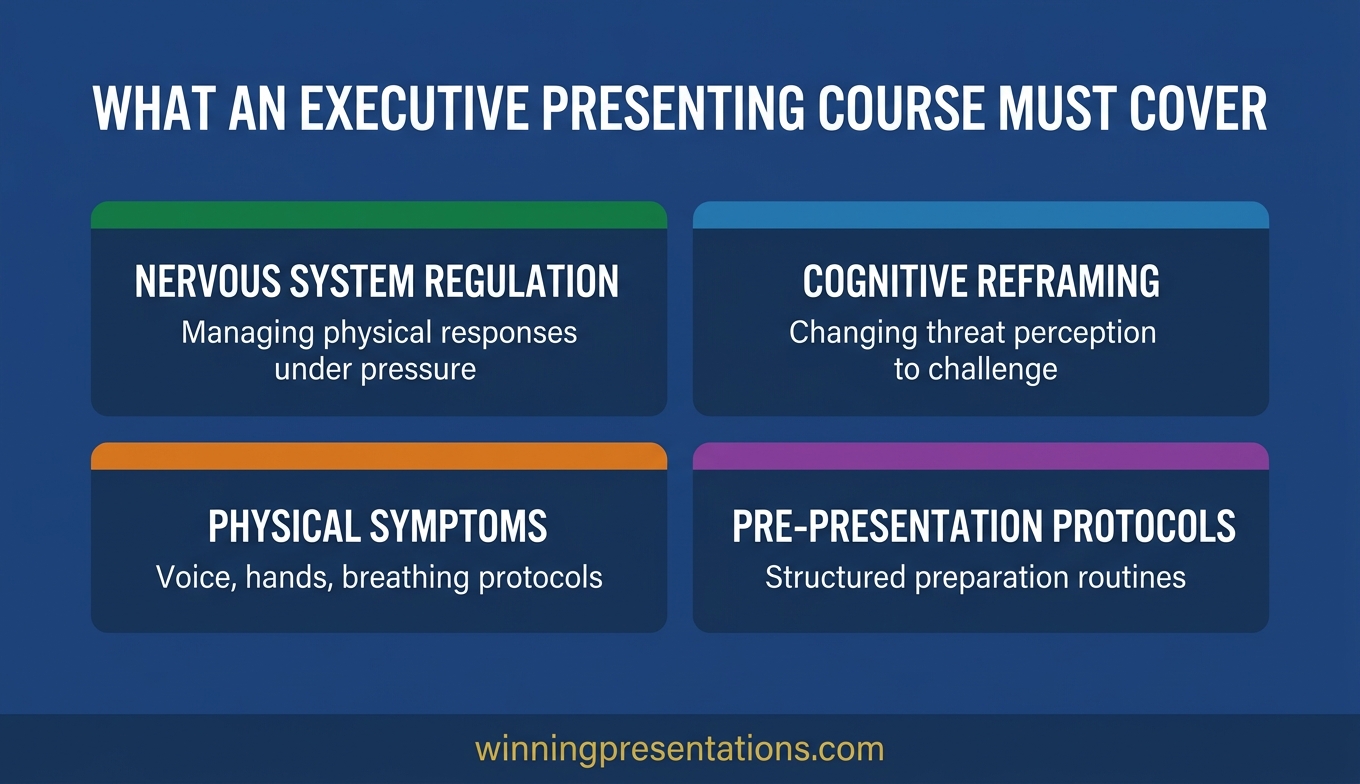

Infographic showing the four components an executive presenting course must include: nervous system regulation, cognitive reframing, physical symptom management, and pre-presentation protocols

Address the Root Cause, Not Just the Symptoms

Conquer Your Fear of Public Speaking — £39, instant access — is a neuroscience-based programme designed for experienced professionals whose presentation anxiety has neurological roots, not knowledge gaps:

  • Nervous system regulation techniques to manage the fight-or-flight response before it takes hold
  • Cognitive reframing protocols for the distorted thinking patterns that intensify under pressure
  • Physical symptom management for trembling, voice constriction, and visible anxiety signs
  • Pre-presentation preparation sequences you can deploy in the thirty minutes before any high-stakes presentation

Get Conquer Your Fear of Public Speaking →

Designed for executives and senior professionals who present at board, committee, and leadership level.

How Executive Presenting Is Different

Executive presentations carry specific pressures that general-audience programmes do not account for. Understanding these differences is essential when evaluating whether a presenting confidence programme will actually help at your level.

The audience has authority over your career. When you present to a board, a senior leadership team, or an investment committee, the people in the room have direct influence on your promotion, your budget, or your project’s survival. This is not the same as presenting to peers. The stakes are not hypothetical — they are career-defining, and your nervous system knows it.

The tolerance for visible anxiety is lower. At executive level, visible nervousness signals something different than it does in a training room. In a workshop, nerves are expected and sympathised with. In a boardroom, visible anxiety can be interpreted as a lack of conviction in your own recommendation — which undermines the entire purpose of the presentation.

Q&A is unpredictable and consequential. Senior audiences ask questions that go beyond the prepared material. They challenge assumptions. They probe for weaknesses. They ask questions designed to test your thinking, not just your content. If your anxiety management strategy only covers the prepared portion of the presentation, you are vulnerable in the exact moment that matters most.

Repetition is not an option. In most presentation skills courses, you practise in front of the group, receive feedback, and try again. In executive presenting, there is no second attempt. The board meeting happens once. The funding review happens once. The promotion panel happens once. Any programme that relies on gradual desensitisation through repeated exposure misses the reality of executive presenting: you need to perform in a context where the first attempt is the only one.

This is why the right presentation anxiety course for executives focuses on equipping you to manage a single high-stakes event, not building comfort through volume.

Five Criteria for Evaluating Any Programme

If you are comparing options and trying to determine which executive presenting programme will actually deliver results at your level, apply these five criteria. They separate programmes designed for real-world executive conditions from those that sound good in a brochure.

1. Does it address the nervous system, or just mindset? If the programme’s primary approach to anxiety is “think positively” or “visualise success,” it is not addressing the physiological activation that drives presentation anxiety. Look for content that explicitly covers nervous system regulation, breathing techniques designed for pre-presentation deployment, and somatic approaches that work with the body rather than trying to override it with willpower.

2. Is it designed for self-paced application, or does it require group attendance? Senior executives have unpredictable schedules. A programme that requires you to attend fixed sessions on specific dates may be impractical. Self-paced programmes that you can work through around your actual schedule — and return to when a specific high-stakes presentation is approaching — tend to produce better long-term results because you use them when you need them.

3. Does it include protocols you can deploy immediately? Theory without application is an academic exercise. Effective programmes give you specific, step-by-step sequences you can use before your next presentation. Not principles to reflect on — actions to take in the thirty minutes before you walk into the room.

Conquer Your Fear of Public Speaking includes exactly these kinds of deployable protocols — nervous system regulation, cognitive reframing, and pre-presentation preparation sequences you can use before any high-stakes event.

4. Does it acknowledge that confidence is context-dependent? You may be confident presenting to your team but anxious presenting to the board. A programme that treats confidence as a single quality — “build your confidence and it will transfer everywhere” — is oversimplifying. Look for content that addresses the specific contexts where your confidence breaks down: seniority of audience, formality of setting, unpredictability of Q&A, personal career stakes.

5. Does it address what happens after the presentation? Many executives experience a post-presentation shame spiral — replaying every stumble, every question they handled imperfectly, every moment where their anxiety was visible. This post-event rumination reinforces the anxiety for next time. Programmes that address this cycle, not just the presentation itself, produce more durable improvement.
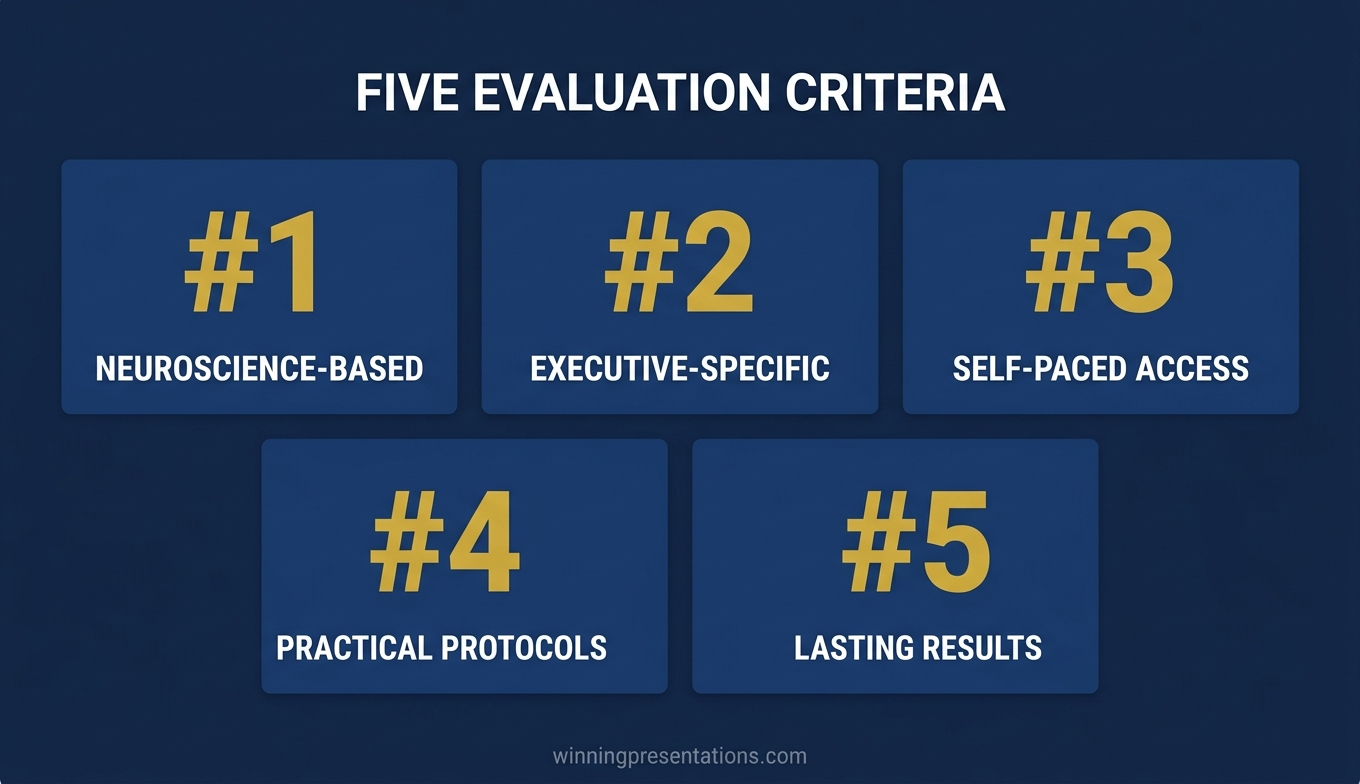

Infographic showing five evaluation criteria for executive presenting courses: nervous system focus, self-paced format, deployable protocols, context-specific confidence, and post-presentation support

Common Objections — and What the Evidence Shows

“I should be able to handle this without a course.” This is the most common objection, and it reflects a misunderstanding of how presentation anxiety works. You cannot think your way out of a nervous system activation any more than you can think your way out of a racing heart during a sprint. The neurological response is not a character weakness — it is a predictable physiological pattern that responds to specific interventions, not to willpower. Executives who struggle with this are typically high-performers in every other dimension. The anxiety is a system problem, not a competence problem.

“I’ve tried courses before and they didn’t help.” If the courses you tried focused on delivery technique, body language, and motivational exercises, they were not addressing presentation anxiety. They were addressing presentation skill — a related but different challenge. A programme designed for anxiety-driven performance issues works at the neurological level: regulating the nervous system, interrupting catastrophic thinking patterns, and managing the physical symptoms that undermine delivery. If your previous courses did not include these components, you have not yet tried the approach most likely to help.

“At my level, people will judge me for needing help with this.” The reality is precisely the opposite. Senior professionals who invest in managing their presentation performance are making a strategic career decision. The executives who struggle most are the ones who avoid addressing the problem and instead develop elaborate avoidance strategies — delegating presentations, reading from scripts, or limiting their visibility. These strategies cap career progression far more visibly than seeking professional development.

See also: how your physical position affects presentation confidence and delivery.

Ready to Address the Real Problem?

Conquer Your Fear of Public Speaking — £39, instant access — gives you the neuroscience-based protocols to manage presentation anxiety at its source. Nervous system regulation. Cognitive reframing. Physical symptom management. Pre-presentation preparation. Work through it at your own pace, and return to it before any high-stakes event.

Get Conquer Your Fear of Public Speaking →

Designed for executives and senior professionals who need to present with authority under pressure.

Frequently Asked Questions

Is a confident presenting course worth it for someone who already presents regularly?

Yes — if the course addresses the specific gap you are experiencing. Presenting regularly without addressing underlying anxiety or performance issues simply reinforces the patterns you already have. A programme that targets nervous system regulation, cognitive reframing, and physical symptom management gives you tools your experience alone will not provide. The investment pays for itself the first time you walk into a board presentation and manage your physiological response rather than being managed by it.

How long does it take to see results from a presentation confidence programme?

The nervous system regulation and pre-presentation protocols can produce a noticeable difference in your very next presentation — these are techniques you deploy immediately, not skills that require months of practice. The cognitive reframing component typically takes longer to become automatic, usually two to four high-stakes presentations before the new thinking patterns begin to override the old ones. Full integration — where the techniques become your default response rather than something you consciously deploy — generally occurs over eight to twelve weeks of regular use.

Does this work for virtual presentations as well as in-person ones?

The underlying neuroscience is identical regardless of format. Your nervous system activates in response to perceived threat — and a virtual presentation to a senior audience triggers the same fight-or-flight response as an in-person one. The regulation techniques, cognitive reframing protocols, and pre-presentation preparation sequences work in both contexts. Some executives find virtual presentations more anxiety-inducing because they cannot read the room as easily, which creates additional uncertainty. The programme addresses this through the cognitive reframing component, which targets the specific thought patterns that escalate anxiety when feedback cues are limited.

What if my anxiety is specific to Q&A rather than the presentation itself?

Q&A anxiety is one of the most common patterns at executive level, because Q&A is the least controllable part of any presentation. The nervous system regulation techniques in Conquer Your Fear of Public Speaking are designed to be deployed in real time — including during transitions from prepared content to unscripted Q&A. The cognitive reframing component specifically addresses the catastrophic thinking that Q&A triggers: “What if I don’t know the answer?”, “What if they think my analysis is weak?”, “What if they ask about the one thing I’m not prepared for?” These thought patterns are predictable and interruptible with the right protocol.

The Winning Edge — Weekly Presentation Intelligence

Every Thursday, one framework or technique for presenting with authority at executive level — drawn from 25 years of boardroom experience and 16 years training senior professionals. Join The Winning Edge →

Mary Beth Hazeldine is the Owner & Managing Director of Winning Presentations. With 25 years of corporate banking experience at JPMorgan Chase, PwC, Royal Bank of Scotland, and Commerzbank, she advises executives across financial services, healthcare, technology, and government on structuring presentations for high-stakes funding rounds, board briefings, and leadership decisions.

20 Apr 2026
Executive sitting calmly in a quiet corporate office before a high-stakes presentation, composed and focused, reviewing notes, navy tones, editorial photography style

Cognitive Restructuring for Presentation Anxiety: Reframe the Thoughts That Hold You Back

Quick Answer

Cognitive restructuring is the practice of identifying distorted or catastrophic thoughts before a presentation and replacing them with more accurate ones. It does not mean thinking positively — it means thinking correctly. Most presentation anxiety is maintained by thoughts that overestimate the probability and severity of failure. Challenging those thoughts directly, rather than suppressing them, is one of the most evidence-backed approaches to reducing chronic pre-presentation fear.

Tomás had presented to small groups without difficulty for most of his career. But after a difficult board meeting three years earlier — one where his numbers had been challenged publicly and he had stumbled through a response he knew was inadequate — something shifted. The anticipatory dread that preceded every major presentation became intense. He began losing sleep the night before. His preparation time tripled, not because he was less competent, but because no level of preparation felt sufficient to prevent the same thing happening again.

He described it to me as “waiting for the ambush.” The actual presentations, when they came, were rarely catastrophic. But the period leading up to them had become almost unbearable.

What Tomás was experiencing is a pattern I see frequently in experienced executives: anxiety maintained not by the reality of their presentations, but by the content of their thoughts about them. His mind had drawn a direct causal line between the difficult board meeting and the conclusion that future high-stakes presentations would produce the same outcome. Every subsequent presentation activated that prediction.

Cognitive restructuring is the process of examining that kind of prediction directly — testing its accuracy rather than accepting it or suppressing it.

Is pre-presentation dread affecting your performance?

Conquer Speaking Fear is a 30-day programme that uses clinical hypnotherapy and nervous system regulation techniques to address the root causes of presentation anxiety — including the thought patterns that sustain it.

Explore the Programme →

What Actually Maintains Presentation Anxiety

Presentation anxiety is not simply a response to difficult presentations. If it were, it would resolve naturally once those presentations passed without disaster. For many people, it does not resolve — it escalates. Understanding why requires looking at what maintains the anxiety rather than what originally caused it.

The primary mechanism is anticipatory cognition: the thoughts generated in advance of a presentation about what is likely to happen and how bad it will be. These thoughts are not neutral predictions. They tend to be systematically biased in the direction of threat. They overestimate the probability of negative outcomes. They underestimate the ability to recover from difficulty. They treat worst-case scenarios as the most likely ones.

These biased predictions produce physical symptoms — elevated heart rate, tension, disrupted sleep — which the anxious mind then interprets as further evidence that something bad is going to happen. This loop between catastrophic prediction and physical response is what maintains anxiety across presentations, regardless of how well the actual presentations go.

Avoidance also plays a role. When anxiety becomes intense enough, the natural response is to reduce exposure to the triggering situation. For executives, full avoidance is rarely possible — but partial avoidance is common. Delegating presentations to colleagues, choosing shorter formats, avoiding meetings where difficult questions are likely. These strategies reduce short-term discomfort but prevent the disconfirmation experiences that would, over time, naturally reduce anxiety. Cognitive restructuring interrupts this pattern by targeting the prediction directly, before avoidance becomes the dominant strategy.

The Five Cognitive Distortions Most Common in Presenters

Cognitive distortions are patterns of thinking that deviate systematically from accurate appraisal. In the context of presentation anxiety, five are particularly common.

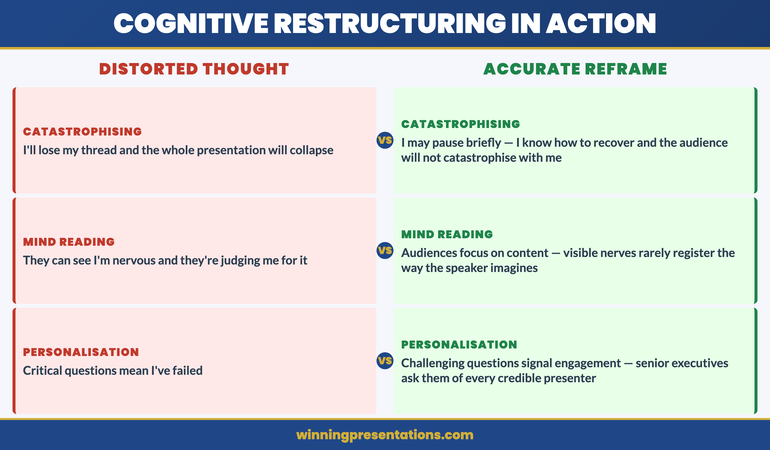
Catastrophising is the tendency to predict the worst possible outcome and treat it as likely. “I will forget my key point and the whole presentation will fall apart” is a catastrophising thought. It conflates a genuine possibility (forgetting a point) with an unlikely cascade (the whole presentation collapsing).

Mind reading involves assuming you know what others are thinking, usually negatively. “They can see I’m nervous and they’re judging me for it” is a mind-reading thought. Audiences are generally focused on content, not on monitoring a presenter’s internal state.

All-or-nothing thinking frames outcomes in binary terms: either the presentation is a complete success or a failure. This distortion removes the vast middle ground of “it went reasonably well and achieved its purpose.”

Fortune telling involves predicting negative outcomes with unwarranted certainty. “They won’t approve this” treated as a fact rather than a possibility is fortune telling. It forecloses options that haven’t yet been determined.

Personalisation attributes difficult moments entirely to internal inadequacy. When a presentation generates critical questions, personalisation interprets this as evidence of personal failure rather than a normal feature of executive decision-making. Critical questions are frequently a sign of engagement, not rejection.

Five cognitive distortions in presentation anxiety: Catastrophising, Mind Reading, All-or-Nothing Thinking, Fortune Telling, and Personalisation — with a brief description of each pattern

The Cognitive Restructuring Process Step by Step

Cognitive restructuring is not positive thinking. It is not replacing a negative thought with an optimistic one. It is a structured process of examining a thought’s accuracy and replacing distorted predictions with more calibrated ones.

The process has four steps. First, identify the specific thought. Not the emotion (“I feel anxious”) but the thought behind it (“I am going to lose control of the Q&A and the committee will lose confidence in me”). The more precisely you can articulate the thought, the more effectively you can examine it.

Second, examine the evidence. What evidence supports this prediction? What evidence contradicts it? How many times have you lost control of a Q&A session in the last five years? How many presentations have resulted in a committee losing confidence in you in ways that had lasting consequences? In most cases, the evidence against the catastrophic prediction substantially outweighs the evidence for it.

Third, generate an alternative thought — not an optimistic one, a realistic one. Not “the Q&A will go brilliantly” but “I may face a difficult question I can’t answer immediately, and I know how to handle that: I can acknowledge it, take a note, and follow up.” This is accurate and manageable rather than either catastrophic or falsely reassuring.

Fourth, assess the outcome. After generating the alternative thought, how does your anxiety level change? Not to zero — that is not the goal. But typically, replacing a distorted prediction with an accurate one reduces the intensity of anticipatory anxiety to a level that does not impair preparation or performance.

Conquer Speaking Fear

A 30-day programme for executives whose presentation anxiety goes beyond ordinary nerves. Conquer Speaking Fear — £39, instant access — combines clinical hypnotherapy techniques, nervous system regulation, and structured cognitive approaches to address the root causes of presentation fear.

  • Daily audio sessions using clinical hypnotherapy techniques
  • Nervous system regulation practices for pre-presentation symptoms
  • Cognitive frameworks for challenging anxiety-maintaining thoughts
  • A 30-day structured programme with progressive exposure

Get Conquer Speaking Fear →

Designed for executives experiencing persistent or escalating presentation anxiety.

Working with Catastrophic Thinking Specifically

Catastrophising deserves extended attention because it is both the most common distortion in presentation anxiety and the one that generates the most intense anticipatory dread. It typically follows a chain of “and then what?” thinking that escalates a plausible difficulty into a career-threatening event.

The interruption technique is to follow the chain deliberately, all the way to its actual endpoint, and examine how likely each link is. “I might forget my key point → and then I’ll lose my thread → and then the audience will see I’m struggling → and then they’ll lose confidence in my judgement → and then my proposal will be rejected → and then my reputation will be damaged.” Each link in that chain is far less probable than the one before it. Most presenters who momentarily lose their thread recover within thirty seconds. Audiences do not interpret a brief pause as evidence of fundamental incompetence.

A second technique is the decatastrophising question: “If the worst-case scenario actually happened, what would I do?” This is not resignation. It is preparation. Most executives who work through this question discover that even their worst-case scenario — a failed presentation, a deferred proposal, a difficult Q&A — is something they have survived before, or is something they could navigate with the resources available to them. The catastrophe, when examined rather than avoided, turns out to be survivable.

If your anxiety around presenting has begun to affect your physical symptoms in the run-up to high-stakes meetings, the article on projecting confidence through a camera covers some of the physical regulation techniques that complement cognitive work.

If you want a structured programme for working through both the cognitive and physical dimensions of presentation anxiety together, Conquer Speaking Fear was designed specifically for executives whose anxiety goes beyond ordinary nerves.

Applying Restructuring in the Hour Before You Present

Cognitive restructuring is most effective when practised regularly rather than applied as an emergency intervention five minutes before you walk into the room. Nevertheless, there is a condensed version that can be useful in the final hour before a presentation when anxiety is already elevated.

The single most valuable question to ask in that period is: “What am I predicting right now?” Not “how do I feel?” but specifically what outcome your mind is predicting. Once the prediction is articulated explicitly, apply the evidence test quickly: in how many similar situations has this prediction come true? If the honest answer is rarely or never, that is the accurate replacement thought: “This has rarely happened in similar situations, and I am as well-prepared as I have been for those.”

Physical anchoring supports this process. The cognitive work is harder when the nervous system is in a state of high activation — which is precisely when you are trying to use it. A brief period of slow, controlled breathing (four counts in, hold for four, six counts out) reduces physiological arousal enough to make clearer thinking more accessible. This is not a substitute for cognitive work; it creates the conditions in which cognitive work is more effective.

In the room itself, the most useful cognitive anchor is task focus rather than self-focus. Self-focused attention (“how am I coming across?”, “do they look engaged?”) amplifies anxiety. Task-focused attention (“what is the most important point to make here?”, “what does this person’s question need from me?”) reduces it. The shift is intentional and practicable. For techniques specifically around managing eye contact and audience connection under pressure, the article on eye contact in presentations covers this in detail.

Pre-presentation hour protocol: three steps — Identify the prediction, Apply the evidence test, Shift to task focus — with the question to ask at each stage

Changing Patterns Over Time, Not Just Individual Moments

One session of cognitive restructuring before one presentation will reduce anxiety for that presentation. It will not change the underlying pattern. What changes patterns over time is consistent practice across multiple presentations, combined with the gradual accumulation of disconfirmation experiences — presentations that go adequately or well, despite the predictions that they would not.

Keeping a brief written record is more useful than it sounds. After each presentation, note the anxiety prediction you had beforehand and what actually happened. Over three to six months, this record typically reveals a systematic gap between prediction and outcome. The predictions are consistently more negative than the reality. Reviewing this record before subsequent presentations provides evidence that the pattern of over-prediction is a feature of the anxiety, not an accurate reading of reality.

The other factor that changes patterns over time is expanding the range of situations you present in. Anxiety is maintained partly by the brain’s threat appraisal of unfamiliar high-stakes situations. Gradually increasing exposure — taking on presentations that feel slightly outside the comfort zone, rather than staying within what feels safe — provides new evidence that challenges the threat prediction. This is not recklessness; it is systematic desensitisation applied to a professional context.

When Restructuring Alone Is Not Enough

Cognitive restructuring is a powerful technique with a specific scope. It works well for moderate presentation anxiety where the primary maintenance mechanism is distorted thinking. It is less sufficient when anxiety is severe, when physical symptoms are intense enough to impair performance significantly, or when the pattern has become so well-established that cognitive approaches alone cannot interrupt it.

For executives in that situation, a more comprehensive approach is usually required — one that addresses the nervous system regulation component alongside the cognitive one. Hypnotherapy-based techniques work at a level of the brain that direct conscious reasoning does not reach: they can modify the automatic threat response that activates before conscious thought can intervene. This is why they are used in clinical contexts where cognitive approaches alone have not been sufficient.

It is also worth noting that some degree of pre-presentation arousal is normal and useful. The goal is not to eliminate all physical or cognitive signs of activation before a presentation. Moderate arousal sharpens attention and improves performance. The goal of cognitive restructuring — and of more comprehensive programmes — is to bring arousal down from the level that impairs performance to the level that enhances it.

If you present in remote or virtual settings and notice that anxiety is particularly pronounced in that context, the article on managing anxiety when presenting to a camera addresses the specific dynamics of virtual presentation fear.

Conquer Speaking Fear

A 30-day programme combining clinical hypnotherapy and cognitive techniques for executives with persistent presentation anxiety. £39, instant access.

Get Conquer Speaking Fear →

Designed for executives whose anxiety goes beyond ordinary nerves and affects preparation or performance.

Frequently Asked Questions

How quickly does cognitive restructuring work for presentation anxiety?

Many people notice a meaningful reduction in anticipatory anxiety within the first few sessions of deliberate cognitive restructuring practice. However, the effect is cumulative: the technique becomes more effective as it becomes more automatic, which typically takes consistent practice over several weeks. For well-established anxiety patterns, three to six months of regular practice — combined with the gradual accumulation of disconfirmation experiences from actual presentations — is a more realistic timeframe for significant change. This is not a criticism of the technique; it reflects how deeply ingrained thought patterns work.

Is cognitive restructuring the same as positive thinking?

No, and the distinction matters. Positive thinking replaces a negative thought with an optimistic one, regardless of accuracy. Cognitive restructuring replaces a distorted thought with an accurate one. If an accurate assessment of a situation suggests that a presentation carries genuine risk, cognitive restructuring would not deny that risk — it would help you appraise it proportionately rather than catastrophically, and identify what you can do to manage it. The goal is calibration, not optimism.

Can cognitive restructuring help with the physical symptoms of presentation anxiety?

Partly. Physical symptoms of anxiety — elevated heart rate, trembling, voice changes — are produced by the threat appraisal system, which is what cognitive restructuring directly addresses. When the threat appraisal is modified, physiological arousal typically reduces. However, for executives whose physical symptoms are severe or occur very early in the anticipatory period, complementary techniques that work directly on the nervous system — breathing practices, progressive muscle relaxation, hypnotherapy-based approaches — tend to produce faster and more complete relief of physical symptoms.

The Winning Edge — A Newsletter for Executives Who Present

Every Thursday: one practical technique for managing the mental and physical demands of high-stakes presenting. Written for executives who want to perform at their best under pressure.

Subscribe to The Winning Edge →

Related: if you are preparing for a high-stakes Q&A and want to feel more grounded when difficult questions arrive, read the companion article on when honesty is the most credible answer in Q&A.

About the Author

Mary Beth Hazeldine is the Owner and Managing Director of Winning Presentations. With 25 years of corporate banking experience at JPMorgan Chase, PwC, Royal Bank of Scotland, and Commerzbank, she advises executives across financial services, healthcare, technology, and government on structuring presentations and managing the psychological demands of high-stakes presenting.

16 Apr 2026
Male executive answering a challenging question in an investment committee meeting, calm measured expression, senior questioners visible around the table, formal boardroom setting

Voice Control in Q&A: Why Experienced Presenters Sound Measured Under Pressure

Quick answer: Your voice changes during Q&A because the physiological activation of being questioned — elevated cortisol, muscle tension, shallower breath — directly affects the vocal mechanism. Experienced presenters sound measured under questioning not because they feel less pressure, but because they have developed specific disciplines: slowing the pace of their first sentence, using a deliberate pause before answering, and maintaining a lower pitch register through breath management. These are learnable techniques, not personality traits.

Kwame had presented the strategy update without difficulty. Twenty-two minutes, clean delivery, the slides doing exactly what he had intended. Then the investment committee chair asked a question he had not fully anticipated — not a hostile one, not even a particularly difficult one, but one that required him to think carefully before answering.

He heard it immediately — the slight thinness in the first word of his answer, the pace that was fractionally too fast, the pitch that had risen in a way he could not control in real time. He was answering correctly. He knew that. But the voice was not matching the confidence he felt intellectually. The committee chair asked a follow-up question. Kwame’s second answer was better. His third was back to where he needed to be. But the first two had set a tone, and he knew it.

The post-meeting debrief with his executive coach focused almost entirely on the transition between the presentation and the Q&A. The coach pointed out that Kwame was not anxious during the presentation — he had rehearsed it thoroughly and was genuinely comfortable with the material. The Q&A was different because it was unpredictable, and unpredictability activated a physiological response that the presentation had not. The voice reveals that shift. Learning to manage the voice in those first few seconds of an answer, the coach said, was the most important single skill Kwame could develop before his next committee presentation.

If Q&A is where your executive presentations tend to lose momentum — through vocal uncertainty, hesitation, or answers that trail off before reaching a clear point — the Executive Q&A Handling System provides a structured approach to managing the full Q&A process.

Explore the System →

Why Your Voice Changes Under Executive Questioning

The transition from presentation to Q&A is one of the most significant shifts in any executive briefing — not because the content changes, but because the presenter’s relationship to what they are saying changes fundamentally. A prepared presentation is delivered from a position of relative control. A question interrupts that control, requires real-time processing, and introduces an element of unpredictability that the nervous system registers as exposure.

The voice reflects this shift because the vocal mechanism is directly affected by the physiological state of the presenter. When cortisol and adrenaline increase — as they do when the nervous system perceives the evaluative exposure of being questioned by a senior audience — the muscles of the throat, jaw, and chest tighten. Breathing becomes shallower, reducing the air support available to the voice. The result is a voice that rises in pitch, reduces in volume, or increases in pace — sometimes all three simultaneously.

For senior audiences, these vocal changes carry interpretive weight. A voice that rises in pitch or speeds up under questioning signals uncertainty about the answer, discomfort with the questioner, or reduced confidence in the position being defended. The audience is not making a conscious diagnostic assessment — they are simply responding to what the voice communicates at a level below deliberate analysis. The effect on perceived authority is real even when the audience cannot articulate why they feel less confident in the presenter.

This dynamic is particularly pronounced in two types of Q&A: when the question is one the presenter was not expecting, and when the questioner is visibly more senior than the presenter or has a reputation for rigorous challenge. Both situations increase the physiological activation above the baseline, which makes the vocal management problem correspondingly harder. Understanding why this happens is the prerequisite for developing the techniques that address it.

Executive Q&A Handling System — £39, instant access

Handle Executive Questions With Consistency, Clarity, and Authority

The Executive Q&A Handling System is a structured framework for predicting, preparing for, and managing the questions that matter most in high-stakes executive presentations. It covers question analysis, response frameworks, and the specific disciplines for maintaining authority when questions are difficult, unexpected, or adversarial.

  • Frameworks for predicting and preparing for high-risk questions
  • Response structures for difficult, unexpected, and loaded questions
  • Techniques for maintaining composure and vocal authority in live Q&A
  • System for handling Q&A in board, investor, and senior leadership contexts

Get the Executive Q&A Handling System →

Designed for executives who present to boards, investors, and senior leadership teams where Q&A is high-stakes.

The Physiological Pattern That Breaks Down Vocal Control

Vocal control under pressure depends on three physiological elements: adequate breath support, relaxed throat and jaw musculature, and a pace of speech that allows the vocal mechanism to function without strain. When a difficult question activates the stress response, all three of these elements are compromised simultaneously — which is why the vocal deterioration under questioning can happen so quickly and feel so difficult to reverse once it has started.

Breath is the most fundamental. The voice is an air-driven instrument, and shallow breathing — the breathing pattern that stress produces — reduces the air column that supports the voice. A voice without adequate breath support loses its lower frequencies first, which is why anxiety tends to produce a higher, thinner vocal quality. The pitch is not deliberately chosen to be higher — it is the acoustic consequence of reduced breath support.

The pace of speech also accelerates under stress as a function of the activated nervous system. Faster speech reduces the natural pauses that punctuate clear, authoritative communication. Those pauses serve a dual function: they give the speaker time to think, and they give the audience time to absorb what has been said. When stress removes them, the answer begins to feel rushed — even when the content is correct — and the audience receives less time to register each point before the next one arrives.

Understanding this pattern matters because the management strategies that work must address the physiological root rather than simply the surface behaviour. Telling yourself to slow down rarely works in the moment if the underlying breath pattern has not changed. Managing the breath first — through deliberate elongated exhale before beginning the answer — changes the physiological state that is generating the vocal deterioration. The surface behaviour follows.


The physiological chain in Q&A vocal breakdown: stress response activates, breath shallows, throat tightens, pitch rises and pace accelerates — and the management approach that addresses each link

The Three Vocal Habits That Communicate Confidence in Q&A

Experienced Q&A presenters share three vocal habits that distinguish their answers from those of less practised colleagues. These habits are not naturally acquired — they are developed through deliberate practice and the sustained attention that comes from treating the Q&A as a performance discipline in its own right, not simply as the portion of the presentation that happens after the prepared content finishes.

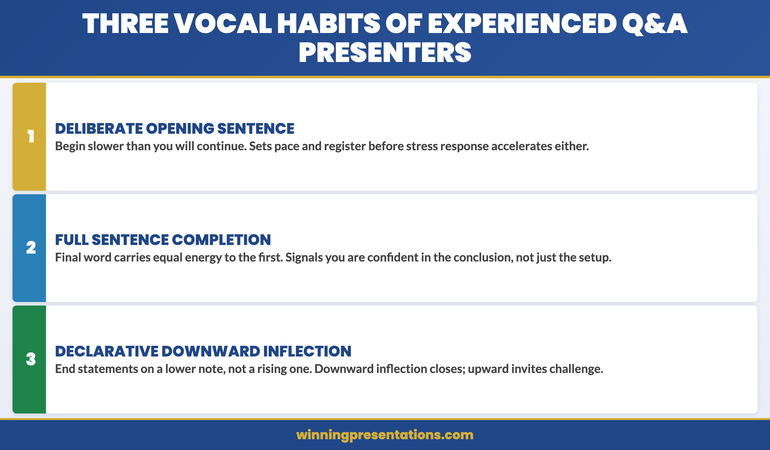
The first habit is the deliberate opening. Experienced Q&A presenters begin their answer with a sentence that is slower and more measured than the pace they will settle into once the answer is underway. This first sentence functions as a vocal reset — it establishes the pace and register of the answer before the stress response has had time to accelerate either. The content of that first sentence is often relatively simple: a brief acknowledgement of the question, a restatement of the core point being addressed, or a one-sentence orientation. What matters is the vocal discipline, not the specific words.

The second habit is finishing sentences fully. Anxious answers trail off — the pitch drops, the volume reduces, and the final words of the sentence are swallowed before they have landed. This happens because the speaker’s attention is already moving to the next idea before the current one has been delivered. Deliberate sentence completion — ensuring that the last word of each sentence carries as much vocal energy as the first — is one of the most audible markers of vocal authority in Q&A. It communicates that the speaker is confident in their conclusion, not just their opening.

The third habit is ending on a lower note. Upward inflection at the end of a statement — a vocal pattern common in some regional accents and increasingly prevalent in professional speech — reads as a question or an invitation for the questioner to push back. A declarative answer delivered with downward inflection at the end of the key sentence communicates that the speaker has arrived at a conclusion, not a hypothesis. This single vocal adjustment — conscious in rehearsal, eventually habitual — changes the perceived authority of an answer even when the content is identical.

Physical stillness during the first sentence of an answer supports all three habits. The companion article on movement during presentations covers how physical grounding and deliberate stillness interact with vocal authority — the voice and the body reinforce each other, and managing one makes the other easier.

What to Do When Your Voice Catches Mid-Answer

A voice catch — the brief loss of vocal control that produces a crack, a break in sound, or a sudden increase in pitch mid-sentence — is one of the most disconcerting experiences for a presenter in a high-stakes Q&A. It is involuntary, it is visible to the room, and it produces an immediate self-consciousness that makes the next few seconds of the answer harder to manage than they would otherwise have been.

The most important single thing to know about a voice catch is that the audience’s interpretation of it is shaped almost entirely by what the presenter does immediately afterwards. A voice catch followed by a confident continuation of the answer at the same pace and pitch is read by most audiences as a normal human response to pressure — something that happens, noted briefly, and then forgotten. A voice catch followed by visible distress, a sharp intake of breath, or a halting restart amplifies the moment and makes it the thing the audience remembers.

The practical recovery sequence for a voice catch in Q&A is brief and simple. Pause for one full second — not in the way that signals panic, but in the deliberate way that signals that you are choosing your next words carefully. Take a breath during that pause — not a visible gasp, but a natural breath that replenishes the air support the voice needs. Resume the sentence from the point where the catch occurred, at a slightly slower pace than before, with full sentence completion on the next thought. The pause absorbs the catch; the resumption defines what the room remembers.

For managing the broader Q&A dynamic when questions feel adversarial or when the room has turned against a position, the article on hostile questioner simulation covers how to practise the specific pressure scenarios that make voice catches most likely — and how rehearsed exposure to those scenarios reduces their impact.

For executives who want a systematic approach to managing the full Q&A session, the Executive Q&A Handling System covers the preparation, response structure, and in-the-moment disciplines that experienced Q&A presenters use in board, investor, and senior leadership contexts.


Q&A vocal authority framework showing the three vocal habits of experienced presenters: deliberate opening sentence, full sentence completion, and declarative downward inflection — with examples of each

Pre-Q&A Vocal Preparation in Under Five Minutes

The quality of your vocal performance in Q&A is influenced by your physical and vocal state when the Q&A begins — not only by the techniques you apply once questions start arriving. Five minutes of deliberate preparation before the session begins can meaningfully change your baseline vocal state at the point of transition from presentation to questioning.

Breath is the starting point. Three to five slow, extended exhales — longer than feels natural, emptying the lungs more fully than normal breathing — activate the parasympathetic nervous system and reduce the cortisol-driven activation that constricts the throat and raises pitch. This exercise is not meditative — it is physiological. The extended exhale is the most effective single technique for reducing the physical tension that will otherwise manifest as vocal deterioration when the first question arrives. Do this in a private space in the final few minutes before the session begins.

Speaking aloud at your intended vocal register for two to three minutes before the session also helps to warm the vocal mechanism and establish the pace and pitch you intend to use. This does not require a formal warm-up — reading a few paragraphs from any document at the pace and register you intend to use in the Q&A is sufficient. The purpose is to make that vocal setting feel normal before the pressure of the session makes accessing it harder.

One additional preparation that experienced Q&A presenters use is rehearsing the first sentence of several different types of answer out loud. Not the full answer — just the opening sentence for a factual question, a challenge question, and a question requiring a more nuanced response. The purpose is not to script the answers, but to make the physical and vocal experience of beginning an answer feel familiar. When the first question arrives and the stress response activates, having said something similar out loud in the preceding ten minutes makes the opening discipline easier to access.

The Pause That Resets Vocal Authority in Live Q&A

The deliberate pause before answering a question is one of the most consistently underused tools in executive Q&A. Most presenters begin answering before they have fully formed the answer — because the social pressure of a question feels like a demand for an immediate response, and silence in a group setting feels like exposure. Both of these are perceptions rather than realities. Senior audiences do not experience a two-second pause as emptiness. They experience it as the presenter taking the question seriously.

The pause serves two distinct functions. The first is cognitive — it gives you time to hear the question fully, decide what the core point is, and formulate the first sentence of your answer before you begin speaking. Answers that start well tend to continue well; answers that start with an unformed thought often recover but do so less authoritatively than an answer that opened from a clear position. The pause buys the time to start well.

The second function is physiological. A deliberate pause — not an anxious silence, but a conscious and intentional beat — allows for one full breath before the answer begins. That breath changes the vocal output of the answer. It deepens the register slightly, reduces the pace of the opening sentence, and sets a physical baseline that is closer to composed than to reactive. The pause is the single most accessible in-the-moment vocal management tool available to Q&A presenters, and it works every time it is applied deliberately.

The pause works best when the presenter has already established an expectation of thoughtfulness with the room — when the question has been heard fully, acknowledged briefly (“that’s the right question to raise”), and then a one-beat pause taken before the answer begins. In this context, the pause feels like part of the engagement, not like a moment of difficulty. For more on the mechanics and application of the deliberate pause in executive presentations, the article on the pause technique in presentations covers how silence functions as an authority signal and how to use it without it feeling awkward.

For executives who face structured Q&A challenges — where questioners are persistent, where questions are designed to expose gaps in the position, or where the same objection appears in multiple forms — the article on anticipating executive objections before the session covers the preparation framework that makes the in-session vocal management techniques more effective. Vocal control is significantly easier when the answer is already well-formed before the question is asked.

Executive Q&A Handling System — £39, instant access

A Complete Framework for Predicting, Preparing, and Handling Executive Q&A

The Executive Q&A Handling System gives you the preparation framework and response structures experienced executives use to maintain authority through difficult, unexpected, and adversarial questions — including the vocal and physical disciplines that distinguish composed Q&A presenters from those who lose ground under questioning.

Get the Executive Q&A Handling System →

Designed for executives presenting to boards, investors, and senior leadership teams where Q&A is high-stakes.

Frequently Asked Questions

Why does my voice rise in pitch when I answer questions from very senior people?

Pitch rises under pressure because the muscles of the throat and larynx tighten when cortisol and adrenaline are elevated — and senior questioners typically produce a higher activation response than peers or subordinates. The tighter the throat musculature, the higher the pitch. The direct management approach is breath-first: an elongated exhale before beginning the answer reduces the muscle tension that is raising the pitch. This approach works physiologically rather than trying to consciously lower the pitch, which most people cannot do reliably under genuine pressure.

How long should the pause before an answer be in executive Q&A?

One to two seconds is the most effective range for a deliberate pause before beginning a Q&A answer in most executive contexts. Shorter than one second and the pause does not register as intentional — it simply disappears into the rhythm of the conversation. Longer than three seconds in a standard Q&A context begins to feel like difficulty rather than deliberateness, unless the question is genuinely complex and the pause has been framed explicitly (“let me think about that for a moment”). The one-to-two second pause, combined with a brief breath, is long enough to change the physiological state and short enough to read as thoughtful rather than uncertain.

Does practising Q&A out loud actually make a difference to vocal performance in the room?

Yes — and the mechanism is specific. When you practise answering questions out loud at the pace and register you intend to use, you are building a physical and vocal memory of that state. When the pressure of the actual Q&A activates the stress response, your nervous system has a reference point for what the correct vocal state feels like from the inside. Without that reference, you are trying to access a physical state you have not recently inhabited. With it, you are trying to return to somewhere familiar. The difference in accessibility is significant, particularly in the critical first few seconds of the first answer.

The Winning Edge — Weekly Newsletter

One Insight Per Week on Executive Communication

Each week, The Winning Edge delivers one focused insight on executive communication — structure, delivery, influence, and the mechanics of getting senior audiences to yes. Straightforward, applicable, and written for people who present under pressure.

Subscribe to The Winning Edge →

About the Author

Mary Beth Hazeldine — Owner & Managing Director, Winning Presentations

With 25 years of corporate banking experience at JPMorgan Chase, PwC, Royal Bank of Scotland, and Commerzbank, Mary Beth now advises executives across financial services, healthcare, technology, and government on structuring and delivering high-stakes presentations — including the Q&A sessions that determine whether a well-prepared case is accepted or challenged. Winning Presentations is her specialist advisory practice.

14 Apr 2026

Power Posing Before Presentations: What the Research Actually Shows

Quick Answer
Power posing before presentations — standing in an expansive posture for two minutes — does not reliably produce the hormonal changes Amy Cuddy’s original 2010 study claimed. Independent replications have not reproduced the cortisol and testosterone findings. What the research does support is that open, upright posture affects your own psychological state — not through hormone changes, but through proprioceptive feedback. For executive presenters, the most reliable pre-presentation confidence tools are deliberate preparation, controlled breathing, and an explicit intent statement — not a pose. Understanding why power posing became so popular reveals what presenters actually need.

Marcus had read the book. He had watched the TED Talk three times. Two minutes before every high-stakes presentation, he disappeared into a bathroom cubicle, stood with his hands on his hips and his feet apart, and held the pose for exactly 120 seconds. He had been doing it for four years. He believed it worked — and he believed it so completely that when his L&D director mentioned the replication research at a team meeting, he felt something close to personal offence.

The L&D director was not wrong. The research Marcus had built his pre-presentation ritual around had not replicated. But the L&D director missed something important too: Marcus’s ritual was not entirely without value. The two minutes of stillness, the deliberate separation from the pre-presentation noise, the act of doing something purposeful rather than scrolling his phone in a corridor — all of that had genuine psychological value. The pose itself was irrelevant. The ritual was not.

This distinction — between a specific technique and the category of behaviour it represents — is where most of the power posing debate loses its usefulness. The question is not really “does power posing work?” The question is: what does an executive presenter actually need in the two minutes before they walk into a high-stakes room, and how do they get it reliably?

If presentation anxiety goes deeper than pre-presentation rituals can reach — if the fear is significant enough to affect your performance, your sleep, or your career decisions — Conquer Speaking Fear is a structured 30-day programme that addresses the underlying anxiety pattern, not just the surface symptoms.

Explore the System →

What Power Posing Originally Claimed

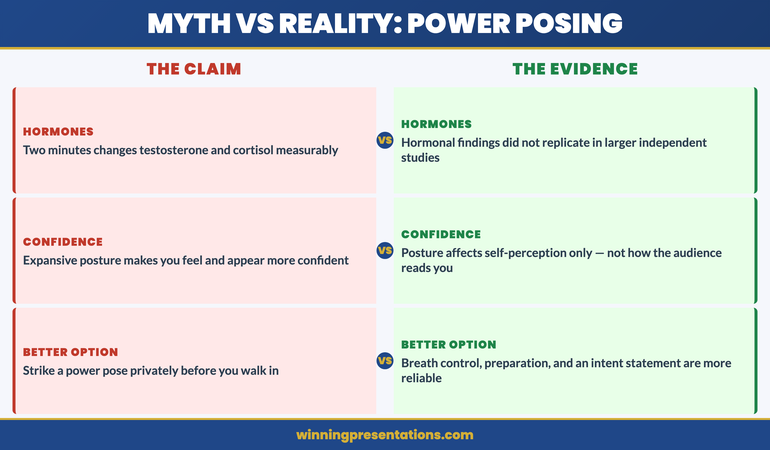
Amy Cuddy and her colleagues published a study in 2010 — later expanded into a widely shared TED Talk and a bestselling book — claiming that standing in an expansive, dominant posture for two minutes produced measurable physiological changes: increased testosterone and decreased cortisol. The conclusion was striking: a brief physical intervention could change your hormonal profile and, consequently, your psychological readiness for a high-stakes situation.

The research attracted enormous popular attention because it offered a simple, accessible, cost-free intervention for one of the most common professional problems: feeling underprepared or inadequate before an important presentation. The idea that two minutes of deliberate posture could level the physiological playing field was intuitively appealing and practically convenient. It required no equipment, no prior training, and no significant time investment.

The TED Talk became one of the most viewed in the platform’s history. It entered corporate learning programmes, coaching curricula, and pre-presentation advice from well-meaning managers worldwide. By the mid-2010s, power posing had achieved the status of established science in most professional training contexts, despite the fact that its scientific foundations were already being actively questioned by researchers in the field.

Myth versus reality of power posing: original hormonal claims versus what replications actually found, and what works instead

What the Replication Research Found

Independent attempts to replicate the hormonal findings of the original power posing study have not produced consistent results. A large pre-registered replication by Ranehill and colleagues in 2015 — involving a significantly larger sample than the original study — found that expansive postures did produce self-reported feelings of power, but did not produce the hormone changes that were central to Cuddy’s original claim. The cortisol and testosterone results did not hold.

Subsequent meta-analyses have generally confirmed this pattern: the psychological effects of posture — feeling more confident, more in control, more ready — are real and replicable. The hormonal effects are not. This distinction matters because the original claim was that power posing worked by changing your biology, which would then change your behaviour. The revised understanding is that power posing, if it has any effect at all, works through cognitive and attentional channels — it shifts what you are thinking about and how you are evaluating your own readiness, not what your hormones are doing.

Cuddy herself has refined her position over time, arguing that the self-reported psychological effects are the meaningful outcome, even in the absence of the hormonal findings. This is a legitimate scientific position, but it represents a significant narrowing of the original claim. The mechanism is different. The magnitude of effect may be different. And the implication for practice is different: if power posing produces a modest self-perception shift rather than a physiological transformation, then it competes directly with other cognitive techniques that may produce comparable or larger effects.

Conquer Speaking Fear — £39

Address the Anxiety Pattern That Rituals Can’t Reach

Pre-presentation rituals help. But if your anxiety is significant — if it follows you into the days before a presentation, affects your sleep, or causes you to avoid high-profile opportunities — it needs more than a posture adjustment. Conquer Speaking Fear is a structured 30-day programme that uses nervous system regulation and clinical hypnotherapy techniques to address the underlying anxiety pattern, not just manage its symptoms.

  • 30-day structured programme for presentation anxiety and public speaking fear
  • Nervous system regulation techniques grounded in clinical practice
  • Clinical hypnotherapy methods adapted for professional presenters
  • Designed for executives whose anxiety pattern affects their career and performance

Get Conquer Speaking Fear →

Designed for professionals whose presentation anxiety is affecting their performance and opportunities.

What Posture Actually Does to Confidence

The research on embodied cognition — the relationship between physical posture and psychological state — is broader than the power posing debate and considerably more robust. Several consistent findings emerge from this literature that are directly relevant to presenters.

First, contracted, closed posture — shoulders rounded, chest caved, head down — has consistent negative effects on self-perception and cognitive performance. The research on this is more reliable than the research on expansive posture effects, possibly because the contrast between collapsed and upright posture is more physiologically significant than the contrast between neutral and expansive posture. If you are anxious before a presentation and your body has collapsed into itself, deliberately correcting your posture to upright — not superhero stance, just neutral upright — will have a measurable positive effect on how you feel.

Second, the relationship between posture and self-perception runs in both directions. Feeling confident tends to produce upright posture; upright posture tends to increase felt confidence. This is proprioceptive feedback — your body’s own sensory system reporting on its physical state and influencing your psychological state in return. This mechanism is real and supported by a substantial body of research. It is why slumping over your phone in a corridor before a presentation is a worse preparation strategy than standing or walking.

Third, the effect of posture on confidence is almost entirely self-directed, not audience-directed. Your posture in the two minutes before a presentation changes how you feel about yourself — it does not reliably change how your audience perceives you from the moment you walk in. Audience perception is shaped by how you carry yourself in the room, how you speak, and how you engage with questions — not by what you were doing in the corridor beforehand.

This reframes the useful question. Rather than asking whether expansive posture changes your hormones, ask: what physical and cognitive state do you want to be in when you walk through the door, and what is the most reliable way to get there in the time available? For most presenters, Conquer Speaking Fear addresses the systematic anxiety pattern that no pre-presentation ritual can fully manage on its own.

For specific physical techniques that reliably reduce anxiety state before a presentation, see the companion article on box breathing for executive presenters — a method with considerably stronger physiological support than power posing.

A Pre-Presentation Confidence Sequence That Works

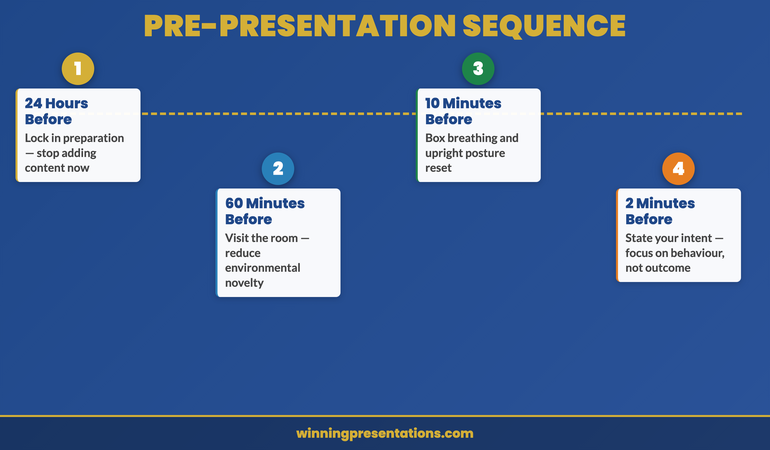
If the goal is to be in the optimal psychological state when the presentation begins, a structured pre-presentation sequence is more reliable than any single technique. The sequence below is designed for the 24 hours preceding a high-stakes presentation and can be adapted based on individual preference and available time.

24 hours before: Preparation lock-in. Make a deliberate decision to stop adding material to your preparation. Late additions to a presentation script or slide deck — made under the time pressure of the night before — consistently increase anxiety without improving presentation quality. The preparation phase should have ended by 24 hours before delivery. If you are still making significant changes at this point, note them as a learning for next time, but stop making them now. What you know is what you will present with.

60 minutes before: Environment scan. If possible, visit the presentation room before the audience arrives. Sit in the chair you will present from or stand at the front of the room. This familiarisation exercise reduces the novelty of the environment, which is one of the primary anxiety triggers for executive presenters. An unfamiliar room activates threat-assessment responses. A familiar room does not. This is why a structured pre-presentation ritual that includes environmental familiarisation is worth the time.

10 minutes before: Breath and posture reset. Find a quiet space and do four to six cycles of box breathing — four counts in, four counts hold, four counts out, four counts hold. Simultaneously check your posture: feet flat, shoulders back and relaxed, spine upright. This is not power posing. It is a deliberate physiological reset that reduces sympathetic nervous system activation and restores a baseline of physical composure. The effect is immediate and measurable.

2 minutes before: Intent statement. State — silently or aloud — your intention for the presentation. Not a prediction (“this will go well”) and not a hope (“I want them to like it”). An intent statement is about process: “I am going to be clear, I am going to be direct, and I am going to listen carefully to their questions.” This cognitive anchor replaces rumination about outcome — the most common source of pre-presentation anxiety escalation — with a focus on behaviour that is entirely within your control.

Pre-presentation confidence sequence: 24 hours before, 60 minutes before, 10 minutes before, and 2 minutes before the presentation

When Anxiety Is Deeper Than a Posture Problem

Pre-presentation techniques — power posing, box breathing, visualisation, intent statements — address the surface experience of presentation anxiety: the activation, the racing thoughts, the physical symptoms in the moments before walking in. For many executives, these techniques are sufficient. The anxiety is situational, manageable, and does not significantly affect performance or career decisions.

For others, the anxiety pattern is more persistent. It begins days before the presentation. It involves anticipatory catastrophising — elaborate internal narratives about what might go wrong. It affects sleep. It leads to over-preparation as an anxiety-management strategy rather than a quality-improvement strategy. In some cases, it affects which opportunities executives accept: declining high-profile presentations, deferring to colleagues in senior meetings, avoiding situations that would otherwise advance their careers.

This pattern is not addressable through posture. No two-minute ritual touches the underlying anxiety architecture that is generating it. Addressing it requires working at the level of the nervous system’s threat-assessment — the learned associations and conditioned responses that activate the anxiety cycle in the first place. This is the work that clinical approaches, including the nervous system regulation and hypnotherapy techniques in the cognitive restructuring approach covered in a separate article, are specifically designed to do.

For the Q&A dimension of presentation anxiety — particularly the fear of being caught off-guard by difficult questions — see today’s companion piece on handling repeated questions in presentations. Repeated questions are a particularly common anxiety trigger for executives who interpret them as a signal of inadequacy rather than a routine communication dynamic.

Conquer Speaking Fear — £39

A 30-Day Programme for Persistent Presentation Anxiety

When pre-presentation rituals are not enough — because the anxiety starts earlier, runs deeper, or affects your professional decisions — Conquer Speaking Fear gives you a structured 30-day approach to addressing the underlying pattern, not just managing the moment.

Get Conquer Speaking Fear →

Designed for professionals whose presentation anxiety is persistent and affecting their performance.

Frequently Asked Questions

Is power posing harmful?

There is no evidence that power posing is harmful, and some evidence that it produces modest self-perception benefits in specific contexts. The concern is not that the technique is damaging — it is that over-reliance on a ritual whose effects are poorly understood may crowd out more effective interventions. If standing in a bathroom cubicle for two minutes helps you feel more settled before a presentation, there is no reason to stop. But if persistent presentation anxiety is affecting your performance and you are treating power posing as the solution, you may be underestimating the problem and its available remedies.

Does body language matter during the actual presentation?

Yes — but the effect operates differently than most presenters assume. Research on body language in presentations consistently finds that audiences respond primarily to energy and engagement, not to specific posture configurations. An executive who is genuinely engaged with the material and the audience will carry themselves authentically and read as confident. An executive who is performing a posture they believe signals confidence but do not feel will read as incongruent. The best preparation for confident body language during a presentation is thorough preparation that reduces anxiety, not a specific pose adopted beforehand.

What should I actually do in the two minutes before a high-stakes presentation?

Find a quiet space away from the pre-presentation conversation and noise. Stand or sit with upright posture — not expansive, just neutral and open. Do three to four rounds of box breathing to reduce physiological activation. State your intent for the presentation — one sentence about how you intend to show up, not what outcome you want. Then walk in. This sequence takes less than two minutes and draws on techniques with substantially stronger evidence than power posing. The goal is a calm, focused, ready state — not a peak adrenaline state, which is what some presenters are trying to produce and which tends to interfere with measured, authoritative delivery.

Subscribe to The Winning Edge — Mary Beth’s weekly briefing for executives on presentation confidence, anxiety management, and high-stakes communication.

Subscribe to The Winning Edge →

About the Author

Mary Beth Hazeldine is Owner & Managing Director of Winning Presentations. With 25 years of corporate banking experience at JPMorgan Chase, PwC, Royal Bank of Scotland, and Commerzbank, she advises executives across financial services, healthcare, technology, and government on presentation confidence, communication strategy, and high-stakes delivery.

20 Dec 2025
Presentation confidence training comparison - why most programs fail and what actually builds lasting confidence

Why Presentation Confidence Training Fails (And What Actually Works)

A hypnotherapist reveals the missing piece in most confidence programmes — and the framework that builds lasting change

I’ve seen many professionals seek structured approaches to presentation confidence training. Workshops. Coaching programmes. Expensive corporate initiatives.

Most of them don’t work. Not because the training is bad — but because it’s incomplete.

After 24 years in banking and training as a clinical hypnotherapist she applies evidence-based clinical techniques to managing presentation anxiety.

Whether you’re looking for public speaking confidence training or a presentation confidence course that actually sticks, this guide will show you what to look for — and what to avoid.

Why Most Presentation Confidence Training Fails

Here’s what typical confidence coaching for presentations looks like:

  • “Believe in yourself”
  • “Project confidence and others will believe it”
  • “Visualise success”
  • “Practice positive affirmations”

None of this is wrong, exactly. But it misses the fundamental problem.

Presentation anxiety isn’t a mindset problem. It’s a nervous system problem.

When you’re about to present, your brain detects a threat (the audience) and triggers fight-or-flight. Your heart races. Your hands shake. Your mind goes blank. No amount of “believing in yourself” overrides that biological response.

In my hypnotherapy practice, I saw this constantly. Clients who had done confidence workshops, read the books, repeated the affirmations — and were still paralysed by anxiety. Because they were trying to think their way out of a physiological state.

That’s why most presentation confidence training doesn’t stick. It treats the symptom (lack of confidence) instead of the cause (nervous system dysregulation).

Related: Presentation Confidence: How to Build It (And Why “Fake It Till You Make It” Doesn’t Work)

The 3 elements of effective presentation confidence training - nervous system, frameworks, and application

What Effective Presentation Confidence Training Includes

After treating anxiety clients in clinical practice and training executives across global financial institutions

Element 1: Nervous System Techniques (Not Just Mindset)

Effective confidence training for speakers includes tools that speak directly to your physiology:

  • Breathing patterns that activate the parasympathetic response
  • Grounding techniques that redirect nervous energy
  • Anchoring methods (from NLP) that access confident states on demand
  • Reframing that changes how your brain interprets arousal

These aren’t “woo-woo” relaxation tips. They’re how your nervous system actually works. When you understand the machinery, you can operate it deliberately.

This is what my hypnotherapy training taught me — and what’s missing from most presentation confidence training programmes.

Related: How to Calm Nerves Before a Presentation: The 5-Minute Reset

Element 2: Structural Frameworks (Not Just “Be Confident”)

Anxiety thrives on uncertainty. When you don’t know what comes next, your brain interprets that as danger.

The solution isn’t more confidence — it’s more structure.

Effective public speaking confidence training gives you:

  • A clear structure for any presentation
  • Opening templates you can rely on
  • Transitions that carry you forward
  • Recovery phrases for when things go wrong

When you have a framework, your nervous system calms down. You’re not wondering “What do I say next?” because the structure answers that question automatically.

I discovered this in my fifth year of banking when I took “Pitching to Win” training. It didn’t make me a confident person — it gave me a framework I could trust. And that framework gave me presentation confidence for 19 more years.

Related: Presentation Structure: 7 Frameworks That Actually Work

Element 3: Practical Application Over Time (Not One-Day Workshops)

Here’s the problem with one-day confidence workshops: you learn techniques on Tuesday and forget them by Friday.

Lasting confidence building for presentations requires:

  • Spaced practice — applying techniques over weeks, not hours
  • Real presentation application — using frameworks on actual work, not hypothetical exercises
  • Feedback loops — knowing what’s working and what needs adjustment
  • Accountability — structure that keeps you implementing

Research on skill acquisition is clear: lasting change requires practice over time, not intensive one-off sessions. That’s why most corporate presentation confidence training doesn’t stick — it violates how learning actually works.

Presentation coming up and nerves already building?

Before you rehearse again, check whether you have a system for the physical response — not just the words. The difference between conventional training and a nervous system approach is significant once you’ve experienced it.

If you’re at the point where more preparation isn’t solving the problem, Conquer Speaking Fear gives you the nervous system framework that addresses the anxiety response underneath the rehearsal.

For a ready-made framework: Explore Conquer Speaking Fear →

Stop Practising More. Build a System Instead.

Most presentation confidence training tells you to rehearse until it feels natural. Conquer Speaking Fear addresses what rehearsal alone cannot — the physiological anxiety response that fires before you open your mouth.

  • Evidence-based nervous system techniques to calm the acute anxiety response
  • Structured preparation frameworks that replace repetitive rehearsal with targeted readiness
  • The in-the-moment recovery system for when nerves hit mid-presentation
  • Designed for professionals who know their material but still feel the anxiety response each time

£39, immediate access.

Get Conquer Speaking Fear → £39

Designed for experienced professionals who need composure under pressure, not just on a good day.

The Results: What Good Presentation Confidence Training Delivers

When all three elements work together, the results are predictable:

Within 3-5 presentations:

  • Noticeably reduced physical anxiety symptoms
  • Ability to recover from mistakes without derailing
  • Consistent structure that eliminates “what do I say next?” panic

Within 15-20 presentations:

  • Automatic confidence that doesn’t require conscious effort
  • Ability to handle high-stakes situations without excessive preparation anxiety
  • Speaking up becomes natural rather than something to dread

My clients have used these techniques to:

  • present in high-stakes boardrooms and funding environments
  • Transition from dreading presentations to volunteering for them
  • Cut preparation time by 75% while improving delivery

These aren’t outliers. They’re the predictable outcome when you address the nervous system, provide frameworks, and allow time for application.

The Psychology Behind Effective Presentation Confidence Training

Here’s what I learned from treating hundreds of anxiety clients:

Confidence isn’t a personality trait. It’s a nervous system state.

Some people appear naturally confident because their nervous system has learned, through repeated positive experiences, that presenting isn’t a threat. Their brain doesn’t trigger fight-or-flight because it’s accumulated enough evidence that they’ll be okay.

Effective presentation confidence training accelerates this process. It gives you:

  1. Tools to manage your physiological state — so you can present even when anxious
  2. Frameworks that create predictability — so your brain has less to fear
  3. Successful experiences — so your nervous system builds evidence that you’re safe

Each successful presentation deposits “evidence” in your brain. Over time, these deposits compound. What once required conscious effort becomes unconscious competence.

This is the science behind confidence building for presentations — and why approaches that skip the nervous system component don’t create lasting change.

Related: Public Speaking Tips: 15 Psychology-Backed Techniques

Who benefits most from presentation confidence training - professionals who've tried before, executives who freeze, anyone who dreads presenting

Who Benefits Most From Presentation Confidence Training

The nervous system + framework + application approach to confidence coaching for presentations works best for:

Professionals who’ve tried confidence training before without lasting results. If workshops didn’t stick, you likely need the nervous system component that was missing — not more mindset work.

Executives who know their material but freeze under pressure. This is the classic sign that physiology, not knowledge, is the bottleneck. You don’t need to know more — you need to manage your nervous system.

Anyone who dreads everyday presenting moments. Team meetings. Speaking up in discussions. Client calls. Public speaking confidence training works for any situation where you need to speak with confidence.

People who want a system, not just tips. If you’re tired of collecting techniques that don’t add up to transformation, you need an integrated presentation confidence course.

Related: How CEOs Actually Present: Executive Presentation Skills

Frequently Asked Questions About Presentation Confidence Training

How is this different from presentation skills training?

Most presentation skills training focuses on delivery techniques — eye contact, gestures, vocal variety. That’s useful, but it doesn’t address the nervous system response that prevents you from using those techniques under pressure. Effective presentation confidence training starts with physiology, then adds frameworks, then develops delivery. In that order.

I’ve done confidence coaching before. Why would this be different?

If previous training focused on mindset (affirmations, visualisation, “believing in yourself”), it missed the physiological component. You can’t think your way out of a fight-or-flight response. The techniques I teach — drawn from clinical hypnotherapy — work at the nervous system level where anxiety actually lives.

What’s included in the course?

The AI-Enhanced Presentation Mastery course includes: 8 self-paced modules (30-45 minutes each), 50+ AI prompts for faster preparation, nervous system techniques from my hypnotherapy practice, structural frameworks for any presentation type, and lifetime access to all materials.

Is there a guarantee?

Yes. Maven offers a full refund until the halfway point of the course. If it’s not working for you, you get your money back — no questions asked.

How long does presentation confidence training take to work?

Most people notice meaningful improvement within 3-5 presentations when applying these techniques consistently. Deep, automatic confidence typically takes 15-20 presentations over several months. The course is structured over 4-6 weeks specifically because lasting change requires spaced practice, not one-day intensity.

Can I build confidence if I rarely present?

Yes, but you’ll need to create opportunities. The course helps you apply techniques to everyday moments — team meetings, speaking up in discussions, client calls — not just formal presentations. Frequency builds confidence faster than intensity.

What if I’m already a decent presenter but want to be great?

The nervous system techniques help at every level. Even experienced presenters have moments of anxiety — high-stakes pitches, hostile audiences, career-defining moments. The frameworks and AI tools also save significant preparation time, which benefits everyone regardless of skill level.


The Confidence That Holds Even When You’re Under Pressure

Conquer Speaking Fear (£39) builds the kind of composure that stays consistent — not dependent on a good night’s sleep, a friendly audience, or a perfect day. Structured techniques, not mindset mantras.

Get Conquer Speaking Fear → £39

Nervous system techniques + Structural frameworks + Spaced learning + Live coaching

£499

Self-paced. Immediate access.


Mary Beth Hazeldine is a qualified clinical hypnotherapist and Owner & Managing Director of Winning Presentations. She spent 25 years in corporate banking at JPMorgan, PwC, Royal Bank of Scotland, and Commerzbank, and applies evidence-based clinical techniques to managing presentation anxiety. She advises executives across financial services, healthcare, technology, and government on structuring presentations and managing presentation anxiety.

The Winning Edge Newsletter

Weekly techniques for executives who present under pressure. Evidence-based, practical, no fluff.

Subscribe Free →

Not ready for the full system? Start here instead: download the free 7 Presentation Frameworks — practical structures for the most common presentation scenarios.

20 Dec 2025
Presentation confidence guide - how to build lasting confidence with frameworks not fake it till you make it

Presentation Confidence: How to Build It (And Why “Fake It Till You Make It” Doesn’t Work)

A hypnotherapist explains why presentation confidence isn’t a personality trait — and the framework that transformed a nervous junior banker into a confident presenter for 19 years

For my first five years in banking, I had zero presentation confidence. Not because I lacked knowledge — I knew my material cold. But every time I had to present, my voice would shake, my mind would go blank, and I’d avoid speaking up entirely.

I wasn’t presenting to boards back then. I was too junior. It was the everyday moments that terrified me: credit committee presentations, client meetings, speaking up in internal discussions. I’d sit there with something valuable to say and stay silent because I didn’t trust myself to deliver it.

Then I took a training course called “Pitching to Win” — and everything changed.

It didn’t make me a confident person. It gave me something far more powerful: a framework. A structure I could follow every single time. And that framework gave me presentation confidence for the next 19 years at JPMorgan, PwC, RBS, and Commerzbank.

Years later, when I trained as a clinical hypnotherapist and treated hundreds of anxiety clients, I finally understood the science behind why that framework worked — and why “fake it till you make it” never does.

The 5 Pillars of Lasting Presentation Confidence

After 35 years of presenting and training others to become confident presenters, I’ve identified five pillars that create lasting presentation confidence. Notice that none of them require you to “be” confident — they require you to do specific things.

The 5 pillars of presentation confidence - structure, rituals, recovery, evidence, and physiology

Pillar 1: Structural Certainty

Know exactly how your presentation flows before you start. Not word-for-word memorisation — structural certainty. You should be able to answer:

  • What’s my opening line? (Memorised, word-for-word)
  • What are my 3-5 key points?
  • What transitions move me between sections?
  • What’s my closing line? (Memorised, word-for-word)

When you have structural certainty, your brain relaxes. It knows where you’re going even if you stumble along the way. This is the foundation of speaking with confidence.

Related: How to Start a Presentation: 15 Powerful Opening Techniques

Pillar 2: Preparation Rituals

Confident presenters don’t wing it. They have rituals — consistent pre-presentation routines that signal to their brain: “We’ve done this before. We know what happens next.”

My ritual before every high-stakes presentation:

  1. Review my opening (2 minutes)
  2. 3-Breath Reset — in for 4, hold for 4, out for 6, repeat 3 times (90 seconds)
  3. Ground my feet — press them firmly into the floor (30 seconds)
  4. Say out loud: “I’m excited to share this” (5 seconds)

The content of the ritual matters less than its consistency. Your nervous system learns that this sequence leads to successful presenting — and that builds presentation confidence automatically.

Related: How to Calm Nerves Before a Presentation: The 5-Minute Reset

Pillar 3: Recovery Protocols

Here’s a secret about confident presenters: they make mistakes too. The difference is they have recovery protocols — pre-planned responses to common problems.

When you know you can recover from anything, mistakes lose their power to create panic.

Pre-plan your recovery phrases:

  • Mind goes blank: “Let me come back to that point…” (look at notes, continue)
  • Lose your place: “The key thing I want you to take away is…” (pivot to your main message)
  • Technical failure: “While we sort this out, let me tell you the story behind this data…”
  • Hostile question: “That’s a fair challenge. Here’s how I see it…”

When I finally understood this — that confident presenters aren’t mistake-free, they’re recovery-ready — my entire relationship with presenting changed.

Pillar 4: Competence Evidence

Your brain needs evidence that you can do this. Not affirmations. Evidence.

Build your evidence bank:

  • Record yourself presenting (painful but invaluable)
  • Start small — team meetings before board meetings
  • Collect wins — keep a note of presentations that went well
  • Get specific feedback — “What worked?” not just “That was great”

Every successful presentation is evidence your brain can reference next time. The more evidence, the more your nervous system trusts that you’ll be okay — and the more you become a genuinely confident presenter.

Pillar 5: Physiological Control

This is where my hypnotherapy training transformed my understanding. Presentation confidence isn’t just mental — it’s physiological.

You can directly influence your nervous system state through:

  • Breathing patterns — Extended exhales activate the parasympathetic response
  • Posture — Open posture signals safety to your brain
  • Grounding — Physical connection to the floor redirects nervous energy
  • Anchoring — NLP techniques that access confident states on demand

These aren’t tricks. They’re how your nervous system works. When you understand the machinery, you can operate it deliberately — and that’s the fastest path to confident public speaking.

Related: Public Speaking Tips: 15 Psychology-Backed Techniques

Related:  How to Look Confident When Presenting (Even When You’re Not)

Want to Build Lasting Presentation Confidence?

My AI-Enhanced Presentation Mastery course teaches the complete system — frameworks that eliminate uncertainty, psychology techniques from my hypnotherapy practice, plus AI tools that cut preparation time by 75%.

What’s included:

  • The structural frameworks that build real confidence
  • Psychology techniques for managing your nervous system
  • Self-paced modules with lifetime access
  • 50+ AI prompts to prepare faster and better

£499 — self-paced, immediate access.

See the full curriculum →

How to Build Presentation Confidence in Different Situations

The five pillars apply everywhere, but different contexts require different emphasis. Here’s how to become a confident presenter in specific situations:

Building Confidence for Internal Meetings

This is where most presentation anxiety actually lives — not in formal presentations, but in everyday meetings where you need to speak up with confidence.

Build presentation confidence by:

  • Preparing one key point before every meeting
  • Speaking early — the longer you wait, the harder it gets
  • Using grounding (press your feet into the floor) while seated
  • Starting with questions rather than statements if direct contribution feels hard

I spent five years avoiding contribution in internal meetings. The framework that changed this: prepare one thing to say, say it in the first 10 minutes, then relax.

Building Confidence for Client Presentations

Client presentations carry stakes — which means your nervous system is more alert. Combat this with over-preparation on structure:

  • Know your opening cold (word-for-word memorised)
  • Have your three key messages written on a card
  • Prepare answers to the five most likely questions
  • Arrive early and familiarise yourself with the room

Related: How to Create Executive Presentations That Get Results

Building Confidence for High-Stakes Presentations

Board presentations. Investor pitches. Career-defining moments. The framework matters even more here — high stakes amplify everything, including the benefit of preparation.

  • Rehearse out loud at least three times (not in your head — out loud)
  • Do a full dress rehearsal if possible — same room, same setup
  • Front-load your confidence — put your strongest material in the first two minutes when you’re most nervous
  • Have a pre-presentation ritual and do it without fail

Related: How CEOs Actually Present: Executive Presentation Skills

Stop the Racing Heart Before Your Next Meeting

Conquer Your Fear of Public Speaking is a neuroscience-based programme covering nervous system regulation, cognitive reframing, physical symptom management, and pre-presentation protocols — £39, instant access.

Get Conquer Your Fear of Public Speaking →

Designed for professionals who want to present with genuine confidence

Why Presentation Confidence Compounds Over Time

Here’s what nobody tells you about becoming a confident presenter: confidence compounds.

Each successful presentation — even a small one — deposits evidence in your brain that you can do this. Over time, these deposits accumulate. Your nervous system references them automatically. What once required conscious effort becomes unconscious competence.

I wasn’t “confident” after one good presentation. I became a confident presenter after hundreds — each one building on the last, each one reinforced by the same framework.

That’s why the framework matters so much. It’s not just about surviving individual presentations. It’s about building a system that makes you more confident every time you use it.

35 years later, I still use the same principles. The content changes. The framework doesn’t.

Building presentation confidence - what works vs what doesn't work comparison chart How presentation confidence compounds over time - each success builds evidence for your nervous system

Presentation Confidence Killers (And How to Avoid Them)

Killer #1: Comparing Yourself to “Natural” Presenters

There’s no such thing as a natural confident presenter. There are people who’ve had more practice, better training, or more supportive environments. But nobody was born confident at presenting.

Fix: Focus on your own progress, not others’ apparent ease.

Killer #2: Perfectionism

Waiting until you feel “ready” means waiting forever. Perfectionism is anxiety wearing a productivity mask.

Fix: Aim for “good enough to be useful” not “perfect.” Your audience wants value, not perfection.

Killer #3: Avoiding Presentations

Every presentation you avoid is evidence you’re collecting against yourself. Your brain learns: “This is dangerous. We should keep avoiding it.”

Fix: Take small opportunities. Team updates. Brief contributions. Build the evidence bank.

Killer #4: Post-Presentation Rumination

Replaying every mistake after a presentation trains your brain to associate presenting with pain.

Fix: Do a structured debrief instead. Three things that worked, one thing to improve next time. Then stop.

Want the complete nervous system toolkit? Conquer Speaking Fear (£39) gives you the clinical framework behind these five pillars — structured for executives who present under pressure.

If this pattern sounds familiar

You are not alone in this — and it is not a willpower problem. When preparation and practice have not been enough on their own, a structured approach that works at the nervous system level can make the difference. Conquer Speaking Fear was designed for exactly this situation.

If your preparation is solid but your nerves still derail you, Conquer Your Fear of Public Speaking gives you a structured system to manage exactly this.

Frequently Asked Questions About Presentation Confidence

How long does it take to build presentation confidence?

Most people notice meaningful improvement within 3-5 presentations when using a consistent framework. Real confidence — the kind that feels automatic — typically takes 15-20 presentations over several months. The key is consistency: same framework, same rituals, same recovery protocols.

Can introverts become confident presenters?

Absolutely. Some of the most confident presenters I’ve trained are introverts. Introversion means you process internally and may need recovery time after social interaction — it doesn’t mean you can’t present well. In fact, introverts often prepare more thoroughly, which builds more presentation confidence.

What if I’ve tried building confidence before and it didn’t work?

Usually this means you were trying to “feel” confident rather than “do” confident. Confidence isn’t an emotion you summon — it’s an outcome of preparation, practice, and physiological management. Focus on the five pillars (structure, rituals, recovery, evidence, physiology) rather than trying to feel a certain way.

Does presentation confidence come from knowing your material?

Knowing your material is necessary but not sufficient. I’ve seen experts freeze because they knew the content but had no framework for delivering it. You need both: subject matter expertise AND presentation structure. The framework is what lets your expertise come through.

How do I build confidence when I rarely present?

Create opportunities. Volunteer for team updates. Offer to present someone else’s work. Join a speaking group. The less you present, the less evidence your brain has — and the more anxious you’ll be when presentations do arise. Frequency builds presentation confidence more than intensity.

Can I build presentation confidence quickly before an important presentation?

You can’t build deep confidence overnight, but you can create the conditions for a confident performance. Focus on: knowing your opening cold, having a clear structure, preparing recovery phrases, and doing your pre-presentation ritual. This won’t make you permanently confident, but it will get you through the presentation — and that’s one more deposit in your evidence bank.


Your Nerves Aren’t the Problem — Your Response to Them Is

Conquer Your Fear of Public Speaking gives you a structured system to manage physical symptoms, reframe anxious thoughts, and build genuine confidence for any speaking situation — £39, instant access.

Get the Programme →

Designed for executives who want to stop dreading presentations

Your Next Step to Becoming a Confident Presenter

Building presentation confidence is simple, but not easy. It requires you to stop waiting to “feel” confident and start doing the things that create confidence.

Here’s what I suggest:

  1. Choose your next presentation — even a small team update
  2. Apply one framework — structure your content with a clear opening, three points, and a strong close
  3. Create one ritual — even just three deep breaths before you start
  4. Notice what happens — collect the evidence

That’s how it starts. One framework. One ritual. One presentation at a time.

Go deeper: Public Speaking Tips: 15 Psychology-Backed Techniques That Actually Work — the complete guide to speaking with confidence.

Presentation confidence cheat sheet - the 5 pillars and key techniques for confident presenting

Ready to Build Real Presentation Confidence?

AI-Enhanced Presentation Mastery

Frameworks that build confidence + Psychology that makes it stick + AI that cuts prep time

£249 £499

Early bird ends December 31st • 60 seats • Full refund guarantee

Learn More →

The Winning Edge — Weekly Presentation Insights

One technique, one mindset shift, and one real-world scenario every week. Practical, evidence-based, read in under 3 minutes.

Join The Winning Edge — Free


Mary Beth Hazeldine is a qualified clinical hypnotherapist and Owner & Managing Director of Winning Presentations. She spent 25 years in corporate banking at JPMorgan, PwC, Royal Bank of Scotland, and Commerzbank. After struggling with presentation anxiety for her first five years, she discovered that frameworks — not fake confidence — were the key to becoming a confident presenter. She works with executives across financial services, consulting, and corporate leadership, helping them present with genuine confidence.