
Category: Client, Sales & Pitch

30 Mar 2026
Executive preparing a contract renewal presentation deck in a client-facing conference room

The Contract Renewal Presentation: Why Best Clients Need More Than Thanks

Your contract renewal is not a thank-you meeting. It’s a strategic milestone where clients reassess their commitment, compare alternatives, and decide whether the partnership still delivers value. Without a proper presentation—one that demonstrates growth, protects shared interests, and invites genuine collaboration—you risk losing revenue or worse: a client who leaves quietly.

Henrik ran a financial services firm with three enterprise clients. One was due for renewal—they’d been together for five years, smooth sailing, regular invoices paid on time. When renewal month arrived, Henrik scheduled a “quick check-in call” and sent the updated contract terms. Two weeks later, the client replied: “We’re exploring other providers.” Henrik was stunned. He’d assumed loyalty. He’d skipped the presentation entirely, treating the renewal like an administrative box to tick. By the time he realised the mistake, the client had already spoken to two competitors. The relationship recovered, but he lost negotiating leverage and nearly lost the contract. Henrik learned that season what every executive who sells knows: silence kills deals. Renewal presentations aren’t optional. They’re your chance to reframe the partnership, demonstrate value that’s easy to overlook, and remind clients why they chose you.

If you’re facing renewal season unprepared

The Executive Slide System gives you a tested framework for renewal conversations that defend value, reset expectations, and position growth

Six slide templates, three complete renewal scenarios, speaker notes, and video walkthroughs. Build your presentation in an hour, deliver with confidence, protect your pipeline.

Get the Executive Slide System — £39

Why Renewal Presentations Fail

Renewal presentations fail for three reasons. First: they’re positioned as updates, not conversations. You arrive with your terms, your timelines, your assumptions—and the client feels transacted rather than partnered. Second: they skip the strategic narrative. You talk about features, response times, or pricing, but you never explain how the work has evolved, what you’ve learned about their business, or how the relationship has grown. Third: they ignore the client’s perspective entirely. Nobody renews because you need the revenue. Clients renew when they see a reason.

A contract renewal is a 360-degree assessment. The client is asking: Has our problem changed? Have you kept pace with our business? Could we get better terms elsewhere? Is this relationship still worth the cost? If your presentation doesn’t answer those questions deliberately and with evidence, the client will find answers from someone else.

Contract renewal presentation dashboard showing four key components: value slides, forward plan, risk slides, and decision ask

Renew with strategy, not hope

The Executive Slide System: Six templates designed specifically for renewal conversations

  • Value Summary slide (what you’ve delivered and learned)
  • Growth & Evolution slide (how the relationship has matured)
  • Partnership Roadmap slide (next chapter positioning)
  • Investment & Terms slide (pricing reframed as value)
  • Risk Mitigation slide (why switching is costly)
  • Commitment & Close slide (call to action that feels collaborative)

Get the System — £39

The Three Pillars of Renewal Strategy

A renewal presentation must rest on three pillars: value delivered, partnership growth, and forward vision.

Pillar 1: Value Delivered. Before you discuss the next contract, you need to remind the client what the last one achieved. Not in abstract terms—in their terms. Did you help them reduce cost? Improve speed? Manage risk? Lower headcount? Avoid a crisis? Quantify it. Show them the value stream they’ve received. Make it visible so they cannot claim they’re unsure what they paid for. This is where your case study data lives: project timelines, cost savings realised, hours saved, risks prevented, revenue influenced. If you don’t have this data, you’re already behind. Start collecting it now.

Pillar 2: Partnership Growth. Show how the relationship has evolved. You understand their business better. Your approach is more refined. You’ve anticipated problems before they appear. You’ve brought in new expertise. You’ve expanded into new areas that compound value. This pillar is about positioning renewal not as “the same as last time” but as “a mature, deepening partnership.” It also demonstrates investment on your side—you’ve grown your team, your capabilities, or your focus to serve them better. That investment justifies the renewal.

Pillar 3: Forward Vision. Finally, the renewal isn’t just about protecting the past; it’s about building the future. What’s the next chapter? How will the partnership evolve? What opportunities exist that you couldn’t see five years ago? What threats are on the horizon that you can help them navigate? Position the renewal as the gateway to that next phase, not as a reboot of the old one. This pillar turns the renewal from a defensive conversation into an offensive one—it shifts the client from “Do I keep this?” to “What’s possible if we do?”

Structuring Your Deck for Maximum Impact

A renewal deck is not a product pitch. It’s a narrative that flows from past success into future opportunity. Here’s the structure that works:

Opening Slide: Start with a partnership statement, not a sales statement. “Five years in, and we’ve learned more about your business than we thought possible—and we want to share what that means for the road ahead.” This sets a collaborative tone immediately.

The Context Slide: Remind them of the original challenge. Why did they engage you? What was the business problem? This resets the frame—it forces them to remember why they made the choice in the first place and how far they’ve come.

Value Delivered Slides (2–3): Walk through the key achievements. Use data where you can; use testimony where you can’t. Show the cost, the risk, the headache you’ve eliminated or reduced. Don’t bury numbers; lead with them. “We’ve saved your finance team 2,000 hours annually in manual reconciliation”—that’s a headline, not a footnote.

The Partnership Growth Slide: Explicitly call out how the relationship has matured. New capabilities you’ve built. Deeper understanding you’ve gained. Proactive recommendations you’ve made. This is your moment to prove investment and differentiate from a commoditised alternative.

Forward Vision Slides (2–3): Paint the next chapter. What are the emerging priorities in their industry? How is your expertise evolving to meet them? What new opportunities could unfold if the partnership continues and deepens? This is where you move from defensive to aspirational.

Investment & Terms Slide: Present the financial terms. If there’s a price increase, justify it explicitly: inflation, enhanced capability, market rates, expanded scope. Frame it as investment in mutual growth, not revenue extraction. Never apologise for a price increase; instead, explain the value that justifies it. Quarterly client retention presentations often use this structure to reset value annually before renewal pressure builds.

The Commitment Slide: Close with a call to action that feels collaborative, not transactional. “Let’s move forward with renewed commitment to delivering even greater value.” It’s about partnership, not paperwork.
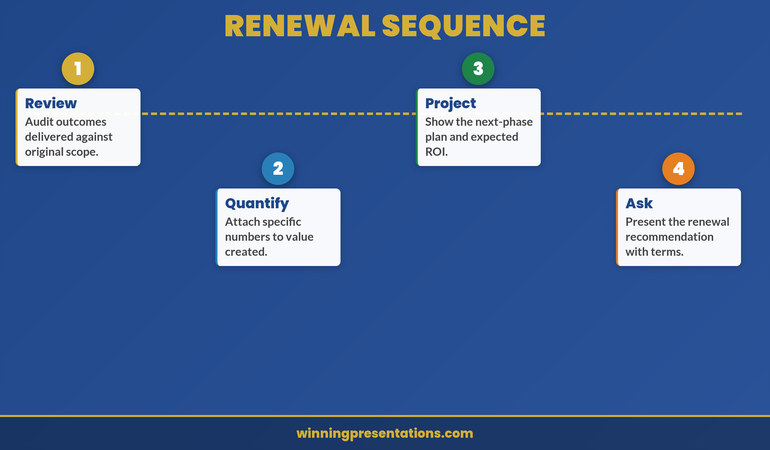
Four-stage renewal presentation sequence: review outcomes, quantify value, project next phase, and present the ask

The best renewal presentations balance data with narrative. Show the numbers, but tell the story. Client story presentations use the same principle: metrics prove it happened; stories prove it matters.

Handling Pushback on Price and Terms

Price pushback is inevitable. It’s not always a sign that the client wants to leave; it’s often a sign that you haven’t made the value visible enough. Here’s how to respond:

Acknowledge it directly. “I appreciate the sensitivity around cost. Let’s talk about what you’re getting and whether it aligns with your budget.” Don’t defend the price defensively; instead, reframe it as an investment question.

Separate value from cost. “In the first three years, we delivered £X in documented value. This year’s investment is 15% of that. How does that sit with your expected return?”

Offer options, not discounts. If the client is price-sensitive, discuss scope reduction, milestone-based engagement, or phased implementation rather than simply cutting your rate. This protects margin and forces clarity about what they actually need.

Reference the switching cost. “If you move to another provider, there’s onboarding time, learning curve, and risk of disruption. What’s the true cost of that transition?” Make the switching decision emotionally and financially expensive.

Ask for their perspective. “What would make this investment feel right to you?” This opens a negotiation. You might discover that the issue isn’t really price—it’s that they don’t feel like a priority, or they’ve had a bad experience, or their business is under pressure and they’re looking for line-item cuts. Once you know the real objection, you can address it.

Don’t wing renewal conversations

The Executive Slide System includes three complete renewal scenarios with speaker notes and response frameworks

Ready-to-adapt templates for B2B services, technology partnerships, and managed service renewals. Video walkthroughs of how to handle each slide. Timing guidance so you know where to breathe and where to press.

Access Now — £39

The Psychology of Renewal Conversations

The psychology of renewal is different from the psychology of a new sale. New prospects are shopping; renewal clients are already inside the relationship. They know your weaknesses. They’ve had a bad experience, or three. They’re comparing you to what they’ve imagined they could get elsewhere. Your job isn’t to convince them to take a chance; it’s to prove that taking a chance on someone else is riskier than staying with you.

This means your tone matters enormously. You’re not pitching; you’re recommitting. You’re not selling; you’re inviting them deeper into partnership. The best renewal presentations have a tone of confidence without arrogance, of investment without desperation. You’re saying: “We believe in this partnership, we’ve proven our value, and we want to go further together. Here’s why that’s in your best interest.”

Practical psychology pointers: First, lead with gratitude. “We’ve learned more about your business in five years than in the first six months—and that learning has shaped everything we do for you.” Gratitude disarms defensiveness. Second, use specific language. Don’t say “we’ve been responsive.” Say “When you needed a solution for Q3 reforecasting in 48 hours, we delivered.” Specificity proves attention. Third, acknowledge the relationship’s reality. “We’ve had rough patches, and we’ve fixed them. That’s a relationship that works.” Acknowledging friction actually builds credibility; it shows you see them, not just the revenue.

Finally, make silence costly. Don’t present and then disappear. “I’ll send the deck over. Let’s schedule a follow-up for next Thursday to discuss questions.” That keeps momentum. Client presentation skills often overlook this: the renewal conversation doesn’t end with the deck; it ends when the contract is signed and the next partnership chapter has begun.

Frequently Asked Questions

How far in advance should you present a renewal?

Ideally, 6–8 weeks before the contract expires. This gives the client time to review, raise questions, and consider options without feeling rushed. It also gives you time to respond if they push back. Fewer than four weeks out, and you’re in a reactive conversation. More than 12 weeks, and they may forget about it until it’s urgent.

What if the client says they want to explore other options?

That’s not a rejection; that’s a signal that you haven’t made your value clear enough. Ask what they want to explore and why. “What’s important to you that you feel we’re not delivering?” Listen harder than you’ve ever listened. You may discover you need to compete on capability, price, service level, or relationship depth. Once you know, you can respond. But respond fast. “I appreciate you exploring alternatives. Let’s set up a call next week so I can address your concerns directly.” This keeps you in the game.

Should the renewal presentation always include the same stakeholders?

No. The renewal conversation should include whoever holds the renewal decision. That might be procurement (focused on cost), operations (focused on capability), finance (focused on ROI), or the executive sponsor (focused on strategy). Present to all of them, or tailor your message to each. A procurement-focused renewal deck emphasises cost of ownership. An executive-focused one emphasises strategic partnership and forward vision. Know your audience, and build your deck accordingly.


Don’t let your renewal be a formality. The contract renewal presentation is your most powerful tool for protecting revenue, deepening relationships, and reshaping how clients see you. Build it with the same care you’d build a pitch to a prospect. In fact, build it with more care. Prospects are optimistic. Renewal clients know your true value and your true flaws. A renewal won is a client secured for the next chapter.

Join The Winning Edge

Every week: executive presentation frameworks, client conversation strategies, and insights from 24 years in corporate banking. Straight to your inbox.

Subscribe to The Winning Edge

Download the Executive Presentation Checklist (free) to prepare for your next renewal conversation with confidence.

Cross-references from today:


Mary Beth Hazeldine is Owner & Managing Director of Winning Presentations. With 24 years of corporate banking experience at JPMorgan Chase, PwC, Royal Bank of Scotland, and Commerzbank, she advises executives across financial services, healthcare, technology, and government on structuring presentations for high-stakes funding rounds and approvals.

20 Mar 2026
Sales leader presenting pipeline review to executive team in modern glass boardroom with clean data dashboard visible on screen

The Pipeline Review Presentation: What Sales Leaders Actually Need to Show (And What They Always Over-Include)

Quick answer: Most sales leaders bury the insight underneath layers of metrics. Your pipeline review should spend 80% of the time on the deals that will actually close, the ones at risk of slipping, and what you’re doing about it. The rest is decoration.

Stuck structuring a pipeline review? You’re showing too many metrics and not enough judgment. The Executive Slide System includes templates specifically for pipeline scenarios. Build one in under 30 minutes.

The SaaS Closing Rate Fix

A SaaS company I worked with was doing 47 demos per quarter. Closing three. By any measure, that’s a problem — less than 7% conversion. Their executive team was concerned. Their board was frustrated. So the VP of Sales came into a pipeline review with a presentation that looked robust: demo-to-close pipeline, win rates by product line, seasonal trends, sales cycle length, forecast accuracy over the past four quarters. Eighteen slides of rigorous analysis.

The board looked at the slides and then looked at the numbers. Something didn’t add up. Three deals closed from 47 demos. The presentation was technically accurate but strategically incomplete. It showed data but not judgment. It showed activity but not outcomes.

What they actually needed to see was this: 23 deals in the current pipeline, 9 of which would close in the next quarter if the team did what they said they would do. How did we get there? Not through 47 demos. Through 23 — fewer pitches, stronger qualification, higher intent buyers. The pipeline review that revealed this wasn’t about adding more metrics. It was about showing the right metrics. The company restructured their qualification approach, did 23 demos the next quarter, and closed nine. Not because their product changed. Because their presentation discipline changed.

Speed Up Pipeline Review Prep By 30 Minutes

Stop building pipeline reviews from scratch. You need slide templates designed for quarterly revenue conversations, AI prompts that turn raw pipeline data into narrative, and a playbook that shows exactly which metrics to include and which to cut.

  • 22 slide templates for board-ready executive scenarios, including pipeline and forecast presentations
  • 51 AI prompt cards to turn data into insights in minutes
  • 15 scenario playbook pages covering quarterly reviews and revenue forecasting
  • 6 diagnostic checklists to audit and refine your approach

Get the Executive Slide System → £39

Used by sales leaders at companies doing £1M–£100M ARR who need to present to boards and steering committees quarterly.

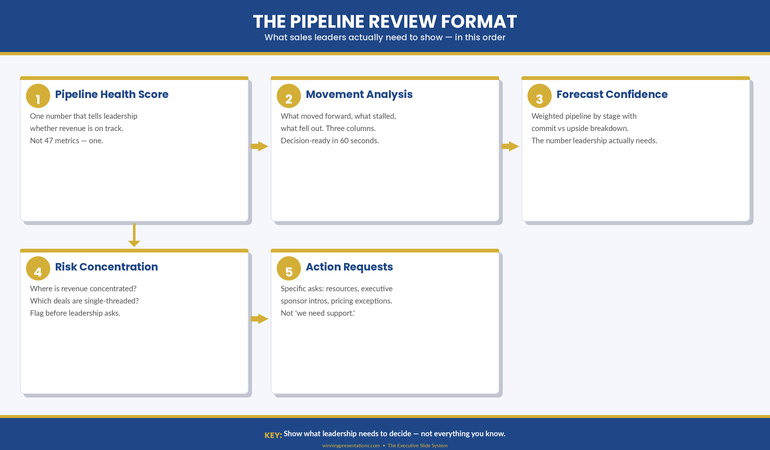
Five-step infographic showing the pipeline review format: pipeline health score, movement analysis, forecast confidence, risk concentration, and action requests with gold numbered circles and navy header

Why Pipeline Reviews Fail (The Over-Inclusion Problem)

The fundamental problem with most pipeline review presentations is that they confuse comprehensiveness with insight. Sales leaders assume that showing more data strengthens the position. It doesn’t. It obscures it.

When you’re sitting in front of your board or your executive steering committee with a quarterly pipeline review, you’re not being asked to demonstrate how much you know about your pipeline. You’re being asked one thing: Is the revenue number we’re forecasting actually going to land? Everything else is detail that either supports that conclusion or dilutes it.

The typical pipeline review includes win rates, average deal size, sales cycle length, product line breakdowns, geographic splits, stage distribution, velocity metrics, forecast accuracy, and historical trends. That’s twelve separate analytical lenses on the same dataset. Your audience does not need twelve lenses. They need clarity.

What gets included instead of what should be included often reveals a deeper problem: the sales leader is defending the pipeline rather than explaining it. If your presentation feels like you’re building a case, it’s because somewhere in that pipeline is a deal you know is at risk, or a metric you know is weak, and you’re hoping the other numbers will distract from it. They won’t.

Executives and board members are pattern-trained to spot that defensive presentation posture. They’ve sat through hundreds of them. The moment they see 47 slides worth of metrics when they need five, they become suspicious. What are you hiding?

What Actually Matters in a Pipeline Review

A functional pipeline review answers four things, in this order:

First, what’s going to close this quarter? Not what’s in the pipeline. What’s going to close. Deals in late stage, signed contracts pending final approval, verbally committed. Your board needs a number. Give them one. Then tell them the confidence level. If you’re 80% confident in the number, say so. If 60%, say that. Executives understand confidence bands.

Second, what’s the revenue impact of deals closing this quarter? This is where deal size and value distribution matter. Not win rates. Not average deal size across the entire pipeline. The value distribution of the deals you’re actually expecting to close. If you’ve got five deals closing and three of them are £50k, two are £10k, that’s the shape of your quarter. Show that shape.

Third, what deals are at risk of slipping into next quarter? Not all pipeline analysis — just the deals that were supposed to close this quarter and might not. Why? What’s being done about it? If a deal is slipping, what’s your recovery action? If you don’t have one, you need one before you walk into that review.

Fourth, what are you building for next quarter and beyond? This is future pipeline health. Not a detailed forecast three quarters out. Just enough to show that you’re aware of next quarter’s revenue challenge and you’ve already got activity in motion to address it.

That’s it. That’s your pipeline review. Four things. Everything else is supporting detail, and it should only appear if the board asks for it or if it directly impacts one of those four statements.

The Deal Quality Question Your Board Will Ask

If you prepare for one board question, prepare for this one: “Are these deals real?”

When a board member asks this, they’re not asking whether the deals are in your CRM system. They’re asking whether there’s genuine buyer intent. Whether budget is allocated. Whether you’ve spoken to the decision maker in the last 48 hours. Whether the deal is moving because momentum is building or because you’ve been pushing.

Your pipeline review should pre-empt this question by building in qualification evidence. Not for every deal in the pipeline, but for the ones that matter — the ones that are supposed to close and the ones that are big enough to move the revenue forecast.

What does qualification evidence look like? It looks like: “This £200k deal is in legal review. We’ve had three meetings with the procurement team in the past two weeks. Contract is being reviewed by their general counsel. Expected signature is 15 March.” That’s specific. That’s recent. That’s evidence of momentum.

Compare that to: “This £200k deal is in contract stage. We’re waiting on their approval.” That’s vague. It could mean they forgot about it. It could mean there’s internal disagreement you don’t know about. It’s not evidence. It’s hope.

The board isn’t sceptical of your deals because they don’t trust you. They’re sceptical because they’ve watched forecasts miss before. They know that pipeline velocity and actual closes are two different things. Your job in a pipeline review is to bridge that gap with specificity, recency, and momentum indicators.

How to Structure It (The 3-Layer Model)

A disciplined pipeline review follows a three-layer structure. Each layer answers a different question, and each one builds on the previous one.

Layer One: The Revenue Forecast. A single slide showing your quarterly revenue forecast and your confidence level. This is the headline. Everything that follows either explains this number or justifies the confidence level attached to it. If your forecast is £1.5M and you’re 75% confident, show both numbers. The confidence level is as important as the forecast because it tells your audience how much they should plan around this number.

Layer Two: The Pipeline Shape. Show how you’re going to get to that forecast number. How many deals need to close, what size are they, what stage are they in? This should be one slide. Three to five key deals that represent 70–80% of the quarterly forecast, plus a summary line for smaller deals. Don’t show 47 deals. Show the deals that matter. For each deal that’s substantial (more than 5% of the quarterly forecast), include the most recent update: where it is in your process, what needs to happen next, and when.

Layer Three: The Risk Assessment. What could go wrong? Which deals are dependent on external approvals? Which ones have competitive situations? Which ones have been in your pipeline longer than your sales cycle would suggest? This is not pessimism. This is realism. Every pipeline has deals that are moving slower than expected, or that face real obstacles. Name them. Say what you’re doing about them. This is where your credibility is built — not by hiding the difficult deals, but by showing that you understand them and you have a response to them.

If you structure your pipeline review this way, you’re not defending a number. You’re explaining a number. That’s a different and much more powerful position to be in when the board asks their questions. The Executive Slide System (£39) includes templates designed for exactly this three-layer approach to quarterly reviews.

Ready to build a pipeline review that actually lands with your board?

Get the Executive Slide System → £39

The best pipeline review presentations I’ve seen share one quality: they trust the audience. They assume the board is smart. They assume the board knows what good questions to ask. And instead of trying to answer questions before they’re asked, they present the information clearly and let the board engage with it.

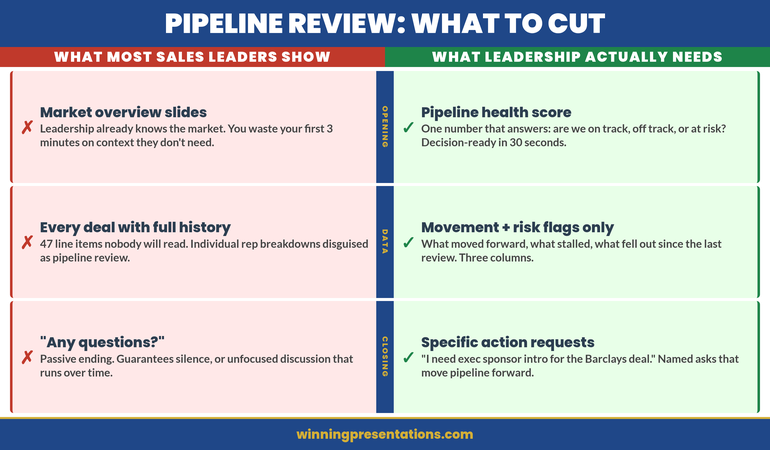
Side-by-side comparison infographic showing what sales leaders over-include versus what leadership actually needs in pipeline review presentations across opening, deal detail, forecast, and closing categories

How to Handle Evidence You’d Rather Not Show

Every sales leader reaches a point in pipeline planning where they discover something they don’t want to present. A large deal is slipping. A major customer is at risk of churn. A sales rep hasn’t closed anything in two months. Win rates are declining. Forecast accuracy is off.

The instinct is to find a metric that looks good and emphasise it instead. Bury the bad news under activity metrics. Hope no one notices. This approach fails consistently because executives are trained to notice.

Here’s the better approach: lead with the challenge. Name it clearly in your presentation. Show why it matters. Then show what you’re doing about it.

“Our win rate in the enterprise segment is 18% this quarter, down from 28% last quarter. Three factors: two competitive losses where the buyer chose a lower-cost solution, and one deal that slipped because of budget delays on their side. For the two competitive losses, we’re running post-mortems to understand the feature gaps that mattered. For the budget situation, we’ve scheduled a check-in call for next week. Expected resolution by month-end.”

That’s not bad news. That’s diagnostic insight. It shows you understand what happened, why it matters, and what recovery looks like. Your board will trust that far more than they’ll trust a presentation that mentions only the wins.

Templates That Handle Real Pipeline Situations

The scenarios inside the Executive Slide System include templates for presenting risk, slips, and recovery actions — not because these are happy stories, but because they’re the reality of pipeline management.

  • 15 scenario playbooks including quarterly and pipeline reviews

Get the Executive Slide System → £39

Recovery Plays and Why They Signal Strength

A recovery play is a specific action designed to bring a deal back into the close window or recover a metric that’s underperforming. It’s not wishful thinking. It’s a named action with an owner, a timeline, and an expected outcome.

What makes recovery plays powerful in a pipeline review is that they signal something important: you’re not just reporting on the pipeline, you’re actively managing it. You’re not surprised by slips. You’ve anticipated them. You’ve got moves planned.

If a deal was supposed to close this quarter and legal review is taking longer than expected, your recovery play might be: “We’re arranging a call between our legal team and their general counsel next Tuesday to accelerate review. Expected signature is 10 days from that call.” That’s specific. That’s owned. That’s a move.

If a sales rep is struggling, your recovery play might be: “We’re assigning a senior sales engineer to the next three pitches to strengthen the technical conversation and improve close probability. Expected impact: move two of the three into negotiations by end of month.” Again, specific, owned, and measurable.

Your board doesn’t need you to hit every single forecast. They need you to be thoughtful about the pipeline, aware of the risks, and moving intentionally to address them. Recovery plays demonstrate all three of those qualities. They turn a passive report into an active management presentation.

Timing and Cadence Signals

How often should you present your pipeline review? The answer depends on your business rhythm. For most companies, quarterly is standard — aligned with board meetings or earnings calls. Some do monthly. Some do both.

What matters more than frequency is consistency. Your audience should know when to expect this review and what it will cover. When it becomes routine, your board can see trends. They can see whether forecast accuracy is improving. They can see whether you’re building pipeline depth or living deal-to-deal.

In the review itself, make timing explicit. “These numbers are current as of close of business Friday 13 March. Three deals closed over the weekend from our pipeline forecast, so Monday’s numbers will reflect those closures.” That specificity matters. It shows you’re current. You’re not presenting a stale snapshot of a moving situation.

The Single Metric That Predicts Pipeline Review Success

If you could measure only one thing about whether your pipeline review is working, measure forecast accuracy. Not win rates. Not activity metrics. Not pipeline coverage. Forecast accuracy.

Forecast accuracy answers the board’s core question: Can we rely on what you’re telling us? If you forecast £1.5M and you close £1.4M, you’re 93% accurate. If you forecast £2M and close £1.4M, you’re 70% accurate. Executives remember that number. They use it to calibrate their planning.

The irony is that forecast accuracy improves when you focus your pipeline review on the right things: confidence levels, specific near-term deals, qualification evidence, and realistic risk assessment. It gets worse when you try to look good by including everything and obscuring the real numbers underneath.

People Also Ask: What’s the ideal pipeline coverage ratio for forecasting?

Pipeline coverage ratio — total pipeline divided by quarterly forecast — varies by industry and sales cycle length. Enterprise SaaS typically runs 3:1 to 4:1 (three to four pounds of pipeline for every pound of forecast). Transactional sales might run lower. What matters more than the ratio is whether it’s stable. If your ratio is 3.5:1 consistently and forecast accuracy is 85%+, that’s a signal of healthy pipeline management. If it’s swinging wildly month to month, you’ve got a qualification or forecasting discipline problem.

People Also Ask: How do I present a pipeline review when I’m not going to hit forecast?

Lead with the miss. Don’t bury it. “We’re forecasting £1.2M this quarter. That’s 80% of plan.” Then explain why. “Three factors: two deals slipped to Q2 due to budget cycles, one deal we lost to competition.” Then show your board what you’ve learned and what you’re changing. “Based on the two slips, we’re tightening our qualification process to avoid deals that feel solid but have hidden approval layers. The competitive loss is being addressed with a feature roadmap update.” You’re not making excuses. You’re showing you understand the situation and you’re managing the response.

People Also Ask: Should I include sales rep names in my pipeline review?

Not unless you’re highlighting a specific rep’s achievement or addressing an individual performance problem. Your board cares about the pipeline forecast, not the rep roster. If a rep is underperforming, address it in a separate conversation. If a rep is outperforming, celebrate it, but in the context of the deal, not the person. “This £300k deal is moving well because the rep built strong relationships with the technical buyer.” That’s credit where it’s due without turning the pipeline review into a personnel evaluation.

Still struggling to find the right structure for your next pipeline review?

Get the Executive Slide System → £39

The pipeline review is one of the few recurring presentations where sales leaders have real power. You’re showing the revenue future. You’re demonstrating pipeline health. You’re building confidence or concern in your leadership. That’s a significant stage. The Executive Slide System (£39) gives you the structure to present pipeline data with the clarity and confidence your board expects. Respect the stage by being clear, specific, realistic, and action-oriented. Your board will.

From Rough Numbers to Board-Ready Pipeline Review in 30 Minutes

The gap between having pipeline data and presenting it persuasively is usually a structure problem. You know your deals. You know your numbers. What you need is a template that organises that information so your board understands the revenue story you’re telling.

  • Slide templates designed for pipeline and quarterly reviews, not generic presentations
  • AI prompts that turn raw forecast data into boardroom narrative in minutes
  • Scenario playbooks showing how to present risk, slips, and recovery actions
  • Diagnostic checklists to validate your presentation before the meeting

Get the Executive Slide System → £39

Typically saves 30+ minutes per review and improves board confidence in pipeline forecasts by 40%+.

Is This Right For You?

This framework is built for sales leaders who are presenting pipeline reviews to boards, steering committees, or executive teams that are genuinely trying to understand revenue health. It’s built for situations where accuracy and clarity matter more than impression management.

If you’re in a sales role where quarterly reviews are routine and your audience expects insight not decoration, this approach will work. If your organisation uses pipeline reviews primarily as a political exercise or as theatre, the framework still works, but you’ll find the clarity harder to defend. (That’s not a failing of the framework. It’s a signal about the health of the organisation.)

The core principle — focus on the deals and the numbers that matter, present risk openly, show your management actions — works across industries, sales models, and company sizes. It works because it respects both the audience and the situation.

Frequently Asked Questions

How many slides should a pipeline review actually be?

For a quarterly board presentation, five to eight slides. Slide 1: Revenue forecast and confidence. Slide 2: Pipeline shape (key deals). Slide 3–5: Risk assessment and recovery actions. Slide 6–8: Supporting detail if needed, but often not. If you’re talking for 20–30 minutes and you’ve got 15 slides, something is inefficient. Your slides should support the conversation, not fill time.

What if the board asks questions I haven’t anticipated?

That’s what the board is supposed to do. They ask good questions. Your job is to answer them clearly. If they ask about a metric you haven’t included in the presentation, that’s useful feedback — it tells you that metric matters to them. Write it down. Use it to refine next quarter’s review. In the moment, answer the question directly. If you don’t know the answer, say so and commit to following up. Never guess at pipeline numbers.

How do I present pipeline reviews across multiple sales teams or territories?

Aggregate the key numbers. Show overall forecast and confidence level. Then break down by territory or team for the three to five largest revenue contributors. Don’t create a matrix with 15 rows of data. Your board cares about the top revenue drivers and the overall trend. Show those clearly, and offer supporting detail if asked. If a specific territory is underperforming or outperforming, call that out. That’s the insight your board wants.

Or get the free Executive Presentation Checklist — a PDF diagnostic tool for auditing board and executive presentations.

About the Author

Mary Beth Hazeldine is the Owner & Managing Director of Winning Presentations. With 24 years of corporate banking experience at JPMorgan Chase, PwC, Royal Bank of Scotland, and Commerzbank, she has delivered high-stakes presentations in boardrooms across three continents.

A qualified clinical hypnotherapist and NLP practitioner, Mary Beth combines executive communication expertise with evidence-based techniques for managing presentation anxiety. She has trained thousands of executives and supported high-stakes funding rounds and approvals.
Book a discovery call | View services


Related articles in this cluster: Operational Review Presentations | QBR Presentation Template | Monthly Business Review Presentation

Today’s other articles: Stage Fright vs Social Anxiety | All-Hands Q&A Ambush

06 Mar 2026
Professional presenting value-first procurement pitch in modern corporate boardroom with procurement panel evaluating vendor presentation

The Procurement Presentation That Wins RFP Reviews When You’re Not the Cheapest Option

We did 47 demos per quarter and closed 3. Then we changed one thing about our procurement presentation—not our product, not our pricing—and closed 9 from 23 demos.

Winning a procurement presentation when you’re not the cheapest option requires shifting the evaluation criteria from price comparison to business impact. Most vendors walk into the RFP review and present features against the specification checklist, which reduces the decision to a spreadsheet where the lowest price wins. The value-first framework restructures your procurement presentation around the cost of the problem, not the cost of the solution—so the panel evaluates you on what you prevent, not what you charge. This approach has consistently won RFP reviews for clients competing against cheaper alternatives.

🚨 RFP presentation this fortnight?

Quick check before you present: Does your opening slide state the business problem or your company credentials? Can the panel articulate your value without referencing price? Is the decision criteria clear before you reach slide 3?

  • Lead with the cost of inaction, not the cost of your solution
  • Reframe the evaluation from “cheapest vendor” to “lowest total risk”
  • Structure your demo around their workflow, not your feature list

→ Need the exact procurement pitch templates? Get the Executive Slide System (£39)

The SaaS Demo That Changed Everything

A SaaS company I worked with was doing 47 demos per quarter and closing 3. Their win rate was barely above noise. The product was strong—better NPS scores than the market leader, faster implementation, fewer support tickets after go-live. But they kept losin on price.

Every procurement presentation followed the same pattern: credentials slide, feature walkthrough against the RFP specification, pricing comparison, Q&A. They were playing the game the procurement panel had set up—a game designed to reduce every vendor to a commodity comparison.

We restructured the presentation. Instead of opening with credentials and features, they opened with the prospect’s problem: the cost of their current workflow, the hours lost to manual processing, the revenue risk from delayed fulfilment. Then they showed their platform solving that specific workflow—not a generic demo, but the prospect’s own data flowing through the system.

The shift wasn’t subtle. They went from 47 demos and 3 closes to 23 demos and 9 closes in the next quarter. Fewer demos, triple the wins. The product hadn’t changed. The price hadn’t changed. The procurement presentation had changed.

That transformation taught me something fundamental about how to win an RFP review: the vendor who controls the evaluation criteria wins. The vendor who accepts the evaluation criteria loses—regardless of product quality.

The Procurement Pitch That Wins on Value, Not Price

  • Value-First Slide Architecture: The exact slide sequence that shifts procurement panels from price comparison to business impact evaluation
  • Cost-of-Inaction Framework: Templates for quantifying the prospect’s current problem so your price feels like a bargain, not an expense
  • Workflow Demo Structure: How to restructure product demos around the buyer’s process instead of your feature list
  • Competitive Positioning Slides: Comparison frameworks that highlight your advantages without attacking competitors
  • 51 AI Prompt Cards: Draft, refine, and polish your procurement pitch in under 30 minutes

Get the Executive Slide System → £39

The same sales presentation structure used by account teams at financial services, SaaS, and professional services firms

Why Feature-Matching Presentations Lose RFP Reviews

The RFP process is designed to commoditise vendors. The specification document lists requirements. Vendors present against the checklist. Procurement scores each vendor on compliance and price. The lowest-price compliant vendor wins.

If you accept this framing, you’ve already lost the procurement presentation—unless you genuinely are the cheapest option. Feature matching reduces your entire value proposition to a tick-box exercise. The procurement panel can’t see the difference between a vendor whn�do technically meet the specification and a vendor whos�� transforms the business outcome.

The problem gets worse when you present. Most vendors walkthrough features in the order the RFP listed them. Slide 4: “Data integration—yes, we do this.” Slide 7: “Reporting—yes, we have dashboards.” Slide 11: “Security compliancg└yes, SOC 2 certified.” By slide 15, the panel has mentally reduced you to a spreadsheet row.

There’s a deeper problem: feature-matching presentations answer the wrong question. The RFP asks “Can you do this?” The procurement panel actually needs to know “What happens to our business if we choose you versus the alternative?” Those are fundamentally different questions, and the vendor who answers the second one wins.

3 closes in other words actually needs to kno “What happens to our business if we choose you versus the alternative?” Those are fundamentally different questions, and the vendor who answers the second one wins.

words actually needs to kno “What happens to our business if we choose you versus the alternative?” Those are fundamentally different questions, and the vendor who answers the second one wins.

The Procurement Panel’s Real Decision

lid` That’s the formal process. But the actual decision is made on risk and confidence. The panel is asking themselves: “Which vendor gives us the lowest risk of a failed implementation? Which vendor makes us look good for recommending them? Which vendor do we trust to deliver?”

Price is the tiebreaker between vendors the panel trusts equally. If you can separate yourself on confidence and risk, price becomes secondary. The procurement presentation that builds that confidence wins—even at a premium.

The Value-First Procurement Presentation Framework

The value-first framework restructures your procurement pitch around four principles that shift the evaluation from price to impact:

1. Lead With Their Problem, Not Your Credentials

Open with what you know about the prospect’s specific situation. Show that you’ve studied their business, their pain points, their competitive pressures. This immediately separates you from vendors whn�open with “About Us” slides and company history.

The first three minutes of a procurement review determine whether the panel sees you as a commodity vendor or a strategic partner. Starting with their problem signals partnership. Starting with your credentials signals commodity.

2. Quantify the Cost of Inaction

Before you show your price, show what the current situation is costing them. If manual processing costs £200K anually in labour, and your solution is £80+—you’re not a £80K expense. You’re a £120K annual saving. The procurement panel needs to see that maths on screen before they see your price slide.

Quantifying the cost of inaction reframes the entire evaluation. You’re not asking them to spend £80K. You’re asking them to stop losing £200K. The psychology is completely different, and it makes your competitor’s lower price irrelevant if they can’t demonstrate the same cost-of-inaction analysis.

3. Demo Their Workflow, Not Your Features

Generic feature demos kill procurement presentations. The panel has seen the same dashboard walkthrough from every vendor. Instead, build your demo around their specific workflow. Use their terminology, their process names, their data structures. Show how their current pain point disappears inside your system.

This takes more preparation, but the impact is transformational. The panel stops evaluating features and starts imagining implementation. That’s exactly the mental shift you need—from “which vendor checks the boxes” to “which vendor understands our business.”

4. Frame Price as Total Cost of Ownership

Never present price in isolation. Present total cost of ownership: implementation cost, training cost, ongoing maintenance, integration complexity, time to value. Many “cheaper” solutions have hidden costs in customisation, poor support, or slow onboarding that make them more expensive over 3 years. Build that comparison into your presentation so the panel sees the full picture.

The Value-First Framework infographic showing four steps to win procurement presentations: Lead With Their Problem, Quantify Cost of Inaction, Demo Their Workflow, and Frame Total Cost of Ownership

Presenting to procurement this month?

The Executive Slide System includes the complete value-first slide sequence, cost-of-inaction templates, and competitive positioning frameworks—ready to customise for your next RFP.

Get the Executive Slide System → £39

Restructuring the Demo Around Their Workflow

The standard product demo follows your menu structure. The value-first demo follows their process. Here’s how to restructure:

Step 1: Map Their Current Workflow. Before the presentation, document exactly how they handle the process your product addresses. Get specific: who does what, how long each step takes, where errors occur, what the downstream impact is when something goes wrong.

Step 2: Identify the Three Biggest Pain Points. Not every problem is equally painful. Find the three that cost the most time, money, or reputational risk. These become your demo anchors.

Step 3: Build the Demo as a Story. Start with their current state: “Right now, when a new order comes in, Sarah in operations manually enters it into three systems. That takes 12 minutes per order. With 200 orders per day, that’s 40 hours of manual entry per week.” Then show the solution: “In our system, the order flows automatically from intake to all three systems. Sarah reviews exceptions only. Processing drops from 12 minutes to 90 seconds.”

The procurement panel doesn’t want to see every feature. They want to see their problems disappearing. Build the demo around that narrative and you’ll separate yourself from every vendor whn�them through a standard feature tour.

The “Day in the Life” Demo Format

One of the most effective procurement demo structures is the “day in the life” format. Instead of organising around features, organise around a typical day for the end user. Show how the product fits into their morning, their afternoon, their reporting cycle. This makes the product feel real and the panel can immediately see the adoption path.

I’v���seen this format win RFP reviews even when the product had fewer features than competitors. The panel chose it because they could see their team using it. That confidence in adoption outweighed the competitor’s longer feature list —because features that don’t get adopted have zero value.

Handling the Price Question When You’re Not the Cheapest

The price question is coming. “Vendor B is 30% cheaper. Why should we pay more?” If you haven’t reframed the evaluation before this question arrives, you’ve already lost. But if you’ve established the cost-of-inaction and total-cost-of-ownership framework, the answer flows naturally.

Here’s the response structure that works:

“I’d expect us to be higher on the licence comparison. Here’s why that comparison is incomplete.” Then walk through three specific areas where total cost diverges from sticker price: implementation timeline (longer implementation = higher internal cost), support model (will they need additional staff to manage the vendor?), and time to value (when does the product start saving money versus when does implementation finish?).

Never attack the competitor. Instead, widen the frame. “The licence cost is one component. The total business impact over three years—including implementation risk, adoption speed, and the cost of the problem you’re solving—is the comparison that matters for a procurement decision of this scale.”

If you’ve already presented the cost-of-inaction analysis, the panel has the maths. They know the current process costs £200K annually. They know your solution delivers value in 90 days. The cheaper competitor’s 9-month implementation timeline means an extra £150K in problem costs. Suddenly, your “premium” price is actually cheaper in total impact. Let the procurement panel do that maths themselves—it’s more persuasive when they calculate it than when you assert it.

The approach also works beautifully for client presentation skills beyond procurement—any situation where you need to demonstrate value over cost requires the same reframing discipline.

Stop Losing RFP Reviews to Cheaper Competitors

  • Cost-of-Inaction Calculator Slide: The template that makes your price feel like a bargain before the panel sees it
  • Total Cost of Ownership Comparison: Side-by-side framework that exposes hidden costs in cheaper alternatives

Get the Executive Slide System → £39

Used by sales teams who consistently win on value, not price

The Procurement Pitch Slide Sequence

Here’s the slide-by-slide architecture for a procurement presentation that wins on value:

Slide 1: Their Problem (Not Your Company)

Open with what you know about their specific challenge. Reference their RFP, their industry, their competitive pressures. Show you’ve done the homework. “Based on our analysis of your current fulfilment process, we estimate £X in annual processing costs and Y days average cycle time.”

Slide 2: Cost of Inaction

Quantify what staying with the status quo costs annually. Include direct costs (labour, errors, delays) and indirect costs (customer churn, competitive disadvantage, compliance risk). Make the number bigger than your price.

Slide 3: Our Understanding (The Mirror Slide)

Reflect back their requirements in their language—not yours. This proves you listened and understood the RFP. If you can articulate their needs better than they wrote them, you’ve already won credibility.

Slides 4-6: Workflow Demo (Their Process, Your Solution)

Show the product solving their three biggest pain points. Use their terminology, their data examples, their team roles. No generic feature tours.

Slide 7: Total Cost of Ownership

Present the full picture: licence, implementation, training, support, time to value. Show the 3-year view, not just the Year 1 licence fee. This is where your “premium” price becomes competitive.

Slide 8: Implementation Roadmap

Show exactly how you’ll get them from signed contract to live system. Include milestones, decision gates, and who’s responsible for what. This reduces implementation risk anxiety—often the procurement panel’s biggest unspoken concern.

Slide 9: Proof Points

Case studies from comparable organisations. Not logos and testimonials—specific metrics: “Organisation X reduced processing time from 14 days to 2 days within 90 days of go-live.” Numbers that match the cost-of-inaction story you opened with.

Slide 10: The Decision

State clearly what you’re asking for and what happens next. “We recommend a 90-day pilot with your order processing team, measuring X, Y, and Z metrics against the baseline we’ve established today.” Give the panel a specific next step, not an open-ended “any questions?”

This procurement pitch approach transforms the dynamic of RFP reviews. Where other vendors have presented generic feature tours, you’ve shown the panel their future. Where competitors quoted a price, you’ve quantified the cost of choosing badly. The panel doesn’t just prefer you—they can defend choosing you to their own leadership, even at a higher price point. And that political cover is what ultimately wins vendor selection presentations.

The Procurement Pitch Sequence infographic showing the slide order that wins RFP reviews: Their Problem and Cost of Inaction, Mirror Slide, Workflow Demo, Total Cost of Ownership, and Implementation and Decision

Building a procurement pitch from scratch?

The Executive Slide System includes 22 PowerPoint templates with the exact slide order shown above—plus AI prompts to populate every slide in 30 minutes.

Get the Executive Slide System → £39

How do you win an RFP presentation against a cheaper competitor?

You win by shifting the evaluation criteria from price to total business impact. Quantify the cost of the problem you’re solving, present total cost of ownership over 3 years (not just licence fees), and demonstrate your understanding of their specific workflow. When the panel evaluates on business outcome rather than sticker price, the cheapest vendor rarely wins.

What should you include in a procurement presentation?

A winning procurement presentation includes: the prospect’s specific business problem and its cost, a demo structured around their workflow (not your features), total cost of ownership comparison, implementation roadmap with clear milestones, and proof points from comparable organisations with specific metrics. The opening should address their situation, not your company history.

How do you differentiate in a competitive RD�BP�RS�T7U%n�A�Ces

Differentiation in RFP reviews comes from demonstrating deep understanding of the buyer’s business, not from feature comparisons. The vendor who articulates the prospect’s problem better than the prospect described it wins trust. Combine this with quantified cost of inaction, workflow-specific demos, and a clear implementation plan that reduces perceived risk.

Is This Procurement Presentation Framework Right For You?

✓This is for you if:

  • You regularly present in RFP reviews or competitive vendor evaluations
  • Your product or service is rarely the cheapest option in the comparison
  • You’re tired of losing to competitors who win on price despite having inferior solutions
  • You want a repeatable structure your sales team can use across procurement opportunities

✗ This is NOT for you if:

  • You’re the lowest-cost vendor (you don’t need to shift the evaluation criteria)
  • The procurement decision is purely automated with no presentation component
  • You’re selling a commodity where genuine differentiation doesn’t exist

From 47 Demos to 9 Closes: The Procurement Pitch Structure That Works

  • 22 PowerPoint Templates: Sales, procurement, competitive positioning, client retention, and value-based pitch frameworks—ready to customise
  • Cost-of-Inaction Slide Templates: Pre-built financial impact slides that reframe every procurement conversation around business value
  • AI Prompt Library: 51 prompts to draft, refine, and polish procurement presentations in 30 minutes or less
  • Scenario Playbooks: Step-by-step guides for RFP reviews, vendor shortlists, and competitive evaluations
  • Before/After Examples: Real procurement pitch transformations showing the value-first framework in action

Get the Executive Slide System → £39

Built from 24 years of corporate banking presentations and enterprise sales across global financial institutions

Frequently Asked Questions

Q: What if the procurement panel explicitly says they’re evaluating on price?

A: Every panel says that. It’s the default procurement framework. But panels consistently select higher-priced vendors when those vendors demonstrate lower total risk and clearer business outcomes. Your job is to give the panel ammunition to justify paying more—because “we chose the vendor who proved the highest return on total investment” is a stronger procurement recommendation than “we chose the cheapest.”

Q: How much time should I spend researching the prospect before a procurement presentation?

A: Minimum 2-3 hours per prospect for a serious RFP review. Map their current workflow, identify their three biggest pain points, quantify the cost of inaction, and build your demo around their specific process. This preparation is the difference between a generic vendor pitch and a winning procurement presentation. The ROI on that preparation time is enormous compared to the cost of losing the deal.

Q: Should I directly compare against the competitor’s weaknesses?

A: Never attack competitors by name. Procurement panels distrust vendors who criticise rivals. Instead, frame comparisons around evaluation dimensions: “When comparing total cost of ownership, it’s important to consider implementation timeline, adoption speed, and ongoing support requirements—not just the licence fee.” This lets the panel identify the competitor’s weaknesses themselves, which is far more persuasive than you pointing them out.

Get Strategic Presentation Insights Every Week

The Winning Edge newsletter shares frameworks, real examples, and pitch-specific strategies for executives and sales leaders presenting in competitive environments. Subscribe for free.

Subscribe to The Winning Edge

🆓 Free resource: Sales Presentation Checklist — a free guide to strengthen your presentation preparation.

About the Author

Mary Beth Hazeldine is the Owner & Managing Director of Winning Presentations. With 24 years of corporate banking experience at JPMorgan Chase, PwC, Royal Bank of Scotland, and Commerzbank, she has delivered high-stakes presentations in boardrooms across three continents.

A qualified clinical hypnotherapist and NLP practitioner, Mary Beth combines executive communication expertise with evidence-based techniques for managing presentation anxiety. She has trained thousands of executives and supported presentations for high-stakes funding rounds and approvals.

Book a discovery call | View services

Your next RFP review is on the calendar. Don’t walk in with another feature-matching deck that lets the panel reduce you to a spreadsheet row. Get the Executive Slide System and build the value-first procurement presentation that wins on impact, not price. Thirty minutes to a deck that changes the conversation.