Tag: presentation training

08 Feb 2026
Maven presentation courses at test pricing showing AI-Enhanced Mastery at £249 and Executive Buy-In System at £199 with savings up to £1,152

Two Executive Presentation Courses: One for Speed, One for Buy-In

Test pricing is temporary. This transparency isn’t.

When I launched these two Maven courses, I deliberately priced them low — not as a “launch discount” marketing gimmick, but to genuinely test demand while I was still building out the content. I wanted to know: would busy professionals actually invest in comprehensive presentation training?

The answer was yes. Resoundingly yes.

Which means the test pricing window is closing. And once it does, these courses will never be available at these prices again.

Here’s what’s about to change:

  • AI-Enhanced Presentation Mastery: Currently £249 → Rising to £399 (self-study) or £750 (live cohort)
  • Executive Buy-In Presentation System: Currently £199 → Rising to £499 (self-study) or £850 (live cohort)

That’s not marketing spin. The current prices represent 37-76% savings compared to what future students will pay. And the content is identical — built from 24 years in corporate banking and consulting, plus 14+ years training senior professionals globally.

Both courses have already started, which is actually better for you — more modules are immediately available, so you can start applying the frameworks this week rather than waiting for content to release.

Let me show you exactly what each course delivers.

Quick answer: If you spend too many hours building presentations and want to cut creation time in half using AI — choose AI-Enhanced Presentation Mastery (£249 now, £399-£750 later). If you struggle to get approvals and face stakeholder resistance — choose Executive Buy-In Presentation System (£199 now, £499-£850 later). If you want speed AND buy-in, the best value is both courses for £448 — less than the future self-study price of Executive Buy-In alone (£499).

Best Value: Get Both Courses

£448

Future value: £898 self-study | £1,600 live cohort — Save up to £1,152

Lock In Test Pricing →

Or scroll down to choose just one course

💰 The Numbers Don’t Lie: Test Pricing vs. Future Pricing

Course Test Price Self-Study Live Cohort You Save
AI-Enhanced Mastery £249 £399 £750 Up to £501
Executive Buy-In £199 £499 £850 Up to £651
BOTH COURSES £448 £898 £1,600 Up to £1,152

Test pricing includes lifetime access to all materials, live Q&A sessions, and future updates.

AI-Enhanced Presentation Mastery (£249)

The problem this solves: You’re spending 4-6 hours building presentations that should take 90 minutes. You’ve tried AI tools but end up with generic outputs that need complete rewrites. You know AI could help, but you haven’t found a system that actually works for executive-level content.

What you’ll learn:

This isn’t an AI tutorial. It’s a strategic system for using AI as a thinking partner — not a content generator.

  • The AVP Framework (Action-Value-Proof) — Structure presentations that are impossible to ignore. Create compelling outlines in minutes that guide audiences to yes.
  • The 132 Rule — Organize information in the exact sequence your audience’s brain processes and remembers it.
  • The S.E.E. Formula (Story-Evidence-Emotion) — Make your proof memorable and your recommendations impossible to dismiss.
  • Your Personal AI Playbook — Customised prompts that reflect your expertise and communication style. Create first drafts in 30 minutes.
  • Data Storytelling with AI — Transform KPIs and analytics into strategic narratives using the Insight-Implication-Action framework.

What’s included:

  • 8 self-paced modules (releasing January–April 2026)
  • 2 live 60-minute coaching sessions
  • AI-powered outline generators
  • 30+ prompt templates for different presentation types
  • Before/after slide transformations
  • Master Prompt Pack
  • Lifetime access to all materials and future updates

The practical result: You’ll cut presentation creation time by 50%+ while dramatically improving quality. One client used the AVP framework to rebuild a 47-slide deck into 12 focused slides — and got approval in the first meeting after three previous rejections.

AI-Enhanced Presentation Mastery

Test Price: £249

Future: £399 self-study | £750 live cohort

Lock In Test Pricing → £249

Modules already available. Start applying frameworks this week.

Executive Buy-In Presentation System (£199)

The problem this solves: You create solid presentations but struggle to get approval. Stakeholders push back. Decision-makers say “let me think about it” instead of “yes.” You know your recommendations are sound, but you can’t seem to get the room on your side.

What you’ll learn:

This is about influence, not information. You’ll learn the psychology of how decisions actually get made in organisations — and how to position yourself on the winning side.

  • The Champion Strategy — How to get someone fighting FOR your proposal before you even present. Pre-meeting tactics that make your presentation a formality.
  • The Objection Map — Find resistance before it finds you. Identify blockers, skeptics, and hidden agendas before you walk into the room.
  • Stakeholder Psychology — Why “alignment” fails and “enrollment” wins. The difference between people nodding and people actually supporting you.
  • The Pre-Decision Conversation — Where approvals actually happen (hint: it’s not in the presentation). How to have the conversations that matter.
  • Handling “Let Me Think About It” — Scripts and frameworks for converting hesitation into commitment.

What’s included:

  • Complete self-paced module library
  • Live Q&A coaching sessions
  • Stakeholder mapping templates
  • Pre-meeting preparation frameworks
  • Objection handling scripts
  • Decision architecture templates
  • Lifetime access to all materials and future updates

The practical result: You’ll stop being the person who presents and start being the person who gets things approved. One executive used the Champion Strategy to secure a £2M budget — the decision was essentially made before the formal presentation even started.

Executive Buy-In Presentation System

Test Price: £199

Future: £499 self-study | £850 live cohort

Lock In Test Pricing → £199

Modules already available. Start applying frameworks this week.

Is This the Right Presentation Skills Course for You?

Here’s the honest breakdown:

Choose AI-Enhanced Presentation Mastery (£249 — saves up to £501) if:

  • You spend too many hours building presentations
  • You want to use AI but haven’t found a system that works
  • You need to produce more presentations without sacrificing quality
  • You’re already decent at getting buy-in but want faster creation
  • Your main pain is time, not approval

Choose Executive Buy-In System (£199 — saves up to £651) if:

  • You create good presentations but struggle to get approval
  • You face resistance, skepticism, or “let me think about it”
  • You need to influence stakeholders without formal authority
  • Politics and hidden agendas derail your recommendations
  • Your main pain is approval, not creation time

Take both courses (£448 — saves up to £1,152) if:

  • You want the complete system — fast creation AND reliable approval
  • You’re at a career inflection point where presentations really matter
  • You recognise that £448 for both is less than the future self-study price of Executive Buy-In alone (£499)
  • You want to lock in lifetime access before prices triple

🚫 These courses are NOT for you if:

  • You’re looking for a quick PowerPoint tutorial (these are strategic frameworks, not software training)
  • You need presentation skills for academic or personal contexts (these are built for corporate/executive environments)
  • You want someone to build your slides for you (these teach you to build better, faster)
  • You’re not willing to invest 2-3 hours per week in learning and applying the frameworks

For more on executive presentation structure, see my guide on executive presentation structure. For AI presentation workflows, see AI presentation workflow. For stakeholder influence, see how to get executive buy-in.

Why Test Pricing Exists (And Why It’s Ending)

I want to be completely honest about why these prices exist — because understanding this helps you see why it’s genuinely a limited window.

I needed to validate demand. Before investing hundreds of hours building comprehensive courses, I needed to know: would busy executives actually pay for in-depth presentation training? Would the frameworks I’ve used for 24 years translate to a self-paced format?

So I priced both courses low enough to test the market while I built the content. Not “discounted” — genuinely priced to test.

The test worked. Students enrolled. They’re getting results. The feedback is shaping the final versions of both courses. But now the content is nearly complete, and there’s no longer a reason to keep prices at testing levels.

Here’s what you get at test pricing that future students won’t:

  • The same content — Identical frameworks, templates, and live sessions
  • Lifetime access — Including all future updates and improvements
  • Live Q&A sessions — Worth the price difference alone
  • Maven Guarantee — Full refund eligible up until halfway point
  • 37-76% lower price — Compared to what the exact same course will cost in 3 months

The maths is simple:

If you wait and buy AI-Enhanced Presentation Mastery at the future self-study price (£399), you’ll pay £150 more for exactly the same course. If you want the live cohort experience later, that’s £750 — three times today’s price.

If you wait and buy Executive Buy-In at the future self-study price (£499), you’ll pay £300 more. The live cohort? £850 — more than four times today’s price.

If you buy both now (£448), you pay less than the future self-study price of Executive Buy-In alone (£499). Here’s the simple price logic: test pricing exists to validate demand, not to be permanent.

Lock In Test Pricing Before It Disappears

AI-Enhanced Mastery

£249 £399-£750

Save up to £501

Lock In Test Pricing →

Executive Buy-In System

£199 £499-£850

Save up to £651

Lock In Test Pricing →

BOTH COURSES: £448 (Future value: £898-£1,600)

Lifetime access. Live Q&A sessions. Maven Guarantee.

Frequently Asked Questions

The courses have already started — am I too late?

The opposite. Because modules release over time, joining now means you get immediate access to everything that’s already available — more content ready to consume than early joiners had. You can catch up at your own pace, the live Q&A sessions are still ahead, and you’re paying the same test price. If anything, you’re getting better value than the earliest students.

Why are these prices so much lower than future pricing?

Honestly? I priced them low to test demand while building the courses. I needed to validate that busy professionals would invest in comprehensive presentation training before committing hundreds of hours to create it. The test worked — students enrolled and are getting results. Now that the content is nearly complete, there’s no reason to keep prices at testing levels. Future students will pay £399-£750 for AI-Enhanced and £499-£850 for Executive Buy-In.

What if I can’t attend the live sessions?

All live sessions are recorded and added to your course portal. You’ll have lifetime access to watch them whenever convenient. The courses are designed for busy professionals — self-paced learning with live sessions as a bonus, not a requirement.

Can my company reimburse the cost?

Yes — many employers cover professional development courses. Maven provides documentation and receipts suitable for expense claims. Both courses include certificates of completion you can share with your employer or add to LinkedIn. At test pricing, this is an easy approval — you’re essentially getting live-cohort-quality training at a fraction of typical corporate training costs.

Will test pricing return later?

No. Test pricing exists because I was validating demand while building the courses. Once the programmes are complete and established, they move to standard pricing: £399 (self-study) or £750 (live cohort) for AI-Enhanced, and £499 (self-study) or £850 (live cohort) for Executive Buy-In. This window is genuinely limited.

What’s the refund policy?

Both courses are backed by Maven’s satisfaction guarantee. You’re eligible for a full refund up until the halfway point of the course if it’s not what you expected. There’s no risk in trying — except the risk of waiting and paying 2-4x more later.

Your Next Step

Let me make this simple.

If you wait three months and buy these courses at regular pricing, you’ll pay £898 for self-study access to both — or £1,600 for live cohort access.

If you act now, you pay £448 for both. That’s less than the future self-study price of Executive Buy-In alone.

The content is identical. The frameworks took me 24 years to develop. The only difference is whether you lock in test pricing or pay 2-4x more later.

If your main pain is spending too many hours building presentations:
AI-Enhanced Presentation Mastery — £249 (future: £399-£750)

If your main pain is getting approval and buy-in:
Executive Buy-In Presentation System — £199 (future: £499-£850)

If you want the complete toolkit:
Both courses — £448 total (future: £898-£1,600)

These frameworks work. I’ve used them to train thousands of executives. You can start applying them this week. The only question is whether you’ll pay test prices or full prices for the same result.

⏰ Test Pricing Window Is Closing

Once these courses are fully established, prices rise to £399-£850 per course. Lock in test pricing now and save up to £1,152.

Best Value: Get Both Courses → £448

📧 Not Ready to Commit? Get the Newsletter First

Weekly insights on executive communication, presentation structure, and high-stakes delivery — free. See if my approach resonates before investing in a course.

Subscribe to The Winning Edge →

About the Author

Mary Beth Hazeldine is the Owner & Managing Director of Winning Presentations. With 24 years in corporate banking and consulting — including senior roles at JPMorgan Chase, PwC, Royal Bank of Scotland, and Commerzbank — she has delivered high-stakes presentations in boardrooms across three continents.

A qualified clinical hypnotherapist and NLP practitioner, Mary Beth combines executive communication expertise with evidence-based techniques for influence and persuasion. She has trained thousands of executives and supported presentations that have secured significant funding and approvals.

Book a discovery call | View services

25 Jan 2026
Professional evaluating executive presentation coaching options to find a programme worth the investment

Executive Presentation Coaching: What to Look For in 2026

I spent £8,000 on presentation coaching that taught me nothing I could use.

The coach was credentialed. The programme was respected. But after six sessions, I was still freezing in front of the board—because everything I’d learned was theory that collapsed under pressure.

Quick answer: The best executive presentation coaching in 2026 focuses on frameworks you can apply under pressure, not concepts you understand intellectually. It should address both structure (how to build slides that work for executive audiences) and delivery (how to present with authority when stakes are high). Most coaching fails because it teaches presentation theory without accounting for the stress response that hijacks your performance when it matters most.

When you find the right coaching:

  • You stop dreading presentations and start seeing them as career accelerators
  • Your recommendations get approved faster—because executives trust how you communicate
  • The skills compound: each presentation builds on the last instead of starting from scratch

Written by Mary Beth Hazeldine — Owner & Managing Director of Winning Presentations, 24 years in corporate banking (JPMorgan Chase, PwC, RBS, Commerzbank), qualified clinical hypnotherapist, and someone who’s been on both sides of executive presentation coaching—as a client who wasted money, and now as someone who teaches what actually works. Last updated: January 2026.

🚨 Evaluating a coaching programme THIS MONTH? Ask these 3 questions:

  1. Can you show me the exact frameworks I’ll use? (If they can’t, it’s theory-based)
  2. How do you address performance under pressure? (If they don’t, skills won’t transfer)
  3. What measurable outcomes have past participants achieved? (Vague answers = vague results)

These questions separate programmes that transform from programmes that teach.

I’ve helped senior professionals transform their executive presentations at global banks, consulting teams, and Fortune 100 companies—environments where one presentation can determine funding, strategy, or careers.

→ Want a programme designed for senior professionals? See the AI-Enhanced Presentation Mastery curriculum — frameworks-first approach for executives who present to decision-makers.

📅 Investing in your presentation skills this quarter?

This guide will help you evaluate any programme—including mine—so you invest in coaching that actually delivers results.

That £8,000 I spent? It taught me what not to look for. Over the next decade—through hundreds of executive presentations and eventually training senior leaders myself—I learned what actually creates transformation versus what just sounds impressive.

The difference isn’t subtle. And in 2026, with AI changing how presentations are created, the gap between effective coaching and outdated approaches has never been wider.

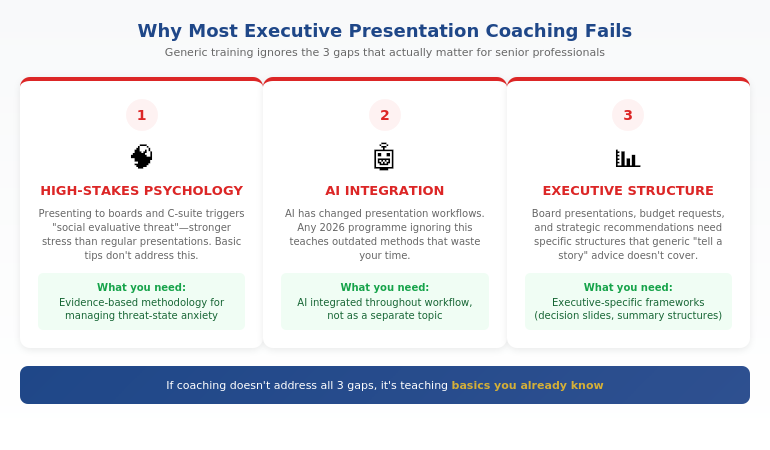
Why Most Executive Presentation Coaching Fails

The presentation coaching industry has a dirty secret: most programmes don’t produce lasting change.

Executives complete the training, feel inspired for a week, then revert to their old patterns the moment they’re under pressure. The coaching “worked” in the safe environment of the training room—but collapsed in the boardroom.

Here’s why:

Problem 1: Theory Without Application

Most coaching teaches concepts: “Lead with your conclusion.” “Use the pyramid principle.” “Make eye contact.”

These aren’t wrong—but they’re incomplete. Understanding a concept intellectually doesn’t mean you can execute it when your nervous system is in fight-or-flight mode.

The insight: Effective executive presentation coaching must bridge the gap between knowing and doing. That requires frameworks specific enough to follow under pressure, plus techniques for managing the stress response that blocks execution.

Problem 2: Generic Approaches

Many programmes teach the same content to everyone: entry-level employees, middle managers, and C-suite executives all get the same “presentation skills” curriculum.

But presenting to a board is fundamentally different from presenting to peers. The expectations, the communication patterns, the decision-making dynamics—all different.

The insight: Executive-level coaching should focus specifically on high-stakes, senior-audience scenarios. Generic “presentation skills” won’t cut it.

Problem 3: Ignoring the Stress Response

Here’s what most coaches don’t understand: the anxiety that executives feel before high-stakes presentations isn’t a mindset problem. It’s a physiological response.

When your brain perceives threat (and being evaluated by people who control your career IS a threat), it triggers hormonal cascades that impair verbal fluency, working memory, and executive function—the exact cognitive skills you need to present well.

The insight: Any coaching that doesn’t address nervous system regulation will fail when stakes are high. “Just be confident” isn’t a technique—it’s a wish.

📚 Research note: The Trier Social Stress Test (Kirschbaum et al., 1993)—the gold standard for measuring social evaluative threat—consistently shows that being judged by high-status observers produces stronger cortisol spikes than other stressors. Research on anxiety and working memory (Eysenck & Calvo’s Processing Efficiency Theory) explains why intelligent, knowledgeable executives can “blank” during presentations: anxiety consumes cognitive resources needed for verbal retrieval. The expertise is intact, but access is blocked. Effective coaching must account for this biological reality.

For more on why training fails, see the hidden reasons most programmes don’t stick.

Diagram showing why most executive presentation coaching fails: theory without application, generic approaches, and ignoring the stress response

What Actually Works: The 5 Non-Negotiables

After spending too much money on coaching that didn’t work, and then developing programmes that do, I’ve identified five elements that separate effective executive presentation coaching from expensive disappointments.

Non-Negotiable 1: Frameworks, Not Concepts

Effective coaching gives you specific, repeatable structures—not abstract principles.

Concept: “Lead with your conclusion.”
Framework: “Your first slide headline should state your recommendation + key benefit. Example: ‘Approve £500K for Q4 Campaign (2.3x Projected ROI).’ Here’s the template.”

The difference? A framework tells you exactly what to do. A concept requires you to figure it out yourself—which you can’t do under pressure.

What to look for: Can the coach show you the exact templates, structures, or scripts you’ll use? If it’s all principles and no specifics, keep looking.

Non-Negotiable 2: Pressure-Tested Techniques

Skills learned in calm conditions don’t automatically transfer to stressful ones. Effective coaching builds in stress inoculation—practicing under conditions that simulate real pressure.

What to look for: Does the programme include practice with realistic scenarios? Do they address what happens when anxiety spikes mid-presentation? Do they teach recovery techniques for when things go wrong?

Non-Negotiable 3: Executive-Specific Content

Presenting to a board requires different skills than presenting to a team meeting. Effective executive coaching focuses specifically on:

  • Decision-oriented structures (not information dumps)
  • Managing challenging questions from senior stakeholders
  • Building credibility with time-poor, skeptical audiences
  • The specific dynamics of high-stakes approval scenarios

What to look for: Is the content designed for senior audiences, or is it generic “presentation skills” repackaged?

Non-Negotiable 4: Both Structure AND Delivery

Some coaching focuses only on slide design. Others focus only on speaking skills. Neither alone is sufficient.

You need both: the ability to structure content that works for executive audiences AND the ability to deliver it with authority under pressure.

What to look for: Does the programme address both what you present (structure, slides, messaging) and how you present it (delivery, presence, managing nerves)?

Non-Negotiable 5: Modern Integration

In 2026, any executive presentation coaching that ignores AI is incomplete. Not because AI replaces presentation skills—but because AI changes how presentations are created.

The executives who thrive use AI to accelerate the mechanical work (drafts, formatting, research synthesis) while applying human judgment to the strategic work (what to include, how to frame it, what story to tell).

What to look for: Does the programme address how to leverage AI tools effectively? Or is it stuck in a pre-2023 world?

💬 “The framework changed how I structure every board presentation. I used to spend 6+ hours on decks that got questioned. Now I spend 90 minutes and get approval on the first pass.” — Senior Director, Global Consulting Firm

⭐ A Programme Built on These 5 Non-Negotiables

AI-Enhanced Presentation Mastery was designed specifically for senior professionals who present to decision-makers. It’s frameworks-first (not theory), addresses the stress response, and integrates modern AI workflows.

What’s included:

  • Executive presentation frameworks (decision slides, board updates, stakeholder pitches)
  • Techniques for calm authority under pressure
  • AI integration for faster, higher-quality presentation creation

See the Full Curriculum →

Cohort-based programme for senior professionals. Limited seats per session.

The 2026 Coaching Landscape: What’s Changed

The executive presentation coaching market has shifted dramatically. Here’s what’s different now:

Change 1: AI Has Raised the Bar

When anyone can generate a “decent” presentation in minutes using AI, the baseline has changed. Decent isn’t enough anymore.

The executives who stand out are those who can take AI-generated foundations and elevate them with strategic thinking, audience insight, and executive-level polish. Coaching that doesn’t address this reality is already outdated.

Change 2: Remote + Hybrid Has Become Permanent

Many executive presentations now happen on video—or hybrid with some participants in-room and others remote. This changes everything: how you build rapport, how you read the room, how you maintain engagement.

Coaching designed for in-person only is incomplete. Look for programmes that address the specific challenges of presenting through screens.

Change 3: Decision Speed Has Increased

Executives have less patience than ever. The “let me walk you through this” approach that worked a decade ago now loses audiences before you’ve made your point.

Modern coaching should emphasise decision-oriented structures: recommendation first, evidence second, context only when asked.

Change 4: Credentialism Matters Less, Results Matter More

Traditional presentation coaching often leaned on credentials: “trained at [famous institution]” or “certified in [methodology].”

Smart buyers now ask: “What outcomes have your participants achieved?” Credentials don’t guarantee results. Ask for evidence of transformation, not badges.

For more on what separates top performers, see why most presentation training fails senior professionals.

Looking for a programme designed for the 2026 reality? AI-Enhanced Presentation Mastery integrates frameworks, stress management, and modern AI workflows—specifically for senior professionals.

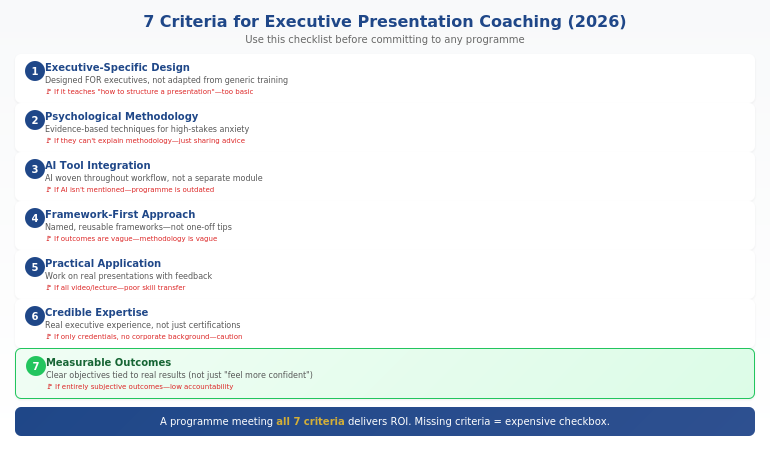
Red Flags: When to Walk Away

Not all coaching is worth the investment. Here are the warning signs:

Red Flag 1: “Everyone Needs the Same Training”

If a programme promises to help “everyone from interns to executives,” it’s not executive-focused. Generic content won’t address the specific challenges of high-stakes senior presentations.

Red Flag 2: All Theory, No Templates

If the coach can’t show you specific frameworks, templates, or structures you’ll walk away with, you’re paying for concepts you could read in a book.

Ask: “Can you show me an example of a framework I’ll learn?” If the answer is vague, walk away.

Red Flag 3: No Mention of Pressure or Nerves

If the programme doesn’t address performance anxiety, stress response, or presenting under pressure, it’s incomplete. Skills learned in calm conditions often collapse when stakes are high.

Red Flag 4: Outdated Content

If there’s no mention of AI, remote/hybrid presenting, or modern executive communication patterns, the content may be years out of date.

Ask: “How has this programme evolved in the last two years?”

Red Flag 5: No Evidence of Results

If the coach can’t point to specific outcomes from past participants—faster approvals, promotions, successful pitches—the programme may not deliver transformation.

Ask: “What measurable results have past participants achieved?”

Red flags when evaluating executive presentation coaching: generic content, no templates, ignoring nerves, outdated material, no evidence of results

⭐ A Programme That Passes Every Test

AI-Enhanced Presentation Mastery includes specific frameworks you can review before enrolling, addresses performance under pressure, and is updated for 2026 realities—including AI integration and remote/hybrid presenting.

You’ll get:

  • Frameworks you can see before you enrol (no mystery content)
  • Techniques for managing the stress response
  • Modern AI workflows that save hours per presentation

See the Full Curriculum →

Designed for senior professionals presenting to boards, executives, and key stakeholders.

How to Evaluate Any Programme

Use this framework to assess any executive presentation coaching you’re considering—including mine:

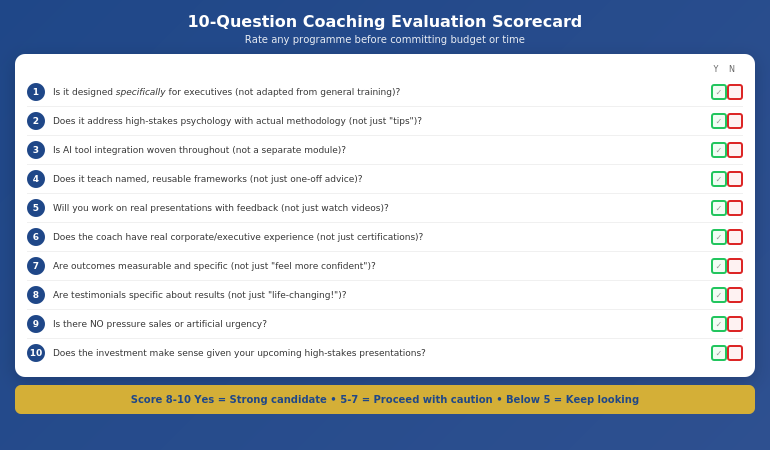
The 10-Question Evaluation

Content Quality:

  1. Is the content designed specifically for executive/senior audiences?
  2. Can they show you the exact frameworks and templates you’ll use?
  3. Does it address both structure (slides/content) AND delivery (presence/nerves)?
  4. Is it updated for 2026 realities (AI, remote/hybrid, decision speed)?

Practical Application:

  1. Does it include practice with realistic high-stakes scenarios?
  2. Do they address what happens when anxiety spikes mid-presentation?
  3. Will you walk away with tools you can use immediately?

Evidence of Results:

  1. Can they point to specific outcomes from past participants?
  2. Do they offer any guarantee or way to assess fit before full commitment?
  3. Does the programme structure support actual skill development (not just information transfer)?

Score it: If a programme doesn’t score at least 7/10, consider alternatives.

10-question coaching evaluation scorecard to rate any executive presentation coaching programme before committing

🎯 Choose Your Next Step Based on Your Timeline

If you present to ExCo/Board in the next 14 days: Focus on immediate fixes—review our decision slide framework and calm presence techniques. Long-term coaching can wait.

If you’re evaluating coaching this month: Use the 10-question scorecard above. Request curriculum details before any call. Compare at least 2-3 options.

If you’re planning Q1 development: Book now for early cohorts—quality programmes fill quickly in January. The AI-Enhanced Presentation Mastery next cohort has limited seats.

🎯 If you’re investing in coaching this quarter, do this TODAY:

  1. List the specific presentation challenges you need to solve (not vague “get better”—specific scenarios)
  2. Identify 2-3 programmes to evaluate using the 10-question framework above
  3. Request to see actual content before committing (frameworks, templates, curriculum)
  4. Ask for outcomes evidence from past participants in similar roles

This takes an hour. It prevents spending thousands on coaching that won’t deliver.

For more on presentation skill development, see what actually gets senior professionals ahead.

Want to evaluate AI-Enhanced Presentation Mastery? See the full curriculum and framework overview — you can review exactly what’s included before making any decision.

Frequently Asked Questions

How much should I expect to invest in executive presentation coaching?

Quality programmes range from a few hundred pounds for self-paced courses to several thousand for intensive 1:1 coaching. The question isn’t the absolute cost—it’s the return. A £500 programme that transforms your executive presentations delivers better ROI than a £5,000 programme that teaches theory you can’t apply.

Is 1:1 coaching better than group programmes?

Not necessarily. 1:1 offers personalisation; group programmes offer peer learning and accountability. The best choice depends on your learning style and specific needs. What matters more than format is whether the content meets the 5 non-negotiables.

How quickly should I expect results from coaching?

With framework-based coaching, you should see improvement in your very next presentation. Deep transformation—the kind that makes high-stakes presenting feel natural—typically takes 3-6 months of deliberate application.

Should I look for a coach with experience in my industry?

Industry experience can be helpful but isn’t essential. Executive presentation patterns are remarkably consistent across sectors. What matters more is whether the coach understands high-stakes, senior-audience dynamics—not the specifics of your industry.

Can AI tools replace executive presentation coaching?

AI can help you create slides faster, but it can’t teach you to present with authority under pressure. The mechanical parts of presentation creation are being automated; the human elements—strategic thinking, executive presence, managing the room—remain irreplaceable. The best coaching helps you leverage AI for efficiency while developing the skills AI can’t provide.

What if I’ve tried coaching before and it didn’t work?

The failure was likely in the approach, not in you. Most coaching fails because it’s theory-based, generic, or ignores the stress response. Use the evaluation framework in this article to find a programme that addresses those gaps. Don’t give up on coaching—find better coaching.

Does coaching work for people who are naturally nervous presenters?

Yes—in fact, naturally nervous people often see the biggest transformation. Here’s why: coaching that addresses the stress response (not just “presentation tips”) gives anxious presenters specific techniques to manage their physiology. They’re not trying to “stop being nervous”—they’re learning to present effectively despite the nerves. Many of the most composed executive presenters you see are naturally anxious people who’ve learned to channel that energy rather than display it.

Is This Right For You?

✓ Executive coaching is right for you if:

  • You present to boards, executives, or senior stakeholders
  • Your presentations affect decisions on funding, strategy, or career advancement
  • You want frameworks and techniques, not just theory
  • You’re ready to invest time in deliberate practice

✗ Executive coaching is NOT right for you if:

  • You mainly present to peers or direct reports (lower stakes)
  • You’re looking for quick tips rather than skill development
  • You’re not willing to practice between sessions
  • You expect transformation without applying what you learn

⭐ The £8,000 I Wasted Taught Me What Works

That expensive coaching that failed? It taught me exactly what to avoid—and what to build. AI-Enhanced Presentation Mastery is everything I wish that programme had been: frameworks-first, pressure-tested, and designed specifically for executives who present to decision-makers.

What you’ll get:

  • Executive presentation frameworks (not theory—templates you can use immediately)
  • Techniques for calm authority under pressure
  • Modern AI integration for faster, better presentations

See the Full Curriculum →

Cohort-based programme on Maven. Review the full curriculum before deciding.

📧 Optional: Get weekly executive presentation strategies in The Winning Edge newsletter (free).

Your Next Step

The right executive presentation coaching can transform how you communicate with decision-makers—and by extension, how your career progresses.

But the wrong coaching wastes thousands and leaves you no better than before. The difference is in knowing what to look for.

Use the 10-question evaluation on any programme you’re considering. Demand to see frameworks before you commit. Ask for evidence of results. And don’t settle for theory-based coaching that collapses under pressure.

Your ability to present to executives is one of the highest-leverage skills you can develop. Invest in coaching that actually delivers transformation—not just inspiration.

To review a programme designed around these principles, see the AI-Enhanced Presentation Mastery curriculum.

P.S. If your immediate challenge is structuring slides for executive approval, see how to build decision slides that get “yes” in 60 seconds. If it’s managing nerves when presenting to senior leadership, see how to sound calm and credible under pressure.

About the Author

Mary Beth Hazeldine is the Owner & Managing Director of Winning Presentations and a qualified clinical hypnotherapist. The £8,000 coaching failure that opens this article is real—and the decade that followed taught her what actually creates transformation in executive presentations.

After 24 years in corporate banking at JPMorgan Chase, PwC, Royal Bank of Scotland, and Commerzbank—where presenting to senior leadership was unavoidable—she now teaches the frameworks and techniques that actually work under pressure.

Book a discovery call | View services

24 Jan 2026
The Presentation Mastery Curve: Where Most Professionals Get Stuck (I Was Stuck for 8 Years)

The Presentation Mastery Curve: Where Most Professionals Get Stuck (I Was Stuck for 8 Years)

I gave presentations for eight years without getting meaningfully better. I wasn’t bad. I was stuck at “competent”—and I had no idea why I couldn’t break through.

Quick answer: The presentation mastery curve is a predictable progression with four stages: Survival (just getting through it), Competence (adequate but forgettable), Confidence (good but plateaued), and Mastery (commanding and persuasive). Most professionals get stuck between Competence and Confidence—where presentations are “fine” but not remarkable. The breakthrough requires deliberate structure work, not more practice of the same approach.

In practice, moving from “competent presenter” to “master presenter” requires recognising which stage you’re actually at, understanding why you’re stuck there, and applying the specific intervention that unlocks the next level.

When you break through to the next stage:

  • People stop saying “let me think about it”
  • Your ask becomes easier to say yes to
  • You stop needing 30 slides to feel credible

Written by Mary Beth Hazeldine — executive presentation coach, 24 years corporate banking, trained 5,000+ executives. I’ve coached executives inside global banks, consulting teams, and high-stakes leadership environments—where one presentation can change funding, strategy, or careers. Last updated: January 2026 with new stage diagnostic + “presenting this week” reset.

🚨 Presenting THIS WEEK? Here’s how to break through immediately:

  1. Identify your stage using the diagnostic below (be honest—most overestimate)
  2. Apply the ONE intervention for your stage (don’t skip ahead)
  3. Focus on structure for this presentation, not delivery polish
  4. Get one piece of feedback on whether your argument was clear (not on your style)

One presentation with deliberate structure work beats ten presentations on autopilot.

📅 Want to systematically move through the mastery curve?

The difference between professionals who stay stuck and those who break through is structured progression with the right interventions at each stage. This article maps the curve—and shows you exactly where you are.

When I finally understood the mastery curve, I realised I’d been applying Confidence-stage interventions while stuck at the Competence stage. I was polishing delivery when my structure was broken. No wonder nothing changed.

The executives I train often have the same realisation. They’ve been working on the wrong things—not because they’re not trying, but because they didn’t know which stage they were actually at.

If you’ve ever felt like your presentations should be better than they are—despite years of experience—this article explains exactly why, and what to do about it.

The Four Stages of Presentation Mastery

After training 5,000+ executives, I’ve observed that the presentation mastery curve follows a remarkably consistent pattern. Almost everyone moves through the same four stages—the difference is how long they stay stuck at each one.

Stage 1: Survival (0-2 years presenting)

At this stage, your primary goal is getting through the presentation without disaster. You’re focused on not forgetting your words, not visibly shaking, not running out of things to say.

Markers: Heavy reliance on notes or slides as a script. Significant anxiety before and during. Relief when it’s over. Little memory of what actually happened.

The trap: Some people stay here for years because avoidance feels safer than exposure. They present as little as possible, which prevents them from ever building the reps needed to advance.

Stage 2: Competence (2-5 years presenting)

You can deliver a presentation that’s “fine.” The audience doesn’t notice anything wrong. You hit your points, stay on time, answer questions adequately. But you’re forgettable.

Markers: Lower anxiety, but not excitement. Presentations feel like tasks to complete, not opportunities to influence. You get polite feedback but rarely enthusiastic response.

The trap: This is where most professionals get permanently stuck. “Fine” doesn’t trigger a need for improvement. The pain isn’t acute enough to drive change.

Stage 3: Confidence (5-10+ years… or never)

You’re comfortable presenting. You might even enjoy it. Your delivery is polished. But something’s still missing—you’re not commanding rooms or driving decisions the way you know is possible.

Markers: Good style, but structure might still be weak. You can present well, but can’t necessarily teach others why. Inconsistent results depending on the topic or audience.

The trap: At this stage, the problem is invisible. You look and feel competent. Others might even compliment you. But you’ve hit a ceiling you can’t identify, let alone break through.

Stage 4: Mastery (Rare)

You don’t just present information—you shape how people think. Your presentations create clarity where there was confusion, momentum where there was stagnation, decisions where there was paralysis.

Markers: Presentations feel like conversations, not performances. You adapt in real-time based on the room. The structure serves the argument so seamlessly that it’s invisible. People act differently after hearing you speak.

The truth: Most professionals never reach this stage—not because they can’t, but because they don’t know the specific interventions required to break through from Stage 3.

The four stages of presentation mastery development showing where most professionals get stuck between Competence and Confidence

⭐ A Structured Path Through the Mastery Curve

AI-Enhanced Presentation Mastery is designed for professionals stuck between Competence and Mastery—with the specific interventions that unlock each stage.

What makes it different:

  • Stage-appropriate frameworks (not one-size-fits-all advice)
  • Structure interventions first (the actual breakthrough), delivery polish second
  • Live cohort sessions for real-time feedback on your actual presentations

See the Full Curriculum →

Next cohort starts soon. Limited to 20 participants for hands-on progression.

📦 What You Get (Specifically):

  • 4 executive presentation frameworks — the structure interventions that create breakthrough
  • AI-enhanced creation workflow — cut creation time by 70% so you can focus on mastery, not mechanics
  • Live cohort sessions — practice with feedback at your actual stage
  • Stage-specific exercises — interventions matched to where you are, not generic advice
  • Real presentation application — apply everything to presentations you’re actually building

📌 What this course gives you that experience alone can’t:

  • Diagnosis — honest assessment of your actual stage (most overestimate by one level)
  • Stage-appropriate intervention — the specific work that unlocks YOUR next level
  • Acceleration — compress years of trial-and-error into focused, structured progression

Experience gives you reps. Structure gives you breakthrough.

Where Most Professionals Get Stuck (And Why)

The most common sticking point is between Stage 2 (Competence) and Stage 3 (Confidence). Here’s why:

The “Good Enough” Trap

At Stage 2, presentations work. They’re not embarrassing. They don’t cause problems. This eliminates the urgent need for improvement.

A marketing VP named David described it perfectly: “I’d been presenting for seven years. My presentations were fine. Nobody complained. But I noticed that when I asked for resources or decisions, I’d get ‘let me think about it’ instead of ‘yes.’ I didn’t connect those two things until much later.”

The absence of failure isn’t the same as the presence of success. But it feels like it.

The Wrong Intervention Problem

When professionals at Stage 2 try to improve, they often apply Stage 3 or 4 interventions: vocal variety, body language, storytelling polish, slide design aesthetics.

These are the wrong tools. The breakthrough from Stage 2 to Stage 3 isn’t about delivery—it’s about structure. Your argument needs to be clearer, your ask needs to be sharper, your logic needs to be tighter.

A product director named Jennifer spent a year working with a speaking coach on her delivery. “My voice got better, my posture improved, but my presentations still weren’t landing. Then someone pointed out that my structure was a mess—I was burying my point on slide 15. All that delivery work was polishing a broken argument.”

The Experience Illusion

There’s a dangerous assumption that more presenting automatically means better presenting. It doesn’t.

If you’ve been driving the same way for 20 years, you have 20 years of experience. But you’re not a better driver than you were at year 5. Presentation skills work the same way—repetition without deliberate intervention just reinforces your current level.

I see this constantly: executives with 15+ years of presenting experience who are still firmly at Stage 2. They’ve never been forced to confront the structural weaknesses that are holding them back.

For more on why traditional approaches fail, see why most presentation training fails.

Ready for the structure intervention that creates breakthrough? AI-Enhanced Presentation Mastery focuses on the actual bottleneck—argument structure—not the symptoms. See the Curriculum →

The Honest Diagnostic: Which Stage Are You Really At?

Most professionals overestimate their stage by at least one level. Here’s an honest diagnostic:

You’re at Stage 1 (Survival) if:

  • You avoid presenting when possible
  • You rely heavily on notes or reading from slides
  • Your primary emotion before presenting is dread
  • You can’t remember much of what happened during presentations
  • You measure success by “getting through it”

You’re at Stage 2 (Competence) if:

  • You can present without disaster, but it feels like a task
  • Audience feedback is polite but not enthusiastic
  • You often hear “that was good” but rarely see action result from your presentations
  • You struggle to articulate why some presentations land better than others
  • Your structure varies significantly from presentation to presentation

You’re at Stage 3 (Confidence) if:

  • You’re comfortable presenting, even to senior audiences
  • Your delivery is polished and consistent
  • But you still have presentations that inexplicably fall flat
  • You can’t reliably replicate your best performances
  • You feel like there’s another level you can’t quite reach

You’re at Stage 4 (Mastery) if:

  • You can adapt your presentation in real-time based on the room
  • People consistently act differently after hearing you speak
  • You could teach others exactly why your approach works
  • Your structure is so clear that the audience never feels lost
  • Presenting feels like a conversation, not a performance

Be honest with yourself. The intervention that works depends entirely on an accurate diagnosis.

Related: See the presentation skills gap most professionals don’t see.

Diagnostic checklist for identifying your current stage of presentation mastery development

⭐ If You’ve Been Stuck at “Good Enough” for Years

That’s not a failure of effort—it’s a misdiagnosis of stage. AI-Enhanced Presentation Mastery includes honest assessment and stage-appropriate interventions that actually create movement.

Why it works when experience hasn’t:

  • Diagnoses your actual stage (not the one you think you’re at)
  • Applies the intervention that matches YOUR bottleneck
  • Structure-first approach (the real breakthrough, not delivery polish)

See the Full Curriculum →

Limited to 20 participants • Hands-on feedback • Next cohort starting soon.

The Intervention That Unlocks Each Stage

Each stage has a specific intervention that creates breakthrough. Applying the wrong intervention is why most people stay stuck.

Stage 1 → Stage 2: Exposure + Simple Structure

The intervention: More reps with a basic framework. You need to present enough times that the survival fear diminishes. But you also need a simple structure to follow so each presentation has a foundation.

Specifically: Use the Problem-Solution-Action framework for every presentation. Don’t worry about polish—just hit the structure every time. Volume matters at this stage.

Stage 2 → Stage 3: Structure Mastery

The intervention: Deep work on argument structure. This is where most improvement efforts fail—they focus on delivery when structure is the actual bottleneck.

Specifically: Master the Pyramid Principle (conclusion first, then evidence). Learn to identify and eliminate structural weaknesses: buried leads, unclear asks, logic gaps. Record yourself and analyse structure, not delivery.

A finance director named Marcus described his breakthrough: “I’d been working on my ‘presence’ for years. Then I rewatched a presentation and ignored how I looked—I just mapped the structure. It was a mess. My conclusion came on slide 18. Once I fixed that, everything changed.”

Stage 3 → Stage 4: Adaptive Mastery

The intervention: Real-time adaptation and invisible structure. At this stage, you need to internalise frameworks so deeply that you can deploy them without thinking—and adjust based on audience response.

Specifically: Practice presenting the same content with different structures. Learn to read the room and pivot. Develop the ability to explain your framework choices—if you can teach it, you’ve mastered it.

For more on effective training approaches, see what to look for in presentation skills training.

Want the specific frameworks for each stage transition? AI-Enhanced Presentation Mastery maps the interventions to your actual level—not generic advice for everyone. Learn More →

The Realistic Timeline for Mastery

Here’s what progression along the presentation mastery curve actually looks like with deliberate practice:

Stage 1 → Stage 2: 3-6 months

With consistent exposure (presenting at least weekly) and a simple framework, most professionals can move past survival mode within a few months. The key is volume—you need enough reps for the fear to subside.

Stage 2 → Stage 3: 6-18 months

This is the hardest transition because it requires recognising invisible structural weaknesses. With deliberate structure work, feedback, and focused practice, most professionals can break through within a year. Without intervention, many stay stuck here forever.

Stage 3 → Stage 4: 12-24+ months

Mastery requires deep internalisation of frameworks and real-time adaptation skills. This stage is about refinement, not revolution. Consistent practice with increasingly challenging audiences and situations builds the adaptive capacity that defines mastery.

The Acceleration Factor

These timelines assume deliberate practice with appropriate interventions. With structured guidance—a coach, a programme, a systematic approach—each transition can be compressed significantly. Without it, most professionals never complete the journey.

A senior VP named Robert shared his experience: “I was stuck at Stage 2 for probably ten years. Once I understood the structure intervention, I moved to Stage 3 within four months. Ten years of being stuck, four months to break through—because I finally had the right diagnosis.”

Frequently Asked Questions

Can you skip stages on the presentation mastery curve?

Not really. Each stage builds capabilities that the next stage requires. Trying to work on Stage 4 skills (adaptive mastery) while still struggling with Stage 2 issues (structural clarity) will frustrate you and produce inconsistent results. The progression is sequential for a reason—foundations matter.

How do I know if I’m stuck or just progressing slowly?

If your presentations have felt roughly the same for more than two years, you’re stuck. Normal progression—even slow progression—shows visible improvement over that timeframe. Stuckness feels like running in place: lots of effort, no movement. If colleagues would describe your presentations the same way they would have described them two years ago, that’s stuckness.

Why does focusing on delivery not work at Stage 2?

Because delivery polish can’t compensate for structural weakness. A beautifully delivered presentation with a buried conclusion still fails. The audience might enjoy watching you, but they won’t act on your message because they can’t follow your argument. Structure is the foundation—delivery is the finish. You can’t finish what isn’t built.

Is Stage 4 mastery actually achievable for most people?

Yes, but it requires sustained deliberate practice—and most people don’t maintain that commitment. Stage 4 is rare not because the skills are impossibly difficult, but because the path requires consistent work over years. Most professionals find Stage 3 “good enough” and stop pushing. That’s a valid choice—but it’s a choice, not a limitation.

What’s the biggest mistake people make when trying to improve?

Applying interventions from the wrong stage. Stage 2 presenters working on “executive presence.” Stage 3 presenters taking basic courses designed for Stage 1. The intervention must match the diagnosis. Most improvement efforts fail because they skip honest assessment and jump to generic advice.

How important is feedback in moving through the stages?

Critical at every stage, but the type of feedback changes. Stage 1 needs encouragement and basic correction. Stage 2 needs structural feedback (not style feedback). Stage 3 needs feedback on argument effectiveness and audience impact. Stage 4 needs feedback on adaptation and invisible framework choices. Generic “that was good” feedback doesn’t help at any stage.

Can I diagnose myself accurately?

Somewhat, but most people overestimate by one level. We judge ourselves on intent; audiences judge us on impact. Recording yourself and analysing structure (not watching how you look) helps. But external assessment from someone who understands the stages is more reliable. That’s one reason coaching and structured programmes accelerate progress—they provide accurate diagnosis.

Is This Course Right For You?

✓ This is for you if:

  • You’ve been presenting for years but feel stuck at “good enough”
  • You want stage-appropriate interventions, not generic tips
  • You’re ready for honest assessment of where you actually are
  • You’re willing to do structure work before delivery polish

✗ This is NOT for you if:

  • You’re at Stage 1 and need basic exposure first
  • You want quick fixes rather than systematic progression
  • You’re not currently presenting at work
  • You prefer to work on delivery polish only

⭐ I Was Stuck for 8 Years. Here’s What Finally Worked.

The mastery curve explained everything. I’d been applying wrong-stage interventions for nearly a decade. AI-Enhanced Presentation Mastery is what I wish existed when I was stuck—stage-appropriate frameworks that actually create movement.

What you’ll actually get:

  • Honest stage diagnosis (most overestimate)
  • The specific intervention for YOUR transition
  • Structure frameworks that create breakthrough

See the Full Curriculum →

Next cohort starting soon. Limited to 20 participants.

📧 Optional: Get weekly presentation frameworks in The Winning Edge newsletter (free).

Your Next Step

If you’ve been working on your presentations for years without meaningful improvement, you now understand why: you’ve likely been applying wrong-stage interventions, or not applying any intervention at all.

Presentation mastery development isn’t mysterious. It follows a predictable curve with specific transitions. The breakthrough comes when you accurately diagnose your stage and apply the matching intervention.

Use the diagnostic above. Be honest about where you are. Then focus on the one intervention that unlocks your next level—structure work for most professionals.

For structured progression with expert guidance, see the AI-Enhanced Presentation Mastery curriculum.

P.S. If you’re presenting this week and want to understand what your slides communicate beyond your words, see what your slides actually say about you.

About the Author

Mary Beth Hazeldine is the Owner & Managing Director of Winning Presentations and creator of AI-Enhanced Presentation Mastery. The “8 years stuck” admission that opened this article is real—and understanding the mastery curve was the breakthrough that finally created movement.

With 24 years of corporate experience at JPMorgan Chase, PwC, Royal Bank of Scotland, and Commerzbank, plus having trained 5,000+ executives through the mastery curve, she now teaches the stage-appropriate approach that actually creates progression.

Book a discovery call | View services

23 Jan 2026
Professional woman having a realization moment about why watching TED Talks didn't improve her presentation skills, showing the breakthrough when passive learning clicks as the problem

Why Watching TED Talks Won’t Improve Your Presentations (I Watched 200+ Before I Figured This Out)

I spent three years watching TED Talks, studying the speakers, taking notes on their techniques. My presentations didn’t improve at all.

Quick answer: Watching TED Talks to improve presentations is like watching cooking shows to become a chef—it feels productive, but passive consumption doesn’t build skills. The problem isn’t the content; it’s the learning mode. Presentation skills require active practice with frameworks, not passive observation of polished performances. The executives who actually improve use structured frameworks they can apply immediately, not inspiration they can’t replicate.

In practice, improving your presentations requires deliberate application of specific frameworks to real presentations you’re building—not watching someone else’s finished product and hoping the magic transfers.

Written by Mary Beth Hazeldine — executive presentation coach, 24 years corporate banking, trained 5,000+ executives. Last updated: January 2026.

🚨 Presenting THIS WEEK? Skip the TED Talks. Do this instead:

  1. Pick ONE framework (problem → solution → action works for 80% of business presentations)
  2. Restructure your current deck using that framework (don’t start from scratch)
  3. Practice the transitions between sections out loud (this is where most people stumble)
  4. Record yourself once on your phone—watch for filler words and pacing only

This 45-minute active session will improve your presentation more than 10 hours of TED Talk watching.

📋 Copy/paste this opening for your next presentation:

“Here’s the decision we need today…” [state the specific ask]

“Here’s the impact if we don’t act…” [make it concrete and urgent]

“Here’s what I’m recommending…” [your solution in one sentence]

This 30-second opening uses the Problem-Solution-Action framework. It works for 80% of business presentations.

📅 Want to systematically improve your presentations over the next 90 days?

The difference between professionals who plateau and those who keep improving is structured practice with feedback. This article explains why passive learning fails—and what to do instead.

After my three years of TED Talk “research,” I finally understood the problem: I was confusing entertainment with education, and inspiration with skill-building.

The executives I now train often come to me after the same realisation. They’ve watched the talks, read the books, attended the webinars. Their presentations haven’t changed.

If you’ve ever wondered why consuming great presentation content hasn’t made you a better presenter, this article explains exactly why—and what actually works instead.

Why Watching TED Talks Doesn’t Transfer to Your Presentations

TED Talks are meticulously crafted performances. The speakers have typically rehearsed for months. They’ve worked with professional coaches. The talks are edited to remove any rough edges. The stage, lighting, and audience are optimised for the speaker’s success.

None of that transfers to your Tuesday afternoon project update.

I see this constantly: executives who can quote Chris Anderson’s TED commandments, who’ve watched Brené Brown’s vulnerability talk six times, who know exactly why Simon Sinek says to “start with why”—but who still struggle to structure a clear 10-minute board update.

The gap isn’t knowledge. It’s application.

A senior product manager named Rachel told me: “I watched Amy Cuddy’s body language talk and tried the power pose before my next presentation. It didn’t help at all. My problem wasn’t confidence—it was that my slides were a mess and I didn’t know how to structure my argument.”

TED Talks give you inspiration. They don’t give you frameworks you can actually use.

The Passive Learning Trap (And Why It Feels Productive)

Here’s the uncomfortable truth about why we default to watching TED Talks when we want to improve presentations: it’s easy, and it feels productive.

Watching a brilliant speaker is enjoyable. You’re learning something. You’re “investing in yourself.” You can do it from your couch after dinner.

Actually restructuring your deck using a new framework? That’s hard. Recording yourself and watching the playback? Uncomfortable. Getting feedback from a colleague? Vulnerable.

So we choose the easy path and wonder why nothing changes.

The research on skill acquisition is clear: passive consumption accounts for almost zero skill transfer. You can watch 1,000 hours of tennis and not improve your serve. Presentations work the same way.

A finance director named James spent six months consuming presentation content—books, podcasts, YouTube channels, TED Talks. When I asked him to show me a recent presentation, it had all the same problems as before: buried lead, too many slides, unclear ask.

“I know what good looks like,” he said. “I just can’t seem to do it.”

That’s the passive learning trap in one sentence.

Diagram comparing passive learning like watching TED Talks versus active learning like applying frameworks, showing why only active learning improves presentation skills

📥 Want to start applying frameworks immediately?

Get the 7 Presentation Frameworks Cheat Sheet — the exact structures that handle 90% of business presentations. Free, instant download.

Download Free Framework Cheat Sheet →

Then, when you’re ready for guided practice with feedback, the course below takes you deeper.

⭐ From Watching to Doing: The Structured Path

AI-Enhanced Presentation Mastery is built on the principle that killed my TED Talk habit: frameworks you apply immediately, not inspiration you forget tomorrow.

What makes it different:

  • 4 executive presentation frameworks (apply to your real presentations)
  • Live cohort sessions (active practice, not passive watching)
  • AI-enhanced workflow (70% faster creation, more time for what matters)

See the Full Curriculum →

Next cohort starts soon. Limited to 20 participants for hands-on feedback.

📦 What You Get (Specifically):

  • 4 executive presentation frameworks — board updates, budget requests, project proposals, stakeholder alignment
  • AI-enhanced creation workflow — cut creation time by 70% so you can focus on delivery and refinement
  • Live cohort sessions — practice with feedback, not passive observation
  • Framework application exercises — apply each framework to a real presentation you’re building
  • Spaced learning structure — designed for retention, not just completion

📌 What this course gives you that TED Talks can’t:

  • Frameworks, not performances — structures you can apply to YOUR presentations, not polished shows to admire
  • Active application — you build real presentations during the course, with feedback
  • Accountability — cohort structure means you actually do the work, not just consume content

TED Talks show you what great looks like. This course teaches you how to build it yourself.

What Actually Improves Presentations (The Research)

If watching doesn’t work, what does? The research on skill acquisition points to three elements that actually improve presentations:

1. Deliberate Practice (Not Just Repetition)

Deliberate practice means working on specific weaknesses with immediate feedback. It’s not comfortable. It’s not entertaining. And it’s the only thing that consistently improves performance.

For presentations, this means: identify one specific weakness (unclear structure, filler words, weak openings), focus on that element, get feedback, adjust, repeat.

Watching TED Talks is the opposite of deliberate practice. It’s passive, there’s no feedback, and you’re not working on your specific weaknesses.

2. Frameworks (Not Tips)

Tips are forgettable. “Make eye contact.” “Tell a story.” “Use fewer bullet points.” You’ve heard them all. They don’t stick because they’re not systematic.

Frameworks are memorable and applicable. “Every executive presentation follows: context (30 seconds), problem (1 minute), solution (2 minutes), ask (30 seconds).” That’s a framework you can actually use on Tuesday.

The executives who improve fastest are the ones who master 3-4 frameworks and apply them repeatedly, not the ones who collect 100 tips they never use.

3. Spaced Repetition (Not Binge Learning)

Remember all those TED Talks you watched? How much do you actually remember? Research shows that massed learning (consuming lots of content at once) creates the illusion of learning but poor retention.

Spaced repetition—revisiting concepts over time with increasing intervals—actually builds lasting skills. This is why one-day workshops rarely create lasting change, but structured programmes with spaced practice do.

For more on why traditional approaches fail, see why most presentation training fails.

Ready for frameworks that actually stick? AI-Enhanced Presentation Mastery uses spaced learning and active application—the opposite of TED Talk binge-watching. See the Curriculum →

The Framework Approach: How Top Performers Actually Learn

The executives who consistently deliver strong presentations share a common trait: they’ve internalised a small number of frameworks so deeply that they apply them automatically.

They’re not thinking about “tips” during a presentation. They’re not trying to remember what that TED speaker did. They’re executing a structure they’ve practiced dozens of times.

Here’s what the framework approach looks like in practice:

The Problem-Solution-Action Framework

This single framework handles 80% of business presentations:

  1. Problem (30 seconds): What’s the issue we’re addressing? Make it concrete and urgent.
  2. Solution (2-3 minutes): What do you propose? Be specific about the approach.
  3. Action (30 seconds): What do you need from this audience? Make the ask clear.

A product director named Sarah told me this framework transformed her stakeholder updates: “Before, I’d just walk through my slides in order. Now I structure everything around: here’s the problem, here’s what I’m doing about it, here’s what I need from you. My updates went from 20 minutes to 8, and I get decisions faster.”

The Pyramid Principle

Start with your conclusion, then support it with evidence. The opposite of how most people present (building up to the conclusion).

Executives don’t have time for suspense. They want the answer first, then the supporting logic. This framework alone will differentiate you in most corporate environments.

The STAR Framework for Stories

When you do tell stories (and you should), use: Situation, Task, Action, Result. This keeps your stories tight and business-relevant—unlike the rambling anecdotes that make audiences check their phones.

Three frameworks. Applied consistently. That’s worth more than 500 hours of TED Talks.

Related: See what to look for in presentation skills training that actually works.

The three presentation frameworks that handle 90 percent of business presentations: Problem-Solution-Action, Pyramid Principle, and STAR Stories

⭐ If You’ve Tried “Learning Presentations” Before and It Didn’t Stick

That’s not a reflection on you—it’s a reflection on passive learning methods. AI-Enhanced Presentation Mastery is designed for executives who’ve consumed plenty of content but haven’t seen results.

Why it’s different:

  • You apply frameworks to real presentations you’re building (not hypotheticals)
  • Live sessions mean accountability and feedback (not self-paced content you never finish)
  • AI workflow handles the grunt work so you focus on what matters

See the Full Curriculum →

For executives who are done with passive content and ready for structured improvement.

The 90-Day Path From “Watching” to “Doing”

If you’re ready to stop watching and start improving, here’s what a structured 90-day path looks like:

Days 1-30: Foundation

Goal: Master one framework completely.

Pick the Problem-Solution-Action framework. Apply it to your next three presentations. Don’t add complexity—just get this one structure automatic.

Record yourself delivering the opening of each presentation. Watch for: clear problem statement, logical flow to solution, specific ask at the end.

Days 31-60: Expansion

Goal: Add the Pyramid Principle.

Now you have two tools: PSA for the overall structure, Pyramid for how you present information within each section. Lead with conclusions. Support with evidence.

Get feedback from one trusted colleague on one presentation during this phase. Specific feedback on structure, not general “that was good.”

Days 61-90: Integration

Goal: Add storytelling with STAR.

Identify one story you can use in your presentations. Structure it with STAR. Practice it until it’s natural. You now have three frameworks that handle nearly any business presentation.

By day 90, you’ve done more active skill-building than three years of TED Talk watching.

If you’re experiencing a plateau in your presentation skills, see the presentation skills gap most professionals don’t see.

Want a structured path with expert guidance? AI-Enhanced Presentation Mastery compresses years of self-directed learning into a focused cohort experience. Learn More →

Frequently Asked Questions

Are TED Talks completely useless for presentation skills?

Not completely—but they serve a different purpose than skill-building. TED Talks can inspire you, expose you to new ideas, and show you what excellence looks like. What they can’t do is teach you how to structure your own presentations, give you feedback on your delivery, or help you apply frameworks to your specific context. Think of them as entertainment that occasionally inspires, not training that builds skills.

Why does watching great speakers not make me better?

Skill acquisition research shows that passive observation creates almost zero transfer to active performance. You can watch 1,000 hours of tennis and not improve your serve. The same applies to presentations. Improvement requires deliberate practice: working on specific weaknesses, getting feedback, and adjusting. Watching—no matter how attentively—doesn’t include any of those elements.

What’s the fastest way to improve my presentations?

The fastest path to improve presentations is: (1) learn one framework deeply, (2) apply it to your next real presentation, (3) record yourself, (4) get specific feedback, (5) adjust and repeat. Most professionals try to learn too many techniques at once and apply none of them consistently. Mastering one framework and using it repeatedly will improve your presentations faster than consuming hundreds of hours of content.

How many frameworks do I actually need?

For most business professionals, 3-4 frameworks handle 90% of presentations: a general structure framework (Problem-Solution-Action), an information hierarchy framework (Pyramid Principle), a storytelling framework (STAR), and optionally a persuasion framework. Going beyond that adds complexity without proportional benefit. Depth beats breadth.

Should I still watch TED Talks?

If you enjoy them, yes—but recategorize them in your mind. They’re entertainment and inspiration, not training. Watch them when you want to relax, not when you want to improve. And when you do watch, focus on structure rather than delivery. Notice how the speaker organized their argument. That’s more transferable than trying to copy their charisma.

How long does it take to see real improvement?

With deliberate practice using frameworks, most executives see noticeable improvement within 3-4 presentations (roughly 2-4 weeks if you present regularly). Significant improvement—where colleagues start commenting on the difference—typically takes 8-12 weeks of consistent framework application. This is dramatically faster than passive learning, which often produces no improvement at all regardless of time invested.

What if I don’t present very often?

Less frequent presenting actually makes framework-based learning more important, not less. When you only present occasionally, you need reliable structures you can pull out without much warmup. Frameworks give you that. Create practice opportunities: volunteer for presentations, offer to present at team meetings, record yourself practicing. The less naturally you get reps, the more deliberate you need to be about creating them.

Is This Course Right For You?

✓ This is for you if:

  • You’ve consumed presentation content before without seeing results
  • You want frameworks you can apply immediately to real presentations
  • You’re a senior professional who presents to executives/stakeholders
  • You’re willing to do active practice, not just watch content

✗ This is NOT for you if:

  • You want self-paced content you can watch passively
  • You’re looking for inspiration, not skill-building
  • You prefer consuming content to applying it
  • You’re not currently presenting at work

⭐ Three Years of TED Talks Taught Me This: You Need Frameworks, Not Inspiration

After 200+ TED Talks and zero improvement, I finally understood: passive watching doesn’t build skills. AI-Enhanced Presentation Mastery is everything I wish existed when I was stuck in the consumption trap.

What you’ll actually do:

  • Apply 4 executive frameworks to real presentations
  • Practice with live feedback (not passive video)
  • Use AI to handle creation so you focus on delivery

See the Full Curriculum →

Next cohort starting soon. Limited to 20 participants.

📧 The Winning Edge Newsletter

Weekly frameworks for executive presentations—the opposite of passive content consumption. Actionable structures you can apply immediately. For senior professionals who want results, not just inspiration.

Subscribe Free →

Your Next Step

If you’ve been trying to improve presentations by watching TED Talks, consuming podcasts, or reading books, you now understand why it hasn’t worked. The problem isn’t your effort or intelligence—it’s the learning mode.

Passive consumption feels productive but builds no skills. Active application of frameworks—even just one framework, applied consistently—will do more for your presentations than years of watching.

Start with Problem-Solution-Action. Apply it to your next presentation. Record yourself. Get feedback. That’s the path forward.

Or, if you’re ready for structured improvement with expert guidance, see the AI-Enhanced Presentation Mastery curriculum.

If you’re also dealing with high-stakes presentations where failure has real consequences, see how to present after a failure without destroying your credibility—today’s partner article on recovery presentations.

About the Author

Mary Beth Hazeldine is the founder of Winning Presentations and creator of AI-Enhanced Presentation Mastery. The “200+ TED Talks” admission that opened this article is real—and it took her three years to realise watching wasn’t the same as learning.

With 24 years of corporate experience at JPMorgan Chase, PwC, Royal Bank of Scotland, and Commerzbank, plus having trained 5,000+ executives, she now teaches the framework-based approach that actually builds presentation skills.

Book a discovery call | View services

22 Dec 2025
Business presentation skills guide - what actually matters in corporate environments from 24 years in banking

Business Presentation Skills: What Actually Matters in Corporate Environments (From 24 Years in Banking)

The presentation skills that get you noticed, promoted, and trusted — and the ones that don’t matter nearly as much as you think

[IMAGE: business-presentation-skills-corporate-guide.png]

Alt text: Business presentation skills guide – what actually matters in corporate environments from 24 years in banking

Most business presentation skills advice is written by people who’ve never sat through a 7am credit committee meeting where careers hang in the balance.

I have. For 24 years.

At JPMorgan, PwC, Royal Bank of Scotland, and Commerzbank, I watched hundreds of professionals present. Some got promoted. Some got ignored. Some got shown the door. The difference wasn’t charisma or confidence or “executive presence” — at least not in the way most training programs define it.

The difference was a specific set of business presentation skills that nobody explicitly teaches. Skills that matter when the CFO is checking her phone, when the board has 47 slides to get through before lunch, when your recommendation needs sign-off from people who’ve heard a hundred pitches this quarter.

This guide covers what I learned — and what I now teach to executives who need results, not applause.

🎁 Free Download: The Executive Presentation Checklist — the pre-presentation checklist I use with C-suite clients. 2 pages, printable.

Why Most Business Presentation Skills Training Misses the Point

Here’s what most presentation training focuses on:

  • Eye contact and body language
  • Voice projection and pacing
  • Slide design principles
  • How to “engage” your audience
  • Managing nervousness

These aren’t wrong. But they’re about 20% of what determines whether your presentation actually works in a corporate environment.

The other 80%? Nobody talks about it.

The skills that actually matter in business:

  • Knowing what to leave out
  • Reading the room before you’ve said a word
  • Structuring for decision-makers who won’t read your slides
  • Handling questions that are really objections
  • Recovering when things go sideways
  • Making the ask without apologising for it

I learned these the hard way. Five years as a terrified junior banker, presenting to credit committees and client meetings, watching what worked and what didn’t. Then 19 more years refining them. Now I train executives who don’t have five years to figure it out themselves.

Related: How to Create Executive Presentations That Get Results

The Business Presentation Skills That Actually Get You Promoted

Let me be specific. These are the skills I’ve seen separate people who advance from people who stall.

1. Structuring for Skimmers (Not Readers)

Here’s a truth nobody tells you: executives don’t read your slides. They skim. They jump to the recommendation. They flip to the financials. They look for the one number that matters.

Most presenters structure for narrative flow — “let me take you on a journey.” Corporate decision-makers don’t want journeys. They want answers.

What works instead:

  • Lead with your recommendation (not your process)
  • Put the “so what” in slide titles, not buried in bullets
  • Design every slide to be understood in 5 seconds if someone jumps to it
  • Include an executive summary that actually summarises

I once watched a brilliant analyst lose a promotion because his presentations required too much work to understand. His analysis was better than anyone else’s. But the partners couldn’t figure out what he was recommending without reading 40 slides. His colleague, with simpler analysis but clearer structure, got the nod.

Related: Presentation Structure: 7 Frameworks That Actually Work

2. Reading the Room Before You Start

The first 30 seconds of any business presentation should be spent reading, not speaking.

Who’s checking their phone? Who’s leaning back? Who asked to be here versus who was told to attend? Who’s the actual decision-maker versus the most senior person in the room? (Not always the same.)

I learned this at RBS during a client pitch. I’d prepared for the CFO, who was technically the decision-maker. But within 30 seconds, I could see the Head of Operations was the one everyone looked at before responding. I pivoted my entire presentation to address her concerns. We won the work.

If I’d stuck to my script, we’d have lost.

What to look for:

  • Who do people glance at before speaking?
  • Who’s taking notes versus who’s waiting for it to end?
  • What’s the energy in the room — rushed, sceptical, engaged, distracted?
  • Did something happen before you walked in that changed the dynamic?

This isn’t mystical. It’s pattern recognition. And it’s trainable.

3. Answering the Question Behind the Question

In business presentations, questions are rarely just questions. They’re concerns wearing a question’s clothing.

“How did you arrive at that number?” often means “I don’t trust that number.”

“What’s the timeline?” often means “This sounds like it’ll take forever.”

“Who else has done this?” often means “I’m nervous about being first.”

The skill isn’t answering the literal question. It’s identifying the concern underneath and addressing that.

Example from my banking days:

A board member asked, “What’s the competitive landscape?” The literal answer would have been a market overview. But I could tell from his tone he was really asking, “Are we too late?” So I answered that question: “We’re not first, but here’s why being second actually works in our favour…”

He nodded and moved on. If I’d given the literal answer, he’d have asked three more questions trying to get to what he actually wanted to know.

Related: How to Present Like a CEO: Executive Presentation Skills for Leadership

Business presentation skills that matter: structure for skimmers, read the room, answer the real question, know what to cut, make the ask

4. Knowing What to Cut

Every presentation is too long. Every single one.

The skill isn’t adding more content. It’s having the judgment to remove content that doesn’t serve your goal — even if it took you hours to create.

I’ve seen presentations fail because someone included every piece of analysis they did, rather than just the analysis that mattered. I’ve seen pitches lose momentum because the presenter couldn’t bear to cut their favourite slide.

The rule I use: If a slide doesn’t directly support your recommendation or answer a question someone will definitely ask, cut it. Move it to the appendix. Better yet, delete it entirely.

One of my clients — a biotech executive — had a 60-slide investor pitch. We cut it to 12. He was terrified. Then he raised £4.2 million. The investors told him it was the clearest pitch they’d seen all quarter.

Cutting isn’t about dumbing down. It’s about respecting your audience’s time and attention.

5. Making the Ask Without Apologising

This is where most business presentations fall apart.

You’ve done the analysis. You’ve built the case. You’ve handled the questions. And then, when it’s time to ask for what you want — the budget, the approval, the decision — you soften it.

“So maybe we could consider…”

“If you think it makes sense…”

“I was hoping we might…”

This kills more presentations than bad slides ever will.

The business presentation skill that separates senior people from junior people is the ability to make a clear ask without hedging, apologising, or leaving room for ambiguity.

What works:

“I’m recommending we approve the £2.3 million budget for Q2 implementation. I need your sign-off today to hit the timeline.”

What doesn’t:

“So that’s the proposal. Let me know what you think, and maybe we can discuss next steps when you have time?”

The first one might get a no. But at least you’ll know where you stand. The second one gets a “let’s circle back” — which is a no that wastes another three weeks.

Want Slides That Match These Skills?

The Executive Slide System gives you templates and frameworks for the business presentations that matter — board updates, budget requests, strategic recommendations.

What’s included:

  • 12 executive slide templates (PowerPoint/Google Slides)
  • The CFO-approved budget request format
  • Board presentation structure guide
  • Before/after examples from real clients

£39Get the Executive Slide System →

The Business Presentation Skills That Don’t Matter as Much as You Think

Controversial opinion: some “essential” presentation skills are overrated in corporate settings.

Perfect Delivery

I’ve seen people with mediocre delivery get promoted because their thinking was sound. I’ve seen polished presenters get ignored because their content was empty.

In business, clarity beats charisma. Every time.

That doesn’t mean delivery doesn’t matter. But if you’re spending 80% of your prep time on how you’ll say things and 20% on what you’ll say, you’ve got it backwards.

“Engaging” Your Audience

Most advice about audience engagement assumes you’re giving a keynote or a TED talk. In a corporate setting, your audience doesn’t want to be engaged. They want to make a decision and get on with their day.

Don’t ask rhetorical questions. Don’t pause for dramatic effect. Don’t try to make them laugh. Just be clear, be direct, and be done.

The most “engaging” thing you can do in a business presentation is respect their time by finishing early.

Memorising Your Script

Memorised presentations sound memorised. And in business settings, they fall apart the moment someone asks a question that takes you off script.

What works better: knowing your material so well that you could present it in any order, answer any question, and still hit your key points. That’s different from memorisation. It’s internalisation.

How to Develop Business Presentation Skills (A Realistic Framework)

Most people try to improve their business presentation skills by:

  1. Reading a book
  2. Maybe attending a workshop
  3. Going back to presenting exactly the same way

That doesn’t work. Here’s what does.

Step 1: Get Honest Feedback on One Specific Thing

Not “how was my presentation?” — that gets you vague reassurance.

Ask: “Did you know what I was recommending within the first two minutes?” or “Was there a point where you got lost?” or “What would you cut?”

Specific questions get useful answers.

Step 2: Watch People Who Are Good at This

Not TED talks. Not keynote speakers. Watch people in your organisation who consistently get buy-in. Notice what they do:

  • How do they structure?
  • How do they handle pushback?
  • How do they make the ask?
  • What don’t they do that you expected them to?

The patterns will emerge.

Step 3: Practice the Hard Parts, Not the Easy Parts

Most people practice their opening (easy) and ignore their Q&A (hard). They rehearse their slides (easy) and wing their recommendation (hard).

Flip it. Spend your practice time on:

  • Answering the three toughest questions you might get
  • Making your ask clearly and without hedging
  • Explaining your recommendation without slides

If you can do those three things well, the rest takes care of itself.

Related: Why Most Presentation Skills Training Fails (And What Actually Works)

The Business Presentation Skills Gap Nobody Talks About

Here’s something I’ve observed across 24 years and thousands of presentations: there’s a specific gap between “competent presenter” and “presenter who gets results.”

Competent presenters can:

  • Create reasonable slides
  • Speak clearly
  • Answer basic questions
  • Get through their material

Presenters who get results can do all that, plus:

  • Adapt in real-time based on room dynamics
  • Make complex recommendations feel simple
  • Handle hostile questions without getting defensive
  • Close with a clear ask that gets a clear answer

That gap is where careers accelerate or plateau. And most presentation training never addresses it.

Close the Gap Over 4 Months

AI-Enhanced Presentation Mastery is my course for professionals who want to level up their business presentation skills — with proven frameworks, AI tools to cut prep time, and live coaching.

8 self-paced modules (January–April 2026):

  • The AVP Framework: Structure that guides audiences to yes
  • The S.E.E. Formula: Messaging that resonates and drives action
  • Your AI Playbook: Customised prompts that save 10+ hours weekly
  • Data Storytelling: Turn numbers into narratives that guide decisions
  • 2 live coaching sessions in April with personalised feedback
  • Master Prompt Pack, templates, and lifetime access

Presale price: £249 (increases to £299, then £499)

60 seats total.

See the full curriculum →

Frequently Asked Questions About Business Presentation Skills

What’s the most important business presentation skill?

Clarity. The ability to make your point understandable in 30 seconds, even if your supporting material takes 30 minutes. If someone asks “what’s the bottom line?” and you can’t answer in one sentence, you’re not ready to present.

How do I improve my business presentation skills quickly?

Focus on structure first. Most presentation problems are structure problems in disguise. Use a proven framework (Situation-Complication-Resolution, Problem-Solution-Benefit, or the Pyramid Principle), lead with your recommendation, and cut anything that doesn’t directly support your ask. You’ll see improvement immediately.

How do I handle nervousness in business presentations?

Preparation beats breathing exercises. When you know your material cold — especially your recommendation, your key numbers, and your answers to likely questions — nervousness drops naturally. The remaining nervousness actually helps; it keeps you sharp. Don’t try to eliminate it entirely.

What’s the difference between presenting to executives vs. regular meetings?

Executives have less time, more context, and higher expectations for directness. Lead with the ask, not the background. Assume they’ve read nothing. Be ready to present your entire recommendation in 60 seconds if they cut you off. And don’t fill silence — if they’re thinking, let them think.

How long should a business presentation be?

Shorter than you think. In my experience, the right length is about 60% of the time slot you’ve been given. If you have 30 minutes, prepare for 18-20 minutes of presenting and 10-12 minutes for questions. If you finish early, everyone’s happy. If you run over, you’ve failed before you’ve even made your ask.


Your Next Step: Build Business Presentation Skills That Get Results

You’ve just read what most presentation training won’t tell you. But knowing isn’t the same as doing.

Choose your path:

🎁 START FREE: Download the Executive Presentation Checklist — a pre-presentation checklist for high-stakes business presentations.

📘 GET THE TEMPLATES (£39): The Executive Slide System gives you the slide structures that work in corporate environments — board presentations, budget requests, strategic recommendations.

🎓 BUILD THE SKILLS (£249): Join AI-Enhanced Presentation Mastery — 8 modules over 4 months with frameworks, AI tools, and live coaching to close the gap between competent and compelling. January cohort, 60 seats, early bird ends December 31st.

Business presentation skills compound. Every presentation you give is practice for the next one. The question is whether you’re practising the right things.


Mary Beth Hazeldine spent 24 years in corporate banking at JPMorgan, PwC, Royal Bank of Scotland, and Commerzbank before founding Winning Presentations. She’s trained over 5,000 executives in the presentation skills that actually matter in corporate environments — the ones that get budgets approved, deals closed, and careers advanced.

19 Dec 2025
Presentation skills training comparison - traditional vs psychology and AI approach for lasting confidence

Presentation Skills Training: Why Most Programs Fail (And What Actually Works)

A hypnotherapist and ex-banker reveals why traditional presentation training doesn’t stick — and the psychology + AI approach that does

You’ve probably been through presentation skills training before. A one-day workshop. A corporate programme. Maybe even executive coaching.

And yet here you are, still searching for answers.

That’s not your fault. It’s a fundamental problem with how presentation training is designed. After 24 years presenting in corporate banking and treating hundreds of anxiety clients as a clinical hypnotherapist, I’ve seen exactly why most programmes fail — and what actually creates lasting change.

🎁 Free Download: Get my Executive Presentation Checklist — the pre-presentation routine I use before every high-stakes talk. A taste of what proper training includes.

Why Traditional Presentation Skills Training Doesn’t Work

Most presentation training focuses on the wrong things:

Problem #1: They teach techniques without addressing psychology.

“Make eye contact.” “Use gestures.” “Vary your tone.” These are surface-level tips that don’t help when your nervous system is in fight-or-flight mode. In my hypnotherapy practice, I saw this constantly — people who knew exactly what they should do but couldn’t do it when anxiety hit.

You can’t perform techniques when your hands are shaking and your mind is blank.

Problem #2: One-day workshops don’t create lasting change.

Research on skill acquisition is clear: lasting change requires spaced practice over time, not a single intensive session. Yet most corporate presentation training is a one-day event that’s forgotten within weeks.

Problem #3: They ignore the preparation bottleneck.

Most presentation anxiety comes from inadequate preparation — not lack of delivery skills. When you’re rushing to finish slides the night before, of course you’ll be nervous. But traditional training focuses almost entirely on delivery, not on how to prepare effectively.

Problem #4: They don’t adapt to how work has changed.

AI has transformed how we create content. Professionals who learn to use these tools effectively can prepare presentations in a fraction of the time — reducing anxiety and improving quality. Yet most presentation training ignores this entirely.

Related: Why Most Presentation Training Fails (And What Actually Works)

What Effective Presentation Skills Training Actually Looks Like

After training over 5,000 executives and treating hundreds of anxiety clients, I’ve identified what actually works:

1. Address the Psychology First

Before you can improve delivery, you need to manage your nervous system. This means learning techniques that work at the physiological level — breathing patterns that activate the parasympathetic response, anchoring techniques that access confident states on demand, and reframing methods that change how your brain interprets arousal.

This isn’t “mindset” fluff. It’s applied psychology from clinical practice.

Related: Public Speaking Tips: 15 Techniques That Actually Work

2. Fix the Preparation Problem

The executives I train who are most confident aren’t naturally gifted speakers — they’re exceptionally well-prepared. They have systems for structuring their message, creating compelling visuals, and rehearsing effectively.

Modern AI tools have made this dramatically easier. What used to take 6+ hours can now be done in 90 minutes — if you know how to use the tools correctly. That extra preparation time translates directly to confidence.

Related: AI Presentation Workflow: How I Cut Creation Time from 6 Hours to 90 Minutes

3. Space Learning Over Time

Skill development requires practice, feedback, and iteration. A single workshop can’t provide that. Effective training happens over weeks, with opportunities to apply techniques, get feedback, and refine your approach.

4. Combine AI Efficiency with Human Connection

AI can help you create better content faster. But the delivery — the presence, the connection, the ability to read the room and adapt — that’s irreducibly human. The best training teaches you to leverage AI for preparation while developing the human skills that make presentations memorable.

The 3Ps Framework: How My Clients Have Raised £250M+

Over 35 years, I’ve developed a methodology called the 3Ps Framework that addresses all three elements of effective presenting:

Proposition: What you’re actually saying — the structure, the argument, the story. Most presentations fail here before anyone opens their mouth. AI tools can dramatically accelerate this phase when used correctly.

Presentation: How the content is visualised and delivered. This includes slide design, pacing, and the technical aspects of delivery. Again, AI can help — but only if you know how to prompt it effectively.

Personality: The human element — presence, confidence, connection. This is where psychology matters most. No AI can give you executive presence. But the right techniques can unlock it.

Clients using this framework have raised over £250 million in funding. Not because they became different people — but because they learned to prepare effectively, manage their psychology, and deliver with authentic confidence.

Related: The 3Ps Framework: How My Clients Have Raised £250M+ in Funding

Presentation Skills Training That Actually Works

My AI-Enhanced Presentation Mastery course combines everything that makes training effective:

  • Psychology-based confidence techniques from my hypnotherapy practice
  • AI-powered preparation systems that cut creation time by 75%
  • Spaced learning over 8 modules with 2 live coaching sessions
  • Real-world application to your actual presentations

January cohort: £249 (increases to £499 in April)

Only 60 seats. Early bird ends December 31st.

See the full curriculum →

Who This Approach Works Best For

The psychology + AI approach to presentation skills training is particularly effective for:

Executives who present to boards and investors. High stakes require both confidence and preparation. The AI tools accelerate your preparation; the psychology techniques ensure you deliver with presence.

Professionals who’ve tried training before without lasting results. If you’ve done workshops that didn’t stick, you likely need the psychology component that was missing — not more tips on gestures and eye contact.

Anyone who spends too long preparing presentations. If you’re regularly working late on slides, AI-enhanced workflows can reclaim hours of your week while actually improving quality.

People who know their material but freeze under pressure. This is a classic sign that psychology, not knowledge, is the bottleneck. Clinical techniques for managing your nervous system will help more than any delivery tip.

Related: How to Create Executive Presentations That Get Results

What to Look for in Presentation Skills Training

If you’re evaluating options for presentation skills training, here’s what to look for:

Does it address psychology, not just technique? Look for programmes that teach anxiety management, confidence building, and mindset — not just “10 tips for better slides.”

Is it spaced over time or a one-day event? Lasting change requires practice and iteration. A single workshop is entertainment, not training.

Does it include modern tools? AI has changed how presentations are created. Training that ignores this is already outdated.

Is there personalised feedback? Generic advice only gets you so far. Look for programmes with live coaching or feedback on your specific presentations.

What’s the trainer’s actual experience? Theory is easy. Look for trainers who have presented in high-stakes environments themselves — not just taught others to do it.

Frequently Asked Questions

How is this different from corporate presentation training?

Most corporate training focuses on delivery tips (eye contact, gestures, voice) without addressing the psychology that prevents you from using those tips under pressure. It’s also typically a one-day event with no follow-up. The approach I teach addresses psychology first, uses AI to solve the preparation bottleneck, and is spaced over time for lasting change.

I’ve done presentation training before and it didn’t help. Why would this be different?

If previous training didn’t work, it likely focused on surface techniques without addressing your nervous system’s response to presenting. The psychology-based techniques I teach — drawn from clinical hypnotherapy — work at the physiological level where anxiety actually lives. That’s the missing piece for most people.

Do I need to be technical to use the AI components?

Not at all. The AI tools I teach (primarily Microsoft Copilot and ChatGPT) are designed to work with natural language prompts. If you can describe what you want, you can use these tools. The course includes exact prompts you can copy and adapt.

How much time does the training require?

The AI-Enhanced Presentation Mastery course includes 8 self-paced modules (about 30-45 minutes each) plus 2 live coaching sessions (90 minutes each). Most people complete it over 4-6 weeks while applying techniques to real presentations.

What if I’m already a confident presenter?

The AI components alone can save you 4+ hours per presentation. Even confident presenters benefit from more efficient preparation and advanced techniques for reading the room, handling difficult questions, and adapting on the fly.

Is there a guarantee?

Yes. Maven offers a full refund until the halfway point of the course. If it’s not working for you, you get your money back.


Your Next Step

If you’re serious about improving your presentation skills — not just attending another workshop that doesn’t stick — here’s what I recommend:

  1. Start with the fundamentals. Read my guide to 15 Public Speaking Tips That Actually Work and try the techniques in your next presentation.
  2. Download the checklist. Get the Executive Presentation Checklist and use it before your next high-stakes talk.
  3. Consider structured training. If you want the complete system — psychology, AI tools, and live coaching — the AI-Enhanced Presentation Mastery course covers everything.

The January cohort has 60 seats at £249 (early bird pricing ends December 31st). After that, the price increases to £499.

Ready for Presentation Training That Actually Works?

AI-Enhanced Presentation Mastery

Psychology-based confidence + AI-powered preparation + Live coaching

£249 £499

Early bird ends December 31st • 60 seats • Full refund guarantee

Enrol Now →


Mary Beth Hazeldine is a qualified clinical hypnotherapist and Managing Director of Winning Presentations. She spent 24 years in corporate banking at JPMorgan, PwC, Royal Bank of Scotland, and Commerzbank, and has trained over 5,000 executives to present with impact. Her clients have raised over £250M using her frameworks.

12 Dec 2025
Why AI won't replace presentation skills - what AI handles vs what you master

Why AI Won’t Replace Presentation Skills (But Will Amplify Them) [2026]

📅 Updated: December 2025

Why AI won't replace presentation skills - what AI handles vs what you master

Why AI Won’t Replace Presentation Skills (But Will Amplify Them)

Quick Answer

AI presentation tools like Copilot and ChatGPT can generate slides in seconds — but they can’t read the room, handle tough questions, or build the trust that closes deals. The executives winning in 2026 aren’t choosing between AI and presentation skills. They’re using AI to handle the mechanics so they can focus on what matters: persuasion, presence, and human connection.

🎁 FREE DOWNLOAD

The AI + Human Presentation Checklist

What to delegate to AI vs. what only you can do. One page. No fluff.

Download Free Checklist →

No spam. Unsubscribe anytime.


Last month, I watched a biotech executive lose a £3 million funding round.

His slides were flawless. Copilot had generated a beautiful deck — clean layouts, smart charts, professional transitions. He’d spent maybe two hours on a presentation that would have taken me two days five years ago.

But when the lead investor asked, “What happens if your Phase 2 trials are delayed six months?” — he froze.

Not because he didn’t know the answer. Because he’d spent so much time perfecting slides that he’d forgotten to prepare for the conversation.

The AI did exactly what it was supposed to do. He didn’t.

The Dangerous Assumption

Here’s what I’m seeing across boardrooms, pitch meetings, and executive presentations: a dangerous assumption that better slides mean better outcomes.

They don’t.

I’ve trained executives for 35 years. I’ve watched presentation technology evolve from overhead projectors to PowerPoint to Prezi to AI. And every single time, the same pattern repeats:

New technology makes average presenters slightly faster at being average.

The executives who were already good? They use the new tools to become exceptional. The gap widens, not narrows.

Copilot doesn’t change this equation. It accelerates it.

What AI Actually Does Well

Let me be clear: I’m not anti-AI. I use PowerPoint Copilot every day. I teach my clients to use it. It’s genuinely transformative for certain tasks.

AI excels at:

  • First drafts. Getting from blank page to working structure in minutes instead of hours.
  • Visual consistency. Layouts, formatting, brand alignment — all the mechanical work.
  • Content transformation. Turning documents into slides, data into charts, notes into talking points.
  • Iteration speed. “Make this more concise.” “Add a comparison.” “Simplify this chart.” Instant.

I used to spend 40% of my preparation time on slide mechanics. Now it’s maybe 10%. That’s a genuine productivity gain.

But here’s what I do with the time I save: I prepare for the parts AI can’t help with.

What AI Cannot Do (And Never Will)

No matter how sophisticated the technology gets, AI will never be able to:

1. Read the room in real-time

The CFO just glanced at her phone. The CEO’s arms are crossed. The technical lead is nodding enthusiastically while everyone else looks confused.

These signals tell you whether to speed up, slow down, skip ahead, or stop and ask a question. AI generates slides. You navigate the humans.

2. Handle the question that matters

The most important moment in any executive presentation isn’t on your slides. It’s the question that comes after.

“What’s your contingency if this fails?”

“Why should we fund this instead of the other three proposals?”

“What aren’t you telling us?”

Your answer — delivered with confidence, specificity, and composure — is what gets the yes or no. No AI can prepare you for that.

3. Build trust through presence

When I worked at JPMorgan, we had a saying: “People fund people, not PowerPoints.”

Trust is built through eye contact, conviction, how you handle pressure, whether you admit what you don’t know. It’s built in the pauses between slides, not on them.

A deck generated by AI is a deck that could have been generated by anyone. Your presence in the room is the differentiator.

4. Create genuine emotional connection

The most persuasive moment I ever witnessed wasn’t a clever chart or a well-designed slide.

It was a founder showing a photo of her grandmother — the person whose medical condition inspired her biotech startup — while explaining why she’d spent seven years on this problem.

AI can’t feel. It can’t share your conviction. It can’t make the room feel what’s at stake.

Related: How to Create Executive Presentations That Get Results

📄
The AI + Human Checklist

A one-page guide to what you should delegate to AI vs. what only you can do. Stop wasting time on the wrong things.

Download Free Checklist →

The Executive Who Got It Right

Compare that biotech executive with someone I worked with last quarter — a Head of Strategy at a FTSE 250 company presenting a £12 million transformation programme to the board.

She used Copilot to build her initial deck in 45 minutes. Solid structure, clean visuals, data-driven charts. Same AI tools as everyone else.

Then she spent the next two weeks on what AI couldn’t help with:

  • Anticipating the 15 most likely questions and rehearsing her answers
  • Understanding each board member’s priorities and concerns
  • Preparing three different versions of her “walk them through the numbers” section based on how much detail they wanted
  • Practicing her opening until she could deliver it while making eye contact with every person in the room
  • Building relationships with key stakeholders before the meeting so she had allies in the room

The presentation took 20 minutes. The Q&A went 40 minutes. She got full approval.

“The slides were table stakes,” she told me afterward. “The real work was everything else.”

The New Presentation Skills Stack

The new presentation skills stack - Layer 1 AI Fluency, Layer 2 Strategic Clarity, Layer 3 Human Performance

Here’s what I’m teaching executives in 2026. It’s not “ignore AI” or “embrace AI.” It’s a new stack of skills:

Layer 1: AI Fluency (Delegate This)

Know which tools to use for what. Master the prompts that generate useful output. Understand the limitations so you’re not surprised when AI produces garbage. Build your first draft fast.

This layer is now table stakes. Everyone will have it within two years.

Layer 2: Strategic Clarity (Own This)

What’s the one thing your audience needs to understand? What decision are you asking them to make? What’s the narrative arc that takes them from where they are to where you need them to be?

AI can’t answer these questions because they require understanding context, politics, relationships, and stakes that exist outside the presentation itself.

Layer 3: Human Performance (Master This)

How you show up in the room. Handling pressure. Building trust. Reading signals. Adapting on the fly. Answering the question behind the question.

This is where the gap between good and great has always been. AI just made it more visible.

Related: Why Presentation Templates Aren’t Enough

What 35 Years of Presentation Training Taught Me About Technology

I started Winning Presentations in 1989. Since then, I’ve watched:

  • Overhead projectors replaced by slides
  • Slides replaced by PowerPoint
  • PowerPoint enhanced by animation, then Prezi, then beautiful templates
  • Templates supplemented by AI

Every single time, the technology got easier. Every single time, my clients asked: “Do we still need presentation training?”

And every single time, the answer was the same: The technology changes what you need to learn. It doesn’t eliminate the need to learn.

In 1995, you needed to learn how to not read from your slides. (Most people still need this.)

In 2005, you needed to learn how to not overwhelm with animation. (Death by bullet point became death by fly-in.)

In 2015, you needed to learn how to not hide behind beautiful design. (Prezi made terrible presenters look temporarily interesting.)

In 2025, you need to learn how to not let AI do the thinking for you.

The pattern is consistent: each wave of technology handles the mechanical work better, which raises the bar on the human work.

The Widening Gap

The widening gap between great and average presenters as AI tools are introduced

Here’s what concerns me about AI in presentations:

The executives who were already investing in their presentation skills are using AI to save time on mechanics and double down on mastery. They’re getting better faster.

The executives who thought “good enough” slides would carry them are now producing “good enough” slides in one-tenth the time — and they’re not investing the saved time in getting better. They’re just moving on to the next thing.

The gap is widening.

I see it in client work. The best presenters I train are light-years ahead of where they were five years ago. The mediocre ones are exactly where they were — just faster at being mediocre.

Which side of that gap do you want to be on?

Why Reading About Presentation Skills Doesn’t Work

You’ve made it this far, which tells me you understand the stakes. AI is changing the game, and the winners will be the people who master both the technology and the human skills.

But here’s what I’ve learned in 35 years: you can’t read your way to presentation mastery.

I’ve written hundreds of articles like this one. They’re useful for awareness — understanding what matters and why. But presentation skills are performance skills. You don’t get better by reading. You get better by doing, getting feedback, and iterating.

That’s why I created a different approach.

🎓 PRESALE NOW OPEN — LIMITED TO 60 SEATS

AI-Enhanced Presentation Mastery: Persuade Faster, Influence More

A hybrid course combining 8 self-paced modules with 2 live coaching sessions — master AI-powered presentations that save time and win decisions.

What you’ll master:

  • The AVP Framework (Action-Value-Proof) — Create compelling outlines in minutes that guide audiences to yes
  • The 132 Rule — Organize information in the exact sequence your audience’s brain processes it
  • The S.E.E. Formula (Story-Evidence-Emotion) — Make your proof memorable and recommendations impossible to dismiss
  • Your Personal AI Playbook — Customised prompts that reflect your expertise and communication style

What’s included:

  • 8 self-paced modules (released January–April 2026)
  • 2 live 60-minute coaching sessions in April 2026
  • Lifetime access to all recordings and materials
  • Templates, checklists, prompt packs, and before/after examples
  • Access to next cohort at no additional cost if you can’t attend live

Investment: £249 presale (increases to £299 early bird, then £499 full price)

Reserve Your Spot — £249 Presale →

Dec 31, 2025 – May 1, 2026 • Hybrid format • All sessions recorded

Reading vs. Doing

What You Get Free Articles AI-Enhanced Mastery (£249)
Awareness of what matters
Proven frameworks (AVP, 132 Rule, S.E.E.) Mentioned ✓ Deep training
8 structured learning modules ✓ Self-paced
Live coaching sessions ✓ 2 sessions in April
Templates & prompt packs Examples only ✓ Full library
Before/after transformations ✓ Real examples
Outcome Know what to do Actually do it

Not Ready for the Course?

Start with the free AI + Human Presentation Checklist — know exactly what to delegate vs. what to master.

Download Free Checklist →

The Bottom Line

AI is the most significant change to presentations since PowerPoint. But it doesn’t change the fundamental truth:

Presentations are human performance. AI is just the instrument.

A great musician with a mediocre instrument will outperform a mediocre musician with a Stradivarius. Every time.

The executives who thrive in 2026 won’t be the ones with the best AI tools. They’ll be the ones who use AI to handle the mechanics — and invest the time saved in becoming genuinely persuasive humans.

That’s the skill set that can’t be automated. That’s what I teach.

The question is: which side of the widening gap will you be on?

FAQ

Will AI eventually be able to deliver presentations for us?

AI can generate video avatars and synthetic voices, but trust is built through human presence. Even if AI could deliver slides, the Q&A, relationship-building, and real-time adaptation will remain human skills. The “delivery” is the smallest part of executive presentations.

How much time should I spend on AI vs. human skills?

For most executives, AI fluency takes 2-4 weeks to develop. Human performance skills take months to years. Invest accordingly — get competent with AI quickly, then focus your ongoing development on the human elements.

What if my company mandates AI use?

Great — use it for what it’s good at (drafts, formatting, iteration) and free up time for what matters (strategy, practice, relationship-building). Mandated AI adoption is an opportunity if you’re strategic about where you invest your saved time.

Is this relevant if I don’t use Copilot?

Yes. The principles apply regardless of which AI tools you use — ChatGPT, Gamma, Beautiful.ai, or any future tools. The human skills remain constant even as the technology evolves.

📧
The Winning Edge Newsletter

Weekly insights on AI-enhanced presentations, executive communication, and what’s actually working in boardrooms right now.

Subscribe Free →

Related Resources

About the Author

Mary Beth Hazeldine has trained executives on presentations for 35 years. With 24 years of corporate banking experience at JPMorgan Chase, PwC, Royal Bank of Scotland, and Commerzbank, she’s helped clients raise over £250 million in funding. She now teaches AI-enhanced presentation mastery at Winning Presentations.


01 Dec 2025
10 executive presentation templates - QBR, budget request, board meeting, investor pitch, strategic recommendation slides

Why Presentation Templates Aren’t Enough (What Actually Gets You Promoted)

Executive presentation skills are what separate people who get promoted from people who stay stuck — and you can’t learn them from a template.

I’ve sold thousands of presentation templates. They’re useful. They give you structure, save you time, and ensure you don’t miss critical elements. But I’ve watched people with perfect templates still fail in the room — because templates solve the “what” problem while executive presentation skills solve the “how” problem.

After 24 years in corporate banking at JPMorgan Chase, PwC, Royal Bank of Scotland, and Commerzbank — and helping clients raise over £250 million in funding — I’ve seen exactly what distinguishes executives who command the room from those who merely survive it. Here’s why developing real executive presentation skills might be the highest-ROI investment in your career.

10 executive presentation templates - QBR, budget request, board meeting, investor pitch, strategic recommendation slides

Templates provide structure — but executive presentation skills determine whether you succeed in the room

What Executive Presentation Skills Actually Include

When I talk about executive presentation skills, I’m not talking about generic public speaking. I’m talking about specific capabilities that matter in high-stakes business contexts:

Reading the room in real-time. Executive presentation skills include knowing when the CFO has already decided and you need to pivot. Sensing when the board is confused versus skeptical. Adjusting your pace, depth, and emphasis based on what’s actually happening — not what you planned.

Handling pushback without getting defensive. Executives will challenge your recommendations. Executive presentation skills include responding to tough questions with confidence, acknowledging valid concerns without caving, and defending your position without becoming adversarial.

Presenting with authority. The same content delivered with hesitation lands completely differently than content delivered with conviction. Executive presentation skills include vocal presence, confident body language, and the ability to own the room without arrogance.

Knowing what to cut in the moment. You prepared 15 minutes of content but the CEO just said “I have 5 minutes.” Executive presentation skills mean you can instantly restructure, hit the essential points, and still land your ask.

Building trust through how you communicate. Leadership is evaluating whether you’re ready for bigger responsibilities. Every presentation is an audition. Executive presentation skills signal “this person can handle senior stakeholders” in ways that content alone cannot.

Why Templates Can’t Teach Executive Presentation Skills

Templates are static. Executive presentation skills are dynamic.

A template tells you to put your recommendation on slide 1. It can’t tell you how to deliver that recommendation when the CEO looks skeptical, the CFO is checking email, and someone just asked a question that suggests they didn’t read the pre-read.

A template gives you a risk assessment structure. It can’t help you respond when a board member says “I don’t buy your mitigation plan” and everyone turns to watch how you handle it.

I’ve seen brilliant analysts with perfect slides get passed over for promotion because their executive presentation skills didn’t match their analytical skills. And I’ve seen people with mediocre slides advance because they commanded attention and handled pressure with grace.

One biotech founder I worked with had a technically perfect investor deck. She’d been pitching for three months with zero second meetings. The problem wasn’t her slides — it was her executive presentation skills. She presented like a scientist, building to conclusions, when investors needed the headline first. After we developed her executive presentation skills, she closed an £8M Series B within four months.

The difference isn’t the deck. It’s the skill.

This is why I created the AI-Enhanced Executive Presentation Mastery course.

It’s an 8-module programme that teaches the executive presentation skills that actually matter — not generic public speaking, but the specific capabilities that get you approved, promoted, and trusted with bigger responsibilities. Learn more about the course →

The Executive Presentation Skills Gap in Most Training

Here’s what most professionals don’t realise: executive presentation skills are rarely taught explicitly.

MBA programmes teach case analysis, not how to present to a hostile board. Corporate training covers “presentation skills” generically — how to structure slides, use visuals, maybe some tips on body language. But the specific executive presentation skills needed to succeed in senior contexts? You’re expected to figure those out through trial and error.

This is expensive learning. Every failed presentation, every deferred decision, every promotion that went to someone else — these are the costs of developing executive presentation skills through experience alone.

An investment banker I coached had been passed over for Director twice. The feedback was always vague: “not quite ready” or “needs more executive presence.” After focused work on his executive presentation skills — specifically handling pressure, stating recommendations with conviction, and managing his pace — he was promoted within eight months. Same person, same technical skills. Different executive presentation skills.

Executive Presentation Skills That Get You Promoted

Based on observing hundreds of executives across my career, here are the executive presentation skills that most strongly correlate with advancement:

1. The ability to synthesise complexity into clarity.

Leadership doesn’t have time for nuance. Executive presentation skills include distilling complex situations into clear recommendations without oversimplifying.

2. Comfort with conflict.

Disagreement is normal at senior levels. Executive presentation skills include engaging productively when people push back, finding common ground without abandoning your position.

3. Executive presence under pressure.

When things go wrong — technical failures, hostile questions, time cuts — how do you respond? Executive presentation skills include maintaining composure and authority even when your plan falls apart.

4. Strategic framing.

Presenting the same facts in different contexts requires different framing. Executive presentation skills include knowing how to position your message for a CFO versus a CEO versus a board.

5. Asking for what you need.

Many professionals present information but fail to make clear asks. Executive presentation skills include confidently requesting decisions, resources, and support — and handling “no” gracefully.

The Career ROI of Executive Presentation Skills

Consider the value at stake when you develop executive presentation skills:

A single successful board presentation could approve a £2M budget that makes your project possible. A strong investor pitch could raise funding that transforms your company. A compelling QBR could lead to the promotion conversation you’ve been waiting for.

Clients have used the executive presentation skills from my training to:

  • Raise over £250 million in combined funding
  • Get £10M board approvals in single meetings
  • Secure promotions after being passed over multiple times
  • Transform from “not ready” to “executive material”

The gap between “good enough” and “excellent” executive presentation skills might be worth hundreds of thousands of pounds over a career. A few hundred pounds invested in developing those skills is rounding error compared to what’s at stake.

FAQs About Executive Presentation Skills

Can executive presentation skills really be taught, or are they innate?

Executive presentation skills are absolutely learnable. Some people have natural advantages, but the specific skills — handling pressure, reading rooms, delivering with authority — develop through deliberate practice and feedback. I’ve watched hundreds of professionals transform their executive presentation skills through structured training.

How long does it take to improve executive presentation skills?

You can see meaningful improvement in executive presentation skills within weeks if you’re practicing deliberately with feedback. The full transformation typically happens over 2-3 months of consistent application. My course is designed to accelerate this timeline significantly.

What’s the difference between general presentation skills and executive presentation skills?

General presentation skills focus on clarity, structure, and basic delivery. Executive presentation skills add layers specific to senior contexts: handling high-pressure questions, reading sophisticated audiences, projecting authority, making confident asks, and adapting in real-time to stakeholder reactions.

Are templates useless if I need executive presentation skills?

No — templates and executive presentation skills work together. Templates ensure your structure is sound and you don’t miss critical elements. Executive presentation skills determine how effectively you deliver that content and handle what happens in the room. You need both, but skills are what differentiate good from great.

Executive presentation skills training - templates plus skills development

Develop Executive Presentation Skills That Get You Promoted

AI-Enhanced Executive Presentation Mastery is an 8-module course that teaches the executive presentation skills templates can’t — reading rooms, handling pushback, presenting with authority, and building executive presence.

Includes 2 live coaching sessions where you’ll practice with real feedback. Clients have used these executive presentation skills to raise over £250 million in funding.

ENROL NOW → £249

8 self-paced modules • 2 live sessions • Templates included • Launches January 2025


Just need templates? The Executive Slide System (£39) includes 10 PowerPoint templates and 30 AI prompts — great if you already have strong executive presentation skills and just need structure.

Related: How to Create Executive Presentations That Get Approved in 2025