
Executive Presentation Structure: The Format That Gets Instant Buy-In
Quick answer: The best executive presentation structure leads with the decision, not the data. Put your recommendation on slide one, follow with business impact and risk, then provide supporting detail only if asked. This “decision-first” structure matches how executives actually process information—and it’s why some presenters get instant buy-in while others get “let’s circle back.”
⚡ Presenting to executives in the next 48 hours? Here’s your structure:
Slide 1: Decision — what you want + expected outcome
Slide 2: Impact — why it matters (revenue, cost, risk)
Slide 3: Risk — what could go wrong + mitigation
Slides 4–6: Evidence — only data that supports your ask
Backup: Detail on demand (methodology, deep analysis)
In this article:
The 11-Word Slide That Rescued a £4M Budget Request
The right executive presentation structure can change everything. I learned this watching a client named Sarah lose—then win—the same £4 million budget request.
The first time, Sarah presented 47 slides. Background, methodology, analysis, findings, recommendations. Textbook structure. The CFO flipped through seven slides, said “I don’t see what you’re asking for,” and moved to the next agenda item. Fourteen hours of preparation, dismissed in 60 seconds.
Six weeks later, Sarah presented again. Same request. Same CFO. But this time, her opening slide contained exactly 11 words: “Request: £4M to reduce customer churn by 23% within 18 months.”
The CFO leaned forward. “Now we’re talking. Walk me through the numbers.”
She got her budget approved in that meeting.
The data hadn’t changed. The structure had. After 24 years in corporate banking at JPMorgan Chase, PwC, and Commerzbank, I’ve seen this pattern hundreds of times. The executives who get buy-in aren’t better at analysis. They’re better at structure.
⭐ Maven Flagship — Executive Buy-In
Build the case your stakeholders can’t dismiss
The Executive Buy-In Presentation System is a self-paced framework — 7 modules walking you through the structure, psychology, and delivery that get senior approval. Monthly cohort enrolment, optional recorded Q&A calls.
£499, lifetime access.
Why the Structure You Learned Is Wrong for Executives
Most professionals structure presentations the way they were taught: background → methodology → analysis → findings → recommendation. This is logical. It’s how you think through problems. And it’s exactly why executives stop listening by slide three.
Here’s the disconnect: you build presentations chronologically, but executives don’t consume them that way.
When a CFO opens your deck, they’re not thinking “I can’t wait to understand your methodology.” They’re thinking: “What do you need? Why should I care? Can I say yes and move on?”
If those questions aren’t answered immediately, you’ve lost them. Not because they’re impatient—because they’re triaging. A typical C-suite executive makes 35+ decisions per day. Every slide that doesn’t answer “so what?” gets mentally filed under “I’ll review later.” (They won’t.)
The executives who command attention flip the traditional structure entirely. They lead with the end. They put the decision first and the supporting detail last.
The Decision-First Structure Executives Actually Want
The most effective executive presentation structure follows what I call the Decision-First Framework. It’s the opposite of how most presentations are built—and that’s exactly why it works.
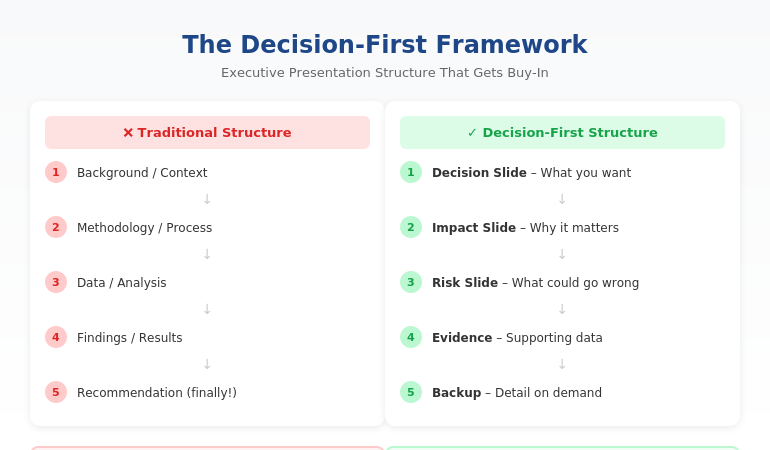
Traditional structure (what you learned):
Background → Process → Data → Analysis → Recommendation
Decision-first structure (what executives want):
Recommendation → Impact → Risk → Supporting Data (if needed)
This structure works because it matches how executives actually think. They don’t need to understand your journey to make a decision. They need to understand the decision itself, what happens if they say yes, and what could go wrong.
When you lead with your recommendation, something remarkable happens: executives engage differently. Instead of waiting to find out what you want, they’re immediately evaluating whether to approve it. You’ve shifted from “presenter explaining things” to “advisor proposing solutions.”
This is exactly how top-tier consulting firms structure client presentations. It’s how I structured every pitch at JPMorgan Chase. And it’s how my clients consistently get faster decisions than their peers.
Want the complete framework with templates for different scenarios? The Executive Slide System includes everything you need to restructure your next presentation. Get instant access →
The Exact Slide Order for Executive Presentations
Here’s the executive presentation structure I teach to banking professionals and FTSE 100 leaders. This works for budget requests, strategic recommendations, project updates, and board presentations:
Slide 1: The Decision Slide
State exactly what you’re asking for and the expected outcome. No background. No preamble. Example: “Recommendation: Approve £2.1M for CRM upgrade. Expected ROI: 340% over 3 years.”
Slide 2: The Impact Slide
Show what happens if they say yes. Revenue impact, cost savings, risk reduction—whatever matters most to this audience. Make the benefit concrete and quantified.
Slide 3: The Risk Slide
Address what could go wrong and how you’ll mitigate it. Executives always think about downside. If you don’t address it, they’ll ask—and you’ll look unprepared.
Slides 4-6: Supporting Evidence
Only include data that directly supports your recommendation. If a slide doesn’t help them say yes, cut it.
Backup Slides: Detail on Demand
Put methodology, detailed analysis, and additional data in backup. You’ll rarely need it—but when an executive asks, you look thorough, not disorganised.
This structure typically reduces a 30-slide presentation to 8-12 slides. More importantly, it reduces decision time from “let’s reconvene” to “approved.”
⭐ Stop Building Slides That Get Ignored
Get the complete Decision-First Framework with plug-and-play templates for every executive scenario.
Includes:
- The exact slide order for budget requests, board updates, and strategic recommendations
- Action-title formulas that eliminate “Overview” and “Background” slides
- Before/after transformations from real presentations
Transform Your Presentation Structure → £39
Instant download. Apply to your next presentation immediately.
How to Apply This Structure to Your Next Presentation
You don’t need to rebuild your entire deck. Start with these three changes:
1. Rewrite your first slide as a decision.
Take whatever’s on your current slide 1 and replace it with: “[Action verb]: [What you want] to [achieve outcome].” If your current first slide says “Q3 Project Update,” change it to “Recommendation: Extend Q3 timeline by 2 weeks to protect £400K deliverable.”
2. Move your recommendation forward.
Find wherever your current recommendation lives (usually slide 15 or later). Move it to slide 1. Yes, it feels uncomfortable. Do it anyway. The supporting detail still exists—it’s just in the right place now.
3. Apply the “so what?” test to every slide.
For each slide, ask: “Does this directly support my recommendation?” If the answer is no, move it to backup. Most presentations lose 30-40% of their slides this way—and become dramatically more effective.
This is exactly how successful CFO presentations are structured. The content isn’t simpler—it’s organised for how finance leaders actually make decisions.
Want a step-by-step system for restructuring your slides? The Executive Slide System walks you through the entire process with templates and real examples. See what’s included →
Related: Great structure is only half the equation. If nerves undermine your delivery, read How to Stop Saying “Um” (Without Sounding Robotic).
Common Questions About Executive Presentation Structure
What is the best structure for an executive presentation?
The best executive presentation structure leads with your recommendation, followed by business impact, risks, and supporting evidence. This “decision-first” approach matches how executives process information. They want to know what you’re asking for before they evaluate whether to approve it. Traditional structures that build to a conclusion waste executive attention.
How do you structure a presentation for senior leadership?
Structure presentations for senior leadership around decisions, not information. Open with your recommendation and expected outcome. Follow with the business case (why it matters), risk assessment (what could go wrong), and supporting data. Keep the main presentation to 8-12 slides and put additional detail in backup slides for reference.
How many slides should an executive presentation have?
Most effective executive presentations have 8-12 slides, plus backup. The goal isn’t a specific number—it’s ensuring every slide directly supports your recommendation. If a slide doesn’t help executives make a decision, it belongs in backup or should be cut entirely. Your executive summary slide alone should convey the core message.
⭐ Present Like Someone Who Understands Executives
Get the complete system for structuring presentations that get immediate buy-in—not polite nods and forgotten follow-ups.
What’s included:
- The Decision-First Framework with exact slide order
- 12 executive slide templates (budget, board, strategy, updates)
- Before/after examples from real presentations
- Action-title formulas that eliminate weak slide titles
The same framework used in FTSE 100 boardrooms, investment banking pitches, and C-suite budget approvals.
FAQ
How long does it take to restructure my existing slides?
Most people can restructure a 20-slide presentation in 60-90 minutes once they understand the Decision-First Framework. The first time takes longest because you’re learning the approach. After that, you’ll naturally build presentations this way from the start—which actually saves time because you’re not second-guessing your structure.
What if my executive actually prefers detailed presentations?
Executives who “prefer detail” actually prefer having detail available when they want it. Lead with your recommendation and keep supporting detail in backup slides. When they ask for more information, you’ll look prepared. In my experience, once executives see a well-structured presentation, they rarely ask for the backup—but they appreciate knowing it exists.
Does this structure work for technical presentations?
Especially for technical presentations. Technical experts often bury their conclusions under methodology because that’s how they solve problems. But executives don’t need to understand your process—they need to understand your conclusion and its business implications. The Decision-First structure forces you to separate “what I did” from “what it means.”
Should I use the same structure for board meetings?
Yes, with one adjustment: boards have even less time and need even clearer decisions. For board presentations, I recommend putting your recommendation AND the expected vote on slide one. Example: “Recommendation: Approve acquisition of XYZ Corp for £12M. Board action requested: Approval vote.” This immediately frames the entire discussion.
📧 The Winning Edge Newsletter
Weekly insights on executive communication, presentation structure, and career-building skills. No fluff—just actionable frameworks from 24 years in corporate banking.
Your Next Step
The right executive presentation structure isn’t about simplifying your message—it’s about sequencing it for how leaders actually make decisions. Lead with the decision. Follow with impact and risk. Put supporting detail where it belongs: available but not in the way.
Try this with your next presentation: write your recommendation as slide one before you create anything else. Build the rest of your deck to support that single slide. You’ll be surprised how much easier the whole process becomes—and how differently executives respond.
If you want the complete framework with templates, examples, and step-by-step guidance, get the Executive Slide System.
📋 Free Resource: Executive Presentation Checklist
Not ready for the full system? Start with this free checklist covering the 10 structural elements every executive presentation needs.
About the Author
Mary Beth Hazeldine is the Owner & Managing Director of Winning Presentations and a former corporate banker with 24 years of experience at JPMorgan Chase, PwC, Royal Bank of Scotland, and Commerzbank. She has trained over 5,000 executives on high-stakes presentation skills and helped clients secure more than £250 million in funding and budget approvals.
Mary Beth is also a qualified clinical hypnotherapist and NLP practitioner, specialising in helping professionals overcome presentation anxiety. After spending five years battling her own fear of presenting at JPMorgan, she developed the techniques she now teaches to executives worldwide.