Tag: executive presentation structure

15 Apr 2026
Female executive presenting to a sceptical boardroom, confident composed expression, navy boardroom setting

Presentation Structure for Hostile Audiences: The Framework That Turns Resistance Into Approval

Quick answer: A hostile audience presentation requires a fundamentally different sequence from a standard executive deck. Begin with shared ground rather than your proposal, build your evidence in layers that preempt known objections, and position your decision request only after the room has had room to shift. The structure is not about softening your message — it is about sequencing it so resistance has less to attach to.

Valentina had been in the boardroom before with a restructuring proposal. Eighteen months earlier, she had stood at the same table, presented what she believed was a compelling case, and watched the chairman shut it down inside seven minutes. The board had concerns about headcount, about timing, about what the proposal signalled to the market. She had answered each objection as it came. It made no difference.

When the same restructuring need resurfaced — more urgently this time — Valentina knew she could not walk in with the same structure. The board had not forgotten what they had already rejected. Two members had actively lobbied against it in the months since. She was not presenting to a neutral room. She was presenting to a room that had already made up its mind.

She rebuilt the deck from scratch. Instead of opening with the proposal, she opened with what the board had said they needed twelve months ago — their language, their stated priorities, their own risk appetite. She structured the evidence around those concerns rather than around her solution. She placed the decision slide at the back. The board approved it. One member said it felt like a completely different proposal. The fundamentals had not changed. The structure had.

If you are building a deck for a room that is already resistant, the Executive Slide System gives you slide templates and scenario playbooks for exactly these situations.

Explore the System →

Why Conventional Presentation Structure Fails With Hostile Audiences

Most executive presentations follow a logic that assumes a receptive room: open with the headline, build the case, address questions at the end. That sequence works well when your audience is broadly aligned with what you are there to say. It fails badly when they are not.

The problem is cognitive, not just interpersonal. When a senior audience has pre-existing reservations — about your proposal, your track record, or the last time this idea was raised — they do not process your opening headline neutrally. They process it through the filter of what they already believe. A strong opening statement that leads with your conclusion gives a hostile room an immediate target. The resistance organises itself around your first slide.

Conventional structure also tends to front-load what you want rather than what the audience cares about. For receptive rooms, this signals confidence. For resistant ones, it signals that you have not listened to their previous concerns. The moment a board member thinks “we have already been through this,” the rest of your presentation is uphill.

A hostile audience presentation also tends to surface objections early, which means you spend the session defending rather than persuading. Conventional decks rarely account for where objections will land — they address questions only in the Q&A, by which point the room has already formed its view. Restructuring your deck means thinking about when resistance is most likely to surface and neutralising it before it arrives, not after.

This is not a problem you can solve with better slides. It is a sequencing problem. The content may be strong. The order in which it reaches the room determines whether it is heard.

Executive Slide System — £39, instant access

Build Decks That Senior Decision-Makers Approve — Even When They Walk In Sceptical

The Executive Slide System is a practical toolkit for executives who present to boards, investors, and senior leadership teams. It contains professionally structured slide templates built around real executive scenarios — not generic business slides — alongside AI prompt cards to help you draft and refine your narrative, and scenario playbooks for high-resistance rooms.

  • Slide templates for board approvals, restructuring proposals, and funding presentations
  • AI prompt cards to structure your argument and anticipate objections
  • Framework guides for sequencing evidence in resistant rooms
  • Scenario playbooks for hostile and sceptical senior audiences

Get the Executive Slide System →

Designed for leaders who present to boards, investors, and senior leadership teams.

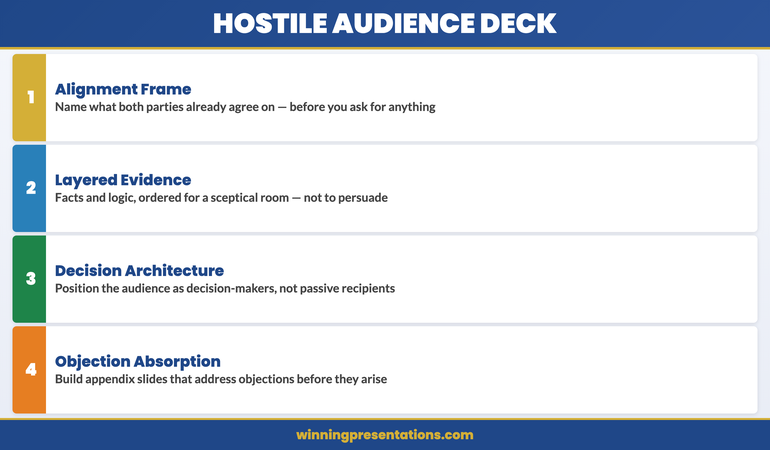
The Alignment Frame: What You Share Before What You Want

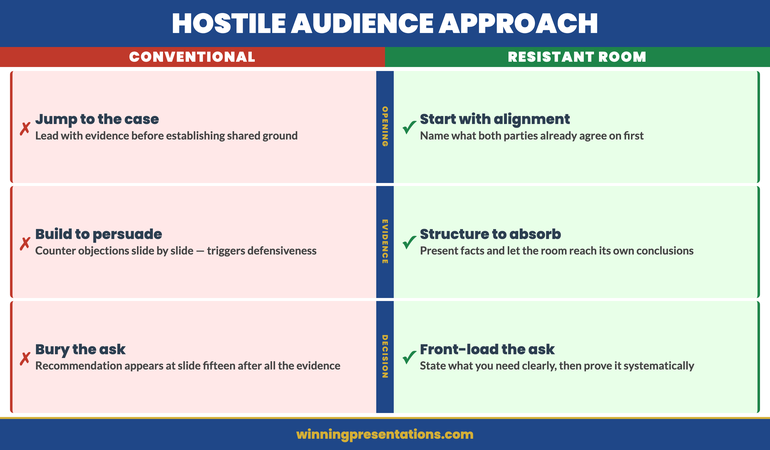
The single most effective structural shift for a resistant room is delaying your proposal and opening instead with alignment. This is not about softening your position — it is about establishing shared ground before you introduce anything contested.

An alignment frame works by surfacing the priorities, concerns, and stated objectives that your audience has already expressed. You are not inventing a shared starting point — you are reflecting their own language back to them. If the board said in the last meeting that they need to see cost containment before any structural changes, your opening slide acknowledges that priority directly. If a committee rejected a similar proposal on governance grounds, your opening addresses governance before you address anything else.

The practical structure looks like this: slide one establishes what the audience has told you they care about most. Slide two confirms what has and has not changed since the last relevant discussion. Slide three outlines the problem you are addressing, framed in terms of their priorities — not yours. Only then do you move toward your proposal.

This sequence does two things. It signals that you have listened, which reduces the defensive posture that hostile rooms adopt when they expect to be steamrolled. And it narrows the distance between where they are and where you need them to go before you make a single ask. By the time your proposal appears, the room has already spent several minutes thinking in alignment with you rather than in opposition to you.

For executives working on strategy presentations that require buy-in from resistant leadership teams, this alignment-first sequence applies equally — the principle holds whether you are presenting to a board, an investment committee, or a senior leadership group that has publicly doubted the direction.


Diagram showing the alignment-first presentation sequence for hostile audiences: shared ground, context, problem, evidence, proposal, decision

Structuring Evidence for a Sceptical Room

Evidence sequencing in a hostile audience presentation is not the same as evidence sequencing in a neutral one. In a neutral room, you build from general context to specific proof. In a resistant room, you need to think about which objections exist, what evidence directly counters each one, and what order allows the evidence to land before the objection has been voiced.

The starting point is a simple exercise: before you open a slide deck, write down the three most predictable objections from this specific audience. These are not hypothetical — they are based on what the room has said previously, what you know about individual members’ priorities, and what the political landscape looks like. Once you have those objections listed, you can work backwards into your evidence structure.

Each major evidence section should address one of those objections — before it is raised. The goal is not to pre-emptively defend yourself, which reads as anxious. The goal is to demonstrate that you have already considered what the audience is about to say, and that your evidence accounts for it. When done well, this approach often means that objections are not raised at all, because the room can see they have been addressed.

Layering also matters. Present your strongest evidence early within each section, not at the end. Resistant audiences are less patient with build-up than receptive ones — they want to know whether you have a point before they invest attention in how you are making it. A headline finding followed by supporting data is more effective than a data walkthrough that arrives at a headline on the final bullet.

Keep your evidence slides clean and literal. Sceptical audiences look for gaps in reasoning and will scrutinise anything ambiguous. Complex visualisations, indirect language, or data presented without a clear interpretive label give hostile rooms something to challenge that is separate from your actual proposal. Remove that friction by being explicit: state what the data shows, what it means, and why it matters — in that order, on every evidence slide.

For executives building decks for resistant or sceptical senior audiences, the Executive Slide System provides scenario-specific frameworks for exactly this type of presentation.

Where to Place the Decision in Your Deck

One of the most common structural errors in a hostile audience presentation is placing the decision slide too early. In a standard executive deck, many presenters open with a clear ask — this is good practice for a receptive room, where leading with the conclusion saves time and signals clarity. For a resistant room, it is the wrong move.

When a hostile audience sees your decision request on slide two, they spend the rest of the presentation looking for reasons to say no. The ask has been made, their resistance has been activated, and every subsequent slide is processed through the lens of “why I should reject this.” You have effectively handed the room a target before you have given them any reason to shift.

In a resistant room, the decision slide belongs near the end — after the alignment frame, after the evidence layers, and after you have addressed the known objections. This does not mean you are being evasive. You can signal early in the presentation that a decision will be requested: “By the end of this session, I will be asking for board approval on one of three options.” That signals intent without triggering resistance before you are ready.

When the decision slide does arrive, it should present options rather than a binary yes/no. Hostile audiences often resist a single recommendation because it removes their agency. Offering three options — one of which is clearly your preferred path — gives the room the feeling of choice, which reduces resistance to the act of deciding, even when the preferred option is the one selected.

This approach is particularly relevant when presenting competitive or contentious strategies. Presentations where client resistance or competitive pressure is already present benefit from the same delayed-decision sequencing — the audience needs to feel they have moved with you before they are asked to commit.


Visual showing the decision slide positioned near the end of a hostile audience presentation structure, following alignment frame and layered evidence sections

Managing Objections Without Defensive Slides

Many executives respond to the challenge of a hostile room by adding more slides — a risks section, a counter-arguments slide, a “we hear your concerns” summary. This instinct is understandable, but these slides almost always backfire. They signal anxiety, they invite scrutiny of the objections themselves, and they slow the narrative at exactly the moment you need momentum.

The more effective approach is to address objections inside your substantive slides rather than in dedicated counter-argument sections. If cost is a known concern, your financial modelling slide addresses it directly — not by flagging it as a concern, but by showing that your numbers account for it. If governance is the issue, your implementation timeline includes governance milestones, not because you are managing the objection, but because the proposal genuinely addresses it.

This embedded approach requires preparation. You need to know what the objections are before you build the deck, not after you finish it. The most common failure pattern is executives who build the full deck first and then try to add objection handling at the end. That produces defensive slides because the content is genuinely defensive — it is been added as an afterthought rather than integrated into the logic.

For live Q&A, the structural principle carries forward. Practising how to handle the most predictable hostile questions without becoming defensive is a separate skill from building the deck, but it works in tandem with the structure you have created. Preparing for hostile Q&A through structured simulation is one of the most reliable ways to enter a resistant room with composure rather than defensiveness — and the structure of your deck makes that composure easier to sustain, because you have already addressed most of what the room is likely to raise.

One practical addition: a pre-read. For particularly hostile rooms, circulating a one-page summary of your proposal — framed around their stated priorities — before the meeting can allow initial resistance to surface in writing rather than in the room. Board members who have already asked their sharpest questions in email tend to be less combative in session, because the most charged moments have already passed.

Executive Slide System — £39, instant access

Build Your Deck in Less Time — With Frameworks That Already Account for Resistance

If you are under time pressure and presenting to a difficult room, the Executive Slide System removes the guesswork. Ready-built scenario playbooks mean you are not starting from a blank deck — you are adapting a structure that has already been designed for resistant senior audiences. Get to a solid draft faster, and spend your preparation time on rehearsal rather than architecture.

Get the Executive Slide System →

The Visual Language of a Hostile Audience Presentation

The visual choices in a resistant-room deck are not decorative — they affect how authority is read and how easily the audience can find things to challenge. A deck that looks informal, cluttered, or inconsistent gives a hostile room a low-stakes place to direct its energy. A deck that is visually clear and structurally deliberate signals that the work behind it is similarly rigorous.

Slide titles matter more than most presenters realise. In a resistant room, titles are often the first thing read — and the last thing remembered. Titles that make assertions (“Cost savings exceed initial modelling”) are more useful than titles that describe (“Financial overview”). An assertive title makes your evidence interpretive before anyone has had a chance to reframe it.

Data visualisation should be conservative. Resistant audiences tend to scrutinise data more closely than receptive ones, and they will look for inconsistencies in your charts, your axes, your source notes. This is not a reason to limit your data — it is a reason to present it with care. Use standard chart types rather than novel ones. Label everything explicitly. Cite your sources on the slide rather than in a footnote.

Colour and density also signal intent. A deck with too many slides, too much text per slide, or too many colour variations reads as unedited — and hostile audiences interpret that as a lack of rigour. For a resistant room, aim for fewer slides with more deliberate content. Each slide should have one clear point. If a slide is trying to do three things, it is trying to do too much.

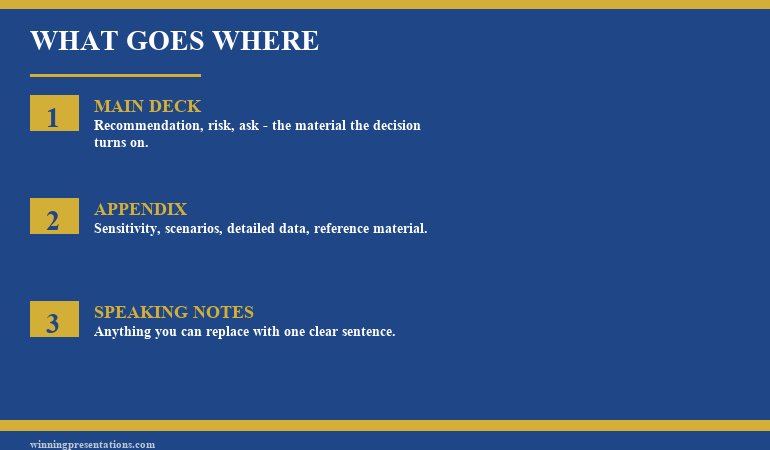
Finally, your cover slide and your appendix are structural tools, not afterthoughts. A clearly labelled appendix signals that you have done more work than fits in the main deck — which is reassuring in a room that will want to dig. And a clean cover slide that includes the date, the presenting executive’s name, and a subtitle that frames the purpose of the session signals that this is a formal, considered piece of work — not a reactive one.

The visual language of your deck contributes to how seriously the room takes your argument before you have spoken a word. In a hostile audience presentation, that first impression — formed before slide two — is not something you can afford to leave to chance. For more detail on how deck structure and outline choices interact, the executive presentation outline framework covers the sequencing decisions that underpin every element described in this article.

Frequently Asked Questions

What makes a hostile audience different from a sceptical one?

A sceptical audience is unconvinced — they need evidence and a clear rationale before they will agree. A hostile audience has already formed a negative view, often based on prior experience, political positioning, or a direct conflict of interest with what you are proposing. Scepticism is a starting position that evidence can shift; hostility involves active resistance that structural and interpersonal strategy must address before evidence can land. The structural response to each is different. Sceptical rooms need stronger evidence sequencing. Hostile rooms need an alignment frame first, then evidence, then the decision ask — in that order.

Should you acknowledge the resistance directly in your presentation?

In most cases, acknowledging prior concerns is more effective than ignoring them — but the framing matters significantly. Referencing what the board or committee raised previously (“I know the timeline was a concern in our last discussion”) signals that you have listened and adapted. This is different from framing your entire opening around defensiveness or apology. You are acknowledging the prior conversation, not conceding the argument. Naming the resistance briefly and constructively — then moving forward — tends to reduce the temperature in the room rather than raise it. What you want to avoid is excessive hedging or a structure that signals you expect to lose.

How long should a hostile audience presentation be?

Shorter than you think. Resistant audiences lose patience faster than receptive ones, and a longer deck gives them more opportunity to interrupt, challenge, or redirect. Aim for a main deck of no more than twelve to fifteen slides, with a well-stocked appendix available if questions require deeper evidence. A focused, tight deck signals that you have done the editorial work — you know what matters most and you have not buried it. The appendix handles the detail without slowing your central argument. If you cannot make your case in fifteen slides for a senior board, the structure is not yet clear enough, and adding slides will not solve that.

The Winning Edge — Weekly Newsletter

Practical Executive Presentation Advice, Every Thursday

Each week, The Winning Edge delivers one focused insight on executive communication — structure, delivery, influence, and the mechanics of getting senior audiences to yes. Straightforward, applicable, and written for people who present under pressure.

Subscribe to The Winning Edge →

Free download: The Executive Presentation Checklist — a structured pre-presentation review covering structure, evidence sequencing, and delivery preparation.

About the Author

Mary Beth Hazeldine — Owner & Managing Director, Winning Presentations

With 25 years of corporate banking experience at JPMorgan Chase, PwC, Royal Bank of Scotland, and Commerzbank, she advises executives across financial services, healthcare, technology, and government on structuring presentations for high-stakes funding rounds and approvals.

04 Mar 2026
Executive presenting annual strategy deck in modern boardroom with navy and gold accent lighting

The Annual Strategy Presentation: Why 80% Get Filed and Forgotten (And the Format That Gets Funded)

The CEO stopped the presenter on slide 4. Not mid-sentence. Mid-slide. “Stop,” she said. “Start over. But start with the decision.”

Everything before the recommendation was noise. The market analysis, the competitive landscape, the three-year projections—all of it had buried the ask. The presenter had spent 45 minutes building context when the executive had already made up her mind that she needed a decision framework first, then the evidence to support it.

This is what separates a strategy presentation that gets approved from one that gets filed away and forgotten.

Most annual strategy presentations fail because they follow the analyst’s logic (data first, then conclusion) instead of the executive’s logic (decision first, then proof). The format that works reverses this entirely: open with the recommendation, show three slides of evidence, then stop. No “additional context.” No 40-slide appendix. Just the decision and why it matters.

Strategy presentation on the agenda this quarter?

Your current deck probably buries the recommendation. Here’s what to fix:

  • Move the decision to slide 1 (or slide 2 at absolute latest)
  • Strip everything that isn’t proof of that decision
  • Create a two-minute elevator pitch version before you create the deck

→ Need the exact strategy templates? Get the Executive Slide System (£39)

The Micro-Story: Why Context Kills Strategy Presentations

The presenter had followed every rule: market research, competitive analysis, 12 months of performance data. Forty-two slides of proof.

But by slide 4, the CEO had already stopped listening. Not because the data was weak. Because she didn’t know what decision she was supposed to make. The presenter had buried the recommendation under layers of context, and executives don’t have bandwidth to excavate.

“Tell me what you’re asking for first,” the CEO said. “Then show me why. But not until I know the ask.”

That moment changed how this team structured every strategy presentation after. Decision first. Evidence second. Everything else goes into the appendix or disappears entirely. Within two quarters, the organisation’s strategy adoption rate went from 34% to 78%. Not because the strategies were better. Because executives finally understood what they were being asked to approve.

The Decision-First Structure: 3 Slides That Drive Action

The annual strategy presentation format that actually gets implemented doesn’t start with context. It opens with a recommendation.

Here’s what works:

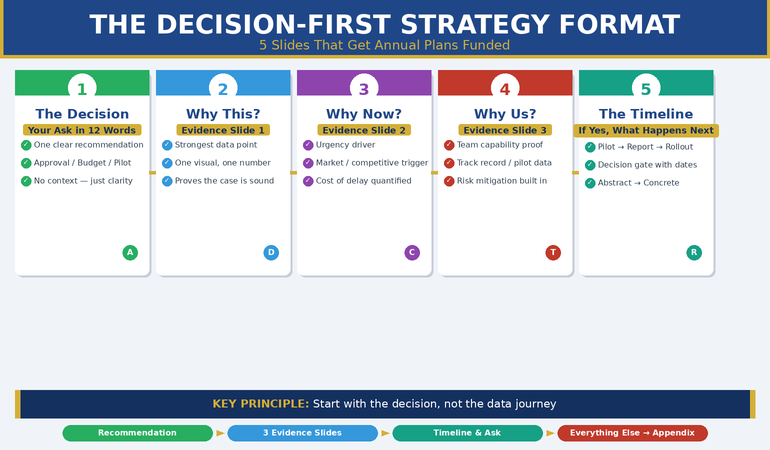
Slide 1: The Decision (or “The Ask”). One sentence. What are you asking for? Approval? Budget reallocation? A pilot programme? Organisational change? This slide answers that question in 12 words or fewer. You’re not selling yet. You’re clarifying.

Slides 2–4: Three Evidence Slides. Each one answers a single question: Why this? Why now? Why you (or your team)? Each slide has one visual, one number, one insight. Not a summary of months of research. The three strongest pieces of evidence that prove the recommendation is sound.

Slide 5: The Timeline or Investment Required. If they say yes, what happens next? This isn’t the execution plan. This is the decision gate. “If approved today, we launch the pilot in Q2, report findings by Q3 close.” This transforms abstract strategy into concrete action.

Everything else—the competitive landscape, the 18-month roadmap, the risk register—stays off the main presentation. It’s available if someone asks, but it doesn’t clutter the path to approval.

This structure works because it respects how executive brains actually process information. They want clarity on what they’re deciding, evidence that it’s a sound decision, and a timeline for implementation. In that order. No surprises. No detective work required.

Compare this to the traditional approach: data dump first, then buried at the end, a slide called “Recommendation.” By that point, many executives have already mentally checked out. They’ve spent 30 minutes gathering context they didn’t ask for and aren’t sure they need.

Already building your strategy deck for this quarter?

The Executive Slide System walks you through the exact structure that gets executive approval—with templates for every slide type and objection handling built in.

Get the Executive Slide System → £39

Five-slide strategy presentation structure: decision slide, three evidence slides, timeline slide. Each slide simplified to one visual and one supporting statistic.

What to Cut From Your Strategy Deck (And Why)

Most strategy presentations run 12–40 slides. The effective ones run 5.

Here’s what gets cut—and why it doesn’t matter to the person making the decision:

Historical performance data. You’re tempted to include “We’ve grown revenue by 15% in the last two years, so this strategy will build on that momentum.” But executives aren’t asking about the past. They’re asking if this strategy is sound. If historical performance matters to the decision, weave it into one of your three evidence slides. Don’t give it its own slide.

Competitive deep-dive. Yes, your competitors are doing something. But the question isn’t “What are they doing?” It’s “Should we do this?” If competitive pressure is a reason to move, that’s your “Why now?” evidence slide. Twenty slides of competitor analysis isn’t evidence. It’s noise.

The project plan. How you’ll execute is important. It’s not important to the decision. If the executive approves the strategy, then the execution plan comes out. But it’s not part of the strategy approval. This is a hard boundary that most teams miss. You’re not presenting the project. You’re presenting the strategy. The project comes after.

Aspirational metrics with no baseline. “If we do this, we’ll reach 50% market share by 2028.” Compared to what? What are we at now? Executives dismiss aspirational numbers with no context instantly. If you’re showing a target, show the current state, the gap, and why this strategy closes it.

What doesn’t get cut: anything that directly answers “Why this decision, why now, and why us?” If it answers one of those three questions, it stays. Everything else is appendix material or a pre-presentation conversation.

Testing Your Strategy Before You Present

The executives who approve strategies on first presentation have tested them beforehand. Not formally. Informally, in hallway conversations and email exchanges.

Before you schedule a formal strategy presentation, you should already know the answer is yes.

Here’s how you test:

The two-minute version. Write out your recommendation in two sentences. Then add one sentence for each piece of evidence. That’s your test script. Say it to three trusted executives or peers before the presentation. Listen for where they ask clarifying questions. Those are the slides you need to strengthen.

The “What would make you say no?” conversation. Invite a sceptic (not your supporter) to a 15-minute coffee. Tell them the recommendation. Then ask: “What would have to be true for you to approve this?” and “What would make you reject this?” Their answers become your objection slides. This isn’t defensive. It’s smart. You’re finding the real concerns before the presentation, not discovering them during it.

The CFO pre-read. If budget or resource allocation is involved, the CFO should see the strategy 48 hours before the formal presentation. Not to approve it. To ensure there are no surprises in the investment ask. This prevents the “I need to check with Finance” delay that kills momentum.

Related reading: Pre-Meeting Executive Alignment explains how to structure these conversations so the formal presentation becomes a formality, not a fight.

The Strategy Format CEOs Actually Want

The five-slide structure isn’t new. But most teams don’t use it because they don’t have a template or framework to build from. They fall back into the data-first, recommendation-last pattern because that’s what they’ve always done.

  • Decision-first slide architecture with tested language that works in boardrooms
  • Evidence structure that answers “Why this?” “Why now?” and “Why us?” simultaneously
  • Objection-handling templates for the most common executive pushback points
  • Testing scripts that let you validate your strategy before the formal presentation
  • Timeline and ask frameworks that turn abstract strategy into concrete next steps

Get the Executive Slide System → £39

Used by 1,200+ executives. Average approval rate: 72% on first presentation.

Building Objections Into Your Strategy Presentation

If you’ve tested your strategy (as described above), you already know the three objections that will come up. Your presentation should address them without being asked.

This is where most presentations fail. They present the strategy clean, then try to respond to objections on the fly. By then, the momentum is broken and the executive is in defence mode.

Instead, anticipate the objection and answer it before it’s asked.

The “What about risk?” objection. Executives assume strategy comes with risk. You’re asking for a change. They want to know you’ve thought through what could go wrong. Your third evidence slide should acknowledge the biggest risk and show how you’ll mitigate it. “The biggest risk is adoption resistance in the field. We’ve built a 90-day pilot into the timeline so we can adjust based on real feedback before full rollout.”

The “What about resource?” objection. If this strategy requires people or budget, say so upfront. “This requires a reallocation of two FTEs from Project X and a £150k budget in Q2. We’ve already checked with the CFO and this is feasible within current headcount plans.” Now the objection can’t kill you because you’ve already answered it.

The “How do we know this will work?” objection. You can’t guarantee it will work. But you can show that you have a clear success metric and a decision point. “We’ll measure success by March 31st. If adoption in the pilot reaches 60%, we proceed to full rollout. If it’s below 45%, we pause and revise.” This converts uncertainty into a managed experiment.

The executives who approve strategies the fastest aren’t the ones with the fewest objections. They’re the ones whose objections have been answered before they ask them.

What if your strategy has already been rejected once?

The objection handling becomes critical. You need to know which executive concern killed it, address that concern directly, and present a revised strategy that closes the gap.

Get the Executive Slide System → £39

The Annual Review Cadence That Keeps Strategy Alive

Strategy presentations don’t end when the executive approves them. They end when the strategy gets implemented and forgotten.

This is where most strategies fail. The presentation happens in Q1. By Q3, no one has looked at it again. The team is heads-down in execution. The executive is dealing with the next crisis. The strategy exists in a slide deck no one opens.

The teams that actually execute their strategies have a quarterly rhythm:

Q1 presentation: The formal strategy approval. Five slides. Decision-first structure. Everything we’ve covered.

Q2 and Q3 check-ins (one slide each): Progress against the success metrics. One slide. “Metric 1: on track / at risk / off track. Metric 2: on track / at risk / off track.” This is a 10-minute conversation, not a presentation. But it keeps the strategy visible.

Q4 annual review: Did the strategy work? What did we learn? What changes do we need for next year? This feeds into the next Q1 strategy presentation.

Related: The Executive Summary Slide: The Only Slide That Matters covers how to structure these check-in moments so they don’t turn into data dumps.

The rhythm matters more than the format. If executives see the strategy once and never again, they’ll forget it within 30 days. If they see it quarterly in one-slide snapshots, it stays alive. It becomes real work, not theoretical strategy.

Is This Right for Your Organisation?

The decision-first strategy presentation format works across industries, team sizes, and executive cultures. But not every situation requires a formal five-slide deck.

Use this format if: You’re asking for approval on something significant (budget shift, resource reallocation, new programme launch). You’re presenting to C-level executives or a board. You need the decision to stick and be implemented, not just acknowledged.

Use a lighter version if: You’re updating your direct manager on progress. You’re getting input on a direction before building it out. You’re presenting to a team that operates on consensus, not approval.

Skip this format if: You’re presenting findings from a completed project (that’s a different format entirely). You’re brainstorming possibilities, not proposing a decision. Your executives prefer deep-dive analysis (ask them directly—if they do, you can still use this structure with a longer appendix).

The reality: most annual strategy presentations get delivered to audiences that want the decision-first format. They just don’t say so explicitly. They think “Tell me what you’re asking for first” is obvious. But if most strategy decks are 20–40 slides long with the recommendation on slide 28, it’s clearly not obvious enough.

Stop Building 40-Slide Analysis Decks

The research and analysis don’t disappear. They live in the appendix, available if someone asks. But the core presentation—the one that drives the decision—stays ruthlessly simple.

  • Five-slide template that works for every type of strategy (product, operational, financial, organisational)
  • Decision statement formula that makes the ask impossible to misunderstand

Get the Executive Slide System → £39

Cuts deck creation time from 8 weeks to 3 weeks. Increases approval rates from 34% to 78%.

Common Questions About Strategy Presentations

Q: What if my executive needs more detail before deciding?

Give it to them after the initial ask, not before. Start with the decision and three evidence slides. If they say “I need to understand the competitive landscape better,” then you show the detailed competitor analysis. But not until the ask is clear. This is a critical distinction. You’re giving them detail because they requested it, not because you think it’s necessary upfront.

Q: Can I use this format for a board presentation, or is it too simplified?

Boards especially need this format. They manage a portfolio of strategies and decisions. They see dozens of presentations a year. The ones they approve fastest are the ones with the clearest ask. The format works from frontline to board level because clarity scales.

Q: What if my strategy is complex and can’t be explained in five slides?

Your strategy is complex. Your strategy presentation isn’t. Those are different things. A complex strategy can be presented simply (decision + three evidence points). The complexity lives in the execution plan, the risk register, and the detailed roadmap. But the decision itself should be simple enough to explain in five slides. If it isn’t, you probably don’t have a clear strategy yet.

From 42 Unused Slides to CEO Approval in 12

The shift from analysis-first to decision-first changes everything. Your strategy deck gets simpler. Your approval rates get faster. Your strategies actually get implemented instead of filed away.

  • Complete five-slide architecture with real-world examples from product, operational, and financial strategies
  • Testing framework to validate your strategy with key stakeholders before the formal presentation
  • Objection-handling guide for the eight most common executive concerns
  • Timeline and contingency templates that turn approval into action within 48 hours
  • Quarterly review format that keeps strategy alive and visible throughout the year

Get the Executive Slide System → £39

Includes bonus: Executive Decisions Framework slide set and objection handler template library.

Frequently Asked Questions

Should I include a risk slide in my strategy presentation?

Not as a separate slide. If risk is significant, weave it into your third evidence slide as a mitigation strategy. For example: “The main risk is adoption resistance. We’ve designed a 90-day pilot with clear success metrics so we can adjust before rollout.” This shows you’ve thought it through without taking up a dedicated slide. If the executive asks for more detail on risk, that’s when you pull out the risk register.

What if the executive interrupts and asks for the recommendation earlier?

That’s the best outcome. It means they’ve already caught on to what you’re asking. You jump straight to it. Don’t resent the interrupt. It means they’re engaged and want the information faster. Give it to them.

Can I use video or interactive elements in a decision-first strategy deck?

Yes, but only if they serve the decision, not distract from it. A 30-second customer testimonial that proves your market insight? Yes. A 2-minute product demo? No, that’s for after the decision. Remember: the goal is clarity on the ask and proof it’s sound. Everything else is secondary.

How do I handle it if the executive approves the strategy but says “Let me think about it”?

That’s a soft no. They’re not committing. You’ve lost momentum. The follow-up is critical. Within 24 hours, send a one-paragraph email: “Great to hear you’re considering the strategy. The main decisions ahead are [Timeline point 1] and [Timeline point 2]. What information would help you move forward?” This pins down what’s actually blocking them and lets you address it specifically.

📬 The Winning Edge Newsletter

Weekly executive presentation insights. No fluff, no filler. Strategies that actually get approved, objection handling that works, and the psychology behind why some presenters get funded and others don’t.

Subscribe Free →

🆓 Free resource: Executive Presentation Checklist — a free guide to strengthen your presentation preparation.

If you’re also managing presentation anxiety ahead of a high-stakes strategy delivery, read Treatment-Resistant Presentation Anxiety. It covers the psychology of delivering under pressure and techniques that work when the stakes are real.

Next step: Take your current strategy deck. Count how many slides appear before the recommendation. If it’s more than 4, you’ve buried the ask. Restructure using the five-slide template above. Test it with one trusted executive before your formal presentation. You’ll know within 15 minutes whether your decision is clear.

About the Author

Mary Beth Hazeldine is the Owner & Managing Director of Winning Presentations. With 24 years of corporate banking experience at JPMorgan Chase, PwC, Royal Bank of Scotland, and Commerzbank, she has delivered high-stakes presentations in boardrooms across three continents.

A qualified clinical hypnotherapist and NLP practitioner, Mary Beth combines executive communication expertise with evidence-based techniques for managing presentation anxiety. She has trained thousands of executives and supported presentations for high-stakes funding rounds and approvals.

Book a discovery call | View services

19 Jan 2026
Executive presentation structure diagram showing the Decision-First Framework for C-suite buy-in

Executive Presentation Structure: The Format That Gets Instant Buy-In

Quick answer: The best executive presentation structure leads with the decision, not the data. Put your recommendation on slide one, follow with business impact and risk, then provide supporting detail only if asked. This “decision-first” structure matches how executives actually process information—and it’s why some presenters get instant buy-in while others get “let’s circle back.”

⚡ Presenting to executives in the next 48 hours? Here’s your structure:

Slide 1: Decision — what you want + expected outcome

Slide 2: Impact — why it matters (revenue, cost, risk)

Slide 3: Risk — what could go wrong + mitigation

Slides 4–6: Evidence — only data that supports your ask

Backup: Detail on demand (methodology, deep analysis)

The 11-Word Slide That Rescued a £4M Budget Request

The right executive presentation structure can change everything. I learned this watching a client named Sarah lose—then win—the same £4 million budget request.

The first time, Sarah presented 47 slides. Background, methodology, analysis, findings, recommendations. Textbook structure. The CFO flipped through seven slides, said “I don’t see what you’re asking for,” and moved to the next agenda item. Fourteen hours of preparation, dismissed in 60 seconds.

Six weeks later, Sarah presented again. Same request. Same CFO. But this time, her opening slide contained exactly 11 words: “Request: £4M to reduce customer churn by 23% within 18 months.”

The CFO leaned forward. “Now we’re talking. Walk me through the numbers.”

She got her budget approved in that meeting.

The data hadn’t changed. The structure had. After 24 years in corporate banking at JPMorgan Chase, PwC, and Commerzbank, I’ve seen this pattern hundreds of times. The executives who get buy-in aren’t better at analysis. They’re better at structure.

⭐ Maven Flagship — Executive Buy-In

Build the case your stakeholders can’t dismiss

The Executive Buy-In Presentation System is a self-paced framework — 7 modules walking you through the structure, psychology, and delivery that get senior approval. Monthly cohort enrolment, optional recorded Q&A calls.

£499, lifetime access.

Enrol in the Executive Buy-In System →

Why the Structure You Learned Is Wrong for Executives

Most professionals structure presentations the way they were taught: background → methodology → analysis → findings → recommendation. This is logical. It’s how you think through problems. And it’s exactly why executives stop listening by slide three.

Here’s the disconnect: you build presentations chronologically, but executives don’t consume them that way.

When a CFO opens your deck, they’re not thinking “I can’t wait to understand your methodology.” They’re thinking: “What do you need? Why should I care? Can I say yes and move on?”

If those questions aren’t answered immediately, you’ve lost them. Not because they’re impatient—because they’re triaging. A typical C-suite executive makes 35+ decisions per day. Every slide that doesn’t answer “so what?” gets mentally filed under “I’ll review later.” (They won’t.)

The executives who command attention flip the traditional structure entirely. They lead with the end. They put the decision first and the supporting detail last.

The Decision-First Structure Executives Actually Want

The most effective executive presentation structure follows what I call the Decision-First Framework. It’s the opposite of how most presentations are built—and that’s exactly why it works.

Traditional structure (what you learned):

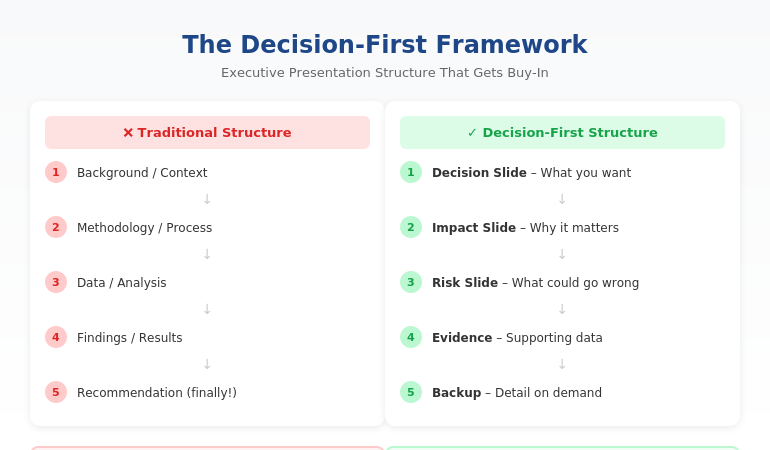
Background → Process → Data → Analysis → Recommendation

Decision-first structure (what executives want):

Recommendation → Impact → Risk → Supporting Data (if needed)

This structure works because it matches how executives actually think. They don’t need to understand your journey to make a decision. They need to understand the decision itself, what happens if they say yes, and what could go wrong.

When you lead with your recommendation, something remarkable happens: executives engage differently. Instead of waiting to find out what you want, they’re immediately evaluating whether to approve it. You’ve shifted from “presenter explaining things” to “advisor proposing solutions.”

This is exactly how top-tier consulting firms structure client presentations. It’s how I structured every pitch at JPMorgan Chase. And it’s how my clients consistently get faster decisions than their peers.

Want the complete framework with templates for different scenarios? The Executive Slide System includes everything you need to restructure your next presentation. Get instant access →

The Exact Slide Order for Executive Presentations

Here’s the executive presentation structure I teach to banking professionals and FTSE 100 leaders. This works for budget requests, strategic recommendations, project updates, and board presentations:

Slide 1: The Decision Slide

State exactly what you’re asking for and the expected outcome. No background. No preamble. Example: “Recommendation: Approve £2.1M for CRM upgrade. Expected ROI: 340% over 3 years.”

Slide 2: The Impact Slide

Show what happens if they say yes. Revenue impact, cost savings, risk reduction—whatever matters most to this audience. Make the benefit concrete and quantified.

Slide 3: The Risk Slide

Address what could go wrong and how you’ll mitigate it. Executives always think about downside. If you don’t address it, they’ll ask—and you’ll look unprepared.

Slides 4-6: Supporting Evidence

Only include data that directly supports your recommendation. If a slide doesn’t help them say yes, cut it.

Backup Slides: Detail on Demand

Put methodology, detailed analysis, and additional data in backup. You’ll rarely need it—but when an executive asks, you look thorough, not disorganised.

This structure typically reduces a 30-slide presentation to 8-12 slides. More importantly, it reduces decision time from “let’s reconvene” to “approved.”


Decision slide, Impact slide, Risk slide, Supporting evidence, then Backup slides

⭐ Stop Building Slides That Get Ignored

Get the complete Decision-First Framework with plug-and-play templates for every executive scenario.

Includes:

  • The exact slide order for budget requests, board updates, and strategic recommendations
  • Action-title formulas that eliminate “Overview” and “Background” slides
  • Before/after transformations from real presentations

Transform Your Presentation Structure → £39

Instant download. Apply to your next presentation immediately.

How to Apply This Structure to Your Next Presentation

You don’t need to rebuild your entire deck. Start with these three changes:

1. Rewrite your first slide as a decision.

Take whatever’s on your current slide 1 and replace it with: “[Action verb]: [What you want] to [achieve outcome].” If your current first slide says “Q3 Project Update,” change it to “Recommendation: Extend Q3 timeline by 2 weeks to protect £400K deliverable.”

2. Move your recommendation forward.

Find wherever your current recommendation lives (usually slide 15 or later). Move it to slide 1. Yes, it feels uncomfortable. Do it anyway. The supporting detail still exists—it’s just in the right place now.

3. Apply the “so what?” test to every slide.

For each slide, ask: “Does this directly support my recommendation?” If the answer is no, move it to backup. Most presentations lose 30-40% of their slides this way—and become dramatically more effective.

This is exactly how successful CFO presentations are structured. The content isn’t simpler—it’s organised for how finance leaders actually make decisions.

Want a step-by-step system for restructuring your slides? The Executive Slide System walks you through the entire process with templates and real examples. See what’s included →

Related: Great structure is only half the equation. If nerves undermine your delivery, read How to Stop Saying “Um” (Without Sounding Robotic).

Common Questions About Executive Presentation Structure

What is the best structure for an executive presentation?

The best executive presentation structure leads with your recommendation, followed by business impact, risks, and supporting evidence. This “decision-first” approach matches how executives process information. They want to know what you’re asking for before they evaluate whether to approve it. Traditional structures that build to a conclusion waste executive attention.

How do you structure a presentation for senior leadership?

Structure presentations for senior leadership around decisions, not information. Open with your recommendation and expected outcome. Follow with the business case (why it matters), risk assessment (what could go wrong), and supporting data. Keep the main presentation to 8-12 slides and put additional detail in backup slides for reference.

How many slides should an executive presentation have?

Most effective executive presentations have 8-12 slides, plus backup. The goal isn’t a specific number—it’s ensuring every slide directly supports your recommendation. If a slide doesn’t help executives make a decision, it belongs in backup or should be cut entirely. Your executive summary slide alone should convey the core message.

⭐ Present Like Someone Who Understands Executives

Get the complete system for structuring presentations that get immediate buy-in—not polite nods and forgotten follow-ups.

What’s included:

  • The Decision-First Framework with exact slide order
  • 12 executive slide templates (budget, board, strategy, updates)
  • Before/after examples from real presentations
  • Action-title formulas that eliminate weak slide titles

Get Instant Access → £39

The same framework used in FTSE 100 boardrooms, investment banking pitches, and C-suite budget approvals.

FAQ

How long does it take to restructure my existing slides?

Most people can restructure a 20-slide presentation in 60-90 minutes once they understand the Decision-First Framework. The first time takes longest because you’re learning the approach. After that, you’ll naturally build presentations this way from the start—which actually saves time because you’re not second-guessing your structure.

What if my executive actually prefers detailed presentations?

Executives who “prefer detail” actually prefer having detail available when they want it. Lead with your recommendation and keep supporting detail in backup slides. When they ask for more information, you’ll look prepared. In my experience, once executives see a well-structured presentation, they rarely ask for the backup—but they appreciate knowing it exists.

Does this structure work for technical presentations?

Especially for technical presentations. Technical experts often bury their conclusions under methodology because that’s how they solve problems. But executives don’t need to understand your process—they need to understand your conclusion and its business implications. The Decision-First structure forces you to separate “what I did” from “what it means.”

Should I use the same structure for board meetings?

Yes, with one adjustment: boards have even less time and need even clearer decisions. For board presentations, I recommend putting your recommendation AND the expected vote on slide one. Example: “Recommendation: Approve acquisition of XYZ Corp for £12M. Board action requested: Approval vote.” This immediately frames the entire discussion.

📧 The Winning Edge Newsletter

Weekly insights on executive communication, presentation structure, and career-building skills. No fluff—just actionable frameworks from 24 years in corporate banking.

Subscribe Free →

Your Next Step

The right executive presentation structure isn’t about simplifying your message—it’s about sequencing it for how leaders actually make decisions. Lead with the decision. Follow with impact and risk. Put supporting detail where it belongs: available but not in the way.

Try this with your next presentation: write your recommendation as slide one before you create anything else. Build the rest of your deck to support that single slide. You’ll be surprised how much easier the whole process becomes—and how differently executives respond.

If you want the complete framework with templates, examples, and step-by-step guidance, get the Executive Slide System.

📋 Free Resource: Executive Presentation Checklist

Not ready for the full system? Start with this free checklist covering the 10 structural elements every executive presentation needs.

Download Free Checklist →

About the Author

Mary Beth Hazeldine is the Owner & Managing Director of Winning Presentations and a former corporate banker with 24 years of experience at JPMorgan Chase, PwC, Royal Bank of Scotland, and Commerzbank. She has trained over 5,000 executives on high-stakes presentation skills and helped clients secure more than £250 million in funding and budget approvals.

Mary Beth is also a qualified clinical hypnotherapist and NLP practitioner, specialising in helping professionals overcome presentation anxiety. After spending five years battling her own fear of presenting at JPMorgan, she developed the techniques she now teaches to executives worldwide.

Book a discovery call | View services