A senior banker delivered a flawless 20-minute strategy presentation. Slides were crisp. Narrative flowed. The room was engaged. Then came the words every executive dreads: “Any questions?”
Forty-seven seconds into the first question—an unexpected probe from a board member about risk assumptions—she froze. Not because she didn’t know the answer. Not because the question was hostile. But because the presentation had shifted from scripted performance to unscripted performance. Control had evaporated. She had practised every slide. She hadn’t practised uncertainty.
That freeze—and the cascading panic that followed—was not a presentation failure. It was a control failure.
The Quick Answer
Your Q&A anxiety is worse than your presentation anxiety because your brain treats them as fundamentally different threats. A presentation is scripted, rehearsed, and contained. Q&A is unscripted, unpredictable, and exposes gaps in your expertise in real time. Control—not competence—is what your nervous system is actually tracking. When you lose the ability to predict what’s coming next, threat activation shoots upward, even when your actual knowledge is solid.
Q&A session coming up and dreading the questions more than the presentation?
The anxiety you’re feeling isn’t about what you don’t know—it’s about losing control of the narrative. Your brain is primed to detect threats in unscripted exchanges. But this threat response can be rewired through prediction and structure.
- Map likely questions before the room opens for Q&A
- Practise response frameworks, not word-for-word answers
- Shift your mindset from “defence” to “demonstration”
→ Want the system that predicts questions before they’re asked? Get the Executive Q&A Handling System (£39)
Jump to Section:
The Control Theory of Q&A Anxiety
There is a psychological principle called “threat of the unknown.” Your brain’s threat-detection system (the amygdala) is exceptionally sensitive to unpredictability. Not actual danger—unpredictability.
When you deliver a presentation, you have rehearsed it. You know what slide comes next. You know your transition words. You’ve practised your pacing. You’ve anticipated where the audience attention might flag. This rehearsal creates narrative control. Your brain can predict the next 60 seconds. Prediction dampens threat activation.
Q&A removes prediction. A question lands that you didn’t anticipate. Your brain doesn’t know what’s coming. You don’t know what follow-up will land. You can’t script your way out because every response generates new uncertainty. This unpredictability is what triggers the panic—not the intellectual challenge of answering.
This is why some of the most competent, knowledgeable executives report that Q&A feels more threatening than delivering the presentation itself. It’s not about expertise. It’s about the loss of control over the information landscape.
Why Your Brain Treats Q&A Differently: The Scripted vs. Unscripted Divide
Your nervous system operates on two different threat-assessment channels when comparing presentations to Q&A:
The Presentation Channel: Scripted, contained, predictable. You have engineered certainty. Your body recognises this as “practised performance,” which carries lower threat weight. Even if you feel nervous, your body knows the structure. The outcome is bounded. You finish at slide 20. The threat window closes.
The Q&A Channel: Unscripted, open-ended, unpredictable. You have engineered uncertainty. Your body recognises this as “real-time performance,” which carries higher threat weight. You don’t know when it ends. You don’t know what angle the next question takes. Every answer you give creates new exposure points. The threat window stays open.
This is not weakness. This is neurobiology. Your amygdala is doing what it evolved to do: flag unpredictable situations as higher-threat than predictable ones—regardless of actual risk.
A carefully scripted presentation about organisational risks feels safer than an unscripted discussion of those same risks, even though the latter is the real conversation where your judgment actually matters. Your brain hasn’t caught up to this paradox.
The Three Types of Q&A Anxiety Executives Face
Not all Q&A anxiety feels the same because not all threats are the same. Understanding which threat you’re actually experiencing helps you target your preparation differently.
1. Competence Threat
This is the fear that you don’t know the answer and will be exposed as unprepared or uninformed. “What if they ask me something I can’t answer?” This anxiety often strikes executives who are new to a role, presenting in unfamiliar domains, or speaking to highly technical audiences.
Competence threat is the easiest to address because it responds to preparation. Map likely questions. Research gaps. Build answer frameworks. When you’ve done the work, competence threat drops significantly because you’ve reduced actual unpredictability. You’ve moved from “I don’t know what questions will come” to “I’ve considered 80% of likely questions already.”
2. Status Threat
This is the fear that answering poorly will damage your reputation, credibility, or standing in the room. “If I stumble, will they lose confidence in me? Will this affect my next promotion?” Status threat is particularly acute for executives presenting upwards (to boards, investors, executives several levels above) or to peers during high-stakes decisions.
Status threat is about self-image projection. You’re not just answering a question. You’re managing how others perceive your competence, judgment, and authority. This amplifies anxiety because the stakes feel personal, not just professional. A stumbled answer during Q&A feels like it broadcasts weakness directly to decision-makers.
3. Ambush Threat
This is the fear that a question will be hostile, loaded, or designed to trap you. “What if someone deliberately tries to make me look bad?” Ambush threat surfaces most often in adversarial contexts: contentious board meetings, regulatory presentations, stakeholder challenges to your strategy, or internal politics where approval isn’t guaranteed.
Ambush threat creates hypervigilance. You’re scanning for hostile intent rather than preparing substantive answers. This diverts cognitive resources away from actual Q&A preparation toward threat-detection, making you less prepared for the meeting itself.
Understanding which threat is dominant in your situation matters because the preparation strategy differs. Competence threat requires knowledge work. Status threat requires confidence work (anchoring your self-worth separately from a single answer). Ambush threat requires strategic preparation (anticipating hostile angles and having response frameworks ready).
How Preparation Shifts the Control Equation
The antidote to Q&A anxiety is not confidence-building in the generic sense. It’s control restoration through prediction.
When you prepare for Q&A properly, you’re not trying to memorise answers. You’re doing something more strategic: you’re shrinking the threat window by reducing unpredictability.
This happens in stages:
Stage 1: Prediction Mapping
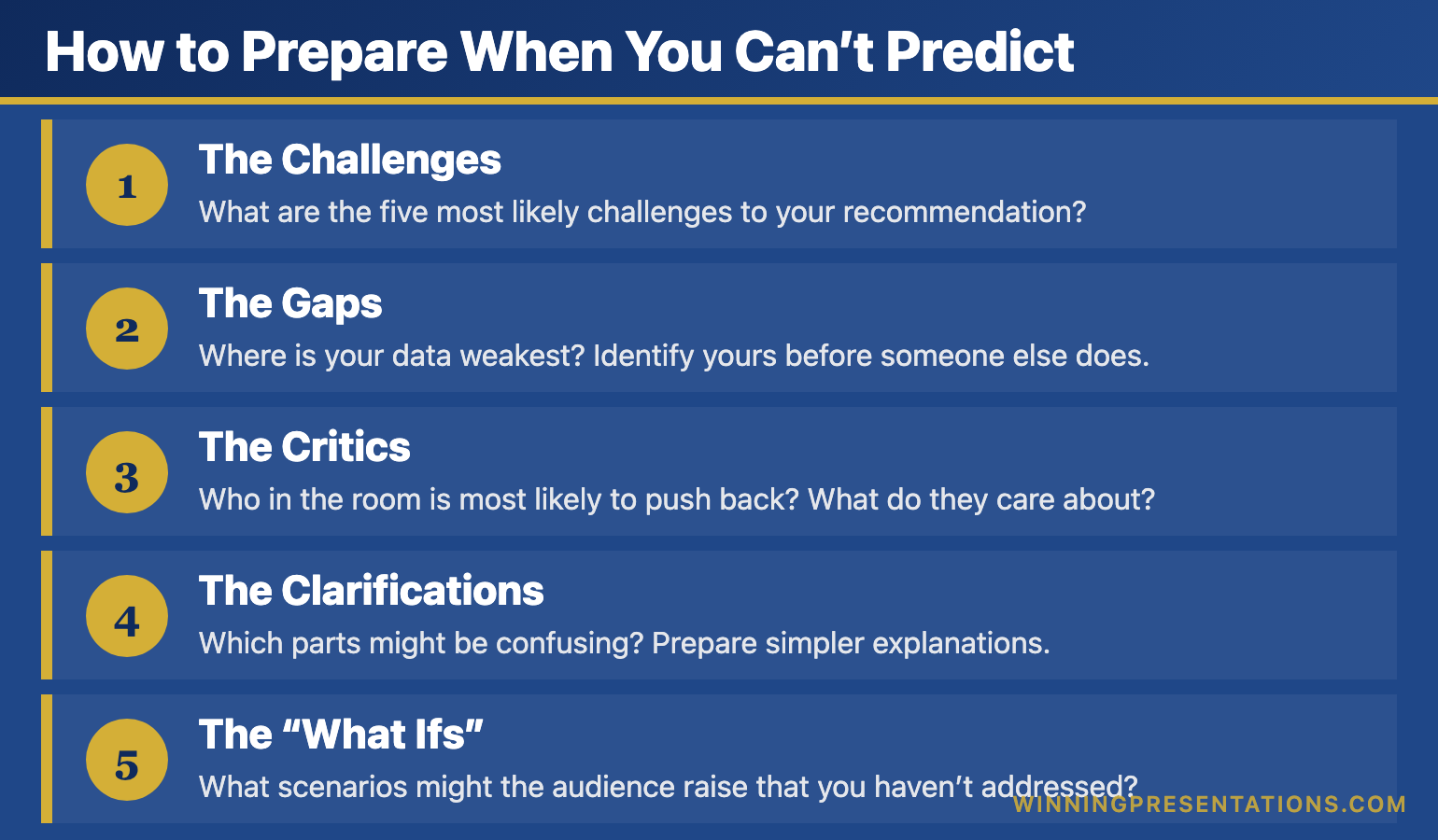
You identify the likely questions before the room opens for Q&A. What will this specific audience care about? What gaps might they spot? What assumptions might they challenge? What decisions hinge on your presentation?
This single step—moving from “I don’t know what will be asked” to “I’ve considered the likely angles”—begins shifting control back to you. Your brain is no longer scanning blindly for threat. It’s working with a bounded set of scenarios.
Stage 2: Response Frameworks
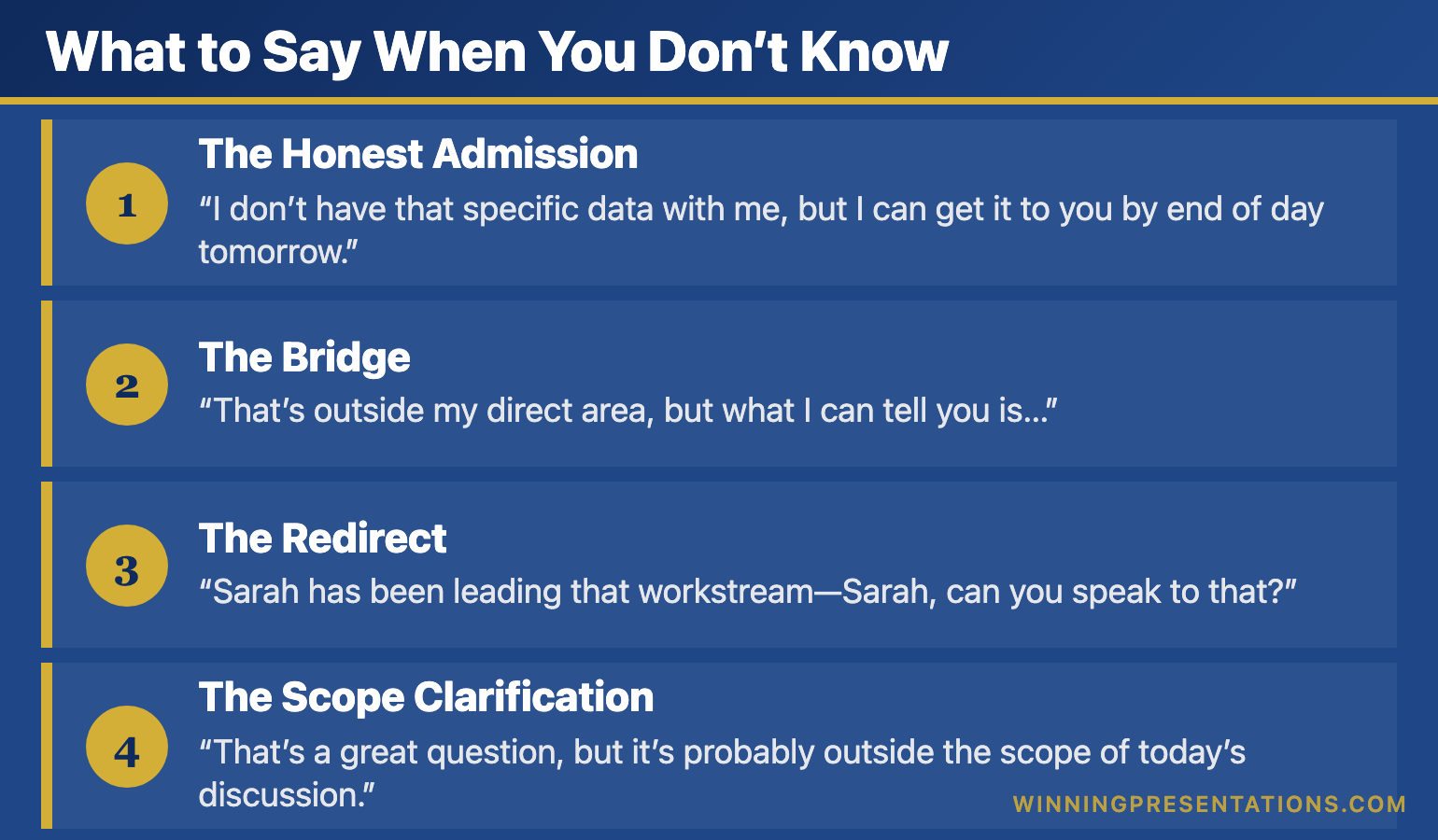
You don’t memorise answers. You build flexible frameworks for responding. This distinction matters. A memorised answer breaks if the question lands at a slightly different angle. A framework adapts. Frameworks give you control because you can handle variations without feeling unprepared.
Stage 3: Narrative Anchoring
You anchor every Q&A response back to your core presentation narrative. This prevents Q&A from becoming a disconnected interrogation and keeps you in the role of presenter explaining your thesis, not defendant justifying your position. Narrative anchoring restores psychological control because you’re still in charge of the conversation direction.
When executives go through this three-stage preparation properly, something shifts neurologically. Q&A still feels different from the presentation. But it no longer feels like walking into an ambush. It feels like continuing a conversation you’ve already shaped.
Reframing Q&A as Your Advantage (Not Your Vulnerability)
The most overlooked insight about Q&A anxiety is this: Q&A is actually your competitive advantage if you reframe what’s happening.
During a presentation, you’re broadcasting. The audience is receiving. You set the pace, the narrative, the framing. They have minimal agency.
During Q&A, the audience reveals what actually matters to them. Their questions expose gaps, concerns, priorities, and objections that you can now address in real time. You get direct feedback on what’s resonating and what’s still unclear.
If you’re prepared, Q&A isn’t a threat-exposure session. It’s an opportunity to demonstrate thinking, flexibility, and depth in real time. It’s where you move from “presenting information” to “thinking with your audience.”
This reframe doesn’t eliminate the nervousness. But it redirects it. Instead of defending your position, you’re demonstrating your confidence in it. Instead of dreading what you’ll be asked, you’re curious about what matters to them.
Executives who make this shift report that Q&A becomes the part of the presentation where they feel most like themselves—because they’re no longer performing a script. They’re having a genuine conversation with people who are invested in what they have to say.
Walk Into Q&A Knowing 80% of Questions Before They’re Asked
Preparation that restores control isn’t about cramming information. It’s about strategic prediction and response architecture. When you know the likely angles your audience will probe, your nervous system shifts from hypervigilance to readiness.
- Map the questions your specific audience will ask (not generic Q&A)
- Build flexible response frameworks that adapt to variations
- Anchor every answer back to your core narrative
- Practice thinking on your feet within structured boundaries
- Transform Q&A from ambush to advantage
Get the Executive Q&A Handling System → £39
Used by 4,000+ executives across banking, technology, and investment. Includes question mapping templates and response frameworks for high-stakes Q&A.
Need the Q&A prep system?
The Executive Q&A Handling System walks you through prediction mapping, response frameworks, and real-time thinking techniques. Get it now (£39).

Stop Dreading the Words “Any Questions?”
The physical dread that hits when those words are spoken doesn’t disappear through willpower. It dissolves through preparation that proves to your nervous system that you’re not walking into unknown territory. You’re walking into a conversation you’ve already mapped.
- Your Q&A anxiety is a signal that your preparation has focused on delivery, not dialogue
- Shift preparation toward the questions, not just the presentation
Get the Executive Q&A Handling System → £39
Includes a specific diagnostic to identify whether you’re facing competence threat, status threat, or ambush threat—and the preparation strategy for each.
Different threat, different strategy.
The system walks you through identifying your primary Q&A threat and the exact preparation steps that address it. Learn your strategy (£39).
Common Questions About Q&A Anxiety
What’s the difference between presentation nerves and Q&A nerves?
Presentation nerves typically peak before you start speaking and then settle as you get into flow. Q&A nerves build throughout the presentation as you anticipate the unknown. They’re driven by unpredictability, not the act of speaking. Even confident presenters report elevated Q&A anxiety because the threat model is different—you’re no longer controlling the narrative.
Can you really prepare for questions you haven’t anticipated?
Yes, through response frameworks rather than memorised answers. When you know your core narrative deeply and have thought through the likely angles your audience will probe, you can adapt to unexpected questions because you’re not relying on script. You’re thinking within a prepared structure. This is qualitatively different from trying to memorise answers to “unknown” questions.
Does anxiety about Q&A mean I’m not ready for the presentation?
No. Q&A anxiety and presentation readiness are separate dimensions. You can be thoroughly prepared on content and still experience control threat during Q&A because the formats trigger different nervous system responses. Addressing Q&A anxiety requires specific preparation for dialogue, not just delivery.
Is This Right For You?
Q&A anxiety becomes your focal point if you recognise yourself in any of these scenarios:
- You’ve rehearsed your presentation meticulously, but the thought of Q&A still triggers physical dread
- You perform well in scripted delivery but feel exposed once the audience can ask anything
- You freeze or stumble when an unexpected question lands, even on topics you know well
- You’ve delivered dozens of presentations, but Q&A still feels like the uncontrolled part
- You worry that how you answer in the moment will damage your credibility or authority
- You sense that your presentation would land harder if you were more confident fielding questions
If your Q&A anxiety is higher than your presentation anxiety—or if you’re avoiding high-stakes Q&A situations because of it—this is a control issue, not a competence issue. The solution is preparation that specifically addresses unpredictability and response flexibility.
Proven Q&A Preparation System for Senior Executives
Developed over 24 years of high-stakes boardroom presentations and refined through clinical work with presentation anxiety, this system gives you the exact prediction and response architecture that transforms Q&A from threat to advantage.
- Question mapping templates customised for your audience and industry
- Response frameworks that adapt to variations and follow-up probes
- Narrative anchoring technique to keep control of the conversation
- Real-time thinking protocols for handling ambush questions
- Diagnostic tools to identify your specific Q&A threat type
Get the Executive Q&A Handling System → £39
4,000+ executives have used this system to transform Q&A from the most dreaded part of presentations into their competitive advantage.
FAQ: Q&A Anxiety and Control
Why do executives with deep expertise still freeze during Q&A?
Because expertise addresses competence threat, not control threat. You can know your subject deeply and still experience panic when the narrative shifts from scripted delivery to unpredictable dialogue. Your nervous system is responding to loss of predictability, not lack of knowledge. Preparation that specifically addresses Q&A scenarios—not just deeper content mastery—is what settles the nervous system.
Can you overcome Q&A anxiety through breathing techniques or mindset alone?
Breathing and grounding techniques can help manage the physical activation in the moment. But they don’t address the underlying threat: unpredictability. Without preparation that actually reduces unpredictability (question mapping, response frameworks), the anxiety resurfaces. Mindset shifts (“Q&A is an opportunity”) help reframe the threat, but they work best alongside structural preparation that proves to your nervous system that you’re ready.
How long before Q&A anxiety actually decreases?
Most executives report noticeable shifts within 2-3 presentations after implementing proper Q&A preparation. The first presentation using question mapping and response frameworks still feels slightly uncertain. But by the second or third, your nervous system recognises the pattern: you’ve prepared, you’ve anticipated the likely angles, and you handle follow-ups confidently. This repetition builds a new template. Your brain learns that Q&A preparation works.
Want more on executive communication?
Join The Winning Edge newsletter for weekly insights on presentation strategy, Q&A mastery, and high-stakes communication. Sent every Friday to 8,000+ executives and communicators.
Related Reading:
- Annual Strategy Presentation Format: The Boardroom Template — A format that anticipates Q&A patterns by design
- When Standard Anxiety Techniques Fail: Treatment-Resistant Presentation Anxiety — For anxiety that persists despite standard interventions
- Why Executives Ask Questions They Already Know the Answer To — Understanding the real agenda behind many Q&A probes
The Shift From Dread to Confidence
Q&A anxiety won’t disappear completely. But it can shift from “dread of the unknown” to “readiness for dialogue.” That shift happens when your nervous system has evidence that you’ve prepared for likely scenarios and have flexible frameworks for handling the rest.
The senior executive who froze mid-Q&A in the opening story didn’t return to her team and memorise more content. She spent two hours mapping the likely questions her board would ask, building response frameworks, and practising how to anchor answers back to her strategic narrative. At her next presentation, the same type of unexpected question landed. This time, she didn’t freeze. She recognised it as a variation of an anticipated angle, adapted her response within a prepared framework, and brought the conversation back to her core thesis. Her answer wasn’t perfect. But her confidence was.
That confidence came from control—not overconfidence in having all the answers, but earned confidence in having done the preparation that matters.
About the Author
Mary Beth Hazeldine is the Owner and Managing Director of Winning Presentations. With 24 years of corporate banking experience at JPMorgan Chase, PwC, Royal Bank of Scotland, and Commerzbank, she has delivered high-stakes presentations in boardrooms across three continents.
A qualified clinical hypnotherapist and NLP practitioner, Mary Beth combines executive communication expertise with evidence-based techniques for managing presentation anxiety. She has trained thousands of executives and supported presentations for high-stakes funding rounds and approvals.