

Presentation Q&A: Why the Questions Terrify You More Than the Presentation
Quick Answer: The Q&A triggers more fear than the presentation because you lose control. You’ve rehearsed your slides; you can’t rehearse unpredictable questions. The solution isn’t predicting every question—it’s building a framework for handling any question. Prepare by category (challenges, gaps, critics), master bridging techniques, and remember: the audience wants you to succeed.
Still Panicking About Q&A?
You’re not alone. Most executives rank Q&A as their biggest presentation fear. The difference between panicked executives and calm ones? A structured system for handling any question. The Executive Q&A Handling System gives you exactly that: a question prediction framework, real-time response techniques, and 51 AI prompts to practise difficult scenarios.
The Presentation That Nearly Ruined My Career
I delivered the best presentation of my career at Commerzbank in 2008. Twenty-two minutes of polished content, clear data, compelling recommendations. The CFO was nodding. My boss looked pleased.
Then came the Q&A. The first question was fine. The second was manageable. The third came from a director I’d never met: “Your projections assume a 12% market growth rate. What’s your evidence for that, given the current regulatory environment?”
I had evidence. Somewhere. In my backup slides. Which I couldn’t find. While twelve executives watched me fumble through my deck, my credibility evaporating with each passing second.
I eventually found the data. But by then, the damage was done. My carefully constructed presentation had been overshadowed by ninety seconds of visible panic.
That evening, I realised something that changed how I approach every presentation: the Q&A isn’t an afterthought. It’s where credibility is won or lost.
Over the following decade, I became obsessed with Q&A preparation. I interviewed executives who seemed effortlessly confident under questioning. I studied hostage negotiators and crisis communicators. I tested techniques with clients across industries.
What I discovered is that Q&A confidence has almost nothing to do with knowing all the answers. It comes from having a system for handling any question—including the ones you can’t predict.
Stop Rehearsing Every Possible Question
You can’t predict every question. But 95% of difficult questions fall into just 5 categories. Learn which ones matter for your presentation, and you’ll handle any curveball with calm certainty.
The Executive Q&A Handling System (£39) teaches you:
- The 5-category preparation framework (done in under 30 minutes)
- Bridging techniques that buy thinking time and signal confidence
- Hostile question responses that reframe attacks into opportunities
- 51 AI prompts to stress-test your answers before the room does
Designed for executives across banking, consulting, and technology. Master your Q&A in one afternoon.
The Psychology of Unpredictability
Why does Q&A trigger more anxiety than the presentation itself? The answer lies in control. During your presentation, you control what information you share, the order, pace, timing, which points to emphasise, when to pause. During Q&A, you control almost nothing. Questions come from anywhere. You’re reacting, not leading. Your carefully rehearsed structure is gone.
This loss of control activates your brain’s threat response. Suddenly you’re not presenting—you’re defending. Your body shifts into fight-or-flight mode, which is exactly the wrong state for clear, confident communication.
The physical symptoms follow: racing heart, shallow breathing, mind going blank. These aren’t signs of incompetence. They’re signs that your nervous system has misidentified a question as a threat.
Understanding this is the first step to managing it. Q&A anxiety isn’t about your knowledge or preparation. It’s about your brain’s response to unpredictability. And that response can be retrained.
How to Prepare When You Can’t Predict
You can’t anticipate every question. But you can prepare for every category of question. Before any presentation, work through five preparation categories:
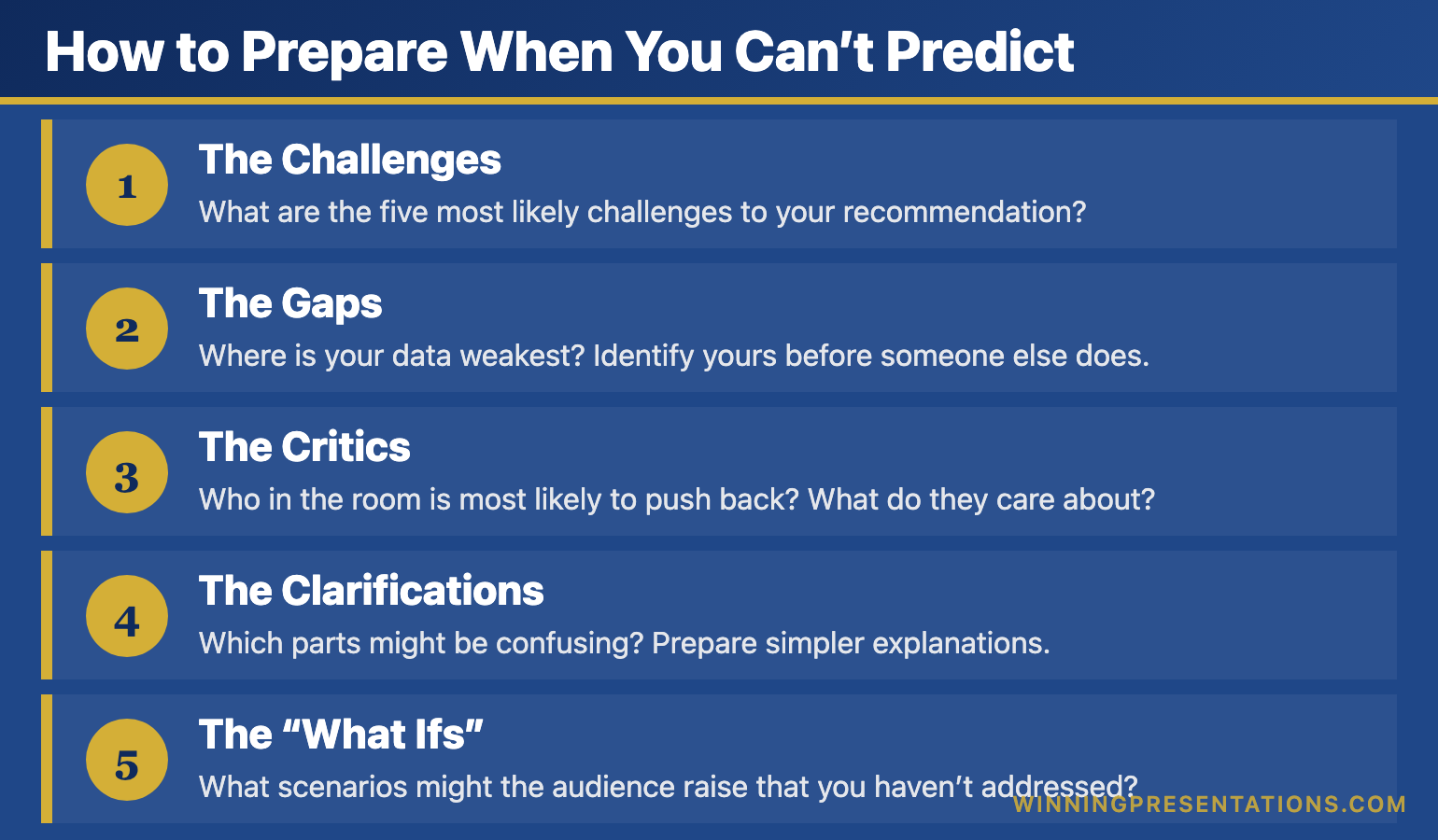
- The Challenges – What are the five most likely challenges to your recommendation?
- The Gaps – Where is your data weakest? Identify yours before someone else does.
- The Critics – Who in the room is most likely to push back? What do they care about?
- The Clarifications – Which parts might be confusing? Prepare simpler explanations.
- The “What Ifs” – What scenarios might the audience raise that you haven’t addressed?
This category-based preparation is more valuable than trying to predict specific questions. For more on anticipating objections, see our guide on how to handle difficult questions in a presentation.
Want a structured framework that handles 95% of difficult questions? The Executive Q&A Handling System teaches you category-based preparation, real-time bridging techniques, and hostile question responses—all in one afternoon.
What to Say When You Don’t Know
Here’s a liberating truth: you don’t need to know everything. The most confident executives all share one trait: they’re comfortable saying “I don’t know.” But they say it strategically:
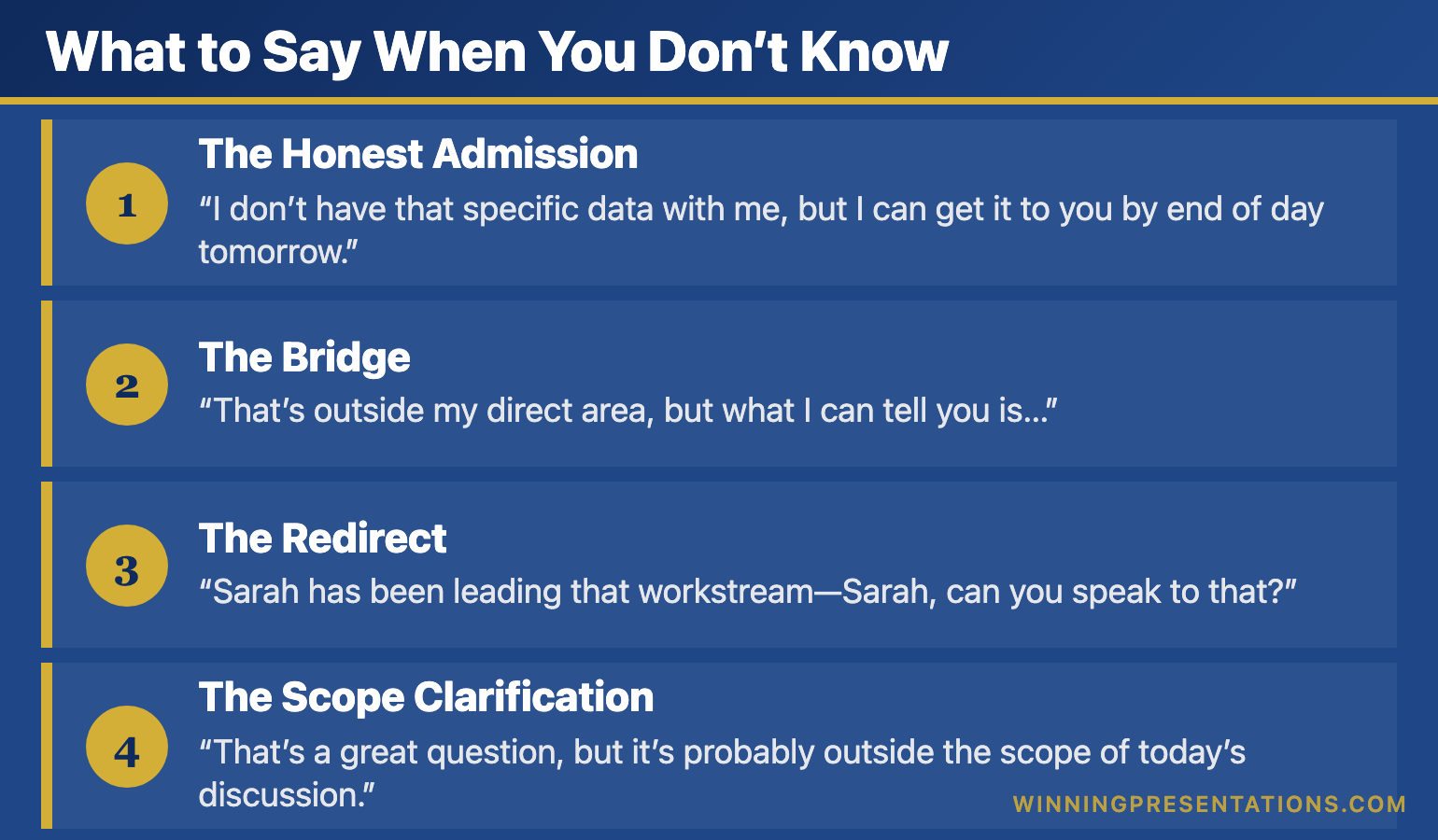
- The Honest Admission: “I don’t have that specific data with me, but I can get it to you by end of day tomorrow.”
- The Bridge: “That’s outside my direct area, but what I can tell you is…”
- The Redirect: “Sarah has been leading that workstream—Sarah, can you speak to that?”
- The Scope Clarification: “That’s a great question, but it’s probably outside the scope of today’s discussion.”
What you should never do: guess, bluff, or provide data you’re not certain about.
Handling Hostile and Loaded Questions
Not all questions are neutral. Some come with a hidden agenda. Some carry hostility. Difficult question types include:
- The Loaded Question – reframe the premise before answering
- The Hostile Question – stay curious, not defensive; treat it as information-seeking
- The Agenda Question – acknowledge the alternative viewpoint without abandoning your position
- The Ambush Question – ask for context if unfamiliar; take your time before responding
Key principle: hostile questions are often about emotion, not information. Your job is to address the underlying concern, not just the surface question.
The Difference Between Flustered and Composed
The executives who stay calm under hostile questioning share one thing: they’ve practised specific response techniques until they become automatic. They don’t think—they respond with precision.
Inside the Executive Q&A Handling System (£39, instant access):
- 7 structured Q&A techniques that signal leadership under pressure
- Scripts for hostile, loaded, and ambush questions
- The Parking Lot technique and 4 other methods for handling questions that would derail the discussion
- 51 AI-powered question prompts for personalised practice
Immediate digital download, ready to use before your next presentation.
7 Techniques That Transform Q&A
These seven techniques have been tested with executives. Each one addresses a specific challenge in Q&A delivery:
- Repeat and Reframe – Echo the question back in your own words. This buys thinking time, demonstrates you understood, and shifts the framing to your advantage.
- The 30-Second Rule – Keep answers to 30 seconds maximum. Brevity signals confidence; rambling signals uncertainty.
- Bridge to Strength – Never leave an answer on a defensive note. Bridge to a point of strength or a supporting fact.
- The Parking Lot – For questions that derail the discussion, offer to discuss offline: “That’s important. Let’s park it and I’ll follow up with you.”
- Evidence Anchoring – When answering, point to a specific piece of data or research. Vagueness breeds doubt; specificity builds credibility.
- The Pause – Pause for 2-3 seconds before answering. It reads as thoughtful, not uncertain. Silence is underused power.
- End on Your Terms – Summarise your key point before moving to the next question. Don’t let the questioner have the last word on your topic.
For the specific anxiety that hits during Q&A rather than in planned content, the Q&A anxiety guide addresses the in-the-moment recovery techniques.
Case Study: From Q&A Terror to Q&A Confidence
Priya was a senior manager at a technology company. Brilliant during presentations—her slides were polished, her data was solid, her delivery was engaging. But the moment the first question came, she fell apart. Racing heart, defensive tone, rambling answers.
The problem wasn’t her knowledge. She over-prepared on content and under-prepared on Q&A. We restructured her preparation:
- Week before: Work through the 5-category objection prep framework. Identify every possible challenge, gap, and critic.
- Day before: Ask a colleague to challenge her with difficult questions. One hour of real dialogue beats days of solo preparation.
- Morning of: 10 minutes practising “I don’t know” responses and pause techniques. Physical calibration, not content review.
We also addressed the physical response: before each practice question, she would pause for 2 seconds, take a full breath, then answer. By the time of her next board presentation, this was automatic.
The result: she handled an aggressive line of questioning from the toughest director in the room. No hesitation. No defensiveness. Clear, evidence-anchored answers with strategic pauses. When she finished, the CEO asked her to lead the follow-up strategic initiative.
Frequently Asked Questions
1. Why is the Q&A scarier than the presentation itself?
During a presentation, you control the content, pace, and flow. During Q&A, you lose control. Questions come from anywhere, and you’re reacting instead of leading. This perceived loss of control triggers your threat response—fight-or-flight—which is exactly the wrong neurological state for calm communication.
2. How do I prepare for questions I can’t predict?
You prepare by category instead of by specific question. Work through five categories: the challenges to your recommendation, the gaps in your data, the likely critics in the room, clarifications that might be needed, and “what if” scenarios. This framework captures 95% of difficult questions before they’re asked.
3. What do I do when I don’t know the answer?
You say so—strategically. Use one of four approaches: the honest admission (“I don’t have that data, but I’ll get it by tomorrow”), the bridge (“That’s outside my area, but here’s what I can tell you”), the redirect (“Sarah’s leading that—Sarah, you take this one”), or the scope clarification (“That’s outside today’s scope”). Never guess or bluff.
4. How do I handle hostile questions in a presentation?
Reframe the premise. If someone asks “Doesn’t your plan ignore the regulatory risk?” you might respond: “Actually, our plan was built around regulatory compliance. Here’s why…” Treat hostile questions as information-seeking, not attacks. Stay curious, not defensive.
5. Should I repeat the question before answering?
Yes—but reframe it. Echo the question back in your own words. This demonstrates understanding, buys you thinking time, and shifts the framing slightly in your favour. Example: “So you’re asking whether the timeline accounts for implementation lag—great question.”
6. How long should my Q&A answers be?
Aim for 30 seconds maximum. Longer than that, you’re rambling—which signals uncertainty. Keep it short, evidence-anchored, and end on a point of strength. If they want more detail, they’ll ask.
Get Weekly Insights on Presentation Mastery
Join executives who receive The Winning Edge—weekly strategies for presenting with confidence, handling difficult stakeholders, and leading through communication.
Free Resource: CFO Questions Cheatsheet
If you’re presenting to finance leadership, you need this. The CFO Questions Cheatsheet covers the 20 questions CFOs ask most frequently, with research-backed answers and talking points for each. Download free.
Q&A Is Where Leaders Are Made
The presentation shows you can prepare. The Q&A shows you can think. It’s the moment where audiences decide whether you’re a functional expert or a leader worth following.
The executives who master Q&A aren’t smarter. They’re not better informed. They’ve simply applied a system—a framework for handling unpredictable questions with calm certainty. They prepare by category, they bridge to strength, they’re comfortable saying “I don’t know,” and they pause before speaking.
That system is learnable. In a few hours of focused preparation, you can transform Q&A from your biggest fear into your greatest strength. You can be the executive in the room who stays composed when others panic. Who clarifies when others fumble. Who builds credibility during questioning instead of just defending.
If Commerzbank taught me anything, it’s this: your presentation is the opening act. Your Q&A is where the audience decides whether you’re worth believing.
Related Resources
- How to Handle Difficult Questions in a Presentation
- Presentation Confidence: How to Build It Fast
- How to Calm Nerves Before a Presentation
About the Author
Mary Beth Hazeldine is the Owner & Managing Director of Winning Presentations. She spent 25 years in banking, including roles at JPMorgan Chase, PwC, RBS, and Commerzbank. A qualified clinical hypnotherapist and NLP practitioner, she advises executives across financial services, healthcare, technology, and government on presenting with confidence and credibility. She specialises in Q&A preparation, stakeholder management, and high-stakes presentation confidence.