Tag: presentation anxiety

15 Jan 2026
Presentation breathing techniques - the 4-7-8 method for calming nerves

Presentation Breathing: The 4-7-8 Technique That Stops Racing Hearts

Quick Answer: The best presentation breathing techniques use the 4-7-8 method (inhale for 4 counts, hold for 7, exhale for 8) to activate your parasympathetic nervous system and calm anxiety in under 60 seconds. Unlike generic “deep breathing” advice, this specific ratio forces your body out of fight-or-flight mode by extending the exhale—the phase that actually slows your heart rate.


In This Article:

The investment banker was hyperventilating in the corridor outside the boardroom. “They told me to take deep breaths,” she said, gasping. “It’s making it worse.”

She was right. Generic “deep breathing” advice often backfires because anxious people breathe too fast—taking rapid deep breaths that actually increase oxygen and make panic worse.

I learned this the hard way during my own five years of presentation terror. I’d stand outside meeting rooms, gulping air, feeling my heart race faster with every breath. It wasn’t until I trained as a clinical hypnotherapist that I understood why: it’s not the depth of breath that calms you. It’s the ratio.

The technique I’m about to share works within three breath cycles. I’ve taught it to hundreds of executives, and it works every time.

Calm Nerves Start with Preparation

Breathing techniques manage the symptoms. But real confidence comes from knowing your slides have your back. The Executive Slide System gives you frameworks that let you present from any slide without panic—because you’re never lost.

Get the Executive Slide System → £39

Presentation breathing techniques - the 4-7-8 method for calming nerves

Why “Just Breathe Deeply” Often Fails

When you’re anxious, your breathing becomes shallow and rapid. The instinct is to take big, deep breaths to compensate. But here’s the problem: if you take those deep breaths too quickly, you’re actually hyperventilating.

Rapid deep breathing floods your system with oxygen and depletes carbon dioxide—which triggers more anxiety symptoms: tingling, dizziness, racing heart. The exact opposite of what you need.

The key isn’t breathing deeply. It’s breathing slowly—and extending your exhale beyond your inhale. That’s what activates your vagus nerve and shifts your nervous system from “threat mode” to “calm mode.”

For a complete guide on managing pre-presentation nerves, see my detailed article on how to calm nerves before a presentation.

The 4-7-8 Technique: Step by Step

This technique was developed by Dr. Andrew Weil, based on ancient yogic breathing practices. Navy SEALs use a variation of it. Here’s exactly how to do it:

Step 1: Exhale completely through your mouth, making a whoosh sound. Empty your lungs fully.

Step 2: Inhale quietly through your nose for a count of 4.

Step 3: Hold your breath for a count of 7.

Step 4: Exhale completely through your mouth for a count of 8, making the whoosh sound again.

Repeat for 3-4 cycles. That’s less than 90 seconds total.

The magic is in the 1:1.75:2 ratio. The long exhale forces your heart rate down. The hold gives your body time to absorb oxygen properly. The slow inhale prevents hyperventilation.

When to Use It (Timing Matters)

Presentation breathing techniques timing guide - when to use 4-7-8 method

5 minutes before: Do 4 complete cycles in a quiet space (bathroom, empty office, stairwell).

2 minutes before: Do 2 cycles while walking to the room.

Sitting at the table: Do 1 subtle cycle as others settle in—no one will notice.

During Q&A: One cycle while someone else asks a question gives you 20 seconds to compose yourself.

The technique works best when practiced regularly, not just in emergencies. Your body learns the calming response faster with repetition.

🏆 PREMIUM TRAINING

Present with Confidence Under Pressure

The Executive Buy-In System combines preparation frameworks with delivery techniques—so you walk into any presentation calm, prepared, and confident. Includes the complete anxiety management toolkit I’ve developed over 24 years.

Learn More About Executive Buy-In → £199

📧 Join 2,000+ professionals getting weekly techniques for confident presenting. Subscribe to The Winning Edge →

FAQs

How do you breathe to calm nerves before a presentation?

Use the 4-7-8 technique: inhale for 4 counts, hold for 7 counts, exhale for 8 counts. The extended exhale activates your parasympathetic nervous system and physically slows your heart rate. Do 3-4 cycles 5 minutes before presenting for maximum effect.

Why does deep breathing sometimes make presentation anxiety worse?

When anxious, people often take rapid deep breaths, which causes hyperventilation—too much oxygen, too little carbon dioxide. This increases symptoms like dizziness and racing heart. The solution is slow breathing with extended exhales, not just deep breaths.

Can I use breathing techniques during a presentation?

Yes. One subtle 4-7-8 cycle while someone asks a question gives you 20 seconds to calm your nervous system without anyone noticing. You can also use a single long exhale before answering difficult questions—it reads as thoughtfulness, not anxiety.

📥 Free Download: 7 Presentation Frameworks

When your structure is solid, anxiety drops. Get the frameworks that give you confidence before you even start breathing exercises.

Download Free Frameworks →

Related: How to Calm Nerves Before a Presentation: The 5-Minute Reset


Mary Beth Hazeldine spent 24 years at JPMorgan, PwC, RBS, and Commerzbank. She’s a clinical hypnotherapist and MD of Winning Presentations.

15 Jan 2026
Should you memorize presentations word-for-word - why it backfires

Should You Memorize Presentations? Why Word-for-Word Is the Worst Strategy

Quick Answer: Don’t memorize presentations word-for-word—it creates a false sense of security that collapses under pressure. When you forget one sentence, you lose the thread entirely. The better approach: memorize your framework and key transitions, then speak naturally from each slide. This gives you flexibility to recover from interruptions while maintaining your core message.


In This Article:

The VP of Strategy at RBS had memorized every word of her board presentation. Three weeks of practice. 47 slides. Perfectly scripted.

Twelve minutes in, a director interrupted with a question. She answered it. Then froze.

She couldn’t find her place in the script. The next 20 minutes were painful—fumbling through slides, apologizing repeatedly, reading directly from the screen. A presentation she knew backwards fell apart because one interruption broke the chain.

I’ve seen this happen dozens of times in my 24 years at JPMorgan, PwC, RBS, and Commerzbank. The executives who memorize word-for-word are actually the most vulnerable when things go off-script. And things always go off-script.

Stop Memorizing Scripts. Start Using Frameworks.

The Executive Slide System gives you pre-built structures that let you present confidently from any slide—without memorizing a single script. When your slides guide you naturally, you never lose your place.

Get the Executive Slide System → £39

Should you memorize presentations word-for-word - why it backfires

Why Word-for-Word Memorizing Backfires

When you memorize a presentation word-for-word, you’re creating a chain. Each sentence depends on the previous one to trigger the next. This works perfectly in practice—and catastrophically in reality.

Here’s what breaks the chain:

  • A question from the audience
  • A technical glitch that skips slides
  • Running short on time
  • An executive who asks you to “jump to the recommendation”
  • Your own mind blanking on one word

Any of these—and they happen in nearly every business presentation—leaves you stranded. You know the material, but you can’t access it because the retrieval system (your memorized sequence) is broken.

For more on why over-rehearsing creates this vulnerability, see my full guide on presentation rehearsal and the diminishing returns of practice.

The Framework Approach That Actually Works

Instead of memorizing words, memorize structures. Here’s the difference:

Word-for-word memorization: “In Q3, we achieved 127% of our revenue target, driven primarily by expansion in the EMEA region, which contributed 43% of new bookings…”

Framework memorization: “Q3 results → what drove them → EMEA specifics → next steps”

With the framework approach, you know what each section covers and how it connects to the next. The exact words come naturally because you understand the flow, not because you’ve rehearsed a script.

This is why executives who present frequently rarely memorize—they’re too busy to rehearse scripts. Instead, they internalize the story arc and speak from knowledge.

How to memorize a presentation - what to memorize vs what to speak naturally

What You SHOULD Memorize (Only These Four Things)

1. Your opening line. The first 10 seconds set your confidence. Have it locked.

2. Your transitions. Know exactly how you’ll move from section to section. “That’s the problem. Here’s what we’re proposing…” These bridges keep you flowing.

3. Your closing call to action. End strong with a clear ask. Don’t fumble the landing.

4. Your story arc/framework. Know the general framework/story arc of your presentation.

Everything in between? Speak from your slides, your expertise, and your framework. That’s where authentic confidence comes from.

🏆 PREMIUM TRAINING

Master Executive Presentations Without Scripts

The Executive Buy-In System teaches you to present with authority—even when interrupted, challenged, or thrown off-script. Learn the same frameworks I’ve taught to 5,000+ executives at JPMorgan, PwC, and Commerzbank.

Learn More About Executive Buy-In → £199

📧 Join 2,000+ professionals getting weekly presentation insights—frameworks, not scripts. Subscribe to The Winning Edge →

FAQs

Should I memorize my presentation word-for-word?

No. Word-for-word memorization creates vulnerability—one interruption or forgotten word breaks your entire flow. Instead, memorize your framework (the structure and key transitions) and speak naturally from your expertise. This gives you flexibility to handle questions and still deliver your core message.

How do I remember my presentation without memorizing it?

Focus on the story arc, not the script. Know your opening line, your section transitions, and your closing call to action. Let your slides serve as visual prompts for the content in between. Practice talking through your framework rather than reciting words.

What if I forget what to say during a presentation?

With framework-based preparation, forgetting a word doesn’t derail you—you simply continue with the next point in your structure. If you do lose your place, glance at your current slide, take a breath, and state the main point of that slide. Your audience won’t know you skipped anything.

📥 Free Download: 7 Presentation Frameworks

Get the exact structures executives use to present without scripts—including the PREP method mentioned above.

Download Free Frameworks →

Related: Presentation Rehearsal: Why 3 Hours of Practice Makes You Worse


Mary Beth Hazeldine spent 24 years at JPMorgan, PwC, RBS, and Commerzbank. She’s a clinical hypnotherapist and MD of Winning Presentations.

14 Jan 2026
q&a anxiety presentation techniques - how to transform hostile questions into opportunities for credibility

Q&A Anxiety Presentation: The Technique That Turns Hostile Questions Into Opportunities

Quick Answer: Q&A anxiety stems from loss of control, not lack of knowledge. The reframe that changes everything: hostile questions aren’t attacks—they’re opportunities to demonstrate expertise and build credibility. Use the Acknowledge-Bridge-Control technique: validate the concern, find common ground, then guide the conversation where you want it to go.

The question came like a punch to the chest.

“Given that your last two projects ran over budget, why should we trust these numbers?”

I was presenting to the PwC leadership team, and a senior partner had just challenged my credibility in front of everyone. My face flushed. My mind raced to defend, to explain, to justify.

But I’d been training for this moment.

Instead of defending, I paused. Took a breath. And said: “You’re right to ask that. Trust has to be earned. Let me show you exactly what’s different this time.”

The room shifted. What could have been a career-damaging moment became the most credibility-building two minutes of my presentation.

That’s when I learned: hostile questions aren’t threats. They’re opportunities—if you know how to reframe them.

⭐ Confidence Starts With Structure

The Executive Slide System builds presentations that anticipate objections. When your slides address likely challenges before they’re raised, hostile questions become easier to handle—you’re simply pointing to evidence you’ve already prepared.

Get the Executive Slide System → £39

Why Hostile Questions Trigger Panic

When someone challenges you publicly, your brain doesn’t distinguish between professional criticism and physical threat. The amygdala fires. Cortisol floods your system. You’re in fight-or-flight before you’ve processed the actual question.

This is why smart, knowledgeable people freeze under hostile questioning. It’s not about competence—it’s about biology.

The solution isn’t to suppress the response. It’s to reframe the situation before your threat system takes over.

Here’s the reframe that changed everything for me: A hostile question is a gift.

Think about it. The questioner has just told you exactly what concerns them. They’ve revealed their objection, their fear, their agenda. Now you can address it directly instead of guessing what resistance exists in the room.

For a complete guide to managing the Q&A, see our hub article on presentation Q&A techniques.

Reframing hostile questions - from threat to opportunity mindset shift for presentation Q&A

The Acknowledge-Bridge-Control Technique

This three-step technique transforms any hostile question into an opportunity:

Step 1: Acknowledge

Validate the concern genuinely. Not defensively, not dismissively—genuinely.

  • “You’re right to raise that.”
  • “That’s a fair challenge.”
  • “I understand why that’s concerning.”

Acknowledgment disarms hostility. The questioner expected resistance. When you validate instead, the temperature drops immediately.

Step 2: Bridge

Find common ground before presenting your perspective.

  • “We both want this project to succeed…”
  • “Like you, I’m focused on minimising risk…”
  • “The underlying concern—getting this right—is one I share…”

Bridging moves you from opposition to collaboration. You’re no longer adversaries; you’re two people trying to solve the same problem.

Step 3: Control

Now guide the conversation to your key point.

  • “…which is why this approach includes three safeguards we didn’t have before.”
  • “…and here’s specifically what’s different this time.”
  • “…let me show you the data that addresses that directly.”

You’ve validated, connected, and now you’re leading. The hostile question has become your platform.

This technique is part of a broader framework for handling presentation Q&A with confidence.

The Questions Behind the Questions

Most hostile questions aren’t really about what they seem to be about:

  • “Why should we trust these numbers?” = “I’m worried about being burned again.”
  • “This seems overly optimistic.” = “I need reassurance about downside scenarios.”
  • “Have you considered X?” = “I want to feel heard and included.”
  • “This is the third time we’ve discussed this.” = “I’m frustrated with the pace of progress.”

When you address the emotion behind the question—not just the words—you transform the interaction. The questioner feels understood, and understanding builds trust faster than data ever can.

For more strategies on managing challenging interactions, explore our guide to presentation Q&A.

🏆 Master High-Stakes Q&A

The Executive Buy-In Presentation System includes advanced techniques for board rooms and investor meetings—where questions are tougher, stakes are higher, and your response defines your credibility.

Learn More → £199

📧 Join 2,000+ professionals getting weekly presentation insights. Subscribe to The Winning Edge →

Frequently Asked Questions

Why does the Q&A cause more anxiety than the presentation?

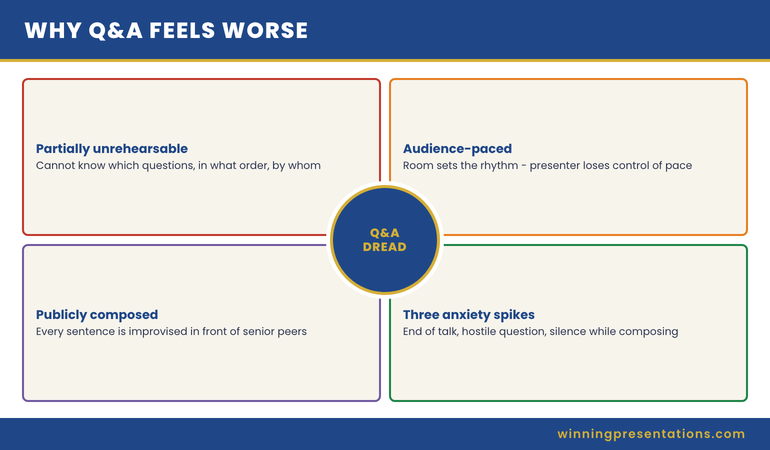
During the presentation, you control content, timing, and direction. In Q&A, that control vanishes—questions are unpredictable, and you’re reacting in real-time. Your brain interprets this loss of control as threat, triggering anxiety even when you know your material. More techniques in our full presentation Q&A guide.

How do I stop feeling attacked during hostile questions?

Reframe the question as information-seeking, not attack. Most hostile questions stem from the questioner’s frustration, fear, or agenda—not from your failure. Responding with curiosity instead of defensiveness transforms the dynamic.

What’s the best technique for handling aggressive questions?

The Acknowledge-Bridge-Control technique: Acknowledge the concern genuinely, Bridge to common ground, then Control the direction by offering your perspective. This validates the questioner while keeping you in command of the response.

📥 Free Download: 7 Presentation Frameworks

Get the structural frameworks that make Q&A easier. When your presentation follows clear logic, questions become opportunities—not threats.

Download Free →

Related: Presentation Q&A: Why the Questions Terrify You More Than the Presentation


Mary Beth Hazeldine spent 24 years at JPMorgan, PwC, RBS, and Commerzbank. She’s a clinical hypnotherapist and MD of Winning Presentations.

14 Jan 2026
presentation q&a techniques - how to handle questions with confidence after your presentation

Presentation Q&A: Why the Questions Terrify You More Than the Presentation

Quick Answer: The Q&A triggers more fear than the presentation because you lose control. You’ve rehearsed your slides; you can’t rehearse unpredictable questions. The solution isn’t predicting every question—it’s building a framework for handling any question. Prepare by category (challenges, gaps, critics), master bridging techniques, and remember: the audience wants you to succeed.

I delivered the best presentation of my career at Commerzbank in 2008. Twenty-two minutes of polished content, clear data, compelling recommendations. The CFO was nodding. My boss looked pleased.

Then came the Q&A.

The first question was fine. The second was manageable. The third came from a director I’d never met: “Your projections assume a 12% market growth rate. What’s your evidence for that, given the current regulatory environment?”

I had evidence. Somewhere. In my backup slides. Which I couldn’t find. While twelve executives watched me fumble through my deck, my credibility evaporating with each passing second.

I eventually found the data. But by then, the damage was done. My carefully constructed presentation had been overshadowed by ninety seconds of visible panic.

That evening, I realised something that changed how I approach every presentation: the Q&A isn’t an afterthought. It’s where credibility is won or lost.

Over the following decade, I became obsessed with Q&A preparation. I interviewed executives who seemed effortlessly confident under questioning. I studied hostage negotiators and crisis communicators. I tested techniques with thousands of clients.

What I discovered is that Q&A confidence has almost nothing to do with knowing all the answers. It comes from having a system for handling any question—including the ones you can’t predict.

⭐ Confidence Comes From Preparation

The Executive Slide System builds presentations with Q&A in mind. When your slides are structured around clear arguments with supporting evidence, you’re not scrambling during questions—you’re simply pointing to the slide that addresses it.

Q&A confidence starts with presentation structure. Know where your evidence lives, and questions become opportunities, not threats.

Get the Executive Slide System → £39

The Psychology of Unpredictability

Why does Q&A trigger more anxiety than the presentation itself? The answer lies in control.

During your presentation, you control:

  • What information you share
  • The order you share it
  • The pace and timing
  • Which points to emphasise
  • When to pause and when to move on

During Q&A, you control almost nothing. Questions come from anywhere, about anything. You’re reacting, not leading. Your carefully rehearsed structure is gone.

This loss of control activates your brain’s threat response. Suddenly you’re not presenting—you’re defending. Your body shifts into fight-or-flight mode, which is exactly the wrong state for clear, confident communication.

The physical symptoms follow: racing heart, shallow breathing, mind going blank. These aren’t signs of incompetence. They’re signs that your nervous system has misidentified a question as a threat.

Understanding this is the first step to managing it. Q&A anxiety isn’t about your knowledge or preparation. It’s about your brain’s response to unpredictability. And that response can be retrained.

Why Q&A triggers fear - diagram showing shift from presenter control during presentation to loss of control during Q&A

How to Prepare When You Can’t Predict

You can’t anticipate every question. But you can prepare for every category of question.

Before any presentation, I work through five preparation categories:

1. The Challenges

What are the five most likely challenges to your recommendation? If you’re proposing a budget increase, prepare for “Why can’t you do this with existing resources?” If you’re presenting a timeline, prepare for “What if this takes longer?”

2. The Gaps

Where is your data weakest? Every presentation has limitations. Identify yours before someone else does. Prepare honest acknowledgments and explain why the gaps don’t undermine your conclusions.

3. The Critics

Who in the room is most likely to push back? What do they care about? Prepare specific responses for their likely concerns. If the CFO always asks about ROI, have your ROI answer ready.

4. The Clarifications

Which parts of your presentation might be confusing? Prepare simpler explanations and concrete examples for technical or complex sections.

5. The “What Ifs”

What scenarios might the audience raise that you haven’t addressed? “What if the market shifts?” “What if we lose that key client?” Think through implications even for scenarios you consider unlikely.

This category-based preparation is more valuable than trying to predict specific questions. It builds mental frameworks you can adapt in real-time.

For more on anticipating and addressing objections, see our guide to handling difficult questions in presentations.

What to Say When You Don’t Know

Here’s a liberating truth: you don’t need to know everything.

The most confident executives I’ve worked with all share one trait: they’re comfortable saying “I don’t know.” But they say it strategically:

The Honest Admission

“I don’t have that specific data with me, but I can get it to you by end of day tomorrow.”

This works because it’s specific (what you’ll provide) and committed (when you’ll provide it). Vague promises like “I’ll look into that” sound evasive.

The Bridge

“That’s outside my direct area, but what I can tell you is…” Then pivot to relevant information you do have.

The Redirect

“Sarah has been leading that workstream—Sarah, can you speak to that?” Redirecting to a colleague isn’t weakness; it’s demonstrating that you’ve built a capable team.

The Scope Clarification

“That’s a great question, but it’s probably outside the scope of today’s discussion. Happy to set up a separate conversation to explore it properly.”

What you should never do: guess, bluff, or provide data you’re not certain about. One wrong number can undermine everything else you’ve said.

Four ways to handle questions when you don't know the answer - honest admission, bridge, redirect, and scope clarification

Handling Hostile and Loaded Questions

Not all questions are neutral. Some are designed to challenge, some to embarrass, some to advance the questioner’s agenda. Here’s how to handle the difficult ones:

The Loaded Question

“Given all the problems with this approach, why should we move forward?”

This question assumes “problems” as fact. Don’t accept the premise. Reframe: “I’d actually characterise those as considerations rather than problems. Let me address the main ones…”

The Hostile Question

“This is the third time you’ve presented this project and it’s still not working.”

Don’t match the energy. Stay curious, not defensive: “I understand the frustration with the timeline. Let me share what’s changed since the last update and why I’m confident we’re now on track.”

The Agenda Question

“Don’t you think we should be investing in X instead?”

Acknowledge the alternative without abandoning your position: “X is worth considering. Today’s recommendation focuses on Y because of [specific reasons]. I’d be happy to do a comparative analysis if that would be helpful.”

The Ambush Question

“Are you aware that Company Z tried this exact approach and it failed?”

If you don’t know, say so honestly: “I’m not familiar with that specific case. Can you share what happened? I’d want to understand how their situation compares to ours.”

The key principle: hostile questions are often about emotion, not information. Acknowledge the feeling before addressing the content. “I hear that there’s concern about…” validates the person and lowers the temperature.

For a deeper dive into managing challenging interactions, see our guide on handling difficult questions in presentations.

7 Techniques That Transform Q&A

These are the specific techniques I teach executives who want to move from Q&A anxiety to Q&A confidence:

1. Repeat and Reframe

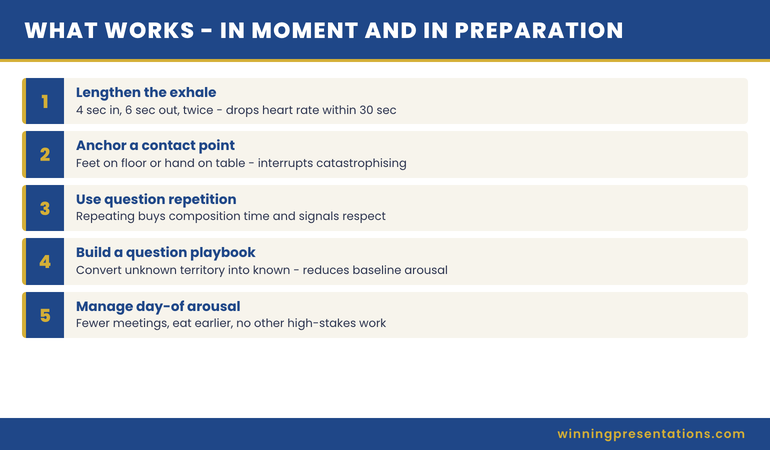
Always repeat the question—it ensures everyone heard it and buys you thinking time. You can also subtly reframe: “So you’re asking about timeline risks” is more manageable than “Why is this so delayed?”

2. The 30-Second Rule

Keep answers to 30-60 seconds. Long answers lose the room and invite follow-up challenges. State your point, give one piece of evidence, stop. Brevity signals confidence.

3. Bridge to Strength

After addressing a question, bridge to your strongest point: “And that connects to why the ROI case is so compelling…” Don’t leave the conversation on a defensive note.

4. The Parking Lot

For questions that would derail the discussion: “That’s important but probably deserves more time than we have now. Can we park it and schedule a follow-up?” This is legitimate, not evasive, when used sparingly.

5. Evidence Anchoring

Point to specific slides, data, or documents when answering. “As you can see on slide 12…” anchors your answer in evidence rather than opinion.

6. The Pause

Pausing before answering reads as thoughtful, not uncertain. Take a breath, gather your thoughts, then respond. Rushing signals anxiety.

7. End on Your Terms

When wrapping up Q&A, don’t just say “Any more questions?” Summarise: “Before we close, let me reiterate the three key points…” End with your message, not their question.

Seven Q&A techniques - repeat and reframe, 30-second rule, bridge to strength, parking lot, evidence anchoring, the pause, end on your terms

🏆 Master High-Stakes Q&A at Executive Level

The Executive Buy-In Presentation System includes advanced Q&A techniques for board rooms, investor meetings, and senior leadership presentations—where questions are tougher and stakes are higher.

Includes: Anticipating executive concerns, managing hostile stakeholders, and turning Q&A into your strongest moment.

Learn More About the Programme → £399

Case Study: From Q&A Terror to Q&A Confidence

Rachel was a senior manager at a technology company who came to me with a specific problem: she was brilliant during presentations but fell apart during Q&A.

“I spend weeks preparing my slides,” she told me. “Then someone asks a question I didn’t anticipate and I lose all my credibility in thirty seconds.”

Her pattern was common: over-preparation on content, under-preparation on Q&A. She rehearsed her slides endlessly but never practised handling questions.

We restructured her preparation:

  • Week before: For every key recommendation, she wrote the three most likely objections and prepared responses.
  • Day before: She asked a colleague to challenge her presentation as harshly as possible. She practised responses out loud.
  • Morning of: She reviewed her “don’t know” responses—the phrases she’d use when asked something she couldn’t answer.

We also worked on her physical response. She learned to pause before answering (buying thinking time), to breathe through the initial anxiety spike, and to reframe questions before responding.

Her next board presentation included a particularly aggressive Q&A from a director known for tough questions. Rachel later told me: “For the first time, I didn’t panic. I actually enjoyed it. I had a system, so I didn’t feel ambushed.”

Her CEO pulled her aside afterward: “That was impressive. You handled his questions better than most VPs do.”

Q&A confidence isn’t about personality. It’s about preparation and practice. Rachel’s transformation took about six weeks of deliberate work—and it fundamentally changed how she was perceived as a leader.

📧 Join 2,000+ professionals getting weekly presentation insights. Subscribe to The Winning Edge →

Frequently Asked Questions

Why is the Q&A scarier than the presentation itself?

During your presentation, you control the content, timing, and direction. In Q&A, that control disappears. You face unpredictable questions, potential challenges to your credibility, and real-time judgment with no script to fall back on. It’s the loss of control that triggers fear. Building presentation confidence helps manage this anxiety.

How do I prepare for questions I can’t predict?

You can’t predict every question, but you can prepare categories. List the five most likely challenges to your argument, the three weakest points in your data, and the two things your toughest critic would ask. Prepare responses for categories, not specific questions.

What do I do when I don’t know the answer?

Say “I don’t have that specific data, but I’ll follow up by [specific time].” Then bridge to what you do know. Honesty builds credibility; pretending destroys it. The best executives all admit knowledge gaps without apologising.

How do I handle hostile questions in a presentation?

First, don’t match the energy—stay calm and curious. Acknowledge the concern (“I understand why that’s frustrating”), then bridge to your key point. Hostile questions are often about emotion, not information. Address the feeling before the content. More techniques in our guide to handling difficult questions.

Should I repeat the question before answering?

Yes, for three reasons: it ensures everyone heard it, it buys you thinking time, and it lets you subtly reframe loaded questions. “So you’re asking about timeline concerns” is more manageable than “Why is this project so delayed?”

How long should my Q&A answers be?

Aim for 30-60 seconds maximum. Long answers lose the room and invite follow-up challenges. State your point, give one piece of evidence, and stop. If they want more, they’ll ask. Brevity signals confidence.

📥 Free Download: 7 Presentation Frameworks

Get the structural frameworks that make Q&A easier. When your presentation follows clear logic, questions become opportunities to reinforce your message—not threats to defend against.

Download Free →

Related Resources

Continue building your Q&A and presentation skills:

Q&A Is Where Leaders Are Made

The presentation shows you can prepare. The Q&A shows you can think.

That’s why so many executives—consciously or not—judge presenters more on how they handle questions than on their polished slides. Anyone can rehearse a deck. Not everyone can respond thoughtfully under pressure.

The techniques in this article aren’t about faking confidence. They’re about building genuine competence through preparation and practice. When you’ve anticipated challenges, prepared for gaps, and practised your responses, Q&A stops being terrifying and starts being an opportunity.

Start with category-based preparation. Master the “I don’t know” responses. Practice the pause. And remember: the audience isn’t trying to catch you out. They’re trying to understand. Help them do that, and Q&A becomes your strongest moment.


Mary Beth Hazeldine is a qualified clinical hypnotherapist, NLP practitioner, and Managing Director of Winning Presentations. After 5 years terrified of presenting, she built a 24-year banking career at JPMorgan Chase, PwC, RBS, and Commerzbank. She has treated hundreds of anxiety clients and trained over 5,000 executives.

09 Jan 2026
Confidence before big meetings - why positive thinking fails and what actually works

Confidence Before Big Meetings: Why ‘Just Think Positive’ Fails (A Hypnotherapist’s 5-Minute Reset)

Quick Answer: Positive thinking fails before big meetings because it tries to override your nervous system with logic. When anxiety has triggered your fight-or-flight response, rational thoughts can’t stop it. The solution is a physical reset that calms your nervous system first—then clear thinking follows naturally. This 5-minute protocol works with your biology, not against it.

“Just think positive. You’ve got this.”

I said this to myself a thousand times before important presentations at JPMorgan. It never worked. The more I told myself to be confident, the more my racing heart reminded me I wasn’t.

Building genuine confidence before big meetings requires something different—something I didn’t understand until I trained as a clinical hypnotherapist.

The problem isn’t your mindset. It’s your nervous system. No amount of positive thinking can override biology.

Here’s the 5-minute reset protocol I now teach executives—one that works with your nervous system instead of fighting it.

Conquering Speaking Fear

The complete system for managing presentation anxiety—including the full pre-meeting protocol and nervous system techniques used by executives at JPMorgan, PwC, and Commerzbank.

Get the Complete System →

Why Positive Thinking Backfires

When you’re anxious, your amygdala has already triggered a cascade of stress hormones. Your heart races. Your palms sweat. Your thinking narrows.

Telling yourself “I’m confident” creates cognitive dissonance. Your body screams danger while your mind insists everything is fine. The mismatch increases anxiety.

A senior director at RBS described it perfectly: “The more I told myself to calm down, the worse I felt. My brain knew I was lying to myself.”

For a comprehensive approach to building lasting confidence, see my complete guide: Presentation Confidence: How to Build It (And Why Faking It Fails).

The 5-Minute Nervous System Reset

This protocol addresses physiology first, then psychology. Your nervous system can’t be reasoned with—but it can be regulated.

Minutes 1-2: Exhale Breathing

Slow exhales activate your parasympathetic nervous system—the “rest and digest” response.

Breathe in for 4 counts. Breathe out for 6-8 counts. The extended exhale triggers calm. Repeat 6-8 times.

A managing partner at PwC does this before every client meeting: “It’s the only thing that slows my heart rate.”

Minutes 2-3: Physical Grounding

Anxiety pulls you into your head. Grounding brings you back to your body.

Feel your feet on the floor. Press your palms flat against your desk. This interrupts the anxiety loop by redirecting attention to present-moment physical reality.

Minutes 3-4: Outcome Visualization

Now—after your nervous system has calmed—visualization can work.

Picture the meeting ending well. Don’t visualize perfection; visualize competence. Your brain doesn’t distinguish vividly imagined success from real success.

Minutes 4-5: Centering Phrase

Choose one factual phrase: “I’ve prepared for this.” “I know my material.” This isn’t positive thinking—it’s a statement that reminds you of reality rather than trying to override it.

Confidence before big meetings - the 5-minute nervous system reset protocol

Before Your Next Big Meeting

A CFO at Commerzbank had quarterly board presentations that left him depleted. His pre-meeting routine included notes review, practice, affirmations, energy music. None helped the physical anxiety.

We replaced everything except note review with this 5-minute protocol. “For the first time, I walked into a board meeting without my heart pounding. I could actually think.”

The technique works because it respects how your nervous system functions. Calm body first. Clear thinking follows.

FAQ: Confidence Before Big Meetings

How can I feel more confident before a big meeting?

True pre-meeting confidence comes from nervous system regulation, not positive thinking. Use physical resets (exhale breathing, grounding) combined with preparation. The goal is physiological calm, not forced optimism.

Why doesn’t positive thinking work before important meetings?

Positive thinking tries to override your nervous system with logic. When anxiety has triggered fight-or-flight, rational thoughts can’t stop it. Physical techniques reset your nervous system directly.

What’s the best pre-meeting routine for confidence?

A hypnotherapist-designed routine: 5 minutes of slow exhale breathing, physical grounding, brief visualization, and a centering phrase. This works with your nervous system rather than against it.

📧 Join 2,000+ professionals getting weekly insights on presentation confidence and anxiety management techniques that actually work. Subscribe to The Winning Edge →

📋 Free Download: Calm Under Pressure

The complete nervous system reset protocol on one page. Keep it on your phone for the 5 minutes before any high-stakes meeting.

Get Your Free Guide →


About the Author

Mary Beth Hazeldine spent 24 years at JPMorgan, PwC, RBS, and Commerzbank. She’s a clinical hypnotherapist and MD of Winning Presentations.

09 Jan 2026
Presentation skills for introverts - why standard advice fails and what actually works

Presentation Skills for Introverts: Why ‘Just Be More Confident’ Fails (And What Actually Works)

Quick Answer: Standard presentation advice fails introverts because it assumes extrovert energy creates impact. For introverts, forcing “confident” behaviors drains energy, feels fake, and undermines natural strengths. Effective presentation skills for introverts leverage what you already do well: thorough preparation, thoughtful delivery, substance over showmanship, and calm authority that stands out in a world of performative enthusiasm.

“You need to project more energy. Be more dynamic. Work the room.”

I heard this feedback for years—and it nearly destroyed my career.

As a self-identified introvert building presentation skills for introverts wasn’t something anyone talked about when I started at JPMorgan. The assumption was simple: good presenters were energetic, spontaneous, commanding. I was none of these things naturally. So I tried to become them.

For five years, I forced myself to be “on” before every presentation. I’d psych myself up, project enthusiasm I didn’t feel, try to “work the room” like the confident colleagues I admired. And every time, I’d crash afterward—exhausted, depleted, convinced I was fundamentally broken.

The turning point came when a senior partner pulled me aside after a client pitch. “You seem like you’re performing,” she said. “It’s distracting. Your content is excellent—why are you trying so hard to be someone else?”

That conversation changed everything.

I stopped trying to present like an extrovert. I started presenting like myself—prepared, thoughtful, substantive. I discovered that the qualities I’d been trying to hide were actually my greatest strengths.

Twenty years later, having trained over 5,000 executives (many of them introverts), I’ve learned that the standard advice doesn’t just fail quiet professionals—it actively harms them.

Here’s what actually works.

Conquering Speaking Fear

A complete system for managing presentation anxiety—designed with introvert energy management in mind. Includes the preparation protocols, energy strategies, and mindset techniques that work with your temperament, not against it.

Includes: Pre-presentation routines, anxiety management techniques, and recovery protocols for introverts.

Get the Complete System →

Why Standard Presentation Advice Fails Introverts

Most presentation training assumes a fundamental lie: that energy equals impact.

Watch any “expert” presentation advice and you’ll hear the same refrains: Project confidence. Command the room. Be dynamic. Engage with enthusiasm.

This advice works beautifully—if you’re an extrovert who gains energy from audiences and thrives on spontaneous interaction.

For introverts, it’s a recipe for exhaustion and inauthenticity.

A senior analyst at RBS came to me after receiving feedback that she was “too quiet” in presentations. She’d tried everything: power poses, energy music before meetings, forcing herself to gesture more dramatically. Each presentation left her more drained than the last. Her anxiety increased because she was simultaneously managing her content AND performing a personality that wasn’t hers.

“I feel like I’m wearing a costume,” she told me. “And everyone can see it doesn’t fit.”

She was right. Audiences detect inauthenticity instantly. When introverts force extrovert behaviors, the mismatch creates cognitive dissonance—both for the presenter and the audience. The result is worse than doing nothing: it undermines credibility while exhausting the presenter.

The Energy Equation

Here’s what the extrovert-designed advice ignores: introverts and extroverts have fundamentally different energy systems.

Extroverts gain energy from external stimulation—audiences, interaction, spontaneity. A room full of people charges their batteries.

Introverts expend energy on external stimulation. The same room drains their batteries. This isn’t weakness or social anxiety—it’s neurology.

Effective presentation skills for introverts must account for this reality. Any technique that ignores energy management is setting you up to fail.

For foundational presentation techniques, see my guide on business presentation skills.

The Introvert Advantages Nobody Talks About

Here’s what no presentation coach tells you: introverts have significant natural advantages that extroverts often lack.

A managing director at Commerzbank once observed something that stuck with me: “The best presentation I saw all year came from our quietest team member. She didn’t ‘work the room.’ She didn’t need to. Her preparation was flawless, her insights were deep, and her calm delivery made everyone lean in rather than sit back.”

Introverts excel at:

Depth over breadth: While extroverts cover more ground, introverts go deeper. Audiences remember substance long after they’ve forgotten flash.

Preparation: Introverts naturally gravitate toward thorough preparation—which correlates more strongly with success than any delivery technique.

Thoughtful responses: In Q&A, pausing to think before speaking signals intelligence and consideration—qualities that build credibility.

Authentic connection: Introverts connect more genuinely with individuals. One deep connection can be more powerful than twenty shallow ones.

Calm authority: In a world of performative enthusiasm, quiet confidence stands out. It reads as substance over style—exactly what senior audiences value.

Presentation skills for introverts - the hidden advantages quiet presenters have

Energy Management: The Foundation of Introvert Presenting

Before any technique, before any content strategy, introverts must master energy management. Everything else builds on this foundation.

A client at PwC learned this the hard way. She’d scheduled three major presentations in one day—a client pitch at 9am, a team update at noon, and a board briefing at 4pm. By the third presentation, she was running on empty. Her delivery suffered, her thinking slowed, and she forgot a key point that cost her credibility with the board.

“I thought I could push through,” she said. “I was wrong.”

We rebuilt her approach around energy management:

The Introvert Energy Protocol

Before presentations:

  • Schedule 30-60 minutes of protected quiet time
  • Avoid draining interactions (difficult conversations, unexpected meetings)
  • Review notes in solitude, not with others
  • Arrive early to acclimate to the room alone

During presentations:

  • Build in natural breaks (questions, videos, activities)
  • Use strategic pauses to recover momentarily
  • Focus on one person at a time rather than “the room”
  • Have water available (a sip creates a natural micro-break)

After presentations:

  • Schedule recovery time (minimum 30 minutes of low-stimulation activity)
  • Limit immediate social interaction
  • Debrief in writing rather than conversation when possible

For more on managing pre-presentation anxiety, see how to calm nerves before a presentation.

Built for How You Actually Work

Conquering Speaking Fear includes specific protocols for introvert energy management—preparation routines, recovery strategies, and techniques that work with your temperament rather than forcing you to be someone you’re not.

Get the System →

The Introvert Preparation Protocol

Preparation is where introverts should outinvest everyone else. It’s your natural strength—lean into it.

A vice president at JPMorgan told me he prepares “twice as much as I think I need.” His presentations are consistently rated among the best in his division. Not because of his delivery—which he describes as “unremarkable”—but because his preparation eliminates uncertainty.

“When I know my material cold,” he said, “I can be present instead of panicking.”

The 4-Layer Preparation Method

Layer 1: Content mastery
Know your material so well you could present it without slides. This reduces cognitive load during delivery, freeing mental energy for audience awareness.

Layer 2: Transition mapping
Script your transitions between sections. These are the moments introverts most often stumble—and the moments that benefit most from preparation.

Layer 3: Question anticipation
List every question you might receive. Prepare responses. For introverts, unexpected questions create the most anxiety. Eliminating surprise eliminates a major energy drain.

Layer 4: Recovery points
Identify moments in your presentation where you can pause, ask a question, or show a brief video. These built-in recovery points let you recharge mid-presentation.

For structural frameworks that support thorough preparation, see presentation structure frameworks.

Presentation skills for introverts - the 4-layer preparation protocol

Delivery Techniques That Work With Your Temperament

Forget “working the room.” Here’s what actually works for introverts:

The Individual Connection Approach

Instead of trying to engage “the audience” (an overwhelming abstraction), connect with individuals. Make eye contact with one person for a complete thought. Then move to another. This transforms a draining crowd into a series of manageable one-on-one moments.

A director at RBS described this shift as “the single most helpful technique I’ve ever learned.” Instead of scanning the room nervously, she now has “a series of small conversations” with specific people.

The Power of the Pause

Extroverts fill silence with words. Introverts can own silence strategically.

A pause before a key point creates anticipation. A pause after creates emphasis. A pause when you need to think signals thoughtfulness, not uncertainty.

What feels uncomfortable to you often reads as confident to audiences. Practice extending pauses until they feel slightly too long—that’s usually the right length.

Depth Over Energy

You don’t need to match extrovert energy. Offer something they can’t: depth.

Where an extrovert covers ten points with enthusiasm, cover five with insight. Go deeper. Audiences remember substance long after they’ve forgotten delivery style.

Authentic Vocal Presence

You don’t need to be louder. You need to be clear and deliberate.

Speak slightly slower than feels natural (nervous introverts rush). Let your voice convey conviction through steadiness, not volume.

For more on vocal techniques, see presentation voice tips.

Q&A Strategies for Thoughtful Responders

Q&A terrifies many introverts—the unpredictability, the on-the-spot thinking, the fear of going blank.

Here’s the reframe: Q&A can actually favor introverts.

A managing partner at PwC observed that introverts often give better Q&A answers than extroverts. “Extroverts start talking immediately and sometimes talk themselves into corners. Introverts pause, think, and give considered responses. The pause might feel awkward to them, but to me it signals they’re taking my question seriously.”

The Introvert Q&A Protocol

Prepare extensively: List every possible question. Prepare responses. The more you’ve anticipated, the fewer will catch you off guard.

Use bridging phrases: “That’s an interesting question—let me think about that” buys thinking time without signaling uncertainty.

Pause before answering: A 2-3 second pause signals thoughtfulness and gives your brain time to formulate a coherent response.

It’s okay to not know: “I don’t have that information at hand, but I’ll follow up by end of day” is perfectly acceptable.

For more on handling questions, see handling difficult questions in presentations.

Case Study: The Quiet CFO Who Commanded the Boardroom

Let me tell you about Sarah, a CFO at a mid-sized financial services firm who came to me convinced she couldn’t succeed in a role that required frequent board presentations.

“I’m too quiet,” she said in our first session. “The board expects energy. They expect someone who takes charge. That’s not me.”

Sarah had spent two years trying to be more “dynamic.” She’d taken presentation skills courses designed for extroverts. She’d practiced power poses. She’d forced herself to open with jokes (which she delivered terribly). Each board meeting left her exhausted and demoralized.

We took a completely different approach.

Month 1: Energy Management
We restructured her pre-meeting routine. Instead of reviewing with her team right before board meetings (draining), she reviewed alone the night before. Morning-of, she protected 90 minutes of quiet preparation time. She arrived at meetings early to sit in the empty room and acclimate.

Month 2: Preparation Protocol
We implemented the 4-layer preparation method. She prepared so thoroughly that nothing in the board meeting could surprise her. Her confidence increased because her uncertainty decreased.

Month 3: Delivery Adaptation
We stopped trying to make her “more energetic.” Instead, we amplified her natural strengths: depth of analysis, clarity of explanation, calm authority. She made eye contact with one board member at a time. She paused strategically. She let her substance speak.

The Result
Six months later, the chairman pulled Sarah aside: “Your board presentations have transformed. You’re the clearest, most credible presenter we have.”

Sarah hadn’t become more extroverted. She’d become more herself—with systems that supported rather than fought her temperament.

“I stopped trying to be someone else,” she told me. “Turns out who I actually am was more than enough.”

📧 Join 2,000+ professionals getting weekly insights on presentation skills—including specific strategies for introverts and quiet leaders. Subscribe to The Winning Edge →

Presentation skills for introverts - case study transformation from quiet to commanding

FAQ: Presentation Skills for Introverts

Can introverts be good presenters?

Introverts can be exceptional presenters—often better than extroverts. Research shows introverts excel at preparation, thoughtful delivery, and deep audience connection. The key is leveraging introvert strengths (substance over showmanship) rather than mimicking extrovert energy.

Why does standard presentation advice fail introverts?

Most advice assumes energy, spontaneity, and “working the room” create impact. For introverts, forcing extrovert behaviors drains energy quickly, feels inauthentic, and undermines natural strengths. Effective introvert presentation skills work with your temperament, not against it.

How can introverts manage energy during presentations?

Strategic energy management includes: thorough preparation to reduce cognitive load, building in recovery moments (questions, videos, activities), scheduling presentations earlier in the day when energy is highest, and protecting time before and after for recharging.

Should introverts try to appear more extroverted when presenting?

No. Audiences detect inauthenticity instantly. Instead of mimicking extrovert energy, introverts should amplify their natural strengths: depth of content, thoughtful pauses, genuine connection with individuals, and calm authority that stands out in a world of performative enthusiasm.

What presentation techniques work best for introverts?

Techniques that leverage introvert strengths include: extensive preparation and rehearsal, one-to-one eye contact rather than “working the room,” strategic pauses for emphasis, deeper content with fewer slides, prepared responses for likely questions, and energy management protocols.

How do introverts handle Q&A sessions?

Q&A can actually favor introverts who excel at thoughtful responses. Prepare for likely questions in advance, use bridging phrases (“That’s an interesting question—let me think about that”) to buy thinking time, and remember that pausing before answering signals thoughtfulness, not uncertainty.

📋 Free Download: Calm Under Pressure

A quick-reference guide for managing presentation anxiety—including specific techniques for introverts. Use it before your next presentation to center yourself without forcing extrovert energy.

Get Your Free Guide →

Related Reading

Your Quiet Strength Is Your Greatest Asset

For years, I believed my introversion was a liability. I thought good presenters had to be energetic, spontaneous, commanding—everything I wasn’t.

I was wrong.

The most impactful presenters aren’t necessarily the loudest. They’re the most prepared, most substantive, most genuine. Many are introverts who learned to present authentically rather than performatively.

Effective presentation skills for introverts don’t require you to become someone you’re not. They require you to become more fully who you already are—with systems that support your temperament rather than fight it.

The world has enough performers. What it needs is more depth, more substance, more quiet authority.

You have that to offer. Stop hiding it.


About the Author

Mary Beth Hazeldine is a qualified clinical hypnotherapist, NLP practitioner, and Managing Director of Winning Presentations. After 5 years terrified of presenting, she built a 24-year banking career at JPMorgan Chase, PwC, RBS, and Commerzbank. She has treated hundreds of anxiety clients and trained over 5,000 executives—many of them fellow introverts.

05 Jan 2026
Stage fright before presentations - the neuroscience of fear and how to overcome it in 60 seconds

Stage Fright Before Presentations: Why “Just Breathe” Fails (And What Actually Works)

Quick Answer: Stage fright before presentations isn’t weakness—it’s your nervous system doing its job. The key isn’t fighting the fear but redirecting it. In the first 60 seconds before presenting, use the physiological reset: exhale fully (8 seconds), inhale slowly (4 seconds), and press your feet firmly into the ground. This activates your parasympathetic nervous system and grounds you in your body rather than your racing thoughts.

I spent five years terrified of presenting.

Not nervous. Not uncomfortable. Terrified.

The kind of terror that started three days before any presentation. The kind that woke me at 4am with my heart pounding and my stomach churning. The kind that made me consider calling in sick, fabricating emergencies, or simply walking out of the building.

I was a banker at JPMorgan Chase. Presentations weren’t optional—they were how careers were made. And mine was dying because I couldn’t stand in front of a room without my voice shaking, my hands trembling, and my mind going completely blank.

One morning in 2003, I was about to present quarterly results to senior leadership. Standing outside the boardroom, I felt my throat close. My vision narrowed. I genuinely thought I might pass out.

A colleague walked past and said, “Just breathe. You’ll be fine.”

I wanted to scream. I’d been breathing. I’d tried every relaxation technique, every visualisation, every piece of advice anyone had ever given me. None of it worked when the moment arrived.

That’s when I realised: the standard advice isn’t designed for real stage fright. It’s designed for mild nervousness. And there’s a vast difference between the two.

Twenty years later—after becoming a clinical hypnotherapist and treating hundreds of clients with presentation anxiety—I understand exactly why that advice failed. And I’ve developed what actually works.

🎯 Transform Your Stage Fright Into Stage Presence

After 5 years of presentation terror and 20+ years helping executives overcome theirs, I’ve distilled everything into a complete system. Conquer Your Fear of Public Speaking combines clear psychological theory, real case studies, and practical techniques—so you understand exactly why fear shows up and how to dismantle it.

Get the Complete System → £39

Why “Just Breathe” Fails When You’re Actually Terrified

Here’s what happens when someone with genuine stage fright tries to “just breathe” moments before presenting:

Your amygdala—the brain’s threat detection centre—has already triggered a full sympathetic nervous system response. Adrenaline is flooding your body. Cortisol is spiking. Blood is redirecting from your digestive system to your major muscle groups.

Telling someone in this state to breathe deeply is like telling someone whose house is on fire to admire the curtains.

The breath advice isn’t wrong—it’s incomplete. When your nervous system is in genuine fight-or-flight, a few deep breaths won’t override millions of years of evolutionary programming. You need a more comprehensive intervention.

The Three Reasons Standard Advice Fails

Reason One: Most advice targets the symptoms, not the source. Your shaking hands aren’t the problem—they’re a downstream effect of your nervous system’s threat response. Address the threat response, and the symptoms resolve themselves.

Reason Two: Generic techniques don’t account for timing. What works the night before is useless 60 seconds before you present. What works 60 seconds before is different from what works mid-presentation when you’ve lost your train of thought.

Reason Three: Standard advice treats all fear as the same. But the executive who’s mildly nervous about a board presentation has fundamentally different needs than the person who’s been avoiding presentations for years because of genuine terror.

The Neuroscience Behind Stage Fright (And Why It’s Not Your Fault)

Your brain can’t distinguish between a sabre-toothed tiger and a room full of executives waiting to judge your quarterly results. Both trigger the same ancient survival response.

When your brain perceives threat—and being evaluated by others is perceived as threat—your prefrontal cortex (responsible for rational thought, complex reasoning, and remembering your presentation) goes partially offline. Blood flow decreases to this region while increasing to your amygdala and brain stem.

This is why you can rehearse perfectly at home and blank completely in the moment. It’s not nerves. It’s neuroscience.

How stage fright affects your brain - prefrontal cortex shutdown and amygdala activation during presentations

The Polyvagal Perspective

Dr. Stephen Porges’ Polyvagal Theory explains something I observed for years in my hypnotherapy practice: fight-or-flight isn’t the only fear response. Many presenters experience freeze—a state where you feel paralysed, disconnected from your body, watching yourself from the outside.

This freeze response is actually a more primitive survival mechanism. It’s what prey animals do when escape seems impossible. And it’s what happens to many executives when they walk into a boardroom and feel overwhelmed.

Understanding this changed everything about how I approach stage fright. Because the intervention for fight-or-flight is different from the intervention for freeze.

The first 60 seconds protocol

The First 60 Seconds Protocol

The moment before you present is when fear peaks. These 60 seconds determine whether you’ll start strong or start struggling.

After treating hundreds of clients and testing countless approaches, I’ve developed a specific protocol for this critical window:

Seconds 1-20: The Physiological Reset

Before anything else, you need to interrupt your body’s threat response. The fastest way is through your breath—but not how you’ve been taught.

The Extended Exhale Technique:

Inhale normally through your nose for 4 seconds. Then exhale slowly through pursed lips for 8 seconds. The key is the extended exhale—it activates your vagus nerve and signals safety to your nervous system.

Repeat twice. Total time: approximately 24 seconds.

Why this works when regular breathing doesn’t: the extended exhale directly stimulates the parasympathetic nervous system. It’s not about relaxation—it’s about physiology.

Seconds 21-40: The Grounding Anchor

With your nervous system beginning to settle, you need to ground yourself in the present moment. Racing thoughts about what might go wrong are future-focused. You need to be here.

The Feet-Hands-Face Sequence:

Press your feet firmly into the ground and notice the sensation. Squeeze your hands together once, then release. Finally, relax your jaw and unclench your face.

This sequence interrupts the mental spiral by forcing attention back to your body. It also releases physical tension that would otherwise show in your voice and posture.

🎯 Master These Techniques With the Complete Guide

The protocol I’ve described took me years to develop through clinical practice. Conquer Your Fear of Public Speaking explains the neuroscience behind each technique—so you understand exactly what you’re doing and why it works.

Access the Complete System → £39

Seconds 41-60: The Mental Reframe

Now that your body is calmer, you can engage your mind productively. But not with positive affirmations—they often backfire because your brain recognises them as false.

Instead, use what I call the Purpose Anchor:

Complete this sentence silently: “In the next 20 minutes, the one thing I want them to understand is…”

This shifts your focus from self-concern to purpose-concern. You’re no longer thinking about how you’ll perform—you’re thinking about what you want to communicate. This subtle shift reduces self-consciousness dramatically.

The Physical Reset: What to Do With Your Body

Stage fright lives in your body before it lives in your mind. Addressing the physical manifestations isn’t just about looking confident—it’s about changing your internal state.

The Pre-Presentation Power Pose (But Not What You Think)

You’ve probably heard about power posing from Amy Cuddy’s TED talk. The research has been debated, but here’s what I’ve observed clinically: the pose matters less than the duration.

Standing in an expansive posture for two minutes changes your hormonal balance—testosterone increases, cortisol decreases. But the specific pose is less important than opening your body rather than closing it.

If you’re in a toilet cubicle before presenting (where many of my clients do their prep), simply standing tall with shoulders back and chest open for 90-120 seconds will shift your state.

The Voice Warm-Up Nobody Talks About

A shaky voice is one of the most common stage fright symptoms—and one of the hardest to hide. But there’s a simple intervention:

Hum. Literally hum at a low pitch for 30 seconds before you enter the room. Humming relaxes your vocal cords and activates your vagus nerve simultaneously. Start low and slide up, then back down.

This is why opera singers and actors warm up before performing. It’s not about technique—it’s about physiology.

Stage fright recovery statistics - 89% of clients report significant improvement after using the 60-second protocol

The Mental Reframe: Changing Your Relationship With Fear

Here’s the counterintuitive truth I’ve learned from treating hundreds of anxious presenters: the goal isn’t to eliminate fear. It’s to change your relationship with it.

Some of the best presenters I’ve worked with still feel nervous. The difference is how they interpret that nervousness.

The Excitement Reframe

Research by Alison Wood Brooks at Harvard Business School found that people who said “I am excited” before a stressful task performed significantly better than those who said “I am calm” or said nothing.

The physiological states of anxiety and excitement are nearly identical—elevated heart rate, heightened alertness, increased energy. The difference is interpretation.

When you feel your heart racing before a presentation, try saying to yourself: “I’m excited about this opportunity to share what I know.” Your nervous system doesn’t know the difference. But your performance does.

The Competence Anchor

One technique I use extensively in my hypnotherapy practice is anchoring to past competence. Before presenting, briefly recall a time when you handled something difficult well. It doesn’t have to be a presentation—any moment of competence works.

Spend 30 seconds re-experiencing that moment: what you saw, what you heard, what you felt. This isn’t about confidence—it’s about reminding your nervous system that you’ve handled challenges before.

Case Study: From Frozen to Fluent in 6 Weeks

James came to me after a career-threatening incident. A senior director at a pharmaceutical company, he had frozen mid-presentation to the executive committee. Not just lost his place—completely frozen. Unable to speak for what felt like minutes but was probably 30 seconds.

He’d avoided presentations for three months after that. His career was stalling. His confidence was destroyed.

“I don’t understand it,” he told me in our first session. “I know my material better than anyone. But when I stand up there, it’s like my brain shuts down.”

That’s exactly what was happening. His brain was shutting down—specifically, his prefrontal cortex was going offline due to the perceived threat.

The Six-Week Protocol

Weeks 1-2: We focused entirely on the physiological response. James practised the extended exhale technique twice daily, regardless of whether he had presentations. He needed to build the neural pathway before he needed to use it.

Weeks 3-4: We added the grounding sequence and began graduated exposure. He started presenting to one colleague, then two, then five. Each time, he used the First 60 Seconds Protocol before beginning.

Weeks 5-6: We worked on mental reframing and anchoring. James identified his Purpose Anchor and practised the excitement reframe. He also learned recovery techniques for if he did lose his place mid-presentation.

The Result

Six weeks after we started, James presented to the same executive committee that had witnessed his freeze. He used every technique we’d developed.

“It wasn’t perfect,” he told me afterwards. “My heart was still pounding. But I didn’t freeze. I didn’t lose my place. And by the end, I was actually enjoying myself.”

That’s the goal. Not eliminating fear—but performing despite it. And then, eventually, transforming it.

🏆 Ready to Transform Your Relationship With Stage Fright?

Conquer Your Fear of Public Speaking contains everything I used with James—and hundreds of clients like him. The complete guide includes:

  • The Psychology of Speaking Fear (why it happens even when you’re prepared)
  • How Fear Gets Conditioned—and how to break the cycle
  • The Calm-First Method with full theory explained
  • Pre-Speaking Reset techniques with rationale
  • In-the-Moment Recovery strategies
  • After-Speaking Integration (to prevent fear returning)

Get Complete Access → £39

What to Do When Stage Fright Strikes Mid-Presentation

The First 60 Seconds Protocol prepares you for a strong start. But what happens when fear ambushes you during your presentation? When you lose your place, or your mind goes blank, or you feel the freeze response creeping in?

The Recovery Pause

First, stop talking. This feels terrifying, but a deliberate pause looks confident, not panicked. Take a breath. Take a sip of water if available.

Then, use what I call the Grounding Sentence: say something that buys you time while you recover.

Options include: “Let me make sure I’m being clear here…” or “That’s a critical point, so let me expand on it…” or “Before I continue, let me check—any questions so far?”

These sentences sound intentional. They give your prefrontal cortex time to come back online. And they shift attention from your internal panic to external engagement.

The Place Recovery Technique

If you’ve genuinely lost your place and can’t remember what comes next, don’t pretend. Briefly look at your notes or slides. Say, “Let me just check I cover everything important.” This is what competent presenters do.

What audiences remember isn’t whether you lost your place—it’s whether you recovered gracefully.

Frequently Asked Questions About Stage Fright

Is stage fright the same as glossophobia?

Glossophobia is the clinical term for fear of public speaking, and stage fright is a common manifestation of it. However, stage fright often refers specifically to the acute fear response before and during a presentation, while glossophobia may include anticipatory anxiety days or weeks before presenting. The techniques in this article address both the anticipatory and acute components.

How long does it take to overcome stage fright?

With consistent practice of the techniques described here, most people notice significant improvement within 4-6 weeks. However, the goal isn’t to eliminate all nervousness—it’s to develop strategies that allow you to present effectively despite the nervousness. Some of the most accomplished presenters I know still feel nervous; they’ve simply learned to work with it rather than against it.

Should I take beta blockers for stage fright?

Beta blockers address the physical symptoms of anxiety—racing heart, shaky hands, trembling voice—without affecting mental clarity. They’re commonly used by musicians and surgeons for high-stakes performances. However, they’re treating symptoms rather than causes. I recommend exploring non-pharmaceutical approaches first, and if you’re considering beta blockers, consulting with a medical professional about whether they’re appropriate for your situation.

Why does stage fright get worse the more senior I become?

This is extremely common and has a clear explanation: as you become more senior, the stakes feel higher. You’re presenting to peers rather than superiors, which paradoxically can feel more threatening. You’re expected to have mastered public speaking by now, so any sign of nervousness feels like evidence of incompetence. And you may have accumulated more negative presentation experiences over the years. The techniques work regardless of seniority—but you may need more consistent practice to override years of accumulated fear responses.

What if I’ve tried everything and nothing works?

If standard anxiety management techniques haven’t worked for you, it may be worth exploring deeper interventions. Clinical hypnotherapy (my background) can address the root causes of presentation anxiety at a subconscious level. Cognitive behavioural therapy (CBT) with a therapist who specialises in performance anxiety is another evidence-based option. Some people benefit from EMDR therapy if their stage fright stems from a specific traumatic presentation experience.

Can stage fright actually help my presentation?

Yes—when channelled correctly. The heightened alertness that comes with nervous energy can make you more responsive to your audience, more dynamic in your delivery, and more memorable overall. The goal isn’t to feel nothing; it’s to feel the right amount and interpret it as excitement rather than terror. Many professional performers describe needing some nervousness to give their best performance.

The Path Forward: From Surviving to Thriving

I want to be honest with you about what’s possible.

If you’ve experienced genuine stage fright—not mild nervousness, but the kind of terror that affects your life—you won’t become a completely relaxed presenter overnight. The neural pathways that create your fear response were built over years. They won’t be dismantled in days.

But you can develop strategies that work. You can learn to recognise the signs of escalating fear and intervene before it peaks. You can build a toolkit of techniques that are available when you need them most. And gradually, over time, you can transform your relationship with presenting from something you dread to something you might even—dare I say it—enjoy.

That journey started for me in a JPMorgan boardroom over twenty years ago. It took me years to figure out what actually works. I’ve condensed that learning into the techniques I’ve shared here and the comprehensive system in Conquering Speaking Fear.

Wherever you are on that journey, know this: stage fright isn’t a character flaw. It’s not evidence that you’re not cut out for presenting. It’s simply your nervous system doing what it evolved to do. And with the right tools, you can work with it rather than against it.

📥 Free Download: Calm Under Pressure Quick Reference

Not ready for the full system? Start with my free quick reference guide—the essential techniques for managing anxiety before and during presentations, distilled into a one-page resource you can review before any high-stakes situation.

Download Free Guide →

Related Articles

Remember that morning outside the JPMorgan boardroom, when I genuinely thought I might pass out? I found my way through it. Not by eliminating the fear, but by learning to work with it. If you’re standing outside your own boardroom right now, heart pounding and throat closing—know that the same path is available to you.


About the Author

Mary Beth Hazeldine is a qualified clinical hypnotherapist, NLP practitioner, and Managing Director of Winning Presentations. After 5 years terrified of presenting, she built a 24-year banking career at JPMorgan Chase, PwC, RBS, and Commerzbank. She has treated hundreds of anxiety clients and trained over 5,000 executives.

31 Dec 2025
Why presentation confidence keeps slipping even when you present all the time

Why Presentation Confidence Keeps Slipping (Even When You Present All the Time)

Last updated: December 31, 2025 · 7 minute read

You’ve been presenting for years. Sometimes a decade or more. Why doesn’t it get easier?

You’ve done the presentations. You’ve survived the meetings. You’ve even received positive feedback. Yet every time you step up to present, the same anxiety returns — sweaty palms, racing thoughts, that familiar knot in your stomach.

If more experience was the solution, you’d be confident by now. But presentation confidence doesn’t work that way.

As a qualified clinical hypnotherapist who spent years treating anxiety disorders before training executives at Winning Presentations, I’ve seen this pattern hundreds of times. And I can tell you exactly why your presentation confidence keeps slipping — and what actually fixes it.

⚡ Key Takeaways

  • Repetition without the right conditions reinforces anxiety — it doesn’t cure it
  • The anxiety reinforcement cycle keeps you trapped: anticipatory fear → survival mode → relief → repeat
  • Your nervous system doesn’t distinguish between “survived” and “succeeded”
  • Presentation confidence requires rewiring at the physiological level, not just more practice
  • Systems and techniques work where willpower and exposure alone fail

📥 FREE DOWNLOAD: Executive Presentation Checklist

The pre-presentation routine that calms nerves and builds genuine confidence.

Download Free →

The Myth of “Just Do It More”

The most common advice for building presentation confidence is some version of: “The more you do it, the easier it gets.”

This sounds logical. It works for most skills. And it’s completely wrong for presentation anxiety.

Here’s why: anxiety doesn’t respond to logic. It’s a physiological response, not a thinking problem. Your nervous system doesn’t care that you’ve “done this before.” It only knows that right now, in this moment, it perceives threat.

When you present while anxious, survive it, and feel relieved afterward, you haven’t built confidence. You’ve reinforced a pattern:

  1. Anticipate presentation → feel fear
  2. Present while afraid → endure it
  3. Finish → feel relief
  4. Next presentation → start at step 1

Your brain learns: “Presentations are scary things we survive.” That’s not presentation confidence — that’s survival mode on repeat.

The Anxiety Reinforcement Cycle That Destroys Presentation Confidence

The anxiety reinforcement cycle that destroys presentation confidence

In my hypnotherapy practice, I saw this cycle with hundreds of clients. The same pattern that creates public speaking anxiety creates fear of flying, social anxiety, and performance anxiety of all kinds.

The cycle works like this:

Stage 1: Anticipatory Anxiety

Days or weeks before the presentation, you start thinking about it. Your imagination runs worst-case scenarios. Your body begins producing stress hormones as if the threat is happening now.

By the time the actual presentation arrives, you’ve been anxious for days. You’re already exhausted before you start.

Stage 2: Fight-or-Flight Activation

When you actually present, your nervous system is in full threat response. Heart racing. Shallow breathing. Tunnel vision. Your prefrontal cortex — the part responsible for clear thinking — partially shuts down because your brain thinks you need to run or fight, not think.

This is why smart, articulate people suddenly can’t find words. It’s not a skill problem. It’s a nervous system hijack.

Stage 3: Survival and Relief

You finish. The relief is enormous. Your body floods with the feeling of “we made it.” This feels like success, but it’s actually reinforcement.

Your nervous system just learned: “That was dangerous. We survived. Be on guard next time.”

Stage 4: Reset to Baseline

You return to normal until the next presentation. Then the cycle begins again — often stronger, because each survival reinforces the threat perception.

This is why your presentation confidence keeps slipping even though you keep presenting. You’re not building confidence. You’re building better anxiety responses.

💡 Break the Anxiety Cycle

If this pattern sounds familiar, Calm Under Pressure was designed specifically to rewire your nervous system response — using the same clinical techniques I developed treating anxiety clients.

In 2 hours, you’ll have tools that work at the physiological level where presentation anxiety actually lives.

Get Calm Under Pressure — £19.99 →

Why Your Presentation Confidence Keeps Slipping: The Real Reasons

Understanding the cycle is step one. But there are specific reasons why your presentation confidence keeps slipping rather than building.

Reason 1: You’re Practicing Anxiety, Not Confidence

Every presentation where you feel afraid and push through is a repetition — but a repetition of what? You’re practicing the experience of being anxious while presenting. You’re getting better at being nervous.

Presentation confidence requires practicing confidence, not practicing survival. The conditions matter as much as the repetitions.

Reason 2: Relief Feels Like Success

After a stressful presentation, the relief is so powerful it feels like accomplishment. “I did it!” But relief and growth are different emotions.

True presentation confidence feels calm before, during, and after. It doesn’t require recovery. When you need to recover from a presentation, you haven’t built confidence — you’ve depleted your stress reserves.

Reason 3: No System For Managing State

Most professionals have no reliable system for managing their physiological state before presenting. They hope they’ll feel okay. Sometimes they do. Usually they don’t.

Without a system, you’re gambling on chemistry. Some days your nervous system cooperates; other days it doesn’t. That’s not presentation confidence — that’s luck.

Reason 4: You’re Focused on the Wrong Thing

Anxious presenters focus on themselves: “How do I look? What if I forget? Are they judging me?” This self-focus feeds anxiety.

Confident presenters focus on their message and audience: “What do they need to understand? How can I help them?” This outward focus short-circuits the self-conscious spiral.

For a complete guide to confidence techniques, see my article on how to speak confidently in public.

What Actually Builds Lasting Presentation Confidence

The good news: presentation confidence is buildable. Not through willpower or exposure, but through specific techniques that work at the level where anxiety actually operates — your nervous system.

1. Physiological Regulation

Before you can present confidently, you need to be able to shift your nervous system out of threat response. This is trainable.

Techniques like the 3-Breath Reset (breathe in for 4 counts, hold for 4, out for 6) directly activate your parasympathetic nervous system — literally telling your brain the threat is over. This isn’t meditation woo-woo; it’s how your nervous system is wired.

For detailed breathing and regulation techniques, see my public speaking tips guide.

2. Anchoring Confident States

Your brain can access confident states on demand — if you train it. This is an NLP technique I used extensively in hypnotherapy.

By deliberately recalling confident moments while creating a physical trigger (like pressing thumb and forefinger together), you build a shortcut to confidence. Before presenting, you access that state instead of hoping it appears.

3. Reframing the Experience

The physiological response of anxiety (racing heart, heightened alertness, energy surge) is identical to excitement. The only difference is the label your brain applies.

Training yourself to interpret these sensations as “I’m ready” instead of “I’m afraid” actually changes the experience. This isn’t positive thinking — it’s neurological reframing.

4. Systems Instead of Willpower

Confident presenters don’t rely on feeling confident. They have pre-presentation routines that reliably produce the right state.

When you have a system — a specific sequence that works every time — you stop gambling on how you’ll feel. The system produces the state, regardless of your mood that day.

For a step-by-step approach to building this kind of confidence, see my guide on how to build confidence in public speaking.

🎓 Ready for Systematic Confidence Building?

If you want to rewire your presentation response at the nervous system level — using the same clinical techniques I developed treating anxiety clients — structured development with expert guidance accelerates results dramatically.

Stop hoping you’ll feel confident. Build systems that produce it reliably. Let’s discuss what that looks like for you →

Breaking the Cycle in 2026

If your presentation confidence keeps slipping despite years of experience, you now understand why. You’ve been practicing the wrong thing.

The path forward isn’t more presentations. It’s changing the conditions under which you present — and building systems that produce confidence instead of hoping it appears.

This requires intention. It requires the right techniques. And for many people, it requires structured support rather than going it alone.

But it’s absolutely achievable. I’ve watched hundreds of anxious professionals transform into confident presenters — not by doing more presentations, but by doing them differently.

If you’re setting presentation skills goals for 2026, make breaking this cycle one of them. The compound returns on genuine presentation confidence — in your career, your influence, and your wellbeing — are substantial.

Your Next Step

📖 FREE: Executive Presentation Checklist
A pre-presentation routine that calms nerves and builds genuine confidence.
Download Free →

💡 QUICK WIN: Calm Under Pressure — £19.99
Clinical NLP techniques for presentation confidence. 2-hour self-paced programme.
Get Instant Access →

🎓 COMPLETE SYSTEM: Structured Development
Psychology-based confidence training with expert guidance.
Let’s discuss what that looks like for you →

FAQs: Presentation Confidence

Why does my presentation confidence keep slipping even though I present regularly?

Repetition without the right conditions reinforces anxiety rather than building presentation confidence. When you present while anxious, survive it, and feel relief afterward, your nervous system learns “presentations are threats we survive” — not “presentations are opportunities where I succeed.” You’re practicing anxiety, not confidence.

How long does it take to build genuine presentation confidence?

With the right techniques targeting your nervous system (not just tips and tricks), most professionals feel significant improvement within 2-4 weeks. Complete rewiring of the anxiety response typically takes 8-12 weeks of deliberate practice. The key is working at the physiological level where anxiety actually lives.

Why doesn’t “just do it more” work for presentation anxiety?

Anxiety is a physiological response, not a thinking problem. Your nervous system doesn’t care that you’ve “done this before” — it only knows it perceives threat right now. Each anxious presentation reinforces the pattern: anticipate → fear → survive → relief → repeat. More repetitions without changing the conditions just strengthen this cycle.

What’s the difference between surviving a presentation and being confident?

Survival requires recovery afterward — the relief feels enormous because you depleted your stress reserves. Genuine presentation confidence feels calm before, during, and after. You don’t need to recover because the experience wasn’t threatening. If you need recovery time after presenting, you’re surviving, not thriving.

Can presentation confidence actually be built, or are some people just naturally confident?

Presentation confidence is absolutely buildable through specific techniques that work at the nervous system level. I’ve trained hundreds of anxious professionals who now present with genuine calm. It’s not about personality — it’s about having systems that produce confident states reliably, regardless of how you naturally feel.


Mary Beth Hazeldine is a qualified clinical hypnotherapist and Managing Director of Winning Presentations. She spent years treating anxiety disorders in private practice before bringing those clinical techniques to corporate training. After 24 years in banking at JPMorgan Chase, PwC, Royal Bank of Scotland, and Commerzbank, she now helps professionals build genuine presentation confidence through psychology-based methods.

Get Weekly Presentation Insights

Join 2,000+ professionals getting practical presentation tips every Tuesday.

Subscribe to The Winning Edge →

21 Dec 2025
What to do when your mind goes blank during a presentation - the 10-second recovery protocol

What to Do When Your Mind Goes Blank During a Presentation (The 10-Second Recovery)

A clinical hypnotherapist’s emergency protocol for the moment panic strikes — tested on hundreds of anxious executives

Your mind goes blank during a presentation. You’re mid-sentence, the audience is watching, and suddenly — nothing. The words you knew seconds ago have vanished. Panic rises. Your heart pounds.

What you do in the next 10 seconds determines whether this becomes a minor blip or a spiralling disaster.

As a clinical hypnotherapist who’s treated hundreds of anxiety clients (and spent 24 years presenting in high-stakes banking environments at JPMorgan, PwC, and RBS), I’ve developed an emergency protocol for exactly this moment. It works because it targets your nervous system, not your memory.

Here’s exactly what to do when your mind goes blank during a presentation.

🎁 Free Download: Get my Executive Presentation Checklist — includes the pre-presentation calming routine that prevents most blank moments before they happen.

Why Your Mind Goes Blank During a Presentation (It’s Not Memory Failure)

When your mind goes blank mid-presentation, your memory hasn’t failed. Your prefrontal cortex — the part of your brain responsible for working memory, language, and clear thinking — has temporarily gone offline.

Why? Stress hormones.

When your nervous system detects a threat (and it absolutely perceives an audience as a threat), it floods your body with cortisol and adrenaline in milliseconds. These hormones impair your prefrontal cortex to prioritise survival functions.

Your brain hasn’t forgotten your content. It’s just temporarily unable to access it because it thinks you’re being chased by a predator. This is biology, not incompetence.

This means the solution isn’t trying harder to remember. It’s calming your nervous system so your thinking brain can come back online.

Related: Overcome Fear of Public Speaking: A Hypnotherapist’s Complete Guide

The 10-Second Recovery When Your Mind Goes Blank in a Presentation

When your mind goes blank during a presentation, execute this protocol:

The 5-step recovery protocol when your mind goes blank during a presentation

Seconds 1-3: STOP and Breathe

Don’t keep talking. Don’t fill the silence with “um” or nervous chatter. Just stop.

Take one slow exhale — longer than your inhale. This immediately signals safety to your nervous system and begins to lower your heart rate.

The audience won’t notice a 3-second pause. To them, it looks like you’re gathering your thoughts. To your nervous system, it’s a reset button.

Seconds 4-6: Ground Yourself Physically

Feel your feet on the floor. Press them down slightly. This physical sensation anchors you in the present moment and interrupts the panic spiral.

If you’re holding notes or standing at a lectern, feel your hands on the surface. Physical grounding pulls your attention out of your racing mind and into your body — which is exactly what your nervous system needs to calm down.

Seconds 7-10: Use a Professional Recovery Phrase

Say one of these out loud:

  • “Let me check my notes on that…” (then actually check them)
  • “Let me think about how to phrase this…”
  • “Actually, let me come back to that point…”
  • “Give me a moment to find that figure…”

These phrases are professional, not apologetic. They buy you time while your prefrontal cortex comes back online.

Then glance at your notes, find your place, and continue. Your brain will have recovered.

Related: How to Calm Nerves Before a Presentation: The 5-Minute Reset

What NOT to Do When Your Mind Goes Blank During a Presentation

Avoiding these mistakes is as important as the recovery protocol itself:

Don’t apologise excessively. “Sorry, I’m so nervous, I completely forgot what I was saying” draws attention to the blank and makes it memorable. A simple pause and “Let me check my notes” is instantly forgettable.

Don’t speed up. Panic makes us rush. Rushing increases cognitive load, which makes blanks more likely. Deliberately slow down instead.

Don’t try to force the memory. Straining to remember increases stress, which keeps your prefrontal cortex offline. Relax, breathe, and let the memory return naturally.

Don’t catastrophise. One blank moment doesn’t ruin a presentation. The audience will forget it in seconds if you recover smoothly. They’re not analysing you — they’re thinking about the content.

🧠 Want the Complete System to Eliminate Presentation Anxiety?

The 10-second recovery is just one technique from my comprehensive 75-page workbook: Conquer Your Fear of Public Speaking: A Hypnotherapist’s Complete System.

Inside you’ll get:

  • The full neuroscience of why your mind goes blank (and how to prevent it)
  • A Fear Type Assessment to identify YOUR specific anxiety pattern
  • 10 clinical techniques with guided exercises and worksheets
  • 5 scripts for different moments (pre-presentation, visualization, recovery)
  • Situation-specific protocols for meetings, client pitches, and board presentations
  • A complete 30-day plan to rewire your fear response permanently
  • 12 printable quick reference cards to carry with you

Get Conquer Your Fear of Public Speaking (£39) →

How to Prevent Your Mind Going Blank During Presentations

The best strategy is prevention. These techniques significantly reduce the likelihood of blank moments:

Know your opening cold. Memorise your first 2-3 sentences word-for-word. Starting strong builds momentum and confidence. Your brain is most likely to blank in the first 60 seconds when anxiety peaks — so make those seconds automatic.

Use notes strategically. Having notes visible reduces the fear of forgetting, which reduces the stress that causes forgetting. It’s not cheating — it’s professional. Even TED speakers use notes.

Pre-presentation calming. Five minutes of extended exhale breathing (inhale 4, hold 4, exhale 6) before you present keeps stress hormones lower, making blanks far less likely. I teach this to every executive I work with.

Practise recovery deliberately. In rehearsal, deliberately pause mid-sentence and practice your recovery phrase. When you’ve done it intentionally 10 times, the real thing feels manageable rather than catastrophic.

Reduce cognitive load. Simpler slides with fewer words. Familiar structure. Less to remember means less to forget.

Related: Presentation Confidence: How to Build It (And Why “Fake It Till You Make It” Doesn’t Work)

Why Blank Moments During Presentations Feel Worse Than They Are

Here’s what I tell every client: blank moments feel catastrophic to you, but they’re barely noticeable to your audience.

When you pause for 3 seconds, you experience it as an eternity. The audience experiences it as a thoughtful pause — if they notice at all. When you say “let me check my notes,” they see professionalism. When you recover and continue, they’ve already forgotten the pause happened.

Research shows audiences significantly underestimate presenter nervousness. What feels like obvious panic to you is invisible to them.

The only way a blank moment becomes memorable is if you make it memorable — through excessive apology, visible panic, or complete shutdown.

Recover smoothly, and it disappears.

Your Emergency Cheat Sheet: What to Do When Your Mind Goes Blank

Save this for your next presentation — screenshot it or print it:

⚡ THE 10-SECOND RECOVERY

When your mind goes blank during a presentation:

  1. STOP — Don’t keep talking. Silence is fine.
  2. EXHALE — One slow breath out (longer than in).
  3. GROUND — Feel your feet firmly on the floor.
  4. SAY — “Let me check my notes on that…”
  5. CONTINUE — Find your place, keep going.

Total time: 10 seconds. The audience won’t remember it. You’ll be fine.

Frequently Asked Questions About Mind Going Blank During Presentations

Why does my mind go blank when I present but not in normal conversation?

Your brain perceives an audience as a threat in a way it doesn’t perceive one-on-one conversation. Multiple people watching triggers a stronger stress response, flooding your system with hormones that impair your prefrontal cortex. The techniques above work because they directly counteract this stress response.

How do I stop my mind going blank during presentations permanently?

Consistent practice with nervous system regulation techniques rewires your brain’s threat response over time. Most people see significant improvement within 3-4 weeks of daily practice with techniques like extended exhale breathing and grounding. Full rewiring typically takes 2-3 months. The Conquer Your Fear of Public Speaking workbook includes a complete 30-day plan for this.

Should I memorise my entire presentation to avoid blanks?

No — this often makes blanks worse. When you memorise word-for-word, losing one word can derail the entire sequence. Instead, know your key points and opening/closing sentences. Use notes for the middle. This gives you structure without the fragility of full memorisation.

Want Guided Support to Eliminate Presentation Anxiety?

My AI-Enhanced Presentation Mastery course goes beyond techniques — you’ll get live coaching, personalised feedback on YOUR specific anxiety patterns, and a community of professionals working through the same challenges.

What’s included:

  • Nervous system regulation techniques from my hypnotherapy practice
  • Frameworks that eliminate uncertainty (anxiety’s fuel)
  • 2 live coaching sessions with personalised feedback
  • 50+ AI prompts to prepare presentations faster (less prep stress = fewer blanks)
  • Community support between sessions

January cohort: £249 (increases to £499 in April)

Only 60 seats available. Early bird pricing ends December 31st.

See the full curriculum →

Your Next Step: Stop Fearing the Blank

Blank moments are survivable. With the right protocol, they become minor blips that the audience never remembers. With consistent practice, they become rare. And with proper nervous system training, your brain stops treating presentations as threats worth panicking over.

Choose your path forward:

🎁 START FREE: Download the Executive Presentation Checklist — includes the pre-presentation calming routine that prevents most blanks.

📘 GO DEEPER (£39): Get Conquer Your Fear of Public Speaking — the complete 75-page workbook with Fear Type Assessment, all techniques, 5 scripts, situation protocols, and a 30-day transformation plan.

🎓 GET COACHED (£249): Join AI-Enhanced Presentation Mastery for live coaching, community support, and personalised feedback. Only 60 seats — early bird ends December 31st.

The fear of going blank is often worse than the blank itself. Once you know you can recover in 10 seconds, the fear loses its power.

Go deeper: Overcome Fear of Public Speaking: A Hypnotherapist’s Complete Guide to Lasting Change


Mary Beth Hazeldine is a qualified clinical hypnotherapist and Managing Director of Winning Presentations. After spending 5 years terrified of presenting, she built a successful 24-year banking career at JPMorgan, PwC, Royal Bank of Scotland, and Commerzbank. She has since treated hundreds of anxiety clients in her hypnotherapy practice and helped over 5,000 executives present with confidence.

21 Dec 2025
Overcome fear of public speaking - a hypnotherapist's guide to rewiring your brain's fear response

Overcome Fear of Public Speaking: A Hypnotherapist’s Guide to Lasting Change

Clinical techniques that rewire your brain’s fear response — from someone who’s treated hundreds of anxiety clients and spent 24 years presenting in banking

If you want to overcome fear of public speaking, you need to understand something most advice ignores: this isn’t a confidence problem. It’s a nervous system problem.

I know this from both sides. I spent my first five years in banking terrified of presenting — credit committees, client meetings, speaking up in internal discussions. Then I built a successful 24-year career at JPMorgan, PwC, RBS, and Commerzbank where presenting was central to my role.

But I truly understood the fear of public speaking when I trained as a clinical hypnotherapist and began treating hundreds of clients with anxiety disorders. What I learned changed everything I thought I knew about conquering this fear.

The techniques in this guide aren’t motivational fluff. They’re clinical methods I’ve used with panic attack sufferers, phobia clients, and high-performing executives who froze under pressure. They work because they target the actual source of the fear — not your mindset, but your nervous system.

🎁 Free Download: Get my Executive Presentation Checklist — includes the pre-presentation calming techniques I teach to anxious executives.

Why You Can’t “Think Your Way” Out of Public Speaking Fear

Here’s what most people don’t understand about fear of public speaking: by the time you feel afraid, your rational brain has already lost the battle.

When you perceive a threat — and your brain absolutely perceives an audience as a threat — your amygdala triggers a cascade of physiological responses in milliseconds. We’re talking 12 milliseconds. That’s faster than conscious thought. Your heart races. Your hands shake. Your throat tightens. Stress hormones flood your system.

This happens before your conscious mind can intervene.

That’s why telling yourself to “just relax” doesn’t work. By the time you’re thinking those words, your body is already in fight-or-flight mode. You can’t reason with a nervous system that’s convinced you’re about to be attacked.

In my hypnotherapy practice, I saw this constantly. Intelligent, successful professionals who had read every book on confidence, attended every workshop, repeated every affirmation — and still froze when they had to speak. They weren’t failing because they lacked willpower. They were failing because they were targeting the wrong system.

To overcome fear of public speaking, you need techniques that speak directly to your nervous system — not your conscious mind.

Related: How to Calm Nerves Before a Presentation: The 5-Minute Reset

How fear of public speaking works in the brain - the nervous system response that rational thinking can't override
The Hypnotherapist’s Framework to Overcome Fear of Public Speaking

After treating hundreds of anxiety clients and applying these techniques to my own presenting career, I’ve developed a framework that addresses public speaking anxiety at its source.

This isn’t about “feeling confident.” It’s about systematically retraining your nervous system to stop interpreting presenting as a threat.

The framework has four stages:

  1. Interrupt the Pattern — Break the automatic fear response
  2. Regulate the Physiology — Calm your nervous system directly
  3. Reframe the Meaning — Change how your brain interprets the situation
  4. Build New Evidence — Create positive associations through experience

Let’s work through each stage with specific techniques you can use immediately.

Stage 1: Interrupt the Fear Pattern

Your brain has learned to associate “audience” with “danger.” This association triggers automatically — you don’t choose it. But you can interrupt it.

Technique: The Pattern Break

When you notice fear rising, do something that disrupts the automatic response. In clinical settings, I used various pattern interrupts with clients. For public speaking, these work well:

Physical interrupt: Press your thumb and forefinger together firmly for 5 seconds while taking a deep breath. This gives your brain something concrete to focus on and interrupts the escalating fear spiral.

Verbal interrupt: Say (silently or out loud): “I notice I’m feeling nervous. That’s interesting.” The word “interesting” shifts you from emotional reaction to observation mode.

Movement interrupt: If possible, walk to a different spot in the room. Physical movement breaks the “freeze” response and gives your nervous system something else to process.

These techniques work because fear is a pattern. Patterns require completion. When you interrupt them, the intensity drops.

Technique: The Pre-Emptive Anchor

This is an NLP technique I adapted from my clinical training. It’s powerful because you set it up before you need it.

  1. Recall a moment when you felt genuinely confident and calm (doesn’t have to be presenting — any situation works)
  2. As you vividly remember that moment, press your thumb and middle finger together
  3. Hold the press while you intensify the memory — the feelings, the sounds, what you saw
  4. Release when the feeling peaks
  5. Repeat 5-10 times over several days to strengthen the anchor

Now you have a physical trigger that accesses calm confidence. When you feel public speaking fear rising, fire the anchor (press thumb and middle finger) and your brain will access that resourceful state.

I’ve used this technique with executives who had debilitating presentation anxiety. It sounds almost too simple, but it works because you’re speaking directly to your nervous system in its own language — physical sensation and emotional memory.

Related: Presentation Confidence: How to Build It (And Why “Fake It Till You Make It” Doesn’t Work)

Stage 2: Regulate Your Physiology to Overcome Public Speaking Anxiety

Fear of public speaking lives in your body, not just your mind. To overcome it, you need to directly influence your physiological state.

Technique: Extended Exhale Breathing

This is the single most powerful technique I know for calming public speaking anxiety quickly. It works because it activates your parasympathetic nervous system — the “rest and digest” response that counteracts fight-or-flight.

The key is making your exhale longer than your inhale:

  1. Inhale through your nose for 4 counts
  2. Hold for 4 counts
  3. Exhale through your mouth for 6-8 counts
  4. Repeat 3-5 times

Do this 5 minutes before presenting, and you’ll notice your heart rate drop and your body calm. I’ve used this with clients who had panic attacks — it works because it’s biology, not psychology.

Technique: Grounding

When fear activates, your attention goes internal — you focus on your racing heart, your shaking hands, your fear of forgetting words. Grounding redirects your attention externally, which interrupts the anxiety loop.

The 5-4-3-2-1 method:

  • Notice 5 things you can see
  • Notice 4 things you can touch (feel your feet on the floor, your hands on the lectern)
  • Notice 3 things you can hear
  • Notice 2 things you can smell
  • Notice 1 thing you can taste

You don’t need to complete the full sequence. Even doing the first two (see and touch) will shift your attention from internal panic to external reality.

Simple grounding for presentations: Press your feet firmly into the floor. Feel the solid ground beneath you. This physical connection creates stability that your nervous system interprets as safety.

Technique: Peripheral Vision Activation

This technique comes from trauma therapy, but it’s remarkably effective for public speaking fear.

When we’re anxious, our vision narrows — we get “tunnel vision.” This is part of the fight-or-flight response. By deliberately widening your visual field, you signal safety to your nervous system.

  1. Look straight ahead at a fixed point
  2. Without moving your eyes, expand your awareness to notice what’s in your peripheral vision — left and right
  3. Continue expanding until you’re aware of almost 180 degrees of your visual field
  4. Hold this expanded awareness for 30-60 seconds

This immediately reduces anxiety because peripheral vision is processed differently than focused vision. It activates neural pathways associated with calm alertness rather than threat detection.

🧠 Want the Complete Fear Transformation System?

I’ve put everything I know about conquering public speaking fear into a comprehensive workbook: Conquer Your Fear of Public Speaking: A Hypnotherapist’s Complete System.

It includes:

  • The full neuroscience of why fear hijacks your brain
  • A Fear Type Assessment to identify YOUR specific pattern
  • All 10 clinical techniques with guided exercises and worksheets
  • 3 detailed case studies of real transformations
  • 5 scripts for different moments (pre-presentation, visualization, recovery)
  • Situation-specific protocols for meetings, pitches, and boards
  • A complete 30-day transformation plan
  • 12 printable quick reference cards

Get Conquer Your Fear of Public Speaking (£39) →

Stage 3: Reframe How Your Brain Interprets Public Speaking

Your brain has learned that public speaking = danger. To overcome fear of public speaking permanently, you need to teach it a different interpretation.

Technique: The Arousal Reframe

Here’s a fascinating finding from psychology research: the physical sensations of fear and excitement are nearly identical. Racing heart, butterflies, heightened alertness — your body produces the same response for both.

The difference is how your brain labels the sensation.

Studies show that people who say “I’m excited” before a stressful performance do significantly better than those who say “I’m calm” (which your body knows is a lie) or “I’m nervous” (which reinforces the fear interpretation).

The practice: When you notice physical arousal before presenting, say out loud: “I’m excited.” Your body won’t know the difference, but your brain will interpret the sensations differently.

This isn’t positive thinking — it’s neurological recategorisation. You’re teaching your brain to file “racing heart before presenting” under “excitement” instead of “danger.”

Technique: The Audience Reframe

Fear of public speaking often includes fear of judgment. You imagine the audience waiting to criticise, judge, or reject you.

But consider: when you’re in an audience, what are you actually thinking?

Usually: “I hope this is interesting.” “I wonder if there’ll be coffee after.” “I need to reply to that email.”

Most audience members are not analysing you. They’re thinking about themselves. They want you to succeed because your success makes their time worthwhile.

The reframe: Before presenting, mentally complete this sentence: “My audience wants me to succeed because _____.”

Possible completions:

  • …they’ve invested time to be here
  • …they need the information I’m sharing
  • …awkward presentations are uncomfortable for everyone
  • …they want to learn something valuable

This shifts your mental model from “audience as threat” to “audience as ally.”

Related: Public Speaking Tips: 15 Techniques That Actually Work

How to overcome public speaking fear by reframing - changing how your brain interprets arousal and audience

Stage 4: Build New Evidence to Overcome Public Speaking Fear Permanently

Your brain learns from experience. Every successful presentation deposits evidence that speaking is safe. Every avoided presentation reinforces that speaking is dangerous.

To overcome fear of public speaking permanently, you need to systematically build positive evidence.

Technique: Graduated Exposure

In clinical settings, this is how we treat phobias. Start with low-stakes situations and gradually increase the challenge as your nervous system learns that each level is safe.

A sample progression:

  1. Speak up once in a team meeting (one sentence)
  2. Give a brief update in a small, friendly group
  3. Present for 2-3 minutes to colleagues you trust
  4. Present a section in a larger meeting
  5. Lead a full presentation to your team
  6. Present to unfamiliar audiences
  7. Handle high-stakes presentations

Each step builds evidence. Your nervous system learns: “That wasn’t dangerous. Maybe the next level won’t be either.”

The key is not skipping levels. If you have severe public speaking fear and force yourself into a high-stakes presentation, you might survive — but you might also reinforce the fear with a traumatic experience.

Technique: Success Logging

Your brain has a negativity bias — it remembers failures more vividly than successes. To counteract this, deliberately record your wins.

After every presentation (even small ones), write down:

  • One thing that went well
  • One moment where you felt in control
  • Any positive feedback you received

Review this log before your next presentation. You’re building a counter-narrative to the “I’m terrible at this” story your fear tells you.

Technique: Visualisation (Done Right)

Visualisation is often taught wrong. “Imagine yourself succeeding” doesn’t work because your brain knows you’re making it up.

Effective visualisation is specific and process-focused:

  1. Close your eyes and imagine walking to the presentation space
  2. See yourself doing your pre-presentation ritual (breathing, grounding)
  3. Visualise delivering your opening line — the exact words
  4. See the audience nodding, engaging
  5. Feel yourself becoming more comfortable as you continue
  6. Visualise your strong closing
  7. See yourself finishing and feeling satisfied

This works because your brain doesn’t fully distinguish between vivid imagination and memory. You’re essentially creating a “memory” of success that your nervous system can reference.

Want Guided Support to Overcome Public Speaking Fear?

My AI-Enhanced Presentation Mastery course combines clinical psychology techniques with practical frameworks — the same methods that helped me go from terrified junior banker to confident executive presenter.

What’s included:

  • Nervous system regulation techniques from my hypnotherapy practice
  • Frameworks that eliminate uncertainty (anxiety’s fuel)
  • 2 live coaching sessions with personalised feedback
  • 50+ AI prompts to prepare presentations faster
  • Community of professionals working through the same challenges

January cohort: £249 (increases to £499 in April)

Only 60 seats. Early bird ends December 31st.

See the full curriculum →

Special Situations: Overcoming Severe Public Speaking Fear

Some fear of public speaking is moderate — uncomfortable but manageable. Some is severe — panic attacks, complete avoidance, career-limiting.

If your fear is severe, here are additional considerations:

When to Seek Professional Help

Consider working with a therapist or clinical hypnotherapist if:

  • You experience panic attacks when presenting or thinking about presenting
  • Your fear has caused you to avoid career opportunities
  • The fear has persisted for years despite trying self-help techniques
  • You have physical symptoms that concern you (chest pain, fainting feelings)
  • The fear is connected to deeper issues (trauma, generalised anxiety)

There’s no shame in getting help. Some of the most successful executives I’ve worked with started in therapy for presentation anxiety. The techniques in this guide work — but sometimes you need professional guidance to apply them effectively.

Medication Considerations

Some people use beta-blockers (propranolol) for situational anxiety. These reduce the physical symptoms of fear — racing heart, shaking hands — without affecting your mind.

I’m not a doctor and can’t give medical advice. But I can share that some of my clients found beta-blockers helpful as a bridge while they built skills. The medication reduced physical symptoms enough that they could practice techniques and build positive experiences. Over time, they needed the medication less.

If you’re considering this route, talk to your GP. Don’t self-medicate.

The Long Game: Overcoming Public Speaking Fear Permanently

Severe fear doesn’t disappear overnight. But it does respond to consistent application of these techniques.

A realistic timeline:

  • Weeks 1-2: Learn the techniques, practice in low-stakes situations
  • Weeks 3-6: Notice reduction in peak anxiety, faster recovery
  • Months 2-3: Successful presentations become more common than difficult ones
  • Months 4-6: Fear becomes “manageable nerves” rather than debilitating anxiety
  • 6+ months: New neural pathways are established; presenting feels natural

This isn’t a quick fix — it’s a permanent rewiring. The investment is worth it.

Timeline to overcome public speaking fear - from learning techniques to permanent rewiring over 6 months

The Complete Daily Practice to Overcome Fear of Public Speaking

Here’s how to integrate these techniques into a sustainable practice:

Daily (5 minutes)

  • Extended exhale breathing practice (2 minutes)
  • Strengthen your confidence anchor (1 minute)
  • Brief visualisation of successful presenting (2 minutes)

Before Any Speaking Situation

  • 5-minute calming routine: breathing + grounding + anchor
  • Arousal reframe: “I’m excited”
  • Audience reframe: “They want me to succeed because…”

After Any Speaking Situation

  • Success logging: What went well? One moment of control?
  • Identify one thing to adjust next time (just one)

Weekly

  • Review success log
  • Seek one low-stakes speaking opportunity
  • Notice progress — even small improvements count

This practice takes 10-15 minutes daily plus a few minutes before and after speaking situations. Small investment, transformative results.

Frequently Asked Questions About Overcoming Public Speaking Fear

How long does it take to overcome fear of public speaking?

Most people notice meaningful improvement within 3-4 weeks of consistent practice. Significant reduction in fear typically takes 2-3 months. Permanent rewiring — where speaking feels natural rather than threatening — usually takes 6+ months. The timeline depends on severity of fear, consistency of practice, and exposure to speaking opportunities.

Can you completely overcome fear of public speaking, or just manage it?

You can overcome it to the point where it no longer limits you. Some arousal before high-stakes presentations is normal and even helpful — it means you care. The goal isn’t to feel nothing; it’s to transform debilitating fear into productive energy. Most of my clients reach a point where they forget they ever had a problem.

What if I’ve tried these techniques before and they didn’t work?

Usually this means inconsistent practice, wrong technique for your specific fear pattern, or attempting too much too fast. The techniques work — but they require repetition to rewire neural pathways. Try focusing on just one technique (extended exhale breathing) for two weeks before adding others. Consistency matters more than variety.

Is hypnotherapy necessary to overcome public speaking fear?

Not for most people. The techniques in this guide draw on hypnotherapy principles but don’t require formal hypnosis. However, if your fear is severe or connected to deeper issues (trauma, generalised anxiety), working with a clinical hypnotherapist can accelerate progress significantly.

Can I overcome public speaking fear on my own, or do I need a course/coach?

Many people successfully overcome moderate fear using self-guided techniques like those in this article. For a structured approach with worksheets and daily guidance, my Conquer Your Fear of Public Speaking workbook (£39) provides the complete system including a Fear Type Assessment to identify your specific pattern. For personalised guidance and live coaching, the Maven course (£249) offers the most support.

Does the fear ever come back?

Your brain doesn’t forget the techniques you’ve learned. However, if you stop speaking for extended periods (months), some nervousness may return when you start again. This is normal and usually resolves quickly once you apply the techniques. The neural pathways are still there — they just need reactivation.


Your Next Step to Overcome Fear of Public Speaking

You now have a complete framework for overcoming public speaking fear. But knowledge isn’t transformation — action is.

Choose your path:

🎁 START FREE: Download the Executive Presentation Checklist and practice extended exhale breathing for one week.

📘 GO DEEPER (£39): Get Conquer Your Fear of Public Speaking — the complete 75-page workbook with Fear Type Assessment, neuroscience chapters, case studies, all techniques with worksheets, 5 scripts, situation protocols, and a 30-day transformation plan. Everything you need for permanent change.

🎓 GET COACHED (£249): Join AI-Enhanced Presentation Mastery for live coaching, community support, and personalised feedback. Early bird ends December 31st.

The fear of public speaking is real. But it’s not permanent. Your nervous system learned this fear — and it can unlearn it.

Go deeper: Public Speaking Tips: 15 Psychology-Backed Techniques That Actually Work

Ready to Overcome Your Fear of Public Speaking?

AI-Enhanced Presentation Mastery

Clinical psychology techniques + Practical frameworks + AI preparation tools + Live coaching

£249 £499

Early bird ends December 31st • 60 seats • Full refund guarantee

Enrol Now →


Mary Beth Hazeldine is a qualified clinical hypnotherapist and Managing Director of Winning Presentations. After spending 5 years terrified of presenting, she built a successful 24-year banking career at JPMorgan, PwC, Royal Bank of Scotland, and Commerzbank. She has since treated hundreds of anxiety clients in her hypnotherapy practice and trained over 5,000 executives to present with confidence. Her methods combine clinical psychology with practical business application.