Tag: presentation preparation

13 May 2026

Template Anxiety: Why Download Templates Sometimes Lower Your Confidence

Quick answer: Template anxiety is the dip in confidence many senior presenters feel when their deck looks polished but they did not design it themselves. The structural cause is not the template — it is the gap between visible polish and felt ownership. The fix is not to abandon templates; it is to do the ownership work the template hides. Three practices close the gap: rewrite every word, run the deck without slides, and identify the slides whose argument is yours.

Sasha is a senior risk analyst who, eighteen months ago, would have spent three days designing every slide for a quarterly board pre-read. The output was uneven — some slides excellent, others rushed because she ran out of time — but every slide felt like hers. She knew where every word came from. She could defend any choice in any line.

Last quarter, under deadline pressure, she bought a senior-level template pack and used it for the same pre-read. The deck looked dramatically better than her previous quarters. Her director told her so. Her CFO commented on it. And on the morning of the board meeting, sitting in her car in the carpark, Sasha felt something she had not felt for years: a small but persistent worry that the deck was a costume she was wearing rather than a piece of work she had built. She walked in. The meeting went well. But the worry had cost her sleep the night before, and she could not name what had caused it.

The thing she could not name has a name. It is template anxiety, and it affects a surprising number of senior presenters who have switched from custom-built decks to high-quality templates. Understanding it changes how you prepare — and recovers the confidence the template seems to have taken away.

If the deck looks ready but you do not feel ready

Conquer Your Fear of Public Speaking is the framework for the gap between deck polish and presenter confidence. Built on Mary Beth’s own five years of presentation anxiety in corporate banking — the practical methods senior professionals use to walk into the room with the calm authority their work deserves.

Explore Conquer Speaking Fear →

What template anxiety actually is

Template anxiety is not the same as ordinary presentation nerves. Ordinary nerves come from the public-facing exposure of presenting itself — the eyes in the room, the questions, the chance of getting something visibly wrong. Template anxiety arrives earlier and quieter. It is the worry, sometimes consciously articulated and sometimes not, that the work in front of you is not fully yours. The deck is polished. You will deliver it. But somewhere underneath, you are aware that you assembled it rather than authored it, and that small distinction starts pulling at your confidence.

It tends to show up in three forms. First, an unfamiliar reluctance to “go off the slide” — to ad-lib, riff, or take the conversation somewhere the slide did not anticipate, because the slide is not yours and you are not certain how far it can be defended. Second, a vague worry about questions on specific points the slide makes — questions you would have welcomed a year ago when every word on the slide came from your keyboard. Third, a small, hard-to-name flinch when someone compliments the deck’s design — because the compliment is being addressed, partly, to someone else.

None of these are catastrophic. Senior presenters experiencing template anxiety still walk in and deliver. But the experience is meaningfully less satisfying than it used to be, and the recovery curve after the meeting is slower. Over time, that slow accumulation of unease can become its own problem.

Why polish without ownership reduces confidence

The mechanism is simple once you see it. Confidence in a presentation comes from two separate sources: belief in the content and belief in the form. When you build a deck from scratch, both sources are coupled — you authored both, so you have direct knowledge of both. When you use a template, the form is borrowed but the content is yours, and the two sources decouple. If your awareness focuses on the form (which it tends to when the form is visibly polished and not entirely yours), the content-confidence stops carrying you the way it used to.

This is not imposter syndrome in the usual sense. Imposter syndrome involves doubting whether you belong in the role at all. Template anxiety is more local — you belong in the role, you wrote the analysis, but the deck-as-object feels like a slightly borrowed garment. The fix is not psychological reassurance. It is to do the work that re-couples the form to the content in your own mind.

There is one other contributor worth naming. When the deck looks better than your decks have looked before, you may unconsciously raise your standard for how the spoken delivery should land. The template has set a higher bar visually, and you start worrying whether your delivery will match that bar. This is a useful reframe: the bar was always there. The template just made you notice it. The delivery needs the same preparation it always needed — neither more nor less because the slides are now polished.

Fix one: rewrite every word in your own voice

The single most effective practice for closing the ownership gap is to rewrite every word on every slide. Not edit. Rewrite.

Open the template. Take its first slide. Type a fresh version of the slide’s content in a separate document, in your own voice, without looking at the template’s wording while you type. Then transfer your version into the template’s structure. Do this for every slide that has copy on it.

This is more work than editing. It is not as much work as designing a deck from scratch. The point is not the time. The point is that the voice on the slide becomes yours by the act of having written it, in your own words, while sitting at your own desk. After this exercise, you can defend any sentence on any slide because you wrote that sentence. The template provided the shape; the words are now yours.

Most senior presenters who try this once never go back to editing. The confidence difference is large enough to feel even before the meeting starts.

Fix two: run the deck without slides at all

The night before the meeting, sit in a quiet room and present the deck without opening it. Out loud. To the wall, the dog, or a patient family member. Do not refer to the slides. Walk through what you are arguing, in what order, with what evidence, and what you are asking for at the end.

This sounds like over-preparation. It is in fact the opposite — it is the bare minimum re-coupling exercise. If you can deliver the argument coherently without slides, the slides are clearly supporting your thinking rather than driving it. If you cannot deliver the argument without slides, the slides are doing more of the cognitive work than you realised, and you need to do more rehearsal before the meeting.

The exercise has a secondary benefit. The act of speaking the argument aloud reveals which sentences sound natural in your voice and which still sound like template language. Anywhere you stumble, anywhere a phrase comes out wooden, anywhere you find yourself paraphrasing the slide rather than speaking the slide — those are sentences that need to be rewritten before the meeting.

The Three Confidence-Recovery Practices for Template-Built Decks: a vertical infographic showing three sequential steps — Rewrite Every Word (closing the ownership gap), Run Without Slides (re-coupling form to content), and Name Your Author Slides (anchoring confidence in 2-3 specific slides) — each step illustrated with a checklist and short rationale, navy and gold colour scheme.

Fix three: name the slides whose argument is yours

Identify the two or three slides in the deck whose argument is uniquely yours. The slide that contains the analysis only you could have done. The chart that visualises a pattern only you have noticed in the data. The recommendation slide whose reasoning you can defend in your sleep.

Mark them. Mentally, or with a small dot on your handout. These are your anchor slides. When you walk into the meeting, your confidence does not need to come from owning the entire deck. It comes from knowing that two or three specific slides exist where you have direct, full authority — slides where any question can be answered fluently, any challenge can be met with calm, any tangent can be navigated back to your point.

The other slides — the agenda, the executive summary, the appendix structure — are templated or supported scaffolding. They do not need to bear your full identity. They just need to be accurate and consistent with the slides that do.

This redistribution of psychological weight is the senior version of “trust your prep.” You do not have to feel ownership of every pixel. You have to feel uncompromising ownership of the slides that carry the argument. The template can hold the rest.

Walk into the room with the calm your work deserves

Conquer Your Fear of Public Speaking is the practical, psychologically-grounded framework for senior professionals who deliver excellent work but lose confidence in the room. Built on Mary Beth’s own five years of presentation anxiety in corporate banking — and the methods that turned it around.

  • The cognitive-behavioural framework for the specific symptoms senior presenters experience
  • Pre-meeting preparation rituals that anchor confidence in evidence, not affirmation
  • In-the-room techniques for the moments when the body remembers anxiety the mind has forgotten
  • £39, instant download, lifetime access

Get Conquer Speaking Fear — £39 →

Designed for senior professionals whose work is good but whose confidence in the room has slipped.

Three symptoms to watch for the morning of the meeting

Template anxiety often does not announce itself loudly. It shows up as small departures from your usual pre-meeting state. Three symptoms are worth tracking the morning of any high-stakes meeting where the deck was templated.

Symptom one: you keep wanting to look at the deck “one more time.” Healthy preparation reaches a stopping point — usually the night before — after which more rehearsal stops adding value. When you find yourself opening the deck repeatedly on the morning of the meeting, scrolling through, reassuring yourself it is still as you left it, that is template anxiety looking for a problem to fix. The fix is not to look again. The fix is to do something physical (walk, breathe, stretch) and trust the prep you have already done.

Symptom two: you start mentally rehearsing answers to questions about the design. Senior presenters under template anxiety sometimes catch themselves preparing for questions like “did you make this yourself?” or “where is this template from?” Those questions almost never come. Boards do not interrogate slide provenance; they interrogate content. If you are rehearsing answers about design ownership, your attention has slipped from the substance of the meeting to a peripheral concern. Notice it, label it, and redirect — what content questions might come, and what evidence supports your answers?

Symptom three: you avoid eye contact with the deck. This sounds odd, but presenters with template anxiety sometimes physically avoid looking at the deck right before the meeting — they will pace, drink water, scroll their phone, do anything except open the deck. This is the body’s way of avoiding the gap between what the deck is and what the presenter feels. The fix is to open the deck, sit with it, and say to yourself the version of “this is mine because I argued it” that is honestly true for you.

Anxiety responds to being named. The act of identifying which symptom you are experiencing reduces it more than most people expect. Template anxiety is no exception.

Pair confidence work with structural preparation

Confidence in a templated deck depends partly on the template being well-built in the first place. The Executive Slide System (£39) gives you 26 templates designed for senior board work — so the structural foundation is solid before the confidence work even begins.

See the Executive Slide System →

Template anxiety is one of the quieter performance issues senior presenters face, partly because it does not look like fear. It looks like a small, persistent unease that costs you sleep and dulls your edge in the room. Naming it changes things. Doing the three practices changes more. The deck does not have to be hand-built to feel like yours — it has to be re-coupled to your voice, your argument, and the specific slides where the work is unmistakeably yours.

For senior presenters who experience the deeper version of this — physical anxiety symptoms, racing heart, trembling hands, dread building for days before the meeting — the partner article on handling the moment when an executive asks “is this your own work?” covers the live-room version of the same dynamic.

Template Anxiety vs Standard Presentation Nerves: a side-by-side comparison chart showing how the two differ — symptom timing (template anxiety arrives earlier, standard nerves arrive in the room), trigger (ownership gap vs exposure), recovery curve (slower vs faster), and the specific cognitive symptoms that distinguish them — designed for self-diagnosis.

If you want a deeper framework for the broader dynamic — the specific patterns of senior-presenter anxiety, the cognitive techniques that shift them, and the in-the-room practices that turn dread into calm authority — the Conquer Your Fear of Public Speaking framework (£39) is built specifically for the experience senior professionals describe of “good work, but the room takes it out of me.”

FAQ

Does template anxiety go away the more I use templates?

For most senior presenters, yes — but only if you do the rewriting work. People who use templates passively (drop in content, change colours, deliver) tend to keep experiencing template anxiety even after years of use. People who rewrite every word, run the deck without slides, and identify their author slides typically stop noticing template anxiety within three or four meetings. The exposure does not heal it; the active ownership work does.

Should I just stop using templates if they affect my confidence?

For most senior presenters, no. Templates exist because most executive decks have well-understood structural problems, and reinventing those structures every time wastes time you cannot afford. The better answer is to keep using templates and build the confidence-recovery practices into your standard preparation. The work is small once it becomes routine.

Is template anxiety the same as imposter syndrome?

Related but different. Imposter syndrome involves a fundamental doubt about whether you belong in the role. Template anxiety is more specific — you believe you belong, you wrote the underlying analysis, but the deck-as-object feels less fully owned than your previous decks. The fix for template anxiety is local (re-couple form to content). The fix for imposter syndrome is broader and often warrants more sustained psychological work.

Why does template anxiety feel worse after a successful meeting?

Because the success belongs partly to the template, in your own internal accounting, and you sense the dilution of credit. This is a misreading. The success belongs to the work — the analysis, the argument, the recommendation, the live delivery — all of which is yours. The template is scaffolding. No one in the meeting watched the scaffolding. They watched you. Reframe the success as belonging to the work, where it actually belongs.

Get The Winning Edge — weekly

One sharp, story-led idea every Thursday on executive presentation craft, the psychology of the room, and the small habits that change how senior audiences receive you. Read by senior professionals across financial services, technology, and consulting.

Subscribe to The Winning Edge →

Not ready for the full system? Start here instead: download the free Executive Presentation Checklist — a one-page reference that helps you walk in with the substance, not just the slides, fully prepared.

Pick the next templated deck on your calendar. Apply the three practices — rewrite, run without slides, name your author slides. Walk in with the deck and the confidence both feeling like yours.


About the author. Mary Beth Hazeldine is Owner & Managing Director of Winning Presentations Ltd, founded 1990. With 24 years of corporate banking experience at JPMorgan Chase, PwC, Royal Bank of Scotland, and Commerzbank, she advises executives across financial services, healthcare, technology, and government on structuring presentations for high-stakes funding rounds and approvals.

06 May 2026
Senior leaders waste hours on generic Copilot output. Three specific prompts turn Copilot into a genuine board-presentation partner. Here is how.

Copilot PowerPoint for Board Presentations: The 3 Prompts That Work

QUICK ANSWER

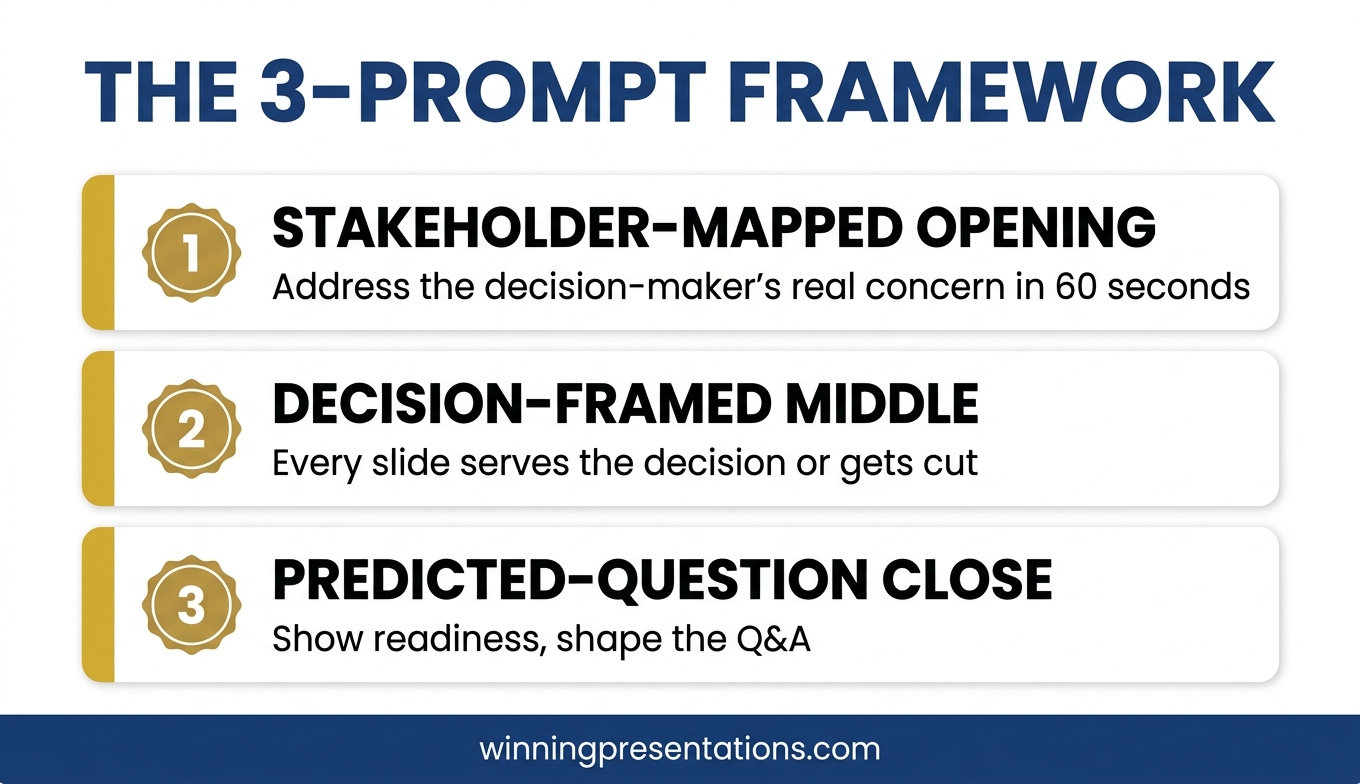
Most senior leaders use Copilot to ask for a complete board presentation. That is why the output reads generic. Three specific prompts, used in the right order, turn Copilot into a genuine board-presentation partner: a stakeholder-mapped opening, a decision-framed middle, and a predicted-question close. Each prompt assumes the strategic work is yours. Copilot drafts the structure so you can spend your time on judgement, not formatting.

If you want the structured approach behind these prompts

The AI-Enhanced Presentation Mastery course from Maven is a self-paced programme covering the prompt and workflow patterns that take Copilot from drafting tool to presentation partner.

Explore the Programme →

Ngozi, a regional operations director at a biotech company, rebuilt the same board deck four times in one afternoon. She had used Copilot to generate the first draft — a 12-slide update for the quarterly operations review. The output looked polished. The sections were logical. The language was professional. But when she read it back, it could have belonged to any company, in any industry, at any quarter. Her board would read three slides and switch off.

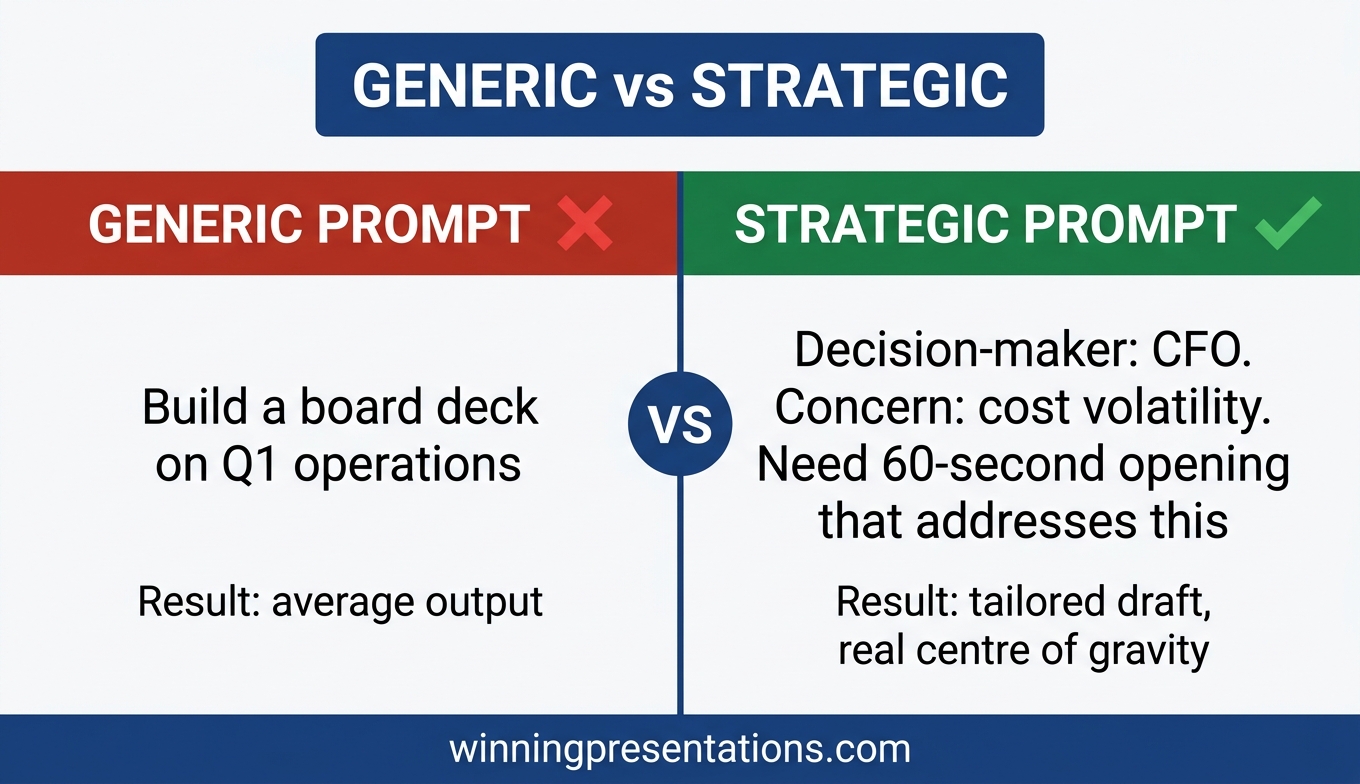
She opened a blank prompt window and tried again. “Build a board deck covering Q1 operations performance.” Same result. Slight variations in headings. Same generic feel. By the third attempt she had realised something that changes how senior leaders should use Copilot for presentations: the AI is not the problem. The prompt is asking the AI to do strategic work that only the presenter can do.

The professionals who get genuinely useful Copilot output for board presentations do something different. They do the strategic thinking first, then use Copilot to draft the structure their thinking requires. Three specific prompts, used in the right order, make this work. Each assumes that the judgement is yours and the drafting is Copilot’s.

Why most Copilot board decks read generic

Copilot is a drafting tool. It is very good at producing coherent text that matches patterns it has seen before. It is not good at knowing which board member will block your proposal, what the finance director is quietly worried about, or why this particular quarter matters differently from the last three. These are strategic inputs only the presenter has.

When senior leaders prompt Copilot with “build a board deck on X” the AI has nothing to work with except pattern-matching. It produces the average of every board deck it has ever seen. Average board decks are unmemorable. They earn polite acknowledgement and no action.

The shift is to stop asking Copilot for decks and start asking Copilot for specific structural work. The three prompts below do that. Each names exactly what structural output is needed. Each supplies the strategic context Copilot cannot guess. Each produces drafts that feel tailored because they are.

Three-prompt framework for using Copilot on board presentations: stakeholder-mapped opening, decision-framed middle, predicted-question close

WHEN COPILOT HAS TO HOLD UP IN A BOARDROOM

Move beyond basic AI usage to executive-grade output

The AI-Enhanced Presentation Mastery course is a self-paced programme with 8 modules and 83 lessons on using AI (including Copilot) to structure, draft, and refine presentations that hold up at senior levels. 2 optional live coaching sessions with Mary Beth, fully recorded — watch back anytime. Monthly cohort enrolment; lifetime access to materials.

  • 8 modules, 83 lessons on AI-assisted executive presentation work
  • Prompt and workflow patterns for Copilot and ChatGPT, board-level output
  • 2 optional live coaching sessions with Mary Beth (recorded)
  • Self-paced, no deadlines, no mandatory live attendance
  • Monthly cohort enrolment — enrol any time

£499, lifetime access to all course materials.

Explore AI-Enhanced Presentation Mastery →

Designed for senior professionals who need AI to produce executive-grade output, not generic drafts.

Prompt 1: The stakeholder-mapped opening

The opening of a board presentation carries more weight than the middle. Board members decide in the first two or three slides whether to lean in or let their attention drift. The opening has to land for the specific people in the room, not for boards in general.

Before you prompt Copilot, write down three facts:

  • Which board member matters most on this topic — who will either support or block the decision?
  • What that person is quietly worried about before the meeting (risk, cost, reputation, precedent)
  • What they need to see in the first two slides for you to have their attention for the rest

Now the prompt:

“I am presenting to a board where the most influential decision-maker on this topic is [role]. Their primary concern before this meeting is [specific worry]. I need a two-slide opening that addresses their concern in the first 60 seconds, without burying the answer. Draft Slide 1 (the one-sentence answer to the implied question they’re bringing into the room) and Slide 2 (three supporting points that map to their concern). No preamble, no company-of-the-future language.”

Copilot produces an opening grounded in a real person’s real concern. That is different from every generic board-opener it would otherwise draft. You will still edit the output. But the draft will have a centre of gravity to edit around.

Prompt 2: The decision-framed middle

The middle of a board deck is where most presentations drift. Slide after slide of context, data, background. By the time the presenter arrives at the ask, the board has spent its attention on material that was the journey, not the answer. Board members rarely say this out loud. They just disengage.

A decision-framed middle does the opposite. Every slide exists because it supports a specific decision the board is about to make. Slides that do not serve that decision get cut or moved to an appendix.

The prompt:

“The decision the board is making is: [specific decision]. Assume they already know [common background you would otherwise over-explain]. Build a 4-slide middle that (1) names the decision in one sentence at the top of Slide 1, (2) shows the two realistic options the board can choose between, (3) gives the supporting evidence for the recommended option, and (4) addresses the strongest argument against. Each slide must directly serve the decision. No context slides, no history, no company-values language.”

The output will be tighter than a generic Copilot draft because the prompt has told Copilot what to leave out, not just what to include. The discipline of naming the decision forces Copilot to cut the padding that would otherwise fill the deck. If you want an overview of where this fits in the broader AI-for-presentations landscape, ChatGPT for PowerPoint presentations covers the parallel approach for non-Microsoft environments.

Before and after comparison of Copilot board deck drafts showing how strategic context in the prompt changes the output quality

Prompt 3: The predicted-question close

The close of a board presentation is the slide you land on before the Q&A begins. Most closes are either a generic “Thank you, questions?” slide or a summary of everything already covered. Both waste the moment. The slide the board is looking at when the first question comes is the slide that shapes the first question.

A predicted-question close shows the board the three questions you are ready to answer. That does two things at once. It frames the Q&A around the questions you want. And it signals preparation — the board member about to ask a harder question will often reframe it because your visible preparedness has raised the bar.

The prompt:

“The three hardest questions the board will ask about [specific proposal] are likely to be [Q1], [Q2], [Q3]. Draft a single closing slide that lists all three as bullet points with a one-sentence direct answer under each. Professional tone, no defensive language, no hedging. The purpose of the slide is to show readiness, not to answer in full — each answer should invite a conversation, not close it down.”

The closing slide produced by this prompt does something unusual. It leaves the board with the impression that you have already thought through the hard parts. That is the impression most senior leaders want and rarely manage to create. It also makes the Q&A shorter and more focused, which every board member quietly appreciates.

Want the prompts ready to use?

The Executive Prompt Pack contains 71 ChatGPT and Copilot prompts for PowerPoint presentations — including board-level prompts, stakeholder-mapped openings, and decision-framed middle sections. £19.99, instant download.

Get the Executive Prompt Pack →

How to sequence the prompts

The three prompts are designed to be used in order. Opening first, because the opening sets what the rest of the deck has to support. Middle second, because the middle adapts to the opening you have committed to. Close third, because the close has to match the questions the opening and middle will provoke.

Running them in any other order usually produces a deck that feels stitched together. Running them in order produces a deck that feels coherent, even when each prompt runs in a separate Copilot session. Senior leaders who use this sequence regularly report that the total time from blank deck to editable first draft drops from two or three hours to around 25 minutes — and the draft is actually worth editing.

One more thing. Copilot’s output still needs an editorial pass. The prompts give you a draft with a real centre of gravity. They do not give you a final deck. The best Copilot PowerPoint prompts and the editing workflow that cleans up the output work together. Neither replaces the other.

The three prompts also apply when you are using Copilot to refine an existing deck, not to build from scratch. Run the opening prompt against the first two slides you already have. The gap between the current opening and the stakeholder-mapped version is usually where the board was losing attention. Fix that first.

Frequently asked questions

Do these prompts work with ChatGPT as well as Copilot?

Yes. The structural logic is the same. ChatGPT and Copilot will produce slightly different drafts because their training and defaults differ, but the prompts give both models the strategic context they need. If you are comparing the two tools for executive slide work, Copilot vs ChatGPT for executive slides covers the differences in detail.

How long should it take to prepare the strategic inputs before prompting?

Around 15 to 20 minutes for most board presentations. That feels slow the first time, but it replaces one to two hours of generic output and rework. The strategic inputs are the same work the presenter would have had to do anyway — the prompts just make the thinking explicit up front.

What if I do not know who the most influential board member on the topic is?

Ask one of your peers or your sponsor. Board influence is rarely what the org chart suggests. The influential member on a cost decision is usually not the one who dominates strategy discussions. If the topic is genuinely novel, the most influential person is whoever has asked the sharpest questions at the last two meetings on adjacent topics.

Should I tell the board I used Copilot to draft the deck?

No, and the question itself points to a worry worth examining. Copilot is a drafting tool, the same way Word is a typing tool. The value you bring is the strategic thinking, the editorial judgement, and the delivery. Leading with “I used AI” tends to shift attention from the decision to the tool, which is not what board time is for.

Do these prompts apply to investor presentations as well as board presentations?

Partially. The stakeholder-mapped opening and the predicted-question close translate cleanly. The decision-framed middle needs adapting because investor presentations often have a different centre of gravity — investment thesis rather than operating decision. The structural discipline still helps.

The Winning Edge

Weekly thinking for senior professionals on executive presentation craft — slide structure, Q&A, delivery, AI, and the judgement calls the frameworks do not cover. Thursday mornings, one considered issue.

Subscribe to The Winning Edge →

Not ready for the full programme? Start here instead: download the free Pyramid Principle Template — the structure most board slides fail to use, in a one-page reference.

Next step: pick one upcoming board presentation. Run the stakeholder-mapped opening prompt this week. See whether the draft lands differently from your usual Copilot output. That one change tends to be the one that reveals the rest.

For the parallel comparison between Copilot and ChatGPT on executive slide work, see Copilot vs ChatGPT for executive slides. For what happens when Copilot’s first draft does not hold up under boardroom scrutiny, see why Copilot’s first draft fails boardroom tests.


About the author

Mary Beth Hazeldine is Owner & Managing Director of Winning Presentations Ltd, a UK company founded in 1990. With 24 years of corporate banking experience at JPMorgan Chase, PwC, Royal Bank of Scotland, and Commerzbank, she advises senior professionals across financial services, healthcare, technology, and government on structuring presentations for high-stakes decisions, board approvals, and executive scrutiny.

13 Apr 2026
Male CFO responding calmly to a challenging board question — composed expression under Q&A pressure, other board members visible, executive boardroom with navy and gold tones, editorial photography style

How to Pressure-Test Your Presentation Q&A Before the Meeting

Quick Answer

Presentation Q&A preparation moves from reactive to systematic when you pressure-test your answers before entering the room. This means categorising the questions you are likely to face, identifying the gaps your data does not cover, rehearsing with an adversarial questioner, and building a response framework for the questions you cannot fully answer. Rehearsing answers you already know is not preparation — it is confirmation. Real preparation stress-tests the limits of what you know.

Kwame had run the numbers six times. As CFO of a mid-size logistics company, he had presented budget proposals to the board before — but this one was different. The proposal involved a £4.2 million capital commitment to upgrade a fleet management system, and the board had already pushed back twice on discretionary spending. He had built what he believed was an airtight case.

The presentation itself went well. The slides were clear, the narrative was coherent, and the ROI model was thorough. Then, at the twelve-minute mark, the Chairman asked a question Kwame had not seen coming: “Before we go further, Kwame — what assumptions are you making about fuel price movements over the implementation period, and have you stress-tested the ROI against a thirty per cent increase?”

Kwame knew the answer in principle. But he had not built that specific scenario into the model. He hedged. He said he could run those numbers after the meeting. The Chairman nodded, but the energy in the room shifted. Two other board members asked follow-up questions he handled less confidently than the main presentation had suggested he would. The proposal was deferred for a second meeting.

Afterwards, the CFO of the parent company — who had been in the room as an observer — pulled Kwame aside: “The proposal was solid. But you walked in having rehearsed what you know and hoping they wouldn’t ask what you don’t. That’s not preparation. That’s optimism.”

Systematic presentation Q&A preparation is not about practising the answers you already have. It is about identifying the assumptions embedded in your case, finding the weakest points in your data, and constructing a response framework that holds up even when the question lands outside your prepared territory.

Need a systematic Q&A preparation framework?

The Executive Q&A Handling System gives you a structured method for anticipating, categorising, and preparing responses to the questions that derail executive presentations — before you walk into the room. Explore the System →

Why rehearsing your answers is not enough

Most executives who prepare for Q&A do so by thinking through the questions they expect to receive and running through their answers mentally or verbally. This is better than no preparation. But it has a fundamental limitation: you are rehearsing a conversation you have already imagined, which means you are only testing your ability to deliver answers you have already constructed.

Real Q&A pressure does not come from the questions you expected. It comes from the question you did not see coming — the one that probes an assumption you made but did not flag, the one that connects two data points in a way that reveals a tension in your model, or the one that is framed in a way that makes any direct answer politically difficult. Rehearsing expected questions builds fluency in territory you already control. It does not build resilience in territory you do not.

The distinction matters most in the moments after a difficult question lands. An executive who has only rehearsed their prepared answers will feel a spike of alarm when the unexpected question arrives, because it signals that they are outside the plan. That alarm shows — in the hesitation before they speak, in the way their answer trails off rather than concluding, in the eye contact that breaks rather than holds. An executive who has actively pressure-tested the limits of their case approaches the unexpected question differently: they know the shape of their uncertainty, which means they can navigate it without being surprised by it.

For a related approach to handling the most confrontational form of unexpected question, see how to handle a hostile question in a board meeting without losing the room.

The four categories of pressure question every executive faces

Pressure questions in executive presentations fall into four distinct categories. Understanding which category a question belongs to is the first step in building a preparation method that covers all of them.

The four categories of pressure question in executive presentations: assumption challenges, data gap questions, political implication questions, and precedent questions — dashboard infographic with preparation method for each

Category 1: Assumption challenge questions. These questions probe the assumptions embedded in your model, forecast, or recommendation. “What are you assuming about interest rates over that period?” “Have you modelled the downside scenario?” “What happens to the ROI if adoption is slower than forecast?” These questions are often the most embarrassing to be caught unprepared for, because the assumptions are visible to anyone who looks closely at your analysis — which suggests you have not looked closely enough yourself.

Preparation method: For every key number in your presentation, write down the two or three assumptions that number depends on. Then build a simple scenario: what does the model look like if each assumption is twenty per cent worse than your base case? You do not need to present these scenarios — you need to know the answers so you can give them when asked.

Category 2: Data gap questions. These questions ask about data you have not included, either because you chose not to or because you did not have it. “Do you have a comparable from another division?” “What does the competitor analysis show?” “Have you validated this with the operational team?” These questions can reveal either that your analysis is incomplete or that you have made a deliberate choice not to include something — and the audience will wonder why.

Preparation method: Before finalising your deck, ask yourself what data an informed sceptic would expect to see but cannot find in your slides. Either include it or prepare a clear explanation of why you have not.

Category 3: Political implication questions. These questions are not really about your analysis — they are about the politics of the decision. “How does this affect the northern division?” “Has this been discussed with the operations board?” “Who owns the implementation risk?” These questions signal that the questioner has a stakeholder interest in the outcome and is testing whether you have addressed it. They can feel like hostile questions but are usually legitimate governance concerns.

Preparation method: Map the stakeholders who will be affected by your recommendation and anticipate the concern each one would raise. Prepare a one-sentence response to each concern that acknowledges it and names how it is being managed.

Category 4: Precedent questions. These questions invoke a previous decision or a comparable situation to test the consistency of your current recommendation. “When we approved a similar programme in 2023 it took twice as long as the forecast — why will this be different?” “We had a similar analysis for the IT project and it underestimated the integration costs. Have you accounted for that?” These questions require specific knowledge of the precedent being cited and a clear, factual explanation of what is different this time.

Preparation method: Research your organisation’s relevant history before the presentation. If there are obvious precedents the audience will raise, address them proactively in the deck rather than waiting for the question.

Executive Q&A Handling System

Anticipate, Prepare, and Handle Every Pressure Question

The Executive Q&A Handling System — £39, instant access — gives you a structured system for predicting the questions your specific audience is likely to ask, building response frameworks for each category of pressure question, and managing the Q&A process so that difficult questions strengthen rather than undermine your credibility.

  • System for predicting and categorising executive Q&A questions
  • Response frameworks for assumption challenges, data gaps, and political questions
  • Adversarial rehearsal guides for high-stakes presentation settings
  • Recovery strategies for questions that expose genuine gaps in your analysis

Get the Executive Q&A Handling System →

Designed for executives who face high-stakes Q&A in board, committee, and investor settings.

The stress-test method: how to run an adversarial Q&A

The most effective Q&A preparation method is the adversarial rehearsal — a structured session in which a trusted colleague, mentor, or adviser tries to find the weaknesses in your case by asking the most difficult questions they can generate. This is fundamentally different from a practice run, where the colleague asks supportive clarifying questions and you deliver your prepared answers. An adversarial rehearsal has a specific goal: to find the questions that you cannot answer well and identify what that reveals about your preparation.

The setup matters. Give your adversarial questioner the following brief before the session: “Your job is not to help me practise. Your job is to find the weakest point in my case and keep pushing until I either give you a satisfying answer or we identify a genuine gap. Ask the same question differently if I give you a vague answer. Escalate if I give you a deflection. I need to know where my preparation is thin.”

During the adversarial rehearsal, track the questions you struggle with in three categories. Questions you struggled with because you do not know the answer are a preparation gap — you need to either find the answer or prepare an explicit response to not knowing it. Questions you struggled with because the answer reveals a tension in your case are a content gap — you may need to adjust the recommendation or explicitly acknowledge the tension in the presentation. Questions you struggled with because the framing caught you off-guard are a rehearsal gap — you need to practise responding to the same content delivered in different, more challenging framings.

One session of genuine adversarial questioning will reveal more about the vulnerabilities in your Q&A preparation than ten sessions of practising your prepared answers.

Pressure-testing your data and the numbers behind your slides

Every number that appears on a slide in a high-stakes executive presentation will be interrogated by at least one person in the room. The question is whether that interrogation will happen before or after you walk in. Pressure-testing your data means asking, for every significant number: what is the source, what are the assumptions, what happens if the assumptions are wrong, and what would a sceptic say about the methodology?

Five-step data pressure test framework for executive presentations: source verification, assumption mapping, downside scenario, sceptic methodology challenge, and reconciliation check — stacked cards infographic

The source question is the most basic and the most frequently neglected. If you are presenting a market size figure, a cost estimate, or a timeline, you should be able to state immediately who produced that number and how recently. A number from a report published two years ago presented as current market data is a vulnerability. An estimate produced internally without external validation is a vulnerability. Neither of these need prevent you from using the number — but you need to know they are vulnerabilities before someone else identifies them.

The reconciliation check is particularly important in financial presentations. Every number in your deck should reconcile with every other related number. If your cost estimate on slide four implies a certain unit cost, and your volume forecast on slide seven implies a different unit cost, a sharp analyst in the room will find the inconsistency. Running a systematic reconciliation across your slides — not just checking individual numbers but checking that the numbers are internally consistent — is a discipline that most presenters skip and most experienced audiences notice the absence of.

For a structured approach to buying time when a data question catches you short, see buying time in Q&A: techniques for managing questions you need a moment to answer.

If you want a structured system for building and running this kind of adversarial Q&A preparation before high-stakes presentations, the Executive Q&A Handling System includes question prediction frameworks, adversarial rehearsal guides, and response strategies for each category of pressure question.

Building a framework for questions you cannot fully answer

Pressure-testing will sometimes reveal that you genuinely do not have the answer to a question the audience is likely to ask. This is not a failure of preparation — it is the purpose of preparation. Finding these gaps before the room does is exactly what the process is designed to do. The question is what to do with them once you have found them.

There are three legitimate responses to a question you cannot fully answer, and one illegitimate one. The illegitimate response is to deflect — to give an answer that sounds responsive but does not actually address the question. Experienced questioners recognise deflection immediately, and it damages credibility far more than an honest acknowledgement of a gap.

The first legitimate response is to close the gap before the meeting. If pressure-testing reveals that you do not know your fuel price assumptions, get the answer before the presentation. Many gaps that feel large in the preparation phase are actually addressable with a few hours of additional analysis or a conversation with a colleague.

The second legitimate response is to acknowledge the gap explicitly in the presentation, frame it as a known uncertainty, and name how you are managing it. “The model does not include a scenario for a thirty per cent fuel price increase. We have not modelled that because it falls outside the range our supply chain team considers realistic — but if the board would find it useful, I can run that scenario and bring it to the next meeting.” This response is far stronger than being caught by the question.

The third legitimate response is to answer the spirit of the question without answering the exact question: “I don’t have that specific number with me, but the broader point you’re making about input cost sensitivity is addressed in the sensitivity analysis on slide nine — would it help to walk through that section?” This only works when the redirect is genuinely responsive to the concern behind the question, not a deflection dressed up as engagement.

For a structured bridging technique that supports these responses in the moment, see the bridging technique for difficult presentation questions: how to navigate without losing credibility.

When pressure-testing reveals a real gap

Occasionally, adversarial Q&A preparation does not just identify a question you cannot answer — it reveals that the case you are making has a genuine substantive weakness. The numbers do not hold up to a simple sensitivity analysis. The recommendation depends on an assumption that is clearly contestable. The implementation plan has a dependency that has not been addressed.

When this happens, the temptation is to press ahead anyway — the presentation is scheduled, the slides are built, and the gap might not come up. This is the wrong choice. A real gap that emerges in the room — that you were aware of and chose not to address — damages your credibility as a presenter and as an analyst in ways that take much longer to recover from than a delayed presentation.

The appropriate response is to decide, before the meeting, whether the gap is material enough to delay the presentation. If the gap would change the recommendation — or would change the conditions under which the recommendation holds — it is material, and the presentation should be delayed until the gap is addressed. If the gap is peripheral — it does not affect the core recommendation but represents a risk the audience should be aware of — it should be disclosed proactively in the presentation, not concealed in the hope it will not be raised.

Executives who earn lasting credibility in high-stakes Q&A settings are those who demonstrate that they have stress-tested their own analysis before presenting it. That quality of rigour is visible — in the specificity of their answers, in their ability to name the assumptions in their model, and in their comfort with the limits of what they know. It is the quality that adversarial Q&A preparation builds.

For a companion resource on presenting with confidence in the room, see presentation gestures: the body language signals that build executive credibility.

Executive Q&A Handling System — £39

The System Behind Executives Who Handle Tough Q&A With Clarity

The Executive Q&A Handling System — £39, instant access — gives you a structured method for predicting and preparing for every category of pressure question, running adversarial rehearsals, and managing the Q&A process so that difficult questions strengthen rather than undermine your credibility in the room.

Get the Executive Q&A Handling System →

Designed for executives who face high-stakes Q&A in board, committee, and investor settings.

Frequently Asked Questions

How much time should I allocate to Q&A preparation before a major presentation?

For a high-stakes presentation — board, investor, or senior committee — allocate at least as much time to Q&A preparation as to slide preparation. In practice, this is rarely done: most executives spend ninety per cent of their preparation time on the deck and twenty minutes on Q&A. The imbalance is understandable, because slide preparation is a creative task with a clear output, whereas Q&A preparation is an analytical task with an uncomfortable one. The adversarial rehearsal session should run for at least sixty minutes for a significant presentation. Data pressure-testing — checking sources, assumptions, and internal consistency — is a separate exercise and should be treated as a quality check on the analysis, not just the communication.

Is it better to ask a colleague or a senior mentor to run the adversarial Q&A?

A senior mentor or someone from outside your team is typically more effective than a close colleague. The problem with colleagues is that they are often too familiar with your context to ask genuinely challenging questions — they fill in the gaps with their own knowledge rather than exposing the gaps as the audience would. A mentor or trusted senior peer who does not know your specific project in detail is more likely to ask the naïve but important question that the audience will also ask. If you do use a colleague, brief them explicitly to ask the questions they think the sceptics in the room will ask — not the questions they themselves would ask as a supportive peer.

What should I do if I get a question in the room that I am genuinely not able to answer?

Say so — specifically and without apology. “I don’t have that figure with me, and I don’t want to give you a number I haven’t verified. I’ll get it to you by close of business today.” This response is more credible than a hedged estimate, more respectful than a deflection, and far less damaging than a wrong answer given confidently. What damages credibility is not the absence of an answer but the pretence of having one. Most experienced decision-makers have significantly more patience for honest uncertainty than for confident inaccuracy.

The Winning Edge

Weekly executive communication insight — every Thursday

Practical, no-filler analysis of Q&A strategy, board presentation technique, and executive communication — from 25 years of experience in high-stakes business settings.

Subscribe to The Winning Edge →

About the Author

Mary Beth Hazeldine — Owner & Managing Director, Winning Presentations

With 25 years of corporate banking experience at JPMorgan Chase, PwC, Royal Bank of Scotland, and Commerzbank, Mary Beth advises executives across financial services, healthcare, technology, and government on structuring presentations and managing the Q&A dynamics that determine whether decisions are made or deferred.

06 Apr 2026
An executive in smart business attire walking purposefully through a bright modern lobby, calm and composed expression, early morning light, editorial photography style

Morning Presentation Protocol: What to Do in the Two Hours Before You Present

What you do in the two hours before a high-stakes presentation matters more than most people realise. By the time you walk into the room, the window for preparation has closed. The anxiety management techniques, the physical regulation, the mental framing — all of it has to happen before that moment. A structured morning protocol is not a luxury for performers and athletes. It is a practical, evidence-based approach to ensuring that the version of yourself that walks into the room is the one you intended to bring.

Astrid had given hundreds of presentations over a fifteen-year career in healthcare management. She was competent, prepared, and well-regarded. But the morning of a significant board presentation, her routine collapsed. She woke early and immediately began reviewing her slides — forty minutes of anxious re-reading that convinced her three sections were unclear. She rewrote them. Then she was late leaving the house, arrived at the venue with ten minutes to spare, grabbed a coffee, and sat in the boardroom trying to remember which version of slide fourteen she had updated. By the time the room filled, her heart was racing and her mouth was dry. The presentation went reasonably well — she was experienced enough to recover — but it was not her best work. She knew it. What she did not know was that the problem was not the slides, or the venue, or the nerves. It was the absence of a deliberate morning protocol. What she had done in those two hours had amplified her anxiety rather than managed it. When she eventually built a structured morning routine — consistent, timed, and designed around her nervous system rather than her slide deck — her presentations changed significantly.

Struggling with anxiety on the day of a big presentation? Conquer Speaking Fear is a structured 30-day programme that addresses the nervous system patterns behind presentation anxiety — so the morning of a high-stakes presentation stops feeling like a crisis. Explore the programme →

Why the Two Hours Before Presenting Matter Most

The nervous system does not respond to logic in the way we would like it to. In the hours before a high-stakes event, your body is already preparing its stress response — regardless of how experienced or well-prepared you are. Cortisol rises, muscle tension increases, and attention narrows. These are physiological processes, not character weaknesses. The question is not whether they happen. The question is whether you have a structured approach to working with them.

What distinguishes executives who consistently perform well under pressure from those who find high-stakes presentations draining and inconsistent is not talent. It is routine. When the two hours before a presentation are unstructured — filled with last-minute review, anxious checking, caffeine, and hurried logistics — the nervous system’s stress response compounds without interruption. When those same two hours are deliberately structured around physical regulation, cognitive preparation, and practical readiness, the presentation experience changes fundamentally.

There is also a practical dimension. The two-hour window is the last point at which you can do anything useful. After that window closes, the logistics are fixed and the slides are final. What remains is your state — your focus, your physical regulation, your relationship to the material. Managing your state is not a soft skill. It is the most high-leverage activity available to you in those final hours.

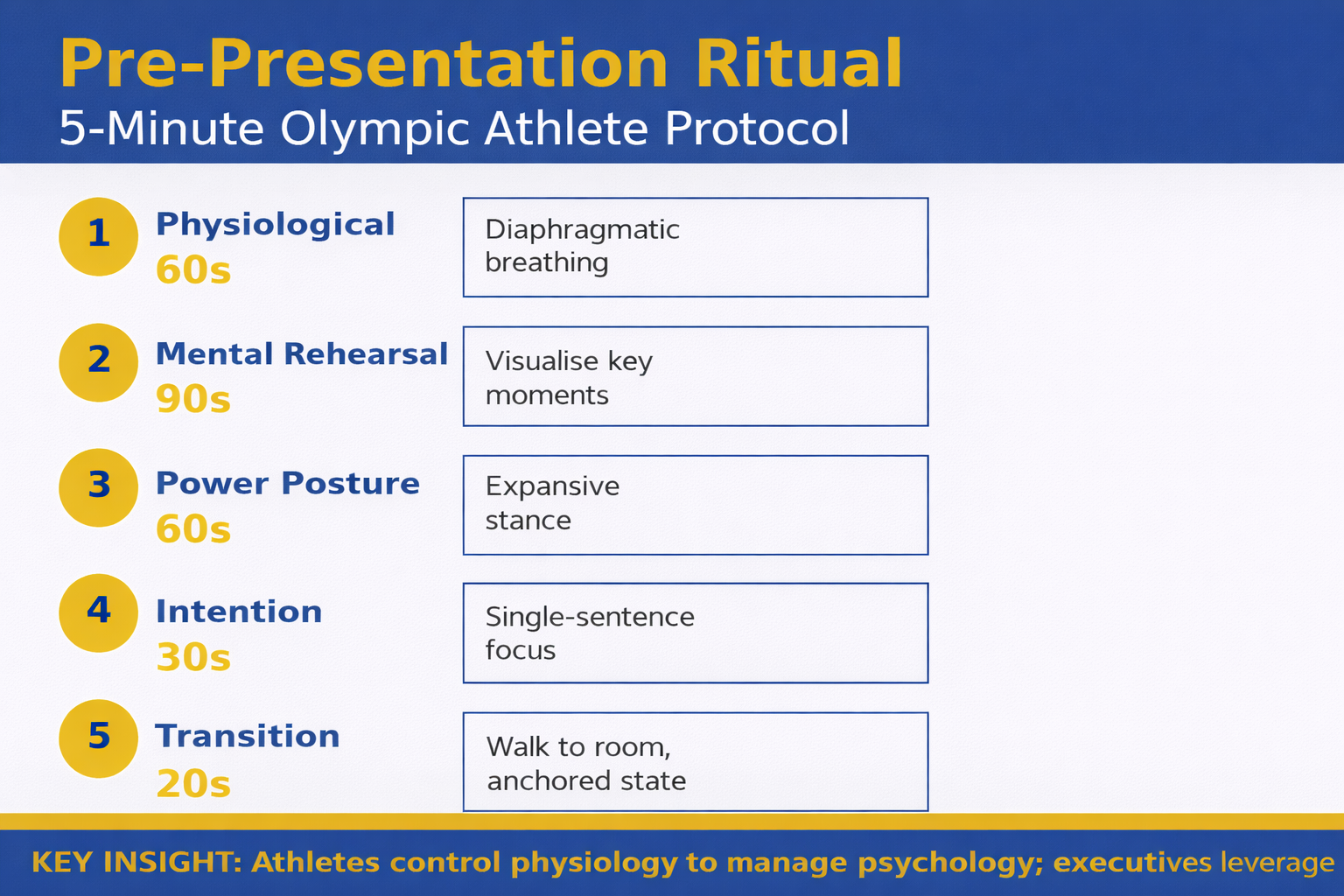
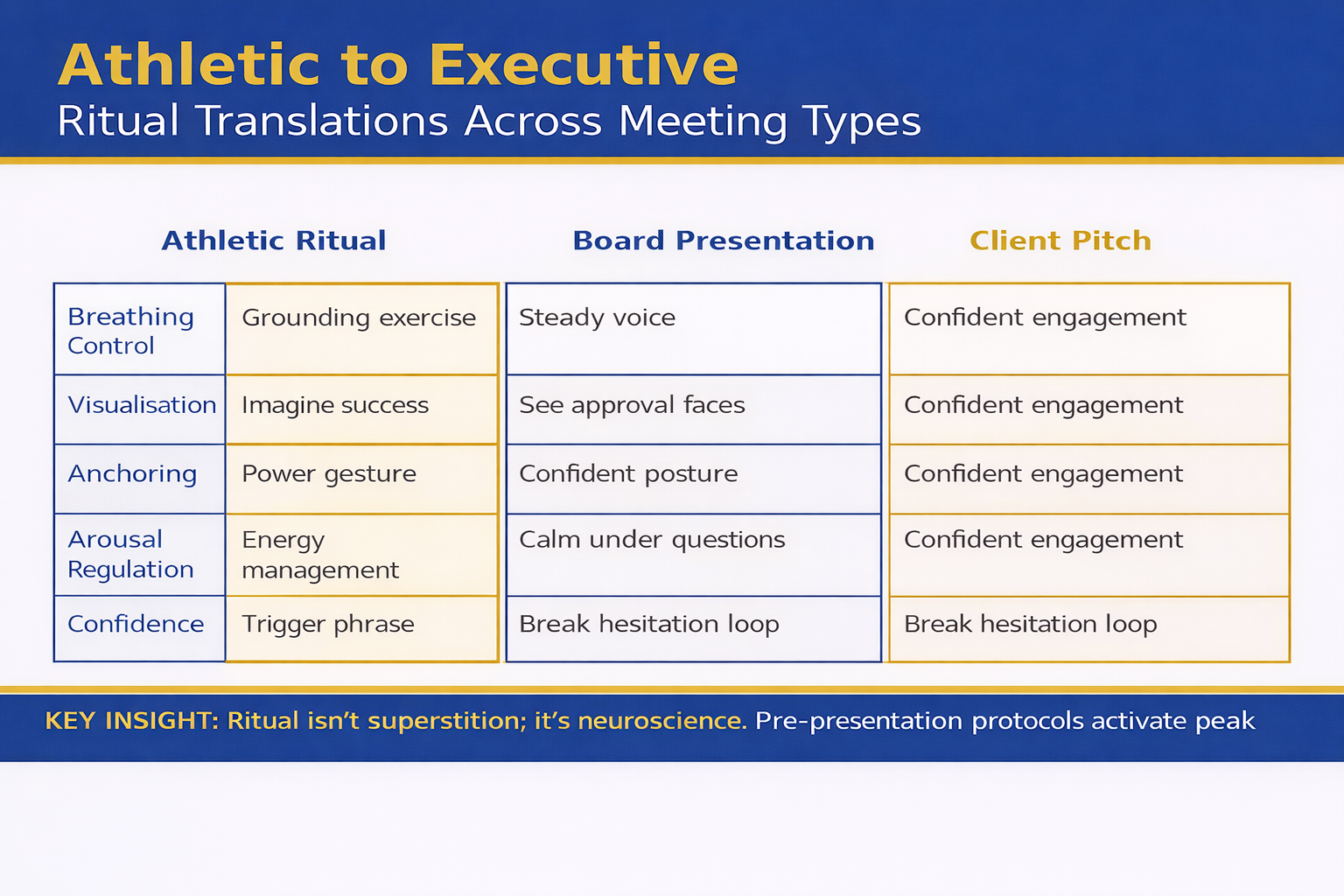
The pre-presentation rituals that athletes use before high-stakes performance follow exactly this logic — the research on elite performance preparation maps closely to what works for executives facing important presentations.

Stop Dreading Presentation Day. Start Managing It.

Conquer Speaking Fear is a structured 30-day programme that uses nervous system regulation and clinical hypnotherapy techniques to address presentation anxiety at its root — so you walk into high-stakes rooms feeling ready, not wired.

  • ✓ 30-day structured programme for presentation anxiety
  • ✓ Nervous system regulation techniques for high-pressure scenarios
  • ✓ Clinical hypnotherapy approaches adapted for executive contexts

Get Conquer Speaking Fear → £39

Designed for executives managing presentation anxiety

The Four-Phase Morning Protocol

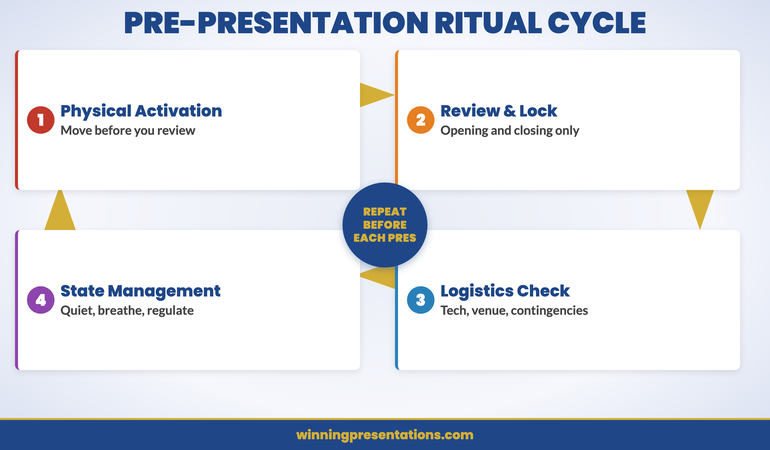
The morning presentation protocol divides the two-hour window into four distinct phases, each with a specific purpose. The phases are designed to move from physical regulation through to mental focus, ending with a period of deliberate quiet before you enter the room. This sequence is not arbitrary — each phase prepares the conditions for the next.

Phase one: Physical activation (T minus 120 to 90 minutes). The first thirty minutes of the protocol addresses your body before your mind. Physical movement — a brisk walk, light exercise, or stretching — changes the neurochemical environment of anxiety. Movement processes the stress hormones that have been building since you woke and introduces endorphins that reduce subjective anxiety. This is not a training session. Fifteen to twenty minutes of moderate movement is sufficient. The key is doing it before engaging with any presentation material.

Phase two: Review and lock (T minus 90 to 60 minutes). The second phase is for content, not creation. If you have not finished preparing by this point, you are in a different kind of problem. This phase is for one final, structured review of your opening and closing only — not the full deck. Read your opening paragraph aloud. Say your closing sentence. These are the moments that shape first and last impressions, and they benefit from one deliberate rehearsal. After this review, the slides are locked. No more changes.

Phase three: Practical logistics (T minus 60 to 30 minutes). The third phase handles everything that needs to be in place before you leave for the venue: technology checked, slides saved to multiple locations, travel confirmed, contingency plans noted. Practical readiness removes the background hum of logistical anxiety that can occupy mental bandwidth during the presentation itself. If you will be presenting in a room you do not know, arrive early enough to check the AV setup, test your slides on the room screen, and stand at the front before anyone else arrives. Physical familiarity with a space significantly reduces situational anxiety.

Phase four: State management (T minus 30 to 0 minutes). The final thirty minutes before presenting are reserved for deliberate state management. This means quiet — no email, no phone calls, no last-minute preparation. Use this time for breathing techniques, a short mindfulness practice, or simply sitting in a calm environment and allowing your nervous system to settle. The goal is not to eliminate activation — some level of physiological arousal is useful for performance. The goal is to bring that activation to a level you can work with rather than a level that works against you.

The four-phase morning presentation protocol infographic: physical activation, review and lock, practical logistics, and state management with timing guidance

The Nervous System Reset: Physical Techniques That Work

The physical techniques that are most effective for pre-presentation anxiety management are those that directly engage the parasympathetic nervous system — the branch responsible for the rest-and-digest state that counterbalances the fight-or-flight response. These techniques work because they change your physiology, not just your thoughts about your physiology.

Controlled breathing is the most accessible and fastest-acting of these techniques. Breathing with a longer exhale than inhale — for example, four counts in and six counts out — activates the vagal nerve and shifts the nervous system toward a calmer baseline. This is not a new-age practice. It is physiology. The vagal nerve is the direct pathway between your breath and your autonomic nervous system, and it responds consistently to specific breathing patterns. Five minutes of extended-exhale breathing during phase four of the morning protocol can meaningfully change your physiological state before you walk in.

Progressive muscle relaxation — the sequential tensing and releasing of major muscle groups — is particularly effective for presenters whose anxiety manifests physically: tight shoulders, clenched jaw, tension in the hands and forearms. Ten minutes of systematic relaxation removes the physical tension that often remains even after breathing exercises have addressed the heart rate. It also directs attention to the body rather than the catastrophising thoughts that tend to dominate anxious minds in the final minutes before a presentation.

Grounding techniques — deliberate sensory engagement with the present environment — are useful for managing the mind’s tendency to project into the presentation room before the body has arrived there. For a detailed breakdown of grounding techniques specifically adapted for executives, our guide to grounding techniques for presentation anxiety covers the evidence-based approaches that work in professional settings.

For those whose anxiety involves persistent negative thought patterns — catastrophic predictions, harsh self-judgement, fixed beliefs about their performance under pressure — the techniques covered in our guide to cognitive restructuring for presentation anxiety address the mental layer that physical techniques alone cannot always reach.

If you want to build morning protocol management into a consistent practice, Conquer Speaking Fear provides the structured 30-day framework that takes these individual techniques and builds them into a coherent approach to managing presentation anxiety over time.

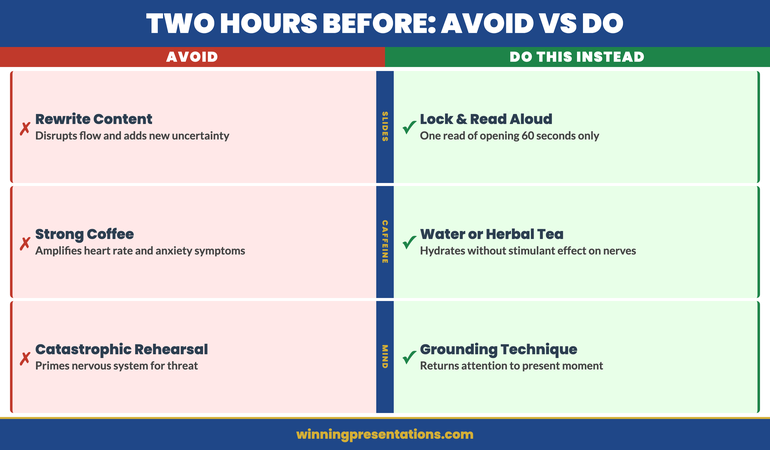
What to Avoid in the Two Hours Before You Present

The morning protocol is as much about what you do not do as what you do. Several common pre-presentation behaviours reliably increase anxiety rather than managing it, and most executives do them habitually without recognising the pattern.

Rewriting slides. Making changes to your presentation material in the two hours before delivery introduces a specific kind of anxiety: uncertainty about your own content. You no longer know which version of slide six you are presenting. The muscle memory of your flow is disrupted. If the changes were significant enough to be necessary this morning, the preparation process had a problem that no last-minute revision will fix. If they were not significant enough to be necessary, you have introduced uncertainty for no benefit. Lock the slides before the protocol begins.

Excessive caffeine. Caffeine is a stimulant that increases heart rate, heightens physical arousal, and can amplify the physiological symptoms of anxiety — the shaking hands, the dry mouth, the racing pulse. For presenters who already manage moderate to high pre-presentation anxiety, a strong coffee in the final hour before presenting is contraindicated by basic physiology. Caffeine consumed more than ninety minutes before presenting has a different effect; it is the timing that matters. In the final hour, a glass of water serves you better than an espresso.

Catastrophic rehearsal. Running through worst-case scenarios in your head — the slide clicker failing, the room going cold, the senior stakeholder asking the question you cannot answer — is a form of mental rehearsal that primes your nervous system for threat rather than performance. The mind does not distinguish cleanly between imagined and real scenarios. When you rehearse disaster, you trigger the same physiological response the real disaster would produce. Use the final thirty minutes for deliberate positive rehearsal, or for state management techniques, not for anticipatory problem-solving that generates anxiety without solutions.

Seeking reassurance. Calling a colleague to talk through your nerves, or asking a peer to quickly review your slides, feels helpful but often has the opposite effect. It externalises your confidence and makes it contingent on someone else’s response. It also invites feedback — and any critical feedback received in the final hour before presenting cannot be acted on, but it can unsettle you. Build your confidence in the preparation period. Protect it in the final two hours.

Four behaviours to avoid before presenting: rewriting slides, excessive caffeine, catastrophic rehearsal, and seeking reassurance, with better alternatives for each

Building the Protocol Into a Repeatable Routine

The morning protocol works best when it becomes automatic. The more consistent the routine, the less cognitive bandwidth it requires — and the more reliable the state it produces. Elite performers in every discipline report that pre-performance routines become conditioning: the body learns to associate the ritual with a particular state, and begins to produce that state in response to the ritual itself.

Building this kind of conditioned response requires consistency. The first few times you use the morning protocol, it will feel deliberate and slightly artificial. By the tenth presentation, it will feel natural. By the twentieth, it will be a trigger — and the physiological calm it produces will begin to appear earlier in the sequence, before you have even completed the protocol, simply because the familiar routine signals to the nervous system that this is a manageable situation.

Adapt the protocol to your specific circumstances. If you present remotely, your logistics phase looks different — the technology checks happen at your desk rather than in a venue. If your presentations often require same-day travel, build the physical activation phase into your journey rather than your morning routine. The structure matters more than the specific implementation. What you are creating is a reliable sequence that moves you, consistently, from anxious to ready.

Track what works. After each presentation, spend five minutes noting which parts of the morning felt effective and which did not. Anxiety patterns are individual — what regulates one person’s nervous system may not work for another. The protocol is a starting framework. Your version of it should be personalised over time based on what your own data tells you about your own pattern. And if you are working on a presentation that involves a challenging Q&A session, our guide to managing fishing questions during presentations covers how to handle the Q&A scenarios that most reliably spike anxiety.

Build the Foundation That Makes Morning Protocols Work

Conquer Speaking Fear gives you the 30-day structured programme to address the nervous system patterns that make presentation anxiety so persistent — so your morning protocol has solid ground to work with, not just a surface fix. £39.

Get Conquer Speaking Fear → £39

Frequently Asked Questions

What if I only have thirty minutes before my presentation, not two hours?

With thirty minutes, prioritise state management over content review. Skip the review phase entirely — the slides are done and re-reading them now will either confirm what you already know or introduce new uncertainty, neither of which is useful. Use the available time for breathing techniques and physical regulation: a short walk, extended-exhale breathing, and grounding. The logistics check should have been completed earlier. In thirty minutes, the most valuable thing you can do is manage your nervous system, not your slides.

Does the morning protocol work for presentations later in the day, not just morning presentations?

Yes — the protocol is named for the most common scenario (a morning presentation) but applies equally to afternoon or evening presentations. The key is the two-hour window before your presentation time, regardless of when that falls in the day. For afternoon presentations, schedule the physical activation phase immediately after lunch rather than at the start of the day. Avoid heavy meals in the two hours before presenting — digestion competes with the physical energy you need for delivering effectively under pressure.

I tend to feel more anxious when I try to relax before presenting. Is that normal?

Yes — this is a recognised phenomenon called relaxation-induced anxiety, and it is more common among high performers than is widely acknowledged. If deliberate relaxation techniques increase your anxiety, the issue is often the contrast between your activated state and the target calm state, which registers as a loss of control. In this case, redirect from relaxation to focused activation: a brisk walk, light movement, or deliberate mental rehearsal of a confident moment. The goal is not a specific state — it is your optimal performance state, which for some people involves a higher level of activation than the standard protocol assumes. Track what works for you specifically over time.

The Winning Edge

Weekly insights on executive presentations, presentation anxiety, and boardroom communication.

Subscribe Free

If your pre-presentation anxiety is compounded by the prospect of difficult questions, our guide to fishing questions in presentations covers how to recognise and respond to the Q&A tactics that most reliably put executives on the back foot.

About the author

Mary Beth Hazeldine, Owner & Managing Director, Winning Presentations. With 24 years of corporate banking experience at JPMorgan Chase, PwC, Royal Bank of Scotland, and Commerzbank, she advises executives across financial services, healthcare, technology, and government on structuring presentations for high-stakes funding rounds and approvals. A qualified clinical hypnotherapist and NLP practitioner, she brings a nervous-system-informed approach to presentation anxiety that goes beyond technique.
03 Apr 2026
Professional woman standing calmly in a corporate corridor, eyes closed, practising grounding before a presentation with a conference room visible in the background

Grounding Techniques for Presentation Anxiety: How to Anchor Yourself Before You Speak

Grounding techniques work for presentation anxiety because they interrupt the physiological cascade that makes speaking feel dangerous. Your nervous system cannot simultaneously process a threat response and a deliberate sensory focus. That neurological fact is what makes grounding practical, not theoretical—and why it works in the final minutes before you step up to present.

Nalini was standing in the corridor outside the executive conference room, waiting for her slot in the quarterly review. She’d presented to this group before—twelve times, in fact—and each time the anxiety arrived with identical precision: racing heartbeat at the fifteen-minute mark, shallow breathing at ten minutes, and a dissociative fog at five minutes that made her notes look like a foreign language. She’d tried deep breathing. She’d tried positive self-talk. Neither penetrated the fog. That morning, before leaving home, she’d read about a sensory grounding technique: name five things you can see, four you can touch, three you can hear. Standing in that corridor, she tried it. Blue carpet. Fire extinguisher. Her colleague’s navy jacket. The exit sign. A crack in the ceiling tile. She pressed her fingertips against the cool wall. Rubbed the edge of her notebook. Touched the fabric of her jacket sleeve. Felt the weight of her shoes on the floor. She heard the air conditioning. A door closing down the hall. Someone’s phone vibrating. By the time the door opened, the fog had lifted. Her heart was still beating fast, but she could read her notes. She walked in and delivered the presentation—not perfectly, but clearly. The difference was that she’d given her nervous system something to do other than panic.

Struggling with pre-presentation anxiety? Conquer Speaking Fear includes a structured anxiety management framework with grounding, breathing, and cognitive techniques designed specifically for executives who present under pressure.

Why Grounding Works When Deep Breathing Alone Doesn’t

Deep breathing is the default advice for presentation anxiety, and it helps many people—but not everyone. The reason is neurological. When the sympathetic nervous system is fully activated—the fight-or-flight response that makes your heart race and your palms sweat—the prefrontal cortex (responsible for rational thought and voluntary breath control) has reduced influence. Telling someone in acute anxiety to “breathe deeply” is like telling someone mid-panic to “calm down.” The instruction requires the very cognitive control that anxiety has compromised.

Grounding techniques take a different route. Instead of trying to override the nervous system through conscious breath control, they engage the sensory cortex—the brain regions that process what you see, hear, touch, and smell. These regions remain active even during acute anxiety because they process incoming sensory data automatically. By deliberately directing attention to sensory input, you’re using a neurological pathway that anxiety hasn’t shut down. The effect is a reduction in the intensity of the threat response, not through willpower, but through sensory competition.

This is why grounding techniques for presentation anxiety are particularly effective in the acute phase—the last ten to fifteen minutes before you speak, when anxiety typically peaks. At this point, cognitive strategies (positive affirmations, logical reframing, content review) often fail because the cognitive system is overwhelmed. Sensory grounding bypasses the overwhelmed system entirely.

It’s also worth noting that grounding doesn’t eliminate anxiety. It reduces it to a manageable level—from the paralysing fog Nalini described to the elevated alertness that actually improves performance. The goal is not calm. The goal is functional arousal: enough activation to be sharp and present, without enough to impair speech, memory, or cognitive flexibility.

Take Control of Presentation Anxiety Before It Controls You

Conquer Speaking Fear gives you a structured anxiety management framework—grounding protocols, breathing techniques, and cognitive reframing tools designed specifically for executives who present under pressure.

  • ✓ Pre-presentation anxiety management protocols
  • ✓ Nervous system regulation techniques for speakers
  • ✓ Cognitive reframing frameworks for high-stakes situations

Get Conquer Speaking Fear → £39

Designed for professionals who present under pressure

The Five-Senses Method: A Complete Pre-Presentation Protocol

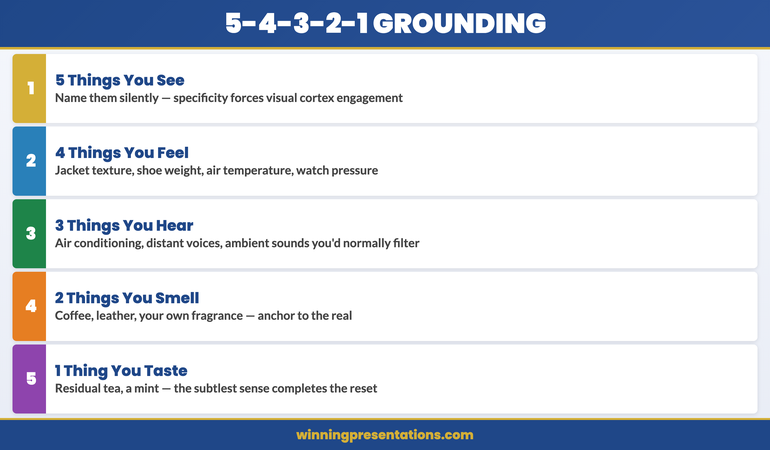
The 5-4-3-2-1 technique is the most widely used grounding method in clinical anxiety management, and it translates directly to the pre-presentation context. The protocol takes three to five minutes and can be done silently, standing in a corridor, sitting at a conference table, or waiting in a virtual meeting lobby.

Five things you can see. Name them silently and specifically. Not “the room” but “the silver pen on the table.” Specificity forces the visual cortex to engage actively rather than passively. Four things you can physically feel. The texture of your jacket. The pressure of your feet on the floor. The temperature of the air on your skin. The weight of your watch. Three things you can hear. Background noise you’d normally filter out—air conditioning, a distant conversation, traffic. Two things you can smell. Coffee. The leather of your notebook. Your own perfume or aftershave. One thing you can taste. The mint you had earlier. The residual flavour of your morning tea.

The sequence matters because it progresses from the easiest sensory channel (vision, which requires no physical action) to the hardest (taste, which requires deliberate attention to a subtle sensation). By the time you reach the final sense, your attention has been fully redirected from internal anxiety to external reality. The fog lifts—not because the anxiety is gone, but because your sensory cortex is now processing real data instead of imagined threats.

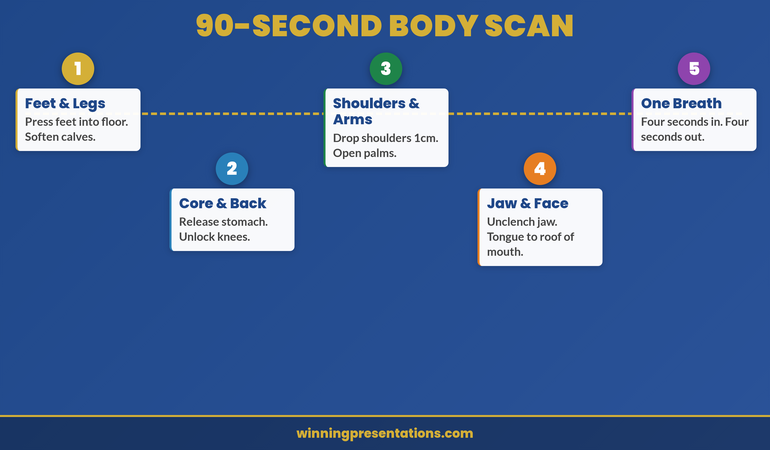
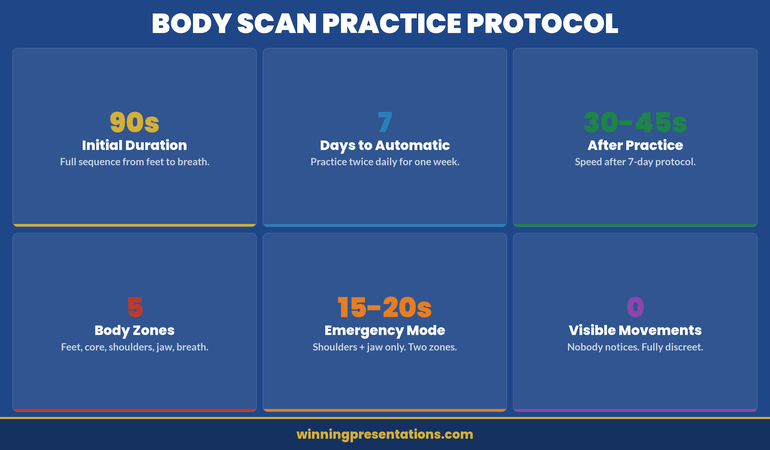
If you’re interested in complementary techniques, our guide on the body scan technique for presentation reset covers a longer protocol that works well when you have fifteen to twenty minutes before presenting. The five-senses method is the rapid-deployment version for when you have five minutes or less.

The 5-4-3-2-1 grounding technique protocol for pre-presentation anxiety showing sensory countdown

Physical Anchors You Can Use in the Room Without Anyone Noticing

The five-senses method works best in private—standing in a corridor, sitting alone before others arrive. But anxiety doesn’t always cooperate with your schedule. Sometimes it spikes mid-meeting, during the presenter before you, or whilst you’re being introduced. You need grounding techniques that work invisibly, in full view of your audience.

Feet on the floor. Press both feet flat against the floor with deliberate pressure. Feel the weight of your body transferring through your legs into the ground. This activates proprioceptive feedback—your body’s awareness of its own position in space—which counteracts the dissociative “floating” sensation that anxiety produces. Nobody can see you doing this. It works whether you’re standing at a lectern or sitting at a table.

Fingertip contact. Press your thumb firmly against your index finger, or press all five fingertips against the table surface. The tactile feedback creates a physical anchor point that your attention can return to whenever anxiety pulls you towards catastrophic thinking. Some executives use a small object—a smooth stone, a pen cap, a ring they rotate—as a consistent physical anchor across multiple presentations.

Temperature shift. Hold a glass of cold water in both hands for ten to fifteen seconds. The temperature change activates the vagus nerve—the primary pathway between your brain and your gut—which triggers a parasympathetic response (the “rest and digest” system that counteracts fight-or-flight). This is why a sip of water before speaking helps more than hydration alone would explain. The cold sensation is doing neurological work.

These micro-techniques can be combined. Press your feet into the floor whilst holding cold water. Touch a physical anchor object whilst listening to the ambient sounds in the room. The more sensory channels you engage simultaneously, the stronger the grounding effect. The research on box breathing for executive presentations shows how breathing and physical grounding work together to regulate the nervous system more effectively than either technique alone.

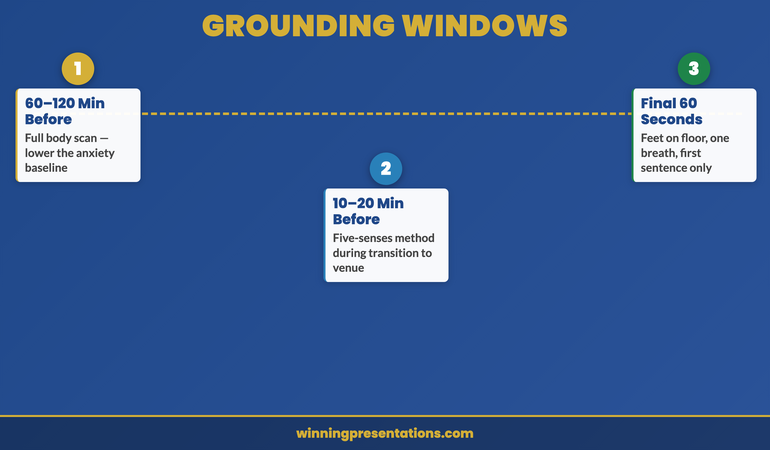
When to Ground: The Three Critical Windows Before You Present

Timing matters. Grounding at the wrong moment is less effective than grounding at the right one. Presentation anxiety follows a predictable curve, and there are three windows where intervention has the greatest impact.

Window 1: The morning of the presentation (60–120 minutes before). This is when anticipatory anxiety begins—the “I have to present today” awareness that colours your entire morning. A full body scan or extended grounding session (ten to fifteen minutes) during this window reduces the baseline anxiety level, so the peak is lower when it arrives. Think of this as lowering the starting point of the anxiety curve.

Window 2: The transition period (10–20 minutes before). This is when you’re physically moving towards the presentation space—walking to the meeting room, logging into the virtual platform, arriving at the venue. Anxiety accelerates during transitions because your body is moving towards the perceived threat. The five-senses method works powerfully here because you’re in a transitional environment with abundant sensory input to anchor to.

Window 3: The final sixty seconds. This is the acute peak. You’re about to be introduced, or you’re about to unmute your microphone, or you’re about to stand up. At this point, complex techniques fail. You need a single-move anchor: feet pressed into the floor, one deep breath through the nose, and a deliberate focus on the first sentence of your presentation. Not the whole presentation—just the first sentence. Narrowing your cognitive focus to one sentence prevents the overwhelm that comes from contemplating the entire performance ahead.

Nalini’s breakthrough came from using all three windows. She did a body scan before leaving home (Window 1), used the five-senses method in the corridor (Window 2), and pressed her feet into the floor as the door opened (Window 3). No single technique was transformative. The combination across three windows was.

For executives who want a complete anxiety management protocol they can practise and refine, Conquer Speaking Fear provides the full framework—grounding, breathing, cognitive reframing, and in-the-moment recovery techniques—in a structured programme designed for professionals who present regularly.

Three critical grounding windows before a presentation showing timing and techniques

Combining Grounding With Breathing and Cognitive Reframing

Grounding is most powerful when combined with two complementary techniques: controlled breathing and cognitive reframing. Think of these as three systems working together. Grounding manages the sensory system. Breathing manages the autonomic nervous system. Cognitive reframing manages the narrative system—the story your mind tells about what’s about to happen.

A practical combined protocol for the ten minutes before a presentation: Begin with two minutes of sensory grounding (the five-senses method). Then shift to two minutes of controlled breathing—inhale for four counts, hold for four, exhale for six (the extended exhale activates the parasympathetic response). Then spend one minute on a single cognitive reframe: replace “I’m about to be judged” with “I’m about to share information that helps these people make a decision.” This reframe shifts the narrative from performance evaluation to professional service, which reduces the perceived social threat.

The sequence matters. Grounding first, because it reduces the physiological intensity enough for breathing to work. Breathing second, because it further calms the autonomic system and restores prefrontal cortex function. Cognitive reframing last, because it requires the prefrontal cortex to be online—which the first two steps have enabled. Attempting cognitive reframing when the nervous system is fully activated is why positive affirmations often feel hollow during acute anxiety. The brain knows you’re lying to it. After grounding and breathing, the reframe feels plausible because the threat level has genuinely decreased.

Self-compassion is also a useful complement to grounding. Our guide on self-compassion and presentation anxiety covers the research showing that treating yourself with kindness during anxious moments reduces cortisol more effectively than self-criticism or forced confidence. Combined with grounding, it creates an internal environment where your nervous system can settle rather than escalate.

Stop Fighting Your Anxiety. Start Managing It.

Grounding, breathing, and cognitive reframing work best as a structured system. Conquer Speaking Fear gives you the complete framework—practised by executives who present under pressure every week—for £39.

Get the Programme Now → £39

FAQ: Grounding Techniques for Presentation Anxiety

How long do grounding techniques take to work?

The five-senses method typically reduces acute anxiety intensity within three to five minutes. Physical anchoring techniques (feet on the floor, fingertip pressure) can produce a noticeable shift within thirty to sixty seconds. The speed depends on how activated your nervous system is when you begin—the earlier you start, the faster the response. Grounding doesn’t need to eliminate anxiety completely; even a partial reduction is enough to restore functional cognitive capacity for presenting.

Can grounding help during a presentation, not just before it?

Yes. Physical anchoring techniques—pressing feet into the floor, touching a pen or table edge, feeling the weight of your body in the chair—work during the presentation itself. The key is that they require no visible action. You can ground silently whilst maintaining eye contact and speaking. If you feel anxiety spiking mid-presentation, take a deliberate sip of water (activating temperature-based grounding) and press your feet into the floor. These two actions together take three seconds and can reset your nervous system enough to continue.

Do grounding techniques work for virtual presentations too?

They work equally well, though the sensory inputs differ. For virtual presentations, ground to your physical environment: the texture of your desk, the temperature of the room, the feel of your keyboard, the sounds in your home. You can also use the additional advantage of having your lower body completely invisible—press both feet flat, grip the edge of your desk, or hold a cold glass of water. The dissociative fog that anxiety produces is actually more common in virtual settings because the screen creates an artificial distance from the audience. Grounding to your physical space counteracts this by anchoring you in your body rather than in the screen.

The Winning Edge

Weekly insights on executive presentations, confidence building, and managing speaking anxiety.

Subscribe Free

If you’re also navigating the challenge of maintaining composure when unexpected questions arise, our guide to handling off-topic questions in presentations covers the techniques for redirecting without losing your anchor.

About the author

Mary Beth Hazeldine, Owner & Managing Director, Winning Presentations. With 24 years of corporate banking experience at JPMorgan Chase, PwC, Royal Bank of Scotland, and Commerzbank, she advises executives across financial services, healthcare, technology, and government on structuring presentations for high-stakes funding rounds and approvals.

22 Mar 2026
Executive standing calmly in corporate corridor before presentation, composed posture, soft lighting suggesting inner calm, modern office environment with navy and gold tones

The Body Scan Technique: 90 Seconds to Reset Your Nervous System Before Any Presentation

Ngozi had been rehearsing her investor pitch for six weeks. Everything was locked down—data, timings, even her opening joke. But thirty minutes before the call, she opened her laptop camera and her hands were shaking so badly she could barely read the screen. Not from doubt. From her nervous system reading the moment as a threat. The body scan technique was the first thing that reset that signal in under two minutes.

Quick Answer: The body scan technique is a 90-second nervous system reset that works by shifting your brain’s attention from threat detection to physical awareness. Instead of fighting anxiety with willpower or breathing exercises alone, a body scan interrupts the fight-or-flight loop at the somatic level—giving your prefrontal cortex enough space to regain control before you walk into the room.

Presenting this week and need a technique that works fast?

If breathing exercises haven’t been enough and your anxiety starts in your body before it reaches your mind, the body scan technique targets the physical layer where presentation fear actually lives. Conquer Speaking Fear is a programme built from clinical hypnotherapy approaches that include the body scan alongside deeper nervous system regulation techniques.

Explore Conquer Speaking Fear →

How Ngozi Discovered Body Scanning Under Pressure

Ngozi spent weeks preparing her Series A pitch. Financials perfect. Slide transitions polished. She could recite her story in her sleep. But thirty minutes before the Zoom call with three partners, her hands started shaking. Not trembling—visibly shaking. She could barely click her mouse. Her mind knew she was ready. Her nervous system didn’t agree. She’d heard about body scanning somewhere—a LinkedIn article, a podcast—and had nothing to lose. She gave herself ninety seconds. Shoulders down. Jaw unclenched. One slow breath. By the time the call started, her hands were steady and her voice was clear. She secured £1.2 million that day. The body scan was the first technique that told her nervous system it was safe to let her mind do its job.

Reset Your Nervous System Before Your Next Presentation—Without Medication

  • A programme using clinical hypnotherapy techniques to retrain your body’s response to presentation pressure—starting with the body scan and building to deeper nervous system regulation
  • Techniques designed for the 90 seconds before you present, not 90 minutes of meditation you don’t have time for
  • Methods that target the physical layer of anxiety (shaking, voice cracking, racing heart) because that’s where presentation fear actually lives
  • Evidence-based approaches from clinical hypnotherapy, not generic “just breathe” advice that hasn’t worked

Explore Conquer Speaking Fear →

Built from nervous system regulation techniques developed with clinical hypnotherapy methods—approaches that address the physical foundations of presentation anxiety.

Why Your Body Panics Before Your Mind Does

Presentation anxiety doesn’t start in your head. It starts in your body.

Your amygdala detects a threat—a room full of senior executives watching you—and triggers the sympathetic nervous system before your conscious mind even registers what’s happening. By the time you think “I’m nervous,” your body has already decided: heart rate up, muscles tense, blood diverted from your digestive system to your limbs, vocal cords tightening.

This is why telling yourself to “calm down” doesn’t work. Your conscious mind is trying to override a survival response that operates faster than thought. The body scan technique works because it doesn’t try to override anything. It redirects your brain’s attention from external threat scanning to internal body awareness—and that attention shift is enough to interrupt the cascade.

The neuroscience is straightforward: your brain can’t simultaneously scan for threats and observe its own physical sensations in detail. When you systematically notice “my shoulders are tense, my jaw is clenched, my hands are gripping,” you’re occupying the neural circuits that were busy amplifying the alarm signal. The fight-or-flight response doesn’t stop—but it drops to a level where your prefrontal cortex can function again.

The 90-Second Body Scan: Step by Step

You can do this standing in a corridor, sitting in a waiting area, or in the toilets two minutes before your slot. Nobody will notice. That’s the point.

Seconds 1-15: Feet and legs. Press your feet deliberately into the floor. Notice the weight distribution—are you leaning forward? Shift back slightly. Feel the contact between your shoes and the ground. Notice your calf muscles. Are they braced? Let them soften. Not relax—soften. There’s a difference. Relaxing implies effort. Softening implies permission.

Seconds 16-30: Core and back. Notice your stomach. Is it clenched? Most anxious presenters brace their core without realising it—as if preparing for a physical impact. Let it release. Notice your lower back. If you’re standing, unlock your knees slightly. Your body will interpret this micro-adjustment as “we’re not in danger” because locked muscles signal threat readiness to your nervous system.

Seconds 31-50: Shoulders and arms. Drop your shoulders one centimetre. That’s all. Most people carry their shoulders closer to their ears when anxious—a defensive posture your body adopted before you noticed. Let your arms hang. If you’re holding notes or a laptop, set them down briefly. Open your palms for three seconds. Your nervous system reads open hands as “no threat detected.”

Seconds 51-70: Jaw and face. Unclench your jaw. Touch your tongue to the roof of your mouth—this is a clinical trick that relaxes the masseter muscle and sends a calm signal through the vagus nerve. Let your forehead smooth. If your brow is furrowed, it’s because your brain is in problem-solving mode. You don’t need to solve anything right now.

Seconds 71-90: One breath. Take one slow breath through your nose. Not deep—slow. Four seconds in, four seconds out. This single breath is the capstone, not the foundation. The body scan has already done the heavy lifting. The breath just confirms to your nervous system: we’re ready.

Five-step body scan technique roadmap showing Feet and Legs, Core and Back, Shoulders and Arms, Jaw and Face, and One Breath as sequential milestones for a 90-second nervous system reset

Why This Works When Breathing Exercises Don’t

When working with executives on presentation anxiety, the most common feedback is: “I tried breathing exercises and they didn’t fully resolve the physical symptoms.”

Here’s why. Breathing techniques target one symptom (rapid breathing) and hope the rest of the anxiety cascade follows. Sometimes it does. Often it doesn’t—because your body is still braced for impact in every other muscle group. You’ve slowed your breathing, but your shoulders are still at your ears, your jaw is still clenched, and your hands are still gripping the clicker like a weapon.

The body scan works differently. Instead of targeting one symptom, it addresses the entire physical anxiety pattern systematically. By the time you reach the breath at the end, your body has already shifted out of high alert. The breath becomes confirmation, not intervention.

There’s another reason. Breathing exercises require you to do something—and when you’re anxious, “doing something” can feel like another performance demand. The body scan asks you to notice, not to perform. Noticing is passive. Your anxiety can’t turn noticing into another source of pressure.

This distinction matters in the context of NLP anchoring techniques too. The body scan creates a foundation state that anchoring techniques can build on. Without the physical reset first, anchoring a confident state onto a tense body doesn’t hold.

Breathing Exercises Haven’t Been Enough?

The body scan is just the entry point. Conquer Speaking Fear builds the complete nervous system regulation system—body scan, reframing, and approaches from clinical hypnotherapy.

Explore the Programme →

When to Use the Body Scan (and When You Need Something Deeper)

The body scan is a pre-presentation tool. It works in the 90 seconds before you walk into the room. It doesn’t fix what happens the night before, the week before, or the career-long pattern that makes presenting feel dangerous.

Use the body scan when your anxiety is situational—it spikes before the presentation and settles afterward. It works well for quarterly reviews, team updates, client meetings, and any scenario where you know you can present competently but your body doesn’t seem to agree.

You need something deeper when the anxiety starts days before the presentation. When you’re losing sleep on Sunday night because of a Tuesday meeting. When you’re rehearsing not the content but the escape routes—which door is closest, what excuse gets you out. When the anxiety has shifted from “I’m nervous about this presentation” to “I’m a person who can’t present.”

That shift—from situational anxiety to identity-level anxiety—is where the body scan reaches its limit and clinical-grade techniques become necessary. The body scan can interrupt a fight-or-flight response. It can’t reprogram the belief system that triggers the response in the first place.

If this resonates, you’re not failing at anxiety management. You’re using the right technique for the wrong layer of the problem.

Making It Automatic: The 7-Day Practice Protocol

The body scan is a skill. Like any skill, it gets faster and more effective with practice. Here’s how to make it automatic before your next presentation.

Days 1-2: Practice at home. Do the full 90-second body scan twice daily—morning and evening. You’re training the neural pathway, not managing anxiety. Do it when you’re already calm so your body learns the sequence without the interference of real stress.

Days 3-4: Practice in low-stakes moments. Before a team meeting. Before a phone call. Before opening your laptop in the morning. You’re teaching your body that the scan is a normal transition, not an emergency measure.

Days 5-6: Speed it up. By now, you know the sequence. Try completing it in 60 seconds, then 45. Your body will start anticipating each zone—feet, core, shoulders, jaw, breath—before you consciously direct attention there. This is the automaticity you need.

Day 7: Test under mild pressure. Use it before a slightly uncomfortable conversation—a feedback session, a negotiation, a meeting with someone senior. Not a boardroom presentation yet. This intermediate step builds confidence in the technique before high stakes demand it.

After seven days, most people report that the body scan takes 30-45 seconds and produces a noticeable shift in physical state. Some report that simply thinking “body scan” triggers a micro-release in their shoulders and jaw—the sequence has become a mental shortcut.

Dashboard infographic showing four key metrics of the body scan practice protocol: 90 seconds initial duration, 7 days to automaticity, 30-45 seconds after practice, and works in 5 body zones

Stop Dreading the Physical Symptoms That Derail Your Presentations

  • Programme that builds from the body scan technique to deeper nervous system regulation—so physical anxiety symptoms become manageable, then minimal
  • Clinical hypnotherapy methods that target the root cause, not just the symptoms—for executives who’ve tried breathing exercises and need something that goes further

Get Conquer Speaking Fear →

Designed to address the root patterns of presentation anxiety—because managing symptoms and resolving underlying patterns require different approaches.

People Also Ask

Can the body scan technique work for severe presentation anxiety?

The body scan is effective for situational anxiety—the spike that happens before a specific presentation. For severe, chronic presentation anxiety that starts days before the event and affects your career decisions, the body scan is a starting point but not a complete solution. Severe anxiety involves identity-level beliefs about yourself as a presenter, and those require deeper techniques like cognitive reframing and clinical-grade interventions.

Is the body scan technique the same as mindfulness meditation?

Related but different. Mindfulness body scans are typically 10-20 minutes and aim for deep relaxation. The presentation body scan is 90 seconds and aims for functional readiness—not relaxation, but a state where your nervous system is calm enough for your brain to perform. You don’t want to feel relaxed before a board presentation. You want to feel alert and in control. That’s a different target state.

What if I don’t have 90 seconds before my presentation?

After practising the full sequence for a week, most people can trigger a meaningful physical shift in 15-20 seconds by scanning just two zones: shoulders (drop them one centimetre) and jaw (unclench and touch tongue to roof of mouth). These two adjustments produce the largest nervous system response because they address the two most common anxiety holding patterns.

Is This Approach Right for You?

This is for you if:

  • Your presentation anxiety shows up physically—shaking hands, tight chest, racing heart, voice changes—before you’ve even started speaking
  • Breathing exercises help a little but don’t fully resolve the physical symptoms
  • You want a technique you can use discreetly in any setting, without anyone noticing
  • You’re willing to practise for 7 days to make the technique automatic

This is NOT for you if:

  • Your anxiety is primarily cognitive (racing thoughts, catastrophising) with minimal physical symptoms—you may benefit more from cognitive reframing techniques
  • You need a technique that works immediately with zero practice—the body scan requires a 7-day training period to become fast and automatic
  • Your presentation anxiety is managed well by current techniques—if what you’re doing works, keep doing it

Frequently Asked Questions

I’ve tried body scans before and they didn’t help with my presentation nerves. What’s different about this approach?

Most body scan techniques are adapted from meditation—they’re designed for deep relaxation and take 10-20 minutes. The presentation body scan is different in three ways: it’s 90 seconds (realistic before a meeting), it targets functional readiness rather than relaxation, and it’s sequenced to address the specific muscle groups that presentation anxiety affects most (jaw, shoulders, core). It’s a clinical intervention, not a wellness practice.

Can I combine the body scan with beta blockers or medication?

That’s a question for your doctor, not a presentation coach. What I can say is that many executives I’ve worked with used medication and somatic techniques simultaneously while building confidence in the body scan, then gradually relied less on medication as the technique became automatic. The body scan doesn’t conflict with medication—it works on a different layer of the anxiety response.

Will people notice I’m doing a body scan before presenting?

No. That’s the design advantage. Dropping your shoulders one centimetre, unclenching your jaw, and pressing your feet into the floor are invisible movements. You can do the full 90-second sequence while appearing to review your notes or check your phone. Nobody in the room will know you’re running a nervous system reset protocol. They’ll just notice that you look calm.

The Winning Edge — Weekly

Presentation confidence strategies, anxiety management techniques, and executive communication insights. One email weekly. Built for executives who take presenting seriously.

Join The Winning Edge

About the Author

Mary Beth Hazeldine is Owner & Managing Director of Winning Presentations. With 24 years of corporate banking experience at JPMorgan Chase, PwC, Royal Bank of Scotland, and Commerzbank, she advises executives across financial services, healthcare, technology, and government on structuring presentations for high-stakes funding rounds and approvals.
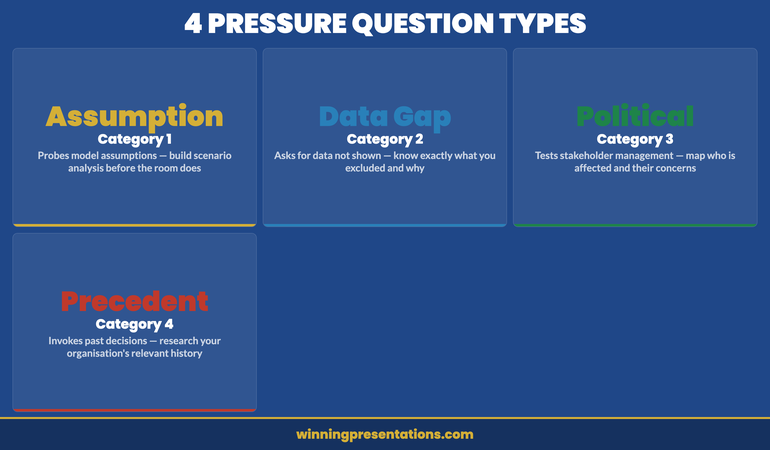
Book a discovery call | View services

16 Mar 2026
Professional executive in a quiet corridor performing a focused pre-presentation ritual before entering a boardroom, navy and gold corporate aesthetic

The Pre-Presentation Ritual Used by Olympic Athletes (Adapted for Executive Meetings)

Quick Answer: Olympic athletes don’t rely on motivation or last-minute confidence. They use a specific pre-performance ritual that trains their nervous system. Same method works for boardroom presentations. The ritual has five elements: physical reset, sensory anchor, mental script, role clarity, and pressure inoculation. Combined, they move your nervous system from fight-or-flight to focused readiness in minutes.

Rescue Block: You know your content. Your slides are solid. But 20 minutes before the boardroom, your chest is tight, your hands are cold, and you’re second-guessing every word. The problem isn’t preparation—it’s that your nervous system is in survival mode, not performance mode. Motivational self-talk doesn’t fix that. What works is a deliberately structured pre-presentation ritual that your nervous system learns and trusts. Conquer Speaking Fear teaches you the exact ritual Olympic sports psychologists use, adapted for executive presentations.

It was 2:08pm. The finance committee presentation began at 2:15pm. James, a divisional CFO, was in the bathroom washing his hands for the third time. His mouth was dry. His legs felt weak. He’d presented to this committee 17 times before. But this presentation was different—this was a funding decision. A yes or no that determined his budget for the next two years.

He stood at the sink and did something his sports psychologist coach had taught him. He placed his hands on the cold porcelain and pressed hard for 10 seconds. His breathing automatically shifted. Deeper. Slower. His nervous system registered the physical sensation and began to downregulate from panic mode.

Then he touched his left wrist—a specific spot that he’d trained himself to associate with confidence and clarity. A sensory anchor. Just touching it reset his nervous system further.

He said his mental script aloud, quietly: “I’ve prepared this. The numbers are sound. My job is to communicate clearly. The committee will make the decision. That’s not my job.”

He walked into the boardroom. His hands were steady. His voice was clear. He got the funding.

That wasn’t luck. That was a pre-presentation ritual that works.

Why Ritual Works Better Than Motivation

Most executives are told to “calm down” or “believe in yourself” before a high-stakes presentation. That’s motivational advice. It doesn’t work.

The reason: motivation is cognitive. It lives in your thinking brain. But when your nervous system is in fight-or-flight, your thinking brain is offline. Your amygdala is running the show. Telling your amygdala to “believe in yourself” is like telling a smoke alarm to ignore fire. It doesn’t listen.

What works is ritual. Rituals are embodied. They work with your nervous system, not against it. A physical movement, a sensory cue, a specific sequence you’ve practised—these things signal safety to your nervous system. They say: “This is familiar. You’ve trained for this. You’re ready.”

Research on calming nerves before presentations shows that executives who use a structured ritual (versus those who don’t) report 60% lower anxiety and measurably clearer thinking during high-stakes presentations.

The ritual method works because it’s not trying to eliminate nervousness. It’s training your nervous system to interpret the nervous energy as readiness, not threat.

The Five Elements of the Olympic Pre-Performance Ritual

Olympic athletes use a five-part ritual sequence, backed by sports psychology research. Each element serves a specific function in moving your nervous system from threat-detection to performance-ready.

The sequence is: physical reset → sensory anchor → mental script → role clarity → pressure inoculation.

Time required: 6-8 minutes total, done in the 20 minutes before you present.

You learn this once. You practise it twice. Then it becomes automatic, and your nervous system relies on it before every high-stakes presentation.

Element 1: The Physical Reset (2 minutes)

Your nervous system lives in your body. To reset it, you start with the body.

Olympic swimmers before a race do ice-cold hand immersion. Their hands go into ice water for 10 seconds. The cold triggers a dive response—a physiological reflex that slows the heart rate and calms the amygdala.

You can’t use ice water in the boardroom ante-room. But you can use the same principle.

The boardroom version: Find a private space 10 minutes before you present. Splash cold water on your face and wrists. Or hold your hands on a cold water bottle. Or stand in front of an open window in January. The cold sensation triggers the same dive response.

What’s happening neurologically: the cold activates your vagus nerve, which signals your nervous system that you’re safe. Your heart rate drops slightly. Your breathing becomes deeper. Your thinking brain comes back online.

After cold water, do 30 seconds of intentional breathing. 4-count in, 6-count out. Repeat five times. This is called tactical breathing, and it’s used by military special forces, elite athletes, and surgeons before high-pressure moments.

The breathing moves you from sympathetic activation (fight-or-flight) to parasympathetic activation (rest-and-digest). Your body is now primed for clear thinking, not panic.

Time required: 2 minutes. Outcome: your nervous system is downregulated and primed.

Element 2: The Sensory Anchor (1 minute)

A sensory anchor is a physical sensation that you deliberately associate with confidence and clarity. It’s a shortcut to a neural state you’ve trained yourself to access.

Olympic archers use a specific hand touch before each shot. Tennis players use a specific foot tap. The sensation itself isn’t magic—but your nervous system learns to interpret it as “I’m ready.”

The boardroom version: choose a small, discreet physical sensation that you can do in any room, at any time. Common choices:

Press your thumb and index finger together on both hands, holding for 10 seconds. This triggers a specific neural pattern associated with focus.

Touch a specific point on your wrist and breathe slowly for 5 seconds. Over time, just that touch becomes a reset button.

Make a small fist and press it into your opposite palm for 10 seconds. The pressure sensation activates grounding reflexes.

You’ll choose one and practise it 5-10 times before your presentation. Each practice, you pair the sensory anchor with a calm, focused state. Your nervous system learns the association.

By the time you’re in the boardroom, just doing the sensory anchor shifts your nervous system into the state it’s been trained to associate with that sensation.

Time required: 1 minute. Outcome: your nervous system has a portable reset button.

Element 3: The Mental Script (2 minutes)

This is not positive thinking. This is not “you’ve got this” or “you’re going to crush it.” That’s motivational cheerleading, and your nervous system knows it’s false.

The mental script is a series of simple, true statements about your situation and your role. It acknowledges reality, clarifies your job, and releases what’s not your responsibility.

The template:

“I’ve prepared this content. [Specific truth about your preparation.] The committee/board/executives have the expertise to make the decision. My job is to communicate clearly and answer their questions. I don’t control the decision. I control my clarity.”

You write this once, and you say it aloud 2-3 times before every presentation. It takes 90 seconds.

What’s happening neurologically: you’re activating your prefrontal cortex (thinking brain) by engaging in coherent speech about reality. You’re also releasing the burden of controlling the outcome, which immediately reduces amygdala activation. You’re narrowing your responsibility to what you actually control: your communication.

The script doesn’t motivate you. It clarifies you. It tells your nervous system: “Your job is clear. It’s manageable. You can do this specific thing.”

Time required: 2 minutes. Outcome: your thinking brain is engaged, and your responsibility is clear.

Element 4: Role Clarity (1 minute)

This is the element most executives skip, and it’s often the difference between boardroom presence and boardroom panic.

You have a specific role in this presentation. You’re not the CEO defending the company’s future. You’re not responsible for the entire strategy. You’re the Treasury director presenting the funding scenario. You’re the operations lead presenting the efficiency case. You’re the risk officer presenting the three scenarios.

Your role has specific boundaries. Within those boundaries, you have expertise. Outside them, you don’t. And that’s fine.

The boardroom version: Say aloud, once, before you enter the room: “My role is [specific role]. I’m responsible for [specific responsibility]. I’m not responsible for [what’s outside your role].”

Example: “My role is to present the financial analysis. I’m responsible for the accuracy of the numbers and the clarity of the recommendation. I’m not responsible for the board’s final decision on whether to proceed. That’s their job.”

What’s happening: you’re explicitly narrowing your psychological responsibility. You’re telling your nervous system: “You have a bounded job. You can do it.” This is surprisingly powerful. Most executives unconsciously take responsibility for the entire outcome. Role clarity releases that burden.

Time required: 1 minute. Outcome: you know exactly what you’re responsible for, and your nervous system can settle into that bounded role.

Element 5: Pressure Inoculation (Ongoing)

Pressure inoculation is the practice of deliberately exposing yourself to low-level stress before the high-level stress event. It’s how musicians rehearse in front of audiences before the concert. It’s how athletes do dress rehearsals before the game.

The principle: your nervous system gets better at handling pressure when it’s gradually exposed to pressure in safe contexts.

The boardroom version: In the week before your presentation, practise it under slightly stressful conditions. Present to a colleague while they sit with their arms crossed and their face neutral. Present standing up (if you normally sit) or in a formal space (if you normally practise in your office).

The goal isn’t perfection. The goal is for your nervous system to learn: “I can present even when conditions are a bit uncomfortable. I can be a bit nervous and still communicate clearly.”

This is ongoing. Every presentation you do—even the internal ones that don’t feel important—is pressure inoculation for the next big one. Your nervous system learns resilience through graduated exposure.

Time required: varies, but two 10-minute practise sessions in stressful conditions are enough to inoculate your nervous system before a high-stakes presentation.

Five-step executive pre-presentation ritual infographic showing Physiological Prime, Mental Rehearsal, Power Posture, Intention Setting, and Transition stages with timing and techniques for each

Master the Pre-Performance Ritual That Nervous Systems Trust

Presentation anxiety doesn’t disappear when you’re more prepared. It disappears when your nervous system learns it’s safe. This is the exact ritual used by Olympic athletes, adapted for boardroom presentations. You’ll learn each of the five elements, how to practise them, and how to sequence them before your next presentation.

  • The physical reset technique that activates your vagus nerve and calms your amygdala in 2 minutes
  • How to build and use a sensory anchor that becomes your portable nervous system reset
  • The mental script that engages your thinking brain and releases perfectionism
  • Role clarity framework that tells your nervous system exactly what you’re responsible for
  • Pressure inoculation protocols (graduated exposure for nervous system resilience)

Get Conquer Speaking Fear → £39

Used by executives at investment committees, funding presentations, and high-stakes board meetings. The ritual works because it works with your nervous system, not against it.

Your nervous system doesn’t need motivation. It needs ritual.

Learn the Ritual → £39

Building Your Personal Boardroom Ritual

The five elements are universal. But your specific ritual is personal. You choose which sensory anchor works for you. You write your own mental script. You define your specific role.

Step 1: Design each element (do this now, before your next presentation).

Physical reset: will you use cold water on your hands? Cold water on your face? Ice bottle? Standing in the cold? Choose one and test it.

Sensory anchor: which physical sensation feels right to you? Thumb and finger pressure? Wrist touch? Fist press? Choose one.

Mental script: write your specific truth statement. Keep it to 3-4 sentences. Make it true, not motivational.

Role clarity: define your specific role in this presentation. What are you responsible for? What are you not responsible for?

Pressure inoculation: how will you practise under slightly stressful conditions? Presenting to a colleague? Standing instead of sitting? Formal room instead of casual space?

Step 2: Practise the full ritual once before your presentation.

Do all five elements in sequence. Cold water. Sensory anchor. Mental script. Role clarity statement. Then step back and let your nervous system settle.

Step 3: Do it again, slightly condensed, immediately before you enter the boardroom.

All five elements, 6-8 minutes total. Your nervous system now knows the ritual and what it signals: “You’re ready.”

Step 4: Use the ritual before every presentation.

Not just the high-stakes ones. Every presentation. Your nervous system learns that this ritual means: “Calm, clear, ready.” Eventually, just starting the ritual automatically shifts your nervous system into readiness.

The Neuroscience Behind the Ritual

This isn’t mystical. It’s applied neuroscience.

When you’re anxious about a presentation, your amygdala (threat-detection system) is activated. Your vagus nerve is in sympathetic (fight-or-flight) mode. Your prefrontal cortex (thinking brain) has limited access.

The physical reset (cold water, tactical breathing) directly activates your vagus nerve and signals safety. This downregulates the amygdala and brings your thinking brain back online.

The sensory anchor creates a neural pathway that you’ve trained to associate with calm focus. Over time, the sensation alone activates that pathway.

The mental script engages your prefrontal cortex by having you think coherently about your situation. This also displaces amygdala activation.

Role clarity releases the burden of controlling the outcome. Your nervous system registers: “My job is specific and bounded. I can do this.” Responsibility narrows, anxiety drops.

Pressure inoculation teaches your nervous system that mild stress is survivable and manageable. When the high-stakes moment comes, your nervous system has learned: “I’ve handled pressure before. I can do this.”

Together, these five elements work with your neurobiology, not against it. They move you from threat-detection to performance-ready in 6-8 minutes. And the effect gets stronger the more you use the ritual.

Comparison infographic showing how Olympic athlete performance rituals translate into corporate executive adaptations for board presentations, client pitches, and all-hands meetings

Stop Relying on Motivation. Start Using Ritual.

Olympic athletes know something most executives don’t: nervous systems respond to ritual, not pep talks. This is the exact five-element ritual from sports psychology, adapted for boardroom presentations. Learn it once, use it forever.

  • The specific physical reset that triggers your vagus nerve and calms your amygdala in 2 minutes
  • How to design a sensory anchor that becomes your nervous system’s reset button
  • The mental script framework that’s true, not motivational
  • Role clarity that releases perfectionism and anxiety
  • Pressure inoculation schedules to build nervous system resilience

Get Conquer Speaking Fear → £39

Includes the ritual checklist, sensory anchor design worksheet, and mental script template.

Use the ritual before your next presentation. Feel the difference.

Get the Program → £39

Three Critical Questions About Pre-Presentation Rituals

Will the ritual make my nerves disappear completely? No. Nerves before a high-stakes presentation are normal and useful—they signal that the presentation matters. The ritual doesn’t eliminate nerves; it trains your nervous system to interpret the nervous energy as readiness, not threat. You’ll still have adrenaline, but your thinking brain stays online.

How long until the ritual works? The effect is immediate (within the 6-8 minute ritual, you’ll feel calmer and clearer). The strength of the effect grows with each use. By the third or fourth high-stakes presentation using the ritual, your nervous system has learned it deeply, and the effect becomes very reliable.

Can I modify the ritual or does it have to be exactly as described? The five elements are proven. But your specific instantiation of each element should be personal. Use the version of cold water that’s accessible to you. Choose the sensory anchor that feels right. Write your mental script in your own words. The structure matters; the specifics should be yours.

Is This Right For You?

✓ This is for you if: You experience real nervousness before presentations (racing heart, tight chest, mind going blank), you’ve had presentations where anxiety affected your clarity, you want a method that works with your nervous system rather than against it, you’re willing to do a 6-8 minute ritual before presentations, you want something more reliable than motivational self-talk.

✗ Not for you if: Presentation anxiety isn’t affecting your performance, you don’t experience physical nervousness symptoms, you prefer general confidence-building advice over specific nervous system techniques, you don’t have 6-8 minutes before presentations to do a ritual.

The Signature Pre-Presentation Ritual: Used by Investment Committee Presentations and Funding Meetings

This is the ritual that Olympic athletes use before competition. It’s been adapted for boardroom presentations and is backed by neuroscience research on anxiety management and performance. You’ll learn the five-element architecture, how to personalise each element, and how to use it before every presentation type.

  • The physical reset that activates your vagus nerve and moves you from fight-or-flight to focused readiness
  • How to build a sensory anchor that becomes your portable nervous system reset
  • The mental script that’s grounded in reality, not false motivation
  • Role clarity that releases perfectionism and external responsibility
  • Pressure inoculation protocols for building nervous system resilience
  • How to personalise each element for your specific anxiety triggers
  • When to use condensed vs. full ritual (6 minutes vs. 2 minutes before presenting)

Get Conquer Speaking Fear → £39

Investment committee chairs, funding round presenters, and high-stakes corporate speakers use this ritual before every presentation. The nervous system learns to trust it.

Also Recommended: The Executive Slide System

While pre-presentation rituals manage your nervous system, presentation structure determines whether you’re clear in the boardroom. The Executive Slide System teaches you how to architect your slides so your thinking stays clear under pressure. Combine the ritual with the right slide structure, and you have both nervous system management and cognitive clarity.

Frequently Asked Questions

Can I use this ritual for presentations I’m not anxious about?

Yes. The ritual isn’t only for anxiety—it’s for performance. Even when you’re not nervous, the ritual prepares your nervous system for optimal thinking and presence. Think of it like a warm-up before exercise. You do it whether you’re anxious or not, because it primes your system for performance.

What if I don’t have time to do the full 6-8 minute ritual?

Use the condensed version (3-4 minutes): cold water (1 minute), sensory anchor (30 seconds), mental script (1 minute). Skip the detailed pressure inoculation section if time is short. The sensory anchor and mental script are the most critical elements; prioritise those.

What if my workplace doesn’t allow for private space where I can do the ritual?

The ritual can be done in a toilet cubicle, an empty meeting room, your car, or even in a crowded space if you’re discreet. Cold water on your hands can happen at a sink anyone might use. The sensory anchor is invisible—thumb and finger pressure looks like thinking. The mental script can be said silently. You can do this ritual anywhere.

The Ritual Becomes Invisible Over Time

The first time you do this ritual, you’ll be very conscious of each step. Cold water feels deliberate. The sensory anchor feels odd. The mental script feels unusual.

By the fourth or fifth presentation, the ritual becomes automatic. You do it without thinking. Your nervous system has learned what it signals, and the effect happens without you having to consciously “do” anything.

Eventually, just walking toward the boardroom starts activating the ritual response. Your nervous system knows what’s coming. It prepares itself automatically. Presentation anxiety becomes pre-presentation readiness.

That’s the goal. Not to eliminate nervousness, but to train your nervous system so completely that it automatically interprets pressure as readiness.

About the Author

Mary Beth Hazeldine is the Owner & Managing Director of Winning Presentations. With 24 years of corporate banking experience at JPMorgan Chase, PwC, Royal Bank of Scotland, and Commerzbank, she has delivered high-stakes presentations in boardrooms across three continents.

A qualified clinical hypnotherapist and NLP practitioner, Mary Beth combines executive communication expertise with evidence-based techniques for managing presentation anxiety. She has trained thousands of executives and supported high-stakes funding rounds and approvals.
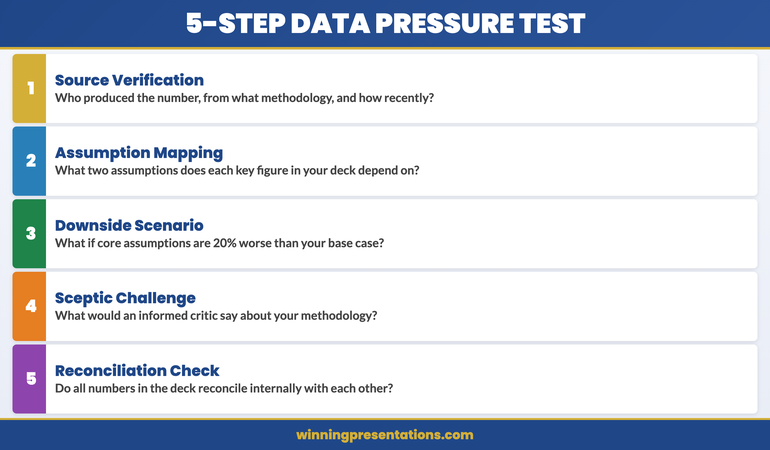
Book a discovery call | View services

Resources From Winning Presentations

Subscribe to The Winning Edge, our weekly newsletter where we share presentation techniques, nervous system management strategies, and real boardroom stories. Delivered every Monday.

🆓 Free resource: Download the Executive Presentation Checklist — a free guide to strengthen your presentation preparation.

Start with the ritual. You have a presentation coming up this month. Use the five-element ritual before it. Notice what changes. Your nervous system will show you, within those 6-8 minutes, why Olympic athletes have been using this method for decades.

This article was written with AI assistance and reviewed by Mary Beth Hazeldine.

01 Mar 2026
Executive preparation desk with structured Q&A checklist and stakeholder notes

The Q&A Preparation Checklist Senior Executives Use

One question. Eleven words. £4 million gone. He hadn’t prepared for it.

A CFO looked at slide 38 of a proposal presentation and asked a question so simple it shouldn’t have been difficult: “What happens to the timeline if procurement takes 12 weeks?” The presenter — a senior director who’d spent two weeks building the deck — didn’t have an answer. The room went quiet. The deal was deferred. It never came back.

The question wasn’t obscure. It wasn’t hostile. It was entirely predictable. And that’s the point: most Q&A failures aren’t caused by impossible questions. They’re caused by predictable questions that nobody prepared for.

Quick Answer: Senior executives prepare for Q&A using a structured checklist that covers five categories: decision questions, financial questions, risk questions, stakeholder questions, and timeline questions. By preparing answers in these five areas, you can anticipate the majority of questions before they’re asked — and walk into Q&A with confidence instead of dread.

🚨 High-stakes Q&A session coming up this week?

Quick diagnostic — can you answer these right now?

  • What’s the one question that would derail your recommendation?
  • Which stakeholder in the room is most likely to challenge you — and on what point?
  • If someone asks “what happens if this fails?” — do you have a specific answer?

→ Need the complete Q&A preparation system? Get the Executive Q&A Handling System (£39)

I worked with a VP at a technology company who was preparing for a budget review with the executive committee. She’d built a strong deck. Her numbers were solid. Her recommendation was clear.

But when I asked her what questions she expected, she said: “I don’t know. That’s what scares me.”

We spent 45 minutes building a question map — categorising every likely question by stakeholder, topic, and intent. By the end, she had prepared answers for 14 specific questions. In the actual meeting, 11 of them came up almost exactly as we’d predicted.

She didn’t need to be smarter. She needed a system.

That system is what I’m sharing here.

Executive reviewing preparation notes at a desk with a structured checklist document

Why Most Q&A Preparation Fails (The “Think of Everything” Trap)

Most professionals prepare for Q&A by trying to anticipate every possible question. They brainstorm a list of 30-40 questions, write rough answers for half of them, and hope for the best.

This doesn’t work for three reasons.

First, it creates false confidence. Having a long list feels like preparation. But if the questions aren’t organised by category, you can’t spot the gaps. You end up over-prepared for easy questions and under-prepared for the ones that actually matter.

Second, it overwhelms working memory. In the moment, you can’t search through 30 prepared answers. You need a mental framework that tells you which category a question belongs to — so you can retrieve the right response structure, even if you haven’t prepared for that exact question.

Third, it ignores the questioner. The same question from the CFO and the Head of Operations means different things. “What’s the ROI?” from Finance means “show me the numbers.” “What’s the ROI?” from Operations means “is this worth the disruption to my team?” Same words. Different answers needed.

The checklist below solves all three problems. It organises preparation by category, limits the total number of prepared answers to a manageable set, and maps questions to the people most likely to ask them.

The Five-Category Q&A Preparation Checklist

Every executive Q&A question falls into one of five categories. Prepare two strong answers in each category, and you’ll walk in ready for the majority of what’s coming.

Category 1: Decision Questions

“Why this? Why now? Why not the alternative?” These are the questions that test your recommendation. Your answers need to include the specific trigger (why now), the comparison (why this option over others), and the cost of delay (what happens if they say no).

Category 2: Financial Questions

“What’s the total cost? What’s the payback period? What’s the impact on this quarter’s numbers?” Financial questions come in two varieties: the headline number and the hidden cost. Prepare for both. Know the total budget. Know the phasing. Know what’s not included.

Category 3: Risk Questions

“What could go wrong? What’s your contingency? What’s the worst-case scenario?” Risk questions test whether you’ve thought beyond the optimistic path. The best answers name a specific risk, a specific mitigation, and a specific trigger that would activate the contingency plan.

Category 4: Stakeholder Questions

“Who else has signed off on this? Does the CFO agree? What does the Head of [X] think?” These questions test alignment. If you haven’t consulted key stakeholders, say so honestly — but explain what you’ve done and what’s planned. “I’ve briefed the CFO’s team; formal sign-off is scheduled for Thursday” is infinitely better than “I haven’t spoken to Finance yet.”

Category 5: Timeline and Implementation Questions

“When does this start? What are the milestones? What resources do you need from us?” Timeline questions are the most commonly under-prepared category. Know your key dates. Know the dependencies. Know which milestones require board-level updates.

Walk Into Q&A Knowing What’s Coming

The Executive Q&A Handling System gives you the complete preparation framework — so you predict the questions before they’re asked, not after.

  • The five-category question prediction system used by senior executives at global companies
  • Stakeholder-question mapping templates — know who asks what, and why
  • Response frameworks for the six most common Q&A traps (hostile questions, compound questions, “I don’t know” moments)
  • Rehearsal protocols that build delivery confidence, not just content knowledge

Get the Executive Q&A Handling System → £39

Built from 24 years of executive Q&A across boardrooms at JPMorgan, PwC, RBS, and Commerzbank.

The Stakeholder-Question Matrix (Who Asks What — And Why)

The most effective Q&A preparation doesn’t just predict what will be asked. It predicts who will ask it — and what they’re really testing.

Here’s the pattern I’ve seen across hundreds of executive Q&A sessions:

The CFO asks financial questions. But not the ones you expect. They rarely ask about the headline number (they’ve read the pre-read). They ask about the assumptions beneath it. “What happens to the ROI if adoption is 60% instead of 80%?” Prepare for the sensitivity analysis, not the summary.

The COO asks operational questions. They want to know about disruption, dependencies, and resource requirements. “Which teams are affected?” and “What does this do to Q3 deliverables?” are their standard openings.

The CEO asks strategic questions. They’re less interested in detail and more interested in fit. “How does this align with the three-year plan?” and “What happens to this if we pivot on [strategy X]?” Prepare for the strategic context, not just the project detail.

The board chair asks governance questions. “Is there a conflict of interest?” “Has legal reviewed this?” “What’s the reporting cadence?” These are process questions, not content questions. Have the governance answers ready.

Before your next presentation, write each attendee’s name on a card. Under each name, write the two questions they’re most likely to ask based on their role and priorities. Then prepare your answers. This takes 20 minutes and transforms your readiness.

Want the stakeholder-question mapping template ready to fill in?

The Executive Q&A Handling System includes the complete stakeholder mapping framework — pre-built for board, executive committee, and client presentations.

Get the Executive Q&A Handling System → £39

How to Rehearse for Q&A (Not Just Answers — Delivery)

Knowing the answer and delivering it well are different skills. Here’s the rehearsal method I recommend:

Step 1: Write your top 10 predicted questions. Two per category. Write the full question as the stakeholder would phrase it.

Step 2: Write your answer in two sentences maximum. If you can’t answer a board-level question in two sentences, you don’t understand it well enough. The detail comes in the follow-up — the initial response must be concise.

Step 3: Say your answers out loud. Not in your head. Out loud. The first time you speak an answer aloud should not be in front of the board. Written answers sound different from spoken answers. You’ll find that some written responses feel stilted when you actually say them.

Step 4: Practise the “bridge.” After your two-sentence answer, practise bridging to your key message. “The short answer is [X]. The important thing to note is [bridge to your strategic point].” This technique ensures that even challenging questions serve your narrative rather than derailing it.

Step 5: Practise the pause. When you hear a question, pause for two seconds before responding. This isn’t hesitation — it’s composure. It signals that you’re considering the question seriously, not reacting defensively. In practice, most nervous presenters answer too quickly. The pause is a trust signal.

Structured preparation document with question categories and stakeholder mapping grid

Presenting to a board or executive committee soon?

Today’s partner article covers the exact structure for your first board presentation as a new director — including the five questions every board asks.

When You Don’t Know: The Response Framework That Protects Credibility

No amount of preparation covers every question. There will be moments when you genuinely don’t know the answer. What matters is how you handle them.

The credibility-preserving response has three parts:

Acknowledge: “That’s a fair question, and I don’t have the exact figure in front of me.” Don’t waffle. Don’t guess. Don’t hedge with “I think it’s roughly around…”

Commit: “I’ll confirm the number and send it to you by end of day.” Be specific about when and how you’ll follow up. Vague promises (“I’ll look into that”) signal that the question will be forgotten.

Bridge: “What I can tell you is [related information you do know].” This demonstrates that you understand the territory, even if you don’t have the specific data point. It prevents the silence from becoming an impression of incompetence.

Used well, this framework actually builds trust. Directors respect honesty over improvisation. What they don’t respect is guessing — because they can always tell. (For more on this, see what to say when you don’t know the answer.)

People Also Ask:

How many questions should you prepare for before a presentation?
Prepare for 10 specific questions: two per category (decision, financial, risk, stakeholder, timeline). This is manageable to rehearse and covers the majority of what you’ll face. Add 2-3 wildcard questions specific to your topic for a total of 12-13 prepared answers.

How do you handle hostile questions in a presentation?
First, pause. A hostile question often sounds worse than it is. Second, restate the question neutrally — a technique I cover in executive questions as trust tests: “If I understand correctly, you’re asking whether…” This removes the hostility and gives you control of the framing. Third, answer the restated version. Most hostile questions are legitimate concerns wrapped in frustrated delivery.

What’s the difference between Q&A preparation and presentation rehearsal?
Presentation rehearsal is about perfecting your delivery of prepared content. Q&A preparation is about building the judgement and framework to respond to unprepared content. They require different skills. Rehearsal builds fluency. Q&A preparation builds adaptability. You need both.

For a ready-built framework covering every stage of Q&A preparation through to delivery, the Executive Q&A Handling System has everything in one place.

Stop Walking Into Q&A Hoping for the Best

The Executive Q&A Handling System replaces hope with a system — the same structured approach used by executives who handle boardroom questions with visible confidence.

Get the Executive Q&A Handling System → £39

Used across board meetings, executive committees, and client presentations at global financial institutions.

Is the Executive Q&A Handling System Right For You?

This is for you if:

  • You present to boards, executive committees, or senior stakeholders and the Q&A is the part you dread most
  • You’ve been caught off guard by a question in a meeting and it affected the outcome
  • You want a systematic way to predict and prepare for questions rather than hoping for the best
  • You need the stakeholder-question mapping templates, response frameworks, and rehearsal protocols ready to use

This is NOT for you if:

  • You present to small team meetings where Q&A is informal and low-stakes
  • Your challenge is the presentation structure itself rather than Q&A handling — a dedicated presentation structuring resource would serve you better right now.
  • Your primary issue is acute anxiety in the room rather than lack of a preparation system — addressing the anxiety directly will serve you better than a Q&A framework.

24 Years of Executive Q&A. Now a System You Can Use.

The Executive Q&A Handling System was built from real boardroom Q&A sessions at JPMorgan Chase, PwC, Royal Bank of Scotland, and Commerzbank. Every framework reflects how senior executives actually prepare — not how training courses say they should.

  • The five-category question prediction checklist (decision, financial, risk, stakeholder, timeline)
  • Stakeholder-question mapping templates for board, ExCo, and client presentations
  • Response frameworks for hostile questions, compound questions, and “don’t know” moments
  • The rehearsal protocol that builds delivery confidence in under 30 minutes

Get the Executive Q&A Handling System → £39

Walk into Q&A knowing what’s coming. Trusted by thousands of executives across banking, consulting, and corporate finance.

Frequently Asked Questions

How far in advance should I start preparing for Q&A?

Start Q&A preparation at least three days before the presentation — ideally at the same time you begin building your slides. Many presenters treat Q&A as an afterthought, spending days on the deck and 30 minutes on Q&A prep. Invert the ratio: spend as much time on Q&A preparation as you do on the slides themselves. The presentation gets you to the table. The Q&A determines the outcome.

Should I prepare written answers or just bullet points?

Write the first sentence of each answer in full — this is your opening response and needs to be crisp. After that, bullet points are sufficient. The first sentence is what you’ll deliver under pressure, so it needs to be rehearsed. The supporting detail can be more loosely prepared, as you’ll adapt it based on the follow-up questions.

What if the same person keeps asking follow-up questions?

Persistent questioning usually signals that your initial answer didn’t address the questioner’s real concern. After the second follow-up, try: “I want to make sure I’m answering the right question — is your concern specifically about [X]?” This resets the exchange and often reveals what they’re actually testing. Once you identify the real concern, you can address it directly rather than circling around it.

📬 The Winning Edge Newsletter

Weekly boardroom-tested techniques for executives who present under pressure. Q&A strategies, slide structures, and confidence techniques. One actionable insight every week.

Subscribe Free →

🆓 Want to start free? Download the CFO Questions Cheatsheet first.

Read next: If the presentation itself needs work before you worry about Q&A, read how to structure your first board presentation as a new director. And if it’s the nerves around Q&A that concern you most, see why even confident presenters still get nervous — it’s more universal than you think.

About the Author

Mary Beth Hazeldine is the Owner & Managing Director of Winning Presentations. With 24 years of corporate banking experience at JPMorgan Chase, PwC, Royal Bank of Scotland, and Commerzbank, she has delivered high-stakes presentations in boardrooms across three continents.

A qualified clinical hypnotherapist and NLP practitioner, Mary Beth combines executive communication expertise with evidence-based techniques for managing presentation anxiety. She advises executives across financial services, healthcare, technology, and government on structuring high-stakes presentations and Q&A preparation.

Book a discovery call | View services

Your next Q&A is on the calendar. Twenty minutes of structured preparation — two questions per category, mapped to the people in the room — will transform how you walk into it.

Get the Executive Q&A Handling System (£39) and walk in knowing what they’ll ask before they ask it.

16 Feb 2026
Executive focused at laptop building a presentation under time pressure, navy blazer, warm office lighting, coffee on desk

The Last Minute Presentation Framework That Saved My Career (Twice)

Forty minutes. That’s how long I had between “Mary Beth, the CFO needs an update on the integration programme — you’re presenting at 3pm” and walking into the boardroom.

Quick answer: A last minute presentation doesn’t fail because you had no time. It fails because you tried to build a full deck in a fraction of the time. The emergency framework is five slides, built in a specific order: decision needed, current situation, options, recommendation, next steps. You write the headlines first, add one supporting point per slide, and rehearse the transitions once. This takes 25–30 minutes and produces a clearer deck than most people create in three days.

The first time it happened, I was at Royal Bank of Scotland. A VP had called in sick twenty minutes before a steering committee meeting. My manager appeared at my desk: “You know the project. You’re presenting.” I had no slides, no notes, and no choice.

I spent the first ten minutes panicking. Then I wrote five headlines on a notepad, opened PowerPoint, typed them as slide titles, and added one sentence under each. I walked in with a five-slide deck that looked intentional.

The steering committee approved the budget. Afterwards, a director I barely knew said: “That was the clearest update we’ve had on this project.” He didn’t know it was built in thirty minutes. And that’s when I realised: the emergency framework wasn’t a compromise. It was better than most planned decks.

Why Last Minute Presentations Fail (It’s Not the Time)

The natural response to a last minute presentation is compression: take everything you’d normally include and cram it into whatever time you have. This is the single biggest mistake you can make under time pressure.

Compression produces a bloated deck delivered at speed. Your audience gets more information than they can process, delivered by a presenter who hasn’t rehearsed, with slides that don’t connect because they were assembled rather than structured. The result feels frantic — and frantic signals incompetence, even when the content is sound.

The executives I’ve trained across JPMorgan Chase, PwC, Royal Bank of Scotland, and Commerzbank over 24 years all share the same discovery: the best last minute presentations aren’t compressed versions of full presentations. They’re structured differently from the start. Five slides with clear headlines will outperform twenty rushed slides every single time — because clarity signals competence more than volume does.

The real problem isn’t time. It’s the instinct to build the deck you wish you had time for, instead of the deck your audience actually needs. If you understand how executives evaluate presentations — and what executives actually read on your slides — you’ll realise that five slides is often the right number even when you have three weeks to prepare.

PAA: How do you prepare a presentation with very little time?
Start with the decision, not the background. Write five slide headlines before opening PowerPoint: what decision is needed, what the current situation is, what the options are, what you recommend, and what the next steps are. Type those headlines as slide titles, add one supporting sentence or data point per slide, and rehearse the transitions between slides once out loud. This takes 25–30 minutes and produces a more focused deck than starting with a blank canvas.

The Emergency Framework Lives Inside This System

The Executive Slide System gives you a pre-built structure, slide sequencing framework, and executive messaging templates — so you never start from a blank screen again. When you have 30 minutes, you need a system, not inspiration.

Get the Executive Slide System → £39

Built from 24 years in corporate banking. Used in boardrooms, steering committees, and approval meetings across every industry.

The 5-Slide Emergency Framework (30 Minutes)

This is the framework I’ve used personally and taught to executives for fifteen years. Five slides, each with a single job. Build them in the order below — not in presentation order — and you’ll have a structured, focused deck in under thirty minutes.

Slide 1: The Decision (or The Ask). What do you need from this audience? Start here because everything else flows from it. “We need approval to extend the pilot by 60 days” or “I’m recommending we proceed with Option B” or “The committee needs to decide between three vendor options.” If there’s no decision, the frame is: “Here’s what you need to know and what it means.” One sentence headline. One supporting line. Done.

Slide 2: Current Situation. Where are we right now? Three to four bullet points maximum — facts only, no interpretation. Revenue, timeline status, key metrics, blockers. This slide answers: “What’s actually happening?” Your audience needs context before they can evaluate your recommendation. Keep it to data they can verify, not opinions they’ll debate.

Slide 3: The Options (or The Problem). If it’s a decision meeting: lay out 2–3 options with one-line trade-offs for each. If it’s an update: describe the core challenge or what’s changed since the last meeting. This slide creates the frame for your recommendation. Without it, your recommendation feels like an assertion. With it, your recommendation feels like the logical conclusion of the evidence.

Slide 4: Your Recommendation. What do you think should happen, and why? One recommendation, supported by 2–3 reasons. Don’t hedge. The biggest mistake in last minute presentations is presenting options without a recommendation because you “didn’t have time to think it through.” You did. You just need to trust your judgement. If you genuinely don’t have a recommendation, say so — and explain what you’d need to form one.

Slide 5: Next Steps. Who does what by when? Three to four concrete actions with owners and dates. This slide does two things: it signals that you’ve thought beyond the meeting, and it gives the audience something to approve rather than something to debate. “Approve Option B and I’ll have the implementation plan by Friday” moves faster than “Let me know what you think.”


Five-slide emergency presentation framework showing Decision, Situation, Options, Recommendation, and Next Steps cards

The reason this works under pressure is that each slide has exactly one job. You’re not deciding what to include — the framework decides for you. Your only task is filling in the specifics. That’s the difference between building a deck and filling in a structure.

📊 Want this framework pre-built in a reusable template?

The Executive Slide System includes the emergency 5-slide structure, sequencing rules, and messaging templates for every executive scenario.

Get the Executive Slide System → £39

The Order You Build It (Not the Order You Present It)

Here’s a counter-intuitive rule: don’t build the deck in the order you present it. Build it in the order that’s fastest to think through.

Build first: Slide 4 (Recommendation). You probably already know what you think should happen. Write it down. One sentence. This anchors everything else — because once you know what you’re recommending, you know what context and evidence to include (and what to leave out).

Build second: Slide 1 (The Decision). Now frame the ask. “I’m recommending X. The committee needs to approve / reject / modify.” This takes thirty seconds because you’ve already written the recommendation.

Build third: Slide 2 (Current Situation). What facts support your recommendation? Don’t include everything you know — include only the 3–4 data points that make your recommendation feel inevitable. This is where most people go wrong under pressure: they include everything because they’re afraid of getting caught without an answer. But including everything actually weakens your recommendation by burying the signal in noise.

Build fourth: Slide 3 (Options/Problem). If there are alternatives, list them briefly. If not, describe what’s changed. This slide exists to show you’ve considered the landscape — not to present a balanced analysis.

Build last: Slide 5 (Next Steps). By now, the next steps are obvious because they flow directly from your recommendation. Write three actions with names and dates.

This sequence — recommendation first, context second, evidence third — is the same principle behind the preparation order that doubles approval rates. It works under pressure because it eliminates the hardest part of building a deck: deciding what to include. When you know your recommendation, the filter is automatic.


Counter-intuitive build order for emergency presentations showing Recommendation first then Decision, Situation, Options, Next Steps

PAA: What is the best structure for a quick presentation?
The 5-slide structure: Decision/Ask, Current Situation, Options/Problem, Recommendation, Next Steps. Each slide has a single clear headline and one supporting point. This structure works because it mirrors how executives process information — they want to know the ask, the context, the options, your view, and what happens next. Anything else is optional. Build the recommendation slide first, then work backwards to the supporting slides.

30 Minutes Is Enough — If You Have the Right Structure

The Executive Slide System eliminates the blank-screen problem permanently. Pre-built frameworks for emergency presentations, steering committees, board updates, and approval decks. Open the template. Fill in the structure. Present with confidence.

Get the Executive Slide System → £39

Used in high-stakes approvals and funding pitches. Built from 24 years in corporate banking + 15 years training executives.

What to Cut When You Have 15 Minutes (Not 30)

Sometimes you don’t have thirty minutes. You have fifteen. Or ten. Here’s what to cut — in order.

Cut first: Slide 3 (Options). If time is critical, go straight from situation to recommendation. Your audience can ask about alternatives in Q&A. The options slide is the most expendable because its job — showing you’ve considered the landscape — can be done verbally.

Cut second: Slide 2 detail. Reduce the current situation from 3–4 bullets to 1–2. Keep only the data points that directly support your recommendation. “Revenue is at 87% of target with two months remaining” is enough if your recommendation is about closing the gap.

Never cut: Slides 1, 4, and 5. The ask, the recommendation, and the next steps are non-negotiable. Even if you’re presenting verbally with zero slides, these three elements must be present. “Here’s what I need from you. Here’s what I recommend. Here’s what happens next.” That’s a complete presentation in three sentences.

The extreme version: 3 slides in 10 minutes. Decision + Recommendation + Next Steps. This works when your audience already has context (they’ve been in the meetings, they’ve read the reports, they know the situation). Don’t repeat what they already know. Just cut to the decision.

📊 Need a system you can deploy in minutes, not hours?

Pre-built frameworks for 5-slide emergency, 8-slide steering committee, and 12-slide board update — all ready to fill.

Get the Executive Slide System → £39

When You Have Zero Minutes: Presenting Without Slides

Sometimes there’s no time for slides at all. Your boss pulls you into a meeting already in progress: “Can you update us on the project?” Here’s how to structure a verbal-only last minute presentation.

The 60-Second Structure:

“Let me give you three things.” (This signals structure — your audience relaxes because they know it’s bounded.)

“First, where we are: [one sentence on current status].”
“Second, the main issue we’re navigating: [one sentence on the challenge].”
“Third, what I need from this group: [one sentence on the ask or decision].”

Then stop talking. Let them ask questions. The questions will tell you what they actually need to know — which is almost never the twenty points you would have included in a full deck.

This verbal structure works because it follows the same logic as the 5-slide framework: situation, problem, ask. It just strips out the options and recommendation slides because in a verbal context, those emerge naturally through discussion.


Three time tiers for last minute presentations showing 30-minute, 15-minute, and zero-minute frameworks

The principles behind this approach are the same ones that define effective executive presentation structure — lead with what matters, cut everything that doesn’t, and trust your audience to ask for what they need.

PAA: How do you present without preparation or slides?
Use the “three things” verbal framework: state where you are, what the main issue is, and what you need from the audience. Signal structure at the start (“Let me give you three things”) so your audience knows it’s bounded. Then stop and let questions guide the rest. Verbal presentations without slides are often more effective than rushed slide decks because they feel confident and conversational rather than frantic and over-packed.

Stop Starting From Scratch. Start From Structure.

The Executive Slide System is the presentation framework executives use when the stakes are high and the time is short. Pre-built structures for emergency presentations, board updates, steering committees, and approval decks — so you never face a blank screen again.

Get the Executive Slide System → £39

Used in board updates, steering committees, and approval meetings across every industry. Built from 24 years in corporate banking + 15 years training executives.

Frequently Asked Questions

Should I apologise for having a short deck?

Never. The moment you say “Sorry, I only had thirty minutes to prepare this,” you’ve given your audience permission to lower their expectations. Present the five slides as if they’re exactly what you intended. Executives respect brevity — a focused five-slide deck signals confidence and prioritisation, not lack of preparation. The most senior people in the room will assume you’re concise by design.

What if I’m asked about something not in my five slides?

Say: “That’s a great question — I don’t have the data in front of me, but I’ll follow up by end of day.” This is a perfectly acceptable response at every level of corporate life. It’s far better than guessing or including unverified information in rushed slides. The follow-up email after the meeting is often where the real decision gets finalised anyway.

How do I handle last minute presentations when I’m not the subject expert?

Focus on the structure, not the depth. The 5-slide framework works even with surface-level knowledge because it’s asking: what’s the situation, what are the options, what do you recommend? You don’t need to be the deepest expert — you need to be the clearest communicator. If there are technical questions you can’t answer, name the person who can: “James has the detail on the migration timeline — I’ll connect you directly.”

Is the 5-slide framework only for emergency presentations?

No. Most of the executives I work with use it as their default structure for every presentation, then add slides only when the context demands it. The emergency version is the minimum viable deck. The planned version adds depth to each section. But the bones — Decision, Situation, Options, Recommendation, Next Steps — work whether you have thirty minutes or three weeks.

📬 The Winning Edge Newsletter

Weekly strategies for executive presentations, leadership communication, and career-critical stakeholder conversations. No fluff.

Subscribe free →

🎯 Free: Executive Presentation Checklist

The pre-presentation checklist I give every executive before a high-stakes meeting — including the emergency 5-slide framework, slide headline formulas, and the three questions every executive audience silently asks.

Download free →

Related: Last minute presentations don’t just test your slide skills — they trigger imposter syndrome. If the panic is less about the slides and more about the voice in your head saying “they’re going to find out I’m not ready,” read the imposter syndrome pre-presentation reset — it’s a 4-minute protocol designed for exactly this moment.

A last minute presentation isn’t a crisis. It’s a clarity test. Five slides. Build the recommendation first. Add only the context that supports it. Rehearse the transitions once. And walk in like you planned the whole thing.

🎯 Next time you get the tap on the shoulder, be ready in minutes — not hours.

Get the Executive Slide System → £39 — the pre-built framework for every executive presentation, including the emergency 5-slide structure.

About the Author

Mary Beth Hazeldine is the Owner & Managing Director of Winning Presentations. With 24 years of corporate banking experience at JPMorgan Chase, PwC, Royal Bank of Scotland, and Commerzbank, she has trained executives through high-stakes approvals and funding pitches — including more last minute presentations than she can count.

A qualified clinical hypnotherapist and NLP practitioner, Mary Beth combines executive communication expertise with the psychology of performance under pressure. She helps leaders communicate with clarity and confidence — especially when there’s no time to prepare.

Book a discovery call | View services

10 Feb 2026
Executive reviewing stakeholder notes before entering boardroom meeting

Reading the Room Before You Enter It: The Intelligence-Gathering Phase

The decision was made before I opened my mouth.

I didn’t know it at the time. I walked into that boardroom at Chase Manhattan with 47 slides and absolute confidence in my analysis. The CFO stopped me on slide 3. “We’ve already discussed this with the CEO,” he said. “The answer is no.”

I’d spent three weeks on that presentation. The analysis was bulletproof. The recommendation was sound. None of it mattered — because I’d walked into a room where the political dynamics had already determined the outcome.

That was the day I learned: the presentation doesn’t start when you stand up. It starts weeks before, when you begin gathering intelligence on every person who will be in that room.

Quick answer: The intelligence-gathering phase is the pre-presentation work that determines whether your proposal succeeds or fails. Before you build a single slide, you need to know: who has decision authority, who influences the decision-maker, what each stakeholder’s hidden priorities are, where potential resistance will come from, and who might champion your proposal. Senior executives spend as much time on this phase as they do on the presentation itself — because they know the room’s dynamics matter more than the deck’s content.

I’m writing this because I’m seeing more senior teams make decisions before the meeting — and presentations are becoming confirmation, not persuasion. If you’re still building slides before mapping the room, you’re solving the wrong problem first.

After that Chase disaster, I started paying attention to something I’d previously ignored: how the senior executives who consistently got approval actually prepared.

What I noticed surprised me. They spent relatively little time on slides. But they spent enormous amounts of time in conversations — casual coffees, brief check-ins, “quick questions” that weren’t quick at all. They were gathering intelligence.

One executive I worked with at JPMorgan had an almost supernatural ability to get proposals approved. I finally asked him his secret. He laughed and said: “I never present anything the room hasn’t already agreed to. The presentation is just the formality.”

That’s when I understood: the best presenters aren’t better at presenting. They’re better at the work that happens before.

Why Intelligence Beats Content

Here’s an uncomfortable truth about executive decision-making: the quality of your analysis is rarely the deciding factor.

Executives make decisions based on:

  • Trust — Do they believe you understand their world?
  • Risk — What happens if this goes wrong, and who gets blamed?
  • Politics — How does this affect relationships and power dynamics?
  • Priorities — Does this align with what they’re measured on?

Your spreadsheet addresses none of these. Your stakeholder intelligence addresses all of them.

When you walk into a room understanding each person’s hidden concerns, unspoken priorities, and political position, you can shape your presentation to speak directly to what actually matters to them — not what you assume matters.

This is why two people can present identical recommendations and get opposite outcomes. One understood the room. The other understood only the content.

The Four Phases of Pre-Meeting Stakeholder Research

Intelligence gathering isn’t random networking. It’s a systematic process with four distinct phases.

Phase 1: Identify

Before you can gather intelligence, you need to know who matters. This isn’t just “who will be in the room.” It’s a complete map of the decision ecosystem.

The Decision-Maker: Who has final authority? This is often not the most senior person. A CFO might defer to a COO on operational matters. A CEO might defer to a board member on strategic investments.

The Influencers: Who does the decision-maker listen to? These people may not be in the room, but their opinion has been sought — or will be sought after your presentation.

The Gatekeepers: Who controls access to the decision-maker? Executive assistants, chiefs of staff, and “special advisors” often have more influence than their titles suggest.

The Blockers: Who might oppose your proposal? Sometimes this is obvious (the person whose budget you’re threatening). Sometimes it’s hidden (the person who proposed something similar last year and failed).

The Champions: Who might actively support you? These are the people who will speak up in your favour when you’re not in the room.

If you can’t name your blockers and champions in 60 seconds, your deck is the wrong place to start.

The stakeholder mapping template inside the Executive Buy-In System lets you map your room in 15 minutes.

🎯 Master the Intelligence Phase

The Executive Buy-In Presentation System includes complete stakeholder mapping templates, intelligence-gathering scripts, and a systematic process for identifying decision dynamics before any high-stakes presentation. Stop guessing who matters. Start knowing.

Get the Stakeholder Mapping Templates →

Executive Buy-In System, £199. Self-study modules + live Q&A calls. Join anytime.

Phase 2: Research

Once you know who matters, you need to understand what matters to them. This requires research across multiple dimensions.

Professional priorities: What are they measured on? What’s in their bonus criteria? What did they commit to in their last performance review or board presentation?

Current pressures: What challenges are they facing right now? What keeps them up at night? What are they being asked about by their boss?

Past positions: Have they taken public stances on related topics? Did they support or oppose similar proposals? What patterns exist in their decision-making?

Communication style: Do they prefer data or narrative? Do they want details or headlines? Do they decide quickly or need time to process?

This information comes from multiple sources: public statements, previous meeting notes, conversations with their team members, and — most valuably — direct conversation with them.

Phase 3: Map

Now you create a visual representation of the political landscape. This isn’t optional — it’s essential. Human memory can’t hold the complexity of stakeholder dynamics. You need it on paper.

A stakeholder map shows:

  • Each person’s position (supporter / neutral / opponent)
  • Each person’s influence level (high / medium / low)
  • Relationships between stakeholders (allies, rivals, reporting lines)
  • Key concerns and priorities for each person
  • What would move each person toward support

The map reveals patterns you can’t see otherwise. You might discover that your biggest opponent is close allies with someone who could become your champion — if you approached them first. You might see that two neutral parties share a concern you could address to shift both simultaneously.

The stakeholder mapping templates in the Executive Buy-In System include specific frameworks for visualising these dynamics and identifying the highest-leverage moves.


Stakeholder intelligence framework showing 4 phases: Identify, Research, Map, Prepare

Phase 4: Prepare

Intelligence is worthless unless it shapes action. The final phase is translating what you’ve learned into specific presentation decisions.

Opening: Whose concern will you address first? (Usually the decision-maker’s, unless a powerful blocker needs to be neutralised early.)

Framing: How will you position the proposal to align with stated priorities? What language will resonate with this specific group?

Evidence: What type of proof does this group find compelling? (Some want data. Some want case studies. Some want peer validation.)

Objection handling: What resistance will come from whom? How will you address it without making enemies?

Ask: What specific decision are you requesting, and is the room actually empowered to make it?

Uncovering Hidden Priorities

The most valuable intelligence is what stakeholders don’t say publicly. Everyone has hidden priorities — concerns they won’t voice in a meeting but that heavily influence their decisions.

Common Hidden Priorities

Career protection: “Will this make me look bad if it fails?” This is especially strong for people who’ve been burned before or who are approaching a promotion decision.

Relationship preservation: “Will supporting this damage my relationship with [person]?” Political alliances often matter more than logical analysis.

Legacy concerns: “Does this undo or overshadow something I built?” People are protective of their past work, even when circumstances have changed.

Resource competition: “Will this take budget/headcount/attention from my priorities?” Zero-sum thinking is pervasive in organisations.

Workload anxiety: “Will this create more work for my team?” Even good ideas get blocked because people are already overwhelmed.

How to Uncover Hidden Priorities

You can’t ask directly. “What’s your hidden agenda?” doesn’t work. Instead, use indirect approaches:

Ask about history: “What happened when [similar proposal] was discussed before?” Past reactions reveal ongoing concerns.

Ask about pressures: “What’s taking most of your attention right now?” Current stress points predict resistance areas.

Ask about success criteria: “What would make this a win from your perspective?” People reveal priorities when describing their ideal outcome.

Ask about concerns: “What would need to be true for you to feel comfortable with this?” This is permission to voice objections before the formal meeting.

Listen for qualifiers: When someone says “I like this, but…” the word after “but” is the hidden priority.

🔍 Scripts for Every Intelligence Conversation

The Executive Buy-In System includes word-for-word scripts for pre-meeting conversations — how to ask questions that reveal hidden priorities without seeming manipulative, how to test reactions without showing your full hand, and how to build alliances before the formal presentation.

Get the Pre-Meeting Conversation Scripts →

Executive Buy-In System, £199. Includes objection-handling frameworks and champion recruitment strategies.

Mapping the Political Landscape

Every organisation has a political landscape — relationships, rivalries, alliances, and histories that shape how decisions actually get made. Ignoring this doesn’t make you “above politics.” It makes you ineffective.

Key Political Dynamics to Identify

Alliance clusters: Who consistently supports whom? These groups often vote as a bloc, so winning one member can win several.

Rivalry pairs: Who has history with whom? If your proposal is associated with one side of a rivalry, the other side may oppose it automatically.

Rising and falling stars: Who is gaining influence? Who is losing it? Aligning with rising stars is strategic; relying on falling stars is risky.

Debt relationships: Who owes whom a favour? Political capital is real, and people cash it in on important decisions.

Information channels: How does information flow? Who talks to whom? A message that reaches the CEO through their trusted advisor lands differently than one that comes through formal channels.

Navigating Without Taking Sides

The goal isn’t to become a political player. It’s to understand the landscape well enough to navigate it without stepping on landmines.

This means:

  • Presenting your proposal as good for the organisation, not good for any faction
  • Acknowledging different perspectives without aligning with any camp
  • Giving potential opponents a way to support you without losing face
  • Never badmouthing anyone, even to people you think are allies

The political navigation module in the Executive Buy-In System covers these dynamics in depth, including case studies of how senior leaders navigate complex political environments.

Using Intelligence to Shape Your Presentation

Intelligence gathering isn’t an end in itself. Every insight should translate into a specific presentation decision.

Shaping Your Opening

Your opening should address the decision-maker’s primary concern within the first 60 seconds. If you’ve done your intelligence work, you know exactly what that concern is.

Example: If the CFO’s hidden priority is “don’t create more work for my already-stretched team,” your opening isn’t about ROI. It’s about: “This proposal requires no additional headcount and actually reduces manual work by 40%.”

Shaping Your Evidence

Different stakeholders find different types of evidence compelling:

  • Finance people want numbers, models, sensitivity analysis
  • Operations people want process flows, implementation plans, risk mitigation
  • Sales people want customer stories, competitive positioning, market validation
  • Technical people want architecture, scalability, integration details

Your intelligence tells you who will be in the room and what each person needs to see. Structure your evidence accordingly — leading with what matters most to the decision-maker, but including what others need to feel comfortable.

Shaping Your Ask

The biggest intelligence failure is asking for something the room can’t give. Before you present, confirm:

  • Does this group have authority to approve this?
  • Is this the right venue for this decision?
  • What’s the maximum they can approve without escalation?
  • What approval process follows a “yes” in this room?

Sometimes the right ask isn’t “approve this” but “recommend this to [higher authority]” or “approve Phase 1 so we can return with Phase 2.”

The Intelligence Timeline

How far in advance should you start? For high-stakes presentations:

  • 4-6 weeks before: Identify stakeholders and begin research
  • 3-4 weeks before: Initial conversations with key players
  • 2-3 weeks before: Create stakeholder map, identify gaps
  • 1-2 weeks before: Fill intelligence gaps, test key messages
  • Days before: Final check-ins with champion and potential blockers

This timeline assumes a major proposal. For routine presentations, compress accordingly — but never skip the intelligence phase entirely.

📊 The Complete Executive Buy-In System

Everything you need to master the intelligence phase and beyond:

  • Stakeholder mapping templates and frameworks
  • Intelligence-gathering conversation scripts
  • Political landscape analysis tools
  • Pre-meeting alignment strategies
  • Champion recruitment playbook
  • Objection prevention and handling

Map the Room Before You Present →

Executive Buy-In System, £199. Self-study modules releasing through April 2026. Join now for immediate access + live Q&A calls.

📬 PS: Want weekly strategies for stakeholder management and executive buy-in? Subscribe to The Winning Edge — free, practical, from 24 years in corporate boardrooms.

Frequently Asked Questions

How do I gather intelligence without seeming manipulative?

Frame conversations as seeking input, not gathering ammunition. “I’m working on a proposal and would value your perspective” is honest and opens dialogue. Most people appreciate being consulted before being presented to — it shows respect for their expertise and position.

What if I don’t have access to key stakeholders?

Work through intermediaries. Their direct reports, peers, or executive assistants often have valuable insights. You can also gather intelligence indirectly through public statements, previous meeting notes, and organisational knowledge. Something is always better than nothing.

How much time should I spend on intelligence vs. content?

For high-stakes presentations, I recommend at least equal time — and often more on intelligence. A perfectly crafted presentation that misreads the room fails. A rough presentation that addresses exactly what stakeholders need often succeeds. Prioritise understanding over polish.

What if my intelligence reveals the proposal will be rejected?

That’s valuable intelligence. You now have choices: modify the proposal to address concerns, build more support before presenting, choose a different venue or timing, or decide not to present at all. All of these are better than walking into certain rejection.

Related: Even with perfect intelligence, your nervous system can sabotage you in the room. Read The Fight or Flight Hack I Learned From Hypnotherapy for the 90-second reset that interrupts panic before high-stakes presentations.

That Chase presentation taught me a lesson I’ve never forgotten: the room’s dynamics matter more than the deck’s content.

The executives who consistently get approval aren’t better presenters. They’re better intelligence gatherers. They know what each stakeholder wants before they enter the room. They’ve addressed concerns before they’re raised. They’ve built support before they ask for it.

Start your next important presentation not with slides, but with questions: Who decides? Who influences? What do they care about? What would make them say yes?

Answer those questions first. Then build your deck.

About the Author

Mary Beth Hazeldine is the Owner & Managing Director of Winning Presentations. With 24 years in corporate banking at JPMorgan Chase, PwC, Royal Bank of Scotland, and Commerzbank, she has navigated complex stakeholder environments across three continents.

Mary Beth has supported high-stakes funding and approval presentations across global banking environments. She now teaches executives the stakeholder management and buy-in strategies that make the difference between proposals that get approved and proposals that get filed away.