Tag: public speaking

16 Apr 2026
Female executive presenting to a senior team in a large open meeting room, standing with composed grounded posture, audience visible and engaged, professional corporate setting

Movement During Presentations: How to Use Physical Space Without Losing Authority

Quick answer: Movement during presentations affects how authority is perceived — but the nature of that movement determines whether it increases or undermines credibility. Purposeful movement that connects to a specific point, transitions between content sections, or closes the physical distance with a key audience member builds presence. Anxious movement — pacing, rocking, shifting weight repeatedly — signals discomfort and draws the audience’s attention away from what is being said. Managing movement under pressure is a physical discipline, not simply a matter of awareness.

Valentina knew her material. She had spent three evenings preparing the numbers and had rehearsed the key points twice the night before. Walking into the steering committee room, she felt reasonably prepared — until she reached the front of the room and realised there was no lectern, no table to stand behind, and sixteen people seated in a horseshoe facing her directly.

She started well. But by the third slide, she noticed she had moved to the left side of the room and was unconsciously pacing — small, repetitive steps that she could feel herself making but could not seem to stop. The movement was not covering any ground purposefully. It was simply the physical expression of the discomfort she was managing internally. A colleague told her afterwards that one of the committee members had whispered something to the person beside him around slide four. She spent the drive home convinced it was about her movement.

What Valentina experienced was not unusual. The physical symptoms of presentation anxiety — the activated nervous system, the heightened muscle tension, the excess energy that has no natural outlet in a formal presentation setting — often manifest as movement. The movement feels like it is helping, because it is releasing physical tension. But to the audience watching, particularly a senior one, it reads as something else entirely.

If physical symptoms — including nervous movement, tension, and restlessness — are affecting how you come across in high-stakes presentations, Calm Under Pressure provides a structured approach to managing those physical responses in the room.

Explore the Approach →

Why Nervous Movement Signals Uncertainty to Senior Audiences

Senior audiences read physical signals faster than most presenters realise. Before the first sentence has been completed, the room has already formed an impression based on how the presenter entered the space, where they stood, and what their body was communicating before they spoke. Nervous movement is one of the clearest physical signals that an audience receives and interprets — often without consciously registering that they are doing so.

The reason nervous movement reads as uncertainty is grounded in how people interpret physical behaviour in high-stakes contexts. A presenter who is comfortable with the material and comfortable in the room typically uses their body deliberately — they move to make a point, to shift the audience’s attention, or to manage the physical space of the room. When movement is random, repetitive, and disconnected from the content, it signals that the body is reacting to internal discomfort rather than engaging with the external environment.

For senior audiences — particularly boards, investment committees, and executive leadership teams who have spent years assessing presentations — this interpretation happens quickly and often with limited generosity. They are not wrong to notice it. Movement under pressure is genuinely informative about a presenter’s internal state. The question is not whether the audience will read it, but what you are giving them to read.

Understanding the relationship between movement and perceived authority is part of the broader discipline of executive physical presence. For related reading on how hand and arm positioning affects credibility, the article on presentation gestures and executive authority covers how deliberate gesture use reinforces rather than contradicts what is being said.

Calm Under Pressure — £19.99, instant access

Manage the Physical Symptoms of Presentation Anxiety — In the Room, in Real Time

Calm Under Pressure is a practical resource for executives who experience physical symptoms of anxiety in high-stakes presentations — shaking, sweating, voice changes, restlessness, and the kind of nervous energy that shows up in your body before the room has had a chance to form an opinion. It provides in-the-moment physical management techniques designed for professional settings where you cannot pause and regroup.

  • In-the-moment techniques for managing physical symptoms under pressure
  • Methods for grounding restless movement and nervous energy before you speak
  • Physical reset protocols for use between slides and during Q&A
  • Frameworks for maintaining composed physical presence through challenging moments

Get Calm Under Pressure →

Designed for executives and professionals who present under pressure and need practical in-the-moment physical management.

The Difference Between Purposeful Movement and Anxious Pacing

Not all movement during a presentation signals anxiety. Skilled presenters move deliberately and purposefully — and that movement enhances rather than undermines their authority. The distinction between purposeful movement and anxious pacing is not primarily a matter of how much you move, but whether the movement has an intentional relationship to the content and the audience.

Purposeful movement serves a communicative function. Walking toward a specific audience member while making a key point closes the physical distance and increases the sense of direct communication. Moving to a different part of the room when transitioning between sections of content signals to the audience that something has shifted — it provides a physical marker for a structural change in the presentation. Pausing in stillness to allow a significant point to land is a form of deliberate non-movement that communicates confidence and control.

Anxious pacing is characterised by repetitiveness and disconnection from the content. The pacing presenter moves because the internal discomfort demands a physical outlet — not because the movement serves any communicative purpose. The steps are often small, often rhythmic, and often cover the same patch of floor. The audience recognises this pattern not because they have analysed it consciously, but because it lacks the intentionality that deliberate movement carries.

A useful internal test during rehearsal: if you ask yourself why you moved just then and the honest answer is “I don’t know” or “I needed to,” the movement was anxious. If the answer is “I moved to emphasise that point” or “I moved to shift the audience’s attention to the screen,” the movement was purposeful. This distinction, practised in low-stakes rehearsals, builds the habit of intentional physical communication before you enter a room where the stakes are high.
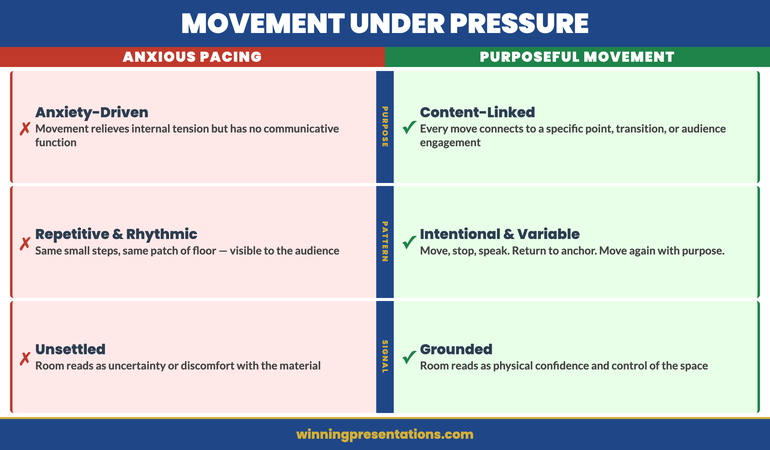

Contrast showing purposeful movement versus anxious pacing in presentations: deliberate movement toward audience, transitional movement between sections, versus repetitive pacing disconnected from content

How Anxiety Produces Unhelpful Physical Patterns

Presentation anxiety produces two distinct physical responses that affect how you occupy space in a room. The first is excess activation — the kind of nervous energy that manifests as pacing, hand movements, weight shifting, and restlessness. The second is physical freezing — a paradoxical stiffness that can set in when the anxiety is high enough that the nervous system pulls the body into a contracted, protective posture.

Both patterns — the overactive and the frozen — communicate anxiety to observers, but they do so in different ways. The overactive presenter reads as unsettled, unfocused, or uncertain about whether they should be in the room. The frozen presenter reads as stiff, disconnected, or under-prepared. Neither pattern is neutral in the way that a presenter might hope when they are simply trying to manage an internal physical state that they cannot directly control.

The anxiety-movement link is physiological. When the body perceives a threat — and a high-stakes presentation to a senior audience is interpreted by many nervous systems as a form of threat — it activates the sympathetic nervous system. Adrenaline and cortisol are released. Muscles are tensed in preparation for physical action that never comes. The body’s physical tension has nowhere to go in a boardroom, so it emerges as movement or as rigidity.

Understanding this mechanism is the first step toward managing it. You are not choosing to pace or to freeze — you are experiencing a physiological response to a perceived threat. The management strategies that work address the physiological state directly, not just the surface behaviour. Telling yourself to stop moving is rarely effective because the underlying activation has not changed. Physical grounding — through breath, through intentional muscle tension and release, through deliberate postural choices — works at the level of the nervous system, not just the conscious instruction.

For executives who experience the pre-presentation activation period as particularly difficult to manage, the article on morning presentation protocols covers how to structure the hours before a high-stakes presentation to reduce the peak of that activation before you enter the room. Managing your physical state ahead of time is more effective than trying to manage it in the moment.

Three Movement Patterns That Undermine Your Credibility

Most presenters have one or two default physical habits that they cannot easily observe in themselves during a presentation. These habits tend to be more visible in video recordings than in live self-assessment — which is one reason that rehearsing on camera, even informally, is such a reliable diagnostic tool. Three patterns appear most commonly in senior executive presentations where movement is unmanaged.

The first is the retreat pattern — moving backwards or sideways away from the audience when making a significant point. This pattern appears when the presenter is unconsciously protecting themselves from the perceived exposure of making a strong claim. The body retreats even as the words advance. The audience reads this as ambivalence — a presenter who is not fully behind what they are saying. Moving forward, toward the audience, on significant points is the correction.

The second is the weight-shift pattern — rhythmically transferring weight from foot to foot while standing in place. This is one of the most common physical habits in presentations and one of the most distracting to observe. It creates a visual rhythm that draws the eye and that reads as restlessness even when the presenter feels relatively calm. The corrective posture is feet shoulder-width apart with weight distributed evenly — a stance that feels slightly over-deliberate in rehearsal but reads as grounded to the audience.

The third is the back-turn pattern — consistently turning toward the screen or slide deck rather than maintaining eye contact with the audience. This pattern often emerges when a presenter is anxious about their content and uses the slides as a prompt. The act of turning away from the audience reduces the physical engagement with the room and signals that the presenter is not fully present with the people in front of them. Managing slides from a position that maintains forward facing — whether through memorisation, a presenter view on a laptop, or deliberate practice — removes the need for the back-turn entirely.

For practical techniques for maintaining eye contact and physical engagement with senior audiences, the article on eye contact techniques in executive presentations covers the specific disciplines for distributing attention across a room of senior decision-makers without triggering the anxiety response that makes sustained eye contact difficult.

If physical symptoms — including these movement patterns — are a persistent challenge in high-pressure presentations, Calm Under Pressure provides in-the-moment physical management techniques designed specifically for professional presentation contexts where the standard approach of taking a break or regrouping is not available.
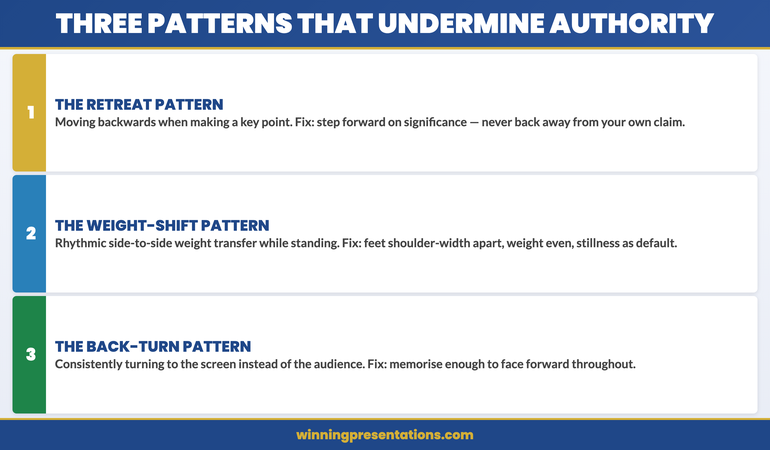

Three movement patterns that undermine presentation credibility: the retreat pattern, the weight-shift pattern, and the back-turn pattern — with corrections for each

Building Physical Confidence for High-Stakes Presentations

Physical confidence in presentations is not a personality trait — it is a practised competence. Presenters who appear naturally composed in high-stakes rooms have typically developed that composure through deliberate rehearsal, feedback, and the accumulated experience of managing their physical state under pressure. The composure looks natural because it has become habitual; it was not natural at the start.

Building physical confidence begins with establishing a default physical position that feels stable under pressure. For most presenters, this means a grounded stance — feet approximately shoulder-width apart, weight evenly distributed, hands in a neutral position either clasped lightly in front or resting at the sides. This position may feel unnatural at first, particularly if the body’s default response to pressure is to contract or to move. Practising it in low-stakes contexts until it feels comfortable is the only way to make it available when the stakes are genuinely high.

Physical confidence also develops through deliberate movement practice. Rather than waiting for high-stakes presentations to discover your physical habits, rehearsing in a space that mimics the presentation environment — a similar-sized room, a similar physical arrangement — allows you to map out your movement choices before they become reactive. Where will you stand for the opening? Where will you move to on the first key point? Where will you position yourself for the Q&A? Making these decisions in rehearsal means you are not making them for the first time in the room.

The link between physical confidence and voice quality is also worth noting here. When the body is tense and movement is anxious, breath becomes shallow, and the voice loses both depth and steadiness. A grounded physical position supports fuller breathing, which in turn supports a more controlled and authoritative vocal delivery. Physical confidence and vocal confidence are not independent qualities — they reinforce each other in both directions. For related reading on this connection, the companion article on voice control during executive Q&A covers how physical grounding and breath management combine to maintain vocal authority under questioning.

Practising Movement Control Before You Enter the Room

The most effective physical preparation for a high-stakes presentation happens in the minutes immediately before the session, not only in the days of rehearsal leading up to it. The body’s activation state in those final minutes — the cortisol and adrenaline already circulating, the muscles already tensed — will shape how you move and stand once you enter the room. Working with that state deliberately, rather than hoping it will settle on its own, makes a measurable difference to how you present.

One of the most reliable pre-entry practices is deliberate physical grounding. Before entering the presentation room, find a private space — a corridor, an empty office, a bathroom — and spend ninety seconds in the default grounded stance described earlier. Feel the weight distributed evenly through both feet. Relax the muscle tension in the shoulders and jaw, which are typically the first places anxiety concentrates. Take three slow, extended exhales. The purpose is not to eliminate the activation — that would be neither possible nor desirable. It is to establish a physical baseline that is closer to composed than to reactive.

Entering the room early, when it is still empty or occupied only by support staff, also allows you to establish your physical relationship with the space before the audience arrives. Stand where you plan to stand. Walk the movement path you have rehearsed. Make the space familiar to your body before it is occupied by the people whose judgement you are managing your anxiety about. Familiarity with the physical environment reduces the additional activation that comes from encountering an unfamiliar space while simultaneously managing the presentation itself.

The pre-room preparation window is also the right time to set your physical intention. Not your content objective — your physical one. A simple internal instruction — “I will stand still unless I am moving with a purpose” — functions as a behavioural anchor that can interrupt habitual anxious movement patterns before they take hold. The instruction does not need to be complex. It needs to be specific enough that you will remember it in the room when the activation is high and the habits are pulling in a familiar direction.

Calm Under Pressure — £19.99, instant access

Manage Physical Symptoms and Nervous Energy in High-Stakes Presentations

Calm Under Pressure provides in-the-moment physical management techniques for executives who experience shaking, nervous movement, voice changes, or physical tension during presentations. It is designed for professional settings where you cannot pause, retreat, or visibly manage your anxiety.

Get Calm Under Pressure →

Designed for executives and senior professionals who need to present with composure under genuine pressure.

Frequently Asked Questions

Is it better to move around the room or stay in one place during a presentation?

Neither is inherently better — the quality of the movement determines whether it helps or hinders. Purposeful movement that connects to specific moments in the content — walking toward an audience member when making a key point, shifting position to signal a transition between sections — enhances presence. Staying in one place with genuine composure and intentional stillness also communicates authority. What undermines credibility is not the presence or absence of movement, but the repetitive, disconnected movement that signals physical restlessness rather than deliberate engagement with the room.

What should I do with my hands if I am not gesturing?

The two most neutral hand positions for a standing presentation are a light clasp in front of the body — hands lightly held at roughly waist height — or hands resting naturally at your sides. Both feel more self-conscious than they look to the audience. Hands in pockets, arms crossed, or hands gripping a lectern all carry stronger negative signals than either neutral position. If you tend to fidget with rings, pens, or clothing during high-stress moments, removing the prop before entering the room removes the fidgeting opportunity.

How do I stop pacing when I cannot tell I am doing it in the moment?

The most reliable method is to use a physical anchor — a specific spot in the room that you return to as your default position after any deliberate movement. If you have established this anchor in rehearsal, returning to it becomes a habit that interrupts the pacing pattern without requiring you to consciously monitor your movement during the presentation itself. Video review of rehearsal recordings is also valuable: most people are surprised by their movement habits when they see them on screen, and that visual feedback is more effective at building awareness than verbal feedback from observers.

The Winning Edge — Weekly Newsletter

One Insight Per Week on Executive Communication

Each week, The Winning Edge delivers one focused insight on executive communication — structure, delivery, influence, and the mechanics of getting senior audiences to yes. Straightforward, applicable, and written for people who present under pressure.

Subscribe to The Winning Edge →

About the Author

Mary Beth Hazeldine — Owner & Managing Director, Winning Presentations

With 25 years of corporate banking experience at JPMorgan Chase, PwC, Royal Bank of Scotland, and Commerzbank, and 16 years training executives in high-stakes communication, Mary Beth advises professionals across financial services, healthcare, technology, and government on presenting with authority and composure under genuine pressure. Winning Presentations is her specialist advisory practice.

05 Apr 2026
Executive presenter making deliberate eye contact with a board member during a high-stakes presentation, confident posture, engaged audience

Eye Contact in Presentations: The 3-Second Rule That Changes How Executives Read You

Quick Answer

The 3-second rule for eye contact in presentations means holding deliberate eye contact with one person for roughly three seconds — long enough to complete a thought — before moving to another. This prevents the scanning and darting that signals anxiety, and it distributes your attention purposefully across the room, including to the people who are most sceptical. Executives read your eye contact behaviour as a direct signal of whether you believe what you are saying.

Henrik is a VP at a pharmaceutical company. He had prepared meticulously for a major leadership presentation — the data was solid, the narrative was clear, and he knew every number on every slide. Afterwards, the feedback stopped him cold: he had “seemed uncertain.” His coach watched the recording with him and spotted the issue within two minutes. Henrik had spent the entire presentation making eye contact with the three people nodding along at the left side of the table. He had barely glanced at the two board members on the right — the sceptics, the ones who were quietly deciding whether his budget proposal was credible. He had read the room, chosen the safe faces, and without realising it, he had signalled to the decision-makers that he either did not see them or did not want to. His certainty about the content never reached the people who mattered most.

Want a structured approach to building presentation confidence?

If you recognise the pattern Henrik experienced — knowing your material but still not landing as confidently as you should — there is a structured programme built specifically for executives navigating that gap. It works on the physical and psychological roots of presentation anxiety, not just the surface technique.

Explore the Programme →

What Eye Contact Signals to an Executive Audience

When you present to a senior audience, the content you deliver accounts for only part of how you are judged. Executives — particularly those who regularly sit in on high-stakes decisions — are experienced observers of other people. They have learned, often without consciously articulating it, to read delivery as a signal of conviction.

Eye contact is one of the clearest signals available to them. When a speaker holds steady, distributed eye contact, the room interprets it as ownership of the material. When a speaker scans nervously, looks repeatedly at their slides, or gravitates only toward friendly faces, the room reads it as discomfort — and discomfort in the presenter creates doubt about the content.

This matters enormously in executive and board-level settings, where the audience is making ongoing assessments throughout your presentation rather than waiting for the end. They are not passively receiving information. They are evaluating whether they trust the person delivering it. This is why your opening moments carry so much weight — and why eye contact behaviour from the first thirty seconds shapes the credibility you carry for the rest of the room.

There is also a subtler signal at work. When you make sustained eye contact with someone, it implies you are speaking directly to them — that you expect them to engage, to respond, to be part of the conversation. Executives are accustomed to being addressed this way. When a presenter fails to include them visually, it can read, consciously or not, as a lack of confidence in what is being said.

The inverse is equally important: the two board members Henrik was avoiding noticed, even if they never mentioned it. Sceptics who are not included in a speaker’s eye contact pattern often become more entrenched in their scepticism. They have been, in effect, dismissed.

The 3-Second Rule: Why It Works and How to Apply It

The 3-second rule is straightforward: when making eye contact in a presentation, hold your gaze with one person for approximately three seconds — enough to complete a sentence or a thought — before moving to someone else. It is not a rigid count. The goal is to match a complete idea to a complete moment of connection.

Why three seconds? Less than that and the contact reads as a glance — it feels rushed and superficial. The audience member does not feel genuinely addressed. More than five or six seconds and the contact starts to feel intense or confrontational, which is equally counterproductive. Three seconds is the natural duration of genuine conversational engagement. It is what happens automatically between two people having a focused discussion. Replicating it in a presentation setting makes the room feel like a conversation rather than a broadcast.

Applying it requires deliberate zone management. A useful way to think about your room is in three zones:

  • Decision-Makers Zone: The people with direct authority over the outcome — budget holders, senior sponsors, the most sceptical voices. Aim to spend approximately 40% of your eye contact time here, even if — especially if — they are not visibly receptive.
  • Nodders Zone: The engaged, visibly supportive faces. These feel natural to return to. Limit yourself to around 30% of your eye contact time here. They are already on your side.
  • Peripheral Zone: Colleagues, observers, junior stakeholders. Include them at around 30%, particularly during moments where you are building general credibility rather than pushing for a specific decision.

The practical discipline is to resist the gravitational pull of the nodders. It is entirely human to seek the safe face when you are under pressure. But doing so consistently tells the decision-makers that you are managing your own anxiety rather than engaging with them — which is precisely the opposite impression you want to create. Deliberate eye contact during an eye contact presentation is an act of attention directed outward, not inward.

One refinement worth noting: when you are presenting data or referencing a slide, it is acceptable to glance at the screen briefly. The error is staying there. Executives are reading your slides differently from how you expect, which means your job is to bridge the visual information to your verbal argument — and that bridge is built through eye contact, not through reading aloud.


Dashboard infographic showing the eye contact zone strategy for presentations with percentage time allocations for decision-makers, nodders, and peripheral audience members

Conquer Speaking Fear — £39

Build the Delivery Confidence That Lets Your Expertise Actually Land

Knowing your material is not the same as being able to deliver it under pressure. Conquer Speaking Fear is a 30-day programme that works on the nervous system roots of presentation anxiety — drawing on techniques from clinical hypnotherapy and nervous system regulation — so that your capability as a speaker matches the depth of your expertise.

  • Addresses the physiological and psychological components of presentation anxiety
  • Uses nervous system regulation techniques developed from clinical hypnotherapy practice
  • Structured as a 30-day programme with a clear, progressive framework
  • Designed for the specific pressures of executive and leadership-level presenting
  • Works on the internal experience of presenting, not just surface-level technique

Get Conquer Speaking Fear → £39

Designed for executives managing presentation anxiety and delivery pressure.

The Common Eye Contact Mistakes Executives Make

Most executives making eye contact errors are not aware they are doing it. The mistakes tend to cluster into a few recurring patterns.

Defaulting to the slide. The slide becomes a refuge when anxiety rises. Looking at the screen gives the speaker a brief pause from the pressure of being observed. Done occasionally, it is fine. Done repeatedly, it signals that the presenter does not fully own the material — that they need the slide as a prompt rather than as a visual support for an argument they could make without it.

The lighthouse sweep. Some speakers attempt to cover the room by scanning continuously from left to right and back again. This feels inclusive in theory, but in practice no individual ever feels addressed. The effect is impersonal and often reads as rehearsed in an unconvincing way. It is eye contact that avoids actual contact.

Locking in on one person. Some speakers — particularly those who are anxious — find one sympathetic face and stay there. This person becomes uncomfortable; everyone else feels excluded. If that one person happens to be a junior colleague rather than a decision-maker, the power dynamics in the room shift in an unhelpful direction.

Avoiding the sceptics entirely. This is Henrik’s mistake, and it is the most costly. Sceptics are sceptical precisely because they have unanswered questions or concerns. When a speaker visually excludes them, they receive a secondary signal that the speaker is either unaware of their concerns or unwilling to engage with them. Neither reading helps the presenter’s case. By contrast, deliberate and steady eye contact with a sceptic communicates: I see you. I am not afraid of your scrutiny.

Breaking eye contact at the wrong moment. The moment a speaker looks away tends to be interpreted as a signal — especially when it happens immediately after a key claim or recommendation. Looking down as you deliver your conclusion reads, unconsciously, as lack of conviction. The recommendation lands, then the speaker retreats from it. Holding eye contact through the delivery of a key point is one of the most direct ways to signal that you stand behind it.

If you are also working on avoiding the over-explanation habits that undermine credibility, eye contact discipline reinforces that work. The two behaviours are connected: over-explaining often comes with the same anxious avoidance pattern that produces poor eye contact.

How to Use Eye Contact When the Room Turns Hostile

There are presentations where the atmosphere shifts. A question is asked with an edge. Two board members exchange a look. Someone pushes back on your data. The room — or part of it — turns.

This is precisely the moment when instinct and good practice diverge most sharply. The instinctive response to hostility is to look away — to break contact, reduce the confrontational feeling, and regroup. But breaking eye contact in that moment sends a signal: that you are unsettled, that the challenge has found its target.

The discipline required is to maintain steady eye contact with the person who has challenged you while you formulate your response. Not a stare — that reads as aggression. But the same three-second conversational contact you would use with anyone else in the room. It communicates that you have heard the challenge, that you are taking it seriously, and that you are not rattled by it.

When answering a difficult question, direct the opening of your answer to the person who asked it, then broaden your gaze to include the wider room as you develop your response. This does two things: it honours the questioner while simultaneously making your answer a contribution to the whole room, not just a defence directed at one person. It reduces the adversarial dynamic without conceding ground.

If a question is genuinely difficult and you need a moment to think, it is completely acceptable to say so. The error is saying so while looking at the floor. Pausing while maintaining a composed, outward gaze signals that you are thinking carefully, not that you have been caught out.

Preparing for exactly this kind of pressure is one of the reasons executives benefit from working on the anxiety response that underpins delivery, not just the technique layer. When the nervous system is calmer under pressure, the physical signals — including eye contact — become far easier to manage.

If you have recently delivered a high-stakes presentation and are thinking about how to manage the follow-up conversation with decision-makers, the board presentation follow-up protocol covers the steps that typically happen after the room.

If the anxiety response in high-pressure presentations is something you recognise in yourself, Conquer Speaking Fear addresses exactly that, using nervous system regulation and clinical hypnotherapy techniques structured across thirty days.

Practising Eye Contact Before High-Stakes Presentations

Knowing the 3-second rule intellectually and executing it under pressure are two different skills. Like any physical component of presentation delivery, eye contact benefits from deliberate rehearsal — not just running through your content, but specifically practising the act of looking at people.

The most effective practice method is to rehearse in front of actual people rather than a mirror. A mirror changes the dynamic significantly: you are watching yourself, which is the opposite of the outward attention eye contact requires. If you can rehearse with a small group — even two or three colleagues — you can practise zone management in a realistic context.

If live rehearsal is not possible, the following framework helps structure your practice:

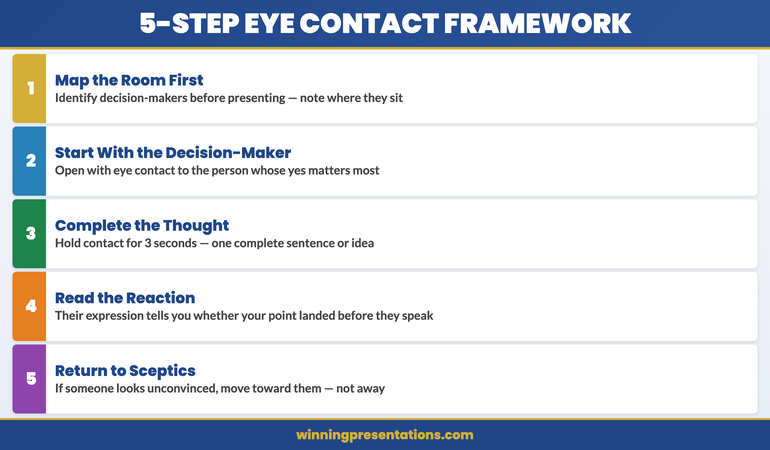
  1. Map your room in advance. Before a high-stakes presentation, identify where the decision-makers, nodders, and peripheral audience members will sit. Have a plan for where your eye contact will begin and how it will move.
  2. Anchor your opening in a person, not a slide. Start by addressing a specific individual with your first sentence. This sets the conversational tone from the outset.
  3. Practise completing full thoughts per person. Rehearse delivering single sentences or short ideas to one imagined person before moving. Get comfortable with the rhythm of thought-and-release rather than scan-and-move.
  4. Record yourself. Even a phone recording of a rehearsal can reveal patterns you are not aware of — including how often you look at your notes, your slides, or the floor.
  5. Practise under mild pressure. If the anxiety itself disrupts your eye contact, practising in entirely comfortable conditions will not prepare you for the real thing. Find ways to rehearse with a slightly raised heart rate — presenting to a slightly larger group than is comfortable, or in a less familiar environment.

The goal is not to make eye contact feel effortful and deliberate on the day — it is to practise until the deliberate choices become second nature. The technique should be invisible to your audience. They should experience you as engaged and present, not as someone executing a method.


Stacked cards infographic showing the five-step eye contact framework for presentations from mapping the room to returning to sceptics

Conquer Speaking Fear — £39

Systematic Confidence for the Moments That Count

Technical rehearsal takes you a certain distance. Conquer Speaking Fear takes you further — building the internal stability that lets you hold eye contact with a sceptic, absorb a difficult question, and deliver your recommendation with composure. It is a 30-day programme using nervous system regulation and techniques drawn from clinical hypnotherapy, structured for the specific challenges of executive-level presenting.

Get Conquer Speaking Fear → £39

Frequently Asked Questions

How long should eye contact last in a presentation?

Aim for approximately three seconds of eye contact per person — long enough to complete a sentence or a clear thought before moving on. Less than that reads as a glance; more than five or six seconds can feel intense or confrontational. The three-second duration naturally mirrors the rhythm of genuine conversational engagement, which is why it tends to feel credible to an executive audience.

Should you make eye contact with difficult or sceptical audience members?

Yes — and it is worth making a deliberate effort to do so, because the instinct under pressure is to avoid sceptical faces. Decision-makers who are sceptical are exactly the people whose confidence you need to build. Deliberately including them in your eye contact pattern signals that you are not unsettled by their scrutiny, which often does more to address their concerns than the content alone. Avoiding them tends to entrench rather than reduce their scepticism.

What if nerves make it difficult to maintain eye contact during a presentation?

This is common and it has a physical basis: when the nervous system is in an anxious state, looking at people can feel more exposing. Surface techniques help — practising zone management, rehearsing under mild pressure, anchoring your opening in a specific person. But if anxiety is disrupting your delivery more broadly, working on the underlying nervous system response tends to produce more sustainable results than technique adjustments alone. A structured programme focused on the physiological roots of presentation anxiety addresses this at the level where it originates.

Free Weekly Insights

The Winning Edge Newsletter

Each week: one practical idea for senior presenters. Delivery, structure, stakeholder handling, and the internal work that makes the difference. No filler.

Subscribe to The Winning Edge →

Mary Beth Hazeldine

Mary Beth Hazeldine is a presentation skills coach and the founder of Winning Presentations. She works with executives and senior leaders on the delivery, structure, and confidence challenges that arise in high-stakes presenting. Her programmes draw on her background in clinical hypnotherapy and nervous system regulation to address the anxiety that technical preparation alone does not resolve. She writes regularly on executive communication, presentation delivery, and the psychology of credibility.

21 Mar 2026
Executive watching a presentation from the audience with visible tension while a confident speaker presents on stage in a corporate conference setting

The Comparison Trap: Why Watching Great Speakers Makes Your Anxiety Worse (Not Better)

You watch a TED talk to calm your nerves before your board presentation. Instead of feeling inspired, you feel crushing inadequacy. That’s not weakness—it’s a predictable anxiety pattern. And it gets worse the more “great speakers” you study.

Quick Answer

Watching skilled speakers when you’re already anxious doesn’t motivate—it triggers comparison and reinforces the belief that you’re not good enough. Your nervous system reads it as evidence you can’t measure up, not inspiration to improve. Breaking the pattern requires understanding what anxiety actually does to your brain, then rewiring how you relate to your own speaking challenges.

Does This Sound Like You?

  • You watch a polished TED talk and feel worse about your own presentation skills
  • You study “great speakers” hoping to feel more confident—but feel more anxious instead
  • You compare every moment of your delivery to speakers who have years of practice (but you only notice their polish, not their process)
  • The more “speaker content” you consume, the more self-doubt creeps in
  • You spiral into “I could never do that” thinking before major presentations
The CFO Who Couldn’t Breathe During Board AnnouncementsTomás had been with the company for seven years. By every measure, he was a competent financial leader. But the moment he stepped into the boardroom to present quarterly results, something shifted. His chest would tighten. His breathing would shallow. His mind would race to every way his analysis might be incomplete, every question the board might ask, every error he might have missed.

He’d started watching YouTube videos of confident CFOs presenting. Financial analysts at Ted talks. Executives delivering flawless earnings calls. The more he watched, the worse the anxiety got. He wasn’t learning confidence. He was collecting evidence that he didn’t measure up. He didn’t need better financial analysis. He needed his body to feel safe in that boardroom.

Stop Measuring Yourself Against Speaker Highlight Reels

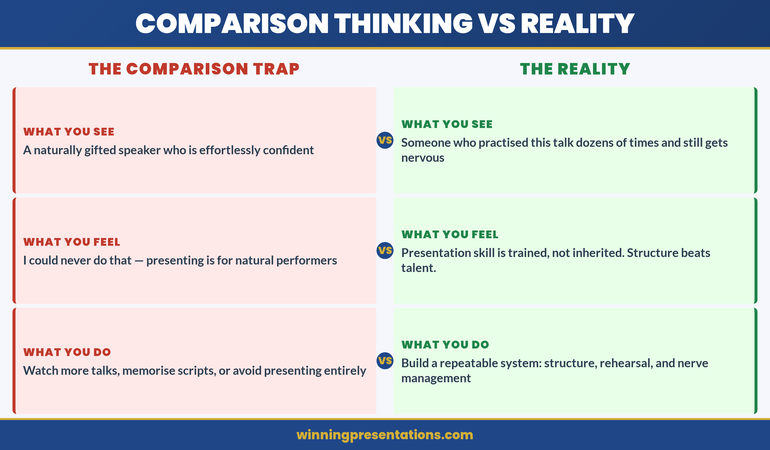
The primary problem with using other speakers’ performances as your learning benchmark is that you’re comparing your full, unfiltered reality—including anxiety, self-doubt, and visible struggle—to someone else’s highlight reel.

What you see: A polished delivery, perfect pacing, no visible nerves.

What you don’t see:

  • Their first 50 presentations (where they were terrible)
  • The speaking situations where they failed and learned
  • How they actually feel in their body during presentations
  • The years of practice hidden behind 18 minutes of TED talk
  • Their current anxiety triggers and vulnerabilities

When your nervous system is already primed for threat (which it is when you’re presentation-anxious), watching someone else’s polished performance reads as evidence that you’re deficient. Your brain doesn’t think, “That looks learnable.” It thinks, “I could never do that.”

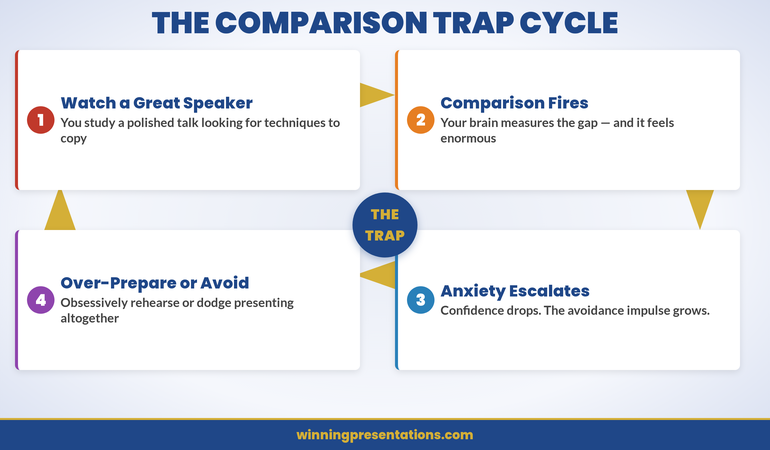
The pattern that keeps you stuck: Watch skilled speaker → Feel inadequate → Try harder → Rehearse obsessively → Anxiety increases anyway → Watch more speakers to feel better → Repeat.

The Conquer Speaking Fear programme (£39) breaks this cycle by teaching you how your nervous system actually works during presentations—using clinical hypnotherapy and NLP techniques to regulate anxiety at the source, rather than trying to out-skill your fear.

Explore the Anxiety-Based Approach

You’re Watching Highlight Reels, Not Real Practice

Here’s what gets hidden when you study great speakers: their learning curve. The neurobiologist who delivers a brilliant TED talk has probably given that talk a thousand times. The executive coach who looks totally composed has probably felt exactly as anxious as you do.

But you don’t see that journey. You only see the highlight.

This creates a dangerous assumption in your brain: They’re naturally good at this. I’m naturally anxious. We’re different.

That difference isn’t skill. It’s practice. It’s repetition. It’s nervous system regulation they learned (usually by trial and error, not by watching other people).

When you’re already battling presentation anxiety, consuming more “great speaker” content doesn’t close the gap. It widens it. Because every polished performance feels like evidence that the gap is wider than you thought.

The Comparison Trap Cycle infographic showing four stages: Watch a Great Speaker, Internal Comparison Fires, Anxiety Escalates, and Avoidance or Over-Preparation

How the Comparison Trap Hijacks Your Nervous System

Your nervous system has a job: keep you safe. When you’re presentation-anxious, it’s already in a heightened state of alert. Your body is primed to notice threat.

Then you watch a skilled speaker deliver flawlessly. In that moment, your nervous system interprets the signal as: That’s the standard you need to meet. You’re not meeting it. You are unsafe/failing.

This isn’t a logic problem. It’s a nervous system problem. The more speakers you watch, the more evidence your system collects that you don’t measure up.

The comparison trap doesn’t just affect your confidence. It actually heightens physiological anxiety: increased heart rate, shallow breathing, cortisol release. It’s not just negative thinking. Your body is responding to what feels like a threat assessment.

This is why “just practice more” or “study great speakers” advice often backfires. You’re adding pressure on top of an already dysregulated nervous system.

The Faulty Logic of Anxiety-Driven Learning

Anxiety has a particular way of “teaching” you. It shows you problems, not solutions. When you’re anxious about presentations, your brain highlights:

  • Everything that could go wrong
  • Every way you might fail
  • Every person watching who might judge you
  • Every flaw in your delivery compared to “better” speakers

Then you try to solve this by consuming more speaker content—thinking you’ll find the “right” way to do it. But you’re not learning the right way. You’re reinforcing the belief that there’s a standard you’re failing to meet.

This is learning through threat, not learning through mastery. And it doesn’t stick. It just creates more anxiety.

What actually works is learning how to regulate your nervous system first, then practicing presentation skills from a calmer, more resourced state. That’s when learning actually happens. That’s when confidence builds—not from watching someone else do it perfectly, but from your own body learning that you can manage the situation.

Feeling the comparison spiral right now? This is exactly what Conquer Speaking Fear addresses: how to interrupt the anxiety pattern before it becomes your default response.

What Actually Reduces Speaking Anxiety (It’s Not Speaker Videos)

The research on anxiety reduction is clear: exposure to threat (like watching skilled speakers when you’re anxious) doesn’t reduce fear. What reduces fear is regulated exposure to manageable challenge, combined with nervous system techniques that help your body learn the situation is safe.

That’s the gap most presentation advice misses. You don’t need:

  • More tips on body language
  • More examples of “perfect” presentations
  • More pressure to match someone else’s standard

You need your nervous system to feel safe while you practice. You need techniques that actually work at the physiological level. You need to build confidence through your own success, not through comparison to others.

Reframing: From Comparison to Nervous System Regulation

The shift from “I need to watch better speakers to learn” to “I need to regulate my nervous system to perform” changes everything.

Instead of:

  • Watching great speakers → feeling worse
  • Rehearsing obsessively → staying anxious
  • Comparing yourself → spiralling into self-doubt

You’d be:

  • Learning how your body responds under pressure
  • Practising techniques that actually calm your nervous system
  • Building confidence through managing your anxiety, not copying someone else’s skill
  • Developing a genuine sense of readiness, not just borrowed confidence from studying others

Comparison Thinking vs Reality infographic contrasting what you see, what you feel, and what you do when caught in the speaker comparison trap versus the reality of learnable skills

Stop Rehearsing What They’re Thinking About You

Here’s what happens in the comparison trap: you’re not just watching speakers. You’re imagining what the audience will think of you compared to them. You’re rehearsing judgment in your head.

This creates a secondary anxiety layer. Now you’re anxious about the presentation and anxious about being judged as “not good enough.”

That’s where nervous system regulation techniques become essential. Not to pump yourself up with false confidence. But to actually interrupt the fear response at the source.

The Conquer Speaking Fear programme uses evidence-based techniques from clinical hypnotherapy and NLP to help your nervous system feel safe during presentations—not just think positive thoughts about them.

Learn the Regulation Techniques

Is This Right For You?

This approach is for you if:

  • You’ve studied great speakers and it hasn’t reduced your anxiety (it may have increased it)
  • You’re rehearsing presentations obsessively but still feel nervous before delivering
  • Comparison is part of your anxiety pattern—you measure yourself against others
  • You want to feel genuinely confident, not just “get through” presentations
  • You’re ready to work on the nervous system level, not just the skills level

From Speaking Terror to Teaching Others

That CFO who couldn’t breathe in the boardroom? He didn’t stop being anxious by watching more successful financial leaders or studying presentation techniques. He stopped by learning how his nervous system actually worked during high-pressure situations. Once he understood that, he could regulate it.

Within 18 months, he went from dreading board announcements to volunteering to lead quarterly presentations to the full board. He didn’t become naturally good at presenting. He learned to manage his nervous system well enough that anxiety stopped controlling his performance.

Three years later, he’s mentoring other finance leaders through their presentation anxiety. Not because he became a “natural presenter.” But because he learned the one thing most presentation advice skips: how to work with your nervous system instead of against it.

The Conquer Speaking Fear programme (£39) condenses that learning curve into a structured programme using clinical hypnotherapy and NLP to create lasting change. You get the nervous system techniques that actually work. Not tips. Not tricks. Tools that work at the physiological level.

Join the Programme

📊 Want to improve your slides?

Preparation reduces anxiety. The Executive Slide System (£39) includes confident-presenter templates designed to minimise preparation stress.

People Also Ask

Does watching great speakers actually help with presentation anxiety?

For some people, watching skilled speakers can be motivating. But if you’re already anxious about presenting, it often increases comparison and self-doubt. The key difference is your nervous system state when you watch. If you’re primed for threat, you’ll interpret polished performances as evidence you’re not good enough. Nervous system regulation should come first; learning through observation should come later.

How long does it take to get over presentation anxiety?

It depends on your approach. If you’re trying to “think positive” or “rehearse more,” it often takes months or years—and can actually worsen anxiety. If you’re working directly with nervous system regulation techniques, most people notice significant shifts within 2-4 weeks. The foundation changes quickly; building full confidence takes longer, but you’re working from a much more resourced place.

Can I stop being anxious about presentations if I’m naturally an anxious person?

Yes. “Naturally anxious” usually means your nervous system is sensitised to threat more readily than others’—not that you’re broken or incapable. With the right nervous system tools, you can learn to regulate that sensitivity in specific situations (like presentations). You don’t become a different person. You become someone whose anxiety no longer controls their performance.

FAQ

Should I completely stop watching other speakers?

Not necessarily. The issue isn’t watching speakers; it’s when you watch them and why. If you’re watching them to learn a specific technique and you’re in a calm, resourced state, that can be valuable. If you’re watching them because you’re anxious and hoping to feel better, that usually backfires. Focus first on nervous system regulation. Then, from a calmer place, you can observe and learn without the comparison trap activating.

Is presentation anxiety the same as general anxiety disorder?

Not exactly. Presentation anxiety is specific to the performance situation. You might be calm in most areas of life but dysregulated when presenting. This specificity is actually an advantage—you can work directly with the nervous system triggers in that context. If you have generalised anxiety, presentation anxiety might be one manifestation of that larger pattern, and you’d want support for both.

If I fix my nervous system, will I need less practice?

No, but your practice will be more effective. Right now, if you’re anxious, you might be rehearsing obsessively and still not feeling confident—because anxiety is hijacking your learning. Once your nervous system is regulated, your practice time creates actual skill development and real confidence. You’ll likely need smarter practice, not necessarily more practice.

Ready to Stop the Comparison Cycle?

Join The Winning Edge newsletter for weekly strategies on nervous system regulation, presentation confidence, and the counter-intuitive approaches that actually reduce anxiety.

Subscribe (It’s Free)

🆓 Free resource: Get the Checklist — a free guide to strengthen your presentation preparation.

About the Author

Mary Beth Hazeldine is a presentation coach and nervous system specialist working with senior leaders and executives. She’s trained over 3,000 professionals to move from presentation anxiety to genuine confidence—by working at the nervous system level, not just the skills level. She’s the creator of the Conquer Speaking Fear programme and the Executive Slide System.

13 Mar 2026
Professional woman in a boardroom setting looking directly at the viewer with confident composure — executive presenter commanding the room"

The Fear That’s Worse Than Stage Fright: Being Forgettable

She delivered the presentation perfectly. Clear structure, confident delivery, sharp answers in Q&A. The senior leadership team thanked her warmly. Three weeks later, when the project was being discussed at board level, her name didn’t come up. Someone else’s did.

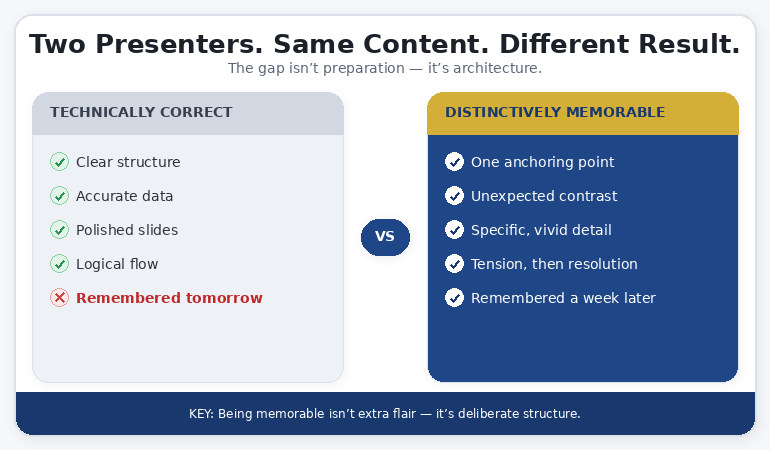
She wasn’t passed over because she failed. She was passed over because she hadn’t registered. The presentation had been technically correct and entirely unmemorable — and in the room where careers advance, those two things are not the same as doing well.

Stage fright gets diagnosed. It gets talked about, treated, trained away. The fear of being forgettable is quieter — but for the executives I work with, it is often the more accurate description of what they are actually afraid of. Not that it will go wrong. That it will go fine, and nobody will notice.

Quick answer: The fear of being forgettable is not a performance problem — it is a distinctiveness problem. Technically correct presentations fail to register because they are built to avoid failure rather than to create impression. The fix is the one decision point that every presentation needs and most executives skip: what single thing do you want the room to remember when everyone has left? That question, answered before the deck is built, changes the structure, the language, and the moment in the room that makes you memorable.

🎯 Worried your presentations land and then disappear? Conquer Speaking Fear (£39) includes the memorability framework — the single structural change that makes executive presentations stick rather than slide off the room.

I spent 24 years in corporate banking at JPMorgan Chase, PwC, Royal Bank of Scotland, and Commerzbank. I sat in hundreds of presentations — some of which I still think about today, and most of which I cannot recall a single detail of. The ones I remember were not always the most technically accomplished. They were the ones where the presenter had made a decision about what to leave behind.

The fear of being forgettable is almost never named as a fear. It presents as something else: a vague dissatisfaction with your own presentations, a frustration that you prepare thoroughly and deliver competently but don’t seem to build momentum, a nagging sense that you’re getting positive feedback but not advancement. What sits underneath all of that is the knowledge — accurate, if unarticulated — that the room is processing your presentation in real time and discarding most of it within 48 hours.

This is not a confidence problem. Many of the executives I work with are entirely confident in front of a room. They are confident and forgettable, and the combination is more frustrating than stage fright, because stage fright at least has a diagnosis.


Executive presenter at boardroom table showing the contrast between technically correct delivery and memorable impression-creating presentation technique

What the Fear of Being Forgettable Actually Is

The fear of being forgettable is not anxiety about the presentation itself. It is anxiety about what happens after the presentation — specifically, about whether the work you put into the room will translate into anything that changes how people think about you, your ideas, or your capability.

It is existential in a way that stage fright is not. Stage fright is about a visible, acute failure — the stumble, the blank, the meltdown. The fear of being forgettable is about an invisible, chronic failure — the presentation that goes smoothly from start to finish and changes nothing. It is possible to manage stage fright and still live with the fear of being forgettable. They are different problems.

The fear is rational. Most executive presentations are, in fact, forgettable. Not because the presenters are weak — because they are built to survive the room rather than to shape it. Built to avoid objections rather than to create impressions. Built for correctness rather than distinctiveness, and correctness, as a standard, produces adequate presentations at best.

The presentation confidence that most people work to build is about managing their own state in front of a room. That matters. But it does not solve the fear of being forgettable — because forgettable presentations are delivered by confident people every day. Confidence is necessary. It is not sufficient.

🎯 From Technically Correct to Genuinely Memorable: The Framework Inside Conquer Speaking Fear

Conquer Speaking Fear addresses both the anxiety that makes you hold back and the structural problem that makes you forgettable — because they are connected. The memorability framework inside includes:

  • The single decision that changes how your presentation is built — the one question most executives skip that determines whether the room retains anything
  • The structural change that creates impression without changing your delivery style or requiring you to be more extroverted
  • The moment-in-the-room technique — how to create one point of genuine distinctiveness that travels out of the room after you’ve left
  • Why technically correct presentations fail to register — and the three specific elements that create retention
  • Scripts and frameworks for building distinctiveness into any presentation, including updates and committee briefings

Get Conquer Speaking Fear → £39

Built from 24 years of reviewing what makes executives memorable — from performance coaching, but in banking boardrooms where careers advance on the quality of the impression you leave behind.

Why GettingIt Right Isn’t the Same as Being Remembered

There is a common assumption that technical competence in presentation leads to memorability. That if you structure your content well, deliver it clearly, and handle Q&A professionally, the impression will follow. It does not work this way.

Technically correct presentations are processed by the audience as expected. Expected things are not memorable. The brain’s memory systems are optimised for novelty, significance, and pattern disruption — not for competent execution of a familiar format. When a presentation ticks every box and surprises no one, the audience experiences it as confirmation of baseline. That confirmation does not generate lasting impression.

There are three specific elements that create memorability in executive presentations. The first is a distinctive frame: a way of seeing the topic that the audience has not encountered before, and cannot easily dismiss. The second is a moment of genuine specificity — a number, a story, a piece of evidence so precise that it does not generalise. The third is a closing that creates tension rather than resolution: something the audience leaves with that has not yet been answered, or a commitment so specific that it follows them out of the room.

Most presentations have none of these. They are built on the assumption that clarity is sufficient for impact. Clarity is necessary for impact. It is not impact.

Preparing a presentation where being remembered genuinely matters? Conquer Speaking Fear (£39) includes the three-element memorability checklist and the templates to build each element into any presentation format.

The One Decision That Makes You Memorable

Before building any presentation, answer this question: what is the single thing you want the room to remember when everyone has left, the coffee cups have been cleared, and two other presentations have happened since yours?

Not the key messages — there are always three or five of those. Not the overall objective. The single thing. The one sentence that you would consider the presentation successful if it was still in someone’s head three days later.

Most executives cannot answer this question without several attempts. Not because they haven’t thought about the presentation — they have thought about it extensively — but because they have been building toward comprehensive communication rather than toward a single retained point. The question forces a prioritisation that comprehensive communication never requires, and that prioritisation is what makes the difference.

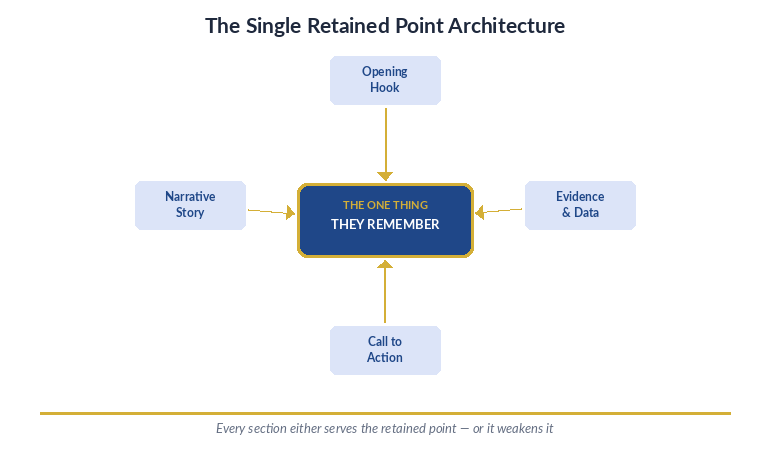
Once the single point is identified, it changes the structure, the language, the evidence selection, and the closing. Every section of the deck can be evaluated against one criterion: does this section serve the single point, or is it here because it belongs in a complete treatment of the topic? A complete treatment of the topic is for a report. A presentation that leaves one point behind is for a room.

This is not the same as simplifying your content. The evidence, the depth, the rigour — all of that remains. What changes is the architecture: everything is built to deposit one thing in the room’s memory, and everything that does not serve that deposit is moved to an appendix or removed entirely.


Presentation structure diagram showing the single retained point architecture — how to build every section toward one memorable conclusion rather than comprehensive topic coverage

⚠️ Stop Presenting Well and Being Forgotten

Technical competence is not the problem. The problem is building presentations that aim for correctness rather than impression. Conquer Speaking Fear (£39) gives you the framework to identify your single retained point and build the rest of the deck to serve it — so you leave something behind when you leave the room.

Get Conquer Speaking Fear → £39

Used by executives who present confidently and want to know why they’re not advancing as fast as their performance warrants.

The Structural Change That Creates Impression

Once you have identified your single retained point, there is one structural change that consistently makes it land: give it three times more space than you think it needs.

Most executives identify the central point of their presentation and give it a slide. They present it in the same format as every other slide — the same visual weight, the same amount of speaking time, the same level of evidence. The audience processes it as one of many points and does not distinguish it as the point they are meant to carry with them.

A presentation built for memorability gives the central point a different kind of attention. It arrives at the point from two directions — an evidence approach and a case study approach. It lingers there rather than moving on. It uses language that is slightly more precise, slightly more surprising, than the surrounding sections. And it returns to the point at the close — not as a summary, but as a reframing that shows the audience something they have just been made to see that they could not see before the presentation began.

The fear of being judged when speaking often produces exactly the opposite structure: executives rush through the material to minimise exposure to judgment, and the rushed pace means no single section gets enough space to register. Slowing down at the central point — deliberately, visibly, without apology — is both a confidence signal and a memorability technique.

The Moment in the Room That People Carry With Them

There is a specific type of moment in executive presentations that travels out of the room with the audience. It is not the best slide. It is not the sharpest Q&A answer. It is the moment where the presenter says something that the audience had not heard formulated that way before — and that formulation makes something they already knew suddenly more useful.

This moment is not spontaneous. It is engineered. The best presenters I observed over 24 years in financial services had prepared two or three formulations that they delivered as if they were occurring to them in real time. The sentences were precise, unexpected, and impossible to improve. They stuck because they had been sharpened in advance to a point that could not be blunted by the audience’s existing vocabulary.

The technique is to write one sentence that your audience will want to use themselves. Not a quotable headline — a usable thought. Something that gives them language for a problem they already have. When an executive leaves a presentation and says to someone in the corridor, “she said something interesting — she said that…” the sentence they complete is the one the presenter put there deliberately.

This is not manipulation. It is the same precision that good writing requires — the sentence that could not have been written differently and still meant the same thing. Presentations that are remembered tend to contain at least one of these sentences. Presentations that are forgotten contain none.

The process of overcoming public speaking fear often focuses on managing internal state in front of a room. That work is valuable. But the executive who has resolved their anxiety and still presents forgettably needs a different intervention: not less fear, but more considered preparation of the specific moment that will travel.

Also published today: International Presentations: The Cultural Mistakes That Kill Deals Before Slide One — the structural adjustments that make you read as credible rather than problematic in cross-cultural rooms.

Common Questions About the Fear of Being Forgettable in Presentations

Is the fear of being forgettable the same as imposter syndrome?
They are related but different. Imposter syndrome is the belief that you are not as capable as others perceive you to be. The fear of being forgettable is the belief that even if you perform well, you will not make an impact. Many executives experience both — but the fear of being forgettable is often the more accurate fear, because it is a response to real feedback: presentations that go well and produce no change. Imposter syndrome is a distortion of self-perception. The fear of being forgettable is often an accurate assessment of a structural problem in how presentations are being built.

How do I become more memorable without changing my personality or presentation style?
The memorability techniques in this article and in Conquer Speaking Fear are structural, not stylistic. You do not need to become more energetic, more performative, or more extroverted. You need to identify your single retained point, give it disproportionate space in the presentation, and engineer one sentence that your audience will want to use themselves. These changes live in the preparation, not in the delivery. Your personality, your voice, your style — none of that changes. What changes is the architecture of the deck and the precision of one or two key sentences.

What if the content I’m presenting doesn’t lend itself to being memorable — like a budget update or a quarterly review?
Every presentation can contain one memorable moment, regardless of topic. A budget update can contain one framing that changes how the audience thinks about a number they have seen before. A quarterly review can contain one sentence that gives the audience language for a pattern they have been observing but haven’t been able to articulate. The technique works across presentation types because it does not depend on the subject matter being inherently interesting — it depends on the presenter doing the preparation work to find the single formulation that makes the familiar suddenly more useful.

Is This Right For You?

This article and Conquer Speaking Fear are for executives who present competently and know it, but who are not seeing the career impact that their presentation performance should generate. If you are getting consistent positive feedback and not advancing, if you are being told your presentations are good but not being remembered after them, or if you sense that you are technically doing everything right and still not registering — the memorability framework is the relevant intervention.

If your primary challenge is managing anxiety or fear in front of a room, Conquer Speaking Fear addresses that too. The memorability work and the anxiety management work are covered together because they connect: the executives who are most afraid of being forgettable tend to rush through their material to reduce exposure, and that rushed pace is exactly what prevents the central point from landing with enough weight to be retained.

Frequently Asked Questions

Does being memorable require being controversial or provocative?
No, and in many executive contexts, controversy is actively counterproductive. Memorability in executive presentations comes from precision and distinctiveness, not from provocation. The formulation that makes you memorable is more likely to be a precisely articulated insight that your audience already half-knows than a deliberately provocative claim. Controversial presentations are remembered, but often for the wrong reasons. The goal is to be remembered for the quality of your thinking, not for having caused friction in the room.

How long does the memorability preparation take?
The critical question — what is the single thing I want the room to remember? — takes 15–30 minutes to answer well if you have not done it before. The first answers are usually too broad. The useful answer is specific enough that you could repeat it to someone who wasn’t in the room and they would understand both the point and why it matters. Once you have that answer, the structural adjustments to the deck take 30–60 minutes for a presentation you have already built. The one engineered sentence takes longer — sometimes a day of writing and revision — because it needs to be precise enough to survive a room full of people who will immediately try to improve it.

📊 Want the slides too?

Preparation reduces anxiety. The Executive Slide System (£39) includes templates designed for executives who want their deck to carry the weight of the memorable moment — so your delivery can focus on the room rather than on the slides.

About the Author

Mary Beth Hazeldine is the founder of Winning Presentations and has spent over two decades advising executives on high-stakes communication. Her background includes roles at JPMorgan Chase, PwC, Royal Bank of Scotland, and Commerzbank. She has observed hundreds of executive presentations across board and leadership contexts and developed Conquer Speaking Fear from the patterns that separated the presentations people still talk about from the presentations nobody remembers. She works with senior leaders on both performance anxiety and the structural problem that lies beneath it.

Free resource: Executive Presentation Checklist — includes the memorability check for every presentation: the five signals that indicate your central point has enough structural weight to be retained.

The Winning Edge Newsletter

Practical executive presentation guidance, once a week. No padding, no noise — just the techniques that matter when the room is full of people whose time is expensive.

Subscribe Free →

12 Mar 2026
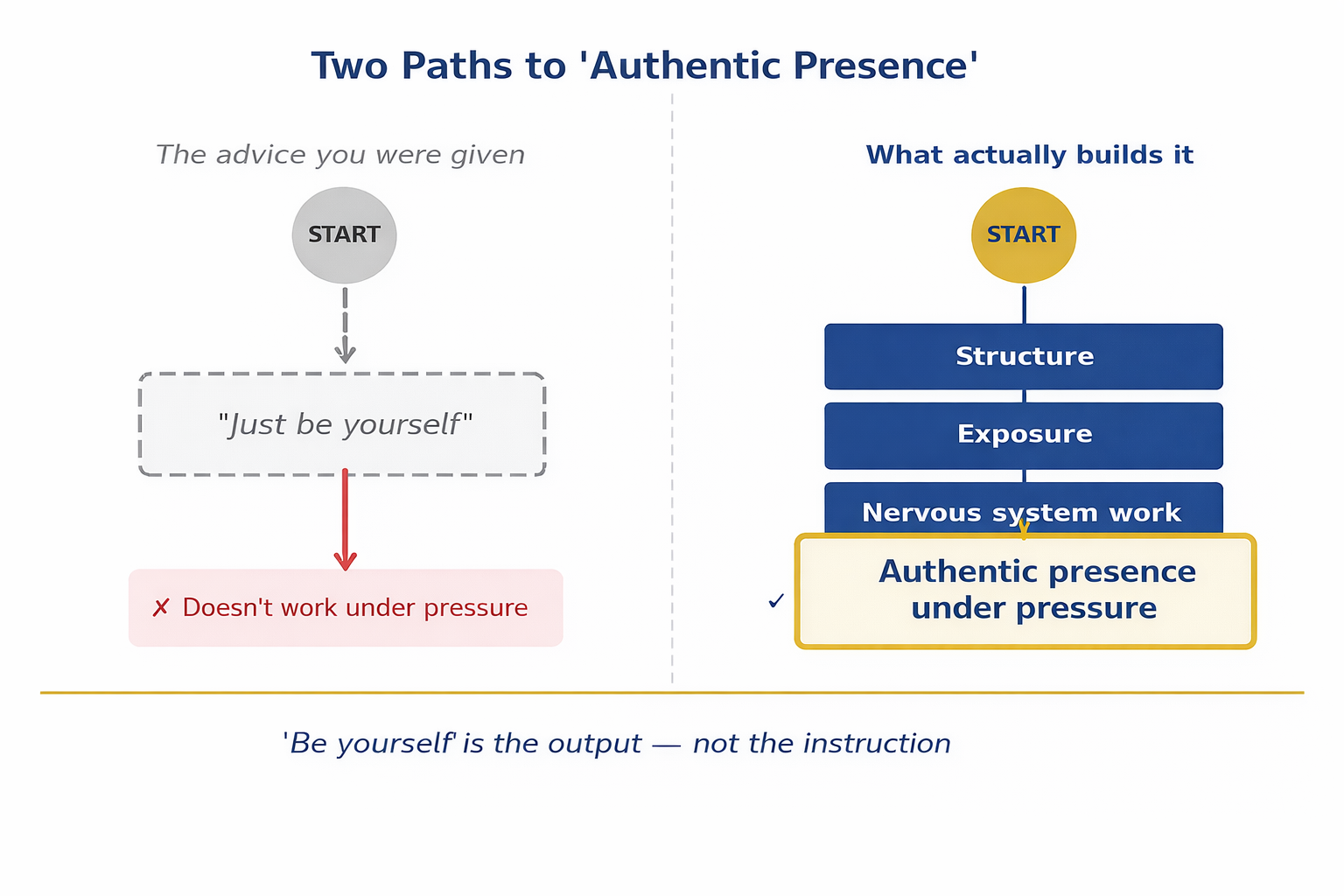
Why 'be yourself' is the worst presentation advice — and what actually builds genuine confidence when presenting

Why ‘Just Be Yourself’ Is the Worst Presentation Advice Ever Given

I have heard this advice given in every variation imaginable. “Just relax and be yourself.” “Be authentic — they’ll respond to that.” “Don’t overthink it, just be natural.” It is delivered by coaches, managers, colleagues, and well-meaning friends. It is almost completely useless.

Here is the problem. The person asking for help with their presentation anxiety is anxious because, in that specific context, they don’t know how to be themselves. The presentation setting activates a version of them they don’t recognise — the one with the dry mouth and the racing thoughts and the sudden inability to remember what they were about to say. Telling them to “just be yourself” in that state is like telling someone who is lost to “just know where you are.”

The advice is not wrong because authenticity doesn’t matter. It matters enormously. It’s wrong because it mistakes the destination for the route.

Quick answer: “Just be yourself” fails as presentation advice because it assumes you already have access to a confident, composed version of yourself in a high-pressure context — and for many people, you don’t yet. Authenticity in presentations isn’t a starting position; it’s a result of having a reliable structure, having prepared the right way, and having repeated the experience enough times for the nervous system to stop treating it as a threat. The route to authentic presenting runs through skill, not sentiment.

🧠 Struggling with presentation anxiety despite trying every tip you’ve been given? Conquer Speaking Fear (£39) addresses the root cause — not the symptoms — with a four-step approach built on clinical hypnotherapy and NLP.

I spent 24 years in corporate banking before I became a presentation coach and clinical hypnotherapist. In my banking career I gave many presentations that went well and several that didn’t — and I received “just be yourself” advice before most of them. I know what it feels like to walk into a room where the stakes are high, where the audience is senior, and where your nervous system is telling you that you are not safe.

In that state, “yourself” is not a useful concept. “Yourself” is simultaneously the person who knows this material better than anyone in the room, and the person whose heart rate has just doubled and who has forgotten how to breathe properly. Telling that person to “be themselves” doesn’t help them access the first version — it just leaves them alone with the second.

What actually builds presenting confidence is not more permission to be authentic. It’s removing the obstacles that prevent authenticity from being accessible. That’s a different problem with a different solution.


Presentation humiliation recovery process showing the 3 mechanisms: interrupt replay loop, separate shame from identity, rebuild nervous system baselineWhy ‘Be Yourself’ Fails in High-Pressure Contexts
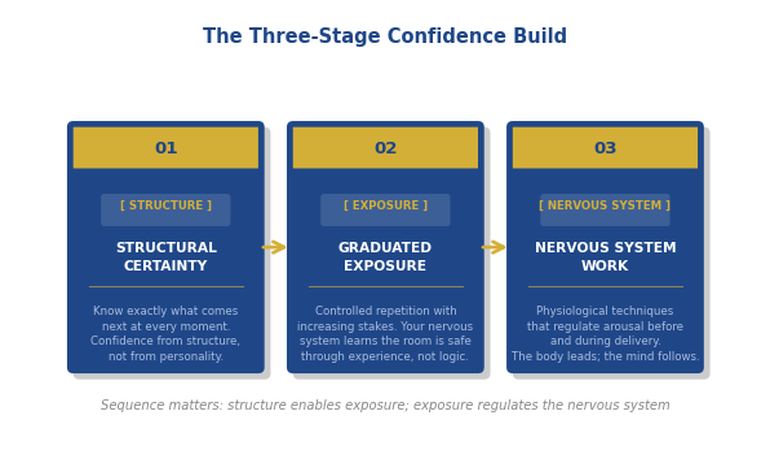
The advice “just be yourself” contains a hidden assumption: that the self you normally inhabit is readily available in high-stakes situations. For most people, it isn’t — and this isn’t a character flaw, it’s a neurological response.

When your nervous system perceives threat — and many brains are wired to classify a large audience, an important meeting, or a high-stakes pitch as a threat — it triggers physiological responses designed to help you survive, not to help you present well. Elevated heart rate. Shallow breathing. Reduced access to higher-order thinking. A narrowed attentional focus. These responses are not evidence that you’re not good enough. They’re evidence that your brain is doing exactly what evolution designed it to do.

The problem is that “be yourself” offers no pathway through this response. It doesn’t tell you how to work with your nervous system rather than against it. It doesn’t provide structure that reduces the cognitive load of an unfamiliar or threatening situation. It doesn’t address the root pattern that makes presenting feel dangerous in the first place.

What’s more, the advice can actually increase anxiety. When someone tries to “be themselves” and still feels anxious, the natural conclusion is that there’s something wrong with them — that even their authentic self isn’t good enough for this situation. The advice doesn’t just fail to help; it creates a new layer of self-criticism on top of the existing anxiety. The research on why even confident presenters still get nervous confirms this: the problem isn’t authenticity, it’s the model people hold about what anxiety means.

🧠 The Approach That Actually Works When ‘Just Be Yourself’ Hasn’t

Conquer Speaking Fear addresses presentation anxiety at the level where it actually lives — the nervous system pattern that activates in high-pressure contexts — not the surface symptoms that generic advice tries to manage:

  • The four-step framework for retraining the nervous system response that makes presenting feel threatening
  • Clinical hypnotherapy and NLP techniques applied specifically to presentation anxiety
  • The pre-presentation physical routine that creates genuine calm rather than performed confidence
  • Evidence-building practices that change how your brain classifies the presenting situation over time
  • The distinction between managing anxiety (which keeps the pattern in place) and resolving it

Get Conquer Speaking Fear → £39

Built from clinical hypnotherapy, NLP practice, and 24 years of high-stakes presenting at JPMorgan Chase, PwC, and RBS. Used by executives who’ve tried every other approach.

What Authenticity in Presenting Actually Is

Authentic presenting is not performing naturalness. It’s not trying to replicate how you feel in a low-stakes conversation and importing it into a high-stakes one. Authenticity in the context of presentations means that your words, delivery, and presence are congruent — that there isn’t a visible gap between what you’re saying and how you appear to be experiencing saying it.

That congruence is available to most people in some contexts and not in others. In a conversation with a trusted colleague about a subject you know well, it’s probably effortless. In a room with senior stakeholders, cameras, or an audience that includes people who can affect your career, it’s not — because your nervous system has added a layer of self-monitoring and threat assessment that didn’t exist in the smaller conversation.

Removing that layer is not a matter of trying harder to be authentic. It’s a matter of reducing what your nervous system needs to monitor. Structure does part of that work — when you know exactly where your presentation is going, you’re not simultaneously navigating and performing. Preparation does another part — when you’ve rehearsed the opening enough times, it stops requiring conscious attention and frees up cognitive resource for presence. And nervous system work — the kind that changes the underlying response pattern — does the part that structure and preparation alone can’t reach.

The result is what people experience as authenticity: the sense that the presenter is genuinely present, not performing presence. But that result is downstream of a specific set of inputs. It doesn’t arrive just because someone gave you permission.

Why Structure Comes Before Authenticity

This is the idea that most presentation advice gets backwards. The conventional model says: first be yourself, then communicate your content confidently. The actual sequence is: first build a reliable structure, then reduce the cognitive load of delivering it, then the self that was always there becomes accessible.

Structure reduces threat. When you walk into a presentation knowing exactly what your first sentence is, what your three main points are, and what you’re going to say in your closing — the brain has far less to manage. The threat response that generates the symptoms most presenters try to hide has less reason to activate. Not because you’ve suppressed it, but because the situation is now more predictable.

This is why some of the best presenter frameworks begin with slide structure rather than mindset. Building presentation confidence starts with giving yourself a reliable architecture to stand inside — not with trying to think your way into a more relaxed emotional state.

It’s also why the “just be yourself” advice works for experienced presenters and fails for anxious ones. Experienced presenters have already developed structure and reduced the cognitive load through repetition. Their brain genuinely has less to monitor in the presenting situation. When someone tells them to “be themselves,” they have reliable access to that self because the threat response has already been downgraded. They’re not natural because they’re naturally relaxed. They’re relaxed because they’ve done the work that structure and repetition require.


Presentation humiliation recovery: Event versus Identity comparison showing how to separate a single bad presentation from your self-narrative

🚫 If Generic Advice Hasn’t Worked, the Route Is Different — Not Longer

Most presentation anxiety programmes manage symptoms. Conquer Speaking Fear (£39) addresses the nervous system pattern underneath — the one that ‘just be yourself’ never reaches.

Get Conquer Speaking Fear → £39

Built on clinical hypnotherapy and NLP — for executives who’ve already tried practice, positive thinking, and being told to relax.

What Actually Builds Genuine Presenting Confidence

The route to confident, authentic presenting has three components. They work in sequence, not simultaneously.

The first is structural certainty. Know exactly where your presentation starts, what it covers, and how it ends. This isn’t about scripting every word — it’s about having a reliable architecture that your brain trusts. When the structure is solid, the self-monitoring that activates in ambiguous situations has less to do.

The second is graduated exposure. Presenting in low-stakes contexts — team meetings, small groups, recorded practice — builds the evidence base that your nervous system needs to downgrade the threat assessment of the presenting situation. Each successful experience registers as data: I presented and the outcome was acceptable. Over time, the brain reclassifies presenting from threat to familiar challenge. This is the mechanism behind why experienced presenters appear naturally confident. It’s not that they were born different — it’s that they’ve created a different data set.

The third, and the one that matters most when the first two haven’t been enough, is addressing the underlying pattern directly. Clinical hypnotherapy and NLP work at the level of the nervous system response itself — not by convincing you to think differently about presenting, but by changing the subconscious association between the presenting context and the threat signal. This is the component that ‘just be yourself’ and most generic presentation advice never reaches.

When all three are in place, authenticity stops being something you have to try to produce. It becomes, as it should always have been, the natural state of a person who is not being overwhelmed by anxiety. Looking confident when presenting is not a performance you layer over anxiety — it’s what emerges when the anxiety has been genuinely addressed.

The Nervous System Problem the Advice Ignores

Presentation anxiety isn’t a mindset problem. It’s a nervous system response that was calibrated in situations where social threat was genuinely dangerous — where being judged by the group could result in exclusion — and which now activates in professional presenting contexts even though the actual consequences are rarely catastrophic.

Telling someone with this response to “be themselves” is asking them to perform naturalness while a part of their brain is running a threat protocol. The physiological symptoms — the racing heart, the shallow breathing, the dry mouth, the trembling hands — are not the result of insufficient authenticity. They’re the result of an overactive threat response in a context where threat has been overestimated.

The work that changes this isn’t in the advice given before presentations. It’s in the pattern-interruption that happens underneath the conscious, rational mind — through techniques that access the subconscious associations between presenting and danger that maintain the response. That work is specific, it takes a particular set of tools, and it is available. But “just be yourself” isn’t it.

Also published today: The Investor Relations Update Format That Prevents Awkward Questions — the four-part slide structure for IR updates that keeps executives in control of the narrative.

Recognise that pattern in yourself? Conquer Speaking Fear addresses the nervous system response that ‘just be yourself’ never reaches — with a four-step clinical approach built on hypnotherapy and NLP.

Get Conquer Speaking Fear → £39

Common Questions About Presentation Advice and Authenticity

Is ‘be yourself’ ever good advice for presenting?
Yes — for people who already have a confident, accessible version of themselves in presenting contexts. For them, the advice is a useful reminder not to over-perform or adopt a stylised ‘presenter voice.’ But for anyone whose nervous system still treats presenting as a threat, “be yourself” describes a destination they can’t reach from where they currently are. It’s good advice for the wrong people, given at the wrong stage.

What’s the difference between authentic presenting and faking confidence?
Faking confidence means performing a state you don’t have access to — and audiences can usually detect the gap, even if they can’t name it. Authentic presenting means the external and internal are congruent: you don’t appear more composed than you feel because you’ve done the work to reduce the gap. The goal isn’t to act calm while feeling panicked. The goal is to reach a state where calm is genuinely available. That’s a different project from ‘just be yourself,’ but it’s an achievable one.

Why do confident colleagues seem to naturally ‘be themselves’ in presentations?
Because their nervous system has already downgraded the threat assessment for presenting — usually through repetition, through a history of acceptable outcomes, or occasionally through a fundamentally different anxiety profile. They’re not naturally more authentic. They’re operating in a context their brain has reclassified as safe, so they have access to the full range of who they are. The route to that state is available to most people, but it runs through the work, not through the advice.

Is This Right For You?

✅ This is for you if:

  • You’ve received ‘just be yourself’ advice and found it doesn’t help — or makes things worse
  • You present competently but never feel genuinely present or relaxed in front of an audience
  • You want to understand why standard presentation tips don’t address what you’re actually experiencing

❌ This is NOT for you if:

  • You already feel calm and confident when presenting and are looking for delivery technique improvements
  • You want a quick list of tips to apply before tomorrow’s presentation (that’s a different article)

🏛️ Built by a Clinical Hypnotherapist Who Spent 24 Years Presenting in High-Stakes Corporate Environments

Conquer Speaking Fear wasn’t built from academic theory about presentation confidence. It was built from the inside — by someone who experienced severe presentation anxiety in a professional context where generic advice consistently failed, and who spent years developing a clinical approach to what that experience actually required:

  • The four-step nervous system retraining framework — not symptom management, root cause resolution
  • Clinical hypnotherapy techniques for changing the subconscious associations that maintain the anxiety response
  • NLP approaches for interrupting the thought patterns that escalate anticipatory anxiety in the days before a presentation
  • The pre-presentation physical routine that creates genuine calm — not performed composure
  • Evidence-building practices that change the data your nervous system holds about presenting over time

Get Conquer Speaking Fear → £39

From a qualified clinical hypnotherapist and NLP practitioner with 24 years of corporate presenting experience at JPMorgan Chase, PwC, Royal Bank of Scotland, and Commerzbank.

📊 Want the slides too?

Preparation reduces anxiety. The Executive Slide System (£39) includes confident-presenter templates designed to reduce preparation stress — because knowing your structure is solid before you walk in genuinely changes how your nervous system responds to the situation.

Related reading: Why Confident Presenters Still Get Nervous Before Every Talk — why the goal isn’t to eliminate nerves and what to do with them instead.

Frequently Asked Questions

How do I get comfortable presenting without having to ‘perform’ confidence I don’t feel?

The route is to stop trying to perform confidence and instead do the work that makes genuine confidence available. That means building a reliable structure so your brain has less to manage in the presenting context, using graduated exposure to give your nervous system new evidence, and — if those two haven’t been enough — working directly on the underlying anxiety pattern through approaches like clinical hypnotherapy or NLP. Performed confidence is exhausting and detectable. Genuine confidence is the result of the brain no longer classifying the presenting situation as a significant threat.

Is presentation anxiety something you can actually resolve, or is it just something you manage forever?

For most people, it’s resolvable — not just manageable. The distinction matters because ‘managing’ anxiety keeps the underlying pattern in place and requires ongoing effort. Resolving it means changing the nervous system response that generates the anxiety in the first place, so that presenting becomes a familiar challenge rather than an activating threat. That resolution isn’t guaranteed, and it requires specific approaches rather than generic tips. But the clinical tools exist, and for the majority of people who haven’t tried them, they produce significantly different outcomes than anything that’s been attempted before.

Why does the advice to ‘just relax’ also not work for presentation anxiety?

Because “just relax” is a request to consciously override a subconscious response — and the conscious mind doesn’t have access to the systems that generate the anxiety symptoms. You can’t decide your way out of an elevated heart rate in the same way you can decide to answer a question differently. The symptoms are produced by the autonomic nervous system responding to a perceived threat signal. The work that changes those symptoms has to operate at the level where that signal originates, not at the level of conscious intention.

What’s the difference between introversion and presentation anxiety?

Introversion is a preference for lower-stimulation environments and a tendency to recharge through solitude rather than social interaction. Presentation anxiety is a fear response to a perceived threat in a social performance context. They often co-occur, but they’re not the same thing and they don’t have the same solution. Many introverts present extremely well because they’ve addressed the anxiety component — introversion doesn’t cause anxiety, it just means the social aspects of presenting require more recovery time afterwards. The work of building presenting confidence is available to introverts as much as to anyone else.

The Winning Edge — weekly insight on presentation confidence, anxiety, and executive communication. Subscribe free →

Want everything in one place? The Complete Presenter Bundle (£99) includes Conquer Speaking Fear, the Executive Slide System, the Executive Q&A Handling System, and four additional products.

Free resource: Executive Presentation Checklist — the pre-presentation checklist for structure, content, and delivery, free to download.

About the Author

Mary Beth Hazeldine is the Owner & Managing Director of Winning Presentations. With 24 years of corporate banking experience at JPMorgan Chase, PwC, Royal Bank of Scotland, and Commerzbank, she has delivered high-stakes presentations in boardrooms across three continents.

A qualified clinical hypnotherapist and NLP practitioner, Mary Beth combines executive communication expertise with evidence-based techniques for managing presentation anxiety. She has trained thousands of executives and supported high-stakes funding rounds and approvals.

Book a discovery call | View services

11 Mar 2026
Executive hand resting on a polished conference table in a moment of pause, microphone in soft focus background, navy and gold tones, calm professional atmosphere

The Pause Before You Answer: Why the Best Q&A Performers Wait Three Seconds

I once had to present 200 redundancies to a room that didn’t know they were coming. The questions afterwards were the hardest I’ve ever faced. Not because they were complex — because they were human. Angry. Frightened. Personal.

The single thing that kept me from falling apart during that Q&A was a three-second pause before every answer. Not because I needed time to think. Because without the pause, my nervous system would have matched the room’s panic — and panic answers are always wrong.

That three-second gap is the most underrated technique in executive Q&A. Most people rush to answer because silence feels dangerous. It’s not. Silence is where authority lives.

Quick answer: The pause before answering in Q&A does three things simultaneously. It gives your prefrontal cortex time to override the amygdala’s fight-or-flight impulse (which produces reactive, defensive answers). It signals to the audience that you’re considering their question seriously rather than deflecting. And it creates a micro-rhythm that makes your answer land with more weight — because the room is already listening before you speak. Three seconds is the optimal interval: long enough to reset, short enough that it doesn’t feel like hesitation.

📋 Facing an executive Q&A session soon? The Executive Q&A Handling System (£39) includes the complete pause-and-respond framework — plus question prediction templates that let you prepare answers before the Q&A starts.

I’ve watched hundreds of Q&A sessions across banking, professional services, and technology. The pattern is almost universal: the presenter finishes their slides, opens the floor to questions, and the moment someone raises a hand, something shifts. The composure evaporates. The carefully structured delivery — clear points, measured pacing, confident tone — disappears. In its place: rapid-fire answers, defensive qualifications, and a subtle but unmistakable panic in the voice.

The executives who handle Q&A brilliantly all share one habit. They pause. Not a dramatic silence. Not a power move. A genuine, three-second space between the question and the answer. It looks like consideration. It feels like control. And it produces answers that are materially better than whatever would have come out of their mouths in the first 0.5 seconds.

I learned this the hard way. Early in my banking career, I treated every question as a test of speed — as though the faster I answered, the more competent I appeared. It took me years to understand that speed signals anxiety, not expertise. The most senior executives I’ve worked with across JPMorgan, PwC, and Commerzbank all do the same thing: they wait. And the room respects them for it.


The 3-second Q&A pause technique showing what happens neurologically: amygdala override, audience attention, and answer quality improvement

Why Rushing to Answer Destroys Your Credibility

When you answer a question the instant it’s asked, you send an unintended signal: I’m afraid of silence. The audience reads this as anxiety, not preparedness. Even if your answer is technically correct, the delivery undermines its authority.

Rushed answers have three structural problems. First, they tend to be longer than necessary — because you start talking before you’ve decided where the answer ends, so you ramble until you find a conclusion. Second, they’re more likely to be defensive — because your amygdala is in control, and the amygdala’s default mode is protect, not persuade. Third, they often miss the real question — because many executive questions contain a surface question and an underlying concern, and it takes a moment to hear both.

A finance director once asked me: “What happens if the market contracts by 15% next quarter?” On the surface, that’s a forecasting question. Underneath, it’s a risk tolerance question — she was asking whether I’d planned for downside scenarios. If I’d rushed to answer the surface question with numbers, I’d have missed the real ask. The three-second pause gave me time to hear both layers and respond to the concern, not just the data point.

Understanding how to handle difficult questions in presentations starts with this recognition: the question you hear isn’t always the question being asked. The pause is what lets you hear the difference.

🎯 The Q&A Framework That Turns Difficult Questions Into Career-Building Moments

The Executive Q&A Handling System gives you the complete pause-and-respond methodology — so you walk into Q&A with composure, not dread:

  • The 3-second pause protocol with specific anchoring techniques — so the pause feels natural, not awkward
  • Question prediction templates that let you prepare answers to the questions executives actually ask in your context
  • The surface-question / underlying-concern framework — so you answer what’s really being asked
  • Hostile question deflection patterns that maintain authority without creating conflict

Get the Executive Q&A Handling System → £39

Built from hundreds of executive Q&A sessions across banking, technology, and professional services — where the wrong answer to the wrong question ends careers.

The Neuroscience Behind the Three-Second Pause

When a question hits you unexpectedly, your amygdala activates before your prefrontal cortex can engage. The amygdala’s response is fast, emotional, and defensive. The prefrontal cortex’s response is slower, analytical, and strategic. In real-time: the amygdala produces an answer in 0.3 seconds. The prefrontal cortex needs 2-3 seconds to formulate one.

This is why rushed answers sound different from considered answers. They’re literally generated by a different part of your brain. The amygdala answer protects you: it deflects, qualifies, hedges, or counter-attacks. The prefrontal cortex answer persuades: it structures, contextualises, concedes where appropriate, and redirects to strength.

The three-second pause is the bridge between these two systems. It’s not “thinking time” in the conventional sense. It’s neurological switching time — the interval your brain needs to move from reactive mode to strategic mode. Without that interval, you’re answering from the part of your brain designed to deal with sabre-toothed tigers, not board members.

This is also why Q&A anxiety feels so intense. The rapid-fire nature of questions keeps your amygdala perpetually activated. Each question is a new micro-threat. The pause breaks that cycle — it gives your nervous system a reset between each trigger.

What the Audience Actually Sees When You Pause

Most people avoid the pause because they believe the audience will interpret silence as not knowing the answer. This is almost always wrong. Research into conversational dynamics consistently shows that brief pauses before responses are interpreted as thoughtfulness, not incompetence.

When you pause for three seconds before answering, here’s what the executive audience sees: someone who takes the question seriously enough to consider their response. Someone who isn’t flustered. Someone who has enough command of the material to choose their words rather than blurt them. That’s authority.

Compare this to the fast responder. The executive who answers before the questioner has finished speaking. What the audience sees: someone reactive. Someone who may have missed the nuance of the question. Someone who values speed over accuracy. That’s anxiety disguised as competence.

There’s a reason that every senior partner I worked with at PwC paused before answering client questions. It wasn’t because they were slow. It was because they understood that the pause itself communicates a message: your question deserves a considered response.

Want to predict the questions before they’re asked? The Executive Q&A Handling System includes question prediction templates for common executive meeting types — so you’ve rehearsed your paused, structured response before the Q&A begins.

Get the Executive Q&A Handling System → £39

How to Build the Pause Into Your Q&A Performance

Knowing you should pause and actually doing it under pressure are different things. The amygdala is fast, and it fights against the pause. Here’s how to train it.

Step 1: The Physical Anchor. When a question lands, do something physical before you speak. Shift your weight slightly. Place your hand on the table. Take one deliberate breath. This physical action occupies the 0.3 seconds your amygdala needs to fire — and by the time you’ve completed the action, your prefrontal cortex is online. The key is that the physical anchor is small enough to be invisible to the audience but definite enough to feel to you.

Step 2: The Silent Repetition. In the first second of your pause, silently repeat the last three words of the question. This serves two purposes: it confirms you heard the question correctly, and it keeps your brain processing the question rather than jumping to an answer. If the question was “What happens to margins if raw material costs increase by 20%?” — you silently repeat “increase by 20%” — and by the time you’ve done that, your answer has already begun to structure itself.

Step 3: The Opening Frame. Before the content of your answer, use a framing phrase: “That’s an important consideration.” “Let me address that directly.” “There are two dimensions to that question.” These phrases buy a further half-second and signal to the audience that a structured answer is coming. They’re not filler — they’re architecture.

Practise this sequence in low-stakes conversations first. A colleague asks you a question in a meeting — pause, anchor, repeat, frame, then answer. Within a week, the sequence will feel natural. Within a month, it will be automatic.


The 3-step pause technique: Physical Anchor, Silent Repetition, and Opening Frame — with timing breakdown

⏱️ Stop Giving Rushed Answers That Undermine Your Best Presentations

The Executive Q&A Handling System gives you the complete pause-to-respond methodology — so your Q&A performance matches the quality of your prepared slides:

  • The physical anchor + silent repetition + opening frame sequence — rehearsed and ready before your next Q&A

Get the Executive Q&A Handling System → £39

Used by presenters who deliver brilliant slides — then lose credibility in the Q&A because their answers don’t match their preparation.

Using the Pause With Difficult or Hostile Questions

The pause is useful for routine questions. It’s essential for difficult ones.

When someone asks a hostile question — one designed to challenge your competence, expose a weakness, or embarrass you in front of the room — your amygdala response is strongest. The urge to answer immediately is overwhelming. And the immediate answer is almost always the wrong one. It’s defensive. It’s emotional. It gives the hostile questioner exactly what they wanted: evidence that you’re rattled.

The three-second pause neutralises hostile questions by changing the dynamic. The questioner expects a reaction. When they get silence followed by a composed, structured answer, their strategy fails. The room’s attention shifts from the attack to your response. And because your prefrontal cortex had time to engage, your response addresses the substance of the question rather than its tone.

Here’s a practical example. A board member asks: “Isn’t this the same strategy that failed last year?” That’s hostile framing. The amygdala answer: “No, this is completely different because—” (defensive, reactive, already losing). The paused answer: “That’s a fair comparison to draw. The strategy shares one element with last year’s approach — the market targeting. The execution model, the pricing, and the team structure are new. Let me walk you through the three changes.” Same information. Completely different authority.

The complete guide to presentation Q&A covers the full taxonomy of difficult questions — but the pause is the foundation that every other technique builds on.

Facing hostile questions in your next Q&A? The Executive Q&A Handling System includes deflection patterns for the most common hostile question types — with specific language you can adapt to your context.

Get the Executive Q&A Handling System → £39

PAA: Quick Answers on Q&A Pausing

Won’t pausing before answering make me look like I don’t know the answer?
No — the opposite. Research shows brief pauses (2-4 seconds) are interpreted as thoughtfulness, not ignorance. What looks like not knowing the answer is rambling, filler words, and defensive qualifications — all of which happen when you rush. A confident pause followed by a structured answer signals command of the material.

How long is too long to pause before answering a question?
Beyond 5 seconds, the pause starts to read as hesitation rather than consideration. The optimal window is 2-4 seconds. Three seconds is the sweet spot — long enough for your prefrontal cortex to engage, short enough to feel natural. If you genuinely need more time, use a bridging phrase: “Let me think about the best way to frame this for you.”

Can I practise the pause technique alone, or do I need a coach?
You can build the core habit alone. Start in low-stakes conversations — colleague questions, team check-ins, informal discussions. The physical anchor (a small movement before speaking) and the silent repetition (repeating the last few words of the question internally) can both be practised without anyone knowing. Within a week of deliberate practice, the pause will feel less forced.

Is This Right For You?

✓ This is for you if:

  • You deliver strong presentations but your Q&A answers don’t match the quality of your prepared slides
  • You rush to answer questions and then wish you’d said something different
  • You’re facing an upcoming Q&A with senior executives and want a concrete technique to improve your composure

✗ This is NOT for you if:

  • Your Q&A challenge is primarily anxiety-related (physical symptoms, avoidance) — see Conquer Speaking Fear for root cause work
  • You already pause naturally and your challenge is structuring the answers themselves

💬 The Q&A System Built From Hundreds of Executive Sessions Across Three Continents

The Executive Q&A Handling System was built from real Q&A sessions in boardrooms where the wrong answer to one question can derail a project, a budget, or a career:

  • The full pause-and-respond protocol — physical anchor, silent repetition, opening frame — with practice exercises
  • Question prediction templates for board meetings, QBRs, investor sessions, and steering committees
  • Hostile question deflection patterns — including the specific language that neutralises aggressive framing
  • The surface-question / underlying-concern framework that reveals what the questioner really wants to know

Get the Executive Q&A Handling System → £39

Built from 24 years of executive Q&A sessions at JPMorgan Chase, PwC, RBS, and Commerzbank — where composure under questioning determines outcomes.

Frequently Asked Questions

What if I pause and then my mind goes blank?

This is the most common fear — and the pause actually prevents it. Mind-blanking in Q&A happens when the amygdala overwhelms your working memory. The pause gives your prefrontal cortex time to engage, which keeps your working memory functional. If you do blank after pausing, use the bridging phrase: “Let me make sure I address the right dimension of that question.” This buys another 3-5 seconds and often the answer surfaces during the bridge.

Does the three-second pause work in fast-paced meetings where multiple people are asking questions?

Yes — and it’s more important in fast-paced settings. When questions are coming rapidly, your nervous system escalates with each one. The pause resets the escalation. Even in a rapid-fire Q&A, a 2-second pause before each answer prevents the cumulative stress buildup that leads to deteriorating answer quality. The room actually benefits from the rhythm — it creates space for them to process your answers before the next question.

How do I handle follow-up questions that are fired immediately after my answer?

Apply the same pause. Follow-up questions are where most people lose composure — because the follow-up feels like the questioner wasn’t satisfied. Your amygdala interprets the follow-up as escalation. The pause disrupts that interpretation. It gives you time to recognise whether the follow-up is a genuine clarification (answer it directly) or a challenge to your competence (address the underlying concern, not the surface question).

📬 The Winning Edge

One email per week. Q&A strategies, executive communication techniques, and the mistakes I see in boardrooms across three continents. No fluff. Just what sharpens your edge.

Subscribe to The Winning Edge

Read next: If you’re presenting a quarterly forecast and the Q&A afterwards is what concerns you, read how to simplify your forecast slide so the Q&A has fewer surprises. And if presentation anxiety goes deeper than Q&A nerves, read the humiliation recovery story I’ve never told before.

Your next Q&A session is coming. Before you walk into it, try one thing: pause for three seconds before every answer. Not because you need time. Because the pause changes what comes out of your mouth — and how the room receives it. Three seconds. That’s all it takes to shift from reactive to authoritative.

About the Author

Mary Beth Hazeldine is the Owner & Managing Director of Winning Presentations. With 24 years of corporate banking experience at JPMorgan Chase, PwC, Royal Bank of Scotland, and Commerzbank, she has delivered high-stakes presentations in boardrooms across three continents.

A qualified clinical hypnotherapist and NLP practitioner, Mary Beth combines executive communication expertise with evidence-based techniques for managing presentation anxiety. She has trained thousands of executives and supported high-stakes funding rounds and approvals.

Book a discovery call | View services

08 Mar 2026
Executive confidently answering a question during a boardroom Q&A session with colleagues listening attentively

The 15-Second Answer Framework: Why Shorter Always Wins

Here’s the gap nobody talks about in executive presentations: You spend weeks preparing a brilliant deck. The content is solid. You rehearse the main narrative. But then the Q&A starts, and everything falls apart — not because you don’t know the answer, but because you can’t stop talking.

The room wants clarity. You’re giving complexity. The executive wants a decision driver. You’re providing context.

This is where the 15-second answer framework changes everything.

Quick Answer: The 15-second answer framework is a structured approach to deliver substantive, boardroom-ready responses that land harder than rambling explanations. It works because human attention in live settings peaks within the first 10–12 seconds. After that, you’re fighting cognitive overload. This framework teaches you to lead with your conclusion, anchor it with one piece of evidence, and stop.

🚨 Q&A session coming up this week?

Quick check: Can you answer your three most likely questions in under 15 seconds each?

  • Write your answer to the hardest question — time yourself reading it aloud
  • If it’s over 15 seconds, cut the context and lead with the conclusion
  • Practise the “Answer-Evidence-Stop” structure three times before your session

→ Want the complete Q&A prediction and response system? Get the Executive Q&A Handling System →

The 14-Hour Deck Moment

Sarah had worked for three days on her deck. The analysis was clean. Her recommendations were logical. She’d built a 14-slide narrative arc that moved from problem to solution to financial impact. She was ready.

The CFO asked a single question: “How much of this cost comes from the vendor increase?”

Sarah launched into a three-minute answer. She explained the vendor negotiations. She walked through the pricing model. She touched on the broader supply chain context. She covered alternative approaches that had been considered and rejected. She brought it back to the headline number.

The room checked out after 40 seconds.

Two weeks later, Sarah’s boss pulled her aside: “Your analysis was thorough. But when the CFO asked about costs, they needed one sentence. You gave them a lecture.” The feedback wasn’t about content. It was about signal-to-noise ratio. Sarah had confused explanation with answers.

This is the hidden cost of rambling in Q&A: you don’t lose points for being wrong. You lose credibility for failing to read the room. And once that’s gone, no amount of additional context brings it back.

Why Brevity Wins: The Neuroscience Is Non-Negotiable

Here’s what happens neurologically when you exceed 15 seconds in a Q&A answer:

Seconds 0–10: Your listener is in active engagement mode. They’re parsing your words, assessing credibility, asking themselves if they agree. Their prefrontal cortex is doing the work.

Seconds 10–15: Attention begins to fragment. They’re still listening, but their brain is now wondering about the next question, the time, whether they need to respond. Cognitive load increases.

Seconds 15+: They’ve mentally checked out. You’re speaking into silence. Your words are noise.

Executives who present under pressure often misinterpret this silence as permission to keep explaining. It’s the opposite. Silence means your listener has disengaged and is waiting for you to finish so they can ask someone else.

The short answer framework executive Q&A approach works because it respects this neurological boundary. You’re not being brief because it’s polite. You’re being brief because that’s when cognitive retention peaks.

Research in executive decision-making shows that executives remember approximately 65% of information delivered in 10–15 second segments, versus 22% of information delivered over 45 seconds or more. The difference isn’t about the quality of content. It’s about bandwidth.

Infographic about the rambling answer vs. the 15-second answer explaining that brevity isn't about saying less, it's about deciding what matters most.

Real Q&A Before and After: The Framework in Practice

Scenario: Funding round, investor asks about your path to profitability.

Before the Framework (32 seconds):
“That’s a great question, and it’s something we’ve spent considerable time thinking about. We have a clear roadmap towards profitability that spans three phases. In the first phase, we’re focused on market penetration and building our user base. In the second phase, which we expect to begin in Q3 of next year, we’ll optimise our cost structure and introduce tiered pricing. And in the third phase, we expect to leverage our data infrastructure to unlock adjacent revenue streams. We project profitability in month 24 of operations, which aligns with peer companies in our segment.”

After the Framework (14 seconds):
“We reach profitability in month 24. We get there through user acquisition costs declining as we optimise our marketing funnel — we’ve already dropped CAC by 31% — and by launching our tiered pricing model in Q3.”

The after version has more specificity (the 31% CAC reduction), more precision (month 24, Q3), and more confidence. The before version has volume without substance. It’s easier to dismiss.

Scenario: Board presentation, director asks if you can hit your revenue target with current headcount.

Before (38 seconds):
“We’ve modelled several scenarios, and headcount is really the constraint. If we maintain our current team, we can reach approximately 85% of our target, assuming current conversion rates hold. However, if we bring on two additional account executives, which is in our budget, we could potentially hit 92–95%, which is within our stretch range. The ROI on those two hires would be approximately 4.2x in year one, based on our average contract value and close rates. We’re also exploring some process improvements in our sales cycle that could unlock an additional 5–7% uplift without headcount, but those are dependent on the new CRM implementation, which we’re targeting for Q2.”

After (13 seconds):
“No, not without two additional account executives. With them, we hit 94% of target. They’re already budgeted, and the ROI is 4.2x in year one.”

The before version buries the answer in nuance and caveats. The after version is direct, specific, and shows you’ve already thought through the trade-offs.

Master the Short Answer: Build Boardroom Credibility in 15 Seconds

The difference between executives who control their Q&A and those who ramble isn’t confidence. It’s structure. The Executive Q&A Handling System gives you the complete framework: how to predict questions, structure answers for impact, handle curveballs, and emerge from Q&A stronger than when you entered.

  • The Question Prediction Map: anticipate 9 out of 10 questions before you walk in
  • The Answer-Evidence-Stop framework: deliver substantive responses in under 15 seconds
  • The Confidence Sequence: practise without anxiety, perform with control
  • Real-world Q&A scripts from 50+ boardroom scenarios
  • The Pause Protocol: how to handle tough questions when you’re not sure

Get the Executive Q&A Handling System → £39

The Three-Part Answer Structure: Answer-Evidence-Stop

The framework has three non-negotiable components:

1. The Answer (First 3–4 Seconds)

Start with your conclusion. Not context. Not background. The actual answer to the question asked.

Weak: “Well, there are several factors at play here, and we’ve looked at this from multiple angles, but essentially…”

Strong: “No, we cannot absorb that cost without reducing headcount.”

The executive asked a yes/no question. Give them yes or no in the first sentence. Everything after that is explanation, not answer.

2. The Evidence (Next 8–10 Seconds)

Now provide one data point, one precedent, or one logical anchor that makes your answer defensible. Not three reasons. Not a full analysis. One supporting element.

Weak evidence: “Our costs have risen 23% this year due to inflation, market dynamics, supply chain constraints, and increased demand for specialised talent, which has also affected our competitors, who’ve reported similar increases…”

Strong evidence: “Our vendor costs rose 23% this year. That’s above inflation and eats into our margin entirely.”

You’ve given the executive one fact they can hold onto. It’s specific. It’s directional. It’s enough.

3. Stop (0–2 Seconds)

This is the hardest part. After you’ve delivered your answer and evidence, silence. No “does that answer your question?” No “let me know if you need more detail.” No trailing off with additional context.

Stop. Breathe. Wait for the next question.

The silence is not awkward. It’s powerful. It signals confidence and control. It tells the room you’ve said what needs saying and you’re comfortable with it.

Why This Matters Beyond the Boardroom

The executives we work with often say the same thing after they’ve integrated this framework: “I thought this was just about Q&A. But it’s changed how I communicate in every meeting.”

That’s because the 15-second answer framework isn’t a Q&A technique. It’s a thinking discipline. It forces you to distil complexity down to its essential elements. It reveals which parts of your argument actually matter and which are just noise.

In a world where attention is scarce and cognitive overload is the default state, this discipline is a competitive advantage. Executives who can deliver substantive answers in 15 seconds stand out. They appear confident, prepared, and in control — not because they’re smarter, but because they’ve done the work to understand what their audience actually needs.

The short answer framework executive Q&A approach isn’t about being brief for politeness. It’s about being sharp for impact.

Already rambling in your Q&A sessions?

It’s the most common pattern senior professionals fall into under pressure: too much context, too little conclusion. The Answer-Evidence-Stop structure fixes this in one week of focused practise — and the Executive Q&A Handling System (£39, instant access) walks you through it step by step.

Get the Executive Q&A Handling System →

Common Questions About the Framework

What if 15 seconds isn’t enough for your specific question?

Almost always, 15 seconds is enough for an answer. What takes longer is over-explanation and context-building. If you find yourself needing more than 15 seconds, ask yourself: “What is the core answer to this specific question?” Deliver that in 15 seconds. If they want elaboration, they’ll ask.

Doesn’t this framework make you sound robotic or scripted?

Only if you practise it until it sounds scripted. The goal is to practise until the structure is invisible. When you deliver your answer, you’re not thinking about the framework — you’re thinking about the content. The framework ensures that content is organised cleanly.

What happens if the room wants you to go deeper?

They’ll ask a follow-up question. And you’ll answer that in 15 seconds too. One question leads to another, and each answer builds on the previous one. This actually keeps you in control. You’re not guessing what they want to know; they’re telling you.

Ready to Control Your Next Q&A Session?

The anxiety around Q&A isn’t about the content. It’s about not knowing how to structure your thoughts under pressure. The Executive Q&A Handling System teaches you the framework, the practise sequence, and the confidence protocols that make Q&A your strongest moment in any presentation.

  • Step-by-step question prediction process
  • Answer templates that work across sectors
  • The Pause Protocol for questions you don’t know

Get the Executive Q&A Handling System → £39

30-day refund guarantee — no questions asked

The Three Traps That Kill Short Answers

Trap 1: Mistaking “Brief” for “Shallow”

Executives often resist the 15-second framework because they worry it makes them sound uninformed. It’s the opposite. A well-constructed 15-second answer proves you’ve done the thinking. A rambling 45-second answer suggests you’re making it up as you go.

Your job in Q&A is not to show how much you know. It’s to show you understand what matters to this question right now.

Trap 2: Leading with Caveats Instead of Conclusions

Anxiety makes us hedge: “Well, it depends…”, “There are several factors…”, “It’s complicated, but…”. These openers signal you’re uncertain, even if you’re not. They also eat your 15 seconds without providing any answer.

Lead with your conclusion. Caveats come after, if they’re necessary at all.

Trap 3: Confusing the Questioner’s Question with the Question You Want to Answer

If someone asks, “Can we launch in Q2?”, the answer is yes or no. Not a 10-minute breakdown of your launch readiness assessment. Not a history of your previous launches. Answer what was asked, then stop.

This is where the framework forces discipline. You have 15 seconds. You cannot afford to answer a different question.

How to Practise This Framework: From Awkward to Automatic

Day 1: Script Your Three Hardest Questions

Identify the three questions most likely to come up in your next presentation. Write out your answer to each one using the Answer-Evidence-Stop structure. Read each answer aloud and time it. If you’re over 15 seconds, cut ruthlessly. Remove adjectives. Remove explanations. Keep only the answer and one supporting fact.

Day 2–3: Record and Listen

Record yourself answering each question twice. Listen back. You’ll hear where you’re padding, hedging, or repeating yourself. Edit your script. Record again.

Day 4–5: Speak Without the Script

Now answer the question from memory, without reading. You should know the structure well enough that you can deliver it naturally. Time yourself again. You’ll likely run a bit longer (3–4 seconds) when you’re not reading, which is fine. You’re still under 15 seconds.

Day 6–7: Add the Pressure

Have someone ask you the question and listen like a sceptic. Watch your instinct to keep explaining. Pause after you’ve answered. Let them sit with your answer. If they want more, they’ll ask. Most won’t.

By the time you step into the boardroom, the Answer-Evidence-Stop structure is automatic. You’re not thinking about framework. You’re thinking about what to say, and the framework ensures you say it cleanly.

Is This Right For You?

This framework works best if you:

  • Present regularly in boardrooms, investor meetings, or executive forums
  • Know your content but struggle to deliver clear, concise answers under pressure
  • Find yourself over-explaining or getting derailed by follow-up questions
  • Want to build confidence in high-stakes Q&A environments
  • Recognise that your technical knowledge isn’t your weakness — your ability to communicate it is

If you’re already comfortable and concise in Q&A, you probably don’t need this. But if any of the above resonates, the framework is designed specifically for you.

Why Brevity Is Your Competitive Advantage

There’s a moment in every high-stakes Q&A when the room is deciding whether to trust you. It doesn’t happen when you deliver your presentation. It happens when you answer a hard question quickly, clearly, and with visible confidence.

That moment is where credibility is made or lost.

The executives who thrive in these moments aren’t the ones with the most information. They’re the ones with the discipline to deliver the essential information and stop. They’ve trained themselves to see brevity not as a limitation but as a strength.

The 15-second answer framework isn’t a trick. It’s an investment in your credibility. And in boardrooms, credibility is everything.

Infographic about the rambling answer vs. the 15-second answer explaining that brevity isn't about saying less, it's about deciding what matters most.

The Complete Q&A Mastery System: Answer, Evidence, Control

This is the system we use to train executives who present under pressure. It covers question prediction, answer architecture, managing curveballs, and the psychological protocols that keep you steady when the room is tough.

  • Full question prediction framework with 50+ real boardroom scenarios
  • The Answer-Evidence-Stop structure with video walkthroughs
  • Scripts and templates for the most common tough questions
  • The Pause Protocol for handling questions you don’t know
  • Post-Q&A debrief system to improve every session

Get the Executive Q&A Handling System → £39

Built on 25 years of high-stakes Q&A — banking, consulting, and senior leadership rooms.

📬 The Winning Edge

Weekly strategies for executives who present under pressure. Concise, actionable, no filler.

Subscribe Free →

Related Reading

You might also find these articles useful:

About the Author

Mary Beth Hazeldine is the Owner & Managing Director of Winning Presentations. With 25 years of corporate banking experience, she has delivered high-stakes presentations in boardrooms across three continents.

A qualified clinical hypnotherapist and NLP practitioner, Mary Beth combines executive communication expertise with evidence-based techniques for managing presentation anxiety. She advises senior professionals across financial services, consulting, technology, and government on high-stakes presentations and Q&A.

Book a discovery call | View services

19 Jan 2026
How to stop saying um - the pause and breathe technique for eliminating filler words

How to Stop Saying Um (Without Sounding Robotic)

Quick answer: Learning how to stop saying um isn’t about willpower—it’s about replacing the filler with a deliberate pause. When you feel “um” coming, close your mouth, take one breath, then continue. This 3-second reset interrupts the nervous system pattern that causes filler words. Within two weeks of practice, most professionals reduce their ums by 70% or more.

⚡ Presenting or speaking in a meeting soon? Try this now:

Step 1: When you feel “um” rising, close your mouth completely

Step 2: Take one silent breath through your nose

Step 3: Continue speaking only when you know your next word

The pause feels longer to you than to your audience. What they see is confidence.

The Meeting That Made Me Finally Fix This

A client once sent me a recording of her team presentation. She wanted feedback on her content. Instead, I counted 47 “ums” in 12 minutes.

She was mortified. “I had no idea I did that.”

Most people don’t. Filler words operate below conscious awareness—until someone points them out, or worse, until you notice colleagues checking their phones while you speak.

The good news: as a clinical hypnotherapist and presentation coach, I’ve helped hundreds of professionals eliminate this habit. Not by trying harder. Not by recording themselves obsessively. But by understanding why “um” happens in the first place—and interrupting the pattern at its source.

Here’s what actually works.

⭐ Eliminate Filler Words at the Source

Stop fighting symptoms. Address the nervous system patterns that cause “um,” “uh,” and rambling in the first place.

Includes:

  • The Pause-and-Breathe Protocol (rewires your default response)
  • Pre-presentation nervous system reset techniques
  • Scripts for high-pressure Q&A without filler words

Get Conquer Speaking Fear → £39

Developed by a clinical hypnotherapist with 24 years of corporate experience. Techniques drawn from neuroscience, NLP, and real boardroom testing.

Why You Say Um (It’s Not What You Think)

“Um” isn’t a vocabulary problem. It’s a nervous system problem.

When you speak under pressure—whether it’s a presentation, a meeting, or even a casual conversation where you feel judged—your brain enters a mild stress state. In this state, two things happen simultaneously:

1. Your thoughts speed up. Stress hormones accelerate mental processing. Ideas come faster than you can articulate them.

2. Your mouth tries to keep up. Rather than pause (which feels vulnerable), your brain fills the gap with sound. “Um” is that sound. It’s your nervous system saying “don’t stop talking or they’ll think you’re incompetent.”

This is why willpower doesn’t work. You can’t think your way out of a stress response. Telling yourself “don’t say um” actually makes it worse—you’re adding cognitive load to an already overloaded system.

The solution isn’t to try harder. It’s to give your nervous system a different option.

The Pause-and-Breathe Technique

Here’s how to stop saying um using a method that works with your neurology, not against it:

Step 1: Recognise the “um impulse.”

There’s a micro-moment before every “um” where you feel the urge to fill silence. It might feel like pressure in your throat, a slight panic, or just the sense that you need to keep making sound. Learn to notice this moment.

Step 2: Close your mouth.

Physically close your lips. This is critical. You cannot say “um” with your mouth closed. It sounds obvious, but this physical interruption breaks the automatic pattern.

Step 3: Take one breath.

Breathe in through your nose. This does two things: it gives your brain oxygen (improving clarity) and it activates your parasympathetic nervous system (reducing the stress response that caused the filler word).

Step 4: Speak only when you have your next word.

Don’t open your mouth until you know exactly what you’re going to say. The pause might feel like three seconds to you. To your audience, it looks like confidence.

This technique works because it replaces the filler behaviour with a different behaviour. You’re not eliminating anything—you’re substituting.

Want the complete system for calm, confident speaking? Conquer Speaking Fear includes the full Pause-and-Breathe Protocol plus techniques for managing nerves before you even start speaking. Get instant access →

How to Practice Without Feeling Awkward

The technique is simple. The challenge is making it automatic. Here’s how to practice without driving yourself crazy:

Low-stakes conversation practice (Week 1):

Practice the pause-and-breathe in conversations that don’t matter—ordering coffee, chatting with a neighbour, calling customer service. The goal isn’t perfection. It’s building the muscle memory of pausing instead of filling.

Recording review (Week 2):

Record yourself for 2 minutes talking about your weekend. Watch it back. Don’t count your ums—notice where they happen. Are they at the start of sentences? During transitions? When you’re searching for a specific word? This tells you when to deploy the pause.

Meeting integration (Week 3+):

Start using the technique in real meetings. Pick one meeting per day where you consciously practice. Don’t try to eliminate every filler word—focus on the first one. Catch that first “um impulse” and pause instead. Success builds on itself.

Most people see significant improvement within 2-3 weeks. The filler words don’t disappear entirely (and they don’t need to), but they reduce by 60-80%.


The Pause-and-Breathe Technique: 4 steps to stop saying um - recognize the impulse, close your mouth, take one breath, speak when ready

⭐ Speak Without the Mental Scramble

Filler words are a symptom. The real problem is the anxiety underneath. Address both with techniques that actually stick.

You’ll learn:

  • How to reset your nervous system before high-stakes conversations
  • The “clarity pause” technique for Q&A sessions
  • Why traditional advice (“just relax”) makes anxiety worse

Get the Complete System → £39

Instant download. Start applying these techniques to your next meeting.

Advanced Techniques for High-Stakes Situations

The pause-and-breathe technique handles everyday speaking. But what about high-pressure moments—board presentations, job interviews, client pitches?

The pre-meeting reset:

Five minutes before any high-stakes conversation, find a private space. Take six slow breaths (4 counts in, 6 counts out). This activates your parasympathetic nervous system and reduces the stress hormones that cause filler words. Learn more about pre-presentation calming techniques here.

The “first sentence” anchor:

Memorise your first sentence word-for-word. Not your whole opening—just the first sentence. When you know exactly how you’ll start, you eliminate the uncertainty that triggers early filler words. A clean start builds momentum.

The Q&A pause protocol:

Questions trigger more “ums” than any other speaking situation. Here’s why: you’re processing and speaking simultaneously. Solution: after someone asks a question, pause for a full 2 seconds before answering. Say “That’s a good question” if you need a bridge. Then answer. This tiny delay gives your brain time to formulate a complete thought.

If you tend to ramble when nervous, these techniques work together. Pausing naturally creates shorter, more structured responses.

Ready to eliminate speaking anxiety entirely? Conquer Speaking Fear goes beyond filler words to address the root cause: the nervous system patterns that create anxiety in the first place. See what’s included →

Related: Once you’ve eliminated filler words, make sure your slides don’t undermine your newfound confidence. Read Executive Presentation Structure: The Format That Gets Instant Buy-In.

Common Questions About Filler Words

Why do I say um so much?

“Um” is a stress response, not a speech habit. When your brain processes faster than your mouth can speak (which happens under pressure), it fills the gap with sound rather than silence. This is an automatic nervous system behaviour—which is why trying to “just stop” doesn’t work. The solution is replacing the filler with a deliberate pause, which gives your brain time to catch up.

How do I train myself to stop saying um?

Train the pause-and-breathe technique: when you feel the “um impulse,” close your mouth, take one breath, then speak only when you know your next word. Practice in low-stakes conversations first (ordering coffee, casual chats), then gradually apply it in meetings. Most people see 60-80% reduction within 2-3 weeks of consistent practice.

Is saying um unprofessional?

Occasional filler words are normal and human. Excessive filler words (more than 3-4 per minute) can signal nervousness and reduce perceived confidence. The goal isn’t to eliminate every “um”—it’s to reduce them enough that they don’t distract from your message. Research suggests audiences stop noticing filler words below a certain threshold.

⭐ Speak With Confidence—Not Filler Words

Stop the mental scramble that causes “um.” Get techniques that work with your nervous system, not against it.

What’s inside:

  • The Pause-and-Breathe Protocol (step-by-step)
  • Pre-meeting nervous system reset
  • Q&A confidence techniques
  • Scripts for high-stakes situations

Get Instant Access → £39

Developed by a qualified clinical hypnotherapist. Techniques tested in real boardrooms, client pitches, and high-stakes presentations.

FAQ

How long does it take to reduce filler words?

Most people see noticeable improvement within 2-3 weeks of consistent practice. The first week focuses on awareness and low-stakes practice. By week three, the pause-and-breathe technique starts becoming automatic. Complete elimination isn’t the goal—reducing filler words by 60-80% is realistic and sufficient for professional impact.

What if I can’t pause—my mind races too fast?

Racing thoughts are a sign of elevated stress hormones, not a personality trait. The pre-meeting breathing reset (6 slow breaths before speaking) reduces this significantly. If your mind still races during speaking, shorten your sentences. Aim for one idea per sentence. Racing thoughts can’t outpace short, complete statements.

Does this work for virtual meetings too?

Yes—and pauses are actually more powerful on video. On camera, filler words stand out more because there’s less visual information to distract from them. The pause-and-breathe technique works identically in virtual settings. Bonus: you can keep a sticky note with “PAUSE” written on it near your camera as a reminder.

Should I ask someone to count my ums?

This usually backfires. Having someone count your filler words increases self-consciousness, which increases stress, which increases filler words. Instead, record yourself occasionally and review privately. Notice patterns without judgement. The goal is awareness, not punishment.

📧 The Winning Edge Newsletter

Weekly techniques for confident speaking, presentation skills, and career communication. No fluff—just actionable methods from a clinical hypnotherapist with 24 years in corporate banking.

Subscribe Free →

Your Next Step

Learning how to stop saying um isn’t about willpower or self-criticism. It’s about giving your nervous system a better option than filling silence with sound.

Try the pause-and-breathe technique in your next conversation. Close your mouth when you feel the filler word coming. Take one breath. Speak when you’re ready. It will feel awkward at first—and your audience won’t notice anything except that you sound more confident.

If you want the complete system for eliminating speaking anxiety—not just filler words, but the underlying nervousness that causes them—get Conquer Speaking Fear.

📋 Free Resource: Public Speaking Cheat Sheets

Quick-reference cards covering body language, vocal techniques, and confidence signals. Perfect companion to the pause-and-breathe technique.

Download Free Cheat Sheets →

About the Author

Mary Beth Hazeldine is the Owner & Managing Director of Winning Presentations and a former corporate banker with 24 years of experience at JPMorgan Chase, PwC, Royal Bank of Scotland, and Commerzbank. She has trained thousands of professionals on high-stakes presentation skills and helped clients secure more than £250 million in funding and budget approvals.

Mary Beth is also a qualified clinical hypnotherapist and NLP practitioner, specialising in helping professionals overcome presentation anxiety and speaking fear. After spending five years battling her own terror of presenting at JPMorgan, she developed the neuroscience-based techniques she now teaches to executives worldwide.

Book a discovery call | View services

15 Jan 2026
Man in a dark blazer typing on a laptop at a modern office desk with a city skyline in the background.

Presentation Rehearsal: Why 3 Hours of Practice Makes You Worse

Quick Answer: More rehearsal doesn’t mean better delivery. Over-practice creates robotic speakers who’ve memorised words but lost connection. Effective presentation rehearsal is distributed (spread across days), varied (different conditions), and focused (specific goals per session). Three 20-minute focused sessions beat one 3-hour marathon every time.

I watched an executive destroy her presentation by rehearsing too much.

Sarah was presenting to the PwC leadership team—a career-defining moment. She’d spent 14 hours over three days grinding through her slides. By presentation day, she could recite every word perfectly.

And that was the problem.

Her delivery was flawless but lifeless. Every sentence sounded scripted. When a director asked a question mid-presentation, she froze—the interruption shattered the mental track she’d memorised. She stumbled through the rest, visibly rattled.

Afterward, she asked me what went wrong. “I prepared more than I’ve ever prepared for anything.”

“That’s exactly what went wrong,” I told her. “You didn’t rehearse. You memorised. There’s a difference.”

This pattern repeats constantly. Executives prepare for important presentations by rehearsing until they can recite their content word-for-word. Then they deliver those words like robots, without the flexibility to adapt, engage, or recover from interruptions.

Over my 25 years at JPMorgan, PwC, RBS, and Commerzbank, I’ve seen brilliant professionals undermine themselves through over-rehearsal more often than under-preparation. The instinct to practice more feels responsible. But past a certain point, more practice makes you worse.

What follows is the rehearsal method I teach executives who need to sound prepared but present—not scripted but confident.

⭐ Want a Structured Framework Instead?

If you want ready-made slide structures that guide your delivery — so you spend less time rehearsing and more time connecting — the Executive Slide System gives you exactly that.

Explore the Executive Slide System →

⭐ Rehearsal Gets Easier When Slides Guide You

The Executive Slide System gives you frameworks that let you present from any slide without memorising a script. When your slides follow clear logic, rehearsal becomes about delivery—not desperately trying to remember what comes next.

Structure that works with you, not against you.

Get the Executive Slide System → £39

Why More Practice Often Makes You Worse

Over-rehearsal creates three distinct problems:

1. Robotic Delivery

When you’ve rehearsed the same words fifty times, you stop thinking about meaning and start reciting sounds. Your brain shifts from “communicating ideas” to “reproducing a recording.” Audiences feel the difference instantly—you’re present in body but absent in mind.

2. Brittleness

Memorised presentations are fragile. Skip one word and your brain panics, searching for the exact phrase it memorised. Interruptions become disasters because you’ve created one rigid path through your content with no alternative routes.

This is why executives who “know their material perfectly” sometimes fall apart when asked a question mid-presentation. Their rehearsal didn’t prepare them for flexibility—it trained them for one specific performance that no longer exists once disrupted.

3. Lost Connection

The first time you run through a presentation, you’re engaged with the ideas. By the twentieth time, you’re bored with content you’ve heard yourself say repeatedly. That boredom transmits to the audience. You’ve rehearsed the meaning out of your own words.

For more on building authentic confidence rather than scripted performance, see our guide to presentation confidence.

[IMAGE: presentation-rehearsal-over-practice-curve.png]

Alt text: The over-rehearsal curve showing how presentation quality improves then declines with excessive practice

Dimensions: 770 × 450px

The Three-Pass Rehearsal Method

Effective presentation rehearsal isn’t about grinding through slides repeatedly. It’s about focused practice with specific objectives. I teach the Three-Pass Method:

Pass 1: Structure (Can You Navigate Without Notes?)

First rehearsal focuses purely on structure. Can you move through your presentation hitting every key point without reading from notes or slides?

Don’t worry about exact wording. Focus on:

  • Do you know what comes next at every transition?
  • Can you state the main point of each section in one sentence?
  • If someone interrupted you, could you find your place again?

If you can’t pass the structure test, more rehearsal won’t help—you need better presentation structure before practicing delivery.

Pass 2: Transitions (Do Sections Flow Naturally?)

Second rehearsal focuses on the bridges between sections. Transitions are where most presentations stumble—the awkward pause while you figure out what comes next.

For each transition, develop a “bridge phrase”—a sentence that connects one section to the next:

  • “That’s the problem. Here’s what we’re proposing…”
  • “So we know what’s happening. The question is why…”
  • “Those are the risks. Now let’s look at mitigation…”

Bridge phrases are worth memorising exactly. They’re your guardrails between sections.

Pass 3: Delivery (Presence, Pace, Emphasis)

Only after structure and transitions are solid do you focus on delivery—how you’ll actually present.

This pass addresses:

  • Where will you pause for emphasis?
  • Which phrases need to land with impact?
  • Where’s your pace too fast or too slow?
  • How will you open with impact and close with clarity?

Record this pass. Watch it later—not during practice—to identify delivery issues without splitting your attention.

The Three-Pass Method for presentation rehearsal - structure, transitions, delivery

Distributed Practice: The Science of Retention

Cognitive science is clear: distributed practice beats massed practice for retention and performance.

Massed practice: 3 hours of rehearsal the night before.

Distributed practice: Three 20-minute sessions across three days.

Same total time. Dramatically different results.

Here’s why distributed practice works:

Sleep Consolidates Learning

Your brain processes and strengthens memories during sleep. When you rehearse, sleep, then rehearse again, each session builds on consolidated learning. Marathon rehearsal the night before gives your brain no time to process.

Retrieval Strengthens Memory

Each time you retrieve information after a gap, you strengthen the neural pathway. Coming back to your presentation after a day away forces active retrieval—much more powerful than continuous repetition where content never leaves short-term memory.

Fresh Eyes Catch Problems

Rehearsing in one long session creates tunnel vision. You stop hearing what’s confusing because you’ve heard it twenty times. Coming back fresh, you notice where transitions are weak or points are unclear.

For an important presentation, spread rehearsal across at least three days:

  • Day 1: Structure pass (20-30 minutes)
  • Day 2: Transitions pass (20-30 minutes)
  • Day 3: Delivery pass + one complete run-through (30-40 minutes)

This approach is part of comprehensive presentation skills training that actually changes behaviour.

What to Memorize (And What to Leave Flexible)

The goal isn’t zero memorisation—it’s strategic memorisation. Some elements benefit from exact preparation; others need flexibility.

Memorize Exactly:

  • Your opening line. The first 10 seconds set the tone. Know exactly how you’ll begin. For techniques, see how to start a presentation.
  • Your closing line. End with intention, not awkward trailing off. See how to end a presentation.
  • Bridge phrases. The transitions between sections.
  • Key statistics. Numbers you’ll cite should be precise.
  • Your ask. If you’re requesting action, know exactly what you’re requesting.

Leave Flexible:

  • Explanations. You know the concepts—explain them conversationally, not from script.
  • Examples. Have several ready so you can choose based on audience reaction.
  • Supporting details. Hit the main points; let details flow naturally.
  • Stories. Know the beats of your stories, but tell them fresh each time.

This balance—memorised anchors with flexible content—creates presentations that sound prepared but present. You know where you’re going but you’re actually communicating, not performing.

For handling moments when things go wrong despite preparation, see what to do when your mind goes blank.

What to memorize vs keep flexible in presentation rehearsal - strategic preparation approach

Rehearsing in Varied Conditions

One of the biggest rehearsal mistakes: practicing only in ideal conditions.

You rehearse alone, in silence, sitting at your desk, reading from your screen. Then you present standing, in a conference room, with twelve people watching and side conversations happening.

The gap between practice conditions and performance conditions undermines your preparation.

Vary Your Physical Position

If you’ll present standing, rehearse standing. If you’ll be at a podium, practice with something in front of you. If you’ll be walking, practice while moving. Your body needs to rehearse, not just your voice.

Vary Your Environment

Rehearse in different rooms. Practice with background noise. Run through while someone else is in the room. Building adaptability requires varied conditions.

Practice With Interruptions

Have someone interrupt you mid-sentence with a question. Practice recovering gracefully. This builds the flexibility that over-rehearsal destroys.

For handling Q&A with confidence, see our guide to presentation Q&A.

Rehearse Worst-Case Scenarios

What if the projector fails? Practice delivering key points without slides. What if you only get half your time? Know which sections to cut. What if you’re asked something you can’t answer? Practice saying “I don’t have that data, but I’ll follow up.”

Varied condition rehearsal doesn’t take more time—it makes the same time more valuable.

🏆 Master High-Stakes Presentation Preparation

The Executive Buy-In Presentation System includes complete preparation frameworks for board meetings, investor pitches, and career-defining presentations—where rehearsal strategy can make or break your outcome.

Learn More About the Programme → £199

Case Study: From 6 Hours to 90 Minutes

James was a finance director who came to me before a critical board presentation. His preparation pattern: marathon rehearsal sessions that left him exhausted and robotic.

“I rehearse for six hours the day before any important presentation,” he told me. “I run through it at least fifteen times. By the end, I know every word.”

“And how do those presentations go?” I asked.

He paused. “Fine. But somehow… flat. People tell me I seem scripted.”

We restructured his preparation entirely:

Monday (Day 1): 30 minutes. Structure pass only. Could he hit every key point from memory? We found two transitions where he consistently stumbled. We fixed the structure, not the rehearsal.

Wednesday (Day 2): 30 minutes. Transitions pass. He developed specific bridge phrases for each section change. We also identified his opening line and closing line—memorised exactly.

Thursday (Day 3): 30 minutes. Delivery pass with recording. He watched the recording that evening and noted two pacing issues.

Friday morning (Presentation day): One 20-minute run-through focusing on the pacing adjustments. Then he stopped rehearsing completely.

Total rehearsal time: 110 minutes across four days.

His previous approach: 6+ hours in one day.

The board presentation was his best ever. His CEO mentioned afterward: “That was different. You seemed actually engaged, not just reciting.”

James’s feedback: “I felt less prepared going in—which scared me. But during the presentation, I felt more present. I was actually thinking about what I was saying instead of trying to remember what came next.”

That’s the difference between effective rehearsal and over-practice.

📧 Join 2,000+ professionals getting weekly presentation insights. Subscribe to The Winning Edge →

Frequently Asked Questions

How long should I rehearse a presentation?

Quality beats quantity. Three focused 20-minute sessions spread across days works better than one 3-hour marathon. Each session should have a specific focus: structure, transitions, or delivery. Rehearsing past the point of diminishing returns creates robotic delivery and actually undermines presentation confidence.

Should I memorize my presentation word-for-word?

No. Memorisation creates brittleness—one forgotten word and your brain panics. Instead, memorise your structure (the flow of ideas) and your anchor phrases (key sentences that trigger the next section). This gives you flexibility while maintaining confidence.

Why do I feel worse after rehearsing more?

Over-rehearsal creates three problems: robotic delivery (you sound scripted), brittleness (any deviation causes panic), and boredom (you’ve lost connection to your own content). The solution is distributed practice with varied conditions, not grinding through the same script repeatedly.

What’s the best way to rehearse a presentation?

Use the Three-Pass Method: First pass focuses on structure (can you hit every point without notes?), second pass on transitions (do sections flow naturally?), third pass on delivery (presence, pace, emphasis). Rehearse in varied conditions—standing, sitting, different rooms—to build adaptability. See also our public speaking tips for delivery techniques.

Should I rehearse in front of a mirror?

Occasionally, but not primarily. Mirror rehearsal splits your attention between delivering and watching, which isn’t how you’ll present. Better: record yourself on video, then watch separately. This gives you feedback without the cognitive split during practice.

How do I know when I’ve rehearsed enough?

You’ve rehearsed enough when you can deliver from any starting point, handle an interruption without losing your place, and feel engaged with your content rather than reciting it. If you feel bored or robotic, you’ve over-rehearsed. Build adaptability through impromptu speaking practice as well.

📥 Free Download: 7 Presentation Frameworks

When your presentation follows a clear framework, rehearsal becomes about delivery—not desperately trying to remember structure. Get seven structured frameworks that make preparation easier.

Download Free →

Related Resources

Continue building your presentation preparation skills:

The Paradox of Preparation

Here’s the paradox that transformed how I think about rehearsal: the goal isn’t to prepare until you’re perfect. It’s to prepare until you’re adaptable.

Perfectly rehearsed presenters are fragile. They’ve optimised for one specific performance that rarely survives contact with reality. Adaptable presenters have built flexibility into their preparation—they can navigate interruptions, adjust to audience reactions, and recover from mistakes without losing their thread.

Sarah, the executive from my opening story, eventually learned this. Her next major presentation used distributed practice, focused passes, and strategic memorisation. She rehearsed less than half the time but performed twice as well.

“The difference,” she told me afterward, “is that I was actually present. I wasn’t trying to reproduce a recording in my head. I was communicating with people in the room.”

That’s the goal of effective rehearsal: not word-perfect delivery, but confident presence. Not memorisation, but mastery. Not robotic performance, but genuine communication.

Three hours of grinding practice won’t get you there. Ninety minutes of strategic rehearsal will.


Mary Beth Hazeldine is a qualified clinical hypnotherapist, NLP practitioner, and Managing Director of Winning Presentations. After 5 years terrified of presenting, she built a 25-year banking career at JPMorgan Chase, PwC, RBS, and Commerzbank. She has treated hundreds of anxiety clients and trained over 5,000 executives.

14 Jan 2026
Businesswoman in a navy blazer speaks with expressive hand gestures during a meeting in a bright office. Behind her, colleagues listen.

Presentation Q&A: Why the Questions Terrify You More Than the Presentation


Quick Answer: The Q&A triggers more fear than the presentation because you lose control. You’ve rehearsed your slides; you can’t rehearse unpredictable questions. The solution isn’t predicting every question—it’s building a framework for handling any question. Prepare by category (challenges, gaps, critics), master bridging techniques, and remember: the audience wants you to succeed.

Still Panicking About Q&A?

You’re not alone. Most executives rank Q&A as their biggest presentation fear. The difference between panicked executives and calm ones? A structured system for handling any question. The Executive Q&A Handling System gives you exactly that: a question prediction framework, real-time response techniques, and 51 AI prompts to practise difficult scenarios.

Explore the System →

The Presentation That Nearly Ruined My Career

I delivered the best presentation of my career at Commerzbank in 2008. Twenty-two minutes of polished content, clear data, compelling recommendations. The CFO was nodding. My boss looked pleased.

Then came the Q&A. The first question was fine. The second was manageable. The third came from a director I’d never met: “Your projections assume a 12% market growth rate. What’s your evidence for that, given the current regulatory environment?”

I had evidence. Somewhere. In my backup slides. Which I couldn’t find. While twelve executives watched me fumble through my deck, my credibility evaporating with each passing second.

I eventually found the data. But by then, the damage was done. My carefully constructed presentation had been overshadowed by ninety seconds of visible panic.

That evening, I realised something that changed how I approach every presentation: the Q&A isn’t an afterthought. It’s where credibility is won or lost.

Over the following decade, I became obsessed with Q&A preparation. I interviewed executives who seemed effortlessly confident under questioning. I studied hostage negotiators and crisis communicators. I tested techniques with clients across industries.

What I discovered is that Q&A confidence has almost nothing to do with knowing all the answers. It comes from having a system for handling any question—including the ones you can’t predict.

Stop Rehearsing Every Possible Question

You can’t predict every question. But 95% of difficult questions fall into just 5 categories. Learn which ones matter for your presentation, and you’ll handle any curveball with calm certainty.

The Executive Q&A Handling System (£39) teaches you:

  • The 5-category preparation framework (done in under 30 minutes)
  • Bridging techniques that buy thinking time and signal confidence
  • Hostile question responses that reframe attacks into opportunities
  • 51 AI prompts to stress-test your answers before the room does

Master Your Q&A →

Designed for executives across banking, consulting, and technology. Master your Q&A in one afternoon.

The Psychology of Unpredictability

Why does Q&A trigger more anxiety than the presentation itself? The answer lies in control. During your presentation, you control what information you share, the order, pace, timing, which points to emphasise, when to pause. During Q&A, you control almost nothing. Questions come from anywhere. You’re reacting, not leading. Your carefully rehearsed structure is gone.

This loss of control activates your brain’s threat response. Suddenly you’re not presenting—you’re defending. Your body shifts into fight-or-flight mode, which is exactly the wrong state for clear, confident communication.

The physical symptoms follow: racing heart, shallow breathing, mind going blank. These aren’t signs of incompetence. They’re signs that your nervous system has misidentified a question as a threat.

Understanding this is the first step to managing it. Q&A anxiety isn’t about your knowledge or preparation. It’s about your brain’s response to unpredictability. And that response can be retrained.

How to Prepare When You Can’t Predict

You can’t anticipate every question. But you can prepare for every category of question. Before any presentation, work through five preparation categories:

Infographic for: presentation q and a (image 1)

  1. The Challenges – What are the five most likely challenges to your recommendation?
  2. The Gaps – Where is your data weakest? Identify yours before someone else does.
  3. The Critics – Who in the room is most likely to push back? What do they care about?
  4. The Clarifications – Which parts might be confusing? Prepare simpler explanations.
  5. The “What Ifs” – What scenarios might the audience raise that you haven’t addressed?

This category-based preparation is more valuable than trying to predict specific questions. For more on anticipating objections, see our guide on how to handle difficult questions in a presentation.

Want a structured framework that handles 95% of difficult questions? The Executive Q&A Handling System teaches you category-based preparation, real-time bridging techniques, and hostile question responses—all in one afternoon.

What to Say When You Don’t Know

Here’s a liberating truth: you don’t need to know everything. The most confident executives all share one trait: they’re comfortable saying “I don’t know.” But they say it strategically:

Infographic for: presentation q and a (image 2)

  • The Honest Admission: “I don’t have that specific data with me, but I can get it to you by end of day tomorrow.”
  • The Bridge: “That’s outside my direct area, but what I can tell you is…”
  • The Redirect: “Sarah has been leading that workstream—Sarah, can you speak to that?”
  • The Scope Clarification: “That’s a great question, but it’s probably outside the scope of today’s discussion.”

What you should never do: guess, bluff, or provide data you’re not certain about.

Handling Hostile and Loaded Questions

Not all questions are neutral. Some come with a hidden agenda. Some carry hostility. Difficult question types include:

  • The Loaded Question – reframe the premise before answering
  • The Hostile Question – stay curious, not defensive; treat it as information-seeking
  • The Agenda Question – acknowledge the alternative viewpoint without abandoning your position
  • The Ambush Question – ask for context if unfamiliar; take your time before responding

Key principle: hostile questions are often about emotion, not information. Your job is to address the underlying concern, not just the surface question.

The Difference Between Flustered and Composed

The executives who stay calm under hostile questioning share one thing: they’ve practised specific response techniques until they become automatic. They don’t think—they respond with precision.

Inside the Executive Q&A Handling System (£39, instant access):

  • 7 structured Q&A techniques that signal leadership under pressure
  • Scripts for hostile, loaded, and ambush questions
  • The Parking Lot technique and 4 other methods for handling questions that would derail the discussion
  • 51 AI-powered question prompts for personalised practice

Handle Any Question →

Immediate digital download, ready to use before your next presentation.

7 Techniques That Transform Q&A

These seven techniques have been tested with executives. Each one addresses a specific challenge in Q&A delivery:

  1. Repeat and Reframe – Echo the question back in your own words. This buys thinking time, demonstrates you understood, and shifts the framing to your advantage.
  2. The 30-Second Rule – Keep answers to 30 seconds maximum. Brevity signals confidence; rambling signals uncertainty.
  3. Bridge to Strength – Never leave an answer on a defensive note. Bridge to a point of strength or a supporting fact.
  4. The Parking Lot – For questions that derail the discussion, offer to discuss offline: “That’s important. Let’s park it and I’ll follow up with you.”
  5. Evidence Anchoring – When answering, point to a specific piece of data or research. Vagueness breeds doubt; specificity builds credibility.
  6. The Pause – Pause for 2-3 seconds before answering. It reads as thoughtful, not uncertain. Silence is underused power.
  7. End on Your Terms – Summarise your key point before moving to the next question. Don’t let the questioner have the last word on your topic.

For the specific anxiety that hits during Q&A rather than in planned content, the Q&A anxiety guide addresses the in-the-moment recovery techniques.

Case Study: From Q&A Terror to Q&A Confidence

Priya was a senior manager at a technology company. Brilliant during presentations—her slides were polished, her data was solid, her delivery was engaging. But the moment the first question came, she fell apart. Racing heart, defensive tone, rambling answers.

The problem wasn’t her knowledge. She over-prepared on content and under-prepared on Q&A. We restructured her preparation:

  • Week before: Work through the 5-category objection prep framework. Identify every possible challenge, gap, and critic.
  • Day before: Ask a colleague to challenge her with difficult questions. One hour of real dialogue beats days of solo preparation.
  • Morning of: 10 minutes practising “I don’t know” responses and pause techniques. Physical calibration, not content review.

We also addressed the physical response: before each practice question, she would pause for 2 seconds, take a full breath, then answer. By the time of her next board presentation, this was automatic.

The result: she handled an aggressive line of questioning from the toughest director in the room. No hesitation. No defensiveness. Clear, evidence-anchored answers with strategic pauses. When she finished, the CEO asked her to lead the follow-up strategic initiative.

Frequently Asked Questions

1. Why is the Q&A scarier than the presentation itself?

During a presentation, you control the content, pace, and flow. During Q&A, you lose control. Questions come from anywhere, and you’re reacting instead of leading. This perceived loss of control triggers your threat response—fight-or-flight—which is exactly the wrong neurological state for calm communication.

2. How do I prepare for questions I can’t predict?

You prepare by category instead of by specific question. Work through five categories: the challenges to your recommendation, the gaps in your data, the likely critics in the room, clarifications that might be needed, and “what if” scenarios. This framework captures 95% of difficult questions before they’re asked.

3. What do I do when I don’t know the answer?

You say so—strategically. Use one of four approaches: the honest admission (“I don’t have that data, but I’ll get it by tomorrow”), the bridge (“That’s outside my area, but here’s what I can tell you”), the redirect (“Sarah’s leading that—Sarah, you take this one”), or the scope clarification (“That’s outside today’s scope”). Never guess or bluff.

4. How do I handle hostile questions in a presentation?

Reframe the premise. If someone asks “Doesn’t your plan ignore the regulatory risk?” you might respond: “Actually, our plan was built around regulatory compliance. Here’s why…” Treat hostile questions as information-seeking, not attacks. Stay curious, not defensive.

5. Should I repeat the question before answering?

Yes—but reframe it. Echo the question back in your own words. This demonstrates understanding, buys you thinking time, and shifts the framing slightly in your favour. Example: “So you’re asking whether the timeline accounts for implementation lag—great question.”

6. How long should my Q&A answers be?

Aim for 30 seconds maximum. Longer than that, you’re rambling—which signals uncertainty. Keep it short, evidence-anchored, and end on a point of strength. If they want more detail, they’ll ask.

Get Weekly Insights on Presentation Mastery

Join executives who receive The Winning Edge—weekly strategies for presenting with confidence, handling difficult stakeholders, and leading through communication.

Subscribe to The Winning Edge

Free Resource: CFO Questions Cheatsheet

If you’re presenting to finance leadership, you need this. The CFO Questions Cheatsheet covers the 20 questions CFOs ask most frequently, with research-backed answers and talking points for each. Download free.

Download the Cheatsheet

Q&A Is Where Leaders Are Made

The presentation shows you can prepare. The Q&A shows you can think. It’s the moment where audiences decide whether you’re a functional expert or a leader worth following.

The executives who master Q&A aren’t smarter. They’re not better informed. They’ve simply applied a system—a framework for handling unpredictable questions with calm certainty. They prepare by category, they bridge to strength, they’re comfortable saying “I don’t know,” and they pause before speaking.

That system is learnable. In a few hours of focused preparation, you can transform Q&A from your biggest fear into your greatest strength. You can be the executive in the room who stays composed when others panic. Who clarifies when others fumble. Who builds credibility during questioning instead of just defending.

If Commerzbank taught me anything, it’s this: your presentation is the opening act. Your Q&A is where the audience decides whether you’re worth believing.

Related Resources


About the Author

Mary Beth Hazeldine is the Owner & Managing Director of Winning Presentations. She spent 25 years in banking, including roles at JPMorgan Chase, PwC, RBS, and Commerzbank. A qualified clinical hypnotherapist and NLP practitioner, she advises executives across financial services, healthcare, technology, and government on presenting with confidence and credibility. She specialises in Q&A preparation, stakeholder management, and high-stakes presentation confidence.