

How to Look Confident When Presenting (Even When You’re Not)
7 techniques that project confidence to your audience — while your nervous system catches up
Here’s a secret from someone who advises executives across financial services, healthcare, technology, and government.
They’ve just learned what confidence looks like — and they do those things deliberately until their nervous system catches up.
I know this because I lived it. For my first five years in banking, I was terrified of presenting. But I learned to look confident when presenting long before I actually felt confident. And eventually, the feeling followed the behaviour.
Here are the seven techniques that make you look confident when presenting — even when you’re shaking inside.
1. Plant Your Feet (And Stop Swaying)
Presenting this week?
If nerves are already building, a framework matters more than another rehearsal. Explore Conquer Speaking Fear →
The physical framework matters: Conquer Speaking Fear addresses the nervous system response that drives visible anxiety — so you can project the confidence you actually have.
Nervous presenters shift their weight, sway side to side, or pace without purpose. It’s one of the most visible signs of anxiety — and your audience registers it immediately.
How to look confident instead:
- Stand with feet shoulder-width apart
- Press your feet firmly into the floor
- Distribute weight evenly on both feet
- Move only when transitioning between points (purposeful movement)
This “grounding” technique does double duty — it makes you look confident AND activates a calming response in your nervous system. I used this technique extensively in my clinical hypnotherapy practice before bringing it into presentation training.
Related: How to Calm Nerves Before a Presentation: The 5-Minute Reset
2. Slow Your Speech (Especially at the Start)
When we’re nervous, we speed up. It’s a fight-or-flight response — our brain wants to get through the “danger” as quickly as possible.
The problem? Fast speech signals anxiety. Slow speech signals confidence and authority.
How to look confident instead:
- Deliberately slow your first three sentences by 30%
- Pause between sentences (count “one” silently)
- Drop your pitch slightly — nervous voices rise
Your audience can’t tell you’re nervous if you don’t sound nervous. Control your pace, and you control their perception.
Look Confident. Even When You Don’t Feel It.
Looking confident when presenting is a skill, not a personality trait. Conquer Speaking Fear (£39, instant access) gives you the physical and structural framework that changes how you come across — before and during the presentation.
- Nervous system techniques that reduce the visible signs of anxiety
- Voice, posture, and pace frameworks that project authority naturally
- The preparation system that replaces last-minute panic with structured readiness
- Designed for professionals who know their content but struggle to show it
Get Conquer Speaking Fear → £39
Designed for professionals who need to project composure, not just feel it.
3. Make Eye Contact With Friendly Faces
Nervous presenters do one of two things: avoid eye contact entirely, or scan the room so fast they connect with no one.
Confident presenters hold eye contact with individuals — typically 3-5 seconds per person.
How to look confident instead:
- Before you start, identify three friendly faces in different parts of the room
- Rotate your eye contact between these three people
- Ignore the sceptics (crossed arms, phone-checkers) — they’re not your audience
This technique makes you look confident while creating genuine connection. And connection reduces your own anxiety — it reminds your brain these are humans, not threats.
Related: Public Speaking Tips: 15 Techniques That Actually Work
4. Use Pauses Instead of Filler Words
“Um,” “uh,” “so,” “like,” “you know” — filler words scream nervousness. But the instinct behind them is right: you need a moment to think.
The solution isn’t to think faster. It’s to pause silently.
How to look confident instead:
- When you need to think, stop talking completely
- Take a breath
- Then continue
Here’s the counterintuitive truth: pauses make you look MORE confident, not less. Watch any skilled speaker — they pause constantly. It signals that you’re in control, not rushing.
5. Open Your Posture (Uncross Everything)
Closed posture — crossed arms, hunched shoulders, hands clasped in front — signals defensiveness. Your audience reads it as insecurity.
How to look confident instead:
- Keep arms uncrossed and relaxed at sides (or use gestures)
- Roll shoulders back and down
- Keep chin parallel to the floor (not tucked down)
- Take up space rather than shrinking
Before you present, do a quick “power pose” in private — hands on hips, chest open, for 60 seconds. Research is mixed on whether it changes your hormones, but it absolutely interrupts the closed posture that anxiety creates.
6. Gesture With Purpose
Nervous presenters either freeze their hands (stiff at sides or gripping notes) or gesture frantically. Neither looks confident.
How to look confident instead:
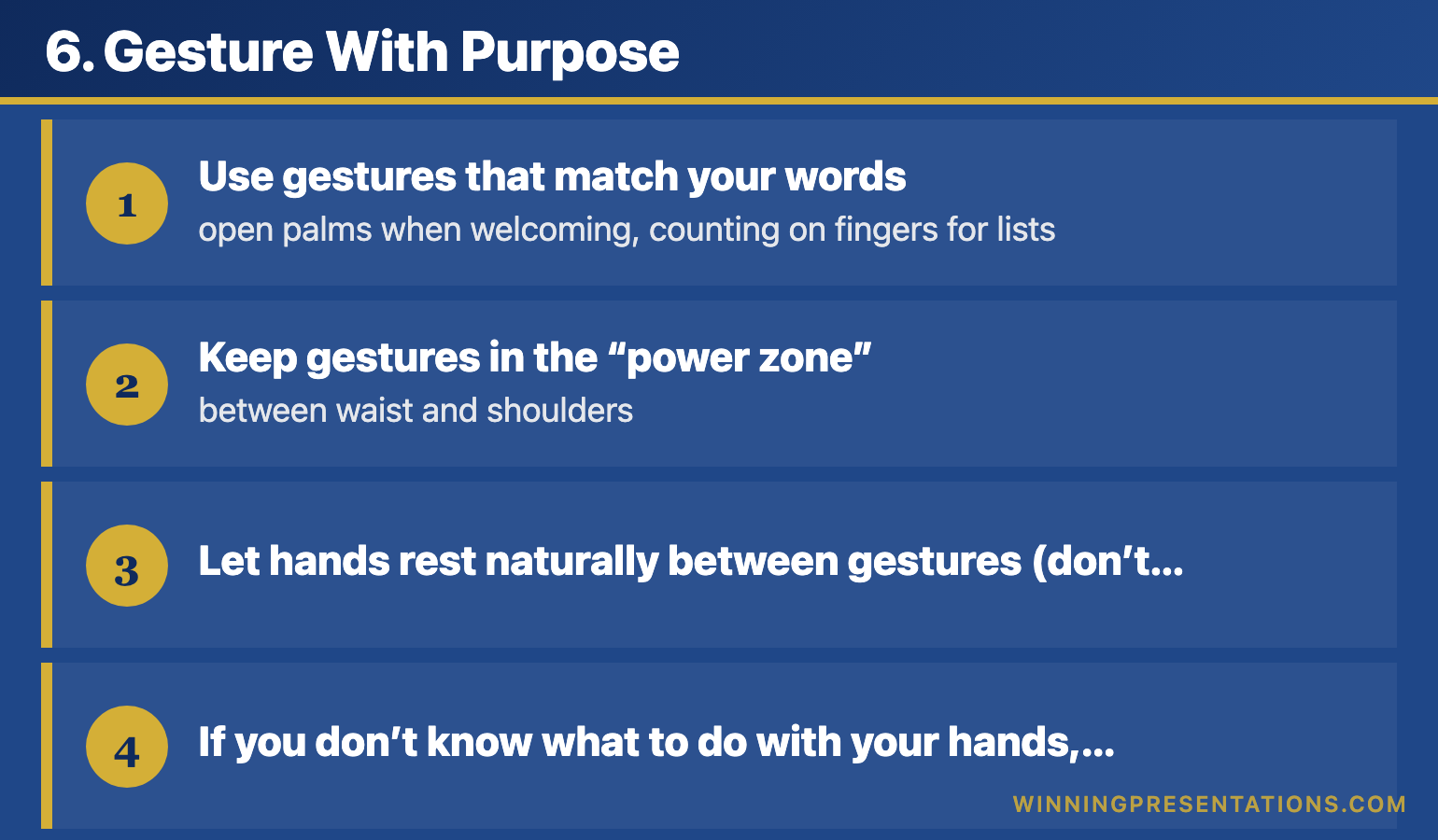
- Use gestures that match your words — open palms when welcoming, counting on fingers for lists
- Keep gestures in the “power zone” — between waist and shoulders
- Let hands rest naturally between gestures (don’t wring them)
- If you don’t know what to do with your hands, hold a clicker or pen
Purposeful gestures don’t just look confident — they help you think. Research shows that gesturing while speaking actually improves verbal fluency.
Related: Presentation Confidence: How to Build It (Not Fake It)
7. Recover From Mistakes Without Apologising
Every presenter makes mistakes. The difference between looking confident and looking nervous is how you handle them.
Nervous presenters apologise profusely, call attention to errors, or freeze up. Confident presenters recover smoothly and move on.
How to look confident instead:
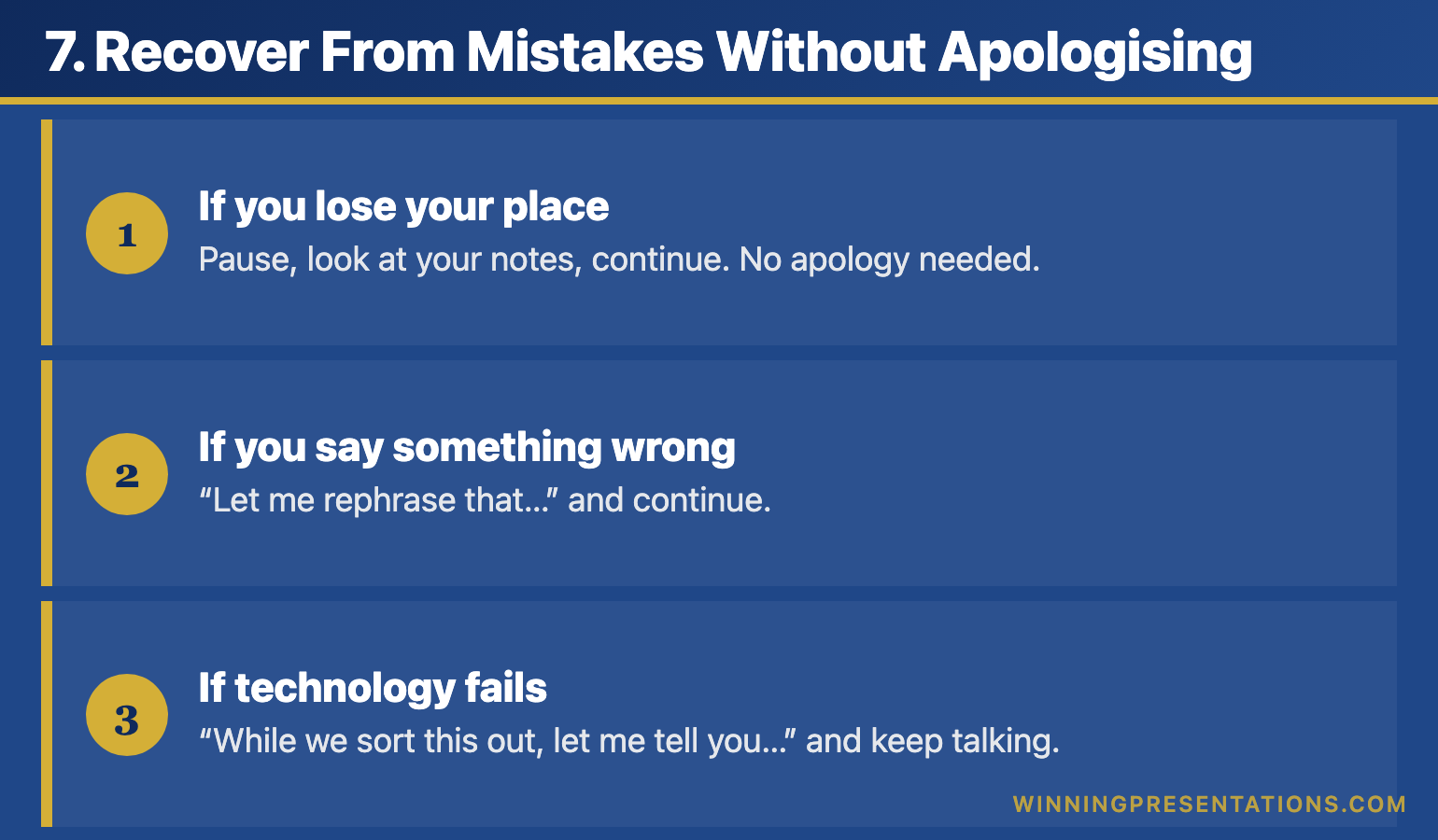
- If you lose your place: Pause, look at your notes, continue. No apology needed.
- If you say something wrong: “Let me rephrase that…” and continue.
- If technology fails: “While we sort this out, let me tell you…” and keep talking.
Pre-plan your recovery phrases. When you know you can handle anything, you look confident because you genuinely feel in control.
Related: How to Start a Presentation: 15 Powerful Opening Techniques
Why Looking Confident Leads to Feeling Confident
There’s a psychological principle at work here: behaviour shapes emotion, not just the reverse.
When you adopt confident body language, your brain receives signals that you’re safe. Your nervous system calms down. And over time, the feeling of confidence follows the appearance of confidence.
I discovered this accidentally in my first five years of banking. By forcing myself to look confident when presenting, I gradually became more confident. The techniques became automatic. The anxiety faded.
You don’t have to wait to feel confident before presenting well. You can look confident now — and let the feeling catch up later.
Consistent Composure. Every Presentation.
Conquer Speaking Fear (£39, instant access) builds composure that holds — across different audiences, stakes, and settings. Structured techniques, not confidence tips.
Get Conquer Speaking Fear → £39
Designed for experienced professionals who present regularly under pressure.
Frequently Asked Questions
How do I look confident when my hands are shaking?
Hold something — a clicker, a pen, or your notes. This gives the shaking somewhere to go without being visible. Also, the shaking usually subsides within 60-90 seconds of starting. If you can get through your opening, your body will calm down.
What if I can’t make eye contact without feeling more nervous?
Look at foreheads instead of eyes — the audience can’t tell the difference. Or focus on the friendly faces only. You don’t need to make eye contact with everyone, just enough people to create connection.
How do I slow down when my instinct is to rush?
Memorise your first three sentences word-for-word and practice them at half speed. When you start slowly, you’re more likely to maintain that pace. Also, build in deliberate pauses — after your opening, after key points, before your conclusion.
Does “fake confidence” actually work?
It’s not about faking — it’s about doing what confident presenters do. The behaviours (grounding, eye contact, pauses, open posture) are real skills you’re building. Over time, the feeling follows the behaviour. You’re not pretending; you’re practising.
Your Next Step
Pick one technique from this list and use it in your next presentation:
- Plant your feet — the easiest to implement immediately
- Slow your first three sentences — sets the tone for everything that follows
- Replace filler words with pauses — makes the biggest visible difference
Master one technique before adding another. Within a few presentations, you’ll look confident without thinking about it.
Go deeper: Presentation Confidence: How to Build It (And Why “Fake It Till You Make It” Doesn’t Work) — the complete guide to building lasting confidence.
Mary Beth Hazeldine is a qualified clinical hypnotherapist and Owner & Managing Director of Winning Presentations. After spending her first five years in banking terrified of presenting, she learned to look confident before she felt confident — and went on to present successfully for 19 more years at JPMorgan, PwC, RBS, and Commerzbank. She has since advised executives across financial services, healthcare, technology, and government.
The Winning Edge Newsletter
Weekly techniques for executives who present under pressure. Evidence-based, practical, no fluff.
Not ready for the full system? Start here: download the free 7 Presentation Frameworks — practical structures for any presentation scenario.