Category: Public Speaking Confidence

28 Jan 2026
I Used to Repeat Myself Three Times in Every Meeting. Then I Learned This. How to Project Your Voice Without Shouting (The Technique Most People Get Wrong) "Sorry, could you say that again?" I heard those words in every meeting for the first three years of my banking career. I'd make a point. Silence. Someone would lean in. I'd repeat myself — louder this time, voice straining. By the third repetition, whatever authority I had was gone. The advice I got? "Just speak up." "Be more confident." "Project from your diaphragm." None of it worked. Because how to project your voice has almost nothing to do with volume — and everything to do with where the sound actually comes from. Quick Answer: Voice projection isn't about speaking louder — it's about resonance. When you breathe from your diaphragm (not your chest), relax your throat, and direct sound forward, your voice carries naturally without strain. Most quiet speakers are chest-breathing and tensing their throat, which traps sound. Fix the breathing, and the voice follows. 🎤 Need to Be Heard in a Meeting Today? Try This 30-Second Reset: Before you speak: Take one slow breath into your belly (not chest) — feel your stomach expand Drop your shoulders — tension rises to throat when shoulders are tight Speak on the exhale — let the breath carry the sound out Aim your voice at the back wall — not at the person nearest you This isn't about being louder. It's about letting your natural voice come through instead of trapping it. In This Article: Why Your Voice Doesn't Carry (It's Not What You Think) The Difference Between Volume and Resonance The 3 Physical Shifts That Change Everything The Anxiety Connection Most People Miss Voice Projection on Zoom and Teams FAQ Why Your Voice Doesn't Carry (It's Not What You Think) The turning point came during a presentation skills workshop — not a voice training course. The facilitator watched me present for 60 seconds, then stopped me. "You're breathing into your chest," she said. "Your shoulders are up by your ears. Your throat is tight. No wonder your voice doesn't carry — you're strangling it before it leaves your mouth." She was right. Every time I got nervous (which was constantly), my body did three things automatically: Shallow chest breathing (less air = less power) Shoulders rising toward ears (tension travels up) Throat tightening (voice gets thin and trapped) I wasn't speaking quietly because I was timid. I was speaking quietly because anxiety was physically constricting my voice. The fix wasn't "speak louder." It was learning to release the tension so my natural voice could come through. The Difference Between Volume and Resonance Here's the distinction that changed everything for me: Volume is how loud the sound is at the source — pushing more air, straining your vocal cords. Resonance is how the sound vibrates and carries — using your chest, throat, and head as amplifiers. When you try to "speak up" by increasing volume, you strain. Your voice sounds forced. You tire quickly. And paradoxically, a strained voice often carries less well than a relaxed one. When you speak with resonance, your voice fills the room naturally. You don't feel like you're shouting. Listeners don't feel like they're being shouted at. The sound just... arrives. Think of the difference between a speaker who sounds effortlessly authoritative versus one who sounds like they're trying too hard. That's resonance versus volume. How can I project my voice without yelling? Project your voice by focusing on resonance, not volume. Breathe from your diaphragm (belly expands, not chest), relax your throat and jaw, and direct sound forward as if speaking to someone at the back of the room. This creates natural carrying power without strain. Yelling pushes air harder; projection uses your body as an amplifier. ⭐ Voice Problems Often Start With Anxiety If your voice gets quiet, tight, or shaky when you're nervous, the fix isn't vocal exercises — it's addressing what's causing the tension in the first place. Conquer Speaking Fear gives you the complete system for rewiring your nervous system response to speaking situations. What's inside: The "Calm Command" protocol for pre-presentation anxiety Breathing techniques that release throat tension (not just "breathe deep") How to reset your nervous system in 60 seconds The mental rehearsal method that builds lasting confidence Get Conquer Speaking Fear → £39 Created by a qualified clinical hypnotherapist who spent 5 years terrified of presenting. Instant download. The 3 Physical Shifts That Change Everything Voice projection comes down to three physical changes. Get these right, and your voice carries naturally: Shift #1: Diaphragmatic Breathing Most people breathe into their chest — especially when nervous. Chest breathing is shallow and gives you less air to work with. Your voice runs out of fuel mid-sentence. Diaphragmatic breathing means breathing into your belly. When you inhale, your stomach should expand outward. Your chest and shoulders stay relatively still. Try this now: Place one hand on your chest, one on your belly. Breathe in slowly. Which hand moves first? If it's your chest, you're chest-breathing. To fix it: Exhale completely first. Then let the inhale happen naturally — it will go deeper. Practice until belly-first breathing becomes automatic. For a deeper dive on breathing for presentations, see our guide to presentation breathing techniques. Shift #2: Release Throat Tension When you're nervous, your throat tightens. It's a primitive protective response — the body preparing for threat. But a tight throat traps sound and makes your voice thin and strained. To release throat tension: Yawn (seriously) — this opens the throat naturally Hum gently for 10 seconds — you should feel vibration in your chest Drop your jaw slightly — most people clench without realising Relax your tongue — let it rest at the bottom of your mouth Before important meetings, I still do a few gentle hums in private. It's the fastest way to open up the vocal pathway. Shift #3: Direct Sound Forward Many quiet speakers direct their voice downward — toward their notes, their laptop, the table. Sound goes where you send it. Instead, imagine you're speaking to someone at the back of the room. Not shouting at them — just including them in the conversation. Your voice will naturally carry further without strain. In a meeting room, pick a point on the far wall and speak toward it. On Zoom, speak toward your camera as if the listener is sitting a few meters behind your screen. Why is my voice so quiet when I speak? A quiet voice usually comes from one of three causes: shallow chest breathing (not enough air), throat tension (voice gets trapped), or directing sound downward instead of outward. All three are often triggered by nervousness. When you're anxious, your body tenses up — and a tense body produces a thin, quiet voice. Address the physical tension, and your natural voice volume returns. Nervous tension killing your voice? Fix the root cause. Get Conquer Speaking Fear → £39 The Anxiety Connection Most People Miss Here's what vocal coaches rarely tell you: for most professionals, voice projection problems are anxiety problems in disguise. When your nervous system perceives threat (and yes, a boardroom full of executives counts), it triggers a cascade of physical responses: Breathing becomes shallow and rapid Muscles tense — including throat, jaw, and shoulders Blood flow shifts away from non-essential functions Fine motor control decreases Your quiet, shaky voice isn't a skill problem. It's your body's threat response showing up in your vocal cords. This is why "just speak up" doesn't work. You can't willpower your way past a nervous system response. You have to work with your body, not against it. The most effective approach combines the physical techniques (breathing, throat release, direction) with methods that calm the underlying anxiety response. When you're not fighting your nervous system, your voice has room to come through. If your voice also shakes when you're nervous, see our specific guide on voice shaking when speaking. ⭐ Stop Fighting Your Nervous System Conquer Speaking Fear teaches you to work with your body's response instead of against it — so your voice comes through naturally, without strain or force. The system includes: Pre-presentation protocols that calm your nervous system In-the-moment resets when anxiety spikes Long-term rewiring techniques for lasting change The hypnotherapist's approach to speaking confidence Get Conquer Speaking Fear → £39 The same techniques I use with private clients. Instant digital download. Voice Projection on Zoom and Teams Virtual meetings add a layer of complexity. Your microphone captures sound differently than human ears in a room. Here's how to adapt: Microphone positioning matters more than volume Speaking louder into a badly positioned mic just creates distortion. Position your microphone 6-8 inches from your mouth, slightly below chin level. Let the mic do the amplification work. Test your levels before important calls Both Zoom and Teams have audio testing features. Use them. Many "quiet" speakers on calls simply have their input levels set too low. Speak toward the camera, not the screen Just like directing sound to the back of a room, speak toward your camera. This creates better mic pickup and — as a bonus — better eye contact with viewers. The resonance principles still apply Diaphragmatic breathing, throat release, and forward direction all improve your virtual presence. A resonant voice sounds more authoritative through speakers, not less. For complete guidance on virtual presence, see our guide to looking confident when presenting. How do speakers project their voice? Professional speakers project their voice through three techniques: diaphragmatic breathing (breathing into the belly for more air support), releasing throat and jaw tension (so sound isn't trapped), and directing their voice outward toward the back of the room. This creates resonance — natural carrying power — rather than strained volume. Most also manage their anxiety, since nervousness causes the physical tension that kills projection. Ready to speak with natural authority? Get Conquer Speaking Fear → £39 The Practice Routine That Builds Lasting Change These techniques work immediately, but lasting change requires practice. Here's the 5-minute daily routine I recommend: Morning (2 minutes): 10 belly breaths (hand on stomach, feel it expand) 30 seconds of gentle humming (feel chest vibration) Speak one sentence out loud, directing voice across the room Before any meeting (30 seconds): One slow belly breath Drop shoulders Quick throat release (small yawn or hum) First words aimed at far wall/back of camera Within 2-3 weeks of consistent practice, the new patterns start to become automatic. Within 2-3 months, they're your default. ⭐ The Complete System for Speaking Confidence Voice projection is one piece. Conquer Speaking Fear gives you the complete system — from managing pre-presentation nerves to rewiring your long-term relationship with speaking situations. Everything included: The "Calm Command" pre-presentation protocol Breathing and body techniques that release tension In-the-moment anxiety resets Mental rehearsal methods for lasting confidence The hypnotherapist's approach to fear rewiring Get Conquer Speaking Fear → £39 Instant download. Created from clinical hypnotherapy training and 24 years of corporate experience. Frequently Asked Questions Will this work if my voice is naturally soft? Yes. "Naturally soft" voices are almost always under-projected voices — not permanently quiet voices. When you breathe properly and release tension, even traditionally soft voices carry well. You're not trying to sound like a drill sergeant; you're trying to let your natural voice come through without restriction. Most people are surprised by how much presence their voice has when it's not being strangled by tension. Does voice projection work on Zoom and Teams? Absolutely — and it might matter even more virtually. Microphones don't compensate for mumbling or trailing off the way human listeners sometimes do. The resonance techniques (diaphragmatic breathing, open throat, forward direction) all translate to virtual settings. Pair them with proper mic positioning and input levels for best results. How long does it take to see results? The 30-second reset technique works immediately — try it in your next meeting. Building lasting change takes longer: 2-3 weeks of daily practice to start feeling natural, 2-3 months to become your default. The key is consistency. Five minutes of daily practice beats an hour once a week. What if my voice still shakes when I'm nervous? Voice shaking is a specific anxiety symptom that requires targeted techniques. The diaphragmatic breathing helps, but if shaking persists, you likely need to address the underlying nervous system response more directly. That's where the anxiety-management components of Conquer Speaking Fear come in — it's designed specifically for professionals whose physical symptoms don't respond to "just relax" advice. Get Weekly Speaking Confidence Insights Techniques for projecting presence, managing nerves, and speaking with authority — from a clinical hypnotherapist with 24 years in corporate banking. Subscribe to The Winning Edge → 📋 Free Resource: 7 Presentation Frameworks Structure your next presentation with proven frameworks — so you can focus on delivery instead of figuring out what comes next. Download Free Frameworks → Your Next Step The next time you need to speak up in a meeting: Take one belly breath before you start Drop your shoulders Aim your voice at the back wall You'll feel the difference immediately. And so will everyone in the room. P.S. Voice projection matters most in high-stakes situations. If you're presenting for approval, I wrote about the pre-meeting alignment strategy that gets decisions made before you even open your slides. P.P.S. If you're spending too long building presentations, check out how to cut presentation creation time without cutting quality — the system approach that saves hours every week. About Mary Beth Hazeldine Qualified clinical hypnotherapist, NLP practitioner, and Owner of Winning Presentations. I spent 5 years terrified of presenting — voice quiet, hands shaking, avoiding every speaking opportunity I could. Learning to project my voice was part of a larger journey that changed my career. Now I help professionals find their voice, literally and figuratively.

How to Project Your Voice Without Shouting (The Technique Most People Get Wrong)

“Sorry, could you say that again?”

I heard those words in every meeting for the first three years of my banking career. I’d make a point. Silence. Someone would lean in. I’d repeat myself — louder this time, voice straining. By the third repetition, whatever authority I had was gone.

The advice I got? “Just speak up.” “Be more confident.” “Project from your diaphragm.”

None of it worked. Because how to project your voice has almost nothing to do with volume — and everything to do with where the sound actually comes from.

Quick Answer: Voice projection isn’t about speaking louder — it’s about resonance. When you breathe from your diaphragm (not your chest), relax your throat, and direct sound forward, your voice carries naturally without strain. Most quiet speakers are chest-breathing and tensing their throat, which traps sound. Fix the breathing, and the voice follows.

🎤 Need to Be Heard in a Meeting Today? Try This 30-Second Reset:

  1. Before you speak: Take one slow breath into your belly (not chest) — feel your stomach expand
  2. Drop your shoulders — tension rises to throat when shoulders are tight
  3. Speak on the exhale — let the breath carry the sound out
  4. Aim your voice at the back wall — not at the person nearest you

This isn’t about being louder. It’s about letting your natural voice come through instead of trapping it.

Why Your Voice Doesn’t Carry (It’s Not What You Think)

The turning point came during a presentation skills workshop — not a voice training course.

The facilitator watched me present for 60 seconds, then stopped me. “You’re breathing into your chest,” she said. “Your shoulders are up by your ears. Your throat is tight. No wonder your voice doesn’t carry — you’re strangling it before it leaves your mouth.”

She was right. Every time I got nervous (which was constantly), my body did three things automatically:

  • Shallow chest breathing (less air = less power)
  • Shoulders rising toward ears (tension travels up)
  • Throat tightening (voice gets thin and trapped)

I wasn’t speaking quietly because I was timid. I was speaking quietly because anxiety was physically constricting my voice.

The fix wasn’t “speak louder.” It was learning to release the tension so my natural voice could come through.

The Difference Between Volume and Resonance

Here’s the distinction that changed everything for me:

Volume is how loud the sound is at the source — pushing more air, straining your vocal cords.

Resonance is how the sound vibrates and carries — using your chest, throat, and head as amplifiers.

When you try to “speak up” by increasing volume, you strain. Your voice sounds forced. You tire quickly. And paradoxically, a strained voice often carries less well than a relaxed one.

When you speak with resonance, your voice fills the room naturally. You don’t feel like you’re shouting. Listeners don’t feel like they’re being shouted at. The sound just… arrives.

Think of the difference between a speaker who sounds effortlessly authoritative versus one who sounds like they’re trying too hard. That’s resonance versus volume.

How can I project my voice without yelling?

Project your voice by focusing on resonance, not volume. Breathe from your diaphragm (belly expands, not chest), relax your throat and jaw, and direct sound forward as if speaking to someone at the back of the room. This creates natural carrying power without strain. Yelling pushes air harder; projection uses your body as an amplifier.
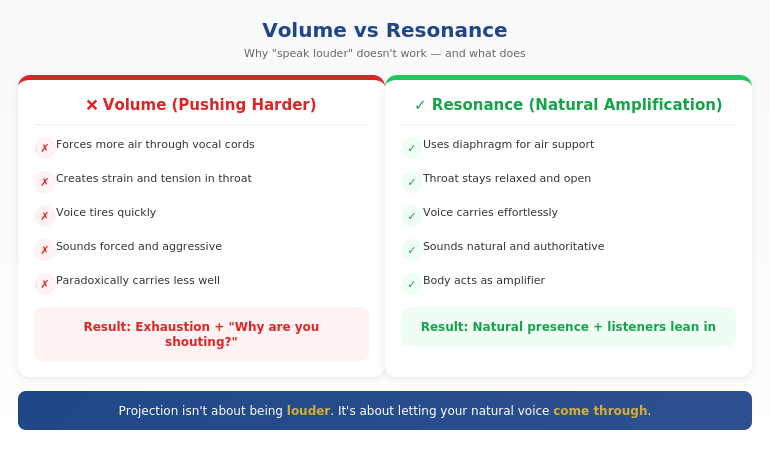
Diagram showing volume vs resonance: volume creates strain and thin sound, resonance creates natural carrying power using diaphragm breathing

⭐ Voice Problems Often Start With Anxiety

If your voice gets quiet, tight, or shaky when you’re nervous, the fix isn’t vocal exercises — it’s addressing what’s causing the tension in the first place. Conquer Speaking Fear gives you the complete system for rewiring your nervous system response to speaking situations.

What’s inside:

  • The “Calm Command” protocol for pre-presentation anxiety
  • Breathing techniques that release throat tension (not just “breathe deep”)
  • How to reset your nervous system in 60 seconds
  • The mental rehearsal method that builds lasting confidence

Get Conquer Speaking Fear → £39

Created by a qualified clinical hypnotherapist who spent 5 years terrified of presenting. Instant download.

The 3 Physical Shifts That Change Everything

Voice projection comes down to three physical changes. Get these right, and your voice carries naturally:

Shift #1: Diaphragmatic Breathing

Most people breathe into their chest — especially when nervous. Chest breathing is shallow and gives you less air to work with. Your voice runs out of fuel mid-sentence.

Diaphragmatic breathing means breathing into your belly. When you inhale, your stomach should expand outward. Your chest and shoulders stay relatively still.

Try this now: Place one hand on your chest, one on your belly. Breathe in slowly. Which hand moves first? If it’s your chest, you’re chest-breathing.

To fix it: Exhale completely first. Then let the inhale happen naturally — it will go deeper. Practice until belly-first breathing becomes automatic.

For a deeper dive on breathing for presentations, see our guide to presentation breathing techniques.

Shift #2: Release Throat Tension

When you’re nervous, your throat tightens. It’s a primitive protective response — the body preparing for threat. But a tight throat traps sound and makes your voice thin and strained.

To release throat tension:

  • Yawn (seriously) — this opens the throat naturally
  • Hum gently for 10 seconds — you should feel vibration in your chest
  • Drop your jaw slightly — most people clench without realising
  • Relax your tongue — let it rest at the bottom of your mouth

Before important meetings, I still do a few gentle hums in private. It’s the fastest way to open up the vocal pathway.

Shift #3: Direct Sound Forward

Many quiet speakers direct their voice downward — toward their notes, their laptop, the table. Sound goes where you send it.

Instead, imagine you’re speaking to someone at the back of the room. Not shouting at them — just including them in the conversation. Your voice will naturally carry further without strain.

In a meeting room, pick a point on the far wall and speak toward it. On Zoom, speak toward your camera as if the listener is sitting a few meters behind your screen.

Why is my voice so quiet when I speak?

A quiet voice usually comes from one of three causes: shallow chest breathing (not enough air), throat tension (voice gets trapped), or directing sound downward instead of outward. All three are often triggered by nervousness. When you’re anxious, your body tenses up — and a tense body produces a thin, quiet voice. Address the physical tension, and your natural voice volume returns.

Nervous tension killing your voice? Fix the root cause.

Get Conquer Speaking Fear → £39

The Anxiety Connection Most People Miss

Here’s what vocal coaches rarely tell you: for most professionals, voice projection problems are anxiety problems in disguise.

When your nervous system perceives threat (and yes, a boardroom full of executives counts), it triggers a cascade of physical responses:

  • Breathing becomes shallow and rapid
  • Muscles tense — including throat, jaw, and shoulders
  • Blood flow shifts away from non-essential functions
  • Fine motor control decreases

Your quiet, shaky voice isn’t a skill problem. It’s your body’s threat response showing up in your vocal cords.

This is why “just speak up” doesn’t work. You can’t willpower your way past a nervous system response. You have to work with your body, not against it.

The most effective approach combines the physical techniques (breathing, throat release, direction) with methods that calm the underlying anxiety response. When you’re not fighting your nervous system, your voice has room to come through.

If your voice also shakes when you’re nervous, see our specific guide on voice shaking when speaking.

The anxiety-voice connection: threat response triggers shallow breathing, throat tension, and muscle tightening, which creates thin quiet voice

⭐ Stop Fighting Your Nervous System

Conquer Speaking Fear teaches you to work with your body’s response instead of against it — so your voice comes through naturally, without strain or force.

The system includes:

  • Pre-presentation protocols that calm your nervous system
  • In-the-moment resets when anxiety spikes
  • Long-term rewiring techniques for lasting change
  • The hypnotherapist’s approach to speaking confidence

Get Conquer Speaking Fear → £39

The same techniques I use with private clients. Instant digital download.

Voice Projection on Zoom and Teams

Virtual meetings add a layer of complexity. Your microphone captures sound differently than human ears in a room. Here’s how to adapt:

Microphone positioning matters more than volume

Speaking louder into a badly positioned mic just creates distortion. Position your microphone 6-8 inches from your mouth, slightly below chin level. Let the mic do the amplification work.

Test your levels before important calls

Both Zoom and Teams have audio testing features. Use them. Many “quiet” speakers on calls simply have their input levels set too low.

Speak toward the camera, not the screen

Just like directing sound to the back of a room, speak toward your camera. This creates better mic pickup and — as a bonus — better eye contact with viewers.

The resonance principles still apply

Diaphragmatic breathing, throat release, and forward direction all improve your virtual presence. A resonant voice sounds more authoritative through speakers, not less.

For complete guidance on virtual presence, see our guide to looking confident when presenting.

How do speakers project their voice?

Professional speakers project their voice through three techniques: diaphragmatic breathing (breathing into the belly for more air support), releasing throat and jaw tension (so sound isn’t trapped), and directing their voice outward toward the back of the room. This creates resonance — natural carrying power — rather than strained volume. Most also manage their anxiety, since nervousness causes the physical tension that kills projection.

Ready to speak with natural authority?

Get Conquer Speaking Fear → £39

The Practice Routine That Builds Lasting Change

These techniques work immediately, but lasting change requires practice. Here’s the 5-minute daily routine I recommend:

Morning (2 minutes):

  • 10 belly breaths (hand on stomach, feel it expand)
  • 30 seconds of gentle humming (feel chest vibration)
  • Speak one sentence out loud, directing voice across the room

Before any meeting (30 seconds):

  • One slow belly breath
  • Drop shoulders
  • Quick throat release (small yawn or hum)
  • First words aimed at far wall/back of camera

Within 2-3 weeks of consistent practice, the new patterns start to become automatic. Within 2-3 months, they’re your default.

⭐ The Complete System for Speaking Confidence

Voice projection is one piece. Conquer Speaking Fear gives you the complete system — from managing pre-presentation nerves to rewiring your long-term relationship with speaking situations.

Everything included:

  • The “Calm Command” pre-presentation protocol
  • Breathing and body techniques that release tension
  • In-the-moment anxiety resets
  • Mental rehearsal methods for lasting confidence
  • The hypnotherapist’s approach to fear rewiring

Get Conquer Speaking Fear → £39

Instant download. Created from clinical hypnotherapy training and 24 years of corporate experience.

Frequently Asked Questions

Will this work if my voice is naturally soft?

Yes. “Naturally soft” voices are almost always under-projected voices — not permanently quiet voices. When you breathe properly and release tension, even traditionally soft voices carry well. You’re not trying to sound like a drill sergeant; you’re trying to let your natural voice come through without restriction. Most people are surprised by how much presence their voice has when it’s not being strangled by tension.

Does voice projection work on Zoom and Teams?

Absolutely — and it might matter even more virtually. Microphones don’t compensate for mumbling or trailing off the way human listeners sometimes do. The resonance techniques (diaphragmatic breathing, open throat, forward direction) all translate to virtual settings. Pair them with proper mic positioning and input levels for best results.

How long does it take to see results?

The 30-second reset technique works immediately — try it in your next meeting. Building lasting change takes longer: 2-3 weeks of daily practice to start feeling natural, 2-3 months to become your default. The key is consistency. Five minutes of daily practice beats an hour once a week.

What if my voice still shakes when I’m nervous?

Voice shaking is a specific anxiety symptom that requires targeted techniques. The diaphragmatic breathing helps, but if shaking persists, you likely need to address the underlying nervous system response more directly. That’s where the anxiety-management components of Conquer Speaking Fear come in — it’s designed specifically for professionals whose physical symptoms don’t respond to “just relax” advice.

Get Weekly Speaking Confidence Insights

Techniques for projecting presence, managing nerves, and speaking with authority — from a clinical hypnotherapist with 24 years in corporate banking.

Subscribe to The Winning Edge →

📋 Free Resource: 7 Presentation Frameworks

Structure your next presentation with proven frameworks — so you can focus on delivery instead of figuring out what comes next.

Download Free Frameworks →

Your Next Step

The next time you need to speak up in a meeting:

  1. Take one belly breath before you start
  2. Drop your shoulders
  3. Aim your voice at the back wall

You’ll feel the difference immediately. And so will everyone in the room.

P.S. Voice projection matters most in high-stakes situations. If you’re presenting for approval, I wrote about the pre-meeting alignment strategy that gets decisions made before you even open your slides.

P.P.S. If you’re spending too long building presentations, check out how to cut presentation creation time without cutting quality — the system approach that saves hours every week.

About Mary Beth Hazeldine
Qualified clinical hypnotherapist, NLP practitioner, and Owner of Winning Presentations. I spent 5 years terrified of presenting — voice quiet, hands shaking, avoiding every speaking opportunity I could. Learning to project my voice was part of a larger journey that changed my career. Now I help professionals find their voice, literally and figuratively.

23 Jan 2026
Woman with a slight smile and eyes closed thinking "I found what works."

Sweating During Presentations? The 60-Second Reset That Stopped Mine Cold

I watched the dark patches spread across my shirt in real-time. Thirty executives were watching me present—and watching me visibly fall apart.

Quick answer: Sweating during presentations is your sympathetic nervous system responding to perceived threat. The harder you try to stop it, the worse it gets—because fighting the response adds more stress to an already activated system. The technique that works: a 60-second parasympathetic reset that calms your nervous system from the inside out, stopping the sweat response before it becomes visible.

In practice, stopping presentation sweating means working WITH your nervous system rather than against it—using specific breathing patterns, grounding techniques, and pre-presentation protocols that prevent the cascade before it starts.

Written by Mary Beth Hazeldine — executive presentation coach, trained clinical hypnotherapist, 24 years corporate banking experience. Last updated: January 2026.

🚨 Presenting TODAY? The 2-minute emergency protocol:

  1. Bathroom reset: Run cold water on your wrists for 30 seconds + 3 slow exhales
  2. Temperature drop: Remove jacket until right before you present; stay in cooler areas
  3. First 30 seconds script: Memorize your opening line so you don’t have to think while nervous
  4. Anchor object: Hold a pen or clicker—gives your hands something to do and hides any trembling

This won’t eliminate the response, but it will reduce visible symptoms enough to get through. For lasting change, use the full protocol below.

📅 Presenting in the next 7 days? Do this now:

  1. 10 minutes before: Find a private space and do the 4-7-8 breath (inhale 4, hold 7, exhale 8) three times
  2. 5 minutes before: Press your feet firmly into the floor and notice 3 things you can see
  3. Right before you stand: Exhale completely, then take one slow breath
  4. If sweating starts: Slow your speech, press your feet down, and let the wave pass (60 seconds)

This works because it activates your parasympathetic nervous system—the “rest and digest” mode that naturally reduces sweating.

After my shirt incident, I spent three years learning everything I could about the nervous system and presentation anxiety. What I discovered changed everything—and it had nothing to do with “confidence tips” or “just relaxing.”

The executives who don’t visibly sweat aren’t less nervous. They’ve learned to work with their nervous system instead of against it.

If sweating during presentations has ever made you dread speaking up, this article gives you the exact technique that finally worked for me—and the hundreds of executives I’ve taught since.

Why You Sweat During Presentations (It’s Not What You Think)

Here’s what’s actually happening when you start sweating during presentations:

Your brain detects a threat. Not a physical threat—a social one. The possibility of judgement, embarrassment, or failure. To your ancient nervous system, social rejection was genuinely dangerous. So it responds the same way it would to a predator.

Your sympathetic nervous system activates. Adrenaline floods your system. Your heart rate increases. Blood flow shifts to your muscles (preparing you to run). And your body starts cooling itself down—because it thinks you’re about to need to sprint.

That’s why you sweat. Your body is preparing for physical exertion that never comes.

I see this pattern constantly: high-performing executives who are calm in genuinely high-stakes situations—negotiations, crises, difficult conversations—but who visibly sweat the moment they have to present to a group. It’s not about competence or confidence. It’s about how your nervous system has learned to respond to this specific trigger.

A finance director named Sarah told me: “I can face a hostile CFO in a one-on-one meeting without breaking a sweat. But put me in front of a group with a PowerPoint, and I’m drenched within five minutes. It makes no sense.”

It makes perfect sense—once you understand it’s not a character flaw. It’s a nervous system pattern. And patterns can be changed.

Why “Just Relax” Makes Sweating Worse

The worst advice anyone can give someone who sweats during presentations: “Just relax.”

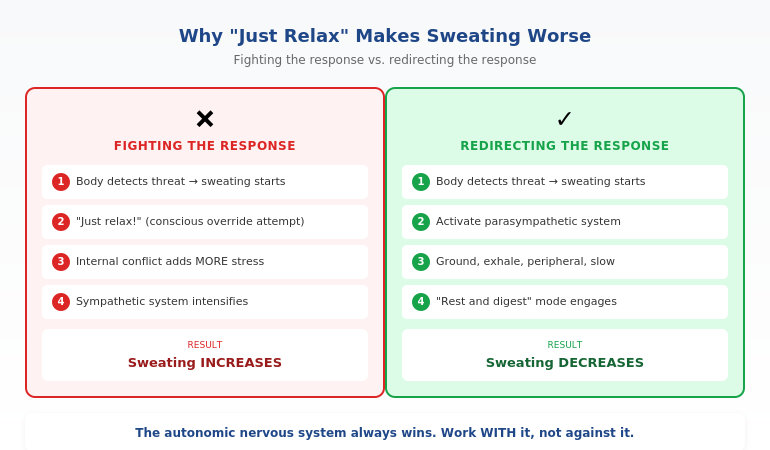
Here’s why this backfires: trying to relax when your sympathetic nervous system is activated creates internal conflict. Part of you is saying “danger!” while another part is saying “stop reacting to danger!” This conflict adds more stress to an already stressed system.

The result? You sweat more.

A client named James described it perfectly: “I’d be standing there telling myself to calm down, and I could feel myself getting hotter. The harder I tried to relax, the worse it got. It was like my body was fighting itself.”

That’s exactly what was happening. His conscious mind was trying to override his autonomic nervous system—and the autonomic system always wins that fight.

The solution isn’t to fight the response. It’s to redirect it.

Diagram showing why fighting the sweat response makes it worse - the sympathetic vs parasympathetic nervous system during presentations

⭐ Stop the Sweat Response Before It Starts

Calm Under Pressure gives you the complete nervous system toolkit—the exact techniques that stop visible sweating by working WITH your biology, not against it.

What’s inside:

  • The 60-second parasympathetic reset (works mid-presentation)
  • Pre-presentation protocol (prevents activation entirely)
  • Emergency recovery techniques (when sweating has already started)

Get Calm Under Pressure → £19.99

Built from clinical hypnotherapy training + 24 years coaching executives through high-stakes moments.

Instant download • Use it today • Keep forever

📦 What You Get (Specifically):

  • The complete 60-second reset — step-by-step technique you can use invisibly during presentations
  • Pre-presentation protocol — the 10-minute sequence that prevents nervous system activation
  • Emergency recovery guide — what to do when sweating has already started
  • The science explained simply — understand why these techniques work (so you trust them)
  • Quick-reference cards — pocket-sized reminders for before you present

📌 What Calm Under Pressure gives you that this article can’t:

  • The complete guided walkthrough — not just what to do, but exactly how to do it with timing cues
  • The layered protocol — techniques that build on each other for cumulative nervous system retraining
  • The emergency recovery scripts — word-for-word phrases for when sweating starts mid-presentation

This article gives you the method. The product gives you the repeatable system you can use in 7 minutes.

The 60-Second Parasympathetic Reset

This is the technique that finally stopped my visible sweating during presentations. It works because it activates your parasympathetic nervous system—the “rest and digest” mode that naturally opposes the stress response.

You can do this invisibly, even while presenting.

Step 1: Ground Your Feet (5 seconds)

Press your feet firmly into the floor. Feel the pressure. This activates sensory pathways that signal “safety” to your nervous system. You’re not running. You’re grounded.

Step 2: Extended Exhale (15 seconds)

Take a breath in through your nose (4 counts). Then exhale slowly through your mouth (8 counts). The extended exhale is the key—it directly stimulates the vagus nerve, which activates parasympathetic response.

One breath with this ratio can begin shifting your nervous system state.

Step 3: Peripheral Vision (20 seconds)

Without moving your head, expand your awareness to the edges of your vision. Notice what’s in your peripheral field. This is counterintuitive, but it works: peripheral vision activates a different neural pathway than focused vision—one associated with calm alertness rather than threat detection.

Step 4: Slow Your Speech (20 seconds)

Deliberately slow down your words. Pause between sentences. This creates a feedback loop: slow speech signals to your nervous system that there’s no emergency, which reduces activation, which makes it easier to speak slowly.

A product director named Michael told me this was the breakthrough: “I always rushed when I was nervous, which made me more nervous. When I forced myself to slow down—even though it felt uncomfortable—my body actually calmed down. It was like I was telling my nervous system ‘we’re safe’ through my behavior.”

The entire sequence takes 60 seconds. And the sweat response begins to subside.

For more on breathing techniques, see the complete guide to presentation breathing.

Want the complete 60-second reset with guided walkthrough? Calm Under Pressure includes the full technique plus audio guidance you can use before any presentation. Get the Full Technique → £19.99

Instant download • Use it today • Keep forever

The Pre-Presentation Protocol (Prevent Before It Starts)

The best way to stop sweating during presentations is to prevent the nervous system cascade from starting in the first place. This requires a specific pre-presentation protocol—not “psych yourself up” motivation, but deliberate nervous system preparation.

Here’s the protocol I use with executives:

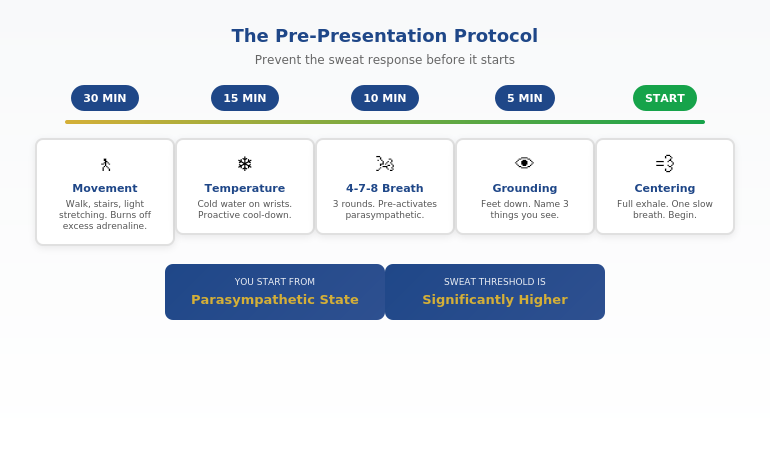
30 Minutes Before: Movement

Get your body moving. Walk briskly. Take stairs. Do some light stretching in a private space. This burns off excess adrenaline before you need to stand still and present.

A VP of sales named Rebecca told me: “I used to sit and review my notes obsessively before presenting. Now I walk the hallway. It sounds too simple, but the difference is dramatic.”

15 Minutes Before: Temperature Management

Cool down proactively. Splash cold water on your wrists. If possible, stand somewhere cooler than the presentation room. Your body sweats to cool down—if you’re already cool, the threshold is higher.

10 Minutes Before: The 4-7-8 Sequence

Find a private space. Do three rounds of 4-7-8 breathing: inhale for 4 counts, hold for 7, exhale for 8. This pre-activates your parasympathetic system so you start from a calmer baseline.

5 Minutes Before: Grounding + Observation

Press your feet into the floor. Look around the room and name (silently) three things you can see. This anchors you in the present moment rather than future catastrophizing.

Right Before You Start: The Centering Breath

Exhale completely. Then take one slow, full breath. Begin speaking on the exhale of that breath. This ensures you start from a parasympathetic state rather than a sympathetic one.

Related: See how to calm nerves before a presentation for additional pre-presentation techniques.

The pre-presentation protocol timeline showing when to do each nervous system technique before presenting

⭐ If You Sweat Even When You’re Fully Prepared

That’s the most frustrating part—you know your content, but your body doesn’t get the memo. Calm Under Pressure works on the nervous system level, not the “confidence” level.

Specifically designed for:

  • Executives who sweat despite thorough preparation
  • Presenters whose sweating is paired with racing heart or shaky voice
  • Professionals who’ve tried “just relaxing” and made it worse

Get Calm Under Pressure → £19.99

Works because it targets the autonomic nervous system—not your mindset.

Instant download • Use it today • Keep forever

What to Do If Sweating Starts Mid-Presentation

Sometimes, despite preparation, the sweat starts. Here’s how to handle it without making things worse.

Don’t Acknowledge It

The instinct is to apologize or call attention to it. “Sorry, it’s warm in here.” Resist this. Drawing attention to sweating increases your self-consciousness, which increases sympathetic activation, which increases sweating.

Most people notice sweating far less than you think. And if they do notice, they’ll forget within minutes—unless you make it memorable by talking about it.

Use the 60-Second Reset (Invisibly)

Press your feet down. Take a slow breath with an extended exhale. Expand your peripheral vision. Slow your speech. You can do all of this while continuing to present—no one will notice.

Take a Strategic Pause

Ask a question. “Before I continue, does anyone have questions about what I’ve covered so far?” This gives you 30-60 seconds where attention is on the audience, not you. Use that time to do the reset.

A marketing director named David told me this saved him in a board presentation: “I could feel the sweat starting. Instead of powering through, I asked a question. While they were thinking, I did the grounding and breathing. By the time I continued, the wave had passed.”

Let the Wave Pass

Here’s the most important thing to understand: the acute sweat response lasts about 60-90 seconds. If you can ride through that window without adding more stress (by fighting it or catastrophizing), the intensity naturally decreases.

Your job isn’t to stop the wave. It’s to not make the wave bigger. The techniques above help you do that.

If you’re also dealing with other physical symptoms during high-stakes presentations, see what senior leaders actually do about high-stakes nerves.

Want the complete emergency recovery guide? Calm Under Pressure includes exactly what to do when sweating starts mid-presentation—plus techniques for other physical symptoms. Get Emergency Recovery Guide → £19.99

Instant download • Use it today • Keep forever

Frequently Asked Questions

Why do I sweat so much when presenting?

Sweating during presentations happens because your sympathetic nervous system detects social evaluation as a threat and triggers the stress response. Your body prepares for physical exertion (fight or flight) by cooling itself down—hence the sweating. This is a normal nervous system response, not a character flaw. The solution is learning to activate your parasympathetic system (the “rest and digest” mode) through specific techniques like grounding, extended exhales, and peripheral vision.

How do I stop nervous sweating when presenting?

To stop nervous sweating when presenting, use the 60-second parasympathetic reset: press your feet firmly into the floor (grounding), take a breath with an extended exhale (4 counts in, 8 counts out), expand your peripheral vision, and deliberately slow your speech. This activates your parasympathetic nervous system, which naturally opposes the sweat response. Prevention is even more effective—use the pre-presentation protocol starting 30 minutes before you speak.

Can you train yourself not to sweat when nervous?

Yes. Sweating when nervous is a learned nervous system pattern, and patterns can be retrained. With consistent practice of parasympathetic activation techniques—before, during, and after presentations—your nervous system learns that presenting isn’t actually dangerous. Most executives I work with see significant improvement within 4-6 presentations using the pre-presentation protocol and 60-second reset consistently.

Does everyone notice when I’m sweating during a presentation?

Far less than you think. When you’re sweating, your attention is hyperfocused on the sensation—which makes it feel enormous. But audiences are focused on your content, not your forehead. Unless you draw attention to it (“Sorry, it’s so hot in here”), most people won’t notice or remember. And even if they notice, they’ll attribute it to the room being warm, not to you being nervous.

What if I start sweating before I even begin speaking?

This is anticipatory anxiety, and the pre-presentation protocol is specifically designed for it. Start the protocol 30 minutes before: movement, temperature management, 4-7-8 breathing, grounding. If sweating starts despite this, use the 60-second reset before you begin. You can do this while waiting to be introduced—press feet down, extended exhale, peripheral vision. Start speaking only after one centering breath.

Are there clothes that help hide presentation sweating?

Yes—but this should be backup, not primary strategy. Dark colors (navy, black, charcoal) hide sweat marks better than light colors. Natural fabrics (cotton, wool) breathe better than synthetics. Layering with a jacket gives you coverage. But more important than clothing is the nervous system work—the techniques in this article will reduce sweating at the source, not just hide it.

Should I tell the audience I’m nervous?

Generally, no. While vulnerability can build connection, drawing attention to sweating often backfires—it increases your self-consciousness and primes the audience to watch for signs of nervousness. A better approach: acknowledge nothing, use the 60-second reset, and let the wave pass. If someone directly asks if you’re okay, a simple “I’m good, thanks” is sufficient.

Is This Right For You?

✓ This is for you if:

  • You experience visible sweating when presenting (even when prepared)
  • You’ve tried “just relaxing” and it made things worse
  • You want techniques that work WITH your nervous system
  • You’re willing to practice the protocol consistently

✗ This is NOT for you if:

  • You have a medical condition causing excessive sweating (see a doctor first)
  • You’re looking for a pill or quick fix
  • You’re not willing to practice techniques before presentations
  • You want generic “confidence tips”

⭐ The Technique That Finally Stopped My Visible Sweating

After my shirt incident in front of 30 executives, I spent three years learning the nervous system. Calm Under Pressure is everything that actually worked—distilled into techniques you can use before your next presentation.

What you’ll use immediately:

  • 60-second parasympathetic reset
  • Pre-presentation protocol (30-minute countdown)
  • Emergency recovery techniques

Get Calm Under Pressure → £19.99

Built from clinical hypnotherapy training + 24 years coaching executives through visible anxiety.

Instant download • Use it today • Keep forever

📧 The Winning Edge Newsletter

Weekly techniques for presentation confidence, nervous system management, and the psychology of high-stakes speaking. For professionals who want to present without visible anxiety.

Subscribe Free →

Your Next Step

If sweating during presentations has made you dread speaking up, you now understand why—and more importantly, what to do about it.

The executives who present without visible sweating aren’t less nervous. They’ve learned to work with their nervous system instead of against it. Grounding. Extended exhales. Peripheral vision. Slowing down. These aren’t “tips”—they’re direct interventions in your autonomic response.

Start with the 60-second reset in your next presentation. Practice the pre-presentation protocol. Let the wave pass without fighting it.

For the complete system with guided techniques, get Calm Under Pressure → £19.99.

If you’re also facing a high-stakes presentation where the content itself is difficult (like presenting after a project failure), see how to present after failure without destroying your credibility—today’s partner article on the structure that rebuilds trust.

About the Author

Mary Beth Hazeldine is the founder of Winning Presentations and creator of Calm Under Pressure. The “shirt incident” that opened this article happened to her—and it launched a three-year deep dive into nervous system science that changed how she approaches presentation anxiety.

With 24 years of corporate experience at JPMorgan Chase, PwC, Royal Bank of Scotland, and Commerzbank, plus training as a clinical hypnotherapist, she brings a unique perspective on the physiological reality of presentation nerves—and how to actually change it.

Book a discovery call | View services

17 Jan 2026
Voice shaking when speaking fix in 60 seconds with a simple reset

Voice Shaking When Speaking (Fix It in 60 Seconds)

Voice shaking when speaking is a brief loss of vocal stability caused by adrenaline, tight throat muscles, and shallow breath support—which is why a fast body-first reset works better than “confidence tips.”

Quick Answer: If your voice is shaking when speaking, don’t fight it and don’t “power through.”
Do this 60-second reset: exhale first (6–8 seconds), drop your tongue (release jaw tension),
hum low (10 seconds), then start with a calm sentence—not a big greeting. This stabilises breath support and stops the tremor fast.

I’ve seen it happen to people who look completely confident on paper.

Senior leaders. CFOs. Heads of Sales. Brilliant experts.

They walk into a meeting, start speaking… and their voice wobbles.

Not because they’re unprepared. But because the body does something very predictable under pressure: it tries to protect you.

This article gives you a fix you can use in under 60 seconds, and it’s the same approach I use when coaching executives who need their voice to stay steady in high-stakes situations.

If you’re about to speak in the next 5 minutes:

  1. Exhale slowly once (6–8 seconds)
  2. Hum low for 10 seconds
  3. Start with: “Let me frame this clearly.”

Then download Calm Under Pressure so you never have to “hope your nerves behave” again.


Get Calm Under Pressure → £19.99

Why Your Voice Shakes When Speaking (It’s Not Weakness)

A shaky voice is usually a body support problem, not a “confidence problem.”

In high-pressure moments, adrenaline creates a chain reaction:

60-second voice stabiliser steps to stop a shaky voice before speaking

  • Your throat tightens slightly (protective reflex)
  • Your breathing moves higher into the chest
  • You start talking before your breath support is stable
  • Your voice loses steadiness and “tremors”

The fix is simple: stabilise breath + release tension before you speak.

The 60-Second Fix (Do This Before You Speak)

This is the fastest reset I teach because it works even when your nerves are strong.

Why voice shaking happens when speaking showing adrenaline breath and throat tension

⭐ Stop the Shaking Before Your Next Presentation

A hypnotherapist’s toolkit for calming your nervous system when physical symptoms strike.

Includes:

  • The 60-second reset that stops trembling hands and voice
  • Breathing techniques that work in high-stakes moments
  • Pre-presentation calming routine you can do anywhere

Get Calm Under Pressure → £19.99

Created by a clinical hypnotherapist who’s helped hundreds overcome presentation anxiety.

Step 1: Exhale First (6–8 seconds)

Don’t inhale. Exhale slowly. This signals safety to your nervous system and stops the “fight-or-flight” spike.

Step 2: Drop Your Tongue + Jaw

Let the tongue relax off the roof of the mouth. This opens the throat and reduces vocal strain instantly.

Step 3: Low Hum (10 seconds)

Hum softly on a low note. It warms the vocal cords and stabilises vibration.

Step 4: Start Mid-Sentence

Skip the “big greeting.” Start with a calm, grounded sentence like:

  • “Let me frame this clearly.”
  • “Here’s what matters most.”
  • “I’ll take this step-by-step.”

If you want the full system for staying calm in high-stakes moments (voice, breathing, mind, and body), it’s inside Calm Under Pressure.

Emergency Opening Lines (If Your Voice Is Already Shaking)

Sometimes you’re already speaking when the tremor hits. These lines buy you time without sounding nervous.

Emergency opening lines to use when your voice is shaking during a presentation

Use one line, then pause for a full breath. That pause is not awkward. It’s authority.

What NOT to Do (The Mistakes That Make It Worse)

Tip: If you want a full set of executive-safe delivery fixes, this is a good companion read: Public Speaking Tips.

  • Don’t gulp air. It increases instability.
  • Don’t rush. Speed makes tremor louder.
  • Don’t lift pitch. Higher pitch shakes more.
  • Don’t apologise. “Sorry, I’m nervous” amplifies it in your mind.

Your 3-Minute Pre-Meeting Calm Routine

If you want this to stop happening long-term, do this before any important call or presentation:

  1. 30 seconds: long exhale cycles (4–6 breaths)
  2. 60 seconds: low hum + gentle neck release
  3. 30 seconds: first sentence rehearsal (slow, low, grounded)
  4. 60 seconds: decide your “first 3 words” (start strong)

This is exactly how “calm presenters” build stability: they stabilise the body first, then the voice follows.

⭐ Walk Into Your Next Presentation Without Fear of Shaking

The techniques in this toolkit become automatic with practice — so you’re always prepared.

Includes:

  • Step-by-step calming sequences for before, during, and after
  • Physical anchoring techniques from clinical hypnotherapy
  • The confidence reset that works even when you’re already shaking

Get Calm Under Pressure → £19.99

Instant download. Use before your next presentation.

Frequently Asked Questions

Why does my voice shake when I speak in meetings?

Usually it’s adrenaline + tight throat + unstable breath support. The fix is exhale first, release tongue/jaw tension, and speak slightly lower and slower.

How do I stop my voice from trembling in public speaking?

Use the 60-second stabiliser before you speak, and practise the 3-minute calm routine before every high-stakes moment.

Is a shaky voice a sign of anxiety?

Often yes—but it’s a physical expression of pressure, not a character flaw. You can retrain it quickly with the right techniques.

What this really costs you: a shaky voice doesn’t just feel uncomfortable—it can make your message sound uncertain.
If you present, pitch, or lead meetings, you need a calm system you can trigger on demand.

📧 Want calm communication skills every week?
Subscribe to The Winning Edge →

Not ready to buy yet? Start with my free Executive Presentation Checklist (simple fixes that instantly improve your delivery).Download the Executive Presentation Checklist →

Related Resources


About the author: Mary Beth Hazeldine leads Winning Presentations and has trained 5,000+ executives to speak with clarity and confidence. She is also a qualified clinical hypnotherapist and NLP practitioner.

16 Jan 2026
Executive calmly presenting after a simple nervous-system reset

Stop Talking Too Fast When Nervous (The 30-Second Reset That Works in Real Meetings)

Quick Answer: If you’re talking too fast when nervous, your body is in a “get out of here” stress response.
The fastest fix is a 30-second reset:
exhale longer than you inhalepauseslow your next sentence.
This breaks the adrenaline momentum and instantly makes you sound calmer and more confident.

Years ago, I sat outside a boardroom in London, rehearsing a presentation I knew inside out. The numbers were solid. The story made sense. The slides were clean.

And then I walked in… and my mouth went into overdrive.

I started talking too fast when nervous, racing through sentences without breathing, sounding like I was trying to finish before anyone could interrupt. Halfway through, the CFO leaned forward and said, “Pause. Start that again. What’s the point?”

That moment was humiliating—and useful. It taught me something most people miss: fast talking isn’t just a communication issue. It’s a nervous system issue. When you learn to reset your physiology, your pace changes immediately—and so does your authority.

This is for you if:

  • You speed up in high-stakes meetings (not casual conversations)
  • You sound competent… but less confident than you feel
  • You need a reset that works today, not after 6 months of practice

If you’re presenting in the next 24–48 hours:

  1. Read the 30-second reset and practise it twice
  2. Pick one phrase from the emergency scripts
  3. Slow only your first sentence (it sets your pace for the next 5 minutes)

⭐ Slow Down Your Speech Without Thinking About It

A hypnotherapist’s toolkit for resetting your nervous system before it hijacks your pace.

Includes:

  • The 30-second reset that calms racing thoughts and speech
  • Breathing patterns that naturally slow your delivery
  • Pre-meeting routine you can do at your desk

Get Calm Under Pressure → £19.99

Created by a clinical hypnotherapist who’s helped hundreds overcome presentation anxiety.

Why You Talk Too Fast When Nervous (And Why “Just Slow Down” Fails)

If you’ve ever told yourself “slow down” and watched it fail instantly, you’re not broken. You’re biological.

When your brain perceives social pressure (being evaluated, judged, questioned, interrupted), it can trigger a mild threat response. That response creates three predictable changes:

  • Your breathing becomes shallow (you don’t get enough air to pace yourself)
  • Your adrenaline spikes (your body wants movement, so your words become the movement)
  • Your attention narrows (you try to “get through it” quickly instead of communicating clearly)

That’s why you speed up. It’s not a speaking problem first. It’s a stress response first.

Why do I talk too fast when I’m nervous?
Because your nervous system is trying to escape discomfort. Your breathing shortens, adrenaline rises, and your brain pushes you to finish quickly—so your speech speeds up.

The 30-Second Simple Reset (Use This Mid-Sentence)

30-second reset steps to stop talking too fast when nervous

This is the fastest reset I teach because it works in real life: in meetings, pitches, interviews, and boardrooms—when you can’t “go for a walk” or “calm down” first.

The 30-second reset:

  1. Exhale longer than you inhale (in 3… out 5) x 2 breaths
  2. Pause for one beat (a real pause)
  3. Slow only your next sentence (not everything)

Why this works: a longer exhale signals safety, the pause breaks momentum, and one slow sentence sets a new pace your body can follow.

Do not try to slow down everything at once. Under pressure, your system will rebel. One sentence is enough to reset the rhythm.

Want a full “calm under pressure” system? Conquer Speaking Fear gives you the complete process—so you can stop relying on willpower in the moment.

What to Say When You Need Time (Without Looking Unprepared)

Many people talk fast because they’re afraid silence will expose them. The reality is the opposite: silence signals control.

Use one of these “executive-safe” phrases to buy time and reset your pace:

  • “Let me put that into one sentence.”
  • “Here’s the headline.”
  • “The decision point is this…”
  • “Let’s take this step-by-step.”
  • “Before I answer, let me clarify one thing.”

The key is what happens next: you pause, you exhale, and then you continue at your new pace.


⭐ Racing Speech Is a Nervous System Problem — Not a Willpower Problem

These techniques work at the physiological level, so you don’t have to consciously monitor every word.

Includes:

  • Vagus nerve activation that shifts you out of fight-or-flight
  • The grounding technique that creates natural pauses
  • Emergency reset when you catch yourself speeding up mid-sentence

Get Calm Under Pressure → £19.99

Used by executives who present to boards, clients, and leadership teams.

How to Sound Confident (Not Slow and Awkward)

Some people slow down… and instantly feel unnatural. That’s because they’re slowing the wrong thing.

Confidence doesn’t come from “slow speech.” It comes from clean speech:

  • Shorter sentences (less cognitive load)
  • One message per breath (better pacing)
  • Intentional pauses (authority)

Try this fast rewrite technique:

The one-breath sentence rule:
If your sentence needs two breaths, it’s too long under pressure.
Split it into two sentences. You’ll immediately sound calmer and more in control.

This isn’t about becoming someone else. It’s about keeping your credibility intact when your nervous system tries to hijack it.

If you want the step-by-step method to stay calm and confident in real-world speaking pressure, Conquer Speaking Fear walks you through it in a structured way.

The 5-Minute Pace Training Routine (So It Becomes Automatic)

Here’s the fastest way to train a calmer pace before any important meeting. It takes five minutes and it works because it teaches your body a new baseline.

5-minute pace training:

  1. Read one paragraph out loud at 70% speed
  2. Pause for one full breath after each sentence
  3. Repeat the next paragraph at a natural pace
  4. Finish with your first real sentence from the meeting

Key rule: your first sentence sets your pace for the next five minutes. Start slower than feels necessary and the whole interaction becomes easier.

5-minute pace training routine to slow down speech before a meeting


⭐ Speak at a Pace That Commands Respect

When your nervous system is calm, your natural pace emerges — measured, confident, authoritative.

Includes:

  • Step-by-step calming sequences for before, during, and after
  • Physical anchoring techniques from clinical hypnotherapy
  • The pause method that makes you sound senior — not rushed

Get Calm Under Pressure → £19.99

Instant download. Use before your next meeting.

Frequently Asked Questions

How do I stop talking too fast when nervous?

Use the 30-second reset: exhale longer than you inhale, pause for one beat, then slow your next sentence. It breaks adrenaline momentum and resets your pace immediately.

Why does my voice sound higher when I’m nervous?

Stress tightens the throat and shortens breathing. A longer exhale lowers tension and helps your voice drop back into a calmer register.

Will pausing make me look awkward?

No. Pausing makes you look intentional. Audiences interpret pauses as confidence, not uncertainty—especially in professional settings.

How can I practise slowing down without sounding robotic?

Practise one paragraph at 70% pace, then return to your natural pace. The contrast trains control while keeping your voice authentic.

📧 Want more calm, confident executive communication tools?
Subscribe to The Winning Edge →

📋 Free Download: Calm Under Pressure Checklist

A quick pre-meeting checklist to stabilise your breathing, pace, and first sentence—so you walk in sounding like yourself.


Download the Free Checklist →

Related Resources


About the Author

Mary Beth Hazeldine spent 24 years at JPMorgan, PwC, RBS, and Commerzbank, and now leads Winning Presentations—helping executives communicate clearly when decisions matter.