Tag: presentation confidence

13 May 2026

Template Anxiety: Why Download Templates Sometimes Lower Your Confidence

Quick answer: Template anxiety is the dip in confidence many senior presenters feel when their deck looks polished but they did not design it themselves. The structural cause is not the template — it is the gap between visible polish and felt ownership. The fix is not to abandon templates; it is to do the ownership work the template hides. Three practices close the gap: rewrite every word, run the deck without slides, and identify the slides whose argument is yours.

Sasha is a senior risk analyst who, eighteen months ago, would have spent three days designing every slide for a quarterly board pre-read. The output was uneven — some slides excellent, others rushed because she ran out of time — but every slide felt like hers. She knew where every word came from. She could defend any choice in any line.

Last quarter, under deadline pressure, she bought a senior-level template pack and used it for the same pre-read. The deck looked dramatically better than her previous quarters. Her director told her so. Her CFO commented on it. And on the morning of the board meeting, sitting in her car in the carpark, Sasha felt something she had not felt for years: a small but persistent worry that the deck was a costume she was wearing rather than a piece of work she had built. She walked in. The meeting went well. But the worry had cost her sleep the night before, and she could not name what had caused it.

The thing she could not name has a name. It is template anxiety, and it affects a surprising number of senior presenters who have switched from custom-built decks to high-quality templates. Understanding it changes how you prepare — and recovers the confidence the template seems to have taken away.

If the deck looks ready but you do not feel ready

Conquer Your Fear of Public Speaking is the framework for the gap between deck polish and presenter confidence. Built on Mary Beth’s own five years of presentation anxiety in corporate banking — the practical methods senior professionals use to walk into the room with the calm authority their work deserves.

Explore Conquer Speaking Fear →

What template anxiety actually is

Template anxiety is not the same as ordinary presentation nerves. Ordinary nerves come from the public-facing exposure of presenting itself — the eyes in the room, the questions, the chance of getting something visibly wrong. Template anxiety arrives earlier and quieter. It is the worry, sometimes consciously articulated and sometimes not, that the work in front of you is not fully yours. The deck is polished. You will deliver it. But somewhere underneath, you are aware that you assembled it rather than authored it, and that small distinction starts pulling at your confidence.

It tends to show up in three forms. First, an unfamiliar reluctance to “go off the slide” — to ad-lib, riff, or take the conversation somewhere the slide did not anticipate, because the slide is not yours and you are not certain how far it can be defended. Second, a vague worry about questions on specific points the slide makes — questions you would have welcomed a year ago when every word on the slide came from your keyboard. Third, a small, hard-to-name flinch when someone compliments the deck’s design — because the compliment is being addressed, partly, to someone else.

None of these are catastrophic. Senior presenters experiencing template anxiety still walk in and deliver. But the experience is meaningfully less satisfying than it used to be, and the recovery curve after the meeting is slower. Over time, that slow accumulation of unease can become its own problem.

Why polish without ownership reduces confidence

The mechanism is simple once you see it. Confidence in a presentation comes from two separate sources: belief in the content and belief in the form. When you build a deck from scratch, both sources are coupled — you authored both, so you have direct knowledge of both. When you use a template, the form is borrowed but the content is yours, and the two sources decouple. If your awareness focuses on the form (which it tends to when the form is visibly polished and not entirely yours), the content-confidence stops carrying you the way it used to.

This is not imposter syndrome in the usual sense. Imposter syndrome involves doubting whether you belong in the role at all. Template anxiety is more local — you belong in the role, you wrote the analysis, but the deck-as-object feels like a slightly borrowed garment. The fix is not psychological reassurance. It is to do the work that re-couples the form to the content in your own mind.

There is one other contributor worth naming. When the deck looks better than your decks have looked before, you may unconsciously raise your standard for how the spoken delivery should land. The template has set a higher bar visually, and you start worrying whether your delivery will match that bar. This is a useful reframe: the bar was always there. The template just made you notice it. The delivery needs the same preparation it always needed — neither more nor less because the slides are now polished.

Fix one: rewrite every word in your own voice

The single most effective practice for closing the ownership gap is to rewrite every word on every slide. Not edit. Rewrite.

Open the template. Take its first slide. Type a fresh version of the slide’s content in a separate document, in your own voice, without looking at the template’s wording while you type. Then transfer your version into the template’s structure. Do this for every slide that has copy on it.

This is more work than editing. It is not as much work as designing a deck from scratch. The point is not the time. The point is that the voice on the slide becomes yours by the act of having written it, in your own words, while sitting at your own desk. After this exercise, you can defend any sentence on any slide because you wrote that sentence. The template provided the shape; the words are now yours.

Most senior presenters who try this once never go back to editing. The confidence difference is large enough to feel even before the meeting starts.

Fix two: run the deck without slides at all

The night before the meeting, sit in a quiet room and present the deck without opening it. Out loud. To the wall, the dog, or a patient family member. Do not refer to the slides. Walk through what you are arguing, in what order, with what evidence, and what you are asking for at the end.

This sounds like over-preparation. It is in fact the opposite — it is the bare minimum re-coupling exercise. If you can deliver the argument coherently without slides, the slides are clearly supporting your thinking rather than driving it. If you cannot deliver the argument without slides, the slides are doing more of the cognitive work than you realised, and you need to do more rehearsal before the meeting.

The exercise has a secondary benefit. The act of speaking the argument aloud reveals which sentences sound natural in your voice and which still sound like template language. Anywhere you stumble, anywhere a phrase comes out wooden, anywhere you find yourself paraphrasing the slide rather than speaking the slide — those are sentences that need to be rewritten before the meeting.

The Three Confidence-Recovery Practices for Template-Built Decks: a vertical infographic showing three sequential steps — Rewrite Every Word (closing the ownership gap), Run Without Slides (re-coupling form to content), and Name Your Author Slides (anchoring confidence in 2-3 specific slides) — each step illustrated with a checklist and short rationale, navy and gold colour scheme.

Fix three: name the slides whose argument is yours

Identify the two or three slides in the deck whose argument is uniquely yours. The slide that contains the analysis only you could have done. The chart that visualises a pattern only you have noticed in the data. The recommendation slide whose reasoning you can defend in your sleep.

Mark them. Mentally, or with a small dot on your handout. These are your anchor slides. When you walk into the meeting, your confidence does not need to come from owning the entire deck. It comes from knowing that two or three specific slides exist where you have direct, full authority — slides where any question can be answered fluently, any challenge can be met with calm, any tangent can be navigated back to your point.

The other slides — the agenda, the executive summary, the appendix structure — are templated or supported scaffolding. They do not need to bear your full identity. They just need to be accurate and consistent with the slides that do.

This redistribution of psychological weight is the senior version of “trust your prep.” You do not have to feel ownership of every pixel. You have to feel uncompromising ownership of the slides that carry the argument. The template can hold the rest.

Walk into the room with the calm your work deserves

Conquer Your Fear of Public Speaking is the practical, psychologically-grounded framework for senior professionals who deliver excellent work but lose confidence in the room. Built on Mary Beth’s own five years of presentation anxiety in corporate banking — and the methods that turned it around.

  • The cognitive-behavioural framework for the specific symptoms senior presenters experience
  • Pre-meeting preparation rituals that anchor confidence in evidence, not affirmation
  • In-the-room techniques for the moments when the body remembers anxiety the mind has forgotten
  • £39, instant download, lifetime access

Get Conquer Speaking Fear — £39 →

Designed for senior professionals whose work is good but whose confidence in the room has slipped.

Three symptoms to watch for the morning of the meeting

Template anxiety often does not announce itself loudly. It shows up as small departures from your usual pre-meeting state. Three symptoms are worth tracking the morning of any high-stakes meeting where the deck was templated.

Symptom one: you keep wanting to look at the deck “one more time.” Healthy preparation reaches a stopping point — usually the night before — after which more rehearsal stops adding value. When you find yourself opening the deck repeatedly on the morning of the meeting, scrolling through, reassuring yourself it is still as you left it, that is template anxiety looking for a problem to fix. The fix is not to look again. The fix is to do something physical (walk, breathe, stretch) and trust the prep you have already done.

Symptom two: you start mentally rehearsing answers to questions about the design. Senior presenters under template anxiety sometimes catch themselves preparing for questions like “did you make this yourself?” or “where is this template from?” Those questions almost never come. Boards do not interrogate slide provenance; they interrogate content. If you are rehearsing answers about design ownership, your attention has slipped from the substance of the meeting to a peripheral concern. Notice it, label it, and redirect — what content questions might come, and what evidence supports your answers?

Symptom three: you avoid eye contact with the deck. This sounds odd, but presenters with template anxiety sometimes physically avoid looking at the deck right before the meeting — they will pace, drink water, scroll their phone, do anything except open the deck. This is the body’s way of avoiding the gap between what the deck is and what the presenter feels. The fix is to open the deck, sit with it, and say to yourself the version of “this is mine because I argued it” that is honestly true for you.

Anxiety responds to being named. The act of identifying which symptom you are experiencing reduces it more than most people expect. Template anxiety is no exception.

Pair confidence work with structural preparation

Confidence in a templated deck depends partly on the template being well-built in the first place. The Executive Slide System (£39) gives you 26 templates designed for senior board work — so the structural foundation is solid before the confidence work even begins.

See the Executive Slide System →

Template anxiety is one of the quieter performance issues senior presenters face, partly because it does not look like fear. It looks like a small, persistent unease that costs you sleep and dulls your edge in the room. Naming it changes things. Doing the three practices changes more. The deck does not have to be hand-built to feel like yours — it has to be re-coupled to your voice, your argument, and the specific slides where the work is unmistakeably yours.

For senior presenters who experience the deeper version of this — physical anxiety symptoms, racing heart, trembling hands, dread building for days before the meeting — the partner article on handling the moment when an executive asks “is this your own work?” covers the live-room version of the same dynamic.

Template Anxiety vs Standard Presentation Nerves: a side-by-side comparison chart showing how the two differ — symptom timing (template anxiety arrives earlier, standard nerves arrive in the room), trigger (ownership gap vs exposure), recovery curve (slower vs faster), and the specific cognitive symptoms that distinguish them — designed for self-diagnosis.

If you want a deeper framework for the broader dynamic — the specific patterns of senior-presenter anxiety, the cognitive techniques that shift them, and the in-the-room practices that turn dread into calm authority — the Conquer Your Fear of Public Speaking framework (£39) is built specifically for the experience senior professionals describe of “good work, but the room takes it out of me.”

FAQ

Does template anxiety go away the more I use templates?

For most senior presenters, yes — but only if you do the rewriting work. People who use templates passively (drop in content, change colours, deliver) tend to keep experiencing template anxiety even after years of use. People who rewrite every word, run the deck without slides, and identify their author slides typically stop noticing template anxiety within three or four meetings. The exposure does not heal it; the active ownership work does.

Should I just stop using templates if they affect my confidence?

For most senior presenters, no. Templates exist because most executive decks have well-understood structural problems, and reinventing those structures every time wastes time you cannot afford. The better answer is to keep using templates and build the confidence-recovery practices into your standard preparation. The work is small once it becomes routine.

Is template anxiety the same as imposter syndrome?

Related but different. Imposter syndrome involves a fundamental doubt about whether you belong in the role. Template anxiety is more specific — you believe you belong, you wrote the underlying analysis, but the deck-as-object feels less fully owned than your previous decks. The fix for template anxiety is local (re-couple form to content). The fix for imposter syndrome is broader and often warrants more sustained psychological work.

Why does template anxiety feel worse after a successful meeting?

Because the success belongs partly to the template, in your own internal accounting, and you sense the dilution of credit. This is a misreading. The success belongs to the work — the analysis, the argument, the recommendation, the live delivery — all of which is yours. The template is scaffolding. No one in the meeting watched the scaffolding. They watched you. Reframe the success as belonging to the work, where it actually belongs.

Get The Winning Edge — weekly

One sharp, story-led idea every Thursday on executive presentation craft, the psychology of the room, and the small habits that change how senior audiences receive you. Read by senior professionals across financial services, technology, and consulting.

Subscribe to The Winning Edge →

Not ready for the full system? Start here instead: download the free Executive Presentation Checklist — a one-page reference that helps you walk in with the substance, not just the slides, fully prepared.

Pick the next templated deck on your calendar. Apply the three practices — rewrite, run without slides, name your author slides. Walk in with the deck and the confidence both feeling like yours.


About the author. Mary Beth Hazeldine is Owner & Managing Director of Winning Presentations Ltd, founded 1990. With 24 years of corporate banking experience at JPMorgan Chase, PwC, Royal Bank of Scotland, and Commerzbank, she advises executives across financial services, healthcare, technology, and government on structuring presentations for high-stakes funding rounds and approvals.

13 May 2026

Speaking Anxiety Before AI-Augmented Presentations: When the Tools Add to the Pressure

Quick Answer

Speaking anxiety before AI-drafted presentations has a distinct shape: the deck looks polished, the voice in your head says you do not deserve to present it, and the body responds with the same physical signs as ordinary nerves but at higher intensity. The fix is not to hand-write the deck. It is to recognise three patterns — felt-ownership gap, surface-polish dread, hidden-question fear — and apply targeted recovery practices for each.

Tomás had presented thirty board updates over twelve years before he ever felt anxiety in the room. The first time it happened, he had used Copilot to draft the deck the day before. The slides looked clean. He had reviewed every page. He knew the content. Two minutes into the meeting his mouth went dry, his hands shook on the laser pointer, and the voice in his head said one thing: this is not really my work.

The deck was his work. He had supplied the source material, edited the structure, rewritten the recommendation. The AI had drafted the connective prose. But the anxiety didn’t care about the technical accuracy of the ownership claim. It responded to a feeling — the felt-ownership gap — that ordinary preparation had not produced and ordinary recovery practices did not address.

Speaking anxiety in 2026 has a new shape. Not a new physiology — the racing heart, the dry mouth, the trembling hands are unchanged — but a new trigger pattern. Senior professionals using AI to draft presentations report higher anxiety than they did before, on the same content, in the same rooms. The fix is not to stop using AI. It is to understand what is triggering the response and address it directly.

If anxiety is showing up before AI-drafted presentations even when the content is solid

The anxiety is responding to a felt-ownership gap, not a content gap. A structured approach addresses the trigger directly so you walk into the room as the author of the deck, not the editor of the model.

Explore Conquer Your Fear of Public Speaking →

Why AI-era anxiety lands differently

Standard presentation anxiety usually has a clear trigger: an unfamiliar audience, an unfamiliar topic, a high-stakes decision. The recovery practices are well established — preparation depth, breathing technique, structured opening lines, body posture work. They reduce intensity, smooth voice and gesture, and let the prepared content carry the room.

AI-era anxiety often presents in situations where none of those triggers should be active. Familiar audience. Familiar topic. Material the presenter has lived with for months. Yet the symptoms arrive with full intensity. The pattern that makes this anxiety distinct is that the content is not the problem; the relationship to the content is.

When you write every slide by hand, your voice is in every line. You can feel where the deck came from. When AI drafts the connective prose, that felt connection thins out. Senior professionals report a specific sensation just before going on: I know what is on the slides, but I do not feel like I wrote them. The voice quiets, the breath shortens, the body responds. Standard anxiety practices help — they always help — but they do not address the trigger directly.

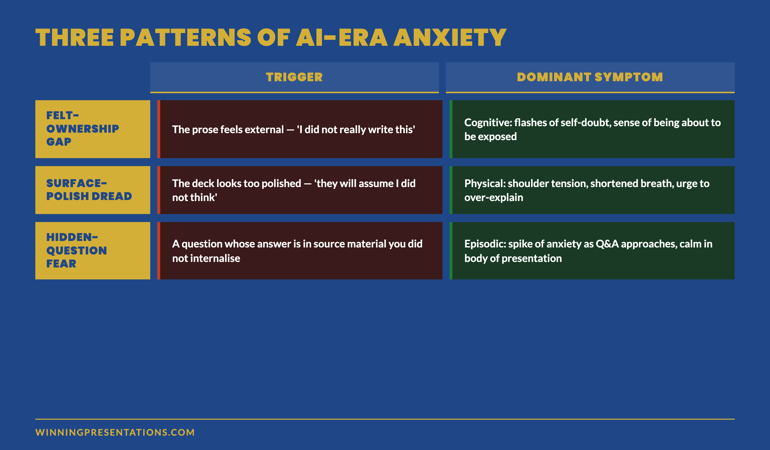
Three Patterns of AI-Era Anxiety infographic showing felt-ownership gap, surface-polish dread, and hidden-question fear with the trigger and dominant symptom for each pattern

The three patterns to recognise

Three distinct patterns recur in senior professionals presenting AI-drafted decks. Recognising the pattern is the first step toward the right recovery practice.

Pattern 1 — Felt-ownership gap. The deck is yours. The work is yours. But the prose feels external. The voice in your head as you walk into the room says some version of: I do not really know this material the way I would if I had written it. Symptoms tend to be cognitive — flashes of self-doubt, a sense of being about to be exposed. The body symptoms (dry mouth, racing heart) follow the cognitive ones rather than leading them.

Pattern 2 — Surface-polish dread. The deck looks polished. The slides are visually clean, the bullets are even, the diagrams are well-spaced. Just before the meeting, a different voice arrives: this looks too polished — they will assume I did not do the thinking. Symptoms tend to be physical first — tension in the shoulders, shortened breath, an urge to over-explain in the opening. Anxiety here is anticipating a credibility judgement that may or may not be coming.

Pattern 3 — Hidden-question fear. Specific to Q&A. The presenter knows the deck cold but worries that a board member will ask a question whose answer is in source material the AI consumed but the presenter did not fully internalise. Symptoms are episodic — confidence during the presentation, a spike of anxiety as Q&A approaches. The fear is not of being unprepared; it is of being asked something you would have known if you had written the slide yourself.

Most presenters experience a mix of two of these patterns rather than just one. The recovery practice depends on which is dominant.

Walk into the room calm even with an AI-drafted deck

Stop letting felt-ownership gaps trigger anxiety in familiar rooms

  • Structured techniques for managing the physical signs of anxiety in the moment
  • Practices for closing the felt-ownership gap before the meeting starts
  • Recovery moves for when anxiety arrives mid-presentation
  • Designed for senior professionals presenting in high-stakes rooms

Conquer Your Fear of Public Speaking — £39, instant access, 30-day refund if it does not fit your context.

Get Conquer Your Fear of Public Speaking →

Designed for senior professionals managing acute presentation anxiety.

Recovery practices for each pattern

For felt-ownership gap — the rewrite-aloud practice

Twenty-four hours before the meeting, sit with the AI-drafted deck and read every slide aloud. On the slides where the prose feels external, rewrite the bullets in your own words — even if the rewrite is technically worse. The goal is not better prose. The goal is to re-author the slide so your voice is in it.

Most senior professionals only need to rewrite three or four slides for the felt-ownership gap to close. The voice that says “I did not write this” stops carrying weight once you have rewritten the slides where the gap was strongest. The deck does not need to be rebuilt; it needs to feel inhabited.

For surface-polish dread — the deliberate roughness move

Add one deliberate handwritten element to the deck. A circled number on a chart. A handwritten note in the margin of a printed copy you bring to the meeting. A slide where one bullet is intentionally left as a fragment that you complete verbally. The deliberate roughness signals — to the room and to yourself — that the deck is a working document, not a polished artefact.

This move addresses the credibility judgement directly. A board that sees a polished deck with no signs of effort can read it as opinion-by-template. A board that sees the same deck with one or two signs of human working — a margin note, a verbal completion — reads it as a thought document. The dread reduces because the trigger has been pre-empted.

For hidden-question fear — the source-material walk-back

Before the meeting, spend 30 minutes walking back through the source material the AI consumed. Not the deck — the underlying source material. Read enough of it to be able to answer a question that goes one layer deeper than what is on the slide. You do not need to memorise everything. You need to know the shape of the supporting evidence so that if a board member asks, you can locate the answer rather than fabricate one.

This practice reduces hidden-question fear more than any in-the-room technique because it addresses the actual gap — your relationship with the underlying evidence, which AI-augmented drafting tends to thin out.

For senior leaders dealing with the physical signs of anxiety more often as AI changes the drafting workflow, structured anxiety techniques designed for the in-the-moment context are available in Conquer Your Fear of Public Speaking.

In-the-room tactics when anxiety arrives

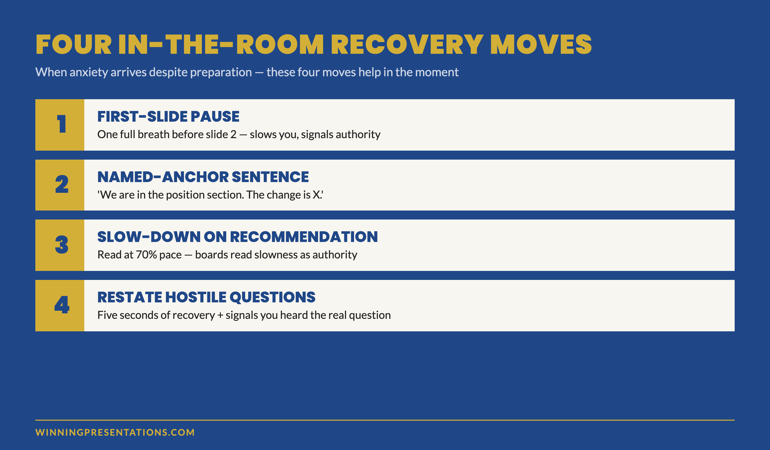
Anxiety does not always honour the preparation. When it shows up despite the recovery practices, four moves help in the room itself:

The first-slide pause. Before you advance to the second slide, stop. Take one full breath. Let the room settle. The pause does two things: it slows your own physiology, and it signals to the room that you are not in a hurry. Boards trust slow openings. Anxious presenters tend to rush the opening; the pause inverts the instinct.

The named-anchor sentence. Have one sentence prepared that names where you are in the deck. “We are in the position section. The change you need to know about is X.” If the anxiety surge happens, the named-anchor sentence gives the room a clear signpost and gives you a structured handhold. It also resets your own breathing because the sentence is short.

The deliberate slow-down on the recommendation slide. When you reach the recommendation, slow down. Read the slide aloud at 70% of your normal pace. The slow-down communicates importance to the room and gives your physiology time to recover. Senior audiences read deliberate slowness as authority; rushed delivery as nerves.

The hand-over move on hostile questions. If a board member asks a hostile question and the anxiety surges, restate the question in your own words before answering. The restatement buys five seconds of cognitive recovery and demonstrates that you are responding to the actual question rather than the version that landed in your head.

Four In-The-Room Recovery Moves infographic showing First-Slide Pause, Named-Anchor Sentence, Deliberate Slow-Down, and Hand-Over Move with the situation each one is used for

Frequently asked questions

Should I stop using AI to draft my decks if it is making me anxious?

For most senior professionals, no. The AI workflow saves significant time and produces useful first drafts. The anxiety is a signal that the editorial pass is not closing the felt-ownership gap. Adjust the workflow rather than abandoning it: rewrite three or four slides in your own voice, walk back through the source material before the meeting, and add deliberate roughness where the polish feels false.

Is this really new, or is it just regular speaking anxiety?

The physiology is identical. The trigger pattern is new. Senior professionals who had not experienced presentation anxiety for years are experiencing it again in AI-augmented workflows, and the recovery practices that worked before do not always address the new trigger. The combination — old physiology, new trigger — is what makes targeted practices necessary.

What about chronic anxiety that predates AI workflows — does this apply?

The patterns described here are about the additional anxiety that AI-augmented decks introduce. Chronic presentation anxiety has different roots and needs different work. If your anxiety predates AI use and is severe, the practices in this article may help at the margin but the underlying work is broader — see the structured techniques for acute and chronic presentation anxiety in our anxiety library.

How do I know which pattern is dominant for me?

The fastest test is to notice when the anxiety surges. If it surges as you walk into the room with the deck on your laptop, the felt-ownership gap is dominant. If it surges when you see the slides projected on the screen, surface-polish dread is dominant. If it surges as Q&A approaches, hidden-question fear is dominant. Most senior professionals have a mix; the dominant pattern is the one whose recovery practice helps most when applied first.

The Winning Edge — weekly newsletter for senior presenters

One framework, one micro-story, one slide pattern — every Thursday morning, ten minutes’ read. Including the AI-era anxiety patterns we are working through with senior professionals across financial services, biotech, and SaaS.

Subscribe to The Winning Edge →

For the partner article on the editorial pass that prevents the surface-polish trigger, see generative AI for executive presentation decks.

Mary Beth Hazeldine — Owner & Managing Director, Winning Presentations Ltd. With 24 years of corporate banking experience at JPMorgan Chase, PwC, Royal Bank of Scotland, and Commerzbank, she advises senior professionals across financial services, healthcare, technology, and government on the structural, behavioural, and AI-augmentation patterns that affect high-stakes presentation work.

11 May 2026
Featured image for The Prompt Anxiety Spiral: Why Some Executives Freeze When Asked to “Just Use AI”

The Prompt Anxiety Spiral: Why Some Executives Freeze When Asked to “Just Use AI”

Quick answer: Prompt anxiety is the freeze response some senior executives experience when asked to “just use AI” — staring at the blank input, second-guessing every prompt, abandoning the tool, and concealing the difficulty. It is rarely about technical skill. It is usually about identity threat: the fear that not being fluent with AI signals being out of date. The reset is to separate the two skills (using the tool from looking competent using it) and rebuild fluency through small private experiments before any high-stakes use.

Astrid is a director on the executive team of a mid-cap UK financial services firm. She has 26 years of experience, two postgraduate qualifications, and a reputation for being the sharpest analytical mind in any room. Last month, in a leadership offsite, the CEO turned to her and said, with genuine warmth: “Astrid, can you just do it with Copilot? Show us how it works on this case.” She felt her chest tighten, her face warm, and a thought she had not noticed before: everyone in this room thinks I already know how to do this. She made an excuse about needing to think it through more carefully and moved the agenda on.

The next morning Astrid privately spent two hours trying to learn Copilot. She got nowhere — partly because the tool was unfamiliar, and partly because she was so focused on not making a mistake that she could not bring herself to type anything. She closed the laptop. The pattern repeated, in different forms, for the next several weeks. By the time she contacted me, she described it as “an embarrassment I cannot say out loud to anyone.” This article is for the people who recognise something in Astrid’s story.

If the freeze response is showing up beyond AI

Conquer Your Fear of Public Speaking is the self-paced programme for senior professionals whose composure under pressure is being undermined by patterns the rest of the room cannot see. Built on 16 years of clinical hypnotherapy work with executives.

Explore the programme →

What prompt anxiety looks like in a senior executive (and why it stays hidden)

Prompt anxiety rarely looks like a panic attack. In senior professionals, it looks like polished avoidance. The agenda gets quietly moved on. A junior colleague gets handed the AI demo. The Copilot panel in PowerPoint never gets opened during a meeting. The deferral is framed as “I will think about it more carefully” or “let’s get someone closer to the tool to do that bit.” Each individual deflection looks like prudence; cumulatively, it is a freeze response.

It stays hidden for two reasons. First, the executive is good at concealment — that is partly how they got to be senior. Second, the working assumption in most rooms is that of course an experienced leader can “just use AI” — so colleagues do not look for signs of difficulty. The freeze is invisible to almost everyone except the person experiencing it.

The cost is private and accumulating. Hours spent privately trying to learn the tool with no measurable progress. Decks built the long way round to avoid having to use Copilot in front of anyone. Quiet erosion of the executive’s own sense of competence. And — the part that hurts most — a growing gap between how confident they look in every other domain and how unconfident they feel in this one.

The identity threat underneath the freeze

Prompt anxiety is rarely about the prompt. It is about identity. For a senior executive, the assumption is fluency. Fluency in the language of finance, fluency in the language of strategy, fluency in the language of whatever specialist domain they have built their career on. AI is the first tool in many years where they are starting from beginner. The gap between assumed fluency and actual fluency is the identity threat.

The body responds to identity threats in much the same way it responds to physical threats — increased heart rate, shallow breathing, a sense of warmth or tightness in the chest, a narrowing of attention. The cognitive consequence is a freeze: the executive cannot type, cannot decide which prompt to try first, cannot think clearly about what they actually want from the tool. The freeze is then read by the person experiencing it as further evidence that they are out of their depth — which intensifies the threat — which intensifies the freeze. This is the spiral.

The four-stage spiral, named

Naming the stages helps people recognise the pattern in themselves rather than reading it as a personal flaw.

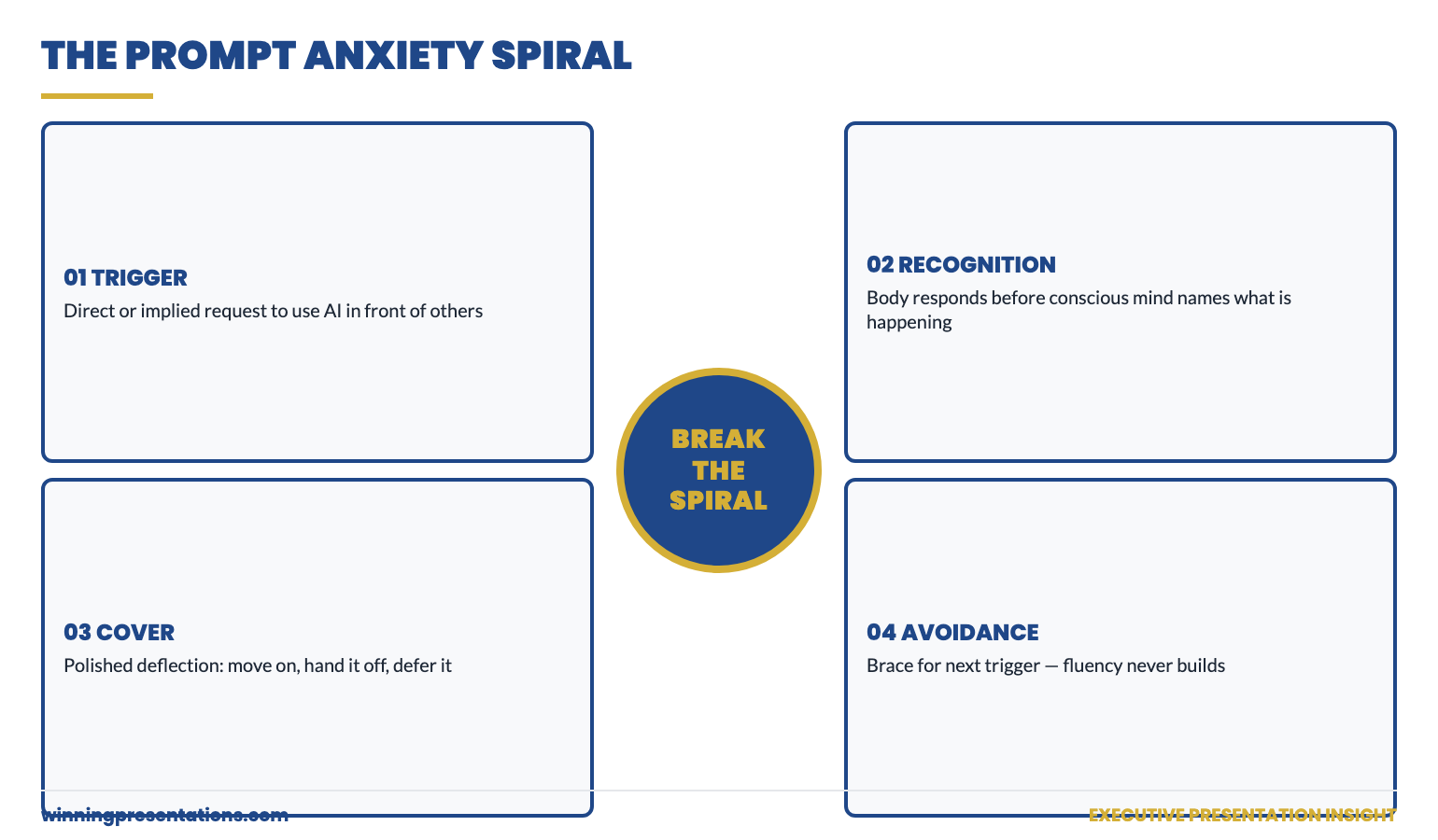
Stage 1: Trigger. A direct or implied prompt to use AI in front of others. “Can you just use Copilot to draft that?” “Send me an AI-built version by tomorrow.” Or simply being in a meeting where everyone else is talking about prompts as if they are obvious.

Stage 2: Recognition. An internal awareness that you are not yet fluent. The body responds before the conscious mind has named what is happening — chest tightens, attention narrows, breathing shallows.

Stage 3: Cover. A polished deflection. Move the agenda on. Hand it to someone else. Schedule “more time to think about it.” The cover succeeds; nobody in the room notices anything off.

Stage 4: Avoidance. The next time AI comes up, you are already braced. You begin avoiding situations where you might be asked. The avoidance prevents you from building fluency, which guarantees the next trigger lands as hard as the last.

The spiral is self-reinforcing. Most people cycle through it for months — sometimes years — without naming it.

The Prompt Anxiety Spiral in Four Stages: Trigger, Recognition, Cover, Avoidance — each stage shown as a card describing what the executive experiences and how the cycle reinforces itself, with the breaking point identified at the recognition stage.

The reset: separating “using the tool” from “looking competent using the tool”

The reset starts with a counterintuitive separation. There are two skills involved here, and they are not the same.

Skill 1: actually using the tool. Typing a prompt, reading the output, refining it, getting useful work done. This is technical and learnable through practice.

Skill 2: looking competent using the tool in front of people. This is performance — and it requires fluency that almost no one has when they are still learning skill 1.

The freeze happens because executives try to develop both skills simultaneously, and both skills get developed in front of people whose opinions matter. The reset is to develop skill 1 entirely in private until you have enough fluency to perform skill 2 calmly. This is the same pattern that works for any high-stakes capability: you do not learn to give a board presentation by giving board presentations; you learn the underlying skills first, then perform them once you can.

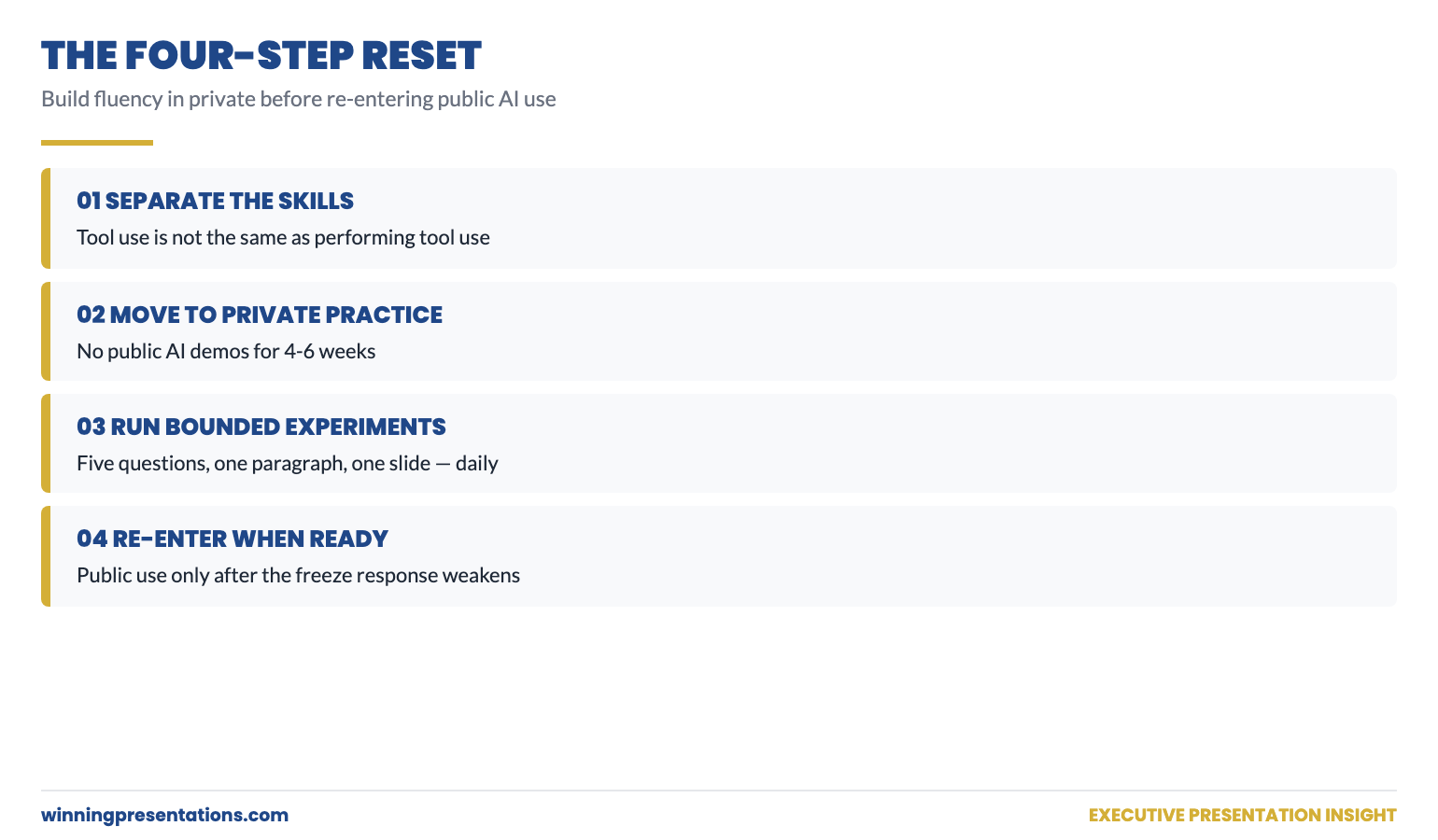
The practical implication is that the next four to six weeks are spent in a private practice mode. No public AI demos. No “let me show you how I did this” moments. The executive uses Copilot privately, on real but low-stakes work, until the freeze response stops firing. Only then do they start using it visibly.

Small, private experiments that rebuild fluency

The fluency-building work is deliberately small. Trying to “learn AI” as a project is itself anxiety-inducing — the scope is unbounded, the success criteria are vague, and the freeze response activates. The experiments below are bounded, specific, and impossible to do badly.

Experiment 1 — five questions about something you already know. Ask Copilot five questions about a topic you have deep expertise in. Read the answers. Notice where Copilot gets it right, where it gets it wrong, where it hedges. This calibrates your expectation of the tool and breaks the assumption that AI knows everything. Five minutes. Done.

Experiment 2 — rewrite one paragraph of your own writing. Take one paragraph you have written. Paste it into Copilot. Ask: “Rewrite this in a more direct, declarative voice.” Compare the output to your original. Decide which is better and why. The skill being practised is editorial judgement, not prompting. Ten minutes.

Experiment 3 — one slide for a real but low-stakes deck. Pick a slide from a deck you are working on for an internal audience — not the board. Ask Copilot to draft it using one of the prompt structures from a public-domain prompt library. Edit the output until it is usable. Use the slide. Notice that nothing catastrophic happened. Twenty minutes.

Experiment 4 — repeat experiment 3 every working day for two weeks. The freeze response weakens with repetition. By the end of two weeks of daily small use, the body’s threat response to “open Copilot” has measurably decreased. Fluency follows. Confidence follows fluency.

When the freeze pattern is showing up in more places than AI

Prompt anxiety is rarely the only place this pattern appears. The same freeze response often shows up around hostile Q&A, unexpected questions in board meetings, or moments when an executive is asked to think aloud in front of a senior audience. Conquer Your Fear of Public Speaking is the structured programme that addresses the underlying response — built on 16 years of clinical hypnotherapy work with senior professionals.

  • Self-paced programme — work through it privately, in your own time
  • Specifically designed for senior professionals whose composure is being undermined by patterns the rest of the room cannot see
  • Practical techniques for the body’s response, not just the cognitive overlay
  • Instant access, lifetime access, £39

Get Conquer Your Fear of Public Speaking — £39 →

Designed for senior professionals working through patterns that surface in high-stakes moments.

What to do after a meeting where you froze

The freeze does not always get caught in time. There will be meetings where you deflect, change the subject, or hand off the AI task — and you walk out of the room knowing you froze. The next 24 hours matter more than the freeze itself.

Most senior professionals respond to a freeze with a private reproach: “I should have just done it. Why am I like this?” The reproach is itself part of the spiral — it makes the next freeze more likely, not less. The alternative is a structured debrief, applied to yourself the way you would apply it to a team member after a difficult presentation.

Three questions to write down (literally write, not just think): What was the trigger I responded to? What did I cover with? What is the smallest thing I can do tonight that moves me one step closer to fluency, that nobody has to know about? The third question is the important one. The work is private. The progress is private. The credit, eventually, is yours alone.

The Reset Plan for Prompt Anxiety in Four Steps: Separate the Two Skills, Move to Private Practice, Run Daily Bounded Experiments, Re-enter Public Use Only When Ready — each step shown with its purpose and the response it builds in the body.

The deeper context here is that the anxiety responding to “just use AI” is the same anxiety that responds to “just answer the question,” “just present without slides,” “just talk about your numbers.” The trigger varies; the underlying response is the same. For executives where this pattern shows up across multiple high-stakes contexts — not only AI — see the deeper article on presentation anxiety treatment for executives.

For the structural side of the AI workflow itself — once the freeze response has weakened enough to allow you to type — the partner article on how to write Copilot prompts that produce executive-grade output is the practical companion to this one.

For the broader response pattern — the body’s freeze, the polished cover, the avoidance loop — Conquer Your Fear of Public Speaking (£39) is the self-paced programme built specifically for senior professionals working through patterns that surface under pressure.

A structured way through the underlying response

Conquer Your Fear of Public Speaking — the self-paced programme for senior professionals working through patterns that surface in high-stakes moments. £39, instant access, lifetime access.

Explore the programme →

Built on 16 years of clinical hypnotherapy work with senior professionals.

FAQ

Is prompt anxiety actually anxiety, or just inexperience?

Both, usually. The inexperience is real — almost no senior leader has had time to develop the AI fluency that younger team members assume they have. The anxiety is the layer on top that prevents the inexperience being addressed. You can be highly intelligent, highly experienced, and still freeze when asked to perform a beginner skill in front of senior colleagues. Naming it as anxiety rather than incompetence is part of the reset.

Should I just admit to my team that I am still learning AI?

For some executives, yes — the admission relieves the performance pressure and reframes the situation. For others, admission feels career-risky in a culture that conflates AI fluency with relevance. The decision is contextual. What is not contextual is the private practice — whether you admit out loud or not, the only sustainable fix is becoming fluent enough that performance is no longer effortful.

How long does the reset take?

For most senior professionals working through small daily experiments, four to six weeks of private practice is enough to take the edge off the freeze response. Full fluency takes longer — typically three to six months of regular use. The freeze response usually weakens long before the fluency is complete; once you can type without the chest tightening, the rest is just learning the tool.

What if I freeze in a meeting next week and have not done the practice yet?

A short script: “I want to give this the time it deserves rather than do it badly under time pressure — let me come back with something more useful by Wednesday.” This is honest and senior. It also gives you a concrete window in which to do the private work that lets you walk back in on Wednesday with something usable. The script buys you the time the spiral was trying to take from you.

Get The Winning Edge — weekly

One sharp, story-led idea every Thursday on executive presentation craft, the small habits that change how senior audiences receive you, and the patterns that show up in high-stakes moments.

Subscribe to The Winning Edge →

Want a structural primer that applies whether you draft with AI or not? Download the free 7 Presentation Frameworks Quick Reference Card — the right structure for any presentation situation, in one reference.

The spiral is recognisable. So is the way out. Tonight, before bed, try experiment one — five questions about something you already know. Five minutes. Nobody has to know. That is how the freeze response begins to lose its grip.


About the author. Mary Beth Hazeldine is Owner & Managing Director of Winning Presentations Ltd, founded 1990. With 24 years of corporate banking experience at JPMorgan Chase, PwC, Royal Bank of Scotland, and Commerzbank, she advises executives across financial services, healthcare, technology, and government on structuring presentations for high-stakes funding rounds and approvals. She is also a clinical hypnotherapist and holds a postgraduate qualification in clinical hypnosis.

08 May 2026
Mid-aged woman sits at a desk with an open laptop, resting her chin on her hand and gazing out a window, thoughtful.

Imposter Syndrome Using AI for Presentations: When You Feel You Are Cheating

Quick answer: The “I am cheating” feeling that surfaces when senior professionals use AI for presentations is a misread of the work. Imposter syndrome attaches to AI use because the AI does the visible drafting and the human does the invisible editorial judgement — so it looks, from inside, as if you contributed nothing. The reality is reversed. The judgement is the work. The drafting is the typing. Three reframes resolve the feeling without losing the productive caution underneath it.

Ines is a director of clinical operations in a mid-size pharmaceutical company. She had been using Copilot for three weeks before the feeling caught up with her. The feeling arrived during a steering committee meeting, mid-sentence, while she was presenting a deck she had drafted with AI assistance. She was making a strong point about supply chain resilience when an internal voice cut in: “You did not write this. You should not be presenting this. If they ask you something the deck does not cover, they will see you do not actually know it.”

The voice was loud enough that she lost her place for half a second. The committee did not notice. She recovered. The presentation went well. But the feeling stayed with her for the rest of the day and crystallised that evening into a question she put to a colleague over dinner: “Am I cheating? Should I just write the decks myself like I used to?” Her colleague, who had been using Copilot since launch, said something useful: “If you wrote the prompt and you read the output and you decided what to keep and what to change, you wrote the deck. The keyboard is not where the work happens.”

That sentence is technically correct, and it does not always land in the moment because imposter syndrome is not technically responsive. The cheating feeling has its own logic, and arguing with it head-on rarely works. What does work is understanding why the feeling shows up specifically with AI — and then applying three reframes that change the underlying perception, not just the surface argument.

Looking for a structured way to manage performance anxiety in high-stakes presentations?

Conquer Your Fear of Public Speaking is a self-paced programme designed for senior professionals who experience performance anxiety in high-stakes presentation work. Practical techniques for the in-the-moment recovery you can use in any meeting.

Explore the Programme →

Why the cheating feeling shows up

Imposter syndrome activates when there is a perceived gap between what others believe you contributed and what you privately know you contributed. AI use opens that gap by design. The audience sees a polished deck. You know that some of the structure came from a model. The two pictures do not match in your head, and the mismatch reads as deception.

The feeling intensifies if your professional identity is tied to “I produce my own work”. Many senior leaders built their careers on visible production — writing the strategy memo, building the financial model, drafting the board paper themselves. AI changes the labour mix. You still own the output, but the labour is distributed differently. The labour distribution change feels like an identity threat, even when the output quality is equal or higher.

It also intensifies in environments where AI use is technically allowed but socially ambiguous. If your employer has not explicitly endorsed AI for presentation work, but has not explicitly forbidden it either, you are operating in a grey zone. The grey zone amplifies imposter feelings because there is no external validation that what you are doing is acceptable. Your nervous system fills the validation vacuum with the worst-case interpretation: that you are doing something you would not want to admit to.

Cycle infographic showing the imposter syndrome loop in AI-assisted presentation work: AI produces visible draft, human applies invisible judgement, audience sees only the polished output, presenter feels the gap as cheating

Visible drafting versus invisible judgement

The cleanest way to understand what is actually happening is to separate the visible work from the invisible work. The visible work in a deck is the typing, the layout, the wording of bullets, the choice of charts. The invisible work is the prior thinking — what to include, what to leave out, what the argument should be, which evidence carries weight, how the audience will react, where the political risk lies, what the closing decision needs to be.

For a senior-level presentation, the invisible work is roughly eighty per cent of the value. Anyone with passable Copilot skills can produce a polished thirty-slide deck on any topic in twenty minutes. Almost no one can produce a deck that lands with a specific board on a specific decision in a specific organisational moment without the invisible work that comes from years of internal context.

When you use AI for the visible work, you are outsourcing the part that has the lowest unit value of your time. You retain the invisible work — the editorial judgement that decides which AI output to keep, which to rewrite, which to cut, which to anchor with internal evidence the model could not have known. This is the work the audience cannot see, and it is also the work that your imposter voice is failing to credit. The voice notices that you typed less. It does not notice that you decided more.

Reframe one: the typing is not the work

The first reframe is to separate effort from value. There is a deeply ingrained association between visible effort and earned credit, particularly in cultures where being seen to work hard is part of the professional identity. AI breaks that association by making the visible effort smaller while leaving the cognitive load roughly constant.

The reframe is simple to state and harder to internalise: the typing is not the work. The work is the judgement applied to what gets typed. A surgeon’s value is not in the physical incision — it is in knowing where, how deep, and when to stop. The incision is the visible part. The training and judgement underneath are the invisible part. AI makes the executive presentation analogous to the surgical analogy. The model does the incision. You do the judgement.

This reframe lands harder when you can name a specific decision you made on the most recent AI-assisted deck that the model could not have made. “I cut the section on European expansion because I knew the chair would push back on the timing — the model did not know that.” “I rewrote the headline on slide eleven because the original was technically correct but politically tone-deaf for our CFO — the model did not know that.” Naming the specific decisions that required your judgement is the most direct route to dissolving the cheating feeling. The decisions are real. They are the work.

Reframe two: AI is a tool, not a co-author

The second reframe targets the way the imposter voice tends to anthropomorphise AI. The voice often phrases the concern as “the AI wrote this, not me” — which assigns agency to the model. The model has no agency. It cannot decide what to write. It can only produce probabilistic next-tokens based on the prompt you supplied and the editorial decisions you made along the way.

The framing that helps is to compare AI to other tools you do not feel imposter syndrome about. You do not feel guilty using Excel to calculate a forecast you could have done by hand. You do not feel guilty using PowerPoint instead of drawing slides on acetate. You do not feel guilty using a spell-checker. The reason is that those tools are clearly tools — they execute under your direction, they have no agency, they do not “co-author” the output.

AI feels different because it produces something that looks like prose, and prose feels like authored content. But the AI is no more an author of your deck than Excel is the author of your forecast. It is a tool that executes your direction. The difference between a Copilot draft and an Excel formula is purely surface-level — both are deterministic outputs of inputs you supplied. The structured workflows that produce executive output reinforce this — the agent is following your instruction set, not writing the deck.

Contrast panels infographic showing the imposter syndrome perception versus the actual contribution split in AI-assisted presentation work: typing versus thinking, drafting versus editing, surface versus judgement

Practical techniques for performance anxiety in senior presentation work

Conquer Your Fear of Public Speaking is a self-paced programme for professionals who experience anxiety, imposter feelings, or in-the-moment nerves during high-stakes presentations. Designed for the executive audience — practical recovery techniques you can use mid-meeting, not generic advice. £39, instant access.

  • Self-paced lessons covering pre-meeting preparation
  • In-the-moment recovery techniques for live presentation moments
  • Frameworks for managing the imposter voice that surfaces under pressure
  • Designed for senior professionals in high-stakes scenarios

Get Conquer Your Fear of Public Speaking →

Designed for senior professionals managing performance anxiety in board, investor, and executive presentation contexts.

Reframe three: the question your imposter voice is really asking

The third reframe goes one layer deeper. The “am I cheating” question is rarely the actual question underneath. When senior professionals dig into what the imposter voice is genuinely worried about, the underlying question usually turns out to be one of three things, and each one has a different response.

The first underlying question is “if they ask me something off the slides, will I look foolish?” This is a competence question, not an authorship question. The answer is not to abandon AI — it is to do the depth work that prepares you to answer questions beyond the deck content. The deck is one slice of your knowledge. AI helped you produce the slice. Your years of context are what handle the questions. Use the time AI saves you to deepen your audience preparation, not to do less work overall.

The second underlying question is “if they find out I used AI, will they think less of my contribution?” This is a social-acceptance question. The honest answer is that some audiences will, particularly in environments that are still adjusting to AI norms. The right response is not concealment, which feeds the imposter voice. The right response is matter-of-fact disclosure when asked, framed around the editorial judgement that produced the final output: “Yes, I used Copilot to draft the structure; the analysis and the recommendation are mine. The AI saved me about three hours.”

The third underlying question is “if AI can do this, what am I actually contributing?” This is an identity question, and it deserves a serious answer rather than a deflection. AI cannot do the invisible work — the situational awareness, the political read, the executive context, the judgement that comes from having been in the room before. Those are your contribution. AI use highlights this contribution by stripping away the typing that used to obscure it. If you find your contribution unclear after AI strips the typing away, that is useful information about where to focus your professional development. The right response is to invest in the parts of your work AI cannot do, not to retreat from AI use to preserve the visible parts it can.

The productive caution worth keeping

None of these reframes are about silencing all hesitation around AI use. There is a productive caution underneath the imposter feeling that is worth preserving — the caution that prompts you to verify numbers the AI generated, to check the source of claims, to read the deck aloud against the audience’s likely reaction, to take responsibility for what reaches the room. That caution is the editorial judgement at work. Keep it. It is the difference between AI-assisted senior output and AI-flavoured generic output.

The reframes target the unproductive part of the feeling — the part that says you are not entitled to present material because you used a tool to draft it. That part is wrong, and feeding it makes you a worse presenter, not a more honest one. Concealing AI use because the imposter voice told you to leads to evasive answers when audiences ask direct questions, which damages credibility more than the AI use itself ever would.

The senior professionals who handle this transition cleanly tend to land on a stable framing: AI is a tool I use to do my work faster; the work itself — the judgement, the decisions, the editorial pass — is mine; if asked, I will say so plainly; if not asked, I will not perform a confession that is not required. The editorial pass is what makes the difference between AI output that lands and AI output that gets pushed back. That pass is yours. The cheating voice is misreading the labour. Do not reorganise your career around its mistake.

Want a structural framework that anchors your editorial judgement?

The Pyramid Principle Template is a free reference for structuring executive briefings — lead with the answer, then prove it. Useful as the structural target your editorial pass is editing toward. Free download.

Get the Pyramid Principle Template →

FAQ

Should I tell people I used AI to draft the deck?

If you are asked directly, yes. Honesty handles the question once and removes the imposter loop entirely. If you are not asked, you do not owe a proactive disclosure unless your organisation requires one. Performing a confession that was not requested often draws more attention to AI use than a matter-of-fact answer would. The framing that works in either case is “I used AI to draft the structure; the analysis and recommendation are mine” — which credits both the tool and the judgement honestly.

Why does the cheating feeling get worse the better the AI gets?

Because the gap between visible AI contribution and invisible human judgement gets larger as the model improves. Earlier AI tools produced obviously rough output that you visibly had to fix; the editorial work was visible because the gaps were visible. Better models produce smoother output that needs subtler editorial work; the gaps are no longer visible to you, even though they are still there. The judgement work has not disappeared — it has just stopped being noticeable. The reframe is to deliberately track the editorial decisions you are still making, even when they feel small.

Is imposter syndrome about AI different from regular imposter syndrome?

It has the same underlying mechanism — a perceived gap between contribution and credit — but a different trigger. Regular imposter syndrome is triggered by promotion, scope expansion, or visibility increases. AI-related imposter syndrome is triggered by the labour distribution change. The mechanism is the same; the trigger is new. The same techniques that help with regular imposter syndrome — naming specific contributions, reality-testing the worst-case interpretation, talking to peers — also help here. The first reframe in this article is the AI-specific addition.

What if my anxiety about using AI is severe enough to disrupt my presentation performance?

If the cheating feeling intensifies during the presentation itself rather than dissolving with the reframes, the underlying issue is performance anxiety more than imposter syndrome about AI specifically. The AI use is the trigger but not the cause. Practical techniques for in-the-moment anxiety — controlled breathing, the structured pause, the recovery sentence — work the same way regardless of whether AI was involved in producing the deck. The deck is yours to present once you are in the room. The earlier the anxiety pattern is addressed, the less it will surface in subsequent presentations.

The Winning Edge — Thursday newsletter

Every Thursday, The Winning Edge delivers one structural insight for executives presenting to boards, investment committees, and senior stakeholders. No general tips. No motivational framing. One specific technique, one executive scenario, one action. Subscribe to The Winning Edge →

Not ready for the full programme? Start here instead: download the free Pyramid Principle Template — the framework that gives your editorial judgement a structural target to edit toward.

Next step: name three specific editorial decisions you made on the last AI-assisted deck you produced. Write them down. Re-read them when the cheating voice next surfaces. The decisions are real. The voice is misreading them.

Related reading: The Copilot Agent Mode workflow that makes editorial judgement the senior contribution.

About the author. Mary Beth Hazeldine is Owner & Managing Director of Winning Presentations Ltd, founded in 1990. With 24 years of corporate banking experience at JPMorgan Chase, PwC, Royal Bank of Scotland, and Commerzbank, she advises executives across financial services, healthcare, technology, and government on structuring presentations for high-stakes funding rounds, approvals, and board-level decisions.

06 May 2026
Senior leaders using AI often feel less credible, not more. The anxiety is real and the fix is not about better tools. It is about confidence boundaries.

AI Anxiety for Executives: When the Tech Makes You Feel Less Credible

QUICK ANSWER

AI anxiety for executives is not about the technology. It is about the quiet worry that using AI makes you seem less capable, less original, or less in control. The anxiety shows up as hesitation to use AI tools even when they would help, a reluctance to admit AI involvement, and a sense that the work is somehow not fully yours. The fix is not better tools. It is a clear internal boundary between what AI drafts and what you judge — and the recognition that judgement is the credible part.

For the underlying confidence work

Conquer Your Fear of Public Speaking is a structured programme for senior professionals whose anxiety shows up in high-stakes presentation moments.

Explore the Programme →

Astrid, a senior partner in a professional services firm, described something to me recently that she had not admitted to her peers. She had started using ChatGPT to structure her client-facing presentations. The output was genuinely better than what she had produced alone. Her clients had noticed. And she felt worse about her work than she had in years.

She was not worried about being caught. She was worried about something harder to name. It felt as though the good parts were not fully hers. Every time she gave a presentation that landed well, a quiet voice asked whether the landing was her skill or the tool’s. She had started avoiding AI for important client work — not because it made the work worse, but because it made her feel less capable.

This is AI anxiety for executives. It is not about AI. It is about the identity work that senior professionals do around competence, originality, and earned authority — and the way those things feel threatened when a machine starts producing drafts that hold up at their level.

What AI anxiety looks like in senior leaders

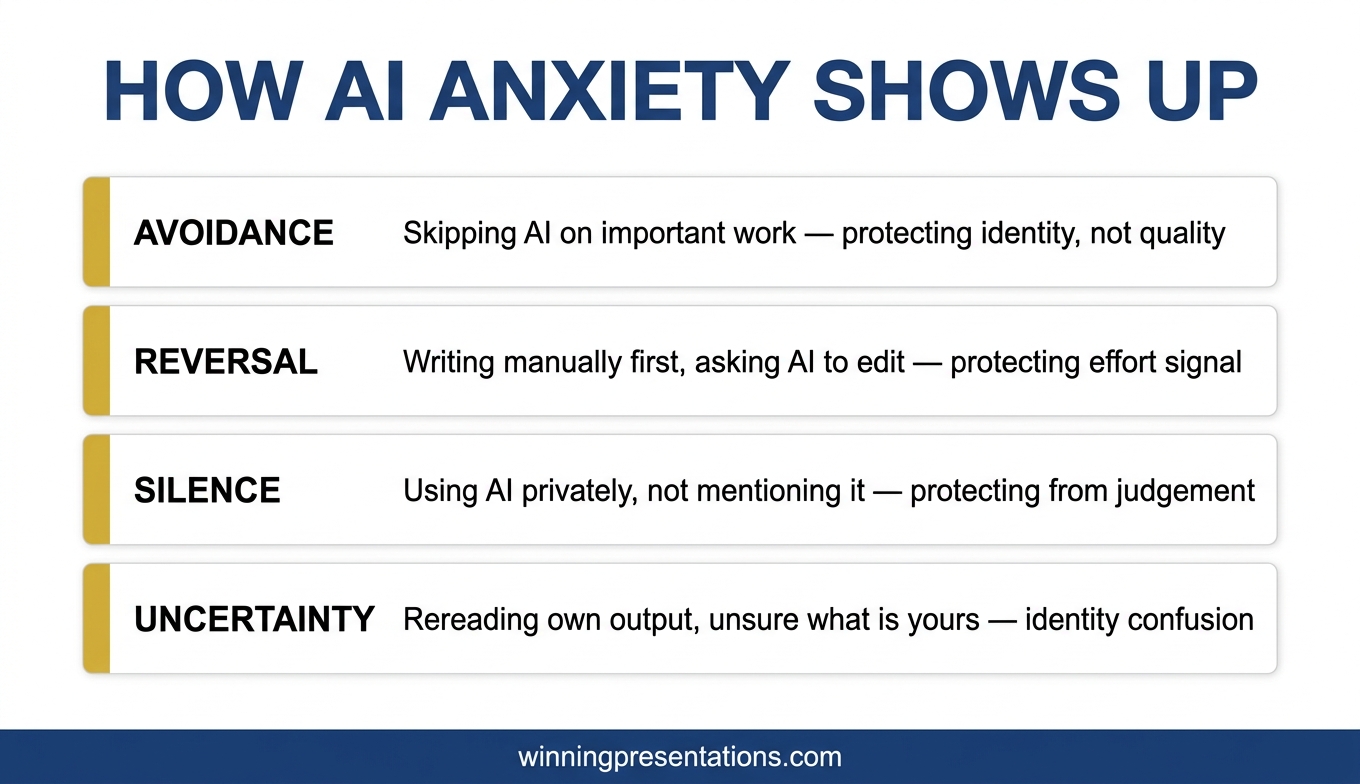
AI anxiety in senior professionals rarely announces itself. It shows up as a cluster of small behaviours that look like preferences but are really defences. The senior partner who avoids Copilot for the quarterly report “because I prefer to think on paper first.” The director who writes the first draft manually, then asks AI for minor edits, rather than the reverse. The executive who uses AI extensively in private and downplays it publicly. The leader who rereads their own output and cannot tell whether they wrote it or the AI did, and finds that a surprisingly uncomfortable question.

The common thread is that the anxiety runs alongside genuine capability. These are not people who need AI. They are people who have quietly noticed that AI makes some parts of their work easier, and who have started worrying about what that means. The worry is not irrational. It is about identity and signal.

The usual advice — “just use the tools, they are amazing” — misses the point. The anxiety is not technical. It is existential in the mild, everyday sense of that word. It is about what counts as your work and what counts as the tool’s work, and whether the distinction matters when the output is the same either way.

Why AI can feel like a credibility threat

Senior professionals have built credibility over years, often decades, through the accumulated evidence that they can produce good work reliably. The work is the signal. Reduce the visible effort behind the work and the signal weakens — at least, that is what the anxious part of the mind concludes. This is not a careful conclusion. It is a fast one, running in the background while the thinking mind is doing something else.

There is also a second layer. Senior audiences can increasingly tell when output has been AI-drafted. The tonal patterns, the structural defaults, the particular flavour of competent-but-generic writing — these become recognisable. Senior leaders who use AI start to worry that their audience will detect it, and that detection will be interpreted as laziness or as intellectual outsourcing. This worry is usually larger than the actual risk, but it is real.

Four ways AI anxiety shows up in senior professionals and what each behaviour is actually protecting

Underneath both layers is something worth naming directly. The real credibility of a senior professional is not in the words on the slide. It is in the judgement behind those words — which questions to ask, which data to trust, which argument to commit to, which risk to take. AI cannot replicate that. What AI can do is draft, assemble, and format. These are the parts of the work that are the least credibility-carrying, even though they take the most visible time.

Senior professionals who feel less credible when using AI are usually confusing the drafting with the judging. They still do the judging. AI does not. But because drafting becomes faster and more polished, the professional loses the visible evidence of the effort that was not actually the credible part in the first place.

WHEN ANXIETY SHOWS UP IN HIGH-STAKES PRESENTATION MOMENTS

Structured work for senior professionals whose presentation anxiety is affecting performance

Conquer Your Fear of Public Speaking is Mary Beth’s programme for professionals whose anxiety shows up in the moments that matter most — board rooms, client pitches, high-stakes presentations. Drawn from 5 years of personal experience with acute presentation anxiety and 16 years of coaching senior leaders through it.

  • Structured anxiety-reduction protocols for high-stakes moments
  • Pre-presentation preparation routines
  • In-the-moment recovery techniques
  • Mindset work for senior professionals
  • Instant download, lifetime access

£39, instant access.

Explore Conquer Your Fear of Public Speaking →

Designed for senior professionals facing high-stakes presentation moments.

The boundary that restores confidence

The fix for AI anxiety in senior leaders is not more or less AI. It is an explicit internal boundary between two categories of work. Category one is what AI drafts. Category two is what you judge. The boundary clarifies which parts of the work are credibility-carrying and which parts are operational.

AI drafts: the structural outline, the first-pass copy, the tonal calibration, the bullet points, the summary paragraphs. These are the visible parts. They were never where your credibility lived. Senior professionals with 20 years of experience do not have more credibility than junior professionals because they can write bullets faster. They have more credibility because they know which bullets matter.

You judge: which argument to build the deck around, which audience member is the real decision-maker, which risk to surface explicitly and which to leave in the appendix, which number to lead with, which counter-argument to engage directly, which option to recommend, which question to be ready for. Every one of these decisions is yours. AI cannot do any of them without your strategic inputs. You are still doing all the credibility-carrying work. The drafting just happens faster.

Once the boundary is clear, AI stops feeling like a threat to your competence. It becomes a drafting tool, like the word processor that you already use without any existential anxiety. The operational parts get faster. The judgement parts remain yours and always were. The clean version of this workflow is covered in why Copilot’s first draft fails boardroom tests, which shows exactly where AI drafting ends and human judgement takes over.

If you want a reliable starting point for AI prompts

The Executive Prompt Pack contains 71 ChatGPT and Copilot prompts designed for senior professionals — prompts you can use immediately without the anxiety of getting them wrong. £19.99, instant download.

Get the Executive Prompt Pack →

What to say if asked whether you used AI

The question “did you use AI for this?” is usually a proxy question. What the asker often wants to know is whether the presenter has understood the material well enough to answer questions about it. “Yes, I used AI to draft the structure, and then I made the decisions about what to keep, what to change, and what position to take” is a strong answer. It is also true. It separates the drafting from the judging, which is the distinction that matters.

Leading with “I didn’t use AI” when you did has a predictable cost. If any part of the output reads as AI-drafted — and senior audiences increasingly pick this up — the presenter has now lied about a small thing, which undermines trust on larger things. The pretence is not worth it.

Leading with “I used AI to draft this” without qualification sometimes lands poorly because it suggests the professional did nothing. The useful phrasing names both halves. “I drafted with AI, edited with judgement” — or a variation in your own words — captures the distinction accurately.

There is one context where AI involvement genuinely matters: client work, regulated decisions, or output that will be audited. In those cases, the correct thing to do is disclose according to the relevant rules, without anxiety about it. The rules exist because AI use is now a normal part of professional work, not an exception.

Frequently asked questions

How is AI anxiety different from ordinary presentation anxiety?

Ordinary presentation anxiety is about the moment of delivery — the racing heart, the shaking hands, the fear of freezing. AI anxiety is quieter and more cognitive. It happens before the presentation, often while preparing, and it is about identity rather than physiology. Both can coexist and both can affect performance, but they have different triggers and need different interventions.

Is there a point at which using AI for presentation work becomes inauthentic?

Authenticity in senior work is not about how much you wrote yourself. It is about whether the argument, decisions, and positions represent your thinking. If you used AI to draft the structure and then you committed to what the deck recommends because you believe it is the right recommendation, the deck is authentic. If you presented a recommendation you did not understand or did not agree with, the deck would be inauthentic — regardless of whether AI was involved.

Should I tell my board that I used AI to prepare the materials?

Usually not, and not because there is anything to hide. Board time is for decisions, not for explanations of drafting tools. If asked directly, answer honestly using the “drafted with AI, edited with judgement” framing. If not asked, there is no reason to offer the information unless your organisation has a disclosure policy.

I use AI extensively and feel fine about it. Am I missing something?

Probably not. People who have clear internal boundaries between AI drafting and their own judgement usually do not experience AI anxiety. The worry is most common in people who are either new to AI tools or who are uncertain about which parts of their work are credibility-carrying. If you have thought through the distinction and feel settled, you are where you want to be.

Can AI anxiety affect presentation delivery on the day?

Yes, indirectly. Senior leaders who feel uncertain about the provenance of their material sometimes deliver with less confidence than usual, even when the material itself is strong. This shows up as extra caveating, over-explanation, or a defensive edge during Q&A. The fix is the internal boundary described above — once it is clear, delivery confidence returns.

The Winning Edge

Weekly thinking for senior professionals on executive presentation craft — the judgement calls, confidence boundaries, and quiet practices that frameworks do not cover.

Subscribe to The Winning Edge →

Not ready for the full programme? Start here instead: download the free 7 Presentation Frameworks Quick Reference — the structural scaffolds that give your own thinking a reliable shape, with or without AI.

Next step: draw the boundary for yourself this week. Write down three parts of your next presentation that AI can draft and three parts that are yours to judge. Notice how different it feels when the distinction is explicit rather than implicit.

For the structural side of AI-assisted executive work, see Copilot PowerPoint for board presentations.


About the author

Mary Beth Hazeldine is Owner & Managing Director of Winning Presentations Ltd, a UK company founded in 1990. With 24 years of corporate banking experience at JPMorgan Chase, PwC, Royal Bank of Scotland, and Commerzbank, she advises senior professionals on the psychology of high-stakes presentation work — including the quieter confidence issues that affect senior performers.

28 Apr 2026
Businesswoman stands in doorway of a glass-walled conference room, with colleagues seated at a long table behind her behind her.

Presentation Panic Attacks: What Triggers Them and How to Regain Control

Quick answer: Presentation panic attacks are triggered when the brain’s threat-detection system — the amygdala — misinterprets a high-stakes speaking situation as a physical danger. The result is a flood of adrenaline and cortisol that produces racing heart, shallow breathing, mental blanking, and an overwhelming urge to escape.

The key to regaining control is not willpower or positive thinking — it is nervous system regulation. Techniques such as controlled breathing, grounding exercises, and cognitive reframing interrupt the panic cycle before it escalates, and with practice, they can prevent attacks from occurring altogether.

Linnea had presented quarterly results to her division head dozens of times. She was good at it — structured, clear, well-prepared. So when the company asked her to present the same figures to the full executive committee, she assumed it would feel no different.

It was different. Standing in the boardroom with twelve senior leaders watching, she felt her chest tighten thirty seconds before she was due to speak. Her mouth went dry. Her hands began trembling so badly she could not advance her slides. The room seemed to narrow around her, and for a terrible moment she genuinely believed she might pass out in front of every person who controlled her career trajectory.

She did not pass out. She stumbled through the opening, excused herself for water, and recovered enough to finish. But the experience left a mark. For the next three months, every meeting invitation triggered a wave of dread — not ordinary nerves, but the visceral, full-body alarm of someone who had experienced a presentation panic attack and now lived in fear of the next one.

What happened to Linnea was not a character flaw. It was neuroscience. And understanding that distinction is the first step toward regaining control.

If presentation anxiety has moved beyond ordinary nerves into something that feels physical and overwhelming, you are not alone — and there are structured approaches that can help. Conquer Your Fear of Public Speaking is a neuroscience-based programme designed specifically for professionals who experience acute fear before and during presentations.

Explore the Programme →

What triggers panic attacks during presentations — and why your brain reacts this way

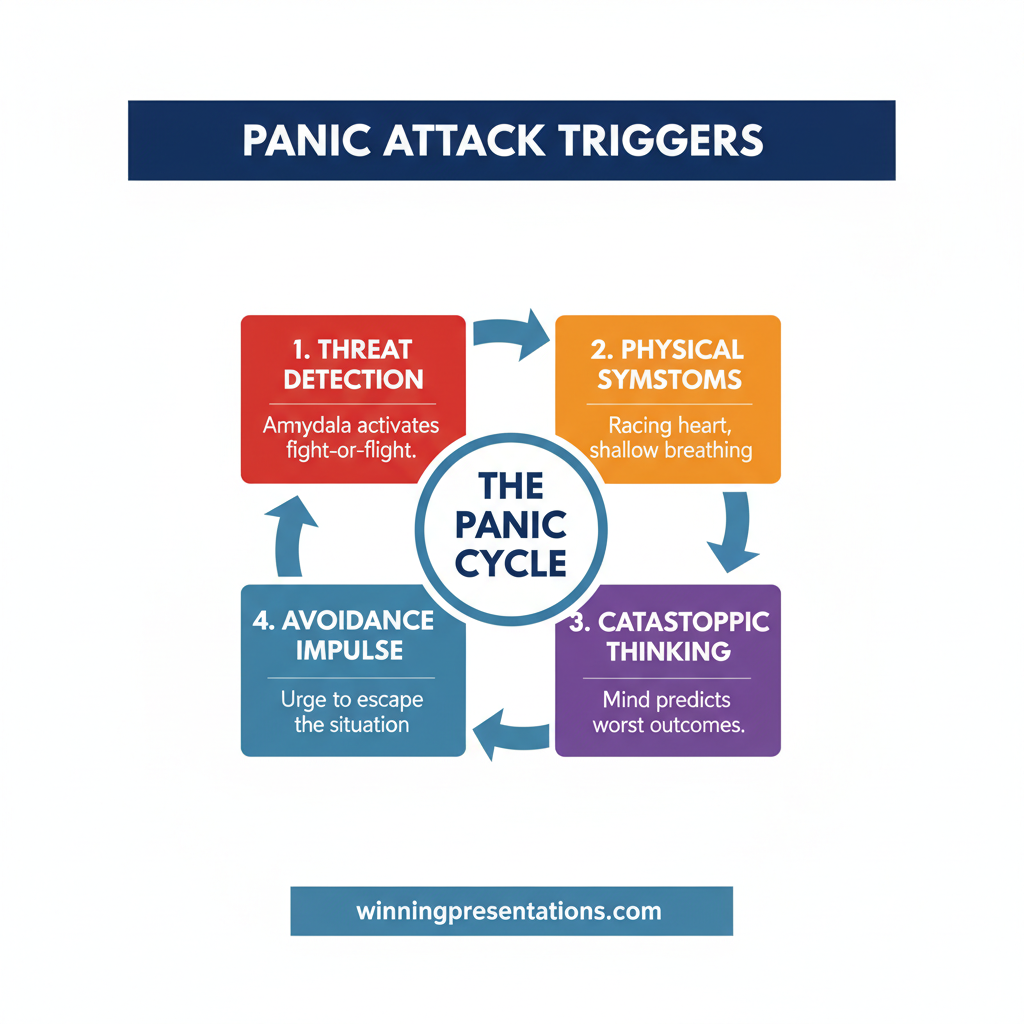
To understand presentation panic attacks, you need to understand what the brain is actually doing when one occurs. The amygdala — a small, almond-shaped structure deep in the brain — is responsible for scanning your environment for threats. When it detects danger, it triggers the sympathetic nervous system before your conscious mind has any say in the matter.

In a genuinely dangerous situation, this response saves lives. In a boardroom, it creates chaos. Your heart rate spikes, breathing becomes shallow, blood redirects to your limbs, and your prefrontal cortex — responsible for structured thinking and articulate speech — essentially goes offline.

Several factors make the amygdala more likely to misfire in presentation contexts:

  • Perceived social evaluation: being watched and judged by people who hold power over your career activates the same neural pathways as physical threat
  • Previous negative experiences: one bad presentation can sensitise the amygdala, making it fire more easily in similar settings
  • Sleep deprivation and chronic stress: a depleted nervous system has a lower threshold for triggering fight-or-flight
  • Perfectionism and catastrophic thinking: mental rehearsal of worst-case scenarios primes the brain to treat the presentation as a genuine threat
  • Unfamiliar environments: a new room, a larger audience, or a higher-stakes context removes the safety cues that normally keep the amygdala calm

The critical insight is that panic attacks are not a failure of courage or competence. They are a neurological event — the brain’s alarm system activating inappropriately. This is why approaches that focus on treating presentation anxiety at the nervous system level tend to be more effective than simple advice to “just relax” or “think positively.”

When presentation fear has become physical, you need more than advice — you need a structured system

Conquer Your Fear of Public Speaking — £39, instant access — is a neuroscience-based programme built for professionals who experience acute anxiety before and during presentations. It covers nervous system regulation, cognitive reframing, physical symptom management, and pre-presentation protocols — the specific mechanisms that interrupt the panic cycle before it takes hold.

If you recognise the pattern Linnea experienced — the tightening chest, the racing thoughts, the dread that builds for days before a presentation — this programme addresses exactly those responses.

Get the Programme →

Instant digital download. Work through it at your own pace.

The difference between presentation anxiety and a panic attack

Most professionals experience some degree of presentation anxiety. Butterflies before a big meeting, a slight tremor in the voice during the opening minute, a heightened awareness of being watched — these are normal nervous system responses that often improve performance by sharpening focus.

A panic attack is qualitatively different. It is not an amplified version of nerves; it is a distinct neurological event with specific characteristics:

  • Sudden onset: panic attacks typically peak within minutes, often without clear warning
  • Physical intensity: heart pounding, chest tightness, dizziness, nausea, tingling in the hands, difficulty breathing — symptoms that feel medical, not psychological
  • Cognitive disruption: thoughts fragment, words disappear, the ability to follow a logical sequence collapses
  • Sense of unreality: the room may feel distant or distorted, and there is often a powerful conviction that something catastrophic is about to happen
  • Urge to escape: the drive to leave the room is overwhelming and feels non-negotiable

The distinction matters because the management strategies differ. Ordinary anxiety responds well to preparation and positive self-talk. Panic attacks require physiological intervention — you need to address what is happening in the body before you can regain access to the thinking brain.

One pattern particularly common among executives is the “secondary fear cycle.” After experiencing a single panic attack during a presentation, the fear of having another one becomes its own trigger. The anticipation of panic creates the very conditions that make the next attack more likely. Breaking this cycle is central to any effective recovery approach.


Infographic comparing the symptoms of normal presentation anxiety versus a full panic attack, showing escalation from mild nervousness through moderate anxiety to acute panic response with physical symptoms

What to do during a panic attack on stage

If you feel a panic attack beginning while you are presenting, the single most important thing to understand is this: the attack will pass. Panic attacks typically last between two and ten minutes. Your body cannot sustain the level of adrenaline output indefinitely. The worst of it will subside — but what you do in those minutes determines whether you recover in the room or need to leave it.

Step 1: Slow your exhale. The fastest way to activate the parasympathetic nervous system — the body’s calming mechanism — is to make your exhale longer than your inhale. Breathe in for four counts, out for six or eight. This is not a metaphor or a relaxation technique; it directly stimulates the vagus nerve, which sends a chemical signal to slow your heart rate. Box breathing for executives is one structured approach that works well in these moments.

Step 2: Ground yourself physically. Press your feet firmly into the floor. If you are standing at a lectern, grip the edges. Touch something solid. These physical anchors send sensory data to your brain that competes with the threat signals — a technique known as “sensory grounding.” Your brain cannot process the panic response and detailed sensory input simultaneously.

Step 3: Use a transition phrase. Have a prepared sentence that buys time without signalling distress: “Let me check my notes on this next point.” The audience does not know what you are experiencing internally — a brief pause looks like thoughtfulness, not panic.

Step 4: Narrow your focus. Find one person who appears engaged and supportive, and speak directly to them. Reducing the social scope lowers the amygdala’s threat assessment. You are no longer presenting to a room of evaluators; you are having a conversation with one person.

Step 5: Accept, do not fight. Trying to suppress a panic attack intensifies it. Acknowledge internally: “This is a panic response. It is uncomfortable but not dangerous. It will pass.” This cognitive labelling engages the prefrontal cortex and begins to reassert executive function.

If you want a structured system that walks you through each of these techniques in depth, Conquer Your Fear of Public Speaking covers nervous system regulation, cognitive reframing, and pre-presentation protocols designed for exactly these situations.

Prevention protocols that reduce the likelihood of an attack

Managing a panic attack in real time is important, but prevention is where the real progress happens. The goal is to reduce your baseline nervous system arousal so that the threshold for triggering a panic response is significantly higher.

Build a pre-presentation protocol. A consistent routine in the 60 to 90 minutes before a presentation trains the nervous system to associate preparation with calm rather than threat. This might include controlled breathing exercises, a physical walk, reviewing your opening lines (not the entire deck), and a brief grounding exercise. Consistency matters more than the specific activities — the brain learns to recognise the routine as a safety cue.

Address anticipatory anxiety early. For many executives, the worst part of a presentation is not the presentation itself — it is the days of dread beforehand. Anticipatory anxiety floods the system with stress hormones long before you walk into the room, leaving you depleted and sensitised by the time you need to perform. Learning to interrupt the anticipatory cycle — through scheduled worry periods, cognitive defusion techniques, or structured rehearsal — prevents the nervous system from being pre-loaded when the moment arrives.

Rehearse in graduated exposure. Avoidance maintains fear. If you have experienced a presentation panic attack, the natural response is to avoid similar situations — or to over-prepare to the point of exhaustion. Neither approach works long-term. Instead, gradually increase your exposure to presentation-like conditions: practise in front of one trusted colleague, then a small group, then a slightly larger audience. Each successful experience rewires the amygdala’s threat assessment for that context.

Manage physical state before cognitive state. Sleep quality, caffeine intake, and physical exercise directly influence nervous system reactivity. An executive who slept four hours and consumed three espressos before a board meeting has a significantly lower panic threshold than one who arrived physically regulated.

Create environmental safety cues. Visit the presentation room beforehand if possible. Stand where you will stand, test the technology, sit in the audience seats. Familiarity reduces novelty, and novelty is one of the amygdala’s primary threat indicators.

Build your own pre-presentation protocol

Conquer Your Fear of Public Speaking — £39, instant access — gives you a structured approach to nervous system regulation, physical symptom management, and cognitive reframing. Rather than relying on willpower or hoping the fear fades with experience, you get a repeatable system designed for professionals who face high-stakes presentations regularly.

Get the Programme →

Instant digital download. No subscription, no expiry.

Building long-term resilience against presentation fear

Acute strategies and prevention protocols are essential, but lasting change requires building the kind of deep resilience that makes panic attacks progressively less likely over time. This is not about eliminating nervousness entirely — some degree of activation before a high-stakes presentation is both normal and useful. It is about raising the threshold so far above your typical presentation demands that the panic response simply does not trigger.

Reframe the narrative. Many executives who experience panic attacks before presentations internalise a story about themselves: “I am someone who cannot handle pressure,” or “There is something wrong with me that other people do not have.” This narrative strengthens the fear cycle. The reframe is neurological, not motivational — your brain had a threat response in a specific context. That response can be reconditioned. It is not a permanent feature of who you are.

Separate preparation from rumination. Effective preparation — reviewing content, practising your opening, testing slides — reduces anxiety. Rumination — imagining everything that could go wrong, replaying past failures — increases it. If your “preparation” involves sitting at your desk feeling dread, that is rumination, and it is making your next presentation harder.

Build a bank of successful experiences. Every presentation you complete — even imperfectly — updates your amygdala’s threat assessment. The brain learns from experience, not theory. Each successful presentation in a slightly more challenging context teaches the nervous system that this type of situation is survivable.

Consider professional support when needed. If panic attacks related to presentations are frequent or significantly limiting your career, working with a professional who understands performance anxiety is a strategic decision. Cognitive-behavioural approaches have a strong track record with situation-specific panic.

The ability to manage high-stakes presentations with composure is not a personality trait that some people have and others lack. It is a skill built on neurological understanding, deliberate practice, and the right support structures — whether that involves presenting to senior stakeholders or delivering quarterly results to the board.


Infographic showing a five-step protocol for building long-term resilience against panic attacks during presentations, from nervous system regulation through graduated exposure to cognitive reframing

Frequently asked questions

Can you have a panic attack during a presentation even if you have never had one before?

Yes. A combination of factors — high stakes, poor sleep, unfamiliar environment, or accumulated stress — can push the nervous system past its threshold for the first time. The first experience often creates a sensitisation effect, making subsequent presentations feel more threatening. Understanding the neurological mechanism and learning regulation techniques can prevent it from becoming a recurring pattern.

How do you hide a panic attack while presenting?

Most panic attack symptoms are far less visible to the audience than they feel to the person experiencing them. Internal sensations — racing heart, dizziness, cognitive disruption — are largely invisible from outside. Use a transition phrase to buy time, slow your breathing with extended exhales, ground yourself physically, and narrow your focus to one person. The goal is not to suppress the experience but to manage it while the physiological wave passes.

Should you tell your employer about panic attacks related to presenting?

This depends on your workplace culture and your relationship with your manager. In many organisations, disclosing performance anxiety is met with support — reasonable adjustments such as presenting seated or having a co-presenter. In others, the stigma may create career risk. What you should absolutely do is take active steps to address the issue, whether through structured self-help resources, professional support, or both.

Join The Winning Edge

A weekly newsletter for executives who want to present with more confidence and clarity. Practical strategies, no fluff.

Subscribe Free →

Mary Beth Hazeldine | Owner & Managing Director, Winning Presentations. With 24 years of corporate banking experience at JPMorgan Chase, PwC, Royal Bank of Scotland, and Commerzbank, she advises executives across financial services, healthcare, technology, and government on structuring presentations for high-stakes funding rounds and approvals.

27 Apr 2026
Featured image for Morning Protocol for Presentation Day: The 90-Minute Routine That Replaces All-Night Anxiety

Morning Protocol for Presentation Day: The 90-Minute Routine That Replaces All-Night Anxiety

Quick Answer

A structured morning presentation routine replaces the frantic hours before a high-stakes talk with a deliberate 90-minute protocol that regulates your nervous system, grounds your thinking, and builds genuine confidence. The routine works because it addresses physiology first and content second. Most executives who struggle on presentation mornings are not under-prepared. They are over-activated — and that is a solvable problem.

Nadira had been awake since 3:14 a.m.

She knew the time exactly because she had checked her phone three times in the first ten minutes. The board presentation was at 9:00 a.m. — a capital allocation review for a healthcare company expanding into two new markets. She had rehearsed the deck eleven times. She could recite the financial projections from memory. None of that mattered at 3:14 a.m., when her chest was tight and her thoughts were circling the same catastrophic loop: what if I freeze, what if they challenge the assumptions, what if my voice shakes.

By the time her alarm went off at 6:30, Nadira had been awake for over three hours. She showered, skipped breakfast because her stomach was knotted, drank two espressos, and spent forty-five minutes re-reading her notes — which only confirmed that she knew the content and did nothing for the anxiety.

The presentation went adequately. Not well. Adequately. She delivered the numbers but never found her rhythm. Her CFO mentioned afterwards that she seemed “tense.” Nadira knew the problem was not preparation. It was the morning. She had arrived at the boardroom already depleted — three hours of anxiety had burned through her reserves before she opened the deck.

Six weeks later, Nadira tried something different. A structured morning protocol. Ninety minutes, five stages, every step deliberate. The difference was not subtle.

If managing presentation-day nerves feels like guesswork

Conquer Your Fear of Public Speaking provides a structured approach to nervous system regulation and pre-presentation preparation — designed for executives who need a reliable protocol, not motivational platitudes.

Explore the Programme →

Why Unstructured Mornings Amplify Presentation Anxiety

The morning of a presentation is when anxiety peaks — not because the threat is greatest, but because the gap between waking and presenting is unstructured time that the anxious mind fills with rehearsal, rumination, and worst-case simulation.

An unstructured morning gives your nervous system exactly what it needs to escalate: time, ambiguity, and no clear task. When you wake without a protocol, the first conscious thought is usually the presentation. From that moment, the sympathetic nervous system begins ramping up cortisol and adrenaline — chemicals that would be useful five minutes before you speak, but are destructive three hours before.

The physiological cost is significant. Extended cortisol exposure impairs working memory, reduces cognitive flexibility, and constricts the vocal cords. By the time you reach the meeting room, your body has already consumed the energy reserves that would normally sustain a focused, confident delivery. This is why so many executives report feeling “flat” despite being thoroughly prepared. The content was ready. The body was not.

The pattern is compounding. Anticipatory anxiety before presentations does not resolve itself by waiting. It amplifies. Every minute of unstructured time between waking and presenting is a minute the anxiety fills with threat-scanning — replaying past failures, imagining future ones, and monitoring the body for signs that the anxiety is getting worse.

A structured morning presentation routine interrupts this cycle at the physiological level. It replaces the anxious void with deliberate action — and deliberate action is one of the most effective regulators of the sympathetic nervous system.

The First Thirty Minutes: Physiological Regulation

The single most important thing you do on presentation morning happens before you look at a single slide. The first thirty minutes are exclusively for your nervous system — not your content.

Minutes 0–5: Cold water and movement. Within two minutes of waking, drink a full glass of cold water. Dehydration intensifies the physical symptoms of anxiety — dry mouth, tight throat, the sensation that your voice will not work. Then move. Not a full workout — five minutes of deliberate physical movement: stretching, walking, light bodyweight exercises. The goal is to signal to the nervous system that the body is functional and not under threat. Movement metabolises the cortisol that accumulated during restless sleep.

Minutes 5–15: Breathing protocol. This is not a suggestion. This is the most physiologically effective tool for downregulating the stress response before a presentation. Box breathing for presentations works because it directly activates the parasympathetic nervous system — the branch responsible for calm, focused attention. Inhale for four counts, hold for four, exhale for four, hold for four. Ten minutes of this pattern reduces heart rate, lowers cortisol, and restores the cognitive flexibility that anxiety impairs.

Minutes 15–30: Grounding sequence. After the breathing protocol, spend ten to fifteen minutes on a grounding technique for presentation anxiety. The most effective version for executives is the sensory grounding method: identify five things you can see, four you can hear, three you can touch, two you can smell, and one you can taste. This forces the brain out of future-focused threat-scanning and into present-moment processing. The shift is not subtle — most people report a noticeable drop in anxiety within minutes.

Eat something during this phase. Not a heavy meal — toast, fruit, yoghurt. The nervous system interprets an empty stomach as confirmation that something is wrong. Eating sends a safety signal: if you are eating, you are not fleeing. The vagus nerve does not process nuance. It processes signals.


The 90-minute pre-presentation morning protocol timeline showing five stages: physiological regulation (minutes 0-30), cognitive preparation (minutes 30-50), tactical rehearsal (minutes 50-65), transition ritual (minutes 65-80), and arrival protocol (minutes 80-90)

A Structured Approach to Presentation-Day Nerves

Conquer Your Fear of Public Speaking — £39, instant access — is a neuroscience-based programme that gives you a reliable system for regulating your nervous system before, during, and after high-stakes presentations:

  • Nervous system regulation techniques for managing the physical symptoms of anxiety
  • Cognitive reframing methods that interrupt catastrophic thinking patterns
  • Pre-presentation protocols designed for executive schedules
  • Physical symptom management for voice, breathing, and composure

Get Conquer Your Fear of Public Speaking →

Designed for executives who need a reliable protocol for high-stakes presentation days.

Cognitive Preparation: What to Rehearse and What to Leave Alone

After thirty minutes of physiological regulation, your nervous system is in a different state. Heart rate is lower. Breathing is slower. The catastrophic loop has been interrupted. This is the window for cognitive preparation — but it must be the right kind.

Rehearse the opening two minutes only. The opening is where the physical symptoms peak: the voice wavers, the hands shake, the pacing falters. If the first two minutes are locked in — scripted, practised, and automatic — the rest of the presentation can flow from confidence rather than survival. Script the first three to four sentences word for word. Know exactly how you will begin, what your first visual will be, and where you will stand or sit. After those opening minutes, shift to bullet points and natural delivery.

Rehearse transitions, not content. On presentation morning, you already know the material. Reviewing every slide creates the illusion of preparation while actually feeding the anxiety — each slide becomes another thing that could go wrong. Instead, rehearse only the transitions between sections. “After the financial overview, I move to market analysis by saying…” Transitions are where presenters lose their thread. Locking them in gives the entire presentation structural integrity without over-rehearsing the content.

Do not rehearse answers to hypothetical questions. This is the single most counterproductive activity on presentation morning. Trying to anticipate every possible question activates exactly the threat-scanning mode that the breathing protocol just calmed. You cannot predict what will be asked. Trust that you know the subject well enough to respond in the moment — and that trust is built by physiological calm, not by mental simulation of worst-case scenarios.

Visualise the room, not the audience. If you are going to visualise, picture the physical space — the table, the screen, the position you will present from. This activates spatial memory and familiarity. Visualising faces or audience judgements activates the social threat system.

The Full 90-Minute Timeline

Here is the complete morning presentation routine, structured so that each stage builds on the previous one. The times assume your presentation is at 9:00 a.m. Adjust the start time accordingly for earlier or later slots.

7:30 — Wake and regulate (Minutes 0–30). Cold water. Five minutes of physical movement. Ten minutes of box breathing. Fifteen minutes of sensory grounding. Eat something light. No phone, no email, no slides. The only task is bringing your nervous system from a state of activation to a state of readiness.

8:00 — Cognitive preparation (Minutes 30–50). Review your opening two minutes. Run through your section transitions. Close the deck. If you do not know the material by now, twenty minutes of last-minute cramming will not fix it. What it will do is re-activate the anxiety you just spent thirty minutes calming.

8:20 — Tactical rehearsal (Minutes 50–65). Stand up. Deliver your opening out loud — not in your head. Speak at the volume you will use in the room. Walk through the physical motions: where you will stand, how you will gesture, where you will look. This is about teaching the body that presenting is familiar, not novel. Novelty triggers the threat response. Familiarity dampens it.

8:35 — Transition ritual (Minutes 65–80). Get dressed (if not already). Make a warm drink. Do a final two-minute breathing reset. This phase is deliberately calm and routine — it buffers the gap between preparation and arrival, preventing the anxiety from rushing back in during the commute or the walk to the meeting room.

8:50 — Arrival protocol (Minutes 80–90). Arrive ten minutes early. Walk the room if possible. Set up your materials. Greet the first person who arrives with a brief conversation — this activates the social engagement system and shifts the nervous system out of threat mode. By the time the room fills, you are occupying the space as a host rather than a performer.

For executives who want a complete, structured approach to managing presentation anxiety, the Conquer Your Fear of Public Speaking programme provides neuroscience-based nervous system regulation techniques and pre-presentation protocols designed for high-stakes environments.

What to Avoid on Presentation Morning

A morning routine is as much about what you exclude as what you include. Several common habits actively undermine presentation readiness, and most executives do at least two of them without realising the cost.

Avoid checking email before you present. Email introduces unpredictable emotional content into a morning that needs to be controlled. A difficult message from a colleague, a challenging client request, or even an unrelated piece of bad news can hijack your emotional state and derail the regulation work you have done. If the presentation is at 9:00, email can wait until 10:00.

Avoid excessive caffeine. One cup of coffee is fine. Two or three cups on an anxious stomach accelerates the heart rate, amplifies the jittery physical sensations that anxious presenters already struggle with, and can make the voice sound tighter and more strained. If you normally drink two cups, have one.

Avoid last-minute slide changes. The temptation to “just fix one more thing” on presentation morning is strong and almost always counterproductive. Last-minute edits introduce uncertainty — you are now presenting material you have not rehearsed in its final form. They also signal to your nervous system that the preparation is incomplete, which feeds the anxiety. The deck was finished yesterday. Leave it.

Avoid seeking reassurance. Asking a colleague “does this look okay?” transfers your anxiety to them and creates a dependency on external validation. The morning protocol builds internal confidence through physiological regulation and deliberate preparation. Reassurance-seeking undermines that by outsourcing confidence to someone else’s opinion.

Today’s companion article on executive PowerPoint training online covers the structural side of presentation preparation — useful context for the content phase of this morning routine. You may also find value in this related piece on competitive win-back presentations, which addresses a different high-stakes scenario where morning preparation matters significantly.


What to avoid on presentation morning: four common mistakes shown as warning cards — checking email, excessive caffeine, last-minute slide edits, and reassurance-seeking — each with the physiological impact on presentation performance

Stop the Anxiety Cycle Before Presentation Day

Conquer Your Fear of Public Speaking — £39, instant access — addresses the root cause of presentation-day anxiety with cognitive reframing and nervous system regulation techniques. It is designed for professionals who are tired of managing symptoms and want to change the underlying pattern.

Get Conquer Your Fear of Public Speaking →

Designed for executives who want a structured, reliable approach to pre-presentation confidence.

Frequently Asked Questions

How early should I wake up on presentation day?

Allow at least ninety minutes between waking and the start of your presentation. If your presentation is at 9:00 a.m. and you need thirty minutes for commuting, wake at 7:00. The protocol requires a minimum of sixty minutes of uninterrupted preparation time, but ninety allows for a natural pace without rushing — and rushing reactivates the stress response. If you consistently wake at 3:00 or 4:00 a.m. before presentations, begin the protocol when you naturally wake and use the breathing and grounding phases to prevent escalation.

What if I only have thirty minutes before my presentation?

Prioritise the physiological regulation phase. Five minutes of movement, ten minutes of box breathing, and a glass of water will do more for your presentation than thirty minutes of slide review. Content preparation is a diminishing return on presentation morning — you either know the material or you do not. Nervous system regulation produces immediate effects on voice quality, cognitive clarity, and composure. If time is very short, do the breathing protocol and nothing else.

Does this morning protocol help with virtual presentations too?

Yes. The physiological response to virtual presentations is often identical to in-person ones — elevated heart rate, cortisol release, shallow breathing, and cognitive narrowing. The protocol works the same way in both contexts because it targets the nervous system, not the delivery format. For virtual presentations, adapt the arrival protocol: log in ten minutes early, check your camera angle and lighting, and speak a few sentences out loud to warm your voice.

The Winning Edge — Weekly Presentation Intelligence

Every Thursday, I share one framework, one real-world example, and one practical technique drawn from 25 years of banking and 16 years of training executives to present with confidence. Join The Winning Edge newsletter →

About the Author

Mary Beth Hazeldine is the Owner & Managing Director of Winning Presentations. A qualified clinical hypnotherapist and NLP practitioner, she spent five years struggling with severe presentation anxiety before developing the nervous system regulation techniques she now teaches. With 25 years of banking experience at JPMorgan Chase, PwC, Royal Bank of Scotland, and Commerzbank, she advises executives across financial services, healthcare, technology, and government on overcoming presentation fear and building lasting confidence.

Book a discovery call | View services

26 Apr 2026
Featured image for Standing vs Sitting During Presentations: How Your Position Shapes Authority and Connection

Standing vs Sitting During Presentations: How Your Position Shapes Authority and Connection

Quick Answer

The choice between standing and sitting during presentations sends different signals to your audience. Standing amplifies authority and projects confidence in large rooms, while sitting creates proximity and conversational trust in smaller meetings. The right choice depends on room size, audience seniority, and what you need the audience to feel. Most presenters default to one position without considering the strategic impact.

Priya was halfway through a divisional review at a pharmaceutical company in Reading when she realised something was wrong. She was standing at the front of a small boardroom — eight people seated around an oval table — and the senior director across from her had physically leaned back, arms folded, watching her with the polite distance of someone observing rather than participating.

She had prepared thoroughly. The data was clear, the recommendation was sound, and her delivery was controlled. But the room felt adversarial rather than collaborative. After the meeting, her manager offered a simple observation: “You were standing over them. In that room, with that group, it felt like a lecture. They wanted a conversation.”

The following month, presenting to the same group, Priya sat down. She placed her notes on the table, made eye contact at the same level as every other person in the room, and opened with a question rather than a statement. The senior director leaned forward. The recommendation was approved without a single challenge.

Nothing had changed about Priya’s competence or her argument. What changed was her physical position — and the signal it sent to every person watching.

Does your body fight you before every presentation?

If the decision about whether to stand or sit gets tangled up with anxiety about being watched, the real issue may not be positioning at all. Conquer Your Fear of Public Speaking is a neuroscience-based programme designed to help executives manage the physical and cognitive symptoms that make every presentation feel like a test.

Explore the Programme →

Why Your Physical Position Changes How You Are Perceived

The way an audience perceives a speaker begins before the first word is spoken. Physical elevation — standing above a seated audience — is one of the oldest and most reliable signals of authority in human communication. It works because of deeply embedded social processing: a person who is higher than you commands a different kind of attention than one who is level with you.

This is not about dominance. It is about signal clarity. Standing at the front of a room tells an audience three things: you are the designated speaker, you have prepared a structured message, and the flow of information is intended to move in one direction. Sitting at the table tells them something different: you are a participant in a shared discussion, your contribution is one of several, and information is expected to flow in both directions.

Neither signal is inherently better. But choosing the wrong one creates a mismatch between what you are saying and what your body is communicating. That mismatch is what audiences experience as discomfort — they describe it as “too formal” or “something felt off.” In most cases, the issue is positional. Getting standing sitting presentations right is less about preference and more about reading context accurately.

Understanding how presentation gestures shape perceived authority becomes significantly more useful when combined with an intentional decision about where and how you position your body in the room.

Conquer Your Fear of Public Speaking

Standing in front of a room should not feel like a threat. This neuroscience-based programme — £39, instant access — covers the physical and cognitive dimensions of presentation anxiety so you can focus on your message rather than managing your nervous system.

  • Nervous system regulation techniques for high-stakes settings
  • Cognitive reframing methods for anticipatory anxiety
  • Physical symptom management (shaking, breathlessness, dry mouth)
  • Pre-presentation protocols you can use in the final minutes before you speak

Get the Programme →

Designed for executives and senior professionals who present regularly in high-pressure environments.

When Standing Strengthens Authority and Presence

Standing works best in situations where the audience expects a structured, directional flow of information. Conference presentations, town halls, client pitches to groups of six or more, and any context where slides are projected behind you — these are environments where standing is the natural and expected position. Audiences in these settings are primed to receive, not to participate, and your standing position reinforces that expectation.

Standing also becomes more important when the room is large or when there is any distance between you and the audience. In a room with thirty people, sitting at a table at the front removes you from half the audience’s sightline. Your gestures become invisible, your eye contact narrows to the people closest to you, and your voice loses projection because you are speaking horizontally rather than directing sound outward and upward.

There is a physical confidence benefit as well. When you stand, your diaphragm opens, your breathing deepens naturally, and your vocal range expands. Speakers who struggle with vocal monotony in seated meetings often discover that the same content sounds more varied and engaging when delivered standing. This is not a psychological trick — it is physiology. An open posture produces a more resonant voice.

Comparison of standing versus sitting presentation dynamics: standing amplifies authority, vocal projection, and gesture visibility in larger rooms; sitting creates eye-level connection and conversational tone in smaller groups

Where standing can work against you is in intimate settings. A room with four people around a small table does not benefit from a speaker standing at one end. In that context, standing creates vertical distance that the audience reads as separation. You become the performer in a room that expected a colleague. This is particularly noticeable in cultures and organisations where hierarchy is already a source of tension — standing amplifies the power differential in ways that may not serve your objective.

The decision about how to use movement during presentations is closely connected to the standing question. Movement only works when you are already standing — and purposeful movement (stepping toward the audience, moving to a different part of the room) can reinforce authority without creating the static formality that some audiences find distancing.

When Sitting Builds Trust and Genuine Connection

Sitting down removes the vertical advantage. That is its purpose. In small meetings — four to eight people — where the goal is discussion, collaboration, or consensus-building, sitting at the table signals that you are a participant rather than a performer. For many executives, particularly those who present to peers or senior leaders, this is the more effective position.

The trust mechanism is straightforward: eye-level communication feels equitable. When you sit, the audience does not need to look up at you. The physical dynamic is shared — everyone is at the same height, everyone has the same posture options, and the conversation feels laterally structured rather than top-down. This is particularly valuable in advisory or consulting contexts, where appearing authoritative without appearing hierarchical is the central presentational challenge.

Sitting also changes the tempo of your delivery. Standing presenters tend to pace themselves against slides or a mental clock. Seated presenters tend to pace themselves against the room — responding to nods, pausing after questions, allowing silences to develop. This responsive tempo often leads to richer discussion and better audience engagement, particularly in senior leadership settings where the audience expects to contribute, not just receive.

One tactical advantage of sitting is its effect on eye contact technique. When standing, eye contact becomes a deliberate scan across the room. When sitting, it becomes conversational — you look at the person speaking, then shift to the person you are addressing. This pattern feels more natural and produces genuine dialogue.

The risk of sitting is reduced projection. If you naturally speak softly, sitting can make your voice harder to hear. If you rely on gestures, sitting compresses your gesture range to what is visible above the table line. And if the audience is expecting a formal presentation — a board briefing or investor update — sitting may feel under-prepared, regardless of content quality.

The Hybrid Approach: Switching Position Mid-Presentation

The most adaptable presenters do not commit to one position for the entire session. They begin standing for the structured portion — data, recommendation, formal argument — and sit down when the session shifts to discussion or Q&A.

This transition is itself a signal. Standing to seated says: “I have finished delivering; now I am listening.” It communicates a shift in power dynamics — from speaker-led to audience-led — and audiences respond instinctively. The room relaxes and questions become more substantive.

The reverse transition — sitting to standing — is equally powerful. If a discussion has become circular, standing to summarise key points and propose next steps restores directional energy. Used sparingly, this transition can reshape a meeting that has lost momentum without requiring you to comment on the pace of the conversation.

The key is attaching the transition to a structural moment — a slide change, a new topic, or a pause after a major point. “Let me sit down for this part — I want to hear your reaction before I move to the recommendation” is a transition that feels purposeful rather than performative.

If you are exploring ways to build confidence across all presentation formats, the Conquer Your Fear of Public Speaking programme includes protocols for managing anxiety in both standing and seated contexts.

Managing Nerves in Each Position

Anxiety behaves differently when you are standing than when you are sitting, and understanding the distinction is essential for managing it effectively. When standing, the body’s fight-or-flight response has more physical expression — pacing, shifting weight, fidgeting with hands. These are visible to the audience and can create a feedback loop: you notice yourself moving nervously, which increases self-consciousness, which increases the nervous movement.

The counter-strategy for standing anxiety is grounding. Plant both feet flat, hip-width apart, and distribute your weight evenly. From this grounded position, deliberate movement becomes possible — a step forward to emphasise a point, a turn toward a different section of the audience — without the restless quality that audiences interpret as uncertainty.

Sitting creates different challenges. Anxiety tends to express itself in smaller movements: tapping fingers, clicking pens, bouncing a knee under the table. The containment of the seated position can also increase a sense of being trapped — no space to move, no physical release for the adrenaline your nervous system is producing.

Managing presentation anxiety by position: standing strategies include grounding feet and deliberate movement; sitting strategies include anchoring hands and controlled breathing techniques

The counter-strategy for seated anxiety is anchoring. Place both hands on the table, fingers loosely interlaced or resting on your notes — this gives the nervous energy a physical endpoint. Combine this with a slower breathing rhythm (inhale for four counts, exhale for six) and the seated position becomes stable rather than confining.

Both positions benefit from arriving early and occupying the space before the audience does. Standing at the front of an empty room for two minutes allows your nervous system to register the space as familiar. Sitting and arranging your materials before others arrive establishes physical ownership of the position. Either approach reduces the novelty that triggers the strongest anxiety responses.

Reading the Room Before You Decide

The decision about whether to stand or sit should ideally be made before you enter the room — but confirmed in the first thirty seconds after you arrive. Three factors should guide the decision.

Room geometry. If the room has a clear “front” — a screen, a lectern, a presentation area separated from the seating — standing is the expected norm. If the room is organised around a table with no focal point, sitting is the default. Going against the room’s implied structure requires a deliberate reason and a confident transition.

Audience seniority relative to yours. Presenting to people more senior than you creates a tactical decision. Standing projects confidence but can create an awkward dynamic where a junior person is physically elevated above decision-makers. Sitting signals respect but can reduce your visibility when you need the room to take your recommendation seriously. The right choice depends on the organisation’s culture and your specific relationship with the audience.

Meeting purpose. Informational presentations (results, updates, briefings) favour standing because the information flow is one-directional. Decisional presentations are more context-dependent — standing works for large committees, sitting for small ones. Collaborative sessions almost always favour sitting because the goal is participation rather than reception. Mastering standing sitting presentations across all three contexts gives you a genuine advantage in how your message lands.

For a deeper exploration of how to structure a confident presenting approach across different executive contexts, the principles of positional awareness apply regardless of the format or formality of the session.

Conquer Your Fear of Public Speaking

Whether you stand or sit, anxiety should not dictate the decision. This programme covers nervous system regulation, cognitive reframing, and physical symptom management — so you choose your position based on strategy, not survival. £39, instant access.

Get the Programme →

Designed for executives and senior professionals who present in high-pressure environments.

Frequently Asked Questions

Is it better to stand or sit when presenting to a small group?

In groups of eight or fewer, sitting is usually more effective. It creates eye-level connection and a conversational dynamic that encourages discussion. The standing sitting presentations debate often comes down to group size: standing in a small room can feel like lecturing, which reduces audience engagement and willingness to challenge your points constructively.

Should I stand for a virtual presentation?

Standing during a virtual presentation can improve your vocal projection, energy, and posture — but only if your camera is positioned at eye level and the framing looks natural. If standing makes you appear distant or creates an awkward angle, sitting with good posture and a well-positioned camera will communicate more effectively through the screen.

How do I manage shaking hands or legs when standing to present?

Shaking is a common adrenaline response. Ground yourself by planting both feet flat on the floor, hip-width apart, and pressing gently into the surface. For hands, hold a pen or rest one hand on the lectern — this gives the nervous energy a physical endpoint. The shaking typically subsides within the first two to three minutes as your body adjusts to the sustained attention. A structured pre-presentation breathing protocol can reduce the intensity of the initial response.

Can I switch between standing and sitting during the same presentation?

Yes, and it can be highly effective. Stand for the structured delivery portion — data, recommendations, formal argument — and sit for discussion and Q&A. The transition itself signals a shift from presenter-led to audience-led, which encourages more substantive engagement. Attach the transition to a structural moment (a topic change or a deliberate pause) so it feels purposeful rather than uncertain.

The Winning Edge — Weekly Newsletter

Practical presentation strategies for senior professionals — delivered every Thursday. Body language, slide structure, executive communication, and confidence techniques drawn from 25 years of corporate experience.

Subscribe to The Winning Edge →

Mary Beth Hazeldine is the Owner & Managing Director of Winning Presentations. With 25 years of corporate banking experience at JPMorgan Chase, PwC, Royal Bank of Scotland, and Commerzbank, she advises executives across financial services, healthcare, technology, and government on structuring presentations for high-stakes funding rounds, board briefings, and leadership decisions.

26 Apr 2026
Featured image for Confident Presenting Course for Executives: What Actually Delivers Results

Confident Presenting Course for Executives: What Actually Delivers Results

Quick Answer

A confident presenting course worth investing in should address nervous system regulation, cognitive reframing under pressure, and physical symptom management — not just delivery technique. Most generic courses treat confidence as a mindset problem. For executives, it is a performance problem with neurological roots. This guide covers the criteria that separate programmes that deliver lasting results from those that produce a temporary lift.

Linnea had delivered quarterly updates to her bank’s risk committee for three years without incident. Then she was promoted to Head of Regulatory Affairs, and the audience changed.

The same material. The same preparation ritual. But now the room included three board members and the group CFO. Within two presentations, she noticed her hands trembling visibly when advancing slides. Her voice thinned. She started rushing through her summary to escape the room faster.

She tried a one-day presentation skills course her company offered. It covered body language, vocal projection, and positive visualisation. None of it addressed what was actually happening: her nervous system was interpreting senior scrutiny as threat, and no amount of positive thinking was going to override that neurological response. She needed something designed for the specific problem she had.

Struggling with presentation anxiety despite being experienced?

Conquer Your Fear of Public Speaking is a neuroscience-based programme that addresses the root causes of presentation anxiety — nervous system regulation, cognitive reframing, and physical symptom management — rather than surface-level confidence techniques.

Explore Conquer Your Fear of Public Speaking →

Why Generic Confidence Courses Fail Executives

Most presentation confidence programmes are built for a general audience. They assume the participant lacks basic experience, needs foundational speaking technique, and will benefit from group exercises that build comfort through repetition. For a graduate or early-career professional, this model works reasonably well.

For an executive who has been presenting for fifteen or twenty years, this model fails — and not because the content is wrong. It fails because it addresses the wrong problem. An experienced executive does not lack presentation knowledge. They lack the ability to access their competence under specific high-pressure conditions.

This distinction matters when evaluating any presenting confidence programme. The question is not “Will I learn something new about presenting?” The question is “Will this programme change how my body and mind respond when I stand up in front of a room that matters?”

Generic courses typically cover vocal projection, body language, storytelling frameworks, and slide design. These are useful topics. But they do not address the trembling hands, the voice constriction, the cognitive fog, or the post-presentation shame spiral that characterises executive-level presentation anxiety. Those symptoms have neurological roots, and they require a neurological intervention.

What an Effective Presenting Programme Must Include

A programme that produces lasting confidence — not just a temporary lift after a motivational workshop — needs to address four interconnected systems. If any one is missing, the results will be partial.

1. Nervous system regulation. Presentation anxiety is not a thinking problem. It is a nervous system activation problem. Your sympathetic nervous system interprets the high-stakes presentation as a threat, triggering the same fight-or-flight cascade that would activate if you were in physical danger. Heart rate increases. Hands tremble. Breathing becomes shallow. Peripheral vision narrows. A presenting confidence programme that does not teach you to regulate this activation — to bring your nervous system back into a functional range before and during the presentation — is missing the most critical component.

2. Cognitive reframing under pressure. Anxiety produces distorted thinking patterns: catastrophising (“This will end my career”), mind-reading (“They can all see I’m nervous”), and all-or-nothing evaluation (“If I stumble once, the whole thing is ruined”). These thought patterns are not rational, but they feel completely real under pressure. Effective programmes teach you to identify and interrupt these patterns in the moment — not as a general self-help exercise, but as a specific protocol you deploy before and during presentations.

3. Physical symptom management. Executives need practical techniques for managing the visible symptoms that undermine their credibility: voice tremor, shaking hands, dry mouth, flushing, and the urge to rush. These symptoms are not character flaws — they are physiological responses that can be managed with the right preparation. Any programme that dismisses physical symptoms as “just nerves” is not addressing what the executive actually needs.

4. Pre-presentation protocols. The thirty minutes before a high-stakes presentation determine more of the outcome than most people realise. What you do with your body, your breathing, your mental rehearsal, and your environment in that window can either prime your nervous system for performance or accelerate the anxiety cascade. A complete programme includes specific, timed protocols for this pre-presentation period.


Infographic showing the four components an executive presenting course must include: nervous system regulation, cognitive reframing, physical symptom management, and pre-presentation protocols

Address the Root Cause, Not Just the Symptoms

Conquer Your Fear of Public Speaking — £39, instant access — is a neuroscience-based programme designed for experienced professionals whose presentation anxiety has neurological roots, not knowledge gaps:

  • Nervous system regulation techniques to manage the fight-or-flight response before it takes hold
  • Cognitive reframing protocols for the distorted thinking patterns that intensify under pressure
  • Physical symptom management for trembling, voice constriction, and visible anxiety signs
  • Pre-presentation preparation sequences you can deploy in the thirty minutes before any high-stakes presentation

Get Conquer Your Fear of Public Speaking →

Designed for executives and senior professionals who present at board, committee, and leadership level.

How Executive Presenting Is Different

Executive presentations carry specific pressures that general-audience programmes do not account for. Understanding these differences is essential when evaluating whether a presenting confidence programme will actually help at your level.

The audience has authority over your career. When you present to a board, a senior leadership team, or an investment committee, the people in the room have direct influence on your promotion, your budget, or your project’s survival. This is not the same as presenting to peers. The stakes are not hypothetical — they are career-defining, and your nervous system knows it.

The tolerance for visible anxiety is lower. At executive level, visible nervousness signals something different than it does in a training room. In a workshop, nerves are expected and sympathised with. In a boardroom, visible anxiety can be interpreted as a lack of conviction in your own recommendation — which undermines the entire purpose of the presentation.

Q&A is unpredictable and consequential. Senior audiences ask questions that go beyond the prepared material. They challenge assumptions. They probe for weaknesses. They ask questions designed to test your thinking, not just your content. If your anxiety management strategy only covers the prepared portion of the presentation, you are vulnerable in the exact moment that matters most.

Repetition is not an option. In most presentation skills courses, you practise in front of the group, receive feedback, and try again. In executive presenting, there is no second attempt. The board meeting happens once. The funding review happens once. The promotion panel happens once. Any programme that relies on gradual desensitisation through repeated exposure misses the reality of executive presenting: you need to perform in a context where the first attempt is the only one.

This is why the right presentation anxiety course for executives focuses on equipping you to manage a single high-stakes event, not building comfort through volume.

Five Criteria for Evaluating Any Programme

If you are comparing options and trying to determine which executive presenting programme will actually deliver results at your level, apply these five criteria. They separate programmes designed for real-world executive conditions from those that sound good in a brochure.

1. Does it address the nervous system, or just mindset? If the programme’s primary approach to anxiety is “think positively” or “visualise success,” it is not addressing the physiological activation that drives presentation anxiety. Look for content that explicitly covers nervous system regulation, breathing techniques designed for pre-presentation deployment, and somatic approaches that work with the body rather than trying to override it with willpower.

2. Is it designed for self-paced application, or does it require group attendance? Senior executives have unpredictable schedules. A programme that requires you to attend fixed sessions on specific dates may be impractical. Self-paced programmes that you can work through around your actual schedule — and return to when a specific high-stakes presentation is approaching — tend to produce better long-term results because you use them when you need them.

3. Does it include protocols you can deploy immediately? Theory without application is an academic exercise. Effective programmes give you specific, step-by-step sequences you can use before your next presentation. Not principles to reflect on — actions to take in the thirty minutes before you walk into the room.

Conquer Your Fear of Public Speaking includes exactly these kinds of deployable protocols — nervous system regulation, cognitive reframing, and pre-presentation preparation sequences you can use before any high-stakes event.

4. Does it acknowledge that confidence is context-dependent? You may be confident presenting to your team but anxious presenting to the board. A programme that treats confidence as a single quality — “build your confidence and it will transfer everywhere” — is oversimplifying. Look for content that addresses the specific contexts where your confidence breaks down: seniority of audience, formality of setting, unpredictability of Q&A, personal career stakes.

5. Does it address what happens after the presentation? Many executives experience a post-presentation shame spiral — replaying every stumble, every question they handled imperfectly, every moment where their anxiety was visible. This post-event rumination reinforces the anxiety for next time. Programmes that address this cycle, not just the presentation itself, produce more durable improvement.


Infographic showing five evaluation criteria for executive presenting courses: nervous system focus, self-paced format, deployable protocols, context-specific confidence, and post-presentation support

Common Objections — and What the Evidence Shows

“I should be able to handle this without a course.” This is the most common objection, and it reflects a misunderstanding of how presentation anxiety works. You cannot think your way out of a nervous system activation any more than you can think your way out of a racing heart during a sprint. The neurological response is not a character weakness — it is a predictable physiological pattern that responds to specific interventions, not to willpower. Executives who struggle with this are typically high-performers in every other dimension. The anxiety is a system problem, not a competence problem.

“I’ve tried courses before and they didn’t help.” If the courses you tried focused on delivery technique, body language, and motivational exercises, they were not addressing presentation anxiety. They were addressing presentation skill — a related but different challenge. A programme designed for anxiety-driven performance issues works at the neurological level: regulating the nervous system, interrupting catastrophic thinking patterns, and managing the physical symptoms that undermine delivery. If your previous courses did not include these components, you have not yet tried the approach most likely to help.

“At my level, people will judge me for needing help with this.” The reality is precisely the opposite. Senior professionals who invest in managing their presentation performance are making a strategic career decision. The executives who struggle most are the ones who avoid addressing the problem and instead develop elaborate avoidance strategies — delegating presentations, reading from scripts, or limiting their visibility. These strategies cap career progression far more visibly than seeking professional development.

See also: how your physical position affects presentation confidence and delivery.

Ready to Address the Real Problem?

Conquer Your Fear of Public Speaking — £39, instant access — gives you the neuroscience-based protocols to manage presentation anxiety at its source. Nervous system regulation. Cognitive reframing. Physical symptom management. Pre-presentation preparation. Work through it at your own pace, and return to it before any high-stakes event.

Get Conquer Your Fear of Public Speaking →

Designed for executives and senior professionals who need to present with authority under pressure.

Frequently Asked Questions

Is a confident presenting course worth it for someone who already presents regularly?

Yes — if the course addresses the specific gap you are experiencing. Presenting regularly without addressing underlying anxiety or performance issues simply reinforces the patterns you already have. A programme that targets nervous system regulation, cognitive reframing, and physical symptom management gives you tools your experience alone will not provide. The investment pays for itself the first time you walk into a board presentation and manage your physiological response rather than being managed by it.

How long does it take to see results from a presentation confidence programme?

The nervous system regulation and pre-presentation protocols can produce a noticeable difference in your very next presentation — these are techniques you deploy immediately, not skills that require months of practice. The cognitive reframing component typically takes longer to become automatic, usually two to four high-stakes presentations before the new thinking patterns begin to override the old ones. Full integration — where the techniques become your default response rather than something you consciously deploy — generally occurs over eight to twelve weeks of regular use.

Does this work for virtual presentations as well as in-person ones?

The underlying neuroscience is identical regardless of format. Your nervous system activates in response to perceived threat — and a virtual presentation to a senior audience triggers the same fight-or-flight response as an in-person one. The regulation techniques, cognitive reframing protocols, and pre-presentation preparation sequences work in both contexts. Some executives find virtual presentations more anxiety-inducing because they cannot read the room as easily, which creates additional uncertainty. The programme addresses this through the cognitive reframing component, which targets the specific thought patterns that escalate anxiety when feedback cues are limited.

What if my anxiety is specific to Q&A rather than the presentation itself?

Q&A anxiety is one of the most common patterns at executive level, because Q&A is the least controllable part of any presentation. The nervous system regulation techniques in Conquer Your Fear of Public Speaking are designed to be deployed in real time — including during transitions from prepared content to unscripted Q&A. The cognitive reframing component specifically addresses the catastrophic thinking that Q&A triggers: “What if I don’t know the answer?”, “What if they think my analysis is weak?”, “What if they ask about the one thing I’m not prepared for?” These thought patterns are predictable and interruptible with the right protocol.

The Winning Edge — Weekly Presentation Intelligence

Every Thursday, one framework or technique for presenting with authority at executive level — drawn from 25 years of boardroom experience and 16 years training senior professionals. Join The Winning Edge →

Mary Beth Hazeldine is the Owner & Managing Director of Winning Presentations. With 25 years of corporate banking experience at JPMorgan Chase, PwC, Royal Bank of Scotland, and Commerzbank, she advises executives across financial services, healthcare, technology, and government on structuring presentations for high-stakes funding rounds, board briefings, and leadership decisions.

24 Apr 2026

Avoiding Presentations at Work: The Career Cost of Saying No

Quick Answer

Avoiding presentations at work protects you from short-term discomfort but creates long-term career damage that is difficult to reverse. Every declined opportunity narrows the roles, projects, and promotions available to you — and the pattern is visible to colleagues and managers even when you believe it’s hidden. The way out is not forcing yourself into a high-stakes presentation. It is building a structured, graduated approach that rebuilds your capacity in controlled conditions first.

Nadia had been a senior analyst at a consulting firm for four years when she realised she had turned down every presentation opportunity that came her way.

Not obviously. She never said “I’m too frightened to present.” She said things that sounded reasonable: “Ravi knows the client better — he should lead.” “I think it’s stronger if we keep it to one presenter.” “I’m deep in the modelling this week, can someone else take the Friday slot?” Each excuse was plausible. Each one was believed. And over four years, each one quietly moved her name off the list of people considered for client-facing roles.

Nadia found out about the career cost during her annual review. Her manager said she was “technically outstanding” but lacked “executive presence.” She hadn’t been considered for the principal promotion because, in the words of her skip-level manager, “we’ve never seen her present.” They hadn’t. Because she had made sure of it.

I hear some version of this story at least once a month. The details change — the industry, the level, the specific excuse. The pattern is always the same.

Recognise this pattern in yourself?

Conquer Speaking Fear is a structured 30-day programme that breaks the avoidance cycle using nervous system regulation — not willpower. It works with your biology, not against it.

Explore the Conquer Speaking Fear programme →

What Presentation Avoidance Actually Looks Like

Presentation avoidance rarely looks like refusal. It looks like delegation, strategic timing, and reasonable explanations that happen to keep you away from the front of the room every time.

The most common patterns are surprisingly consistent across industries and seniority levels:

Volunteering for the preparation instead of the delivery. You do all the analytical work, build all the slides, write the speaking notes — and then hand the finished deck to a colleague “because they’re the relationship lead” or “because they know the audience.” The work gets done. The credit goes to the person who presented it.

Engineering scheduling conflicts. You book a call, a client meeting, or a site visit that overlaps with the presentation you were asked to do. The conflict is real — you created it deliberately, but nobody else knows that.

Suggesting a different format. “Could we do this as a written briefing instead?” “Would a pre-read with a Q&A be more efficient?” Both suggestions sound like process improvement. Both remove the need for you to stand up and present.

The invisible ceiling. Over time, the avoidance becomes self-reinforcing. You turn down opportunities. Colleagues stop asking. Your manager learns that you prefer “behind the scenes” work and starts assigning you accordingly. You have effectively told the organisation that you are not a presenter — without ever saying the words. The opportunities narrow. And because it happened gradually, it doesn’t feel like a decision. It feels like the way things are.

If any of these patterns feel familiar, you are not alone. The fear of presenting to authority figures drives many of these behaviours — even when the presenter is technically more senior than they realise.

The Career Cost Nobody Warns You About

The damage from presentation avoidance is not dramatic. It is cumulative, quiet, and often invisible until it’s too late to reverse easily.

You lose visibility with decision-makers. In most organisations, the people who decide promotions, project assignments, and leadership appointments are not the people who read your reports. They are the people who see you present. If they never see you present, you do not exist in the context that matters for advancement. No amount of technical excellence compensates for this.

Your expertise becomes invisible. A senior analyst who never presents their own findings is perceived differently from one who does — even if the findings are identical. Presenting your work is not showing off. It is how knowledge becomes influence. Without it, your analysis goes into someone else’s presentation and carries their name, their framing, and their career benefit.

You get typed as “not ready.” Managers use shorthand for who is ready for the next level, and “hasn’t presented” is one of the most common disqualifiers. It is rarely stated explicitly because it sounds harsh. Instead, it surfaces as vague feedback: “needs more executive presence,” “not quite ready for client-facing work,” “strong contributor but needs to develop leadership skills.” All of these can mean: “We haven’t seen them present, and we need to before we can promote them.”

The cost compounds over time. A missed presentation in year one is recoverable. A pattern of avoidance over three to five years changes how the organisation sees you permanently. Colleagues who started at the same level and accepted the presentation opportunities are now two levels ahead — not because they were smarter, but because they were visible. That gap widens every year, and closing it becomes progressively harder.

Career cost of avoiding presentations roadmap showing progressive impact over five stages: Lost Visibility, Invisible Expertise, Typed as Not Ready, Compounding Gap, and Narrowed Options

Break the Avoidance Pattern — On Your Own Terms

Conquer Speaking Fear — £39, instant access — is a structured 30-day programme built on nervous system regulation techniques from clinical hypnotherapy. It is designed specifically for professionals who have tried willpower and found it doesn’t hold:

  • A graduated exposure framework that rebuilds confidence without the deep end
  • Nervous system regulation techniques for the physical symptoms that drive avoidance
  • Daily exercises designed for professionals with limited time
  • Techniques drawn from clinical hypnotherapy and NLP practice

Get the Conquer Speaking Fear Programme →

Designed for executives and professionals who know avoidance is limiting their careers.

Why Avoidance Works in the Short Term and Fails in the Long Term

Avoidance persists because it works — immediately and reliably. The moment you successfully avoid a presentation, the anxiety drops. The relief is real, and your nervous system learns to associate avoidance with safety. This is not a character flaw. It is how the threat response works.

The problem is that avoidance doesn’t just remove the anxiety temporarily. It strengthens the belief that the anxiety was justified. Every time you avoid a presentation and feel relief, your brain records: “The thing I feared was real, and escaping it was the right decision.” Over time, this makes the next presentation opportunity feel even more threatening — because the pattern has been reinforced, not challenged.

This is what psychologists call the avoidance-anxiety cycle. The anxiety creates the avoidance. The avoidance validates the anxiety. Each repetition makes the cycle harder to break. A presentation that would have felt manageable three years ago now feels impossible — not because you’ve become less capable, but because the avoidance has trained your nervous system to treat presenting as a genuine threat.

The critical insight is that willpower does not break this cycle. Telling yourself to “just do it” doesn’t address the nervous system response that made you avoid it in the first place. What breaks the cycle is graduated exposure in controlled conditions — starting with presentations that are low-stakes enough that your nervous system can complete them without triggering the full threat response, and building from there.

The experience of rebuilding presentation confidence after a period of avoidance is different from building it for the first time. You are not learning a new skill. You are unwinding a learned response.

Breaking the Avoidance Pattern Without the Deep End

The worst advice someone avoiding presentations can receive is “just sign up for a big one and push through.” This approach has a dismal success rate, because a single overwhelming experience typically reinforces the avoidance rather than breaking it. The nervous system doesn’t learn “I survived” — it learns “that was as bad as I feared, and I should avoid it even harder next time.”

The approach that works is graduated, structured, and deliberately boring at the start. Here is a practical framework:

Week 1–2: Speak without presenting. Contribute verbally in meetings where you are already comfortable. Ask a question. Offer a data point. Make a comment that requires the room to look at you for ten to fifteen seconds. This is not a presentation. It is practice being visible, and it starts to challenge the association between attention and threat.

Week 3–4: Present informally to a safe audience. Walk a trusted colleague through a piece of analysis at your desk. Talk a small group through a process you know well. Choose an audience where the stakes are genuinely zero — no evaluation, no judgement, no career implications. The goal is to complete a verbal delivery without your nervous system escalating. If it does escalate, that is information, not failure.

Week 5–6: Take a low-visibility speaking slot. A five-minute update in a team meeting. A short walkthrough of a project status. Something where you are presenting, but the content is routine and the audience is familiar. This is the stage where most people discover that the anticipated anxiety is worse than the actual experience — but only because the stakes are genuinely low.

Week 7–8: Accept a real presentation with preparation support. This is the first genuinely public presentation, and it should be one where you have time to prepare and where the audience does not include anyone who intimidates you significantly. Run through it once with a colleague beforehand. The goal is not a perfect presentation. The goal is a completed one.

This graduated approach works because it gives the nervous system time to learn that presenting is not the threat it has been coded as. Each step builds evidence against the fear — but only if the steps are small enough that the fear doesn’t overwhelm the experience. The imposter syndrome that drives presentation avoidance responds to the same logic: small, repeated evidence that you can do this is more powerful than one dramatic success.

If you want a structured version of this progression, the Conquer Speaking Fear programme walks you through a 30-day graduated exposure framework with daily nervous system regulation exercises designed to break the avoidance cycle at its root.

Breaking the avoidance pattern: comparison of avoidance cycle (anxiety, avoidance, relief, reinforced fear) versus recovery path (graduated exposure, controlled success, reduced threat response)

What to Do When You Can No Longer Say No

Sometimes the avoidance runway runs out. You are assigned a presentation that you cannot delegate, defer, or restructure into a written format. This happens more often at career transition points — promotions, new roles, client-facing assignments — where presenting is no longer optional.

If you are in this position, here is what to prioritise in the days before the presentation:

Over-prepare the opening two minutes. The first two minutes are when the physical symptoms peak — the heart rate, the dry mouth, the voice catching. If you know the opening so well that you can deliver it on autopilot, you give your nervous system time to settle without the cognitive load of trying to remember what comes next. Script the first three to four sentences word for word. After that, you can shift to notes or a natural flow.

Practise the physical, not just the content. Stand up. Speak out loud. Walk through the room where you will present, if possible. The nervous system responds to environmental cues, and rehearsing in the actual space reduces the novelty signal that triggers the threat response. If you can’t access the room, practise standing in a similar configuration. The body needs to rehearse, not just the mind.

Tell one person. This is counterintuitive, but telling a trusted colleague “I find this difficult” often reduces the intensity of the anxiety. The avoidance pattern thrives on secrecy — the belief that nobody can know. Sharing it with one person breaks that isolation and, in most cases, the response is supportive rather than judgmental. You may also find that the colleague has a similar experience they have never shared either.

See also how today’s related articles tackle adjacent challenges: delivering difficult financial news under pressure, adapting presentations for unfamiliar audiences, and building structured boardroom presentation skills.

Ready to Stop the Pattern?

Conquer Speaking Fear — £39, instant access — is a 30-day programme that uses nervous system regulation techniques from clinical hypnotherapy to break the avoidance cycle at its source. It is designed for professionals who have tried willpower and need a different approach.

Get the Conquer Speaking Fear Programme →

Designed for professionals who know avoidance is holding their career back.

Frequently Asked Questions

Is it normal to avoid presentations at work?

It is extremely common. Research consistently shows that public speaking is one of the most widely reported workplace anxieties, and avoidance is the most common coping strategy. The challenge is that avoidance is also the strategy that causes the most long-term career damage, because it is invisible — neither the person avoiding nor their colleagues typically recognise the cumulative cost until it has already shaped career trajectory significantly.

Can you have a successful career without presenting?

In some specialist roles, yes — but the ceiling is significantly lower. Almost every leadership role, client-facing role, and cross-functional role requires the ability to present. If you cannot or will not present, you limit yourself to roles where someone else presents your work for you. This is viable early in a career but becomes increasingly restrictive as seniority increases. Most professionals who avoid presentations do not choose a different career path — they simply stop advancing at the point where presenting becomes required.

How long does it take to overcome presentation avoidance?

With a structured approach, most professionals see meaningful progress within four to six weeks. This does not mean the anxiety disappears entirely — it means the avoidance behaviour stops, and the anxiety becomes manageable enough that you can present despite it. A graduated exposure framework typically starts to produce results within the first two weeks, as the nervous system begins to recalibrate its threat assessment. Full confidence rebuilding takes longer — typically three to six months of regular, positive presentation experiences.

The Winning Edge — Weekly Presentation Intelligence

Every Thursday, I share one framework, one real-world example, and one practical technique drawn from 25 years of banking and 16 years of training executives to present with confidence. Join The Winning Edge newsletter →

About the Author

Mary Beth Hazeldine is the Owner & Managing Director of Winning Presentations. A qualified clinical hypnotherapist and NLP practitioner, she spent five years struggling with severe presentation anxiety before developing the nervous system regulation techniques she now teaches. With 25 years of banking experience at JPMorgan Chase, PwC, Royal Bank of Scotland, and Commerzbank, she advises executives across financial services, healthcare, technology, and government on overcoming presentation fear and building lasting confidence.

Book a discovery call | View services