

Fear of Authority: Presenting Confidently to People in Power
Quick Answer
Fear of authority in presentations is a specific anxiety pattern triggered by perceived power differentials — not just general public speaking nerves. It activates differently depending on seniority, organisational culture, and the presenter’s own relationship with authority figures. Understanding what is actually being triggered — and why — is the first step toward presenting confidently to people in power.
In This Article
- Why presenting to authority figures triggers a different response
- The hierarchy threat: what your nervous system is reacting to
- The imposter–authority paradox
- Techniques to apply before the presentation
- What to do when the fear activates in the room
- Why some senior leaders remain afraid of presenting upward
- Frequently asked questions
Astrid had presented to hundreds of people. She ran all-hands meetings for her team, delivered client briefings, and chaired cross-functional reviews without difficulty. By any external measure, she was a confident presenter. Until the day she was asked to present her division’s Q3 performance directly to the Group CEO and the Chief Operating Officer.
She described the experience afterwards: “I knew the numbers better than anyone in that room. I had run these presentations dozens of times. And the moment I walked in and saw them sitting at the table, something shifted completely. My voice went quieter. My hands were cold. I kept checking whether they were engaged rather than watching the room as a whole. I finished early because I rushed, and then I couldn’t remember exactly what I had said.”
Nothing about the content had changed. The audience had. Specifically, the perceived consequence of failure had — or felt as though it had. That shift is what fear of authority in presentations actually is: a recalibration of stakes based on who is in the room, not on whether the material is different or the risk is genuinely higher.
Presenting to senior leadership and finding that anxiety activates differently when authority figures are in the room?
This is a specific pattern — and it responds to specific approaches. Conquer Speaking Fear includes a structured programme for authority-specific anxiety, covering nervous system regulation and the cognitive patterns that maintain fear of presenting to people in power. Explore the programme →
Why Presenting to Authority Figures Triggers a Different Response
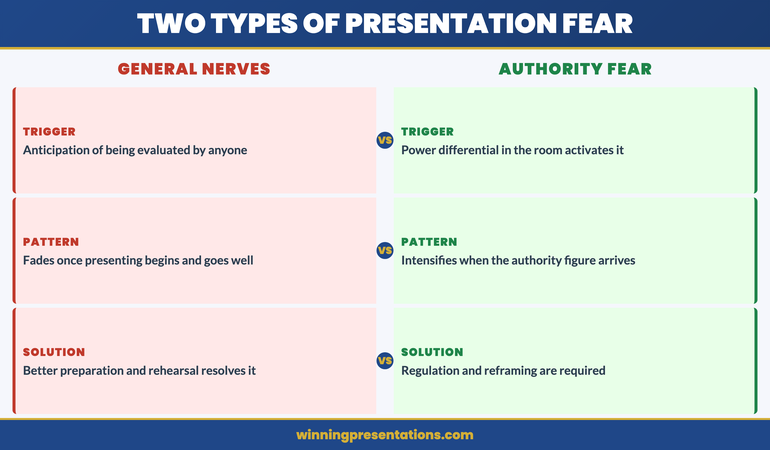
General presentation anxiety is a fear of being evaluated — of being seen, judged, and found wanting in front of others. Fear of authority in presentations is a more specific variant: it is the fear of being evaluated by someone whose judgment has direct consequences for your career, your standing, or your sense of competence. The audience has power over you in a way that a general audience does not. That changes the threat calculation entirely.
Most people who present confidently to peers and clients are still susceptible to this particular variant of anxiety. The shift happens not because the material is more difficult or the audience is more hostile, but because the evaluation carries different stakes. A poor presentation to peers is mildly uncomfortable. A poor presentation to the CEO, the board, or a regulator can feel — at the level of the nervous system — like a genuinely existential threat to professional survival.
The fact that this threat is usually disproportionate does not reduce its physiological force. The anxiety is real even when the danger is not. Understanding this distinction — that the fear is a real emotional and physiological event triggered by a perception rather than by an objective threat — is the prerequisite for working with it rather than being controlled by it.
As explored in the analysis of presentation anxiety with specific audiences, the same presenter can experience dramatically different anxiety levels depending purely on who is in the room. The content is identical. The fear is not triggered by the material — it is triggered by the relationship.
The Hierarchy Threat: What Your Nervous System Is Reacting To
The physiological response to presenting to authority figures draws on the same neural architecture as social threat detection more broadly. When you stand in front of someone who has power over your career outcomes, your nervous system is processing a threat signal — not because there is immediate physical danger, but because social hierarchies are genuinely consequential for wellbeing, and the threat of losing standing within them activates threat-detection systems that evolved to manage real risks.
This is why standard presentation preparation techniques — practising more, knowing the material better, arriving early — do not consistently resolve authority-specific anxiety. They address the cognitive preparation problem, not the threat-detection response. You can know your material fluently and still find that your voice constricts when the CFO walks in late and sits directly opposite you.
The nervous system’s response to hierarchy is not, however, fixed. It is shaped by experience, by interpretation, and by the physiological regulation skills available to you. The distinguishing feature between presenters who perform well in front of authority figures and those who do not is rarely confidence in the abstract — it is the ability to down-regulate the threat response quickly enough that it does not interfere with performance.
For those whose anxiety predates the corporate context — where patterns around authority figures were formed in childhood or earlier career experiences — the work described in resources on glossophobia in the C-suite is directly relevant. Authority-specific anxiety often has deeper roots than professional development programmes address.
Conquer Speaking Fear
A Structured Programme for Presentation Anxiety That Activates With Authority Figures
Conquer Speaking Fear is a 30-day programme for professionals whose presentation anxiety is persistent and specific — including anxiety that activates differently in front of senior leaders, boards, and authority figures. It uses nervous system regulation techniques and clinical hypnotherapy approaches to address the patterns that standard practice and preparation do not resolve.
- 30-day programme structured for working professionals
- Nervous system regulation techniques for the moments anxiety activates
- Clinical hypnotherapy approaches for deeper-rooted fear patterns
- Designed for anxiety that persists despite knowledge, preparation, and experience
Get Conquer Speaking Fear — £39
Designed for executives and senior professionals with persistent presentation anxiety.
The Imposter–Authority Paradox
There is a pattern that appears consistently among senior professionals who experience authority-specific anxiety: the more accomplished they are, the more acute the fear often becomes — particularly when presenting upward. This seems counterintuitive. Surely more experience should mean less anxiety? The paradox is that as seniority increases, the stakes attached to each presentation also increase, and the gap between self-perception and external reputation becomes more pronounced.
A mid-level manager who makes an error in a board presentation has room for recovery. A director or VP who makes the same error in front of the group CEO is in a different position — their reputation has been built on a certain standard of performance, and a visible failure carries proportionally more weight. The fear is not irrational; it reflects a real calculation about professional consequences. It becomes irrational only when it operates at the same intensity for a routine update as it does for a high-stakes decision meeting.
The imposter component adds a further layer. Many senior professionals who experience authority-specific anxiety carry a background sense that their competence has not been fully earned — that they are one poor performance away from being exposed. Presenting to someone with the power to confirm or challenge that fear activates both the hierarchy threat and the competence threat simultaneously. The combination is significantly more disruptive than either alone.
The distinction between this pattern and more general presentation anxiety is explored in the analysis of stage fright versus social anxiety — worth reading if you find that your anxiety is specific to certain audiences rather than present across all presentation contexts.
Techniques to Apply Before the Presentation
The preparation phase for an authority-specific presentation is different from standard presentation preparation. Knowing the material better rarely reduces this variant of anxiety — the anxiety is not about the material. The preparation work that is actually useful focuses on regulating the physiological state you bring into the room.
Reframe the stakes accurately. The nervous system is responding to a perceived threat. Before the presentation, spend time explicitly examining whether the threat is proportionate. In most cases, the realistic consequence of a less-than-perfect presentation to the CEO is that you have a learning experience. The catastrophic outcome your nervous system is preparing for — career damage, public humiliation, permanent loss of standing — is rarely the actual likely outcome. Making this calculation consciously, rather than allowing the unchallenged threat perception to drive your physiological state, is not a trivial exercise. It requires repeated, specific examination of the evidence, not a general reminder to calm down.
Regulate before you arrive. The two most reliable physiological regulation tools for pre-presentation anxiety are controlled breathing and physical movement. Extended exhale breathing — where the out-breath is longer than the in-breath — activates the parasympathetic nervous system and measurably reduces the physiological arousal associated with threat responses. Physical movement prior to the presentation — a brisk walk, not sitting at a desk scrolling through slides — changes the physiological state more reliably than any cognitive technique.
Prepare for the relationship, not just the content. If the authority figure who triggers your anxiety is someone you interact with regularly, the presentation anxiety is partly about that specific relationship. Consider whether there is an opportunity for a brief, non-presentation interaction with that person before the formal setting — a corridor conversation, a brief check-in. Reducing the social distance before the formal moment changes the dynamic in the room.
What to Do When the Fear Activates in the Room
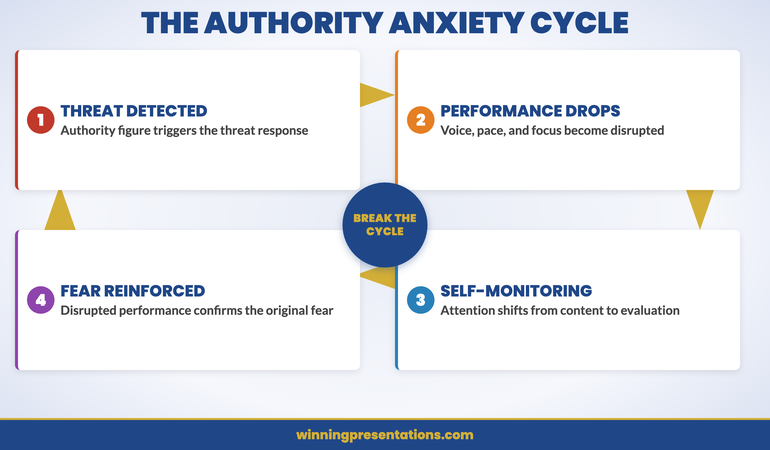
The moment the authority figure walks in, or the moment you stand to present and register who is in the room, the physiological response may activate regardless of how well you prepared. The ability to manage in-the-moment activation is a separate skill from pre-presentation regulation, and it is the skill that matters most for performance.
The first technique is to slow down deliberately. When anxiety activates, speaking pace tends to increase — partly because the body is in a state of arousal, and partly because there is an unconscious desire to finish the exposure quickly. A faster pace signals anxiety to the audience and removes the pauses that give the presenter time to regulate. The antidote is a conscious, deliberate reduction in pace — even if it feels uncomfortable. Slowing down when you are anxious feels wrong from the inside; it reads as composed from the outside.
The second technique is to anchor in the task rather than the evaluation. When fear of authority is active, attention tends to split between the content and the question “what do they think of me right now?” This split attention is visible — it is what produced Astrid’s experience of checking whether the executives were engaged rather than reading the room as a whole. Deliberately returning attention to the specific task — the next slide, the next sentence, the specific question being answered — redirects the nervous system’s monitoring from the social evaluation back to the work.
The third technique is to use questions as regulation points. When a senior leader asks a question, take a visible pause before responding — ideally two to three full seconds. This serves three purposes: it gives you time to regulate before speaking, it signals that you are considering the question seriously rather than deflecting, and it gives the authority figure the impression of measured confidence rather than reactive speed.
If authority-specific anxiety is persistent — activating reliably when certain senior figures are in the room, regardless of preparation or experience — Conquer Speaking Fear addresses the specific patterns that standard presentation coaching does not reach.
Why Some Senior Leaders Remain Afraid of Presenting Upward
One of the least-discussed aspects of authority-specific presentation anxiety is that it does not disappear with seniority. Directors who present confidently to their own teams, their peers, and external audiences can still find that presenting upward — to the board, to investors, to a regulatory committee — activates anxiety at the same intensity it did in their early careers. The authority hierarchy simply moves upward with them.
There is also an organisational culture dimension. Some organisations have leadership cultures in which senior leaders use presentations as opportunities to demonstrate intellectual dominance — to ask difficult questions publicly, to visibly challenge assumptions, to create an atmosphere in which the presenter must defend every claim. Presenters who have experienced this kind of culture may carry a threat-vigilance pattern that activates whenever they present upward, even in organisations where the culture is entirely different.
What changes the pattern, for senior leaders as much as for early-career professionals, is not more rehearsal or better slides. It is the development of a relationship with the physical and cognitive state that authority-figure presentations create — the ability to recognise the activation, to respond to it with regulation rather than suppression, and to return attention to the task without the emotional spiral that performance anxiety typically produces when it is treated as evidence that something is wrong.
Conquer Speaking Fear
30-Day Programme for Persistent Presentation Anxiety
For professionals whose anxiety activates reliably with authority figures — and who have not found a lasting solution through preparation, practice, or conventional coaching.
Get Conquer Speaking Fear — £39
Designed for executives and senior professionals with persistent authority-specific presentation anxiety.
Frequently Asked Questions
Is fear of presenting to authority figures a form of social anxiety?
It overlaps with social anxiety in some individuals, but it is not the same thing. Social anxiety is a broader pattern that affects a range of social interactions. Authority-specific presentation anxiety is context-specific — it activates primarily or exclusively when the audience includes people with evaluative power over the presenter. Many people with authority-specific anxiety have no social anxiety in other contexts. They socialise easily, present confidently to peers, and function without difficulty in most professional settings. The anxiety is specifically about the hierarchical power relationship in the room, not about social interaction generally.
What makes fear of authority in presentations different from ordinary nerves?
Ordinary pre-presentation nerves tend to diminish once the presentation begins and the presenter’s competence becomes apparent — the nerves are anticipatory. Authority-specific fear often intensifies once in the room, because the presence of the authority figure continues to activate the threat response throughout the presentation. It also tends to be highly selective: the same presenter may be entirely comfortable in front of 200 people at a conference and acutely uncomfortable in front of three people if those three people have significant power over their career.
Can this type of anxiety be resolved, or is it something to manage indefinitely?
For most people it can be substantially reduced — not by eliminating the physiological response, but by changing the relationship with it. The goal is not to feel nothing when presenting to the CEO. The goal is to be able to present at full cognitive and communicative capacity despite feeling something. With the right approach — nervous system regulation, accurate threat assessment, and structured exposure — most people find that the anxiety becomes significantly less disruptive and, over time, less intense. Some find that it resolves almost entirely. Others find a stable baseline that no longer interferes with performance. Indefinite management at the same intensity is rarely the outcome when the problem is addressed directly.
The Winning Edge — Weekly Newsletter
Each Thursday: one executive presentation insight, one practical technique, one tool. Read by executives across financial services, healthcare, technology, and government.
About the Author
Mary Beth Hazeldine is Owner and Managing Director of Winning Presentations. With 25 years of corporate banking experience at JPMorgan Chase, PwC, Royal Bank of Scotland, and Commerzbank, she advises executives across financial services, healthcare, technology, and government on managing presentation anxiety and building confidence for high-stakes settings. View services | Book a discovery call