Tag: executive presentation

06 May 2026
Traditional persuasion training teaches tactics. Senior leaders need something different: a structured framework for moving decisions that actually holds up.

Executive Influence and Persuasion Training: How Senior Leaders Move Decisions

QUICK ANSWER

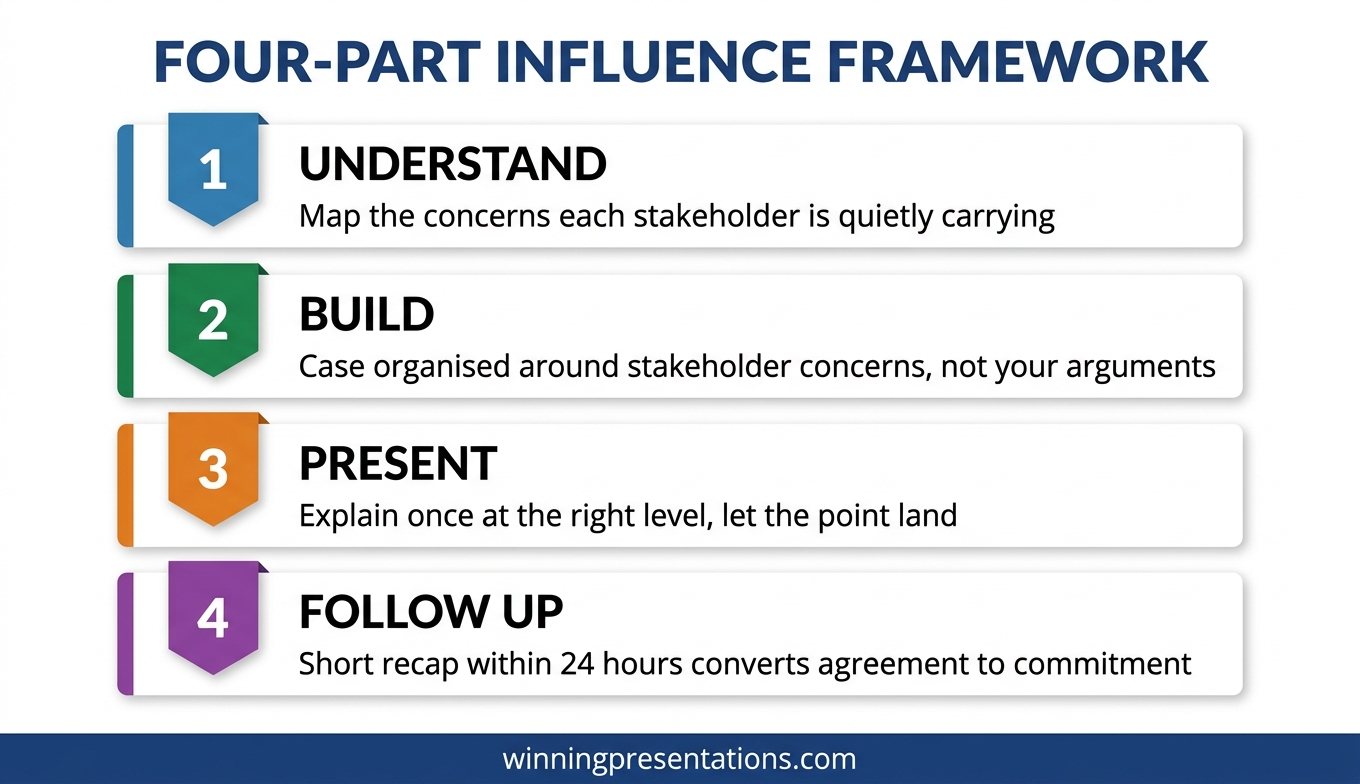
Executive influence and persuasion training for senior leaders is not about charisma, body language, or negotiation tactics. It is about a structured framework for moving decisions among people who have already heard every standard persuasion technique and see through them immediately. The framework has four parts: understanding what your stakeholders actually need to say yes, building a case that addresses their real concerns, presenting it in a way that respects their intelligence, and following up in a way that converts private agreement into public commitment.

The structured framework this article describes

The Executive Buy-In Presentation System is Mary Beth’s self-paced Maven programme covering the complete framework for securing buy-in from senior stakeholders, boards, and executives.

Explore the Programme →

Kenji, a senior director at a global consumer-goods company, walked out of a strategy approval meeting last autumn with a decision he did not expect. His proposal — a £14m restructure of the regional operating model — had been in preparation for six months. Three previous versions had failed. This one passed unanimously. He called me two days later to ask what had actually changed.

The data had not changed. The strategy had not fundamentally shifted. The slides looked similar. What changed was how Kenji had understood the meeting. In the previous three attempts, he had gone in to persuade. This time, he had gone in to address three specific concerns he had privately mapped before the meeting, carried by three specific executives whose support he needed. He had not persuaded anyone. He had made it easy for them to say yes.

Executive influence and persuasion training at senior levels is not about becoming more persuasive. Most senior executives are immune to persuasion tactics because they have seen all of them. What they are not immune to is a well-constructed case that directly addresses the concerns they are already carrying. That is the skill senior leaders need to develop. It looks less like charisma and more like careful, structured preparation.

Why standard persuasion training fails at senior levels

Most persuasion training is designed for sales contexts or early-career leadership, and it teaches tactics: mirroring, framing, storytelling structure, emotional hooks, the use of silence, the “yes ladder”. These tactics work in some contexts. They fail consistently at senior executive level for three reasons.

The first reason is recognition. Senior audiences have seen every tactic. When the tactic is deployed, it registers. A mirrored phrase from a middle manager in an internal meeting reads as coaching. A dramatic storytelling opening in a board update reads as theatrical. The tactics do not land because the audience is fluent in them.

The second reason is asymmetry. Senior stakeholders are evaluating you as much as your proposal. They are asking whether you understand the business well enough to have a defensible view, whether you have anticipated the hard parts, whether your recommendation holds up under pressure. Persuasion tactics signal that you are trying to influence them, which raises their defences rather than lowering them.

The third reason is stakes. Senior decisions are not binary. They carry precedent, political cost, and reputational risk for the people approving them. A persuasive case without a structured answer to those dimensions will not succeed regardless of how well it is delivered. The training needs to address the structure, not just the delivery.

Four-part framework for executive influence and persuasion training covering stakeholder understanding, case construction, presentation, and follow-up

THE STRUCTURED FRAMEWORK FOR EXECUTIVE INFLUENCE

Build the case your stakeholders cannot dismiss

The Executive Buy-In Presentation System is a self-paced Maven programme — 7 modules walking senior professionals through the structure, psychology, and delivery that get executive approval. Bonus Q&A calls (optional, recorded). Monthly cohort enrolment; lifetime access to materials.

  • 7 modules on stakeholder analysis, case construction, and delivery
  • Self-paced — no deadlines, no mandatory live attendance
  • Optional Q&A / coaching calls (fully recorded, watch back anytime)
  • Monthly cohort enrolment — enrol any time
  • Lifetime access to all course materials

£499, lifetime access to all course materials.

Explore the Executive Buy-In Presentation System →

Designed for senior professionals who present decisions to boards, investment committees, and executive sponsors.

Part 1: Understand what stakeholders actually need to say yes

Every senior decision has a set of concerns that live beneath the surface arguments. The surface arguments are the ones people say out loud — budget, timing, strategic fit. The underlying concerns are the ones people do not say out loud because they are political, personal, or uncertain. Senior leaders who influence successfully have learned to map the underlying concerns before the meeting.

The mapping exercise is not complicated. For each stakeholder whose approval you need, write down three things: what the surface argument against your proposal would be if they chose to make one, what the underlying concern probably is (reputation, precedent, control, fear of being seen to change direction), and what specific evidence would make that underlying concern less sharp.

In Kenji’s case, one senior executive had consistently pushed back on previous proposals. On the surface, the pushback was about cost. Underneath, the concern was that the restructure would reduce his remit, which was a status issue rather than a financial one. Kenji spent half a slide on the restructure’s effect on that executive’s remit — not defensively, but transparently. The executive’s objection evaporated because it had been anticipated.

This is the move that standard persuasion training does not teach. It is not about arguing better. It is about understanding what the other person is carrying into the room and addressing it explicitly. For more on the mapping approach, see stakeholder buy-in training.

Part 2: Build a case that addresses real concerns

Once the concerns are mapped, the case has to be built around them, not around the presenter’s own favourite arguments. Most proposals fail because they are organised around what the presenter finds most compelling, which is usually a mixture of the data that supports their view and the strategic logic they have internalised.

A case built around stakeholder concerns is organised differently. It leads with the concern that is most important to the most influential stakeholder, and it addresses that concern with evidence the stakeholder will actually find reassuring — not evidence the presenter finds reassuring. These are often different.

A second move is to surface the strongest counter-argument before the stakeholders do. Naming the strongest argument against your proposal — and then explaining why you have judged it not decisive — is one of the highest-credibility moves in executive communication. It signals that you have thought this through rather than avoiding the hard parts, and it takes the counter-argument off the table in a way a defensive response cannot.

For the slide-structure side of this, the executive presentations buy-in approach maps out how to sequence the case visually so the concerns get addressed in the right order.

Part 3: Present in a way that respects intelligence

Senior audiences do not want to be persuaded. They want to be informed enough to make a good decision. The difference is subtle but it changes every part of delivery.

Presenters who are trying to persuade usually over-explain, over-emphasise, and under-pause. They repeat their key points. They use adjectives like “robust”, “comprehensive”, and “aligned” that signal effort rather than substance. They fill silences. Each of these habits signals anxiety and effort to senior audiences, which reduces credibility.

Presenters who respect the intelligence of the room do the opposite. They explain once, at the right level of detail, and let the point land. They use pauses deliberately. They make their recommendation explicit, defend it in one sentence, and stop. They answer questions directly rather than taking the chance to repeat their case. They let the audience arrive at the conclusion rather than dragging them to it.

This is a delivery style that takes practice to develop because it runs counter to most presentation training. It also requires confidence in the material — if you are uncertain about your own recommendation, the under-explanation will read as evasion rather than authority. The getting executive buy-in presentations framework covers the specific delivery habits that make this tone work.

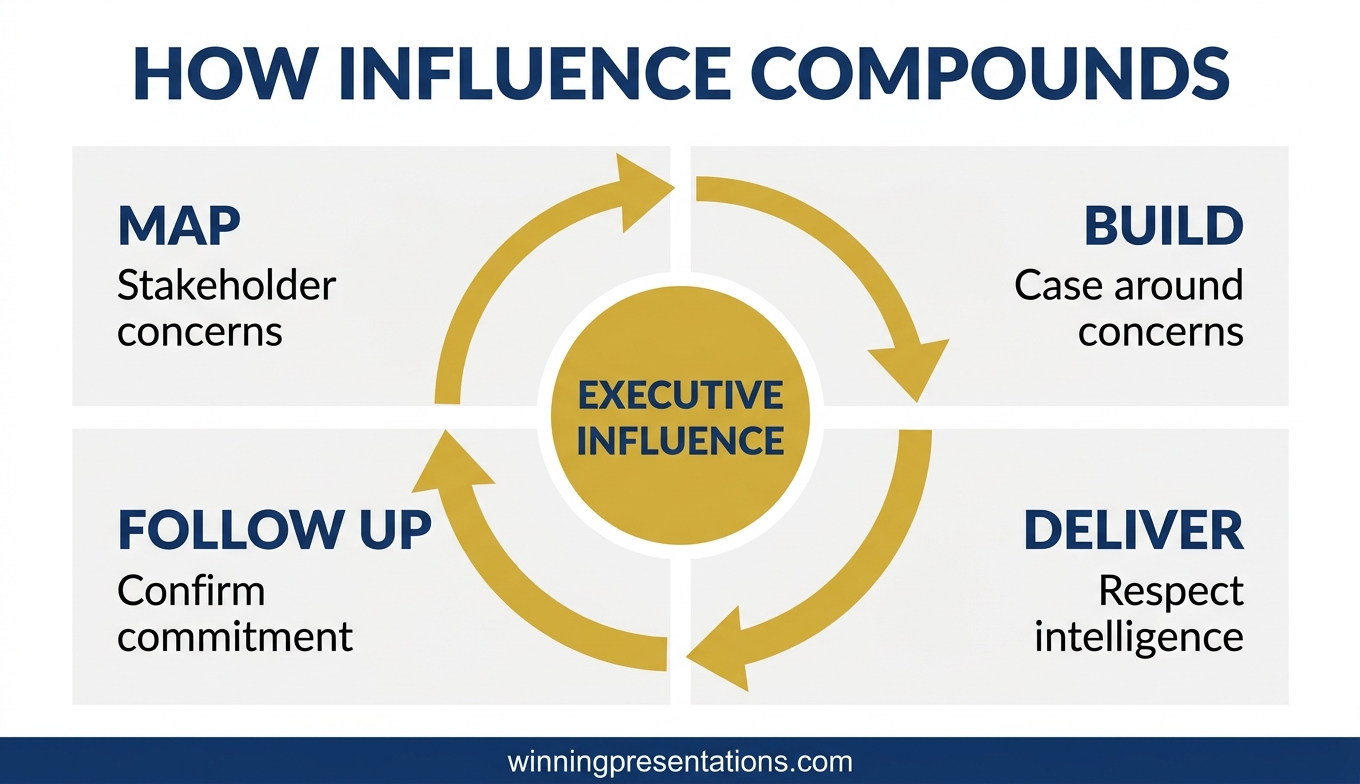
Cycle diagram showing the four stages of executive influence: map concerns, build case, present, follow up

For the slide structure that carries the case

The Executive Slide System provides 26 templates, 93 AI prompts, and 16 scenario playbooks designed for senior-level presentation work — including buy-in scenarios. £39, instant download.

Get the Executive Slide System →

Part 4: Follow up to convert agreement to commitment

Private agreement in a meeting room is not the same as public commitment. Senior executives will often nod during a presentation and then quietly disengage afterward, especially if the proposal touches something they find politically uncomfortable. The influence work is not finished when the meeting ends.

The follow-up move that converts agreement to commitment is a short, structured recap sent within 24 hours. Not a long document. A three-paragraph note confirming the decision reached, the immediate next step, and the specific commitment you need from each stakeholder to move forward. The note makes the agreement visible to the group, which makes quiet disengagement harder.

A second move is to identify one stakeholder whose support is strongest and ask them to be the visible sponsor of the next step. Sponsorship moves the proposal from the presenter’s proposal to a shared proposal, which changes the politics of any subsequent pushback. This is not manipulative. It is how senior decisions actually move forward in complex organisations.

The influence work is cumulative. Each meeting either strengthens or weakens the overall case, and the follow-up is where most of the cumulative work happens. Senior leaders who treat the meeting as the event and the follow-up as admin usually find their proposals losing momentum between meetings.

Frequently asked questions

How is this different from negotiation training?

Negotiation training assumes an adversarial or bargaining context — you and the other party are trying to reach agreement on terms. Executive influence and persuasion is usually not a negotiation. It is a presentation to decision-makers who have the authority to say yes or no. The skills overlap in some places, but the structure of the conversation is fundamentally different.

Can this be learned through a self-paced course, or do I need in-person coaching?

Most of the structural work — stakeholder mapping, case construction, delivery discipline — can be learned through a self-paced programme and practised in real meetings. The Executive Buy-In Presentation System is designed as a self-paced course with 7 modules, optional recorded Q&A calls, and monthly cohort enrolment. In-person coaching adds value for specific high-stakes moments but is not necessary for building the underlying skill.

How long does it take to see results from this kind of training?

The structural techniques (stakeholder mapping, case building, follow-up) can be applied to the next meeting on your calendar and typically produce a noticeable difference in audience engagement. The delivery discipline takes longer — usually three to four presentations to feel natural. Most senior professionals who work through the full framework see a meaningful shift in their approval rates within two to three months.

Does this work for influencing peers, not just senior stakeholders?

Partly. The stakeholder mapping and case construction translate cleanly to peer influence. The delivery work is slightly different because peer audiences often respond to more conversational framing rather than the formal presentation style that works in board contexts. The core framework still applies.

Is there a risk that this approach comes across as too calculated?

Only if the stakeholder mapping is used manipulatively. Used well, addressing people’s real concerns openly and respectfully reads as thoughtful rather than calculated. The signal you are giving is that you have thought about what they are carrying into the room, which most senior people quietly appreciate. The risk comes from pretending you have not done the work — which reads as false — not from having done it.

The Winning Edge

Weekly thinking for senior professionals on executive influence, stakeholder work, slide structure, and the judgement calls that frameworks do not cover.

Subscribe to The Winning Edge →

Not ready for the full programme? Start here instead: download the free Pyramid Principle Template — the structural scaffold that most persuasive executive cases quietly rely on.

Next step: pick one proposal you have coming up in the next 30 days. Do the stakeholder mapping exercise before you build the deck. Notice how differently the case comes together when the map is done first.

For the AI-assisted side of preparing these cases, see Copilot PowerPoint for board presentations.


About the author

Mary Beth Hazeldine is Owner & Managing Director of Winning Presentations Ltd, a UK company founded in 1990. With 24 years of corporate banking experience at JPMorgan Chase, PwC, Royal Bank of Scotland, and Commerzbank, she advises senior professionals on structuring presentations for board approvals, investment committees, and stakeholder-critical decisions.

26 Apr 2026
Featured image for Promotion Panel Presentation: How to Make Your Case Without Overselling

Promotion Panel Presentation: How to Make Your Case Without Overselling

Quick Answer

A promotion panel presentation should demonstrate how you already operate at the next level rather than listing your achievements at the current one. The strongest candidates frame their case around future organisational impact — what they will do with the role — and let their track record serve as evidence of capability, not the centrepiece of the argument.

Nadine had spent three weeks preparing for her panel presentation. She had metrics for every quarter, endorsements from two managing directors, and a slide deck that documented her contribution to the firm’s largest client migration in five years. By any objective measure, she was the strongest internal candidate.

She did not get the role.

The feedback, delivered carefully by her line manager, was that the panel found her presentation “impressive but backward-looking.” They described another candidate — someone with a shorter tenure and a less distinguished record — as having “a clearer vision for the function.” Nadine had spent twenty minutes proving she deserved the promotion. The other candidate had spent fifteen minutes showing what she would do with it.

The difference was not talent or track record. It was framing. Nadine presented a case for recognition. The other candidate presented a case for investment. Promotion panels do not reward past performance — they invest in future leadership. That distinction changes how you build every slide in the deck.

Preparing for a promotion panel this quarter?

Before you finalise your deck, pressure-test it against these three questions — the ones panel members rarely say aloud but always evaluate:

  • Does your opening slide describe the role’s future impact or your past achievements?
  • Could a panel member summarise your case in one sentence to a colleague who was not in the room?
  • Are you showing how you already operate at the next level, or asking to be given the chance?

Explore the Executive Slide System →

The Overselling Trap That Undermines Strong Candidates

The instinct in a promotion panel presentation is to demonstrate as much as possible. More achievements, more metrics, more examples of impact. The logic feels sound: the panel needs evidence, so give them evidence in volume. But volume works against you in this setting because it shifts the tone from leadership to audition.

Panel members are typically senior leaders who have been through this process themselves. They recognise overselling instantly — not because the claims are false, but because the framing feels effortful. A candidate who needs twelve slides to justify a promotion signals that the case requires extensive explanation. A candidate who presents a clear forward vision and supports it with two or three well-chosen examples signals that their readiness is self-evident.

The overselling trap also creates a structural problem. When your deck is dense with achievements, you leave no space for the panel to explore your thinking. The questions you receive become administrative — “Tell me more about the Q3 migration timeline” — rather than strategic. You want the panel asking questions about your vision, your priorities, and your leadership approach. Those conversations are where promotion decisions are made, not during your slide presentation.

The antidote is restraint. Select three examples of impact that are directly relevant to the role you are seeking, and let them do the heavy lifting. Everything else belongs in a brief appendix that demonstrates depth without consuming presentation time. If you have also been thinking about how to build a promotion business case presentation, this principle of selective evidence applies equally there.

Presenting Your Case to a Promotion Panel?

The difference between candidates who get promoted and candidates who get praised is almost always in the slide structure. The Executive Slide System — £39, instant access — gives you frameworks built from 24 years of corporate banking experience:

  • 22 slide templates for high-stakes executive scenarios
  • 51 AI prompt cards to structure persuasive arguments fast
  • 15 scenario playbooks for board, panel, and leadership presentations

Get the Executive Slide System →

Designed for senior professionals preparing career-defining presentations.

What Promotion Panels Are Actually Evaluating

Promotion panels assess four things, and only one of them is past performance. Understanding all four changes how you allocate your presentation time.

Leadership readiness. Can this person operate effectively at the next level? Panel members look for evidence that you already think and act like someone in the target role. They are not asking whether you could grow into it eventually — they are assessing whether the gap is small enough that the transition will be smooth. Your presentation should demonstrate that you have already been operating at this level informally, and the promotion formalises what is already happening.

Organisational awareness. Does this person understand the broader context? A strong candidate connects their role to the organisation’s strategic priorities. A weak candidate talks about their function in isolation. If you are presenting for a director-level role, your deck should reference how your function interacts with other parts of the business, where the friction points are, and what you would do to address them.

Stakeholder judgement. Can this person navigate complexity? Panel members listen for how you talk about difficult situations — budget constraints, underperforming teams, competing priorities, political dynamics. They are less interested in what happened and more interested in how you thought about it. Your micro-stories should reveal your reasoning process, not just the outcome.

Communication clarity. Can this person influence a room? The panel presentation itself is a test of this capability. If you cannot structure a clear, persuasive ten-minute presentation about a subject you know intimately — your own career — then the panel will question whether you can do it on subjects that are less familiar and higher stakes.


Infographic showing the four dimensions promotion panels evaluate: leadership readiness, organisational awareness, stakeholder judgement, and communication clarity

How to Structure Your Promotion Panel Presentation

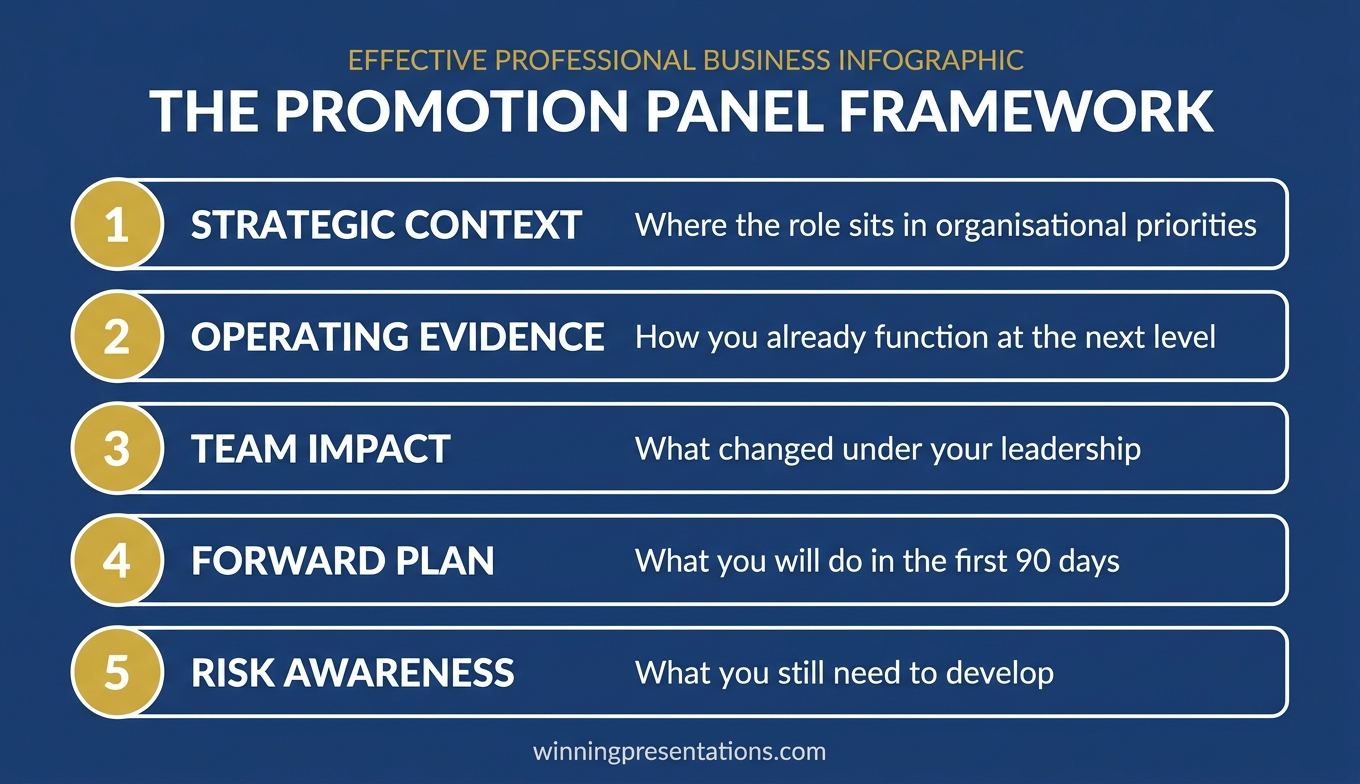
The most effective structure for presenting to a promotion panel follows a three-part architecture: context, capability, and commitment. Each part serves a different purpose and answers a different unspoken question from the panel.

Part 1: Context (2 slides, 2-3 minutes). Start by demonstrating that you understand the strategic landscape of the role you are seeking. What are the three most important priorities for this function over the next twelve to eighteen months? What external pressures or internal changes will shape the role? This is not about impressing the panel with research — it is about proving that you have already started thinking like someone in the role. Open with the organisation’s context, not yours.

Part 2: Capability (3-4 slides, 5-6 minutes). This is where your evidence lives, but it must be framed as capability for the future role, not recognition for past work. For each priority you identified in Part 1, present one example from your career that demonstrates relevant capability. The structure for each example: “Here is what I did, here is why it is relevant to this role, and here is how I would apply that experience to [specific future priority].” This three-part framing turns every achievement into a forward-looking proposition.

Part 3: Commitment (1-2 slides, 2-3 minutes). Close with your vision for the first ninety days and beyond. What would you prioritise? What would you change? What would you protect? This section reveals your leadership instincts. Panel members listen carefully to what you would keep as well as what you would change — both signals are informative. A candidate who plans to change everything signals inexperience. A candidate who plans to change nothing signals complacency. The right answer is selective, strategic, and grounded in the context you established in Part 1.

If you are also preparing for the transition after a successful panel, you may find useful frameworks in this guide on delivering your first presentation after promotion.

Presenting Evidence Without Sounding Like You Are Bragging

This is the tension at the centre of every panel presentation for promotion: you need to demonstrate impact, but you cannot sound self-promotional. The candidates who navigate this well use three techniques consistently.

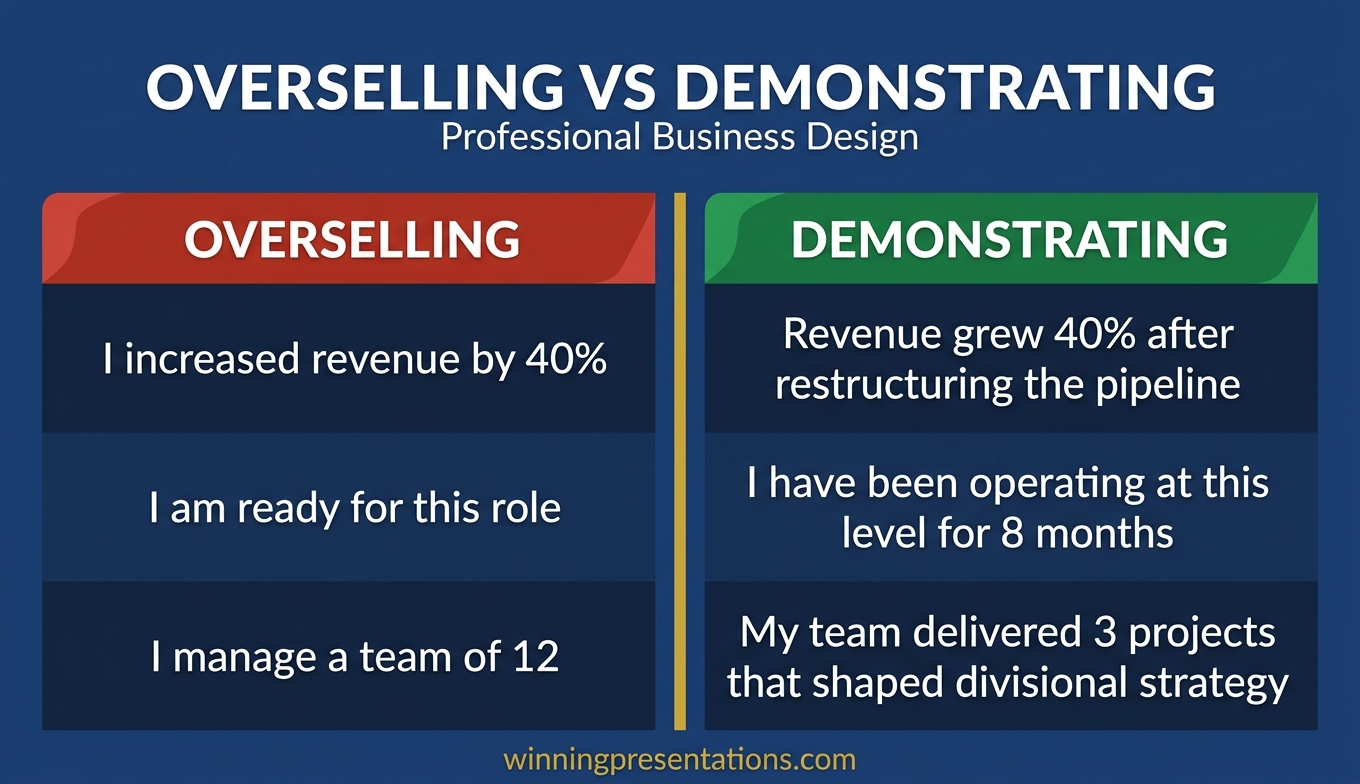
Frame achievements as team outcomes. Instead of “I led the restructuring of the compliance function,” try “The compliance restructuring — which I was asked to lead — reduced processing time by 35 per cent and is now the model being adopted across European operations.” The first version centres you. The second version centres the outcome and lets the panel draw their own conclusion about your role in it.

Let the scale speak for itself. When the numbers are significant, they do not need amplification. “The portfolio grew from £120 million to £340 million during my tenure” is more powerful than “I personally drove unprecedented growth across the portfolio.” Understated delivery of substantial results signals confidence. Overstated delivery of any results signals insecurity.

Attribute credit generously. Panel members know that senior outcomes are never solo achievements. A candidate who acknowledges the contributions of their team, their sponsors, and their peers demonstrates the kind of leadership maturity that promotion panels are specifically looking for. “I built the team that delivered this, and I was fortunate to have a sponsor in the COO who removed barriers at the executive level” tells the panel three things: you build teams, you leverage sponsors, and you are secure enough to share credit.

The Executive Slide System includes frameworks for structuring evidence slides that let results speak without requiring self-promotion.


Comparison infographic showing self-promotional framing versus leadership framing when presenting to a promotion panel

Handling Panel Questions That Test Leadership Maturity

The questions after your panel presentation are not an afterthought — they are often the deciding factor. Panel members use questions to test three things: how you think under pressure, whether your self-awareness is genuine, and whether your vision can survive scrutiny.

“What would you do differently if you could go back?” This question tests self-awareness. The worst answer is “nothing.” The best answer names a specific decision, explains what you learned, and connects that learning to how you would approach a similar situation in the new role. Avoid rehearsed corporate language like “I would communicate more proactively” — be specific enough that the panel believes you have actually reflected on the question before today.

“Where do you see the biggest risk in this function?” This question tests strategic judgement. Panel members are looking for evidence that you can identify threats that are not yet obvious to everyone. A good answer demonstrates that you understand the external environment, the internal dependencies, and the second-order effects of decisions being made elsewhere in the organisation.

“How would you handle a situation where your team disagrees with a senior leader’s direction?” This question tests leadership courage and political skill simultaneously. The panel wants to know that you can push back constructively without damaging relationships. The best answers describe a process — how you would gather evidence, frame the alternative, choose the right moment, and protect your team from reputational risk regardless of the outcome.

“Why this role, and why now?” This deceptively simple question is where many candidates stumble. The answer should connect your personal trajectory to the organisation’s timing. “The function is entering a period of transformation, and my experience in [specific area] is particularly relevant to the challenges ahead” is stronger than “I feel ready for the next step in my career.” The first answer is about the organisation. The second is about you.

For broader guidance on building the skills that underpin strong panel performances, this article on presentation skills for promotion covers the fundamentals.

Build Your Promotion Panel Deck With Confidence

Stop guessing what promotion panels want to see. The Executive Slide System (£39, instant access) gives you 22 templates, 51 AI prompts, and 15 scenario playbooks — built from real executive presentation experience.

Get the Executive Slide System →

Designed for executives preparing for career-defining moments.

Frequently Asked Questions

How long should a presentation to a promotion panel be?

Most promotion panels allocate ten to fifteen minutes for the presentation and ten to fifteen minutes for questions. Aim for the shorter end of the presentation window — a ten-minute presentation that leaves ample time for discussion signals confidence and creates space for the strategic conversation that panels value most. Never exceed your allotted time. A candidate who cannot manage a clock is unlikely to manage a department.

Should I include slides about my current role’s performance metrics?

Include metrics only when they directly demonstrate capability for the target role. A slide showing revenue growth is relevant if the new role involves commercial responsibility. A slide showing project delivery timelines is relevant if the new role involves operational leadership. Avoid metrics that demonstrate competence at your current level without connecting to the next level’s requirements. Two or three well-chosen metrics are more persuasive than a comprehensive performance dashboard.

What is the biggest mistake candidates make when presenting to a promotion panel?

Treating the presentation as a performance review rather than a leadership proposition. The most common structural error is spending 80 per cent of the time on past achievements and 20 per cent on future plans. Reverse that ratio. Panel members already have your performance record — they invited you to present because the record is strong. What they need from the presentation is evidence that you can think and act at the next level.

How do I handle presenting to a promotion panel when I am competing against an external candidate?

Your advantage as an internal candidate is institutional knowledge, established relationships, and a shorter ramp-up period. Lean into these without being defensive about the external threat. Frame your first-ninety-day plan around actions that only an insider could execute quickly — leveraging existing relationships, building on current momentum, addressing known friction points. The external candidate can only promise generic plans; you can offer specific, grounded commitments.

If you are also preparing for a committee-level presentation, this guide on remuneration committee presentations covers the structural principles that apply when the audience holds decision-making authority.

The Winning Edge

A weekly newsletter for executives who present at senior level. Frameworks, slide structures, and panel preparation strategies — delivered every Thursday.

Subscribe to The Winning Edge →

Free resource: Executive Presentation Checklist — a quick pre-panel checklist to pressure-test your deck before the day.

About the Author

Mary Beth Hazeldine is the Owner & Managing Director of Winning Presentations. With 25 years of corporate banking experience at JPMorgan Chase, PwC, Royal Bank of Scotland, and Commerzbank, she advises executives across financial services, healthcare, technology, and government on structuring presentations for high-stakes funding rounds, board briefings, and leadership decisions.

22 Apr 2026
A confident executive woman standing at the head of a boardroom table delivering her opening line to attentive board members, navy suit, professional lighting, editorial photography style

Board Presentation Opening Lines

Quick Answer

The most effective board presentation opening lines follow one principle: tell the board what they need to decide before you tell them why. Start with the recommendation, the decision, or the single number that frames everything else. Anything else is delay — and delay costs credibility.

Fatima had been working on the proposal for six weeks. The numbers were solid. The risk analysis was thorough. Her opening slide said: “Agenda.”

The chair of the audit committee looked at it, glanced at his phone, and didn’t look up again for four minutes.

She recovered — eventually — but she lost the room before she said her second sentence. The agenda slide wasn’t just a weak choice. It was a signal: I don’t know what decision you need to make yet. And senior executives interpret that signal immediately.

I’ve watched hundreds of board presentations open this way. The presenter believes they’re being professional and organised. The board experiences it as someone who hasn’t done the work to understand what matters at that level.

Already have strong content but losing the room at the start?

The Executive Slide System includes opening slide frameworks designed specifically for boardroom and approval presentations — the structures that get executives oriented fast and decisions made sooner.

Explore the Executive Slide System →

Why most board presentation openings fail in the first 30 seconds

Most people open a board presentation the way they were taught to open any presentation: orient the audience, set context, preview the agenda, then build your argument. In academic settings and general business presentations, this works reasonably well.

In boardrooms, it destroys momentum before you’ve started.

Board members are not a general audience. They have typically received a pre-read. They already have context. What they’re waiting for — consciously or not — is the one thing they need to engage with: the decision, the recommendation, or the number that frames everything.

When you open with context they already have, you signal that you don’t understand their workflow. When you open with an agenda slide, you’re asking them to wait even longer before you reach the point. The attention loss is immediate, and it affects how they receive everything that follows.

The three most common failing opening structures are:

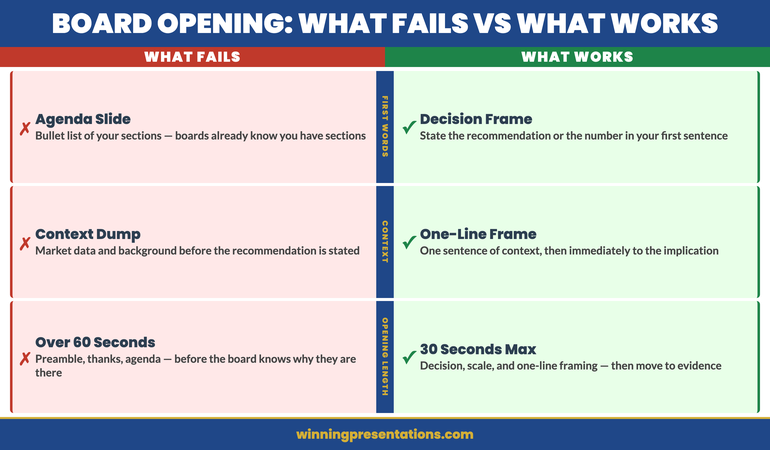
  • The orientation delay: “Good morning, thank you for the opportunity to present today. I’ll be covering three areas: background, analysis, and recommendation.” You’ve used 15 seconds and said nothing of value.
  • The agenda slide: Bullet points listing your section headings. Boards don’t need to know you have three sections. They need to know what’s in them.
  • The context dump: Opening with market data, company history, or project background before you’ve stated your recommendation. This makes them sit through context before they know what you want them to do with it.

Each of these has the same root problem: they put the presenter’s structure ahead of the board’s need to decide.

Infographic showing three failing board presentation opening structures — orientation delay, agenda slide, and context dump — contrasted with the decision-first approach

What boards actually want to hear first

I spent 24 years in corporate banking at JPMorgan Chase, PwC, Royal Bank of Scotland, and Commerzbank. I sat in hundreds of board and steering committee meetings on both sides of the table. The single most consistent pattern I observed: the presentations that held attention from the first sentence always led with the decision frame.

Not the process frame. Not the background frame. The decision frame.

A decision frame answers one question before any other: What are you asking us to do, or what do you need us to know in order to act?

This isn’t the same as a recommendation. Sometimes the board isn’t being asked to approve anything — they’re being given an update that requires awareness. A decision frame still works: “The programme is on track. The one item requiring board attention is the supplier risk in Q3.”

That sentence tells them exactly where to direct their scrutiny. Everything that follows is supporting detail. They’re not waiting for the point. The point arrived in your first sentence.

According to research into executive communication, senior decision-makers form an initial assessment of a presenter’s credibility within the first minute of a presentation. That first impression shapes how they interpret every data point that follows. An opening that respects their time and intelligence creates a halo effect. An opening that delays the point creates the opposite.

Your Opening Line Shouldn’t Be an Apology for Making Them Wait

The Executive Slide System — £39, instant access — includes the opening slide structures used in boardroom and high-stakes approval presentations. Lead with the decision frame, not the agenda. Your first slide should tell them what they need to know before you explain why.

  • Opening slide frameworks for board and approval presentations
  • Decision-first structure templates for different meeting types
  • AI prompt cards to draft opening lines in under 5 minutes
  • Slide templates for context, recommendation, and risk framing

Get the Executive Slide System →

Designed for board, approval, and investor presentations at executive level.

Four opening structures that work at executive level

There isn’t one perfect opening structure. Context matters: the type of meeting, what the board has already seen, the level of urgency, and whether you’re seeking approval or providing a report. These four structures cover the main scenarios.

1. The direct recommendation opening

Use this when you are seeking a decision or approval.

“We’re recommending [specific action]. The investment required is [amount]. Subject to board approval, we can move to contract by [date].”

Everything after this is evidence. The board knows what you want from them before you’ve showed them a single piece of supporting data. They can now evaluate your evidence against a clear decision framework. This is genuinely helpful — it changes how they listen.

2. The single-number opening

Use this when one metric defines the situation.

“Revenue is [X]. That’s [above/below] plan by [Y]. I want to spend our time on the two structural factors driving that variance — they’re different from what we expected.”

A specific number commands attention in a way that “overview of our quarterly performance” never does. It grounds the board immediately. They know the scale, the direction, and the frame for the discussion before you move to your second sentence.

3. The one-thing-to-know opening

Use this for updates where you’re not seeking a decision but awareness matters.

“Everything is on track. The one item I want to make sure you’re aware of is [issue]. It doesn’t require a decision today, but I want to ensure it’s visible at board level.”

This structure respects their time and shows judgement. You’ve told them what to care about and what not to worry about in a single breath. That’s a significant signal of executive competence.

4. The context-then-implication opening

Use this when the board needs a small amount of new context before your recommendation makes sense — but the context should take 30 seconds, not five minutes.

“Since our last meeting, [one significant external development]. That changes our position on [topic] in one specific way: [implication and recommendation].”

The key is compression. One development, one implication, one recommendation. Then you expand. The internal structure of your presentation can be as detailed as needed — your opening sentence sets the frame.

Roadmap infographic showing the four board presentation opening structures: direct recommendation, single-number, one-thing-to-know, and context-then-implication

Phrases to eliminate from every board opening

Certain phrases appear in board presentations so frequently that they’ve lost all meaning. More damaging, they’ve become signals of a presenter who hasn’t thought carefully about their opening. If you use any of these, you’re starting with borrowed language rather than a clear frame.

“Thank you for having me” / “Thank you for the opportunity to present.” This is not wrong, exactly. But it consumes your first sentence on politeness that everyone understands is implied. The board didn’t invite you to be thanked — they invited you because they need information. Get to it.

“Before I begin…” This tells the board that whatever follows is not the actual presentation — it’s preamble. You’ve signalled delay before you’ve started.

“As you’ll see from the agenda…” If your opening sentence refers to your agenda, your opening sentence is about your structure rather than their decision. That’s the wrong priority.

“I know you’re all very busy…” Acknowledging their busyness doesn’t make your presentation faster. It suggests you’re worried about their patience, which makes them more aware of time.

“This is a complex topic, but…” Anything that follows “but” in an opening sentence carries anxiety about whether your argument will land. Boards don’t need forewarning about complexity — they need your clearest summary of what it means.

Removing these phrases is not about being brusque. It’s about using your opening line for what it should do: establish the decision frame and earn attention through clarity.

If you want to see how the internal structure of a high-stakes presentation supports a strong opening, the article on executive presentation structure covers this in detail. And for the specific difference between a board paper and a board presentation — which changes what your opening needs to do — see board paper vs board presentation.

The first slide rule that changes everything

Your opening words and your first slide are not the same thing. But they should be aligned.

The most effective first slides for board presentations share one characteristic: they show the conclusion, not the agenda. This is counterintuitive for most presenters trained in traditional presentation structures. The instinct is to ease the audience in — set up the problem before revealing the solution.

Boards don’t want to be eased in. They want to know immediately what position you’re advocating, then evaluate whether your supporting evidence holds.

A first slide that shows your recommendation (with the supporting rationale compressed to three bullet points) lets the board challenge the right things from the start. If they see a problem with your recommendation in the first minute, they’ll tell you — and you can address it before spending 20 minutes on analysis that doesn’t resolve their concern.

Compare these two first-slide approaches for a budget approval request:

Approach A: Title: “FY2027 Budget Request — Technology Infrastructure Division.” Content: Agenda.

Approach B: Title: “We’re requesting £2.4M for infrastructure replacement — here’s why it’s the only option.” Content: Three-line summary of the business case and the alternative cost of inaction.

Approach B tells the board what decision they’re being asked to make, frames the scale, and gives them the argument in compressed form. If they want more detail, your subsequent slides provide it. If they have a question about the assumption behind the recommendation, they can raise it now rather than at slide 22.

The principles behind strong board presentation structure — including how to open, present, and close effectively — are covered in depth in the guide to how to start a presentation.

If you’d prefer a complete ready-made framework rather than building your opening structure from scratch, the Executive Slide System includes opening slide templates designed specifically for board and approval presentations.

Stop Rebuilding Your Board Slides From Scratch

The Executive Slide System — £39, instant access — is designed for executives who need a structured, repeatable format for high-stakes presentations. No more guessing what to put on slide one. The opening frameworks tell you exactly what information belongs where and why.

Get the Executive Slide System →

Designed for boardroom and executive approval presentations.

Frequently Asked Questions

Should I introduce myself at the start of a board presentation?

Only if you are presenting to a board for the first time and there are members who don’t know your role. In that case, one sentence is sufficient: “I’m [name], [role], and I’m responsible for [area].” If the board already knows you, skip the introduction entirely. Your time is better spent on the decision frame.

How long should a board presentation opening be?

The opening — from your first spoken word to your first piece of supporting evidence — should take 30 to 60 seconds. If it takes longer, you have too much preamble. The opening’s job is to establish the decision frame, not to explain your thinking process. Thinking is shown through the structure of your evidence, not the length of your introduction.

What if I need to provide context before the board can understand my recommendation?

Keep the context to one sentence and state the recommendation anyway. “Since our last meeting, the regulator has issued updated guidance — our recommendation is [X] to stay compliant” gives both context and recommendation without the extended build-up. If the context requires more than one sentence, that’s a sign that your pre-read document needed to be stronger, not that your opening needs to be longer.

The Winning Edge

Weekly strategies for executives who want to present with clarity and conviction. Every Thursday.

Subscribe Free →

Not ready for the full system? Start here instead: download the free Executive Presentation Checklist — a single-page reference for the structure, opening, and closing every executive presentation needs.

For executives presenting in hybrid or virtual environments, where opening line technique requires additional adaptation, see when to turn your camera off in virtual presentations — a related consideration for how presence translates across formats.

Your next board presentation deserves a first sentence that earns attention rather than waits for it. Start with the decision. Let the evidence follow. The board will notice the difference.

About the Author

Mary Beth Hazeldine is Owner & Managing Director of Winning Presentations. With 24 years of corporate banking experience at JPMorgan Chase, PwC, Royal Bank of Scotland, and Commerzbank, she advises executives across financial services, healthcare, technology, and government on structuring presentations for high-stakes funding rounds and approvals. She is a qualified clinical hypnotherapist and NLP practitioner.

22 Apr 2026
A senior executive man reviewing presentation slides at a table with a younger professional woman, warm collegial setting, glass office background, mentorship context, editorial photography style

Mentorship Presentation

Quick Answer

An effective mentorship presentation shares hard-won knowledge through structured experience rather than instruction. The key is framing your insight as something you discovered — not something you’re delivering. This shifts the dynamic from teacher-to-student to peer-to-peer, which is the only dynamic that actually changes how people think.

Henrik had 28 years of experience in supply chain finance. His mentee, Chiara, was sharp, ambitious, and had been promoted twice in four years. He wanted to share what he knew before he retired.

He built a presentation. Twenty-two slides covering everything he’d learned about vendor relationships, payment terms, and working capital dynamics. He delivered it over 90 minutes.

Chiara said it was helpful. Afterwards, she couldn’t recall a single specific insight.

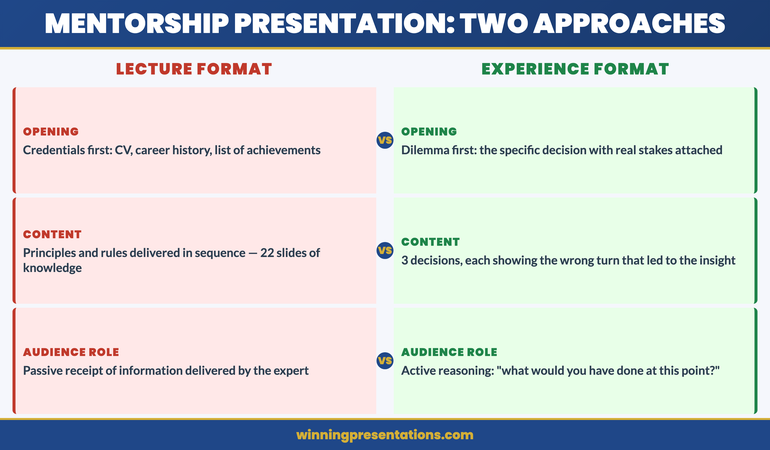
The information was excellent. The format made it forgettable. Henrik had built a lecture when he needed to build a conversation. The difference between the two is not tone — it’s structure. And the structure problem is fixable.

Want your knowledge to land rather than wash over people?

The Executive Slide System includes frameworks for structuring complex knowledge into clear, actionable slide decks — the kind that get read, remembered, and acted on.

Explore the Executive Slide System →

The patronising trap in mentorship presentations

The patronising trap is not about tone. Most people who patronise their audience aren’t trying to condescend — they’re trying to be thorough. The trap is structural: it’s built into how you organise the content.

When you present as though you know something your audience doesn’t, and your job is to transfer that knowledge to them, you’ve created a hierarchy. Even if the content is valuable and the delivery is warm, the structure says: I have expertise; you lack it. This creates a subtle defensiveness in the listener — particularly in high-performers who are used to being the person in the room who knows things.

The alternative is to present as though you’re inviting them to examine a problem alongside you. You’ve already done the examination. You’ve already reached conclusions. But you’re presenting the examination, not just the conclusions — and you’re doing it in a way that allows them to follow the thinking rather than simply receive the result.

This matters because retained knowledge comes from active engagement. When a person follows a chain of reasoning and arrives at the insight themselves — even if you led them there — they own it. When you give them the conclusion directly, they receive it but don’t necessarily internalise it.

The structural shift is surprisingly simple: lead with a question or a dilemma rather than a statement. “Here’s what I learned” becomes “Here’s the problem I hadn’t anticipated.” The content that follows is identical. The relationship between presenter and audience is fundamentally different.

Split comparison infographic showing ineffective lecture-style mentorship presentation structure versus effective experience-sharing mentorship structure

The structure that teaches without lecturing

There is a specific structure that works for mentorship presentations at executive level. I’ve used it across group mentorship sessions, one-to-one strategy conversations, and formal knowledge-transfer presentations. It adapts to any length and any subject matter.

It has four parts:

Part 1 — The decision you faced. Not the answer. The decision — the moment where multiple options existed and something was at stake. Be specific about the stakes. Vague stakes produce vague learning. “A significant contract was at risk” produces less engagement than “We had 48 hours to respond and a £3.8M renewal on the line.”

Part 2 — What you tried first (and why it was wrong). This is the part most mentors skip. They’re uncomfortable presenting failure or initial misjudgement. But the wrong turn is where the learning lives. If you jumped straight to the right answer, your mentee learns the answer without the reasoning that makes it applicable elsewhere. The wrong turn teaches them to recognise the situation next time — not just copy the response.

Part 3 — The insight that changed your approach. Not a principle. A specific realisation, triggered by a specific event or piece of information. “We realised the procurement lead wasn’t the real decision-maker — the CFO was reviewing every contract above £500K” is teaching. “You need to understand stakeholder dynamics” is not.

Part 4 — The pattern you now apply. This is where you make the specific applicable to the general. Once you’ve taken them through the specific decision, you can generalise to the pattern — and it will land because they’ve followed the reasoning. “Since then, I map decision authority before I map content” is a principle that makes sense because they understand where it came from.

This structure takes longer to build than a traditional knowledge-transfer presentation. But it transfers knowledge that stays.

Build Decks That Teach as Clearly as They Inform

The Executive Slide System — £39, instant access — includes frameworks for structuring knowledge presentations that audiences actually engage with. Stop building lecture decks. Build thinking frameworks instead.

  • Slide structure templates for knowledge transfer and strategic alignment
  • AI prompt cards to build complex content into clear narrative flows
  • Executive presentation frameworks for different audience types
  • Opening and closing structures that maintain engagement throughout

Get the Executive Slide System →

Designed for executive-level presentations across all formats and audiences.

How to design knowledge-transfer slides

Most knowledge-transfer presentations look like this: a title slide, a table of contents, seven section headers with three to five bullet points each, and a summary slide. This is the standard corporate training format. It’s also the format most likely to produce an audience who nods, takes notes, and remembers nothing specific three days later.

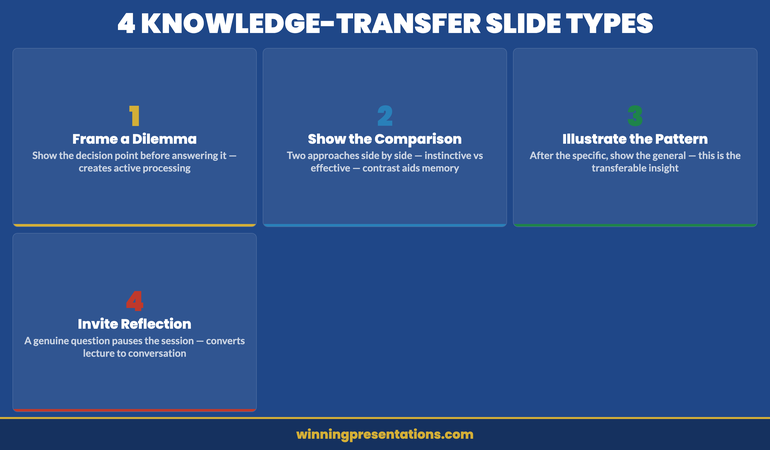
Slide design for knowledge transfer requires a different logic. Each slide should do one of four things:

Frame a dilemma. A slide that shows a decision point — “Which approach did we choose and why?” — orients the audience toward a specific question before you answer it. This creates active processing rather than passive receipt of information.

Show the comparison. Rather than a slide full of principles, a comparison slide shows two approaches side by side — the instinctive approach and the effective one, or the approach that works in one context and fails in another. Comparisons are memorable because they contain contrast, and the brain encodes contrast more reliably than lists.

Illustrate the pattern. Once you’ve taken the audience through a specific decision, a single slide showing the general pattern (with your specific example as one application) ties the learning together. This is the “applicable elsewhere” moment — the point at which specific experience becomes transferable knowledge.

Invite reflection. A slide that asks a question — “What would you have done at this point?” or “What’s the risk in each option?” — creates a pause for active engagement. In a one-to-one setting, you can ask these questions verbally without putting them on a slide. In a group, the slide creates a visible anchor for the conversation.

For the foundational principles of executive presentation structure that underpin this approach, the article on executive presentation structure covers the core frameworks.

Using questions to deepen retention

One of the most consistent patterns I’ve observed in effective mentorship presentations is the deliberate use of questions — not rhetorical questions, but genuine questions that pause the presentation and invite a response.

Most presenters avoid this. They’re worried about silence, or about the conversation going off track, or about losing the thread of their prepared content. The avoidance is understandable. But it costs them the engagement that makes knowledge transfer work.

The question method works like this: at a natural turning point in your narrative — usually just after you’ve described the wrong turn or the dilemma — you pause and ask a direct question. “Before I tell you what we did, what would you have considered here?” or “What’s the risk you’d want to understand before moving forward?”

The mentee’s answer reveals their current mental model. If they identify the same concern you had, you can confirm it and move forward — they’re tracking with you. If they identify a different concern, you have an opportunity to address that concern directly, which is far more valuable than following your prepared script.

You don’t need to ask questions on every slide. Two or three across a 60-minute session is enough to shift the dynamic from presentation to conversation. That shift changes retention significantly.

Dashboard infographic showing four slide design types for knowledge transfer: frame a dilemma, show the comparison, illustrate the pattern, invite reflection

Four mistakes that undermine mentorship presentations

These patterns appear consistently in mentorship presentations that don’t transfer knowledge effectively. Each one has a specific fix.

1. Starting with credentials rather than content. Opening with your CV, your career history, or your list of achievements signals that you feel your authority needs establishing before your content will be accepted. Most mentees already respect you — that’s why they’re there. Starting with credentials delays the content and, ironically, can feel defensive. Start with the first dilemma. Your credentials will be demonstrated through the quality of the reasoning, not the length of your biography.

2. Covering too much. A mentorship presentation that tries to share 28 years of knowledge in 90 minutes will transfer almost none of it. Three specific, well-developed experiences with clear patterns will transfer far more than twenty principles illustrated with brief examples. Depth beats breadth in knowledge transfer every time.

3. Using “always” and “never.” Absolute rules are memorable but unreliable. The experienced person knows that every rule has a context in which it doesn’t apply. When you present principles as absolutes, you’re simplifying in a way that will mislead your mentee the first time they encounter the exception. Better: “My default is [approach] — and there are two situations where it doesn’t work.”

4. Skipping the failure. I’ve already mentioned this, but it deserves its own entry. The moments of your career that changed how you operated were almost always preceded by something going wrong. Sharing those moments is not a sign of weakness. It’s the most valuable thing you can give a mentee: the pattern of error that leads to the pattern of insight. Without the failure, the insight sounds like advice. With the failure, it sounds like truth.

If you’re also thinking about how to present your experience when moving between roles or seeking a new position, the article on internal transfer pitch presentations covers how to frame accumulated experience as a strategic asset.

For a complete framework for building structured executive presentations — including the slide templates that support knowledge transfer and persuasion across complex topics — the Executive Slide System gives you the structures used in high-stakes executive presentations.

Turn Your Experience Into a Presentation That Actually Changes How People Think

The Executive Slide System — £39, instant access — gives you the slide frameworks, AI prompt cards, and structure templates to turn complex knowledge and experience into presentations that land. Stop delivering information. Start transferring understanding.

Get the Executive Slide System →

Designed for executives structuring knowledge, strategy, and approval presentations.

Frequently Asked Questions

How long should a mentorship presentation be?

Sixty minutes is the ceiling for knowledge retention in a mentorship setting. Most people attempt 90 minutes to two hours and end up with an audience who remembers very little. If your content genuinely requires more time, divide it across multiple sessions rather than extending a single presentation. The break between sessions allows reflection and consolidation — which is where retention actually happens.

Should I use slides for a mentorship presentation?

Yes, when slides serve as anchors for specific frameworks, comparisons, or decision points — not when they’re a running commentary on what you’re saying. A mentorship presentation with eight well-designed slides will produce better knowledge transfer than one with thirty slides that duplicate your spoken content. The slides should create reference points, not document everything.

How do I handle it when a mentee already knows something I’m covering?

Acknowledge it directly and adjust. “You may already know this part — tell me if you want to skip ahead” treats the mentee as the intelligent professional they are. Continuing to present content they’ve already mastered wastes their time and suggests you haven’t thought about their current level. Good mentorship presentation means knowing when to skip, deepen, or redirect based on their responses.

The Winning Edge

Weekly insights for executives on presenting, persuading, and communicating with precision. Every Thursday.

Subscribe Free →

Not ready for the full system? Start here instead: download the free Executive Presentation Checklist — a practical reference for structuring any executive presentation clearly and quickly.

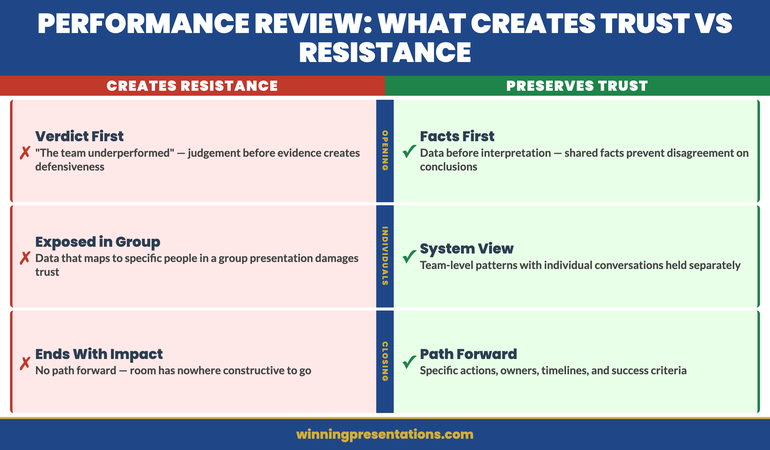
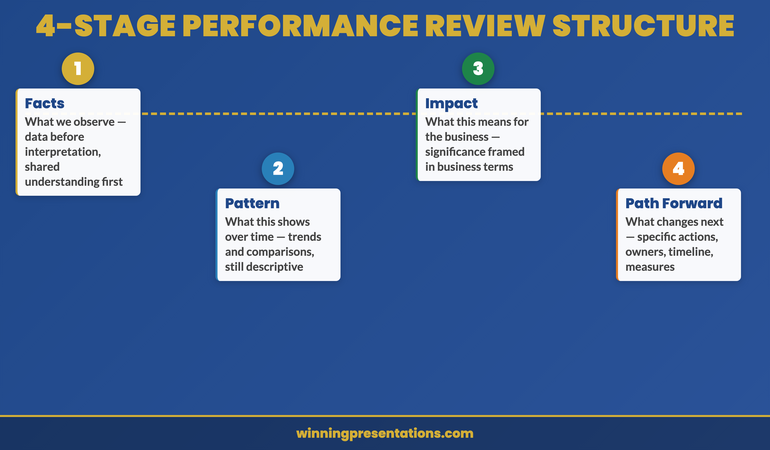
For the related challenge of delivering difficult feedback through a formal presentation — where clarity and respect need to coexist — see the guide on team performance review presentations.

The best mentors don’t teach. They show their thinking, invite engagement, and create the conditions in which insight becomes visible. Your presentation is that invitation. Build it accordingly.

About the Author

Mary Beth Hazeldine is Owner & Managing Director of Winning Presentations. With 24 years of corporate banking experience at JPMorgan Chase, PwC, Royal Bank of Scotland, and Commerzbank, she advises executives across financial services, healthcare, technology, and government on structuring presentations for high-stakes funding rounds and approvals. She is a qualified clinical hypnotherapist and NLP practitioner.

21 Apr 2026
Female executive presenting confidently on a large conference stage holding a handheld microphone, professional lighting, large audience visible, editorial photography style

Microphone Technique for Executives: Handheld, Lapel and Podium

Quick Answer

Poor microphone technique is one of the fastest ways to lose an audience before you have said anything worth hearing. The three types of microphone used in executive presentations — handheld, lapel, and podium — each require different habits. Get the technique right and the microphone disappears from the room’s awareness. Get it wrong and it becomes the only thing anyone notices. This is a mechanical skill, not a talent. It takes twenty minutes to learn and applies immediately.

I watched a divisional director lose the room in the first forty-five seconds of a company-wide address. He had prepared well. The content was clear. The slide structure was sound. But he walked to the front holding the handheld microphone at chin level and turned his head away from it every time he looked at his slides. The words reached the front rows and evaporated. The back third of the room heard a sequence of half-sentences and ambient noise.

The people in those back rows did not know why they could not follow him. They simply stopped trying. They checked their phones, leaned to whisper to colleagues, and disconnected from a presentation that deserved better. The director did not recover, not because the content failed, but because the physical credibility gap opened in the first minute became the frame through which everything else was read.

Microphone technique is one of those skills that is invisible when done correctly and catastrophic when done badly. Most executives are never taught it. It is assumed that someone who can present to a boardroom can also handle an amplification system. The assumption is wrong, and the consequences are measurable in audience engagement from the first sentence.

Presenting to a large audience and managing your nerves at the same time?

Conquer Speaking Fear is a 30-day programme using nervous system regulation techniques from clinical hypnotherapy. Designed for executives who have tried other approaches and still struggle with the physical and psychological experience of high-stakes presenting.

Find Out More →

Why Microphone Technique Matters More Than Most Executives Realise

In a small meeting room, voice projection is managed by the speaker. In a larger venue — a conference hall, a company-wide townhall, an awards ceremony, an industry event — amplification takes over that function. The microphone becomes the primary instrument of your voice, and if you do not know how to use it, you have handed control of your first impression to a piece of equipment you have not practised with.

The problem is compounded because microphone issues are almost always invisible to the speaker. When you turn your head and your voice drops out of the microphone’s pickup range, you feel nothing different. You have no signal that fifty per cent of the room just missed your opening statement. The feedback loop that would normally alert you — a restless audience, a confused expression, a question that reveals they did not follow — is delayed by several minutes, by which time the connection has already been severed.

The deeper issue is what poor amplification signals to an experienced audience. Senior professionals who attend many large presentations have a calibrated sense of what confident, prepared speakers look like on stage. Fumbling with a microphone, holding it inconsistently, or having feedback spikes from a lapel badly clipped suggests either inexperience with large formats or poor preparation. Neither is the impression you want to create in the first sixty seconds.

The solution is not complex. It requires understanding the three microphone types, the specific error patterns of each, and a pre-presentation soundcheck protocol that takes under five minutes. None of this is performance coaching. It is mechanical knowledge that anyone can apply immediately.

Handheld Microphone: The Positioning Errors That Destroy Clarity

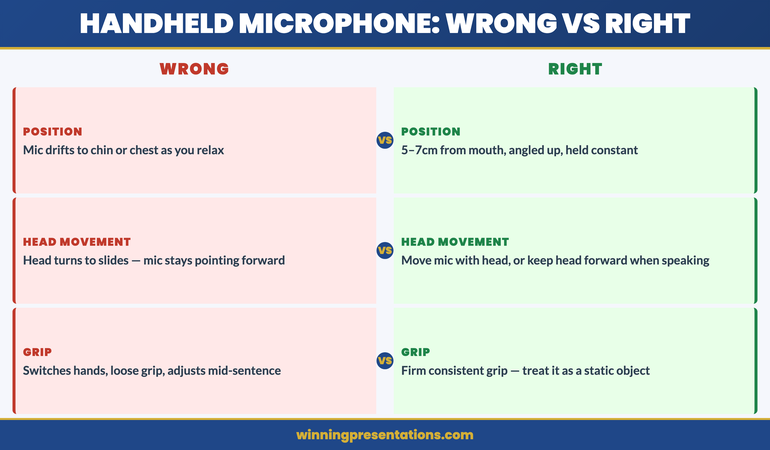
The handheld microphone is the most common in corporate presentations and the one most frequently misused. The fundamental rule is consistent distance: the microphone should be held approximately five to seven centimetres from your mouth, angled slightly upward, and maintained at that distance regardless of what your head does.

The most common error is letting the microphone drift downward as the presentation progresses. Speakers start with correct positioning and, as they relax into their content or begin referencing slides, the hand holding the microphone drops toward chin level, then toward the chest. At this point the microphone is capturing significantly less of the voice and more of the room’s ambient noise. The audience hears a reduction in clarity and volume that feels like disengagement, even if the speaker is fully present.

The second error is head-turning. When speakers turn to reference slides or look across the room, they often rotate their head while keeping the microphone stationary. The microphone stays pointing at where the voice was rather than following where it is. The fix is to move the microphone with your head, or to train yourself to keep your head forward when speaking and only glance at slides briefly rather than addressing them.

The third error is inconsistent grip. Nervous speakers often transfer the microphone between hands, hold it loosely, or grip it tightly and then adjust mid-sentence. Each adjustment creates a brief movement that disrupts pickup distance. Hold the microphone with a firm, consistent grip — treating it as a static object, not a prop — from the moment you take it to the moment you hand it back.

A practical test before any presentation with a handheld microphone: stand in front of a mirror, hold the microphone at the correct distance, and then do what you plan to do on stage — turn your head, gesture, reference notes. Watch what happens to the microphone position. The errors that appear in a mirror will also appear on stage.

Handheld microphone technique errors: drift downward, head-turning without moving mic, inconsistent grip — correct position shown at 5-7cm, angled upward, consistent throughout

Lapel Microphone: Placement, Clothing and Movement Rules

The lapel microphone, also called a lavalier, clips to clothing near the collar and provides hands-free amplification. It is common at conferences and company-wide events where the speaker needs freedom of movement. The three variables that determine whether it works are placement, clothing choice, and movement habits.

Placement is the most frequently mismanaged element. The clip should sit approximately fifteen to twenty centimetres below the chin, close to the centreline of the chest. Too low and the pickup weakens significantly; too high and the microphone is visible in camera shots and more susceptible to clothing noise. The exact placement depends on the sensitivity of the specific device, which is why a soundcheck matters — the technician will advise on positioning for that particular room and system.

Clothing creates the most unpredictable problems. Fabrics that rustle — certain synthetics, stiff cotton, structured jackets with internal lining — generate constant friction noise that the lapel microphone amplifies. This is not volume that the speaker can hear, but it is clearly audible to the audience and to anyone watching a recording. If you are presenting at a large event and wearing a lapel microphone, test your outfit with movement before you go on. Run your hand across the lapel area and listen for any fabric sound. Jackets with lapels are generally better than soft knitwear, which can move against the clip and generate intermittent noise.

Movement habits matter because turning your head sharply to one side — particularly if wearing a collar microphone near the jawline — can bring the jaw or shoulder into proximity with the pickup capsule, causing brief distortion. The fix is to turn from the body rather than leading with the chin: rotate your whole torso to address different parts of the room rather than swinging your head while your shoulders stay square.

Podium Microphone: How to Work It Without Being Trapped by It

The podium microphone is fixed in position, which creates a specific constraint that many speakers handle badly: they become physically anchored to the podium. They stand directly behind it, keep their movement minimal, and lose the stage presence that comes from occupying space freely. The microphone that was supposed to amplify their authority ends up containing it.

The key to working a podium microphone without being trapped by it is understanding its pickup angle. Most podium microphones have a cardioid pattern that captures a cone of sound roughly thirty to forty-five degrees wide directly in front of the capsule. You do not need to lean into the microphone. You need to speak across it from a consistent distance — typically twenty to thirty centimetres — and maintain that relationship even when you move your weight, gesture, or shift your stance.

The error most speakers make is leaning forward when they want to emphasise a point. The instinct is to move toward the audience when you want to make something land. But leaning into a podium microphone creates a volume spike that is jarring for the audience and uncomfortable in a large hall. Emphasis is better delivered through vocal variation — a slower pace, a deliberate pause, a lower register — rather than through physical proximity to the pickup.

If you want the freedom to move away from the podium briefly, discuss this with the AV team before the session. Many podium setups can be paired with a lapel backup that allows you to step out from behind the stand for a section of the presentation and then return. Planning this in advance is far more effective than improvising it on stage.

Understanding how to use eye contact effectively in executive presentations becomes significantly more powerful when your microphone technique is already handled — you can direct full attention to the room rather than managing the equipment at the same time.

Conquer Speaking Fear

Microphone technique handles the mechanics. Conquer Speaking Fear — £39, instant access — addresses the anxiety that makes the mechanics harder to manage in the moment. A 30-day programme built from clinical hypnotherapy techniques for executives who need a systematic approach to high-stakes presenting.

  • Nervous system regulation techniques from clinical hypnotherapy
  • 30-day structured programme for lasting anxiety reduction
  • In-the-moment techniques for the day of a high-stakes presentation
  • Designed for executives who have tried other approaches

Get Conquer Speaking Fear →

The anxiety management system built from clinical hypnotherapy, not just presentation tips.

When Anxiety Meets a Microphone: Managing Amplified Nerves

For speakers who experience presentation anxiety, a microphone adds a specific layer of difficulty. The physical symptoms of anxiety — a slight tremor in the voice, an increase in breathing rate, a dry mouth — become more apparent under amplification. Sounds that would be imperceptible to an audience of twenty become audible to an audience of two hundred. This knowledge itself increases the anxiety, which worsens the physical symptoms, which increases the awareness of the microphone. It is a reliable loop that catches many capable executives off guard the first time they present at scale.

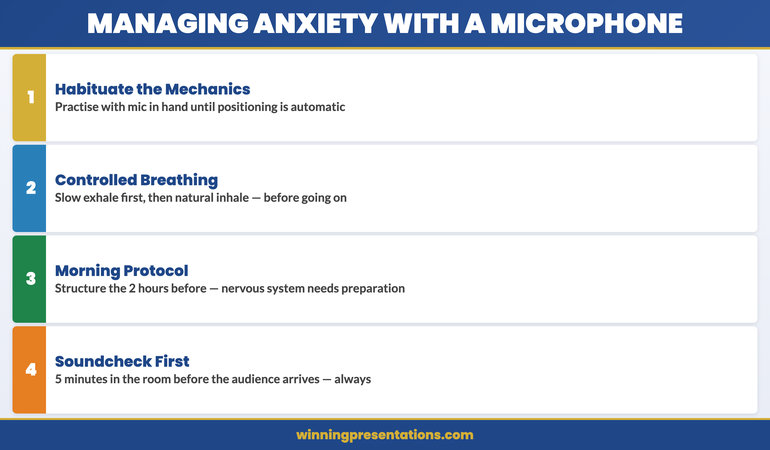
The most effective counter is preparation that is specific to the amplified format, not just to presenting in general. Practise with a microphone, or at least with your hand held in the position a microphone would occupy, so that the physical habit of holding it becomes automatic. Automatic behaviours are not disrupted by anxiety in the same way that novel behaviours are. When the mechanics of microphone use are fully habitual, they no longer compete with the cognitive and physical demands of managing nerves.

Breathing is more important under amplification than in smaller formats. The microphone will pick up an audible breath if it is sharp or gasped. Practise deliberate, controlled breathing before you go on stage: slow exhale, then a natural inhale, not the other way around. This is the breathing pattern associated with the parasympathetic nervous system rather than the stress response, and it reduces the visible and audible signs of anxiety more effectively than deep inhalation does.

The morning before a large presentation is also a significant factor. What you do in the two hours before you go on stage has a measurable effect on how well your nervous system manages the amplified format. A structured morning presentation protocol specifically for high-stakes events gives the nervous system the conditions to perform, rather than asking it to recover from a disordered start to the day.

If anxiety in large-format presentations is a consistent pattern for you rather than an occasional occurrence, that is not a microphone technique problem. The technique helps, but the root cause requires a different kind of work. Conquer Speaking Fear is designed specifically for executives dealing with persistent presentation anxiety — a 30-day programme built from clinical hypnotherapy, not generic confidence advice.

Microphone anxiety management: four steps — habituate the mechanics, controlled breathing technique, morning protocol, address root cause if pattern is persistent

The Soundcheck Protocol Most Speakers Skip

Most speakers arrive at a large event, accept the microphone from an AV technician, and walk to the stage. This skips the single most effective preparation available to them: a working soundcheck in the actual space, at the actual volume level, before the audience arrives.

A soundcheck takes four minutes. What it gives you is worth far more. First, you get to hear your own voice as the audience will hear it — amplified, in that specific room, at that specific volume. For most people this is a surprising experience: the voice sounds different, often deeper and more resonant, and getting comfortable with that difference before you are in front of five hundred people means you are not distracted by it when it matters.

Second, the soundcheck is where you discover problems. The lapel clip that causes friction against your jacket. The podium microphone positioned too far to the left of centre. The feedback frequency that kicks in when you turn toward the screen. These are all fixable before the presentation and difficult to manage during it.

Third, the soundcheck is where you establish rapport with the AV team. These are the people who control your volume, your slide progression, and the lighting. Treating them as professionals who are invested in your success — which they are — rather than as technicians to be given brief instructions creates a collaborative dynamic that consistently produces better outcomes on the day.

Request a soundcheck as a formal part of your arrival process for any event that uses amplification. If the organisers say there is no time, arrive thirty minutes earlier than they suggest and ask the AV team directly. Almost always, they will make time. They want the audio to work as much as you do.

The same principle of deliberate physical preparation applies to movement and stage positioning: professionals who walk the stage before the audience arrives always look more comfortable when the audience is there.

Frequently Asked Questions

What should you do if the microphone cuts out mid-presentation?

Pause briefly, signal to the AV team with a clear look or a raised hand, and project your voice naturally until the system is restored. Do not apologise repeatedly or call attention to the technical problem beyond acknowledging it once. Audiences are forgiving of equipment failures that are managed calmly and unforgettable when a speaker appears thrown by them. The ability to project without amplification for thirty seconds, if necessary, is worth practising specifically: speak from the diaphragm, not the throat, and maintain the same pace and authority your amplified voice would carry.

Is it acceptable to hold a handheld microphone with two hands?

Not typically. Two-handed microphone holding limits gesture, signals physical tension, and looks uncertain on stage. The exception is if the venue is very large and the microphone is heavy — some broadcast-quality handheld microphones have significant weight, and a two-handed hold can be appropriate for extended periods. In most corporate presentation contexts, one hand with a firm, relaxed grip is correct. The other hand should be free to gesture naturally or rest at your side.

How do you handle a microphone when you want to pause dramatically?

A deliberate pause is one of the most powerful tools in executive presenting, and the microphone changes how you manage it. If you lower the microphone during a pause, you signal that you are about to speak again when you raise it — which can reduce the impact of the silence. Keeping the microphone in position during a pause maintains the tension of the silence rather than breaking it. The audience reads the raised microphone and the silence simultaneously, which creates a more powerful expectation of what comes next.

The Winning Edge — A Newsletter for Executives Who Present

Every Thursday: one practical technique for structuring, presenting, or defending a high-stakes proposal. Designed for executives who need to communicate with authority, not just confidence.

Subscribe to The Winning Edge →

Conquer Speaking Fear

The 30-day programme for executives dealing with persistent presentation anxiety — built from clinical hypnotherapy techniques that address the nervous system root cause, not just the surface symptoms. £39, instant access.

Get Conquer Speaking Fear →

The anxiety management system built from clinical hypnotherapy, not just presentation tips.

When you are ready to address the Q&A session that follows a large-format presentation, the same discipline applies: preparation and habit formation reduce the unpredictability. See the companion article on handling Q&A in team settings for a structured approach to managing questions under pressure.

About the Author

Mary Beth Hazeldine is the Owner and Managing Director of Winning Presentations. With 25 years of corporate banking experience at JPMorgan Chase, PwC, Royal Bank of Scotland, and Commerzbank, she advises executives across financial services, healthcare, technology, and government on structuring presentations for high-stakes funding rounds and approvals.

13 Apr 2026
Female VP Business Development presenting a competitive tender to a corporate procurement panel — confident, composed posture, presentation screen visible, executive boardroom setting with navy and gold tones

Competitive Tender Presentation: How to Win the Room Against an Established Vendor

Quick Answer

A competitive tender presentation wins when it addresses the buyer’s real risk — the risk of switching — rather than simply competing on features and price. Structure your presentation around the cost of staying, your transition credibility, and a specific decision path. The goal is not to be the best option in the room. It is to make switching feel safer than staying.

Valentina had spent eleven years building her consultancy’s reputation in supply chain technology. When a procurement opportunity came through from a global retail group — one the firm had been pursuing for two years — she put together what she considered the strongest pitch deck of her career. Detailed capability statements, three comparable implementation case studies, and a pricing model that came in twelve per cent below the incumbent.

She presented to a panel of seven. The conversation was professional, the questions were substantive, and she left the room feeling cautiously optimistic. Two weeks later, the client renewed with the incumbent.

When she called the procurement lead to ask for feedback, the response was instructive: “Your capability was not in question. But when we tried to imagine the transition, it felt like a risk we didn’t know how to manage. The incumbent knows our systems. You don’t — yet.”

Valentina had done what most challengers do: she had built a presentation designed to prove she was good enough. What she had not done was address the one question that actually drove the decision: Is switching worth the disruption?

A competitive tender presentation is not a capability audit. It is a risk management conversation. The buyers already know you have capability — you passed the initial screening. What they are evaluating in the room is whether the risk of choosing you is lower than the risk of staying with a known quantity. Every slide in your tender deck needs to speak to that question, directly or indirectly.

Preparing a competitive tender deck?

If you’re structuring a tender presentation from scratch and want a framework built for high-stakes competitive pitches, the Executive Slide System provides templates and scenario guides designed for exactly this context. Explore the System →

Why challengers lose tender presentations before they begin

The structural disadvantage facing any challenger in a competitive tender is well understood: the incumbent has relationships, institutional knowledge, and the powerful psychological advantage of familiarity. Buyers know exactly what they are getting if they stay. They do not know exactly what they are getting if they switch — which means switching carries uncertainty even when your offering is objectively superior.

What is less well understood is how challengers make this disadvantage worse through their presentation choices. The most common mistake is building a capability-led deck: a presentation that leads with who you are, what you have done, and why you are qualified. This structure unintentionally confirms the buyer’s anxiety. It says, in effect, “here is why we are good enough to consider.” The incumbent does not need to make this argument. They are already the default.

A capability-led presentation also invites the wrong comparisons. When you open with your track record and credentials, you prompt the panel to compare your track record with the incumbent’s track record — a comparison the incumbent will almost always win, simply by virtue of having more history in the specific industry or category.

The challenge-led presentation works differently. It opens with the buyer’s problem — ideally the specific cost or risk the buyer is carrying by staying with the current provider — and positions your solution as the structured response to that cost. This is a fundamentally different conversation. Instead of competing on the same territory as the incumbent, you are reframing what the tender decision is actually about.

For related thinking on competitive pitch structure, see how to structure a competitive displacement pitch against an incumbent vendor.

The five structural elements of a winning competitive tender presentation

The most effective competitive tender presentations share a consistent architecture regardless of sector or deal size. The specific content changes; the structure does not.

The five structural elements of a competitive tender presentation infographic: status quo cost, transition credibility, solution specificity, risk reduction plan, decision path — showing each stage with key questions

1. The status quo cost (slides 1–2). Open not with who you are, but with what staying is currently costing the buyer. This requires research — you need to identify the specific operational, financial, or strategic cost the buyer is bearing under the current arrangement. It might be underperformance against a contract metric, a capability gap the current supplier has not addressed, or an emerging strategic risk the buyer faces that the incumbent’s offering does not cover. Frame this cost in terms the panel will recognise immediately.

2. Transition credibility (slides 3–4). Before presenting your solution, address the switching risk directly. Show comparable transitions you have managed — the complexity involved, the timeline, and the method by which you reduced disruption for the previous client. If you can include a specific example from a similar procurement environment, do so. The goal is to make the buyer feel that your transition management is a known and tested capability, not an aspiration.

3. Solution specificity (slides 5–7). Now present your solution — but do so in the specific language of this buyer’s context. Generic capability slides undermine your credibility at this stage. Instead, map your solution to the specific requirements, processes, and terminology in the tender brief. Buyers notice — and respond positively — when a presenter has absorbed their language rather than presenting in their own.

4. Risk reduction plan (slide 8). This slide is often absent from challenger decks, and its absence is frequently the deciding factor. A risk reduction plan shows the panel that you have already anticipated the transition risks they are worried about and have a specific method for managing each one. Include timelines, accountability, and escalation paths. The more concrete this slide is, the more it neutralises the incumbent’s primary advantage.

5. Decision path (slide 9). End with a specific next step rather than a general invitation to proceed. Name the decision the panel needs to make, the information they would need to make it, and the timeline within which you can begin. This demonstrates operational readiness and removes the vagueness that allows panels to defer rather than decide.

Executive Slide System

Structure Your Tender Pitch to Win — Not Just Compete

When the incumbent has the relationship advantage, your presentation structure becomes the differentiator. The Executive Slide System — £39, instant access — gives you the frameworks and templates designed for competitive, high-stakes pitches where capability alone is not enough.

  • Slide templates for competitive and procurement scenarios
  • AI prompt cards to build challenger narratives quickly
  • Framework guides for structuring risk-reduction arguments
  • Scenario playbooks for high-stakes client and tender presentations

Get the Executive Slide System →

Designed for executives presenting in competitive, high-stakes procurement environments.

How to frame the risk of change without triggering inertia

The most counterproductive thing a challenger can do in a tender presentation is ignore the switching risk. Buyers know the risk is there. If you do not address it, they will carry it silently through the rest of your presentation — and that unaddressed anxiety will eventually outweigh your capability argument.

The equally counterproductive response is to minimise the switching risk: “The transition is very straightforward” or “We have done this hundreds of times.” These reassurances are generic and feel hollow because they do not engage with the specific complexity of this buyer’s context. They can actually increase anxiety by suggesting you have not fully understood what you are taking on.

The approach that works is specificity. Acknowledge the real complexity of the transition — name the specific systems, processes, or stakeholders that will be affected — and then show your specific method for managing each point of complexity. This demonstrates that you understand the buyer’s environment in detail and that your transition plan is not a template but a tailored response.

There is also a reframing technique that experienced tender presenters use to good effect: explicitly comparing the risk of switching with the risk of staying. If the buyer is considering switching, it is because the current arrangement carries some form of risk — performance, capacity, strategic fit, or cost. A slide that maps the risks on both sides of the decision helps the panel see that the question is not “shall we take on a transition risk?” but “which risk is more manageable?” This reframe moves the conversation from a comparison of you versus the incumbent to a comparison of two different risk profiles — and gives the panel a more honest basis for deciding.

See also: how to structure a partnership proposal presentation that gets to yes in one meeting — the risk-reframing principle applies equally in partnership contexts.

The competitor comparison that builds credibility

Many tender presentations either include a direct competitor comparison slide or avoid it entirely. Both approaches, handled poorly, create problems. A direct comparison slide can look defensive and invites the panel to scrutinise every claim. Avoiding comparison entirely can leave the panel drawing their own comparisons — which may be less favourable.

Competitive tender presentation comparison slide strategy: wrong approach vs right approach — infographic showing how challenger presenters should frame competitor comparisons to build rather than undermine credibility

The most effective comparison approach focuses not on features but on decision criteria. Rather than building a table that compares your offering directly against the incumbent’s (which you will lose on depth of relationship and institutional knowledge regardless of your product superiority), build a table that maps both options against the buyer’s specific stated objectives from the tender brief.

This approach has three advantages. First, it anchors the comparison in criteria the buyer has already committed to publicly — making it harder to dismiss. Second, it shifts the conversation from a personality contest to a strategic assessment. Third, it gives you control over which criteria appear on the slide — allowing you to emphasise the dimensions where the challenger naturally performs strongly and where the incumbent’s age or approach is genuinely a limiting factor.

The comparison slide also works well as a device for naming the switching cost explicitly. A row labelled “Transition risk management” that shows your specific methodology against the incumbent’s “existing relationship” creates a natural opening for the risk-reduction conversation.

One important discipline: every claim you make on a comparison slide must be defensible in Q&A. If a panel member challenges a point, you need to be able to substantiate it calmly and specifically. Vague claims — “we offer superior customer service” — will be challenged and undermine your overall credibility if you cannot back them up with a specific example or metric.

If you are building this presentation from scratch and want a framework for structuring competitive pitches at executive level, the Executive Slide System includes scenario-specific templates and prompt cards designed for high-stakes procurement presentations.

“You’re too new to us” — handling the relationship objection in Q&A

Almost every competitive tender Q&A will include some version of the relationship objection. It may be explicit: “How do we know you’ll understand our business quickly enough?” Or it may be implicit, emerging as a series of questions about your experience in their specific sector, their geography, or with organisations of their scale.

The relationship objection is not really about your knowledge or capability — you have already demonstrated those through the tender process. It is about the buyer’s anxiety around the unknown. They are asking, in effect: “When something goes wrong — and something always goes wrong — will you know how to respond in a way that fits how we operate?”

The most effective response pattern has three parts. First, validate the concern without dismissing it: “You are right that we are building this relationship from scratch rather than extending an existing one — and that is worth taking seriously.” Second, reframe what ‘knowing your business’ actually requires at the operational level: most organisations’ internal processes are not as unique as they feel from inside, and your experience with comparable organisations is directly transferable. Third, offer a specific mechanism for accelerating the relationship: a structured discovery process, named relationship managers, and a defined escalation path during the first six months.

The worst response to the relationship objection is a defensive one: “We have significant experience in your sector and have worked with organisations like yours across twelve countries.” This reads as a credential recitation — which the panel has already seen — rather than an engagement with their specific concern. It confirms the anxiety rather than addressing it.

For a related account management scenario, see how to structure an account review presentation to retain a client.

The closing sequence in competitive tender presentations

The close of a competitive tender presentation is where most challengers revert to convention — a summary slide, a “thank you for your time” acknowledgement, and a general invitation to proceed. This is a missed opportunity.

The closing sequence of a tender presentation should do three things. First, it should consolidate the decision logic — not rehearse your entire capability argument, but name the single most important reason why selecting you is the lower-risk decision. One sentence, delivered with authority. Second, it should anticipate the next step specifically: not “we look forward to your decision” but “the next step would be a thirty-minute technical review with your operations team, which we can schedule for any time this week.” Third, it should leave the panel with something tangible — a one-page summary of your risk-reduction plan, your transition timeline, or your named relationship team.

The tangible handout serves two purposes: it gives the panel something to refer to during their deliberations, and it demonstrates the operational confidence that distinguishes a serious challenger from a speculative one. Incumbents rarely bring handouts to tender presentations — they do not need to. You do. Use them.

For a deeper treatment of closing sequences in high-stakes presentations, see the companion article: presentation closing framework: the techniques that drive executive decisions.

Executive Slide System — £39

The Framework Behind Every Competitive Pitch

The Executive Slide System — £39, instant access — gives you the templates, AI prompt cards, and scenario playbooks to structure competitive tender presentations that address switching risk, demonstrate transition credibility, and close with a specific decision path.

Get the Executive Slide System →

Designed for executives presenting in competitive procurement environments.

Frequently Asked Questions

How long should a competitive tender presentation be?

Most procurement panels allocate thirty to sixty minutes for a tender presentation, including Q&A. Structure your presentation to use no more than two-thirds of the allotted time for the formal presentation, leaving the remainder for questions. If you are given sixty minutes, aim for a forty-minute deck. A presentation that runs over time signals poor planning — a significant disadvantage in a competitive context. The goal is a tight, decision-focused narrative, not a comprehensive capability audit.

Should I name the incumbent in my tender presentation?

Name the incumbent only if doing so is strategically useful and you can substantiate every claim you make. In most cases, it is more effective to reference the incumbent obliquely through the “status quo cost” framing — describing the type of limitation the buyer is experiencing — rather than directly naming them. Direct naming can come across as aggressive and may put the panel in a defensive posture if they have an existing positive relationship with the provider. The exception is a direct comparison slide anchored to the buyer’s own tender criteria, where naming the incumbent is expected and framing is neutral and factual.

What if the buyer tells us we lost on price?

If price is cited as the reason for losing, it is worth exploring whether price was the actual reason or a proxy for a different concern. Procurement panels sometimes cite price because it is a defensible, objective explanation — whereas the real hesitation may have been around relationship, transition confidence, or internal politics. Ask for a thirty-minute debrief and listen carefully for what sits behind the price objection. Occasionally the real opportunity is to address the underlying concern rather than adjust your pricing.

The Winning Edge

Weekly executive communication insight — in your inbox every Thursday

Join executives across financial services, healthcare, and technology who receive practical, no-filler analysis of what works in high-stakes presentations and what doesn’t.

Subscribe to The Winning Edge →

Free resource: Download the Executive Presentation Checklist — a pre-presentation audit used by Mary Beth’s clients before every high-stakes pitch.

About the Author

Mary Beth Hazeldine — Owner & Managing Director, Winning Presentations

With 25 years of corporate banking experience at JPMorgan Chase, PwC, Royal Bank of Scotland, and Commerzbank, Mary Beth advises executives across financial services, healthcare, technology, and government on structuring presentations for high-stakes funding rounds, procurement decisions, and board approvals. Her work focuses on the communication architecture that moves decisions — not just the slides.

13 Apr 2026
Male CFO at the closing moment of a board presentation — composed, authoritative expression, board members visible in background, executive boardroom with navy and gold tones, editorial photography style

Presentation Closing Framework: The Three-Part Close That Drives Executive Decisions

Quick Answer

A strong presentation closing framework has three components: a decision consolidation statement (one sentence summarising why this is the right choice), a specific next step (not a general invitation to proceed), and a tangible handout or commitment anchor. The goal is not to summarise — it is to make the decision feel inevitable and the path forward feel clear.

Henrik had presented the cost-reduction programme to the board three times in as many months. Each time, the analysis was thorough, the numbers were clear, and the recommendation was unambiguous. Each time, the board thanked him, asked a few clarifying questions, and agreed to revisit the decision at the next meeting.

As CFO of a mid-size healthcare group, Henrik understood that boards are cautious by design. What he had not understood — until a non-executive director told him privately — was that his presentations were ending in a way that made deferral the default.

“Every time you finish,” she said, “you say, ‘I’m happy to take any questions.’ That’s the signal that you’re done presenting and you’re handing control back to us. We’re very comfortable deciding when we want to decide. You need to tell us when you need us to decide.”

Henrik had been spending enormous energy on the substance of his presentations and almost none on how they ended. His closings were technically correct — a summary slide, a clear recommendation — but they were passive. They created no forward momentum and gave the board no particular reason to act now rather than later.

The next month, he ended differently. He named the decision clearly, stated the cost of another month’s delay in concrete terms, and said: “I’m asking for a decision today. If there are concerns that prevent that, I’d like to understand which ones so I can address them before we leave the room.” The board approved the programme at that meeting.

The closing of a presentation is not the tail end of a communication process. It is the moment when everything you have built either converts into action or dissolves into a follow-up email that may never be answered.

Want a structured closing framework?

The Executive Slide System includes closing sequence templates and scenario guides designed for high-stakes decision presentations, board updates, and funding rounds. Explore the System →

Why most executive presentations end weakly

The convention in most organisations is to end a presentation with a summary slide and an open invitation for questions: “That’s the overview — happy to take any questions you have.” This convention is so widespread that most presenters apply it without examining what it actually does to a room.

What it does is transfer control. The moment you say “happy to take any questions,” you are signalling that the formal part of the presentation is over and the audience is now in charge of what happens next. In an executive or board context, this is rarely the outcome you want. Senior decision-makers are accustomed to being in control of their own time and their own agenda. The moment you hand control back to them, they will use it — to ask questions, to deliberate, to defer, or to end the meeting early.

The passive close also creates an ambiguity problem. It is not clear from “happy to take any questions” whether you are inviting clarification, seeking endorsement, or asking for a decision. Decision-makers — particularly board members — are very sensitive to what is actually being asked of them. When the ask is ambiguous, the safest response is no response: defer the decision until the next meeting, when there may be more clarity.

The active close does the opposite. It names what is happening, what the decision is, and what happens next. It does not leave the outcome to inference. This is a significant shift in presentation culture for many executives, who have been trained to present and then yield. But in high-stakes contexts, yielding is not a virtue. It is a risk.

For a related structural principle applied at the opening, see how to start a presentation: the opening techniques that set executive authority from the first slide.

The three-part executive close

The most effective presentation closing framework for executive contexts has three distinct components, each doing a specific job. Used together, they transform the end of a presentation from a passive handover into an active decision moment.

The three-part executive presentation closing framework infographic — decision consolidation, specific next step, and commitment anchor — showing how each component drives audience action

Component 1: The decision consolidation statement. This is a single sentence — delivered verbally, not read from a slide — that names the decision and frames it in terms of its strategic consequence. It should not be a summary of your presentation. A summary is backwards-facing: it tells the audience what they have just heard. The consolidation statement is forwards-facing: it tells the audience what happens if they act on what they have just heard. Example: “Approving this investment today means we can begin the procurement process this quarter and have systems in place before the regulatory deadline — which protects the business from the compliance risk we identified on slide twelve.”

Component 2: The specific next step. Name exactly what you are asking the audience to do, and by when. Not “I hope we can move forward” — that is a wish, not a next step. Not “we look forward to your feedback” — that is an invitation for correspondence, not a decision path. A specific next step sounds like: “I’m asking for approval today, subject to any conditions the board wishes to attach. If approval is given, the procurement team can begin the vendor selection process on Monday.” The more specific the next step, the more clearly the audience understands what they are being asked to do.

Component 3: The commitment anchor. This is a tangible leave-behind — a one-page summary, a printed timeline, a named next action — that makes the decision feel concrete rather than conceptual. The commitment anchor serves two purposes: it gives the audience something to refer to after you leave the room, and it signals that you are operationally ready to proceed. Presenting without a leave-behind suggests that you are still in the analysis phase. Presenting with one suggests that you have already begun.

Executive Slide System

Build Presentations That Close — Not Just Inform

The closing sequence is where presentations succeed or fail. The Executive Slide System — £39, instant access — gives you the slide templates, AI prompt cards, and closing frameworks to build presentations that drive decisions rather than generate follow-up emails.

  • Slide templates for decision-focused executive presentations
  • AI prompt cards to structure closing arguments quickly
  • Framework guides for board approvals, budget bids, and programme sign-off
  • Scenario playbooks covering common high-stakes presentation contexts

Get the Executive Slide System →

Designed for executives who need decisions, not discussions.

Commitment close vs summary close — which to use

There are two primary closing approaches used in executive presentations. The summary close — a recap of your main points followed by a recommendation — is the more common and the less effective. The commitment close — a forward-facing statement of what you are asking for and why now — is the approach that actually moves decisions.

The summary close has one legitimate use: when the audience is genuinely processing complex information for the first time and needs a synthesis before they can decide. In a ninety-minute technical briefing covering new regulatory requirements, a summary close is appropriate. In a board presentation where the topic has been on the agenda for two months, it reads as filler.

The commitment close works because it aligns with how senior decision-makers actually think about their role. They are not there to absorb information — they have assistants and briefing packs for that. They are there to make decisions. A presenter who treats the close as the decision moment — who explicitly names what the decision is and why this meeting is the right moment to make it — is speaking directly to how executives understand their function in the room.

The practical difference is in the verb you use. The summary close uses “is”: “Our recommendation is X.” The commitment close uses “need” or “ask”: “We need a decision today so that…” or “I’m asking the board to approve…” The commitment close positions you as someone with authority who is asking for a specific outcome — which is a very different posture from someone who has completed a presentation and is waiting to see what happens.

For a companion approach to the pre-meeting phase that complements a strong close, see how to use pre-decision conversations to build executive approval before the meeting.

How to handle the silence after the close

The moment after you deliver the close of a presentation is often the most uncomfortable part of the entire communication. You have named the decision. You have stated what you are asking for. And then — nothing. The room is quiet, people are looking at the table or at each other, and the temptation is to fill the silence.

Do not fill it.

Presentation closing framework — handling silence after the close: a dashboard showing the four types of silence every executive presenter faces and the correct response to each

The silence after a close is a working silence. Decision-makers are processing — weighing the case against their own priorities, considering the implications for their stakeholders, formulating their question or their position. This is a good sign. It means your close landed and the decision is being actively considered.

When you speak into working silence, you undermine it. You suggest that you are not comfortable with the weight of the decision, that you have more to say, or that you need to soften your ask. Any of these signals weakens your close. The audience will take their cue from you: if you seem uncertain about whether to act, they will feel uncertain too.

The practical rule is to count to ten after your close. Ten seconds feels much longer than it is. In that time, the decision-maker who was about to speak will speak. If nobody speaks after ten seconds, ask a specific question: “Does anyone have concerns they’d like to raise before we move to a decision?” This moves the silence from open-ended to purposeful, without retreating from your position.

If you are building a presentation for a critical decision meeting and want a structured framework that takes you from opening through to close, the Executive Slide System includes closing sequence templates specifically designed for high-stakes executive contexts.

Closing mistakes that undermine credibility

There are five closing patterns that consistently undermine the effectiveness of executive presentations, regardless of how strong the preceding content has been.

The apologetic close. “I know this was a lot to cover in a short time” or “I realise there’s still some uncertainty in these numbers.” Self-deprecation in the close signals that you are not fully confident in your own case — which gives decision-makers permission to defer. If there is genuine uncertainty in your data, address it during the body of the presentation, not in the final sentence.

The laundry list close. Ending with five or six “next steps” dilutes the decision and gives the audience multiple low-friction alternatives to the main ask. If you need approval today, that should be the only next step in the close. Other actions can follow from it.

The over-summarised close. A summary that takes more than ninety seconds is no longer a summary — it is a second presentation. Decision-makers in executive settings have excellent memories for content they found compelling. A lengthy recap implies you do not trust them to remember what you said.

The open-ended close. Ending with “I’m happy to discuss further” or “I’d welcome your thoughts” without naming a decision invites discussion, not decision-making. Both have their place, but they are different processes. Be clear about which one you are opening.

The gratitude close. “Thank you for your time — I really appreciate you giving us this opportunity.” Gratitude is appropriate at the very end of a meeting, after the decision has been made. Opening the close with it signals that you consider the presentation to be over before the decision has been made, which it has not.

For a foundational treatment of executive summary structure that informs the closing sequence, see how to structure an executive summary slide that sets the decision frame.

The follow-up anchor technique

When a decision cannot be made in the room — because a key stakeholder is absent, because additional information is genuinely needed, or because the governance structure requires a second layer of approval — the follow-up anchor is the technique that keeps momentum alive rather than allowing the decision to drift.

The follow-up anchor is a specific, named commitment made in the room before the meeting ends. Not “we’ll be in touch” — that is not a commitment, it is a valediction. The follow-up anchor sounds like: “Before we close, can I confirm that you’ll have a response to me by next Wednesday? I’ll send a one-page summary with the key decision points this afternoon to support your deliberations.” The anchor has a date, a named person, and a specific deliverable.

The follow-up anchor works because it converts a vague “we’ll think about it” into a named next action with a deadline. It also signals operational competence — you are already managing the process, not just presenting the case. Decision-makers respond positively to this because it reduces their administrative burden: they know what they will receive and when, which makes it easier for them to engage.

The one-page summary you send after the meeting should be designed for forwarding. Senior decision-makers rarely make decisions alone — they consult their own advisers, their finance directors, their chief of staff. A clean, one-page summary that travels well through an organisation is more powerful than a detailed report that requires the decision-maker to interpret it on behalf of others.

For related thinking on how competitive presentations use the closing sequence, see the companion article: competitive tender presentation: how to win the room against an established vendor.

Executive Slide System — £39

The Structure Behind Presentations That Get Decisions

The Executive Slide System — £39, instant access — gives you slide templates, closing frameworks, and AI prompt cards to build executive presentations that move from opening context to clear decision moment without losing the room in between.

Get the Executive Slide System →

Designed for executives who need decisions, not discussions.

Frequently Asked Questions

How long should the close of a presentation be?

For most executive presentations, the close should take no more than two to three minutes. This includes the decision consolidation statement (one sentence, delivered verbally), the specific next step (one or two sentences), and the handover of any commitment anchor. If your close is taking longer than three minutes, you are either summarising rather than closing, or you have identified that additional persuasion is needed — which means you should address it in the body of the presentation, not the close. The brevity of the close is itself a signal of confidence: you believe your case has been made and you are asking for the decision.

What if the audience has objections during the close?

An objection raised during the close is usually one of two things: a genuine concern that was not addressed during the presentation, or a signal that the audience is engaging seriously with the decision. In either case, welcome it rather than defending against it. Name the objection: “That’s a fair challenge — let me address it directly.” Then answer specifically, without retreating from your recommendation. If the objection reveals a genuine gap in your case, acknowledge it, state how you will address it, and modify your next step accordingly: “Given that concern, what I’d suggest is a thirty-minute session next week to go through the risk model in more detail. Can we agree that as the next step?”

Is it appropriate to ask for a decision in a board presentation?

Yes — and in most cases it is not only appropriate but expected. Board members are decision-makers by function. Presenting to a board without asking for a decision leaves them in the position of advisers rather than governors, which is not the role they are paid to play. The key is to frame the decision clearly and to name the consequence of not deciding: “Every month we delay the programme costs the business approximately £X in operational inefficiency.” This is not pressure — it is information. Decision-makers need to understand the cost of inaction in order to weigh the decision correctly.

The Winning Edge

Weekly executive communication insight — every Thursday

Practical, no-filler analysis of what works in high-stakes presentations — including closing techniques, board communication, and decision-meeting structure.

Subscribe to The Winning Edge →

Free resource: Download the Executive Presentation Checklist — a pre-presentation audit used by Mary Beth’s clients before every high-stakes decision meeting.

About the Author

Mary Beth Hazeldine — Owner & Managing Director, Winning Presentations

With 25 years of corporate banking experience at JPMorgan Chase, PwC, Royal Bank of Scotland, and Commerzbank, Mary Beth advises executives across financial services, healthcare, technology, and government on structuring presentations for high-stakes funding rounds and board approvals. Her work focuses on the communication architecture that moves decisions.

13 Apr 2026
Male CFO responding calmly to a challenging board question — composed expression under Q&A pressure, other board members visible, executive boardroom with navy and gold tones, editorial photography style

How to Pressure-Test Your Presentation Q&A Before the Meeting

Quick Answer

Presentation Q&A preparation moves from reactive to systematic when you pressure-test your answers before entering the room. This means categorising the questions you are likely to face, identifying the gaps your data does not cover, rehearsing with an adversarial questioner, and building a response framework for the questions you cannot fully answer. Rehearsing answers you already know is not preparation — it is confirmation. Real preparation stress-tests the limits of what you know.

Kwame had run the numbers six times. As CFO of a mid-size logistics company, he had presented budget proposals to the board before — but this one was different. The proposal involved a £4.2 million capital commitment to upgrade a fleet management system, and the board had already pushed back twice on discretionary spending. He had built what he believed was an airtight case.

The presentation itself went well. The slides were clear, the narrative was coherent, and the ROI model was thorough. Then, at the twelve-minute mark, the Chairman asked a question Kwame had not seen coming: “Before we go further, Kwame — what assumptions are you making about fuel price movements over the implementation period, and have you stress-tested the ROI against a thirty per cent increase?”

Kwame knew the answer in principle. But he had not built that specific scenario into the model. He hedged. He said he could run those numbers after the meeting. The Chairman nodded, but the energy in the room shifted. Two other board members asked follow-up questions he handled less confidently than the main presentation had suggested he would. The proposal was deferred for a second meeting.

Afterwards, the CFO of the parent company — who had been in the room as an observer — pulled Kwame aside: “The proposal was solid. But you walked in having rehearsed what you know and hoping they wouldn’t ask what you don’t. That’s not preparation. That’s optimism.”

Systematic presentation Q&A preparation is not about practising the answers you already have. It is about identifying the assumptions embedded in your case, finding the weakest points in your data, and constructing a response framework that holds up even when the question lands outside your prepared territory.

Need a systematic Q&A preparation framework?

The Executive Q&A Handling System gives you a structured method for anticipating, categorising, and preparing responses to the questions that derail executive presentations — before you walk into the room. Explore the System →

Why rehearsing your answers is not enough

Most executives who prepare for Q&A do so by thinking through the questions they expect to receive and running through their answers mentally or verbally. This is better than no preparation. But it has a fundamental limitation: you are rehearsing a conversation you have already imagined, which means you are only testing your ability to deliver answers you have already constructed.

Real Q&A pressure does not come from the questions you expected. It comes from the question you did not see coming — the one that probes an assumption you made but did not flag, the one that connects two data points in a way that reveals a tension in your model, or the one that is framed in a way that makes any direct answer politically difficult. Rehearsing expected questions builds fluency in territory you already control. It does not build resilience in territory you do not.

The distinction matters most in the moments after a difficult question lands. An executive who has only rehearsed their prepared answers will feel a spike of alarm when the unexpected question arrives, because it signals that they are outside the plan. That alarm shows — in the hesitation before they speak, in the way their answer trails off rather than concluding, in the eye contact that breaks rather than holds. An executive who has actively pressure-tested the limits of their case approaches the unexpected question differently: they know the shape of their uncertainty, which means they can navigate it without being surprised by it.

For a related approach to handling the most confrontational form of unexpected question, see how to handle a hostile question in a board meeting without losing the room.

The four categories of pressure question every executive faces

Pressure questions in executive presentations fall into four distinct categories. Understanding which category a question belongs to is the first step in building a preparation method that covers all of them.

The four categories of pressure question in executive presentations: assumption challenges, data gap questions, political implication questions, and precedent questions — dashboard infographic with preparation method for each

Category 1: Assumption challenge questions. These questions probe the assumptions embedded in your model, forecast, or recommendation. “What are you assuming about interest rates over that period?” “Have you modelled the downside scenario?” “What happens to the ROI if adoption is slower than forecast?” These questions are often the most embarrassing to be caught unprepared for, because the assumptions are visible to anyone who looks closely at your analysis — which suggests you have not looked closely enough yourself.

Preparation method: For every key number in your presentation, write down the two or three assumptions that number depends on. Then build a simple scenario: what does the model look like if each assumption is twenty per cent worse than your base case? You do not need to present these scenarios — you need to know the answers so you can give them when asked.

Category 2: Data gap questions. These questions ask about data you have not included, either because you chose not to or because you did not have it. “Do you have a comparable from another division?” “What does the competitor analysis show?” “Have you validated this with the operational team?” These questions can reveal either that your analysis is incomplete or that you have made a deliberate choice not to include something — and the audience will wonder why.

Preparation method: Before finalising your deck, ask yourself what data an informed sceptic would expect to see but cannot find in your slides. Either include it or prepare a clear explanation of why you have not.

Category 3: Political implication questions. These questions are not really about your analysis — they are about the politics of the decision. “How does this affect the northern division?” “Has this been discussed with the operations board?” “Who owns the implementation risk?” These questions signal that the questioner has a stakeholder interest in the outcome and is testing whether you have addressed it. They can feel like hostile questions but are usually legitimate governance concerns.

Preparation method: Map the stakeholders who will be affected by your recommendation and anticipate the concern each one would raise. Prepare a one-sentence response to each concern that acknowledges it and names how it is being managed.

Category 4: Precedent questions. These questions invoke a previous decision or a comparable situation to test the consistency of your current recommendation. “When we approved a similar programme in 2023 it took twice as long as the forecast — why will this be different?” “We had a similar analysis for the IT project and it underestimated the integration costs. Have you accounted for that?” These questions require specific knowledge of the precedent being cited and a clear, factual explanation of what is different this time.

Preparation method: Research your organisation’s relevant history before the presentation. If there are obvious precedents the audience will raise, address them proactively in the deck rather than waiting for the question.

Executive Q&A Handling System

Anticipate, Prepare, and Handle Every Pressure Question

The Executive Q&A Handling System — £39, instant access — gives you a structured system for predicting the questions your specific audience is likely to ask, building response frameworks for each category of pressure question, and managing the Q&A process so that difficult questions strengthen rather than undermine your credibility.

  • System for predicting and categorising executive Q&A questions
  • Response frameworks for assumption challenges, data gaps, and political questions
  • Adversarial rehearsal guides for high-stakes presentation settings
  • Recovery strategies for questions that expose genuine gaps in your analysis

Get the Executive Q&A Handling System →

Designed for executives who face high-stakes Q&A in board, committee, and investor settings.

The stress-test method: how to run an adversarial Q&A

The most effective Q&A preparation method is the adversarial rehearsal — a structured session in which a trusted colleague, mentor, or adviser tries to find the weaknesses in your case by asking the most difficult questions they can generate. This is fundamentally different from a practice run, where the colleague asks supportive clarifying questions and you deliver your prepared answers. An adversarial rehearsal has a specific goal: to find the questions that you cannot answer well and identify what that reveals about your preparation.

The setup matters. Give your adversarial questioner the following brief before the session: “Your job is not to help me practise. Your job is to find the weakest point in my case and keep pushing until I either give you a satisfying answer or we identify a genuine gap. Ask the same question differently if I give you a vague answer. Escalate if I give you a deflection. I need to know where my preparation is thin.”

During the adversarial rehearsal, track the questions you struggle with in three categories. Questions you struggled with because you do not know the answer are a preparation gap — you need to either find the answer or prepare an explicit response to not knowing it. Questions you struggled with because the answer reveals a tension in your case are a content gap — you may need to adjust the recommendation or explicitly acknowledge the tension in the presentation. Questions you struggled with because the framing caught you off-guard are a rehearsal gap — you need to practise responding to the same content delivered in different, more challenging framings.

One session of genuine adversarial questioning will reveal more about the vulnerabilities in your Q&A preparation than ten sessions of practising your prepared answers.

Pressure-testing your data and the numbers behind your slides

Every number that appears on a slide in a high-stakes executive presentation will be interrogated by at least one person in the room. The question is whether that interrogation will happen before or after you walk in. Pressure-testing your data means asking, for every significant number: what is the source, what are the assumptions, what happens if the assumptions are wrong, and what would a sceptic say about the methodology?

Five-step data pressure test framework for executive presentations: source verification, assumption mapping, downside scenario, sceptic methodology challenge, and reconciliation check — stacked cards infographic

The source question is the most basic and the most frequently neglected. If you are presenting a market size figure, a cost estimate, or a timeline, you should be able to state immediately who produced that number and how recently. A number from a report published two years ago presented as current market data is a vulnerability. An estimate produced internally without external validation is a vulnerability. Neither of these need prevent you from using the number — but you need to know they are vulnerabilities before someone else identifies them.

The reconciliation check is particularly important in financial presentations. Every number in your deck should reconcile with every other related number. If your cost estimate on slide four implies a certain unit cost, and your volume forecast on slide seven implies a different unit cost, a sharp analyst in the room will find the inconsistency. Running a systematic reconciliation across your slides — not just checking individual numbers but checking that the numbers are internally consistent — is a discipline that most presenters skip and most experienced audiences notice the absence of.

For a structured approach to buying time when a data question catches you short, see buying time in Q&A: techniques for managing questions you need a moment to answer.

If you want a structured system for building and running this kind of adversarial Q&A preparation before high-stakes presentations, the Executive Q&A Handling System includes question prediction frameworks, adversarial rehearsal guides, and response strategies for each category of pressure question.

Building a framework for questions you cannot fully answer

Pressure-testing will sometimes reveal that you genuinely do not have the answer to a question the audience is likely to ask. This is not a failure of preparation — it is the purpose of preparation. Finding these gaps before the room does is exactly what the process is designed to do. The question is what to do with them once you have found them.

There are three legitimate responses to a question you cannot fully answer, and one illegitimate one. The illegitimate response is to deflect — to give an answer that sounds responsive but does not actually address the question. Experienced questioners recognise deflection immediately, and it damages credibility far more than an honest acknowledgement of a gap.

The first legitimate response is to close the gap before the meeting. If pressure-testing reveals that you do not know your fuel price assumptions, get the answer before the presentation. Many gaps that feel large in the preparation phase are actually addressable with a few hours of additional analysis or a conversation with a colleague.

The second legitimate response is to acknowledge the gap explicitly in the presentation, frame it as a known uncertainty, and name how you are managing it. “The model does not include a scenario for a thirty per cent fuel price increase. We have not modelled that because it falls outside the range our supply chain team considers realistic — but if the board would find it useful, I can run that scenario and bring it to the next meeting.” This response is far stronger than being caught by the question.

The third legitimate response is to answer the spirit of the question without answering the exact question: “I don’t have that specific number with me, but the broader point you’re making about input cost sensitivity is addressed in the sensitivity analysis on slide nine — would it help to walk through that section?” This only works when the redirect is genuinely responsive to the concern behind the question, not a deflection dressed up as engagement.

For a structured bridging technique that supports these responses in the moment, see the bridging technique for difficult presentation questions: how to navigate without losing credibility.

When pressure-testing reveals a real gap

Occasionally, adversarial Q&A preparation does not just identify a question you cannot answer — it reveals that the case you are making has a genuine substantive weakness. The numbers do not hold up to a simple sensitivity analysis. The recommendation depends on an assumption that is clearly contestable. The implementation plan has a dependency that has not been addressed.

When this happens, the temptation is to press ahead anyway — the presentation is scheduled, the slides are built, and the gap might not come up. This is the wrong choice. A real gap that emerges in the room — that you were aware of and chose not to address — damages your credibility as a presenter and as an analyst in ways that take much longer to recover from than a delayed presentation.

The appropriate response is to decide, before the meeting, whether the gap is material enough to delay the presentation. If the gap would change the recommendation — or would change the conditions under which the recommendation holds — it is material, and the presentation should be delayed until the gap is addressed. If the gap is peripheral — it does not affect the core recommendation but represents a risk the audience should be aware of — it should be disclosed proactively in the presentation, not concealed in the hope it will not be raised.

Executives who earn lasting credibility in high-stakes Q&A settings are those who demonstrate that they have stress-tested their own analysis before presenting it. That quality of rigour is visible — in the specificity of their answers, in their ability to name the assumptions in their model, and in their comfort with the limits of what they know. It is the quality that adversarial Q&A preparation builds.

For a companion resource on presenting with confidence in the room, see presentation gestures: the body language signals that build executive credibility.

Executive Q&A Handling System — £39

The System Behind Executives Who Handle Tough Q&A With Clarity

The Executive Q&A Handling System — £39, instant access — gives you a structured method for predicting and preparing for every category of pressure question, running adversarial rehearsals, and managing the Q&A process so that difficult questions strengthen rather than undermine your credibility in the room.

Get the Executive Q&A Handling System →

Designed for executives who face high-stakes Q&A in board, committee, and investor settings.

Frequently Asked Questions

How much time should I allocate to Q&A preparation before a major presentation?

For a high-stakes presentation — board, investor, or senior committee — allocate at least as much time to Q&A preparation as to slide preparation. In practice, this is rarely done: most executives spend ninety per cent of their preparation time on the deck and twenty minutes on Q&A. The imbalance is understandable, because slide preparation is a creative task with a clear output, whereas Q&A preparation is an analytical task with an uncomfortable one. The adversarial rehearsal session should run for at least sixty minutes for a significant presentation. Data pressure-testing — checking sources, assumptions, and internal consistency — is a separate exercise and should be treated as a quality check on the analysis, not just the communication.

Is it better to ask a colleague or a senior mentor to run the adversarial Q&A?

A senior mentor or someone from outside your team is typically more effective than a close colleague. The problem with colleagues is that they are often too familiar with your context to ask genuinely challenging questions — they fill in the gaps with their own knowledge rather than exposing the gaps as the audience would. A mentor or trusted senior peer who does not know your specific project in detail is more likely to ask the naïve but important question that the audience will also ask. If you do use a colleague, brief them explicitly to ask the questions they think the sceptics in the room will ask — not the questions they themselves would ask as a supportive peer.

What should I do if I get a question in the room that I am genuinely not able to answer?

Say so — specifically and without apology. “I don’t have that figure with me, and I don’t want to give you a number I haven’t verified. I’ll get it to you by close of business today.” This response is more credible than a hedged estimate, more respectful than a deflection, and far less damaging than a wrong answer given confidently. What damages credibility is not the absence of an answer but the pretence of having one. Most experienced decision-makers have significantly more patience for honest uncertainty than for confident inaccuracy.

The Winning Edge

Weekly executive communication insight — every Thursday

Practical, no-filler analysis of Q&A strategy, board presentation technique, and executive communication — from 25 years of experience in high-stakes business settings.

Subscribe to The Winning Edge →

About the Author

Mary Beth Hazeldine — Owner & Managing Director, Winning Presentations

With 25 years of corporate banking experience at JPMorgan Chase, PwC, Royal Bank of Scotland, and Commerzbank, Mary Beth advises executives across financial services, healthcare, technology, and government on structuring presentations and managing the Q&A dynamics that determine whether decisions are made or deferred.

12 Apr 2026
Female chief digital officer presenting a digital transformation investment case to a board of directors in a glass-walled boardroom

Digital Transformation Board Presentation: How to Build the Business Case

Quick Answer

A digital transformation board presentation succeeds when it leads with strategic context rather than technical capability, frames the investment in terms of risk and competitive position rather than feature sets, and gives the board a clear choice with a recommended direction — not a technology briefing to absorb.

Priya had spent four months on the business case. As Chief Digital Officer at a mid-size financial services firm, she had commissioned an independent vendor review, benchmarked against three competitors, and built a financial model that showed a clear return within thirty months. The board presentation was scheduled for ninety minutes. She had allocated the first forty to walking through the technology landscape.

The Chair stopped her at slide nine. “Priya, we appreciate the detail, but can you take us to the decision? What are you actually asking us to approve?”

She had a recommendation on slide twenty-three. By the time she reached it, the board had mentally disengaged. The investment wasn’t approved that day — it was deferred for “further consideration,” which, in practice, meant another quarter of delay and a request for a shorter, clearer paper.

The problem wasn’t the quality of the analysis. It was the sequencing. Priya had built a presentation for an audience that wanted to understand the technology — but boards don’t want to understand the technology. They want to understand the risk, the opportunity cost, and the decision in front of them. The more technical context you provide before reaching the ask, the more confused and disengaged a board audience becomes.

Digital transformation is one of the most common investment decisions reaching boardrooms today. It is also one of the most frequently mishandled presentations — not because the analysis is weak, but because the story is told in the wrong order for a board audience.

Building a board-ready transformation deck?

If you’re preparing a digital transformation investment case for a board or executive committee, the Executive Slide System includes templates and frameworks for exactly this type of high-stakes approval presentation. Explore the System →

Why digital transformation presentations fail at board level

The most common failure mode in a digital transformation board presentation is technology-first sequencing. The presenter builds the story from capability outwards — here is what the technology can do, here is how we would implement it, here is the projected return. This is a logical order for a project team. It is the wrong order for a board.

Boards operate from a different frame of reference. Their primary concern is not operational capability — it’s fiduciary responsibility and strategic positioning. When a presentation opens with technology, it triggers a set of questions in the board’s collective mind that have nothing to do with the slides: Is this within our strategic priorities? Who is accountable if this goes wrong? What happens if we don’t do it? A technology-first presentation typically never answers these questions, because it was built around the solution rather than the decision.

The second failure mode is scope ambiguity. “Digital transformation” is a phrase that means different things to different people in the same boardroom. Without an explicit definition of what is and isn’t included in the scope of the investment, board members will import their own interpretations — and the discussion will fragment along those lines. A clear scope statement, positioned early in the deck, prevents this.

The third failure mode is the absence of a clear ask. Many digital transformation presentations end with a roadmap or a phased plan — but without a specific, bounded decision for the board to make. Boards are accustomed to approving specific things: a budget envelope, a mandate to proceed to the next phase, a vendor selection. An open-ended “we’d welcome the board’s thoughts on the direction” creates uncertainty about what is actually being requested and typically results in deferral.

For related thinking on how transformation programmes should be communicated to executive audiences, the article on how to structure a transformation programme presentation covers the ongoing communication layer that sits alongside the initial investment case.

Executive Slide System

Build the Board Case — Not Just the Deck

Digital transformation investments fail at board level when the presentation is built for the project team rather than the approving body. The Executive Slide System — £39, instant access — gives you the templates and frameworks to build a board-ready investment case that leads with strategic context, not technical capability.

  • Slide templates for investment approval and business case presentations
  • AI prompt cards to build your strategic narrative fast
  • Framework guides for structuring risk, ROI, and stakeholder impact
  • Scenario playbooks for high-stakes board and executive committee presentations

Get the Executive Slide System →

Designed for executives preparing complex investment cases for board and executive committee approval.

The presentation structure that works for board audiences

The most effective digital transformation board presentations follow a decision-first structure. The ask is on slide one or two — not at the end. This is counterintuitive for many executives who have been trained to build to a conclusion, but for board audiences it is almost always the right approach.

Digital transformation board presentation structure infographic showing six sections: strategic context, the decision, business case, risk analysis, implementation approach, and board ask

A seven-to-ten slide structure that reliably works for this type of presentation:

Slide 1 — Strategic context. One slide that frames the market or competitive position that makes this investment relevant now. This is not a market research presentation — it’s a single compelling observation that positions the decision in the context of the board’s existing strategic priorities.

Slide 2 — The decision. State clearly what you are asking the board to approve, at what cost envelope, over what timeframe, and with what accountability. Boards respond well to precision at this stage. Vagueness here creates anxiety throughout the rest of the presentation.

Slides 3–4 — Business case. The quantified case for the investment: revenue protection or growth, cost efficiency, operational risk reduction, or competitive positioning. Boards are not looking for exhaustive financial modelling — they’re looking for confidence that the numbers have been stress-tested and the assumptions are defensible.

Slide 5 — Risk analysis. What are the three or four material risks, and how are they being managed? A board that sees no risks on a transformation deck becomes more concerned, not less. Acknowledging risk credibly is a sign of programme maturity.

Slides 6–7 — Implementation approach. A high-level phased plan with clear milestones, governance structure, and accountability. Boards don’t need a Gantt chart — they need to see that there is a credible delivery framework.

Slide 8 — Alternatives considered. What other approaches were evaluated, and why is this the recommended option? A single slide on this prevents the question “have you considered X?” from derailing the discussion.

Slide 9 — The ask. A clear restatement of the specific decision required: budget approval, mandate to proceed to Phase 1, or endorsement of the vendor recommendation. This is the action slide — it should specify what happens next and who is responsible.

How to build the business case without losing the room

The business case section of a digital transformation presentation is where most presenters spend disproportionate time and where most boards switch off. The mismatch arises because the presenter is presenting the full analytical process — here is how we built the model, here is every assumption — when the board wants the conclusions and the confidence level behind them.

A practical approach: present the business case as a range rather than a point estimate. “The base case shows X, the conservative case shows Y, and the optimistic case shows Z — and here is the single factor that most significantly determines which scenario we’re in.” This demonstrates analytical rigour without requiring the board to follow detailed financial modelling, and it prepares them for the risk conversation that follows.

The business case should also address the cost of not acting. Many transformation investment cases focus entirely on the projected return from the investment, without quantifying the risk of the status quo. For a board audience, the cost of inaction is often the most compelling part of the argument — particularly where the competitive context shows that peers or competitors are already investing in the same capabilities.

For guidance on how to present technology evaluation decisions to mixed executive and finance audiences, the article on technology evaluation presentations for IT and finance covers the specific adaptations needed when multiple executive functions share the decision.

The Executive Slide System includes AI prompt cards specifically designed to help you pressure-test a business case narrative before the board meeting — see what’s included.

Framing risk: the argument boards actually respond to

Risk is the most important and most frequently mishandled section of a digital transformation board presentation. There are two failure modes: presenting no risks (which destroys credibility), and presenting an exhaustive list of every possible risk (which creates paralysis).

The format that works best for a board audience is a focused risk register with three columns: the risk, the likelihood and impact assessment, and the specific mitigation measure already in place or proposed. Limit this to four or five material risks. The board does not need to see operational delivery risks that sit below the programme governance threshold — only the risks that genuinely have strategic or financial significance.

Risk framing infographic for digital transformation board presentations showing four risk types: strategic, financial, operational, and dependency risks, with mitigation approaches for each

The framing of risk in this context also matters. A risk presented as “technology implementation failure” triggers a generalist anxiety in the boardroom. A risk presented as “vendor dependency risk — mitigated by contractual break clauses and a parallel in-house capability build in Phase 2” is specific, manageable, and demonstrates programme maturity. The specificity is what builds confidence.

One risk that boards consistently want to see addressed — and that is frequently absent from transformation decks — is organisational change risk. Technology implementation is typically not what derails digital transformation programmes. Cultural resistance, capability gaps, and middle management inertia are. Acknowledging this explicitly and showing that the people-side of the programme has a plan demonstrates the kind of executive maturity that boards look for in a programme sponsor.

Executive Slide System — £39

The Investment Case That Gets Approved

The Executive Slide System — £39, instant access — gives you a structured framework for building the kind of board-ready investment case that gets a decision rather than a deferral.

Explore the System →

Designed for executives presenting investment cases, strategic initiatives, and transformation programmes to boards.

The questions boards ask — and how to prepare for them

Experienced non-executive directors ask a fairly consistent set of questions in digital transformation presentations. Preparing for these in advance — and, where possible, pre-empting them in the deck — removes the most common sources of discussion that extend meetings beyond their allocated time.

The most frequent board questions in this context are: Why now? What happens if we don’t do this? How confident are you in the vendor? What does Phase 1 actually cost and what does it prove? Who is the senior accountable person, and what authority do they have? What does success look like at the twelve-month mark?

Each of these questions should have a clear, brief answer in the presenter’s head before the meeting — ideally with a corresponding slide or appendix page they can reference. The ability to answer “who is accountable?” with a specific name and a description of their authority is a more confidence-building answer than “we’re working through the governance structure.” Boards approve investments in people as much as in programmes.

For a broader discussion of how to anticipate and handle the difficult questions that arise in high-stakes presentations, the article on stakeholder buy-in psychology covers the underlying dynamics of executive decision-making in complex investment contexts.

Preparing the room before you enter it

The single most effective thing you can do to improve the outcome of a digital transformation board presentation is to have a brief, informal conversation with the Chair or Senior Independent Director before the formal meeting. This is not about lobbying — it’s about understanding whether there are specific concerns, recent experiences with similar investments at peer organisations, or governance questions that are likely to surface in the discussion.

Board members bring their external perspectives to every investment discussion. A non-executive who has recently seen a high-profile digital transformation failure at another company will bring that context into the room. A Chair who has a background in technology will have different questions to one whose career is in finance. Understanding the composition of the room allows you to calibrate your presentation — not to change the substance, but to sequence the content in a way that addresses the concerns most likely to arise.

A pre-meeting brief to the executive sponsor — not the full presentation, but a two-page summary of the ask and the key risks — is also worth considering for complex investment cases. It prevents the sponsor from hearing the analysis for the first time in the room and gives them the foundation to contribute constructively to the discussion rather than asking orientation questions.

For the cross-department alignment that often needs to happen in parallel with a transformation investment case, see also the approach covered in how to structure a cross-department quarterly review — the stakeholder alignment principles transfer directly to programme governance communications.

Frequently Asked Questions

How many slides should a digital transformation board presentation have?

For a ninety-minute board session, aim for eight to ten primary slides with an appendix of three to five supporting slides available for deep-dive questions. The board should be able to understand the investment case, the risks, and the decision from the primary deck alone. The appendix demonstrates rigour without slowing down the main presentation. If your primary deck is running beyond twelve slides, review whether each slide contains a decision-relevant point or whether it’s presenting process information that belongs in a supporting document rather than the presentation itself.

Should I include a financial model in the board presentation?

Include the outputs of the financial model — a single slide showing base, conservative, and optimistic scenarios with the primary assumptions stated — but not the model itself. Boards need to understand the logic and the confidence level behind the numbers, not to audit the spreadsheet. If a board member wants to review the model in detail, that conversation should happen in a pre-meeting briefing or a designated working session rather than during the formal presentation. Walking a board through financial modelling assumptions in real time typically results in the discussion getting stuck on technical detail rather than the strategic decision.

What if the board asks for a delay to “consider further”?

A deferral request usually signals one of three things: a specific unanswered question, an unresolved concern about governance or accountability, or a need for broader board alignment that hasn’t happened yet. The most useful response to a deferral is to ask directly what information or assurance would allow the board to make the decision at the next meeting. This converts a vague delay into a specific action list — and it demonstrates the programme maturity that boards are implicitly testing for when they ask for more time.

The Winning Edge — Weekly Insights for Executive Presenters

Every Thursday: one practical insight to sharpen your executive communication. No generic tips — only what works in real high-stakes rooms.

Join The Winning Edge →

Free resource: The Executive Presentation Checklist — a pre-meeting quality check for high-stakes presentations.

About the Author

Mary Beth Hazeldine — Owner & Managing Director, Winning Presentations

With 25 years of corporate banking experience at JPMorgan Chase, PwC, Royal Bank of Scotland, and Commerzbank, Mary Beth advises executives across financial services, healthcare, technology, and government on structuring presentations for high-stakes funding rounds and approvals. She is the creator of the Executive Slide System and the Conquer Speaking Fear programme.