Tag: presentation Q&A

13 Apr 2026
Male CFO responding calmly to a challenging board question — composed expression under Q&A pressure, other board members visible, executive boardroom with navy and gold tones, editorial photography style

How to Pressure-Test Your Presentation Q&A Before the Meeting

Quick Answer

Presentation Q&A preparation moves from reactive to systematic when you pressure-test your answers before entering the room. This means categorising the questions you are likely to face, identifying the gaps your data does not cover, rehearsing with an adversarial questioner, and building a response framework for the questions you cannot fully answer. Rehearsing answers you already know is not preparation — it is confirmation. Real preparation stress-tests the limits of what you know.

Kwame had run the numbers six times. As CFO of a mid-size logistics company, he had presented budget proposals to the board before — but this one was different. The proposal involved a £4.2 million capital commitment to upgrade a fleet management system, and the board had already pushed back twice on discretionary spending. He had built what he believed was an airtight case.

The presentation itself went well. The slides were clear, the narrative was coherent, and the ROI model was thorough. Then, at the twelve-minute mark, the Chairman asked a question Kwame had not seen coming: “Before we go further, Kwame — what assumptions are you making about fuel price movements over the implementation period, and have you stress-tested the ROI against a thirty per cent increase?”

Kwame knew the answer in principle. But he had not built that specific scenario into the model. He hedged. He said he could run those numbers after the meeting. The Chairman nodded, but the energy in the room shifted. Two other board members asked follow-up questions he handled less confidently than the main presentation had suggested he would. The proposal was deferred for a second meeting.

Afterwards, the CFO of the parent company — who had been in the room as an observer — pulled Kwame aside: “The proposal was solid. But you walked in having rehearsed what you know and hoping they wouldn’t ask what you don’t. That’s not preparation. That’s optimism.”

Systematic presentation Q&A preparation is not about practising the answers you already have. It is about identifying the assumptions embedded in your case, finding the weakest points in your data, and constructing a response framework that holds up even when the question lands outside your prepared territory.

Need a systematic Q&A preparation framework?

The Executive Q&A Handling System gives you a structured method for anticipating, categorising, and preparing responses to the questions that derail executive presentations — before you walk into the room. Explore the System →

Why rehearsing your answers is not enough

Most executives who prepare for Q&A do so by thinking through the questions they expect to receive and running through their answers mentally or verbally. This is better than no preparation. But it has a fundamental limitation: you are rehearsing a conversation you have already imagined, which means you are only testing your ability to deliver answers you have already constructed.

Real Q&A pressure does not come from the questions you expected. It comes from the question you did not see coming — the one that probes an assumption you made but did not flag, the one that connects two data points in a way that reveals a tension in your model, or the one that is framed in a way that makes any direct answer politically difficult. Rehearsing expected questions builds fluency in territory you already control. It does not build resilience in territory you do not.

The distinction matters most in the moments after a difficult question lands. An executive who has only rehearsed their prepared answers will feel a spike of alarm when the unexpected question arrives, because it signals that they are outside the plan. That alarm shows — in the hesitation before they speak, in the way their answer trails off rather than concluding, in the eye contact that breaks rather than holds. An executive who has actively pressure-tested the limits of their case approaches the unexpected question differently: they know the shape of their uncertainty, which means they can navigate it without being surprised by it.

For a related approach to handling the most confrontational form of unexpected question, see how to handle a hostile question in a board meeting without losing the room.

The four categories of pressure question every executive faces

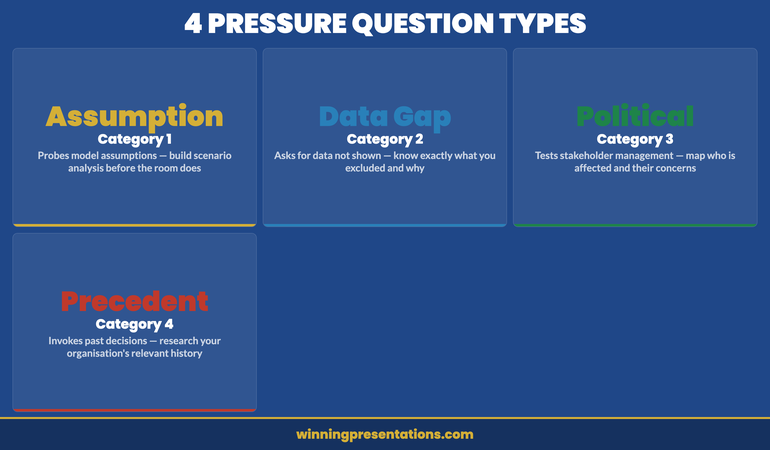
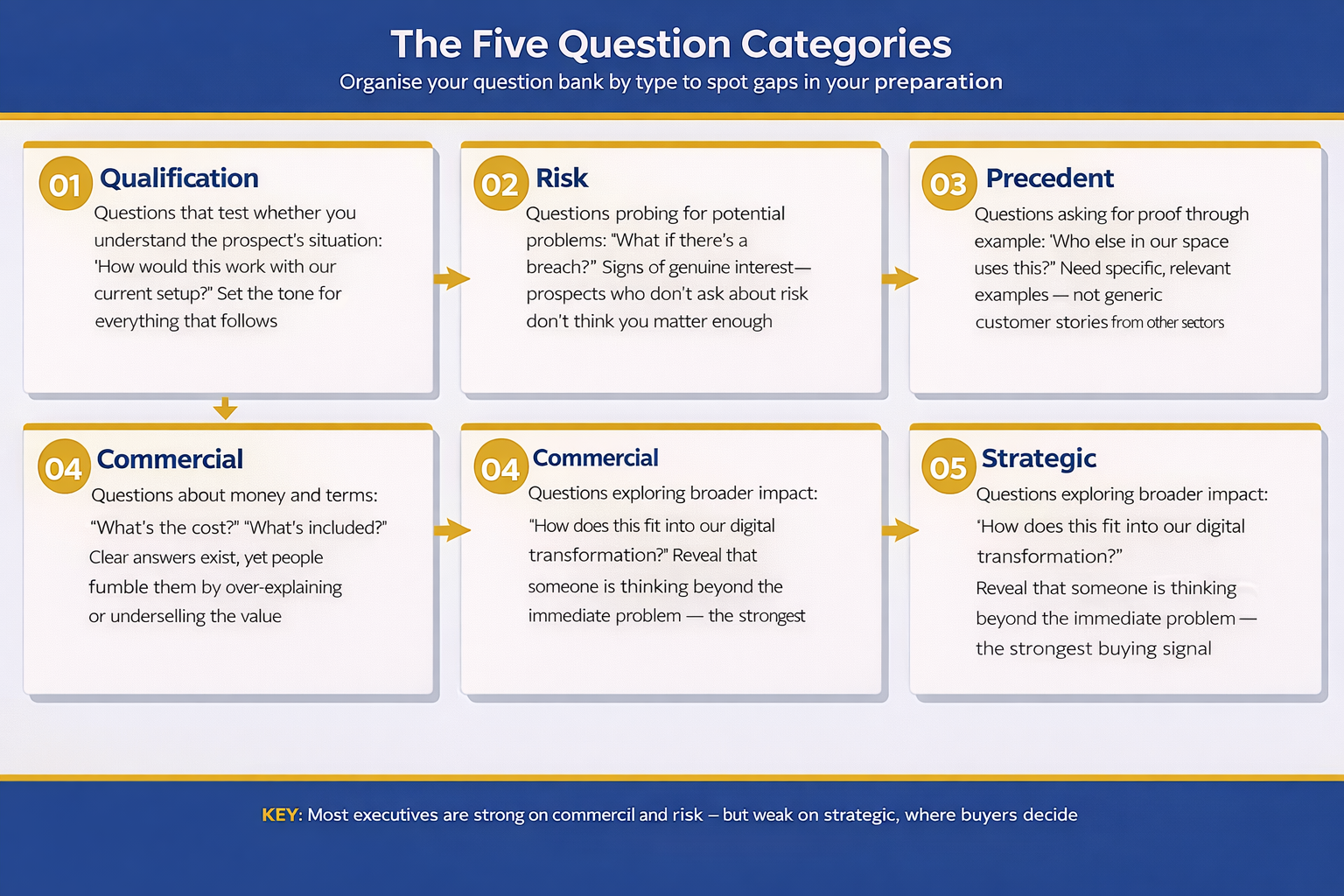
Pressure questions in executive presentations fall into four distinct categories. Understanding which category a question belongs to is the first step in building a preparation method that covers all of them.

The four categories of pressure question in executive presentations: assumption challenges, data gap questions, political implication questions, and precedent questions — dashboard infographic with preparation method for each

Category 1: Assumption challenge questions. These questions probe the assumptions embedded in your model, forecast, or recommendation. “What are you assuming about interest rates over that period?” “Have you modelled the downside scenario?” “What happens to the ROI if adoption is slower than forecast?” These questions are often the most embarrassing to be caught unprepared for, because the assumptions are visible to anyone who looks closely at your analysis — which suggests you have not looked closely enough yourself.

Preparation method: For every key number in your presentation, write down the two or three assumptions that number depends on. Then build a simple scenario: what does the model look like if each assumption is twenty per cent worse than your base case? You do not need to present these scenarios — you need to know the answers so you can give them when asked.

Category 2: Data gap questions. These questions ask about data you have not included, either because you chose not to or because you did not have it. “Do you have a comparable from another division?” “What does the competitor analysis show?” “Have you validated this with the operational team?” These questions can reveal either that your analysis is incomplete or that you have made a deliberate choice not to include something — and the audience will wonder why.

Preparation method: Before finalising your deck, ask yourself what data an informed sceptic would expect to see but cannot find in your slides. Either include it or prepare a clear explanation of why you have not.

Category 3: Political implication questions. These questions are not really about your analysis — they are about the politics of the decision. “How does this affect the northern division?” “Has this been discussed with the operations board?” “Who owns the implementation risk?” These questions signal that the questioner has a stakeholder interest in the outcome and is testing whether you have addressed it. They can feel like hostile questions but are usually legitimate governance concerns.

Preparation method: Map the stakeholders who will be affected by your recommendation and anticipate the concern each one would raise. Prepare a one-sentence response to each concern that acknowledges it and names how it is being managed.

Category 4: Precedent questions. These questions invoke a previous decision or a comparable situation to test the consistency of your current recommendation. “When we approved a similar programme in 2023 it took twice as long as the forecast — why will this be different?” “We had a similar analysis for the IT project and it underestimated the integration costs. Have you accounted for that?” These questions require specific knowledge of the precedent being cited and a clear, factual explanation of what is different this time.

Preparation method: Research your organisation’s relevant history before the presentation. If there are obvious precedents the audience will raise, address them proactively in the deck rather than waiting for the question.

Executive Q&A Handling System

Anticipate, Prepare, and Handle Every Pressure Question

The Executive Q&A Handling System — £39, instant access — gives you a structured system for predicting the questions your specific audience is likely to ask, building response frameworks for each category of pressure question, and managing the Q&A process so that difficult questions strengthen rather than undermine your credibility.

  • System for predicting and categorising executive Q&A questions
  • Response frameworks for assumption challenges, data gaps, and political questions
  • Adversarial rehearsal guides for high-stakes presentation settings
  • Recovery strategies for questions that expose genuine gaps in your analysis

Get the Executive Q&A Handling System →

Designed for executives who face high-stakes Q&A in board, committee, and investor settings.

The stress-test method: how to run an adversarial Q&A

The most effective Q&A preparation method is the adversarial rehearsal — a structured session in which a trusted colleague, mentor, or adviser tries to find the weaknesses in your case by asking the most difficult questions they can generate. This is fundamentally different from a practice run, where the colleague asks supportive clarifying questions and you deliver your prepared answers. An adversarial rehearsal has a specific goal: to find the questions that you cannot answer well and identify what that reveals about your preparation.

The setup matters. Give your adversarial questioner the following brief before the session: “Your job is not to help me practise. Your job is to find the weakest point in my case and keep pushing until I either give you a satisfying answer or we identify a genuine gap. Ask the same question differently if I give you a vague answer. Escalate if I give you a deflection. I need to know where my preparation is thin.”

During the adversarial rehearsal, track the questions you struggle with in three categories. Questions you struggled with because you do not know the answer are a preparation gap — you need to either find the answer or prepare an explicit response to not knowing it. Questions you struggled with because the answer reveals a tension in your case are a content gap — you may need to adjust the recommendation or explicitly acknowledge the tension in the presentation. Questions you struggled with because the framing caught you off-guard are a rehearsal gap — you need to practise responding to the same content delivered in different, more challenging framings.

One session of genuine adversarial questioning will reveal more about the vulnerabilities in your Q&A preparation than ten sessions of practising your prepared answers.

Pressure-testing your data and the numbers behind your slides

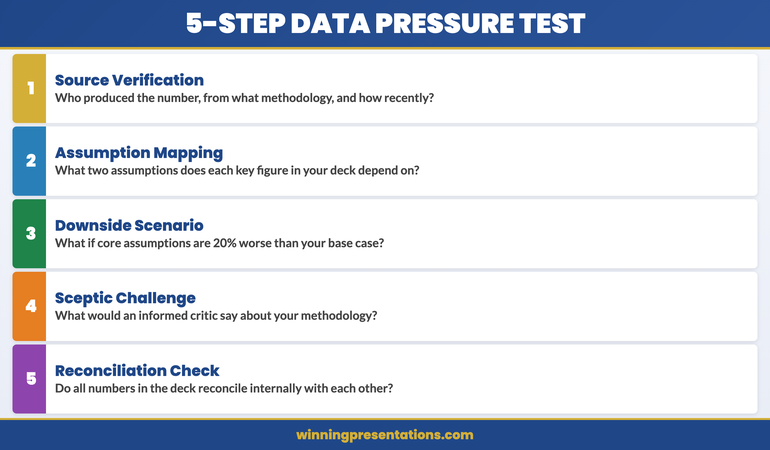
Every number that appears on a slide in a high-stakes executive presentation will be interrogated by at least one person in the room. The question is whether that interrogation will happen before or after you walk in. Pressure-testing your data means asking, for every significant number: what is the source, what are the assumptions, what happens if the assumptions are wrong, and what would a sceptic say about the methodology?

Five-step data pressure test framework for executive presentations: source verification, assumption mapping, downside scenario, sceptic methodology challenge, and reconciliation check — stacked cards infographic

The source question is the most basic and the most frequently neglected. If you are presenting a market size figure, a cost estimate, or a timeline, you should be able to state immediately who produced that number and how recently. A number from a report published two years ago presented as current market data is a vulnerability. An estimate produced internally without external validation is a vulnerability. Neither of these need prevent you from using the number — but you need to know they are vulnerabilities before someone else identifies them.

The reconciliation check is particularly important in financial presentations. Every number in your deck should reconcile with every other related number. If your cost estimate on slide four implies a certain unit cost, and your volume forecast on slide seven implies a different unit cost, a sharp analyst in the room will find the inconsistency. Running a systematic reconciliation across your slides — not just checking individual numbers but checking that the numbers are internally consistent — is a discipline that most presenters skip and most experienced audiences notice the absence of.

For a structured approach to buying time when a data question catches you short, see buying time in Q&A: techniques for managing questions you need a moment to answer.

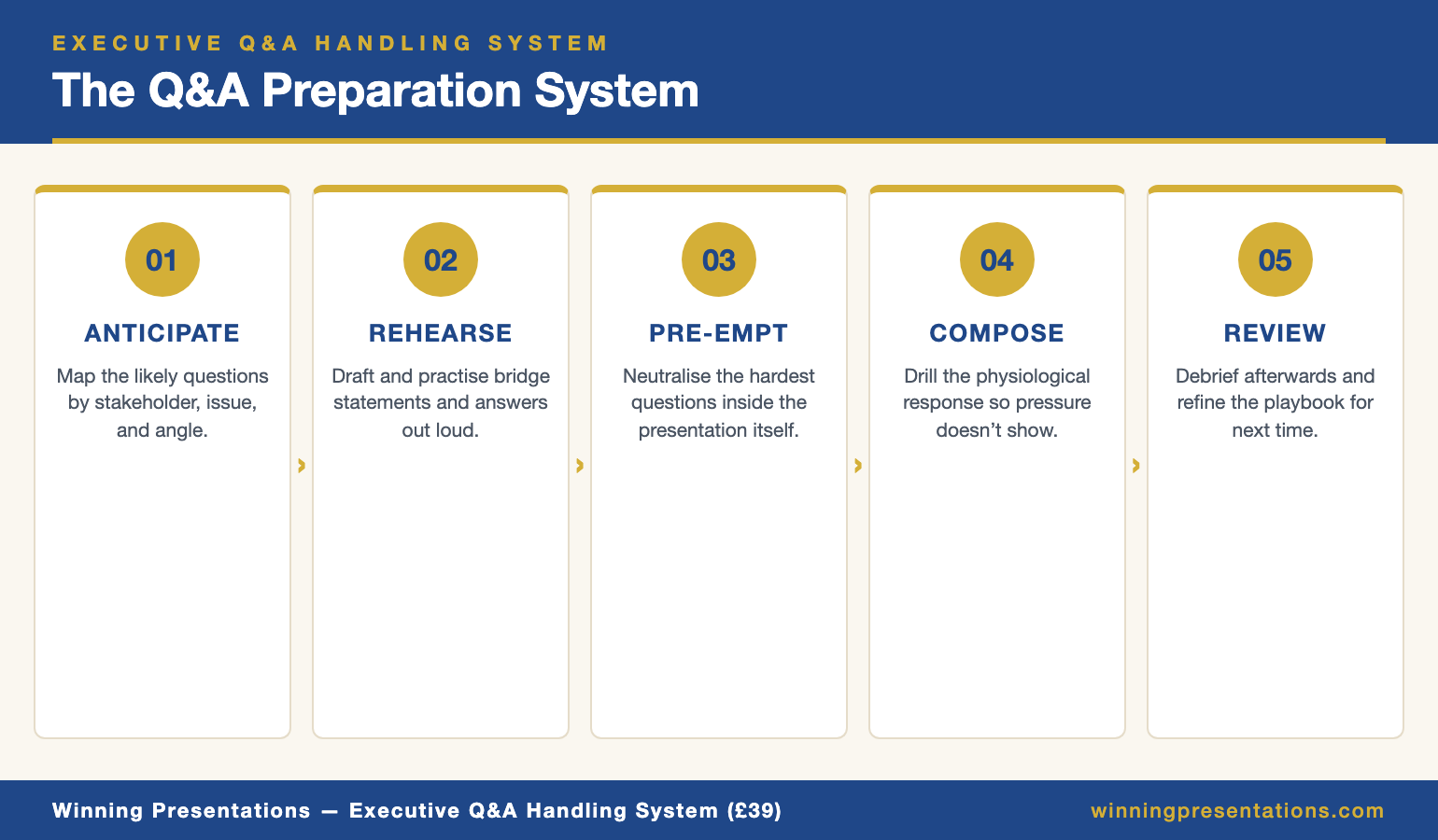
If you want a structured system for building and running this kind of adversarial Q&A preparation before high-stakes presentations, the Executive Q&A Handling System includes question prediction frameworks, adversarial rehearsal guides, and response strategies for each category of pressure question.

Building a framework for questions you cannot fully answer

Pressure-testing will sometimes reveal that you genuinely do not have the answer to a question the audience is likely to ask. This is not a failure of preparation — it is the purpose of preparation. Finding these gaps before the room does is exactly what the process is designed to do. The question is what to do with them once you have found them.

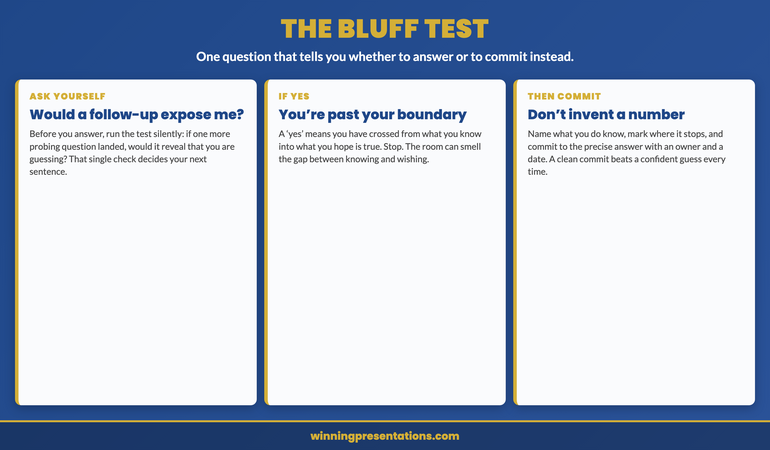
There are three legitimate responses to a question you cannot fully answer, and one illegitimate one. The illegitimate response is to deflect — to give an answer that sounds responsive but does not actually address the question. Experienced questioners recognise deflection immediately, and it damages credibility far more than an honest acknowledgement of a gap.

The first legitimate response is to close the gap before the meeting. If pressure-testing reveals that you do not know your fuel price assumptions, get the answer before the presentation. Many gaps that feel large in the preparation phase are actually addressable with a few hours of additional analysis or a conversation with a colleague.

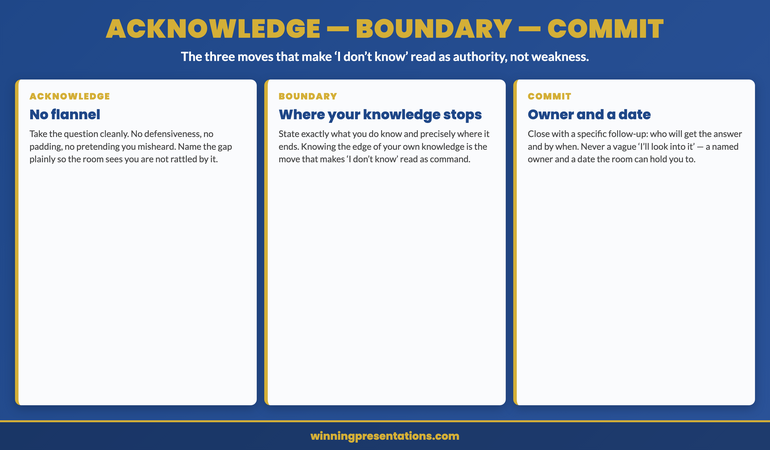
The second legitimate response is to acknowledge the gap explicitly in the presentation, frame it as a known uncertainty, and name how you are managing it. “The model does not include a scenario for a thirty per cent fuel price increase. We have not modelled that because it falls outside the range our supply chain team considers realistic — but if the board would find it useful, I can run that scenario and bring it to the next meeting.” This response is far stronger than being caught by the question.

The third legitimate response is to answer the spirit of the question without answering the exact question: “I don’t have that specific number with me, but the broader point you’re making about input cost sensitivity is addressed in the sensitivity analysis on slide nine — would it help to walk through that section?” This only works when the redirect is genuinely responsive to the concern behind the question, not a deflection dressed up as engagement.

For a structured bridging technique that supports these responses in the moment, see the bridging technique for difficult presentation questions: how to navigate without losing credibility.

When pressure-testing reveals a real gap

Occasionally, adversarial Q&A preparation does not just identify a question you cannot answer — it reveals that the case you are making has a genuine substantive weakness. The numbers do not hold up to a simple sensitivity analysis. The recommendation depends on an assumption that is clearly contestable. The implementation plan has a dependency that has not been addressed.

When this happens, the temptation is to press ahead anyway — the presentation is scheduled, the slides are built, and the gap might not come up. This is the wrong choice. A real gap that emerges in the room — that you were aware of and chose not to address — damages your credibility as a presenter and as an analyst in ways that take much longer to recover from than a delayed presentation.

The appropriate response is to decide, before the meeting, whether the gap is material enough to delay the presentation. If the gap would change the recommendation — or would change the conditions under which the recommendation holds — it is material, and the presentation should be delayed until the gap is addressed. If the gap is peripheral — it does not affect the core recommendation but represents a risk the audience should be aware of — it should be disclosed proactively in the presentation, not concealed in the hope it will not be raised.

Executives who earn lasting credibility in high-stakes Q&A settings are those who demonstrate that they have stress-tested their own analysis before presenting it. That quality of rigour is visible — in the specificity of their answers, in their ability to name the assumptions in their model, and in their comfort with the limits of what they know. It is the quality that adversarial Q&A preparation builds.

For a companion resource on presenting with confidence in the room, see presentation gestures: the body language signals that build executive credibility.

Executive Q&A Handling System — £39

The System Behind Executives Who Handle Tough Q&A With Clarity

The Executive Q&A Handling System — £39, instant access — gives you a structured method for predicting and preparing for every category of pressure question, running adversarial rehearsals, and managing the Q&A process so that difficult questions strengthen rather than undermine your credibility in the room.

Get the Executive Q&A Handling System →

Designed for executives who face high-stakes Q&A in board, committee, and investor settings.

Frequently Asked Questions

How much time should I allocate to Q&A preparation before a major presentation?

For a high-stakes presentation — board, investor, or senior committee — allocate at least as much time to Q&A preparation as to slide preparation. In practice, this is rarely done: most executives spend ninety per cent of their preparation time on the deck and twenty minutes on Q&A. The imbalance is understandable, because slide preparation is a creative task with a clear output, whereas Q&A preparation is an analytical task with an uncomfortable one. The adversarial rehearsal session should run for at least sixty minutes for a significant presentation. Data pressure-testing — checking sources, assumptions, and internal consistency — is a separate exercise and should be treated as a quality check on the analysis, not just the communication.

Is it better to ask a colleague or a senior mentor to run the adversarial Q&A?

A senior mentor or someone from outside your team is typically more effective than a close colleague. The problem with colleagues is that they are often too familiar with your context to ask genuinely challenging questions — they fill in the gaps with their own knowledge rather than exposing the gaps as the audience would. A mentor or trusted senior peer who does not know your specific project in detail is more likely to ask the naïve but important question that the audience will also ask. If you do use a colleague, brief them explicitly to ask the questions they think the sceptics in the room will ask — not the questions they themselves would ask as a supportive peer.

What should I do if I get a question in the room that I am genuinely not able to answer?

Say so — specifically and without apology. “I don’t have that figure with me, and I don’t want to give you a number I haven’t verified. I’ll get it to you by close of business today.” This response is more credible than a hedged estimate, more respectful than a deflection, and far less damaging than a wrong answer given confidently. What damages credibility is not the absence of an answer but the pretence of having one. Most experienced decision-makers have significantly more patience for honest uncertainty than for confident inaccuracy.

The Winning Edge

Weekly executive communication insight — every Thursday

Practical, no-filler analysis of Q&A strategy, board presentation technique, and executive communication — from 25 years of experience in high-stakes business settings.

Subscribe to The Winning Edge →

About the Author

Mary Beth Hazeldine — Owner & Managing Director, Winning Presentations

With 25 years of corporate banking experience at JPMorgan Chase, PwC, Royal Bank of Scotland, and Commerzbank, Mary Beth advises executives across financial services, healthcare, technology, and government on structuring presentations and managing the Q&A dynamics that determine whether decisions are made or deferred.

07 Apr 2026

The Hostile Questioner Simulation: Stress-Test Your Answers Before the Room Does

Quick answer: A hostile questioner simulation is a structured rehearsal exercise in which colleagues challenge your answers under conditions that mimic the pressure of the real executive meeting. It is the most reliable way to identify the gaps in your Q&A preparation before those gaps become visible in the room. The simulation works because it compresses the emotional and cognitive conditions of real Q&A into a controlled environment where you can practise and adjust without consequences.

Kenji had prepared more thoroughly for this board presentation than for any other in his career. He had rehearsed the deck twice, reviewed the financial model, pre-read the board papers, and anticipated six questions he thought were likely. When the Non-Executive Director challenged him on a specific assumption in the revenue model — an assumption that was methodologically sound but superficially easy to attack — Kenji answered competently. But he felt his voice tighten. He heard himself become slightly defensive. He watched the NED’s expression shift from interrogative to satisfied.

After the meeting, his CFO told him the presentation had gone well overall, but flagged the moment with the NED. “You answered correctly,” she said. “But you looked rattled. That matters in a room like this.” Kenji asked what he should have done differently. “You needed to have been in that moment before,” she said. “The answer wasn’t the problem. The unexpectedness was the problem.”

The CFO’s observation points to something that conventional Q&A preparation almost always misses. Preparing answers to likely questions is necessary but not sufficient. What determines performance under hostile Q&A is not primarily whether you know the answer — it is whether you have experienced the emotional and physiological conditions of challenge before you walk into the room. That experience is what the simulation creates.

The hostile questioner simulation is, at its core, an inoculation exercise. It does not eliminate the discomfort of challenge — it reduces its novelty, which reduces its power to destabilise.

Preparing for high-stakes Q&A?

The Executive Q&A Handling System is a structured approach to predicting and preparing for executive Q&A — including frameworks for anticipating hostile question patterns and building answers that hold up under scrutiny.

Explore the System →

The Problem With Traditional Q&A Preparation

The standard approach to Q&A preparation involves compiling a list of likely questions and drafting answers to each. This is useful — and should remain part of any preparation process — but it has two significant limitations that become visible only under real conditions.

It optimises for content, not for performance under pressure. A well-drafted answer in a preparation document is produced in conditions of low stress, unlimited time, and no social consequence for a weak response. The same answer, delivered under challenge from a sceptical Non-Executive Director, is produced under entirely different conditions. The cognitive load is higher. The emotional stakes are visible. The time pressure is real. The answer that looked clean on paper often sounds hesitant, over-hedged, or defensive in the room.

It cannot anticipate the follow-up. Hostile questioners rarely accept a first answer and move on. They push — often with a follow-up that accepts the substance of your answer while attacking the framing, or that redirects to a related vulnerability. A preparation document can anticipate the first question. It cannot anticipate the third exchange in a sequence, because that exchange depends on the specific choices made in the first two. Only a live simulation can generate the genuine unpredictability of an experienced interrogator.

These limitations do not mean that written preparation is unhelpful — they mean that it is incomplete. The simulation fills the gap between preparation and performance.

Why Hostility in Q&A Follows Predictable Patterns

Hostile Q&A in executive settings is not random. It follows a small number of recurring patterns that can be anticipated and prepared for specifically. Understanding these patterns transforms the simulation from a general stress-exposure exercise into a targeted preparation tool.

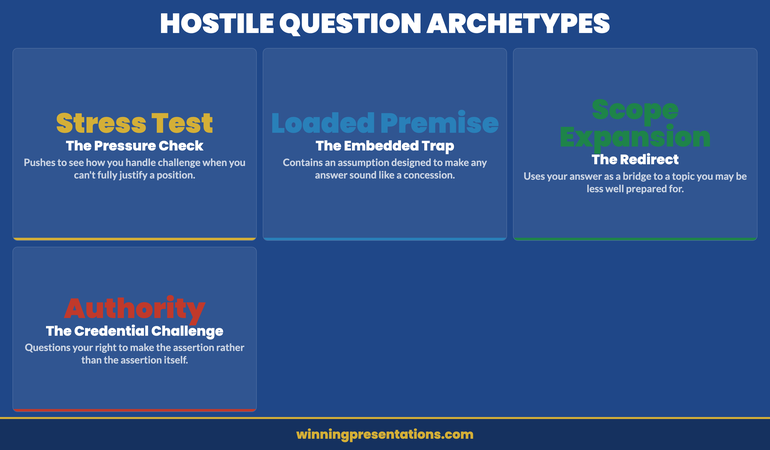
The stress test. The questioner pushes on a position not because they necessarily disagree with it, but to assess how you handle pressure. The question is often framed as a challenge to your methodology, your assumptions, or your confidence in the conclusion. The intent is less about the content and more about observing how you respond when challenged. The indicator is the quality of your second answer — the one you give after you have been pushed.

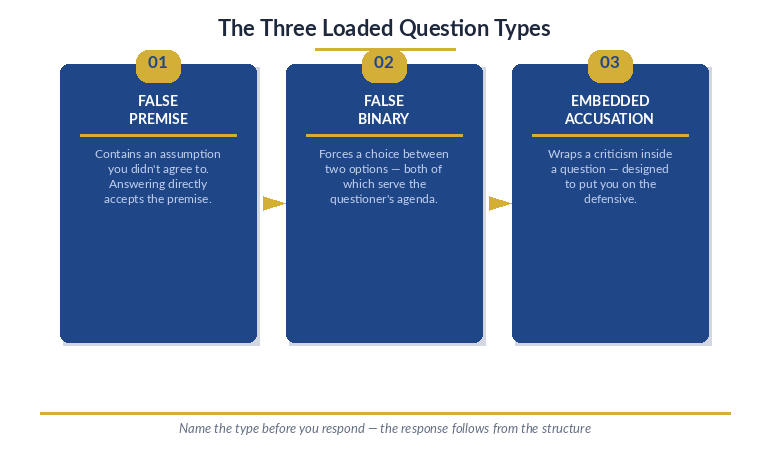
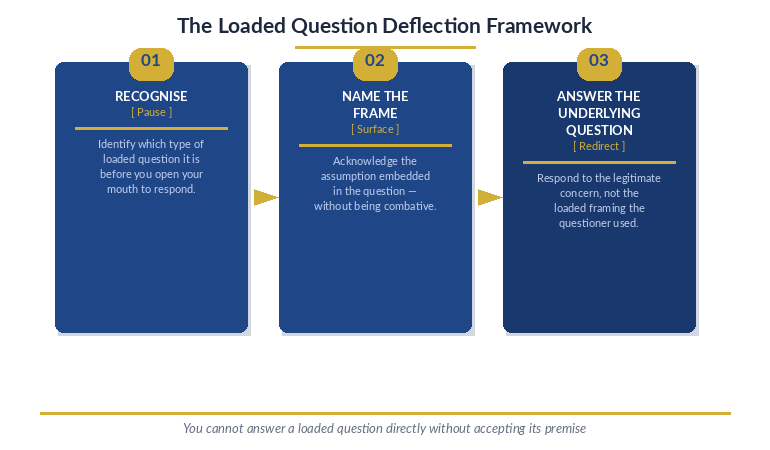
The loaded premise. The question contains an embedded assumption that, if accepted, positions any answer as a concession. “Given that your team has consistently missed this metric for the past three quarters…” is a loaded premise — it accepts as given something that may be contested. Accepting the premise before answering it transfers control of the narrative to the questioner. The correct response is to address the premise explicitly before answering the question.

Scope expansion. The questioner uses your answer to a specific question as a bridge to a broader topic that you may be less well prepared for. “You’ve addressed the operational impact — can you also speak to the regulatory exposure?” moves from a territory you anticipated to one you may not have. The effective response is to acknowledge the legitimacy of the broader question while clearly framing what you can answer now and what requires further analysis. For related patterns, see this guide on handling hostile questions in board meetings.

The authority challenge. The questioner questions your credentials to make the assertion rather than questioning the assertion itself. This is particularly common in cross-functional presentations where the presenter is speaking on topics that touch another executive’s domain. The authority challenge is a social manoeuvre as much as an intellectual one — and responding to it as if it were purely intellectual often misses the dynamic.

The Three-Layer Simulation Framework

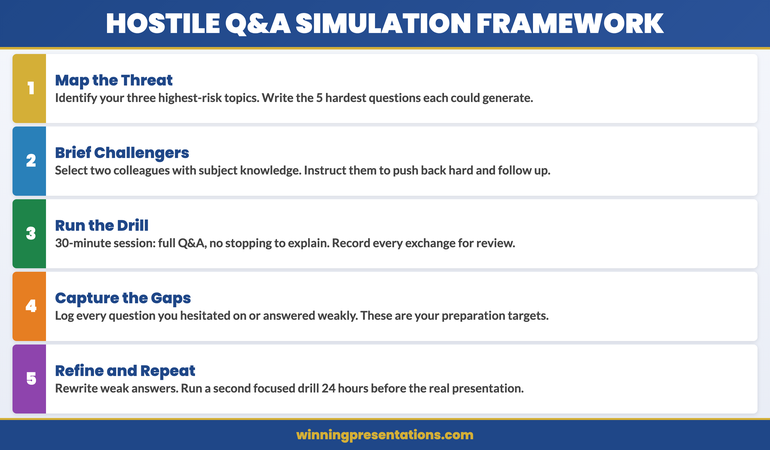
The most effective hostile questioner simulations are structured in three layers of escalating intensity. Each layer serves a different function in the preparation process, and all three should be completed in the sequence below for maximum benefit.

Five-step framework for running an effective hostile questioner simulation before executive presentations

Layer one — Question mapping. Before any live simulation, conduct a systematic mapping of the questions most likely to arise and the questions you most hope will not. These are different lists and both are necessary. The first list drives the content of your written preparation. The second list drives the focus of your simulation — because the questions you hope will not arise are almost certainly the ones a hostile questioner will reach for. A useful exercise at this stage is to brief a colleague on your presentation content and ask them to identify the three points they would push on if they were seeking to challenge your credibility. Their perspective as an intelligent insider is often more accurate than your own assessment of where you are vulnerable.

Layer two — Structured challenge session. With one or two colleagues briefed on your material and given explicit instructions to challenge hard, run a full Q&A session lasting 20 to 30 minutes. The challengers should cover all four hostile question archetypes — stress test, loaded premise, scope expansion, and authority challenge — and should push back on first answers rather than accepting them. You should respond as you would in the real room: under time pressure, without notes, and without stopping to explain yourself mid-answer. The session should feel uncomfortable — that discomfort is the point.

Layer three — Gap analysis and refinement. Immediately after the simulation, while the experience is fresh, identify every question where you hesitated, gave a weak answer, or felt rattled. These are your priority preparation targets. For each one, write a revised answer — clear, specific, and no longer than 60 seconds when spoken aloud. Then return to your challengers for a focused second session covering only the gap questions. This second session is typically shorter (10 to 15 minutes) and produces the most significant improvement in both content quality and delivery confidence.

The Executive Q&A Handling System

A structured system for predicting and handling executive Q&A — designed for high-stakes presentations where the questions are as consequential as the content.

  • Framework for predicting the questions most likely to arise in any executive meeting
  • Structured approaches for handling the four main hostile question archetypes
  • Answer frameworks that hold up under follow-up pressure
  • System for building and maintaining an executive Q&A preparation habit

Get the Executive Q&A Handling System — £39

Designed for executives preparing for Q&A in high-scrutiny board and leadership meetings.

How to Recruit Your Internal Challengers

The quality of the simulation depends almost entirely on the quality of the challengers. A colleague who softens their challenge to avoid causing discomfort defeats the purpose of the exercise. Recruiting the right people — and briefing them correctly — is as important as the simulation itself.

Select challengers with genuine subject knowledge. The most effective challengers are people who know your subject well enough to identify real weaknesses — not people who will ask generic difficult questions. A colleague from finance, risk, or a directly adjacent function is usually a better challenger than a generalist, because they can probe the same dimensions a real hostile questioner would. Their challenge will land closer to the actual vulnerability than the challenge of someone working purely from the question list you have given them.

Brief them to be genuinely uncomfortable to answer. The default social behaviour of a colleague asked to challenge you is to be challenging-but-supportive — to push but pull back before causing real discomfort. This instinct is natural and must be explicitly overridden. Your brief to your challengers should include a clear instruction: “I need this to feel like the worst version of the real meeting. Don’t ease up. If I look rattled, that’s useful information.” Without this explicit permission, most colleagues will moderate their challenge.

Brief them on the four hostile archetypes. Give each challenger a written brief that includes the four main hostile question types — stress test, loaded premise, scope expansion, authority challenge — and ask them to use each at least once across the session. This ensures that your simulation covers the full range of challenge you might face, rather than focusing on the most obvious lines of questioning. For related preparation strategies, see the companion article on addressing objections before they are raised in Q&A.

The Executive Q&A Handling System includes a structured framework for predicting and preparing for the specific question archetypes most likely to arise in your meeting context.

Running the Simulation: Rules and Format

The following rules make the simulation as useful as possible. Each rule addresses a common shortcut that reduces the exercise’s effectiveness.

Four hostile question archetypes that executives should prepare for in Q&A simulation exercises

No stopping to explain. In the real meeting, you will not be able to pause, step out of your presenter role, and explain what you meant to say. The simulation should replicate this condition exactly. If you give a weak answer, it stands — you do not get to revise it mid-session. The discipline of living with imperfect answers in the simulation is what makes the experience useful. Stopping to explain converts the simulation into a seminar, which has no preparation value.

No notes for your answers. Your challengers may have notes. You should not. If you answer from notes in the simulation, you will not develop the cognitive pathways that allow you to construct clean answers under real pressure. The simulation is specifically designed to build those pathways through repetition under stress. Notes short-circuit the process.

Record the session. The most valuable data from a simulation is the difference between how you thought you performed and how you actually performed. These two assessments are almost never identical. Recording the session — even audio only — allows you and your challengers to review specific moments with precision rather than relying on impressions. Pay particular attention to pace, to hedging language, and to the quality of your second answers after a follow-up challenge.

Do not debrief immediately. The instinct after a difficult simulation is to debrief in the same room, immediately. Resist this. Allow 30 minutes before reviewing the recording or discussing the session. The initial emotional response to being challenged — even in a safe environment — can distort the analytical assessment. A brief gap allows you to separate the experience of the challenge from the evaluation of your performance, and produces more accurate identification of genuine gaps. For the parallel challenge of managing risk committee scrutiny, see this guide on identifying Q&A blind spots before risk committee meetings.

Processing the Feedback Without Defensiveness

The feedback from a simulation is inherently personal — it reveals gaps in your preparation, weaknesses in your argumentation, and moments where your composure broke down. Receiving this feedback without defensiveness requires a specific mindset that is worth establishing explicitly before the session begins.

Treat gaps as information, not as judgements. A gap identified in a simulation is a gap you can address before the meeting. A gap that surfaces for the first time in the real room cannot be addressed — it simply becomes part of the record of that meeting. The simulation’s purpose is to surface gaps in a context where they are correctable. Receiving that information with gratitude rather than defensiveness accelerates the preparation cycle.

Distinguish between content gaps and performance gaps. Some weaknesses revealed in a simulation are content gaps — the answer is genuinely incomplete or the analysis has a real hole. Others are performance gaps — the content is sound but the delivery under pressure was unclear, defensive, or hesitant. These require different responses. Content gaps require further analysis and a revised answer. Performance gaps require repetition — giving the same answer again, more cleanly, until the delivery matches the quality of the content.

Focus debrief time on the follow-up questions. The most revealing moments in any simulation are typically the third or fourth exchange in a sequence — when the initial answer has been challenged and the follow-up challenges have been layered on top. These late-sequence exchanges are where real preparation is tested, and where most presenters discover they run out of both content and composure simultaneously. The debrief should spend proportionally more time on these multi-exchange sequences than on standalone questions that were answered well.

The Day-Before Refresh That Consolidates Gains

The gap between the simulation and the real meeting is where most of the preparation gains are consolidated or lost. A structured day-before refresh — distinct from the full simulation and shorter in duration — ensures that the improvements made during the simulation are accessible under real conditions.

Review the gap question list, not the full question list. The day before the meeting is not the time to rehearse answers to every possible question. It is the time to run through the specific questions where you identified gaps in the simulation — testing whether the revised answers are now clean and confident. Limiting the review to these priority questions prevents the cognitive overload that comes from attempting to rehearse everything.

Speak the answers aloud. Reading a preparation document silently is qualitatively different from speaking the answer aloud under conditions that approximate the real room. The day-before refresh should involve speaking — ideally in a physical posture similar to how you will present (standing if you will be standing, at a table if you will be seated). This physical rehearsal activates the motor memory of the delivery, not just the cognitive memory of the content.

Close with a confidence anchor. After the content review, spend five minutes reviewing the questions from the simulation that you answered well — cleanly, confidently, without hesitation. This is not indulgence; it is calibration. Entering a high-stakes Q&A with your recent mental reference points skewed toward difficulty produces a different physiological state than entering with a balanced recent reference — and that physiological state affects your first answer. The day-before refresh should end with evidence of your own competence, not with a catalogue of everything that could go wrong. For techniques specifically related to vocal control in the Q&A context, see the companion piece on using your voice to command the room during Q&A.

Build a System for Predicting Executive Q&A

The Executive Q&A Handling System gives you a structured approach to anticipating the questions most likely to arise in any executive meeting — so your simulation starts from the right question list.

View the Executive Q&A Handling System — £39

Designed for executives preparing for high-scrutiny board and leadership Q&A.

Frequently Asked Questions

How far in advance of the presentation should I run the simulation?

The ideal timeline is to run the main simulation two to three days before the presentation, leaving sufficient time to address the gaps identified and conduct a shorter second session. Running the simulation the evening before leaves insufficient time for meaningful gap-closing. Running it more than a week before allows too much time for the specific emotional and cognitive experience of being challenged to fade, reducing its inoculation effect. If you can only conduct one session, two days before is the optimal timing.

What if I don’t have access to knowledgeable colleagues who can challenge me effectively?

There are two alternatives. The first is to brief a generalist colleague on the question archetypes and give them a written list of challenging questions drawn from your question mapping exercise. While a generalist challenger cannot probe the content as deeply as a subject-matter colleague, they can still generate the social and emotional experience of challenge — and that experience has preparation value even without deep content knowledge. The second alternative is self-simulation: recording yourself presenting, then reviewing the recording as a hostile questioner would, identifying every point where a challenge could be mounted and drafting answers. This is less effective than live simulation but more effective than written preparation alone.

How do I handle a question in the real meeting that I genuinely cannot answer?

Acknowledge it clearly and commit to a specific follow-up. “I don’t have the precise data in front of me — I’ll send it to you by end of day tomorrow” is a credible response that maintains trust. What undermines trust is either bluffing — attempting an answer you are not confident in — or over-hedging, which signals that you are uncertain about a wide range of things rather than one specific data point. The simulation is the safest place to practise saying “I don’t know” cleanly — to build the habit of using it precisely and without apology when the situation genuinely requires it.

The Winning Edge — Weekly Newsletter

Executive presentation strategy, delivered every Thursday. Frameworks for Q&A preparation, difficult questions, and high-stakes executive communication.

Subscribe to The Winning Edge

About the Author

Mary Beth Hazeldine is Owner & Managing Director of Winning Presentations. With 24 years of corporate banking experience at JPMorgan Chase, PwC, Royal Bank of Scotland, and Commerzbank, she advises executives across financial services, healthcare, technology, and government on structuring presentations for high-stakes funding rounds and approvals. Connect at winningpresentations.com.

04 Apr 2026
Executive confidently responding to data questions during a board presentation with financial charts visible on screen, editorial photography

Data Questions in Presentations: How to Defend Your Numbers Under Pressure

Data questions in presentations are rarely about the data. They are about trust. When a board member challenges your numbers, they are testing whether you understand the assumptions behind them, the limitations within them, and the decisions they should and should not support. Here is how to defend your data under pressure without losing credibility or the room.

Ingrid was presenting the quarterly revenue forecast to the executive committee of a mid-market technology firm. Slide six showed a projected twelve percent growth in recurring revenue, driven by three new enterprise contracts expected to close in the next quarter. The CFO leaned forward. “Ingrid, the pipeline conversion rate you’ve used here is forty-two percent. Our actual conversion rate for the last four quarters has averaged thirty-one percent. Walk me through why you’ve used a different number.” She had used the higher figure because it reflected the conversion rate for enterprise deals specifically, which historically closed at a higher rate than the blended average. But she hadn’t flagged the distinction on the slide or in the supporting notes. She knew the answer—but the ten seconds it took her to locate the rationale in her memory felt, to the room, like hesitation. The CFO’s eyebrows rose. The CEO looked down at his notes. Ingrid recovered well, explaining the enterprise-specific rate and offering to share the supporting data by email. But the damage was subtle and real: for the remainder of the presentation, every number was scrutinised more carefully. She had been credible at slide five. By slide seven, she was being audited. The issue wasn’t the data. It was the gap between her preparation and her presentation of it.

Preparing for a data-heavy presentation with Q&A? The Executive Q&A Handling System includes frameworks and response structures designed for high-scrutiny presentation environments.

Why Data Challenges Are About Trust, Not Accuracy

When someone challenges a number in your presentation, the instinct is to defend the number. This is almost always the wrong response. The question behind the question is not “Is this number correct?” It is “Do you understand what this number means well enough for me to trust the decision you’re asking me to make?”

Data questions in presentations serve a governance function. The board member or senior executive who challenges your figures is not trying to embarrass you. They are building their own confidence that the data has been properly interrogated before it reaches them. Your job is not to prove the number is right. Your job is to demonstrate that you understand its provenance, its limitations, and its implications for the decision at hand.

This reframing changes your preparation entirely. Instead of preparing to defend every number, prepare to explain the three to five numbers that are most likely to be challenged—the ones with the biggest assumptions, the widest confidence intervals, or the greatest impact on the recommendation. Know the source. Know the methodology. Know the alternative interpretation. And know what your recommendation would be if the number were materially different.

The executive who responds to a data challenge with “The number is correct—it comes from our CRM” is defending accuracy. The executive who responds with “That number reflects our enterprise conversion rate over the last six quarters. If we used the blended rate instead, the forecast would be eight percent rather than twelve. My recommendation wouldn’t change, but the confidence interval would widen” is demonstrating mastery. The first response ends the question. The second response earns trust.

Handle Data Scrutiny With Authority

The Executive Q&A Handling System gives you response frameworks and preparation structures for high-scrutiny presentations—so you defend your numbers with the confidence the room expects.

  • ✓ Q&A response frameworks for executive settings
  • ✓ Preparation templates for data-heavy presentations
  • ✓ Techniques for handling hostile and unexpected questions

Get the Q&A Handling System → £39

Designed for executives who face data scrutiny in high-stakes presentations

Assumption Transparency: The Defence That Prevents the Attack

The most effective defence against data questions is to answer them before they’re asked. Assumption transparency—stating your key assumptions on the slide rather than hiding them in a footnote or an appendix—removes the adversarial dynamic entirely. When you proactively disclose that “this forecast uses enterprise-specific conversion rates (42%) rather than the blended rate (31%),” you’ve eliminated the challenge before the CFO can formulate it.

This approach works because it reverses the power dynamic. When the audience discovers an assumption themselves, it feels like catching you out. When you disclose it proactively, it feels like rigour. The data is identical. The perception is entirely different. Transparency converts a potential weakness into a credibility signal.

The practical implementation is an “Assumptions” callout box on any slide that presents modelled, projected, or estimated data. Keep it brief—three to five key assumptions, each in a single line. Position it at the bottom of the slide in a visually distinct format (grey text, smaller font, clearly labelled). This tells the audience: “I’ve thought about what underpins these numbers, and I’m confident enough to show my working.”

The assumptions you choose to disclose also signal what you consider material. Listing every assumption suggests you’re unsure which ones matter. Listing three tells the audience these are the ones you’ve stress-tested because they have the greatest impact on the recommendation. This selectivity is itself an act of expertise—it shows you can distinguish between assumptions that affect the decision and assumptions that are technically interesting but practically irrelevant.

Assumption transparency framework showing proactive disclosure versus reactive defence in data presentations

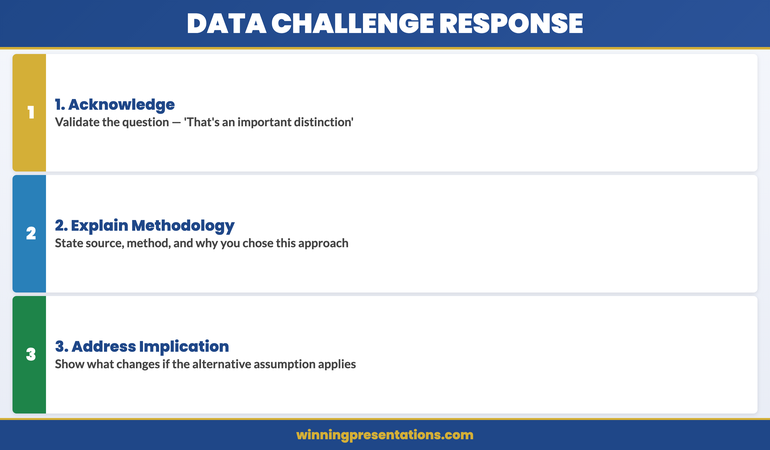
The Three-Part Response to Any Data Challenge

When a data question arrives—and it will, regardless of your preparation—use a three-part response structure that maintains credibility while addressing the challenge directly.

Part 1: Acknowledge the question’s legitimacy. “That’s an important distinction” or “You’re right to question that assumption.” This is not flattery—it is professional respect. It tells the questioner that you understand why the data point matters, which immediately reduces the adversarial temperature. A defensive response—“The data is sound”—escalates. An acknowledging response—“That’s a fair challenge”—de-escalates.

Part 2: Explain the methodology. State the source, the methodology, and the reason you chose this approach over alternatives. Be specific and brief. “We used the enterprise-specific conversion rate because the three pipeline deals are all enterprise contracts. The blended rate includes SME deals, which convert at a lower rate and aren’t represented in this quarter’s pipeline.” This takes fifteen seconds and demonstrates mastery.

Part 3: Address the implication. State what would change if the alternative assumption were used. “If we applied the blended rate, the projection would drop from twelve to eight percent growth. The recommendation to proceed with the hiring plan would still hold, though the timing would shift by one quarter.” This is the element that builds the most trust, because it shows you’ve already considered the alternative the questioner is proposing. You haven’t just defended your number—you’ve demonstrated that the decision is robust regardless. For more on the bridging technique for difficult questions, that guide covers how to redirect challenging questions without appearing evasive.

The three-part structure works because it addresses all three layers of the data challenge simultaneously: the emotional layer (acknowledgement), the technical layer (methodology), and the decision layer (implication). Most presenters only address the technical layer—and that’s why data challenges feel so uncomfortable. When you address all three, the questioner feels heard, informed, and reassured.

Anticipating Data Questions Before They Arrive

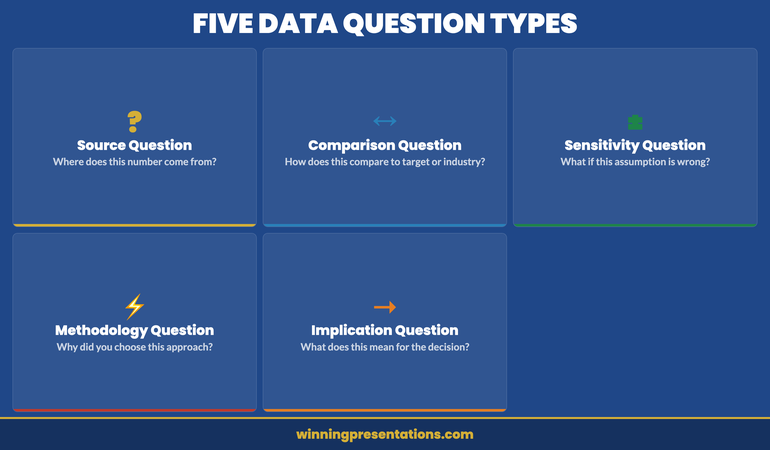
The most predictable data questions follow a pattern. For any presentation containing numerical analysis, audit each slide against five question types that appear in virtually every executive Q&A.

The Source Question: “Where does this number come from?” Prepare a one-sentence answer for every significant data point: the system, the report, the date range, and any manual adjustments. If you had to manipulate the data—filtering outliers, annualising partial data, converting currencies—disclose the methodology proactively or prepare the answer for Q&A.

The Comparison Question: “How does this compare to [last quarter / the industry / the target]?” Prepare context for every headline number. A twelve percent growth figure means nothing without comparison. Twelve percent against a target of fifteen is underperformance. Twelve percent against an industry average of four is outperformance. The questioner wants to calibrate your number against a reference point. Provide it before they ask.

The Sensitivity Question: “What happens if this assumption is wrong?” This is the data question that separates adequate presenters from authoritative ones. Prepare a sensitivity range for your three to five most impactful assumptions. Know what changes—and what doesn’t—when each assumption shifts by a material amount. For techniques on buying time during Q&A, that guide covers legitimate strategies for creating thinking space when unexpected questions arrive.

If you regularly present data-heavy material to senior audiences, the Executive Q&A Handling System provides the preparation frameworks that ensure you’ve anticipated the questions before you enter the room.

Five predictable data question types in executive presentations with preparation strategies

Recovering Credibility After a Data Stumble

If you’ve been caught off-guard by a data question—a number you can’t explain, an assumption you didn’t anticipate, a comparison you haven’t prepared—the recovery is more important than the stumble. How you handle the next sixty seconds determines whether the audience writes off the moment or writes off your presentation.

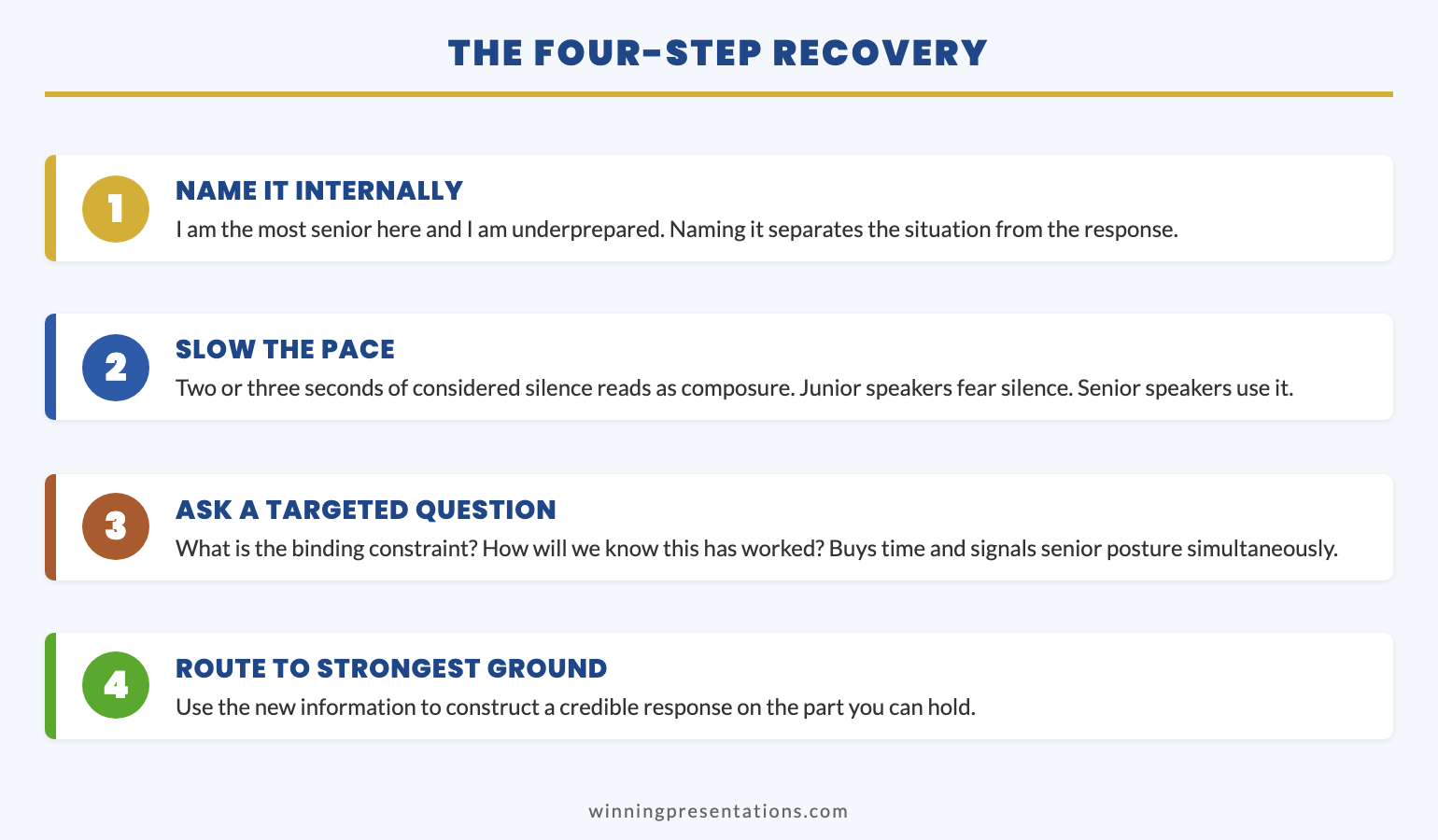
The recovery protocol has three steps. First, resist the urge to guess. An incorrect improvised answer is far more damaging than an honest acknowledgement. “I don’t have that specific breakdown in front of me” is a temporary gap. “I believe the number is roughly…” followed by an incorrect estimate is a credibility collapse.

Second, commit to a specific follow-up. Not “I’ll look into that”—which sounds vague and may never happen—but “I’ll send the detailed breakdown to the committee by end of business today.” The specificity of the commitment signals accountability. The timeline signals urgency. Together, they convert a moment of weakness into a demonstration of professional discipline.

Third, move forward with the presentation. Do not apologise repeatedly, do not circle back to the point, and do not let the stumble colour the rest of your delivery. The audience takes their cue from you. If you treat the moment as a minor administrative gap, they will too. If you treat it as a catastrophe, they will begin scrutinising every subsequent number with renewed suspicion. The stumble matters far less than the signal you send about it. For approaches to handling particularly hostile questions in board meetings, that guide covers the specific dynamics when data challenges carry political intent.

Prepare for Every Data Challenge Before You Enter the Room

Stop dreading Q&A. The Executive Q&A Handling System gives you the frameworks to anticipate, structure, and deliver authoritative responses to data scrutiny—for £39.

Get the Q&A Handling System → £39

Frequently Asked Questions

How do I handle a data question when the questioner has better data than I do?

Acknowledge their data immediately: “That’s a useful data point—thank you. My analysis used [source/timeframe]. If your figures reflect [their likely source], the difference may be [methodology/scope/date range]. I’d like to reconcile the two datasets after this meeting so we’re working from a single source going forward.” This response does three things: it validates their contribution, explains the discrepancy without being defensive, and proposes a constructive resolution. The worst response is to argue that your data is right and theirs is wrong—even if that’s true.

Should I include an appendix with detailed data for Q&A?

Always. An appendix with supporting detail is your safety net for data questions. Structure it as a set of backup slides that mirror your main presentation: for each core slide, prepare one or two appendix slides with the underlying data, the methodology note, the sensitivity analysis, or the comparison benchmarks. When a question arrives, you can say “I have the detailed breakdown—let me pull up the supporting slide.” This signals preparedness and converts Q&A from an interrogation into a collaborative data review.

What if a data challenge reveals a genuine error in my presentation?

Acknowledge it immediately, thank the person who spotted it, and assess the impact on your recommendation in real time. “You’re right—that should be thirty-one percent, not forty-two. Let me quickly assess whether that changes the recommendation.” If the recommendation holds, say so: “The conclusion is the same, but the margin is tighter. I’ll circulate corrected figures after the meeting.” If the error materially changes the recommendation, say that too: “This changes the picture. I’d like to revise the analysis and bring an updated recommendation to next week’s meeting.” Honesty in the moment of error builds more trust than a flawless presentation built on unchallenged assumptions.

The Winning Edge

Weekly insights on Q&A handling, executive presentations, and boardroom communication.

Subscribe Free

If data scrutiny also triggers anxiety about your credibility as a presenter, our guide to imposter syndrome in presentations covers the psychological patterns that make high performers feel like frauds under pressure.

About the author

Mary Beth Hazeldine, Owner & Managing Director, Winning Presentations. With 24 years of corporate banking experience at JPMorgan Chase, PwC, Royal Bank of Scotland, and Commerzbank, she advises executives across financial services, healthcare, technology, and government on structuring presentations for high-stakes funding rounds and approvals.

20 Mar 2026
Executive standing at podium in large corporate auditorium with hundreds of seats and professional lighting creating dramatic atmosphere for all-hands meeting

All-Hands Q&A: When 200 People Watch You Get Ambushed (The Format That Protects You)

Quick Answer

Large-audience Q&A is fundamentally different from boardroom dialogue. When 50–500 people are watching, questions become performative, hostile questioners play to the crowd, and silence reads as weakness. The format that protects you involves curating questions in advance, sequencing them strategically, and controlling the narrative before anyone stands up to challenge you.

Feeling Exposed Before Your Next All-Hands?

You’ve prepared your slides. But you haven’t prepared for the executive from operations who’s been silent all week—the one about to ask a loaded question in front of 150 people.

The Executive Q&A Handling System walks you through the three-step framework that lets you predict 80% of questions before they’re asked—so you’re never ambushed again.

Get the Executive Q&A Handling System → £39

Built on 25 years of high-stakes Q&A — banking, consulting, and senior leadership.

A senior executive froze for 47 seconds during a board presentation. But this wasn’t a board of eight—it was an all-hands of 200. The recovery technique she’d practised worked. But afterwards she said something that changed how we think about Q&A at scale:

“The boardroom is chess. The all-hands is a stadium. You need different rules.”

She was right. The techniques that work in a boardroom become liabilities in a stadium. This article is about the different rules.

The Boardroom Is Chess. The All-Hands Is a Stadium.

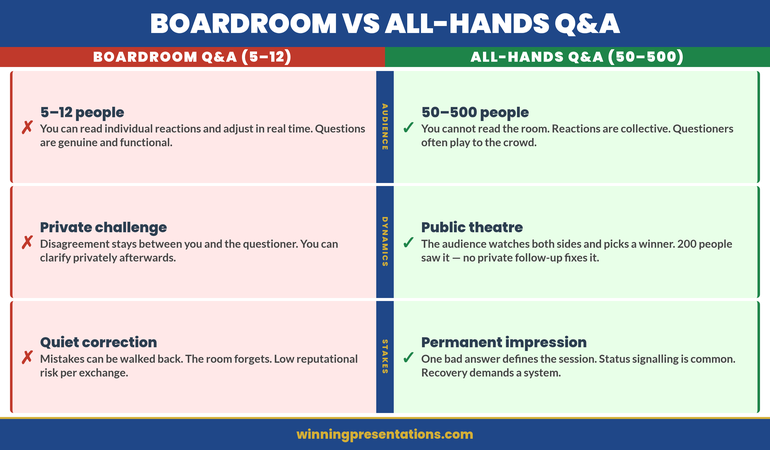
In a boardroom of eight, a question is a conversation. The questioner is looking for information. You can push back, ask for clarification, admit uncertainty. The conversation stays private, stays at the table, shapes only the opinions of those eight people.

In an all-hands of 200, a question is a performance. The questioner isn’t primarily asking you—they’re communicating to the 199 other people in the room. They’re establishing credibility, testing your resolve, signalling to their peers. And silence, hesitation, or an answer that doesn’t land reads to the entire room as weakness.

This is why boardroom Q&A strategy fails catastrophically at scale. You can’t engage in real-time dialogue with 200 people. You can’t afford genuine pauses. You can’t admit uncertainty without 199 people watching your stock price drop.

The all-hands requires a completely different architecture: one built on curation, sequence, and narrative control.

Why Large-Audience Q&A Is So Different

Four psychological forces change how Q&A functions at scale.

Performative Dynamics — The questioner is performing for their peers, not seeking information from you. A hostile question in a boardroom is a challenge. A hostile question in an all-hands is a bid for status. The audience becomes part of the conversation whether you acknowledge it or not.

Audience Inference — 200 people will interpret your answer not in isolation but against a narrative being written live. If you answer one question confidently and hesitate on the next, the hesitation is read as exposure. If you answer the same type of question differently when posed by different people, that inconsistency echoes through the room.

The Silence Problem — In a smaller room, a thoughtful pause signals reflection. In a stadium, a pause is dead air. It’s anxiety. It’s been-caught. Even three seconds of silence before an answer can shift the room’s perception from “she’s thinking” to “she doesn’t know.”

The Contagion Effect — One strong question can trigger others. If someone asks a loaded question and the room responds (even non-verbally—a nod, a shift forward), other questioners become emboldened. What begins as one hostile line can cascade into a perceived ambush within 60 seconds.

Understanding these forces is the first step to protecting yourself against them.

The Framework That Stops Ambush Before It Starts

You can’t prevent someone from raising their hand. But you can prevent ambush. The executive Q&A system teaches you the exact three-step framework that lets you predict the difficult questions before they’re asked—so when they come, you’re already composed, already prepared, and already ahead of the room.

  • Identify the hidden agendas—what questions are really being asked beneath the surface
  • Map the question vectors—who will ask, from which angle, and why
  • Build your pre-composed, flexible responses that work across variations

Get the Executive Q&A Handling System → £39

The framework that lets you walk into Q&A with 80% of the questions already mapped.

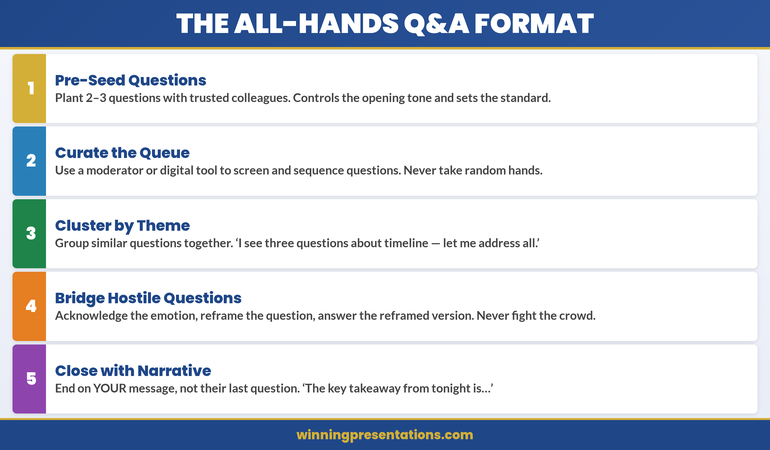
Five-step infographic showing the all-hands Q&A protection format: pre-seed questions, curate the queue, cluster by theme, bridge hostile questions, close with narrative

The Three Dangerous Dynamics You’re Up Against

Before you design a Q&A strategy, you need to understand what you’re actually defending against.

1. The Ambush Through Sequence

A hostile questioner will often wait until later in the Q&A, after you’ve built confidence and credibility, to drop a loaded question. By then, you’re thinking faster, checking less of your internal logic, more likely to contradict something you said earlier. The sequence of questions matters far more than the individual questions themselves. If hostile questions arrive early, you’re locked into caution for the entire session. If they arrive late, they can unpick everything you’ve already built.

2. The Echo and Amplification

One person asks a critical question. Someone else nods. A third person leans forward. Within 30 seconds, the room has decided this is a serious issue, whether or not it actually is. This is the contagion effect at work. A single poorly answered question doesn’t just affect that one interaction—it becomes the permission structure for the next questioner to press harder.

3. The Trap Through Specificity

An experienced hostile questioner will ask for specific data you don’t have in your head at that moment—revenue from a specific customer, headcount in a specific region, a specific decision date that hasn’t been finalised. They’re not asking because they don’t know the answer. They’re asking to force you to either admit you don’t know (weakness in front of 200 people) or guess (and potentially say something contradicted by documents the room has already seen).

Understanding these dynamics lets you build defences before the Q&A even begins.

Curating Questions Before They Become Weapons

The most sophisticated executives don’t leave Q&A to chance. They curate it.

This doesn’t mean scripting the room or planting friendly questions. It means actively managing which questions surface and when. In a large all-hands, you have several legitimate levers:

The Pre-Submission Window — Many large all-hands now invite questions via email or Slack in advance of the session. This gives you 24–48 hours to think through the difficult questions before you’re on stage. You can also use this to shape the types of questions that will be asked: if you explicitly invite “strategic challenges and alternative perspectives,” you set the frame differently than if you say “we welcome all questions.”

The Moderator’s Discretion — If there’s a moderator or chair (often there is, in all-hands at companies over 100 people), the moderator has genuine discretion about question order. You can brief your moderator in advance: “If anyone asks about the acquisition timeline, I’d prefer that comes later in the session when I’ve had time to establish context.” This is legitimate curation, not suppression.

The Format Choice — A written Q&A (submitted via chat) gives you seconds to read each question before it’s asked. A live hand-raising Q&A gives you no warning. A hybrid format—written questions with live follow-ups—gives you the advantages of both. If you have any control over format, this is where it starts.

The Pre-Briefing of Allies — You don’t need to plant questions. But you can ensure that people who are informed and genuinely supportive of your strategy are ready to ask clarifying questions if needed. A well-placed question from someone respected in the room—not a softball, but a genuine question your ally already knows the answer to—can shift narrative momentum at a critical moment.

Curation is not manipulation. It’s architecture. You’re building a structure where truth can surface more effectively.

Ready to walk into your next all-hands knowing 80% of the questions before they’re asked?

Get the Executive Q&A Handling System → £39

Sequencing Strategy: Order Determines Narrative

If curation is about which questions surface, sequencing is about when they surface. This is where most executives lose control.

A hostile questioner wants to ask their loaded question when you’re off balance. An unprepared executive let’s questions come in whatever order they naturally arise. An experienced executive controls the sequence.

The architecture looks like this:

Open with Softballs, Establish Credibility — The first two to three questions should be ones you’re ready for, that you can answer with absolute clarity and confidence. This isn’t dodging. These questions genuinely exist. But you’re choosing to answer them first. The room watches you nail the opening questions. Your body language settles. Your pacing stabilises. By question three, you’ve established that you know what you’re talking about.

Sequence Difficulty in a Staircase, Not a Cliff — If the first three questions are softball and the fourth is “Why did you fail to deliver the acquisition?” you’ve created a cliff. The room notices the shift. You appear less confident. Instead, gradually escalate: first straightforward strategic questions, then deeper strategic questions, then the hardest questions. A staircase climbed looks like progress. A cliff-jump looks like you’ve lost control.

Place Your Hardest Question Second-to-Last — Not last. If you answer your hardest question at the end, the session ends on ambiguity. Place it second-to-last, then deliberately choose an easier final question. You take the hit on the hard question, recover visibly on the final one, and the room leaves remembering your composure on the recovery, not your struggle with the hard one.

Never Let Questions Cluster by Theme — If three questions in a row are about revenue projections, you’re locked into one lane of conversation for three straight minutes. The room stops hearing your answers and starts hearing repetition. Vary the themes: a question about strategy, then culture, then operations, then long-term vision. Each theme-shift keeps the audience’s attention and prevents any single challenge from building momentum.

Sequencing isn’t about softballing the audience. It’s about intelligent narrative design. You’re the executor of that design.

Managing the Hostile Questioner in the Room

Sometimes curation and sequencing aren’t enough. Someone raises their hand with a genuinely hostile question. How do you handle that in front of 200 people?

The principle is this: never respond to the emotion in the question. Respond to the legitimate underlying concern.

A hostile question often contains two layers: the surface aggression and the real question underneath. An example:

Hostile surface: “How can you claim we’re on track when the data clearly shows we’ve missed the last three milestones?”

Real question: Am I right to be concerned about execution?

If you respond to the hostility (“I think we’ve been very clear about this” or “The data actually shows…”), you’re now in an argument with one person in front of 199 others. Instead, acknowledge the concern and reframe the narrative:

“You’re asking whether we’re actually on track—whether the gap between plan and reality is something we’re managing or something that’s managing us. That’s the right question. Here’s what’s happened: we’ve missed three milestones, and we’ve recovered on two of them. Here’s the third one and our plan to close it.”

You’ve stripped away the hostility, validated the underlying concern, and answered the real question. The room watches someone raise a challenge, watch you take it seriously, and watch you respond not with defensiveness but with clarity. That’s not weakness. That’s leadership.

The five-step protocol for hostile questions:

  1. Pause for one full breath (not three seconds—one breath). Longer pauses read as defeat in a stadium. One breath reads as composure.
  2. Thank the questioner for raising a legitimate concern (and make clear it is legitimate, even if the delivery was hostile).
  3. Rephrase the real question underneath the aggression in neutral language.
  4. Answer the real question with data, context, or clear reasoning.
  5. Invite follow-up in a way that signals you’re not threatened—”Does that address your concern?” or “What’s the specific data point that would help here?”

This protocol works because it moves the frame from “executive vs. hostile questioner” to “executive and audience, jointly looking for truth.” That’s a frame you always win in.

Predict 80% of Questions Before They’re Asked

The system that lets you walk into high-stakes Q&A with absolute confidence. Learn how to map question vectors, predict hostile challenges, and build responses that work across variations—so you’re never caught off guard.

Get the Executive Q&A Handling System → £39

Designed for funding rounds, board approvals, and company all-hands.

Comparison infographic showing boardroom Q&A versus all-hands Q&A differences across audience size, question motive, hostile dynamics, and recovery from mistakes

The Recovery Protocol When It Goes Wrong

Sometimes despite your preparation, despite curation and sequencing, you’ll stumble. You’ll give an answer that doesn’t land. You’ll be asked something you genuinely don’t know. You’ll get tangled in language. And 200 people will watch it happen.

The recovery is more important than the stumble.

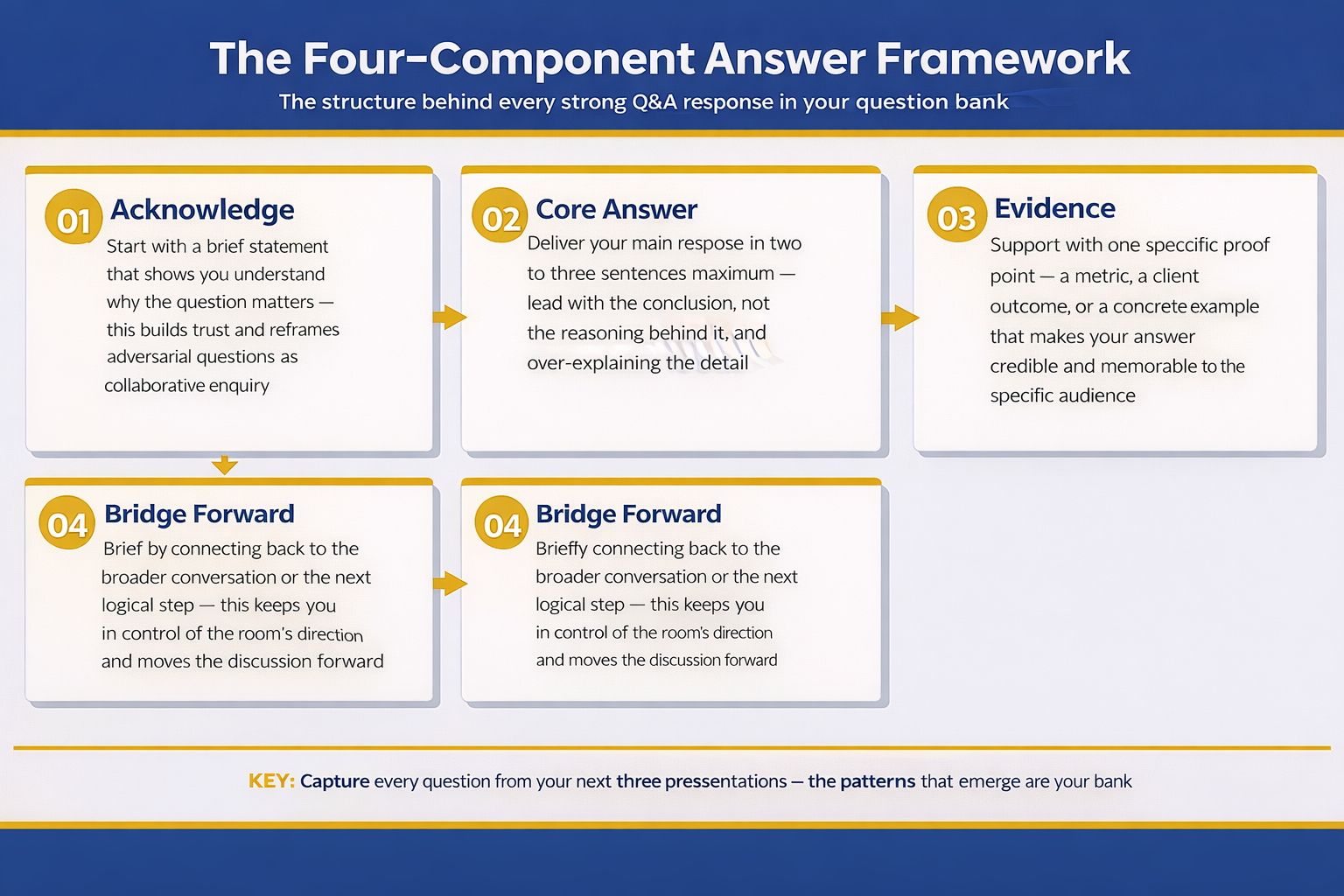
The protocol: acknowledge, clarify, commit, move forward.

Acknowledge: “I didn’t explain that clearly.” Or “That’s a good point and I didn’t address it well.” Or “I don’t have the specific data on that and I should.” Be explicit. The room already knows something didn’t work. Naming it directly proves you’re aware and in control.

Clarify: Give a shorter, clearer version of what you meant to say. Or, if you don’t have the answer, say so: “That’s the right question. I don’t have the headcount breakdown by region off the top of my head, but I’ll send it to you after this.” Specificity here matters enormously. “I don’t know” is worse than “I don’t have that data with me, but here’s who to ask and when you’ll get it.”

Commit: If you’ve committed to follow up (send data, circle back with an answer, investigate something), state it again. “So I’m committing to send you that breakdown within 24 hours.” The room needs to see that you’ve made a commitment and that you’re tracking it.

Move forward: Don’t dwell. Don’t over-apologise. Don’t loop back to the same question three turns later. The quickest way to make a stumble memorable is to keep referencing it. Instead, move to the next question with the same composure you started with.

The senior executive who froze for 47 seconds used this exact protocol. She said: “I lost my train of thought—apologies. Let me restart that answer.” She restarted. She nailed it. And after the all-hands, most people didn’t even remember the freeze. They remembered the recovery.

Three Questions About All-Hands Q&A You’re Probably Asking

Should you ever admit you don’t know the answer in front of 200 people?

Yes—but only if you commit to finding it. “I don’t know, and here’s who has the answer and when you’ll get it” is strength. “I don’t know” without the commit is weakness. The room isn’t judging whether you know everything. They’re judging whether you’re in control and competent. An honest “I don’t know” with a clear path to the answer proves competence. An evasive “we’re looking at that” proves the opposite.

What if someone asks a question that’s actually a political move against you?

It happens. Someone uses the all-hands to signal to their allies or to undermine you publicly. Don’t take the bait. Treat it as a legitimate question (even if it’s not), answer it with data and reason, and move on. Responding to the political subtext (“I know what you’re doing”) only amplifies it. Responding to the surface question denies them the conflict they’re after and proves your focus is on substance, not politics.

How do you handle a question you’ve specifically asked your moderator to avoid?

The moderator was supposed to keep it off the table, but it came anyway. Don’t blame the moderator or show frustration. You asked for curation, curation failed, now you adapt. This is exactly what composure looks like in real time. Answer the question you didn’t prepare to answer—and do it well enough that the room never knows you wanted to avoid it.

Want the three-step framework that lets you predict 80% of questions before they’re asked?

Get the Executive Q&A Handling System → £39

Master Large-Audience Q&A With Absolute Confidence

The difference between an executive who gets ambushed and one who doesn’t isn’t luck or natural talent. It’s preparation. The Executive Q&A Handling System teaches you the exact framework that lets you walk into any Q&A—board meeting, all-hands, investor presentation—knowing you’ve predicted the questions, prepared your responses, and designed a narrative that protects you.

  • Predict difficult questions before they’re asked using the question-mapping system
  • Build flexible, pre-composed responses that work across question variations
  • Control the narrative through strategic curation and sequencing
  • Recover with composure when things don’t go to plan

Get the Executive Q&A Handling System → £39

Built from 25 years inside boardrooms, all-hands, investor decks, and high-stakes Q&A.

People Also Ask: How do you handle hostile questions in front of a large audience?

Acknowledge the emotion behind the question without validating the hostility. Say “I can see this is important to you” or “That’s a fair concern.” Then reframe: restate the question in neutral terms that you can answer constructively. Answer the reframed version. The audience hears you being respectful and substantive. The hostile questioner gets heard without controlling the narrative. Never argue with someone in front of 200 people — the crowd always sides with the person who stays composed.

People Also Ask: Should I use a moderator for all-hands Q&A?

Yes, whenever possible. A moderator serves three functions: they screen questions for relevance and tone, they sequence questions so hostile or emotional ones don’t cluster together, and they give you a natural pause between questions (which your nervous system needs). Even an informal moderator — “Sarah will be collecting questions” — changes the dynamic. You’re no longer fielding random hands from a crowd. You’re responding to a curated, sequenced list.

People Also Ask: What if nobody asks questions at an all-hands meeting?

Silence after “Any questions?” in a room of 200 people is common and not necessarily a bad sign. Large audiences are reluctant to be the first person to speak. Pre-seed two or three questions with trusted colleagues. After those are asked and answered, the room usually opens up. If it doesn’t, close with your narrative: “The key thing I want you to take away from today is…” Silence isn’t failure. It’s often a sign that your presentation answered the questions before they were asked.

Is This Right For You?

The Executive Q&A Handling System is designed for executives and leaders who regularly face Q&A in high-stakes environments:

  • You present to company all-hands of 50+ people regularly
  • You’ve had the experience of being asked something hostile and wishing you’d been better prepared
  • You know some questions are coming but you’re not quite sure how to respond
  • You want to move from anxious about Q&A to completely composed
  • You’re leading through change, restructure, or challenges and expect scrutiny
  • You’re preparing for funding pitches or investor presentations
  • You want to shift from “hoping it goes well” to “knowing exactly what will happen”

If most of these resonate, this system will change how you approach every Q&A you do from now on.

Frequently Asked Questions

How much time does the system take to learn?

The core framework takes about 30 minutes to understand. The real work—applying it to your specific upcoming Q&A—takes one to two hours. Most executives do this prep 24–48 hours before a big all-hands or presentation. You’re not adding complexity to your process; you’re structuring the prep you should be doing anyway.

What if I work in a culture where Q&A is very open and unstructured?

Curation and sequencing still apply. You can’t control which questions get asked, but you can brief your moderator on preferred sequencing, you can influence what gets submitted in advance, and you can absolutely apply the response protocols in this system. The system works whether your Q&A is hyper-structured or completely free-form.

Does this system teach me how to dodge difficult questions?

No. The opposite. This system teaches you how to answer difficult questions in a way that’s honest, clear, and maintains your credibility. Questions you can’t answer get an honest “I don’t know, here’s the path to the answer.” Questions you can answer but were worried about get a structured response that lands with confidence. The goal is never to dodge. The goal is to protect yourself while being truthful.

Can I use this before my all-hands next week?

Yes. You get access immediately. Many executives use this as a just-in-time prep tool: buy it Wednesday, use it to prepare for Thursday’s presentation. It’s designed to be actionable in hours, not weeks.

Stay Sharp: The Winning Edge Newsletter

Practical Q&A and presentation techniques delivered every week

Each week, The Winning Edge covers real situations: how to handle hostile questions in front of investors, how to recover when something goes wrong, how to read a room and adjust in real time. Subscribe and get patterns that work in the boardroom, the all-hands, and the high-stakes conversation.

Subscribe to The Winning Edge

Free resource: Download the Executive Presentation Checklist (PDF) — the pre-presentation validation that ensures nothing gets overlooked before you present.

About the Author

Mary Beth Hazeldine is the Owner & Managing Director of Winning Presentations. With 25 years of corporate banking experience, she has delivered high-stakes presentations in boardrooms across three continents.

A qualified clinical hypnotherapist and NLP practitioner, Mary Beth combines executive communication expertise with evidence-based techniques for managing presentation anxiety. She advises senior professionals across financial services, consulting, technology, and government on high-stakes Q&A.

Book a discovery call | View services

17 Mar 2026
Technical presenter explaining a complex concept to non-technical executive board members using simple visual language, modern boardroom, navy and gold corporate aesthetic

When Non-Technical Executives Ask Technical Questions: How to Translate Under Pressure

Quick answer: When a non-technical executive asks a technical question, they’re often not asking for technical depth—they’re asking “Will this work, and can I trust it?” Translate the question into the business risk underneath. Answer the risk, not the jargon.

Stuck in the boardroom when a non-technical executive asks a technical question you weren’t expecting? The gap between their question and your knowledge isn’t the problem—your translation speed is. The Executive Q&A Handling System teaches you to diagnose what non-technical executives actually need to hear, and answer it instantly without condescension.

Master technical Q&A for non-technical audiences → £39

A CFO asked a technology director: “How confident are you in the architecture?” It sounded technical. The director launched into a fifteen-minute explanation of microservices, API scalability, and load balancing. The CFO’s eyes glazed over. What he’d actually asked was: “Can this project stay on time and on budget?”

They were speaking the same language but answering different questions. The director was answering the technical question. The CFO was asking the business question. The gap between them killed the conversation and signalled that the director didn’t understand what executives care about.

This happens constantly in boardrooms. A non-technical executive asks a question that sounds technical. The presenter answers the technical version, misses the real intent, and walks out of the room thinking “They don’t understand this.” What actually happened: the presenter didn’t understand what the executive needed.

The Role-Mismatch Problem in Q&A

Non-technical executives ask technical questions, but their frame of reference is different from yours. You’re thinking: “How do I explain this correctly?” They’re thinking: “Is this a risk I need to manage?”

This creates a consistent pattern:

The executive asks about a technical detail. Something like: “What’s the data migration strategy?” or “How are you handling the API integration?” or “What’s your backup procedure if the vendor disappears?”

The presenter hears a technical question. So they answer technically, diving into details about databases, authentication protocols, redundancy systems. They’re being thorough.

The executive stops listening. They’ve lost the thread. They don’t need to understand microservices—they need to know whether the project will survive if something goes wrong.

The presenter thinks the executive is unsophisticated. “They just don’t get it. They asked a technical question but couldn’t follow the technical answer.” False. The executive asked a risk question and the presenter gave a detail answer.

The real skill in boardroom Q&A isn’t technical knowledge—it’s recognising which question is really being asked underneath the words, and answering that one.

What Non-Technical Executives Really Ask

A non-technical executive asking technical questions is almost always asking one of these five things:

1. “Is this a known risk or an unknown one?” When they ask “How will you handle scalability?”, they’re really asking: “Is this a solved problem or are you building something we’ve never done before?” Known risks can be managed. Unknown risks are threats.

2. “Can I trust the people running this?” When they ask “What’s your testing framework?”, they’re assessing your rigour and competence. They’re asking: “Does this team know what they’re doing?” Not: “Explain your testing framework.”

3. “What happens when the worst-case scenario occurs?” When they ask “What’s your disaster recovery plan?”, they’re not asking for technical detail. They’re asking: “Have you thought about failure? Can this organisation survive a major problem?” They want assurance that you’ve considered risk.

4. “Is this going to cost us more than we’ve budgeted?” When they ask technical questions about dependencies, timelines, or integration complexity, they’re often asking: “Will we go over budget?” Hidden inside the technical question is a financial risk question.

5. “Are you sure about this?” Sometimes they’re just checking your confidence level. A wavering answer feels risky. A confident answer (even if the answer is “We’ll figure that out”) feels manageable.

Once you understand that non-technical questions are actually risk questions, your entire approach to Q&A changes. You’re no longer explaining technical detail—you’re demonstrating that you’ve thought through risk.

Translation matrix infographic mapping four common technical questions to their executive translations showing the business concern behind each technical inquiry

The Translation Framework: From Technical Question to Risk Answer

Here’s the framework that lets you answer in real time:

Step 1: Hear the question but don’t answer it yet. When a non-technical executive asks “How are you handling data security?”, pause for one breath. Don’t jump straight into explaining encryption or compliance frameworks.

Step 2: Identify the risk underneath. Ask yourself silently: “What’s the actual concern here?” Data security questions usually mean: “Could we get breached and expose customer data?” or “Are we compliant with regulations?” Occasionally: “Will security requirements slow down the project?”

Step 3: Lead with the risk answer, then give technical detail only if asked. Instead of explaining security architecture, say: “Our data is encrypted both in transit and at rest. We’re fully compliant with GDPR and ISO 27001. Those are the two regulatory requirements that matter most for this project.” You’ve answered the risk. Now the executive knows you’ve thought about it.

Step 4: Pause and check their reaction. If they nod and move on, you’re done. You answered what they needed. If they lean forward or ask a follow-up, then give technical detail. You’ve earned the space to be technical because you answered the risk first.

Example: The Data Migration Question

Non-technical executive asks: “Walk me through the data migration strategy. What if something goes wrong during the cutover?”

Wrong answer: “We’re using an ETL tool with three-phase validation. Source system remains live during Phase 1 and 2, then we cut over in Phase 3 with a 48-hour rollback window. We’ve built dual-write logic to ensure consistency…”

Right answer: “The biggest risk in migration is data loss or inconsistency during cutover. We’re protecting against that with a 48-hour rollback window and full data validation before we go live. We’ve done this type of migration four times. The parallel run adds two weeks to the timeline, but that’s worth it for safety. The only scenario where we’d cut over without the rollback window is if the business explicitly chooses speed over safety—but we’re not recommending that.”

The difference: The right answer acknowledges the real risk (data loss), explains how you’re managing it (rollback window, validation, proven methodology), and puts the safety/speed tradeoff on the executive’s desk. The executive now understands the situation and can make a decision. The wrong answer buries the executive in technical detail that doesn’t help them decide anything.

Three-layer translation framework infographic showing what they asked at the technical level what they actually want to know at the business level and how to answer with business impact first

Responding in Real Time Under Pressure

The challenge with translating technical questions for non-technical executives is doing it in real time. You can’t take ten minutes to think. The best Q&A prep happens before you present, by anticipating the questions and mapping the translation beforehand.

Pre-presentation work: Three days before presenting, list the technical questions you might get. For each one, write down: “The risk they’re probably asking about is…” Once you’ve identified the risk, you know how to answer the question without over-explaining.

In the moment: When the question lands, you have a mental template. Take a breath. Think: “Risk question or detail question?” Then answer the risk first, detail only if asked.

If you get stuck: Ask a clarifying question: “When you ask about security, are you mostly concerned about compliance, data breaches, or operational disruption?” This buys you thinking time and also forces them to clarify what they actually care about. Often, their answer tells you exactly what risk they’re worried about.

Common Traps to Avoid When Answering Non-Technical Executives

Trap 1: Using jargon as a confidence signal. When nervous, presenters often double down on technical language, thinking “If I sound more technical, I’ll sound more credible.” The opposite is true with non-technical audiences. Jargon makes you sound like you’re hiding something.

Trap 2: Assuming they need the depth they’re asking for. “How does the API handle rate limiting?” sounds like a deep technical question. It often means: “Can we support the volume of requests we’ll get?” Answer the volume concern, not the API question.

Trap 3: Over-answering from anxiety. When you’re nervous about being found out, you add detail. You explain things they didn’t ask for. You hope something you say will prove your competence. This backfires. They stop listening because there’s too much noise.

Trap 4: Treating non-technical people like they’re stupid. Condescension is felt instantly, even if you don’t mean it. “Oh, that’s a great question!” (tone: surprised they understand) or over-simplified answers that feel patronising. Respect their intelligence. Explain the concept clearly, not simply.

Trap 5: Giving a technical answer when they’re asking for confidence. Sometimes a non-technical executive asks a technical question because they want to assess your confidence. A confident, clear answer—even if it admits uncertainty on a detail—feels more trustworthy than a technically comprehensive answer that wavers.

Trap 6: Forgetting that risk tolerance changes the answer. The CFO asking about disaster recovery has a different risk tolerance than the CTO. CFO wants: “Will we lose money?” CTO wants: “Will we lose data?” Same technical question, different real question. You need to know who’s asking.

Master the Risk Translation Framework for Boardroom Q&A

The Executive Q&A Handling System teaches you a real-time translation formula: hear the technical question, identify the risk underneath, answer the risk. You’ll learn to diagnose which questions are actually asking about risk, cost, timeline, or confidence—and answer accordingly.

  • The five questions non-technical executives are really asking (and what each one needs)
  • Risk identification in real time: How to hear the business question underneath the technical words
  • The answer architecture: Lead with risk, follow with detail (only if asked)
  • Question anticipation workbook: Map likely technical questions and translate them before you present
  • Live response patterns: Clarifying questions that buy thinking time and reveal what they actually care about

Get the Q&A System → £39

Includes the “Question Translation Template”—map your technical questions to business risks before presenting.

Need a formula to answer technical questions from non-technical executives instantly?

Learn the Framework → £39

The Role Difference and Why It Matters

The core issue: executives and specialists live in different mental models. A specialist thinks: “How does this work?” An executive thinks: “What could go wrong with this, and can I manage it?”

Neither model is wrong. They’re just different. Your job in boardroom Q&A is to translate between them.

When a non-technical executive asks a technical question, they’re not asking you to teach them engineering. They’re asking you to confirm that you’ve thought about risk and that you can manage it. Answering the risk question does that. Answering the technical question (in technical depth) doesn’t.

In board-level Q&A especially, this pattern is consistent. Directors care about risk, return, and reputation. They’re asking technical questions because they want to know: “Are we safe? Can we trust this team? Will we lose money or face?”

The presenter who recognises this pattern and answers accordingly walks out of the boardroom looking like they understand executive priorities. The presenter who answers the technical question in technical depth walks out looking like they’re focused on engineering, not business.

Building a Pre-Presentation Question Map

You can’t prepare for every question, but you can prepare for the likely ones. Three days before presenting, do this work:

Step 1: Predict the technical questions you might get. Based on your presentation content, what technical details might someone want to explore? List them.

Step 2: For each question, identify the risk underneath. “They might ask about X. That probably means they’re worried about Y risk.” Write it down.

Step 3: Prepare the risk answer first, then the technical detail. If they ask, you can go technical. But you’ve got the risk answer locked.

Step 4: Identify which executive roles will be in the room and what they care about. CFO cares about cost and timeline. CIO cares about integration and disruption. Chief Commercial Officer cares about customer impact. Different roles ask the same technical question but care about different risks. Map it.

This work happens before you present. Once you’re in the room, you just execute the translation. You’ve already done the thinking.

The Complete Q&A System: From Prediction to Response

The Executive Q&A Handling System covers the entire journey: predicting questions, translating business intent, answering under pressure, handling hostility, and recovering from gaps in knowledge. The translation framework is just one piece—but it’s the one that unlocks boardroom credibility.

  • Risk translation formula: Technical question → business risk → confident answer
  • Role-based risk mapping: What each executive role actually cares about
  • Question prediction workbook: Build your anticipated Q&A before presenting
  • Live response framework: Clarifying questions, confidence signals, time-buying techniques
  • Handling the “I don’t know” moment: How to survive admitting uncertainty and maintain credibility

Get the Q&A System → £39

Includes real Q&A examples from boardroom presentations that reveal how executives ask business questions in technical language.

Ready to translate technical questions in real time during your next presentation?

Start Here → £39

People Also Ask

What if the executive’s question is actually technical and they want technical depth? That’s rare, but you’ll know it by their reaction. If you give the risk answer and they’re unsatisfied, they’ll push back or ask for more detail. Then you go technical. But assume they want the risk first and let them ask for technical depth if they need it.

Is it condescending to simplify technical concepts for non-technical executives? No—it’s respectful. Dumbing down is condescending. Translating is respectful. There’s a difference: simplify the language, not the concept. “We’ve built redundancy so if one system fails, another takes over” is simpler than “We’ve implemented active-active failover in a distributed architecture,” but it’s not dumb. It’s clear.

What if I genuinely don’t know the answer to their technical question? Answer honestly and pivot to what you do know. “I don’t have that specific data on me, but here’s what I do know: we’ve budgeted for this contingency, and our vendor’s track record suggests it won’t be an issue. Let me follow up with the exact detail.” You’ve answered the risk (we’ve planned for it) even though you don’t know the technical detail.

Is This Right For You?

✓ This is for you if:

You present technical solutions to non-technical executives and you want to answer their questions in a way that actually lands.
You’re worried about how to handle Q&A when the audience is less technical than you are.
You want to diagnose which question is really being asked underneath the technical words.

✗ Not for you if:

You’re presenting to technical audiences who genuinely want technical depth. (Different framework applies.)
You believe executives should understand technology at a technical level and you’re not interested in translating.

FAQ

What’s the difference between translating and dumbing down?

Translating respects the intelligence of the audience while simplifying the language. “We’re using load balancing to ensure the system handles peak traffic” is translated. “We make it so the traffic doesn’t get too heavy” is dumbed down. Translation: clear language, full concept. Dumbing down: oversimplified concept.

How do I know if a non-technical executive actually wants technical detail?

Watch their body language and listen to their follow-ups. If you give the risk answer and they look satisfied, you’re done. If they lean forward and ask more questions, they want depth. If they look confused, your translation missed the mark and you need to simplify further.

Should I ask the executive which type of answer they prefer?

Not usually—it can feel like you’re putting them on the spot or suggesting they wouldn’t understand. Default to the risk answer first, then gauge their reaction. If you really need to know, ask it indirectly: “Should I focus on the impact to timeline, or would you like me to walk through the technical approach?”

What if the non-technical executive is actually asking a trick question to catch me out?

Possible, but rare. More often, they’re just asking a genuine question in language that makes sense to them. Even if it’s a test of your knowledge, the risk-first answer works: it shows you think like an executive, not just like a specialist.

Related: Your Presentation Didn’t Fail — The Decision Was Already Made Before You Walked In — Understanding pre-decision dynamics helps you anticipate which questions matter to which executives.

Related: The ‘One More Thing’ That Ruins Good Presentations: Why Anxiety Makes You Add Content — Nervous presenters often over-answer Q&A from anxiety. The translation framework helps you answer precisely instead.

Translate Technical Questions Into Executive Answers

Your next boardroom Q&A will include at least one technical question from a non-technical executive. When it lands, you now have a framework: identify the risk underneath, answer the risk, offer technical detail only if asked.

This doesn’t require you to understand less about the technology. It requires you to understand what executives actually care about. That’s a business skill, not a technical one. And it’s the skill that separates presenters who get heard from presenters who get interrupted.

You’re presenting next Thursday? Start mapping your anticipated questions now. For each one, write: “The risk they’re probably worried about is…” Once you’ve identified the risk, you know how to answer the question—even in real time, even under pressure.

Join executives learning to bridge the gap between technical depth and executive clarity. Subscribe to The Winning Edge newsletter for weekly frameworks on boardroom communication.

About the Author

Mary Beth Hazeldine is the Owner & Managing Director of Winning Presentations. With 24 years of corporate banking experience at JPMorgan Chase, PwC, Royal Bank of Scotland, and Commerzbank, she has delivered high-stakes presentations in boardrooms across three continents.

A qualified clinical hypnotherapist and NLP practitioner, Mary Beth combines executive communication expertise with evidence-based techniques for managing presentation anxiety. She has trained thousands of executives and supported high-stakes funding rounds and approvals.

Book a discovery call | View services

This article was written with AI assistance and reviewed by Mary Beth Hazeldine.

14 Mar 2026
Executive reviewing a structured question bank document before a presentation meeting

The Question Bank: Building a Personal Library of Answers You’ll Need Again and Again

A presentation question bank is a personal system of recurring Q&A patterns with tested answers you’ve refined through real meetings. It prevents inconsistent responses, saves preparation time, and dramatically improves your closing rate. This guide shows you how to build, categorise, maintain, and use one.

The Problem That Started It All

A sales VP at a SaaS firm was closing just three out of every forty-seven client demos—a 6% close rate. When we dug into what was happening, the issue became clear: he was being asked essentially the same fifteen questions in every single demo. “How does this integrate with our legacy system?” “What’s your migration process?” “What happens if your company gets acquired?”

The problem wasn’t that he couldn’t answer these questions. The problem was that he was answering them from scratch every single time. In Demo 1, he’d emphasise technical integration. In Demo 7, he’d focus on risk mitigation. In Demo 23, he’d suddenly mention a customer story he’d forgotten about in earlier demos. The prospects could feel the inconsistency. More importantly, some answers came across as stronger and more credible than others—and he had no system for knowing which version worked best.

The moment he built a personal question bank with tested answers refined through real feedback, everything shifted. He structured each recurring question with a core narrative, supporting data, and a customer example. He practised the answers until they sounded natural. His close rate climbed from 3 out of 47 to 9 out of 23 in the next four months. That’s a jump from 6% to 39%.

This wasn’t luck. It was systematic preparation.

Quick Diagnostic: Are You Losing Deals to Inconsistency?

Consider these questions about your own presentation Q&A:

  • Are you answering the same questions in every presentation but explaining them differently each time?
  • Do you sometimes wish you’d answered a question differently after the meeting ended?
  • Are your best answers happening by accident rather than by design?
  • Do you spend energy crafting answers in the moment instead of drawing on tested responses?

If you recognised yourself in more than one of those, you’re ready for this approach. The Executive Q&A Handling System gives you the exact framework to build and maintain a question bank that works. It’s £39 and designed specifically for this challenge.

What a Question Bank Actually Is

A question bank is not a FAQ. It’s not a script. It’s not something you memorise.

A question bank is a curated personal library of questions you know will come up in your presentations—organised by category, each with a framework for answering that you’ve tested in real meetings. It captures the structure of your best answers, the specific data points that resonate, the customer stories that illustrate your point, and the natural language you use when you’re at your most confident.

Think of it like a jazz musician’s practice framework. A jazz musician doesn’t memorise every solo. Instead, she knows the underlying patterns, the chord progressions, the scales that work, and the techniques that create impact. When she plays, she improvises within that structure. That’s what a question bank does for your Q&A.

The core benefit isn’t that you’ll remember the answer. It’s that you’ll deliver it consistently, confidently, and with the specific elements that have proven to work. You’re no longer inventing responses on the spot. You’re drawing on a tested system.

Building a question bank takes about four to six weeks if you’re deliberate about it. Maintaining it takes roughly thirty minutes per month. The return—in consistency, confidence, and closing rates—is immediate and measurable.

How to Categorise Your Questions

Not all questions are created equal, and grouping them correctly saves you time during preparation and helps you spot gaps in your thinking.

Most presentation questions fall into five natural categories:

Category 1: The Qualification Questions. These test whether you understand the prospect’s situation. “How would this work with our current setup?” “What’s the typical timeline?” “Has anyone in our industry implemented this?” These questions come early and set the tone for everything that follows.

Category 2: The Risk Questions. These probe for potential problems. “What if there’s a data breach?” “What happens if you go out of business?” “How do we ensure this doesn’t disrupt our operations?” Risk questions often feel aggressive, but they’re actually signs of genuine interest. A prospect who doesn’t ask about risk doesn’t believe you matter enough to worry about.

Category 3: The Precedent Questions. These ask for proof through example. “Who else in our space uses this?” “Can you share a case study?” “What did you do when a client had this exact problem?” Precedent questions need specific, relevant examples—not generic customer stories.

Category 4: The Commercial Questions. These focus on money and terms. “What’s the cost?” “How do you price this?” “What’s included in the base package?” These questions have clear answers, yet people often fumble them by over-explaining or underselling.

Category 5: The Strategic Questions. These explore broader implications. “How does this fit into our digital transformation?” “What’s your vision for where this goes?” “How will this change the way we work?” Strategic questions reveal that someone is thinking beyond the immediate problem and imagining long-term outcomes.

When you’re building your question bank, categorise each recurring question into one of these five types. This immediately shows you where your preparation is strongest and where you need to do more work. Most executives have strong answers for commercial and risk questions but weaker answers for strategic questions—precisely the questions that buyers ask when they’re seriously considering you.

The Four-Component Answer Framework infographic showing the structure behind every strong Q&A response: Acknowledge (show you understand why the question matters), Core Answer (deliver your main response leading with the conclusion), Evidence (support with one specific proof point that builds credibility), and Bridge Forward (connect back to the broader conversation to maintain control)

The Answer Framework for Each Entry

Once you’ve identified a recurring question and categorised it, the next step is to build a framework for your answer. This isn’t a word-for-word script. It’s the architecture of your response—the elements that make the answer work.

Every strong answer has four components. Master this framework, and you’ll never be caught flat-footed by a question again.

Component 1: The Acknowledgement. Start by acknowledging what the question reveals about the prospect’s concern. If someone asks “What happens if there’s a data breach?” they’re signalling that security and trust matter to them. Your first words should reflect that you understand the seriousness of the concern. “That’s a critical question—it shows you’re thinking about operational resilience, and you’re right to ask.” This takes five seconds and immediately builds trust. It also reframes the question from adversarial to collaborative.

Component 2: The Core Answer. This is the substance. It’s one to three sentences that directly address the question without hedging or over-explaining. For the data breach question, your core answer might be: “We use AES-256 encryption at rest and in transit, maintain SOC 2 Type II certification, and carry cyber liability insurance of £X million. We’ve been audited by [recognised auditor] annually for the past five years.” Notice what’s missing: you’re not explaining what encryption is, apologising for industry-wide security challenges, or offering unnecessary qualifications. You’re stating the fact with confidence.

Component 3: The Proof. This is where you provide evidence through example, data, or case study. For the data breach question: “Across our customer base, we’ve had zero breaches in our platform in [number] years. We’ve had clients in regulated industries like [sector] choose us specifically because of our security posture.” The proof component answers the unspoken follow-up: “How do I know you’re telling me the truth?” A strong proof component uses specific, verifiable evidence, not generic reassurance.

Component 4: The Bridge Forward. This brings the conversation back to the prospect’s situation and moves the discussion forward. “The reason I mention our security approach is that we know it’s non-negotiable in your industry. Once we’ve confirmed the technical architecture meets your requirements, we can move to discussing implementation and timeline.” The bridge acknowledges their concern has been addressed and introduces the next logical conversation.

Apply this framework to every recurring question in your bank. You’ll notice two things: first, you have to really understand your answer to structure it this way. You can’t fake this framework. Second, when you deliver a response using this structure, people perceive you as more competent and more trustworthy. The structure itself is persuasive.

The Five Question Categories infographic for organising a presentation question bank: Qualification (testing understanding), Risk (probing for problems), Precedent (asking for proof), Commercial (money and terms), and Strategic (broader impact and transformation)

Building Your Bank from Real Meetings

The strongest question banks are built from real presentations, not from theoretical guessing. Here’s how to build yours without waiting for a perfect moment.

Step 1: Listen and Record. In your next five presentations, bring a notebook or use your phone to jot down every question that comes up. Don’t overthink it—just write the question as it was asked. You’re looking for patterns. After five presentations, you’ll likely see that the same eight to twelve questions appeared across multiple meetings, even if they were phrased slightly differently.

Step 2: Cluster and Name. Take your list of questions and group the similar ones together. “How do you handle integrations?” and “Does this connect with Salesforce?” are essentially the same question asked different ways. Name the cluster with a clear, single question that captures the essence. “How does the platform integrate with existing systems?” becomes your bank entry.

Step 3: Rate Your Current Answers. For each clustered question, honestly rate how confident you felt answering it in recent presentations. Use a simple scale: Strong (I answered this with confidence and clarity), Moderate (I answered it adequately but felt there was something missing), Weak (I stumbled through this or changed my answer between presentations).

Step 4: Build the Framework. Start with your “Strong” answers. Write them up using the four-component framework: acknowledgement, core answer, proof, bridge forward. Don’t overthink this. If the answer worked in a real presentation, capture what made it work. Then move to your “Moderate” answers and refine them using the framework. Finally, tackle your “Weak” answers, which usually means researching a bit more and finding a better proof point.

Step 5: Test and Refine. The next time someone asks one of your banked questions, deliver the framed answer. Pay attention to their reaction. Did they seem satisfied? Did they ask a follow-up? Did you spot a better way to phrase something? Make notes after the presentation. Your question bank isn’t static—it evolves based on what works in real conversations.

This approach takes the guesswork out of preparation. You’re not trying to imagine what questions might come up. You’re capturing what actually comes up and building a tested response system around it.

Maintaining and Updating Your Bank

A question bank is only valuable if it stays current. The moment your market, your product, or your competitive situation shifts, your answers need to shift too.

Monthly Review. Set a calendar reminder for the first Monday of each month. Spend thirty minutes reviewing your question bank. Go through each entry and ask: Have I answered this question in the past month? If yes, how did it land? Do I need to adjust anything? If no, is this still a question that comes up, or can I retire this entry? This monthly discipline keeps your bank aligned with what’s actually happening in your presentations.

Seasonal Updates. Quarterly, do a deeper review. Look for new questions that have emerged. In Q1, prospects might focus on budget cycles and board-approved initiatives. In Q4, they might focus on year-end commitments and next-year planning. Your question bank should reflect these seasonal variations. Add new questions that surfaced in recent presentations. Remove questions that haven’t appeared in three months. This keeps your bank lean and relevant.

Competitive Shifts. If a competitor launches a new feature, releases new pricing, or makes a market announcement, review your bank immediately. You’ll almost certainly be asked about it. Develop your four-component answer before the next presentation, not during it. This is where the value of a maintained bank becomes obvious. Everyone will be asked the same competitive question. Your question bank means you’ll be ready. Your competitors will be improvising.

Proof Point Rotation. Every six months, look at the proof points (case studies, customer examples, data points) in your answers. Have they aged? Do they still feel current and relevant? Replace older examples with newer ones. A prospect is more impressed by “We helped a customer in your sector solve this in the past two months” than “We’ve been solving this for years.” Rotating proof points keeps your answers feeling fresh and recent.

The Q&A Preparation Checklist for Executives can help you structure this monthly and seasonal review process.

Using Your Bank for Live Preparation

A question bank is only useful if you actually use it before presentations. Here’s how to make it part of your real preparation workflow.

Seven Days Before. Pull your presentation attendee list. Based on titles, industries, and company type, identify which questions from your bank are most likely to come up. If you’re pitching to CFOs, your commercial and risk questions matter most. If you’re pitching to operations leaders, your implementation and integration questions matter most. Prioritise your review based on the specific audience.

Three Days Before. Review the five to seven questions most likely for this specific presentation. Read through each four-component answer. Don’t memorise it. Just let the framework settle into your mind. Read it once, let it sit, read it again. This is different from studying. You’re activating knowledge you already have, not cramming new information.

Day Before. Do a final read of your top three questions. If there’s a new development you should mention (new customer, new feature, new market announcement), update your proof point accordingly. Spend five minutes visualising how you’ll answer each question. See yourself staying calm, delivering the answer with the four components in order, and moving the conversation forward. This mental rehearsal is remarkably effective.

During the Presentation. When a question lands, take a breath. You know the framework for this question because you’ve practiced it. You know the acknowledgement that shows you understand their concern. You know your core answer with confidence. You know the proof point that builds credibility. You know the bridge that moves the conversation forward. You’re not thinking on your feet. You’re executing a framework you’ve already internalised.

This is where most people realise the actual value of a question bank. It doesn’t reduce spontaneity. It enables spontaneity. You can fully listen to the questioner, respond authentically, and draw on a structure that you know works—all at the same time.

If you want to accelerate this process and integrate Q&A preparation into a complete system, the Executive Q&A Handling System walks you through the entire build-and-maintain process with templates, frameworks, and strategic guidance.

Stop Leaving Your Best Answers to Chance

A well-built question bank eliminates inconsistency, saves preparation time, and directly improves your close rate. The difference between answering questions from memory and drawing on a tested framework is measurable—often the difference between 6% and 39% conversion.

  • Capture every recurring question in one place, organised by type
  • Build tested answers using the four-component framework that works
  • Maintain your bank monthly to stay current with your market

Get the Executive Q&A Handling System → £39

Used by executives across finance, technology, and professional services.

People Also Ask: How long does it take to build a question bank?A functional question bank takes four to six weeks if you’re deliberate about it. You’ll identify your top recurring questions in the first two weeks (based on real presentations), build out the four-component framework for each question over the next two weeks, and spend the final two weeks testing the answers in live presentations and refining them. Most people find they can dedicate just thirty minutes a week to this without disrupting their schedule. The time investment returns itself in your first post-bank presentation through improved confidence and consistency.

The Three Questions Every Presenter Faces

Most of the questions that appear in your bank will fall into three recurring themes, regardless of your industry or product. Understanding these meta-questions will help you anticipate and prepare for the questions you haven’t yet heard.

Theme 1: “Will this actually work for us?” This is the core doubt underneath qualification and risk questions. The prospect is asking whether your solution is credible, viable, and suitable for their specific situation. Your answer needs to acknowledge their specific constraints and show that you’ve solved similar challenges before. This is where precedent questions are so valuable. Prospects don’t want generic reassurance. They want evidence from situations that look like theirs.

Theme 2: “Can we afford this and what are the trade-offs?” This surfaces in commercial questions, but it goes deeper than just price. Prospects are asking whether the value justifies the cost, whether it will create other expenses they haven’t anticipated, and whether they’re getting a good deal compared to alternatives. Your answer needs to separate total cost of ownership from upfront price, and anticipate the trade-offs they’re worried about before they ask.

Theme 3: “What does this change about how we work?” This is the strategic question that separates buyers who are seriously considering you from those who are just gathering information. They’re asking about implementation, timeline, change management, and the implications for their team and operations. Your answer needs to be honest about what will change (they know something will) and clear about how you’ll guide them through it.

As you build your question bank, notice how your recurring questions connect to these three meta-themes. Your bank answers should directly address these underlying concerns, not just answer the surface question.

People Also Ask: Should I include questions I’ve never been asked?Only if you anticipate them based on your market or competitive situation. The strongest question banks are built from real presentations, not theoretical scenarios. However, there’s a reasonable exception: if you know a competitor released a feature that will definitely generate questions, or if there’s a regulatory change that will surface concerns, you can proactively add these to your bank. But start with questions that have actually come up. A bank of real questions is more valuable than a bank of possible questions.

Use your question map to visually organise these three meta-themes across your five question categories. This gives you a complete strategic view of your Q&A landscape and helps you spot gaps in your preparation.

Master the Framework That Changes Everything

The difference between a scattered Q&A approach and a systematic question bank is the difference between hoping you answer well and knowing you’ll answer well.

  • Apply the four-component answer framework to every recurring question
  • Build answers that are tested, credible, and naturally delivered

Get the Executive Q&A Handling System → £39

The framework used by top sales leaders and business development executives.

Moving from Scattered Q&A to Systematic Preparation

The mistake most executives make is waiting for perfection before they start capturing their questions. They think they’ll build a complete, exhaustive question bank all at once. That’s backwards. Start with your top five questions. Build the four-component answer for each. Test them. Refine them. Then add five more.

A question bank isn’t built in a day. It’s built in conversations—in presentations, in follow-ups, in moments where you realise a question worked better when you answered it differently.

The system is simple. Capture it. Test it. Refine it. Repeat. After four weeks, you’ll have a bank that covers 80% of your presentations. After eight weeks, you’ll realise you’ve stopped answering questions inconsistently. After twelve weeks, you’ll notice your close rate has shifted.

This isn’t about memorising scripts or sounding robotic. It’s about building confidence through systematic preparation. When you know you have a tested answer for the most important questions, you can be fully present in the conversation. You can listen deeply. You can respond authentically. You can move deals forward.

People Also Ask: How many questions should be in my final bank?Most executives have between twelve and twenty questions that cover 90% of their presentations. A few industries have more—complex B2B sales environments might have twenty to thirty. The key is that every question in your bank should be one that has actually appeared in at least two separate presentations. Don’t aim for comprehensiveness. Aim for the questions that matter and that come up repeatedly. A tight bank of well-answered questions is more useful than a bloated one with questions you rarely face.

The Complete Q&A Preparation System for Executives

A question bank is just the foundation. A complete Q&A handling system includes question prediction, tactical frameworks, and maintenance protocols. The result is that you walk into every presentation knowing you can handle whatever comes your way.

  • Identify your core recurring questions using the clustering method
  • Build tested answers using the four-component framework
  • Integrate Q&A preparation into your pre-presentation workflow
  • Maintain your bank monthly to stay competitive and current
  • Use your bank to improve consistency, confidence, and close rates

Get the Executive Q&A Handling System → £39

Complete system including question capture templates, answer frameworks, maintenance checklists, and strategic Q&A mapping.

Is This Right For You?

This approach is right for you if you:

  • Answer the same questions repeatedly but sometimes give different versions of the answer
  • Want to reduce your Q&A preparation time without reducing quality
  • Know your best answers work but haven’t systematised them
  • Want to close more deals by being more consistent and confident in Q&A
  • Are responsible for multiple presentations or team preparation
This approach is not for you if you:

  • Face entirely new questions in every presentation (you need question mapping, not banking)
  • Are not currently presenting regularly (build your bank once you have recurring presentations)
  • Prefer to improvise all answers without frameworks

Frequently Asked Questions

Q: Won’t a question bank make me sound scripted or robotic?A: No. A question bank is a framework, not a script. You’re memorising the structure (acknowledgement, core answer, proof, bridge), not the exact wording. Because the framework is internalised, you can deliver it conversationally and authentically. In fact, most people report sounding more natural and confident because they’re not searching for the right words—they’re drawing on a structure they’ve practiced. The framework frees you to listen and respond naturally rather than scrambling for an answer.

Q: How do I know if a question is recurring enough to include in my bank?A: Include a question in your bank if it’s appeared in at least two separate presentations. If it showed up once and you haven’t seen it again, it’s not yet recurring. Keep a separate “watch list” of questions that appeared once or twice. Once a question reaches the threshold of appearing in three presentations (even if phrased differently), that’s your signal to add it to your permanent bank. This ensures you’re capturing genuine patterns, not one-off edge cases.

Q: Can I use someone else’s answers in my question bank or do I have to develop my own?A: You can use others’ answers as a starting point, but your bank is most powerful when it contains your answers, tested in your presentations, refined based on your market. Borrowed answers often lack the specificity and proof points that land best with your exact audience. Start with your own answers. If you’re unsure about something, research it, develop your own perspective, and then build your answer framework around that. This ensures you can deliver the answer authentically and adjust it based on audience reaction.

Q: What should I do if I’m asked a question that’s in my bank but my answer doesn’t land well in the moment?A: Pay attention. After the presentation, review what happened. Did the question come in a different context than you expected? Did you miss their underlying concern? Did the proof point feel dated or irrelevant? Use the mismatch as feedback to refine that entry in your bank. Your bank isn’t static. It evolves based on what you learn in real conversations. If an answer doesn’t work, change it. The moment you realise a proof point isn’t landing, find a better one. This is how a question bank stays valuable over time.

Your Next Step

A question bank isn’t complex. It’s just systematic. You’ve probably already built most of it in your head through dozens of presentations. What’s missing is the discipline to capture it, structure it, and maintain it.

Start this week. In your next presentation, capture every question that comes up. Don’t overthink it. Just write them down. After your third presentation, you’ll see patterns. Those patterns are the beginning of your question bank. From there, apply the four-component framework we’ve discussed, test your answers, and maintain them monthly. Within a month, you’ll notice the difference in your preparation time and your confidence. Within three months, you’ll notice the difference in your close rate.

The Executive Q&A Handling System gives you templates and frameworks to accelerate this process, but the work itself—the listening, the refining, the maintenance—is worth doing regardless. This is foundational to executive presence.

About the Author

Mary Beth Hazeldine is the Owner & Managing Director of Winning Presentations. With 24 years of corporate banking experience at JPMorgan Chase, PwC, Royal Bank of Scotland, and Commerzbank, she has delivered high-stakes presentations in boardrooms across three continents.

A qualified clinical hypnotherapist and NLP practitioner, Mary Beth combines executive communication expertise with evidence-based techniques for managing presentation anxiety. She has trained thousands of executives and supported presentations that have secured high-stakes funding rounds and approvals.

Book a discovery call | View services

13 Mar 2026
Professional woman at a boardroom table holding composed focus while facing a question from a male executive — Q&A under pressure

Loaded Questions in Presentations: Recognising the Setup Before You Fall Into It

The question sounded straightforward: “Given what you’ve told us today, would you say the previous approach was a mistake?” It was not straightforward. It was a closed frame with a false binary embedded in it — and the moment you answered either yes or no, you had accepted a premise that was never yours to accept.

The executive who fell into it gave a careful, nuanced answer. What she didn’t do was recognise the question type before she started speaking. By the time she realised the frame was wrong, the answer was already in the room, and the follow-up question was waiting.

Loaded questions in presentations are not rare. They are a consistent feature of high-stakes Q&A — particularly in board meetings, investor sessions, regulatory reviews, and any room where someone has an interest in the answer being something specific. The executives who handle them well don’t have better answers. They recognise the setup faster.

Quick answer: A loaded question contains a false premise, a false binary, or an embedded accusation that forces you to accept the questioner’s framing before you can answer. The recognition test is simple: before answering, ask yourself whether the question’s framing is yours. If you can’t answer yes or no without accepting a premise you don’t hold, the question is loaded. The deflection technique is to name the frame before answering it — not to challenge the questioner, but to set the terms of your response before you begin.

🚨 Preparing for a Q&A where loaded questions are likely? The Executive Q&A Handling System (£39) includes the loaded question recognition framework, the three deflection patterns that work in executive rooms, and the preparation method that anticipates traps before you’re in the room.

I spent 24 years in corporate banking at JPMorgan Chase, PwC, Royal Bank of Scotland, and Commerzbank. In that time I observed and participated in a significant number of Q&A sessions that were designed, explicitly or implicitly, to produce a particular answer. Regulatory reviews, board challenge sessions, investor Q&As before difficult announcements — these are environments where questions are not always requests for information. Sometimes they are frames.

The executives who handled them best were not the most combative. They were the most methodical. They had a recognition process that ran faster than their instinct to answer, and they deployed it in the pause before every response. That pause — brief, unhurried, apparently natural — was where the recognition happened. By the time they began speaking, they had already decided whether to answer the question as framed or to name the frame first.

This article covers the three types of loaded question, the recognition test that distinguishes them from legitimate challenge, and the deflection pattern that works in rooms where you cannot afford to seem evasive but also cannot afford to accept a false premise.


Three-part infographic showing the loaded question taxonomy: False Premise (contains an unaccepted assumption), False Binary (forces a two-option choice), and Embedded Accusation (criticism wrapped in a question)

The Three Types of Loaded Question

Not all difficult questions are loaded questions. A difficult question is one that requires a careful or uncomfortable answer. A loaded question is one where the framing itself is designed to constrain the answer — where accepting the question as posed means accepting a premise, a binary, or an implication that limits your options before you’ve said a word.

There are three types, and they operate differently. The false premise question contains a fact or assumption that is contestable, embedded inside what sounds like a straightforward enquiry. The false binary question presents two options as if they are the only options. The embedded accusation question wraps an implicit criticism inside a neutral grammatical structure so that answering it means implicitly accepting the criticism.

All three share a structural feature: they are more damaging when answered within the questioner’s frame than when answered outside it. The executive who recognises the type before answering can choose where to stand. The executive who answers within the frame has already conceded ground that may not be theirs to give.

The framework for handling difficult questions in presentations covers the broader category of challenging Q&A. Loaded questions are a specific subset that requires a specific recognition step before the handling technique applies.

🚨 Recognise the Trap Before You Walk Into It: The Executive Q&A Handling System

The Executive Q&A Handling System includes the complete loaded question framework — recognition, categorisation, and deflection — plus the preparation method that anticipates these questions before the session begins:

  • The three-type loaded question taxonomy with real examples from board, investor, and regulatory Q&A contexts
  • The recognition test — four questions that run in under five seconds and identify whether you’re inside a loaded frame
  • Three deflection patterns that work in executive rooms: reframe, acknowledge-and-replace, and explicit frame-naming
  • The preparation method for anticipating loaded questions before the session — including the stakeholder analysis that identifies who is likely to use them and why
  • Script templates for each deflection type — worded for executive contexts where you cannot appear evasive but cannot accept a false premise

Get the Executive Q&A Handling System → £39

Built from 24 years of observing Q&A sessions in banking boardrooms, investor meetings, and regulatory reviews — the environments where loaded questions are most consistently deployed.

The Recognition Test: Is the Frame Yours?

Before answering any question in a high-stakes Q&A, the recognition test runs as follows. Ask yourself: if I answer this question as posed — yes, no, or with the specific information requested — am I accepting a premise, a binary, or an implication that I would not otherwise accept?

If the answer is yes, the question is loaded. The framing does not belong to you, and accepting it will cost you something — credibility, flexibility, or the accuracy of your position — that may be more valuable than the question is worth to answer within its own terms.

The test takes less time to run than it takes to describe. With practice, it becomes automatic: a brief check, in the pause before you speak, that runs faster than your instinct to answer. The pause itself is useful — it signals that you are thinking about the question seriously rather than reacting to it, which is a credibility signal in itself. The pause is where the recognition happens. It is also where the answer is constructed.

Four specific signals indicate a loaded question: the word “still” (implying a prior behaviour or state you haven’t confirmed), the word “admit” (framing your answer as a concession), a question that begins with “given that” or “in light of” (embedding a premise before the actual question begins), and any question that presents exactly two options as the only available choices.

Heading into a session where loaded questions are predictable? The Executive Q&A Handling System (£39) includes the preparation template for anticipating loaded questions before the session — including the stakeholder analysis that identifies who is likely to use them and what their intent is.

Type 1: The False Premise Question

The false premise question embeds a contestable fact or assumption inside the question itself. Classic examples: “Now that the market has confirmed your original approach was too conservative, how are you adjusting?” — where “confirmed” is doing significant work. Or “Given that the board agreed to this approach in February, why have outcomes underperformed?” — where “agreed” may be a contested characterisation of a more complex discussion.

The mechanism is that the false premise is grammatically subordinate — it arrives inside a clause before the actual question begins, making it easy to miss when you’re processing the question. Your attention goes to the main clause; the premise slips through unexamined.

The deflection for a false premise question is to address the premise before addressing the question. Not aggressively — the framing does not need to be challenged as if the questioner is being dishonest. It simply needs to be placed differently before you continue. The pattern is: “I’d want to be careful about the framing there — [restatement of the accurate premise] — but to your underlying question: [answer].” This names the false premise without making the questioner defensive, places your own premise on record, and proceeds to answer the actual question, which demonstrates that you are not being evasive.


Three-step Loaded Question Deflection Framework: Recognise (identify the question type before responding), Name the Frame (surface the embedded assumption), Answer the Underlying Question (respond to the legitimate concern)

⚠️ Stop Accepting Frames That Aren’t Yours

Loaded questions are more damaging when answered within the questioner’s frame than when named and redirected. The Executive Q&A Handling System (£39) gives you the recognition test, the deflection scripts, and the preparation method that takes the trap away before the room sets it.

Get the Executive Q&A Handling System → £39

Used by executives preparing for board challenge sessions, investor Q&As, and regulatory reviews where questions are designed to produce specific answers.

Type 2: The False Binary Question

The false binary question presents two options as if they are the only options, when there is at least one other option the questioner has not offered. “Do you think the problem is in the strategy or the execution?” is a false binary if the honest answer is that the strategy and execution both contributed — or that neither is the primary problem, and the issue is something the question hasn’t named.

False binary questions are particularly common in investment and board contexts, where the questioner wants to establish accountability. The binary structure makes attribution easier: if you accept either option, the question has been answered in a way that assigns responsibility to one of two named causes. The option that assigns responsibility elsewhere — or that disputes the framing entirely — is never offered, because offering it would undermine the purpose of the question.

The deflection for a false binary is not to refuse to answer but to expand the option set before answering. The pattern is: “I don’t think it’s quite either of those — [name the third option or combination] — but if you’re asking where the most significant opportunity to improve is, that would be [answer].” This sidesteps the false binary, provides a more accurate answer, and demonstrates that you are engaging with the substance of what the questioner is actually trying to understand.

The short answer framework for executive Q&A is particularly useful here: the deflection and the answer combined should be shorter than the question was. Long responses to loaded questions create the impression that you are trying to talk your way out of something. Concise responses create the impression that you had the answer ready, which you did.

Type 3: The Embedded Accusation Question

The embedded accusation question wraps an implicit criticism inside neutral grammatical structure. “How are you planning to address the trust deficit that’s developed with the team?” embeds the accusation that a trust deficit exists. “What’s your explanation for the communication failures during the transition?” embeds the accusation that there were communication failures. Both are framed as requests for information; both contain an accusation in the subordinate clause that you would not accept if it were stated directly.

The embedded accusation is the most damaging of the three types because answering it within the frame means accepting the accusation. An answer that begins “To address the trust deficit…” has confirmed that the trust deficit exists. An answer that begins “The communication failures during the transition…” has confirmed that there were communication failures. The questioner has gotten the confirmation they wanted without having to make the accusation explicitly — and now the accusation is on record in your words, not theirs.

The deflection for an embedded accusation requires naming the assumption before responding. The pattern is: “I’d challenge the framing slightly — [specific restatement of the actual situation] — but your underlying concern is [acknowledgement], and here’s how I’d address that: [answer].” This does three things: it declines the embedded accusation, it demonstrates that you understand the concern behind the question, and it provides a substantive response that does not allow the questioner to claim you were being evasive.

The most common Q&A mistakes executives make in presentations include accepting frames they haven’t verified and providing long answers to deflect questions they should have deflected concisely. The embedded accusation type is where both mistakes are most likely to occur together.

Also published today: International Presentations: The Cultural Mistakes That Kill Deals Before Slide One — including how cultural context affects the Q&A dynamic and which loaded question types are most common by cultural profile.

Common Questions About Loaded Questions in Presentations

Is it always appropriate to name a loaded frame in a formal Q&A?
It depends on the room and the intent behind the question. In a regulatory review or a hostile board challenge, naming the frame directly — precisely but without aggression — is both appropriate and necessary. In an investor Q&A where the questioner is genuinely probing rather than trying to trap, naming the frame can come across as defensive. The recognition test helps here: if the framing genuinely limits your options in a way that would misrepresent your position, name it. If the framing is imprecise but the questioner’s intent is legitimate, you can widen the frame without naming it explicitly — just by answering from a broader position than the question offered.

What if I name a loaded frame and the questioner insists their framing is correct?
Acknowledge their view and hold your position. The pattern is: “I understand that’s how you’re reading it — my read of the situation is [restatement]. I’m happy to explain why I see it differently if that’s useful, but I wouldn’t want my answer to imply agreement with a characterisation I don’t hold.” This is firm without being combative, offers to continue the discussion, and makes clear that you’re not going to accept a premise under social pressure. Questioners who insist on their framing after this response are usually seeking confirmation, not information — and the room can see that.

How do I prepare for loaded questions before a session rather than handling them in the room?
The preparation method involves a stakeholder analysis for each person likely to ask questions: what is their current position relative to your presentation, what outcome serves their interests, and what framing of your work would produce that outcome? Once you have identified who might use a loaded question and what type it is likely to be, you prepare your recognition response and your deflection script in advance. The Executive Q&A Handling System includes a structured preparation template for this process — it takes 30–45 minutes and removes the most likely traps before you are in the room.

Is This Right For You?

This article and the Executive Q&A Handling System are for executives who face structured Q&A sessions where some participants are likely to use questions as framing tools rather than as genuine requests for information. Board challenge sessions, investor Q&As before difficult announcements, regulatory reviews, and competitive sales presentations all fit this profile.

If your Q&A sessions are largely collaborative — colleagues asking genuine questions about how to implement a proposal — the loaded question framework is less immediately relevant, though the recognition test is useful in any high-stakes room where you are accountable for your answers. If you are preparing for a session where you know from experience or context that some questions will be designed to constrain rather than to enquire, the preparation method and deflection scripts in the Executive Q&A Handling System will be the most efficient investment you can make before the meeting.

Frequently Asked Questions

Does the deflection technique work in writing as well as in spoken Q&A?
Yes, and in writing it is often more effective because you have more time to compose the response. Written loaded questions — in email, in committed papers, in written submissions to regulators — follow the same three-type structure. The false premise, false binary, and embedded accusation appear in written form as frequently as in spoken Q&A. The written deflection follows the same pattern: name the frame, restate the accurate position, and address the underlying question. In writing, the naming of the frame can be slightly more formal — “I note the question assumes X; the accurate position is Y” — because the written register supports more explicit framing without appearing combative.

Are there cultural differences in how often loaded questions are used?
Loaded questions are more common in adversarial cultural contexts — UK regulatory environments, US legal depositions, investment committee sessions with activist investors — and less common in consensus-oriented cultures where direct challenge is considered inappropriate. However, the false premise type appears across virtually all professional contexts, because it is often not intended as a trap — it is simply the questioner’s genuine belief. The recognition test does not assume bad intent: it identifies structural problems in framing regardless of motivation, which is why it is useful even when the questioner is not being deliberately manipulative.

About the Author

Mary Beth Hazeldine is the founder of Winning Presentations and has spent over two decades advising executives on high-stakes communication. Her background includes roles at JPMorgan Chase, PwC, Royal Bank of Scotland, and Commerzbank, where she participated in and prepared executives for board challenge sessions, investor Q&As, and regulatory reviews. She developed the Executive Q&A Handling System from the question patterns she observed consistently across those contexts, with particular focus on the recognition and deflection techniques that protect executives from accepting frames that are not theirs to accept.

The Winning Edge Newsletter

Practical executive presentation guidance, once a week. No padding, no noise — just the techniques that matter when the room is full of people whose questions are more than questions.

Subscribe Free →

11 Mar 2026
Executive hand resting on a polished conference table in a moment of pause, microphone in soft focus background, navy and gold tones, calm professional atmosphere

The Pause Before You Answer: Why the Best Q&A Performers Wait Three Seconds

I once had to present 200 redundancies to a room that didn’t know they were coming. The questions afterwards were the hardest I’ve ever faced. Not because they were complex — because they were human. Angry. Frightened. Personal.

The single thing that kept me from falling apart during that Q&A was a three-second pause before every answer. Not because I needed time to think. Because without the pause, my nervous system would have matched the room’s panic — and panic answers are always wrong.

That three-second gap is the most underrated technique in executive Q&A. Most people rush to answer because silence feels dangerous. It’s not. Silence is where authority lives.

Quick answer: The pause before answering in Q&A does three things simultaneously. It gives your prefrontal cortex time to override the amygdala’s fight-or-flight impulse (which produces reactive, defensive answers). It signals to the audience that you’re considering their question seriously rather than deflecting. And it creates a micro-rhythm that makes your answer land with more weight — because the room is already listening before you speak. Three seconds is the optimal interval: long enough to reset, short enough that it doesn’t feel like hesitation.

📋 Facing an executive Q&A session soon? The Executive Q&A Handling System (£39) includes the complete pause-and-respond framework — plus question prediction templates that let you prepare answers before the Q&A starts.

I’ve watched hundreds of Q&A sessions across banking, professional services, and technology. The pattern is almost universal: the presenter finishes their slides, opens the floor to questions, and the moment someone raises a hand, something shifts. The composure evaporates. The carefully structured delivery — clear points, measured pacing, confident tone — disappears. In its place: rapid-fire answers, defensive qualifications, and a subtle but unmistakable panic in the voice.

The executives who handle Q&A brilliantly all share one habit. They pause. Not a dramatic silence. Not a power move. A genuine, three-second space between the question and the answer. It looks like consideration. It feels like control. And it produces answers that are materially better than whatever would have come out of their mouths in the first 0.5 seconds.

I learned this the hard way. Early in my banking career, I treated every question as a test of speed — as though the faster I answered, the more competent I appeared. It took me years to understand that speed signals anxiety, not expertise. The most senior executives I’ve worked with across JPMorgan, PwC, and Commerzbank all do the same thing: they wait. And the room respects them for it.


The 3-second Q&A pause technique showing what happens neurologically: amygdala override, audience attention, and answer quality improvement

Why Rushing to Answer Destroys Your Credibility

When you answer a question the instant it’s asked, you send an unintended signal: I’m afraid of silence. The audience reads this as anxiety, not preparedness. Even if your answer is technically correct, the delivery undermines its authority.

Rushed answers have three structural problems. First, they tend to be longer than necessary — because you start talking before you’ve decided where the answer ends, so you ramble until you find a conclusion. Second, they’re more likely to be defensive — because your amygdala is in control, and the amygdala’s default mode is protect, not persuade. Third, they often miss the real question — because many executive questions contain a surface question and an underlying concern, and it takes a moment to hear both.

A finance director once asked me: “What happens if the market contracts by 15% next quarter?” On the surface, that’s a forecasting question. Underneath, it’s a risk tolerance question — she was asking whether I’d planned for downside scenarios. If I’d rushed to answer the surface question with numbers, I’d have missed the real ask. The three-second pause gave me time to hear both layers and respond to the concern, not just the data point.

Understanding how to handle difficult questions in presentations starts with this recognition: the question you hear isn’t always the question being asked. The pause is what lets you hear the difference.

🎯 The Q&A Framework That Turns Difficult Questions Into Career-Building Moments

The Executive Q&A Handling System gives you the complete pause-and-respond methodology — so you walk into Q&A with composure, not dread:

  • The 3-second pause protocol with specific anchoring techniques — so the pause feels natural, not awkward
  • Question prediction templates that let you prepare answers to the questions executives actually ask in your context
  • The surface-question / underlying-concern framework — so you answer what’s really being asked
  • Hostile question deflection patterns that maintain authority without creating conflict

Get the Executive Q&A Handling System → £39

Built from hundreds of executive Q&A sessions across banking, technology, and professional services — where the wrong answer to the wrong question ends careers.

The Neuroscience Behind the Three-Second Pause

When a question hits you unexpectedly, your amygdala activates before your prefrontal cortex can engage. The amygdala’s response is fast, emotional, and defensive. The prefrontal cortex’s response is slower, analytical, and strategic. In real-time: the amygdala produces an answer in 0.3 seconds. The prefrontal cortex needs 2-3 seconds to formulate one.

This is why rushed answers sound different from considered answers. They’re literally generated by a different part of your brain. The amygdala answer protects you: it deflects, qualifies, hedges, or counter-attacks. The prefrontal cortex answer persuades: it structures, contextualises, concedes where appropriate, and redirects to strength.

The three-second pause is the bridge between these two systems. It’s not “thinking time” in the conventional sense. It’s neurological switching time — the interval your brain needs to move from reactive mode to strategic mode. Without that interval, you’re answering from the part of your brain designed to deal with sabre-toothed tigers, not board members.

This is also why Q&A anxiety feels so intense. The rapid-fire nature of questions keeps your amygdala perpetually activated. Each question is a new micro-threat. The pause breaks that cycle — it gives your nervous system a reset between each trigger.

What the Audience Actually Sees When You Pause

Most people avoid the pause because they believe the audience will interpret silence as not knowing the answer. This is almost always wrong. Research into conversational dynamics consistently shows that brief pauses before responses are interpreted as thoughtfulness, not incompetence.

When you pause for three seconds before answering, here’s what the executive audience sees: someone who takes the question seriously enough to consider their response. Someone who isn’t flustered. Someone who has enough command of the material to choose their words rather than blurt them. That’s authority.

Compare this to the fast responder. The executive who answers before the questioner has finished speaking. What the audience sees: someone reactive. Someone who may have missed the nuance of the question. Someone who values speed over accuracy. That’s anxiety disguised as competence.

There’s a reason that every senior partner I worked with at PwC paused before answering client questions. It wasn’t because they were slow. It was because they understood that the pause itself communicates a message: your question deserves a considered response.

Want to predict the questions before they’re asked? The Executive Q&A Handling System includes question prediction templates for common executive meeting types — so you’ve rehearsed your paused, structured response before the Q&A begins.

Get the Executive Q&A Handling System → £39

How to Build the Pause Into Your Q&A Performance

Knowing you should pause and actually doing it under pressure are different things. The amygdala is fast, and it fights against the pause. Here’s how to train it.

Step 1: The Physical Anchor. When a question lands, do something physical before you speak. Shift your weight slightly. Place your hand on the table. Take one deliberate breath. This physical action occupies the 0.3 seconds your amygdala needs to fire — and by the time you’ve completed the action, your prefrontal cortex is online. The key is that the physical anchor is small enough to be invisible to the audience but definite enough to feel to you.

Step 2: The Silent Repetition. In the first second of your pause, silently repeat the last three words of the question. This serves two purposes: it confirms you heard the question correctly, and it keeps your brain processing the question rather than jumping to an answer. If the question was “What happens to margins if raw material costs increase by 20%?” — you silently repeat “increase by 20%” — and by the time you’ve done that, your answer has already begun to structure itself.

Step 3: The Opening Frame. Before the content of your answer, use a framing phrase: “That’s an important consideration.” “Let me address that directly.” “There are two dimensions to that question.” These phrases buy a further half-second and signal to the audience that a structured answer is coming. They’re not filler — they’re architecture.

Practise this sequence in low-stakes conversations first. A colleague asks you a question in a meeting — pause, anchor, repeat, frame, then answer. Within a week, the sequence will feel natural. Within a month, it will be automatic.


The 3-step pause technique: Physical Anchor, Silent Repetition, and Opening Frame — with timing breakdown

⏱️ Stop Giving Rushed Answers That Undermine Your Best Presentations

The Executive Q&A Handling System gives you the complete pause-to-respond methodology — so your Q&A performance matches the quality of your prepared slides:

  • The physical anchor + silent repetition + opening frame sequence — rehearsed and ready before your next Q&A

Get the Executive Q&A Handling System → £39

Used by presenters who deliver brilliant slides — then lose credibility in the Q&A because their answers don’t match their preparation.

Using the Pause With Difficult or Hostile Questions

The pause is useful for routine questions. It’s essential for difficult ones.

When someone asks a hostile question — one designed to challenge your competence, expose a weakness, or embarrass you in front of the room — your amygdala response is strongest. The urge to answer immediately is overwhelming. And the immediate answer is almost always the wrong one. It’s defensive. It’s emotional. It gives the hostile questioner exactly what they wanted: evidence that you’re rattled.

The three-second pause neutralises hostile questions by changing the dynamic. The questioner expects a reaction. When they get silence followed by a composed, structured answer, their strategy fails. The room’s attention shifts from the attack to your response. And because your prefrontal cortex had time to engage, your response addresses the substance of the question rather than its tone.

Here’s a practical example. A board member asks: “Isn’t this the same strategy that failed last year?” That’s hostile framing. The amygdala answer: “No, this is completely different because—” (defensive, reactive, already losing). The paused answer: “That’s a fair comparison to draw. The strategy shares one element with last year’s approach — the market targeting. The execution model, the pricing, and the team structure are new. Let me walk you through the three changes.” Same information. Completely different authority.

The complete guide to presentation Q&A covers the full taxonomy of difficult questions — but the pause is the foundation that every other technique builds on.

Facing hostile questions in your next Q&A? The Executive Q&A Handling System includes deflection patterns for the most common hostile question types — with specific language you can adapt to your context.

Get the Executive Q&A Handling System → £39

PAA: Quick Answers on Q&A Pausing

Won’t pausing before answering make me look like I don’t know the answer?
No — the opposite. Research shows brief pauses (2-4 seconds) are interpreted as thoughtfulness, not ignorance. What looks like not knowing the answer is rambling, filler words, and defensive qualifications — all of which happen when you rush. A confident pause followed by a structured answer signals command of the material.

How long is too long to pause before answering a question?
Beyond 5 seconds, the pause starts to read as hesitation rather than consideration. The optimal window is 2-4 seconds. Three seconds is the sweet spot — long enough for your prefrontal cortex to engage, short enough to feel natural. If you genuinely need more time, use a bridging phrase: “Let me think about the best way to frame this for you.”

Can I practise the pause technique alone, or do I need a coach?
You can build the core habit alone. Start in low-stakes conversations — colleague questions, team check-ins, informal discussions. The physical anchor (a small movement before speaking) and the silent repetition (repeating the last few words of the question internally) can both be practised without anyone knowing. Within a week of deliberate practice, the pause will feel less forced.

Is This Right For You?

✓ This is for you if:

  • You deliver strong presentations but your Q&A answers don’t match the quality of your prepared slides
  • You rush to answer questions and then wish you’d said something different
  • You’re facing an upcoming Q&A with senior executives and want a concrete technique to improve your composure

✗ This is NOT for you if:

  • Your Q&A challenge is primarily anxiety-related (physical symptoms, avoidance) — see Conquer Speaking Fear for root cause work
  • You already pause naturally and your challenge is structuring the answers themselves

💬 The Q&A System Built From Hundreds of Executive Sessions Across Three Continents

The Executive Q&A Handling System was built from real Q&A sessions in boardrooms where the wrong answer to one question can derail a project, a budget, or a career:

  • The full pause-and-respond protocol — physical anchor, silent repetition, opening frame — with practice exercises
  • Question prediction templates for board meetings, QBRs, investor sessions, and steering committees
  • Hostile question deflection patterns — including the specific language that neutralises aggressive framing
  • The surface-question / underlying-concern framework that reveals what the questioner really wants to know

Get the Executive Q&A Handling System → £39

Built from 24 years of executive Q&A sessions at JPMorgan Chase, PwC, RBS, and Commerzbank — where composure under questioning determines outcomes.

Frequently Asked Questions

What if I pause and then my mind goes blank?

This is the most common fear — and the pause actually prevents it. Mind-blanking in Q&A happens when the amygdala overwhelms your working memory. The pause gives your prefrontal cortex time to engage, which keeps your working memory functional. If you do blank after pausing, use the bridging phrase: “Let me make sure I address the right dimension of that question.” This buys another 3-5 seconds and often the answer surfaces during the bridge.

Does the three-second pause work in fast-paced meetings where multiple people are asking questions?

Yes — and it’s more important in fast-paced settings. When questions are coming rapidly, your nervous system escalates with each one. The pause resets the escalation. Even in a rapid-fire Q&A, a 2-second pause before each answer prevents the cumulative stress buildup that leads to deteriorating answer quality. The room actually benefits from the rhythm — it creates space for them to process your answers before the next question.

How do I handle follow-up questions that are fired immediately after my answer?

Apply the same pause. Follow-up questions are where most people lose composure — because the follow-up feels like the questioner wasn’t satisfied. Your amygdala interprets the follow-up as escalation. The pause disrupts that interpretation. It gives you time to recognise whether the follow-up is a genuine clarification (answer it directly) or a challenge to your competence (address the underlying concern, not the surface question).

📬 The Winning Edge

One email per week. Q&A strategies, executive communication techniques, and the mistakes I see in boardrooms across three continents. No fluff. Just what sharpens your edge.

Subscribe to The Winning Edge

Read next: If you’re presenting a quarterly forecast and the Q&A afterwards is what concerns you, read how to simplify your forecast slide so the Q&A has fewer surprises. And if presentation anxiety goes deeper than Q&A nerves, read the humiliation recovery story I’ve never told before.

Your next Q&A session is coming. Before you walk into it, try one thing: pause for three seconds before every answer. Not because you need time. Because the pause changes what comes out of your mouth — and how the room receives it. Three seconds. That’s all it takes to shift from reactive to authoritative.

About the Author

Mary Beth Hazeldine is the Owner & Managing Director of Winning Presentations. With 24 years of corporate banking experience at JPMorgan Chase, PwC, Royal Bank of Scotland, and Commerzbank, she has delivered high-stakes presentations in boardrooms across three continents.

A qualified clinical hypnotherapist and NLP practitioner, Mary Beth combines executive communication expertise with evidence-based techniques for managing presentation anxiety. She has trained thousands of executives and supported high-stakes funding rounds and approvals.

Book a discovery call | View services

06 Mar 2026
Executive navigating political dynamics during high-stakes corporate committee presentation with stakeholders around a boardroom table

Political Questions in Presentations: When the Real Agenda Isn’t the Question Being Asked

Everyone said no to the £3M project. Then we discovered the real blocker wasn’t the CFO at all.

Political questions in presentations are questions designed to advance the questioner’s agenda rather than genuinely seek information. They disguise territorial disputes, power struggles, and personal grievances as legitimate inquiry. Recognising political questions requires understanding the difference between surface content (what’s being asked) and underlying intent (why it’s being asked). The framework for handling them involves three steps: identify the real agenda, acknowledge the surface question without being trapped by it, and redirect to the decision the room actually needs to make. Answering the literal question is almost always the wrong move—because the literal question was never the point.

🚨 Presenting to a politically complex room this week?

Quick diagnostic: Do you know which stakeholders in the room have competing interests? Can you name the one person most likely to ask a question that serves their agenda, not yours?

  • Map the room before you enter it—who gains and who loses from your proposal?
  • Prepare for “questions” that are actually statements disguised as inquiry
  • Have a bridge phrase ready: “That’s an important consideration. Here’s how it connects to the decision we’re making today…”

→ Need the complete Q&A preparation system? Get the Executive Q&A Handling System (£39)

The Stakeholder Map That Saved a £3M Project

A project director came to me after her third failed attempt to get a £3M technology investment approved. The steering committee kept rejecting it. She assumed the CFO was the blocker—he asked the toughest questions in every session.

We built a stakeholder map of the committee. Every member. Their stated position. Their likely real position. And crucially—what each person gained or lost if the project went ahead.

The real blocker wasn’t the CFO. He was actually neutral—his tough questions were genuine due diligence, the kind you’d expect from a finance leader evaluating a major investment. The real blocker was a VP of Operations who’d been asking seemingly reasonable questions in every meeting: “Have we considered the impact on the Leeds team?” “What’s the training burden for existing staff?” “Is this the right time given our current workload?”

Every question sounded operational. Every question was actually political. The VP felt bypassed in the project planning. Her team would absorb the implementation burden, but she hadn’t been consulted on the timeline or resource allocation. Her questions weren’t seeking information—they were signalling opposition through the acceptable language of operational concern.

One pre-meeting conversation fixed it. The project director met with the VP, acknowledged the implementation burden, adjusted the timeline to accommodate her team’s capacity, and gave her a formal role in the rollout governance. The VP’s questions in the next steering committee were supportive. The CFO’s due-diligence questions were answered. The £3M was approved.

Three presentations had failed because the project director was answering the literal questions instead of addressing the political dynamics behind them. The questions weren’t the problem. The hidden agendas were.

Walk Into Q&A Knowing the Political Landscape Before the First Question

  • Political Question Recognition: The framework for identifying when a question is serving the questioner’s agenda, not seeking genuine information
  • Stakeholder Mapping for Q&A: How to predict which questions will come from whom—and what they’re really asking—before you enter the room
  • Bridge Response Templates: Tested phrases for acknowledging political questions without being trapped by them
  • Hidden Agenda Playbook: Specific response strategies for territorial disputes, power positioning, and score-settling disguised as inquiry
  • Pre-Meeting Intelligence System: The preparation framework that lets you predict the political questions before they’re asked

Get the Executive Q&A Handling System → £39

Built from hundreds of executive presentations across banking, consulting, and corporate finance—where political Q&A is the norm, not the exception

How to Recognise a Political Question in Real Time

Political questions share characteristics that distinguish them from genuine inquiry. Learning to spot these patterns in real time is the first skill in navigating corporate Q&A:

The Question Contains Its Own Answer

“Don’t you think it’s risky to deploy this before we’ve resolved the integration issues with the Leeds team?” This isn’t a question—it’s a statement (“this is risky and premature”) wrapped in question form. If the questioner already has a position embedded in the question, they’re not seeking information. They’re making a case to the room.

The Question Addresses an Audience, Not the Presenter

Watch where the questioner looks when they ask. If they’re looking at you, they want an answer. If they’re looking at the committee chair, the CEO, or another stakeholder—they’re performing for that audience. The question is political theatre designed to signal their position to the decision maker.

The Question Raises Stakes Disproportionate to the Topic

“What happens to client confidence if this implementation fails?” This question escalates a routine project decision into a client-confidence conversation—a much higher-stakes frame than the actual risk warrants. Disproportionate escalation is a classic political move: it makes the decision feel more dangerous than it is, which benefits anyone who wants to delay or block it.

The Question References a Previous Decision or Conflict

“Is this going to be like the CRM migration that went over budget by 40%?” This isn’t about your project. It’s about a historical wound. The questioner is using your proposal as a vehicle to relitigate an old decision—perhaps one they opposed or were blamed for. The historical reference is the tell: they’re fighting a previous battle, not evaluating your proposal. Understanding the political stakeholder map is essential for predicting when these historical references will surface.

The Five Types of Political Questions

Political questions in presentations cluster into five categories. Recognising the type tells you both the hidden agenda and the correct response strategy:

1. The Territory Question

Surface: “How does this affect my team’s responsibilities?”

Hidden agenda: “Am I losing control, budget, or headcount?” Territory questions come from stakeholders who feel their domain is being encroached upon. The response must explicitly protect their territory or offer something in return.

2. The Credibility Test

Surface: “What’s your experience with implementations of this scale?”

Hidden agenda: “I don’t believe you can deliver this, and I want the room to doubt you too.” Credibility tests are designed to undermine your authority in front of decision makers. The response must demonstrate competence without being defensive. When someone contradicts your data in a presentation, it’s often a credibility test in disguise.

3. The Delay Tactic

Surface: “Shouldn’t we conduct a broader market review before committing?”

Hidden agenda: “I can’t openly oppose this, but I can slow it down until it loses momentum.” Delay tactics use reasonable-sounding process suggestions to kill momentum. They’re effective because saying “let’s do more research” sounds responsible—even when the real intent is obstruction.

4. The Score-Settler

Surface: “Is this similar to the approach that failed in Q3 last year?”

Hidden agenda: “I want to remind the room that your team / department / predecessor failed before.” Score-settlers use your presentation as an opportunity to rehash old grievances. The question isn’t about your proposal—it’s about establishing a narrative of past failure.

5. The Power Play

Surface: “I think we need to step back and consider whether this aligns with our strategic priorities.”

Hidden agenda: “I want to demonstrate that I operate at a higher strategic level than you.” Power plays reframe the conversation to assert the questioner’s seniority or strategic authority. They often come from people one or two levels above the presenter who want to remind the room of the hierarchy.

The Five Types of Political Questions infographic showing Territory Question, Credibility Test, Delay Tactic, Score-Settler, and Power Play—each with surface question and hidden agenda

Facing a politically complex Q&A session?

The Executive Q&A Handling System includes response templates for all five political question types—plus the pre-meeting intelligence framework that predicts them.

Get the Executive Q&A Handling System → £39

The Framework for Responding Without Taking the Bait

The natural response to a political question is to answer it literally. This is almost always wrong. Answering the surface question validates the hidden frame—you’re playing their game on their terms.

The three-step political question response framework:

Step 1: Acknowledge Without Validating

Show you’ve heard the question. Don’t dismiss it. But don’t accept the embedded premise either.

Instead of: “That’s a great question” (which validates the political frame)

Say: “That’s an important consideration” or “That touches on something we’ve built into the plan.”

The word “consideration” is powerful in political Q&A. It acknowledges the topic without agreeing it’s a problem. “Important question” implies the question is good. “Important consideration” implies you’ve already thought about it.

Step 2: Address the Hidden Agenda (Without Naming It)

Respond to what they actually care about, even though they didn’t explicitly state it.

Territory question (“How does this affect my team?”): “Your team’s role becomes more strategic in Phase 2. We’ve specifically designed the implementation to strengthen your team’s capabilities, not replace them.”

Delay tactic (“Shouldn’t we do more research?”): “We’ve completed the market review—findings are in the appendix. The risk of further delay is that [specific competitive or financial consequence]. The recommendation is to proceed with a controlled pilot that gives us real data within 8 weeks.”

Score-settler (“Is this like the CRM failure?”): “The CRM project taught us valuable lessons about phased rollout—which is exactly why this proposal includes built-in review gates at weeks 4, 8, and 12. We’ve incorporated those learnings into the governance structure.”

Step 3: Redirect to the Decision

After addressing the hidden concern, bring the room back to the actual decision. Political questions succeed when they derail the meeting into a tangent. Redirecting prevents this.

“The decision the committee needs to make today is [specific decision]. This proposal addresses [the concern raised] through [specific mechanism]. I’d recommend we focus on [the decision criteria] to make the best use of everyone’s time.”

The redirect isn’t aggressive. It’s professional. And it signals to the room that you understand the dynamics—which builds credibility with every other stakeholder watching. Understanding how executive questions function as trust tests helps you recognise when a question is genuine and when it’s political.

Stop Getting Ambushed by Political Questions You Didn’t See Coming

  • Question Prediction Framework: Anticipate the political dynamics and prepare responses before you enter the room
  • Bridge Response Library: Tested phrases for every type of political question—acknowledge, address, redirect

Get the Executive Q&A Handling System → £39

Walk into Q&A knowing the political questions before they’re asked

Navigating a high-stakes committee presentation?

The Executive Q&A Handling System includes the stakeholder mapping template—so you know who will ask what, and why, before the meeting starts.

Get the Executive Q&A Handling System → £39

Pre-Meeting Intelligence: Predicting Political Questions

The best response to a political question is one you’ve prepared before the meeting. Prediction is more valuable than reaction. Here’s the intelligence framework:

Map Who Gains and Who Loses

For every stakeholder in the room, answer two questions: “What does this person gain if my proposal is approved?” and “What does this person lose?” Anyone who loses—budget, headcount, influence, control, status—is a potential source of political questions.

Identify Historical Grievances

Has there been a failed project in this area before? Does your proposal resemble something that was previously rejected or went wrong? Historical grievances are the fuel for score-settling questions. Know the history and prepare to address it proactively.

Read the Pre-Meeting Signals

Before major presentations, stakeholders often signal their position through informal channels: corridor conversations, email tone, questions raised in pre-reads, last-minute attendee additions. These are intelligence signals. A stakeholder who asks detailed questions in the pre-read is either genuinely engaged or building their case for opposition. The tone and framing of those questions tells you which.

The Pre-Meeting Conversation

The most powerful tool for defusing political questions is a one-to-one conversation before the meeting. Meet with the stakeholder most likely to oppose. Ask directly: “What concerns do you have about this proposal?” In a private setting, most people will tell you the real issue—which they’d never state publicly in the meeting. That gives you the opportunity to address it privately, adjust your proposal, or prepare a specific response.

The £3M project I described earlier was approved not because the presentation got better. It was approved because a single pre-meeting conversation addressed the hidden political objection. The meeting itself became a formality.

Pre-Meeting Intelligence Framework infographic showing four steps: Map Who Gains and Loses, Identify Historical Grievances, Read Pre-Meeting Signals, and Have the Pre-Meeting Conversation

How do you handle a question designed to make you look bad?

Recognise it as a credibility test or score-settling attempt. Don’t become defensive—defensiveness confirms the narrative the questioner is trying to create. Instead, acknowledge the concern (“That’s an important consideration”), demonstrate competence with a specific, measured response, and redirect to the decision at hand. Your composure under the attack builds more credibility with the room than any verbal rebuttal could.

What if a senior stakeholder asks a political question and expects a direct answer?

Seniority doesn’t change the response framework—it changes the tone. With a senior stakeholder, acknowledge with more deference (“That’s exactly the kind of strategic consideration we need to address”), provide a concise response that addresses the hidden concern, and offer to discuss in more detail offline. The offline offer is powerful: it signals respect for their position while preventing the political dynamic from derailing the meeting.

Can you prevent political questions entirely through better preparation?

You can significantly reduce them through pre-meeting stakeholder conversations, but you can’t eliminate them entirely. Corporate politics exist in every organisation. The goal isn’t prevention—it’s preparation. When you’ve mapped the political landscape, predicted the likely questions, and prepared responses for each stakeholder’s concerns, political questions become manageable rather than ambush-like.

Is the Executive Q&A Handling System Right For You?

✓ This is for you if:

  • You present to senior committees where stakeholders have competing interests and political dynamics are significant
  • You’ve experienced Q&A sessions where questions felt designed to undermine your proposal rather than improve it
  • You want a systematic framework for predicting and preparing for political questions before major presentations
  • You’re tired of answering the literal question and realising afterwards that you missed the real agenda

✗ This is NOT for you if:

  • Your Q&A challenges are primarily about knowledge gaps (not knowing the answer) rather than political dynamics
  • You present primarily in collaborative settings where stakeholder alignment already exists

24 Years of Boardroom Q&A. Now a System You Can Use.

  • Political Question Recognition Guide: The five types of political questions with real examples, hidden agendas, and tested response strategies for each
  • Stakeholder Intelligence Template: The pre-meeting mapping tool that predicts who will ask what—and why—before you enter the room
  • Bridge Response Library: Dozens of tested phrases for acknowledging, addressing, and redirecting political questions without taking the bait
  • Pre-Meeting Conversation Scripts: How to have the one-to-one conversation that defuses political opposition before the presentation
  • Q&A Simulation Framework: Practice political Q&A scenarios with your team so nothing in the meeting feels unrehearsed

Get the Executive Q&A Handling System → £39

Built from hundreds of executive presentations at JPMorgan, PwC, RBS, and Commerzbank—where every Q&A is political

Frequently Asked Questions

Q: How do I tell the difference between a genuinely tough question and a political one?

A: Genuine questions seek specific information to improve decision quality. They ask “how” and “what”—”How does the implementation timeline account for Q4 capacity?” Political questions embed a position or agenda—”Don’t you think it’s premature to implement during Q4?” The test: if the question contains an implicit answer or conclusion, it’s political. If it’s genuinely open-ended, it’s authentic due diligence. Watch for embedded assumptions, historical references, and disproportionate escalation.

Q: Should I call out political questions directly?

A: Never publicly. Calling out a political question makes you look combative and embarrasses the questioner—who may have allies in the room. The goal is to address the hidden concern without naming it. “That’s an important consideration. We’ve built safeguards into the plan specifically for that scenario” addresses the concern without accusing anyone of political manoeuvring. If the dynamic is severe and recurring, address it privately after the meeting or through a pre-meeting conversation before the next one.

Q: What if the political question comes from the decision maker themselves?

A: Decision makers ask political questions for different reasons than other stakeholders. They may be testing whether you can navigate political complexity (a leadership competence test), gauging the room’s reaction to a provocative frame, or signalling their own concerns to the committee. The response framework remains the same—acknowledge, address the hidden concern, redirect—but add a closing question: “Would it be helpful if I addressed that in more detail offline, or does the committee have what it needs to proceed?” This gives the decision maker control while moving the meeting forward.

Get Strategic Q&A Insights Every Week

The Winning Edge newsletter shares Q&A frameworks, political navigation strategies, and real boardroom examples for executives who present in high-stakes environments. Subscribe for free.

Subscribe to The Winning Edge

About the Author

Mary Beth Hazeldine is the Owner & Managing Director of Winning Presentations. With 24 years of corporate banking experience at JPMorgan Chase, PwC, Royal Bank of Scotland, and Commerzbank, she has delivered high-stakes presentations in boardrooms across three continents.

A qualified clinical hypnotherapist and NLP practitioner, Mary Beth combines executive communication expertise with evidence-based techniques for managing presentation anxiety. She has trained thousands of executives and supported presentations for high-stakes funding rounds and approvals.

Book a discovery call | View services

Your next committee presentation has political dynamics. Every room does. The question is whether you walk in blind or walk in prepared. Get the Executive Q&A Handling System and know the political questions before they’re asked. Because the presenter who reads the room wins the room.

05 Mar 2026
Executive reviewing structured Q&A briefing document at desk before high-stakes presentation

The Q&A Briefing Document: What to Prepare When Stakes Are Career-Defining

Most executives prepare for Q&A by guessing which questions might come up. That’s why most executives panic when something unexpected gets asked.

The difference between recovering gracefully and freezing for 47 seconds isn’t luck. It’s a briefing document.

Quick answer: A Q&A briefing document is a structured, written preparation system that maps your audience’s concerns, predicts likely questions by category, and provides response frameworks rather than memorised answers. It’s the difference between defensive scrambling and confident, coherent replies. The five sections every briefing doc must contain are: Audience Intelligence, Question Predictions by Category, Response Frameworks, Bridge Statements, and Red Lines.

Feeling unprepared for upcoming Q&A? You’re not alone.

Most executives wing their Q&A preparation and hope they won’t be challenged on weak points. The Executive Q&A Handling System teaches you exactly how to build a briefing document that covers every angle—and gives you the confidence to handle anything.

Get the Executive Q&A Handling System → £39

The Executive Who Froze (And Recovered)

Sarah, a finance director presenting to the board, was mid-Q&A when a director asked something she hadn’t anticipated. Forty-seven seconds of silence. The room held its breath.

What nobody in that boardroom knew: she had prepared a briefing document for the first time.

That document didn’t contain the answer to that specific question. But it contained something more valuable—a response framework. A structure for how she approached difficult questions. Response frameworks don’t predict every question. They teach your mind how to think under pressure.

During those 47 seconds, Sarah wasn’t paralysed. She was using her framework. Acknowledging the question, taking a breath, then pivoting to what she knew. The board didn’t notice the pause was panic. They noticed she recovered with composure.

When she came back to the office, she said the same thing every executive says after their first briefing document: “Why didn’t anyone teach me to do this earlier?”

What the Q&A System Teaches You

  • How to build a briefing document that covers every category of question your specific audience might ask
  • The exact structure of response frameworks that work under pressure—not rigid answers, but thinking patterns
  • How to spot your dangerous gaps before the presentation, not during it
  • How to practise with your briefing document so you’re truly prepared, not just rehearsed
  • The psychology of boardroom Q&A: what questions executives really fear, and why

Get the Executive Q&A Handling System → £39

Used by finance directors, CEOs, and board-level executives facing career-defining presentations

What a Q&A Briefing Document Actually Is

A Q&A briefing document isn’t a script. It’s not a list of prepared answers you’ve memorised. It’s a working document—a physical or digital artifact you prepare before the presentation, and that you can reference if you need to.

Think of it as an intelligence file on your own presentation. It contains everything you need to know to answer questions confidently, but it’s structured in a way that your nervous system can actually use it under pressure.

The briefing document serves three purposes at once:

  • Diagnostic: It forces you to identify gaps in your own knowledge before the presentation starts.
  • Practical: It gives you a tool to reference if you blank on a detail during live Q&A.
  • Psychological: It transforms your internal state from “I hope they don’t ask about X” to “I’m prepared for X.”

The preparation process—building the document—matters as much as the document itself. The act of thinking through what your audience cares about, what they might challenge you on, and how you’ll respond, is what rewires your confidence.

The Five Sections Every Briefing Document Needs

Every effective Q&A briefing document contains five core sections. This isn’t arbitrary structure—it’s the sequence your mind needs to move through when preparing for high-stakes Q&A.

Section 1: Audience Intelligence

Start by documenting who is in the room. Not names—psychology. What are their concerns? What do they care about? What keeps them awake at night about your topic?

If you’re presenting to a board, the finance director cares about cash flow and risk. The HR director cares about people impact and retention. The CEO cares about competitive positioning. Write down what each stakeholder in the room actually wants to know.

Section 2: Question Predictions by Category

This isn’t fortune-telling. It’s categorisation. Break down likely questions into categories: Financial Impact, Implementation Risk, Competitive Response, Timeline Feasibility, Resource Requirements, and anything else specific to your situation.

Under each category, list 3-5 specific questions you predict. Not every possible question—just the ones that would genuinely challenge your presentation if asked.

Section 3: Response Frameworks

This is the core of the document. For each category of question, write a response framework—not a rigid answer, but a thinking structure.

A framework might look like: “For financial impact questions, I acknowledge the concern, present the three-year projection, address the worst-case scenario, then connect back to the strategic benefit.” That structure applies to multiple specific questions, but it’s not memorised dialogue.

Section 4: Bridge Statements

Write 4-6 bridge statements—sentences that pivot you from a difficult question back to your core message. These aren’t evasions. They’re authentic pivots that acknowledge the question while steering toward what matters.

Examples: “That’s a fair concern, and here’s how we’re mitigating that risk…” or “I understand where that concern comes from. What we’re focused on is…”

Section 5: Red Lines

This section identifies what you will not say. What topics are out of bounds? What commitments can’t you make? What doesn’t fall under your remit? Be explicit about your boundaries so you’re not caught off guard by a question that puts you in a difficult position.

Writing down your red lines in advance means you can answer “I can’t comment on that” or “That’s outside my brief, but here’s what I can tell you…” without hesitation or defensiveness.


The Q&A Briefing Document infographic showing five sections every executive needs before high-stakes Q&A: Audience Intelligence, Question Predictions, Response Frameworks, Bridge Statements, and Red Lines

How to Map Likely Questions to Your Specific Audience

The difference between a generic briefing document and a powerful one is specificity. You’re not preparing for every possible Q&A in existence. You’re preparing for this audience, in this room, on this topic.

Step 1: Identify stakeholder concerns. For each person in the room, write down their primary concern about your topic. If they’re the CFO, their concern is likely financial sustainability. If they’re the operations director, it’s feasibility. If they’re the compliance officer, it’s regulation and risk.

Step 2: Translate concerns into questions. Take each concern and turn it into specific questions that person might ask. The CFO doesn’t just care about “finances”—they care about cash flow impact in quarter one, impact on shareholder return, and whether you’ve modelled for recession. Each of those becomes a distinct predicted question.

Step 3: Identify the hard questions. Be honest: what would genuinely undermine your presentation if asked? What are the weak points in your argument? What aren’t you completely certain about? Those become your priority questions in the briefing document.

Step 4: Map to precedent. Have similar questions come up in previous presentations? Is there a pattern in how this organisation asks questions? Add those to your document.

The briefing document isn’t complete until you feel genuinely prepared for the questions that would most hurt you.

Building Response Frameworks Within the Document

The second your briefing document becomes a script, it stops working. The moment you’re trying to remember memorised answers under pressure, your nervous system takes over and you blank.

Response frameworks are different. A framework is a thinking structure—a sequence of moves your mind makes to answer a category of questions confidently.

Here’s a practical example. If your presentation is about expanding into a new market, you might predict several questions about market viability. Your framework might be:

Framework for Market Viability Questions:

1. Acknowledge the legitimate concern (“The viability question is the right first question”)

2. Present the three-part evidence (market research data, competitor analysis, customer validation)

3. Address the worst-case scenario explicitly

4. Close by connecting back to the strategic imperative

That framework applies to “Is the market actually big enough?”, “What if we’ve miscalculated demand?”, and “How confident are you in the research?” None of those are the same question, but the framework structures your thinking for all of them.

Build 3-5 core frameworks for your presentation. Each one should feel like a natural way of thinking about that category of question, not a trick or a memorised pattern. When you practice with your frameworks, they become instinctive.

Building a briefing document requires knowing what structure actually works under pressure.

The Executive Q&A Handling System walks you through the exact process, with templates and real examples so you know exactly what goes in each section.

Get the Executive Q&A Handling System → £39

Practising With the Document

A briefing document that sits unread until presentation day is paperwork. A briefing document you practice with becomes your confidence.

Practice doesn’t mean memorising. It means familiarising yourself with the thinking patterns until they’re automatic. Here’s how:

Read through once a day. For the three days before your presentation, read the entire briefing document once. Not to memorise it—just to let your mind absorb the structure and key points.

Practice with the predicted questions out loud. Have someone ask you the 8-10 predicted questions in random order. Answer them using your frameworks, not the document. The document is your safety net, not your script.

Record yourself. Hear what you actually sound like. Are you pausing too long? Hesitating on certain topics? Sounding defensive? The briefing document is your thinking structure, but you still need to hear yourself deliver it.

Add notes as you practice. If a question stumps you during practice, add it to the document. If a framework doesn’t feel natural when you say it out loud, rewrite it. Your briefing document is a living tool that evolves as you practice.

The goal of practice is not perfection. It’s familiarity. When you’re nervous in the boardroom, your brain retreats to what’s familiar. Practice makes your frameworks and response patterns familiar.


Briefing Doc vs Memorised Answers comparison infographic showing why frameworks beat scripts in executive Q&A: memorised answers break under variation while briefing documents adapt and provide recovery structure

Eliminate the Dread of Unprepared Q&A

  • Stop winging it. Start with a documented, structured approach that removes the panic from high-stakes Q&A.
  • Walk into your next presentation knowing you’ve prepared for the questions that matter most—not just hoped they won’t come up.

Get the Executive Q&A Handling System → £39

Join 300+ executives who’ve transformed their Q&A preparation

The Difference Between a Briefing Doc and Memorised Answers

This distinction matters. It’s the difference between appearing prepared and actually being prepared.

Memorised answers are rigid. You prepare specific dialogue for specific questions. If the question comes out slightly differently than expected, you’re thrown off. Worse, you sound rehearsed. Your audience can hear the script.

Response frameworks are flexible. You’re not memorising words. You’re internalising a structure for thinking. When the question comes in a slightly different form, the framework still applies. When something unexpected gets asked, you can adapt your framework to address it.

Memorised answers fail under pressure. When your nervous system kicks in during a difficult moment, detailed memory retrieval is one of the first things that goes. You blank on word choice, phrasing, exact details. You start backtracking and clarifying, which makes you sound uncertain.

Response frameworks survive pressure. Frameworks are thinking patterns, not memory tasks. Even when you’re nervous, your brain can follow a sequence. “Acknowledge, explain, address the worst case, pivot” is a mental process, not dialogue to retrieve.

The briefing document supports frameworks, not scripts. It’s a reference tool that contains your key points, data, and bridge statements, but it trains you to think, not to recite.

That’s why executives who use briefing documents recover gracefully when challenged. They’re not searching their memory for a prepared answer. They’re following a thinking pattern they’ve internalised. It looks like presence and composure because it actually is.

The Executive Q&A Handling System teaches you the entire process: how to build a briefing document, how to develop response frameworks that work, and how to practice so it all feels natural.

Track C is specifically designed for executives facing career-defining presentations where the Q&A matters as much as the slides.

Get the Executive Q&A Handling System → £39

Is the Q&A Briefing Document Right for You?

A briefing document approach makes sense when the stakes are real. When you’re presenting to a board, to investors, to a sceptical audience, when one weak answer could undermine your entire presentation.

If you’re giving an internal update to your team, you probably don’t need this level of preparation. But if you’re a finance director presenting new strategy, a COO defending an operational change, a CEO pitching to the board, or any executive where the Q&A could be career-defining—yes. This is exactly for you.

Your nervous system doesn’t distinguish between “this is important” and “this could be career-changing.” It just knows you’re about to be questioned. A well-constructed briefing document tells your nervous system: you’re prepared. Which means your conscious mind can stay present instead of panicking.

24 Years of Boardroom Q&A, Distilled Into System

  • The exact five-section structure that executives use to prepare for the highest-stakes presentations
  • How to identify which questions will actually determine whether your audience trusts you
  • Response frameworks that work regardless of which variation of a question gets asked
  • The psychology of staying composed when challenged—and how a briefing document rewires that response
  • Real templates and examples you can adapt for your specific presentation, role, and audience

Get the Executive Q&A Handling System → £39

The same system used by board members, CFOs, and executives preparing for career-defining Q&A

Frequently Asked Questions About Q&A Briefing Documents

How long should a Q&A briefing document be?

Most effective briefing documents are 4-8 pages. Long enough to be comprehensive, short enough that you can scan it quickly. It’s not a white paper—it’s a working reference. If you need 20 pages, you’re documenting too much. Simplify to the core frameworks and key points.

Should I bring the briefing document to the presentation itself?

Depends on the format. If you’re seated at a table, it’s fine to have it in front of you (though you’ll rarely need to reference it if you’ve prepared well). If you’re standing and presenting, you’re probably not referencing it live. The real value is the preparation process. You’ve internalised the structure. The document stays with you mentally, not physically.

What if they ask something that isn’t in my predicted questions?

That’s the point of frameworks. Your response frameworks teach you how to think, not just how to answer specific questions. When something unexpected gets asked, you fall back on the framework. Acknowledge, think, respond—the structure holds you even when the specific question wasn’t predicted. That’s what Sarah did in the boardroom. The question wasn’t on her list, but her framework was strong enough to carry her.

How much time does building a briefing document take?

First time: 4-6 hours. You’re thinking through audience concerns, predicting questions, building frameworks from scratch. Once you’ve done it once, the second document takes 3-4 hours because you know the process. It’s focused work, not continuous. Most executives build it over a few days leading up to the presentation.

Get executive Q&A insights every week.

The Winning Edge newsletter delivers real strategies for the presentation moments that matter. Techniques, frameworks, psychology. Once a week, practical. No fluff.

Subscribe to The Winning Edge

Explore related articles in Q&A Mastery:

About the Author

Mary Beth Hazeldine has spent 24 years helping executives and boards navigate high-stakes presentations and Q&A. She’s worked with finance directors, CEOs, board members, and leaders facing career-defining moments. She created the Executive Q&A Handling System after realising that most executives prepare for Q&A backwards—hoping questions won’t come instead of systematically preparing for them. Now she teaches the preparation framework that separates executives who panic from those who handle anything the board throws at them.

Next step: If you have a high-stakes presentation coming up, start building your briefing document this week. Spend 30 minutes mapping your audience’s concerns. That alone will change how you approach the Q&A. Then, if you want the complete system, the Executive Q&A Handling System walks you through every section and teaches you the frameworks that work under real boardroom pressure.