

Quick Answer: Your voice pitch rises when you’re nervous because the fight-or-flight response triggers involuntary tension in your vocal cords. The muscles that control pitch (the cricothyroid and interarytenoid muscles) constrict under nervous system activation, forcing your cords to vibrate faster and produce higher frequencies. This is not a confidence problem — it’s a physiology problem. The tactical fix is a three-step breathing and laryngeal reset you can execute in under 90 seconds, even minutes before you present.
🚨 Presenting this week and your voice pitch goes up when you’re nervous? The Rescue Block: Stop voice pitch rise in 90 seconds. → Get the Calm Under Pressure guide — £19.99, instant access for the exact in-the-moment laryngeal reset technique.
I watched an executive vomit in a bin outside the boardroom before presenting to the board. For three years, this happened. Nobody knew.
What she didn’t tell anyone was that when she walked into the room, her voice came out nearly two octaves higher than her speaking range. The nausea was the physical manifestation of the same nervous system state that locked her throat. The high-pitched voice was its audible signature.
She managed to control the vomiting through breathing work. But the voice pitch — that stayed until she understood what was actually happening at the laryngeal level. Once she did, she had a fix that took 90 seconds and actually worked.
The reason her voice got higher wasn’t because she lacked confidence. It wasn’t psychological. It was mechanical.
The Physiology: Why Fight-or-Flight Makes Your Voice Go High
When you experience presentation nerves, your nervous system activates the fight-or-flight response. This is automatic. Your amygdala detects threat — in this case, an audience, evaluation, stakes — and launches a cascade of physiological changes designed to protect you: your heart rate rises, your breathing becomes shallow, your muscles tense, your blood vessels constrict.
Your larynx — the voice box containing your vocal cords — is not exempt from this response. It is, in fact, one of the first places the tension appears because it is exquisitely sensitive to nervous system state. When you are calm, the muscles around your vocal cords are relaxed and supple. When you are nervous, they contract involuntarily.
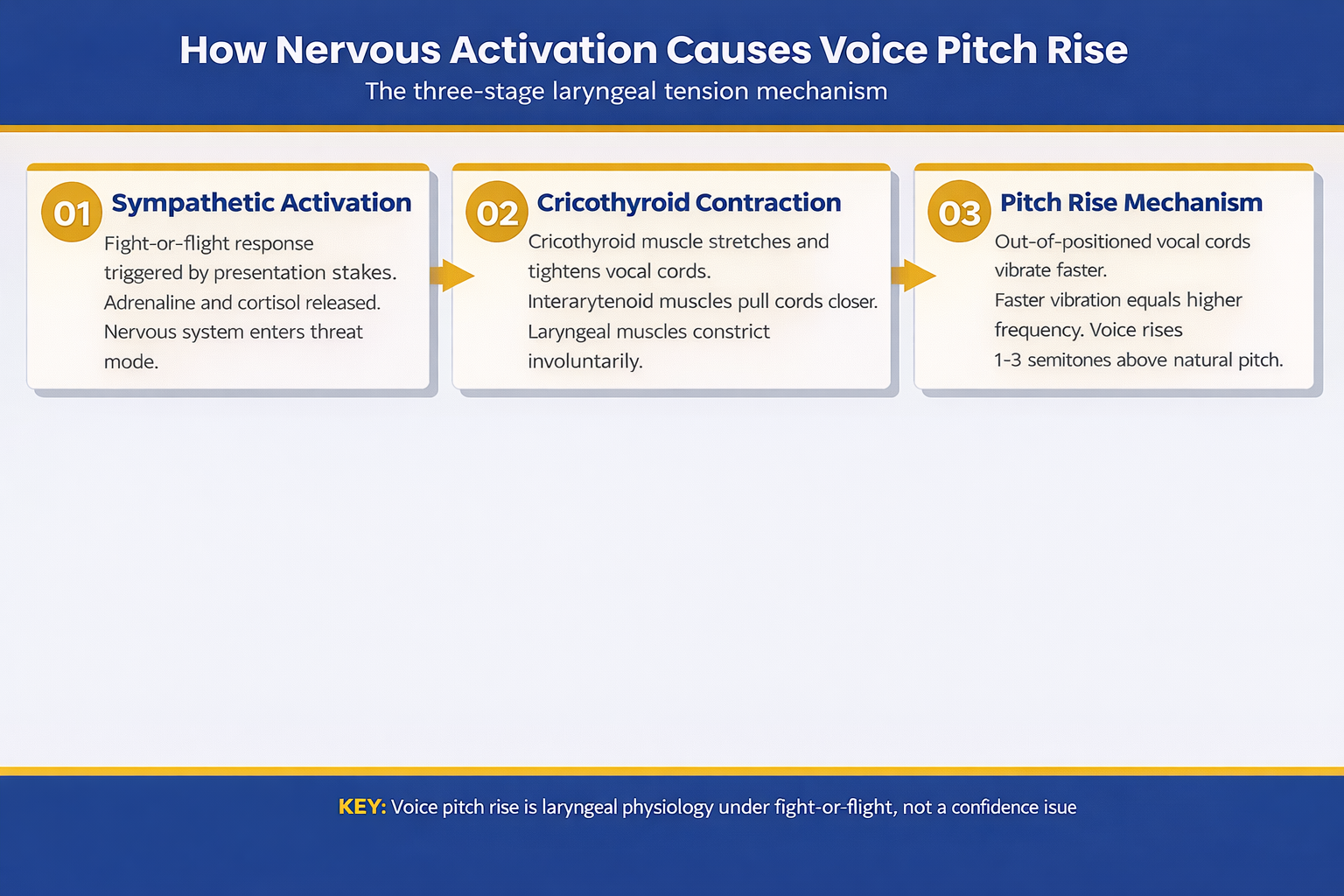
This is where pitch rise begins. The vocal cords are two tissue folds suspended horizontally across your larynx. When air from your lungs passes through them, they vibrate. The speed of vibration determines frequency: slower vibration = lower pitch, faster vibration = higher pitch. The tension in and around the vocal cords controls that speed.
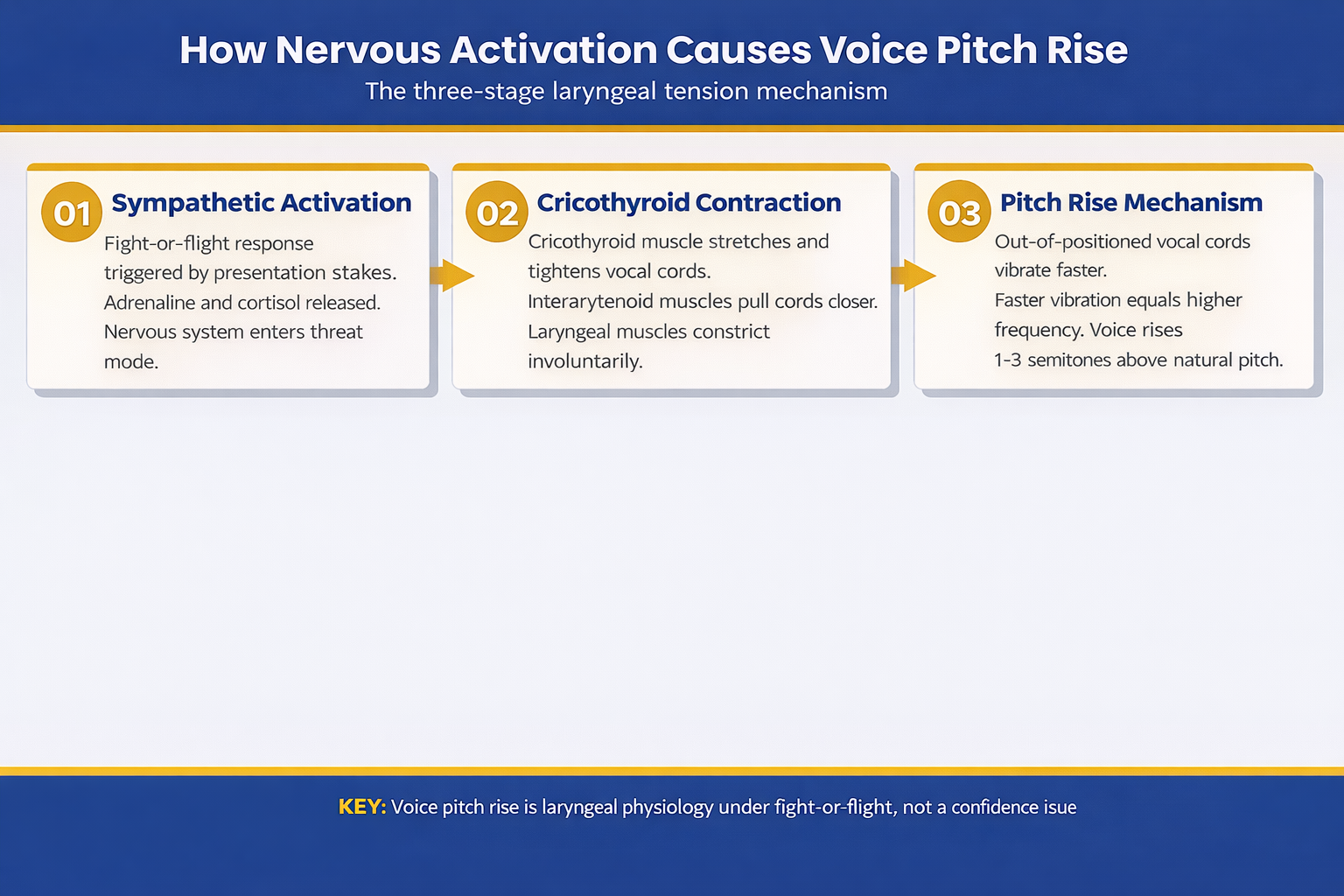
Under nervous activation, several things happen simultaneously. The cricothyroid muscle — the muscle that stretches and tenses the vocal cords — contracts. The interarytenoid muscles, which bring the cords closer together, also tense. The muscles of your neck and throat tighten. The result is that your vocal cords are pulled taut, positioned closer together, and vibrating faster under the same breath pressure. Faster vibration equals higher frequency. Higher frequency equals your voice going up by one, two, even three semitones.
This is not weakness. This is not lack of confidence. This is pure laryngeal mechanics under sympathetic nervous system activation.
Vocal Cord Tension Under Nervous Activation — The Mechanism
To understand the fix, you need to understand the precise sequence of what tightens and why. The nervous system has two branches: the parasympathetic (rest-and-digest) and the sympathetic (fight-or-flight). When you present, your sympathetic nervous system dominates. This triggers the release of adrenaline and cortisol, which signal your muscles to contract and prepare for threat response.
Your laryngeal muscles respond to this signal immediately. The cricothyroid muscle, which is innervated by the external branch of the superior laryngeal nerve, shortens and stretches your vocal cords. The lateral cricoarytenoid muscles adduct — bring together — your vocal cords. The thyroarytenoid muscles, which control the internal tension of the cords themselves, constrict. All of this happens without your conscious awareness or permission.
The result is that your vocal range compresses. The lower frequencies become unavailable. When you try to speak at your normal pitch, the tightened cords cannot drop that low. Your voice defaults to whatever pitch the tension allows — which is higher. You feel like you are forcing out sound. The audience hears a thin, tight, higher-pitched version of your voice.
Many people interpret this as a confidence issue or a sign they should not be presenting. Neither is true. What it actually signals is that your nervous system is activated — which is normal — and your laryngeal muscles have responded to that activation — which is also normal. The problem is not your voice or your ability. The problem is that nobody taught you how to reset the tension so you can speak from your natural pitch even when the nervous system is alert.
Drop Your Voice Pitch Back to Normal in 90 Seconds — Even When You’re Nervous
Voice pitch rise is a laryngeal tension problem, not a confidence problem. Calm Under Pressure (£19.99, instant access) provides a parasympathetic reset sequence that releases the cricothyroid and interarytenoid muscles in 90 seconds or less — executed right before you present or even in the moment if needed.
- The three-step laryngeal release sequence (breathing pattern + neck release + vocal warm-up) that resets pitch to your natural range
- The exact timing: when to execute this reset for maximum effect (spoiler: not five minutes before, not one hour before)
- The fail-safe reset you can do silently even if you’re already at the podium
- Real scenario: presenter goes from 145 Hz (pitch-shifted) back to 110 Hz (natural) in two minutes
Get Calm Under Pressure → £19.99
The in-the-moment physical symptom management system. Used by executives in banking, consulting, and corporate leadership for shaking, sweating, blushing, nausea, and voice issues.
The 90-Second Laryngeal Reset: The Fix That Works in the Moment
The key to releasing laryngeal tension is to activate your parasympathetic nervous system — the brake pedal to fight-or-flight. When parasympathetic tone increases, adrenaline and cortisol decrease, muscle tension releases, and your laryngeal muscles return to rest. This is not visualisation or positive self-talk. It is direct nervous system intervention.
The technique has three components. First is breathing. A specific pattern signals safety to your brainstem: a 4-count inhale through your nose, a 6-count exhale through your mouth. This longer-exhale ratio is the single most effective breathing pattern for downregulating the sympathetic nervous system. Do this for six breaths. Your shoulders will drop. Your chest will feel less tight.
The second component is a direct release of laryngeal tension. Place two fingers on the area directly under your chin, between the angle of your jaw. You are feeling the mylohyoid muscle. Press gently upward and toward the back of your neck, holding for three seconds. Release. Repeat four times. This specific pressure point releases reflex tension in the intrinsic laryngeal muscles. The pressure itself is neurologically connected to the cricothyroid and thyroarytenoid muscles through fascial and muscular chains. Many people feel their throat open immediately after this step.
The third component is a vocal warm-up that resets your pitch baseline. Hum three times, starting high and sliding down to your natural range. This is not singing. You are simply moving your vocal cords through their full range and allowing them to settle into their resting frequency. After the parasympathetic downregulation and the direct laryngeal release, your vocal cords will return to their natural tension state, and this hum will anchor that lower, natural pitch.
Execute all three steps once. The entire sequence takes 90 seconds. Many people report an immediate two-to-four semitone drop in their speaking pitch — enough to restore their voice to its natural range even though they are still nervous.
The mechanism is not magical. It is nervous system physiology. By downregulating the sympathetic response and releasing the reflex tension in your laryngeal muscles, you have restored the conditions under which your voice operates at its natural pitch. The nervousness remains — your heart rate is still elevated, your attention is heightened — but your voice is no longer a hostage to that nervousness.
This reset sequence is one of six in-the-moment physical symptom techniques covered in the Calm Under Pressure guide — £19.99, instant access, which handles shaking, sweating, blushing, nausea, racing heart, and voice pitch issues for presentations happening this week or this month.
Before You Present: The Foundation Reset
The 90-second reset works in the moment. But the larger framework is to build parasympathetic tone throughout the days before your presentation. A nervous system that is already downregulated — more parasympathetic baseline, less sympathetic reactivity — will show less laryngeal tension even in a high-stakes moment. This is cumulative.
In the week before your presentation, prioritise sleep. A nervous system that has not slept well is hypervigilant, triggers fight-or-flight more easily, and maintains higher baseline tension. Even one night of poor sleep — six hours or less — materially increases how tight your voice will sound. If you have a presentation on Friday, your sleep Tuesday through Thursday matters more than anything you do on presentation day morning.
The second priority is reducing decision fatigue and external stress. Your nervous system has a limited capacity for managing threats. If you are managing five other urgent issues that week, your sympathetic nervous system is already partially activated. When you walk into your presentation, it only takes a small additional stimulus to tip into full fight-or-flight response. Clear your calendar for the 72 hours before your presentation where possible. It sounds like a luxury. It is actually nervous system management.
The third priority is vocal warm-up. Not an hour before. Thirty minutes before. Do the hum sequence three times with longer duration — eight-second hums instead of three-second ones. This familiarises your vocal cords with their natural frequency and primes them to settle into that range when presentation nerves hit. Some people add gentle neck rolls and shoulder rolls. The point is proprioceptive awareness: you are signalling to your nervous system, “I notice my voice, my neck, my larynx,” which is protective. Dissociation — pretending the physical symptoms are not happening — amplifies the nervous system’s fear response. Directed attention to the actual physical mechanisms dampens it.
The fourth element is what you consume. Avoid caffeine for four hours before you present. Caffeine increases heart rate and nervous system arousal — exactly the state that tightens your larynx. Dehydration also increases laryngeal tension because your vocal cords require moisture to vibrate smoothly. Drink water consistently through the day you present. Not right before — that causes bloating and pressure in your chest. Consistent, moderate hydration throughout the morning.
How This Works Across Different Presentation Scenarios
The pitch-rise mechanism is the same across all presentation contexts, but the intensity varies. A formal board presentation typically generates higher sympathetic activation than an internal team meeting. A competitive pitch in front of unfamiliar stakeholders triggers more laryngeal tension than a presentation to your own department. The fix works across all of these, but your recovery window varies slightly.
In a high-stakes scenario — board meeting, investor pitch, customer presentation with decision-makers present — you can expect the sympathetic activation to be significant. Your laryngeal tension will be substantial. The 90-second reset will give you a meaningful drop in pitch, but you should plan for the reset to be executed 15–20 minutes before you speak, not five minutes before. This allows your nervous system to restabilise slightly after the reset. If you execute the reset too close to speaking, you may find your pitch starts to rise again during your introduction. Give yourself the buffer.
In a lower-stakes presentation — team update, internal training, a presentation to a friendly audience — the sympathetic activation is typically moderate. The pitch rise is less severe. The 90-second reset executed five minutes before you speak is usually sufficient.
If you are already speaking and discover mid-presentation that your voice pitch is higher than you want it to be, you can execute a silent version of the reset. The breathing pattern (4-count inhale, 6-count exhale) can be done while standing at the podium without the audience noticing. Pause between slides or during a moment when someone else is speaking, and execute six breaths. The pressure-point release under the chin is subtle enough to do without being visible if you are positioned behind a lectern. The hum is obviously not silent, but you can substitute a brief throat clear — the act of moving your vocal cords through that range has a similar resetting effect, even without the hum.
Stop Sounding Nervous Even Though You Are — The Laryngeal Reset That Actually Works
If your voice pitch rises when you present, you’ve probably tried relaxation, positive self-talk, and “just breathing.” Those address the general anxiety state. This addresses the specific laryngeal mechanism — the three-muscle sequence that forces your voice higher under nervous activation. This is the tactical fix for presentations happening within weeks or days.
- The neurological reason why standard relaxation advice fails for voice pitch (hint: you are trying to calm your amygdala when you actually need to release laryngeal muscle tension)
- The exact three-step reset: breathing pattern, pressure-point release, vocal reset — no equipment, no setup, executable anywhere
- The timing formula: when to execute this reset based on your presentation type and stakes level
- The silent version: how to execute the reset while you’re already presenting if needed
In-the-moment physical symptom management for presentations. Six techniques for shaking, sweating, blushing, nausea, racing heart, and voice control.
Your Voice Reveals What Your Words Won’t — Unless You Know This
Calm Under Pressure gives you a neuroscience-based system for managing physical stress responses, including vocal pitch control, breathing regulation, and in-the-moment recovery techniques — £19.99, instant access.
Designed for executives who want to stop dreading presentations
Common Questions About Voice Pitch and Presentation Nerves
Is voice pitch rise a sign that I’m not confident enough to be presenting?
No. Voice pitch rise is a laryngeal tension response to sympathetic nervous system activation. Even the most experienced executives — CEOs, board members, politicians — experience vocal cord tension under high-stakes presentation conditions. The difference is that some have learned to manage the laryngeal mechanism, while others haven’t. Confidence and vocal control are separate skill sets. You can be genuinely confident in your content and still experience voice pitch rise because your nervous system is doing exactly what it’s supposed to do: responding to threat perception with fight-or-flight activation. The fix is not confidence building. It’s laryngeal release.
Why doesn’t breathing alone fix the voice pitch problem?
Breathing addresses overall nervous system state, which is valuable. But voice pitch rise is a local laryngeal tension problem. Your cricothyroid and interarytenoid muscles are contracting under nervous system signal, pulling your vocal cords taut and forcing them to vibrate faster. Deep breathing will downregulate your sympathetic nervous system and reduce the intensity of that contraction, but it doesn’t directly release the reflex tension in those specific muscles. You need the combination: breathing (parasympathetic downregulation) plus direct laryngeal release (pressure-point reset) plus vocal calibration (hum to reset pitch baseline). That combination addresses the mechanism directly.
Can I use this technique if I have a voice condition like vocal strain or hoarseness?
If you have chronic vocal issues, this technique may still help with the tension component, but you should check with a speech-language pathologist before using a new vocal approach. The laryngeal release is safe and used in clinical speech therapy, but a baseline assessment from a professional ensures you’re not masking an underlying condition that needs different treatment. The Calm Under Pressure guide includes a note about this as well.
Voice Pitch Rise Versus Other Voice Symptoms
Presentation nerves affect your voice in several different ways, and it’s important to understand which symptom you’re actually experiencing because the fixes differ. Voice pitch rise — your voice going higher than normal — is distinct from voice shaking (tremor), voice cracking (pitch breaks), or voice hoarseness (quality degradation). Each has a different mechanism and requires a different technique.
Voice pitch rise is caused by laryngeal muscle tension that increases cord vibration frequency. Voice shaking is caused by oscillation in the muscles controlling your airflow — you sound wobbly or tremulous. Voice cracking is caused by your vocal folds suddenly separating during speech, often as your pitch is changing. Voice hoarseness is caused by swelling or inflammation of the vocal cords themselves, often from tension held over hours or days.
If you experience voice pitch rise but not tremor, your primary intervention is the laryngeal reset. If you experience tremor alongside pitch rise, you are probably dealing with whole-body nervous system activation that requires breath and postural work as well as laryngeal release. If you experience cracking and pitch breaks, the issue is often vocal fatigue or inadequate warm-up in addition to nervousness. If you experience hoarseness after presenting, the issue is likely sustained tension and inadequate hydration.
Many people experience more than one of these simultaneously. The Calm Under Pressure guide addresses all six physical symptoms (shaking, sweating, blushing, nausea, racing heart, and voice control) with integrated techniques that work together.
Is This Right for You?
✅ This is for you if:
- Your voice pitch noticeably rises when you’re nervous or presenting, and you want to control it in the moment
- You’ve tried relaxation techniques and they haven’t solved the pitch-rise problem specifically
- You have a presentation coming up in the next 4–8 weeks and you need a quick, practical fix rather than a long-term anxiety programme
- You want to understand the physiology so you can trust the technique and use it with confidence
❌ This is NOT for you if:
- Your primary issue is chronic presentation anxiety or fear of presenting (you’d benefit more from Conquer Speaking Fear, the 30-day programme)
- Your voice pitch rise is caused by a medical condition rather than nervousness (check with your doctor first)
- You’re looking for public speaking coaching or slide design advice (this is specifically a physical symptom management technique)
What Happens After You Master the Reset
Once you have the laryngeal reset technique working, you can use it for any high-stakes presentation scenario. The mechanism remains the same — parasympathetic downregulation plus direct laryngeal release plus vocal calibration — regardless of the context. A board presentation. A competitive pitch. A presentation to a new client. A sales demo. A performance review presentation. Anywhere you would normally experience voice pitch rise, this reset prevents it.
Over time, as you use the reset technique repeatedly, you build a kind of nervous system adaptation. The reset becomes faster. Your body begins to anticipate the sequence and respond more readily. Some people report that after using the technique for three or four presentations, the pitch rise becomes less severe in the first place. This is because your nervous system begins to associate presentation contexts with the reset sequence — and because you’re proving to yourself repeatedly that the symptom is manageable. Perceived control reduces actual nervous system reactivity.
The second benefit is confidence in your voice. Many people who experience voice pitch rise develop voice self-consciousness — they monitor their voice constantly during presentations, which makes the anxiety worse. Once you have a reliable reset technique, you stop monitoring. You know that if pitch rise shows up, you can handle it. That internal permission removes a layer of performance anxiety that was never about your actual ability to present.
📊 Want the slides too?
Frequently Asked Questions
How quickly does the laryngeal reset work? Can I use it minutes before I speak?
The reset works in 90 seconds, and you can execute it as close to your presentation as you need. However, the timing matters slightly based on presentation intensity. For high-stakes scenarios (board meetings, investor pitches, competitive reviews), execute the reset 15–20 minutes before you speak. This allows your nervous system a brief stabilisation window. For lower-stakes presentations, five to ten minutes is fine. If you’re already presenting and need to use the reset, execute the breathing pattern first — that provides immediate parasympathetic signal — then the pressure-point release, then the vocal hum or throat clear. The whole sequence still works even if you’re mid-presentation, though the pitch-reset effect may be slightly less dramatic.
Is the laryngeal reset technique safe to use repeatedly before multiple presentations?
Yes. The technique uses only parasympathetic downregulation, gentle physical pressure, and normal vocal warm-up — all safe and commonly used in clinical speech therapy. You can use it before every presentation without concern. In fact, the more you use it, the more your nervous system learns to respond to it. Some people report that after using the reset for three or four presentations, the pitch rise becomes less severe in the first place because your body begins to anticipate and prepare for the reset.
What if I have a chronic voice condition or have been told my voice is naturally high-pitched?
The reset technique addresses tension-induced pitch rise specifically — the rise caused by laryngeal muscle contraction under nervous activation. If your natural speaking pitch is simply higher, this technique will not lower your baseline pitch permanently. However, it can still help you access the lower end of your natural range and prevent additional pitch rise from nervousness on top of your baseline. If you have a diagnosed vocal condition, check with a speech-language pathologist before using new vocal techniques. The laryngeal release is used clinically and is safe, but professional guidance ensures you’re not masking an underlying issue.
Can I combine this technique with other anxiety management approaches like meditation or medication?
Absolutely. The laryngeal reset is a physical, local technique that works on the laryngeal muscles directly. It complements, not replaces, broader anxiety management. If you’re using breathing meditation, therapy, or medication for presentation anxiety, this technique sits alongside those approaches. You would use the broader anxiety tools for general nervous system management (meditation helps with overall calm, therapy addresses underlying anxiety patterns, medication regulates neurotransmitters), and you would use the laryngeal reset for the specific symptom of voice pitch rise. They work together.
The Winning Edge — Executive Presentation Insights
Weekly strategies for executives who present at board level, in competitive reviews, and in high-stakes leadership meetings. No filler. No theory. Practical frameworks from 25 years in the room.
Also published today:
- Track A: The Pre-Decision Conversation: How to Secure Executive Approval Before the Formal Meeting — If you’re managing the political side of a high-stakes presentation, this is the structure.
- Track C: Risk Committee Q&A: The Blind Spots You Need to Prepare For — Essential if your presentation involves risk, compliance, or executive challenge.
For further reading on presentation physical symptoms, see Voice Cracking During Presentations: Why It Happens and the Fix, Voice Shaking When Speaking: The Nervous System Mechanism and the Recovery Technique, and High-Stakes Presentation Nerves: Managing Physical Symptoms in Board-Level Moments.
Your voice pitch rises when you present because your laryngeal muscles tense under fight-or-flight activation. That is physiology, not a lack of capability. The fix is a 90-second reset that releases that tension and restores your voice to its natural pitch, even while you remain nervous. Master the laryngeal reset sequence in the Calm Under Pressure guide — £19.99, instant access before your next presentation.
Not ready for the full system? Start here: download the free 7 Presentation Frameworks — practical structures you can apply to your next presentation immediately.
About the Author
Mary Beth Hazeldine is the Owner & Managing Director of Winning Presentations. A qualified clinical hypnotherapist and NLP practitioner with 25 years of corporate banking experience at JPMorgan Chase, PwC, Royal Bank of Scotland, and Commerzbank, she combines executive communication expertise with evidence-based techniques for managing presentation anxiety and physical symptoms.
She has supported executives and their presentations for high-stakes funding rounds, board approvals, and competitive pitches across three continents. Her work in presentation anxiety management draws directly from her personal experience: she overcame five years of severe presentation terror using the techniques she now teaches.


