Tag: budget presentation

18 Apr 2026

Management Accounts Presentation: When the Numbers Demand an Explanation

Quick Answer: A management accounts presentation fails when it reports numbers without explaining them. The board already has the figures — what they need from you is the narrative: what changed, why it changed, and what management is doing in response. The most effective management accounts presentations are built around a four-part structure for each key metric: expectation, outcome, cause, response. That structure turns a reporting exercise into a decision-making conversation.

Astrid had been Head of Finance at the logistics company for four years. She was methodical, precise, and trusted by the board. But the month the EBITDA came in 23% below budget, she sat in front of her spreadsheet for three hours wondering how to build a management accounts presentation that would not lose her credibility before she finished the first slide.

The temptation was to bury the number — to lead with revenue (which was only 8% down), build the case for external factors, and let EBITDA appear deep enough in the deck that the meeting had momentum before the board saw it. She resisted that instinct. Instead, she put the key variance on the second slide, led with the most honest explanation she had, and structured the rest of the presentation around what management was doing to recover the position.

The board did not respond well to the EBITDA figure. But they responded well to her. The Chair said afterwards that the most confidence-inspiring thing a finance director can do is present bad news clearly, early, and with a plan. Boards are experienced enough to know that businesses have difficult months. What they are actually assessing is whether management understands its own numbers and is in command of its own response.

That distinction — between what the numbers say and whether management understands them — is what the management accounts presentation is really designed to communicate.

If you present financial results to a board or senior committee

The Executive Slide System includes slide templates and framework guides designed for finance and board reporting presentations — including the narrative structure that turns monthly accounts from a reporting exercise into a conversation that drives decisions.

Explore the System →

Why Management Accounts Presentations Go Wrong Before a Slide Is Built

The most common failure in management accounts presentations is not a presentation problem. It is a framing problem — and it happens before anyone opens PowerPoint.

When finance teams approach the monthly pack as a reporting exercise, the output is a presentation that describes what happened. When they approach it as a communication exercise, the output is a presentation that explains what happened and what it means for decisions being made right now. These are structurally different outputs, and boards experience them as such. One feels like a status update. The other feels like the briefing they needed to walk in and make a call.

The second common failure is building the presentation around the structure of the accounts rather than the structure of the conversation the board needs to have. Management accounts are organised by accounting categories: P&L, balance sheet, cash flow, departmental cost centres. Boards are not organised by accounting categories — they are organised by decisions, priorities, and concerns. Presenting in accounting order forces the board to do the interpretive work of connecting figures to implications. Presenting in decision order means the slides do that work for them.

A third failure is proportionality. Finance teams with 40 slides of management accounts are not communicating more effectively than those with 12. They are signalling that they have not prioritised — that every number is equally important, which means none of them are. The board will come to its own conclusions about which three figures matter most, and those conclusions may not align with yours. The management accounts presentation is your opportunity to make that prioritisation explicit. The principles behind this are covered in depth in the data presentations for executives framework — the same logic applies here.

Executive Slide System

Build Financial Presentations That Drive Decisions, Not Just Discussion

The Executive Slide System — £39, instant access — includes slide templates for finance and board reporting presentations, AI prompt cards for structuring your financial narrative, and framework guides for presenting variance analysis and results with clarity. Designed for finance directors and senior executives who present management accounts to boards and senior committees.

  • Slide templates for management accounts, board updates, and financial review presentations
  • AI prompt cards to build your narrative around key variances and performance drivers
  • Framework guides for structuring financial results as a decision-making conversation
  • Scenario playbooks for presenting unfavourable results and recovery plans to senior audiences

Get the Executive Slide System →

Designed for executives presenting financial results in high-stakes board environments.
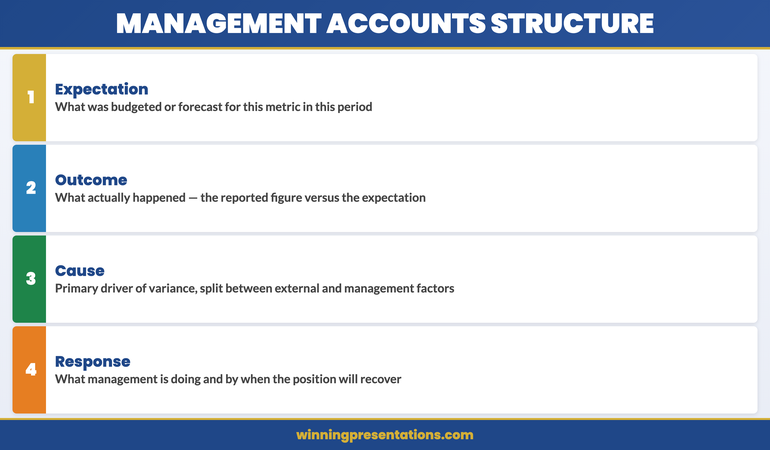

Management Accounts Presentation Structure infographic showing four components for each key metric: Expectation — what was budgeted or forecast; Outcome — what actually happened; Cause — the primary driver of the variance; Response — what management is doing as a result

The Narrative Architecture for Financial Results

Every management accounts presentation needs a narrative architecture — a conscious decision about what story you are telling with the numbers, before you decide which numbers to show.

The most reliable structure for financial results uses a four-part sequence for each key metric: expectation, outcome, cause, response. Expectation: what was the budget or forecast? Outcome: what actually happened? Cause: what was the primary driver of the difference? Response: what is management doing about it, and on what timeline? Applied consistently across your three or four priority metrics, this structure gives the board everything it needs to form a view and ask the right questions — without requiring them to read across multiple slides to piece together a picture you could have given them in one.

One structural decision that significantly improves management accounts presentations is the choice to lead with the conclusion rather than build to it. Most finance presentations work chronologically or logically: here are the inputs, here is the process, here is the output. Boards find this frustrating because they want to know the headline before they invest attention in the detail. Leading with the conclusion — “EBITDA is 23% below budget, driven primarily by two factors, and here is our recovery plan” — orients the board before you present the evidence. It does not reduce the rigour of the presentation; it increases the board’s ability to engage with it productively.

Cross-referencing your management accounts narrative against the quarterly forecast gives the board an additional layer of context — whether the monthly variance is part of a pattern or an isolated month. The quarterly forecast presentation framework covers how to integrate this context without doubling the length of your pack.

Variance Analysis: How to Present the Gap Without Sounding Defensive

Variance analysis is where most management accounts presentations either gain or lose the board’s confidence. The numbers themselves rarely cause the problem. The way they are explained does.

The defensive presentation of variance explains the gap in terms of factors outside management’s control. Fuel costs increased. Currency moved against us. The market contracted. These may all be true — but presenting them without equal weight on what management controlled creates the impression that the team sees itself as a passive responder to external conditions. Boards lose confidence in finance leaders who consistently attribute outcomes to factors they could not influence.

The credible presentation of variance separates causes into two categories: external factors (outside management’s control) and management decisions (inside management’s control). For each, it gives the honest weighting. If 60% of the EBITDA shortfall came from a supplier cost increase and 40% from a decision to prioritise volume over margin in Q3, both get stated clearly. The 40% that management controlled is where the board will focus — and presenting it voluntarily, with context, is far stronger than having the board extract it through questions.

The response section of the variance narrative is where credibility is built or destroyed. A vague response (“we are reviewing our cost structure”) signals that management does not yet have a clear plan. A specific response (“we have identified three cost reduction levers that will recover 60% of the shortfall by month eight, and we are tracking them against weekly milestones”) signals that management is in command of its own situation. Specificity — even when the situation is difficult — is more confidence-inspiring than optimism. For more on how variance analysis integrates into board financial reporting, the budget variance presentation framework is a useful companion resource.

For finance directors and heads of strategy who present management accounts to boards and senior committees, the Executive Slide System includes slide templates and AI prompt cards designed specifically for financial results and board reporting presentations.
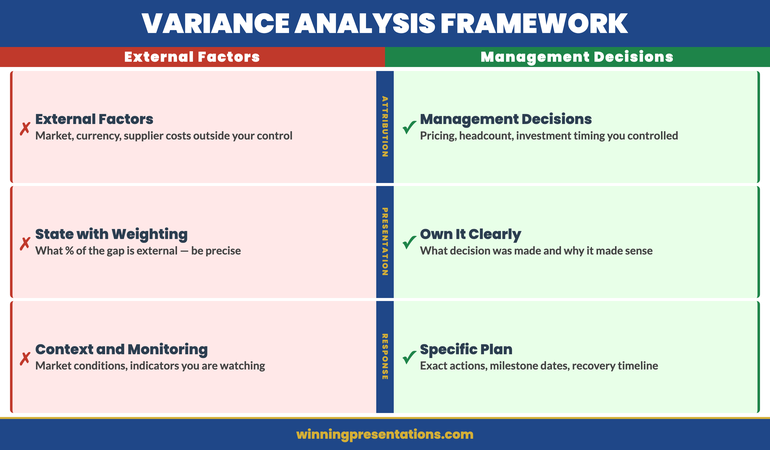

Variance Analysis Framework infographic showing two columns: External Factors (outside management control — presented with honest weighting) vs Management Decisions (inside management control — presented with specific recovery plan and timeline)

The One Slide Your Board Reads First

Every management accounts pack has one slide that the board will turn to before the presentation formally begins. In most cases, it is the summary P&L or the KPI dashboard on the first or second page of the pack. Boards have learned to navigate to this slide first because it gives them the headline picture before they invest attention in anything else.

Because this slide receives disproportionate attention, it deserves disproportionate care. The summary slide — whether it is a P&L summary, a KPI dashboard, or an executive briefing note at the front of the pack — should give the board the three things they most need to know: the headline financial position against budget or prior year, the one or two primary drivers of any significant variance, and the management response or action being taken. One slide. Three pieces of information. Nothing that requires them to cross-reference page 14 to understand what they are looking at.

The formatting of this slide matters more than any other in the pack. Red/amber/green traffic light indicators work well for KPIs where the direction of movement is self-evident — but they lose their value if overused. If everything is amber, nothing is. Reserve the RAG system for your five or six most critical metrics, and let the narrative explain everything else. A board that has to decode a slide before it can read it is a board whose attention you have already lost.

When the Numbers Tell a Story the Business Doesn’t Like

There is a version of management accounts preparation that every finance director and CFO knows well: you have the figures, they are worse than expected, and you have to build a presentation that explains them to people who will be concerned, possibly critical, and are relying on you to give them an honest picture.

The principle that holds in this situation is simpler than most executives expect. Boards deal with bad news regularly. What they cannot deal with is bad news that arrives late, that arrives without explanation, or that arrives with an explanation that subsequently turns out to be incomplete. The finance director who tells the board the full picture clearly and early — and who has a credible plan — is in a far stronger position than the one who presents an optimistic version that requires three subsequent months of “further explanation.”

When presenting unfavourable management accounts, lead with the headline. Do not bury it. State what has happened, why it has happened (with honest weighting between external and management factors), and what management is doing about it. The board will have questions — that is appropriate. Your job is to ensure that your answers to those questions do not produce a worse impression than the numbers themselves. Preparation here is everything: anticipate the three or four questions the board is most likely to ask, have precise answers ready, and resist the temptation to speculate on outcomes you cannot yet project with confidence.

One phrase that finance directors find useful when presenting difficult results: “Here is what we know, here is what we do not yet know, and here is what we are doing to find out.” It is honest, it is structured, and it signals a management team that is running towards a problem rather than away from it. The same principle — leading with clarity rather than protection — applies in investor and shareholder contexts; the AGM presentation framework for handling shareholder questions applies the identical logic to the public scrutiny that listed company finance directors face.

Making Management Accounts a Decision Tool, Not a Report

The highest-value management accounts presentations do something most finance presentations do not: they end with a clear indication of what the board needs to decide or approve as a result of what has been presented.

Most management accounts presentations are constructed as information deliveries — here are the facts, over to you. The board then has to do the interpretive work of converting information into decision points. Some boards are good at this. Many are not, or take significantly longer than necessary because the finance team has not made the decision implications explicit.

A simple addition to the closing section of any management accounts presentation is a “decisions required” or “board input needed” slide that states clearly: given what we have just presented, here are the two or three things we need from you before the next management accounts meeting. These might be approval for additional budget, endorsement of a cost recovery plan, or a steer on strategic priorities in light of a changed financial position. The specificity of this slide tells the board exactly what you need them to do — and gives the finance team a clear mandate to act on after the meeting.

This approach transforms management accounts from a reporting exercise into a governance mechanism. The board is not just receiving information — it is actively participating in the response to that information. Finance directors who build this habit find that their board relationships improve significantly, because the board begins to see the management accounts meeting as a forum where real decisions get made, not just a status update that could have been an email.

Executive Slide System

The Slide Architecture for Finance Leaders Who Present to Boards

The Executive Slide System — £39, instant access — includes slide templates for management accounts and board financial reporting, AI prompt cards for building variance narratives, and framework guides for structuring results presentations that drive decisions rather than just discussion.

Get the Executive Slide System →

Designed for finance directors and senior executives presenting results to boards and senior committees.

Frequently Asked Questions

How should management accounts be presented to a board?

Management accounts should be presented to a board in decision order, not accounting order. Rather than working through the P&L line by line, identify the three or four metrics that most directly affect the decisions the board will make in the next quarter — and build your narrative around those. For each key metric, use the expectation-outcome-cause-response structure: what was forecast, what happened, why, and what management is doing about it. Lead with the headline rather than building to it, and close with a clear statement of what you need from the board. The pack itself should be concise — a well-constructed 12-slide management accounts presentation is more effective than a 40-slide one that forces the board to do the interpretive work.

What do you do when management accounts are significantly below budget?

When management accounts are significantly below budget, the presentation approach matters as much as the content. Lead with the headline variance early — do not bury it in the middle of the pack. Present the causes with honest weighting: separate the factors outside management’s control from the decisions management made that contributed to the shortfall. The board will focus on the controllable element, so present that part with a specific recovery plan and timeline rather than a vague commitment to “review the situation.” The finance director who presents difficult numbers clearly, early, and with a credible plan is in a far stronger position than one who presents optimistically and has to revise downwards again next month.

How many slides should a management accounts presentation have?

For a typical board management accounts presentation, 10 to 15 slides is generally appropriate. This allows for an executive summary slide, three to five slides covering key financial metrics with variance analysis, one to two slides on operational performance, a slide on cash and balance sheet position if relevant, a forward-looking section covering the updated forecast or outlook, and a decisions-required slide at the end. Anything significantly beyond 15 slides tends to dilute rather than enhance the board’s understanding — it signals that the finance team has not done the prioritisation work that the board is relying on them to do.

The Winning Edge

Weekly insights on executive presentations, delivered every Thursday. Practical frameworks, real scenarios, and honest analysis of what actually works in senior boardrooms.

Subscribe to The Winning Edge →

Free resource: Download the Executive Presentation Checklist — a one-page pre-presentation review for board and senior committee presentations.

About the Author

Mary Beth Hazeldine — Owner & Managing Director, Winning Presentations

With 25 years of corporate banking experience at JPMorgan Chase, PwC, Royal Bank of Scotland, and Commerzbank, Mary Beth Hazeldine advises executives across financial services, healthcare, technology, and government on structuring presentations for high-stakes funding rounds and approvals. She works directly with senior leaders to build the presentation architecture that gets decisions made. Learn more at Winning Presentations.

17 Apr 2026
A finance director presenting a revised budget proposal to a sceptical finance committee in a corporate boardroom, navy and dark tones, editorial photography style

Budget Resubmission Presentation: What Finance Committees Need to See

Quick Answer: A budget resubmission fails when you present the same deck again. Finance committees rejected your original request for specific reasons — usually around ROI evidence, timing, or lack of alternatives analysis. A successful resubmission acknowledges the rejection, isolates the exact objections raised, addresses each one with new evidence, and presents the project as stronger, not unchanged. The slides are secondary to the diagnostic work that happens before you open PowerPoint.

Henrik had prepared for six weeks. The CapEx request was airtight — or so he thought. When the finance committee rejected his £2.3 million infrastructure upgrade, the feedback was three lines: “ROI timeline unclear. Alternatives not sufficiently explored. Timing not aligned with current priorities.”

He was deflated. His instinct was to go back in three months with the same deck, slightly updated. His CFO stopped him. “They didn’t reject the project,” she said. “They rejected the presentation of it. That’s a different problem.”

That distinction changed everything. Henrik spent two weeks doing the diagnostic work the first submission skipped — mapping the committee’s actual concerns, building a phased ROI model, and including a genuine alternatives analysis. Six weeks later, the resubmission was approved. Not because the project had changed. Because the presentation finally spoke to what the committee needed to hear.

If your budget request has already been rejected

The Executive Slide System includes slide templates designed specifically for finance and approval presentations — including resubmission scenarios where you need to address prior objections and rebuild credibility with the same committee.

Explore the System →

Why Most Budget Resubmissions Fail

The most common mistake in a budget resubmission is treating it as a resubmission. Executives go back with the same slides, the same narrative, and perhaps some updated figures — and are surprised when the committee says no again.

Finance committees have a specific memory of your previous presentation. They remember why they said no. When you return with something that looks largely unchanged, you signal either that you didn’t understand their objections, or that you understood them but couldn’t address them. Neither reading helps your case.

The second common mistake is addressing the wrong objections. Committees rarely tell you their real concerns in the formal feedback. “ROI timeline unclear” might actually mean “we don’t trust the assumptions in your model.” “Timing not aligned with current priorities” might mean “one board member has a competing project and has already lobbied against yours.” Understanding the surface objection and the underlying concern are different tasks.

A budget resubmission is not a second bite of the same apple. It is a new presentation built from a post-mortem of the first one. The executive who approaches it this way consistently outperforms the one who simply tries harder with the same material.

Executive Slide System

Structure the Resubmission So Finance Committees Say Yes

The Executive Slide System — £39, instant access — includes slide templates for finance and approval scenarios, AI prompt cards to rebuild your ROI narrative, and a scenario playbook for executives presenting to hostile or sceptical decision-makers. Designed for budget presentations where the first submission didn’t land and you need a structurally stronger case the second time.

  • Slide templates for CapEx, opex, and budget approval presentations
  • AI prompt cards to pressure-test your financial assumptions before the meeting
  • Framework guides for structuring an objection-response narrative
  • Scenario playbooks for finance committee, board, and investment committee presentations

Get the Executive Slide System →

Designed for executives facing second-attempt approval presentations.


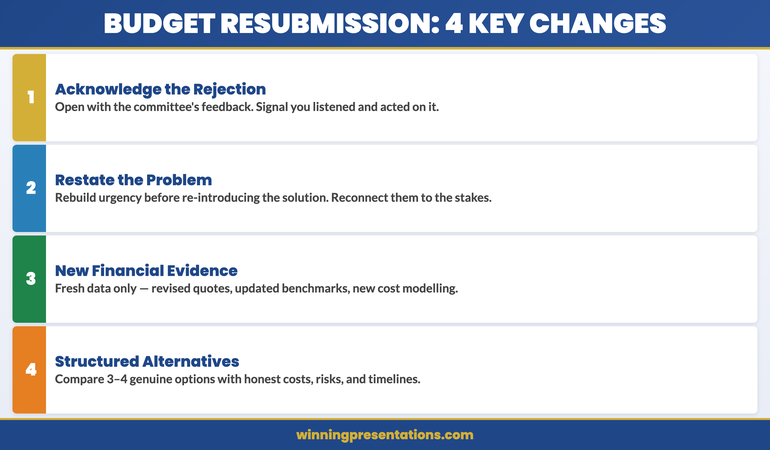
The Four Changes for a Successful Budget Resubmission infographic showing: Diagnose the Real Objection, Address with New Evidence, Reframe the Narrative, and Present the Alternatives

Diagnosing What the Committee Actually Objected To

Before you change a single slide, you need to understand what the committee actually objected to. This requires going beyond the formal written feedback, which is almost always a sanitised version of the real conversation.

Request a debrief with the chair of the finance committee or the most senior sponsor in the room. Frame it as seeking guidance: “I want to ensure I’m addressing the committee’s concerns properly before resubmitting. Would you be willing to give me fifteen minutes to understand what would strengthen the case?” Most chairs will say yes — they want well-constructed proposals coming back, not the same weak ones.

In that conversation, listen for three things. First, which objections were raised by whom — understanding the political landscape inside the committee matters. Second, what the committee would need to see to be confident in the ROI assumptions — this tells you what new evidence to gather. Third, whether the timing objection is real or a proxy for something else. If one committee member is pushing a competing capital project, timing becomes a way to delay your proposal rather than reject it outright.

Once you have this diagnostic information, map each concern to a specific change you will make in the deck. If you cannot identify what change addresses each concern, the resubmission is not ready yet. The internal link between concern and response is what makes the resubmission feel genuinely responsive rather than cosmetically updated. See how this approach connects to the pre-meeting work described in The Follow-Up Deck: Why Most Approvals Die After the Meeting.

The Four Changes That Earn a Second Look

Not every resubmission needs a complete rebuild. Most need four targeted changes, each one designed to address a specific category of concern that finance committees raise when they reject a budget request.

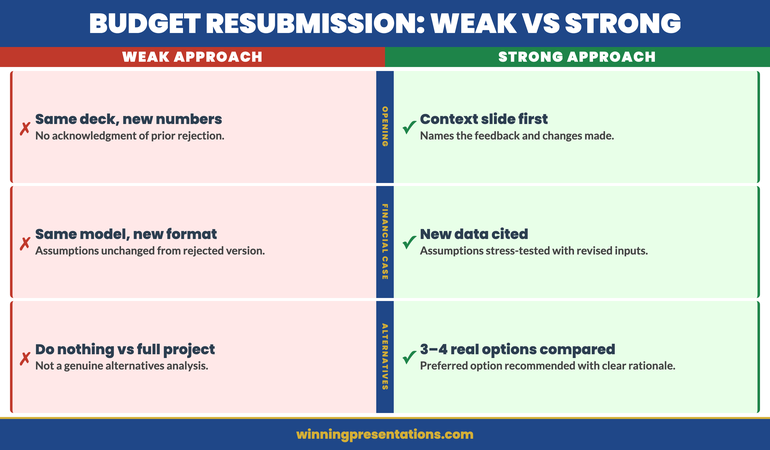
1. Acknowledge the rejection explicitly. Open the resubmission by referencing the previous presentation and what you heard from the committee. “Following the committee’s feedback in February, this revised proposal addresses three specific areas: the ROI timeline, alternatives analysis, and alignment with the current capital priorities.” This signals that you listened, that you did the work, and that this is a genuinely improved version — not the same material with fresh slides.

2. Restate the problem, not the solution. Many rejected budget requests spend the first ten slides describing the solution — the system, the infrastructure, the initiative — before establishing why the problem matters. Committees who weren’t sold the first time need to be reconnected to the urgency of the problem before they can evaluate the solution on its merits. Rebuild the problem slide before you rebuild anything else.

3. Introduce genuinely new financial evidence. If the ROI model was questioned, you need new inputs — not the same model with different formatting. Commission updated cost modelling, gather vendor quotes that support the assumptions, or bring in market benchmarks from a credible external source. The committee will recognise recycled figures dressed in new slides. New evidence signals that the financial case has been properly stress-tested.

4. Include a structured alternatives analysis. “We considered doing nothing, and also doing the project at half-scale” is not an alternatives analysis. A structured alternatives analysis presents three to four genuine options — including the do-nothing scenario — with honest comparative costs, risks, and timelines for each. This demonstrates that your preferred option is the recommended outcome of a rigorous process, not simply the option the team preferred from the start.

For a deeper look at how CapEx presentations are structured from the outset, see Capital Expenditure Presentation: The Slide Structure That Gets CapEx Approved.

If you need to rebuild the financial narrative quickly and ensure the slide structure meets finance committee expectations, the Executive Slide System includes prompt cards specifically designed for restructuring a presentation that didn’t land the first time.


Weak vs Strong Budget Resubmission comparison infographic showing the difference between cosmetic updates and diagnostic restructuring across four dimensions: problem framing, ROI evidence, alternatives analysis, and objection response

Building Your Resubmission Case

A resubmission is not built in PowerPoint. It is built in the weeks of work that happen before you open a presentation tool. The slides are the output of a process — not the process itself.

Start by updating your stakeholder map. Between your first presentation and the resubmission, the political landscape inside the committee may have changed. New members may have joined. The CFO’s priorities may have shifted. A competing project may have been approved or rejected, which changes the available capital headroom. Your pre-meeting conversations should give you an updated picture of where support and opposition sit before you step into the room.

Next, rebuild the financial model with new inputs. If the committee questioned your assumptions, the only credible response is new data. If they challenged your implementation timeline, bring in updated project management assessments. If they were concerned about total cost of ownership, include a five-year cost comparison that previous models omitted. Every financial assumption that was challenged needs a corresponding piece of new evidence that wasn’t in the original submission.

Then update your risk section. Most first submissions understate implementation risk because project teams are optimistic about their own proposals. A resubmission that honestly names the risks — and then explains how each one is mitigated — signals intellectual rigour. Finance committees are more comfortable approving projects where the risk has been honestly assessed than projects where it appears to have been glossed over.

Finally, update your internal cross-references. If the resubmission references savings from a related initiative, or assumes integration with an existing system, those dependencies need to be named and confirmed in writing before the presentation. Assumptions that couldn’t be confirmed in the first submission should be confirmed before the second.

Structuring the Resubmission Deck

The structure of a resubmission deck differs from a first-pass budget request in one important way: the opening acknowledges the history. Committees who have already seen your proposal need to see that history acknowledged before they can engage with the updated case. A deck that opens as though the rejection never happened reads as either oblivious or evasive.

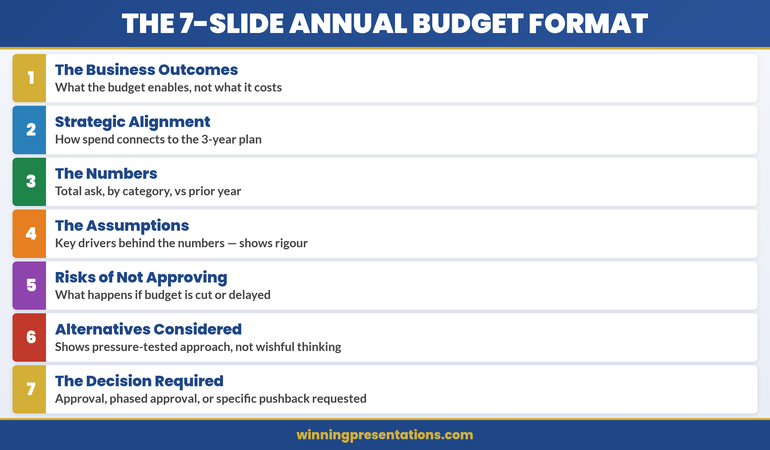
A resubmission deck structured for finance committees typically follows this sequence:

Slide 1 — Context slide: One line on when the original proposal was submitted and a single sentence on what feedback was received. This is not a defensive slide — it is a signalling slide. It says “I heard you, and this version responds to what I heard.”

Slides 2–3 — The problem: Rebuild the urgency of the business problem. Not the solution — the problem. What happens if this doesn’t get funded? What is the cost of delay, in concrete terms? If the committee didn’t feel the urgency the first time, this is where you earn it back.

Slides 4–5 — The updated ROI case: Present the revised financial model with its new inputs highlighted. Don’t bury the changes — surface them. “Since February, we have obtained revised vendor quotes and updated the model based on current market rates. The revised payback period is 3.2 years, compared to 4.1 years in the original submission.” Specificity here signals that the changes are real, not cosmetic.

Slide 6 — Alternatives analysis: Three or four genuine options, compared on cost, risk, and timeline. Recommend your preferred option at the end, with a brief rationale. Keep this slide to a grid — not paragraphs.

Slides 7–8 — Risk and mitigation: Name the top three implementation risks and the corresponding mitigation for each. If a risk was specifically raised by a committee member in the previous session, address it by name in this section.

Slide 9 — Implementation roadmap: Phased milestones, owners, and decision points. If the original timeline was challenged, show how the revised timeline is structured and what would trigger a go/no-go decision at each phase.

Slide 10 — The ask: One slide. The specific amount, the timing, and one sentence on what approval unlocks. For guidance on how this sequence connects to zero-based budget frameworks, see Zero-Based Budget Presentation: Justify Every Line to Finance.

Presenting the Resubmission Without Appearing Defensive

The tone of a resubmission matters as much as the content. Executives who come back into the room carrying resentment about the original rejection — even when that resentment is concealed — communicate it through their body language, their framing, and the way they handle questions.

The framing that works best is genuine curiosity about whether the case is now strong enough, not determination to get approval at all costs. “Following the feedback from February, we’ve done additional work that I’d like to walk you through” is a different energy from “We’ve addressed every concern that was raised.” The first is collaborative. The second is defensive.

When questions come, don’t pre-empt them with elaborate explanations of why the original model was correct. If the committee asks about a changed assumption, answer the question directly, then explain the new basis for that assumption. The order matters: answer first, explain second. Pre-emptive defensiveness reads as if you’re trying to win an argument rather than inform a decision.

Finally, be prepared to accept a partial approval. Finance committees sometimes approve a phased version of a project when they’re not ready to commit the full amount. If you have structured a phased option in your deck, you’re positioned to accept this outcome as a win rather than a compromise. “Yes to Phase 1, conditional review for Phase 2” can be a stronger outcome than a second outright rejection.

Ready to Rebuild the Case?

Slide Templates Designed for Finance Committee Presentations

The Executive Slide System — £39, instant access — gives you templates for CapEx, budget approval, and resubmission scenarios, plus AI prompt cards to restructure the financial narrative before you step back into the room.

Get the Executive Slide System →

Frequently Asked Questions

How long should I wait before resubmitting a rejected budget?

There is no fixed waiting period, but a resubmission submitted fewer than four weeks after rejection usually signals that insufficient diagnostic work has been done. The credibility of the resubmission depends on the quality of the changes, not the speed of the return. Most committees expect to see a resubmission at the next scheduled budget cycle — typically quarterly. If you have a compelling reason to return sooner, the context slide at the start of your deck should explain the timing rationale.

Should I request a pre-meeting with committee members before resubmitting?

Yes. Pre-meeting conversations with the committee chair and key decision-makers are one of the highest-value activities you can do before a resubmission. These conversations let you confirm that your revised case addresses the specific concerns that led to rejection, rather than the concerns you assumed were the issue. They also give you early signals about whether the timing is right and whether there are any political dynamics you need to account for in how you structure the presentation.

What if the rejection was politically motivated rather than financial?

Political rejections — where a committee member blocked the proposal for reasons unrelated to its financial merit — are common and require a different response to financial rejections. In this situation, the priority before resubmission is shoring up political support outside the meeting room. Identify who opposed the proposal and why, then work with your sponsor to either address their underlying concern or build a coalition of support strong enough that opposition becomes untenable. Resubmitting without addressing a political blockage produces the same result.

The Winning Edge — Free Weekly Newsletter

Practical frameworks for executives who present to boards, finance committees, and senior leadership. Every Thursday.

Subscribe to The Winning Edge →

Not ready for the full system? Start here instead: download the free Executive Presentation Checklist — a one-page reference covering the structural elements finance committees look for in budget and approval presentations.

About the Author

Mary Beth Hazeldine is Owner & Managing Director of Winning Presentations. With 25 years of corporate banking experience at JPMorgan Chase, PwC, Royal Bank of Scotland, and Commerzbank, she advises executives across financial services, healthcare, technology, and government on structuring presentations for high-stakes funding rounds and approvals.
09 Apr 2026

Budget Resubmission Presentation: What to Change After the First Rejection

Quick Answer

A budget resubmission presentation should not simply re-present the original proposal with adjusted numbers. Finance committees that rejected your initial submission are looking for evidence that you understood why it was rejected, that you have addressed the underlying concerns, and that you can defend the revised case under scrutiny. The structure of the resubmission matters as much as the revised figures.

Kenji had been Head of Technology at a retail banking group for two years when his infrastructure modernisation budget was rejected at the April finance committee. The committee’s feedback was brief: the proposal lacked sufficient evidence of ROI, and the timeline was considered optimistic given the organisation’s recent delivery record on technology projects.

His initial response was to rebuild the financial model. He spent three weeks tightening the numbers, adding sensitivity analyses, and extending the timeline by six months. When he presented the revised proposal in June, the committee rejected it again. This time the feedback was different: the committee was not confident the business case addressed the fundamental question of why this investment was necessary now rather than in the next financial year.

The financial model had never been the problem. The problem was that Kenji’s original presentation had led with capability and features — what the infrastructure would be able to do — rather than with risk and consequence — what would happen if the current infrastructure was not replaced. The committee had rejected the framing of the proposal, not just the numbers. Until the resubmission addressed that framing, no amount of revised modelling would produce a different outcome.

Preparing a budget resubmission?

Before you rebuild the model, check whether your slide structure addresses what the committee actually rejected. The Executive Slide System includes financial presentation frameworks designed for approval meetings, including resubmissions after rejection. Explore the System →

Why Budgets Are Rejected and What Finance Actually Needs

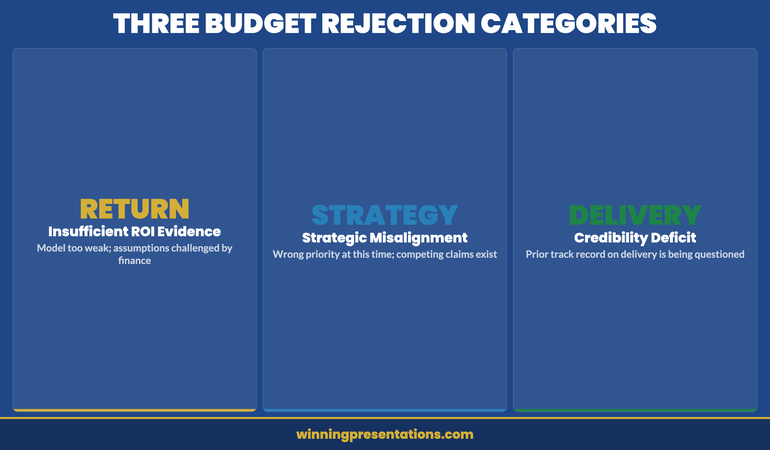
Budget rejections fall into three categories, and only one of them is actually about the numbers. Understanding which category your rejection belongs to determines what the resubmission needs to address.

The first category is insufficient evidence of return. The committee cannot see a credible path from the investment to a measurable outcome. This is a modelling and assumptions problem — and it is the only category where revising the financial model alone will resolve the issue. If you can provide tighter assumptions, stronger benchmarks, or a clearer articulation of how return will be measured and when, the resubmission has a direct path to approval.

The second category is strategic misalignment. The committee does not believe this investment is the right priority at this time, relative to other competing claims on the budget. No amount of modelling resolves this. The resubmission needs to demonstrate how this investment connects to the organisation’s current strategic priorities, and specifically why deferring it creates a worse outcome than approving it now.

The third category — the most common and the hardest to diagnose — is a credibility deficit. The committee is not confident that the presenter or their team can deliver what is being proposed. This is particularly acute when the organisation has a history of late or over-budget technology or infrastructure projects, which is a reason Kenji’s second submission failed. A resubmission that does not directly address the delivery confidence problem will not succeed, regardless of the quality of the financial model.

Most rejected budgets contain elements of all three. The task before the resubmission is to identify which is the dominant concern, because that determines the entire structure of the revised presentation.

Three categories of budget rejection: return evidence, strategic alignment, and delivery credibility

The First Move After Rejection

The first thing to do after a budget rejection is not to revise the proposal. It is to understand precisely what was rejected and why. This sounds obvious, but most post-rejection conversations focus on what the presenter thinks the committee meant, rather than on getting the committee’s actual concerns on record.

Request a debrief, ideally with the finance director or the committee chair, within a week of the decision. The question to ask is not “what would it take to get this approved?” — which puts the committee in the position of designing your resubmission — but rather “what specific concerns were unresolved at the point of decision?” This frames the conversation as a diagnostic rather than a negotiation, and experienced finance directors will give you considerably more useful feedback if they feel they are being asked to help you understand rather than being pressured to change their minds.

Document the feedback carefully. When the resubmission is eventually presented, the committee will compare what they said to what you addressed. If the resubmission does not map directly to the documented concerns, it signals that you either did not understand the feedback or chose to work around it — neither of which builds confidence.

What to Change — and What Not to Touch

There is a common instinct to make the resubmission significantly different from the original — to demonstrate responsiveness and effort. This instinct is partially right and partially dangerous. Substantial changes that address the committee’s documented concerns signal that you listened and acted. Substantial changes that go beyond what was asked signal either that you had doubts about the original proposal that you did not disclose, or that you are making changes to appear responsive rather than because they are substantively right.

Change the structure of the case if the rejection was about framing. If the committee rejected the proposal because the rationale was wrong — capability-led rather than risk-led, for example — restructure the argument, not just the slides. The committee will recognise a slide reshuffle; they will not recognise a genuinely different argument unless it is genuinely different.

Change the financial assumptions if they were specifically challenged. If the committee requested more conservative growth projections or questioned the cost assumptions, revise them with explicit references to what changed and why. Do not quietly update figures without acknowledging the change — the committee will notice the difference and will want to know why the original numbers were presented if these more cautious assumptions were available.

Do not change anything that was not the subject of feedback. Altering elements of the proposal that the committee did not question suggests uncertainty about the original position, and invites new questions about material that was previously settled.

For guidance on structuring the financial argument itself, the approach in zero-based budget presentations is directly applicable to resubmissions where the original proposal was rejected on return-evidence grounds — the discipline of justifying each line from first principles removes the assumption problem that often underlies the “insufficient ROI” rejection.

Executive Slide System

Build Financial Presentations That Get Budget Approval

The Executive Slide System provides structured frameworks for financial and budget presentations, including resubmissions after rejection. It includes slide templates for finance committee meetings, AI prompt cards to build the case quickly, and scenario guides for challenging approval environments.

  • Slide templates for budget and financial approval presentations
  • AI prompt cards to structure the resubmission argument
  • Framework guides for risk-led and return-led financial cases
  • Scenario playbooks for budget, capex, and resource allocation items

Get the Executive Slide System — £39

Designed for budget and financial presentations in regulated and corporate environments.

Structuring the Resubmission Presentation

A budget resubmission presentation has a structural requirement that the original proposal does not: it must acknowledge the previous rejection before making the case. Presenting a revised budget as if the original was never rejected — simply updating the figures and re-presenting the slides — is the single most common structural error in resubmissions, and it consistently produces a worse reception than the original.

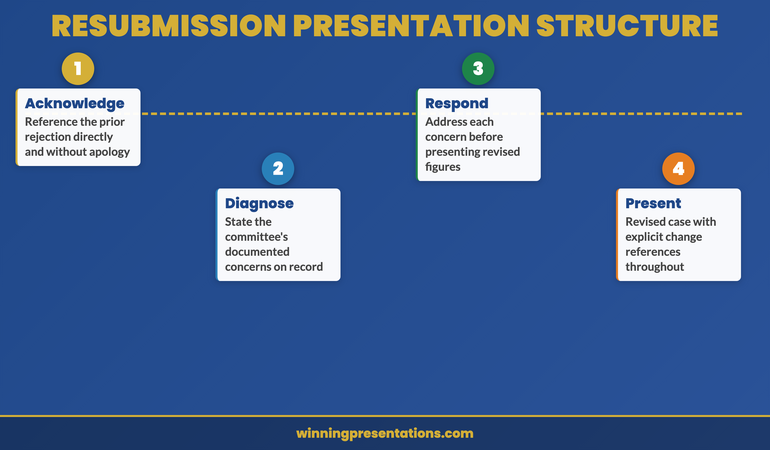
The committee knows this is a resubmission. Pretending otherwise reads as either oblivious or evasive. The structure that works is: acknowledgement, diagnosis, response, revised case.

Acknowledgement: Open with a brief, direct reference to the previous submission and its outcome. “This is a revised proposal for [project], following the committee’s decision in April. The original submission was rejected on two grounds, which I will address directly.” This signals that you are aware of the history, you are not defensive about it, and the resubmission is designed to resolve the specific concerns raised.

Diagnosis: State what you understood the committee’s concerns to be. If you had a debrief conversation, reference it. “Based on the feedback received from [name/role], the committee’s primary concerns were: [specific concerns].” This gives the committee the opportunity to confirm or correct your understanding before the revised case is presented, and it demonstrates that you conducted a genuine post-rejection diagnostic rather than simply revising the slides.

Response: Address each concern directly, in the order it was raised. Not buried in the appendix, not woven into the financial model — directly, as a standalone section that the committee can evaluate before the revised figures are presented. This is the part of the resubmission that most commonly gets cut for time, which is almost always a mistake. The committee’s concerns are the test the resubmission must pass; address them before asking for approval.

Revised case: Present the updated financial proposal, incorporating the changes made in response to the committee’s feedback, with explicit references to what changed and why.

For reference on how resource and financial proposals are typically structured for contested approval environments, the resource allocation presentation framework covers the argumentation approach that works when budgets are under direct competitive pressure.

The Three Objections to Address Before They Raise Them

In a resubmission, there are typically three objections that the committee will raise regardless of how comprehensively the original concerns were addressed. Addressing these proactively — before they are raised as questions — materially reduces the risk of a second rejection.

The first is: “Why should we approve this now rather than defer it to next year’s cycle?” This objection is almost always present when a budget was rejected once already. The committee may have approved an alternative proposal in the interim, making this one appear less urgent than it did six months ago. The resubmission needs a current-state argument: what has changed since the original submission, and how does that change affect the cost or risk of waiting a further twelve months?

The second is: “What gives us confidence the delivery will be successful?” This is particularly acute when the organisation has a track record of project overruns, or when the project scope has changed between the original and revised submissions. A resubmission that does not include a delivery confidence section — covering governance arrangements, milestone structure, and how delivery risk will be managed — will encounter this objection in the room.

The third is: “Is this the right amount?” After a rejection, committees are sensitive to whether the revised budget is genuinely right-sized or has simply been reduced to secure approval, with the expectation that a supplementary request will follow. If the budget has been reduced from the original, explain specifically what scope was removed to achieve the reduction, not just that the figure is lower.

Three pre-emptive objections for a budget resubmission: timing, delivery confidence, and budget sizing

Presenting the Revision Without Looking Defensive

The psychological challenge of a resubmission is presenting a revised case with full conviction when you know the committee has already said no once. The temptation is to over-qualify — to hedge the revised figures, acknowledge every uncertainty, and soften the recommendation. This reads as lack of confidence in the revised case, which is the last impression a resubmission needs to create.

The discipline is to hold the distinction between acknowledging the rejection and diminishing the recommendation. You can acknowledge the previous decision with directness and without apology, and then present the revised case with exactly the same conviction you would bring to a first submission. The rejection was of the previous case; this is a different case. It deserves to be presented as such.

Avoid two common tone errors. The first is apologetic framing — “I know you have concerns about this, and I hope this revised version addresses them” — which positions the presenter as petitioner rather than professional making a considered case. The second is over-confident dismissal — “I believe we have now resolved all the concerns raised” — which can read as arrogant and tends to provoke the committee into finding new concerns. The right tone is direct and measured: “The revised proposal addresses the specific concerns raised in April. Here is how.”

If the capital expenditure case involves significant infrastructure investment, the guidance in capital expenditure presentations covers how to frame large investment proposals in a way that holds up under scrutiny — including how to address delivery risk in the financial narrative itself rather than in a separate risk register that committees rarely read.

If your budget proposal has been rejected once and you are preparing the resubmission, the Executive Slide System includes financial presentation frameworks that address the structural requirements of a second-attempt approval, including how to lead with the committee’s previous concerns.

Executive Slide System

Slide Templates for Budget and Financial Approval Meetings

Structure your resubmission using frameworks designed for contested financial approvals — from the opening acknowledgement to the revised recommendation and delivery confidence section.

Get the Executive Slide System — £39

Designed for financial and budget presentations in corporate and regulated environments.

Frequently Asked Questions

How long should a budget resubmission presentation be?

A resubmission should typically be shorter than the original proposal, not longer. If the original was rejected because the case was unclear, adding more slides rarely resolves the problem — it usually compounds it. The acknowledgement-diagnosis-response-revised case structure can typically be delivered in eight to twelve slides, with supporting detail in the appendix. The committee has already read a version of this proposal; they do not need the full context again. They need to see that their specific concerns have been addressed and that the revised figures are sound.

Should you request a meeting with the finance director before the formal resubmission?

Yes, where possible. A pre-meeting with the finance director or a relevant committee member before the formal resubmission gives you the opportunity to test whether your revised case addresses their concerns before the formal meeting, and it signals engagement with the feedback process rather than a determination to push the proposal through regardless. It is not appropriate to use this meeting to lobby for approval — it is a diagnostic conversation, not a pre-vote. The question to ask is whether your diagnosis of the rejection matches their recollection of the discussion.

What should you do if the budget is rejected a second time?

Request a direct conversation with the committee chair or finance director to understand whether the objection is to this proposal specifically or to the priority of the investment in the current environment. If the committee has a fundamental view that the investment should not happen now — regardless of the quality of the case — no amount of revised modelling will change the outcome. The more productive path is to understand what conditions would need to change for the proposal to succeed, and to determine whether those conditions are likely to be met within a timeframe that makes the investment still relevant.

The Winning Edge — Weekly Newsletter

Each Thursday: one executive presentation insight, one structure, one practical tool. Read by executives across financial services, healthcare, technology, and infrastructure.

Subscribe to The Winning Edge

Preparing a budget or financial approval presentation? The Executive Presentation Checklist is a free download covering structure, language, and approval-readiness for finance committee and board presentations.

About the Author

Mary Beth Hazeldine is Owner and Managing Director of Winning Presentations. With 25 years of corporate banking experience at JPMorgan Chase, PwC, Royal Bank of Scotland, and Commerzbank, she advises executives across financial services, healthcare, technology, and government on structuring presentations for high-stakes funding rounds, board approvals, and governance reviews. View services | Book a discovery call
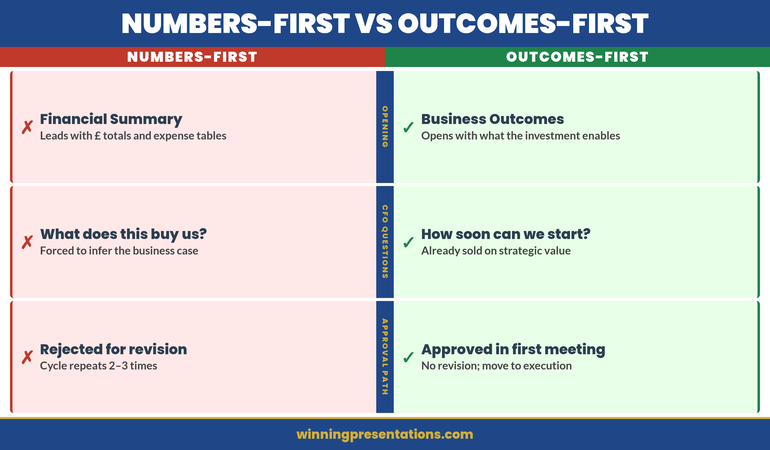
08 Apr 2026

Resource Allocation Presentation: Structuring the Case When Budgets Are Contested

Quick Answer

A resource allocation presentation succeeds when it reframes the request from “we need resources” to “here is the cost the organisation is currently bearing by not having them.” Lead with the business impact of the current resourcing gap, quantify where possible, and present headcount or budget as the solution to a named problem — not as a departmental ask. The decision-makers approving your request are evaluating whether the business case justifies the investment, not whether you deserve support.

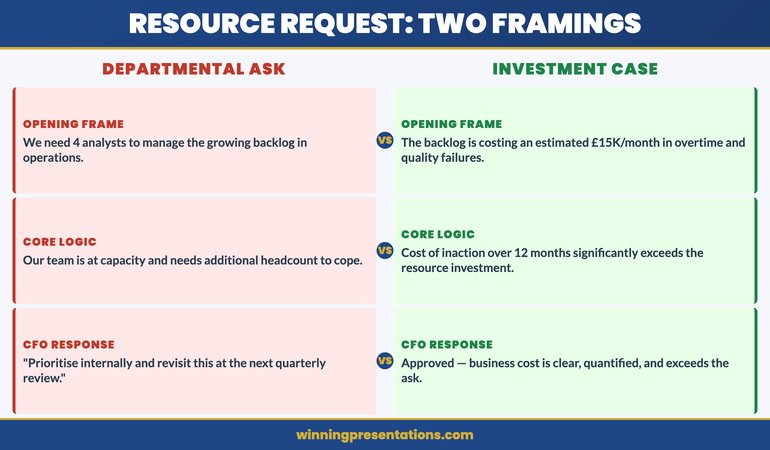
Priya had been waiting six months for approval to hire four additional analysts in her operations team. The backlog was growing. Her existing team were working consistent twelve-hour days. The quality issues were escalating. She had a presentation slot at the quarterly resource review and she was confident the case was obvious.

She opened with: “We need four additional FTEs in operations to manage the current workload and address the backlog that’s been building since Q3.”

The CFO responded: “We’re in a constrained environment. Can you look at prioritising internally and coming back to us with a revised request?” Meeting closed. No decision. Priya left without the headcount.

Three months later, a different team in the same organisation made an almost identical request using a different framing. They opened with the cost of the quality failures, not the size of the headcount gap. They quantified the revenue at risk from the backlog. They got approval the same day.

The two presentations had the same underlying business case. The difference was structural. One asked for resources. The other made the cost of not resourcing impossible to ignore.

Presenting a headcount or budget request this quarter?

Check whether your resource case is framed to get a decision:

  • Does your opening slide describe the business cost of the gap — not the size of the gap?
  • Have you quantified the impact in terms the CFO uses (revenue, cost, risk)?
  • Have you pre-empted the “prioritise internally” objection with a clear slide?

The Executive Slide System includes business case slide frameworks for resource requests, headcount justifications, and budget approvals. Explore the System →

Why Resource Requests Fail at the First Slide

The structural failure in most resource allocation presentations happens before the first supporting slide. It happens in the way the request is framed — and the framing sets the entire tone of the decision-making conversation that follows.

When you open a resource request with “my team needs X headcount” or “we need an additional £Y to deliver this programme,” you have inadvertently positioned yourself as a department competing for a limited pool of organisational resource. The CFO’s mental model shifts to rationing mode: who else is asking, what is the priority order, can this be deferred?

By contrast, when you open with the business impact of the resourcing gap — the revenue at risk, the regulatory exposure, the client attrition rate, the project delay costs — you have positioned the resourcing decision as an organisational investment decision with a clear return. The CFO’s mental model shifts to investment mode: what is the cost of acting, what is the cost of not acting, which is higher?

This is not a rhetorical trick. It is a structural accuracy. In most cases where resource requests are genuinely justified, the business cost of underresourcing is real and quantifiable. The problem is that presenters know this cost intuitively but rarely make it explicit in the presentation. They present the solution (more headcount) without first establishing the problem (the current cost of the gap) in terms that decision-makers recognise.

The fix is to invert the sequence. Present the problem in business cost terms first. Present the solution — the resource request — second. The business case then feels inevitable rather than aspirational.

The Reframe: From “We Need” to “Here Is the Cost”

Two-column comparison showing weak resource request framing versus business-cost reframe approach for executive presentations

The reframe requires identifying, before the presentation, what the organisation is currently paying — in cost, risk, or lost revenue — because the resource gap exists. This is the cost-of-inaction analysis, and it is the most important preparation step in building a resource allocation presentation.

For an operations team with a backlog, the cost-of-inaction might include: delay costs from client contracts with service level agreements, overtime costs already being incurred by existing staff, quality failure costs from rushed delivery, staff turnover risk from sustained overwork, and revenue at risk from clients considering alternative providers.

Not all of these will be fully quantifiable. Some will be directional estimates. That is acceptable — you are not building an actuarial model, you are building a business case. The standard is whether the aggregate cost picture is credible and directionally accurate. Executives making resource decisions are accustomed to working with estimates. They are not accustomed to presenters who have not attempted to quantify the cost at all.

Once you have the cost-of-inaction picture, the structure of your opening changes entirely. Instead of “we need four analysts,” you can open with: “The operations backlog is currently running at eight weeks, which is creating three types of business cost I’d like to walk you through — and I’m proposing a resourcing solution that addresses all three at a total cost significantly below what we’re currently absorbing.”

That opening does not ask for anything. It announces a cost problem and a solution. The ask comes later, after the problem has been established on its own terms.

For the financial slide structures that support this approach, see capital expenditure presentations: building the approval case for board-level investment decisions.

The Business Case Framework That Gets Resource Requests Approved

Stop presenting headcount and budget requests as departmental asks. The Executive Slide System gives you the slide structure to reframe resource allocation as a business investment decision — with the sequence that gets CFO approval.

  • Business case slide templates for headcount requests, budget approvals, and programme investment decisions
  • Cost-of-inaction slide frameworks that quantify the business impact of the current resource gap
  • AI prompt cards to build the five-slide resource case in under 15 minutes
  • Objection-handling slide structures for the “prioritise internally” and “revisit next quarter” responses

Get the Executive Slide System → £39

Designed for operations, finance, and programme leaders presenting resource cases to CFOs, board committees, and senior leadership teams.

The Five-Slide Resource Allocation Framework

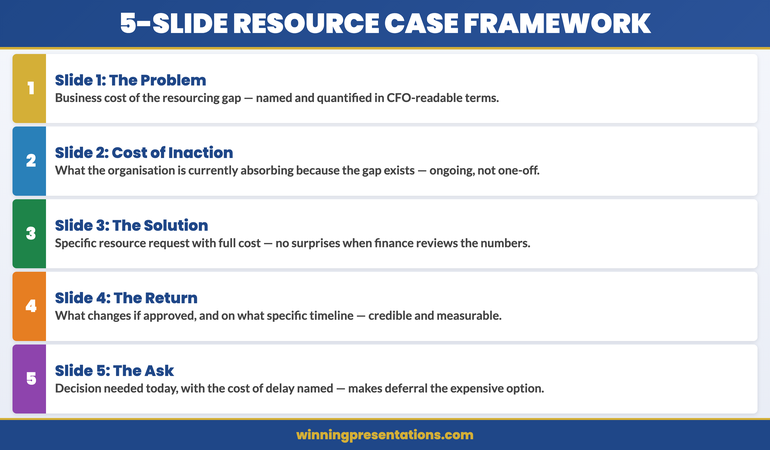
Most resource allocation presentations contain too many slides. The information needed to make a resource decision is focused: what is the problem, what does it cost, what is the proposed solution, what will it cost, and what is the expected return? Five slides cover this sequence. Every additional slide is generally context the decision-makers do not need in order to make the decision.

Slide 1 — The problem framed in business cost terms. A clear statement of the current resourcing gap and its business consequences. Not “we are understaffed” but “current resourcing is producing three identifiable cost outcomes for the business.” Name the outcomes. Quantify where you can.

Slide 2 — The cost-of-inaction analysis. This is often the most important slide in the deck, and the one most presenters skip. Show what the business is currently absorbing because the resourcing gap exists: delayed delivery, quality failures, staff overtime, client risk, regulatory exposure. Present this as an ongoing cost, not a one-off event. “We are currently absorbing an estimated £[X]K per month in [specific cost categories].”

Slide 3 — The proposed resource solution. Now — and only now — introduce the headcount or budget ask. “We are requesting approval for [specific resource] at a total cost of [£X] per annum, beginning [date].” Keep this slide clean and specific. Include the full cost — salary, benefits, onboarding, equipment — so there are no surprises in the financial review.

Slide 4 — The return on the investment. What will change if the request is approved? Be specific about which of the costs identified in slide 2 will be reduced or eliminated, and on what timeline. “Full resolution of the quality issue within 90 days of hire. Backlog reduction to four weeks by end of Q3. Overtime cost eliminated within six weeks.” Specificity here is credibility.

Slide 5 — The ask and the timeline. What do you need from this meeting, and by when? “We need a decision today to begin recruitment in April and have resource in place before Q3 deliverables begin.” Include the consequence of delay: “Each month of delay extends the backlog by approximately [X] weeks and incurs an estimated [£Y] in additional overtime.”

Five slides. Tight, evidence-based, decision-ready. For financial presentation structures supporting this framework, see zero-based budget presentations: building the case from a clean baseline.

How to Quantify the Business Case

The most common objection to the cost-of-inaction approach is: “I can’t quantify the cost precisely enough to put it in front of a CFO.” This objection is worth addressing directly, because it stops many managers from making the attempt.

A CFO reviewing a resource request does not expect a fully audited, actuarially precise cost model. They expect a credible, directionally accurate estimate of what the business is absorbing. The standard is whether the numbers are defensible under reasonable questioning — not whether they are exact.

A workable approach: identify two or three cost categories that are genuinely attributable to the resourcing gap and where you have enough data to produce a directional estimate. For a backlogged operations team: overtime hours worked per month multiplied by blended hourly rate; client SLA penalty clauses at risk; project delay costs from postponed deliverables. You do not need all three. Even one well-evidenced cost category is more persuasive than a verbal claim that “the team is at capacity.”

When presenting estimated figures, be transparent about the methodology: “Based on current overtime hours, we estimate this is costing approximately £15K per month in premium labour costs — and that figure excludes the quality failure costs, which are harder to quantify but have been flagged three times in client reviews this quarter.” Transparency about limitations increases, rather than decreases, credibility with financially sophisticated audiences.

If you’re building the financial case for a resource request this quarter, the Executive Slide System includes slide templates and AI prompt cards specifically designed for cost-of-inaction analysis — the structure that reframes headcount requests as investment decisions for CFO review.

Handling “Prioritise Internally” Objections

Resource allocation presentation objection-handling roadmap: four steps from objection to decision-ready response

“Have you considered whether this could be addressed through internal prioritisation?” is one of the most common responses to resource requests, and one of the most difficult to handle in a presentation setting if you haven’t prepared for it.

The question is not inherently adversarial. It is a legitimate governance question — the CFO’s job is to ensure that resource allocation reflects genuine need rather than departmental preference. The best response addresses it on those exact terms.

The preparation involves completing a credible internal prioritisation analysis before the presentation. What could the team stop doing, reduce in scope, or defer in order to absorb the additional demand? What is the business consequence of each trade-off? Present this analysis proactively — ideally as a dedicated slide in your five-slide framework — rather than waiting to be asked.

A slide that says “We have reviewed internal prioritisation options. Scenario A: defer [specific deliverable] to H2, with [specific business consequence]. Scenario B: reduce [specific workstream] to minimum viable scope, with [specific quality or risk consequence]. Neither scenario resolves the backlog within the Q3 timeline. The most cost-effective resolution remains the resource investment proposed.” This slide pre-empts the objection and demonstrates organisational rigour.

When the objection arises anyway — as it often does — you can respond: “We’ve actually modelled that, and it’s on slide 4. The short version is that the two realistic internal options both carry business costs that exceed the cost of the resource investment over a 12-month horizon. I’d be happy to walk through the detail.” You cannot be sent away to do work you’ve already done.

When to Present and When to Pre-Sell

The formal resource allocation presentation is not where decisions are made. In most organisations, significant resource decisions are made — or at minimum, strongly influenced — in the conversations that happen before the formal meeting. Understanding this changes how you should manage the process.

The most effective resource requesters approach formal presentations as confirmation meetings rather than persuasion meetings. By the time they walk into the room, the CFO or relevant budget holder has already seen the cost-of-inaction analysis in a one-to-one conversation, has had their primary concerns addressed, and has indicated — at minimum — that the case is credible. The formal presentation is where the decision is formalised, not where it is won.

This means the most important step in a resource allocation process often happens two weeks before the presentation: a brief, direct conversation with the decision-maker where you share the headline cost-of-inaction figure and ask whether they want to see the full analysis. “I wanted to give you a heads-up before the resource review — we’ve done some analysis on the backlog cost and I think the number will be higher than expected. Would it be helpful to walk you through it before the formal committee session?” Most CFOs say yes.

This pre-sell approach does not compromise the formal process. It ensures that the formal meeting is productive, focused, and conclusive — rather than an exploratory conversation where the CFO is encountering the case for the first time and needs time to process it before committing to a decision.

Today’s companion article on screen sharing presentations: keeping your audience engaged in virtual approval meetings covers the additional considerations for resource cases presented in remote or hybrid settings.

For revenue-related business cases, see revenue forecast presentations: structuring the financial narrative for senior review.

Stop Leaving Resource Decisions to “We’ll Revisit Next Quarter”

When resource requests are deferred, it’s usually because the business cost wasn’t clear enough to create urgency. The Executive Slide System includes the cost-of-inaction slide framework that makes deferral the more expensive option — and gets the decision at the meeting you’re in.

Get the Executive Slide System → £39

Built from business cases presented to CFOs and board committees across financial services, technology, and professional services.

Frequently Asked Questions

How many slides should a resource allocation presentation have?

Five slides is generally sufficient for a resource request presented to a CFO or senior committee: the problem framed in business cost terms, the cost-of-inaction analysis, the proposed resource solution, the expected return, and the ask with timeline. Additional slides may be appropriate for complex programme investments or multi-phase requests, but the core decision case should be completable in five. Appendices can carry supporting data for questions without adding to the main deck length.

What if I can’t quantify the business cost precisely?

Present a directional estimate with a transparent methodology, and acknowledge the limitations. A credible estimate — “we believe this is costing approximately £X per month, based on overtime hours and delayed delivery costs, though we acknowledge the quality failure component is harder to quantify” — is significantly more persuasive than a purely qualitative claim. CFOs are experienced at making decisions with imperfect data. They are not experienced at approving requests with no financial framing at all.

What’s the best time to submit a resource request?

Align resource requests with your organisation’s planning and budget cycle wherever possible — ideally the quarter before the cycle in which you need the resource in place. Outside of formal cycles, the right time is when the business cost of the gap has become quantifiable and significant. Presenting a resource request in a budget cycle is procedurally easier; presenting it mid-cycle requires a stronger business case. Both are possible — the strength of the cost-of-inaction analysis determines which will succeed.

How do I handle the response “headcount freeze is in place”?

A headcount freeze is a default policy response, not an absolute ceiling on resource decisions. The right response is to present the cost-of-inaction analysis as the reason the freeze should not apply to this request — or to explore whether the resource can be secured through alternative mechanisms: contract, consultancy, temporary cover, or internal reallocation with backfill. Presenting these alternatives proactively signals rigour and significantly increases the likelihood of a favourable decision even within a constrained environment.

The Winning Edge — Weekly Insights for Executive Presenters

Practical frameworks for structuring high-stakes presentations, managing executive audiences, and building decks that get decisions. Delivered every Thursday.

Join The Winning Edge →

Free resource: Executive Presentation Checklist — the pre-presentation checklist for business cases, resource requests, and approval presentations at board and senior leadership level.

About the Author

Mary Beth Hazeldine is the Owner & Managing Director of Winning Presentations. With 24 years of corporate banking experience at JPMorgan Chase, PwC, Royal Bank of Scotland, and Commerzbank, she has delivered high-stakes presentations in boardrooms across three continents.

A qualified clinical hypnotherapist and NLP practitioner, Mary Beth advises executives across financial services, healthcare, technology, and government on structuring presentations for high-stakes funding rounds and approvals.

Book a discovery call | View services

07 Apr 2026

Zero-Based Budget Presentation: Justify Every Line to Finance

Quick answer: A zero-based budget presentation requires you to justify every line of expenditure as if it were a new request — not a continuation of last year’s spend. The most effective structure leads with the business outcome each line of spending supports, layers evidence for the lines most likely to face scrutiny, and frames the final slide as a binary decision with named consequences on both sides.

Valentina had three months to prepare. As Head of Operations for a mid-sized healthcare technology firm, she had presented budget requests before — always with a roll-forward from the prior year, always with a modest increase ask, always with a CFO who pushed back on the headline number and then approved most of it anyway. This year was different.

The board had mandated a zero-based budget process across the business. Every department would start from zero. Every pound would need justification. The CFO had warned his team that he expected operational rigour, not PowerPoint creativity. Valentina’s first draft — which looked like every budget deck she had ever produced — came back with a single comment: “This doesn’t tell me why. Start again.”

The second version took a different approach. Instead of opening with a summary of last year’s spend and this year’s request, Valentina opened with the operational outcomes her department was responsible for delivering — and then showed the dependency map between each outcome and each line of expenditure. By the third slide, the CFO had stopped making notes and started asking questions. That was the shift. Questions meant he was thinking about approval, not rejection.

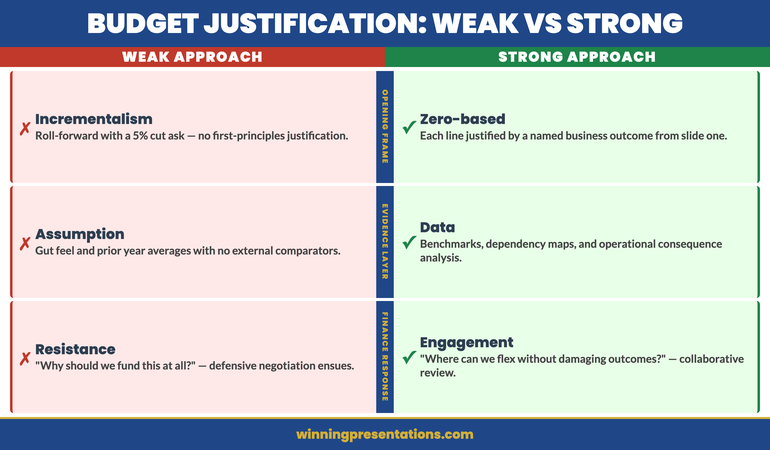
Zero-based budgeting presentations fail when they are structured like traditional budget decks. They succeed when they are structured like investment proposals — where every line earns its place through a direct link to business value.

Preparing for a budget approval meeting?

The Executive Slide System includes slide templates and framework guides designed for high-scrutiny financial presentations — structured to help you lead with business outcomes and build your evidence layer efficiently.

Explore the System →

Why Zero-Based Budgeting Changes the Presentation Challenge

In a traditional incremental budget review, the implicit question the presenter is answering is: “Is this year’s increase reasonable?” The prior year’s spend is treated as a baseline that has already been approved and therefore doesn’t need re-justification. Your task is to explain the delta.

Zero-based budgeting removes that baseline. The implicit question becomes: “Does this spend need to exist at all?” That is a fundamentally different challenge — and it requires a fundamentally different deck structure.

The risk for most budget presenters is that they approach zero-based reviews using the same architecture as traditional reviews. They lead with total spend, break it down by category, attach a growth percentage, and wait for questions. This structure fails in a zero-based environment because it answers the wrong question. It tells the finance team what you want to spend. It doesn’t tell them why each element needs to exist.

The zero-based budget presentation is closer in structure to a capital expenditure proposal than a standard departmental review. Both require you to justify spending as if it were new. Both benefit from a dependency-based argument structure rather than a category-summary format.

The Problem With Traditional Budget Decks

Most budget presentations are built around three implicit assumptions that zero-based processes invalidate:

Assumption one: prior approval implies ongoing necessity. In a traditional review, last year’s approved budget line carries an implicit endorsement. In a zero-based review, it carries no weight at all. If you can’t justify why the line exists from first principles, the finance team is entitled to cut it entirely.

Assumption two: category headers are self-explanatory. Headings like “personnel costs,” “software licences,” and “professional services” communicate what the money is spent on, not why the organisation needs to spend it. Finance teams conducting a genuine zero-based review will push beneath every category header to understand the operational rationale. Your deck should anticipate that push, not wait for it.

Assumption three: the total is the primary focus. In a zero-based environment, the individual lines matter more than the total. A finance team will often accept a higher total if each line has a credible business case, and reject a lower total if several lines appear unjustified. Presenting the total first invites the wrong conversation — a negotiation about the headline number rather than an evaluation of each component’s merit.

Understanding these assumptions allows you to invert the structure of your deck: lead with operational outcomes, link each spend line to a named outcome, and surface the total only after the dependency map is established.

The Five Slides Every ZBB Presentation Needs

The structure below has been designed for budget presentations where every line must earn its place. It works in CFO reviews, board budget sessions, and investment committee meetings where detailed scrutiny is expected.

Five-step framework for structuring a zero-based budget presentation for executive scrutiny

Slide one — Operational outcomes. List the three to five measurable outcomes your department is responsible for delivering in the coming year. These are the anchors for everything that follows. Every line of expenditure will be linked back to one of these outcomes. If you cannot connect a spend line to a named outcome, that line belongs in a separate conversation.

Slide two — Dependency map. Show visually how each outcome depends on specific categories of spend. This is the intellectual core of the zero-based argument. The finance team can see that removing a budget line doesn’t just save money — it removes a capability that supports a named business outcome.

Slide three — Line-by-line justification. For each budget line, provide: what it funds, which outcome it supports, what the operational impact would be if it were removed, and any market comparators or benchmarks that contextualise the cost.

Slide four — Flexion points. Pre-identify the lines where you have genuine flexibility — where reduced funding would reduce service levels rather than eliminate a capability. Offering controlled flexion is strategically effective: it demonstrates rigour and gives the finance team a managed choice rather than an adversarial negotiation.

Slide five — Decision frame. Present the final slide as a binary: fund at this level and deliver these outcomes, or fund at a reduced level and accept these named consequences. A clean decision frame is more persuasive than a plea — it positions your ask as a business decision, not a departmental request.

The Executive Slide System

Slide templates and framework guides designed for executive presentations that require financial justification and board-level scrutiny.

  • Slide templates designed for budget approval and financial review meetings
  • AI prompt cards to structure financial arguments quickly and clearly
  • Framework guides for presenting numbers to mixed executive audiences
  • Scenario playbooks for CFO, board, and investment committee decks

Get the Executive Slide System — £39

Designed for executives preparing for high-scrutiny financial presentations.

How to Justify Each Line Without Losing the Room

The risk in detailed budget presentations is that justification becomes a recitation. The presenter reads through each line in order, the finance team becomes passive, and by the time the high-scrutiny items appear the room has lost engagement. The most effective zero-based budget presenters sequence their justification by risk, not by category.

Prioritise the lines most likely to face challenge. Before the meeting, identify the two or three expenditure lines that are most likely to prompt sceptical questions. These are typically: new spend categories with no prior year comparator, lines that have grown significantly relative to the business, and costs that are difficult to benchmark externally. Cover these early — when the room is still engaged and you have the most credibility to defend them.

Use a consistent justification structure. For each line, use the same three-part format: what it funds, what operational outcome it supports, and what would change if it were removed. Consistency allows the finance team to evaluate each line on the same basis, which reduces the likelihood of tangential discussions about format rather than substance.

Separate baseline from growth. Even in a zero-based process, it is worth distinguishing between spend that maintains an existing capability and spend that funds new or expanded capabilities. Finance teams understand that some expenditure simply keeps the lights on. Presenting this distinction honestly prevents unnecessary scrutiny of maintenance costs that are not in dispute. For guidance on structuring financial forecasts more broadly, see this analysis of revenue forecast presentation structure.

Speak to consequences, not to effort. The instinct when defending a budget line is to describe how much work it represents or how carefully it was costed. Finance teams are rarely moved by evidence of effort. What moves them is clarity about the operational consequence of removing the line. “If this line is cut, we lose the capability to X, which affects outcome Y by Z” is a more effective justification than any description of how the number was calculated.

The Executive Slide System includes slide templates structured specifically for budget justification and financial approval presentations, with a dependency-map format built in.

Handling Finance Team Scrutiny in the Room

The finance team’s role in a zero-based budget review is to challenge assumptions and test the rigour of your justification. Experienced budget presenters treat this scrutiny as a feature of the process rather than an obstacle to their ask. The way you handle challenge in the room often matters more than the quality of your deck.

Comparison of weak versus strong approaches to budget justification in executive meetings

Anticipate the three most likely challenge questions. Before the meeting, write out the three questions you most hope the finance team does not ask. These are your highest-risk areas. Then prepare clear, direct answers — ideally supported by a backup slide in an appendix — so that when these questions arise you can answer them without hesitation or visible discomfort. Hesitation in a budget meeting is read as uncertainty about the justification.

Distinguish between questions that seek information and questions that signal scepticism. A question like “what would be the impact of reducing this line by 20%?” is typically exploratory — the finance team wants to understand the flexibility in the model. A question like “can you walk me through how you arrived at this number?” often signals that the number looks high. Reading the intent behind a question allows you to calibrate your response appropriately. For a more detailed treatment of reading hostile questions, see the companion article on preparing for hostile questioner scenarios.

Never concede on a line you haven’t analysed. In a budget meeting, there is social pressure to appear flexible when challenged. The impulse to say “we could probably reduce that” in response to scrutiny is understandable, but it is also dangerous. Agreeing to reduce a line you have not modelled creates a commitment you cannot necessarily honour and signals that the original ask was not fully thought through. If you need time to model the impact of a proposed reduction, say so and commit to a specific follow-up timeline. For context on how governance bodies interpret budget proposals, see this overview of governance update presentation structure.

What the CFO Is Actually Evaluating

Understanding what the CFO is evaluating — and what they are not evaluating — changes how you structure your preparation. Most budget presenters over-prepare on the numbers and under-prepare on the narrative. A CFO conducting a zero-based budget review is typically evaluating four things simultaneously:

Rigour of thinking. Have you genuinely started from zero, or have you repackaged last year’s spend with better-sounding labels? A CFO who has run multiple zero-based budget cycles can identify cosmetic zero-basing quickly. The test is whether you can explain the rationale for each line in plain language without reference to what was previously approved.

Calibration of the ask. Is the total consistent with what the finance team would expect given the operational scope of the department? A CFO isn’t just evaluating whether each individual line is justified — they’re also assessing whether the aggregate feels calibrated. An aggregate that feels high will invite more detailed scrutiny even if each line appears justifiable in isolation.

Quality of trade-off analysis. The best budget presentations include explicit trade-off analysis: what would the organisation gain from funding option A versus option B, and what would it forgo? A CFO wants to make a well-informed allocation decision, not simply accept or reject your proposal. Offering a structured trade-off gives them the material to make that decision — and makes you a more credible partner in the process.

Your credibility as an operational leader. The budget presentation is also a proxy for how well you understand your own function. A Head of Operations who can explain every significant line of their budget — its purpose, its dependency, its flexibility — signals operational competence that extends beyond the budget itself. This is also why the team performance review presentation that often follows a budget cycle matters: it shows whether operational commitments made during the budget process were delivered. See the companion piece on structuring a team performance review presentation for guidance on that conversation.

Building Your Evidence Layer Before the Meeting

The evidence layer in a zero-based budget presentation is the set of materials you have prepared to substantiate each justification — not all of which will appear in the main deck, but all of which you should be able to produce immediately if challenged. A strong evidence layer has three components:

External benchmarks. For your highest-cost lines, identify external comparators that contextualise the spend. Industry salary benchmarks, software licence cost comparisons, contractor day-rate market data — these allow you to position your spend relative to a reference point the finance team can validate independently. Benchmarks are more persuasive than self-referential justifications because they anchor the argument in market reality rather than internal preference.

Operational dependency documentation. For any line that might appear discretionary, document the specific operational process it supports. This is particularly important for overheads and enabling functions — costs that don’t produce a visible output but that underpin capabilities the business depends on. A clear dependency document answers the question “what would actually happen if we cut this?” before it is asked.

Appendix slides for the most likely challenge scenarios. Prepare three to five supplementary slides that address the questions most likely to come up in a detailed review. These are not part of the main presentation — they sit in an appendix and are surfaced only if the specific question arises. The discipline of preparing these slides also forces you to think through the most challenging aspects of your justification before you are in the room.

The presenter who arrives with an evidence layer — even if most of it is never shown — projects a qualitatively different level of preparation from the one who has only the deck. Finance teams notice the difference.

Build Your Next Budget Deck With the Right Structure

The Executive Slide System includes framework guides for structuring financial approval presentations — so you can build a dependency-based argument without starting from a blank slide.

View the Executive Slide System — £39

Designed for executives preparing high-scrutiny financial presentations.

Frequently Asked Questions

What is the difference between a zero-based budget presentation and a standard budget review?

A standard budget review typically treats the prior year’s spend as a baseline and focuses on justifying increases or decreases relative to that baseline. A zero-based budget presentation requires you to justify every line of expenditure as if it were a new request — with no assumed entitlement to prior year spend levels. This means structuring your deck around business outcomes and dependency maps rather than category summaries and year-on-year variances.

How should I handle a line that is difficult to justify in isolation but necessary as part of a broader function?

The key is to make the dependency visible rather than asserting it. If a line is genuinely necessary as part of a broader operational capability, your deck should show the full capability — not just the individual line — and demonstrate that the capability would be impaired without it. Dependency mapping is the most effective tool for this: it shows the finance team that the line isn’t discretionary, it is load-bearing.

What should I include in my appendix for a zero-based budget presentation?

Your appendix should contain the detailed justification for the three to five lines most likely to face scrutiny — including external benchmarks, operational dependency documentation, and the modelled impact of any proposed reduction. You should also include a sensitivity analysis showing how your total changes under two or three different funding scenarios. These materials should be prepared in advance and be immediately available if challenged, even if they are never formally presented.

The Winning Edge — Weekly Newsletter

Executive presentation strategy, delivered every Thursday. Practical frameworks for high-stakes meetings — no filler, no motivational content.

Subscribe to The Winning Edge

Free resource: Executive Presentation Checklist — a practical pre-meeting audit for high-stakes presentations.

About the Author

Mary Beth Hazeldine is Owner & Managing Director of Winning Presentations. With 24 years of corporate banking experience at JPMorgan Chase, PwC, Royal Bank of Scotland, and Commerzbank, she advises executives across financial services, healthcare, technology, and government on structuring presentations for high-stakes funding rounds and approvals. Connect at winningpresentations.com.
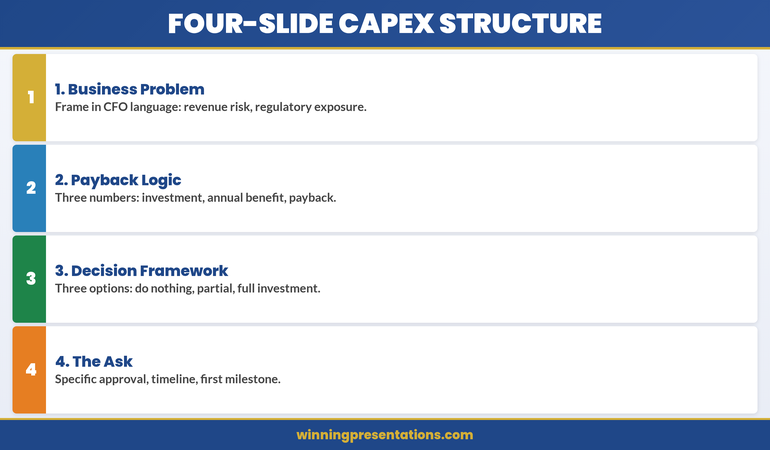
04 Apr 2026
Finance executive presenting a strategic cost reduction plan to the executive committee in a corporate setting, professional editorial photography

Cost Reduction Presentation: How to Frame Budget Cuts as Strategic Investment

A cost reduction presentation fails the moment the audience hears it as bad news. The executive who frames budget cuts as strategic reallocation—redirecting resources from diminishing returns to higher-yield investments—earns approval. The one who frames them as austerity earns resistance. Here is how to structure the slides that make savings feel like strategy.

Kwadwo had been asked to present a £3.2 million reduction to the operations budget at the quarterly executive committee meeting. His first draft opened with a waterfall chart showing where every pound would be removed—headcount, travel, external consultants, software licences. He rehearsed it on a Tuesday evening, and his wife—a former operations director herself—listened from the kitchen doorway. “You’ve just told twelve senior people that everything they built last year was wasteful. They’ll spend the entire meeting defending their budgets instead of approving yours.” He rewrote the presentation overnight. The new version opened with a single slide showing the three strategic priorities the CEO had announced in January, followed by a comparison: current spend allocation versus the allocation required to fund those priorities. The £3.2 million wasn’t a cut—it was a reallocation from activities that no longer served the stated strategy to investments that would accelerate it. The executive committee approved the plan in forty minutes. The original version would have triggered forty minutes of arguments.

Building a cost reduction deck for the executive committee? The Executive Slide System includes strategic reframing templates and decision frameworks for high-stakes finance presentations.

The Reallocation Frame: Why Language Determines Approval

The difference between a cost reduction presentation that earns swift approval and one that triggers prolonged debate is almost entirely a matter of framing. When you present cuts, every line item has a defender in the room. When you present reallocations, every line item has a strategic justification that the audience has already endorsed.

The reallocation frame works because it borrows authority from decisions the executive team has already made. If the CEO announced three strategic priorities at the start of the year, your savings plan should map directly to those priorities. The question shifts from “Why are you cutting my budget?” to “How does our current spend support the strategy we all agreed to?” The first question is personal and adversarial. The second is structural and collaborative.

Build your opening slide around a simple visual: two columns. The left column shows current spend by category. The right column shows the spend allocation required to fund the stated strategic priorities. The gap between the two is your savings target. This single slide does more persuasive work than any waterfall chart because it makes the cuts feel inevitable rather than arbitrary. The audience sees the misalignment and reaches the conclusion before you state it.

Avoid the trap of opening with the savings number. Leading with “We need to find £3.2 million in savings” puts the audience on the defensive immediately. Leading with “The board approved three strategic priorities in January—here’s what it costs to fund them, and here’s where we’re currently spending that money on activities that predate the strategy” creates alignment before the number appears. The savings figure should arrive as a logical consequence of strategic alignment, not as an opening demand.

Frame Your Cost Reduction as Strategic Reallocation

The Executive Slide System gives you reframing templates and decision frameworks—so your savings presentation earns approval instead of resistance.

  • ✓ Presentation templates for executive finance scenarios
  • ✓ AI prompt cards to build structured decks fast
  • ✓ Framework guides for high-stakes decision presentations

Get the Executive Slide System → £39

Designed for executives preparing high-stakes presentations

Connecting Every Saving to a Strategic Priority

The most common failure in cost reduction presentations is presenting savings by department or cost category. When you show a slide that reads “Marketing: -£400K / IT: -£600K / Operations: -£1.2M,” you’ve created three adversaries in the room. The marketing director, the CTO, and the COO are now calculating what they’ll lose, not what the organisation will gain.

The structural fix is to present savings by strategic priority, not by cost centre. Instead of “IT reduction: £600K,” present it as “Digital transformation acceleration: £600K redirected from legacy infrastructure maintenance to cloud migration.” The number is identical. The emotional response is entirely different. The CTO is no longer defending a cut—they’re participating in an investment.

For each savings line, build a three-column structure: the current spend being redirected, the strategic priority it now funds, and the expected return. This converts every line from a loss into an investment thesis. The executive committee is no longer approving cuts. They’re approving a portfolio rebalance. And portfolio rebalancing is the language of strategy, not austerity.

This approach also provides natural defence against the inevitable question: “Why this line item and not another?” When every saving is connected to a strategic priority, the answer is structural rather than political: “We redirected this spend because it was the clearest misalignment with the priorities the board approved in January.” This is a far stronger answer than “We chose this because it had the least operational impact,” which implies the decision was arbitrary and could have been made differently. For more on structuring restructuring presentations that maintain team trust, that guide covers the communication architecture for organisational change.

Strategic reallocation framework for cost reduction presentations showing current spend versus strategic priority alignment

Addressing the People Impact Without Losing the Room

If your cost reduction includes headcount changes, the room will be thinking about it from the moment you start speaking—regardless of which slide you put it on. Acknowledging the people impact early, directly, and with a clear plan is essential. Burying it in the appendix or saving it for Q&A signals avoidance, and avoidance destroys credibility in executive meetings.

The approach that works is to dedicate one slide—not more—to the people impact framework. State three things: the scope (how many roles are affected), the support plan (redeployment, retraining, enhanced severance), and the timeline (when affected individuals will be informed, by whom, and through what process). This slide should be factual, respectful, and brief. It is not the place for emotional language or corporate euphemisms. “We are reducing thirty-two roles across three departments” is direct and honest. “We are right-sizing our organisation to unlock strategic agility” is evasive and will irritate everyone in the room.

Position this slide after the strategic alignment section and before the implementation timeline. This placement matters. By the time the audience reaches the people impact slide, they’ve already accepted the strategic logic for the reallocation. The question is no longer “should we do this?” but “how do we do this responsibly?” That’s a much more constructive conversation.

If the cost reduction does not involve headcount changes, say so explicitly. A single line—“This reallocation programme does not affect any current roles”—removes the concern that has been lurking in every audience member’s mind since the meeting invitation landed. For guidance on the specific communication challenges when reductions do involve job losses, our guide to redundancy announcement presentations covers the full communication sequence from board approval to individual notifications.

The Implementation Timeline That Builds Confidence

Executive committees approve cost reductions more readily when they can see exactly how and when the savings will materialise. An implementation timeline that shows quarterly milestones—with specific savings targets at each stage—converts an abstract number into a credible delivery plan.

Structure the timeline in three phases. Phase one (months one to three): quick wins that demonstrate momentum. These are savings that require no structural change—contract renegotiations, discretionary spend freezes, duplicate licence elimination. Showing early results builds organisational confidence that the plan is achievable. Phase two (months four to six): structural changes that require planning and coordination—team reorganisations, process automation, vendor consolidation. Phase three (months seven to twelve): strategic investments that the savings fund—the initiatives that connect the cost reduction to the organisation’s growth agenda.

The three-phase structure is important because it tells a story of progression: from discipline to transformation to growth. The committee sees not just where money is being saved, but where it is going. This is the final piece of the reallocation frame. The cost reduction presentation doesn’t end with savings—it ends with investment. And investment is the language of leadership.

If you’re preparing a finance presentation that requires this kind of strategic reframing, the Executive Slide System includes the structural templates that ensure every slide advances the decision, not just the data.

Three-phase implementation timeline for cost reduction presentations showing quick wins, structural changes, and strategic investments

The Governance Slide: Tracking Savings Delivery

The final slide before Q&A should address the question every executive committee member is silently asking: “How will we know this is working?” Present a governance framework that specifies four elements: what will be measured, how often it will be reported, who owns the delivery, and what triggers escalation.

A simple tracking structure works best. Monthly reporting on savings realisation versus target, with a RAG status for each savings line. Quarterly reviews at the executive committee to assess whether the reallocation is achieving its strategic objectives—not just whether the number has been met. An escalation protocol that defines the threshold at which a shortfall triggers a revised plan rather than a request for more time.

This governance slide achieves two things. First, it demonstrates that you’ve thought beyond the approval—you’ve planned the delivery. Second, it gives the committee a reason to approve today rather than requesting further analysis. The governance framework provides the safety net that allows the committee to say yes without feeling they’ve relinquished oversight. In crisis communication contexts where the financial situation demands urgent board-level transparency, our guide to presenting a data breach to the board demonstrates similar governance framing under pressure.

Build a Cost Reduction Deck the Committee Approves Fast

Stop presenting cuts. Start presenting strategic reallocation. The Executive Slide System gives you the templates and frameworks to build savings presentations that earn approval—for £39.

Get the System Now → £39

Frequently Asked Questions

Should I present the total savings number on the first slide?

No. Leading with the savings number triggers defensive responses before you’ve established the strategic logic. Open instead with the strategic priorities the organisation has already approved, then show the misalignment between current spend and those priorities. The savings number should arrive as a natural consequence of strategic realignment—typically on the third or fourth slide. By that point, the audience has already accepted the rationale, and the number feels like a logical outcome rather than an arbitrary target.

How do I handle pushback from department heads whose budgets are being cut?

Anticipate it by engaging department heads individually before the presentation. Share the strategic framing privately and ask for their input on implementation—not on whether the cuts should happen. This converts potential adversaries into collaborators. In the meeting itself, if pushback occurs, redirect to the strategic alignment frame: “The question isn’t whether marketing should keep this budget. The question is whether this spend serves the priorities we all committed to in January.” This makes the challenge about strategy, not territory.

What if the cost reduction was mandated from above with no strategic framing?

Create the strategic frame yourself. Even a top-down directive to “reduce costs by fifteen percent” can be connected to organisational priorities. The CEO didn’t mandate the cut in a vacuum—there’s a revenue shortfall, a margin pressure, or a board directive driving it. Find that connection and build your presentation around it. If you can’t identify a strategic link, frame the savings as funding a specific initiative: “This reallocation creates the capacity to invest in [initiative] without requesting additional budget.” The committee will respond better to “we’re funding growth” than “we’re following orders.”

The Winning Edge

Weekly insights on executive presentations, slide strategy, and boardroom communication.

Subscribe Free

Preparing a savings proposal for the board? Download the Executive Slide System checklist for a quick framework to structure your cost reduction presentation.

If your cost reduction programme also involves presenting to external stakeholders or pitching for new vendor contracts, our guide to vendor selection presentations covers the deck architecture that wins final shortlist meetings.

About the author

Mary Beth Hazeldine, Owner & Managing Director, Winning Presentations. With 24 years of corporate banking experience at JPMorgan Chase, PwC, Royal Bank of Scotland, and Commerzbank, she advises executives across financial services, healthcare, technology, and government on structuring presentations for high-stakes funding rounds and approvals.
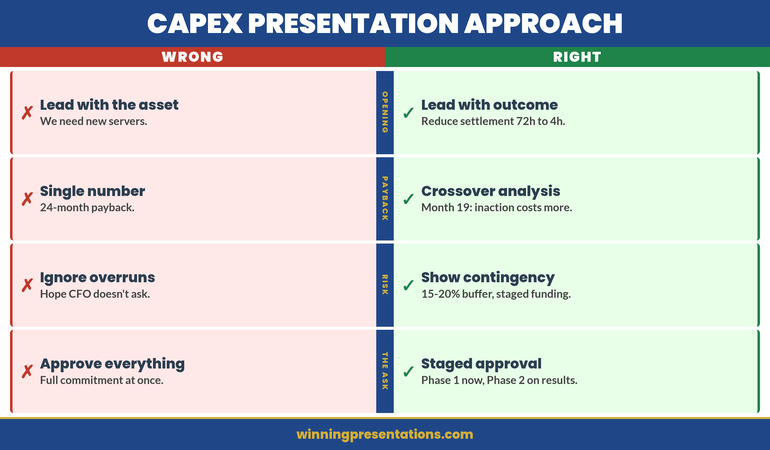
23 Mar 2026
Executive VP presenting annual budget to a leadership team in a modern boardroom, CFO visible as key listener, clean financial slide on screen behind them showing outcome-linked figures, confident and prepared demeanour

Annual Budget Presentation: The CFO-Approved Format That Secures Sign-Off Before Year End

Quick Answer

Annual budgets that secure CFO approval open with business outcomes, not financial figures. CFOs reject budget requests because they cannot see what the organisation gains—not because the numbers are wrong. A structured format reorders the presentation to lead with strategy, then moves to financial detail, risk mitigation, and alternatives considered. This structure is designed to give CFOs the information they need in the order they need it to evaluate the request.

Preparing your annual budget presentation now:

The 7-slide outcomes-first structure addresses how CFOs evaluate financial requests. If your budget has been rejected or required revision, the issue is likely structural, not financial.

Diane, VP of Operations at a UK logistics firm with 2,800 employees, had her annual budget request rejected twice. The first year, the CFO said the ask was “too high and not justified.” The second year, after she adjusted the figures downward by 12%, the response was the same: “Revise and resubmit.” Neither rejection was about the numbers. Her 31-slide presentation buried the strategic rationale—why the investment mattered to the organisation—in slide 22. The spreadsheets came first. The CFO couldn’t see what £6.8 million would do for the business.

In year three, Diane restructured to 7 slides. Slide 1: what the investment would enable for the supply chain network. Slide 2: how it aligned to the three-year strategic plan. Slide 3: the £6.8M ask and its breakdown. Slide 4: the assumptions behind the numbers. Slide 5: what would be at risk if the budget was cut. Slide 6: two alternatives she’d considered and rejected. Slide 7: the specific approval decision she needed. The CFO approved in the first review meeting. No revision requested. “You’ve done the hard thinking for me,” he said. Diane’s budget moved from year-long paralysis to execution within weeks.

Why Most Annual Budget Requests Get Rejected (Or Trapped in Revision Loops)

The conventional annual budget presentation is built backwards. It opens with financial summary tables, bar charts showing year-on-year growth, and category breakdowns. The logic seems sound: show the totals, show the detail, show the comparison, and the CFO will approve.

But that’s not how decision-makers process budget requests. A CFO who receives a 25-slide presentation opening with spreadsheet data doesn’t know whether you’re asking for £2 million or £20 million—or what the organisation gets in return—until slide 18. By then, they’re already thinking of questions, objections, and alternative scenarios. They loop back, ask for revisions, and the cycle repeats.

The core problem isn’t the budget amount. It’s the mental model. CFOs approve budgets when they understand three things in this order:

1. What does this money enable? Not what it costs. What does the organisation gain? What becomes possible? How does it move the needle on strategic priorities?

2. How does this connect to our stated strategy? Does it support the three-year plan? Does it address a known gap or bottleneck? Is it aligned to what we said we’d prioritise this year?

3. What assumptions underpin the request? CFOs approve confident asks, not uncertain ones. They need to see that you’ve pressure-tested the numbers, thought through the risks, and considered alternatives. That rigour signals competence and reduces their approval risk.

When a budget presentation skips these steps and leads with financial tables, the CFO is forced to work backwards—inferring the outcomes, checking alignment, and guessing at your assumptions. That creates friction, revision requests, and delays.

Budget Presentation Templates: 7-Slide Outcomes-First Format

The Executive Slide System includes templates for the 7-slide outcomes-first format used in budget presentations to CFOs and finance committees. Each slide is structured around how CFOs evaluate financial requests.

  • Outcomes and strategic alignment slide templates
  • Assumption and risk frameworks for supporting evidence
  • Decision-clarity slides for isolating the approval required
  • AI prompt cards for outcomes, alignment, and risk language

From £39 per licence

Explore the System

Based on experience with executive presentations in operations, finance, and capital allocation.

The 7-Slide Annual Budget Format: Outcomes First, Numbers Second

The framework that secures approvals follows a strict logic: establish outcomes and alignment before introducing financial asks. Each slide serves a specific decision-making purpose.

The 7-Slide Annual Budget Format: Card 1 Business Outcomes, Card 2 Strategic Alignment, Card 3 Numbers, Card 4 Assumptions, Card 5 Risks of Not Approving, Card 6 Alternatives Considered, Card 7 Decision Required

Notice the architecture: the first three slides build a narrative (outcomes → alignment → numbers). Slides 4–7 provide evidence and reduce decision risk. The CFO can now move through your logic without guesswork.

Slide 1: The Business Outcomes (Not the Cost)

Open with one clear statement of what the budget enables. Not what it costs. What becomes possible.

Wrong: “Annual Budget Request: £6.8M (Operations) + £2.3M (IT) + £1.4M (HR)”

Right: “This budget expands our logistics network capacity to process 40% more throughput without adding headcount, reducing per-unit delivery costs by 18% and unlocking the enterprise customer tier we’ve targeted in the three-year plan.”

The right version answers the CFO’s unconscious question: “What does this organisation gain?” Add one visual—a simple outcomes graphic, a network diagram, or a throughput chart—to reinforce the outcome. Then move on. This slide should take 90 seconds to present.

CFOs who see outcomes first are already mentally committed to exploring your ask. They know what they’re evaluating.

Slide 2: Strategic Alignment (Why Now? Why This?)

Now that the CFO knows what you’re asking for, connect it to the strategy. Show how the budget supports the published three-year plan, addresses a known strategic gap, or enables a stated corporate priority.

This slide removes guesswork. It says: “I’ve been paying attention to the organisation’s stated direction, and this budget is not a nice-to-have—it’s how we execute the strategy you’ve already approved.”

Use a simple visual: perhaps a 2×2 matrix showing the three strategic pillars and where your ask aligns, or a timeline showing when this investment is needed to hit strategic milestones. The text should be sparse—one or two sentences explaining the connection.

Alignment is a permission structure. It signals that your ask isn’t surprising or opportunistic; it’s the inevitable next step in executing a plan the board already endorsed.

Slide 3: The Numbers (Total Ask, Breakdown, Year-on-Year)

Now introduce the financial detail. By this point in your presentation, the CFO understands what you’re asking for and why it matters. The numbers are no longer a surprise; they’re the cost of delivering the outcomes you’ve already sold.

Keep this slide visual and simple. Use:

  • Total request at the top in large type. Don’t bury the number.
  • Category breakdown below (3–5 categories max). Operations, IT, People, Risk Mitigation, Innovation—whatever makes sense for your organisation.
  • Year-on-year comparison. Show variance as a percentage of total budget. If you’re asking for a 7% increase, say so explicitly. If this is a flat budget with reallocation, show that clearly.

Never lead with the numbers. Position them as supporting evidence for an already-established case.

Slides 4–7: The Proof (Assumptions, Risks, Alternatives, Decision)

Slide 4: The Assumptions Behind the Numbers

CFOs approve confident budgets. They want to see that you’ve thought through the drivers behind your ask. What labour market conditions underpin your hiring forecast? What supplier contract renegotiations support your savings projection? What customer growth assumptions justify the IT investment?

List 3–5 key assumptions. For each, show one piece of supporting data: a market report, an internal trend, a contract timeline. This isn’t a deep dive—it’s proof that you’ve done rigorous thinking, not guesswork.

Slide 5: What’s at Risk If We Don’t Approve (Or Cut) This Budget

This is perhaps the most important slide after outcomes. It answers: “What happens if we say no?” Spell it out clearly and specifically.

Don’t be vague (“We’ll fall behind competitors”). Be concrete: “If we don’t invest in supply chain automation this year, our order-to-delivery time will remain at 6 days while competitors move to 3. We’ll lose the high-volume enterprise contracts where margins are 40% higher. Estimated impact: £2.1M in forgone revenue over 18 months.”

Risk clarity is a stronger motivator than outcomes for many CFOs. It frames the budget not as optional spending but as necessary defence.

Slide 6: Alternatives You Considered (And Why You Rejected Them)

This signals that you haven’t just asked for one thing. You’ve pressure-tested your approach and chosen the best option. Show two alternative strategies and explain why they don’t work as well as your ask.

Example: “Alternative 1: Outsource logistics to a third party. This would be £200K cheaper but would reduce our network control and make enterprise customers nervous about data security. Rejected.” Or: “Alternative 2: Phase the investment over three years. This costs £800K more in eventual implementation but delays our competitive positioning. Rejected.”

Alternatives show maturity. They signal that your ask is the result of thoughtful analysis, not wishful thinking.

Slide 7: The Decision You’re Requesting

End with absolute clarity about what you need. Are you asking for full approval? Phased approval with specific milestones? Conditional approval pending board sign-off? A specific discussion topic or decision date?

Don’t end vaguely with “Please consider this and get back to me.” End with: “I’m seeking your approval to proceed with Phase 1 implementation (£2.1M) in Q2, with a review checkpoint before Phase 2 commitment in Q3.” Clarity removes friction. It tells the CFO exactly what decision is in front of them.

Budget Presentations Structured for CFO Review

The Executive Slide System provides outcome frameworks, assumption templates, and risk visualisation slides. Each is designed around the 7-slide format that addresses how CFOs evaluate financial requests.

See the Templates

The Confidence Gap: Why This Format Wins

Numbers-first presentations create uncertainty. A CFO sees a list of costs and asks: “Is this enough to solve the problem? What am I missing? Why should I trust these estimates?” These are revision triggers.

Outcomes-first presentations create confidence. The CFO sees your complete thinking: what you’re trying to accomplish, why it matters, what you’ve considered, and what’s at risk if you don’t proceed. Your rigour becomes visible. Your competence is proven by your assumptions, your risk awareness, and your realistic alternatives.

The 7-slide format compresses decision time from weeks to hours. Budget approvals that typically require 3–4 revisions move to single-meeting sign-off. CFOs who use this structure consistently report that it removes the guesswork from capital allocation.

Numbers-First vs Outcomes-First Budget Presentation Comparison: Numbers-First opens with totals, CFO asks what this buys, rejected for revision; Outcomes-First opens with business outcomes, CFO asks how soon can you start, approved in first meeting

Notice the difference: outcomes-first doesn’t just change the order of your slides. It changes how the CFO engages with your ask from the moment you begin.

Is This Approach Right For You?

Yes, if:

  • Your budget request has been rejected or asked for revision before
  • You’re asking for approval from a CFO or finance committee, not a single manager
  • Your ask is material enough that approval takes more than one meeting

Not as critical, if:

  • You’re requesting a routine departmental budget increase under 5% with no strategic change
  • Your CFO has already communicated approval in principle pending formal sign-off
22 Mar 2026
Executive presenting capital expenditure proposal to CFO in modern glass boardroom, confident posture, financial charts visible on presentation screen, navy blue and gold corporate setting

The Capital Expenditure Presentation: How to Make the CFO Your Ally, Not Your Gatekeeper

The CFO looked at slide 38 and said eleven words: “Why should I fund something you can’t explain in one slide?”

Quick Answer: A capital expenditure presentation fails when it leads with the asset and hopes the CFO sees the value. A strong CapEx presentation structure leads with the business outcome the expenditure unlocks, positions the CFO as a co-owner of the investment thesis, and frames the approval as a strategic decision rather than a spending decision. The difference is whether Finance feels like a checkpoint or a champion.

Already preparing a CapEx presentation for next week?

If your capital expenditure presentation is treating the CFO as a gatekeeper instead of a strategic partner, the slide structure is working against you. The Executive Slide System includes CapEx-specific templates designed to frame financial approval as a shared investment decision.

Explore the System →

The CapEx Request That Taught a VP a Costly Lesson

Kenji was the VP of Operations at a mid-sized logistics company. He’d built a solid business case for warehouse automation—a £2.3M investment that would reduce processing time by 40% and cut staffing needs by 18 positions over three years. He’d been careful. Three months of vendor evaluation. Detailed ROI analysis. Risk mitigation plan. He walked into the CFO’s office with a 35-slide presentation, confident the numbers would speak for themselves. The CFO watched him through the first four slides, then stopped him: “You haven’t told me why you’re here. Show me the business outcome first, then come back to the technical detail.” Kenji went back to his desk and restructured the deck. Business problem—first slide. Payback period—slide two. The CFO pre-read the new version, approved it in their next meeting, and told him: “I would have approved this the first time if you’d led with what we were solving, not what we were buying.”

Build the CapEx Presentation That Turns Your CFO Into Your Strongest Advocate

  • Deploy slide templates designed specifically for capital expenditure approvals—structured around the financial logic CFOs use to evaluate long-term investments
  • Use AI prompt cards that translate technical infrastructure needs into business outcome language Finance teams respond to
  • Build payback period slides that show the cost of delay, not just the cost of the investment
  • Include the decision-first slide framework that gets CFO alignment before the technical deep-dive

Explore the Executive Slide System →

Built from 24 years presenting capital expenditure cases in banking—where CapEx approvals required sign-off from Finance, Risk, and the board in the same meeting.

Reframing CapEx: From Spending Request to Strategic Investment

Most capital expenditure presentations open with the asset. “We need new servers.” “We need to upgrade the CRM.” “We need to replace the trading platform.” Every one of those sentences positions the CFO as a gatekeeper. You’re asking permission to spend money.

The reframe that changes the entire dynamic: open with what becomes possible after the investment. Not “we need new servers” but “we can reduce settlement processing from 72 hours to 4 hours, which eliminates the manual reconciliation that costs us £180k annually in labour and exposes us to regulatory risk every quarter.”

Now the CFO is evaluating a business outcome, not a purchase request. The conversation shifts from “can we afford this?” to “can we afford not to do this?”

This is not a language trick. It’s a structural decision about where your presentation starts. When your budget presentation leads with the business outcome, every subsequent slide—technical architecture, vendor selection, implementation timeline—becomes evidence supporting a decision the CFO already wants to make.

The Four-Slide CapEx Structure That CFOs Actually Approve

After watching capital expenditure presentations succeed and fail across four global financial institutions, I’ve identified a four-slide opening sequence that consistently gets CFO alignment before the technical detail begins.

Slide 1: The Business Problem Statement (Not the Technical Problem)
Frame the problem in language the CFO uses in their own presentations to the board. Revenue at risk. Regulatory exposure. Operational cost that scales with growth. Manual processes that prevent the team from working on higher-value activities. One slide. Two to three sentences. No technical jargon.

Slide 2: The Payback Logic
Not a full financial model—that goes in the appendix. Show three numbers: total investment, annual benefit, payback period. If the payback period is under 18 months, the CFO’s next question is about risk, not cost. If it’s over 24 months, you need a strategic justification on this same slide. Either way, the CFO now has the financial frame before seeing any technical detail.

Slide 3: The Decision Framework
Show the three options you evaluated and why you recommend this one. Not a vendor comparison—a decision comparison. Option A: do nothing (cost of status quo). Option B: partial upgrade (cost and limitations). Option C: full investment (cost and full benefit). The CFO sees that you’ve already done the analysis they would have asked for.

Slide 4: The Ask
State the specific approval you need, the timeline, and the first milestone. “We’re requesting £1.8M in CapEx for Q2 implementation, with first measurable benefit by Q3.” This is the slide where the CFO decides whether to keep listening or start asking questions. If you’ve structured slides one through three correctly, they keep listening.

Four-slide CapEx structure infographic showing Business Problem, Payback Logic, Decision Framework, and The Ask as sequential steps for CFO approval

Pre-Empting the Three CFO Objections That Kill CapEx Requests

Every CFO evaluating a capital expenditure request runs the same mental checklist. If your presentation doesn’t address these three objections before the CFO raises them, you’ve lost control of the conversation.

Objection 1: “What happens if the project overruns?”
CFOs have been burned before. Every CapEx request promises on-time delivery. Few deliver it. Your presentation needs a slide that acknowledges implementation risk honestly. Show your contingency budget (typically 15-20% of total). Show your milestone-based funding structure—if phase one doesn’t deliver the expected benefit, phase two funding is re-evaluated. This tells the CFO you’ve thought like a CFO, not like a project manager.

Objection 2: “Can we lease instead of buy?”
This is the CFO testing whether you understand the difference between CapEx and OpEx. If leasing is genuinely worse for this scenario, show why: higher total cost over the asset life, less control over upgrades, vendor dependency. If leasing is actually viable, acknowledge it—and show why ownership is better for this specific case. The worst answer is ignoring the question entirely.

Objection 3: “Why now? Can this wait until next fiscal year?”
This is the timing objection, and it kills more CapEx requests than budget constraints do. Your answer needs to be specific: what gets more expensive, more complex, or more risky if you delay twelve months? Quantify the cost of waiting. If the vendor’s pricing expires, say so. If a regulatory deadline makes this urgent, show the compliance timeline. If the team will lose capacity to competing projects in Q3, map it out.

If you address these three objections in your slides before the CFO raises them, something powerful happens: the CFO stops evaluating and starts advocating. They’ve seen that you understand their concerns. Now they’re helping you refine the proposal instead of challenging it.

Need to Present CapEx to Your CFO This Quarter?

Explore the slide templates designed to structure capital expenditure requests around the financial logic CFOs use to evaluate investments.

Explore the Templates →

The Payback Slide That Changes How Finance Sees Your Request

Most CapEx presentations show a payback period as a single number. “24-month payback.” The CFO nods, writes it down, and moves to the next proposal that has a shorter one.

The payback slide that actually changes the conversation shows three things simultaneously: the cost of the investment, the cost of not investing, and the crossover point where doing nothing becomes more expensive than doing something.

Here’s what that looks like in practice. Your current system costs £420k per year in maintenance, workarounds, and manual processing. That cost increases by 12% annually as the system ages and the team grows. The new system costs £1.2M to implement and £180k annually to maintain. The crossover point—where cumulative cost of the old system exceeds cumulative cost of the new system—is month 19.

Now the CFO isn’t evaluating whether to spend £1.2M. They’re evaluating whether to keep spending £420k (and rising) per year on a system that’s getting worse. The CapEx request becomes the financially responsible choice, not the expensive one. This is the difference between presenting to a CFO who sees you as a cost centre and a CFO who sees you as a strategic partner.

If you’re also presenting quarterly forecasts alongside your CapEx case, the forecast presentation structure that simplifies complex financial data works on the same principle: show the trajectory, not just the snapshot.

Comparison infographic showing wrong versus right approaches to CapEx presentation payback slides across four categories including cost framing and timeline presentation

Why Timing Your CapEx Presentation to Budget Cycles Matters More Than Content

You can build the perfect capital expenditure presentation and still get rejected if you present it at the wrong point in the budget cycle. CFOs think in cycles: annual planning, quarterly reviews, mid-year reforecasts. Each cycle has a different appetite for new expenditure.

The best window for CapEx approval is during annual planning (typically Q4 for the following year) when the CFO is actively allocating budget. The second-best window is immediately after a strong quarterly result, when there’s confidence in the financial outlook. The worst window is mid-quarter after a miss, when every new expenditure feels like a threat to the reforecast.

If you’re forced to present outside the ideal window, acknowledge it explicitly: “I know we’re mid-cycle, and I wouldn’t bring this outside planning season unless the timing risk justified it.” Then show why waiting for the next planning cycle costs more than approving now.

This is how experienced capital expenditure presenters operate. They don’t just build better slides—they time the conversation to match the CFO’s mental state about spending. The same proposal gets rejected in February and approved in October, not because the numbers changed, but because the context did.

Stop Losing CapEx Approvals to Structure Problems

  • Slide templates that lead with business outcomes and payback logic—so the CFO evaluates strategy, not just cost
  • AI prompt cards that help you frame capital expenditure in the language Finance teams use to justify investment to the board

Explore the Executive Slide System →

Designed for capital expenditure presentations where the CFO needed to see payback logic before technical detail—and approved the investment in the pre-meeting.

People Also Ask

How many slides should a capital expenditure presentation have?

For CFO-level CapEx approval: 8-12 slides in the main deck, with detailed financial models and technical specifications in an appendix. The first four slides determine whether the CFO keeps listening or starts challenging. Those four slides—business problem, payback logic, decision framework, and the ask—must stand alone as a complete argument.

What’s the difference between a CapEx presentation and a budget presentation?

A budget presentation allocates recurring operational spending. A CapEx presentation justifies a one-time investment in a long-term asset. The approval criteria are different: budget presentations focus on allocation efficiency, while CapEx presentations focus on payback period, asset life, and strategic value. CFOs evaluate them with different mental models, so the structure must be different.

Should I include vendor details in a capital expenditure presentation?

Include vendor selection rationale, not vendor detail. The CFO needs to know you evaluated options and made a defensible choice. They don’t need the vendor’s technical architecture diagram. Show the decision logic: why this vendor, what the alternatives were, and what the switching risk is. Keep vendor-specific detail in the appendix for IT stakeholders who need it.

Is This Approach Right for You?

This is for you if:

  • You’re presenting a capital expenditure request to a CFO or finance committee and need approval, not just acknowledgement
  • Your previous CapEx requests have been deferred or sent back for “more financial detail”
  • You’re a technical leader who needs to translate infrastructure investment into business language
  • Your organisation requires formal CapEx approval and you want to get it done in one meeting, not three

This is NOT for you if:

  • Your CapEx request is under £10k and follows a simplified approval process
  • You’re presenting to a technical committee only, with no Finance stakeholders in the room
  • Your organisation doesn’t distinguish between CapEx and OpEx approvals

Frequently Asked Questions

My CFO keeps asking me to “come back with more detail” on CapEx requests. What am I doing wrong?

“More detail” usually means “you haven’t answered my real question yet.” CFOs rarely want more data—they want more clarity on payback period, implementation risk, and what happens if the project fails. Check whether your presentation addresses the three standard CFO objections: overrun risk, lease vs. buy, and timing. If any of those are missing, that’s what “more detail” actually means.

Should I present CapEx separately or include it in my quarterly review?

Present it separately unless the CapEx request is directly tied to a quarterly result. Quarterly reviews have their own agenda and time pressure. A CapEx request buried in a quarterly review gets evaluated with less attention and often deferred to a dedicated session anyway. Request a standalone 20-minute slot with the CFO. It signals that you take the financial commitment seriously.

How do I handle a CapEx presentation when the CFO has already said no once?

Don’t re-present the same case. Identify what changed since the rejection: new data, new urgency, new risk, or new competitive pressure. Open with that change. “Last quarter you said no because the payback period was too long. Since then, our maintenance costs increased 23% and the vendor raised implementation pricing by 15%. Here’s the updated analysis.” The CFO needs to see that new information justifies a new decision, not that you’re simply asking again.

The Winning Edge — Weekly

Advanced presentation strategy and executive communication insights. One email. Every week. No fluff, no sales pitch—just the frameworks that get decisions approved.

Join The Winning Edge

Free resource: Executive Presentation Diagnostic Checklist

About the Author

Mary Beth Hazeldine is Owner & Managing Director of Winning Presentations. With 24 years of corporate banking experience at JPMorgan Chase, PwC, Royal Bank of Scotland, and Commerzbank, she advises executives across financial services, healthcare, technology, and government on structuring presentations for high-stakes funding rounds and approvals.

Book a discovery call | View services

17 Feb 2026
Split-screen of executive in boardroom — left side stressed with hand on forehead, right side composed and confident with glasses, warm golden lighting

I Audited a Real Q&A Disaster: 3 Answers That Killed a £2M Budget

The slides were good. The Q&A destroyed everything in four minutes.

Quick answer: A client sent me the recording of a budget approval meeting that went wrong. The presentation was solid — clear structure, clean slides, strong recommendation. Then three questions landed during Q&A, and all three answers made the same fundamental mistake: they defended instead of directing. I’ve broken down each answer below — the exact words used, what the panel heard, and the rewritten version that would have saved the decision. If you’ve ever walked out of a meeting thinking “the presentation went well but something went wrong at the end,” this audit will show you exactly what happened.

Last October, a senior programme manager I’d been coaching sent me a Teams recording with one message: “What happened?”

He’d presented a £2.1M infrastructure modernisation programme to the investment committee. Eight stakeholders. Forty-minute slot. He’d spent three weeks building the deck — and it was genuinely good. Clear problem statement, credible solution, phased implementation, realistic ROI projections. He delivered it with confidence. The room was engaged.

Then Q&A started. Three questions. Three answers. The committee chair said, “Let’s table this and reconvene when the team has had more time to think through the details.” The project was delayed five months. By the time he got back in the room, half the budget had been reallocated to a different initiative. I watched the recording three times. The problem wasn’t what he knew — it was how he answered.

The Setup: What Happened in the Room

Before I break down each answer, here’s what the panel was thinking. They’d just watched a competent 25-minute presentation. They understood the problem. They understood the proposed solution. They were leaning toward approval — I could see it in the body language. Nodding. Eye contact with each other. One member was already looking at the implementation timeline slide.

Then the committee chair asked the first question. And from that point, the energy in the room changed completely in under four minutes.

I’ve anonymised the details, but the question types, the answer structures, and the panel dynamics are exactly as they happened. These are the three most common Q&A failure patterns I see in executive presentation Q&A — and they’re all fixable.

Stop Losing Decisions in Q&A

The Executive Q&A Handling System gives you the preparation framework, response structures, and recovery scripts for the part of your presentation that actually decides outcomes. Question mapping templates, the 3-part executive response structure, and hostile question deflection techniques — built from real boardroom situations.

Get the Executive Q&A Handling System → £39

Instant download. Built from 24 years in corporate banking environments where Q&A was where every decision was actually made.

Answer #1: The Two-Minute Ramble (Cost Question)

The question:

“The implementation costs seem front-loaded. What’s driving that?”

What he said (before):

“Yeah, so the front-loading is because we need to procure the hardware in Q1 before the vendor pricing changes in April. And there’s also the licensing costs which are annual so they hit in year one. Plus we need to bring in two contractors for the migration phase because the internal team doesn’t have the capacity, and we looked at whether we could phase that differently but the dependencies mean the migration has to happen before we can start the optimisation workstream. We did model a scenario where we spread it over two years but the total cost actually increases by about 15% because of the vendor pricing changes and the contractor day rates going up. So it’s actually more cost-effective to front-load even though it looks like a bigger commitment upfront. I can share the detailed cost model if that would help.”

Duration: 1 minute 48 seconds.

What the panel heard:

Noise. They stopped listening after twenty seconds. The chair asked a simple “what’s driving the front-loading?” question — she wanted a headline, not a dissertation. By the time he got to the useful part (15% cheaper to front-load), the panel had already checked out. The “I can share the detailed cost model” at the end sounded like an admission that he hadn’t presented the full picture. It created doubt where none existed before.

What he should have said (after):

“Two things drive the front-loading: hardware procurement before April pricing changes, and annual licensing that hits in year one. We modelled a two-year spread — it costs 15% more. Front-loading is the cheaper option.”

Duration: 12 seconds.

Same information. One-tenth of the time. The panel gets the headline (it’s cheaper this way), the reason (two specific factors), and the proof (we modelled the alternative). No rambling. No defensive over-explaining. No invitation to question the completeness of his analysis.


Before and after comparison of cost question answer showing two-minute ramble versus twelve-second executive response with structure breakdown

PAA: Why do executives give long rambling answers in Q&A?
The instinct when challenged is to prove you know your material — so you give every detail, every caveat, every alternative you considered. This is the opposite of what senior decision-makers want. They asked a question to test whether you can identify what matters, not whether you can recite everything you know. Long answers signal that you can’t prioritise information under pressure — which is exactly the skill the panel is evaluating. The fix: answer the question in 15 seconds or fewer using the Headline → Reason → Proof structure, then stop talking.

Answer #2: The Defensive Pivot (Risk Question)

The question:

“What happens to the business if the migration takes longer than projected?”

What he said (before):

“I don’t think it will take longer than projected because we’ve built in a 20% buffer on each phase. And we’ve already done a proof of concept that validated the timeline. The vendor has also confirmed they can meet the delivery schedule. So I’m fairly confident in the projections we’ve presented.”

Duration: 28 seconds.

What the panel heard:

“I haven’t thought about what happens if I’m wrong.” The committee member asked what happens if — a contingency question. He answered why it won’t happen — a confidence statement. These are two completely different things. The question was testing his risk awareness. His answer demonstrated risk blindness. The panel exchanged a glance. I could see it on the recording. That glance said: “He doesn’t know what he doesn’t know.”

This is the most dangerous Q&A mistake I see in executive settings, and it’s the one I coach most frequently in the difficult questions framework. The question isn’t an attack — it’s an invitation to show you’ve thought about failure scenarios.

What he should have said (after):

“If the migration overruns, the main business impact is a 4-6 week delay to the optimisation phase. We mitigate that with a parallel workstream that keeps the existing system operational until cutover is complete. The 20% buffer on each phase is designed to absorb a typical overrun without triggering the contingency. But if we exceed the buffer, the fallback is to phase the migration by business unit rather than doing a full cutover — slower, but zero business disruption.”

Duration: 22 seconds.

This answer does four things the original didn’t: names the specific business impact (4-6 week delay), shows the primary mitigation (parallel workstream), acknowledges the buffer, and provides a concrete fallback plan. It says: “I’ve thought about what happens when things go wrong, and I have a plan.” That’s what the panel wanted to hear.

📋 The Q&A Handling System includes question mapping templates that help you predict exactly these questions before the meeting.

Plus the 3-part executive response structure so you never default to defensive rambling again.

Get the Executive Q&A Handling System → £39

Prepare the Answers Before the Questions Land

The Executive Q&A Handling System includes question mapping by stakeholder type, the Headline → Reason → Proof response framework, “I don’t know” recovery scripts, and hostile question deflection techniques. Stop improvising under pressure.

Get the Executive Q&A Handling System → £39

Instant download. Question mapping templates + response frameworks + recovery scripts. Built from 24 years in corporate banking environments.

Answer #3: The “I’ll Get Back to You” (Timeline Question)

The question:

“Can this be done in two phases instead of three?”

What he said (before):

“That’s a good question. I’d need to go back and look at the dependencies to see if we could compress the timeline. Let me come back to you on that.”

Duration: 8 seconds.

What the panel heard:

“I haven’t thought about alternative approaches to my own proposal.” This was the answer that killed the decision. Not because the question was hard — it was a perfectly reasonable question about phasing. But “I’ll get back to you” on a question about your own programme’s structure tells the committee you’re presenting a plan you haven’t stress-tested. If you can’t tell them whether your three phases could be compressed to two, you haven’t modelled the alternatives. And if you haven’t modelled the alternatives, how confident should they be in the plan you’re presenting?

The committee chair’s response — “Let’s table this and reconvene” — was the direct consequence. She needed to know the team had thought through the options. This answer told her they hadn’t. I’ve written about this pattern in the context of how Q&A failures lose deals — the “reconvene” is almost always permanent.

Before and after comparison of cost question answer showing two-minute ramble versus twelve-second executive response with structure breakdown

What he should have said (after):

“We looked at a two-phase model. It’s possible, but it compresses the migration and optimisation into a single phase, which increases the operational risk during cutover. Three phases keeps each phase focused on one objective: procure, migrate, optimise. My recommendation is three phases, but if the committee prefers a faster timeline, I can present the two-phase model with the risk trade-offs at our next session.”

Duration: 18 seconds.

This answer shows he considered the alternative, explains why he chose differently, names the specific trade-off (operational risk), maintains his recommendation, AND offers a concrete next step if the committee disagrees. It says: “I’ve thought about this. I have a view. And I’m flexible if you want to go a different direction.” That’s executive-level communication.

PAA: What do you do when you don’t know the answer in a presentation Q&A?
Never bluff, but never say just “I’ll get back to you” either. The recovery structure is: acknowledge what you do know, name the specific thing you need to verify, and commit to a concrete timeframe. For example: “The two-phase model is possible — I know the dependency structure supports it. What I’d need to confirm is the risk impact on the migration window. I can have that analysis to you by Thursday.” This shows competence (you know the landscape), honesty (you’re not guessing), and reliability (you’re committing to a deadline).

📋 The Q&A Handling System includes “I don’t know” recovery scripts for exactly these moments.

Plus hostile question deflection and the question mapping system that prevents most surprises from happening in the first place.

Get the Executive Q&A Handling System → £39

The Pattern: Why All 3 Answers Failed the Same Way

When I watched the recording the third time, the pattern was obvious. All three answers shared the same structural failure: he answered the question he was afraid of, not the question he was asked.

The cost question? He was afraid the panel thought the costs were too high. So he explained everything about costs. But the question was specifically about front-loading — not about the total amount.

The risk question? He was afraid the panel thought the timeline was unrealistic. So he defended the timeline. But the question was about contingency — not about whether the timeline was achievable.

The phasing question? He was afraid he’d look stupid if he didn’t have a perfect answer. So he said “I’ll get back to you.” But the question was about flexibility — not about perfection.

This is the single most common Q&A failure pattern in executive settings: the presenter hears the surface question, but responds to the emotional threat underneath it. And the answer to the emotional threat is always worse than the answer to the actual question — because it’s defensive, unfocused, and reveals anxiety rather than competence.

PAA: How do you prepare for tough questions in an executive presentation?
The most effective preparation method is Question Mapping: before the meeting, list the 5-10 most likely questions by stakeholder type and category (cost, risk, timeline, priorities, capability, credibility). For each question, write a 15-second answer using the Headline → Reason → Proof structure. Practise saying the answers out loud — not reading them, saying them. The goal is to build a mental index so that when the question lands, your brain retrieves a structured response rather than improvising under pressure.


The 15-second answer framework showing three steps: Headline in three seconds, Reason in five seconds, Proof in five seconds, then stop talking

The 15-Second Answer Framework

Every Q&A answer in an executive setting should follow the same structure:

Headline (3 seconds): State your answer in one sentence. “Front-loading is the cheaper option.” “The main business impact is a 4-6 week delay.” “We looked at two phases — three is lower risk.”

Reason (5 seconds): Give one or two specific reasons. Not five. Not a list. One or two concrete factors that support your headline.

Proof (5 seconds): One piece of evidence. A number, a comparison, a modelled scenario. Something concrete that closes the loop.

Then stop talking.

Fifteen seconds. If the panel wants more, they’ll ask a follow-up. If they don’t, you’ve answered cleanly and the meeting moves forward. The biggest mistake presenters make in Q&A isn’t giving wrong answers — it’s giving right answers that take too long to land.

Turn Q&A From Your Biggest Risk Into Your Strongest Asset

The Executive Q&A Handling System includes question mapping templates organised by stakeholder type, the Headline → Reason → Proof response framework, “I don’t know” recovery scripts, defensive-to-directive answer rewrites, and hostile question deflection techniques. Everything you need to walk into Q&A prepared.

Get the Executive Q&A Handling System → £39

Instant download. Built from 24 years in corporate banking and consulting environments where Q&A decided most major budgets, deals, and approvals.

Frequently Asked Questions

How much time should I spend preparing for Q&A versus preparing slides?

For high-stakes executive presentations, aim for a 50/50 split. If you spend three days on slides, spend three days on Q&A preparation. That means: mapping the likely questions by stakeholder, writing 15-second answers for each, and practising them out loud. Most presenters spend 90% on slides and 10% on Q&A — which is why Q&A is where most decisions fall apart. The slides are the easy part. You control the narrative. Q&A is where the panel tests whether your confidence comes from deep understanding or surface preparation.

What if the committee asks a question I genuinely haven’t thought about?

Use the recovery structure: acknowledge what you do know (“The two-phase model is possible — I know the dependency structure supports it”), name the specific gap (“What I’d need to confirm is the risk impact on the migration window”), and commit to a concrete deadline (“I can have that analysis to you by Thursday”). This shows competence, honesty, and reliability. What kills credibility is either bluffing (the panel can always tell) or a vague “I’ll get back to you” with no specifics and no timeframe.

Is it ever appropriate to push back on a question from a senior stakeholder?

Yes — if you do it by redirecting rather than resisting. “That’s an important consideration. The reason we chose three phases over two is [specific reason]. If the committee wants to explore the two-phase option, I can present the trade-offs at our next session.” This acknowledges their authority, restates your position with evidence, and offers a path forward. What doesn’t work: defending your position emotionally, dismissing the question, or capitulating immediately without explaining your reasoning.

📬 The Winning Edge Newsletter

Weekly strategies for executive presentations, Q&A preparation, and career-critical communication. No fluff.

Subscribe free →

Related: Q&A anxiety often has a physical dimension too. If your hands shake, your voice trembles, or your heart races before presenting, the preparation techniques in this article work alongside the physiological management strategies in severe hand shaking during presentations.

Three answers. Four minutes. A £2.1M budget that should have been approved. The slides were never the problem — the Q&A preparation was. Map your questions before the meeting. Write 15-second answers. Practise saying them out loud. And when the question lands, answer the question you were asked — not the one you’re afraid of.

📋 Get the question mapping templates + response frameworks + recovery scripts.

Get the Executive Q&A Handling System → £39

Optional bundle: If you present regularly and want slides, Q&A, confidence, storytelling, and delivery in one package — The Complete Presenter (£99) includes all seven Winning Presentations products plus three bundle-only bonuses.

About the Author

Mary Beth Hazeldine is the Owner & Managing Director of Winning Presentations. With 24 years of corporate banking experience at JPMorgan Chase, PwC, Royal Bank of Scotland, and Commerzbank, she spent most of those years in rooms where Q&A decided whether budgets got approved, deals got funded, and careers advanced.

She now helps executives prepare for the part of their presentation that actually determines outcomes — the questions that come after the slides.

Book a discovery call | View services

12 Feb 2026
Executive presenting headcount request to leadership team with approval indicators

The Headcount Request That Got Yes When Everyone Said No

“We’re in a hiring freeze. The answer is no.”

That’s what my client heard when she mentioned her headcount request to her CFO in the corridor. The company had just announced a 15% budget reduction. Every department was being told to do more with less. And Sarah needed 12 new engineers to deliver a project the CEO had personally championed.

Two weeks later, she got all 12 approved.

Not because she had special connections. Not because the freeze was lifted. But because her presentation made it impossible to say no — by making the cost of “no” crystal clear.

I’m sharing this now because headcount requests in 2026 face unprecedented scrutiny. AI is reshaping workforce planning, budgets are tight, and executives are asking harder questions about every hire. The old approach — “we need more people because we’re busy” — doesn’t work anymore. What works is a business case so compelling that approval becomes the obvious choice.

Quick answer: Successful headcount requests don’t ask for people — they present a business case for outcomes. The structure that works: lead with the business problem (not the resource gap), quantify the cost of inaction, present headcount as the solution to a problem leadership already cares about, and pre-answer the objections before they’re raised. This approach gets approval even during hiring freezes because it reframes the request from “cost” to “investment with measurable return.”

I’ve helped executives request headcount in every economic condition — boom times when money flowed freely, and downturns when every hire required CEO approval. The pattern is consistent: the requests that get approved aren’t the ones with the best justification. They’re the ones with the best presentation.

Sarah’s situation was typical. She had a genuine need — her team was working 60-hour weeks, attrition was climbing, and the CEO’s pet project was at risk. But her first draft presentation was also typical: a list of reasons why she needed more people, supported by workload data and burnout statistics.

It would have failed. Here’s why — and what we changed.

Why Most Headcount Requests Fail

The fundamental mistake in headcount presentations is starting with the resource gap. “We need 12 more engineers because…” immediately puts leadership in defence mode. They hear “cost” before they hear “value.”

The Psychology of No

When executives hear a headcount request, three mental processes activate simultaneously:

Budget protection: “Where will this money come from? What else won’t get funded?”

Precedent fear: “If I approve this, what other requests will follow?”

Accountability anxiety: “If this hire doesn’t work out, it’s my signature on the approval.”

Your presentation has to address all three — before they become objections.

The “Busy” Trap

The most common headcount justification is also the weakest: “We’re too busy.” Every department is busy. Every manager feels understaffed. “Busy” doesn’t differentiate your request — it makes you sound like everyone else who’s asking.

What executives actually need to hear: not that you’re busy, but that specific business outcomes are at risk without additional resources. That’s a completely different conversation.

🎯 Executive Slide System — Headcount Request Templates Included

Stop building headcount presentations from scratch. The Executive Slide System includes ready-to-use templates for resource requests, budget approvals, and business cases — all structured to get executive buy-in.

  • Business case structure that leads with outcomes
  • ROI calculation frameworks executives trust
  • Objection pre-answer templates
  • Decision slide formats that drive approval

Get the Executive Slide System → £39

Instant download. Used in headcount requests that have secured hundreds of new hires across banking and consulting environments.

The 5-Slide Structure That Gets Yes

Here’s the exact structure Sarah used to get 12 engineers approved during a hiring freeze:

Slide 1: The Business Problem (Not the Resource Gap)

Don’t open with “We need more people.” Open with the business problem that leadership already cares about.

Sarah’s opening: “Project Phoenix — the CEO’s priority initiative — is at risk of missing its Q3 deadline. Current trajectory shows a 67% probability of 8-week delay, which would push launch past the competitor window.”

Notice what’s not mentioned: headcount, engineers, workload, burnout. The first slide is entirely about business impact. Leadership is now thinking about Project Phoenix, not about budget.

Slide 2: The Cost of Inaction

Before you present your solution, make the cost of doing nothing undeniable.

Sarah’s slide: “An 8-week delay costs £2.4M in delayed revenue, puts the Series B timeline at risk, and allows CompetitorX to establish market position. Additionally, current team attrition trajectory suggests we lose 3 senior engineers in the next 90 days — each representing £180K in replacement and ramp-up costs.”

This slide does the heavy lifting. When the cost of inaction is £2.4M+, the cost of 12 engineers looks like a bargain.

Slide 3: The Solution (Now You Can Mention Headcount)

Only after establishing the problem and the cost of inaction do you present headcount as the solution.

Sarah’s framing: “To deliver Phoenix on schedule and protect the £2.4M revenue, we need to add 12 engineers over the next 6 weeks. This represents a £840K annual investment that protects £2.4M in near-term revenue and establishes the team capacity for the 2027 roadmap.”

The headcount request is now positioned as a solution to a problem leadership wants solved — not as a cost to be minimised.

Slide 4: The Risk Mitigation

Address the “what if it doesn’t work” fear before it’s voiced.

Sarah included:

  • Hiring timeline: Specific milestones with contingency plans
  • Ramp-up plan: How new hires become productive (with timeline)
  • Success metrics: How leadership will know the investment is working
  • Exit ramp: What happens if business conditions change

This slide removes the “what if” anxiety that kills approvals.

Slide 5: The Decision

End with a clear, specific ask — not a vague request for “support.”

Sarah’s close: “I’m requesting approval to open 12 engineering requisitions immediately, with a £840K annual budget allocation. This protects £2.4M in Phoenix revenue and positions us for the 2027 roadmap. I need your decision by Friday to maintain the hiring timeline.”

Clear ask. Clear timeline. Clear next step.


5-slide headcount request structure showing business case framework for approval

Want this structure as a ready-to-use template? The Executive Slide System includes the complete headcount request framework — plus decision slides, ROI calculators, and objection pre-answers.

Get the Templates → £39

Making the Numbers Undeniable

The difference between headcount requests that get approved and those that get “let’s revisit next quarter” often comes down to how the numbers are presented.

The ROI Frame

Never present headcount as a cost. Always present it as an investment with measurable return.

Weak: “12 engineers will cost £840K annually.”

Strong: “A £840K investment protects £2.4M in revenue and enables £4.2M in 2027 roadmap delivery. ROI: 7.9x in year one.”

The numbers are the same. The frame is completely different.

The Comparison Anchor

Give leadership a reference point that makes your request seem reasonable.

Sarah’s anchor: “The cost of 12 engineers (£840K) is less than the cost of the 8-week delay (£2.4M), less than the cost of losing 3 senior engineers to attrition (£540K in replacement costs), and less than the consulting alternative (£1.2M for equivalent capacity).”

When you anchor against worse alternatives, your request becomes the sensible middle ground.

The Staged Approach

If your full request feels too large, offer a staged alternative that gets you started.

Sarah’s backup: “If 12 immediate hires isn’t possible, a phased approach of 6 now and 6 in Q2 still protects the Phoenix timeline, though with reduced margin for error.”

This shows flexibility while maintaining the business case. Leadership often approves the full request when they see you’ve thought through alternatives.

📊 Build Business Cases That Get Approved

The Executive Slide System gives you the frameworks for any approval presentation — headcount, budget, project investment, or strategic initiative. Stop guessing what executives want to see.

  • Cost-of-inaction calculation templates
  • ROI presentation frameworks
  • Risk mitigation slide structures
  • Decision slide formats that drive action

Get the Executive Slide System → £39

Instant download. Developed from 24 years of corporate banking presentations where every resource request faced intense scrutiny.

Pre-Answering the Objections

The best headcount presentations answer objections before they’re raised. Here are the five you’ll face — and how to address them in your slides:

Objection 1: “Can’t you do more with AI/automation?”

Pre-answer: Include a slide on what you’ve already automated and why the remaining work requires human judgment. “We’ve automated 40% of routine tasks. The remaining work — architecture decisions, client relationships, complex problem-solving — requires experienced engineers.”

Objection 2: “What about contractors instead of FTEs?”

Pre-answer: Show the total cost comparison including ramp-up time, knowledge retention, and long-term flexibility. Contractors often cost more when you factor in everything.

Objection 3: “Can you reprioritise instead?”

Pre-answer: Show what gets cut if you don’t add headcount — and the business impact of those cuts. Make leadership choose between options, not between “yes” and “no.”

Objection 4: “What if the project gets cancelled?”

Pre-answer: Show how the roles support multiple initiatives, not just one project. “These 12 engineers support Phoenix, but also provide capacity for the 2027 roadmap and reduce our single-point-of-failure risk on critical systems.”

Objection 5: “Why now? Can’t it wait?”

Pre-answer: Show the cost of delay. “Every month we wait adds £300K to the eventual cost (higher salaries in a tighter market, extended project timeline, continued attrition of current team).”

Handling the Tough Q&A

Even with perfect slides, headcount requests face intense questioning. Here’s how to handle the moments that determine approval:

When They Challenge Your Numbers

Don’t get defensive. Show your work.

“The £2.4M delay cost comes from three factors: £1.8M in delayed subscription revenue based on current pipeline, £400K in additional contractor costs to extend the bridge period, and £200K in opportunity cost from the sales team’s reduced confidence in our delivery timeline. I can walk through each calculation.”

When They Ask for Less

Don’t immediately agree. Show the trade-offs.

“I can work with 8 instead of 12, but I want to be transparent about what that means: we move from 95% confidence on the Q3 deadline to about 70%, and we lose the buffer for the inevitable surprises. If 8 is the decision, I’ll make it work — but I want leadership to understand the risk we’re accepting.”

When They Want to Delay the Decision

Make the cost of delay concrete.

“I understand the desire for more time. But every week we delay the hiring process adds roughly 2 weeks to the project timeline, because good candidates don’t stay on the market. If we decide Friday, we can still hit Q3. If we wait until end of month, Q3 becomes unlikely.”

Facing tough Q&A on your headcount request? The Executive Q&A Handling System gives you frameworks for handling challenges, pushback, and curveball questions with confidence.

Get the Q&A System → £39

What Happened to Sarah

Sarah presented to the CFO, COO, and CEO on a Thursday morning. The same CFO who had said “the answer is no” in the corridor.

The presentation took 12 minutes. The Q&A took 20. Most of the questions were about implementation details — a sign that approval was likely.

By Friday afternoon, she had written approval for all 12 positions.

The CFO told her afterwards: “I’ve seen a hundred headcount requests this year. Yours was the only one that made me feel like saying no would cost us money.”

That’s the reframe that changes everything. Not “please give me resources” but “here’s what you lose if you don’t.”

🎯 Get Your Headcount Approved

The Executive Slide System includes everything you need to build a headcount presentation that gets yes:

  • Business case templates: Lead with outcomes, not resource gaps
  • Cost-of-inaction frameworks: Make “no” more expensive than “yes”
  • ROI calculators: Present investment, not cost
  • Objection pre-answers: Address concerns before they’re raised
  • Decision slides: Clear asks that drive approval

Get the Executive Slide System → £39

Instant download. The same frameworks used in headcount requests that have secured hundreds of new hires — even during hiring freezes.

📬 PS: Weekly strategies for executive presentations and getting buy-in. Subscribe to The Winning Edge — practical techniques from 24 years in corporate boardrooms.

Frequently Asked Questions

What if my company has a strict hiring freeze with no exceptions?

Even “no exceptions” freezes have exceptions — they just require CEO-level approval and an exceptional business case. Use the cost-of-inaction framework to show that the freeze is costing more than the hire. If the numbers are compelling enough, freezes get unfrozen. If they’re not, at least you’ve positioned yourself for first approval when the freeze lifts.

How do I request headcount when I can’t quantify the revenue impact?

Focus on risk and cost avoidance instead of revenue. “Without this hire, we have single-point-of-failure risk on a critical system” or “Current overtime costs are £X per month and climbing” or “Attrition risk in the current team represents £Y in replacement costs.” Not everything ties to revenue, but everything ties to something leadership cares about.

Should I ask for more than I need, expecting to be negotiated down?

No. Ask for exactly what you need with clear justification. Padding your request damages credibility and invites the “let’s cut this by 30%” response. If you need 12, ask for 12 and show why 12 is the right number. You can offer a phased alternative, but don’t inflate the initial ask.

How long should a headcount presentation be?

Five to seven slides maximum for the core presentation. You can have backup slides for detailed questions, but the main narrative should be completable in 10-15 minutes. Executives make headcount decisions quickly when the business case is clear — long presentations signal unclear thinking.

Related: If past presentation failures are affecting your confidence in high-stakes requests like headcount approvals, read Presentation PTSD Is Real: Signs You’re Still Carrying an Old Failure for techniques to break the pattern.

Sarah’s CFO was right about one thing: during a hiring freeze, the default answer is no.

But defaults can be overridden — when the cost of “no” is higher than the cost of “yes.”

Your headcount request isn’t about getting resources. It’s about presenting a business case so compelling that approval becomes the obvious choice.

Lead with the problem. Quantify the cost of inaction. Position headcount as the solution. Pre-answer the objections. Ask for a clear decision.

That’s how you get yes when everyone else is hearing no.

About the Author

Mary Beth Hazeldine is the Owner & Managing Director of Winning Presentations. With 24 years in corporate banking at JPMorgan Chase, PwC, Royal Bank of Scotland, and Commerzbank, she has supported hundreds of resource requests, budget approvals, and headcount presentations in high-scrutiny environments.

A certified hypnotherapist and NLP practitioner, Mary Beth combines executive communication expertise with an understanding of the psychology behind approval decisions. She helps professionals build business cases that get yes — even when the default answer is no.

Book a discovery call | View services