

Severe Hand Shaking During Presentations: What’s Actually Happening (And What Works)
She was holding a single sheet of A4 paper. The entire room could see it vibrating.
Quick answer: Severe hand shaking during presentations — the kind where you can’t hold a clicker, turn a page, or point at a slide without the whole room noticing — is not ordinary nervousness. It’s a full sympathetic nervous system overload: your body has flooded with adrenaline and your fine motor control has been temporarily disabled. The standard advice to “just relax” or “breathe deeply” doesn’t work at this severity level because the shaking is happening below conscious control. What does work is a three-part protocol that targets the physiological chain: cool the hands (vasoconstriction reset), engage the large muscles (burn off the adrenaline), and switch to gross motor actions (eliminate tasks requiring fine motor control). This article covers each step.
Jump to:
I know what severe hand shaking feels like because I lived it for five years. Not a mild tremor that nobody notices. The kind where I couldn’t hold my notes without the paper rattling against the microphone. The kind where I pressed my hands flat on the table to hide it and prayed nobody asked me to point at anything on a slide.
At Commerzbank, I once had to present a credit risk analysis to a room of twenty senior bankers. By slide three my hands were shaking so visibly that I put the clicker down on the table and started advancing slides by reaching over and pressing the laptop keyboard. I told myself it was a “style choice.” Everyone in the room knew it wasn’t. That moment — the shame of it — is what eventually drove me to train as a clinical hypnotherapist and solve this problem properly.
Why Severe Shaking Is Different From Normal Nerves
Most people experience some level of nervous energy before presenting. Mild hand tremor, slightly elevated heart rate, a bit of restlessness. That’s your sympathetic nervous system preparing you for performance — it’s functional and it usually settles within the first thirty seconds of speaking.
Severe shaking is a different physiological event. When your body perceives the presentation as a genuine threat — not a performance opportunity but a survival situation — it triggers a full fight-or-flight response. Adrenaline floods your bloodstream. Blood is redirected from your extremities (hands, fingers) to your large muscles (legs, core). Your fine motor control shuts down because your body is preparing to run or fight, not to hold a clicker or turn a page.
This is why the shaking feels uncontrollable — because it is. You cannot consciously override a sympathetic nervous system response with willpower. Telling yourself to “stop shaking” is like telling yourself to stop sweating. The instruction goes to the wrong part of your brain. The shaking is being controlled by your autonomic nervous system, which doesn’t take orders from your conscious mind.
The key insight: you can’t stop severe shaking by thinking about it. You stop it by changing the physiological conditions that caused it. That’s what the protocol below does — it targets the body, not the mind. If you’re experiencing other nervous system responses to presentation trauma, the same principle applies: address the physiology first.
PAA: Why do my hands shake so badly when presenting?
Severe hand shaking during presentations is caused by a full sympathetic nervous system activation — a fight-or-flight response that floods your body with adrenaline and redirects blood away from your extremities. Your fine motor control shuts down because your body is preparing for physical action, not precise hand movements. This is different from mild nervousness and cannot be controlled through willpower alone. Effective management requires targeting the physiological chain: cooling the hands, engaging large muscles to burn off adrenaline, and eliminating tasks that require fine motor control during the presentation.
Get the Physical Symptoms Under Control — Before Your Next Presentation
Calm Under Pressure is a programme designed specifically for the physical symptoms of presentation anxiety — hand shaking, racing heart, shallow breathing, nausea. It works on the nervous system directly, not just the mindset. Created by a qualified clinical hypnotherapist who spent five years dealing with severe presentation shaking firsthand.
Get Calm Under Pressure → £19.99
Instant download. Techniques you can use the night before or morning of any presentation. Built from clinical hypnotherapy training + personal experience with severe presentation anxiety.
The 3-Step Protocol (Before You Present)
This protocol works best when applied 10–20 minutes before you’re due to present. It targets the three physiological mechanisms that cause severe shaking. (This is educational, not medical advice. If your hands shake outside of presentation situations — at rest, during meals, or in daily tasks — consult a clinician to rule out other causes.)
Step 1: Cool the hands (2 minutes). Run your wrists and the backs of your hands under cold water for 60–90 seconds. If no sink is available, hold a cold drink can or a bottle of cold water against your inner wrists. This triggers a vasoconstriction response — your blood vessels narrow slightly, reducing the tremor amplitude. It also activates your mammalian dive reflex, which nudges your nervous system toward parasympathetic (calming) mode. This is not a placebo effect — it’s a recognised physiological response that many professionals find effective.
Step 2: Engage the large muscles (3 minutes). Find somewhere private — a toilet cubicle, a stairwell, an empty corridor. Do wall push-ups (15–20), or press your palms together as hard as you can for 10-second holds (repeat 5 times), or squeeze your thighs by sitting and pressing your knees together hard. The goal is to burn off the excess adrenaline that’s causing the tremor. Adrenaline was designed to fuel large muscle action. When you give it large muscles to work with, the surplus gets metabolised and the fine motor tremor reduces. This is the single most effective intervention for severe shaking.
Step 3: Slow exhale breathing (2 minutes). Breathe in for 4 counts. Breathe out for 8 counts. Repeat 6 times. The extended exhale activates the vagus nerve, which is the main brake pedal on your sympathetic nervous system. Standard “deep breathing” advice (breathe in deeply!) actually makes anxiety worse because it over-oxygenates your blood. The key is the long exhale, not the deep inhale. Four in, eight out. Six rounds. That’s all.
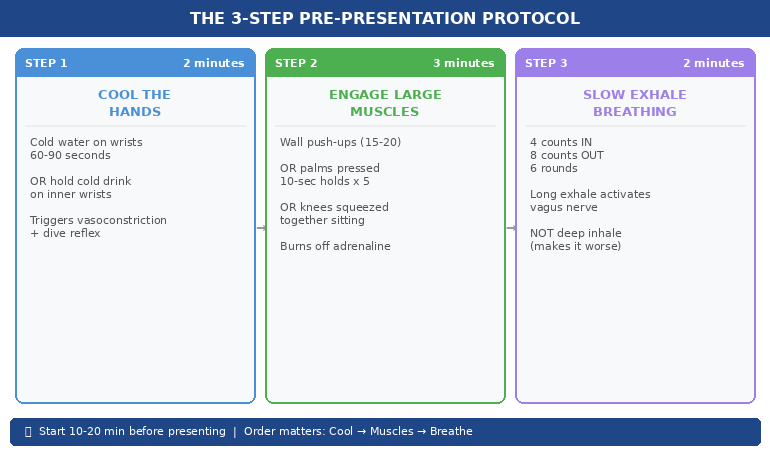
The order matters. Cool first (reduce blood flow to trembling extremities), muscle engagement second (burn off adrenaline), breathing third (activate the calming brake). If you skip to breathing without doing steps 1 and 2, the adrenaline is still circulating and the breathing alone won’t be enough for severe shaking.
For milder shaking, the 30-second nervous system reset may be sufficient. But if your shaking is severe enough that you can’t hold a clicker or turn a page, you need the full three-step protocol.
🎧 Want a guided version of this protocol you can use before any presentation?
Calm Under Pressure is an programme that walks you through the nervous system reset — designed for severe physical symptoms, not just general nerves.
What to Do If You’re Already Shaking Mid-Presentation
Sometimes the shaking starts after you’ve begun presenting. You’re two slides in, you reach for your water glass, and you see your hand trembling. Panic compounds the problem — the awareness of shaking triggers more adrenaline, which triggers more shaking. Here’s how to interrupt the cycle:
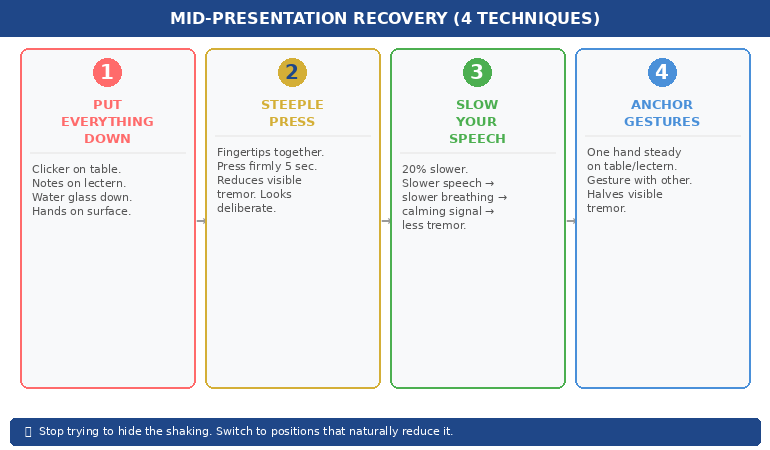
Put everything down. Clicker on the table. Notes on the lectern. Water glass back down. Don’t try to hold anything while your hands are shaking — it makes the tremor more visible, not less. Resting your hands on the table or the sides of the lectern is completely natural and nobody will question it.
Press your fingertips together. Bring both hands together in front of you with fingertips touching (like a steeple). Press firmly for 5 seconds. This engages the small muscles in your hands isometrically, which temporarily reduces the visible tremor. It also looks deliberate and thoughtful — nobody reads steepled hands as nervousness.
Speak more slowly. When adrenaline surges, your speech speeds up, which speeds up your breathing, which increases the shaking. Deliberately slowing your speech by 20% creates a feedback loop in the opposite direction: slower speech → slower breathing → calming signal to the nervous system → reduced tremor. You will feel like you’re speaking absurdly slowly. You’re not. You’re speaking at normal pace for the first time.
Use anchor gestures. Instead of pointing at slides (which requires fine motor precision and makes tremor visible), use broad palm-up gestures or hold one hand steady on the table while gesturing with the other. Anchor one hand and free the other. This halves the visible tremor and gives your body a stable reference point.
PAA: How do I stop my hands shaking during a presentation?
If you’re already shaking mid-presentation, put everything down (clicker, notes, water), press your fingertips together in a steeple for 5 seconds (isometric engagement reduces visible tremor), slow your speech by 20% (creates a calming feedback loop), and use anchor gestures (one hand steady on the table, gesture with the other). The key is to stop trying to hide the shaking — which makes it worse — and instead switch to positions and movements that naturally reduce it.
The Night-Before Reset That Changes the Morning After
Calm Under Pressure is designed to be used the evening before or morning of a presentation. The technique works directly on the nervous system responses that cause severe shaking, racing heart, and shallow breathing — so you walk into the room with your physiology already calmer.
Get Calm Under Pressure → £19.99
Instant download. Programme built from clinical hypnotherapy training. Designed specifically for physical presentation symptoms at the severe end.
The Equipment Strategy (Eliminate the Evidence)
One of the smartest things you can do for severe hand shaking is eliminate every situation where the shaking becomes visible. This isn’t avoidance — it’s tactical presentation design:
Ditch the clicker. Use a wireless keyboard shortcut to advance slides (press the right arrow key on a laptop at the table), or ask a colleague to advance slides for you. Saying “next slide, please” is completely normal in corporate settings. Nobody questions it. And you’ve just eliminated the single biggest tremor-revealing object.
Never hold paper. If you need notes, put them flat on the table or the lectern. A vibrating sheet of paper amplifies hand tremor by a factor of ten — it’s the most visible possible evidence of shaking. Flat notes on a surface are completely invisible.
Use a heavy water glass. If you need water during the presentation, choose the heaviest glass available. A lightweight plastic cup trembles visibly. A heavy glass tumbler dampens the tremor. Better yet, take a sip before you start and don’t touch the glass during the presentation.
Stand behind something. A lectern, a table edge, a standing desk. Not to hide — but to give your hands a natural resting place. Hands resting on a surface don’t shake visibly. Hands hanging at your sides or holding objects do. Choose your position strategically.
🎧 Address the root cause — not just the tactics.
Calm Under Pressure works on the nervous system directly so the shaking is less severe before it starts. Equipment strategies help in the moment. The programme helps long-term.
The Long-Term Fix (Rewiring the Response)
The protocol and equipment strategies manage the symptom. The long-term fix addresses the cause: your nervous system has learned to classify “presenting” as a threat, and it needs to be retrained to classify it as safe.
This is not about positive thinking or affirmations. It’s about systematic desensitisation — gradually exposing your nervous system to the presentation stimulus while keeping your body in a calm state, so your brain learns a new association: presenting = safe.
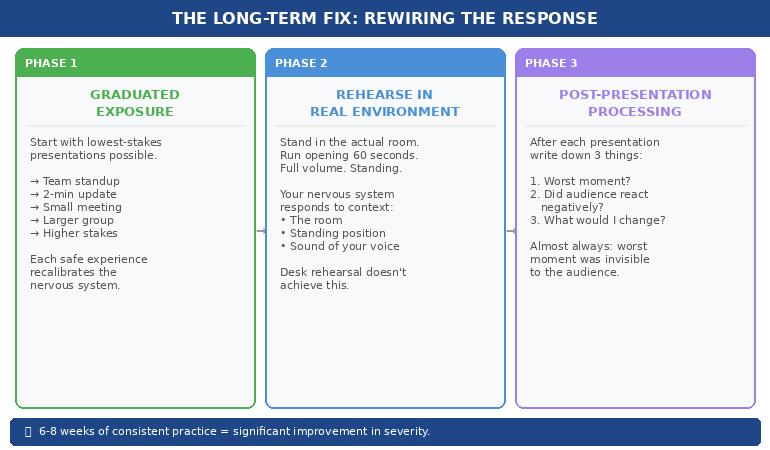
Graduated exposure. Start with the lowest-stakes presentation you can find. A team standup. A 2-minute update in a small meeting. Present something low-risk to people who don’t evaluate you. Then increase the stakes gradually — slightly larger group, slightly more important topic, slightly higher scrutiny. Each time your nervous system experiences “presenting” without a threat materialising, it recalibrates. This is the same principle used in clinical treatment of phobias.
Pre-presentation rehearsal. Stand in the actual room where you’ll present, if possible. Run through your opening sixty seconds — out loud, at full volume, standing in the position you’ll use. Your nervous system responds to environmental cues (the room, the standing position, the sound of your own voice). Rehearsing in the real environment teaches your body that this specific context is safe. Rehearsing at your desk with notes doesn’t achieve this.
Post-presentation processing. After each presentation, write down three things: (1) What was the worst moment? (2) Did the audience actually react negatively? (3) What would I do differently? This creates a feedback loop that corrects your nervous system’s threat assessment. Almost always, the worst moment was invisible to the audience, they didn’t react negatively, and the “evidence” of failure exists only in your own perception.
If you’ve experienced a full panic attack before presenting, the graduated exposure approach is especially important — start smaller than you think necessary, and build up more slowly than feels logical.
PAA: Can you permanently fix hand shaking when presenting?
Yes, but it requires retraining your nervous system, not just managing the symptoms. The approach combines graduated exposure (starting with low-stakes presentations and building up), rehearsal in the actual presentation environment, and post-presentation processing to correct your brain’s threat assessment. Clinical techniques like hypnotherapy and systematic desensitisation can accelerate this process. Most people see significant improvement within 6–8 weeks of consistent practice — the shaking doesn’t disappear overnight, but it reduces progressively as your nervous system learns that presenting is safe.
Start Rewiring Your Nervous System Before Your Next Presentation
Calm Under Pressure combines clinical hypnotherapy techniques with practical nervous system management — designed specifically for the physical symptoms that standard presentation coaching doesn’t address. Use it the night before. Walk in calmer.
Get Calm Under Pressure → £19.99
Instant download. Built from clinical hypnotherapy training + five years of personal experience with severe presentation anxiety. Designed for the physical end of the spectrum.
Frequently Asked Questions
Should I tell the audience my hands are shaking?
Generally no. Drawing attention to the shaking amplifies your awareness of it (which triggers more adrenaline, which increases the shaking). Most audiences either don’t notice or don’t care — they’re focused on your content, not your hands. The exception: if the shaking is so severe that ignoring it feels absurd, a brief, confident acknowledgement can actually reduce the pressure. “I’ve got a bit of adrenaline going — let me set this down” is honest and human. Then move on immediately. Don’t dwell on it.
Could the shaking be a medical condition rather than anxiety?
If your hands shake in situations other than presenting — at rest, while eating, during normal daily tasks — it’s worth consulting a doctor to rule out essential tremor, thyroid issues, or other medical causes. Anxiety-related presentation shaking is situation-specific: it happens before and during presentations and stops afterwards. If the shaking persists outside of high-pressure situations, seek medical advice before assuming it’s anxiety-related.
Does beta-blocker medication help with presentation shaking?
Beta-blockers (such as propranolol) are sometimes prescribed for performance anxiety and can reduce the physical symptoms including hand tremor. They work by blocking the effects of adrenaline on your heart and muscles. However, they require a prescription, they affect everyone differently, and they address the symptom without changing the underlying nervous system response. If you’re considering medication, discuss it with your GP. The techniques in this article can be used alongside medication or as an alternative — they’re not mutually exclusive.
How long before a presentation should I start the protocol?
The three-step protocol (cool, muscle engagement, breathing) works best 10–20 minutes before you’re due to present. Starting too early means the effects wear off. Starting too late means you don’t have time for all three steps. If you only have 5 minutes, prioritise step 2 (muscle engagement) — it’s the single most effective intervention for burning off adrenaline. If you only have 2 minutes, do the extended exhale breathing (4 in, 8 out, 6 rounds).
📬 The Winning Edge Newsletter
Weekly strategies for presentation confidence, nervous system management, and career-critical communication. No fluff.
Optional next step: Start with Calm Under Pressure for the physical symptoms. If your presentation anxiety goes beyond the body — if you avoid presentations entirely, procrastinate on preparation, or experience dread days before presenting — Conquer Speaking Fear (£39) addresses the psychological root causes alongside the physical management.
Related: Physical symptoms are one side of the coin. If you’re also preparing for a high-stakes presentation like a job interview presentation, getting the structure right reduces anxiety — because when you know your material is well-organised, your nervous system has less reason to panic.
Severe hand shaking during presentations is a physiological event, not a character flaw. Cool the hands. Engage the large muscles. Breathe on the exhale. Design your equipment to eliminate evidence. And start the long-term work of teaching your nervous system that presenting is safe. The shaking will reduce. It did for me.
🎧 Start with the nervous system reset — use it before your next presentation.
Optional bundle: Calm Under Pressure handles the physical symptoms. But if you also want the slide structure, Q&A preparation, and psychological confidence framework alongside it — The Complete Presenter (£99) includes all seven Winning Presentations products plus three bundle-only bonuses. Everything you need to walk in prepared and stay calm through to the last question.
About the Author
Mary Beth Hazeldine is the Owner & Managing Director of Winning Presentations. With 24 years of corporate banking experience at JPMorgan Chase, PwC, Royal Bank of Scotland, and Commerzbank, she spent five of those years dealing with severe presentation anxiety — including the hand shaking, racing heart, and avoidance that come with it.
She trained as a clinical hypnotherapist and NLP practitioner specifically to solve the problem, and now helps executives manage the physical and psychological dimensions of presentation anxiety so they can present with confidence when it matters most.