Tag: presentation fear

21 Mar 2026
Executive watching a presentation from the audience with visible tension while a confident speaker presents on stage in a corporate conference setting

The Comparison Trap: Why Watching Great Speakers Makes Your Anxiety Worse (Not Better)

You watch a TED talk to calm your nerves before your board presentation. Instead of feeling inspired, you feel crushing inadequacy. That’s not weakness—it’s a predictable anxiety pattern. And it gets worse the more “great speakers” you study.

Quick Answer

Watching skilled speakers when you’re already anxious doesn’t motivate—it triggers comparison and reinforces the belief that you’re not good enough. Your nervous system reads it as evidence you can’t measure up, not inspiration to improve. Breaking the pattern requires understanding what anxiety actually does to your brain, then rewiring how you relate to your own speaking challenges.

Does This Sound Like You?

  • You watch a polished TED talk and feel worse about your own presentation skills
  • You study “great speakers” hoping to feel more confident—but feel more anxious instead
  • You compare every moment of your delivery to speakers who have years of practice (but you only notice their polish, not their process)
  • The more “speaker content” you consume, the more self-doubt creeps in
  • You spiral into “I could never do that” thinking before major presentations
The CFO Who Couldn’t Breathe During Board AnnouncementsTomás had been with the company for seven years. By every measure, he was a competent financial leader. But the moment he stepped into the boardroom to present quarterly results, something shifted. His chest would tighten. His breathing would shallow. His mind would race to every way his analysis might be incomplete, every question the board might ask, every error he might have missed.

He’d started watching YouTube videos of confident CFOs presenting. Financial analysts at Ted talks. Executives delivering flawless earnings calls. The more he watched, the worse the anxiety got. He wasn’t learning confidence. He was collecting evidence that he didn’t measure up. He didn’t need better financial analysis. He needed his body to feel safe in that boardroom.

Stop Measuring Yourself Against Speaker Highlight Reels

The primary problem with using other speakers’ performances as your learning benchmark is that you’re comparing your full, unfiltered reality—including anxiety, self-doubt, and visible struggle—to someone else’s highlight reel.

What you see: A polished delivery, perfect pacing, no visible nerves.

What you don’t see:

  • Their first 50 presentations (where they were terrible)
  • The speaking situations where they failed and learned
  • How they actually feel in their body during presentations
  • The years of practice hidden behind 18 minutes of TED talk
  • Their current anxiety triggers and vulnerabilities

When your nervous system is already primed for threat (which it is when you’re presentation-anxious), watching someone else’s polished performance reads as evidence that you’re deficient. Your brain doesn’t think, “That looks learnable.” It thinks, “I could never do that.”

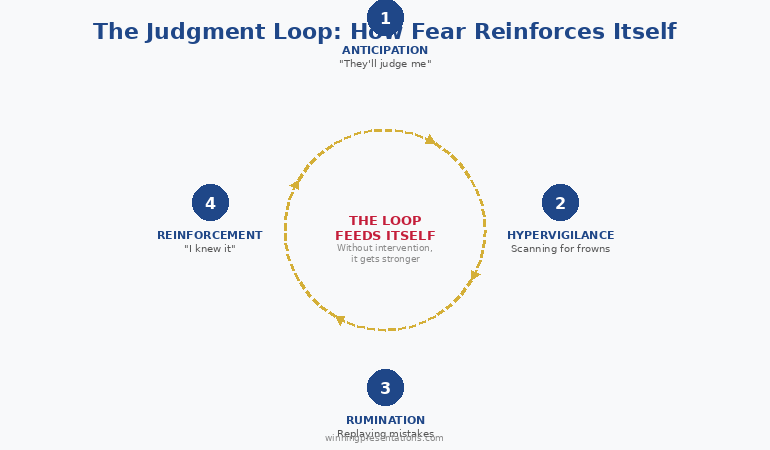
The pattern that keeps you stuck: Watch skilled speaker → Feel inadequate → Try harder → Rehearse obsessively → Anxiety increases anyway → Watch more speakers to feel better → Repeat.

The Conquer Speaking Fear programme (£39) breaks this cycle by teaching you how your nervous system actually works during presentations—using clinical hypnotherapy and NLP techniques to regulate anxiety at the source, rather than trying to out-skill your fear.

Explore the Anxiety-Based Approach

You’re Watching Highlight Reels, Not Real Practice

Here’s what gets hidden when you study great speakers: their learning curve. The neurobiologist who delivers a brilliant TED talk has probably given that talk a thousand times. The executive coach who looks totally composed has probably felt exactly as anxious as you do.

But you don’t see that journey. You only see the highlight.

This creates a dangerous assumption in your brain: They’re naturally good at this. I’m naturally anxious. We’re different.

That difference isn’t skill. It’s practice. It’s repetition. It’s nervous system regulation they learned (usually by trial and error, not by watching other people).

When you’re already battling presentation anxiety, consuming more “great speaker” content doesn’t close the gap. It widens it. Because every polished performance feels like evidence that the gap is wider than you thought.
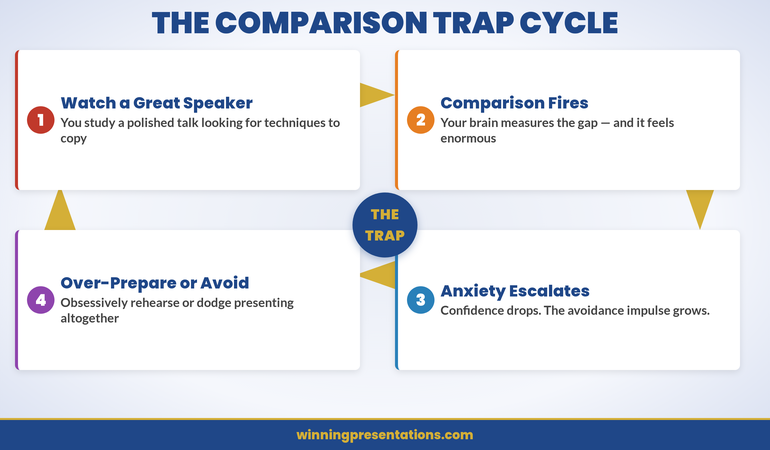
The Comparison Trap Cycle infographic showing four stages: Watch a Great Speaker, Internal Comparison Fires, Anxiety Escalates, and Avoidance or Over-Preparation

How the Comparison Trap Hijacks Your Nervous System

Your nervous system has a job: keep you safe. When you’re presentation-anxious, it’s already in a heightened state of alert. Your body is primed to notice threat.

Then you watch a skilled speaker deliver flawlessly. In that moment, your nervous system interprets the signal as: That’s the standard you need to meet. You’re not meeting it. You are unsafe/failing.

This isn’t a logic problem. It’s a nervous system problem. The more speakers you watch, the more evidence your system collects that you don’t measure up.

The comparison trap doesn’t just affect your confidence. It actually heightens physiological anxiety: increased heart rate, shallow breathing, cortisol release. It’s not just negative thinking. Your body is responding to what feels like a threat assessment.

This is why “just practice more” or “study great speakers” advice often backfires. You’re adding pressure on top of an already dysregulated nervous system.

The Faulty Logic of Anxiety-Driven Learning

Anxiety has a particular way of “teaching” you. It shows you problems, not solutions. When you’re anxious about presentations, your brain highlights:

  • Everything that could go wrong
  • Every way you might fail
  • Every person watching who might judge you
  • Every flaw in your delivery compared to “better” speakers

Then you try to solve this by consuming more speaker content—thinking you’ll find the “right” way to do it. But you’re not learning the right way. You’re reinforcing the belief that there’s a standard you’re failing to meet.

This is learning through threat, not learning through mastery. And it doesn’t stick. It just creates more anxiety.

What actually works is learning how to regulate your nervous system first, then practicing presentation skills from a calmer, more resourced state. That’s when learning actually happens. That’s when confidence builds—not from watching someone else do it perfectly, but from your own body learning that you can manage the situation.

Feeling the comparison spiral right now? This is exactly what Conquer Speaking Fear addresses: how to interrupt the anxiety pattern before it becomes your default response.

What Actually Reduces Speaking Anxiety (It’s Not Speaker Videos)

The research on anxiety reduction is clear: exposure to threat (like watching skilled speakers when you’re anxious) doesn’t reduce fear. What reduces fear is regulated exposure to manageable challenge, combined with nervous system techniques that help your body learn the situation is safe.

That’s the gap most presentation advice misses. You don’t need:

  • More tips on body language
  • More examples of “perfect” presentations
  • More pressure to match someone else’s standard

You need your nervous system to feel safe while you practice. You need techniques that actually work at the physiological level. You need to build confidence through your own success, not through comparison to others.

Reframing: From Comparison to Nervous System Regulation

The shift from “I need to watch better speakers to learn” to “I need to regulate my nervous system to perform” changes everything.

Instead of:

  • Watching great speakers → feeling worse
  • Rehearsing obsessively → staying anxious
  • Comparing yourself → spiralling into self-doubt

You’d be:

  • Learning how your body responds under pressure
  • Practising techniques that actually calm your nervous system
  • Building confidence through managing your anxiety, not copying someone else’s skill
  • Developing a genuine sense of readiness, not just borrowed confidence from studying others
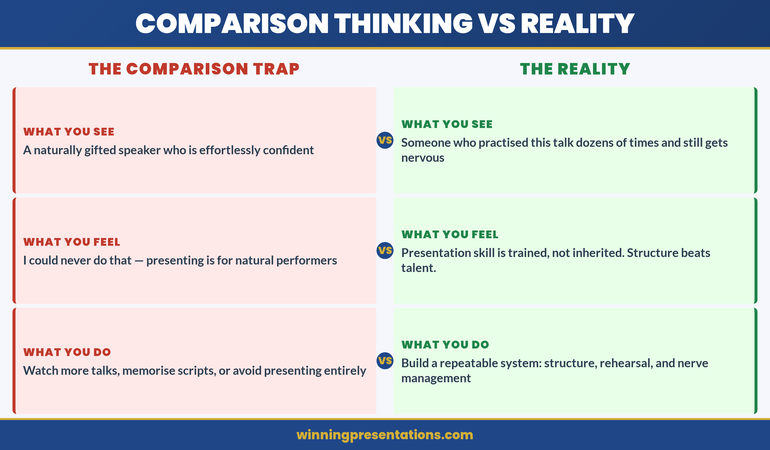
Comparison Thinking vs Reality infographic contrasting what you see, what you feel, and what you do when caught in the speaker comparison trap versus the reality of learnable skills

Stop Rehearsing What They’re Thinking About You

Here’s what happens in the comparison trap: you’re not just watching speakers. You’re imagining what the audience will think of you compared to them. You’re rehearsing judgment in your head.

This creates a secondary anxiety layer. Now you’re anxious about the presentation and anxious about being judged as “not good enough.”

That’s where nervous system regulation techniques become essential. Not to pump yourself up with false confidence. But to actually interrupt the fear response at the source.

The Conquer Speaking Fear programme uses evidence-based techniques from clinical hypnotherapy and NLP to help your nervous system feel safe during presentations—not just think positive thoughts about them.

Learn the Regulation Techniques

Is This Right For You?

This approach is for you if:

  • You’ve studied great speakers and it hasn’t reduced your anxiety (it may have increased it)
  • You’re rehearsing presentations obsessively but still feel nervous before delivering
  • Comparison is part of your anxiety pattern—you measure yourself against others
  • You want to feel genuinely confident, not just “get through” presentations
  • You’re ready to work on the nervous system level, not just the skills level

From Speaking Terror to Teaching Others

That CFO who couldn’t breathe in the boardroom? He didn’t stop being anxious by watching more successful financial leaders or studying presentation techniques. He stopped by learning how his nervous system actually worked during high-pressure situations. Once he understood that, he could regulate it.

Within 18 months, he went from dreading board announcements to volunteering to lead quarterly presentations to the full board. He didn’t become naturally good at presenting. He learned to manage his nervous system well enough that anxiety stopped controlling his performance.

Three years later, he’s mentoring other finance leaders through their presentation anxiety. Not because he became a “natural presenter.” But because he learned the one thing most presentation advice skips: how to work with your nervous system instead of against it.

The Conquer Speaking Fear programme (£39) condenses that learning curve into a structured programme using clinical hypnotherapy and NLP to create lasting change. You get the nervous system techniques that actually work. Not tips. Not tricks. Tools that work at the physiological level.

Join the Programme

📊 Want to improve your slides?

Preparation reduces anxiety. The Executive Slide System (£39) includes confident-presenter templates designed to minimise preparation stress.

People Also Ask

Does watching great speakers actually help with presentation anxiety?

For some people, watching skilled speakers can be motivating. But if you’re already anxious about presenting, it often increases comparison and self-doubt. The key difference is your nervous system state when you watch. If you’re primed for threat, you’ll interpret polished performances as evidence you’re not good enough. Nervous system regulation should come first; learning through observation should come later.

How long does it take to get over presentation anxiety?

It depends on your approach. If you’re trying to “think positive” or “rehearse more,” it often takes months or years—and can actually worsen anxiety. If you’re working directly with nervous system regulation techniques, most people notice significant shifts within 2-4 weeks. The foundation changes quickly; building full confidence takes longer, but you’re working from a much more resourced place.

Can I stop being anxious about presentations if I’m naturally an anxious person?

Yes. “Naturally anxious” usually means your nervous system is sensitised to threat more readily than others’—not that you’re broken or incapable. With the right nervous system tools, you can learn to regulate that sensitivity in specific situations (like presentations). You don’t become a different person. You become someone whose anxiety no longer controls their performance.

FAQ

Should I completely stop watching other speakers?

Not necessarily. The issue isn’t watching speakers; it’s when you watch them and why. If you’re watching them to learn a specific technique and you’re in a calm, resourced state, that can be valuable. If you’re watching them because you’re anxious and hoping to feel better, that usually backfires. Focus first on nervous system regulation. Then, from a calmer place, you can observe and learn without the comparison trap activating.

Is presentation anxiety the same as general anxiety disorder?

Not exactly. Presentation anxiety is specific to the performance situation. You might be calm in most areas of life but dysregulated when presenting. This specificity is actually an advantage—you can work directly with the nervous system triggers in that context. If you have generalised anxiety, presentation anxiety might be one manifestation of that larger pattern, and you’d want support for both.

If I fix my nervous system, will I need less practice?

No, but your practice will be more effective. Right now, if you’re anxious, you might be rehearsing obsessively and still not feeling confident—because anxiety is hijacking your learning. Once your nervous system is regulated, your practice time creates actual skill development and real confidence. You’ll likely need smarter practice, not necessarily more practice.

Ready to Stop the Comparison Cycle?

Join The Winning Edge newsletter for weekly strategies on nervous system regulation, presentation confidence, and the counter-intuitive approaches that actually reduce anxiety.

Subscribe (It’s Free)

🆓 Free resource: Get the Checklist — a free guide to strengthen your presentation preparation.

About the Author

Mary Beth Hazeldine is a presentation coach and nervous system specialist working with senior leaders and executives. She’s trained over 3,000 professionals to move from presentation anxiety to genuine confidence—by working at the nervous system level, not just the skills level. She’s the creator of the Conquer Speaking Fear programme and the Executive Slide System.

17 Mar 2026
Executive at a desk late at night surrounded by printed slides adding yet more content to an already overloaded presentation, navy and gold corporate aesthetic

The ‘One More Thing’ Killing Your Presentations: Why Anxiety Makes You Add Content Instead of Simplifying

Quick answer: Nervous presenters don’t simplify—they add slides. When anxiety spikes, your brain tells you that more content equals more safety, more credibility, more control. This backfires catastrophically. The presentation becomes bloated, the message blurs, and you look unprepared.

Catching yourself adding “just one more slide” before a presentation? That’s anxiety talking, and it will sabotage you. Conquer Speaking Fear teaches you to recognise anxiety-driven over-preparation and replace it with a simple, confidence-building presentation structure that stays intact under pressure.

Break the anxiety-over-preparation cycle → £39

A director walked into a boardroom with forty-seven slides. Her presentation was supposed to be thirty minutes. She’d prepared for six weeks, revising and expanding. The night before, anxiety hit: “What if they ask something I haven’t covered?” So she added seven more slides.

Twenty minutes in, the CFO interrupted. “What’s the actual decision you want from us?” She froze. In forty-seven slides, the core point had become invisible. She’d buried the recommendation under layers of supporting data that no one had asked for.

The content wasn’t bad. But the volume was a tell-tale sign of anxiety, and the audience knew it. Anxious presenters add slides. Confident presenters know what to cut.

The Anxiety-Content Loop

Here’s what happens in an anxious presenter’s mind, usually starting about a week before the presentation:

Monday: You finish your slides. Twelve slides, tight narrative. It feels clean.

Tuesday: Anxiety whispers: “But what if they ask about the quarterly impact on EBITDA? You should add a slide on that.” You add it.

Wednesday: Anxiety escalates: “The VP of Finance definitely wants to see a three-year projection. Add another one.” You do.

Thursday: Now you’re in full spiral mode: “What about competitive comparison? Market share implications? Risk factors by region?” You keep adding.

Friday night before the presentation: You have twenty-three slides instead of twelve. You stay up late “practising” but really you’re reading every slide, trying to memorise content you never meant to present in the first place.

Saturday morning: You feel unprepared (because you are—you’ve just memorised someone else’s presentation), and anxiety peaks at 6 AM: “I should add one more thing.” But now there’s no time to practise the new version.

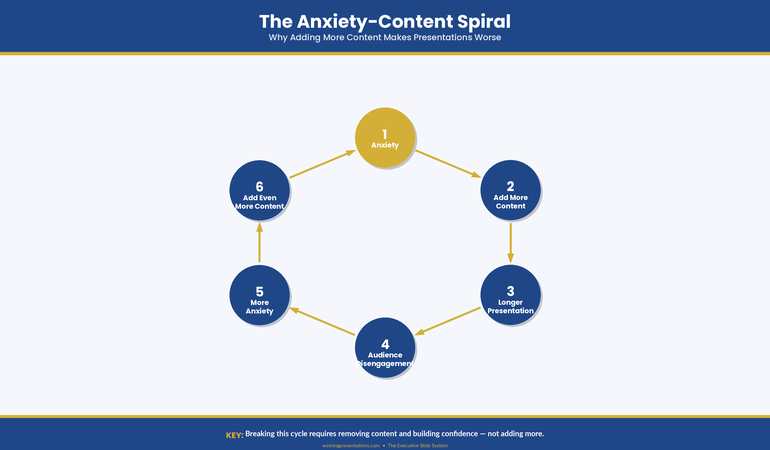
This is the anxiety-content loop. And most presenters run it without even noticing they’re trapped in it.

Anxiety-content spiral diagram showing the vicious cycle from anxiety through adding content longer presentation less confident delivery audience disengagement and back to more anxiety

Why Anxiety Drives You to Add Instead of Cut

When your nervous system detects threat, it shifts into protective mode. For presenters, that protective instinct manifests as content hoarding. Your brain calculates: more information = fewer gaps I can be caught in = safer position.

This logic is backwards, but it feels true when you’re anxious. Here’s why:

Anxiety assumes the audience is looking for gaps. If you have forty-seven slides, there are forty-seven chances to prove your expertise and fill in potential questions. Your nervous system sees this as risk reduction. In reality, it’s noise creation.

Adding feels like control. When you can’t control whether the presentation will go well, you can at least control the volume of material. Expanding the deck feels like you’re doing something constructive. It’s false productivity born from helplessness.

Cutting feels like leaving yourself exposed. Every slide you remove feels like you’re leaving a weapon behind. “What if they ask about this and I don’t have a slide?” Your nervous system treats this as dangerous. So you keep the slide, just in case.

Anxiety distorts your sense of what’s necessary. When calm, you know that two slides on budget suffice. When anxious, one slide feels insufficient. You add a third “just to be thorough.” Then a fourth “for context.” Soon you have six slides on budget and the audience has stopped listening.

The cruel irony: the more slides you add from anxiety, the less prepared you actually feel, because now there’s more material to master. Anxiety creates the very problem it’s trying to prevent.

The Consequences of Slide Bloat

Audiences can sense when a presentation is bloated. They don’t consciously analyse slide count—they feel it. The signs:

Time pressure becomes obvious. You planned for thirty minutes but have forty slides. You start rushing, skipping slides, apologising: “I’ll skip this one—not critical.” Now you’re signalling that your own preparation was wasteful.

Your message becomes invisible. In client meetings and boardrooms, the core decision or ask gets buried under supporting details. Stakeholders leave confused about what you actually wanted from them.

You lose credibility. Bloated presentations signal insecurity, not expertise. Confident subject-matter experts trim ruthlessly. They know that clarity beats completeness.

The Q&A becomes chaotic. With forty-seven slides, questioners don’t know which one to challenge or build on. Instead of a focused conversation, you get scattered questions that force you to jump around the deck.

You appear unprepared. This is the cruel twist: over-preparation from anxiety makes you look under-prepared. The rushed pacing, the apologetic skipping, the obvious padding—it all screams “I didn’t think through what actually matters.”

Your delivery becomes stiff. More slides mean more memorisation, less mental space for presence and authenticity. You’re too focused on hitting your content marks to connect with the room.

None of this is because the slides are bad. It’s because the volume contradicts the presentation’s purpose.

How to Recognise the Pattern in Your Own Work

You might be in the anxiety-addition loop right now without realising it. Here’s the diagnostic checklist:

  • Your slide count keeps growing, even though the time limit isn’t changing. You started with a plan for fifteen slides in thirty minutes. Now you have twenty-two and still find reasons to add more.
  • You’re adding slides to answer questions you’ve imagined, not questions you’ve actually been asked. “They might ask about…” drives new slides.
  • You can’t articulate why each slide is there. When someone asks “Why this slide?”, your answer is vague: “It provides context” or “Good to have.” Not “It directly supports the main recommendation.”
  • Your practice sessions feel rushed because there’s too much material. You wanted to practise for an hour, but now there’s ninety minutes of content.
  • You’re adding slides in the final days before presenting. Not because new information has emerged, but because you’re nervous and adding feels like productivity.
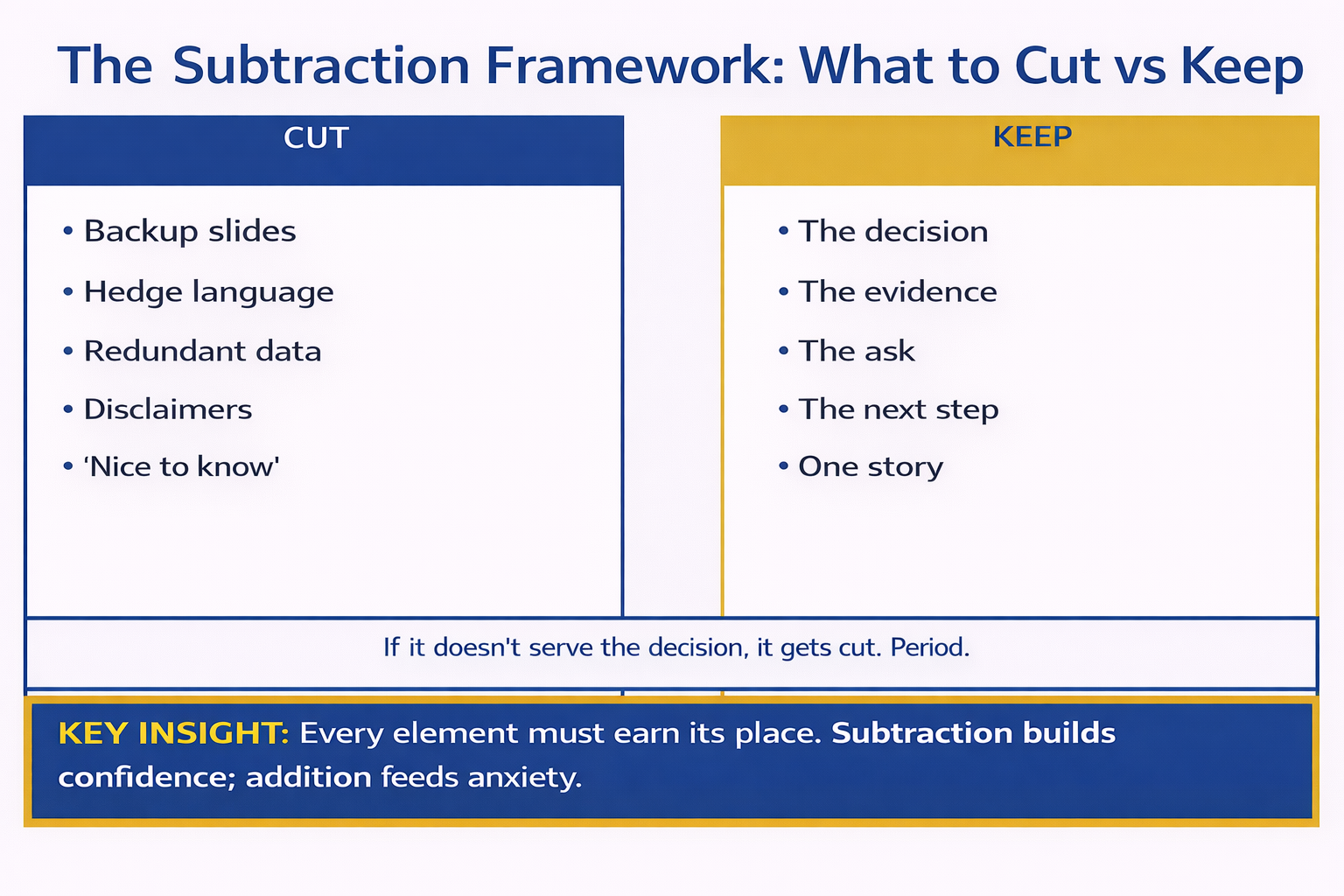
  • You’ve already decided what to cut, but you haven’t actually deleted those slides. They linger in the deck as “backup” or “optional.” They’re adding cognitive load even if you don’t present them.

If three or more of these apply, you’re in the loop. The good news: once you see the pattern, you can interrupt it.

Subtraction framework infographic comparing what to cut from presentations versus what to keep with specific examples for each category

Rebuilding Your Preparation Approach

Breaking the anxiety-addition loop requires a different preparation strategy entirely. Instead of expanding until the night before, you build once and protect that structure.

Strategy 1: Build your presentation in one focused session, then stop. Choose one day—ideally two weeks before presenting. Build the slides based on your audience’s actual question: “What decision do I need from you?” or “What action do I want?” Build slides that answer that question and nothing else. Then close the file.

Strategy 2: If you want to add something, you must delete something. A rule: no additions without deletions. This forces genuine prioritisation. Is the new idea more important than one of the existing slides? If yes, which one gets cut? This forces you to defend your structure instead of just expanding it.

Strategy 3: Practise with the full slide count early, then lock the deck. Three weeks out, do a full run-through. If you finish with time left, that’s fine—you have space. But that means the slide count is set. No additions after the first full practice.

Strategy 4: Record yourself and watch for the signals. Film yourself presenting the deck. Watch for where you’re apologising, skipping slides, or rushing. Those are the problem areas. The solution isn’t more slides—it’s simplifying the existing ones or cutting them entirely.

Strategy 5: Use a trusted colleague as a veto. Before finalising, show your slides to someone you trust and ask: “Be honest—do we need this slide?” An external voice often catches padding that you can’t see because anxiety has normalised it.

Master the Confidence Structure That Stops Anxiety-Driven Additions

Conquer Speaking Fear teaches you a presentation framework designed to stop the anxiety-addition loop before it starts. You build once, you lock the structure, and you practise from confidence instead of from fear.

  • The “Purpose Statement” framework: Build your deck around one clear decision or outcome, not scattered content
  • The deletion protocol: How to know what to cut so anxiety can’t convince you to add it back
  • The confidence checkpoint: Three practice milestones that prove you’re ready (no more adding after milestone 2)
  • The anticipation exercise: Answer likely questions in your prep, not by adding slides
  • The pre-presentation routine: Neurological techniques that calm anxiety in the final hours

Get Conquer Speaking Fear → £39

Includes the “Purpose Statement” template—used by executives at Goldman Sachs and major law firms to lock presentations and stop anxious editing.

Need a framework to stop adding slides from anxiety before your next presentation?

Learn the Confidence Framework → £39

The Real Conversation Beneath the Anxiety

Adding slides from anxiety isn’t really about content. It’s about a belief: “I am not enough. My ideas alone won’t convince them. I need more stuff to be credible.”

This is the imposter syndrome that runs beneath presentation anxiety. When you doubt your credibility, you instinctively add armour—more data, more detail, more slides. It feels protective. It feels professional.

But audiences don’t evaluate you based on volume. They evaluate you based on clarity and confidence. The presenter who says “I know what you need to decide, and here it is” carries more authority than the presenter drowning in material.

Interrupting the anxiety-addition loop means interrupting the belief underneath it. You are enough. Your core message is enough. The slides exist to support your message, not to carry it.

Once you shift that belief, the preparation process changes. You’re no longer asking “What else should I include?” You’re asking “What does the audience actually need?” And those questions produce completely different decks.

The Relationship Between Anxiety and Preparation

Here’s a counterintuitive truth: The more you truly calm your nerves, the less you over-prepare. And the less you over-prepare, the calmer you actually feel during the presentation.

This is the opposite of what anxiety tells you. Anxiety says: “You’ll feel calmer when you’ve covered every possible angle.” That’s a lie. You feel calmer when you’ve mastered a focused, tight, defensible structure.

Executives who deliver killer presentations often have fewer slides than the average presenter. Not because they know less. Because they know more—they know what matters and what doesn’t. That confidence comes from a tight preparation process, not from an exhaustive one.

The Presentation Confidence System: From Anxiety to Clarity

Conquer Speaking Fear isn’t just about managing nerves—it’s about building a presentation structure and preparation process that make anxiety irrelevant. You lock your slides early, practise with purpose, and walk in feeling ready because you actually are.

  • The core framework that stops “one more slide” syndrome before it starts
  • The purpose statement that keeps you on track when anxiety tries to derail you
  • The three-stage practice protocol that builds real confidence, not false reassurance
  • The pre-presentation calm technique (clinical hypnotherapy anchoring for executive presenters)
  • The Q&A anticipation process: Answer tough questions in prep, not by adding slides

Get Conquer Speaking Fear → £39

Includes a worksheet to map your own anxiety triggers during presentation prep.

Ready to stop over-preparing from anxiety and start building from clarity?

Start Here → £39

People Also Ask

What if my audience really does need that extra information? They don’t. What they need is to understand your core point. If they want more detail, they’ll ask. In fact, brevity often prompts better questions because there’s actually space for the audience to think.

Isn’t over-preparing better than under-preparing? No. Under-prepared presenters are scattered. Over-prepared presenters (from anxiety) appear insecure and rushed. There’s a preparation sweet spot: you know your material, you’ve cut ruthlessly, you have mental space to respond to the room. That’s not about total hours invested—it’s about where you focus.

How do I know if I’m adding from anxiety or from genuine new information? Ask yourself: “Has my audience’s actual need changed, or have I just had more time to worry?” Genuine new information changes the actual requirement. Anxiety just keeps you busy.

Is This Right For You?

✓ This is for you if:

You catch yourself adding slides days before presentations, even though you know the original structure was strong.
Your presentation anxiety gets worse as you get closer to the date, instead of getting better with preparation.
You want to recognise when you’re adding from anxiety versus adding from genuine audience needs.

✗ Not for you if:

You genuinely need to cover more material because your audience has asked for it. (In that case, rebuild the structure—don’t just add to the existing one.)
You prefer to add as much material as possible and let the audience pick what’s relevant. (That’s not a strategy—that’s avoidance of prioritisation.)

Want to master the complete slide architecture that prevents this problem?

The Executive Slide System teaches you a seven-slide framework that works for any executive presentation. It’s tight enough that anxiety can’t derail it, and flexible enough that it adapts to your audience. Learn the ESS framework → £39

FAQ

Is there ever a good reason to add slides close to presentation day?

Almost never. If new information emerges that fundamentally changes your recommendation, then yes—rebuild from scratch. But “I just thought of something I should mention” at the three-day mark is anxiety, not strategy.

What if my boss asks me to add more detail before presenting?

That’s different from anxiety—that’s a genuine audience need. In that case, rebuild the structure instead of just tacking on extra slides. Ask your boss: “Which existing slides should I cut to make room for this new detail?” That forces prioritisation and usually gets you back to a reasonable slide count.

How many practice runs do I actually need before I stop adding?

Ideally one full run-through, at least ten days before presenting. That’s your confirmation moment: “The structure works. It covers what needs covering. No more additions.” Everything after that should be refinement, not expansion.

What if I finish practising and there are still fifteen minutes of blank time in my scheduled presentation?

That’s perfect. You can pause for questions, build in discussion time, or simply speak at a more natural pace (instead of rushing). Blank time during a presentation is a gift. Don’t fill it with slides.

Related: Your Presentation Didn’t Fail — The Decision Was Already Made Before You Walked In — How pre-decision dynamics compound anxiety and why you need to diagnose the situation early.

Related: Technical Questions From Non-Technical Executives: How to Translate Under Pressure — How to handle unexpected questions without relying on slides you added from anxiety.

Break the Anxiety-Addition Cycle Before Your Next Presentation

The best presentations you’ve ever given probably weren’t the ones with the most slides. They were the ones where you felt focused, confident, and clear about what you wanted the audience to do.

That feeling comes from a tight preparation process, not an exhaustive one. From a structure you can defend, not a mountain of material you’re hoping covers every contingency.

You’re presenting next week? This is the week to build your deck, practise it fully, and then lock it. Don’t open it again except for delivery adjustments. The additions your anxiety will suggest are noise, not value. Recognise the pattern and stop it.

Join executives learning to break anxiety patterns and build confidence through better preparation. Subscribe to The Winning Edge newsletter for weekly frameworks on managing presentation nerves.

🆓 Free resource: Download now — a free guide to strengthen your presentation preparation.

About the Author

Mary Beth Hazeldine is the Owner & Managing Director of Winning Presentations. With 24 years of corporate banking experience at JPMorgan Chase, PwC, Royal Bank of Scotland, and Commerzbank, she has delivered high-stakes presentations in boardrooms across three continents.

A qualified clinical hypnotherapist and NLP practitioner, Mary Beth combines executive communication expertise with evidence-based techniques for managing presentation anxiety. She has trained thousands of executives and supported high-stakes funding rounds and approvals.

Book a discovery call | View services

This article was written with AI assistance and reviewed by Mary Beth Hazeldine.

03 Mar 2026
The Perfectionism Trap: Why Over-Preparing Makes Presentation Anxiety Worse

The Perfectionism Trap: Why Over-Preparing Makes Presentation Anxiety Worse

Sarah spent 14 hours preparing a 15-minute presentation. She rehearsed it 11 times. She could recite every transition. And she was more terrified walking into that room than she’d ever been.

Quick Answer: Presentation perfectionism creates a paradox: the more you prepare beyond a critical threshold, the more anxious you become. Over-preparation amplifies anxiety because it shifts your focus from communicating a message to performing a script perfectly. Your brain registers perfection as the standard, so any deviation — a stumbled word, a missed phrase, an unexpected question — feels catastrophic. The fix isn’t less preparation. It’s different preparation that targets confidence rather than control.

🚨 Spending hours over-preparing and still feeling terrified?

Quick diagnostic:

  • Do you rehearse more than 3 times and feel worse with each run-through?
  • Does changing a single word in your script feel like starting over?
  • Do you prepare for every possible question but still dread the Q&A?

→ That’s the perfectionism trap. More preparation won’t help — you need a different approach to pre-presentation anxiety. Conquer Speaking Fear (£39) includes the cognitive reframing techniques that break the over-preparation cycle.

Sarah was a senior programme manager at a consulting firm. She’d been presenting to clients for six years and considered herself well-prepared. Before every presentation, she’d write a full script, rehearse it until she could recite it from memory, then rehearse it again “just in case.”

She came to me because the anxiety was getting worse, not better. “I prepare more than anyone on my team,” she told me. “I should be the most confident person in the room. Instead, I’m the most terrified.”

When I watched her prepare, the problem was obvious. By rehearsal four, she’d stopped communicating and started performing. Every word had to be exact. Every transition had to land perfectly. She’d built a standard so rigid that any deviation felt like failure — and her nervous system responded to that perceived failure with escalating anxiety.

We restructured her preparation. Three rehearsals maximum. Bullet points instead of scripts. The instruction: “Know your message, not your words.” Her anxiety dropped significantly within two presentations. Not because she prepared less, but because she prepared differently.

Infographic showing the diminishing returns curve of presentation preparation with confidence peaking at moderate preparation and anxiety rising with over-preparation

The Diminishing Returns Curve of Preparation

Preparation follows a predictable curve. Early preparation builds confidence rapidly: understanding your content, structuring your argument, knowing your key messages. Each hour invested yields measurable improvement in both competence and confidence.

Then the curve flattens. You know your material. Your structure is solid. Additional preparation doesn’t improve your presentation — it polishes what’s already finished. At this point, each additional hour yields marginal improvement in quality but measurable increase in anxiety.

Then the curve inverts. Beyond the threshold, more preparation actively damages your performance. You memorise phrasing instead of understanding concepts. You rehearse transitions until they feel mechanical. You optimise for perfection, which is impossible, rather than communication, which is achievable. Presentation anxiety before meetings often escalates precisely at this point — when preparation has crossed from useful to harmful.

The paradox: the presenters who prepare most obsessively are often the most anxious, while presenters who prepare sufficiently but not excessively appear more confident, more natural, and more persuasive.

Why More Preparation Makes Anxiety Worse (The Psychology)

Three psychological mechanisms explain why over-preparation amplifies anxiety rather than reducing it.

Mechanism 1: Perfectionism creates a failure-sensitive mindset. When you rehearse a presentation to the point of memorisation, your brain registers the memorised version as “correct.” Any deviation — a different word, a missed phrase, an off-script moment — registers as an error. Your nervous system responds to perceived errors with anxiety. The more perfect your preparation, the more error-sensitive your performance becomes.

Mechanism 2: Rehearsal without variation reduces adaptability. Real presentations involve interruptions, questions, technical issues, and audience reactions. If you’ve rehearsed a rigid script, any interruption forces you to abandon your memorised pathway. That moment of disorientation — finding your place again — triggers acute anxiety. Presenters who prepare with flexibility can adapt without panic. Scriptmemorising presenters cannot.

Mechanism 3: Over-preparation signals threat to your nervous system. When you spend hours preparing for a 15-minute presentation, your subconscious draws a conclusion: “This must be dangerous — otherwise, why would I need to prepare this much?” The preparation intensity itself communicates threat, and your body responds accordingly. This is similar to the pattern described in why confident presenters still get nervous — the relationship between preparation and anxiety is more complex than “prepare more, fear less.”

The Preparation Threshold: Where Confidence Peaks

The preparation threshold is the point where additional preparation stops building confidence and starts building anxiety. It’s different for everyone, but there are reliable markers.

You’ve hit the threshold when: You can explain your key message in one sentence without notes. You can answer “what’s the point of this presentation?” instantly. You know your opening, your three main points, and your close. You can present the core argument to a colleague in conversation without slides.

You’ve crossed the threshold when: You’re rehearsing word-for-word phrasing rather than concepts. You feel worse after each additional rehearsal. You’re spending more time on transitions than on content. You’re anticipating every possible question and scripting answers. You’re unable to present without looking at your notes because you’ve memorised a sequence, not understood an argument.

Most presentations reach the threshold after two to three focused preparation sessions. Everything beyond that is anxiety management disguised as preparation.

Stop the Over-Preparation Cycle That’s Making Your Anxiety Worse

If you’re spending hours preparing and feeling more terrified with each rehearsal, the problem isn’t your preparation quantity — it’s your preparation approach. Conquer Speaking Fear includes:

  • The cognitive reframing technique that breaks the perfectionism-anxiety loop
  • The confidence threshold method — know exactly when to stop preparing
  • Clinical hypnotherapy protocols that calm your nervous system before you present
  • The “know your message, not your words” framework that replaces rigid scripting

Get Conquer Speaking Fear → £39

Designed for the presenter who prepares obsessively and still feels terrified — because the preparation itself is the problem.

What to Do Instead: Preparation That Builds Confidence

The goal isn’t to prepare less. It’s to prepare in a way that builds confidence rather than anxiety. This requires three structural changes to how you approach presentation preparation.

Replace scripts with bullet frameworks. Write three to five bullet points per section, not sentences. Your job is to know the argument, not the words. This forces you to communicate rather than recite, and communication is what builds confidence. If you lose your place, you can reconstruct the argument from the bullet — something impossible with a memorised script.

Rehearse with variation, not repetition. Each time you practise, change something deliberately. Use different phrasing. Start from a different section. Present to a different person. This builds adaptability — the skill that prevents panic when real presentations don’t go exactly as planned. Variation trains your brain to handle the unexpected, which reduces threat perception.

Cap your rehearsals at three. The first rehearsal identifies gaps. The second rehearsal smooths the flow. The third confirms you’re ready. Everything beyond three is anxiety management, not preparation. If you still feel anxious after three rehearsals, the solution isn’t a fourth rehearsal — it’s addressing the anxiety directly through techniques like managing anxiety the night before a presentation.

2. presentation-perfectionism-anxiety-in-article-2.png — Alt text: Infographic comparing perfectionist preparation versus confident preparation showing scripts versus bullet frameworks and rigid rehearsal versus varied practice

Breaking the Perfectionism Cycle Before Your Next Presentation

Perfectionism is a cycle: you prepare obsessively, perform rigidly, notice every imperfection, conclude you need to prepare more next time, and prepare even more obsessively. Breaking the cycle requires interrupting it at the right point.

Before your next presentation, set a preparation budget. Decide in advance how many hours you’ll spend preparing and how many times you’ll rehearse. Write it down. When you reach your limit, stop — regardless of how you feel. The discomfort you feel at stopping is the perfectionism, not the preparation.

After your next presentation, audit the gaps. Were there moments where your preparation failed? Probably not. Were there moments where you deviated from your script and it was fine? Probably yes. Collect this evidence. Perfectionism survives on the belief that anything less than perfect preparation leads to disaster. Your own experience will disprove this.

Redefine success. A perfect presentation isn’t one where every word was scripted and delivered exactly. A successful presentation is one where your audience understood your message and took the action you wanted. These are fundamentally different standards — and the second one is both achievable and less anxiety-producing.

Stop Spending Hours Preparing and Still Walking In Terrified

The perfectionism trap keeps you preparing longer and feeling worse. Conquer Speaking Fear gives you the clinical techniques to break the cycle — so you can prepare confidently and present without the paralysing anxiety that comes from chasing perfection.

Get Conquer Speaking Fear → £39

Built from 24 years of working with executives who prepared obsessively and still dreaded every presentation.

Is This Right For You?

✓ This is for you if:

  • You prepare more than most of your colleagues but feel more anxious than they do
  • You’ve noticed that more rehearsal makes you feel worse, not better
  • You script presentations word-for-word and panic when you deviate
  • You want a structured approach to breaking the over-preparation habit

✗ This is NOT for you if:

  • You genuinely under-prepare and your presentations suffer from lack of structure
  • Your anxiety is specifically about physical symptoms like shaking or voice cracking rather than preparation
  • You’re looking for a presentation template rather than an anxiety management approach

If your anxiety shows up as physical symptoms rather than perfectionism, breathing techniques may address the immediate response while you work on the underlying pattern.

From 5 Years of Terror to Teaching Thousands — I Know This Trap Personally

I spent five years terrified of presenting. I over-prepared obsessively — scripts, rehearsals, contingency plans for every possible scenario. The preparation made me feel in control. The anxiety told me I was anything but. It took clinical hypnotherapy and cognitive restructuring to break the cycle. Conquer Speaking Fear gives you:

  • The exact cognitive reframing protocols that broke my perfectionism-anxiety loop
  • Clinical hypnotherapy techniques for calming your nervous system before you present
  • The preparation framework that replaces rigid scripting with flexible confidence
  • Evidence-based techniques tested with thousands of executives who over-prepare

Get Conquer Speaking Fear → £39

30-day programme including the reframing techniques, nervous system protocols, and preparation restructuring that allows you to present confidently without over-preparing.

If your perfectionism extends to slide design — spending hours adjusting fonts, colours, and layouts instead of focusing on your message — the Executive Slide System (£39) provides pre-built executive slide frameworks so you spend less time designing and more time communicating.

Frequently Asked Questions

How do I know if I’m over-preparing or genuinely under-prepared?

Under-prepared presenters can’t articulate their core message without notes. Over-prepared presenters can recite their presentation word-for-word but feel worse after each rehearsal. The test: can you explain your key argument conversationally, without slides, in under two minutes? If yes, you’re prepared enough. If you can do that but still feel anxious, the anxiety isn’t a preparation problem — it’s an anxiety problem requiring a different solution.

Won’t reducing preparation make my presentation quality worse?

No — and this is the counter-intuitive part. Audiences respond to confident communication, not perfect recitation. When you present from understanding rather than memorisation, you make better eye contact, respond more naturally to the room, and sound more conversational. These qualities improve perceived presentation quality even if you occasionally use an imperfect phrase. Perfection is invisible to audiences. Confidence is immediately visible.

What if my role genuinely requires word-perfect presentations?

Some contexts require precise language — regulatory presentations, legal disclosures, earnings calls. In these cases, the preparation approach changes: memorise the mandatory language but prepare the surrounding context flexibly. The rigid portions should be short and clearly marked. Everything else should be bullet-based. This hybrid approach maintains compliance without triggering the perfectionism trap across your entire presentation.

📬 Want these insights in your inbox? Presentation strategies for executives managing high-stakes communication, twice weekly. Subscribe to Winning Presentations insights.

🆓 Free resource: 7 Presentation Frameworks for Confident Delivery — bullet-based frameworks that replace rigid scripting with structured confidence.

Related articles from today: If perfectionism is derailing your client reviews, see how the client retention quarterly format reduces preparation load by focusing on outcomes rather than scripts. And when over-preparation meets live Q&A, learn how to handle compound questions without the scripted responses that perfectionism demands.

About the Author

Mary Beth Hazeldine is the Owner & Managing Director of Winning Presentations. With 24 years of corporate banking experience at JPMorgan Chase, PwC, Royal Bank of Scotland, and Commerzbank, she has delivered high-stakes presentations in boardrooms across three continents.

A qualified clinical hypnotherapist and NLP practitioner, Mary Beth combines executive communication expertise with evidence-based techniques for managing presentation anxiety. She has trained thousands of executives and supported high-stakes funding rounds and approvals.

Book a discovery call | View services

Your next presentation doesn’t need to be perfect. It needs to be understood. If over-preparation is amplifying your anxiety instead of reducing it, the preparation approach is the problem. Break the perfectionism cycle before your next high-stakes presentation.

23 Feb 2026
Senior executive woman in navy blazer standing alone in office corridor with visible tension in her expression — glossophobia at the executive level

Glossophobia at the C-Suite: Why Successful Executives Still Struggle (And What Actually Fixes It)

Quick answer: Glossophobia doesn’t disappear with seniority — it intensifies. The higher you climb, the more scrutiny each presentation carries, and your nervous system learns to treat every speaking event as a career-defining threat. Generic advice (“breathe,” “visualise success,” “practice more”) fails senior executives because the fear isn’t about skill — it’s a conditioned neurological response. Breaking it requires clinical-grade techniques that interrupt the anxiety cycle at the nervous system level, not the confidence level.

I Was a Senior Banker Who Couldn’t Present Without Vomiting. Nobody Knew.

I spent five years terrified of presenting.

Not as a graduate. Not as a junior analyst. As a senior professional at JPMorgan Chase, PwC, and Royal Bank of Scotland — the kind of person who was supposed to have it figured out.

Before every presentation, I would vomit. My hands shook so visibly I couldn’t hold the clicker. I’d rehearse fifty times and still lose my train of thought the moment I saw a boardroom full of faces. I turned down opportunities. I cancelled meetings. I structured my career around avoiding the thing that was supposed to define it.

Nobody knew. That’s the part people don’t understand about glossophobia at the executive level. It’s invisible. You learn to mask it with preparation, delegation, and strategic avoidance. But the fear doesn’t shrink. It compounds. Every presentation you survive adds another data point to the part of your brain that says: that was close — next time will be worse.

It took clinical hypnotherapy to break the cycle. Not tips. Not confidence tricks. Not another rehearsal. A neurological reset that changed how my nervous system responded to speaking.

That’s what I want to explain today — and why everything you’ve tried hasn’t worked yet.

🚨 Presentation this week and dreading it? Quick check: Can you name the exact thought that triggers your anxiety? Not “I’m nervous” — the specific sentence your brain produces. (“They’ll see I don’t belong.” “I’ll forget what to say.” “My voice will shake.”) If you can’t name it, that’s the first fix. The anxiety isn’t general — it’s a specific thought loop, and it can be interrupted. → Need the clinical techniques to break the cycle? Conquer Speaking Fear (£39) was built for exactly this.

The Escalation Trap: Why Glossophobia Gets Worse the More Senior You Become

Most people assume glossophobia fades with experience. You present more, you get better, the fear subsides. That’s how it works for most skills.

Glossophobia doesn’t follow that pattern. For senior executives, the fear escalates — and it does so for three structural reasons that have nothing to do with skill.

Reason 1: The stakes genuinely increase. A graduate presenting to their team risks embarrassment. A VP presenting to the board risks a career. Your nervous system isn’t irrational — it’s responding to a real escalation in consequences. The higher you climb, the more each presentation matters, and your amygdala adjusts its threat assessment accordingly. That “disproportionate fear” your therapist mentioned? At the executive level, it’s not disproportionate at all.

Reason 2: The masking becomes the problem. Every technique you’ve developed to manage the fear — over-preparing, memorising scripts, arriving early to “settle in,” avoiding Q&A, delegating presentations you could do yourself — these adaptations reinforce the anxiety. Your brain interprets each workaround as proof that the threat is real. “If it weren’t dangerous,” your nervous system reasons, “you wouldn’t need all these defences.”

Reason 3: Identity fusion. At the senior level, your identity becomes inseparable from your professional competence. A bad presentation doesn’t just feel like a bad presentation — it feels like evidence that you don’t belong. Imposter syndrome and glossophobia fuel each other in a loop that tightens with every promotion. The more successful you become, the more you feel you have to lose.

This is the Escalation Trap. And it’s why generic stage fright advice written for students and first-time speakers makes executive glossophobia worse, not better.

Diagram showing the Executive Glossophobia Escalation Trap — how fear of presenting intensifies with seniority through higher stakes, more scrutiny, and identity threat

How the Executive Brain Processes Presentation Fear Differently

When a junior professional feels nervous before a presentation, their prefrontal cortex (the rational, planning part of the brain) is still largely in charge. The nervousness is uncomfortable but manageable. They can reason their way through it: “This is normal. I’ll be fine once I start.”

Executive glossophobia operates differently. After years of high-stakes presentations, the fear response has been conditioned into the limbic system — the part of the brain that handles threat detection and operates below conscious thought. By the time you’re aware you’re anxious, the neurological cascade has already started: cortisol spike, adrenaline release, blood flow redirected from the prefrontal cortex to survival systems.

This is why rational self-talk doesn’t work. You’re trying to use the part of your brain that’s been taken offline by the very response you’re trying to manage. It’s like trying to reason with a smoke alarm — the alarm doesn’t care about your logic. It detected smoke, and it’s doing its job.

The executive brain has also developed something I call anticipatory looping — the tendency to run anxiety simulations days or weeks before the presentation. Junior professionals get nervous the morning of. Senior executives start the anxiety cycle the moment the meeting appears in their calendar. By presentation day, they’ve already experienced the fear response dozens of times. Their nervous system is exhausted before they’ve said a single word.

This anticipatory looping is the single biggest drain on executive performance — and it’s completely invisible to anyone watching from the outside. The executive who presents calmly to senior leadership may have spent the previous 72 hours in a low-grade panic state that nobody sees.

Present Without the Executive Anxiety Spiral

Conquer Speaking Fear gives you the clinical techniques that interrupt glossophobia at the nervous system level — not the confidence level. Built specifically for senior professionals whose fear has escalated with their career.

  • ✓ The Anticipatory Loop Breaker — stop the anxiety cycle before presentation day
  • ✓ Limbic reset techniques adapted from clinical hypnotherapy for executive environments
  • ✓ The Identity Separation Protocol — decouple your self-worth from your last presentation

Conquer Speaking Fear → £39

Created by a clinical hypnotherapist who spent 5 years terrified of presenting — and now trains thousands of executives to present with confidence.

Why ‘Just Breathe’ and ‘Practice More’ Fail Senior Professionals

The standard glossophobia advice falls into three categories, and all three fail at the executive level for the same reason: they target the wrong system.

Category 1: Breathing and relaxation techniques. “Take three deep breaths before you start.” “Do box breathing in the corridor.” These techniques work for mild nervousness. For conditioned executive glossophobia, they’re trying to calm a nervous system that has already been hijacked. By the time you’re standing outside the boardroom doing breathing exercises, the cortisol cascade started three days ago. You’re applying a plaster to a fracture. If you want to understand why breathing techniques alone don’t work for severe presentation anxiety, the neuroscience explains it clearly.

Category 2: Exposure and practice. “The more you present, the more comfortable you’ll get.” This is true for mild nervousness. For conditioned glossophobia, repeated exposure without intervention does the opposite — it reinforces the neural pathway. Every presentation you survive while terrified teaches your brain: “See? That was dangerous. Good thing we were on high alert.” You don’t desensitise. You re-traumatise.

Category 3: Cognitive reframing. “Reframe the anxiety as excitement.” “Tell yourself they want you to succeed.” These techniques require your prefrontal cortex to override your limbic system. At the executive level of glossophobia, the limbic system has already taken the prefrontal cortex offline. You can’t reframe what you can’t think through. It’s like telling someone mid-panic-attack to “choose to be calm.”

The reason these categories fail is that they all operate at the conscious level — and executive glossophobia is a subcortical, conditioned response. Conquer Speaking Fear works at the level where the fear actually lives — the nervous system — using clinical techniques adapted from hypnotherapy and NLP for executive environments.

Comparison showing why generic public speaking advice fails for executive glossophobia — surface-level techniques versus clinical interventions that address the neurological fear loop

The Clinical Intervention That Breaks the Executive Anxiety Cycle

After five years of living with executive glossophobia, I trained as a clinical hypnotherapist. Not because I wanted to change careers — because I wanted to understand why nothing was working, and what would.

What I discovered changed everything I understood about presentation fear. The techniques that actually break executive glossophobia share three characteristics that standard advice doesn’t have:

Characteristic 1: They bypass the conscious mind. Clinical techniques work at the limbic/subcortical level — the same level where the fear response operates. Instead of trying to think your way out of an anxiety response (which doesn’t work when the thinking brain has been taken offline), these techniques interrupt the neurological pattern directly. The fear response is a conditioned loop. You break it by intervening at the point where the loop starts — not at the point where you’re already shaking.

Characteristic 2: They address the specific trigger, not “anxiety in general.” Executive glossophobia isn’t generalised anxiety. It’s a conditioned response to a specific stimulus: being watched while speaking in a professional context where your competence is being evaluated. The intervention has to match the specificity of the trigger. Generic “anxiety management” misses the target entirely.

Characteristic 3: They create a new default response. The goal isn’t to eliminate nervousness (some adrenaline improves performance). The goal is to replace the catastrophic fear response with a functional activation response. Same stimulus, different neurological pathway. When the meeting invitation appears in your calendar, your nervous system activates preparation mode instead of survival mode. The difference between those two states is the difference between presenting with clarity and presenting while trying not to pass out.

This is the architecture behind Conquer Speaking Fear — clinical techniques from hypnotherapy and NLP, adapted specifically for the executive environment where the fear response has been conditioned by years of high-stakes presentations.

If your glossophobia has escalated with your career rather than fading with experience, you don’t need more practice — you need a neurological intervention. That’s exactly what Conquer Speaking Fear delivers — the clinical techniques that break the executive anxiety cycle, not manage it.

Stop Dreading Every Senior Meeting on Your Calendar

The anticipatory looping. The sleepless nights before board meetings. The career decisions you’ve made around avoidance. Conquer Speaking Fear breaks the cycle where it actually lives — your nervous system.

  • ✓ End the days-long anxiety spiral that starts the moment a presentation hits your calendar
  • ✓ Stop structuring your career around avoidance — take the opportunities you’ve been turning down
  • ✓ Replace the catastrophic fear response with functional activation (calm energy, not paralysis)

Conquer Speaking Fear → £39

Built from clinical hypnotherapy and NLP techniques, adapted for high-pressure executive environments where generic advice has already failed.

Common Questions About Glossophobia in Senior Executives

Why do successful executives still fear public speaking?

Because glossophobia is a conditioned neurological response, not a skill deficit. Executive glossophobia escalates through three mechanisms: genuinely higher stakes (career consequences are real), masking behaviours that reinforce the fear (over-preparation, avoidance, delegation), and identity fusion (your self-worth becomes inseparable from your professional performance). These three factors create the Escalation Trap — a cycle where each promotion increases the fear rather than reducing it. The executives who present confidently haven’t eliminated nervousness. They’ve replaced the catastrophic fear response with a functional activation response — same adrenaline, different neurological pathway.

Can glossophobia get worse with age and seniority?

Yes, and this is the most misunderstood aspect of presentation anxiety. Research on conditioned fear responses shows that without clinical intervention, repeated exposure to the fear stimulus strengthens the neural pathway rather than weakening it — particularly when each exposure carries higher consequences. A VP presenting to a board has more at stake than a manager presenting to a team. The nervous system registers the escalation and adjusts its threat response accordingly. This is why “just keep presenting” makes executive glossophobia worse, not better.

How do senior leaders overcome presentation anxiety for good?

The executives who genuinely resolve glossophobia (rather than managing it) use techniques that operate at the subcortical level — the same level where the conditioned fear response lives. This includes clinical approaches adapted from hypnotherapy and NLP that interrupt the neurological pattern directly, without relying on the prefrontal cortex (which goes offline during a fear response). The key distinction: they don’t try to think their way out of the fear. They retrain the nervous system’s automatic response to the speaking stimulus. This creates a permanent change in how the brain processes the trigger, rather than a temporary coping strategy.

Is Conquer Speaking Fear Right For You?

✓ This is for you if:

  • You’re a senior professional whose presentation fear has intensified with each promotion — not faded
  • You’ve tried breathing exercises, visualisation, and “just present more often” and none of it has stuck
  • You’ve structured career decisions around avoiding presentations (turning down opportunities, delegating talks you should give yourself)
  • You want clinical-grade techniques that work at the nervous system level, not another list of confidence tips

✗ This is NOT for you if:

  • You get mild butterflies but can present effectively once you start (that’s normal activation, not glossophobia)
  • You’re looking for slide design or presentation structure help (the Executive Slide System covers that)
  • You need in-person therapy for clinical anxiety disorder (this is a self-study programme, not a replacement for professional mental health treatment)

From 5 Years of Executive Presentation Terror to Training Thousands of Executives. This Is How.

I didn’t learn these techniques from a textbook. I developed them because I had to — five years of glossophobia at JPMorgan, PwC, and RBS nearly ended my career before I trained as a clinical hypnotherapist and discovered what actually works.

  • ✓ Clinical techniques from a qualified hypnotherapist who lived with executive glossophobia
  • ✓ NLP interventions adapted specifically for boardroom and committee environments
  • ✓ The Escalation Trap exit strategy — break the cycle that worsens with every promotion

Conquer Speaking Fear → £39

24 years in corporate banking. Qualified clinical hypnotherapist and NLP practitioner. Thousands of executives trained through high-stakes presentations, board updates, and committee meetings.

📊 Want the slides too?

Preparation reduces anxiety. The Executive Slide System (£39) includes confident-presenter templates designed to minimise preparation stress — so the structural side of your next presentation is handled, and you can focus entirely on managing the fear response.

Frequently Asked Questions

What if my glossophobia is too severe for a self-study programme?

Conquer Speaking Fear uses clinical-grade techniques from hypnotherapy and NLP — the same approaches used in therapeutic settings. For most executive glossophobia (fear that’s conditioned by workplace experience, not a pre-existing clinical anxiety disorder), these techniques are effective in a self-study format because the work is neurological, not conversational. You’re retraining a conditioned response, not processing complex emotional trauma. However, if you have a diagnosed anxiety disorder or your fear extends well beyond professional speaking (social situations, daily interactions, panic attacks outside of work), I’d recommend working with a clinical professional alongside this programme.

Does executive coaching work better than clinical techniques for glossophobia?

Executive coaching addresses performance and skill — how you structure your message, manage your delivery, and handle questions. Clinical techniques address the neurological fear response — why your hands shake, why you can’t think clearly, why the anxiety starts days before the presentation. They solve different problems. Most senior executives with glossophobia don’t have a performance problem. They have a neurological conditioning problem. Coaching improves what you do. Clinical techniques change how your brain responds to the trigger. For executive glossophobia, you usually need the clinical intervention first — once the fear response is resolved, coaching becomes dramatically more effective.

Can glossophobia come back after treatment?

The conditioned fear response can be re-triggered by a particularly intense experience — a public failure, a hostile audience, an unexpected ambush in a high-stakes meeting. However, once you’ve learned the clinical intervention techniques, you have the tools to interrupt the re-conditioning before it takes hold. The difference between pre-treatment and post-treatment isn’t that the fear never surfaces — it’s that you can intervene within seconds instead of being trapped in a weeks-long anxiety spiral. Most of the executives I’ve worked with describe it as having a “reset button” they didn’t have before.

Get Weekly Presentation Intelligence

Clinical techniques for managing executive anxiety, plus the slide structures and communication strategies that reduce preparation stress — delivered every week.

Join the Newsletter

Related: If your glossophobia is compounded by workplace politics — colleagues who undermine you or hostile rooms — read The Executive Who Tried to Sabotage My Client’s Presentation (And How the Slides Saved Her). When your slide structure is bulletproof, the political attacks bounce off — which reduces the fear response significantly.

Also today: If you’re presenting to a room that’s already decided against you, your glossophobia isn’t irrational — it’s responding to real resistance. Read The Presentation You Give When the Room Has Already Decided Against You for the structural approach that reverses pre-decided rooms.

Your next step: Open your calendar right now. Find the next board update, senior leadership meeting, earnings call, or steering committee. Notice the thought your brain produces when you look at it. That thought — not the event itself — is what Conquer Speaking Fear interrupts. If that meeting is this week, fix the nervous system loop before you rehearse the slides.

Your next board meeting, leadership update, or committee presentation is already in your diary. The anxiety has already started. Break the cycle before the meeting, not during it.

Conquer Speaking Fear → £39

About the Author

Mary Beth Hazeldine is the Owner & Managing Director of Winning Presentations. With 24 years of corporate banking experience at JPMorgan Chase, PwC, Royal Bank of Scotland, and Commerzbank, she has delivered high-stakes presentations in boardrooms across three continents — and spent five of those years living with the glossophobia she now helps executives overcome.

A qualified clinical hypnotherapist and NLP practitioner, Mary Beth combines executive communication expertise with evidence-based clinical techniques for resolving presentation anxiety. She has trained thousands of executives and supported high-stakes funding rounds and approvals across banking, consulting, and corporate environments.

Book a discovery call | View services

17 Feb 2026
(1200×675)Professional's hand gripping the edge of a podium during a presentation, knuckles visible, warm golden stage lighting in background

Severe Hand Shaking During Presentations: What’s Actually Happening (And What Works)

She was holding a single sheet of A4 paper. The entire room could see it vibrating.

Quick answer: Severe hand shaking during presentations — the kind where you can’t hold a clicker, turn a page, or point at a slide without the whole room noticing — is not ordinary nervousness. It’s a full sympathetic nervous system overload: your body has flooded with adrenaline and your fine motor control has been temporarily disabled. The standard advice to “just relax” or “breathe deeply” doesn’t work at this severity level because the shaking is happening below conscious control. What does work is a three-part protocol that targets the physiological chain: cool the hands (vasoconstriction reset), engage the large muscles (burn off the adrenaline), and switch to gross motor actions (eliminate tasks requiring fine motor control). This article covers each step.

I know what severe hand shaking feels like because I lived it for five years. Not a mild tremor that nobody notices. The kind where I couldn’t hold my notes without the paper rattling against the microphone. The kind where I pressed my hands flat on the table to hide it and prayed nobody asked me to point at anything on a slide.

At Commerzbank, I once had to present a credit risk analysis to a room of twenty senior bankers. By slide three my hands were shaking so visibly that I put the clicker down on the table and started advancing slides by reaching over and pressing the laptop keyboard. I told myself it was a “style choice.” Everyone in the room knew it wasn’t. That moment — the shame of it — is what eventually drove me to train as a clinical hypnotherapist and solve this problem properly.

Why Severe Shaking Is Different From Normal Nerves

Most people experience some level of nervous energy before presenting. Mild hand tremor, slightly elevated heart rate, a bit of restlessness. That’s your sympathetic nervous system preparing you for performance — it’s functional and it usually settles within the first thirty seconds of speaking.

Severe shaking is a different physiological event. When your body perceives the presentation as a genuine threat — not a performance opportunity but a survival situation — it triggers a full fight-or-flight response. Adrenaline floods your bloodstream. Blood is redirected from your extremities (hands, fingers) to your large muscles (legs, core). Your fine motor control shuts down because your body is preparing to run or fight, not to hold a clicker or turn a page.

This is why the shaking feels uncontrollable — because it is. You cannot consciously override a sympathetic nervous system response with willpower. Telling yourself to “stop shaking” is like telling yourself to stop sweating. The instruction goes to the wrong part of your brain. The shaking is being controlled by your autonomic nervous system, which doesn’t take orders from your conscious mind.

The key insight: you can’t stop severe shaking by thinking about it. You stop it by changing the physiological conditions that caused it. That’s what the protocol below does — it targets the body, not the mind. If you’re experiencing other nervous system responses to presentation trauma, the same principle applies: address the physiology first.

PAA: Why do my hands shake so badly when presenting?
Severe hand shaking during presentations is caused by a full sympathetic nervous system activation — a fight-or-flight response that floods your body with adrenaline and redirects blood away from your extremities. Your fine motor control shuts down because your body is preparing for physical action, not precise hand movements. This is different from mild nervousness and cannot be controlled through willpower alone. Effective management requires targeting the physiological chain: cooling the hands, engaging large muscles to burn off adrenaline, and eliminating tasks that require fine motor control during the presentation.

Get the Physical Symptoms Under Control — Before Your Next Presentation

Calm Under Pressure is a programme designed specifically for the physical symptoms of presentation anxiety — hand shaking, racing heart, shallow breathing, nausea. It works on the nervous system directly, not just the mindset. Created by a qualified clinical hypnotherapist who spent five years dealing with severe presentation shaking firsthand.

Get Calm Under Pressure → £19.99

Instant download. Techniques you can use the night before or morning of any presentation. Built from clinical hypnotherapy training + personal experience with severe presentation anxiety.

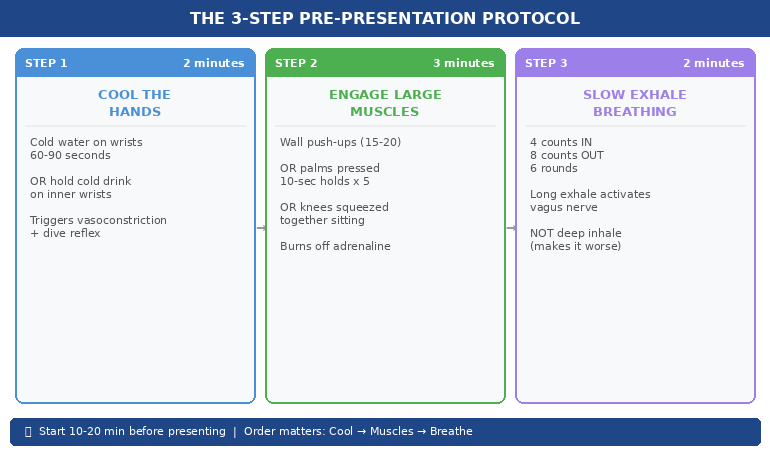
The 3-Step Protocol (Before You Present)

This protocol works best when applied 10–20 minutes before you’re due to present. It targets the three physiological mechanisms that cause severe shaking. (This is educational, not medical advice. If your hands shake outside of presentation situations — at rest, during meals, or in daily tasks — consult a clinician to rule out other causes.)

Step 1: Cool the hands (2 minutes). Run your wrists and the backs of your hands under cold water for 60–90 seconds. If no sink is available, hold a cold drink can or a bottle of cold water against your inner wrists. This triggers a vasoconstriction response — your blood vessels narrow slightly, reducing the tremor amplitude. It also activates your mammalian dive reflex, which nudges your nervous system toward parasympathetic (calming) mode. This is not a placebo effect — it’s a recognised physiological response that many professionals find effective.

Step 2: Engage the large muscles (3 minutes). Find somewhere private — a toilet cubicle, a stairwell, an empty corridor. Do wall push-ups (15–20), or press your palms together as hard as you can for 10-second holds (repeat 5 times), or squeeze your thighs by sitting and pressing your knees together hard. The goal is to burn off the excess adrenaline that’s causing the tremor. Adrenaline was designed to fuel large muscle action. When you give it large muscles to work with, the surplus gets metabolised and the fine motor tremor reduces. This is the single most effective intervention for severe shaking.

Step 3: Slow exhale breathing (2 minutes). Breathe in for 4 counts. Breathe out for 8 counts. Repeat 6 times. The extended exhale activates the vagus nerve, which is the main brake pedal on your sympathetic nervous system. Standard “deep breathing” advice (breathe in deeply!) actually makes anxiety worse because it over-oxygenates your blood. The key is the long exhale, not the deep inhale. Four in, eight out. Six rounds. That’s all.


Three-step pre-presentation protocol showing cool hands then engage large muscles then slow exhale breathing with time estimates

The order matters. Cool first (reduce blood flow to trembling extremities), muscle engagement second (burn off adrenaline), breathing third (activate the calming brake). If you skip to breathing without doing steps 1 and 2, the adrenaline is still circulating and the breathing alone won’t be enough for severe shaking.

For milder shaking, the 30-second nervous system reset may be sufficient. But if your shaking is severe enough that you can’t hold a clicker or turn a page, you need the full three-step protocol.

🎧 Want a guided version of this protocol you can use before any presentation?

Calm Under Pressure is an programme that walks you through the nervous system reset — designed for severe physical symptoms, not just general nerves.

Get Calm Under Pressure → £19.99

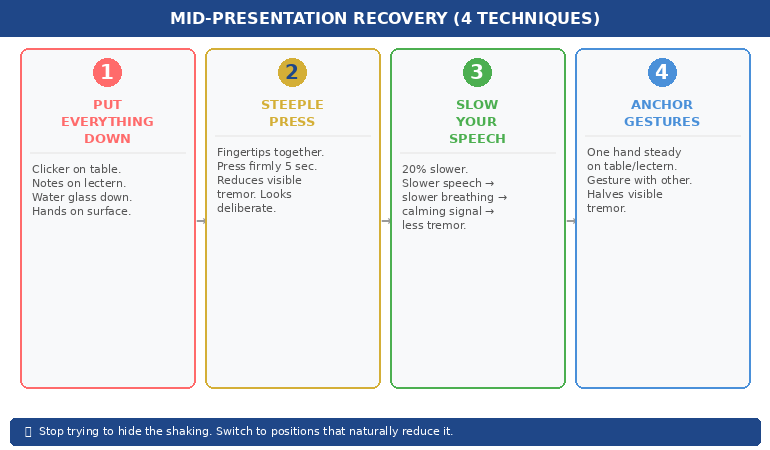
What to Do If You’re Already Shaking Mid-Presentation

Sometimes the shaking starts after you’ve begun presenting. You’re two slides in, you reach for your water glass, and you see your hand trembling. Panic compounds the problem — the awareness of shaking triggers more adrenaline, which triggers more shaking. Here’s how to interrupt the cycle:

Put everything down. Clicker on the table. Notes on the lectern. Water glass back down. Don’t try to hold anything while your hands are shaking — it makes the tremor more visible, not less. Resting your hands on the table or the sides of the lectern is completely natural and nobody will question it.

Press your fingertips together. Bring both hands together in front of you with fingertips touching (like a steeple). Press firmly for 5 seconds. This engages the small muscles in your hands isometrically, which temporarily reduces the visible tremor. It also looks deliberate and thoughtful — nobody reads steepled hands as nervousness.

Speak more slowly. When adrenaline surges, your speech speeds up, which speeds up your breathing, which increases the shaking. Deliberately slowing your speech by 20% creates a feedback loop in the opposite direction: slower speech → slower breathing → calming signal to the nervous system → reduced tremor. You will feel like you’re speaking absurdly slowly. You’re not. You’re speaking at normal pace for the first time.

Use anchor gestures. Instead of pointing at slides (which requires fine motor precision and makes tremor visible), use broad palm-up gestures or hold one hand steady on the table while gesturing with the other. Anchor one hand and free the other. This halves the visible tremor and gives your body a stable reference point.

PAA: How do I stop my hands shaking during a presentation?
If you’re already shaking mid-presentation, put everything down (clicker, notes, water), press your fingertips together in a steeple for 5 seconds (isometric engagement reduces visible tremor), slow your speech by 20% (creates a calming feedback loop), and use anchor gestures (one hand steady on the table, gesture with the other). The key is to stop trying to hide the shaking — which makes it worse — and instead switch to positions and movements that naturally reduce it.

The Night-Before Reset That Changes the Morning After

Calm Under Pressure is designed to be used the evening before or morning of a presentation. The technique works directly on the nervous system responses that cause severe shaking, racing heart, and shallow breathing — so you walk into the room with your physiology already calmer.

Get Calm Under Pressure → £19.99

Instant download.  Programme built from clinical hypnotherapy training. Designed specifically for physical presentation symptoms at the severe end.


Mid-presentation recovery techniques showing put everything down then steeple press then slow speech then anchor gestures

The Equipment Strategy (Eliminate the Evidence)

One of the smartest things you can do for severe hand shaking is eliminate every situation where the shaking becomes visible. This isn’t avoidance — it’s tactical presentation design:

Ditch the clicker. Use a wireless keyboard shortcut to advance slides (press the right arrow key on a laptop at the table), or ask a colleague to advance slides for you. Saying “next slide, please” is completely normal in corporate settings. Nobody questions it. And you’ve just eliminated the single biggest tremor-revealing object.

Never hold paper. If you need notes, put them flat on the table or the lectern. A vibrating sheet of paper amplifies hand tremor by a factor of ten — it’s the most visible possible evidence of shaking. Flat notes on a surface are completely invisible.

Use a heavy water glass. If you need water during the presentation, choose the heaviest glass available. A lightweight plastic cup trembles visibly. A heavy glass tumbler dampens the tremor. Better yet, take a sip before you start and don’t touch the glass during the presentation.

Stand behind something. A lectern, a table edge, a standing desk. Not to hide — but to give your hands a natural resting place. Hands resting on a surface don’t shake visibly. Hands hanging at your sides or holding objects do. Choose your position strategically.

🎧 Address the root cause — not just the tactics.

Calm Under Pressure works on the nervous system directly so the shaking is less severe before it starts. Equipment strategies help in the moment. The programme helps long-term.

Get Calm Under Pressure → £19.99

The Long-Term Fix (Rewiring the Response)

The protocol and equipment strategies manage the symptom. The long-term fix addresses the cause: your nervous system has learned to classify “presenting” as a threat, and it needs to be retrained to classify it as safe.

This is not about positive thinking or affirmations. It’s about systematic desensitisation — gradually exposing your nervous system to the presentation stimulus while keeping your body in a calm state, so your brain learns a new association: presenting = safe.

Graduated exposure. Start with the lowest-stakes presentation you can find. A team standup. A 2-minute update in a small meeting. Present something low-risk to people who don’t evaluate you. Then increase the stakes gradually — slightly larger group, slightly more important topic, slightly higher scrutiny. Each time your nervous system experiences “presenting” without a threat materialising, it recalibrates. This is the same principle used in clinical treatment of phobias.

Pre-presentation rehearsal. Stand in the actual room where you’ll present, if possible. Run through your opening sixty seconds — out loud, at full volume, standing in the position you’ll use. Your nervous system responds to environmental cues (the room, the standing position, the sound of your own voice). Rehearsing in the real environment teaches your body that this specific context is safe. Rehearsing at your desk with notes doesn’t achieve this.

Post-presentation processing. After each presentation, write down three things: (1) What was the worst moment? (2) Did the audience actually react negatively? (3) What would I do differently? This creates a feedback loop that corrects your nervous system’s threat assessment. Almost always, the worst moment was invisible to the audience, they didn’t react negatively, and the “evidence” of failure exists only in your own perception.

If you’ve experienced a full panic attack before presenting, the graduated exposure approach is especially important — start smaller than you think necessary, and build up more slowly than feels logical.


Long-term fix showing graduated exposure then rehearse in real environment then post-presentation processing feedback loop

PAA: Can you permanently fix hand shaking when presenting?
Yes, but it requires retraining your nervous system, not just managing the symptoms. The approach combines graduated exposure (starting with low-stakes presentations and building up), rehearsal in the actual presentation environment, and post-presentation processing to correct your brain’s threat assessment. Clinical techniques like hypnotherapy and systematic desensitisation can accelerate this process. Most people see significant improvement within 6–8 weeks of consistent practice — the shaking doesn’t disappear overnight, but it reduces progressively as your nervous system learns that presenting is safe.

Start Rewiring Your Nervous System Before Your Next Presentation

Calm Under Pressure combines clinical hypnotherapy techniques with practical nervous system management — designed specifically for the physical symptoms that standard presentation coaching doesn’t address. Use it the night before. Walk in calmer.

Get Calm Under Pressure → £19.99

Instant download. Built from clinical hypnotherapy training + five years of personal experience with severe presentation anxiety. Designed for the physical end of the spectrum.

Frequently Asked Questions

Should I tell the audience my hands are shaking?

Generally no. Drawing attention to the shaking amplifies your awareness of it (which triggers more adrenaline, which increases the shaking). Most audiences either don’t notice or don’t care — they’re focused on your content, not your hands. The exception: if the shaking is so severe that ignoring it feels absurd, a brief, confident acknowledgement can actually reduce the pressure. “I’ve got a bit of adrenaline going — let me set this down” is honest and human. Then move on immediately. Don’t dwell on it.

Could the shaking be a medical condition rather than anxiety?

If your hands shake in situations other than presenting — at rest, while eating, during normal daily tasks — it’s worth consulting a doctor to rule out essential tremor, thyroid issues, or other medical causes. Anxiety-related presentation shaking is situation-specific: it happens before and during presentations and stops afterwards. If the shaking persists outside of high-pressure situations, seek medical advice before assuming it’s anxiety-related.

Does beta-blocker medication help with presentation shaking?

Beta-blockers (such as propranolol) are sometimes prescribed for performance anxiety and can reduce the physical symptoms including hand tremor. They work by blocking the effects of adrenaline on your heart and muscles. However, they require a prescription, they affect everyone differently, and they address the symptom without changing the underlying nervous system response. If you’re considering medication, discuss it with your GP. The techniques in this article can be used alongside medication or as an alternative — they’re not mutually exclusive.

How long before a presentation should I start the protocol?

The three-step protocol (cool, muscle engagement, breathing) works best 10–20 minutes before you’re due to present. Starting too early means the effects wear off. Starting too late means you don’t have time for all three steps. If you only have 5 minutes, prioritise step 2 (muscle engagement) — it’s the single most effective intervention for burning off adrenaline. If you only have 2 minutes, do the extended exhale breathing (4 in, 8 out, 6 rounds).

📬 The Winning Edge Newsletter

Weekly strategies for presentation confidence, nervous system management, and career-critical communication. No fluff.

Subscribe free →

Optional next step: Start with Calm Under Pressure for the physical symptoms. If your presentation anxiety goes beyond the body — if you avoid presentations entirely, procrastinate on preparation, or experience dread days before presenting — Conquer Speaking Fear (£39) addresses the psychological root causes alongside the physical management.

Related: Physical symptoms are one side of the coin. If you’re also preparing for a high-stakes presentation like a job interview presentation, getting the structure right reduces anxiety — because when you know your material is well-organised, your nervous system has less reason to panic.

Severe hand shaking during presentations is a physiological event, not a character flaw. Cool the hands. Engage the large muscles. Breathe on the exhale. Design your equipment to eliminate evidence. And start the long-term work of teaching your nervous system that presenting is safe. The shaking will reduce. It did for me.

🎧 Start with the nervous system reset — use it before your next presentation.

Get Calm Under Pressure → £19.99

Optional bundle: Calm Under Pressure handles the physical symptoms. But if you also want the slide structure, Q&A preparation, and psychological confidence framework alongside it — The Complete Presenter (£99) includes all seven Winning Presentations products plus three bundle-only bonuses. Everything you need to walk in prepared and stay calm through to the last question.

About the Author

Mary Beth Hazeldine is the Owner & Managing Director of Winning Presentations. With 24 years of corporate banking experience at JPMorgan Chase, PwC, Royal Bank of Scotland, and Commerzbank, she spent five of those years dealing with severe presentation anxiety — including the hand shaking, racing heart, and avoidance that come with it.

She trained as a clinical hypnotherapist and NLP practitioner specifically to solve the problem, and now helps executives manage the physical and psychological dimensions of presentation anxiety so they can present with confidence when it matters most.

Book a discovery call | View services

29 Jan 2026
Woman looking anxious before presenting with thought bubble showing worried inner critic

Every Time I Stood Up to Speak, the Same Thought Hijacked Me.

“They can all see you’re faking it.”

That was the thought. Every single time. Standing up in meetings. Walking to the front of a room. Unmuting on a video call. The same voice, the same accusation: they’re watching you fail.

For five years, I believed it was true. The fear of being judged when speaking wasn’t just uncomfortable—it ran my career. I turned down opportunities. I stayed silent when I had something valuable to say. I spent hours rehearsing, then hours afterward replaying every stumble.

Then I trained as a clinical hypnotherapist. And I discovered something that changed everything: the judgment I feared wasn’t coming from the audience. It was coming from inside my own head—and it had been lying to me the whole time.

Quick Answer: The fear of being judged when speaking is a cognitive loop—your brain predicting criticism, scanning for evidence, then “confirming” the prediction with selective attention. In practice, audiences are far more generous than speakers imagine. Breaking the loop requires understanding that most judgment you fear is projection: your inner critic’s voice, not actual audience opinion.

🎯 Does This Sound Familiar?

  • You replay presentations for hours, fixating on every mistake
  • You assume a neutral face means disapproval
  • You feel like everyone noticed that one stumble—even when no one mentions it
  • You avoid speaking opportunities because the judgment feels unbearable
  • You’ve been told you’re “too hard on yourself”—but can’t seem to stop

If three or more apply, you’re caught in the judgment loop. There’s a way out—keep reading.

Want a Structured Way to Break the Loop?

For readers who prefer a guided framework over working through techniques alone, Conquer Speaking Fear walks through the cognitive and physiological work step-by-step — designed by a qualified clinical hypnotherapist.

Explore the Programme →

The Moment I Realised I’d Been Wrong for Years

The turning point came during my hypnotherapy training. We studied a cognitive distortion called “mind reading”—the assumption that you know what others are thinking.

I realised I’d been doing it for my entire career.

Every frown in the audience meant disapproval. Every glance at a phone meant boredom. Every person who didn’t smile was silently cataloguing my failures.

Except none of it was real. I was projecting my own self-criticism onto faces that were actually neutral, distracted, or simply processing information.

When I finally started asking for actual feedback after presentations, the gap between my perception and reality was staggering. “Clear and confident,” people said. “Really useful.” Meanwhile, I’d spent the previous night convinced I’d humiliated myself.

The fear of being judged when speaking wasn’t coming from the audience. It was coming from a voice in my own head—and that voice had been running the show for five years.

The Judgment Loop: Why Your Brain Creates Critics That Don’t Exist

The fear of being judged isn’t irrational—it’s an ancient survival mechanism running outdated software.

Thousands of years ago, social rejection meant death. Being cast out from the tribe meant no protection, no food, no survival. Your brain evolved to be hyper-vigilant about social threats—scanning constantly for signs of exclusion.

The problem? That same brain now treats a Tuesday morning team meeting like a life-or-death tribal evaluation.

The judgment loop works in four stages:

Stage 1: Anticipation. Before you speak, your brain predicts negative outcomes. “They’ll think you’re incompetent. They’ll see through you. They’re already judging.”

Stage 2: Hypervigilance. During the presentation, you scan for evidence confirming those predictions. A frown. A yawn. Someone checking their phone. Each gets flagged as “proof.”

Stage 3: Rumination. Afterward, you replay every micro-moment, constructing a narrative of failure. The frown becomes contempt. The yawn becomes boredom. The silence becomes criticism.

Stage 4: Reinforcement. This post-event analysis “proves” your fears were justified—making the anticipation worse next time.

The loop feeds itself. Without intervention, it strengthens with every presentation.

#image_title

Fear of being judged when speaking diagram showing the judgment loop cycle of anticipation hypervigilance rumination and reinforcement

What Audiences Actually Think (The Research)

Cognitive psychology research consistently shows the same thing: audiences are far more generous than speakers believe.

The Illusion of Transparency

Speakers dramatically overestimate how visible their nervousness is. In studies, presenters rated their anxiety as obvious; audiences barely noticed. Your racing heart, sweaty palms, and internal panic are largely invisible to everyone but you.

The Audience Wants You to Succeed

Most audiences are sympathetic, not critical. They’re not hoping you’ll fail—they’re hoping you’ll give them something useful. When you stumble, their instinct is usually empathy, not judgment.

Think about your own experience. When a speaker loses their place, do you think “what an idiot”? Or “that happens to everyone”?

Attention Is Scattered, Not Focused

You feel like every eye is drilling into you, evaluating every word. In reality, audience attention is distributed. People are thinking about their next meeting, their lunch, their own concerns. You’re not the centre of their mental universe—even while you’re speaking.

This is liberating, not dismissive. The judgment you fear isn’t happening because people aren’t paying the microscopic attention your brain assumes.

For a deeper look at building sustainable confidence, see my guide on genuine presentation confidence.

⭐ Stop the Loop Before Your Next Presentation

The fear of being judged isn’t something you manage—it’s something you can resolve. Get the complete system for rewiring how you experience speaking.

Conquer Speaking Fear includes:

  • The psychological framework behind judgment fear (and how to dismantle it)
  • NLP techniques to interrupt the rumination loop
  • Pre-presentation protocols that prevent the spiral before it starts

Get Conquer Speaking Fear → £39

Created by a clinical hypnotherapist who spent 5 years trapped in the same loop.

The Spotlight Effect: Why You Feel Watched When You’re Not

Psychologists call it the “spotlight effect”—the tendency to believe others are paying more attention to us than they actually are.

In one famous study, participants wore embarrassing t-shirts and estimated that about half the people they encountered noticed. The actual number? Less than 25%.

When speaking, the spotlight effect intensifies. You feel like you’re under a microscope when you’re actually just… talking to people who are half-listening while thinking about their own lives.

Why does this matter?

Because the fear of being judged is based on a false premise: that people are watching you closely enough to judge you in the first place.

They’re not.

That stumble you replayed forty times? Most people didn’t register it. That “um” that haunts you? Nobody counted. That moment you lost your place? They assumed you were pausing for effect.

The spotlight you feel isn’t real. It’s a cognitive illusion created by a brain that evolved to overestimate social threats.

Why am I so afraid of being judged when I speak?

Fear of judgment when speaking stems from your brain’s ancient threat-detection system treating social evaluation like physical danger. This was useful for tribal survival—social rejection once meant death. But it creates false alarms in modern contexts. The fear feels real because your nervous system can’t distinguish between actual threat and imagined social rejection.

How do I stop caring what people think when presenting?

You don’t stop caring—you recalibrate. The goal isn’t indifference but accurate perception. When you understand that most “judgment” is projection (your inner critic, not actual audience opinion), you can focus on connection rather than performance. Cognitive reframing and pre-presentation protocols help shift this automatically.

Is fear of judgment a form of anxiety?

Yes—fear of being judged when speaking is a core component of social anxiety and performance anxiety. It involves the same neural pathways: amygdala activation, stress hormones, hypervigilance for threat. The good news is that anxiety responses can be rewired with the right techniques.

Your Inner Critic Isn’t Protecting You—It’s Sabotaging You

Here’s the uncomfortable truth: the harshest judge in any room is the one inside your own head.

Your inner critic sounds like it’s helping. “Don’t mess up. They’re watching. Be careful.” But this voice doesn’t protect you from judgment—it creates the anxiety that undermines your performance.

The inner critic creates a self-fulfilling prophecy:

You fear being seen as nervous → The fear makes you nervous → The nervousness confirms the fear was “justified.”

Meanwhile, the audience sees someone who seems slightly tense and thinks nothing of it. The “judgment” exists only in the loop between your ears.

The voice isn’t objective

If you recorded your inner critic’s commentary and played it back, you’d recognise it as absurdly harsh. “Everyone thinks you’re incompetent” is not reasonable analysis—it’s catastrophising. But in the moment, it feels like truth.

Part of breaking the judgment loop is learning to hear that voice as a voice—not as reality. It has opinions. Those opinions are usually wrong. You don’t have to believe everything it says.

For more on the physical side of this response, see my guide on managing high-stakes presentation nerves.

For the Inner Critic Loop

The structured programme for silencing the inner critic that logic alone won’t quiet

Conquer Your Fear of Public Speaking (£39, instant access) — cognitive reframing techniques and NLP pattern interrupts designed by a qualified clinical hypnotherapist.

Get the Programme →

How to Break the Loop: The 4-Step Reset

Understanding the loop intellectually is useful. Breaking it requires action. Here’s the framework I use with clients—and used on myself:

Step 1: Catch the Prediction

Before you speak, notice the anticipatory thoughts. “They’ll think I’m boring. They’ll judge my voice. They’ll see I’m nervous.”

Don’t argue with them. Just notice. “Ah, there’s the prediction.” Awareness alone begins to weaken the loop.

Step 2: Question the Evidence

During or after speaking, when you catch yourself “mind reading,” ask: “What’s my actual evidence for this?”

A frown isn’t evidence of judgment. It might be concentration. Confusion. Indigestion. You don’t know—and assuming the worst isn’t data.

Step 3: Interrupt the Replay

Post-presentation rumination is where the loop reinforces itself. When you catch yourself replaying mistakes, use a pattern interrupt:

— Physically move (stand up, change rooms)
— Say “that’s not useful” out loud
— Redirect attention to something requiring focus

The goal isn’t suppression—it’s breaking momentum before the spiral.

Step 4: Collect Contrary Evidence

Actively seek feedback. Not “how did I do?” (too vague) but “what’s one thing that worked well?” and “what’s one thing I could improve?”

Real feedback—almost always more positive than imagination—begins to overwrite the false narrative.

From Performing to Connecting: What Real Confidence Looks Like

The deepest shift happens when you stop treating speaking as a performance to be judged and start treating it as a connection to be made.

Performance mindset asks: “How am I being perceived?”
Connection mindset asks: “How can I be useful to these people?”

When you focus on the audience’s needs rather than your own evaluation, the spotlight effect diminishes naturally. You’re not the subject anymore—the value you’re providing is.

This isn’t fake-it-till-you-make-it. It’s genuine confidence from redirecting attention away from self-judgment and toward service.

The irony: When you stop worrying about being judged, you become a better speaker. Your delivery improves. Your presence strengthens. You become the confident person you were trying to perform.

Not because the audience changed. Because you stopped inventing critics who were never there.

For more on overcoming fear of public speaking at a deeper level, that guide covers the physiological techniques that complement this cognitive approach.

⭐ Ready to Break the Loop for Good?

The fear of being judged when speaking isn’t permanent. It’s a pattern—and patterns can be changed. Get the complete system for rewiring your relationship with speaking.

Conquer Speaking Fear gives you:

  • The psychological framework behind judgment fear
  • Step-by-step techniques to interrupt the loop at every stage
  • Pre-presentation protocols that prevent spiralling

Get Conquer Speaking Fear → £39

Created by a qualified clinical hypnotherapist and NLP practitioner who knows the loop from the inside.

Frequently Asked Questions

How long does it take to overcome fear of being judged when speaking?

Most people notice a significant shift within 2-4 weeks of consistent practice with these techniques. The judgment loop took years to build, so complete rewiring takes time—but acute intensity often reduces quickly once you understand the mechanism and have tools to interrupt it.

Will the fear ever go away completely?

For most people, the fear transforms rather than disappears entirely. You may still notice old thoughts arise, but they lose their power. Instead of believing “everyone’s judging me,” you recognise it as an old pattern and let it pass. The fear stops controlling behaviour even if echoes remain.

What if I really am being judged?

Sometimes you are—but rarely as you imagine. Even when someone judges a presentation negatively, their opinion is usually fleeting and less extreme than feared. The key: their judgment of one presentation isn’t judgment of your worth as a person. Those are different things.

Should I avoid speaking situations until I’ve overcome this?

Avoidance strengthens fear. Each avoided presentation teaches your brain that speaking is genuinely dangerous. Instead, seek smaller, lower-stakes opportunities to practice the techniques. Gradual exposure with new tools is more effective than waiting until you feel “ready.”

Get Weekly Confidence Insights

Practical techniques for speaking with confidence—no fluff, just what works.

Subscribe to The Winning Edge →

If your body reacts before your mind does

Racing heart, shaking hands, tight chest before you speak? Calm Under Pressure (£19.99) covers the physiological techniques — breathing, posture, vocal resets — designed to complement the cognitive work in this article.

Get Calm Under Pressure →

Related: Fear of judgment often spikes when presenting to senior leaders. Read What Executives Actually Want From Your Presentation to understand what they’re really looking for—it’s not what most people assume, and knowing this can reduce the pressure significantly.

The Bottom Line

The fear of being judged when speaking feels like truth. It feels like you’re perceiving reality accurately—that the audience really is cataloguing your flaws.

They’re not.

The judgment loop is a cognitive distortion created by a brain evolved for tribal survival, not conference room presentations. The critics in your head aren’t real. The spotlight isn’t on you. And the audience is far more sympathetic than your inner voice has led you to believe.

Once you understand this—really understand it—the loop begins to break.

Your next step: Before your next presentation, notice the anticipatory thoughts. Don’t fight them. Just notice: “There’s the prediction.” That simple act of awareness is the first crack in the loop that’s been running your speaking life.

Mary Beth Hazeldine is Owner & Managing Director of Winning Presentations and a qualified clinical hypnotherapist and NLP practitioner. After spending 5 years trapped in the judgment loop herself — while working 25 years in corporate banking at JPMorgan Chase, PwC, Royal Bank of Scotland, and Commerzbank — she developed techniques that help senior professionals across financial services, consulting, and technology speak with genuine confidence.

24 Jan 2026
Professional woman taking a calming breath as panic subsides before a presentation, showing the moment of regaining control

Panic Attack Before Presentation: What to Do in the Moment

My hands were shaking so badly I couldn’t hold my notes. My heart was pounding so hard I was certain everyone in the corridor could hear it. I had seven minutes until I was supposed to present to the board—and I was hiding in a bathroom stall, convinced I was dying.

Quick answer: A panic attack before presentation is your nervous system’s false alarm—it feels life-threatening but it isn’t. The 90-second protocol that stops it: (1) Cold water on wrists and neck, (2) 4-7-8 breathing (inhale 4, hold 7, exhale 8), (3) Name 5 things you can see out loud. This interrupts the panic cycle and gives your prefrontal cortex time to regain control from your hijacked amygdala.

In practice, panic attacks before presenting are far more common than most professionals admit—and they’re completely manageable once you understand what’s happening in your body and have a reliable protocol to interrupt the cycle.

When you have a protocol that works:

  • Panic becomes manageable instead of terrifying
  • You present anyway—and no one knows what happened
  • The fear of panic itself starts to fade

Written by Mary Beth Hazeldine — executive presentation coach and qualified clinical hypnotherapist. I spent 5 years having panic attacks before presentations until I learned what actually works. I’ve since helped hundreds of executives who thought they’d have to live with this forever. Last updated: January 2026.

🚨 Panic attack happening RIGHT NOW? Do this:

  1. Cold water — Run cold water on your wrists and splash your face/neck (activates dive reflex, slows heart)
  2. 4-7-8 breath — Inhale 4 counts, hold 7 counts, exhale 8 counts. Repeat 3 times.
  3. 5-4-3-2-1 grounding — Name 5 things you see, 4 you touch, 3 you hear, 2 you smell, 1 you taste
  4. Move — Shake your hands, roll your shoulders, walk. Movement discharges adrenaline.

This takes 90 seconds. The panic will peak and pass. You will be able to present.

→ Want this protocol in audio form you can use in the moment? Get Calm Under Pressure →

📅 Presenting in the next 7 days?

The protocol above handles acute panic. But if you want to prevent panic attacks from escalating—or stop them before they fully activate—you need to train your nervous system in advance. That’s what this article teaches.

That board presentation I mentioned? I made it through. Delivered the full 20 minutes. Got the budget approved. No one knew what had happened in that bathroom seven minutes earlier.

I learned something crucial that day: panic attacks feel unsurvivable, but they’re not. And once you have a reliable protocol, you stop fearing the fear itself—which is often worse than the panic.

After 5 years of suffering through this alone—and then training as a clinical hypnotherapist specifically to understand why it happens—I now teach these techniques to executives who thought presentation panic was just something they had to endure. It isn’t.

What’s Actually Happening During a Panic Attack

Understanding what’s happening in your body removes some of the terror. A panic attack before presentation is your nervous system misfiring—your brain has incorrectly flagged “presentation” as “life-threatening danger.”

The Amygdala Hijack

Your amygdala (the brain’s threat detector) triggers fight-or-flight. It doesn’t consult your rational brain first. By the time you think “this is just a presentation,” your body is already flooded with adrenaline and cortisol.

This is why telling yourself to “just relax” doesn’t work. Your rational brain isn’t driving anymore.

The Physical Symptoms (And Why They Happen)

Every panic symptom has a survival purpose that’s now misfiring:

  • Racing heart — Pumping blood to muscles for fighting or fleeing
  • Shallow breathing — Quick oxygen intake for action
  • Sweating — Cooling the body for exertion
  • Trembling — Muscles primed for explosive movement
  • Tunnel vision — Focusing on the “threat”
  • Nausea/stomach drop — Digestion shutting down to redirect energy
  • Feeling of unreality — Dissociation to protect from trauma

None of these will hurt you. They feel terrible, but they’re your body trying to protect you from a threat that doesn’t exist.

The Critical Fact Most People Don’t Know

Panic attacks peak within 10 minutes and pass within 20-30 minutes—even if you do nothing. Your body cannot sustain that level of activation indefinitely. The adrenaline gets metabolised. The cortisol clears.

The 90-second protocol below speeds this process dramatically by directly interrupting the nervous system cascade.

Diagram showing the panic attack cycle and how the 90-second protocol interrupts it at each stage

The 90-Second Protocol (Step-by-Step)

This protocol works because it targets your nervous system directly—not through thoughts, but through physical interventions that trigger automatic calming responses.

Step 1: Cold Water (15 seconds)

Run cold water over your wrists. If possible, splash cold water on your face and the back of your neck.

Why it works: This activates the “mammalian dive reflex”—an automatic response that slows your heart rate. Your body thinks you’re diving into water and immediately begins calming your cardiovascular system. It’s not psychological; it’s physiological.

If you can’t get to water: Press something cold against your wrists or neck—a cold drink can, ice from a water glass, a cold window, your phone screen.

Step 2: 4-7-8 Breathing (45 seconds)

Inhale through your nose for 4 counts. Hold for 7 counts. Exhale through your mouth for 8 counts. Repeat 3 times.

Why it works: The extended exhale activates your parasympathetic nervous system (the “rest and digest” system). You’re manually flipping the switch from fight-or-flight to calm. The hold interrupts the hyperventilation pattern that makes panic worse.

Can’t remember the counts? Just make the exhale longer than the inhale. That’s the key mechanism.

Step 3: 5-4-3-2-1 Grounding (20 seconds)

Name out loud (or silently if you’re not alone):

  • 5 things you can see
  • 4 things you can touch
  • 3 things you can hear
  • 2 things you can smell
  • 1 thing you can taste

Why it works: This engages your prefrontal cortex (rational brain) and pulls attention away from the amygdala (panic brain). You cannot fully panic while actively cataloguing your environment. It anchors you in the present moment rather than the catastrophic future.

Step 4: Move (10 seconds)

Shake your hands vigorously. Roll your shoulders. Walk a few steps. Do wall push-ups if you’re somewhere private.

Why it works: Your body has been flooded with adrenaline meant for physical action. Movement discharges it. This is why animals shake after a threat passes—they’re completing the stress cycle. Humans often skip this step, which is why the chemicals linger.

For more breathing techniques, see the complete guide to presentation breathing.

⭐ Never Face Presentation Panic Unprepared Again

Calm Under Pressure is the complete system for managing physical anxiety symptoms before and during presentations—including the 90-second protocol in audio form you can use in the moment.

What’s inside:

  • The Emergency Protocol audio (what you just learned, guided so you don’t have to remember)
  • The 7-Day Nervous System Reset (reduces baseline anxiety before big presentations)
  • The Pre-Presentation Ritual (prevents panic from fully activating)

Get Calm Under Pressure → £19.99

Created by a clinical hypnotherapist who spent 5 years managing her own presentation panic.

How to Stop Panic Before It Starts

The 90-second protocol handles acute panic. But ideally, you prevent presentation panic from fully activating in the first place.

The Pre-Presentation Ritual (30 minutes before)

1. Physiological sigh (5 minutes before leaving for the room)

Double inhale through your nose (one breath, then a second shorter breath on top), then long exhale through mouth. Repeat 3-5 times. Stanford research shows this is the fastest way to reduce real-time stress.

2. Cold exposure (10 minutes before)

Hold something cold, splash cold water on your wrists, or step outside briefly if it’s cold. Pre-activates the calming dive reflex before you need it.

3. Movement (15-20 minutes before)

Take a brisk walk. Climb stairs. Light stretching. Burns off anticipatory adrenaline before it accumulates to panic levels.

4. Arrival ritual (5 minutes before)

Arrive early. Claim your space. Touch the podium or table. Greet one person. This reduces the “entering hostile territory” feeling that triggers panic.

The Morning-Of Protocol

On presentation days:

  • Limit caffeine — It amplifies anxiety symptoms. Half your normal amount, or skip it.
  • Eat protein — Stabilises blood sugar. Blood sugar crashes trigger anxiety responses.
  • Exercise early — Even 20 minutes of movement reduces anxiety for hours afterward.
  • Avoid news/social media — Your nervous system doesn’t need additional activation.

Want the complete pre-presentation ritual with guided audio?

Includes the full 30-minute protocol you can follow the morning of any high-stakes presentation.

Get Calm Under Pressure → £19.99

Long-Term: Training Your Nervous System

If you experience panic attacks regularly before presentations, your nervous system has learned to associate “presentation” with “danger.” The long-term solution is retraining that association.

Gradual Exposure

Your nervous system learns safety through repeated exposure without catastrophe:

  • Speak up in small meetings first
  • Volunteer for low-stakes presentations
  • Record yourself presenting and watch it back
  • Present to friends or family

Each time you present and survive, your amygdala gets evidence that presentations aren’t actually life-threatening. The threat association weakens.

Daily Nervous System Training

Daily practice—not just on presentation days—builds your capacity to regulate:

  • Daily breathwork — 5 minutes of 4-7-8 breathing trains your body to access calm states quickly
  • Cold exposure — Cold showers or ice on wrists builds stress tolerance
  • Vagal toning — Humming, singing, gargling stimulate the vagus nerve that controls the calm response

Cognitive Reframing

Physical interventions work faster, but shifting how you think about panic also helps:

  • “This is excitement” — Anxiety and excitement have identical symptoms. Relabelling helps.
  • “My body is preparing me” — Reframe symptoms as preparation for performance, not danger signals.
  • “I’ve survived this before” — You have a 100% survival rate for panic attacks so far.

For more on the psychology of speaking fear, see the hypnotherapist’s guide to lasting change.

The three-level approach to managing presentation panic: emergency protocol, prevention ritual, and long-term nervous system training

⭐ Stop Dreading Every Presentation

The techniques in this article work. But implementing them when you’re already anxious is hard. Calm Under Pressure gives you the complete system with audio guides so you don’t have to think—just press play.

You’ll get:

  • Emergency audio protocol (use during active panic)
  • 7-day nervous system reset program
  • Pre-presentation morning ritual
  • Long-term training guide

Get Calm Under Pressure → £19.99

Used by executives who present in high-stakes boardrooms and client meetings.

When to Seek Professional Help

The techniques here help most people manage presentation panic. But some situations warrant professional support:

Consider seeing a professional if:

  • Panic attacks happen frequently outside of presentations
  • You’re avoiding career opportunities because of fear
  • Anxiety is affecting sleep, relationships, or daily life
  • You’re using alcohol or substances to cope
  • These techniques aren’t helping after consistent 4-week practice

Effective professional approaches for presentation panic:

  • Cognitive Behavioural Therapy (CBT) — Evidence-based treatment for anxiety disorders
  • Clinical Hypnotherapy — Works with subconscious associations driving panic
  • EMDR — Particularly helpful if there’s a traumatic presentation experience in your history
  • Medication — Beta-blockers block physical symptoms; SSRIs address underlying anxiety. Discuss with your doctor.

Seeking help isn’t weakness—it’s strategic. Many successful executives work with professionals to optimise their performance.

For more on building lasting confidence, see the 5-minute reset that actually works.

Ready to take control of presentation panic?

Get the complete toolkit—emergency protocols, prevention rituals, and the training system.

Get Calm Under Pressure → £19.99

Frequently Asked Questions

Can a panic attack actually hurt me?

No. A panic attack before presentation feels dangerous but isn’t. The symptoms are uncomfortable—sometimes terrifying—but they won’t cause heart attacks, fainting (blood pressure rises during panic, making fainting nearly impossible), or permanent harm. Understanding this reduces the fear of panic itself.

What if panic happens DURING my presentation?

Pause. Take a drink of water (buys time, activates swallowing reflex which calms). Take one breath with a long exhale. Continue. Most audiences assume you’re collecting your thoughts. If needed, say “Let me take a moment to make sure I’m explaining this clearly.”

Will people know I’m having a panic attack?

Almost certainly not. Internal symptoms (racing heart, nausea, doom feeling) are invisible. External symptoms (trembling, sweating) are far less obvious than you think. Others are focused on their own concerns, not analysing your physiology.

Should I tell my audience I’m nervous?

Generally, no. It draws attention to something they haven’t noticed and reduces your perceived authority. Exception: if you’re visibly struggling, a brief “Bear with me for a moment” is better than pretending nothing is wrong.

Why do panic attacks seem to come out of nowhere?

They don’t. There’s usually a buildup of anticipatory anxiety that crosses a threshold—hours or days of rumination, sleep disruption, and physical tension accumulating until the system tips. Prevention techniques address this buildup.

Can I take medication for presentation panic?

Beta-blockers (propranolol) are commonly prescribed for performance anxiety—they block physical symptoms without affecting mental clarity. Safe for occasional use, but they don’t address the underlying cause. Discuss with your doctor.

How long until these techniques work?

The 90-second protocol works immediately—relief within minutes. Prevention techniques show results within 1-2 weeks of consistent use. Long-term nervous system retraining takes 4-8 weeks to produce lasting change.

Is This Right For You?

✓ This is for you if:

  • You experience physical panic symptoms before presenting
  • You’ve tried “just relax” and it doesn’t work
  • You want techniques that work with your nervous system
  • You’re willing to practice before the high-stakes moment

✗ This is NOT for you if:

  • Panic attacks happen frequently in daily life (see a professional)
  • You want a magic fix without practice
  • Your main issue is content preparation, not anxiety
  • You’re unwilling to try physical techniques

⭐ I Hid in Bathroom Stalls for 5 Years. Then I Found What Works.

The techniques in Calm Under Pressure are what finally ended my own presentation panic—and what I now teach executives who thought they’d suffer through this forever. You don’t have to.

The complete system:

  • 90-second emergency protocol (audio)
  • Pre-presentation ritual (30-minute preparation)
  • 7-day nervous system reset
  • Long-term training guide

Get Calm Under Pressure → £19.99

From someone who’s been in that bathroom stall—and found her way out.

📧 Optional: Get weekly techniques for presentation confidence in The Winning Edge newsletter (free).

Your Next Step

A panic attack before presentation doesn’t have to derail your career or your confidence. The 90-second protocol works. The prevention rituals work. The long-term training works.

Start with the emergency protocol. Practice it when you’re calm so it’s automatic when you need it. Then build in the prevention rituals. Then commit to the nervous system training.

You can present without panic. I did—after 5 years of hiding in bathroom stalls. Hundreds of my clients have. You will too.

For the complete system with audio guides, get Calm Under Pressure (£19.99).

P.S. If anxiety about your slides is making panic worse, see what your slides actually communicate about you—sometimes fixing the deck reduces the anxiety.

About the Author

Mary Beth Hazeldine is the Owner & Managing Director of Winning Presentations and a qualified clinical hypnotherapist. The bathroom stall story that opened this article is real—she spent 5 years experiencing panic attacks before presentations before training as a hypnotherapist specifically to understand and overcome them.

With 24 years at JPMorgan Chase, PwC, Royal Bank of Scotland, and Commerzbank—environments where one presentation could change funding, strategy, or careers—she’s helped hundreds of executives who thought panic was something they just had to endure.

Book a discovery call | View services

21 Jan 2026
Fear of public speaking at work - the day-before protocol that calms nerves before workplace presentations

Fear of Public Speaking at Work: What to Do the Day Before

Quick answer: If you’re experiencing fear of public speaking at work with a presentation tomorrow, the next 24 hours matter more than you think. What you do today—not what you did last week—determines whether you walk in nervous or confident. The day-before protocol: lock your content by noon, do one physical run-through, prepare for three questions, stop rehearsing by 8pm, and protect your sleep. This sequence has helped executives manage presentation fear for over 15 years.

The goal isn’t to eliminate fear. It’s to arrive prepared enough that fear becomes useful energy instead of paralysing dread.

⚡ Presentation tomorrow? Here’s your day-before protocol:

By noon: Lock your content. No more edits after this.

Afternoon: One full run-through standing up, out loud

Before dinner: Write down 3 questions you might get. Prepare answers.

By 8pm: Stop all rehearsal. Your brain needs processing time.

Evening: Normal routine. Early bed. No alcohol.

If you’re presenting in the next 48 hours, follow this protocol exactly.

The Night Before That Changed Everything

I spent five years terrified of presenting at work. Not just nervous—terrified. The kind of fear that kept me awake the night before, made me nauseous in the morning, and had me rehearsing obsessively until minutes before I had to speak.

The turning point came when I had a board presentation I couldn’t escape. I’d tried everything: more preparation, positive thinking, even beta blockers. Nothing worked.

Then a mentor gave me advice that seemed wrong: “Stop preparing by 8pm. Go to bed early. Trust that you know enough.”

I didn’t believe her. But I was desperate. I followed her protocol exactly.

The next morning, something was different. I wasn’t calm—but I wasn’t paralysed either. The fear was still there, but it felt like energy instead of dread. I delivered that presentation better than any before it.

That day-before protocol became the foundation of everything I now teach about managing fear of public speaking at work.

⭐ Transform Your Presentation Fear Into Confidence

Get the complete system for managing speaking anxiety at work—from the day-before protocol to in-the-moment techniques that actually work.

Inside Conquer Speaking Fear:

  • The day-before protocol (expanded with timing)
  • Morning-of nervous system reset techniques
  • What to do when fear spikes mid-presentation
  • Long-term confidence building exercises

Get Conquer Speaking Fear → £39

Created by a clinical hypnotherapist who personally overcame 5 years of presentation terror. Refined through 15+ years coaching executives in high-stakes workplace presentations.

Why the Day Before Matters More Than You Think

Most people with fear of public speaking at work focus on the wrong timeframe. They think confidence comes from weeks of preparation or years of practice.

It doesn’t. Confidence comes from arriving rested, prepared enough, and not over-rehearsed.

Here’s what actually happens in your brain the day before a presentation:

Your brain is consolidating. Everything you’ve prepared needs time to move from active memory to accessible memory. This happens during sleep and during breaks from rehearsal. When you rehearse until midnight, you’re actually interfering with this process.

Your nervous system is calibrating. The activities you do the day before set your baseline for the next morning. If you spend the evening anxious and rehearsing, you’ll wake up with elevated cortisol. If you spend the evening calm and confident, you’ll wake up closer to that state.

Your fear is looking for evidence. Anxiety makes you hyper-aware of anything that confirms your fear. The day before, your brain is scanning for signs that tomorrow will go badly. What you focus on expands.

This is why the day-before protocol works. It’s not about positive thinking—it’s about giving your brain and nervous system what they need to function well under pressure.

For deeper techniques on calming your nervous system, see the complete guide to calming nerves before a presentation.

The day-before timeline showing what to do 24 hours, evening, and morning before a work presentation

The Day-Before Protocol (Hour by Hour)

Morning (24 hours before):

Do your final content review. Make any last edits to slides or notes. But set a hard deadline: no changes after noon. The urge to keep tweaking is anxiety disguised as productivity. It doesn’t help—it keeps you in “preparation mode” instead of letting you shift to “ready mode.”

If you find yourself wanting to add slides or change your structure, resist. You know enough. More content won’t make you feel more confident—it will make you feel more overwhelmed.

Afternoon (12-18 hours before):

Do one complete run-through. Stand up. Speak out loud. Time yourself if the presentation has a time limit. Don’t stop and restart—go all the way through, mistakes and all.

This isn’t about perfecting your delivery. It’s about proving to your brain that you can get through the whole thing. One complete run-through does more for confidence than ten interrupted rehearsals.

After the run-through, write down three questions you might be asked. For each one, prepare a 30-second answer. Not scripted—just the key points you’d hit. This removes the fear of “what if they ask something I can’t answer.”

Evening (6-12 hours before):

Stop all rehearsal by 8pm. This feels wrong when you’re anxious. Your brain will tell you that more practice equals more safety. It’s lying.

What your brain actually needs is processing time. The material you’ve prepared needs to consolidate. Rehearsing until midnight prevents this and guarantees you’ll feel foggy tomorrow.

Do your normal evening routine. Watch something easy. Talk to someone about anything except the presentation. Go to bed at your usual time or slightly earlier. No alcohol—it disrupts sleep architecture and you’ll wake up groggier.

Want the complete day-before system? Conquer Speaking Fear includes the expanded protocol plus techniques for when anxiety spikes anyway. See what’s included →

The 3 Mistakes That Make Fear Worse

Most advice about fear of public speaking at work focuses on what to do. But avoiding what makes fear worse is equally important.

Mistake 1: Rehearsing until you “feel ready”

You will never feel ready. That’s not how anxiety works. Anxious people don’t rehearse until they feel confident—they rehearse until they’re exhausted and the presentation happens anyway.

The feeling of readiness doesn’t come from more rehearsal. It comes from deciding you’ve prepared enough and trusting that decision. Set a cutoff time and honour it.

Mistake 2: Trying to eliminate the fear

Fear before a work presentation is normal. Trying to make it disappear completely is a losing battle that makes you feel worse when it doesn’t work.

The goal is to be functional with the fear, not fearless. Some of the best presenters I’ve trained still feel nervous before every presentation. They’ve just learned that the fear doesn’t predict failure.

Mistake 3: Running through worst-case scenarios

Your brain thinks this is protective. “If I imagine everything that could go wrong, I’ll be prepared for it.” But what actually happens is you rehearse failure instead of success.

Every time you visualise blanking, stumbling, or being judged, you’re training your brain to expect that outcome. Visualisation works—which is exactly why negative visualisation is so damaging.

If you notice yourself running worst-case scenarios, redirect to “good enough” scenarios instead. Not perfect—just adequate. “I’ll get through it. Some parts will be better than others. I’ll handle the questions.”

The fear spiral versus the preparation spiral showing how the day before determines presentation success

⭐ Break the Fear Spiral Before Your Next Presentation

Learn the techniques that transform presentation dread into manageable nerves—and eventually, into confidence you can rely on.

What you’ll learn:

  • How to stop the mental rehearsal of failure
  • The nervous system reset that works in 60 seconds
  • What to do when fear spikes mid-presentation
  • Building long-term speaking confidence

Get Conquer Speaking Fear → £39

Instant download. Use the techniques before your next presentation.

This pays for itself the first time you present without the paralysing dread.

What to Do the Morning Of

If you’ve followed the day-before protocol, you’ll wake up in better shape than usual. But the morning still matters.

First 30 minutes:

Don’t check your slides immediately. Your brain needs time to wake up before diving into work mode. Do your normal morning routine first.

When you feel yourself starting to worry, notice it without fighting it. “There’s the worry. That’s normal.” Fighting anxiety makes it stronger. Acknowledging it lets it pass.

1-2 hours before:

Do a brief review of your opening and closing. These are the parts that matter most and that people remember. Don’t rehearse the whole thing again—just remind yourself how you’ll start and how you’ll end.

If you have backup slides or notes, make sure they’re accessible. Knowing you have a safety net reduces anxiety even if you never use it.

30 minutes before:

Do the physiological reset: slow exhale (longer than your inhale), relax your shoulders, unclench your jaw. Your body and mind are connected—calming one calms the other.

Arrive early if possible. Being rushed adds stress. Having a few minutes to settle into the space helps your nervous system recognise it as safe.

Right before:

Remember: the fear you’re feeling is the same physiological response as excitement. Your body can’t tell the difference—only your interpretation does. You can reframe “I’m terrified” as “I’m activated and ready.”

For more on building lasting confidence, see the complete guide to presentation confidence.

Struggling with workplace presentations? Conquer Speaking Fear covers the complete system—from long-term confidence building to in-the-moment techniques. Download now →

Related: If you’re presenting to senior leaders or a board, fear often spikes because the stakes feel higher. See board presentation best practices for what actually works in those high-pressure situations.

Common Questions About Fear of Public Speaking at Work

How do I stop being scared of public speaking at work?

You don’t stop being scared—you learn to function with the fear. Fear of public speaking at work is one of the most common workplace anxieties, and trying to eliminate it completely usually backfires. Instead, focus on being prepared enough that fear becomes useful energy rather than paralysing dread. The day-before protocol (lock content by noon, one run-through, stop rehearsing by 8pm, protect sleep) helps more than any amount of positive thinking.

Why do I get so nervous presenting at work?

Workplace presentations trigger fear because they combine public performance with professional consequences. Your brain perceives social evaluation as a threat—and at work, that evaluation can affect your career, income, and standing with colleagues. This fear response is normal and shared by most professionals. The difference between nervous presenters and confident ones isn’t the absence of fear—it’s having techniques to manage it. For lasting change, explore how to overcome fear of public speaking through deeper methods.

What helps with presentation anxiety at work?

Three things help most: adequate preparation (but not over-preparation), a consistent pre-presentation routine, and reframing the fear as activation rather than threat. The day-before protocol is particularly effective because it addresses both the mental and physical aspects of anxiety—stopping rehearsal early lets your brain consolidate learning, while protecting sleep keeps your nervous system regulated.

⭐ Present at Work Without the Paralysing Dread

The complete system for managing speaking fear—from preparation to delivery to long-term confidence building.

Inside Conquer Speaking Fear:

  • The day-before protocol (expanded with timing)
  • Morning-of nervous system techniques
  • What to do when fear spikes mid-presentation
  • Building confidence that lasts
  • Reframing techniques from clinical hypnotherapy

Get Conquer Speaking Fear → £39

Created by a clinical hypnotherapist who overcame 5 years of presentation terror. Instant download.

FAQ

Should I take something to calm my nerves before presenting?

Some people use beta blockers (like propranolol) for physical symptoms—they block the racing heart and shaky hands without affecting mental clarity. If you’re considering this, talk to a doctor. However, medication addresses symptoms, not the underlying fear. The techniques in this article help you need less intervention over time. Avoid alcohol or sedatives—they impair performance even when they reduce anxiety.

What if I can’t sleep the night before?

One night of poor sleep won’t ruin your presentation. The fear of not sleeping is often worse than the actual sleep loss. If you’re lying awake, don’t fight it—get up, do something boring in dim light, and return to bed when drowsy. Avoid screens. Even rest without sleep helps more than anxious tossing. Following the day-before protocol (stopping rehearsal by 8pm, normal evening routine) significantly improves sleep quality.

How do I handle fear that spikes during the presentation?

Pause. Take a sip of water. This buys you 2-3 seconds and looks completely natural. During that pause, take one slow breath and ground yourself by feeling your feet on the floor. The fear spike usually passes in 10-15 seconds if you don’t fight it. Saying “let me think about that for a moment” is always acceptable and gives you time to reset.

Will the fear ever go away completely?

For most people, no—and that’s okay. What changes is your relationship with the fear. Instead of dreading it for weeks, you’ll feel it briefly and move through it. Instead of it controlling your performance, you’ll perform well despite it. Many confident speakers still feel nervous before every presentation—they’ve just learned that the feeling doesn’t predict failure.

📧 The Winning Edge Newsletter

Weekly insights on managing presentation anxiety, building speaking confidence, and communicating effectively at work. Practical techniques from a clinical hypnotherapist with 24 years in corporate banking.

Subscribe Free →

Your Next Step

If you have a presentation at work tomorrow, follow the day-before protocol:

  1. Lock your content by noon—no more edits
  2. Do one complete run-through standing up, out loud
  3. Write down three possible questions and prepare brief answers
  4. Stop all rehearsal by 8pm
  5. Normal evening routine, early bed, no alcohol

The fear won’t disappear. But you’ll arrive tomorrow with a regulated nervous system, consolidated preparation, and enough energy to convert fear into presence.

For the complete system—day-before protocol, morning-of techniques, and long-term confidence building—get Conquer Speaking Fear.

About the Author

Mary Beth Hazeldine is the Owner & Managing Director of Winning Presentations and a former corporate banker with 24 years of experience at JPMorgan Chase, PwC, Royal Bank of Scotland, and Commerzbank. She has trained thousands of executives on high-stakes presentation skills and helped clients secure more than £250 million in funding and budget approvals.

Mary Beth is also a qualified clinical hypnotherapist and NLP practitioner who spent 5 years struggling with presentation terror before developing the techniques she now teaches. The day-before protocol in this article comes from that personal experience—and has been refined through working with executives facing the same fear.

Book a discovery call | View services

18 Jan 2026
Presentation anxiety before meetings - the executive reset technique for calming nerves before high-stakes presentations

Presentation Anxiety Before Meetings: The Executive Reset That Actually Works

Presentation anxiety before meetings isn’t a character flaw—it’s your nervous system misfiring a protection response. The executives I’ve trained don’t eliminate anxiety; they reset it. The technique takes 5 minutes: interrupt the pattern, redirect the energy, and anchor to your message. This works whether you’re presenting to the board, leading a steering committee, or delivering a quarterly update to senior leadership.

If you want the complete system for conquering presentation anxiety—not just tips, but the psychological framework that creates lasting change—Conquer Speaking Fear gives you the tools I’ve used with hundreds of executives.

I spent five years terrified of presenting.

Not nervous. Terrified. The kind where you wake at 3am before a big meeting, heart pounding, rehearsing disaster scenarios. The kind where you sit in the car park for ten minutes because your hands won’t stop shaking.

I was a senior banker at JPMorgan Chase. I’d closed multi-million pound deals. But standing up in front of the executive committee? My body acted like I was being chased by a predator.

That’s what drove me to train as a clinical hypnotherapist. Not because I wanted to help other people—at first, I just wanted to fix myself.

What I discovered changed everything: presentation anxiety before meetings isn’t about confidence. It’s about your nervous system. And once you understand that, you can reset it.

Here’s the exact technique I now teach to executives who face the same thing I did.


⭐ Stop the Anxiety Spiral Before Your Next Meeting

A hypnotherapist’s toolkit for calming your nervous system when the dread kicks in.

Includes:

  • The 60-second reset you can do at your desk before walking in
  • Breathing patterns that interrupt the anxiety response
  • Physical grounding techniques that work in real time

Get Calm Under Pressure → £19.99

Created by a clinical hypnotherapist who’s helped hundreds overcome presentation anxiety.

Why Presentation Anxiety Hits Hardest Before Big Meetings

Your brain doesn’t distinguish between physical danger and social threat. When you’re about to present to the board, your amygdala fires the same alarm as if you were about to be attacked.

The result: cortisol floods your system. Your heart races. Your palms sweat. Your mind goes blank or starts racing through worst-case scenarios.

This isn’t weakness. This is evolution.

For most of human history, being rejected by the group meant death. Your brain learned to treat social evaluation as a survival threat. Standing in front of senior leaders—people who control your career, your income, your professional identity—triggers that ancient wiring.

The problem? Most advice tells you to “just relax” or “think positive thoughts.” That’s like telling someone with a racing heart to simply slow it down. The conscious mind doesn’t control the stress response.

What works instead: interrupt the pattern, redirect the energy, anchor to purpose.

This is the foundation of the work I do with executives who need to overcome fear of public speaking at a deeper level than surface-level tips provide.

The 5-Minute Executive Reset

This technique works because it addresses all three channels your nervous system uses: physical, cognitive, and intentional.

Do this 5-30 minutes before any high-stakes meeting. Not the night before (too early). Not as you walk into the room (too late). The sweet spot is the gap between arriving and presenting.

Phase 1: Interrupt (90 seconds)

Break the anxiety loop with a physical pattern interrupt. Options:

  • Cold water on your wrists and the back of your neck
  • 10 slow, deep exhales (exhale longer than inhale)
  • Squeeze your fists tight for 5 seconds, then release completely

Phase 2: Redirect (90 seconds)

Shift from threat-focus to task-focus. Ask yourself:

  • “What’s the ONE thing I need them to understand?”
  • “What decision do I need from this room?”
  • “What’s the best outcome for the people I’m presenting to?”

Phase 3: Anchor (2 minutes)

Connect to your purpose and competence:

  • Recall one specific moment when you presented well (even if small)
  • Remind yourself: “I know this material. I’ve done the work.”
  • Set one micro-intention: “I will speak slowly for the first 30 seconds”

This entire reset takes 5 minutes. It doesn’t eliminate anxiety—it channels it into focus.

Only have 2 minutes? Use the emergency version: splash cold water on your wrists, take three slow exhales, and say “I know this material. My only job is to help them understand one thing.” It covers all three phases in 30 seconds—enough to take the edge off before you walk in.

Want the full reset protocol?

Conquer Speaking Fear includes the complete nervous system reset—plus the deeper psychological work that makes the change permanent.

Get the Complete System — £39 →


The 5-minute executive reset for presentation anxiety showing the three-phase approach

Phase-by-Phase Breakdown: Why Each Step Works

Phase 1: Interrupt — Breaking the Loop

Anxiety feeds on itself. The more you notice your racing heart, the more it races. The more you worry about going blank, the more likely you are to go blank.

A physical pattern interrupt breaks this loop by giving your nervous system something else to process. Cold water works because it triggers the dive reflex—a parasympathetic response that naturally slows your heart rate. Deep exhales work because they activate the vagus nerve, signalling safety to your brain.

The key: make it physical, make it immediate, make it intense enough to notice.

Phase 2: Redirect — From Threat to Task

Anxiety narrows your focus onto threat. You start thinking about what could go wrong, who might judge you, how you might fail.

Redirection expands your focus back to the task. When you ask “What’s the ONE thing I need them to understand?”, you shift from self-focused fear to audience-focused purpose.

This is why well-prepared presenters often feel less anxious: their attention is on the message, not on themselves. If you’re presenting an OKR update to executives, knowing exactly what decision you need makes anxiety harder to sustain.

Phase 3: Anchor — Competence and Purpose

Your brain believes evidence over affirmation. “I’m confident” means nothing if your body doesn’t believe it. “Last month, I explained the Q3 results clearly and the CEO nodded—I can do this” is specific, real, and your nervous system responds to it.

The micro-intention (“I will speak slowly for the first 30 seconds”) gives you one thing to focus on when you start. It’s small enough to achieve, which builds momentum.


⭐ Pre-Meeting Anxiety Is a Body Problem — Not a Mindset Problem

These techniques work at the physiological level, so you’re not fighting your own nervous system.

Includes:

  • Vagus nerve activation that shifts you out of fight-or-flight
  • The calming sequence to use the morning of important meetings
  • Emergency reset when anxiety spikes 5 minutes before you present

Get Calm Under Pressure → £19.99

Used by executives who present to leadership, clients, and boards.

What to Do the Morning of a High-Stakes Meeting

The morning of a big presentation is when anxiety peaks. Here’s the routine I recommend to executives:

The night before:

  • Review your slides once—no more. Over-rehearsing increases anxiety.
  • Write down your opening sentence. Memorise just that.
  • Set your clothes out. Remove decision fatigue.

The morning:

  • Exercise if possible—even a 15-minute walk changes your neurochemistry
  • Eat protein, not sugar. You need stable energy, not a spike and crash.
  • Avoid checking emails about the presentation. New information creates new anxiety.

30 minutes before:

  • Run the 5-minute Executive Reset
  • Review your opening sentence and your closing ask
  • Arrive early enough to test tech and claim your space

This routine isn’t about eliminating nerves. It’s about arriving in a state where you can perform despite them.

For deeper work on building sustainable presentation confidence, the principles here are a starting point—but lasting change requires addressing the underlying patterns.

Ready to address the underlying patterns?

Conquer Speaking Fear goes beyond techniques to rewire how your nervous system responds to high-stakes presentations.

Get Conquer Speaking Fear — £39 →

People Also Ask

Why do I get so anxious before presenting at work?

Your brain interprets evaluation by senior colleagues as a social survival threat. This triggers the same fight-or-flight response as physical danger. It’s not weakness or lack of preparation—it’s your nervous system doing what it evolved to do. The solution isn’t to eliminate the response but to reset and redirect it.

How do I calm down before a big presentation?

Use a physical pattern interrupt (cold water, deep exhales, muscle tension-release), then redirect your focus from self to task by asking “What’s the one thing I need them to understand?” Finally, anchor to a specific moment of past competence. This 5-minute reset works better than generic deep breathing because it addresses all three channels: physical, cognitive, and intentional.

Is presentation anxiety a sign I’m not ready?

No. Many of the most prepared executives experience significant anxiety before high-stakes presentations. Anxiety is about perceived threat, not actual competence. The goal isn’t to feel no anxiety—it’s to perform well despite it. Some research suggests moderate anxiety actually improves performance by increasing focus and energy.

3 Mistakes That Make Presentation Anxiety Worse

Mistake 1: Over-Rehearsing the Night Before

Rehearsing more than twice the evening before a presentation increases anxiety, not confidence. Your brain starts finding new things to worry about. Review once, write down your opening line, then stop. Trust that you know the material.

Mistake 2: Trying to “Feel Confident”

Confidence isn’t a feeling you summon—it’s a result of action. Telling yourself to feel confident when your body is screaming threat creates cognitive dissonance that makes anxiety worse. Instead, focus on one small action: “I will speak slowly for the first sentence.” Action builds confidence; waiting to feel confident prevents action.

Mistake 3: Avoiding the Anxiety

The more you try to suppress or avoid anxiety, the stronger it gets. This is well-documented in psychology research. Instead, acknowledge it: “I notice I’m feeling anxious. That’s my nervous system doing its job. I’m going to do the reset and then present anyway.” Acceptance reduces the secondary anxiety—the anxiety about being anxious.

These mistakes are why quick tips often fail. The deeper approaches to calming nerves address the underlying patterns, not just the symptoms.


⭐ Ready to Stop Dreading Meetings Entirely?

Go beyond managing symptoms — rewire how your brain responds to presentations so the anxiety stops before it starts.

Includes:

  • The complete fear-to-confidence transformation system
  • Mental rehearsal techniques that build genuine calm
  • Cognitive reframing methods from clinical hypnotherapy

Get Conquer Speaking Fear → £39

The complete system for professionals who want to present without dread — not just survive it.

Frequently Asked Questions

How long does it take for the Executive Reset to work?

The reset itself takes 5 minutes and provides immediate relief for most people. However, lasting change—where you stop experiencing severe anticipatory anxiety—typically takes 4-8 weeks of consistent practice. The reset is a tool for the moment; the deeper work in Conquer Speaking Fear addresses the underlying patterns.

What if I have to present in 2 minutes and don’t have time for the full reset?

Use the 30-second emergency version: splash cold water on your wrists, take three slow exhales, and say to yourself “I know this material. My only job is to help them understand one thing.” This covers all three phases in compressed form. It won’t eliminate anxiety, but it will reduce it enough to perform.

Does this work for virtual presentations too?

Yes, and virtual presentations have advantages: you can do the reset without anyone noticing, keep notes visible off-camera, and control your environment. The same technique applies—interrupt, redirect, anchor—just adapted for the virtual context. Many executives find virtual presentations less anxiety-inducing once they learn to use the format strategically.

I’ve tried deep breathing and it doesn’t work for me. Will this be different?

Deep breathing alone often fails because it only addresses one channel (physical) and can actually increase focus on the anxiety. The Executive Reset works differently: it interrupts the anxiety loop, redirects cognitive focus away from threat, and anchors to competence and purpose. If deep breathing hasn’t worked, that’s exactly why this three-phase approach exists.

Get Weekly Confidence-Building Insights

Join executives who receive one actionable technique every week for presenting with confidence and clarity—even under pressure.

Subscribe to The Winning Edge →

Your Next Step

Presentation anxiety before meetings is your nervous system doing what it evolved to do. You can’t eliminate it by willpower, but you can reset it in 5 minutes.

The Executive Reset: Interrupt the loop (physical pattern break), redirect your focus (from self to task), and anchor to competence (specific past success + micro-intention).

Use it before your next high-stakes meeting. Notice what shifts.

And if you’re ready to do the deeper work—to change the pattern itself, not just manage the symptoms—Conquer Speaking Fear gives you the complete system I’ve developed from my own journey and 15+ years of working with executives who face the same thing.

Not ready to buy today? Start with this free resource:

Download the Executive Presentation Checklist—it includes a pre-meeting anxiety check that pairs with the reset technique above.

Download Free Checklist →

21 Dec 2025
What to do when your mind goes blank during a presentation - the 10-second recovery protocol

What to Do When Your Mind Goes Blank During a Presentation (The 10-Second Recovery)

A clinical hypnotherapist’s emergency protocol for the moment panic strikes — from a clinical hypnotherapist who specialises in presentation anxiety

Your mind goes blank during a presentation. You’re mid-sentence, the audience is watching, and suddenly — nothing. The words you knew seconds ago have vanished. Panic rises. Your heart pounds.

What you do in the next 10 seconds determines whether this becomes a minor blip or a spiralling disaster.

As a clinical hypnotherapist who specialises in presentation anxiety, I developed a recovery protocol that works because it targets your nervous system, not your memory.

Here’s exactly what to do when your mind goes blank during a presentation.

Why Your Mind Goes Blank During a Presentation (It’s Not Memory Failure)

Presenting soon?

If your mind goes blank under pressure, a recovery system matters more than more rehearsal. Explore Conquer Speaking Fear →

When your mind goes blank mid-presentation, your memory hasn’t failed. Your prefrontal cortex — the part of your brain responsible for working memory, language, and clear thinking — has temporarily gone offline.

Why? Stress hormones.

When your nervous system detects a threat (and it absolutely perceives an audience as a threat), it floods your body with cortisol and adrenaline in milliseconds. These hormones impair your prefrontal cortex to prioritise survival functions.

Your brain hasn’t forgotten your content. It’s just temporarily unable to access it because it thinks you’re being chased by a predator. This is biology, not incompetence.

This means the solution isn’t trying harder to remember. It’s calming your nervous system so your thinking brain can come back online.

Related: Overcome Fear of Public Speaking: A Hypnotherapist’s Complete Guide

The 10-Second Recovery When Your Mind Goes Blank in a Presentation

When your mind goes blank during a presentation, execute this protocol:

The 5-step recovery protocol when your mind goes blank during a presentation

Seconds 1-3: STOP and Breathe

Don’t keep talking. Don’t fill the silence with “um” or nervous chatter. Just stop.

Take one slow exhale — longer than your inhale. This immediately signals safety to your nervous system and begins to lower your heart rate.

The audience won’t notice a 3-second pause. To them, it looks like you’re gathering your thoughts. To your nervous system, it’s a reset button.

Seconds 4-6: Ground Yourself Physically

Feel your feet on the floor. Press them down slightly. This physical sensation anchors you in the present moment and interrupts the panic spiral.

If you’re holding notes or standing at a lectern, feel your hands on the surface. Physical grounding pulls your attention out of your racing mind and into your body — which is exactly what your nervous system needs to calm down.

Seconds 7-10: Use a Professional Recovery Phrase

Say one of these out loud:

  • “Let me check my notes on that…” (then actually check them)
  • “Let me think about how to phrase this…”
  • “Actually, let me come back to that point…”
  • “Give me a moment to find that figure…”

These phrases are professional, not apologetic. They buy you time while your prefrontal cortex comes back online.

Then glance at your notes, find your place, and continue. Your brain will have recovered.

Related: How to Calm Nerves Before a Presentation: The 5-Minute Reset

What NOT to Do When Your Mind Goes Blank During a Presentation

Avoiding these mistakes is as important as the recovery protocol itself:

Don’t apologise excessively. “Sorry, I’m so nervous, I completely forgot what I was saying” draws attention to the blank and makes it memorable. A simple pause and “Let me check my notes” is instantly forgettable.

Don’t speed up. Panic makes us rush. Rushing increases cognitive load, which makes blanks more likely. Deliberately slow down instead.

Don’t try to force the memory. Straining to remember increases stress, which keeps your prefrontal cortex offline. Relax, breathe, and let the memory return naturally.

Don’t catastrophise. One blank moment doesn’t ruin a presentation. The audience will forget it in seconds if you recover smoothly. They’re not analysing you — they’re thinking about the content.

🧠 Want the Complete System to Eliminate Presentation Anxiety?

The 10-second recovery is just one technique from my comprehensive 75-page workbook (£39, instant access): Conquer Your Fear of Public Speaking: A Hypnotherapist’s Complete System.

Inside you’ll get:

  • The full neuroscience of why your mind goes blank (and how to prevent it)
  • A Fear Type Assessment to identify YOUR specific anxiety pattern
  • 10 clinical techniques with guided exercises and worksheets
  • 5 scripts for different moments (pre-presentation, visualization, recovery)
  • Situation-specific protocols for meetings, client pitches, and board presentations
  • A complete 30-day plan to rewire your fear response permanently
  • 12 printable quick reference cards to carry with you

Get Conquer Your Fear of Public Speaking (£39) →

How to Prevent Your Mind Going Blank During Presentations

The best strategy is prevention. These techniques significantly reduce the likelihood of blank moments:

Know your opening cold. Memorise your first 2-3 sentences word-for-word. Starting strong builds momentum and confidence. Your brain is most likely to blank in the first 60 seconds when anxiety peaks — so make those seconds automatic.

Use notes strategically. Having notes visible reduces the fear of forgetting, which reduces the stress that causes forgetting. It’s not cheating — it’s professional. Even TED speakers use notes.

Pre-presentation calming. Five minutes of extended exhale breathing (inhale 4, hold 4, exhale 6) before you present keeps stress hormones lower, making blanks far less likely. I teach this to every executive I work with.

Practise recovery deliberately. In rehearsal, deliberately pause mid-sentence and practice your recovery phrase. When you’ve done it intentionally 10 times, the real thing feels manageable rather than catastrophic.

Reduce cognitive load. Simpler slides with fewer words. Familiar structure. Less to remember means less to forget.

Related: Presentation Confidence: How to Build It (And Why “Fake It Till You Make It” Doesn’t Work)

Blanking Out Isn’t a Memory Problem — It’s an Anxiety Response

Conquer Your Fear of Public Speaking gives you neuroscience-based protocols for managing the freeze response, recovering mid-presentation, and building mental resilience — £39, instant access.

Get the Programme →

Designed for executives who want to stop dreading presentations

Why Blank Moments During Presentations Feel Worse Than They Are

Here’s what I tell every client: blank moments feel catastrophic to you, but they’re barely noticeable to your audience.

When you pause for 3 seconds, you experience it as an eternity. The audience experiences it as a thoughtful pause — if they notice at all. When you say “let me check my notes,” they see professionalism. When you recover and continue, they’ve already forgotten the pause happened.

Research shows audiences significantly underestimate presenter nervousness. What feels like obvious panic to you is invisible to them.

The only way a blank moment becomes memorable is if you make it memorable — through excessive apology, visible panic, or complete shutdown.

Recover smoothly, and it disappears.

Your Emergency Cheat Sheet: What to Do When Your Mind Goes Blank

Save this for your next presentation — screenshot it or print it:

⚡ THE 10-SECOND RECOVERY

When your mind goes blank during a presentation:

  1. STOP — Don’t keep talking. Silence is fine.
  2. EXHALE — One slow breath out (longer than in).
  3. GROUND — Feel your feet firmly on the floor.
  4. SAY — “Let me check my notes on that…”
  5. CONTINUE — Find your place, keep going.

Total time: 10 seconds. The audience won’t remember it. You’ll be fine.

If blank moments happen regularly and the fear of forgetting is affecting your preparation, Conquer Speaking Fear (£39) includes the full nervous system retraining programme — so blanks become rare rather than feared.

Frequently Asked Questions About Mind Going Blank During Presentations

Why does my mind go blank when I present but not in normal conversation?

Your brain perceives an audience as a threat in a way it doesn’t perceive one-on-one conversation. Multiple people watching triggers a stronger stress response, flooding your system with hormones that impair your prefrontal cortex. The techniques above work because they directly counteract this stress response.

How do I stop my mind going blank during presentations permanently?

Consistent practice with nervous system regulation techniques rewires your brain’s threat response over time. Most people see significant improvement within 3-4 weeks of daily practice with techniques like extended exhale breathing and grounding. Full rewiring typically takes 2-3 months. The Conquer Your Fear of Public Speaking workbook includes a complete 30-day plan for this.

Should I memorise my entire presentation to avoid blanks?

No — this often makes blanks worse. When you memorise word-for-word, losing one word can derail the entire sequence. Instead, know your key points and opening/closing sentences. Use notes for the middle. This gives you structure without the fragility of full memorisation.

Your Next Step: Stop Fearing the Blank

Blank moments are survivable. With the right protocol, they become minor blips that the audience never remembers. With consistent practice, they become rare. And with proper nervous system training, your brain stops treating presentations as threats worth panicking over.

Choose your path forward:
The fear of going blank is often worse than the blank itself. Once you know you can recover in 10 seconds, the fear loses its power.

Go deeper: Overcome Fear of Public Speaking: A Hypnotherapist’s Complete Guide to Lasting Change


Mary Beth Hazeldine is a qualified clinical hypnotherapist and Owner & Managing Director of Winning Presentations. After spending 5 years terrified of presenting, she built a successful 25-year banking career at JPMorgan, PwC, Royal Bank of Scotland, and Commerzbank. She now applies evidence-based clinical techniques to help executives manage presentation anxiety.

The Winning Edge Newsletter

Weekly techniques for executives who present under pressure. Evidence-based, practical, no fluff.

Subscribe Free →