Category: Q&A Handling

19 Mar 2026
Executive answering a question confidently in a boardroom with a data dashboard visible on screen behind them showing charts and metrics that support their verbal response, navy and gold corporate aesthetic

Evidence-First Answers: The Q&A Structure That Builds Trust in Every Room

Quick Answer: An evidence-first answer structure flips the default response pattern. Instead of stating your opinion and then defending it, you lead with proof — a data point, a precedent, a concrete example — and let the evidence carry your conclusion. This structure builds trust because your audience reaches your conclusion alongside you, rather than being asked to trust your judgment before seeing the reasoning.

Your Q&A Is Losing Credibility If: You’re answering senior questions with “I think…” or “In my experience…” before providing evidence. Executive audiences trust data more than opinions. If your answers start with conclusions, you’re asking the room to take your word for it — and in high-stakes meetings, that’s a credibility risk. The fix: reverse your answer structure so evidence arrives first and your point lands as the inevitable conclusion.

See the evidence-first answer framework →

Stopped on Slide 4

The CEO stopped a presenter on slide 4. The Director of Operations had been walking through a project status update — clean slides, clear data, well-rehearsed delivery. But then the CEO asked: “What’s the risk to the Q2 timeline if this vendor delays by two weeks?”

The Director answered immediately: “I think we’ll be fine. We’ve built in buffer.”

The CEO leaned forward. “You think we’ll be fine. What does the data say?”

Silence. The Director didn’t have the data ready. She had the answer — and it was correct — but she’d led with her opinion instead of her evidence. In that room, with that audience, opinion without proof wasn’t an answer. It was a guess.

The following week, she restructured her approach. Same question, different format: “The vendor’s current delivery rate is 94% on-time over the last six quarters. Our buffer is 11 working days. Even a two-week delay leaves us three days inside the Q2 deadline.” The CEO nodded and moved on. Same conclusion. Different structure. Completely different credibility.

That’s the evidence-first answer structure in action — and it changes how every question you receive builds or erodes trust.

Why Opinion-First Answers Lose the Room

Most professionals answer questions the way they think: conclusion first, reasoning second. “I think we should delay the launch” (conclusion) “because the testing hasn’t been completed” (evidence). This feels natural. It’s how conversations work. But in executive Q&A, it creates a credibility problem.

When you lead with your opinion, you’re asking the audience to extend trust before they have evidence. The listener’s internal response is: “Based on what?” Even if they don’t say it aloud, they’re evaluating your conclusion against an evidence gap. And in that gap, doubt lives.

Executive audiences are particularly sensitive to this because their job is to make decisions based on data, not on the confidence of the person speaking. A VP who says “I believe we’ll hit target” gets a different reception than a VP who says “Current run rate is £2.1 million against a £2.4 million target, and our pipeline coverage ratio is 1.8x — which historically converts at our target.” Same underlying confidence. Radically different credibility.

The opinion-first pattern also creates a defensive dynamic. Once you’ve stated a conclusion, every follow-up question feels like a challenge. “Why do you think that?” “What makes you confident?” “Have you considered the alternative?” You end up defending a position instead of building a case. The evidence-first structure eliminates this because the audience hears the evidence before the conclusion — so the conclusion feels earned, not asserted.

If you’ve ever had a question go hostile mid-answer, the strategy for handling hostile questions becomes much simpler when you’re leading with evidence. There’s nothing to attack when the proof arrives before the opinion.
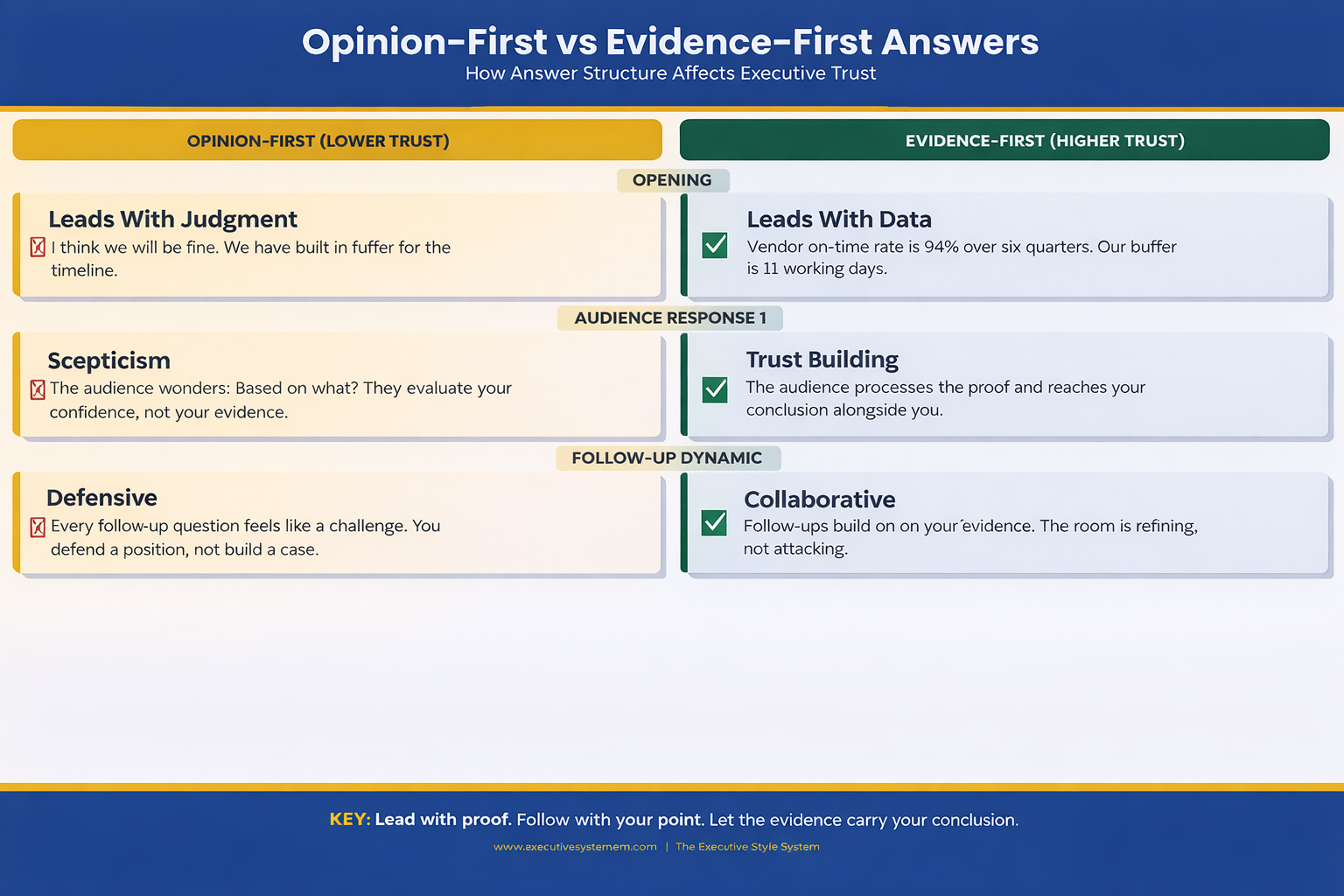
ide-by-side comparison infographic showing opinion-first answer structure versus evidence-first answer structure with audience trust response at each stage including opening audience response and follow-up dynamic

The Evidence-First Framework (Proof → Point → Implication)

The framework has three components, delivered in this exact sequence:

Proof (5–15 seconds): One concrete piece of evidence that directly addresses the question. Not three pieces. Not a data dump. One. The strongest, most relevant data point you have. “Our retention rate for Q1 was 94%, up from 87% in the same period last year.”

Point (5–10 seconds): The conclusion that follows logically from your evidence. “That tells us the onboarding changes we made in November are working.” This should feel inevitable. If you’ve chosen the right evidence, the point writes itself.

Implication (5–10 seconds): What this means for the decision the room is trying to make. “So I’d recommend we continue with the current approach for Q2 rather than introducing new variables.” This connects your evidence-based answer to the room’s actual agenda.

Total answer length: 15–35 seconds. That’s it. Executive Q&A rewards precision, not volume. Most people answer questions for 60–90 seconds because they’re padding opinion with filler. The evidence-first structure removes the padding because the evidence does the heavy lifting.

Here’s the structure applied to a common executive question — “Are we going to hit our revenue target this quarter?”

Opinion-first (what most people do): “Yes, I’m confident we’ll hit target. Our team has been performing well and we have strong pipeline. The deals in progress look solid and I think we’ll close them.”

Evidence-first (what builds trust): “Current booked revenue is £1.7 million against a £2.4 million target. Pipeline weighted at 60% probability adds another £900,000 — giving us £2.6 million in projected revenue. Based on that, we’re tracking to exceed target by approximately 8%.”

Same answer. Same confidence. But the second version never asks the audience to trust the speaker’s instinct. The numbers speak first. The conclusion follows. Trust is built through the structure of the answer, not the authority of the person giving it.

The Complete Evidence-First Answer System for Executive Q&A

The Executive Q&A Handling System gives you the Proof → Point → Implication framework with scenario-specific templates for every common executive question type — from budget challenges to timeline risks to stakeholder objections.

  • The evidence-first answer framework with worked examples across 12 executive scenarios
  • Question prediction maps: anticipate what they’ll ask before the meeting starts
  • The “evidence library” builder — how to prepare your proof points before you walk in
  • Recovery scripts for when you don’t have the evidence (how to buy time without losing credibility)

Get the Executive Q&A Handling System → £39

Built from 24 years of fielding executive questions at JPMorgan Chase, PwC, and Royal Bank of Scotland — where “I think” wasn’t an acceptable answer.

Five Question Types and How Evidence-First Handles Each

Not every question requires the same kind of evidence. The Proof → Point → Implication structure stays constant, but the type of proof changes depending on what the question is actually asking.

1. The data question. “Where are we on budget?” This is the simplest evidence-first answer. Your proof is a number. “We’ve spent £340,000 of the £500,000 budget, with 60% of deliverables completed. That puts us slightly ahead of pace.” Lead with the figure. Let it do the talking.

2. The opinion question. “Do you think this strategy will work?” This is where most people slip into opinion-first mode. Instead: “Comparable strategies in our sector have shown a 30% improvement in conversion rates over 12 months. Our current baseline is lower than theirs was, which suggests even higher upside. So yes — the evidence supports this working.” Your opinion is the same, but it arrives after the evidence.

3. The challenge question. “Why didn’t you deliver on time?” This feels like an attack, which triggers a defensive response. Evidence-first defuses it: “The vendor delivered their component nine days late, which compressed our testing window from 15 days to six. We prioritised the three critical test scenarios and completed them within the reduced window. The two lower-priority scenarios will complete by Friday.” Facts first. Accountability included. No defensiveness.

4. The hypothetical question. “What happens if we lose the contract?” Hypotheticals are designed to test your thinking. Use precedent as evidence: “When we lost the Meridian contract in 2024, revenue impact was £1.2 million over two quarters. We recovered by redirecting the team to three smaller accounts within 60 days. A similar approach here would cover approximately 80% of the gap.” Precedent makes hypotheticals concrete.

5. The political question. “Does the other department agree with your approach?” These are loaded. Evidence-first protects you: “I shared the proposal with their leadership team on Tuesday. Their written feedback confirmed alignment on scope and timeline, with one open question on resource allocation that we’re resolving this week.” Written evidence, specific dates, named actions. No room for interpretation.

Handle every question type with confidence?

Get the Q&A Handling System → £39

When to Break the Rule (And Lead With Your Point)

Evidence-first is the default. But there are moments when leading with your conclusion is the right call.

When the room is impatient. If the CEO has asked a direct question and the room is tight on time, lead with a one-sentence answer, then support it: “Yes, we’ll hit target. Current pipeline coverage is 1.8x with 60% probability weighting.” The conclusion comes first because that’s what the room is waiting for. But the evidence still follows immediately — you’re not asking for trust without proof, you’re just resequencing for speed.

When the answer is binary. “Are we on track?” “Will this be ready by Friday?” “Do you have budget approval?” These questions want a yes or no. Deliver it, then support: “Yes. The approval came through on Tuesday with full budget confirmed.” Evidence arrives as confirmation, not as buildup.

When you’re the recognised expert. If the room already trusts your expertise on this specific topic, leading with evidence can feel like over-explaining. The CFO asking the Head of Tax a question about tax implications doesn’t need evidence-first — they need a direct answer from a trusted expert. Save evidence-first for when you’re building credibility, not when you’ve already got it.

The judgement call: if the person asking trusts you and wants a fast answer, lead with the point. If the person asking is evaluating you, lead with evidence. When in doubt, lead with evidence. It costs you three extra seconds and builds trust every time.

People Also Ask: What if I don’t have evidence for the question being asked?

Say so directly and offer what you do have. “I don’t have the specific conversion data for that segment. What I can tell you is the overall conversion rate is 12%, and I’ll have the segment breakdown by end of day tomorrow.” This is infinitely more credible than guessing. Executives respect honesty about gaps far more than fabricated confidence.

People Also Ask: How do I prepare evidence for unexpected questions?

You don’t prepare for every possible question — you build an evidence library around the five to seven themes your audience cares about. For a budget review, that’s spend-to-date, forecast accuracy, variance explanation, and resource utilisation. Having these numbers ready covers most questions that could arise. Question prediction maps help you identify which themes to prepare for.

People Also Ask: Does evidence-first work in informal conversations?

It works everywhere, but calibrate the formality. In a corridor conversation, you wouldn’t say “the data shows…” But you’d still lead with the concrete fact: “We just got the numbers back — retention is at 94%.” The structure translates naturally into conversational language. The principle — proof before opinion — applies regardless of setting.

Never Get Caught Without an Evidence-Based Answer Again

The Executive Q&A Handling System includes the evidence library builder and question prediction maps so you walk into every meeting with your proof points ready.

  • Evidence library template for seven common executive meeting themes

Get the Executive Q&A Handling System → £39

Designed for executives who present to boards, leadership teams, and stakeholders where every answer either builds or erodes credibility.

Building Your Evidence Library Before the Meeting

The evidence-first structure only works if you have evidence ready. Walking into a meeting planning to “wing it” with data is the same as planning to fail. The preparation isn’t about memorising numbers — it’s about building a reference set of proof points around the themes your audience cares about.

Here’s how to build an evidence library in 15 minutes before any meeting:

Step 1: Identify the five themes. What are the five topics this audience will ask about? For a board meeting: financial performance, risk, timeline, resources, competitive position. For a project review: budget, deliverables, blockers, team, next milestones. Write them down.

Step 2: Find one number for each theme. Not five numbers. One. The single most relevant data point for each theme. “Budget: spent £340K of £500K.” “Timeline: 3 days ahead of schedule.” “Risk: 2 open items, both mitigated.” One data point per theme is enough to anchor an evidence-first answer. More than one and you’re preparing a presentation, not a Q&A.

Step 3: Prepare your “I don’t know” answer. For any theme where you don’t have current data, prepare the redirect: “I don’t have that figure with me. I’ll send it to you by [specific time].” This is a complete answer. It’s credible. It’s professional. It prevents you from guessing — which is the single fastest way to lose credibility in executive Q&A.

Step 4: Check for landmines. Is there a number that looks bad without context? Prepare the context in advance. “Attrition is up to 14% — driven entirely by the planned restructuring. Voluntary attrition is actually down to 3%.” If you know a number will trigger a follow-up, pre-build the evidence-first answer that explains it before it becomes a challenge.

This 15-minute preparation makes the difference between walking into Q&A with a safety net and walking in hoping for the best. The executives who seem naturally confident in Q&A aren’t naturally anything — they’ve done this preparation so many times it’s become invisible.

If you’ve ever struggled with the anticipation before a meeting turning into something more debilitating, the shame spiral after a bad Q&A session can be interrupted before it becomes a pattern. Preparation is the first defence.

And for situations where your presentation format itself affects how Q&A unfolds, consider whether presenting without slides might actually give you more control over the conversation. Without a deck, the Q&A becomes a dialogue rather than an interrogation.
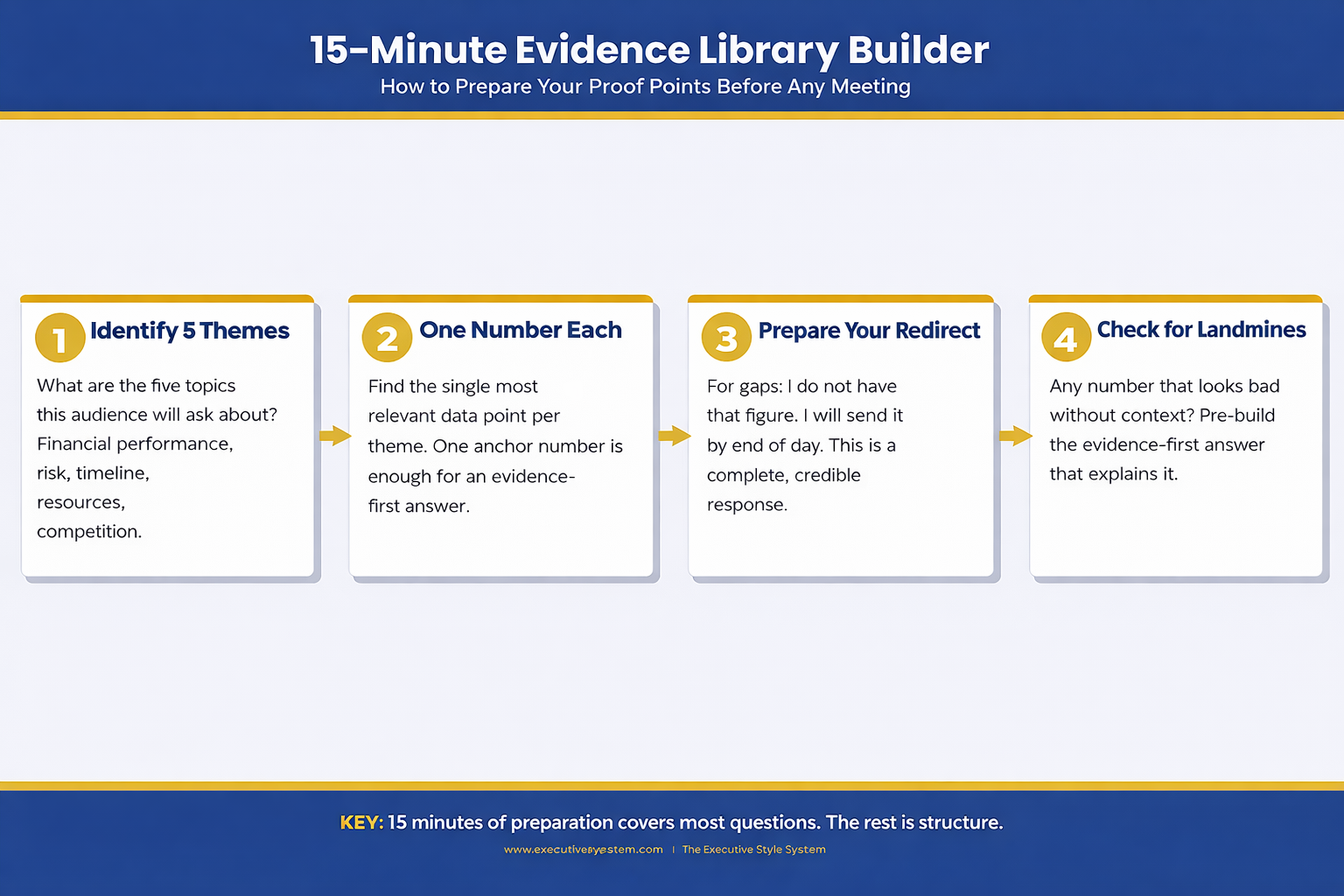
Four-step evidence library preparation framework infographic showing how to identify themes find anchor data points prepare redirects and check for landmines before executive meetings

Putting It Together: Your Next Q&A

The evidence-first answer structure isn’t complicated. It’s three components delivered in sequence: proof, point, implication. The entire answer takes 15–35 seconds. It works for data questions, opinion questions, challenges, hypotheticals, and political questions. And it builds trust every single time because you never ask the room to take your word for it.

The preparation takes 15 minutes: five themes, one number each, one “I don’t know” script. Do it before every meeting with a senior audience. Within a few weeks, it becomes automatic — and the way your audience responds to your answers will change measurably.

The Executive Q&A Handling System (£39) gives you the full framework: the evidence-first structure, question prediction maps, the evidence library builder, and recovery scripts for when you’re caught without data.

For questions you can anticipate, the approach is even more powerful. Addressing objections before they’re asked lets you embed your evidence directly into the presentation — so the Q&A becomes a confirmation of what you’ve already proven rather than a test of what you know.

Your next Q&A is this week — walk in prepared?

Get the Q&A Handling System → £39

Is This Right For You?

✓ This is for you if:

  • You present to senior audiences and your answers sometimes land as opinion rather than evidence
  • You’ve been caught without data during Q&A and felt your credibility slip in real time
  • You want a repeatable structure that works for every question type, not just the ones you’ve rehearsed
  • You’re preparing for a high-stakes meeting this week and need to walk in with your evidence ready

✗ Not for you if:

  • Your Q&A sessions are casual team conversations where formality would feel out of place
  • You’re already the recognised expert in the room and your audience trusts your judgment implicitly
  • Your challenge is presentation anxiety rather than answer structure — Conquer Speaking Fear (£39) addresses that directly

Walk Into Every Q&A With Your Evidence Ready

The Executive Q&A Handling System gives you the complete evidence-first framework: the answer structure, the preparation method, the question prediction tools, and the recovery scripts that protect your credibility even when you don’t have the data.

  • Proof → Point → Implication framework with 12 scenario-specific worked examples
  • 15-minute evidence library builder (the five-theme method)
  • Question prediction maps for boards, leadership meetings, and stakeholder reviews
  • Recovery scripts: how to handle “I don’t know” without losing the room
  • The hostile question protocol: evidence-first structure for adversarial situations

Get the Executive Q&A Handling System → £39

Built from 24 years of answering executive questions in banking, consulting, and corporate boardrooms — where evidence was the only currency that mattered.

Frequently Asked Questions

Won’t leading with evidence make my answers sound robotic?

Only if you deliver it like a data readout. The evidence is the backbone, not the personality. A natural evidence-first answer sounds like: “Interesting question — the retention data from Q1 actually tells us something useful here. We’re at 94%, up from 87% last year, which means the onboarding changes are working. I’d recommend we stay the course.” That’s evidence-first and conversational. Structure doesn’t eliminate personality — it gives personality something solid to stand on.

What if the evidence contradicts the answer I want to give?

Then the evidence is doing its job. If the data doesn’t support your preferred conclusion, say so: “The data doesn’t support the timeline we originally proposed. Current velocity suggests we’ll miss by two weeks. I’d recommend we adjust the deadline now rather than compress quality at the end.” This is exponentially more credible than bending data to fit a predetermined conclusion. Executives respect intellectual honesty above almost everything else.

How do I use evidence-first when the question is about feelings or team morale?

Use qualitative evidence instead of quantitative. “In the last three one-to-ones, two team members raised concerns about workload sustainability. The anonymous pulse survey showed a 15-point drop in engagement scores. That tells me morale is a genuine concern, not just anecdotal.” Qualitative data — named conversations, survey results, observable behaviour — is still evidence. It’s just not numerical.

Does this structure work for external presentations (clients, investors)?

It’s even more important externally. Clients and investors are evaluating your credibility in real time. Every answer that leads with evidence builds their confidence in your professionalism. Every answer that leads with opinion invites scepticism. The Proof → Point → Implication structure is particularly effective in investor Q&A because it mirrors how investors themselves think: data first, conclusions second.

The Evidence Speaks First

Your next meeting has a Q&A section. Someone will ask a question that matters. The difference between an answer that builds trust and one that erodes it comes down to sequence: do you lead with what you think, or what you know?

Lead with what you know. Let the evidence carry your conclusion. Watch the room respond differently.

Stay Updated

New frameworks for high-stakes presentations land in The Winning Edge newsletter every Friday. Subscribe for frameworks you can use immediately.

About the Author

Mary Beth Hazeldine is the Owner & Managing Director of Winning Presentations. With 24 years of corporate banking experience at JPMorgan Chase, PwC, Royal Bank of Scotland, and Commerzbank, she has delivered high-stakes presentations in boardrooms across three continents.

A qualified clinical hypnotherapist and NLP practitioner, Mary Beth combines executive communication expertise with evidence-based techniques for managing presentation anxiety. She has trained thousands of executives and supported high-stakes funding rounds and approvals.

Book a discovery call | View services

13 Mar 2026
Professional woman at a boardroom table holding composed focus while facing a question from a male executive — Q&A under pressure

Loaded Questions in Presentations: Recognising the Setup Before You Fall Into It

The question sounded straightforward: “Given what you’ve told us today, would you say the previous approach was a mistake?” It was not straightforward. It was a closed frame with a false binary embedded in it — and the moment you answered either yes or no, you had accepted a premise that was never yours to accept.

The executive who fell into it gave a careful, nuanced answer. What she didn’t do was recognise the question type before she started speaking. By the time she realised the frame was wrong, the answer was already in the room, and the follow-up question was waiting.

Loaded questions in presentations are not rare. They are a consistent feature of high-stakes Q&A — particularly in board meetings, investor sessions, regulatory reviews, and any room where someone has an interest in the answer being something specific. The executives who handle them well don’t have better answers. They recognise the setup faster.

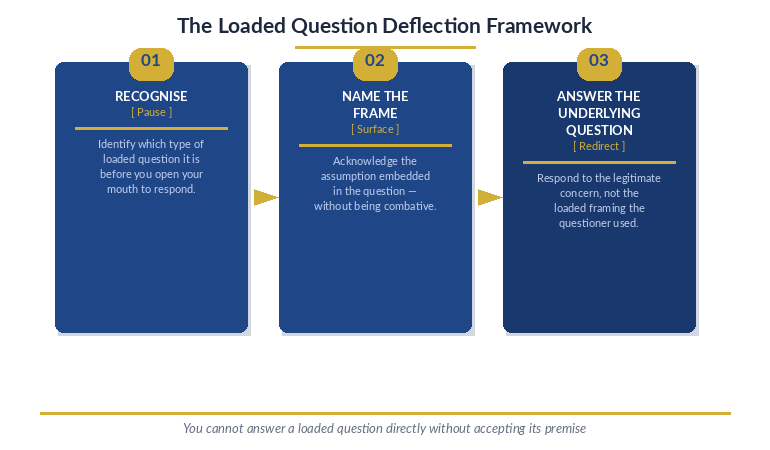
Quick answer: A loaded question contains a false premise, a false binary, or an embedded accusation that forces you to accept the questioner’s framing before you can answer. The recognition test is simple: before answering, ask yourself whether the question’s framing is yours. If you can’t answer yes or no without accepting a premise you don’t hold, the question is loaded. The deflection technique is to name the frame before answering it — not to challenge the questioner, but to set the terms of your response before you begin.

🚨 Preparing for a Q&A where loaded questions are likely? The Executive Q&A Handling System (£39) includes the loaded question recognition framework, the three deflection patterns that work in executive rooms, and the preparation method that anticipates traps before you’re in the room.

I spent 24 years in corporate banking at JPMorgan Chase, PwC, Royal Bank of Scotland, and Commerzbank. In that time I observed and participated in a significant number of Q&A sessions that were designed, explicitly or implicitly, to produce a particular answer. Regulatory reviews, board challenge sessions, investor Q&As before difficult announcements — these are environments where questions are not always requests for information. Sometimes they are frames.

The executives who handled them best were not the most combative. They were the most methodical. They had a recognition process that ran faster than their instinct to answer, and they deployed it in the pause before every response. That pause — brief, unhurried, apparently natural — was where the recognition happened. By the time they began speaking, they had already decided whether to answer the question as framed or to name the frame first.

This article covers the three types of loaded question, the recognition test that distinguishes them from legitimate challenge, and the deflection pattern that works in rooms where you cannot afford to seem evasive but also cannot afford to accept a false premise.


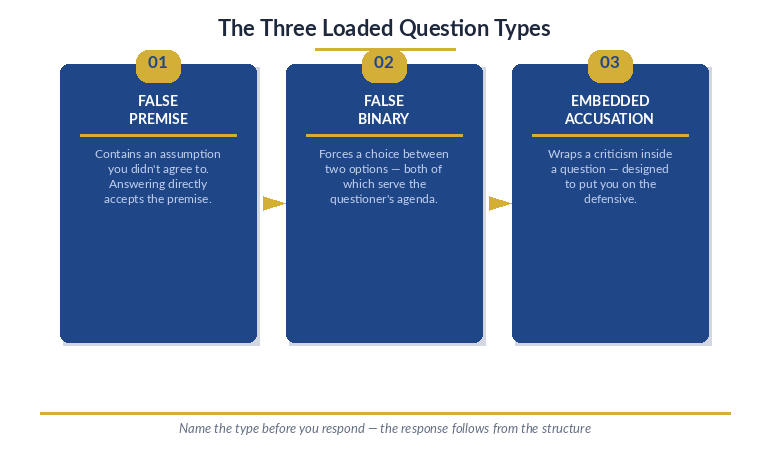
Three-part infographic showing the loaded question taxonomy: False Premise (contains an unaccepted assumption), False Binary (forces a two-option choice), and Embedded Accusation (criticism wrapped in a question)

The Three Types of Loaded Question

Not all difficult questions are loaded questions. A difficult question is one that requires a careful or uncomfortable answer. A loaded question is one where the framing itself is designed to constrain the answer — where accepting the question as posed means accepting a premise, a binary, or an implication that limits your options before you’ve said a word.

There are three types, and they operate differently. The false premise question contains a fact or assumption that is contestable, embedded inside what sounds like a straightforward enquiry. The false binary question presents two options as if they are the only options. The embedded accusation question wraps an implicit criticism inside a neutral grammatical structure so that answering it means implicitly accepting the criticism.

All three share a structural feature: they are more damaging when answered within the questioner’s frame than when answered outside it. The executive who recognises the type before answering can choose where to stand. The executive who answers within the frame has already conceded ground that may not be theirs to give.

The framework for handling difficult questions in presentations covers the broader category of challenging Q&A. Loaded questions are a specific subset that requires a specific recognition step before the handling technique applies.

🚨 Recognise the Trap Before You Walk Into It: The Executive Q&A Handling System

The Executive Q&A Handling System includes the complete loaded question framework — recognition, categorisation, and deflection — plus the preparation method that anticipates these questions before the session begins:

  • The three-type loaded question taxonomy with real examples from board, investor, and regulatory Q&A contexts
  • The recognition test — four questions that run in under five seconds and identify whether you’re inside a loaded frame
  • Three deflection patterns that work in executive rooms: reframe, acknowledge-and-replace, and explicit frame-naming
  • The preparation method for anticipating loaded questions before the session — including the stakeholder analysis that identifies who is likely to use them and why
  • Script templates for each deflection type — worded for executive contexts where you cannot appear evasive but cannot accept a false premise

Get the Executive Q&A Handling System → £39

Built from 24 years of observing Q&A sessions in banking boardrooms, investor meetings, and regulatory reviews — the environments where loaded questions are most consistently deployed.

The Recognition Test: Is the Frame Yours?

Before answering any question in a high-stakes Q&A, the recognition test runs as follows. Ask yourself: if I answer this question as posed — yes, no, or with the specific information requested — am I accepting a premise, a binary, or an implication that I would not otherwise accept?

If the answer is yes, the question is loaded. The framing does not belong to you, and accepting it will cost you something — credibility, flexibility, or the accuracy of your position — that may be more valuable than the question is worth to answer within its own terms.

The test takes less time to run than it takes to describe. With practice, it becomes automatic: a brief check, in the pause before you speak, that runs faster than your instinct to answer. The pause itself is useful — it signals that you are thinking about the question seriously rather than reacting to it, which is a credibility signal in itself. The pause is where the recognition happens. It is also where the answer is constructed.

Four specific signals indicate a loaded question: the word “still” (implying a prior behaviour or state you haven’t confirmed), the word “admit” (framing your answer as a concession), a question that begins with “given that” or “in light of” (embedding a premise before the actual question begins), and any question that presents exactly two options as the only available choices.

Heading into a session where loaded questions are predictable? The Executive Q&A Handling System (£39) includes the preparation template for anticipating loaded questions before the session — including the stakeholder analysis that identifies who is likely to use them and what their intent is.

Type 1: The False Premise Question

The false premise question embeds a contestable fact or assumption inside the question itself. Classic examples: “Now that the market has confirmed your original approach was too conservative, how are you adjusting?” — where “confirmed” is doing significant work. Or “Given that the board agreed to this approach in February, why have outcomes underperformed?” — where “agreed” may be a contested characterisation of a more complex discussion.

The mechanism is that the false premise is grammatically subordinate — it arrives inside a clause before the actual question begins, making it easy to miss when you’re processing the question. Your attention goes to the main clause; the premise slips through unexamined.

The deflection for a false premise question is to address the premise before addressing the question. Not aggressively — the framing does not need to be challenged as if the questioner is being dishonest. It simply needs to be placed differently before you continue. The pattern is: “I’d want to be careful about the framing there — [restatement of the accurate premise] — but to your underlying question: [answer].” This names the false premise without making the questioner defensive, places your own premise on record, and proceeds to answer the actual question, which demonstrates that you are not being evasive.


Three-step Loaded Question Deflection Framework: Recognise (identify the question type before responding), Name the Frame (surface the embedded assumption), Answer the Underlying Question (respond to the legitimate concern)

⚠️ Stop Accepting Frames That Aren’t Yours

Loaded questions are more damaging when answered within the questioner’s frame than when named and redirected. The Executive Q&A Handling System (£39) gives you the recognition test, the deflection scripts, and the preparation method that takes the trap away before the room sets it.

Get the Executive Q&A Handling System → £39

Used by executives preparing for board challenge sessions, investor Q&As, and regulatory reviews where questions are designed to produce specific answers.

Type 2: The False Binary Question

The false binary question presents two options as if they are the only options, when there is at least one other option the questioner has not offered. “Do you think the problem is in the strategy or the execution?” is a false binary if the honest answer is that the strategy and execution both contributed — or that neither is the primary problem, and the issue is something the question hasn’t named.

False binary questions are particularly common in investment and board contexts, where the questioner wants to establish accountability. The binary structure makes attribution easier: if you accept either option, the question has been answered in a way that assigns responsibility to one of two named causes. The option that assigns responsibility elsewhere — or that disputes the framing entirely — is never offered, because offering it would undermine the purpose of the question.

The deflection for a false binary is not to refuse to answer but to expand the option set before answering. The pattern is: “I don’t think it’s quite either of those — [name the third option or combination] — but if you’re asking where the most significant opportunity to improve is, that would be [answer].” This sidesteps the false binary, provides a more accurate answer, and demonstrates that you are engaging with the substance of what the questioner is actually trying to understand.

The short answer framework for executive Q&A is particularly useful here: the deflection and the answer combined should be shorter than the question was. Long responses to loaded questions create the impression that you are trying to talk your way out of something. Concise responses create the impression that you had the answer ready, which you did.

Type 3: The Embedded Accusation Question

The embedded accusation question wraps an implicit criticism inside neutral grammatical structure. “How are you planning to address the trust deficit that’s developed with the team?” embeds the accusation that a trust deficit exists. “What’s your explanation for the communication failures during the transition?” embeds the accusation that there were communication failures. Both are framed as requests for information; both contain an accusation in the subordinate clause that you would not accept if it were stated directly.

The embedded accusation is the most damaging of the three types because answering it within the frame means accepting the accusation. An answer that begins “To address the trust deficit…” has confirmed that the trust deficit exists. An answer that begins “The communication failures during the transition…” has confirmed that there were communication failures. The questioner has gotten the confirmation they wanted without having to make the accusation explicitly — and now the accusation is on record in your words, not theirs.

The deflection for an embedded accusation requires naming the assumption before responding. The pattern is: “I’d challenge the framing slightly — [specific restatement of the actual situation] — but your underlying concern is [acknowledgement], and here’s how I’d address that: [answer].” This does three things: it declines the embedded accusation, it demonstrates that you understand the concern behind the question, and it provides a substantive response that does not allow the questioner to claim you were being evasive.

The most common Q&A mistakes executives make in presentations include accepting frames they haven’t verified and providing long answers to deflect questions they should have deflected concisely. The embedded accusation type is where both mistakes are most likely to occur together.

Also published today: International Presentations: The Cultural Mistakes That Kill Deals Before Slide One — including how cultural context affects the Q&A dynamic and which loaded question types are most common by cultural profile.

Common Questions About Loaded Questions in Presentations

Is it always appropriate to name a loaded frame in a formal Q&A?
It depends on the room and the intent behind the question. In a regulatory review or a hostile board challenge, naming the frame directly — precisely but without aggression — is both appropriate and necessary. In an investor Q&A where the questioner is genuinely probing rather than trying to trap, naming the frame can come across as defensive. The recognition test helps here: if the framing genuinely limits your options in a way that would misrepresent your position, name it. If the framing is imprecise but the questioner’s intent is legitimate, you can widen the frame without naming it explicitly — just by answering from a broader position than the question offered.

What if I name a loaded frame and the questioner insists their framing is correct?
Acknowledge their view and hold your position. The pattern is: “I understand that’s how you’re reading it — my read of the situation is [restatement]. I’m happy to explain why I see it differently if that’s useful, but I wouldn’t want my answer to imply agreement with a characterisation I don’t hold.” This is firm without being combative, offers to continue the discussion, and makes clear that you’re not going to accept a premise under social pressure. Questioners who insist on their framing after this response are usually seeking confirmation, not information — and the room can see that.

How do I prepare for loaded questions before a session rather than handling them in the room?
The preparation method involves a stakeholder analysis for each person likely to ask questions: what is their current position relative to your presentation, what outcome serves their interests, and what framing of your work would produce that outcome? Once you have identified who might use a loaded question and what type it is likely to be, you prepare your recognition response and your deflection script in advance. The Executive Q&A Handling System includes a structured preparation template for this process — it takes 30–45 minutes and removes the most likely traps before you are in the room.

Is This Right For You?

This article and the Executive Q&A Handling System are for executives who face structured Q&A sessions where some participants are likely to use questions as framing tools rather than as genuine requests for information. Board challenge sessions, investor Q&As before difficult announcements, regulatory reviews, and competitive sales presentations all fit this profile.

If your Q&A sessions are largely collaborative — colleagues asking genuine questions about how to implement a proposal — the loaded question framework is less immediately relevant, though the recognition test is useful in any high-stakes room where you are accountable for your answers. If you are preparing for a session where you know from experience or context that some questions will be designed to constrain rather than to enquire, the preparation method and deflection scripts in the Executive Q&A Handling System will be the most efficient investment you can make before the meeting.

Frequently Asked Questions

Does the deflection technique work in writing as well as in spoken Q&A?
Yes, and in writing it is often more effective because you have more time to compose the response. Written loaded questions — in email, in committed papers, in written submissions to regulators — follow the same three-type structure. The false premise, false binary, and embedded accusation appear in written form as frequently as in spoken Q&A. The written deflection follows the same pattern: name the frame, restate the accurate position, and address the underlying question. In writing, the naming of the frame can be slightly more formal — “I note the question assumes X; the accurate position is Y” — because the written register supports more explicit framing without appearing combative.

Are there cultural differences in how often loaded questions are used?
Loaded questions are more common in adversarial cultural contexts — UK regulatory environments, US legal depositions, investment committee sessions with activist investors — and less common in consensus-oriented cultures where direct challenge is considered inappropriate. However, the false premise type appears across virtually all professional contexts, because it is often not intended as a trap — it is simply the questioner’s genuine belief. The recognition test does not assume bad intent: it identifies structural problems in framing regardless of motivation, which is why it is useful even when the questioner is not being deliberately manipulative.

About the Author

Mary Beth Hazeldine is the founder of Winning Presentations and has spent over two decades advising executives on high-stakes communication. Her background includes roles at JPMorgan Chase, PwC, Royal Bank of Scotland, and Commerzbank, where she participated in and prepared executives for board challenge sessions, investor Q&As, and regulatory reviews. She developed the Executive Q&A Handling System from the question patterns she observed consistently across those contexts, with particular focus on the recognition and deflection techniques that protect executives from accepting frames that are not theirs to accept.

The Winning Edge Newsletter

Practical executive presentation guidance, once a week. No padding, no noise — just the techniques that matter when the room is full of people whose questions are more than questions.

Subscribe Free →

12 Mar 2026
Investor Q&A follow-up questions that kill funding — second-order question map for founders preparing for investor conversations

Investor Q&A: The Follow-Up Questions That Kill Funding (And How to Prepare for Them)

Most investor presentations don’t collapse on the first question. They collapse on the second one.

The founder answers the opening question confidently — “what’s your customer acquisition cost?” — with a specific number and a clear explanation. Then the investor asks: “And how does that break down by channel?” Pause. Then: “What’s the trend over the last four quarters?” Another pause. Then: “What’s driving the increase in Q3?” By the fourth question, the founder is visibly reaching for data they don’t have immediately available. By the fifth, the room has reached a conclusion about how well the business is understood.

The first answer wasn’t wrong. The follow-ups revealed the boundaries of preparation. That’s where investor Q&A funding conversations are actually decided — not on whether you can answer the initial question, but on how far into the second order your preparation extends.

Quick answer: Investor Q&A follow-up questions follow predictable patterns. Every first-order question about metrics, strategy, or competitive positioning has three or four second-order follow-ups that experienced investors use to test the depth of understanding behind the initial answer. Preparing for the follow-ups — not just the opening questions — is what separates funded founders and executives from those who present well but leave investors uncertain. The preparation method is systematic: map each expected question, then generate the three most likely follow-ups for each, and prepare answers to all of them.

📋 Preparing for an investor Q&A this week? The Executive Q&A Handling System (£39) includes the investor Q&A framework with the second-order question map, preparation templates, and exact language for handling the questions most people aren’t ready for.

I spent 24 years in corporate banking at JPMorgan Chase, PwC, Royal Bank of Scotland, and Commerzbank. I have been in rooms where capital decisions were made — and in rooms where they weren’t, despite a strong headline pitch. The difference between those outcomes was rarely the first question and almost always what happened in the third and fourth.

Experienced investors are not trying to catch you out with follow-up questions. They’re trying to assess something specific: how deeply you understand your own business, and whether the answers you gave to the opening questions were genuinely grounded or were polished responses built for presentation rather than for interrogation.

The preparation framework that works isn’t “know your numbers.” Every funded founder knows their headline numbers. It’s “know the story behind every number, the story behind that story, and where the story breaks down.” That’s three levels deep. Most preparation stops at the first.


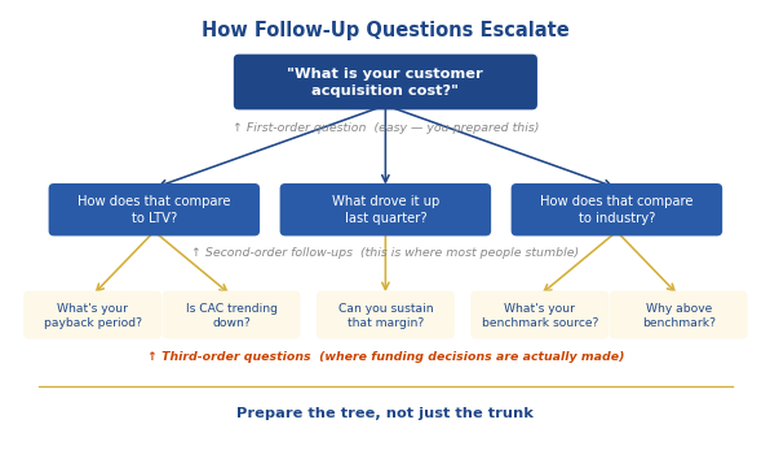
Investor Q&A follow-up question map showing first-order questions and three levels of second-order follow-ups across metrics, strategy, competitive, and risk categories

Why Follow-Up Questions Are Where Funding Is Decided

An investor who asks a follow-up question is not being difficult. They’re doing exactly what their role requires: assessing whether the person in front of them has the depth of understanding to manage the capital they’re being asked to commit.

The follow-up question serves a diagnostic function. If the first answer was memorised or prepared for the pitch, the follow-up will surface that. If the first answer was grounded in genuine understanding, the follow-up is easy — because the same understanding that produced the first answer produces the second one naturally, without additional preparation.

This is why investor Q&A preparation that only covers anticipated first-order questions consistently fails. Founders spend hours preparing answers to “what’s your CAC?” and “who are your main competitors?” and “what’s your burn rate?” — and are then derailed by “how does CAC vary by segment?” or “what’s your win rate against that competitor specifically?” or “at current burn, what’s your runway if the next round takes six months longer than expected?”

The follow-up isn’t harder to answer than the original question. It’s harder only if the answer to the original question was a prepared surface response rather than an expression of genuine understanding. The diagnostic function of the follow-up is precise: it distinguishes one from the other.

Today’s sister article on the investor relations presentation format covers how to structure the deck itself to prevent questions before they’re asked. This article covers the Q&A that follows — and specifically the follow-ups that most preparation misses.

📋 The Investor Q&A Framework That Prepares You Three Questions Deep

The Executive Q&A Handling System includes the investor Q&A preparation framework — the second-order question map, the preparation templates, and the exact language for handling follow-ups on metrics, strategy, competition, and risk:

  • The investor follow-up question map for each major Q&A category — what experienced investors ask second, third, and fourth
  • Preparation template: map your first-order answers and generate second-order questions systematically before the meeting
  • Language for handling questions where the honest answer isn’t the one you planned — without losing credibility
  • The bridging technique for redirecting follow-ups that are moving into territory you want to control
  • How to answer “I don’t know” in a way that builds rather than erodes investor confidence

Get the Executive Q&A Handling System → £39

Built from 24 years in corporate banking and executive Q&A preparation at JPMorgan Chase, PwC, and RBS — including preparing executives for investor presentations and funding rounds.

The Follow-Up Map: Metrics Questions

Every metric question an investor asks has a predictable set of follow-ups. Here are the most common, across the metrics categories that matter most in investor conversations.

Customer acquisition cost (CAC). First order: “What’s your CAC?” The follow-ups investors actually use: “How does that break down by channel?” “What’s the trend over the last four quarters?” “What’s driving the change?” “How does that compare to your LTV at different customer segments?” Preparation means knowing the channel breakdown, the trend, the driver, and the LTV-to-CAC ratio by segment — not just the headline CAC number.

Revenue growth. First order: “What’s your revenue growth rate?” Follow-ups: “New versus expansion revenue?” “Churn rate?” “Net revenue retention?” “What’s the growth rate of your top 10 accounts?” Most founders prepare the growth rate headline. Experienced investors are trying to understand whether that growth is healthy or fragile — new customer acquisition masking significant churn, or a stable expanding base. The follow-ups diagnose which.

Burn rate and runway. First order: “What’s your current burn?” Follow-ups: “How does that compare to six months ago?” “What are the main drivers of burn?” “What happens to burn if you hit your growth targets?” “What levers do you have if you need to extend runway?” Prepare the drivers, the sensitivity, and the optionality. Investors are stress-testing your understanding of the cash dynamics, not just the headline number.

Preparing for an investor meeting? The Executive Q&A Handling System (£39) includes the full investor follow-up question map across metrics, strategy, competitive, and risk categories.

The Follow-Up Map: Strategy Questions

Go-to-market strategy. First order: “What’s your GTM strategy?” Follow-ups: “What’s working best right now and why?” “What have you tried that hasn’t worked?” “What does the unit economics look like at scale?” “How does your GTM need to change when you move upmarket?” Most prepared answers describe the intended strategy. Investors want to know whether you’ve run it, what you’ve learned from running it, and whether your unit economics work beyond the current stage.

Pricing strategy. First order: “How did you arrive at that pricing?” Follow-ups: “Have you tested higher price points?” “Where do you lose deals on price?” “What’s the average contract value trend?” “How does your pricing compare to your top competitor in a head-to-head?” The follow-up questions are probing your pricing confidence — whether it’s based on customer research and competitive intelligence, or on a number that felt reasonable when you set it.

Expansion strategy. First order: “What’s your expansion plan?” Follow-ups: “What are the three biggest risks to the expansion timeline?” “What milestones do you need to hit before you can expand?” “Who else has expanded into that market and what happened to them?” “What does the team composition need to look like to execute?” Investors are looking for realistic planning versus aspirational planning. The follow-ups test whether you’ve worked the plan backwards from the risks.

The Follow-Up Map: Competitive Questions

Competitive positioning. First order: “Who are your main competitors?” The follow-ups: “What do customers choose them over you for?” “What’s your win rate against [specific competitor]?” “What would need to change for a customer to switch back to them?” “What are they doing now that concerns you?” Most competitive answers describe why you’re better. Investors want to understand whether you have accurate intelligence on your competitors’ strengths — not just their weaknesses.

Defensibility. First order: “What’s your competitive moat?” Follow-ups: “How long would it take a well-resourced competitor to replicate your key advantage?” “What assumptions is your moat argument dependent on?” “What happened to the last company that had this advantage?” The defensibility follow-up is almost always about identifying which assumptions the moat depends on. Prepare your moat argument and then prepare the honest answer to “what would need to be true for this advantage to erode?”


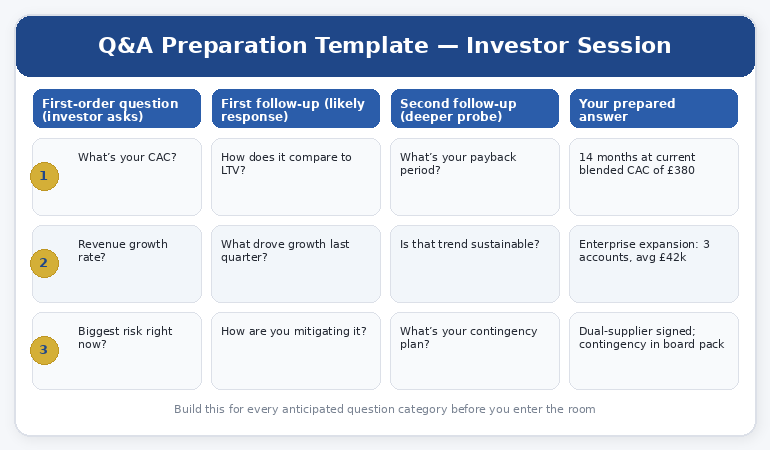
Investor Q&A preparation template showing how to map first-order questions to three levels of follow-up questions across competitive, risk, and metrics categories

⚠️ Stop Being Derailed by the Questions You Didn’t Prepare For

Most investor Q&A preparation covers the opening questions. The Executive Q&A Handling System (£39) includes the follow-up question maps that prepare you three levels deep — so you know exactly how to answer what comes after the first answer.

Get the Executive Q&A Handling System → £39

Used by executives and founders preparing for investor presentations, board meetings, and high-stakes funding conversations.

The Follow-Up Map: Risk Questions

Key person risk. First order: “What happens if you leave?” Follow-ups: “Who on your team could step up?” “What’s been documented so far?” “What would a succession plan look like?” “What would make you leave?” The key person question is expected. The follow-ups are probing whether you’ve actually thought about business continuity or whether “we’re building the team” is a placeholder answer.

Regulatory and legal risk. First order: “What are your main regulatory risks?” Follow-ups: “Have you had any regulatory interaction to date?” “What’s your current legal spend and what’s it for?” “What happens to your business model if [specific regulation] changes?” Prepare the honest answer to the regulatory question, then prepare the follow-up on what you’ve done about it, not just what the risk is.

Technology or execution risk. First order: “What’s the biggest technical risk to delivery?” Follow-ups: “What’s the fallback if that risk materialises?” “Have you had any incidents so far and how did you handle them?” “What does your testing and validation process look like?” Investors are testing whether you have realistic risk management or optimistic risk assessment. The follow-ups are designed to find out.

The CFO presentation framework uses the same principle: financial decision-makers always have prepared follow-ups for every first-order answer, and the presenter who knows what those follow-ups are enters the conversation at a significant advantage.

The Preparation System That Covers Second-Order Questions

The preparation method is straightforward once you understand what it’s for. It has four steps.

Step 1: List every question you expect. Not the questions you hope to get — every question that could reasonably arise across metrics, strategy, competitive positioning, team, and risk. This is your first-order question bank. Most founders have this. Most stop here.

Step 2: For each first-order question, generate three follow-ups. Ask yourself: if I give my planned answer to this question, what’s the next question an experienced investor would logically ask? Then ask it again: and if I answer that, what’s the next one? Three levels. Some questions will only have one or two logical follow-ups. Others will have five. The discipline of generating three forces you to think past your prepared surface answer.

Step 3: Prepare honest answers to the difficult follow-ups. Some of the follow-ups will surface genuine gaps — numbers you don’t know, assumptions you haven’t tested, risks you haven’t fully modelled. This is the most valuable part of the exercise: discovering your preparation gaps before the investor does. Where you have gaps, fill them. Where they can’t be filled before the meeting, prepare an honest, credible answer to “I don’t have that to hand, but here’s what I do know.”

Step 4: Run the preparation with a colleague who hasn’t seen it. The preparation that stays in your head isn’t tested. Having someone else ask you the first-order questions — then follow up unprompted — reveals whether your preparation is actually solid or whether it still has surface areas that look prepared but break down three questions in. The executive presentation structure that works in investor contexts is built to handle Q&A, not just delivery — and practising the Q&A is as important as rehearsing the deck.

Also published today: The Investor Relations Update Format That Prevents Awkward Questions — how to structure the deck itself so that many Q&A questions never need to be asked.

Common Questions About Investor Q&A Preparation

How many investor questions should I prepare for?
Prepare for every question you can anticipate, but the preparation that matters is the second-order follow-ups — not just additional questions. A bank of 40 first-order questions with no follow-up preparation is less valuable than 15 first-order questions, each with three follow-ups you’ve genuinely worked through. Quality of preparation depth matters more than quantity of questions covered.

What should I do when an investor asks a question I genuinely don’t know the answer to?
The honest answer is nearly always more effective than a deflection. The specific phrasing matters: “I don’t have that number with me, but I can tell you that [related thing you do know] — I’ll get you the exact figure after this meeting.” That response demonstrates honesty, demonstrates that related knowledge is solid, and demonstrates that you’ll follow through. What damages credibility is the visible search for an answer that isn’t there, or an answer that clearly isn’t what was asked.

How do investors use follow-up questions differently from opening questions?
Opening questions often probe what you know. Follow-up questions probe how you know it and how deeply. “What’s your CAC?” tests whether you have the number. “What’s driving the increase in Q3?” tests whether you understand why the number is what it is. Investors are assessing both layers simultaneously — but the follow-up is where the second layer is actually examined.

Is This Right For You?

✅ This is for you if:

  • You’re preparing for an investor presentation, board meeting, or funding conversation where Q&A is a significant part of the session
  • You’ve been caught out by follow-up questions in previous investor meetings and want to close those preparation gaps
  • You want a systematic method for preparing Q&A, not just a list of questions to memorise

❌ This is NOT for you if:

  • You’re preparing for an internal Q&A with colleagues rather than external investor scrutiny (the stakes and preparation depth differ)
  • You’re looking for guidance on the deck structure itself rather than the Q&A — that’s covered in the IR update format article published today

🏛️ The Q&A System Built From 24 Years of Watching What Investors Actually Test

The Executive Q&A Handling System is built on a simple premise: the questions that kill funding are not the ones you’ve prepared for. They’re the follow-ups that expose whether the prepared answers were grounded or polished:

  • The investor follow-up question map across metrics, strategy, competitive, and risk categories
  • The four-step preparation system for generating and answering second-order questions before the meeting
  • Language for handling difficult follow-ups — including the honest “I don’t know” that builds credibility rather than eroding it
  • The bridging technique for redirecting follow-ups into the territory you’ve prepared without appearing to deflect
  • Q&A preparation templates for the eight most common investor meeting formats

Get the Executive Q&A Handling System → £39

Built from 24 years in corporate banking at JPMorgan Chase, PwC, Royal Bank of Scotland, and Commerzbank — including preparing executives for investor Q&A, board scrutiny, and high-stakes funding conversations.

Frequently Asked Questions

How do follow-up questions in investor Q&A differ from those in a board presentation?

Board Q&A follow-ups are typically aimed at governance, accountability, and strategic direction — boards are testing whether management understands the decision they’re being asked to approve. Investor follow-ups are more specifically financial and risk-focused — investors are assessing whether the business model and management team warrant the capital commitment. The preparation principles are similar (prepare three levels deep, know the story behind every number), but the territory of the follow-ups is different. The investor Q&A preparation described in this article is specific to investor and fundraising contexts; for board Q&A preparation, the approach is adapted but the underlying method is the same.

What if an investor keeps following up with increasingly detailed questions I can’t fully answer?

The most effective response is to draw a clear line honestly: “That level of detail is in the data room rather than in my head — I’d rather give you accurate numbers than approximate ones. Can I get that to you by end of week?” This response is more credible than an attempted answer that turns out to be imprecise. Experienced investors understand that not every figure is memorised; what they’re assessing is whether the response to uncertainty is honest and organised, or defensive and evasive. The former is reassuring. The latter is not.

How long before a funding meeting should I start Q&A preparation?

The second-order question preparation is most effective when done at least five days before the meeting — not because the content changes, but because the follow-up mapping exercise surfaces preparation gaps that take time to close. If you identify a gap the day before the meeting, you may not be able to fill it; if you identify it a week out, you can get the number, build the analysis, or at least form a credible bridging response. The preparation itself takes three to four hours for a thorough investor meeting. The rehearsal — having a colleague ask first-order questions and follow up unprompted — needs a separate two-hour session.

Should I prepare differently for angel investors versus institutional VCs?

The depth of preparation required is broadly similar, but the territory of follow-up questions differs. Angel investors often focus heavily on founder background, motivation, and resilience — the follow-ups to “what’s your exit strategy?” or “why are you the right person to build this?” tend to be character and commitment-based. Institutional VCs are more likely to pursue financial model follow-ups, comparable transactions, and market sizing logic in detail. Preparing for both audiences requires the same systematic mapping approach, but with different follow-up question banks for each.

The Winning Edge — weekly insight on Q&A handling, executive presentations, and investor communication. Subscribe free →

Want everything in one place? The Complete Presenter Bundle (£99) includes the Executive Q&A Handling System, the Executive Slide System, Conquer Speaking Fear, and four additional products.

About the Author

Mary Beth Hazeldine is the Owner & Managing Director of Winning Presentations. With 24 years of corporate banking experience at JPMorgan Chase, PwC, Royal Bank of Scotland, and Commerzbank, she has delivered high-stakes presentations in boardrooms across three continents.

A qualified clinical hypnotherapist and NLP practitioner, Mary Beth combines executive communication expertise with evidence-based techniques for managing presentation anxiety. She has trained thousands of executives and supported high-stakes funding rounds and approvals.

Book a discovery call | View services

10 Mar 2026
Investment committee member asking a pointed question to a presenter in a formal meeting room, navy and gold accents

The Hypothetical Trap: When Executives Ask “What If” to Test Your Limits (And How to Answer)

“What if your main customer leaves?”

The question came from the Investment Committee member on the left, 20 minutes into a funding presentation. Not aggressive. Quiet. Almost casual.

The presenting team stopped. Looked at each other. Then gave a three-minute explanation of why that scenario was unlikely. Market share data. Contract terms. Customer relationship depth.

They never answered the actual question.

The committee member waited until they finished and then said: “I understand why you think that’s unlikely. I asked what would happen if it did.”

Quick answer: When executives ask hypothetical questions in presentations, they’re not asking you to predict the future. They’re testing the quality of your thinking under uncertainty — specifically, whether you’ve identified the gaps in your own argument and planned for them. The right answer structure is: acknowledge the scenario directly (don’t argue it away), state what would happen (honest, specific), then describe what you’d do (mitigation or pivot). Three parts. The mistake most presenters make is spending 80% of their answer defending the assumption rather than engaging with the hypothetical.

📋 Facing executive Q&A this week? The Executive Q&A Handling System (£39) includes the hypothetical question framework from this article — plus the complete question prediction map, answer structures for 9 difficult question types, and the pre-meeting Q&A briefing template. Walk in knowing 80% of what they’ll ask.

I’ve been in a lot of rooms where this happens. Hypothetical questions are one of the most reliably mishandled moments in executive presentations — not because the presenter doesn’t know the answer, but because they misread the question.

The investment committee scenario above is typical. The presenting team heard “what if your main customer leaves?” as an objection to their business case. It wasn’t. It was a gap-finding exercise. The committee member already had a view on the customer concentration risk — they were in the business of finding these things. What they wanted to know was: does this management team see the gap too? Have they thought through it? Is there a contingency? Can they discuss it calmly without getting defensive?

The team answered a question that hadn’t been asked. They defended their assumption instead of engaging with the scenario. And in doing so, they failed the actual test — which had nothing to do with customer retention probability.

That presenting team eventually got funded. But they left two committee members uncertain rather than confident — and that uncertainty shaped the terms they were offered. One answer, handled differently, can change the outcome of a room.


Three types of hypothetical questions in executive presentations: gap-finding, stress-testing, and values-probing framework

What Executives Are Actually Testing With Hypotheticals

Understanding the intent behind a hypothetical question changes how you answer it.

Executives ask hypothetical questions for three reasons — and none of them is to trip you up for its own sake. They are senior professionals with limited time. When they ask a speculative question, it’s because they want to learn something that your prepared presentation hasn’t told them.

The first thing they test is thinking quality under uncertainty. Can you reason clearly when you’re not on script? Do you distinguish between what you know and what you’ve assumed? Do you get defensive, or do you engage? A presenter who can hold an uncertain scenario calmly and think through it clearly in real time signals a quality of mind that data alone can’t demonstrate.

The second thing they test is self-awareness. Do you know where the risks are in your own argument? The most trustworthy presenters can identify their own assumptions and gaps before an executive points them out. When you acknowledge the hypothetical without flinching — “yes, if that happened, here’s what the impact would be” — you demonstrate that you’ve already thought about it. That’s a significant trust signal.

The third thing they test is preparedness. A well-prepared presenter has thought through the likely hypotheticals in advance. Their answer isn’t invented on the spot — it draws on thinking they’ve done, scenarios they’ve modelled, contingencies they’ve identified. That preparedness is visible in the quality and specificity of the answer. You can hear the difference between a presenter who’s thought this through and one who’s improvising.

For a deeper look at the trust signals executives read during Q&A, see: Executive Questions as a Trust Test.

💬 Walk Into Q&A Knowing 80% of the Questions Before They’re Asked

The Executive Q&A Handling System is built for executives who face high-stakes Q&A — boards, investment committees, senior leadership, client pitches — and want to handle any question with confidence rather than hoping for easy ones:

  • The hypothetical question framework from this article — with the 3-part answer structure and worked examples across board, investor, and stakeholder scenarios
  • The question prediction map — the method for identifying 80% of the questions you’ll face before entering the room
  • Answer structures for 9 difficult question types: hypotheticals, data challenges, the “I don’t know” scenario, loaded questions, compound questions, and more
  • The pre-meeting Q&A briefing template — what to prepare, in what order, for each presentation context
  • The short answer framework — how to give a complete, credible answer in under 60 seconds without appearing evasive

Get the Executive Q&A Handling System → £39

Built from 24 years in the rooms where these questions get asked — boardrooms, investment committees, and executive reviews across global banking and professional services.

The Three Types of Hypothetical Question

Not all hypothetical questions work the same way. The three types below each require a slightly different framing in your response.

Type 1: Gap-finding hypotheticals. “What if your key assumption is wrong?” “What if this regulation changes?” “What if you lose your main client?” These are scenario questions about known risks or vulnerabilities. The executive already suspects the gap exists. They’re asking whether you see it too. The correct response acknowledges the scenario and addresses impact and mitigation. Do not argue the likelihood. Do not say “that’s unlikely because…”

Type 2: Stress-testing hypotheticals. “What if you had to do this with half the budget?” “What if the timeline moved by three months?” “What if you lost two key people in Q3?” These are pressure tests on the robustness of the plan. The executive wants to know if you’ve built in any flex, and whether you have a hierarchy of priorities if resources are constrained. The correct response shows you’ve thought about sequencing and trade-offs, not just the best-case scenario.

Type 3: Values-probing hypotheticals. “What if a major client asked you to do something your team objected to?” “What if you had to choose between timeline and quality?” “What if a regulatory decision came back negative and the board wanted to proceed anyway?” These are questions about how you make hard decisions under conflict. The executive is evaluating your judgement and integrity, not just your analytical ability. The correct response is honest, specific, and doesn’t try to avoid the tension in the question.

Most presenters handle Type 1 by defending the assumption (wrong), freeze on Type 2 because they haven’t thought through trade-offs (unnecessary), and over-hedge on Type 3 to avoid committing to a position (exactly the wrong move — executives are looking for someone with a clear framework for hard decisions).

Want the complete question type library with answer structures? The Executive Q&A Handling System covers all three hypothetical types above — plus 6 additional difficult question categories — with worked answer frameworks for each.

Get the Q&A Handling System → £39

The 3-Part Answer Structure That Works Every Time

The structure below works for all three hypothetical types. The proportions shift depending on context, but the three components are constant.

Part 1: Acknowledge the scenario directly. Don’t argue the premise. Don’t say “that’s unlikely.” The executive knows it might be unlikely — that’s not why they’re asking. Say: “If that happened…” or “In that scenario…” and mean it. Commit to engaging with the hypothetical rather than routing around it. This takes about one sentence and is the difference between an answer that lands and one that sets the room’s teeth on edge.

Part 2: State what would happen — specifically. This is where most presenters underdeliver. They say “it would be challenging” or “we’d need to reassess.” That’s not an answer. An answer is: “Revenue would drop by approximately 30% in the first quarter, the cash position would require bridging for 90 days, and we’d need to accelerate the diversification programme we have planned for Q4.” Specific. Honest. Quantified where you can be. This part signals whether you’ve actually modelled the scenario or are improvising. Executives hear the difference immediately.

Part 3: Describe what you’d do. The mitigation or pivot. Not the full plan — two to three sentences maximum. “Our response would be: [action 1], [action 2], and [action 3] within [timeframe].” This closes the loop. You’ve acknowledged the scenario, you’ve been honest about the impact, and you’ve demonstrated that there’s a response. The executive can now decide whether that response is adequate. That’s what they wanted — not certainty that the scenario won’t happen, but confidence that if it did, the team would handle it.

For a method to predict which hypotheticals you’ll face before entering the room, see: Predict Presentation Questions: The Question Map.


The 3-part answer structure for hypothetical questions: acknowledge the scenario, state what happens, describe your response

The Trap: Why Defending the Assumption Makes It Worse

The presenting team I described at the start spent three minutes explaining why their main customer was unlikely to leave. They were probably right. That wasn’t what made the exchange go wrong.

When a presenter defends the assumption behind a hypothetical question, they signal several things that erode confidence rather than building it. They signal that they’ve heard the question as a threat rather than as genuine inquiry. They signal that they may not have thought through the scenario being raised. And they signal that they’re not comfortable with uncertainty — which is a significant credibility problem at senior level, where uncertainty is the constant operating condition.

The investment committee member who asked the question was not suggesting the customer would leave. She was asking: if that happened, what would happen next, and what would the team do? When the team spent three minutes arguing that it wouldn’t happen, they answered a question she hadn’t asked — and left her own question unanswered.

The corrected version takes about 45 seconds. “If that customer left, we’d lose approximately 28% of revenue in year one. That’s the scenario that keeps me up at night, frankly. We’d activate our two Tier 2 clients immediately — they’re ready to scale, they’re just waiting for capacity. We’d bridge the revenue gap with our reserve facility, and we’d restructure Q3 and Q4 priorities to accelerate the expansion we have planned for 2027. It’s not a scenario we want. But we’ve modelled it, and we could survive it.” That’s it. She asked, you answered. The room moves on with confidence rather than uncertainty.

🛑 Stop Improvising Answers to Questions You Could Have Predicted

  • The question prediction methodology that identifies the hypotheticals, stress tests, and gap-finding questions before you walk in — with the Q&A briefing template to organise your preparation
  • The short answer framework: how to give a complete, credible answer to any hypothetical in under 60 seconds

Get the Q&A Handling System → £39

Used for board presentations, investment committee sessions, and executive reviews across global banking, consulting, and corporate environments.

PAA: Quick Answers on Hypothetical Questions

How should I prepare for hypothetical questions before a presentation?
Map your presentation’s three most material assumptions. For each assumption, ask: what if this is wrong, what would the impact be, and what would we do? Those six answers — two per assumption — are your hypothetical Q&A preparation for the questions most likely to come. Then map your known gaps: what are the weakest points in your argument? Executives will find them. Having an honest, prepared answer is far stronger than being caught improvising. For the full methodology, see the question prediction map.

What’s the best way to handle a hypothetical you genuinely haven’t thought about?
Say so — briefly and without apology. “I haven’t modelled that specific scenario, but let me work through it now.” Then use the 3-part structure: what would happen, what would we do, and what are the uncertainties. A thoughtful response to an unanticipated hypothetical, worked through in real time, is more credible than a prepared answer that doesn’t engage with the actual question. Executives value the quality of your thinking, not just the completeness of your preparation.

How do I answer a hypothetical without committing to something I’m not certain about?
Language of probability is acceptable: “Our best estimate in that scenario would be…” or “Based on our modelling, the most likely outcome would be…” What’s not acceptable is refusing to engage with the scenario at all. The goal is not certainty — it’s honest, specific reasoning under uncertainty. Executives don’t expect you to know the future. They do expect you to be able to think clearly about it. For related guidance, see how to handle difficult questions in presentations.

Is the Executive Q&A Handling System Right For You?

✔️ This is for you if:

  • You regularly face executive Q&A — board presentations, investment committees, senior leadership reviews — where hypothetical and challenging questions are expected
  • You’ve been caught out by a hypothetical or difficult question and want a structured preparation method rather than hoping for easy ones
  • You want a repeatable answer framework so you don’t have to improvise under pressure

❌ This is NOT for you if:

If you recognised any of those scenarios in your own Q&A experience, the answer isn’t better improvisation under pressure. It’s a preparation system that removes the improvisation requirement altogether.

🏛️ The Q&A System Built From the Rooms Where These Questions Get Asked

The Executive Q&A Handling System was built from 24 years inside the rooms where hypotheticals, stress tests, and gap-finding questions are standard equipment — investment committees at JPMorgan, board reviews at RBS and Commerzbank, and senior client presentations across global financial services:

  • The complete hypothetical question framework — all three types with answer structures and worked examples
  • The question prediction map: the pre-meeting methodology that identifies 80% of the questions before you walk in
  • Answer frameworks for 9 difficult question types: hypotheticals, data challenges, compound questions, loaded questions, “I don’t know” scenarios, and more
  • The Q&A briefing document template — the pre-meeting preparation structure that executives who handle Q&A with confidence use every time
  • The short answer framework — how to give a complete, credible answer in under 60 seconds that doesn’t sound evasive

Get the Executive Q&A Handling System → £39

Your next board or executive Q&A is already on the calendar. Walk in knowing what’s coming — and exactly how to answer it.

Frequently Asked Questions

Why do executives ask hypothetical questions when they could just ask direct ones?

Because the hypothetical question tests something a direct question doesn’t: how you think under uncertainty. A direct question (“what are your risks?”) gets a prepared list. A hypothetical question (“what if your main risk materialises?”) gets your actual reasoning about consequences, trade-offs, and responses. The hypothetical also reveals whether you’ve genuinely modelled the scenario or whether your risk list is a compliance exercise. Most executives have learned that the hypothetical question cuts through prepared positioning more reliably than the direct version.

Is it acceptable to ask for time to think before answering a hypothetical?

Yes — briefly. “Give me a moment to work through that” followed by 10–15 seconds of visible thinking is better than a rushed, incomplete answer. What you’re signalling is that you take the question seriously enough to think before you speak — which is exactly the quality of mind the question is testing. Longer than 20 seconds starts to read as a preparation gap. If the scenario is genuinely complex, acknowledge that: “That’s a multi-variable scenario — let me give you the primary impact first and flag the dependencies.” Then do exactly that.

What should I do if a hypothetical reveals a real gap I haven’t addressed?

Acknowledge it directly. “You’ve identified something we haven’t fully resolved” is a strong answer — far stronger than trying to paper over the gap with improvised reasoning. State what you know, what you don’t know, and what you’d do to close the gap before a decision is required. Executives fund and approve managers who demonstrate clear self-awareness about their own unknowns. The gap isn’t the problem. Discovering the gap in the room when you should have found it in your preparation is the problem — and honesty about that is part of the solution.

How many hypothetical questions should I prepare for before a presentation?

As a minimum: three to five questions based on your presentation’s most material assumptions, plus any known sensitive areas you’ve deliberately kept brief. For high-stakes presentations — board, investment committee, major client pitch — extend this to eight to ten scenarios using the question prediction methodology. The goal is not to pre-answer every possible question. It’s to build enough fluency with the material under uncertainty that even an unanticipated hypothetical gets a thoughtful, structured response rather than a defensive one.

📬 The Winning Edge — Weekly Presentation Intelligence

One article per week on executive communication, Q&A mastery, and high-stakes presentation strategy. No fluff, no motivation — just the frameworks that work in real executive environments.

Subscribe to The Winning Edge

Also published today: if the challenge is building the right slide structure for a high-stakes deal or acquisition meeting, see The Due Diligence Presentation That Almost Killed a £50M Deal. And if the physical symptoms of Q&A anxiety are the real problem, read When Public Speaking Fear Becomes a Medical Emergency.

About the Author

Mary Beth Hazeldine is the Owner & Managing Director of Winning Presentations. With 24 years of corporate banking experience at JPMorgan Chase, PwC, Royal Bank of Scotland, and Commerzbank, she has delivered high-stakes presentations in boardrooms across three continents.

A qualified clinical hypnotherapist and NLP practitioner, Mary Beth combines executive communication expertise with evidence-based techniques for managing presentation anxiety. She has trained thousands of executives and supported presentations for high-stakes funding rounds and approvals.

Book a discovery call | View services

01 Mar 2026
Executive preparation desk with structured Q&A checklist and stakeholder notes

The Q&A Preparation Checklist Senior Executives Use

One question. Eleven words. £4 million gone. He hadn’t prepared for it.

A CFO looked at slide 38 of a proposal presentation and asked a question so simple it shouldn’t have been difficult: “What happens to the timeline if procurement takes 12 weeks?” The presenter — a senior director who’d spent two weeks building the deck — didn’t have an answer. The room went quiet. The deal was deferred. It never came back.

The question wasn’t obscure. It wasn’t hostile. It was entirely predictable. And that’s the point: most Q&A failures aren’t caused by impossible questions. They’re caused by predictable questions that nobody prepared for.

Quick Answer: Senior executives prepare for Q&A using a structured checklist that covers five categories: decision questions, financial questions, risk questions, stakeholder questions, and timeline questions. By preparing answers in these five areas, you can anticipate the majority of questions before they’re asked — and walk into Q&A with confidence instead of dread.

🚨 High-stakes Q&A session coming up this week?

Quick diagnostic — can you answer these right now?

  • What’s the one question that would derail your recommendation?
  • Which stakeholder in the room is most likely to challenge you — and on what point?
  • If someone asks “what happens if this fails?” — do you have a specific answer?

→ Need the complete Q&A preparation system? Get the Executive Q&A Handling System (£39)

I worked with a VP at a technology company who was preparing for a budget review with the executive committee. She’d built a strong deck. Her numbers were solid. Her recommendation was clear.

But when I asked her what questions she expected, she said: “I don’t know. That’s what scares me.”

We spent 45 minutes building a question map — categorising every likely question by stakeholder, topic, and intent. By the end, she had prepared answers for 14 specific questions. In the actual meeting, 11 of them came up almost exactly as we’d predicted.

She didn’t need to be smarter. She needed a system.

That system is what I’m sharing here.

Executive reviewing preparation notes at a desk with a structured checklist document

Why Most Q&A Preparation Fails (The “Think of Everything” Trap)

Most professionals prepare for Q&A by trying to anticipate every possible question. They brainstorm a list of 30-40 questions, write rough answers for half of them, and hope for the best.

This doesn’t work for three reasons.

First, it creates false confidence. Having a long list feels like preparation. But if the questions aren’t organised by category, you can’t spot the gaps. You end up over-prepared for easy questions and under-prepared for the ones that actually matter.

Second, it overwhelms working memory. In the moment, you can’t search through 30 prepared answers. You need a mental framework that tells you which category a question belongs to — so you can retrieve the right response structure, even if you haven’t prepared for that exact question.

Third, it ignores the questioner. The same question from the CFO and the Head of Operations means different things. “What’s the ROI?” from Finance means “show me the numbers.” “What’s the ROI?” from Operations means “is this worth the disruption to my team?” Same words. Different answers needed.

The checklist below solves all three problems. It organises preparation by category, limits the total number of prepared answers to a manageable set, and maps questions to the people most likely to ask them.

The Five-Category Q&A Preparation Checklist

Every executive Q&A question falls into one of five categories. Prepare two strong answers in each category, and you’ll walk in ready for the majority of what’s coming.

Category 1: Decision Questions

“Why this? Why now? Why not the alternative?” These are the questions that test your recommendation. Your answers need to include the specific trigger (why now), the comparison (why this option over others), and the cost of delay (what happens if they say no).

Category 2: Financial Questions

“What’s the total cost? What’s the payback period? What’s the impact on this quarter’s numbers?” Financial questions come in two varieties: the headline number and the hidden cost. Prepare for both. Know the total budget. Know the phasing. Know what’s not included.

Category 3: Risk Questions

“What could go wrong? What’s your contingency? What’s the worst-case scenario?” Risk questions test whether you’ve thought beyond the optimistic path. The best answers name a specific risk, a specific mitigation, and a specific trigger that would activate the contingency plan.

Category 4: Stakeholder Questions

“Who else has signed off on this? Does the CFO agree? What does the Head of [X] think?” These questions test alignment. If you haven’t consulted key stakeholders, say so honestly — but explain what you’ve done and what’s planned. “I’ve briefed the CFO’s team; formal sign-off is scheduled for Thursday” is infinitely better than “I haven’t spoken to Finance yet.”

Category 5: Timeline and Implementation Questions

“When does this start? What are the milestones? What resources do you need from us?” Timeline questions are the most commonly under-prepared category. Know your key dates. Know the dependencies. Know which milestones require board-level updates.

Infographic showing the five-category Q&A preparation checklist covering clarification, challenge, political, budget, and timeline questions

Walk Into Q&A Knowing What’s Coming

The Executive Q&A Handling System gives you the complete preparation framework — so you predict the questions before they’re asked, not after.

  • The five-category question prediction system used by senior executives at global companies
  • Stakeholder-question mapping templates — know who asks what, and why
  • Response frameworks for the six most common Q&A traps (hostile questions, compound questions, “I don’t know” moments)
  • Rehearsal protocols that build delivery confidence, not just content knowledge

Get the Executive Q&A Handling System → £39

Built from 24 years of executive Q&A across boardrooms at JPMorgan, PwC, RBS, and Commerzbank.

The Stakeholder-Question Matrix (Who Asks What — And Why)

The most effective Q&A preparation doesn’t just predict what will be asked. It predicts who will ask it — and what they’re really testing.

Here’s the pattern I’ve seen across hundreds of executive Q&A sessions:

The CFO asks financial questions. But not the ones you expect. They rarely ask about the headline number (they’ve read the pre-read). They ask about the assumptions beneath it. “What happens to the ROI if adoption is 60% instead of 80%?” Prepare for the sensitivity analysis, not the summary.

The COO asks operational questions. They want to know about disruption, dependencies, and resource requirements. “Which teams are affected?” and “What does this do to Q3 deliverables?” are their standard openings.

The CEO asks strategic questions. They’re less interested in detail and more interested in fit. “How does this align with the three-year plan?” and “What happens to this if we pivot on [strategy X]?” Prepare for the strategic context, not just the project detail.

The board chair asks governance questions. “Is there a conflict of interest?” “Has legal reviewed this?” “What’s the reporting cadence?” These are process questions, not content questions. Have the governance answers ready.

Before your next presentation, write each attendee’s name on a card. Under each name, write the two questions they’re most likely to ask based on their role and priorities. Then prepare your answers. This takes 20 minutes and transforms your readiness.

Want the stakeholder-question mapping template ready to fill in?

The Executive Q&A Handling System includes the complete stakeholder mapping framework — pre-built for board, executive committee, and client presentations.

Get the Executive Q&A Handling System → £39

How to Rehearse for Q&A (Not Just Answers — Delivery)

Knowing the answer and delivering it well are different skills. Here’s the rehearsal method I recommend:

Step 1: Write your top 10 predicted questions. Two per category. Write the full question as the stakeholder would phrase it.

Step 2: Write your answer in two sentences maximum. If you can’t answer a board-level question in two sentences, you don’t understand it well enough. The detail comes in the follow-up — the initial response must be concise.

Step 3: Say your answers out loud. Not in your head. Out loud. The first time you speak an answer aloud should not be in front of the board. Written answers sound different from spoken answers. You’ll find that some written responses feel stilted when you actually say them.

Step 4: Practise the “bridge.” After your two-sentence answer, practise bridging to your key message. “The short answer is [X]. The important thing to note is [bridge to your strategic point].” This technique ensures that even challenging questions serve your narrative rather than derailing it.

Step 5: Practise the pause. When you hear a question, pause for two seconds before responding. This isn’t hesitation — it’s composure. It signals that you’re considering the question seriously, not reacting defensively. In practice, most nervous presenters answer too quickly. The pause is a trust signal.

Structured preparation document with question categories and stakeholder mapping grid

Presenting to a board or executive committee soon?

Today’s partner article covers the exact structure for your first board presentation as a new director — including the five questions every board asks.

When You Don’t Know: The Response Framework That Protects Credibility

No amount of preparation covers every question. There will be moments when you genuinely don’t know the answer. What matters is how you handle them.

The credibility-preserving response has three parts:

Acknowledge: “That’s a fair question, and I don’t have the exact figure in front of me.” Don’t waffle. Don’t guess. Don’t hedge with “I think it’s roughly around…”

Commit: “I’ll confirm the number and send it to you by end of day.” Be specific about when and how you’ll follow up. Vague promises (“I’ll look into that”) signal that the question will be forgotten.

Bridge: “What I can tell you is [related information you do know].” This demonstrates that you understand the territory, even if you don’t have the specific data point. It prevents the silence from becoming an impression of incompetence.

Used well, this framework actually builds trust. Directors respect honesty over improvisation. What they don’t respect is guessing — because they can always tell. (For more on this, see what to say when you don’t know the answer.)

Infographic showing the acknowledge-bridge-commit response framework for when you don't know the answer

People Also Ask:

How many questions should you prepare for before a presentation?
Prepare for 10 specific questions: two per category (decision, financial, risk, stakeholder, timeline). This is manageable to rehearse and covers the majority of what you’ll face. Add 2-3 wildcard questions specific to your topic for a total of 12-13 prepared answers.

How do you handle hostile questions in a presentation?
First, pause. A hostile question often sounds worse than it is. Second, restate the question neutrally — a technique I cover in executive questions as trust tests: “If I understand correctly, you’re asking whether…” This removes the hostility and gives you control of the framing. Third, answer the restated version. Most hostile questions are legitimate concerns wrapped in frustrated delivery.

What’s the difference between Q&A preparation and presentation rehearsal?
Presentation rehearsal is about perfecting your delivery of prepared content. Q&A preparation is about building the judgement and framework to respond to unprepared content. They require different skills. Rehearsal builds fluency. Q&A preparation builds adaptability. You need both.

For a ready-built framework covering every stage of Q&A preparation through to delivery, the Executive Q&A Handling System has everything in one place.

Stop Walking Into Q&A Hoping for the Best

The Executive Q&A Handling System replaces hope with a system — the same structured approach used by executives who handle boardroom questions with visible confidence.

Get the Executive Q&A Handling System → £39

Used across board meetings, executive committees, and client presentations at global financial institutions.

Is the Executive Q&A Handling System Right For You?

This is for you if:

  • You present to boards, executive committees, or senior stakeholders and the Q&A is the part you dread most
  • You’ve been caught off guard by a question in a meeting and it affected the outcome
  • You want a systematic way to predict and prepare for questions rather than hoping for the best
  • You need the stakeholder-question mapping templates, response frameworks, and rehearsal protocols ready to use

This is NOT for you if:

  • You present to small team meetings where Q&A is informal and low-stakes
  • Your challenge is the presentation structure itself rather than Q&A handling — a dedicated presentation structuring resource would serve you better right now.
  • Your primary issue is acute anxiety in the room rather than lack of a preparation system — addressing the anxiety directly will serve you better than a Q&A framework.

24 Years of Executive Q&A. Now a System You Can Use.

The Executive Q&A Handling System was built from real boardroom Q&A sessions at JPMorgan Chase, PwC, Royal Bank of Scotland, and Commerzbank. Every framework reflects how senior executives actually prepare — not how training courses say they should.

  • The five-category question prediction checklist (decision, financial, risk, stakeholder, timeline)
  • Stakeholder-question mapping templates for board, ExCo, and client presentations
  • Response frameworks for hostile questions, compound questions, and “don’t know” moments
  • The rehearsal protocol that builds delivery confidence in under 30 minutes

Get the Executive Q&A Handling System → £39

Walk into Q&A knowing what’s coming. Trusted by thousands of executives across banking, consulting, and corporate finance.

Frequently Asked Questions

How far in advance should I start preparing for Q&A?

Start Q&A preparation at least three days before the presentation — ideally at the same time you begin building your slides. Many presenters treat Q&A as an afterthought, spending days on the deck and 30 minutes on Q&A prep. Invert the ratio: spend as much time on Q&A preparation as you do on the slides themselves. The presentation gets you to the table. The Q&A determines the outcome.

Should I prepare written answers or just bullet points?

Write the first sentence of each answer in full — this is your opening response and needs to be crisp. After that, bullet points are sufficient. The first sentence is what you’ll deliver under pressure, so it needs to be rehearsed. The supporting detail can be more loosely prepared, as you’ll adapt it based on the follow-up questions.

What if the same person keeps asking follow-up questions?

Persistent questioning usually signals that your initial answer didn’t address the questioner’s real concern. After the second follow-up, try: “I want to make sure I’m answering the right question — is your concern specifically about [X]?” This resets the exchange and often reveals what they’re actually testing. Once you identify the real concern, you can address it directly rather than circling around it.

📬 The Winning Edge Newsletter

Weekly boardroom-tested techniques for executives who present under pressure. Q&A strategies, slide structures, and confidence techniques. One actionable insight every week.

Subscribe Free →

🆓 Want to start free? Download the CFO Questions Cheatsheet first.

Read next: If the presentation itself needs work before you worry about Q&A, read how to structure your first board presentation as a new director. And if it’s the nerves around Q&A that concern you most, see why even confident presenters still get nervous — it’s more universal than you think.

About the Author

Mary Beth Hazeldine is the Owner & Managing Director of Winning Presentations. With 24 years of corporate banking experience at JPMorgan Chase, PwC, Royal Bank of Scotland, and Commerzbank, she has delivered high-stakes presentations in boardrooms across three continents.

A qualified clinical hypnotherapist and NLP practitioner, Mary Beth combines executive communication expertise with evidence-based techniques for managing presentation anxiety. She advises executives across financial services, healthcare, technology, and government on structuring high-stakes presentations and Q&A preparation.

Book a discovery call | View services

Your next Q&A is on the calendar. Twenty minutes of structured preparation — two questions per category, mapped to the people in the room — will transform how you walk into it.

Get the Executive Q&A Handling System (£39) and walk in knowing what they’ll ask before they ask it.