

I spent £8,000 on presentation coaching that taught me nothing I could use.
The coach was credentialed. The programme was respected. But after six sessions, I was still freezing in front of the board—because everything I’d learned was theory that collapsed under pressure.
Quick answer: The best executive presentation coaching in 2026 focuses on frameworks you can apply under pressure, not concepts you understand intellectually. It should address both structure (how to build slides that work for executive audiences) and delivery (how to present with authority when stakes are high). Most coaching fails because it teaches presentation theory without accounting for the stress response that hijacks your performance when it matters most.
When you find the right coaching:
- You stop dreading presentations and start seeing them as career accelerators
- Your recommendations get approved faster—because executives trust how you communicate
- The skills compound: each presentation builds on the last instead of starting from scratch
Written by Mary Beth Hazeldine — Owner & Managing Director of Winning Presentations, 24 years in corporate banking (JPMorgan Chase, PwC, RBS, Commerzbank), qualified clinical hypnotherapist, and someone who’s been on both sides of executive presentation coaching—as a client who wasted money, and now as someone who teaches what actually works. Last updated: January 2026.
🚨 Evaluating a coaching programme THIS MONTH? Ask these 3 questions:
- Can you show me the exact frameworks I’ll use? (If they can’t, it’s theory-based)
- How do you address performance under pressure? (If they don’t, skills won’t transfer)
- What measurable outcomes have past participants achieved? (Vague answers = vague results)
These questions separate programmes that transform from programmes that teach.
I’ve helped senior professionals transform their executive presentations at global banks, consulting teams, and Fortune 100 companies—environments where one presentation can determine funding, strategy, or careers.
→ Want a programme designed for senior professionals? See the AI-Enhanced Presentation Mastery curriculum — frameworks-first approach for executives who present to decision-makers.
📅 Investing in your presentation skills this quarter?
This guide will help you evaluate any programme—including mine—so you invest in coaching that actually delivers results.
That £8,000 I spent? It taught me what not to look for. Over the next decade—through hundreds of executive presentations and eventually training senior leaders myself—I learned what actually creates transformation versus what just sounds impressive.
The difference isn’t subtle. And in 2026, with AI changing how presentations are created, the gap between effective coaching and outdated approaches has never been wider.
In this article:
Why Most Executive Presentation Coaching Fails
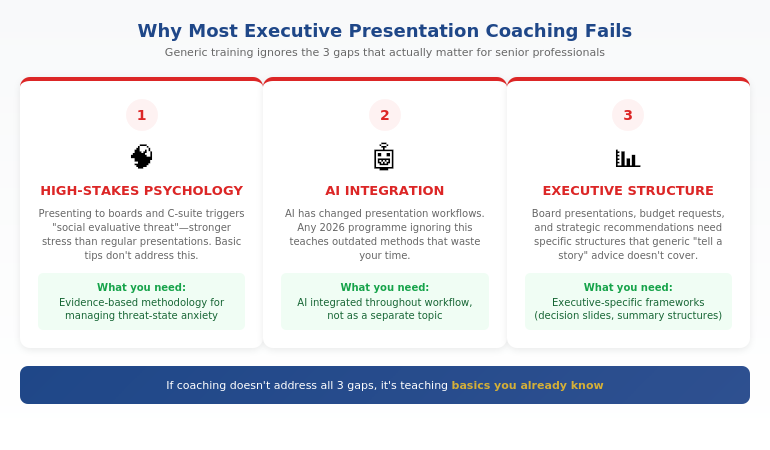
The presentation coaching industry has a dirty secret: most programmes don’t produce lasting change.
Executives complete the training, feel inspired for a week, then revert to their old patterns the moment they’re under pressure. The coaching “worked” in the safe environment of the training room—but collapsed in the boardroom.
Here’s why:
Problem 1: Theory Without Application
Most coaching teaches concepts: “Lead with your conclusion.” “Use the pyramid principle.” “Make eye contact.”
These aren’t wrong—but they’re incomplete. Understanding a concept intellectually doesn’t mean you can execute it when your nervous system is in fight-or-flight mode.
The insight: Effective executive presentation coaching must bridge the gap between knowing and doing. That requires frameworks specific enough to follow under pressure, plus techniques for managing the stress response that blocks execution.
Problem 2: Generic Approaches
Many programmes teach the same content to everyone: entry-level employees, middle managers, and C-suite executives all get the same “presentation skills” curriculum.
But presenting to a board is fundamentally different from presenting to peers. The expectations, the communication patterns, the decision-making dynamics—all different.
The insight: Executive-level coaching should focus specifically on high-stakes, senior-audience scenarios. Generic “presentation skills” won’t cut it.
Problem 3: Ignoring the Stress Response
Here’s what most coaches don’t understand: the anxiety that executives feel before high-stakes presentations isn’t a mindset problem. It’s a physiological response.
When your brain perceives threat (and being evaluated by people who control your career IS a threat), it triggers hormonal cascades that impair verbal fluency, working memory, and executive function—the exact cognitive skills you need to present well.
The insight: Any coaching that doesn’t address nervous system regulation will fail when stakes are high. “Just be confident” isn’t a technique—it’s a wish.
📚 Research note: The Trier Social Stress Test (Kirschbaum et al., 1993)—the gold standard for measuring social evaluative threat—consistently shows that being judged by high-status observers produces stronger cortisol spikes than other stressors. Research on anxiety and working memory (Eysenck & Calvo’s Processing Efficiency Theory) explains why intelligent, knowledgeable executives can “blank” during presentations: anxiety consumes cognitive resources needed for verbal retrieval. The expertise is intact, but access is blocked. Effective coaching must account for this biological reality.
For more on why training fails, see the hidden reasons most programmes don’t stick.
What Actually Works: The 5 Non-Negotiables
After spending too much money on coaching that didn’t work, and then developing programmes that do, I’ve identified five elements that separate effective executive presentation coaching from expensive disappointments.
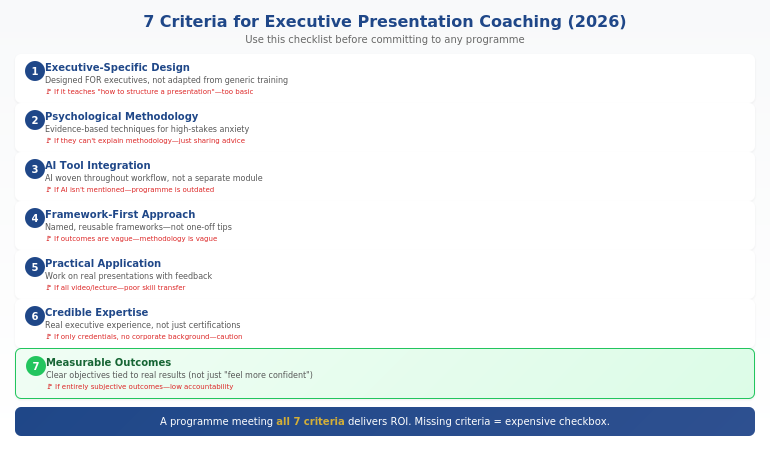
Non-Negotiable 1: Frameworks, Not Concepts
Effective coaching gives you specific, repeatable structures—not abstract principles.
Concept: “Lead with your conclusion.”
Framework: “Your first slide headline should state your recommendation + key benefit. Example: ‘Approve £500K for Q4 Campaign (2.3x Projected ROI).’ Here’s the template.”
The difference? A framework tells you exactly what to do. A concept requires you to figure it out yourself—which you can’t do under pressure.
What to look for: Can the coach show you the exact templates, structures, or scripts you’ll use? If it’s all principles and no specifics, keep looking.
Non-Negotiable 2: Pressure-Tested Techniques
Skills learned in calm conditions don’t automatically transfer to stressful ones. Effective coaching builds in stress inoculation—practicing under conditions that simulate real pressure.
What to look for: Does the programme include practice with realistic scenarios? Do they address what happens when anxiety spikes mid-presentation? Do they teach recovery techniques for when things go wrong?
Non-Negotiable 3: Executive-Specific Content
Presenting to a board requires different skills than presenting to a team meeting. Effective executive coaching focuses specifically on:
- Decision-oriented structures (not information dumps)
- Managing challenging questions from senior stakeholders
- Building credibility with time-poor, skeptical audiences
- The specific dynamics of high-stakes approval scenarios
What to look for: Is the content designed for senior audiences, or is it generic “presentation skills” repackaged?
Non-Negotiable 4: Both Structure AND Delivery
Some coaching focuses only on slide design. Others focus only on speaking skills. Neither alone is sufficient.
You need both: the ability to structure content that works for executive audiences AND the ability to deliver it with authority under pressure.
What to look for: Does the programme address both what you present (structure, slides, messaging) and how you present it (delivery, presence, managing nerves)?
Non-Negotiable 5: Modern Integration
In 2026, any executive presentation coaching that ignores AI is incomplete. Not because AI replaces presentation skills—but because AI changes how presentations are created.
The executives who thrive use AI to accelerate the mechanical work (drafts, formatting, research synthesis) while applying human judgment to the strategic work (what to include, how to frame it, what story to tell).
What to look for: Does the programme address how to leverage AI tools effectively? Or is it stuck in a pre-2023 world?
💬 “The framework changed how I structure every board presentation. I used to spend 6+ hours on decks that got questioned. Now I spend 90 minutes and get approval on the first pass.” — Senior Director, Global Consulting Firm
⭐ A Programme Built on These 5 Non-Negotiables
AI-Enhanced Presentation Mastery was designed specifically for senior professionals who present to decision-makers. It’s frameworks-first (not theory), addresses the stress response, and integrates modern AI workflows.
What’s included:
- Executive presentation frameworks (decision slides, board updates, stakeholder pitches)
- Techniques for calm authority under pressure
- AI integration for faster, higher-quality presentation creation
Cohort-based programme for senior professionals. Limited seats per session.
The 2026 Coaching Landscape: What’s Changed
The executive presentation coaching market has shifted dramatically. Here’s what’s different now:
Change 1: AI Has Raised the Bar
When anyone can generate a “decent” presentation in minutes using AI, the baseline has changed. Decent isn’t enough anymore.
The executives who stand out are those who can take AI-generated foundations and elevate them with strategic thinking, audience insight, and executive-level polish. Coaching that doesn’t address this reality is already outdated.
Change 2: Remote + Hybrid Has Become Permanent
Many executive presentations now happen on video—or hybrid with some participants in-room and others remote. This changes everything: how you build rapport, how you read the room, how you maintain engagement.
Coaching designed for in-person only is incomplete. Look for programmes that address the specific challenges of presenting through screens.
Change 3: Decision Speed Has Increased
Executives have less patience than ever. The “let me walk you through this” approach that worked a decade ago now loses audiences before you’ve made your point.
Modern coaching should emphasise decision-oriented structures: recommendation first, evidence second, context only when asked.
Change 4: Credentialism Matters Less, Results Matter More
Traditional presentation coaching often leaned on credentials: “trained at [famous institution]” or “certified in [methodology].”
Smart buyers now ask: “What outcomes have your participants achieved?” Credentials don’t guarantee results. Ask for evidence of transformation, not badges.
For more on what separates top performers, see why most presentation training fails senior professionals.
Looking for a programme designed for the 2026 reality? AI-Enhanced Presentation Mastery integrates frameworks, stress management, and modern AI workflows—specifically for senior professionals.
Red Flags: When to Walk Away
Not all coaching is worth the investment. Here are the warning signs:
Red Flag 1: “Everyone Needs the Same Training”
If a programme promises to help “everyone from interns to executives,” it’s not executive-focused. Generic content won’t address the specific challenges of high-stakes senior presentations.
Red Flag 2: All Theory, No Templates
If the coach can’t show you specific frameworks, templates, or structures you’ll walk away with, you’re paying for concepts you could read in a book.
Ask: “Can you show me an example of a framework I’ll learn?” If the answer is vague, walk away.
Red Flag 3: No Mention of Pressure or Nerves
If the programme doesn’t address performance anxiety, stress response, or presenting under pressure, it’s incomplete. Skills learned in calm conditions often collapse when stakes are high.
Red Flag 4: Outdated Content
If there’s no mention of AI, remote/hybrid presenting, or modern executive communication patterns, the content may be years out of date.
Ask: “How has this programme evolved in the last two years?”
Red Flag 5: No Evidence of Results
If the coach can’t point to specific outcomes from past participants—faster approvals, promotions, successful pitches—the programme may not deliver transformation.
Ask: “What measurable results have past participants achieved?”
⭐ A Programme That Passes Every Test
AI-Enhanced Presentation Mastery includes specific frameworks you can review before enrolling, addresses performance under pressure, and is updated for 2026 realities—including AI integration and remote/hybrid presenting.
You’ll get:
- Frameworks you can see before you enrol (no mystery content)
- Techniques for managing the stress response
- Modern AI workflows that save hours per presentation
Designed for senior professionals presenting to boards, executives, and key stakeholders.
How to Evaluate Any Programme
Use this framework to assess any executive presentation coaching you’re considering—including mine:
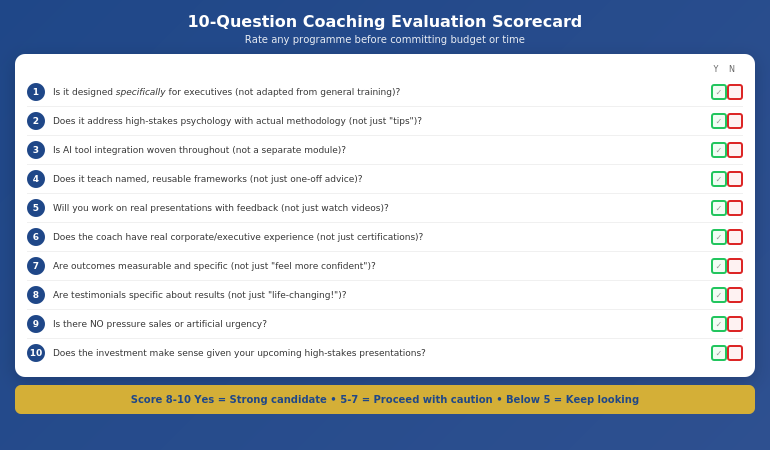
The 10-Question Evaluation
Content Quality:
- Is the content designed specifically for executive/senior audiences?
- Can they show you the exact frameworks and templates you’ll use?
- Does it address both structure (slides/content) AND delivery (presence/nerves)?
- Is it updated for 2026 realities (AI, remote/hybrid, decision speed)?
Practical Application:
- Does it include practice with realistic high-stakes scenarios?
- Do they address what happens when anxiety spikes mid-presentation?
- Will you walk away with tools you can use immediately?
Evidence of Results:
- Can they point to specific outcomes from past participants?
- Do they offer any guarantee or way to assess fit before full commitment?
- Does the programme structure support actual skill development (not just information transfer)?
Score it: If a programme doesn’t score at least 7/10, consider alternatives.
🎯 Choose Your Next Step Based on Your Timeline
If you present to ExCo/Board in the next 14 days: Focus on immediate fixes—review our decision slide framework and calm presence techniques. Long-term coaching can wait.
If you’re evaluating coaching this month: Use the 10-question scorecard above. Request curriculum details before any call. Compare at least 2-3 options.
If you’re planning Q1 development: Book now for early cohorts—quality programmes fill quickly in January. The AI-Enhanced Presentation Mastery next cohort has limited seats.
🎯 If you’re investing in coaching this quarter, do this TODAY:
- List the specific presentation challenges you need to solve (not vague “get better”—specific scenarios)
- Identify 2-3 programmes to evaluate using the 10-question framework above
- Request to see actual content before committing (frameworks, templates, curriculum)
- Ask for outcomes evidence from past participants in similar roles
This takes an hour. It prevents spending thousands on coaching that won’t deliver.
For more on presentation skill development, see what actually gets senior professionals ahead.
Want to evaluate AI-Enhanced Presentation Mastery? See the full curriculum and framework overview — you can review exactly what’s included before making any decision.
Frequently Asked Questions
How much should I expect to invest in executive presentation coaching?
Quality programmes range from a few hundred pounds for self-paced courses to several thousand for intensive 1:1 coaching. The question isn’t the absolute cost—it’s the return. A £500 programme that transforms your executive presentations delivers better ROI than a £5,000 programme that teaches theory you can’t apply.
Is 1:1 coaching better than group programmes?
Not necessarily. 1:1 offers personalisation; group programmes offer peer learning and accountability. The best choice depends on your learning style and specific needs. What matters more than format is whether the content meets the 5 non-negotiables.
How quickly should I expect results from coaching?
With framework-based coaching, you should see improvement in your very next presentation. Deep transformation—the kind that makes high-stakes presenting feel natural—typically takes 3-6 months of deliberate application.
Should I look for a coach with experience in my industry?
Industry experience can be helpful but isn’t essential. Executive presentation patterns are remarkably consistent across sectors. What matters more is whether the coach understands high-stakes, senior-audience dynamics—not the specifics of your industry.
Can AI tools replace executive presentation coaching?
AI can help you create slides faster, but it can’t teach you to present with authority under pressure. The mechanical parts of presentation creation are being automated; the human elements—strategic thinking, executive presence, managing the room—remain irreplaceable. The best coaching helps you leverage AI for efficiency while developing the skills AI can’t provide.
What if I’ve tried coaching before and it didn’t work?
The failure was likely in the approach, not in you. Most coaching fails because it’s theory-based, generic, or ignores the stress response. Use the evaluation framework in this article to find a programme that addresses those gaps. Don’t give up on coaching—find better coaching.
Does coaching work for people who are naturally nervous presenters?
Yes—in fact, naturally nervous people often see the biggest transformation. Here’s why: coaching that addresses the stress response (not just “presentation tips”) gives anxious presenters specific techniques to manage their physiology. They’re not trying to “stop being nervous”—they’re learning to present effectively despite the nerves. Many of the most composed executive presenters you see are naturally anxious people who’ve learned to channel that energy rather than display it.
Is This Right For You?
✓ Executive coaching is right for you if:
- You present to boards, executives, or senior stakeholders
- Your presentations affect decisions on funding, strategy, or career advancement
- You want frameworks and techniques, not just theory
- You’re ready to invest time in deliberate practice
✗ Executive coaching is NOT right for you if:
- You mainly present to peers or direct reports (lower stakes)
- You’re looking for quick tips rather than skill development
- You’re not willing to practice between sessions
- You expect transformation without applying what you learn
⭐ The £8,000 I Wasted Taught Me What Works
That expensive coaching that failed? It taught me exactly what to avoid—and what to build. AI-Enhanced Presentation Mastery is everything I wish that programme had been: frameworks-first, pressure-tested, and designed specifically for executives who present to decision-makers.
What you’ll get:
- Executive presentation frameworks (not theory—templates you can use immediately)
- Techniques for calm authority under pressure
- Modern AI integration for faster, better presentations
Cohort-based programme on Maven. Review the full curriculum before deciding.
📧 Optional: Get weekly executive presentation strategies in The Winning Edge newsletter (free).
Your Next Step
The right executive presentation coaching can transform how you communicate with decision-makers—and by extension, how your career progresses.
But the wrong coaching wastes thousands and leaves you no better than before. The difference is in knowing what to look for.
Use the 10-question evaluation on any programme you’re considering. Demand to see frameworks before you commit. Ask for evidence of results. And don’t settle for theory-based coaching that collapses under pressure.
Your ability to present to executives is one of the highest-leverage skills you can develop. Invest in coaching that actually delivers transformation—not just inspiration.
To review a programme designed around these principles, see the AI-Enhanced Presentation Mastery curriculum.
P.S. If your immediate challenge is structuring slides for executive approval, see how to build decision slides that get “yes” in 60 seconds. If it’s managing nerves when presenting to senior leadership, see how to sound calm and credible under pressure.
About the Author
Mary Beth Hazeldine is the Owner & Managing Director of Winning Presentations and a qualified clinical hypnotherapist. The £8,000 coaching failure that opens this article is real—and the decade that followed taught her what actually creates transformation in executive presentations.
After 24 years in corporate banking at JPMorgan Chase, PwC, Royal Bank of Scotland, and Commerzbank—where presenting to senior leadership was unavoidable—she now teaches the frameworks and techniques that actually work under pressure.