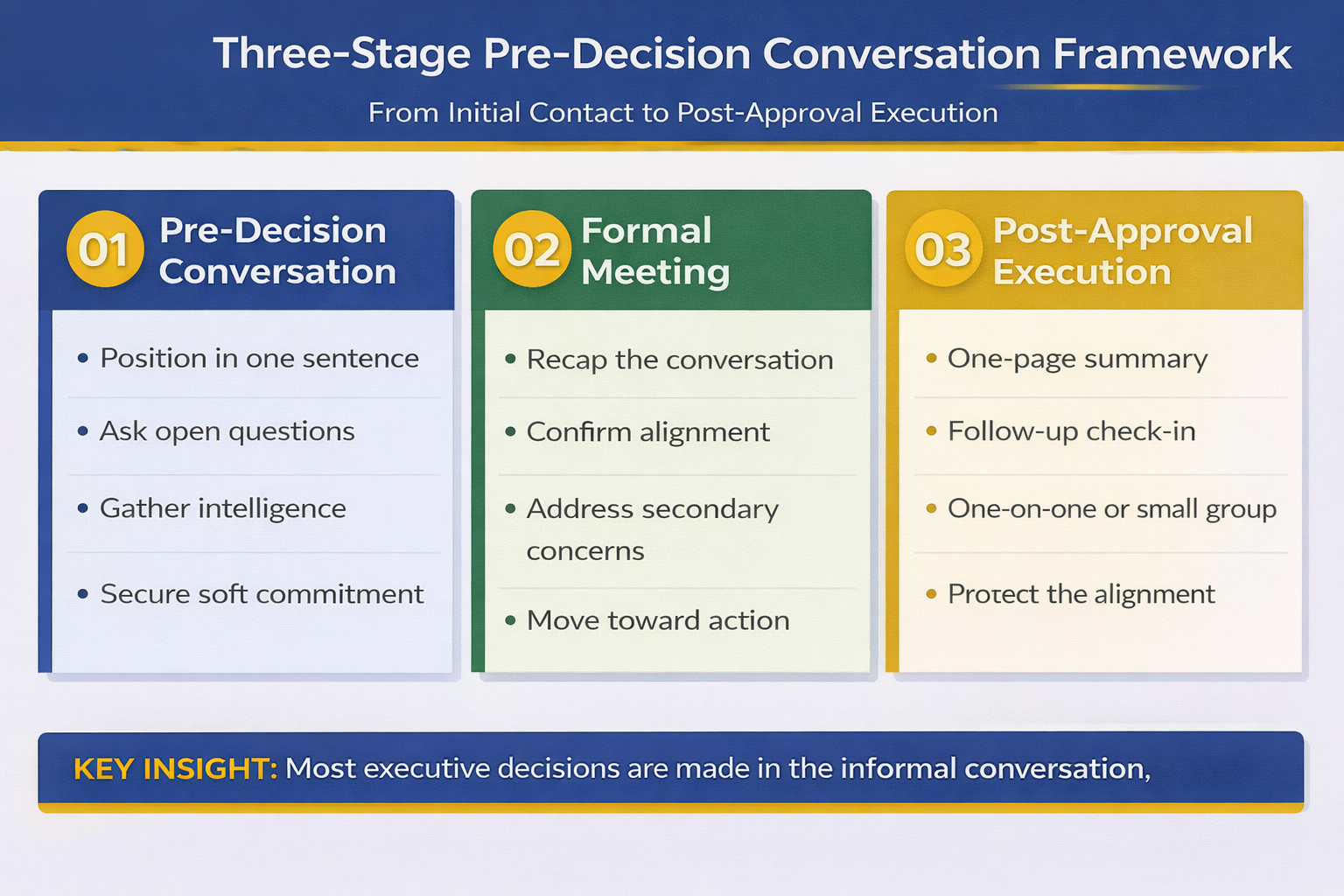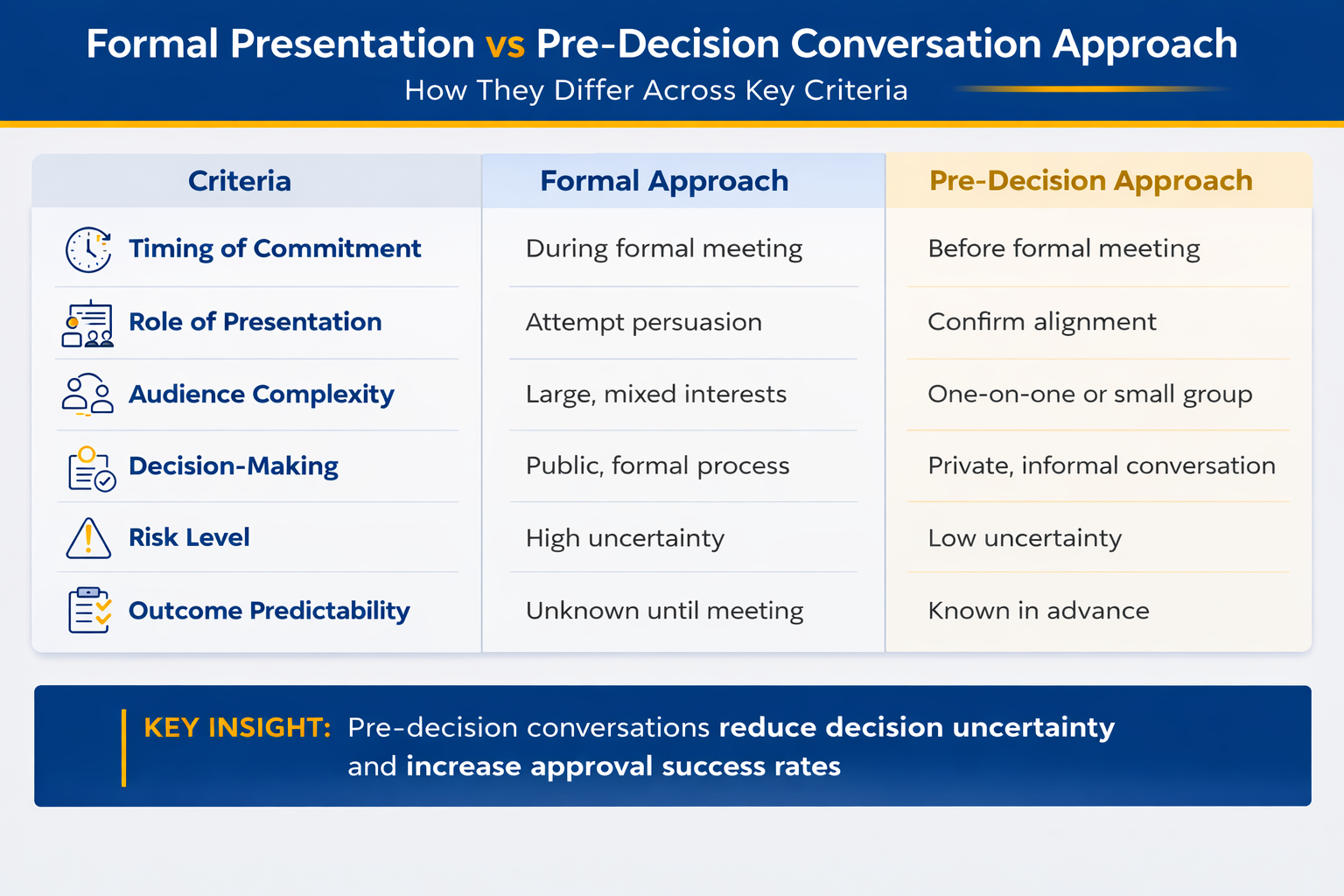
Category: Executive Buy-In

12 Feb 2026
Professional executive woman presenting with restraint to boardroom, holding notes with simple chart visible, corporate glass office setting

Why Over-Explaining Destroys Your Credibility (The Slide Audit That Changes Everything)

Quick answer: Over-explaining in presentations isn’t thoroughness — it’s a stress response that signals doubt. Executives interpret excessive detail as a lack of confidence in your own recommendation. The fix: audit every slide as either “safety content” (makes you feel prepared) or “decision content” (helps them decide) — then cut ruthlessly. In my experience, most decks are majority safety content that actively undermines your credibility.

A Client Had 65 Slides. I Asked One Question. She Went Quiet for 30 Seconds.

She’d spent three weeks building it. Every slide was polished. Every chart sourced and footnoted. Every possible objection anticipated with backup data.

I asked her: “Which of these slides does the audience need to make a decision — and which exist because they make you feel safe presenting?”

She went quiet. Then: “…most of these are for me, aren’t they?”

Thirty-eight slides were there to manage her anxiety. Not to help the CFO decide. Once she saw it, she couldn’t unsee it — and neither will you.

This is the pattern I’ve watched play out across 24 years in banking boardrooms at JPMorgan Chase, PwC, Royal Bank of Scotland, and Commerzbank. The highest-performing professionals sabotaging their own credibility not by saying the wrong thing, but by saying too much. Over-explaining isn’t a communication problem. It’s a stress response disguised as professionalism.

And the fix isn’t “be more concise.” The fix is understanding why you included each slide in the first place — then having a system to separate what serves you from what serves them.

That system is what I call the Credibility Audit. And once you run it on your own deck, your presentations — and how executives respond to you — will never be the same.

🎯 Stop Over-Explaining. Start Getting Decisions.

The Executive Buy-In Presentation System is a 7-module self-study programme that teaches you how decisions actually get made — and how to structure your presentation so “yes” feels safe. Includes the Credibility Release framework, Decision Definition Canvas, Pressure Response playbook, and AI-assisted workflow. Study at your own pace, with live Q&A calls for support.

Built on 24 years in banking boardrooms. Not theory — pattern recognition from thousands of high-stakes presentations.

Get the Executive Buy-In System → £199

Self-study modules + live Q&A sessions. Join anytime — all released modules available immediately.

First-cohort pricing: £199 is the launch price for this intake only. From next month, pricing moves to £499 (self-study) and £850 (live cohort).

Why Over-Explaining Feels Right But Reads Wrong

Here’s what makes this problem so persistent: the impulse to over-explain comes from a good place. You want to be thorough. You want to show you’ve done the work. You want to anticipate every question so nobody catches you off guard.

These are reasonable instincts. They also signal the opposite of what you intend.

When you present 47 slides of context, methodology, and evidence before reaching your recommendation, the audience isn’t thinking “how thorough.” They’re thinking: “If they need to explain this much, are they sure about it?”

There’s neuroscience behind this. When we’re anxious, we talk more. It’s a measurable stress response — the same mechanism that makes people over-justify when they feel insecure about a decision. Audiences detect this subconsciously. They can’t always name what feels off, but they register it as uncertainty.

The result: you’ve accidentally signalled doubt about the very recommendation you’re trying to get approved.

I watched this happen to a brilliant colleague at Commerzbank. She presented a €50M deal structure for 45 minutes. Flawless analysis. Perfect charts. The Chair’s response: “That was thorough. What did you want us to do?” Her recommendation was on slide 38. By the time she reached it, the room had already decided she wasn’t confident in it.

The seniority paradox makes this worse. Watch any boardroom carefully. The most senior person usually says the least. The CEO speaks last, and briefly. This isn’t laziness — it’s how authority is communicated. But most professionals, as they prepare for senior audiences, add more explanation. They’re signalling junior-ness to the exact people they want to see them as senior.

If your executives keep stopping you mid-presentation, the problem isn’t your content. It’s your ratio of explanation to judgement.

📋 Want the complete Credibility Release framework?

Module 3 of the Executive Buy-In System gives you the full audit tool, Apology Scan reference sheet, and restraint-as-authority techniques.

Get the Executive Buy-In System → £199

Launch pricing — moves to £499/£850 next month.

Safety Content vs Decision Content: The Distinction That Changes Everything

Every slide in your presentation falls into one of two categories. Once you learn to see this, you can never unsee it.

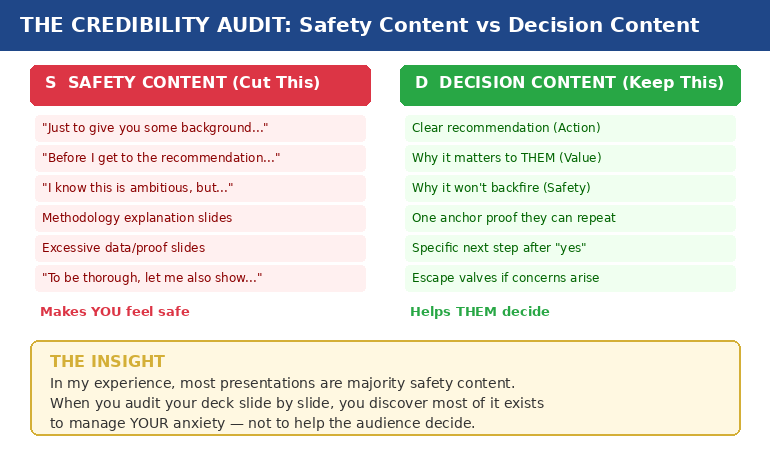
Safety content exists to make you feel prepared. It’s the background context, the methodology walkthrough, the 14 case studies, the comprehensive data analysis. It feels essential when you’re building the deck at 11pm. In the room, it signals that you’re not sure what matters.

Decision content exists to help them decide. It’s your clear recommendation, the specific value to them, the reason it won’t backfire, one piece of proof they can repeat to their peers, and a concrete next step.

In my experience, most presentations are majority safety content.

Credibility audit diagram showing safety content versus decision content with examples of each type

A consultant I worked with showed a client 14 case studies to prove their methodology worked. The client said: “But none of these are in our industry.” One relevant example would have closed the deal. Instead, fourteen irrelevant ones created doubt.

That’s safety content in action. The consultant wasn’t trying to help the client decide. She was trying to protect herself from the question “how do we know this works?” — a question the client never asked.

The three questions every decision-maker silently asks are:

  1. What happens if I say yes and it goes wrong?
  2. What happens if I say no and miss out?
  3. Can I defend this decision to my peers?

Everything that answers those three questions is decision content. Everything else — no matter how impressive — is safety content. And safety content doesn’t just waste time. It actively undermines your credibility by making you look unsure about which information actually matters.

If you’ve ever wondered why your executive presentation structure isn’t landing, start here. The structure probably isn’t wrong. The ratio is.

📊 The Credibility Release Framework: Module 3 of the Buy-In System

Five lessons that transform how you build presentations: why over-explaining destroys credibility (the neuroscience), the Credibility Audit tool for existing decks, the Apology Scan reference sheet, and the “restraint as authority” framework. Plus the Permission to Be Brief audio for cultures that expect “comprehensive” presentations.

Get the Executive Buy-In System → £199

7 modules, 36 lessons, 8 downloadable tools. Designed for busy executives who can’t commit to fixed schedules.

£199 is the first-cohort launch price. From next month: £499 self-study / £850 live cohort.

The Credibility Audit: How to Run It on Your Own Deck

This takes fifteen minutes and will change how you see every presentation you build.

Step 1: Print your deck (or open it in slide sorter view). You need to see every slide at once.

Step 2: Mark each slide with one letter. S for safety content — content that exists because it makes you feel prepared. D for decision content — content that directly helps the audience make their decision.

Be honest. The methodology slide that took you four hours to build? If removing it wouldn’t change whether they say yes or no, it’s an S.

Step 3: Count the ratio. If you’re like most professionals I work with, you’ll find the majority of your slides are S.

Step 4: For every S slide, ask one question: “If the CEO asked me to present this in half the time, would I keep this slide?” If the answer is no, it was never decision content. It was your anxiety asking for an insurance policy.

Step 5: Move the S slides to an appendix. Don’t delete them — that triggers its own anxiety. Put them in backup. If someone asks a question that one of those slides answers, you’ll have it. But you won’t volunteer information that nobody asked for.

A client brought me a 47-slide deck for a steering committee. We reduced it to 12 slides using this exact process. Same information, different structure. The committee approved in 15 minutes — a decision that had been delayed for three months.

The content wasn’t the problem. The ratio was.

🔍 Make this audit repeatable for every presentation.

The Credibility Release Checklist inside the Executive Buy-In System turns this into a systematic, page-by-page diagnostic you can run in minutes.

Get the Executive Buy-In System → £199

Launch pricing — moves to £499/£850 next month.

The Apology Scan: Hidden Phrases That Signal Doubt

Over-explaining isn’t just about slide count. It’s also about language. There are phrases that feel polite and professional but actually function as apologies for your own recommendation.

I call this the Apology Scan. Run through your presenter notes or script and look for these patterns:

“Just to give you some background…” — Translation: I’m not confident you’ll accept my recommendation without extensive justification.

“I know this is ambitious, but…” — Translation: I’m pre-apologising for what I’m about to recommend.

“You might be wondering why…” — Translation: I’m anticipating your objection and defending before you’ve attacked.

“To be thorough, let me also show…” — Translation: I’m padding my case because I’m not sure the core argument is strong enough.

“Before I get to the recommendation…” — Translation: I need you to see how much work I’ve done before you’ll trust my judgement.

Every one of these phrases feels reasonable when you write them. In the room, each one is an unintentional admission of doubt. They tell the audience: “I’m not sure you’ll trust me, so let me earn it first.”

Senior leaders don’t do this. They state what they recommend, why it matters, and what happens next. The absence of hedging is the credibility signal.

I learned this watching a partner at PwC give a 20-minute presentation to a CFO. After five minutes, the CFO interrupted: “I trust you. What do you need?” The partner said: “I need 15 more minutes.” The CFO laughed, approved everything, and left. That partner understood something it took me years to learn: the CFO wasn’t evaluating the content. She was evaluating the confidence.

Why Restraint Communicates Authority (And How to Get There)

Executives judge three things in the first two minutes — before they’ve evaluated a single slide:

  1. Do you know what you want? (Clear recommendation, not buried on slide 38)
  2. Do you believe in it? (Restrained delivery, not defensive over-explanation)
  3. Are you making this easy for me? (Decision-ready structure, not a data tour)

Restraint answers all three. Verbosity answers none.

This doesn’t mean being unprepared. It means being prepared enough to know what to leave out. Cutting content is an act of judgement — and judgement is exactly what executives are evaluating.

The “appendix strategy” solves the cultural challenge. In organisations that expect “comprehensive” presentations, you can be brief in the room while having depth available if asked. Your main deck shows 12 slides of decision content. Your appendix holds 35 slides of safety content. If someone asks “what about the methodology?” — you have it. But you didn’t volunteer it, which signals you know what matters.

This is the difference between a presenter and a decision-maker. Presenters show everything they know. Decision-makers show only what’s needed. Which one do you want to be perceived as?

There’s a reason “great presentation” is the worst feedback you can get. It means they were impressed by your delivery but didn’t feel moved to act. Restraint moves people to act.

How many slides should an executive presentation have?

There’s no magic number. The question is: how many of your slides are “decision content” (helps them decide) versus “safety content” (makes you feel prepared)? A 12-slide deck of pure decision content outperforms a 47-slide deck that’s 70% safety content. Run the Credibility Audit and let the ratio guide you.

How do you present confidently to senior executives?

Confidence in executive presentations is communicated through restraint, not through proving you’ve done the work. Lead with your recommendation, not your research. Cut safety content to an appendix. Remove apology phrases from your script. The absence of hedging is the credibility signal.

Why do executives stop presentations early?

Usually because the recommendation is buried under context. Executives scan for direction in the first 90 seconds. If they find context instead of a clear recommendation, they interrupt — not because they’re impatient, but because they can’t evaluate a proposal they haven’t heard yet.

🏆 The Complete System for Getting Executive Decisions

The Executive Buy-In Presentation System covers everything in this article and far more — from clarifying the decision before you build a single slide, to structuring your message so “yes” feels safe, to handling pressure when executives push back. Seven modules:

  • Module 1: Clarify the Decision (eliminate the ambiguity that causes over-explaining)
  • Module 2: The Executive Buy-In Structure (Action → Value → Safety → Proof → Next Step)
  • Module 3: The Credibility Release (the audit and apology scan from this article)
  • Module 4: Reassurance-First Proof (one anchor proof vs ten weak ones)
  • Module 5: AI as Execution Engine (90-minute deck creation workflow)
  • Module 6: Pressure Response (reframe pushback as risk-testing, not rejection)
  • Module 7: Your Personal Executive Playbook (custom rules for your stress patterns)

36 lessons, 8 downloadable tools, live Q&A sessions. Self-study format designed for busy executives.

Get the Executive Buy-In System → £199

Join anytime — all released modules available immediately. Study at your own pace.

⚡ £199 is the first-cohort launch price only. From next month, the self-study programme moves to £499 and the live cohort to £850. This intake locks in the launch rate.

Frequently Asked Questions

How do I know if I’m over-explaining versus being appropriately thorough?

Run the Credibility Audit: mark each slide as S (safety — makes you feel prepared) or D (decision — helps them decide). If more than 40% of your slides are S, you’re over-explaining. The acid test: if the CEO asked you to present in half the time, which slides would you cut first? Those were never decision content — they were anxiety management disguised as thoroughness.

What if my organisation expects long, comprehensive presentations?

Use the appendix strategy. Keep your main deck to decision content only (typically 10-15 slides). Move all safety content to an appendix. You’re not being unprepared — you’re being strategic about what you volunteer versus what you hold in reserve. If someone asks a detailed question, you have the slide. But you didn’t dilute your credibility by volunteering information nobody asked for. Over time, your brevity will be noticed — and rewarded.

Doesn’t cutting slides risk looking unprepared or under-researched?

The opposite is true. Knowing what to cut requires more judgement than knowing what to include. Executives recognise this instantly. A 12-slide deck that leads with a clear recommendation signals: “I know exactly what matters.” A 47-slide deck that buries the recommendation on slide 38 signals: “I’m not sure which of this information is important, so I’m showing you all of it.” The first is the presentation of someone ready for the next level. The second is the presentation of someone still proving they belong at this one.

Can the Credibility Audit work for non-slide presentations — like verbal updates or meeting contributions?

Absolutely. The same principle applies to any communication. Before your next verbal update, write down what you plan to say. Mark each point as S (makes you feel covered) or D (helps them decide or act). You’ll likely find you planned to give three minutes of context before reaching the actual point. Cut the context. Lead with the point. Watch how differently the room responds.

📬 The Winning Edge Newsletter

Weekly insights on executive presentations, decision psychology, and high-stakes communication — from 24 years in banking boardrooms. No fluff. No “10 tips” lists. Just the patterns that actually get decisions.

Subscribe Free →

📋 Free: Executive Presentation Checklist

A quick-reference checklist for structuring any executive presentation — including the safety vs decision content check. Download it before your next high-stakes meeting.

Download the Free Checklist →

Related reading: The Headcount Request That Got Yes When Everyone Said No · Why Your Nervous System Remembers That Awful Presentation From 2019

Your next step: Open your most recent presentation. Mark every slide S or D. Count the ratio. Then move every S slide to an appendix and see what’s left. That’s your real presentation — the one that communicates confidence instead of anxiety. And if you want the complete system for structuring presentations that get decisions instead of “let’s discuss further,” the Executive Buy-In Presentation System gives you the frameworks, tools, and playbooks to make it repeatable. It’s £199 at the current first-cohort launch price (moving to £499/£850 next month).

About the Author

Mary Beth Hazeldine is the Owner & Managing Director of Winning Presentations. With 24 years of corporate banking experience at JPMorgan Chase, PwC, Royal Bank of Scotland, and Commerzbank, she has delivered high-stakes presentations in boardrooms across three continents.

A qualified clinical hypnotherapist and NLP practitioner, Mary Beth combines executive communication expertise with evidence-based techniques for managing presentation anxiety. She has trained senior professionals and executive audiences over many years, and supported high-stakes funding and approval presentations across industries.

Book a discovery call | View services

10 Feb 2026
Executive reviewing stakeholder notes before entering boardroom meeting

Reading the Room Before You Enter It: The Intelligence-Gathering Phase

The decision was made before I opened my mouth.

I didn’t know it at the time. I walked into that boardroom at Chase Manhattan with 47 slides and absolute confidence in my analysis. The CFO stopped me on slide 3. “We’ve already discussed this with the CEO,” he said. “The answer is no.”

I’d spent three weeks on that presentation. The analysis was bulletproof. The recommendation was sound. None of it mattered — because I’d walked into a room where the political dynamics had already determined the outcome.

That was the day I learned: the presentation doesn’t start when you stand up. It starts weeks before, when you begin gathering intelligence on every person who will be in that room.

Quick answer: The intelligence-gathering phase is the pre-presentation work that determines whether your proposal succeeds or fails. Before you build a single slide, you need to know: who has decision authority, who influences the decision-maker, what each stakeholder’s hidden priorities are, where potential resistance will come from, and who might champion your proposal. Senior executives spend as much time on this phase as they do on the presentation itself — because they know the room’s dynamics matter more than the deck’s content.

I’m writing this because I’m seeing more senior teams make decisions before the meeting — and presentations are becoming confirmation, not persuasion. If you’re still building slides before mapping the room, you’re solving the wrong problem first.

After that Chase disaster, I started paying attention to something I’d previously ignored: how the senior executives who consistently got approval actually prepared.

What I noticed surprised me. They spent relatively little time on slides. But they spent enormous amounts of time in conversations — casual coffees, brief check-ins, “quick questions” that weren’t quick at all. They were gathering intelligence.

One executive I worked with at JPMorgan had an almost supernatural ability to get proposals approved. I finally asked him his secret. He laughed and said: “I never present anything the room hasn’t already agreed to. The presentation is just the formality.”

That’s when I understood: the best presenters aren’t better at presenting. They’re better at the work that happens before.

Why Intelligence Beats Content

Here’s an uncomfortable truth about executive decision-making: the quality of your analysis is rarely the deciding factor.

Executives make decisions based on:

  • Trust — Do they believe you understand their world?
  • Risk — What happens if this goes wrong, and who gets blamed?
  • Politics — How does this affect relationships and power dynamics?
  • Priorities — Does this align with what they’re measured on?

Your spreadsheet addresses none of these. Your stakeholder intelligence addresses all of them.

When you walk into a room understanding each person’s hidden concerns, unspoken priorities, and political position, you can shape your presentation to speak directly to what actually matters to them — not what you assume matters.

This is why two people can present identical recommendations and get opposite outcomes. One understood the room. The other understood only the content.

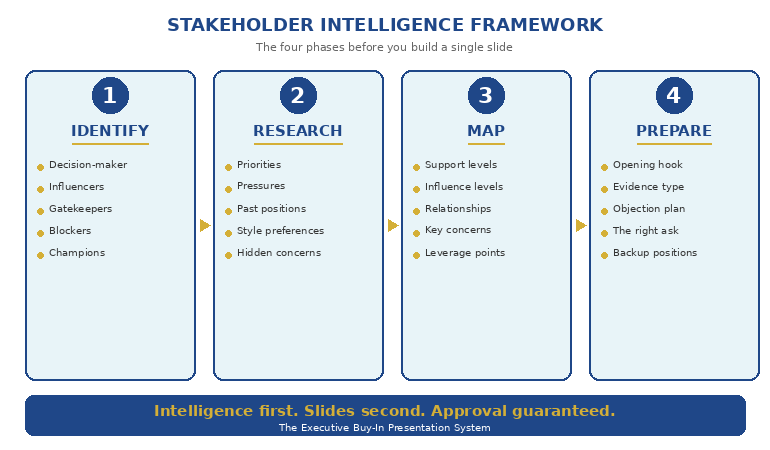
The Four Phases of Pre-Meeting Stakeholder Research

Intelligence gathering isn’t random networking. It’s a systematic process with four distinct phases.

Phase 1: Identify

Before you can gather intelligence, you need to know who matters. This isn’t just “who will be in the room.” It’s a complete map of the decision ecosystem.

The Decision-Maker: Who has final authority? This is often not the most senior person. A CFO might defer to a COO on operational matters. A CEO might defer to a board member on strategic investments.

The Influencers: Who does the decision-maker listen to? These people may not be in the room, but their opinion has been sought — or will be sought after your presentation.

The Gatekeepers: Who controls access to the decision-maker? Executive assistants, chiefs of staff, and “special advisors” often have more influence than their titles suggest.

The Blockers: Who might oppose your proposal? Sometimes this is obvious (the person whose budget you’re threatening). Sometimes it’s hidden (the person who proposed something similar last year and failed).

The Champions: Who might actively support you? These are the people who will speak up in your favour when you’re not in the room.

If you can’t name your blockers and champions in 60 seconds, your deck is the wrong place to start.

The stakeholder mapping template inside the Executive Buy-In System lets you map your room in 15 minutes.

🎯 Master the Intelligence Phase

The Executive Buy-In Presentation System includes complete stakeholder mapping templates, intelligence-gathering scripts, and a systematic process for identifying decision dynamics before any high-stakes presentation. Stop guessing who matters. Start knowing.

Get the Stakeholder Mapping Templates →

Executive Buy-In System, £199. Self-study modules + live Q&A calls. Join anytime.

Phase 2: Research

Once you know who matters, you need to understand what matters to them. This requires research across multiple dimensions.

Professional priorities: What are they measured on? What’s in their bonus criteria? What did they commit to in their last performance review or board presentation?

Current pressures: What challenges are they facing right now? What keeps them up at night? What are they being asked about by their boss?

Past positions: Have they taken public stances on related topics? Did they support or oppose similar proposals? What patterns exist in their decision-making?

Communication style: Do they prefer data or narrative? Do they want details or headlines? Do they decide quickly or need time to process?

This information comes from multiple sources: public statements, previous meeting notes, conversations with their team members, and — most valuably — direct conversation with them.

Phase 3: Map

Now you create a visual representation of the political landscape. This isn’t optional — it’s essential. Human memory can’t hold the complexity of stakeholder dynamics. You need it on paper.

A stakeholder map shows:

  • Each person’s position (supporter / neutral / opponent)
  • Each person’s influence level (high / medium / low)
  • Relationships between stakeholders (allies, rivals, reporting lines)
  • Key concerns and priorities for each person
  • What would move each person toward support

The map reveals patterns you can’t see otherwise. You might discover that your biggest opponent is close allies with someone who could become your champion — if you approached them first. You might see that two neutral parties share a concern you could address to shift both simultaneously.

The stakeholder mapping templates in the Executive Buy-In System include specific frameworks for visualising these dynamics and identifying the highest-leverage moves.


Stakeholder intelligence framework showing 4 phases: Identify, Research, Map, Prepare

Phase 4: Prepare

Intelligence is worthless unless it shapes action. The final phase is translating what you’ve learned into specific presentation decisions.

Opening: Whose concern will you address first? (Usually the decision-maker’s, unless a powerful blocker needs to be neutralised early.)

Framing: How will you position the proposal to align with stated priorities? What language will resonate with this specific group?

Evidence: What type of proof does this group find compelling? (Some want data. Some want case studies. Some want peer validation.)

Objection handling: What resistance will come from whom? How will you address it without making enemies?

Ask: What specific decision are you requesting, and is the room actually empowered to make it?

Uncovering Hidden Priorities

The most valuable intelligence is what stakeholders don’t say publicly. Everyone has hidden priorities — concerns they won’t voice in a meeting but that heavily influence their decisions.

Common Hidden Priorities

Career protection: “Will this make me look bad if it fails?” This is especially strong for people who’ve been burned before or who are approaching a promotion decision.

Relationship preservation: “Will supporting this damage my relationship with [person]?” Political alliances often matter more than logical analysis.

Legacy concerns: “Does this undo or overshadow something I built?” People are protective of their past work, even when circumstances have changed.

Resource competition: “Will this take budget/headcount/attention from my priorities?” Zero-sum thinking is pervasive in organisations.

Workload anxiety: “Will this create more work for my team?” Even good ideas get blocked because people are already overwhelmed.

How to Uncover Hidden Priorities

You can’t ask directly. “What’s your hidden agenda?” doesn’t work. Instead, use indirect approaches:

Ask about history: “What happened when [similar proposal] was discussed before?” Past reactions reveal ongoing concerns.

Ask about pressures: “What’s taking most of your attention right now?” Current stress points predict resistance areas.

Ask about success criteria: “What would make this a win from your perspective?” People reveal priorities when describing their ideal outcome.

Ask about concerns: “What would need to be true for you to feel comfortable with this?” This is permission to voice objections before the formal meeting.

Listen for qualifiers: When someone says “I like this, but…” the word after “but” is the hidden priority.

🔍 Scripts for Every Intelligence Conversation

The Executive Buy-In System includes word-for-word scripts for pre-meeting conversations — how to ask questions that reveal hidden priorities without seeming manipulative, how to test reactions without showing your full hand, and how to build alliances before the formal presentation.

Get the Pre-Meeting Conversation Scripts →

Executive Buy-In System, £199. Includes objection-handling frameworks and champion recruitment strategies.

Mapping the Political Landscape

Every organisation has a political landscape — relationships, rivalries, alliances, and histories that shape how decisions actually get made. Ignoring this doesn’t make you “above politics.” It makes you ineffective.

Key Political Dynamics to Identify

Alliance clusters: Who consistently supports whom? These groups often vote as a bloc, so winning one member can win several.

Rivalry pairs: Who has history with whom? If your proposal is associated with one side of a rivalry, the other side may oppose it automatically.

Rising and falling stars: Who is gaining influence? Who is losing it? Aligning with rising stars is strategic; relying on falling stars is risky.

Debt relationships: Who owes whom a favour? Political capital is real, and people cash it in on important decisions.

Information channels: How does information flow? Who talks to whom? A message that reaches the CEO through their trusted advisor lands differently than one that comes through formal channels.

Navigating Without Taking Sides

The goal isn’t to become a political player. It’s to understand the landscape well enough to navigate it without stepping on landmines.

This means:

  • Presenting your proposal as good for the organisation, not good for any faction
  • Acknowledging different perspectives without aligning with any camp
  • Giving potential opponents a way to support you without losing face
  • Never badmouthing anyone, even to people you think are allies

The political navigation module in the Executive Buy-In System covers these dynamics in depth, including case studies of how senior leaders navigate complex political environments.

Using Intelligence to Shape Your Presentation

Intelligence gathering isn’t an end in itself. Every insight should translate into a specific presentation decision.

Shaping Your Opening

Your opening should address the decision-maker’s primary concern within the first 60 seconds. If you’ve done your intelligence work, you know exactly what that concern is.

Example: If the CFO’s hidden priority is “don’t create more work for my already-stretched team,” your opening isn’t about ROI. It’s about: “This proposal requires no additional headcount and actually reduces manual work by 40%.”

Shaping Your Evidence

Different stakeholders find different types of evidence compelling:

  • Finance people want numbers, models, sensitivity analysis
  • Operations people want process flows, implementation plans, risk mitigation
  • Sales people want customer stories, competitive positioning, market validation
  • Technical people want architecture, scalability, integration details

Your intelligence tells you who will be in the room and what each person needs to see. Structure your evidence accordingly — leading with what matters most to the decision-maker, but including what others need to feel comfortable.

Shaping Your Ask

The biggest intelligence failure is asking for something the room can’t give. Before you present, confirm:

  • Does this group have authority to approve this?
  • Is this the right venue for this decision?
  • What’s the maximum they can approve without escalation?
  • What approval process follows a “yes” in this room?

Sometimes the right ask isn’t “approve this” but “recommend this to [higher authority]” or “approve Phase 1 so we can return with Phase 2.”

The Intelligence Timeline

How far in advance should you start? For high-stakes presentations:

  • 4-6 weeks before: Identify stakeholders and begin research
  • 3-4 weeks before: Initial conversations with key players
  • 2-3 weeks before: Create stakeholder map, identify gaps
  • 1-2 weeks before: Fill intelligence gaps, test key messages
  • Days before: Final check-ins with champion and potential blockers

This timeline assumes a major proposal. For routine presentations, compress accordingly — but never skip the intelligence phase entirely.

📊 The Complete Executive Buy-In System

Everything you need to master the intelligence phase and beyond:

  • Stakeholder mapping templates and frameworks
  • Intelligence-gathering conversation scripts
  • Political landscape analysis tools
  • Pre-meeting alignment strategies
  • Champion recruitment playbook
  • Objection prevention and handling

Map the Room Before You Present →

Executive Buy-In System, £199. Self-study modules releasing through April 2026. Join now for immediate access + live Q&A calls.

📬 PS: Want weekly strategies for stakeholder management and executive buy-in? Subscribe to The Winning Edge — free, practical, from 24 years in corporate boardrooms.

Frequently Asked Questions

How do I gather intelligence without seeming manipulative?

Frame conversations as seeking input, not gathering ammunition. “I’m working on a proposal and would value your perspective” is honest and opens dialogue. Most people appreciate being consulted before being presented to — it shows respect for their expertise and position.

What if I don’t have access to key stakeholders?

Work through intermediaries. Their direct reports, peers, or executive assistants often have valuable insights. You can also gather intelligence indirectly through public statements, previous meeting notes, and organisational knowledge. Something is always better than nothing.

How much time should I spend on intelligence vs. content?

For high-stakes presentations, I recommend at least equal time — and often more on intelligence. A perfectly crafted presentation that misreads the room fails. A rough presentation that addresses exactly what stakeholders need often succeeds. Prioritise understanding over polish.

What if my intelligence reveals the proposal will be rejected?

That’s valuable intelligence. You now have choices: modify the proposal to address concerns, build more support before presenting, choose a different venue or timing, or decide not to present at all. All of these are better than walking into certain rejection.

Related: Even with perfect intelligence, your nervous system can sabotage you in the room. Read The Fight or Flight Hack I Learned From Hypnotherapy for the 90-second reset that interrupts panic before high-stakes presentations.

That Chase presentation taught me a lesson I’ve never forgotten: the room’s dynamics matter more than the deck’s content.

The executives who consistently get approval aren’t better presenters. They’re better intelligence gatherers. They know what each stakeholder wants before they enter the room. They’ve addressed concerns before they’re raised. They’ve built support before they ask for it.

Start your next important presentation not with slides, but with questions: Who decides? Who influences? What do they care about? What would make them say yes?

Answer those questions first. Then build your deck.

About the Author

Mary Beth Hazeldine is the Owner & Managing Director of Winning Presentations. With 24 years in corporate banking at JPMorgan Chase, PwC, Royal Bank of Scotland, and Commerzbank, she has navigated complex stakeholder environments across three continents.

Mary Beth has supported high-stakes funding and approval presentations across global banking environments. She now teaches executives the stakeholder management and buy-in strategies that make the difference between proposals that get approved and proposals that get filed away.

02 Feb 2026
Two executives in private one-on-one meeting discussing presentation champion strategy and stakeholder buy-in

The Champion Strategy: How to Get Someone Fighting FOR Your Proposal

I watched a brilliant proposal die in 47 minutes.

The presenter had done everything right. Clear recommendation. Solid data. Compelling ROI. She’d rehearsed until her delivery was flawless. The CFO asked two questions, nodded thoughtfully, and said, “Let’s table this for now.”

Afterwards, I asked her: “Who in that room was already fighting for this before you walked in?”

She looked confused. “What do you mean? I was presenting it. I was fighting for it.”

That was the problem.

The most important person for your proposal’s success isn’t you. It’s your champion—the person who fights for your idea when you’re not in the room. Without one, even perfect presentations fail. With one, even mediocre presentations often succeed.

Quick answer: A presentation champion is someone with influence in the decision-making group who advocates for your proposal before, during, and after your presentation. The champion strategy involves identifying the right person, enrolling them in your idea through one-on-one conversations (never in the group meeting), and equipping them to defend your proposal when you’re not present. This approach works because executive decisions rarely happen in presentations—they happen in hallway conversations, pre-meetings, and informal discussions where your champion speaks for you. This article explains how to identify, approach, and activate your champion.

⚡ Presenting This Week? The 15-Minute Champion Check

If you have a presentation coming up and haven’t thought about champions, ask yourself:

  1. Who in the room already wants this to succeed? (Not who should—who actually does?)
  2. Have you talked to them one-on-one? If not, schedule 15 minutes today.
  3. Do they know what objections to expect? Brief them on likely pushback and how to respond.
  4. Can they speak first or second? Champions are most effective when they establish momentum early.

This won’t replace proper champion development, but it dramatically improves your odds. For the complete system, keep reading.

Why Champions Matter More Than Presentation Skills

Here’s an uncomfortable truth I learned after 24 years in corporate banking: executive decisions rarely happen in presentations.

By the time you stand up to present, most decision-makers have already formed opinions. They’ve talked to colleagues. They’ve heard informal assessments. They’ve developed positions based on conversations you weren’t part of.

Your presentation doesn’t create the decision. It confirms or challenges decisions that were already forming.

This is why brilliant presenters with weak proposals sometimes win, while mediocre presenters with strong proposals sometimes lose. The presentation is visible. The pre-work is invisible. And the pre-work usually matters more.

A champion changes this dynamic. When you have someone in the room who’s already committed to your success, they do things you can’t:

  • They advocate for your idea in conversations you’re not invited to
  • They counter objections before they solidify into opposition
  • They lend their credibility to your proposal
  • They signal to others that supporting this idea is safe
  • They follow up after the meeting to keep momentum

Without a champion, you’re alone. With a champion, you have an ally inside the decision-making system.

For more on why good presentations still fail, see my article on how to get executive buy-in.

What Makes Someone a Champion

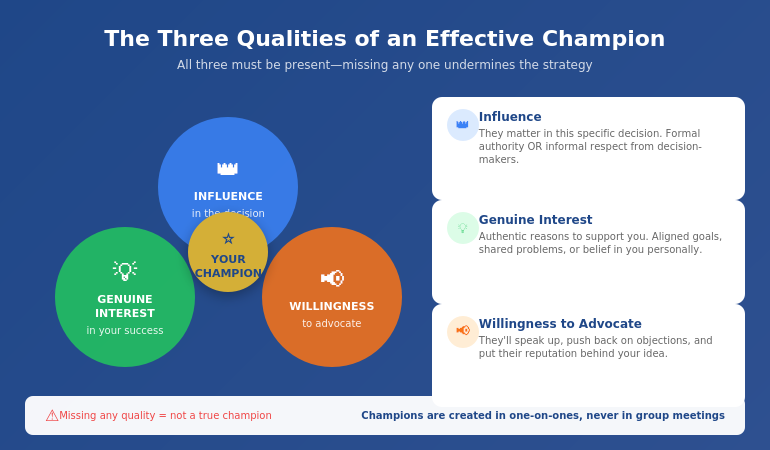
Not everyone can be your champion. The right champion has three characteristics:

1. Influence in the Decision

Your champion needs to matter in this specific decision. That might mean formal authority (they’re a decision-maker) or informal influence (decision-makers respect their judgment). Often, the most effective champions aren’t the most senior people—they’re the people whose opinions carry weight with the actual decision-makers.

2. Genuine Interest in Your Success

Champions work best when they have authentic reasons to support your proposal. Maybe it aligns with their goals. Maybe it solves a problem they care about. Maybe they believe in you personally. The motivation matters because champions often need to spend political capital defending your idea—they won’t do that for something they don’t actually believe in.

3. Willingness to Advocate

Some people might want your proposal to succeed but won’t actively fight for it. A true champion is willing to speak up, push back on objections, and put their reputation behind your idea. This requires a certain personality type—not everyone is comfortable in that role.

The intersection of these three qualities is rare. You might find someone influential who doesn’t care about your proposal. Or someone who cares deeply but lacks influence. Or someone with both but who avoids advocacy. Your job is to find the person who has all three—or to develop those qualities in a potential champion.

Venn diagram showing the three qualities of an effective presentation champion: influence, genuine interest, and willingness to advocate

🎯 Master the Buy-In System

The Executive Buy-In Presentation System teaches the complete internal advocate approach—plus stakeholder mapping, objection handling, and the pre-meeting tactics that determine whether your proposal succeeds or fails.

What you’ll learn:

  • The Champion Identification Framework
  • The Enrollment Conversation script
  • Stakeholder mapping for complex decisions
  • How to neutralise blockers before they block
  • The Follow-Through System for post-presentation momentum

Join the Executive Buy-In System → £199

Self-study programme with modules + templates + live Q&A calls. Study at your own pace.

How to Identify Your Champion

Finding your champion requires honest assessment of the decision-making landscape. Here’s the process I teach:

Step 1: Map the Decision-Makers

List everyone who will influence this decision. Include formal decision-makers (those who sign off) and informal influencers (those whose opinions matter). For each person, note:

  • Their likely position on your proposal (supportive, neutral, opposed, unknown)
  • Their level of influence in this specific decision
  • Their relationship with you (strong, moderate, weak, none)

Step 2: Identify Potential Champions

From your map, look for people who are:

  • Already supportive or leaning supportive (you need genuine interest)
  • Influential enough to matter (their voice carries weight)
  • Accessible to you (you can actually have conversations with them)

The best champions often aren’t obvious. They might be one level below the top decision-maker but highly trusted. They might be from a different department but respected for their judgment. They might be a peer who happens to have the CEO’s ear.

Step 3: Assess Willingness

Before approaching a potential champion, consider: Would this person actually advocate for a proposal? Some people avoid taking positions. Others speak up but only for their own initiatives. Look for people with a track record of supporting good ideas—even when they weren’t the originator.

Step 4: Choose Wisely

Having multiple champions can be powerful, but start with one. Choose the person who best combines influence, genuine interest, and willingness. You can expand later—but a strong single champion often outperforms multiple weak ones.

For more on stakeholder analysis, see my guide on stakeholder buy-in psychology.

📋 Note: The complete stakeholder mapping system—including templates for identifying champions and planning your approach—is covered in the Executive Buy-In System programme.

The Enrollment Conversation

You cannot create an internal advocate in a group meeting. This is perhaps the most important thing I can tell you about the sponsor approach.

Group meetings are the worst place to build support. People are cautious. They’re watching others. They’re protecting themselves. No one wants to be the first to champion an idea that might fail publicly.

Champions are created in one-on-one conversations—ideally before the formal presentation is even scheduled.

Here’s the enrollment conversation structure I teach:

1. Open with Genuine Curiosity

Don’t pitch. Ask questions. “I’m working on a proposal for [X] and I’d value your perspective. What would you need to see for something like this to work?”

This does two things: it shows respect for their judgment, and it reveals what they actually care about—information you can use to shape your proposal.

2. Listen More Than You Talk

Let them share concerns, questions, and suggestions. Take notes. Ask follow-up questions. The more they talk, the more invested they become—and the more you learn about how to position your proposal for success.

3. Incorporate Their Input

After the conversation, actually use their feedback. When people see their ideas reflected in your proposal, they feel ownership. Ownership drives advocacy.

4. Make the Ask

Once you’ve had substantive conversations and incorporated input, you can make the explicit ask: “This is going to the steering committee next month. Would you be willing to support it? I think your perspective on [their area of expertise] could really help.”

Notice the ask is specific. You’re not asking them to “help” vaguely—you’re asking for explicit support in a specific context.

5. Equip Them

Champions can only advocate effectively if they have the right information. Share your key points, anticipated objections, and responses. Make it easy for them to defend your proposal without needing you present.

💡 The Enrollment Conversation Is Where Champions Are Made

The scripts and practice scenarios for these conversations are detailed in the Executive Buy-In System. But even without formal training, the principles above will dramatically improve your approach: genuine curiosity, active listening, incorporation of feedback, specific asks, and proper equipping.

Activating Your Champion

Having a champion isn’t enough. You need to activate them effectively. Here’s how:

Before the Presentation

Brief them on the landscape. Who else will be in the room? What positions have people already taken? What objections are likely? Your champion should walk in informed, not surprised.

Agree on their role. Will they speak early to establish momentum? Will they address specific objections? Will they stay quiet unless needed? Different situations call for different approaches. Discuss and agree.

Share your materials in advance. Your champion should see your presentation before the meeting. They might catch issues, suggest improvements, or simply feel more confident advocating for something they’ve reviewed.

During the Presentation

Don’t look to them for rescue. Your champion shouldn’t be your safety net for a poorly prepared presentation. Do your job well; let them amplify your success rather than compensate for your failures.

Create openings. When appropriate, you can create natural moments for your champion to contribute: “Sarah has been thinking about the operational implications—Sarah, what’s your view?” This gives them a platform without making their support seem staged.

After the Presentation

Debrief immediately. What worked? What didn’t? What follow-up is needed? Your champion often has insights into room dynamics that you missed while presenting.

Keep them informed. As the decision progresses, keep your champion updated. They may have opportunities to advocate in conversations you’re not part of—but only if they know what’s happening.

Thank them genuinely. Champions spend political capital on your behalf. Acknowledge that investment, regardless of the outcome.

For more on the pre-meeting strategy, see my guide on pre-meeting executive alignment.

🎯 The Complete Buy-In System

Stop leaving buy-in to chance. The Executive Buy-In Presentation System teaches everything in this article—plus stakeholder mapping, objection handling, political navigation, and follow-through tactics—in a structured programme with templates, scripts, and live support.

The programme includes:

  • The Champion Identification Framework
  • Enrollment Conversation scripts
  • Stakeholder mapping templates
  • Objection pre-emption strategies
  • The Follow-Through System
  • Live Q&A calls for your specific situations

Join the Executive Buy-In System → £199

Self-study programme with live Q&A support. Study at your own pace.

Frequently Asked Questions

What is a champion in business presentations?

A presentation champion is someone with influence in the decision-making group who actively advocates for your proposal. Unlike a passive supporter who might vote yes if asked, a champion proactively speaks up for your idea, counters objections, and uses their credibility to build support—both in formal meetings and in informal conversations where decisions often really happen.

How do you get executive buy-in for a proposal?

Executive buy-in requires working outside the presentation itself. Identify stakeholders before you present, have one-on-one conversations to understand concerns and incorporate feedback, cultivate a champion who will advocate for you, and address objections before they surface publicly. The presentation confirms momentum you’ve already built—it rarely creates new support from scratch.

Why do good presentations get rejected?

Most rejected presentations fail for political reasons, not content reasons. The presenter had no champion advocating for them. Key stakeholders had concerns that weren’t addressed beforehand. Opposition formed in private conversations. Decision-makers had already decided before the presentation started. Strong content matters, but it can’t overcome weak stakeholder groundwork.

What if I don’t know anyone senior enough to be my champion?

You don’t necessarily need someone senior—you need someone influential in this specific decision. That might be a peer who’s highly respected, someone from a related department whose opinion carries weight, or your direct manager who can advocate upward. Start building relationships before you need them. The best time to develop potential champions is when you don’t have an immediate ask.

How do I approach a potential champion without seeming political?

Lead with genuine curiosity rather than asking for support. “I’d value your perspective on this challenge” is authentic relationship-building. “Will you support my proposal?” feels transactional. Build the relationship through substantive conversations about the work. The ask for support comes later, naturally, after you’ve demonstrated respect for their judgment and incorporated their thinking.

What if my champion can’t attend the actual presentation?

Champions are often more valuable outside the presentation than inside it. They can advocate in pre-meetings, informal conversations, and follow-up discussions. If your champion can’t attend, ask them to speak with key decision-makers beforehand, and keep them informed so they can continue advocating as the decision progresses through other forums.

How far in advance should I start building champion relationships?

Ideally, you’re building relationships continuously—not just when you need something. For a specific proposal, start cultivating your champion at least 2-4 weeks before the formal presentation. This gives time for multiple conversations, incorporating feedback, and allowing your champion to do their own informal advocacy. Last-minute champion recruitment rarely works.

📧 The Winning Edge Newsletter

Weekly insights on executive presentations, stakeholder management, and what actually works in corporate decision-making.

Subscribe Free →

📋 Free: Executive Presentation Checklist

A pre-presentation checklist that includes the champion check, stakeholder assessment, and objection preparation. Use it before every important presentation.

Download Free Checklist →

About the Author

Mary Beth Hazeldine is the Owner & Managing Director of Winning Presentations. With 24 years of corporate banking experience at JPMorgan Chase, PwC, Royal Bank of Scotland, and Commerzbank, she has navigated complex stakeholder environments and delivered high-stakes presentations in boardrooms across three continents.

A qualified clinical hypnotherapist and NLP practitioner, Mary Beth combines executive communication expertise with evidence-based techniques for managing presentation anxiety. She works with senior teams on high-stakes funding rounds and executive approvals.

Book a discovery call | View services

Your Next Step

Before your next important presentation, ask yourself: Who is my champion?

If you can’t name someone specific—someone who will actively advocate for your proposal in conversations you’re not part of—you have work to do before you work on your slides.

The internal advocate approach isn’t about politics or manipulation. It’s about recognising how decisions actually get made in organisations, and working with that reality rather than against it.

Strong proposals deserve strong advocates. Find yours.

Related: If your preparation process needs work too, see today’s companion article on the preparation order that doubles approval rates—because even with a champion, your content still needs to be right.