Tag: public speaking anxiety

06 Apr 2026
An executive in smart business attire walking purposefully through a bright modern lobby, calm and composed expression, early morning light, editorial photography style

Morning Presentation Protocol: What to Do in the Two Hours Before You Present

What you do in the two hours before a high-stakes presentation matters more than most people realise. By the time you walk into the room, the window for preparation has closed. The anxiety management techniques, the physical regulation, the mental framing — all of it has to happen before that moment. A structured morning protocol is not a luxury for performers and athletes. It is a practical, evidence-based approach to ensuring that the version of yourself that walks into the room is the one you intended to bring.

Astrid had given hundreds of presentations over a fifteen-year career in healthcare management. She was competent, prepared, and well-regarded. But the morning of a significant board presentation, her routine collapsed. She woke early and immediately began reviewing her slides — forty minutes of anxious re-reading that convinced her three sections were unclear. She rewrote them. Then she was late leaving the house, arrived at the venue with ten minutes to spare, grabbed a coffee, and sat in the boardroom trying to remember which version of slide fourteen she had updated. By the time the room filled, her heart was racing and her mouth was dry. The presentation went reasonably well — she was experienced enough to recover — but it was not her best work. She knew it. What she did not know was that the problem was not the slides, or the venue, or the nerves. It was the absence of a deliberate morning protocol. What she had done in those two hours had amplified her anxiety rather than managed it. When she eventually built a structured morning routine — consistent, timed, and designed around her nervous system rather than her slide deck — her presentations changed significantly.

Struggling with anxiety on the day of a big presentation? Conquer Speaking Fear is a structured 30-day programme that addresses the nervous system patterns behind presentation anxiety — so the morning of a high-stakes presentation stops feeling like a crisis. Explore the programme →

Why the Two Hours Before Presenting Matter Most

The nervous system does not respond to logic in the way we would like it to. In the hours before a high-stakes event, your body is already preparing its stress response — regardless of how experienced or well-prepared you are. Cortisol rises, muscle tension increases, and attention narrows. These are physiological processes, not character weaknesses. The question is not whether they happen. The question is whether you have a structured approach to working with them.

What distinguishes executives who consistently perform well under pressure from those who find high-stakes presentations draining and inconsistent is not talent. It is routine. When the two hours before a presentation are unstructured — filled with last-minute review, anxious checking, caffeine, and hurried logistics — the nervous system’s stress response compounds without interruption. When those same two hours are deliberately structured around physical regulation, cognitive preparation, and practical readiness, the presentation experience changes fundamentally.

There is also a practical dimension. The two-hour window is the last point at which you can do anything useful. After that window closes, the logistics are fixed and the slides are final. What remains is your state — your focus, your physical regulation, your relationship to the material. Managing your state is not a soft skill. It is the most high-leverage activity available to you in those final hours.

The pre-presentation rituals that athletes use before high-stakes performance follow exactly this logic — the research on elite performance preparation maps closely to what works for executives facing important presentations.

Stop Dreading Presentation Day. Start Managing It.

Conquer Speaking Fear is a structured 30-day programme that uses nervous system regulation and clinical hypnotherapy techniques to address presentation anxiety at its root — so you walk into high-stakes rooms feeling ready, not wired.

  • ✓ 30-day structured programme for presentation anxiety
  • ✓ Nervous system regulation techniques for high-pressure scenarios
  • ✓ Clinical hypnotherapy approaches adapted for executive contexts

Get Conquer Speaking Fear → £39

Designed for executives managing presentation anxiety

The Four-Phase Morning Protocol

The morning presentation protocol divides the two-hour window into four distinct phases, each with a specific purpose. The phases are designed to move from physical regulation through to mental focus, ending with a period of deliberate quiet before you enter the room. This sequence is not arbitrary — each phase prepares the conditions for the next.

Phase one: Physical activation (T minus 120 to 90 minutes). The first thirty minutes of the protocol addresses your body before your mind. Physical movement — a brisk walk, light exercise, or stretching — changes the neurochemical environment of anxiety. Movement processes the stress hormones that have been building since you woke and introduces endorphins that reduce subjective anxiety. This is not a training session. Fifteen to twenty minutes of moderate movement is sufficient. The key is doing it before engaging with any presentation material.

Phase two: Review and lock (T minus 90 to 60 minutes). The second phase is for content, not creation. If you have not finished preparing by this point, you are in a different kind of problem. This phase is for one final, structured review of your opening and closing only — not the full deck. Read your opening paragraph aloud. Say your closing sentence. These are the moments that shape first and last impressions, and they benefit from one deliberate rehearsal. After this review, the slides are locked. No more changes.

Phase three: Practical logistics (T minus 60 to 30 minutes). The third phase handles everything that needs to be in place before you leave for the venue: technology checked, slides saved to multiple locations, travel confirmed, contingency plans noted. Practical readiness removes the background hum of logistical anxiety that can occupy mental bandwidth during the presentation itself. If you will be presenting in a room you do not know, arrive early enough to check the AV setup, test your slides on the room screen, and stand at the front before anyone else arrives. Physical familiarity with a space significantly reduces situational anxiety.

Phase four: State management (T minus 30 to 0 minutes). The final thirty minutes before presenting are reserved for deliberate state management. This means quiet — no email, no phone calls, no last-minute preparation. Use this time for breathing techniques, a short mindfulness practice, or simply sitting in a calm environment and allowing your nervous system to settle. The goal is not to eliminate activation — some level of physiological arousal is useful for performance. The goal is to bring that activation to a level you can work with rather than a level that works against you.
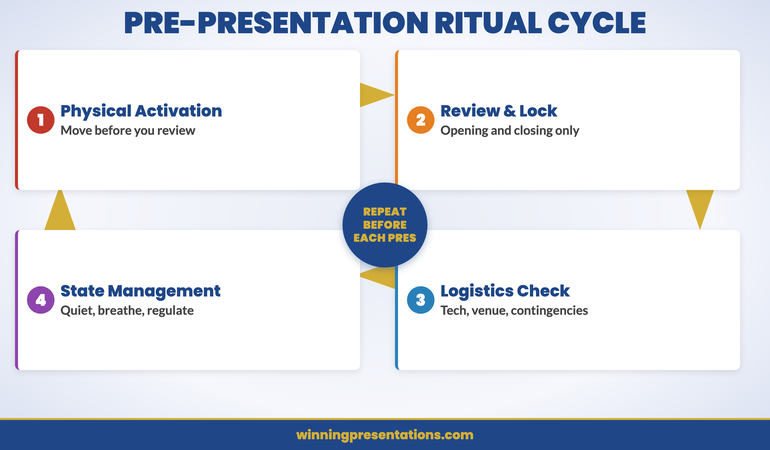
The four-phase morning presentation protocol infographic: physical activation, review and lock, practical logistics, and state management with timing guidance

The Nervous System Reset: Physical Techniques That Work

The physical techniques that are most effective for pre-presentation anxiety management are those that directly engage the parasympathetic nervous system — the branch responsible for the rest-and-digest state that counterbalances the fight-or-flight response. These techniques work because they change your physiology, not just your thoughts about your physiology.

Controlled breathing is the most accessible and fastest-acting of these techniques. Breathing with a longer exhale than inhale — for example, four counts in and six counts out — activates the vagal nerve and shifts the nervous system toward a calmer baseline. This is not a new-age practice. It is physiology. The vagal nerve is the direct pathway between your breath and your autonomic nervous system, and it responds consistently to specific breathing patterns. Five minutes of extended-exhale breathing during phase four of the morning protocol can meaningfully change your physiological state before you walk in.

Progressive muscle relaxation — the sequential tensing and releasing of major muscle groups — is particularly effective for presenters whose anxiety manifests physically: tight shoulders, clenched jaw, tension in the hands and forearms. Ten minutes of systematic relaxation removes the physical tension that often remains even after breathing exercises have addressed the heart rate. It also directs attention to the body rather than the catastrophising thoughts that tend to dominate anxious minds in the final minutes before a presentation.

Grounding techniques — deliberate sensory engagement with the present environment — are useful for managing the mind’s tendency to project into the presentation room before the body has arrived there. For a detailed breakdown of grounding techniques specifically adapted for executives, our guide to grounding techniques for presentation anxiety covers the evidence-based approaches that work in professional settings.

For those whose anxiety involves persistent negative thought patterns — catastrophic predictions, harsh self-judgement, fixed beliefs about their performance under pressure — the techniques covered in our guide to cognitive restructuring for presentation anxiety address the mental layer that physical techniques alone cannot always reach.

If you want to build morning protocol management into a consistent practice, Conquer Speaking Fear provides the structured 30-day framework that takes these individual techniques and builds them into a coherent approach to managing presentation anxiety over time.

What to Avoid in the Two Hours Before You Present

The morning protocol is as much about what you do not do as what you do. Several common pre-presentation behaviours reliably increase anxiety rather than managing it, and most executives do them habitually without recognising the pattern.

Rewriting slides. Making changes to your presentation material in the two hours before delivery introduces a specific kind of anxiety: uncertainty about your own content. You no longer know which version of slide six you are presenting. The muscle memory of your flow is disrupted. If the changes were significant enough to be necessary this morning, the preparation process had a problem that no last-minute revision will fix. If they were not significant enough to be necessary, you have introduced uncertainty for no benefit. Lock the slides before the protocol begins.

Excessive caffeine. Caffeine is a stimulant that increases heart rate, heightens physical arousal, and can amplify the physiological symptoms of anxiety — the shaking hands, the dry mouth, the racing pulse. For presenters who already manage moderate to high pre-presentation anxiety, a strong coffee in the final hour before presenting is contraindicated by basic physiology. Caffeine consumed more than ninety minutes before presenting has a different effect; it is the timing that matters. In the final hour, a glass of water serves you better than an espresso.

Catastrophic rehearsal. Running through worst-case scenarios in your head — the slide clicker failing, the room going cold, the senior stakeholder asking the question you cannot answer — is a form of mental rehearsal that primes your nervous system for threat rather than performance. The mind does not distinguish cleanly between imagined and real scenarios. When you rehearse disaster, you trigger the same physiological response the real disaster would produce. Use the final thirty minutes for deliberate positive rehearsal, or for state management techniques, not for anticipatory problem-solving that generates anxiety without solutions.

Seeking reassurance. Calling a colleague to talk through your nerves, or asking a peer to quickly review your slides, feels helpful but often has the opposite effect. It externalises your confidence and makes it contingent on someone else’s response. It also invites feedback — and any critical feedback received in the final hour before presenting cannot be acted on, but it can unsettle you. Build your confidence in the preparation period. Protect it in the final two hours.
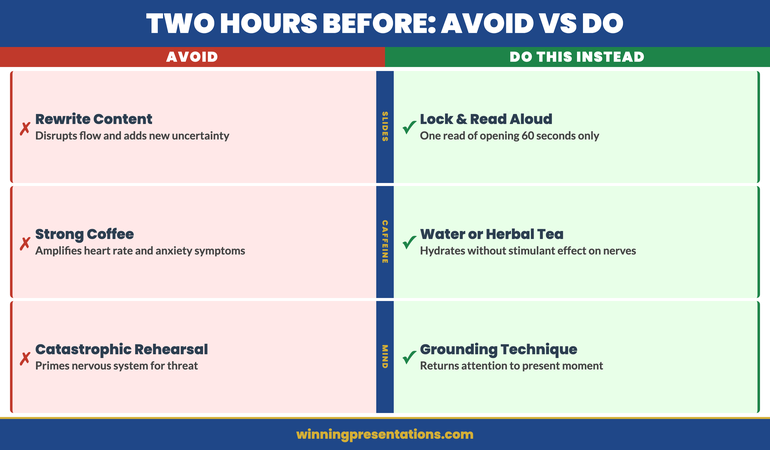
Four behaviours to avoid before presenting: rewriting slides, excessive caffeine, catastrophic rehearsal, and seeking reassurance, with better alternatives for each

Building the Protocol Into a Repeatable Routine

The morning protocol works best when it becomes automatic. The more consistent the routine, the less cognitive bandwidth it requires — and the more reliable the state it produces. Elite performers in every discipline report that pre-performance routines become conditioning: the body learns to associate the ritual with a particular state, and begins to produce that state in response to the ritual itself.

Building this kind of conditioned response requires consistency. The first few times you use the morning protocol, it will feel deliberate and slightly artificial. By the tenth presentation, it will feel natural. By the twentieth, it will be a trigger — and the physiological calm it produces will begin to appear earlier in the sequence, before you have even completed the protocol, simply because the familiar routine signals to the nervous system that this is a manageable situation.

Adapt the protocol to your specific circumstances. If you present remotely, your logistics phase looks different — the technology checks happen at your desk rather than in a venue. If your presentations often require same-day travel, build the physical activation phase into your journey rather than your morning routine. The structure matters more than the specific implementation. What you are creating is a reliable sequence that moves you, consistently, from anxious to ready.

Track what works. After each presentation, spend five minutes noting which parts of the morning felt effective and which did not. Anxiety patterns are individual — what regulates one person’s nervous system may not work for another. The protocol is a starting framework. Your version of it should be personalised over time based on what your own data tells you about your own pattern. And if you are working on a presentation that involves a challenging Q&A session, our guide to managing fishing questions during presentations covers how to handle the Q&A scenarios that most reliably spike anxiety.

Build the Foundation That Makes Morning Protocols Work

Conquer Speaking Fear gives you the 30-day structured programme to address the nervous system patterns that make presentation anxiety so persistent — so your morning protocol has solid ground to work with, not just a surface fix. £39.

Get Conquer Speaking Fear → £39

Frequently Asked Questions

What if I only have thirty minutes before my presentation, not two hours?

With thirty minutes, prioritise state management over content review. Skip the review phase entirely — the slides are done and re-reading them now will either confirm what you already know or introduce new uncertainty, neither of which is useful. Use the available time for breathing techniques and physical regulation: a short walk, extended-exhale breathing, and grounding. The logistics check should have been completed earlier. In thirty minutes, the most valuable thing you can do is manage your nervous system, not your slides.

Does the morning protocol work for presentations later in the day, not just morning presentations?

Yes — the protocol is named for the most common scenario (a morning presentation) but applies equally to afternoon or evening presentations. The key is the two-hour window before your presentation time, regardless of when that falls in the day. For afternoon presentations, schedule the physical activation phase immediately after lunch rather than at the start of the day. Avoid heavy meals in the two hours before presenting — digestion competes with the physical energy you need for delivering effectively under pressure.

I tend to feel more anxious when I try to relax before presenting. Is that normal?

Yes — this is a recognised phenomenon called relaxation-induced anxiety, and it is more common among high performers than is widely acknowledged. If deliberate relaxation techniques increase your anxiety, the issue is often the contrast between your activated state and the target calm state, which registers as a loss of control. In this case, redirect from relaxation to focused activation: a brisk walk, light movement, or deliberate mental rehearsal of a confident moment. The goal is not a specific state — it is your optimal performance state, which for some people involves a higher level of activation than the standard protocol assumes. Track what works for you specifically over time.

The Winning Edge

Weekly insights on executive presentations, presentation anxiety, and boardroom communication.

Subscribe Free

If your pre-presentation anxiety is compounded by the prospect of difficult questions, our guide to fishing questions in presentations covers how to recognise and respond to the Q&A tactics that most reliably put executives on the back foot.

About the author

Mary Beth Hazeldine, Owner & Managing Director, Winning Presentations. With 24 years of corporate banking experience at JPMorgan Chase, PwC, Royal Bank of Scotland, and Commerzbank, she advises executives across financial services, healthcare, technology, and government on structuring presentations for high-stakes funding rounds and approvals. A qualified clinical hypnotherapist and NLP practitioner, she brings a nervous-system-informed approach to presentation anxiety that goes beyond technique.

03 Apr 2026
Professional woman standing calmly in a corporate corridor, eyes closed, practising grounding before a presentation with a conference room visible in the background

Grounding Techniques for Presentation Anxiety: How to Anchor Yourself Before You Speak

Grounding techniques work for presentation anxiety because they interrupt the physiological cascade that makes speaking feel dangerous. Your nervous system cannot simultaneously process a threat response and a deliberate sensory focus. That neurological fact is what makes grounding practical, not theoretical—and why it works in the final minutes before you step up to present.

Nalini was standing in the corridor outside the executive conference room, waiting for her slot in the quarterly review. She’d presented to this group before—twelve times, in fact—and each time the anxiety arrived with identical precision: racing heartbeat at the fifteen-minute mark, shallow breathing at ten minutes, and a dissociative fog at five minutes that made her notes look like a foreign language. She’d tried deep breathing. She’d tried positive self-talk. Neither penetrated the fog. That morning, before leaving home, she’d read about a sensory grounding technique: name five things you can see, four you can touch, three you can hear. Standing in that corridor, she tried it. Blue carpet. Fire extinguisher. Her colleague’s navy jacket. The exit sign. A crack in the ceiling tile. She pressed her fingertips against the cool wall. Rubbed the edge of her notebook. Touched the fabric of her jacket sleeve. Felt the weight of her shoes on the floor. She heard the air conditioning. A door closing down the hall. Someone’s phone vibrating. By the time the door opened, the fog had lifted. Her heart was still beating fast, but she could read her notes. She walked in and delivered the presentation—not perfectly, but clearly. The difference was that she’d given her nervous system something to do other than panic.

Struggling with pre-presentation anxiety? Conquer Speaking Fear includes a structured anxiety management framework with grounding, breathing, and cognitive techniques designed specifically for executives who present under pressure.

Why Grounding Works When Deep Breathing Alone Doesn’t

Deep breathing is the default advice for presentation anxiety, and it helps many people—but not everyone. The reason is neurological. When the sympathetic nervous system is fully activated—the fight-or-flight response that makes your heart race and your palms sweat—the prefrontal cortex (responsible for rational thought and voluntary breath control) has reduced influence. Telling someone in acute anxiety to “breathe deeply” is like telling someone mid-panic to “calm down.” The instruction requires the very cognitive control that anxiety has compromised.

Grounding techniques take a different route. Instead of trying to override the nervous system through conscious breath control, they engage the sensory cortex—the brain regions that process what you see, hear, touch, and smell. These regions remain active even during acute anxiety because they process incoming sensory data automatically. By deliberately directing attention to sensory input, you’re using a neurological pathway that anxiety hasn’t shut down. The effect is a reduction in the intensity of the threat response, not through willpower, but through sensory competition.

This is why grounding techniques for presentation anxiety are particularly effective in the acute phase—the last ten to fifteen minutes before you speak, when anxiety typically peaks. At this point, cognitive strategies (positive affirmations, logical reframing, content review) often fail because the cognitive system is overwhelmed. Sensory grounding bypasses the overwhelmed system entirely.

It’s also worth noting that grounding doesn’t eliminate anxiety. It reduces it to a manageable level—from the paralysing fog Nalini described to the elevated alertness that actually improves performance. The goal is not calm. The goal is functional arousal: enough activation to be sharp and present, without enough to impair speech, memory, or cognitive flexibility.

Take Control of Presentation Anxiety Before It Controls You

Conquer Speaking Fear gives you a structured anxiety management framework—grounding protocols, breathing techniques, and cognitive reframing tools designed specifically for executives who present under pressure.

  • ✓ Pre-presentation anxiety management protocols
  • ✓ Nervous system regulation techniques for speakers
  • ✓ Cognitive reframing frameworks for high-stakes situations

Get Conquer Speaking Fear → £39

Designed for professionals who present under pressure

The Five-Senses Method: A Complete Pre-Presentation Protocol

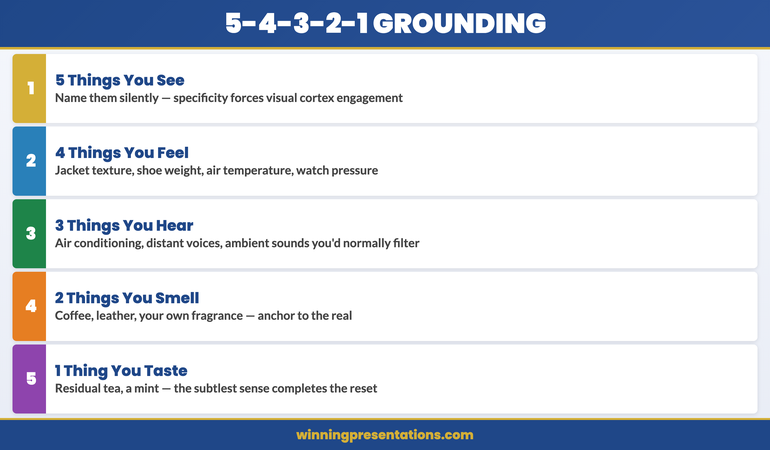
The 5-4-3-2-1 technique is the most widely used grounding method in clinical anxiety management, and it translates directly to the pre-presentation context. The protocol takes three to five minutes and can be done silently, standing in a corridor, sitting at a conference table, or waiting in a virtual meeting lobby.

Five things you can see. Name them silently and specifically. Not “the room” but “the silver pen on the table.” Specificity forces the visual cortex to engage actively rather than passively. Four things you can physically feel. The texture of your jacket. The pressure of your feet on the floor. The temperature of the air on your skin. The weight of your watch. Three things you can hear. Background noise you’d normally filter out—air conditioning, a distant conversation, traffic. Two things you can smell. Coffee. The leather of your notebook. Your own perfume or aftershave. One thing you can taste. The mint you had earlier. The residual flavour of your morning tea.

The sequence matters because it progresses from the easiest sensory channel (vision, which requires no physical action) to the hardest (taste, which requires deliberate attention to a subtle sensation). By the time you reach the final sense, your attention has been fully redirected from internal anxiety to external reality. The fog lifts—not because the anxiety is gone, but because your sensory cortex is now processing real data instead of imagined threats.

If you’re interested in complementary techniques, our guide on the body scan technique for presentation reset covers a longer protocol that works well when you have fifteen to twenty minutes before presenting. The five-senses method is the rapid-deployment version for when you have five minutes or less.

The 5-4-3-2-1 grounding technique protocol for pre-presentation anxiety showing sensory countdown

Physical Anchors You Can Use in the Room Without Anyone Noticing

The five-senses method works best in private—standing in a corridor, sitting alone before others arrive. But anxiety doesn’t always cooperate with your schedule. Sometimes it spikes mid-meeting, during the presenter before you, or whilst you’re being introduced. You need grounding techniques that work invisibly, in full view of your audience.

Feet on the floor. Press both feet flat against the floor with deliberate pressure. Feel the weight of your body transferring through your legs into the ground. This activates proprioceptive feedback—your body’s awareness of its own position in space—which counteracts the dissociative “floating” sensation that anxiety produces. Nobody can see you doing this. It works whether you’re standing at a lectern or sitting at a table.

Fingertip contact. Press your thumb firmly against your index finger, or press all five fingertips against the table surface. The tactile feedback creates a physical anchor point that your attention can return to whenever anxiety pulls you towards catastrophic thinking. Some executives use a small object—a smooth stone, a pen cap, a ring they rotate—as a consistent physical anchor across multiple presentations.

Temperature shift. Hold a glass of cold water in both hands for ten to fifteen seconds. The temperature change activates the vagus nerve—the primary pathway between your brain and your gut—which triggers a parasympathetic response (the “rest and digest” system that counteracts fight-or-flight). This is why a sip of water before speaking helps more than hydration alone would explain. The cold sensation is doing neurological work.

These micro-techniques can be combined. Press your feet into the floor whilst holding cold water. Touch a physical anchor object whilst listening to the ambient sounds in the room. The more sensory channels you engage simultaneously, the stronger the grounding effect. The research on box breathing for executive presentations shows how breathing and physical grounding work together to regulate the nervous system more effectively than either technique alone.

When to Ground: The Three Critical Windows Before You Present

Timing matters. Grounding at the wrong moment is less effective than grounding at the right one. Presentation anxiety follows a predictable curve, and there are three windows where intervention has the greatest impact.

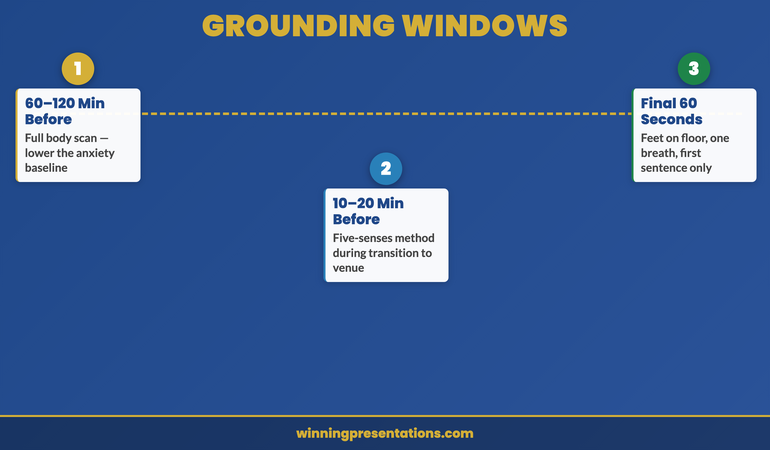
Window 1: The morning of the presentation (60–120 minutes before). This is when anticipatory anxiety begins—the “I have to present today” awareness that colours your entire morning. A full body scan or extended grounding session (ten to fifteen minutes) during this window reduces the baseline anxiety level, so the peak is lower when it arrives. Think of this as lowering the starting point of the anxiety curve.

Window 2: The transition period (10–20 minutes before). This is when you’re physically moving towards the presentation space—walking to the meeting room, logging into the virtual platform, arriving at the venue. Anxiety accelerates during transitions because your body is moving towards the perceived threat. The five-senses method works powerfully here because you’re in a transitional environment with abundant sensory input to anchor to.

Window 3: The final sixty seconds. This is the acute peak. You’re about to be introduced, or you’re about to unmute your microphone, or you’re about to stand up. At this point, complex techniques fail. You need a single-move anchor: feet pressed into the floor, one deep breath through the nose, and a deliberate focus on the first sentence of your presentation. Not the whole presentation—just the first sentence. Narrowing your cognitive focus to one sentence prevents the overwhelm that comes from contemplating the entire performance ahead.

Nalini’s breakthrough came from using all three windows. She did a body scan before leaving home (Window 1), used the five-senses method in the corridor (Window 2), and pressed her feet into the floor as the door opened (Window 3). No single technique was transformative. The combination across three windows was.

For executives who want a complete anxiety management protocol they can practise and refine, Conquer Speaking Fear provides the full framework—grounding, breathing, cognitive reframing, and in-the-moment recovery techniques—in a structured programme designed for professionals who present regularly.

Three critical grounding windows before a presentation showing timing and techniques

Combining Grounding With Breathing and Cognitive Reframing

Grounding is most powerful when combined with two complementary techniques: controlled breathing and cognitive reframing. Think of these as three systems working together. Grounding manages the sensory system. Breathing manages the autonomic nervous system. Cognitive reframing manages the narrative system—the story your mind tells about what’s about to happen.

A practical combined protocol for the ten minutes before a presentation: Begin with two minutes of sensory grounding (the five-senses method). Then shift to two minutes of controlled breathing—inhale for four counts, hold for four, exhale for six (the extended exhale activates the parasympathetic response). Then spend one minute on a single cognitive reframe: replace “I’m about to be judged” with “I’m about to share information that helps these people make a decision.” This reframe shifts the narrative from performance evaluation to professional service, which reduces the perceived social threat.

The sequence matters. Grounding first, because it reduces the physiological intensity enough for breathing to work. Breathing second, because it further calms the autonomic system and restores prefrontal cortex function. Cognitive reframing last, because it requires the prefrontal cortex to be online—which the first two steps have enabled. Attempting cognitive reframing when the nervous system is fully activated is why positive affirmations often feel hollow during acute anxiety. The brain knows you’re lying to it. After grounding and breathing, the reframe feels plausible because the threat level has genuinely decreased.

Self-compassion is also a useful complement to grounding. Our guide on self-compassion and presentation anxiety covers the research showing that treating yourself with kindness during anxious moments reduces cortisol more effectively than self-criticism or forced confidence. Combined with grounding, it creates an internal environment where your nervous system can settle rather than escalate.

Stop Fighting Your Anxiety. Start Managing It.

Grounding, breathing, and cognitive reframing work best as a structured system. Conquer Speaking Fear gives you the complete framework—practised by executives who present under pressure every week—for £39.

Get the Programme Now → £39

FAQ: Grounding Techniques for Presentation Anxiety

How long do grounding techniques take to work?

The five-senses method typically reduces acute anxiety intensity within three to five minutes. Physical anchoring techniques (feet on the floor, fingertip pressure) can produce a noticeable shift within thirty to sixty seconds. The speed depends on how activated your nervous system is when you begin—the earlier you start, the faster the response. Grounding doesn’t need to eliminate anxiety completely; even a partial reduction is enough to restore functional cognitive capacity for presenting.

Can grounding help during a presentation, not just before it?

Yes. Physical anchoring techniques—pressing feet into the floor, touching a pen or table edge, feeling the weight of your body in the chair—work during the presentation itself. The key is that they require no visible action. You can ground silently whilst maintaining eye contact and speaking. If you feel anxiety spiking mid-presentation, take a deliberate sip of water (activating temperature-based grounding) and press your feet into the floor. These two actions together take three seconds and can reset your nervous system enough to continue.

Do grounding techniques work for virtual presentations too?

They work equally well, though the sensory inputs differ. For virtual presentations, ground to your physical environment: the texture of your desk, the temperature of the room, the feel of your keyboard, the sounds in your home. You can also use the additional advantage of having your lower body completely invisible—press both feet flat, grip the edge of your desk, or hold a cold glass of water. The dissociative fog that anxiety produces is actually more common in virtual settings because the screen creates an artificial distance from the audience. Grounding to your physical space counteracts this by anchoring you in your body rather than in the screen.

The Winning Edge

Weekly insights on executive presentations, confidence building, and managing speaking anxiety.

Subscribe Free

If you’re also navigating the challenge of maintaining composure when unexpected questions arise, our guide to handling off-topic questions in presentations covers the techniques for redirecting without losing your anchor.

About the author

Mary Beth Hazeldine, Owner & Managing Director, Winning Presentations. With 24 years of corporate banking experience at JPMorgan Chase, PwC, Royal Bank of Scotland, and Commerzbank, she advises executives across financial services, healthcare, technology, and government on structuring presentations for high-stakes funding rounds and approvals.

01 Apr 2026

Box Breathing for Executives: Why Navy SEALs Use It Before High Stakes

Box breathing is a physiological reset button—a four-step technique that brings your nervous system back into balance within minutes. Navy SEALs use it before covert operations. Emergency room surgeons use it before complex procedures. And senior executives use it before board meetings, earnings calls, and regulatory hearings where composure determines the outcome. The technique is simple, evidence-backed, and discreet enough to use in a conference room lavatory or in the five minutes before you walk into a shareholder meeting.

The Story: Henrik’s Regulatory Hearing

Henrik sat in the corridor of the regulatory office with nine minutes to spare before presenting a critical approval hearing. As Chief Financial Officer of a pharmaceutical company, he’d presented to boards and regulators dozens of times—but this was different. A competitor’s recent failure in a similar category had made the regulator more scrutinising. His hands were cold. His jaw was tight. His voice, when he’d rehearsed it an hour earlier, had sounded thin and uncertain.

He’d tried everything: positive affirmations (felt hollow), visualisation (his mind wandered), pacing (made him more anxious). Then a former Navy officer on his executive advisory board had mentioned something in passing at a networking event: box breathing. Not meditation. Not mindfulness. Just a structured breathing pattern that resets the autonomic nervous system in under five minutes.

Henrik pulled up a quiet side room and spent four minutes doing exactly that. Four counts in. Four counts hold. Four counts out. Four counts hold. Repeat. When he walked into the hearing room, something had shifted. His voice was steady. His thoughts were clear. He moved through the presentation with the kind of composed authority the regulators needed to see. The approval came through three weeks later.

The reality of presentation anxiety

Anxiety before high-stakes presentations isn’t a personal failing—it’s a physiological response to perceived threat. Your body doesn’t distinguish between physical danger and reputational risk. When you’re about to present to a board or speak at a regulatory hearing, your sympathetic nervous system activates, flooding your system with cortisol and adrenaline. Box breathing counteracts this directly by engaging your parasympathetic nervous system. It’s not about feeling confident. It’s about getting your physiology out of the way so your competence can show.

The Neuroscience Behind Box Breathing

Your autonomic nervous system has two branches: the sympathetic (fight-or-flight) and the parasympathetic (rest-and-digest). When you’re facing a high-stakes moment, your sympathetic system dominates. Your breathing becomes shallow and rapid. Your heart rate climbs. Blood pools in your muscles instead of your prefrontal cortex. This is useful if you’re facing a predator. It’s catastrophic if you’re trying to communicate complex information clearly.

Box breathing works because extended exhalation—particularly the pause at the end of the breath—directly activates the vagus nerve, which controls parasympathetic activation. The equal counting pattern (four in, four hold, four out, four hold) creates a rhythm that your nervous system recognises and responds to. Within minutes, your heart rate variability improves, your cortisol begins to drop, and your prefrontal cortex—the part of your brain responsible for rational thought, composure, and articulation—comes back online.

This isn’t speculation or wellness theory. The physiological mechanisms have been studied in military contexts, clinical psychology, and sports performance for decades. The technique appears in trauma protocols, anxiety management programmes, and athlete preparation routines because it works at a biochemical level that doesn’t require belief or motivation. Your body simply responds.

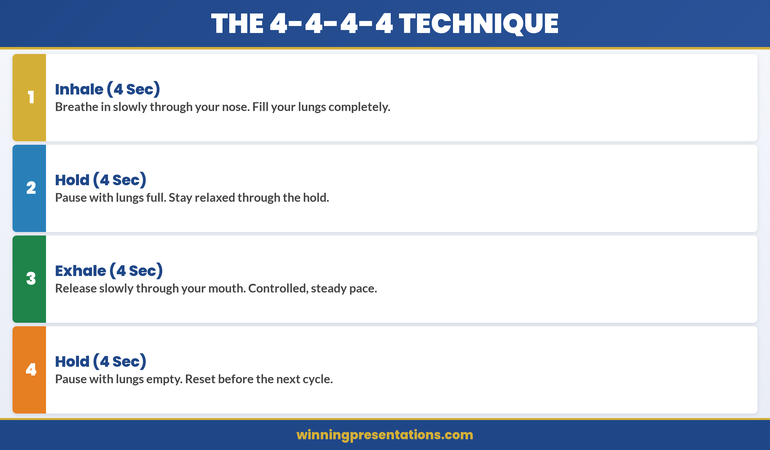
The 4-4-4-4 Technique: Step by Step

Box breathing for executives is deliberately straightforward. There’s nothing to remember beyond counting. Here’s the method:

Step 1: Exhale completely
Before you begin the pattern, expel all the air in your lungs with a slow, deliberate exhale. This triggers an immediate parasympathetic response and signals to your body that you’re intentionally shifting your state.

Step 2: Inhale for four counts
Close your mouth if you’re in a shared space and breathe slowly through your nose. Count steadily: one, two, three, four. Inhale with intention but without strain.

Step 3: Hold for four counts
Once you’ve inhaled, pause without forcing. One, two, three, four. This pause is crucial—it allows your body to absorb the oxygen and signals a return to equilibrium.

Step 4: Exhale for four counts
Slowly release the breath over four counts through your mouth or nose. This is the longest part of your breathing cycle in terms of nervous system effect. Extended exhalation is where the parasympathetic activation happens.

Step 5: Hold for four counts
Pause again for four counts. You’ve completed one cycle of box breathing.

Repeat this cycle five to ten times. Three to five minutes is typically enough to restore composure before a presentation. Some executives do it for longer before particularly high-stakes moments, but diminishing returns set in after ten cycles.

The count can be adjusted if four feels uncomfortable. Some people use five or six counts per phase. The critical variables are that all four phases are equal in duration and that you’re breathing slowly and deliberately—roughly one full cycle every 20 seconds.

Ready to master your nervous system before high-stakes presentations?

Conquer Speaking Fear gives you box breathing, grounding techniques, and frameworks to manage anxiety when your reputation is on the line.

Take Control of Your Nervous System

Step-by-step box breathing technique diagram for executives before high-stakes presentations

Why Executives Resist Box Breathing

The most capable executives often resist breathing techniques, and it’s worth understanding why. There are three consistent objections.

First, it feels too simple. After years of building complex financial models and navigating geopolitical market dynamics, a four-count breathing pattern can feel trivial. The executive brain interprets simple as ineffective. But physiology doesn’t care about complexity. Your vagus nerve doesn’t require intellectual sophistication. It responds to the pattern regardless of whether you believe in it.

Second, there’s a perception problem. Some worry that using a breathing technique signals weakness or that they need external props to manage their state. The reality is inverted: controlling your physiology before a high-stakes moment is a mark of professionalism and preparation. Navy SEALs, emergency surgeons, and Olympic athletes aren’t weak. They’re disciplined about managing the variables they can control.

Third, they haven’t learned it during low-stakes moments. Attempting box breathing for the first time ten minutes before a regulatory hearing adds cognitive load when you can least afford it. The technique works best when it’s already familiar, when your body recognises the pattern and responds automatically. This is why rehearsal matters.

When to Use Box Breathing: Timing and Context

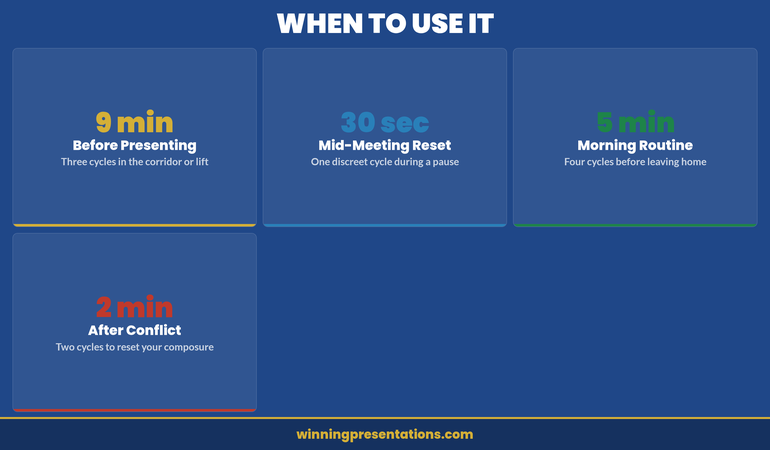
Box breathing isn’t a tool you pull out only in crisis. The executives who benefit most from it integrate it into routine preparation. Here are the most effective moments:

Fifteen to thirty minutes beforehand. This is the optimal window. Your nervous system has time to absorb the reset, but you’re close enough to the event that the effect persists. If you practise earlier, arousal will begin to climb again as you move closer. If you try it two minutes before, you might not have enough time to feel the shift.

During breaks in longer presentations or meetings. If you’re presenting for an hour with a break halfway through, use that break to do one or two cycles of box breathing. It resets your energy and brings you back into a composed state for the second half.

As part of your morning routine on presentation days. Starting the day with three to five minutes of box breathing sets your baseline lower. When the presentation happens later that day, you’re starting from a calmer physiological state, which means you don’t have as far to climb in terms of arousal.

In the moment, if you feel anxiety climbing during the presentation itself. If you’re mid-presentation and notice your heart rate rising or your thoughts becoming scattered, you can excuse yourself for 90 seconds, find a private space, do one or two cycles of box breathing, and return. The reset is noticeable even in such a compressed timeframe.

Adapting Box Breathing for Corporate Settings

The advantage of box breathing for executives is that it’s invisible. You’re not lighting scented candles. You’re not chanting. You’re not wearing any special equipment. You’re simply breathing in a particular pattern, which you can do anywhere without drawing attention.

In a conference room waiting for a board meeting to start, you can do two cycles of box breathing while reviewing your notes. In a client dinner before a major pitch, you can excuse yourself to the restroom for a discreet reset. Before stepping into a shareholder meeting, you can use the elevator ride as your practice window. The technique adapts to the environment because it requires nothing but your breath and your attention.

Some executives integrate it into their pre-presentation routine as casually as they’d check their slides or review their opening line—a standard part of preparation, not a special intervention. This normalisation is precisely what makes it sustainable over time.

If you’re concerned about appearing unusual, remember: most people are too focused on themselves to notice your breathing pattern. And if anyone does notice you taking slow, deliberate breaths before a presentation, the only conclusion they’ll draw is that you’re composed and in control.

Struggling with the structural side of your presentation?

Conquer Speaking Fear combines breathing techniques with frameworks for clarity and confidence under pressure.

Advanced Variations and Adaptations

Once you’re comfortable with the basic 4-4-4-4 pattern, several variations can be useful depending on your situation and what your nervous system needs in the moment.

Extended exhale. If you’re particularly activated, lengthen the exhale phase: 4 counts in, 4 counts hold, 6 counts out, 4 counts hold. The extended exhale amplifies parasympathetic activation. This is particularly useful if you’re feeling panic or very high arousal.

Variable pacing. You can adjust the base count from four to six or even eight, depending on your lung capacity and what feels natural. A 6-6-6-6 pattern gives you a longer cycle, which some people find more meditative. The absolute values matter less than the consistency—equal pacing across all four phases.

Layered breathing in the morning. Some executives combine box breathing with other techniques as part of their morning routine. Five minutes of box breathing, followed by a three-minute visualisation of the day’s presentations going well, followed by a grounding exercise (feet on the floor, five senses awareness). This layered approach creates a robust baseline of composure that persists throughout the day.

Real-time use during the presentation. As you become more practised, you can integrate subtle breathing patterns into your speaking without pausing. Between major points or while your audience is digesting information, you can use shortened versions of the pattern—2-2-2-2 or 3-3-3-3—to maintain a calm, centred state throughout the entire presentation.

Build your complete presentation confidence toolkit

Beyond breathing techniques, you need frameworks for handling objections, managing complex narratives, and staying composed under pressure. That’s what Conquer Speaking Fear covers.

Explore Conquer Speaking Fear

When and where executives can use box breathing in corporate settings

Frequently Asked Questions

How quickly does box breathing work?

Most people notice a physiological shift within 60–90 seconds of starting the technique. Heart rate decreases, breathing slows, and the subjective sense of calm increases. The speed of effect depends on your baseline arousal level and how practised you are. Regular practitioners report faster onset—sometimes within 30 seconds.

Can you do box breathing too much?

In practical terms, no. Box breathing is a self-regulating technique: once your nervous system reaches a calm baseline, the technique simply maintains that state. There’s no risk of over-calming yourself into lethargy before a presentation. If anything, regular practice trains your autonomic nervous system to return to baseline faster, which is a performance advantage.

What if I feel lightheaded during box breathing?

Lightheadedness usually means you’re breathing too deeply or holding too long. Reduce the count from 4 to 3 seconds, and ensure you’re breathing into your diaphragm rather than your chest. If lightheadedness persists, stop the technique and breathe normally. You may also be hyperventilating slightly—focus on the exhale being complete before starting the next inhale.

Does box breathing work if you don’t believe in it?

Yes. Box breathing works through direct physiological mechanisms—specifically, vagus nerve activation and CO2 regulation—not through placebo or belief. Your autonomic nervous system responds to the breathing pattern regardless of your cognitive stance. Sceptical executives often report being surprised by how quickly it works precisely because they didn’t expect it to.


Stay Composed Under Pressure

Box breathing is a tool for executives who want to control the variables they can influence. You can’t control whether the board will approve your proposal. You can’t control market conditions or regulatory decisions. But you can control your physiology in the minutes before you walk into the room. You can control whether your voice is steady, whether your thinking is clear, and whether your audience perceives you as composed and in command of the situation.

Those who integrate breathing techniques into their preparation routine aren’t less capable than those who don’t. They’re more disciplined. They treat their physiology the same way they treat their slides and messaging—as a critical component that requires planning and rehearsal.

Join The Winning Edge newsletter for weekly strategies on presentation structure, executive communication, and managing high-stakes moments.

Subscribe to The Winning Edge

Need to structure the presentation itself? The Executive Slide System gives you slide templates and frameworks for high-stakes executive scenarios.


See also from today:


Further reading on presentation anxiety:


About the Author

Mary Beth Hazeldine is the Owner & Managing Director of Winning Presentations. With 24 years of corporate banking experience at JPMorgan Chase, PwC, Royal Bank of Scotland, and Commerzbank, she advises executives across financial services, healthcare, technology, and government on structuring presentations for high-stakes funding rounds and approvals.

19 Feb 2026
Presentation anxiety career impact infographic showing three steps to break the avoidance cycle: identity separation, controlled exposure, and nervous system reframe

Presentation Anxiety Is Ruining My Career — What Actually Fixes It (The 3-Step System)

She turned down a promotion because it required monthly board presentations. Eighteen months later, she turned down another. The third time, the promotion went to someone she’d trained.

Quick answer: If presentation anxiety is ruining your career, generic advice like “just practice more” or “imagine the audience naked” isn’t going to fix it — because the problem isn’t a skills gap. It’s a nervous system pattern that has become wired into your professional identity. You avoid. The avoidance costs you. The cost confirms the belief that presenting is dangerous. And the cycle tightens. Breaking it requires three things in this order: separating the fear from your identity, controlled exposure that doesn’t re-traumatise you, and reframing the physical symptoms your body produces. As a qualified clinical hypnotherapist who spent five years terrified of presenting in high-stakes corporate settings, I built the system that finally broke my own pattern — and I’ve since used it with executives at many career stages.

The Promotion She Let Someone Else Take

A client came to me after fifteen years in financial services. Technically brilliant — one of the strongest people on her team. But when a director role opened that required monthly board presentations, she said no. Told her manager she preferred “the analytical side.”

Eighteen months later, a similar role opened. Same structure — monthly presentations to a senior committee. She declined again. “Not the right time.” The third time, she watched a colleague she’d mentored take the role she wanted. Not more qualified. Just willing to stand up and speak.

When she told me that story, I felt it in my chest — because that could have been me. I spent five years terrified of presenting in high-stakes corporate settings. The only difference was that I got help before the avoidance pattern cemented itself into my career. She’d let it run for fifteen years. By the time she found me, the cost wasn’t discomfort. It was career trajectory. Years of it, compounding silently.

She didn’t need more presentation tips. She needed to dismantle the pattern.

🧠 Stop the Avoidance Cycle — For Good

Conquer Speaking Fear is the three-audio system I built after five years of presentation terror in corporate banking. The Client Session gives you the cognitive framework — attention redirection and evidence auditing. The Clinical Hypnotherapy Session rewires the subconscious pattern driving your avoidance. The Pre-Presentation Reset is a 90-second protocol for the morning of any high-stakes session.

Get Conquer Speaking Fear — £39

Three audio sessions + pocket card. Built from clinical hypnotherapy, NLP, and 24 years of real corporate experience. Instant download.

The Real Career Cost (It’s Not What You Think)

Most people think presentation anxiety costs them confidence. It doesn’t. It costs them compound visibility.

Every time you let someone else present your work, you transfer your credibility to them. Every time you decline a stretch assignment because it involves speaking, you remove yourself from the promotion pipeline. Every time you stay quiet in a meeting where you had the best idea, you teach senior leaders that you’re not ready for the next level.

None of this happens in one dramatic moment. It accumulates across dozens of small decisions over years. You don’t notice the pattern until someone with less experience, less knowledge, and fewer results gets the role you wanted — because they were visible and you weren’t.

PAA: Can presentation anxiety affect your career?
Yes — and it affects it in ways most people underestimate. Research on workplace visibility consistently shows that professionals who present regularly are promoted faster, receive higher performance ratings, and are more likely to be identified as “high potential” by senior leadership. Presentation anxiety doesn’t just create discomfort — it creates a systematic visibility deficit that compounds over time. The longer you avoid presenting, the wider the gap between your actual capability and your perceived capability becomes.

The cruelest part? The more experienced you become, the worse the gap gets. At five years into your career, nobody notices if you’re quiet. At fifteen years, everyone notices — and they draw conclusions about your readiness that have nothing to do with your actual skill.

Why “Tips” Don’t Work for Career-Level Anxiety

If you’re searching “presentation anxiety ruining my career,” you’ve almost certainly already tried the standard advice. Deep breathing. Power poses. Practice in front of a mirror. Arrive early to “own the room.”

These work for people with mild nerves. They don’t work for you because your anxiety isn’t situational — it’s structural. It’s woven into how you see yourself as a professional. You’ve built an entire career strategy around avoiding the thing that scares you, and that avoidance has become part of your identity.

I’ve written about why therapy alone often doesn’t fix presentation fear. The same principle applies to tips: they address the symptom (nerves before a specific presentation) but not the system (a deeply embedded pattern of avoidance that has been reinforced by years of successful escape).

PAA: Why can’t I overcome my fear of presenting?
Because most approaches treat presentation anxiety as a skills problem or a confidence problem. For career-level anxiety — the kind that changes your decisions about roles, projects, and visibility — the fear has become part of your professional identity. You don’t just feel afraid before presenting; you’ve organised your entire career around not having to present. Breaking that pattern requires working at the identity level, not the symptom level. That’s why tips, practice, and even some therapy approaches don’t create lasting change for people at this stage.

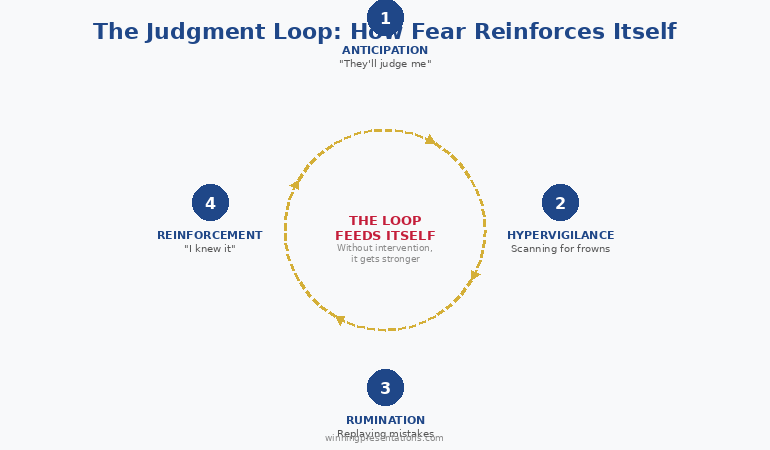
Diagram showing the presentation anxiety avoidance cycle: fear triggers avoidance, avoidance reduces visibility, reduced visibility limits career progression, and limited career reinforces the original fear

Step 1: Separate the Fear From Your Identity

The first step isn’t learning to manage your nerves. It’s recognising that “I’m not a presenter” is a story you’ve told yourself so many times it feels like a fact.

You are not your anxiety. You are a professional who developed a fear response that served you at one point — it protected you from perceived danger — but is now actively working against your career interests. The fear and the person are two separate things.

This sounds simple. It isn’t. When you’ve spent a decade making career decisions based on “I can’t present,” that belief has roots in every part of your professional identity. Pulling it out requires more than positive thinking. It requires structured work — the kind I do using NLP techniques that specifically target identity-level beliefs.

The practical exercise: Write down “I am someone who avoids presenting.” Now write down three decisions you’ve made in the last two years because of that belief. Seeing the career cost on paper — in your own handwriting — starts the separation between you and the pattern.

The Clinical Hypnotherapy Session inside Conquer Speaking Fear works at the subconscious level where avoidance patterns are stored — the same NLP and hypnotherapy techniques I used to break my own five-year pattern.

Get Conquer Speaking Fear — £39

Step 2: Controlled Exposure (Not Trial by Fire)

“Just do it more” is the worst advice for career-level presentation anxiety. Forcing yourself into a high-stakes presentation when your nervous system is in full threat mode doesn’t build confidence — it creates another traumatic data point that confirms the fear.

I’ve written about why your nervous system remembers bad presentations. The same memory system that’s trapping you in the avoidance cycle needs to be given new evidence — but gently, in controlled doses, with the right scaffolding around it.

Controlled exposure means starting with presentations where three conditions are true: the audience is small (three to five people), the stakes are low (no decisions riding on it), and the content is something you know cold. You’re not proving anything. You’re giving your nervous system one data point that says: “I presented, and nothing bad happened.”

Then you increase one variable at a time. Slightly larger audience. Slightly higher stakes. Slightly less familiar content. Each successful exposure doesn’t just build confidence — it physically rewires the neural pathway that currently connects “presenting” with “danger.”

The timeline most people need: Four to six controlled exposures over three to four weeks before the nervous system begins treating presenting as manageable rather than threatening. Not months. Not years. Weeks — if the exposure is structured correctly.

🔄 The Structured Programme That Breaks the Pattern

Conquer Speaking Fear is three audio sessions designed to be listened to in order. The Client Session gives you the cognitive reframe. The Hypnotherapy Session rewires the subconscious pattern. The Pre-Presentation Reset calms your nervous system on the day. Designed for professionals who’ve been avoiding presentations for years — not beginners with mild nerves.

Get Conquer Speaking Fear — £39

Three audios + pocket card. Instant download. Listen in order before your next presentation.

Step 3: Reframe What Your Body Is Doing

Your racing heart, sweating palms, and shallow breathing aren’t malfunctions. They’re your body’s preparation system doing exactly what it was designed to do: flooding you with adrenaline to perform under pressure.

The problem isn’t the physical response. It’s your interpretation of it. When an Olympic sprinter’s heart races before a race, they call it “being ready.” When you feel the same thing before a presentation, you call it “I’m going to fail.” Same physiology. Opposite meaning. Opposite outcome.

I’ve written about the fight-or-flight hack from hypnotherapy that teaches you to relabel these sensations in real time. The technique takes ninety seconds. But it only works after Steps 1 and 2 have loosened the identity-fear bond. Without that groundwork, relabelling is just another tip that doesn’t stick.

PAA: How do I stop anxiety from holding me back at work?
Start by recognising that the anxiety itself isn’t what’s holding you back — the avoidance is. The fear creates discomfort; the avoidance creates career consequences. Separate your identity from the fear (you are not “someone who can’t present”), begin controlled low-stakes exposure to give your nervous system new evidence, and learn to reinterpret your body’s stress response as preparation rather than danger. This three-step sequence — Identity, Exposure, Reframe — works because it addresses the pattern, not just the symptoms.

Conquer Speaking Fear is three audio sessions — cognitive framework, clinical hypnotherapy, and a 90-second pre-presentation reset. It’s what I wish existed during my five years of presentation terror in banking. Instant download, listen in order.

Get Conquer Speaking Fear — £39

🎯 Your Career Shouldn’t Be Capped by a Nervous System Pattern

Conquer Speaking Fear gives you three audio sessions to break the avoidance cycle that’s been silently limiting your career. The Client Session reframes the cognitive pattern. The Hypnotherapy Session rewires the subconscious loop. The Pre-Presentation Reset steadies your nervous system on the day. Built from clinical hypnotherapy, NLP, and 24 years of real corporate experience.

Get Conquer Speaking Fear — £39

Used by professionals who’ve stopped accepting “I’m just not a presenter” as the final answer.

Frequently Asked Questions

How severe does presentation anxiety need to be before it affects your career?

If you’ve turned down a role, declined a project, stayed quiet in a meeting, or let someone else present your work because of how presenting makes you feel — it’s already affecting your career. You don’t need a clinical diagnosis for the avoidance pattern to create real professional consequences. The impact is cumulative: each avoided opportunity slightly reduces your visibility, and that visibility gap compounds over years. Most people don’t recognise the full career cost until they see someone less qualified get the role they wanted.

How long does it take to fix presentation anxiety that’s been going on for years?

The identity-separation work typically takes one to two weeks of focused exercises. The controlled exposure phase takes three to four weeks (four to six low-stakes presentations with gradually increasing challenge). The reframing becomes automatic after six to eight uses. Most professionals see a noticeable shift within four to six weeks — not because the fear disappears entirely, but because the avoidance pattern breaks and they start making different career decisions. The fear reduces further with each successful presentation after that.

What if my presentation anxiety is clinical — should I see a therapist instead?

If your anxiety extends well beyond presenting — into social situations, daily worry, or panic attacks unrelated to work — yes, a therapist should be your first step. But if your anxiety is specifically triggered by presenting or speaking in professional settings and you function normally otherwise, a structured self-directed programme can be highly effective. Many of the techniques in Conquer Speaking Fear are drawn from the same clinical hypnotherapy and NLP approaches used in therapeutic settings, adapted for professionals who don’t need full therapy but do need more than tips.

Get weekly speaking confidence strategies

Evidence-based techniques for managing presentation anxiety — from a clinical hypnotherapist who lived it.

Subscribe to the Newsletter

Related: If the fear is about structure — not knowing what to put on your slides or how to organise your deck — that’s a different problem with a different fix. Read The Executive Pre-Read That Gets Decisions Before You Walk In for the structural side of high-stakes presenting.

About the Author

Mary Beth Hazeldine is the Owner & Managing Director of Winning Presentations. With 24 years across banking and consulting — including JPMorgan Chase, PwC, Royal Bank of Scotland, and Commerzbank — she has delivered high-stakes presentations in boardrooms across three continents.

A qualified clinical hypnotherapist and NLP practitioner, Mary Beth combines executive communication expertise with evidence-based techniques for managing presentation anxiety. She has supported presentations for high-stakes funding rounds and approvals across 15+ years of executive training.

Book a discovery call | View services

Your next step: Open a blank document right now and write down three professional opportunities you’ve declined, avoided, or handed to someone else because they involved presenting. Don’t judge them. Just look at them. That list is the real cost of your presentation anxiety — and it’s the reason generic tips will never be enough. The pattern needs a system, not a workaround.

14 Feb 2026
Executive woman with quiet confidence standing in boardroom — introvert presentation advantage

Why Introverted Executives Present Better Than Extroverts

Quick answer: Introverted executives often have an advantage in high-stakes presentations because they prepare more thoroughly, listen more carefully, and let their content — not their charisma — carry the room. The traits that make you feel like a weaker presenter are often the traits that make audiences trust you more.

The best board presentation I ever witnessed was delivered by a woman who described herself as “painfully introverted.”

She was a CFO at a mid-cap financial services firm. Before the meeting, I watched her sit quietly in the corridor while her colleagues rehearsed loudly in the breakout room next door. She didn’t pace. She didn’t run through her slides one more time. She just sat with her notes and breathed.

When she stood up, she spoke for nine minutes. Nine. No jokes. No theatrics. No “let me tell you a story about my first day in finance.” Just a clear recommendation, three supporting data points, and a direct ask for approval.

The board approved her proposal without a single challenge. The extroverted VP who presented after her — louder, funnier, more animated — got seventeen follow-up questions and was asked to come back next quarter.

That moment changed how I think about presentation coaching. For years, I’d been helping introverted clients become more like the extroverts they admired. I had it backwards. The introverts didn’t need to become louder. The extroverts needed to become more disciplined. And the data, it turns out, agrees.

If anxiety is the thing getting in the way — not your introversion — Conquer Speaking Fear walks through a clinical-hypnotherapy-based approach to reducing the fear response so your natural preparation and precision can do their job. A structured alternative to “just breathe” advice.

Your Quiet Wiring Isn’t the Problem. The Anxiety Around It Is.

Conquer Speaking Fear gives you a structured system built from clinical hypnotherapy and NLP to reduce presentation anxiety — so your natural preparation, precision, and calm can do what they’ve always been capable of.

Get Conquer Speaking Fear → £39

Built from clinical hypnotherapy + NLP techniques — designed specifically for high-performing professionals who over-prepare but still feel anxious.

The Misconception That Holds Introverts Back

Most presentation advice is written for extroverts by extroverts. “Command the room.” “Own the stage.” “Project energy.” The implicit message is that presenting well means performing well — and that the louder, more animated version of you is the better presenter.

That’s not what the evidence suggests.

Multiple studies and reviews on audience perception suggest that listeners tend to rate speakers higher on credibility and trustworthiness when those speakers are calm, measured, and content-focused — traits that come naturally to introverts. Extroverted speakers tend to score higher on entertainment value. But in a boardroom, nobody is looking to be entertained. They’re looking to be informed.

PAA: Are introverts better at public speaking?
In high-stakes professional settings, introverts often outperform extroverts because they prepare more thoroughly, speak more concisely, and let their content carry the message rather than relying on charisma. The traits introverts consider weaknesses — deliberateness, quietness, careful word choice — are exactly what senior audiences value.

The misconception runs deep because most of us learned what “good presenting” looks like from TED Talks, keynotes, and all-hands meetings — contexts where performance matters. But executive presentations aren’t performances. They’re decision-making conversations. And in those rooms, quiet confidence outperforms theatrical energy almost every time.

What the research tends to show (in plain English):

In professional and academic settings, audiences tend to associate calm, structured delivery with competence and credibility, while highly energetic delivery can read as “performance” rather than “decision support.” Introverted speakers also tend to prepare more thoroughly, which correlates with higher audience confidence in the content.

Sources: Susan Cain, Quiet: The Power of Introverts in a World That Can’t Stop Talking (2012) • Ames & Flynn, “What Breaks a Leader” (Journal of Personality and Social Psychology, 2007) — found that assertiveness has diminishing returns and can reduce perceived leadership effectiveness • Pentland, Honest Signals (MIT Press, 2008) — research on communication patterns showing that consistent, measured delivery signals increase trust ratings


Comparison of introvert versus extrovert presentation styles showing why introverted executives have a strategic advantage

If your introversion isn’t the problem but the anxiety around it is, Conquer Speaking Fear (£39) uses hypnotherapy and NLP techniques to reduce the fear response — so your natural strengths can work uninterrupted.

The 5 Advantages Introverted Presenters Have

These aren’t consolation prizes. These are genuine competitive advantages in the rooms where decisions get made.

1. You prepare more thoroughly. Introverts don’t wing it. That instinct to rehearse, to anticipate questions, to have backup data ready — it’s not over-preparation. It’s the reason you rarely get caught without an answer. Executives notice who’s prepared and who’s improvising. Preparation signals respect for their time.

2. You use silence naturally. Most extroverted presenters fill every pause with words. Introverts are comfortable with silence — and silence is one of the most powerful tools in a boardroom. A deliberate pause after a key recommendation gives the room time to absorb it. Rushed delivery signals anxiety. Paced delivery signals authority.

3. You distil before you deliver. Introverts process internally before speaking. That means your first draft is already tighter than most people’s third. In a world where executive attention spans are shrinking, the ability to say more with fewer words is a genuine strategic advantage.

4. You listen during Q&A. This is where introverts shine most. Extroverts often start formulating their response before the question is finished. Introverts wait, process, and then respond to what was actually asked — not what they assumed was coming. Senior leaders notice the difference, and they remember who actually answered their question.

5. Your credibility is content-driven. When an extrovert delivers a strong presentation, the audience sometimes attributes it to personality. When an introvert delivers a strong presentation, the audience attributes it to the quality of the thinking. That distinction matters when the goal is approval, not applause.

Presenting in the next 7 days? Do these 3 things in 4 minutes:

1. Write your recommendation as a one-sentence decision ask.
2. Cut your deck until your top 3 proof points are unmissable.
3. Rehearse only the opening + the ask (not the whole talk).

If anxiety still hijacks you before you speak, the Rescue Block earlier in this article points to the same approach — a structured reset method plus the longer-term system to remove the fear response altogether.

If preparation is the missing piece

Introverted presenters often work harder on the content than anyone else in the room. The Executive Slide System (£39) gives you 26 templates, 93 AI prompts, and 16 scenario playbooks — so the structure is already decided before the anxiety has anything to grip onto.

See the Executive Slide System → £39


When Over-Preparation Stops Carrying You Through

If you over-prepare and still freeze, the problem isn’t your preparation — it’s the anxiety response running underneath it. Conquer Speaking Fear targets that response directly.

Get Conquer Speaking Fear → £39

£39, instant access. For senior professionals whose preparation isn’t the bottleneck.

What Senior Audiences Actually Value

I spent 25 years in corporate banking at JPMorgan Chase, PwC, Royal Bank of Scotland, and Commerzbank. In that time, I sat through hundreds of executive presentations. The ones I remember aren’t the entertaining ones. They’re the clear ones.

Senior audiences — board members, C-suite executives, steering committees — evaluate presenters on a very specific set of criteria, and none of them favour extroversion:

“Did they respect my time?” Shorter, tighter presentations win. Introverts naturally create shorter decks because they edit before they build. The 10-slide presenter who finishes in 12 minutes earns more respect than the 35-slide presenter who runs over by 15.

“Did they answer my actual question?” In Q&A, introverts listen before responding. That sounds obvious, but it’s remarkably rare. Most presenters hear the first three words of a question and start composing an answer. The executive who pauses, absorbs the full question, and then responds precisely — that’s the one who gets invited back.

“Did they know what they were recommending?” Confidence in content matters more than confidence in delivery. An introvert who says “My recommendation is X, and here are three reasons” with calm certainty will outperform an extrovert who says the same thing with more energy but less precision.

PAA: How can introverts be better at presentations?
Introverts improve most not by becoming louder, but by removing the anxiety that blocks their natural strengths. Focus on structure (clear recommendation, supporting evidence, specific ask), preparation (anticipate the top five questions), and pacing (use silence deliberately instead of filling it).

If you’re preparing for a first presentation after a promotion, your introvert instinct to listen before leading is exactly what your new team needs to see. The listening-led approach works because it signals respect — and that’s harder to fake than charisma.

How to Use Your Quiet Wiring as an Edge

The shift isn’t about becoming a different kind of presenter. It’s about recognising that your existing instincts are already the right ones — and structuring your preparation around them.

Lean into preparation, not rehearsal. There’s a difference. Rehearsal is practising your lines. Preparation is anticipating every question, every objection, every “what about…” that could come up. Introverts are extraordinary at this. Build your confidence on the depth of your preparation, not on how many times you’ve run through the slides.

Use written structure as your anchor. Extroverts can improvise from bullet points. You shouldn’t try. Write out your opening sentence, your recommendation, and your closing ask in full. Not to memorise — to internalise. Knowing exactly how you’ll start and finish eliminates the two moments that create the most anxiety.

Design your slides to carry the argument. When your slides are clear enough to stand alone, you don’t need to perform. You narrate. That’s a completely different energy — and it’s one introverts are naturally suited to. Think of yourself as a guide walking someone through evidence, not a performer trying to hold attention.

Claim the pause. When you pause, the room interprets it as thoughtfulness. When an extrovert pauses, the room often interprets it as losing their place. Your silence reads as authority. Use it deliberately after key points, after tough questions, and before your recommendation.

Arrive early, alone. This is practical, not symbolic. Introverts perform better when they’ve had time to acclimate to the physical space. Walk the room. Stand where you’ll present. Adjust the screen. By the time people arrive, you’ve already reduced the novelty — and novelty is what triggers the anxiety response.

What Introverted Executives Should Stop Doing

If you’re an introverted professional who’s been trying to present more like the extroverts around you, here’s what to cut immediately:

Stop opening with humour. Unless it comes naturally, forced humour signals discomfort, not warmth. Open with your recommendation or with a clear, calm statement of what you’ll cover. That’s not boring — that’s confident.

Stop apologising for being concise. “I’ll keep this brief” sounds like you’re apologising for not having enough content. You’re not. You’re respecting the room’s time. Say nothing — just be brief. They’ll notice, and they’ll be grateful.

Stop copying the charismatic presenter in your organisation. Their style works for them because it’s authentic. Borrowing it makes you look like you’re performing. Your style works for you because it’s authentic too — you just haven’t given it permission yet.

Stop treating Q&A as a threat. Q&A is actually where introverts have the biggest advantage. Your instinct to listen fully, process, and respond precisely is exactly what the room wants. The anxiety around Q&A comes from imagining questions you can’t answer. Preparation — which you’re already excellent at — eliminates that fear. Read more on managing high-stakes nerves before your next big moment.

PAA: Why do introverts struggle with presentations?
Introverts don’t struggle because they lack presentation skill — they struggle because most presentation training is built for extroverts. When introverts try to “project energy” or “command the stage,” they feel inauthentic, which increases anxiety. The fix isn’t to become louder. It’s to build a presentation approach that works with your natural tendencies: thorough preparation, clear structure, deliberate pacing, and content-driven credibility.

Frequently Asked Questions

Can introverts really be effective presenters at the executive level?

Yes — and they often outperform extroverts in executive settings. Board members and C-suite leaders value clarity, preparation, and precision over energy and charisma. Introverts naturally produce all three. The challenge isn’t ability; it’s managing the anxiety that masks those abilities.

Should I tell my audience I’m an introvert?

No. There’s no upside to labelling yourself, and it can unintentionally lower expectations. Instead, let your preparation and clarity speak for you. If you’re well-structured and concise, the audience won’t be thinking about your personality type — they’ll be thinking about your recommendation.

How do I handle networking events and informal presentations as an introvert?

Informal settings are harder for introverts than formal presentations because there’s no structure to lean on. Create your own: arrive with two or three conversation starters, set a time limit for yourself, and give yourself permission to leave early. For informal presentations, prepare a 60-second version of your key point — having that rehearsed anchor reduces the cognitive load significantly.

Is presentation anxiety worse for introverts?

Not necessarily — available research suggests anxiety levels are similar across personality types. But introverts experience anxiety differently. They tend to internalise it (racing thoughts, overthinking) rather than externalise it (fidgeting, talking fast). That internal experience can feel more intense even when the external signs are minimal. The good news for quiet leadership communication: because your anxiety is less visible, audiences typically perceive you as calmer than you feel.

📬 The Winning Edge Newsletter

Weekly executive presentation strategies, confidence techniques, and career-critical communication insights. No fluff.

Subscribe free →

Related: If you’ve recently been promoted and your first presentation is approaching, read The Presentation You Give After Getting Promoted (Most Get It Wrong) — your introvert instinct to listen before leading is exactly the right approach for that moment.

You don’t need to become louder. You don’t need to become more animated. You need to remove the anxiety that’s been masking the presentation skills you already have — the preparation, the precision, the calm authority that senior audiences value above everything else.

Built From 25 Years of Watching Quiet People Get It Right

Conquer Speaking Fear was designed for senior professionals whose anxiety masks a presentation skill set the room actually wants to hear. Clinical hypnotherapy foundation, NLP-based anchoring sequences, and the complete reprogramming protocol — instant access, work at your own pace.

  • Nervous-system regulation protocols (clinical hypnotherapy foundation)
  • Pre-presentation anchoring sequences (NLP-based)
  • Cognitive reframing for the over-preparation loop
  • Complete programme, instant access, lifetime updates

Get Conquer Speaking Fear → £39

Designed for senior professionals in banking, biotech, and SaaS. £39, instant access.

About the Author

Mary Beth Hazeldine is the Owner & Managing Director of Winning Presentations. With 25 years of corporate banking experience at JPMorgan Chase, PwC, Royal Bank of Scotland, and Commerzbank, she spent over a decade delivering high-stakes presentations before training others to do the same.

A qualified clinical hypnotherapist and NLP practitioner, Mary Beth combines executive communication expertise with evidence-based techniques for managing presentation anxiety. She advises senior professionals across financial services, healthcare, technology, and government on managing presentation anxiety and structuring decision-focused decks that earn trust quickly.

Book a discovery call | View services

04 Feb 2026
Executive holding a pill before a presentation, deciding whether to take beta blockers for public speaking anxiety

I Kept Beta Blockers in My Desk for 3 Years. Here’s Why I Never Took One.

Quick answer: Yes, executives take beta blockers before presentations. More than you think. But medication manages the symptoms without touching the fear underneath — and after 25 years in corporate banking and training as a clinical hypnotherapist, I can tell you there is a faster, more permanent path. Here is the honest breakdown of what works, what doesn’t, and what nobody in the boardroom will admit to.

I kept a box of propranolol in my desk drawer for three years.

Not prescribed. Borrowed from a colleague who “got them for migraines.” Every Monday morning, I would open the drawer, look at the box, and wonder if today was the day I would finally take one.

I never did. Not because I was brave, but because I was more afraid of the pill than the presentation. What if it made me drowsy? What if my boss noticed? What if I became dependent and couldn’t present without it?

Those three years taught me something that changed the direction of my career entirely. Working at JPMorgan Chase, then PwC, then Royal Bank of Scotland, I discovered that the medication question isn’t really about medication at all. It is about whether you want to manage the fear — or actually resolve it.

After training as a clinical hypnotherapist, I now understand exactly why I was right to hesitate. And why so many executives don’t.

Reaching for medication before your next presentation?

There is a structured, clinical programme that addresses the fear pattern directly — no pills, no white-knuckling. It retrains the nervous system response at the subconscious level. See Conquer Speaking Fear →

Comparison chart showing beta blockers versus nervous system retraining for presentation anxiety, with pros and cons of each approach

The Pill in the Boardroom Bathroom

Let me paint you a picture you will recognise.

It is 8:47am. You are presenting the quarterly update to the leadership team at 9:00. You are sitting in the bathroom stall. Your heart is hammering so loudly you can feel it in your ears. Your hands are cold and damp. Your mouth has gone completely dry.

And you are Googling “can I take a beta blocker 15 minutes before a presentation.”

I have been that person. Many of the executives I have worked with have been that person. The medication question is the most common thing I am asked in private — and the thing nobody will raise in a group setting.

Here is the reality: beta blockers for public speaking are extraordinarily common among senior professionals. Concert musicians have used propranolol for decades. Surgeons use them. Barristers use them. And yes — your colleagues on the executive floor use them too.

The question is not whether they work. They do, for certain symptoms. The question is whether they are the right solution for you.

What Beta Blockers Actually Do (And What They Don’t)

⚕️ Not medical advice. Beta blockers are prescription medication. Talk to your GP before taking them — they are not suitable for everyone, particularly those with asthma, low blood pressure, or certain heart conditions. This article discusses their use for presentation anxiety from a practical and psychological perspective, not a clinical one.

Beta blockers — typically propranolol — work by blocking adrenaline receptors. When your fight-or-flight response fires before a presentation, adrenaline floods your body. Propranolol stops that adrenaline from reaching your heart and muscles.

What beta blockers DO:

They slow your heart rate. They reduce hand tremor. They stop the visible shaking. They prevent that “thumping chest” sensation that makes you feel like everyone can see your fear. For purely physical symptoms, they can be remarkably effective within 30–60 minutes.

What beta blockers DON’T do:

They do not touch the fear itself. They do not stop the negative thought loop (“they’re judging me,” “I’m going to forget my words,” “they can tell I’m nervous”). They do not build confidence. They do not improve your presentation skills. And critically — they do not help you the day you forget to take one.

This is the distinction most people miss. Beta blockers manage the physical expression of anxiety. They do not address the neurological pattern that creates it.

I have worked with executives who took propranolol before every presentation for five, ten, even fifteen years. When they finally forgot the pill or couldn’t get a refill in time, the panic returned at full force — sometimes worse than before, because now they had an additional fear layered on top: “I can’t present without my medication.”

Do executives take beta blockers before presentations?

Yes — far more commonly than most people realise. Beta blockers like propranolol are widely used by senior professionals to manage the physical symptoms of presentation anxiety, including racing heart and hand tremor. However, they only address symptoms and do not resolve the underlying fear. Many executives use them as a temporary bridge while developing longer-term anxiety management skills.

Your Fear Has a Pattern. You Can Break It.

Conquer Speaking Fear (£39, instant access) uses clinical hypnotherapy and NLP techniques to retrain the neurological pattern that creates presentation anxiety — not just mask the symptoms. No medication. No willpower. A different nervous system response.

Get Conquer Speaking Fear → £39

Designed by a clinical hypnotherapist with 25 years of corporate banking experience. £39, instant access.

The Executive Anxiety Secret Nobody Discusses

When I started training executives after leaving banking, the most surprising discovery was not how many professionals struggled with presentation anxiety. It was how many senior professionals struggled with it — and how completely they hid it.

Managing Directors. Partners. C-suite leaders. People who looked utterly composed at the front of the room.

Behind closed doors, here is what they told me:

“I’ve been taking propranolol before every board meeting for eight years. My wife doesn’t even know.”

“I rearranged my entire schedule last quarter to avoid presenting at the all-hands. I told my team I had a conflict.”

“I drink two glasses of wine before evening events where I might have to speak. I’ve done it for so long I don’t even think about it anymore.”

These are not weak people. These are accomplished professionals with decades of experience, running teams of hundreds, making decisions worth millions. And they are quietly medicating, drinking, or avoiding their way around a neurological pattern that nobody taught them how to change.

The shame keeps the problem invisible. And the invisibility keeps people reaching for the quick fix — because they do not know a permanent solution exists.

The Dependency Trap: When Medication Becomes a Crutch

I want to be clear: I am not anti-medication. Beta blockers are safe when prescribed appropriately, they have genuine medical applications, and for some people they serve as a valuable bridge while doing deeper work.

But here is the pattern I see repeatedly in my practice:

Stage 1: The relief. You take propranolol before a big presentation. Your heart doesn’t race. Your hands don’t shake. You think: “This is the answer.”

Stage 2: The habit. You take it before the next presentation. And the one after. You start carrying it “just in case.” The box moves from your desk drawer to your briefcase.

Stage 3: The dependency belief. You begin to believe you cannot present without it. This is not a physical dependency — beta blockers are not addictive. It is a psychological dependency. Your brain has created a new rule: “Safe presentations require medication.”

Stage 4: The expanded fear. Now you have two fears. The original presentation anxiety, plus a new one: “What happens if I can’t get my pills?” Travel, forgotten prescriptions, running out of refills — all become sources of anxiety that didn’t exist before.

This is not a theoretical risk. I have worked with three executives in the past year alone who came to me specifically because their propranolol dependency had escalated their presentation nerves rather than reduced them.

The beta blocker dependency cycle: four stages from initial relief to expanded fear, showing how medication can reinforce presentation anxiety

Is propranolol safe for public speaking?

Propranolol is generally considered safe for occasional use before presentations when prescribed by a doctor. It effectively reduces physical symptoms like rapid heartbeat and trembling. However, it can cause lightheadedness, fatigue, and a feeling of emotional disconnection. The larger concern is not physical safety but psychological dependency — the belief that you cannot present without it — which reinforces the anxiety pattern rather than resolving it.

Stop Managing the Symptom. Resolve the Cause.

Conquer Speaking Fear (£39, instant access) is built on the same clinical hypnotherapy and NLP techniques that resolved my own 5-year presentation phobia — without medication, without white-knuckling it, without “just pushing through.” The nervous system pattern changes permanently.

Get Conquer Speaking Fear → £39

25 years of corporate banking experience. Qualified clinical hypnotherapist and NLP practitioner. £39 — a fraction of the cost of one therapy session.

What Actually Works Long-Term (From a Hypnotherapist Who Lived It)

I was terrified of presenting for five years. Not mildly nervous — terrified. Racing heart, dry mouth, shallow breathing, the full physiological cascade that makes you want to cancel, call in sick, or find any excuse to let someone else present.

Beta blockers would have masked the symptoms. But here is what actually resolved the fear permanently:

1. Understand the pattern. Presentation anxiety is not a character flaw. It is a learned neurological response — your amygdala firing a threat signal based on a past experience (or series of experiences) where speaking in front of others felt dangerous. Once you see it as a pattern, you can change it.

2. Work at the subconscious level. This is where medication falls short. The fear response is generated below conscious awareness. Talking about it (traditional therapy) and thinking about it (willpower) operate at the wrong level. Clinical hypnotherapy and NLP techniques access the subconscious pattern directly.

3. Replace the response — don’t suppress it. Beta blockers suppress adrenaline. Hypnotherapy replaces the fear trigger with a calm, resourceful state. The difference: suppression requires ongoing medication. Replacement is permanent.

4. Build evidence. Every successful presentation without medication builds genuine neural evidence that you can do this. Medication-assisted presentations don’t build this evidence — your brain attributes the calm to the pill, not to you.

This is exactly the approach I built into Conquer Speaking Fear — the same techniques that got me from vomiting in the corridor to confidently presenting to boardrooms across three continents.

Retrain Your Nervous System — Not Just Your Symptoms

Here is the simplest way to think about the choice:

Beta blockers = turn down the volume on the alarm. The alarm still fires. You just don’t hear it as loudly. Remove the volume control, and the alarm is still there.

Nervous system retraining = change what triggers the alarm. When the presenting situation no longer registers as a threat, the alarm doesn’t fire. Nothing to suppress. Nothing to medicate. Nothing to remember to pack in your briefcase.

I have worked with executives who spent years — and thousands of pounds — on therapy, coaching, and medication. When they finally addressed the subconscious pattern, the shift happened in weeks, not years.

If you are currently using beta blockers and they are helping you function, I am not suggesting you stop immediately. But I am suggesting you start building the permanent solution alongside them. Use the medication as a bridge, not a destination. Work on calming your nerves at the source, and you will find you need the bridge less and less — until one day you leave the pill in the drawer and present anyway.

That is the day everything changes.

What are natural alternatives to beta blockers for presentations?

The most effective natural alternatives address the root neurological pattern rather than just symptoms. Clinical hypnotherapy and NLP retraining can permanently change the fear response. For immediate physical relief, diaphragmatic breathing (4-7-8 technique), peripheral vision activation, and bilateral stimulation can reduce the fight-or-flight response within 60–90 seconds. These techniques build genuine confidence because your brain learns it can manage the situation without external support.

🎓 25 Years Coaching Senior Professionals Without Beta Blockers

Conquer Your Fear of Public Speaking is built from 16 years coaching senior professionals across financial services, consulting, healthcare, and technology — alongside 25 years of corporate banking experience. Every technique — the nervous system regulation work, the breathing protocols, the cognitive reframing scripts — comes from real client work with executives who chose to build genuine confidence rather than mask symptoms.

Designed for senior professionals who want to manage acute presentation anxiety without medication — and build the regulation skills that last.

Get Conquer Your Fear of Public Speaking → £39

Instant download — lifetime access to every framework and technique.

Frequently Asked Questions

Can I take beta blockers and do nervous system retraining at the same time?

Absolutely — and this is often the smartest approach. Use beta blockers as a bridge while actively retraining your fear response through hypnotherapy or NLP techniques. As the retraining takes effect, you will naturally find you need the medication less. Many of my clients follow this exact path: medication provides immediate relief while the deeper work creates permanent change. The key is treating the medication as temporary support, not a long-term solution.

My presentation anxiety is only physical — surely medication is the right answer?

This is one of the most common misconceptions. What feels “only physical” — racing heart, trembling, sweating — is actually the physical expression of a subconscious fear pattern. Your amygdala detects a perceived threat and triggers the adrenaline cascade. Beta blockers block the adrenaline from reaching your muscles and heart, but your amygdala still fires the threat signal every single time. Address the signal itself, and the physical symptoms resolve naturally without medication.

How long does nervous system retraining take compared to medication?

Medication works in 30–60 minutes but stops working when you stop taking it. Nervous system retraining through clinical hypnotherapy and NLP typically shows significant improvement within 2–4 weeks of consistent practice, with permanent results. Most executives I work with notice a measurable reduction in their presentation anxiety after the first week. The trade-off is clear: immediate but temporary symptom relief versus slightly longer but permanent resolution.

Will my doctor judge me for asking about beta blockers for presentations?

No. GPs prescribe propranolol for performance anxiety regularly — it is one of the most common off-label uses. If you want to discuss it with your doctor, be direct: “I experience significant physical anxiety symptoms before work presentations and I would like to discuss whether propranolol might help as a short-term bridge while I work on longer-term solutions.” Most doctors will appreciate the thoughtful approach and the fact that you are not looking for a permanent prescription.

📧 The Winning Edge Newsletter

Weekly insights on presentation confidence, evidence-based anxiety techniques, and what actually works for professionals who need to present at a senior level.

Subscribe Free →

Not ready for the full programme? Start here instead — download the free 7 Presentation Frameworks guide, which gives you a structured foundation so your nervous system has one less unknown to panic about.

📌 Related: Even when the anxiety is managed, most executives receive feedback that sounds positive but means nothing. Read Why “Great Presentation” Is the Worst Feedback You Can Get — and learn how to get the actionable input that actually improves your next performance.

Your next step: If you have been reaching for medication before presentations — or thinking about it — recognise that as a signal, not a solution. The fear has a pattern. The pattern can be changed. Start with understanding why the fear exists, then use Conquer Speaking Fear to retrain the response permanently.

Leave the pill in the drawer. Build the skill instead.

About the Author

Mary Beth Hazeldine is the Owner & Managing Director of Winning Presentations. With 25 years of corporate banking experience at JPMorgan Chase, PwC, Royal Bank of Scotland, and Commerzbank, she has delivered high-stakes presentations in boardrooms across three continents.

A qualified clinical hypnotherapist and NLP practitioner, Mary Beth combines executive communication expertise with evidence-based techniques for managing presentation anxiety. She advises executives across financial services, healthcare, technology, and government on managing presentation anxiety and high-stakes speaking situations.

Book a discovery call | View services

29 Jan 2026
Woman looking anxious before presenting with thought bubble showing worried inner critic

Every Time I Stood Up to Speak, the Same Thought Hijacked Me.

“They can all see you’re faking it.”

That was the thought. Every single time. Standing up in meetings. Walking to the front of a room. Unmuting on a video call. The same voice, the same accusation: they’re watching you fail.

For five years, I believed it was true. The fear of being judged when speaking wasn’t just uncomfortable—it ran my career. I turned down opportunities. I stayed silent when I had something valuable to say. I spent hours rehearsing, then hours afterward replaying every stumble.

Then I trained as a clinical hypnotherapist. And I discovered something that changed everything: the judgment I feared wasn’t coming from the audience. It was coming from inside my own head—and it had been lying to me the whole time.

Quick Answer: The fear of being judged when speaking is a cognitive loop—your brain predicting criticism, scanning for evidence, then “confirming” the prediction with selective attention. In practice, audiences are far more generous than speakers imagine. Breaking the loop requires understanding that most judgment you fear is projection: your inner critic’s voice, not actual audience opinion.

🎯 Does This Sound Familiar?

  • You replay presentations for hours, fixating on every mistake
  • You assume a neutral face means disapproval
  • You feel like everyone noticed that one stumble—even when no one mentions it
  • You avoid speaking opportunities because the judgment feels unbearable
  • You’ve been told you’re “too hard on yourself”—but can’t seem to stop

If three or more apply, you’re caught in the judgment loop. There’s a way out—keep reading.

Want a Structured Way to Break the Loop?

For readers who prefer a guided framework over working through techniques alone, Conquer Speaking Fear walks through the cognitive and physiological work step-by-step — designed by a qualified clinical hypnotherapist.

Explore the Programme →

The Moment I Realised I’d Been Wrong for Years

The turning point came during my hypnotherapy training. We studied a cognitive distortion called “mind reading”—the assumption that you know what others are thinking.

I realised I’d been doing it for my entire career.

Every frown in the audience meant disapproval. Every glance at a phone meant boredom. Every person who didn’t smile was silently cataloguing my failures.

Except none of it was real. I was projecting my own self-criticism onto faces that were actually neutral, distracted, or simply processing information.

When I finally started asking for actual feedback after presentations, the gap between my perception and reality was staggering. “Clear and confident,” people said. “Really useful.” Meanwhile, I’d spent the previous night convinced I’d humiliated myself.

The fear of being judged when speaking wasn’t coming from the audience. It was coming from a voice in my own head—and that voice had been running the show for five years.

The Judgment Loop: Why Your Brain Creates Critics That Don’t Exist

The fear of being judged isn’t irrational—it’s an ancient survival mechanism running outdated software.

Thousands of years ago, social rejection meant death. Being cast out from the tribe meant no protection, no food, no survival. Your brain evolved to be hyper-vigilant about social threats—scanning constantly for signs of exclusion.

The problem? That same brain now treats a Tuesday morning team meeting like a life-or-death tribal evaluation.

The judgment loop works in four stages:

Stage 1: Anticipation. Before you speak, your brain predicts negative outcomes. “They’ll think you’re incompetent. They’ll see through you. They’re already judging.”

Stage 2: Hypervigilance. During the presentation, you scan for evidence confirming those predictions. A frown. A yawn. Someone checking their phone. Each gets flagged as “proof.”

Stage 3: Rumination. Afterward, you replay every micro-moment, constructing a narrative of failure. The frown becomes contempt. The yawn becomes boredom. The silence becomes criticism.

Stage 4: Reinforcement. This post-event analysis “proves” your fears were justified—making the anticipation worse next time.

The loop feeds itself. Without intervention, it strengthens with every presentation.

#image_title

Fear of being judged when speaking diagram showing the judgment loop cycle of anticipation hypervigilance rumination and reinforcement

What Audiences Actually Think (The Research)

Cognitive psychology research consistently shows the same thing: audiences are far more generous than speakers believe.

The Illusion of Transparency

Speakers dramatically overestimate how visible their nervousness is. In studies, presenters rated their anxiety as obvious; audiences barely noticed. Your racing heart, sweaty palms, and internal panic are largely invisible to everyone but you.

The Audience Wants You to Succeed

Most audiences are sympathetic, not critical. They’re not hoping you’ll fail—they’re hoping you’ll give them something useful. When you stumble, their instinct is usually empathy, not judgment.

Think about your own experience. When a speaker loses their place, do you think “what an idiot”? Or “that happens to everyone”?

Attention Is Scattered, Not Focused

You feel like every eye is drilling into you, evaluating every word. In reality, audience attention is distributed. People are thinking about their next meeting, their lunch, their own concerns. You’re not the centre of their mental universe—even while you’re speaking.

This is liberating, not dismissive. The judgment you fear isn’t happening because people aren’t paying the microscopic attention your brain assumes.

For a deeper look at building sustainable confidence, see my guide on genuine presentation confidence.

⭐ Stop the Loop Before Your Next Presentation

The fear of being judged isn’t something you manage—it’s something you can resolve. Get the complete system for rewiring how you experience speaking.

Conquer Speaking Fear includes:

  • The psychological framework behind judgment fear (and how to dismantle it)
  • NLP techniques to interrupt the rumination loop
  • Pre-presentation protocols that prevent the spiral before it starts

Get Conquer Speaking Fear → £39

Created by a clinical hypnotherapist who spent 5 years trapped in the same loop.

The Spotlight Effect: Why You Feel Watched When You’re Not

Psychologists call it the “spotlight effect”—the tendency to believe others are paying more attention to us than they actually are.

In one famous study, participants wore embarrassing t-shirts and estimated that about half the people they encountered noticed. The actual number? Less than 25%.

When speaking, the spotlight effect intensifies. You feel like you’re under a microscope when you’re actually just… talking to people who are half-listening while thinking about their own lives.

Why does this matter?

Because the fear of being judged is based on a false premise: that people are watching you closely enough to judge you in the first place.

They’re not.

That stumble you replayed forty times? Most people didn’t register it. That “um” that haunts you? Nobody counted. That moment you lost your place? They assumed you were pausing for effect.

The spotlight you feel isn’t real. It’s a cognitive illusion created by a brain that evolved to overestimate social threats.

Why am I so afraid of being judged when I speak?

Fear of judgment when speaking stems from your brain’s ancient threat-detection system treating social evaluation like physical danger. This was useful for tribal survival—social rejection once meant death. But it creates false alarms in modern contexts. The fear feels real because your nervous system can’t distinguish between actual threat and imagined social rejection.

How do I stop caring what people think when presenting?

You don’t stop caring—you recalibrate. The goal isn’t indifference but accurate perception. When you understand that most “judgment” is projection (your inner critic, not actual audience opinion), you can focus on connection rather than performance. Cognitive reframing and pre-presentation protocols help shift this automatically.

Is fear of judgment a form of anxiety?

Yes—fear of being judged when speaking is a core component of social anxiety and performance anxiety. It involves the same neural pathways: amygdala activation, stress hormones, hypervigilance for threat. The good news is that anxiety responses can be rewired with the right techniques.

Your Inner Critic Isn’t Protecting You—It’s Sabotaging You

Here’s the uncomfortable truth: the harshest judge in any room is the one inside your own head.

Your inner critic sounds like it’s helping. “Don’t mess up. They’re watching. Be careful.” But this voice doesn’t protect you from judgment—it creates the anxiety that undermines your performance.

The inner critic creates a self-fulfilling prophecy:

You fear being seen as nervous → The fear makes you nervous → The nervousness confirms the fear was “justified.”

Meanwhile, the audience sees someone who seems slightly tense and thinks nothing of it. The “judgment” exists only in the loop between your ears.

The voice isn’t objective

If you recorded your inner critic’s commentary and played it back, you’d recognise it as absurdly harsh. “Everyone thinks you’re incompetent” is not reasonable analysis—it’s catastrophising. But in the moment, it feels like truth.

Part of breaking the judgment loop is learning to hear that voice as a voice—not as reality. It has opinions. Those opinions are usually wrong. You don’t have to believe everything it says.

For more on the physical side of this response, see my guide on managing high-stakes presentation nerves.

For the Inner Critic Loop

The structured programme for silencing the inner critic that logic alone won’t quiet

Conquer Your Fear of Public Speaking (£39, instant access) — cognitive reframing techniques and NLP pattern interrupts designed by a qualified clinical hypnotherapist.

Get the Programme →

How to Break the Loop: The 4-Step Reset

Understanding the loop intellectually is useful. Breaking it requires action. Here’s the framework I use with clients—and used on myself:

Step 1: Catch the Prediction

Before you speak, notice the anticipatory thoughts. “They’ll think I’m boring. They’ll judge my voice. They’ll see I’m nervous.”

Don’t argue with them. Just notice. “Ah, there’s the prediction.” Awareness alone begins to weaken the loop.

Step 2: Question the Evidence

During or after speaking, when you catch yourself “mind reading,” ask: “What’s my actual evidence for this?”

A frown isn’t evidence of judgment. It might be concentration. Confusion. Indigestion. You don’t know—and assuming the worst isn’t data.

Step 3: Interrupt the Replay

Post-presentation rumination is where the loop reinforces itself. When you catch yourself replaying mistakes, use a pattern interrupt:

— Physically move (stand up, change rooms)
— Say “that’s not useful” out loud
— Redirect attention to something requiring focus

The goal isn’t suppression—it’s breaking momentum before the spiral.

Step 4: Collect Contrary Evidence

Actively seek feedback. Not “how did I do?” (too vague) but “what’s one thing that worked well?” and “what’s one thing I could improve?”

Real feedback—almost always more positive than imagination—begins to overwrite the false narrative.

From Performing to Connecting: What Real Confidence Looks Like

The deepest shift happens when you stop treating speaking as a performance to be judged and start treating it as a connection to be made.

Performance mindset asks: “How am I being perceived?”
Connection mindset asks: “How can I be useful to these people?”

When you focus on the audience’s needs rather than your own evaluation, the spotlight effect diminishes naturally. You’re not the subject anymore—the value you’re providing is.

This isn’t fake-it-till-you-make-it. It’s genuine confidence from redirecting attention away from self-judgment and toward service.

The irony: When you stop worrying about being judged, you become a better speaker. Your delivery improves. Your presence strengthens. You become the confident person you were trying to perform.

Not because the audience changed. Because you stopped inventing critics who were never there.

For more on overcoming fear of public speaking at a deeper level, that guide covers the physiological techniques that complement this cognitive approach.

⭐ Ready to Break the Loop for Good?

The fear of being judged when speaking isn’t permanent. It’s a pattern—and patterns can be changed. Get the complete system for rewiring your relationship with speaking.

Conquer Speaking Fear gives you:

  • The psychological framework behind judgment fear
  • Step-by-step techniques to interrupt the loop at every stage
  • Pre-presentation protocols that prevent spiralling

Get Conquer Speaking Fear → £39

Created by a qualified clinical hypnotherapist and NLP practitioner who knows the loop from the inside.

Frequently Asked Questions

How long does it take to overcome fear of being judged when speaking?

Most people notice a significant shift within 2-4 weeks of consistent practice with these techniques. The judgment loop took years to build, so complete rewiring takes time—but acute intensity often reduces quickly once you understand the mechanism and have tools to interrupt it.

Will the fear ever go away completely?

For most people, the fear transforms rather than disappears entirely. You may still notice old thoughts arise, but they lose their power. Instead of believing “everyone’s judging me,” you recognise it as an old pattern and let it pass. The fear stops controlling behaviour even if echoes remain.

What if I really am being judged?

Sometimes you are—but rarely as you imagine. Even when someone judges a presentation negatively, their opinion is usually fleeting and less extreme than feared. The key: their judgment of one presentation isn’t judgment of your worth as a person. Those are different things.

Should I avoid speaking situations until I’ve overcome this?

Avoidance strengthens fear. Each avoided presentation teaches your brain that speaking is genuinely dangerous. Instead, seek smaller, lower-stakes opportunities to practice the techniques. Gradual exposure with new tools is more effective than waiting until you feel “ready.”

Get Weekly Confidence Insights

Practical techniques for speaking with confidence—no fluff, just what works.

Subscribe to The Winning Edge →

If your body reacts before your mind does

Racing heart, shaking hands, tight chest before you speak? Calm Under Pressure (£19.99) covers the physiological techniques — breathing, posture, vocal resets — designed to complement the cognitive work in this article.

Get Calm Under Pressure →

Related: Fear of judgment often spikes when presenting to senior leaders. Read What Executives Actually Want From Your Presentation to understand what they’re really looking for—it’s not what most people assume, and knowing this can reduce the pressure significantly.

The Bottom Line

The fear of being judged when speaking feels like truth. It feels like you’re perceiving reality accurately—that the audience really is cataloguing your flaws.

They’re not.

The judgment loop is a cognitive distortion created by a brain evolved for tribal survival, not conference room presentations. The critics in your head aren’t real. The spotlight isn’t on you. And the audience is far more sympathetic than your inner voice has led you to believe.

Once you understand this—really understand it—the loop begins to break.

Your next step: Before your next presentation, notice the anticipatory thoughts. Don’t fight them. Just notice: “There’s the prediction.” That simple act of awareness is the first crack in the loop that’s been running your speaking life.

Mary Beth Hazeldine is Owner & Managing Director of Winning Presentations and a qualified clinical hypnotherapist and NLP practitioner. After spending 5 years trapped in the judgment loop herself — while working 25 years in corporate banking at JPMorgan Chase, PwC, Royal Bank of Scotland, and Commerzbank — she developed techniques that help senior professionals across financial services, consulting, and technology speak with genuine confidence.

17 Jan 2026
Man in a suit giving a presentation in a modern conference room, gesturing toward a projected slide deck behind him.

Voice Shaking When Speaking (Fix It in 60 Seconds)

Voice shaking when speaking is a brief loss of vocal stability caused by adrenaline, tight throat muscles, and shallow breath support—which is why a fast body-first reset works better than “confidence tips.”

Quick Answer: If your voice is shaking when speaking, don’t fight it and don’t “power through.”
Do this 60-second reset: exhale first (6–8 seconds), drop your tongue (release jaw tension),
hum low (10 seconds), then start with a calm sentence—not a big greeting. This stabilises breath support and stops the tremor fast.

I’ve seen it happen to people who look completely confident on paper.

Senior leaders. CFOs. Heads of Sales. Brilliant experts.

They walk into a meeting, start speaking… and their voice wobbles.

Not because they’re unprepared. But because the body does something very predictable under pressure: it tries to protect you.

This article gives you a fix you can use in under 60 seconds, and it’s the same approach I use when coaching executives who need their voice to stay steady in high-stakes situations.

If you’re about to speak in the next 5 minutes:

  1. Exhale slowly once (6–8 seconds)
  2. Hum low for 10 seconds
  3. Start with: “Let me frame this clearly.”

Then download Calm Under Pressure so you never have to “hope your nerves behave” again.


Get Calm Under Pressure → £19.99

Why Your Voice Shakes When Speaking (It’s Not Weakness)

A shaky voice is usually a body support problem, not a “confidence problem.”

In high-pressure moments, adrenaline creates a chain reaction:

60-second voice stabiliser steps to stop a shaky voice before speaking

  • Your throat tightens slightly (protective reflex)
  • Your breathing moves higher into the chest
  • You start talking before your breath support is stable
  • Your voice loses steadiness and “tremors”

The fix is simple: stabilise breath + release tension before you speak.

The 60-Second Fix (Do This Before You Speak)

This is the fastest reset I teach because it works even when your nerves are strong.

Why voice shaking happens when speaking showing adrenaline breath and throat tension

⭐ Stop the Shaking Before Your Next Presentation

A hypnotherapist’s toolkit for calming your nervous system when physical symptoms strike.

Includes:

  • The 60-second reset that stops trembling hands and voice
  • Breathing techniques that work in high-stakes moments
  • Pre-presentation calming routine you can do anywhere

Get Calm Under Pressure → £19.99

Created by a clinical hypnotherapist who’s helped hundreds overcome presentation anxiety.

Step 1: Exhale First (6–8 seconds)

Don’t inhale. Exhale slowly. This signals safety to your nervous system and stops the “fight-or-flight” spike.

Step 2: Drop Your Tongue + Jaw

Let the tongue relax off the roof of the mouth. This opens the throat and reduces vocal strain instantly.

Step 3: Low Hum (10 seconds)

Hum softly on a low note. It warms the vocal cords and stabilises vibration.

Step 4: Start Mid-Sentence

Skip the “big greeting.” Start with a calm, grounded sentence like:

  • “Let me frame this clearly.”
  • “Here’s what matters most.”
  • “I’ll take this step-by-step.”

If you want the full system for staying calm in high-stakes moments (voice, breathing, mind, and body), it’s inside Calm Under Pressure.

Emergency Opening Lines (If Your Voice Is Already Shaking)

Sometimes you’re already speaking when the tremor hits. These lines buy you time without sounding nervous.

Emergency opening lines to use when your voice is shaking during a presentation

Use one line, then pause for a full breath. That pause is not awkward. It’s authority.

What NOT to Do (The Mistakes That Make It Worse)

Tip: If you want a full set of executive-safe delivery fixes, this is a good companion read: Public Speaking Tips.

  • Don’t gulp air. It increases instability.
  • Don’t rush. Speed makes tremor louder.
  • Don’t lift pitch. Higher pitch shakes more.
  • Don’t apologise. “Sorry, I’m nervous” amplifies it in your mind.

Your 3-Minute Pre-Meeting Calm Routine

If you want this to stop happening long-term, do this before any important call or presentation:

  1. 30 seconds: long exhale cycles (4–6 breaths)
  2. 60 seconds: low hum + gentle neck release
  3. 30 seconds: first sentence rehearsal (slow, low, grounded)
  4. 60 seconds: decide your “first 3 words” (start strong)

This is exactly how “calm presenters” build stability: they stabilise the body first, then the voice follows.

⭐ Walk Into Your Next Presentation Without Fear of Shaking

The techniques in this toolkit become automatic with practice — so you’re always prepared.

Includes:

  • Step-by-step calming sequences for before, during, and after
  • Physical anchoring techniques from clinical hypnotherapy
  • The confidence reset that works even when you’re already shaking

Get Calm Under Pressure → £19.99

Instant download. Use before your next presentation.

Frequently Asked Questions

Why does my voice shake when I speak in meetings?

Usually it’s adrenaline + tight throat + unstable breath support. The fix is exhale first, release tongue/jaw tension, and speak slightly lower and slower.

How do I stop my voice from trembling in public speaking?

Use the 60-second stabiliser before you speak, and practise the 3-minute calm routine before every high-stakes moment.

Is a shaky voice a sign of anxiety?

Often yes—but it’s a physical expression of pressure, not a character flaw. You can retrain it quickly with the right techniques.

What this really costs you: a shaky voice doesn’t just feel uncomfortable—it can make your message sound uncertain.
If you present, pitch, or lead meetings, you need a calm system you can trigger on demand.

📧 Want calm communication skills every week?
Subscribe to The Winning Edge →

Not ready to buy yet? Start with my free Executive Presentation Checklist (simple fixes that instantly improve your delivery).Download the Executive Presentation Checklist →

Related Resources


About the author: Mary Beth Hazeldine leads Winning Presentations and has trained 5,000+ executives to speak with clarity and confidence. She is also a qualified clinical hypnotherapist and NLP practitioner.

16 Jan 2026
Businessman in glasses speaks during a meeting, using hand gestures to emphasize a point.

Stop Talking Too Fast When Nervous (The 30-Second Reset That Works in Real Meetings)

Quick Answer: If you’re talking too fast when nervous, your body is in a “get out of here” stress response.
The fastest fix is a 30-second reset:
exhale longer than you inhalepauseslow your next sentence.
This breaks the adrenaline momentum and instantly makes you sound calmer and more confident.

Years ago, I sat outside a boardroom in London, rehearsing a presentation I knew inside out. The numbers were solid. The story made sense. The slides were clean.

And then I walked in… and my mouth went into overdrive.

I started talking too fast when nervous, racing through sentences without breathing, sounding like I was trying to finish before anyone could interrupt. Halfway through, the CFO leaned forward and said, “Pause. Start that again. What’s the point?”

That moment was humiliating—and useful. It taught me something most people miss: fast talking isn’t just a communication issue. It’s a nervous system issue. When you learn to reset your physiology, your pace changes immediately—and so does your authority.

This is for you if:

  • You speed up in high-stakes meetings (not casual conversations)
  • You sound competent… but less confident than you feel
  • You need a reset that works today, not after 6 months of practice

If you’re presenting in the next 24–48 hours:

  1. Read the 30-second reset and practise it twice
  2. Pick one phrase from the emergency scripts
  3. Slow only your first sentence (it sets your pace for the next 5 minutes)

⭐ Slow Down Your Speech Without Thinking About It

A hypnotherapist’s toolkit for resetting your nervous system before it hijacks your pace.

Includes:

  • The 30-second reset that calms racing thoughts and speech
  • Breathing patterns that naturally slow your delivery
  • Pre-meeting routine you can do at your desk

Get Calm Under Pressure → £19.99

Created by a clinical hypnotherapist who’s helped hundreds overcome presentation anxiety.

Why You Talk Too Fast When Nervous (And Why “Just Slow Down” Fails)

If you’ve ever told yourself “slow down” and watched it fail instantly, you’re not broken. You’re biological.

When your brain perceives social pressure (being evaluated, judged, questioned, interrupted), it can trigger a mild threat response. That response creates three predictable changes:

  • Your breathing becomes shallow (you don’t get enough air to pace yourself)
  • Your adrenaline spikes (your body wants movement, so your words become the movement)
  • Your attention narrows (you try to “get through it” quickly instead of communicating clearly)

That’s why you speed up. It’s not a speaking problem first. It’s a stress response first.

Why do I talk too fast when I’m nervous?
Because your nervous system is trying to escape discomfort. Your breathing shortens, adrenaline rises, and your brain pushes you to finish quickly—so your speech speeds up.

The 30-Second Simple Reset (Use This Mid-Sentence)

30-second reset steps to stop talking too fast when nervous

This is the fastest reset I teach because it works in real life: in meetings, pitches, interviews, and boardrooms—when you can’t “go for a walk” or “calm down” first.

The 30-second reset:

  1. Exhale longer than you inhale (in 3… out 5) x 2 breaths
  2. Pause for one beat (a real pause)
  3. Slow only your next sentence (not everything)

Why this works: a longer exhale signals safety, the pause breaks momentum, and one slow sentence sets a new pace your body can follow.

Do not try to slow down everything at once. Under pressure, your system will rebel. One sentence is enough to reset the rhythm.

Want a full “calm under pressure” system? Conquer Speaking Fear gives you the complete process—so you can stop relying on willpower in the moment.

What to Say When You Need Time (Without Looking Unprepared)

Many people talk fast because they’re afraid silence will expose them. The reality is the opposite: silence signals control.

Use one of these “executive-safe” phrases to buy time and reset your pace:

  • “Let me put that into one sentence.”
  • “Here’s the headline.”
  • “The decision point is this…”
  • “Let’s take this step-by-step.”
  • “Before I answer, let me clarify one thing.”

The key is what happens next: you pause, you exhale, and then you continue at your new pace.


⭐ Racing Speech Is a Nervous System Problem — Not a Willpower Problem

These techniques work at the physiological level, so you don’t have to consciously monitor every word.

Includes:

  • Vagus nerve activation that shifts you out of fight-or-flight
  • The grounding technique that creates natural pauses
  • Emergency reset when you catch yourself speeding up mid-sentence

Get Calm Under Pressure → £19.99

Used by executives who present to boards, clients, and leadership teams.

How to Sound Confident (Not Slow and Awkward)

Some people slow down… and instantly feel unnatural. That’s because they’re slowing the wrong thing.

Confidence doesn’t come from “slow speech.” It comes from clean speech:

  • Shorter sentences (less cognitive load)
  • One message per breath (better pacing)
  • Intentional pauses (authority)

Try this fast rewrite technique:

The one-breath sentence rule:
If your sentence needs two breaths, it’s too long under pressure.
Split it into two sentences. You’ll immediately sound calmer and more in control.

This isn’t about becoming someone else. It’s about keeping your credibility intact when your nervous system tries to hijack it.

If you want the step-by-step method to stay calm and confident in real-world speaking pressure, Conquer Speaking Fear walks you through it in a structured way.

The 5-Minute Pace Training Routine (So It Becomes Automatic)

Here’s the fastest way to train a calmer pace before any important meeting. It takes five minutes and it works because it teaches your body a new baseline.

5-minute pace training:

  1. Read one paragraph out loud at 70% speed
  2. Pause for one full breath after each sentence
  3. Repeat the next paragraph at a natural pace
  4. Finish with your first real sentence from the meeting

Key rule: your first sentence sets your pace for the next five minutes. Start slower than feels necessary and the whole interaction becomes easier.

5-minute pace training routine to slow down speech before a meeting


⭐ Speak at a Pace That Commands Respect

When your nervous system is calm, your natural pace emerges — measured, confident, authoritative.

Includes:

  • Step-by-step calming sequences for before, during, and after
  • Physical anchoring techniques from clinical hypnotherapy
  • The pause method that makes you sound senior — not rushed

Get Calm Under Pressure → £19.99

Instant download. Use before your next meeting.

Frequently Asked Questions

How do I stop talking too fast when nervous?

Use the 30-second reset: exhale longer than you inhale, pause for one beat, then slow your next sentence. It breaks adrenaline momentum and resets your pace immediately.

Why does my voice sound higher when I’m nervous?

Stress tightens the throat and shortens breathing. A longer exhale lowers tension and helps your voice drop back into a calmer register.

Will pausing make me look awkward?

No. Pausing makes you look intentional. Audiences interpret pauses as confidence, not uncertainty—especially in professional settings.

How can I practise slowing down without sounding robotic?

Practise one paragraph at 70% pace, then return to your natural pace. The contrast trains control while keeping your voice authentic.

📧 Want more calm, confident executive communication tools?
Subscribe to The Winning Edge →

📋 Free Download: Calm Under Pressure Checklist

A quick pre-meeting checklist to stabilise your breathing, pace, and first sentence—so you walk in sounding like yourself.


Download the Free Checklist →

Related Resources


About the Author

Mary Beth Hazeldine spent 24 years at JPMorgan, PwC, RBS, and Commerzbank, and now leads Winning Presentations—helping executives communicate clearly when decisions matter.

21 Dec 2025
Overcome fear of public speaking - a hypnotherapist's guide to rewiring your brain's fear response

Overcome Fear of Public Speaking: A Hypnotherapist’s Guide to Lasting Change

Clinical techniques that rewire your brain’s fear response — from someone who’s treated hundreds of anxiety clients and spent 25 years presenting in banking

Quick Answer

You cannot overcome a fear of public speaking by thinking your way out of it — because the fear lives in your nervous system, not your rational mind. Lasting change requires interrupting the physical fear response, building new neural pathways through structured exposure, and replacing the brain’s threat interpretation with evidence of safety. This guide gives you the four-stage clinical framework that achieves that.

⚡ If Your Presentation Is This Week

Start with physiological regulation before anything else. Box breathing (4 counts in — 4 hold — 4 out — 4 hold) practised for 5 minutes twice daily will measurably reduce your baseline cortisol level by presentation day. Pair it with a single “anchor” — a physical gesture you make while calm, repeated daily — so you can activate that calm state deliberately before you walk into the room. These are two of the four tools covered in Stage 2 of this guide.

If you want to overcome fear of public speaking, you need to understand something most advice ignores: this isn’t a confidence problem. It’s a nervous system problem.

I know this from both sides. I spent my first five years in banking terrified of presenting — credit committees, client meetings, speaking up in internal discussions. Then I built a successful 25-year career at JPMorgan, PwC, RBS, and Commerzbank where presenting was central to my role.

But I truly understood the fear of public speaking when I trained as a clinical hypnotherapist and began treating hundreds of clients with anxiety disorders. What I learned changed everything I thought I knew about conquering this fear.

The techniques in this guide aren’t motivational fluff. They’re clinical methods I’ve used with panic attack sufferers, phobia clients, and high-performing executives who froze under pressure. They work because they target the actual source of the fear — not your mindset, but your nervous system.

🎁 Free Download: Get my Executive Presentation Checklist — includes the pre-presentation calming techniques I teach to anxious executives.

Why You Can’t “Think Your Way” Out of Public Speaking Fear

Here’s what most people don’t understand about fear of public speaking: by the time you feel afraid, your rational brain has already lost the battle.

When you perceive a threat — and your brain absolutely perceives an audience as a threat — your amygdala triggers a cascade of physiological responses in milliseconds. We’re talking 12 milliseconds. That’s faster than conscious thought. Your heart races. Your hands shake. Your throat tightens. Stress hormones flood your system.

This happens before your conscious mind can intervene.

That’s why telling yourself to “just relax” doesn’t work. By the time you’re thinking those words, your body is already in fight-or-flight mode. You can’t reason with a nervous system that’s convinced you’re about to be attacked.

In my hypnotherapy practice, I saw this constantly. Intelligent, successful professionals who had read every book on confidence, attended every workshop, repeated every affirmation — and still froze when they had to speak. They weren’t failing because they lacked willpower. They were failing because they were targeting the wrong system.

To overcome fear of public speaking, you need techniques that speak directly to your nervous system — not your conscious mind.

Related: How to Calm Nerves Before a Presentation: The 5-Minute Reset

How fear of public speaking works in the brain - the nervous system response that rational thinking can't override
The Hypnotherapist’s Framework to Overcome Fear of Public Speaking

After treating hundreds of anxiety clients and applying these techniques to my own presenting career, I’ve developed a framework that addresses public speaking anxiety at its source.

This isn’t about “feeling confident.” It’s about systematically retraining your nervous system to stop interpreting presenting as a threat.

The framework has four stages:

  1. Interrupt the Pattern — Break the automatic fear response
  2. Regulate the Physiology — Calm your nervous system directly
  3. Reframe the Meaning — Change how your brain interprets the situation
  4. Build New Evidence — Create positive associations through experience

Let’s work through each stage with specific techniques you can use immediately.

Built for When the Standard Advice Has Already Failed You

If you’ve already tried breathing exercises, visualisation, and “just practise more” — and the fear is still there — that is a nervous system issue, not a preparation issue. Conquer Speaking Fear uses the same four-stage hypnotherapy and NLP framework described in this article, structured as a guided programme you work through at your own pace.

  • Hypnotherapy sessions targeting the nervous system fear response
  • NLP anchoring and reframing techniques for high-stakes moments
  • Designed for executives whose career depends on communicating confidently

£39, immediate access. Work through at your own pace.

Get Conquer Speaking Fear → £39

Immediate access. Work through each stage at your own pace.

Stage 1: Interrupt the Fear Pattern

Your brain has learned to associate “audience” with “danger.” This association triggers automatically — you don’t choose it. But you can interrupt it.

Technique: The Pattern Break

When you notice fear rising, do something that disrupts the automatic response. In clinical settings, I used various pattern interrupts with clients. For public speaking, these work well:

Physical interrupt: Press your thumb and forefinger together firmly for 5 seconds while taking a deep breath. This gives your brain something concrete to focus on and interrupts the escalating fear spiral.

Verbal interrupt: Say (silently or out loud): “I notice I’m feeling nervous. That’s interesting.” The word “interesting” shifts you from emotional reaction to observation mode.

Movement interrupt: If possible, walk to a different spot in the room. Physical movement breaks the “freeze” response and gives your nervous system something else to process.

These techniques work because fear is a pattern. Patterns require completion. When you interrupt them, the intensity drops.

Technique: The Pre-Emptive Anchor

This is an NLP technique I adapted from my clinical training. It’s powerful because you set it up before you need it.

  1. Recall a moment when you felt genuinely confident and calm (doesn’t have to be presenting — any situation works)
  2. As you vividly remember that moment, press your thumb and middle finger together
  3. Hold the press while you intensify the memory — the feelings, the sounds, what you saw
  4. Release when the feeling peaks
  5. Repeat 5-10 times over several days to strengthen the anchor

Now you have a physical trigger that accesses calm confidence. When you feel public speaking fear rising, fire the anchor (press thumb and middle finger) and your brain will access that resourceful state.

I’ve used this technique with executives who had debilitating presentation anxiety. It sounds almost too simple, but it works because you’re speaking directly to your nervous system in its own language — physical sensation and emotional memory.

Related: Presentation Confidence: How to Build It (And Why “Fake It Till You Make It” Doesn’t Work)

The reframing stage is the one most executives find most impactful — but it works best in sequence. Conquer Speaking Fear takes you through all four stages in order, with clinical exercises at each stage.

Stage 2: Regulate Your Physiology to Overcome Public Speaking Anxiety

Fear of public speaking lives in your body, not just your mind. To overcome it, you need to directly influence your physiological state.

Technique: Extended Exhale Breathing

This is the single most powerful technique I know for calming public speaking anxiety quickly. It works because it activates your parasympathetic nervous system — the “rest and digest” response that counteracts fight-or-flight.

The key is making your exhale longer than your inhale:

  1. Inhale through your nose for 4 counts
  2. Hold for 4 counts
  3. Exhale through your mouth for 6-8 counts
  4. Repeat 3-5 times

Do this 5 minutes before presenting, and you’ll notice your heart rate drop and your body calm. I’ve used this with clients who had panic attacks — it works because it’s biology, not psychology.

Technique: Grounding

When fear activates, your attention goes internal — you focus on your racing heart, your shaking hands, your fear of forgetting words. Grounding redirects your attention externally, which interrupts the anxiety loop.

The 5-4-3-2-1 method:

  • Notice 5 things you can see
  • Notice 4 things you can touch (feel your feet on the floor, your hands on the lectern)
  • Notice 3 things you can hear
  • Notice 2 things you can smell
  • Notice 1 thing you can taste

You don’t need to complete the full sequence. Even doing the first two (see and touch) will shift your attention from internal panic to external reality.

Simple grounding for presentations: Press your feet firmly into the floor. Feel the solid ground beneath you. This physical connection creates stability that your nervous system interprets as safety.

Technique: Peripheral Vision Activation

This technique comes from trauma therapy, but it’s remarkably effective for public speaking fear.

When we’re anxious, our vision narrows — we get “tunnel vision.” This is part of the fight-or-flight response. By deliberately widening your visual field, you signal safety to your nervous system.

  1. Look straight ahead at a fixed point
  2. Without moving your eyes, expand your awareness to notice what’s in your peripheral vision — left and right
  3. Continue expanding until you’re aware of almost 180 degrees of your visual field
  4. Hold this expanded awareness for 30-60 seconds

This immediately reduces anxiety because peripheral vision is processed differently than focused vision. It activates neural pathways associated with calm alertness rather than threat detection.

🧠 Want the Complete Fear Transformation System?

I’ve put everything I know about conquering public speaking fear into a comprehensive workbook: Conquer Your Fear of Public Speaking: A Hypnotherapist’s Complete System.

It includes:

  • The full neuroscience of why fear hijacks your brain
  • A Fear Type Assessment to identify YOUR specific pattern
  • All 10 clinical techniques with guided exercises and worksheets
  • 3 detailed case studies of real transformations
  • 5 scripts for different moments (pre-presentation, visualization, recovery)
  • Situation-specific protocols for meetings, pitches, and boards
  • A complete 30-day transformation plan
  • 12 printable quick reference cards

Get Conquer Your Fear of Public Speaking (£39) →

Stage 3: Reframe How Your Brain Interprets Public Speaking

Your brain has learned that public speaking = danger. To overcome fear of public speaking permanently, you need to teach it a different interpretation.

Technique: The Arousal Reframe

Here’s a fascinating finding from psychology research: the physical sensations of fear and excitement are nearly identical. Racing heart, butterflies, heightened alertness — your body produces the same response for both.

The difference is how your brain labels the sensation.

Studies show that people who say “I’m excited” before a stressful performance do significantly better than those who say “I’m calm” (which your body knows is a lie) or “I’m nervous” (which reinforces the fear interpretation).

The practice: When you notice physical arousal before presenting, say out loud: “I’m excited.” Your body won’t know the difference, but your brain will interpret the sensations differently.

This isn’t positive thinking — it’s neurological recategorisation. You’re teaching your brain to file “racing heart before presenting” under “excitement” instead of “danger.”

Technique: The Audience Reframe

Fear of public speaking often includes fear of judgment. You imagine the audience waiting to criticise, judge, or reject you.

But consider: when you’re in an audience, what are you actually thinking?

Usually: “I hope this is interesting.” “I wonder if there’ll be coffee after.” “I need to reply to that email.”

Most audience members are not analysing you. They’re thinking about themselves. They want you to succeed because your success makes their time worthwhile.

The reframe: Before presenting, mentally complete this sentence: “My audience wants me to succeed because _____.”

Possible completions:

  • …they’ve invested time to be here
  • …they need the information I’m sharing
  • …awkward presentations are uncomfortable for everyone
  • …they want to learn something valuable

This shifts your mental model from “audience as threat” to “audience as ally.”

Related: Public Speaking Tips: 15 Techniques That Actually Work

How to overcome public speaking fear by reframing - changing how your brain interprets arousal and audience

The Fear Doesn’t Have to Be There Before Your Next Presentation

The four stages in this article are the framework. Conquer Speaking Fear is the structured, guided programme built around them — with hypnotherapy sessions and NLP exercises designed specifically for executives who present under scrutiny. £39, immediate access.

Get Conquer Speaking Fear → £39

Used by executives in banking, consulting, and corporate leadership.

Stage 4: Build New Evidence to Overcome Public Speaking Fear Permanently

Your brain learns from experience. Every successful presentation deposits evidence that speaking is safe. Every avoided presentation reinforces that speaking is dangerous.

To overcome fear of public speaking permanently, you need to systematically build positive evidence.

Technique: Graduated Exposure

In clinical settings, this is how we treat phobias. Start with low-stakes situations and gradually increase the challenge as your nervous system learns that each level is safe.

A sample progression:

  1. Speak up once in a team meeting (one sentence)
  2. Give a brief update in a small, friendly group
  3. Present for 2-3 minutes to colleagues you trust
  4. Present a section in a larger meeting
  5. Lead a full presentation to your team
  6. Present to unfamiliar audiences
  7. Handle high-stakes presentations

Each step builds evidence. Your nervous system learns: “That wasn’t dangerous. Maybe the next level won’t be either.”

The key is not skipping levels. If you have severe public speaking fear and force yourself into a high-stakes presentation, you might survive — but you might also reinforce the fear with a traumatic experience.

Technique: Success Logging

Your brain has a negativity bias — it remembers failures more vividly than successes. To counteract this, deliberately record your wins.

After every presentation (even small ones), write down:

  • One thing that went well
  • One moment where you felt in control
  • Any positive feedback you received

Review this log before your next presentation. You’re building a counter-narrative to the “I’m terrible at this” story your fear tells you.

Technique: Visualisation (Done Right)

Visualisation is often taught wrong. “Imagine yourself succeeding” doesn’t work because your brain knows you’re making it up.

Effective visualisation is specific and process-focused:

  1. Close your eyes and imagine walking to the presentation space
  2. See yourself doing your pre-presentation ritual (breathing, grounding)
  3. Visualise delivering your opening line — the exact words
  4. See the audience nodding, engaging
  5. Feel yourself becoming more comfortable as you continue
  6. Visualise your strong closing
  7. See yourself finishing and feeling satisfied

This works because your brain doesn’t fully distinguish between vivid imagination and memory. You’re essentially creating a “memory” of success that your nervous system can reference.

Want Guided Support to Overcome Public Speaking Fear?

My AI-Enhanced Presentation Mastery course combines clinical psychology techniques with practical frameworks — the same methods that helped me go from terrified junior banker to confident executive presenter.

What’s included:

  • Nervous system regulation techniques from my hypnotherapy practice
  • Frameworks that eliminate uncertainty (anxiety’s fuel)
  • Self-paced modules with lifetime access
  • 50+ AI prompts to prepare presentations faster
  • Community of professionals working through the same challenges

£499 — self-paced, immediate access.

Learn More About the Course →

Special Situations: Overcoming Severe Public Speaking Fear

Some fear of public speaking is moderate — uncomfortable but manageable. Some is severe — panic attacks, complete avoidance, career-limiting.

If your fear is severe, here are additional considerations:

When to Seek Professional Help

Consider working with a therapist or clinical hypnotherapist if:

  • You experience panic attacks when presenting or thinking about presenting
  • Your fear has caused you to avoid career opportunities
  • The fear has persisted for years despite trying self-help techniques
  • You have physical symptoms that concern you (chest pain, fainting feelings)
  • The fear is connected to deeper issues (trauma, generalised anxiety)

There’s no shame in getting help. Some of the most successful executives I’ve worked with started in therapy for presentation anxiety. The techniques in this guide work — but sometimes you need professional guidance to apply them effectively.

Medication Considerations

Some people use beta-blockers (propranolol) for situational anxiety. These reduce the physical symptoms of fear — racing heart, shaking hands — without affecting your mind.

I’m not a doctor and can’t give medical advice. But I can share that some of my clients found beta-blockers helpful as a bridge while they built skills. The medication reduced physical symptoms enough that they could practice techniques and build positive experiences. Over time, they needed the medication less.

If you’re considering this route, talk to your GP. Don’t self-medicate.

The Long Game: Overcoming Public Speaking Fear Permanently

Severe fear doesn’t disappear overnight. But it does respond to consistent application of these techniques.

A realistic timeline:

  • Weeks 1-2: Learn the techniques, practice in low-stakes situations
  • Weeks 3-6: Notice reduction in peak anxiety, faster recovery
  • Months 2-3: Successful presentations become more common than difficult ones
  • Months 4-6: Fear becomes “manageable nerves” rather than debilitating anxiety
  • 6+ months: New neural pathways are established; presenting feels natural

This isn’t a quick fix — it’s a permanent rewiring. The investment is worth it.

Timeline to overcome public speaking fear - from learning techniques to permanent rewiring over 6 months

The Complete Daily Practice to Overcome Fear of Public Speaking

Here’s how to integrate these techniques into a sustainable practice:

Daily (5 minutes)

  • Extended exhale breathing practice (2 minutes)
  • Strengthen your confidence anchor (1 minute)
  • Brief visualisation of successful presenting (2 minutes)

Before Any Speaking Situation

  • 5-minute calming routine: breathing + grounding + anchor
  • Arousal reframe: “I’m excited”
  • Audience reframe: “They want me to succeed because…”

After Any Speaking Situation

  • Success logging: What went well? One moment of control?
  • Identify one thing to adjust next time (just one)

Weekly

  • Review success log
  • Seek one low-stakes speaking opportunity
  • Notice progress — even small improvements count

This practice takes 10-15 minutes daily plus a few minutes before and after speaking situations. Small investment, transformative results.

If this pattern sounds familiar

You are not alone in this — and it is not a willpower problem. When preparation and practice have not been enough on their own, a structured approach that works at the nervous system level can make the difference. Conquer Speaking Fear was designed for exactly this situation.

Frequently Asked Questions About Overcoming Public Speaking Fear

How long does it take to overcome fear of public speaking?

Most people notice meaningful improvement within 3-4 weeks of consistent practice. Significant reduction in fear typically takes 2-3 months. Permanent rewiring — where speaking feels natural rather than threatening — usually takes 6+ months. The timeline depends on severity of fear, consistency of practice, and exposure to speaking opportunities.

Can you completely overcome fear of public speaking, or just manage it?

You can overcome it to the point where it no longer limits you. Some arousal before high-stakes presentations is normal and even helpful — it means you care. The goal isn’t to feel nothing; it’s to transform debilitating fear into productive energy. Most of my clients reach a point where they forget they ever had a problem.

What if I’ve tried these techniques before and they didn’t work?

Usually this means inconsistent practice, wrong technique for your specific fear pattern, or attempting too much too fast. The techniques work — but they require repetition to rewire neural pathways. Try focusing on just one technique (extended exhale breathing) for two weeks before adding others. Consistency matters more than variety.

Is hypnotherapy necessary to overcome public speaking fear?

Not for most people. The techniques in this guide draw on hypnotherapy principles but don’t require formal hypnosis. However, if your fear is severe or connected to deeper issues (trauma, generalised anxiety), working with a clinical hypnotherapist can accelerate progress significantly.

Can I overcome public speaking fear on my own, or do I need a course/coach?

Many people successfully overcome moderate fear using self-guided techniques like those in this article. For a structured approach with worksheets and daily guidance, my Conquer Your Fear of Public Speaking workbook provides the complete system including a Fear Type Assessment to identify your specific pattern. For personalised guidance and live coaching, the Maven course (£249) offers the most support.

Does the fear ever come back?

Your brain doesn’t forget the techniques you’ve learned. However, if you stop speaking for extended periods (months), some nervousness may return when you start again. This is normal and usually resolves quickly once you apply the techniques. The neural pathways are still there — they just need reactivation.


Your Next Step to Overcome Fear of Public Speaking

You now have a complete framework for overcoming public speaking fear. But knowledge isn’t transformation — action is.

Choose your path:

The fear of public speaking is real. But it’s not permanent. Your nervous system learned this fear — and it can unlearn it.

Go deeper: Public Speaking Tips: 15 Psychology-Backed Techniques That Actually Work

The Winning Edge — Weekly Presentation Insights

One technique, one mindset shift, and one real-world scenario every week. Practical, evidence-based, read in under 3 minutes.

Join The Winning Edge — Free


Mary Beth Hazeldine is a qualified clinical hypnotherapist and Owner & Managing Director of Winning Presentations. After spending 5 years terrified of presenting, she built a successful 25-year banking career at JPMorgan, PwC, Royal Bank of Scotland, and Commerzbank. She has since treated hundreds of anxiety clients in her hypnotherapy practice and trained executives across industries to present with confidence. Her methods combine clinical psychology with practical business application.