Tag: speaking confidence

25 Apr 2026
Presentation Warm-Up Routine: The 10-Minute Protocol That Stops Nerves Before They Start — featured image

Presentation Warm-Up Routine: The 10-Minute Protocol That Stops Nerves Before They Start

Quick Answer

A presentation warm-up routine works in three phases: body activation to discharge excess adrenaline, vocal preparation to stabilise pitch and volume, and mental grounding to shift your focus from threat detection to task execution. The entire protocol takes ten minutes and can be done in a bathroom, stairwell, or empty office. It does not eliminate nerves — it regulates them so your body supports your message rather than undermining it.

Elena arrived at the conference centre forty-five minutes early. She had rehearsed her presentation six times. She knew the content. She had anticipated the likely questions. Her slides were clean, structured, and on-message.

None of that mattered when her body decided it was under threat.

By the time she walked to the front of the room, her hands were trembling visibly, her voice had risen half an octave, and her jaw was so tight she could feel her back teeth pressing together. The first three minutes of her presentation sounded nothing like the version she had rehearsed. The words were the same. The delivery was not. The audience noticed.

Afterwards, a colleague who had presented immediately before her mentioned something Elena had not considered: “I always warm up in the stairwell. Ten minutes. Voice, body, breathing. By the time I walk in, the adrenaline is working for me, not against me.” Elena had spent forty-five minutes reviewing her slides. She had spent zero minutes preparing her body to deliver them.

Presenting to senior leadership this week?

If your body hijacks your delivery despite thorough content preparation, the issue is not your slides — it is your nervous system. Quick self-check before your next presentation:

  • Does your voice change pitch or pace in the first two minutes?
  • Do your hands shake, your jaw clench, or your shoulders rise toward your ears?
  • Do you feel a disconnect between what you planned to say and what actually comes out?

Explore Conquer Your Fear of Public Speaking →

Why Walking Into a Presentation Cold Makes Anxiety Worse

Athletes warm up before competition. Musicians tune and run scales before performance. Actors do vocal and physical exercises before stepping on stage. Executives walk into board presentations having done none of these things — and then wonder why their body does not cooperate when they need it most.

The reason cold starts amplify anxiety is physiological, not psychological. When you are nervous, your sympathetic nervous system prepares your body for threat: heart rate increases, muscles tense, breathing becomes shallow, digestion slows, and blood diverts from your extremities to your core. This is the fight-or-flight response, and it operates below conscious control.

If you walk into a presentation without warming up, the fight-or-flight response has nowhere to go. The adrenaline surging through your system has no physical outlet, so it manifests as trembling hands, a shaking voice, visible sweating, and mental blankness. Your body is screaming “run” while your brain is trying to explain a quarterly forecast.

A warm-up routine gives the adrenaline somewhere to go before you step into the room. Physical movement discharges the excess energy. Vocal exercises engage the muscles that control pitch and volume. Mental grounding techniques redirect your attention from internal threat signals to external task focus. Together, these three elements regulate the nervous system so it supports performance rather than sabotaging it.

This is not about eliminating nerves — a certain amount of arousal improves performance. The goal is to bring your activation level into the zone where adrenaline sharpens your focus rather than overwhelming your capacity to think clearly. For a deeper exploration of how to manage the physical symptoms of presentation anxiety, see our guide to breathing techniques for presentations.


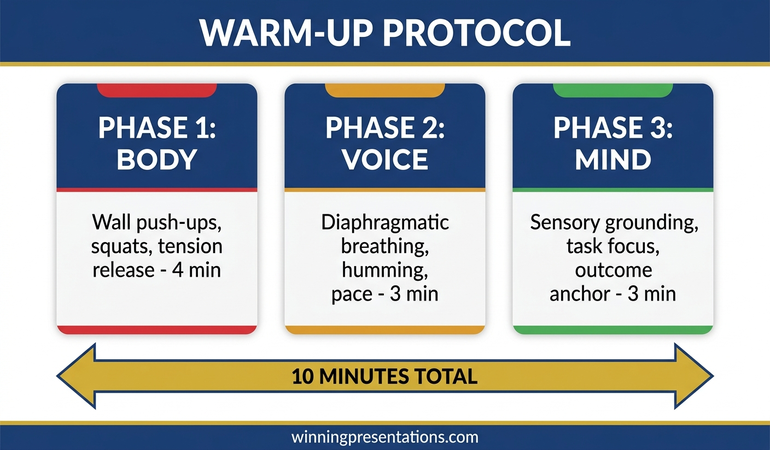
Three-phase presentation warm-up routine showing body activation, vocal preparation, and mental grounding with time allocations

Phase 1: Body Activation — Discharging Adrenaline Before It Controls You

The body activation phase takes three to four minutes and serves one purpose: burning off the excess adrenaline that would otherwise make your hands shake and your voice tremble. This is not a fitness routine — it is a physiological reset that prepares your body to be still and composed when you need it to be.

Large muscle engagement (90 seconds). Find a private space — a stairwell, an empty office, a bathroom stall — and do thirty seconds of wall push-ups, thirty seconds of standing squats, and thirty seconds of shoulder rolls. The goal is to engage your largest muscle groups so they absorb the adrenaline instead of your hands and voice. Keep the movements controlled and rhythmic. You are discharging energy, not exhausting yourself.

Isometric tension release (60 seconds). Clench both fists as tightly as possible for five seconds, then release. Repeat with your shoulders — press them up toward your ears, hold for five seconds, release. Then press your palms together at chest level, push hard for five seconds, and release. This progressive tension-release cycle activates and then relaxes the muscle groups most likely to carry visible tension during your presentation.

Jaw and face release (60 seconds). Open your mouth as wide as you can, stretch your face, and then release into a neutral expression. Repeat three times. Your jaw carries more tension than any other facial muscle, and a clenched jaw restricts your vocal range, makes you look rigid, and can trigger headaches during a long presentation. A loose jaw is the foundation of natural-sounding speech.

After the body activation phase, you should feel physically lighter — less coiled, less restless, less like your body is preparing for a threat. The adrenaline is still present, but it is distributed across your muscles rather than concentrated in your extremities.

Phase 2: Vocal Preparation — Stabilising Pitch, Pace, and Projection

The vocal preparation phase takes three minutes and addresses the most visible symptom of presentation anxiety: a voice that does not sound like yours. When you are nervous, your vocal cords tighten, your breathing becomes shallow, and your pitch rises. These changes happen automatically, and they are immediately noticeable to an audience — even if they cannot articulate what sounds different.

Diaphragmatic breathing (60 seconds). Place one hand on your stomach and breathe so your hand moves outward on the inhale and inward on the exhale. Take four slow breaths: inhale for four counts, hold for two, exhale for six. This pattern activates the parasympathetic nervous system, which counteracts the fight-or-flight response. It also shifts your breathing from chest-level (shallow, anxious) to diaphragm-level (deep, controlled) — which gives your voice its natural depth and resonance.

Vocal range warm-up (60 seconds). Hum at a comfortable pitch, then slide your hum from low to high and back down. Repeat three times. This warms the vocal cords and establishes your full range before you speak. Then say “one-two-three-four-five” at your normal speaking volume, followed by the same sequence projected as if speaking to someone across a large room. This calibrates your volume and ensures you do not start your presentation too quietly — a common anxiety response that signals uncertainty to the audience.

Pace calibration (60 seconds). Speak the first three sentences of your presentation out loud, deliberately slower than feels natural. Anxiety accelerates speech. What feels slow to you sounds measured and authoritative to the audience. Time yourself: your opening sentence should take at least five seconds. If it takes less than three, you are rushing. Practise the opening at the slow pace until it feels comfortable — this becomes your anchor tempo for the real presentation.

Still Dreading the Walk to the Front of the Room?

A warm-up routine manages the symptoms. Conquer Your Fear of Public Speaking — £39, instant access — addresses the underlying patterns that cause presentation anxiety in the first place:

  • Neuroscience-based techniques for regulating your nervous system before, during, and after presenting
  • Cognitive reframing protocols that change how your brain interprets the presentation situation
  • Physical symptom management for trembling, voice changes, and visible anxiety
  • Pre-presentation routines designed specifically for executive environments

Get Conquer Your Fear of Public Speaking → £39

Designed for executives who know their content but cannot control their body’s response to presenting it.

Phase 3: Mental Grounding — Shifting From Threat to Task

The mental grounding phase takes three minutes and addresses the cognitive dimension of presentation anxiety: the running internal commentary that tells you something is about to go wrong. This commentary — “they’ll think I’m not prepared,” “what if I forget the numbers,” “the last time I presented this badly…” — is your brain’s threat detection system scanning for danger. It is not helpful, and it is not accurate, but it feels urgent and true.

Mental grounding redirects your attention from internal threat signals to external task focus. Instead of monitoring how you feel, you begin monitoring what you need to do. This shift does not require positive thinking or affirmations — it requires structured attention redirection.

Sensory grounding (60 seconds). Name five things you can see, four you can hear, three you can touch. This technique, borrowed from clinical anxiety management, forces your brain out of future-oriented threat detection and into present-moment awareness. When your brain is busy cataloguing sensory input, it has less capacity for catastrophic prediction. Do this standing in the room where you will present, if possible — it also familiarises you with the environment, which reduces novelty-related anxiety.

Task-focus rehearsal (60 seconds). Instead of rehearsing content, rehearse actions. Say to yourself: “I will walk to the front, place my notes on the lectern, make eye contact with three people, and begin with my opening sentence.” This converts the presentation from an abstract threat (“I have to present to the board”) into a concrete sequence of manageable physical actions. Anxiety thrives on abstraction. Specificity neutralises it.

Outcome anchoring (60 seconds). Identify one specific outcome you want from this presentation — not “I want it to go well,” but “I want the CFO to approve the next phase.” Hold that outcome in mind as you take three final diaphragmatic breaths. This anchors your attention to purpose rather than performance. You are not going in to be judged. You are going in to achieve something specific. That reframe changes how your nervous system treats the situation.

If you want to build on this pre-presentation preparation with a structured morning protocol, see our guide to the morning presentation protocol that sets up your entire day for confident delivery.

For executives who want a complete system for managing presentation anxiety — not just a warm-up routine — the Conquer Your Fear of Public Speaking programme (£39) provides the full neuroscience-based framework for rewiring your response to high-stakes speaking situations.

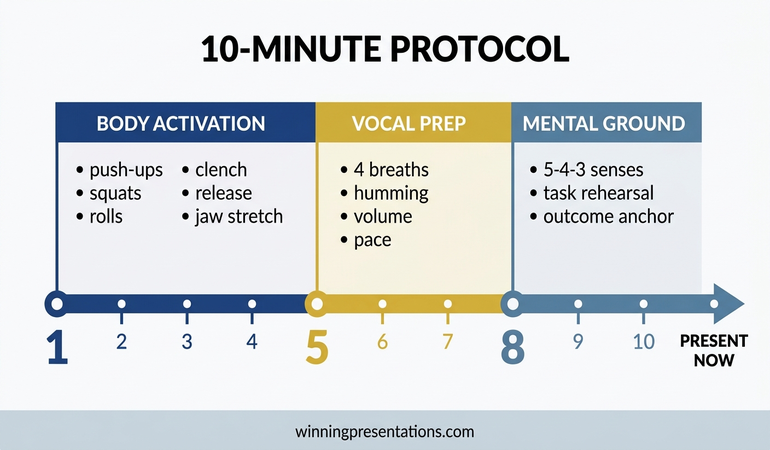
The Complete 10-Minute Protocol

Here is the full warm-up sequence, designed to be done in any private space ten minutes before you present. The order matters — body first, then voice, then mind — because physical regulation creates the foundation for vocal and cognitive control.

Minutes 1-4: Body activation. Wall push-ups (30 seconds), standing squats (30 seconds), shoulder rolls (30 seconds), fist clench and release (30 seconds), shoulder press and release (30 seconds), palm press and release (30 seconds), jaw stretches (60 seconds).

Minutes 5-7: Vocal preparation. Four diaphragmatic breaths at 4-2-6 count (60 seconds). Humming slides low to high (30 seconds). Volume calibration at two levels (30 seconds). Opening sentences at slow pace (60 seconds).

Minutes 8-10: Mental grounding. Sensory grounding — 5 see, 4 hear, 3 touch (60 seconds). Task-focus rehearsal — physical action sequence (60 seconds). Outcome anchoring with three final breaths (60 seconds).

This protocol is sequential, not optional. Skipping the body phase and jumping to breathing exercises leaves the adrenaline unaddressed. Skipping the vocal phase means your voice will betray your nerves in the first sentence. Skipping the mental phase means your attention will be split between your content and your internal threat commentary. All three phases work together.

After the protocol, walk directly into the room and begin. Do not sit down and wait — waiting allows the anxiety to rebuild. The transition from warm-up to presentation should be immediate, while the regulation is still active.


Complete 10-minute presentation warm-up protocol timeline showing body activation, vocal preparation, and mental grounding phases with specific exercises

Ready to Address the Root Cause, Not Just the Symptoms?

This warm-up routine regulates your nervous system in the moment. Conquer Your Fear of Public Speaking — £39, instant access — gives you the complete programme to change how your brain responds to presenting, so the anxiety diminishes over time rather than requiring management before every meeting.

Get Conquer Your Fear of Public Speaking → £39

Designed for executives who want to present with composure, not just survive the experience.

Want the slides too?

Preparation reduces anxiety. The Executive Slide System (£39) includes confident-presenter templates designed to minimise preparation stress — so your warm-up routine starts from a position of structure, not uncertainty.

Frequently Asked Questions

Can I do a presentation warm-up routine in a suit without getting sweaty?

Yes. The body activation exercises are controlled, low-impact movements — wall push-ups, standing squats, shoulder rolls, and isometric holds. They engage large muscle groups without raising your heart rate to the point of visible sweating. Keep the movements slow and deliberate. You are discharging adrenaline, not doing a workout. If you are concerned about overheating, focus on the isometric tension-release exercises (fist clenches, shoulder presses, palm presses) which are invisible to anyone who might walk past.

What if I only have two minutes before my presentation?

If time is limited, prioritise in this order: four diaphragmatic breaths (30 seconds), jaw release and facial stretch (15 seconds), opening sentence at slow pace (15 seconds), and sensory grounding — five things you can see (30 seconds). This compressed sequence hits the most critical elements: breathing calms the nervous system, jaw release frees your voice, pace calibration prevents rushing, and sensory grounding redirects your attention. It is not as effective as the full ten-minute protocol, but it is significantly better than walking in cold.

Should I use this routine before virtual presentations too?

Absolutely. Virtual presentations trigger the same fight-or-flight response as in-person ones — sometimes worse, because you cannot read the room and the silence between your words feels amplified. Do the full warm-up routine before joining the call. If you are presenting from home, you have the advantage of complete privacy for the body activation phase. The vocal preparation is especially important for virtual settings, where microphone compression can make a nervous, high-pitched voice sound even more strained than it would in person.

The Winning Edge — Weekly Presentation Intelligence

Every Thursday, I share one framework, one real-world example, and one practical technique drawn from 24 years of presenting in boardrooms across three continents. Join The Winning Edge newsletter →

Not ready for the full programme? Start here instead: download the free Executive Presentation Checklist — a one-page reference covering the structure and preparation elements every confident presentation needs.

Once your warm-up routine is in place, make sure your slides support your confidence — see our guide to executive slide design for the visual structures that reduce cognitive load and let you present from a position of clarity.

About the Author

Mary Beth Hazeldine is the Owner & Managing Director of Winning Presentations. With 24 years of corporate banking experience at JPMorgan Chase, PwC, Royal Bank of Scotland, and Commerzbank, she advises executives across financial services, healthcare, technology, and government on structuring presentations for high-stakes funding rounds and approvals. A qualified clinical hypnotherapist and NLP practitioner, she combines executive communication expertise with evidence-based techniques for managing presentation anxiety.

Book a discovery call | View services

05 Apr 2026
Executive presenter making deliberate eye contact with a board member during a high-stakes presentation, confident posture, engaged audience

Eye Contact in Presentations: The 3-Second Rule That Changes How Executives Read You

Quick Answer

The 3-second rule for eye contact in presentations means holding deliberate eye contact with one person for roughly three seconds — long enough to complete a thought — before moving to another. This prevents the scanning and darting that signals anxiety, and it distributes your attention purposefully across the room, including to the people who are most sceptical. Executives read your eye contact behaviour as a direct signal of whether you believe what you are saying.

Henrik is a VP at a pharmaceutical company. He had prepared meticulously for a major leadership presentation — the data was solid, the narrative was clear, and he knew every number on every slide. Afterwards, the feedback stopped him cold: he had “seemed uncertain.” His coach watched the recording with him and spotted the issue within two minutes. Henrik had spent the entire presentation making eye contact with the three people nodding along at the left side of the table. He had barely glanced at the two board members on the right — the sceptics, the ones who were quietly deciding whether his budget proposal was credible. He had read the room, chosen the safe faces, and without realising it, he had signalled to the decision-makers that he either did not see them or did not want to. His certainty about the content never reached the people who mattered most.

Want a structured approach to building presentation confidence?

If you recognise the pattern Henrik experienced — knowing your material but still not landing as confidently as you should — there is a structured programme built specifically for executives navigating that gap. It works on the physical and psychological roots of presentation anxiety, not just the surface technique.

Explore the Programme →

What Eye Contact Signals to an Executive Audience

When you present to a senior audience, the content you deliver accounts for only part of how you are judged. Executives — particularly those who regularly sit in on high-stakes decisions — are experienced observers of other people. They have learned, often without consciously articulating it, to read delivery as a signal of conviction.

Eye contact is one of the clearest signals available to them. When a speaker holds steady, distributed eye contact, the room interprets it as ownership of the material. When a speaker scans nervously, looks repeatedly at their slides, or gravitates only toward friendly faces, the room reads it as discomfort — and discomfort in the presenter creates doubt about the content.

This matters enormously in executive and board-level settings, where the audience is making ongoing assessments throughout your presentation rather than waiting for the end. They are not passively receiving information. They are evaluating whether they trust the person delivering it. This is why your opening moments carry so much weight — and why eye contact behaviour from the first thirty seconds shapes the credibility you carry for the rest of the room.

There is also a subtler signal at work. When you make sustained eye contact with someone, it implies you are speaking directly to them — that you expect them to engage, to respond, to be part of the conversation. Executives are accustomed to being addressed this way. When a presenter fails to include them visually, it can read, consciously or not, as a lack of confidence in what is being said.

The inverse is equally important: the two board members Henrik was avoiding noticed, even if they never mentioned it. Sceptics who are not included in a speaker’s eye contact pattern often become more entrenched in their scepticism. They have been, in effect, dismissed.

The 3-Second Rule: Why It Works and How to Apply It

The 3-second rule is straightforward: when making eye contact in a presentation, hold your gaze with one person for approximately three seconds — enough to complete a sentence or a thought — before moving to someone else. It is not a rigid count. The goal is to match a complete idea to a complete moment of connection.

Why three seconds? Less than that and the contact reads as a glance — it feels rushed and superficial. The audience member does not feel genuinely addressed. More than five or six seconds and the contact starts to feel intense or confrontational, which is equally counterproductive. Three seconds is the natural duration of genuine conversational engagement. It is what happens automatically between two people having a focused discussion. Replicating it in a presentation setting makes the room feel like a conversation rather than a broadcast.

Applying it requires deliberate zone management. A useful way to think about your room is in three zones:

  • Decision-Makers Zone: The people with direct authority over the outcome — budget holders, senior sponsors, the most sceptical voices. Aim to spend approximately 40% of your eye contact time here, even if — especially if — they are not visibly receptive.
  • Nodders Zone: The engaged, visibly supportive faces. These feel natural to return to. Limit yourself to around 30% of your eye contact time here. They are already on your side.
  • Peripheral Zone: Colleagues, observers, junior stakeholders. Include them at around 30%, particularly during moments where you are building general credibility rather than pushing for a specific decision.

The practical discipline is to resist the gravitational pull of the nodders. It is entirely human to seek the safe face when you are under pressure. But doing so consistently tells the decision-makers that you are managing your own anxiety rather than engaging with them — which is precisely the opposite impression you want to create. Deliberate eye contact during an eye contact presentation is an act of attention directed outward, not inward.

One refinement worth noting: when you are presenting data or referencing a slide, it is acceptable to glance at the screen briefly. The error is staying there. Executives are reading your slides differently from how you expect, which means your job is to bridge the visual information to your verbal argument — and that bridge is built through eye contact, not through reading aloud.


Dashboard infographic showing the eye contact zone strategy for presentations with percentage time allocations for decision-makers, nodders, and peripheral audience members

Conquer Speaking Fear — £39

Build the Delivery Confidence That Lets Your Expertise Actually Land

Knowing your material is not the same as being able to deliver it under pressure. Conquer Speaking Fear is a 30-day programme that works on the nervous system roots of presentation anxiety — drawing on techniques from clinical hypnotherapy and nervous system regulation — so that your capability as a speaker matches the depth of your expertise.

  • Addresses the physiological and psychological components of presentation anxiety
  • Uses nervous system regulation techniques developed from clinical hypnotherapy practice
  • Structured as a 30-day programme with a clear, progressive framework
  • Designed for the specific pressures of executive and leadership-level presenting
  • Works on the internal experience of presenting, not just surface-level technique

Get Conquer Speaking Fear → £39

Designed for executives managing presentation anxiety and delivery pressure.

The Common Eye Contact Mistakes Executives Make

Most executives making eye contact errors are not aware they are doing it. The mistakes tend to cluster into a few recurring patterns.

Defaulting to the slide. The slide becomes a refuge when anxiety rises. Looking at the screen gives the speaker a brief pause from the pressure of being observed. Done occasionally, it is fine. Done repeatedly, it signals that the presenter does not fully own the material — that they need the slide as a prompt rather than as a visual support for an argument they could make without it.

The lighthouse sweep. Some speakers attempt to cover the room by scanning continuously from left to right and back again. This feels inclusive in theory, but in practice no individual ever feels addressed. The effect is impersonal and often reads as rehearsed in an unconvincing way. It is eye contact that avoids actual contact.

Locking in on one person. Some speakers — particularly those who are anxious — find one sympathetic face and stay there. This person becomes uncomfortable; everyone else feels excluded. If that one person happens to be a junior colleague rather than a decision-maker, the power dynamics in the room shift in an unhelpful direction.

Avoiding the sceptics entirely. This is Henrik’s mistake, and it is the most costly. Sceptics are sceptical precisely because they have unanswered questions or concerns. When a speaker visually excludes them, they receive a secondary signal that the speaker is either unaware of their concerns or unwilling to engage with them. Neither reading helps the presenter’s case. By contrast, deliberate and steady eye contact with a sceptic communicates: I see you. I am not afraid of your scrutiny.

Breaking eye contact at the wrong moment. The moment a speaker looks away tends to be interpreted as a signal — especially when it happens immediately after a key claim or recommendation. Looking down as you deliver your conclusion reads, unconsciously, as lack of conviction. The recommendation lands, then the speaker retreats from it. Holding eye contact through the delivery of a key point is one of the most direct ways to signal that you stand behind it.

If you are also working on avoiding the over-explanation habits that undermine credibility, eye contact discipline reinforces that work. The two behaviours are connected: over-explaining often comes with the same anxious avoidance pattern that produces poor eye contact.

How to Use Eye Contact When the Room Turns Hostile

There are presentations where the atmosphere shifts. A question is asked with an edge. Two board members exchange a look. Someone pushes back on your data. The room — or part of it — turns.

This is precisely the moment when instinct and good practice diverge most sharply. The instinctive response to hostility is to look away — to break contact, reduce the confrontational feeling, and regroup. But breaking eye contact in that moment sends a signal: that you are unsettled, that the challenge has found its target.

The discipline required is to maintain steady eye contact with the person who has challenged you while you formulate your response. Not a stare — that reads as aggression. But the same three-second conversational contact you would use with anyone else in the room. It communicates that you have heard the challenge, that you are taking it seriously, and that you are not rattled by it.

When answering a difficult question, direct the opening of your answer to the person who asked it, then broaden your gaze to include the wider room as you develop your response. This does two things: it honours the questioner while simultaneously making your answer a contribution to the whole room, not just a defence directed at one person. It reduces the adversarial dynamic without conceding ground.

If a question is genuinely difficult and you need a moment to think, it is completely acceptable to say so. The error is saying so while looking at the floor. Pausing while maintaining a composed, outward gaze signals that you are thinking carefully, not that you have been caught out.

Preparing for exactly this kind of pressure is one of the reasons executives benefit from working on the anxiety response that underpins delivery, not just the technique layer. When the nervous system is calmer under pressure, the physical signals — including eye contact — become far easier to manage.

If you have recently delivered a high-stakes presentation and are thinking about how to manage the follow-up conversation with decision-makers, the board presentation follow-up protocol covers the steps that typically happen after the room.

If the anxiety response in high-pressure presentations is something you recognise in yourself, Conquer Speaking Fear addresses exactly that, using nervous system regulation and clinical hypnotherapy techniques structured across thirty days.

Practising Eye Contact Before High-Stakes Presentations

Knowing the 3-second rule intellectually and executing it under pressure are two different skills. Like any physical component of presentation delivery, eye contact benefits from deliberate rehearsal — not just running through your content, but specifically practising the act of looking at people.

The most effective practice method is to rehearse in front of actual people rather than a mirror. A mirror changes the dynamic significantly: you are watching yourself, which is the opposite of the outward attention eye contact requires. If you can rehearse with a small group — even two or three colleagues — you can practise zone management in a realistic context.

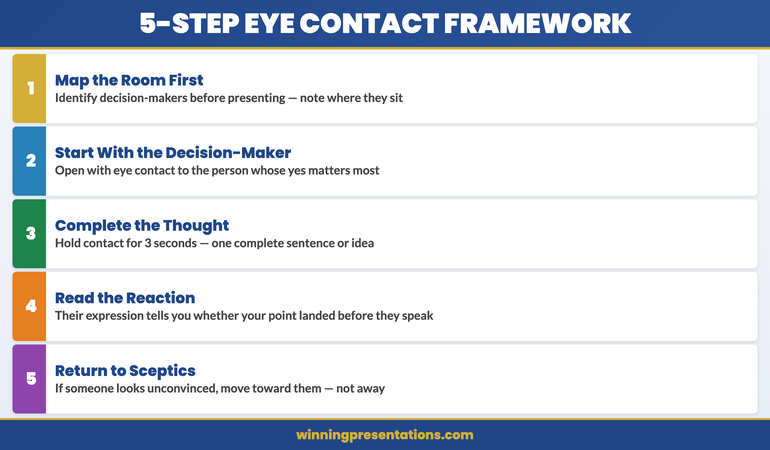
If live rehearsal is not possible, the following framework helps structure your practice:

  1. Map your room in advance. Before a high-stakes presentation, identify where the decision-makers, nodders, and peripheral audience members will sit. Have a plan for where your eye contact will begin and how it will move.
  2. Anchor your opening in a person, not a slide. Start by addressing a specific individual with your first sentence. This sets the conversational tone from the outset.
  3. Practise completing full thoughts per person. Rehearse delivering single sentences or short ideas to one imagined person before moving. Get comfortable with the rhythm of thought-and-release rather than scan-and-move.
  4. Record yourself. Even a phone recording of a rehearsal can reveal patterns you are not aware of — including how often you look at your notes, your slides, or the floor.
  5. Practise under mild pressure. If the anxiety itself disrupts your eye contact, practising in entirely comfortable conditions will not prepare you for the real thing. Find ways to rehearse with a slightly raised heart rate — presenting to a slightly larger group than is comfortable, or in a less familiar environment.

The goal is not to make eye contact feel effortful and deliberate on the day — it is to practise until the deliberate choices become second nature. The technique should be invisible to your audience. They should experience you as engaged and present, not as someone executing a method.


Stacked cards infographic showing the five-step eye contact framework for presentations from mapping the room to returning to sceptics

Conquer Speaking Fear — £39

Systematic Confidence for the Moments That Count

Technical rehearsal takes you a certain distance. Conquer Speaking Fear takes you further — building the internal stability that lets you hold eye contact with a sceptic, absorb a difficult question, and deliver your recommendation with composure. It is a 30-day programme using nervous system regulation and techniques drawn from clinical hypnotherapy, structured for the specific challenges of executive-level presenting.

Get Conquer Speaking Fear → £39

Frequently Asked Questions

How long should eye contact last in a presentation?

Aim for approximately three seconds of eye contact per person — long enough to complete a sentence or a clear thought before moving on. Less than that reads as a glance; more than five or six seconds can feel intense or confrontational. The three-second duration naturally mirrors the rhythm of genuine conversational engagement, which is why it tends to feel credible to an executive audience.

Should you make eye contact with difficult or sceptical audience members?

Yes — and it is worth making a deliberate effort to do so, because the instinct under pressure is to avoid sceptical faces. Decision-makers who are sceptical are exactly the people whose confidence you need to build. Deliberately including them in your eye contact pattern signals that you are not unsettled by their scrutiny, which often does more to address their concerns than the content alone. Avoiding them tends to entrench rather than reduce their scepticism.

What if nerves make it difficult to maintain eye contact during a presentation?

This is common and it has a physical basis: when the nervous system is in an anxious state, looking at people can feel more exposing. Surface techniques help — practising zone management, rehearsing under mild pressure, anchoring your opening in a specific person. But if anxiety is disrupting your delivery more broadly, working on the underlying nervous system response tends to produce more sustainable results than technique adjustments alone. A structured programme focused on the physiological roots of presentation anxiety addresses this at the level where it originates.

Free Weekly Insights

The Winning Edge Newsletter

Each week: one practical idea for senior presenters. Delivery, structure, stakeholder handling, and the internal work that makes the difference. No filler.

Subscribe to The Winning Edge →

Mary Beth Hazeldine

Mary Beth Hazeldine is a presentation skills coach and the founder of Winning Presentations. She works with executives and senior leaders on the delivery, structure, and confidence challenges that arise in high-stakes presenting. Her programmes draw on her background in clinical hypnotherapy and nervous system regulation to address the anxiety that technical preparation alone does not resolve. She writes regularly on executive communication, presentation delivery, and the psychology of credibility.

30 Mar 2026
Quiet moment of reflection before a high-stakes presentation showing a calm professional environment

Self-Compassion for Presentation Anxiety: The Research-Backed Technique Sceptical Executives Trust

Self-compassion quiets the inner critic that drives presentation anxiety. Rather than pushing harder through fear, this evidence-based technique teaches you to respond to mistakes and pressure the way you’d support a trusted colleague. For executives who’ve resisted breathing exercises and affirmations, self-compassion offers something different: a research-backed permission structure to be human during high-stakes moments.

Linh’s Turning Point: From Perfectionist Sabotage to Measured Presence

Linh, a finance director at a multinational bank, had mastered every technical skill. She prepared meticulously. Yet every presentation triggered a spiral: one stumbled phrase, and her internal voice became ruthless. That was sloppy. You should know this cold. Everyone’s thinking you’re not qualified. The harder she pushed to be perfect, the more anxious she became. By her third major presentation in two months, she was considering stepping back from client-facing work altogether—a career-limiting decision she wasn’t ready to make. During a coaching conversation, Linh learned that her perfectionism wasn’t a strength; it was fuel for anxiety. When she began practising self-compassion—acknowledging her nerves as normal, treating herself with the same grace she’d extend to her team—her presentation quality actually improved. The permission to be imperfect freed her from the paralysis of perfectionism.

Rescue Block: You Don’t Have to Be Perfect to Perform Well

Presentation anxiety often masquerades as a motivation problem. In reality, it’s your nervous system perceiving a threat. Self-compassion interrupts that threat signal by validating your experience and reminding you that struggle is part of being human. This isn’t about lowering standards—it’s about building psychological safety so you can access your best thinking under pressure.

What Self-Compassion Actually Means for Presenters

Self-compassion isn’t self-pity or weakness. Kristin Neff, the leading researcher in this field, defines it as three interlocking elements: mindfulness of your difficulty (noticing anxiety without exaggerating it), common humanity (recognising that struggle is universal, not a personal failing), and self-kindness (responding to yourself with the same dignity you’d offer a colleague).

For presentation anxiety, this translates into a specific mental shift. Instead of I’m panicking, I must be terrible at this, the self-compassionate response is: My nervous system is activated. This is what anxiety feels like. I can move forward anyway. That distinction might seem subtle, but the neurological impact is measurable. The inner critic—which intensifies the fight-or-flight response—quiets. Your prefrontal cortex, the rational planning centre, can remain engaged.

Ready to Stop Fighting Your Anxiety?

Conquer Speaking Fear teaches you how. In six modules, you’ll learn the neuroscience of anxiety, practical de-escalation techniques, and the mindset shifts research shows actually work for executives who’ve tried everything else.

Conquer Speaking Fear — £39

Six modules. Lifetime access. No assumptions about your comfort level.

Why Research Backs This Approach

The evidence for self-compassion in anxiety management is robust. Longitudinal studies show that individuals who practise self-compassion report lower trait anxiety, reduced avoidance behaviour, and faster recovery from setbacks. Neuroscience explains why: when you respond to yourself with kindness, you activate the parasympathetic nervous system—your rest-and-digest state—which directly counteracts the arousal of anxiety.

What makes this particularly relevant for presentation anxiety is the mechanism. Traditional anxiety management (grounding techniques, breathing exercises) works by managing the physical symptoms. Self-compassion works by changing your relationship to those symptoms. You’re not trying to eliminate the nervousness; you’re teaching your brain that nervousness doesn’t mean failure. For sceptical executives, this distinction matters. You’re not engaging in sentiment or positive thinking. You’re applying a neurologically sound response to psychological distress.

Research also shows that self-compassion buffers against perfectionism—the cognitive pattern that magnifies presentation anxiety in high-achieving professionals. When you can acknowledge a mistake without catastrophising, you remain calmer and more focused. Your audience doesn’t experience your anxiety; they experience your stability.

The Three Pillars in Practice

Mindfulness: Notice Without Narration

Before a presentation, you’ll likely experience physical sensations: elevated heart rate, tension in your chest, a tightness in your throat. Mindfulness means noticing these without the story. Instead of My heart is racing—I’m going to panic, try: I notice my heart is beating faster. That’s what my body does when it’s preparing. You’re describing the sensation, not interpreting it as catastrophe.

Common Humanity: You’re Not Alone in This

Anxiety thrives on the belief that your experience is abnormal or unique. In reality, every presenter experiences nervousness. Even seasoned executives, award-winning speakers, and confident performers report pre-presentation anxiety. The difference is they’ve learned not to treat it as evidence of inadequacy. When you remind yourself—This is what anxiety feels like for humans. I’m not broken—you reduce the secondary anxiety (anxiety about being anxious) that compounds the original fear.

Self-Kindness: The Internal Tone That Matters

This is where most executives get stuck. Self-kindness can sound soft or indulgent. In practice, it’s rigorous. It means asking: What would I need right now if I were a colleague I valued? The answer might be a pause, a glass of water, a reminder of your competence, or permission to feel uncertain. You’re not rewarding yourself for being anxious; you’re treating anxiety as a problem that warrants care, not punishment.

You can practise these three elements together in a simple structured exercise, which brings us to your practical toolkit.

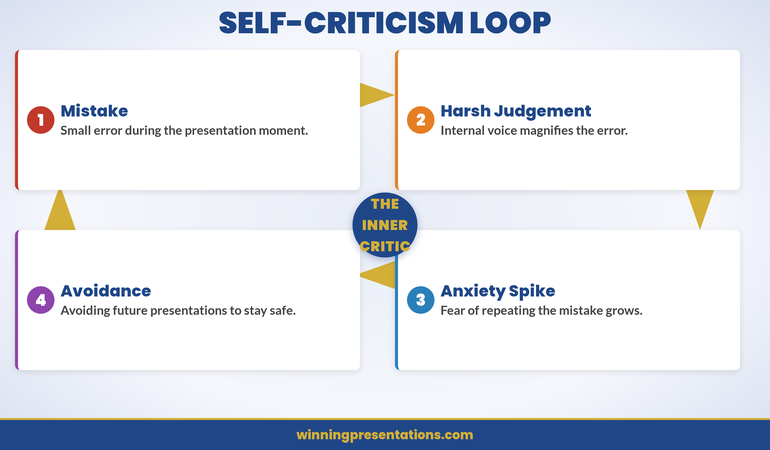
The self-criticism cycle showing four stages: mistake, harsh judgement, anxiety spike, and avoidance

Your 90-Second Exercise Routine

The most effective self-compassion practice for presentation anxiety is the pause-name-soothe sequence. You can do this in 90 seconds, anywhere—in the car park before you present, in the bathroom at the conference, even during a difficult Q&A moment.

Step 1: Pause (20 seconds)
Stop what you’re doing. Notice your breath without changing it. Count the exhales: one, two, three. This brief pause activates your awareness and signals to your nervous system that you’re choosing a response, not being hijacked by panic.

Step 2: Name (30 seconds)
Silently or aloud, name what you’re experiencing. Use simple, non-dramatic language: I’m feeling anxious. My chest is tight. I’m having the thought that I might forget what I’m saying. By naming, you’re engaging your language centres and creating distance from the raw emotion. You’re no longer the anxiety; you’re observing it.

Step 3: Soothe (40 seconds)
Place your hand on your heart or cross your arms over your chest in a gentle self-hug. Speak to yourself as you would a nervous colleague: This is hard right now. That’s okay. I’ve prepared well. I can move forward even with these feelings. The physical touch activates the soothing system; the words reinforce kindness. Research shows this combination is more effective than either element alone.

You can practise this routine during low-stress moments so it’s available when you need it. Many executives practise once daily for a week before a high-stakes presentation, then on-demand before the actual event.

Level Up Your Preparation

Conquer Speaking Fear walks you through this routine with video guidance, then shows you how to integrate it with your broader presentation strategy. You’ll also learn why your anxiety has a particular pattern—and how to interrupt it.

Conquer Speaking Fear — £39

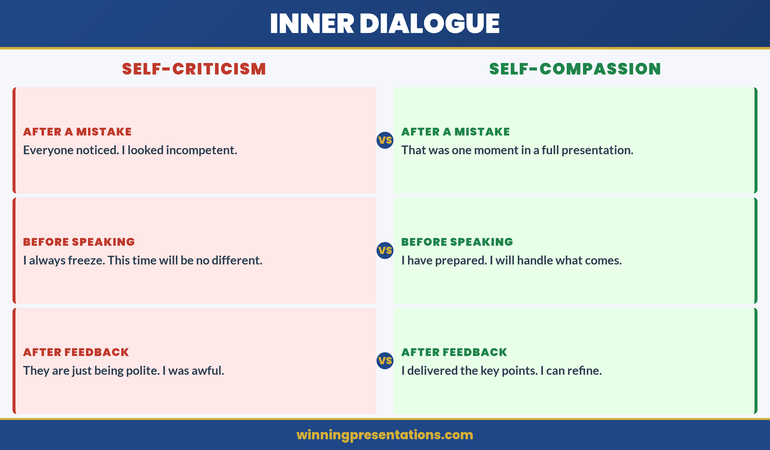
Contrast between self-criticism and self-compassion responses after mistakes, before speaking, and after feedback

Why Sceptical Executives Resist (And How to Overcome It)

You might be thinking: This sounds nice, but will it actually work for me? Won’t I just feel silly talking to myself?

That resistance is predictable. High-achieving professionals have often built their identity on rational problem-solving and self-reliance. Self-compassion can feel like emotional indulgence. Here’s what the research shows: the executives who resist self-compassion are often the same ones whose perfectionism is driving their anxiety. The resistance itself is part of the pattern.

The reframe: self-compassion is strategic, not sentimental. When you reduce the internal criticism that amplifies anxiety, you access clearer thinking. Your prefrontal cortex isn’t hijacked by the threat-detection system. You make better decisions during presentations, field difficult questions more calmly, and recover more quickly from mistakes. This is performance optimisation through psychological stability.

Second concern: Won’t this make me complacent about improving? In fact, self-compassion strengthens motivation for improvement. When you’re not berating yourself for mistakes, you can examine them objectively. What went wrong? What can I adjust? This is the mindset that drives learning. Harsh self-criticism, by contrast, often leads to avoidance (you stop doing presentations) or defensive rigidity (you ignore feedback).

A practical starting point: try the 90-second routine once. Notice what happens. Most executives report a measurable shift in their nervous system activation within three or four practises. That’s not placebo; that’s neurobiology.

For guided video walkthroughs of the 90-second routine and integration strategies, see the full training in Conquer Speaking Fear.

Integrating Self-Compassion Into Your Prep

Self-compassion works best when it’s woven into your broader preparation strategy. Here’s how:

During Content Development
If you notice perfectionist thinking (This section isn’t excellent yet), pause and apply self-compassion. I’m working through this. Draft work is supposed to feel rough. I can refine it. This keeps perfectionism from sabotaging your creative process.

During Practice Sessions
If you stumble during a run-through, notice the urge to self-criticise. Instead, treat the mistake as data: I found something to improve. That’s valuable. You’re building the neural pathways that support learning.

Immediately Before Presenting
Use the 90-second routine. Pair it with a pre-presentation ritual (a specific phrase, a particular movement) so your nervous system learns to associate the ritual with calm focus.

After the Presentation
This is crucial. Instead of replaying every imperfection, practise self-compassion. I did difficult work today. I handled some parts well and some parts less well. That’s the nature of live performance. I learned something. This prevents the post-presentation anxiety spiral that can make future presentations feel higher-stakes.

Build Your Slides with Confidence

Preparation reduces anxiety. The Executive Slide System (£39) includes slide templates and frameworks specifically designed to minimise preparation stress and build presenter confidence.

The Bottom Line: Permission to Perform

Self-compassion for presentation anxiety isn’t about becoming comfortable with nervousness. It’s about building a relationship with your anxiety that doesn’t amplify it. When you stop treating nervousness as evidence of inadequacy, your nervous system downregulates. You become more present, more flexible, and more effective.

For executives, this is particularly valuable because you’re operating in high-stakes environments where stakes feel personal. A misspoken phrase in a board presentation isn’t just a communication hiccup; your mind frames it as a threat to your professional standing. Self-compassion interrupts that narrative. It tells your nervous system: You’re safe. You can think clearly. You can keep going.

That’s not motivational poster sentiment. That’s applied neuroscience.

Frequently Asked Questions

Q: If I practise self-compassion, won’t I lower my standards?
A: No. Research shows the opposite: self-compassion is associated with higher intrinsic motivation and better long-term performance. When you’re not distracted by self-criticism, you can focus on what actually matters—clear communication and audience connection.

Q: How long before I notice a difference?
A: Most people report a noticeable shift in their nervous system activation within three to four practises of the 90-second routine. Deeper integration into your presentation anxiety pattern usually takes two to four weeks of consistent practise.

Q: Can I do this alongside other anxiety management techniques?
A: Yes. Self-compassion complements breathing exercises, preparation, and other evidence-based approaches. Think of it as a complementary layer: it changes how you relate to anxiety, whilst other techniques manage the physical symptoms.

Stay Ahead of Presentation Anxiety

New techniques, research insights, and executive-focused strategies delivered to your inbox. Join The Winning Edge newsletter.


Related Articles
How to Run a Project Kickoff Presentation That Gets Buy-In
The Contract Renewal Presentation: Authority, Nuance, and Closing Power
Buying Time in Q&A: Three Techniques That Sound Natural

Self-compassion isn’t a luxury for presenters—it’s a strategy for sustained performance under pressure.


About the Author

Mary Beth Hazeldine is Owner & Managing Director of Winning Presentations. A qualified clinical hypnotherapist and NLP practitioner who overcame five years of severe presentation anxiety, she combines 24 years of corporate banking experience at JPMorgan Chase, PwC, Royal Bank of Scotland, and Commerzbank with evidence-based techniques for managing presentation fear.

29 Mar 2026
Abstract representation of audience-specific presentation anxiety showing different meeting environments

Why You Freeze With Some Audiences but Not Others (And How to Fix It)

Some presentations trigger panic. Others leave you calm. The difference isn’t about your skill—it’s about how your nervous system perceives threat in that specific audience. When you face authority figures, experts, or people who can judge your competence, your amygdala fires differently. Understanding this mismatch between actual and perceived threat is the first step to managing audience-specific presentation anxiety across all contexts.

The board meeting that broke Sarah’s confidence

Sarah had delivered presentations to her team every week for three years. Direct reports, peers, even senior managers from other divisions—no problem. Then came the board observation meeting. The same slide deck. The same room. But this time, six non-executive directors sat at the table, including the Chair of the audit committee. Sarah’s mouth went dry halfway through slide three. Her voice tightened. She stumbled over numbers she’d rehearsed a hundred times. Later, her manager asked what happened. “I know this material inside out,” Sarah said. “But something about their faces… I just froze.” She wasn’t nervous about her knowledge. She was terrified about their judgment of her. That fear was specific. It attached itself to that particular audience, not to presenting itself.

Anxiety isn’t your weakness—it’s your system trying to protect you.

When your nervous system flags certain audiences as “high stakes,” it floods you with cortisol and adrenaline. This response made sense when stakes meant survival. Today, it misfires in boardrooms and client pitches. The good news: your threat-detection system is retrainable. Understanding which audiences trigger your amygdala—and why—is where recovery begins.

Why anxiety spikes with certain audiences

Your presentation anxiety isn’t universal. It discriminates. You might be composed delivering to your own team but panic in front of your CEO. You might sail through client workshops but freeze at industry conferences. The variation isn’t random—it reflects how your amygdala categorises different audiences on a single dimension: perceived threat.

Threat here doesn’t mean physical danger. It means evaluation risk. Can this audience judge my competence? Can they make decisions that affect my career? Can they publicly question my credibility? The higher your brain scores a group on these metrics, the more your threat-detection system activates.

Research in social neuroscience shows that audiences triggering evaluative anxiety activate different neural pathways than general presentation nerves. Your anterior insula lights up—the region processing interoception and social pain. Your dorsolateral prefrontal cortex—the thinking part—dims. You’re not becoming less intelligent. You’re becoming less able to access your own knowledge because your limbic system has hijacked executive function.

This explains why Sarah could present the same figures to her team confidently but stumbled in front of the board. The content didn’t change. The audience’s perceived power to judge her did.

Stop freezing in front of authority

The Conquer Speaking Fear programme combines clinical hypnotherapy protocols with NLP techniques to rewire how your nervous system responds to evaluative audiences. You’ll identify your specific audience triggers, reset your threat response, and build confidence across all contexts—from boardrooms to industry stages.

Perfect for professionals who perform confidently in low-stakes settings but freeze when judgment matters.

Conquer Speaking Fear — £39

The three audience threat profiles

Not all evaluation-focused audiences trigger the same response. Your nervous system distinguishes between different types of judges, each activating different fear narratives.

Authority-based threat: Audiences you perceive as hierarchically above you—your boss, your board, your client’s C-suite. The fear narrative is: “They can diminish me.” Your body floods with cortisol. Your vocal cords tighten. You’re not afraid of speaking; you’re afraid of revealing inadequacy to someone with power over your standing.

Expert-based threat: Audiences who know your field as well as (or better than) you do. Industry conferences, peer-group presentations, specialist seminars. The fear narrative is: “They’ll spot the gaps.” Your perfectionism amplifies. You scrutinise every word choice. You triple-check data. The irony: experts are often the least judgmental audiences, because they know how rare expertise actually is.

Social-accountability threat: Audiences linked to your identity or relationships. Presenting to your industry peers where reputation matters. Pitching to a community you’re part of. The fear narrative is: “This defines how I’m seen.” You’re not afraid of incompetence; you’re afraid of perception shift. This is why some professionals dread industry conference talks but breeze through client presentations.

Most people experience all three, but one typically dominates. Identifying which threat profile activates your anxiety is diagnostic. It tells you exactly where your nervous system is misfiring.

Four audience-specific anxiety triggers: authority threat, expert threat, social threat, and status threat

Diagnostic: recognising your triggers

Before you can retrain your response, you need precision diagnosis. Vague anxiety (“I’m nervous about presentations”) doesn’t change. Specific anxiety (“I freeze when an audience includes people who can evaluate my technical credibility”) does—because specificity lets you design targeted intervention.

Ask yourself:

  • Who exactly makes you anxious? Not “senior people”—which people? Your CEO? Specific clients? Competitors? A particular personality type?
  • What do you fear they’ll think? That you’re incompetent? Unprepared? Not credible? That you don’t belong? The specific narrative matters because it points to the specific reset technique you need.
  • When does it hit? Before you start (anticipatory)? When you see their faces? When asked a question? During specific sections? Timing tells you whether you’re managing threat perception or just missing preparation.
  • What does it feel like in your body? Throat tightness? Racing heart? Trembling hands? Blank mind? Your somatic signature tells you which part of your nervous system to target in retraining.

Sarah’s diagnosis: She froze specifically in front of the audit chair (authority + expertise + social accountability). The fear narrative was: “They’ll find me technically wanting.” The somatic signature was vocal cord shutdown. That specificity allowed her to design a reset protocol targeting executive presence, not general presentation confidence.

If you’re curious whether your anxiety pattern matches audience threat profiles documented in clinical neuroscience, subscribe to The Winning Edge newsletter for self-diagnostic frameworks and real case studies showing exactly how people like you identified their specific triggers.

Reset techniques that work

Once you’ve identified your specific audience threat profile, retraining becomes systematic rather than general. Your goal isn’t to eliminate nervousness—that’s neither possible nor desirable. Nervous energy sharpens focus. Your goal is to lower the threshold at which your threat-detection system fires, and to keep your prefrontal cortex online even when it does.

Reframing the audience: Before a high-stakes presentation, spend 3–5 minutes reframing the audience from “judges” to “listeners seeking your perspective.” This isn’t positive thinking; it’s threat-perception recalibration. You’re literally telling your amygdala: these people are not here to diminish you; they’re here to understand you. Neuroimaging shows this cognitive reframe reduces amygdala activation within minutes.

Tactical breathing: Your sympathetic nervous system (fight-or-flight) and parasympathetic nervous system (calm-and-focus) speak the same language: breathing. A 4-6-8 breathing pattern—inhale four counts, hold six, exhale eight—immediately shifts your autonomic balance. The longer exhale tells your vagus nerve it’s safe to downregulate. Use this 2–3 minutes before entering the room, not just when you feel panic starting.

Audience connection protocol: For authority-based threat specifically, spend the first 60 seconds establishing human connection, not credentials. Ask a question. Make eye contact. Notice something human about the room. This deactivates the hierarchical frame and resets threat perception from “powerful judge” to “person like me.”

Preparation anchoring: The irony: over-preparation can amplify anxiety because it keeps you focused on what could go wrong. Strategic preparation anchors your confidence to specific moments you’ve rehearsed. Practise your opening sentence 50 times. Practise your three key transitions. Practise your close. Not the whole deck—the moments where your nervous system typically hijacks your voice. This specificity creates embodied memory that survives amygdala activation.

Clinical protocol meets practical tools

Conquer Speaking Fear embeds these reset techniques into a structured 8-week programme. Each module targets a specific audience threat profile and includes guided hypnotherapy sessions to rewire how your amygdala responds to evaluation contexts. You’ll work through your exact fear narrative and replace it with evidence-based confidence protocols.

Want the slides too?

Preparation reduces anxiety. The Executive Slide System (£39) includes confident-presenter templates designed to minimise preparation stress.

Building audience-confidence protocols

The difference between professionals who manage presentation anxiety and those who don’t isn’t talent or intelligence. It’s systematic protocol. They build audience-specific confidence routines and rehearse them until they’re automatic.

The 48-hour reframe: 48 hours before a high-stakes presentation, stop revising content and start reframing context. Write down: (1) What specifically about this audience triggers me? (2) What evidence contradicts that fear? (3) What’s my specific goal—not perfection, but clear communication? This cognitive work is as important as slide refinement.

The morning protocol: On presentation day, before you enter the space: 4-6-8 breathing (3 cycles), one specific thing you want to communicate clearly, one physical grounding exercise (feet on ground, palms together). These three elements prime your parasympathetic system and keep your prefrontal cortex online.

The entrance frame: Don’t walk in thinking “Will they judge me?” Walk in thinking “What does this audience need to understand?” This tiny perspective shift—from self-focus to audience-focus—remaps your neural activity from fear-processing regions to empathy-processing regions. Your amygdala quiets; your mentalising network engages.

Sarah used all three. Within four presentations, her audience-specific anxiety halved. Not because she became a different presenter. Because her nervous system learned the audit committee was an audience to communicate with, not a tribunal to fear.

Four-step reset technique for managing audience-specific presentation anxiety: identify, map, reframe, and anchor

The neuroscience of performance under pressure

Your nervous system doesn’t distinguish between real threat and perceived threat. Both activate identical pathways. This is why telling yourself “there’s nothing to fear” doesn’t work—your amygdala doesn’t listen to logic. It listens to pattern and context.

When you practise your reset protocol specifically with that audience context in mind, you’re not building confidence in a general sense. You’re building what neuroscientists call “context-dependent learning”—your nervous system learns: “This audience context, plus this breathing pattern, plus this reframe = safety.” When you show up, your body recognises the pattern and downregulates automatically.

This is why glossophobia in executives often persists despite decades of presentation experience. They’ve rehearsed content, not context. They’ve built confidence for generic presentations, not for the specific audiences that activate their threat response. The moment they face their particular fear-trigger audience, all that experience becomes inaccessible.

The solution isn’t more rehearsal. It’s informed rehearsal—practising your reset protocols in the exact context where your anxiety fires. This is what systemic presentation anxiety management looks like at the neuroscientific level.

Frequently asked questions

Why do I present confidently to my team but panic in front of my boss?

Your team has no formal power to evaluate your professional standing. Your boss does. Your amygdala correctly identifies the hierarchical difference and activates differently. This isn’t weakness; it’s your threat-detection system working. The reset involves reframing authority from “judge of my competence” to “audience seeking my perspective,” then rehearsing that reframe in the boss’s presence until your nervous system learns the pattern is safe.

Can I ever eliminate presentation anxiety entirely?

No—nor should you want to. Nervous system activation is what keeps you sharp and responsive. The goal isn’t zero anxiety; it’s anxiety within your window of optimal performance. Some professionals perform best with moderate nervous activation. The problem is when activation tips into dysregulation—when your prefrontal cortex goes offline and your amygdala hijacks your voice. That’s when specific audience threat is costing you. Managing audience-specific anxiety means staying in your optimal zone across all contexts.

How long does it take to rewire my response to a specific audience?

Context-dependent learning typically stabilises within 4–6 weeks of consistent protocol practise with that specific audience context. Some people see measurable shifts within days. The variation depends on how deeply your amygdala has encoded the threat association—5 years of authority-based fear takes longer to rewire than 5 months. But the timeline is measured in weeks and months, not years, when you use evidence-based techniques rather than just exposure.

Stay on top of presentation confidence

Subscribe to The Winning Edge for weekly insights on managing presentation anxiety, building executive presence, and communicating with impact—whether you’re addressing your team or your board.

Subscribe to The Winning Edge

If audience-specific anxiety is rooted in evaluative fear, you might also benefit from understanding how presentation anxiety can derail your career progression and the deeper dynamics of the audience-judgment anxiety loop. Both articles explore the psychological mechanisms at work when certain audiences trigger disproportionate fear responses. For the neuroscientific foundations, see our article on glossophobia in executives.

Audience-specific presentation anxiety isn’t a character flaw. It’s your nervous system applying an outdated survival mechanism to modern professional contexts. Once you understand which audiences trigger your amygdala and why, retraining becomes systematic and measurable. You’ll present with equal confidence whether you’re addressing your team or your board—because you’ll have taught your threat-detection system the truth: competent communication is safe.

About the author

Mary Beth Hazeldine is Owner & Managing Director of Winning Presentations. A qualified clinical hypnotherapist and NLP practitioner who overcame five years of severe presentation anxiety, she combines 24 years of corporate banking experience at JPMorgan Chase, PwC, Royal Bank of Scotland, and Commerzbank with evidence-based techniques for managing presentation fear.

27 Mar 2026
Professional laptop setup showing a virtual meeting screen with warm lighting and a calm workspace environment

I Was Fine in Boardrooms. Then Zoom Destroyed My Confidence.

Quick answer: Camera-based presenting triggers distinct anxiety because you can see yourself, lose real-time audience feedback, and face screen fatigue. Unlike in-person presenting—where you read the room—virtual meetings isolate you with your own image and a grid of faces you can’t fully process. The self-view effect can intensify anxiety. Three immediate fixes: disable self-view, position your camera at eye level, and use the “pause and breathe” technique between responses.

The Scene: Petra had delivered presentations to boardrooms across Europe with barely a tremor. But when her company moved to hybrid meetings, something shifted. During her first Zoom call with the leadership team, she felt her chest tighten the moment her camera went live. She could see herself in the small box—the tilt of her head, the occasional blink—and it was distracting her completely. The faces on screen seemed distant and unreadable. No nods, no engaged eye contact. Just flat tiles and occasional frozen frames. By the time she finished her slides, her shoulders were in her ears and she’d forgotten half of what she planned to say.

“It’s completely different from in-person,” she told her colleague afterwards. “I know how to work a room. But this? I can’t read anyone. And I’m stuck watching myself.”

Petra’s experience isn’t unusual. Virtual presentation anxiety is its own beast—distinct from stage fright or boardroom nerves. And understanding why is the first step to managing it.

Managing camera anxiety takes more than tips.

The Conquer Speaking Fear programme teaches nervous system techniques specifically designed for remote anxiety.

Explore Conquer Speaking Fear →

Why Self-View Breaks Your Confidence

The moment your camera goes live, you face a fundamental difference from in-person presenting: you can see yourself. In a boardroom, you never watch yourself present. You read the audience. You track energy. You adjust. But on Zoom? There you are, in a small box, present for your own performance.

This isn’t vanity. It’s neuroscience. Research shows that seeing your own face on screen can increase self-focused attention and affect stress responses. You’re essentially creating a second “observer” in your own mind, constantly monitoring and judging your appearance, your expressions, even the slight delay in video transmission.

That split attention—between what you’re saying and how you look saying it—hijacks working memory. You have fewer cognitive resources left for the actual content. Your delivery becomes smaller, more cautious. Your voice may tighten. And paradoxically, the more aware you become of this, the more anxious you feel.

Professional presenters often disable self-view entirely during live streams for exactly this reason. The moment they stop watching themselves, delivery improves dramatically.


Camera Anxiety Cycle infographic showing four stages in a continuous loop: See Yourself, Monitor Expression, Lose Flow, and Anxiety Builds — with a central Self-View hub indicating where to break the cycle

Loss of Real Audience Feedback

In a physical room, you read microexpressions. A furrowed brow tells you someone’s confused. A smile and a nod say you’ve landed a point. Leaning forward signals engagement. These cues are instantaneous and unconscious—your nervous system processes them automatically, and your brain adjusts your delivery in real time.

On a video call, that feedback loop breaks. Faces are small. The bandwidth of Zoom video is compressed, which flattens micro-expressions. Internet latency creates a slight delay, so even if someone nods, you might not see it immediately. And if someone’s camera is off, or they’re multitasking off-screen, you have absolutely no signal of whether your message is landing.

This uncertainty creates what neuroscientists call “communicative stress.” Your brain is wired to seek evidence that you’re being understood. Without it, anxiety builds. You may find yourself overexplaining, speaking faster, or becoming overly formal—all compensation behaviours that make you sound less confident.

Some presenters experience this as a unique form of isolation: you’re performing into a void. You can’t modulate your message based on real feedback. That loss of control triggers the ancient anxiety response—your nervous system interprets silence or ambiguous facial expressions as potential rejection or disapproval.

The Real Issue: Your Nervous System Isn’t Built for This

Camera anxiety isn’t a character flaw or a confidence issue. It’s your nervous system responding to genuine communicative ambiguity. When you’re unsure if you’re being understood, or aware that you’re being watched through a screen, your body triggers a mild threat response. Your sympathetic nervous system activates. Heart rate climbs. Breathing becomes shallow.

The Conquer Speaking Fear programme gives you three frameworks to reverse this:

  • Nervous System Reset Technique: A 90-second body-based practice that shifts your physiology from threat mode to task focus—proven to lower cortisol and stabilise heart rate before you go live.
  • Anxiety Reframe Method: Transform the physical sensations of anxiety (racing heart, butterflies) into signals of readiness, not danger. This rewires your stress response in real time.
  • Audience-Centred Grounding: A mental technique that shifts your focus from how you look to the value you’re delivering—dissolving self-consciousness and rebuilding confidence.

These aren’t willpower strategies. They’re neuroscience-backed tools that work with your biology, not against it.

Get Conquer Speaking Fear → £39

Screen Fatigue and Cognitive Overload

Virtual presenting demands more cognitive effort than in-person delivering. You’re processing multiple information streams simultaneously: your own image, the faces of attendees, your slides or notes, chat messages, and the slight technical delay that creates a cognitive friction with your speech.

This is called “Zoom fatigue” in the research literature, and it’s real. Studies from Microsoft and the University of Arizona found that video calls cause higher cognitive load than equivalent in-person meetings. Your brain has to work harder to extract meaning from compressed video, to compensate for the loss of body language, and to manage the slight asynchronisation between audio and video.

That effort is exhausting. After a 60-minute video presentation, many people report feeling drained in a way that a 90-minute in-person presentation doesn’t trigger. And when you’re cognitively fatigued, anxiety often spikes. Your emotional regulation becomes compromised. That wobble in your voice, the stumble over a word, the moment you lose your thread—these happen more often when you’re running on depleted resources.

Some presenters also experience what’s called “glass face syndrome”—the feeling that the camera is capturing every minute of emotion, every flicker of uncertainty. Combined with cognitive fatigue, this creates a perfect storm: you’re exhausted, watching yourself, and convinced that every slip is visible to everyone.

Practical Fixes You Can Use Today

1. Disable Self-View (Immediately)

This matters. In Zoom, click your video thumbnail and select “Hide Self View.” In Microsoft Teams, right-click your video and choose “Turn off my video preview.” In Google Meet, click your video icon and select “Settings” → “Hide self view.”

Removing self-view can reduce anxiety markers and improve natural delivery. You’re no longer operating with a self-consciousness observer in the room. Try it for one meeting and notice the difference in how you feel.

2. Position Your Camera at Eye Level

If your camera is below your eye line, you’re presenting looking down, which unconsciously conveys submission or low confidence. If it’s above, you’re looking up, which can read as uncertain or seeking approval. A camera positioned at your eye level creates psychological equilibrium and more confident body language.

Use a laptop stand, a stack of books, or a monitor arm. This single adjustment will improve how you feel and how you’re perceived.

3. Use the “Pause and Breathe” Technique

During your presentation, pause after each major point for 2-3 seconds. Use those seconds to take a deliberate breath through your nose. This serves multiple functions: it resets your nervous system, it gives your audience time to absorb your message (compensating for the feedback loss), and it creates a natural rhythm that reduces the sense of needing to fill silence.

The pause also breaks the illusion that you’re “on camera performing.” It grounds you in the present moment, which dissolves much of the self-consciousness.

4. Create a “Green Room” Ritual

Fifteen minutes before going live, step away from your desk. Do something physical: a short walk, five minutes of stretching, or even standing and shaking out your shoulders. This activates your parasympathetic nervous system (the “rest and digest” state) and prevents you from sitting in anxiety-rumination mode until the meeting starts.

If you’re presenting from your office, even a 60-second walk to the kitchen and back will interrupt the anxiety loop.

Feeling like you need more than tactics?

The nervous system techniques in Conquer Speaking Fear address the physiology of camera anxiety. You’ll learn structured methods to manage the physical sensations of anxiety and present with more ease, regardless of your delivery medium.

Learn more about Conquer Speaking Fear

Calm Your Nervous System Before Going Live

The 2-5 minutes immediately before your presentation are critical. Your nervous system is hypervigilant, scanning for threat. Here’s what works:

The 4-7-8 Breathing Pattern: Breathe in for 4 counts, hold for 7, exhale for 8. Do this three times. This is a practical nervous system technique that can help reduce heart rate and activate your parasympathetic system. Many find it helpful before presenting.

Grounding: Feel your feet on the floor. Notice the texture of your chair. Name five things you can see in your room. This pulls your attention out of anxious anticipation and into the present moment, where you’re actually safe.

A Simple Affirmation (Not Toxic Positivity): Rather than “I’m going to be amazing,” try “I’ve prepared for this, and I know my material.” This is grounded in fact and activates your competence nervous system rather than your performance anxiety system.

Combine these three elements in a 5-minute pre-presentation ritual, and you’ll notice your anxiety shifts from anticipatory dread to focused readiness.

From Anxiety to Presence

Virtual presenting anxiety is distinct from in-person stage fright because it activates different neural pathways. The self-view effect, the loss of real-time feedback, the cognitive load—these are specific problems with specific solutions.

But there’s a deeper shift that happens when you understand what’s actually triggering your anxiety. You move from “Something is wrong with me” to “This is a communication design problem, and it has solutions.” That’s where real confidence begins.

The executives and entrepreneurs we work with at Winning Presentations don’t become anxiety-free overnight. Instead, they develop the nervous system literacy to recognise when anxiety is rising, to intervene quickly, and to use that energy as fuel rather than fighting it. That’s what changes presentations from white-knuckle performances into genuine communication.

Your camera isn’t your enemy. Your nervous system isn’t broken. You just need to understand how this specific medium works and adjust accordingly.


Virtual Presenting split comparison infographic contrasting anxiety-increasing behaviours (watching yourself, looking at faces, staying still) against anxiety-reducing alternatives (hiding self-view, looking at lens, using controlled gesture)

Frequently Asked Questions

Is camera anxiety the same as regular stage fright?

No. Stage fright is triggered by physical presence in a room and the immediate risk of judgment. Camera anxiety is triggered by self-visibility, loss of audience feedback, and cognitive overload from the digital medium. The techniques that work for one don’t always transfer to the other. In-person presenting relies on reading the room and adjusting energy; virtual presenting requires managing self-consciousness and creating connection through a screen. If you’re comfortable in boardrooms but anxious on video calls, that’s a medium-specific issue, not a confidence issue.

If I disable self-view, won’t I stop caring about how I look?

The opposite. When you remove the self-monitoring, you typically become more natural and more present. You stop performing and start communicating. Your posture improves, your voice becomes steadier, and you actually deliver better content. The self-view doesn’t improve your appearance—it just increases anxiety and degrades your delivery. Most professional presenters and newsreaders disable self-view specifically to present more confidently.

How long before these techniques actually work?

The breathing and grounding techniques create an immediate shift—you should notice a difference in heart rate and focus within 5 minutes. The reframing tools and nervous system reset typically show benefits within 3-5 presentations as your body learns that the “threat” scenario isn’t actually dangerous. The deeper presence shift, where you stop thinking about anxiety altogether, often takes 2-3 weeks of consistent practice.

Want proven strategies delivered to your inbox?

Join The Winning Edge newsletter for executive-level presentation techniques, anxiety management frameworks, and the occasional uncomfortable truth about what actually builds speaking confidence.

Subscribe to The Winning Edge

Or grab our free Executive Presentation Checklist to ensure every detail is covered before you present.

Related: If camera anxiety often emerges during difficult questions, read how to use bridging techniques to reset your nervous system mid-conversation.

Camera anxiety isn’t a weakness. It’s your nervous system responding accurately to a genuinely different communicative context. The fix isn’t willpower or more practice delivering to a webcam—it’s understanding the mechanism and using tools designed specifically for this medium.

About the Author

Mary Beth Hazeldine is Owner & Managing Director of Winning Presentations. With 24 years of corporate banking experience at JPMorgan Chase, PwC, Royal Bank of Scotland, and Commerzbank, she advises executives across financial services, healthcare, technology, and government on structuring presentations for high-stakes funding rounds and approvals.

Book a discovery call | View services

24 Mar 2026
Executive preparing backstage before presentation with water glass and calm breathing technique

Dry Mouth Before Presenting: Why It Happens and the 3-Minute Fix

Your mouth goes dry. Three seconds into your deck, and you’re reaching for water that’s nowhere near you. The more you think about it, the worse it gets. Dry mouth presenting is one of the most common physical symptoms executives report—and it’s entirely manageable once you understand what’s happening.

Dry mouth before presenting isn’t a character flaw. It’s your sympathetic nervous system responding to perceived threat. The good news: there’s a 3-minute protocol that actually works, and you can deploy it the moment you feel it happening.

Contents

Why Dry Mouth Happens During Presentations

When you step in front of an audience, your amygdala registers threat. Your body floods with cortisol and adrenaline. Your sympathetic nervous system—the fight-or-flight branch—takes over.

One of the first physiological changes: reduced saliva production. Your mouth redirects resources away from digestion and non-essential functions. Blood flow concentrates where you’ll need it for survival: heart, lungs, large muscles. Salivary glands are deprioritised. The result is the sticky, cottony sensation that makes speaking feel like pushing through concrete.

This is not a flaw in your system. It’s ancient programming designed to help you survive. But in a boardroom, it works against you.

The trigger is anticipatory anxiety. Your mind projects into the future—what if I stumble? What if they ask a question I can’t answer?—and your body responds as if the threat is happening now. Over 72% of executives report presentation physical symptoms before they step onto a stage. Dry mouth is the most underestimated of them all.

Why? Because most people don’t know how to address it until the moment it’s happening. And by then, they’re improvising instead of executing a protocol.

Control Your Nervous System Before You Present

Your mouth is dry because your sympathetic nervous system is in overdrive. The Calm Under Pressure guide contains nervous system regulation protocols designed for high-stakes presentations.

  • ✓ Breathing techniques designed to activate your parasympathetic nervous system
  • ✓ Pre-presentation hydration and salivary gland activation protocols
  • ✓ In-the-moment recovery techniques you can use during your presentation

Get Calm Under Pressure

Designed for executives facing presentation pressure

The 3-Minute Protocol: Your Recovery Roadmap

You have three minutes before you present. Here’s the exact sequence that works.

Minute 1: Sympathetic Reset

Do box breathing. Breathe in for a count of 4, hold for 4, exhale for 4, hold for 4. Repeat four times. This activates your vagus nerve—the “off switch” for fight-or-flight. Your heart rate drops. Your nervous system begins to recognise safety. Your salivary glands start to reactivate.

The science is solid: controlled breathing directly signals your parasympathetic nervous system. Within 60 seconds, your body chemistry begins to shift from cortisol-dominant to a calmer state.

Minute 2: Physical Rehydration

Drink water. Not a sip—a full glass if you have it. Water does two things: it directly hydrates your mouth, and the act of swallowing stimulates your salivary glands. If water isn’t available, place your tongue on the roof of your mouth and move it in small circles. This activates the palatal glands. It feels odd. It works.

Some executives keep a lozenge in their pocket. Sucking a lozenge stimulates saliva production faster than water alone. Choose something sugar-free so your mouth doesn’t become sticky again mid-presentation.

Minute 3: Mental Anchor

Shift your focus. Stop thinking about your dry mouth. Instead, run through your opening line. Say it aloud, quietly. Feel yourself speaking with authority. Your mind and body are linked—when you speak with confidence in rehearsal, your nervous system registers safety. Your salivary glands stay engaged.

This is the critical shift. You’re no longer in panic mode. You’re in preparation mode. Your body recognises the difference.

Priya, a VP of Strategy at a tech firm, used this protocol 45 minutes before a Series B funding pitch to investors worth £8.2m. She’d struggled with dry mouth before every major presentation for years. “I did the box breathing in the lift, drank a full glass of water in the washroom, and then stood outside the conference room and ran through my first minute of the pitch aloud,” she told me. “By the time I walked in, my mouth felt normal. I didn’t think about it once during the presentation. That pitch closed in 18 days.”

The protocol works because it addresses both the physiology and the psychology. You’re not just hydrating your mouth—you’re signalling safety to your nervous system and reclaiming your focus.

Need nervous system techniques for presenting?

The Calm Under Pressure guide includes evidence-based protocols for managing physical symptoms of presentation anxiety.

Timeline showing the 3-minute protocol: minute 1 box breathing, minute 2 hydration, minute 3 mental anchor

Stop Treating Dry Mouth as Your Problem

Dry mouth presenting is a symptom of nervous system activation. The Calm Under Pressure guide contains full protocols for managing the 6 most common presentation physical symptoms—dry mouth, shaking hands, voice cracking, heart racing, and more.

  • ✓ Before-presentation nervous system reset techniques
  • ✓ During-presentation recovery manoeuvres
  • ✓ Post-presentation nervous system reset to prevent spiralling

Get Calm Under Pressure

Evidence-based practice and executive coaching approaches.

What NOT to Do (The Mistakes That Backfire)

Don’t Use Caffeine

Coffee and tea dry your mouth further. They also spike cortisol, making your nervous system more reactive. If you’re struggling with dry mouth, caffeine 90 minutes before your presentation is self-sabotage. Stick to water.

Don’t Mouth-Breathe Before You Present

Breathing through your mouth dries your mouth and signals your nervous system that you’re in danger. Nose breathing activates your parasympathetic nervous system. The 3-minute protocol uses nose breathing deliberately for this reason.

Don’t Skip the Swallow Test

Before you step in front of your audience, swallow deliberately. If you can’t swallow easily, your nerves are still in control. Go back to your protocol. Do another round of box breathing. Give your nervous system five more minutes if you need them. A dry swallow on camera is worse than taking 300 seconds to prepare properly.

Don’t Rely on Sugar

Boiled sweets feel like they work because they trigger saliva production quickly. But the sugar rush also spikes blood glucose, which triggers cortisol release. You’ll feel better for 90 seconds, then worse. If you use a lozenge, use sugar-free only.

Managing Dry Mouth Once You’re Presenting

You’ve done the protocol. You step in front of the room. And halfway through your third slide, the dryness returns.

This is normal. It happens because the moment you’re presenting, your sympathetic nervous system reactivates. You’re managing threat in real time. The key is to have a 90-second recovery you can deploy without stopping your presentation.

The Pause Technique: Stop speaking. Swallow deliberately. Take a breath in through your nose. Reach for water if it’s available and take a sip—not a huge gulp, just enough to wet your mouth. Swallow again. Then resume speaking. The entire sequence takes 8–10 seconds. Your audience interprets this as a thoughtful pause, not panic.

The Tongue Anchor: If you don’t have water, use your tongue. Place it on the roof of your mouth. This stimulates your palatal glands immediately. You can do this whilst speaking—your audience won’t see it. Within 10 seconds, saliva production increases noticeably.

Both techniques break the feedback loop: dry mouth → panic about dry mouth → more dryness. You interrupt the cycle by introducing a physical action that rehydrates and signals safety.

See also: How to Fix Your Voice Getting Higher When You’re Nervous. Dry mouth often accompanies voice cracking and pitch elevation. These physical symptoms are linked—managing one often helps manage the others.

Long-Term Fixes That Reduce Recurrence

Hydration Baseline

The week before a major presentation, drink 2.5 litres of water daily minimum. This primes your salivary glands and ensures your nervous system isn’t already working from a deficit. Dehydration amplifies presentation anxiety. Most executives don’t hydrate deliberately enough.

Nervous System Conditioning

Practise box breathing daily, not just before presentations. Five minutes a day, five days a week, for six weeks. This trains your parasympathetic nervous system to activate more readily. Over time, your body learns to downregulate threat faster. Dry mouth becomes less severe and less frequent.

This is not meditation or relaxation. It’s nervous system fitness. You’re building capacity.

Presentation Practice Under Pressure

Practice your presentation in front of people. Not in front of the mirror. In front of 2–3 colleagues who will ask questions and challenge you. This exposes your nervous system to the actual threat stimulus in a controlled environment. Over time, your body habituates. Presentations feel less threatening. Your sympathetic activation weakens.

This is why executives who present weekly are rarely bothered by dry mouth. They’ve desensitised their threat response.

Post-Presentation Recovery

After you present, your nervous system stays elevated for 30–90 minutes. Most executives ignore this. They crash into their next task without recovering properly. This means your nervous system stays in a heightened state heading into your next high-stakes situation. Over time, this creates cumulative anxiety.

After you present, spend five minutes in deliberate recovery: box breathing, a walk outside, or a conversation with a trusted colleague. This signals to your nervous system that the threat has passed. You recover properly. Your baseline anxiety drops.

For more on this, read Post-Presentation Anxiety: Why Your Heart Is Still Racing After.

Long-term nervous system management cycle: daily hydration, conditioning, practice under pressure, post-presentation recovery

Frequently Asked Questions

Q: Does anti-anxiety medication help with dry mouth presenting?

Medication can help with overall presentation anxiety. However, many anti-anxiety medications actually worsen dry mouth as a side effect. If you’re considering medication, discuss this with your doctor. The behavioural protocols (box breathing, nervous system conditioning) often work as well or better without medication side effects.

Q: Can I prevent dry mouth by eating before I present?

Light eating can help—a banana, a handful of nuts, or a piece of toast 60–90 minutes before you present provides steady glucose and prevents blood sugar drops that amplify anxiety. However, eating right before you present can make you feel sluggish or create additional anxiety about your breath. Eat early. Present later.

Q: What if I don’t have time for the full 3-minute protocol?

Do box breathing. It’s the most important element. 90 seconds of box breathing—just four rounds—will shift your nervous system state meaningfully. If you have one more minute, add water. If you have a third minute, add the mental anchor. But even one minute of box breathing is better than nothing.

Q: Does dry mouth presenting mean I’m not cut out for public speaking?

No. The most seasoned executives still experience dry mouth before high-stakes presentations. It’s not a sign of weakness—it’s a sign that your nervous system recognises that the moment matters. What separates confident presenters from anxious ones isn’t the absence of dry mouth. It’s having a protocol to manage it before it manages you.

The Winning Edge

Weekly presentation strategies for executives who present under pressure.

Subscribe Free

Dry mouth presenting is one of the most correctable presentation symptoms you’ll face. You’re not powerless. You have a nervous system you can regulate, a protocol that works, and the capacity to present with vocal control. The 3-minute fix isn’t magic—it’s applied neuroscience.

Use it before your next presentation. Then read about Restructuring Your Presentation Team for Trust and Impact to ensure the content you’re delivering lands with the same confidence as your delivery.

About the Author

Mary Beth Hazeldine is Owner & Managing Director of Winning Presentations. With 24 years of corporate banking experience at JPMorgan Chase, PwC, Royal Bank of Scotland, and Commerzbank, she advises executives across financial services, healthcare, technology, and government on structuring presentations for high-stakes funding rounds and approvals.

Book a discovery call | View services

09 Mar 2026
Executive gripping the edge of a boardroom lectern with white knuckles, dramatic lighting showing tension and vulnerability

The Panic Attack That Changed How I Teach Presentations (And What I Wish Someone Had Told Me)

I had a full panic attack fifteen minutes before presenting to thirty bankers at JPMorgan. Racing heart, tunnel vision, convinced I would collapse on stage. No one in that room knew. I presented. It was fine. But here’s what nearly destroyed my career: the five years of avoidance that followed.

Panic attacks before presentations aren’t a performance flaw—they’re a nervous system response to perceived threat. But the real damage comes from the avoidance patterns that follow. After working with thousands of executives, I’ve discovered that conventional fear-management advice actually reinforces the panic cycle. This is what I wish someone had told me then, and what I now teach every client: retraining your nervous system response, not just managing symptoms, changes everything.

🚨 Presentation coming up and dreading it?

You might be caught in the avoidance trap without realising it. If you’re saying “yes” to any of these, your nervous system needs retraining, not just breathing exercises:

  • Volunteering for fewer visible projects because of presentation anxiety
  • Over-preparing to exhaustion to feel “safe”
  • Avoiding eye contact or certain audience members during talks

→ Need the full fear-management system? Get Conquer Speaking Fear (£39)

The Five Years That Cost More Than the Five Minutes

That panic attack at JPMorgan happened on a Tuesday in autumn. The presentation itself was solid. I delivered the content, the clients engaged, and my manager commended my performance. But I left that room convinced that what nearly happened—that total system shutdown—would happen again. So I did what most people do: I tried to prevent it.

I over-prepared presentations by weeks. I rewrote slides until midnight. I avoided eye contact because making it was “too stimulating.” I turned down a high-visibility pitch to senior leadership because the scale felt dangerous. I spoke too fast, gave fewer ground-floor talks, and gradually became the person in the room who looked least confident—even when I knew my material inside out.

It wasn’t the panic attack that damaged my career trajectory. It was five years of choices made by a nervous system in lockdown mode, each one a small move away from visibility, risk, and leadership. The real cost of panic isn’t the moment itself. It’s what we do in the five years after.

The Panic-to-Confidence Path infographic showing five retraining stages: Recognise, Interrupt, Reframe, Rehearse, and Reinforce

What Panic Actually Is (And Why the Nervous System Matters)

A panic attack before a presentation isn’t a personal weakness. It’s your nervous system doing exactly what it’s supposed to do—detecting a threat and mobilising your body to respond. The problem is that your amygdala, the brain’s threat centre, doesn’t distinguish between a charging lion and a room of thirty executives waiting to hear your quarterly update.

When you perceive a presentation as a threat, your nervous system triggers the fight-flight-freeze response. Adrenaline surges. Your heart accelerates. Blood floods away from your prefrontal cortex—the thinking part—and into your limbs. Your breathing becomes shallow. This response kept our ancestors alive. It’s maladaptive in a boardroom.

The clinical reality is this: panic isn’t the problem. Unconditioned panic—panic that persists and prevents you from doing the thing that triggered it—becomes the problem. And that unconditioned state develops through a pattern of avoidance.

The Avoidance Trap: Why Conventional Fear Management Backfires

Most presentation-anxiety advice follows this logic: feel the fear, manage the fear, do the presentation anyway. Breathing exercises. Positive visualisation. Reframing thoughts. All reasonable. All inadequate.

Here’s why: each time you avoid a presentation (or downsize it, or over-prepare to reduce risk), your nervous system learns that presentations are genuinely dangerous. The avoidance reinforces the threat signal. You might feel momentary relief—”I didn’t have to give that talk”—but you’ve actually strengthened the panic circuit.

This is the mechanism behind presentation anxiety ruining careers. One panic attack, one year of avoidance, and suddenly you’re the person everyone knows is brilliant in a room but won’t speak at company forums. Your skills become invisible. Your potential gets rewritten by fear.

Conventional anxiety management treats panic as the enemy to defeat. But if you’re fighting it, you’re still treating it as a threat. Your nervous system notices. The cycle deepens.

From “Managing Fear” to Retraining Your Response

After eight years of clinical hypnotherapy training and NLP practice, I learned that the shift isn’t cognitive—it’s neurological. You don’t think your way out of panic. You retrain your nervous system to recognise that presentations aren’t actually dangerous.

This retraining works through a principle called habituation. When you expose yourself to a presentation situation repeatedly, without the expected catastrophe, your amygdala gradually reduces its threat response. You’re not becoming brave. You’re teaching your brain new data.

But here’s the critical part: this only works if the exposure is structured, graduated, and supported. If you throw yourself into a high-stakes presentation unprepared, you reinforce the threat signal. If you avoid presentations entirely, you get no new data. The middle path—graduated, intentional exposure with proper nervous system regulation—is where the retraining happens.

This is why I shifted my teaching five years ago. I stopped teaching executives how to manage fear and started teaching them how to retrain their response to perceived threat. It’s a different conversation entirely.

Four Retraining Techniques That Actually Work

1. Deliberate Micro-Exposures (Not Avoidance, Not Full-Scale Panic)

Start with presentations that are just slightly outside your comfort zone. Not the board presentation you’ve been avoiding. A team update. A small group. Something where the stakes are real enough that your nervous system is engaged, but low enough that you can actually recover properly afterwards. The goal is to gather evidence that presentations don’t produce the catastrophe you’re expecting.

2. Somatic Regulation Before Entry (Not Breathing Exercises, Physiology)

Breathing exercises can actually keep you in the fight-flight state if done incorrectly. Instead, activate your parasympathetic nervous system through progressive physical regulation. Cold water on your face, isometric muscle tension for 5 seconds then release, or the physiological sigh (a longer exhale than inhale). These shift your body state before you enter the presentation space. Your mind follows your physiology.

3. Reframing Sensations as Readiness (Not Safety, Optimal Activation)

Your racing heart before a presentation isn’t a sign of danger—it’s a sign of activation. High performers in sports, music, and public speaking report the same physiological response. Instead of trying to calm your nervous system, label the sensations differently. “My heart is racing because I’m ready.” “This adrenaline is preparing me to perform.” This isn’t positive thinking—it’s accurate nervous system literacy.

4. Post-Presentation Integration (The Overlooked Step)

After you present, your nervous system needs evidence of completion and safety. Most people present, feel relief, then move directly to the next task. Instead, take 5-10 minutes to physically signal completion. Walk outside. Hydrate. Have a conversation with someone you trust about what you just accomplished. This signals to your nervous system that you survived, you’re safe, and the threat has passed. This is the data that rewires the circuit.

Old Approach vs New Approach comparison infographic contrasting four dimensions of presentation fear management: strategy, timeline, exposure, and mindset

Present Without the Panic Hijacking Your Performance

  • Four retraining techniques proven to reduce panic response, not just symptoms
  • Graduated exposure framework—start small, build evidence, scale safely
  • Nervous system literacy: understand your physiology so it stops controlling you
  • Integration protocols that signal safety and prevent re-traumatisation

Get Conquer Speaking Fear → £39

Developed by a clinical hypnotherapist and NLP practitioner with 24 years of executive communication experience.

Ready to stop the avoidance cycle?

Conquer Speaking Fear teaches you the nervous system retraining protocols I wish I’d known five years ago. Fast, evidence-based, and designed for executives who can’t afford another year of panic controlling their choices.

Get Conquer Speaking Fear → £39

How I Teach This Now

When I work with an executive who has experienced a panic attack before a presentation, the first conversation isn’t about their fear. It’s a diagnostic: “What have you avoided since?” Because that answer tells me everything I need to know about where their nervous system is operating from.

One client—a finance director at a major investment firm—had experienced panic before a quarterly earnings call three years prior. The call itself was fine. But the three years that followed? She’d slowly declined every board-level speaking opportunity. She’d delegated away her visibility. She’d become, in her own words, “invisible to the people who matter.” The panic attack was five minutes. The cost was a stalled career.

When she completed the nervous system retraining in Conquer Speaking Fear, the shift wasn’t dramatic. She didn’t “become brave.” Instead, she gathered new evidence. She did a small presentation to her team. It went well. She did a slightly larger one. Still fine. She slowly, systematically, taught her nervous system that presentations weren’t the danger she’d spent three years treating them as.

By month three, she volunteered for a board-level presentation. By month six, she’d presented twice at external industry forums. She didn’t feel fearless—she felt competent, because her nervous system had recalibrated. This is what retraining looks like in practice.

Stop Letting One Bad Experience Control Every Presentation for Years

  • The avoidance mechanism explained—and how to interrupt it before it costs you your career
  • Graduated retraining framework you can implement immediately
  • Proven protocols from clinical hypnotherapy and trauma-informed coaching

Get Conquer Speaking Fear → £39

Used by executives across FTSE 100 firms, investment banks, and professional service networks.

The avoidance cost you didn’t realise was happening

Every presentation declined. Every team you avoided leading. Every visibility opportunity that passed to someone else. One panic attack shouldn’t derail five years of career momentum. Get the system that rewires it.

Get Conquer Speaking Fear → £39

Is This Right For You?

Conquer Speaking Fear is designed specifically for executives and professionals who have experienced panic or severe anxiety before presentations and notice that avoidance has become their primary coping mechanism. It’s for people who know their technical competence is solid but whose nervous system is running an outdated threat programme.

This course is not a substitute for crisis mental health support. If you’re experiencing panic attacks that are severely impairing your functioning, or if you have a clinical anxiety disorder, you should consult a mental health professional alongside any self-directed course work. Retraining protocols work best when combined with proper clinical support if needed.

It’s also not a motivational course. There are no affirmations or willpower frameworks here. This is clinical nervous system retraining—physiological, evidence-based, and designed to work even if you’re skeptical about positive thinking.

From 5 Years of Terror to Teaching Thousands — The System That Changed Everything

  • The exact retraining protocols I developed after my own panic experience
  • Refined through work with thousands of corporate clients across banking, investment, and professional services
  • Grounded in clinical hypnotherapy, NLP, and trauma-informed nervous system science
  • Fast implementation: structured protocols you can begin using within days
  • Lifetime access: return to the material whenever you need nervous system recalibration

Get Conquer Speaking Fear → £39

Designed by a clinical hypnotherapist and NLP practitioner with 24 years of corporate banking background.

Want the slides too?

Preparation reduces anxiety. The Executive Slide System (£39) includes confident-presenter templates designed to minimise preparation stress.

Frequently Asked Questions

Is this just breathing exercises and positive thinking?

No. Conquer Speaking Fear focuses on nervous system retraining through graduated exposure, somatic regulation, and post-presentation integration. Breathing exercises alone keep many people trapped in the anxiety cycle. This course addresses the mechanism that creates panic in the first place—your nervous system’s learned threat response to presentations. You’ll learn why conventional anxiety management often backfires, and what actually changes the neurological pattern.

What if I’ve been avoiding presentations for years?

That actually means you need this more, not less. The longer the avoidance pattern, the more entrenched the nervous system signal becomes. But the retraining protocols work specifically because they’re graduated. You won’t start with the board presentation. You’ll start with a small, manageable exposure that gathers new evidence for your nervous system. Each success builds on the last. The course includes a full framework for determining where to start and how to scale.

How quickly will I see results?

Some clients notice a shift in their physiology and confidence within the first presentation they undertake after learning the techniques. Others see the real change over a month or two as they complete multiple small exposures. The retraining isn’t about feeling brave immediately—it’s about your nervous system gradually recognising that presentations aren’t actually dangerous. This is a process, not a switch. But most clients report noticeable confidence improvement within two to three weeks of consistent application.

What if my panic is tied to a specific traumatic presentation experience?

Conquer Speaking Fear is designed for presentation-specific anxiety and panic. If your panic is part of a broader anxiety disorder, PTSD, or other clinical condition, you should work with a qualified mental health professional. The protocols in this course work best for nervous system dysregulation specific to presentation anxiety, not for clinical trauma that requires trauma-focused therapy.

📬 The Winning Edge

Weekly strategies for executives who refuse to let fear control their careers.

Subscribe Free → The Winning Edge

🆓 Free resource: 7 Presentation Frameworks — a free guide to strengthen your presentation preparation.

About the Author

Mary Beth Hazeldine is the Owner & Managing Director of Winning Presentations. With 24 years of corporate banking experience at JPMorgan Chase, PwC, Royal Bank of Scotland, and Commerzbank, she has delivered high-stakes presentations in boardrooms across three continents.

A qualified clinical hypnotherapist and NLP practitioner, Mary Beth combines executive communication expertise with evidence-based techniques for managing presentation anxiety. She has trained thousands of executives and supported high-stakes funding rounds and approvals.

Book a discovery call | View services

07 Mar 2026
Professional presenter standing confidently at podium with empty chair visible in audience, navy and gold corporate tones, resilience and recovery atmosphere

Your Audience Just Walked Out of Your Presentation. Here’s Exactly What to Do in the Next 3 Seconds

Someone stood up and walked out in the middle of my presentation. Thirty people watched them leave.

For a moment—maybe two—I wanted to follow them. Disappear. Start over. The room went quiet. The kind of quiet that lasts three seconds but feels like thirty.

But I didn’t walk out. I stayed. And what happened next taught me more about presenting with confidence than years of perfect presentations ever could.

Quick Answer

When an audience member walked out during my board-level presentation, I recovered using a three-second reset technique that I’d learned from a previous on-stage freeze. I acknowledged the moment internally (not publicly), refocused on the people who were present, and finished strong. The walkout didn’t destroy the presentation—it actually strengthened my resilience and showed me exactly how to handle the worst-case scenario I’d feared for five years.

🚨 Scenario Diagnostic: The Mid-Presentation Walkout

Your pulse jumps. The room shifts. You think: “I’ve lost them. This is over.” But it’s not. A walkout—whether from disagreement, disinterest, or a genuine conflict—is not a reflection of your value as a presenter. It’s a moment. And moments can be recovered from. This article shows you exactly how.

What Actually Happened That Day

It was a quarterly business review with a client I’d been working with for three years. Twenty-eight employees in the room, plus two stakeholders I’d never met. I was forty minutes into a sixty-minute presentation on strategic initiatives for the coming year.

One of the new stakeholders was sitting three rows back. Professional. Quiet. Taking notes.

Then, without any visible change in their expression, they closed their notebook, stood up, and walked to the back of the room. They paused at the door, looked at their phone, and left. The door clicked shut.

I was mid-sentence. Something about quarterly targets. The words just… evaporated.

Twenty-eight people—including my client—were looking at me. Not at the person who left. At me. Their faces had that confused, slightly embarrassed expression people get when something unexpected happens in public.

I felt the heat rise from my neck to my face. My mouth went dry. For about two seconds, my brain offered me nothing but panic and shame.

Then I remembered something I’d learned the hard way five years earlier: The moment you acknowledge a disruption internally, you take back control of the room.

The Recovery Technique That Worked

Here’s what I did—and what you can do in the same situation:

Step 1: The Three-Second Internal Reset

I paused. Not dramatically. Just a natural beat, as if I’d been planning to pause anyway. During those three seconds, I did one thing: I accepted that the walkout happened and that it wasn’t mine to control.

That’s not positive thinking. That’s not “brushing it off.” It’s something sharper: radical responsibility. I didn’t cause the walkout. I don’t know their story, their deadline, their frustration level. So I released it.

Step 2: Refocus on the People Present

My eyes moved back to the people still in the room. I made direct eye contact with three people I knew well—my client, and two colleagues who always engaged. Their expressions told me everything: “Keep going. We’re still here.”

I made a conscious choice: I would not mention the walkout. I would not apologise for it. I would not make it mean anything about my presentation.

Step 3: Deliver the Next Sentence With Full Conviction

I said: “The targets I’m outlining represent a seventeen percent improvement over last quarter. Here’s how we get there.”

Not rushing. Not over-compensating. Just continuing. The room stayed with me.

After the presentation ended, I got three pieces of feedback: one person asked a thoughtful question about implementation, another said they appreciated the clarity, and my client pulled me aside to explain that the person who left had a family emergency and had to take an urgent call. They’d been professional enough not to interrupt, but they simply had to go.

The walkout had nothing to do with the presentation.

Why Audience Members Walk Out (And Why It’s Not Always About You)

This is crucial. Before I learned this distinction, I would have spent three days replaying the moment, analysing every word I’d said, convinced that the walkout proved I wasn’t a good presenter.

The reality is more nuanced—and more forgiving:

  • External emergencies: Family calls, health issues, work crises. In my case, this was exactly what happened.
  • Scheduling conflicts: Someone forgot they had another meeting and realised mid-presentation.
  • Disagreement: Sometimes, someone disagrees with you so fundamentally that they choose not to hear more. This is about your content—but it’s not about your worth.
  • Meeting fatigue: After attending five presentations in a day, some people simply hit their limit.
  • Unmet expectations: They expected a different type of content and realised quickly they weren’t going to get it.
  • Personal distress: You don’t know what’s happening in someone’s life. Mental health, grief, stress—these are silent.

Understanding this changed everything for me. A walkout is not a referendum on you. It’s a decision someone made based on information you don’t have.

The Three-Second Recovery Framework

I’ve now used this framework in three situations since that presentation: once with a genuine walkout, once with a technical failure, and once with a hostile question that could have derailed the entire room.

Here’s the framework:

Second 1: Pause and Breathe
Stop talking. Take one full breath. This isn’t about composure theatre—it’s about giving your nervous system one second to process. Your body will calm down faster if you give it permission.

Second 2: Acknowledge Reality Internally
Say to yourself: “That happened. I don’t control that. I do control what comes next.” This is not a mindset hack—this is a physiological fact. You cannot control audience behaviour. You can control your next words.

Second 3: Refocus Forward
Make eye contact with one friendly face. Then deliver your next sentence with the same conviction you had before the disruption. Not faster. Not louder. Same.

The entire cycle takes three seconds. You don’t need to be perfect. You need to be present.

The 3-Second Recovery infographic showing three steps: Pause, Anchor, and Resume with descriptions for mid-presentation recovery

Building Worst-Case Resilience Into Your Presentations

Recovery in the moment matters. But resilience built beforehand matters more.

After the walkout, I changed how I prepare for presentations. Here’s what actually moved the needle:

Pre-Presentation: Know Your Worst-Case Scenario

Before every presentation, I now ask: “What’s the one thing that would shake me most?” For me, it’s always some version of audience rejection—walkouts, hostile questions, visible disengagement. I name it. I picture it. I practice it.

Then I ask the follow-up: “If that happens, what will I do?” I rehearse my recovery, not my presentation content. That’s the work that changes everything.

Mental Rehearsal: The Worst-Case Run-Through

Once a week before a high-stakes presentation, I spend five minutes doing something most presenters skip: I mentally walk through the presentation with the worst-case scenario embedded in it. I see the walkout. I feel the pause. I notice myself recovering. I finish strong.

This isn’t doomsaying. This is inoculation. When the real worst-case moment comes, your nervous system recognises it. It’s not a shock—it’s a scenario you’ve already survived in your mind.

Content Design: Building In Flexibility

I also changed how I structure presentations. I now identify which sections are essential and which are flexible. If I need to cut content due to a disruption or an unexpected challenge, I know exactly what goes—and the core message survives.

This alone reduces the weight you carry into the room. You’re no longer holding “this has to go perfectly.” You’re holding “this core message will land, no matter what.”

Reactive vs Prepared presenter comparison infographic showing four scenarios: walkout, tech failure, public challenge, and post-presentation response

Resilience isn’t built during the presentation — it’s built before it. Conquer Speaking Fear gives you the mental rehearsal protocols and recovery frameworks that turn worst-case scenarios from threats into situations you’ve already survived in your mind. Get the programme → £39

The After-Presentation Debrief That Matters

What you do in the sixty minutes after a disrupted presentation determines whether you grow or spiral.

Here’s my process:

Don’t Rehash Immediately

Right after the presentation with the walkout, I didn’t text my team. I didn’t email my client asking what went wrong. I didn’t scroll through the presentation looking for flaws. I took a thirty-minute walk and got coffee.

Your nervous system needs time to regulate before you analyse anything. If you start the analysis while you’re still in a dysregulated state, you’ll confirm every fear you have. You’ll find evidence for failure that isn’t actually there.

Gather Actual Feedback (Not Invented Feedback)

After I’d calmed down, I reached out to my client—not to apologise for the walkout, but to ask a genuine question: “How did the material land with the group?”

The answer was clear: it landed well. The walkout had no impact on the room’s perception of the presentation.

The One Question That Matters

I ask myself this question in every debrief: “What did I learn about myself as a presenter from this?” In this case, the answer was: “I’m more resilient than I thought. I can recover. I can stay present even when something unexpected happens.”

That’s not false confidence. That’s evidence-based confidence. I have proof now. I’ve done it.

Present Without the Fear of the Worst-Case Scenario

If you’ve spent years preparing for the exact moment a walkout happens—if you’ve rehearsed this fear in your head a thousand times—it’s time to move from fear to framework.

Conquer Speaking Fear is a comprehensive programme that teaches you exactly how to handle the scenarios that keep you up at night. Not toxic positivity. Not false confidence. Real, tested recovery techniques for real worst-case moments.

Get Conquer Speaking Fear → £39

The Fear I Carried for Five Years

Before this walkout actually happened, I’d feared it for nearly five years. I’d imagined it countless times. I’d built entire narratives about what a walkout would mean: that I wasn’t good enough, that people could see through me, that I didn’t belong on stage.

The fear was worse than the reality.

When the walkout actually happened, two things surprised me: First, I could recover. I’d learned how, and when the moment came, the learning held. Second, the room didn’t collapse. The presentation didn’t fail. Thirty people stayed, listened, engaged, and learned something.

One person’s behaviour didn’t determine the value of what I was offering.

This is the thing about worst-case scenarios: they lose their power the moment you survive them. Not because they weren’t scary—they were. But because you now have evidence that you can handle what you feared.

Want the slides to match the recovery?

Preparation reduces anxiety. The Executive Slide System (£39) includes calm-presenter templates designed to minimise preparation stress when you are rebuilding confidence.

What Changed After the Walkout

I no longer rehearse the fear. I rehearse the recovery. I no longer ask, “What if someone walks out?” I ask, “If someone walks out, here’s exactly what I’ll do.”

That shift—from fear-based thinking to framework-based thinking—changed everything about how I show up in presentations. My anxiety dropped noticeably. My conviction increased. And paradoxically, since I stopped fearing walkouts, I’ve had far fewer of them.

I suspect this is because confidence is contagious. When you’re no longer radiating fear, audiences tend to stay engaged.

If you’re carrying the weight of a worst-case scenario—if you’re rehearsing what could go wrong rather than knowing what you’ll do if it does—this is your sign to break that cycle. The framework is learnable. The resilience is built. The recovery is possible.

The walkout I feared for five years lasted three seconds. The recovery framework I learned took twenty minutes to master. If you’re still rehearsing your fear instead of your response, the shift is faster than you think.

Stop Rehearsing Your Worst-Case Scenario on Repeat

The cycle of anxiety is simple: you fear something, you rehearse it mentally, the rehearsal feels real, the fear intensifies. You’re not broken — you’re caught in a loop. The exit is a framework, not willpower.

Get Conquer Speaking Fear → £39

Created by a clinical hypnotherapist who spent 5 years terrified of presenting — and now trains executives to present with confidence.

Is This Right For You?

This article—and the framework in it—is for you if:

  • You’ve experienced a disruption in a presentation and it knocked your confidence for days
  • You spend time before presentations imagining worst-case scenarios
  • You feel like you need to be perfect because any mistake means failure
  • You’ve been told to “just be confident” and that hasn’t helped
  • You’re in a high-stakes role where presentations matter—board meetings, client pitches, leadership communications
  • You want to get from “anxiety about what might happen” to “certainty about what I’ll do if it does”

This isn’t for everyone. If presentations don’t trigger anxiety for you, you don’t need this. But if you’ve ever felt that sick drop in your stomach when something unexpected happened on stage, this is for you.

What Five Years of Fear Actually Taught Me

I spent five years afraid of exactly what I’ve now survived and recovered from. That fear cost me opportunities, sleep, and peace of mind. Looking back, the only thing that moved the needle was learning the frameworks—not positive thinking, not breathing exercises, but real, practised recovery techniques.

Conquer Speaking Fear (£39, instant access) is the toolkit I built for senior professionals who need to recover from the moment that knocked them flat — combining clinical hypnotherapy, NLP, and physiological resets you can use minutes before walking on stage.

This is what changed everything for me. It is what I now use with senior professionals across financial services, consulting, technology, and government when their presentation confidence has been knocked down and needs to come back.

Get Conquer Speaking Fear → £39

People Also Ask

What should you do if someone walks out of your presentation?

First, pause internally (not externally). Acknowledge that you cannot control their behaviour. Refocus on the people still in the room. Continue your presentation with the same conviction you had before the walkout. Do not apologise or draw attention to it. The moment will pass, and thirty seconds later, the audience will have moved on—especially if you have.

How do you recover from a presentation that doesn’t go well?

Recovery happens in three stages: (1) Give yourself sixty minutes before analysing what happened; (2) Gather actual feedback from stakeholders, not invented feedback from your anxious mind; (3) Extract one specific learning about yourself or your approach that you can apply to the next presentation. Avoid the spiral of replaying the presentation endlessly or assuming it was worse than it was.

Is it normal to be anxious about presentations?

Yes. Presentation anxiety is one of the most common fears, even among experienced presenters and executives. The difference between anxious presenters and confident ones isn’t the absence of anxiety—it’s that confident presenters have frameworks for managing it. They know what they’ll do if something unexpected happens. They’ve rehearsed the recovery, not just the content.

Frequently Asked Questions

Can you recover from a walkout and still be respected?

Absolutely. In fact, how you handle a walkout is more memorable to an audience than the walkout itself. If you stay present, keep your composure, and continue with conviction, people will respect your professionalism. The person who walked out made a choice about them. Your response demonstrates something about you—specifically, that you’re not fragile and that you’re focused on serving the people who are still in the room.

What if the walkout is about your presentation?

It might be. Not all walkouts are emergencies—some are genuine disagreement or disengagement. Even then, the recovery is the same: you don’t chase them. You don’t apologise for their choice. You continue serving the people who are present. If there’s genuine feedback (not assumptions), gather it after the presentation. Use it to improve future presentations. But the fact that one person disagreed doesn’t invalidate the value you’re offering to everyone else in the room.

How do I stop being afraid of worst-case scenarios in presentations?

Stop trying to prevent them and start preparing for them. Fear thrives in uncertainty. The moment you have a framework for handling worst-case scenarios, the fear loses power. Learn about presentation anxiety recovery to understand how this works neurologically. Then practice the recovery framework until it’s automatic.

📬 Get Weekly Tactics for Confident Presenting

Every week, I send one framework that shifts how you show up in high-stakes presentations. No fluff. Just the techniques that work.

Subscribe to The Winning Edge

🆓 Free resource: 7 Presentation Frameworks — a free guide to strengthen your presentation preparation.

The One Thing to Remember

The walkout taught me something I couldn’t have learned any other way: I’m more resilient than my fear told me I was. The thing I’d rehearsed for five years turned out to be survivable, recoverable, and ultimately not even about me.

Your worst-case scenario is the same. It will probably happen someday—not because you’re destined to fail, but because you present to enough people over enough years that the odds catch up. And when it does, you’ll discover what I discovered: you can handle it.

The framework works. The recovery is real. And you’re more capable than your fear believes.

About the Author

Mary Beth Hazeldine is the Owner & Managing Director of Winning Presentations. With 25 years of corporate banking experience, she has delivered high-stakes presentations in boardrooms across three continents.

A qualified clinical hypnotherapist and NLP practitioner, Mary Beth combines executive communication expertise with evidence-based techniques for managing presentation anxiety. She advises senior professionals across financial services, consulting, technology, and government on building presentations that work — even when something unexpected happens.

02 Mar 2026
Board directors asking questions in a corporate boardroom setting with presentation screen

Board Meeting Q&A: The 7 Questions Directors Always Ask (And What They’re Really Testing)

The CFO rejected it in 11 words. But it wasn’t the presentation that killed the deal. It was the answer to question three.

Quick Answer

Board directors ask the same seven categories of questions in every Q&A session—budget challenges, risk probes, timeline pressure, stakeholder alignment, alternatives analysis, cost-of-inaction testing, and governance compliance. The directors are not testing your slides; they’re testing your judgment under pressure. If you can predict these seven question types and prepare topic-matched answers in advance, you’ll walk into the boardroom with the clarity that wins approval.

🚨 Rescue: Are You Getting Blindsided in Board Q&A?

Directors ask questions you should have anticipated. You don’t have a framework for predicting them. You answer reactively instead of strategically. Three immediate actions:

  1. Map the question types: Before your next board meeting, write down which of these seven categories will matter most to your specific director.
  2. Pre-write your answers: Don’t prepare talking points. Prepare exact answer scripts so you can deliver them under pressure without fumbling.
  3. Run mock Q&A: Have a colleague ask these seven question types back-to-back. Record yourself. Listen for hesitation, filler words, or pivoting—all signals the answer isn’t locked in.

Get the Executive Q&A Handling System → £39

Jump to Section

The £4M Question That Wasn’t About the Slides

A CFO from a biotech firm spent three weeks perfecting her board presentation. Forty-seven slides narrowed to twelve. Charts that sang. A narrative arc that built momentum. The deck was flawless.

She walked into the boardroom confident. The presentation went perfectly. Directors engaged, nodded, asked follow-up questions—all positive signals. Then the chair asked: “Walk us through your assumptions on customer acquisition cost if we hit 60% market penetration in year two.”

The CFO had numbers. Spreadsheets backed her up. But the way she answered—hedging, backtracking, diving into footnotes instead of speaking with conviction—signalled uncertainty. Not about the data. About her own judgment.

Three weeks of slide work collapsed in 40 seconds of Q&A. The board approved a smaller funding round. Later, the chair told her: “Your slides were excellent. But in Q&A, you sounded like you were presenting someone else’s work, not owning it as your own.”

She didn’t need better slides. She needed a framework to predict the question types directors ask, lock in answer scripts in advance, and deliver them with the authority that wins approval. The presentation didn’t kill the deal. The unpreparedness in Q&A did.


The 7 board question types directors always ask: budget challenges, risk probes, timeline pressure, stakeholder alignment, alternatives analysis, cost-of-inaction testing, governance compliance

The 7 Board Questions Directors Always Ask

Board directors operate from a playbook. Year after year, organisation after organisation, the same question categories appear. They shift in wording—sometimes sharper, sometimes softer depending on the chair’s style—but the underlying intent never changes.

Question Type 1: The Budget Challenge

The director looks sceptical. “How are you justifying this spend when we could allocate that budget elsewhere?” This question This question appears in most board Q&A sessions. Q&A sessions. Directors use it to test whether you understand the cost-benefit logic, not just the line items. They’re checking if you’ve competed against alternatives—even ones you didn’t present.

Question Type 2: The Risk Probe

“What happens if this assumption is wrong? What’s your downside scenario?” Directors live in risk. They ask this to see how you’ve stress-tested your thinking, whether you’ve prepared contingencies, and whether you’re overconfident about outcomes you can’t control.

Question Type 3: The Timeline Pressure

“Why this timeline? Could you accelerate it, or would delaying it be wiser?” This tests whether you’ve built slack into your schedule or whether you’re running on assumptions that evaporate under pressure. Directors know that execution delays cascade.

Question Type 4: The Stakeholder Alignment

“Have you confirmed buy-in from [HR / Finance / Sales]? What if they say no?” This uncovers whether you’ve done the pre-work or whether you’re asking the board to approve work that hasn’t been aligned below yet. Directors hate surprises downstream.

Question Type 5: The Alternatives Question

“Why this option and not the build/buy/partner approach instead?” Directors want evidence that you’ve evaluated other paths and chosen this one deliberately, not defaulted to it.

Question Type 6: The Cost-of-Inaction Test

“What happens if we don’t do this? What’s the cost of waiting?” This tests whether you understand the true business impact—not just what you’re proposing to build, but what’s at stake if you don’t.

Question Type 7: The Governance Compliance Question

“Does this align with our policy on [data / legal / regulatory / vendor management]? Have compliance and legal signed off?” Directors are gatekeepers. They ask this to confirm you haven’t built something that violates governance.

What Each Question Really Tests

Behind every question type is a hidden diagnostic. Directors aren’t listening for facts; they’re listening for the evidence of your judgment under pressure.

Budget Challenge tests: Your intellectual honesty. Can you say “This costs more, but here’s why it’s worth it” without sounding defensive? Can you acknowledge trade-offs?

Risk Probe tests: Your realism. Do you sound like you’ve war-gamed this, or are you presenting best-case assumptions as certainties?

Timeline Pressure tests: Your planning discipline. Have you built buffers and decision points, or are you hoping nothing goes wrong?

Stakeholder Alignment tests: Your organisational awareness. Do you understand who needs to move first, or are you presenting as if the board approval is the starting gun?

Alternatives Question tests: Your strategic thinking. Have you evaluated options, or did you arrive at this one by habit?

Cost-of-Inaction tests: Your business acumen. Can you quantify the risk of inaction, or are you asking the board to approve based on your assertion alone?

Governance Compliance tests: Your operational rigour. Do you move through the organisation systematically, or do you treat governance as an afterthought?

Notice what they’re not testing: the beauty of your slides. The eloquence of your storytelling. Your ability to read a room. Directors assume you’re competent at those things. They’re stress-testing your judgment.

Walk Into Board Q&A Knowing 80% of the Questions Before They’re Asked

Most executives enter board Q&A sessions unprepared for the actual questions that matter. They’ve rehearsed answers to what they think directors will ask, not what directors actually ask. The result: hesitation, backtracking, and the impression of judgment under fire.

The Executive Q&A Handling System flips this. You work through a proprietary question-mapping framework that identifies which of the seven question types matter most to your specific board composition. Then you build answer scripts—not talking points, but locked-in responses you can deliver under pressure without reaching for filler words or pivoting.

  • Predict the exact question categories your directors will ask, based on board composition and business context
  • Write answer scripts that acknowledge trade-offs and edge cases (the signals of strategic thinking)
  • Practise delivery until your answers sound conversational, not rehearsed—the hallmark of authentic authority

Get the Executive Q&A Handling System → £39

Used by executives preparing for high-stakes board Q&A in funding rounds, strategy approvals, and governance reviews.

If you’re presenting to a board for the first time, or you’ve noticed your Q&A answers lack the decisiveness directors expect, the Executive Q&A Handling System walks you through the exact process to map board questions and lock in your answers.

Stop Getting Blindsided by the Question You Should Have Predicted

Every director has a signature question type. Finance directors probe budget assumptions. Risk-focused directors stress-test downside scenarios. Operational directors test stakeholder alignment. When you walk into a board room unprepared for these predictable patterns, you’re already behind.

  • Know which question type matters most to each director on your board, before you sit down
  • Deliver answers that acknowledge complexity and edge cases—proof that you’ve genuinely thought this through

Get the Executive Q&A Handling System → £39

The framework includes a board profiling template and question-type checklists for finance, governance, risk, and operational directors.

Board Q&A often blends with hybrid presentation formats, where some directors are in the room and others are remote. Your Q&A framework needs to work across both delivery modes.


Board Q&A preparation checklist: question type identification, answer script writing, pressure delivery practice, stakeholder pre-alignment, downside scenario mapping, governance compliance review

How to Prepare Answers That Win Approval

Board approval doesn’t hinge on the quality of your slides. It hinges on your ability to answer the seven question types with authority and honesty. Here’s the preparation framework:

Step 1: Profile Your Board

Which directors are finance-focused? Which are risk-obsessed? Which care most about operations and execution? Map the board composition and predict which question types will dominate your Q&A. A board with strong finance and risk representation? Expect aggressive budget and risk probes. A board with operational executives? Expect timeline pressure and stakeholder alignment questions.

Step 2: Build Your Question Map

For each of the seven question types, write down the specific version that will appear in your board Q&A. Don’t write generic versions. Write the actual questions your board will ask, based on your business context. “Walk us through your CAC assumptions if we shift from direct sales to channel partnerships” is more useful than “How have you stress-tested your assumptions?”

Step 3: Write Answer Scripts (Not Talking Points)

Talking points are vague. “We’ve thought about budget and here’s why we’re confident” is a talking point. Answer scripts are specific and locked in. “Our budget assumes £2.8M in year-one implementation costs. That’s 2.4% of annual revenue—higher than our industry baseline, but necessary because we’re building custom integrations rather than using COTS software. If we used COTS, we’d cut implementation costs by 40%, but we’d lose the operational advantage we’ve modelled.”

That’s an answer script. It acknowledges the trade-off. It signals that you’ve weighed alternatives. It doesn’t overstate certainty.

Step 4: Pressure Test Your Delivery

Have a colleague sit across from you and ask these questions in rapid succession, the way a board does. Record yourself. Listen for:

  • Filler words (“um,” “uh,” “like,” “you know”)
  • Hedging language (“I think,” “probably,” “we hope”)
  • Pivoting instead of answering (starting to answer the question they asked, then pivoting to something you’d rather talk about)
  • Hesitation before you speak

These are all signals that your answer scripts aren’t locked in yet. Practise until you can deliver them conversationally, with the calm authority that comes from genuine preparation.

Step 5: Pre-Align Stakeholders

The stakeholder alignment question often catches executives off guard because they haven’t done pre-alignment work. Before your board Q&A, confirm that HR, Finance, Legal, and any other department affected by your proposal has actually signed off. Don’t let the board be the first place you hear “Wait, Finance didn’t agree to this timeline.”

3 Questions Board Executives Ask Us

Q: How far in advance should I prepare board Q&A answers?
A: At least two weeks before your board meeting. That gives you time to build scripts, run mock Q&A, refine your language, and pre-align with stakeholders. Preparing the morning of creates stress and shows in your delivery.

Q: What if a director asks a question that isn’t one of the seven types?
A: It rarely happens. But if it does, your response is the same: pause (don’t rush), acknowledge the question, and answer with specificity and intellectual honesty. Directors respect executives who take a moment to think before they answer.

Q: Should I memorise my answers or keep them conversational?
A: Memorise the core ideas and key numbers. Keep the delivery conversational. You want directors to hear someone who knows this subject deeply, not someone reciting a script. The script is your foundation, not your prison.

24 Years of Board Q&A. The 7 Questions Never Change. The Answers Do.

Over nearly a quarter-century, I’ve sat through hundreds of board Q&A sessions—as a CFO, as a founder, as an advisor, and as a director myself. The seven question types I’ve outlined in this article have never changed. Budget challenges, risk probes, timeline pressure, stakeholder alignment, alternatives analysis, cost-of-inaction testing, governance compliance. They’re constants.

What changes is the sophistication of the directors asking them, the complexity of the business context, and the stakes of the decision. Your board expects you to walk in with answers that reflect genuine strategic thinking—not hope, not assumption, but judgment that’s been pressure-tested and refined.

  • Learn the seven question types and how to map them to your specific board
  • Practise answer scripts until delivery is effortless and conversational
  • Walk into your next board meeting with the clarity that wins approval

Get the Executive Q&A Handling System → £39

Used by executives across finance, operations, strategy, and IT preparing for high-stakes board Q&A in funding rounds, governance approvals, and strategic reviews.

Is This Right For You?

The Executive Q&A Handling System is built for executives who:

  • Present to boards regularly and want to move from reactive to prepared
  • Know the questions are predictable but haven’t had a framework to map them
  • Have good slides but notice their Q&A answers lack the conviction directors expect
  • Want to understand what directors are actually testing, not just what they’re asking
  • Are preparing for high-stakes decisions (funding rounds, strategy approvals, governance reviews) where board confidence matters

Frequently Asked Questions

Do all directors ask the same seven question types?

The seven types are universal. But the emphasis varies. Finance directors will probe budget and risk aggressively. Risk-focused directors will stress-test downside scenarios. Operational directors will focus on timeline and execution risk. The framework helps you identify which types matter most to your specific board and prepare accordingly.

What if I don’t know the directors’ profiles in advance?

You can usually find their public profiles online—investor history, operational background, prior board roles. If not, use the generic board composition (assume you’ll face budget, risk, and stakeholder questions, because those appear in nearly every board Q&A). The Executive Q&A Handling System includes a profiling template that works for both prepared and unprepared situations.

Can I use this framework for investor pitches and presentations to other stakeholder groups?

Yes. Investors ask a variation of the same seven questions, with heavier emphasis on risk and alternatives. The framework is adaptable to investor Q&A, strategy review Q&A, and any high-stakes questioning scenario. The underlying logic—prediction, scripting, pressure testing—applies everywhere.

📬 Get weekly guidance on executive communication delivered to your inbox

Each week, I share frameworks for presenting to boards, handling difficult questions, and building your authority as a presenter.

Subscribe


Related articles from today:

Build on your foundation: If this is your first board presentation, read First Board Presentation: How New Directors Earn Authority in the Room. For deeper Q&A mastery, explore How to Handle Difficult Questions in Presentations and Predict Your Presentation Questions: The Question Map Framework.

About the Author

Mary Beth Hazeldine is Owner & Managing Director of Winning Presentations. Over nearly 25 years, She advises executives across financial services, healthcare, technology, and government on preparing for high-stakes board Q&A, funding rounds, and strategic approval presentations. She founded Winning Presentations to help executives move from hoping they’ll answer well under pressure to knowing they will.

Her frameworks—built on years of observation in real boardrooms—show executives how to structure their thinking, anticipate the questions that matter, and deliver answers with the authority that wins approval.

Book a discovery call | View services

Your next board Q&A will surface the same seven question types. The executives who win approval are the ones who walked in knowing this in advance. Map your board questions and lock in your answers today.

23 Feb 2026
Senior executive woman in navy blazer standing alone in office corridor with visible tension in her expression — glossophobia at the executive level

Glossophobia at the C-Suite: Why Successful Executives Still Struggle (And What Actually Fixes It)

Quick answer: Glossophobia doesn’t disappear with seniority — it intensifies. The higher you climb, the more scrutiny each presentation carries, and your nervous system learns to treat every speaking event as a career-defining threat. Generic advice (“breathe,” “visualise success,” “practice more”) fails senior executives because the fear isn’t about skill — it’s a conditioned neurological response. Breaking it requires clinical-grade techniques that interrupt the anxiety cycle at the nervous system level, not the confidence level.

I Was a Senior Banker Who Couldn’t Present Without Vomiting. Nobody Knew.

I spent five years terrified of presenting.

Not as a graduate. Not as a junior analyst. As a senior professional at JPMorgan Chase, PwC, and Royal Bank of Scotland — the kind of person who was supposed to have it figured out.

Before every presentation, I would vomit. My hands shook so visibly I couldn’t hold the clicker. I’d rehearse fifty times and still lose my train of thought the moment I saw a boardroom full of faces. I turned down opportunities. I cancelled meetings. I structured my career around avoiding the thing that was supposed to define it.

Nobody knew. That’s the part people don’t understand about glossophobia at the executive level. It’s invisible. You learn to mask it with preparation, delegation, and strategic avoidance. But the fear doesn’t shrink. It compounds. Every presentation you survive adds another data point to the part of your brain that says: that was close — next time will be worse.

It took clinical hypnotherapy to break the cycle. Not tips. Not confidence tricks. Not another rehearsal. A neurological reset that changed how my nervous system responded to speaking.

That’s what I want to explain today — and why everything you’ve tried hasn’t worked yet.

🚨 Presentation this week and dreading it? Quick check: Can you name the exact thought that triggers your anxiety? Not “I’m nervous” — the specific sentence your brain produces. (“They’ll see I don’t belong.” “I’ll forget what to say.” “My voice will shake.”) If you can’t name it, that’s the first fix. The anxiety isn’t general — it’s a specific thought loop, and it can be interrupted. → Need the clinical techniques to break the cycle? Conquer Speaking Fear (£39) was built for exactly this.

The Escalation Trap: Why Glossophobia Gets Worse the More Senior You Become

Most people assume glossophobia fades with experience. You present more, you get better, the fear subsides. That’s how it works for most skills.

Glossophobia doesn’t follow that pattern. For senior executives, the fear escalates — and it does so for three structural reasons that have nothing to do with skill.

Reason 1: The stakes genuinely increase. A graduate presenting to their team risks embarrassment. A VP presenting to the board risks a career. Your nervous system isn’t irrational — it’s responding to a real escalation in consequences. The higher you climb, the more each presentation matters, and your amygdala adjusts its threat assessment accordingly. That “disproportionate fear” your therapist mentioned? At the executive level, it’s not disproportionate at all.

Reason 2: The masking becomes the problem. Every technique you’ve developed to manage the fear — over-preparing, memorising scripts, arriving early to “settle in,” avoiding Q&A, delegating presentations you could do yourself — these adaptations reinforce the anxiety. Your brain interprets each workaround as proof that the threat is real. “If it weren’t dangerous,” your nervous system reasons, “you wouldn’t need all these defences.”

Reason 3: Identity fusion. At the senior level, your identity becomes inseparable from your professional competence. A bad presentation doesn’t just feel like a bad presentation — it feels like evidence that you don’t belong. Imposter syndrome and glossophobia fuel each other in a loop that tightens with every promotion. The more successful you become, the more you feel you have to lose.

This is the Escalation Trap. And it’s why generic stage fright advice written for students and first-time speakers makes executive glossophobia worse, not better.

Diagram showing the Executive Glossophobia Escalation Trap — how fear of presenting intensifies with seniority through higher stakes, more scrutiny, and identity threat

How the Executive Brain Processes Presentation Fear Differently

When a junior professional feels nervous before a presentation, their prefrontal cortex (the rational, planning part of the brain) is still largely in charge. The nervousness is uncomfortable but manageable. They can reason their way through it: “This is normal. I’ll be fine once I start.”

Executive glossophobia operates differently. After years of high-stakes presentations, the fear response has been conditioned into the limbic system — the part of the brain that handles threat detection and operates below conscious thought. By the time you’re aware you’re anxious, the neurological cascade has already started: cortisol spike, adrenaline release, blood flow redirected from the prefrontal cortex to survival systems.

This is why rational self-talk doesn’t work. You’re trying to use the part of your brain that’s been taken offline by the very response you’re trying to manage. It’s like trying to reason with a smoke alarm — the alarm doesn’t care about your logic. It detected smoke, and it’s doing its job.

The executive brain has also developed something I call anticipatory looping — the tendency to run anxiety simulations days or weeks before the presentation. Junior professionals get nervous the morning of. Senior executives start the anxiety cycle the moment the meeting appears in their calendar. By presentation day, they’ve already experienced the fear response dozens of times. Their nervous system is exhausted before they’ve said a single word.

This anticipatory looping is the single biggest drain on executive performance — and it’s completely invisible to anyone watching from the outside. The executive who presents calmly to senior leadership may have spent the previous 72 hours in a low-grade panic state that nobody sees.

Present Without the Executive Anxiety Spiral

Conquer Speaking Fear gives you the clinical techniques that interrupt glossophobia at the nervous system level — not the confidence level. Built specifically for senior professionals whose fear has escalated with their career.

  • ✓ The Anticipatory Loop Breaker — stop the anxiety cycle before presentation day
  • ✓ Limbic reset techniques adapted from clinical hypnotherapy for executive environments
  • ✓ The Identity Separation Protocol — decouple your self-worth from your last presentation

Conquer Speaking Fear → £39

Created by a clinical hypnotherapist who spent 5 years terrified of presenting — and now trains thousands of executives to present with confidence.

Why ‘Just Breathe’ and ‘Practice More’ Fail Senior Professionals

The standard glossophobia advice falls into three categories, and all three fail at the executive level for the same reason: they target the wrong system.

Category 1: Breathing and relaxation techniques. “Take three deep breaths before you start.” “Do box breathing in the corridor.” These techniques work for mild nervousness. For conditioned executive glossophobia, they’re trying to calm a nervous system that has already been hijacked. By the time you’re standing outside the boardroom doing breathing exercises, the cortisol cascade started three days ago. You’re applying a plaster to a fracture. If you want to understand why breathing techniques alone don’t work for severe presentation anxiety, the neuroscience explains it clearly.

Category 2: Exposure and practice. “The more you present, the more comfortable you’ll get.” This is true for mild nervousness. For conditioned glossophobia, repeated exposure without intervention does the opposite — it reinforces the neural pathway. Every presentation you survive while terrified teaches your brain: “See? That was dangerous. Good thing we were on high alert.” You don’t desensitise. You re-traumatise.

Category 3: Cognitive reframing. “Reframe the anxiety as excitement.” “Tell yourself they want you to succeed.” These techniques require your prefrontal cortex to override your limbic system. At the executive level of glossophobia, the limbic system has already taken the prefrontal cortex offline. You can’t reframe what you can’t think through. It’s like telling someone mid-panic-attack to “choose to be calm.”

The reason these categories fail is that they all operate at the conscious level — and executive glossophobia is a subcortical, conditioned response. Conquer Speaking Fear works at the level where the fear actually lives — the nervous system — using clinical techniques adapted from hypnotherapy and NLP for executive environments.

Comparison showing why generic public speaking advice fails for executive glossophobia — surface-level techniques versus clinical interventions that address the neurological fear loop

The Clinical Intervention That Breaks the Executive Anxiety Cycle

After five years of living with executive glossophobia, I trained as a clinical hypnotherapist. Not because I wanted to change careers — because I wanted to understand why nothing was working, and what would.

What I discovered changed everything I understood about presentation fear. The techniques that actually break executive glossophobia share three characteristics that standard advice doesn’t have:

Characteristic 1: They bypass the conscious mind. Clinical techniques work at the limbic/subcortical level — the same level where the fear response operates. Instead of trying to think your way out of an anxiety response (which doesn’t work when the thinking brain has been taken offline), these techniques interrupt the neurological pattern directly. The fear response is a conditioned loop. You break it by intervening at the point where the loop starts — not at the point where you’re already shaking.

Characteristic 2: They address the specific trigger, not “anxiety in general.” Executive glossophobia isn’t generalised anxiety. It’s a conditioned response to a specific stimulus: being watched while speaking in a professional context where your competence is being evaluated. The intervention has to match the specificity of the trigger. Generic “anxiety management” misses the target entirely.

Characteristic 3: They create a new default response. The goal isn’t to eliminate nervousness (some adrenaline improves performance). The goal is to replace the catastrophic fear response with a functional activation response. Same stimulus, different neurological pathway. When the meeting invitation appears in your calendar, your nervous system activates preparation mode instead of survival mode. The difference between those two states is the difference between presenting with clarity and presenting while trying not to pass out.

This is the architecture behind Conquer Speaking Fear — clinical techniques from hypnotherapy and NLP, adapted specifically for the executive environment where the fear response has been conditioned by years of high-stakes presentations.

If your glossophobia has escalated with your career rather than fading with experience, you don’t need more practice — you need a neurological intervention. That’s exactly what Conquer Speaking Fear delivers — the clinical techniques that break the executive anxiety cycle, not manage it.

Stop Dreading Every Senior Meeting on Your Calendar

The anticipatory looping. The sleepless nights before board meetings. The career decisions you’ve made around avoidance. Conquer Speaking Fear breaks the cycle where it actually lives — your nervous system.

  • ✓ End the days-long anxiety spiral that starts the moment a presentation hits your calendar
  • ✓ Stop structuring your career around avoidance — take the opportunities you’ve been turning down
  • ✓ Replace the catastrophic fear response with functional activation (calm energy, not paralysis)

Conquer Speaking Fear → £39

Built from clinical hypnotherapy and NLP techniques, adapted for high-pressure executive environments where generic advice has already failed.

Common Questions About Glossophobia in Senior Executives

Why do successful executives still fear public speaking?

Because glossophobia is a conditioned neurological response, not a skill deficit. Executive glossophobia escalates through three mechanisms: genuinely higher stakes (career consequences are real), masking behaviours that reinforce the fear (over-preparation, avoidance, delegation), and identity fusion (your self-worth becomes inseparable from your professional performance). These three factors create the Escalation Trap — a cycle where each promotion increases the fear rather than reducing it. The executives who present confidently haven’t eliminated nervousness. They’ve replaced the catastrophic fear response with a functional activation response — same adrenaline, different neurological pathway.

Can glossophobia get worse with age and seniority?

Yes, and this is the most misunderstood aspect of presentation anxiety. Research on conditioned fear responses shows that without clinical intervention, repeated exposure to the fear stimulus strengthens the neural pathway rather than weakening it — particularly when each exposure carries higher consequences. A VP presenting to a board has more at stake than a manager presenting to a team. The nervous system registers the escalation and adjusts its threat response accordingly. This is why “just keep presenting” makes executive glossophobia worse, not better.

How do senior leaders overcome presentation anxiety for good?

The executives who genuinely resolve glossophobia (rather than managing it) use techniques that operate at the subcortical level — the same level where the conditioned fear response lives. This includes clinical approaches adapted from hypnotherapy and NLP that interrupt the neurological pattern directly, without relying on the prefrontal cortex (which goes offline during a fear response). The key distinction: they don’t try to think their way out of the fear. They retrain the nervous system’s automatic response to the speaking stimulus. This creates a permanent change in how the brain processes the trigger, rather than a temporary coping strategy.

Is Conquer Speaking Fear Right For You?

✓ This is for you if:

  • You’re a senior professional whose presentation fear has intensified with each promotion — not faded
  • You’ve tried breathing exercises, visualisation, and “just present more often” and none of it has stuck
  • You’ve structured career decisions around avoiding presentations (turning down opportunities, delegating talks you should give yourself)
  • You want clinical-grade techniques that work at the nervous system level, not another list of confidence tips

✗ This is NOT for you if:

  • You get mild butterflies but can present effectively once you start (that’s normal activation, not glossophobia)
  • You’re looking for slide design or presentation structure help (the Executive Slide System covers that)
  • You need in-person therapy for clinical anxiety disorder (this is a self-study programme, not a replacement for professional mental health treatment)

From 5 Years of Executive Presentation Terror to Training Thousands of Executives. This Is How.

I didn’t learn these techniques from a textbook. I developed them because I had to — five years of glossophobia at JPMorgan, PwC, and RBS nearly ended my career before I trained as a clinical hypnotherapist and discovered what actually works.

  • ✓ Clinical techniques from a qualified hypnotherapist who lived with executive glossophobia
  • ✓ NLP interventions adapted specifically for boardroom and committee environments
  • ✓ The Escalation Trap exit strategy — break the cycle that worsens with every promotion

Conquer Speaking Fear → £39

24 years in corporate banking. Qualified clinical hypnotherapist and NLP practitioner. Thousands of executives trained through high-stakes presentations, board updates, and committee meetings.

📊 Want the slides too?

Preparation reduces anxiety. The Executive Slide System (£39) includes confident-presenter templates designed to minimise preparation stress — so the structural side of your next presentation is handled, and you can focus entirely on managing the fear response.

Frequently Asked Questions

What if my glossophobia is too severe for a self-study programme?

Conquer Speaking Fear uses clinical-grade techniques from hypnotherapy and NLP — the same approaches used in therapeutic settings. For most executive glossophobia (fear that’s conditioned by workplace experience, not a pre-existing clinical anxiety disorder), these techniques are effective in a self-study format because the work is neurological, not conversational. You’re retraining a conditioned response, not processing complex emotional trauma. However, if you have a diagnosed anxiety disorder or your fear extends well beyond professional speaking (social situations, daily interactions, panic attacks outside of work), I’d recommend working with a clinical professional alongside this programme.

Does executive coaching work better than clinical techniques for glossophobia?

Executive coaching addresses performance and skill — how you structure your message, manage your delivery, and handle questions. Clinical techniques address the neurological fear response — why your hands shake, why you can’t think clearly, why the anxiety starts days before the presentation. They solve different problems. Most senior executives with glossophobia don’t have a performance problem. They have a neurological conditioning problem. Coaching improves what you do. Clinical techniques change how your brain responds to the trigger. For executive glossophobia, you usually need the clinical intervention first — once the fear response is resolved, coaching becomes dramatically more effective.

Can glossophobia come back after treatment?

The conditioned fear response can be re-triggered by a particularly intense experience — a public failure, a hostile audience, an unexpected ambush in a high-stakes meeting. However, once you’ve learned the clinical intervention techniques, you have the tools to interrupt the re-conditioning before it takes hold. The difference between pre-treatment and post-treatment isn’t that the fear never surfaces — it’s that you can intervene within seconds instead of being trapped in a weeks-long anxiety spiral. Most of the executives I’ve worked with describe it as having a “reset button” they didn’t have before.

Get Weekly Presentation Intelligence

Clinical techniques for managing executive anxiety, plus the slide structures and communication strategies that reduce preparation stress — delivered every week.

Join the Newsletter

Related: If your glossophobia is compounded by workplace politics — colleagues who undermine you or hostile rooms — read The Executive Who Tried to Sabotage My Client’s Presentation (And How the Slides Saved Her). When your slide structure is bulletproof, the political attacks bounce off — which reduces the fear response significantly.

Also today: If you’re presenting to a room that’s already decided against you, your glossophobia isn’t irrational — it’s responding to real resistance. Read The Presentation You Give When the Room Has Already Decided Against You for the structural approach that reverses pre-decided rooms.

Your next step: Open your calendar right now. Find the next board update, senior leadership meeting, earnings call, or steering committee. Notice the thought your brain produces when you look at it. That thought — not the event itself — is what Conquer Speaking Fear interrupts. If that meeting is this week, fix the nervous system loop before you rehearse the slides.

Your next board meeting, leadership update, or committee presentation is already in your diary. The anxiety has already started. Break the cycle before the meeting, not during it.

Conquer Speaking Fear → £39

About the Author

Mary Beth Hazeldine is the Owner & Managing Director of Winning Presentations. With 24 years of corporate banking experience at JPMorgan Chase, PwC, Royal Bank of Scotland, and Commerzbank, she has delivered high-stakes presentations in boardrooms across three continents — and spent five of those years living with the glossophobia she now helps executives overcome.

A qualified clinical hypnotherapist and NLP practitioner, Mary Beth combines executive communication expertise with evidence-based clinical techniques for resolving presentation anxiety. She has trained thousands of executives and supported high-stakes funding rounds and approvals across banking, consulting, and corporate environments.

Book a discovery call | View services