Tag: speaking confidence

19 Feb 2026
Presentation anxiety career impact infographic showing three steps to break the avoidance cycle: identity separation, controlled exposure, and nervous system reframe

Presentation Anxiety Is Ruining My Career — What Actually Fixes It (The 3-Step System)

She turned down a promotion because it required monthly board presentations. Eighteen months later, she turned down another. The third time, the promotion went to someone she’d trained.

Quick answer: If presentation anxiety is ruining your career, generic advice like “just practice more” or “imagine the audience naked” isn’t going to fix it — because the problem isn’t a skills gap. It’s a nervous system pattern that has become wired into your professional identity. You avoid. The avoidance costs you. The cost confirms the belief that presenting is dangerous. And the cycle tightens. Breaking it requires three things in this order: separating the fear from your identity, controlled exposure that doesn’t re-traumatise you, and reframing the physical symptoms your body produces. As a qualified clinical hypnotherapist who spent five years terrified of presenting in high-stakes corporate settings, I built the system that finally broke my own pattern — and I’ve since used it with executives at many career stages.

The Promotion She Let Someone Else Take

A client came to me after fifteen years in financial services. Technically brilliant — one of the strongest people on her team. But when a director role opened that required monthly board presentations, she said no. Told her manager she preferred “the analytical side.”

Eighteen months later, a similar role opened. Same structure — monthly presentations to a senior committee. She declined again. “Not the right time.” The third time, she watched a colleague she’d mentored take the role she wanted. Not more qualified. Just willing to stand up and speak.

When she told me that story, I felt it in my chest — because that could have been me. I spent five years terrified of presenting in high-stakes corporate settings. The only difference was that I got help before the avoidance pattern cemented itself into my career. She’d let it run for fifteen years. By the time she found me, the cost wasn’t discomfort. It was career trajectory. Years of it, compounding silently.

She didn’t need more presentation tips. She needed to dismantle the pattern.

🧠 Stop the Avoidance Cycle — For Good

Conquer Speaking Fear is the three-audio system I built after five years of presentation terror in corporate banking. The Client Session gives you the cognitive framework — attention redirection and evidence auditing. The Clinical Hypnotherapy Session rewires the subconscious pattern driving your avoidance. The Pre-Presentation Reset is a 90-second protocol for the morning of any high-stakes session.

Get Conquer Speaking Fear — £39

Three audio sessions + pocket card. Built from clinical hypnotherapy, NLP, and 24 years of real corporate experience. Instant download.

The Real Career Cost (It’s Not What You Think)

Most people think presentation anxiety costs them confidence. It doesn’t. It costs them compound visibility.

Every time you let someone else present your work, you transfer your credibility to them. Every time you decline a stretch assignment because it involves speaking, you remove yourself from the promotion pipeline. Every time you stay quiet in a meeting where you had the best idea, you teach senior leaders that you’re not ready for the next level.

None of this happens in one dramatic moment. It accumulates across dozens of small decisions over years. You don’t notice the pattern until someone with less experience, less knowledge, and fewer results gets the role you wanted — because they were visible and you weren’t.

PAA: Can presentation anxiety affect your career?
Yes — and it affects it in ways most people underestimate. Research on workplace visibility consistently shows that professionals who present regularly are promoted faster, receive higher performance ratings, and are more likely to be identified as “high potential” by senior leadership. Presentation anxiety doesn’t just create discomfort — it creates a systematic visibility deficit that compounds over time. The longer you avoid presenting, the wider the gap between your actual capability and your perceived capability becomes.

The cruelest part? The more experienced you become, the worse the gap gets. At five years into your career, nobody notices if you’re quiet. At fifteen years, everyone notices — and they draw conclusions about your readiness that have nothing to do with your actual skill.

Why “Tips” Don’t Work for Career-Level Anxiety

If you’re searching “presentation anxiety ruining my career,” you’ve almost certainly already tried the standard advice. Deep breathing. Power poses. Practice in front of a mirror. Arrive early to “own the room.”

These work for people with mild nerves. They don’t work for you because your anxiety isn’t situational — it’s structural. It’s woven into how you see yourself as a professional. You’ve built an entire career strategy around avoiding the thing that scares you, and that avoidance has become part of your identity.

I’ve written about why therapy alone often doesn’t fix presentation fear. The same principle applies to tips: they address the symptom (nerves before a specific presentation) but not the system (a deeply embedded pattern of avoidance that has been reinforced by years of successful escape).

PAA: Why can’t I overcome my fear of presenting?
Because most approaches treat presentation anxiety as a skills problem or a confidence problem. For career-level anxiety — the kind that changes your decisions about roles, projects, and visibility — the fear has become part of your professional identity. You don’t just feel afraid before presenting; you’ve organised your entire career around not having to present. Breaking that pattern requires working at the identity level, not the symptom level. That’s why tips, practice, and even some therapy approaches don’t create lasting change for people at this stage.

Diagram showing the presentation anxiety avoidance cycle: fear triggers avoidance, avoidance reduces visibility, reduced visibility limits career progression, and limited career reinforces the original fear

Step 1: Separate the Fear From Your Identity

The first step isn’t learning to manage your nerves. It’s recognising that “I’m not a presenter” is a story you’ve told yourself so many times it feels like a fact.

You are not your anxiety. You are a professional who developed a fear response that served you at one point — it protected you from perceived danger — but is now actively working against your career interests. The fear and the person are two separate things.

This sounds simple. It isn’t. When you’ve spent a decade making career decisions based on “I can’t present,” that belief has roots in every part of your professional identity. Pulling it out requires more than positive thinking. It requires structured work — the kind I do using NLP techniques that specifically target identity-level beliefs.

The practical exercise: Write down “I am someone who avoids presenting.” Now write down three decisions you’ve made in the last two years because of that belief. Seeing the career cost on paper — in your own handwriting — starts the separation between you and the pattern.

The Clinical Hypnotherapy Session inside Conquer Speaking Fear works at the subconscious level where avoidance patterns are stored — the same NLP and hypnotherapy techniques I used to break my own five-year pattern.

Get Conquer Speaking Fear — £39

Step 2: Controlled Exposure (Not Trial by Fire)

“Just do it more” is the worst advice for career-level presentation anxiety. Forcing yourself into a high-stakes presentation when your nervous system is in full threat mode doesn’t build confidence — it creates another traumatic data point that confirms the fear.

I’ve written about why your nervous system remembers bad presentations. The same memory system that’s trapping you in the avoidance cycle needs to be given new evidence — but gently, in controlled doses, with the right scaffolding around it.

Controlled exposure means starting with presentations where three conditions are true: the audience is small (three to five people), the stakes are low (no decisions riding on it), and the content is something you know cold. You’re not proving anything. You’re giving your nervous system one data point that says: “I presented, and nothing bad happened.”

Then you increase one variable at a time. Slightly larger audience. Slightly higher stakes. Slightly less familiar content. Each successful exposure doesn’t just build confidence — it physically rewires the neural pathway that currently connects “presenting” with “danger.”

The timeline most people need: Four to six controlled exposures over three to four weeks before the nervous system begins treating presenting as manageable rather than threatening. Not months. Not years. Weeks — if the exposure is structured correctly.

🔄 The Structured Programme That Breaks the Pattern

Conquer Speaking Fear is three audio sessions designed to be listened to in order. The Client Session gives you the cognitive reframe. The Hypnotherapy Session rewires the subconscious pattern. The Pre-Presentation Reset calms your nervous system on the day. Designed for professionals who’ve been avoiding presentations for years — not beginners with mild nerves.

Get Conquer Speaking Fear — £39

Three audios + pocket card. Instant download. Listen in order before your next presentation.

Step 3: Reframe What Your Body Is Doing

Your racing heart, sweating palms, and shallow breathing aren’t malfunctions. They’re your body’s preparation system doing exactly what it was designed to do: flooding you with adrenaline to perform under pressure.

The problem isn’t the physical response. It’s your interpretation of it. When an Olympic sprinter’s heart races before a race, they call it “being ready.” When you feel the same thing before a presentation, you call it “I’m going to fail.” Same physiology. Opposite meaning. Opposite outcome.

I’ve written about the fight-or-flight hack from hypnotherapy that teaches you to relabel these sensations in real time. The technique takes ninety seconds. But it only works after Steps 1 and 2 have loosened the identity-fear bond. Without that groundwork, relabelling is just another tip that doesn’t stick.

PAA: How do I stop anxiety from holding me back at work?
Start by recognising that the anxiety itself isn’t what’s holding you back — the avoidance is. The fear creates discomfort; the avoidance creates career consequences. Separate your identity from the fear (you are not “someone who can’t present”), begin controlled low-stakes exposure to give your nervous system new evidence, and learn to reinterpret your body’s stress response as preparation rather than danger. This three-step sequence — Identity, Exposure, Reframe — works because it addresses the pattern, not just the symptoms.

Conquer Speaking Fear is three audio sessions — cognitive framework, clinical hypnotherapy, and a 90-second pre-presentation reset. It’s what I wish existed during my five years of presentation terror in banking. Instant download, listen in order.

Get Conquer Speaking Fear — £39

🎯 Your Career Shouldn’t Be Capped by a Nervous System Pattern

Conquer Speaking Fear gives you three audio sessions to break the avoidance cycle that’s been silently limiting your career. The Client Session reframes the cognitive pattern. The Hypnotherapy Session rewires the subconscious loop. The Pre-Presentation Reset steadies your nervous system on the day. Built from clinical hypnotherapy, NLP, and 24 years of real corporate experience.

Get Conquer Speaking Fear — £39

Used by professionals who’ve stopped accepting “I’m just not a presenter” as the final answer.

Frequently Asked Questions

How severe does presentation anxiety need to be before it affects your career?

If you’ve turned down a role, declined a project, stayed quiet in a meeting, or let someone else present your work because of how presenting makes you feel — it’s already affecting your career. You don’t need a clinical diagnosis for the avoidance pattern to create real professional consequences. The impact is cumulative: each avoided opportunity slightly reduces your visibility, and that visibility gap compounds over years. Most people don’t recognise the full career cost until they see someone less qualified get the role they wanted.

How long does it take to fix presentation anxiety that’s been going on for years?

The identity-separation work typically takes one to two weeks of focused exercises. The controlled exposure phase takes three to four weeks (four to six low-stakes presentations with gradually increasing challenge). The reframing becomes automatic after six to eight uses. Most professionals see a noticeable shift within four to six weeks — not because the fear disappears entirely, but because the avoidance pattern breaks and they start making different career decisions. The fear reduces further with each successful presentation after that.

What if my presentation anxiety is clinical — should I see a therapist instead?

If your anxiety extends well beyond presenting — into social situations, daily worry, or panic attacks unrelated to work — yes, a therapist should be your first step. But if your anxiety is specifically triggered by presenting or speaking in professional settings and you function normally otherwise, a structured self-directed programme can be highly effective. Many of the techniques in Conquer Speaking Fear are drawn from the same clinical hypnotherapy and NLP approaches used in therapeutic settings, adapted for professionals who don’t need full therapy but do need more than tips.

Get weekly speaking confidence strategies

Evidence-based techniques for managing presentation anxiety — from a clinical hypnotherapist who lived it.

Subscribe to the Newsletter

Related: If the fear is about structure — not knowing what to put on your slides or how to organise your deck — that’s a different problem with a different fix. Read The Executive Pre-Read That Gets Decisions Before You Walk In for the structural side of high-stakes presenting.

About the Author

Mary Beth Hazeldine is the Owner & Managing Director of Winning Presentations. With 24 years across banking and consulting — including JPMorgan Chase, PwC, Royal Bank of Scotland, and Commerzbank — she has delivered high-stakes presentations in boardrooms across three continents.

A qualified clinical hypnotherapist and NLP practitioner, Mary Beth combines executive communication expertise with evidence-based techniques for managing presentation anxiety. She has supported presentations for high-stakes funding rounds and approvals across 15+ years of executive training.

Book a discovery call | View services

Your next step: Open a blank document right now and write down three professional opportunities you’ve declined, avoided, or handed to someone else because they involved presenting. Don’t judge them. Just look at them. That list is the real cost of your presentation anxiety — and it’s the reason generic tips will never be enough. The pattern needs a system, not a workaround.

17 Feb 2026
(1200×675)Professional's hand gripping the edge of a podium during a presentation, knuckles visible, warm golden stage lighting in background

Severe Hand Shaking During Presentations: What’s Actually Happening (And What Works)

She was holding a single sheet of A4 paper. The entire room could see it vibrating.

Quick answer: Severe hand shaking during presentations — the kind where you can’t hold a clicker, turn a page, or point at a slide without the whole room noticing — is not ordinary nervousness. It’s a full sympathetic nervous system overload: your body has flooded with adrenaline and your fine motor control has been temporarily disabled. The standard advice to “just relax” or “breathe deeply” doesn’t work at this severity level because the shaking is happening below conscious control. What does work is a three-part protocol that targets the physiological chain: cool the hands (vasoconstriction reset), engage the large muscles (burn off the adrenaline), and switch to gross motor actions (eliminate tasks requiring fine motor control). This article covers each step.

I know what severe hand shaking feels like because I lived it for five years. Not a mild tremor that nobody notices. The kind where I couldn’t hold my notes without the paper rattling against the microphone. The kind where I pressed my hands flat on the table to hide it and prayed nobody asked me to point at anything on a slide.

At Commerzbank, I once had to present a credit risk analysis to a room of twenty senior bankers. By slide three my hands were shaking so visibly that I put the clicker down on the table and started advancing slides by reaching over and pressing the laptop keyboard. I told myself it was a “style choice.” Everyone in the room knew it wasn’t. That moment — the shame of it — is what eventually drove me to train as a clinical hypnotherapist and solve this problem properly.

Why Severe Shaking Is Different From Normal Nerves

Most people experience some level of nervous energy before presenting. Mild hand tremor, slightly elevated heart rate, a bit of restlessness. That’s your sympathetic nervous system preparing you for performance — it’s functional and it usually settles within the first thirty seconds of speaking.

Severe shaking is a different physiological event. When your body perceives the presentation as a genuine threat — not a performance opportunity but a survival situation — it triggers a full fight-or-flight response. Adrenaline floods your bloodstream. Blood is redirected from your extremities (hands, fingers) to your large muscles (legs, core). Your fine motor control shuts down because your body is preparing to run or fight, not to hold a clicker or turn a page.

This is why the shaking feels uncontrollable — because it is. You cannot consciously override a sympathetic nervous system response with willpower. Telling yourself to “stop shaking” is like telling yourself to stop sweating. The instruction goes to the wrong part of your brain. The shaking is being controlled by your autonomic nervous system, which doesn’t take orders from your conscious mind.

The key insight: you can’t stop severe shaking by thinking about it. You stop it by changing the physiological conditions that caused it. That’s what the protocol below does — it targets the body, not the mind. If you’re experiencing other nervous system responses to presentation trauma, the same principle applies: address the physiology first.

PAA: Why do my hands shake so badly when presenting?
Severe hand shaking during presentations is caused by a full sympathetic nervous system activation — a fight-or-flight response that floods your body with adrenaline and redirects blood away from your extremities. Your fine motor control shuts down because your body is preparing for physical action, not precise hand movements. This is different from mild nervousness and cannot be controlled through willpower alone. Effective management requires targeting the physiological chain: cooling the hands, engaging large muscles to burn off adrenaline, and eliminating tasks that require fine motor control during the presentation.

Get the Physical Symptoms Under Control — Before Your Next Presentation

Calm Under Pressure is a programme designed specifically for the physical symptoms of presentation anxiety — hand shaking, racing heart, shallow breathing, nausea. It works on the nervous system directly, not just the mindset. Created by a qualified clinical hypnotherapist who spent five years dealing with severe presentation shaking firsthand.

Get Calm Under Pressure → £19.99

Instant download. Techniques you can use the night before or morning of any presentation. Built from clinical hypnotherapy training + personal experience with severe presentation anxiety.

The 3-Step Protocol (Before You Present)

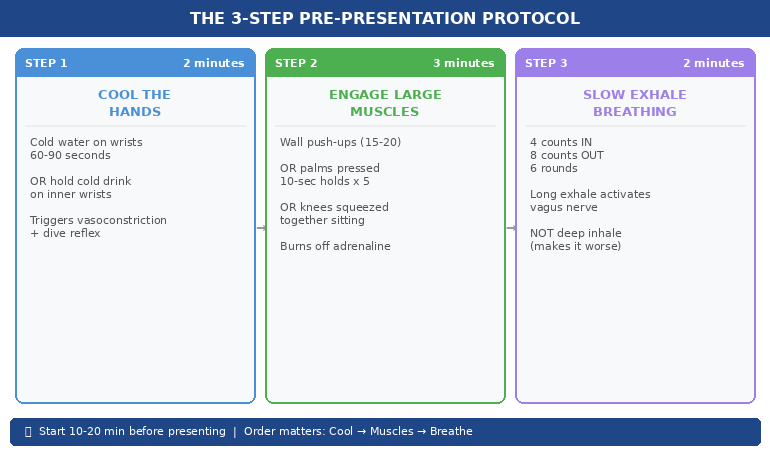
This protocol works best when applied 10–20 minutes before you’re due to present. It targets the three physiological mechanisms that cause severe shaking. (This is educational, not medical advice. If your hands shake outside of presentation situations — at rest, during meals, or in daily tasks — consult a clinician to rule out other causes.)

Step 1: Cool the hands (2 minutes). Run your wrists and the backs of your hands under cold water for 60–90 seconds. If no sink is available, hold a cold drink can or a bottle of cold water against your inner wrists. This triggers a vasoconstriction response — your blood vessels narrow slightly, reducing the tremor amplitude. It also activates your mammalian dive reflex, which nudges your nervous system toward parasympathetic (calming) mode. This is not a placebo effect — it’s a recognised physiological response that many professionals find effective.

Step 2: Engage the large muscles (3 minutes). Find somewhere private — a toilet cubicle, a stairwell, an empty corridor. Do wall push-ups (15–20), or press your palms together as hard as you can for 10-second holds (repeat 5 times), or squeeze your thighs by sitting and pressing your knees together hard. The goal is to burn off the excess adrenaline that’s causing the tremor. Adrenaline was designed to fuel large muscle action. When you give it large muscles to work with, the surplus gets metabolised and the fine motor tremor reduces. This is the single most effective intervention for severe shaking.

Step 3: Slow exhale breathing (2 minutes). Breathe in for 4 counts. Breathe out for 8 counts. Repeat 6 times. The extended exhale activates the vagus nerve, which is the main brake pedal on your sympathetic nervous system. Standard “deep breathing” advice (breathe in deeply!) actually makes anxiety worse because it over-oxygenates your blood. The key is the long exhale, not the deep inhale. Four in, eight out. Six rounds. That’s all.


Three-step pre-presentation protocol showing cool hands then engage large muscles then slow exhale breathing with time estimates

The order matters. Cool first (reduce blood flow to trembling extremities), muscle engagement second (burn off adrenaline), breathing third (activate the calming brake). If you skip to breathing without doing steps 1 and 2, the adrenaline is still circulating and the breathing alone won’t be enough for severe shaking.

For milder shaking, the 30-second nervous system reset may be sufficient. But if your shaking is severe enough that you can’t hold a clicker or turn a page, you need the full three-step protocol.

🎧 Want a guided version of this protocol you can use before any presentation?

Calm Under Pressure is an programme that walks you through the nervous system reset — designed for severe physical symptoms, not just general nerves.

Get Calm Under Pressure → £19.99

What to Do If You’re Already Shaking Mid-Presentation

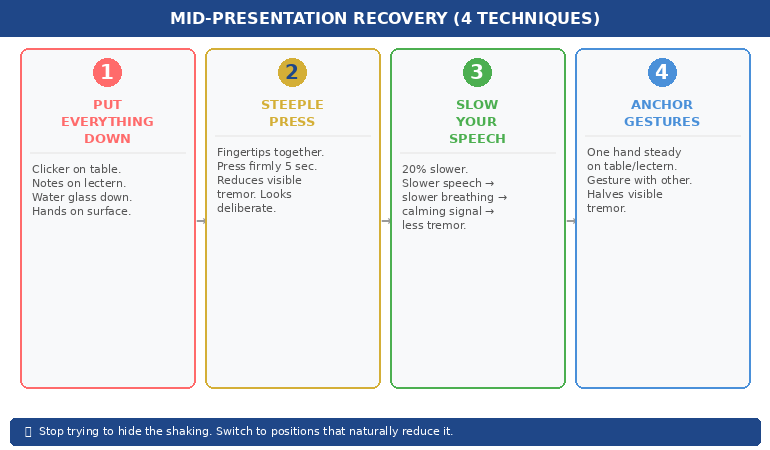
Sometimes the shaking starts after you’ve begun presenting. You’re two slides in, you reach for your water glass, and you see your hand trembling. Panic compounds the problem — the awareness of shaking triggers more adrenaline, which triggers more shaking. Here’s how to interrupt the cycle:

Put everything down. Clicker on the table. Notes on the lectern. Water glass back down. Don’t try to hold anything while your hands are shaking — it makes the tremor more visible, not less. Resting your hands on the table or the sides of the lectern is completely natural and nobody will question it.

Press your fingertips together. Bring both hands together in front of you with fingertips touching (like a steeple). Press firmly for 5 seconds. This engages the small muscles in your hands isometrically, which temporarily reduces the visible tremor. It also looks deliberate and thoughtful — nobody reads steepled hands as nervousness.

Speak more slowly. When adrenaline surges, your speech speeds up, which speeds up your breathing, which increases the shaking. Deliberately slowing your speech by 20% creates a feedback loop in the opposite direction: slower speech → slower breathing → calming signal to the nervous system → reduced tremor. You will feel like you’re speaking absurdly slowly. You’re not. You’re speaking at normal pace for the first time.

Use anchor gestures. Instead of pointing at slides (which requires fine motor precision and makes tremor visible), use broad palm-up gestures or hold one hand steady on the table while gesturing with the other. Anchor one hand and free the other. This halves the visible tremor and gives your body a stable reference point.

PAA: How do I stop my hands shaking during a presentation?
If you’re already shaking mid-presentation, put everything down (clicker, notes, water), press your fingertips together in a steeple for 5 seconds (isometric engagement reduces visible tremor), slow your speech by 20% (creates a calming feedback loop), and use anchor gestures (one hand steady on the table, gesture with the other). The key is to stop trying to hide the shaking — which makes it worse — and instead switch to positions and movements that naturally reduce it.

The Night-Before Reset That Changes the Morning After

Calm Under Pressure is designed to be used the evening before or morning of a presentation. The technique works directly on the nervous system responses that cause severe shaking, racing heart, and shallow breathing — so you walk into the room with your physiology already calmer.

Get Calm Under Pressure → £19.99

Instant download.  Programme built from clinical hypnotherapy training. Designed specifically for physical presentation symptoms at the severe end.


Mid-presentation recovery techniques showing put everything down then steeple press then slow speech then anchor gestures

The Equipment Strategy (Eliminate the Evidence)

One of the smartest things you can do for severe hand shaking is eliminate every situation where the shaking becomes visible. This isn’t avoidance — it’s tactical presentation design:

Ditch the clicker. Use a wireless keyboard shortcut to advance slides (press the right arrow key on a laptop at the table), or ask a colleague to advance slides for you. Saying “next slide, please” is completely normal in corporate settings. Nobody questions it. And you’ve just eliminated the single biggest tremor-revealing object.

Never hold paper. If you need notes, put them flat on the table or the lectern. A vibrating sheet of paper amplifies hand tremor by a factor of ten — it’s the most visible possible evidence of shaking. Flat notes on a surface are completely invisible.

Use a heavy water glass. If you need water during the presentation, choose the heaviest glass available. A lightweight plastic cup trembles visibly. A heavy glass tumbler dampens the tremor. Better yet, take a sip before you start and don’t touch the glass during the presentation.

Stand behind something. A lectern, a table edge, a standing desk. Not to hide — but to give your hands a natural resting place. Hands resting on a surface don’t shake visibly. Hands hanging at your sides or holding objects do. Choose your position strategically.

🎧 Address the root cause — not just the tactics.

Calm Under Pressure works on the nervous system directly so the shaking is less severe before it starts. Equipment strategies help in the moment. The programme helps long-term.

Get Calm Under Pressure → £19.99

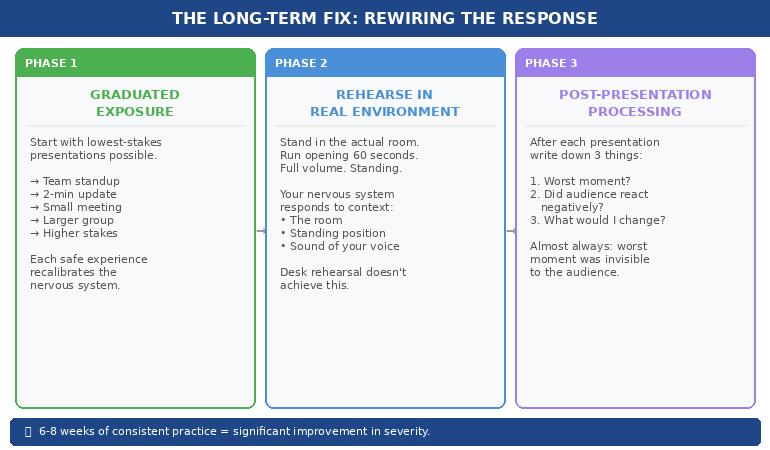
The Long-Term Fix (Rewiring the Response)

The protocol and equipment strategies manage the symptom. The long-term fix addresses the cause: your nervous system has learned to classify “presenting” as a threat, and it needs to be retrained to classify it as safe.

This is not about positive thinking or affirmations. It’s about systematic desensitisation — gradually exposing your nervous system to the presentation stimulus while keeping your body in a calm state, so your brain learns a new association: presenting = safe.

Graduated exposure. Start with the lowest-stakes presentation you can find. A team standup. A 2-minute update in a small meeting. Present something low-risk to people who don’t evaluate you. Then increase the stakes gradually — slightly larger group, slightly more important topic, slightly higher scrutiny. Each time your nervous system experiences “presenting” without a threat materialising, it recalibrates. This is the same principle used in clinical treatment of phobias.

Pre-presentation rehearsal. Stand in the actual room where you’ll present, if possible. Run through your opening sixty seconds — out loud, at full volume, standing in the position you’ll use. Your nervous system responds to environmental cues (the room, the standing position, the sound of your own voice). Rehearsing in the real environment teaches your body that this specific context is safe. Rehearsing at your desk with notes doesn’t achieve this.

Post-presentation processing. After each presentation, write down three things: (1) What was the worst moment? (2) Did the audience actually react negatively? (3) What would I do differently? This creates a feedback loop that corrects your nervous system’s threat assessment. Almost always, the worst moment was invisible to the audience, they didn’t react negatively, and the “evidence” of failure exists only in your own perception.

If you’ve experienced a full panic attack before presenting, the graduated exposure approach is especially important — start smaller than you think necessary, and build up more slowly than feels logical.


Long-term fix showing graduated exposure then rehearse in real environment then post-presentation processing feedback loop

PAA: Can you permanently fix hand shaking when presenting?
Yes, but it requires retraining your nervous system, not just managing the symptoms. The approach combines graduated exposure (starting with low-stakes presentations and building up), rehearsal in the actual presentation environment, and post-presentation processing to correct your brain’s threat assessment. Clinical techniques like hypnotherapy and systematic desensitisation can accelerate this process. Most people see significant improvement within 6–8 weeks of consistent practice — the shaking doesn’t disappear overnight, but it reduces progressively as your nervous system learns that presenting is safe.

Start Rewiring Your Nervous System Before Your Next Presentation

Calm Under Pressure combines clinical hypnotherapy techniques with practical nervous system management — designed specifically for the physical symptoms that standard presentation coaching doesn’t address. Use it the night before. Walk in calmer.

Get Calm Under Pressure → £19.99

Instant download. Built from clinical hypnotherapy training + five years of personal experience with severe presentation anxiety. Designed for the physical end of the spectrum.

Frequently Asked Questions

Should I tell the audience my hands are shaking?

Generally no. Drawing attention to the shaking amplifies your awareness of it (which triggers more adrenaline, which increases the shaking). Most audiences either don’t notice or don’t care — they’re focused on your content, not your hands. The exception: if the shaking is so severe that ignoring it feels absurd, a brief, confident acknowledgement can actually reduce the pressure. “I’ve got a bit of adrenaline going — let me set this down” is honest and human. Then move on immediately. Don’t dwell on it.

Could the shaking be a medical condition rather than anxiety?

If your hands shake in situations other than presenting — at rest, while eating, during normal daily tasks — it’s worth consulting a doctor to rule out essential tremor, thyroid issues, or other medical causes. Anxiety-related presentation shaking is situation-specific: it happens before and during presentations and stops afterwards. If the shaking persists outside of high-pressure situations, seek medical advice before assuming it’s anxiety-related.

Does beta-blocker medication help with presentation shaking?

Beta-blockers (such as propranolol) are sometimes prescribed for performance anxiety and can reduce the physical symptoms including hand tremor. They work by blocking the effects of adrenaline on your heart and muscles. However, they require a prescription, they affect everyone differently, and they address the symptom without changing the underlying nervous system response. If you’re considering medication, discuss it with your GP. The techniques in this article can be used alongside medication or as an alternative — they’re not mutually exclusive.

How long before a presentation should I start the protocol?

The three-step protocol (cool, muscle engagement, breathing) works best 10–20 minutes before you’re due to present. Starting too early means the effects wear off. Starting too late means you don’t have time for all three steps. If you only have 5 minutes, prioritise step 2 (muscle engagement) — it’s the single most effective intervention for burning off adrenaline. If you only have 2 minutes, do the extended exhale breathing (4 in, 8 out, 6 rounds).

📬 The Winning Edge Newsletter

Weekly strategies for presentation confidence, nervous system management, and career-critical communication. No fluff.

Subscribe free →

Optional next step: Start with Calm Under Pressure for the physical symptoms. If your presentation anxiety goes beyond the body — if you avoid presentations entirely, procrastinate on preparation, or experience dread days before presenting — Conquer Speaking Fear (£39) addresses the psychological root causes alongside the physical management.

Related: Physical symptoms are one side of the coin. If you’re also preparing for a high-stakes presentation like a job interview presentation, getting the structure right reduces anxiety — because when you know your material is well-organised, your nervous system has less reason to panic.

Severe hand shaking during presentations is a physiological event, not a character flaw. Cool the hands. Engage the large muscles. Breathe on the exhale. Design your equipment to eliminate evidence. And start the long-term work of teaching your nervous system that presenting is safe. The shaking will reduce. It did for me.

🎧 Start with the nervous system reset — use it before your next presentation.

Get Calm Under Pressure → £19.99

Optional bundle: Calm Under Pressure handles the physical symptoms. But if you also want the slide structure, Q&A preparation, and psychological confidence framework alongside it — The Complete Presenter (£99) includes all seven Winning Presentations products plus three bundle-only bonuses. Everything you need to walk in prepared and stay calm through to the last question.

About the Author

Mary Beth Hazeldine is the Owner & Managing Director of Winning Presentations. With 24 years of corporate banking experience at JPMorgan Chase, PwC, Royal Bank of Scotland, and Commerzbank, she spent five of those years dealing with severe presentation anxiety — including the hand shaking, racing heart, and avoidance that come with it.

She trained as a clinical hypnotherapist and NLP practitioner specifically to solve the problem, and now helps executives manage the physical and psychological dimensions of presentation anxiety so they can present with confidence when it matters most.

Book a discovery call | View services

16 Feb 2026
Professional pausing mid-presentation at glass whiteboard, finger on content, composed and thoughtful expression, colleagues visible in background

Why You Keep Losing Your Train of Thought Mid-Presentation (And the Fix)

Fourteen slides in, I forgot what country I was presenting about.

Quick answer: Losing your train of thought during a presentation isn’t a memory problem — it’s a cognitive overload problem. Your working memory can hold roughly four pieces of information at once, and presentation anxiety floods it with threat signals that push out your content. The fix isn’t memorising harder. It’s reducing the load on your working memory before you present, and having a 3-second recovery protocol for when it happens anyway. Both are learnable skills, not personality traits.

I was presenting a cross-border integration plan to forty people at Commerzbank. The London and Frankfurt teams. Senior management on both sides. I’d rehearsed. I knew the material cold. Then someone shifted in their chair during slide fourteen, and my brain decided that shift meant disapproval.

Mid-sentence, everything emptied. I couldn’t remember what I’d just said, what came next, or why I was standing there. The silence lasted maybe four seconds. It felt like a year.

I looked down at my slide title — “Regulatory Timeline: Phase 2” — and said: “So, the critical milestone here is the March deadline.” I was back. Nobody in that room knew I’d just experienced a total cognitive wipeout. That four-second gap taught me more about presentation recovery than five years of preparation ever had.

If you want a structured approach to managing presentation nerves: Explore Conquer Your Fear of Public Speaking →

A neuroscience-based programme for professionals who want to present with genuine confidence.

Why It Happens (It’s Not Your Memory)

The standard advice for losing your train of thought is “prepare better” or “practise more.” This is wrong — and understanding why it’s wrong is the first step to fixing it permanently.

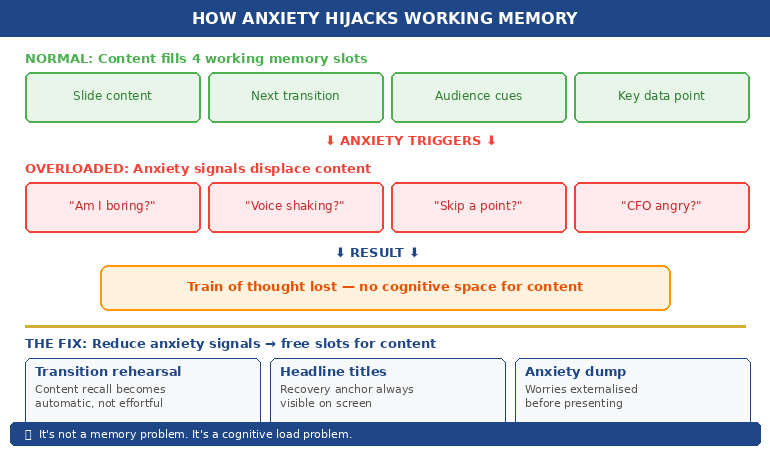
Your working memory — the part of your brain that holds what you’re saying right now, what you’re about to say next, and how your audience is responding — has a capacity of roughly four items. In a normal conversation, that’s plenty. But during a presentation, your working memory is also processing: “Are they bored? Was that the right word? Is my voice shaking? Did I skip a section? Is the CFO checking his phone?”

Each of those threat-monitoring thoughts takes up a slot. When all four slots are occupied by anxiety signals, there’s literally no cognitive space left for your content. Your train of thought doesn’t derail because you forgot. It derails because your brain prioritised danger detection over information delivery.

This is why it happens more to experienced professionals, not less. As a qualified clinical hypnotherapist, I’ve seen this pattern repeatedly with senior executives: the more senior you become, the higher the stakes feel, and the more working memory gets hijacked by threat monitoring. The VP presenting a quarterly update to peers loses their place more often than the graduate presenting their first project summary — because the VP’s brain calculates the cost of failure as higher.

The fight-or-flight response is the mechanism behind this. When your amygdala detects threat (even social threat like judgement), it diverts resources away from your prefrontal cortex — the part of your brain responsible for sequential thinking, language production, and working memory. Your brain is literally choosing survival over eloquence.

PAA: Why do I keep losing my train of thought when presenting?
Presentation anxiety triggers your threat-detection system, which floods your working memory with danger signals. Since working memory can only hold about four items at once, anxiety pushes out your content. This is a neurological response, not a preparation failure. Reducing the cognitive load before you present — through slide-title anchoring, transition rehearsal, and pre-presentation anxiety protocols — prevents the overload before it starts.

The System That Stops the Cognitive Hijack

Conquer Speaking Fear gives you the neurological reset protocols, pre-presentation anxiety tools, and in-the-moment recovery techniques that keep your working memory clear — so your content stays accessible when the pressure is highest.

Get Conquer Speaking Fear → £39

Built from clinical hypnotherapy training + 24 years presenting in high-stakes corporate environments at JPMorgan Chase, PwC, RBS, and Commerzbank.

The 3-Second Mid-Sentence Recovery

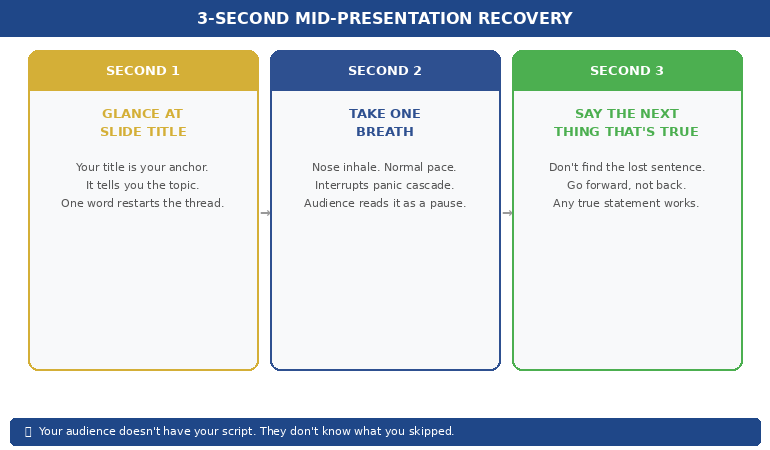
You’re mid-sentence and the thread vanishes. Here’s the protocol — three seconds, three steps. Practise it once and it becomes automatic.

Second 1: Glance at your slide title. Not the content. Not the data. The title. Your slide title is your anchor — it tells you exactly what this section is about. If your title says “Q3 Revenue by Region,” you immediately know the topic. That single piece of information is enough to restart your working memory because it gives your brain a category to pull from, not a specific sentence to recall.

Second 2: Take one breath. Not a dramatic pause. Not a deep meditation breath. One normal inhale through your nose. This does two things: it interrupts the panic cascade (your amygdala responds to controlled breathing as a safety signal), and it gives your prefrontal cortex one second to re-engage. Your audience reads this as a thoughtful pause, not a breakdown.

Second 3: Say the next thing that’s true. Don’t try to find the exact sentence you lost. Say whatever is true about the topic on your slide. “The key number here is…” or “What this means for us is…” or “The critical point on this slide is…” You’re not going back to where you were. You’re going forward from where you are. Your audience doesn’t have your script. They don’t know what you skipped.


Three-second recovery protocol for losing train of thought showing glance at slide title, breathe, say the next true thing

This is fundamentally different from the advice in our article on what to do when your mind goes blank, which covers total blank-outs. Losing your train of thought is a partial failure — you know the topic, you’ve lost the thread. The recovery is faster because you have more to work with. You just need to restart the sequence, not rebuild it from nothing.

🧠 Want the full recovery toolkit — including the pre-presentation protocols that prevent this?

Conquer Speaking Fear includes the neurological reset, anxiety-reduction sequences, and in-the-moment recovery techniques used in high-stakes boardrooms.

Get Conquer Speaking Fear → £39

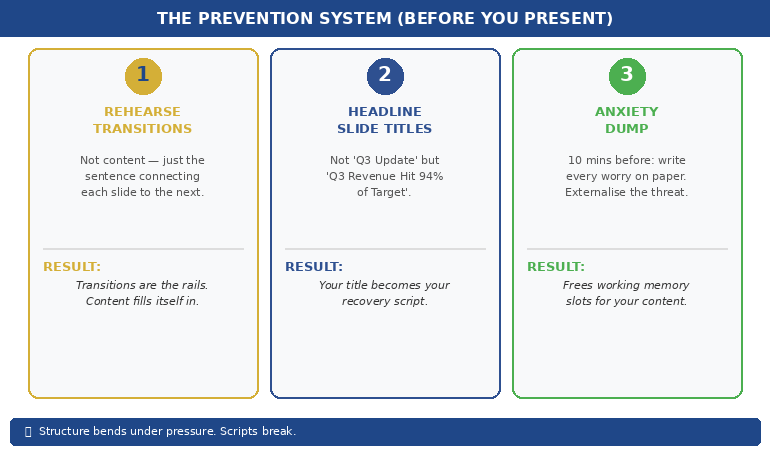
The Prevention System (Before You Present)

Recovery is essential. Prevention is better. Here are the three techniques that reduce the probability of losing your train of thought from “every presentation” to “rarely.”

1. Rehearse transitions, not content. Most people rehearse what they’ll say on each slide. This fills working memory with content recall — exactly the kind of load that gets displaced by anxiety. Instead, rehearse only the transitions: the single sentence that connects one slide to the next. “So that’s the revenue picture — now let’s look at what’s driving it.” When you know your transitions, you can lose the middle of any slide and still get to the next one. The transitions are the rails. The content fills itself in.

2. Write headline-complete slide titles. Generic titles like “Q3 Update” or “Market Analysis” give your brain nothing to work with during a blank. Headline titles like “Q3 Revenue Recovered to 94% of Target” or “Market Share Grew Despite Price Increase” tell you exactly what to say even if you’ve forgotten everything else. Your slide title becomes your recovery script. If you lose your thread, the title is sitting right there — and it contains the point you need to make.

3. Pre-presentation anxiety dump. Ten minutes before you present, write down every worry on a piece of paper. “They’ll think I’m underprepared.” “The CFO will ask about the variance.” “I’ll stumble on the technical section.” This isn’t journaling — it’s a cognitive offload. Research on expressive writing shows that externalising anxious thoughts frees working memory capacity. You’re literally clearing slots for your content by moving the worry out of your head and onto paper.

The professionals who over-explain during presentations are often doing so because they sense themselves losing the thread and compensate by adding more words. The prevention system stops the root cause — working memory overload — rather than treating the symptom.

PAA: How do I stop forgetting what to say during a presentation?
Rehearse your transitions between slides (not the content on each slide), write headline-complete slide titles that double as recovery scripts, and do a 10-minute anxiety dump before presenting. These three techniques reduce working memory load so your content stays accessible even when nerves are high. The goal isn’t perfect recall — it’s having a structure that keeps you moving forward regardless of what you forget.

The Prevention + Recovery System for High-Stakes Presenters

Conquer Speaking Fear gives you the complete anxiety management system — pre-presentation protocols that keep your working memory clear, in-the-moment recovery techniques, and the cognitive restructuring tools that break the anxiety cycle permanently.

Get Conquer Speaking Fear → £39

Used in board meetings, steering committees, and investor presentations. Built from clinical hypnotherapy training + 24 years in corporate banking.


Prevention system for losing train of thought showing three techniques: rehearse transitions, headline slide titles, pre-presentation anxiety dump

What to Do in the Worst Case (Total Blank)

Sometimes the 3-second recovery isn’t enough. You glance at the slide title and nothing comes. Your brain is fully offline. Here’s the escalation protocol.

Ask the room a question. “Before I continue — what’s your biggest concern about this timeline?” or “Quick check: does this match what you’re seeing in your region?” This does three things at once: it buys you 20–30 seconds while someone responds, it shifts the cognitive load to someone else temporarily, and it often triggers your own memory because hearing someone else’s perspective reactivates the neural pathway your content lives on.

Advance to the next slide. If you’re completely stuck on slide nine, move to slide ten. A new slide gives your brain a new anchor point — new title, new visual, new topic. The content on the previous slide can be addressed later (“Let me circle back to the implementation timeline”). Your audience doesn’t know you skipped forward. They assume you’re being efficient.

Narrate what you see. If everything has gone and you can’t move forward, describe what’s literally on the screen. “This chart shows our revenue trajectory over the past four quarters.” This is not insightful commentary — it’s a restart mechanism. The act of verbalising what you see re-engages your prefrontal cortex and typically breaks the freeze within 5–10 seconds. The first sentence is the hardest. Once you’re talking again, the thread comes back.

🧠 These recovery protocols are just one part of the system.

Conquer Speaking Fear includes the complete anxiety management toolkit — from pre-presentation reset to mid-presentation recovery to long-term confidence rewiring.

The Patterns That Make It Worse

Certain presentation habits dramatically increase the probability of losing your train of thought. Recognise any of these:

Scripting word-for-word. If you memorise a script, your brain is running a recall task — pulling exact words in exact order from long-term memory. This is an extraordinarily fragile process under stress. One missed word and the entire sequence collapses, because each word depends on the previous one. Professionals who present from structure (knowing their points, not their sentences) almost never lose their thread — because any sentence that makes the point is a correct sentence.

Avoiding eye contact. When you avoid eye contact, you lose the social feedback that keeps your brain anchored. Eye contact with one friendly face activates your social-engagement nervous system (the ventral vagal pathway), which actively suppresses the fight-or-flight response. One face, four seconds, per section. That’s enough to keep your threat-detection system quiet and your working memory clear.

Presenting too much information. Cognitive overload doesn’t start mid-presentation. It starts in the preparation phase. If you’re trying to cover twenty points in fifteen minutes, your brain is running a constant prioritisation algorithm that consumes working memory even before anxiety enters the picture. Fewer points means less cognitive load means more working memory available for delivery.

PAA: Can anxiety cause you to lose your train of thought?
Yes — this is the primary cause for most professionals. Anxiety activates your amygdala, which diverts cognitive resources away from your prefrontal cortex (responsible for working memory, sequential thinking, and language production). The result is that your content gets displaced by threat signals. This is a neurological mechanism, not a character flaw, and it’s more common in experienced professionals because higher seniority means higher perceived stakes.


Working memory diagram showing four cognitive slots normal versus overloaded with anxiety signals during presentations


Frequently Asked Questions

Is losing my train of thought a sign of poor preparation?

Almost never. The professionals who lose their thread most frequently are typically the best-prepared — because over-preparation creates rigidity, and rigidity collapses under anxiety. The fix is structural preparation (transitions + headline titles) rather than content memorisation. Structure bends under pressure; scripts break.

Should I use notes or a teleprompter to prevent this?

Notes as a safety net are fine. Notes as a script are dangerous. If you’re reading from notes, your brain is running two tasks simultaneously — reading and presenting — which doubles the cognitive load. A single card with your five transition sentences is more useful than three pages of scripted content. If you must use notes, write only your slide transitions and one key data point per section.

Does this get worse with age or seniority?

Yes, for most people — but not because of cognitive decline. It gets worse because seniority increases the perceived stakes. A director presenting to the board calculates higher personal consequences than an analyst presenting to their team, which triggers a stronger fight-or-flight response and greater working memory displacement. The techniques in this article work specifically because they address the anxiety mechanism, not the memory mechanism.

What if I lose my train of thought during a Q&A, not the presentation itself?

Q&A derailments are actually easier to recover from because the format is already conversational. Use the bridge technique: “That’s a good question — let me think about the best way to answer that.” This buys you 3–5 seconds and signals thoughtfulness, not confusion. Then answer whatever part of the question you do remember. If you’ve genuinely forgotten the question, ask them to repeat it — this is completely normal and nobody judges it.

📬 The Winning Edge Newsletter

Weekly strategies for speaking confidence, executive presence, and career-critical presentation moments. No fluff.

Subscribe free →

🎯 Free: Executive Presentation Checklist

The pre-presentation checklist that includes the working memory protection protocol, slide-title anchoring system, and transition rehearsal framework — everything in this article, condensed into a printable one-pager.

📊 Optional: Want the slides too?

Preparation reduces anxiety. The includes headline-complete slide templates designed to minimise working memory load — so you always have an anchor point to recover from.

Related: Losing your train of thought is magnified when you’re presenting under time pressure with no preparation. If you’ve been thrown into a last minute presentation, the 5-slide emergency framework gives you a structure that’s impossible to lose your place in — because each slide has exactly one job.

Losing your train of thought isn’t a preparation failure. It’s a working memory problem with a neurological solution. Glance at the title. Breathe. Say the next thing that’s true. And before you present, rehearse your transitions, write headline titles, and dump the anxiety on paper.

🎯 Present with the confidence that comes from knowing you can recover from anything.

Get Conquer Speaking Fear → £39

About the Author

Mary Beth Hazeldine is the Owner & Managing Director of Winning Presentations. A qualified clinical hypnotherapist and NLP practitioner who spent five years battling presentation terror before learning to overcome it, she now helps executives speak with confidence in high-stakes environments.

With 24 years of corporate banking experience at JPMorgan Chase, PwC, Royal Bank of Scotland, and Commerzbank, Mary Beth combines neurological understanding of presentation anxiety with practical frameworks tested in real boardrooms — not classrooms.

Book a discovery call | View services

12 Feb 2026
Professional reflecting on past presentation experience with contemplative expression

Presentation PTSD Is Real: Signs You’re Still Carrying an Old Failure

It was seven years ago. I still remember exactly what I was wearing.

The room had 40 people. I was presenting quarterly results to the leadership team. Slide 12 — a chart I’d built myself — had an error. The CFO spotted it immediately. “These numbers don’t add up,” he said. Not quietly. Not kindly.

For the next three minutes, I stood there while he picked apart my work in front of everyone. My face burned. My voice disappeared. I wanted the floor to open and swallow me whole.

That presentation ended my confidence for years. Every time I stood up to speak after that, I wasn’t in the current room — I was back in that room, waiting for someone to find the error, waiting for the humiliation to start again.

If you’ve had a presentation experience that still affects how you feel about speaking — even years later — you’re not being dramatic. Your nervous system is doing exactly what it’s designed to do. It’s trying to protect you from a threat it still believes is real.

I’m writing about this now because presentation anxiety is increasingly recognised as a genuine psychological response, not a character flaw. Recent understanding of how trauma affects the nervous system explains why “just get over it” doesn’t work — and what actually does.

Quick answer: Presentation trauma occurs when a difficult speaking experience becomes encoded in your nervous system as a threat. Signs include physical reactions (racing heart, sweating, nausea) that seem disproportionate to the current situation, avoidance behaviours, intrusive memories of past failures, and anticipatory anxiety that starts days before a presentation. Recovery involves recognising the pattern, working with your nervous system rather than against it, and gradually rebuilding positive associations with speaking. Some people notice shifts relatively quickly; deeper patterns can take longer. The key is that recovery is possible — your nervous system learned this response, and it can learn something new.

⏰ Presenting in the next 48 hours?

Three things to do right now to calm your nervous system:

  1. Tonight: Use a guided nervous system reset before bed (18–20 min)
  2. Tomorrow morning: Avoid caffeine; do 5 minutes of slow breathing
  3. Minutes before: Use a 90-second physical reset in the corridor

If you’d rather work from a structured system, the Conquer Speaking Fear programme includes guided audio for each of those three moments.

Note: This article discusses presentation-related anxiety and trauma responses. While these experiences are common and the techniques here help many people, persistent or severe symptoms may benefit from support with a qualified mental health professional. The term “PTSD” is used colloquially here to describe trauma-like responses to presentation experiences — clinical PTSD is a specific diagnosis that requires professional assessment.

As a certified hypnotherapist who now works with executives on presentation anxiety, I’ve heard hundreds of these stories. The details differ — a forgotten line, a hostile question, a technology failure, a panic attack — but the pattern is remarkably consistent.

Something happened. It felt terrible. And now, years later, it still controls how you feel about presenting.

The good news: this isn’t permanent. Your nervous system learned this fear response, and it can unlearn it. But first, you need to understand what’s actually happening.

Signs You’re Carrying Presentation Trauma

Presentation trauma doesn’t always announce itself obviously. Sometimes it shows up as “I just don’t like presenting” or “I’m not a natural speaker.” But there are specific signs that suggest you’re carrying something from the past:

1. Your Body Reacts Before Your Mind Does

You get an email about an upcoming presentation. Before you’ve even processed what it says, your heart rate increases. Your stomach tightens. Your palms get clammy.

This instant physical response — before conscious thought — is a hallmark of trauma. Your nervous system has flagged “presentation” as a threat and is activating your fight-or-flight response automatically.

2. The Fear Seems Disproportionate

You’re presenting to three friendly colleagues about a topic you know well. Objectively, the stakes are low. But your body is reacting like you’re about to face a firing squad.

When the fear response doesn’t match the actual situation, it’s often because your nervous system is responding to a past threat, not the current one.

3. You Have Intrusive Memories

When you think about presenting, your mind automatically goes to that time it went wrong. You can see it clearly — the faces, the room, the moment everything fell apart. These memories arrive unbidden and feel uncomfortably vivid.

4. You Avoid at All Costs

You’ve turned down opportunities, delegated important moments to others, or restructured your career to minimise presenting. The avoidance has become a pattern that shapes your professional life.

5. Anticipatory Anxiety Starts Days (or Weeks) Early

A presentation is scheduled for next Thursday. By Sunday, you’re already feeling anxious. By Wednesday night, you can’t sleep. The dread builds exponentially as the date approaches.

6. You Experience Shame, Not Just Fear

There’s a difference between “I’m afraid of presenting” and “I’m ashamed of how I present.” Trauma often carries shame — a feeling that you are fundamentally flawed, not just that the situation is scary.

🎯 Release Presentation Trauma With Guided Nervous System Work

Conquer Speaking Fear — £39, instant access — uses hypnotherapy and NLP techniques specifically designed to work with your nervous system, not against it. The programme includes three audio tools for different moments:

  • Full Guided Session (18-20 min): Deep nervous system reprogramming — use the night before
  • 90-Second Reset Audio: Quick calm-down for the corridor or bathroom — minutes before
  • Printable Pocket Card: 4-step physical reset — in the moment when you need it

Get Conquer Speaking Fear → £39

Instant download. Created by a certified hypnotherapist who spent five years terrified of presenting — and found a way out.

Why Your Nervous System Won’t “Just Let It Go”

If you’ve ever been told to “just relax” or “it’s not a big deal,” you know how unhelpful that advice is. Here’s why your nervous system doesn’t respond to logic:

The Amygdala Doesn’t Have a Calendar

Your amygdala — the brain’s threat-detection centre — processes experiences without timestamps. A humiliating presentation from 2018 feels just as threatening as one happening right now, because to your amygdala, there’s no difference between “this happened” and “this is happening.”

Emotional Memories Are Stored Differently

Traumatic experiences aren’t filed away like regular memories. They’re stored in a fragmented, sensory way — which is why a particular room layout, a certain type of projector, or even a specific smell can trigger the whole response pattern.

Your Body Keeps the Score

The fear isn’t just in your mind — it’s encoded in your body. Your posture, your breathing pattern, your muscle tension all hold the memory. This is why cognitive approaches (“think positive thoughts”) often fail. The body remembers what the mind tries to forget.

Avoidance Reinforces the Fear

Every time you avoid presenting, your nervous system gets confirmation: “See? That was dangerous. Good thing we escaped.” The avoidance provides temporary relief but strengthens the fear response long-term.

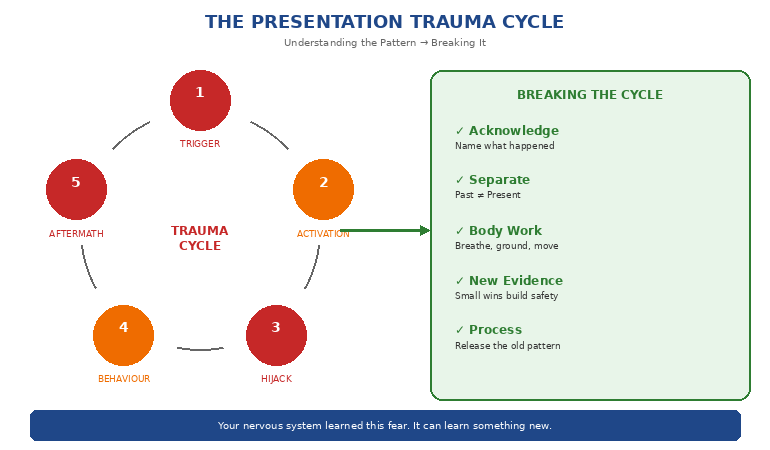
The Trauma Response Cycle

Understanding the cycle helps you interrupt it:

Stage 1: Trigger
Something reminds your nervous system of the original threat — a calendar invite, a request to present, even someone mentioning “presentation” in conversation.

Stage 2: Activation
Your fight-or-flight system activates. Heart rate increases, stress hormones release, blood flows away from your prefrontal cortex (thinking brain) toward your survival systems.

Stage 3: Hijack
Your rational mind goes offline. You can’t think clearly, can’t access your preparation, can’t remember that you’re actually safe. The past has hijacked the present.

Stage 4: Behaviour
You either fight (get defensive, speak too fast, overcompensate), flight (avoid, delegate, call in sick), or freeze (mind goes blank, voice disappears, body locks up).

Stage 5: Aftermath
Regardless of how the presentation actually went, you feel depleted, ashamed, and more convinced than ever that presenting is dangerous. The cycle reinforces itself.


Presentation trauma cycle showing trigger, response, and recovery pathway

Breaking the cycle means working with your body, not just your mind — the Conquer Speaking Fear programme (£39) is built around that principle, with guided audio that interrupts this exact pattern.

How to Release the Pattern

Recovery from presentation trauma isn’t about forcing yourself to present more (exposure therapy without proper support often makes things worse). It’s about working with your nervous system to create new associations.

Step 1: Acknowledge What Happened

Stop minimising. “It wasn’t that bad” or “I should be over it by now” keeps you stuck. Something happened that affected you. That’s real. Your response makes sense given what you experienced.

I spent years pretending my CFO moment didn’t bother me. Recovery only started when I admitted: that was humiliating, it hurt, and it changed how I felt about presenting.

Step 2: Separate Past from Present

When you notice the fear response activating, practice naming it: “This is my nervous system responding to 2018, not to today.” You’re not trying to make the feeling go away — you’re creating space between the trigger and your response.

Step 3: Work With Your Body

Because the trauma is stored in your body, body-based techniques are often more effective than cognitive ones:

  • Slow exhales: Longer exhales than inhales can help activate your parasympathetic nervous system
  • Grounding: Feel your feet on the floor, your weight in the chair — anchor yourself in the present moment
  • Movement: Shake out your hands, roll your shoulders — discharge the physical activation
  • Posture reset: Stand tall, open your chest — your body’s position affects your emotional state

Step 4: Create New Experiences

Your nervous system needs evidence that presenting can be safe. This doesn’t mean forcing yourself into high-stakes situations. It means starting small:

  • Speaking up in a meeting with one comment
  • Presenting to one trusted colleague
  • Recording yourself and watching without judgment
  • Gradually increasing the challenge as your nervous system adapts

Step 5: Process the Original Experience

Sometimes the old memory needs direct attention. Techniques like guided visualisation, timeline therapy, or working with a therapist can help you process what happened so it no longer controls your present.

This is where hypnotherapy-based approaches can be particularly effective — they work directly with the subconscious patterns that keep the trauma response active.

🧠 Nervous System Reprogramming for Presentation Trauma

Conquer Speaking Fear (£39, instant access) was created specifically for professionals carrying presentation trauma. The guided hypnotherapy session helps your nervous system release the old pattern and build new, calmer associations with speaking.

  • Work with your subconscious, not against it
  • Release the physical holding patterns
  • Build genuine confidence (not just “fake it”)
  • Three audio formats for different situations

Get Conquer Speaking Fear → £39

Instant download. Developed from hypnotherapy techniques that helped me release my own presentation trauma after five years of suffering.

Rebuilding Confidence After a Bad Experience

Once you’ve started releasing the trauma pattern, you can begin rebuilding genuine confidence:

Reframe the Original Story

The story you tell yourself about what happened matters. “I failed and everyone saw” is different from “I had a difficult experience and I survived it.”

My CFO story? I eventually reframed it: “I made an error, someone called it out publicly, and I handled a difficult moment without falling apart completely. I went back to work the next day. I kept presenting. I survived.”

Collect Counter-Evidence

Your brain has been selectively remembering the bad experience. Start noticing the neutral and positive ones. After each presentation — even a small one — note what went okay. Build a file of evidence that presenting doesn’t always mean disaster.

Prepare Differently

Trauma often creates over-preparation (spending 20 hours on a 10-minute presentation) or under-preparation (avoiding thinking about it until the last minute). Neither works.

Effective preparation for trauma recovery means: know your content well enough to feel secure, but accept that perfection isn’t the goal. Your safety doesn’t depend on getting everything right.

Build Physical Anchors

Create associations between specific physical actions and calm states. When you’re relaxed, practice a subtle gesture (touching your thumb to your finger, for example). Over time, this gesture can help trigger the calm state — giving you a tool you can use in the moment.

This anchoring technique is part of what makes nervous system-based approaches so effective for presentation anxiety.

What Recovery Actually Looks Like

Recovery from presentation trauma isn’t linear, and it doesn’t mean you’ll never feel nervous again. Here’s what realistic progress looks like:

Week 1-2: You start noticing the pattern — recognising when your nervous system is responding to the past rather than the present.

Week 3-4: The anticipatory anxiety begins to shorten. Instead of dreading a presentation for two weeks, you might dread it for a few days.

Month 2-3: You have a presentation that goes “okay” and notice it. The negative bias starts shifting.

Month 3-6: The physical symptoms become less intense. Your heart still races, but it doesn’t feel life-threatening. You can think while nervous.

Ongoing: Presenting becomes uncomfortable rather than terrifying. You can do it without it ruining your week. Eventually, some presentations feel almost… fine.

This timeline varies. Some people see significant shifts in weeks; others take longer. The key is that progress is possible — your nervous system can learn new patterns.

🎓 25 Years Coaching Senior Professionals Through Speaking Fear

Conquer Your Fear of Public Speaking is built from 16 years coaching senior professionals across financial services, consulting, healthcare, and technology — alongside 25 years of corporate banking experience. Every technique — the nervous system regulation work, the trauma-informed preparation rituals, the in-the-moment recovery scripts — comes from real client work with executives who came to speaking with histories that needed careful, not generic, approaches.

Designed for senior professionals whose speaking fear has roots in past experience, not just nerves — and who need approaches that respect that history.

Get Conquer Your Fear of Public Speaking → £39

Instant download — lifetime access to every framework and technique.

Frequently Asked Questions

Is “presentation PTSD” a real diagnosis?

The term is used colloquially to describe trauma-like responses to presentation experiences. Clinical PTSD is a specific diagnosis with defined criteria that requires professional assessment. However, the nervous system responses described in this article — hypervigilance, avoidance, intrusive memories, disproportionate fear responses — are real and well-documented, even if they don’t meet the clinical threshold for PTSD. Your experience is valid regardless of diagnostic labels.

How long does it take to recover from presentation trauma?

This varies significantly based on the severity of the original experience, how long ago it happened, and what support you have. Some people notice shifts within a few weeks; deeper patterns may take several months of consistent work. There’s no universal timeline — everyone’s nervous system responds differently. If you’re not seeing progress after sustained effort, consider working with a therapist who specialises in anxiety or trauma responses. The key is that recovery is possible — your nervous system learned this response, and it can learn a new one.

Should I force myself to present more to get over it?

Exposure without proper support can actually reinforce the trauma. Simply forcing yourself through more presentations while activated often strengthens the fear response. The goal is to present while regulated — which requires first developing tools to work with your nervous system. Gradual, supported exposure works; white-knuckling through high-stakes presentations usually doesn’t.

Can I fully recover, or will I always be anxious about presenting?

Most people don’t become completely anxiety-free — some presentation nerves are normal and even useful. What changes is the intensity and the control. Instead of anxiety hijacking your ability to think and speak, it becomes manageable background noise. Many people who’ve done this work eventually describe presenting as “uncomfortable but doable” rather than “terrifying and avoided at all costs.”

📬 PS: Weekly techniques for managing presentation anxiety and building genuine confidence. Subscribe to The Winning Edge — practical strategies from a hypnotherapist who’s been there.

Related: If presentation trauma is holding you back from career moments like requesting resources or budget, read The Headcount Request That Got Yes When Everyone Said No for a presentation structure that builds confidence through preparation.

That presentation from years ago — the one you still think about — doesn’t have to control your future.

Your nervous system is doing what it was designed to do: protect you from perceived threats. But the threat isn’t real anymore. The room is different. The audience is different. You are different.

Recovery is possible. Your nervous system learned to fear presenting, and it can learn something new.

It starts with acknowledging what happened, understanding why your body responds the way it does, and working with your nervous system rather than against it.

The past doesn’t have to own your present. You can let it go.

About the Author

Mary Beth Hazeldine is the Owner & Managing Director of Winning Presentations. With 25 years in corporate banking at JPMorgan Chase, PwC, Royal Bank of Scotland, and Commerzbank, she experienced presentation trauma firsthand — including five years of debilitating fear before finding techniques that actually worked.

Now a certified hypnotherapist and NLP practitioner, Mary Beth specialises in helping professionals release presentation anxiety at the nervous system level. She combines executive communication expertise with evidence-based approaches to fear and trauma recovery.

Book a discovery call | View services

11 Feb 2026
Professional pausing confidently mid-presentation, moment of composure

When Your Voice Cracks Mid-Sentence (The Recovery Nobody Teaches)

My voice cracked on the word “strategy.”

Two hundred people in the room. The CEO in the front row. And my voice — the one thing I needed to work — just… broke. Mid-word. Mid-sentence. Mid-thought.

What happened next is a blur. I remember heat rising to my face. I remember my throat tightening further. I remember thinking: “Everyone just heard that. Everyone knows.”

I finished the presentation somehow. Smiled through the Q&A. Walked calmly to the bathroom and cried for ten minutes.

That was fifteen years ago. It took me another five years — and training as a clinical hypnotherapist — to understand what actually happened in that moment, and what I could have done differently.

I’m sharing this now because voice cracking is the presentation fear people are most ashamed to admit. In 2026, I’m seeing more professionals struggle with this than ever — hybrid meetings with close-up cameras, AI transcription that captures every hesitation, and audiences who’ve forgotten how to be generous with speakers. If your voice has ever betrayed you, this article is for you.

Quick answer: If your voice cracks when presenting, it’s usually caused by stress-driven breath restriction and throat tension — not a “bad voice.” The fix isn’t “just relax” — it’s a quick downshift in arousal that often reduces tension for many speakers. Mid-presentation, you can recover in 3-5 seconds with a deliberate pause, a slow exhale, and a grounded restart. Long-term, you can train your nervous system to stay calmer so it’s less likely to happen.

Note: This article is educational and not medical advice. If voice cracking happens frequently outside stressful situations, or you experience pain or hoarseness, see an ENT specialist or speech-language pathologist.

After that presentation, I became hypervigilant about my voice. Every meeting, I’d monitor for signs of cracking. Which, of course, made it worse — because vigilance is tension, and tension is exactly what causes the problem.

I tried everything. Vocal exercises. Breathing techniques from YouTube. Drinking warm water. Avoiding dairy. None of it helped consistently, because none of it addressed the root cause.

When I trained as a hypnotherapist, I finally understood: the voice crack isn’t a voice problem. It’s a nervous system problem. And the nervous system doesn’t respond to willpower or tips. It responds to specific interventions that speak its language — like the breathing techniques and pre-presentation calming methods I now teach.

Now I teach executives the same techniques that ended my own five-year struggle. The techniques that turn “I hope my voice doesn’t crack” into “I know I can handle whatever happens.”

Why Your Voice Cracks (The Physiology)

Understanding why your voice cracks removes half the fear. It’s not weakness. It’s not lack of preparation. It’s biology.

The Fight-or-Flight Voice

When your brain perceives threat — and yes, 200 pairs of eyes qualifies — it triggers your sympathetic nervous system. Adrenaline floods your body. And your vocal apparatus responds:

  • Vocal cords tighten: Tension in the larynx restricts the smooth vibration your voice needs
  • Breathing shallows: Less air means less support for sustained sound
  • Throat constricts: The muscles around your larynx contract, raising your pitch and reducing control
  • Mouth dries: Saliva production decreases, making articulation harder

The result: your voice has less air, more tension, and reduced lubrication. Of course it cracks.

The Feedback Loop From Hell

Here’s where it gets worse. When your voice cracks:

You notice → You feel embarrassed → Your brain registers more threat → More adrenaline releases → Your voice tightens further → It cracks again

This is why “just push through” doesn’t work. Pushing through feeds the loop. What you need is an intervention that breaks it.

🎯 Conquer Speaking Fear — Complete Audio Programme

Train your nervous system to stay calm before and during presentations. This programme includes three guided audio sessions designed by a clinical hypnotherapist:

  • Full Guided Session (18-20 min): Deep nervous system reprogramming for lasting confidence
  • Quick 90-Second Reset: Use in the corridor before any presentation
  • Printable Reset Card: The 4-step protocol you can keep in your pocket

Get Conquer Speaking Fear → £39

Instant download. Developed from techniques that ended my own 5-year struggle with presentation anxiety.

The Mid-Presentation Recovery (3-5 Seconds)

Your voice just cracked. The room heard it. Now what?

Most people do one of two things: they speed up (trying to get past the embarrassment) or they freeze (deer in headlights). Both make it worse.

Here’s the recovery that actually works:

Step 1: Pause Deliberately (1-2 seconds)

Stop talking. Completely. Not a hesitation — a deliberate pause.

This feels counterintuitive. Your instinct screams “keep going, fill the silence, pretend it didn’t happen.” Ignore that instinct.

A deliberate pause does three things:

  • Breaks the panic spiral by giving you back control
  • Reads to the audience as confidence, not weakness
  • Creates space for the physiological reset you’re about to do

Professional speakers pause constantly. Your audience won’t think “their voice cracked.” They’ll think “they’re pausing for emphasis.”

Step 2: Exhale Slowly (2 seconds)

During the pause, release your breath slowly through slightly parted lips. Not a big dramatic sigh — just a quiet, controlled exhale.

A slower exhale can help many people feel calmer and reduce vocal tension. You can’t force your voice to relax, but you can exhale — and the relaxation often follows.

Step 3: Ground and Restart (1-2 seconds)

Feel your feet on the floor. Press them down slightly. Then restart your sentence — from the beginning of the thought, not from where you cracked.

Why restart? Because it gives you a clean vocal line. “As I was saying, the strategy requires…” sounds confident. Picking up mid-word sounds like you’re pretending the crack didn’t happen (which everyone notices).


Voice recovery protocol showing 3-step mid-presentation reset technique

The 3-5 Second Window

The entire recovery takes 3-5 seconds. To your audience, it looks like a confident pause. To your nervous system, it’s a chance to downshift.

I’ve watched executives use this technique in board meetings, investor pitches, and all-hands presentations. Nobody in the audience knows anything went wrong. The speaker knows — and they know they handled it.

Voice cracking is one of the most common physical symptoms of speaking fear — this recovery works because it targets the underlying fear response, not just the voice.

If you want this to be automatic under pressure, don’t wait until the next high-stakes moment. Save the 90-second reset now and use it before your next meeting.

The Conquer Speaking Fear programme (£39) includes a printable pocket card with this exact protocol — so you can review it in the corridor before any high-stakes presentation.

Preventing It Before You Present

Recovery is essential. But prevention is better. Here’s what actually works in the 5-30 minutes before you present:

The 90-Second Nervous System Reset

This is the protocol I use with executives before high-stakes presentations. It takes 90 seconds and can be done in a bathroom stall, empty corridor, or parked car:

Ground (15 seconds): Feel your feet. Press them into the floor. Notice the contact points. This activates your body awareness and begins pulling you out of your head.

Breathe (30 seconds): Inhale for 4 counts. Hold for 4 counts. Exhale for 6 counts. Repeat twice. The extended exhale is key — it helps shift your body toward a calmer state.

Anchor (30 seconds): Press your thumb and forefinger together. While holding this pressure, recall a moment when you felt completely confident and in control. Any moment — doesn’t have to be presenting. Hold the memory and the finger pressure together for 30 seconds.

Engage (15 seconds): Release the anchor. Take one normal breath. Say your opening line out loud — just once, at normal volume and pace. You’re ready.

The Warm-Up Most People Skip

Your voice is a physical instrument. Would a singer perform without warming up? Would an athlete sprint without stretching?

Five minutes before presenting:

  • Hum: Low, relaxed humming for 30 seconds loosens your vocal cords
  • Yawn: Three big, exaggerated yawns open your throat
  • Lip trills: Blow air through loosely closed lips (like a horse) to release tension
  • Range slides: Slide from your lowest comfortable note to your highest, then back down

This isn’t about sounding better. It’s about ensuring your vocal apparatus is loose and ready — not tight and primed to crack.

🎧 Three Audio Tools for Different Moments

Conquer Speaking Fear gives you the right tool for every situation:

  • Night before: Full 18-20 minute guided session — deep relaxation and mental rehearsal
  • Corridor before: 90-second quick reset audio — nervous system calm in under 2 minutes
  • In-the-moment: Printable pocket card — the 4-step recovery you can glance at anytime

Get All Three Tools → £39

Developed by a clinical hypnotherapist. Based on techniques that actually work with your nervous system, not against it.

Long-Term Nervous System Training

The techniques above work in the moment. But if voice cracking is a recurring problem, you need to retrain your nervous system’s baseline response to presentations.

Why “Practice More” Doesn’t Fix It

You’ve probably been told to practice until you’re comfortable. But here’s the problem: if you practice while anxious, you’re training your nervous system to associate presenting with anxiety. You’re reinforcing the pattern, not breaking it.

What works is practicing in a calm state while mentally rehearsing the challenging situation. This is what hypnotherapy does — it accesses the subconscious patterns that drive the anxiety response and rewires them at the source.

The Anchor Stack Technique

Over time, you can build what I call an “anchor stack” — multiple positive associations linked to the act of presenting:

Memory anchors: Link the thumb-forefinger press to memories of confidence, competence, and calm

Physical anchors: Develop a pre-presentation ritual (specific posture, specific breath pattern) that your body learns to associate with readiness

Visual anchors: Create a mental image of yourself presenting successfully that you can access before and during any presentation

When you have multiple anchors stacked together, your nervous system has multiple pathways to calm. One bad moment doesn’t derail you because you have backup systems.

The full guided session in Conquer Speaking Fear (£39) walks you through building these anchor stacks — reprogramming your nervous system’s response to presentations over repeated listening.

Releasing the Shame

Here’s what I wish someone had told me after my voice cracked in front of 200 people:

Everyone has experienced this. Every single person in that audience has had their voice crack, their face flush, their hands shake, their mind go blank. They’re not judging you. They’re relieved it wasn’t them this time.

It’s not a character flaw. Voice cracking isn’t weakness, inadequacy, or lack of preparation. It’s a physiological response to perceived threat. Your nervous system is trying to protect you. It’s just overreacting.

It’s fixable. Not with willpower. Not with “fake it till you make it.” But with specific techniques that work with your biology instead of against it.

One incident doesn’t define you. I’ve had my voice crack in presentations. I’ve also delivered presentations that moved people to tears, secured millions in funding, and changed careers. Both are true. The voice crack isn’t who I am — it was a moment I learned from.

The Reframe That Changed Everything

After years of dreading presentations, I finally asked myself: “What if the goal isn’t to never have my voice crack? What if the goal is to know I can handle it when it does?”

That reframe changed everything. I stopped trying to control the uncontrollable. I started building skills for recovery. And paradoxically, once I stopped fearing the crack, it almost never happened.

Your voice cracking isn’t the problem. Your fear of it cracking is the problem. Solve the fear, and the symptom often disappears.

🎯 The Complete Confidence System

Conquer Speaking Fear includes everything you need to end the voice-cracking cycle:

  • Full Guided Audio (18-20 min): Deep nervous system reprogramming with hypnotherapeutic techniques — progressive relaxation, future pacing, anchor building, and embedded suggestions for lasting confidence
  • Quick Reset Audio (90 seconds): The exact protocol to use in the corridor, bathroom, or car before any presentation
  • Printable Pocket Card: The 4-step recovery protocol you can keep with you and glance at anytime

Get Conquer Speaking Fear → £39

Instant download. Based on the techniques that ended my own 5-year struggle — methods I’ve used with executive audiences and clients over many years.

📬 PS: Weekly strategies for confident presenting and executive communication. Subscribe to The Winning Edge — practical techniques from a hypnotherapist who’s been there.

Frequently Asked Questions

Can voice cracking be a medical issue?

In rare cases, persistent voice problems can indicate medical conditions like vocal nodules or laryngeal tension dysphonia. If your voice cracks frequently outside of stressful situations, or if you experience pain or prolonged hoarseness, see an ENT specialist. But for most people, voice cracking during presentations is purely anxiety-driven — and the techniques in this article address that directly.

What if my voice cracks during a job interview or really high-stakes moment?

The recovery protocol works anywhere. Pause, exhale, restart. In an interview, you can even acknowledge it lightly: “Let me start that thought again.” This shows composure under pressure — which is exactly what interviewers want to see. The worst response is pretending it didn’t happen while clearly being rattled.

How long does it take to stop voice cracking permanently?

With consistent use of nervous system training (like the guided audio), many people notice improvement within a few weeks, though results vary. The goal isn’t “never crack again” — it’s building enough confidence in your recovery skills that the fear diminishes, which often stops the cracking from happening in the first place.

Does caffeine make voice cracking worse?

Yes. Caffeine increases adrenaline, tightens muscles, and dehydrates your vocal cords. If you’re prone to voice cracking, avoid coffee for 2-3 hours before presenting. Warm water with honey is a better choice — it hydrates and soothes the throat without stimulating your nervous system.

Related: Voice issues often surface during high-stakes executive presentations. If you’re presenting transformation updates or programme status to steering committees, read Transformation Program Updates That Make Executives Want to Fund You for the structure that builds champions instead of critics.

Fifteen years ago, my voice cracked on the word “strategy” and I thought my career was over.

It wasn’t. That moment became the catalyst for everything I now teach — the nervous system training, the recovery protocols, the deep understanding of how anxiety manifests physically and how to interrupt it.

Your voice cracking isn’t a verdict on your competence. It’s your nervous system asking for better tools. Give it those tools, and it will stop sending the distress signal.

Pause. Exhale. Ground. Restart.

You’ve got this.

About the Author

Mary Beth Hazeldine is the Owner & Managing Director of Winning Presentations. A certified hypnotherapist and NLP practitioner, she spent five years struggling with presentation anxiety before training in the techniques that finally worked.

With 24 years in corporate banking at JPMorgan Chase, PwC, Royal Bank of Scotland, and Commerzbank, Mary Beth understands the pressure of high-stakes executive presentations. She helps professionals overcome speaking fear using evidence-based approaches that work with the nervous system, not against it.

Book a discovery call | View services

09 Feb 2026
Person experiencing nervous system response before presentation with visible tension

Why Your Nervous System Remembers That Awful Presentation From 2019

It was six years ago. You’ve been promoted twice since then. You’ve delivered dozens of successful presentations. You’ve received praise, closed deals, earned respect.

And yet.

The moment you stand up to present to a group that reminds you of that room — same size, same setup, same type of senior faces watching — your heart rate spikes. Your palms dampen. Your voice tightens before you’ve said a word.

Your conscious mind knows you’re not that person anymore. Your nervous system didn’t get the memo.

I spent five years as a presentation coach wondering why intelligent, accomplished executives couldn’t “just get over” a single bad experience from years earlier. Then I trained as a clinical hypnotherapist, and everything made sense.

Your nervous system isn’t being irrational. It’s doing exactly what it evolved to do: protect you from threats it has identified. The problem is, it classified “presenting to senior stakeholders” as a survival-level threat — and it’s still running that programme.

Here’s how that happens, and more importantly, how to change it.

Quick answer: Your nervous system stores intense emotional experiences as survival data, bypassing rational thought. A humiliating or frightening presentation gets encoded the same way your brain encodes near-miss car accidents — as a threat to remember and avoid. This is why logic (“I’m prepared, I know my stuff”) doesn’t calm presentation anxiety. The response lives below conscious thought. To change it, you need techniques that work at the nervous system level, not the cognitive level.

If old presentation trauma is still running the show, you are not broken — your nervous system has learned a pattern it hasn’t had a reason to update.

Conquer Your Fear of Public Speaking walks through the nervous-system-level techniques — hypnotherapy audio, somatic release, pre-presentation protocols — designed for professionals who need to step into high-stakes presentations without the old fear programme firing.

Explore the programme →

Why Your Body Remembers What Your Mind Forgets

Your nervous system has one primary job: keep you alive.

To do this efficiently, it catalogues experiences into two categories: safe and dangerous. When something registers as dangerous, your nervous system creates a rapid-response protocol. The next time you encounter similar conditions, it triggers that protocol automatically — before your conscious mind even processes what’s happening.

This is brilliant for actual survival threats. You don’t want to consciously evaluate whether that car is going to hit you; you want your body to jump out of the way first.

The problem is, your nervous system can’t distinguish between physical danger and social danger. To your amygdala, the part of your brain that processes threat, humiliation registers the same as physical harm.

That presentation in 2019 — the one where you lost your train of thought, or the CFO cut you off, or you could see people checking their phones — your nervous system filed that as a near-death experience.

Not literally, of course. But in terms of how it’s stored and retrieved, the encoding is identical.

For a deeper understanding of the fear response, see my guide on overcoming fear of public speaking.

How Presentation Trauma Actually Forms

Not every bad presentation becomes encoded trauma. The nervous system has specific conditions for creating these rapid-response protocols:

Diagram showing how nervous system stores and retrieves presentation trauma

Condition 1: Intensity

The emotional charge needs to be high enough to trigger the encoding process. A mildly awkward presentation doesn’t create trauma. A presentation where you felt genuine humiliation, fear, or shame does.

Condition 2: Perceived helplessness

Trauma forms when you feel you had no control, no escape, no way to fix what was happening. Standing at the front of a room, unable to leave, while things fall apart — that’s a helplessness state.

Condition 3: Social evaluation

Your nervous system is especially sensitive to group judgment. Being negatively evaluated by a group — particularly a high-status group — triggers ancient threat responses related to tribal exclusion.

Condition 4: No completion

When an intense experience doesn’t have a clear resolution — when you just have to endure it until it’s over — the nervous system keeps the file “open.” It doesn’t know the threat has passed.

Put all four together, and you have the perfect recipe for a nervous system that believes presenting is genuinely dangerous.

🧠 Work With Your Nervous System, Not Against It

Conquer Speaking Fear (£39, instant download) uses clinical hypnotherapy techniques to address presentation anxiety at the nervous system level — where it actually lives. This isn’t about “thinking positive” or “power posing.” It’s about rewiring the automatic responses that hijack you before conscious thought kicks in.

  • Hypnotherapy audio sessions for nervous system reset
  • Somatic techniques to release stored presentation trauma
  • Pre-presentation protocols that calm the fear response

Get Conquer Speaking Fear (instant download) →

Developed by a clinical hypnotherapist with 25 years of corporate presentation experience.

Signs Your Nervous System Is Running an Old Programme

How do you know if your presentation anxiety is a nervous system response versus normal nerves? Here are the distinguishing signs:

The response is disproportionate to the actual risk.

You’re presenting a routine update to colleagues you’ve known for years. There’s nothing at stake. And yet your body is responding as if you’re about to face a firing squad. The gap between actual threat and physical response is the giveaway.

Logic doesn’t help.

You tell yourself you’re prepared. You remind yourself you’ve done this before. You know, rationally, that you’ll be fine. None of it makes a dent in the anxiety. That’s because the response is happening below the level where rational thought operates.

Specific triggers activate it.

Maybe it’s not all presentations — just ones with a certain type of audience, or in a certain room configuration, or with a certain person present. The specificity points to encoded memory, not generalised anxiety.

The response starts before the event.

Days before the presentation, you’re already anxious. Your sleep is disrupted. You’re running mental simulations of everything that could go wrong. Your nervous system is pre-activating the threat response.

Physical symptoms appear automatically.

Racing heart, sweating, voice tremor, shallow breathing, dry mouth, shaking hands — these aren’t choices. They’re your sympathetic nervous system activating whether you want it to or not.

If this describes your experience, see my article on Conquer Speaking Fear for techniques that work at the nervous system level.

How to Release Stored Presentation Trauma

If your presentation anxiety is encoded at the nervous system level, you need approaches that work at that level. Here’s what actually helps:

Approach 1: Somatic Release

Your body stores the incomplete threat response. Somatic techniques help complete the cycle your nervous system left open.

After a stressful presentation (or when recalling one), try this: Allow your body to shake, tremble, or move however it wants to for 2-3 minutes. This looks strange but mimics what animals do after escaping predators — they shake to discharge the stress hormones and reset their nervous system.

Approach 2: Bilateral Stimulation

Alternating stimulation of the left and right brain helps reprocess traumatic memories. You can do this by tapping alternately on your left and right knees while recalling the difficult presentation, or by moving your eyes left to right while holding the memory.

This is the basis of EMDR therapy, and it helps move memories from “active threat” to “past event” in your nervous system’s filing system.

Approach 3: Hypnotherapy

Clinical hypnotherapy accesses the subconscious directly — the level where trauma is stored. In a hypnotic state, it’s possible to revisit and reframe past experiences, essentially giving your nervous system new information about what that event meant.

This is how I work with presentation anxiety now, and it’s far more effective than any cognitive approach I used in my first decade of coaching.

Approach 4: Gradual Exposure with Safety

Controlled exposure to presentation situations — starting with low-stakes environments and gradually increasing — can help your nervous system learn that presenting doesn’t lead to the catastrophe it expects.

The key is “with safety.” Exposure without adequate support can retraumatise rather than heal.

For techniques to calm physical symptoms, see my guide on presentation breathing techniques.

🎯 Release What Your Mind Can’t Reach

The techniques that release presentation trauma aren’t the ones most training programmes teach. Conquer Speaking Fear (£39, instant download) gives you clinical hypnotherapy audio sessions designed specifically for presentation anxiety — the same approaches I use with executive clients who’ve carried these patterns for years.

Get Conquer Speaking Fear (instant download) →

Created by a qualified clinical hypnotherapist who overcame severe presentation anxiety herself.

Rewiring the Response

Releasing old trauma is half the work. The other half is giving your nervous system new experiences that create new patterns.

Stack successful experiences.

Your nervous system learns from repetition. Every presentation that goes “okay” (not perfect — just okay) adds a data point that contradicts the original trauma encoding. Over time, these accumulate into a new default expectation.

Create pre-presentation rituals.

Rituals signal safety to your nervous system. A consistent routine before presenting — the same breathing pattern, the same grounding exercise, the same mental preparation — creates predictability. Predictability calms the threat response.

Reframe the physical sensations.

The physical symptoms of anxiety and excitement are nearly identical: racing heart, heightened alertness, increased energy. You can train your nervous system to interpret these sensations as “ready” rather than “afraid” by consistently labelling them that way before presenting.

This isn’t pretending you’re not anxious. It’s recognising that the sensations themselves are neutral — it’s the interpretation that creates suffering.

Build a recovery practice.

After every presentation, take 5 minutes for nervous system recovery. Slow breathing, gentle movement, perhaps some bilateral tapping. This teaches your nervous system that presentations end, that you survive them, and that it can return to baseline.

For more calming techniques, see my guide on how to calm nerves before a presentation.

The Presentation From 2019 Doesn’t Define You

Here’s what I want you to understand: carrying presentation trauma doesn’t mean you’re weak, broken, or fundamentally anxious. It means your nervous system did what nervous systems do — it identified a threat and created a protection programme.

That programme served a purpose. It tried to keep you safe. And now it’s time to update it with new information: you’re not the person who gave that presentation in 2019. You’ve grown. You’ve learned. And with the right techniques, your nervous system can learn too.

Because you deserve to present without that old experience hijacking your body every time.

Frequently Asked Questions

How long does it take to release presentation trauma?

This varies significantly. Some people experience shift after a single hypnotherapy session. For others, especially those with multiple traumatic presentation experiences, it may take several weeks of consistent practice. The nervous system doesn’t operate on rational timelines — it changes when it feels safe enough to change.

Is this the same as PTSD?

Presentation trauma operates on similar mechanisms to PTSD but is typically less severe and more specific in its triggers. The nervous system encoding process is the same, which is why PTSD treatments like EMDR can be effective for presentation anxiety. However, if you have symptoms that significantly impair daily functioning, please consult a mental health professional.

Will the anxiety ever go away completely?

For most people, the goal isn’t zero anxiety — it’s functional anxiety. Some activation before presenting can actually improve performance. The goal is to move from a hijacked, disproportionate response to a manageable, appropriate one. Many people who do this work find that presentations become neutral or even enjoyable over time.

Can I do this work on my own, or do I need a therapist?

Many of these techniques can be practised independently, especially somatic release and bilateral stimulation. For deeper trauma, or if self-practice isn’t creating change, working with a qualified hypnotherapist or trauma-informed therapist can accelerate the process significantly. The audio sessions in Conquer Speaking Fear are designed to give you access to clinical techniques you can use on your own.

📧 Weekly insights: Subscribe to The Winning Edge →

Related: Difficult presentations create trauma — but so does delivering difficult news. See How to Present Cost Cuts Without Destroying Trust for the framework that protects relationships while delivering hard messages.

About the Author

Mary Beth Hazeldine is the Owner & Managing Director of Winning Presentations. After 25 years in corporate banking and consulting, she trained as a clinical hypnotherapist to address the presentation anxiety she saw (and experienced) throughout her corporate career.

Mary Beth combines executive communication expertise with clinical techniques for managing the nervous system responses that derail even the most prepared presenters. She has worked with senior professionals across industries to transform their relationship with high-stakes presentations.

06 Feb 2026
Senior executive looking pensive before high-stakes presentation in corporate setting

Performance Anxiety in Older Professionals: Why It Gets Worse With Seniority

I was more terrified presenting at 45 than I was at 25.

That sounds backwards. Twenty years of experience. Hundreds of presentations. A track record of success. By every logical measure, I should have been more confident, not less.

But there I was — senior enough to present to the executive committee at Commerzbank, experienced enough to know exactly what I was doing, and so anxious before every high-stakes presentation that I sometimes couldn’t eat for 24 hours beforehand.

When I finally trained as a clinical hypnotherapist and started working with executives on presentation anxiety, I discovered something that changed everything: I wasn’t unusual. The pattern I experienced — anxiety that increases with seniority rather than decreasing — is remarkably common among high-performing professionals.

And there’s solid neuroscience behind why it happens.

Quick answer: Performance anxiety often intensifies with seniority because of three factors: accumulated negative experiences that compound over time, genuinely higher stakes as you advance, and identity threat — the fear that a poor presentation will reveal you as less competent than your position suggests. The good news: these specific causes respond well to targeted interventions that work differently from generic “confidence building” advice.

⚡ Presenting in the next 24 hours?

Do this now:

  1. 4-7-8 breathing × 2: Inhale 4 seconds, hold 7, exhale 8. Repeat twice.
  2. 10-second “eyes soft” reset: Soften your gaze, drop your shoulders, unclench your jaw.
  3. First sentence memorised: Know your opening cold. Everything else can flex.
  4. One “re-entry line” ready: If you lose your place: “Let me come back to the key point here…”

This 60-second protocol interrupts the anxiety spiral. For the deeper work of rewiring the pattern permanently, that’s what Conquer Speaking Fear is designed to do.

Explore the programme →

Why Performance Anxiety Gets Worse With Experience

The assumption that experience reduces anxiety is intuitive but wrong. Here’s why:

Your brain doesn’t average experiences — it accumulates them.

Every presentation that went badly, every moment you stumbled over words, every time you saw someone check their phone while you were speaking — your amygdala filed all of it. Not as “learning experiences.” As threats.

At 25, you might have had one or two awkward presentations stored in your threat database. At 45, you might have dozens. Your conscious mind remembers the successes. Your nervous system remembers every moment of perceived danger.

This is why a senior executive with a stellar track record can feel more anxious than a graduate giving their first presentation. The graduate has no threat history. The executive has twenty years of accumulated micro-traumas, most of which they’ve consciously forgotten but their body hasn’t.

The Anxiety Accumulation Effect

I call this phenomenon the Anxiety Accumulation Effect. It works like this:

Senior executive looking pensive before high-stakes presentation in corporate setting

Early career: You’re nervous but resilient. Bad presentations sting, but you bounce back quickly. You have less to lose and more time to recover.

Mid-career: Stakes rise. Bad presentations now have real consequences — missed promotions, lost clients, damaged reputation. Each negative experience leaves a slightly deeper mark. Your nervous system starts anticipating threat more quickly.

Senior level: You’ve accumulated years of high-stakes experiences. Your threat detection system is finely tuned — perhaps too finely tuned. You notice micro-signals in the audience that junior presenters miss entirely. Your body responds to a board member shifting in their seat the same way it would respond to a genuine threat.

The cruel irony: the skills that made you successful — attention to detail, reading the room, high standards — become the very mechanisms that amplify your anxiety.

Higher Stakes, Higher Fear

Let’s be honest about something: the stakes are higher when you’re senior.

At 25, a bad presentation might mean an uncomfortable conversation with your manager. At 45, it might mean:

Career consequences: You’re presenting to people who decide your bonus, your promotion, your future at the company. The evaluation is real, not imagined.

Financial exposure: You might be presenting a proposal worth millions. Your mortgage, your children’s education, your retirement — they’re all connected to your professional performance in ways they weren’t at 25.

Reputation risk: You’ve spent two decades building credibility. One truly disastrous presentation in front of the wrong people can undo years of careful positioning.

Leadership expectations: People expect you to be polished. The tolerance for nervousness that exists for junior staff evaporates at senior levels. Visible anxiety can be interpreted as lack of confidence in your own recommendations.

Your anxiety isn’t irrational. It’s your brain accurately perceiving that the consequences of failure have genuinely increased.

The problem isn’t that you’re afraid. The problem is that fear has become disproportionate to the actual probability of those consequences occurring.

Break the Accumulation Pattern

Conquer Speaking Fear (£39, instant download) uses clinical hypnotherapy and NLP techniques specifically designed to interrupt the anxiety accumulation that builds over a career. Not positive thinking. Not “just practice more.” Actual neurological intervention that changes how your brain responds to presentation situations.

Get Conquer Speaking Fear →

Created by a clinical hypnotherapist who experienced this pattern firsthand.

When Your Identity Is on the Line

This is the factor nobody talks about, and it might be the most important one.

At 25, your identity is still forming. A bad presentation doesn’t threaten who you are — it’s just something that happened while you were learning.

At 45, you’ve built an identity around being competent, experienced, capable. You’re the person others come to for advice. You’re the senior voice in the room. You’ve earned your position through demonstrated ability.

And every high-stakes presentation becomes a test of that identity.

The fear isn’t just “what if I stumble over my words?” It’s “what if they discover I’m not as competent as they think I am?” What if this presentation reveals that my success was luck, not skill? What if I’ve been fooling everyone, including myself?

Psychologists call this identity threat. It’s closely related to imposter syndrome, but it’s slightly different. Imposter syndrome is the chronic feeling that you don’t deserve your success. Identity threat is the acute fear that a specific performance will expose you.

Senior professionals are particularly vulnerable to identity threat because they have more identity invested in their professional competence. The more you’ve built your self-concept around being good at your job, the more terrifying it is to risk that self-concept in public.

For more on the psychology of presentation confidence, see my guide on building presentation confidence that actually lasts.

Ready to address identity threat at its root? The Conquer Speaking Fear programme includes specific techniques for separating your self-worth from any single presentation.

Explore Conquer Speaking Fear (£39) →

What Actually Helps (And What Doesn’t)

If you’re experiencing worsening presentation anxiety as you advance in your career, generic advice won’t help. You’ve probably already tried it.

What doesn’t work:

“Just practice more.” You’ve been practicing for 20 years. If practice alone solved this, you’d be cured by now. Practice without addressing the underlying threat response just gives you more opportunities to reinforce the anxiety pattern.

“Imagine the audience in their underwear.” This advice was always absurd, but it’s particularly useless for senior professionals presenting to boards and executive committees. You can’t trick your brain into thinking high-stakes situations aren’t high-stakes.

“Fake it till you make it.” You’ve been “making it” for two decades. The problem isn’t lack of success — it’s that success hasn’t translated into reduced anxiety. Faking confidence while feeling terrified is exhausting, and your body knows the difference.

“Remember, the audience wants you to succeed.” Maybe. But your nervous system doesn’t care about the audience’s intentions. It cares about the perceived threat of evaluation. Rational reframes rarely override limbic system responses.

What actually works:

Nervous system regulation. Before you can think differently, you need to feel differently. Techniques that directly calm the physiological stress response — specific breathing patterns, vagal toning, somatic interventions — create a foundation for everything else.

Pattern interruption. The anxiety response is a learned pattern. Your brain learned to associate presentations with threat. Clinical techniques like hypnotherapy and NLP can interrupt and rewrite these patterns at a level that conscious effort can’t reach.

Identity work. If your anxiety is rooted in identity threat, you need to do the deeper work of separating your self-worth from any single performance. This isn’t about lowering your standards — it’s about recognising that you remain competent even when a specific presentation doesn’t go perfectly.

Graduated exposure with support. Not just “do more presentations” — but structured exposure with proper nervous system support, so each presentation becomes evidence of safety rather than another threat to accumulate.

For immediate physiological techniques, see my guide on calming nerves before a presentation.

These approaches fail because they target the wrong system. Presentation anxiety in experienced professionals is a nervous system pattern, not a knowledge gap — and that is what Conquer Speaking Fear (£39) is designed to address.

The Permission You Might Need

If you’re a senior professional struggling with presentation anxiety that seems to be getting worse, I want to tell you something important:

This doesn’t mean you’re weak. It doesn’t mean you’re a fraud. It doesn’t mean you don’t deserve your success.

It means your nervous system has been doing its job — protecting you from perceived threats — and it’s gotten a bit too good at it. The very vigilance that helped you succeed is now working against you.

You’re not broken. You’re not unusual. And you’re not stuck with this forever.

The anxiety accumulation that happens over a career can be addressed. The patterns can be interrupted. The nervous system can be retrained. I know because I’ve done it myself, and I’ve helped hundreds of other senior professionals do the same.

For a deeper understanding of how to overcome speaking fear at its root, see my comprehensive guide on overcoming the fear of public speaking.

It’s Time to Break the Pattern

Conquer Speaking Fear (£39, instant download) gives you the clinical tools to interrupt the anxiety accumulation that builds over a career. Hypnotherapy recordings, NLP techniques, nervous system regulation protocols, and the identity work that separates your self-worth from any single presentation.

Get Conquer Speaking Fear →

Instant download. Start interrupting the pattern today.

Frequently Asked Questions

Is it normal for presentation anxiety to get worse as I get more senior?

Yes, and it’s more common than you think. The combination of accumulated negative experiences, genuinely higher stakes, and increased identity investment creates conditions for anxiety to intensify rather than fade. Many senior executives experience this but don’t discuss it because they assume it reflects poorly on them. It doesn’t — it reflects the normal functioning of a nervous system that’s become overly protective.

I’ve been successful for 20 years. Why do I still feel like a fraud before presentations?

This is identity threat at work. The more you’ve built your professional identity around competence, the more any single presentation feels like a test of that identity. Your brain isn’t questioning your track record — it’s worried that this specific presentation might be the one that “exposes” you. This fear is almost always disproportionate to reality, but knowing that doesn’t make it go away. It requires intervention at the nervous system level.

Will medication help with presentation anxiety?

Beta blockers can reduce physical symptoms like racing heart and shaking hands, and some executives use them for high-stakes presentations. However, medication addresses symptoms without changing the underlying pattern. It can be useful as a short-term support while you do deeper work, but most people find they want to eventually present without chemical assistance. The goal should be rewiring the anxiety response, not permanently managing it.

How is this different from the anxiety I felt early in my career?

Early-career anxiety is typically about competence uncertainty — “Can I do this?” Senior-level anxiety is typically about identity threat — “What if this reveals I’m not who I appear to be?” The underlying fear has shifted from capability to exposure. This requires different interventions. Early-career anxiety often responds to skill-building and practice. Senior-level anxiety requires nervous system work and identity separation.

Your Next Step

If presentation anxiety has been getting worse as you’ve advanced in your career, you’re not alone — and you’re not stuck with it.

The anxiety accumulation pattern can be interrupted. The nervous system can be retrained. The identity threat can be addressed.

You’ve earned your position through decades of hard work. You deserve to present without the anxiety that’s been accumulating along the way.

📧 Get the Winning Edge Newsletter

Weekly insights on presentation confidence, nervous system regulation, and the psychology of high-stakes communication — from a clinical hypnotherapist with 25 years in banking.

Subscribe free →

Related reading: If your anxiety spikes specifically around monthly or quarterly business reviews, the problem might be structural as much as psychological. Read Monthly Business Reviews That Don’t Bore Everyone to Death for the 20-minute format that reduces both preparation stress and presentation pressure.

About the Author

Mary Beth Hazeldine is the Owner & Managing Director of Winning Presentations. With 25 years of corporate banking experience at JPMorgan Chase, PwC, Royal Bank of Scotland, and Commerzbank, she experienced firsthand the anxiety accumulation pattern described in this article.

Now a qualified clinical hypnotherapist and NLP practitioner, Mary Beth specialises in helping senior professionals break the presentation anxiety patterns that build over a career. She combines executive communication expertise with evidence-based clinical techniques.

30 Jan 2026
Professional man speaking in meeting with uncertain expression and open hand gesture, searching for words mid-sentence

How to Stop Rambling When Nervous: The 3-Sentence Structure

The question was simple: “Can you give us a quick update on the project?”

What came out of my mouth was anything but quick. I talked for four minutes. I repeated myself twice. I went off on a tangent about a supplier issue that nobody asked about. By the time I stopped, the room had glazed over and my manager was checking her phone.

I knew I was rambling. I could hear myself doing it. But I couldn’t stop.

Quick answer: Nervous rambling happens when anxiety hijacks your working memory, making it impossible to organise thoughts in real-time. The fix isn’t “slow down” or “take a breath”—it’s having a structure so simple you can use it even when your brain is flooded with stress hormones. The 3-sentence structure works: Point (what you’re saying), Reason (why it matters), Example or Action (proof or next step). When you know exactly how your answer will be shaped, you stop filling silence with words.

Why We Ramble When Nervous (The Neuroscience)

Before I became a clinical hypnotherapist specialising in presentation anxiety, I spent 24 years in corporate banking. I’ve been the rambler in the room more times than I’d like to admit. And I’ve watched hundreds of intelligent professionals do the same thing—lose control of their words the moment pressure hit.

Here’s what’s actually happening in your brain when you ramble:

When you feel anxious—someone asks you a question, all eyes turn to you, you’re put on the spot—your amygdala triggers a stress response. Cortisol and adrenaline flood your system. Your heart rate increases. And critically, blood flow shifts away from your prefrontal cortex (where organised thinking happens) toward your limbic system (where survival instincts live).

This is why you can’t “think straight” when nervous. Your brain is literally operating with reduced cognitive capacity. The part of you that organises thoughts, prioritises information, and knows when to stop talking? It’s running on backup power.

So you do what feels safe: you keep talking. Silence feels dangerous when you’re in fight-or-flight mode. Your brain interprets the pause as a threat—they’re judging me, I need to fill this space, I should add more context—and words keep pouring out.

The rambling isn’t a character flaw. It’s a neurological response to perceived threat.

And that’s exactly why “just relax” doesn’t work. You can’t think your way out of a stress response. You need a structure so automatic that it works even when your prefrontal cortex is compromised.

The 3-sentence structure to stop rambling: Point, Reason, Example, then Stop

The 3-Sentence Structure That Stops Rambling

The structure I teach is deliberately simple. It has to be—because you’ll be using it when your brain is running at 60% capacity.

Sentence 1: POINT — State your answer directly. No preamble, no context-setting, no “Well, that’s a great question.” Just the point.

Sentence 2: REASON — Give one reason why this matters or why it’s true. One. Not three. Not five. One.

Sentence 3: EXAMPLE or ACTION — Either give a brief example that illustrates your point, or state the next action. Then stop.

That’s it. Point. Reason. Example. Stop.

Let me show you how this works with the question that started my rambling disaster:

“Can you give us a quick update on the project?”

What I said (rambling): “So, the project is going well, I think we’re making progress, although there have been some challenges with the timeline because the supplier had some issues, which reminded me that we need to talk about the procurement process at some point, but anyway, the team is working hard and we’ve completed most of the first phase, or at least the parts that don’t depend on the supplier, and I think we should be on track for the deadline, assuming nothing else comes up…”

What I should have said (3-sentence structure): “We’re on track for the March deadline. The first phase is 80% complete, with the remaining work dependent on supplier delivery next week. I’ll flag any risks in Friday’s update.”

Same information. Fraction of the words. Zero rambling.

If you’re also struggling with talking too fast when nervous, the 3-sentence structure helps with that too—when you know exactly what you’re going to say, you naturally slow down.

⭐ Stop Rambling. Start Commanding the Room.

Conquer Speaking Fear gives you the complete system for speaking with confidence—including the mental techniques that stop nervous rambling at its source.

What’s included:

  • The neuroscience of why you ramble (and how to interrupt the pattern)
  • Structure templates for answering any question concisely
  • Hypnotherapy-based techniques to reduce anxiety before speaking
  • Practice exercises you can do in 5 minutes before any meeting

Get Conquer Speaking Fear → £39

Created by a clinical hypnotherapist who spent 5 years conquering her own speaking fear

Practice Scenarios: Using the Structure in Real Meetings

The 3-sentence structure only works if you’ve practised it enough that it becomes automatic. Here are five common meeting scenarios with example responses:

Scenario 1: “What do you think about this proposal?”

Point: “I think it’s viable but needs refinement.”
Reason: “The timeline is aggressive given our current resource constraints.”
Example/Action: “I’d suggest we map out dependencies before committing to the April launch.”

Scenario 2: “Can you explain what went wrong?”

Point: “The integration failed because of a data format mismatch.”
Reason: “Our system expected JSON but the vendor sent XML.”
Action: “We’ve implemented validation checks to prevent this going forward.”

Scenario 3: “Where are we on budget?”

Point: “We’re 12% over budget.”
Reason: “The overage is driven by unplanned contractor costs in Q2.”
Action: “I’m presenting options to recover the gap at Thursday’s review.”

Scenario 4: “What’s your recommendation?”

Point: “I recommend we go with Vendor B.”
Reason: “They’re 20% cheaper and have better implementation support.”
Example: “They successfully deployed for three companies in our industry last year.”

Scenario 5: “Can you introduce yourself?”

Point: “I’m Sarah, the project lead for the digital transformation initiative.”
Reason: “I’ve been with the company for six years, most recently leading the CRM migration.”
Action: “I’m here to answer any questions about implementation timelines.”

Notice what’s missing from all of these: filler words, excessive context, tangents, and the word “just.” Each response is complete. Each response is concise. Each response stops.

For more techniques on speaking confidently in meetings, including how to handle interruptions and pushback, see my detailed guide.

What Doesn’t Work (And Why People Keep Suggesting It)

You’ve probably heard all of these. None of them work reliably for nervous rambling:

“Take a deep breath before you speak.”

This can help with physical symptoms, but it doesn’t solve the structural problem. You can take a deep breath and still ramble for three minutes because you don’t know where your answer is going. Breathing helps your body; structure helps your words.

“Just slow down.”

When you’re anxious, your brain interprets pauses as danger. Telling yourself to slow down creates internal conflict—your stress response is pushing you to fill silence while your conscious mind is trying to brake. The result is often choppy, awkward speech that still goes on too long.

“Think before you speak.”

With what cognitive resources? When you’re nervous, your prefrontal cortex is impaired. “Think before you speak” assumes you have full access to your thinking capacity. You don’t. You need a structure simple enough to execute on autopilot.

“Practice more.”

Practice what, exactly? If you practice without a structure, you’re just reinforcing bad habits. Unstructured practice can actually make rambling worse because you’re training your brain that “more words = better prepared.”

The 3-sentence structure works because it gives your impaired brain a simple template to follow. Point. Reason. Example. Stop. Even at 60% cognitive capacity, you can execute three steps.

⭐ Get the Complete Speaking Confidence System

Conquer Speaking Fear combines practical techniques like the 3-sentence structure with deeper work on the anxiety that causes rambling in the first place.

You’ll learn:

  • How to interrupt the anxiety-rambling cycle before it starts
  • The “mental rehearsal” technique used by elite performers
  • How to recover when you catch yourself rambling mid-sentence
  • Building long-term confidence that reduces nervous responses

Get Conquer Speaking Fear → £39

From a clinical hypnotherapist with 24 years in high-pressure corporate environments

Advanced Techniques for Chronic Ramblers

If rambling is a persistent problem—not just occasional nervousness—these advanced techniques can help:

The Physical Anchor

When you finish your third sentence, do something physical: put your pen down, place your hands flat on the table, or shift your weight slightly. This physical action creates a “stop signal” that interrupts the urge to keep talking. Your body tells your brain: we’re done.

The Preview Technique

Before you start speaking, say how many points you’ll make: “Two things on this.” Now you’ve created a public commitment. Your brain knows it needs to stop after two things. This works especially well for longer responses where three sentences isn’t enough.

The Callback Close

End by referencing the question you were asked: “So to answer your question about timeline—March 15th, assuming no supplier delays.” This signals clearly that you’ve completed your answer. It also proves you actually answered what was asked, which ramblers often fail to do.

The Silence Practice

Rambling is often a fear of silence. Practice sitting in silence after you finish speaking. In your next low-stakes meeting, give a short answer and then deliberately wait. Notice that the silence isn’t as uncomfortable as your brain predicted. Nobody judges you for being concise. The more you prove this to yourself, the less you’ll feel compelled to fill space with words.

For related techniques on presentation skills for meetings, including how to handle being put on the spot, see my comprehensive guide.

What causes rambling when speaking?

Rambling is caused by anxiety triggering a stress response that impairs your prefrontal cortex—the part of your brain responsible for organising thoughts and knowing when to stop. When you’re nervous, your brain interprets silence as threatening and pushes you to keep talking. This isn’t a character flaw; it’s a neurological response to perceived pressure. The solution is having a simple structure that works even when your cognitive capacity is reduced.

How do I stop over-explaining at work?

Use the 3-sentence structure: Point (your answer), Reason (why it matters), Example or Action (proof or next step). Then stop. Over-explaining usually happens because you’re uncertain whether you’ve been clear enough, so you keep adding context. The structure gives you confidence that you’ve said enough. If they need more, they’ll ask.

Why do I ramble when I’m put on the spot?

Being put on the spot triggers your fight-or-flight response, which reduces activity in your prefrontal cortex. Without full access to your thinking brain, you can’t organise thoughts in real-time—so you talk while thinking, which produces rambling. The fix is having a structure so simple you can use it on autopilot: Point, Reason, Example, Stop.

⭐ Finally Speak With Confidence and Clarity

Conquer Speaking Fear gives you both the practical structures and the deeper anxiety work to stop rambling for good.

Inside the programme:

  • The 3-sentence structure with practice scenarios
  • Hypnotherapy-based techniques to calm your nervous system
  • How to handle being put on the spot without panicking
  • Building lasting confidence that reduces anxiety over time

Get Conquer Speaking Fear → £39

Instant access. Start using these techniques in your next meeting.

Frequently Asked Questions

What if three sentences isn’t enough to answer the question?

For complex questions, use the Preview Technique: “There are three parts to this.” Then give each part its own Point-Reason-Example structure. You’re not limited to three sentences total—you’re using the structure as a unit. Three parts with three sentences each gives you nine focused sentences, which is plenty for almost any question. The key is that each unit has a clear endpoint.

How do I practice the 3-sentence structure?

Start with low-stakes situations: answering emails out loud, explaining something to a friend, or responding to questions in your head while watching the news. The goal is making the structure automatic before you need it under pressure. Spend one week practising daily for five minutes, and the pattern will start to feel natural.

What if I catch myself rambling mid-sentence?

Stop, pause, and say: “Let me summarise.” Then give your Point in one sentence. It’s completely acceptable to course-correct publicly. In fact, people respect it—it shows self-awareness. What they don’t respect is someone who clearly knows they’re rambling but can’t stop.

Is rambling a sign of anxiety disorder?

Occasional rambling when nervous is normal—most people experience it. If rambling is severely impacting your work performance or causing significant distress, it may be worth speaking with a mental health professional. But for most people, rambling is a skill gap, not a disorder. You haven’t learned a structure for speaking concisely under pressure. That’s fixable.

📧 The Winning Edge Newsletter

Weekly techniques for speaking with confidence, managing presentation anxiety, and commanding any room. No fluff—just what works.

Subscribe Free →

📋 Free: Public Speaking Cheat Sheets

Quick-reference guides for managing nerves, structuring answers, and recovering from mistakes—keep them on your phone for any meeting.

Download Free Cheat Sheets →

Your Next Step

The next time someone asks you a question in a meeting, pause for one second. In that second, identify your Point—the single sentence that answers the question. Then give your Reason. Then your Example or Action. Then stop.

Point. Reason. Example. Stop.

It will feel abrupt at first. Your brain will scream at you to add more context. Resist. Let the silence sit. Watch what happens: nothing bad. People nod. They move on. They respect your conciseness.

The rambling that used to derail your credibility? It’s not a fixed part of who you are. It’s a pattern. And patterns can be interrupted.

Three sentences. That’s all you need.

Related: If unclear slide structure is contributing to your rambling during presentations, see why “Overview” is the worst slide title—the fix often starts with clearer thinking before you speak.

29 Jan 2026
Woman looking anxious before presenting with thought bubble showing worried inner critic

Every Time I Stood Up to Speak, the Same Thought Hijacked Me.

“They can all see you’re faking it.”

That was the thought. Every single time. Standing up in meetings. Walking to the front of a room. Unmuting on a video call. The same voice, the same accusation: they’re watching you fail.

For five years, I believed it was true. The fear of being judged when speaking wasn’t just uncomfortable—it ran my career. I turned down opportunities. I stayed silent when I had something valuable to say. I spent hours rehearsing, then hours afterward replaying every stumble.

Then I trained as a clinical hypnotherapist. And I discovered something that changed everything: the judgment I feared wasn’t coming from the audience. It was coming from inside my own head—and it had been lying to me the whole time.

Quick Answer: The fear of being judged when speaking is a cognitive loop—your brain predicting criticism, scanning for evidence, then “confirming” the prediction with selective attention. In practice, audiences are far more generous than speakers imagine. Breaking the loop requires understanding that most judgment you fear is projection: your inner critic’s voice, not actual audience opinion.

🎯 Does This Sound Familiar?

  • You replay presentations for hours, fixating on every mistake
  • You assume a neutral face means disapproval
  • You feel like everyone noticed that one stumble—even when no one mentions it
  • You avoid speaking opportunities because the judgment feels unbearable
  • You’ve been told you’re “too hard on yourself”—but can’t seem to stop

If three or more apply, you’re caught in the judgment loop. There’s a way out—keep reading.

Want a Structured Way to Break the Loop?

For readers who prefer a guided framework over working through techniques alone, Conquer Speaking Fear walks through the cognitive and physiological work step-by-step — designed by a qualified clinical hypnotherapist.

Explore the Programme →

The Moment I Realised I’d Been Wrong for Years

The turning point came during my hypnotherapy training. We studied a cognitive distortion called “mind reading”—the assumption that you know what others are thinking.

I realised I’d been doing it for my entire career.

Every frown in the audience meant disapproval. Every glance at a phone meant boredom. Every person who didn’t smile was silently cataloguing my failures.

Except none of it was real. I was projecting my own self-criticism onto faces that were actually neutral, distracted, or simply processing information.

When I finally started asking for actual feedback after presentations, the gap between my perception and reality was staggering. “Clear and confident,” people said. “Really useful.” Meanwhile, I’d spent the previous night convinced I’d humiliated myself.

The fear of being judged when speaking wasn’t coming from the audience. It was coming from a voice in my own head—and that voice had been running the show for five years.

The Judgment Loop: Why Your Brain Creates Critics That Don’t Exist

The fear of being judged isn’t irrational—it’s an ancient survival mechanism running outdated software.

Thousands of years ago, social rejection meant death. Being cast out from the tribe meant no protection, no food, no survival. Your brain evolved to be hyper-vigilant about social threats—scanning constantly for signs of exclusion.

The problem? That same brain now treats a Tuesday morning team meeting like a life-or-death tribal evaluation.

The judgment loop works in four stages:

Stage 1: Anticipation. Before you speak, your brain predicts negative outcomes. “They’ll think you’re incompetent. They’ll see through you. They’re already judging.”

Stage 2: Hypervigilance. During the presentation, you scan for evidence confirming those predictions. A frown. A yawn. Someone checking their phone. Each gets flagged as “proof.”

Stage 3: Rumination. Afterward, you replay every micro-moment, constructing a narrative of failure. The frown becomes contempt. The yawn becomes boredom. The silence becomes criticism.

Stage 4: Reinforcement. This post-event analysis “proves” your fears were justified—making the anticipation worse next time.

The loop feeds itself. Without intervention, it strengthens with every presentation.

#image_title

Fear of being judged when speaking diagram showing the judgment loop cycle of anticipation hypervigilance rumination and reinforcement

What Audiences Actually Think (The Research)

Cognitive psychology research consistently shows the same thing: audiences are far more generous than speakers believe.

The Illusion of Transparency

Speakers dramatically overestimate how visible their nervousness is. In studies, presenters rated their anxiety as obvious; audiences barely noticed. Your racing heart, sweaty palms, and internal panic are largely invisible to everyone but you.

The Audience Wants You to Succeed

Most audiences are sympathetic, not critical. They’re not hoping you’ll fail—they’re hoping you’ll give them something useful. When you stumble, their instinct is usually empathy, not judgment.

Think about your own experience. When a speaker loses their place, do you think “what an idiot”? Or “that happens to everyone”?

Attention Is Scattered, Not Focused

You feel like every eye is drilling into you, evaluating every word. In reality, audience attention is distributed. People are thinking about their next meeting, their lunch, their own concerns. You’re not the centre of their mental universe—even while you’re speaking.

This is liberating, not dismissive. The judgment you fear isn’t happening because people aren’t paying the microscopic attention your brain assumes.

For a deeper look at building sustainable confidence, see my guide on genuine presentation confidence.

⭐ Stop the Loop Before Your Next Presentation

The fear of being judged isn’t something you manage—it’s something you can resolve. Get the complete system for rewiring how you experience speaking.

Conquer Speaking Fear includes:

  • The psychological framework behind judgment fear (and how to dismantle it)
  • NLP techniques to interrupt the rumination loop
  • Pre-presentation protocols that prevent the spiral before it starts

Get Conquer Speaking Fear → £39

Created by a clinical hypnotherapist who spent 5 years trapped in the same loop.

The Spotlight Effect: Why You Feel Watched When You’re Not

Psychologists call it the “spotlight effect”—the tendency to believe others are paying more attention to us than they actually are.

In one famous study, participants wore embarrassing t-shirts and estimated that about half the people they encountered noticed. The actual number? Less than 25%.

When speaking, the spotlight effect intensifies. You feel like you’re under a microscope when you’re actually just… talking to people who are half-listening while thinking about their own lives.

Why does this matter?

Because the fear of being judged is based on a false premise: that people are watching you closely enough to judge you in the first place.

They’re not.

That stumble you replayed forty times? Most people didn’t register it. That “um” that haunts you? Nobody counted. That moment you lost your place? They assumed you were pausing for effect.

The spotlight you feel isn’t real. It’s a cognitive illusion created by a brain that evolved to overestimate social threats.

Why am I so afraid of being judged when I speak?

Fear of judgment when speaking stems from your brain’s ancient threat-detection system treating social evaluation like physical danger. This was useful for tribal survival—social rejection once meant death. But it creates false alarms in modern contexts. The fear feels real because your nervous system can’t distinguish between actual threat and imagined social rejection.

How do I stop caring what people think when presenting?

You don’t stop caring—you recalibrate. The goal isn’t indifference but accurate perception. When you understand that most “judgment” is projection (your inner critic, not actual audience opinion), you can focus on connection rather than performance. Cognitive reframing and pre-presentation protocols help shift this automatically.

Is fear of judgment a form of anxiety?

Yes—fear of being judged when speaking is a core component of social anxiety and performance anxiety. It involves the same neural pathways: amygdala activation, stress hormones, hypervigilance for threat. The good news is that anxiety responses can be rewired with the right techniques.

Your Inner Critic Isn’t Protecting You—It’s Sabotaging You

Here’s the uncomfortable truth: the harshest judge in any room is the one inside your own head.

Your inner critic sounds like it’s helping. “Don’t mess up. They’re watching. Be careful.” But this voice doesn’t protect you from judgment—it creates the anxiety that undermines your performance.

The inner critic creates a self-fulfilling prophecy:

You fear being seen as nervous → The fear makes you nervous → The nervousness confirms the fear was “justified.”

Meanwhile, the audience sees someone who seems slightly tense and thinks nothing of it. The “judgment” exists only in the loop between your ears.

The voice isn’t objective

If you recorded your inner critic’s commentary and played it back, you’d recognise it as absurdly harsh. “Everyone thinks you’re incompetent” is not reasonable analysis—it’s catastrophising. But in the moment, it feels like truth.

Part of breaking the judgment loop is learning to hear that voice as a voice—not as reality. It has opinions. Those opinions are usually wrong. You don’t have to believe everything it says.

For more on the physical side of this response, see my guide on managing high-stakes presentation nerves.

For the Inner Critic Loop

The structured programme for silencing the inner critic that logic alone won’t quiet

Conquer Your Fear of Public Speaking (£39, instant access) — cognitive reframing techniques and NLP pattern interrupts designed by a qualified clinical hypnotherapist.

Get the Programme →

How to Break the Loop: The 4-Step Reset

Understanding the loop intellectually is useful. Breaking it requires action. Here’s the framework I use with clients—and used on myself:

Step 1: Catch the Prediction

Before you speak, notice the anticipatory thoughts. “They’ll think I’m boring. They’ll judge my voice. They’ll see I’m nervous.”

Don’t argue with them. Just notice. “Ah, there’s the prediction.” Awareness alone begins to weaken the loop.

Step 2: Question the Evidence

During or after speaking, when you catch yourself “mind reading,” ask: “What’s my actual evidence for this?”

A frown isn’t evidence of judgment. It might be concentration. Confusion. Indigestion. You don’t know—and assuming the worst isn’t data.

Step 3: Interrupt the Replay

Post-presentation rumination is where the loop reinforces itself. When you catch yourself replaying mistakes, use a pattern interrupt:

— Physically move (stand up, change rooms)
— Say “that’s not useful” out loud
— Redirect attention to something requiring focus

The goal isn’t suppression—it’s breaking momentum before the spiral.

Step 4: Collect Contrary Evidence

Actively seek feedback. Not “how did I do?” (too vague) but “what’s one thing that worked well?” and “what’s one thing I could improve?”

Real feedback—almost always more positive than imagination—begins to overwrite the false narrative.

From Performing to Connecting: What Real Confidence Looks Like

The deepest shift happens when you stop treating speaking as a performance to be judged and start treating it as a connection to be made.

Performance mindset asks: “How am I being perceived?”
Connection mindset asks: “How can I be useful to these people?”

When you focus on the audience’s needs rather than your own evaluation, the spotlight effect diminishes naturally. You’re not the subject anymore—the value you’re providing is.

This isn’t fake-it-till-you-make-it. It’s genuine confidence from redirecting attention away from self-judgment and toward service.

The irony: When you stop worrying about being judged, you become a better speaker. Your delivery improves. Your presence strengthens. You become the confident person you were trying to perform.

Not because the audience changed. Because you stopped inventing critics who were never there.

For more on overcoming fear of public speaking at a deeper level, that guide covers the physiological techniques that complement this cognitive approach.

⭐ Ready to Break the Loop for Good?

The fear of being judged when speaking isn’t permanent. It’s a pattern—and patterns can be changed. Get the complete system for rewiring your relationship with speaking.

Conquer Speaking Fear gives you:

  • The psychological framework behind judgment fear
  • Step-by-step techniques to interrupt the loop at every stage
  • Pre-presentation protocols that prevent spiralling

Get Conquer Speaking Fear → £39

Created by a qualified clinical hypnotherapist and NLP practitioner who knows the loop from the inside.

Frequently Asked Questions

How long does it take to overcome fear of being judged when speaking?

Most people notice a significant shift within 2-4 weeks of consistent practice with these techniques. The judgment loop took years to build, so complete rewiring takes time—but acute intensity often reduces quickly once you understand the mechanism and have tools to interrupt it.

Will the fear ever go away completely?

For most people, the fear transforms rather than disappears entirely. You may still notice old thoughts arise, but they lose their power. Instead of believing “everyone’s judging me,” you recognise it as an old pattern and let it pass. The fear stops controlling behaviour even if echoes remain.

What if I really am being judged?

Sometimes you are—but rarely as you imagine. Even when someone judges a presentation negatively, their opinion is usually fleeting and less extreme than feared. The key: their judgment of one presentation isn’t judgment of your worth as a person. Those are different things.

Should I avoid speaking situations until I’ve overcome this?

Avoidance strengthens fear. Each avoided presentation teaches your brain that speaking is genuinely dangerous. Instead, seek smaller, lower-stakes opportunities to practice the techniques. Gradual exposure with new tools is more effective than waiting until you feel “ready.”

Get Weekly Confidence Insights

Practical techniques for speaking with confidence—no fluff, just what works.

Subscribe to The Winning Edge →

If your body reacts before your mind does

Racing heart, shaking hands, tight chest before you speak? Calm Under Pressure (£19.99) covers the physiological techniques — breathing, posture, vocal resets — designed to complement the cognitive work in this article.

Get Calm Under Pressure →

Related: Fear of judgment often spikes when presenting to senior leaders. Read What Executives Actually Want From Your Presentation to understand what they’re really looking for—it’s not what most people assume, and knowing this can reduce the pressure significantly.

The Bottom Line

The fear of being judged when speaking feels like truth. It feels like you’re perceiving reality accurately—that the audience really is cataloguing your flaws.

They’re not.

The judgment loop is a cognitive distortion created by a brain evolved for tribal survival, not conference room presentations. The critics in your head aren’t real. The spotlight isn’t on you. And the audience is far more sympathetic than your inner voice has led you to believe.

Once you understand this—really understand it—the loop begins to break.

Your next step: Before your next presentation, notice the anticipatory thoughts. Don’t fight them. Just notice: “There’s the prediction.” That simple act of awareness is the first crack in the loop that’s been running your speaking life.

Mary Beth Hazeldine is Owner & Managing Director of Winning Presentations and a qualified clinical hypnotherapist and NLP practitioner. After spending 5 years trapped in the judgment loop herself — while working 25 years in corporate banking at JPMorgan Chase, PwC, Royal Bank of Scotland, and Commerzbank — she developed techniques that help senior professionals across financial services, consulting, and technology speak with genuine confidence.

18 Jan 2026
Presentation anxiety before meetings - the executive reset technique for calming nerves before high-stakes presentations

Presentation Anxiety Before Meetings: The Executive Reset That Actually Works

Presentation anxiety before meetings isn’t a character flaw—it’s your nervous system misfiring a protection response. The executives I’ve trained don’t eliminate anxiety; they reset it. The technique takes 5 minutes: interrupt the pattern, redirect the energy, and anchor to your message. This works whether you’re presenting to the board, leading a steering committee, or delivering a quarterly update to senior leadership.

If you want the complete system for conquering presentation anxiety—not just tips, but the psychological framework that creates lasting change—Conquer Speaking Fear gives you the tools I’ve used with hundreds of executives.

I spent five years terrified of presenting.

Not nervous. Terrified. The kind where you wake at 3am before a big meeting, heart pounding, rehearsing disaster scenarios. The kind where you sit in the car park for ten minutes because your hands won’t stop shaking.

I was a senior banker at JPMorgan Chase. I’d closed multi-million pound deals. But standing up in front of the executive committee? My body acted like I was being chased by a predator.

That’s what drove me to train as a clinical hypnotherapist. Not because I wanted to help other people—at first, I just wanted to fix myself.

What I discovered changed everything: presentation anxiety before meetings isn’t about confidence. It’s about your nervous system. And once you understand that, you can reset it.

Here’s the exact technique I now teach to executives who face the same thing I did.


⭐ Stop the Anxiety Spiral Before Your Next Meeting

A hypnotherapist’s toolkit for calming your nervous system when the dread kicks in.

Includes:

  • The 60-second reset you can do at your desk before walking in
  • Breathing patterns that interrupt the anxiety response
  • Physical grounding techniques that work in real time

Get Calm Under Pressure → £19.99

Created by a clinical hypnotherapist who’s helped hundreds overcome presentation anxiety.

Why Presentation Anxiety Hits Hardest Before Big Meetings

Your brain doesn’t distinguish between physical danger and social threat. When you’re about to present to the board, your amygdala fires the same alarm as if you were about to be attacked.

The result: cortisol floods your system. Your heart races. Your palms sweat. Your mind goes blank or starts racing through worst-case scenarios.

This isn’t weakness. This is evolution.

For most of human history, being rejected by the group meant death. Your brain learned to treat social evaluation as a survival threat. Standing in front of senior leaders—people who control your career, your income, your professional identity—triggers that ancient wiring.

The problem? Most advice tells you to “just relax” or “think positive thoughts.” That’s like telling someone with a racing heart to simply slow it down. The conscious mind doesn’t control the stress response.

What works instead: interrupt the pattern, redirect the energy, anchor to purpose.

This is the foundation of the work I do with executives who need to overcome fear of public speaking at a deeper level than surface-level tips provide.

The 5-Minute Executive Reset

This technique works because it addresses all three channels your nervous system uses: physical, cognitive, and intentional.

Do this 5-30 minutes before any high-stakes meeting. Not the night before (too early). Not as you walk into the room (too late). The sweet spot is the gap between arriving and presenting.

Phase 1: Interrupt (90 seconds)

Break the anxiety loop with a physical pattern interrupt. Options:

  • Cold water on your wrists and the back of your neck
  • 10 slow, deep exhales (exhale longer than inhale)
  • Squeeze your fists tight for 5 seconds, then release completely

Phase 2: Redirect (90 seconds)

Shift from threat-focus to task-focus. Ask yourself:

  • “What’s the ONE thing I need them to understand?”
  • “What decision do I need from this room?”
  • “What’s the best outcome for the people I’m presenting to?”

Phase 3: Anchor (2 minutes)

Connect to your purpose and competence:

  • Recall one specific moment when you presented well (even if small)
  • Remind yourself: “I know this material. I’ve done the work.”
  • Set one micro-intention: “I will speak slowly for the first 30 seconds”

This entire reset takes 5 minutes. It doesn’t eliminate anxiety—it channels it into focus.

Only have 2 minutes? Use the emergency version: splash cold water on your wrists, take three slow exhales, and say “I know this material. My only job is to help them understand one thing.” It covers all three phases in 30 seconds—enough to take the edge off before you walk in.

Want the full reset protocol?

Conquer Speaking Fear includes the complete nervous system reset—plus the deeper psychological work that makes the change permanent.

Get the Complete System — £39 →


The 5-minute executive reset for presentation anxiety showing the three-phase approach

Phase-by-Phase Breakdown: Why Each Step Works

Phase 1: Interrupt — Breaking the Loop

Anxiety feeds on itself. The more you notice your racing heart, the more it races. The more you worry about going blank, the more likely you are to go blank.

A physical pattern interrupt breaks this loop by giving your nervous system something else to process. Cold water works because it triggers the dive reflex—a parasympathetic response that naturally slows your heart rate. Deep exhales work because they activate the vagus nerve, signalling safety to your brain.

The key: make it physical, make it immediate, make it intense enough to notice.

Phase 2: Redirect — From Threat to Task

Anxiety narrows your focus onto threat. You start thinking about what could go wrong, who might judge you, how you might fail.

Redirection expands your focus back to the task. When you ask “What’s the ONE thing I need them to understand?”, you shift from self-focused fear to audience-focused purpose.

This is why well-prepared presenters often feel less anxious: their attention is on the message, not on themselves. If you’re presenting an OKR update to executives, knowing exactly what decision you need makes anxiety harder to sustain.

Phase 3: Anchor — Competence and Purpose

Your brain believes evidence over affirmation. “I’m confident” means nothing if your body doesn’t believe it. “Last month, I explained the Q3 results clearly and the CEO nodded—I can do this” is specific, real, and your nervous system responds to it.

The micro-intention (“I will speak slowly for the first 30 seconds”) gives you one thing to focus on when you start. It’s small enough to achieve, which builds momentum.


⭐ Pre-Meeting Anxiety Is a Body Problem — Not a Mindset Problem

These techniques work at the physiological level, so you’re not fighting your own nervous system.

Includes:

  • Vagus nerve activation that shifts you out of fight-or-flight
  • The calming sequence to use the morning of important meetings
  • Emergency reset when anxiety spikes 5 minutes before you present

Get Calm Under Pressure → £19.99

Used by executives who present to leadership, clients, and boards.

What to Do the Morning of a High-Stakes Meeting

The morning of a big presentation is when anxiety peaks. Here’s the routine I recommend to executives:

The night before:

  • Review your slides once—no more. Over-rehearsing increases anxiety.
  • Write down your opening sentence. Memorise just that.
  • Set your clothes out. Remove decision fatigue.

The morning:

  • Exercise if possible—even a 15-minute walk changes your neurochemistry
  • Eat protein, not sugar. You need stable energy, not a spike and crash.
  • Avoid checking emails about the presentation. New information creates new anxiety.

30 minutes before:

  • Run the 5-minute Executive Reset
  • Review your opening sentence and your closing ask
  • Arrive early enough to test tech and claim your space

This routine isn’t about eliminating nerves. It’s about arriving in a state where you can perform despite them.

For deeper work on building sustainable presentation confidence, the principles here are a starting point—but lasting change requires addressing the underlying patterns.

Ready to address the underlying patterns?

Conquer Speaking Fear goes beyond techniques to rewire how your nervous system responds to high-stakes presentations.

Get Conquer Speaking Fear — £39 →

People Also Ask

Why do I get so anxious before presenting at work?

Your brain interprets evaluation by senior colleagues as a social survival threat. This triggers the same fight-or-flight response as physical danger. It’s not weakness or lack of preparation—it’s your nervous system doing what it evolved to do. The solution isn’t to eliminate the response but to reset and redirect it.

How do I calm down before a big presentation?

Use a physical pattern interrupt (cold water, deep exhales, muscle tension-release), then redirect your focus from self to task by asking “What’s the one thing I need them to understand?” Finally, anchor to a specific moment of past competence. This 5-minute reset works better than generic deep breathing because it addresses all three channels: physical, cognitive, and intentional.

Is presentation anxiety a sign I’m not ready?

No. Many of the most prepared executives experience significant anxiety before high-stakes presentations. Anxiety is about perceived threat, not actual competence. The goal isn’t to feel no anxiety—it’s to perform well despite it. Some research suggests moderate anxiety actually improves performance by increasing focus and energy.

3 Mistakes That Make Presentation Anxiety Worse

Mistake 1: Over-Rehearsing the Night Before

Rehearsing more than twice the evening before a presentation increases anxiety, not confidence. Your brain starts finding new things to worry about. Review once, write down your opening line, then stop. Trust that you know the material.

Mistake 2: Trying to “Feel Confident”

Confidence isn’t a feeling you summon—it’s a result of action. Telling yourself to feel confident when your body is screaming threat creates cognitive dissonance that makes anxiety worse. Instead, focus on one small action: “I will speak slowly for the first sentence.” Action builds confidence; waiting to feel confident prevents action.

Mistake 3: Avoiding the Anxiety

The more you try to suppress or avoid anxiety, the stronger it gets. This is well-documented in psychology research. Instead, acknowledge it: “I notice I’m feeling anxious. That’s my nervous system doing its job. I’m going to do the reset and then present anyway.” Acceptance reduces the secondary anxiety—the anxiety about being anxious.

These mistakes are why quick tips often fail. The deeper approaches to calming nerves address the underlying patterns, not just the symptoms.


⭐ Ready to Stop Dreading Meetings Entirely?

Go beyond managing symptoms — rewire how your brain responds to presentations so the anxiety stops before it starts.

Includes:

  • The complete fear-to-confidence transformation system
  • Mental rehearsal techniques that build genuine calm
  • Cognitive reframing methods from clinical hypnotherapy

Get Conquer Speaking Fear → £39

The complete system for professionals who want to present without dread — not just survive it.

Frequently Asked Questions

How long does it take for the Executive Reset to work?

The reset itself takes 5 minutes and provides immediate relief for most people. However, lasting change—where you stop experiencing severe anticipatory anxiety—typically takes 4-8 weeks of consistent practice. The reset is a tool for the moment; the deeper work in Conquer Speaking Fear addresses the underlying patterns.

What if I have to present in 2 minutes and don’t have time for the full reset?

Use the 30-second emergency version: splash cold water on your wrists, take three slow exhales, and say to yourself “I know this material. My only job is to help them understand one thing.” This covers all three phases in compressed form. It won’t eliminate anxiety, but it will reduce it enough to perform.

Does this work for virtual presentations too?

Yes, and virtual presentations have advantages: you can do the reset without anyone noticing, keep notes visible off-camera, and control your environment. The same technique applies—interrupt, redirect, anchor—just adapted for the virtual context. Many executives find virtual presentations less anxiety-inducing once they learn to use the format strategically.

I’ve tried deep breathing and it doesn’t work for me. Will this be different?

Deep breathing alone often fails because it only addresses one channel (physical) and can actually increase focus on the anxiety. The Executive Reset works differently: it interrupts the anxiety loop, redirects cognitive focus away from threat, and anchors to competence and purpose. If deep breathing hasn’t worked, that’s exactly why this three-phase approach exists.

Get Weekly Confidence-Building Insights

Join executives who receive one actionable technique every week for presenting with confidence and clarity—even under pressure.

Subscribe to The Winning Edge →

Your Next Step

Presentation anxiety before meetings is your nervous system doing what it evolved to do. You can’t eliminate it by willpower, but you can reset it in 5 minutes.

The Executive Reset: Interrupt the loop (physical pattern break), redirect your focus (from self to task), and anchor to competence (specific past success + micro-intention).

Use it before your next high-stakes meeting. Notice what shifts.

And if you’re ready to do the deeper work—to change the pattern itself, not just manage the symptoms—Conquer Speaking Fear gives you the complete system I’ve developed from my own journey and 15+ years of working with executives who face the same thing.

Not ready to buy today? Start with this free resource:

Download the Executive Presentation Checklist—it includes a pre-meeting anxiety check that pairs with the reset technique above.

Download Free Checklist →