Category: Executive Communication

03 Jan 2026
How to handle difficult questions in a presentation - 7 techniques for executives

How to Handle Difficult Questions in a Presentation: The Executive’s Playbook [2026]

The presentation went perfectly. Then someone asked that question β€” and everything fell apart.I’ve seen it happen to brilliant executives. Flawless slides. Compelling narrative. Complete command of the room. Then a board member asks something unexpected, and suddenly they’re fumbling, defensive, or worse β€” completely stuck.Learning to handle difficult questions in presentations isn’t optional at senior levels. It’s often where decisions are actually made. Your slides build the case; your answers close it.

After 24 years in banking and training over 5,000 executives on high-stakes presentations, I’ve developed a systematic approach to handling difficult questions. Not tricks to deflect or delay β€” genuine techniques that demonstrate competence and build trust, even when you don’t have a perfect answer.

Here’s the playbook.

🎁 Free Download: Get my 10 Questions CFOs Always Ask β€” anticipate the tough questions before they’re asked.

Why Difficult Questions Derail Presenters (And How to Stay in Control)

When someone asks a challenging question, your brain perceives it as a threat. The amygdala activates. Cortisol spikes. Your prefrontal cortex β€” the part responsible for clear thinking β€” goes partially offline.

This is why intelligent, prepared people suddenly forget everything they know when asked a tough question. It’s not incompetence; it’s neuroscience.

The key to handling difficult questions is having a system that works even when your brain is under stress. A framework so practiced that it becomes automatic β€” allowing you to respond thoughtfully while your nervous system settles.

That’s what I’m going to give you.

The PAUSE framework for handling difficult presentation questions - Pause, Acknowledge, Understand, Structure, Engage with example phrases for each step

The 4-Step Framework to Handle Difficult Questions

Before we get to specific techniques, here’s the master framework for handling any difficult question:

Step 1: Pause (2-3 seconds)

Don’t rush to answer. A brief pause signals thoughtfulness, gives you time to process, and prevents reactive responses you’ll regret. Say “That’s a good question” if you need more time β€” but only once per presentation.

Step 2: Clarify (if needed)

Make sure you understand what’s actually being asked. “Just to make sure I understand β€” are you asking about [X] or [Y]?” This buys time and ensures you answer the right question.

Step 3: Respond (using one of the 7 techniques below)

Give a structured, confident response. Even “I don’t know” can be delivered with authority when framed correctly.

Step 4: Bridge back (when appropriate)

Connect your answer to your core message or next steps. “And that’s exactly why we’re proposing [your recommendation].”

7 Techniques to Handle Difficult Questions in Any Presentation

Here are seven techniques for the seven types of difficult questions you’ll face.

Technique 1: The Honest Unknown β€” When You Don’t Know the Answer

The worst thing you can do is fake it. Executives have finely tuned BS detectors. They’d rather hear “I don’t know” than watch you make something up.

The formula:

  • Acknowledge what you don’t know
  • Explain what you do know
  • Commit to a follow-up

Example responses:

“I don’t have that specific number with me, but I can tell you [related information you do know]. I’ll get you the exact figure by end of day.”

“That’s outside my area of expertise, but [colleague name] would know. Let me connect you after this meeting.”

“Honestly, I haven’t analysed that scenario. What I can tell you is [what you have analysed]. Would it be helpful if I ran those numbers and came back to you?”

What makes this work: You maintain credibility by being honest, demonstrate competence by sharing related knowledge, and show professionalism by committing to follow-up.

Technique 2: The Reframe β€” When the Question Misses the Point

Sometimes people ask the wrong question. They’re focused on a detail when the bigger picture matters more, or they’re operating from an outdated assumption.

The formula:

  • Acknowledge their concern
  • Redirect to the more important issue
  • Answer the reframed question

Example responses:

“That’s a fair question, and let me address it by zooming out a bit. The real issue isn’t [their focus] β€” it’s [bigger issue]. Here’s what the data shows…”

“I understand why you’d ask that. What I’ve found is that [their question] is actually a symptom of [underlying cause]. Let me explain…”

“That’s interesting β€” we initially focused there too. But when we dug deeper, we realised [reframe]. Here’s what we learned…”

What makes this work: You’re not dismissing their question β€” you’re demonstrating deeper understanding by addressing the real issue.

Technique 3: The Acknowledge and Pivot β€” When You’re Asked About Weaknesses

Every proposal has weaknesses. Skilled questioners will find them. Trying to deny weaknesses destroys credibility; the key is how you acknowledge and contextualise them.

The formula:

  • Acknowledge the weakness directly
  • Provide context or mitigation
  • Pivot to strengths or next steps

Example responses:

“You’re right β€” that is a risk. We’ve identified it too. Here’s how we’re mitigating it: [mitigation]. And here’s why we believe the opportunity still outweighs the risk: [context].”

“Fair point. The Q2 numbers are soft. What’s encouraging is [positive context], and our plan to address Q2 is [action]. We expect to see improvement by [timeline].”

“Yes, the timeline is aggressive. We’ve built in [contingency], and if we hit [milestone], we’ll know we’re on track. If not, we’ll adjust at [checkpoint].”

What makes this work: You show self-awareness and preparedness. Trying to spin weaknesses as strengths is transparent and damages trust; acknowledging them directly builds it.

πŸ† Want the Complete Executive Q&A System?

The Executive Slide System (Β£39) includes frameworks for handling Q&A in board presentations, investor pitches, and executive updates β€” plus 30 AI prompts to prepare for tough questions before they’re asked.

Technique 4: The Evidence Response β€” When You’re Challenged on Facts

When someone challenges your data or conclusions, you need to defend without being defensive.

The formula:

  • Cite your source or methodology
  • Acknowledge limitations if relevant
  • Offer to share details

Example responses:

“That’s based on [source] β€” the same methodology we used in [previous project]. I can share the full dataset after this meeting if that would be helpful.”

“You’re right to question that. The number comes from [source]. It has some limitations β€” specifically [limitation] β€” but it’s the best available data, and directionally we’re confident in the conclusion.”

“That’s a different figure than what I’ve seen. Can I ask where yours comes from? [Listen] Interesting β€” we may be measuring slightly different things. Let me reconcile these and get back to you.”

What makes this work: You demonstrate rigour without being defensive. Offering to share data shows confidence; being open to reconciliation shows intellectual honesty.

Technique 5: The Boundary β€” When the Question Is Out of Scope

Sometimes questions are legitimate but not appropriate for this meeting β€” too detailed, off-topic, or beyond your authority to answer.

The formula:

  • Acknowledge the question’s validity
  • Explain why now isn’t the right time/place
  • Offer an alternative path

Example responses:

“That’s an important question, and it deserves more time than we have here. Can we schedule a follow-up specifically to dig into that?”

“I want to give that the attention it deserves. It’s a bit outside the scope of today’s decision, but let me take it offline and come back to you with a thorough answer.”

“That’s really a question for [appropriate person/team]. I can connect you, or we can include them in a follow-up conversation.”

What makes this work: You’re not dodging β€” you’re managing scope appropriately. The key is always offering a path forward.

Technique 6: The Bridge β€” When You’re Asked About Confidential Information

Sometimes you know the answer but can’t share it β€” ongoing negotiations, personnel matters, unreleased information.

The formula:

  • Acknowledge the question without confirming/denying
  • Explain your constraint
  • Share what you can

Example responses:

“I’m not able to discuss specifics on that right now β€” there are some sensitivities involved. What I can tell you is [related information you can share].”

“That touches on some ongoing discussions I can’t comment on. Once we have something to announce, you’ll be among the first to know. In the meantime, [redirect to what you can discuss].”

“I appreciate you asking. I need to be careful here because [reason]. What I can say is [safe information].”

What makes this work: You’re being honest about your constraints rather than pretending the question doesn’t exist. Transparency about your limitations builds trust.

Technique 7: The Hostile Deflection β€” When the Question Is an Attack

Occasionally, questions aren’t really questions β€” they’re attacks. Someone’s trying to make you look bad, derail the meeting, or advance their own agenda.

The formula:

  • Stay calm (visibly)
  • Acknowledge any legitimate core to the question
  • Redirect to productive ground

Example responses:

“I hear your concern. [Pause] Let me address the substantive point there: [address any legitimate element]. What I’d suggest we focus on is [productive direction].”

“That’s one perspective. Here’s how I see it: [your perspective]. But rather than debate that, let me ask β€” what would you need to see to feel comfortable with this proposal?”

“I notice some strong feelings there. [Pause] Can you help me understand specifically what your concern is? I want to make sure I’m addressing the right thing.”

What makes this work: You refuse to escalate while maintaining your authority. The visible calm is crucial β€” everyone in the room notices who keeps their composure.

How to Prepare for Difficult Questions Before They’re Asked

The best way to handle difficult questions is to anticipate them. Here’s my preparation process:

Step 1: List every possible objection to your proposal. Be honest β€” what are the weaknesses? What will sceptics focus on?

Step 2: Identify who will ask what. Think about each stakeholder’s priorities. The CFO will ask about cost. The COO will ask about implementation. What’s each person’s likely question?

Step 3: Prepare specific responses. For each anticipated question, script a response using one of the seven techniques above.

Step 4: Practice out loud. Have a colleague ask you the tough questions. Get comfortable delivering your responses under mild pressure.

Step 5: Prepare your “I don’t know” response. Even with perfect preparation, someone will ask something unexpected. Know exactly how you’ll handle it with grace.

Handle Difficult Questions: Body Language That Builds Confidence

Your non-verbal response matters as much as your words. When asked a difficult question:

Maintain eye contact with the questioner while they ask. This signals that you’re taking them seriously.

Don’t rush. Pause after they finish. Take a breath. This demonstrates composure and prevents reactive answers.

Keep your posture open. Don’t cross your arms, step back, or look at the floor. These signals undermine whatever words you say.

Speak at normal pace. When stressed, people speed up. Consciously slow down. A measured response sounds more confident than a rushed one.

End with eye contact. After answering, check back with the questioner. “Does that address your concern?” This shows confidence and invites dialogue rather than shutting it down.

Handle Difficult Questions: Common Mistakes to Avoid

Mistake 1: Getting defensive. Defensiveness signals that you feel attacked β€” which suggests vulnerability. Stay neutral and curious instead.

Mistake 2: Over-explaining. When nervous, people talk too much. Answer the question, then stop. Silence after your answer is fine.

Mistake 3: Interrupting the question. Let them finish, even if you think you know where they’re going. Interrupting is rude and sometimes leads you to answer the wrong question.

Mistake 4: Saying “That’s a great question” repeatedly. Once is fine. More than that sounds like a stalling tactic.

Mistake 5: Promising what you can’t deliver. In the pressure of the moment, don’t commit to timelines, numbers, or actions you can’t actually deliver. It’s better to say “I’ll look into that” than to over-promise.

Difficult questions do's and don'ts - 7 best practices like pause before answering and stay calm versus 7 mistakes to avoid like rushing to fill silence and getting defensive

Handle Difficult Questions: Common Scenarios

How do you handle questions you weren’t expecting at all?

Use the Honest Unknown technique. Pause, acknowledge that it’s a good question, share what you do know that’s relevant, and commit to following up. Never bluff.

What if someone keeps asking hostile questions?

After two hostile questions, it’s appropriate to say: “I sense some concerns here. Would it be helpful to pause and discuss what’s driving these questions? I want to make sure we’re addressing the real issue.”

How do you handle questions that expose a genuine mistake?

Own it directly. “You’re right β€” that was an error on our part. Here’s what happened, here’s what we’ve learned, and here’s what we’re doing to prevent it happening again.” Attempting to minimise genuine mistakes destroys credibility.

What if you’re asked the same difficult question by multiple people?

This signals you haven’t adequately addressed it. After the second time, say: “I’m noticing this is coming up repeatedly. Let me try to address it more fully…” Then expand your answer or ask what specifically isn’t being addressed.

Your Difficult Questions Toolkit

You now have a complete framework for handling difficult questions. Here’s how to go deeper:

🎁 FREE: 10 Questions CFOs Always Ask
Anticipate the tough finance questions before they’re asked.


πŸ“‹ EXECUTIVE CHECKLIST (Β£0): Executive Presentation Checklist
Includes Q&A preparation framework for any executive presentation.


πŸ† COMPLETE SYSTEM (Β£39): The Executive Slide System
17 templates + 51 AI prompts + video training. Includes complete Q&A preparation framework and response scripts for board presentations.

πŸŽ“ Master High-Stakes Executive Presentations

Handling difficult questions is just one part of executive presentation mastery. The Executive Buy-In Presentation System teaches you how to structure for approval, deliver with authority, and navigate the Q&A that follows.

  • 7 modules of video training
  • Q&A simulation exercises
  • Live practice sessions with feedback
  • Scripts for every difficult scenario

Learn More About the Course β†’


Related Articles:

πŸ“§ Get The Winning Edge

Weekly techniques for high-stakes presentations from 24 years in corporate boardrooms.

Subscribe Free β†’


Mary Beth Hazeldine spent 24 years in corporate banking at JPMorgan Chase, PwC, Royal Bank of Scotland, and Commerzbank. She now trains professionals on high-stakes presentations through Winning Presentations. Her clients have raised over Β£250 million using her frameworks.

20 Dec 2025
Presentation confidence guide - how to build lasting confidence with frameworks not fake it till you make it

Presentation Confidence: How to Build It (And Why “Fake It Till You Make It” Doesn’t Work)

A hypnotherapist explains why presentation confidence isn’t a personality trait β€” and the framework that transformed a nervous junior banker into a confident presenter for 19 years

For my first five years in banking, I had zero presentation confidence. Not because I lacked knowledge β€” I knew my material cold. But every time I had to present, my voice would shake, my mind would go blank, and I’d avoid speaking up entirely.

I wasn’t presenting to boards back then. I was too junior. It was the everyday moments that terrified me: credit committee presentations, client meetings, speaking up in internal discussions. I’d sit there with something valuable to say and stay silent because I didn’t trust myself to deliver it.

Then I took a training course called “Pitching to Win” β€” and everything changed.

It didn’t make me a confident person. It gave me something far more powerful: a framework. A structure I could follow every single time. And that framework gave me presentation confidence for the next 19 years at JPMorgan, PwC, RBS, and Commerzbank.

Years later, when I trained as a clinical hypnotherapist and treated hundreds of anxiety clients, I finally understood the science behind why that framework worked β€” and why “fake it till you make it” never does.

🎁 Free Download: Get my Executive Presentation Checklist β€” the framework I use before every high-stakes presentation. The structure that builds real confidence.

Why “Fake It Till You Make It” Destroys Presentation Confidence

Let’s address the most common advice head-on: pretending to be a confident presenter doesn’t create confidence. It destroys it.

Here’s why faking confidence backfires:

Your body knows you’re lying. When you try to project confidence while feeling terrified inside, you create cognitive dissonance. Your nervous system is in fight-or-flight mode while your face is trying to smile. The audience picks up on this incongruence β€” they can’t articulate what’s wrong, but something feels “off.”

It increases anxiety over time. Every time you “fake” being a confident presenter, you reinforce the belief that your real self isn’t good enough. You’re essentially telling yourself: “The authentic me can’t do this.” That belief compounds with every presentation.

It doesn’t build skill. Acting confident is performance. Building presentation confidence is development. One exhausts you; the other strengthens you.

In my hypnotherapy practice, I saw this pattern constantly. Clients who had spent years “faking it” were more anxious than those who admitted they needed help. The mask had become heavier than the fear.

Related: Public Speaking Tips: 15 Techniques That Actually Work

Building presentation confidence - what works vs what doesn't work comparison chart

What Presentation Confidence Actually Is (The Science)

Here’s what I learned from treating hundreds of anxiety clients and training over 5,000 executives to become confident presenters:

Confidence isn’t a personality trait. It’s a nervous system state.

Some people appear naturally confident because their nervous system has learned, through repeated positive experiences, that presenting isn’t a threat. Their brain doesn’t trigger fight-or-flight because it’s processed enough evidence that they’ll be okay.

The good news? You can teach your nervous system the same thing β€” systematically, predictably, without waiting for years of random positive experiences.

The key is giving your brain something it can control. Something predictable. Something that works every time regardless of how you feel.

That’s what a framework does. And that’s how you build presentation confidence that lasts.

How to Build Presentation Confidence With Frameworks

When I took “Pitching to Win” training in my fifth year of banking, the transformation wasn’t magical β€” it was mechanical.

The training gave me:

  • A structure for every presentation β€” I always knew what came next
  • An opening I could rely on β€” No more panic about how to start
  • Transitions between sections β€” I never got lost mid-presentation
  • A closing that worked β€” I knew exactly how to end

None of this required me to be a “confident person.” It required me to follow a process.

And here’s what I discovered: when you have a framework, your nervous system calms down. Anxiety thrives on uncertainty. A framework eliminates uncertainty. Your brain stops asking “What if I forget what to say?” because the structure carries you forward.

I presented confidently for 19 more years β€” not because I became someone different, but because I had a system I trusted.

Related: Presentation Structure: 7 Frameworks That Actually Work

🎯 Want Confidence-Building Frameworks You Can Use Immediately?

The Public Speaking Cheat Sheets include presentation structures, opening templates, confidence techniques, and recovery phrases β€” all on printable cards you can review before any presentation.

Get the Cheat Sheets (Β£14.99) β†’

The 5 Pillars of Lasting Presentation Confidence

After 35 years of presenting and training others to become confident presenters, I’ve identified five pillars that create lasting presentation confidence. Notice that none of them require you to “be” confident β€” they require you to do specific things.

The 5 pillars of presentation confidence - structure, rituals, recovery, evidence, and physiology

Pillar 1: Structural Certainty

Know exactly how your presentation flows before you start. Not word-for-word memorisation β€” structural certainty. You should be able to answer:

  • What’s my opening line? (Memorised, word-for-word)
  • What are my 3-5 key points?
  • What transitions move me between sections?
  • What’s my closing line? (Memorised, word-for-word)

When you have structural certainty, your brain relaxes. It knows where you’re going even if you stumble along the way. This is the foundation of speaking with confidence.

Related: How to Start a Presentation: 15 Powerful Opening Techniques

Pillar 2: Preparation Rituals

Confident presenters don’t wing it. They have rituals β€” consistent pre-presentation routines that signal to their brain: “We’ve done this before. We know what happens next.”

My ritual before every high-stakes presentation:

  1. Review my opening (2 minutes)
  2. 3-Breath Reset β€” in for 4, hold for 4, out for 6, repeat 3 times (90 seconds)
  3. Ground my feet β€” press them firmly into the floor (30 seconds)
  4. Say out loud: “I’m excited to share this” (5 seconds)

The content of the ritual matters less than its consistency. Your nervous system learns that this sequence leads to successful presenting β€” and that builds presentation confidence automatically.

Related: How to Calm Nerves Before a Presentation: The 5-Minute Reset

Pillar 3: Recovery Protocols

Here’s a secret about confident presenters: they make mistakes too. The difference is they have recovery protocols β€” pre-planned responses to common problems.

When you know you can recover from anything, mistakes lose their power to create panic.

Pre-plan your recovery phrases:

  • Mind goes blank: “Let me come back to that point…” (look at notes, continue)
  • Lose your place: “The key thing I want you to take away is…” (pivot to your main message)
  • Technical failure: “While we sort this out, let me tell you the story behind this data…”
  • Hostile question: “That’s a fair challenge. Here’s how I see it…”

When I finally understood this β€” that confident presenters aren’t mistake-free, they’re recovery-ready β€” my entire relationship with presenting changed.

Pillar 4: Competence Evidence

Your brain needs evidence that you can do this. Not affirmations. Evidence.

Build your evidence bank:

  • Record yourself presenting (painful but invaluable)
  • Start small β€” team meetings before board meetings
  • Collect wins β€” keep a note of presentations that went well
  • Get specific feedback β€” “What worked?” not just “That was great”

Every successful presentation is evidence your brain can reference next time. The more evidence, the more your nervous system trusts that you’ll be okay β€” and the more you become a genuinely confident presenter.

Pillar 5: Physiological Control

This is where my hypnotherapy training transformed my understanding. Presentation confidence isn’t just mental β€” it’s physiological.

You can directly influence your nervous system state through:

  • Breathing patterns β€” Extended exhales activate the parasympathetic response
  • Posture β€” Open posture signals safety to your brain
  • Grounding β€” Physical connection to the floor redirects nervous energy
  • Anchoring β€” NLP techniques that access confident states on demand

These aren’t tricks. They’re how your nervous system works. When you understand the machinery, you can operate it deliberately β€” and that’s the fastest path to confident public speaking.

Related: Public Speaking Tips: 15 Psychology-Backed Techniques

Related:Β Β How to Look Confident When Presenting (Even When You’re Not)

🧠 Want the Complete Nervous System Toolkit?

The Calm Under Pressure guide includes the exact techniques I used with my hypnotherapy clients β€” breathing protocols, anchoring methods, and reframing scripts adapted for high-stakes presenting.

Get Calm Under Pressure (Β£19.99) β†’

Want to Build Lasting Presentation Confidence?

My AI-Enhanced Presentation Mastery course teaches the complete system β€” frameworks that eliminate uncertainty, psychology techniques from my hypnotherapy practice, plus AI tools that cut preparation time by 75%.

What’s included:

  • The structural frameworks that build real confidence
  • Psychology techniques for managing your nervous system
  • Live coaching sessions with personalised feedback
  • 50+ AI prompts to prepare faster and better

January cohort: Β£249 (increases to Β£499 in April)

Only 60 seats. Early bird ends December 31st.

See the full curriculum β†’

How to Build Presentation Confidence in Different Situations

The five pillars apply everywhere, but different contexts require different emphasis. Here’s how to become a confident presenter in specific situations:

Building Confidence for Internal Meetings

This is where most presentation anxiety actually lives β€” not in formal presentations, but in everyday meetings where you need to speak up with confidence.

Build presentation confidence by:

  • Preparing one key point before every meeting
  • Speaking early β€” the longer you wait, the harder it gets
  • Using grounding (press your feet into the floor) while seated
  • Starting with questions rather than statements if direct contribution feels hard

I spent five years avoiding contribution in internal meetings. The framework that changed this: prepare one thing to say, say it in the first 10 minutes, then relax.

Building Confidence for Client Presentations

Client presentations carry stakes β€” which means your nervous system is more alert. Combat this with over-preparation on structure:

  • Know your opening cold (word-for-word memorised)
  • Have your three key messages written on a card
  • Prepare answers to the five most likely questions
  • Arrive early and familiarise yourself with the room

Related: How to Create Executive Presentations That Get Results

Building Confidence for High-Stakes Presentations

Board presentations. Investor pitches. Career-defining moments. The framework matters even more here β€” high stakes amplify everything, including the benefit of preparation.

  • Rehearse out loud at least three times (not in your head β€” out loud)
  • Do a full dress rehearsal if possible β€” same room, same setup
  • Front-load your confidence β€” put your strongest material in the first two minutes when you’re most nervous
  • Have a pre-presentation ritual and do it without fail

Related: How CEOs Actually Present: Executive Presentation Skills

Why Presentation Confidence Compounds Over Time

Here’s what nobody tells you about becoming a confident presenter: confidence compounds.

Each successful presentation β€” even a small one β€” deposits evidence in your brain that you can do this. Over time, these deposits accumulate. Your nervous system references them automatically. What once required conscious effort becomes unconscious competence.

I wasn’t “confident” after one good presentation. I became a confident presenter after hundreds β€” each one building on the last, each one reinforced by the same framework.

That’s why the framework matters so much. It’s not just about surviving individual presentations. It’s about building a system that makes you more confident every time you use it.

35 years later, I still use the same principles. The content changes. The framework doesn’t.

Building presentation confidence - what works vs what doesn't work comparison chart How presentation confidence compounds over time - each success builds evidence for your nervous system

Presentation Confidence Killers (And How to Avoid Them)

Killer #1: Comparing Yourself to “Natural” Presenters

There’s no such thing as a natural confident presenter. There are people who’ve had more practice, better training, or more supportive environments. But nobody was born confident at presenting.

Fix: Focus on your own progress, not others’ apparent ease.

Killer #2: Perfectionism

Waiting until you feel “ready” means waiting forever. Perfectionism is anxiety wearing a productivity mask.

Fix: Aim for “good enough to be useful” not “perfect.” Your audience wants value, not perfection.

Killer #3: Avoiding Presentations

Every presentation you avoid is evidence you’re collecting against yourself. Your brain learns: “This is dangerous. We should keep avoiding it.”

Fix: Take small opportunities. Team updates. Brief contributions. Build the evidence bank.

Killer #4: Post-Presentation Rumination

Replaying every mistake after a presentation trains your brain to associate presenting with pain.

Fix: Do a structured debrief instead. Three things that worked, one thing to improve next time. Then stop.

Frequently Asked Questions About Presentation Confidence

How long does it take to build presentation confidence?

Most people notice meaningful improvement within 3-5 presentations when using a consistent framework. Real confidence β€” the kind that feels automatic β€” typically takes 15-20 presentations over several months. The key is consistency: same framework, same rituals, same recovery protocols.

Can introverts become confident presenters?

Absolutely. Some of the most confident presenters I’ve trained are introverts. Introversion means you process internally and may need recovery time after social interaction β€” it doesn’t mean you can’t present well. In fact, introverts often prepare more thoroughly, which builds more presentation confidence.

What if I’ve tried building confidence before and it didn’t work?

Usually this means you were trying to “feel” confident rather than “do” confident. Confidence isn’t an emotion you summon β€” it’s an outcome of preparation, practice, and physiological management. Focus on the five pillars (structure, rituals, recovery, evidence, physiology) rather than trying to feel a certain way.

Does presentation confidence come from knowing your material?

Knowing your material is necessary but not sufficient. I’ve seen experts freeze because they knew the content but had no framework for delivering it. You need both: subject matter expertise AND presentation structure. The framework is what lets your expertise come through.

How do I build confidence when I rarely present?

Create opportunities. Volunteer for team updates. Offer to present someone else’s work. Join a speaking group. The less you present, the less evidence your brain has β€” and the more anxious you’ll be when presentations do arise. Frequency builds presentation confidence more than intensity.

Can I build presentation confidence quickly before an important presentation?

You can’t build deep confidence overnight, but you can create the conditions for a confident performance. Focus on: knowing your opening cold, having a clear structure, preparing recovery phrases, and doing your pre-presentation ritual. This won’t make you permanently confident, but it will get you through the presentation β€” and that’s one more deposit in your evidence bank.


Your Next Step to Becoming a Confident Presenter

Building presentation confidence is simple, but not easy. It requires you to stop waiting to “feel” confident and start doing the things that create confidence.

Here’s what I suggest:

  1. Choose your next presentation β€” even a small team update
  2. Apply one framework β€” structure your content with a clear opening, three points, and a strong close
  3. Create one ritual β€” even just three deep breaths before you start
  4. Notice what happens β€” collect the evidence

That’s how it starts. One framework. One ritual. One presentation at a time.

Go deeper: Public Speaking Tips: 15 Psychology-Backed Techniques That Actually Work β€” the complete guide to speaking with confidence.

Presentation confidence cheat sheet - the 5 pillars and key techniques for confident presenting

Ready to Build Real Presentation Confidence?

AI-Enhanced Presentation Mastery

Frameworks that build confidence + Psychology that makes it stick + AI that cuts prep time

Β£249 Β£499

Early bird ends December 31st β€’ 60 seats β€’ Full refund guarantee

Enrol Now β†’


Mary Beth Hazeldine is a qualified clinical hypnotherapist and Managing Director of Winning Presentations. She spent 24 years in corporate banking at JPMorgan, PwC, Royal Bank of Scotland, and Commerzbank. After struggling with presentation anxiety for her first five years, she discovered that frameworks β€” not fake confidence β€” were the key to becoming a confident presenter. She has since trained over 5,000 executives to present with genuine confidence.

19 Dec 2025
Presentation skills training comparison - traditional vs psychology and AI approach for lasting confidence

Presentation Skills Training: Why Most Programs Fail (And What Actually Works)

A hypnotherapist and ex-banker reveals why traditional presentation training doesn’t stick β€” and the psychology + AI approach that does

You’ve probably been through presentation skills training before. A one-day workshop. A corporate programme. Maybe even executive coaching.

And yet here you are, still searching for answers.

That’s not your fault. It’s a fundamental problem with how presentation training is designed. After 24 years presenting in corporate banking and treating hundreds of anxiety clients as a clinical hypnotherapist, I’ve seen exactly why most programmes fail β€” and what actually creates lasting change.

🎁 Free Download: Get my Executive Presentation Checklist β€” the pre-presentation routine I use before every high-stakes talk. A taste of what proper training includes.

Why Traditional Presentation Skills Training Doesn’t Work

Most presentation training focuses on the wrong things:

Problem #1: They teach techniques without addressing psychology.

“Make eye contact.” “Use gestures.” “Vary your tone.” These are surface-level tips that don’t help when your nervous system is in fight-or-flight mode. In my hypnotherapy practice, I saw this constantly β€” people who knew exactly what they should do but couldn’t do it when anxiety hit.

You can’t perform techniques when your hands are shaking and your mind is blank.

Problem #2: One-day workshops don’t create lasting change.

Research on skill acquisition is clear: lasting change requires spaced practice over time, not a single intensive session. Yet most corporate presentation training is a one-day event that’s forgotten within weeks.

Problem #3: They ignore the preparation bottleneck.

Most presentation anxiety comes from inadequate preparation β€” not lack of delivery skills. When you’re rushing to finish slides the night before, of course you’ll be nervous. But traditional training focuses almost entirely on delivery, not on how to prepare effectively.

Problem #4: They don’t adapt to how work has changed.

AI has transformed how we create content. Professionals who learn to use these tools effectively can prepare presentations in a fraction of the time β€” reducing anxiety and improving quality. Yet most presentation training ignores this entirely.

Related: Why Most Presentation Training Fails (And What Actually Works)

What Effective Presentation Skills Training Actually Looks Like

After training over 5,000 executives and treating hundreds of anxiety clients, I’ve identified what actually works:

1. Address the Psychology First

Before you can improve delivery, you need to manage your nervous system. This means learning techniques that work at the physiological level β€” breathing patterns that activate the parasympathetic response, anchoring techniques that access confident states on demand, and reframing methods that change how your brain interprets arousal.

This isn’t “mindset” fluff. It’s applied psychology from clinical practice.

Related: Public Speaking Tips: 15 Techniques That Actually Work

2. Fix the Preparation Problem

The executives I train who are most confident aren’t naturally gifted speakers β€” they’re exceptionally well-prepared. They have systems for structuring their message, creating compelling visuals, and rehearsing effectively.

Modern AI tools have made this dramatically easier. What used to take 6+ hours can now be done in 90 minutes β€” if you know how to use the tools correctly. That extra preparation time translates directly to confidence.

Related: AI Presentation Workflow: How I Cut Creation Time from 6 Hours to 90 Minutes

3. Space Learning Over Time

Skill development requires practice, feedback, and iteration. A single workshop can’t provide that. Effective training happens over weeks, with opportunities to apply techniques, get feedback, and refine your approach.

4. Combine AI Efficiency with Human Connection

AI can help you create better content faster. But the delivery β€” the presence, the connection, the ability to read the room and adapt β€” that’s irreducibly human. The best training teaches you to leverage AI for preparation while developing the human skills that make presentations memorable.

The 3Ps Framework: How My Clients Have Raised Β£250M+

Over 35 years, I’ve developed a methodology called the 3Ps Framework that addresses all three elements of effective presenting:

Proposition: What you’re actually saying β€” the structure, the argument, the story. Most presentations fail here before anyone opens their mouth. AI tools can dramatically accelerate this phase when used correctly.

Presentation: How the content is visualised and delivered. This includes slide design, pacing, and the technical aspects of delivery. Again, AI can help β€” but only if you know how to prompt it effectively.

Personality: The human element β€” presence, confidence, connection. This is where psychology matters most. No AI can give you executive presence. But the right techniques can unlock it.

Clients using this framework have raised over Β£250 million in funding. Not because they became different people β€” but because they learned to prepare effectively, manage their psychology, and deliver with authentic confidence.

Related: The 3Ps Framework: How My Clients Have Raised Β£250M+ in Funding

Presentation Skills Training That Actually Works

My AI-Enhanced Presentation Mastery course combines everything that makes training effective:

  • Psychology-based confidence techniques from my hypnotherapy practice
  • AI-powered preparation systems that cut creation time by 75%
  • Spaced learning over 8 modules with 2 live coaching sessions
  • Real-world application to your actual presentations

January cohort: Β£249 (increases to Β£499 in April)

Only 60 seats. Early bird ends December 31st.

See the full curriculum β†’

Who This Approach Works Best For

The psychology + AI approach to presentation skills training is particularly effective for:

Executives who present to boards and investors. High stakes require both confidence and preparation. The AI tools accelerate your preparation; the psychology techniques ensure you deliver with presence.

Professionals who’ve tried training before without lasting results. If you’ve done workshops that didn’t stick, you likely need the psychology component that was missing β€” not more tips on gestures and eye contact.

Anyone who spends too long preparing presentations. If you’re regularly working late on slides, AI-enhanced workflows can reclaim hours of your week while actually improving quality.

People who know their material but freeze under pressure. This is a classic sign that psychology, not knowledge, is the bottleneck. Clinical techniques for managing your nervous system will help more than any delivery tip.

Related: How to Create Executive Presentations That Get Results

What to Look for in Presentation Skills Training

If you’re evaluating options for presentation skills training, here’s what to look for:

Does it address psychology, not just technique? Look for programmes that teach anxiety management, confidence building, and mindset β€” not just “10 tips for better slides.”

Is it spaced over time or a one-day event? Lasting change requires practice and iteration. A single workshop is entertainment, not training.

Does it include modern tools? AI has changed how presentations are created. Training that ignores this is already outdated.

Is there personalised feedback? Generic advice only gets you so far. Look for programmes with live coaching or feedback on your specific presentations.

What’s the trainer’s actual experience? Theory is easy. Look for trainers who have presented in high-stakes environments themselves β€” not just taught others to do it.

Frequently Asked Questions

How is this different from corporate presentation training?

Most corporate training focuses on delivery tips (eye contact, gestures, voice) without addressing the psychology that prevents you from using those tips under pressure. It’s also typically a one-day event with no follow-up. The approach I teach addresses psychology first, uses AI to solve the preparation bottleneck, and is spaced over time for lasting change.

I’ve done presentation training before and it didn’t help. Why would this be different?

If previous training didn’t work, it likely focused on surface techniques without addressing your nervous system’s response to presenting. The psychology-based techniques I teach β€” drawn from clinical hypnotherapy β€” work at the physiological level where anxiety actually lives. That’s the missing piece for most people.

Do I need to be technical to use the AI components?

Not at all. The AI tools I teach (primarily Microsoft Copilot and ChatGPT) are designed to work with natural language prompts. If you can describe what you want, you can use these tools. The course includes exact prompts you can copy and adapt.

How much time does the training require?

The AI-Enhanced Presentation Mastery course includes 8 self-paced modules (about 30-45 minutes each) plus 2 live coaching sessions (90 minutes each). Most people complete it over 4-6 weeks while applying techniques to real presentations.

What if I’m already a confident presenter?

The AI components alone can save you 4+ hours per presentation. Even confident presenters benefit from more efficient preparation and advanced techniques for reading the room, handling difficult questions, and adapting on the fly.

Is there a guarantee?

Yes. Maven offers a full refund until the halfway point of the course. If it’s not working for you, you get your money back.


Your Next Step

If you’re serious about improving your presentation skills β€” not just attending another workshop that doesn’t stick β€” here’s what I recommend:

  1. Start with the fundamentals. Read my guide to 15 Public Speaking Tips That Actually Work and try the techniques in your next presentation.
  2. Download the checklist. Get the Executive Presentation Checklist and use it before your next high-stakes talk.
  3. Consider structured training. If you want the complete system β€” psychology, AI tools, and live coaching β€” the AI-Enhanced Presentation Mastery course covers everything.

The January cohort has 60 seats at Β£249 (early bird pricing ends December 31st). After that, the price increases to Β£499.

Ready for Presentation Training That Actually Works?

AI-Enhanced Presentation Mastery

Psychology-based confidence + AI-powered preparation + Live coaching

Β£249 Β£499

Early bird ends December 31st β€’ 60 seats β€’ Full refund guarantee

Enrol Now β†’


Mary Beth Hazeldine is a qualified clinical hypnotherapist and Managing Director of Winning Presentations. She spent 24 years in corporate banking at JPMorgan, PwC, Royal Bank of Scotland, and Commerzbank, and has trained over 5,000 executives to present with impact. Her clients have raised over Β£250M using her frameworks.

19 Dec 2025
15 public speaking tips that actually work - psychology-backed techniques for confident presentations

Public Speaking Tips: 15 Techniques From Someone Who’s Trained 5,000+ Executives

Last updated: December 30, 2025

Psychology-backed public speaking tips that transformed nervous presenters into confident communicators

Most public speaking tips are useless. “Picture the audience in their underwear.” “Just be yourself.” “Practice in front of a mirror.” You’ve heard them all. They don’t work.

The fear of public speaking β€” glossophobia β€” affects up to 75% of people. But it doesn’t have to control you.

I come at this from two directions. First, I spent 24 years presenting to boards, investors, and C-suite executives at JPMorgan, PwC, Royal Bank of Scotland, and Commerzbank. I was terrified for the first decade. The generic public speaking techniques made it worse.

Second β€” and this is what makes my approach different β€” I’m a qualified clinical hypnotherapist who has treated hundreds of clients with anxiety disorders. Panic attacks. Social anxiety. Performance anxiety. I’ve seen what actually rewires the fear response, and I’ve brought those techniques into my presentation training.

What changed everything wasn’t tips β€” it was understanding the psychology behind fear and confident speaking. These public speaking tips come from training over 5,000 executives, combined with my background in NLP (Neuro-Linguistic Programming) and clinical hypnotherapy. They’re not motivational fluff β€” they’re specific techniques you can use to overcome stage fright and speak confidently in your next presentation.

🎯 Ready to Conquer Your Fear of Public Speaking?

After 5 years of presentation terror and treating hundreds of anxiety clients as a clinical hypnotherapist, I created a system that actually works β€” not just “breathe and visualize” advice that fails under pressure.

  • The neuroscience behind why your brain panics (and how to rewire it)
  • The 60-second reset that works even minutes before you speak
  • Scripts and exercises you can use immediately

Get the Complete System β†’ Β£39

Why Most Public Speaking Tips Fail

Before we get to what works, let’s address why the standard advice doesn’t help with public speaking anxiety.

In my hypnotherapy practice, I saw the same pattern repeatedly: people trying to think their way out of a physiological response. It doesn’t work. Telling someone to “relax” when their nervous system is in fight-or-flight mode is like telling someone with a broken leg to “walk it off.”

Generic public speaking tips fail because they treat symptoms, not causes. The real issues behind fear of public speaking are:

  • Perceived threat response β€” Your brain interprets audience judgment as physical danger
  • Attention misdirection β€” You’re focused on yourself instead of your message
  • Lack of control anchors β€” Nothing feels predictable or manageable
  • Identity attachment β€” You’ve made the outcome mean something about your worth

These are the same patterns I treated in my anxiety clients. The techniques below address these root causes, not just the surface symptoms. Whether you’re looking to overcome presentation nerves or become a more confident speaker, these strategies will help.

Related: How CEOs Actually Present: Executive Presentation Skills for Leadership

15 Public Speaking Tips That Actually Work

Part 1: Before You Speak (Preparation)

1. The 3-Breath Reset

This is the single most effective technique I teach for calming nerves before a presentation. I used it with my hypnotherapy clients for years before bringing it into corporate training. It takes 30 seconds and changes your physiological state immediately.

How to do it:

  1. Breathe in for 4 counts through your nose
  2. Hold for 4 counts
  3. Breathe out for 6 counts through your mouth
  4. Repeat 3 times

3-breath reset technique for public speaking anxiety - breathe in 4 counts hold 4 out 6 to calm nerves

Why it works: The extended exhale activates your parasympathetic nervous system β€” literally telling your brain the threat is over. This isn’t meditation woo-woo; it’s how your nervous system is wired. I’ve used this technique to help clients stop panic attacks in their tracks.

Do this in the bathroom, in your car, or standing backstage. Three breaths. Every time. It’s one of the most reliable presentation anxiety tips you’ll find.

2. Arrive in the Room First

One of my most counterintuitive public speaking tips: get to the room early and own the space.

Walk the stage or the front of the room. Touch the podium. Adjust the chair. Stand where you’ll stand when presenting. Your brain needs to register this as YOUR territory, not hostile ground you’re entering.

I learned this presenting to the board at Commerzbank. The executives who commanded the room weren’t more talented β€” they arrived 15 minutes early and made the space theirs.

3. Know Your First 30 Seconds Cold

You don’t need to memorise your entire presentation. But you absolutely must have your opening locked in β€” word for word, no improvisation.

Why? Because the first 30 seconds are when your nerves are highest. If you have to think about what to say, you’ll stumble. If it’s automatic, you can focus on delivery while your brain calms down.

This single public speaking tip has helped more nervous presenters than any other technique I teach.

Related: How to Start a Presentation: 15 Powerful Opening Techniques

4. The “What If” Reframe

Nervous speakers ask: “What if I forget my words? What if they hate it? What if I fail?”

Confident speakers ask the same question differently: “What if this goes well? What if they’re genuinely interested? What if this is the presentation that changes everything?”

This isn’t positive thinking β€” it’s pattern interruption, a technique I used constantly in hypnotherapy. Your brain will answer whatever question you ask it. Ask better questions. It’s a powerful way to overcome stage fright before it takes hold.

Want a quick reference you can review before any presentation?

The Public Speaking Cheat Sheets include the 3-Breath Reset, power poses, voice warm-ups, and 20+ techniques on printable cards. Keep them in your bag for high-stakes moments.

Get the Cheat Sheets (Β£14.99) β†’

5. Eliminate “Performance” From Your Mind

Here’s a mindset shift that transformed my speaking: you’re not performing, you’re having a conversation.

When you “perform,” you create distance between yourself and the audience. You become an actor trying to impress. The audience feels it β€” and so do you.

Instead, think of your presentation as a conversation where you happen to be doing most of the talking. You’re sharing something you know with people who want to hear it. That’s it.

This single reframe has helped more nervous executives develop speaking confidence than any technique I teach.

Part 2: During Your Presentation (Delivery)

6. Find Three Friendly Faces

Before you start speaking, identify three people in different parts of the room who look receptive. Maybe they’re nodding. Maybe they’re smiling. Maybe they just look interested.

During your presentation, rotate your eye contact between these three people. It feels like you’re speaking to individuals who want to hear from you β€” because you are.

Avoid: the person checking their phone, the one with arms crossed, the obvious sceptic. They exist in every audience. They’re not your target.

7. Pause Before Key Points

Nervous speakers rush. They fill every silence with words because silence feels dangerous.

Here’s the truth: pauses make you look confident, not uncertain.

Before your most important point, stop. Take a breath. Let the silence build. Then deliver your message.

Watch any TED Talk from a masterful speaker. Count the pauses. They’re not accidents β€” they’re strategic. This is one of the most powerful public speaking techniques for projecting confidence.

Related: How to End a Presentation: 7 Closing Techniques I Teach C-Suite Executives

8. Ground Your Feet

When anxiety hits, nervous energy rises. You feel it in your chest, your throat, your head. Your feet want to pace or shift.

Counter this by consciously pressing your feet into the floor. Feel the ground beneath you. This “grounding” technique redirects nervous energy downward and creates physical stability that translates to vocal stability.

Grounding is a core technique in anxiety therapy. I taught it to hundreds of hypnotherapy clients before adapting it for presenters. I have executives imagine roots growing from their feet into the floor. It sounds strange. It works.

πŸ’‘ Want the Complete Confidence System?

If presentation nerves are holding you back, Calm Under Pressure combines proven NLP techniques with practical exercises I’ve used with hundreds of anxiety clients.

In 2 hours, you’ll have tools to stay calm and composed in any presentation situation.

Get Calm Under Pressure β€” Β£19.99 β†’

9. Speak to the Back Row (Voice Projection)

Project your voice as if the most important person is in the back of the room. This does three things:

  • Forces you to slow down (voice projection requires pace)
  • Deepens your voice (projecting engages your diaphragm)
  • Commands attention (volume signals authority)

You don’t need to shout. Just imagine your words need to reach someone 30 feet away. Your body language and vocal delivery will adjust automatically.

10. Use Purposeful Movement

Standing frozen looks nervous. Pacing looks nervous. The solution is purposeful movement.

Move when you transition between points. Walk to a different spot on stage, plant your feet, deliver the next section. Then move again for the next transition.

This gives your nervous energy somewhere to go while building stage presence that looks intentional rather than anxious.

Purposeful stage movement diagram for public speaking - 3 positions for confident delivery
Part 3: Managing Your Nerves (Psychology)

This section draws heavily on my hypnotherapy training. These aren’t generic mindset tips β€” they’re clinical techniques adapted for the boardroom.

11. Reframe Nerves as Excitement

This is one of the most research-backed public speaking tips available. Studies show that reframing speech anxiety as excitement improves performance.

The physiological response is identical β€” racing heart, heightened alertness, energy surge. The only difference is the label you put on it.

Before you present, say out loud: “I’m excited.” Not “I’m calm” (your body knows that’s a lie). “I’m excited” redirects the same energy toward a positive interpretation.

How to reframe public speaking nerves as excitement - same physical response different mindset

12. The Competence Anchor

This is an NLP technique I’ve used with hundreds of clients β€” both in my hypnotherapy practice and in executive training β€” to build speaking confidence.

How to create it:

  1. Remember a time you felt completely confident β€” any context
  2. Close your eyes and fully re-experience that moment
  3. When the feeling peaks, press your thumb and forefinger together
  4. Repeat 5-10 times with different confident memories

Now you have a physical trigger. Before presenting, press your thumb and forefinger together to access that state. Your nervous system doesn’t distinguish between remembered confidence and current confidence. This is the same anchoring technique I used to help anxiety clients access calm states on demand.

13. Prepare for Mistakes (So They Don’t Derail You)

Mistakes will happen. You’ll lose your train of thought. The slide won’t advance. You’ll say the wrong word.

The difference between amateur and professional speakers isn’t that professionals don’t make mistakes β€” it’s that mistakes don’t throw them off.

Pre-plan your recovery phrases:

  • “Let me come back to that point…”
  • “Actually, the more important thing is…”
  • “Where was I? Right β€” [key word from your notes]”

When you know you can recover, mistakes lose their power to create panic. This is essential for anyone learning how to speak in public with confidence.

For a deep dive on building lasting confidence, see my guide onΒ how to speak confidently in public.

Want to Master High-Stakes Presentations?

These public speaking tips are the foundation. My AI-Enhanced Presentation Mastery course goes deeper β€” combining executive presence training with AI tools that cut your preparation time in half.

What’s included:

  • Module 7: Executive presence and delivery techniques
  • The psychology of confident presenting
  • Live coaching sessions with personalised feedback
  • 50+ AI prompts to create compelling content faster

January cohort: Β£249 (increases to Β£499 in April)

Only 60 seats. Early bird ends December 31st.

See the full curriculum β†’

14. Detach From Outcome

This is advanced, but it’s the public speaking tip that creates lasting transformation.

Most presentation anxiety comes from attachment to outcome. You need them to approve. You need them to be impressed. You need to not embarrass yourself.

But here’s the truth: you don’t control how they respond. You only control what you deliver.

Shift your goal from “make them say yes” to “deliver my message as clearly as possible.” The first goal creates anxiety because it’s outside your control. The second creates focus because it’s entirely within your control.

I’ve seen executives transform overnight with this shift. The paradox is that when you stop needing a specific outcome, you usually get better outcomes.

15. Create a Pre-Presentation Ritual

Every confident speaker I’ve trained has a ritual. Not superstition β€” a deliberate sequence that signals to their brain: “It’s time to perform.”

My ritual before high-stakes presentations:

  1. Review my opening (2 minutes)
  2. 3-Breath Reset (30 seconds)
  3. Competence Anchor β€” press thumb and forefinger (10 seconds)
  4. Power pose in private β€” hands on hips, chest open (60 seconds)
  5. Say out loud: “I’m excited to share this” (5 seconds)

5-minute pre-presentation ritual for public speaking confidence - review opening, breathing, power pose

Total: under 5 minutes. The consistency is what matters. Your brain learns that this sequence leads to successful presenting, and it prepares accordingly.

Related: How to Create Executive Presentations That Get Results

Public Speaking Tips for Specific Situations

Different contexts require adapting these public speaking techniques. Here’s how to speak confidently in specific high-stakes situations:

Virtual Presentations

Virtual presenting has unique challenges. You can’t read the room. Energy feels flat. Distractions are everywhere.

Adapt these techniques:

  • Look at the camera, not the screen (this creates “eye contact”)
  • Exaggerate your facial expressions by 20% (the camera flattens them)
  • Stand if possible β€” it improves your energy and breathing
  • Use people’s names frequently to maintain audience engagement

Related: Why Most QBR Presentations Bore Leadership (And How to Fix Yours)

Board Presentations

Boards are time-poor and decision-focused. They don’t want a performance β€” they want clarity.

  • Lead with your recommendation (tip #3 applies here β€” know your opening cold)
  • Speak with authority, not apology
  • Anticipate the three questions they’ll ask and have answers ready

Related: The Board Presentation Structure Nobody Teaches You

Investor Pitches

High stakes, short time, sceptical audience. The speaking confidence techniques become even more critical.

  • Your conviction matters as much as your numbers
  • Pause after your ask β€” let them process
  • Treat questions as interest, not attacks

Related: Investor Pitch Deck Template: The Sequoia Format That Raised Billions

Speaking Confidently in Meetings

Not every speaking opportunity is a formal presentation. Here’s how to project confidence when speaking in meetings:

  • Speak early β€” the longer you wait, the harder it gets
  • Use the grounding technique (#8) while seated
  • Prepare one key point you want to make before the meeting starts
  • Lower your vocal pitch slightly (nerves raise pitch)

Common Public Speaking Mistakes to Avoid

Even with these tips, certain mistakes undermine your impact:

Mistake 1: Apologising at the Start

“Sorry, I’m a bit nervous” or “I’m not very good at this” β€” these phrases kill your credibility before you’ve said anything of substance.

Fix: Start with your content. Your audience doesn’t need to know you’re nervous. Most can’t even tell.

Mistake 2: Reading Slides

If you’re reading what’s on the screen, why are you there? Slides support your message β€” they don’t replace it.

Fix: Know your content well enough that slides are visual aids, not scripts.

Mistake 3: Ending Weakly

“So, yeah… that’s it. Any questions?” is not an ending. It’s an apology for taking their time.

Fix: Prepare your closing as carefully as your opening. End with a clear call to action or a memorable final statement.

Related: Presentation Structure: 7 Frameworks That Actually Work

How to Practice Public Speaking Skills

Knowing techniques is one thing. Embodying them is another. The fastest path to becoming a better public speaker isn’t more practice β€” it’s more deliberate practice with specific techniques.

Related:Β How to Get Better at Public Speaking: What Actually Works

Record Yourself

I know β€” watching yourself is painful. Do it anyway. You’ll notice filler words, pacing issues, and body language habits you’d never catch otherwise.

Practice Transitions, Not Scripts

Don’t memorise every word. Instead, practice how you move between sections. “After I cover X, I’ll transition to Y by saying Z.” This keeps you flexible while maintaining structure.

Rehearse the Anxiety

Practice in conditions that mimic the stress. Present to colleagues. Present standing up. Present in the actual room if possible. Your brain needs to experience success in challenging conditions to believe it’s possible.

Get Feedback That Matters

“That was great!” isn’t useful feedback. Ask specific questions: “Did I rush through the third section? Was my ask clear? Where did you lose focus?”

Related:Β How to Improve Public Speaking Skills: The 5 Things That Actually Matter

Want to add storytelling to your presentation skills toolkit?

The Business Storytelling Mini-Course teaches you how to structure stories that captivate executives, backed by the same psychology principles in this article.

⭐ Confidence Comes From Preparation

When your slides guide you (not trip you up), presenting gets easier. The Executive Slide System gives you frameworks that let you present from any slide without memorizing a script β€” so you can focus on delivery, not fumbling with content.

Get the Executive Slide System β†’ Β£39

Frequently Asked Questions

How do I calm nerves before a presentation?

Use the 3-Breath Reset: breathe in for 4 counts, hold for 4 counts, breathe out for 6 counts. Repeat 3 times. The extended exhale activates your parasympathetic nervous system and physically calms your body. Combine this with arriving early to own the space and knowing your first 30 seconds cold.

For a step-by-step walkthrough, see How to Calm Nerves Before a Presentation: The 5-Minute Reset

How do I stop shaking when presenting?

Shaking comes from adrenaline. You can’t stop the adrenaline, but you can process it: (1) Do the 3-Breath Reset before presenting, (2) Hold something β€” a clicker, a pen, notes β€” to occupy your hands, (3) Ground your feet firmly on the floor. The shaking usually subsides within 60-90 seconds of starting if you don’t fight it.

What if I forget what to say?

Pause. Look at your notes or slide. Say “Let me come back to that point” and move on. Audiences rarely notice these moments as much as you fear. Preparation helps: know your key points rather than scripts, so you can always return to the core message.

What are the best public speaking tips for beginners?

Start with three fundamentals: (1) Know your opening cold β€” memorise your first 30 seconds word-for-word, (2) Use the 3-Breath Reset before speaking to calm your nervous system, and (3) Focus on one friendly face in the audience rather than trying to scan everyone. Master these before adding more advanced techniques.

How do I handle a hostile audience?

First, don’t assume hostility β€” scepticism often looks like hostility but isn’t. If someone is genuinely combative: acknowledge their point (“That’s a fair concern”), answer directly, and move on. Don’t get defensive or debate. Your composure is more persuasive than winning an argument.

How long does it take to become a confident speaker?

Most people see meaningful improvement within 3-5 presentations if they apply these public speaking techniques consistently. Mastery takes years, but competence and speaking confidence come much faster than most people expect. The key is deliberate practice, not just repetition.

Can introverts be good public speakers?

Absolutely. Some of the best speakers I’ve trained are introverts. Introverts often prepare more thoroughly and listen better to audience cues. The key is working with your natural style rather than trying to become an extrovert on stage. Many introverts find that the “conversation, not performance” reframe (tip #5) is particularly helpful.

How can I project confidence when speaking?

Confidence comes from three things: preparation (know your opening cold), physiology (ground your feet, breathe deeply, speak to the back row), and mindset (reframe nerves as excitement, detach from outcome). The Competence Anchor technique (#12) gives you instant access to confident states when you need them.


Your Next Step

Your Next Step

πŸ“– FREE: 7 Presentation Frameworks
The structures I use for every presentation type β€” from team updates to investor pitches.
Download Free β†’

πŸ’‘ QUICK WIN (Β£19.99): Calm Under Pressure
NLP techniques for presentation confidence. 2-hour self-paced program.
Get Instant Access β†’

πŸŽ“ COMPLETE SYSTEM (Β£249): AI-Enhanced Presentation Mastery
8-module course + 2 live coaching sessions + community access.
Learn More β†’

These public speaking tips work. But reading about techniques and applying them are different things.

Here’s what I suggest to become a better public speaker:

  1. Pick three techniques from this article that resonate with you
  2. Apply them to your next presentation β€” don’t try to do everything at once
  3. Notice what changes β€” in your nerves, your delivery, your audience response

Once you’ve experienced the difference, you’ll want to go deeper.

Public speaking tips cheat sheet summarizing all 15 techniques in preparation, delivery, and psychology categories

Get the Public Speaking Cheat Sheet here

πŸ“§ Join 2,000+ professionals getting weekly presentation insights β€” techniques that actually work, not generic advice. Subscribe to The Winning Edge β†’


Mary Beth Hazeldine is the Managing Director of Winning Presentations. She spent 24 years in corporate banking at JPMorgan Chase, PwC, Royal Bank of Scotland, and Commerzbank before training thousands of executives to present with impact. As a qualified clinical hypnotherapist, she has treated hundreds of clients with anxiety disorders β€” experience she now applies to help professionals overcome fear of public speaking. Her clients have raised over Β£250M using her frameworks.

17 Dec 2025
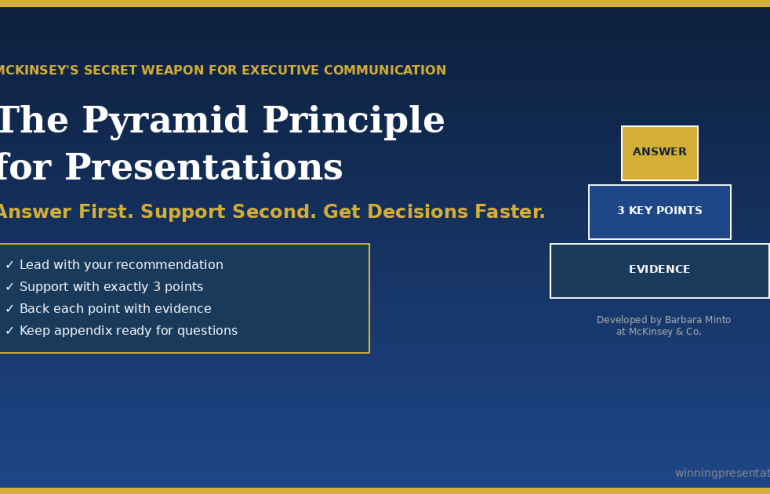
The Pyramid Principle for Presentations - McKinsey's secret weapon for executive communication

The Pyramid Principle for Presentations: McKinsey’s Secret Weapon (Used Wrong by Most)

πŸ“… Updated: December 2025

Quick Answer

The Pyramid Principle is a communication framework developed by Barbara Minto at McKinsey that structures presentations top-down: lead with your answer first, then support it with 3 key points, each backed by evidence. It’s the opposite of how most people present (building to a conclusion) and dramatically more effective for executive audiences who want your recommendation, not your thought process.

πŸ“¦ INCLUDES PYRAMID PRINCIPLE TEMPLATE

Executive Slide System β€” Β£39

Ready-to-use Pyramid Principle deck plus 16 other frameworks as PowerPoint templates. 51 AI prompts. Slide-by-slide scripts.

Get the Templates β€” Β£39 β†’

Instant download. Lifetime access. 30-day money-back guarantee.


What Is the Pyramid Principle?

The Pyramid Principle was developed by Barbara Minto at McKinsey in the 1960s and has since become the standard for executive communication at consulting firms, investment banks, and Fortune 500 companies worldwide.

The core idea is simple: start with the answer.

Most people present bottom-up β€” they walk through their analysis, build the case piece by piece, and finally reveal their conclusion. This feels logical to the presenter. It mirrors how they did the work.

But it’s torture for the audience.

Executives don’t want to follow your journey. They want your destination. They want to know what you recommend, then decide whether they need the supporting detail.

The Pyramid Principle flips the structure:

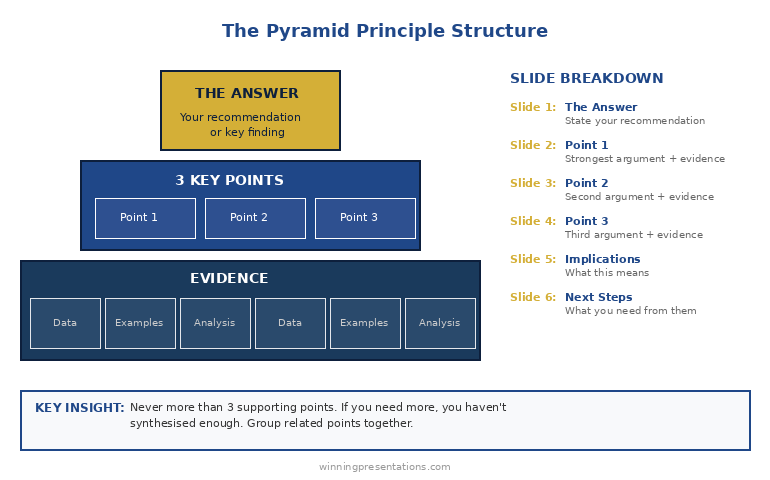
  1. Start with the answer β€” your main recommendation or finding
  2. Group supporting arguments β€” 3 key points that prove your answer
  3. Order logically β€” each point supported by evidence

It’s called a “pyramid” because the structure looks like one: single point at the top, broader supporting base below.

Related: Presentation Structure: 7 Frameworks That Actually Work

Why It Works for Executive Presentations

I’ve trained executives at JPMorgan, PwC, and dozens of other firms. The Pyramid Principle works because it aligns with how senior leaders actually process information.

Executives are time-poor. A CEO might have 15 minutes between meetings. If your conclusion is on slide 12, they’ll never see it. If it’s on slide 1, they can engage immediately β€” and choose whether to dig deeper.

Executives are decision-makers. They don’t need to understand every detail of your analysis. They need to know: What do you recommend? Why? What do you need from me? The Pyramid answers all three in the first 2 minutes.

Executives will interrupt. If you’re building to a conclusion, every question derails you. If you’ve already stated your answer, questions become productive exploration of supporting points.

A client of mine β€” a director at a major consulting firm β€” used to get interrupted constantly in partner meetings. His presentations were thorough but bottom-up. We restructured using the Pyramid Principle. The interruptions didn’t stop, but they changed: instead of “get to the point,” partners started asking “tell me more about point 2.” He made partner 8 months later.

The Pyramid Structure (Slide by Slide)

Here’s how to apply the Pyramid Principle to a typical executive presentation:

Slide 1: The Answer

State your recommendation or key finding in one sentence. Be direct. Be specific.

  • ❌ “We’ve been analysing the market opportunity…”
  • βœ… “We should acquire Company X for Β£15M β€” it will generate Β£4M annual savings within 18 months.”

Slide 2: Supporting Point 1

Your strongest argument. Lead with the point, then provide evidence.

  • Point: “The acquisition eliminates our largest cost centre”
  • Evidence: Current outsourcing costs, projected in-house costs, timeline to realise savings

Slide 3: Supporting Point 2

Second strongest argument, same structure.

  • Point: “Company X has technology we’d need 2 years to build”
  • Evidence: Capability comparison, build vs. buy analysis

Slide 4: Supporting Point 3

Third argument. Never more than 3 β€” if you need more, you haven’t synthesised enough.

  • Point: “The asking price is below market value”
  • Evidence: Comparable transactions, valuation methodology

Slide 5: Implications

What this means for the business. Risks, dependencies, timeline.

Slide 6: Next Steps

What you need from the audience. One clear ask.


Pyramid Principle structure diagram - answer at top, 3 supporting points below, evidence at base

The Rule of Three: Why exactly 3 supporting points? Because humans can hold 3-4 items in working memory. More than 3 points and your audience starts forgetting the first one. Fewer than 3 and your argument feels thin. Three is the magic number.

⚑
Skip the Blank Slide

The Executive Slide System includes a complete Pyramid Principle deck with placeholder text for each slide. Just fill in your content and present.

Get the Pyramid Template β€” Β£39 β†’

The MECE Rule: Mutually Exclusive, Collectively Exhaustive

The Pyramid Principle has a companion concept: MECE (pronounced “me-see”). Your supporting points should be:

Mutually Exclusive: No overlap between points. Each argument is distinct.

  • ❌ “It saves money” and “It reduces costs” (these overlap)
  • βœ… “It saves money” and “It saves time” and “It reduces risk” (distinct)

Collectively Exhaustive: Together, they cover all the important ground. No major gaps.

MECE matters because overlap confuses your audience (“wait, didn’t you already say that?”) and gaps invite objections (“but what about…?”).

Before you finalise your 3 supporting points, ask:

  1. Is there any overlap between these points?
  2. If someone accepted all 3 points, would they accept my answer?
  3. What’s the strongest objection β€” and is it addressed?

Before and After: A Real Example

Here’s how the Pyramid Principle transforms an actual presentation:

BEFORE (Bottom-Up):

  1. Slide 1: Agenda
  2. Slide 2: Background on the project
  3. Slide 3: Methodology we used
  4. Slide 4: Data we collected
  5. Slide 5: Analysis of Option A
  6. Slide 6: Analysis of Option B
  7. Slide 7: Analysis of Option C
  8. Slide 8: Comparison matrix
  9. Slide 9: Risks and considerations
  10. Slide 10: Our recommendation

Problem: The CEO checked out by slide 4. The recommendation never landed.

AFTER (Pyramid Principle):

  1. Slide 1: “We recommend Option B β€” it delivers 40% higher ROI with acceptable risk”
  2. Slide 2: Point 1 β€” ROI comparison (Option B wins on financial returns)
  3. Slide 3: Point 2 β€” Implementation timeline (Option B is fastest)
  4. Slide 4: Point 3 β€” Risk profile (Option B risks are manageable)
  5. Slide 5: What we need to proceed
  6. Appendix: Methodology, detailed analysis, data (available if asked)

Result: CEO approved in the meeting. Total presentation time: 8 minutes.

3 Common Mistakes (And How to Fix Them)

Mistake 1: Burying the answer in context

❌ “Given the market conditions and our strategic priorities and the competitive landscape… we recommend X.”

βœ… “We recommend X.” Full stop. Context comes after, if needed.

Mistake 2: More than 3 supporting points

If you have 5 points, you haven’t synthesised. Group related points together. “Financial benefits” can cover cost savings, revenue increase, and working capital improvement β€” that’s one point, not three.

Mistake 3: Supporting points that don’t actually support

Every point must directly answer “why should I accept your recommendation?” If a point is interesting but doesn’t support your answer, cut it or move it to the appendix.

Related: Executive Presentation Template: 12 Slides That Command the Room

From Framework to Finished Presentation

The Pyramid Principle tells you how to structure your thinking. But there’s a gap between knowing the structure and having slides ready for Monday’s board meeting.

That’s where most people struggle. They understand “answer first, 3 supporting points” β€” but what exactly goes on each slide? How do you phrase the opening? What evidence is compelling vs. overwhelming?

I’ve spent 35 years closing that gap.

The Executive Slide System gives you the complete Pyramid Principle deck β€” not just a framework, but ready-to-use slides with placeholders you fill in. Plus AI prompts to generate content for each section and scripts for what to say when you present.

The consulting director I mentioned earlier? He used these exact templates. The difference wasn’t that he suddenly understood the Pyramid Principle β€” he’d known it for years. The difference was having slides that forced him to execute it properly.

What’s Included: Free vs. Paid

What You Get Free Checklist Executive Slide System (Β£39)
Pyramid Principle overview βœ“ βœ“
7 frameworks reference card βœ“ βœ“
Ready-to-use PowerPoint templates β€” βœ“ 10 templates
Pyramid Principle slide deck β€” βœ“ 6-slide template
AI prompts for each slide β€” βœ“ 30 prompts
Before/after examples β€” βœ“ Real transformations
Result Understand the principle Present like McKinsey

🎯 PRESENT LIKE MCKINSEY

Executive Slide System

17 PowerPoint templates including the complete Pyramid Principle deck.
51 AI prompts. Slide-by-slide scripts. Used to close Β£250M+ in deals.

Get Instant Access β€” Β£39 β†’

βœ“ Instant downloadΒ Β Β βœ“ Lifetime accessΒ Β Β βœ“ 30-day guarantee

Frequently Asked Questions

What is the Pyramid Principle in simple terms?

The Pyramid Principle means starting with your answer or recommendation first, then supporting it with 3 key points, each backed by evidence. It’s the opposite of building to a conclusion β€” you state the conclusion immediately and let your audience decide how much supporting detail they need.

Who invented the Pyramid Principle?

Barbara Minto developed the Pyramid Principle while working at McKinsey & Company in the 1960s. She later wrote “The Pyramid Principle: Logic in Writing and Thinking,” which became the standard text for business communication at consulting firms worldwide.

When should you NOT use the Pyramid Principle?

Avoid the Pyramid Principle when your audience needs to be emotionally engaged before hearing your conclusion (use the Hero’s Journey instead), when you’re delivering bad news that requires context first, or when you genuinely don’t have a recommendation yet. It’s designed for situations where you have a clear answer and a decision-making audience.

What is MECE and how does it relate to the Pyramid Principle?

MECE stands for Mutually Exclusive, Collectively Exhaustive. It’s a test for your supporting points: they should have no overlap (mutually exclusive) and together cover all the important ground (collectively exhaustive). MECE ensures your argument is logically airtight.

How many supporting points should I have?

Exactly 3. Human working memory can hold 3-4 items comfortably. More than 3 points and your audience starts forgetting earlier ones. If you have 5 points, you haven’t synthesised enough β€” group related points together.

Not Ready to Buy? Start Here.

Get the free checklist with the Pyramid Principle template and 6 other frameworks. You can upgrade to full templates later.

Download Free Checklist β†’

πŸ“§
The Winning Edge Newsletter

Weekly insights on presentations that close deals, win budgets, and advance careers.

Subscribe Free β†’

Related Resources

About the Author

Mary Beth Hazeldine has trained executives on high-stakes presentations for 35 years. With 24 years in corporate banking at JPMorgan Chase, PwC, Royal Bank of Scotland, and Commerzbank, she’s used the Pyramid Principle in hundreds of board presentations and client pitches. Her clients have closed over Β£250 million using her presentation frameworks. She teaches at Winning Presentations.