Tag: speaking anxiety

14 May 2026
Featured image for When AI Makes You Faster But the Anxiety Doesn’t Fade: Why Confidence Lags Capability

When AI Makes You Faster But the Anxiety Doesn’t Fade: Why Confidence Lags Capability

Quick Answer

Confidence lags capability because confidence is built on felt-mastery — the embodied sense that you wrote the material, walked through the data, and earned the recommendation. AI shortens the time to a polished draft but does not produce felt-mastery. The fix is not less AI. It is a deliberate practice that rebuilds felt-mastery after the AI has done the drafting work — three short walk-throughs, a counter-argument rehearsal, and a deliberate roughness pass that puts your voice back into the deck.

Niamh had been a director of risk in an insurance group for fourteen years. She had presented to the executive committee dozens of times without anxiety. In February she introduced an AI workflow into her quarterly committee deck — Copilot for the data extraction, ChatGPT for the structure. The deck took 90 minutes instead of seven hours. She walked into the meeting and felt, for the first time in years, the cold-stomach feeling she had not had since her first board presentation.

Niamh’s AI workflow had not failed. The deck was good — possibly better than her previous quarterly. What had failed was her felt-sense of having earned it. She had written 11% of the words. The recommendation slide had been her decision but not her drafting. When the chair asked her to walk the committee through the third data point, her stomach dropped — and the body remembered the feeling from years ago even though her capability had grown, not shrunk.

The pattern Niamh experienced is now common across senior leadership. Generative AI cuts the time to a polished deck. The body’s measurement of mastery — built over decades on the felt experience of writing, revising, struggling — does not move at the same speed as the toolset. Capability runs ahead. Confidence lags. The gap shows up as anxiety, even in senior professionals who have not felt it in years.

If presentation anxiety has returned with your AI workflow

It is not because you are doing AI wrong. It is because the body’s mastery measurement runs slower than the toolset. The gap is real, the anxiety is real, and the practice that closes both is well-rehearsed.

Explore Conquer Your Fear of Public Speaking →

Why confidence lags capability — the felt-mastery gap

Confidence in front of a senior audience is not built on the quality of the deck. It is built on the felt-sense that you can answer any question on any slide because you wrote the slide, struggled with the analysis behind it, and chose every number deliberately. That felt-sense is what the body uses to settle the nervous system before a high-stakes meeting.

The traditional path to that felt-sense is slow. Writing a quarterly committee deck used to take eight to ten hours. Most of those hours were not productive in the strict sense — they were re-reading source material, rewriting the recommendation three times, walking the corridor of the office and arguing with yourself about whether the second option deserved more weight. The deck got built. The mastery got built underneath it.

AI shortens the deck to 90 minutes. The deck is built faster — sometimes better. The mastery underneath is not. The body, which uses time-on-task as one of its inputs to the calm-or-anxious calculation, registers something is missing. It is right. The hours of struggle that produced the body’s confidence are no longer in the workflow.

This is not an argument against AI. The time saving is real and substantial. It is an argument for replacing the lost mastery-building hours with a deliberate, condensed practice that rebuilds felt-mastery without rebuilding the deck. Twenty years ago, this practice was not necessary because the workflow itself produced it. In an AI-augmented workflow, the practice has to be added back deliberately.
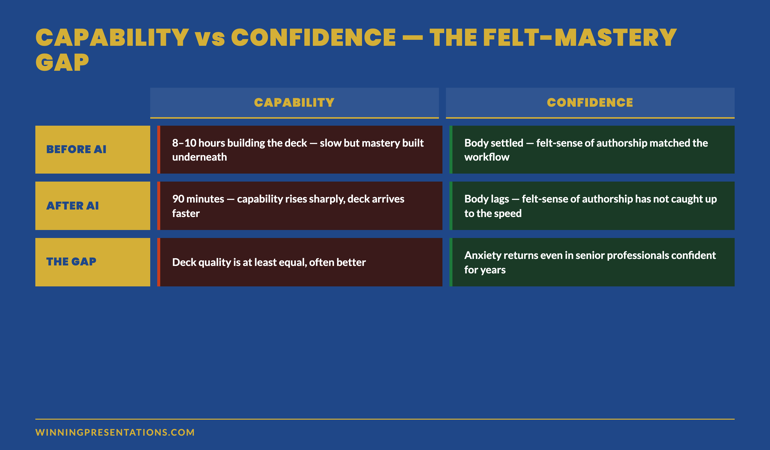
Capability vs Confidence — visualisation showing capability rising sharply when AI is introduced while confidence remains flat, with the felt-mastery gap labelled between them

The three patterns that produce post-AI anxiety

Senior professionals who experience this anxiety report it in three patterns. Most have one dominant pattern; some have a mix. The pattern matters because the recovery practice is different for each.

Pattern 1 — The “I didn’t earn this” feeling

The deck is good. The recommendation is sound. But you cannot shake the sense that you are presenting work you did not fully do. The anxiety lands hardest in the moments before walking into the room. It is mostly cognitive — a story the mind is telling about authorship.

This pattern is most common in senior professionals who have been promoted on the strength of detailed individual work and are still calibrating their identity around delegated and AI-assisted output. The recovery practice for this pattern is the walk-through — three short rehearsals of the deck without the slides, in your own words, until you have re-authored the material in your own voice.

Pattern 2 — The “what if they ask about that figure” feeling

The anxiety surges when you imagine a board member asking about a specific number — and you cannot remember which file Copilot pulled it from. It is mostly anticipatory — fear of the question you will not be able to answer in real time.

This pattern is more common in functions where source provenance matters at meeting time — risk, finance, audit, regulatory affairs. The recovery practice is the source-walk: open every file Copilot referenced and read the original passage that produced each number, in the file’s native context. Twenty minutes restores the source map. The body settles when the map is back.

Pattern 3 — The “this looks too polished” feeling

The anxiety is about the deck itself looking machine-drafted — even if no specific phrase reads obviously AI. It is mostly aesthetic — fear that the audience will register a tonal evenness that says “no human wrote this.” The fear is specific to the moment the deck appears on the screen.

This pattern is more common in senior professionals presenting to peer audiences (other senior leaders) rather than reporting up. The recovery practice is the deliberate-roughness pass: rewrite three to five bullets in slightly less polished language, add one specific anecdote or hand-drawn detail, leave one chart with the slightly off-axis labels Copilot produced. The polish drops a notch. The deck reads as authored.

The practice that closes the gap in 45 minutes

The recovery practice has four moves. Together they take 45 minutes — substantially less than the hours of struggle the AI removed, but enough to rebuild felt-mastery before the meeting. The order matters: the first move addresses authorship, the second evidence, the third response readiness, the fourth tone.

Move 1 — Three walk-throughs (15 minutes)

Print the deck. Stand up. Walk to the back of the room. Talk through the deck out loud, in your own words, without reading the slides. Do this three times. The first walk-through will be halting. The second will surface the slides where you do not yet have your own language. The third will sound like you.

The walk-through is the single highest-leverage practice for closing the felt-mastery gap. Speaking the material in your own words re-authors it in the body. The deck stops feeling like AI’s output and starts feeling like yours.

Move 2 — The source-walk (15 minutes)

Open every source file Copilot or ChatGPT referenced. Read the original passage that produced each number on the deck. Note the page or table reference next to each number on your printed copy. The exercise is not about catching errors (those should have been caught at the editorial stage). It is about restoring the source map in your memory.

If a senior audience asks “where does that come from,” the body’s calm response depends on whether you can name the source instantly. Twenty minutes of source-walk produces that calm without rebuilding the deck.

Move 3 — The counter-argument rehearsal (10 minutes)

Write down the three sharpest objections the audience could raise — the ones an experienced critic would lead with, not the polite ones. Write a two-sentence response to each. Read each pair aloud. Adjust until the response feels true rather than scripted.

This move addresses Pattern 2 anxiety directly. It also produces a side benefit: when an objection arrives in the meeting, the body recognises it from the rehearsal and stays calm. The practice that built into the work in the old workflow needs to be done deliberately in the AI-augmented one.
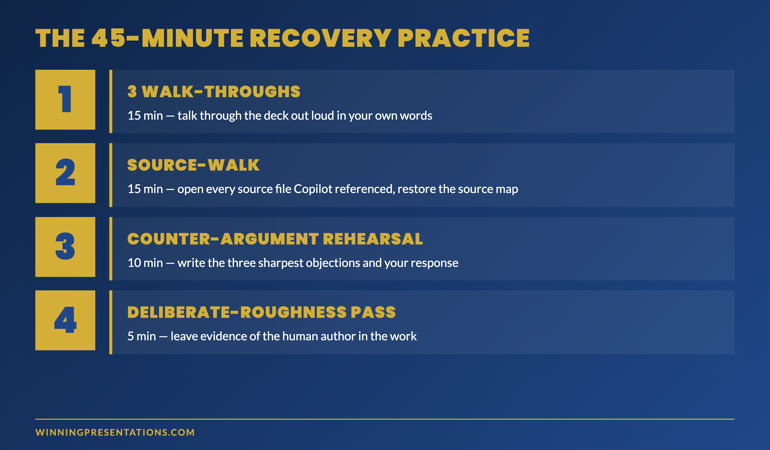
The 4-move 45-minute recovery practice for post-AI presentation anxiety: walk-throughs, source-walk, counter-argument rehearsal, deliberate roughness — with timings shown for each move

Move 4 — The deliberate-roughness pass (5 minutes)

Open the deck one more time. Rewrite three bullets in slightly less polished language. Add one specific human detail to the recommendation slide — a date, a name, a sentence in your normal speaking voice. Leave one of Copilot’s slightly imperfect chart labels alone if it is structurally accurate. The point is not to make the deck worse. The point is to leave evidence of the human author in the work.

Senior audiences register the absence of this evidence. The deliberate-roughness pass adds it back without compromising the structural quality.

When the anxiety is the story the body keeps telling

Conquer Your Fear of Public Speaking — clinical hypnotherapy programme

  • Six recorded clinical hypnotherapy sessions designed for senior professionals with returning presentation anxiety
  • Addresses the embodied response, not just the cognitive story — works on the body’s pre-meeting nervous system
  • Listen at home before the high-stakes meeting cycle — most participants notice a shift inside two weeks
  • Built on five years of recovery work after my own presentation anxiety in financial services

Conquer Your Fear of Public Speaking — £39, instant access, lifetime use.

Get Conquer Your Fear of Public Speaking →

For senior professionals whose anxiety has returned despite years of confident presenting.

When the anxiety is older than the AI workflow

The patterns above describe new anxiety triggered by an AI workflow change. Some senior professionals have presentation anxiety that predates AI by years or decades. The 45-minute practice helps at the margin, but the underlying work is broader.

Three indicators that the anxiety is older than the workflow:

  • The anxiety appears before any meeting, regardless of whether AI was used to draft
  • The physical symptoms — racing heart, shaking hands, dry mouth — feel familiar from before AI tools existed in your workflow
  • The anxiety persists even after a meeting has gone well — the body does not register the success

If two or more of these are present, the work to do is different. The 45-minute practice closes the felt-mastery gap; it does not address the underlying nervous system pattern that drives chronic presentation anxiety. For that, the rapid-response techniques in Calm Under Pressure and the deeper hypnotherapy work in Conquer Your Fear of Public Speaking are designed to work on the embodied response itself rather than the cognitive story around it.

For senior professionals managing both — chronic anxiety plus AI-introduced anxiety — start with the embodied work. The cognitive pattern reduces faster once the body has settled.

For the physical symptoms — racing heart, shaking, dry mouth

Calm Under Pressure covers the rapid-response techniques for the physical symptoms of presentation anxiety — methods you can use in the room, in the moment, without anyone noticing. £19.99, instant access.

Get Calm Under Pressure →

Rapid-response techniques for shaking hands, racing heart, trembling voice.

Frequently asked questions

Should I stop using AI to draft my decks if it is making me anxious?

For most senior professionals, no. The time saving is substantial and the structural quality of AI-assisted decks tends to be at least as good as hand-drafted. The fix is not to remove the tool. It is to add the 45-minute felt-mastery practice that the old workflow produced organically. The practice replaces the lost mastery-building time without giving up the AI productivity gain.

Will the gap close on its own once I have done more AI-assisted decks?

Partially. The novelty of the workflow does fade with repetition, and that takes some edge off the cognitive pattern. But the felt-mastery component does not auto-correct without deliberate practice. Senior professionals who skip the 45-minute practice and just do more AI-assisted decks tend to report the anxiety lingering longer — sometimes for months — rather than closing.

Is this just regular presentation nerves dressed up in AI language?

The physiology is identical. The trigger is new. Senior professionals who had not experienced presentation anxiety for years are experiencing it again specifically in AI-augmented workflows, and the recovery practices that worked for ordinary first-time-presenter nerves do not address the felt-mastery gap directly. The combination — old physiology, new trigger — is what makes a targeted practice necessary.

How quickly does the practice close the gap?

For most senior professionals, the first run of the 45-minute practice produces a noticeable reduction in pre-meeting anxiety. By the third or fourth deck, the practice can often be compressed — two walk-throughs instead of three, ten minutes of source-walk instead of fifteen. Once the body has rebuilt the felt-mastery measurement around AI-assisted decks, the practice becomes maintenance rather than restoration.

The Winning Edge — weekly newsletter for senior presenters

One framework, one micro-story, one slide pattern — every Thursday morning, ten minutes’ read. For senior professionals who want my best material before it appears anywhere else.

Subscribe to The Winning Edge →

Not ready for the full programme? Start here: download the free Executive Presentation Checklist — a one-page reference for the structural questions every executive deck must answer before the meeting.

For more on AI-specific anxiety patterns, see speaking anxiety before AI-drafted presentations.

Mary Beth Hazeldine — Owner & Managing Director, Winning Presentations Ltd. After 24 years in corporate banking and five years recovering from her own presentation anxiety, she works with senior professionals across financial services, healthcare, and technology on the embodied side of high-stakes presenting.

13 May 2026
Featured image for Speaking Anxiety Before AI-Augmented Presentations: When the Tools Add to the Pressure

Speaking Anxiety Before AI-Augmented Presentations: When the Tools Add to the Pressure

Quick Answer

Speaking anxiety before AI-drafted presentations has a distinct shape: the deck looks polished, the voice in your head says you do not deserve to present it, and the body responds with the same physical signs as ordinary nerves but at higher intensity. The fix is not to hand-write the deck. It is to recognise three patterns — felt-ownership gap, surface-polish dread, hidden-question fear — and apply targeted recovery practices for each.

Tomás had presented thirty board updates over twelve years before he ever felt anxiety in the room. The first time it happened, he had used Copilot to draft the deck the day before. The slides looked clean. He had reviewed every page. He knew the content. Two minutes into the meeting his mouth went dry, his hands shook on the laser pointer, and the voice in his head said one thing: this is not really my work.

The deck was his work. He had supplied the source material, edited the structure, rewritten the recommendation. The AI had drafted the connective prose. But the anxiety didn’t care about the technical accuracy of the ownership claim. It responded to a feeling — the felt-ownership gap — that ordinary preparation had not produced and ordinary recovery practices did not address.

Speaking anxiety in 2026 has a new shape. Not a new physiology — the racing heart, the dry mouth, the trembling hands are unchanged — but a new trigger pattern. Senior professionals using AI to draft presentations report higher anxiety than they did before, on the same content, in the same rooms. The fix is not to stop using AI. It is to understand what is triggering the response and address it directly.

If anxiety is showing up before AI-drafted presentations even when the content is solid

The anxiety is responding to a felt-ownership gap, not a content gap. A structured approach addresses the trigger directly so you walk into the room as the author of the deck, not the editor of the model.

Explore Conquer Your Fear of Public Speaking →

Why AI-era anxiety lands differently

Standard presentation anxiety usually has a clear trigger: an unfamiliar audience, an unfamiliar topic, a high-stakes decision. The recovery practices are well established — preparation depth, breathing technique, structured opening lines, body posture work. They reduce intensity, smooth voice and gesture, and let the prepared content carry the room.

AI-era anxiety often presents in situations where none of those triggers should be active. Familiar audience. Familiar topic. Material the presenter has lived with for months. Yet the symptoms arrive with full intensity. The pattern that makes this anxiety distinct is that the content is not the problem; the relationship to the content is.

When you write every slide by hand, your voice is in every line. You can feel where the deck came from. When AI drafts the connective prose, that felt connection thins out. Senior professionals report a specific sensation just before going on: I know what is on the slides, but I do not feel like I wrote them. The voice quiets, the breath shortens, the body responds. Standard anxiety practices help — they always help — but they do not address the trigger directly.

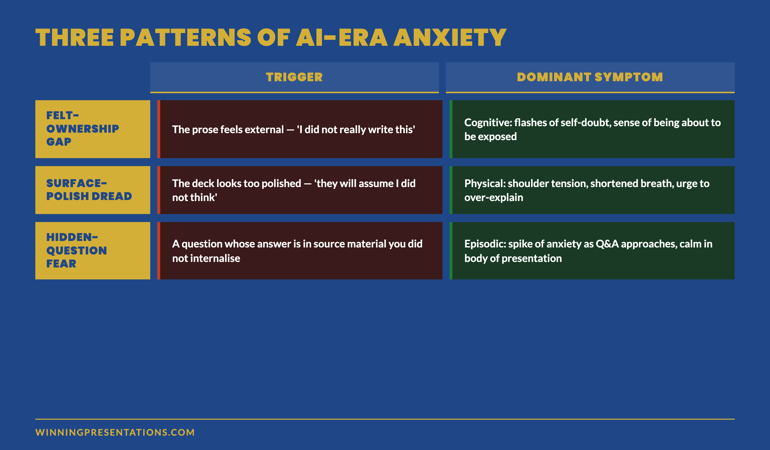
Three Patterns of AI-Era Anxiety infographic showing felt-ownership gap, surface-polish dread, and hidden-question fear with the trigger and dominant symptom for each pattern

The three patterns to recognise

Three distinct patterns recur in senior professionals presenting AI-drafted decks. Recognising the pattern is the first step toward the right recovery practice.

Pattern 1 — Felt-ownership gap. The deck is yours. The work is yours. But the prose feels external. The voice in your head as you walk into the room says some version of: I do not really know this material the way I would if I had written it. Symptoms tend to be cognitive — flashes of self-doubt, a sense of being about to be exposed. The body symptoms (dry mouth, racing heart) follow the cognitive ones rather than leading them.

Pattern 2 — Surface-polish dread. The deck looks polished. The slides are visually clean, the bullets are even, the diagrams are well-spaced. Just before the meeting, a different voice arrives: this looks too polished — they will assume I did not do the thinking. Symptoms tend to be physical first — tension in the shoulders, shortened breath, an urge to over-explain in the opening. Anxiety here is anticipating a credibility judgement that may or may not be coming.

Pattern 3 — Hidden-question fear. Specific to Q&A. The presenter knows the deck cold but worries that a board member will ask a question whose answer is in source material the AI consumed but the presenter did not fully internalise. Symptoms are episodic — confidence during the presentation, a spike of anxiety as Q&A approaches. The fear is not of being unprepared; it is of being asked something you would have known if you had written the slide yourself.

Most presenters experience a mix of two of these patterns rather than just one. The recovery practice depends on which is dominant.

Walk into the room calm even with an AI-drafted deck

Stop letting felt-ownership gaps trigger anxiety in familiar rooms

  • Structured techniques for managing the physical signs of anxiety in the moment
  • Practices for closing the felt-ownership gap before the meeting starts
  • Recovery moves for when anxiety arrives mid-presentation
  • Designed for senior professionals presenting in high-stakes rooms

Conquer Your Fear of Public Speaking — £39, instant access, 30-day refund if it does not fit your context.

Get Conquer Your Fear of Public Speaking →

Designed for senior professionals managing acute presentation anxiety.

Recovery practices for each pattern

For felt-ownership gap — the rewrite-aloud practice

Twenty-four hours before the meeting, sit with the AI-drafted deck and read every slide aloud. On the slides where the prose feels external, rewrite the bullets in your own words — even if the rewrite is technically worse. The goal is not better prose. The goal is to re-author the slide so your voice is in it.

Most senior professionals only need to rewrite three or four slides for the felt-ownership gap to close. The voice that says “I did not write this” stops carrying weight once you have rewritten the slides where the gap was strongest. The deck does not need to be rebuilt; it needs to feel inhabited.

For surface-polish dread — the deliberate roughness move

Add one deliberate handwritten element to the deck. A circled number on a chart. A handwritten note in the margin of a printed copy you bring to the meeting. A slide where one bullet is intentionally left as a fragment that you complete verbally. The deliberate roughness signals — to the room and to yourself — that the deck is a working document, not a polished artefact.

This move addresses the credibility judgement directly. A board that sees a polished deck with no signs of effort can read it as opinion-by-template. A board that sees the same deck with one or two signs of human working — a margin note, a verbal completion — reads it as a thought document. The dread reduces because the trigger has been pre-empted.

For hidden-question fear — the source-material walk-back

Before the meeting, spend 30 minutes walking back through the source material the AI consumed. Not the deck — the underlying source material. Read enough of it to be able to answer a question that goes one layer deeper than what is on the slide. You do not need to memorise everything. You need to know the shape of the supporting evidence so that if a board member asks, you can locate the answer rather than fabricate one.

This practice reduces hidden-question fear more than any in-the-room technique because it addresses the actual gap — your relationship with the underlying evidence, which AI-augmented drafting tends to thin out.

For senior leaders dealing with the physical signs of anxiety more often as AI changes the drafting workflow, structured anxiety techniques designed for the in-the-moment context are available in Conquer Your Fear of Public Speaking.

In-the-room tactics when anxiety arrives

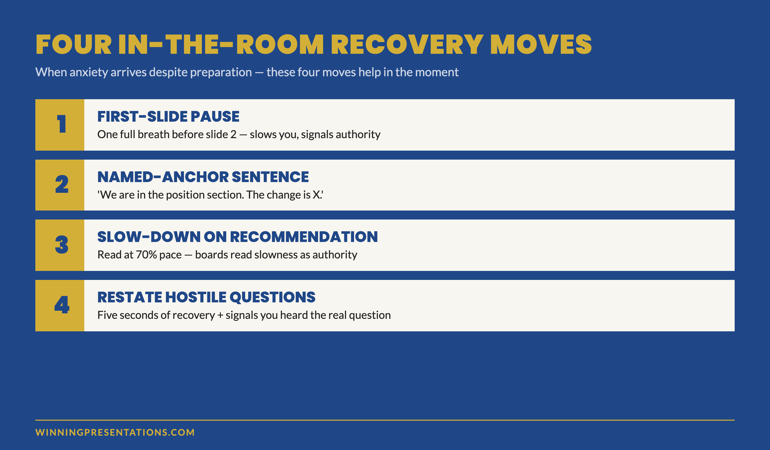
Anxiety does not always honour the preparation. When it shows up despite the recovery practices, four moves help in the room itself:

The first-slide pause. Before you advance to the second slide, stop. Take one full breath. Let the room settle. The pause does two things: it slows your own physiology, and it signals to the room that you are not in a hurry. Boards trust slow openings. Anxious presenters tend to rush the opening; the pause inverts the instinct.

The named-anchor sentence. Have one sentence prepared that names where you are in the deck. “We are in the position section. The change you need to know about is X.” If the anxiety surge happens, the named-anchor sentence gives the room a clear signpost and gives you a structured handhold. It also resets your own breathing because the sentence is short.

The deliberate slow-down on the recommendation slide. When you reach the recommendation, slow down. Read the slide aloud at 70% of your normal pace. The slow-down communicates importance to the room and gives your physiology time to recover. Senior audiences read deliberate slowness as authority; rushed delivery as nerves.

The hand-over move on hostile questions. If a board member asks a hostile question and the anxiety surges, restate the question in your own words before answering. The restatement buys five seconds of cognitive recovery and demonstrates that you are responding to the actual question rather than the version that landed in your head.

Four In-The-Room Recovery Moves infographic showing First-Slide Pause, Named-Anchor Sentence, Deliberate Slow-Down, and Hand-Over Move with the situation each one is used for

Frequently asked questions

Should I stop using AI to draft my decks if it is making me anxious?

For most senior professionals, no. The AI workflow saves significant time and produces useful first drafts. The anxiety is a signal that the editorial pass is not closing the felt-ownership gap. Adjust the workflow rather than abandoning it: rewrite three or four slides in your own voice, walk back through the source material before the meeting, and add deliberate roughness where the polish feels false.

Is this really new, or is it just regular speaking anxiety?

The physiology is identical. The trigger pattern is new. Senior professionals who had not experienced presentation anxiety for years are experiencing it again in AI-augmented workflows, and the recovery practices that worked before do not always address the new trigger. The combination — old physiology, new trigger — is what makes targeted practices necessary.

What about chronic anxiety that predates AI workflows — does this apply?

The patterns described here are about the additional anxiety that AI-augmented decks introduce. Chronic presentation anxiety has different roots and needs different work. If your anxiety predates AI use and is severe, the practices in this article may help at the margin but the underlying work is broader — see the structured techniques for acute and chronic presentation anxiety in our anxiety library.

How do I know which pattern is dominant for me?

The fastest test is to notice when the anxiety surges. If it surges as you walk into the room with the deck on your laptop, the felt-ownership gap is dominant. If it surges when you see the slides projected on the screen, surface-polish dread is dominant. If it surges as Q&A approaches, hidden-question fear is dominant. Most senior professionals have a mix; the dominant pattern is the one whose recovery practice helps most when applied first.

The Winning Edge — weekly newsletter for senior presenters

One framework, one micro-story, one slide pattern — every Thursday morning, ten minutes’ read. Including the AI-era anxiety patterns we are working through with senior professionals across financial services, biotech, and SaaS.

Subscribe to The Winning Edge →

For the partner article on the editorial pass that prevents the surface-polish trigger, see generative AI for executive presentation decks.

Mary Beth Hazeldine — Owner & Managing Director, Winning Presentations Ltd. With 24 years of corporate banking experience at JPMorgan Chase, PwC, Royal Bank of Scotland, and Commerzbank, she advises senior professionals across financial services, healthcare, technology, and government on the structural, behavioural, and AI-augmentation patterns that affect high-stakes presentation work.

06 May 2026
Senior leaders using AI often feel less credible, not more. The anxiety is real and the fix is not about better tools. It is about confidence boundaries.

AI Anxiety for Executives: When the Tech Makes You Feel Less Credible

QUICK ANSWER

AI anxiety for executives is not about the technology. It is about the quiet worry that using AI makes you seem less capable, less original, or less in control. The anxiety shows up as hesitation to use AI tools even when they would help, a reluctance to admit AI involvement, and a sense that the work is somehow not fully yours. The fix is not better tools. It is a clear internal boundary between what AI drafts and what you judge — and the recognition that judgement is the credible part.

For the underlying confidence work

Conquer Your Fear of Public Speaking is a structured programme for senior professionals whose anxiety shows up in high-stakes presentation moments.

Explore the Programme →

Astrid, a senior partner in a professional services firm, described something to me recently that she had not admitted to her peers. She had started using ChatGPT to structure her client-facing presentations. The output was genuinely better than what she had produced alone. Her clients had noticed. And she felt worse about her work than she had in years.

She was not worried about being caught. She was worried about something harder to name. It felt as though the good parts were not fully hers. Every time she gave a presentation that landed well, a quiet voice asked whether the landing was her skill or the tool’s. She had started avoiding AI for important client work — not because it made the work worse, but because it made her feel less capable.

This is AI anxiety for executives. It is not about AI. It is about the identity work that senior professionals do around competence, originality, and earned authority — and the way those things feel threatened when a machine starts producing drafts that hold up at their level.

What AI anxiety looks like in senior leaders

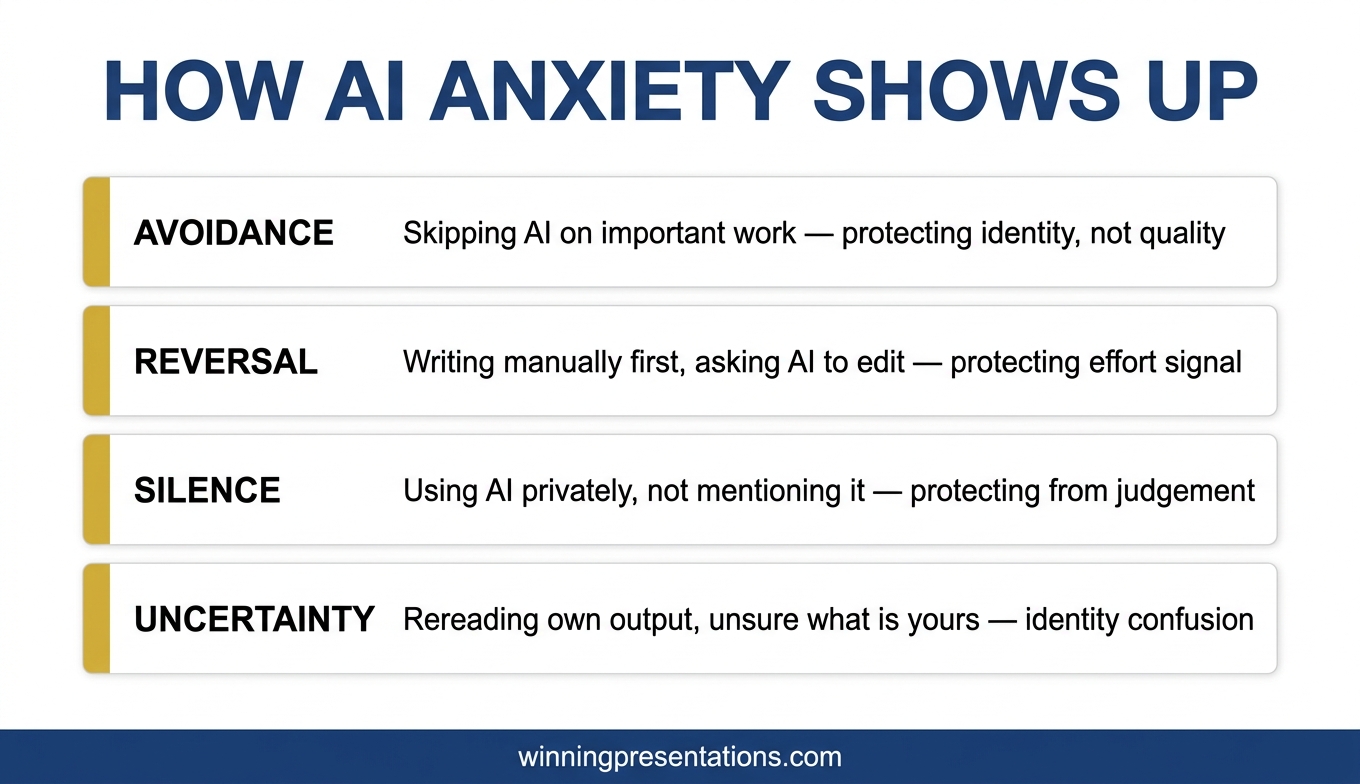
AI anxiety in senior professionals rarely announces itself. It shows up as a cluster of small behaviours that look like preferences but are really defences. The senior partner who avoids Copilot for the quarterly report “because I prefer to think on paper first.” The director who writes the first draft manually, then asks AI for minor edits, rather than the reverse. The executive who uses AI extensively in private and downplays it publicly. The leader who rereads their own output and cannot tell whether they wrote it or the AI did, and finds that a surprisingly uncomfortable question.

The common thread is that the anxiety runs alongside genuine capability. These are not people who need AI. They are people who have quietly noticed that AI makes some parts of their work easier, and who have started worrying about what that means. The worry is not irrational. It is about identity and signal.

The usual advice — “just use the tools, they are amazing” — misses the point. The anxiety is not technical. It is existential in the mild, everyday sense of that word. It is about what counts as your work and what counts as the tool’s work, and whether the distinction matters when the output is the same either way.

Why AI can feel like a credibility threat

Senior professionals have built credibility over years, often decades, through the accumulated evidence that they can produce good work reliably. The work is the signal. Reduce the visible effort behind the work and the signal weakens — at least, that is what the anxious part of the mind concludes. This is not a careful conclusion. It is a fast one, running in the background while the thinking mind is doing something else.

There is also a second layer. Senior audiences can increasingly tell when output has been AI-drafted. The tonal patterns, the structural defaults, the particular flavour of competent-but-generic writing — these become recognisable. Senior leaders who use AI start to worry that their audience will detect it, and that detection will be interpreted as laziness or as intellectual outsourcing. This worry is usually larger than the actual risk, but it is real.

Four ways AI anxiety shows up in senior professionals and what each behaviour is actually protecting

Underneath both layers is something worth naming directly. The real credibility of a senior professional is not in the words on the slide. It is in the judgement behind those words — which questions to ask, which data to trust, which argument to commit to, which risk to take. AI cannot replicate that. What AI can do is draft, assemble, and format. These are the parts of the work that are the least credibility-carrying, even though they take the most visible time.

Senior professionals who feel less credible when using AI are usually confusing the drafting with the judging. They still do the judging. AI does not. But because drafting becomes faster and more polished, the professional loses the visible evidence of the effort that was not actually the credible part in the first place.

WHEN ANXIETY SHOWS UP IN HIGH-STAKES PRESENTATION MOMENTS

Structured work for senior professionals whose presentation anxiety is affecting performance

Conquer Your Fear of Public Speaking is Mary Beth’s programme for professionals whose anxiety shows up in the moments that matter most — board rooms, client pitches, high-stakes presentations. Drawn from 5 years of personal experience with acute presentation anxiety and 16 years of coaching senior leaders through it.

  • Structured anxiety-reduction protocols for high-stakes moments
  • Pre-presentation preparation routines
  • In-the-moment recovery techniques
  • Mindset work for senior professionals
  • Instant download, lifetime access

£39, instant access.

Explore Conquer Your Fear of Public Speaking →

Designed for senior professionals facing high-stakes presentation moments.

The boundary that restores confidence

The fix for AI anxiety in senior leaders is not more or less AI. It is an explicit internal boundary between two categories of work. Category one is what AI drafts. Category two is what you judge. The boundary clarifies which parts of the work are credibility-carrying and which parts are operational.

AI drafts: the structural outline, the first-pass copy, the tonal calibration, the bullet points, the summary paragraphs. These are the visible parts. They were never where your credibility lived. Senior professionals with 20 years of experience do not have more credibility than junior professionals because they can write bullets faster. They have more credibility because they know which bullets matter.

You judge: which argument to build the deck around, which audience member is the real decision-maker, which risk to surface explicitly and which to leave in the appendix, which number to lead with, which counter-argument to engage directly, which option to recommend, which question to be ready for. Every one of these decisions is yours. AI cannot do any of them without your strategic inputs. You are still doing all the credibility-carrying work. The drafting just happens faster.

Once the boundary is clear, AI stops feeling like a threat to your competence. It becomes a drafting tool, like the word processor that you already use without any existential anxiety. The operational parts get faster. The judgement parts remain yours and always were. The clean version of this workflow is covered in why Copilot’s first draft fails boardroom tests, which shows exactly where AI drafting ends and human judgement takes over.

If you want a reliable starting point for AI prompts

The Executive Prompt Pack contains 71 ChatGPT and Copilot prompts designed for senior professionals — prompts you can use immediately without the anxiety of getting them wrong. £19.99, instant download.

Get the Executive Prompt Pack →

What to say if asked whether you used AI

The question “did you use AI for this?” is usually a proxy question. What the asker often wants to know is whether the presenter has understood the material well enough to answer questions about it. “Yes, I used AI to draft the structure, and then I made the decisions about what to keep, what to change, and what position to take” is a strong answer. It is also true. It separates the drafting from the judging, which is the distinction that matters.

Leading with “I didn’t use AI” when you did has a predictable cost. If any part of the output reads as AI-drafted — and senior audiences increasingly pick this up — the presenter has now lied about a small thing, which undermines trust on larger things. The pretence is not worth it.

Leading with “I used AI to draft this” without qualification sometimes lands poorly because it suggests the professional did nothing. The useful phrasing names both halves. “I drafted with AI, edited with judgement” — or a variation in your own words — captures the distinction accurately.

There is one context where AI involvement genuinely matters: client work, regulated decisions, or output that will be audited. In those cases, the correct thing to do is disclose according to the relevant rules, without anxiety about it. The rules exist because AI use is now a normal part of professional work, not an exception.

Frequently asked questions

How is AI anxiety different from ordinary presentation anxiety?

Ordinary presentation anxiety is about the moment of delivery — the racing heart, the shaking hands, the fear of freezing. AI anxiety is quieter and more cognitive. It happens before the presentation, often while preparing, and it is about identity rather than physiology. Both can coexist and both can affect performance, but they have different triggers and need different interventions.

Is there a point at which using AI for presentation work becomes inauthentic?

Authenticity in senior work is not about how much you wrote yourself. It is about whether the argument, decisions, and positions represent your thinking. If you used AI to draft the structure and then you committed to what the deck recommends because you believe it is the right recommendation, the deck is authentic. If you presented a recommendation you did not understand or did not agree with, the deck would be inauthentic — regardless of whether AI was involved.

Should I tell my board that I used AI to prepare the materials?

Usually not, and not because there is anything to hide. Board time is for decisions, not for explanations of drafting tools. If asked directly, answer honestly using the “drafted with AI, edited with judgement” framing. If not asked, there is no reason to offer the information unless your organisation has a disclosure policy.

I use AI extensively and feel fine about it. Am I missing something?

Probably not. People who have clear internal boundaries between AI drafting and their own judgement usually do not experience AI anxiety. The worry is most common in people who are either new to AI tools or who are uncertain about which parts of their work are credibility-carrying. If you have thought through the distinction and feel settled, you are where you want to be.

Can AI anxiety affect presentation delivery on the day?

Yes, indirectly. Senior leaders who feel uncertain about the provenance of their material sometimes deliver with less confidence than usual, even when the material itself is strong. This shows up as extra caveating, over-explanation, or a defensive edge during Q&A. The fix is the internal boundary described above — once it is clear, delivery confidence returns.

The Winning Edge

Weekly thinking for senior professionals on executive presentation craft — the judgement calls, confidence boundaries, and quiet practices that frameworks do not cover.

Subscribe to The Winning Edge →

Not ready for the full programme? Start here instead: download the free 7 Presentation Frameworks Quick Reference — the structural scaffolds that give your own thinking a reliable shape, with or without AI.

Next step: draw the boundary for yourself this week. Write down three parts of your next presentation that AI can draft and three parts that are yours to judge. Notice how different it feels when the distinction is explicit rather than implicit.

For the structural side of AI-assisted executive work, see Copilot PowerPoint for board presentations.


About the author

Mary Beth Hazeldine is Owner & Managing Director of Winning Presentations Ltd, a UK company founded in 1990. With 24 years of corporate banking experience at JPMorgan Chase, PwC, Royal Bank of Scotland, and Commerzbank, she advises senior professionals on the psychology of high-stakes presentation work — including the quieter confidence issues that affect senior performers.

28 Apr 2026
Businesswoman stands in doorway of a glass-walled conference room, with colleagues seated at a long table behind her behind her.

Presentation Panic Attacks: What Triggers Them and How to Regain Control

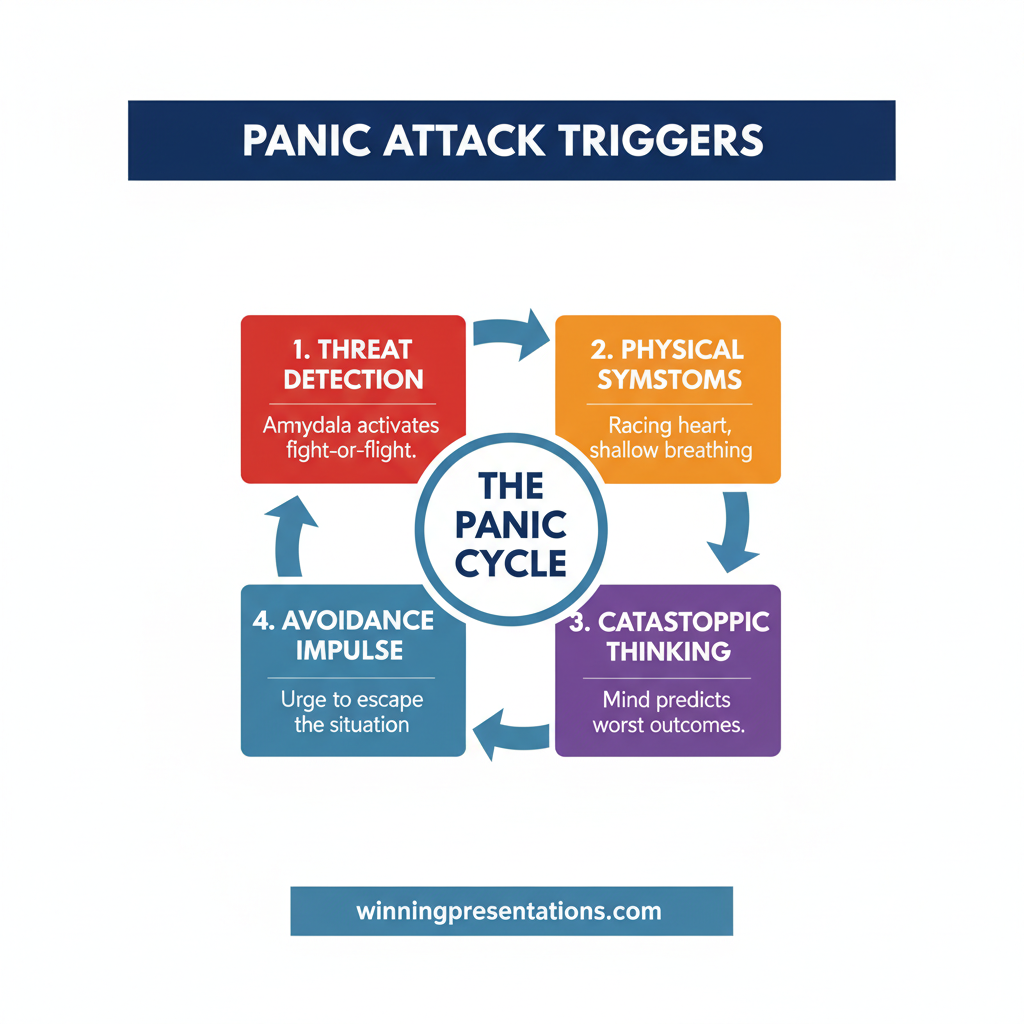
Quick answer: Presentation panic attacks are triggered when the brain’s threat-detection system — the amygdala — misinterprets a high-stakes speaking situation as a physical danger. The result is a flood of adrenaline and cortisol that produces racing heart, shallow breathing, mental blanking, and an overwhelming urge to escape.

The key to regaining control is not willpower or positive thinking — it is nervous system regulation. Techniques such as controlled breathing, grounding exercises, and cognitive reframing interrupt the panic cycle before it escalates, and with practice, they can prevent attacks from occurring altogether.

Linnea had presented quarterly results to her division head dozens of times. She was good at it — structured, clear, well-prepared. So when the company asked her to present the same figures to the full executive committee, she assumed it would feel no different.

It was different. Standing in the boardroom with twelve senior leaders watching, she felt her chest tighten thirty seconds before she was due to speak. Her mouth went dry. Her hands began trembling so badly she could not advance her slides. The room seemed to narrow around her, and for a terrible moment she genuinely believed she might pass out in front of every person who controlled her career trajectory.

She did not pass out. She stumbled through the opening, excused herself for water, and recovered enough to finish. But the experience left a mark. For the next three months, every meeting invitation triggered a wave of dread — not ordinary nerves, but the visceral, full-body alarm of someone who had experienced a presentation panic attack and now lived in fear of the next one.

What happened to Linnea was not a character flaw. It was neuroscience. And understanding that distinction is the first step toward regaining control.

If presentation anxiety has moved beyond ordinary nerves into something that feels physical and overwhelming, you are not alone — and there are structured approaches that can help. Conquer Your Fear of Public Speaking is a neuroscience-based programme designed specifically for professionals who experience acute fear before and during presentations.

Explore the Programme →

What triggers panic attacks during presentations — and why your brain reacts this way

To understand presentation panic attacks, you need to understand what the brain is actually doing when one occurs. The amygdala — a small, almond-shaped structure deep in the brain — is responsible for scanning your environment for threats. When it detects danger, it triggers the sympathetic nervous system before your conscious mind has any say in the matter.

In a genuinely dangerous situation, this response saves lives. In a boardroom, it creates chaos. Your heart rate spikes, breathing becomes shallow, blood redirects to your limbs, and your prefrontal cortex — responsible for structured thinking and articulate speech — essentially goes offline.

Several factors make the amygdala more likely to misfire in presentation contexts:

  • Perceived social evaluation: being watched and judged by people who hold power over your career activates the same neural pathways as physical threat
  • Previous negative experiences: one bad presentation can sensitise the amygdala, making it fire more easily in similar settings
  • Sleep deprivation and chronic stress: a depleted nervous system has a lower threshold for triggering fight-or-flight
  • Perfectionism and catastrophic thinking: mental rehearsal of worst-case scenarios primes the brain to treat the presentation as a genuine threat
  • Unfamiliar environments: a new room, a larger audience, or a higher-stakes context removes the safety cues that normally keep the amygdala calm

The critical insight is that panic attacks are not a failure of courage or competence. They are a neurological event — the brain’s alarm system activating inappropriately. This is why approaches that focus on treating presentation anxiety at the nervous system level tend to be more effective than simple advice to “just relax” or “think positively.”

When presentation fear has become physical, you need more than advice — you need a structured system

Conquer Your Fear of Public Speaking — £39, instant access — is a neuroscience-based programme built for professionals who experience acute anxiety before and during presentations. It covers nervous system regulation, cognitive reframing, physical symptom management, and pre-presentation protocols — the specific mechanisms that interrupt the panic cycle before it takes hold.

If you recognise the pattern Linnea experienced — the tightening chest, the racing thoughts, the dread that builds for days before a presentation — this programme addresses exactly those responses.

Get the Programme →

Instant digital download. Work through it at your own pace.

The difference between presentation anxiety and a panic attack

Most professionals experience some degree of presentation anxiety. Butterflies before a big meeting, a slight tremor in the voice during the opening minute, a heightened awareness of being watched — these are normal nervous system responses that often improve performance by sharpening focus.

A panic attack is qualitatively different. It is not an amplified version of nerves; it is a distinct neurological event with specific characteristics:

  • Sudden onset: panic attacks typically peak within minutes, often without clear warning
  • Physical intensity: heart pounding, chest tightness, dizziness, nausea, tingling in the hands, difficulty breathing — symptoms that feel medical, not psychological
  • Cognitive disruption: thoughts fragment, words disappear, the ability to follow a logical sequence collapses
  • Sense of unreality: the room may feel distant or distorted, and there is often a powerful conviction that something catastrophic is about to happen
  • Urge to escape: the drive to leave the room is overwhelming and feels non-negotiable

The distinction matters because the management strategies differ. Ordinary anxiety responds well to preparation and positive self-talk. Panic attacks require physiological intervention — you need to address what is happening in the body before you can regain access to the thinking brain.

One pattern particularly common among executives is the “secondary fear cycle.” After experiencing a single panic attack during a presentation, the fear of having another one becomes its own trigger. The anticipation of panic creates the very conditions that make the next attack more likely. Breaking this cycle is central to any effective recovery approach.


Infographic comparing the symptoms of normal presentation anxiety versus a full panic attack, showing escalation from mild nervousness through moderate anxiety to acute panic response with physical symptoms

What to do during a panic attack on stage

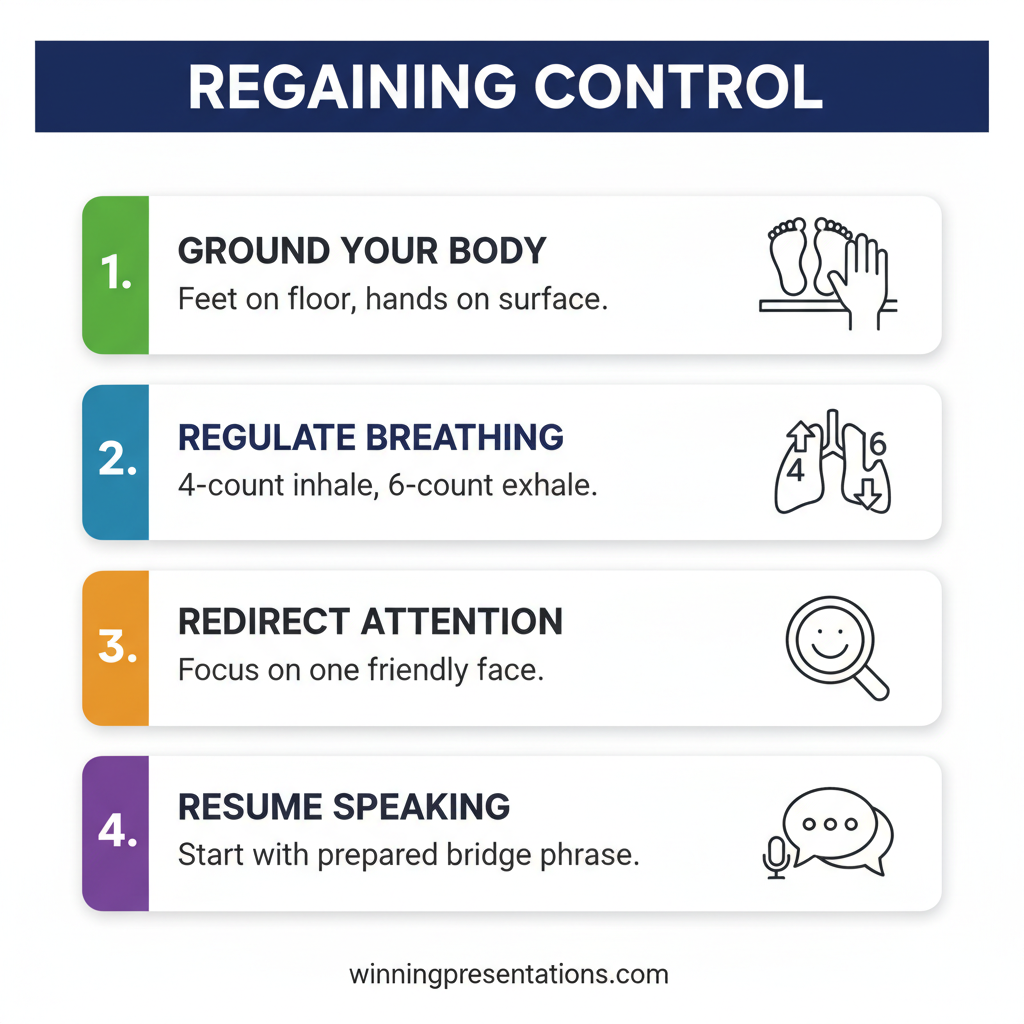
If you feel a panic attack beginning while you are presenting, the single most important thing to understand is this: the attack will pass. Panic attacks typically last between two and ten minutes. Your body cannot sustain the level of adrenaline output indefinitely. The worst of it will subside — but what you do in those minutes determines whether you recover in the room or need to leave it.

Step 1: Slow your exhale. The fastest way to activate the parasympathetic nervous system — the body’s calming mechanism — is to make your exhale longer than your inhale. Breathe in for four counts, out for six or eight. This is not a metaphor or a relaxation technique; it directly stimulates the vagus nerve, which sends a chemical signal to slow your heart rate. Box breathing for executives is one structured approach that works well in these moments.

Step 2: Ground yourself physically. Press your feet firmly into the floor. If you are standing at a lectern, grip the edges. Touch something solid. These physical anchors send sensory data to your brain that competes with the threat signals — a technique known as “sensory grounding.” Your brain cannot process the panic response and detailed sensory input simultaneously.

Step 3: Use a transition phrase. Have a prepared sentence that buys time without signalling distress: “Let me check my notes on this next point.” The audience does not know what you are experiencing internally — a brief pause looks like thoughtfulness, not panic.

Step 4: Narrow your focus. Find one person who appears engaged and supportive, and speak directly to them. Reducing the social scope lowers the amygdala’s threat assessment. You are no longer presenting to a room of evaluators; you are having a conversation with one person.

Step 5: Accept, do not fight. Trying to suppress a panic attack intensifies it. Acknowledge internally: “This is a panic response. It is uncomfortable but not dangerous. It will pass.” This cognitive labelling engages the prefrontal cortex and begins to reassert executive function.

If you want a structured system that walks you through each of these techniques in depth, Conquer Your Fear of Public Speaking covers nervous system regulation, cognitive reframing, and pre-presentation protocols designed for exactly these situations.

Prevention protocols that reduce the likelihood of an attack

Managing a panic attack in real time is important, but prevention is where the real progress happens. The goal is to reduce your baseline nervous system arousal so that the threshold for triggering a panic response is significantly higher.

Build a pre-presentation protocol. A consistent routine in the 60 to 90 minutes before a presentation trains the nervous system to associate preparation with calm rather than threat. This might include controlled breathing exercises, a physical walk, reviewing your opening lines (not the entire deck), and a brief grounding exercise. Consistency matters more than the specific activities — the brain learns to recognise the routine as a safety cue.

Address anticipatory anxiety early. For many executives, the worst part of a presentation is not the presentation itself — it is the days of dread beforehand. Anticipatory anxiety floods the system with stress hormones long before you walk into the room, leaving you depleted and sensitised by the time you need to perform. Learning to interrupt the anticipatory cycle — through scheduled worry periods, cognitive defusion techniques, or structured rehearsal — prevents the nervous system from being pre-loaded when the moment arrives.

Rehearse in graduated exposure. Avoidance maintains fear. If you have experienced a presentation panic attack, the natural response is to avoid similar situations — or to over-prepare to the point of exhaustion. Neither approach works long-term. Instead, gradually increase your exposure to presentation-like conditions: practise in front of one trusted colleague, then a small group, then a slightly larger audience. Each successful experience rewires the amygdala’s threat assessment for that context.

Manage physical state before cognitive state. Sleep quality, caffeine intake, and physical exercise directly influence nervous system reactivity. An executive who slept four hours and consumed three espressos before a board meeting has a significantly lower panic threshold than one who arrived physically regulated.

Create environmental safety cues. Visit the presentation room beforehand if possible. Stand where you will stand, test the technology, sit in the audience seats. Familiarity reduces novelty, and novelty is one of the amygdala’s primary threat indicators.

Build your own pre-presentation protocol

Conquer Your Fear of Public Speaking — £39, instant access — gives you a structured approach to nervous system regulation, physical symptom management, and cognitive reframing. Rather than relying on willpower or hoping the fear fades with experience, you get a repeatable system designed for professionals who face high-stakes presentations regularly.

Get the Programme →

Instant digital download. No subscription, no expiry.

Building long-term resilience against presentation fear

Acute strategies and prevention protocols are essential, but lasting change requires building the kind of deep resilience that makes panic attacks progressively less likely over time. This is not about eliminating nervousness entirely — some degree of activation before a high-stakes presentation is both normal and useful. It is about raising the threshold so far above your typical presentation demands that the panic response simply does not trigger.

Reframe the narrative. Many executives who experience panic attacks before presentations internalise a story about themselves: “I am someone who cannot handle pressure,” or “There is something wrong with me that other people do not have.” This narrative strengthens the fear cycle. The reframe is neurological, not motivational — your brain had a threat response in a specific context. That response can be reconditioned. It is not a permanent feature of who you are.

Separate preparation from rumination. Effective preparation — reviewing content, practising your opening, testing slides — reduces anxiety. Rumination — imagining everything that could go wrong, replaying past failures — increases it. If your “preparation” involves sitting at your desk feeling dread, that is rumination, and it is making your next presentation harder.

Build a bank of successful experiences. Every presentation you complete — even imperfectly — updates your amygdala’s threat assessment. The brain learns from experience, not theory. Each successful presentation in a slightly more challenging context teaches the nervous system that this type of situation is survivable.

Consider professional support when needed. If panic attacks related to presentations are frequent or significantly limiting your career, working with a professional who understands performance anxiety is a strategic decision. Cognitive-behavioural approaches have a strong track record with situation-specific panic.

The ability to manage high-stakes presentations with composure is not a personality trait that some people have and others lack. It is a skill built on neurological understanding, deliberate practice, and the right support structures — whether that involves presenting to senior stakeholders or delivering quarterly results to the board.


Infographic showing a five-step protocol for building long-term resilience against panic attacks during presentations, from nervous system regulation through graduated exposure to cognitive reframing

Frequently asked questions

Can you have a panic attack during a presentation even if you have never had one before?

Yes. A combination of factors — high stakes, poor sleep, unfamiliar environment, or accumulated stress — can push the nervous system past its threshold for the first time. The first experience often creates a sensitisation effect, making subsequent presentations feel more threatening. Understanding the neurological mechanism and learning regulation techniques can prevent it from becoming a recurring pattern.

How do you hide a panic attack while presenting?

Most panic attack symptoms are far less visible to the audience than they feel to the person experiencing them. Internal sensations — racing heart, dizziness, cognitive disruption — are largely invisible from outside. Use a transition phrase to buy time, slow your breathing with extended exhales, ground yourself physically, and narrow your focus to one person. The goal is not to suppress the experience but to manage it while the physiological wave passes.

Should you tell your employer about panic attacks related to presenting?

This depends on your workplace culture and your relationship with your manager. In many organisations, disclosing performance anxiety is met with support — reasonable adjustments such as presenting seated or having a co-presenter. In others, the stigma may create career risk. What you should absolutely do is take active steps to address the issue, whether through structured self-help resources, professional support, or both.

Join The Winning Edge

A weekly newsletter for executives who want to present with more confidence and clarity. Practical strategies, no fluff.

Subscribe Free →

Mary Beth Hazeldine | Owner & Managing Director, Winning Presentations. With 24 years of corporate banking experience at JPMorgan Chase, PwC, Royal Bank of Scotland, and Commerzbank, she advises executives across financial services, healthcare, technology, and government on structuring presentations for high-stakes funding rounds and approvals.

26 Apr 2026
Featured image for Confident Presenting Course for Executives: What Actually Delivers Results

Confident Presenting Course for Executives: What Actually Delivers Results

Quick Answer

A confident presenting course worth investing in should address nervous system regulation, cognitive reframing under pressure, and physical symptom management — not just delivery technique. Most generic courses treat confidence as a mindset problem. For executives, it is a performance problem with neurological roots. This guide covers the criteria that separate programmes that deliver lasting results from those that produce a temporary lift.

Linnea had delivered quarterly updates to her bank’s risk committee for three years without incident. Then she was promoted to Head of Regulatory Affairs, and the audience changed.

The same material. The same preparation ritual. But now the room included three board members and the group CFO. Within two presentations, she noticed her hands trembling visibly when advancing slides. Her voice thinned. She started rushing through her summary to escape the room faster.

She tried a one-day presentation skills course her company offered. It covered body language, vocal projection, and positive visualisation. None of it addressed what was actually happening: her nervous system was interpreting senior scrutiny as threat, and no amount of positive thinking was going to override that neurological response. She needed something designed for the specific problem she had.

Struggling with presentation anxiety despite being experienced?

Conquer Your Fear of Public Speaking is a neuroscience-based programme that addresses the root causes of presentation anxiety — nervous system regulation, cognitive reframing, and physical symptom management — rather than surface-level confidence techniques.

Explore Conquer Your Fear of Public Speaking →

Why Generic Confidence Courses Fail Executives

Most presentation confidence programmes are built for a general audience. They assume the participant lacks basic experience, needs foundational speaking technique, and will benefit from group exercises that build comfort through repetition. For a graduate or early-career professional, this model works reasonably well.

For an executive who has been presenting for fifteen or twenty years, this model fails — and not because the content is wrong. It fails because it addresses the wrong problem. An experienced executive does not lack presentation knowledge. They lack the ability to access their competence under specific high-pressure conditions.

This distinction matters when evaluating any presenting confidence programme. The question is not “Will I learn something new about presenting?” The question is “Will this programme change how my body and mind respond when I stand up in front of a room that matters?”

Generic courses typically cover vocal projection, body language, storytelling frameworks, and slide design. These are useful topics. But they do not address the trembling hands, the voice constriction, the cognitive fog, or the post-presentation shame spiral that characterises executive-level presentation anxiety. Those symptoms have neurological roots, and they require a neurological intervention.

What an Effective Presenting Programme Must Include

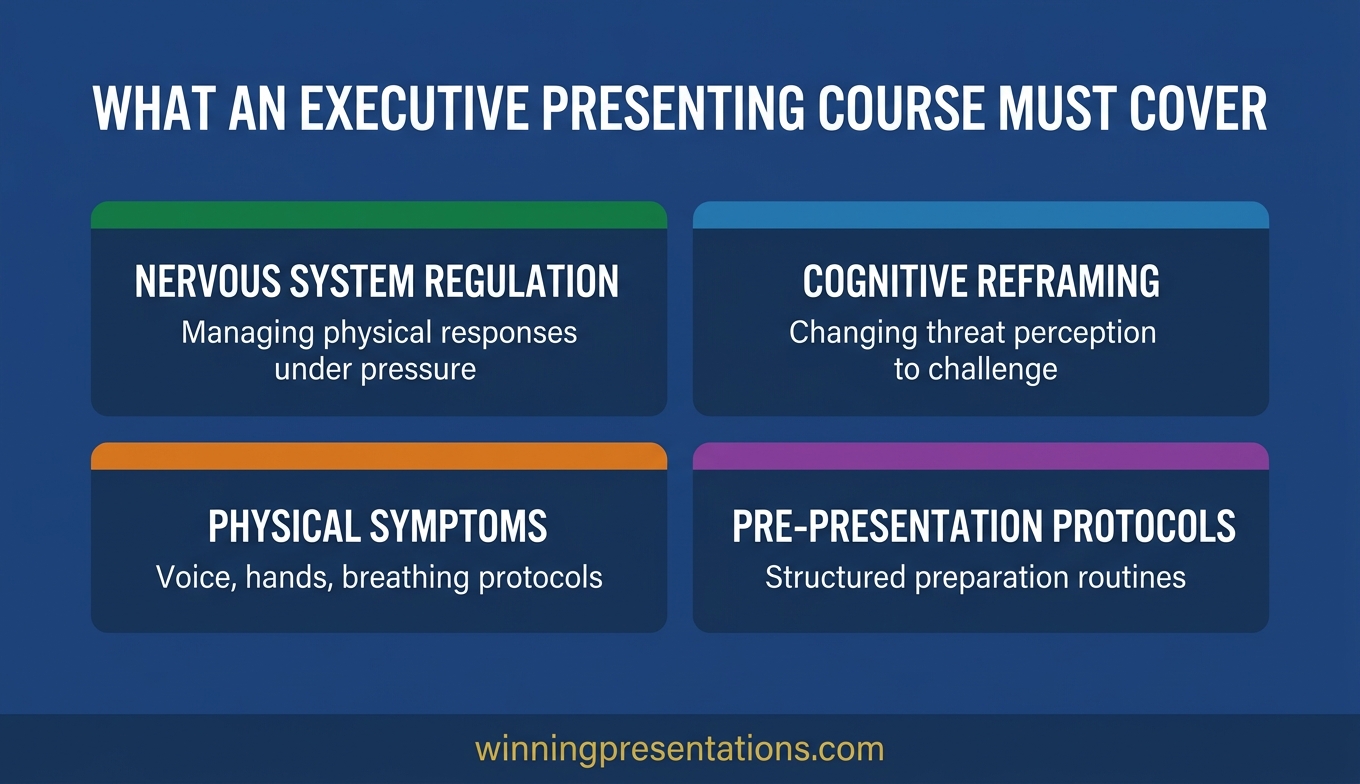
A programme that produces lasting confidence — not just a temporary lift after a motivational workshop — needs to address four interconnected systems. If any one is missing, the results will be partial.

1. Nervous system regulation. Presentation anxiety is not a thinking problem. It is a nervous system activation problem. Your sympathetic nervous system interprets the high-stakes presentation as a threat, triggering the same fight-or-flight cascade that would activate if you were in physical danger. Heart rate increases. Hands tremble. Breathing becomes shallow. Peripheral vision narrows. A presenting confidence programme that does not teach you to regulate this activation — to bring your nervous system back into a functional range before and during the presentation — is missing the most critical component.

2. Cognitive reframing under pressure. Anxiety produces distorted thinking patterns: catastrophising (“This will end my career”), mind-reading (“They can all see I’m nervous”), and all-or-nothing evaluation (“If I stumble once, the whole thing is ruined”). These thought patterns are not rational, but they feel completely real under pressure. Effective programmes teach you to identify and interrupt these patterns in the moment — not as a general self-help exercise, but as a specific protocol you deploy before and during presentations.

3. Physical symptom management. Executives need practical techniques for managing the visible symptoms that undermine their credibility: voice tremor, shaking hands, dry mouth, flushing, and the urge to rush. These symptoms are not character flaws — they are physiological responses that can be managed with the right preparation. Any programme that dismisses physical symptoms as “just nerves” is not addressing what the executive actually needs.

4. Pre-presentation protocols. The thirty minutes before a high-stakes presentation determine more of the outcome than most people realise. What you do with your body, your breathing, your mental rehearsal, and your environment in that window can either prime your nervous system for performance or accelerate the anxiety cascade. A complete programme includes specific, timed protocols for this pre-presentation period.


Infographic showing the four components an executive presenting course must include: nervous system regulation, cognitive reframing, physical symptom management, and pre-presentation protocols

Address the Root Cause, Not Just the Symptoms

Conquer Your Fear of Public Speaking — £39, instant access — is a neuroscience-based programme designed for experienced professionals whose presentation anxiety has neurological roots, not knowledge gaps:

  • Nervous system regulation techniques to manage the fight-or-flight response before it takes hold
  • Cognitive reframing protocols for the distorted thinking patterns that intensify under pressure
  • Physical symptom management for trembling, voice constriction, and visible anxiety signs
  • Pre-presentation preparation sequences you can deploy in the thirty minutes before any high-stakes presentation

Get Conquer Your Fear of Public Speaking →

Designed for executives and senior professionals who present at board, committee, and leadership level.

How Executive Presenting Is Different

Executive presentations carry specific pressures that general-audience programmes do not account for. Understanding these differences is essential when evaluating whether a presenting confidence programme will actually help at your level.

The audience has authority over your career. When you present to a board, a senior leadership team, or an investment committee, the people in the room have direct influence on your promotion, your budget, or your project’s survival. This is not the same as presenting to peers. The stakes are not hypothetical — they are career-defining, and your nervous system knows it.

The tolerance for visible anxiety is lower. At executive level, visible nervousness signals something different than it does in a training room. In a workshop, nerves are expected and sympathised with. In a boardroom, visible anxiety can be interpreted as a lack of conviction in your own recommendation — which undermines the entire purpose of the presentation.

Q&A is unpredictable and consequential. Senior audiences ask questions that go beyond the prepared material. They challenge assumptions. They probe for weaknesses. They ask questions designed to test your thinking, not just your content. If your anxiety management strategy only covers the prepared portion of the presentation, you are vulnerable in the exact moment that matters most.

Repetition is not an option. In most presentation skills courses, you practise in front of the group, receive feedback, and try again. In executive presenting, there is no second attempt. The board meeting happens once. The funding review happens once. The promotion panel happens once. Any programme that relies on gradual desensitisation through repeated exposure misses the reality of executive presenting: you need to perform in a context where the first attempt is the only one.

This is why the right presentation anxiety course for executives focuses on equipping you to manage a single high-stakes event, not building comfort through volume.

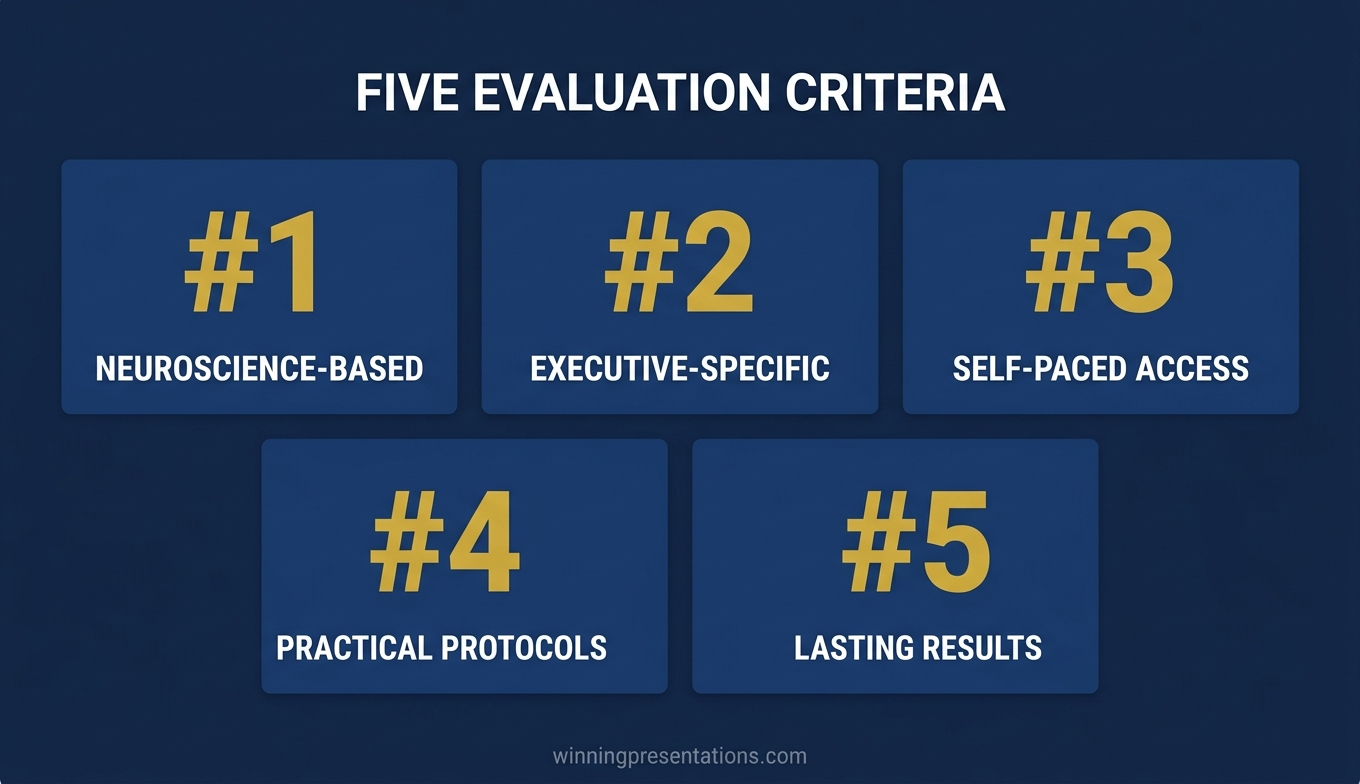
Five Criteria for Evaluating Any Programme

If you are comparing options and trying to determine which executive presenting programme will actually deliver results at your level, apply these five criteria. They separate programmes designed for real-world executive conditions from those that sound good in a brochure.

1. Does it address the nervous system, or just mindset? If the programme’s primary approach to anxiety is “think positively” or “visualise success,” it is not addressing the physiological activation that drives presentation anxiety. Look for content that explicitly covers nervous system regulation, breathing techniques designed for pre-presentation deployment, and somatic approaches that work with the body rather than trying to override it with willpower.

2. Is it designed for self-paced application, or does it require group attendance? Senior executives have unpredictable schedules. A programme that requires you to attend fixed sessions on specific dates may be impractical. Self-paced programmes that you can work through around your actual schedule — and return to when a specific high-stakes presentation is approaching — tend to produce better long-term results because you use them when you need them.

3. Does it include protocols you can deploy immediately? Theory without application is an academic exercise. Effective programmes give you specific, step-by-step sequences you can use before your next presentation. Not principles to reflect on — actions to take in the thirty minutes before you walk into the room.

Conquer Your Fear of Public Speaking includes exactly these kinds of deployable protocols — nervous system regulation, cognitive reframing, and pre-presentation preparation sequences you can use before any high-stakes event.

4. Does it acknowledge that confidence is context-dependent? You may be confident presenting to your team but anxious presenting to the board. A programme that treats confidence as a single quality — “build your confidence and it will transfer everywhere” — is oversimplifying. Look for content that addresses the specific contexts where your confidence breaks down: seniority of audience, formality of setting, unpredictability of Q&A, personal career stakes.

5. Does it address what happens after the presentation? Many executives experience a post-presentation shame spiral — replaying every stumble, every question they handled imperfectly, every moment where their anxiety was visible. This post-event rumination reinforces the anxiety for next time. Programmes that address this cycle, not just the presentation itself, produce more durable improvement.


Infographic showing five evaluation criteria for executive presenting courses: nervous system focus, self-paced format, deployable protocols, context-specific confidence, and post-presentation support

Common Objections — and What the Evidence Shows

“I should be able to handle this without a course.” This is the most common objection, and it reflects a misunderstanding of how presentation anxiety works. You cannot think your way out of a nervous system activation any more than you can think your way out of a racing heart during a sprint. The neurological response is not a character weakness — it is a predictable physiological pattern that responds to specific interventions, not to willpower. Executives who struggle with this are typically high-performers in every other dimension. The anxiety is a system problem, not a competence problem.

“I’ve tried courses before and they didn’t help.” If the courses you tried focused on delivery technique, body language, and motivational exercises, they were not addressing presentation anxiety. They were addressing presentation skill — a related but different challenge. A programme designed for anxiety-driven performance issues works at the neurological level: regulating the nervous system, interrupting catastrophic thinking patterns, and managing the physical symptoms that undermine delivery. If your previous courses did not include these components, you have not yet tried the approach most likely to help.

“At my level, people will judge me for needing help with this.” The reality is precisely the opposite. Senior professionals who invest in managing their presentation performance are making a strategic career decision. The executives who struggle most are the ones who avoid addressing the problem and instead develop elaborate avoidance strategies — delegating presentations, reading from scripts, or limiting their visibility. These strategies cap career progression far more visibly than seeking professional development.

See also: how your physical position affects presentation confidence and delivery.

Ready to Address the Real Problem?

Conquer Your Fear of Public Speaking — £39, instant access — gives you the neuroscience-based protocols to manage presentation anxiety at its source. Nervous system regulation. Cognitive reframing. Physical symptom management. Pre-presentation preparation. Work through it at your own pace, and return to it before any high-stakes event.

Get Conquer Your Fear of Public Speaking →

Designed for executives and senior professionals who need to present with authority under pressure.

Frequently Asked Questions

Is a confident presenting course worth it for someone who already presents regularly?

Yes — if the course addresses the specific gap you are experiencing. Presenting regularly without addressing underlying anxiety or performance issues simply reinforces the patterns you already have. A programme that targets nervous system regulation, cognitive reframing, and physical symptom management gives you tools your experience alone will not provide. The investment pays for itself the first time you walk into a board presentation and manage your physiological response rather than being managed by it.

How long does it take to see results from a presentation confidence programme?

The nervous system regulation and pre-presentation protocols can produce a noticeable difference in your very next presentation — these are techniques you deploy immediately, not skills that require months of practice. The cognitive reframing component typically takes longer to become automatic, usually two to four high-stakes presentations before the new thinking patterns begin to override the old ones. Full integration — where the techniques become your default response rather than something you consciously deploy — generally occurs over eight to twelve weeks of regular use.

Does this work for virtual presentations as well as in-person ones?

The underlying neuroscience is identical regardless of format. Your nervous system activates in response to perceived threat — and a virtual presentation to a senior audience triggers the same fight-or-flight response as an in-person one. The regulation techniques, cognitive reframing protocols, and pre-presentation preparation sequences work in both contexts. Some executives find virtual presentations more anxiety-inducing because they cannot read the room as easily, which creates additional uncertainty. The programme addresses this through the cognitive reframing component, which targets the specific thought patterns that escalate anxiety when feedback cues are limited.

What if my anxiety is specific to Q&A rather than the presentation itself?

Q&A anxiety is one of the most common patterns at executive level, because Q&A is the least controllable part of any presentation. The nervous system regulation techniques in Conquer Your Fear of Public Speaking are designed to be deployed in real time — including during transitions from prepared content to unscripted Q&A. The cognitive reframing component specifically addresses the catastrophic thinking that Q&A triggers: “What if I don’t know the answer?”, “What if they think my analysis is weak?”, “What if they ask about the one thing I’m not prepared for?” These thought patterns are predictable and interruptible with the right protocol.

The Winning Edge — Weekly Presentation Intelligence

Every Thursday, one framework or technique for presenting with authority at executive level — drawn from 25 years of boardroom experience and 16 years training senior professionals. Join The Winning Edge →

Mary Beth Hazeldine is the Owner & Managing Director of Winning Presentations. With 25 years of corporate banking experience at JPMorgan Chase, PwC, Royal Bank of Scotland, and Commerzbank, she advises executives across financial services, healthcare, technology, and government on structuring presentations for high-stakes funding rounds, board briefings, and leadership decisions.

09 Apr 2026

Fear of Authority: Presenting Confidently to People in Power

Quick Answer

Fear of authority in presentations is a specific anxiety pattern triggered by perceived power differentials — not just general public speaking nerves. It activates differently depending on seniority, organisational culture, and the presenter’s own relationship with authority figures. Understanding what is actually being triggered — and why — is the first step toward presenting confidently to people in power.

Astrid had presented to hundreds of people. She ran all-hands meetings for her team, delivered client briefings, and chaired cross-functional reviews without difficulty. By any external measure, she was a confident presenter. Until the day she was asked to present her division’s Q3 performance directly to the Group CEO and the Chief Operating Officer.

She described the experience afterwards: “I knew the numbers better than anyone in that room. I had run these presentations dozens of times. And the moment I walked in and saw them sitting at the table, something shifted completely. My voice went quieter. My hands were cold. I kept checking whether they were engaged rather than watching the room as a whole. I finished early because I rushed, and then I couldn’t remember exactly what I had said.”

Nothing about the content had changed. The audience had. Specifically, the perceived consequence of failure had — or felt as though it had. That shift is what fear of authority in presentations actually is: a recalibration of stakes based on who is in the room, not on whether the material is different or the risk is genuinely higher.

Presenting to senior leadership and finding that anxiety activates differently when authority figures are in the room?

This is a specific pattern — and it responds to specific approaches. Conquer Speaking Fear includes a structured programme for authority-specific anxiety, covering nervous system regulation and the cognitive patterns that maintain fear of presenting to people in power. Explore the programme →

Why Presenting to Authority Figures Triggers a Different Response

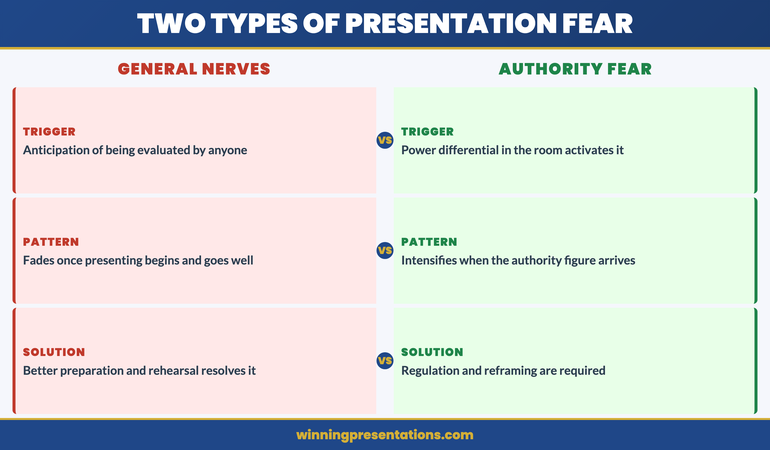
General presentation anxiety is a fear of being evaluated — of being seen, judged, and found wanting in front of others. Fear of authority in presentations is a more specific variant: it is the fear of being evaluated by someone whose judgment has direct consequences for your career, your standing, or your sense of competence. The audience has power over you in a way that a general audience does not. That changes the threat calculation entirely.

Most people who present confidently to peers and clients are still susceptible to this particular variant of anxiety. The shift happens not because the material is more difficult or the audience is more hostile, but because the evaluation carries different stakes. A poor presentation to peers is mildly uncomfortable. A poor presentation to the CEO, the board, or a regulator can feel — at the level of the nervous system — like a genuinely existential threat to professional survival.

The fact that this threat is usually disproportionate does not reduce its physiological force. The anxiety is real even when the danger is not. Understanding this distinction — that the fear is a real emotional and physiological event triggered by a perception rather than by an objective threat — is the prerequisite for working with it rather than being controlled by it.

As explored in the analysis of presentation anxiety with specific audiences, the same presenter can experience dramatically different anxiety levels depending purely on who is in the room. The content is identical. The fear is not triggered by the material — it is triggered by the relationship.

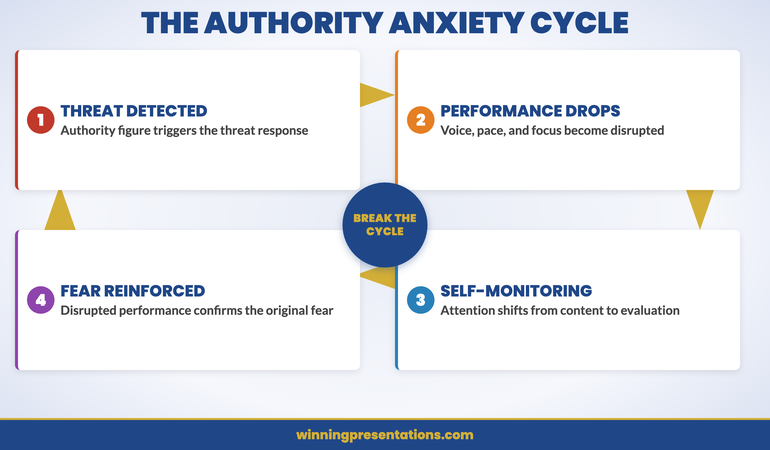
Diagram showing the difference between general presentation anxiety and authority-specific fear — stakes perception versus objective risk

The Hierarchy Threat: What Your Nervous System Is Reacting To

The physiological response to presenting to authority figures draws on the same neural architecture as social threat detection more broadly. When you stand in front of someone who has power over your career outcomes, your nervous system is processing a threat signal — not because there is immediate physical danger, but because social hierarchies are genuinely consequential for wellbeing, and the threat of losing standing within them activates threat-detection systems that evolved to manage real risks.

This is why standard presentation preparation techniques — practising more, knowing the material better, arriving early — do not consistently resolve authority-specific anxiety. They address the cognitive preparation problem, not the threat-detection response. You can know your material fluently and still find that your voice constricts when the CFO walks in late and sits directly opposite you.

The nervous system’s response to hierarchy is not, however, fixed. It is shaped by experience, by interpretation, and by the physiological regulation skills available to you. The distinguishing feature between presenters who perform well in front of authority figures and those who do not is rarely confidence in the abstract — it is the ability to down-regulate the threat response quickly enough that it does not interfere with performance.

For those whose anxiety predates the corporate context — where patterns around authority figures were formed in childhood or earlier career experiences — the work described in resources on glossophobia in the C-suite is directly relevant. Authority-specific anxiety often has deeper roots than professional development programmes address.

Conquer Speaking Fear

A Structured Programme for Presentation Anxiety That Activates With Authority Figures

Conquer Speaking Fear is a 30-day programme for professionals whose presentation anxiety is persistent and specific — including anxiety that activates differently in front of senior leaders, boards, and authority figures. It uses nervous system regulation techniques and clinical hypnotherapy approaches to address the patterns that standard practice and preparation do not resolve.

  • 30-day programme structured for working professionals
  • Nervous system regulation techniques for the moments anxiety activates
  • Clinical hypnotherapy approaches for deeper-rooted fear patterns
  • Designed for anxiety that persists despite knowledge, preparation, and experience

Get Conquer Speaking Fear — £39

Designed for executives and senior professionals with persistent presentation anxiety.

The Imposter–Authority Paradox

There is a pattern that appears consistently among senior professionals who experience authority-specific anxiety: the more accomplished they are, the more acute the fear often becomes — particularly when presenting upward. This seems counterintuitive. Surely more experience should mean less anxiety? The paradox is that as seniority increases, the stakes attached to each presentation also increase, and the gap between self-perception and external reputation becomes more pronounced.

A mid-level manager who makes an error in a board presentation has room for recovery. A director or VP who makes the same error in front of the group CEO is in a different position — their reputation has been built on a certain standard of performance, and a visible failure carries proportionally more weight. The fear is not irrational; it reflects a real calculation about professional consequences. It becomes irrational only when it operates at the same intensity for a routine update as it does for a high-stakes decision meeting.

The imposter component adds a further layer. Many senior professionals who experience authority-specific anxiety carry a background sense that their competence has not been fully earned — that they are one poor performance away from being exposed. Presenting to someone with the power to confirm or challenge that fear activates both the hierarchy threat and the competence threat simultaneously. The combination is significantly more disruptive than either alone.

The distinction between this pattern and more general presentation anxiety is explored in the analysis of stage fright versus social anxiety — worth reading if you find that your anxiety is specific to certain audiences rather than present across all presentation contexts.

Techniques to Apply Before the Presentation

The preparation phase for an authority-specific presentation is different from standard presentation preparation. Knowing the material better rarely reduces this variant of anxiety — the anxiety is not about the material. The preparation work that is actually useful focuses on regulating the physiological state you bring into the room.

Reframe the stakes accurately. The nervous system is responding to a perceived threat. Before the presentation, spend time explicitly examining whether the threat is proportionate. In most cases, the realistic consequence of a less-than-perfect presentation to the CEO is that you have a learning experience. The catastrophic outcome your nervous system is preparing for — career damage, public humiliation, permanent loss of standing — is rarely the actual likely outcome. Making this calculation consciously, rather than allowing the unchallenged threat perception to drive your physiological state, is not a trivial exercise. It requires repeated, specific examination of the evidence, not a general reminder to calm down.

Regulate before you arrive. The two most reliable physiological regulation tools for pre-presentation anxiety are controlled breathing and physical movement. Extended exhale breathing — where the out-breath is longer than the in-breath — activates the parasympathetic nervous system and measurably reduces the physiological arousal associated with threat responses. Physical movement prior to the presentation — a brisk walk, not sitting at a desk scrolling through slides — changes the physiological state more reliably than any cognitive technique.

Prepare for the relationship, not just the content. If the authority figure who triggers your anxiety is someone you interact with regularly, the presentation anxiety is partly about that specific relationship. Consider whether there is an opportunity for a brief, non-presentation interaction with that person before the formal setting — a corridor conversation, a brief check-in. Reducing the social distance before the formal moment changes the dynamic in the room.

Three-stage preparation approach for authority-specific presentation anxiety: reframe stakes, regulate physiology, reduce social distance

What to Do When the Fear Activates in the Room

The moment the authority figure walks in, or the moment you stand to present and register who is in the room, the physiological response may activate regardless of how well you prepared. The ability to manage in-the-moment activation is a separate skill from pre-presentation regulation, and it is the skill that matters most for performance.

The first technique is to slow down deliberately. When anxiety activates, speaking pace tends to increase — partly because the body is in a state of arousal, and partly because there is an unconscious desire to finish the exposure quickly. A faster pace signals anxiety to the audience and removes the pauses that give the presenter time to regulate. The antidote is a conscious, deliberate reduction in pace — even if it feels uncomfortable. Slowing down when you are anxious feels wrong from the inside; it reads as composed from the outside.

The second technique is to anchor in the task rather than the evaluation. When fear of authority is active, attention tends to split between the content and the question “what do they think of me right now?” This split attention is visible — it is what produced Astrid’s experience of checking whether the executives were engaged rather than reading the room as a whole. Deliberately returning attention to the specific task — the next slide, the next sentence, the specific question being answered — redirects the nervous system’s monitoring from the social evaluation back to the work.

The third technique is to use questions as regulation points. When a senior leader asks a question, take a visible pause before responding — ideally two to three full seconds. This serves three purposes: it gives you time to regulate before speaking, it signals that you are considering the question seriously rather than deflecting, and it gives the authority figure the impression of measured confidence rather than reactive speed.

If authority-specific anxiety is persistent — activating reliably when certain senior figures are in the room, regardless of preparation or experience — Conquer Speaking Fear addresses the specific patterns that standard presentation coaching does not reach.

Why Some Senior Leaders Remain Afraid of Presenting Upward

One of the least-discussed aspects of authority-specific presentation anxiety is that it does not disappear with seniority. Directors who present confidently to their own teams, their peers, and external audiences can still find that presenting upward — to the board, to investors, to a regulatory committee — activates anxiety at the same intensity it did in their early careers. The authority hierarchy simply moves upward with them.

There is also an organisational culture dimension. Some organisations have leadership cultures in which senior leaders use presentations as opportunities to demonstrate intellectual dominance — to ask difficult questions publicly, to visibly challenge assumptions, to create an atmosphere in which the presenter must defend every claim. Presenters who have experienced this kind of culture may carry a threat-vigilance pattern that activates whenever they present upward, even in organisations where the culture is entirely different.

What changes the pattern, for senior leaders as much as for early-career professionals, is not more rehearsal or better slides. It is the development of a relationship with the physical and cognitive state that authority-figure presentations create — the ability to recognise the activation, to respond to it with regulation rather than suppression, and to return attention to the task without the emotional spiral that performance anxiety typically produces when it is treated as evidence that something is wrong.

Conquer Speaking Fear

30-Day Programme for Persistent Presentation Anxiety

For professionals whose anxiety activates reliably with authority figures — and who have not found a lasting solution through preparation, practice, or conventional coaching.

Get Conquer Speaking Fear — £39

Designed for executives and senior professionals with persistent authority-specific presentation anxiety.

Frequently Asked Questions

Is fear of presenting to authority figures a form of social anxiety?

It overlaps with social anxiety in some individuals, but it is not the same thing. Social anxiety is a broader pattern that affects a range of social interactions. Authority-specific presentation anxiety is context-specific — it activates primarily or exclusively when the audience includes people with evaluative power over the presenter. Many people with authority-specific anxiety have no social anxiety in other contexts. They socialise easily, present confidently to peers, and function without difficulty in most professional settings. The anxiety is specifically about the hierarchical power relationship in the room, not about social interaction generally.

What makes fear of authority in presentations different from ordinary nerves?

Ordinary pre-presentation nerves tend to diminish once the presentation begins and the presenter’s competence becomes apparent — the nerves are anticipatory. Authority-specific fear often intensifies once in the room, because the presence of the authority figure continues to activate the threat response throughout the presentation. It also tends to be highly selective: the same presenter may be entirely comfortable in front of 200 people at a conference and acutely uncomfortable in front of three people if those three people have significant power over their career.

Can this type of anxiety be resolved, or is it something to manage indefinitely?

For most people it can be substantially reduced — not by eliminating the physiological response, but by changing the relationship with it. The goal is not to feel nothing when presenting to the CEO. The goal is to be able to present at full cognitive and communicative capacity despite feeling something. With the right approach — nervous system regulation, accurate threat assessment, and structured exposure — most people find that the anxiety becomes significantly less disruptive and, over time, less intense. Some find that it resolves almost entirely. Others find a stable baseline that no longer interferes with performance. Indefinite management at the same intensity is rarely the outcome when the problem is addressed directly.

The Winning Edge — Weekly Newsletter

Each Thursday: one executive presentation insight, one practical technique, one tool. Read by executives across financial services, healthcare, technology, and government.

Subscribe to The Winning Edge

About the Author

Mary Beth Hazeldine is Owner and Managing Director of Winning Presentations. With 25 years of corporate banking experience at JPMorgan Chase, PwC, Royal Bank of Scotland, and Commerzbank, she advises executives across financial services, healthcare, technology, and government on managing presentation anxiety and building confidence for high-stakes settings. View services | Book a discovery call

21 Mar 2026
Executive watching a presentation from the audience with visible tension while a confident speaker presents on stage in a corporate conference setting

The Comparison Trap: Why Watching Great Speakers Makes Your Anxiety Worse (Not Better)

You watch a TED talk to calm your nerves before your board presentation. Instead of feeling inspired, you feel crushing inadequacy. That’s not weakness—it’s a predictable anxiety pattern. And it gets worse the more “great speakers” you study.

Quick Answer

Watching skilled speakers when you’re already anxious doesn’t motivate—it triggers comparison and reinforces the belief that you’re not good enough. Your nervous system reads it as evidence you can’t measure up, not inspiration to improve. Breaking the pattern requires understanding what anxiety actually does to your brain, then rewiring how you relate to your own speaking challenges.

Does This Sound Like You?

  • You watch a polished TED talk and feel worse about your own presentation skills
  • You study “great speakers” hoping to feel more confident—but feel more anxious instead
  • You compare every moment of your delivery to speakers who have years of practice (but you only notice their polish, not their process)
  • The more “speaker content” you consume, the more self-doubt creeps in
  • You spiral into “I could never do that” thinking before major presentations
The CFO Who Couldn’t Breathe During Board AnnouncementsTomás had been with the company for seven years. By every measure, he was a competent financial leader. But the moment he stepped into the boardroom to present quarterly results, something shifted. His chest would tighten. His breathing would shallow. His mind would race to every way his analysis might be incomplete, every question the board might ask, every error he might have missed.

He’d started watching YouTube videos of confident CFOs presenting. Financial analysts at Ted talks. Executives delivering flawless earnings calls. The more he watched, the worse the anxiety got. He wasn’t learning confidence. He was collecting evidence that he didn’t measure up. He didn’t need better financial analysis. He needed his body to feel safe in that boardroom.

Stop Measuring Yourself Against Speaker Highlight Reels

The primary problem with using other speakers’ performances as your learning benchmark is that you’re comparing your full, unfiltered reality—including anxiety, self-doubt, and visible struggle—to someone else’s highlight reel.

What you see: A polished delivery, perfect pacing, no visible nerves.

What you don’t see:

  • Their first 50 presentations (where they were terrible)
  • The speaking situations where they failed and learned
  • How they actually feel in their body during presentations
  • The years of practice hidden behind 18 minutes of TED talk
  • Their current anxiety triggers and vulnerabilities

When your nervous system is already primed for threat (which it is when you’re presentation-anxious), watching someone else’s polished performance reads as evidence that you’re deficient. Your brain doesn’t think, “That looks learnable.” It thinks, “I could never do that.”

The pattern that keeps you stuck: Watch skilled speaker → Feel inadequate → Try harder → Rehearse obsessively → Anxiety increases anyway → Watch more speakers to feel better → Repeat.

The Conquer Speaking Fear programme (£39) breaks this cycle by teaching you how your nervous system actually works during presentations—using clinical hypnotherapy and NLP techniques to regulate anxiety at the source, rather than trying to out-skill your fear.

Explore the Anxiety-Based Approach

You’re Watching Highlight Reels, Not Real Practice

Here’s what gets hidden when you study great speakers: their learning curve. The neurobiologist who delivers a brilliant TED talk has probably given that talk a thousand times. The executive coach who looks totally composed has probably felt exactly as anxious as you do.

But you don’t see that journey. You only see the highlight.

This creates a dangerous assumption in your brain: They’re naturally good at this. I’m naturally anxious. We’re different.

That difference isn’t skill. It’s practice. It’s repetition. It’s nervous system regulation they learned (usually by trial and error, not by watching other people).

When you’re already battling presentation anxiety, consuming more “great speaker” content doesn’t close the gap. It widens it. Because every polished performance feels like evidence that the gap is wider than you thought.

The Comparison Trap Cycle infographic showing four stages: Watch a Great Speaker, Internal Comparison Fires, Anxiety Escalates, and Avoidance or Over-Preparation

How the Comparison Trap Hijacks Your Nervous System

Your nervous system has a job: keep you safe. When you’re presentation-anxious, it’s already in a heightened state of alert. Your body is primed to notice threat.

Then you watch a skilled speaker deliver flawlessly. In that moment, your nervous system interprets the signal as: That’s the standard you need to meet. You’re not meeting it. You are unsafe/failing.

This isn’t a logic problem. It’s a nervous system problem. The more speakers you watch, the more evidence your system collects that you don’t measure up.

The comparison trap doesn’t just affect your confidence. It actually heightens physiological anxiety: increased heart rate, shallow breathing, cortisol release. It’s not just negative thinking. Your body is responding to what feels like a threat assessment.

This is why “just practice more” or “study great speakers” advice often backfires. You’re adding pressure on top of an already dysregulated nervous system.

The Faulty Logic of Anxiety-Driven Learning

Anxiety has a particular way of “teaching” you. It shows you problems, not solutions. When you’re anxious about presentations, your brain highlights:

  • Everything that could go wrong
  • Every way you might fail
  • Every person watching who might judge you
  • Every flaw in your delivery compared to “better” speakers

Then you try to solve this by consuming more speaker content—thinking you’ll find the “right” way to do it. But you’re not learning the right way. You’re reinforcing the belief that there’s a standard you’re failing to meet.

This is learning through threat, not learning through mastery. And it doesn’t stick. It just creates more anxiety.

What actually works is learning how to regulate your nervous system first, then practicing presentation skills from a calmer, more resourced state. That’s when learning actually happens. That’s when confidence builds—not from watching someone else do it perfectly, but from your own body learning that you can manage the situation.

Feeling the comparison spiral right now? This is exactly what Conquer Speaking Fear addresses: how to interrupt the anxiety pattern before it becomes your default response.

What Actually Reduces Speaking Anxiety (It’s Not Speaker Videos)

The research on anxiety reduction is clear: exposure to threat (like watching skilled speakers when you’re anxious) doesn’t reduce fear. What reduces fear is regulated exposure to manageable challenge, combined with nervous system techniques that help your body learn the situation is safe.

That’s the gap most presentation advice misses. You don’t need:

  • More tips on body language
  • More examples of “perfect” presentations
  • More pressure to match someone else’s standard

You need your nervous system to feel safe while you practice. You need techniques that actually work at the physiological level. You need to build confidence through your own success, not through comparison to others.

Reframing: From Comparison to Nervous System Regulation

The shift from “I need to watch better speakers to learn” to “I need to regulate my nervous system to perform” changes everything.

Instead of:

  • Watching great speakers → feeling worse
  • Rehearsing obsessively → staying anxious
  • Comparing yourself → spiralling into self-doubt

You’d be:

  • Learning how your body responds under pressure
  • Practising techniques that actually calm your nervous system
  • Building confidence through managing your anxiety, not copying someone else’s skill
  • Developing a genuine sense of readiness, not just borrowed confidence from studying others

Comparison Thinking vs Reality infographic contrasting what you see, what you feel, and what you do when caught in the speaker comparison trap versus the reality of learnable skills

Stop Rehearsing What They’re Thinking About You

Here’s what happens in the comparison trap: you’re not just watching speakers. You’re imagining what the audience will think of you compared to them. You’re rehearsing judgment in your head.

This creates a secondary anxiety layer. Now you’re anxious about the presentation and anxious about being judged as “not good enough.”

That’s where nervous system regulation techniques become essential. Not to pump yourself up with false confidence. But to actually interrupt the fear response at the source.

The Conquer Speaking Fear programme uses evidence-based techniques from clinical hypnotherapy and NLP to help your nervous system feel safe during presentations—not just think positive thoughts about them.

Learn the Regulation Techniques

Is This Right For You?

This approach is for you if:

  • You’ve studied great speakers and it hasn’t reduced your anxiety (it may have increased it)
  • You’re rehearsing presentations obsessively but still feel nervous before delivering
  • Comparison is part of your anxiety pattern—you measure yourself against others
  • You want to feel genuinely confident, not just “get through” presentations
  • You’re ready to work on the nervous system level, not just the skills level

From Speaking Terror to Teaching Others

That CFO who couldn’t breathe in the boardroom? He didn’t stop being anxious by watching more successful financial leaders or studying presentation techniques. He stopped by learning how his nervous system actually worked during high-pressure situations. Once he understood that, he could regulate it.

Within 18 months, he went from dreading board announcements to volunteering to lead quarterly presentations to the full board. He didn’t become naturally good at presenting. He learned to manage his nervous system well enough that anxiety stopped controlling his performance.

Three years later, he’s mentoring other finance leaders through their presentation anxiety. Not because he became a “natural presenter.” But because he learned the one thing most presentation advice skips: how to work with your nervous system instead of against it.

The Conquer Speaking Fear programme (£39) condenses that learning curve into a structured programme using clinical hypnotherapy and NLP to create lasting change. You get the nervous system techniques that actually work. Not tips. Not tricks. Tools that work at the physiological level.

Join the Programme

📊 Want to improve your slides?

Preparation reduces anxiety. The Executive Slide System (£39) includes confident-presenter templates designed to minimise preparation stress.

People Also Ask

Does watching great speakers actually help with presentation anxiety?

For some people, watching skilled speakers can be motivating. But if you’re already anxious about presenting, it often increases comparison and self-doubt. The key difference is your nervous system state when you watch. If you’re primed for threat, you’ll interpret polished performances as evidence you’re not good enough. Nervous system regulation should come first; learning through observation should come later.

How long does it take to get over presentation anxiety?

It depends on your approach. If you’re trying to “think positive” or “rehearse more,” it often takes months or years—and can actually worsen anxiety. If you’re working directly with nervous system regulation techniques, most people notice significant shifts within 2-4 weeks. The foundation changes quickly; building full confidence takes longer, but you’re working from a much more resourced place.

Can I stop being anxious about presentations if I’m naturally an anxious person?

Yes. “Naturally anxious” usually means your nervous system is sensitised to threat more readily than others’—not that you’re broken or incapable. With the right nervous system tools, you can learn to regulate that sensitivity in specific situations (like presentations). You don’t become a different person. You become someone whose anxiety no longer controls their performance.

FAQ

Should I completely stop watching other speakers?

Not necessarily. The issue isn’t watching speakers; it’s when you watch them and why. If you’re watching them to learn a specific technique and you’re in a calm, resourced state, that can be valuable. If you’re watching them because you’re anxious and hoping to feel better, that usually backfires. Focus first on nervous system regulation. Then, from a calmer place, you can observe and learn without the comparison trap activating.

Is presentation anxiety the same as general anxiety disorder?

Not exactly. Presentation anxiety is specific to the performance situation. You might be calm in most areas of life but dysregulated when presenting. This specificity is actually an advantage—you can work directly with the nervous system triggers in that context. If you have generalised anxiety, presentation anxiety might be one manifestation of that larger pattern, and you’d want support for both.

If I fix my nervous system, will I need less practice?

No, but your practice will be more effective. Right now, if you’re anxious, you might be rehearsing obsessively and still not feeling confident—because anxiety is hijacking your learning. Once your nervous system is regulated, your practice time creates actual skill development and real confidence. You’ll likely need smarter practice, not necessarily more practice.

Ready to Stop the Comparison Cycle?

Join The Winning Edge newsletter for weekly strategies on nervous system regulation, presentation confidence, and the counter-intuitive approaches that actually reduce anxiety.

Subscribe (It’s Free)

🆓 Free resource: Get the Checklist — a free guide to strengthen your presentation preparation.

About the Author

Mary Beth Hazeldine is a presentation coach and nervous system specialist working with senior leaders and executives. She’s trained over 3,000 professionals to move from presentation anxiety to genuine confidence—by working at the nervous system level, not just the skills level. She’s the creator of the Conquer Speaking Fear programme and the Executive Slide System.

03 Mar 2026
The Perfectionism Trap: Why Over-Preparing Makes Presentation Anxiety Worse

The Perfectionism Trap: Why Over-Preparing Makes Presentation Anxiety Worse

Sarah spent 14 hours preparing a 15-minute presentation. She rehearsed it 11 times. She could recite every transition. And she was more terrified walking into that room than she’d ever been.

Quick Answer: Presentation perfectionism creates a paradox: the more you prepare beyond a critical threshold, the more anxious you become. Over-preparation amplifies anxiety because it shifts your focus from communicating a message to performing a script perfectly. Your brain registers perfection as the standard, so any deviation — a stumbled word, a missed phrase, an unexpected question — feels catastrophic. The fix isn’t less preparation. It’s different preparation that targets confidence rather than control.

🚨 Spending hours over-preparing and still feeling terrified?

Quick diagnostic:

  • Do you rehearse more than 3 times and feel worse with each run-through?
  • Does changing a single word in your script feel like starting over?
  • Do you prepare for every possible question but still dread the Q&A?

→ That’s the perfectionism trap. More preparation won’t help — you need a different approach to pre-presentation anxiety. Conquer Speaking Fear (£39) includes the cognitive reframing techniques that break the over-preparation cycle.

Sarah was a senior programme manager at a consulting firm. She’d been presenting to clients for six years and considered herself well-prepared. Before every presentation, she’d write a full script, rehearse it until she could recite it from memory, then rehearse it again “just in case.”

She came to me because the anxiety was getting worse, not better. “I prepare more than anyone on my team,” she told me. “I should be the most confident person in the room. Instead, I’m the most terrified.”

When I watched her prepare, the problem was obvious. By rehearsal four, she’d stopped communicating and started performing. Every word had to be exact. Every transition had to land perfectly. She’d built a standard so rigid that any deviation felt like failure — and her nervous system responded to that perceived failure with escalating anxiety.

We restructured her preparation. Three rehearsals maximum. Bullet points instead of scripts. The instruction: “Know your message, not your words.” Her anxiety dropped significantly within two presentations. Not because she prepared less, but because she prepared differently.

Infographic showing the diminishing returns curve of presentation preparation with confidence peaking at moderate preparation and anxiety rising with over-preparation

The Diminishing Returns Curve of Preparation

Preparation follows a predictable curve. Early preparation builds confidence rapidly: understanding your content, structuring your argument, knowing your key messages. Each hour invested yields measurable improvement in both competence and confidence.

Then the curve flattens. You know your material. Your structure is solid. Additional preparation doesn’t improve your presentation — it polishes what’s already finished. At this point, each additional hour yields marginal improvement in quality but measurable increase in anxiety.

Then the curve inverts. Beyond the threshold, more preparation actively damages your performance. You memorise phrasing instead of understanding concepts. You rehearse transitions until they feel mechanical. You optimise for perfection, which is impossible, rather than communication, which is achievable. Presentation anxiety before meetings often escalates precisely at this point — when preparation has crossed from useful to harmful.

The paradox: the presenters who prepare most obsessively are often the most anxious, while presenters who prepare sufficiently but not excessively appear more confident, more natural, and more persuasive.

Why More Preparation Makes Anxiety Worse (The Psychology)

Three psychological mechanisms explain why over-preparation amplifies anxiety rather than reducing it.

Mechanism 1: Perfectionism creates a failure-sensitive mindset. When you rehearse a presentation to the point of memorisation, your brain registers the memorised version as “correct.” Any deviation — a different word, a missed phrase, an off-script moment — registers as an error. Your nervous system responds to perceived errors with anxiety. The more perfect your preparation, the more error-sensitive your performance becomes.

Mechanism 2: Rehearsal without variation reduces adaptability. Real presentations involve interruptions, questions, technical issues, and audience reactions. If you’ve rehearsed a rigid script, any interruption forces you to abandon your memorised pathway. That moment of disorientation — finding your place again — triggers acute anxiety. Presenters who prepare with flexibility can adapt without panic. Scriptmemorising presenters cannot.

Mechanism 3: Over-preparation signals threat to your nervous system. When you spend hours preparing for a 15-minute presentation, your subconscious draws a conclusion: “This must be dangerous — otherwise, why would I need to prepare this much?” The preparation intensity itself communicates threat, and your body responds accordingly. This is similar to the pattern described in why confident presenters still get nervous — the relationship between preparation and anxiety is more complex than “prepare more, fear less.”

The Preparation Threshold: Where Confidence Peaks

The preparation threshold is the point where additional preparation stops building confidence and starts building anxiety. It’s different for everyone, but there are reliable markers.

You’ve hit the threshold when: You can explain your key message in one sentence without notes. You can answer “what’s the point of this presentation?” instantly. You know your opening, your three main points, and your close. You can present the core argument to a colleague in conversation without slides.

You’ve crossed the threshold when: You’re rehearsing word-for-word phrasing rather than concepts. You feel worse after each additional rehearsal. You’re spending more time on transitions than on content. You’re anticipating every possible question and scripting answers. You’re unable to present without looking at your notes because you’ve memorised a sequence, not understood an argument.

Most presentations reach the threshold after two to three focused preparation sessions. Everything beyond that is anxiety management disguised as preparation.

Stop the Over-Preparation Cycle That’s Making Your Anxiety Worse

If you’re spending hours preparing and feeling more terrified with each rehearsal, the problem isn’t your preparation quantity — it’s your preparation approach. Conquer Speaking Fear includes:

  • The cognitive reframing technique that breaks the perfectionism-anxiety loop
  • The confidence threshold method — know exactly when to stop preparing
  • Clinical hypnotherapy protocols that calm your nervous system before you present
  • The “know your message, not your words” framework that replaces rigid scripting

Get Conquer Speaking Fear → £39

Designed for the presenter who prepares obsessively and still feels terrified — because the preparation itself is the problem.

What to Do Instead: Preparation That Builds Confidence

The goal isn’t to prepare less. It’s to prepare in a way that builds confidence rather than anxiety. This requires three structural changes to how you approach presentation preparation.

Replace scripts with bullet frameworks. Write three to five bullet points per section, not sentences. Your job is to know the argument, not the words. This forces you to communicate rather than recite, and communication is what builds confidence. If you lose your place, you can reconstruct the argument from the bullet — something impossible with a memorised script.

Rehearse with variation, not repetition. Each time you practise, change something deliberately. Use different phrasing. Start from a different section. Present to a different person. This builds adaptability — the skill that prevents panic when real presentations don’t go exactly as planned. Variation trains your brain to handle the unexpected, which reduces threat perception.

Cap your rehearsals at three. The first rehearsal identifies gaps. The second rehearsal smooths the flow. The third confirms you’re ready. Everything beyond three is anxiety management, not preparation. If you still feel anxious after three rehearsals, the solution isn’t a fourth rehearsal — it’s addressing the anxiety directly through techniques like managing anxiety the night before a presentation.

2. presentation-perfectionism-anxiety-in-article-2.png — Alt text: Infographic comparing perfectionist preparation versus confident preparation showing scripts versus bullet frameworks and rigid rehearsal versus varied practice

Breaking the Perfectionism Cycle Before Your Next Presentation

Perfectionism is a cycle: you prepare obsessively, perform rigidly, notice every imperfection, conclude you need to prepare more next time, and prepare even more obsessively. Breaking the cycle requires interrupting it at the right point.

Before your next presentation, set a preparation budget. Decide in advance how many hours you’ll spend preparing and how many times you’ll rehearse. Write it down. When you reach your limit, stop — regardless of how you feel. The discomfort you feel at stopping is the perfectionism, not the preparation.

After your next presentation, audit the gaps. Were there moments where your preparation failed? Probably not. Were there moments where you deviated from your script and it was fine? Probably yes. Collect this evidence. Perfectionism survives on the belief that anything less than perfect preparation leads to disaster. Your own experience will disprove this.

Redefine success. A perfect presentation isn’t one where every word was scripted and delivered exactly. A successful presentation is one where your audience understood your message and took the action you wanted. These are fundamentally different standards — and the second one is both achievable and less anxiety-producing.

Stop Spending Hours Preparing and Still Walking In Terrified

The perfectionism trap keeps you preparing longer and feeling worse. Conquer Speaking Fear gives you the clinical techniques to break the cycle — so you can prepare confidently and present without the paralysing anxiety that comes from chasing perfection.

Get Conquer Speaking Fear → £39

Built from 24 years of working with executives who prepared obsessively and still dreaded every presentation.

Is This Right For You?

✓ This is for you if:

  • You prepare more than most of your colleagues but feel more anxious than they do
  • You’ve noticed that more rehearsal makes you feel worse, not better
  • You script presentations word-for-word and panic when you deviate
  • You want a structured approach to breaking the over-preparation habit

✗ This is NOT for you if:

  • You genuinely under-prepare and your presentations suffer from lack of structure
  • Your anxiety is specifically about physical symptoms like shaking or voice cracking rather than preparation
  • You’re looking for a presentation template rather than an anxiety management approach

If your anxiety shows up as physical symptoms rather than perfectionism, breathing techniques may address the immediate response while you work on the underlying pattern.

From 5 Years of Terror to Teaching Thousands — I Know This Trap Personally

I spent five years terrified of presenting. I over-prepared obsessively — scripts, rehearsals, contingency plans for every possible scenario. The preparation made me feel in control. The anxiety told me I was anything but. It took clinical hypnotherapy and cognitive restructuring to break the cycle. Conquer Speaking Fear gives you:

  • The exact cognitive reframing protocols that broke my perfectionism-anxiety loop
  • Clinical hypnotherapy techniques for calming your nervous system before you present
  • The preparation framework that replaces rigid scripting with flexible confidence
  • Evidence-based techniques tested with thousands of executives who over-prepare

Get Conquer Speaking Fear → £39

30-day programme including the reframing techniques, nervous system protocols, and preparation restructuring that allows you to present confidently without over-preparing.

If your perfectionism extends to slide design — spending hours adjusting fonts, colours, and layouts instead of focusing on your message — the Executive Slide System (£39) provides pre-built executive slide frameworks so you spend less time designing and more time communicating.

Frequently Asked Questions

How do I know if I’m over-preparing or genuinely under-prepared?

Under-prepared presenters can’t articulate their core message without notes. Over-prepared presenters can recite their presentation word-for-word but feel worse after each rehearsal. The test: can you explain your key argument conversationally, without slides, in under two minutes? If yes, you’re prepared enough. If you can do that but still feel anxious, the anxiety isn’t a preparation problem — it’s an anxiety problem requiring a different solution.

Won’t reducing preparation make my presentation quality worse?

No — and this is the counter-intuitive part. Audiences respond to confident communication, not perfect recitation. When you present from understanding rather than memorisation, you make better eye contact, respond more naturally to the room, and sound more conversational. These qualities improve perceived presentation quality even if you occasionally use an imperfect phrase. Perfection is invisible to audiences. Confidence is immediately visible.

What if my role genuinely requires word-perfect presentations?

Some contexts require precise language — regulatory presentations, legal disclosures, earnings calls. In these cases, the preparation approach changes: memorise the mandatory language but prepare the surrounding context flexibly. The rigid portions should be short and clearly marked. Everything else should be bullet-based. This hybrid approach maintains compliance without triggering the perfectionism trap across your entire presentation.

📬 Want these insights in your inbox? Presentation strategies for executives managing high-stakes communication, twice weekly. Subscribe to Winning Presentations insights.

🆓 Free resource: 7 Presentation Frameworks for Confident Delivery — bullet-based frameworks that replace rigid scripting with structured confidence.

Related articles from today: If perfectionism is derailing your client reviews, see how the client retention quarterly format reduces preparation load by focusing on outcomes rather than scripts. And when over-preparation meets live Q&A, learn how to handle compound questions without the scripted responses that perfectionism demands.

About the Author

Mary Beth Hazeldine is the Owner & Managing Director of Winning Presentations. With 24 years of corporate banking experience at JPMorgan Chase, PwC, Royal Bank of Scotland, and Commerzbank, she has delivered high-stakes presentations in boardrooms across three continents.

A qualified clinical hypnotherapist and NLP practitioner, Mary Beth combines executive communication expertise with evidence-based techniques for managing presentation anxiety. She has trained thousands of executives and supported high-stakes funding rounds and approvals.

Book a discovery call | View services

Your next presentation doesn’t need to be perfect. It needs to be understood. If over-preparation is amplifying your anxiety instead of reducing it, the preparation approach is the problem. Break the perfectionism cycle before your next high-stakes presentation.

02 Mar 2026
Exhausted executive sitting alone in an empty boardroom after a presentation, showing the weight of chronic presentation fatigue

Presentation Burnout: When You Present So Often the Fear Becomes Exhaustion

I used to count down the hours until my next presentation. Not from fear. From exhaustion.

Quick Answer: Presentation burnout is not public speaking anxiety. It’s chronic nervous system depletion from sustained presentation demand. Fear is acute. Burnout is chronic. They require different recovery approaches. If you’re exhausted before you step into the room (not nervous, exhausted), you’re dealing with burnout, not fear—and no amount of breathing techniques will fix it until you reset your nervous system.

🚨 Presenting so often you’re running on empty?

Quick diagnostic before your next presentation:

  • Do you feel flat, drained, or emotionally numb before presenting (not just nervous)?
  • Has your anxiety evolved into resignation—like you’re too tired to care?
  • Are you recovering for days after each presentation instead of just hours?

→ That’s burnout, not fear — and they require different solutions. This article covers the recovery framework for burnout. If presentation fear is still part of your experience alongside the exhaustion, Conquer Speaking Fear addresses the acute anxiety component.

I spent five years terrified of presenting. That terror was acute and specific—heart racing, hands shaking, voice cracking. I knew the fear would spike before every presentation and settle within hours afterwards.

Then something shifted. Around year four, the acute fear evolved into something quieter and more insidious. I wasn’t panicking before presentations anymore. I was exhausted. I’d spend three days before a presentation feeling depleted, disengaged, hollow. The fear hadn’t disappeared—it had transformed into chronic nervous system exhaustion that lasted weeks between presentations.

I remember sitting in the car park before a board presentation thinking: “I’m too tired for this. Not scared. Just tired.”

That’s when I realised: I’d treated the wrong problem. I’d been managing acute fear responses while my nervous system was collapsing from sustained stress. No amount of breathing techniques could fix nervous system depletion. I needed a different protocol entirely.

This distinction changed everything. Here’s how to recognise burnout in yourself, understand what’s happening in your nervous system, and rebuild your capacity to present sustainably.

Infographic comparing presentation anxiety versus presentation burnout with symptoms, timeline, and nervous system impact

Burnout vs. Fear: Why the Difference Matters

Most presentation anxiety advice addresses fear: the acute spike in nervous system activation before a presentation. Fear is a response system designed for immediate threats. Your body registers presenting as a threat, your sympathetic nervous system activates, adrenaline spikes—and you feel it as anxiety.

Burnout is different. It’s the cumulative effect of sustained nervous system activation without adequate recovery. Fear is acute. Burnout is chronic. Interestingly, even confident presenters still get nervous—but they recover properly. Burnt-out presenters don’t.

Fear shows up as: Racing heart, sweating, trembling, mind going blank, urgent need to escape. Acute spike. Settles quickly after the presentation.

Burnout shows up as: Flatness, emotional numbness, exhaustion days before you present, cynicism about upcoming presentations, slow recovery (weeks instead of hours), difficulty accessing normal emotional range, feeling distant from your own performance.

This matters because treating burnout with fear-reduction techniques often fails. You can perfect your breathing, reframe your thoughts, build confidence—and still feel hollowed out because the real problem isn’t fear. It’s nervous system depletion.

Many executives I work with have spent years managing fear responses—reading books, doing therapy, taking meditation courses—only to realise their real problem is unsustainable presentation load combined with inadequate recovery time.

When you recognise the difference, recovery becomes possible.

The Chronic Presenter Cycle (And How It Starts)

Burnout follows a predictable pattern in high-presenting environments. Understanding the cycle helps you interrupt it. If you’re experiencing presentation anxiety before meetings, this is where it often begins.

Stage 1: Early high-presentation period (Months 1–6). You’re presenting frequently—weekly or more—and managing well. Each presentation triggers the acute fear response. You manage it, present, recover. Your nervous system returns to baseline.

Stage 2: Presentation frequency increases, recovery time shrinks (Months 6–18). You’re presenting more often. Maybe multiple presentations per week. But the recovery window between presentations closes. Before you’ve recovered from Tuesday’s board presentation, you’re preparing for Thursday’s steering committee update.

Stage 3: Nervous system fails to return to baseline (Month 18+). Your system stays in a semi-activated state constantly. You’re not acutely anxious (the acute response actually flattens), but you’re not resting either. You exist in a chronic low-grade activated state.

Stage 4: Burnout becomes your baseline. What once felt like manageable anxiety is now exhaustion. Presentations trigger resignation instead of fear. Recovery takes weeks instead of hours. Your capacity rebuilds slowly, then something stressful happens—another presentation surge, organisational change, merger—and you collapse again.

The critical variable is recovery time. Fear + adequate recovery = manageable. Fear + no recovery = burnout.

I’ve worked with executives managing 40–50 presentations annually who are thriving because they’ve structured recovery time. I’ve worked with executives managing 15 annual presentations who are burnt out because every presentation lands without recovery space between them.

Volume matters less than the ratio of activation to recovery. If your presentation structure is adding to the load, a hybrid presentation format can reduce preparation time by splitting content between written and verbal delivery.

Nervous System Depletion: What’s Actually Happening

To understand presentation burnout, you need to understand nervous system states. Your nervous system has two primary activation branches:

Sympathetic nervous system (activation, threat response). This is your fight-or-flight system. When you perceive a threat—like presenting in front of executives—this system activates. Heart rate increases, adrenaline spikes, blood diverts from digestion to muscles. This is useful for genuine emergencies. It’s exhausting when it activates for regular work presentations.

Parasympathetic nervous system (recovery, rest). This is your recovery system. Activation here allows your body to rest, digest, process, rebuild. Recovery happens here.

When you present frequently, your sympathetic system stays partially activated between presentations. Your parasympathetic system doesn’t fully activate, so recovery is incomplete. Over months, your nervous system’s capacity to regulate diminishes. You become depleted.

This is measurable. Burnt-out presenters typically show: elevated resting heart rate, disrupted sleep, difficulty concentrating, emotional flatness, slow physical recovery. These aren’t psychological—they’re physiological signs of nervous system depletion.

The recovery protocol works because it deliberately reactivates your parasympathetic system, allowing genuine nervous system reset. That’s why conventional anxiety management often fails for burnout. Breathing exercises and positive self-talk address cognition. They don’t reset the nervous system itself.

Diagram of sympathetic and parasympathetic nervous system states with activation timeline showing recovery periods for burned-out versus healthy presenters

The Recovery Framework That Actually Works

Recovery from presentation burnout requires three simultaneous changes: reducing presentation demand, extending recovery time, and reactivating parasympathetic function.

Step 1: Create visible recovery windows. If you’re presenting weekly, you need at least one presentation-free week per month minimum. That week should include: no new presentations, no presentation preparation, no strategic thinking about presentations. Your job that week is nervous system recovery. This is non-negotiable.

Step 2: Reset parasympathetic function between presentations. Recovery isn’t passive. It’s active reset. This includes techniques like: diaphragmatic breathing (specific protocol, not generic deep breathing), guided nervous system reset (using clinical hypnotherapy protocols), progressive muscle relaxation, vagal toning exercises. This is the approach detailed in managing presentation anxiety the night before—preparing your nervous system intentionally rather than hoping you’ll feel better. Generic meditation often doesn’t work for burnout because meditation can activate overthinking. Parasympathetic reset requires specific nervous system protocols.

Step 3: Adjust your relationship to presentations. Burnout often includes a psychological component: your mind has decided presentations are threatening and unsustainable. You need to actively reframe them using evidence-based techniques. This isn’t positive thinking. It’s cognitive restructuring: examining your actual evidence and rebuilding your neural pathways around presenting.

Recovery typically requires 8–12 weeks of consistent application. You’ll notice improvement in: recovery time between presentations (days instead of weeks), emotional access returning (feeling less numb), resting heart rate dropping, sleep improving.

Sustainable Presenting: How to Continue Without Collapsing

Once you’ve recovered from acute burnout, the goal is sustainable presenting. This means continuing to present frequently without returning to depletion.

Structure recovery into your calendar proactively. Don’t wait until you’re burnt out. If you’re presenting 15+ times per quarter, build two week-long recovery windows into your schedule now. Schedule them like you schedule presentations—they’re non-negotiable commitments to your system.

Monitor your nervous system state weekly. Check: Am I recovering fully between presentations, or staying partially activated? Is my sleep normal, or disrupted? Is my emotional range returning, or flattening? These are early warning signs. Act on them immediately, before full burnout returns.

Use your high-presenting seasons strategically. Some seasons require high presentation load (quarters, product launches, funding rounds). Acknowledge this. Plan recovery for afterwards. Don’t pretend you can present heavily every quarter indefinitely.

Build recovery into your presentation week. If you’re presenting Tuesday, don’t schedule demanding work Wednesday and Thursday. Give yourself a day post-presentation for partial recovery. This compounds. Consistent small recovery windows prevent major burnout.

The executives I work with who manage 40+ presentations annually without burnout all share one thing: they’ve made recovery non-negotiable. It’s not a luxury. It’s system maintenance.

Is This Right For You?

✓ This is for you if:

  • You’ve been presenting frequently (15+ times annually) and feel exhausted rather than just nervous
  • Your fear has evolved into flatness or emotional numbness before presentations
  • Recovery between presentations now takes weeks, not hours
  • You’re willing to make recovery a non-negotiable priority in your calendar

✗ This is NOT for you if:

  • Your presenting is still occasional (fewer than 10 presentations annually) and you experience acute fear, not exhaustion
  • You’re looking for tips to manage a single upcoming presentation
  • You’re not ready to create recovery windows or change your presentation schedule

If Q&A situations are adding to your exhaustion, the board presentation Q&A preparation framework shortens prep time so you spend less energy on over-preparation.

Still Experiencing Presentation Fear Alongside the Exhaustion?

Burnout and fear are different problems requiring different solutions. This article addresses burnout — the chronic exhaustion from sustained presentation demand. But many burnt-out presenters still carry acute presentation anxiety as well: the racing heart, the shaking hands, the dread before stepping into the room. If fear is still part of your experience, Conquer Speaking Fear addresses that component:

  • Clinical hypnotherapy techniques to reduce the acute fear response before presentations
  • Cognitive reframing scripts to change how your mind processes presentation situations
  • Confidence-building protocols built from clinical hypnotherapy practice with executive professionals

Get Conquer Speaking Fear → £39

Tackling the fear frees up energy to focus on burnout recovery. Addressing both problems separately is more effective than hoping one solution fixes everything.

Frequently Asked Questions

How long does it take to recover from presentation burnout?

Recovery typically requires 8–12 weeks of consistent application of the nervous system reset protocol. You’ll notice improvement in recovery time (days instead of weeks) within 2–3 weeks. Full nervous system rebuild usually takes 8–12 weeks. This timeline assumes you’ve also reduced presentation load and built recovery time into your calendar.

What if I can’t reduce my presentation load or take recovery time?

This is the hardest scenario. If you cannot change your presentation frequency or create recovery windows, nervous system recovery is significantly slower. Some executives in this position use the reset protocol multiple times daily instead of relying on scheduled recovery windows. It’s less effective than structural change, but it helps. Ideally, you’d have a conversation with your leadership about realistic presentation load over the next 12 months.

Is this different from regular presentation anxiety?

Yes, fundamentally. Regular presentation anxiety is acute: it spikes before presentations and settles after. Burnout is chronic: your nervous system stays activated between presentations, preventing full recovery. Conventional anxiety management (breathing, positive thinking, visualisation) addresses acute responses. Burnout recovery requires nervous system reset. If you’re dealing with acute anxiety, not burnout, a different system is needed.

If preparation stress is part of your burnout cycle, the Executive Slide System (£39) includes confident-presenter templates designed to minimise slide preparation time.

📬 Want these insights in your inbox? Presentations twice weekly for executives managing high-stakes communication. Subscribe to Winning Presentations insights.


Related articles from today: Managing presentation fatigue is easier with a clear hybrid format. Learn how to structure a hybrid presentation to reduce your total presentation load. And if your burnout shows up in Q&A situations, prepare for difficult board questions using this framework designed to reduce presentation uncertainty.

About the Author

Mary Beth Hazeldine is the Owner & Managing Director of Winning Presentations. With 24 years of corporate banking experience at JPMorgan Chase, PwC, Royal Bank of Scotland, and Commerzbank, she has delivered high-stakes presentations in boardrooms across three continents.

A qualified clinical hypnotherapist and NLP practitioner, Mary Beth combines executive communication expertise with evidence-based techniques for managing presentation anxiety. She advises executives across financial services, healthcare, technology, and government on structuring high-stakes presentations for funding rounds and approvals.

Book a discovery call | View services

Burnout recovery starts with the structural changes in this article — recovery windows, reduced presentation load, and deliberate parasympathetic reset. Apply them consistently, and the exhaustion you feel before presentations will begin to lift.

18 Feb 2026
Professional woman standing alone in boardroom with golden sunset light behind her, hands clasped, quiet composure after overcoming the audience judgment anxiety loop that held her back for years

The ‘Audience Is Judging You’ Thought Loop: How One Executive Broke 11 Years of It

She could run a £40M P&L. She couldn’t stand in front of twelve people without hearing the voice that said they know you’re faking it.

Quick answer: The audience judgment loop is the repeating thought cycle where you believe the audience is evaluating your competence, which triggers self-monitoring, which degrades your performance, which confirms the belief that they were judging you all along. It’s the most common anxiety pattern in experienced professionals because it gets worse with seniority — the higher the stakes, the louder the loop. This article follows one senior director’s eleven-year struggle with the loop and the three specific shifts that broke it. Not theory. Not affirmations. The actual cognitive and behavioural changes — in the order they happened.

I nearly didn’t take the call. The email said “senior director, financial services, eleven years of presentation anxiety.” I assumed it was someone who got nervous before big pitches — the standard pattern I see weekly.

It wasn’t. When we spoke, she told me she’d turned down three promotions because each one required more visibility. She’d declined two conference speaking invitations that her CEO had personally recommended her for. She’d built a career strategy around minimising the number of times she had to stand in front of a room — and it had worked, until it hadn’t. The new role she wanted required monthly board updates. She couldn’t avoid it anymore.

Her name was Claire. What she described wasn’t nervousness. It was an eleven-year-old thought loop that had quietly shaped every career decision she’d made.

Details changed to protect identity. The patterns and timeline are drawn from real coaching work.

Trapped: What 11 Years Inside the Loop Looks Like

Claire’s loop had four stages, and they fired in the same order every time:

Stage 1 — The trigger: Any situation where she’d be visible to more than five people. Team meetings were fine. Anything with senior stakeholders, clients, or cross-functional audiences activated it. The trigger wasn’t the audience size. It was the perceived consequence of being seen as less than competent by people who mattered.

Stage 2 — The surveillance shift: The moment she stood up to present, her attention split. Half went to the content. Half went to monitoring the audience for signs of judgment. A furrowed brow. Someone checking their phone. A whispered conversation. Every ambiguous signal got interpreted as confirmation: they can see through you.

Stage 3 — The performance collapse: Because her attention was split, her delivery suffered. She’d lose her place. Over-explain things. Rush through sections. Add unnecessary caveats. The presentation she’d rehearsed as a confident, clear-headed professional came out as something noticeably less — because the cognitive load of self-monitoring left no bandwidth for actual presenting.

Stage 4 — The confirmation: After every presentation, Claire would replay every micro-expression she’d noticed, every pause that felt too long, every question that felt pointed. And the conclusion was always the same: See? They noticed. They could tell. This “evidence” fed Stage 1, making the next trigger stronger.

Eleven years of this. Not because Claire lacked skill — she was exceptionally good at her job. But because the loop was self-reinforcing. Each cycle made the next one more automatic. By the time she called me, the loop fired before she even opened her mouth. The anxiety before meetings had become the defining feature of her professional life.

The Loop Doesn’t Break With Willpower. It Breaks With Structure.

Conquer Speaking Fear is a three-audio programme built for experienced professionals whose anxiety has become automatic. The Client Session gives you the cognitive reframe. The Hypnotherapy Session rewires the subconscious pattern. The Pre-Presentation Reset gives you a 12-minute protocol for the morning of. This isn’t confidence advice — it’s a clinical intervention for the loop itself.

Get Conquer Speaking Fear → £39

Instant download. Three audio sessions built by a qualified clinical hypnotherapist who spent five years trapped in the same loop.

Shift #1: The Attention Redirection (Week 2)

The first thing I asked Claire to do had nothing to do with confidence, breathing, or positive thinking. I asked her to tell me what the CFO was wearing in her last board update.

She couldn’t. She’d been in a room with twelve people for forty minutes and she couldn’t tell me what a single one of them looked like. Because she hadn’t been looking at them. She’d been looking for signs from them. Those are fundamentally different modes of attention.

The judgment loop runs on surveillance — scanning for threat signals. The fix isn’t to stop scanning (you can’t suppress attention). The fix is to redirect it to something useful. We replaced “What are they thinking about me?” with a specific task: after each section of your presentation, identify one person who nodded and direct the next section to them.

This works for three reasons. First, it gives the brain a concrete job that competes with the surveillance habit. Second, it forces you to notice positive signals instead of ambiguous ones (you can’t find a nodder without looking for agreement). Third, it creates a feedback loop that reinforces connection rather than threat.

Claire tried it in a team meeting first — low stakes. Then a cross-functional update. Then a client review. The results weren’t dramatic at first. But by the third attempt, she noticed something she’d never experienced before: a moment during the presentation where she forgot to be afraid. Not the whole time. Just a moment. But after eleven years, a moment was a breakthrough.

PAA: Why does the audience judgment loop get worse with seniority?
Because the perceived cost of failure increases. A junior analyst who stumbles in a presentation faces mild embarrassment. A senior director who stumbles risks credibility with stakeholders who control budgets, promotions, and strategic decisions. The loop isn’t irrational — the stakes genuinely are higher. The problem is that the loop’s response to higher stakes (increased self-monitoring) is precisely the behaviour that degrades performance. The more you have to lose, the harder the loop runs, and the worse you present. This is why experienced professionals often describe their anxiety as getting worse, not better, with career progression.


Four-stage audience judgment anxiety loop diagram showing Trigger to Surveillance to Collapse to Confirmation Bias cycle with descriptions of what happens at each stage

Shift #2: The Evidence Audit (Week 4)

Two weeks into the attention redirection, Claire was presenting better — but the post-presentation replay was still running. She’d finish a meeting, feel reasonably good for about ten minutes, and then the voice would start: Did you see how Mark looked at his phone? Sarah’s question was probably testing whether you actually knew the numbers. The silence after section three was too long.

The loop wasn’t just running during presentations. It was running after them, rewriting the experience to match the anxiety narrative. This is the part that most presentation confidence advice misses entirely — you can deliver a perfectly competent presentation and still feel like it went badly because the post-event processing is distorted.

The Evidence Audit is a structured debrief that forces factual analysis instead of emotional replay. Within one hour of the presentation, Claire wrote down three things:

1. Three observable facts about how the audience responded. Not interpretations. Facts. “Sarah asked a follow-up question about the implementation timeline.” “David stayed for fifteen minutes after the meeting to discuss phase two.” “The CFO approved the budget increase I recommended.” These are things that happened, not things she felt.

2. One thing she did well (with evidence). Not “I felt more confident” — that’s a feeling, not evidence. “I answered the risk question in under fifteen seconds without notes.” “I maintained eye contact with three different stakeholders during the recommendation section.” Observable, verifiable.

3. One thing to adjust next time (with a specific plan). Not “be less nervous” — that’s a wish, not a plan. “Next time, pause for two seconds before answering questions instead of jumping in immediately.” Concrete, actionable.

The first time Claire did this, she was surprised. The evidence told a completely different story from her emotional replay. Mark hadn’t been checking his phone dismissively — he’d been looking up the reference she’d mentioned. Sarah’s question wasn’t testing her — it was genuine interest in the implementation. The silence after section three was six seconds, not the eternity it had felt like.

After four presentations with the Evidence Audit, Claire told me something that stopped me: “I’ve been lying to myself about how these go. For eleven years.”

This is what the imposter syndrome pattern does — it rewrites real events to match the internal narrative. The Evidence Audit doesn’t argue with the narrative. It just introduces facts that the narrative can’t absorb.

🎧 The Conquer Speaking Fear programme includes the Clinical Hypnotherapy Session that rewires the subconscious pattern driving the post-presentation replay.

Plus the Pre-Presentation Reset audio for the morning of any high-stakes session.

Get Conquer Speaking Fear → £39

Three Audios. Three Layers of the Loop.

The Client Session gives you the cognitive framework Claire used — attention redirection, evidence auditing, and the exposure reframe. The Hypnotherapy Session works at the subconscious level where the loop is stored. The Pre-Presentation Reset is your 12-minute protocol before any high-stakes situation. One programme, three layers, designed to break the pattern — not just manage it.

Get Conquer Speaking Fear → £39

Instant download. Built by a qualified clinical hypnotherapist and NLP practitioner who spent five years trapped in this exact loop before training to break it.

Shift #3: The Exposure Reframe (Week 7)

By week seven, Claire was presenting more competently and processing the aftermath more accurately. But she was still avoiding. She’d take the meetings she had to take. She wouldn’t volunteer for the ones she didn’t. The loop had weakened, but the avoidance pattern it had created over eleven years was still running.

This is where most anxiety interventions stop — at “managing the symptoms.” Claire didn’t need to manage symptoms. She needed to reverse eleven years of career-shaping avoidance. That required a reframe of what exposure meant.

The old frame: Every presentation is a test of my competence. Under this frame, exposure is risk. More presentations = more chances to fail publicly. No wonder she avoided them.

The new frame: Every presentation is data collection about how audiences actually respond to me. Under this frame, exposure is research. More presentations = more evidence. And the evidence, as she’d discovered through four weeks of auditing, overwhelmingly contradicted the loop’s narrative.

The shift isn’t semantic. It changes the neurological response. “Test” activates threat circuitry. “Data collection” activates curiosity circuitry. Same situation, different neural pathway, different physiological response.

Claire volunteered for a conference panel. Not a keynote — a panel, where she’d share the stage and the pressure. She prepared using the attention redirection. She did the Evidence Audit afterwards. And the data she collected was unambiguous: two people approached her after the panel to ask about her framework. The moderator emailed her the next day to say she’d been the strongest panellist. Her CEO mentioned it in their next one-to-one.

None of that data was available while she was avoiding. The loop had kept her in a closed system where the only evidence was the distorted replay in her own head. Exposure — reframed as data collection — opened the system.

PAA: Can you completely eliminate the audience judgment thought loop?
Not entirely, and you wouldn’t want to. A degree of awareness about how your audience is receiving your message is healthy and useful — it’s what makes you responsive rather than robotic. What you can eliminate is the surveillance version: the hypervigilant scanning for threat signals that splits your attention and degrades your delivery. The goal is to shift from threat-scanning to connection-seeking. You’ll still notice the room. You just won’t be terrified of what you notice.


Three-stage transformation timeline showing how to break the audience judgment anxiety loop — Attention Redirection at Week 2, Evidence Audit at Week 4, and Exposure Reframe at Week 7 with outcomes for each stage

After: What Changed — and What Didn’t

I followed up with Claire six months later. Here’s what had changed:

She’d taken the role requiring monthly board updates. She’d delivered seven of them. She’d accepted one of the conference invitations she’d previously declined. She’d stopped building her career strategy around avoiding visibility.

Here’s what hadn’t changed: she still felt a spike of anxiety before high-stakes presentations. She still noticed the voice — they’re watching, they’re evaluating — in the first thirty seconds. She still preferred small meetings to large audiences.

The difference is that the loop no longer controlled her decisions. The anxiety still showed up. It just didn’t run the show. She noticed it, let it pass through the first thirty seconds, and then her attention locked onto the task: find the nodder, deliver the section, move forward.

“The voice is still there,” she told me. “But now it talks and I present anyway. It used to talk and I’d cancel.”

That’s the realistic outcome. Not fearlessness. Not effortless confidence. A loop that used to be invisible and automatic becoming visible and optional. Eleven years of avoidance replaced by a new pattern: show up, present, collect the evidence, let the evidence speak louder than the voice.

PAA: How long does it take to break the audience judgment anxiety loop?
Claire’s timeline was seven weeks from first shift to the conference panel. Some people move faster; others take longer — particularly if the loop has been reinforced by a specific traumatic presentation experience. The three shifts (attention redirection, evidence audit, exposure reframe) need to happen in order because each one builds on the previous. Trying to jump straight to exposure without the cognitive tools tends to reinforce the loop rather than break it. If your anxiety is severe or has a strong physical component, consider working with a therapist who specialises in performance anxiety alongside any self-directed programme.

🎧 The three-audio programme follows the same sequence: cognitive reframe first, subconscious rewiring second, real-world protocol third.

Built by someone who spent five years in Claire’s exact position before training as a clinical hypnotherapist to break the pattern.

Get Conquer Speaking Fear → £39

I Spent Five Years Trapped in This Loop. Then I Trained to Break It.

I’m Mary Beth Hazeldine — clinical hypnotherapist, NLP practitioner, and former presentation-phobic executive. Conquer Speaking Fear contains the exact three-layer intervention I developed after my own recovery: the cognitive framework (Client Session), the subconscious rewiring (Hypnotherapy Session), and the real-world protocol (Pre-Presentation Reset). Three audios. Listen in order. Let the loop weaken.

Get Conquer Speaking Fear → £39

Instant download. Three audio sessions. Designed for experienced professionals whose anxiety has become automatic — not beginners who just need practice.

Frequently Asked Questions

Is the audience judgment loop the same as imposter syndrome?

Related but different. Imposter syndrome is the belief that you don’t deserve your position and will eventually be “found out.” The audience judgment loop is a real-time attentional process that runs during and after presentations. You can have one without the other — though they often co-occur. Someone with imposter syndrome might avoid presenting entirely; someone with the judgment loop might present regularly but experience intense self-monitoring and distorted post-event processing every time. The interventions overlap (evidence-based cognitive work helps both), but the judgment loop requires specific attention redirection techniques that imposter syndrome work doesn’t always address.

Will the audience judgment loop come back after I break it?

It can re-activate during periods of high stress, role transitions, or after a genuinely poor presentation experience. This is normal and doesn’t mean the work has failed. The difference is speed of recovery: before intervention, a re-activation can spiral for weeks or months. After intervention, you recognise the loop, apply the attention redirection and evidence audit, and it typically resolves within one or two presentation cycles. The tools become faster with practice. Claire reported a brief re-activation when she changed roles eighteen months later — it lasted two meetings before the pattern reasserted itself.

Should I tell my manager about my audience judgment anxiety?

That depends on your relationship with your manager and your organisation’s culture. In supportive environments, disclosing can lead to useful accommodations (presenting in smaller groups first, co-presenting to share the pressure). In less supportive environments, disclosure can reinforce the very judgment you’re afraid of. A middle path: ask for specific structural support without labelling it as anxiety. “I’d like to present this section to a smaller group first to test the messaging” achieves the same outcome as “I’m too anxious to present to the full board” without the career risk. If your anxiety is significantly impacting your work, consider speaking with a therapist who specialises in performance anxiety for confidential support.

📬 The Winning Edge Newsletter

Weekly strategies for executive presentations, speaking confidence, and career-critical communication. No fluff.

Subscribe free →

Related: The judgment loop doesn’t just affect delivery — it affects how you handle questions afterwards. If the Q&A is where your anxiety peaks, the structural approach in handling high-stakes presentation Q&A gives you a framework that works alongside the cognitive shifts in this article.

Eleven years. Three promotions declined. Two conferences avoided. A career strategy built around staying invisible. Claire’s loop wasn’t about skill — she had plenty. It was about a thought pattern that had become so automatic she didn’t recognise it as a pattern anymore. Attention redirection. Evidence audit. Exposure reframe. Three shifts, seven weeks, and a voice that still shows up but no longer runs the show. The loop breaks when you stop trying to silence it and start collecting evidence that contradicts it.

Optional add-on: Preparation reduces anxiety. The Executive Slide System (£39) includes confident-presenter templates designed to minimise preparation stress. Or get confidence, slides, Q&A, storytelling, and delivery in one package — The Complete Presenter (£99). Save over 50%.

About the Author

Mary Beth Hazeldine is the Owner & Managing Director of Winning Presentations. A qualified clinical hypnotherapist and NLP practitioner, she spent five years trapped in her own audience judgment loop during a 24-year career in banking and consulting at JPMorgan Chase, PwC, Royal Bank of Scotland, and Commerzbank. She trained as a hypnotherapist specifically to understand — and break — the patterns she’d experienced.

She now helps experienced professionals whose presentation anxiety has become automatic rather than situational.

Book a discovery call | View services