

Standing vs Sitting During Presentations: How Your Position Shapes Authority and Connection
Quick Answer
The choice between standing and sitting during presentations sends different signals to your audience. Standing amplifies authority and projects confidence in large rooms, while sitting creates proximity and conversational trust in smaller meetings. The right choice depends on room size, audience seniority, and what you need the audience to feel. Most presenters default to one position without considering the strategic impact.
In This Article
- Why your physical position changes how you are perceived
- When standing strengthens authority and presence
- When sitting builds trust and genuine connection
- The hybrid approach: switching position mid-presentation
- Managing nerves in each position
- Reading the room before you decide
- Frequently asked questions
Priya was halfway through a divisional review at a pharmaceutical company in Reading when she realised something was wrong. She was standing at the front of a small boardroom — eight people seated around an oval table — and the senior director across from her had physically leaned back, arms folded, watching her with the polite distance of someone observing rather than participating.
She had prepared thoroughly. The data was clear, the recommendation was sound, and her delivery was controlled. But the room felt adversarial rather than collaborative. After the meeting, her manager offered a simple observation: “You were standing over them. In that room, with that group, it felt like a lecture. They wanted a conversation.”
The following month, presenting to the same group, Priya sat down. She placed her notes on the table, made eye contact at the same level as every other person in the room, and opened with a question rather than a statement. The senior director leaned forward. The recommendation was approved without a single challenge.
Nothing had changed about Priya’s competence or her argument. What changed was her physical position — and the signal it sent to every person watching.
Does your body fight you before every presentation?
If the decision about whether to stand or sit gets tangled up with anxiety about being watched, the real issue may not be positioning at all. Conquer Your Fear of Public Speaking is a neuroscience-based programme designed to help executives manage the physical and cognitive symptoms that make every presentation feel like a test.
Why Your Physical Position Changes How You Are Perceived
The way an audience perceives a speaker begins before the first word is spoken. Physical elevation — standing above a seated audience — is one of the oldest and most reliable signals of authority in human communication. It works because of deeply embedded social processing: a person who is higher than you commands a different kind of attention than one who is level with you.
This is not about dominance. It is about signal clarity. Standing at the front of a room tells an audience three things: you are the designated speaker, you have prepared a structured message, and the flow of information is intended to move in one direction. Sitting at the table tells them something different: you are a participant in a shared discussion, your contribution is one of several, and information is expected to flow in both directions.
Neither signal is inherently better. But choosing the wrong one creates a mismatch between what you are saying and what your body is communicating. That mismatch is what audiences experience as discomfort — they describe it as “too formal” or “something felt off.” In most cases, the issue is positional. Getting standing sitting presentations right is less about preference and more about reading context accurately.
Understanding how presentation gestures shape perceived authority becomes significantly more useful when combined with an intentional decision about where and how you position your body in the room.
Conquer Your Fear of Public Speaking
Standing in front of a room should not feel like a threat. This neuroscience-based programme — £39, instant access — covers the physical and cognitive dimensions of presentation anxiety so you can focus on your message rather than managing your nervous system.
- Nervous system regulation techniques for high-stakes settings
- Cognitive reframing methods for anticipatory anxiety
- Physical symptom management (shaking, breathlessness, dry mouth)
- Pre-presentation protocols you can use in the final minutes before you speak
Designed for executives and senior professionals who present regularly in high-pressure environments.
When Standing Strengthens Authority and Presence
Standing works best in situations where the audience expects a structured, directional flow of information. Conference presentations, town halls, client pitches to groups of six or more, and any context where slides are projected behind you — these are environments where standing is the natural and expected position. Audiences in these settings are primed to receive, not to participate, and your standing position reinforces that expectation.
Standing also becomes more important when the room is large or when there is any distance between you and the audience. In a room with thirty people, sitting at a table at the front removes you from half the audience’s sightline. Your gestures become invisible, your eye contact narrows to the people closest to you, and your voice loses projection because you are speaking horizontally rather than directing sound outward and upward.
There is a physical confidence benefit as well. When you stand, your diaphragm opens, your breathing deepens naturally, and your vocal range expands. Speakers who struggle with vocal monotony in seated meetings often discover that the same content sounds more varied and engaging when delivered standing. This is not a psychological trick — it is physiology. An open posture produces a more resonant voice.
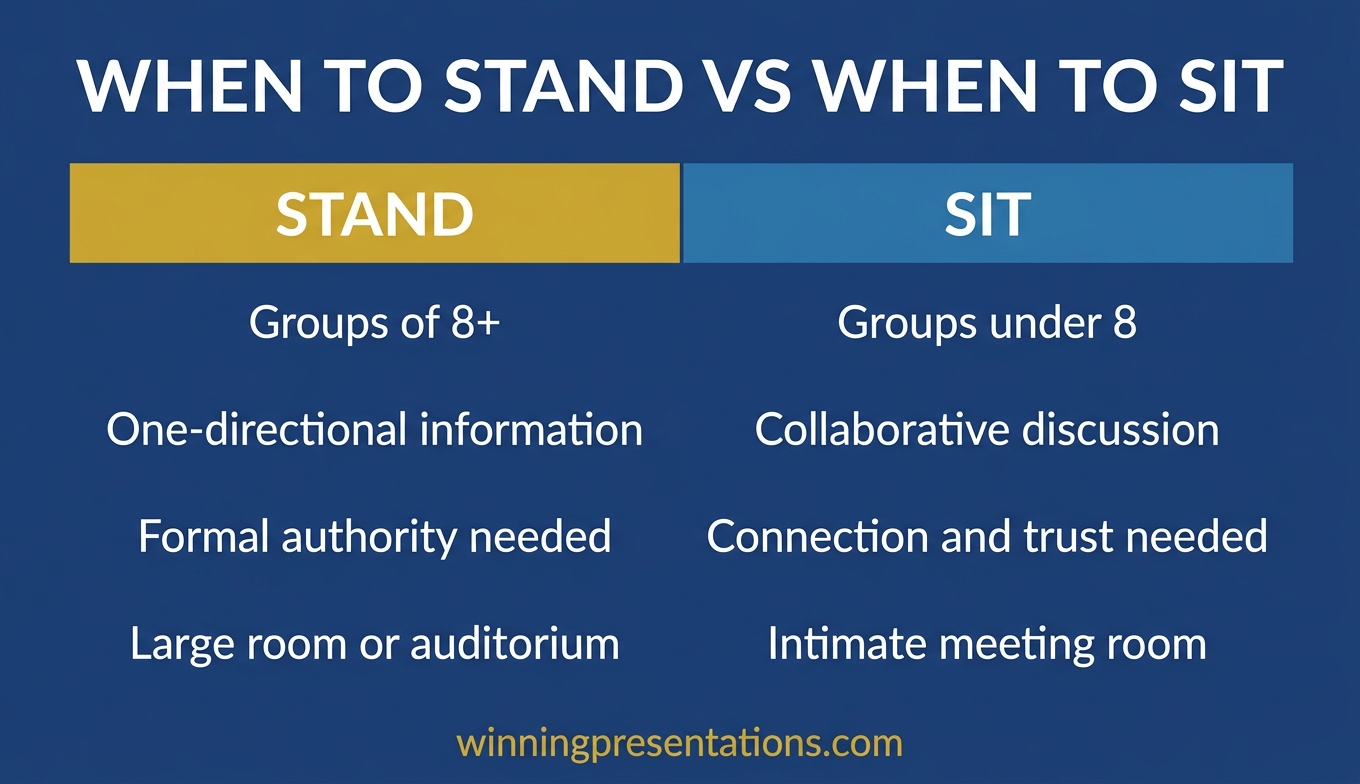
Where standing can work against you is in intimate settings. A room with four people around a small table does not benefit from a speaker standing at one end. In that context, standing creates vertical distance that the audience reads as separation. You become the performer in a room that expected a colleague. This is particularly noticeable in cultures and organisations where hierarchy is already a source of tension — standing amplifies the power differential in ways that may not serve your objective.
The decision about how to use movement during presentations is closely connected to the standing question. Movement only works when you are already standing — and purposeful movement (stepping toward the audience, moving to a different part of the room) can reinforce authority without creating the static formality that some audiences find distancing.
When Sitting Builds Trust and Genuine Connection
Sitting down removes the vertical advantage. That is its purpose. In small meetings — four to eight people — where the goal is discussion, collaboration, or consensus-building, sitting at the table signals that you are a participant rather than a performer. For many executives, particularly those who present to peers or senior leaders, this is the more effective position.
The trust mechanism is straightforward: eye-level communication feels equitable. When you sit, the audience does not need to look up at you. The physical dynamic is shared — everyone is at the same height, everyone has the same posture options, and the conversation feels laterally structured rather than top-down. This is particularly valuable in advisory or consulting contexts, where appearing authoritative without appearing hierarchical is the central presentational challenge.
Sitting also changes the tempo of your delivery. Standing presenters tend to pace themselves against slides or a mental clock. Seated presenters tend to pace themselves against the room — responding to nods, pausing after questions, allowing silences to develop. This responsive tempo often leads to richer discussion and better audience engagement, particularly in senior leadership settings where the audience expects to contribute, not just receive.
One tactical advantage of sitting is its effect on eye contact technique. When standing, eye contact becomes a deliberate scan across the room. When sitting, it becomes conversational — you look at the person speaking, then shift to the person you are addressing. This pattern feels more natural and produces genuine dialogue.
The risk of sitting is reduced projection. If you naturally speak softly, sitting can make your voice harder to hear. If you rely on gestures, sitting compresses your gesture range to what is visible above the table line. And if the audience is expecting a formal presentation — a board briefing or investor update — sitting may feel under-prepared, regardless of content quality.
The Hybrid Approach: Switching Position Mid-Presentation
The most adaptable presenters do not commit to one position for the entire session. They begin standing for the structured portion — data, recommendation, formal argument — and sit down when the session shifts to discussion or Q&A.
This transition is itself a signal. Standing to seated says: “I have finished delivering; now I am listening.” It communicates a shift in power dynamics — from speaker-led to audience-led — and audiences respond instinctively. The room relaxes and questions become more substantive.
The reverse transition — sitting to standing — is equally powerful. If a discussion has become circular, standing to summarise key points and propose next steps restores directional energy. Used sparingly, this transition can reshape a meeting that has lost momentum without requiring you to comment on the pace of the conversation.
The key is attaching the transition to a structural moment — a slide change, a new topic, or a pause after a major point. “Let me sit down for this part — I want to hear your reaction before I move to the recommendation” is a transition that feels purposeful rather than performative.
If you are exploring ways to build confidence across all presentation formats, the Conquer Your Fear of Public Speaking programme includes protocols for managing anxiety in both standing and seated contexts.
Managing Nerves in Each Position
Anxiety behaves differently when you are standing than when you are sitting, and understanding the distinction is essential for managing it effectively. When standing, the body’s fight-or-flight response has more physical expression — pacing, shifting weight, fidgeting with hands. These are visible to the audience and can create a feedback loop: you notice yourself moving nervously, which increases self-consciousness, which increases the nervous movement.
The counter-strategy for standing anxiety is grounding. Plant both feet flat, hip-width apart, and distribute your weight evenly. From this grounded position, deliberate movement becomes possible — a step forward to emphasise a point, a turn toward a different section of the audience — without the restless quality that audiences interpret as uncertainty.
Sitting creates different challenges. Anxiety tends to express itself in smaller movements: tapping fingers, clicking pens, bouncing a knee under the table. The containment of the seated position can also increase a sense of being trapped — no space to move, no physical release for the adrenaline your nervous system is producing.
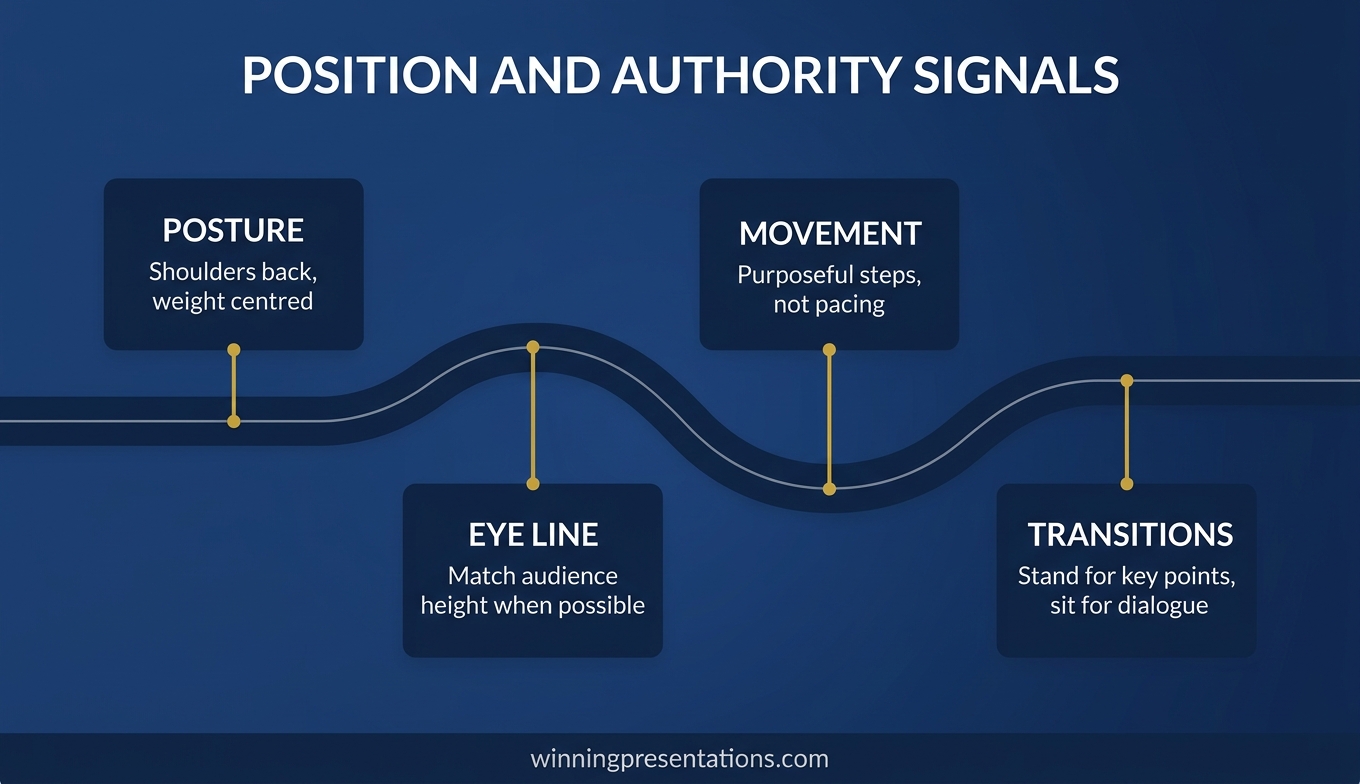
The counter-strategy for seated anxiety is anchoring. Place both hands on the table, fingers loosely interlaced or resting on your notes — this gives the nervous energy a physical endpoint. Combine this with a slower breathing rhythm (inhale for four counts, exhale for six) and the seated position becomes stable rather than confining.
Both positions benefit from arriving early and occupying the space before the audience does. Standing at the front of an empty room for two minutes allows your nervous system to register the space as familiar. Sitting and arranging your materials before others arrive establishes physical ownership of the position. Either approach reduces the novelty that triggers the strongest anxiety responses.
Reading the Room Before You Decide
The decision about whether to stand or sit should ideally be made before you enter the room — but confirmed in the first thirty seconds after you arrive. Three factors should guide the decision.
Room geometry. If the room has a clear “front” — a screen, a lectern, a presentation area separated from the seating — standing is the expected norm. If the room is organised around a table with no focal point, sitting is the default. Going against the room’s implied structure requires a deliberate reason and a confident transition.
Audience seniority relative to yours. Presenting to people more senior than you creates a tactical decision. Standing projects confidence but can create an awkward dynamic where a junior person is physically elevated above decision-makers. Sitting signals respect but can reduce your visibility when you need the room to take your recommendation seriously. The right choice depends on the organisation’s culture and your specific relationship with the audience.
Meeting purpose. Informational presentations (results, updates, briefings) favour standing because the information flow is one-directional. Decisional presentations are more context-dependent — standing works for large committees, sitting for small ones. Collaborative sessions almost always favour sitting because the goal is participation rather than reception. Mastering standing sitting presentations across all three contexts gives you a genuine advantage in how your message lands.
For a deeper exploration of how to structure a confident presenting approach across different executive contexts, the principles of positional awareness apply regardless of the format or formality of the session.
Conquer Your Fear of Public Speaking
Whether you stand or sit, anxiety should not dictate the decision. This programme covers nervous system regulation, cognitive reframing, and physical symptom management — so you choose your position based on strategy, not survival. £39, instant access.
Designed for executives and senior professionals who present in high-pressure environments.
Frequently Asked Questions
Is it better to stand or sit when presenting to a small group?
In groups of eight or fewer, sitting is usually more effective. It creates eye-level connection and a conversational dynamic that encourages discussion. The standing sitting presentations debate often comes down to group size: standing in a small room can feel like lecturing, which reduces audience engagement and willingness to challenge your points constructively.
Should I stand for a virtual presentation?
Standing during a virtual presentation can improve your vocal projection, energy, and posture — but only if your camera is positioned at eye level and the framing looks natural. If standing makes you appear distant or creates an awkward angle, sitting with good posture and a well-positioned camera will communicate more effectively through the screen.
How do I manage shaking hands or legs when standing to present?
Shaking is a common adrenaline response. Ground yourself by planting both feet flat on the floor, hip-width apart, and pressing gently into the surface. For hands, hold a pen or rest one hand on the lectern — this gives the nervous energy a physical endpoint. The shaking typically subsides within the first two to three minutes as your body adjusts to the sustained attention. A structured pre-presentation breathing protocol can reduce the intensity of the initial response.
Can I switch between standing and sitting during the same presentation?
Yes, and it can be highly effective. Stand for the structured delivery portion — data, recommendations, formal argument — and sit for discussion and Q&A. The transition itself signals a shift from presenter-led to audience-led, which encourages more substantive engagement. Attach the transition to a structural moment (a topic change or a deliberate pause) so it feels purposeful rather than uncertain.
The Winning Edge — Weekly Newsletter
Practical presentation strategies for senior professionals — delivered every Thursday. Body language, slide structure, executive communication, and confidence techniques drawn from 25 years of corporate experience.
Mary Beth Hazeldine is the Owner & Managing Director of Winning Presentations. With 25 years of corporate banking experience at JPMorgan Chase, PwC, Royal Bank of Scotland, and Commerzbank, she advises executives across financial services, healthcare, technology, and government on structuring presentations for high-stakes funding rounds, board briefings, and leadership decisions.