Tag: body language

26 Apr 2026
Featured image for Standing vs Sitting During Presentations: How Your Position Shapes Authority and Connection

Standing vs Sitting During Presentations: How Your Position Shapes Authority and Connection

Quick Answer

The choice between standing and sitting during presentations sends different signals to your audience. Standing amplifies authority and projects confidence in large rooms, while sitting creates proximity and conversational trust in smaller meetings. The right choice depends on room size, audience seniority, and what you need the audience to feel. Most presenters default to one position without considering the strategic impact.

Priya was halfway through a divisional review at a pharmaceutical company in Reading when she realised something was wrong. She was standing at the front of a small boardroom — eight people seated around an oval table — and the senior director across from her had physically leaned back, arms folded, watching her with the polite distance of someone observing rather than participating.

She had prepared thoroughly. The data was clear, the recommendation was sound, and her delivery was controlled. But the room felt adversarial rather than collaborative. After the meeting, her manager offered a simple observation: “You were standing over them. In that room, with that group, it felt like a lecture. They wanted a conversation.”

The following month, presenting to the same group, Priya sat down. She placed her notes on the table, made eye contact at the same level as every other person in the room, and opened with a question rather than a statement. The senior director leaned forward. The recommendation was approved without a single challenge.

Nothing had changed about Priya’s competence or her argument. What changed was her physical position — and the signal it sent to every person watching.

Does your body fight you before every presentation?

If the decision about whether to stand or sit gets tangled up with anxiety about being watched, the real issue may not be positioning at all. Conquer Your Fear of Public Speaking is a neuroscience-based programme designed to help executives manage the physical and cognitive symptoms that make every presentation feel like a test.

Explore the Programme →

Why Your Physical Position Changes How You Are Perceived

The way an audience perceives a speaker begins before the first word is spoken. Physical elevation — standing above a seated audience — is one of the oldest and most reliable signals of authority in human communication. It works because of deeply embedded social processing: a person who is higher than you commands a different kind of attention than one who is level with you.

This is not about dominance. It is about signal clarity. Standing at the front of a room tells an audience three things: you are the designated speaker, you have prepared a structured message, and the flow of information is intended to move in one direction. Sitting at the table tells them something different: you are a participant in a shared discussion, your contribution is one of several, and information is expected to flow in both directions.

Neither signal is inherently better. But choosing the wrong one creates a mismatch between what you are saying and what your body is communicating. That mismatch is what audiences experience as discomfort — they describe it as “too formal” or “something felt off.” In most cases, the issue is positional. Getting standing sitting presentations right is less about preference and more about reading context accurately.

Understanding how presentation gestures shape perceived authority becomes significantly more useful when combined with an intentional decision about where and how you position your body in the room.

Conquer Your Fear of Public Speaking

Standing in front of a room should not feel like a threat. This neuroscience-based programme — £39, instant access — covers the physical and cognitive dimensions of presentation anxiety so you can focus on your message rather than managing your nervous system.

  • Nervous system regulation techniques for high-stakes settings
  • Cognitive reframing methods for anticipatory anxiety
  • Physical symptom management (shaking, breathlessness, dry mouth)
  • Pre-presentation protocols you can use in the final minutes before you speak

Get the Programme →

Designed for executives and senior professionals who present regularly in high-pressure environments.

When Standing Strengthens Authority and Presence

Standing works best in situations where the audience expects a structured, directional flow of information. Conference presentations, town halls, client pitches to groups of six or more, and any context where slides are projected behind you — these are environments where standing is the natural and expected position. Audiences in these settings are primed to receive, not to participate, and your standing position reinforces that expectation.

Standing also becomes more important when the room is large or when there is any distance between you and the audience. In a room with thirty people, sitting at a table at the front removes you from half the audience’s sightline. Your gestures become invisible, your eye contact narrows to the people closest to you, and your voice loses projection because you are speaking horizontally rather than directing sound outward and upward.

There is a physical confidence benefit as well. When you stand, your diaphragm opens, your breathing deepens naturally, and your vocal range expands. Speakers who struggle with vocal monotony in seated meetings often discover that the same content sounds more varied and engaging when delivered standing. This is not a psychological trick — it is physiology. An open posture produces a more resonant voice.
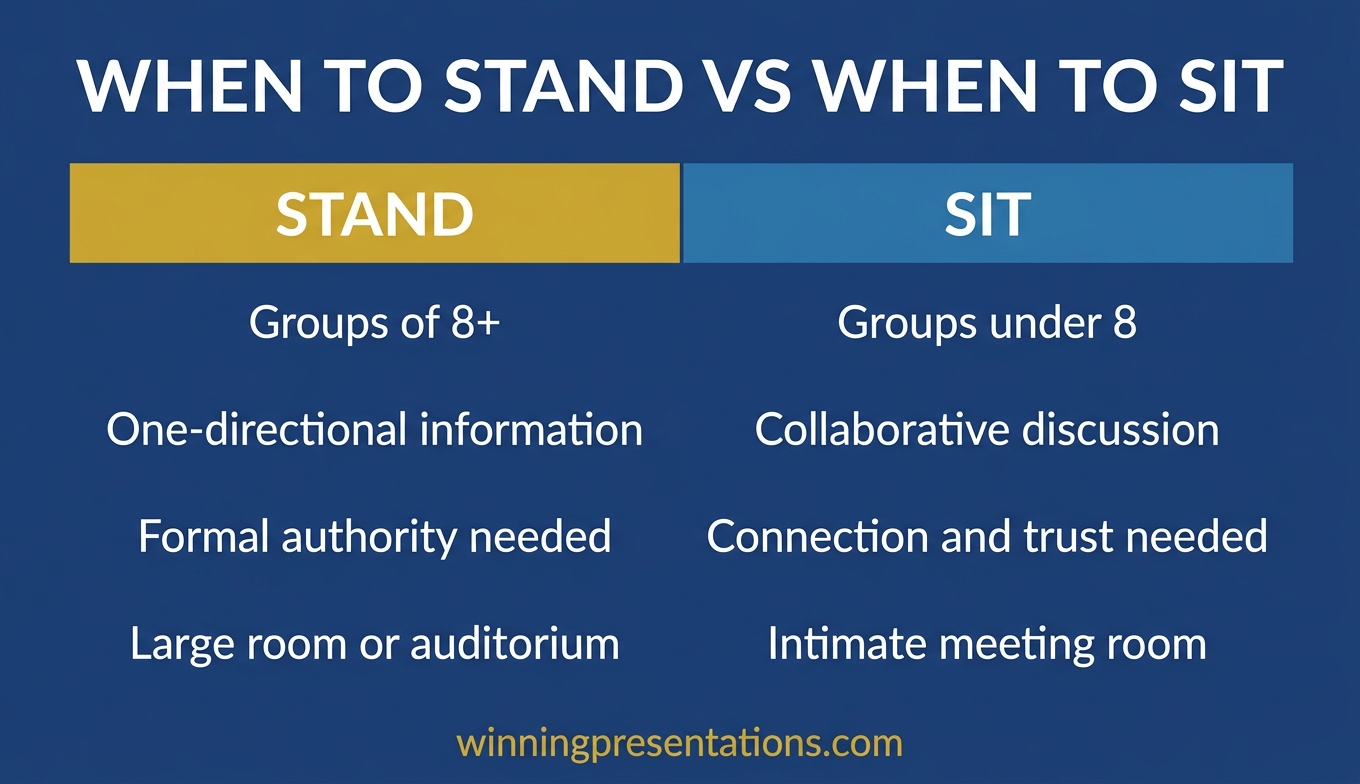
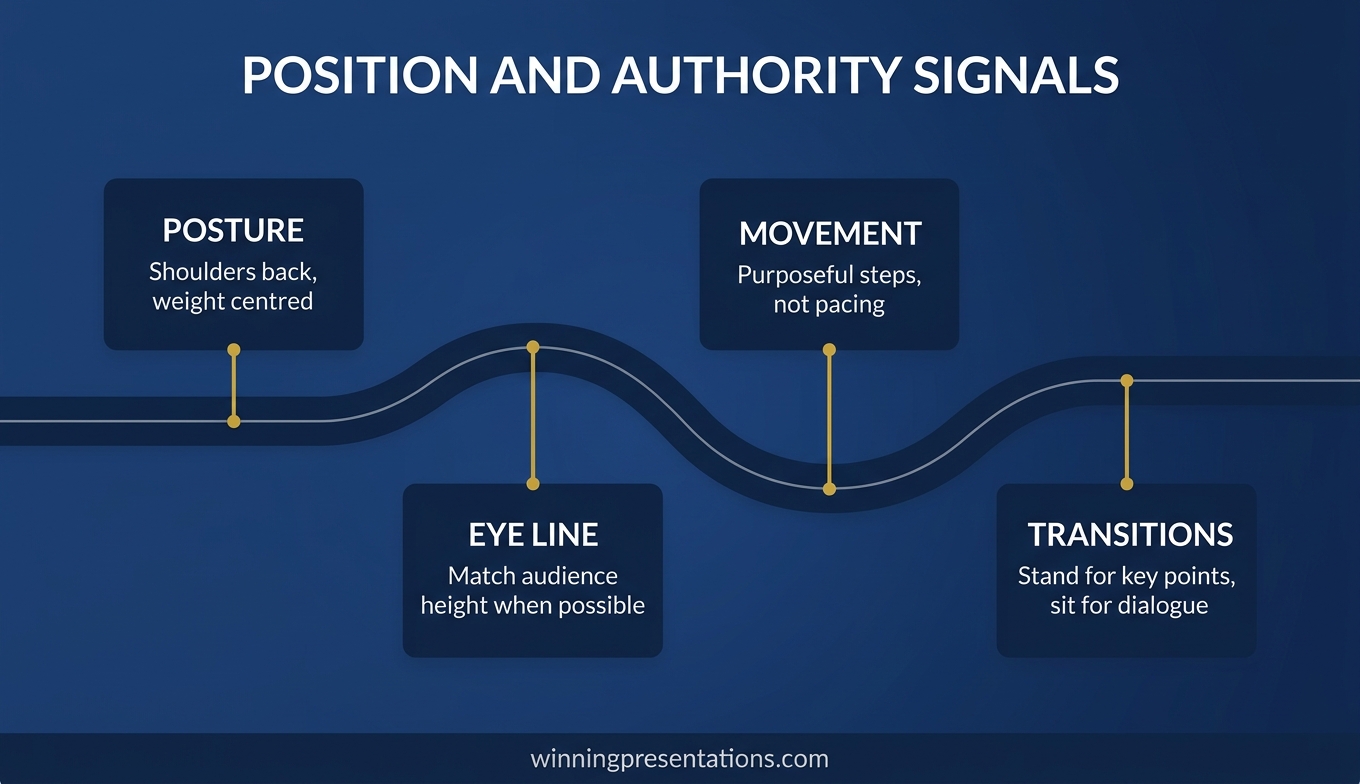
Comparison of standing versus sitting presentation dynamics: standing amplifies authority, vocal projection, and gesture visibility in larger rooms; sitting creates eye-level connection and conversational tone in smaller groups

Where standing can work against you is in intimate settings. A room with four people around a small table does not benefit from a speaker standing at one end. In that context, standing creates vertical distance that the audience reads as separation. You become the performer in a room that expected a colleague. This is particularly noticeable in cultures and organisations where hierarchy is already a source of tension — standing amplifies the power differential in ways that may not serve your objective.

The decision about how to use movement during presentations is closely connected to the standing question. Movement only works when you are already standing — and purposeful movement (stepping toward the audience, moving to a different part of the room) can reinforce authority without creating the static formality that some audiences find distancing.

When Sitting Builds Trust and Genuine Connection

Sitting down removes the vertical advantage. That is its purpose. In small meetings — four to eight people — where the goal is discussion, collaboration, or consensus-building, sitting at the table signals that you are a participant rather than a performer. For many executives, particularly those who present to peers or senior leaders, this is the more effective position.

The trust mechanism is straightforward: eye-level communication feels equitable. When you sit, the audience does not need to look up at you. The physical dynamic is shared — everyone is at the same height, everyone has the same posture options, and the conversation feels laterally structured rather than top-down. This is particularly valuable in advisory or consulting contexts, where appearing authoritative without appearing hierarchical is the central presentational challenge.

Sitting also changes the tempo of your delivery. Standing presenters tend to pace themselves against slides or a mental clock. Seated presenters tend to pace themselves against the room — responding to nods, pausing after questions, allowing silences to develop. This responsive tempo often leads to richer discussion and better audience engagement, particularly in senior leadership settings where the audience expects to contribute, not just receive.

One tactical advantage of sitting is its effect on eye contact technique. When standing, eye contact becomes a deliberate scan across the room. When sitting, it becomes conversational — you look at the person speaking, then shift to the person you are addressing. This pattern feels more natural and produces genuine dialogue.

The risk of sitting is reduced projection. If you naturally speak softly, sitting can make your voice harder to hear. If you rely on gestures, sitting compresses your gesture range to what is visible above the table line. And if the audience is expecting a formal presentation — a board briefing or investor update — sitting may feel under-prepared, regardless of content quality.

The Hybrid Approach: Switching Position Mid-Presentation

The most adaptable presenters do not commit to one position for the entire session. They begin standing for the structured portion — data, recommendation, formal argument — and sit down when the session shifts to discussion or Q&A.

This transition is itself a signal. Standing to seated says: “I have finished delivering; now I am listening.” It communicates a shift in power dynamics — from speaker-led to audience-led — and audiences respond instinctively. The room relaxes and questions become more substantive.

The reverse transition — sitting to standing — is equally powerful. If a discussion has become circular, standing to summarise key points and propose next steps restores directional energy. Used sparingly, this transition can reshape a meeting that has lost momentum without requiring you to comment on the pace of the conversation.

The key is attaching the transition to a structural moment — a slide change, a new topic, or a pause after a major point. “Let me sit down for this part — I want to hear your reaction before I move to the recommendation” is a transition that feels purposeful rather than performative.

If you are exploring ways to build confidence across all presentation formats, the Conquer Your Fear of Public Speaking programme includes protocols for managing anxiety in both standing and seated contexts.

Managing Nerves in Each Position

Anxiety behaves differently when you are standing than when you are sitting, and understanding the distinction is essential for managing it effectively. When standing, the body’s fight-or-flight response has more physical expression — pacing, shifting weight, fidgeting with hands. These are visible to the audience and can create a feedback loop: you notice yourself moving nervously, which increases self-consciousness, which increases the nervous movement.

The counter-strategy for standing anxiety is grounding. Plant both feet flat, hip-width apart, and distribute your weight evenly. From this grounded position, deliberate movement becomes possible — a step forward to emphasise a point, a turn toward a different section of the audience — without the restless quality that audiences interpret as uncertainty.

Sitting creates different challenges. Anxiety tends to express itself in smaller movements: tapping fingers, clicking pens, bouncing a knee under the table. The containment of the seated position can also increase a sense of being trapped — no space to move, no physical release for the adrenaline your nervous system is producing.
Managing presentation anxiety by position: standing strategies include grounding feet and deliberate movement; sitting strategies include anchoring hands and controlled breathing techniques

The counter-strategy for seated anxiety is anchoring. Place both hands on the table, fingers loosely interlaced or resting on your notes — this gives the nervous energy a physical endpoint. Combine this with a slower breathing rhythm (inhale for four counts, exhale for six) and the seated position becomes stable rather than confining.

Both positions benefit from arriving early and occupying the space before the audience does. Standing at the front of an empty room for two minutes allows your nervous system to register the space as familiar. Sitting and arranging your materials before others arrive establishes physical ownership of the position. Either approach reduces the novelty that triggers the strongest anxiety responses.

Reading the Room Before You Decide

The decision about whether to stand or sit should ideally be made before you enter the room — but confirmed in the first thirty seconds after you arrive. Three factors should guide the decision.

Room geometry. If the room has a clear “front” — a screen, a lectern, a presentation area separated from the seating — standing is the expected norm. If the room is organised around a table with no focal point, sitting is the default. Going against the room’s implied structure requires a deliberate reason and a confident transition.

Audience seniority relative to yours. Presenting to people more senior than you creates a tactical decision. Standing projects confidence but can create an awkward dynamic where a junior person is physically elevated above decision-makers. Sitting signals respect but can reduce your visibility when you need the room to take your recommendation seriously. The right choice depends on the organisation’s culture and your specific relationship with the audience.

Meeting purpose. Informational presentations (results, updates, briefings) favour standing because the information flow is one-directional. Decisional presentations are more context-dependent — standing works for large committees, sitting for small ones. Collaborative sessions almost always favour sitting because the goal is participation rather than reception. Mastering standing sitting presentations across all three contexts gives you a genuine advantage in how your message lands.

For a deeper exploration of how to structure a confident presenting approach across different executive contexts, the principles of positional awareness apply regardless of the format or formality of the session.

Conquer Your Fear of Public Speaking

Whether you stand or sit, anxiety should not dictate the decision. This programme covers nervous system regulation, cognitive reframing, and physical symptom management — so you choose your position based on strategy, not survival. £39, instant access.

Get the Programme →

Designed for executives and senior professionals who present in high-pressure environments.

Frequently Asked Questions

Is it better to stand or sit when presenting to a small group?

In groups of eight or fewer, sitting is usually more effective. It creates eye-level connection and a conversational dynamic that encourages discussion. The standing sitting presentations debate often comes down to group size: standing in a small room can feel like lecturing, which reduces audience engagement and willingness to challenge your points constructively.

Should I stand for a virtual presentation?

Standing during a virtual presentation can improve your vocal projection, energy, and posture — but only if your camera is positioned at eye level and the framing looks natural. If standing makes you appear distant or creates an awkward angle, sitting with good posture and a well-positioned camera will communicate more effectively through the screen.

How do I manage shaking hands or legs when standing to present?

Shaking is a common adrenaline response. Ground yourself by planting both feet flat on the floor, hip-width apart, and pressing gently into the surface. For hands, hold a pen or rest one hand on the lectern — this gives the nervous energy a physical endpoint. The shaking typically subsides within the first two to three minutes as your body adjusts to the sustained attention. A structured pre-presentation breathing protocol can reduce the intensity of the initial response.

Can I switch between standing and sitting during the same presentation?

Yes, and it can be highly effective. Stand for the structured delivery portion — data, recommendations, formal argument — and sit for discussion and Q&A. The transition itself signals a shift from presenter-led to audience-led, which encourages more substantive engagement. Attach the transition to a structural moment (a topic change or a deliberate pause) so it feels purposeful rather than uncertain.

The Winning Edge — Weekly Newsletter

Practical presentation strategies for senior professionals — delivered every Thursday. Body language, slide structure, executive communication, and confidence techniques drawn from 25 years of corporate experience.

Subscribe to The Winning Edge →

Mary Beth Hazeldine is the Owner & Managing Director of Winning Presentations. With 25 years of corporate banking experience at JPMorgan Chase, PwC, Royal Bank of Scotland, and Commerzbank, she advises executives across financial services, healthcare, technology, and government on structuring presentations for high-stakes funding rounds, board briefings, and leadership decisions.

05 Apr 2026
Executive presenter making deliberate eye contact with a board member during a high-stakes presentation, confident posture, engaged audience

Eye Contact in Presentations: The 3-Second Rule That Changes How Executives Read You

Quick Answer

The 3-second rule for eye contact in presentations means holding deliberate eye contact with one person for roughly three seconds — long enough to complete a thought — before moving to another. This prevents the scanning and darting that signals anxiety, and it distributes your attention purposefully across the room, including to the people who are most sceptical. Executives read your eye contact behaviour as a direct signal of whether you believe what you are saying.

Henrik is a VP at a pharmaceutical company. He had prepared meticulously for a major leadership presentation — the data was solid, the narrative was clear, and he knew every number on every slide. Afterwards, the feedback stopped him cold: he had “seemed uncertain.” His coach watched the recording with him and spotted the issue within two minutes. Henrik had spent the entire presentation making eye contact with the three people nodding along at the left side of the table. He had barely glanced at the two board members on the right — the sceptics, the ones who were quietly deciding whether his budget proposal was credible. He had read the room, chosen the safe faces, and without realising it, he had signalled to the decision-makers that he either did not see them or did not want to. His certainty about the content never reached the people who mattered most.

Want a structured approach to building presentation confidence?

If you recognise the pattern Henrik experienced — knowing your material but still not landing as confidently as you should — there is a structured programme built specifically for executives navigating that gap. It works on the physical and psychological roots of presentation anxiety, not just the surface technique.

Explore the Programme →

What Eye Contact Signals to an Executive Audience

When you present to a senior audience, the content you deliver accounts for only part of how you are judged. Executives — particularly those who regularly sit in on high-stakes decisions — are experienced observers of other people. They have learned, often without consciously articulating it, to read delivery as a signal of conviction.

Eye contact is one of the clearest signals available to them. When a speaker holds steady, distributed eye contact, the room interprets it as ownership of the material. When a speaker scans nervously, looks repeatedly at their slides, or gravitates only toward friendly faces, the room reads it as discomfort — and discomfort in the presenter creates doubt about the content.

This matters enormously in executive and board-level settings, where the audience is making ongoing assessments throughout your presentation rather than waiting for the end. They are not passively receiving information. They are evaluating whether they trust the person delivering it. This is why your opening moments carry so much weight — and why eye contact behaviour from the first thirty seconds shapes the credibility you carry for the rest of the room.

There is also a subtler signal at work. When you make sustained eye contact with someone, it implies you are speaking directly to them — that you expect them to engage, to respond, to be part of the conversation. Executives are accustomed to being addressed this way. When a presenter fails to include them visually, it can read, consciously or not, as a lack of confidence in what is being said.

The inverse is equally important: the two board members Henrik was avoiding noticed, even if they never mentioned it. Sceptics who are not included in a speaker’s eye contact pattern often become more entrenched in their scepticism. They have been, in effect, dismissed.

The 3-Second Rule: Why It Works and How to Apply It

The 3-second rule is straightforward: when making eye contact in a presentation, hold your gaze with one person for approximately three seconds — enough to complete a sentence or a thought — before moving to someone else. It is not a rigid count. The goal is to match a complete idea to a complete moment of connection.

Why three seconds? Less than that and the contact reads as a glance — it feels rushed and superficial. The audience member does not feel genuinely addressed. More than five or six seconds and the contact starts to feel intense or confrontational, which is equally counterproductive. Three seconds is the natural duration of genuine conversational engagement. It is what happens automatically between two people having a focused discussion. Replicating it in a presentation setting makes the room feel like a conversation rather than a broadcast.

Applying it requires deliberate zone management. A useful way to think about your room is in three zones:

  • Decision-Makers Zone: The people with direct authority over the outcome — budget holders, senior sponsors, the most sceptical voices. Aim to spend approximately 40% of your eye contact time here, even if — especially if — they are not visibly receptive.
  • Nodders Zone: The engaged, visibly supportive faces. These feel natural to return to. Limit yourself to around 30% of your eye contact time here. They are already on your side.
  • Peripheral Zone: Colleagues, observers, junior stakeholders. Include them at around 30%, particularly during moments where you are building general credibility rather than pushing for a specific decision.

The practical discipline is to resist the gravitational pull of the nodders. It is entirely human to seek the safe face when you are under pressure. But doing so consistently tells the decision-makers that you are managing your own anxiety rather than engaging with them — which is precisely the opposite impression you want to create. Deliberate eye contact during an eye contact presentation is an act of attention directed outward, not inward.

One refinement worth noting: when you are presenting data or referencing a slide, it is acceptable to glance at the screen briefly. The error is staying there. Executives are reading your slides differently from how you expect, which means your job is to bridge the visual information to your verbal argument — and that bridge is built through eye contact, not through reading aloud.


Dashboard infographic showing the eye contact zone strategy for presentations with percentage time allocations for decision-makers, nodders, and peripheral audience members

Conquer Speaking Fear — £39

Build the Delivery Confidence That Lets Your Expertise Actually Land

Knowing your material is not the same as being able to deliver it under pressure. Conquer Speaking Fear is a 30-day programme that works on the nervous system roots of presentation anxiety — drawing on techniques from clinical hypnotherapy and nervous system regulation — so that your capability as a speaker matches the depth of your expertise.

  • Addresses the physiological and psychological components of presentation anxiety
  • Uses nervous system regulation techniques developed from clinical hypnotherapy practice
  • Structured as a 30-day programme with a clear, progressive framework
  • Designed for the specific pressures of executive and leadership-level presenting
  • Works on the internal experience of presenting, not just surface-level technique

Get Conquer Speaking Fear → £39

Designed for executives managing presentation anxiety and delivery pressure.

The Common Eye Contact Mistakes Executives Make

Most executives making eye contact errors are not aware they are doing it. The mistakes tend to cluster into a few recurring patterns.

Defaulting to the slide. The slide becomes a refuge when anxiety rises. Looking at the screen gives the speaker a brief pause from the pressure of being observed. Done occasionally, it is fine. Done repeatedly, it signals that the presenter does not fully own the material — that they need the slide as a prompt rather than as a visual support for an argument they could make without it.

The lighthouse sweep. Some speakers attempt to cover the room by scanning continuously from left to right and back again. This feels inclusive in theory, but in practice no individual ever feels addressed. The effect is impersonal and often reads as rehearsed in an unconvincing way. It is eye contact that avoids actual contact.

Locking in on one person. Some speakers — particularly those who are anxious — find one sympathetic face and stay there. This person becomes uncomfortable; everyone else feels excluded. If that one person happens to be a junior colleague rather than a decision-maker, the power dynamics in the room shift in an unhelpful direction.

Avoiding the sceptics entirely. This is Henrik’s mistake, and it is the most costly. Sceptics are sceptical precisely because they have unanswered questions or concerns. When a speaker visually excludes them, they receive a secondary signal that the speaker is either unaware of their concerns or unwilling to engage with them. Neither reading helps the presenter’s case. By contrast, deliberate and steady eye contact with a sceptic communicates: I see you. I am not afraid of your scrutiny.

Breaking eye contact at the wrong moment. The moment a speaker looks away tends to be interpreted as a signal — especially when it happens immediately after a key claim or recommendation. Looking down as you deliver your conclusion reads, unconsciously, as lack of conviction. The recommendation lands, then the speaker retreats from it. Holding eye contact through the delivery of a key point is one of the most direct ways to signal that you stand behind it.

If you are also working on avoiding the over-explanation habits that undermine credibility, eye contact discipline reinforces that work. The two behaviours are connected: over-explaining often comes with the same anxious avoidance pattern that produces poor eye contact.

How to Use Eye Contact When the Room Turns Hostile

There are presentations where the atmosphere shifts. A question is asked with an edge. Two board members exchange a look. Someone pushes back on your data. The room — or part of it — turns.

This is precisely the moment when instinct and good practice diverge most sharply. The instinctive response to hostility is to look away — to break contact, reduce the confrontational feeling, and regroup. But breaking eye contact in that moment sends a signal: that you are unsettled, that the challenge has found its target.

The discipline required is to maintain steady eye contact with the person who has challenged you while you formulate your response. Not a stare — that reads as aggression. But the same three-second conversational contact you would use with anyone else in the room. It communicates that you have heard the challenge, that you are taking it seriously, and that you are not rattled by it.

When answering a difficult question, direct the opening of your answer to the person who asked it, then broaden your gaze to include the wider room as you develop your response. This does two things: it honours the questioner while simultaneously making your answer a contribution to the whole room, not just a defence directed at one person. It reduces the adversarial dynamic without conceding ground.

If a question is genuinely difficult and you need a moment to think, it is completely acceptable to say so. The error is saying so while looking at the floor. Pausing while maintaining a composed, outward gaze signals that you are thinking carefully, not that you have been caught out.

Preparing for exactly this kind of pressure is one of the reasons executives benefit from working on the anxiety response that underpins delivery, not just the technique layer. When the nervous system is calmer under pressure, the physical signals — including eye contact — become far easier to manage.

If you have recently delivered a high-stakes presentation and are thinking about how to manage the follow-up conversation with decision-makers, the board presentation follow-up protocol covers the steps that typically happen after the room.

If the anxiety response in high-pressure presentations is something you recognise in yourself, Conquer Speaking Fear addresses exactly that, using nervous system regulation and clinical hypnotherapy techniques structured across thirty days.

Practising Eye Contact Before High-Stakes Presentations

Knowing the 3-second rule intellectually and executing it under pressure are two different skills. Like any physical component of presentation delivery, eye contact benefits from deliberate rehearsal — not just running through your content, but specifically practising the act of looking at people.

The most effective practice method is to rehearse in front of actual people rather than a mirror. A mirror changes the dynamic significantly: you are watching yourself, which is the opposite of the outward attention eye contact requires. If you can rehearse with a small group — even two or three colleagues — you can practise zone management in a realistic context.

If live rehearsal is not possible, the following framework helps structure your practice:

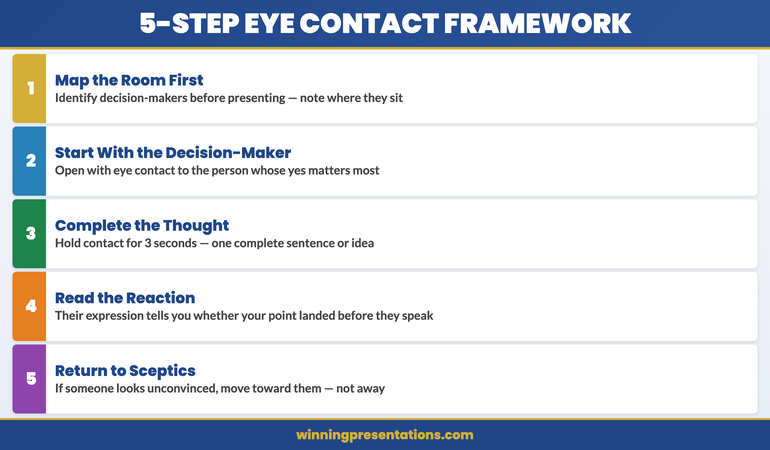
  1. Map your room in advance. Before a high-stakes presentation, identify where the decision-makers, nodders, and peripheral audience members will sit. Have a plan for where your eye contact will begin and how it will move.
  2. Anchor your opening in a person, not a slide. Start by addressing a specific individual with your first sentence. This sets the conversational tone from the outset.
  3. Practise completing full thoughts per person. Rehearse delivering single sentences or short ideas to one imagined person before moving. Get comfortable with the rhythm of thought-and-release rather than scan-and-move.
  4. Record yourself. Even a phone recording of a rehearsal can reveal patterns you are not aware of — including how often you look at your notes, your slides, or the floor.
  5. Practise under mild pressure. If the anxiety itself disrupts your eye contact, practising in entirely comfortable conditions will not prepare you for the real thing. Find ways to rehearse with a slightly raised heart rate — presenting to a slightly larger group than is comfortable, or in a less familiar environment.

The goal is not to make eye contact feel effortful and deliberate on the day — it is to practise until the deliberate choices become second nature. The technique should be invisible to your audience. They should experience you as engaged and present, not as someone executing a method.


Stacked cards infographic showing the five-step eye contact framework for presentations from mapping the room to returning to sceptics

Conquer Speaking Fear — £39

Systematic Confidence for the Moments That Count

Technical rehearsal takes you a certain distance. Conquer Speaking Fear takes you further — building the internal stability that lets you hold eye contact with a sceptic, absorb a difficult question, and deliver your recommendation with composure. It is a 30-day programme using nervous system regulation and techniques drawn from clinical hypnotherapy, structured for the specific challenges of executive-level presenting.

Get Conquer Speaking Fear → £39

Frequently Asked Questions

How long should eye contact last in a presentation?

Aim for approximately three seconds of eye contact per person — long enough to complete a sentence or a clear thought before moving on. Less than that reads as a glance; more than five or six seconds can feel intense or confrontational. The three-second duration naturally mirrors the rhythm of genuine conversational engagement, which is why it tends to feel credible to an executive audience.

Should you make eye contact with difficult or sceptical audience members?

Yes — and it is worth making a deliberate effort to do so, because the instinct under pressure is to avoid sceptical faces. Decision-makers who are sceptical are exactly the people whose confidence you need to build. Deliberately including them in your eye contact pattern signals that you are not unsettled by their scrutiny, which often does more to address their concerns than the content alone. Avoiding them tends to entrench rather than reduce their scepticism.

What if nerves make it difficult to maintain eye contact during a presentation?

This is common and it has a physical basis: when the nervous system is in an anxious state, looking at people can feel more exposing. Surface techniques help — practising zone management, rehearsing under mild pressure, anchoring your opening in a specific person. But if anxiety is disrupting your delivery more broadly, working on the underlying nervous system response tends to produce more sustainable results than technique adjustments alone. A structured programme focused on the physiological roots of presentation anxiety addresses this at the level where it originates.

Free Weekly Insights

The Winning Edge Newsletter

Each week: one practical idea for senior presenters. Delivery, structure, stakeholder handling, and the internal work that makes the difference. No filler.

Subscribe to The Winning Edge →

Mary Beth Hazeldine

Mary Beth Hazeldine is a presentation skills coach and the founder of Winning Presentations. She works with executives and senior leaders on the delivery, structure, and confidence challenges that arise in high-stakes presenting. Her programmes draw on her background in clinical hypnotherapy and nervous system regulation to address the anxiety that technical preparation alone does not resolve. She writes regularly on executive communication, presentation delivery, and the psychology of credibility.

13 Jan 2026
Presentation gestures guide - confident hand movements and body language techniques for effective presenting

Presentation Gestures: Why Your Hands Reveal Your Confidence

Quick Answer: Your hands broadcast your confidence level before you speak a word. Purposeful gestures—open palms, numbered fingers, size indicators—project authority. Nervous habits—fidgeting, pocket-diving, fig-leaf position—undermine everything you say. The goal isn’t eliminating movement but channelling energy into gestures that reinforce your message.

I once watched a CFO destroy a £3 million budget proposal without saying anything wrong.

His content was solid. His slides were clear. His recommendations were sound. But his hands told a different story.

Throughout the presentation, he gripped the sides of the lectern like it might fly away. When he stepped out to make a point, his hands immediately dove into his pockets. During questions, he crossed his arms tightly across his chest.

The board saw a nervous executive who didn’t believe in his own proposal. They rejected it.

Afterward, he asked me what went wrong. “Your hands,” I told him. “They were screaming that you weren’t confident. And the board listened to your hands, not your words.”

He was genuinely shocked. He had no idea his gestures were undermining him.

⭐ Slides That Free Your Hands

The Executive Slide System creates presentations you can deliver without clutching notes or reading from screens. When your slides guide you naturally, your hands are free to gesture with purpose instead of grasping for security.

Get the Executive Slide System → £39

The Gestures That Command Authority

Confident presenters use their hands with intention. Here are the gestures that project authority:

Open Palms

Palms facing slightly upward signal honesty and openness. Politicians and executives use this instinctively when making important points. It says “I have nothing to hide.” This is foundational to effective presentation body language.

Numbered Fingers

“There are three things to consider…” accompanied by three raised fingers creates structure and memorability. It signals organisation and helps audiences track your points.

Size and Scale Indicators

Showing “this big” or “that small” with your hands makes abstract concepts concrete. When discussing growth, expansion, or comparison, let your hands illustrate the scale.

Steepling

Fingertips touching in front of your chest projects confidence and thoughtfulness. Use it during pauses or when listening to questions. It reads as authoritative without being aggressive.

Purposeful Pointing

Pointing at slides, referencing audience members (carefully), or emphasising key moments creates direction and energy. The key word is purposeful—random pointing looks erratic.

For more on how your physical presence affects your message, see our complete guide to presentation body language.

Confident presentation gestures versus nervous hand habits - open palms, steepling, and numbered fingers versus fidgeting, pockets, and crossed arms

The Nervous Habits That Undermine You

These gestures signal anxiety—even when you’re not feeling it:

The Pocket Dive

Hands in pockets reads as disengaged or hiding something. One hand occasionally is acceptable; both hands continuously is a credibility killer.

The Fig Leaf

Hands clasped in front of your groin is a classic defensive posture. It screams discomfort and makes you look smaller.

The Lectern Death Grip

White-knuckling the podium broadcasts fear. It also locks you in place, preventing natural movement that creates engagement.

Self-Touching

Playing with hair, touching your face, adjusting clothing—all self-soothing behaviours that signal nervousness. Your audience notices even when you don’t.

The Fidget

Clicking pens, jingling coins, rubbing hands together. Nervous energy has to go somewhere—but these outlets distract your audience and undermine your message.

The challenge is that most people don’t know they’re doing these things. That’s why awareness of your body language is the first step to fixing it.

Your “Home Base” Position

Between gestures, you need somewhere for your hands to go. This is your home base—a neutral position that looks natural and confident.

Best options:

  • Arms relaxed at your sides (harder than it sounds, but projects most confidence)
  • Hands lightly clasped at waist level (comfortable and neutral)
  • One hand holding notes, other at side (practical for longer presentations)

Avoid:

  • Hands behind back (looks like you’re hiding something or being interrogated)
  • Arms crossed (defensive, closed off)
  • Hands on hips (can read as aggressive or impatient)

Practice your home base until it feels natural. Then gestures become departures and returns—purposeful movements rather than constant fidgeting.

This is part of the broader body language framework that transforms how audiences perceive you.

🏆 Master Your Complete Physical Presence

The Executive Buy-In Presentation System covers gestures, posture, movement, eye contact, and voice—the complete physical toolkit that separates good presenters from commanding ones.

Learn More → £199

📧 Join 2,000+ professionals getting weekly presentation insights. Subscribe to The Winning Edge →

Frequently Asked Questions

What should I do with my hands during a presentation?

Use purposeful gestures that match your words—open palms for honesty, numbered fingers for lists, size indicators for scale. Between gestures, rest hands at your sides or lightly clasped at waist level. Avoid pockets, crossed arms, or fig-leaf position. More techniques in our body language guide.

What hand gestures show confidence when presenting?

Open palms facing slightly upward signal honesty and openness. Steepling (fingertips touching) projects authority. Purposeful pointing emphasises key points. The key is intentional movement that matches your message, not constant motion.

How do I stop nervous hand gestures when presenting?

First, identify your specific habit (fidgeting, touching face, gripping lectern). Then practice with hands at sides as your ‘home base.’ Nervous energy needs somewhere to go—channel it into purposeful gestures rather than trying to eliminate movement entirely. This connects to broader presentation body language principles.

📥 Free Download: 7 Presentation Frameworks

Get the structural frameworks that let you present confidently—so your gestures can be purposeful rather than anxious.

Download Free →

Related: Presentation Body Language: The Complete Guide to Physical Presence


Mary Beth Hazeldine spent 24 years at JPMorgan, PwC, RBS, and Commerzbank. She’s a clinical hypnotherapist and MD of Winning Presentations.

12 Jan 2026
presentation eye contact techniques - how to connect with individual audience members instead of scanning the room

Presentation Eye Contact: Why Looking at Everyone Means Connecting with No One

Quick Answer: Scanning the room isn’t eye contact—it’s surveillance. When you try to look at everyone, you connect with no one. Effective presentation eye contact means focusing on one person for a complete thought (3-5 seconds), creating genuine connection, then moving to someone else. This builds trust and authority far more than nervous room-scanning ever could.

A director at RBS once asked me to watch her present and tell her why audiences seemed “disconnected.”

Within thirty seconds, I spotted the problem. Her eyes were everywhere—sweeping left to right, front to back, like a lighthouse beam. She was technically looking at everyone. She was connecting with no one.

“I was told to make eye contact with the whole room,” she explained. “So I keep my eyes moving.”

That advice had backfired completely. Her constant scanning read as nervous, evasive, even untrustworthy. Audiences sensed something was off, even if they couldn’t articulate what.

I taught her a different approach—one that transformed her presence within a single session. The technique is simple, but it contradicts what most people have been taught about presentation body language.

🎯 Master Every Aspect of Presentation Delivery

The Public Speaking Cheat Sheets include eye contact patterns, body language techniques, and voice control methods—everything you need to command a room with confidence.

Get the Cheat Sheets → £14.99

The “One Thought, One Person” Technique

Here’s the approach that actually works:

Pick one person. Make genuine eye contact with them—not a glance, but real connection. Hold it for one complete thought or sentence (typically 3-5 seconds).

Complete your thought. Finish what you’re saying while still connected to that person. They should feel like you’re speaking directly to them.

Move to a different section. Find someone in another part of the room. Repeat the process. Front, back, left, right—work the whole space, but through genuine individual connections.

This creates an entirely different effect than scanning. Each person you connect with feels seen. Others in that section feel included by proximity. And you project calm confidence rather than nervous energy.

For more on mastering your physical presence, see our complete guide to presentation body language.

One thought one person eye contact technique - diagram showing how to connect with individual audience members across different room sections

Why Scanning Backfires

When your eyes are constantly moving, several problems emerge:

  • You look nervous. Darting eyes are a universal signal of anxiety or evasiveness. Your audience reads this subconsciously.
  • No one feels connected. A glance isn’t connection. When you never settle on anyone, everyone feels like part of an anonymous crowd.
  • You can’t read the room. You need to hold eye contact long enough to register reactions. Scanning means you miss the signals that tell you how your message is landing.
  • You lose your train of thought. Constant visual movement is cognitively demanding. Your brain is processing new faces instead of focusing on your content.

The irony is that scanning is often taught as a confidence technique. In practice, it undermines confidence—both yours and your audience’s confidence in you.

What If Eye Contact Makes You Nervous?

If direct eye contact feels uncomfortable, use these adaptations:

Start with friendly faces. Identify people who are nodding, smiling, or visibly engaged. Begin your eye contact practice with them. Their positive feedback builds your confidence for tougher audience members.

Use the forehead trick. Look at the bridge of someone’s nose or their forehead. From presentation distance, this reads as eye contact. It’s less intense for you while appearing connected to them.

Section the room mentally. Divide the space into four to six sections. Make sure you connect with at least one person in each section during your presentation. This ensures coverage without requiring you to think about individual faces constantly.

These techniques work together with your overall body language to create a presence that feels authoritative and trustworthy.

⭐ Slides That Let You Focus on Connection

The Executive Slide System gives you slide structures you can present without memorising scripts. When you’re not worried about what comes next, you can focus on genuine eye contact with your audience.

Get the Executive Slide System → £39

📧 Join 2,000+ professionals getting weekly presentation insights. Subscribe to The Winning Edge →

Frequently Asked Questions

Where should I look when giving a presentation?

Focus on one person for a complete thought (3-5 seconds), then move to someone in a different section. This creates genuine connection rather than the ‘scanning’ effect that makes you look nervous. See our full guide to presentation body language for more techniques.

How long should I maintain eye contact during a presentation?

Hold eye contact with one person for one complete thought—typically 3-5 seconds. Shorter feels nervous and darting; longer can feel intense or uncomfortable. Complete your thought, then move on.

What if eye contact makes me nervous when presenting?

Start with friendly faces—people who are nodding or engaged. Build confidence there before including neutral or challenging audience members. You can also look at foreheads or the bridge of the nose; from presentation distance, it reads as eye contact.

📥 Free Download: 7 Presentation Frameworks

Get structures that support confident delivery—so you can focus on connection instead of content.

Download Free →

Related: Presentation Body Language: Look Confident Even When You’re Not


Mary Beth Hazeldine spent 24 years at JPMorgan, PwC, RBS, and Commerzbank. She’s a clinical hypnotherapist and MD of Winning Presentations.

20 Dec 2025
How to look confident when presenting - 7 techniques to project confidence even when nervous

How to Look Confident When Presenting (Even When You’re Not)

7 techniques that project confidence to your audience — while your nervous system catches up

Here’s a secret from someone who advises executives across financial services, healthcare, technology, and government.

They’ve just learned what confidence looks like — and they do those things deliberately until their nervous system catches up.

I know this because I lived it. For my first five years in banking, I was terrified of presenting. But I learned to look confident when presenting long before I actually felt confident. And eventually, the feeling followed the behaviour.

Here are the seven techniques that make you look confident when presenting — even when you’re shaking inside.

1. Plant Your Feet (And Stop Swaying)

Presenting this week?

If nerves are already building, a framework matters more than another rehearsal. Explore Conquer Speaking Fear →

The physical framework matters: Conquer Speaking Fear addresses the nervous system response that drives visible anxiety — so you can project the confidence you actually have.

Nervous presenters shift their weight, sway side to side, or pace without purpose. It’s one of the most visible signs of anxiety — and your audience registers it immediately.

How to look confident instead:

  • Stand with feet shoulder-width apart
  • Press your feet firmly into the floor
  • Distribute weight evenly on both feet
  • Move only when transitioning between points (purposeful movement)

This “grounding” technique does double duty — it makes you look confident AND activates a calming response in your nervous system. I used this technique extensively in my clinical hypnotherapy practice before bringing it into presentation training.

Related: How to Calm Nerves Before a Presentation: The 5-Minute Reset

2. Slow Your Speech (Especially at the Start)

When we’re nervous, we speed up. It’s a fight-or-flight response — our brain wants to get through the “danger” as quickly as possible.

The problem? Fast speech signals anxiety. Slow speech signals confidence and authority.

How to look confident instead:

  • Deliberately slow your first three sentences by 30%
  • Pause between sentences (count “one” silently)
  • Drop your pitch slightly — nervous voices rise

Your audience can’t tell you’re nervous if you don’t sound nervous. Control your pace, and you control their perception.

Look Confident. Even When You Don’t Feel It.

Looking confident when presenting is a skill, not a personality trait. Conquer Speaking Fear (£39, instant access) gives you the physical and structural framework that changes how you come across — before and during the presentation.

  • Nervous system techniques that reduce the visible signs of anxiety
  • Voice, posture, and pace frameworks that project authority naturally
  • The preparation system that replaces last-minute panic with structured readiness
  • Designed for professionals who know their content but struggle to show it

Get Conquer Speaking Fear → £39

Designed for professionals who need to project composure, not just feel it.

3. Make Eye Contact With Friendly Faces

Nervous presenters do one of two things: avoid eye contact entirely, or scan the room so fast they connect with no one.

Confident presenters hold eye contact with individuals — typically 3-5 seconds per person.

How to look confident instead:

  • Before you start, identify three friendly faces in different parts of the room
  • Rotate your eye contact between these three people
  • Ignore the sceptics (crossed arms, phone-checkers) — they’re not your audience

This technique makes you look confident while creating genuine connection. And connection reduces your own anxiety — it reminds your brain these are humans, not threats.

Related: Public Speaking Tips: 15 Techniques That Actually Work

4. Use Pauses Instead of Filler Words

“Um,” “uh,” “so,” “like,” “you know” — filler words scream nervousness. But the instinct behind them is right: you need a moment to think.

The solution isn’t to think faster. It’s to pause silently.

How to look confident instead:

  • When you need to think, stop talking completely
  • Take a breath
  • Then continue

Here’s the counterintuitive truth: pauses make you look MORE confident, not less. Watch any skilled speaker — they pause constantly. It signals that you’re in control, not rushing.

5. Open Your Posture (Uncross Everything)

Closed posture — crossed arms, hunched shoulders, hands clasped in front — signals defensiveness. Your audience reads it as insecurity.

How to look confident instead:

  • Keep arms uncrossed and relaxed at sides (or use gestures)
  • Roll shoulders back and down
  • Keep chin parallel to the floor (not tucked down)
  • Take up space rather than shrinking

Before you present, do a quick “power pose” in private — hands on hips, chest open, for 60 seconds. Research is mixed on whether it changes your hormones, but it absolutely interrupts the closed posture that anxiety creates.

6. Gesture With Purpose

Nervous presenters either freeze their hands (stiff at sides or gripping notes) or gesture frantically. Neither looks confident.

How to look confident instead:

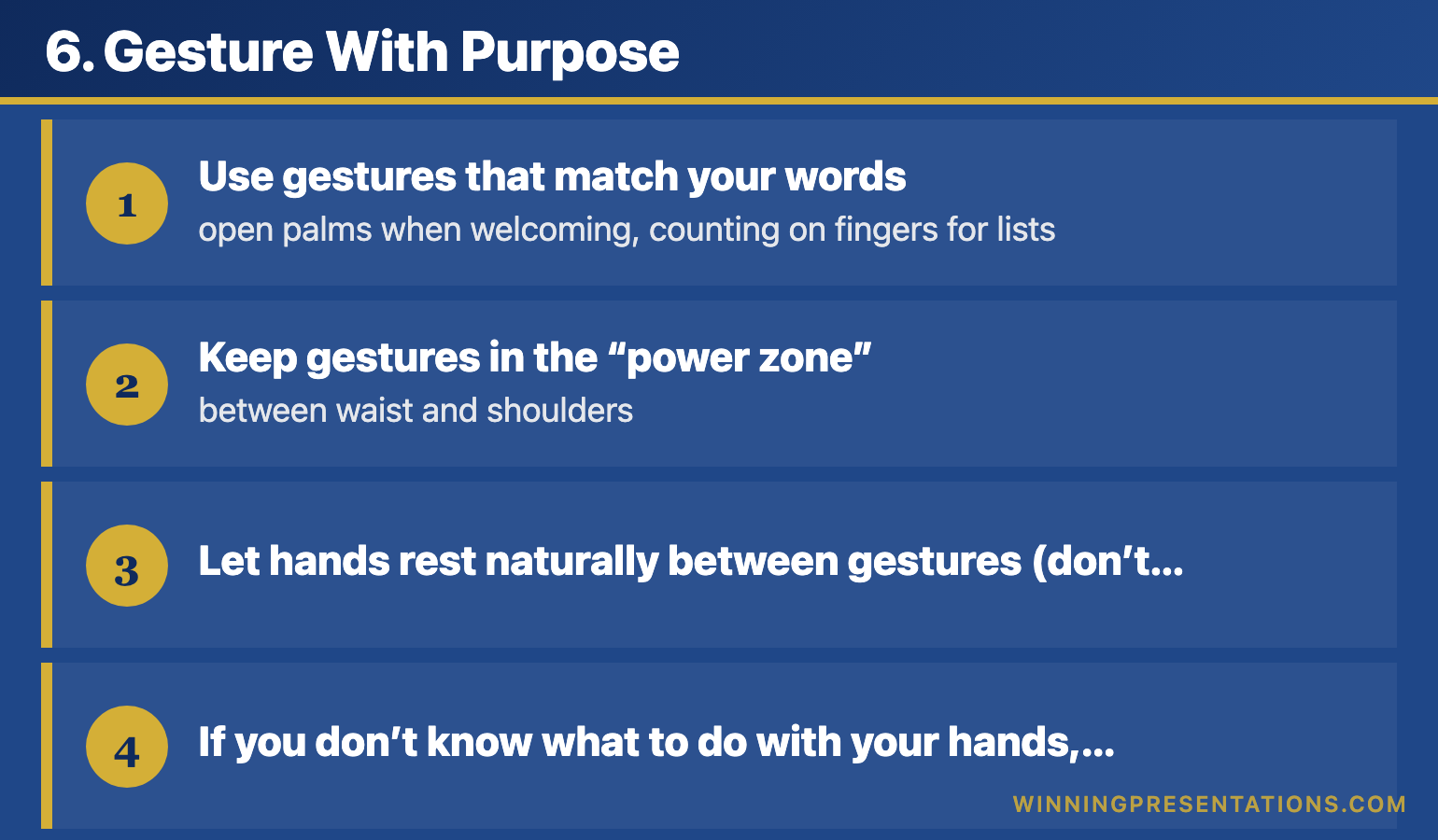
  • Use gestures that match your words — open palms when welcoming, counting on fingers for lists
  • Keep gestures in the “power zone” — between waist and shoulders
  • Let hands rest naturally between gestures (don’t wring them)
  • If you don’t know what to do with your hands, hold a clicker or pen

Purposeful gestures don’t just look confident — they help you think. Research shows that gesturing while speaking actually improves verbal fluency.

Related: Presentation Confidence: How to Build It (Not Fake It)

7. Recover From Mistakes Without Apologising

Every presenter makes mistakes. The difference between looking confident and looking nervous is how you handle them.

Nervous presenters apologise profusely, call attention to errors, or freeze up. Confident presenters recover smoothly and move on.

How to look confident instead:

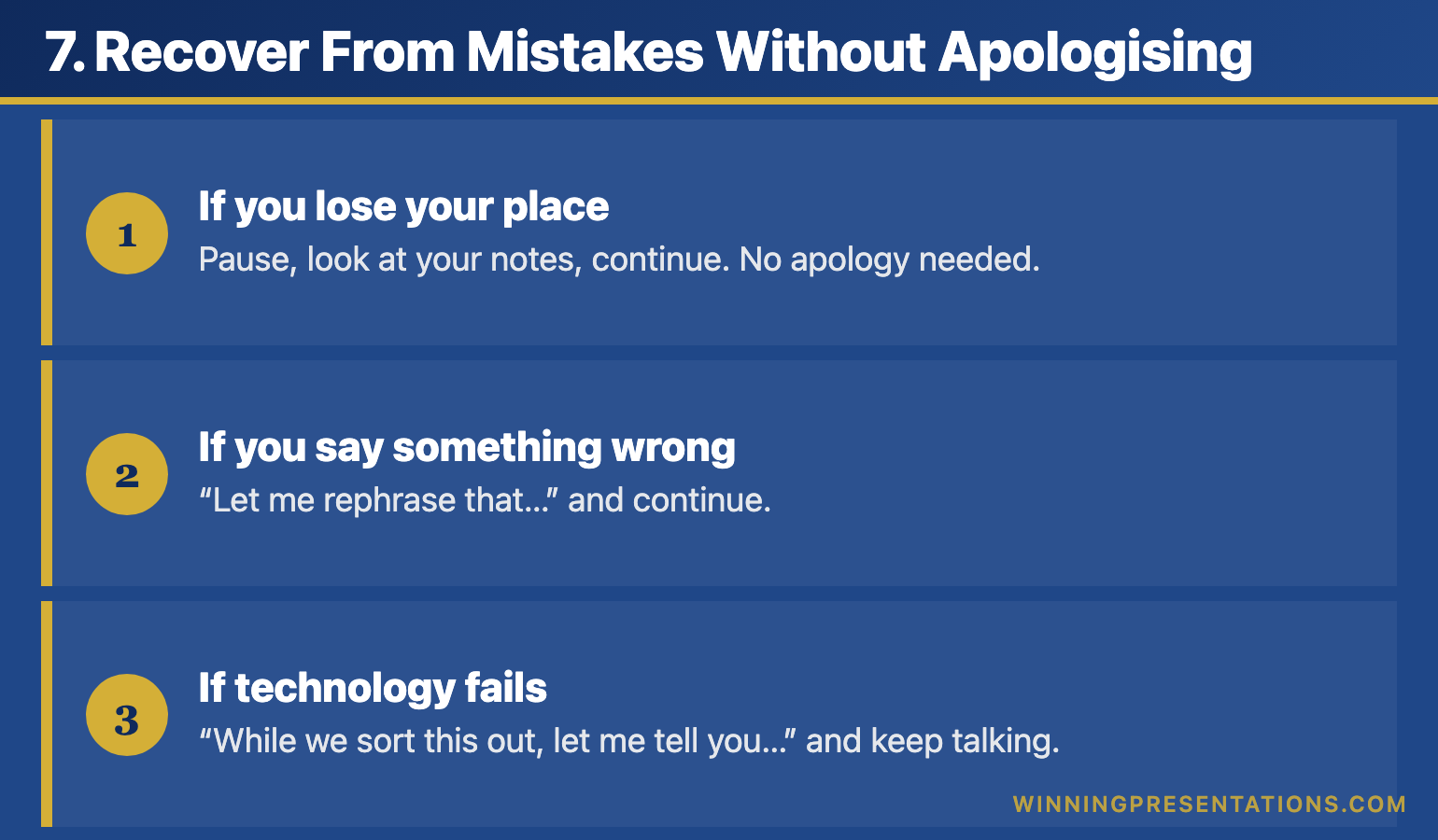
  • If you lose your place: Pause, look at your notes, continue. No apology needed.
  • If you say something wrong: “Let me rephrase that…” and continue.
  • If technology fails: “While we sort this out, let me tell you…” and keep talking.

Pre-plan your recovery phrases. When you know you can handle anything, you look confident because you genuinely feel in control.

Related: How to Start a Presentation: 15 Powerful Opening Techniques

Why Looking Confident Leads to Feeling Confident

There’s a psychological principle at work here: behaviour shapes emotion, not just the reverse.

When you adopt confident body language, your brain receives signals that you’re safe. Your nervous system calms down. And over time, the feeling of confidence follows the appearance of confidence.

I discovered this accidentally in my first five years of banking. By forcing myself to look confident when presenting, I gradually became more confident. The techniques became automatic. The anxiety faded.

You don’t have to wait to feel confident before presenting well. You can look confident now — and let the feeling catch up later.

Consistent Composure. Every Presentation.

Conquer Speaking Fear (£39, instant access) builds composure that holds — across different audiences, stakes, and settings. Structured techniques, not confidence tips.

Get Conquer Speaking Fear → £39

Designed for experienced professionals who present regularly under pressure.

Frequently Asked Questions

How do I look confident when my hands are shaking?

Hold something — a clicker, a pen, or your notes. This gives the shaking somewhere to go without being visible. Also, the shaking usually subsides within 60-90 seconds of starting. If you can get through your opening, your body will calm down.

What if I can’t make eye contact without feeling more nervous?

Look at foreheads instead of eyes — the audience can’t tell the difference. Or focus on the friendly faces only. You don’t need to make eye contact with everyone, just enough people to create connection.

How do I slow down when my instinct is to rush?

Memorise your first three sentences word-for-word and practice them at half speed. When you start slowly, you’re more likely to maintain that pace. Also, build in deliberate pauses — after your opening, after key points, before your conclusion.

Does “fake confidence” actually work?

It’s not about faking — it’s about doing what confident presenters do. The behaviours (grounding, eye contact, pauses, open posture) are real skills you’re building. Over time, the feeling follows the behaviour. You’re not pretending; you’re practising.


Your Next Step

Pick one technique from this list and use it in your next presentation:

  1. Plant your feet — the easiest to implement immediately
  2. Slow your first three sentences — sets the tone for everything that follows
  3. Replace filler words with pauses — makes the biggest visible difference

Master one technique before adding another. Within a few presentations, you’ll look confident without thinking about it.

Go deeper: Presentation Confidence: How to Build It (And Why “Fake It Till You Make It” Doesn’t Work) — the complete guide to building lasting confidence.


Mary Beth Hazeldine is a qualified clinical hypnotherapist and Owner & Managing Director of Winning Presentations. After spending her first five years in banking terrified of presenting, she learned to look confident before she felt confident — and went on to present successfully for 19 more years at JPMorgan, PwC, RBS, and Commerzbank. She has since advised executives across financial services, healthcare, technology, and government.

The Winning Edge Newsletter

Weekly techniques for executives who present under pressure. Evidence-based, practical, no fluff.

Subscribe Free →

Not ready for the full system? Start here: download the free 7 Presentation Frameworks — practical structures for any presentation scenario.