

Confident Presenting Course for Executives: What Actually Delivers Results
Quick Answer
A confident presenting course worth investing in should address nervous system regulation, cognitive reframing under pressure, and physical symptom management — not just delivery technique. Most generic courses treat confidence as a mindset problem. For executives, it is a performance problem with neurological roots. This guide covers the criteria that separate programmes that deliver lasting results from those that produce a temporary lift.
In this article
Linnea had delivered quarterly updates to her bank’s risk committee for three years without incident. Then she was promoted to Head of Regulatory Affairs, and the audience changed.
The same material. The same preparation ritual. But now the room included three board members and the group CFO. Within two presentations, she noticed her hands trembling visibly when advancing slides. Her voice thinned. She started rushing through her summary to escape the room faster.
She tried a one-day presentation skills course her company offered. It covered body language, vocal projection, and positive visualisation. None of it addressed what was actually happening: her nervous system was interpreting senior scrutiny as threat, and no amount of positive thinking was going to override that neurological response. She needed something designed for the specific problem she had.
Struggling with presentation anxiety despite being experienced?
Conquer Your Fear of Public Speaking is a neuroscience-based programme that addresses the root causes of presentation anxiety — nervous system regulation, cognitive reframing, and physical symptom management — rather than surface-level confidence techniques.
Why Generic Confidence Courses Fail Executives
Most presentation confidence programmes are built for a general audience. They assume the participant lacks basic experience, needs foundational speaking technique, and will benefit from group exercises that build comfort through repetition. For a graduate or early-career professional, this model works reasonably well.
For an executive who has been presenting for fifteen or twenty years, this model fails — and not because the content is wrong. It fails because it addresses the wrong problem. An experienced executive does not lack presentation knowledge. They lack the ability to access their competence under specific high-pressure conditions.
This distinction matters when evaluating any presenting confidence programme. The question is not “Will I learn something new about presenting?” The question is “Will this programme change how my body and mind respond when I stand up in front of a room that matters?”
Generic courses typically cover vocal projection, body language, storytelling frameworks, and slide design. These are useful topics. But they do not address the trembling hands, the voice constriction, the cognitive fog, or the post-presentation shame spiral that characterises executive-level presentation anxiety. Those symptoms have neurological roots, and they require a neurological intervention.
What an Effective Presenting Programme Must Include
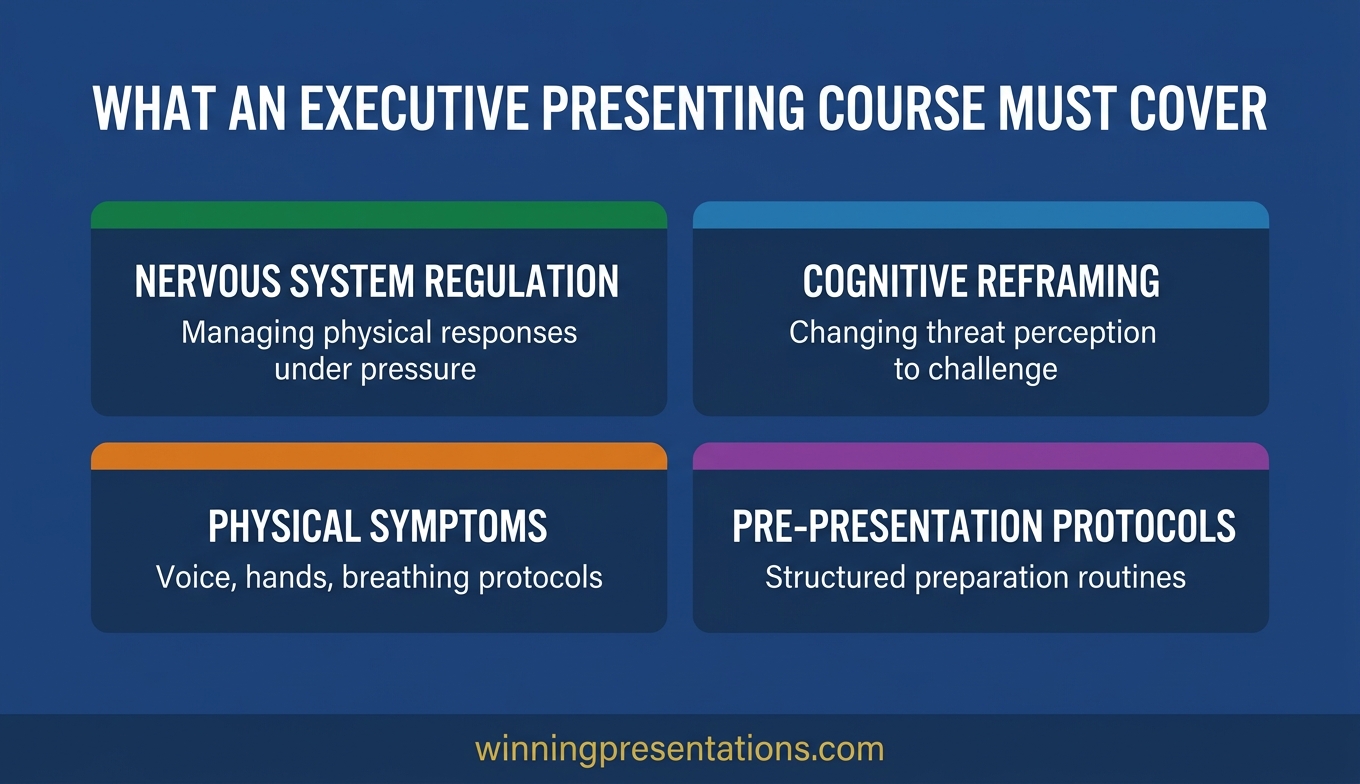
A programme that produces lasting confidence — not just a temporary lift after a motivational workshop — needs to address four interconnected systems. If any one is missing, the results will be partial.
1. Nervous system regulation. Presentation anxiety is not a thinking problem. It is a nervous system activation problem. Your sympathetic nervous system interprets the high-stakes presentation as a threat, triggering the same fight-or-flight cascade that would activate if you were in physical danger. Heart rate increases. Hands tremble. Breathing becomes shallow. Peripheral vision narrows. A presenting confidence programme that does not teach you to regulate this activation — to bring your nervous system back into a functional range before and during the presentation — is missing the most critical component.
2. Cognitive reframing under pressure. Anxiety produces distorted thinking patterns: catastrophising (“This will end my career”), mind-reading (“They can all see I’m nervous”), and all-or-nothing evaluation (“If I stumble once, the whole thing is ruined”). These thought patterns are not rational, but they feel completely real under pressure. Effective programmes teach you to identify and interrupt these patterns in the moment — not as a general self-help exercise, but as a specific protocol you deploy before and during presentations.
3. Physical symptom management. Executives need practical techniques for managing the visible symptoms that undermine their credibility: voice tremor, shaking hands, dry mouth, flushing, and the urge to rush. These symptoms are not character flaws — they are physiological responses that can be managed with the right preparation. Any programme that dismisses physical symptoms as “just nerves” is not addressing what the executive actually needs.
4. Pre-presentation protocols. The thirty minutes before a high-stakes presentation determine more of the outcome than most people realise. What you do with your body, your breathing, your mental rehearsal, and your environment in that window can either prime your nervous system for performance or accelerate the anxiety cascade. A complete programme includes specific, timed protocols for this pre-presentation period.
Address the Root Cause, Not Just the Symptoms
Conquer Your Fear of Public Speaking — £39, instant access — is a neuroscience-based programme designed for experienced professionals whose presentation anxiety has neurological roots, not knowledge gaps:
- Nervous system regulation techniques to manage the fight-or-flight response before it takes hold
- Cognitive reframing protocols for the distorted thinking patterns that intensify under pressure
- Physical symptom management for trembling, voice constriction, and visible anxiety signs
- Pre-presentation preparation sequences you can deploy in the thirty minutes before any high-stakes presentation
Get Conquer Your Fear of Public Speaking →
Designed for executives and senior professionals who present at board, committee, and leadership level.
How Executive Presenting Is Different
Executive presentations carry specific pressures that general-audience programmes do not account for. Understanding these differences is essential when evaluating whether a presenting confidence programme will actually help at your level.
The audience has authority over your career. When you present to a board, a senior leadership team, or an investment committee, the people in the room have direct influence on your promotion, your budget, or your project’s survival. This is not the same as presenting to peers. The stakes are not hypothetical — they are career-defining, and your nervous system knows it.
The tolerance for visible anxiety is lower. At executive level, visible nervousness signals something different than it does in a training room. In a workshop, nerves are expected and sympathised with. In a boardroom, visible anxiety can be interpreted as a lack of conviction in your own recommendation — which undermines the entire purpose of the presentation.
Q&A is unpredictable and consequential. Senior audiences ask questions that go beyond the prepared material. They challenge assumptions. They probe for weaknesses. They ask questions designed to test your thinking, not just your content. If your anxiety management strategy only covers the prepared portion of the presentation, you are vulnerable in the exact moment that matters most.
Repetition is not an option. In most presentation skills courses, you practise in front of the group, receive feedback, and try again. In executive presenting, there is no second attempt. The board meeting happens once. The funding review happens once. The promotion panel happens once. Any programme that relies on gradual desensitisation through repeated exposure misses the reality of executive presenting: you need to perform in a context where the first attempt is the only one.
This is why the right presentation anxiety course for executives focuses on equipping you to manage a single high-stakes event, not building comfort through volume.
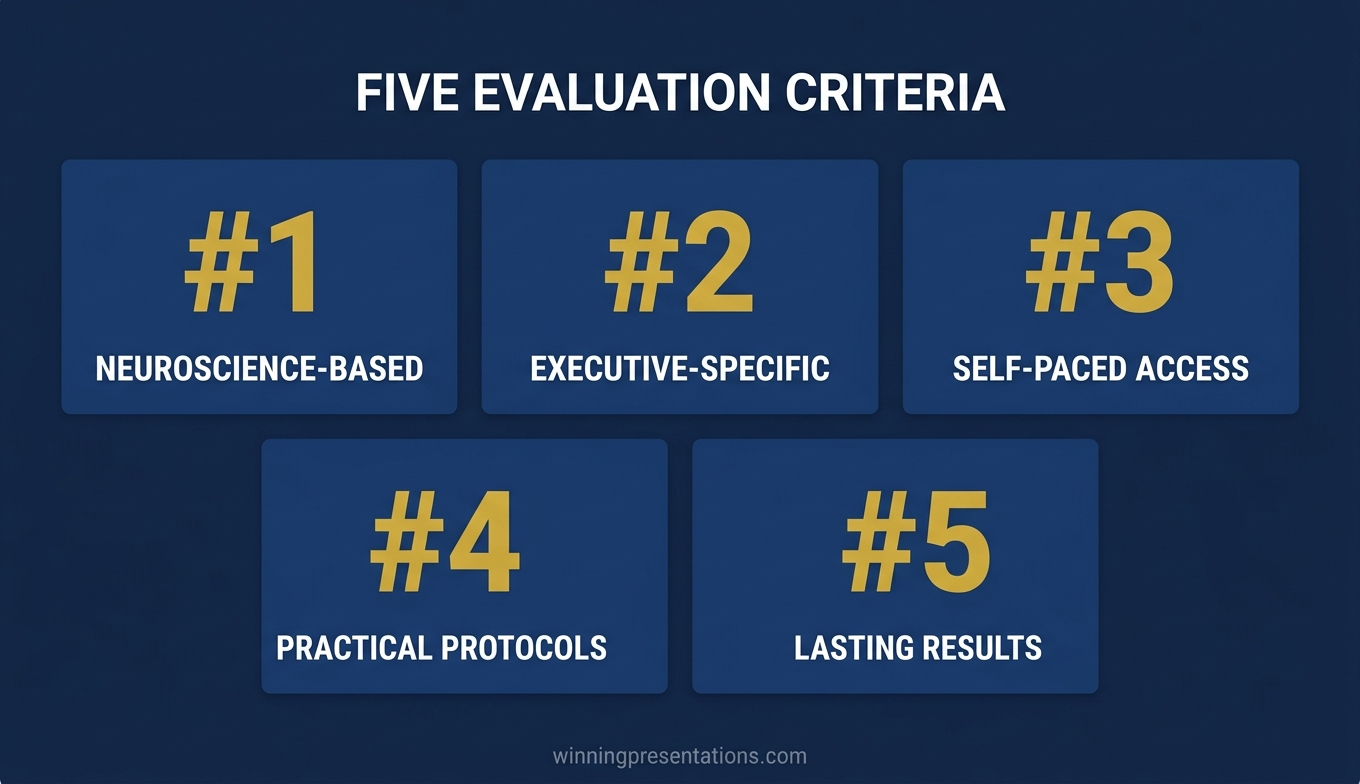
Five Criteria for Evaluating Any Programme
If you are comparing options and trying to determine which executive presenting programme will actually deliver results at your level, apply these five criteria. They separate programmes designed for real-world executive conditions from those that sound good in a brochure.
1. Does it address the nervous system, or just mindset? If the programme’s primary approach to anxiety is “think positively” or “visualise success,” it is not addressing the physiological activation that drives presentation anxiety. Look for content that explicitly covers nervous system regulation, breathing techniques designed for pre-presentation deployment, and somatic approaches that work with the body rather than trying to override it with willpower.
2. Is it designed for self-paced application, or does it require group attendance? Senior executives have unpredictable schedules. A programme that requires you to attend fixed sessions on specific dates may be impractical. Self-paced programmes that you can work through around your actual schedule — and return to when a specific high-stakes presentation is approaching — tend to produce better long-term results because you use them when you need them.
3. Does it include protocols you can deploy immediately? Theory without application is an academic exercise. Effective programmes give you specific, step-by-step sequences you can use before your next presentation. Not principles to reflect on — actions to take in the thirty minutes before you walk into the room.
Conquer Your Fear of Public Speaking includes exactly these kinds of deployable protocols — nervous system regulation, cognitive reframing, and pre-presentation preparation sequences you can use before any high-stakes event.
4. Does it acknowledge that confidence is context-dependent? You may be confident presenting to your team but anxious presenting to the board. A programme that treats confidence as a single quality — “build your confidence and it will transfer everywhere” — is oversimplifying. Look for content that addresses the specific contexts where your confidence breaks down: seniority of audience, formality of setting, unpredictability of Q&A, personal career stakes.
5. Does it address what happens after the presentation? Many executives experience a post-presentation shame spiral — replaying every stumble, every question they handled imperfectly, every moment where their anxiety was visible. This post-event rumination reinforces the anxiety for next time. Programmes that address this cycle, not just the presentation itself, produce more durable improvement.
Common Objections — and What the Evidence Shows
“I should be able to handle this without a course.” This is the most common objection, and it reflects a misunderstanding of how presentation anxiety works. You cannot think your way out of a nervous system activation any more than you can think your way out of a racing heart during a sprint. The neurological response is not a character weakness — it is a predictable physiological pattern that responds to specific interventions, not to willpower. Executives who struggle with this are typically high-performers in every other dimension. The anxiety is a system problem, not a competence problem.
“I’ve tried courses before and they didn’t help.” If the courses you tried focused on delivery technique, body language, and motivational exercises, they were not addressing presentation anxiety. They were addressing presentation skill — a related but different challenge. A programme designed for anxiety-driven performance issues works at the neurological level: regulating the nervous system, interrupting catastrophic thinking patterns, and managing the physical symptoms that undermine delivery. If your previous courses did not include these components, you have not yet tried the approach most likely to help.
“At my level, people will judge me for needing help with this.” The reality is precisely the opposite. Senior professionals who invest in managing their presentation performance are making a strategic career decision. The executives who struggle most are the ones who avoid addressing the problem and instead develop elaborate avoidance strategies — delegating presentations, reading from scripts, or limiting their visibility. These strategies cap career progression far more visibly than seeking professional development.
See also: how your physical position affects presentation confidence and delivery.
Ready to Address the Real Problem?
Conquer Your Fear of Public Speaking — £39, instant access — gives you the neuroscience-based protocols to manage presentation anxiety at its source. Nervous system regulation. Cognitive reframing. Physical symptom management. Pre-presentation preparation. Work through it at your own pace, and return to it before any high-stakes event.
Get Conquer Your Fear of Public Speaking →
Designed for executives and senior professionals who need to present with authority under pressure.
Frequently Asked Questions
Is a confident presenting course worth it for someone who already presents regularly?
Yes — if the course addresses the specific gap you are experiencing. Presenting regularly without addressing underlying anxiety or performance issues simply reinforces the patterns you already have. A programme that targets nervous system regulation, cognitive reframing, and physical symptom management gives you tools your experience alone will not provide. The investment pays for itself the first time you walk into a board presentation and manage your physiological response rather than being managed by it.
How long does it take to see results from a presentation confidence programme?
The nervous system regulation and pre-presentation protocols can produce a noticeable difference in your very next presentation — these are techniques you deploy immediately, not skills that require months of practice. The cognitive reframing component typically takes longer to become automatic, usually two to four high-stakes presentations before the new thinking patterns begin to override the old ones. Full integration — where the techniques become your default response rather than something you consciously deploy — generally occurs over eight to twelve weeks of regular use.
Does this work for virtual presentations as well as in-person ones?
The underlying neuroscience is identical regardless of format. Your nervous system activates in response to perceived threat — and a virtual presentation to a senior audience triggers the same fight-or-flight response as an in-person one. The regulation techniques, cognitive reframing protocols, and pre-presentation preparation sequences work in both contexts. Some executives find virtual presentations more anxiety-inducing because they cannot read the room as easily, which creates additional uncertainty. The programme addresses this through the cognitive reframing component, which targets the specific thought patterns that escalate anxiety when feedback cues are limited.
What if my anxiety is specific to Q&A rather than the presentation itself?
Q&A anxiety is one of the most common patterns at executive level, because Q&A is the least controllable part of any presentation. The nervous system regulation techniques in Conquer Your Fear of Public Speaking are designed to be deployed in real time — including during transitions from prepared content to unscripted Q&A. The cognitive reframing component specifically addresses the catastrophic thinking that Q&A triggers: “What if I don’t know the answer?”, “What if they think my analysis is weak?”, “What if they ask about the one thing I’m not prepared for?” These thought patterns are predictable and interruptible with the right protocol.
The Winning Edge — Weekly Presentation Intelligence
Every Thursday, one framework or technique for presenting with authority at executive level — drawn from 25 years of boardroom experience and 16 years training senior professionals. Join The Winning Edge →
Mary Beth Hazeldine is the Owner & Managing Director of Winning Presentations. With 25 years of corporate banking experience at JPMorgan Chase, PwC, Royal Bank of Scotland, and Commerzbank, she advises executives across financial services, healthcare, technology, and government on structuring presentations for high-stakes funding rounds, board briefings, and leadership decisions.