

How Long Does It Take to Build Presentation Confidence?
Quick Answer
Real presentation confidence takes longer than weekend courses promise and considerably less time than most senior leaders fear. From observing executives across two and a half decades, the honest timeline is roughly: visible composure under pressure within 6 to 8 weeks of structured work, settled authority across most meeting types within 6 months, and a stable confidence that survives difficult rooms within 18 to 24 months. The progress is not linear. There is a noticeable plateau around month four that catches most leaders by surprise, and a second one between year one and year two. Knowing the shape of the timeline reduces the panic when the plateau arrives.
On this page
Astrid was 41, newly promoted to head of investor relations at a London-listed industrial group, and visibly disappointed at the end of our first session. We had spoken for an hour about her presentation history, the nine-month transition into the role, the panel of analysts she was due to face the following week. Toward the end she asked the question that anyone in her position eventually asks. “How long until I feel like I am not faking it?” My honest answer was longer than she wanted to hear. Six to eight weeks before the room read her as composed. Six months before she felt it herself. Eighteen months before the difficult meetings stopped sitting on her chest the night before. She did not say anything for a long moment. Then she nodded once and said: “Right. That’s a relief, actually. I had been told it was three weeks.”
The honest timeline of presentation confidence is one of the least-discussed pieces of senior coaching. Most courses promise something faster than the body actually delivers, partly because faster timelines sell better and partly because the people writing the courses have not stayed with the same leader long enough to see what month four looks like. From observing executives across two and a half decades, the real shape is more useful than the marketing one. Knowing it spares the leader the panic that arrives at the predictable points where progress appears to stop.
This article walks through that real timeline. It is not faster than the marketing courses claim because the body’s actual capacity to absorb high-stakes meetings does not move on the timeline of a weekend programme. It is also not as long as the leader sitting in front of the next big presentation usually fears. The work is finite. The shape is recognisable. The plateaus are not failures.
If you want a structured 6-week starting point
The first eight weeks are the most predictable part of the timeline. A structured programme during this window does the heaviest lifting — the part that produces the visible composure shift the room registers before the leader feels it themselves.
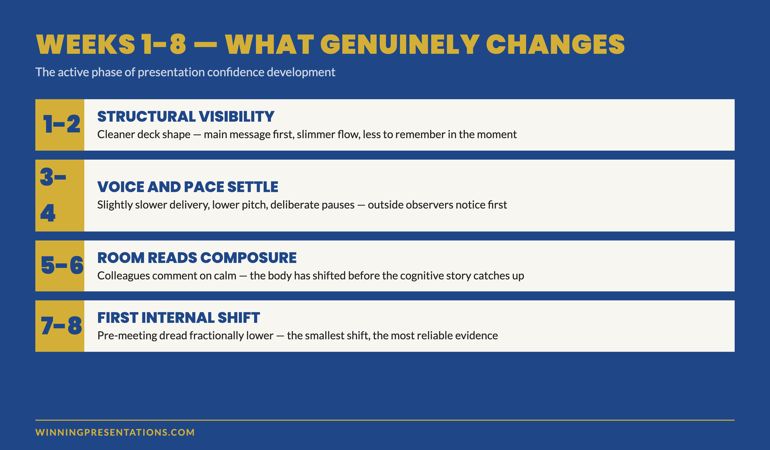
Weeks 1 to 8 — what genuinely changes
The first eight weeks are the most active phase of the timeline and the most misrepresented in marketing copy. The body does change in this window — in ways the room registers before the leader feels them — but the changes are specific. They are not the “transformation” language the courses promise. They are quieter and more useful than that.
Weeks 1 to 2: Structural visibility. The first thing that shifts is the structure of the deck. A senior leader who begins working on presentation confidence usually finds, within the first two weeks, that the way they have been building decks has been adding to their nervousness. Slides without a clear main message. An opening that buries the core point. A flow that requires the presenter to remember the order. Once the structural work begins, the deck itself starts to do some of the work the leader’s nervous system was carrying. By the end of week two, the leader presents from a more skeletal deck and is noticeably less anxious during preparation. The room does not yet read this as confidence. The leader does not yet feel it. The substrate has changed.
Weeks 3 to 4: Voice and pace settle. The second observable change is in voice and pace. Most senior leaders who have been operating with low-grade presentation anxiety speak slightly faster than they realise during high-stakes meetings. The structural work in weeks one and two reduces some of the cognitive load, which makes room for a more deliberate pace. By the end of week four, an outside observer can usually hear the difference even if the leader cannot. The pace is fractionally slower. The pauses between sentences are slightly longer. The voice is held lower. The leader’s audience starts to read this. The leader still feels the same internally, which is the part that catches them out.
Weeks 5 to 6: The room reads composure. This is the window in which other people in the meeting begin to comment. A colleague says “you seemed really calm in there”. The chair makes a passing remark about “your presentation style”. The leader is privately puzzled because they did not feel calm. The body has caught up to a confidence the cognitive story is still trailing behind. This gap — between what the audience sees and what the leader feels — is the most disorienting part of the timeline. It is also the most reliable predictor that the work is taking. Audiences are honest readers. If they are seeing composure, the substrate has shifted.
Weeks 7 to 8: The first internal shift. The first time the leader notices the change in themselves is usually around week seven or eight. It is not dramatic. It is the morning of a high-stakes meeting and the level of dread is fractionally lower than it would have been three months earlier. The body is settling into the meeting differently. This is the smallest shift on the timeline. It is also the one the leader will refer back to for the next six months as evidence that the work is producing real change.
Months 3 to 6 — the visible authority window
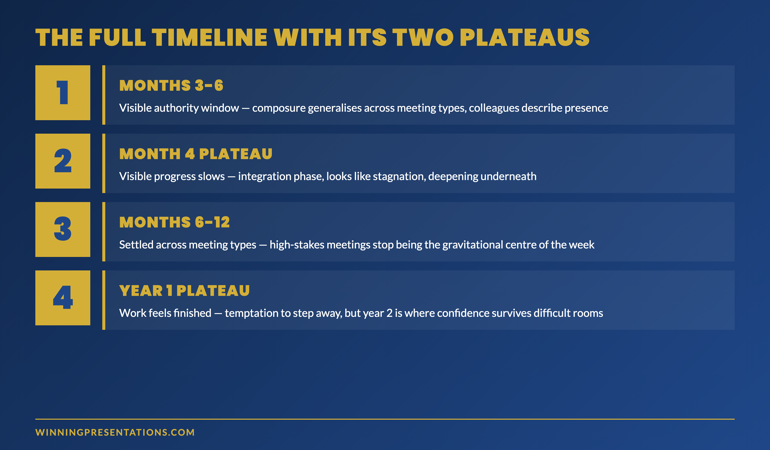
Months three through six are when the visible-authority layer settles. The work in the first eight weeks tends to be specific to the meeting types the leader was actively preparing for. Months three to six generalise that work across the rest of their meeting types — the impromptu corridor briefing, the unexpected board call, the difficult one-to-one with a senior stakeholder. The composure starts to be available across the broader range of senior interactions, not only the rehearsed ones.
This is also the window in which colleagues start to describe the leader differently. The phrase “executive presence” gets used. The chair makes a comment about “the way you handled that”. A peer asks for advice on a presentation. None of this means the leader has arrived. It means the room is now referencing them differently. The reputational layer has caught up to the substrate that shifted in weeks one to eight.
For senior leaders preparing specifically for stakeholder buy-in scenarios — board approvals, executive committee sign-offs, complex investment decisions — this is also the window in which a deeper structural programme such as The Executive Buy-In Presentation System can do work that the in-the-moment confidence techniques cannot. The buy-in skill set requires more than composure under pressure. It requires the structural sequence that walks senior stakeholders from initial scepticism to active sponsorship, and that work tends to land best after the foundational confidence layer is in place.
The most useful internal benchmark in this window is what the leader notices on the way home from a difficult meeting. By month four or five, the meeting is being processed during the meeting rather than rehashed for two hours afterwards. The mental replay shortens. The next morning is no longer dominated by the previous afternoon. This is one of the most concrete indicators of where the leader is on the timeline.
Months 6 to 12 — settled across meeting types
Between month six and the end of year one, the confidence stabilises across the bulk of the leader’s meeting calendar. The board presentation, the investor call, the divisional review, the project update, the difficult conversation with a senior stakeholder — all of these begin to share a similar baseline level of activation. The previously spiky distribution flattens. The leader does not become unaffected by the meetings. They become consistent across them.
The most reliable signal here is what happens to the leader’s calendar planning. In the first six months, the leader was usually planning around the high-stakes meetings — protecting the morning, blocking recovery time, managing the rest of the week to absorb the impact. By month nine or ten, the high-stakes meeting is one item on a normal week rather than the gravitational centre of it. Other work continues normally around it. This is one of the under-discussed signs of real confidence: it is not the meeting itself that has changed; it is the way the rest of the leader’s week organises around it.
This window also brings the first encounter with the “I am not actively practising any more” feeling. The structured techniques from the early weeks become ambient. The leader still uses them but no longer notices using them. This is the integration phase. It looks like coasting from the inside. From the outside, it is the leader operating fluently in a way that took conscious effort six months earlier.
The structural foundation: Conquer Your Fear of Public Speaking, £39
Most of what shifts in the first eight weeks of the timeline above is foundational structural work. This programme walks through that foundation step by step — the deck restructuring, the voice and pace calibration, the pre-meeting and recovery routines — designed for senior professionals who present at executive level.
- The 6-week structural programme that does the heaviest lifting in the timeline
- Voice, pace, and pre-meeting routines for senior audiences
- What to do when progress plateaus around month four
- Designed for executives who present regularly to boards and senior stakeholders
Get Conquer Your Fear of Public Speaking →
£39, instant access. Designed for senior professionals presenting to executive audiences.
Year 2 onwards — the stable confidence layer
The second year is the layer that survives the difficult room. The composure that settled in months six to twelve is tested during year two by the kinds of meetings that the leader could not have absorbed in their first six months. The hostile board chair. The unexpected challenge from a senior peer. The meeting where the numbers do not support the message. By the time the leader has absorbed two or three of these, the confidence has a different quality. It is not the absence of nerves. It is the presence of a settled response to nerves that the body has practised.
Year two is also when most senior leaders stop thinking about presentation confidence as a separate skill. It has become part of how they operate. They no longer prepare for a board presentation as a special event. They prepare for it as one item among the week’s work. The conscious effort that defined year one is no longer required, which is the closest thing to “arrived” that the work produces. There is no point at which the leader stops being affected by high-stakes meetings. There is a point at which the meetings stop disrupting the rest of their working life.
For introverted senior leaders specifically, the year-two layer also brings a different relationship with energy management. The compounding effect of structural preparation across hundreds of meetings means each new meeting requires less new effort. The reserve that was being drawn down weekly in year one is being drawn down monthly in year two. The companion piece on Presentation Confidence for Introverts walks through why this energy economics shift is particularly noticeable for senior introverts.
The two plateaus most leaders hit
The timeline above implies smoother progress than most leaders actually experience. The honest version has two plateaus, both of which catch leaders by surprise and cause many of them to abandon the work prematurely. Naming them in advance reduces the panic when they arrive.
Plateau 1 — Month 4. Around month four, the visible progress of the first eight weeks slows down. The leader has stopped noticing fresh internal shifts. The audience comments have plateaued. Difficult meetings are still difficult. This is the most common point at which leaders conclude that the work has stopped producing results. In fact the integration is happening below the surface — the techniques are moving from conscious to ambient, the new baseline is consolidating, the substrate is settling. The plateau looks like stagnation and is actually deepening. Leaders who push through it find that month six is recognisably different from month four. Leaders who abandon at the plateau usually report that “the course worked for a while and then stopped”. What stopped was the visible signal. The work itself did not.
Plateau 2 — End of year one. The second plateau arrives around month eleven or twelve. The leader has settled across meeting types. The work feels finished. There is a temptation to consider the project complete. What follows in year two is often the most useful part of the entire timeline — the consolidation under genuinely difficult conditions — but it is invisible at the moment of completion of year one. Leaders who step away at this point retain most of the gain. Leaders who continue with lighter-touch practice across year two arrive at a confidence layer that survives the kinds of meetings the year-one leader could not have absorbed.
Is this right for you?
The timeline above is calibrated for senior professionals presenting regularly at executive level — board members, divisional heads, senior partners, investor relations leads, finance committee chairs. It assumes a baseline of presenting at least every two to three weeks during the active phase. Leaders who present once a quarter will see the same shape on a longer timeline. The components are the same. The compounding is slower because the body has fewer high-stakes meetings to consolidate around.
The timeline is not calibrated for severe public speaking phobia or clinical presentation anxiety. Those conditions need their own approach, often in combination with the structural work above. The companion piece on clinical hypnotherapy for public speaking walks through the more specialised work for the smaller subset of senior professionals whose anxiety is at that level.
Frequently asked questions
Can presentation confidence be built faster than this?
The visible-composure layer can sometimes accelerate to four to six weeks for leaders who present three or four times a week and are willing to commit to focused structural work. The settled-authority layer cannot reliably be accelerated below six months. The body’s integration capacity is the rate-limiting factor, and structural shortcuts at that level tend to produce a confidence that does not survive a difficult meeting. The honest version takes the time it takes.
What if I have a major presentation in 4 weeks and need confidence now?
The four-week window is enough for the structural and voice-pace layer of the work. The composure the audience reads in the meeting will be measurably stronger than four weeks earlier. The internal feeling of confidence will not yet have caught up. This is normal and not a sign that the work has failed. The structural preparation is what carries the leader through a high-stakes meeting in this window. The internal shift will arrive by week seven or eight.
Why do I feel like I am moving backwards in month four?
You are not. Month four is the most reliable plateau in the timeline. The visible-progress signals slow down because the integration phase has begun. The work moves from conscious application to ambient operation, which feels like stagnation from the inside and looks like deepening from the outside. Leaders who push through month four reach month six recognisably different. Leaders who abandon at month four typically attribute the decline to the course “wearing off”. It is the integration phase, and it is the most useful part of the first six months.
Does this timeline apply to introverts and extroverts equally?
The shape applies to both. The components within each phase differ. Extroverts often consolidate the structural layer faster and the recovery layer slower. Introverts often consolidate the recovery layer faster and the room-energy layer slower. The total time to settled authority is similar for both. The route is different, and the techniques inside each phase are calibrated separately.
Will I ever stop being nervous before high-stakes meetings?
No, and the leaders who claim they have are usually misreading their own physiological state. The aim is not to remove nervousness. It is to build a confidence that operates alongside nervousness — a body that can run a high-stakes meeting from a slightly activated state without being disrupted by it. Most senior leaders at the year-two layer continue to feel nerves before major meetings. The nerves no longer disrupt their week.
The Winning Edge — weekly, free
Each Thursday: one structural framework, one micro-story from senior coaching, one practical move you can use in this week’s meetings. Built for senior professionals who present at executive level.
Not ready for the full system? Start here instead: download the free Executive Presentation Checklist — a one-page pre-meeting routine the senior leaders I work with use the morning of a board presentation.
About the author
Mary Beth Hazeldine is the Owner & Managing Director of Winning Presentations Ltd, founded in 1990. With 24 years of corporate banking experience at JPMorgan Chase, PwC, Royal Bank of Scotland, and Commerzbank, she advises executives across financial services, healthcare, technology, and government on structuring presentations for high-stakes funding rounds, board approvals, and senior reviews.