

Executive Presence for Women in Senior Roles: The Specific Signals That Reverse in Male-Dominated Rooms
Quick answer: Several of the signals that read as executive presence in mixed rooms reverse for senior women in male-dominated ones. Warm openings can register as deference; collaborative framing can read as uncertainty; smile-while-speaking can be coded as weakness rather than approachability. The fix is not to imitate the men in the room, which produces its own credibility penalty, but to use a different signal set built around structural authority — decision-first openings, single-sentence framing of the ask, a small number of strong points held under interruption, and a deliberate refusal of the qualifier vocabulary. The shift is not stylistic; it is structural, and it transfers across geographies, sectors, and seniority levels.
JUMP TO:
- Why the standard signals reverse in male-dominated rooms
- The six signals that flip — and the structural alternatives
- The qualifier tax: the vocabulary that quietly costs credibility
- Why imitating the men in the room produces its own penalty
- In the room: holding ground under interruption
- Frequently asked questions
Priyanka, a managing director at a London-headquartered investment bank, walked into a credit committee meeting last quarter with a £40m financing recommendation that her team had spent six weeks preparing. The deck was clean, the analysis was strong, and the conclusion was right. She opened the way she had been coached to open since she was a vice-president — by acknowledging the room, thanking the chair for the time, and noting that her team had built on the work of the previous committee. Twelve minutes in, the committee chair interrupted to ask whether she “actually believed in the deal” or was “just walking the team through the pitch”. The deal was approved an hour later, but the question stayed with her. She had given the same opening to mixed-gender committees for ten years. Nobody had ever asked her whether she believed in her own recommendation.
The diagnosis is not that the opening was wrong in some absolute sense. It is that the opening reads differently in a room where every other voice is male, every other suit is darker, and the question being decided sits at the limits of the committee’s risk appetite. Warmth that signals approachability in a mixed room can signal deference in a room where the audience defaults to reading women as junior. Collaborative framing that signals leadership in some contexts reads as uncertainty in others. The signals are not wrong; they are calibrated for a room shape that, at this seniority, no longer exists.
This piece walks through why several of the standard executive-presence signals reverse for senior women in male-dominated rooms, the six specific signals that flip and the structural alternatives that hold up, the qualifier vocabulary that quietly costs credibility, why the obvious workaround — imitating the men in the room — produces its own penalty, and the in-the-room work for holding ground under interruption. The aim is not to make senior women perform a borrowed style; it is to give them a different signal set that registers as authority in the rooms they actually have to win.
Before the next high-stakes meeting, a one-page structural check is worth a look.
The Executive Presentation Checklist is a free one-page structural audit of the moves that hold up under senior scrutiny — designed to be run through the night before a board, committee, or executive-sponsor meeting. Free download.
Why the standard signals reverse in male-dominated rooms
Most executive-presence training is calibrated for the room a senior leader spends most of their time in. For male senior leaders, that room defaults to broadly male in composition, and the signal set that registers as presence — measured warmth, occasional smile, collaborative framing, generous attribution — works in part because the audience is reading the speaker against a male default. The same signal set, delivered by a woman in a room that defaults to reading women as junior, lands against a different default and produces a different reading. The signals are not failing; they are being interpreted through a different filter, and the filter is producing the opposite reading from the one intended.
The asymmetry is structural rather than individual. A room of mostly men evaluating a recommendation from a senior woman is not, in most cases, doing anything consciously biased. The reading is happening at the level of pattern matching the audience has been doing since their first finance committee twenty years ago: this is what a credible deal advocate looks like, this is what an uncertain one looks like. When the speaker’s defaults — warmth, collaboration, attribution — land against a pattern that expected certainty, ownership, and decisiveness, the audience registers a mild mismatch. The mismatch is not articulated as “she is a woman, therefore I doubt her”. It is felt as “something is slightly off about this pitch”, and it produces the question Priyanka was asked: do you actually believe this?
The senior women who navigate these rooms well have usually figured this out the hard way. They have learned by trial and error that the moves which worked at director level stop working at managing director level, that the rooms which gave them benefit of the doubt at thirty-five do not at fifty, that the executive-presence advice in their leadership-development programmes was calibrated for the wrong audience. For the closely related discipline behind the broader executive-presence work this article builds on, see our executive presence for senior leaders piece.
The six signals that flip — and the structural alternatives
The first signal that flips is the warm opening. The opening that thanks the chair, acknowledges the prior work, and frames the meeting as a continuation of a longer conversation reads as collegial in a mixed room. In a male-dominated room evaluating a high-stakes recommendation, it reads as a softening — a positioning of the speaker as participant rather than as the person making the call. The structural alternative is a decision-first opening: a single sentence stating what the room is being asked to decide and the speaker’s recommendation. Acknowledgment goes at the end of the meeting, not the start.
The second is collaborative framing. The “we have looked at this together” framing that signals leadership in many rooms reads in male-dominated approval meetings as diffusion of authorship. The room cannot tell whose recommendation it is. The structural alternative is first-person ownership of the recommendation, with attribution to the team handled separately: “I am recommending the £40m. The work behind it was led by X and Y.” The recommendation is in the singular voice; the credit is in the plural.
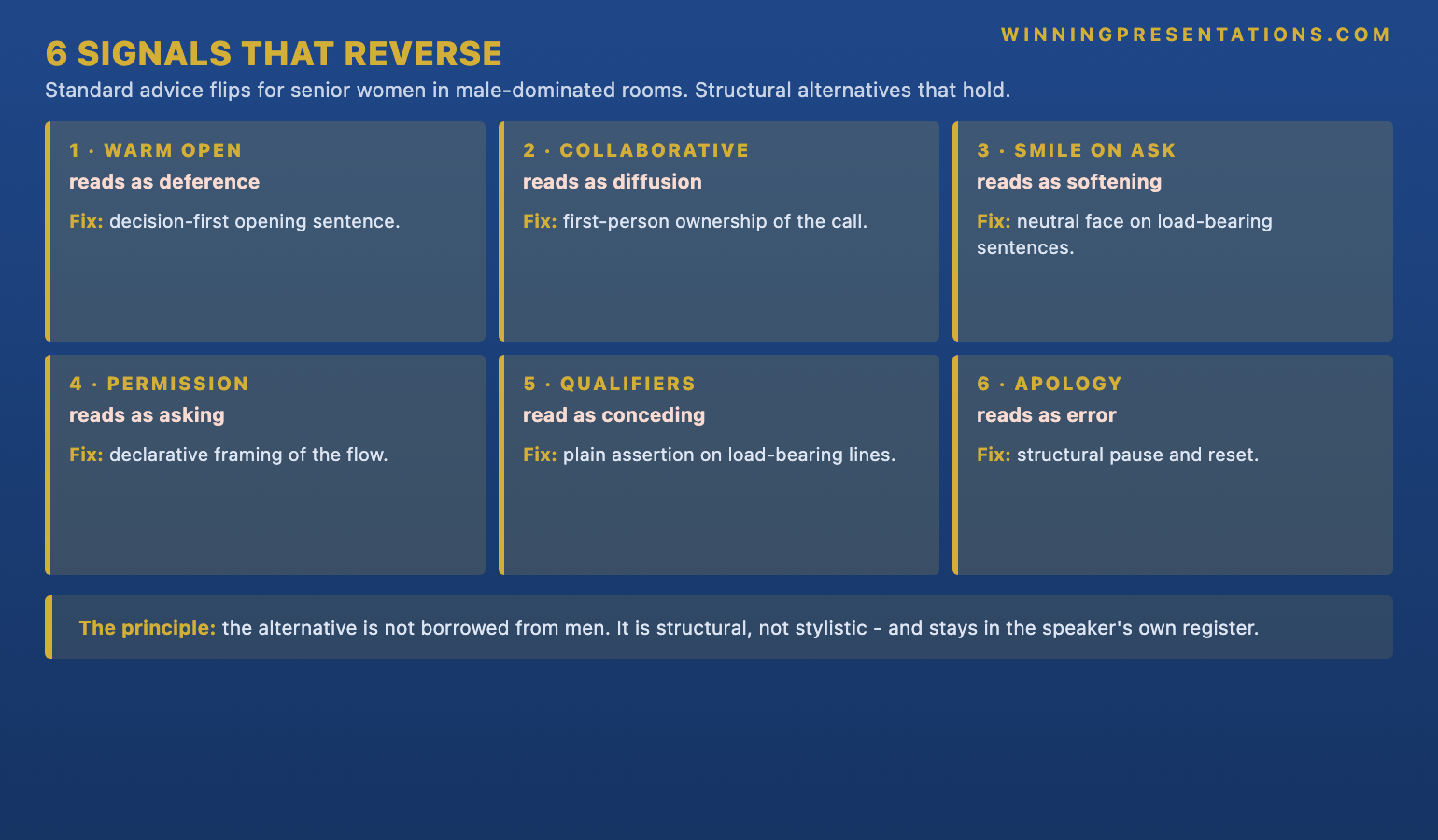
The third is smile-while-speaking. In mixed rooms a brief smile during the opening and at relaxed moments reads as approachable. In male-dominated rooms evaluating a hard decision, smile-while-delivering-the-ask reads as softening the ask — a positioning of “this is just a suggestion” when the substance is “this is the recommendation”. The structural alternative is a neutral expression on the load-bearing sentences, with the smile reserved for genuine warmth moments that follow rather than overlap the substantive points. The audience reads a deliberate face on a hard sentence as confidence; they read a smiling face on the same sentence as ambivalence.
The fourth is permission-seeking. “I would like to walk you through” reads as polite in many contexts; in a male-dominated room it reads as asking permission to do what the meeting has already invited the speaker to do. The structural alternative is declarative framing: “I will walk you through the recommendation; I will pause at the assumption slide for any early questions”. The intent is the same; the framing puts the speaker in control of the time.
The fifth is the qualifier vocabulary, which is large enough to deserve its own section below. The sixth is the apology reflex. Many senior women apologise reflexively for small disruptions — being interrupted, needing to find a slide, taking a moment to think. In male-dominated rooms, these apologies accumulate into a perceived pattern of error, even when nothing has gone wrong. The structural alternative is a deliberate pause and a structured response: “Let me pick up at the assumption slide, which is where the variance question lands”. No apology — just a structural reset.
The qualifier tax: the vocabulary that quietly costs credibility
The qualifier tax is the accumulated credibility cost of small softening words that any individual instance is harmless, but which together register as uncertainty. The vocabulary is familiar: “just”, “maybe”, “I think”, “perhaps”, “a bit”, “sort of”, “I might be wrong but”, “I just wanted to”. In mixed rooms the qualifiers register as politeness or as collaborative tone. In male-dominated rooms, the same words register as the speaker pre-emptively conceding ground — apologising for the recommendation before the recommendation has been challenged.
Joana, a chief operating officer at a Lisbon-headquartered logistics group, ran a recording of one of her own steering committee meetings through a transcript review with her executive coach. The transcript revealed thirty-eight uses of “just”, twelve uses of “I think” before sentences that were factual rather than opinion, and four instances of “this might sound silly but” preceding observations that were substantive and well-supported. Joana is one of the most senior women in her sector in Iberia; the qualifier tax was costing her credibility she had spent thirty years earning. The remedy was not eloquence training. It was deliberate removal of the qualifiers from the load-bearing sentences and a six-month habit of catching them in real time.
The discipline that works is sentence-level rather than vocabulary-level. The presenter writes out the three or four sentences that carry the recommendation and removes every qualifier from those sentences. “I think the volume assumption is reasonable” becomes “The volume assumption is sourced from group treasury and stress-tested at 8 per cent variance”. “Maybe we should consider option B” becomes “Option B is the stronger recommendation”. The substance is identical; the credibility cost is not. The mid-sentence qualifiers in less load-bearing passages can stay; the discipline is at the level of the sentences that carry the ask.
The structured programme for senior leaders who need approval from rooms that do not default to giving it.
The Executive Buy-In Presentation System is a self-paced programme covering the stakeholder analysis, case construction, and presentation structure that earn buy-in from senior committees and boards — including the rooms where the default reading is sceptical and the structural signals matter most. Designed for senior professionals navigating high-stakes approval meetings.
- 7 self-paced modules — stakeholder analysis, case construction, presentation structure, objection pre-emption, in-room delivery, post-meeting follow-up, calendar and political work
- Monthly cohort enrolment — enrol whenever suits you, work through at your own pace
- Optional Q&A calls — fully recorded so you can watch back anytime
- No deadlines, no mandatory session attendance
- Lifetime access to materials — £499
Why imitating the men in the room produces its own penalty
The obvious workaround — adopt the signal set the men in the room use and the room will read the speaker as one of them — turns out not to work. Several senior women who tried this in the early 2000s and 2010s found that the imitation produced its own credibility penalty. Lowered voice and sharper, declarative cadence read as inauthentic when delivered by someone whose normal register was different; aggressive opening and absence of warmth read as overcorrection rather than as confidence; the suppression of attribution read not as ownership but as a refusal to credit a team. The room registered the imitation as a performance, and the performance registered as a lack of presence.
The reason is that executive presence in any room is partly about coherence — the alignment between the speaker’s substance, their delivery, and the audience’s prior reading of who the speaker is. A senior woman who has been collaborative and warm for twenty years cannot suddenly arrive as terse and declarative; the audience reads the discontinuity rather than the new persona. The signal change registers as performance, and performance is the opposite of presence. The audience perceives that the speaker is trying to be someone they are not, and the credibility cost is sometimes higher than the original signal cost.
The structural alternative is not imitation of a different style but adjustment of specific signals at specific moments. The opening sentence changes; the qualifier tax on the load-bearing sentences is removed; the smile-on-the-ask is replaced with a neutral expression; the apology reflex is replaced with a structural pause. The rest of the speaker’s natural register stays. The audience reads the speaker as still herself, with a sharper structural signal in the moments that matter. This is sustainable in a way that wholesale imitation is not — it does not require the speaker to maintain a borrowed persona for the duration of the meeting, only to attend carefully to a small number of load-bearing moments.
In the room: holding ground under interruption
The single hardest in-the-room moment for senior women in male-dominated meetings is the interruption that arrives before the recommendation is fully on the table. The interruption typically asks a question the speaker was about to address two slides later, or pushes back on an assumption the speaker had planned to defend in the assumption slide. The reflex many senior women describe is to surrender the floor immediately and respond to the question, which then derails the structure of the recommendation and leaves the speaker working backwards through the deck for the rest of the meeting. The signal cost is severe: the audience reads it as the deck being controlled by the interruptor rather than by the presenter.
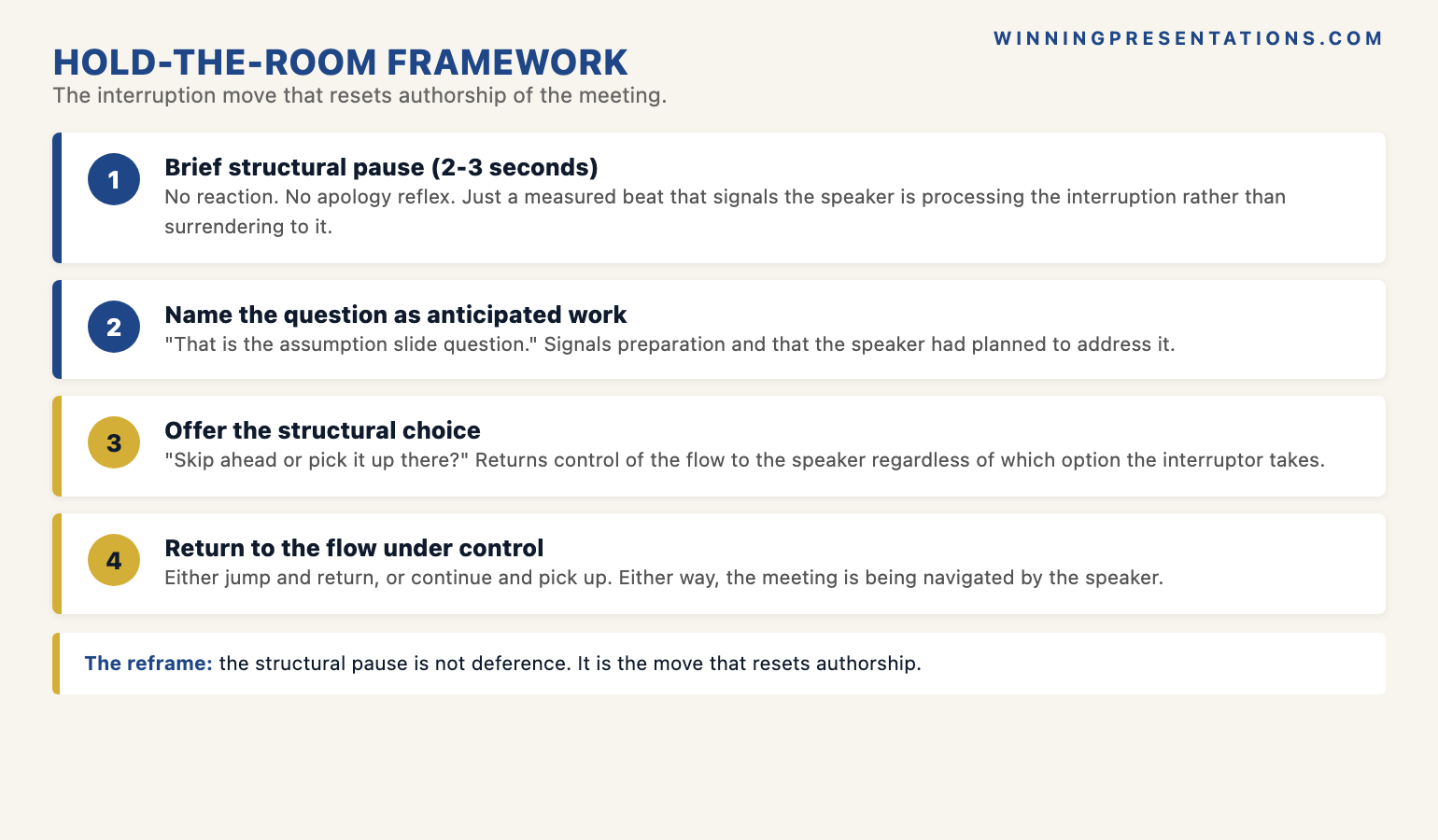
The move that holds ground is a structural pause followed by a deliberate sentence: “That is the assumption slide question; I will get to it in two slides — would you like me to skip ahead, or shall I continue and pick it up there?” The sentence does several things at once. It names the question as one the speaker was going to address — which signals preparation. It gives the interruptor a choice — which signals control of the flow. And it leaves the speaker in charge of the next move regardless of which option the interruptor takes. The same move from a male presenter would also work; the move is structural rather than gendered. But it works disproportionately well for senior women in male-dominated rooms because it intervenes on the specific dynamic — pre-emptive ceding of the floor — that the room would otherwise read as deference.
If the structural rebuilding work above is the pattern that resonates:
The Executive Slide System is a structured library of templates, AI prompts, and scenario playbooks for executive slide work — including the decision-first opening structures, assumption slides, and risk-and-mitigation patterns that support the structural-signal moves in this article. 26 templates, 93 AI prompts, 16 scenario playbooks. £39, instant download, lifetime updates.
The other in-the-room discipline is the recovery after a derailment, which happens to every senior presenter eventually. A question lands hard, a number is wrong, an interruption succeeds. The recovery move is a brief structural pause — two seconds, maybe three — followed by a return to the recommendation at the level of structure rather than detail: “Let me step back to the decision the committee is being asked to take.” The structural reset rebuilds the speaker’s authority over the meeting in a single sentence. It signals that the speaker is still running the meeting, even after a difficult moment. For the closely connected piece on rebuilding confidence in rooms where the structural anxiety compounds — particularly for senior professionals whose nerves have outlasted the seniority that was supposed to dissolve them — see our companion article on conquering the fear of public speaking for senior professionals.
Frequently asked questions
Is this advice asking me to be less warm?
No. The structural moves above all live at the level of the three or four load-bearing sentences in a meeting — the opening, the recommendation, the ask, and the recovery after an interruption. The warmth of the rest of the meeting — the side-conversations before it starts, the response to a colleague who is helping, the close — stays exactly as it is. The point is to remove warmth from the sentences where it is being read against the speaker, not to remove warmth from the meeting. Senior women who try to remove warmth from the entire interaction usually find the audience reads the new register as performance and the credibility cost climbs. The work is selective, not wholesale.
Why does the qualifier tax matter so much more in male-dominated rooms?
It is not that the qualifiers carry a different literal meaning. It is that the audience in a male-dominated room is more likely to be pattern-matching the speaker against a male default that uses fewer qualifiers, so the qualifiers register as a noticeable deviation. The same speech in a mixed room may be read as collegial; in a male-dominated room the same speech reads as uncertain. The remedy is the same in both settings — strip qualifiers from the load-bearing sentences — but the cost of not doing so is higher in the male-dominated setting because the contrast with the audience’s pattern is sharper.
Does this advice apply outside English-speaking corporate settings?
The structural moves transfer; the surface vocabulary needs adapting. The qualifier vocabulary in German corporate settings is different from English (“vielleicht”, “eigentlich”, “irgendwie”), but the dynamic is similar — softening words on load-bearing sentences cost credibility disproportionately in male-dominated rooms. The same is true in French (“peut-être”, “je pense”), Italian, and most Northern European languages I have worked across. The structural moves — decision-first opening, first-person ownership, neutral expression on the ask, structural pause on interruption — translate without modification. The vocabulary work is the localisation; the structural work is the constant.
Won’t this advice age badly as the rooms become less male-dominated?
Some of it will. As the demographic mix of senior committees and boards shifts, some of the signals that flip today will stop flipping. But the structural moves themselves — decision-first opening, first-person ownership of the recommendation, removal of qualifiers from load-bearing sentences, structural pause on interruption — are not specifically gendered. They are stronger signals of authority for any senior presenter, regardless of audience composition. The cost-benefit asymmetry is sharper for women in male-dominated rooms today, but the moves themselves are not transitional. They are good structural discipline that will continue to work as the rooms change.
The Winning Edge — weekly newsletter
The Winning Edge is a weekly newsletter for senior professionals who present at the executive level. One short email a week, focused on the structural moves that separate decks committees back from decks they defer. Subscribe to The Winning Edge →
Not ready for the full programme? Start here instead: download the free Executive Presentation Checklist — the one-page structural audit to run before any senior meeting.
About the author
Mary Beth Hazeldine is Owner & Managing Director of Winning Presentations Ltd. With 25 years of corporate banking experience at JPMorgan Chase, PwC, Royal Bank of Scotland, and Commerzbank, she advises executives across financial services, healthcare, technology, and government on structuring presentations for high-stakes funding rounds, board approvals, and strategic decisions.