Category: Presentation Confidence

04 Apr 2026
Professional woman standing at a podium looking composed but internally conflicted, corporate presentation setting, editorial photography

Imposter Syndrome in Presentations: Why High Performers Feel Like Frauds at the Podium

Imposter syndrome in presentations does not target the unprepared. It targets the competent—the executives who know enough to recognise the gap between what they understand and what the audience expects. The paradox is that the more you know, the more exposed you feel. Here is why imposter syndrome intensifies at the podium and what to do when it arrives.

Beatriz had been promoted to Head of Strategy at a consumer goods company six months earlier, following a decade in management consulting. She was presenting the annual strategic review to the executive committee—twelve people she’d worked alongside for half a year. She knew the material. She’d built the analysis herself. But standing at the front of the room, she felt a familiar constriction in her chest: the conviction that someone was about to ask a question that would reveal she didn’t belong here. That the consulting background was a costume, and the strategy role was borrowed. She delivered the presentation competently—steady voice, clear slides, controlled pace. Afterwards, the CEO told her it was one of the strongest strategy reviews he’d seen. She nodded, smiled, and spent the following weekend replaying every answer she’d given in Q&A, searching for the moment she’d been exposed. She never found it, because it didn’t happen. But the search itself was exhausting. Beatriz didn’t need better slides. She needed to understand why her brain was running an audit she’d never pass.

Does presentation anxiety feel out of proportion to your preparation? The Conquer Speaking Fear programme addresses the psychological patterns that drive presentation anxiety for experienced professionals.

Why Presentations Trigger Imposter Syndrome More Than Other Work

In written work, you can edit. In meetings, you can defer. In one-to-one conversations, you can redirect. A presentation offers none of these escape routes. You are standing in front of an audience, delivering content you cannot take back, being evaluated in real time by people whose opinions affect your career. For someone whose internal narrative already questions their legitimacy, a presentation is the highest-stakes version of the test they’ve been dreading.

Imposter syndrome in presentations is amplified by a specific cognitive distortion: the belief that the audience knows more than you do. In a boardroom presentation, you’re often speaking to people with decades of experience. Your brain interprets their seniority as superior knowledge—forgetting that you were asked to present precisely because you have expertise they lack. The finance director isn’t presenting the strategic review because strategy isn’t their domain. You are presenting it because it is yours. But imposter syndrome flattens that distinction and tells you that everyone in the room could do what you’re doing, only better.

The second amplifier is visibility. Imposter syndrome thrives in private—the quiet conviction that you’re somehow less capable than your role implies. In daily work, this stays manageable because there’s no single moment of exposure. A presentation creates exactly that moment. Every eye is on you. Every hesitation is observed. Every answer is assessed. The internal experience is of a spotlight focused on the gap between who you are and who the audience expects you to be. This is why competent professionals who manage perfectly well in meetings, workshops, and negotiations can feel genuinely terrified when asked to present.

Understanding this mechanism matters because it changes the intervention. The solution is not more preparation—you’re already well-prepared. The solution is recognising that the fear signal is being generated by a threat-detection system that has misidentified the situation. You are not being exposed. You are being consulted. The physiological response is identical, but the interpretation changes everything.

Present With Authority When Your Inner Voice Says You Can’t

Conquer Speaking Fear addresses the psychological patterns that drive presentation anxiety for experienced professionals—including the imposter cycle that preparation alone can’t fix.

  • ✓ Evidence-based anxiety reduction frameworks
  • ✓ Cognitive reframing techniques for high achievers
  • ✓ Practical pre-presentation routines that build confidence

Get Conquer Speaking Fear → £39

For professionals whose anxiety is out of proportion to their preparation

The Competence Gap Illusion: What Your Brain Gets Wrong

The Dunning-Kruger effect is usually cited to explain why incompetent people overestimate their abilities. The less-discussed corollary is equally important: competent people systematically underestimate theirs. When you know a subject deeply, you become acutely aware of its complexity, its ambiguities, and the limits of your understanding. This awareness—which is actually a sign of expertise—feels like evidence of inadequacy.

In a presentation context, this manifests as the conviction that someone in the audience will ask a question you can’t answer, and that this single moment will invalidate everything you’ve said. What your brain fails to calculate is the probability. You’ve prepared extensively. You know the subject. The chance of a genuinely unanswerable question is low—and the appropriate response to one is not shame but honest acknowledgement. “I don’t have that specific data to hand—I’ll follow up with you this afternoon” is a perfectly professional answer that no reasonable audience member would interpret as incompetence.

The competence gap illusion also distorts your assessment of the audience. You assume they process information the way you do—noticing every nuance, every simplification, every point where you chose to summarise rather than elaborate. They don’t. Your audience is processing at a much higher level: Does this person seem credible? Is the recommendation clear? Do I trust this analysis? They’re evaluating your authority, not auditing your footnotes.

The practical intervention is a pre-presentation reality check. Before you stand up to speak, write down three things you know about this topic that nobody else in the room knows in as much depth. Not impressive things—just specific things. The regulatory change you researched last week. The client conversation that shaped your recommendation. The data point that surprised even you. These are your anchors. When imposter syndrome whispers “you don’t belong here,” these anchors remind you that you were invited for a reason. For more on the perfectionism and anxiety cycle that feeds imposter syndrome in presentations, that guide examines why the pursuit of a flawless delivery often intensifies the anxiety it’s trying to prevent.
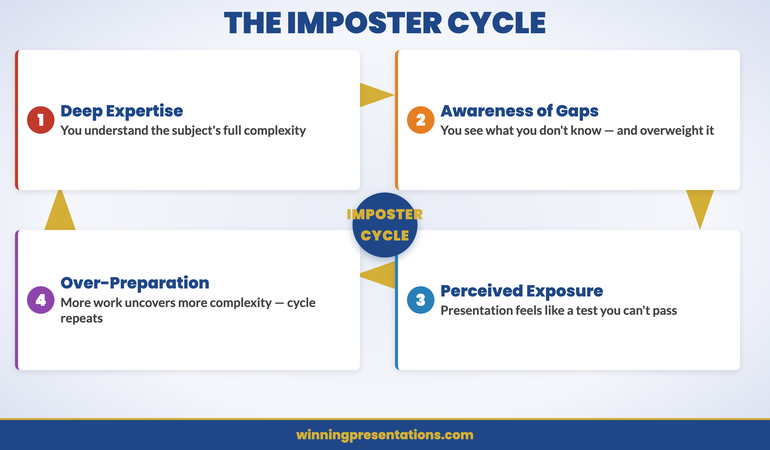
The competence gap illusion showing how expertise creates awareness of complexity that feels like inadequacy

Reframing Authority: You Were Invited to Speak for a Reason

Imposter syndrome tells you that you’re at the front of the room by accident—that circumstances conspired to put you here, and discovery is imminent. The structural reality is different. Someone decided this meeting needed a presentation. Someone decided you were the person to deliver it. Someone scheduled the room, invited the attendees, and allocated time on the agenda for your content. None of these decisions were accidental.

This reframe is not positive thinking. It is factual analysis. The question is not “Am I good enough to present this?” The question is “Why did a rational group of professionals decide I should present this?” The answer is always some version of: because you have knowledge, access, analysis, or perspective that the room needs. Your role is not to prove you belong. Your role is to deliver the content they asked for.

A useful cognitive shift is to move from “I am the expert” to “I am the messenger.” The first framing invites scrutiny of your credentials. The second invites scrutiny of your message—which is where you want the attention. You are not standing at the front of the room to demonstrate your intelligence. You are standing there to communicate findings, recommendations, or analysis that the audience needs to make a decision. This repositioning reduces the personal stakes dramatically. If the audience challenges your recommendation, they’re challenging the analysis—not your right to be there.

The Over-Preparation Trap: When More Work Makes It Worse

Imposter syndrome creates a paradoxical relationship with preparation. The more anxious you feel, the more you prepare. The more you prepare, the more complexity you uncover. The more complexity you uncover, the more exposed you feel. And the more exposed you feel, the more you prepare. This cycle can consume entire weekends before a Monday presentation.

The trap is that over-preparation reinforces the underlying belief. Each additional hour of work sends a signal to your brain: “This is so important and so precarious that I need to keep working.” Your nervous system interprets excessive preparation as confirmation that the threat is real. A presentation you’ve prepared for ten hours feels more dangerous than one you’ve prepared for three—not because the content is riskier, but because your behaviour has told your brain the stakes are higher.

The intervention is a preparation boundary. Set a fixed number of hours for preparation and stop when you reach it. If the content isn’t ready in that time, the issue is scope—you’re trying to cover too much—not effort. Reduce the scope rather than extending the hours. A presentation that covers three points thoroughly is more authoritative than one that covers seven points superficially. Your audience will remember your clarity, not your comprehensiveness.

The most effective preparation for imposter-syndrome-driven anxiety is rehearsal, not research. Rehearse the opening sixty seconds until it feels automatic. Rehearse transitions between sections. Rehearse the close. When you stand up to present, the first words should come without thought—because those first sixty seconds set the tone for how your brain processes the rest of the presentation. If the opening is smooth, your nervous system recalibrates: “This is going well. Reduce the alert level.” The cognitive restructuring approach offers additional techniques for interrupting the thought patterns that drive this cycle.

If your anxiety pattern includes physical symptoms alongside the imposter narrative, Conquer Speaking Fear addresses both the cognitive and physiological dimensions of presentation anxiety.
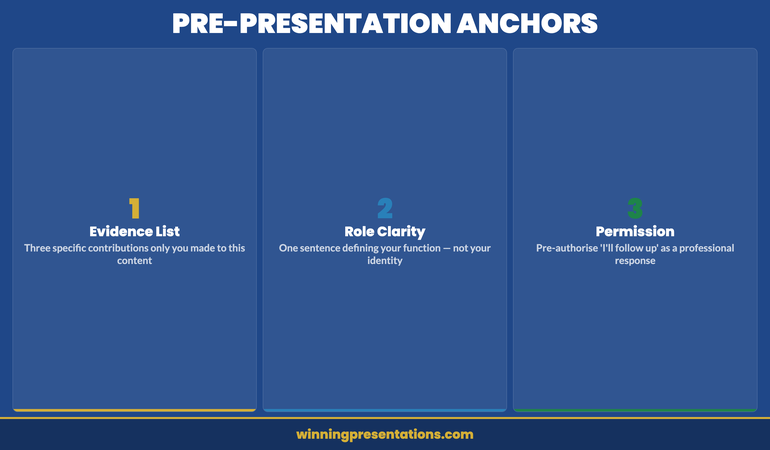
The over-preparation trap cycle showing how excessive preparation reinforces imposter syndrome in presentations

Practical Anchors for the Ten Minutes Before You Present

Imposter syndrome peaks in the ten minutes before you speak. The gap between sitting in the audience and standing at the front is where the anxiety compounds. These practical anchors are not about eliminating the feeling—they’re about preventing it from controlling your delivery.

Anchor 1: The Evidence List. Before the meeting, write three specific contributions you’ve made to the content you’re presenting. Not “I worked hard on this”—specific, verifiable contributions. “I identified the supplier risk that saved the project £180K.” “I conducted the twelve stakeholder interviews that shaped this recommendation.” “I built the financial model from the raw data.” Read the list silently. These are facts, not affirmations.

Anchor 2: The Role Clarity Statement. Remind yourself of your role in one sentence: “I am here to present the findings from the strategic review so the committee can make a decision.” This strips away the identity threat. You’re not being evaluated as a person. You’re performing a function. The function has a clear purpose. Your job is to serve that purpose, not to prove yourself.

Anchor 3: The Permission to Be Imperfect. Give yourself explicit permission to not know everything. Before you walk to the front, say internally: “If someone asks a question I can’t answer, I will say ‘I’ll follow up on that’ and the meeting will continue.” This pre-authorises the response that imposter syndrome tells you is forbidden. In practice, “I’ll follow up on that” is one of the most professional responses in any executive meeting—it signals honesty and discipline. For more on the self-compassion approach to presentation anxiety, that guide covers how reducing self-criticism before a presentation produces a measurably calmer delivery.

Break the Imposter Cycle Before Your Next Presentation

Conquer Speaking Fear gives you the cognitive and physiological frameworks to present with authority—even when your inner voice is running a different script. For £39.

Get Conquer Speaking Fear → £39

Frequently Asked Questions

Does imposter syndrome ever go away completely?

For most professionals, it doesn’t disappear—it becomes manageable. The goal isn’t to eliminate the feeling but to change your relationship with it. Experienced presenters who experience imposter syndrome learn to notice it arriving, acknowledge it as a familiar pattern rather than a truthful assessment, and proceed with the presentation regardless. Over time, the intensity diminishes because your brain accumulates evidence that the feared outcome—being exposed as a fraud—never actually materialises. Each successful presentation is a data point against the narrative.

Why does imposter syndrome seem worse in senior roles?

Seniority increases both visibility and accountability. In a junior role, a weak presentation is forgotten quickly. In a senior role, it becomes part of how colleagues assess your leadership capability. The stakes feel genuinely higher—and they are, to some degree. But imposter syndrome exaggerates the risk dramatically. A mediocre strategy review won’t end your career. An honest answer of “I’ll look into that” won’t undermine your authority. Your brain is conflating “this matters” with “this could destroy me,” and the distinction between those two is where the work lies.

Should I tell my audience that I’m nervous?

Generally, no. Your audience processes your nervousness differently than you do. What feels to you like visible anxiety often reads to the audience as focused energy. Announcing nervousness redirects the audience’s attention from your content to your emotional state—which is the opposite of what you want. The exception is if you’re in a context where vulnerability is expected and valued, such as a personal development workshop or a leadership team offsite focused on authenticity. In a standard executive presentation, keep the focus on the message and let your delivery speak for itself.

The Winning Edge

Weekly insights on executive presentations, confidence building, and boardroom communication.

Subscribe Free

If your imposter syndrome also triggers anxiety about handling questions after the presentation, our guide to defending your data in presentations covers the Q&A strategies that maintain authority under scrutiny.

About the author

Mary Beth Hazeldine, Owner & Managing Director, Winning Presentations. With 24 years of corporate banking experience at JPMorgan Chase, PwC, Royal Bank of Scotland, and Commerzbank, she advises executives across financial services, healthcare, technology, and government on structuring presentations for high-stakes funding rounds and approvals.

14 Mar 2026
Executive pressing thumb and finger together as an NLP anchor before stepping onto a presentation stage

NLP Anchoring for Presenters: The Technique That Changed My Career (Step-by-Step)

Quick Answer: NLP anchoring is a psychological technique that associates a specific sensory cue (touch, sound, or gesture) with a desired mental state. By repeatedly pairing the cue with confidence, you train your nervous system to trigger that state on command—allowing you to access calm assurance moments before presenting, regardless of anxiety levels.

My Five Years of Terror—and the Discovery That Changed Everything

For five years, I was terrified. Not of the content I knew I’d present—I was confident in that. I was terrified of the presentation itself. My hands would shake. My throat would tighten. My mind would go blank the moment I stood up. I’d spend nights before presentations feeling sick, and I’d wake at 3 am in cold panic.

I was a corporate banker with 24 years of technical expertise. I could advise clients on complex financial structures, but I couldn’t stand in front of a room without my nervous system hijacking me.

Then I trained in neuro-linguistic programming and clinical hypnotherapy. I discovered anchoring—a technique that quite literally rewired my nervous system’s response to presenting. Not through willpower. Not through breathing exercises alone (though they help). But through direct neurological conditioning.

Within three months of using the anchor I’ll teach you in this article, I went from being the person who dreaded presenting to being the person people asked for advice on how to present with such calm confidence. That shift changed my career, my income, and my entire relationship with public speaking.

Quick Diagnostic: Is Anchoring Right for Your Anxiety?

Before we go further, let’s make sure we’re addressing the right problem. Anchoring is exceptionally effective for acute presentation anxiety—the kind where you know exactly what to say, but your nervous system misfires when you’re about to deliver it. Your chest tightens. Your hands shake. Your breathing becomes shallow. You might even feel nauseous.

Anchoring works because it gives your nervous system a physiological pathway to access calm confidence on demand. It’s not about thinking positively or reframing thoughts. It’s about conditioning a sensory-motor response that your body can reproduce instantly.

However, if you’re experiencing burnout, chronic exhaustion, or a deeper nervous system depletion from overwork, anchoring alone won’t be sufficient. You’d benefit from a more comprehensive programme that addresses both acute anxiety and system recovery.

The good news: most presenters dealing with stage fear fall into the acute anxiety category, and that’s exactly what anchoring solves. If that’s you—if you’re confident in your content but your nervous system sabotages you in the moment—this technique will be transformative.

Ready to learn how to create your first anchor? Let’s go. Or if you want the full system including other hypnotherapy techniques for presentation anxiety, Conquer Speaking Fear £39 walks you through the complete process.

What Is NLP Anchoring, Exactly?

NLP anchoring is a technique from neuro-linguistic programming that uses a deliberate sensory trigger—a gesture, sound, or physical touch—to evoke a specific mental or emotional state on command.

Here’s the mechanism: Your brain is fundamentally associative. Pavlov’s dogs learned to salivate at the sound of a bell because the bell became paired with food. You learned to feel hunger when you smell coffee in the morning because that smell has been paired with breakfast time. This is classical conditioning, and it’s one of the most reliable processes in neuroscience.

Anchoring harnesses that same principle deliberately. You choose a mental state you want to access (confidence, calm, focus). You experience that state intensely. Then you pair it with a specific, unique sensory trigger—perhaps pressing your thumb and forefinger together, or touching a specific point on your wrist. After multiple repetitions, that trigger becomes hardwired to that state. Eventually, you can activate the state simply by firing the trigger.

The anchor itself is neutral. A thumb-and-finger press is meaningless. But through repetition and intensity, your nervous system learns: This gesture means access confidence now.

Unlike positive self-talk or visualisation, anchoring doesn’t rely on conscious thought. Your nervous system doesn’t care what your logical brain believes. Once an anchor is properly installed, it works even if you’re anxious, doubtful, or disoriented—because the anchor operates at a neurological level, not an intellectual one.

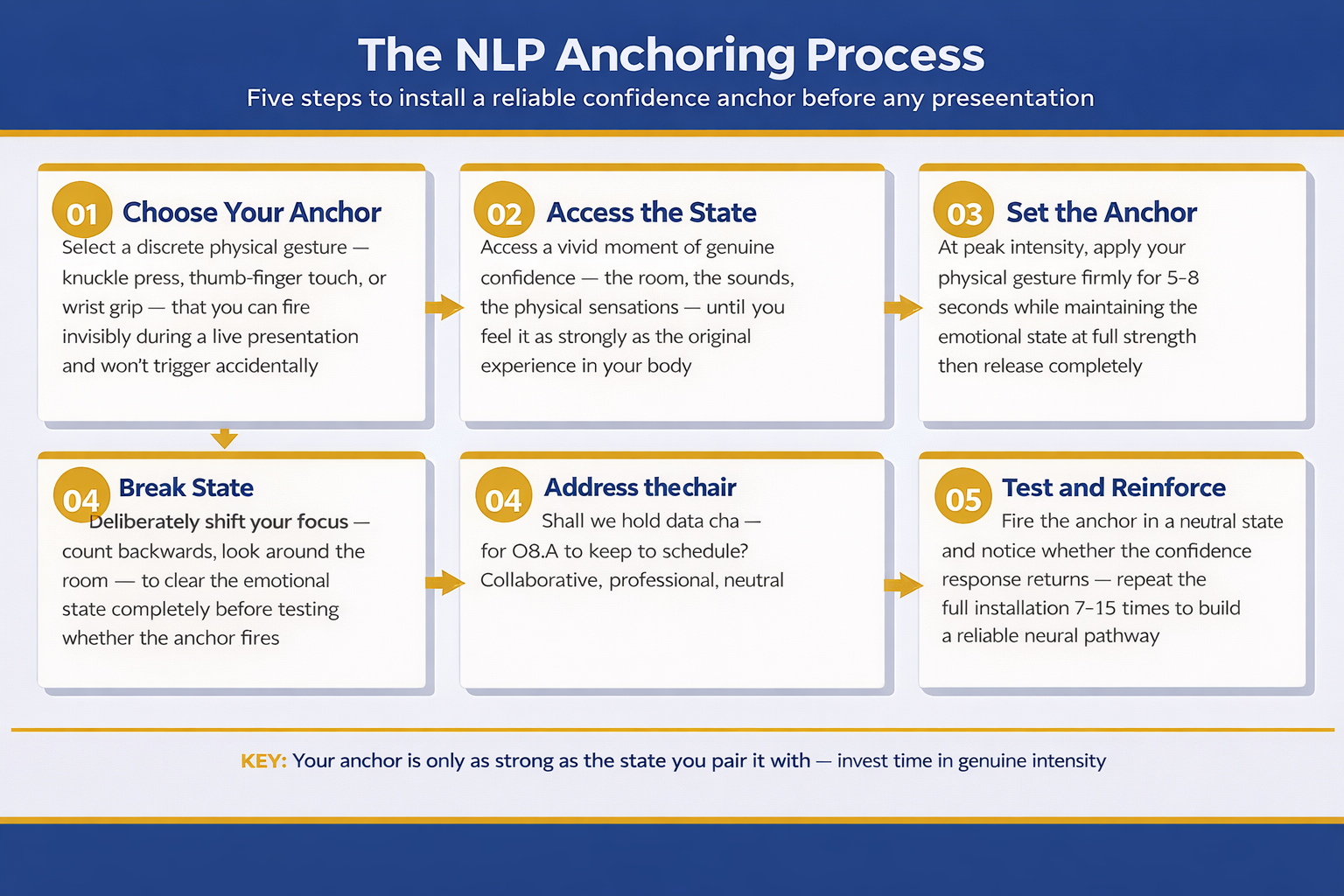
The NLP Anchoring Process for Presenters infographic showing five sequential steps: Choose Your Anchor (select a discrete physical gesture), Access the State (recall a vivid moment of genuine confidence), Set the Anchor (apply the gesture at peak intensity for 5-8 seconds), Break State (clear the emotional state completely before testing), and Test and Reinforce (fire the anchor and repeat 7-15 times to build a reliable neural pathway)

The Science: Why Anchoring Actually Works

When you experience a powerful emotion or mental state, your brain activates specific neural pathways. If you’re feeling confident, particular networks in your prefrontal cortex, amygdala, and anterior cingulate cortex light up. These aren’t abstract concepts—they’re actual electrical and chemical activity in your brain.

When you pair that brain state with a sensory cue repeatedly, something remarkable happens: the neural pathway becomes bidirectional. Normally, confidence leads to calm physiology. But through anchoring, the sensory cue activates the confidence pathway directly, bypassing the need for logical thought or conscious effort.

This is why anchoring is so effective for presentation anxiety. Anxiety lives in the amygdala and limbic system—the ancient, automatic parts of your brain. You can’t logic your way out of amygdala activation. But you can create a more powerful competing activation through anchoring. When you fire your anchor, you’re not fighting anxiety with your conscious mind. You’re recruiting the same ancient brain systems to create a stronger, competing state of calm.

The research supports this. Studies on neuro-linguistic programming show that anchoring produces measurable changes in cortisol levels (stress hormone), heart rate variability, and subjective anxiety ratings. It’s not placebo. It’s not wishful thinking. It’s applied neuroscience.

This is particularly important if you’ve read about how presentation anxiety lives in your nervous system—because anchoring is one of the most direct ways to communicate with that nervous system and shift its default response.

How quickly does an NLP anchor start to work?

Most people report feeling a shift within 2–3 uses of a properly installed anchor. You’ll notice the anchor firing (triggering the state) immediately, though the intensity builds over the first week or two of consistent use. For presentation anxiety specifically, you should feel measurably calmer within 3–5 presentations where you’ve used the anchor. That said, the stronger and more emotionally vivid your anchor installation, the faster it works.

How to Create Your Own Anchor (Step-by-Step)

Now for the practical bit. This is where anchoring stops being theory and becomes something you can actually use. Creating an anchor involves four key steps.

Step 1: Choose Your Trigger

Your trigger needs to be specific, unique, and easy to reproduce. Most people choose a physical gesture because it’s portable and invisible during a presentation. Common triggers include:

  • Pressing your thumb and forefinger together (the most popular choice)
  • Touching a specific point on your wrist or arm
  • Pressing your tongue against the roof of your mouth in a particular way
  • Squeezing a specific muscle in your leg

The trigger should be something you can do discreetly, even while presenting or on a video call. You also want it to be distinct enough that you don’t trigger it accidentally throughout your day. Choose something now and stick with it—consistency is crucial for anchoring.

Step 2: Activate a Powerful State of Confidence

This is the critical step that most people skip or rush through, which is why their anchors don’t work. You cannot create a strong anchor while feeling mildly confident. You need to activate a genuinely powerful state of confidence and calm.

The best way to do this is to recall a specific memory where you felt absolutely confident and assured. Not arrogant—genuinely calm and certain of your capabilities. It could be from presenting, from a moment in your career, or from any domain of life. Close your eyes. Step into that memory. Remember what you saw, what you felt in your body, your posture, your breathing. Make it vivid and visceral. Spend at least 2–3 minutes fully inhabiting that state.

If you don’t have a powerful confidence memory, you can create one through visualisation. Imagine yourself presenting brilliantly—calm, articulate, commanding the room. Watch yourself as if you’re watching a film. Then step into the image and feel it from the inside. Again, spend 2–3 minutes really living it, not just thinking about it.

Step 3: Pair the Trigger with the State (The Anchoring Moment)

At the peak moment of your confidence state—when you’re feeling it most strongly—perform your trigger gesture. If you’ve chosen the thumb-and-forefinger press, press them together firmly while taking a breath. Hold the trigger for 2–3 seconds whilst the state is at its strongest. Then release.

This is the moment of anchoring. You’re creating an association between the gesture and the state.

Step 4: Repeat the Installation (Minimum 7 Times)

A single pairing is not enough. Your nervous system learns through repetition. Repeat the full process—activate the state, pause, reach peak confidence, fire the trigger—a minimum of 7 times in one session. Ideally 10–15 times. Each time, make sure you’re reaching genuine confidence, not just half-heartedly going through the motions.

After your first installation session, repeat the anchor at least once daily for five days. This cements the neural pathway. After that, you can maintain it with occasional use (firing the anchor a few times per week).

If you want additional anchoring variations and how to layer multiple anchors together, Conquer Speaking Fear £39 includes a complete guided video walkthrough of this exact process.

Stop Anxiety Before It Hijacks Your Presentation

  • Create a neurological anchor that accesses calm on demand—no willpower required
  • Learn the exact 7-step installation process used by executives who present to boards and investors
  • Discover how to use your anchor in real presentations (even when presenting on video)
  • Understand why traditional anxiety management often fails—and what actually works
  • Install your anchor correctly the first time (mistakes will cost you weeks of progress)

Get Conquer Speaking Fear → £39

Trusted by 1000+ professionals in finance, tech, and consulting

How to Fire Your Anchor Before Presenting (The Deployment Strategy)

Installing an anchor is one thing. Using it effectively in the high-stress environment of a real presentation is another. Here’s how to actually deploy your anchor when it matters most.

The Pre-Presentation Window (15 Minutes Before)

Find a private space—the bathroom, a quiet hallway, your car, even a locked conference room. You need 2–3 minutes of solitude. Fire your anchor 3–5 times in succession. Each time, pause for a few seconds and let yourself feel the calm it generates. Don’t just mechanically perform the gesture; actually inhabit the confident state it triggers.

This is different from the installation process. You’re not trying to deepen the anchor further. You’re activating it to bring that confident state into your present moment, ready for your presentation.

The Waiting Moment

After you fire the anchor, you have roughly 10–15 minutes before the anchor naturally “decays”—meaning the neurological activation fades. Time your anchor-firing strategically so that you’re presenting within that window. If you’re waiting longer than 15 minutes, fire the anchor again closer to your presentation start.

During the Presentation Itself

Once you’re presenting, you can fire the anchor discreetly during the talk if you feel anxiety spiking. A thumb-and-finger press hidden at your side, or a tongue-press that no one will notice, can reset your nervous system mid-presentation. Some presenters do this during pauses, whilst taking a sip of water, or when moving between sections of their talk.

Most people find they don’t need to fire it during the presentation if they’ve installed it strongly and fired it beforehand. The initial activation is usually sufficient.

What if I forget to fire my anchor before presenting?

If you’ve already begun presenting, you can still fire it discreetly at any point. The anchor will activate a calm state within seconds. However, the better strategy is to build firing the anchor into your pre-presentation routine, so it becomes automatic. Some presenters fire their anchor whilst walking to the stage, or immediately before they’re introduced. Make it part of your ritual.

Advanced Techniques for Powerful Anchors

Once you’ve installed a basic anchor, you can enhance it with additional techniques that make it stronger and more reliable. Here are the most effective variations.

Stacking Anchors (Multiple States)

Instead of anchoring only to confidence, you can create separate anchors for different states: calm, focus, articulation, charisma. Then fire them all in sequence before presenting, creating a compounded effect. For instance, you might press your thumb-and-forefinger for calm, then touch your wrist for focus, then press a leg muscle for charisma. The neurological intensity multiplies.

Anchor Chaining

This involves firing one anchor to access a state, then immediately performing a second action (perhaps a power pose or a specific breathing pattern) whilst the first anchor is active. This creates an association between the anchor and the secondary behaviour, making both more powerful together.

Collapsing Anchors

If you have a lingering anxiety state that you want to eliminate, you can create an anchor for confidence, then deliberately activate the anxiety state, and fire the confidence anchor immediately whilst the anxiety is present. The confidence state “collapses” the anxiety state, and over repetitions, this weakens the anxiety response. This is advanced work and works best when paired with understanding your fight-or-flight response.

Resource Anchoring

Some people create an anchor not just for a mental state, but for accessing a specific resource or memory of a person they trust. For example, you might anchor to a memory of a mentor you admire, or a moment when a colleague praised your presentation skills. The anchor gives you neurological access to that resource precisely when you need it.

Never Walk Into a Presentation Unprepared Again

  • Master anchoring plus five additional NLP techniques specifically for presentation anxiety

Get Conquer Speaking Fear → £39

Includes video guides, workbook, and quick-reference deployment checklists

Can anchors fade or stop working?

An anchor can weaken if you don’t use it regularly. Think of it like a muscle—if you stop exercising, it atrophies. However, it’s remarkably easy to reactivate. Even if you haven’t used an anchor in months, firing it a few times usually restores its full power. Additionally, if you repeatedly fail at your anchor (for instance, trying to fire it whilst in a state of panic without having installed it properly first), you can inadvertently weaken it. This is why proper installation is non-negotiable.

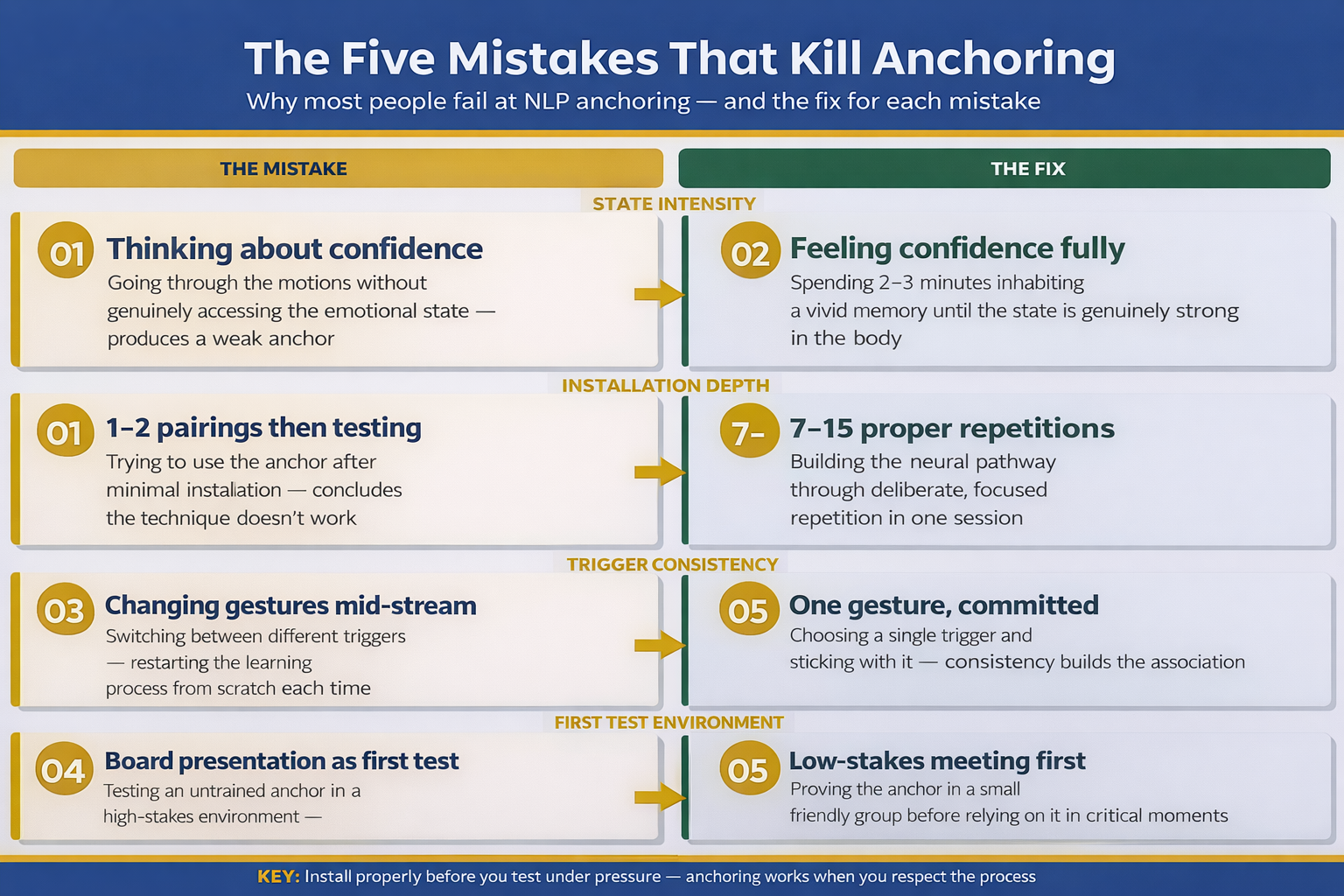
Side-by-side comparison of five common NLP anchoring mistakes and the correct approach for each, covering state intensity, installation depth, trigger consistency, and first test environment

The Mistakes That Kill Anchoring (And How to Avoid Them)

I’ve seen hundreds of people attempt anchoring and fail. Not because anchoring doesn’t work, but because they made preventable mistakes during installation or deployment. Here are the most common ones.

Mistake 1: Installing Without Reaching a Genuinely Powerful State

This is the number one reason anchors fail. People think about confidence rather than feeling it. They go through the motions without really accessing the state. Your anchor will be only as strong as the state you pair it with. If you’re 60% confident during installation, your anchor will trigger 60% confidence when you fire it. Invest the time to genuinely access a powerful, vivid state of confidence. Make it real. Make it felt.

Mistake 2: Firing the Anchor Without Installing It Properly First

Some people try to use an anchor after just one or two pairings, then conclude it doesn’t work. Anchors need a minimum of 7 proper installations to be neurologically reliable. You’re building a neural pathway, and pathways need repetition to become strong. If you try to use an untrained anchor under stress, it won’t work—and then you’ll question the whole technique.

Mistake 3: Changing Your Trigger Mid-Stream

Once you choose a trigger, commit to it. If you keep switching between different gestures, you never build a consistent pairing. Your brain is learning: This gesture means this state. If you’re constantly introducing new gestures, you’re starting the learning process from scratch each time.

Mistake 4: Relying on the Anchor Alone Without Context

Anchoring is extraordinarily powerful, but it’s not magic. If you’re presenting on zero sleep, or you’re in a genuinely dangerous situation (not presentation anxiety, but actual danger), no anchor will override your nervous system’s appropriate response. Anchoring works best when paired with proper preparation, adequate sleep, and other practical tools like breathing techniques.

Mistake 5: Firing the Anchor Under Extreme Distress Without Prior Installation

Your first test of an anchor should not be a high-stakes presentation in front of your board of directors. Install the anchor in low-stress situations first (perhaps presenting to a small friendly group, or in a low-pressure meeting). Let it prove itself in manageable contexts before you rely on it in the most critical moments.

Beyond these installation mistakes, there are also mistakes in how people think about what anchoring can do. Anchoring is brilliant for acute presentation anxiety. It’s less effective if you’re dealing with chronic burnout or deeper nervous system dysregulation. Know what problem you’re solving.

If you want to understand not just how to install an anchor, but also how to diagnose what type of presentation anxiety you’re dealing with and which techniques work for each type, Conquer Speaking Fear £39 walks through the complete diagnostic and treatment process.

Learn From Someone Who’s Used Anchoring With Thousands of Presenters

  • 24 years in corporate banking at JPMorgan Chase, PwC, Royal Bank of Scotland, and Commerzbank
  • Qualified clinical hypnotherapist and certified NLP practitioner with live case studies from clients
  • Video walkthroughs of the exact anchor installation process, plus six additional NLP techniques
  • Troubleshooting guide: what to do when your anchor isn’t working (and why)
  • Real-world deployment strategies for presentations, investor pitches, board meetings, and speaking engagements

Get Conquer Speaking Fear → £39

Trusted by professionals at FTSE 100 companies and Silicon Valley tech firms

Want the slides too?

If you’re installing anchors but struggling to deliver them with visual confidence, your slides might be working against you instead of amplifying your message. The Executive Slide System £39 teaches the slide design and delivery approach used by executives at FTSE 100 firms—so your visuals reinforce your nervous system work, not undermine it.

Is NLP Anchoring Right For You?

✅ Anchoring is right for you if:

  • You’re confident in your presentation content but anxious in the delivery
  • Your anxiety spikes only in presentation moments, not throughout your day
  • You want a practical tool you can use immediately, before your next presentation
  • You’re open to learning applied neuroscience rather than relying on willpower alone
  • You’ve tried breathing exercises and positive self-talk but need something stronger
  • You’re willing to spend 20 minutes installing an anchor properly before expecting results

❌ Anchoring might not be sufficient if:

  • You’re experiencing severe chronic anxiety unrelated to presentations
  • You’re burnt out or experiencing nervous system exhaustion from overwork
  • You lack confidence in your presentation content itself
  • You’re unwilling to spend time practising the anchor installation process
  • You’re expecting a magic solution without any personal effort or commitment
  • You’re in acute crisis and need immediate professional mental health support

Frequently Asked Questions

How long does it take to install an anchor properly?

The initial installation takes 20–30 minutes. This includes 10–15 repetitions of activating the state, reaching peak confidence, and firing the trigger. After installation, you’ll want to reinforce it daily for 5 days (5–10 minutes per day). Most people report measurable results within a week, though the anchor becomes more powerful over the first month of use.

Can anchoring work if I’m naturally anxious or introverted?

Yes, absolutely. Anchoring doesn’t depend on your personality type or baseline anxiety level. It depends on your nervous system’s ability to learn associations, and that’s universal. Whether you’re naturally anxious or calm, whether you’re introverted or extroverted, your nervous system can be trained to access confidence on command. Introversion and anxiety are different things—introversion is personality, anxiety is a nervous system state.

What if I’ve tried anchoring before and it didn’t work?

Most commonly, anchoring “failed” because the initial installation wasn’t done properly. Perhaps the state wasn’t genuinely powerful, or the anchor was fired only once or twice before being tested under stress, or the trigger was changed mid-stream. The technique itself is neurologically sound. If you’re willing to redo the installation with proper attention to each step, it will work. The second time around, most people see dramatic results.

Can I use anchoring alongside other anxiety-management techniques?

Yes, and in fact this is the ideal approach. Anchoring works brilliantly with breathing techniques, preparation, adequate sleep, and other NLP methods. Anchoring addresses the neurological pathway to confidence. Other techniques address preparation, physical state, and cognitive framing. Together, they’re more powerful than any single tool alone.

🆓 Free resource: Executive Presentation Checklist — a free guide to strengthen your presentation preparation.

Your Next Step

You now understand how anchoring works, why it’s neurologically powerful, and exactly how to install an anchor that will be reliable in your presentations. The technique is straightforward. The challenge most people face isn’t understanding—it’s execution. Most people read about anchoring and then don’t actually do it.

So here’s my challenge to you: within the next three days, choose your trigger gesture, find a quiet space for 20 minutes, activate a memory of genuine confidence, and install your anchor using the step-by-step process outlined above. Don’t overthink it. Don’t wait for the “perfect” moment. Just do it. By next week, you’ll have a neurological tool that will fundamentally change how your body responds to presentations. Your next presentation is your first real test. Use the anchor beforehand, and notice the difference.

If you want the full video walkthrough, additional NLP techniques, and troubleshooting support, Conquer Speaking Fear £39 is designed exactly for that.

About the Author

Mary Beth Hazeldine is the Owner & Managing Director of Winning Presentations. With 24 years of corporate banking experience at JPMorgan Chase, PwC, Royal Bank of Scotland, and Commerzbank, she has delivered high-stakes presentations in boardrooms across three continents.

A qualified clinical hypnotherapist and NLP practitioner, Mary Beth combines executive communication expertise with evidence-based techniques for managing presentation anxiety. She has trained thousands of executives and supported presentations that have secured high-stakes funding rounds and approvals.
Book a discovery call | View services

13 Mar 2026
Professional woman in a boardroom setting looking directly at the viewer with confident composure — executive presenter commanding the room"

The Fear That’s Worse Than Stage Fright: Being Forgettable

She delivered the presentation perfectly. Clear structure, confident delivery, sharp answers in Q&A. The senior leadership team thanked her warmly. Three weeks later, when the project was being discussed at board level, her name didn’t come up. Someone else’s did.

She wasn’t passed over because she failed. She was passed over because she hadn’t registered. The presentation had been technically correct and entirely unmemorable — and in the room where careers advance, those two things are not the same as doing well.

Stage fright gets diagnosed. It gets talked about, treated, trained away. The fear of being forgettable is quieter — but for the executives I work with, it is often the more accurate description of what they are actually afraid of. Not that it will go wrong. That it will go fine, and nobody will notice.

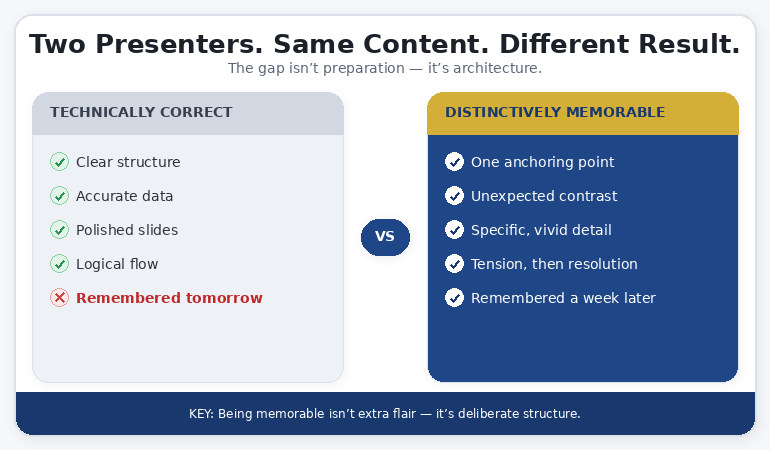
Quick answer: The fear of being forgettable is not a performance problem — it is a distinctiveness problem. Technically correct presentations fail to register because they are built to avoid failure rather than to create impression. The fix is the one decision point that every presentation needs and most executives skip: what single thing do you want the room to remember when everyone has left? That question, answered before the deck is built, changes the structure, the language, and the moment in the room that makes you memorable.

🎯 Worried your presentations land and then disappear? Conquer Speaking Fear (£39) includes the memorability framework — the single structural change that makes executive presentations stick rather than slide off the room.

I spent 24 years in corporate banking at JPMorgan Chase, PwC, Royal Bank of Scotland, and Commerzbank. I sat in hundreds of presentations — some of which I still think about today, and most of which I cannot recall a single detail of. The ones I remember were not always the most technically accomplished. They were the ones where the presenter had made a decision about what to leave behind.

The fear of being forgettable is almost never named as a fear. It presents as something else: a vague dissatisfaction with your own presentations, a frustration that you prepare thoroughly and deliver competently but don’t seem to build momentum, a nagging sense that you’re getting positive feedback but not advancement. What sits underneath all of that is the knowledge — accurate, if unarticulated — that the room is processing your presentation in real time and discarding most of it within 48 hours.

This is not a confidence problem. Many of the executives I work with are entirely confident in front of a room. They are confident and forgettable, and the combination is more frustrating than stage fright, because stage fright at least has a diagnosis.


Executive presenter at boardroom table showing the contrast between technically correct delivery and memorable impression-creating presentation technique

What the Fear of Being Forgettable Actually Is

The fear of being forgettable is not anxiety about the presentation itself. It is anxiety about what happens after the presentation — specifically, about whether the work you put into the room will translate into anything that changes how people think about you, your ideas, or your capability.

It is existential in a way that stage fright is not. Stage fright is about a visible, acute failure — the stumble, the blank, the meltdown. The fear of being forgettable is about an invisible, chronic failure — the presentation that goes smoothly from start to finish and changes nothing. It is possible to manage stage fright and still live with the fear of being forgettable. They are different problems.

The fear is rational. Most executive presentations are, in fact, forgettable. Not because the presenters are weak — because they are built to survive the room rather than to shape it. Built to avoid objections rather than to create impressions. Built for correctness rather than distinctiveness, and correctness, as a standard, produces adequate presentations at best.

The presentation confidence that most people work to build is about managing their own state in front of a room. That matters. But it does not solve the fear of being forgettable — because forgettable presentations are delivered by confident people every day. Confidence is necessary. It is not sufficient.

🎯 From Technically Correct to Genuinely Memorable: The Framework Inside Conquer Speaking Fear

Conquer Speaking Fear addresses both the anxiety that makes you hold back and the structural problem that makes you forgettable — because they are connected. The memorability framework inside includes:

  • The single decision that changes how your presentation is built — the one question most executives skip that determines whether the room retains anything
  • The structural change that creates impression without changing your delivery style or requiring you to be more extroverted
  • The moment-in-the-room technique — how to create one point of genuine distinctiveness that travels out of the room after you’ve left
  • Why technically correct presentations fail to register — and the three specific elements that create retention
  • Scripts and frameworks for building distinctiveness into any presentation, including updates and committee briefings

Get Conquer Speaking Fear → £39

Built from 24 years of reviewing what makes executives memorable — from performance coaching, but in banking boardrooms where careers advance on the quality of the impression you leave behind.

Why GettingIt Right Isn’t the Same as Being Remembered

There is a common assumption that technical competence in presentation leads to memorability. That if you structure your content well, deliver it clearly, and handle Q&A professionally, the impression will follow. It does not work this way.

Technically correct presentations are processed by the audience as expected. Expected things are not memorable. The brain’s memory systems are optimised for novelty, significance, and pattern disruption — not for competent execution of a familiar format. When a presentation ticks every box and surprises no one, the audience experiences it as confirmation of baseline. That confirmation does not generate lasting impression.

There are three specific elements that create memorability in executive presentations. The first is a distinctive frame: a way of seeing the topic that the audience has not encountered before, and cannot easily dismiss. The second is a moment of genuine specificity — a number, a story, a piece of evidence so precise that it does not generalise. The third is a closing that creates tension rather than resolution: something the audience leaves with that has not yet been answered, or a commitment so specific that it follows them out of the room.

Most presentations have none of these. They are built on the assumption that clarity is sufficient for impact. Clarity is necessary for impact. It is not impact.

Preparing a presentation where being remembered genuinely matters? Conquer Speaking Fear (£39) includes the three-element memorability checklist and the templates to build each element into any presentation format.

The One Decision That Makes You Memorable

Before building any presentation, answer this question: what is the single thing you want the room to remember when everyone has left, the coffee cups have been cleared, and two other presentations have happened since yours?

Not the key messages — there are always three or five of those. Not the overall objective. The single thing. The one sentence that you would consider the presentation successful if it was still in someone’s head three days later.

Most executives cannot answer this question without several attempts. Not because they haven’t thought about the presentation — they have thought about it extensively — but because they have been building toward comprehensive communication rather than toward a single retained point. The question forces a prioritisation that comprehensive communication never requires, and that prioritisation is what makes the difference.

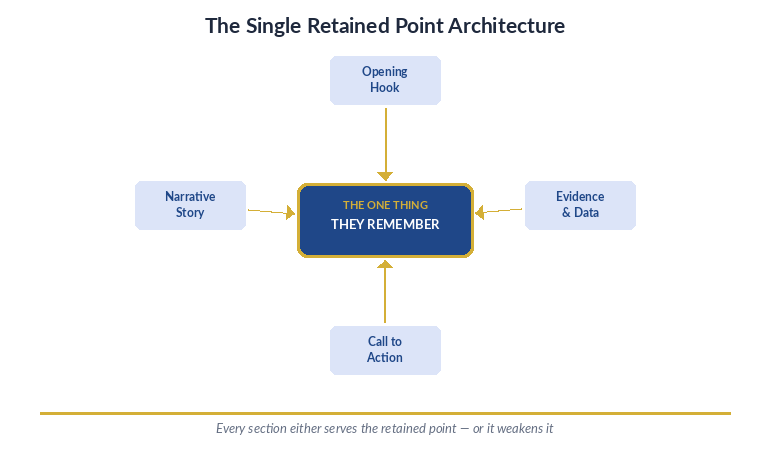
Once the single point is identified, it changes the structure, the language, the evidence selection, and the closing. Every section of the deck can be evaluated against one criterion: does this section serve the single point, or is it here because it belongs in a complete treatment of the topic? A complete treatment of the topic is for a report. A presentation that leaves one point behind is for a room.

This is not the same as simplifying your content. The evidence, the depth, the rigour — all of that remains. What changes is the architecture: everything is built to deposit one thing in the room’s memory, and everything that does not serve that deposit is moved to an appendix or removed entirely.


Presentation structure diagram showing the single retained point architecture — how to build every section toward one memorable conclusion rather than comprehensive topic coverage

⚠️ Stop Presenting Well and Being Forgotten

Technical competence is not the problem. The problem is building presentations that aim for correctness rather than impression. Conquer Speaking Fear (£39) gives you the framework to identify your single retained point and build the rest of the deck to serve it — so you leave something behind when you leave the room.

Get Conquer Speaking Fear → £39

Used by executives who present confidently and want to know why they’re not advancing as fast as their performance warrants.

The Structural Change That Creates Impression

Once you have identified your single retained point, there is one structural change that consistently makes it land: give it three times more space than you think it needs.

Most executives identify the central point of their presentation and give it a slide. They present it in the same format as every other slide — the same visual weight, the same amount of speaking time, the same level of evidence. The audience processes it as one of many points and does not distinguish it as the point they are meant to carry with them.

A presentation built for memorability gives the central point a different kind of attention. It arrives at the point from two directions — an evidence approach and a case study approach. It lingers there rather than moving on. It uses language that is slightly more precise, slightly more surprising, than the surrounding sections. And it returns to the point at the close — not as a summary, but as a reframing that shows the audience something they have just been made to see that they could not see before the presentation began.

The fear of being judged when speaking often produces exactly the opposite structure: executives rush through the material to minimise exposure to judgment, and the rushed pace means no single section gets enough space to register. Slowing down at the central point — deliberately, visibly, without apology — is both a confidence signal and a memorability technique.

The Moment in the Room That People Carry With Them

There is a specific type of moment in executive presentations that travels out of the room with the audience. It is not the best slide. It is not the sharpest Q&A answer. It is the moment where the presenter says something that the audience had not heard formulated that way before — and that formulation makes something they already knew suddenly more useful.

This moment is not spontaneous. It is engineered. The best presenters I observed over 24 years in financial services had prepared two or three formulations that they delivered as if they were occurring to them in real time. The sentences were precise, unexpected, and impossible to improve. They stuck because they had been sharpened in advance to a point that could not be blunted by the audience’s existing vocabulary.

The technique is to write one sentence that your audience will want to use themselves. Not a quotable headline — a usable thought. Something that gives them language for a problem they already have. When an executive leaves a presentation and says to someone in the corridor, “she said something interesting — she said that…” the sentence they complete is the one the presenter put there deliberately.

This is not manipulation. It is the same precision that good writing requires — the sentence that could not have been written differently and still meant the same thing. Presentations that are remembered tend to contain at least one of these sentences. Presentations that are forgotten contain none.

The process of overcoming public speaking fear often focuses on managing internal state in front of a room. That work is valuable. But the executive who has resolved their anxiety and still presents forgettably needs a different intervention: not less fear, but more considered preparation of the specific moment that will travel.

Also published today: International Presentations: The Cultural Mistakes That Kill Deals Before Slide One — the structural adjustments that make you read as credible rather than problematic in cross-cultural rooms.

Common Questions About the Fear of Being Forgettable in Presentations

Is the fear of being forgettable the same as imposter syndrome?
They are related but different. Imposter syndrome is the belief that you are not as capable as others perceive you to be. The fear of being forgettable is the belief that even if you perform well, you will not make an impact. Many executives experience both — but the fear of being forgettable is often the more accurate fear, because it is a response to real feedback: presentations that go well and produce no change. Imposter syndrome is a distortion of self-perception. The fear of being forgettable is often an accurate assessment of a structural problem in how presentations are being built.

How do I become more memorable without changing my personality or presentation style?
The memorability techniques in this article and in Conquer Speaking Fear are structural, not stylistic. You do not need to become more energetic, more performative, or more extroverted. You need to identify your single retained point, give it disproportionate space in the presentation, and engineer one sentence that your audience will want to use themselves. These changes live in the preparation, not in the delivery. Your personality, your voice, your style — none of that changes. What changes is the architecture of the deck and the precision of one or two key sentences.

What if the content I’m presenting doesn’t lend itself to being memorable — like a budget update or a quarterly review?
Every presentation can contain one memorable moment, regardless of topic. A budget update can contain one framing that changes how the audience thinks about a number they have seen before. A quarterly review can contain one sentence that gives the audience language for a pattern they have been observing but haven’t been able to articulate. The technique works across presentation types because it does not depend on the subject matter being inherently interesting — it depends on the presenter doing the preparation work to find the single formulation that makes the familiar suddenly more useful.

Is This Right For You?

This article and Conquer Speaking Fear are for executives who present competently and know it, but who are not seeing the career impact that their presentation performance should generate. If you are getting consistent positive feedback and not advancing, if you are being told your presentations are good but not being remembered after them, or if you sense that you are technically doing everything right and still not registering — the memorability framework is the relevant intervention.

If your primary challenge is managing anxiety or fear in front of a room, Conquer Speaking Fear addresses that too. The memorability work and the anxiety management work are covered together because they connect: the executives who are most afraid of being forgettable tend to rush through their material to reduce exposure, and that rushed pace is exactly what prevents the central point from landing with enough weight to be retained.

Frequently Asked Questions

Does being memorable require being controversial or provocative?
No, and in many executive contexts, controversy is actively counterproductive. Memorability in executive presentations comes from precision and distinctiveness, not from provocation. The formulation that makes you memorable is more likely to be a precisely articulated insight that your audience already half-knows than a deliberately provocative claim. Controversial presentations are remembered, but often for the wrong reasons. The goal is to be remembered for the quality of your thinking, not for having caused friction in the room.

How long does the memorability preparation take?
The critical question — what is the single thing I want the room to remember? — takes 15–30 minutes to answer well if you have not done it before. The first answers are usually too broad. The useful answer is specific enough that you could repeat it to someone who wasn’t in the room and they would understand both the point and why it matters. Once you have that answer, the structural adjustments to the deck take 30–60 minutes for a presentation you have already built. The one engineered sentence takes longer — sometimes a day of writing and revision — because it needs to be precise enough to survive a room full of people who will immediately try to improve it.

📊 Want the slides too?

Preparation reduces anxiety. The Executive Slide System (£39) includes templates designed for executives who want their deck to carry the weight of the memorable moment — so your delivery can focus on the room rather than on the slides.

About the Author

Mary Beth Hazeldine is the founder of Winning Presentations and has spent over two decades advising executives on high-stakes communication. Her background includes roles at JPMorgan Chase, PwC, Royal Bank of Scotland, and Commerzbank. She has observed hundreds of executive presentations across board and leadership contexts and developed Conquer Speaking Fear from the patterns that separated the presentations people still talk about from the presentations nobody remembers. She works with senior leaders on both performance anxiety and the structural problem that lies beneath it.

Free resource: Executive Presentation Checklist — includes the memorability check for every presentation: the five signals that indicate your central point has enough structural weight to be retained.

The Winning Edge Newsletter

Practical executive presentation guidance, once a week. No padding, no noise — just the techniques that matter when the room is full of people whose time is expensive.

Subscribe Free →

12 Mar 2026
Why 'be yourself' is the worst presentation advice — and what actually builds genuine confidence when presenting

Why ‘Just Be Yourself’ Is the Worst Presentation Advice Ever Given

I have heard this advice given in every variation imaginable. “Just relax and be yourself.” “Be authentic — they’ll respond to that.” “Don’t overthink it, just be natural.” It is delivered by coaches, managers, colleagues, and well-meaning friends. It is almost completely useless.

Here is the problem. The person asking for help with their presentation anxiety is anxious because, in that specific context, they don’t know how to be themselves. The presentation setting activates a version of them they don’t recognise — the one with the dry mouth and the racing thoughts and the sudden inability to remember what they were about to say. Telling them to “just be yourself” in that state is like telling someone who is lost to “just know where you are.”

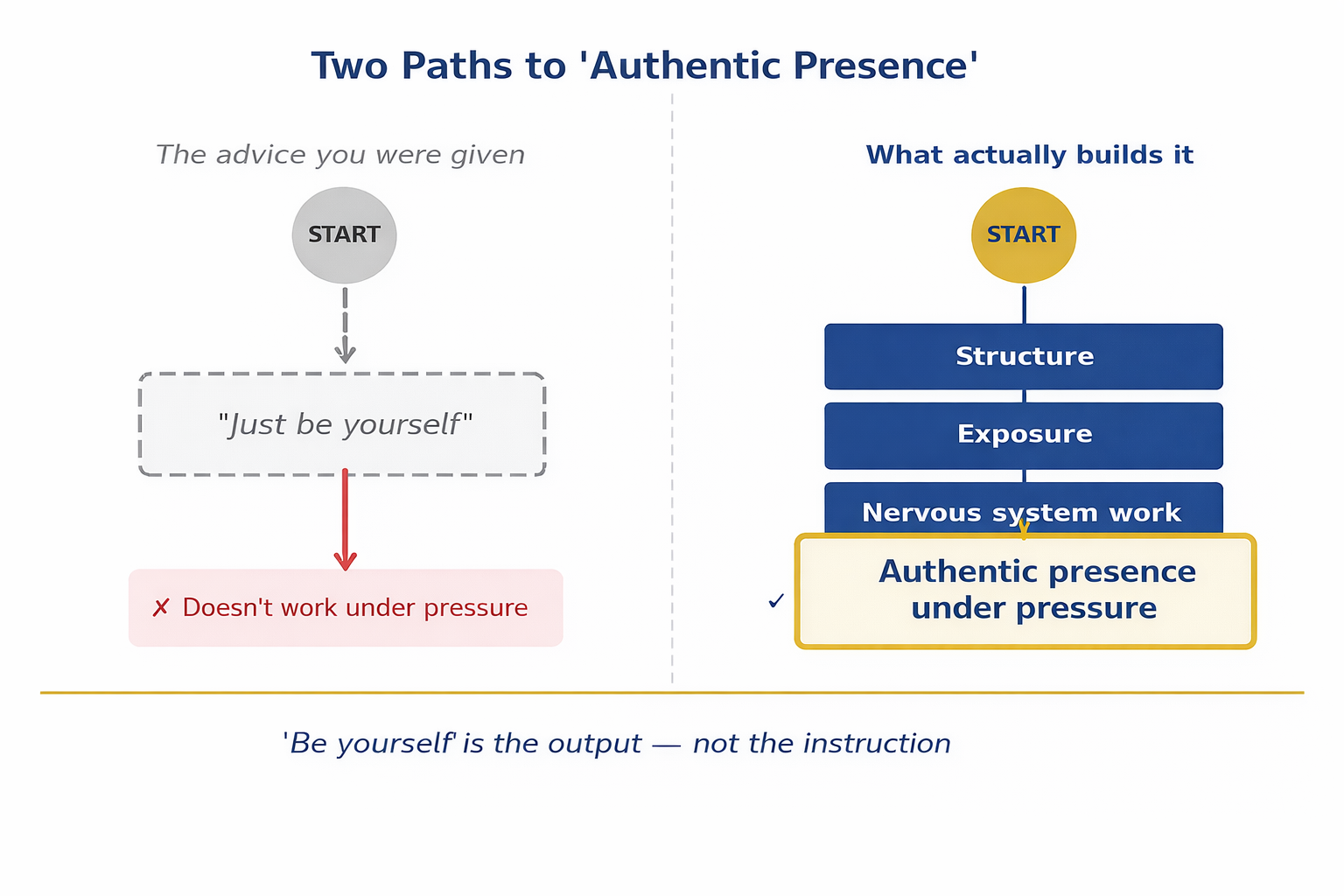
The advice is not wrong because authenticity doesn’t matter. It matters enormously. It’s wrong because it mistakes the destination for the route.

Quick answer: “Just be yourself” fails as presentation advice because it assumes you already have access to a confident, composed version of yourself in a high-pressure context — and for many people, you don’t yet. Authenticity in presentations isn’t a starting position; it’s a result of having a reliable structure, having prepared the right way, and having repeated the experience enough times for the nervous system to stop treating it as a threat. The route to authentic presenting runs through skill, not sentiment.

🧠 Struggling with presentation anxiety despite trying every tip you’ve been given? Conquer Speaking Fear (£39) addresses the root cause — not the symptoms — with a four-step approach built on clinical hypnotherapy and NLP.

I spent 24 years in corporate banking before I became a presentation coach and clinical hypnotherapist. In my banking career I gave many presentations that went well and several that didn’t — and I received “just be yourself” advice before most of them. I know what it feels like to walk into a room where the stakes are high, where the audience is senior, and where your nervous system is telling you that you are not safe.

In that state, “yourself” is not a useful concept. “Yourself” is simultaneously the person who knows this material better than anyone in the room, and the person whose heart rate has just doubled and who has forgotten how to breathe properly. Telling that person to “be themselves” doesn’t help them access the first version — it just leaves them alone with the second.

What actually builds presenting confidence is not more permission to be authentic. It’s removing the obstacles that prevent authenticity from being accessible. That’s a different problem with a different solution.


Presentation humiliation recovery process showing the 3 mechanisms: interrupt replay loop, separate shame from identity, rebuild nervous system baselineWhy ‘Be Yourself’ Fails in High-Pressure Contexts

The advice “just be yourself” contains a hidden assumption: that the self you normally inhabit is readily available in high-stakes situations. For most people, it isn’t — and this isn’t a character flaw, it’s a neurological response.

When your nervous system perceives threat — and many brains are wired to classify a large audience, an important meeting, or a high-stakes pitch as a threat — it triggers physiological responses designed to help you survive, not to help you present well. Elevated heart rate. Shallow breathing. Reduced access to higher-order thinking. A narrowed attentional focus. These responses are not evidence that you’re not good enough. They’re evidence that your brain is doing exactly what evolution designed it to do.

The problem is that “be yourself” offers no pathway through this response. It doesn’t tell you how to work with your nervous system rather than against it. It doesn’t provide structure that reduces the cognitive load of an unfamiliar or threatening situation. It doesn’t address the root pattern that makes presenting feel dangerous in the first place.

What’s more, the advice can actually increase anxiety. When someone tries to “be themselves” and still feels anxious, the natural conclusion is that there’s something wrong with them — that even their authentic self isn’t good enough for this situation. The advice doesn’t just fail to help; it creates a new layer of self-criticism on top of the existing anxiety. The research on why even confident presenters still get nervous confirms this: the problem isn’t authenticity, it’s the model people hold about what anxiety means.

🧠 The Approach That Actually Works When ‘Just Be Yourself’ Hasn’t

Conquer Speaking Fear addresses presentation anxiety at the level where it actually lives — the nervous system pattern that activates in high-pressure contexts — not the surface symptoms that generic advice tries to manage:

  • The four-step framework for retraining the nervous system response that makes presenting feel threatening
  • Clinical hypnotherapy and NLP techniques applied specifically to presentation anxiety
  • The pre-presentation physical routine that creates genuine calm rather than performed confidence
  • Evidence-building practices that change how your brain classifies the presenting situation over time
  • The distinction between managing anxiety (which keeps the pattern in place) and resolving it

Get Conquer Speaking Fear → £39

Built from clinical hypnotherapy, NLP practice, and 24 years of high-stakes presenting at JPMorgan Chase, PwC, and RBS. Used by executives who’ve tried every other approach.

What Authenticity in Presenting Actually Is

Authentic presenting is not performing naturalness. It’s not trying to replicate how you feel in a low-stakes conversation and importing it into a high-stakes one. Authenticity in the context of presentations means that your words, delivery, and presence are congruent — that there isn’t a visible gap between what you’re saying and how you appear to be experiencing saying it.

That congruence is available to most people in some contexts and not in others. In a conversation with a trusted colleague about a subject you know well, it’s probably effortless. In a room with senior stakeholders, cameras, or an audience that includes people who can affect your career, it’s not — because your nervous system has added a layer of self-monitoring and threat assessment that didn’t exist in the smaller conversation.

Removing that layer is not a matter of trying harder to be authentic. It’s a matter of reducing what your nervous system needs to monitor. Structure does part of that work — when you know exactly where your presentation is going, you’re not simultaneously navigating and performing. Preparation does another part — when you’ve rehearsed the opening enough times, it stops requiring conscious attention and frees up cognitive resource for presence. And nervous system work — the kind that changes the underlying response pattern — does the part that structure and preparation alone can’t reach.

The result is what people experience as authenticity: the sense that the presenter is genuinely present, not performing presence. But that result is downstream of a specific set of inputs. It doesn’t arrive just because someone gave you permission.

Why Structure Comes Before Authenticity

This is the idea that most presentation advice gets backwards. The conventional model says: first be yourself, then communicate your content confidently. The actual sequence is: first build a reliable structure, then reduce the cognitive load of delivering it, then the self that was always there becomes accessible.

Structure reduces threat. When you walk into a presentation knowing exactly what your first sentence is, what your three main points are, and what you’re going to say in your closing — the brain has far less to manage. The threat response that generates the symptoms most presenters try to hide has less reason to activate. Not because you’ve suppressed it, but because the situation is now more predictable.

This is why some of the best presenter frameworks begin with slide structure rather than mindset. Building presentation confidence starts with giving yourself a reliable architecture to stand inside — not with trying to think your way into a more relaxed emotional state.

It’s also why the “just be yourself” advice works for experienced presenters and fails for anxious ones. Experienced presenters have already developed structure and reduced the cognitive load through repetition. Their brain genuinely has less to monitor in the presenting situation. When someone tells them to “be themselves,” they have reliable access to that self because the threat response has already been downgraded. They’re not natural because they’re naturally relaxed. They’re relaxed because they’ve done the work that structure and repetition require.


Presentation humiliation recovery: Event versus Identity comparison showing how to separate a single bad presentation from your self-narrative

🚫 If Generic Advice Hasn’t Worked, the Route Is Different — Not Longer

Most presentation anxiety programmes manage symptoms. Conquer Speaking Fear (£39) addresses the nervous system pattern underneath — the one that ‘just be yourself’ never reaches.

Get Conquer Speaking Fear → £39

Built on clinical hypnotherapy and NLP — for executives who’ve already tried practice, positive thinking, and being told to relax.

What Actually Builds Genuine Presenting Confidence

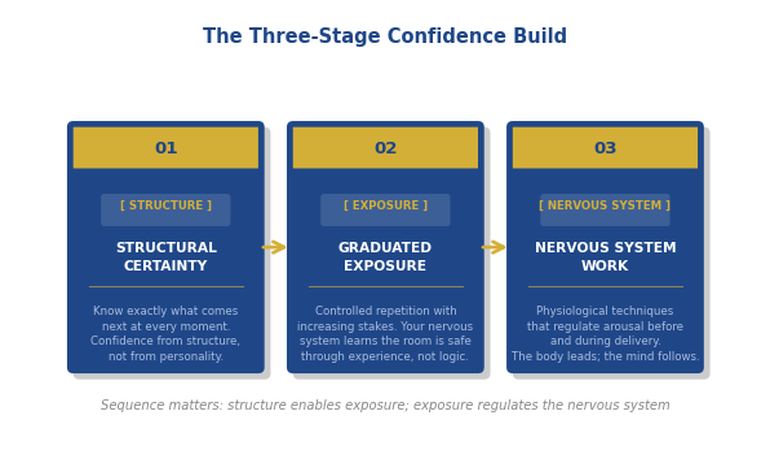
The route to confident, authentic presenting has three components. They work in sequence, not simultaneously.

The first is structural certainty. Know exactly where your presentation starts, what it covers, and how it ends. This isn’t about scripting every word — it’s about having a reliable architecture that your brain trusts. When the structure is solid, the self-monitoring that activates in ambiguous situations has less to do.

The second is graduated exposure. Presenting in low-stakes contexts — team meetings, small groups, recorded practice — builds the evidence base that your nervous system needs to downgrade the threat assessment of the presenting situation. Each successful experience registers as data: I presented and the outcome was acceptable. Over time, the brain reclassifies presenting from threat to familiar challenge. This is the mechanism behind why experienced presenters appear naturally confident. It’s not that they were born different — it’s that they’ve created a different data set.

The third, and the one that matters most when the first two haven’t been enough, is addressing the underlying pattern directly. Clinical hypnotherapy and NLP work at the level of the nervous system response itself — not by convincing you to think differently about presenting, but by changing the subconscious association between the presenting context and the threat signal. This is the component that ‘just be yourself’ and most generic presentation advice never reaches.

When all three are in place, authenticity stops being something you have to try to produce. It becomes, as it should always have been, the natural state of a person who is not being overwhelmed by anxiety. Looking confident when presenting is not a performance you layer over anxiety — it’s what emerges when the anxiety has been genuinely addressed.

The Nervous System Problem the Advice Ignores

Presentation anxiety isn’t a mindset problem. It’s a nervous system response that was calibrated in situations where social threat was genuinely dangerous — where being judged by the group could result in exclusion — and which now activates in professional presenting contexts even though the actual consequences are rarely catastrophic.

Telling someone with this response to “be themselves” is asking them to perform naturalness while a part of their brain is running a threat protocol. The physiological symptoms — the racing heart, the shallow breathing, the dry mouth, the trembling hands — are not the result of insufficient authenticity. They’re the result of an overactive threat response in a context where threat has been overestimated.

The work that changes this isn’t in the advice given before presentations. It’s in the pattern-interruption that happens underneath the conscious, rational mind — through techniques that access the subconscious associations between presenting and danger that maintain the response. That work is specific, it takes a particular set of tools, and it is available. But “just be yourself” isn’t it.

Also published today: The Investor Relations Update Format That Prevents Awkward Questions — the four-part slide structure for IR updates that keeps executives in control of the narrative.

Recognise that pattern in yourself? Conquer Speaking Fear addresses the nervous system response that ‘just be yourself’ never reaches — with a four-step clinical approach built on hypnotherapy and NLP.

Get Conquer Speaking Fear → £39

Common Questions About Presentation Advice and Authenticity

Is ‘be yourself’ ever good advice for presenting?
Yes — for people who already have a confident, accessible version of themselves in presenting contexts. For them, the advice is a useful reminder not to over-perform or adopt a stylised ‘presenter voice.’ But for anyone whose nervous system still treats presenting as a threat, “be yourself” describes a destination they can’t reach from where they currently are. It’s good advice for the wrong people, given at the wrong stage.

What’s the difference between authentic presenting and faking confidence?
Faking confidence means performing a state you don’t have access to — and audiences can usually detect the gap, even if they can’t name it. Authentic presenting means the external and internal are congruent: you don’t appear more composed than you feel because you’ve done the work to reduce the gap. The goal isn’t to act calm while feeling panicked. The goal is to reach a state where calm is genuinely available. That’s a different project from ‘just be yourself,’ but it’s an achievable one.

Why do confident colleagues seem to naturally ‘be themselves’ in presentations?
Because their nervous system has already downgraded the threat assessment for presenting — usually through repetition, through a history of acceptable outcomes, or occasionally through a fundamentally different anxiety profile. They’re not naturally more authentic. They’re operating in a context their brain has reclassified as safe, so they have access to the full range of who they are. The route to that state is available to most people, but it runs through the work, not through the advice.

Is This Right For You?

✅ This is for you if:

  • You’ve received ‘just be yourself’ advice and found it doesn’t help — or makes things worse
  • You present competently but never feel genuinely present or relaxed in front of an audience
  • You want to understand why standard presentation tips don’t address what you’re actually experiencing

❌ This is NOT for you if:

  • You already feel calm and confident when presenting and are looking for delivery technique improvements
  • You want a quick list of tips to apply before tomorrow’s presentation (that’s a different article)

🏛️ Built by a Clinical Hypnotherapist Who Spent 24 Years Presenting in High-Stakes Corporate Environments

Conquer Speaking Fear wasn’t built from academic theory about presentation confidence. It was built from the inside — by someone who experienced severe presentation anxiety in a professional context where generic advice consistently failed, and who spent years developing a clinical approach to what that experience actually required:

  • The four-step nervous system retraining framework — not symptom management, root cause resolution
  • Clinical hypnotherapy techniques for changing the subconscious associations that maintain the anxiety response
  • NLP approaches for interrupting the thought patterns that escalate anticipatory anxiety in the days before a presentation
  • The pre-presentation physical routine that creates genuine calm — not performed composure
  • Evidence-building practices that change the data your nervous system holds about presenting over time

Get Conquer Speaking Fear → £39

From a qualified clinical hypnotherapist and NLP practitioner with 24 years of corporate presenting experience at JPMorgan Chase, PwC, Royal Bank of Scotland, and Commerzbank.

📊 Want the slides too?

Preparation reduces anxiety. The Executive Slide System (£39) includes confident-presenter templates designed to reduce preparation stress — because knowing your structure is solid before you walk in genuinely changes how your nervous system responds to the situation.

Related reading: Why Confident Presenters Still Get Nervous Before Every Talk — why the goal isn’t to eliminate nerves and what to do with them instead.

Frequently Asked Questions

How do I get comfortable presenting without having to ‘perform’ confidence I don’t feel?

The route is to stop trying to perform confidence and instead do the work that makes genuine confidence available. That means building a reliable structure so your brain has less to manage in the presenting context, using graduated exposure to give your nervous system new evidence, and — if those two haven’t been enough — working directly on the underlying anxiety pattern through approaches like clinical hypnotherapy or NLP. Performed confidence is exhausting and detectable. Genuine confidence is the result of the brain no longer classifying the presenting situation as a significant threat.

Is presentation anxiety something you can actually resolve, or is it just something you manage forever?

For most people, it’s resolvable — not just manageable. The distinction matters because ‘managing’ anxiety keeps the underlying pattern in place and requires ongoing effort. Resolving it means changing the nervous system response that generates the anxiety in the first place, so that presenting becomes a familiar challenge rather than an activating threat. That resolution isn’t guaranteed, and it requires specific approaches rather than generic tips. But the clinical tools exist, and for the majority of people who haven’t tried them, they produce significantly different outcomes than anything that’s been attempted before.

Why does the advice to ‘just relax’ also not work for presentation anxiety?

Because “just relax” is a request to consciously override a subconscious response — and the conscious mind doesn’t have access to the systems that generate the anxiety symptoms. You can’t decide your way out of an elevated heart rate in the same way you can decide to answer a question differently. The symptoms are produced by the autonomic nervous system responding to a perceived threat signal. The work that changes those symptoms has to operate at the level where that signal originates, not at the level of conscious intention.

What’s the difference between introversion and presentation anxiety?

Introversion is a preference for lower-stimulation environments and a tendency to recharge through solitude rather than social interaction. Presentation anxiety is a fear response to a perceived threat in a social performance context. They often co-occur, but they’re not the same thing and they don’t have the same solution. Many introverts present extremely well because they’ve addressed the anxiety component — introversion doesn’t cause anxiety, it just means the social aspects of presenting require more recovery time afterwards. The work of building presenting confidence is available to introverts as much as to anyone else.

The Winning Edge — weekly insight on presentation confidence, anxiety, and executive communication. Subscribe free →

Want everything in one place? The Complete Presenter Bundle (£99) includes Conquer Speaking Fear, the Executive Slide System, the Executive Q&A Handling System, and four additional products.

Free resource: Executive Presentation Checklist — the pre-presentation checklist for structure, content, and delivery, free to download.

About the Author

Mary Beth Hazeldine is the Owner & Managing Director of Winning Presentations. With 24 years of corporate banking experience at JPMorgan Chase, PwC, Royal Bank of Scotland, and Commerzbank, she has delivered high-stakes presentations in boardrooms across three continents.

A qualified clinical hypnotherapist and NLP practitioner, Mary Beth combines executive communication expertise with evidence-based techniques for managing presentation anxiety. She has trained thousands of executives and supported high-stakes funding rounds and approvals.

Book a discovery call | View services

14 Feb 2026
Executive woman with quiet confidence standing in boardroom — introvert presentation advantage

Why Introverted Executives Present Better Than Extroverts

Quick answer: Introverted executives often have an advantage in high-stakes presentations because they prepare more thoroughly, listen more carefully, and let their content — not their charisma — carry the room. The traits that make you feel like a weaker presenter are often the traits that make audiences trust you more.

The best board presentation I ever witnessed was delivered by a woman who described herself as “painfully introverted.”

She was a CFO at a mid-cap financial services firm. Before the meeting, I watched her sit quietly in the corridor while her colleagues rehearsed loudly in the breakout room next door. She didn’t pace. She didn’t run through her slides one more time. She just sat with her notes and breathed.

When she stood up, she spoke for nine minutes. Nine. No jokes. No theatrics. No “let me tell you a story about my first day in finance.” Just a clear recommendation, three supporting data points, and a direct ask for approval.

The board approved her proposal without a single challenge. The extroverted VP who presented after her — louder, funnier, more animated — got seventeen follow-up questions and was asked to come back next quarter.

That moment changed how I think about presentation coaching. For years, I’d been helping introverted clients become more like the extroverts they admired. I had it backwards. The introverts didn’t need to become louder. The extroverts needed to become more disciplined. And the data, it turns out, agrees.

If anxiety is the thing getting in the way — not your introversion — Conquer Speaking Fear walks through a clinical-hypnotherapy-based approach to reducing the fear response so your natural preparation and precision can do their job. A structured alternative to “just breathe” advice.

Your Quiet Wiring Isn’t the Problem. The Anxiety Around It Is.

Conquer Speaking Fear gives you a structured system built from clinical hypnotherapy and NLP to reduce presentation anxiety — so your natural preparation, precision, and calm can do what they’ve always been capable of.

Get Conquer Speaking Fear → £39

Built from clinical hypnotherapy + NLP techniques — designed specifically for high-performing professionals who over-prepare but still feel anxious.

The Misconception That Holds Introverts Back

Most presentation advice is written for extroverts by extroverts. “Command the room.” “Own the stage.” “Project energy.” The implicit message is that presenting well means performing well — and that the louder, more animated version of you is the better presenter.

That’s not what the evidence suggests.

Multiple studies and reviews on audience perception suggest that listeners tend to rate speakers higher on credibility and trustworthiness when those speakers are calm, measured, and content-focused — traits that come naturally to introverts. Extroverted speakers tend to score higher on entertainment value. But in a boardroom, nobody is looking to be entertained. They’re looking to be informed.

PAA: Are introverts better at public speaking?
In high-stakes professional settings, introverts often outperform extroverts because they prepare more thoroughly, speak more concisely, and let their content carry the message rather than relying on charisma. The traits introverts consider weaknesses — deliberateness, quietness, careful word choice — are exactly what senior audiences value.

The misconception runs deep because most of us learned what “good presenting” looks like from TED Talks, keynotes, and all-hands meetings — contexts where performance matters. But executive presentations aren’t performances. They’re decision-making conversations. And in those rooms, quiet confidence outperforms theatrical energy almost every time.

What the research tends to show (in plain English):

In professional and academic settings, audiences tend to associate calm, structured delivery with competence and credibility, while highly energetic delivery can read as “performance” rather than “decision support.” Introverted speakers also tend to prepare more thoroughly, which correlates with higher audience confidence in the content.

Sources: Susan Cain, Quiet: The Power of Introverts in a World That Can’t Stop Talking (2012) • Ames & Flynn, “What Breaks a Leader” (Journal of Personality and Social Psychology, 2007) — found that assertiveness has diminishing returns and can reduce perceived leadership effectiveness • Pentland, Honest Signals (MIT Press, 2008) — research on communication patterns showing that consistent, measured delivery signals increase trust ratings


Comparison of introvert versus extrovert presentation styles showing why introverted executives have a strategic advantage

If your introversion isn’t the problem but the anxiety around it is, Conquer Speaking Fear (£39) uses hypnotherapy and NLP techniques to reduce the fear response — so your natural strengths can work uninterrupted.

The 5 Advantages Introverted Presenters Have

These aren’t consolation prizes. These are genuine competitive advantages in the rooms where decisions get made.

1. You prepare more thoroughly. Introverts don’t wing it. That instinct to rehearse, to anticipate questions, to have backup data ready — it’s not over-preparation. It’s the reason you rarely get caught without an answer. Executives notice who’s prepared and who’s improvising. Preparation signals respect for their time.

2. You use silence naturally. Most extroverted presenters fill every pause with words. Introverts are comfortable with silence — and silence is one of the most powerful tools in a boardroom. A deliberate pause after a key recommendation gives the room time to absorb it. Rushed delivery signals anxiety. Paced delivery signals authority.

3. You distil before you deliver. Introverts process internally before speaking. That means your first draft is already tighter than most people’s third. In a world where executive attention spans are shrinking, the ability to say more with fewer words is a genuine strategic advantage.

4. You listen during Q&A. This is where introverts shine most. Extroverts often start formulating their response before the question is finished. Introverts wait, process, and then respond to what was actually asked — not what they assumed was coming. Senior leaders notice the difference, and they remember who actually answered their question.

5. Your credibility is content-driven. When an extrovert delivers a strong presentation, the audience sometimes attributes it to personality. When an introvert delivers a strong presentation, the audience attributes it to the quality of the thinking. That distinction matters when the goal is approval, not applause.

Presenting in the next 7 days? Do these 3 things in 4 minutes:

1. Write your recommendation as a one-sentence decision ask.
2. Cut your deck until your top 3 proof points are unmissable.
3. Rehearse only the opening + the ask (not the whole talk).

If anxiety still hijacks you before you speak, the Rescue Block earlier in this article points to the same approach — a structured reset method plus the longer-term system to remove the fear response altogether.

Stop Trying to Present Like an Extrovert. Start Presenting Like You.

Conquer Speaking Fear was built for professionals who are excellent at their work but undermined by anxiety when it’s time to present it. Clinical hypnotherapy + NLP techniques that work with your wiring, not against it.

Get Conquer Speaking Fear → £39

Built from 25 years in corporate banking + clinical hypnotherapy training — for high-performing professionals, not beginners.

What Senior Audiences Actually Value

I spent 25 years in corporate banking at JPMorgan Chase, PwC, Royal Bank of Scotland, and Commerzbank. In that time, I sat through hundreds of executive presentations. The ones I remember aren’t the entertaining ones. They’re the clear ones.

Senior audiences — board members, C-suite executives, steering committees — evaluate presenters on a very specific set of criteria, and none of them favour extroversion:

“Did they respect my time?” Shorter, tighter presentations win. Introverts naturally create shorter decks because they edit before they build. The 10-slide presenter who finishes in 12 minutes earns more respect than the 35-slide presenter who runs over by 15.

“Did they answer my actual question?” In Q&A, introverts listen before responding. That sounds obvious, but it’s remarkably rare. Most presenters hear the first three words of a question and start composing an answer. The executive who pauses, absorbs the full question, and then responds precisely — that’s the one who gets invited back.

“Did they know what they were recommending?” Confidence in content matters more than confidence in delivery. An introvert who says “My recommendation is X, and here are three reasons” with calm certainty will outperform an extrovert who says the same thing with more energy but less precision.

PAA: How can introverts be better at presentations?
Introverts improve most not by becoming louder, but by removing the anxiety that blocks their natural strengths. Focus on structure (clear recommendation, supporting evidence, specific ask), preparation (anticipate the top five questions), and pacing (use silence deliberately instead of filling it).

If you’re preparing for a first presentation after a promotion, your introvert instinct to listen before leading is exactly what your new team needs to see. The listening-led approach works because it signals respect — and that’s harder to fake than charisma.

How to Use Your Quiet Wiring as an Edge

The shift isn’t about becoming a different kind of presenter. It’s about recognising that your existing instincts are already the right ones — and structuring your preparation around them.

Lean into preparation, not rehearsal. There’s a difference. Rehearsal is practising your lines. Preparation is anticipating every question, every objection, every “what about…” that could come up. Introverts are extraordinary at this. Build your confidence on the depth of your preparation, not on how many times you’ve run through the slides.

Use written structure as your anchor. Extroverts can improvise from bullet points. You shouldn’t try. Write out your opening sentence, your recommendation, and your closing ask in full. Not to memorise — to internalise. Knowing exactly how you’ll start and finish eliminates the two moments that create the most anxiety.

Design your slides to carry the argument. When your slides are clear enough to stand alone, you don’t need to perform. You narrate. That’s a completely different energy — and it’s one introverts are naturally suited to. Think of yourself as a guide walking someone through evidence, not a performer trying to hold attention.

Claim the pause. When you pause, the room interprets it as thoughtfulness. When an extrovert pauses, the room often interprets it as losing their place. Your silence reads as authority. Use it deliberately after key points, after tough questions, and before your recommendation.

Arrive early, alone. This is practical, not symbolic. Introverts perform better when they’ve had time to acclimate to the physical space. Walk the room. Stand where you’ll present. Adjust the screen. By the time people arrive, you’ve already reduced the novelty — and novelty is what triggers the anxiety response.

What Introverted Executives Should Stop Doing

If you’re an introverted professional who’s been trying to present more like the extroverts around you, here’s what to cut immediately:

Stop opening with humour. Unless it comes naturally, forced humour signals discomfort, not warmth. Open with your recommendation or with a clear, calm statement of what you’ll cover. That’s not boring — that’s confident.

Stop apologising for being concise. “I’ll keep this brief” sounds like you’re apologising for not having enough content. You’re not. You’re respecting the room’s time. Say nothing — just be brief. They’ll notice, and they’ll be grateful.

Stop copying the charismatic presenter in your organisation. Their style works for them because it’s authentic. Borrowing it makes you look like you’re performing. Your style works for you because it’s authentic too — you just haven’t given it permission yet.

Stop treating Q&A as a threat. Q&A is actually where introverts have the biggest advantage. Your instinct to listen fully, process, and respond precisely is exactly what the room wants. The anxiety around Q&A comes from imagining questions you can’t answer. Preparation — which you’re already excellent at — eliminates that fear. Read more on managing high-stakes nerves before your next big moment.

PAA: Why do introverts struggle with presentations?
Introverts don’t struggle because they lack presentation skill — they struggle because most presentation training is built for extroverts. When introverts try to “project energy” or “command the stage,” they feel inauthentic, which increases anxiety. The fix isn’t to become louder. It’s to build a presentation approach that works with your natural tendencies: thorough preparation, clear structure, deliberate pacing, and content-driven credibility.

Frequently Asked Questions

Can introverts really be effective presenters at the executive level?

Yes — and they often outperform extroverts in executive settings. Board members and C-suite leaders value clarity, preparation, and precision over energy and charisma. Introverts naturally produce all three. The challenge isn’t ability; it’s managing the anxiety that masks those abilities.

Should I tell my audience I’m an introvert?

No. There’s no upside to labelling yourself, and it can unintentionally lower expectations. Instead, let your preparation and clarity speak for you. If you’re well-structured and concise, the audience won’t be thinking about your personality type — they’ll be thinking about your recommendation.

How do I handle networking events and informal presentations as an introvert?

Informal settings are harder for introverts than formal presentations because there’s no structure to lean on. Create your own: arrive with two or three conversation starters, set a time limit for yourself, and give yourself permission to leave early. For informal presentations, prepare a 60-second version of your key point — having that rehearsed anchor reduces the cognitive load significantly.

Is presentation anxiety worse for introverts?

Not necessarily — available research suggests anxiety levels are similar across personality types. But introverts experience anxiety differently. They tend to internalise it (racing thoughts, overthinking) rather than externalise it (fidgeting, talking fast). That internal experience can feel more intense even when the external signs are minimal. The good news for quiet leadership communication: because your anxiety is less visible, audiences typically perceive you as calmer than you feel.

📬 The Winning Edge Newsletter

Weekly executive presentation strategies, confidence techniques, and career-critical communication insights. No fluff.

Subscribe free →

Related: If you’ve recently been promoted and your first presentation is approaching, read The Presentation You Give After Getting Promoted (Most Get It Wrong) — your introvert instinct to listen before leading is exactly the right approach for that moment.

You don’t need to become louder. You don’t need to become more animated. You need to remove the anxiety that’s been masking the presentation skills you already have — the preparation, the precision, the calm authority that senior audiences value above everything else.

Start with Conquer Speaking Fear (£39) and let your quiet wiring do what it’s always been capable of.

About the Author

Mary Beth Hazeldine is the Owner & Managing Director of Winning Presentations. With 25 years of corporate banking experience at JPMorgan Chase, PwC, Royal Bank of Scotland, and Commerzbank, she spent over a decade delivering high-stakes presentations before training others to do the same.

A qualified clinical hypnotherapist and NLP practitioner, Mary Beth combines executive communication expertise with evidence-based techniques for managing presentation anxiety. She has trained thousands of professionals and helps leaders structure decision-focused decks that earn trust quickly.

Book a discovery call | View services