

The Competitive Displacement Pitch: Replacing an Incumbent Vendor When They’re in the Room
Quick Answer: Winning a competitive displacement pitch against an incumbent vendor requires a specific slide structure and positioning strategy that most challengers get completely wrong. The key is never to attack the incumbent directly — instead, you shift the conversation from “who is better” to “what has changed” and “what does staying cost.” A four-part framework — Change Trigger, Gap Evidence, Risk of Inaction, and Decision Architecture — executed in the right sequence is the difference between winning the review and walking out with polite thanks and no contract.
I once watched a talented senior director lose a competitive review she should have won — because she opened her pitch with a slide titled “Why We’re Better Than [Incumbent].”
The incumbent’s account manager was sitting three seats to her left. The procurement lead shifted uncomfortably. The CFO — the actual decision-maker — looked at the ceiling. By slide four, the body language in the room had closed. She spent the next eighteen slides trying to claw back authority she’d lost in the first thirty seconds.
She lost the review. Not on capability. Not on price. She lost because she misread the psychology of a competitive displacement pitch against an incumbent vendor.
Displacement pitches are a specific, high-stakes category. The incumbent has inertia, relationships, and institutional familiarity on their side. You have one hour and a deck. The standard pitch structure — open with your value proposition, present your features, handle objections at the end — is the wrong framework for this situation entirely.
This article gives you the exact slide structure and strategic positioning that works in competitive reviews against entrenched suppliers, including the scenarios where the incumbent’s representative is physically present in the room.
🚨 In a competitive review this month? Quick diagnostic: Does your opening slide state what has changed in the business environment — or does it open with your company credentials? If it opens with credentials, you’re already giving the incumbent the advantage. → Need the exact displacement pitch slide structure? Get the Executive Slide System (£39)
Why Most Displacement Pitches Fail Before Slide 3
The mistake most challengers make is treating a displacement pitch like a standard sales presentation. They lead with company credentials, outline their capabilities, and spend the first quarter of their deck establishing who they are. This is exactly what the incumbent wants you to do.
Here is why: the incumbent doesn’t need to prove they exist. The client already knows them. They have a working relationship, existing integrations, established processes, and a track record — however imperfect. Your credential slides don’t counter any of that. They just consume time while the committee waits for you to get to the point.
The three psychological barriers you must dissolve before any capability discussion lands are:
- Inertia: “Switching is complicated and risky.”
- Relationship loyalty: “We’ve worked with them for years — it feels disloyal to move.”
- Decision risk: “What if the challenger is worse? At least we know what we have.”
Notice that none of these are about your product or service. They’re about the cost and psychological discomfort of change. Your pitch must address those three fears before you spend a single slide on your capabilities.
The executives who succeed at competitive displacement pitches reframe the entire conversation early. Instead of “here’s why we’re better,” their opening message is: “Here’s what has changed — and here’s why that makes the current arrangement more expensive to maintain than to replace.”
The Change Trigger Slide: Frame the Problem, Not the Competitor
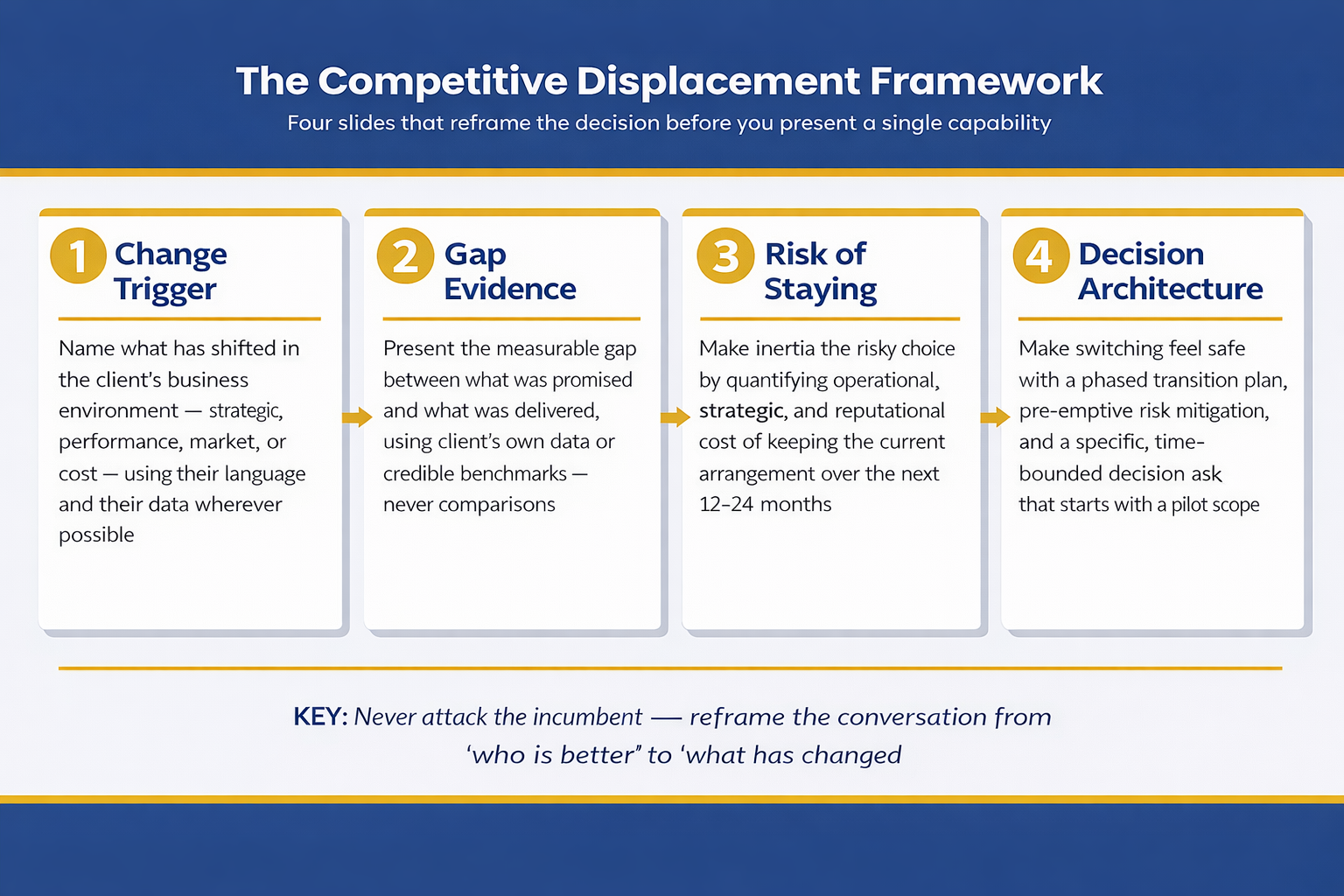
Your first substantive slide — after a sharp, one-line positioning statement as your opener — must be the Change Trigger slide. This is not about you. It is entirely about what has shifted in the client’s business environment that makes their current arrangement no longer fit for purpose.
Change triggers fall into four categories:
- Strategic shift: A new direction, acquisition, or market pressure that the incumbent’s solution wasn’t designed for
- Performance gap: Measurable metrics that have deteriorated or plateaued under the current arrangement
- Market change: Regulatory, competitive, or technology shifts that create new requirements
- Cost of status quo: The financial or operational cost of maintaining the current approach has increased materially
One well-chosen change trigger, supported by client-specific data, is more persuasive than ten slides of your product capabilities. It does something no credential slide can: it makes the audience feel the urgency of the situation from their own frame of reference rather than yours.
The discipline here is to use their language and their numbers wherever possible. If their last annual report mentioned a strategic priority that the incumbent is not supporting, reference it. If their industry has seen regulatory changes, quantify what non-compliance costs. If their closest competitor has moved, note it.
This slide tells the decision-maker: you understand their world. The incumbent, by contrast, is already positioned as part of the old world — simply by association with the problem you’ve just named.
The full competitive displacement slide sequence — Change Trigger, Gap Evidence, Risk of Staying, and Decision Architecture — is built into the Executive Slide System (£39), with scenario-specific templates for competitive reviews and vendor replacement pitches.
Gap Evidence: What Data Makes Switching Impossible to Ignore
Once you’ve established the Change Trigger, you need a single slide — never more than one — that presents the performance gap in measurable terms. This is the Gap Evidence slide, and it has a precise job: to make the cost of the current arrangement visible.
This slide works best when it presents data in three categories:
- What the current arrangement was supposed to deliver (the original promise or specification)
- What it has actually delivered (the measurable reality — ideally drawn from their own internal data)
- What that gap has cost (in revenue, efficiency, risk, or strategic momentum)
The most common mistake at this stage is presenting comparative data between you and the incumbent. Avoid this. Comparison slides invite the incumbent to challenge your numbers in the room and turn the meeting into a debate. Instead, show the gap between what the client expected and what they received. That data belongs entirely to the client’s own experience and cannot be disputed by the incumbent.
If you don’t have access to their internal performance data — which is common in early competitive reviews — you can use industry benchmarks, peer company results, or publicly available metrics as a proxy. Frame them clearly as contextual references, not direct comparisons.
Keep this slide to a maximum of three data points. Decision-makers are not convinced by the volume of evidence. They’re convinced by one or two undeniable numbers that connect directly to something they care about: budget, risk, competitive position, or strategic progress.
The Displacement Pitch Structure That Wins Competitive Reviews
When the incumbent has relationships, history, and inertia on their side, your pitch needs more than good slides. It needs a precise strategic sequence that reframes the decision before you present a single capability.
- The exact 4-part competitive displacement slide sequence (Change Trigger → Gap Evidence → Risk of Staying → Decision Architecture)
- Scenario Playbook page for competitive vendor reviews — including the objection scripts and pre-meeting positioning strategy
- 15 executive-grade templates for high-stakes pitches: challenger, vendor replacement, and competitive bid formats
- 51 AI prompts to build your displacement deck in under 40 minutes — including research and data framing prompts
Get the Executive Slide System → £39
Built from 24 years of competitive pitches in corporate banking and consulting — including vendor displacement reviews at JPMorgan Chase, RBS, and Commerzbank.
The Risk of Staying Slide: The Frame That Changes the Decision
This is the most psychologically powerful slide in a displacement pitch and the one almost every challenger presentation omits. Most presenters spend their time reducing the perceived risk of switching to them. The Risk of Staying slide does something entirely different: it makes inertia itself the risky choice.
Decision-makers default to incumbents because of loss aversion — the deeply human tendency to weigh potential losses more heavily than equivalent gains. Your capability slides fight against this instinct. Your Risk of Staying slide works with it.
This slide has three components:
- Operational risk: What specific failure modes or escalating costs does continuing the current arrangement carry over the next 12–24 months?
- Strategic risk: What competitive or market opportunity does the client forfeit by maintaining the status quo?
- Reputational or career risk: (Use with surgical precision, never as a threat.) If the decision-maker has a professional stake in this outcome — and they almost always do — what does continued underperformance of the current arrangement mean for their credibility with their own leadership?
The framing discipline here is essential. You are not threatening the client or catastrophising. You are presenting a sober, evidence-based view of what staying costs — the same analytical rigour a good consulting firm would apply. If anything, the tone should be more measured here than anywhere else in the deck.
Once a decision-maker has genuinely calculated the cost of inaction, switching is no longer a risk. It becomes risk mitigation.
If you’re preparing a competitive displacement pitch this month, the Executive Slide System (£39) includes the pre-built Risk of Staying template with the exact framing language that keeps this slide credible rather than aggressive.
Decision Architecture: How to Make Yes Feel Safe
After the first three slides have done their work — establishing urgency, evidencing the gap, and reframing inertia as risk — your capabilities now land differently. The audience is no longer evaluating you as the challenger trying to unseat a known quantity. They’re evaluating you as a potential solution to a problem they now feel acutely.
Decision Architecture is the structure of your final section — typically slides five through nine — and it has one job: make the decision to switch feel low-risk, clearly bounded, and reversible if needed.
The components that reduce switching anxiety most effectively are:
- A phased transition plan: Show them the first 90 days in concrete steps. Uncertainty about implementation is the single biggest silent objection in vendor replacement reviews. Remove it before they raise it.
- A risk mitigation slide: Name the three most common transition concerns pre-emptively and show your approach to each. This is counter-intuitive — addressing problems they haven’t raised yet — but it builds disproportionate trust.
- A clear decision ask: Your final slide must state the specific decision you’re asking for and what happens next. Not “we’d welcome the opportunity to work with you.” A precise ask: “We’re proposing a 90-day pilot with defined success metrics, starting [month]. The decision we need today is go/no-go on the pilot scope.”
Executives make decisions more confidently when the first step is time-bounded, low-commitment, and reversible. A pilot or phased engagement is often easier to approve than a full contract switch — and once you’re in, the incumbent’s advantage of inertia works in your favour.
Common Questions About Competitive Displacement Pitches
How do you pitch against an incumbent vendor without attacking them?
The most effective approach never directly criticises the incumbent. Instead, position the conversation around what has changed in the client’s business environment and what the current arrangement was not designed to address. This reframes the decision as forward-looking rather than evaluative — which reduces the incumbent’s relationship advantage and focuses the committee on future needs rather than past loyalty.
What is the biggest mistake in a competitive displacement pitch?
Leading with credentials and capabilities before establishing urgency. Challengers who open with “who we are” allow the incumbent’s inertia to dominate the room. The first ten minutes of a displacement pitch should be entirely about the client’s situation — not about the challenger. Capabilities only land once the decision-maker is already questioning whether the current arrangement is sustainable.
How long should a competitive displacement pitch deck be?
Eight to twelve slides for most executive-level competitive reviews. The four-part framework — Change Trigger, Gap Evidence, Risk of Staying, Decision Architecture — takes four to six slides. Your capabilities, case evidence, and transition plan take the remaining slides. Anything beyond twelve slides shifts the meeting from decision-making to information-processing, which benefits the incumbent by deferring the decision.
What to Do When the Incumbent Is Actually in the Room
In competitive reviews with multiple vendors presenting in sequence, the incumbent’s representative may be present during part of the process — or, in some procurement formats, all vendors may present to the same panel on the same day, with representatives from each firm present.
This changes the dynamic significantly. Here’s the protocol:
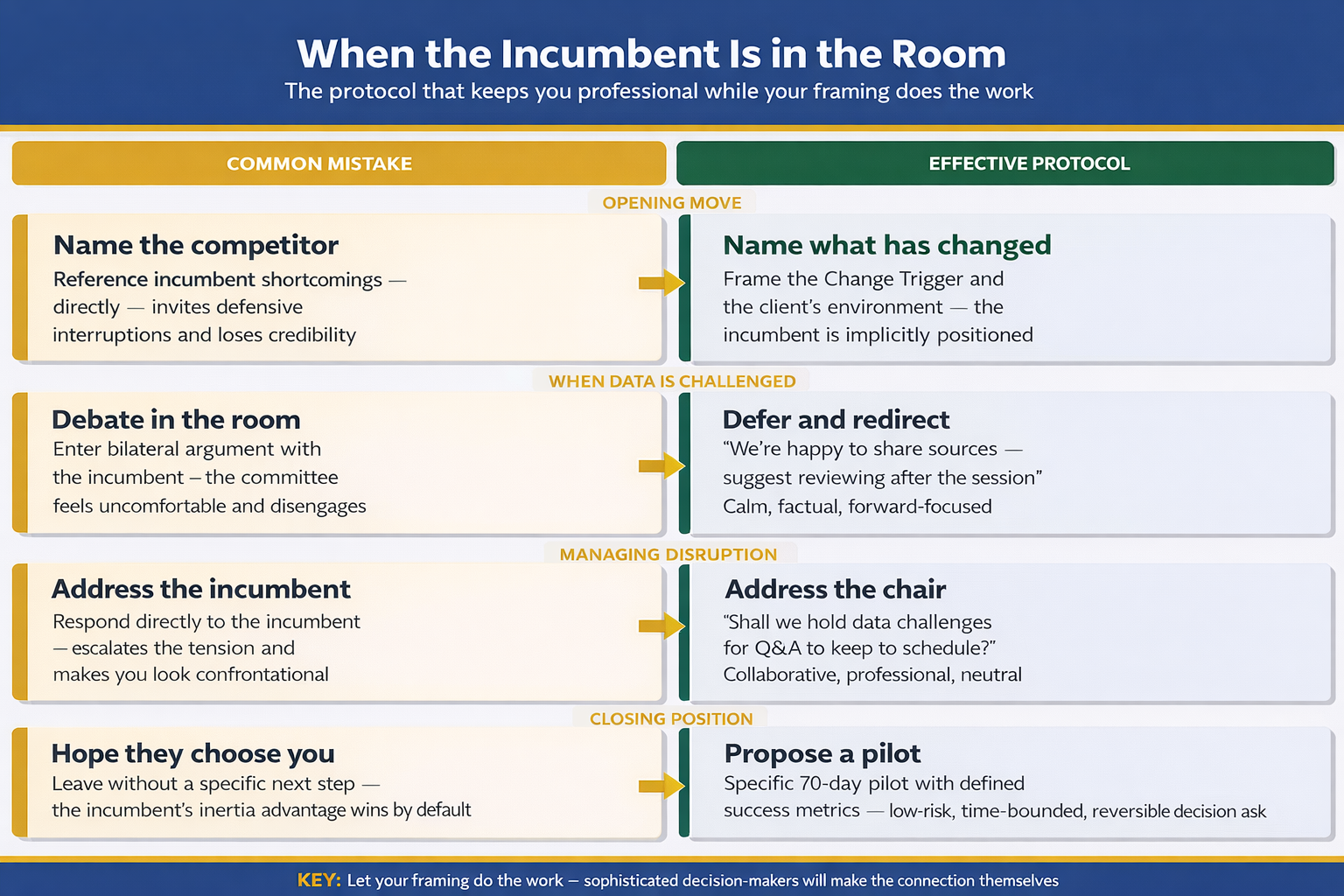
Never acknowledge the incumbent directly. Do not reference them by name, allude to their specific shortcomings, or make any remark that requires them to be in the room to make sense. Everything you say should be fully coherent to a panel that has never worked with the incumbent at all. This keeps you professional and prevents them from putting you on the defensive.
Let your framing do the work. The Change Trigger and Gap Evidence slides implicitly position the incumbent as part of the old state without naming them. Sophisticated decision-makers will make the connection themselves — and they’ll respect you for not making it for them.
Expect the incumbent to interrupt or challenge data in the room. Prepare for this. Have the source of every data point on your notes page. When challenged, respond calmly: “We’re happy to share our data sources — the underlying analysis draws from [source]. We’d suggest reviewing it together after the session.” This removes the challenge from the meeting without conceding the point.
Manage the room temperature with the chair. If you notice the atmosphere becoming uncomfortable or the incumbent becoming disruptive, address the chair — not the incumbent. “Shall we agree to hold detailed data challenges for the Q&A section so we can keep to schedule?” This keeps you collaborative and professional while neutralising the disruption.
🔥 The Q&A section is where most displacement pitches get derailed. When the incumbent challenges your data in the room, the decision-maker is watching how you handle pressure — not just what you say. The Executive Q&A Handling System (£39) includes the exact preparation framework for handling hostile questions and incumbent pushback — so you don’t just survive the Q&A, you win it.
Stop Walking Out of Competitive Reviews With “We’ll Be in Touch”
If you’ve been through a competitive review in the last 12 months and lost to an entrenched incumbent — despite genuinely better capability — the problem almost certainly wasn’t your product. It was the pitch structure. The Executive Slide System gives you the displacement framework built for exactly this scenario.
- The 4-part competitive displacement sequence — ready to populate with your own data in under an hour
- Risk of Staying template with pre-written framing language (keeps the slide credible, not aggressive)
- Decision Architecture templates including phased transition and risk mitigation formats
- 6 checklists and guides including the competitive review preparation checklist
Get the Executive Slide System → £39
Used in competitive vendor reviews, challenger pitches, and procurement presentations across banking, consulting, and technology sectors.
The 48-Hour Preparation Plan for Displacement Pitches
The displacement framework above is the strategic structure. But the execution happens in the 48 hours before you walk into the room. The preparation process for a competitive review is fundamentally different from a standard pitch because you are managing two dynamics simultaneously: your own positioning and the incumbent’s inertia.
In the first 24 hours, your priority is intelligence. Confirm who will be on the evaluation panel and map their relationship history with the incumbent. Identify the one or two committee members most likely to be sympathetic to change — they typically sit in roles where the incumbent’s shortcomings are most visible. Build your Change Trigger slide around data points that connect directly to their professional concerns, not abstract industry trends.
In the final 24 hours, rehearse the first three minutes of your pitch — the Change Trigger and Gap Evidence — more than any other section. These opening slides carry more weight in a displacement review than your closing. If you lose the room in the first three minutes, no amount of capability demonstration recovers the position. Practise handling the most likely challenge from the incumbent’s side and prepare your one-line redirection to the chair.
Finally, confirm your decision ask. The single most common failure in competitive displacement pitches is leaving the room without a specific next step. Your final slide should name the decision, the timeline, and the first action if approved.
Is This Right for You?
✅ This is for you if:
- You’re in a competitive vendor review or procurement process where an incumbent supplier holds the existing contract
- You have a stronger capability than the incumbent but keep losing on “relationship” or “transition risk” grounds
- You’re preparing a pitch for a client review in the next 30 days and need a tested structure, not a generic template
- You want slide-level frameworks you can populate with your own data, not a theory of what good pitches look like
❌ This is NOT for you if:
- You’re pitching to a client with no existing supplier relationship (a standard sales pitch structure will serve you better)
- You’re in an informal or relationship-driven sales process without a formal procurement stage
- You need bespoke pitch consulting rather than a self-serve framework (consider a discovery call instead)
After the Pitch: Managing the Decision Window
What happens after you leave the room matters as much as what happens inside it. The decision window following a competitive displacement review is the period of highest vulnerability for a challenger — and most presenters do nothing with it. The incumbent, by contrast, has the advantage of proximity: they can reach the committee through existing channels without it feeling like a follow-up.
Your post-pitch strategy should include three actions within 48 hours. First, send a one-page executive summary — not a full deck recap — to the decision-maker covering the Change Trigger, the gap cost, and your proposed 90-day pilot structure. Second, provide the data sources you referenced during the pitch, delivered cleanly and without commentary. This builds credibility and removes any question marks the incumbent may have planted during the session.
Third, and most overlooked: reach out to the sympathetic committee member identified during your preparation. A brief, professional message acknowledging the discussion and offering to answer any follow-up questions gives your internal champion the material they need to advocate for you in the rooms you are not in. The decision in a displacement review is rarely made during the pitch itself. It is made in the conversations that follow — and the challenger who manages those conversations wins.
Built From 24 Years of High-Stakes Competitive Pitches. Now Available as Templates.
I spent two decades in corporate banking presenting, evaluating, and sitting on the other side of vendor displacement pitches at JPMorgan Chase, Royal Bank of Scotland, PwC, and Commerzbank. I’ve watched challengers lose on capability they had and incumbents survive reviews they should have lost. The difference was almost always structure — not skill, not price, not product. The Executive Slide System gives you the exact framework that works when the stakes are a contract, a client, or a career.
- 22 executive templates including competitive displacement, challenger, and vendor review pitch formats
- 15 scenario playbook pages covering the competitive review scenario end to end
- 51 AI prompts — including Change Trigger research prompts, Gap Evidence framing, and Risk of Staying language
- Immediate download — ready to use before your next competitive review
Your next competitive review date is fixed. The incumbent has the advantage of familiarity. Close that gap before you walk in the room.
Get the Executive Slide System → £39
Trained thousands of executives in high-stakes presentations including competitive pitches, funding rounds, and board-level approvals. Immediate digital download.
Frequently Asked Questions
How do you handle objections when the incumbent is actively defending their position in the room?
Acknowledge the challenge briefly, defer detailed data disputes to after the session, and redirect to the decision-maker rather than entering a bilateral debate with the incumbent. Your goal is to ensure the committee feels informed, not that you’ve “won” an argument. Decision-makers are watching how you handle pressure — stay measured, factual, and forward-focused. If the incumbent makes an inaccurate claim, address it once with a source reference, then move on.
Should I mention price differences between my solution and the incumbent’s?
Only if price is a core differentiator in your favour, and only after the Risk of Staying slide has reframed the total cost of the current arrangement. Presenting a lower unit price before establishing the cost of inertia reduces your pitch to a procurement comparison rather than a strategic conversation. If the incumbent is cheaper, don’t lead with price at all — lead with cost of the current approach, then position your value in strategic rather than transactional terms.
What if the committee appears loyal to the incumbent throughout the pitch?
Loyalty signals — nodding at incumbent comments, protective body language, warm references to the existing relationship — are normal in displacement reviews and don’t mean the decision is made. Your job is to give the decision-maker permission to change their mind without it feeling like a betrayal. The Decision Architecture section is specifically designed for this: a phased pilot with defined metrics gives a loyal committee a low-risk, face-saving path to approving change.
How early in the competitive process should I start building my displacement case?
Ideally before the formal RFP is issued. Pre-RFP conversations with sympathetic stakeholders are the most valuable intelligence-gathering opportunity for a displacement pitch. Use them to understand which change triggers resonate internally, what the incumbent’s known gaps are from the client’s own perspective, and who within the committee has the most motivation to change. This pre-work turns generic displacement frameworks into a pitch that feels as though it was written by someone already inside the room.
The Winning Edge — Executive Presentation Insights
Weekly strategies for executives who present at board level, in competitive reviews, and in high-stakes leadership meetings. No filler. No theory. Practical frameworks from 24 years in the room.
🆓 Free resource: Executive Presentation Checklist — a free guide to strengthen your presentation preparation.
Also published today:
- Track B: NLP Anchoring for Presenters: The Technique That Changed My Career (Step-by-Step) — If competitive review pressure is affecting your delivery as well as your structure, this is the next read.
- Track C: The Question Bank: Building a Personal Library of Answers You’ll Need Again and Again — Essential preparation for the Q&A section of your competitive displacement pitch.
Your next competitive review has a date on the calendar. The incumbent walks in with relationships, familiarity, and the psychological advantage of inertia. The only way to counter that is with a pitch structure designed specifically for the displacement scenario — not a standard sales deck.
Start with the Change Trigger slide. Make the cost of staying visible before you present a single capability. Use the Executive Slide System (£39) to build the full four-part framework before you walk in the room.
For further reading on high-stakes pitch strategy: Client Presentation Skills: Why ‘Impressive’ Loses and Presentation Objection Handling.
About the Author
Mary Beth Hazeldine is the Owner & Managing Director of Winning Presentations. With 24 years of corporate banking experience at JPMorgan Chase, PwC, Royal Bank of Scotland, and Commerzbank, she has delivered high-stakes presentations in boardrooms across three continents.
A qualified clinical hypnotherapist and NLP practitioner, Mary Beth combines executive communication expertise with evidence-based techniques for managing presentation anxiety. She has trained thousands of executives and supported presentations that have secured high-stakes funding rounds and approvals.