

The Pre-Decision Conversation: Where Approvals Actually Happen
Quick Answer: Most executives make their decision in an informal conversation hours or days before the formal meeting. The formal meeting is a confirmation ritual, not the decision moment. The pre-decision conversation — a single phone call, a corridor chat, or a brief coffee meeting — is where approvals actually happen. Getting this conversation right means your presentation delivers confirmation, not persuasion. That changes everything about how you prepare.
🚨 Pitching for approval this month? Quick diagnostic: Have you had a pre-decision conversation with the decision-maker yet, or are you relying entirely on the formal presentation? If it’s the latter, you’re walking in without the framework that determines whether you win. → Get the Executive Slide System (£39), which includes the exact pre-conversation positioning strategy and decision-meeting follow-up.
A CFO told me she approved a £2 million budget in a five-minute corridor conversation two days before the formal approval meeting.
The executive who was presenting sent her a single-page executive summary in advance. They had a brief phone call the morning before that one-pager arrived. She asked three questions. He answered them with precision.
By the time the formal meeting happened, the decision was already made. Everyone in the room knew it. The presentation became a confirmation ritual — addressing questions that had already been resolved, walking through slides that she had already mentally approved.
This is the norm at executive level, not the exception. Most senior decision-makers make their decision outside the formal meeting. The formal meeting is theatre.
But most presenters still approach it as if the meeting itself determines the outcome. They prepare slides for persuasion. They build arguments for a room that has already decided. They walk in hoping to land a decision they should have secured days before.
What Is a Pre-Decision Conversation?
A pre-decision conversation is an informal discussion — usually a phone call, a corridor chat, or a brief in-person meeting — between you and a decision-maker or key influencer before the formal approval meeting takes place.
Its purpose is not to present your case. You’re not pitching. You’re clarifying what the decision-maker actually cares about, answering the questions that would otherwise sit unanswered in the formal meeting, and creating space for them to voice concerns that they wouldn’t raise in front of a full committee.
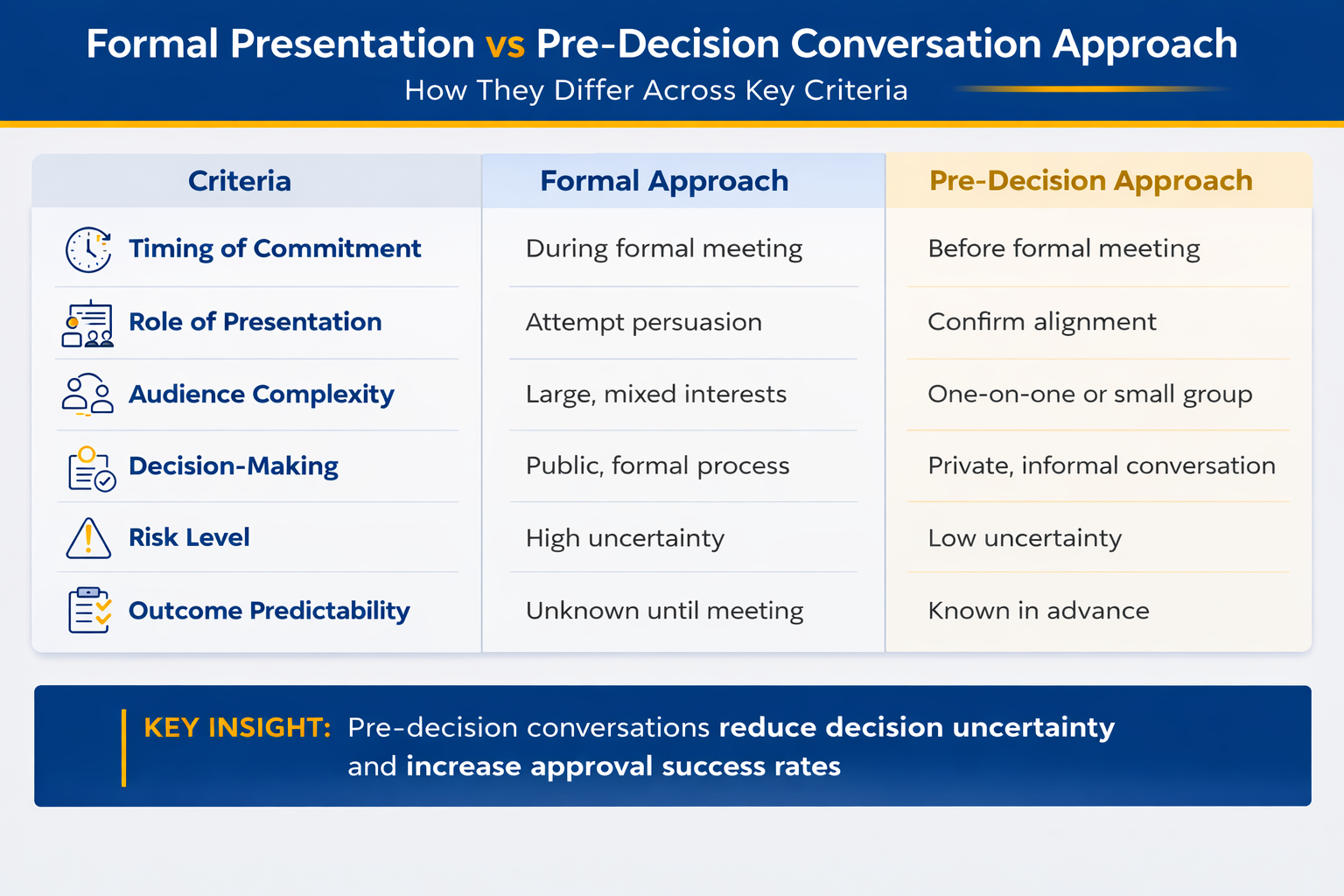
This is fundamentally different from a “pre-meeting brief” or a presentation rehearsal. Those are preparation activities. A pre-decision conversation is a sales conversation. It happens one-on-one or in a very small group. It is designed to move someone from uncertainty toward a yes before they enter the formal decision space.
The stakes are high because this conversation often determines whether the formal meeting is a smooth confirmation or an ambush. A decision-maker who has already agreed in principle will defend your proposal in the room. A decision-maker who is hearing your argument for the first time in front of peers is far more likely to defer, object, or propose conditions.
Why the Informal Conversation Determines the Outcome
Executives avoid surprise decisions in public. They prefer to know where they stand before they commit in front of peers or their own leadership team.
When you lead with a formal presentation without a pre-decision conversation, you’re asking the decision-maker to commit in an unfamiliar environment, in front of an audience, without private space to raise concerns or renegotiate terms. They are more likely to defer, ask for more time, or propose modifications rather than give a clean yes.
A pre-decision conversation removes the risk of public commitment. It allows the decision-maker to ask difficult questions privately. It gives you space to adapt your position based on what you learn. It lets them feel heard before they have to perform a decision in front of others.
This is why informal influence often outweighs formal persuasion. The best slide deck in the world cannot compete with a decision-maker who has already made up their mind — and pre-decision conversations are where minds actually get made up.
Many executives don’t even attend their own approval meetings. They send a delegate with instructions: approve if certain conditions are met, or defer if X happens. The pre-conversation with the actual decision-maker is what determined their position. The formal meeting is just execution.
When to Initiate the Pre-Decision Conversation
Timing determines whether a pre-decision conversation feels natural or manipulative. Get it wrong and you risk appearing to lobby behind the scenes. Get it right and you’re simply being thoughtful.
The ideal window is 5–10 days before the formal meeting. This gives you enough time to gather intelligence, adapt your approach, and ensure your formal presentation reflects any insights you gained. It’s recent enough that momentum hasn’t shifted, but distant enough that reaching out doesn’t feel like a last-minute panic.
You should initiate the conversation with the person most likely to become your champion or the person most likely to block you — often both are the same person. If there is a steering committee, start with the chair. If there is a finance committee, start with the CFO or budget-holder. If there is a project governance board, start with the executive sponsor.
The conversation should feel organic to your relationship. If you have never spoken to this person one-on-one before, a sudden pre-meeting call can read as suspect. Build it into existing touchpoints: “I know you’re reviewing this next Tuesday. Would you have 20 minutes this week for a quick call? I’d like to make sure I’m addressing your specific concerns rather than presenting a generic case.”
Never frame it as “getting approval early” or “lobbying support.” Frame it as preparation, intelligence-gathering, or relationship-building. “I’d like to understand what you’re looking for” is very different from “I’d like to get you to approve this.”
Secure Buy-In Before the Room Through Strategic Pre-Decision Conversations
The difference between executives who consistently win approvals and those who don’t isn’t the quality of their presentations. It’s whether they have already secured the decision before the formal meeting begins.
- The exact timing, framing, and positioning strategy for pre-decision conversations that feel natural, not manipulative
- Word-for-word scripts for three common pre-conversation scenarios: finance approval, programme governance, and stakeholder alignment
- The questions to ask that reveal what the decision-maker actually cares about — before you build your formal presentation
- The follow-up framework that converts informal agreement into formal approval without re-negotiation
Get the Executive Slide System → £39
Includes the pre-conversation positioning strategy from 24 years of corporate banking approvals at JPMorgan Chase, RBS, and Commerzbank — where executive alignment is the difference between a decision and a deferral.
How to Structure the Conversation for Maximum Impact
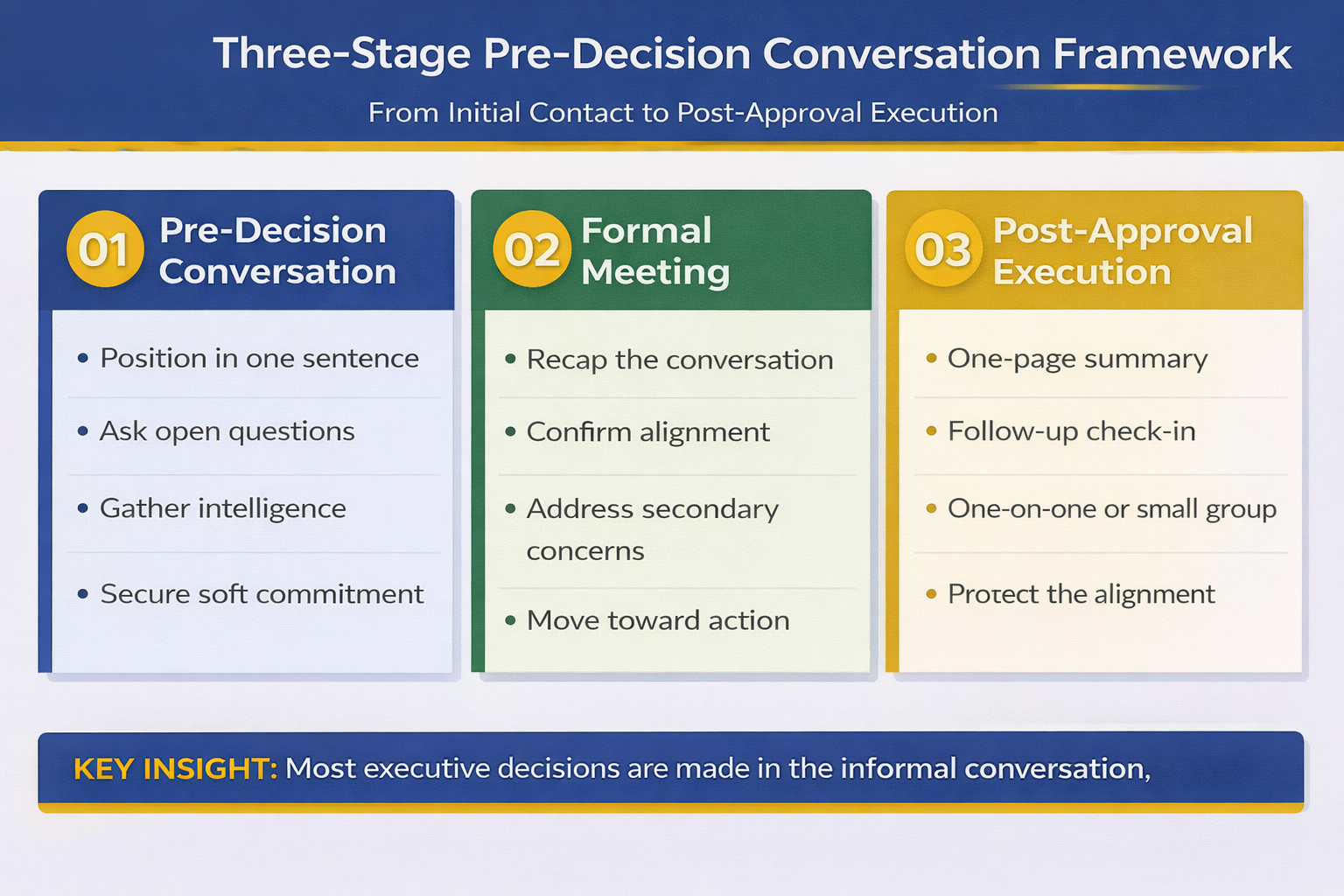
A pre-decision conversation that works has three distinct phases. They must happen in order, and each must be brief.
Phase 1: The Positioning Statement (30 seconds)
Lead with your core positioning in a single sentence. Not your company. Not your features. The one thing that makes this decision matter to them right now. “We’re proposing a shift in how we structure our approval workflow, and I wanted to understand whether this aligns with your priority of reducing sign-off delays.”
Phase 2: Intelligence Gathering (5–10 minutes)
Ask questions. Shut up and listen. The goal is to discover what the decision-maker is actually worried about, what they care about most, and what would make them feel confident saying yes. Most presenters skip this entirely and launch into their pitch. Don’t. The conversation should be 70% them talking and 30% you talking. Ask open questions: “What does success look like for you here?” “What are your main concerns about moving forward?” “What would need to be true for you to feel confident saying yes?”
Phase 3: The Soft Commitment (2–3 minutes)
Once you understand where they stand, you can adapt. But you also need to move toward alignment. “Based on what you’ve told me, I want to make sure next Tuesday’s presentation addresses what actually matters to you. It sounds like the cost impact is your main concern and the implementation timeline is secondary. Is that right?” This does two things: it shows you listened, and it creates space for them to confirm or correct you. Either way, you’re getting closer to agreement.
Close with something like: “I appreciate your time. I’ll make sure the presentation reflects this conversation. If anything shifts before Tuesday, just let me know.”
Get the Pre-Decision Conversation Script Template
The exact words to use when you initiate the conversation, how to transition into intelligence-gathering, and how to secure the soft commitment without sounding like you’re lobbying. Included in the Executive Slide System.
What to Do When You Encounter Resistance
Sometimes you initiate a pre-decision conversation and the response is not enthusiasm. The decision-maker is busy. They say they’ll wait for the formal meeting. They raise a concern that wasn’t on your radar.
If they defer the conversation: accept it gracefully. “No problem. I know you’re busy. I’ll make sure the presentation covers your main priorities. If you have a few minutes the day before, I’d still appreciate your input. Either way, we’re good.” Don’t push. Pushiness signals desperation and erodes trust.
If they raise a concern in that moment: this is the most valuable intelligence you can get. Don’t dismiss it or defend. Clarify it. “Tell me more about that.” “What specifically worries you?” “What would need to change for that not to be a concern?” If it is a genuine blocker, knowing about it now gives you time to address it before the formal meeting. If it is a smoke screen, the conversation will reveal that too.
If they seem aligned but non-committal: don’t interpret silence as agreement. Test it gently. “So it sounds like you see the value, but you want to see how the team responds in the meeting before you fully commit? Is that fair?” This forces clarity. They either confirm they’re waiting for the room’s input, or they reveal that they’re actually more convinced than they sounded.
Stop Walking Into Approval Meetings Cold
The anxiety of an approval meeting without a pre-decision conversation is the anxiety of genuine uncertainty. You don’t know where the decision-maker actually stands. The formal meeting becomes a high-stakes gamble.
- The pre-conversation checklist that ensures you ask the right questions in the right order
- How to read signals: what it means when they go quiet, when they challenge, when they agree too quickly
Get the Executive Slide System → £39
Essential preparation framework for anyone securing budget approval, board-level agreement, or stakeholder alignment.
Common Questions About Pre-Decision Conversations
Isn’t having a pre-decision conversation before the formal meeting just lobbying?
No. Lobbying is trying to build a coalition against someone else’s position. A pre-decision conversation is one-on-one, transparent, and focused on understanding the decision-maker’s position so you can address it. It is how senior executives do their jobs. When a CFO has concerns about a budget request, the finance director talks to them one-on-one before the formal budget meeting. That is not lobbying. That is due diligence. The same applies to you.
What if I have multiple decision-makers? Who do I talk to first?
Start with the person who can say no most definitively — usually the person who controls the budget or who has formal authority over the approval. Get them comfortable. Then work down the influence chain. Each conversation should be brief and should focus on understanding where that person stands, not on trying to turn them into your advocate. If the primary decision-maker is already aligned, the secondary influencers are usually not a problem.
What if the decision-maker says yes in the pre-conversation but then doesn’t defend the proposal in the formal meeting?
This happens when they said yes to move the conversation forward but were never genuinely convinced. That is why testing for real commitment matters. If you sense soft agreement, push slightly: “So you’re comfortable moving forward if [specific condition]?” If they waffle, you have discovered that you don’t actually have alignment yet. Now you know what to do: address the real concern before the formal meeting, or adjust your ask.
The Formal Meeting: Converting Pre-Decision Alignment Into Action
Once you have had a pre-decision conversation and secured at least soft alignment, the formal meeting becomes a different exercise. You are no longer pitching for a decision. You are confirming one and addressing secondary concerns.
This changes everything about how you present. Your opening is no longer a pitch. It is a recap of the conversation: “In our discussions this week, it became clear that your main priority is implementing this with minimal disruption to current operations. The proposal I’m presenting has that as its core structure. Here’s how.” You are reminding them of the conversation they had with you and showing them that you listened.
Your presentation is shorter. You have already covered the main questions and objections. The formal meeting can focus on addressing the secondary concerns and handling questions from the broader audience that weren’t present in the pre-conversation.
Your close is not a call to action. It is a recap and next step: “Based on what we’ve discussed, the next step is [specific action]. Are there any questions before we move forward?” This is not a question. It is a transition into action.
Executives who have already committed in the pre-conversation will support your presentation. They will fill in gaps, answer peer questions, and smooth the path to final approval. You have made them your champion because you listened to them before anyone else did.
The Formal Meeting Playbook
Once you have secured pre-decision alignment, the formal meeting structure is fundamentally different. Get the exact template for opening, body, and close that converts confirmed decisions into final approvals.
Is This Right for You?
✅ This is for you if:
- You’re seeking formal approval from a decision-maker or committee for something that matters (budget, programme, initiative, hire)
- You have identified the key decision-maker but haven’t had a one-on-one conversation with them about your proposal
- You’ve had approval meetings that went sideways despite strong slides, or that resulted in unexpected objections you could have addressed
- You want to shift from hoping your presentation persuades them to knowing you have alignment before you walk in the room
❌ This is NOT for you if:
- You’re presenting to a wide, unfamiliar audience where one-on-one conversations aren’t practical (company town hall, public conference)
- The decision is genuinely distributed across a large committee with no clear champion
- The decision-maker has explicitly asked not to be contacted before the formal meeting (respect that boundary)
- You haven’t yet built enough relationship credibility for a pre-meeting conversation to feel natural
After the Green Light: Managing the Handover
A pre-decision conversation secures alignment. The formal meeting confirms it. But many approvals still fail at the handover — the moment between formal approval and actual implementation.
This is where discipline matters. After the formal meeting, send a one-page summary within 24 hours. Not a full recap. A single page covering: the approval, the next step, the timeline, and who is responsible for what. This document serves two purposes: it confirms what was actually agreed (no room for interpretation later), and it signals professionalism and follow-through.
Then schedule a brief follow-up conversation with the key decision-maker — not another formal meeting, just a check-in. “I wanted to confirm we’re aligned on the timeline. Implementation starts [date]. Is there anything you want to flag or discuss before we move into execution?” This catches scope creep or shifting priorities before they become problems.
Finally, keep them informed as implementation begins. Monthly updates, not because they asked for them, but because it shows respect for their decision and their time. Executives who feel kept informed are executives who continue to support the approval even when implementation gets messy.
Built From 24 Years of High-Stakes Approval Conversations in Banking. Now a Framework You Can Use.
I spent two decades in corporate banking securing approvals for multi-million-pound initiatives, vendor switches, and programme expansions. The difference between approvals that sailed through and those that got blocked was almost never the slides. It was whether the key decision-maker had already made up their mind before the formal meeting. The pre-decision conversation is where that happens. The Executive Slide System gives you the exact framework.
- 22 executive templates including budget request, programme approval, and stakeholder alignment formats
- Word-for-word scripts for three pre-decision conversation scenarios — finance approval, governance, and executive alignment
- The post-approval handover checklist that ensures agreement doesn’t slip during implementation
- 51 AI prompts to prepare for your pre-conversation, including research, objection-handling, and follow-up frameworks
Your approval meeting has a date. The decision-maker’s mind may already be made, or it may still be open. Find out before you present.
Get the Executive Slide System → £39
Trained thousands of executives in high-stakes presentations across banking, consulting, and technology. Immediate digital download. Used in budget approvals, board presentations, and governance meetings.
Frequently Asked Questions
How do you initiate a pre-decision conversation without appearing to lobby or influence the decision before the formal process?
Frame it as clarification, not persuasion. The language matters enormously. Use: “I’d like to understand your specific priorities before I present,” not “I want to get your buy-in early.” Use: “I’m making sure I address your concerns rather than guess at them,” not “I want to align with you before the meeting.” The intent is genuine — you are seeking to understand, not to manipulate. If your language matches that genuine intent, the conversation feels natural and professional. Senior executives talk one-on-one with peers and stakeholders all the time. This is exactly that.
What if a decision-maker agrees in the pre-conversation but the broader committee challenges them in the formal meeting?
This is one of the reasons the pre-conversation is so valuable. The person who has already committed to you will tend to defend your proposal in the room because they’ve already staked their credibility on it. If they face unexpected objections, they have usually had time to think through counterarguments. If they were only softly aligned, the committee pushback will reveal that you don’t actually have agreement yet — which is far better to learn in a pre-conversation than in a public meeting. If this happens, treat it as intelligence: you need to address a real concern before the formal meeting.
Is a pre-decision conversation different for budget approvals versus programme approvals versus stakeholder alignment?
The framework is the same (positioning, intelligence-gathering, soft commitment), but the questions change. For budget approvals, focus on cost impact, ROI, and trade-offs. For programme approvals, focus on risk, resourcing, and timeline. For stakeholder alignment, focus on their specific department’s impact and dependencies. The structure stays consistent; the content adapts to what that person actually cares about.
What happens if you don’t have a direct relationship with the decision-maker? How do you initiate the conversation then?
Use a warm introduction. Ask your sponsor or the person who invited you to the formal meeting to facilitate an introduction: “I’d appreciate if you could introduce me to [decision-maker]. I’d like a 20-minute call to understand what they’re most focused on before I present.” This makes the conversation feel less like cold outreach and more like a natural part of the process. If a warm introduction isn’t possible, reach out briefly and directly: “I’m presenting a proposal in your area next Tuesday. Would you have 20 minutes this week for a quick call? I’d like to make sure I’m addressing your specific priorities.” Be honest about why you’re reaching out. Honesty builds trust.
The Winning Edge — Executive Presentation Insights
Weekly strategies for executives who present at board level, secure approvals, and navigate high-stakes decisions. Practical frameworks from 24 years in the room, not theory.
🎁 Free resource: Executive Presentation Checklist — the pre-meeting audit framework for approval presentations. Free download, no email required.
Also published today:
- Track B: How to Speak Higher in High-Stakes Moments: The Technique That Stops Your Voice Dropping — If approval anxiety is affecting your delivery as well as your preparation, this is your next read.
- Track C: Risk Committee Q&A: The Blind Spots Every Presenter Misses (And How to Prepare for Them) — Essential preparation for approval meetings that include formal Q&A.
Your next approval meeting is already on the calendar. You will walk into that room with either the advantage of having already secured alignment, or the disadvantage of hoping your presentation convinces them.
The difference is a single 20-minute conversation that happens days before the formal meeting. Use the Executive Slide System (£39) to structure that conversation. It includes the exact scripts for initiating the call, the questions that reveal what they actually care about, and the follow-up approach that converts informal alignment into formal approval.
For further reading on executive alignment and approval strategy: Pre-Meeting Executive Alignment: The Strategy That Determines Outcomes, The Decision Slide: The One Slide That Matters in Executive Presentations, and Building Executive Buy-In: From First Contact to Final Approval.
About the Author
Mary Beth Hazeldine is the Owner & Managing Director of Winning Presentations. With 24 years of corporate banking experience at JPMorgan Chase, PwC, Royal Bank of Scotland, and Commerzbank, she has delivered high-stakes presentations in boardrooms across three continents.
A qualified clinical hypnotherapist and NLP practitioner, Mary Beth combines executive communication expertise with evidence-based techniques for managing presentation anxiety. She has trained thousands of executives and supported presentations that have secured high-stakes funding rounds and approvals.