Tag: pre-meeting alignment

17 Apr 2026
A senior female executive in a one-to-one conversation with a male board member in a glass-walled office, building alignment before a formal meeting, confident and collaborative tone, editorial photography style

Stakeholder Alignment Presentation: The Pre-Meeting That Wins Approvals

Quick Answer: Most approvals are decided before the formal presentation begins. A stakeholder alignment session — a structured pre-meeting with key decision-makers — lets you surface objections privately, refine your narrative based on what you hear, and arrive in the room with commitments already secured. The formal presentation then becomes a ratification exercise rather than a persuasion exercise. This approach works for board approvals, finance committee requests, and any high-stakes executive decision.

Astrid had thirty minutes in front of the investment committee. She had rehearsed the deck twenty times. Her financial model was solid, her slides were clear, and her executive sponsor believed in the project. When the committee chair asked a single question — “What does the operations director think about the implementation timeline?” — the presentation stalled.

The operations director hadn’t been consulted. He sat in the room, visibly uncomfortable. The committee read the room, delayed the decision, and asked for a revised proposal that incorporated operational input.

Three weeks later, Astrid submitted the same project with one structural difference: she had spent the preceding fortnight meeting individually with every committee member and the operations director. By the time she walked into the formal presentation, every objection had already been heard, addressed, and in most cases resolved. The formal presentation took nineteen minutes. The approval was unanimous.

If you’re preparing for a high-stakes approval

The Executive Slide System includes scenario playbooks and slide templates for executive approval presentations — including the alignment and pre-meeting frameworks that help you structure what you learn before the formal session.

Explore the System →

Why the Decision Is Made Before You Present

Senior decision-makers rarely change their minds in a committee room. By the time the formal meeting convenes, most members have already formed a view — based on conversations in corridors, emails exchanged with colleagues, and assumptions built from prior context. The formal presentation is where those views are tested, not formed.

This is not cynicism about the process. It reflects how experienced executives make high-stakes decisions: they gather information in advance, test their instincts with trusted colleagues, and arrive in the meeting with a working hypothesis. Your presentation either confirms or challenges that hypothesis. If you’ve done no work to shape it in advance, you’re working against a position that was set before you entered the room.

The most effective executives understand this dynamic and work with it rather than against it. They treat the formal presentation as the final step in a longer engagement process, not the first and only opportunity to make their case.

The pre-presentation alignment session is the mechanism that makes this possible. It is not manipulation — it is thorough preparation. Every concern that surfaces in a private conversation is one that won’t derail the formal meeting. Every commitment secured informally is one that reinforces the approval in the room. And every stakeholder who feels heard in advance is one who arrives in the meeting inclined to support rather than question.

Executive Slide System

Structure Your Approval Presentation to Match the Work Done Before the Room

The Executive Slide System — £39, instant access — gives you slide templates for board, finance committee, and investment committee presentations, plus scenario playbooks for navigating stakeholder alignment before high-stakes approvals. Designed for executives who want to arrive in the formal meeting with the decision already moving in their direction.

  • Slide templates for approval and board presentations across executive scenarios
  • AI prompt cards to map stakeholder concerns before the alignment session
  • Framework guides for structuring the narrative around what you hear pre-meeting
  • Scenario playbooks for investment committee, board, and finance committee contexts

Get the Executive Slide System →

Designed for high-stakes approval presentations where preparation matters more than performance.


Stakeholder Alignment Dashboard infographic showing four metric categories: Decision-Makers to Brief, Concerns to Surface, Commitments Secured, and Objections Outstanding — a pre-presentation tracking framework

Who to Meet and What to Ask Them

Not every stakeholder needs a dedicated pre-meeting. The goal is to meet the people whose support is essential and whose concerns, if left unaddressed, could derail the formal presentation. For most approval presentations, that list is shorter than it appears.

Start with the decision-makers — the people who will vote, recommend, or formally approve. Understand their current view on the topic before you attempt to inform it. Have they been involved in similar decisions before? Do they have a prior position on this type of investment or initiative? Is there a competing proposal that complicates their thinking?

Next, identify the influencers — the people whose opinion the decision-makers trust. In a finance committee context, this is often the CFO’s direct advisers or the head of internal audit. In a board context, it may be the senior independent director or a non-executive with a strong view on capital allocation. These people may not have a vote, but their informal influence on the final outcome can be decisive.

Finally, identify the potential blockers — the people whose opposition, if expressed in the formal meeting, could damage the proposal even if they are in the minority. Understanding a blocker’s concern before the meeting gives you the opportunity to address it privately, which is almost always more productive than managing it in public.

In each pre-meeting, ask three questions. What do they already know about the proposal? What concerns do they have about it? And what would they need to see to be comfortable supporting it? These questions are not a sales pitch — they are information-gathering. The goal is to understand, not to convince. Convincing comes later, in how you update the presentation.

For the framework behind pre-decision conversations, see The Pre-Decision Conversation: How Executives Secure Approval Before the Meeting.

Running the Alignment Session Effectively

An alignment session is a conversation, not a presentation. Executives who use the pre-meeting to walk through their slides — treating it as a rehearsal — miss the point. The slide deck is not what you bring to this meeting. What you bring is curiosity and good questions.

Keep the meeting short: thirty minutes is usually sufficient. Open by explaining your purpose directly — you are seeking input before the formal session to ensure the presentation addresses the right questions. Most decision-makers respect this directness. It signals that you are thorough, not that you are uncertain.

Listen more than you speak. When a concern surfaces, resist the instinct to immediately counter it. Instead, explore it: “That’s useful to know — can you say more about what’s driving that concern?” Understanding the root of an objection is more valuable than overcoming its surface expression. An objection that sounds financial may actually be about trust. An objection about timing may actually be about resource competition.

Take notes, and be transparent about doing so. “I want to make sure I capture this accurately before I revise the presentation” signals that the conversation will have a real impact on what the committee sees. This is important: if decision-makers sense that the pre-meeting is performative rather than genuinely informative, they stop sharing real concerns.

Close each session by confirming what you’ve heard and what changes you plan to make. “Based on what you’ve shared, I’ll strengthen the implementation timeline and add more detail on the alternatives we considered. Does that address the main concerns you raised?” This gives the stakeholder the opportunity to confirm or correct your understanding before you do the work.

If you’re rebuilding a formal approval presentation around what you’ve heard in pre-meeting conversations, the Executive Slide System includes slide templates and AI prompt cards designed to help you translate stakeholder concerns into a presentation narrative that addresses them structurally, not just rhetorically.


Stakeholder Alignment Roadmap infographic showing five stages: Map the Stakeholders, Schedule Pre-Meetings, Surface Concerns, Update the Narrative, and Enter the Room with Commitments Secured

What to Do With What You Hear

The alignment session has value only if it changes something. If you leave every pre-meeting with the same deck and the same narrative, you’ve gathered information that you didn’t act on — which is worse than not gathering it, because it signals to stakeholders that the consultation was cosmetic.

After each pre-meeting, categorise what you’ve heard. Some concerns will be addressed by adding or clarifying information — a new slide, an updated data source, a clearer explanation of a financial assumption. These are structural changes, and they make the presentation more complete. Make them before the formal session.

Other concerns will reflect a disagreement about the underlying business case — a stakeholder who genuinely believes the investment is premature, or that a different approach should be considered. These cannot be resolved with a slide change. They require a direct conversation about the merits, and in some cases, the involvement of a more senior sponsor to navigate the impasse. Identify these early, because they need more time than a slide revision.

Some concerns will be about perception rather than substance — a stakeholder who hasn’t been involved in previous discussions and feels left out, or one who is concerned about credit and visibility when the project succeeds. These are relationship issues, and they are resolved through the pre-meeting process itself: the act of consulting them is the resolution. Make sure they know their input shaped the final presentation.

Keep a simple log of what you heard, what you changed, and what remains unresolved. This is useful for two reasons. It ensures that nothing gets lost between conversations. And if the decision is contested in the formal meeting, your log gives you the basis to say with confidence: “I discussed this with [stakeholder] two weeks ago, and here is how I addressed that concern in the revised presentation.” For related thinking on managing structural change presentations, see Restructuring Presentation: Rebuilding Trust Through Transparent Communication.

Aligning Across Competing Interests

The most challenging stakeholder alignment situations are those where key decision-makers have competing interests — where what one stakeholder needs to hear directly contradicts what another needs to hear. A proposal that involves resource reallocation is a classic example: the function gaining resources welcomes it, while the function losing resources opposes it.

The response here is not to tell different stakeholders different things — that collapses the moment the formal meeting convenes. The response is to find the common ground between competing interests and build the presentation narrative around it.

What both stakeholders share, despite competing interests, is typically a concern about the broader organisational outcome. The function losing resources still cares about the company’s performance. The disagreement is about means, not ends. A presentation that frames the proposal in terms of the shared goal — rather than the redistribution of resources — gives both stakeholders something they can support.

Where interests are genuinely irreconcilable, the alignment session’s value is in surfacing the conflict before the formal meeting rather than discovering it in public. A committee where two factions are in open disagreement is difficult to present to. A committee where the chair knows the disagreement exists and has managed it in advance is a different environment. Use the pre-meeting process to give the chair the information they need to manage the room, as well as to manage your own presentation.

Using the Formal Presentation to Confirm, Not Persuade

When the alignment process has been done well, the formal presentation shifts in character. It becomes a confirmation exercise — a structured walk through the proposal that gives the committee confidence that everything has been considered, rather than a persuasion exercise where the outcome is uncertain.

This changes the tone and the pacing. A confirmation presentation can afford to be shorter, because most of the information has already been shared in pre-meetings. It can acknowledge concerns explicitly — “I know some of you have raised questions about the implementation timeline, so I’ve added a new slide that addresses this directly” — because the concerns are already known. And it can invite a more collaborative discussion, because the presenter isn’t guarding against ambushes.

The questions that arise in a confirmation presentation are also different in character. They tend to be sharper and more specific — looking for the final detail that will complete the picture — rather than broad and exploratory. This is a good sign. It means the committee is doing the final check before committing, not starting the analysis from scratch.

The goal is to make the formal presentation feel inevitable in the best sense: the logical outcome of a rigorous process rather than a surprise outcome from a single event. For guidance on how executive presence supports this dynamic in the room, see Executive Presence in Presentations: The Quality That Closes the Room.

Need the Templates, Not Another Framework?

Slide Templates for Executives Who Present to Senior Decision-Makers

The Executive Slide System — £39, instant access — includes ready-to-use templates for board, finance committee, and investment approval presentations, plus AI prompt cards to structure your narrative around what stakeholders actually need to hear.

Get the Executive Slide System →

Frequently Asked Questions

How many pre-meetings is too many before a formal presentation?

There is no fixed upper limit, but the quality of pre-meetings matters more than the number. Five shallow conversations that don’t surface real concerns are less valuable than two deep ones that reveal the actual objections. As a working guide, prioritise the three to five people whose support is essential and whose concerns are most likely to surface in the formal meeting. Beyond that core group, judge based on the political complexity of the specific approval and the time available.

What if a key stakeholder refuses to meet before the formal session?

A refusal to meet is itself useful information. It may signal opposition, disengagement, or a prior commitment to a competing proposal. If a critical decision-maker declines a pre-meeting, work through your executive sponsor to understand their position and whether there is a backstory that you need to account for. It may also be worth adjusting the formal presentation to explicitly invite that stakeholder’s input — framing their engagement as essential to the process rather than assuming their alignment.

Is it appropriate to share draft slides in a pre-meeting?

In most cases, no. Sharing draft slides in a pre-meeting shifts the conversation from concerns to critique — stakeholders start commenting on slide design rather than sharing their underlying concerns about the proposal. The exception is when a specific stakeholder is a subject-matter expert whose input on a particular section of the deck would meaningfully improve it. In that case, share only the relevant section and frame it as a request for input rather than a preview of the full presentation.

The Winning Edge — Free Weekly Newsletter

Practical frameworks for executives who present to boards, finance committees, and senior leadership. Every Thursday.

Subscribe to The Winning Edge →

Not ready for the full system? Start here instead: download the free Executive Presentation Checklist — a one-page reference covering the structural elements decision-makers look for in board and approval presentations.

About the Author

Mary Beth Hazeldine is Owner & Managing Director of Winning Presentations. With 25 years of corporate banking experience at JPMorgan Chase, PwC, Royal Bank of Scotland, and Commerzbank, she advises executives across financial services, healthcare, technology, and government on structuring presentations for high-stakes funding rounds and approvals.

17 Mar 2026
Executive walking into a boardroom where committee members have already made their decision, subtle body language showing predetermined outcome, navy and gold corporate aesthetic

Your Presentation Didn’t Fail — The Decision Was Already Made Before You Walked In

Quick answer: Many boardroom presentations fail not because of weak slides or delivery, but because the decision was predetermined. Executives often use presentations to validate existing leanings rather than genuinely evaluate options. Understanding this pre-decision dynamic lets you reframe your approach and influence the outcome.

Stuck in a presentation where you sense the outcome is already locked? You’re not imagining it. Pre-decision dynamics operate in every boardroom, and most presenters never address them directly. The Executive Slide System teaches you how to diagnose these dynamics early and restructure your slides to shift them.

Discover how to reframe your slides for pre-decided audiences → £39

A senior VP sat in the boardroom watching her team present a three-year cost-reduction strategy. Forty-five minutes of analysis. Seventeen slides of data. Three different implementation scenarios. She nodded at the right moments, asked clarifying questions, then rejected every option—not because the logic was flawed, but because the CFO had already decided he wanted his own proposal on the table first.

The presentation didn’t fail because it was poorly constructed. It failed because the decision had already been made, and the presentation was being used as political theatre, not genuine evaluation.

This happens in corporate environments constantly. Your slides are competing not against the strength of your logic, but against existing stakeholder leanings, hidden agendas, and pre-aligned factions. Understanding this dynamic isn’t pessimistic—it’s liberating. Once you see the pattern, you can work with it instead of against it.

Pre-Decision Dynamics in Boardrooms

Executive audiences rarely enter a presentation with blank minds. By the time you’re presenting, stakeholders have already formed initial preferences based on a dozen inputs you may never have controlled: prior conversations, rumour, political loyalty, financial incentive, or simple familiarity with an option they’ve already discussed privately.

This is what researchers call confirmation bias in high-stakes environments. Decision-makers instinctively look for information that confirms what they already believe, and minimise information that contradicts it. In boardrooms, this tendency amplifies because:

  • Ego is involved. Reversing a position already stated publicly feels like a loss of credibility.
  • Politics are present. Siding with one faction over another has real consequences for internal influence and career trajectory.
  • Time pressure is constant. Executives prefer to move toward a “decided” state quickly rather than remain in genuine evaluation mode.
  • Social proof drives conformity. If the senior voice in the room has already leaned one way, others follow to maintain group cohesion.

None of this means your presentation is worthless. It means your presentation is operating in a context where the rules are different from what most presenters assume.

Why Your Slides Don’t Change Pre-Made Minds

Traditional presentation advice says: show the data, build the argument, land the recommendation. This works beautifully in classrooms and sales contexts where the audience genuinely wants to be persuaded.

But in executive environments with pre-decided audiences, this approach backfires. Your detailed analysis becomes ammunition for the already-decided stakeholder to construct counter-arguments. Your three options become a buffet of justifications for why the preferred option is best.

Why? Because pre-decided audiences use presentations differently. They don’t evaluate—they filter. They’re looking for:

  • Reasons to rule out competing options
  • Language they can repeat to justify their preference
  • Data points that look good in an email recap
  • Anything that makes them look decisive and informed

Your job isn’t to persuade them. Your job is to become the clearest path to the decision they’re already leaning toward—or to expose flaws in that decision so obviously that staying the course becomes riskier than changing course.

How to Diagnose Pre-Decision Early

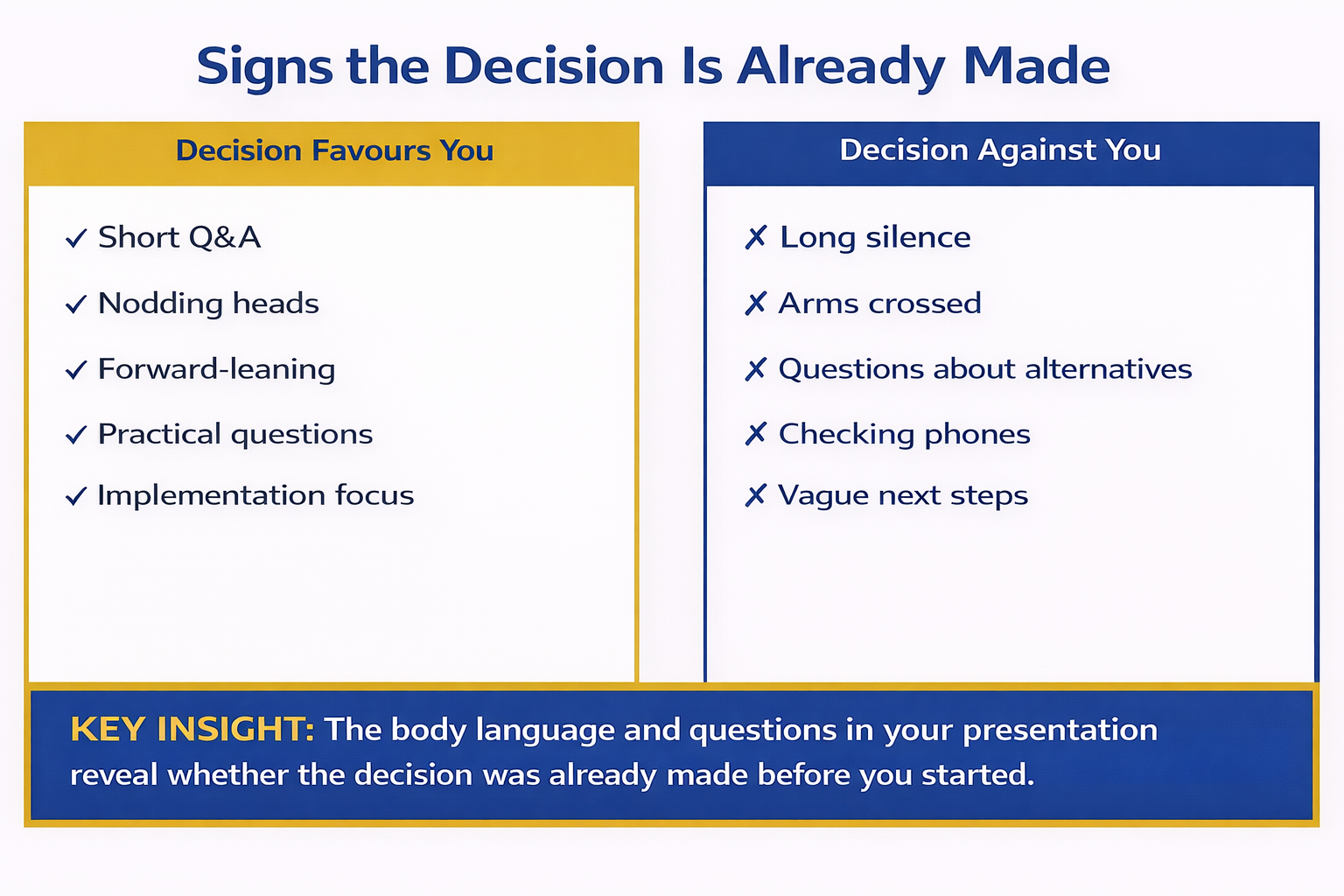
Before you present, you need to know whether you’re walking into a genuine evaluation or a pre-decided outcome. Real diagnostic signals appear weeks before the meeting:

Signal 1: Private alignment conversations have already happened. Stakeholders mention the decision casually in corridor chats before you’ve even presented the analysis. “I think we’re going with option B” signals that evaluation is over—you’re in validation mode.

Signal 2: The decision-maker defines “success” in oddly specific terms. Instead of “help us choose the best option,” they say “I need a clear business case for approach X.” You’re not evaluating X—you’re justifying it.

Signal 3: Certain voices are absent from decision meetings. If key stakeholders who should influence the choice are being excluded, a faction has already decided and is controlling the process.

Signal 4: The timeframe is artificially compressed. “We need this decided by Thursday” often means the decision is already made and they’re rushing to legitimacy. Real evaluation takes longer.

Signal 5: Your predecessors’ recommendations are being ignored or contradicted without new information. If prior analysis said one thing and the new brief says another without any material change in context, a decision has been made at a different level.

Recognising these signals early lets you adjust your strategy before you’re standing in front of the room.

Body language and verbal cue comparison infographic showing signs the decision favours you versus signs the decision is against you across multiple indicators

Restructuring Your Approach for Pre-Decided Audiences

Once you know you’re presenting to a pre-decided audience, your slide strategy changes fundamentally. Your aim shifts from persuasion to clarity and credibility.

First: Lead with the stakeholder’s preference, not your analysis. Name the option they’re leaning toward. Validate the reasoning. This removes defensiveness and positions you as someone who understands their thinking.

Second: Surface the hidden risks in their preferred option using neutral language. Don’t argue against it—illuminate gaps. “This approach works beautifully if assumption X holds true. Here’s what we’ve seen when that assumption breaks down.”

Third: Reframe competing options not as alternatives, but as complementary or sequential steps. Instead of “Option A or Option B,” use “Option B achieves X quickly, and Option A handles Y in the medium term.”

Fourth: Make it easy for them to change their mind without losing face. Give them new information that legitimises reversal. “We just learned this from the market research—it changes the risk profile of the original approach.”

Master Pre-Decision Dynamics With Structured Slide Architecture

The Executive Slide System teaches you a seven-slide foundation that works in pre-decided boardrooms. You’ll learn how to diagnose stakeholder leanings before you present, structure your recommendation to shift pre-aligned positions, and surface hidden risks that force genuine reconsideration.

  • Identify whether you’re in evaluation mode or validation mode (Signal check)
  • Restructure your recommendation to address unspoken stakeholder concerns
  • Create slides that surface risk without appearing to argue
  • Build a decision-shifting narrative that feels like new information, not contradiction
  • Deliver with confidence when you understand the real dynamics at play

Get the Executive Slide System → £39

Used by executives at FTSE 250 companies and funded startups to restructure high-stakes presentations in real time.

Need a framework to diagnose pre-decision dynamics before you walk in?

Get the ESS Framework → £39

The Pre-Presentation Alignment Conversation

The most powerful move you can make happens before you present. Conduct a pre-decision stakeholder conversation with the key decision-maker. Not to persuade them—to understand them.

This conversation should happen 3–5 days before the presentation. Its purpose is diagnostic, not political:

“I want to make sure my slides land clearly. Walk me through your current thinking on this decision. What’s most important to you about the final choice?”

Listen for:

  • What they say first (usually the real priority)
  • What they return to multiple times (the worry underneath)
  • What they don’t mention (the blind spot)
  • Who they reference (“I’ve talked to the CFO about…”)—the informal power structure

This single conversation often reveals whether you’re in a pre-decided scenario. If they already have a clear leaning, you now know. If they’re genuinely undecided, you’ll hear it in the language they use—it’s more tentative, more exploratory, less prescriptive.

Armed with this clarity, restructure your slides to build genuine buy-in, not just validation. The slides should address the stakeholder’s actual priority, not the priority you guessed.

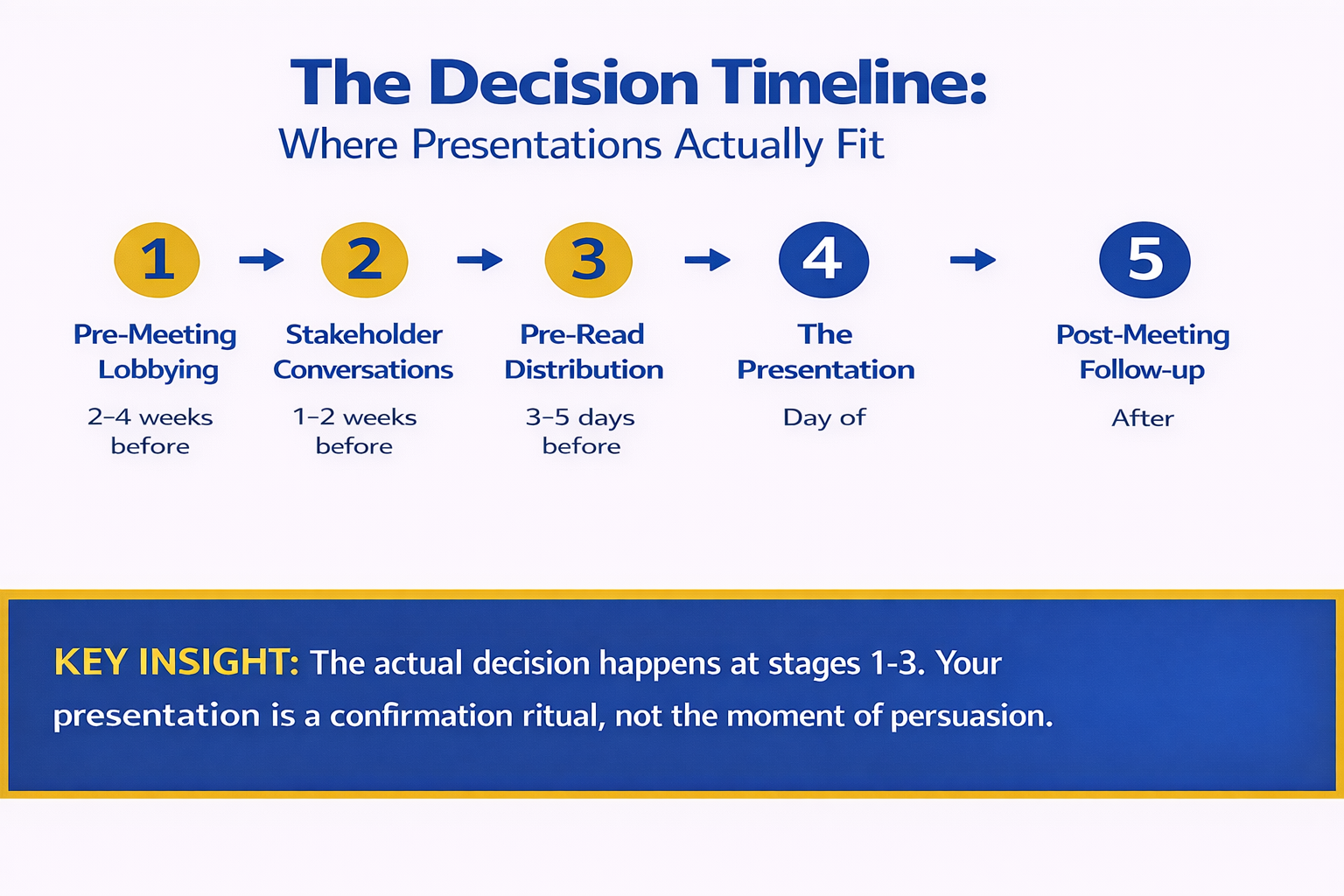
Decision timeline infographic showing five stages from pre-meeting lobbying to post-meeting follow-up highlighting that the actual decision happens at stages one to three not during the formal presentation

Winning Presentations Beyond Pre-Decision Scenarios

Not every presentation operates under pre-decision pressure. Some stakeholder groups genuinely want to evaluate options. But too many presenters assume they’re in the evaluation group when they’re actually in the validation group.

Understanding which context you’re in changes everything. A strong boardroom presentation structure works in both scenarios, but the emphasis shifts. In pre-decision environments, clarity and risk transparency become more important than volume of detail.

The stakes of getting this wrong are real. A misread pre-decision scenario can lead you to over-prepare, over-present, and over-argue, which only reinforces stakeholder defensiveness about their leaning. You come across as someone who doesn’t understand the political reality.

Diagnose and Restructure Before Your Next Boardroom Presentation

The Executive Slide System includes a pre-presentation diagnostic tool to identify whether you’re facing a pre-decided audience. Once you know, the system guides you through restructuring every slide to work with stakeholder leanings, not against them.

  • Pre-presentation diagnostic: Signals to spot pre-decided scenarios
  • Stakeholder alignment conversation template: Uncover hidden priorities
  • Slide restructuring framework: Adapt your narrative for pre-aligned audiences
  • Risk-surfacing techniques: Highlight flaws without appearing argumentative
  • Real-world boardroom examples: Presentations that succeeded despite pre-decision pressure

Get the Executive Slide System → £39

Included: Full stakeholder alignment conversation template (save 2 hours of preparation).

Ready to restructure your slides for the boardroom reality you’re actually facing?

Start With the ESS → £39

Key Takeaways

Pre-decision dynamics are normal in executive environments. Stakeholders often use presentations to validate existing leanings rather than genuinely evaluate options. Recognising this isn’t cynical—it’s realistic.

Your presentation isn’t failing because it’s weak. It’s failing because you’re treating a validation scenario as an evaluation scenario. The approach is different.

Diagnosis comes before restructuring. Ask yourself: has the decision already been made? If yes, shift from persuasion to clarity and credibility. If no, use a traditional persuasion structure.

A pre-presentation stakeholder conversation is your strongest diagnostic tool. It reveals whether you’re in a pre-decided scenario and, if you are, what the real priority is.

Is This Right For You?

✓ This is for you if:

You’re presenting to stakeholders who seem to have already decided, and your slides feel like they’re being used to justify rather than evaluate.
You suspect a stakeholder faction has aligned privately before your presentation, and you need to know how to work with that reality.
You want to diagnose pre-decision dynamics early so you can restructure your approach instead of walking into the boardroom blindly.

✗ Not for you if:

You’re presenting to an audience that genuinely hasn’t formed a preference yet and is asking you to help them decide. (In that case, use a traditional persuasion structure.)
You prefer to ignore the political reality of boardrooms and hope that strong analysis alone will win the day.

People Also Ask

What if I’m wrong about whether the decision is pre-made? You’re not really wrong—the stakes of being wrong are low. If you treat a genuine evaluation scenario like pre-decided, you’ll be clear and organised (which helps). If you treat a pre-decided scenario like genuine evaluation, you’ll be verbose and argumentative (which hurts). Defaulting to the pre-decided assumption is safer.

Is it unethical to adjust my slides based on a stakeholder’s existing leaning? No. Your job is to serve the decision-maker’s real needs, not your imagined idea of what’s neutral. If you understand what they actually care about, you present information in a way they can hear. That’s not manipulation—that’s communication.

How do I surface concerns about the preferred option without looking like I’m arguing against it? Use neutral, exploratory language: “Here’s what we’ve seen when this assumption holds” or “This approach works beautifully in scenario X. Here’s what happens in scenario Y.” You’re not saying the option is wrong—you’re surfacing contingencies they need to account for.

The Complete Framework for Pre-Decision Boardrooms

The Executive Slide System is built on one core truth: your slides must serve the stakeholder’s real decision-making process, not an imagined ideal one. That’s how you build credibility and influence.

  • Seven-slide architecture that works in pre-decided scenarios
  • Pre-presentation diagnostic checklist (identify the real situation)
  • Stakeholder alignment conversation template (uncover hidden priorities)
  • Slide restructuring toolkit (adapt your narrative in real time)
  • Risk-surfacing language (raise concerns without appearing argumentative)

Get the Executive Slide System → £39

Trusted by executives at FTSE-listed companies, family offices, and venture-backed startups.

FAQ

Can I still influence a pre-decided decision through my presentation?

Yes, but indirectly. You don’t change a pre-decided stakeholder’s mind through argument—you do it by surfacing information they didn’t have that makes the original decision riskier. “We just learned X from the market” or “Competitor Y has moved faster than we anticipated” gives them a legitimate reason to reconsider without admitting their original leaning was wrong.

What’s the difference between a pre-decided scenario and a bad presentation?

A bad presentation fails because the slides are confusing, the logic is weak, or the delivery is poor. A pre-decided scenario fails because the audience was never going to be persuaded by slides alone—they were there to validate. You can have excellent slides and still fail in a pre-decided scenario if you don’t address the real dynamic.

Should I confront a stakeholder if I think they’ve already decided?

No. Never accuse a stakeholder of having pre-decided. Instead, use the alignment conversation diagnostic to understand their thinking, acknowledge what you learn, and restructure your slides accordingly. They may not even realise they’ve already decided—and that’s fine.

How many pre-presentation alignment conversations should I have?

Ideally, one with the primary decision-maker and one with the most influential peer stakeholder. That’s usually enough to map the terrain. More than that and you risk looking like you’re lobbying rather than gathering information.

Related: The ‘One More Thing’ That Ruins Good Presentations: Why Anxiety Makes You Add Content — How nervous presenters often over-prepare in pre-decided scenarios, which backfires.

Related: Technical Questions From Non-Technical Executives: How to Translate Under Pressure — When the Q&A reveals a comprehension gap that you need to bridge instantly.

Get Clarity on Boardroom Politics Before Your Next Presentation

The executives who win boardrooms aren’t the ones with the most data. They’re the ones who understand the political reality—who has decided what, why, and what would actually shift their thinking.

The Executive Slide System gives you a diagnostic framework to map that reality in your next presentation. Once you see the dynamics clearly, restructuring your slides becomes straightforward.

You’re presenting on March 24? You have seven days to diagnose the stakeholder landscape and restructure your narrative. That window is shrinking—start your stakeholder alignment conversation this week.

Join the executives learning to read boardroom dynamics before they present. Subscribe to The Winning Edge newsletter for weekly frameworks on executive communication.

🆓 Free resource: Download now — a free guide to strengthen your presentation preparation.

About the Author

Mary Beth Hazeldine is the Owner & Managing Director of Winning Presentations. With 24 years of corporate banking experience at JPMorgan Chase, PwC, Royal Bank of Scotland, and Commerzbank, she has delivered high-stakes presentations in boardrooms across three continents.

A qualified clinical hypnotherapist and NLP practitioner, Mary Beth combines executive communication expertise with evidence-based techniques for managing presentation anxiety. She has trained thousands of executives and supported high-stakes funding rounds and approvals.
Book a discovery call | View services

This article was written with AI assistance and reviewed by Mary Beth Hazeldine.

15 Mar 2026
Professional executive having a one-to-one pre-meeting conversation with a colleague in a modern glass office, navy and gold corporate aesthetic, high-stakes approval setting

The Pre-Decision Conversation: Where Approvals Actually Happen

Quick Answer: Most executives make their decision in an informal conversation hours or days before the formal meeting. The formal meeting is a confirmation ritual, not the decision moment. The pre-decision conversation — a single phone call, a corridor chat, or a brief coffee meeting — is where approvals actually happen. Getting this conversation right means your presentation delivers confirmation, not persuasion. That changes everything about how you prepare.

🚨 Pitching for approval this month? Quick diagnostic: Have you had a pre-decision conversation with the decision-maker yet, or are you relying entirely on the formal presentation? If it’s the latter, you’re walking in without the framework that determines whether you win. → Get the Executive Slide System (£39), which includes the exact pre-conversation positioning strategy and decision-meeting follow-up.

A CFO told me she approved a £2 million budget in a five-minute corridor conversation two days before the formal approval meeting.

The executive who was presenting sent her a single-page executive summary in advance. They had a brief phone call the morning before that one-pager arrived. She asked three questions. He answered them with precision.

By the time the formal meeting happened, the decision was already made. Everyone in the room knew it. The presentation became a confirmation ritual — addressing questions that had already been resolved, walking through slides that she had already mentally approved.

This is the norm at executive level, not the exception. Most senior decision-makers make their decision outside the formal meeting. The formal meeting is theatre.

But most presenters still approach it as if the meeting itself determines the outcome. They prepare slides for persuasion. They build arguments for a room that has already decided. They walk in hoping to land a decision they should have secured days before.

What Is a Pre-Decision Conversation?

A pre-decision conversation is an informal discussion — usually a phone call, a corridor chat, or a brief in-person meeting — between you and a decision-maker or key influencer before the formal approval meeting takes place.

Its purpose is not to present your case. You’re not pitching. You’re clarifying what the decision-maker actually cares about, answering the questions that would otherwise sit unanswered in the formal meeting, and creating space for them to voice concerns that they wouldn’t raise in front of a full committee.

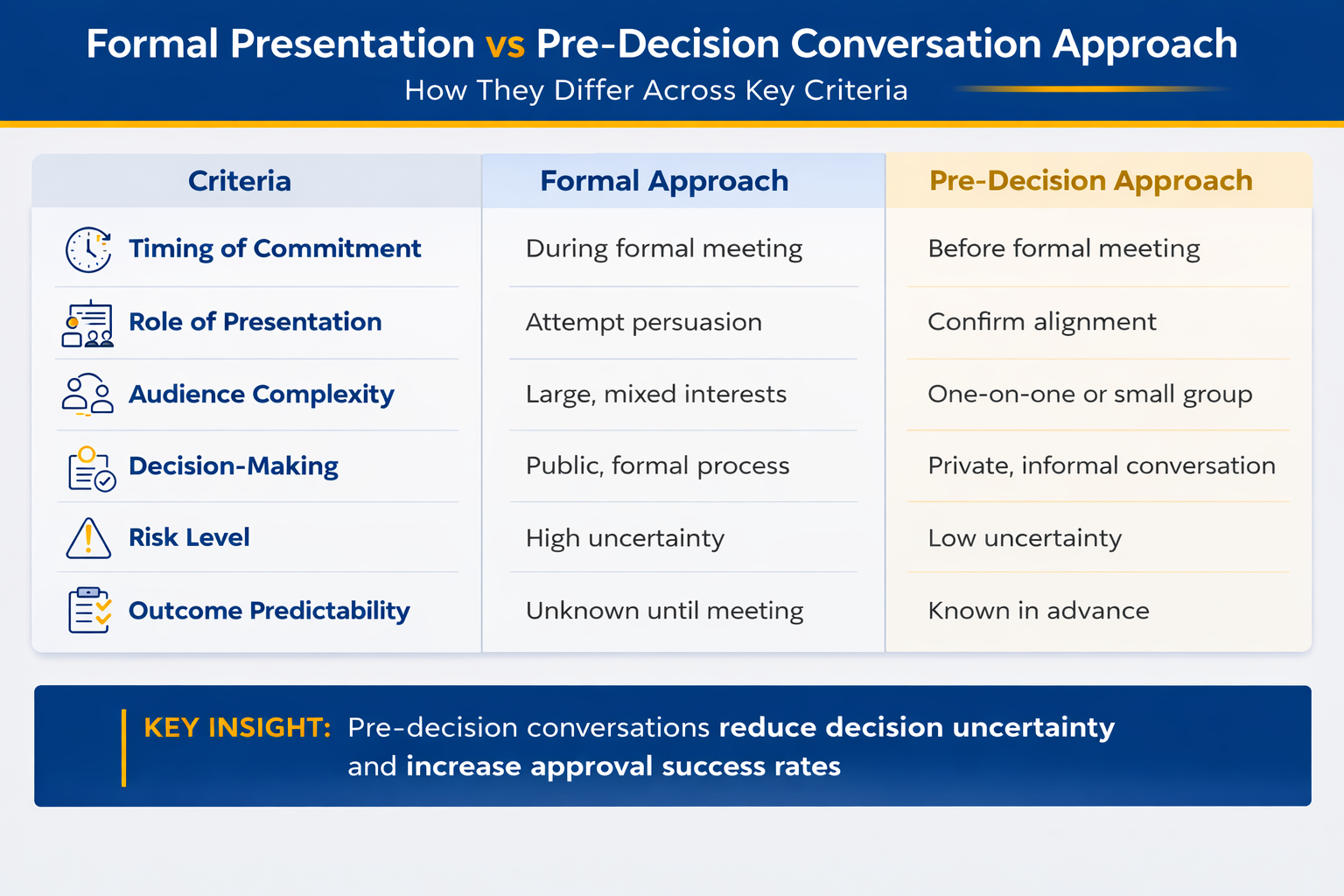
This is fundamentally different from a “pre-meeting brief” or a presentation rehearsal. Those are preparation activities. A pre-decision conversation is a sales conversation. It happens one-on-one or in a very small group. It is designed to move someone from uncertainty toward a yes before they enter the formal decision space.

The stakes are high because this conversation often determines whether the formal meeting is a smooth confirmation or an ambush. A decision-maker who has already agreed in principle will defend your proposal in the room. A decision-maker who is hearing your argument for the first time in front of peers is far more likely to defer, object, or propose conditions.

Why the Informal Conversation Determines the Outcome

Executives avoid surprise decisions in public. They prefer to know where they stand before they commit in front of peers or their own leadership team.

When you lead with a formal presentation without a pre-decision conversation, you’re asking the decision-maker to commit in an unfamiliar environment, in front of an audience, without private space to raise concerns or renegotiate terms. They are more likely to defer, ask for more time, or propose modifications rather than give a clean yes.

A pre-decision conversation removes the risk of public commitment. It allows the decision-maker to ask difficult questions privately. It gives you space to adapt your position based on what you learn. It lets them feel heard before they have to perform a decision in front of others.

This is why informal influence often outweighs formal persuasion. The best slide deck in the world cannot compete with a decision-maker who has already made up their mind — and pre-decision conversations are where minds actually get made up.

Many executives don’t even attend their own approval meetings. They send a delegate with instructions: approve if certain conditions are met, or defer if X happens. The pre-conversation with the actual decision-maker is what determined their position. The formal meeting is just execution.

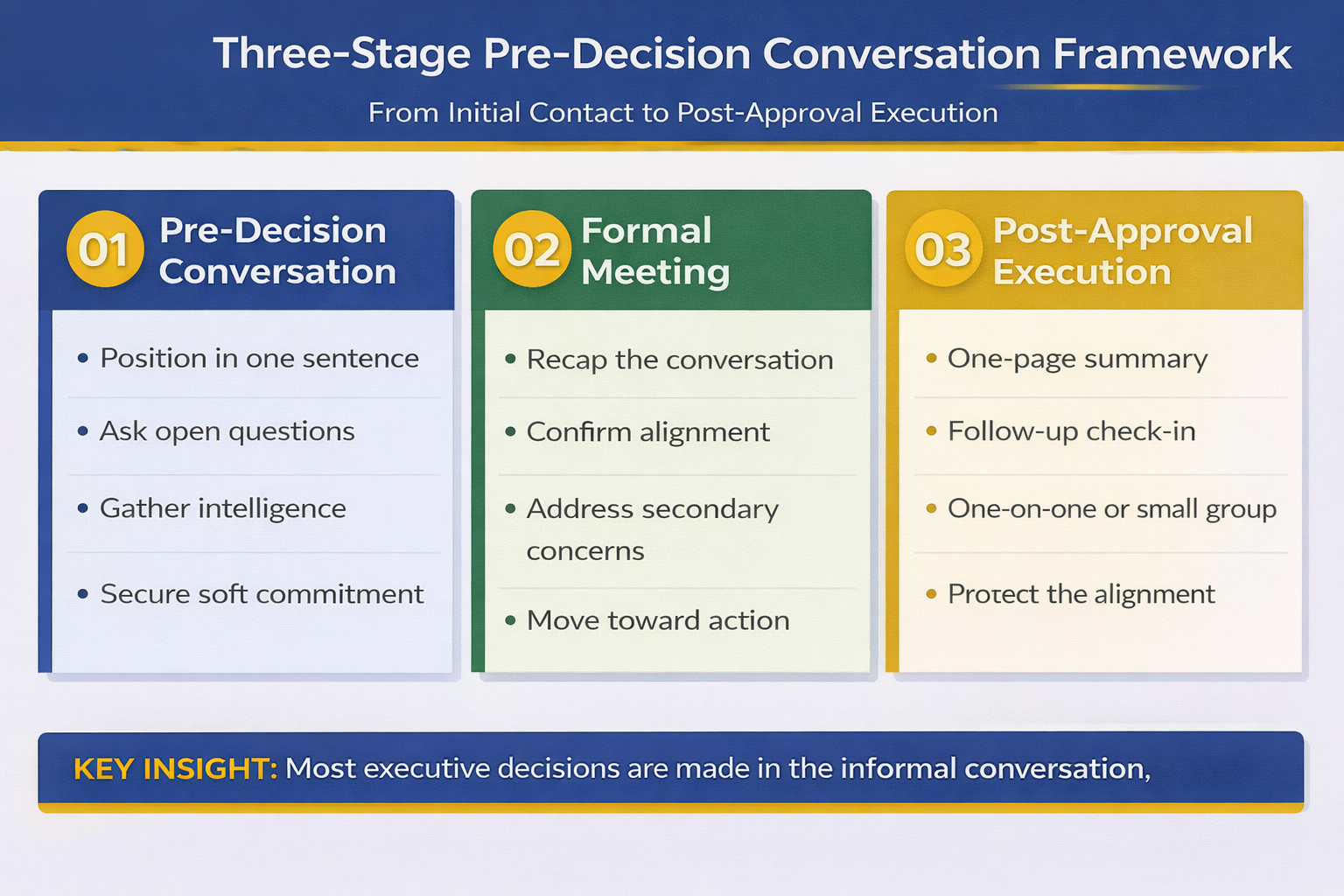
Three-stage pre-decision conversation framework infographic showing Pre-Decision Conversation, Formal Meeting, and Post-Approval Execution phases with key actions for each stage including positioning, intelligence gathering, recap and confirmation

When to Initiate the Pre-Decision Conversation

Timing determines whether a pre-decision conversation feels natural or manipulative. Get it wrong and you risk appearing to lobby behind the scenes. Get it right and you’re simply being thoughtful.

The ideal window is 5–10 days before the formal meeting. This gives you enough time to gather intelligence, adapt your approach, and ensure your formal presentation reflects any insights you gained. It’s recent enough that momentum hasn’t shifted, but distant enough that reaching out doesn’t feel like a last-minute panic.

You should initiate the conversation with the person most likely to become your champion or the person most likely to block you — often both are the same person. If there is a steering committee, start with the chair. If there is a finance committee, start with the CFO or budget-holder. If there is a project governance board, start with the executive sponsor.

The conversation should feel organic to your relationship. If you have never spoken to this person one-on-one before, a sudden pre-meeting call can read as suspect. Build it into existing touchpoints: “I know you’re reviewing this next Tuesday. Would you have 20 minutes this week for a quick call? I’d like to make sure I’m addressing your specific concerns rather than presenting a generic case.”

Never frame it as “getting approval early” or “lobbying support.” Frame it as preparation, intelligence-gathering, or relationship-building. “I’d like to understand what you’re looking for” is very different from “I’d like to get you to approve this.”

Secure Buy-In Before the Room Through Strategic Pre-Decision Conversations

The difference between executives who consistently win approvals and those who don’t isn’t the quality of their presentations. It’s whether they have already secured the decision before the formal meeting begins.

  • The exact timing, framing, and positioning strategy for pre-decision conversations that feel natural, not manipulative
  • Word-for-word scripts for three common pre-conversation scenarios: finance approval, programme governance, and stakeholder alignment
  • The questions to ask that reveal what the decision-maker actually cares about — before you build your formal presentation
  • The follow-up framework that converts informal agreement into formal approval without re-negotiation

Get the Executive Slide System → £39

Includes the pre-conversation positioning strategy from 24 years of corporate banking approvals at JPMorgan Chase, RBS, and Commerzbank — where executive alignment is the difference between a decision and a deferral.

How to Structure the Conversation for Maximum Impact

A pre-decision conversation that works has three distinct phases. They must happen in order, and each must be brief.

Phase 1: The Positioning Statement (30 seconds)
Lead with your core positioning in a single sentence. Not your company. Not your features. The one thing that makes this decision matter to them right now. “We’re proposing a shift in how we structure our approval workflow, and I wanted to understand whether this aligns with your priority of reducing sign-off delays.”

Phase 2: Intelligence Gathering (5–10 minutes)
Ask questions. Shut up and listen. The goal is to discover what the decision-maker is actually worried about, what they care about most, and what would make them feel confident saying yes. Most presenters skip this entirely and launch into their pitch. Don’t. The conversation should be 70% them talking and 30% you talking. Ask open questions: “What does success look like for you here?” “What are your main concerns about moving forward?” “What would need to be true for you to feel confident saying yes?”

Phase 3: The Soft Commitment (2–3 minutes)
Once you understand where they stand, you can adapt. But you also need to move toward alignment. “Based on what you’ve told me, I want to make sure next Tuesday’s presentation addresses what actually matters to you. It sounds like the cost impact is your main concern and the implementation timeline is secondary. Is that right?” This does two things: it shows you listened, and it creates space for them to confirm or correct you. Either way, you’re getting closer to agreement.

Close with something like: “I appreciate your time. I’ll make sure the presentation reflects this conversation. If anything shifts before Tuesday, just let me know.”

Get the Pre-Decision Conversation Script Template

The exact words to use when you initiate the conversation, how to transition into intelligence-gathering, and how to secure the soft commitment without sounding like you’re lobbying. Included in the Executive Slide System.

View Inside → £39

What to Do When You Encounter Resistance

Sometimes you initiate a pre-decision conversation and the response is not enthusiasm. The decision-maker is busy. They say they’ll wait for the formal meeting. They raise a concern that wasn’t on your radar.

If they defer the conversation: accept it gracefully. “No problem. I know you’re busy. I’ll make sure the presentation covers your main priorities. If you have a few minutes the day before, I’d still appreciate your input. Either way, we’re good.” Don’t push. Pushiness signals desperation and erodes trust.

If they raise a concern in that moment: this is the most valuable intelligence you can get. Don’t dismiss it or defend. Clarify it. “Tell me more about that.” “What specifically worries you?” “What would need to change for that not to be a concern?” If it is a genuine blocker, knowing about it now gives you time to address it before the formal meeting. If it is a smoke screen, the conversation will reveal that too.

If they seem aligned but non-committal: don’t interpret silence as agreement. Test it gently. “So it sounds like you see the value, but you want to see how the team responds in the meeting before you fully commit? Is that fair?” This forces clarity. They either confirm they’re waiting for the room’s input, or they reveal that they’re actually more convinced than they sounded.

Stop Walking Into Approval Meetings Cold

The anxiety of an approval meeting without a pre-decision conversation is the anxiety of genuine uncertainty. You don’t know where the decision-maker actually stands. The formal meeting becomes a high-stakes gamble.

  • The pre-conversation checklist that ensures you ask the right questions in the right order
  • How to read signals: what it means when they go quiet, when they challenge, when they agree too quickly

Get the Executive Slide System → £39

Essential preparation framework for anyone securing budget approval, board-level agreement, or stakeholder alignment.

Common Questions About Pre-Decision Conversations

Isn’t having a pre-decision conversation before the formal meeting just lobbying?
No. Lobbying is trying to build a coalition against someone else’s position. A pre-decision conversation is one-on-one, transparent, and focused on understanding the decision-maker’s position so you can address it. It is how senior executives do their jobs. When a CFO has concerns about a budget request, the finance director talks to them one-on-one before the formal budget meeting. That is not lobbying. That is due diligence. The same applies to you.

What if I have multiple decision-makers? Who do I talk to first?
Start with the person who can say no most definitively — usually the person who controls the budget or who has formal authority over the approval. Get them comfortable. Then work down the influence chain. Each conversation should be brief and should focus on understanding where that person stands, not on trying to turn them into your advocate. If the primary decision-maker is already aligned, the secondary influencers are usually not a problem.

What if the decision-maker says yes in the pre-conversation but then doesn’t defend the proposal in the formal meeting?
This happens when they said yes to move the conversation forward but were never genuinely convinced. That is why testing for real commitment matters. If you sense soft agreement, push slightly: “So you’re comfortable moving forward if [specific condition]?” If they waffle, you have discovered that you don’t actually have alignment yet. Now you know what to do: address the real concern before the formal meeting, or adjust your ask.

Comparison matrix infographic contrasting formal presentation approach versus pre-decision conversation approach across six criteria including timing, format, objective, decision dynamics, success rate, and risk level

The Formal Meeting: Converting Pre-Decision Alignment Into Action

Once you have had a pre-decision conversation and secured at least soft alignment, the formal meeting becomes a different exercise. You are no longer pitching for a decision. You are confirming one and addressing secondary concerns.

This changes everything about how you present. Your opening is no longer a pitch. It is a recap of the conversation: “In our discussions this week, it became clear that your main priority is implementing this with minimal disruption to current operations. The proposal I’m presenting has that as its core structure. Here’s how.” You are reminding them of the conversation they had with you and showing them that you listened.

Your presentation is shorter. You have already covered the main questions and objections. The formal meeting can focus on addressing the secondary concerns and handling questions from the broader audience that weren’t present in the pre-conversation.

Your close is not a call to action. It is a recap and next step: “Based on what we’ve discussed, the next step is [specific action]. Are there any questions before we move forward?” This is not a question. It is a transition into action.

Executives who have already committed in the pre-conversation will support your presentation. They will fill in gaps, answer peer questions, and smooth the path to final approval. You have made them your champion because you listened to them before anyone else did.

The Formal Meeting Playbook

Once you have secured pre-decision alignment, the formal meeting structure is fundamentally different. Get the exact template for opening, body, and close that converts confirmed decisions into final approvals.

Get the Templates → £39

Is This Right for You?

This is for you if:

  • You’re seeking formal approval from a decision-maker or committee for something that matters (budget, programme, initiative, hire)
  • You have identified the key decision-maker but haven’t had a one-on-one conversation with them about your proposal
  • You’ve had approval meetings that went sideways despite strong slides, or that resulted in unexpected objections you could have addressed
  • You want to shift from hoping your presentation persuades them to knowing you have alignment before you walk in the room

This is NOT for you if:

  • You’re presenting to a wide, unfamiliar audience where one-on-one conversations aren’t practical (company town hall, public conference)
  • The decision is genuinely distributed across a large committee with no clear champion
  • The decision-maker has explicitly asked not to be contacted before the formal meeting (respect that boundary)
  • You haven’t yet built enough relationship credibility for a pre-meeting conversation to feel natural

After the Green Light: Managing the Handover

A pre-decision conversation secures alignment. The formal meeting confirms it. But many approvals still fail at the handover — the moment between formal approval and actual implementation.

This is where discipline matters. After the formal meeting, send a one-page summary within 24 hours. Not a full recap. A single page covering: the approval, the next step, the timeline, and who is responsible for what. This document serves two purposes: it confirms what was actually agreed (no room for interpretation later), and it signals professionalism and follow-through.

Then schedule a brief follow-up conversation with the key decision-maker — not another formal meeting, just a check-in. “I wanted to confirm we’re aligned on the timeline. Implementation starts [date]. Is there anything you want to flag or discuss before we move into execution?” This catches scope creep or shifting priorities before they become problems.

Finally, keep them informed as implementation begins. Monthly updates, not because they asked for them, but because it shows respect for their decision and their time. Executives who feel kept informed are executives who continue to support the approval even when implementation gets messy.

Built From 24 Years of High-Stakes Approval Conversations in Banking. Now a Framework You Can Use.

I spent two decades in corporate banking securing approvals for multi-million-pound initiatives, vendor switches, and programme expansions. The difference between approvals that sailed through and those that got blocked was almost never the slides. It was whether the key decision-maker had already made up their mind before the formal meeting. The pre-decision conversation is where that happens. The Executive Slide System gives you the exact framework.

  • 22 executive templates including budget request, programme approval, and stakeholder alignment formats
  • Word-for-word scripts for three pre-decision conversation scenarios — finance approval, governance, and executive alignment
  • The post-approval handover checklist that ensures agreement doesn’t slip during implementation
  • 51 AI prompts to prepare for your pre-conversation, including research, objection-handling, and follow-up frameworks

Your approval meeting has a date. The decision-maker’s mind may already be made, or it may still be open. Find out before you present.

Get the Executive Slide System → £39

Trained thousands of executives in high-stakes presentations across banking, consulting, and technology. Immediate digital download. Used in budget approvals, board presentations, and governance meetings.

Frequently Asked Questions

How do you initiate a pre-decision conversation without appearing to lobby or influence the decision before the formal process?

Frame it as clarification, not persuasion. The language matters enormously. Use: “I’d like to understand your specific priorities before I present,” not “I want to get your buy-in early.” Use: “I’m making sure I address your concerns rather than guess at them,” not “I want to align with you before the meeting.” The intent is genuine — you are seeking to understand, not to manipulate. If your language matches that genuine intent, the conversation feels natural and professional. Senior executives talk one-on-one with peers and stakeholders all the time. This is exactly that.

What if a decision-maker agrees in the pre-conversation but the broader committee challenges them in the formal meeting?

This is one of the reasons the pre-conversation is so valuable. The person who has already committed to you will tend to defend your proposal in the room because they’ve already staked their credibility on it. If they face unexpected objections, they have usually had time to think through counterarguments. If they were only softly aligned, the committee pushback will reveal that you don’t actually have agreement yet — which is far better to learn in a pre-conversation than in a public meeting. If this happens, treat it as intelligence: you need to address a real concern before the formal meeting.

Is a pre-decision conversation different for budget approvals versus programme approvals versus stakeholder alignment?

The framework is the same (positioning, intelligence-gathering, soft commitment), but the questions change. For budget approvals, focus on cost impact, ROI, and trade-offs. For programme approvals, focus on risk, resourcing, and timeline. For stakeholder alignment, focus on their specific department’s impact and dependencies. The structure stays consistent; the content adapts to what that person actually cares about.

What happens if you don’t have a direct relationship with the decision-maker? How do you initiate the conversation then?

Use a warm introduction. Ask your sponsor or the person who invited you to the formal meeting to facilitate an introduction: “I’d appreciate if you could introduce me to [decision-maker]. I’d like a 20-minute call to understand what they’re most focused on before I present.” This makes the conversation feel less like cold outreach and more like a natural part of the process. If a warm introduction isn’t possible, reach out briefly and directly: “I’m presenting a proposal in your area next Tuesday. Would you have 20 minutes this week for a quick call? I’d like to make sure I’m addressing your specific priorities.” Be honest about why you’re reaching out. Honesty builds trust.

The Winning Edge — Executive Presentation Insights

Weekly strategies for executives who present at board level, secure approvals, and navigate high-stakes decisions. Practical frameworks from 24 years in the room, not theory.

Subscribe Free →

🎁 Free resource: Executive Presentation Checklist — the pre-meeting audit framework for approval presentations. Free download, no email required.

Also published today:

Your next approval meeting is already on the calendar. You will walk into that room with either the advantage of having already secured alignment, or the disadvantage of hoping your presentation convinces them.

The difference is a single 20-minute conversation that happens days before the formal meeting. Use the Executive Slide System (£39) to structure that conversation. It includes the exact scripts for initiating the call, the questions that reveal what they actually care about, and the follow-up approach that converts informal alignment into formal approval.

For further reading on executive alignment and approval strategy: Pre-Meeting Executive Alignment: The Strategy That Determines Outcomes, The Decision Slide: The One Slide That Matters in Executive Presentations, and Building Executive Buy-In: From First Contact to Final Approval.

About the Author

Mary Beth Hazeldine is the Owner & Managing Director of Winning Presentations. With 24 years of corporate banking experience at JPMorgan Chase, PwC, Royal Bank of Scotland, and Commerzbank, she has delivered high-stakes presentations in boardrooms across three continents.

A qualified clinical hypnotherapist and NLP practitioner, Mary Beth combines executive communication expertise with evidence-based techniques for managing presentation anxiety. She has trained thousands of executives and supported presentations that have secured high-stakes funding rounds and approvals.

Book a discovery call | View services

28 Jan 2026
Professional woman in enrollment conversation during coffee meeting, actively engaging with colleague about stakeholder buy-in

Pre-Meeting Executive Alignment: How to Get Approval Before You Present

The CFO approved £2 million before my client finished slide one.

Not because the presentation was brilliant. Not because the data was compelling. Because the decision had already been made — three days earlier, over a 12-minute conversation and one carefully crafted email.

The presentation? A formality. A public confirmation of a private agreement.

This is what pre-meeting executive alignment looks like when it’s done right. And it’s the skill that separates professionals who constantly fight for approval from those who walk into rooms where “yes” is already waiting.

Quick Answer: Pre-meeting executive alignment is the practice of socializing your recommendation with key stakeholders before the formal presentation. Done correctly, it surfaces objections early, builds champions, and transforms the meeting from a decision point into a confirmation ceremony. The most effective executives spend more time on pre-alignment than on slides.

📋 Presenting for Approval This Week? Do This First:

48-72 hours before your presentation:

  1. Identify the real decision-maker (often not the most senior person)
  2. Request 10 minutes — “I’d value your perspective before Thursday’s meeting”
  3. Share your recommendation (not all your slides — just the answer)
  4. Ask: “What concerns would you want me to address?”
  5. Send a follow-up email summarizing what you heard and how you’ll address it

This 10-minute conversation often determines the outcome more than the 30-minute presentation.

The Email That Changed Everything

Early in my banking career at JPMorgan, I watched a colleague present a flawless business case for a new trading system. The logic was airtight. The ROI was clear. The slides were polished.

The CFO said no.

Not because the proposal was weak — but because he’d been blindsided. He had concerns about implementation risk that were never addressed. He felt ambushed by a major capital request he hadn’t been prepared for. His “no” wasn’t about the merits. It was about the process.

A month later, I saw a more senior colleague get a larger budget approved in half the time. The difference? She’d spent 20 minutes with the CFO the week before, walking him through her thinking and asking what would make him comfortable.

By the time she presented, he was already her champion. He’d helped shape the proposal. His concerns were already addressed. The meeting was a formality.

That’s when I understood: the presentation isn’t where the decision gets made. It’s where the decision gets announced.

Why Pre-Alignment Works

Pre-meeting alignment works because of three psychological principles that govern how senior people make decisions:

1. Executives hate surprises

Senior leaders are evaluated on judgment. Being caught off-guard in a meeting — especially by something they “should have known” — feels like a failure. When you pre-align, you’re protecting their reputation, not just selling your idea.

2. Ownership drives support

When someone contributes to shaping a proposal, they become invested in its success. The CFO who suggested adding a risk mitigation section will defend that section in the meeting. Pre-alignment turns potential blockers into co-authors.

3. Public positions are hard to reverse

Once someone takes a position in a meeting, backing down feels like losing face. If you surface objections privately, they can be addressed without anyone having to publicly change their mind. Private alignment prevents public conflict.

For more on how executives actually make decisions, see our guide to executive presentation structure.

How do you get stakeholder alignment before a meeting?

Get stakeholder alignment by having brief one-on-one conversations with key decision-makers 48-72 hours before your presentation. Share your recommendation (not all your slides), ask what concerns they’d want addressed, then incorporate their input. Follow up with a short email confirming what you heard. This transforms potential opponents into contributors who are invested in your success.

Timeline showing pre-alignment process: 1 week before identify stakeholders, 48-72 hours before have conversations, 24 hours before send summary email, meeting day present with confidence

⭐ Maven Flagship — Executive Buy-In

Walk into your next approval meeting prepared

The Executive Buy-In Presentation System gives you 7 self-paced modules covering stakeholder analysis, case construction, and the presentation structures that hold up to scrutiny.

Monthly cohort enrolment — £499, lifetime access.

Enrol in the Executive Buy-In System →

The 5-Step Pre-Alignment Process

Here’s the exact process I teach executives for pre-meeting alignment:

Step 1: Map Your Stakeholders (1 Week Before)

Before you build a single slide, answer these questions:

  • Who will be in the room?
  • Who has formal decision authority?
  • Who has informal influence? (Often more important)
  • Who might object, and why?
  • Who could be a champion if they understood the benefits?

Create a simple grid: Name | Role | Likely Position | Key Concern | How to Reach

Step 2: Prioritise Your Conversations (5-7 Days Before)

You can’t pre-align with everyone. Prioritise:

  1. The decision-maker (whoever actually signs off)
  2. Potential blockers (people likely to object)
  3. Influential voices (people others listen to)

Three to four conversations is usually enough. More than that becomes logistically difficult and can feel like you’re “working the room” too hard.

Step 3: Have the Conversations (48-72 Hours Before)

Request brief meetings: “I’m presenting to the steering committee on Thursday. I’d value 10 minutes of your perspective beforehand — would Tuesday or Wednesday work?”

In the conversation:

  • Share your recommendation in one sentence
  • Explain the core logic (2-3 minutes max)
  • Ask: “What concerns would you want me to address?”
  • Listen more than you talk
  • Thank them for their input

Do NOT present all your slides. This isn’t a preview — it’s a consultation.

How do you get executive buy-in for a project?

Executive buy-in comes from making “yes” feel safe, not from having the best data. The most reliable method is pre-meeting alignment: share your recommendation privately with key stakeholders before the formal presentation, address their concerns in advance, and let them contribute to shaping the proposal. By meeting time, they’re invested in your success.

Step 4: Incorporate and Acknowledge (24-48 Hours Before)

After your conversations:

  • Adjust your presentation to address the concerns you heard
  • Add a slide or talking point that directly acknowledges input: “Based on conversations with the team, I’ve added a section on implementation risk…”
  • Send a brief follow-up email to each person you spoke with

This follow-up email is crucial. It confirms you listened and creates a paper trail of their involvement.

Step 5: Present With Confidence (Meeting Day)

When you’ve done proper pre-alignment:

  • You know what objections are coming (because you asked)
  • You’ve already addressed the major concerns (in your slides)
  • Key stakeholders feel heard (because they contributed)
  • The decision-maker isn’t being surprised (because you briefed them)

The presentation becomes a confirmation, not a persuasion exercise.

For more on presenting to senior leadership, see our guide on how to present to a board of directors.

Need the slide structure that executives respond to?

Get the Executive Slide System → £39

The Email Template That Works

Here’s the follow-up email template I used with my client — the one that preceded the £2M approval:

Subject: Following up on our conversation — Thursday’s budget review

Hi [Name],

Thank you for taking time yesterday to share your perspective on the [project name] proposal.

I heard two key points:

  1. [Concern #1 they raised]
  2. [Concern #2 they raised]

I’ve updated the presentation to address both directly — specifically, I’ve added [what you added] and revised [what you changed].

Looking forward to Thursday. Please let me know if anything else comes to mind before then.

Best,
[Your name]

This email does three things:

  1. Confirms you listened (they see their concerns reflected back)
  2. Shows you acted (you made changes based on their input)
  3. Creates investment (they’re now part of the proposal’s development)

Comparison showing traditional approach vs pre-alignment approach: traditional leads to surprises and objections, pre-alignment leads to support and quick approval

What is pre-meeting alignment?

Pre-meeting alignment is the practice of having brief one-on-one conversations with key stakeholders before a formal presentation or decision meeting. The goal is to share your recommendation, surface concerns early, incorporate feedback, and build support — so the meeting becomes a confirmation of a decision that’s already been shaped collaboratively, rather than a debate.

⭐ The Slide Structure That Closes After Pre-Alignment

Pre-alignment gets stakeholders ready to say yes. The Executive Slide System gives you the structure that makes “yes” easy — recommendation-first, objection-addressed, decision-clear.

Inside the system:

  • The exact 6-slide structure executives prefer
  • How to lead with your recommendation (not context)
  • Where to place proof so it reassures, not defends
  • The decision slide format that gets action

Get the Executive Slide System → £39

Built from 24 years of corporate banking experience. Works for budget requests, board presentations, and client pitches.

Common Mistakes to Avoid

Pre-alignment is powerful, but it can backfire if done wrong:

Mistake #1: Presenting your full deck in the pre-meeting

The pre-alignment conversation is a consultation, not a preview. Share your recommendation and ask for input — don’t walk through 25 slides. If you do, the actual meeting feels redundant.

Mistake #2: Only talking to supporters

It’s tempting to pre-align with people you know will agree. But the value is in reaching potential blockers. The CFO who might object is exactly who you need to talk to beforehand.

Mistake #3: Ignoring what you hear

If someone raises a concern and you don’t address it, you’ve made things worse. They’ll feel unheard and may actively oppose you in the meeting. Either incorporate their feedback or explain why you couldn’t.

Mistake #4: Being too obvious about “working the room”

Pre-alignment should feel like genuine consultation, not political manoeuvring. Frame it as seeking input, not building a coalition. “I’d value your perspective” works. “I’m lining up support” does not.

Mistake #5: Skipping the follow-up email

The conversation creates alignment. The email locks it in. Without the written follow-up, people can forget what they said or claim they never agreed. The email creates accountability.

For the slide structure that works after you’ve done pre-alignment, see our guide to CFO-approved budget presentations.

Ready to structure slides that close after pre-alignment?

Get the Executive Slide System → £39

When Pre-Alignment Isn’t Possible

Sometimes you can’t pre-align — you don’t have access, there’s no time, or the culture doesn’t support it. In those cases:

  • Lead with your recommendation anyway. Even without pre-alignment, the structure still matters. Don’t build to your conclusion.
  • Anticipate objections yourself. If you can’t ask stakeholders what concerns them, use your judgment and address likely objections proactively.
  • Create space for input during the meeting. If they haven’t had a chance to shape the proposal, give them opportunities to contribute: “Before I continue, I’d welcome any initial reactions.”

Pre-alignment dramatically improves your odds. But even without it, the right structure helps.

Is Pre-Alignment Right For Your Situation?

Chart showing when pre-alignment works well vs when it may not be appropriate

⭐ Complete Your Approval Strategy

Pre-alignment opens the door. The Executive Slide System walks you through it — with the exact structure, format, and flow that executives respond to.

Everything you get:

  • The 6-slide executive structure (recommendation-first)
  • Real before/after transformations
  • Slide-by-slide breakdown with formatting guidance
  • Templates for budget, board, and client presentations

Get the Executive Slide System → £39

Instant download. The same structure I taught in corporate banking for budget approvals and steering committee decisions.

Frequently Asked Questions

Isn’t this just politics or manipulation?

Pre-alignment isn’t manipulation — it’s good communication. You’re not hiding information or going behind anyone’s back. You’re consulting stakeholders, incorporating their input, and making the formal meeting more productive for everyone. The alternative — blindsiding people with a major request in a public meeting — is actually less respectful of their time and position.

What if I don’t have access to the decision-makers beforehand?

Start with whoever you can reach. Even pre-aligning with one influential person is better than none. You can also ask your manager or sponsor to help facilitate introductions: “Would it be appropriate for me to brief [Name] before Thursday?” If truly no access is possible, focus on anticipating objections yourself and structuring your presentation to address them proactively.

How far in advance should I do pre-alignment?

48-72 hours before the meeting is ideal. Too early (more than a week) and priorities may shift or people forget. Too late (day before) and there’s no time to incorporate feedback or for them to process. The sweet spot gives you time to adjust your presentation while keeping the conversation fresh in everyone’s mind.

What if someone changes their mind in the actual meeting?

It happens, but it’s rare when you’ve done proper pre-alignment. If someone raises a new objection, don’t panic. Acknowledge it calmly: “That’s a fair point — I’d like to think through the implications. Can I follow up with you after the meeting?” This shows confidence and prevents the meeting from derailing. The follow-up email you sent creates a record of their earlier input, which usually keeps positions stable.

Get Weekly Executive Presentation Insights

Strategies for getting approval, building credibility, and presenting with confidence — from 24 years in corporate banking.

Subscribe to The Winning Edge →

📋 Free Resource: Executive Presentation Checklist

A quick-reference checklist covering structure, pre-alignment, and delivery. Use it before your next high-stakes presentation.

Download Free Checklist →

Your Next Step

The next time you have a presentation where you need approval, try the pre-alignment approach:

  1. Identify 2-3 key stakeholders
  2. Request 10 minutes of their time before the meeting
  3. Share your recommendation and ask what concerns they’d want addressed
  4. Incorporate their feedback and send a follow-up email

You’ll be surprised how much easier the actual presentation becomes when the groundwork is already laid.

P.S. Once you’re in the meeting, delivery matters too. If you struggle with projecting confidence, I wrote about how to project your voice without shouting — it’s more about resonance than volume.

P.P.S. If you’re spending too long building presentations, check out how to cut presentation creation time without cutting quality — the system approach that saves hours.

About Mary Beth Hazeldine
Owner & Managing Director of Winning Presentations. 24 years in corporate banking at JPMorgan Chase, PwC, RBS, and Commerzbank. I’ve seen hundreds of presentations succeed or fail based on what happened before the meeting started. Pre-alignment is the skill I wish someone had taught me in year one.