Tag: executive Q&A

16 Apr 2026
Male executive answering a challenging question in an investment committee meeting, calm measured expression, senior questioners visible around the table, formal boardroom setting

Voice Control in Q&A: Why Experienced Presenters Sound Measured Under Pressure

Quick answer: Your voice changes during Q&A because the physiological activation of being questioned — elevated cortisol, muscle tension, shallower breath — directly affects the vocal mechanism. Experienced presenters sound measured under questioning not because they feel less pressure, but because they have developed specific disciplines: slowing the pace of their first sentence, using a deliberate pause before answering, and maintaining a lower pitch register through breath management. These are learnable techniques, not personality traits.

Kwame had presented the strategy update without difficulty. Twenty-two minutes, clean delivery, the slides doing exactly what he had intended. Then the investment committee chair asked a question he had not fully anticipated — not a hostile one, not even a particularly difficult one, but one that required him to think carefully before answering.

He heard it immediately — the slight thinness in the first word of his answer, the pace that was fractionally too fast, the pitch that had risen in a way he could not control in real time. He was answering correctly. He knew that. But the voice was not matching the confidence he felt intellectually. The committee chair asked a follow-up question. Kwame’s second answer was better. His third was back to where he needed to be. But the first two had set a tone, and he knew it.

The post-meeting debrief with his executive coach focused almost entirely on the transition between the presentation and the Q&A. The coach pointed out that Kwame was not anxious during the presentation — he had rehearsed it thoroughly and was genuinely comfortable with the material. The Q&A was different because it was unpredictable, and unpredictability activated a physiological response that the presentation had not. The voice reveals that shift. Learning to manage the voice in those first few seconds of an answer, the coach said, was the most important single skill Kwame could develop before his next committee presentation.

If Q&A is where your executive presentations tend to lose momentum — through vocal uncertainty, hesitation, or answers that trail off before reaching a clear point — the Executive Q&A Handling System provides a structured approach to managing the full Q&A process.

Explore the System →

Why Your Voice Changes Under Executive Questioning

The transition from presentation to Q&A is one of the most significant shifts in any executive briefing — not because the content changes, but because the presenter’s relationship to what they are saying changes fundamentally. A prepared presentation is delivered from a position of relative control. A question interrupts that control, requires real-time processing, and introduces an element of unpredictability that the nervous system registers as exposure.

The voice reflects this shift because the vocal mechanism is directly affected by the physiological state of the presenter. When cortisol and adrenaline increase — as they do when the nervous system perceives the evaluative exposure of being questioned by a senior audience — the muscles of the throat, jaw, and chest tighten. Breathing becomes shallower, reducing the air support available to the voice. The result is a voice that rises in pitch, reduces in volume, or increases in pace — sometimes all three simultaneously.

For senior audiences, these vocal changes carry interpretive weight. A voice that rises in pitch or speeds up under questioning signals uncertainty about the answer, discomfort with the questioner, or reduced confidence in the position being defended. The audience is not making a conscious diagnostic assessment — they are simply responding to what the voice communicates at a level below deliberate analysis. The effect on perceived authority is real even when the audience cannot articulate why they feel less confident in the presenter.

This dynamic is particularly pronounced in two types of Q&A: when the question is one the presenter was not expecting, and when the questioner is visibly more senior than the presenter or has a reputation for rigorous challenge. Both situations increase the physiological activation above the baseline, which makes the vocal management problem correspondingly harder. Understanding why this happens is the prerequisite for developing the techniques that address it.

Executive Q&A Handling System — £39, instant access

Handle Executive Questions With Consistency, Clarity, and Authority

The Executive Q&A Handling System is a structured framework for predicting, preparing for, and managing the questions that matter most in high-stakes executive presentations. It covers question analysis, response frameworks, and the specific disciplines for maintaining authority when questions are difficult, unexpected, or adversarial.

  • Frameworks for predicting and preparing for high-risk questions
  • Response structures for difficult, unexpected, and loaded questions
  • Techniques for maintaining composure and vocal authority in live Q&A
  • System for handling Q&A in board, investor, and senior leadership contexts

Get the Executive Q&A Handling System →

Designed for executives who present to boards, investors, and senior leadership teams where Q&A is high-stakes.

The Physiological Pattern That Breaks Down Vocal Control

Vocal control under pressure depends on three physiological elements: adequate breath support, relaxed throat and jaw musculature, and a pace of speech that allows the vocal mechanism to function without strain. When a difficult question activates the stress response, all three of these elements are compromised simultaneously — which is why the vocal deterioration under questioning can happen so quickly and feel so difficult to reverse once it has started.

Breath is the most fundamental. The voice is an air-driven instrument, and shallow breathing — the breathing pattern that stress produces — reduces the air column that supports the voice. A voice without adequate breath support loses its lower frequencies first, which is why anxiety tends to produce a higher, thinner vocal quality. The pitch is not deliberately chosen to be higher — it is the acoustic consequence of reduced breath support.

The pace of speech also accelerates under stress as a function of the activated nervous system. Faster speech reduces the natural pauses that punctuate clear, authoritative communication. Those pauses serve a dual function: they give the speaker time to think, and they give the audience time to absorb what has been said. When stress removes them, the answer begins to feel rushed — even when the content is correct — and the audience receives less time to register each point before the next one arrives.

Understanding this pattern matters because the management strategies that work must address the physiological root rather than simply the surface behaviour. Telling yourself to slow down rarely works in the moment if the underlying breath pattern has not changed. Managing the breath first — through deliberate elongated exhale before beginning the answer — changes the physiological state that is generating the vocal deterioration. The surface behaviour follows.


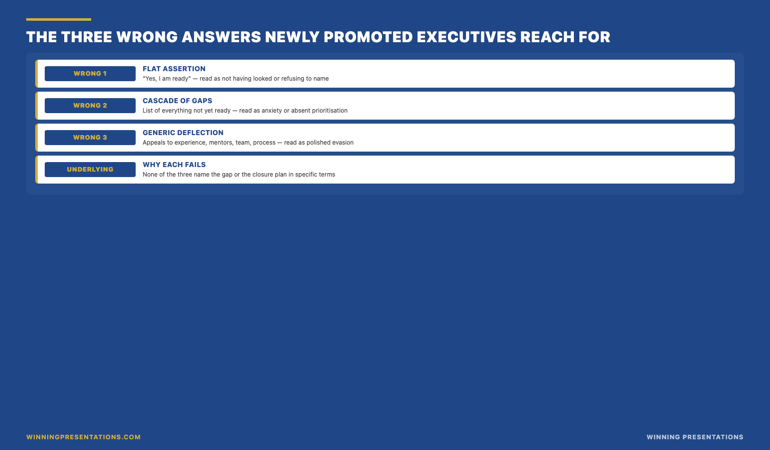
The physiological chain in Q&A vocal breakdown: stress response activates, breath shallows, throat tightens, pitch rises and pace accelerates — and the management approach that addresses each link

The Three Vocal Habits That Communicate Confidence in Q&A

Experienced Q&A presenters share three vocal habits that distinguish their answers from those of less practised colleagues. These habits are not naturally acquired — they are developed through deliberate practice and the sustained attention that comes from treating the Q&A as a performance discipline in its own right, not simply as the portion of the presentation that happens after the prepared content finishes.

The first habit is the deliberate opening. Experienced Q&A presenters begin their answer with a sentence that is slower and more measured than the pace they will settle into once the answer is underway. This first sentence functions as a vocal reset — it establishes the pace and register of the answer before the stress response has had time to accelerate either. The content of that first sentence is often relatively simple: a brief acknowledgement of the question, a restatement of the core point being addressed, or a one-sentence orientation. What matters is the vocal discipline, not the specific words.

The second habit is finishing sentences fully. Anxious answers trail off — the pitch drops, the volume reduces, and the final words of the sentence are swallowed before they have landed. This happens because the speaker’s attention is already moving to the next idea before the current one has been delivered. Deliberate sentence completion — ensuring that the last word of each sentence carries as much vocal energy as the first — is one of the most audible markers of vocal authority in Q&A. It communicates that the speaker is confident in their conclusion, not just their opening.

The third habit is ending on a lower note. Upward inflection at the end of a statement — a vocal pattern common in some regional accents and increasingly prevalent in professional speech — reads as a question or an invitation for the questioner to push back. A declarative answer delivered with downward inflection at the end of the key sentence communicates that the speaker has arrived at a conclusion, not a hypothesis. This single vocal adjustment — conscious in rehearsal, eventually habitual — changes the perceived authority of an answer even when the content is identical.

Physical stillness during the first sentence of an answer supports all three habits. The companion article on movement during presentations covers how physical grounding and deliberate stillness interact with vocal authority — the voice and the body reinforce each other, and managing one makes the other easier.

What to Do When Your Voice Catches Mid-Answer

A voice catch — the brief loss of vocal control that produces a crack, a break in sound, or a sudden increase in pitch mid-sentence — is one of the most disconcerting experiences for a presenter in a high-stakes Q&A. It is involuntary, it is visible to the room, and it produces an immediate self-consciousness that makes the next few seconds of the answer harder to manage than they would otherwise have been.

The most important single thing to know about a voice catch is that the audience’s interpretation of it is shaped almost entirely by what the presenter does immediately afterwards. A voice catch followed by a confident continuation of the answer at the same pace and pitch is read by most audiences as a normal human response to pressure — something that happens, noted briefly, and then forgotten. A voice catch followed by visible distress, a sharp intake of breath, or a halting restart amplifies the moment and makes it the thing the audience remembers.

The practical recovery sequence for a voice catch in Q&A is brief and simple. Pause for one full second — not in the way that signals panic, but in the deliberate way that signals that you are choosing your next words carefully. Take a breath during that pause — not a visible gasp, but a natural breath that replenishes the air support the voice needs. Resume the sentence from the point where the catch occurred, at a slightly slower pace than before, with full sentence completion on the next thought. The pause absorbs the catch; the resumption defines what the room remembers.

For managing the broader Q&A dynamic when questions feel adversarial or when the room has turned against a position, the article on hostile questioner simulation covers how to practise the specific pressure scenarios that make voice catches most likely — and how rehearsed exposure to those scenarios reduces their impact.

For executives who want a systematic approach to managing the full Q&A session, the Executive Q&A Handling System covers the preparation, response structure, and in-the-moment disciplines that experienced Q&A presenters use in board, investor, and senior leadership contexts.


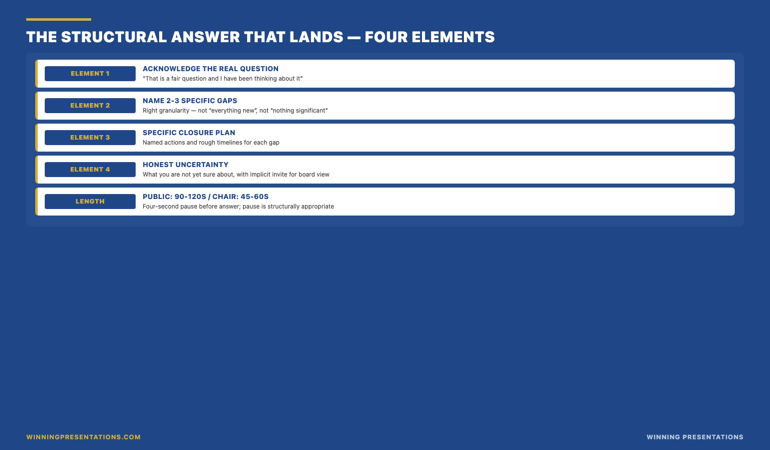
Q&A vocal authority framework showing the three vocal habits of experienced presenters: deliberate opening sentence, full sentence completion, and declarative downward inflection — with examples of each

Pre-Q&A Vocal Preparation in Under Five Minutes

The quality of your vocal performance in Q&A is influenced by your physical and vocal state when the Q&A begins — not only by the techniques you apply once questions start arriving. Five minutes of deliberate preparation before the session begins can meaningfully change your baseline vocal state at the point of transition from presentation to questioning.

Breath is the starting point. Three to five slow, extended exhales — longer than feels natural, emptying the lungs more fully than normal breathing — activate the parasympathetic nervous system and reduce the cortisol-driven activation that constricts the throat and raises pitch. This exercise is not meditative — it is physiological. The extended exhale is the most effective single technique for reducing the physical tension that will otherwise manifest as vocal deterioration when the first question arrives. Do this in a private space in the final few minutes before the session begins.

Speaking aloud at your intended vocal register for two to three minutes before the session also helps to warm the vocal mechanism and establish the pace and pitch you intend to use. This does not require a formal warm-up — reading a few paragraphs from any document at the pace and register you intend to use in the Q&A is sufficient. The purpose is to make that vocal setting feel normal before the pressure of the session makes accessing it harder.

One additional preparation that experienced Q&A presenters use is rehearsing the first sentence of several different types of answer out loud. Not the full answer — just the opening sentence for a factual question, a challenge question, and a question requiring a more nuanced response. The purpose is not to script the answers, but to make the physical and vocal experience of beginning an answer feel familiar. When the first question arrives and the stress response activates, having said something similar out loud in the preceding ten minutes makes the opening discipline easier to access.

The Pause That Resets Vocal Authority in Live Q&A

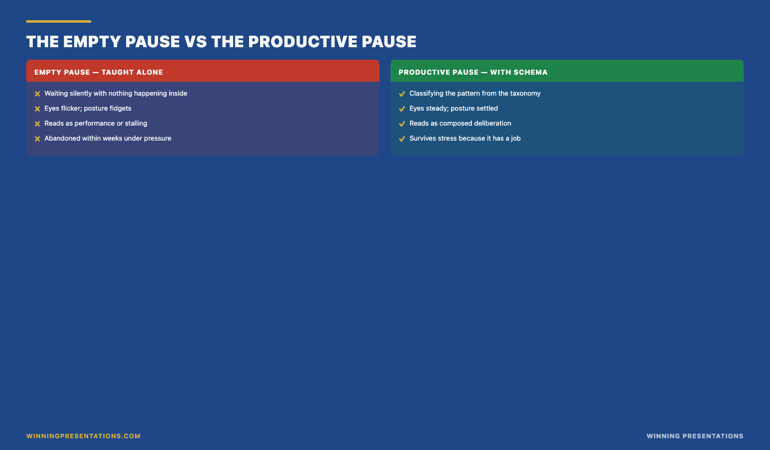
The deliberate pause before answering a question is one of the most consistently underused tools in executive Q&A. Most presenters begin answering before they have fully formed the answer — because the social pressure of a question feels like a demand for an immediate response, and silence in a group setting feels like exposure. Both of these are perceptions rather than realities. Senior audiences do not experience a two-second pause as emptiness. They experience it as the presenter taking the question seriously.

The pause serves two distinct functions. The first is cognitive — it gives you time to hear the question fully, decide what the core point is, and formulate the first sentence of your answer before you begin speaking. Answers that start well tend to continue well; answers that start with an unformed thought often recover but do so less authoritatively than an answer that opened from a clear position. The pause buys the time to start well.

The second function is physiological. A deliberate pause — not an anxious silence, but a conscious and intentional beat — allows for one full breath before the answer begins. That breath changes the vocal output of the answer. It deepens the register slightly, reduces the pace of the opening sentence, and sets a physical baseline that is closer to composed than to reactive. The pause is the single most accessible in-the-moment vocal management tool available to Q&A presenters, and it works every time it is applied deliberately.

The pause works best when the presenter has already established an expectation of thoughtfulness with the room — when the question has been heard fully, acknowledged briefly (“that’s the right question to raise”), and then a one-beat pause taken before the answer begins. In this context, the pause feels like part of the engagement, not like a moment of difficulty. For more on the mechanics and application of the deliberate pause in executive presentations, the article on the pause technique in presentations covers how silence functions as an authority signal and how to use it without it feeling awkward.

For executives who face structured Q&A challenges — where questioners are persistent, where questions are designed to expose gaps in the position, or where the same objection appears in multiple forms — the article on anticipating executive objections before the session covers the preparation framework that makes the in-session vocal management techniques more effective. Vocal control is significantly easier when the answer is already well-formed before the question is asked.

Executive Q&A Handling System — £39, instant access

A Complete Framework for Predicting, Preparing, and Handling Executive Q&A

The Executive Q&A Handling System gives you the preparation framework and response structures experienced executives use to maintain authority through difficult, unexpected, and adversarial questions — including the vocal and physical disciplines that distinguish composed Q&A presenters from those who lose ground under questioning.

Get the Executive Q&A Handling System →

Designed for executives presenting to boards, investors, and senior leadership teams where Q&A is high-stakes.

Frequently Asked Questions

Why does my voice rise in pitch when I answer questions from very senior people?

Pitch rises under pressure because the muscles of the throat and larynx tighten when cortisol and adrenaline are elevated — and senior questioners typically produce a higher activation response than peers or subordinates. The tighter the throat musculature, the higher the pitch. The direct management approach is breath-first: an elongated exhale before beginning the answer reduces the muscle tension that is raising the pitch. This approach works physiologically rather than trying to consciously lower the pitch, which most people cannot do reliably under genuine pressure.

How long should the pause before an answer be in executive Q&A?

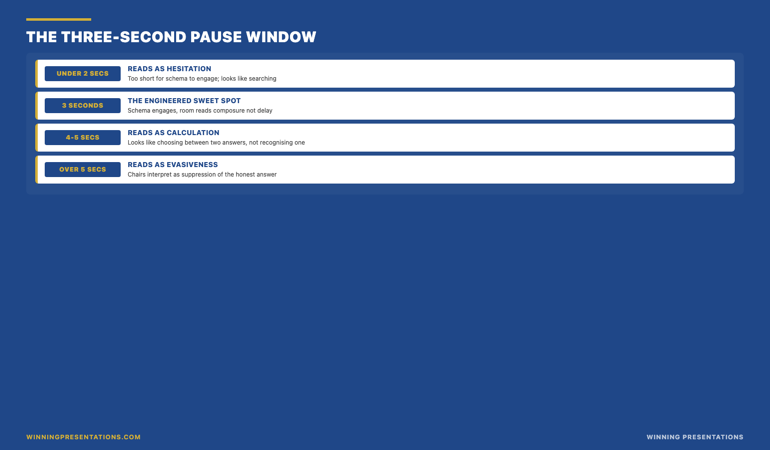
One to two seconds is the most effective range for a deliberate pause before beginning a Q&A answer in most executive contexts. Shorter than one second and the pause does not register as intentional — it simply disappears into the rhythm of the conversation. Longer than three seconds in a standard Q&A context begins to feel like difficulty rather than deliberateness, unless the question is genuinely complex and the pause has been framed explicitly (“let me think about that for a moment”). The one-to-two second pause, combined with a brief breath, is long enough to change the physiological state and short enough to read as thoughtful rather than uncertain.

Does practising Q&A out loud actually make a difference to vocal performance in the room?

Yes — and the mechanism is specific. When you practise answering questions out loud at the pace and register you intend to use, you are building a physical and vocal memory of that state. When the pressure of the actual Q&A activates the stress response, your nervous system has a reference point for what the correct vocal state feels like from the inside. Without that reference, you are trying to access a physical state you have not recently inhabited. With it, you are trying to return to somewhere familiar. The difference in accessibility is significant, particularly in the critical first few seconds of the first answer.

The Winning Edge — Weekly Newsletter

One Insight Per Week on Executive Communication

Each week, The Winning Edge delivers one focused insight on executive communication — structure, delivery, influence, and the mechanics of getting senior audiences to yes. Straightforward, applicable, and written for people who present under pressure.

Subscribe to The Winning Edge →

About the Author

Mary Beth Hazeldine — Owner & Managing Director, Winning Presentations

With 25 years of corporate banking experience at JPMorgan Chase, PwC, Royal Bank of Scotland, and Commerzbank, Mary Beth now advises executives across financial services, healthcare, technology, and government on structuring and delivering high-stakes presentations — including the Q&A sessions that determine whether a well-prepared case is accepted or challenged. Winning Presentations is her specialist advisory practice.

07 Apr 2026

The Hostile Questioner Simulation: Stress-Test Your Answers Before the Room Does

Quick answer: A hostile questioner simulation is a structured rehearsal exercise in which colleagues challenge your answers under conditions that mimic the pressure of the real executive meeting. It is the most reliable way to identify the gaps in your Q&A preparation before those gaps become visible in the room. The simulation works because it compresses the emotional and cognitive conditions of real Q&A into a controlled environment where you can practise and adjust without consequences.

Kenji had prepared more thoroughly for this board presentation than for any other in his career. He had rehearsed the deck twice, reviewed the financial model, pre-read the board papers, and anticipated six questions he thought were likely. When the Non-Executive Director challenged him on a specific assumption in the revenue model — an assumption that was methodologically sound but superficially easy to attack — Kenji answered competently. But he felt his voice tighten. He heard himself become slightly defensive. He watched the NED’s expression shift from interrogative to satisfied.

After the meeting, his CFO told him the presentation had gone well overall, but flagged the moment with the NED. “You answered correctly,” she said. “But you looked rattled. That matters in a room like this.” Kenji asked what he should have done differently. “You needed to have been in that moment before,” she said. “The answer wasn’t the problem. The unexpectedness was the problem.”

The CFO’s observation points to something that conventional Q&A preparation almost always misses. Preparing answers to likely questions is necessary but not sufficient. What determines performance under hostile Q&A is not primarily whether you know the answer — it is whether you have experienced the emotional and physiological conditions of challenge before you walk into the room. That experience is what the simulation creates.

The hostile questioner simulation is, at its core, an inoculation exercise. It does not eliminate the discomfort of challenge — it reduces its novelty, which reduces its power to destabilise.

Preparing for high-stakes Q&A?

The Executive Q&A Handling System is a structured approach to predicting and preparing for executive Q&A — including frameworks for anticipating hostile question patterns and building answers that hold up under scrutiny.

Explore the System →

The Problem With Traditional Q&A Preparation

The standard approach to Q&A preparation involves compiling a list of likely questions and drafting answers to each. This is useful — and should remain part of any preparation process — but it has two significant limitations that become visible only under real conditions.

It optimises for content, not for performance under pressure. A well-drafted answer in a preparation document is produced in conditions of low stress, unlimited time, and no social consequence for a weak response. The same answer, delivered under challenge from a sceptical Non-Executive Director, is produced under entirely different conditions. The cognitive load is higher. The emotional stakes are visible. The time pressure is real. The answer that looked clean on paper often sounds hesitant, over-hedged, or defensive in the room.

It cannot anticipate the follow-up. Hostile questioners rarely accept a first answer and move on. They push — often with a follow-up that accepts the substance of your answer while attacking the framing, or that redirects to a related vulnerability. A preparation document can anticipate the first question. It cannot anticipate the third exchange in a sequence, because that exchange depends on the specific choices made in the first two. Only a live simulation can generate the genuine unpredictability of an experienced interrogator.

These limitations do not mean that written preparation is unhelpful — they mean that it is incomplete. The simulation fills the gap between preparation and performance.

Why Hostility in Q&A Follows Predictable Patterns

Hostile Q&A in executive settings is not random. It follows a small number of recurring patterns that can be anticipated and prepared for specifically. Understanding these patterns transforms the simulation from a general stress-exposure exercise into a targeted preparation tool.

The stress test. The questioner pushes on a position not because they necessarily disagree with it, but to assess how you handle pressure. The question is often framed as a challenge to your methodology, your assumptions, or your confidence in the conclusion. The intent is less about the content and more about observing how you respond when challenged. The indicator is the quality of your second answer — the one you give after you have been pushed.

The loaded premise. The question contains an embedded assumption that, if accepted, positions any answer as a concession. “Given that your team has consistently missed this metric for the past three quarters…” is a loaded premise — it accepts as given something that may be contested. Accepting the premise before answering it transfers control of the narrative to the questioner. The correct response is to address the premise explicitly before answering the question.

Scope expansion. The questioner uses your answer to a specific question as a bridge to a broader topic that you may be less well prepared for. “You’ve addressed the operational impact — can you also speak to the regulatory exposure?” moves from a territory you anticipated to one you may not have. The effective response is to acknowledge the legitimacy of the broader question while clearly framing what you can answer now and what requires further analysis. For related patterns, see this guide on handling hostile questions in board meetings.

The authority challenge. The questioner questions your credentials to make the assertion rather than questioning the assertion itself. This is particularly common in cross-functional presentations where the presenter is speaking on topics that touch another executive’s domain. The authority challenge is a social manoeuvre as much as an intellectual one — and responding to it as if it were purely intellectual often misses the dynamic.

The Three-Layer Simulation Framework

The most effective hostile questioner simulations are structured in three layers of escalating intensity. Each layer serves a different function in the preparation process, and all three should be completed in the sequence below for maximum benefit.

Five-step framework for running an effective hostile questioner simulation before executive presentations

Layer one — Question mapping. Before any live simulation, conduct a systematic mapping of the questions most likely to arise and the questions you most hope will not. These are different lists and both are necessary. The first list drives the content of your written preparation. The second list drives the focus of your simulation — because the questions you hope will not arise are almost certainly the ones a hostile questioner will reach for. A useful exercise at this stage is to brief a colleague on your presentation content and ask them to identify the three points they would push on if they were seeking to challenge your credibility. Their perspective as an intelligent insider is often more accurate than your own assessment of where you are vulnerable.

Layer two — Structured challenge session. With one or two colleagues briefed on your material and given explicit instructions to challenge hard, run a full Q&A session lasting 20 to 30 minutes. The challengers should cover all four hostile question archetypes — stress test, loaded premise, scope expansion, and authority challenge — and should push back on first answers rather than accepting them. You should respond as you would in the real room: under time pressure, without notes, and without stopping to explain yourself mid-answer. The session should feel uncomfortable — that discomfort is the point.

Layer three — Gap analysis and refinement. Immediately after the simulation, while the experience is fresh, identify every question where you hesitated, gave a weak answer, or felt rattled. These are your priority preparation targets. For each one, write a revised answer — clear, specific, and no longer than 60 seconds when spoken aloud. Then return to your challengers for a focused second session covering only the gap questions. This second session is typically shorter (10 to 15 minutes) and produces the most significant improvement in both content quality and delivery confidence.

The Executive Q&A Handling System

A structured system for predicting and handling executive Q&A — designed for high-stakes presentations where the questions are as consequential as the content.

  • Framework for predicting the questions most likely to arise in any executive meeting
  • Structured approaches for handling the four main hostile question archetypes
  • Answer frameworks that hold up under follow-up pressure
  • System for building and maintaining an executive Q&A preparation habit

Get the Executive Q&A Handling System — £39

Designed for executives preparing for Q&A in high-scrutiny board and leadership meetings.

How to Recruit Your Internal Challengers

The quality of the simulation depends almost entirely on the quality of the challengers. A colleague who softens their challenge to avoid causing discomfort defeats the purpose of the exercise. Recruiting the right people — and briefing them correctly — is as important as the simulation itself.

Select challengers with genuine subject knowledge. The most effective challengers are people who know your subject well enough to identify real weaknesses — not people who will ask generic difficult questions. A colleague from finance, risk, or a directly adjacent function is usually a better challenger than a generalist, because they can probe the same dimensions a real hostile questioner would. Their challenge will land closer to the actual vulnerability than the challenge of someone working purely from the question list you have given them.

Brief them to be genuinely uncomfortable to answer. The default social behaviour of a colleague asked to challenge you is to be challenging-but-supportive — to push but pull back before causing real discomfort. This instinct is natural and must be explicitly overridden. Your brief to your challengers should include a clear instruction: “I need this to feel like the worst version of the real meeting. Don’t ease up. If I look rattled, that’s useful information.” Without this explicit permission, most colleagues will moderate their challenge.

Brief them on the four hostile archetypes. Give each challenger a written brief that includes the four main hostile question types — stress test, loaded premise, scope expansion, authority challenge — and ask them to use each at least once across the session. This ensures that your simulation covers the full range of challenge you might face, rather than focusing on the most obvious lines of questioning. For related preparation strategies, see the companion article on addressing objections before they are raised in Q&A.

The Executive Q&A Handling System includes a structured framework for predicting and preparing for the specific question archetypes most likely to arise in your meeting context.

Running the Simulation: Rules and Format

The following rules make the simulation as useful as possible. Each rule addresses a common shortcut that reduces the exercise’s effectiveness.

Four hostile question archetypes that executives should prepare for in Q&A simulation exercises

No stopping to explain. In the real meeting, you will not be able to pause, step out of your presenter role, and explain what you meant to say. The simulation should replicate this condition exactly. If you give a weak answer, it stands — you do not get to revise it mid-session. The discipline of living with imperfect answers in the simulation is what makes the experience useful. Stopping to explain converts the simulation into a seminar, which has no preparation value.

No notes for your answers. Your challengers may have notes. You should not. If you answer from notes in the simulation, you will not develop the cognitive pathways that allow you to construct clean answers under real pressure. The simulation is specifically designed to build those pathways through repetition under stress. Notes short-circuit the process.

Record the session. The most valuable data from a simulation is the difference between how you thought you performed and how you actually performed. These two assessments are almost never identical. Recording the session — even audio only — allows you and your challengers to review specific moments with precision rather than relying on impressions. Pay particular attention to pace, to hedging language, and to the quality of your second answers after a follow-up challenge.

Do not debrief immediately. The instinct after a difficult simulation is to debrief in the same room, immediately. Resist this. Allow 30 minutes before reviewing the recording or discussing the session. The initial emotional response to being challenged — even in a safe environment — can distort the analytical assessment. A brief gap allows you to separate the experience of the challenge from the evaluation of your performance, and produces more accurate identification of genuine gaps. For the parallel challenge of managing risk committee scrutiny, see this guide on identifying Q&A blind spots before risk committee meetings.

Processing the Feedback Without Defensiveness

The feedback from a simulation is inherently personal — it reveals gaps in your preparation, weaknesses in your argumentation, and moments where your composure broke down. Receiving this feedback without defensiveness requires a specific mindset that is worth establishing explicitly before the session begins.

Treat gaps as information, not as judgements. A gap identified in a simulation is a gap you can address before the meeting. A gap that surfaces for the first time in the real room cannot be addressed — it simply becomes part of the record of that meeting. The simulation’s purpose is to surface gaps in a context where they are correctable. Receiving that information with gratitude rather than defensiveness accelerates the preparation cycle.

Distinguish between content gaps and performance gaps. Some weaknesses revealed in a simulation are content gaps — the answer is genuinely incomplete or the analysis has a real hole. Others are performance gaps — the content is sound but the delivery under pressure was unclear, defensive, or hesitant. These require different responses. Content gaps require further analysis and a revised answer. Performance gaps require repetition — giving the same answer again, more cleanly, until the delivery matches the quality of the content.

Focus debrief time on the follow-up questions. The most revealing moments in any simulation are typically the third or fourth exchange in a sequence — when the initial answer has been challenged and the follow-up challenges have been layered on top. These late-sequence exchanges are where real preparation is tested, and where most presenters discover they run out of both content and composure simultaneously. The debrief should spend proportionally more time on these multi-exchange sequences than on standalone questions that were answered well.

The Day-Before Refresh That Consolidates Gains

The gap between the simulation and the real meeting is where most of the preparation gains are consolidated or lost. A structured day-before refresh — distinct from the full simulation and shorter in duration — ensures that the improvements made during the simulation are accessible under real conditions.

Review the gap question list, not the full question list. The day before the meeting is not the time to rehearse answers to every possible question. It is the time to run through the specific questions where you identified gaps in the simulation — testing whether the revised answers are now clean and confident. Limiting the review to these priority questions prevents the cognitive overload that comes from attempting to rehearse everything.

Speak the answers aloud. Reading a preparation document silently is qualitatively different from speaking the answer aloud under conditions that approximate the real room. The day-before refresh should involve speaking — ideally in a physical posture similar to how you will present (standing if you will be standing, at a table if you will be seated). This physical rehearsal activates the motor memory of the delivery, not just the cognitive memory of the content.

Close with a confidence anchor. After the content review, spend five minutes reviewing the questions from the simulation that you answered well — cleanly, confidently, without hesitation. This is not indulgence; it is calibration. Entering a high-stakes Q&A with your recent mental reference points skewed toward difficulty produces a different physiological state than entering with a balanced recent reference — and that physiological state affects your first answer. The day-before refresh should end with evidence of your own competence, not with a catalogue of everything that could go wrong. For techniques specifically related to vocal control in the Q&A context, see the companion piece on using your voice to command the room during Q&A.

Build a System for Predicting Executive Q&A

The Executive Q&A Handling System gives you a structured approach to anticipating the questions most likely to arise in any executive meeting — so your simulation starts from the right question list.

View the Executive Q&A Handling System — £39

Designed for executives preparing for high-scrutiny board and leadership Q&A.

Frequently Asked Questions

How far in advance of the presentation should I run the simulation?

The ideal timeline is to run the main simulation two to three days before the presentation, leaving sufficient time to address the gaps identified and conduct a shorter second session. Running the simulation the evening before leaves insufficient time for meaningful gap-closing. Running it more than a week before allows too much time for the specific emotional and cognitive experience of being challenged to fade, reducing its inoculation effect. If you can only conduct one session, two days before is the optimal timing.

What if I don’t have access to knowledgeable colleagues who can challenge me effectively?

There are two alternatives. The first is to brief a generalist colleague on the question archetypes and give them a written list of challenging questions drawn from your question mapping exercise. While a generalist challenger cannot probe the content as deeply as a subject-matter colleague, they can still generate the social and emotional experience of challenge — and that experience has preparation value even without deep content knowledge. The second alternative is self-simulation: recording yourself presenting, then reviewing the recording as a hostile questioner would, identifying every point where a challenge could be mounted and drafting answers. This is less effective than live simulation but more effective than written preparation alone.

How do I handle a question in the real meeting that I genuinely cannot answer?

Acknowledge it clearly and commit to a specific follow-up. “I don’t have the precise data in front of me — I’ll send it to you by end of day tomorrow” is a credible response that maintains trust. What undermines trust is either bluffing — attempting an answer you are not confident in — or over-hedging, which signals that you are uncertain about a wide range of things rather than one specific data point. The simulation is the safest place to practise saying “I don’t know” cleanly — to build the habit of using it precisely and without apology when the situation genuinely requires it.

The Winning Edge — Weekly Newsletter

Executive presentation strategy, delivered every Thursday. Frameworks for Q&A preparation, difficult questions, and high-stakes executive communication.

Subscribe to The Winning Edge

About the Author

Mary Beth Hazeldine is Owner & Managing Director of Winning Presentations. With 24 years of corporate banking experience at JPMorgan Chase, PwC, Royal Bank of Scotland, and Commerzbank, she advises executives across financial services, healthcare, technology, and government on structuring presentations for high-stakes funding rounds and approvals. Connect at winningpresentations.com.

06 Apr 2026
An executive presenting with calm authority at a boardroom table while a committee member leans forward with a pointed question, editorial photography style

Fishing Questions in Presentations: How to Respond Without Being Pinned Down

A fishing question is not asked because the questioner wants information. It is asked because the questioner wants a commitment — on record, in a room full of witnesses — before you are in a position to give one responsibly. Recognising a fishing question when it arrives, and responding in a way that is honest without being pinned down, is one of the most practically valuable Q&A skills an executive can develop.

Rafaela had been presenting the preliminary findings of a regulatory review to a committee that included two members with strongly opposing positions on the outcome. The presentation was going well — the data was solid, the structure was clear, and the room seemed engaged. Then one of the committee members, a senior partner who had been quiet throughout, leaned forward and asked: “So based on what you’ve found, would you say this falls within acceptable parameters or not?” Rafaela knew the question immediately for what it was. The analysis was not yet complete. She had flagged that explicitly in the introduction. But the question was framing the preliminary data as if it were a conclusion, and asking her to confirm a verdict that would effectively end the debate before the final report was delivered. A simple yes or no would have been wrong — not because she was hiding anything, but because the analysis genuinely did not support a definitive conclusion yet. What she needed was a response that was truthful, specific, and firm without being dismissive of the question. What she gave instead was a hedged non-answer that left the room uncertain about whether she was evading or genuinely uncertain. The committee member pressed again. She felt the moment slip. This guide covers what she should have done instead.

Facing high-stakes Q&A sessions where the questions are designed to corner you? The Executive Q&A Handling System gives you a structured system for predicting and responding to the questions that executives find hardest to handle. Explore the System →

What Fishing Questions Are — and How to Recognise Them

A fishing question has a specific structural signature: it frames a binary or forced choice and presents it as a neutral request for your assessment. “Would you say this is a risk or not?” “Is this on track or not?” “Do you think this is acceptable?” The framing appears reasonable — it sounds like the questioner is simply asking for your professional opinion. What it is actually doing is asking you to adopt a position publicly, in conditions that are designed to make the position hard to walk back.

The recognition signals are consistent. First, the question arrives before the relevant analysis is complete or before you are in a position to answer definitively. Second, it offers a binary or forced choice that does not reflect the genuine complexity of the situation. Third, it is asked in front of an audience — because a commitment made privately carries far less weight than one made in a room. Fourth, the questioner already has a preferred answer, and the question is structured to produce it.

Not every blunt or direct question is a fishing question. “What do you think will happen to margin in Q3?” is a direct question that deserves a direct answer. A fishing question is characterised by the mismatch between the certainty implied by its framing and the certainty that your evidence actually supports. When someone asks you to confirm a conclusion that your analysis does not yet justify, that is a fishing question — regardless of how reasonable it sounds.

The distinction matters because the response to a genuine direct question and the response to a fishing question are different. Responding to a genuine question with the caution appropriate for a fishing question signals evasiveness. Responding to a fishing question with the directness appropriate for a genuine question hands the questioner exactly what they were angling for.

Prepare for the Questions Designed to Corner You

The Executive Q&A Handling System gives you a structured approach to predicting, preparing for, and responding to the most challenging executive Q&A scenarios — including the fishing questions, stress tests, and loaded questions that catch executives off guard.

  • ✓ System for predicting and preparing for difficult Q&A questions
  • ✓ Response frameworks for high-stakes executive questioning
  • ✓ Scenario playbooks for board, investor, and committee Q&A

Get the Q&A Handling System → £39

Designed for executives managing high-stakes Q&A sessions

Why Fishing Questions Work: The Psychology of Public Commitment

Fishing questions exploit a well-documented psychological dynamic: public commitments are sticky. Once you have stated a position in front of a group, you are motivated — consciously and unconsciously — to maintain consistency with that position. This is not a weakness. It is a social and professional norm that makes functioning organisations possible. But it can be leveraged against you by a questioner who understands its power.

The dynamic operates in two directions. If you answer “yes, this is within acceptable parameters,” and the final analysis reveals it is not, you are now on record as having misjudged the situation. If you answer “no, it is not acceptable,” you may have committed to a position that the full data does not support, foreclosing options that the complete analysis might have kept open. The questioner wins either way — they have created a record that serves their position, and they have done it using your words.

The social pressure of the room amplifies this dynamic. When a question is asked in front of an audience, silence feels evasive, qualification sounds weak, and refusal to engage appears defensive. The questioner has created conditions in which the most comfortable response — giving a direct answer — is also the most dangerous one. This is why fishing questions are effective: not because they are logically compelling, but because they make the responsible answer psychologically difficult to deliver.

Understanding this mechanism is the first step toward managing it. When you recognise that the discomfort you feel is a function of the question’s design rather than a signal that you should comply with its framing, you can respond from a position of clarity rather than pressure. For a wider framework on recognising questions that are designed to set you up before they are even fully asked, our guide to recognising loaded questions in presentations covers the full taxonomy of adversarial question types.

The Response Framework: Honest, Specific, and Not Pinned Down

The effective response to a fishing question has three components, delivered in sequence. The first is an acknowledgement of the question’s premise — not agreement with its framing, but recognition that a real issue is being pointed at. “That is a central question, and it is one I want to answer accurately.” This buys a moment and signals engagement rather than evasion.

The second component is a statement of what you can say definitively, based on what you know. Not a hedge, not a qualification — a specific statement of fact. “What I can tell you with confidence is that the data we have reviewed to date shows X.” This demonstrates that you are not avoiding the question, you are giving the questioner the most accurate information available. Specificity is credibility. A vague non-answer and a precisely framed limitation are received very differently by a room.

The third component is a statement of what would be required to answer the full question. “A definitive assessment of whether this falls within acceptable parameters requires the completion of the analysis in section four, which we expect to have by the end of this month.” This is not a delay tactic. It is a statement of epistemic honesty — you are telling the room what you do not yet know and what would change that. This framing converts apparent evasion into professional rigour.

Together, these three components produce a response that is honest, specific, and firm without handing the questioner the commitment they were seeking. The key is the absence of hedging language in the second component. “What I can tell you with confidence is…” is a strong statement. “I think, based on what we have seen so far, it might suggest…” is a weak one that signals uncertainty and invites the questioner to push harder.

The Executive Q&A Handling System provides the full response architecture for fishing questions and other adversarial Q&A patterns, with scenario playbooks for the contexts where these question types most frequently appear.

Fishing question response framework infographic: three steps — acknowledge the premise, state what you know definitively, and specify what is needed for a complete answer

Common Forms of the Fishing Question and How Each Works

Fishing questions appear in several recurring forms, each with a slightly different mechanism. Recognising the form helps you identify the intent faster, which gives you more time to compose the response before the pressure of the room builds.

The binary verdict request. “Is this acceptable or not?” “Is this on track or not?” This is the most direct form. It offers two options and implies that a refusal to choose one is itself a choice — specifically, a suspicious one. The effective response names the binary as a false choice: “The right answer to that question is more nuanced than a yes or no, and I want to give you the accurate one.”

The premature conclusion invitation. “So based on what you’ve shown us, would you say this confirms X?” This form presents a tentative interpretation as if it flows naturally from your data, and invites you to confirm it. The problem is that the interpretation may go further than your data supports. The response: “The data is consistent with X as one interpretation, but it is also consistent with Y — the full analysis will allow us to distinguish between them.”

The hypothetical commitment trap. “If the final figures come in below target, would you support restructuring?” This asks you to commit to a future action based on a hypothetical — which is doubly problematic, because the hypothetical may not materialise, but the commitment is real and immediate. The response: “I would want to see the complete picture before making a recommendation on restructuring. What I can say is that if figures come in below target, we will need a structured response, and I am prepared to be part of developing that.”

The attribution test. “You’re the expert here — what’s your gut feeling?” This flatters you into bypassing analytical rigour and substituting intuition for evidence. The answer your gut provides is then on the record, divorced from any analytical caveat. The response: “My professional assessment is that we need the full analysis before I can be confident in a recommendation — and a gut feeling in a situation this consequential is not a substitute for that.”

Four common forms of fishing questions in executive presentations: binary verdict, premature conclusion, hypothetical commitment, and attribution test — with response approaches for each

When the Questioner Presses After Your First Response

A skilled fishing questioner will press after your first response. They know that most people will hold their ground once but will concede under repeated pressure — particularly in a public setting where silence is uncomfortable and the questioner appears persistent. The second press is often the moment that matters most.

When a questioner presses, resist the instinct to soften your position or offer additional qualification. Softening signals that your first response was not fully confident, and invites a third attempt. Instead, hold your original framing and restate the key point more briefly: “As I said, I cannot give you a definitive answer on this until the analysis is complete. I understand that is frustrating, and I will make sure you have the full picture as soon as it is available.” Brevity signals confidence. A longer explanation of why you cannot answer suggests you feel you need to justify the position, which creates the impression that it is negotiable.

If the questioner continues to press, naming the dynamic is a legitimate tool — used carefully, and without accusation. “I notice we are coming back to this question, and I want to be transparent about why I am holding the same position: the analysis is not yet at the stage where I can responsibly give you the answer you are looking for. That is not evasion — it is professional accuracy.” This shifts the frame from “the presenter is being difficult” to “the presenter is being rigorous,” and it does so in a way that the room can follow.

For guidance on the structured short-answer approach that works in high-pressure Q&A, our guide to the short answer framework for executive Q&A covers the technique of answering completely and confidently in fewer words — which is the single most effective defence against a questioner who uses repetition as pressure. And for the critical period after a difficult Q&A session, our guide to Q&A follow-up in the 48-hour decision window covers how to manage the aftermath when commitments were sought but not given.

Walk Into Every Q&A Session With a System

The Executive Q&A Handling System gives you the structured approach to predict, prepare for, and respond to every difficult question type — including fishing questions, stress tests, and loaded questions. £39.

Get the System Now → £39

Frequently Asked Questions

Is it ever appropriate to answer a fishing question directly?

Yes — when your analysis is complete and your evidence supports a definitive answer. A fishing question is only problematic when it asks you to commit to a position that your evidence does not yet justify. If you have the full data and the answer is clear, give it directly and with confidence. The distinction is not about the form of the question — it is about the relationship between the question’s framing and the state of your analysis. When the evidence supports the answer, there is no reason to withhold it.

How do I avoid appearing evasive when I decline to give a direct answer?

The key is specificity. Evasion sounds vague: “It is complicated, there are a lot of factors…” Professional accuracy sounds precise: “What I can confirm is X. What I cannot yet confirm is Y, because we do not have the Z data.” Specificity about what you know and what you do not know reads as rigour, not evasion. Vagueness reads as evasion regardless of your intent. Always name the specific thing you cannot yet confirm and the specific condition that would allow you to confirm it.

Can I prepare for fishing questions before a presentation?

Yes — and this is one of the highest-value forms of Q&A preparation. Before any high-stakes presentation, identify the two or three questions where someone who disagreed with your preliminary findings or wanted to force a premature conclusion would most likely press you. For each one, prepare your three-component response in advance: what you can confirm, what you cannot, and what would change that. Practising this structure before the session means that when the fishing question arrives, you are not improvising under pressure — you are delivering a prepared response that sounds thoughtful and confident because it is.

The Winning Edge

Weekly insights on executive presentations, Q&A strategy, and boardroom communication.

Subscribe Free

If the morning of a Q&A-heavy presentation is a source of anxiety for you, our guide to the morning presentation protocol covers the two-hour routine that builds readiness and manages the physiological stress response before you walk into the room.

About the author

Mary Beth Hazeldine, Owner & Managing Director, Winning Presentations. With 24 years of corporate banking experience at JPMorgan Chase, PwC, Royal Bank of Scotland, and Commerzbank, she advises executives across financial services, healthcare, technology, and government on structuring presentations for high-stakes funding rounds and approvals.

04 Apr 2026
Executive confidently responding to data questions during a board presentation with financial charts visible on screen, editorial photography

Data Questions in Presentations: How to Defend Your Numbers Under Pressure

Data questions in presentations are rarely about the data. They are about trust. When a board member challenges your numbers, they are testing whether you understand the assumptions behind them, the limitations within them, and the decisions they should and should not support. Here is how to defend your data under pressure without losing credibility or the room.

Ingrid was presenting the quarterly revenue forecast to the executive committee of a mid-market technology firm. Slide six showed a projected twelve percent growth in recurring revenue, driven by three new enterprise contracts expected to close in the next quarter. The CFO leaned forward. “Ingrid, the pipeline conversion rate you’ve used here is forty-two percent. Our actual conversion rate for the last four quarters has averaged thirty-one percent. Walk me through why you’ve used a different number.” She had used the higher figure because it reflected the conversion rate for enterprise deals specifically, which historically closed at a higher rate than the blended average. But she hadn’t flagged the distinction on the slide or in the supporting notes. She knew the answer—but the ten seconds it took her to locate the rationale in her memory felt, to the room, like hesitation. The CFO’s eyebrows rose. The CEO looked down at his notes. Ingrid recovered well, explaining the enterprise-specific rate and offering to share the supporting data by email. But the damage was subtle and real: for the remainder of the presentation, every number was scrutinised more carefully. She had been credible at slide five. By slide seven, she was being audited. The issue wasn’t the data. It was the gap between her preparation and her presentation of it.

Preparing for a data-heavy presentation with Q&A? The Executive Q&A Handling System includes frameworks and response structures designed for high-scrutiny presentation environments.

Why Data Challenges Are About Trust, Not Accuracy

When someone challenges a number in your presentation, the instinct is to defend the number. This is almost always the wrong response. The question behind the question is not “Is this number correct?” It is “Do you understand what this number means well enough for me to trust the decision you’re asking me to make?”

Data questions in presentations serve a governance function. The board member or senior executive who challenges your figures is not trying to embarrass you. They are building their own confidence that the data has been properly interrogated before it reaches them. Your job is not to prove the number is right. Your job is to demonstrate that you understand its provenance, its limitations, and its implications for the decision at hand.

This reframing changes your preparation entirely. Instead of preparing to defend every number, prepare to explain the three to five numbers that are most likely to be challenged—the ones with the biggest assumptions, the widest confidence intervals, or the greatest impact on the recommendation. Know the source. Know the methodology. Know the alternative interpretation. And know what your recommendation would be if the number were materially different.

The executive who responds to a data challenge with “The number is correct—it comes from our CRM” is defending accuracy. The executive who responds with “That number reflects our enterprise conversion rate over the last six quarters. If we used the blended rate instead, the forecast would be eight percent rather than twelve. My recommendation wouldn’t change, but the confidence interval would widen” is demonstrating mastery. The first response ends the question. The second response earns trust.

Handle Data Scrutiny With Authority

The Executive Q&A Handling System gives you response frameworks and preparation structures for high-scrutiny presentations—so you defend your numbers with the confidence the room expects.

  • ✓ Q&A response frameworks for executive settings
  • ✓ Preparation templates for data-heavy presentations
  • ✓ Techniques for handling hostile and unexpected questions

Get the Q&A Handling System → £39

Designed for executives who face data scrutiny in high-stakes presentations

Assumption Transparency: The Defence That Prevents the Attack

The most effective defence against data questions is to answer them before they’re asked. Assumption transparency—stating your key assumptions on the slide rather than hiding them in a footnote or an appendix—removes the adversarial dynamic entirely. When you proactively disclose that “this forecast uses enterprise-specific conversion rates (42%) rather than the blended rate (31%),” you’ve eliminated the challenge before the CFO can formulate it.

This approach works because it reverses the power dynamic. When the audience discovers an assumption themselves, it feels like catching you out. When you disclose it proactively, it feels like rigour. The data is identical. The perception is entirely different. Transparency converts a potential weakness into a credibility signal.

The practical implementation is an “Assumptions” callout box on any slide that presents modelled, projected, or estimated data. Keep it brief—three to five key assumptions, each in a single line. Position it at the bottom of the slide in a visually distinct format (grey text, smaller font, clearly labelled). This tells the audience: “I’ve thought about what underpins these numbers, and I’m confident enough to show my working.”

The assumptions you choose to disclose also signal what you consider material. Listing every assumption suggests you’re unsure which ones matter. Listing three tells the audience these are the ones you’ve stress-tested because they have the greatest impact on the recommendation. This selectivity is itself an act of expertise—it shows you can distinguish between assumptions that affect the decision and assumptions that are technically interesting but practically irrelevant.

Assumption transparency framework showing proactive disclosure versus reactive defence in data presentations

The Three-Part Response to Any Data Challenge

When a data question arrives—and it will, regardless of your preparation—use a three-part response structure that maintains credibility while addressing the challenge directly.

Part 1: Acknowledge the question’s legitimacy. “That’s an important distinction” or “You’re right to question that assumption.” This is not flattery—it is professional respect. It tells the questioner that you understand why the data point matters, which immediately reduces the adversarial temperature. A defensive response—“The data is sound”—escalates. An acknowledging response—“That’s a fair challenge”—de-escalates.

Part 2: Explain the methodology. State the source, the methodology, and the reason you chose this approach over alternatives. Be specific and brief. “We used the enterprise-specific conversion rate because the three pipeline deals are all enterprise contracts. The blended rate includes SME deals, which convert at a lower rate and aren’t represented in this quarter’s pipeline.” This takes fifteen seconds and demonstrates mastery.

Part 3: Address the implication. State what would change if the alternative assumption were used. “If we applied the blended rate, the projection would drop from twelve to eight percent growth. The recommendation to proceed with the hiring plan would still hold, though the timing would shift by one quarter.” This is the element that builds the most trust, because it shows you’ve already considered the alternative the questioner is proposing. You haven’t just defended your number—you’ve demonstrated that the decision is robust regardless. For more on the bridging technique for difficult questions, that guide covers how to redirect challenging questions without appearing evasive.

The three-part structure works because it addresses all three layers of the data challenge simultaneously: the emotional layer (acknowledgement), the technical layer (methodology), and the decision layer (implication). Most presenters only address the technical layer—and that’s why data challenges feel so uncomfortable. When you address all three, the questioner feels heard, informed, and reassured.

Anticipating Data Questions Before They Arrive

The most predictable data questions follow a pattern. For any presentation containing numerical analysis, audit each slide against five question types that appear in virtually every executive Q&A.

The Source Question: “Where does this number come from?” Prepare a one-sentence answer for every significant data point: the system, the report, the date range, and any manual adjustments. If you had to manipulate the data—filtering outliers, annualising partial data, converting currencies—disclose the methodology proactively or prepare the answer for Q&A.

The Comparison Question: “How does this compare to [last quarter / the industry / the target]?” Prepare context for every headline number. A twelve percent growth figure means nothing without comparison. Twelve percent against a target of fifteen is underperformance. Twelve percent against an industry average of four is outperformance. The questioner wants to calibrate your number against a reference point. Provide it before they ask.

The Sensitivity Question: “What happens if this assumption is wrong?” This is the data question that separates adequate presenters from authoritative ones. Prepare a sensitivity range for your three to five most impactful assumptions. Know what changes—and what doesn’t—when each assumption shifts by a material amount. For techniques on buying time during Q&A, that guide covers legitimate strategies for creating thinking space when unexpected questions arrive.

If you regularly present data-heavy material to senior audiences, the Executive Q&A Handling System provides the preparation frameworks that ensure you’ve anticipated the questions before you enter the room.

Five predictable data question types in executive presentations with preparation strategies

Recovering Credibility After a Data Stumble

If you’ve been caught off-guard by a data question—a number you can’t explain, an assumption you didn’t anticipate, a comparison you haven’t prepared—the recovery is more important than the stumble. How you handle the next sixty seconds determines whether the audience writes off the moment or writes off your presentation.

The recovery protocol has three steps. First, resist the urge to guess. An incorrect improvised answer is far more damaging than an honest acknowledgement. “I don’t have that specific breakdown in front of me” is a temporary gap. “I believe the number is roughly…” followed by an incorrect estimate is a credibility collapse.

Second, commit to a specific follow-up. Not “I’ll look into that”—which sounds vague and may never happen—but “I’ll send the detailed breakdown to the committee by end of business today.” The specificity of the commitment signals accountability. The timeline signals urgency. Together, they convert a moment of weakness into a demonstration of professional discipline.

Third, move forward with the presentation. Do not apologise repeatedly, do not circle back to the point, and do not let the stumble colour the rest of your delivery. The audience takes their cue from you. If you treat the moment as a minor administrative gap, they will too. If you treat it as a catastrophe, they will begin scrutinising every subsequent number with renewed suspicion. The stumble matters far less than the signal you send about it. For approaches to handling particularly hostile questions in board meetings, that guide covers the specific dynamics when data challenges carry political intent.

Prepare for Every Data Challenge Before You Enter the Room

Stop dreading Q&A. The Executive Q&A Handling System gives you the frameworks to anticipate, structure, and deliver authoritative responses to data scrutiny—for £39.

Get the Q&A Handling System → £39

Frequently Asked Questions

How do I handle a data question when the questioner has better data than I do?

Acknowledge their data immediately: “That’s a useful data point—thank you. My analysis used [source/timeframe]. If your figures reflect [their likely source], the difference may be [methodology/scope/date range]. I’d like to reconcile the two datasets after this meeting so we’re working from a single source going forward.” This response does three things: it validates their contribution, explains the discrepancy without being defensive, and proposes a constructive resolution. The worst response is to argue that your data is right and theirs is wrong—even if that’s true.

Should I include an appendix with detailed data for Q&A?

Always. An appendix with supporting detail is your safety net for data questions. Structure it as a set of backup slides that mirror your main presentation: for each core slide, prepare one or two appendix slides with the underlying data, the methodology note, the sensitivity analysis, or the comparison benchmarks. When a question arrives, you can say “I have the detailed breakdown—let me pull up the supporting slide.” This signals preparedness and converts Q&A from an interrogation into a collaborative data review.

What if a data challenge reveals a genuine error in my presentation?

Acknowledge it immediately, thank the person who spotted it, and assess the impact on your recommendation in real time. “You’re right—that should be thirty-one percent, not forty-two. Let me quickly assess whether that changes the recommendation.” If the recommendation holds, say so: “The conclusion is the same, but the margin is tighter. I’ll circulate corrected figures after the meeting.” If the error materially changes the recommendation, say that too: “This changes the picture. I’d like to revise the analysis and bring an updated recommendation to next week’s meeting.” Honesty in the moment of error builds more trust than a flawless presentation built on unchallenged assumptions.

The Winning Edge

Weekly insights on Q&A handling, executive presentations, and boardroom communication.

Subscribe Free

If data scrutiny also triggers anxiety about your credibility as a presenter, our guide to imposter syndrome in presentations covers the psychological patterns that make high performers feel like frauds under pressure.

About the author

Mary Beth Hazeldine, Owner & Managing Director, Winning Presentations. With 24 years of corporate banking experience at JPMorgan Chase, PwC, Royal Bank of Scotland, and Commerzbank, she advises executives across financial services, healthcare, technology, and government on structuring presentations for high-stakes funding rounds and approvals.

03 Apr 2026
Executive presenter confidently responding to a question from a senior colleague during a boardroom presentation

Off-Topic Questions in Presentations: How to Redirect Without Losing the Room

Off-topic questions in presentations are rarely accidental. They signal that someone in the room has an agenda that doesn’t align with yours, a concern that your presentation hasn’t addressed, or a need to demonstrate their own knowledge. How you redirect determines whether the room stays with you or fractures into competing conversations. Here’s how to handle it with authority and respect.

Soren was presenting a supply chain resilience update to the operations committee when the CFO interrupted with a question about headcount reductions in the logistics team. It had nothing to do with supply chain resilience—it was a budget question that belonged in the financial review the following week. But Soren had been in enough of these meetings to understand what was really happening. The CFO wasn’t confused about the agenda. He was signalling to the committee that cost management was his priority, regardless of the topic on the table. Soren had a choice: answer the headcount question and lose fifteen minutes of his allocated time, or dismiss it and create an adversary. He did neither. “That’s an important question, and I want to give it the detail it deserves,” he said. “The headcount numbers sit within the broader workforce planning paper for next week’s financial review. I’ll make sure you have the breakdown before that meeting. Can I continue with the resilience framework for the remaining time?” The CFO nodded. Soren kept the room. Crucially, he followed up the next morning with the headcount data. The CFO never interrupted him again.

Want a structured approach to handling difficult Q&A? The Executive Q&A Handling System includes frameworks for redirecting, bridging, and managing challenging questions in high-stakes meetings.

Why Off-Topic Questions Happen: The Four Hidden Motives

Understanding why someone asks an off-topic question changes how you respond. Most presenters treat off-topic questions as confusion—the asker didn’t understand the scope, didn’t read the agenda, or simply drifted. That’s occasionally true. More often, off-topic questions are strategic, and recognising the strategy allows you to respond with precision rather than frustration.

Motive 1: Territory marking. The asker wants to signal their own priority to the room. The CFO’s headcount question in Soren’s meeting wasn’t about headcount—it was about asserting that financial discipline is never off the table. Responding to the content of the question misses the real communication. Acknowledging the importance of the topic whilst redirecting to the appropriate forum addresses the motive without derailing your presentation.

Motive 2: Genuine concern that your presentation hasn’t addressed. Sometimes the off-topic question is a signal that your scope was too narrow for the audience. If three people in the room are worried about budget implications and your presentation only covers operational metrics, the “off-topic” budget question is actually the most important question in the room. Recognise this and adapt. “I can see the cost dimension is important to this group. Let me address that briefly before continuing.”

Motive 3: Status assertion. Some stakeholders ask off-topic questions to demonstrate their breadth of knowledge or their seniority. The question is not seeking information—it’s seeking acknowledgement. The response that works here is brief validation followed by a redirect: “You’re raising an important point about regulatory implications. That’s being addressed separately by the compliance team. Let me continue with the operational framework.”

Motive 4: Deliberate disruption. Occasionally, a stakeholder uses off-topic questions to derail a presentation they oppose. This is the most difficult motive to address because responding to each question consumes time, which is exactly the disruptor’s objective. The technique here is pattern recognition: after the second off-topic question from the same person, name the pattern gently. “I notice we’re pulling into several areas outside today’s scope. Can I suggest we complete the resilience framework first, then open the floor for broader discussion?”

Handle Every Q&A Scenario With Confidence

The Executive Q&A Handling System gives you frameworks for redirecting off-topic questions, bridging to your key messages, and managing challenging Q&A dynamics in high-stakes meetings.

  • ✓ Question redirection and bridging frameworks
  • ✓ Scenario guides for difficult Q&A situations
  • ✓ Preparation templates for anticipating challenging questions

Get the Q&A Handling System → £39

Designed for executives who face challenging Q&A sessions

The Acknowledge-Redirect Framework

The most effective technique for handling off-topic questions in presentations is the three-step Acknowledge-Redirect-Return framework. It takes ten to fifteen seconds when executed well, and it accomplishes three objectives simultaneously: it respects the asker, it protects your time, and it keeps the room focused.

Step 1: Acknowledge. Validate the question’s importance without engaging with its content. “That’s an important area.” “I can see why that’s on your mind.” “Good question—it connects to a broader issue.” The acknowledgement must be genuine, not dismissive. A perfunctory “good question” followed by an immediate redirect reads as patronising. Take half a second to make eye contact with the asker and ensure your tone conveys respect.

Step 2: Redirect. Name where and when the question will be addressed. Not “we’ll get to that later” (vague and often untrue) but “that sits within the workforce planning review next Thursday” or “I’d like to address that with you directly after the meeting, because it deserves more time than I can give it here.” Specificity is the difference between a redirect that satisfies and one that frustrates.

Step 3: Return. Explicitly bring the room back to your presentation. “Let me continue with the third element of the resilience framework.” Use a transitional phrase that reconnects to where you were, not where the question took you. This signals to the entire room that the presentation has a structure and that structure is being protected.

Soren’s response to the CFO followed this framework precisely. He acknowledged the importance (“That’s an important question”), redirected to a specific forum (“the financial review next week”), offered a concrete follow-up action (“I’ll make sure you have the breakdown”), and returned to his topic (“Can I continue with the resilience framework?”). The whole exchange took twenty seconds. For more on the bridging technique that underpins this framework, our guide on the bridging technique for difficult questions covers the full methodology.

The Acknowledge-Redirect-Return framework for handling off-topic questions in three clear steps

The Parking Lot Technique: When and How to Use It

The “parking lot” is a well-known facilitation technique: capture off-topic questions on a visible list (a whiteboard, a shared document, a slide) and commit to addressing them at a specific time. It works in workshop and training settings. It can also work in executive presentations, with modifications.

In executive settings, a literal parking lot list can feel patronising—senior leaders don’t appreciate seeing their questions written on a board to be dealt with later. The modification is to use a verbal parking lot: acknowledge the question, state that you’re noting it for the post-meeting follow-up, and then actually follow up. The “noting it” must be visible—write it down in your own notes so the asker sees the physical act of recording. This transforms the parking lot from a dismissal into a commitment.

When to use the parking lot: when the off-topic question is genuinely important but would consume more than two minutes of your allocated time. When not to use it: when the question is from the most senior person in the room (they expect an immediate response, even if brief), or when the question reveals a fundamental concern about your proposal that the room needs to hear addressed. Parking lot the former and you’ve protected your time. Parking lot the latter and you’ve avoided a conversation the room was ready to have.

The critical discipline is follow-through. If you park a question and never return to it, you’ve taught the room that the parking lot is where questions go to die. Send a follow-up email within 24 hours addressing every parked question in detail. This builds a reputation as someone who respects questions enough to answer them properly, even when the meeting didn’t allow time.

When the Off-Topic Question Comes From Someone Senior

Redirecting a peer is straightforward. Redirecting your CEO, your board chair, or your most important client requires a different calibration. Senior stakeholders operate with an implicit understanding that their questions take priority, regardless of the agenda. Dismissing their off-topic question—even politely—can be interpreted as poor political judgement.

The technique here is the “brief answer plus redirect.” Give a concise, thirty-second response to the substance of the question, then redirect to the appropriate depth. “The short answer is that headcount is flat year-on-year, with a reallocation of three roles from warehouse to analytics. The detailed breakdown is in next week’s workforce paper, and I’ll send you the summary tonight. Shall I continue with the resilience metrics?” You’ve answered the question, demonstrated knowledge, committed to follow-up, and asked permission to continue. The senior stakeholder feels heard. The room stays on track.

What you must never do is ignore the political dimension. If the CEO asks about headcount during your supply chain presentation, the correct response is not “that’s off-topic.” It’s politically astute to treat the CEO’s question as worthy of a brief answer, even if it technically doesn’t belong. The room is watching how you handle the power dynamic, not just how you handle the content. Handle it well and you build credibility. Handle it badly—either by capitulating entirely or by being dismissively efficient—and you lose political capital regardless of how good your presentation is.

Our guide on handling all-hands Q&A ambush scenarios covers the additional complexity of managing off-topic questions in large-audience settings, where senior stakeholders may use questions to make statements rather than seek answers.

For a complete library of Q&A handling frameworks—including redirection, bridging, and managing senior stakeholder dynamics—the Executive Q&A Handling System provides the structured approach that turns difficult Q&A sessions into opportunities to demonstrate executive judgement.

The Follow-Up That Prevents Repeat Offenders

The most overlooked element of handling off-topic questions in presentations is what happens after the meeting. Most presenters redirect the question, finish the presentation, and move on. The asker is left with an unresolved question and a memory of being redirected. Next meeting, they ask again—often more insistently.

Soren’s follow-up the next morning was the decisive action. By sending the CFO the headcount breakdown before the financial review, he accomplished three things. First, he honoured his commitment—which builds trust. Second, he provided the information in a format the CFO could review at his own pace—which is more useful than a rushed verbal answer in the wrong meeting. Third, he demonstrated that he takes the CFO’s priorities seriously—which transformed a potential adversary into a neutral participant.

Build a follow-up discipline: within 24 hours of any meeting where you redirect a question, send a targeted response to the person who asked it. Not a mass email to all attendees—a direct message to the individual. “Following up on your question about headcount during yesterday’s resilience review—here’s the breakdown.” This personal attention costs five minutes and prevents the question from resurfacing in your next three meetings.

For persistent off-topic questioners—people who consistently raise the same tangential concerns—a pre-meeting conversation is the structural fix. “I know workforce planning is a priority for you. I’m covering resilience metrics tomorrow. Would it be helpful if I included a one-slide summary of how workforce changes affect resilience, so we address both in one session?” This transforms the off-topic question into an on-topic element, satisfying the asker’s need without disrupting the flow. Our guide on trick questions in presentations covers the related skill of recognising when a question is testing your credibility rather than seeking information.

Master the Q&A That Makes or Breaks Your Presentation

Off-topic questions, hostile challenges, and senior stakeholder dynamics—the Executive Q&A Handling System gives you the frameworks for every scenario, for £39.

Get the System Now → £39

FAQ: Off-Topic Questions in Presentations

What if the off-topic question is actually more important than my presentation topic?

This happens more often than presenters acknowledge. If the room visibly engages with the off-topic question—heads nodding, other people adding to it—the room is telling you what matters to them right now. In this situation, rigid adherence to your agenda is counterproductive. Acknowledge the shift: “It’s clear this is the priority for this group right now. Let me address it directly, and we can return to the resilience framework in the remaining time or schedule a follow-up session.” Adapting to the room’s energy is a leadership skill, not a presentation failure.

How do I redirect without sounding dismissive?

Tone and specificity are the two factors. A dismissive redirect sounds like: “That’s not what we’re covering today.” A respectful redirect sounds like: “That’s an important area—the compliance team is working on that and I know they’re presenting next week. I’ll make sure your question is flagged for their session. Can I continue with the third element?” The difference is validation (important area), a specific alternative forum (compliance team, next week), a concrete action (I’ll flag it), and a request rather than a command (Can I continue?). All four elements together prevent the perception of dismissal.

Should I set ground rules about questions at the start of my presentation?

In workshop or training settings, yes—ground rules are appropriate. In executive meetings, explicit ground rules about questions can sound controlling and may undermine your credibility with senior participants. A better approach is to set implicit expectations through your introduction: “I’ll cover the resilience framework in three sections over the next twenty minutes, and I’d welcome questions on each section as we go.” This implicitly defines the scope without restricting anyone. If someone goes off-topic despite this framing, the Acknowledge-Redirect framework handles it. The introduction simply makes your redirect more natural: “That’s outside the resilience scope I outlined, but I’ll follow up directly.”

The Winning Edge

Weekly insights on executive presentations, Q&A strategy, and boardroom communication.

Subscribe Free

If you’re also managing the physical anxiety that off-topic questions can trigger, our guide to grounding techniques for presentation anxiety covers the sensory anchoring methods that keep you composed when the unexpected arrives.

About the author

Mary Beth Hazeldine, Owner & Managing Director, Winning Presentations. With 24 years of corporate banking experience at JPMorgan Chase, PwC, Royal Bank of Scotland, and Commerzbank, she advises executives across financial services, healthcare, technology, and government on structuring presentations for high-stakes funding rounds and approvals.

02 Apr 2026
Executive responding to a challenging question during a board presentation

Trick Questions in Presentations: How to Respond When They Already Know the Answer

When an executive asks you a question they clearly already know the answer to, they are not seeking information. They are testing your credibility, your composure, and your ability to think on your feet. The response framework in this article will show you exactly how to turn that test into proof of your competence.

Henrik arrived at the quarterly audit committee review with his balance sheet slides prepared to the minute. Three months into his role as finance director, he was about to present the company’s year-end position. Five minutes in, one of the senior audit committee members raised his hand: “Henrik, I notice your cash reserves have declined. What contingency measures do you have in place?” Henrik felt his chest tighten. The questioner was the chair of the audit committee. He would absolutely know about the contingency strategy—it had been discussed at their planning meeting in January. This wasn’t a genuine question. This was a test. Henrik paused. His instinct was to launch into defensive detail, to prove he’d done the work. Instead, he slowed down, met the questioner’s eyes, and gave a response that acknowledged the real question being asked. The room shifted. By the end of the presentation, that same audit committee member stopped him afterwards to say, “That’s exactly the kind of thinking we need in this chair.” Henrik had passed the test—not because he had the right answer, but because he’d recognised what was actually being asked.

Facing difficult questions in executive settings? The Executive Q&A Handling System includes preparation frameworks and response strategies built for exactly this kind of high-stakes Q&A situation.

Why Executives Ask Questions They Already Know the Answer To

Before you can respond effectively to a trick question, you need to understand what is actually happening when an executive asks you something they already know the answer to. This is a fundamentally different interaction than a genuine information-seeking question.

In corporate contexts, questions serve multiple purposes beyond information exchange. They are tools for assessment, credibility testing, relationship signalling, and power dynamics. When someone in an executive setting asks you a question they already know the answer to, they are running one of three diagnostics:

  • Are you prepared? Can you articulate your thinking clearly, or are you winging it?
  • Can you stay composed under pressure? Do you panic, become defensive, or deflect?
  • Do you understand the bigger context? Can you see beyond the surface of what’s being asked to the underlying concern?

Most professionals interpret these as genuine questions and respond with either defensive detail (“Let me explain exactly what happened…”) or vague reassurance (“Don’t worry, we’ve got it covered”). Both responses fail the test because they miss what the questioner is actually evaluating. They’re not checking your knowledge of the facts. They’re checking your judgment and your character.

The questioner wants to see whether you will pause, recognise the real question, and respond with clarity and confidence. This is why the executives you see handling difficult Q&A with grace are not necessarily the ones with the most information. They are the ones with the psychological awareness to understand what test they are being given.

The Executive Q&A Handling System

If you are regularly presenting to executive audiences, you are likely facing trick questions—whether you recognise them as such or not. The Executive Q&A Handling System is a preparation framework designed specifically for senior-level presentations where the stakes are credibility and influence.

This system includes:

  • A structured approach to pre-meeting preparation that identifies likely questions and the psychology behind them
  • Response frameworks for handling questions where the questioner already knows the answer
  • Techniques for staying composed when you’re being tested, not informed
  • Methods for reading the room to spot credibility challenges before the question is asked
  • Recovery strategies for when a response doesn’t land as intended

This is not theoretical. It’s built from the patterns we see in rooms where executives succeed, and where they stumble. You learn the psychology of the questioner’s intent, not just what words to say.


Get the Executive Q&A Handling System → £39

The Three Types of Trick Question in Executive Settings

Not all trick questions are created equal. Understanding which category a question falls into will help you diagnose what the questioner is really asking—and respond appropriately. Here are the three patterns that appear repeatedly in executive presentations:

The Consistency Test
The questioner has heard you say something before, or they have read something in your written materials, and they want to hear whether you will say the same thing now, under pressure. This is often phrased as an innocent question (“So how exactly does that process work?”), but the questioner is checking whether you will contradict yourself or suddenly shift your position. The underlying concern is trust. If you tell a different story under pressure, why should they believe anything you say?

The Competence Challenge
The questioner already understands the technical answer, but they want to see whether you can articulate it clearly and confidently. This is most common in highly technical presentations to expert audiences. A board member asks your CFO a detailed question about revenue recognition. The board member is not seeking education—they are checking whether your CFO truly understands the material, or whether they are relying on someone else’s analysis.

The Values Check
The questioner knows what you are going to say, but they want to watch how you say it and what emphasis you place. They are assessing whether your stated values align with your actual priorities. For example: “How are you thinking about risk in this proposal?” The questioner may already know your risk assessment, but they are checking whether risk genuinely matters to you, or whether it is something you pay lip service to while rushing toward a deadline.

Each of these requires a slightly different response strategy. The Consistency Test requires calm clarity. The Competence Challenge requires precision and confidence. The Values Check requires authentic emphasis on what genuinely matters to you. When you misidentify the type of trick question, your response lands wrong—even if your facts are correct.

hree types of trick questions in executive presentations showing the credibility test, the loyalty probe, and the knowledge trap

The Acknowledge-and-Expand Response Framework

Here is the framework that changes how you respond to trick questions in presentations. It’s built on one simple principle: respond to what is actually being asked, not what is literally being said.

Step 1: Pause and Acknowledge
When you hear the question, resist the urge to answer immediately. Pause. Look at the questioner. Breathe. This pause accomplishes three things: it signals that you are taking the question seriously, it gives your nervous system a moment to settle, and it gives your brain time to diagnose what is really being asked.

Your acknowledgement should be brief and genuine. “That’s a good question. Let me think about what you’re really asking here.” This tells the questioner that you are not going to give a rote answer. You are going to engage with the intent behind the question.

Step 2: Name the Real Question
If you can identify the real question—the test being administered—name it directly. Not aggressively. Not defensively. Simply: “I think you’re asking whether we have genuinely thought through the risk, or whether risk is something we’re paying lip service to.” Or: “You want to know that I can articulate this clearly, without hedging.” This signals that you understand the psychology of the moment. It also disarms the trick, because once it is named, it stops being a trick. It becomes a conversation between two adults.

Step 3: Answer Both the Literal and the Psychological Question
Now provide your answer. Clarity first. Then confidence. Then, if applicable, acknowledgement of the concern beneath the question. For a Competence Challenge, you might say: “The revenue recognition standard for performance obligations requires us to… [clear, precise answer]… and I understand why that matters to you—it’s the difference between someone who can manage the detail and someone who is just executing someone else’s strategy.” You have now answered the literal question (the technical detail) and the psychological question (yes, I understand this and I own it).

Step 4: Close with Confidence
End your response with a statement that acknowledges you have understood and addressed the real concern: “So yes, we have thought this through at that level.” Or: “I hope that demonstrates we understand the nuance here.” Then stop. Do not over-explain. Do not defend further. Let your answer sit.

The Acknowledge-and-Expand framework works because it addresses what executives actually care about in Q&A: seeing that you can think under pressure and respond to the real question, not just the surface words. This is the foundation of handling objections and difficult questions with authority.

Reading the Room: Recognising a Test Before You Walk Into It

The best time to prepare for a trick question is before you walk into the room. If you can identify which questions are likely to be traps, you can rehearse your response and manage your nervous system in advance.

Start with the agenda and the audience list. Which topics on your agenda are most likely to trigger credibility testing? What concerns does this particular group have that they might test you on? Have you presented to any of these people before? How did they question you last time?

Then, think about the psychology of the room. Is someone in this meeting competing with you for influence? Is someone new to the group trying to establish credibility by challenging the presenter? Is there a topic that is historically contentious in this organisation? Trick questions often come from people who are either protecting territory or trying to establish authority. Once you understand the dynamics, you can predict with reasonable accuracy which questions are likely to be tests and which are genuine.

The most predictive factor is this: if a question covers something that was already clearly stated in your written materials or in earlier parts of your presentation, and someone asks it again in the Q&A, it is likely a trick question. They are not seeking information they do not have. They are testing something else. Prepare your response with that in mind.

For more on this preparation work, see our guide to reading the room before you enter.

Preparation Matters More Than Instinct

Many professionals believe that handling trick questions is about quick thinking or natural charisma. It is not. It is about preparation. When you know what questions are likely to come, and you have rehearsed your response framework, you stop relying on instinct (which often leads to defensiveness under pressure) and you start relying on strategy.

The Executive Q&A Handling System includes a pre-meeting briefing template that helps you map out the psychology of the audience, predict likely trick questions, and rehearse responses before you present. This is what separates professionals who remain calm in difficult Q&A from those who freeze or become defensive.

What to Do When You Get the Trick Question Wrong

Even with excellent preparation, there will be times when you misread the situation or give a response that does not land as intended. This happens to experienced presenters. The question is not whether you will ever get it wrong. The question is what you do in the moment when you realise you have.

The instinct, when you have given a wrong answer, is to double down or to apologise excessively. Neither works. Instead, use this recovery sequence:

Pause and Acknowledge the Miss
If you have said something that clearly did not land, or you have heard a follow-up question that tells you your response missed the mark, do not pretend it did not happen. Pause and acknowledge: “I don’t think I answered the question you actually asked.” Or: “Let me come back to that—I think I answered the wrong thing.” This signals that you are paying attention and that you care about being understood.

Reframe and Try Again
Now ask a clarifying question or rephrase what you think the real question is: “Are you asking whether this approach will work in our specific context, or whether the general methodology is sound?” This gives you another chance to identify the real question. Often, the questioner will help you. They will say yes, that is what I was asking. Now you answer the right question.

Move Forward Without Belaboring It
Once you have recovered, move forward. Do not apologise multiple times. Do not spend the next five minutes trying to convince the questioner that your original answer was actually okay. You have acknowledged the miss and answered more accurately. That is enough. The room will respect you more for recovering gracefully than if you had answered perfectly the first time.

This recovery sequence also demonstrates one of the most valuable qualities in executive Q&A: the ability to think and adapt in real time. Sometimes your recovery itself becomes proof of your competence.

Building a Pre-Meeting Intelligence Briefing for Q&A

This is the preparation system that professionals who handle trick questions with confidence use before every executive presentation. It takes about 20 minutes and it is worth ten times that in improved outcomes.

Step 1: Map the Audience Psychology
For each person in the meeting, write down: their primary concern about your topic, their historical relationship to you, and any territory they are protecting. A CFO’s primary concern may be cost control. A head of operations may be concerned about implementation risk. A board member may be concerned about whether the leadership team is aligned. These concerns shape the questions they ask.

Step 2: Identify Trigger Topics
Which parts of your presentation are most likely to trigger testing questions? Usually these are the parts where someone’s interests or priorities could be affected. If you are proposing a change to process, the person who built the current process may ask a trick question to test your thinking. If you are asking for budget, the person holding the budget may test your depth of preparation.

Step 3: Predict the Likely Trick Questions
For each trigger topic, write down the most likely question and what it is really testing. For example: “Likely question: How does this change affect the current team structure? Real question being asked: Are you thinking about the human side of this, or just the process?”

Step 4: Rehearse Your Response Using the Acknowledge-and-Expand Framework
For your top three predicted trick questions, rehearse your response out loud. Use the four-step framework: pause, acknowledge the real question, answer both levels, close with confidence. Do this once. Just once, out loud. You do not need to memorise your response. You just need to know you can deliver it.

This briefing system transforms trick questions from threats into expected elements of the conversation. You walk into the room knowing what to expect, knowing why someone might ask it, and knowing how you will respond. That confidence shows. And that is when trick questions stop being a problem and start being an opportunity to demonstrate your credibility.

Four-step framework for responding to trick questions showing acknowledge, align, expand, and redirect sequence

If you are presenting to an executive audience in the next few weeks, the Executive Q&A Handling System provides a structured preparation template for exactly this kind of pre-meeting intelligence work.

Frequently Asked Questions

What if I genuinely do not know the answer to the trick question?

If you do not know the answer, the trick question framework still applies. Pause, acknowledge what you are being asked, and say honestly: “That is a fair question and I do not have that level of detail immediately available. Here is what I do know… [answer what you do know clearly] …and I will get you the specific data point you are asking for.” This response demonstrates competence and honesty. It often lands better with executives than someone who tries to bluff their way through an answer they do not have. The credibility test is not about knowing everything. It is about knowing what you know and being clear about what you do not.

How do I know if I am reading the trick question correctly?

You do not need to read it perfectly. The Acknowledge-and-Expand framework is specifically designed to handle uncertainty. By pausing, acknowledging the question, naming what you think is being asked, and inviting the questioner to confirm, you give yourself multiple chances to get it right. If you have misread the situation, the questioner will correct you. “Not quite—what I am actually asking is…” That correction gives you the information you need to answer the right question. The executives who handle this well are not mind-readers. They are good listeners who are willing to check their assumptions.

Can you teach yourself to recognise trick questions, or is this something you either have or you do not?

This is absolutely teachable. It requires three things: understanding the psychology of why executives ask questions they already know the answer to, learning the response framework, and rehearsing your application of it in realistic scenarios. The pattern recognition improves with practice. After you have handled three or four trick questions using the Acknowledge-and-Expand framework, you will start to spot them coming. You will recognise the tone, the timing, the setup. Your nervous system will settle because you will have a strategy. This is not about having a special talent. It is about systematic preparation.

Stay Ahead of Difficult Questions

Every week, The Winning Edge shares practical frameworks for handling executive Q&A, managing audience dynamics, and presenting with authority. Framework-driven. Real-world focused. No theory without application.


Join The Winning Edge

Related Reading

If trick questions trigger anxiety, you may find value in our guide to managing presentation anxiety through cognitive restructuring. This article focuses on the psychological patterns that make difficult Q&A feel threatening and how to reframe your relationship to audience testing.

The Real Power of Recognising a Trick Question

Henrik’s story at the beginning of this article was not about having the perfect answer. He had the same facts everyone else in the room had. The difference was that he recognised what was being tested and he responded to the real question. That one moment of psychological awareness—understanding that the audit committee member was not seeking information but testing credibility—changed how he was perceived in that room.

This is what separates the executives you see handling difficult Q&A with grace from those who struggle. They are not necessarily smarter or more prepared in the traditional sense. They are more psychologically aware. They understand that a question is not just words. It is a test. And they have frameworks for responding to the test, not just the words.

When you can do this consistently—when you can pause, recognise what is really being asked, and respond with clarity and confidence—you stop seeing trick questions as threats. They become what they actually are: invitations to demonstrate your competence and your character. And that is when your credibility in the room shifts fundamentally.

About Mary Beth Hazeldine

Mary Beth Hazeldine is the Owner and Managing Director of Winning Presentations. With 24 years of corporate banking experience at JPMorgan Chase, PwC, Royal Bank of Scotland, and Commerzbank, she advises executives across financial services, healthcare, technology, and government on structuring presentations for high-stakes funding rounds and approvals. She is a qualified clinical hypnotherapist and NLP practitioner whose approach integrates psychology-based communication strategy with practical executive presentation technique.

30 Mar 2026
Executive at a podium handling a Q&A session with composure and confidence

Buying Time in Q&A: Ethical Techniques When You Need Thirty Seconds to Think

When you’re caught off guard in Q&A, the pause itself is not weakness—it’s strategy. Ethical buying time techniques include acknowledging the question, restating it for clarity, or offering a structured response timeline. The executives who own their silence outperform those who rush to fill it.

Osman, a finance director at a healthcare group, was midway through a board Q&A when a shareholder asked about a regulatory change he hadn’t anticipated. His first instinct was to speak faster, to fill the silence with half-formed thoughts. But he stopped himself. He took a three-second pause, restated the question aloud, and said: “That’s a crucial point. Let me give you the precision this deserves.”

That silence wasn’t a gap in his knowledge. It was permission to think like a leader. The board saw a director who wouldn’t sacrifice accuracy for speed. That pause changed how they perceived his credibility for the rest of the meeting.

Feeling unmoored in live Q&A?

Pausing under pressure is a learnable skill, not a confidence deficit. The right framework transforms that thirty-second gap from terrifying to tactical. You’ll learn how in this article—and in the full system, how to structure your thinking so confident pauses become your signature move.

Acknowledge, Pause, Reframe

The moment a question lands, your instinct is often to answer instantly. But the most executive move is to signal that you’ve heard it, create space for thought, and then respond from a position of composure.

The technique: Acknowledge the question explicitly. Say: “That’s an excellent point,” or “I appreciate you raising that.” This does three things simultaneously. It buys you two to three seconds of thinking time. It signals to the room that you respect the question. And it shifts the emotional tone from you being caught off guard to you being thoughtful.

Then pause. Not uncomfortably long—just long enough for your breathing to settle and your thoughts to coalesce. Two to four seconds feels eternal when you’re standing there, but it reads as confidence to the audience.

Finally, reframe. You’re not answering the surface question; you’re answering the underlying concern. This layer of thinking—turning “Why didn’t you hit the Q3 target?” into “What does our revised pathway to that target look like?”—is what distinguishes senior executives from those who merely survive Q&A.

Master the System

The Executive Q&A Handling System teaches you five frameworks for managing pressure, structuring your thinking in real time, and owning the room. Every technique in this article is part of a complete system you’ll use in your next high-stakes Q&A.

Buy Now — £39

The Clarification Pause

If you genuinely don’t understand the question, clarification is both honest and strategic. It’s a legitimate pause-builder that serves everyone in the room.

The technique: Ask for clarity without apology. “To make sure I address this precisely, are you asking about our timeline, or the resource allocation?” You’re not stalling; you’re being professional. You’re ensuring your answer lands where it matters.

This approach works because it invites the questioner to refine their thinking too. Often, in the process of clarifying, both you and the audience understand the real issue more sharply. That clarity is gold in executive Q&A.

The clarification pause also sets a tone: you value precision over speed. You’d rather take an extra moment than give a half-answer. That’s how senior leaders think.

Four ethical techniques for buying time in Q&A: clarifying question, structured pause, bridge statement, and reframe and redirect

Related reading: When You Don’t Know the Answer in a Presentation explores how to handle questions that truly lie outside your scope—a different challenge, but one that shares the same foundation of honest pause.

Structured Response Buying Time

The most elegant time-buying technique is also the most useful: signposting your response structure aloud before you deliver the substance.

The technique: Say: “I’ll address this in three parts—the context, the decision, and the timeline.” Now you’ve bought yourself thinking time, but you’ve also given the audience a roadmap. They know where you’re going, so when you pause between sections, they understand it as intentional, not hesitant.

This is not filler. This is architecture. You’re showing the rigour behind your thinking, and the audience trusts structured thinking.

Where buying time becomes ethical, here, is that your structure is genuine. You’re not inventing three parts to stall; you’re using structure to organise a response that actually has three components. The buying time is the bonus.

Pro move: As you walk through each section, your thinking sharpens. By part three, you’re not buying time any longer—you’re in command. This is the difference between feeling rescued by a technique and owning it.

The system I teach in the Executive Q&A Handling System walks you through how to recognise which technique to deploy in real time, so you’re never deciding how to buy time while under pressure.

Body Language That Buys Credibility

The pause itself is only half the message. How you hold your body during that pause determines whether the room interprets it as thoughtfulness or uncertainty.

The non-negotiables: Keep your posture open. Don’t fold your arms or shift your weight. Maintain eye contact with the questioner. If you drop your gaze, the room reads it as evasion, not reflection.

Your breathing matters. Most executives hold their breath during a pause, which makes them physically tense. Breathe. Slowly. This settles your nervous system and keeps your thinking clear. It’s also visible to an attentive audience—they’ll see composure, not panic.

One more thing: nod slightly as you take the pause. It signals, “I heard you, I’m considering this seriously.” That’s a non-verbal form of acknowledgement, and it costs nothing.

For a deeper dive into how your physical presence shapes perception in Q&A, the bridging technique article covers how to use stance and gesture as strategic tools, not just accessories to your words.

Q&A pause techniques dashboard showing acceptable pause duration, clarify window, bridge rule, and visible panic reduction

Ready to stop fearing the pause?

The Executive Q&A Handling System (£39) includes video modules on timing, scripting, and real-world scenarios. Build the confidence that transforms pressure into presence.

Access the System

When Buying Time Becomes Stalling

There’s a line between ethical pause and evasion. Know where it is.

Buying time is legitimate when:

  • You’re gathering your thoughts to give a more accurate answer.
  • You’re signalling that the question deserves serious consideration, not a throwaway response.
  • You’re using the pause to listen more deeply to what the questioner is actually asking.
  • You’re creating space for your own nervous system to settle so you can think clearly.

Buying time becomes stalling when:

  • You’re using the pause to dodge a question you don’t want to answer.
  • You’re repeating the question three times just to fill silence.
  • You’re offering non-answers cloaked in strategic language.
  • You’re buying time so frequently that the audience stops believing you’re ever thinking and starts suspecting you’re always hiding.

The distinction matters. Boards and senior leadership teams can smell the difference. They’ve been in rooms with hundreds of executives. They know a genuine pause from theatre.

The strongest executives use buying time tactically, not as a default. They know when to pause and when to answer sharply. The short answer framework covers exactly when a quick, crisp response is more powerful than a measured one.

Frequently Asked Questions

How long should a pause actually be?

Two to four seconds feels like an eternity when you’re standing in front of a room. It reads as composure to the audience. Anything longer than five seconds starts to feel intentional avoidance. The sweet spot is where you’ve caught your breath, reset your thinking, and are ready to speak with precision—usually somewhere in that two-to-four window.

What if I pause and my mind genuinely goes blank?

That’s anxiety, not a technique failure. If you’ve paused and your mind hasn’t returned, acknowledge it. “That’s a good question. Let me circle back to that after I finish this thought,” or “I want to give you a proper answer rather than rush this—let me follow up with you tomorrow.” Honesty in that moment is more credible than desperate filler words. The system walks you through how to prepare so your mind has something to work with, even under pressure.

Is buying time a sign of weakness?

No. It’s a sign that you value accuracy over speed. In executive environments, that’s strength. The executives who lose credibility are the ones who speak first and think second. Buying time—strategically—is how senior leaders protect their authority in real time.

Stay Sharp

New frameworks for high-stakes presentations land in The Winning Edge every week. Subscribe and never feel unprepared in Q&A again.

Subscribe Now

The executives who command boardrooms aren’t the ones who never need to pause. They’re the ones who’ve made peace with silence and turned it into their most powerful tool.

Mary Beth Hazeldine is Owner & Managing Director of Winning Presentations. With 24 years of corporate banking experience at JPMorgan Chase, PwC, Royal Bank of Scotland, and Commerzbank, she advises executives across financial services, healthcare, technology, and government on structuring presentations for high-stakes funding rounds and approvals.

22 Mar 2026
Executive composing strategic follow-up email on laptop after boardroom Q&A session, focused expression, modern office with presentation materials visible in background

Post-Q&A Follow-Up: The Email That Converts ‘We’ll Think About It’ Into Approval

A regional operations director received pushback on a distribution network expansion in three consecutive Q&A sessions. Same outcome: “We’ll think about it.” After the third deferral, she changed her approach. Approved in one email.

Quick Answer: A post-Q&A follow-up email converts deferred decisions into approvals by doing three things: answering the questions that were actually asked (not the ones you wished they’d asked), addressing the concern behind the question that wasn’t voiced, and framing the next step so small that saying yes requires less effort than saying “let me think about it” again.

Got a “we’ll think about it” after your last Q&A?

If the Q&A ended without a decision and you’re not sure what to write in the follow-up, the Executive Q&A Handling System includes post-session follow-up frameworks designed to help move deferred decisions forward within 48 hours.

Explore the System →

The Distribution Network Expansion That Got Approval on the Fourth Attempt

Ines, a Regional Operations Director at a logistics company, presented a distribution network expansion across three board meetings. Each time, the Q&A went well—solid ROI projections, clear cost analysis, detailed implementation timeline. Each time, the result was identical: “We’ll think about it.” After the third deferral, she changed tactics entirely. Instead of requesting another board slot, she sent a follow-up email within 24 hours. Not a meeting recap. Not a gratitude note. A pivot. She zeroed in on one question the CFO had asked repeatedly—”What’s our exposure if demand forecasts don’t hit targets in Year 2?”—and provided a specific scenario analysis. Then she reframed the ask: “Would you be comfortable approving the network expansion for Year 1 only, with Year 2 contingent on Q4 demand validation?” The CFO responded within two hours. “Yes. Let’s lock in Year 1 and review in October.”

Turn Post-Q&A Silence Into Decisions That Move Forward

  • A complete Q&A handling system that covers preparation, in-session responses, AND the post-session follow-up that most Q&A training ignores entirely
  • Follow-up email frameworks designed to convert “we’ll think about it” into approval within 48 hours—with templates for each common deferral pattern
  • Question prediction methods that help you anticipate objections before the Q&A starts, so your follow-up addresses concerns before they crystallise into blockers
  • The reframing technique that turns partial objections into partial approvals—getting movement instead of stalling

Explore the Executive Q&A Handling System →

Designed for executive presentations where structured follow-up conversations help move decisions forward—because the real decision work often happens after the Q&A closes.

Why “We’ll Think About It” Is a Q&A Failure, Not a Decision Delay

“We’ll think about it” feels like a polite deferral. It’s actually diagnostic information. It tells you that the Q&A session failed to resolve the one concern that mattered most to the decision-maker.

In most cases, that concern was never voiced directly. The CFO asked about implementation timelines, but the real concern was risk. The VP asked about team capacity, but the real concern was whether this initiative competes with their own priorities. The CEO asked for “more data,” but the real concern was confidence—they didn’t trust the recommendation enough to put their name on it.

If you walk out of a Q&A with “we’ll think about it” and send a standard follow-up—”Thank you for the discussion, please find the deck attached”—you’ve wasted the most valuable conversion window in the entire decision cycle. The 24 hours after a Q&A session is when the decision-maker’s concerns are fresh, their memory of your answers is sharpest, and their willingness to engage is highest.

Your Q&A preparation needs to include a follow-up strategy, not just an in-session strategy. The follow-up email is where deferred decisions become approved ones.

The Three-Part Follow-Up Email Structure

The post-Q&A follow-up email that converts deferrals into approvals has three parts. Not a summary. Not a recap. A conversion instrument.

Part 1: The Question Acknowledgement (2-3 sentences)
Name the specific questions that were asked. Not all of them—just the ones that revealed the decision-maker’s real concern. “You raised two important questions during our discussion: the implementation risk if the vendor timeline slips, and the impact on the Q3 reforecast if we start before Q2 results are final.” This tells the reader: I was listening to what you actually care about, not what I wanted to talk about.

Part 2: The New Information (3-5 sentences)
This is the critical section. Provide one piece of information, analysis, or framing that wasn’t in the presentation or the Q&A. Not something you forgot—something you’ve now prepared specifically in response to their concern. “Since our meeting, I’ve modelled the scenario where the vendor timeline slips by 6 weeks. The financial impact is £40k in additional parallel running costs—within our contingency budget of £75k. The attached one-page analysis shows the three trigger points where we’d escalate.” This demonstrates responsiveness and removes the decision-maker’s need to do their own analysis.

Part 3: The Micro-Ask (1-2 sentences)
Don’t ask for the full approval again. Ask for the smallest possible next step. “Would you be comfortable giving a conditional go-ahead for Phase 1, with Phase 2 contingent on the Q2 review?” Or: “Can we schedule 15 minutes next Tuesday to review the updated risk analysis? I can have it ready by Monday.” The micro-ask works because it reduces the decision from “approve everything” to “agree to this small thing.” And small agreements compound.

Three-part follow-up email structure infographic showing Question Acknowledgement, New Information, and Micro-Ask as stacked cards for converting deferred decisions

Answering the Question They Didn’t Ask Out Loud

The most important question in any Q&A session is the one that wasn’t asked. Decision-makers rarely voice their deepest concern directly. Instead, they ask proxy questions—questions that circle the real issue without naming it.

Here’s how to decode common proxy questions:

“Can you walk me through the implementation timeline again?”
They’re not confused about the timeline. They’re worried the project will overrun and they’ll be associated with a failure. Your follow-up should address implementation risk explicitly—not repeat the timeline.

“Have you considered any alternatives?”
They’re not suggesting you missed options. They’re testing whether you’re married to one solution or capable of pivoting if it doesn’t work. Your follow-up should show flexibility: “If the initial approach encounters [specific obstacle], we have two fallback options already scoped.”

“What does the team think about this?”
They’re not asking for a poll. They’re worried about execution capability—does the team have capacity and willingness to deliver? Your follow-up should name specific people and their commitments.

If you predicted these questions before the session, you’ll recognise the proxy pattern in real time. Your follow-up email becomes the place where you answer the real question directly—something that’s difficult to do in the social dynamics of a live meeting but perfectly natural in a written follow-up.

Want to Predict the Questions Before They’re Asked?

The Executive Q&A Handling System includes the question prediction framework that maps likely objections to specific decision-maker roles—so your follow-up can address concerns when they arise.

Explore the System →

The 24-Hour Window: Why Timing Matters More Than Content

You have 24 hours after a Q&A session to send the follow-up that converts the deferral. After 24 hours, two things happen that work against you.

First, the decision-maker’s memory of your answers starts to degrade. They remember their own questions clearly—but your answers blur. If you don’t reinforce your strongest answers in writing within 24 hours, the decision-maker reconstructs their own version of what you said. That reconstruction is rarely favourable.

Second, other priorities fill the gap. The urgency you created in the presentation dissipates. By Wednesday, your Monday Q&A feels like last week’s problem. The decision-maker’s calendar fills with new requests, new presentations, new decisions. Your proposal moves from “I need to decide on this” to “I should revisit this when I have time.” That time never comes.

The 24-hour follow-up breaks this pattern. It arrives while the decision-maker still remembers the conversation, still feels the momentum, and still has mental space for your proposal. It gives them a reason to act now instead of later.

If you missed the 24-hour window, a 48-hour follow-up still works—but you need to create a new urgency. “Since our discussion, I’ve learned that the vendor pricing expires end of month” or “The project team I’ve reserved will be reassigned to another initiative on Friday.” Genuine time pressure, not manufactured scarcity.

Framing the Next Step So Small They Can’t Say No

The biggest mistake in post-Q&A follow-ups is asking for the same decision that was deferred. If the decision-maker said “we’ll think about it” to a £500k investment, asking again for £500k produces the same result.

Instead, shrink the ask. There are three ways to do this:

The Conditional Approval: “Would you be comfortable approving Phase 1, with Phase 2 contingent on [milestone]?” This works because it turns one big decision into two smaller ones. The first decision feels lower risk.

The Information Request: “Would it be helpful if I prepared a one-page risk analysis addressing the scenario you raised? I could have it ready by Thursday.” This works because you’re not asking for a decision—you’re asking for permission to be helpful. Nobody says no to “can I give you more information?”

The Calendar Anchor: “Can we block 15 minutes next Tuesday to review the updated analysis together?” This works because it commits the decision-maker to a specific follow-up moment. Without a calendar anchor, “we’ll think about it” means “we’ll forget about it.”

Each of these micro-asks does the same thing: it creates forward momentum without requiring the decision-maker to overcome the inertia of the full commitment. And once they’ve said yes to the small step, the full approval becomes a natural continuation, not a new decision.

This is why understanding how to handle situations where you don’t know the answer during the Q&A itself is so valuable—because “I’ll research that and send you the analysis by tomorrow” becomes a natural bridge to the follow-up email. The gap in your knowledge becomes your conversion opportunity.

Cycle infographic showing the four stages of the post-Q&A conversion loop: Listen for Proxy Questions, Decode the Real Concern, Send 24-Hour Follow-Up, and Frame the Micro-Ask

Stop Losing Approvals to Post-Q&A Silence

  • Follow-up email frameworks that convert “we’ll think about it” into approval within 48 hours—with templates for conditional approvals, information bridges, and calendar anchors
  • Question decoding guide that helps you identify the real concern behind proxy questions—so your follow-up addresses what the decision-maker actually cares about

Get the Executive Q&A Handling System →

Designed for the critical 24 hours after Q&A sessions where you can build momentum—because follow-up strategy often determines whether a deferral becomes a decision.

People Also Ask

How long should a post-Q&A follow-up email be?

Under 200 words in the email body. Decision-makers scan, they don’t read. Your email should have three short sections: acknowledge the key questions (2-3 sentences), provide one new piece of information (3-5 sentences), and make one small ask (1-2 sentences). If you need to provide detailed analysis, attach it as a one-page document and reference it in the email—don’t embed it.

Should I copy everyone who was in the Q&A session?

Copy only the people whose concerns you’re addressing directly. If the CFO asked the key question, send the follow-up to the CFO and copy your sponsor. Don’t copy the entire meeting list—it diffuses accountability and makes the email feel like a broadcast instead of a targeted response. If other attendees need updates, send those separately with different framing.

What if the decision-maker doesn’t respond to my follow-up email?

Wait 48 hours, then send a one-line follow-up with a calendar link: “Would 15 minutes on [specific day] work to discuss? Here’s a link to my calendar.” If there’s still no response after a week, the issue isn’t your follow-up technique—it’s either a priority misalignment or an organisational blocker. Ask your internal sponsor what’s happening behind the scenes before sending another email.

Is This Approach Right for You?

This is for you if:

  • You’ve had Q&A sessions that went well but ended with “we’ll think about it” instead of a decision
  • You’re sending standard “thank you for the meeting” follow-ups and not getting traction
  • You want a structured approach to the post-presentation phase that most Q&A training ignores
  • You’re presenting proposals that require multiple stakeholder approvals and need to keep momentum between meetings

This is NOT for you if:

  • Your Q&A sessions consistently end with clear decisions—your current process is working
  • You’re in a context where follow-up emails aren’t culturally appropriate (some organisations require formal proposal resubmission instead)
  • The deferral is genuinely about budget timing, not about unresolved concerns—in that case, a follow-up email won’t change the fiscal calendar

Frequently Asked Questions

I’m worried that a follow-up email will seem pushy. How do I avoid that?

Pushiness comes from asking for the same thing again without adding value. The three-part structure avoids this by design: you acknowledge their specific concern (showing you listened), provide new information they didn’t have before (adding value), and frame a smaller ask (reducing pressure). This reads as helpful and responsive, not pushy. The key is the new information—if your follow-up contains nothing the decision-maker didn’t already have, it is pushy.

What if there were multiple decision-makers and they had different concerns?

Send separate follow-ups. The CFO gets a follow-up addressing financial risk. The CTO gets a follow-up addressing technical feasibility. Each email should feel like a personal response to their specific question, not a mass communication. If you need both to agree, include one line that bridges to the other stakeholder’s concern: “I’ve also prepared the technical risk analysis that [CTO name] requested—happy to share if helpful.”

Should my follow-up email include the presentation deck as an attachment?

Only if they asked for it. Attaching the full deck makes your email feel like a broadcast, not a targeted response. Instead, attach only the new material—the one-page analysis, the updated financial model, the risk scenario you modelled. This signals that the follow-up contains something they haven’t seen before, which is the reason to open it.

The Winning Edge — Weekly

Q&A strategies, executive communication frameworks, and the presentation techniques that get decisions approved. One email weekly. Built for executives who present to other executives.

Join The Winning Edge

About the Author

Mary Beth Hazeldine is Owner & Managing Director of Winning Presentations. With 24 years of corporate banking experience at JPMorgan Chase, PwC, Royal Bank of Scotland, and Commerzbank, she advises executives across financial services, healthcare, technology, and government on structuring presentations for high-stakes funding rounds and approvals.

Book a discovery call | View services

21 Mar 2026
Senior executive standing at a boardroom lectern preparing strategic response cards for contingency questions in a high-stakes presentation setting

What’s Your Plan B? — The Contingency Questions That Define Senior Presentations

You’ve built an airtight case for your recommendation. You’ve walked through the numbers, the timeline, the expected outcomes. And then a board member leans forward and asks: “But what if it fails?” Everything you said before that moment—the entire case—suddenly feels irrelevant. Because they weren’t testing your recommendation. They were testing your contingency thinking.

Quick Answer: Senior executives ask contingency questions in Q&A to assess your strategic depth and risk awareness—they’re testing whether your recommendation survives when reality deviates from your plan. The five core question types (Assumption Failure, Timing Deviation, Competitive Response, Resource Constraint, and Demand Collapse) follow predictable patterns, so you can prepare systematically instead of hoping you won’t be caught off-guard. Learning to recognise these patterns and respond with credible fallback positions is what separates presenters who survive boardroom scrutiny from those who collapse under it.

Do You Have a Contingency Blind Spot?

You might need this system if any of these sound familiar:

  • You’ve been caught off-guard by “What if your key assumption doesn’t hold?” and had no credible answer
  • You’re confident in your recommendation but haven’t fully mapped what breaks if you’re wrong
  • Senior audiences ask why you haven’t considered Plan B, and you sense they’re not convinced by “We’ll adapt”
  • You’ve presented to boards or senior committees and felt the Q&A was testing something deeper than your numbers
  • You’re strong on execution but weaker on contingency frameworks—and you know it matters at senior level

If yes to 2+ of these: You’re not missing execution rigour. You’re missing the contingency thinking that executives expect to see in strategic decisions.

The Board Member’s Question Revealed Everything

Fadilah had spent two weeks perfecting her recommendation. Market analysis, competitive positioning, three-year financial model, implementation roadmap. It was thorough. It was clear. By the time she reached slide 6, everyone in the room understood the strategic rationale.

Then the longest-serving board member—the one who never asked questions—raised his hand.

“This works if everything unfolds as you’ve written it. But what happens at the first deviation? What’s your Plan B?”

Fadilah paused. She had execution contingencies. But she didn’t have strategic contingencies—she hadn’t mapped what would change her recommendation if key assumptions shifted. So she did what most presenters do: she hedged. “We’d adapt as we go. We’re flexible.”

She saw it in his face. That wasn’t the answer. He wasn’t testing her optimism. He was testing her thinking. And she’d just told him she hadn’t fully thought through what would actually break her recommendation—or what she’d do about it.

That’s when she understood: contingency thinking isn’t a side conversation. It’s the central conversation in senior Q&A.

Know the Contingency Questions Before They’re Asked

The Executive Q&A Handling System walks you through how senior executives ask contingency questions, what they’re really testing for, and exactly how to build fallback positions that demonstrate strategic depth rather than optimism.

You’ll learn to predict 80% of the questions before they land—because they follow patterns. And you’ll know how to answer them credibly, without hedging or waffling.

Learn the System (£39)

The Five Core Contingency Question Types

Contingency questions in senior Q&A aren’t random challenges. They follow a taxonomy. Once you recognise the pattern, you can prepare systematically instead of hoping you won’t be caught off-guard.

These five types account for roughly 75% of the contingency questioning you’ll encounter in boardrooms and senior Q&A.

Five Contingency Question Types infographic showing Assumption Failure, Timing Deviation, Competitive Response, Resource Constraint, and Demand Collapse as numbered steps executives test in Q&A

Assumption Failure: “What if you’re wrong?”

This is the most direct contingency question. An executive picks apart one of your core assumptions and asks what happens if it doesn’t hold.

Example: “You’re assuming 60% of the existing customer base will migrate to the new platform. What if that migration rate is only 35%?”

This question is testing whether your entire recommendation collapses if that assumption breaks. The executive isn’t being hostile—they’re doing risk assessment. They want to know if you’ve thought past your base case.

How to answer: Don’t defend the assumption. Instead, show what you’ve modelled if it shifts. “If migration is 35%, we’d expect revenue to lag by 18 months, but we’d still hit break-even in Y3 because the lower initial spend means we’ve held cost discipline.” You’re not predicting the assumption is wrong. You’re demonstrating you’ve mapped the failure path.

Timing Deviation: “What if it takes longer?”

Executives have seen countless projects slip. They want to know whether your contingency planning accounts for the real world—not the project plan.

Example: “You’ve outlined a 12-month rollout. What’s our position if regulatory approval takes an extra quarter?”

The question is straightforward: Can your recommendation survive when timelines stretch? This is particularly acute in regulated industries, where “six weeks” often means “six months”.

How to answer: Show the cost of delay without pretending delay won’t happen. “A quarter-long approval lag reduces Year 1 revenue by approximately 18%, but it doesn’t change the unit economics—it just pushes our break-even to Q2 of Year 2 instead of Q4 of Year 1. We’ve already budgeted for three months of contingency cost.” You’re not predicting everything will go to plan. You’re showing you’ve funded the waiting period.

Competitive Response: “What if they copy this?”

In strategic Q&A, executives ask what happens when competitors respond to your move. This is particularly acute for innovation presentations.

Example: “If we launch this service and it’s successful, what prevents a competitor from replicating it within six months?”

They’re not asking you to guarantee competitive advantage. They’re asking whether your contingency plan accounts for a world where your first-mover advantage erodes faster than you’ve modelled.

How to answer: Show what you’d do if competitive positioning changed. “If competitive response accelerates our timeline to differentiation, we’d shift budget into the proprietary data layer—that’s where the moat is. We can do that within existing spend because we’ve ring-fenced 15% of Year 1 budget as a competitive response reserve.” You’re not claiming you’ll stay unique forever. You’re showing you’ve planned for the commoditisation curve.

Resource Constraint: “What if budget gets cut?”

This is the perennial boardroom question. CFOs and boards always ask: What happens if funding doesn’t materialise as planned?

Example: “This plan depends on the full £2M investment. What if the board only approves £1.5M?”

This isn’t pessimism. This is governance. They want to know whether your recommendation is fragile or robust.

How to answer: Show the phased fallback without reframing the recommendation. “At £1.5M, we’d defer the international expansion to Year 2, but the core UK implementation stays intact. That means we hit our break-even target 12 months later, but the risk profile is actually lower because we’re validating the model before expanding scope. We’d just need to ring-fence the £1.5M for the full year rather than phase it.” You’re not saying the recommendation doesn’t need funding. You’re showing where you can compress without abandoning strategy.

Demand Collapse: “What if adoption is slower than forecast?”

This is the inverse of your growth assumption. Executives ask this because they’ve seen products with brilliant features and zero demand.

Example: “You’re forecasting 2,000 sign-ups in Year 1. What if the market gives you 400?”

They’re testing whether your recommendation survives if you’re optimistic about market pull.

How to answer: Show the contingency without claiming it won’t happen. “At 400 sign-ups, we’d be cash-flow negative through Year 1, but our contingency is the partnership route—we have pre-qualified channels that could accelerate adoption. We’d activate those in Q3 if organic adoption lags. That doesn’t guarantee we hit 2,000, but it gives us a credible path to breakeven without additional capital.” You’re not defending your forecast. You’re showing you have levers to pull if the market doesn’t cooperate.

Contingency Answers comparison infographic contrasting unprepared responses versus strategic responses across three common Plan B question scenarios

Learning to recognise these five question types gives you a system. You’ll stop feeling blindsided.

Explore the Q&A System (£39)

Stop Getting Caught Without a Plan B

Every time you walk into a boardroom without a credible fallback position, you’re betting that no one will ask about risk. The Executive Q&A Handling System teaches you how to build contingency positions that earn credibility—not defensiveness.

Get the System (£39)

Ready to build contingency thinking into your senior presentations?

Start Here (£39)

Is This Right For You?

This system is built for senior presenters who:

  • Present to boards, executive committees, or C-suite audiences regularly
  • Know that Q&A is where credibility is built or lost—and want to control the narrative
  • Have been caught by contingency questions and want a framework to prepare systematically
  • Understand that “I’ll figure it out” doesn’t work in executive rooms
  • Want to walk into Q&A knowing what’s coming and how to respond

Not for you if: You’re presenting to audiences without governance mindsets, or you’re still building foundational presentation skills rather than mastering strategic Q&A.

24 Years of Boardroom Q&A — Now a System You Can Use

This isn’t theory. The Executive Q&A Handling System is built on two decades of coaching executives, watching boardrooms think, and learning what separates presenters who survive scrutiny from those who crumble.

It includes the five contingency question types, question prediction frameworks, response structures for credible fallbacks, and follow-up strategies to demonstrate strategic thinking when assumptions shift.

Learn the System (£39)

People Also Ask

How do you answer ‘What’s your Plan B?’ in a presentation?

Your Plan B should never feel like you don’t believe in Plan A. Instead, show the contingency levers you’d pull if key assumptions shift. Focus on what you’d do first to adapt (cost reduction, timeline adjustment, scope compression), not on worst-case fantasy scenarios. The answer demonstrates strategic flexibility, not pessimism.

What are contingency questions in executive Q&A?

Contingency questions are the ones executives ask to test whether your recommendation survives when reality deviates from your plan. They fall into five types: Assumption Failure, Timing Deviation, Competitive Response, Resource Constraint, and Demand Collapse. They’re not objections—they’re risk assessments. Learning to recognise them lets you prepare credible fallback positions instead of being caught off-guard.

Why do boards ask about Plan B?

Boards ask about Plan B because they’re evaluating risk management, not just execution confidence. They want to know whether you’ve thought systemically about what breaks your recommendation and whether you have credible levers to pull. It’s a governance question disguised as a contingency question. The answer tells them whether you’re prepared for the real world or just the project plan.

Frequently Asked Questions

Should I include contingency plans in my presentation slides, or wait for Q&A?

Build your primary recommendation on the slides, but have your contingency thinking fully mapped and ready to articulate in Q&A. You don’t need a “Plan B slide”—that muddies your core message. But you absolutely need credible fallbacks to show when someone asks. This separates presenters who have contingency thinking from those who only have presentations.

How do you prepare for contingency questions you haven’t thought of?

You can’t prepare for questions you haven’t imagined, but you can prepare for the pattern. Once you recognise that most contingency questions fit into one of five types, you can stress-test your recommendation against each one systematically. That covers 75% of what you’ll hear. For the remaining 25%, your answer is structural: acknowledge the question, show the thinking process, and outline how you’d approach that new contingency. That builds credibility even when you’re improvising.

What’s the difference between contingency planning and lack of conviction?

Lack of conviction sounds like “We’re not sure this will work, so we have a backup.” Contingency planning sounds like “This recommendation works on our base case. Here’s what we’d do if Assumption X shifts, because we’ve thought it through.” The first sounds defensive. The second sounds strategic. The difference is in the framing: you’re not hedging your recommendation, you’re demonstrating that you’ve thought past it.

Get the Winning Edge

New frameworks, Q&A patterns, and execution strategies delivered every week.

Subscribe to the Newsletter

Free: The Executive Presentation Checklist

Before your next boardroom presentation, use this checklist to audit your contingency thinking, Q&A preparation, and strategic positioning.

Download (Free)

About the Author

Mary Beth Hazeldine has spent 24 years coaching executives, watching boardrooms think, and teaching presenters how to handle Q&A with confidence. She’s worked with companies ranging from FTSE firms to scale-ups, helping leaders move from good presentations to boardroom credibility. Her frameworks focus on what actually happens in senior Q&A—not what presentation theory says should happen.

20 Mar 2026
Executive standing at podium in large corporate auditorium with hundreds of seats and professional lighting creating dramatic atmosphere for all-hands meeting

All-Hands Q&A: When 200 People Watch You Get Ambushed (The Format That Protects You)

Quick Answer

Large-audience Q&A is fundamentally different from boardroom dialogue. When 50–500 people are watching, questions become performative, hostile questioners play to the crowd, and silence reads as weakness. The format that protects you involves curating questions in advance, sequencing them strategically, and controlling the narrative before anyone stands up to challenge you.

Feeling Exposed Before Your Next All-Hands?

You’ve prepared your slides. But you haven’t prepared for the executive from operations who’s been silent all week—the one about to ask a loaded question in front of 150 people.

The Executive Q&A Handling System walks you through the three-step framework that lets you predict 80% of questions before they’re asked—so you’re never ambushed again.

Get the Executive Q&A Handling System → £39

Used by thousands of executives in high-stakes funding rounds and approvals across banking, SaaS, and venture capital.

A senior executive froze for 47 seconds during a board presentation. But this wasn’t a board of eight—it was an all-hands of 200. The recovery technique she’d practised worked. But afterwards she said something that changed how we think about Q&A at scale:

“The boardroom is chess. The all-hands is a stadium. You need different rules.”

She was right. The techniques that work in a boardroom become liabilities in a stadium. This article is about the different rules.

The Boardroom Is Chess. The All-Hands Is a Stadium.

In a boardroom of eight, a question is a conversation. The questioner is looking for information. You can push back, ask for clarification, admit uncertainty. The conversation stays private, stays at the table, shapes only the opinions of those eight people.

In an all-hands of 200, a question is a performance. The questioner isn’t primarily asking you—they’re communicating to the 199 other people in the room. They’re establishing credibility, testing your resolve, signalling to their peers. And silence, hesitation, or an answer that doesn’t land reads to the entire room as weakness.

This is why boardroom Q&A strategy fails catastrophically at scale. You can’t engage in real-time dialogue with 200 people. You can’t afford genuine pauses. You can’t admit uncertainty without 199 people watching your stock price drop.

The all-hands requires a completely different architecture: one built on curation, sequence, and narrative control.

Why Large-Audience Q&A Is So Different

Four psychological forces change how Q&A functions at scale.

Performative Dynamics — The questioner is performing for their peers, not seeking information from you. A hostile question in a boardroom is a challenge. A hostile question in an all-hands is a bid for status. The audience becomes part of the conversation whether you acknowledge it or not.

Audience Inference — 200 people will interpret your answer not in isolation but against a narrative being written live. If you answer one question confidently and hesitate on the next, the hesitation is read as exposure. If you answer the same type of question differently when posed by different people, that inconsistency echoes through the room.

The Silence Problem — In a smaller room, a thoughtful pause signals reflection. In a stadium, a pause is dead air. It’s anxiety. It’s been-caught. Even three seconds of silence before an answer can shift the room’s perception from “she’s thinking” to “she doesn’t know.”

The Contagion Effect — One strong question can trigger others. If someone asks a loaded question and the room responds (even non-verbally—a nod, a shift forward), other questioners become emboldened. What begins as one hostile line can cascade into a perceived ambush within 60 seconds.

Understanding these forces is the first step to protecting yourself against them.

The Framework That Stops Ambush Before It Starts

You can’t prevent someone from raising their hand. But you can prevent ambush. The executive Q&A system teaches you the exact three-step framework that lets you predict the difficult questions before they’re asked—so when they come, you’re already composed, already prepared, and already ahead of the room.

  • Identify the hidden agendas—what questions are really being asked beneath the surface
  • Map the question vectors—who will ask, from which angle, and why
  • Build your pre-composed, flexible responses that work across variations

Get the Executive Q&A Handling System → £39

Thousands of executives have walked into Q&A knowing 80% of the questions before they were asked.

Five-step infographic showing the all-hands Q&A protection format: pre-seed questions, curate the queue, cluster by theme, bridge hostile questions, close with narrative

The Three Dangerous Dynamics You’re Up Against

Before you design a Q&A strategy, you need to understand what you’re actually defending against.

1. The Ambush Through Sequence

A hostile questioner will often wait until later in the Q&A, after you’ve built confidence and credibility, to drop a loaded question. By then, you’re thinking faster, checking less of your internal logic, more likely to contradict something you said earlier. The sequence of questions matters far more than the individual questions themselves. If hostile questions arrive early, you’re locked into caution for the entire session. If they arrive late, they can unpick everything you’ve already built.

2. The Echo and Amplification

One person asks a critical question. Someone else nods. A third person leans forward. Within 30 seconds, the room has decided this is a serious issue, whether or not it actually is. This is the contagion effect at work. A single poorly answered question doesn’t just affect that one interaction—it becomes the permission structure for the next questioner to press harder.

3. The Trap Through Specificity

An experienced hostile questioner will ask for specific data you don’t have in your head at that moment—revenue from a specific customer, headcount in a specific region, a specific decision date that hasn’t been finalised. They’re not asking because they don’t know the answer. They’re asking to force you to either admit you don’t know (weakness in front of 200 people) or guess (and potentially say something contradicted by documents the room has already seen).

Understanding these dynamics lets you build defences before the Q&A even begins.

Curating Questions Before They Become Weapons

The most sophisticated executives don’t leave Q&A to chance. They curate it.

This doesn’t mean scripting the room or planting friendly questions. It means actively managing which questions surface and when. In a large all-hands, you have several legitimate levers:

The Pre-Submission Window — Many large all-hands now invite questions via email or Slack in advance of the session. This gives you 24–48 hours to think through the difficult questions before you’re on stage. You can also use this to shape the types of questions that will be asked: if you explicitly invite “strategic challenges and alternative perspectives,” you set the frame differently than if you say “we welcome all questions.”

The Moderator’s Discretion — If there’s a moderator or chair (often there is, in all-hands at companies over 100 people), the moderator has genuine discretion about question order. You can brief your moderator in advance: “If anyone asks about the acquisition timeline, I’d prefer that comes later in the session when I’ve had time to establish context.” This is legitimate curation, not suppression.

The Format Choice — A written Q&A (submitted via chat) gives you seconds to read each question before it’s asked. A live hand-raising Q&A gives you no warning. A hybrid format—written questions with live follow-ups—gives you the advantages of both. If you have any control over format, this is where it starts.

The Pre-Briefing of Allies — You don’t need to plant questions. But you can ensure that people who are informed and genuinely supportive of your strategy are ready to ask clarifying questions if needed. A well-placed question from someone respected in the room—not a softball, but a genuine question your ally already knows the answer to—can shift narrative momentum at a critical moment.

Curation is not manipulation. It’s architecture. You’re building a structure where truth can surface more effectively.

Ready to walk into your next all-hands knowing 80% of the questions before they’re asked?

Get the Executive Q&A Handling System → £39

Sequencing Strategy: Order Determines Narrative

If curation is about which questions surface, sequencing is about when they surface. This is where most executives lose control.

A hostile questioner wants to ask their loaded question when you’re off balance. An unprepared executive let’s questions come in whatever order they naturally arise. An experienced executive controls the sequence.

The architecture looks like this:

Open with Softballs, Establish Credibility — The first two to three questions should be ones you’re ready for, that you can answer with absolute clarity and confidence. This isn’t dodging. These questions genuinely exist. But you’re choosing to answer them first. The room watches you nail the opening questions. Your body language settles. Your pacing stabilises. By question three, you’ve established that you know what you’re talking about.

Sequence Difficulty in a Staircase, Not a Cliff — If the first three questions are softball and the fourth is “Why did you fail to deliver the acquisition?” you’ve created a cliff. The room notices the shift. You appear less confident. Instead, gradually escalate: first straightforward strategic questions, then deeper strategic questions, then the hardest questions. A staircase climbed looks like progress. A cliff-jump looks like you’ve lost control.

Place Your Hardest Question Second-to-Last — Not last. If you answer your hardest question at the end, the session ends on ambiguity. Place it second-to-last, then deliberately choose an easier final question. You take the hit on the hard question, recover visibly on the final one, and the room leaves remembering your composure on the recovery, not your struggle with the hard one.

Never Let Questions Cluster by Theme — If three questions in a row are about revenue projections, you’re locked into one lane of conversation for three straight minutes. The room stops hearing your answers and starts hearing repetition. Vary the themes: a question about strategy, then culture, then operations, then long-term vision. Each theme-shift keeps the audience’s attention and prevents any single challenge from building momentum.

Sequencing isn’t about softballing the audience. It’s about intelligent narrative design. You’re the executor of that design.

Want to see the exact question-mapping framework used by executives at JPMorgan, PwC, and RBS?

Get the Executive Q&A Handling System → £39

Managing the Hostile Questioner in the Room

Sometimes curation and sequencing aren’t enough. Someone raises their hand with a genuinely hostile question. How do you handle that in front of 200 people?

The principle is this: never respond to the emotion in the question. Respond to the legitimate underlying concern.

A hostile question often contains two layers: the surface aggression and the real question underneath. An example:

Hostile surface: “How can you claim we’re on track when the data clearly shows we’ve missed the last three milestones?”

Real question: Am I right to be concerned about execution?

If you respond to the hostility (“I think we’ve been very clear about this” or “The data actually shows…”), you’re now in an argument with one person in front of 199 others. Instead, acknowledge the concern and reframe the narrative:

“You’re asking whether we’re actually on track—whether the gap between plan and reality is something we’re managing or something that’s managing us. That’s the right question. Here’s what’s happened: we’ve missed three milestones, and we’ve recovered on two of them. Here’s the third one and our plan to close it.”

You’ve stripped away the hostility, validated the underlying concern, and answered the real question. The room watches someone raise a challenge, watch you take it seriously, and watch you respond not with defensiveness but with clarity. That’s not weakness. That’s leadership.

The five-step protocol for hostile questions:

  1. Pause for one full breath (not three seconds—one breath). Longer pauses read as defeat in a stadium. One breath reads as composure.
  2. Thank the questioner for raising a legitimate concern (and make clear it is legitimate, even if the delivery was hostile).
  3. Rephrase the real question underneath the aggression in neutral language.
  4. Answer the real question with data, context, or clear reasoning.
  5. Invite follow-up in a way that signals you’re not threatened—”Does that address your concern?” or “What’s the specific data point that would help here?”

This protocol works because it moves the frame from “executive vs. hostile questioner” to “executive and audience, jointly looking for truth.” That’s a frame you always win in.

Predict 80% of Questions Before They’re Asked

The system that thousands of executives have used to walk into high-stakes Q&A with absolute confidence. Learn how to map question vectors, predict hostile challenges, and build responses that work across variations—so you’re never caught off guard.

Get the Executive Q&A Handling System → £39

Used in funding rounds, board approvals, and company all-hands across three continents.

Comparison infographic showing boardroom Q&A versus all-hands Q&A differences across audience size, question motive, hostile dynamics, and recovery from mistakes

The Recovery Protocol When It Goes Wrong

Sometimes despite your preparation, despite curation and sequencing, you’ll stumble. You’ll give an answer that doesn’t land. You’ll be asked something you genuinely don’t know. You’ll get tangled in language. And 200 people will watch it happen.

The recovery is more important than the stumble.

The protocol: acknowledge, clarify, commit, move forward.

Acknowledge: “I didn’t explain that clearly.” Or “That’s a good point and I didn’t address it well.” Or “I don’t have the specific data on that and I should.” Be explicit. The room already knows something didn’t work. Naming it directly proves you’re aware and in control.

Clarify: Give a shorter, clearer version of what you meant to say. Or, if you don’t have the answer, say so: “That’s the right question. I don’t have the headcount breakdown by region off the top of my head, but I’ll send it to you after this.” Specificity here matters enormously. “I don’t know” is worse than “I don’t have that data with me, but here’s who to ask and when you’ll get it.”

Commit: If you’ve committed to follow up (send data, circle back with an answer, investigate something), state it again. “So I’m committing to send you that breakdown within 24 hours.” The room needs to see that you’ve made a commitment and that you’re tracking it.

Move forward: Don’t dwell. Don’t over-apologise. Don’t loop back to the same question three turns later. The quickest way to make a stumble memorable is to keep referencing it. Instead, move to the next question with the same composure you started with.

The senior executive who froze for 47 seconds used this exact protocol. She said: “I lost my train of thought—apologies. Let me restart that answer.” She restarted. She nailed it. And after the all-hands, most people didn’t even remember the freeze. They remembered the recovery.

Three Questions About All-Hands Q&A You’re Probably Asking

Should you ever admit you don’t know the answer in front of 200 people?

Yes—but only if you commit to finding it. “I don’t know, and here’s who has the answer and when you’ll get it” is strength. “I don’t know” without the commit is weakness. The room isn’t judging whether you know everything. They’re judging whether you’re in control and competent. An honest “I don’t know” with a clear path to the answer proves competence. An evasive “we’re looking at that” proves the opposite.

What if someone asks a question that’s actually a political move against you?

It happens. Someone uses the all-hands to signal to their allies or to undermine you publicly. Don’t take the bait. Treat it as a legitimate question (even if it’s not), answer it with data and reason, and move on. Responding to the political subtext (“I know what you’re doing”) only amplifies it. Responding to the surface question denies them the conflict they’re after and proves your focus is on substance, not politics.

How do you handle a question you’ve specifically asked your moderator to avoid?

The moderator was supposed to keep it off the table, but it came anyway. Don’t blame the moderator or show frustration. You asked for curation, curation failed, now you adapt. This is exactly what composure looks like in real time. Answer the question you didn’t prepare to answer—and do it well enough that the room never knows you wanted to avoid it.

Want the three-step framework that lets you predict 80% of questions before they’re asked?

Get the Executive Q&A Handling System → £39

Don’t let 200 people watch you get ambushed. Master the techniques that protect you.

Get the Executive Q&A Handling System → £39

Master Large-Audience Q&A With Absolute Confidence

The difference between an executive who gets ambushed and one who doesn’t isn’t luck or natural talent. It’s preparation. The Executive Q&A Handling System teaches you the exact framework that lets you walk into any Q&A—board meeting, all-hands, investor presentation—knowing you’ve predicted the questions, prepared your responses, and designed a narrative that protects you.

  • Predict difficult questions before they’re asked using the question-mapping system
  • Build flexible, pre-composed responses that work across question variations
  • Control the narrative through strategic curation and sequencing
  • Recover with composure when things don’t go to plan

Get the Executive Q&A Handling System → £39

Thousands of executives at JPMorgan, PwC, RBS, and leading SaaS companies have used this system in high-stakes funding rounds and approvals.

People Also Ask: How do you handle hostile questions in front of a large audience?

Acknowledge the emotion behind the question without validating the hostility. Say “I can see this is important to you” or “That’s a fair concern.” Then reframe: restate the question in neutral terms that you can answer constructively. Answer the reframed version. The audience hears you being respectful and substantive. The hostile questioner gets heard without controlling the narrative. Never argue with someone in front of 200 people — the crowd always sides with the person who stays composed.

People Also Ask: Should I use a moderator for all-hands Q&A?

Yes, whenever possible. A moderator serves three functions: they screen questions for relevance and tone, they sequence questions so hostile or emotional ones don’t cluster together, and they give you a natural pause between questions (which your nervous system needs). Even an informal moderator — “Sarah will be collecting questions” — changes the dynamic. You’re no longer fielding random hands from a crowd. You’re responding to a curated, sequenced list.

People Also Ask: What if nobody asks questions at an all-hands meeting?

Silence after “Any questions?” in a room of 200 people is common and not necessarily a bad sign. Large audiences are reluctant to be the first person to speak. Pre-seed two or three questions with trusted colleagues. After those are asked and answered, the room usually opens up. If it doesn’t, close with your narrative: “The key thing I want you to take away from today is…” Silence isn’t failure. It’s often a sign that your presentation answered the questions before they were asked.

Is This Right For You?

The Executive Q&A Handling System is designed for executives and leaders who regularly face Q&A in high-stakes environments:

  • You present to company all-hands of 50+ people regularly
  • You’ve had the experience of being asked something hostile and wishing you’d been better prepared
  • You know some questions are coming but you’re not quite sure how to respond
  • You want to move from anxious about Q&A to completely composed
  • You’re leading through change, restructure, or challenges and expect scrutiny
  • You’re preparing for funding pitches or investor presentations
  • You want to shift from “hoping it goes well” to “knowing exactly what will happen”

If most of these resonate, this system will change how you approach every Q&A you do from now on.

Frequently Asked Questions

How much time does the system take to learn?

The core framework takes about 30 minutes to understand. The real work—applying it to your specific upcoming Q&A—takes one to two hours. Most executives do this prep 24–48 hours before a big all-hands or presentation. You’re not adding complexity to your process; you’re structuring the prep you should be doing anyway.

What if I work in a culture where Q&A is very open and unstructured?

Curation and sequencing still apply. You can’t control which questions get asked, but you can brief your moderator on preferred sequencing, you can influence what gets submitted in advance, and you can absolutely apply the response protocols in this system. The system works whether your Q&A is hyper-structured or completely free-form.

Does this system teach me how to dodge difficult questions?

No. The opposite. This system teaches you how to answer difficult questions in a way that’s honest, clear, and maintains your credibility. Questions you can’t answer get an honest “I don’t know, here’s the path to the answer.” Questions you can answer but were worried about get a structured response that lands with confidence. The goal is never to dodge. The goal is to protect yourself while being truthful.

Can I use this before my all-hands next week?

Yes. You get access immediately. Many executives use this as a just-in-time prep tool: buy it Wednesday, use it to prepare for Thursday’s presentation. It’s designed to be actionable in hours, not weeks.

Stay Sharp: The Winning Edge Newsletter

Join thousands of executives who get practical Q&A and presentation techniques delivered every week

Each week, The Winning Edge covers real situations: how to handle hostile questions in front of investors, how to recover when something goes wrong, how to read a room and adjust in real time. Subscribe and get patterns that work in the boardroom, the all-hands, and the high-stakes conversation.

Subscribe to The Winning Edge

Free resource: Download the Executive Presentation Checklist (PDF) — the pre-presentation validation that ensures nothing gets overlooked before you present.

About the Author

Mary Beth Hazeldine is the Owner & Managing Director of Winning Presentations. With 24 years of corporate banking experience at JPMorgan Chase, PwC, Royal Bank of Scotland, and Commerzbank, she has delivered high-stakes presentations in boardrooms across three continents.

A qualified clinical hypnotherapist and NLP practitioner, Mary Beth combines executive communication expertise with evidence-based techniques for managing presentation anxiety. She has trained thousands of executives and supported high-stakes funding rounds and approvals.

Book a discovery call | View services