

Managing Hostile Questions in Executive Presentations
Quick answer: Managing hostile questions in executive presentations comes down to a small set of structured moves used in the right order: recognise the question pattern, choose the right technique (direct answer, bridging, blocking, or de-escalation), deliver a forty-five-second response shape, and acknowledge what you do not know. Most senior professionals rely on improvisation and lose ground predictably. The presenters who handle hostile Q&A reliably have built a small structured library and rehearse the moves before high-stakes meetings. The skill is learnable and the techniques are reusable across boards, investment committees, and executive sessions.
Jump to:
Rafaela had been a senior director in a London-based asset manager for nine years. She presented to the investment committee monthly. Her decks were tight, her data was clean, and her presentations ran to schedule. The Q&A, on the other hand, had become the part of her job she dreaded most. Roughly one in three sessions involved at least one challenge that knocked her off rhythm. Most of the time the proposal still went through, but with caveats and re-work she could feel the committee adding because of how she had handled the questions, not because of the substance of the proposal itself.
Her firm had paid for two presentation training courses over the previous three years. Both had been about delivery, slide design, and “executive presence”. Neither had said anything specific about Q&A. When Rafaela went looking for training that addressed the question session itself, she found that most of what was available was either generic “communication skills” content or one-day workshops that did not stick beyond the first meeting back. The structured material she actually needed — pattern recognition, response shapes, the moves used by senior peers — was harder to find than she expected.
Her experience is common. Q&A is the part of senior presenting where the decision is actually made, and it is the part most under-served by general presentation training. This article covers what works, what to look for in a Q&A training option, and the structural moves that produce reliable behaviour change across meetings.
If hostile Q&A is where your presentations stall
The Executive Q&A Handling System is the structured library senior professionals use to recognise question patterns and respond with composure. Three files, instant access. Designed for repeat use before boards, investment committees, and executive sessions.
Why hostile Q&A is the part that matters most
Most senior presentations do not fail in the deck. They fail in the questions. The deck communicates the proposal. The Q&A communicates the presenter’s command of the proposal — and, by extension, the room’s confidence in delivery. Two presenters with identical decks can leave an investment committee with very different verdicts based on how they handled the questions.
The asymmetry shows up in committee post-decision write-ups. The reasons recorded for declining or deferring a proposal rarely cite slide design. They typically cite specific moments in the Q&A: a defensive answer to a premise challenge, an unwillingness to commit to a number under uncertainty, a visible loss of composure when multiple challenges arrived in sequence. These moments determine outcomes more reliably than the substance of the underlying analysis.
Hostile questions are also the area where senior presenters have least training. Most presentation training focuses on delivery, slide construction, narrative, or executive presence in the opening. Q&A is treated as a brief module at the end, often with generic advice such as “stay calm” or “rephrase the question”. This material is not wrong, but it is not enough. The structural moves that work in board-level Q&A are specific and learnable, and they require dedicated treatment that most general training does not provide.
What counts as a hostile question
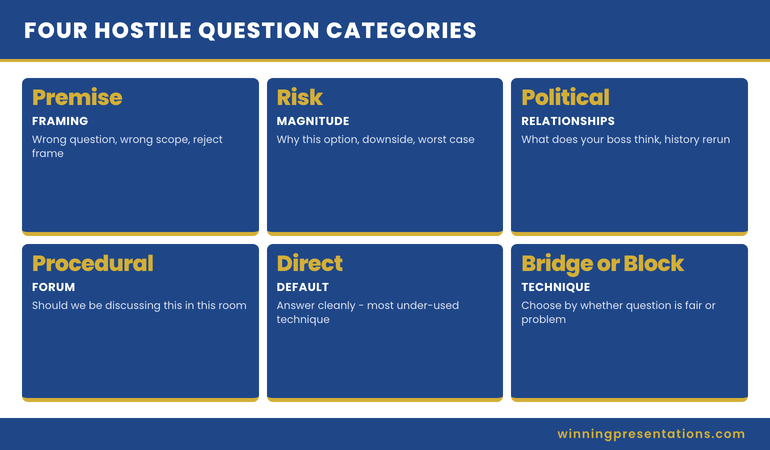
“Hostile” is a slightly misleading label. Most of the questions that destabilise senior presenters are not delivered with hostility. They are delivered politely, sometimes warmly, by colleagues who have a legitimate concern. What makes them hostile, in the technical sense, is that they cannot be answered cleanly without preparation. The discomfort is structural, not interpersonal.
Premise challenges. Questions that attack the framing of the proposal rather than its content. “I am not sure we are answering the right question.” “I do not accept the diagnosis.” These are the most common form of hostile question at board level and the most damaging when handled badly. They feel hostile because they invalidate the work that has gone before.
Comparison and risk questions. “Why this rather than option X?” “What goes wrong here?” “What is the worst case?” These feel less aggressive but require structured responses with concrete numbers and named failure modes. Vague answers read as evasion. Senior peers know the difference.
Political questions. “What does your CFO think?” “Has the CEO signed off on this?” “We tried something like this before — what is different now?” These probe the political coverage and history behind the proposal. Mishandling them is rarely about substance; it is about pronouns, attribution, and willingness to acknowledge inconvenient context.
Procedural challenges. “I am not sure we should be discussing this in this forum.” “Should this not have come through committee X first?” These question the appropriateness of the conversation rather than the content. They are the hardest to prepare for and the easiest to mishandle. Pushing back on a procedural challenge is almost always a credibility hit.
For senior professionals who present to senior peer rooms
A structured Q&A library — pattern recognition, response shapes, and the techniques that hold up under pressure
The Executive Q&A Handling System covers the four hostile question categories, the four response techniques, the forty-five-second response shape, and the eleven specific patterns most often seen at board level. Designed for senior professionals presenting to boards, investment committees, and executive panels.
- Question pattern library across the four hostile categories
- Response shapes designed for forty-five-second structured answers
- Bridging, blocking, direct answer, and de-escalation mechanics
- Three files, instant access, designed for repeat use
£39 · Instant access · Designed for executive Q&A scenarios
The four techniques that actually work
Four techniques cover the majority of hostile Q&A situations. Knowing all four — and knowing which to use when — is what separates fluent senior presenters from technically correct ones.
Direct answering. The default move and the most under-used. Most hostile questions deserve a direct, structured answer rather than any technique. Senior peers reward presenters who answer clearly even when the answer is uncomfortable. The mistake most senior presenters make is reaching for technique when a direct answer would have been better received.
Bridging. Acknowledge the question, give a brief direct answer, then move the conversation to where you need it. The companion piece on bridging versus blocking techniques covers the mechanics in detail. Bridging is the right move when the question is fair but the conversation needs to move forward.
Blocking. Decline to answer the question on its terms, give a structured reason, and offer an alternative response that is at least as useful. Blocking is the right move when the question itself is the problem — when answering directly would mislead the room. Used sparingly, it signals integrity. Used reflexively, it signals evasion.
De-escalation. When multiple challenges arrive in sequence, the de-escalation move stops the cascade, names the pattern, invites the chair to sequence, and answers each question in turn. The companion piece on multiple board members piling on covers this in detail. It is the highest-leverage technique for senior presenters who face large committees regularly.
All four techniques use the same forty-five-second response shape. The shape is what makes them work; the technique is what determines which version to deliver.
The forty-five-second response shape
A useful property of well-handled hostile Q&A is that almost every good answer fits into roughly forty-five seconds and follows the same four-part shape. Once the shape is in muscle memory, the brain composes the content while the structure holds.
Acknowledge the question on its own terms. Repeat or paraphrase briefly. This costs four seconds and signals that you have heard the asker. It also gives the cortisol time to settle.
Name the structure of your answer. “There are three things to consider” or “I would distinguish two cases.” This buys composition time and signals that you are about to give a structured answer rather than a defensive one.
Deliver the answer at the level of the question. If the question was about premise, answer at premise level. If the question was about magnitude, give a number with a band. If the question was political, address the relationship. Most failed answers fail because they answer at the wrong altitude.
Name what you do not know. One short sentence on the limits of your answer. “What I cannot tell you in this room is X. I will come back with that by Y.” This signals that you understand the boundary of your own answer, which is the strongest credibility move available at board level.
Forty-five seconds is the right length for most board-level questions. Longer than that becomes a speech. Shorter than that is rarely substantive enough. The discipline is to stop at step four rather than continue talking out of nervousness — which is the most common failure mode for senior presenters who have not rehearsed the shape.
Training options for senior professionals
When senior professionals decide to invest in Q&A training, the available options vary widely in quality and fit. Three categories cover most of what is on the market.
One-day workshops. Common, available from many providers, and inexpensive relative to coaching. They tend to cover Q&A as one module within a broader presentation skills programme. Useful as an introduction. Limited as a behaviour-change intervention because one day rarely produces durable muscle memory in adults under work pressure. Most senior professionals who attend these report short-term improvement that fades within four to six weeks.
Self-paced structured systems. Library-style products that combine pattern recognition material, response shapes, and worked examples. Useful when the senior professional has the discipline to apply the material to specific upcoming meetings rather than treating it as theoretical. The Executive Q&A Handling System is one example; broader self-paced options exist for related areas through Q&A handling training designed for presentations. The advantage is repeatability — the same material applies to each new meeting.
One-on-one coaching. Highest cost, most variable quality. Useful for senior professionals dealing with a specific high-stakes meeting or a persistent pattern that has not responded to other interventions. The fit between coach and client matters more than the brand of the coaching firm. Most senior professionals find this most useful as a complement to structured material, not a replacement for it.
For most senior professionals, the highest-return combination is a structured self-paced system used before each high-stakes meeting, supplemented by occasional one-on-one work on specific persistent patterns. Workshops are useful as starting points but rarely sufficient on their own. The detailed comparison piece on handling tough questions in presentations covers the trade-offs in more depth.
What to look for in a Q&A training option
Five criteria distinguish material that produces durable behaviour change from material that does not.
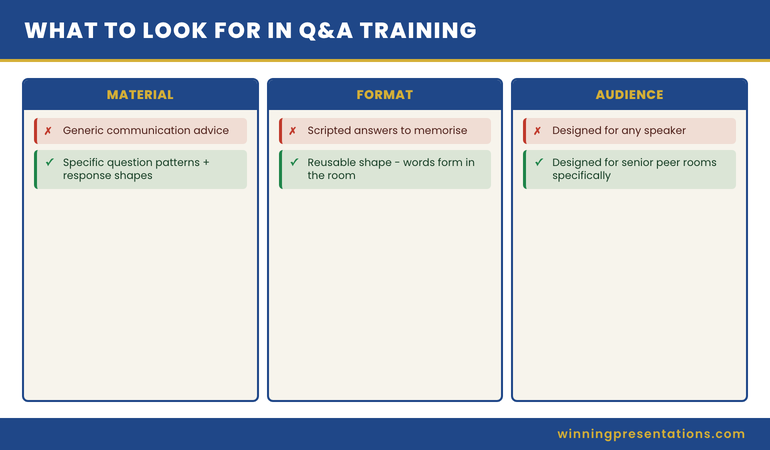
Pattern recognition, not generic advice. Material that names specific question patterns — premise challenge, comparison question, procedural challenge — and pairs each with a response shape. Generic advice such as “rephrase the question” is true but not actionable under pressure. Specific patterns are.
Response shapes, not scripts. Scripted answers collapse the moment the question deviates from what was rehearsed. Response shapes provide structure and let the words form in the room. Material that gives you scripts to memorise is the wrong shape.
Designed for senior peer rooms. Q&A behaviour at director level is different from Q&A behaviour at VP level, which is different again from board level. Material designed for senior peer rooms specifically — boards, investment committees, executive sessions — is more useful than generic communication skills content.
Reusable across meetings. A useful Q&A system can be applied to a new meeting in roughly an hour of preparation per high-stakes session. Material that requires extensive customisation for each meeting tends to be applied inconsistently and produces inconsistent results.
Acknowledges the physiological component. Q&A behaviour is partly about technique and partly about arousal management. Material that addresses only the technique — without the breathing, the silence handling, the post-meeting processing — tends to fall apart in real high-stakes meetings, where physiology dominates technique under pressure.
Frequently asked questions
How long does it take to see improvement in hostile Q&A handling?
For most senior professionals, two or three structured high-stakes meetings produce measurable change. The four-part response shape can be in muscle memory after a small number of out-loud rehearsals. The harder discipline — stopping at step four, not over-relying on bridging, choosing the right technique under pressure — usually takes a slightly longer arc to settle. Most professionals describe noticeable change within a quarter of consistent practice.
Is this material applicable outside boards and committees?
Yes. The four techniques and the response shape work in any high-stakes question session — client pitches, conference Q&A, regulatory hearings, internal town halls, journalist interviews. The patterns are most concentrated at board level because of the seniority of the room and the stakes of the decision, but the moves are general.
What if my industry has a particular question pattern that is not covered?
Most industries have at least one or two pattern variations. The four categories — premise, comparison and risk, political, procedural — cover the majority. The remaining variations are usually handled adequately by the response shape, even if the specific pattern was not rehearsed. The shape is the point. The patterns are useful but not exhaustive.
Is there a free starting point before committing to a paid system?
The free Executive Presentation Checklist (linked at the end of this article) covers the structural fundamentals that reduce the surface area for hostile questions. It is not a Q&A-specific resource, but a clean structure makes the question session more predictable and reduces the load on real-time technique. For senior professionals who want to test the approach before investing, it is a useful preview.
For senior professionals who present in rooms where the questions matter
The structured Q&A library used by senior presenters across financial services, biotech, and government
The Executive Q&A Handling System gives you the four techniques, the response shape, the eleven hostile question patterns, and the de-escalation move in one place. Designed for repeat use across boards, investment committees, executive sponsors, and senior peer rooms.
- Pattern recognition across the four hostile question categories
- Response shapes designed for forty-five-second structured answers
- Bridging, blocking, direct answer, and de-escalation mechanics
- Three files, instant access, designed for executive Q&A scenarios
£39 · Instant access · Designed for executive Q&A scenarios
The Winning Edge — weekly
One short note each Thursday on hostile Q&A, response shapes, and the techniques senior presenters use to keep control of high-stakes rooms. Written for professionals who do not have time for newsletters that read like newsletters.
Want a structural starting point first? The free Executive Presentation Checklist covers the fundamentals that reduce the surface area for hostile questions in the first place.
For a deeper view of the specific patterns most often seen at board level, see the companion piece on the hostile question handling course landscape.
Next step: For your next high-stakes meeting, write down three questions you are afraid of being asked. For each, decide which of the four techniques fits. Rehearse the four-part response shape on each one out loud. That is the preparation that separates rooms held from rooms lost.
Mary Beth Hazeldine is the Owner & Managing Director of Winning Presentations. With 24 years of corporate banking experience at JPMorgan Chase, PwC, Royal Bank of Scotland, and Commerzbank, she advises senior professionals across financial services, healthcare, technology, and government on hostile Q&A handling, board-level question management, and the structural moves that produce reliable behaviour change in high-stakes meetings. She speaks German and works extensively with the German-speaking financial markets.