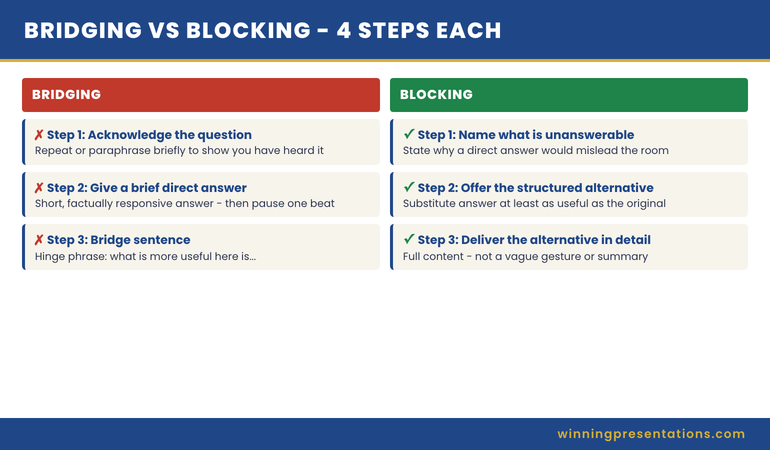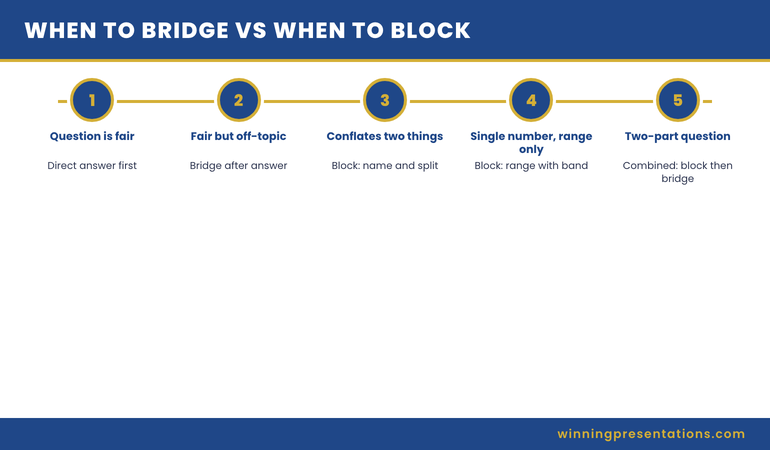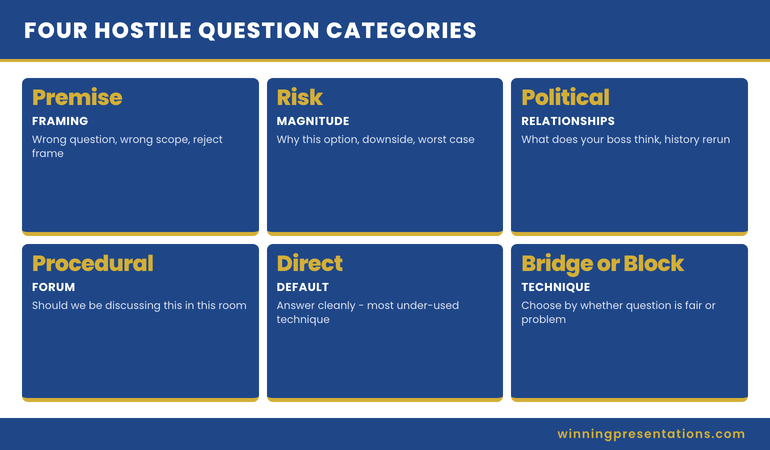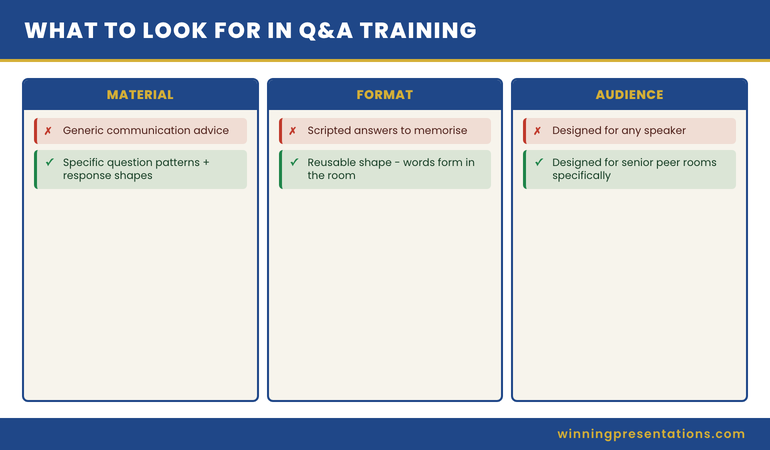
Quick answer: The Executive Q&A Handling System (QAHS) is a structured training resource for senior professionals who need to handle tough, hostile, or politically loaded questions in high-stakes presentations. Unlike improvisation training, QAHS is built on the insight that most difficult questions follow predictable patterns — which means you can prepare for them systematically rather than hoping to think quickly under pressure. The system covers question type identification, response frameworks for each major category of challenge, and techniques for buying thinking time without losing authority. It is available for £39 with instant access. This page explains exactly what it covers and whether it is the right fit for your situation.
The Problem: Most Executives Improvise When They Could Prepare
Tough questions in presentations feel like they come from nowhere. A board member pivots from the agenda to a question about a decision made two years ago. An investor asks you to defend an assumption buried on slide fourteen. A committee chair reframes your proposal in a way that implies it is riskier than you have presented it. In the moment, these feel like ambushes. They do not have to.
The reason difficult Q&A feels unpredictable is that most senior professionals have never been taught a framework for categorising it. Once you understand that executive-level tough questions fall into a small number of recurring types — fishing questions, loaded questions, hypothetical questions, binary-choice questions, precedent questions — you can prepare for each category specifically. You stop rehearsing your presentation and start anticipating your Q&A.
The consequences of poor Q&A handling at board level are significant. A well-constructed presentation can be undermined in the Q&A session by a single clumsy response. An executive who handles challenge poorly signals uncertainty about their own case — regardless of the quality of their analysis. Decision-makers who were inclined to approve a proposal begin to hedge when the presenter cannot respond to a straightforward challenge without stumbling.
The fix is not to become a better improviser. It is to prepare more systematically — and the Executive Q&A Handling System provides the method for doing exactly that.
The Solution: A System for Predicting and Handling Executive Q&A
The Executive Q&A Handling System is not a collection of clever phrases or a set of deflection techniques. It is a structured method for understanding what types of tough questions you are likely to face, why questioners ask them, and how to respond in a way that is both honest and authoritative.
The system is built on a simple premise: most executive-level challenge questions are not random. They reflect specific concerns — about risk, about process, about precedent, about political positioning — and those concerns are largely predictable given what you know about your audience, your proposal, and the context of the meeting. If you can map those concerns in advance, you can prepare responses that address them directly rather than scrambling in real time.
The QAHS covers four major question types that appear consistently in board, committee, and investor Q&A sessions:
Fishing questions — designed to find out what you have not said, rather than to challenge what you have
Loaded questions — containing an embedded assumption or framing that, if you accept it, weakens your position
Hypothetical questions — asking you to defend scenarios that may never occur, often used to stress-test your confidence in your own case
Binary-choice questions — presenting a false either/or that constrains your answer if you do not recognise the framing
For each type, the system provides a response framework — a structured approach that allows you to answer confidently without being led into ground you have not prepared. The frameworks are designed to feel natural rather than formulaic: the goal is not to sound rehearsed but to respond with the authority that preparation provides.
The system also covers Q&A session management: how to open the Q&A in a way that sets the right tone, how to handle the dynamic when multiple questioners are pushing simultaneously, and how to close the Q&A session without losing the room’s sense of momentum towards a decision.
What You Get
A question-type identification system — so you can categorise the questions you are likely to face before you walk into the room, not after you have been caught off guard
Response frameworks for each major question category — structured approaches that give you a clear path through fishing, loaded, hypothetical, and binary-choice challenges
Techniques for buying thinking time without losing authority — specific language and approaches for creating space to think when a question catches you off guard, without signalling uncertainty
A method for handling hostile or politically motivated questions — including how to recognise when a question is about positioning rather than genuine inquiry, and how to respond in a way that does not inflame the dynamic
Q&A session structure guidance — how to open, manage, and close the Q&A session itself, not just how to handle individual questions
Price: £39 — instant access, no subscription.
Go Into Your Next Presentation Knowing Exactly How to Handle Whatever the Room Throws at You
The Executive Q&A Handling System gives you the frameworks to anticipate, categorise, and respond to the tough questions that derail executive presentations — for £39, instant access.
Instant access. Designed for directors and senior leaders in complex stakeholder environments.
Is This Right For You?
This system is designed for: senior professionals — directors, heads of function, senior managers — who present regularly in complex stakeholder environments where the Q&A carries real consequences. If you present to boards, investment committees, regulatory bodies, or senior leadership teams, and the questions you face are often politically charged, technically demanding, or strategically loaded, this system was built for that context.
It is also well suited to senior professionals preparing for a specific high-stakes presentation — a funding round, a restructuring proposal, a board strategy review — where the Q&A is as consequential as the presentation itself.
This system is not designed for: people who are new to presenting and who need foundational skills — structure, slide design, delivery basics. The QAHS assumes you are already a competent presenter and focuses specifically on the Q&A dimension. It also assumes your presentation environment is one where questioners may have interests that do not align with yours — it is not optimised for low-stakes internal meetings where questions are largely supportive.
The system covers the four question types that appear most consistently in executive-level Q&A: fishing questions (designed to surface what you have not said), loaded questions (with embedded assumptions that constrain your response), hypothetical questions (used to stress-test your confidence in your case), and binary-choice questions (false either/or framings). It also covers politically motivated questions — where the questioner’s goal is positioning rather than genuine inquiry — and the specific challenge of handling hostile challenge in a group setting without inflaming the dynamic.
How is this different from improvisation training?
Improvisation training builds your capacity to think quickly in novel situations. The QAHS is built on a different premise: that most executive-level tough questions are not novel — they follow predictable patterns that you can anticipate before the meeting. The system gives you a preparation method rather than a performance technique. This distinction matters because improvisation under pressure is a difficult skill to develop, while systematic preparation is something you can do the day before any presentation.
Can I use this for investor presentations?
Yes. Investor Q&A sessions are one of the contexts the system is well-suited to. Investors frequently use fishing questions to probe for risks you have not disclosed, loaded questions to test whether you are realistic about downside scenarios, and hypothetical questions to stress-test your financial assumptions. The frameworks in the QAHS apply directly to these patterns. The system does not cover the specific content of financial modelling or investment memoranda — it focuses on the Q&A dynamic itself, which is where investor presentations often succeed or fail independently of the quality of the underlying analysis.
How long does it take to work through the system?
The system is structured so that you can work through the core frameworks in a focused session of two to three hours. Most users then return to specific sections when preparing for a particular presentation — spending thirty to forty-five minutes mapping the question types they are likely to face and preparing responses using the relevant frameworks. It is designed to be used repeatedly, not worked through once and set aside.
Does this work if questioners are politically motivated?
Yes — and politically motivated questions are one of the hardest categories to handle well without a framework. The system includes specific guidance on recognising when a question is motivated by positioning rather than genuine inquiry, and on responding in a way that is direct and composed without escalating the tension. A key principle: politically motivated questioners want to provoke a defensive response. The system helps you identify the pattern early enough to avoid giving them one.
The Winning Edge
Weekly insights on executive presentations, Q&A strategy, and high-stakes communication for senior professionals.
Mary Beth Hazeldine, Owner & Managing Director, Winning Presentations. With 25 years of corporate banking experience at JPMorgan Chase, PwC, Royal Bank of Scotland, and Commerzbank, she has spent 16 years training senior professionals to handle board-level presentations and Q&A with clarity and authority.
Quick answer: A hostile questioner simulation is a structured rehearsal exercise in which colleagues challenge your answers under conditions that mimic the pressure of the real executive meeting. It is the most reliable way to identify the gaps in your Q&A preparation before those gaps become visible in the room. The simulation works because it compresses the emotional and cognitive conditions of real Q&A into a controlled environment where you can practise and adjust without consequences.
Kenji had prepared more thoroughly for this board presentation than for any other in his career. He had rehearsed the deck twice, reviewed the financial model, pre-read the board papers, and anticipated six questions he thought were likely. When the Non-Executive Director challenged him on a specific assumption in the revenue model — an assumption that was methodologically sound but superficially easy to attack — Kenji answered competently. But he felt his voice tighten. He heard himself become slightly defensive. He watched the NED’s expression shift from interrogative to satisfied.
After the meeting, his CFO told him the presentation had gone well overall, but flagged the moment with the NED. “You answered correctly,” she said. “But you looked rattled. That matters in a room like this.” Kenji asked what he should have done differently. “You needed to have been in that moment before,” she said. “The answer wasn’t the problem. The unexpectedness was the problem.”
The CFO’s observation points to something that conventional Q&A preparation almost always misses. Preparing answers to likely questions is necessary but not sufficient. What determines performance under hostile Q&A is not primarily whether you know the answer — it is whether you have experienced the emotional and physiological conditions of challenge before you walk into the room. That experience is what the simulation creates.
The hostile questioner simulation is, at its core, an inoculation exercise. It does not eliminate the discomfort of challenge — it reduces its novelty, which reduces its power to destabilise.
Preparing for high-stakes Q&A?
The Executive Q&A Handling System is a structured approach to predicting and preparing for executive Q&A — including frameworks for anticipating hostile question patterns and building answers that hold up under scrutiny.
The standard approach to Q&A preparation involves compiling a list of likely questions and drafting answers to each. This is useful — and should remain part of any preparation process — but it has two significant limitations that become visible only under real conditions.
It optimises for content, not for performance under pressure. A well-drafted answer in a preparation document is produced in conditions of low stress, unlimited time, and no social consequence for a weak response. The same answer, delivered under challenge from a sceptical Non-Executive Director, is produced under entirely different conditions. The cognitive load is higher. The emotional stakes are visible. The time pressure is real. The answer that looked clean on paper often sounds hesitant, over-hedged, or defensive in the room.
It cannot anticipate the follow-up. Hostile questioners rarely accept a first answer and move on. They push — often with a follow-up that accepts the substance of your answer while attacking the framing, or that redirects to a related vulnerability. A preparation document can anticipate the first question. It cannot anticipate the third exchange in a sequence, because that exchange depends on the specific choices made in the first two. Only a live simulation can generate the genuine unpredictability of an experienced interrogator.
These limitations do not mean that written preparation is unhelpful — they mean that it is incomplete. The simulation fills the gap between preparation and performance.
Why Hostility in Q&A Follows Predictable Patterns
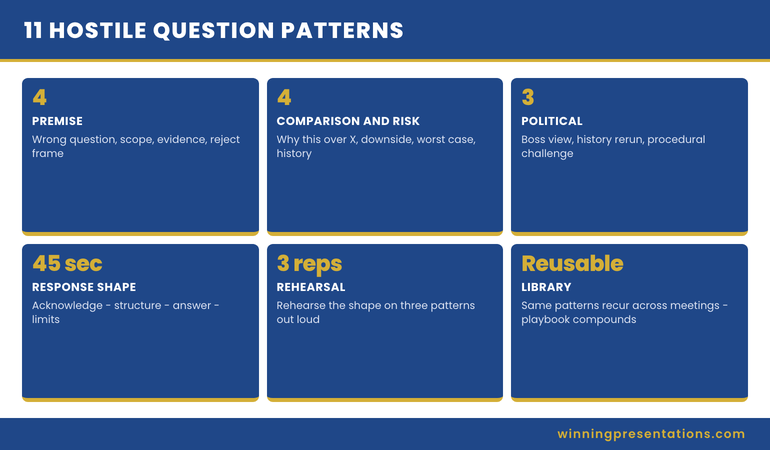
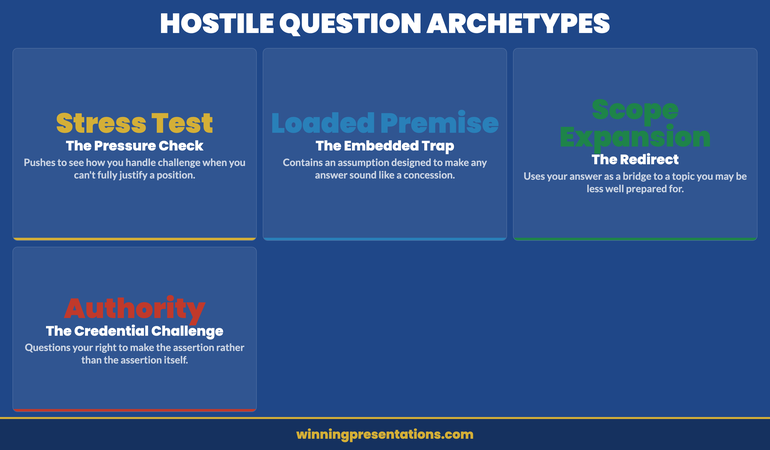
Hostile Q&A in executive settings is not random. It follows a small number of recurring patterns that can be anticipated and prepared for specifically. Understanding these patterns transforms the simulation from a general stress-exposure exercise into a targeted preparation tool.
The stress test. The questioner pushes on a position not because they necessarily disagree with it, but to assess how you handle pressure. The question is often framed as a challenge to your methodology, your assumptions, or your confidence in the conclusion. The intent is less about the content and more about observing how you respond when challenged. The indicator is the quality of your second answer — the one you give after you have been pushed.
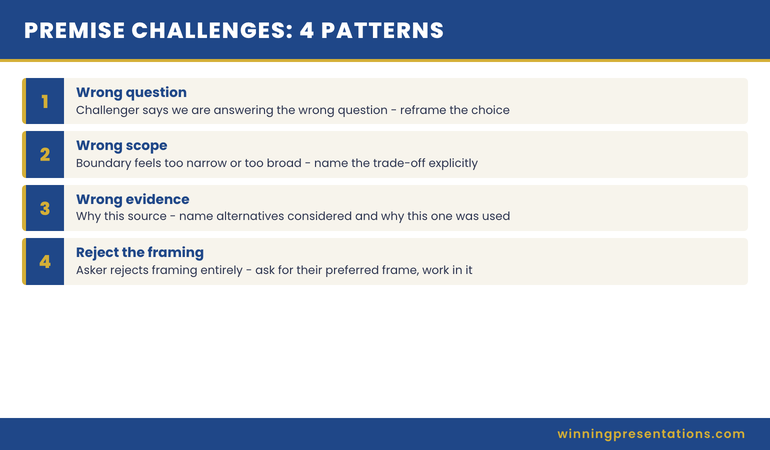
The loaded premise. The question contains an embedded assumption that, if accepted, positions any answer as a concession. “Given that your team has consistently missed this metric for the past three quarters…” is a loaded premise — it accepts as given something that may be contested. Accepting the premise before answering it transfers control of the narrative to the questioner. The correct response is to address the premise explicitly before answering the question.
Scope expansion. The questioner uses your answer to a specific question as a bridge to a broader topic that you may be less well prepared for. “You’ve addressed the operational impact — can you also speak to the regulatory exposure?” moves from a territory you anticipated to one you may not have. The effective response is to acknowledge the legitimacy of the broader question while clearly framing what you can answer now and what requires further analysis. For related patterns, see this guide on handling hostile questions in board meetings.
The authority challenge. The questioner questions your credentials to make the assertion rather than questioning the assertion itself. This is particularly common in cross-functional presentations where the presenter is speaking on topics that touch another executive’s domain. The authority challenge is a social manoeuvre as much as an intellectual one — and responding to it as if it were purely intellectual often misses the dynamic.
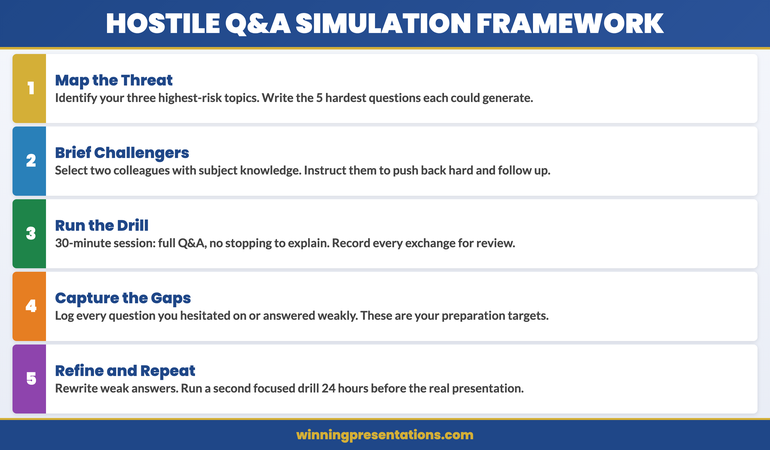
The Three-Layer Simulation Framework
The most effective hostile questioner simulations are structured in three layers of escalating intensity. Each layer serves a different function in the preparation process, and all three should be completed in the sequence below for maximum benefit.
Layer one — Question mapping. Before any live simulation, conduct a systematic mapping of the questions most likely to arise and the questions you most hope will not. These are different lists and both are necessary. The first list drives the content of your written preparation. The second list drives the focus of your simulation — because the questions you hope will not arise are almost certainly the ones a hostile questioner will reach for. A useful exercise at this stage is to brief a colleague on your presentation content and ask them to identify the three points they would push on if they were seeking to challenge your credibility. Their perspective as an intelligent insider is often more accurate than your own assessment of where you are vulnerable.
Layer two — Structured challenge session. With one or two colleagues briefed on your material and given explicit instructions to challenge hard, run a full Q&A session lasting 20 to 30 minutes. The challengers should cover all four hostile question archetypes — stress test, loaded premise, scope expansion, and authority challenge — and should push back on first answers rather than accepting them. You should respond as you would in the real room: under time pressure, without notes, and without stopping to explain yourself mid-answer. The session should feel uncomfortable — that discomfort is the point.
Layer three — Gap analysis and refinement. Immediately after the simulation, while the experience is fresh, identify every question where you hesitated, gave a weak answer, or felt rattled. These are your priority preparation targets. For each one, write a revised answer — clear, specific, and no longer than 60 seconds when spoken aloud. Then return to your challengers for a focused second session covering only the gap questions. This second session is typically shorter (10 to 15 minutes) and produces the most significant improvement in both content quality and delivery confidence.
The Executive Q&A Handling System
A structured system for predicting and handling executive Q&A — designed for high-stakes presentations where the questions are as consequential as the content.
Framework for predicting the questions most likely to arise in any executive meeting
Structured approaches for handling the four main hostile question archetypes
Answer frameworks that hold up under follow-up pressure
System for building and maintaining an executive Q&A preparation habit
Designed for executives preparing for Q&A in high-scrutiny board and leadership meetings.
How to Recruit Your Internal Challengers
The quality of the simulation depends almost entirely on the quality of the challengers. A colleague who softens their challenge to avoid causing discomfort defeats the purpose of the exercise. Recruiting the right people — and briefing them correctly — is as important as the simulation itself.
Select challengers with genuine subject knowledge. The most effective challengers are people who know your subject well enough to identify real weaknesses — not people who will ask generic difficult questions. A colleague from finance, risk, or a directly adjacent function is usually a better challenger than a generalist, because they can probe the same dimensions a real hostile questioner would. Their challenge will land closer to the actual vulnerability than the challenge of someone working purely from the question list you have given them.
Brief them to be genuinely uncomfortable to answer. The default social behaviour of a colleague asked to challenge you is to be challenging-but-supportive — to push but pull back before causing real discomfort. This instinct is natural and must be explicitly overridden. Your brief to your challengers should include a clear instruction: “I need this to feel like the worst version of the real meeting. Don’t ease up. If I look rattled, that’s useful information.” Without this explicit permission, most colleagues will moderate their challenge.
Brief them on the four hostile archetypes. Give each challenger a written brief that includes the four main hostile question types — stress test, loaded premise, scope expansion, authority challenge — and ask them to use each at least once across the session. This ensures that your simulation covers the full range of challenge you might face, rather than focusing on the most obvious lines of questioning. For related preparation strategies, see the companion article on addressing objections before they are raised in Q&A.
The Executive Q&A Handling System includes a structured framework for predicting and preparing for the specific question archetypes most likely to arise in your meeting context.
Running the Simulation: Rules and Format
The following rules make the simulation as useful as possible. Each rule addresses a common shortcut that reduces the exercise’s effectiveness.
No stopping to explain. In the real meeting, you will not be able to pause, step out of your presenter role, and explain what you meant to say. The simulation should replicate this condition exactly. If you give a weak answer, it stands — you do not get to revise it mid-session. The discipline of living with imperfect answers in the simulation is what makes the experience useful. Stopping to explain converts the simulation into a seminar, which has no preparation value.
No notes for your answers. Your challengers may have notes. You should not. If you answer from notes in the simulation, you will not develop the cognitive pathways that allow you to construct clean answers under real pressure. The simulation is specifically designed to build those pathways through repetition under stress. Notes short-circuit the process.
Record the session. The most valuable data from a simulation is the difference between how you thought you performed and how you actually performed. These two assessments are almost never identical. Recording the session — even audio only — allows you and your challengers to review specific moments with precision rather than relying on impressions. Pay particular attention to pace, to hedging language, and to the quality of your second answers after a follow-up challenge.
Do not debrief immediately. The instinct after a difficult simulation is to debrief in the same room, immediately. Resist this. Allow 30 minutes before reviewing the recording or discussing the session. The initial emotional response to being challenged — even in a safe environment — can distort the analytical assessment. A brief gap allows you to separate the experience of the challenge from the evaluation of your performance, and produces more accurate identification of genuine gaps. For the parallel challenge of managing risk committee scrutiny, see this guide on identifying Q&A blind spots before risk committee meetings.
Processing the Feedback Without Defensiveness
The feedback from a simulation is inherently personal — it reveals gaps in your preparation, weaknesses in your argumentation, and moments where your composure broke down. Receiving this feedback without defensiveness requires a specific mindset that is worth establishing explicitly before the session begins.
Treat gaps as information, not as judgements. A gap identified in a simulation is a gap you can address before the meeting. A gap that surfaces for the first time in the real room cannot be addressed — it simply becomes part of the record of that meeting. The simulation’s purpose is to surface gaps in a context where they are correctable. Receiving that information with gratitude rather than defensiveness accelerates the preparation cycle.
Distinguish between content gaps and performance gaps. Some weaknesses revealed in a simulation are content gaps — the answer is genuinely incomplete or the analysis has a real hole. Others are performance gaps — the content is sound but the delivery under pressure was unclear, defensive, or hesitant. These require different responses. Content gaps require further analysis and a revised answer. Performance gaps require repetition — giving the same answer again, more cleanly, until the delivery matches the quality of the content.
Focus debrief time on the follow-up questions. The most revealing moments in any simulation are typically the third or fourth exchange in a sequence — when the initial answer has been challenged and the follow-up challenges have been layered on top. These late-sequence exchanges are where real preparation is tested, and where most presenters discover they run out of both content and composure simultaneously. The debrief should spend proportionally more time on these multi-exchange sequences than on standalone questions that were answered well.
The Day-Before Refresh That Consolidates Gains
The gap between the simulation and the real meeting is where most of the preparation gains are consolidated or lost. A structured day-before refresh — distinct from the full simulation and shorter in duration — ensures that the improvements made during the simulation are accessible under real conditions.
Review the gap question list, not the full question list. The day before the meeting is not the time to rehearse answers to every possible question. It is the time to run through the specific questions where you identified gaps in the simulation — testing whether the revised answers are now clean and confident. Limiting the review to these priority questions prevents the cognitive overload that comes from attempting to rehearse everything.
Speak the answers aloud. Reading a preparation document silently is qualitatively different from speaking the answer aloud under conditions that approximate the real room. The day-before refresh should involve speaking — ideally in a physical posture similar to how you will present (standing if you will be standing, at a table if you will be seated). This physical rehearsal activates the motor memory of the delivery, not just the cognitive memory of the content.
Close with a confidence anchor. After the content review, spend five minutes reviewing the questions from the simulation that you answered well — cleanly, confidently, without hesitation. This is not indulgence; it is calibration. Entering a high-stakes Q&A with your recent mental reference points skewed toward difficulty produces a different physiological state than entering with a balanced recent reference — and that physiological state affects your first answer. The day-before refresh should end with evidence of your own competence, not with a catalogue of everything that could go wrong. For techniques specifically related to vocal control in the Q&A context, see the companion piece on using your voice to command the room during Q&A.
Build a System for Predicting Executive Q&A
The Executive Q&A Handling System gives you a structured approach to anticipating the questions most likely to arise in any executive meeting — so your simulation starts from the right question list.
Designed for executives preparing for high-scrutiny board and leadership Q&A.
Frequently Asked Questions
How far in advance of the presentation should I run the simulation?
The ideal timeline is to run the main simulation two to three days before the presentation, leaving sufficient time to address the gaps identified and conduct a shorter second session. Running the simulation the evening before leaves insufficient time for meaningful gap-closing. Running it more than a week before allows too much time for the specific emotional and cognitive experience of being challenged to fade, reducing its inoculation effect. If you can only conduct one session, two days before is the optimal timing.
What if I don’t have access to knowledgeable colleagues who can challenge me effectively?
There are two alternatives. The first is to brief a generalist colleague on the question archetypes and give them a written list of challenging questions drawn from your question mapping exercise. While a generalist challenger cannot probe the content as deeply as a subject-matter colleague, they can still generate the social and emotional experience of challenge — and that experience has preparation value even without deep content knowledge. The second alternative is self-simulation: recording yourself presenting, then reviewing the recording as a hostile questioner would, identifying every point where a challenge could be mounted and drafting answers. This is less effective than live simulation but more effective than written preparation alone.
How do I handle a question in the real meeting that I genuinely cannot answer?
Acknowledge it clearly and commit to a specific follow-up. “I don’t have the precise data in front of me — I’ll send it to you by end of day tomorrow” is a credible response that maintains trust. What undermines trust is either bluffing — attempting an answer you are not confident in — or over-hedging, which signals that you are uncertain about a wide range of things rather than one specific data point. The simulation is the safest place to practise saying “I don’t know” cleanly — to build the habit of using it precisely and without apology when the situation genuinely requires it.
The Winning Edge — Weekly Newsletter
Executive presentation strategy, delivered every Thursday. Frameworks for Q&A preparation, difficult questions, and high-stakes executive communication.
Mary Beth Hazeldine is Owner & Managing Director of Winning Presentations. With 24 years of corporate banking experience at JPMorgan Chase, PwC, Royal Bank of Scotland, and Commerzbank, she advises executives across financial services, healthcare, technology, and government on structuring presentations for high-stakes funding rounds and approvals. Connect at winningpresentations.com.
The acknowledge-bridge-deliver framework gives you a three-step structure to handle difficult, off-topic, or hostile questions without losing your poise or message. Acknowledge the questioner’s point, bridge to what matters most, then deliver your key message. This technique lets you stay in control, redirect without appearing evasive, and turn tension into credibility.
Annika was presenting her company’s sustainability strategy to a sceptical board. Midway through, a director asked a loaded question about last year’s carbon offset failures—nothing to do with the current roadmap. She froze. Then she answered defensively, which spiralled into a 10-minute debate that buried her message. Later, she told her coach: “I lost them the moment I got defensive.” She was right. What Annika didn’t know was that a single framework—acknowledge-bridge-deliver—would have let her validate the director’s concern, pivot to her new strategy, and regain control in 30 seconds. Three months later, at her next board presentation, she used it. Same tough director. Same loaded question. Different outcome: “That’s a fair point. What matters now is our new approach, which addresses exactly that weakness.” The room leaned in. She didn’t lose a single second of momentum.
Difficult questions test your presence.
The acknowledge-bridge-deliver framework helps you stay in control. The Executive Q&A Handling System includes frameworks and response templates for every question type. Explore the System →
What Is a Bridging Technique?
A bridging technique is a structured way to acknowledge a difficult or off-topic question, validate the person asking it, and then redirect the conversation back to your key message—without appearing evasive or dismissive. Think of it as a verbal pivot: you don’t ignore the question, and you don’t get pulled into a tangent. Instead, you take the questioner with you.
Bridging is especially valuable in executive contexts where you’re presenting to boards, investors, or sceptical stakeholders. These audiences are trained to probe. They ask hard questions. If you dodge, they lose trust. If you get sucked into a debate on something peripheral, your core message evaporates. A bridging technique lets you do neither.
The beauty of bridging is that it works on three levels. First, it buys you time to think—you’re not stammering or going silent. Second, it validates the questioner, which defuses tension and keeps the room on your side. Third, it keeps your message intact. That’s the real win.
The Acknowledge-Bridge-Deliver Framework
This three-step structure is the backbone of every effective bridging technique response. Learn it, practise it, and you’ll find it works regardless of how hostile or off-topic the question is.
Step 1: Acknowledge
Your first job is to make the questioner feel heard. Don’t argue. Don’t correct them. Simply acknowledge what they’ve said or the concern behind it. This step is short—one or two sentences maximum. Examples: “That’s a fair question.” “I understand your concern there.” “You’ve touched on something important.” The goal is to signal respect and buy yourself thinking time.
Step 2: Bridge
Now you pivot. This is the crucial middle step. You use a bridging phrase—a connector that shifts the conversation toward your message without being obvious about it. Examples: “What’s more important right now is…” “The broader context here is…” “What we’re focused on today is…” A good bridge acknowledges the question’s existence whilst making it clear you’re moving to what matters most. It’s not dismissive; it’s directional.
Step 3: Deliver
Finish by delivering your key message or the most relevant point to your overall narrative. This is where you regain control. You’re not answering the original question directly; you’re providing context that matters more. Keep it concise and confident. Then move on—don’t circle back to the difficult question unless the room presses further.
Master Q&A Handling Frameworks
The Executive Q&A Handling System covers everything you need:
The acknowledge-bridge-deliver framework for difficult questions
Seven question categories and how to spot them in real time
Ready-made response structures and bridge statements you can use immediately
How to handle hostile, off-topic, and ambiguous questions without losing your message
Techniques to buy thinking time and stay calm under pressure
Scripts and examples for every scenario—board meetings, investor pitches, public forums
Understanding the framework in theory is one thing. Seeing it in action is another. Here are three scenarios you’re likely to encounter, and how bridging technique questions turns potential disasters into moments of credibility.
Scenario 1: The Gotcha Question
The Question: “Your competitor just launched a product that does exactly what you’re proposing. Why should we invest in yours?”
Without Bridging (Mistake): “Well, their product is actually quite different…” [You spend five minutes defending against a competitor narrative, and your own value prop gets buried.]
With Bridging: “That’s a smart competitive question. [Acknowledge] The difference is in execution and integration—which is what we’re focused on today. [Bridge] We’ve designed this specifically to work within your existing infrastructure, cutting implementation time by 40% and reducing staff retraining. [Deliver]”
Scenario 2: The Hostile Question
The Question: “Frankly, your track record on this doesn’t inspire confidence. What makes you think this time will be different?”
Without Bridging (Mistake): “That’s not fair—our last project was actually…” [You get defensive. The questioner digs in. The room watches the sparring match.]
With Bridging: “I hear you. [Acknowledge] That’s exactly why we’ve restructured our approach. [Bridge] What we’re presenting today is built on lessons from previous work, and we’ve brought in external oversight to ensure accountability. [Deliver]”
Scenario 3: The Off-Topic Question
The Question: “What’s your stance on offshore outsourcing?”
Without Bridging (Mistake): You either spend 10 minutes on a tangent or brush the question off, making the questioner feel dismissed.
With Bridging: “That’s a broader policy question, and a fair one. [Acknowledge] For today’s discussion, what matters is how we deliver results locally, which is the cornerstone of this proposal. [Bridge] We’re committed to building a team here, investing in your local talent, and delivering within your community. [Deliver]”
Common Mistakes When Bridging
Bridging is simple, but it’s easy to get wrong. Here are the pitfalls to avoid.
Mistake 1: Acknowledging Without Sincerity
If your acknowledgement sounds rushed or insincere—”Sure, sure, that’s fine”—you’ve lost credibility before you bridge. Slow down. Take one second. Let your acknowledgement land. The room will feel the difference between a genuine “That’s a fair point” and a dismissive brush-off.
Mistake 2: Bridging Too Hard
If your bridge phrase is obviously a dodge—”That’s interesting, but what I really want to talk about is…”—you look evasive. A good bridge is natural and subtle. It should feel like a conversational pivot, not a redirect sign.
Mistake 3: Delivering the Wrong Message
After bridging, you need to deliver something relevant to the broader narrative. If you bridge away from a difficult question only to say something completely unrelated, you’ve wasted the technique. Your delivery should feel like a natural extension of your main point, not a random pivot.
Not Just Framework—Confidence Under Pressure
The acknowledge-bridge-deliver framework works because it gives your brain a structure to follow when tension is high. You’re not improvising. You’re executing a proven method. That’s where confidence comes from. The Executive Q&A Handling System includes workbooks, scenarios, and quick-reference cards you can use before your next presentation.
Bridging works best when combined with other Q&A frameworks. If you want to deepen your Q&A toolkit, consider pairing acknowledge-bridge-deliver with these complementary approaches:
Evidence-First Answers: After you bridge and deliver your message, backing it up with data or evidence makes it unshakeable. Learn more in our guide to the evidence-first answer structure.
Preemptive Framing: If you know difficult questions are coming, address them before Q&A even starts. This reduces the sting and makes bridging unnecessary for those particular questions. See our full article on preemptive Q&A strategies.
Frequently Asked Questions
What if the questioner pushes back after I bridge?
Stay calm and use the bridge again if needed, but this time acknowledge the persistence. Example: “I understand you’re keen to dig into that point. Here’s what’s most relevant to today’s decision…” You’re not avoiding; you’re refocusing. If they push a third time, offer to discuss offline. This signals confidence and control.
Can bridging come across as evasive?
Only if you acknowledge without sincerity, bridge too obviously, or deliver a message that feels unrelated. A genuine acknowledgement plus a natural bridge plus a relevant delivery feels like a confident executive who knows what matters. That’s not evasive; that’s leadership.
Should I write out my bridge statements in advance?
Yes, especially for predictable questions. Write three or four bridging phrases and practise them until they feel natural. When you’re in the moment, muscle memory takes over. You won’t be scrambling; you’ll be executing.
Stay Sharp on Q&A and Executive Presence
Join The Winning Edge newsletter for practical frameworks, real scenarios, and strategies for handling pressure in the boardroom.
Q&A confidence extends beyond the message—it includes your presence on camera. If you’re presenting virtually, see our article on managing presentation anxiety and camera presence for tips on staying calm in remote scenarios.
The acknowledge-bridge-deliver framework works because it respects both the questioner and your message. You’re not dodging. You’re redirecting with grace and authority. Next time a difficult question lands, you won’t freeze or get defensive. You’ll acknowledge, bridge, and deliver—and the room will lean in.
About the Author
Mary Beth Hazeldine is Owner & Managing Director of Winning Presentations. With 24 years of corporate banking experience at JPMorgan Chase, PwC, Royal Bank of Scotland, and Commerzbank, she advises executives across financial services, healthcare, technology, and government on structuring presentations for high-stakes funding rounds and approvals.
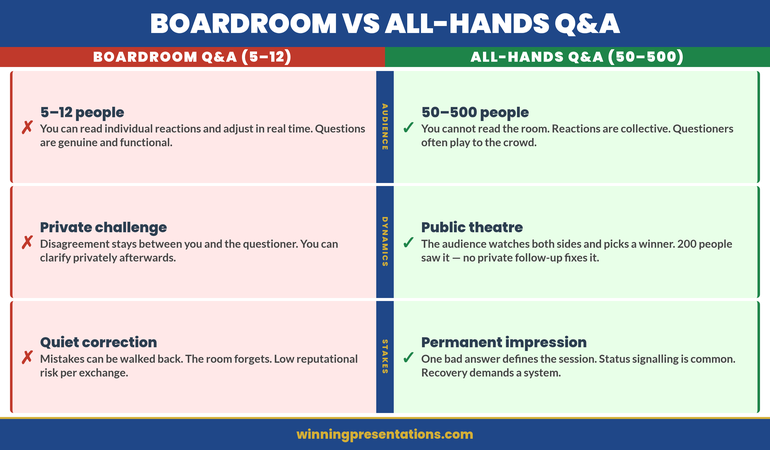
Large-audience Q&A is fundamentally different from boardroom dialogue. When 50–500 people are watching, questions become performative, hostile questioners play to the crowd, and silence reads as weakness. The format that protects you involves curating questions in advance, sequencing them strategically, and controlling the narrative before anyone stands up to challenge you.
Feeling Exposed Before Your Next All-Hands?
You’ve prepared your slides. But you haven’t prepared for the executive from operations who’s been silent all week—the one about to ask a loaded question in front of 150 people.
The Executive Q&A Handling System walks you through the three-step framework that lets you predict 80% of questions before they’re asked—so you’re never ambushed again.
A senior executive froze for 47 seconds during a board presentation. But this wasn’t a board of eight—it was an all-hands of 200. The recovery technique she’d practised worked. But afterwards she said something that changed how we think about Q&A at scale:
“The boardroom is chess. The all-hands is a stadium. You need different rules.”
She was right. The techniques that work in a boardroom become liabilities in a stadium. This article is about the different rules.
The Boardroom Is Chess. The All-Hands Is a Stadium.
In a boardroom of eight, a question is a conversation. The questioner is looking for information. You can push back, ask for clarification, admit uncertainty. The conversation stays private, stays at the table, shapes only the opinions of those eight people.
In an all-hands of 200, a question is a performance. The questioner isn’t primarily asking you—they’re communicating to the 199 other people in the room. They’re establishing credibility, testing your resolve, signalling to their peers. And silence, hesitation, or an answer that doesn’t land reads to the entire room as weakness.
This is why boardroom Q&A strategy fails catastrophically at scale. You can’t engage in real-time dialogue with 200 people. You can’t afford genuine pauses. You can’t admit uncertainty without 199 people watching your stock price drop.
The all-hands requires a completely different architecture: one built on curation, sequence, and narrative control.
Why Large-Audience Q&A Is So Different
Four psychological forces change how Q&A functions at scale.
Performative Dynamics — The questioner is performing for their peers, not seeking information from you. A hostile question in a boardroom is a challenge. A hostile question in an all-hands is a bid for status. The audience becomes part of the conversation whether you acknowledge it or not.
Audience Inference — 200 people will interpret your answer not in isolation but against a narrative being written live. If you answer one question confidently and hesitate on the next, the hesitation is read as exposure. If you answer the same type of question differently when posed by different people, that inconsistency echoes through the room.
The Silence Problem — In a smaller room, a thoughtful pause signals reflection. In a stadium, a pause is dead air. It’s anxiety. It’s been-caught. Even three seconds of silence before an answer can shift the room’s perception from “she’s thinking” to “she doesn’t know.”
The Contagion Effect — One strong question can trigger others. If someone asks a loaded question and the room responds (even non-verbally—a nod, a shift forward), other questioners become emboldened. What begins as one hostile line can cascade into a perceived ambush within 60 seconds.
Understanding these forces is the first step to protecting yourself against them.
The Framework That Stops Ambush Before It Starts
You can’t prevent someone from raising their hand. But you can prevent ambush. The executive Q&A system teaches you the exact three-step framework that lets you predict the difficult questions before they’re asked—so when they come, you’re already composed, already prepared, and already ahead of the room.
Identify the hidden agendas—what questions are really being asked beneath the surface
Map the question vectors—who will ask, from which angle, and why
Build your pre-composed, flexible responses that work across variations
Thousands of executives have walked into Q&A knowing 80% of the questions before they were asked.
The Three Dangerous Dynamics You’re Up Against
Before you design a Q&A strategy, you need to understand what you’re actually defending against.
1. The Ambush Through Sequence
A hostile questioner will often wait until later in the Q&A, after you’ve built confidence and credibility, to drop a loaded question. By then, you’re thinking faster, checking less of your internal logic, more likely to contradict something you said earlier. The sequence of questions matters far more than the individual questions themselves. If hostile questions arrive early, you’re locked into caution for the entire session. If they arrive late, they can unpick everything you’ve already built.
2. The Echo and Amplification
One person asks a critical question. Someone else nods. A third person leans forward. Within 30 seconds, the room has decided this is a serious issue, whether or not it actually is. This is the contagion effect at work. A single poorly answered question doesn’t just affect that one interaction—it becomes the permission structure for the next questioner to press harder.
3. The Trap Through Specificity
An experienced hostile questioner will ask for specific data you don’t have in your head at that moment—revenue from a specific customer, headcount in a specific region, a specific decision date that hasn’t been finalised. They’re not asking because they don’t know the answer. They’re asking to force you to either admit you don’t know (weakness in front of 200 people) or guess (and potentially say something contradicted by documents the room has already seen).
Understanding these dynamics lets you build defences before the Q&A even begins.
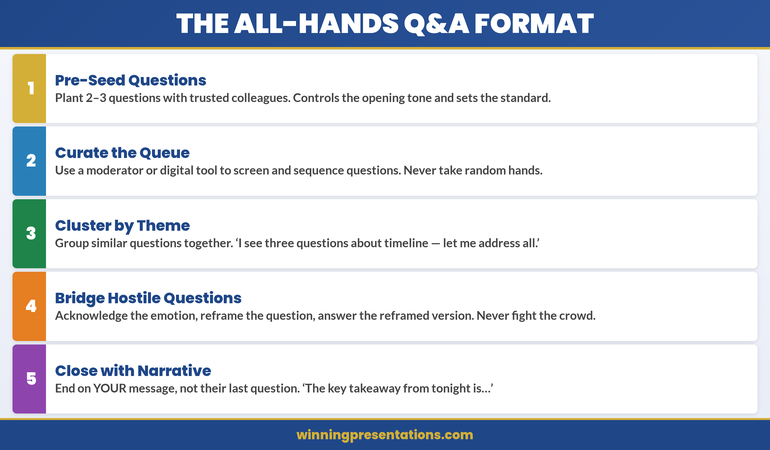
Curating Questions Before They Become Weapons
The most sophisticated executives don’t leave Q&A to chance. They curate it.
This doesn’t mean scripting the room or planting friendly questions. It means actively managing which questions surface and when. In a large all-hands, you have several legitimate levers:
The Pre-Submission Window — Many large all-hands now invite questions via email or Slack in advance of the session. This gives you 24–48 hours to think through the difficult questions before you’re on stage. You can also use this to shape the types of questions that will be asked: if you explicitly invite “strategic challenges and alternative perspectives,” you set the frame differently than if you say “we welcome all questions.”
The Moderator’s Discretion — If there’s a moderator or chair (often there is, in all-hands at companies over 100 people), the moderator has genuine discretion about question order. You can brief your moderator in advance: “If anyone asks about the acquisition timeline, I’d prefer that comes later in the session when I’ve had time to establish context.” This is legitimate curation, not suppression.
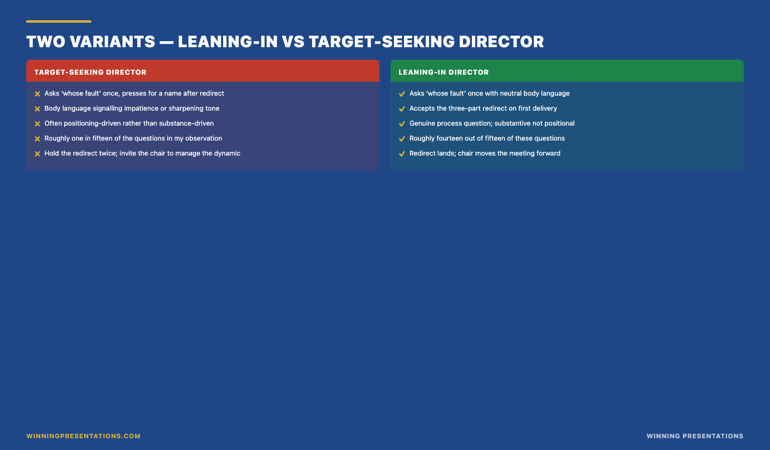
The Format Choice — A written Q&A (submitted via chat) gives you seconds to read each question before it’s asked. A live hand-raising Q&A gives you no warning. A hybrid format—written questions with live follow-ups—gives you the advantages of both. If you have any control over format, this is where it starts.
The Pre-Briefing of Allies — You don’t need to plant questions. But you can ensure that people who are informed and genuinely supportive of your strategy are ready to ask clarifying questions if needed. A well-placed question from someone respected in the room—not a softball, but a genuine question your ally already knows the answer to—can shift narrative momentum at a critical moment.
Curation is not manipulation. It’s architecture. You’re building a structure where truth can surface more effectively.
Ready to walk into your next all-hands knowing 80% of the questions before they’re asked?
If curation is about which questions surface, sequencing is about when they surface. This is where most executives lose control.
A hostile questioner wants to ask their loaded question when you’re off balance. An unprepared executive let’s questions come in whatever order they naturally arise. An experienced executive controls the sequence.
The architecture looks like this:
Open with Softballs, Establish Credibility — The first two to three questions should be ones you’re ready for, that you can answer with absolute clarity and confidence. This isn’t dodging. These questions genuinely exist. But you’re choosing to answer them first. The room watches you nail the opening questions. Your body language settles. Your pacing stabilises. By question three, you’ve established that you know what you’re talking about.
Sequence Difficulty in a Staircase, Not a Cliff — If the first three questions are softball and the fourth is “Why did you fail to deliver the acquisition?” you’ve created a cliff. The room notices the shift. You appear less confident. Instead, gradually escalate: first straightforward strategic questions, then deeper strategic questions, then the hardest questions. A staircase climbed looks like progress. A cliff-jump looks like you’ve lost control.
Place Your Hardest Question Second-to-Last — Not last. If you answer your hardest question at the end, the session ends on ambiguity. Place it second-to-last, then deliberately choose an easier final question. You take the hit on the hard question, recover visibly on the final one, and the room leaves remembering your composure on the recovery, not your struggle with the hard one.
Never Let Questions Cluster by Theme — If three questions in a row are about revenue projections, you’re locked into one lane of conversation for three straight minutes. The room stops hearing your answers and starts hearing repetition. Vary the themes: a question about strategy, then culture, then operations, then long-term vision. Each theme-shift keeps the audience’s attention and prevents any single challenge from building momentum.
Sequencing isn’t about softballing the audience. It’s about intelligent narrative design. You’re the executor of that design.
Want to see the exact question-mapping framework used by executives at JPMorgan, PwC, and RBS?
Sometimes curation and sequencing aren’t enough. Someone raises their hand with a genuinely hostile question. How do you handle that in front of 200 people?
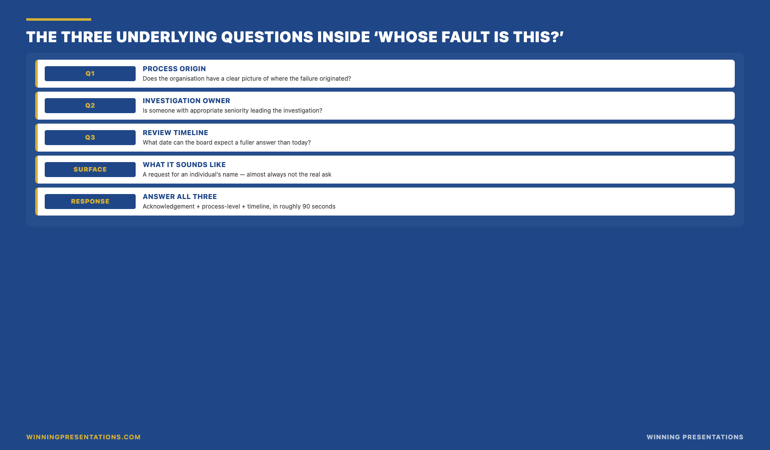
The principle is this: never respond to the emotion in the question. Respond to the legitimate underlying concern.
A hostile question often contains two layers: the surface aggression and the real question underneath. An example:
Hostile surface: “How can you claim we’re on track when the data clearly shows we’ve missed the last three milestones?”
Real question: Am I right to be concerned about execution?
If you respond to the hostility (“I think we’ve been very clear about this” or “The data actually shows…”), you’re now in an argument with one person in front of 199 others. Instead, acknowledge the concern and reframe the narrative:
“You’re asking whether we’re actually on track—whether the gap between plan and reality is something we’re managing or something that’s managing us. That’s the right question. Here’s what’s happened: we’ve missed three milestones, and we’ve recovered on two of them. Here’s the third one and our plan to close it.”
You’ve stripped away the hostility, validated the underlying concern, and answered the real question. The room watches someone raise a challenge, watch you take it seriously, and watch you respond not with defensiveness but with clarity. That’s not weakness. That’s leadership.
The five-step protocol for hostile questions:
Pause for one full breath (not three seconds—one breath). Longer pauses read as defeat in a stadium. One breath reads as composure.
Thank the questioner for raising a legitimate concern (and make clear it is legitimate, even if the delivery was hostile).
Rephrase the real question underneath the aggression in neutral language.
Answer the real question with data, context, or clear reasoning.
Invite follow-up in a way that signals you’re not threatened—”Does that address your concern?” or “What’s the specific data point that would help here?”
This protocol works because it moves the frame from “executive vs. hostile questioner” to “executive and audience, jointly looking for truth.” That’s a frame you always win in.
Predict 80% of Questions Before They’re Asked
The system that thousands of executives have used to walk into high-stakes Q&A with absolute confidence. Learn how to map question vectors, predict hostile challenges, and build responses that work across variations—so you’re never caught off guard.
Used in funding rounds, board approvals, and company all-hands across three continents.
The Recovery Protocol When It Goes Wrong
Sometimes despite your preparation, despite curation and sequencing, you’ll stumble. You’ll give an answer that doesn’t land. You’ll be asked something you genuinely don’t know. You’ll get tangled in language. And 200 people will watch it happen.
The recovery is more important than the stumble.
The protocol: acknowledge, clarify, commit, move forward.
Acknowledge: “I didn’t explain that clearly.” Or “That’s a good point and I didn’t address it well.” Or “I don’t have the specific data on that and I should.” Be explicit. The room already knows something didn’t work. Naming it directly proves you’re aware and in control.
Clarify: Give a shorter, clearer version of what you meant to say. Or, if you don’t have the answer, say so: “That’s the right question. I don’t have the headcount breakdown by region off the top of my head, but I’ll send it to you after this.” Specificity here matters enormously. “I don’t know” is worse than “I don’t have that data with me, but here’s who to ask and when you’ll get it.”
Commit: If you’ve committed to follow up (send data, circle back with an answer, investigate something), state it again. “So I’m committing to send you that breakdown within 24 hours.” The room needs to see that you’ve made a commitment and that you’re tracking it.
Move forward: Don’t dwell. Don’t over-apologise. Don’t loop back to the same question three turns later. The quickest way to make a stumble memorable is to keep referencing it. Instead, move to the next question with the same composure you started with.
The senior executive who froze for 47 seconds used this exact protocol. She said: “I lost my train of thought—apologies. Let me restart that answer.” She restarted. She nailed it. And after the all-hands, most people didn’t even remember the freeze. They remembered the recovery.
Three Questions About All-Hands Q&A You’re Probably Asking
Should you ever admit you don’t know the answer in front of 200 people?
Yes—but only if you commit to finding it. “I don’t know, and here’s who has the answer and when you’ll get it” is strength. “I don’t know” without the commit is weakness. The room isn’t judging whether you know everything. They’re judging whether you’re in control and competent. An honest “I don’t know” with a clear path to the answer proves competence. An evasive “we’re looking at that” proves the opposite.
What if someone asks a question that’s actually a political move against you?
It happens. Someone uses the all-hands to signal to their allies or to undermine you publicly. Don’t take the bait. Treat it as a legitimate question (even if it’s not), answer it with data and reason, and move on. Responding to the political subtext (“I know what you’re doing”) only amplifies it. Responding to the surface question denies them the conflict they’re after and proves your focus is on substance, not politics.
How do you handle a question you’ve specifically asked your moderator to avoid?
The moderator was supposed to keep it off the table, but it came anyway. Don’t blame the moderator or show frustration. You asked for curation, curation failed, now you adapt. This is exactly what composure looks like in real time. Answer the question you didn’t prepare to answer—and do it well enough that the room never knows you wanted to avoid it.
Want the three-step framework that lets you predict 80% of questions before they’re asked?
Master Large-Audience Q&A With Absolute Confidence
The difference between an executive who gets ambushed and one who doesn’t isn’t luck or natural talent. It’s preparation. The Executive Q&A Handling System teaches you the exact framework that lets you walk into any Q&A—board meeting, all-hands, investor presentation—knowing you’ve predicted the questions, prepared your responses, and designed a narrative that protects you.
Predict difficult questions before they’re asked using the question-mapping system
Build flexible, pre-composed responses that work across question variations
Control the narrative through strategic curation and sequencing
Recover with composure when things don’t go to plan
Thousands of executives at JPMorgan, PwC, RBS, and leading SaaS companies have used this system in high-stakes funding rounds and approvals.
People Also Ask: How do you handle hostile questions in front of a large audience?
Acknowledge the emotion behind the question without validating the hostility. Say “I can see this is important to you” or “That’s a fair concern.” Then reframe: restate the question in neutral terms that you can answer constructively. Answer the reframed version. The audience hears you being respectful and substantive. The hostile questioner gets heard without controlling the narrative. Never argue with someone in front of 200 people — the crowd always sides with the person who stays composed.
People Also Ask: Should I use a moderator for all-hands Q&A?
Yes, whenever possible. A moderator serves three functions: they screen questions for relevance and tone, they sequence questions so hostile or emotional ones don’t cluster together, and they give you a natural pause between questions (which your nervous system needs). Even an informal moderator — “Sarah will be collecting questions” — changes the dynamic. You’re no longer fielding random hands from a crowd. You’re responding to a curated, sequenced list.
People Also Ask: What if nobody asks questions at an all-hands meeting?
Silence after “Any questions?” in a room of 200 people is common and not necessarily a bad sign. Large audiences are reluctant to be the first person to speak. Pre-seed two or three questions with trusted colleagues. After those are asked and answered, the room usually opens up. If it doesn’t, close with your narrative: “The key thing I want you to take away from today is…” Silence isn’t failure. It’s often a sign that your presentation answered the questions before they were asked.
Is This Right For You?
The Executive Q&A Handling System is designed for executives and leaders who regularly face Q&A in high-stakes environments:
You present to company all-hands of 50+ people regularly
You’ve had the experience of being asked something hostile and wishing you’d been better prepared
You know some questions are coming but you’re not quite sure how to respond
You want to move from anxious about Q&A to completely composed
You’re leading through change, restructure, or challenges and expect scrutiny
You’re preparing for funding pitches or investor presentations
You want to shift from “hoping it goes well” to “knowing exactly what will happen”
If most of these resonate, this system will change how you approach every Q&A you do from now on.
Frequently Asked Questions
How much time does the system take to learn?
The core framework takes about 30 minutes to understand. The real work—applying it to your specific upcoming Q&A—takes one to two hours. Most executives do this prep 24–48 hours before a big all-hands or presentation. You’re not adding complexity to your process; you’re structuring the prep you should be doing anyway.
What if I work in a culture where Q&A is very open and unstructured?
Curation and sequencing still apply. You can’t control which questions get asked, but you can brief your moderator on preferred sequencing, you can influence what gets submitted in advance, and you can absolutely apply the response protocols in this system. The system works whether your Q&A is hyper-structured or completely free-form.
Does this system teach me how to dodge difficult questions?
No. The opposite. This system teaches you how to answer difficult questions in a way that’s honest, clear, and maintains your credibility. Questions you can’t answer get an honest “I don’t know, here’s the path to the answer.” Questions you can answer but were worried about get a structured response that lands with confidence. The goal is never to dodge. The goal is to protect yourself while being truthful.
Can I use this before my all-hands next week?
Yes. You get access immediately. Many executives use this as a just-in-time prep tool: buy it Wednesday, use it to prepare for Thursday’s presentation. It’s designed to be actionable in hours, not weeks.
Stay Sharp: The Winning Edge Newsletter
Join thousands of executives who get practical Q&A and presentation techniques delivered every week
Each week, The Winning Edge covers real situations: how to handle hostile questions in front of investors, how to recover when something goes wrong, how to read a room and adjust in real time. Subscribe and get patterns that work in the boardroom, the all-hands, and the high-stakes conversation.
Mary Beth Hazeldine is the Owner & Managing Director of Winning Presentations. With 24 years of corporate banking experience at JPMorgan Chase, PwC, Royal Bank of Scotland, and Commerzbank, she has delivered high-stakes presentations in boardrooms across three continents.
A qualified clinical hypnotherapist and NLP practitioner, Mary Beth combines executive communication expertise with evidence-based techniques for managing presentation anxiety. She has trained thousands of executives and supported high-stakes funding rounds and approvals.
Quick Answer: Q&A anxiety stems from loss of control, not lack of knowledge. The reframe that changes everything: hostile questions aren’t attacks—they’re opportunities to demonstrate expertise and build credibility. Use the Acknowledge-Bridge-Control technique: validate the concern, find common ground, then guide the conversation where you want it to go.
The question came like a punch to the chest.
“Given that your last two projects ran over budget, why should we trust these numbers?”
I was presenting to the PwC leadership team, and a senior partner had just challenged my credibility in front of everyone. My face flushed. My mind raced to defend, to explain, to justify.
But I’d been training for this moment.
Instead of defending, I paused. Took a breath. And said: “You’re right to ask that. Trust has to be earned. Let me show you exactly what’s different this time.”
The room shifted. What could have been a career-damaging moment became the most credibility-building two minutes of my presentation.
That’s when I learned: hostile questions aren’t threats. They’re opportunities—if you know how to reframe them.
Dreading the Q&A More Than the Presentation Itself?
You are not alone. Most executives say the Q&A is where their confidence collapses — not during the slides. The difference between freezing and flourishing under fire? A structured system for handling any question, including the hostile ones. The Executive Q&A Handling System gives you that system: question prediction frameworks, real-time response techniques, and 51 AI prompts to stress-test your answers before the room does.
When someone challenges you publicly, your brain doesn’t distinguish between professional criticism and physical threat. The amygdala fires. Cortisol floods your system. You’re in fight-or-flight before you’ve processed the actual question.
This is why smart, knowledgeable people freeze under hostile questioning. It’s not about competence—it’s about biology.
The solution isn’t to suppress the response. It’s to reframe the situation before your threat system takes over.
Here’s the reframe that changed everything for me: A hostile question is a gift.
Think about it. The questioner has just told you exactly what concerns them. They’ve revealed their objection, their fear, their agenda. Now you can address it directly instead of guessing what resistance exists in the room.
Most hostile questions aren’t really about what they seem to be about:
“Why should we trust these numbers?” = “I’m worried about being burned again.”
“This seems overly optimistic.” = “I need reassurance about downside scenarios.”
“Have you considered X?” = “I want to feel heard and included.”
“This is the third time we’ve discussed this.” = “I’m frustrated with the pace of progress.”
When you address the emotion behind the question—not just the words—you transform the interaction. The questioner feels understood, and understanding builds trust faster than data ever can.
For more strategies on managing challenging interactions, explore our guide to presentation Q&A.
Stop Dreading the Questions
Turn Every Hostile Question Into a Credibility-Building Moment
The Executive Q&A Handling System (£39, instant access): seven field-tested Q&A techniques that signal leadership under pressure, scripts for hostile and loaded questions, the Parking Lot method and four other frameworks for managing derailing questions, and 51 AI prompts to rehearse difficult scenarios before you face them live.
Designed for executives who present to boards, investors, and senior leadership — where the questions matter more than the slides.
If you present to boards, investors, or senior leadership, the Executive Q&A Handling System gives you a structured approach to preparing for and handling any question — including the ones designed to test you.
Frequently Asked Questions
Why does the Q&A cause more anxiety than the presentation?
During the presentation, you control content, timing, and direction. In Q&A, that control vanishes—questions are unpredictable, and you’re reacting in real-time. Your brain interprets this loss of control as threat, triggering anxiety even when you know your material. More techniques in our full presentation Q&A guide.
How do I stop feeling attacked during hostile questions?
Reframe the question as information-seeking, not attack. Most hostile questions stem from the questioner’s frustration, fear, or agenda—not from your failure. Responding with curiosity instead of defensiveness transforms the dynamic.
What’s the best technique for handling aggressive questions?
The Acknowledge-Bridge-Control technique: Acknowledge the concern genuinely, Bridge to common ground, then Control the direction by offering your perspective. This validates the questioner while keeping you in command of the response.
Prepare for the Unpredictable
Know What They Will Ask Before They Ask It
The Executive Q&A Handling System (£39) includes a question prediction framework that maps the 5 categories of questions your audience will ask — so you walk in with answers ready, not hoping for the best.
Mary Beth Hazeldine is the Owner & Managing Director of Winning Presentations. With 25 years of corporate banking experience at JPMorgan Chase, PwC, Royal Bank of Scotland, and Commerzbank, she has delivered high-stakes presentations in boardrooms across three continents.
A qualified clinical hypnotherapist and NLP practitioner, Mary Beth combines executive communication expertise with evidence-based techniques for managing presentation anxiety. She advises executives across financial services, healthcare, technology, and government on structuring presentations for high-stakes Q&A sessions.