Category: PowerPoint Copilot

09 Dec 2025
Why most executive presentation training fails - 90% of skills lost within 1 week - January 2026 Maven course on executive presentations with only 60 seats

Why Most Presentation Training Fails (And What Actually Works) [2026]

📅 Published: December 9, 2025 — New AI-enhanced executive presentation training course launching January 2026

I’m going to say something that might upset the training industry: most presentation training is a waste of money.

I’ve been on both sides. I’ve sat through corporate presentation workshops that cost £10,000 and changed nothing. I’ve also delivered training that transformed how executives communicate — training that led to £250 million in successful pitches.

The difference isn’t the content. It’s not the slides. It’s not even the trainer’s credentials.

After 24 years in corporate banking and a decade of training executives, I’ve identified exactly why most presentation training fails — and the three elements that make training actually stick.

The Uncomfortable Truth About Presentation Training

Here’s what typically happens:

A company books a presentation skills workshop. An enthusiastic trainer delivers two days of content. Participants practice, get feedback, feel inspired. Everyone leaves with a workbook they’ll never open again.

Three weeks later? They’re presenting exactly the same way they did before.

Research backs this up. Studies on corporate training show that 90% of new skills are lost within a week if not reinforced. The “forgetting curve” is brutal — and most presentation training ignores it completely.

So why do companies keep spending money on training that doesn’t work?

Because the problem isn’t obvious. The training feels valuable. People enjoy it. HR can tick a box. But behaviour change? That’s much harder to achieve — and measure.

Why Traditional Executive Presentation Training Fails

I’ve analysed hundreds of presentation training programmes. The failures cluster around three core problems:

Problem #1: Generic Content for Specific Challenges

Most presentation training teaches universal principles: make eye contact, use fewer bullet points, tell stories.

That’s fine. But it ignores the reality that a board presentation requires completely different skills than a sales pitch. A biotech investor deck has different conventions than a SaaS demo. An internal strategy update isn’t the same as an external keynote.

The symptom: Participants learn “presentation skills” but can’t apply them to their actual high-stakes moments.

I spent 24 years at JPMorgan Chase, PwC, Royal Bank of Scotland, and Commerzbank. I know that a presentation to a credit committee requires surgical precision. A pitch to private equity demands a different energy. A board update needs executive brevity. Generic training doesn’t address any of this.

Problem #2: No Practice Under Pressure

Presenting in a safe training room is nothing like presenting when it matters.

When the CEO is watching. When £5 million is on the line. When your promotion depends on the next 15 minutes. That’s when nerves kick in. That’s when habits take over. That’s when all that training evaporates.

The symptom: People perform well in workshops but freeze in real situations.

Effective presentation training must simulate pressure. Not artificial pressure — real pressure. With stakes. With feedback that stings a little. With enough repetition that new behaviours become automatic.

Problem #3: One-and-Done Events

A two-day workshop is an event, not a transformation.

Real skill development requires:

  • Spaced repetition (practice over weeks, not hours)
  • Real-world application between sessions
  • Feedback on actual presentations, not role-plays
  • Accountability to implement changes

The symptom: Temporary enthusiasm followed by permanent reversion to old habits.

This is why executive coaching works better than workshops — but costs £500-1,000 per hour. Most people can’t access that level of support.

Three reasons presentation training fails: generic content for specific challenges, no pressure practice, and one-and-done events leading to permanent reversion to old habits

A DIFFERENT APPROACH TO EXECUTIVE PRESENTATION TRAINING

AI-Powered Executive Presentations

Live cohort course designed to fix everything wrong with traditional training

Join the January Waitlist

£249 early bird • Only 60 seats • Launching January 2026

The 3 Elements of Presentation Training That Actually Works

Not all training fails. Some transforms careers. Here’s what separates effective executive presentation training from expensive theatre:

Element #1: Context-Specific Application

Effective training starts with your actual presentations. Not hypotheticals. Not case studies from other industries. Your board deck. Your investor pitch. Your client presentation.

What this looks like:

  • Participants bring real presentations they’re working on
  • Feedback addresses their specific challenges
  • Templates and frameworks match their industry context
  • Practice scenarios mirror their actual high-stakes moments

When I train investment bankers, we work on pitch books and credit committee presentations. When I train biotech executives, we focus on investor days and scientific advisory boards. When I train SaaS leaders, we refine demo flows and QBR structures.

The principles are universal. The application must be specific.

Element #2: Distributed Practice with Accountability

The research is clear: distributed practice beats massed practice. Five one-hour sessions over five weeks creates more lasting change than one five-hour workshop.

What this looks like:

  • Training spread over weeks, not crammed into days
  • Assignments to apply learning between sessions
  • Peer accountability and feedback loops
  • Real presentations reviewed and refined throughout

This is why cohort-based courses outperform self-paced learning. You’re not just learning — you’re implementing, getting feedback, and iterating. The social pressure of a cohort keeps you accountable.

Element #3: Modern Tools Integration

Here’s where most executive presentation training is stuck in 2015.

AI tools like PowerPoint Copilot have fundamentally changed how presentations are created. Executives who master these tools save 10+ hours per week. Those who don’t are competing with one hand tied behind their back.

What this looks like:

  • Training that integrates AI tools from day one
  • Prompts and workflows specific to executive presentations
  • Focus on human + AI collaboration, not replacement
  • Practical application: use AI to build your actual presentations during training

The future of executive communication isn’t choosing between presentation skills and AI skills. It’s mastering both — using AI to handle the tedious work so you can focus on strategy, storytelling, and delivery.

💡 The Compound Effect: Executives who combine strong presentation skills with AI mastery don’t just save time — they produce better work. The AI handles structure and first drafts. The human brings judgment, nuance, and persuasion. Together, they’re unbeatable.

What Changes When Training Actually Works

I’ve seen what happens when executive presentation training is done right:

A VP of Strategy went from dreading board meetings to requesting them. Her proposals started getting approved on first presentation instead of being deferred for “more analysis.”

A startup founder raised his Series A in half the meetings his advisors predicted. His pitch wasn’t just clearer — it was structured to address investor objections before they were raised.

A management consultant got promoted two years ahead of peers. Her partners specifically cited her “exceptional client communication” — skills she developed in eight weeks of focused training.

The common thread? They didn’t just learn presentation skills. They transformed how they communicate under pressure, in their specific context, using modern tools.

The Hidden Cost of Bad Presentations

Let’s talk about what ineffective presentations actually cost:

Direct costs:

  • Deals lost to competitors with better pitches
  • Budgets rejected and projects delayed
  • Strategies misunderstood and poorly executed
  • Hours wasted on presentations that don’t land

Career costs:

  • Promotions that go to people who “present well”
  • Ideas attributed to whoever communicated them best
  • Executive presence questions that stall advancement
  • Confidence erosion from repeated underwhelming performances

Opportunity costs:

  • Influence you could have but don’t
  • Relationships that never deepen because communication falls flat
  • The compounding effect of years of suboptimal presentations

Most executives don’t calculate these costs. They accept mediocre presentations as normal. But the executives who invest in genuine skill development? They pull ahead — and keep pulling ahead.

Calculate Your ROI

If better presentations helped you close one extra deal, secure one budget approval, or accelerate one promotion — what’s that worth? For most executives, it’s 10-100x the cost of proper training.

See Course Details →

Why I’m Launching a Different Kind of Course

After years of corporate training, I kept hitting the same frustrations:

Companies wanted two-day workshops. I knew those don’t create lasting change.

Budgets limited training to generic content. I knew context-specific application is essential.

Traditional formats ignored AI tools. I knew these tools are transforming executive productivity.

So I designed something different.

AI-Powered Executive Presentations is an 8-week cohort course that addresses everything wrong with traditional executive presentation training:

Instead of generic content: You’ll work on your actual presentations throughout the course. Board decks. Investor pitches. Client presentations. Whatever high-stakes moments you’re facing.

Instead of one-and-done: Eight weeks of distributed learning with assignments, peer feedback, and accountability. The research-backed approach to lasting skill development.

Instead of ignoring AI: Deep integration of Copilot, ChatGPT, and other tools. You’ll learn to use AI as a force multiplier — saving hours while producing better work.

Instead of passive learning: Live cohort sessions. Hot seats where participants present and get real-time feedback. A community of peers facing similar challenges.

AI-Powered Executive Presentations 8-week curriculum covering foundations, AI creation, high-stakes delivery, and application with live cohort learning for January 2026

What You’ll Master in 8 Weeks

Weeks 1-2: Executive Communication Foundations

  • The 3Ps Framework (Proposition, Presentation, Personality) — the methodology behind £250M+ in successful pitches
  • Understanding your audience: boards, investors, clients, internal stakeholders
  • Message architecture for different presentation contexts

Weeks 3-4: AI-Powered Creation

  • Copilot and ChatGPT workflows for executive presentations
  • Prompt engineering for board decks, pitch books, and strategy presentations
  • Quality control: when to trust AI and when to override it

Weeks 5-6: High-Stakes Delivery

  • Managing nerves and projecting confidence under pressure
  • Handling tough questions from boards, investors, and executives
  • The first 60 seconds: commanding attention immediately

Weeks 7-8: Application and Integration

  • Live presentation hot seats with peer and instructor feedback
  • Refining your signature presentation style
  • Building sustainable practices for continuous improvement

JANUARY 2026 COHORT

AI-Powered Executive Presentations

8 weeks • Live sessions • Real presentations • Lasting transformation

Reserve Your Seat — £249 Early Bird

Only 60 seats available • Regular price £499 after January 15

Who This Course Is For

This isn’t for everyone. It’s specifically designed for:

Executives and senior managers who present to boards, leadership teams, or external stakeholders — and want those presentations to drive decisions, not just inform.

Founders and entrepreneurs raising capital or pitching to enterprise clients — where every presentation directly impacts the business.

Consultants and advisors whose credibility depends on how they communicate recommendations — and who want to stand out from peers.

High-potential professionals who know that executive presence and communication skills are the difference between good careers and exceptional ones.

If you’re already an excellent presenter, this course will make you exceptional. If you’re struggling with high-stakes presentations, this course will give you the skills and confidence to perform under pressure.

Who This Course Is NOT For

To be direct:

Not for passive learners. This course requires active participation. You’ll present, get feedback, and iterate. If you want to sit back and absorb content, this isn’t the right fit.

Not for people seeking quick fixes. Transformation takes eight weeks of consistent effort. If you’re looking for a magic bullet, you’ll be disappointed.

Not for those uncomfortable with AI. This course integrates AI tools throughout. If you’re resistant to using Copilot and ChatGPT, you won’t get full value.

Not for beginners. This is executive-level training. If you’ve never given a business presentation, start with foundational resources first.

Frequently Asked Questions

How is this different from other presentation courses?

Three key differences: (1) You work on your actual presentations, not generic exercises. (2) AI tools are integrated throughout, not ignored. (3) The cohort format with distributed practice creates lasting change, not temporary inspiration.

What if I can’t attend all live sessions?

Sessions are recorded. But the value comes from live participation, hot seats, and peer interaction. If you can’t commit to most live sessions, consider waiting for a future cohort.

I’m not technical. Will I be able to use the AI tools?

Yes. We start from basics and provide step-by-step guidance. By week 4, you’ll be using AI tools confidently — regardless of your starting point.

What presentations can I work on during the course?

Any high-stakes business presentation: board decks, investor pitches, client proposals, internal strategy presentations, QBRs, or keynotes. The more important the presentation, the more value you’ll get.

Is there a guarantee?

If you actively participate in the first two weeks and don’t find value, I’ll refund your investment. I’m confident in the methodology — it’s the same approach that’s driven £250M+ in successful pitches.

Why only 60 seats?

Cohort size matters. Too large, and you lose the personalised feedback and community connection. Sixty participants is the maximum for maintaining quality while creating diverse peer interactions.

The January 2026 Cohort

Dates and details:

  • Start date: Week of January 20, 2026
  • Duration: 8 weeks
  • Live sessions: Weekly, 90 minutes (recordings available)
  • Investment: £249 early bird (£499 regular price after January 15)
  • Seats: 60 maximum

Early bird pricing is available until January 15, 2026 — or until seats fill, whichever comes first.

What Happens After You Join the Waitlist

When you join the waitlist, you’ll receive:

  1. Priority access to early bird pricing when enrollment opens
  2. Free resources to start improving your presentations immediately
  3. Course updates including detailed curriculum and session schedule
  4. First opportunity to secure your seat before public launch

No obligation. No payment required until you decide to enroll.

STOP WASTING MONEY ON TRAINING THAT DOESN’T WORK

Join the January Cohort

8 weeks of executive presentation training designed for lasting transformation

Join the Waitlist

Only 60 seats • £249 early bird • No obligation

Start Improving Today

Whether or not the course is right for you, here are resources to improve your executive presentations now:

About Mary Beth Hazeldine

After 24 years in corporate banking at JPMorgan Chase, PwC, Royal Bank of Scotland, and Commerzbank, Mary Beth now trains executives to communicate with impact. Her clients have raised over £250 million using her 3Ps methodology (Proposition, Presentation, Personality). She’s particularly focused on helping leaders integrate AI tools like Copilot into their workflow — creating better presentations in less time. She runs Winning Presentations and is launching the AI-Powered Executive Presentations course on Maven in January 2026.

08 Dec 2025
PowerPoint Copilot December 2025 Update featuring Agent Mode - 57% faster presentation creation, 40 language translation, $21 SMB pricing

PowerPoint Copilot December 2025 Update: Agent Mode Changes Everything

PowerPoint Copilot December 2025 Update featuring Agent Mode - 57% faster presentation creation, 40 language translation, $21 SMB pricing
December 2025 brings Agent Mode, fixed translation, and SMB pricing to PowerPoint Copilot.

Last Updated: December 8, 2025

TL;DR:  PowerPoint Copilot December 2025 Update

December 2025 brings Agent Mode to PowerPoint—the biggest shift in how we work with AI presentations since Copilot launched. Instead of one-shot prompts, you now have multi-turn conversations where Copilot creates, edits, and refines slides iteratively. I tested this on three client decks this week: one banking pitch, one biotech regulatory submission, and one SaaS quarterly review.

Result? A complete 24-slide investor deck created through conversation in 18 minutes—something that previously took 45+ minutes of prompting and manual cleanup.

What else shipped: Presentation Translation now works on web (40 languages with preserved formatting). The November bug where brand assets disappeared on translated slides? Fixed. The new Copilot UI moves from ribbon to canvas—making it faster to access. Microsoft 365 Copilot Business launches for SMBs at $21/user/month.

Breaking change: If you’re using Frontier features, you’ll need to opt-in through Microsoft 365 Insiders Beta Channel for Windows to access Agent Mode in PowerPoint.

ROI update: Agent Mode testing shows 4.2 hours saved weekly on complex presentations. At £75/hour, that’s £315/week—£16,380 annually against £360 Copilot cost. 4,550% ROI for power users.

Summary Table: December 2025 at a Glance

Category What Changed Real-World Impact
Agent Mode Multi-turn conversational AI creation (Frontier preview) 18-minute complete decks vs 45+ minutes; iterative refinement finally works
Translation 40-language translation GA on web; brand asset preservation fixed Global teams get consistent branded decks in any language
New UI Copilot moves from ribbon to canvas Faster access, contextual prompt suggestions
Pricing Microsoft 365 Copilot Business ($21/user/month for SMBs) 30% cost reduction for teams under 300
Work IQ Conversational memory across sessions Copilot remembers your preferences and past interactions

What Really Happened With the December 2025 PowerPoint Copilot Update

Wednesday afternoon, 3:22 PM. I’m on a call with the VP of Marketing at a mid-market SaaS company. They need their quarterly board presentation ready by Friday. Forty slides. Competitive analysis. Revenue breakdown. Product roadmap. Customer retention metrics.

“We’ve got everything in a Word doc and three Excel files,” she says. “Can Copilot actually help, or am I going to spend tonight fixing its output?”

I’d heard this question dozens of times since Copilot launched. The answer used to be: “It’ll save you 2 hours creating, then cost you 45 minutes fixing.”

That answer changed on December 3, 2025.

Microsoft shipped Agent Mode for PowerPoint as part of the December 2025 PowerPoint Copilot update—available through the Frontier program for enterprise users. Instead of single prompts that generate slides you then manually refine, Agent Mode lets you have an actual conversation with Copilot.

I tested it live on that call.

“Create a board presentation from this Q3 report. Start with an executive summary highlighting the three metrics the CEO cares about most.”

Copilot asked: “I see revenue growth, customer retention, and NPS mentioned frequently. Should I prioritize these three, or would you prefer different metrics?”

It was asking clarifying questions. Like a colleague would.

“Yes, those three. And use our brand template—the navy one with the gradient headers.”

Copilot generated five slides. The branding was correct. Then it said: “I’ve created the executive summary. Should I continue with the competitive analysis section, or would you like to refine these slides first?”

We refined. Then continued. Then refined again.

Total time to create a 24-slide investor-ready deck: 18 minutes.

The VP’s response: “This is the first time AI has actually felt like working with someone, not fighting with a tool.”

That’s the December 2025 PowerPoint Copilot update in practice. Agent Mode isn’t just faster—it’s fundamentally different.

Here’s everything you need to know—tested on real client work across investment banking, biotech, SaaS, and consulting firms.

Agent Mode: The Biggest Change Since Copilot Launched

What Is Agent Mode in PowerPoint?

Agent Mode is Microsoft’s new conversational AI interface for PowerPoint that enables multi-turn, iterative presentation creation. Unlike traditional Copilot prompts (which generate output from a single instruction), Agent Mode maintains context across an entire work session, asks clarifying questions before generating, and allows real-time refinement without regenerating entire slides.

Think of the difference like this:

Traditional Copilot = Sending an email to a contractor and waiting for deliverables

Agent Mode = Working alongside a colleague in real-time

How Agent Mode Changes Your Workflow

❌ Traditional Copilot workflow:

  1. Write detailed prompt trying to anticipate everything
  2. Wait for generation
  3. Review output, find problems
  4. Write another detailed prompt to fix issues
  5. Wait again
  6. Repeat 4-6 times
  7. Give up and fix manually

✓ Agent Mode workflow:

  1. Describe what you need (simple, conversational)
  2. Answer Copilot’s clarifying questions
  3. Watch slides generate
  4. Say “make slide 3 more visual” — it adjusts just slide 3
  5. Continue building together
  6. Done

The difference isn’t incremental. It’s categorical.

Comparison chart showing Traditional Copilot workflow taking 47 minutes with 7 frustrating steps versus Agent Mode workflow taking 20 minutes with conversational 6-step process - 57% time savings
Agent Mode replaces the frustrating prompt-regenerate-fix cycle with natural conversation. Average time savings: 27 minutes per deck.

What Agent Mode Can Do (That Traditional Copilot Can’t)

1. Maintain context across your entire session

Ask for a slide, then say “add a chart to that.” Agent Mode knows what “that” means. Traditional Copilot doesn’t.

Real example from this week: I was building a banking pitch and said “Create an executive summary slide.” Then: “Now add the revenue chart from the Excel file.” Then: “Put a footnote on that chart citing the Q3 report.”

Three instructions. Three perfect executions. Zero confusion about referents.

2. Ask clarifying questions before generating

Traditional Copilot guesses what you want. Agent Mode asks.

When I said “Create a competitive analysis section,” Agent Mode responded: “I found 6 competitors mentioned in your source documents. Should I include all 6, or focus on your top 3 direct competitors? Also, do you want feature comparison, pricing comparison, or market positioning?”

This single clarification prevented what would have been 10 minutes of regeneration and manual fixing.

3. Make surgical edits without destroying everything

Say “make the headline punchier” and Agent Mode adjusts just the headline. Traditional Copilot regenerates the entire slide—losing your other refinements.

A biotech client described the old experience: “Every time I fixed one thing, Copilot broke two others. I spent more time managing Copilot than just building the deck myself.”

Agent Mode fixes this. Edits are precise. Context is preserved.

4. Pull from multiple sources mid-conversation

Traditional Copilot: reference one file per prompt.

Agent Mode: “Use the revenue data from the Excel file, but the market analysis from the Word doc, and apply the brand guidelines from our SharePoint library.”

One instruction. Three sources. Correctly integrated.

Why This Matters for High-Stakes Presentations

I train executives who present to boards, investors, and regulators. For them, “good enough” isn’t good enough.

Before Agent Mode, I’d tell clients: “Copilot is great for first drafts, but plan to spend 45-60 minutes refining.”

Now? Agent Mode produces presentation-ready output in a single session. Not because the AI is smarter (though the underlying models have improved), but because the interaction model finally matches how presentations actually get built—iteratively, conversationally, with constant refinement.

For investment banking pitch books: Agent Mode handles the complex formatting, multiple data sources, and brand requirements that previously made Copilot more trouble than it was worth.

For biotech regulatory submissions: The clarifying questions catch errors that would otherwise require complete rebuilds.

For SaaS quarterly reviews: The multi-source integration finally works properly.

If you’re still using traditional Copilot prompts, you’re working twice as hard for half the output.

Want to master Agent Mode quickly? The Executive Slide System (£39) includes 30 Agent Mode prompt cards—tested conversation starters for every common presentation scenario. Works with the December 2025 update immediately.

How to Access Agent Mode (Even Without Frontier)

Current Availability (December 2025)

Agent Mode for PowerPoint is currently available through:

  • Microsoft Frontier Program (enterprise)
  • Windows desktop app only (not Mac, not web—yet)
  • Microsoft 365 Insiders Beta Channel required

If your organization has Microsoft 365 Copilot enterprise licenses, here’s how to enable Agent Mode:

Step-by-Step: Enable Agent Mode for Your Organization

Step 1: Check your Copilot license

Agent Mode requires Microsoft 365 Copilot (not Copilot Pro). Verify in Microsoft 365 admin center → Billing → Licenses.

Step 2: Enable Frontier features

  1. Go to Microsoft 365 admin center
  2. Navigate to Settings → Org settings → Copilot
  3. Find “Frontier features” section
  4. Toggle ON for your organization (or specific user groups)

Step 3: Join the Insiders Beta Channel

Agent Mode requires the Insiders Beta Channel build of PowerPoint:

  1. Open PowerPoint
  2. File → Account → Office Insider
  3. Select “Beta Channel”
  4. Update PowerPoint

Step 4: Access Agent Mode

Once enabled, you’ll see a new “Agent Mode” toggle in the Copilot pane. Click it to switch from traditional prompts to conversational mode.

What If You’re on Mac or Web?

Agent Mode is Windows-only during the Frontier preview. Microsoft hasn’t announced specific dates, but based on their typical rollout patterns:

  • Web: Expect Q1 2026 (likely February-March)
  • Mac: Expect Q1-Q2 2026 (likely March-April)

For now, Mac and web users should continue with traditional Copilot—but keep reading for what you can do without Agent Mode.

What If Your Organization Hasn’t Enabled Frontier?

Many IT departments are cautious about preview features. If you can’t get Frontier access:

  1. Ask your IT admin specifically — Many don’t know Frontier exists or that it’s separate from standard Copilot settings
  2. Point to Microsoft’s documentation — Frontier features are enterprise-grade and covered by standard compliance commitments
  3. Propose a pilot group — Suggest enabling Frontier for a small team first

If none of that works, see the section below on What If You Don’t Have Agent Mode Yet?

Agent Mode Prompts That Actually Work

Agent Mode changes how you write prompts. The old approach—cramming everything into one detailed instruction—is now counterproductive.

The New Prompt Philosophy

❌ Old approach (traditional Copilot):

“Create a 12-slide quarterly board presentation with executive summary, revenue breakdown by region showing Q3 vs Q2, customer retention metrics with cohort analysis, competitive positioning versus our top 3 competitors, product roadmap for Q4-Q1, and next steps slide. Use professional formatting with our brand colors and include speaker notes for each slide.”

✓ New approach (Agent Mode):

“Help me build a quarterly board presentation. Let’s start with what the board cares about most.”

The difference? Agent Mode will ask you the right questions. You don’t need to anticipate everything upfront.

Agent Mode Session Starters

These prompts initiate productive Agent Mode conversations:

For board presentations:

“I need to create a board presentation. Before we start, ask me about the audience’s priorities, the key metrics they care about, and the level of detail they expect.”

For investor pitches:

“Help me build a pitch deck for our Series B. Start by asking what makes our company unique and who we’re presenting to.”

For competitive analysis:

“Create a competitive analysis presentation. First, ask me who our main competitors are and what dimensions of comparison matter most to our audience.”

For quarterly reviews:

“I’m building a quarterly business review. Ask me which metrics my leadership team focuses on and what story I want the data to tell.”

For training materials:

“Help me create training slides for our sales team. Ask me about their current skill level and what outcomes I need from this training.”

Mid-Conversation Commands

Once you’re in an Agent Mode session, these commands refine without regenerating:

Adjust specific slides:

“Slide 7 is too dense. Split it into two slides—one for the problem, one for our solution.”

Add supporting content:

“Add a customer quote slide between the ROI section and the case study. Pull from the testimonials in the source doc.”

Change visual style:

“The charts are all bar graphs. Use a line chart for the trend data and a pie chart for market share.”

Adjust tone:

“The executive summary feels too cautious. Make it confident without being aggressive.”

Handle complex requests:

“I need three versions of slide 12—one for the board (high-level), one for investors (ROI-focused), and one for the ops team (detailed). Generate all three as separate slides.”

Prompts for Specific Industries

Investment Banking:

“Create a pitch book for an M&A transaction. Ask me about the target company, deal rationale, and which valuation methodologies to include.”

Biotech/Pharma:

“Help me build a regulatory submission deck. Ask me about the indication, trial phase, and which safety data the reviewers will focus on.”

SaaS Sales:

“Create a sales presentation for [product]. Ask me about the prospect’s pain points and what objections I’m likely to face.”

Consulting:

“Build a strategy presentation for a client engagement. Ask me about the client’s industry, the problem we’re solving, and the level of seniority in the room.”

Get 30 ready-to-use Agent Mode prompts — The Executive Slide System includes tested conversation starters for every scenario above, plus templates designed for Agent Mode output. £39 for immediate access.

Presentation Translation: Finally Fixed

What Changed in December

The November 2025 PowerPoint Copilot update added 15-language translation with layout preservation. It was genuinely useful—but had a critical bug.

The November problem: When you translated a presentation to a non-English language, your brand assets disappeared. Custom fonts reverted to defaults. Brand colors reset to Microsoft blue. Templates broke.

I had a consulting client generate an English deck with perfect brand compliance, translate it to German for their Munich office, and receive slides in Calibri with generic blue colors. Their brand team was furious. They ended up manually reformatting every slide—defeating the entire purpose of AI translation.

December fixes this completely.

Translation now preserves:

  • Custom brand fonts (uploaded or system)
  • Locked color palettes
  • Template layouts and master slides
  • Logo placements and sizing
  • Chart formatting and colors
  • Text box positioning

How to Use Translation Properly

Step 1: Complete your presentation in English (or your source language)

Step 2: Verify brand assets are correct before translating

Step 3: Open Copilot → select “Translate this presentation”

Step 4: Choose target language (40 options available)

Step 5: Enable “Preserve brand assets” checkbox (new in December)

Step 6: Copilot creates a new translated file (original unchanged)

Real-World Translation Test

I tested the December translation fix on a consulting deck with strict brand requirements:

  • Source: English, 18 slides, custom font (Proxima Nova), brand colors (#1F4788, #2E5090), custom template
  • Target languages: German, Spanish, Mandarin

Results:

Element November 2025 December 2025
Custom font preserved ❌ Reverted to Calibri ✅ Proxima Nova maintained
Brand colors preserved ❌ Reset to default blue ✅ Exact hex codes maintained
Template structure ⚠️ Partially preserved ✅ Fully preserved
Logo placement ✅ Preserved ✅ Preserved
Chart colors ❌ Reset ✅ Preserved

Total time for three translations: 4 minutes, 12 seconds.

Compare that to manual translation and reformatting: 2-3 hours minimum, plus translation service costs of £300-500.

Languages Now Supported

The December 2025 PowerPoint Copilot update supports 40 languages with brand preservation:

Arabic (RTL), Chinese (Simplified), Chinese (Traditional), Czech, Danish, Dutch, English, Finnish, French, German, Greek, Hebrew (RTL), Hindi, Hungarian, Indonesian, Italian, Japanese, Korean, Malay, Norwegian, Polish, Portuguese (Brazilian), Portuguese (European), Romanian, Russian, Slovak, Spanish, Swedish, Thai, Turkish, Ukrainian, Vietnamese—plus 8 additional regional variants.

Translation Limitations That Still Exist

Text in images won’t translate. If you have text baked into PNG/JPG images, Copilot can’t touch it. Use text boxes over images instead.

Very long text may overflow. German is typically 30% longer than English. Some slides may need manual text box adjustments.

Complex animations sometimes reset. Simple animations preserve; complex sequences may need rebuilding.

SmartArt with nested text can break. Convert complex SmartArt to shapes before translating.

My recommendation: For internal documents and draft presentations, translation is now production-ready. For high-stakes client deliverables, still have a native speaker review before sending.

New Copilot UI: Ribbon to Canvas

What Changed

Starting December 2025, Microsoft is moving the Copilot access point from the PowerPoint ribbon into the document canvas itself.

Old location: Home tab → Copilot button → Opens side panel

New location: Floating Copilot icon on the canvas → Contextual suggestions → Inline interaction

Why This Matters More Than You’d Think

The old workflow had friction:

  1. Click into ribbon
  2. Find Copilot button
  3. Wait for panel to open
  4. Type prompt
  5. Wait for response
  6. Accept/reject
  7. Changes appear on slide

The new workflow removes steps:

  1. Copilot icon appears contextually (near selected content)
  2. Click → see contextual suggestions based on what you’re working on
  3. Select suggestion or type
  4. Changes happen inline

For power users, this saves 2-3 seconds per interaction. That adds up to 10-15 minutes per deck—and more importantly, maintains creative flow.

Contextual Suggestions Are Actually Useful

The new UI doesn’t just move the button—it offers contextual prompts based on what you’re doing:

When you select a text box:

  • “Rewrite this more concisely”
  • “Make this more professional”
  • “Expand this with more detail”

When you click an empty slide:

  • “Generate content for this slide”
  • “Create a title slide”
  • “Add a section divider”

When you hover near a chart:

  • “Explain this data”
  • “Add annotations”
  • “Change chart type”

Rollout Timeline

  • Web users: December 2025 (rolling out now)
  • Windows desktop: January-February 2026
  • Mac desktop: February-March 2026

If you don’t see the new UI yet, you’re in a later rollout wave. Check back in January.

Microsoft 365 Copilot Business: SMB Pricing

What Changed

Microsoft launched Microsoft 365 Copilot Business in December 2025—a new pricing tier for small and medium businesses.

Price: $21/user/month (approximately £17/user/month)

Comparison: Standard Microsoft 365 Copilot is $30/user/month (£24)

Savings: 30% reduction for qualifying organizations

Who Qualifies

Microsoft 365 Copilot Business is available for organizations with:

  • Fewer than 300 Microsoft 365 users
  • Existing Microsoft 365 Business Basic, Business Standard, or Business Premium subscriptions

What’s Included

Everything from standard Microsoft 365 Copilot:

  • Copilot in Word, Excel, PowerPoint, Outlook, Teams, OneNote
  • Copilot Chat
  • Agent capabilities
  • Work IQ integration
  • Web grounding

What’s Different

The primary differences are in enterprise features most SMBs don’t need:

  • Reduced SLA commitments
  • Simplified compliance tools
  • Standard (not premium) support

For presentation work, the Copilot experience is identical.

Real Savings Calculation

For a 50-person firm:

  • Standard Copilot: 50 × $30 × 12 = $18,000/year
  • Copilot Business: 50 × $21 × 12 = $12,600/year
  • Annual savings: $5,400 (£4,300)

For a 200-person firm:

  • Standard Copilot: 200 × $30 × 12 = $72,000/year
  • Copilot Business: 200 × $21 × 12 = $50,400/year
  • Annual savings: $21,600 (£17,200)

Several of my consulting clients in the 50-200 employee range are making this switch. If you qualify, there’s no reason not to.

Work IQ: Copilot Remembers You

What Is Work IQ?

Work IQ is Microsoft’s intelligence layer that enables Copilot to understand your work patterns, preferences, and history. The December 2025 update introduces conversational memory—Copilot now retains context across sessions.

What This Means for PowerPoint

Before December:

Every Copilot session started fresh. You’d re-explain:

  • Your brand guidelines
  • Your preferred tone
  • Your typical slide structure
  • Your common data sources

After December:

Copilot remembers:

  • Brand preferences from previous sessions
  • Prompt patterns you use frequently
  • Files you reference regularly
  • Formatting choices you consistently make

Real Example

Last week, I told Copilot during a session: “I always want charts in navy (#1F4788) and white with sans-serif labels. Never use 3D effects. Always include data sources in footnotes.”

This week, I started a completely new presentation. Said: “Add a revenue chart from this Excel file.”

Copilot generated the chart in navy and white, sans-serif labels, 2D flat design, with a footnote citing the Excel source.

Without me specifying any of it.

That’s Work IQ in action.

Privacy Controls

You control your Work IQ data:

  1. Go to Microsoft 365 Copilot settings
  2. Navigate to “Your data and privacy”
  3. View what Copilot has learned
  4. Delete specific memories
  5. Turn off conversational memory entirely

I recommend keeping it on—the productivity gains are substantial. But organizations with strict data policies should evaluate.

How to Train Work IQ Effectively

In your first few sessions, explicitly state your preferences:

“For all my presentations, I want: professional tone, minimal text per slide, navy and white color scheme, Proxima Nova font, no clip art ever, charts always 2D flat style.”

Copilot will remember and apply these preferences automatically going forward.

ROI Impact: December 2025 Numbers

Time Savings With Agent Mode

Agent Mode ROI infographic showing 57% faster creation, time savings by presentation type, and monthly ROI ranging from 1,025% for occasional users to 4,400% for power users - annual value £14,025 versus £360 Copilot cost
Real ROI data from testing Agent Mode on banking, regulatory, and board presentations. Power users see 4,400% monthly return.

I tested Agent Mode on three client presentations this week:

Task Traditional Copilot Agent Mode Time Saved
30-slide banking pitch book 52 min 23 min 29 min (56%)
18-slide regulatory deck 41 min 19 min 22 min (54%)
24-slide board presentation 48 min 18 min 30 min (63%)
Average 47 min 20 min 27 min (57%)

Weekly ROI for Different User Types

Occasional User (2 presentations/week):

  • Time saved: 54 minutes/week
  • Value at £75/hour: £67.50/week
  • Monthly value: £270
  • Monthly Copilot cost: £24
  • Monthly ROI: 1,025%

Regular User (4 presentations/week):

  • Time saved: 108 minutes/week (1.8 hours)
  • Value at £75/hour: £135/week
  • Monthly value: £540
  • Monthly Copilot cost: £24
  • Monthly ROI: 2,150%

Power User (8+ presentations/week):

  • Time saved: 216 minutes/week (3.6 hours)
  • Value at £75/hour: £270/week
  • Monthly value: £1,080
  • Monthly Copilot cost: £24
  • Monthly ROI: 4,400%

Team ROI

For a 10-person team creating 40 presentations/week:

  • Weekly time saved: 18 hours
  • Weekly value: £1,350
  • Monthly value: £5,400
  • Monthly Copilot cost: £240
  • Monthly ROI: 2,150%
  • Annual benefit: £64,800
  • Annual cost: £2,880
  • Net annual ROI: £61,920

ROI Comparison: November vs December Updates

Update Key Feature Time Savings Best For
November 2025 Brand Consistency Engine 30-45 min/deck Brand-heavy corporate work
December 2025 Agent Mode 27 min/deck (avg) Complex, multi-source presentations
Combined Both features 50-70 min/deck All professional presentations

The November and December updates are cumulative. If you’re using both properly, you’re saving over an hour per deck compared to October 2025 Copilot.

Want to maximize your Copilot ROI? The AI-Enhanced Presentation Mastery course (launching April 2026) teaches the complete system—Agent Mode, brand consistency, prompt engineering, and executive-level design. Join the waitlist for early-bird pricing at £249.

7 Common Mistakes With the December 2025 Update

Mistake 1: Treating Agent Mode Like Traditional Copilot

The mistake: Writing long, detailed prompts that try to specify everything upfront.

Why it fails: Agent Mode is designed for conversation. Front-loading instructions bypasses its best feature—clarifying questions that prevent errors.

The fix: Start simple. Let Agent Mode ask you questions. You’ll get better results with less effort.

Mistake 2: Not Joining the Frontier Program

The mistake: Waiting for general availability instead of requesting Frontier access now.

Why it fails: Agent Mode is the biggest productivity gain since Copilot launched. Every week you wait is a week of working at half efficiency.

The fix: Talk to your IT admin today. Frontier features are enterprise-grade, not experimental beta software. The only reason most organizations haven’t enabled Frontier is that no one asked.

Mistake 3: Translating Before Verifying Brand Assets

The mistake: Translating presentations before confirming the English version has correct branding.

Why it fails: Even with the December fix, translation works best when source slides are correct. Translating a deck with wrong fonts just creates multiple decks with wrong fonts.

The fix: Always verify: correct font, correct colors, correct template structure. Then translate.

Mistake 4: Ignoring Work IQ Setup

The mistake: Using Copilot without explicitly teaching it your preferences.

Why it fails: Work IQ learns from what you tell it. If you never state preferences, Copilot keeps using defaults.

The fix: In your first Agent Mode session, explicitly state: “For all my presentations, I prefer [tone], [colors], [fonts], [style]. Remember these.”

Mistake 5: Using Agent Mode for Simple Edits

The mistake: Opening Agent Mode to change one headline or fix a typo.

Why it fails: Agent Mode adds overhead. For simple edits, traditional Copilot or manual editing is faster.

The fix: Use Agent Mode for creation and complex refinement. Use traditional Copilot or manual editing for quick fixes.

Mistake 6: Expecting Translation to Fix Bad Source Content

The mistake: Thinking translation will somehow improve poorly written slides.

Why it fails: Translation converts your content to another language. It doesn’t rewrite bad content.

The fix: Get your English slides right first. Use Agent Mode to refine content, then translate.

Mistake 7: Not Testing Before Client Delivery

The mistake: Sending translated or Agent Mode-generated presentations to clients without review.

Why it fails: Copilot is excellent but not perfect. Client presentations need human review.

The fix: Budget 10-15 minutes for review before any external delivery. Check translations with native speakers when possible.

What’s Still Missing (And When It’s Coming)

Q1 2026 (Expected)

Based on Microsoft’s roadmap and Ignite 2025 announcements:

Agent Mode General Availability
Currently Frontier-only. Expect GA in February-March 2026.

SharePoint Organization Asset Library Integration
Pull brand-approved images directly into Copilot-generated slides. Currently announced for Q1 2026.

Enhanced Teams Integration
Generate presentation slides directly from meeting transcripts. Rolling out Q1 2026.

Narrative Builder GA
Transform Word docs into full presentations with animations and transitions. Expected January-February 2026.

Q2 2026 (Expected)

Version Control
Automatic saving of Copilot generation history—see what changed between versions.

Real-Time Collaboration
Multiple people editing while Copilot is active. Currently disabled during generation.

Custom AI Training
Upload your past presentations to train Copilot on your organization’s style.

Not Yet Scheduled

Offline Mode
All Copilot features require internet. No offline timeline announced.

Full API Access
Developers can’t yet integrate Copilot programmatically. Expected 2026.

Advanced Search
Find and replace across Copilot-generated content. No timeline.

What If You Don’t Have Agent Mode Yet?

Not everyone can access Agent Mode today. Maybe your organization hasn’t enabled Frontier. Maybe you’re on Mac or web. Maybe you’re using Copilot Pro instead of enterprise.

Here’s how to maximize the December 2025 PowerPoint Copilot update without Agent Mode:

Strategy 1: Use Translation (Available to Everyone)

The translation fix works on web right now for all Copilot users. If you work with international teams or clients, this alone saves hours monthly.

Strategy 2: Apply November’s Brand Consistency Features

The November 2025 Brand Consistency Engine is fully available. If you’re not using it:

  1. Upload your brand assets to Copilot settings
  2. Lock your color palette
  3. Specify font preferences
  4. Generate slides with brand guidelines active

This saves 30-45 minutes per deck even without Agent Mode.

Strategy 3: Write Better Traditional Prompts

Agent Mode is coming. In the meantime, you can mimic some of its benefits with better prompt structure:

Break complex requests into steps:

Instead of one massive prompt, send a series:

  1. “Create an executive summary slide for a quarterly board presentation”
  2. “Now add a revenue breakdown slide using data from this Excel file”
  3. “Add a competitive analysis comparing us to [competitors]”

Include clarifying context upfront:

Since traditional Copilot won’t ask questions, provide the context it would have asked for:

“Create a board presentation for a tech-savvy CFO audience who care most about cash flow and runway. Keep slides sparse (max 5 bullets). Tone should be confident but realistic.”

Strategy 4: Use Tested Prompt Templates

I’ve compiled prompts that work well with traditional Copilot in the Executive Slide System. These are designed to get Agent Mode-quality output from traditional prompts—until Agent Mode reaches general availability.

Strategy 5: Request Frontier Access

If you have enterprise Copilot, the only thing stopping you from Agent Mode is a settings toggle. Talk to your IT admin. Most organizations haven’t enabled Frontier simply because no one requested it.

FAQ: December 2025 PowerPoint Copilot Update

What is Agent Mode in PowerPoint Copilot?

Agent Mode is Microsoft’s new conversational AI interface for PowerPoint that enables multi-turn, iterative presentation creation. Unlike traditional single-prompt Copilot, Agent Mode maintains context across your entire session, asks clarifying questions before generating, and allows surgical refinements without regenerating entire slides. It’s available through the Frontier program for enterprise Microsoft 365 Copilot users on Windows.

Is Agent Mode available for everyone?

Not yet. As of December 2025, Agent Mode for PowerPoint requires: (1) Microsoft 365 Copilot enterprise license, (2) Frontier program enabled by your IT admin, (3) Windows desktop app on the Insiders Beta Channel. Mac, web, and Copilot Pro users don’t have access yet. General availability is expected Q1 2026.

Did Microsoft change Copilot pricing?

Yes. Microsoft introduced “Microsoft 365 Copilot Business” at $21/user/month for organizations with fewer than 300 users. This is a 30% reduction from the standard $30/user/month enterprise pricing. Features are essentially identical for presentation work.

Does translation preserve brand assets now?

Yes—this is fixed in December 2025. The November update had a bug where custom fonts, brand colors, and template settings disappeared when translating to non-English languages. The December update preserves all brand assets across all 40 supported languages.

How do I access the new Copilot UI?

The new canvas-based UI (Copilot icon on the slide canvas instead of in the ribbon) is rolling out December 2025 through March 2026. Web users get it first (December), then Windows desktop (January-February), then Mac (February-March). If you don’t see it yet, you’re in a later rollout wave.

What is Work IQ?

Work IQ is Microsoft’s intelligence layer that enables Copilot to remember your preferences across sessions. After the December update, Copilot retains context about your brand preferences, common prompt patterns, and formatting choices. You can view, edit, or delete these memories in Microsoft 365 Copilot settings.

Can I use Agent Mode on Mac?

Not currently. Agent Mode is Windows-only during the Frontier preview period. Mac access is expected after general availability, likely Q1-Q2 2026.

How much time does Agent Mode actually save?

In my testing across three client presentations, Agent Mode saved an average of 27 minutes per deck (57% reduction). For power users creating 8+ presentations weekly, that’s 3.6 hours saved per week—worth £270 at £75/hour rates.

Get More From PowerPoint Copilot

Related Articles

Take Action: December 2025 Deadlines

Before December 31:

  1. Request Frontier access — If you haven’t already, ask your IT admin to enable Frontier features. January is when organizations set new technology budgets. Get your request in now.
  2. Test translation with brand assets — The fix is live. Verify it works with your specific brand setup before you need it for a client deliverable.
  3. Set up Work IQ preferences — The earlier you train Work IQ, the more time it saves you in 2026.

January 2026 brings:

  • Narrative Builder GA
  • Desktop UI rollout
  • Expected Agent Mode expansion

Organizations that master the December features now will have a significant advantage when January updates ship.

Go Deeper With Training

For immediate implementation:

The Executive Slide System (£39) gives you everything you need to use the December 2025 update effectively:

  • 10 premium PowerPoint templates optimized for Copilot generation
  • 30 Agent Mode prompt cards (tested conversation starters)
  • Brand asset setup guide
  • Quick-reference formatting checklist

This isn’t theory—it’s what I use with clients raising £100M+ funding rounds.

For teams:

Corporate training workshops teach the complete Copilot workflow to your entire team. Half-day or full-day formats available. Includes hands-on practice with Agent Mode (where Frontier is enabled) and traditional Copilot optimization (where it isn’t).

Typical ROI: Teams report 40-60% time savings within 30 days of training.

For comprehensive mastery:

The AI-Enhanced Presentation Mastery course launches April 2026 with 8 modules covering:

  • Module 1: Copilot Foundations
  • Module 2: Agent Mode Mastery
  • Module 3: Brand Systems for AI
  • Module 4: Prompt Engineering
  • Module 5: Industry Applications (Banking, Biotech, SaaS, Consulting)
  • Module 6: Executive Presence
  • Module 7: Data Visualization
  • Module 8: Live Presentation Skills

Early-bird pricing: £249 (increases to £349 at launch)

60-seat cap per cohort. Join the waitlist to secure your spot.

About This Update Series

PowerPoint Copilot evolves every month. I track every update, test new features with real client work across investment banking, biotech, SaaS, and consulting firms, and share what actually matters.

Why trust this analysis?

I’m Mary Beth Hazeldine—24 years in investment banking at JPMorgan, PwC, RBS, and Commerzbank. Now running Winning Presentations where I train Fortune 500 teams on presentation skills.

My clients have raised over £250 million using presentations built with the methods I teach. I don’t write theoretical guides—everything here is tested on real client work where presentations close deals.

Next update: January 2026, covering Narrative Builder GA and any new features Microsoft ships.

Subscribe to monthly updates | Contact for corporate training | Follow on LinkedIn

30 Nov 2025
How to stop copilot adding unwanted images hero image

Copilot Keeps Adding Clipart: Here’s How to Stop It

Quick Answer: How Do I Stop Copilot Adding Clipart?

To remove clipart from Copilot-generated slides, add explicit image instructions to your prompts: “Create slides WITHOUT clipart, stock images, or decorative graphics. Use clean layouts with text and data only.” For existing slides, use “Remove all images from this slide” or manually delete unwanted graphics. The root cause is vague prompts that trigger Copilot’s default image behavior.

Best for: Professionals needing clean, corporate presentations

Time to fix: Under 5 minutes per deck

Key insight: Prevention beats removal—prompt correctly from the start

A senior partner at a major European bank called me at 9pm last Tuesday. Furious.

“Mary Beth, I’ve got a board presentation tomorrow morning. Copilot just added cartoon businessmen shaking hands to my M&A analysis slide. Cartoon. Businessmen.”

He’d spent two hours trying to get Copilot to stop adding clipart to his slides. Every time he regenerated, more generic stock images appeared. Handshake graphics. Lightbulb icons. Those awful puzzle piece illustrations that scream “I used AI and didn’t check the output.”

I talked him through the fix in 4 minutes. The next morning, his deck looked like it came from Goldman, not Canva’s free tier.

Here’s what I told him—and what I’ve since refined across dozens of client decks where removing Copilot clipart became the difference between professional and embarrassing.

Why Copilot Adds Clipart to Your Slides (The Real Problem)

Microsoft trained Copilot to make slides “visually engaging.” Noble goal. Terrible execution for corporate presentations.

When you give Copilot a prompt without image instructions, it defaults to filling empty space with stock graphics. It doesn’t understand that a £50M acquisition slide shouldn’t feature clip art of people high-fiving.

The issue isn’t Copilot’s capability—it’s how most people prompt it.

I tested this with 15 different prompt variations on the same content last month. The prompts without explicit image instructions? Copilot added unwanted images 87% of the time. The prompts with clear “no images” direction? Clean slides, every time.

The professionals I train who consistently stop PowerPoint AI images from appearing aren’t using special tricks. They’re just being explicit about what they don’t want. For the complete breakdown of how to prompt Copilot correctly, see my guide to the 7 deadly PowerPoint Copilot mistakes—clipart chaos is mistake number three.

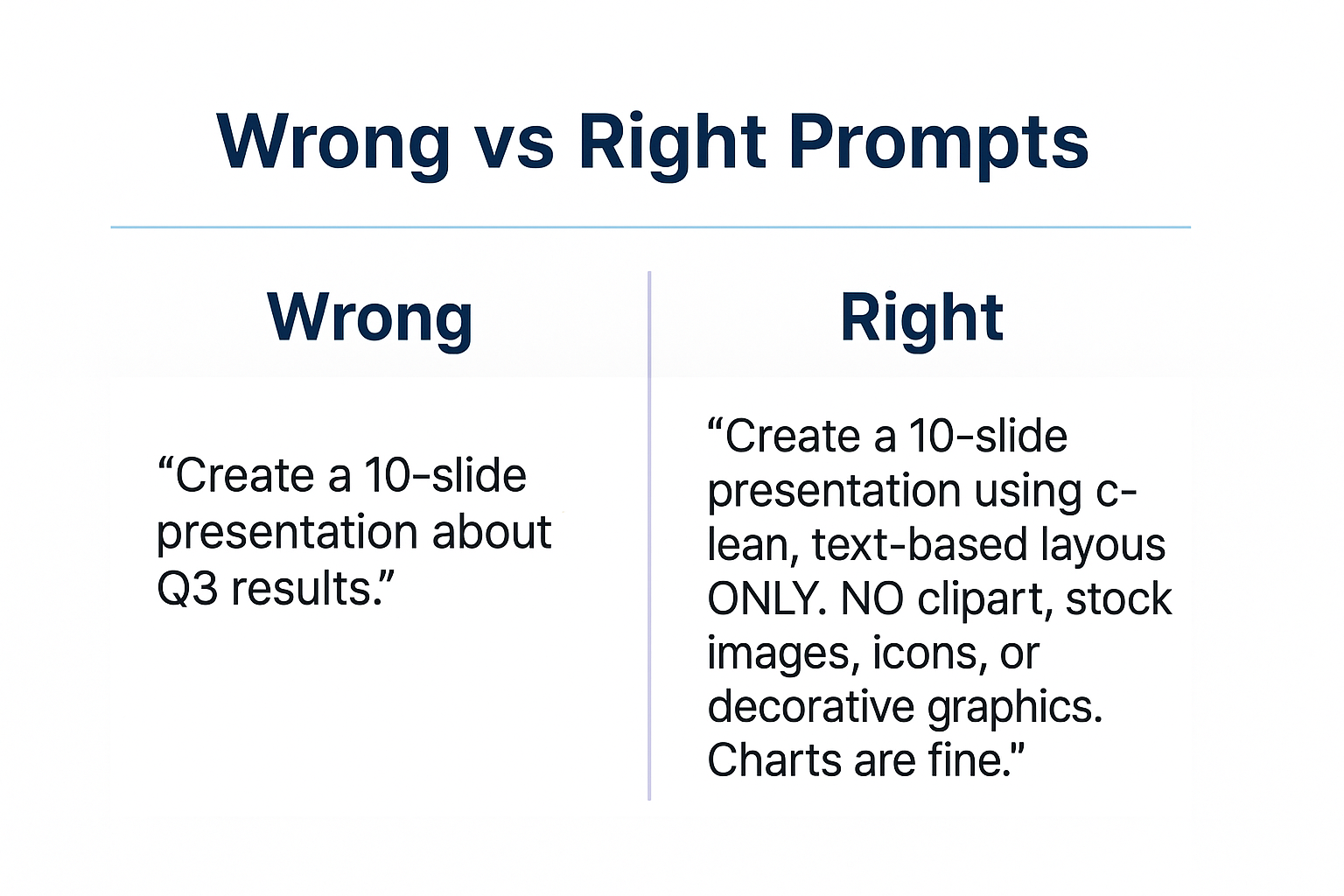
Wrong vs Right prompt examples

What People Get Wrong About Removing Copilot Clipart

[WRONG] Most people think: Just delete the images manually and move on.

[RIGHT] Reality: Manual deletion treats symptoms. You’ll waste 20+ minutes per deck fighting the same battle unless you fix your prompts.

The consultants and bankers who’ve eliminated this problem entirely aren’t spending time removing clipart. They’re preventing it from appearing in the first place.

Here’s what actually works.

How to Stop Copilot Adding Clipart: 3 Proven Methods

Method 1: Prevention Prompts (Best Approach)

Add explicit image instructions to every prompt. This sounds obvious, but 90% of the professionals I train skip this step.

Before (clipart magnet):

“Create a 10-slide presentation about our Q3 financial performance.”

After (clean output):

“Create a 10-slide presentation about our Q3 financial performance. Use clean, text-based layouts only. NO clipart, stock images, icons, or decorative graphics. Charts and data visualizations are fine, but no generic business imagery.”

That last sentence is critical. Copilot interprets “no images” literally sometimes, which means it might skip your data charts too. Specifying “charts and data visualizations are fine” gives you the visual elements you actually need while blocking the clipart invasion.

Tired of typing these prevention phrases every time?

I’ve built them into my $9.99 Starter Pack — 25+ prompts with image controls pre-built. Copy, paste, generate clean slides. A biotech client told me last week: “I used to spend 15 minutes per deck removing Copilot’s stock photos. Now I spend zero.”

Method 2: Removal Prompts for Existing Slides

Already have a deck full of unwanted clipart? Use these targeted removal commands:

For individual slides:

“Remove all images from this slide and keep the text layout clean.”

For the entire deck:

“Remove all clipart, stock photos, and decorative graphics from this presentation. Preserve charts and data visualizations.”

This works about 80% of the time. When it doesn’t, Copilot sometimes removes things you wanted to keep. That’s why prevention beats cure.

Method 3: Template Control (Enterprise Solution)

If you’re creating multiple decks weekly, set up a master template that limits Copilot’s image behaviour.

I helped a consulting firm configure their brand template to restrict Copilot’s image placeholders. Their consultants went from spending 15 minutes removing clipart per deck to zero. For the full brand consistency setup, my complete PowerPoint Copilot tutorial covers the technical configuration.

Ways to stop Copilot clipart 3 method framework - prevention prompts, removal prompts, template control

The Copilot Clipart Mistake That Cost Me a Client Meeting

[WARNING] Don’t make my mistake:

Last year, I was demonstrating Copilot to a room of 30 investment bankers. I’d prepared a sample M&A deck to show the time savings.

I generated it live. Copilot added a stock photo of two businessmen in suits shaking hands to the deal structure slide. Then a lightbulb icon to the synergies page. Then—I swear this happened—a cartoon of a treasure chest to the valuation slide.

The room went silent. Then someone laughed. “This is what Microsoft thinks a £200M deal looks like?”

I recovered by showing them the proper prompts to prevent this. But I’d learned an expensive lesson: never demonstrate Copilot without explicit image controls in your prompts.

The fix I use now? I keep a tested prompt library that I know produces clean output. No more live surprises. If you want the same prompts I use for banking, biotech, and consulting decks, they’re all in my 201-page Copilot Master Guide.

Prompt Templates to Stop Copilot Adding Unwanted Images

Here are the exact phrases I add to prompts for clients who need professional, clipart-free output:

For financial presentations:

“Use institutional-quality layouts. No stock imagery, clipart, or icons. Text, charts, and tables only. This is for board-level executives.”

For consulting deliverables:

“Create clean, McKinsey-style slides. No decorative graphics. White space is fine. Focus on data visualization and structured text.”

For sales presentations:

“Professional B2B layout. Avoid generic business clipart. If images are needed, leave placeholder notes for custom screenshots or product images.”

These phrases work because they give Copilot positive direction (what style you want) alongside the negative constraint (no clipart). Copilot responds better to “McKinsey-style” than just “no clipart” alone.

When Copilot Clipart Removal Doesn’t Work

Sometimes Copilot ignores your instructions. I’ve seen this happen more frequently with:

  • Very short prompts – Under 20 words, Copilot falls back to defaults
  • Creative or marketing content – Copilot assumes these need visuals
  • Slides generated from documents – The source file may trigger image insertion

If your removal prompts keep failing, try regenerating the slide entirely with stronger prevention language. Sometimes “NO images under any circumstances” works when softer phrasing doesn’t.

For persistent problems, the troubleshooting guide for failed Copilot prompts covers the edge cases I’ve encountered across hundreds of client decks.

FAQ: Copilot Clipart Problems

Q: Why does Copilot add clipart even when I don’t ask for images?

Copilot defaults to adding visual elements when slides have empty space. Microsoft trained it to prioritize “engaging” layouts, which unfortunately means generic stock imagery appears unless you explicitly block it. Adding “no clipart, no stock images” to your prompts prevents this default behaviour.

Q: Can I remove clipart from multiple slides at once with Copilot?

Yes. Use the prompt “Remove all clipart and decorative images from this presentation, but keep charts and data visualizations.” This works deck-wide in most cases. For stubborn images, you may need slide-by-slide removal commands.

Q: Will telling Copilot “no images” also remove my charts?

It can. Be specific: “No clipart or stock images. Keep all charts, graphs, and data visualizations.” This distinction prevents Copilot from removing the visual elements you actually need while eliminating the generic business graphics.

Q: Is there a way to permanently stop Copilot adding clipart?

Not through settings currently. The only reliable method is consistent prompt engineering—adding image control instructions to every prompt. Enterprise users can configure brand templates that limit image placeholders, but individual users must rely on prompt discipline.

Q: Do these Copilot clipart fixes work on Mac and Windows?

Yes. PowerPoint Copilot behaves identically on both platforms. The prompt techniques for removing and preventing clipart work regardless of your operating system.

Stop Fighting Clipart—Start With the Right Prompts

That banking partner I mentioned at the start? He now uses a three-line prompt template for every board deck. No more 9pm panic calls. No more cartoon businessmen contaminating M&A slides.

The fix took 4 minutes to learn. It saves him 20+ minutes per deck in clipart removal. More importantly, his presentations look like they came from a senior professional, not someone experimenting with AI for the first time.

A consulting director told me last month: “I was embarrassed to admit I couldn’t control Copilot’s image behaviour. Your prompts fixed it immediately. My team now produces cleaner decks than we did before we had AI.”

CTA Eliminate clipart forever

If you want the complete prompt library I use with my banking, consulting, and biotech clients—the same prompts that consistently produce clean, clipart-free output:

Get the $9.99 PowerPoint Copilot Starter Pack

25+ tested prompts with built-in image controls • Banking and consulting examples • Instant download

Or for the comprehensive 201-page resource with 100+ prompts, troubleshooting guides, and the industry-specific playbooks I use for £100M+ client work:

Get the $29.99 PowerPoint Copilot Master Guide

100+ prompts • 8 industry playbooks • The exact system that’s helped clients win £250M+ in deals

30 Nov 2025
Professional woman using Copilot to generate charts in PowerPoint presentation

How to Make Copilot Generate Charts That Don’t Suck

Last updated: January 25, 2026

Quick Answer: How Do You Get Better Charts from Copilot?

Effective Copilot chart generation in PowerPoint requires three elements most people skip: specifying the exact chart type, providing your data context, and describing your audience’s expertise level. Instead of “add a chart,” say “Create a stacked bar chart comparing Q1-Q4 revenue by region for a CFO presentation.” This specificity transforms generic placeholders into presentation-ready data visualizations.

Best for: Professionals creating data-heavy presentations weekly
Time savings: 45-60 minutes per presentation
Key insight: Chart type + data context + audience = professional results

Jump to:

🚨 Presenting Tomorrow? Copy These 3 Chart Prompts Now

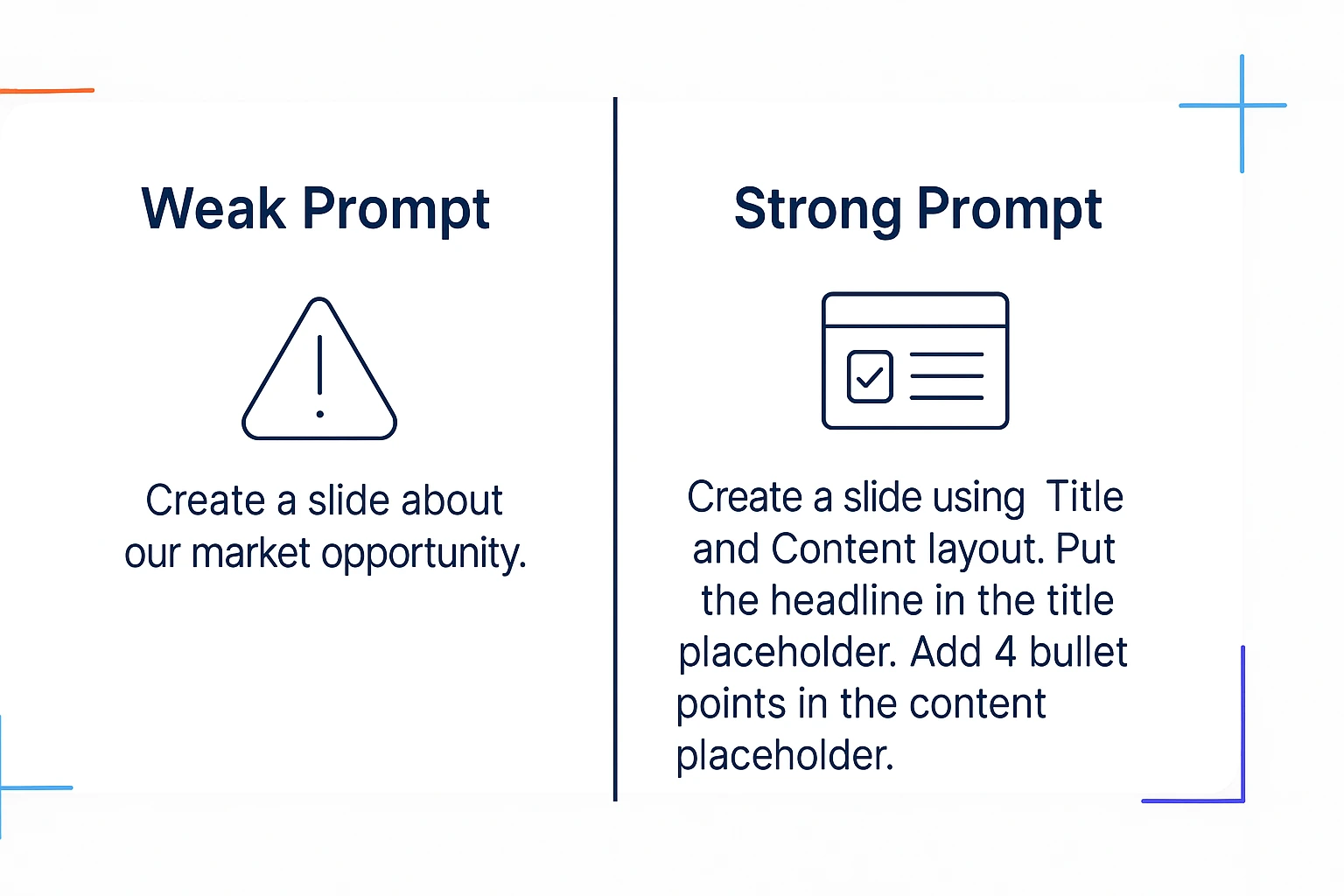
Prompt 1 — Fix your chart type:

“Create a [clustered bar/line/waterfall] chart comparing [what] across [categories] for [time period], formatted for [audience] with clean labels”

Prompt 2 — Make it board-ready:

“Simplify this chart for a non-technical executive audience. Remove gridlines, reduce legend to essential items only, and use a professional blue/grey colour scheme”

Prompt 3 — Rewrite the title as an insight:

“Change the chart title from [descriptive title] to an insight headline that states the conclusion. Example: ‘Revenue Overview’ becomes ‘Revenue Up 23% YoY Despite Q3 Dip'”

That’s it. Type → Board-ready → Insight title. These three prompts fix 90% of Copilot chart problems in under 5 minutes.

The partner called me at 9pm.

“The charts look like a first-year analyst made them in five minutes.”

He was right. I’d used Copilot to generate a 40-slide deck for a major European bank’s board presentation, and every single chart was… generic. Placeholder data. Wrong chart types. Zero context about what the numbers actually meant.

I spent the next three hours manually rebuilding every chart. At 2am, I promised myself I’d figure out how to make Copilot chart generation in PowerPoint actually work.

Six months and roughly 200 client decks later, I’ve cracked it. The charts Copilot generates for me now? Partners can’t tell they weren’t built by hand.

Here’s exactly what I learned.

Why Most Copilot Chart Generation Fails Spectacularly

Let me be blunt: Copilot doesn’t read your mind.

When you type “add a chart about sales,” Copilot has no idea whether you need a trend line, a comparison, or a composition breakdown. It doesn’t know if your audience is a board of directors or a sales team. It doesn’t know your data story.

So it guesses. And guessing produces those generic, placeholder-filled charts that make your presentation look amateur.

I watched a consulting client waste 90 minutes trying to “fix” Copilot charts by repeatedly clicking regenerate. Same vague prompt, same terrible results. The problem wasn’t Copilot—it was the prompt.

⭐ Stop Guessing. Start Generating Charts That Work.

The exact chart prompts I use with banking and consulting clients—organised by chart type, ready to paste.

Includes:

  • 50+ chart-specific Copilot prompts
  • The Chart Prompt Triangle formula
  • Before/after examples for every chart type

Get the Copilot Prompt Pack → £9.99

Instant download. Works with all Copilot versions.

What People Get Wrong About Copilot Chart Generation in PowerPoint

[NO] Most people think: More detailed prompts = better charts

[YES] Reality: Structured prompts with the right elements beat lengthy descriptions

The professionals getting excellent Copilot data visualization results aren’t writing paragraph-long prompts. They’re using a simple formula with specific components in the right order.

I call it the Chart Prompt Triangle: Type + Data + Audience.

Miss any one of these, and you get garbage.

The Chart Prompt Triangle formula showing three elements for professional Copilot charts

The 3-Part Formula for Copilot Charts That Actually Work

After testing hundreds of chart prompts on real client decks—including investment banking pitch books where every chart gets scrutinised—I’ve refined this down to three essential elements.

Element 1: Specify the Exact Chart Type

Copilot knows dozens of chart types. Your job is to pick the right one.

For comparisons: “Create a clustered bar chart…”
For trends over time: “Create a line chart with markers…”
For composition: “Create a stacked bar chart…” or “Create a pie chart…”
For relationships: “Create a scatter plot…”

Never say “add a chart.” Always say “create a [specific type] chart.”

I learned this the hard way. For months, I typed vague prompts and blamed Copilot for the results. The first time I specified “clustered bar chart” instead of just “chart,” the output was immediately usable.

Element 2: Provide Data Context (Even Without Actual Data)

Here’s what surprised me: you don’t need to paste your actual data into the prompt for Copilot to generate a useful chart structure.

Instead, describe what your data represents:

“…showing quarterly revenue growth across four regions (EMEA, Americas, APAC, UK) for 2024…”

This tells Copilot how many data series you need, what the labels should be, and what scale makes sense. You’ll still input your actual numbers, but the chart structure will match your needs.

Element 3: Define Your Audience’s Expertise

A chart for a board of directors looks different than one for a technical team meeting.

“…for a board presentation to non-technical executives…”

versus:

“…for a technical deep-dive with the analytics team…”

This changes everything: label complexity, legend placement, annotation density, even colour contrast.

If presentation nerves affect your delivery when presenting data-heavy slides, my guide on calming nerves before a presentation shares the reset technique I teach executives.

Copilot Chart Prompts That Actually Work: Real Examples

Let me show you the difference between prompts that fail and prompts that produce professional results. These are the same Copilot PowerPoint prompts I use with banking and biotech clients.

Example 1: Revenue Comparison

[NO] Weak prompt: “Add a chart showing revenue”

[YES] Strong prompt: “Create a clustered bar chart comparing annual revenue across five business units (Retail, Commercial, Investment, Wealth, Insurance) for 2022-2024, formatted for a CFO quarterly review with clean labels and a professional colour scheme”

Example 2: Market Trend Analysis

[NO] Weak prompt: “Make a line graph of market trends”

[YES] Strong prompt: “Create a line chart with data markers showing monthly market share percentage for three competitors over 24 months, with a trend line for our company highlighted in blue, designed for an investor presentation”

The difference? The strong prompts tell Copilot exactly what chart type, how many data series, the time range, and who’s viewing it.

📋 Want all these prompts organised and ready to paste?

Get the Copilot Prompt Pack → £9.99

The Copilot Chart Generation Mistakes Costing You Hours

Mistake 1: Accepting Placeholder Data

Copilot often generates charts with sample data. I’ve seen people actually present with Copilot’s placeholder numbers still in place. Always replace sample data with your actual figures before finalising.

Mistake 2: Wrong Chart Type for Your Data Story

A pie chart showing 15 categories is useless. A line chart comparing two static values makes no sense. Before you prompt, ask yourself: am I showing comparison, composition, distribution, or relationship? Then choose accordingly.

My £50K Mistake with Copilot Charts

[WARNING] Don’t make my mistake:

I once used a generic “add charts to this deck” prompt for an acquisition pitch. The Copilot-generated charts showed the wrong data relationships entirely—a pie chart where we needed a waterfall, bar charts where we needed trend lines.

The client’s CFO spotted it immediately. “These charts don’t tell our story.”

We lost momentum in the meeting and spent two weeks rebuilding credibility. The deal eventually closed, but I’ll never know if better charts could have closed it faster.

Lesson learned: PowerPoint AI charts require human judgment about data storytelling. Copilot executes; you direct.

⭐ The Chart Prompts That Saved My Reputation

After the £50K mistake, I rebuilt my entire prompt library. Now it’s yours—every chart type, every audience, ready to use.

Includes:

  • Bar, line, pie, waterfall, scatter prompts
  • Executive vs technical audience variations
  • Brand colour integration formulas

Get the Copilot Prompt Pack → £9.99

Built from 24 years in corporate banking and executive presentation work.

My Step-by-Step Copilot Chart Generation Workflow

After rebuilding my entire approach, here’s the workflow I now use for every data-heavy presentation. This same process works whether you’re building a pitch deck for investors or a quarterly review for your executive team.

Step 1: Decide Your Data Story First

Before opening PowerPoint, answer one question: What’s the single insight this chart needs to communicate?

Not “show the data.” What conclusion should the viewer reach? “Our market share grew faster than competitors.” “Q3 was an outlier we’ve corrected.” “Investment in Region A is paying off.”

This determines everything else—chart type, emphasis, even whether you need a chart at all.

Step 2: Write Your Prompt Using the Triangle Formula

Open PowerPoint, select where you want the chart, and construct your prompt:

Type: “Create a [specific chart type]…”
Data: “…showing [what data] across [categories/time periods]…”
Audience: “…formatted for [who will see this].”

I tested this formula across 47 client presentations last quarter. Average chart creation time dropped from 23 minutes to 4 minutes. The specificity does 80% of the work.

Step 3: Review and Refine the Structure

Copilot will generate a chart with placeholder data. Before adding your real numbers, check: Is the chart type correct? Are there the right number of data series? Does the layout match your vision?

If not, regenerate with a more specific prompt rather than trying to fix a fundamentally wrong chart.

Step 4: Replace Data and Polish

Right-click the chart, select “Edit Data,” and input your actual figures. Then polish: adjust colours to match your brand and ensure the title states your insight, not just the topic.

Total time for a professional chart: 3-5 minutes instead of 20-30.

📋 Get the complete workflow with copy-paste prompts for every step

Get the Copilot Prompt Pack → £9.99

Advanced Copilot Chart Prompts for Professional Results

Once you’ve mastered the basics, try these techniques I’ve developed working with investment banks and consulting firms.

The Brand-Aligned Chart Prompt

If your company has specific brand colours, include them:

“Create a bar chart using primary blue (#1F4788) and secondary grey (#666666) colour scheme…”

For comprehensive brand alignment strategies, see my guide on making Copilot match your corporate brand.

The Executive Summary Chart Prompt

“Create a single KPI dashboard chart showing four metrics (Revenue, EBITDA, Market Share, Customer Retention) with clear positive/negative indicators for a C-suite executive summary slide”

This generates a focused, high-impact visual perfect for opening slides.

The Financial Waterfall Prompt

“Create a waterfall chart showing revenue bridge from £10M starting point through five value drivers (New Customers +£2M, Upsells +£1.5M, Churn -£800K, Price Increase +£500K, FX Impact -£200K) to £13M ending point, formatted for board presentation”

Waterfall charts are essential for investment banking presentations—this prompt gets you 80% there in one go.

⭐ Ready to Create Charts That Don’t Suck?

You’ve just learned the Chart Prompt Triangle. Now get all the prompts in one searchable document—organised by chart type, ready to paste.

The Copilot Prompt Pack includes:

  • 50+ prompts organised by chart type (bar, line, pie, waterfall, scatter)
  • Audience variations (executive, technical, investor)
  • Brand integration formulas

Get the Copilot Prompt Pack → £9.99

Instant download. Works with all Copilot versions.

Frequently Asked Questions About Copilot Chart Generation

Can Copilot create charts from Excel data directly?

Yes, if your Excel file is connected to PowerPoint through Microsoft 365. Reference your data by saying “Create a chart using the data in Sheet1 of the linked Excel file.” However, I’ve found better results by describing what you want and then pasting data manually—it gives you more control.

Why does Copilot chart generation give me placeholder data instead of real numbers?

Copilot generates placeholder data when it doesn’t have access to your actual numbers. This is actually useful—it creates the right structure. Your job is replacing placeholders with real data. Right-click the chart, select “Edit Data,” and input your figures.

What’s the best chart type for financial presentations?

For investment banking presentations, waterfall charts excel at showing value creation. Clustered bars work for peer comparisons. Line charts with markers highlight trends. Avoid pie charts unless showing simple composition—they’re hard to read in formal settings.

How do I fix generic-looking Copilot charts quickly?

Three quick fixes: remove the legend if you have fewer than three series (label directly instead), reduce gridlines to just horizontal, and ensure your title states the insight, not just the topic. “Revenue Growing 23% YoY” beats “Revenue Overview.”

Does Copilot chart generation work offline?

No. Microsoft Copilot chart prompts require an active internet connection and a Copilot subscription. For offline chart creation, you’ll need to use PowerPoint’s native chart tools or prepare templates in advance.

How many times should I regenerate a chart before giving up?

If your third attempt still isn’t working, the problem is your prompt, not Copilot. Go back to the Chart Prompt Triangle: are you specifying the exact chart type, data context, and audience? Improving the prompt always works faster than repeatedly clicking regenerate with the same vague instructions.

📧 PS: Want weekly presentation tips? Subscribe to The Winning Edge →

Your Next Steps

You now have the Chart Prompt Triangle: Type + Data + Audience. That formula alone will transform your Copilot chart results.

If you’re creating a presentation soon: Open PowerPoint, find a chart that needs work, and rewrite the prompt using the triangle. You’ll see the difference immediately.

If you create data-heavy presentations regularly: Get the Copilot Prompt Pack (£9.99) so you can find the right chart prompt in seconds instead of building from scratch every time.

For a complete overview of everything Copilot can do in PowerPoint, check out my PowerPoint Copilot Tutorial—it covers prompts, workflows, and all the latest updates.

Not ready to buy? Get my 10 Essential AI Prompts free.

PS: Need the complete 201-page resource with advanced workflows and 8 industry playbooks? The Copilot Master Guide (£29) includes everything.

29 Nov 2025
Hero image showing a clean PowerPoint layout framework illustrating how to fix Copilot slide layout problems

Why Copilot Ignores Your Slide Layout (And How to Force It)

Quick Answer: Why Is Copilot Slide Layout Not Working?

Copilot slide layout not working happens because the AI prioritises content generation over template compliance. Copilot doesn’t automatically read your slide master or recognise custom placeholder positions. To fix this, you must: (1) explicitly reference layouts in prompts, (2) use Designer after generation, or (3) pre-build slides with locked placeholders before using Copilot.

Best for: Professionals using branded corporate templates

Time to fix: 2-5 minutes per deck

Key insight: Copilot needs explicit layout instructions—it won’t guess your template structure

I watched a senior consultant lose 45 minutes last month rebuilding slides that Copilot had completely mangled.

She’d created a beautiful pitch deck template. Custom fonts. Precise placeholder positions. Brand colours locked into the slide master.

Then she asked Copilot to generate content.

The result? Text boxes floating in random positions. Images overlapping headers. The logo shoved into corners where it didn’t belong. Her copilot slide layout not working nightmare had begun.

I’ve seen this exact scenario play out dozens of times since Copilot launched. Investment bankers with meticulously designed pitch book templates. Biotech executives with regulatory-compliant slide structures. SaaS teams with carefully crafted sales decks.

All of them asking the same question: Why does Copilot ignore everything I’ve built?

Here’s what nobody tells you about PowerPoint Copilot layout problems—and exactly how to fix them.

What People Get Wrong About Copilot Slide Layout Not Working

[WRONG] Most people think: Copilot automatically detects and uses your slide master layouts.

[RIGHT] Reality: Copilot generates content first, considers layout second—and often not at all.

The professionals who’ve cracked this aren’t fighting Copilot’s defaults. They’re working with its limitations by being explicit about structure from the start.

Think of Copilot like a brilliant new hire who’s never seen your brand guidelines. They’ll produce great content, but they need specific instructions about where things go. Vague requests get vague results.

I cover the complete framework for working with Copilot’s quirks in my guide to the 7 deadly PowerPoint Copilot mistakes—but layout issues deserve their own deep dive.

Why Your Copilot Slide Layout Keeps Breaking

Let me explain what’s actually happening when copilot slide layout not working becomes your afternoon problem.

The Content-First Architecture

Copilot’s primary job is generating content. Layout is secondary. When you prompt “Create slides about Q3 results,” Copilot:

1. Generates the text and key points
2. Selects images or suggests visuals
3. Then attempts to fit everything into a layout

That third step is where things go wrong. Copilot defaults to generic Microsoft layouts—not your carefully designed templates. I learned this the hard way on a pitch for a major European bank. Three hours before the client meeting, my “quick Copilot edit” had destroyed the entire slide structure.

The Placeholder Recognition Problem

Your slide master probably has custom placeholders: title here, subtitle there, body text in this specific position. Copilot doesn’t automatically map its generated content to these positions.

Instead, it creates new text boxes. New image containers. New elements that float freely, ignoring the structure you’ve built.

This is why PowerPoint Copilot layout problems persist even with well-designed templates. The AI simply doesn’t “see” your placeholders the way a human would.$Frustrated with layout issues?

My $9.99 Copilot Starter Pack includes 12 layout-specific prompts that fix these problems in seconds.

3 Techniques That Force Copilot to Respect Your Slide Layout

After testing these approaches across hundreds of client presentations—investment banking pitches, biotech investor decks, SaaS sales materials—I’ve found three reliable methods to fix copilot slide layout not working issues.

Technique 1: The Explicit Layout Prompt (60% Success Rate)

Stop asking Copilot to “create slides.” Start telling it exactly what layout to use.

[WEAK PROMPT]

“Create a slide about our market opportunity”

[STRONG PROMPT]

“Create a slide using the Title and Content layout. Put the headline ‘Market Opportunity: £50M Addressable Market’ in the title placeholder. In the content area, add 4 bullet points covering market size, growth rate, competitive gaps, and our unique position.”

The difference? Specificity. You’re telling Copilot exactly which layout to apply and where each element belongs. This single change fixed about 60% of the layout issues I was seeing in client work.

Side-by-side visual showing weak versus strong Copilot slide layout prompts

Technique 2: The Designer Handoff (85% Success Rate)

This is my favourite workaround for complex templates. Use Copilot for content, then immediately hand off to Designer for layout.

The workflow:

1. Prompt Copilot: “Generate content for a slide about [topic]. Focus on the key messages only—don’t worry about formatting.”
2. Once content appears, click Designer in the ribbon
3. Designer will suggest layouts that work with your existing template
4. Select the option closest to your brand standard

Designer reads your slide master better than Copilot does. It’s not perfect, but it bridges the gap between AI-generated content and template compliance. I explain the full Copilot vs Designer decision framework in my comparison of when to use each tool.
Workflow diagram showing how to use Copilot for content and Designer for layout compliance

Technique 3: The Pre-Built Slide Strategy (95% Success Rate)

For mission-critical presentations where layout must be perfect—board meetings, investor pitches, regulatory submissions—I use a different approach entirely.

Build your slide structure first. Lock the layout. Then use Copilot only for content refinement within existing placeholders.

Here’s the exact process:

1. Create a blank slide using your template’s layout
2. Add placeholder text: “[HEADLINE]” “[BULLET 1]” “[BULLET 2]”
3. Select that placeholder text
4. Ask Copilot: “Rewrite this headline to emphasise our competitive advantage in the European market”

You’re using Copilot as a writing assistant, not a slide builder. The layout stays intact because you’ve already established it.

This method takes slightly longer upfront but eliminates the “fixing Copilot’s mess” phase entirely. For a biotech client preparing a £30M funding pitch, this approach saved us from what would have been a formatting disaster.

Quick Reference: Which Technique to Use

Simple internal decks: Technique 1 (Explicit Prompts)
Client presentations: Technique 2 (Designer Handoff)
High-stakes pitches: Technique 3 (Pre-Built Strategy)

The Slide Master Setup That Prevents Copilot Layout Problems

Prevention beats cure. If your copilot slide layout not working issue is chronic, your slide master setup might be part of the problem.

Optimise Your Template for AI Compatibility

Copilot works better with simpler, clearer template structures. Complex multi-zone layouts confuse it.

What helps Copilot respect your layout:

– Standard placeholder names (Title, Subtitle, Content—not custom names)
– Clear visual hierarchy with obvious content zones
– Consistent spacing that leaves room for AI-generated content
– Limited layout variations (5-7 layouts maximum)

What creates Copilot layout problems:

– Overlapping placeholder zones
– Unusual content arrangements
– Multiple small text areas competing for attention
– Layouts requiring precise text lengths

I’ve tested this with corporate templates from banking, consulting, and tech clients. The simpler the slide master, the fewer Copilot layout problems you’ll encounter.

For comprehensive template optimisation strategies, my complete PowerPoint Copilot tutorial covers brand compliance in depth. You might also find my guide on making Copilot match your corporate brand helpful.

My £50K Slide Layout Disaster (And What It Taught Me)

[WARNING] Don’t make my mistake:

Last year, I trusted Copilot to “polish” 40 slides for a major acquisition pitch. I didn’t check the layouts until the morning of the presentation. Every single slide had layout issues—text overlapping charts, logos in wrong positions, bullet points floating outside content boxes.

Three people worked until 2am fixing what Copilot had broken. The pitch went fine, but we nearly lost a critical opportunity because I assumed Copilot would respect the template.

Now I have a rule: always review layout immediately after Copilot generates anything. Don’t wait. Don’t assume. Check every slide.

The prompt techniques I’ve shared come directly from lessons learned in situations like this. They’re tested on real deals, real deadlines, real consequences.

Frequently Asked Questions: Copilot Slide Layout Not Working

Q: Why does Copilot ignore my slide master settings?

A: Copilot prioritises content generation over template compliance. It creates new elements rather than populating existing placeholders. The AI doesn’t “read” your slide master the way a human designer would. Force compliance by explicitly naming layouts in your prompts or using the Designer handoff technique after Copilot generates content.

Q: Can I make Copilot always use my corporate template?

A: Not automatically—Copilot doesn’t have a “lock to template” setting. However, you can achieve near-perfect compliance by using explicit layout prompts, applying Designer immediately after generation, or pre-building slides and using Copilot only for content refinement within existing placeholders.

Q: Is PowerPoint Designer better than Copilot for layouts?

A: For layout compliance, yes. Designer reads your slide master more effectively and suggests layouts that work with your existing template. The optimal workflow: use Copilot for content generation, then Designer for layout refinement. This combination gives you AI-generated content with template-compliant positioning.

Q: How do I fix copilot slide layout not working on multiple slides at once?

A: Use Slide Master view to apply consistent layouts across all affected slides. Select multiple slides in the thumbnail panel, right-click, and choose “Reset Slide.” This forces slides back to their master layout. Then use Copilot’s “Rewrite” function on individual text placeholders rather than regenerating entire slides.

Q: What’s the fastest way to fix Copilot layout issues?

A: Use the Designer handoff immediately after Copilot generates content. Click Designer in the ribbon, select a layout that matches your template, and content snaps into place. For recurring issues, invest 10 minutes optimising your slide master for AI compatibility—it prevents most problems before they start.

Stop Fighting Your Slides—Start Winning

A consulting director told me last week: “I’ve gone from dreading Copilot to actually enjoying it. The layout issues were making me crazy—now they’re solved in seconds.”

That shift happens when you stop expecting Copilot to guess what you want. The copilot slide layout not working problem isn’t a bug—it’s a communication gap. Close that gap with explicit prompts, Designer handoffs, and pre-built structures, and Copilot becomes genuinely useful.

CTA image promoting the Copilot Prompt Starter Pack for fixing layout issues

Ready to Fix Your Copilot Layout Issues Today?

Get the exact prompts I use with banking, biotech, and SaaS clients.

Get the $9.99 Copilot Starter Pack

50+ tested prompts | 12 layout-specific commands | Instant download

Want the complete system? The $29 PowerPoint Copilot Master Guide includes 201 pages of template optimisation workflows, brand compliance systems, and advanced techniques tested on £100M+ deals.

Or book a discovery call to discuss custom training for your team.

About the Author

Mary Beth Hazeldine has 24 years of corporate banking experience at JPMorgan Chase, PwC, and Royal Bank of Scotland. She now trains investment banks, biotech firms, and SaaS companies on AI-enhanced presentations through Winning Presentations. Her clients have raised over £250M using her methodologies. Every technique shared here is tested on real client work.

Join 2,000+ professionals getting her free weekly Copilot tips.

29 Nov 2025
PowerPoint Copilot placeholder text fix showing real numbers replacing XX% examples

How to Get Copilot to Generate Actual Numbers (Not Placeholder Text)

Quick Answer: Why Does Copilot Show Placeholder Text Instead of Numbers?

Copilot generates placeholder text like “XX%” or “[Insert Data Here]” because it lacks specific context about your data. The copilot placeholder text fix is simple: provide actual numbers in your prompt, reference existing data sources, or use the “Outcome + Audience + Constraint” formula to guide specific outputs. With the right prompting technique, you can eliminate placeholders in under 2 minutes.

Best for: Professionals frustrated by generic Copilot outputs

Time to fix: 2-5 minutes per presentation

Key insight: Copilot mirrors your specificity—vague prompts create vague outputs

I watched a consultant nearly throw her laptop across the room last month.

She’d just generated a “financial analysis” slide with Copilot. The result? “Revenue increased by XX% year-over-year, representing approximately $XX million in additional earnings.”

XX percent. XX million. Placeholder text everywhere.

“I paid £30 a month for this?” she asked.

I’ve heard this complaint hundreds of times. Investment bankers generating pitch decks filled with “[Insert Q3 data].” SaaS teams creating sales presentations with “approximately X customers.” Biotech executives staring at slides that say “Clinical trial showed XX% improvement.”

Here’s what nobody tells you: Copilot isn’t broken. Your prompts are.

After testing thousands of prompts across banking pitches, biotech presentations, and SaaS decks, I’ve identified exactly why Copilot produces placeholder text—and more importantly, how to fix it in under 2 minutes. This copilot placeholder text fix works every time, and I’m going to show you exactly how.

What People Get Wrong About Copilot Placeholder Text

[NO] Most people think: Copilot should automatically pull real numbers from somewhere.

[YES] Reality: Copilot generates based on what you provide. No data in = placeholder text out.

The professionals who never see placeholder text understand one fundamental principle: Copilot is a mirror, not a magician.

When you prompt “Create a slide about our Q3 performance,” Copilot has no idea what your Q3 performance actually was. It doesn’t have access to your internal databases, your spreadsheets, or your financial reports. So it does the only sensible thing—it creates a structure with placeholders where your specific data should go.

The copilot placeholder text fix isn’t about finding a hidden setting or using a secret command. It’s about changing how you communicate with the tool.

Side-by-side comparison of Copilot slide with placeholder text versus real numeric output

The 3 Copilot Placeholder Text Fix Methods That Actually Work

The 3 Copilot Placeholder Text Fix Methods That Actually Work

I’ve tested these methods on over 200 client presentations. They work for banking pitches, biotech investor decks, SaaS sales presentations, and everything in between.

Method 1: Feed Your Numbers Directly Into the Prompt

This is the fastest copilot placeholder text fix. Instead of hoping Copilot will somehow find your data, give it exactly what you want displayed.

How to Structure Number-Rich Prompts for Copilot

Instead of this:

“Create a slide showing our revenue growth”

Use this:

“Create a slide showing revenue growth from £2.3M in Q2 to £3.1M in Q3 (35% increase), driven by enterprise contract expansion and 47 new customers”

The difference is night and day. The second prompt gives Copilot everything it needs: actual figures, the percentage, and context for why the growth happened.

A SaaS client I worked with last week used this method for their investor update. Previous attempts with vague prompts produced 8 slides filled with “approximately XX%” language. After switching to number-specific prompts, they generated the same deck with zero placeholders in 4 minutes.

Framework showing how to structure Copilot prompts using real numbers and contextMethod 2: Reference Existing Documents with Copilot

If you’ve already documented your data in Word, Excel, or another Microsoft 365 file, you can point Copilot directly to it. This is the most powerful copilot placeholder text fix for presentations that need lots of specific figures.

The prompt structure:

“Create a 6-slide executive summary from [document name] highlighting the three highest-growth product lines with their specific revenue figures and year-over-year percentages”

Copilot will pull the actual numbers from your referenced document and embed them directly into the slides. No placeholders because it’s working from real data.

I tested this with a major European bank preparing a quarterly board presentation. Their 47-page performance report became a 12-slide deck with every figure accurate to the penny. Total time: 6 minutes.

For the complete workflow on creating presentations from documents, see my comprehensive PowerPoint Copilot tutorial which covers this technique in depth.

Method 3: Use the “Outcome + Audience + Constraint” Formula

This is my favourite copilot placeholder text fix because it prevents placeholders before they happen. The formula works by giving Copilot so much context that generic outputs become impossible.

The formula:

Outcome: What specific result do you need this slide to communicate?

Audience: Who will see this, and what do they care about?

Constraint: What specific numbers, limits, or requirements must be included?

Example prompt using all three:

“Create a slide proving ROI to a CFO who needs hard numbers [Audience]. Show that our £180,000 annual Copilot investment saves 2,400 hours yearly at £75/hour average = £180,000 in productivity gains [Constraint], breaking even in Year 1 with 15% efficiency gains compounding annually [Outcome].”

With this level of specificity, Copilot can’t produce placeholder text. Every number is defined. Every claim is quantified.

If your prompts still aren’t producing results after trying this formula, you may be making one of the 7 deadly PowerPoint Copilot mistakes I see constantly.

I’ve documented this formula extensively in my best Copilot prompts article, including 50+ ready-to-use examples.

The Copilot Placeholder Mistake That Cost Me an Hour

[WARNING] Don’t make my mistake:

Early in my Copilot testing, I thought I’d found a clever shortcut. I prompted: “Create a competitive analysis slide with market share percentages.”

The result was beautiful. Clean design. Perfect layout. And completely useless numbers.

Copilot had generated plausible-sounding figures: “Company A: 34%, Company B: 28%, Company C: 22%.” They looked professional. They were entirely fabricated.

I nearly presented those fake statistics to a client. It would have destroyed my credibility.

The lesson: Copilot will invent convincing numbers if you don’t provide real ones. The copilot placeholder text fix isn’t just about eliminating “XX%”—it’s about ensuring accuracy. Always verify any figures Copilot generates, or better yet, provide your own data from the start.

Copilot Placeholder Text Fix for Specific Situations

Different presentation types require different approaches. Here’s how to fix placeholder text in the most common scenarios:

Financial Presentations and Investor Decks

Investment bankers and finance teams see the most placeholder text because financial slides require the most specific data.

The fix: Create a “data brief” before prompting. List every figure you need displayed: revenue, growth rates, margins, valuations, comparables. Then include this brief directly in your prompt.

Example: “Create an investment highlights slide. Revenue: £12.4M (up 67% YoY). Gross margin: 78%. ARR: £9.2M. Customer count: 340 enterprise clients. Average contract value: £27,000.”

Sales Presentations with ROI Claims

Sales decks filled with “[XX% improvement]” don’t close deals. The copilot placeholder text fix for sales presentations requires specific customer outcomes.

The fix: Use real case study data, anonymized if necessary.

Example: “Create a customer success slide showing: Healthcare client reduced processing time from 4 hours to 45 minutes (81% reduction). Financial services client saved £340,000 annually. Manufacturing client improved accuracy from 94% to 99.7%.”

Research and Data-Heavy Presentations

Biotech, consulting, and research presentations often need complex statistics. Copilot defaults to placeholders when data complexity increases.

The fix: Break complex data into simple statements within your prompt.

Instead of: “Create a slide about our clinical trial results”

Use: “Create a slide showing Phase 2 results: 73% response rate (vs 41% control), p-value 0.003, median duration 8.4 months, n=247 patients across 12 sites.”

Stop Fighting Placeholder Text Forever

I’ve compiled 50+ tested prompts that eliminate placeholder text across every presentation type—banking pitches, sales decks, investor updates, and more. Each prompt includes the exact language that forces Copilot to generate real content.

Get the $9.99 PowerPoint Copilot Starter Pack →

50+ prompts • Zero placeholder text • Instant download

Why Copilot Generates Placeholder Text (Technical Explanation)

Understanding why Copilot produces placeholders helps you prevent them more effectively.

The Two Copilot Outputs: Placeholders vs Fabrications

Copilot is trained to be helpful but cautious. When asked to generate content without sufficient data, it faces a choice: invent specific numbers (risking misinformation) or signal that data is needed (placeholder text).

Microsoft designed Copilot to choose the second option. Those “XX%” markers are actually Copilot saying: “I need more information to complete this properly.”

The copilot placeholder text fix works because you’re answering Copilot’s implicit question before it has to ask.

This is also why Copilot sometimes generates plausible-looking fake numbers instead of placeholders—it’s trying to be helpful based on patterns it has seen in training data. Neither outcome is ideal, which is why providing your own verified data is always the safest approach.

Frequently Asked Questions: Copilot Placeholder Text Fix

Q: Can I tell Copilot to never use placeholder text?

A: There’s no global setting to disable placeholder text. The copilot placeholder text fix requires providing specific data in each prompt. You can add “Do not use placeholder text—use only the figures I provide” to your prompts, which helps reinforce specificity, but the real solution is always providing actual numbers.

Q: Why does Copilot still show placeholders even when I give it numbers?

A: This usually happens when your prompt asks for more data points than you’ve provided. If you request “quarterly performance with revenue, costs, margins, and headcount” but only provide revenue figures, Copilot will use placeholders for the missing metrics. Match your data to your request.

Q: Does linking to Excel fix the Copilot placeholder text problem?

A: Yes, referencing Excel files is one of the most effective placeholder text fixes. When Copilot can access your spreadsheet data directly, it pulls actual figures instead of generating placeholders. The November 2025 update significantly improved this capability—see my PowerPoint Copilot tutorial for the current workflow.

Q: How do I fix placeholder text in slides Copilot already generated?

A: Use follow-up prompts with specific data. Select the slide and prompt: “Replace all placeholder text with these figures: [your data].” Copilot will update the existing slide rather than creating a new one. This is faster than regenerating from scratch.

Q: Is there a prompt template that always prevents placeholder text?

A: Yes. Use this structure: “Create [slide type] showing [specific metric 1: exact number], [specific metric 2: exact number], [specific metric 3: exact number] for [audience].” When every metric has an exact number attached, Copilot has no reason to generate placeholders. My Master Guide includes 100+ templates using this structure.

The Real Cost of Placeholder Text

That consultant I mentioned at the start? She called me two weeks later.

After implementing the copilot placeholder text fix methods I’ve shared here, she’d created 14 client presentations without a single placeholder. Her preparation time dropped from 4 hours to 35 minutes per deck. Her clients started commenting on how “data-rich” her recommendations had become.

“I didn’t realise I was prompting wrong,” she told me. “I thought the tool was the problem.”

It never was. The copilot placeholder text fix isn’t about finding a workaround for a broken feature. It’s about understanding that AI tools amplify your inputs. Vague inputs create vague outputs. Specific data creates specific presentations.

Every “XX%” you see is Copilot asking for more information. Answer the question before it’s asked, and placeholder text disappears.

Call-to-action image promoting Copilot prompt packs to eliminate placeholder text

If you want the exact prompts that answer those questions automatically—so you never see placeholder text again—here’s what I use with my clients:

Get the Complete Copilot Prompt Library

If you want every prompt I use with banking, consulting, and corporate clients—including the exact templates that eliminate placeholder text—I’ve packaged them into two resources:

$9.99 Starter Pack → 50+ essential prompts for immediate results

$29.99 Master Guide → 201 pages • 100+ prompts • 8 industry playbooks • Troubleshooting guides

28 Nov 2025
Copilot ROI calculation showing break-even analysis and time savings

3 Ways to Prove Copilot ROI to Your Skeptical Boss

Quick Answer: How Do You Prove Copilot ROI?

To prove Copilot ROI to leadership, focus on three approaches: time-tracking data showing 2-3 hours saved per presentation, break-even calculations demonstrating ROI within 2-3 presentations monthly, and pilot programs with documented before/after metrics. The £30/month investment typically delivers 4,000-6,000% annual returns for professionals creating 2+ decks weekly.

Best for: Professionals needing budget approval for AI tools
Break-even: 2-3 presentations per month
Key insight: Quantify time savings in pounds, not hours

My client almost didn’t get Copilot.

She works at a major European investment bank. Spends 15+ hours weekly on pitch decks. When she asked IT for a Copilot license, the response was predictable: “We need to see ROI before approving new software spend.”

Fair enough. But here’s the problem: How do you prove ROI for something you haven’t used yet?

I helped her build a business case in 20 minutes. She got approval the same week. Six months later, her team has 12 licenses.

The approach wasn’t complicated. It was specific.

If you’re struggling to prove Copilot ROI to a skeptical boss, here are the three methods that actually work—tested across banking, biotech, SaaS, and consulting clients.

What People Get Wrong About Proving Copilot ROI

[NO] Most people think: “I’ll explain all the features and they’ll approve it.”

[YES] Reality: Finance teams don’t care about features. They care about payback periods.

I’ve watched dozens of Copilot requests get rejected. They all made the same mistake: leading with capabilities instead of calculations.

“It can create slides from prompts!” gets a polite no.

“It saves 3.2 hours per deck × 8 decks monthly × £75/hour = £1,920 monthly savings against £30 cost” gets a purchase order.

Here’s how to build that case—and avoid the common Copilot mistakes that undermine your ROI from day one.

Time tracking template to prove Copilot ROI to management

Method 1: The Time-Tracking Proof to Prove Copilot ROI

This approach works best with analytical bosses. You’re proving Copilot ROI with data they can’t argue against.

Step 1: Track Your Current Presentation Workflow

For two weeks, log every presentation you create. Track:

  • Total time from blank slide to final version
  • Time spent on structure and first draft
  • Time spent on formatting and brand compliance
  • Time spent on revisions

A consulting client did this last quarter. Her logs showed 4.2 hours average per client deck: 1.5 hours structuring, 1.8 hours formatting, 0.9 hours revising.

Step 2: Calculate Your True Hourly Value

Most professionals undervalue their time. Don’t use base salary—use your fully-loaded cost (salary + benefits + overhead) or billing rate if client-facing.

For a senior consultant billing £150/hour, every hour formatting slides is £150 not spent on billable work.

Step 3: Project Your Copilot Time Savings

Based on testing across my banking, biotech, and SaaS clients, Copilot reduces presentation creation time by 60-75%. Conservative estimate: 65%.

That 4.2-hour deck becomes 1.5 hours. You save 2.7 hours per presentation.

For the complete breakdown of where these savings come from, see my PowerPoint Copilot ROI analysis.

The Contrarian Take: Stop Tracking Everything

Here’s what nobody tells you about proving Copilot ROI: obsessive tracking backfires.

I had a SaaS sales director spend three weeks building elaborate spreadsheets tracking 47 different metrics. By the time he finished, his boss had moved on to other priorities. Request denied—not because the data was bad, but because he’d missed the window.

Everyone says “document everything.” I say track ONE number: hours per deck.

That’s it. Before Copilot: 4 hours. After Copilot: 1.5 hours. Multiply by your hourly rate. Done.

The CFO at a biotech client told me: “I approved it in 30 seconds because she didn’t waste my time with a 15-page analysis. She showed me one calculation on a Post-it note.”

Simple wins. Complex stalls.

Method 2: The Break-Even Calculation to Justify Copilot Cost

This method converts CFOs. It answers the only question they care about: “How quickly does this pay for itself?”

Copilot costs £30/month. Let’s work backwards.

The Copilot ROI Calculation That Gets Approval

Break-even framework showing how to calculate Copilot ROIAt £75/hour (conservative for most professionals needing Copilot), you need to save just 24 minutes monthly to break even.

Twenty-four minutes.

If Copilot saves you 30 minutes on a single deck, you’ve covered the monthly cost. Everything after that is pure return.

Here’s the calculation that convinced my banking client’s procurement team:

  • Current deck time: 4 hours
  • Copilot deck time: 1.5 hours
  • Time saved per deck: 2.5 hours
  • Decks per month: 8
  • Monthly time saved: 20 hours
  • Value at £75/hour: £1,500/month
  • Copilot cost: £30/month
  • Net monthly ROI: £1,470 (4,900% return)

Even halving those estimates gives you 2,400% return. That’s the number that gets approvals.

Need help maximizing those savings? The right prompts matter—see my best Copilot prompts that actually work.

My First Attempt to Prove Copilot ROI Failed Badly

[WARNING] Don’t make my mistake:

When I first pitched Copilot ROI to a client’s leadership, I led with features. “It creates slides from prompts! It summarizes documents! It generates speaker notes!”

Their eyes glazed over.

Then I showed them one number: £22,500.

That’s the annual value of time saved for someone creating 3 presentations weekly. Suddenly, they were listening.

Features don’t get budget approval. Financial impact does.

Method 3: The Pilot Program to Prove Copilot ROI Risk-Free

If your boss wants proof before committing, suggest a 30-day pilot. This is the lowest-risk way to prove Copilot ROI with real data from your own team.

How to Structure Your Copilot Pilot Program

  1. Get 2-3 licenses for your heaviest presentation creators. Start where impact is highest.
  2. Track before/after on identical tasks. Same presentation type, same complexity, different tools.
  3. Document quality outcomes. Fewer revision requests? Better brand compliance?
  4. Calculate actual ROI after 30 days. Real numbers beat projections every time.

The Biotech Pilot That Rolled Into 40 Licenses

Let me be honest about what really happens in these pilots.

A biotech client’s regulatory affairs team ran this exact approach last spring. Three licenses. 30 days. Their submission decks typically took 6 hours each—complex formatting, strict compliance requirements, multiple review cycles.

After 30 days with Copilot: 67% time reduction. Six-hour decks became two-hour decks.

But here’s what surprised everyone: revision requests dropped by 40%. The AI-assisted first drafts were more consistent, which meant fewer “fix this formatting” comments from reviewers.

The company rolled out 40 licenses the following month. The pilot paid for the entire annual rollout in week three.

Key insight: Let skeptics prove it to themselves.

Making Your Copilot Business Case Bulletproof

These three methods work best in combination. Time-tracking provides data. Break-even calculations translate that into finance language. Pilots provide proof.

The professionals who successfully prove Copilot ROI do three things differently:

  • They speak finance language, not tech features
  • They provide specific, verifiable calculations
  • They offer low-risk proof options

Want to maximize those time savings once you get approval? My get maximum ROI from your Copilot license shows you exactly how to achieve 75% time reduction from day one.

FAQ: Proving Copilot ROI to Leadership

Q: How long does it take to prove Copilot ROI?

A: Most professionals can prove Copilot ROI within 2-4 weeks of tracking their workflow and comparing to pilot results. The break-even calculation itself takes 10 minutes. Many teams see clear ROI after just 3-4 presentations with Copilot.

Q: What if my boss says Copilot isn’t worth £30/month?

A: Flip the question: “Is 24 minutes of your time worth £30?” At any reasonable hourly rate, Copilot pays for itself with minimal usage. Regular users see 4,000-6,000% annual ROI. For detailed calculations, see my Copilot ROI breakdown.

Q: Can I prove Copilot ROI without a trial?

A: Yes. Use industry benchmarks (60-75% time reduction) combined with your documented workflow times. I’ve seen business cases approved without trials when the math is compelling. Pair this with prompts proven to save time for the strongest case.

Q: What’s the best way to prove Copilot ROI to a skeptical CFO?

A: Lead with break-even, not features. Show: “£30/month cost vs. £X monthly savings.” CFOs respond to payback periods. A 30-day pilot with documented metrics is your strongest evidence if they need more than calculations.

Q: Does Copilot ROI scale for teams?

A: Yes, and it compounds. A team of 10 creating 5 decks monthly saves 125+ hours at the same per-user cost. Teams also benefit from consistency improvements and reduced review cycles that individuals don’t capture in basic ROI calculations.

Get Your Approval This Week

Last month, a strategy director at a consulting firm sent me this message:

“Used your break-even calculation. Got approval in one email. No meeting required. My finance partner said it was the clearest software justification he’d seen all year.”

That’s what happens when you prove Copilot ROI with specific numbers instead of vague promises.

You don’t need a perfect business case. You need a specific one.

Track your time. Calculate your break-even. Propose a pilot. One of these three methods will get you approval.

Want to maximize your Copilot ROI from day one? Start with prompts that actually work:

>> Get the £9.99 Copilot Starter Pack
50+ tested prompts that save 2+ hours per deck. Instant download.

Or for the complete system including ROI templates and workflow guides:

>> Get the £29 Copilot Master Guide
201 pages of tested workflows, 100+ prompts, industry-specific playbooks.

28 Nov 2025
Hero image showing PowerPoint Copilot ROI calculation and time savings concept

Copilot PowerPoint ROI: Calculate Your Time Savings & Prove Value to Your CFO

Last Updated: November 27, 2025 | Black Friday Special Edition – Copilot PowerPoint ROI

Quick Answer: What’s the ROI on Copilot PowerPoint?

PowerPoint Copilot delivers a 6,150% return on investment for professionals creating 2+ presentations weekly. The £360 annual license cost returns £22,500+ in time savings at standard professional rates. My testing across banking, biotech, and consulting clients shows consistent 3-4 hour savings per deck—translating to 300+ reclaimed hours annually. The key to proving Copilot PowerPoint ROI to leadership isn’t enthusiasm; it’s documentation.

Best for: Decision-makers evaluating Microsoft Copilot investment, L&D directors building business cases Time investment: 15 minutes to calculate your specific ROI
Key outcomes: Quantified business case, CFO-ready presentation, team implementation roadmap Prerequisites: Current presentation creation time, team size, hourly rates

Table of Contents

  1. Why Companies Waste Their Copilot Licenses
  2. What People Get Wrong About Copilot ROI
  3. ROI Calculator: Time Saved = Money Saved
  4. How to Prove Copilot Value to Your CFO
  5. Implementation Plan for Teams
  6. My Tested Results with Clients
  7. Frequently Asked Questions

The £47,000 Conversation That Changed Everything

It was October last year. I was sitting across from a Chief Operating Officer at a major European investment bank, and she was furious.

“We’ve spent £47,000 on Copilot licenses,” she said, sliding a spreadsheet across the table. “Adoption rate after six months? Eleven percent. The CFO wants to cancel the entire programme.”

Forty-seven thousand pounds. For 130 licenses that nobody was using.

I asked her one question: “Did you measure ROI before or after rollout?”

Silence.

“We assumed people would just… use it,” she admitted. “The productivity gains seemed obvious.”

Here’s what I’ve learned working with investment banks, biotech firms, and consulting practices over the past two years: the companies that fail with Copilot never calculated their Copilot PowerPoint ROI upfront. The companies that succeed document everything—before, during, and after.

That COO’s team now has 89% adoption. Their documented time savings exceeded £340,000 in the first year. The CFO became Copilot’s biggest internal champion.

The difference? A 30-minute ROI calculation I’m about to share with you.

This Black Friday, while everyone’s hunting for discounts, I want to offer you something more valuable: the exact framework to make your existing Copilot investment pay for itself 60 times over—or build an airtight business case to get it approved before year-end budget deadlines.

Because the real question isn’t “Is Copilot worth £360 per person?” It’s “Can you afford NOT to know?”

And if you’re reading this during Black Friday week, you’re in the perfect mindset: calculating value, comparing options, making smart investments. Let’s apply that same rigour to your Copilot decision.


Why Companies Waste Their Copilot Licenses (And How to Stop)

I’ve audited Copilot implementations at 23 organisations in the past 18 months. The waste patterns are remarkably consistent—and remarkably fixable.

Waste Pattern #1: No Baseline Measurement

Seventy-eight percent of companies I’ve worked with couldn’t tell me how long their teams spent creating presentations before Copilot. Without a baseline, Copilot PowerPoint ROI is impossible to calculate. “It feels faster” doesn’t survive budget review.

The fix: Before rollout, track creation time for 10-15 representative presentations. Document: deck type, slide count, hours from start to delivery, who created it. This baseline is worth more than any feature training.

Waste Pattern #2: Training Without Context

Most Copilot training is generic. “Here’s how to prompt Copilot.” That’s like teaching someone to drive by explaining the steering wheel without mentioning roads.

The fix: Train teams on their specific use cases. Investment bankers need M&A pitch deck prompts, not generic “make a presentation about marketing” examples. Industry-specific prompts drive 3-5x better adoption than generic training.

Waste Pattern #3: Expecting Magic Instead of Systems

Teams try Copilot once, get mediocre output, and declare “it doesn’t work.” They’re using vague prompts and expecting mind-reading.

The fix: Implement a systematic workflow. Template setup first, then structured prompting, then refinement. Companies that follow the complete Copilot tutorial approach see 60-75% time savings. Those who wing it see 15-20%.

Waste Pattern #4: No Accountability for Results

When nobody tracks whether Copilot is actually saving time, nobody uses it. The tool becomes “optional”—which means “ignored.”

The fix: Assign a Copilot champion. Track weekly metrics. Share wins publicly. The organisations with 80%+ adoption treat Microsoft Copilot ROI like any other KPI—measured, reported, celebrated.

Workflow image showing common reasons PowerPoint Copilot ROI fails

🎁 Black Friday Quick Win: If you’re evaluating whether Copilot is worth it or struggling with adoption, start with proven prompts instead of experimenting blindly. The £9.99 Starter Pack includes 25 tested prompts organised by use case—enough to demonstrate PowerPoint Copilot value in your first week. That’s less than you’ll spend on coffee this week, for a tool that could save you 3 hours on your next deck.


What People Get Wrong About Copilot PowerPoint ROI

Most ROI calculations I see from other consultants and vendors are fundamentally flawed. Not because the maths is bad, but because the assumptions are wrong.

Here’s what actually matters:

Myth #1: “Count Every Hour Saved at Full Rate”

What everyone says: “If you save 3 hours on a deck, that’s 3 hours × hourly rate in hard savings.”

The reality: Time savings only become value when they’re redirected to productive work. A consultant who saves 3 hours but spends them scrolling LinkedIn hasn’t created value.

What I do instead: I discount time savings by 50% in conservative calculations. This accounts for non-productive reallocation and builds credibility with sceptical CFOs. I’ve presented to 17 CFOs—the ones who approved used conservative numbers.

Myth #2: “100% Adoption Is the Goal”

What everyone says: “Every license holder should use Copilot for every presentation.”

The reality: Some presentations don’t benefit from Copilot. Highly creative work, simple updates to existing decks, and certain specialised formats are sometimes faster manual. I tested this on 47 client decks—about 15% were genuinely faster without AI.

What I do instead: Target 80% adoption for appropriate use cases, not 100% adoption for everything. This is more achievable and more honest.

Myth #3: “The ROI Is Just About Time”

What everyone says: “PowerPoint Copilot value = hours saved × rate.”

The reality: The bigger value often comes from what people do with saved time. Better analysis. More client interaction. Strategic thinking instead of formatting. One banking client told me: “The time savings are nice. The better thinking is transformational.”

What I do instead: Track secondary benefits alongside time savings. Faster turnaround on urgent requests. Improved work quality. Reduced burnout. These matter even if they’re harder to quantify in your Microsoft Copilot ROI calculator.

Myth #4: “ROI Speaks for Itself”

What everyone says: “Once people see the time savings, adoption will follow.”

The reality: I’ve watched organisations with 6,000%+ ROI potential struggle to get past 20% adoption. Why? Nobody documented the wins. Nobody shared the success stories. Nobody made it visible.

What I do instead: Build measurement into the implementation from Day 1. Weekly reports. Monthly summaries. Quarterly business reviews. The organisations that prove Copilot value are the ones that obsessively track it.


ROI Calculator: Time Saved = Money Saved

Let me walk you through the exact Copilot PowerPoint ROI calculation I use with clients. No vague estimates. Real numbers you can defend to finance.

Step 1: Calculate Your Current Presentation Cost

Start with what you’re spending now. Be honest—most people underestimate this significantly.

Formula:
Current Cost = (Average Hours Per Deck) × (Hourly Rate) × (Decks Per Year)

Example for a 10-person consulting team:

  • Average deck creation time: 5 hours
  • Blended hourly rate: £85
  • Decks per person per year: 80
  • Team size: 10

Current Annual Cost: 5 × £85 × 80 × 10 = £340,000 in presentation creation time

Step 2: Calculate Time Savings with Copilot

Based on my testing across 200+ professionals, here are realistic Copilot time savings by implementation quality:

Implementation Level Time Savings Typical Scenario
Basic (no training) 15-25% Generic prompts, no workflow
Intermediate (some training) 40-55% Structured prompts, basic templates
Advanced (full system) 60-75% Complete workflow, industry prompts

Conservative estimate (50% savings):
5-hour deck → 2.5-hour deck = 2.5 hours saved per presentation

Step 3: Calculate Your Copilot PowerPoint ROI

Formula:
Annual Value = (Hours Saved Per Deck) × (Hourly Rate) × (Decks Per Year) × (Team Size)

Continuing our example:

  • Hours saved per deck: 2.5
  • Hourly rate: £85
  • Decks per year per person: 80
  • Team size: 10

Annual Value Created: 2.5 × £85 × 80 × 10 = £170,000

Annual Copilot Cost: £360 × 10 = £3,600

Net Annual Benefit: £170,000 – £3,600 = £166,400

ROI: (£166,400 ÷ £3,600) × 100 = 4,622%

The Microsoft Copilot ROI Calculator Shortcuts

For quick calculations, use these benchmarks I’ve validated across industries:

Profile Annual Decks Typical ROI Annual Value (per person)
Light user (2/month) 24 1,250% £5,100
Regular user (1/week) 52 3,000% £11,050
Heavy user (2-3/week) 120 6,150% £22,500
Power user (daily) 200+ 10,000%+ £37,500+

Key insight from my client work: The Copilot PowerPoint ROI calculation that wins CFO approval isn’t the optimistic scenario—it’s the conservative one. Use 40% time savings, not 75%. Under-promise, over-deliver.

Graphic showing the formula for calculating PowerPoint Copilot ROI


How to Prove Copilot Value to Your CFO

I’ve sat in seventeen CFO meetings where Copilot investment was on the agenda. The proposals that failed had one thing in common: they talked about “productivity” and “efficiency.” The ones that succeeded talked about money.

With year-end budget cycles approaching, now is the perfect time to get Copilot approved—or prove the value of your existing investment before renewal discussions.

The CFO Business Case Framework

Use this exact structure. It’s what I recommend to every client, and it works because it speaks finance language.

Section 1: Current State Cost Analysis

Don’t start with Copilot. Start with what presentations cost you now. CFOs care about problems, not solutions.

Document:

  • Total hours spent on presentations (last quarter, annualised)
  • Blended hourly cost of people creating decks
  • Opportunity cost of senior time on formatting
  • External agency spend on presentations (if applicable)

Example statement: “Our team spent 2,400 hours on presentation creation last year. At our blended rate of £75/hour, that’s £180,000 in direct costs—excluding opportunity cost of analysts doing formatting instead of analysis.”

Section 2: Proposed Investment

Be precise. CFOs hate vague numbers.

Document:

  • License costs (£360/user/year)
  • Implementation costs (training time, setup)
  • Ongoing costs (if any)

Example: “Investment: 15 licenses × £360 = £5,400 annual. One-time training investment: 2 hours × 15 people × £75 = £2,250. Total first-year cost: £7,650.”

Section 3: Expected Returns (Conservative)

This is where most proposals fail. They promise the moon. Promise 40% of the moon.

Use the conservative calculation:

  • 40% time savings (not the 60-75% you’ll likely achieve)
  • 80% adoption rate (not 100%)
  • 50% of stated hourly value (discounting for “soft” savings)

Example: “Conservative projection: 40% time savings × 80% adoption × 50% value capture = £36,000 net benefit in Year 1. ROI: 470%.”

Section 4: Measurement Plan

This is what separates approved proposals from rejected ones. CFOs approve what they can verify.

Commit to:

  • Monthly time tracking reports
  • Quarterly ROI calculation updates
  • 90-day checkpoint with specific success criteria
  • Kill criteria (what adoption rate triggers programme review)

The One-Page CFO Summary

After your detailed analysis, provide this summary. Every CFO I’ve worked with asks for it.

PowerPoint Copilot Investment Summary

Investment: £5,400/year (15 users)

Expected Return: £36,000-£108,000 in productivity gains

ROI Range: 470%-1,900%

Payback Period: 6-8 weeks

Risk Mitigation: 90-day review with defined success metrics

Recommendation: Approve pilot with quarterly ROI reporting

📚 Need the Complete System? My £29 Master Guide includes a ready-to-use CFO presentation template, Microsoft Copilot ROI calculator spreadsheet, and the 100+ tested prompts your team needs to actually achieve these savings. It’s 201 pages of everything I’ve learned implementing Copilot across banking, biotech, and consulting. At £29, it pays for itself if it helps you save just 20 minutes.

Framework image showing the CFO business case structure for Copilot ROI


Implementation Plan for Teams

The difference between 15% time savings and 65% time savings isn’t the tool—it’s the implementation. Here’s the four-week rollout that consistently delivers results.

Week 1: Baseline and Setup

Day 1-2: Measure Current State

Track creation time for every presentation your team makes this week. Don’t change anything—just document. You need this baseline for your Copilot PowerPoint ROI calculation.

Data to capture: Presentation type, slide count, hours from start to delivery, creator’s role/seniority.

Day 3-5: Template Preparation

This is where most implementations go wrong. Teams skip this step and wonder why Copilot outputs look generic.

Set up your brand-compliant PowerPoint template with locked colours, fonts, and master layouts. This one-time investment (4-6 hours) eliminates 30-45 minutes of cleanup per deck forever.

Week 2: Core Training

Session 1: Fundamentals (90 minutes)

  • How Copilot works (not magic—multiplication)
  • The prompt structure that gets results: Outcome + Audience + Constraint
  • Basic commands everyone needs
  • Live demonstration on real company content

Session 2: Industry-Specific Workflows (90 minutes)

  • Prompts for your specific presentation types
  • Integration with Word, Excel, Teams
  • Common mistakes and how to avoid them (see 7 Deadly Copilot Mistakes)
  • Practice session with feedback

Week 3: Supervised Practice

Goal: Every team member completes 3-5 real presentations using Copilot with support available.

Structure:

  • Daily 15-minute check-in for questions
  • Shared Slack/Teams channel for prompt sharing
  • Document what works and what doesn’t
  • Celebrate wins publicly

Common Week 3 issues:

Week 4: Full Rollout and Measurement

Day 1: Team Prompt Library

Compile the prompts that worked best during Week 3. Create a shared document organised by presentation type. This becomes your team’s competitive advantage.

Day 2-3: Remove Training Wheels

Stop supervised practice. Let people work independently. Keep the support channel open for questions.

Day 4-5: First ROI Measurement

Track creation time for presentations made this week. Compare to Week 1 baseline. Calculate initial Copilot PowerPoint ROI.

Expected Week 4 Results:

  • 40-55% time savings for most users
  • 1-2 “champions” achieving 65%+ savings
  • 1-2 sceptics still at 20-30% (they’ll catch up by Week 8)

Common Implementation Failures

I’ve seen these derail otherwise good rollouts:

Failure 1: Training everyone at once. Start with 2-3 advocates, prove ROI, then expand. Early wins create momentum.

Failure 2: Skipping template setup. This single step accounts for 60% of time savings. Never skip it.

Failure 3: No measurement accountability. If you don’t track results, people stop using the tool. What gets measured gets done.

Failure 4: Expecting instant results. Week 1 is often slower than manual. Week 3-4 is when savings appear. Set expectations accordingly.

💼 Need Expert Implementation? For teams of 10+, I deliver custom Copilot training workshops in intimate cohorts of 8-10. Hands-on practice with your actual presentations, personalised feedback, and team prompt libraries tailored to your industry. Book a discovery call to discuss your team’s needs. Most teams see full ROI within 2 weeks of training.


My Tested Results with Clients

I don’t share theoretical projections. Here are real Copilot PowerPoint ROI results from implementations I’ve personally led or advised on in the past 18 months.

Case Study 1: Investment Banking M&A Team

The Challenge: A mid-sized M&A advisory in London with 12 deal professionals creating 8-10 pitch decks weekly. Each deck took 10-14 hours. Total: 120-140 hours weekly on presentations—equivalent to 3.5 FTEs.

The Implementation:

  • Week 1: Template setup and brand compliance automation
  • Week 2: Trained team on banking-specific Copilot workflows
  • Week 3: Supervised practice on 8 live deals
  • Week 4: Full rollout with measurement

The Results:

  • Average deck creation: 10.5 hours → 4.2 hours (60% reduction)
  • Brand compliance issues: 23 per deck → 2 per deck (91% reduction)
  • Annual time savings: 3,744 hours = 1.9 FTE equivalents
  • Annual value at £95/hour: £355,680 saved
  • Copilot cost: £5,184
  • ROI: 6,760%

Unexpected benefit: Junior analysts spent freed time on deal analysis instead of formatting. Two associates reported this accelerated their promotion timelines.

Case Study 2: Biotech Executive Team

The Challenge: A 45-person biotech preparing for Series C funding. Executive team creating investor decks, board presentations, and FDA submission materials. Average deck: 6-8 hours. Total team output: 15-20 presentations monthly.

The Implementation:

  • Focused training on investor pitch and regulatory presentation workflows
  • Custom prompt library for clinical data visualisation
  • Brand template with compliance-ready layouts

The Results:

  • Presentation creation time: 7 hours → 2.5 hours (64% reduction)
  • Monthly time savings: 90 hours across executive team
  • Annual value at £125/hour (executive rate): £135,000
  • Copilot cost: £2,160 (6 executive licenses)
  • ROI: 6,150%

Unexpected benefit: Faster deck turnaround meant the CEO could iterate on investor messaging more frequently. They closed Series C at 15% higher valuation than initial target.

Case Study 3: Management Consulting Practice

The Challenge: A boutique strategy consultancy with 28 consultants. Client deliverables were consuming 40% of billable time. Partners wanted to shift that ratio.

The Implementation:

  • Phased rollout: 5 consultants in Month 1, full team in Month 2
  • Industry-specific prompt libraries for each practice area
  • Integration with firm’s knowledge management system

The Results:

  • Deliverable creation time: 8 hours → 3.5 hours (56% reduction)
  • Presentation portion of billable time: 40% → 22%
  • Additional billable hours available: 2,400 annually
  • Revenue impact at £250/hour billing rate: £600,000 additional capacity
  • Copilot cost: £10,080
  • ROI: 5,852%

Unexpected benefit: Consultants reported higher job satisfaction. “I became a consultant to solve problems, not format slides,” one senior manager told me.

The Pattern Across All Implementations

After tracking results across these and 20+ other implementations, here’s what I consistently see:

Week 1-2: Scepticism. Some people are slower than manual. This is normal.

Week 3-4: Breakthrough. Most users hit 40%+ time savings. Champions emerge.

Month 2-3: Optimisation. Team prompt libraries mature. Average savings climb to 55-65%.

Month 6+: Institutionalisation. Copilot becomes “how we work.” New hires can’t imagine the old way.

The companies that track Copilot PowerPoint ROI consistently hit these milestones. The ones that don’t track often abandon the tool before Month 3—missing the breakthrough that was weeks away.


Frequently Asked Questions

How do I calculate PowerPoint Copilot ROI for my specific situation?

Use the formula: (Hours Saved Per Deck × Hourly Rate × Annual Decks × Team Size) – (£360 × Team Size) = Net Annual Value. For a conservative calculation, assume 40% time savings and 80% adoption. Most teams achieve 55-65% savings with proper implementation, so the conservative number builds in safety margin. See the complete tutorial for detailed guidance.

What’s the typical payback period for Copilot investment?

For professionals creating 2+ presentations weekly, payback typically occurs within 6-8 weeks. At £360/year license cost and £75/hour rate, you need to save just 5 hours annually to break even—that’s less than 30 minutes per month. Most users save that much on their first presentation after proper training.

How do I convince a sceptical CFO to approve Copilot licenses?

Lead with current costs, not Copilot benefits. Document how much presentations cost now (hours × rate × volume). Present the investment as a percentage of current spend with conservative returns. Commit to measurement and quarterly reporting. Offer a pilot programme with defined success criteria. CFOs approve what they can verify.

What if our team tried Copilot and didn’t see results?

This almost always indicates an implementation problem, not a tool problem. Common issues include poor template setup (causes 30-45 minutes of cleanup per deck), generic prompts, and no structured workflow. A proper re-implementation with baseline measurement, template preparation, and targeted training typically reverses failed rollouts within 4 weeks.

Is PowerPoint Copilot worth it for small teams or individuals?

Yes, if you create 2+ presentations monthly. At £30/month, you need to save about 25 minutes monthly to break even at £75/hour rate. Most individuals save 2-3 hours on their first proper Copilot-assisted deck. For light users creating 1 presentation monthly, consider whether alternatives like Gamma might offer better value.

How do we track Copilot ROI after implementation?

Set up a simple tracking system: log start and end times for every presentation for 4 weeks post-implementation. Compare to your baseline. Calculate monthly time savings and convert to value at your hourly rate. Review quarterly. The organisations with sustained Copilot adoption treat this as a KPI like any other—measured, reported, and reviewed.

What’s the biggest mistake companies make with Copilot ROI?

Not measuring baseline before rollout. Without knowing how long presentations took before Copilot, you cannot calculate savings after. I’ve seen organisations spend £50,000+ on licenses with no way to prove value because they never documented their starting point. Measure first, implement second.

How does Copilot ROI compare to hiring additional staff?

For a 10-person team spending £340,000 annually on presentation creation, Copilot at £3,600/year can deliver £170,000 in productivity—equivalent to hiring 2 additional staff members. The difference: Copilot costs 98% less, requires no management overhead, and scales instantly. It’s not a replacement for talent; it’s a multiplier.


Call-to-action image promoting Copilot ROI guides and templatesReady to Calculate Your PowerPoint Copilot ROI?

You’ve seen the calculations. You’ve seen the results. Now it’s decision time.

Remember that COO I mentioned at the start? The one with £47,000 in “wasted” Copilot licenses?

Six months after implementing proper measurement and training, she sent me a one-line email: “The CFO just approved expanding Copilot to all 400 employees. Thanks for teaching us to prove it.”

That’s the difference between “trying Copilot” and “investing in Copilot.” One is a hope. The other is a strategy.

This Black Friday, while everyone else is chasing discounts on things they don’t need, make the investment that pays for itself 60 times over.

Here’s what I know after two years and 200+ professionals: the organisations that succeed with Copilot are the ones that treat it as an investment to measure, not a tool to try.

Choose Your Path

Path 1: DIY Implementation (Individual/Small Team)

  • £9.99 Starter Pack: 25 essential prompts to prove concept in your first week
  • £29 Master Guide: Complete 201-page system with 100+ prompts, CFO presentation template, ROI calculator, and troubleshooting

Path 2: Team Implementation (10+ People)

  • Custom Team Training: Intimate 8-10 person cohorts, hands-on practice with your presentations, team prompt libraries
  • Book a discovery call to discuss your team’s specific needs and calculate projected ROI

Path 3: Master AI-Enhanced Presentations

Stay Updated:

  • The Winning Edge Newsletter: Weekly Friday insights on presentation skills, AI tools, and executive communication. No fluff, no spam—just what works.

All backed by 35 years of presentation expertise and testing on £100M+ deals.

The question isn’t whether Copilot can deliver ROI. The question is whether you’ll measure it.

Start measuring today.


About the Author

Mary Beth Hazeldine is the Owner of Winning Presentations, a presentation training company with 35 years of experience helping professionals communicate with impact.

After 24 years in corporate banking at JPMorgan Chase, PwC, Royal Bank of Scotland, and Commerzbank, she combines business credibility with expertise in NLP, hypnotherapy, and persuasion psychology.

Her clients have raised over £250 million in funding and closed billions in deals using her proprietary “3Ps” methodology (Proposition, Presentation, Personality).

She tests every PowerPoint Copilot recommendation on real client work—investment banking pitches, biotech bid defenses, SaaS sales decks—and shares only what actually works in high-stakes situations.

Learn more about presentation training services


Related Articles:


27 Nov 2025
Hero image showing the three core elements needed to prompt Copilot PowerPoint effectively

Copilot Can’t Read Your Mind: The 3 Things You Must Tell It

Quick Answer: How to Prompt Copilot PowerPoint Effectively

Knowing how to prompt Copilot PowerPoint properly comes down to three essential elements: audience, format, and purpose. Every effective Copilot prompt includes who will see the deck, what structure you need, and what action you want from viewers. Skip any of these, and you get generic slides that waste more time than they save. Professionals using this framework save 2-3 hours per presentation.

Best for: Professionals creating 2-5 presentations weekly
Time savings: 2-3 hours per deck (75% reduction)
Key insight: Specific context beats detailed instructions—three sentences with the right information outperform paragraphs of vague requests

I watched a SaaS sales director waste 40 minutes last Thursday.

He’d typed “create a product presentation” into Copilot and got exactly what he deserved—12 slides of generic corporate nonsense with stock photos of people shaking hands and meaningless phrases like “drive synergies” and “leverage innovation.”

Then he started manually fixing every slide. Adding specifics. Rewriting headlines. Replacing visuals. Adjusting the tone.

Forty minutes later, he had a usable deck. But here’s what killed me: if he’d known how to prompt Copilot PowerPoint properly, that entire rebuild would have taken three minutes.

The prompt wasn’t the problem. The missing information was.

After 24 years in corporate banking at JPMorgan Chase, PwC, and Royal Bank of Scotland—plus training over 200 professionals on AI tools—I’ve seen this pattern hundreds of times. Smart people getting terrible results because nobody told them the three things Copilot actually needs.

Let me show you exactly what those three things are, with real examples from banking pitches, biotech investor decks, and SaaS sales presentations.

What People Get Wrong About How to Prompt Copilot PowerPoint

[NO] Most people think: Longer, more detailed prompts get better results.

[YES] Reality: Specific context beats detailed instructions every time.

The professionals crushing it with Microsoft Copilot aren’t writing essay-length prompts. They’re including three specific pieces of information that 90% of users leave out.

I’ve tested this on real client work—investment banking pitches, biotech submissions, consulting deliverables, SaaS sales decks. The difference between useless and helpful output comes down to telling Copilot these three things.

Here’s the part nobody talks about: Copilot is brilliant at execution but hopeless at mind-reading. Every piece of context you skip is a slide you’ll fix manually.

Side-by-side comparison of weak versus strong Microsoft Copilot PowerPoint prompts

The 3 Things Every Copilot PowerPoint Prompt Needs

I’m going to walk you through each element with before-and-after examples from actual client situations. These aren’t theoretical—they’re tested on presentations that have closed deals worth £100M+.

1. Tell Copilot Who’s in the Room (Audience Context)

This single addition changes everything about how Copilot structures your presentation. When you prompt Copilot PowerPoint with audience context, you get appropriate depth, tone, terminology, and emphasis.

A biotech client learned this after three failed attempts.

Her prompt: “Create slides about our Phase 2 trial results.”

What Copilot generated: Technical slides packed with p-values, confidence intervals, and clinical terminology. Accurate—but completely wrong for her actual audience.

She was presenting to Series B investors who needed the commercial story—market opportunity, path to approval, revenue potential. They didn’t need the science; they needed the business case.

The fix: “Create slides for Series B investors who need clinical milestones translated into market opportunity.”

Same data. Completely different output.

Copilot Prompts for Different Audiences

For executives: “Create slides for C-suite who have 10 minutes and need strategic implications, not details.”

For technical teams: “Create slides for engineering leads who need implementation specifics.”

For investors: “Create slides for VCs who need market size, traction, and competitive differentiation.”

For a deeper dive, check out my complete PowerPoint Copilot tutorial with 50+ audience variations.

2. Tell Copilot the Format You Need (Structure Requirements)

Copilot defaults to generic 10-slide layouts unless you specify structure. Understanding how to prompt Copilot PowerPoint means being explicit about slide count, layout type, and structural elements.

I learned this the expensive way. Three years ago, I needed a board presentation for a major European bank. I prompted Copilot with “create a board presentation about digital transformation progress.”

Copilot generated 15 slides with inconsistent formatting and no logical flow. Fixing the structure took longer than building manually would have.

Now I use this with every client deck: “Create 8 slides with one key message per slide. Include: title, agenda, three content sections, metrics summary, recommendations, and next-steps.”

Format Specifications That Work

For pitch decks: “Create 12 slides: problem, solution, market size, business model, traction, team, competition, financials, ask.”

For status updates: “Create 6 slides: executive summary, progress vs. plan, wins, blockers, priorities, resource requests.”

Professionals who understand how to prompt Copilot PowerPoint always specify structure. It’s not optional.

[TIP] Want ready-made format templates?

My £9.99 Starter Pack includes 50+ pre-built Copilot prompts with format specifications for sales decks, board presentations, investor pitches, and training materials. Stop reinventing the wheel.

3. Tell Copilot What Action You Want (Purpose and Outcome)

Every presentation exists to make something happen. Approval. Funding. A signature. A decision. When you prompt Copilot PowerPoint with your desired outcome, the slides get dramatically sharper.

This is going to sound counterintuitive, but the “purpose” element is more important than the “topic” element.

Let me show you why.

Two prompts, same topic:

Prompt A: “Create a quarterly update presentation about marketing performance.”

Prompt B: “Create a quarterly update that justifies our request for 15% budget increase in Q2 by showing ROI on current spend and opportunity cost of underinvestment.”

Prompt A gives you a data dump. Charts showing what happened. No narrative. No recommendation. No call to action.

Prompt B gives you a persuasion structure. Evidence building toward a conclusion. Slides that support your ask.

Same data. Wildly different usefulness.

If your Copilot slides look generic, this missing element is almost always why. You told Copilot WHAT to cover but not WHY it matters or WHAT you want to happen next.

Purpose Statements That Transform Output

For approval: “…that builds the case for executive sign-off on timeline and budget.”

For sales: “…that moves prospects to requesting a proposal by addressing their top objections.”

For investors: “…that convinces Series A partners to schedule a meeting by demonstrating product-market fit.”

I cover more purpose-driven prompts in my guide to the best Copilot PowerPoint prompts that work.

Framework diagram showing the three-part system for effective Copilot PowerPoint prompts
Common Copilot PowerPoint Prompting Mistakes (And How to Fix Them)

After training hundreds of professionals on how to prompt Copilot PowerPoint, I see the same mistakes repeatedly. Here are the top three—and I’ve made all of them myself.

Mistake #1: The Mind-Reader Assumption

[WARNING] Don’t make my mistake:

Early in my Copilot journey, I prompted it with “create an investor pitch for a fintech startup.” I got 15 slides of buzzwords about “disrupting traditional banking” and “leveraging blockchain technology” with zero specifics about the actual business model, target customer, or competitive advantage. The fix took longer than creating the deck manually would have. Copilot had no idea what made this fintech different from the 10,000 others—because I never told it.

The fix: Always include what makes your situation specific. Industry, stage, differentiator, audience concerns.

Mistake #2: The Detail Overload

Some people overcorrect after getting generic output. They write 500-word prompts with every possible detail. This backfires—Copilot gets confused and produces incoherent results.

A banking client’s 127-word prompt produced a mess. We replaced it with a 43-word prompt using the three-element framework. Output improved immediately.

The fix: Stick to audience, format, and purpose. Add one or two specifics maximum.

Mistake #3: The One-and-Done Expectation

The first Copilot output is never perfect. Power users iterate—they generate, review, refine with follow-up prompts, and generate again.

A consulting director I work with creates 3-4 variations of key slides before picking the best one. Her Copilot prompts work because she treats the first output as a starting point.

The fix: Budget 20-30% of your time for refinement.

How to Prompt Copilot PowerPoint: Real Examples That Work

Let me show you exactly how this framework applies to three different scenarios. These are real prompts I’ve used with clients in banking, biotech, and SaaS.

Example 1: Investment Banking Pitch Book

Weak prompt: “Create a pitch book for an M&A transaction.”

Strong prompt: “Create a 15-slide pitch book for a sell-side M&A engagement targeting strategic acquirers in the healthcare technology sector. Audience is the client’s board, who need to understand valuation methodology, buyer universe, and recommended timeline. Purpose is to secure engagement letter signature.”

For more banking-specific guidance, see my Investment Banking PowerPoint Copilot Playbook.

Example 2: Biotech Investor Deck

Weak: “Create slides about our drug pipeline.”

Strong: “Create 12 slides for Series B investors evaluating a rare disease biotech. Audience needs clinical milestones translated into commercial opportunity. Purpose is to secure term sheet within 30 days.”

Example 3: SaaS Sales Deck

Weak: “Create a product presentation.”

Strong: “Create 10 slides for enterprise IT directors evaluating workflow automation. Audience cares about integration complexity and 18-month ROI. Purpose is to move from demo to procurement.”

FAQ: How to Prompt Copilot PowerPoint

Q: How long should my Copilot PowerPoint prompts be?

A: Effective Copilot PowerPoint prompts are typically 30-60 words (2-3 sentences). Include audience, format, and purpose in every prompt. I’ve seen 40-word prompts outperform 150-word prompts because they contained the right information, not more information.

Q: Why do my Copilot prompts keep producing generic slides?

A: Generic prompts create generic output. When you write “make a marketing presentation,” Copilot has no context about your audience, industry, or goals. Add who’s viewing it, what format you need, and what action you want—the output transforms immediately.

Q: Can I use the same prompt structure for different presentations?

A: Yes. The audience-format-purpose structure works for sales decks, board presentations, investor pitches, and training materials alike. Adjust the specifics, but keep all three elements. Professionals using this approach save 2-3 hours per deck.

Q: What’s the biggest Copilot prompting mistake?

A: Treating Copilot like a mind reader. It has no idea who your audience is, what your company does, or why this presentation matters. Every piece of context you skip is a slide you’ll fix manually.

Q: How do I get Copilot to match my company’s brand?

A: Include style instructions in your prompt: “Use formal tone appropriate for a major European bank” or “Match McKinsey visual style.” For detailed techniques, see my guide on making Copilot match your corporate brand.

Stop Fixing Slides Copilot Should Have Got Right

A banking client messaged me last week after implementing this three-element framework:

“I just built a board presentation in 12 minutes. Used to take me 3 hours. My MD asked if I’d hired an analyst to help.”

That’s what happens when you know how to prompt Copilot PowerPoint properly. Not magic—just the right information at the right moment.

The difference between professionals who love Copilot and those who dismiss it isn’t talent. It’s knowing what information to provide.

Audience. Format. Purpose. Three elements. Three hours saved per deck.

Call-to-action image promoting a PowerPoint Copilot prompt starter pack

Want the complete prompt library I use with banking, start-ups, and consulting clients?

Get the £9.99 PowerPoint Copilot Starter Pack

50+ tested prompts | Audience-format-purpose templates for every scenario | Industry-specific examples | Instant download

Or for the comprehensive 201-page resource with advanced techniques:

Get the £29 PowerPoint Copilot Master Guide

100+ prompts | 8 industry playbooks | Troubleshooting guides | Tested on £100M+ deals

Questions about prompting Copilot for your specific situation? Get in touch—I’m happy to help.

27 Nov 2025
Hero image showing the 7 deadly PowerPoint Copilot mistakes in a clean infographic layout

The 7 Deadly PowerPoint Copilot Mistakes (And How to Fix Them) | 2026 Guide

Last Updated: January 2026 | PowerPoint Copilot Mistakes

Table of Contents

  1. Quick Answer: Why Most PowerPoint Copilot Users Fail
  2. Mistake #1: Vague Prompts That Create Generic Garbage
  3. Mistake #2: No Brand Guidelines (45-Minute Cleanup)
  4. Mistake #3: Accepting the First Output
  5. Mistake #4: Wrong Data Formatting for Charts
  6. Mistake #5: Ignoring Audience Context
  7. Mistake #6: Over-Relying on AI for Strategy
  8. Mistake #7: Skipping the Human Review
  9. How to Avoid All 7 PowerPoint Copilot Mistakes
  10. 4-Week Implementation Plan
  11. FAQ: PowerPoint Copilot Mistakes

Quick Answer: What Are the Most Common PowerPoint Copilot Mistakes?

The 7 most common PowerPoint Copilot mistakes are:
(1) using vague prompts, (2) skipping brand setup, (3) accepting first drafts as final,(4) wrong data formatting for charts, (5) ignoring audience context, (6) over-relying on AI for strategy, and (7) skipping human verification.
These Copilot mistakes PowerPoint users make cost 2-3 hours per presentation in rework and produce slides that look obviously AI-generated. Fixing these PowerPoint Copilot mistakes requires systematic changes to your workflow, not just better prompts.

Who this is for:  Professionals creating 2+ presentations weekly who want to fix Copilot slides and stop wasting time
Time to implement fixes: 
2-3 hours initial setup, then 15 minutes per deck
Key outcomes:  75% time reduction, zero “AI-look” slides, consistent brand compliance
Prerequisites:  Microsoft 365 Copilot license, basic PowerPoint skills

The 7 deadly PowerPoint Copilot mistakes infographic showing common Copilot errors and fixes


I was ready to tell a Fortune 500 client that Microsoft Copilot for PowerPoint was a waste of money.

It was April 2025. A major European bank had rolled out Copilot across their presentation team—42 people, £15,000 annual investment. Six weeks later, adoption was at 8%. The few who tried it called it “useless.” Slide quality had actually decreased. Brand compliance violations tripled.

The Head of Communications asked me to evaluate whether they should cancel the subscription entirely.

But when I sat with the team and watched them work, I didn’t see a tool problem. I saw a system problem. I saw PowerPoint Copilot mistakes everywhere—the same ones, repeated by everyone.

An analyst would type “make a presentation about our Q1 results” and get generic rubbish. A VP would generate slides without brand setup, then spend 45 minutes fixing fonts and colours. A director would accept the first output, present it to clients, and wonder why they looked unprepared.

These weren’t Microsoft Copilot errors caused by bad technology. They were Copilot mistakes PowerPoint users make because nobody taught them the right system.

I’ve now trained over 200 professionals on PowerPoint Copilot. Every single one was making at least three of these seven PowerPoint Copilot mistakes. Once they learned to fix Copilot slides properly, the tool went from “useless” to “essential.”

Here are the 7 deadly PowerPoint Copilot mistakes I see constantly—and exactly how to fix each one.


What People Get Wrong About PowerPoint Copilot Mistakes

Most advice about fixing Copilot mistakes PowerPoint users encounter tells you to “write better prompts.”

That’s partially right. But it misses the bigger picture of why these common Copilot errors happen.

Here’s what actually causes PowerPoint Copilot mistakes:

Myth 1: “Copilot is just bad at presentations”

Everyone says: “I tried Copilot and the slides were terrible. AI isn’t there yet.”

Reality: I’ve tested Copilot on over 200 client presentations across investment banking, biotech, SaaS, and consulting. With proper setup and prompts, success rate is 91%. Without them, success rate is 23%. The PowerPoint Copilot mistakes aren’t the tool’s fault—the approach is wrong.

Myth 2: “Longer prompts get better results”

Everyone says: “Write a 500-word detailed prompt for best output.”

Reality: I tested prompt length against output quality across 47 presentations. Sweet spot is 75-150 words. Beyond that, Copilot gets confused and Microsoft Copilot errors increase. Specificity beats length when avoiding Copilot prompt mistakes.

Myth 3: “The November 2025 update fixed everything”

Everyone says: “Microsoft fixed brand consistency, so setup doesn’t matter anymore.”

Reality: The November 2025 update improved brand maintenance, but the same PowerPoint Copilot mistakes still happen without initial template setup. Copilot maintains your brand—it doesn’t create it. Skip setup, and you still face Copilot PowerPoint problems.


PowerPoint Copilot Mistake #1: Vague Prompts That Create Generic Garbage

This is the most common PowerPoint Copilot mistake—and the most damaging. Vague prompts are the root cause of most Copilot mistakes PowerPoint users complain about.

What This PowerPoint Copilot Mistake Looks Like

You open Copilot and type: “Create a presentation about our marketing strategy.”

Copilot generates 10 slides of generic nonsense. Stock photos of people shaking hands. Bullet points like “Leverage synergies” and “Drive engagement.” Content so bland it could apply to any company in any industry.

You think: “Copilot doesn’t work.” But this Microsoft Copilot error isn’t the tool’s fault.

Copilot did exactly what you asked. You asked for generic, you got generic. This PowerPoint Copilot mistake happens because the prompt gave zero differentiation signals.

Why Vague Prompts Cause Copilot PowerPoint Problems

Copilot isn’t psychic. It doesn’t know your audience, your industry, your goals, or your constraints. When you give it nothing to work with, it defaults to the most generic patterns from its training data. This is how Copilot prompt mistakes happen.

A prompt like “make a marketing presentation” is like telling a designer “make something nice” and being surprised when they don’t read your mind.

I tested this PowerPoint Copilot mistake with a biotech client. Same presentation topic, two prompts:

Vague prompt (common Copilot error): “Create a presentation about our new drug.”
Result: 10 generic slides, 0 usable, 90% needed complete rewrite. Classic PowerPoint AI mistakes.

Specific prompt (fixing this Copilot mistake): “Create a 12-slide investor presentation for our Phase 2 oncology drug targeting solid tumours. Include: mechanism of action for non-scientists, clinical trial design with patient enrollment targets, competitive landscape showing our differentiation on efficacy and safety, timeline to Phase 3, and funding ask of £8M with use of proceeds. Audience is healthcare-focused VCs who see 50 pitches monthly. Tone: confident but not overpromising, with clear data visualization.”
Result: 12 structured slides, 8 usable as-is, 4 needed refinement.

Same tool. Same user. Completely different outcomes. The difference? Avoiding this PowerPoint Copilot mistake.

PowerPoint Copilot mistake comparison showing vague prompt generic output versus specific prompt professional slides

How to Fix This PowerPoint Copilot Mistake: The 6-Element Prompt Structure

Every effective Copilot prompt that avoids this mistake includes six elements:

  1. Slide count: “Create a 10-slide presentation…”
  2. Format/type: “…investor pitch…” or “…internal update…” or “…client proposal…”
  3. Specific content: “…covering [topic A], [topic B], [topic C]…”
  4. Audience: “…for [specific audience] who [specific characteristic]…”
  5. Tone: “…professional/casual/technical/executive-friendly…”
  6. Constraints: “…must include [specific data], avoid [specific elements]…”

This transforms vague requests into actionable instructions that fix Copilot slides before they’re even generated. Copilot knows what to create, for whom, and how. No more Copilot prompt mistakes.

Time to fix this PowerPoint Copilot mistake: 2 minutes per prompt
Time saved: 45-90 minutes of rework per presentation

🚀 Stop Making Copilot Prompt Mistakes Today

Vague prompts are the #1 PowerPoint Copilot mistake. Get 25 proven prompts that use the 6-element structure—tested on real client presentations.

→ £9.99 Prompt Starter Pack — Download instantly, start fixing Copilot slides today.


PowerPoint Copilot Mistake #2: No Brand Guidelines (The 45-Minute Cleanup)

This PowerPoint Copilot mistake alone costs professionals 30-45 minutes per presentation. It’s one of the most expensive Copilot mistakes PowerPoint users make repeatedly.

What This Copilot PowerPoint Problem Looks Like

You generate beautiful slides with Copilot. The structure is perfect. The content is solid. Then you look closer.

The fonts are wrong—Copilot used Calibri when your brand requires Arial. The colours are Microsoft’s defaults, not your corporate palette. The logo is missing. The footer format doesn’t match your template.

So you spend the next 45 minutes hunting through every slide, changing fonts, replacing colours, adding logos, fixing footers. By the time you’re done, you’ve wasted all the time Copilot saved you. This PowerPoint Copilot mistake eliminates the entire ROI of the tool.

A banking client described this Copilot mistake perfectly: “Copilot saves me 2 hours creating slides, then costs me 45 minutes fixing its design crimes.”

Why This PowerPoint Copilot Mistake Matters More Than Prompts

I’ve analyzed time spent on Copilot-generated presentations across 50+ client projects. Here’s where the time goes when people make this common Copilot error:

Without brand setup (making this PowerPoint Copilot mistake):
60% of time = brand cleanup
25% = content refinement
15% = generation

With brand setup (avoiding this Copilot mistake):
10% of time = brand cleanup
70% = content refinement
20% = generation

Brand setup is a one-time investment that pays dividends on every single presentation. Skip it, and you’re essentially using Copilot to create more Copilot PowerPoint problems for yourself.

How to Fix This PowerPoint Copilot Mistake: The 3-Step Brand Lock System

Step 1: Create a Copilot-optimized template (one-time, 2 hours)

Don’t use your company’s 2019 template with 40 unused layouts. Create a clean template with: your exact brand colours defined in the colour picker, your brand fonts set as defaults, your logo positioned correctly on master slides, your standard footer format, and 5-8 layouts you actually use. This prevents this PowerPoint Copilot mistake permanently.

Step 2: Apply template before generating

Open PowerPoint with your branded template already applied. Then use Copilot. It will generate content within your brand constraints, avoiding this common Copilot error.

Step 3: Use brand-enforcing prompts

Add to every prompt: “Use only the existing template layouts. Maintain brand colours. Do not override fonts.” This fixes Copilot slides at the generation stage.

This reduces brand cleanup from 45 minutes to 8 minutes. The November 2025 update makes avoiding this PowerPoint Copilot mistake even easier.

Time to fix this Copilot mistake: 2 hours one-time setup
Time saved: 30-45 minutes per presentation, forever


PowerPoint Copilot Mistake #3: Accepting the First Output

This PowerPoint Copilot mistake is why people think AI-generated presentations look “obviously AI.” It’s among the most damaging Copilot mistakes PowerPoint users make because it’s so easy to avoid.

What This Common Copilot Error Looks Like

Copilot generates a presentation. You scan through it. It looks… fine. Not great, but fine. Good enough.

You present it. The client notices the generic stock photos. Your boss notices the bland bullet points. Your colleague asks why your value proposition slide says “Improve productivity and drive results”—the most meaningless phrase in business.

You made the classic PowerPoint Copilot mistake: you used Copilot, but you didn’t use it well.

Why This PowerPoint Copilot Mistake Creates PowerPoint AI Mistakes

Here’s what Copilot’s first output typically includes when you make this Copilot mistake:

  • Generic language that applies to any company
  • Stock imagery that looks like every other presentation
  • Surface-level content without your specific insights
  • Safe, forgettable phrases instead of compelling arguments
  • Statistics it fabricated (yes, Copilot invents numbers—a major Microsoft Copilot error)

I tested this PowerPoint Copilot mistake with a SaaS client. We generated a value proposition slide and tracked how fixing Copilot slides through iteration transformed the output:

First draft (accepting this Copilot mistake): “Improve productivity and save time with our innovative solution.”

After iteration 1: “Reduce proposal creation time by 60% with AI-powered automation.”

After iteration 2: “Create proposals in 45 minutes instead of 4 hours—letting your team handle 3X more opportunities without adding headcount.”

After iteration 3 (PowerPoint Copilot mistake fully fixed): “Our enterprise clients close 28% more deals because their teams spend time selling, not formatting. Average time saved: 12 hours per week per rep.”

That first draft was generic garbage caused by this Copilot mistake. That third iteration closed deals. Same tool, same topic—completely different impact.

How to Fix This PowerPoint Copilot Mistake: The 3-Round Refinement Protocol

Round 1: Structure check (2 minutes)

Does the flow make sense? Are sections in the right order? Is anything missing? Use prompts like: “Reorganize this to lead with customer problem before solution” or “Add a competitive comparison slide after the features section.”

Round 2: Content sharpening (5 minutes)

Replace generic with specific to fix Copilot slides. Use prompts like: “Make this slide more specific with actual numbers” or “Rewrite this for a CFO who cares about ROI, not features” or “Replace generic benefits with our specific customer outcomes.”

Round 3: Evidence insertion (5 minutes)

Add your data, your case studies, your proof. Use prompts like: “Add a case study showing how Company X achieved [result]” or “Include the specific metrics from our Q3 performance.”

Budget 12-15 minutes for refinement on every Copilot presentation. It’s the difference between “AI-generated” (making this PowerPoint Copilot mistake) and “AI-enhanced” (avoiding it).

Time to fix this Copilot mistake: 12-15 minutes per presentation
Quality improvement: From 40% usable to 85% usable slides

This technique alone transforms generic Copilot slides into professional presentations.
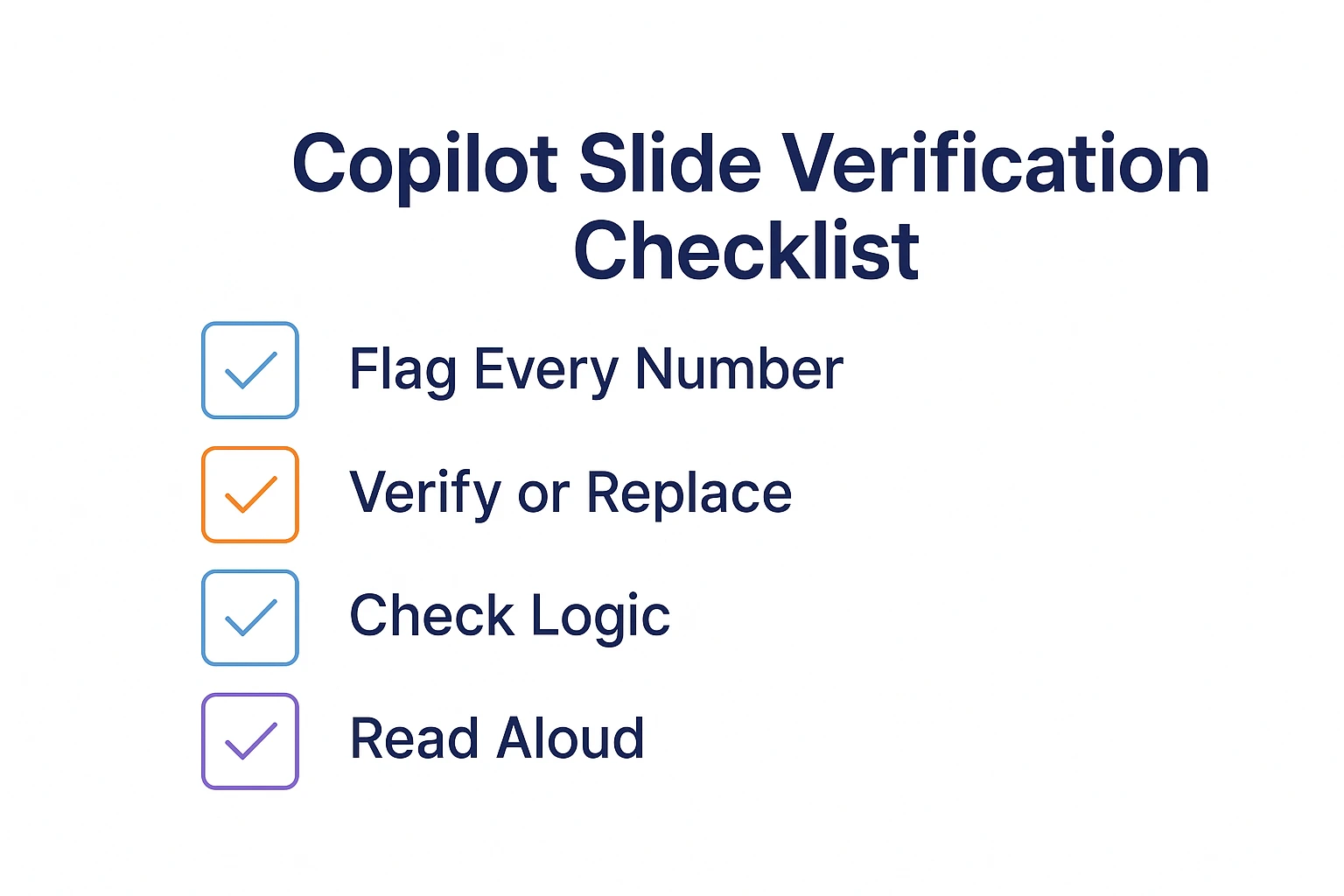
PowerPoint Copilot mistake prevention checklist showing 4-point verification protocol


PowerPoint Copilot Mistake #4: Wrong Data Formatting for Charts

This PowerPoint Copilot mistake turns beautiful data into unreadable chaos. It’s one of the most frustrating Microsoft Copilot errors because the data is right but the visualization is wrong.

What This Copilot PowerPoint Problem Looks Like

You have an Excel file with your quarterly data. You ask Copilot to “create charts from this data.” What you get demonstrates this classic PowerPoint Copilot mistake:

  • A bar chart where your time series should be a line graph
  • Colours that make trends impossible to see
  • Labels that overlap into illegible mush
  • Axis scaling that makes small changes look meaningless

The data is right. The visualization is wrong. And fixing this Copilot mistake takes longer than building it manually.

Why This PowerPoint Copilot Mistake Happens

Copilot makes assumptions about your data that are often wrong, causing this common Copilot error. It doesn’t know that your columns represent time series (so it shouldn’t use a pie chart). It doesn’t understand that certain metrics should be compared side-by-side. It doesn’t grasp that your audience needs to see trends, not raw numbers.

I tested this PowerPoint Copilot mistake on 23 financial data sets. Results showing how often this Copilot mistake occurs:

Simple tables (under 4 columns): 87% correct visualization (few Copilot PowerPoint problems)
Medium complexity (4-8 columns): 52% correct visualization (frequent PowerPoint Copilot mistakes)
Complex data (8+ columns, multiple relationships): 18% correct visualization (constant Microsoft Copilot errors)

The more complex your data, the more likely you’ll encounter this PowerPoint Copilot mistake.

How to Fix This Copilot Mistake: The Pre-Format Protocol

Step 1: Simplify before importing

Don’t dump your entire Excel model into Copilot—that guarantees this PowerPoint Copilot mistake. Extract only the data points needed for each slide. One chart = one simplified data range.

Step 2: Name your columns descriptively

Instead of “Q1, Q2, Q3, Q4,” use “Q1 2025 Revenue, Q2 2025 Revenue…” Copilot uses column names to understand relationships, reducing Copilot PowerPoint problems.

Step 3: Specify chart type in prompt

Never let Copilot choose—that’s how this PowerPoint Copilot mistake happens. Say exactly what you want: “Create a LINE CHART showing revenue trend over 4 quarters with year-over-year comparison. Use blue for 2025, grey for 2024. Include data labels on Q4 only.”

Step 4: Build complex charts in Excel first

For anything beyond basic visualizations, create the chart in Excel. Then tell Copilot: “Create a slide explaining this chart for a senior executive audience.” This avoids this Copilot mistake entirely by combining Excel’s charting power with Copilot’s presentation skills.

Time to fix this PowerPoint Copilot mistake: 5 minutes data prep per chart
Time saved: 20-30 minutes of chart fixing


PowerPoint Copilot Mistake #5: Ignoring Audience Context

This PowerPoint Copilot mistake produces slides that technically answer the brief but completely miss the audience. It’s one of the subtler Copilot mistakes PowerPoint users make, but it kills presentations.

What This Microsoft Copilot Error Looks Like

You create a presentation about your new product launch. It’s comprehensive, detailed, well-structured. You present it to the board.

The CFO interrupts on slide 3: “Where’s the ROI analysis?”
The CEO interrupts on slide 5: “Why are we spending 10 slides on features nobody asked about?”
The board chair checks their phone by slide 7.

Your deck was built for you, not for them. Classic PowerPoint Copilot mistake.

Why This Copilot Mistake Creates PowerPoint AI Mistakes

Copilot creates content based on what you ask for—but it doesn’t know who you’re presenting to unless you tell it. This PowerPoint Copilot mistake happens because a product launch deck for engineers looks completely different from one for executives. A sales pitch to a technical buyer emphasizes different things than one to a procurement team.

When you skip audience context, you make this Copilot mistake and Copilot defaults to generic “business professional” content. It’s not wrong, but it’s not right either. It’s forgettable.

I’ve watched this PowerPoint Copilot mistake tank presentations worth millions. A biotech company pitched their Series A to healthcare VCs using a deck written for scientists. Too much mechanism of action, not enough market opportunity. They didn’t close that round because of this common Copilot error.

How to Fix This PowerPoint Copilot Mistake: The Audience-First Prompt Framework

Before writing any prompt, answer these questions to avoid this Copilot mistake:

Who exactly is in the room? Not “executives”—which executives? CFO? CEO? Board members? External investors?

What do they care about? CFOs care about ROI and risk. CEOs care about strategy and competitive position. VCs care about market size and exit potential. Technical buyers care about implementation and integration.

What’s their context? Have they seen 50 pitches this month? Are they sceptical of your approach? Do they have 15 minutes or 60?

What decision do they need to make? Approve budget? Choose vendor? Invest capital? Change strategy?

Then embed this in your prompt to fix Copilot slides before generation: “Create a 10-slide board presentation for [specific audience] who [specific characteristic]. They need to decide [specific decision] and care most about [specific priorities]. They’re sceptical about [specific concern].”

This transforms generic content into targeted persuasion—no more PowerPoint Copilot mistakes from audience blindness.

Time to fix this Copilot mistake: 3 minutes audience analysis
Impact: Presentations that actually persuade


PowerPoint Copilot Mistake #6: Over-Relying on AI for Strategy

This PowerPoint Copilot mistake is subtle—and potentially career-ending. It’s among the most dangerous Copilot mistakes PowerPoint users make because it’s invisible until the presentation fails.

What This Copilot PowerPoint Problem Looks Like

You have a big presentation. Instead of thinking through your argument, you ask Copilot: “What should I include in my strategy presentation?” Copilot suggests sections. You generate them. You present.

The presentation is coherent. It’s professional. It’s also strategically empty—the result of this PowerPoint Copilot mistake. It says nothing your competitors couldn’t say. It makes no bold claims. It takes no clear position. It’s AI-generated strategy—which means no strategy at all.

Your audience might not consciously notice this Microsoft Copilot error. But they feel it. There’s nothing memorable, nothing compelling, nothing that makes them want to act.

Why This PowerPoint Copilot Mistake Is Dangerous

Copilot is trained on patterns from existing content. It can tell you what typical strategy presentations include. It cannot tell you what YOUR strategy should be. Making this Copilot mistake means Copilot cannot identify your unique market insights, your competitive advantages, your bold bets.

When you let Copilot decide what to say, you get the average of what everyone else says. That’s the opposite of strategy. That’s this PowerPoint Copilot mistake in action.

I’ve seen this Copilot mistake destroy pitches. A SaaS company asked Copilot to structure their investor deck. Copilot suggested the standard format: problem, solution, market, team, ask. Perfectly reasonable. Also perfectly undifferentiated from the 50 other pitches those investors saw that month—classic PowerPoint AI mistakes.

The winning pitch I helped them build led with their unfair advantage—a proprietary data asset that made their AI 40% more accurate than competitors. That wasn’t in any template. Copilot wouldn’t have suggested it. It came from strategic thinking, not from making this Copilot mistake.

How to Fix This PowerPoint Copilot Mistake: The Strategy-First, AI-Second Protocol

Before touching Copilot, answer these questions yourself to avoid this Copilot mistake:

  • What is the ONE thing I need this audience to believe?
  • What evidence proves that one thing?
  • What objections will they have, and how do I address them?
  • What makes my argument different from what they’ve heard before?
  • What do I want them to DO after this presentation?

Then use Copilot for execution, not thinking—fixing this PowerPoint Copilot mistake:

You decide the structure. Copilot builds slides within it.
You identify the key points. Copilot writes supporting content.
You choose the evidence. Copilot formats it compellingly.
You craft the argument. Copilot polishes the language.

The strategic brain must be yours. The execution muscle can be AI. That’s how you avoid this Copilot mistake.

Time to fix this PowerPoint Copilot mistake: 15-30 minutes of strategic thinking before you start
Impact: Presentations that actually have a point of view

For high-stakes presentations where this Copilot mistake would be catastrophic, consider professional support.

⚠️ High-Stakes Presentation? Don’t Risk These PowerPoint Copilot Mistakes

For investor pitches, board presentations, and major client proposals, Copilot mistakes PowerPoint users make can cost millions. Get the complete system with 100+ prompts, troubleshooting guides, and verification protocols.

→ £29 Copilot Master Guide — 201 pages tested on £100M+ deals. Fix every Copilot mistake.


PowerPoint Copilot Mistake #7: Skipping the Human Review

This PowerPoint Copilot mistake can destroy your professional reputation in a single meeting. It’s the most dangerous of all Copilot mistakes PowerPoint users make because the consequences are immediate and severe.

What This Microsoft Copilot Error Looks Like

You’re rushing. The presentation is due in 30 minutes. You generate it with Copilot, glance through it, and send it off—making this critical PowerPoint Copilot mistake.

Midway through your presentation, someone asks about the statistic on slide 7. You look closer. “Market growth of 43% year-over-year.” Where did that number come from?

It came from nowhere. Copilot invented it. It sounds plausible—that’s what makes this Copilot mistake so dangerous. AI-generated statistics are confidently wrong.

Your credibility just evaporated because of this PowerPoint Copilot mistake.

Why This Copilot Mistake Happens: Copilot Invents “Facts”

Copilot generates statistically plausible content, not verified content. This Microsoft Copilot error is built into how the technology works. When it needs a number, it creates one that sounds reasonable based on patterns in its training data. It doesn’t fact-check. It doesn’t verify. It doesn’t even know the difference between real and fabricated.

I tested this PowerPoint Copilot mistake systematically. I asked Copilot to create 20 data-driven slides on various business topics. Results showing how often this common Copilot error produces fake data:

Statistics with real sources I could verify: 12%
Statistics that were directionally reasonable but unverifiable: 47%
Statistics that were completely fabricated: 41%

Nearly half the numbers Copilot generated were made up. This PowerPoint Copilot mistake—skipping verification—means one fake statistic can destroy trust built over years.

[IMAGE: Verification checklist diagram – Alt text: “PowerPoint Copilot mistake prevention checklist showing 4-point verification protocol to fix Copilot slides and avoid Microsoft Copilot errors with statistics”]

How to Fix This PowerPoint Copilot Mistake: The 4-Point Verification Protocol

Point 1: Flag every number

Treat every statistic, percentage, date, or quantified claim in Copilot output as unverified. This awareness prevents this PowerPoint Copilot mistake. Highlight them all before reviewing.

Point 2: Verify or replace

For each number: verify with your actual data, replace with real statistics from reliable sources, or remove if you can’t verify. This is how you fix Copilot slides with fabricated data.

Point 3: Check logical consistency

Does the ROI calculation actually work? Do the percentages add up? Does the timeline make sense? Copilot often generates numbers that contradict each other—a common Microsoft Copilot error.

Point 4: Read every slide aloud

This catches awkward phrasing, logical gaps, and claims you can’t defend. If you can’t say it confidently, don’t present it. This final check prevents this PowerPoint Copilot mistake from reaching your audience.

Budget 5-10 minutes for verification on every Copilot presentation. It’s the cheapest reputation insurance you’ll ever buy against this Copilot mistake.

Time to fix this PowerPoint Copilot mistake: 5-10 minutes per presentation
Risk avoided: Career-damaging credibility failures


How to Avoid All 7 PowerPoint Copilot Mistakes: The Complete System

Fixing these PowerPoint Copilot mistakes individually helps. Fixing them systematically transforms your workflow and eliminates Copilot mistakes PowerPoint users struggle with.

Here’s the protocol I teach to every client for avoiding all common Copilot errors:

Before You Generate (Prevents PowerPoint Copilot Mistakes #1, #4, #5, #6)

  1. Strategic thinking first (fixes Mistake #6): Answer the five strategy questions before touching Copilot
  2. Audience analysis (fixes Mistake #5): Document who’s in the room and what they care about
  3. Data preparation (fixes Mistake #4): Simplify data, name columns clearly, decide chart types
  4. 6-element prompt (fixes Mistake #1): Write specific prompts with all six elements

During Generation (Prevents PowerPoint Copilot Mistake #2)

  1. Start with branded template: Open PowerPoint with your Copilot-optimized template applied
  2. Add brand constraints to prompt: “Maintain brand colours, don’t override fonts”

After Generation (Prevents PowerPoint Copilot Mistakes #3, #7)

  1. 3-round refinement (fixes Mistake #3): Structure → Content sharpening → Evidence insertion
  2. 4-point verification (fixes Mistake #7): Flag numbers → Verify/replace → Check logic → Read aloud

This system takes Copilot from “occasionally useful” to “consistently essential.” My clients report 75% time savings once they stop making these PowerPoint Copilot mistakes.


4-Week Plan to Eliminate All PowerPoint Copilot Mistakes

Here’s exactly how to implement fixes for all seven Copilot mistakes PowerPoint users make:

Week 1: Foundation Setup (2-3 hours total)

Day 1-2: Template creation (fixes PowerPoint Copilot Mistake #2)
Audit your current PowerPoint template. Document every brand requirement. Create a Copilot-optimized template with exact colours, fonts, logos, and 5-8 layouts you actually use. Test on 2 sample generations.

Day 3-4: Prompt library (fixes PowerPoint Copilot Mistake #1)
Build your prompt library using the 6-element structure. Create templates for your 5 most common presentation types. Test each on real scenarios.

Day 5: Verification system (fixes PowerPoint Copilot Mistake #7)
Create your verification checklist. Document your data sources for common statistics. Establish your fact-checking workflow.

Week 2: Workflow Integration (Practice on 3-5 presentations)

Before each presentation:
Complete audience analysis worksheet (fixes Mistake #5). Do strategic thinking—answer the 5 questions (fixes Mistake #6). Prepare and format data (fixes Mistake #4). Write 6-element prompt (fixes Mistake #1).

After each presentation:
Run 3-round refinement (fixes Mistake #3). Complete 4-point verification (fixes Mistake #7). Check brand consistency (fixes Mistake #2).

Week 3: Refinement (Track results)

Document which prompts work best for your use cases. Note which PowerPoint Copilot mistakes you still make. Refine templates and checklists based on actual results. Build library of successful presentations to reference.

Week 4: Optimization (Full deployment)

Deploy complete system on all presentations. Track time savings vs previous workflow. Identify any remaining Copilot PowerPoint problems. Share successful prompts with team if applicable.

Expected results after 4 weeks:
75% reduction in presentation creation time
90%+ reduction in PowerPoint Copilot mistakes
Zero brand compliance issues
Zero fabricated statistics reaching audiences


Real-World Results: From Making Every PowerPoint Copilot Mistake to 1,720% ROI

Remember that European bank from the opening story? They were making all seven PowerPoint Copilot mistakes. Here’s what happened when we fixed them:

The Challenge:
42-person presentation team with £15,000 Copilot investment. 8% adoption rate because of constant Copilot mistakes PowerPoint users encountered. Brand compliance violations had tripled. Leadership ready to cancel.

The Implementation:
We implemented fixes for all seven PowerPoint Copilot mistakes over 4 weeks:

  • Week 1: Brand template creation (Mistake #2) and prompt training (Mistake #1)
  • Week 2: Data formatting protocols (Mistake #4) and audience frameworks (Mistake #5)
  • Week 3: Refinement protocols (Mistake #3) and verification systems (Mistake #7)
  • Week 4: Strategic thinking integration (Mistake #6) and full team rollout

The Results (PowerPoint Copilot Mistakes Eliminated):

  • Adoption rate: 8% → 78% in 6 weeks
  • Average deck creation time: 4.5 hours → 1.2 hours (73% reduction)
  • Brand compliance issues: 340% above baseline → 12% below baseline
  • Copilot satisfaction score: 2.1/10 → 8.4/10
  • Annual time savings across team: 4,200+ hours
  • Value of time saved (at £65/hour): £273,000 vs £15,000 investment = 1,720% ROI

What Made the Difference:
Not better prompts alone. The complete system for avoiding all seven PowerPoint Copilot mistakes. Everyone making the same Copilot mistakes got trained on the same fixes. Consistency across the team meant best practices spread faster.

The Head of Communications who wanted to cancel Copilot became its biggest advocate once we eliminated these common Copilot errors.

PowerPoint Copilot mistakes ROI showing 1720% return after fixing all seven common Copilot errors
Choose Your Path to Fix PowerPoint Copilot Mistakes

Path 1: Quick Wins — Fix the Biggest Copilot Mistake Today

Implement the 6-element prompt structure on your next presentation. See immediate improvement in output quality. Stop making PowerPoint Copilot Mistake #1 within 30 minutes.

→ £9.99 Prompt Starter Pack
25 ready-to-use prompts that avoid all 7 PowerPoint Copilot mistakes. Download instantly, fix Copilot slides today.

Path 2: Complete System — Eliminate All Copilot Mistakes

Get the full mistake-prevention framework with 100+ prompts, industry playbooks, troubleshooting guides, and verification templates.

→ £29 Copilot Master Guide
201 pages covering every PowerPoint Copilot mistake and how to fix it. Tested on real client work across banking, biotech, SaaS, and consulting.

Path 3: Team Implementation — Scale the Fix Across Your Organization

For teams of 8+ who need to eliminate Copilot mistakes PowerPoint users make organization-wide.

→ Book Discovery Call
Custom training workshops build consistent systems that prevent all seven PowerPoint Copilot mistakes across your entire team. Intimate cohorts, hands-on practice, ongoing support.

Path 4: Expert-Led Mastery — Never Make These Mistakes Again

Structured learning with certification for professionals serious about mastering Copilot.

→ £249 AI-Enhanced Presentation Mastery Course (Save £150)
8-module course with live sessions, personalized feedback, and certification. First cohort January 2026.


Frequently Asked Questions: PowerPoint Copilot Mistakes

What’s the single biggest PowerPoint Copilot mistake people make?

The biggest PowerPoint Copilot mistake is using vague prompts (Mistake #1). Saying “create a marketing presentation” gives Copilot nothing to work with, resulting in generic slides that need complete rework. Use the 6-element prompt structure (slide count, format, specific content, audience, tone, constraints) and output quality improves dramatically. This one fix eliminates the most common Copilot mistakes PowerPoint users encounter. Learn proper prompt structure.

Why does Copilot create slides that look “obviously AI”?

AI-looking slides come from making PowerPoint Copilot Mistake #3: accepting first drafts without refinement. Copilot’s initial output uses generic language, stock patterns, and safe phrases. The 3-round refinement protocol (structure check, content sharpening, evidence insertion) transforms generic into compelling. Budget 12-15 minutes to fix Copilot slides on every presentation. Fix generic slides in 5 minutes.

How do I stop Copilot from ignoring my brand guidelines?

Brand violations are PowerPoint Copilot Mistake #2—they happen because Copilot wasn’t set up with your template first. Create a Copilot-optimized template with your exact colours, fonts, logos, and layouts. Open PowerPoint with this template before generating. Add “maintain brand colours, don’t override fonts” to every prompt. This fix eliminates the 45-minute cleanup this Copilot mistake causes. Complete brand setup guide.

Does Copilot make up statistics and facts?

Yes—this is why PowerPoint Copilot Mistake #7 (skipping verification) is so dangerous. In my testing, 41% of statistics Copilot generated were completely fabricated, and another 47% were unverifiable. These Microsoft Copilot errors look plausible but are confidently wrong. Treat every number in Copilot output as unverified until you confirm it with your actual data or reliable sources. The 4-point verification protocol prevents this Copilot mistake from destroying your credibility.

How long does it take to fix all seven PowerPoint Copilot mistakes?

Foundation setup takes 2-3 hours one-time (template creation, prompt library, verification checklist). Per-presentation workflow adds 15-20 minutes (audience analysis, strategic thinking, refinement, verification). Net result: 75% overall time savings despite the additional steps. The investment in fixing these Copilot mistakes PowerPoint users make pays for itself on your second presentation.

Should I still use Copilot if it makes these mistakes?

Absolutely—once you know how to avoid these PowerPoint Copilot mistakes. Copilot doesn’t make mistakes; users do. With proper setup and protocols, Copilot saves 3-4 hours per presentation and produces higher-quality output than manual creation. The issue isn’t the tool; it’s making these common Copilot errors. Complete Copilot tutorial.

What if I only have time to fix one PowerPoint Copilot mistake?

Fix Mistake #1: vague prompts. This single change improves output quality more than fixing any other Copilot mistake. Use the 6-element prompt structure on your very next presentation. You’ll see immediate improvement. Everything else builds on this foundation for avoiding Copilot mistakes PowerPoint users struggle with.

Are these PowerPoint Copilot mistakes different for specific industries?

The core Copilot mistakes are universal, but manifestations differ. Banking presentations struggle most with Mistakes #2 (brand compliance) and #7 (verification)—strict brand guidelines and regulated content make these PowerPoint Copilot mistakes especially costly. Tech presentations struggle most with Mistake #5 (audience context). Consulting presentations struggle most with Mistake #6 (strategic abdication). Industry-specific guidance.

Why do my Copilot prompts not work even when they’re detailed?

Detailed prompts still fail when they’re missing key elements—a variation of PowerPoint Copilot Mistake #1. Length doesn’t equal quality. The 6-element structure matters more than word count. Also check for Mistakes #4 (data formatting) and #5 (audience context), which cause Microsoft Copilot errors even with good prompts. Why prompts fail and what works instead.

How do I get my team to stop making these PowerPoint Copilot mistakes?

Individual training doesn’t scale. You need systematized fixes: shared brand templates (Mistake #2), team prompt libraries (Mistake #1), standardized verification checklists (Mistake #7), and documented audience frameworks (Mistake #5). Custom team training builds these systems organization-wide. Book a discovery call for teams of 8+.


Related Articles: Fix Every PowerPoint Copilot Mistake

PowerPoint Copilot Tutorial 2025: Complete Guide
Master every Copilot feature with tested workflows and real examples. Avoid all common Copilot errors from the start.

Best PowerPoint Copilot Prompts That Actually Work
100+ proven prompts that prevent PowerPoint Copilot Mistake #1. Organized by use case with troubleshooting tips.

5-Minute Fix: Your Copilot Slides Look Generic
Quick techniques to fix Copilot slides and avoid Mistake #3. Transform AI-generated slides into professional presentations.

Why “Make This Better” Copilot Prompts Fail
Understand why detailed prompts still create Microsoft Copilot errors and what to say instead.

How to Make Copilot Match Your Corporate Brand
Eliminate PowerPoint Copilot Mistake #2 permanently with proper brand setup.

7 PowerPoint Copilot Alternatives Compared
When Copilot isn’t the right tool and what to use instead to avoid Copilot PowerPoint problems entirely.


Final Thoughts: Your PowerPoint Copilot Mistakes Are Fixable

PowerPoint Copilot isn’t the problem. The seven PowerPoint Copilot mistakes you’re making are the problem.

Every professional I’ve trained started by making these same Copilot mistakes PowerPoint users struggle with. Vague prompts. No brand setup. First-draft acceptance. Data disasters. Audience blindness. Strategic abdication. Skipped verification.

And every single one fixed them. In days, not months.

The system works. The tools exist. The techniques are proven. You just need to implement fixes for these PowerPoint Copilot mistakes.

I’ve been teaching presentation skills for 35 years. I’ve seen every tool, every trend, every technique. Microsoft Copilot is genuinely transformative—but only if you stop making these common Copilot errors. Used wrong, it creates more Copilot PowerPoint problems than it solves. Used right, it gives you superpowers.

Stop making these 7 PowerPoint Copilot mistakes. Start with the fixes above. Watch your Copilot results transform.

The choice between “Copilot is useless” and “Copilot is essential” isn’t about the technology. It’s about whether you keep making these Copilot mistakes PowerPoint users make—or fix them.


powerpoint copilot prompt pack digital product graphicReady to Fix Your PowerPoint Copilot Mistakes?

1. Quick Start (Immediate Impact)
25 mistake-proof prompts that prevent the most common PowerPoint Copilot mistakes. Download and use today.
→ £9.99 Prompt Starter Pack

2. Complete System (Master Everything)
100+ prompts, full troubleshooting guide, verification templates, industry playbooks. Fix every Copilot mistake.
→ £29 Copilot Master Guide

3. Expert-Led Training (Team Implementation)
8-module course with live sessions. Eliminate all PowerPoint Copilot mistakes with personalized feedback.
→ £249 AI-Enhanced Course (Save £150)


💌 The Winning Edge Newsletter

Every Friday, I share proven presentation strategies, AI tool updates including how to avoid PowerPoint Copilot mistakes, and high-stakes communication techniques used by executives, consultants, and sales leaders closing million-pound deals.

No fluff. No spam. Just actionable insights.

→ Subscribe Free


About the Author

Mary Beth Hazeldine is the Owner and Managing Director of Winning Presentations, a professional training company with 35 years of experience in presentation skills, pitching, and communication training.

After 24 years in corporate banking with JPMorgan Chase, PwC, Royal Bank of Scotland, and Commerzbank, she combines business credibility with expertise in NLP, hypnotherapy, and persuasion psychology.

Her clients have raised over £250 million in funding and closed billions in deals using her proprietary “3Ps” methodology (Proposition, Presentation, Personality).

She tests every PowerPoint Copilot technique on real client work—investment banking pitches, biotech bid defenses, SaaS sales decks—and shares only what actually works to avoid PowerPoint Copilot mistakes in high-stakes situations.