

How to Calm Nerves Before a Presentation: The 5-Minute Reset That Actually Works
A hypnotherapist’s structured technique for stopping presentation anxiety before you walk into the room
You’re about to present. Your heart is racing. Your hands are shaking. Your mind is going blank.
You need something that works in the next five minutes — not a week-long course on confidence.
I’m going to give you exactly that. As a clinical hypnotherapist who applies evidence-based clinical techniques to managing presentation anxiety.
It takes five minutes. It works every time. And by the end of this article, you’ll have a pre-presentation routine you can use for the rest of your career.
Why You Can’t “Think” Your Way Out of Presentation Anxiety
Here’s what most people get wrong when trying to calm nerves before a presentation: they try to think their way out of a physiological response.
“Relax.” “You’ve got this.” “Stop being nervous.”
It doesn’t work. In my hypnotherapy practice, I saw this pattern time and again with executive clients. Presentation anxiety isn’t a thinking problem — it’s a nervous system response. Your brain has detected a threat (the audience) and triggered fight-or-flight.
No amount of positive self-talk will override that biological reaction. You need to speak directly to your nervous system.
That’s exactly what the 5-Minute Reset does.
Related: Public Speaking Tips: 15 Techniques That Actually Work
The 5-Minute Pre-Presentation Reset (Step-by-Step)
Do this sequence in order, ideally somewhere private — a bathroom, your car, an empty corridor. It takes five minutes and will change your physiological state completely.
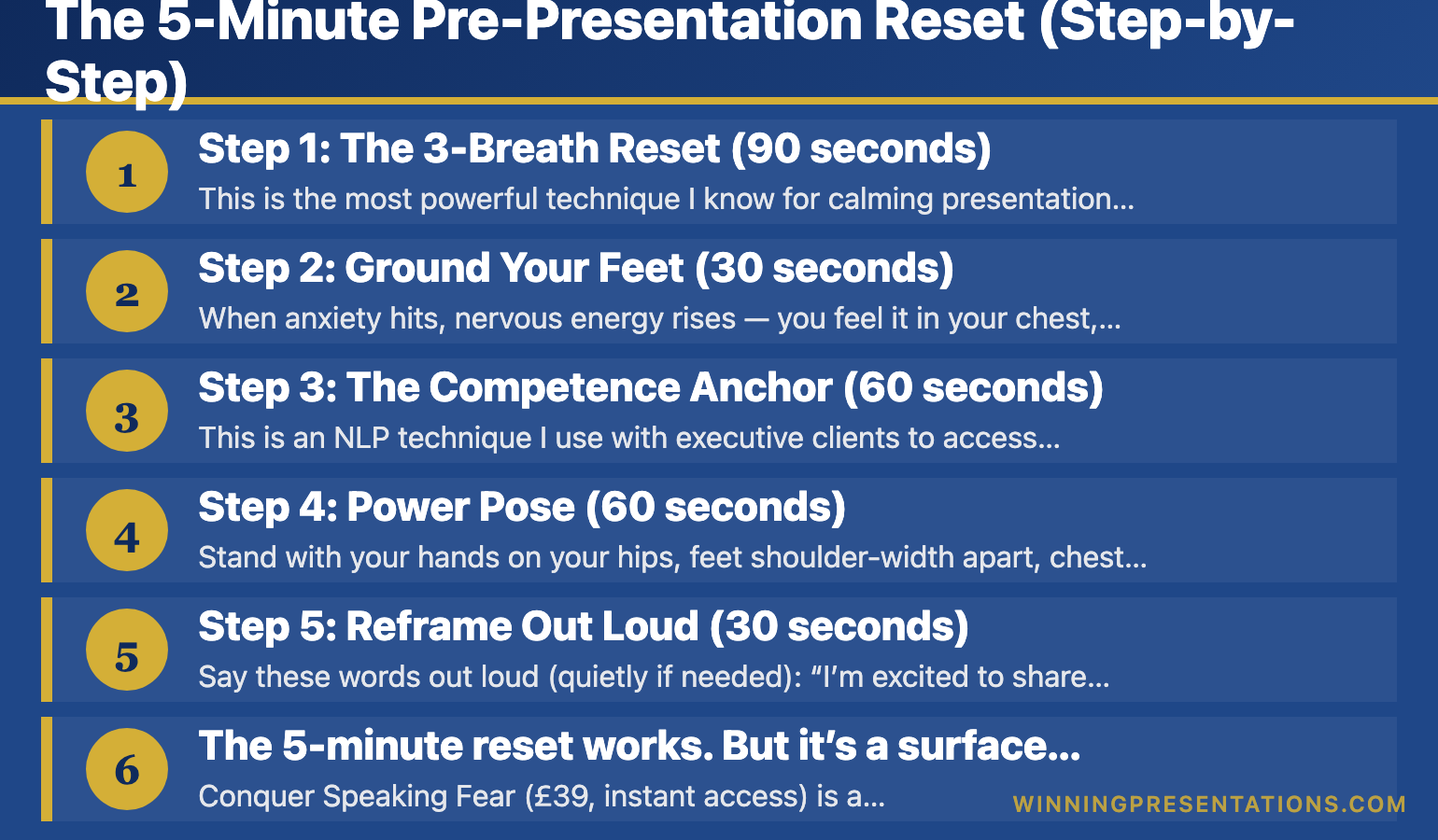
Step 1: The 3-Breath Reset (90 seconds)
This is the most powerful technique I know for calming presentation nerves. I used it with panic attack clients for years before bringing it into executive training.
How to do it:
- Breathe in through your nose for 4 counts
- Hold for 4 counts
- Breathe out through your mouth for 6 counts
- Repeat 3 times
Why it works: The extended exhale activates your parasympathetic nervous system — literally telling your brain the threat is over. This isn’t relaxation advice; it’s how your nervous system is wired. I’ve used this exact technique to help clients stop panic attacks in their tracks.
Three breaths. Ninety seconds. Do it every single time.
Step 2: Ground Your Feet (30 seconds)
When anxiety hits, nervous energy rises — you feel it in your chest, throat, and head. Your feet want to pace or shift.
Counter this by pressing your feet firmly into the floor. Feel the ground beneath you. Imagine roots growing from your feet into the earth.
This “grounding” technique redirects nervous energy downward and creates physical stability that will translate to vocal stability when you speak. It’s a core technique in anxiety therapy that I used extensively in my clinical hypnotherapy practice before adapting it for presenters.
Related: How to Start a Presentation: 15 Powerful Opening Techniques
Step 3: The Competence Anchor (60 seconds)
This is an NLP technique I use with executive clients to access confident states on demand. It’s one of the most effective ways to calm nerves before a presentation because it gives you a physical trigger you can use anywhere.
How to create it:
- Remember a time you felt completely confident — any context
- Close your eyes and fully re-experience that moment
- When the feeling peaks, press your thumb and forefinger together firmly
- Hold for 5 seconds, then release
You’ve now created a physical trigger. Before you present, press your thumb and forefinger together to access that state. Your nervous system doesn’t distinguish between remembered confidence and current confidence.
This is the same anchoring technique I used to help anxiety clients access calm states on demand. It works for presentations too.
Step 4: Power Pose (60 seconds)
Stand with your hands on your hips, feet shoulder-width apart, chest open. Hold for 60 seconds.
Research on power posing is mixed, but I’ve seen it work consistently with the executives I train. At minimum, it interrupts the closed, protective posture that presentation anxiety creates — hunched shoulders, crossed arms, shallow breathing.
That posture change affects your mental state. Open body, open mind.
Step 5: Reframe Out Loud (30 seconds)
Say these words out loud (quietly if needed): “I’m excited to share this.”
Not “I’m calm” — your body knows that’s a lie. “I’m excited” works because the physiological response to excitement is identical to anxiety: racing heart, heightened alertness, energy surge. The only difference is the label you put on it.
Research shows that reframing anxiety as excitement actually improves performance. One sentence. Say it out loud. It matters.
🎯 Want This Entire Routine on a Printable Card?
The include the 5-Minute Reset, voice warm-ups, power poses, and 20+ techniques on printable cards you can keep in your bag. Review them before any high-stakes presentation.
Stop managing nerves. Eliminate them.
The 5-minute reset works. But it’s a surface technique — and you know it.
Conquer Speaking Fear (£39, instant access) is a hypnotherapist-designed system that targets the root cause of presentation anxiety — not just the symptoms. Use the reset in the short term; use the system to stop needing it.
- Fear Type Assessment — identify exactly what drives your anxiety response
- 10 evidence-based techniques with structured practice
- 5 word-for-word scripts for worst-case scenarios
- 30-day structured plan — build lasting confidence
⚡ Presenting this week?
If you’re heading into a high-stakes presentation this week and need more than a 5-minute reset, Conquer Speaking Fear gives you the complete system — including the pre-presentation protocols that make the nerves manageable every time.
The 60-Second Emergency Version
No time for the full reset? Here’s how to calm presentation nerves in under a minute:
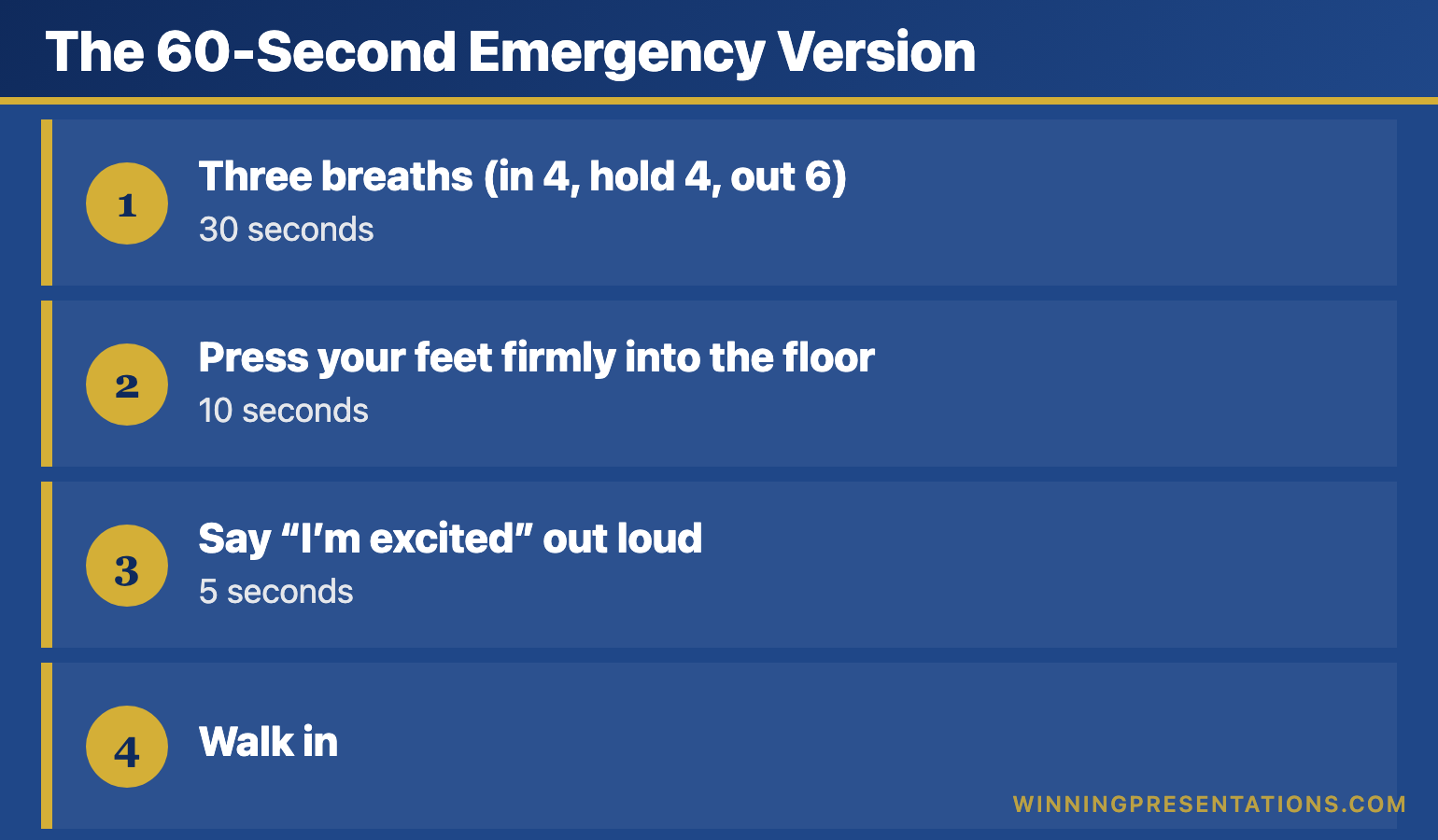
- Three breaths (in 4, hold 4, out 6) — 30 seconds
- Press your feet firmly into the floor — 10 seconds
- Say “I’m excited” out loud — 5 seconds
- Walk in
Forty-five seconds. It won’t eliminate your nerves completely, but it will take the edge off enough to get through your opening — and the first 60 seconds are when presentation anxiety is highest. After that, you’ll settle.
What to Do If Your Mind Goes Blank During the Presentation
Even with preparation, it happens. You’re mid-sentence and suddenly — nothing. Your mind is completely empty.
Here’s your recovery plan:
- Pause. It feels like an eternity to you. To the audience, it looks like confidence.
- Look at your slide or notes. No one judges you for this.
- Say: “Let me come back to that point…” and move to the next section.
The audience rarely notices these moments as much as you fear. And knowing you have a recovery plan removes the panic that makes blanking worse.
Related: How to End a Presentation: 7 Closing Techniques That Work
Why This Works When Other Techniques Don’t
Most advice for calming nerves before a presentation focuses on what to think. But as I learned in my clinical hypnotherapy practice, you can’t think your way out of a physiological state.
The 5-Minute Reset works because it targets your nervous system directly:
- Breathing activates the parasympathetic response
- Grounding redirects nervous energy
- Anchoring accesses stored confident states
- Posture interrupts anxiety body language
- Reframing changes how your brain interprets the arousal
Each step builds on the last. Together, they create a reliable state change that works whether you’re presenting to five people or five hundred.
Related: How to Create Executive Presentations That Get Results
Building Long-Term Presentation Confidence
The 5-Minute Reset is a powerful tool for calming nerves before any presentation. But if presentation anxiety is a recurring challenge, you’ll want to build deeper confidence over time.
That means:
- Knowing your opening cold — Memorise your first 30 seconds word-for-word so you don’t have to think when nerves are highest
- Arriving early — Get to the room first and make the space yours
- Creating a consistent ritual — Use the same pre-presentation routine every time so your brain learns to associate it with successful outcomes
- Practising in stressful conditions — Rehearse standing up, in front of colleagues, in the actual room when possible
I cover all 15 of these techniques in my comprehensive guide: Public Speaking Tips: 15 Techniques That Actually Work
Ready to build confidence that works long-term?
Conquer Speaking Fear is a complete system for executives who understand their material but still feel the anxiety response before every presentation. 75-page workbook. Evidence-based. Immediate download.
Want to stop relying on the reset and start walking in composed? Conquer Speaking Fear builds the foundation underneath the techniques →
Frequently Asked Questions
How do I stop shaking before a presentation?
Shaking comes from adrenaline — you can’t stop the adrenaline, but you can process it. Do the 3-Breath Reset (breathe in 4, hold 4, out 6, repeat 3 times), then hold something in your hands — a clicker, pen, or notes — to occupy them. The shaking usually subsides within 60-90 seconds of starting your presentation if you don’t fight it.
What if I get nervous again during the presentation?
Use a micro-reset: take one slow breath (in 4, out 6), press your feet into the floor, and continue. You can do this while speaking or during a natural pause. The audience won’t notice.
Does the 5-Minute Reset work for virtual presentations?
Absolutely. Do the full routine before you go on camera. The only adaptation: during the presentation, you can ground your feet while seated, and focus your eye contact on the camera lens (not the screen) to create connection.
What if I only have 2 minutes before presenting?
Use the 60-Second Emergency Version: three breaths (30 seconds), ground your feet (10 seconds), say “I’m excited” out loud (5 seconds), then walk in. It’s enough to take the edge off your presentation anxiety.
Why do I get presentation anxiety when I know the material?
Because anxiety isn’t about knowledge — it’s about perceived threat. Your nervous system interprets being watched and judged as danger, regardless of how prepared you are. That’s why techniques that target the nervous system directly (like the 5-Minute Reset) work better than “just know your stuff” advice.
📬 The Winning Edge Newsletter
Weekly strategies for speaking confidence, executive presence, and career-critical presentation moments.
Your Next Step
You now have a structured technique to calm nerves before any presentation. Here’s what I want you to do:
- Save this article — bookmark it or print the steps
- Use the 5-Minute Reset before your next presentation — even a low-stakes meeting
- Notice the difference — in your body, your voice, your confidence
Once you’ve experienced how well this works, you’ll never present without it again.
Go deeper: Public Speaking Tips: 15 Techniques That Actually Work — the complete guide to confident presenting, from a hypnotherapist who specialises in executive presentation skills.
Mary Beth Hazeldine is a qualified clinical hypnotherapist and Managing Director of Winning Presentations. She spent 25 years in corporate banking at JPMorgan, PwC, Royal Bank of Scotland, and Commerzbank, and applies evidence-based clinical techniques to managing presentation anxiety. She advises executives across financial services, healthcare, technology, and government.
Not ready for the full system? Start here instead: subscribe to The Winning Edge — weekly strategies for executive confidence and presentation skills, free.