My hands were shaking so badly I couldn’t hold my notes. My heart was pounding so hard I was certain everyone in the corridor could hear it. I had seven minutes until I was supposed to present to the board—and I was hiding in a bathroom stall, convinced I was dying.
Quick answer: A panic attack before presentation is your nervous system’s false alarm—it feels life-threatening but it isn’t. The 90-second protocol that stops it: (1) Cold water on wrists and neck, (2) 4-7-8 breathing (inhale 4, hold 7, exhale 8), (3) Name 5 things you can see out loud. This interrupts the panic cycle and gives your prefrontal cortex time to regain control from your hijacked amygdala.
In practice, panic attacks before presenting are far more common than most professionals admit—and they’re completely manageable once you understand what’s happening in your body and have a reliable protocol to interrupt the cycle.
When you have a protocol that works:
- Panic becomes manageable instead of terrifying
- You present anyway—and no one knows what happened
- The fear of panic itself starts to fade
Written by Mary Beth Hazeldine — executive presentation coach and qualified clinical hypnotherapist. I spent 5 years having panic attacks before presentations until I learned what actually works. I’ve since helped hundreds of executives who thought they’d have to live with this forever. Last updated: January 2026.
🚨 Panic attack happening RIGHT NOW? Do this:
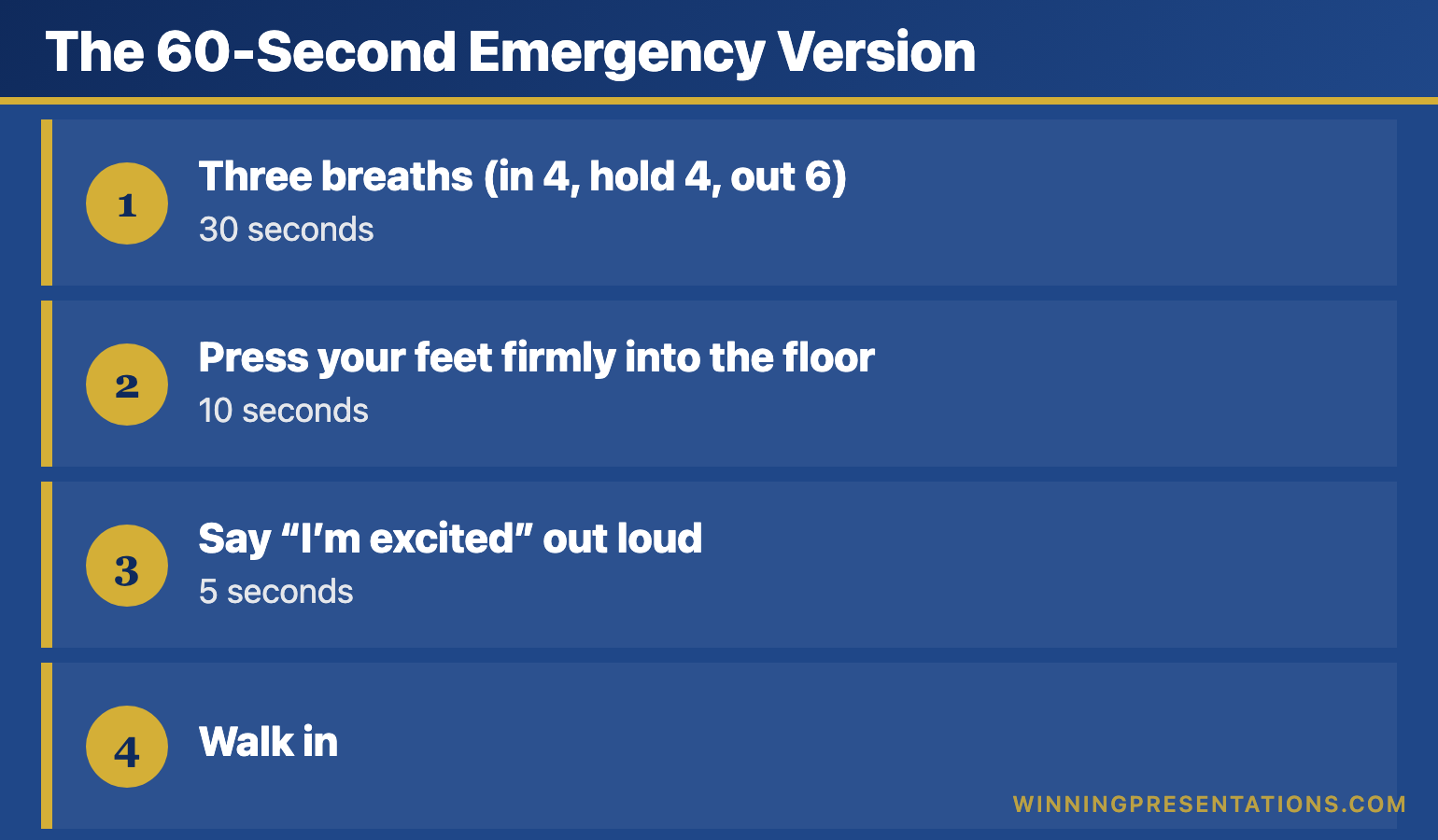
- Cold water — Run cold water on your wrists and splash your face/neck (activates dive reflex, slows heart)
- 4-7-8 breath — Inhale 4 counts, hold 7 counts, exhale 8 counts. Repeat 3 times.
- 5-4-3-2-1 grounding — Name 5 things you see, 4 you touch, 3 you hear, 2 you smell, 1 you taste
- Move — Shake your hands, roll your shoulders, walk. Movement discharges adrenaline.
This takes 90 seconds. The panic will peak and pass. You will be able to present.
→ Want this protocol in audio form you can use in the moment? Get Calm Under Pressure →
📅 Presenting in the next 7 days?
The protocol above handles acute panic. But if you want to prevent panic attacks from escalating—or stop them before they fully activate—you need to train your nervous system in advance. That’s what this article teaches.
That board presentation I mentioned? I made it through. Delivered the full 20 minutes. Got the budget approved. No one knew what had happened in that bathroom seven minutes earlier.
I learned something crucial that day: panic attacks feel unsurvivable, but they’re not. And once you have a reliable protocol, you stop fearing the fear itself—which is often worse than the panic.
After 5 years of suffering through this alone—and then training as a clinical hypnotherapist specifically to understand why it happens—I now teach these techniques to executives who thought presentation panic was just something they had to endure. It isn’t.
In this article:
What’s Actually Happening During a Panic Attack
Understanding what’s happening in your body removes some of the terror. A panic attack before presentation is your nervous system misfiring—your brain has incorrectly flagged “presentation” as “life-threatening danger.”
The Amygdala Hijack
Your amygdala (the brain’s threat detector) triggers fight-or-flight. It doesn’t consult your rational brain first. By the time you think “this is just a presentation,” your body is already flooded with adrenaline and cortisol.
This is why telling yourself to “just relax” doesn’t work. Your rational brain isn’t driving anymore.
The Physical Symptoms (And Why They Happen)
Every panic symptom has a survival purpose that’s now misfiring:
- Racing heart — Pumping blood to muscles for fighting or fleeing
- Shallow breathing — Quick oxygen intake for action
- Sweating — Cooling the body for exertion
- Trembling — Muscles primed for explosive movement
- Tunnel vision — Focusing on the “threat”
- Nausea/stomach drop — Digestion shutting down to redirect energy
- Feeling of unreality — Dissociation to protect from trauma
None of these will hurt you. They feel terrible, but they’re your body trying to protect you from a threat that doesn’t exist.
The Critical Fact Most People Don’t Know
Panic attacks peak within 10 minutes and pass within 20-30 minutes—even if you do nothing. Your body cannot sustain that level of activation indefinitely. The adrenaline gets metabolised. The cortisol clears.
The 90-second protocol below speeds this process dramatically by directly interrupting the nervous system cascade.

The 90-Second Protocol (Step-by-Step)
This protocol works because it targets your nervous system directly—not through thoughts, but through physical interventions that trigger automatic calming responses.
Step 1: Cold Water (15 seconds)
Run cold water over your wrists. If possible, splash cold water on your face and the back of your neck.
Why it works: This activates the “mammalian dive reflex”—an automatic response that slows your heart rate. Your body thinks you’re diving into water and immediately begins calming your cardiovascular system. It’s not psychological; it’s physiological.
If you can’t get to water: Press something cold against your wrists or neck—a cold drink can, ice from a water glass, a cold window, your phone screen.
Step 2: 4-7-8 Breathing (45 seconds)
Inhale through your nose for 4 counts. Hold for 7 counts. Exhale through your mouth for 8 counts. Repeat 3 times.
Why it works: The extended exhale activates your parasympathetic nervous system (the “rest and digest” system). You’re manually flipping the switch from fight-or-flight to calm. The hold interrupts the hyperventilation pattern that makes panic worse.
Can’t remember the counts? Just make the exhale longer than the inhale. That’s the key mechanism.
Step 3: 5-4-3-2-1 Grounding (20 seconds)
Name out loud (or silently if you’re not alone):
- 5 things you can see
- 4 things you can touch
- 3 things you can hear
- 2 things you can smell
- 1 thing you can taste
Why it works: This engages your prefrontal cortex (rational brain) and pulls attention away from the amygdala (panic brain). You cannot fully panic while actively cataloguing your environment. It anchors you in the present moment rather than the catastrophic future.
Step 4: Move (10 seconds)
Shake your hands vigorously. Roll your shoulders. Walk a few steps. Do wall push-ups if you’re somewhere private.
Why it works: Your body has been flooded with adrenaline meant for physical action. Movement discharges it. This is why animals shake after a threat passes—they’re completing the stress cycle. Humans often skip this step, which is why the chemicals linger.
For more breathing techniques, see the complete guide to presentation breathing.
⭐ Never Face Presentation Panic Unprepared Again
Calm Under Pressure is the complete system for managing physical anxiety symptoms before and during presentations—including the 90-second protocol in audio form you can use in the moment.
What’s inside:
- The Emergency Protocol audio (what you just learned, guided so you don’t have to remember)
- The 7-Day Nervous System Reset (reduces baseline anxiety before big presentations)
- The Pre-Presentation Ritual (prevents panic from fully activating)
Get Calm Under Pressure → £19.99
Created by a clinical hypnotherapist who spent 5 years managing her own presentation panic.
How to Stop Panic Before It Starts
The 90-second protocol handles acute panic. But ideally, you prevent presentation panic from fully activating in the first place.
The Pre-Presentation Ritual (30 minutes before)
1. Physiological sigh (5 minutes before leaving for the room)
Double inhale through your nose (one breath, then a second shorter breath on top), then long exhale through mouth. Repeat 3-5 times. Stanford research shows this is the fastest way to reduce real-time stress.
2. Cold exposure (10 minutes before)
Hold something cold, splash cold water on your wrists, or step outside briefly if it’s cold. Pre-activates the calming dive reflex before you need it.
3. Movement (15-20 minutes before)
Take a brisk walk. Climb stairs. Light stretching. Burns off anticipatory adrenaline before it accumulates to panic levels.
4. Arrival ritual (5 minutes before)
Arrive early. Claim your space. Touch the podium or table. Greet one person. This reduces the “entering hostile territory” feeling that triggers panic.
The Morning-Of Protocol
On presentation days:
- Limit caffeine — It amplifies anxiety symptoms. Half your normal amount, or skip it.
- Eat protein — Stabilises blood sugar. Blood sugar crashes trigger anxiety responses.
- Exercise early — Even 20 minutes of movement reduces anxiety for hours afterward.
- Avoid news/social media — Your nervous system doesn’t need additional activation.
Want the complete pre-presentation ritual with guided audio?
Includes the full 30-minute protocol you can follow the morning of any high-stakes presentation.
Long-Term: Training Your Nervous System
If you experience panic attacks regularly before presentations, your nervous system has learned to associate “presentation” with “danger.” The long-term solution is retraining that association.
Gradual Exposure
Your nervous system learns safety through repeated exposure without catastrophe:
- Speak up in small meetings first
- Volunteer for low-stakes presentations
- Record yourself presenting and watch it back
- Present to friends or family
Each time you present and survive, your amygdala gets evidence that presentations aren’t actually life-threatening. The threat association weakens.
Daily Nervous System Training
Daily practice—not just on presentation days—builds your capacity to regulate:
- Daily breathwork — 5 minutes of 4-7-8 breathing trains your body to access calm states quickly
- Cold exposure — Cold showers or ice on wrists builds stress tolerance
- Vagal toning — Humming, singing, gargling stimulate the vagus nerve that controls the calm response
Cognitive Reframing
Physical interventions work faster, but shifting how you think about panic also helps:
- “This is excitement” — Anxiety and excitement have identical symptoms. Relabelling helps.
- “My body is preparing me” — Reframe symptoms as preparation for performance, not danger signals.
- “I’ve survived this before” — You have a 100% survival rate for panic attacks so far.
For more on the psychology of speaking fear, see the hypnotherapist’s guide to lasting change.

⭐ Stop Dreading Every Presentation
The techniques in this article work. But implementing them when you’re already anxious is hard. Calm Under Pressure gives you the complete system with audio guides so you don’t have to think—just press play.
You’ll get:
- Emergency audio protocol (use during active panic)
- 7-day nervous system reset program
- Pre-presentation morning ritual
- Long-term training guide
Get Calm Under Pressure → £19.99
Used by executives who present in high-stakes boardrooms and client meetings.
When to Seek Professional Help
The techniques here help most people manage presentation panic. But some situations warrant professional support:
Consider seeing a professional if:
- Panic attacks happen frequently outside of presentations
- You’re avoiding career opportunities because of fear
- Anxiety is affecting sleep, relationships, or daily life
- You’re using alcohol or substances to cope
- These techniques aren’t helping after consistent 4-week practice
Effective professional approaches for presentation panic:
- Cognitive Behavioural Therapy (CBT) — Evidence-based treatment for anxiety disorders
- Clinical Hypnotherapy — Works with subconscious associations driving panic
- EMDR — Particularly helpful if there’s a traumatic presentation experience in your history
- Medication — Beta-blockers block physical symptoms; SSRIs address underlying anxiety. Discuss with your doctor.
Seeking help isn’t weakness—it’s strategic. Many successful executives work with professionals to optimise their performance.
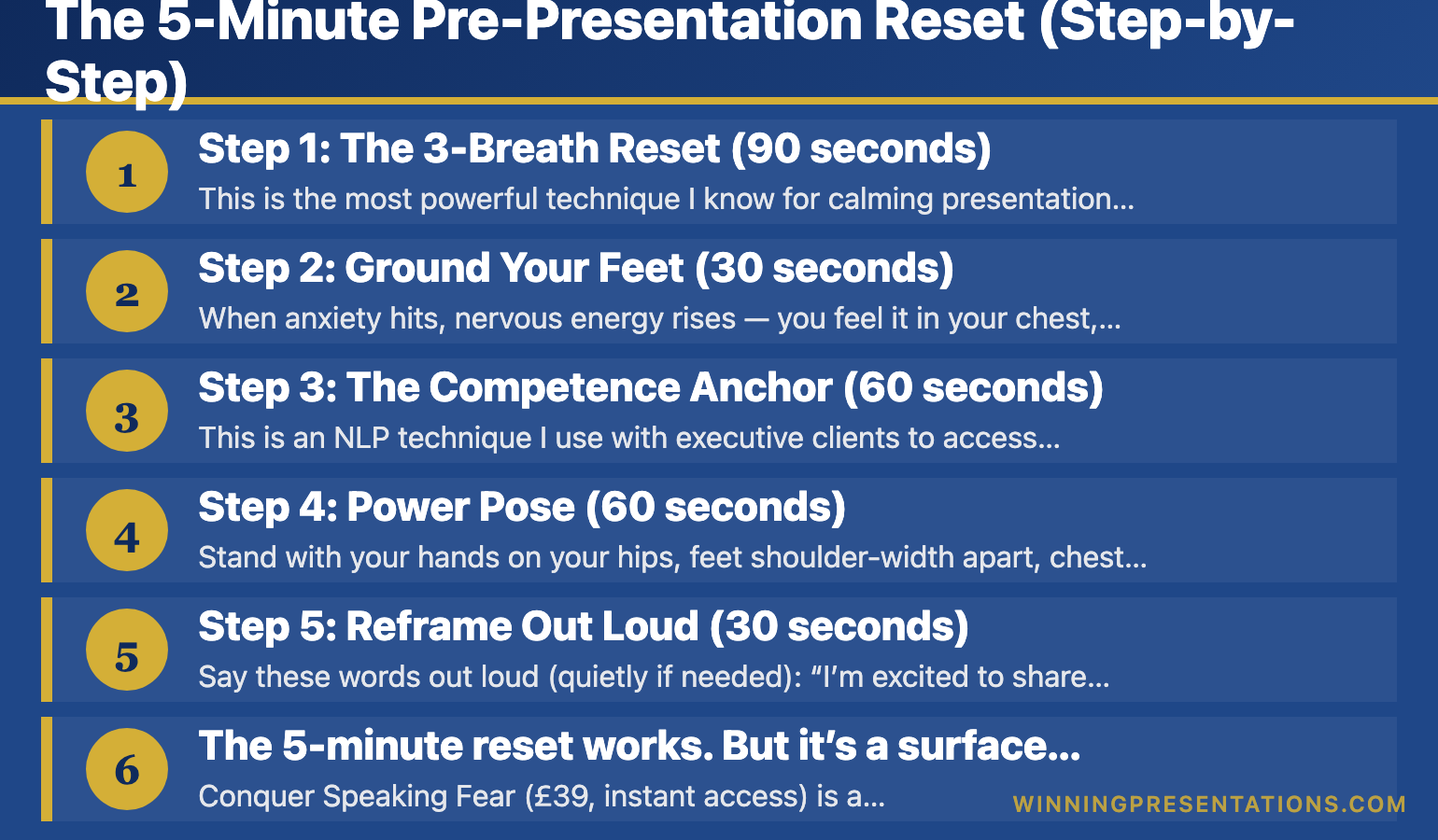
For more on building lasting confidence, see the 5-minute reset that actually works.
Ready to take control of presentation panic?
Get the complete toolkit—emergency protocols, prevention rituals, and the training system.
Frequently Asked Questions
Can a panic attack actually hurt me?
No. A panic attack before presentation feels dangerous but isn’t. The symptoms are uncomfortable—sometimes terrifying—but they won’t cause heart attacks, fainting (blood pressure rises during panic, making fainting nearly impossible), or permanent harm. Understanding this reduces the fear of panic itself.
What if panic happens DURING my presentation?
Pause. Take a drink of water (buys time, activates swallowing reflex which calms). Take one breath with a long exhale. Continue. Most audiences assume you’re collecting your thoughts. If needed, say “Let me take a moment to make sure I’m explaining this clearly.”
Will people know I’m having a panic attack?
Almost certainly not. Internal symptoms (racing heart, nausea, doom feeling) are invisible. External symptoms (trembling, sweating) are far less obvious than you think. Others are focused on their own concerns, not analysing your physiology.
Should I tell my audience I’m nervous?
Generally, no. It draws attention to something they haven’t noticed and reduces your perceived authority. Exception: if you’re visibly struggling, a brief “Bear with me for a moment” is better than pretending nothing is wrong.
Why do panic attacks seem to come out of nowhere?
They don’t. There’s usually a buildup of anticipatory anxiety that crosses a threshold—hours or days of rumination, sleep disruption, and physical tension accumulating until the system tips. Prevention techniques address this buildup.
Can I take medication for presentation panic?
Beta-blockers (propranolol) are commonly prescribed for performance anxiety—they block physical symptoms without affecting mental clarity. Safe for occasional use, but they don’t address the underlying cause. Discuss with your doctor.
How long until these techniques work?
The 90-second protocol works immediately—relief within minutes. Prevention techniques show results within 1-2 weeks of consistent use. Long-term nervous system retraining takes 4-8 weeks to produce lasting change.
Is This Right For You?
✓ This is for you if:
- You experience physical panic symptoms before presenting
- You’ve tried “just relax” and it doesn’t work
- You want techniques that work with your nervous system
- You’re willing to practice before the high-stakes moment
✗ This is NOT for you if:
- Panic attacks happen frequently in daily life (see a professional)
- You want a magic fix without practice
- Your main issue is content preparation, not anxiety
- You’re unwilling to try physical techniques
⭐ I Hid in Bathroom Stalls for 5 Years. Then I Found What Works.
The techniques in Calm Under Pressure are what finally ended my own presentation panic—and what I now teach executives who thought they’d suffer through this forever. You don’t have to.
The complete system:
- 90-second emergency protocol (audio)
- Pre-presentation ritual (30-minute preparation)
- 7-day nervous system reset
- Long-term training guide
Get Calm Under Pressure → £19.99
From someone who’s been in that bathroom stall—and found her way out.
📧 Optional: Get weekly techniques for presentation confidence in The Winning Edge newsletter (free).
Your Next Step
A panic attack before presentation doesn’t have to derail your career or your confidence. The 90-second protocol works. The prevention rituals work. The long-term training works.
Start with the emergency protocol. Practice it when you’re calm so it’s automatic when you need it. Then build in the prevention rituals. Then commit to the nervous system training.
You can present without panic. I did—after 5 years of hiding in bathroom stalls. Hundreds of my clients have. You will too.
For the complete system with audio guides, get Calm Under Pressure (£19.99).
P.S. If anxiety about your slides is making panic worse, see what your slides actually communicate about you—sometimes fixing the deck reduces the anxiety.
About the Author
Mary Beth Hazeldine is the Owner & Managing Director of Winning Presentations and a qualified clinical hypnotherapist. The bathroom stall story that opened this article is real—she spent 5 years experiencing panic attacks before presentations before training as a hypnotherapist specifically to understand and overcome them.
With 24 years at JPMorgan Chase, PwC, Royal Bank of Scotland, and Commerzbank—environments where one presentation could change funding, strategy, or careers—she’s helped hundreds of executives who thought panic was something they just had to endure.