Tag: conquer speaking fear

12 Apr 2026
Professional executive presenting calmly and confidently to boardroom colleagues

Overcome Presentation Anxiety: Online Course for Professionals

If you are looking for an online course to overcome presentation anxiety, Conquer Speaking Fear is a 30-day programme designed specifically for professionals who present regularly and need a structured, evidence-informed approach to managing their response to high-stakes speaking. Unlike generic mindfulness apps or public speaking tips, Conquer Speaking Fear combines nervous system regulation techniques with clinical hypnotherapy sessions built around the presentation context — not just speaking in the abstract. It is available now at £39, instant access. This page explains what the programme includes, who it is designed for, and how to decide whether it is right for your situation.

The Problem: Presentation Anxiety Is Not Just Nerves

For many professionals, the difficulty with presentations goes beyond the pre-meeting nerves that most people describe. It shows up differently depending on the person — a voice that tightens in the first few minutes, a mind that empties of everything it rehearsed the moment a difficult question arrives, or a pattern of quietly declining to present in high-stakes meetings when alternatives are available. Over time, avoidance becomes its own problem: the fewer high-stakes presentations you do, the more charged each one becomes.

Senior professionals often experience this acutely precisely because the stakes are higher. When you have been promoted to a level where your presentations carry real weight — where decisions get made or blocked based on how you communicate — the pressure compounds. Anxiety at this level is not about lacking experience. It is about a nervous system that has learned to treat the presenting environment as a threat, and that responds accordingly regardless of how well you know the material.

This is a physiological pattern, not a character flaw. The voice tightening, the mind going blank under pressure, the dread in the days before a presentation — these are normal nervous system responses that have been calibrated to the wrong stimulus. They are also, with the right structured approach, genuinely workable.

If you have tried general confidence-building approaches and found that they help in lower-stakes situations but do not reliably hold under real pressure, the reason is usually that those approaches do not address the nervous system response directly. Understanding the full range of what treatment-resistant presentation anxiety looks like can help clarify whether what you are experiencing falls into that category.

The Solution: Conquer Speaking Fear

Conquer Speaking Fear is a 30-day structured online programme that addresses presentation anxiety at the level where most approaches stop short: the nervous system. The programme does not ask you to think your way out of anxiety or to simply push through it with willpower. It gives you a set of practical, evidence-informed techniques — drawn from nervous system regulation and clinical hypnotherapy — that change how your body and mind respond to the presentation environment over time.

The programme is built around consistency over intensity. Thirty days of structured practice, with each module building on the previous, creates lasting change in a way that a single intensive workshop rarely does. The techniques are designed to be used in real professional life — not just in quiet practice sessions, but in the moments before you enter a room and during a presentation when you need them most.

Clinical hypnotherapy is one component that often raises questions. In this context, it refers to audio-guided sessions designed to work at the level of the subconscious associations that drive the anxiety response — the part of the brain that decides presentations are threatening before the rational mind has a chance to evaluate the situation. This is not stage hypnosis. It is a well-established technique used in clinical practice for anxiety management, adapted here specifically for the professional presenting context.

The programme also includes a dedicated module for professionals who have had a presenting experience that went badly — a major stumble, a hostile Q&A, or a presentation that resulted in significant professional consequences. For some people, that kind of experience creates a specific pattern that general anxiety work does not touch. The exposure ladder approach to presentation anxiety covers the gradual re-engagement strategy that complements this module well.

What You Get

  • 30-day structured programme — daily modules that build systematically, designed to fit around a working professional’s schedule
  • Nervous system regulation techniques — practical methods for managing the physiological response before, during, and after presentations
  • Clinical hypnotherapy audio sessions — guided sessions designed specifically for the professional presentation context, addressing subconscious anxiety patterns
  • Module for presenting after a difficult experience — dedicated support for professionals recovering from a presentation that went significantly wrong
  • In-the-moment symptom management techniques — tools you can use during a live presentation, not just in preparation
  • Instant access — start today, work at your own pace within the 30-day structure

Price: £39 — instant access, no subscription.

Build a Presenting Practice That Does Not Depend on the Day You Are Having

Conquer Speaking Fear gives you the structured, 30-day programme to shift your relationship with high-stakes presenting — using nervous system regulation and clinical hypnotherapy techniques developed for professionals, not for general public speaking anxiety. £39, instant access.

  • ✓ 30-day programme with daily structured modules
  • ✓ Clinical hypnotherapy audio sessions for presentations
  • ✓ Nervous system techniques for before and during presentations
  • ✓ Module for recovering from a difficult presenting experience

Get Conquer Speaking Fear → £39

Instant access · £39 · No subscription

Is This Right for You?

Conquer Speaking Fear is designed for professionals who present regularly as part of their role and who experience a consistent anxiety pattern that affects their performance or their willingness to take on high-visibility presentations. It is particularly suited to people who have already tried general confidence-building approaches — workshops, affirmations, breathing techniques — and found that those approaches do not hold reliably under real pressure.

It is right for you if: you experience physical symptoms (voice tightening, mind going blank) under presentation pressure; you find that dread in the days before a presentation affects your preparation; you avoid certain high-stakes speaking opportunities; or you have had a difficult presenting experience that has affected your confidence since.

It is not designed for people who are simply looking to improve their slide design or delivery technique without an anxiety component — for those needs, a slide structure resource or presentation skills training would be more appropriate. It is also not a replacement for clinical support if you are experiencing significant anxiety across multiple areas of your life — if that is your situation, working alongside a qualified therapist while using this programme is entirely appropriate.

For professionals with specific questions about how cognitive restructuring for presentation anxiety works as a complementary approach, that guide covers the thinking-level techniques that sit alongside the nervous system work in this programme.

Frequently Asked Questions

Is this the same as meditation or mindfulness?

No. Mindfulness and meditation are valuable practices, but they work primarily at the level of conscious awareness. Conquer Speaking Fear includes nervous system regulation techniques that address the physiological response to presentation pressure — the physical symptoms that occur before and during presenting — and clinical hypnotherapy sessions that work at the level of subconscious association patterns. If you have tried mindfulness and found it helpful in daily life but unreliable under presentation pressure, this programme addresses a different mechanism.

Does this work if my anxiety is severe?

The programme is designed for professionals who experience meaningful anxiety in presenting contexts — ranging from persistent pre-presentation dread to physical symptoms that affect delivery. If your anxiety is severe enough that it is affecting your broader daily functioning, working alongside qualified clinical support is advisable, and this programme can complement that work. If your anxiety is specifically and primarily triggered by presenting situations — which is the case for many professionals — this programme is directly designed for your pattern.

How long until I see results?

Most participants notice a shift in their physical response to presentation preparation within the first two weeks of consistent practice. The nervous system regulation techniques in particular can produce noticeable results relatively quickly, because they address the physiological response directly rather than trying to change it through thought alone. Full integration — where the techniques hold reliably under significant pressure — typically develops over the 30-day programme period. The programme is structured to build progressively, so results deepen as you continue.

Can I do this alongside other anxiety support?

Yes. Conquer Speaking Fear is designed to work as a standalone programme, and it is also compatible with other anxiety support — including therapy, coaching, or medication prescribed by a clinical professional. If you are currently working with a therapist on anxiety, it is worth mentioning that you are using a presentation-specific programme so they can be aware of the techniques you are practising. The approaches in this programme do not conflict with standard evidence-based anxiety treatments.

Is this suitable for C-suite executives?

Yes — and the programme is particularly relevant at C-suite level, where the stakes of each presentation are highest and the expectation to appear composed under pressure is most acute. Senior executives often find that general public speaking courses feel too basic for their experience level. Conquer Speaking Fear does not address presentation skills or delivery technique — it addresses the anxiety pattern itself, which operates independently of seniority or experience. The more visibility your presentations carry, the more disruptive an unchecked anxiety pattern becomes.

The Winning Edge

Weekly insights on executive presentations, speaking confidence, and high-stakes communication — delivered every Thursday.

Subscribe Free

About the author

Mary Beth Hazeldine, Owner & Managing Director, Winning Presentations. With 25 years of corporate banking experience at JPMorgan Chase, PwC, Royal Bank of Scotland, and Commerzbank, and 16 years working with executives on high-stakes presentations, she advises senior professionals across financial services, healthcare, technology, and government on structuring and delivering presentations under pressure.

11 Apr 2026
Professional speaking confidently to an executive audience — visible calm, open posture, boardroom setting, editorial photography style

Exposure Ladder for Presentation Anxiety: A Systematic Approach to Building Speaking Confidence

Quick Answer

An exposure ladder for presentation anxiety works by building a hierarchy of speaking situations from low-anxiety to high-anxiety, then moving through them deliberately and repeatedly until each step becomes manageable. Unlike willpower-based approaches, systematic desensitisation changes the nervous system’s threat response — not just your attitude toward presenting.

Ngozi had presented at every level of her organisation for eleven years. She had closed deals, led strategy reviews, and presented to the board. By any external measure she was an accomplished presenter. But for the past three years, the week before any significant presentation had become a period of progressive dread — poor sleep, a constant low-level nausea, and an inability to concentrate on anything else. The presenting itself was manageable. The anticipation had become unbearable.

She had tried all the standard advice. She had recorded herself presenting. She had meditated. She had told herself the anxiety was excitement. None of it made a lasting difference. What changed, eventually, was working through a structured exposure hierarchy — not to presentations she was already doing, but to a deliberate sequence of lower-stakes speaking situations she had quietly been avoiding for years. Speaking in a meeting when she did not need to. Offering opinions without being asked. Presenting informally to three people without slides.

The exposure ladder did not make Ngozi comfortable with presenting because she practised presenting more. It worked because it systematically reduced her nervous system’s baseline threat response to being observed and evaluated — the underlying mechanism that was driving the dread. Once that baseline came down, the anticipatory anxiety reduced with it.

This article explains how to build and use an exposure ladder for presentation anxiety — and why the clinical logic behind it is the most reliable route out of a pattern that willpower alone rarely shifts.

Is presentation anxiety limiting your career progression?

Conquer Speaking Fear is a 30-day programme that combines nervous system regulation and clinical hypnotherapy techniques, designed specifically for professionals whose anxiety is persistent despite years of presenting experience.

Explore the Programme →

Why Exposure Works When Everything Else Doesn’t

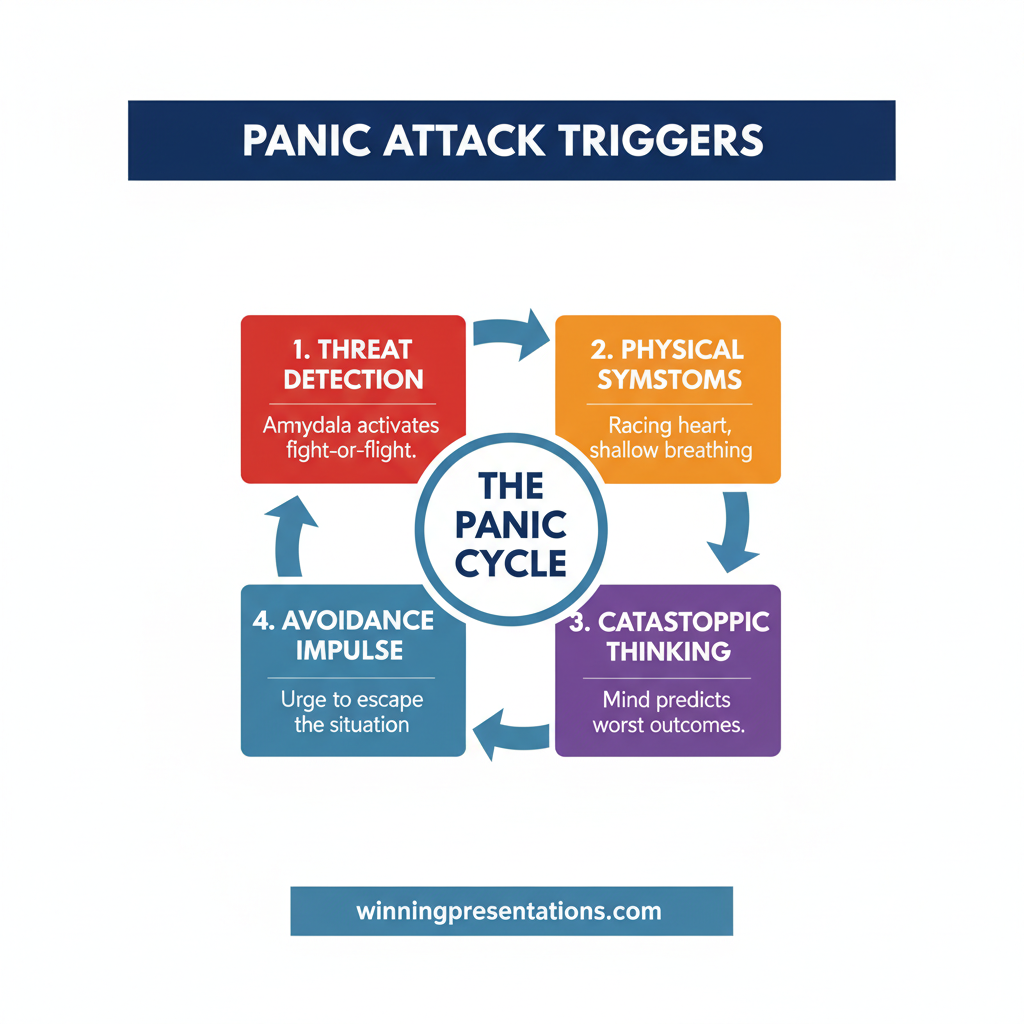
Presentation anxiety is not fundamentally a confidence problem. It is a threat response. The amygdala — the part of the brain responsible for threat detection — has learned, through repeated association, that being observed and evaluated in front of an audience is dangerous. It responds to that stimulus the same way it would respond to a physical threat: elevated cortisol, accelerated heart rate, restricted breathing, heightened vigilance. The cognitive experience of this response is dread, self-consciousness, and the urge to avoid.

This is why approaches that work at the cognitive level — reframing your thoughts, replacing negative self-talk, visualising success — produce limited results for people with persistent anxiety. The threat response is not cognitive in origin. It does not respond reliably to cognitive correction. You can tell yourself rationally that the presentation is not dangerous, while your nervous system continues to respond as though it is. The rational argument and the threat response operate in different systems.

Exposure therapy works at the level of the nervous system itself. By repeatedly experiencing the feared stimulus — in a controlled, gradual way — without the catastrophic outcome the nervous system anticipates, the amygdala progressively updates its threat assessment. The technical term is habituation: the response to a stimulus decreases with repeated, non-catastrophic exposure. This is not a motivational insight. It is a neurobiological process. It works whether or not you believe in it, and it works for people whose anxiety has been resistant to every cognitive approach they have tried.

The critical requirement is gradation. Throwing yourself into high-stakes presentations does not produce habituation — it can reinforce the threat response if the experience is sufficiently distressing. The ladder structure exists to ensure that each step is challenging enough to activate the anxiety response, but manageable enough that repeated exposure produces habituation rather than reinforcement. This is the clinical insight that makes the difference between an exposure programme that works and one that makes anxiety worse.

For professionals whose anxiety has been resistant to standard approaches, the exposure ladder is often the first intervention that produces a measurable, sustained change — because it is the first intervention that works at the level where the anxiety actually lives.

How to Build Your Personal Exposure Ladder

An exposure ladder is a personally constructed hierarchy of speaking situations, ordered from least to most anxiety-provoking. It is not a generic list — it is built from your specific pattern of avoidance and your specific anxiety triggers. Two people with presentation anxiety will often have completely different ladders, because the situations they find most threatening are different.

Begin by listing every type of speaking or being-observed situation that produces anxiety for you — not just formal presentations. Include meetings where you speak up, phone calls with people you find intimidating, informal updates in team settings, social situations where you are introduced to groups, and any other context where you experience the same anticipatory or in-the-moment anxiety response. This list is your raw material.

Next, rate each situation on a scale of 0–10 for the anxiety it produces, where 0 is no anxiety and 10 is the highest anxiety you can imagine. These ratings are subjective and they will not be consistent — a situation that feels like a 7 one week may feel like a 5 a month later. That variability is normal and expected. For now, use your current honest rating.

Organise your list from lowest to highest anxiety rating. This is your exposure ladder. You will work from the bottom up — beginning with situations rated 2–3, working toward situations rated 8–9. The principle is that you do not move to the next rung until the current rung no longer consistently produces a significant anxiety response. For most people this means repeating a situation three to five times, over days or weeks, until the anxiety rating for that situation drops to 2 or below.

The ladder should have enough rungs that the gaps between adjacent steps are small — typically no more than one to two points on the anxiety rating scale. If you find a large gap between two adjacent items, insert an intermediate situation. The goal is a gradual gradient, not a series of large jumps.

How to build a personal exposure ladder for presentation anxiety: listing situations, rating anxiety, ordering from low to high

The First Rungs: Low-Stakes Practice That Actually Counts

The most common mistake people make when starting an exposure programme is skipping the lower rungs because they seem too easy or too unrelated to presentations. This is a significant error. The lower rungs are where the neurobiological work of reducing baseline threat response happens — and that baseline reduction is what makes the higher rungs easier when you reach them.

For many professionals with presentation anxiety, typical first-rung situations include: asking a question in a meeting with three or four people present; making a comment in a small team discussion when you did not feel obligated to; speaking to a stranger in a professional context; introducing yourself in a group of five to eight people. These may feel trivially low-anxiety, or they may feel more significant than that — either way, they belong at the bottom of your ladder if they are situations you have been avoiding or find uncomfortable.

The discipline of the first rungs is repeatability. You are not trying to have one good experience — you are trying to accumulate repeated, non-catastrophic experiences until the situation loses its anxiety charge. A first rung situation should be practised multiple times per week, in naturally occurring opportunities, until the anxiety rating consistently stays at 2 or below. Only then should you move up.

It is also worth noting that the situations that belong on the lower rungs are often the situations that high-functioning professionals with presentation anxiety have been unconsciously managing around for years. They contribute to meetings in writing but not verbally. They send emails rather than picking up the phone. They arrive early and leave before social conversation starts. These avoidance patterns maintain the anxiety — each avoidance confirms to the nervous system that the situation is dangerous. The first rungs of the exposure ladder directly address this maintenance cycle.

Conquer Speaking Fear includes structured exercises for this phase of the work — specifically the progression from daily low-stakes vocal presence to deliberate speaking situations in professional environments. If the lower rungs are where you need the most support, the 30-day programme provides a week-by-week structure for this exact progression.

A 30-Day Programme for Persistent Presentation Anxiety

Conquer Speaking Fear is a structured 30-day programme combining nervous system regulation and clinical hypnotherapy techniques. Designed for professionals whose anxiety persists despite years of presenting experience — not a confidence course, but a clinical-grade approach to changing your nervous system’s response to speaking situations.

  • 30-day programme with progressive nervous system regulation exercises
  • Clinical hypnotherapy techniques for acute and anticipatory anxiety
  • Structured exposure progression for professional speaking contexts
  • Framework for managing anxiety during high-stakes presentations

Get Conquer Speaking Fear →

Designed for executives and professionals whose presentation anxiety has been resistant to standard techniques.

The Middle Rungs: Structured Escalation in Professional Settings

The middle section of the ladder — typically situations rated 4–6 — is where the most practically significant progress happens for professionals. This is the range that includes the everyday speaking situations that presentation anxiety is quietly limiting: contributing substantively in larger meetings, presenting updates informally to senior colleagues, volunteering to lead a section of a team discussion, speaking at a workshop or professional event.

The principle remains the same: deliberate, repeated exposure to each situation until the anxiety rating drops consistently to 2 or below. But the middle rungs require more intentional engineering of opportunities, because the situations do not occur as frequently as lower-rung situations, and because the stakes involved mean that avoidance is more tempting when the anxiety is present.

One effective strategy for the middle rungs is to create low-consequence versions of higher-stakes situations. Before presenting to a senior leadership team, present the same material to a trusted peer or a small team. Before speaking at an industry event, present informally at an internal team meeting. Before delivering a board update, walk through your slides in a small pre-meeting. These are not rehearsals — they are genuine exposure steps, because the anxiety they produce and the habituation that follows are both real, even when the stakes are modest.

The middle rungs also surface the cognitive distortions that accompany anxiety — the conviction that your voice will shake visibly, that people will notice your anxiety, that you will lose your thread and be unable to recover. Repeated middle-rung experiences provide direct evidence against these predictions, which is why cognitive restructuring approaches are most effective when combined with exposure rather than used in isolation. The exposure creates the evidence; the cognitive work makes that evidence legible to a mind that has been filtering it out.

People also ask: How long does it take for exposure therapy to work for public speaking? The timeline varies considerably by individual, by the severity of the anxiety, and by the consistency of practice. For professionals with moderate presentation anxiety, consistent work through an exposure ladder typically produces noticeable reduction in lower-rung anxiety within four to eight weeks. Progress to high-stakes situations often takes three to six months of sustained practice. The programme is not linear — anxiety will be higher on some days than others, and there will be setbacks. The measure of progress is the trend over time, not any individual session.

Approaching High-Stakes Presentations Without Regression

The upper rungs of the exposure ladder — board presentations, large conference speeches, high-visibility client pitches — are the situations that professionals with presentation anxiety most want to resolve. They are also the situations where the work of the lower and middle rungs pays the largest dividend, because the baseline threat response that drove the dread has been systematically reduced.

The risk at the upper rungs is regression — returning to high anxiety after a difficult experience. A presentation that goes poorly, a tough question you struggled to answer, or an audience that appeared unresponsive can temporarily reset anxiety ratings upward. This is normal and does not signal that the exposure programme has failed. What matters is returning to the practice rather than returning to avoidance. Avoidance after a difficult experience is the single most reliable way to maintain and deepen anxiety. Re-exposure, at a slightly lower rung if necessary, is the path through.

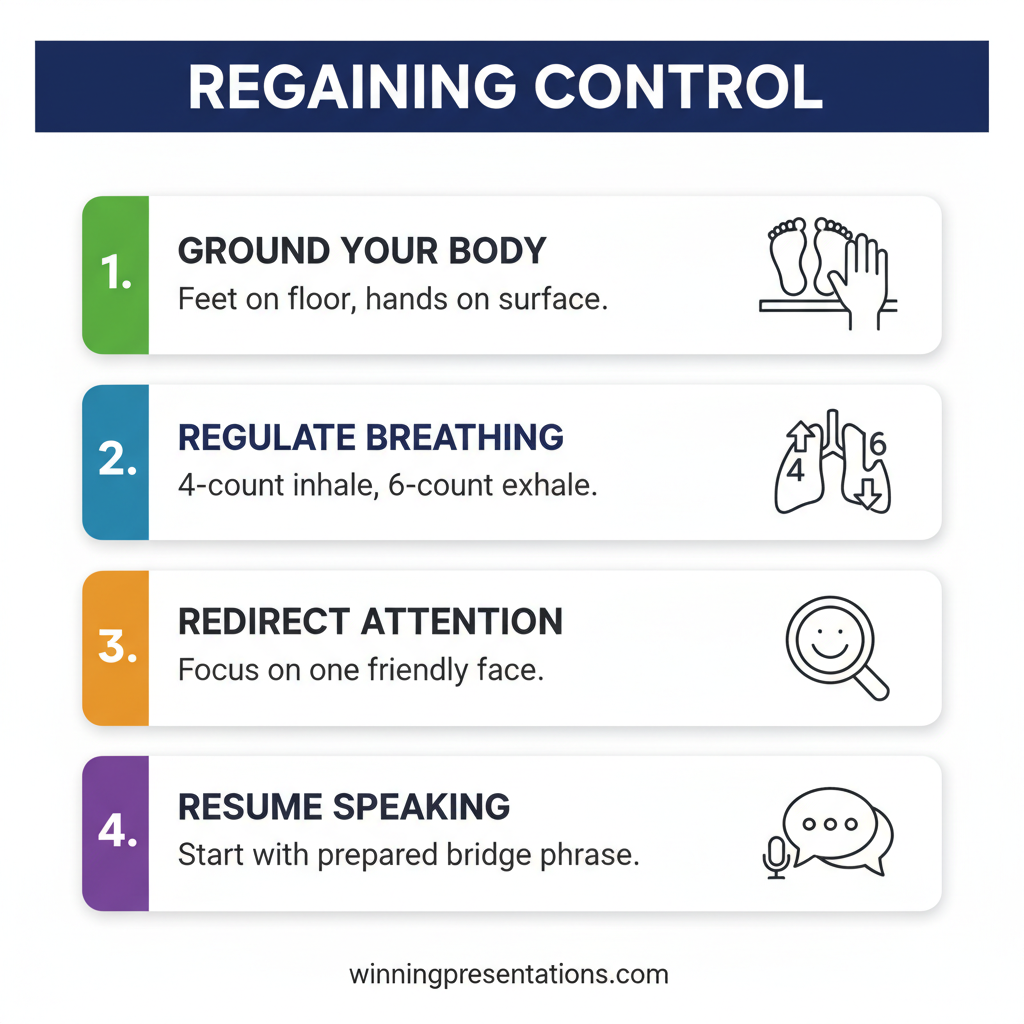
High-stakes presentations also benefit from two specific preparation approaches that work in conjunction with the lower anxiety baseline the exposure ladder creates. Physiological regulation — box breathing, slow exhalation, deliberate postural adjustment — directly modulates the acute threat response in the minutes before a presentation. And cognitive decoupling — separating your evaluation of the presentation’s quality from your evaluation of yourself — reduces the self-referential threat response that drives much of the anticipatory anxiety in high-performing professionals.

The pattern of recovery from anxiety relapse is also predictable. If a difficult high-stakes presentation temporarily reactivates anxiety that had reduced, the recovery through the ladder typically happens faster than the original progression — because the nervous system retains habituation more efficiently than it retains threat learning. This is a useful frame for understanding presentation anxiety relapse: the setback is real, but the recovery is faster than the original work.

Exposure ladder progression from low-stakes daily situations through middle rungs to high-stakes board and conference presentations

Common Mistakes That Stall Progress Up the Ladder

Three patterns reliably stall progress through an exposure ladder, and all three are driven by the same underlying mechanism: avoiding the anxiety response rather than experiencing it.

Safety behaviours. A safety behaviour is anything you do during an exposure to reduce or manage the anxiety rather than experiencing it. Reading from notes rather than speaking from memory. Focusing entirely on the screen rather than making eye contact. Presenting standing behind a lectern when you could present without one. Safety behaviours prevent habituation because they prevent the full anxiety response — and therefore prevent the nervous system from learning that the full response is survivable. Identifying and gradually removing safety behaviours is as important as adding new rungs to the ladder.

Moving up too quickly. Impatience is the most common structural mistake. Moving to the next rung before the current rung has habituated means you are working at anxiety levels that are too high to produce reliable habituation. The discomfort of repeated middle-rung exposure is the work — shortcutting it by jumping to higher rungs creates distress rather than habituation, and can make the upper rungs feel harder rather than easier.

Treating single positive experiences as evidence that the anxiety is resolved. Anxiety is variable. One good presentation does not reset the pattern — and the next difficult one does not undo the progress. The consistency of the practice, not the quality of any individual experience, is what produces lasting change. People who stop their exposure practice after a run of good presentations often find that the anxiety returns when the stakes rise again, because the nervous system has not been habituated fully to the highest-anxiety situations on the ladder.

For a structured approach to maintaining progress and avoiding these stall patterns, the Conquer Speaking Fear programme includes week-by-week guidance on pacing, safety behaviour removal, and recovery from setbacks.

A Structured Path Through Persistent Presentation Anxiety

Conquer Speaking Fear — £39 — is a 30-day programme combining nervous system regulation and clinical hypnotherapy techniques for professionals whose anxiety persists despite years of presenting. If you have tried reframing and positive thinking and found them insufficient, this programme works at the level where the anxiety actually lives.

Get Conquer Speaking Fear →

Designed for executives and professionals with persistent, anxiety that has resisted standard confidence-building approaches.

Frequently Asked Questions

Can I build an exposure ladder on my own, or do I need a therapist?

For presentation anxiety that is persistent but does not significantly impair daily functioning, a self-directed exposure ladder is a reasonable starting point. The principles are straightforward, and many professionals make meaningful progress through structured self-practice. The challenges of self-directed work are consistency, pacing, and identifying safety behaviours — these are easier to monitor with an external guide. If your anxiety is severe, accompanied by panic attacks, or has been present for many years without any period of reduction, working with a therapist trained in exposure-based approaches is worth pursuing alongside or instead of a self-directed programme.

Is systematic desensitisation the same as exposure therapy?

Systematic desensitisation and exposure therapy are closely related but not identical. Systematic desensitisation, developed by Joseph Wolpe in the 1950s, combines a hierarchy of feared situations with progressive muscle relaxation — the original clinical model involved practising relaxation responses while imagining feared situations in order. Modern exposure therapy typically focuses on live (in-vivo) exposure without requiring a specific relaxation component, and the evidence base for live exposure is stronger than for imaginal exposure alone. The exposure ladder approach described in this article draws primarily on the in-vivo exposure model — deliberate, graduated exposure to real situations rather than imagined ones.

What if my anxiety is worse than usual during an exposure practice?

Variable anxiety during exposure practice is entirely normal and does not signal that the approach is failing. Anxiety tends to be higher when you are tired, stressed, or facing other pressures — and exposure sessions that happen to fall on high-stress days may feel harder than usual. The principle is to continue the practice rather than avoid it, even on difficult days — but to reduce the step if necessary rather than forcing an exposure that is significantly beyond your current capacity. If a situation that was previously a 3 on your anxiety scale suddenly feels like a 7, drop back one rung on your ladder and repeat from there. Progress is measured over weeks and months, not individual sessions.

Get weekly insight on presentation confidence in your inbox

Every Thursday, The Winning Edge delivers one actionable insight for professionals working to build sustainable presentation confidence — including practical techniques drawn from clinical anxiety research.

Subscribe to The Winning Edge →

About the Author

Mary Beth Hazeldine is Owner & Managing Director of Winning Presentations. With 25 years of corporate banking experience at JPMorgan Chase, PwC, Royal Bank of Scotland, and Commerzbank, she advises executives across financial services, healthcare, technology, and government on overcoming presentation anxiety and structuring high-stakes presentations for board and executive audiences.

10 Apr 2026
Executive presenter holding a deliberate pause mid-presentation, commanding the room with composed silence, boardroom setting, navy and gold tones, editorial photography style

Presentation Pause Technique: Why Most Executives Rush Past Their Most Powerful Moment

Quick Answer: The presentation pause technique is the deliberate use of silence at key moments in a presentation — after a major point, before a slide transition, or when a question is asked — to control pacing, emphasise meaning, and project authority. Most executives rush through these moments. Learning to hold a pause is one of the fastest delivery improvements available to senior presenters, and it costs nothing except the willingness to tolerate temporary silence.

Ngozi had been a partner at a management consultancy for six years when a colleague watching her present for the first time pulled her aside afterwards. “You know what your problem is?” he said. “You don’t let anything land.” She had delivered a forty-minute session to a senior client team, hit every point on her notes, and received polite but muted engagement. The content was strong. The delivery was relentless.

Her colleague pointed out what she hadn’t noticed: she was filling every gap between her sentences. When she moved from one point to the next, she was speaking before the previous thought had settled. When she clicked to a new slide, she was already halfway through the first sentence before anyone in the room had read the title. When she made her key recommendation, she immediately started qualifying it rather than allowing it to sit.

The fix was simple but uncomfortable. He asked her to pause for a full three seconds after every major point before continuing. “It’s going to feel like thirty seconds,” he said. “It’s three. Do it anyway.” In her next presentation two weeks later, Ngozi did it. The room was noticeably different. People leaned forward. The same content landed with an authority she hadn’t experienced before. The only thing that had changed was the silence.

Working on your presentation delivery?

Conquer Speaking Fear is a structured 30-day programme addressing the nervous system patterns that make confident delivery difficult — including the anxiety that drives rushing, over-talking, and avoidance of the pause.

Explore the Programme →

Why Executives Rush — and What It Costs Them

The most common delivery failure among experienced executives is not losing their thread, forgetting their content, or stumbling over words. It is pace. Specifically: speaking faster than the room can absorb, and filling every available silence before it has any chance to work.

This pattern almost always has the same origin: discomfort with silence. When a presenter is anxious — even mildly, in the way that almost everyone is before a high-stakes presentation — the nervous system interprets silence as danger. The urge is to fill it, because filling it creates the sensation of forward momentum. The problem is that this sensation is a private experience. What the audience experiences is a stream of content delivered at a pace that prevents any individual point from registering before the next one arrives.

The cost of this pattern is considerable and largely invisible. Presenters who rush consistently report feedback like “it was a lot to take in” or “you covered a lot of ground” — diplomatic ways of saying the content didn’t land. They also tend to receive lower ratings on questions like “was the presenter authoritative?” and “did the presentation feel controlled?” Authority and control are not content qualities. They are delivery qualities, and they depend substantially on pace — specifically on the willingness to slow down and hold silence at the right moments.

The relationship between anxiety and rushing is worth understanding clearly, because for many presenters the solution isn’t simply to slow down — it’s to address the underlying discomfort that creates the rush in the first place. See the morning presentation protocol for a practical pre-presentation routine that reduces baseline anxiety before you step in front of the room.

Four Types of Strategic Pause and When to Use Each

Not all pauses serve the same function. Experienced presenters use different types of silence at different moments, each with a distinct purpose. Understanding the four main types gives you a practical toolkit rather than a single technique applied indiscriminately.

Presentation Pause Technique contrast panels infographic comparing Rushed Delivery (filling every silence, speaking over slide transitions, qualifying immediately) against Strategic Delivery (pause after key points, transition silence, hold the recommendation)

The Emphasis Pause. This is the pause that comes immediately after a significant statement — a key recommendation, a critical data point, a decision you’re asking the room to make. Its function is to separate the point from everything that follows it. Without this pause, the most important sentence in your presentation dissolves into the subsequent explanation. With it, the sentence stands alone long enough for the room to receive it. Duration: two to four seconds.

The Transition Pause. This is the pause between sections or when moving from one slide to the next. Its function is to signal to the audience that the context is changing. When presenters eliminate transition pauses, the audience has no sensory signal that one section has ended and another has begun — the structure of the presentation becomes invisible. The transition pause gives the room a moment to process the previous section before absorbing the next one. Duration: two to three seconds. During this pause, make no sound and do not look at your notes.

The Question Pause. This is the pause that follows a question from the audience, before you respond. Its function is twofold: it signals that you are thinking before speaking (a marker of deliberate rather than reactive engagement), and it gives you time to formulate a more considered answer. Most presenters who struggle with audience questions are responding before they’ve finished listening. The question pause creates a physical intervention in that pattern. Duration: three to five seconds. It will feel like ten. Do it anyway.

The Holding Pause. This is the pause you use when you need the room to settle — when people are talking amongst themselves, when a comment has created a reaction you want to allow before continuing, or when you’ve asked a rhetorical question and genuinely want the room to consider it. Its function is control. The presenter who can stand in silence without anxiety is the presenter who commands the room. Duration: as long as it takes. This is the hardest pause to execute and the most powerful when done well.

Address the Anxiety That Drives Rushing

Conquer Speaking Fear is a structured 30-day programme that works with the nervous system patterns underlying difficult presentation delivery. It covers the clinical hypnotherapy and nervous system regulation techniques that address the discomfort driving rushed pacing, over-talking, and avoidance of silence.

  • 30-day structured programme with daily practice sessions
  • Nervous system regulation techniques for pre-presentation anxiety
  • Clinical hypnotherapy approaches for deep pattern change
  • Specific protocols for delivery-related anxiety triggers

Get Conquer Speaking Fear — £39

Designed for professionals whose presentation anxiety is affecting their delivery, career progression, or confidence in high-stakes contexts.

The Physiology of the Pause: Why Silence Feels Longer Than It Is

One of the most consistent obstacles to developing the presentation pause technique is the experience of time distortion. When a presenter pauses for three seconds, it feels to them like eight to ten seconds. This is not an exaggeration or a subjective impression — it is a well-documented effect of heightened nervous system arousal. When adrenaline is present, time perception accelerates for the individual experiencing it. The three-second pause that feels interminable to the presenter is registering as a natural, comfortable beat to the audience.

This knowledge is practically useful because it allows you to recalibrate your internal pause timer. If you are holding a two-second pause and it feels like five seconds, the correct response is to hold it for two more seconds — not to end it because it has already felt “too long.” The felt sense of time during a presentation is reliably inaccurate on the short end. Trust the clock, not your nervous system’s report of the clock.

There is also a social effect at work. Audiences perceive silence from a presenter as a signal of comfort and control, not as a signal of confusion or forgetting. The presenter who pauses after a significant point reads as deliberate and confident. The presenter who rushes on immediately after reads as nervous, even if the content is strong. Silence, in a presentation context, functions as a display of authority rather than a gap in performance. This reframe is useful to hold when the urge to fill silence becomes strong.

The relationship between pace and the nervous system is explored in the pre-presentation ritual framework — the same principles that high-performance athletes use to manage activation levels before competition apply directly to the physiological experience of presenting under pressure. The voice command in presentations article covers the related skill of controlling pace through breath and vocal register.

How to Practise the Pause Until It Feels Natural

The presentation pause technique is a physical skill as much as a mental one. It requires practice to make it automatic, and that practice needs to be deliberate rather than aspirational. Deciding to pause more in your next presentation without rehearsing the pause beforehand is unlikely to produce a different result from what you’ve always done. The nervous system reverts to its default pattern under pressure, and the default pattern, for most presenters, is to fill silence.

The most effective practice method is to record yourself presenting. Not with an audience — alone, with a laptop or phone, running through five to ten minutes of material you know well. After the recording, watch it back specifically looking for the moments where you rushed a transition, spoke over a key point, or began qualifying a recommendation before it had settled. These are your practice targets.

Then run the same section again, this time building in deliberate pauses at each of those moments. A practical technique is to set physical markers — a hand on the table, a breath — that trigger the pause before you continue. The physical anchor interrupts the automated rush pattern more reliably than a mental instruction alone.

Running this practice cycle four to five times before a significant presentation is typically enough to shift the habit noticeably. The first time you hold a three-second pause in front of a live audience and feel the room settle, the discomfort of the technique disappears almost entirely. It is the anticipation of silence, not the silence itself, that creates the avoidance.

If the anxiety driving rushed delivery feels like more than a habit — if it’s affecting your preparation, your confidence, or your willingness to take on visible presenting opportunities — Conquer Speaking Fear addresses the underlying nervous system patterns directly.

Using the Pause Under Pressure: Questions and Challenges

The presentation pause technique is most difficult to execute — and most valuable — during the question and answer phase of a presentation. This is the moment when anxiety peaks for most presenters, and the moment when the urge to fill silence is strongest. It is also the moment when a well-timed pause communicates the most about your credibility.

Mastering the Strategic Pause cycle infographic showing four stages: Read the Room (identify the moment), Hold (three to five seconds of silence), Anchor (state the point clearly), Build (continue from a position of control)

The question pause serves a specific function in the Q&A context: it signals that you are choosing your response rather than producing a reflexive one. When a board member or senior executive asks a challenging question and the presenter pauses before responding, the room reads that pause as considered judgment. When the presenter responds immediately, the room often reads the speed as either defensiveness or insufficient depth of thinking. Neither is the impression you want to create.

A common variation is the clarifying pause — used when a question is ambiguous or when you suspect the questioner means something different from what they’ve asked. Rather than answering a question that may not have been the actual question, pause, and then ask for a brief clarification: “Before I respond — can you tell me what’s driving the question?” This is a form of executive confidence that most presenters never develop because it requires the willingness to slow the interaction down rather than rush to demonstrate competence.

The pause also functions as a defensive tool during hostile or loaded questions. A presenter who pauses before responding to a challenge creates the impression of composure regardless of their internal state. The pause breaks the adversarial rhythm that hostile questions are often designed to create. It returns control of the pace to the presenter. For a more structured approach to handling the specific types of difficult questions that arise in executive presentations, the personal attack disguised as a question framework covers the response structure in detail.

A Structured Programme for Presentation Anxiety

Conquer Speaking Fear uses clinical hypnotherapy and nervous system regulation techniques to address the anxiety patterns that make delivery skills — including the pause — difficult to execute under pressure.

Explore Conquer Speaking Fear

Designed for professionals experiencing presentation anxiety that affects delivery, confidence, or career opportunities.

Frequently Asked Questions

How long should a presentation pause be?

For most strategic pauses — after a key point, at a slide transition — two to four seconds is the right duration. For the question pause before responding to an audience question, three to five seconds. For the holding pause used to settle a room or allow a rhetorical question to land, as long as necessary. The reliable guide is that whatever duration feels comfortable to you in practice is probably too short. Add two seconds to your instinct and see how the room responds.

Will the audience think I’ve forgotten what I’m saying if I pause?

No — provided your body language is composed during the pause. A presenter who pauses while looking at the ceiling or shuffling notes reads as having lost their thread. A presenter who pauses while looking calmly at the audience, or glancing briefly down before looking back up, reads as deliberate. The difference is in what you do during the pause, not the pause itself. Practise holding a pause while maintaining eye contact and relaxed posture — it changes the audience’s read entirely.

Why do I rush even when I know I shouldn’t?

Rushing under pressure is primarily a nervous system response rather than a conscious choice. When adrenaline is present, the urge to fill silence is automatic — it is the same fight-or-flight activation that drives other anxiety responses. Knowing you shouldn’t rush doesn’t override the physiological drive to do so. What does override it is practice that specifically targets the pause — making it a rehearsed behaviour rather than a deliberate in-the-moment decision. For persistent rushing that doesn’t respond to practice alone, the underlying anxiety pattern may benefit from a more structured approach.

The Winning Edge Newsletter

Weekly insights on executive presentation delivery, anxiety management, and the psychological skills behind confident presenting. No generic advice — just what actually works.

Subscribe Free →

About Mary Beth Hazeldine

With 25 years of corporate banking experience at JPMorgan Chase, PwC, Royal Bank of Scotland, and Commerzbank, Mary Beth Hazeldine is Owner and Managing Director of Winning Presentations. She advises executives across financial services, healthcare, technology, and government on the delivery skills and anxiety management strategies that support high-stakes presenting. View services | Book a discovery call

20 Mar 2026
Split corporate scene showing confident executive at podium on one side and anxious professional in meeting room on other side representing stage fright versus social anxiety

Stage Fright vs Social Anxiety: Different Causes, Different Fixes (Why This Matters for Your Recovery)

Quick Answer: Stage fright is situational fear tied to public performance itself. Social anxiety is pervasive fear of judgment that bleeds into all social contexts. They require different diagnostic approaches and different recovery strategies. Misidentifying which one you have is why many executives feel stuck—applying the wrong fix to the wrong problem.

Diagnosis Matters More Than You Think

Thousands of executives spend months or years working on confidence-building tips when their real issue is nervous system regulation. Or they focus on breathing techniques when their problem is an identity-based anxiety spiral. The Conquer Speaking Fear programme uses clinical hypnotherapy and nervous system science—not generic presentation tips—to address the actual root cause of your anxiety.

Learn how nervous system regulation differs from confidence coaching →

The Audience Judgement Loop (11 Years)
An executive spent 11 years trapped in a thought loop: “They’re judging me. I’m not ready. I’ll embarrass myself.” He’d rehearse presentations obsessively, avoid eye contact, speak in a monotone—all the classic presentation anxiety patterns. Then he took a confidence-building course. More techniques. More rules. More ways to feel like he was doing it wrong. Nothing stuck. Six months later, nothing had changed. But when he finally reframed his problem, everything shifted. It wasn’t stage fright at all—it was social anxiety wearing a presentation mask. His real fear wasn’t the performance moment itself. It was the belief that people were evaluating his character, his intelligence, his worth. One reframing technique broke the 11-year cycle. But only after he correctly identified what he was actually fighting.

Stage Fright: The Performance Response

Stage fright is situational. It’s specific to the moment you’re in front of people to perform. The moment ends, the fear largely ends with it. An executive with stage fright might feel completely calm in a one-on-one conversation with the same person they’re nervous about presenting to. They feel fine in small team meetings but anxious at the quarterly town hall. They rehearse obsessively because they believe preparation will reduce the performance risk.

Stage fright is fundamentally a threat response. Your nervous system recognises a real, temporary situation where judgment is possible and reacts accordingly. Heart rate rises. Adrenaline flows. Your body is preparing to either perform at high stakes or escape the situation. This is not a broken response—it’s an ancient survival mechanism that happens to activate in modern performance contexts.

The physical symptoms are unmistakable: trembling hands, a dry mouth, butterflies in the stomach, a tight chest, racing thoughts. These symptoms typically spike 15 minutes before performance and subside within 10 minutes of finishing. An executive with pure stage fright might feel completely confident 30 minutes after a presentation ends.

Social Anxiety: The Identity Problem

Social anxiety is pervasive. It’s not about the specific performance moment—it’s about the belief that people are judging your character. An executive with social anxiety doesn’t feel calm in one-on-one conversations with colleagues they worry about. They don’t relax after the presentation ends because the anxiety isn’t tied to the performance—it’s tied to the interaction itself.

Social anxiety is fundamentally about evaluation of self. The fear isn’t “Will I mess up my words?” It’s “Do they think I’m competent?” or “Are they judging my character?” This creates a loop where the person interprets neutral social cues as criticism, avoids interactions that trigger anxiety, and then feels ashamed for avoiding them. The anxiety spreads across contexts—presentations, meetings, networking, even emails.

The physical symptoms of social anxiety are similar to stage fright on the surface, but the duration and trigger patterns differ completely. Someone with social anxiety might feel anxious hours before a presentation, during it, and for hours or days after—replaying every word, every moment, looking for evidence they were judged. The anxiety doesn’t turn off when the situation ends because the situation was never what the anxiety was really about.

Comparison infographic showing stage fright versus social anxiety across four dimensions: trigger, pattern, core fear, and recovery path with cross and check icons

The Diagnostic Framework: How to Tell the Difference

Here’s the clearest diagnostic tool. Imagine this scenario: You’re delivering a major presentation to your board. Afterwards, someone you respect pulls you aside and says, “That was great. Really clear.” How do you respond?

Stage fright response: “Thank you. I was so nervous. My hands were shaking.” Relief. The moment is over. By tomorrow, the anxiety has dissolved.

Social anxiety response: “Really? But I was rambling in the second section. I could tell they weren’t engaged. I probably sounded unprepared.” Doubt. Rumination. The anxiety shifts into self-criticism and evidence-gathering about your competence or likeability.

Stage fright is about the moment. Social anxiety is about your interpretation of what the moment says about you as a person. This distinction is critical because it changes everything about recovery.

Aspect Stage Fright Social Anxiety
Trigger Specific performance moment; high-stakes audience present Belief about judgment or social evaluation; present even in low-stakes social situations
Duration Minutes to an hour before and during; subsides quickly after Hours or days before; rumination after; context-independent
Core Fear “I will make a mistake or forget my words” “They are judging my character or competence”
Avoidance Pattern Avoids presentations; seeks small audiences or written formats Avoids social situations broadly; withdraws from colleagues; struggles in group settings
What Helps Preparation, practice, nervous system regulation in the moment Identity work, reframing beliefs about judgment, nervous system regulation + cognitive shifts

Why Your Recovery Path Depends on Which One You Have

This is where most executives get stuck. If you have stage fright and you spend your time building confidence and self-esteem, you’re missing the real problem: your nervous system is reacting to genuine stakes. You don’t need to think differently about yourself. You need your body to regulate more effectively in the moment.

If you have social anxiety and you spend your time practising presentation techniques and rehearsing, you’re treating a symptom, not a cause. You can memorise your whole deck word-for-word and still feel like a fraud in the moment because the anxiety isn’t about your preparation—it’s about whether people are judging you. More preparation actually feeds the anxiety because it’s rooted in the belief that you have to be perfect to deserve positive judgment.

Stage fright recovery focuses on nervous system regulation: breathing techniques that actually work, body awareness in high-stress moments, strategic visualisation tied to your actual nervous system state, and graduated exposure to the feared situation (presenting to larger audiences, higher stakes).

Social anxiety recovery focuses on reframing: examining the belief that judgment is dangerous, creating evidence that contradicts your anxiety narrative, building tolerance for being evaluated without needing to control the outcome, and regulating the nervous system as part of a larger identity shift.

Which one resonates? Get the specific framework.

Get Conquer Speaking Fear → £39

The Nervous System Component

Both conditions involve nervous system dysregulation, but in different patterns. Understanding this is essential because the fix depends on the pattern.

In stage fright, your nervous system is in a sympathetic (fight/flight) state during the performance. Your body has mobilised resources for threat response. This is actually functional—it’s giving you energy and alertness. The problem is that this activation feels terrible and makes it harder to access your executive function (clear thinking, smooth speech, memory access). The solution is to downregulate without losing the activation. You want calm focus, not panic or shutdown.

In social anxiety, your nervous system is in a dysregulated state before, during, and after social interaction because your mind is interpreting social evaluation as a threat to your identity. You might feel activated (anxiety, racing thoughts) or shut down (numbness, dissociation, inability to speak). The underlying problem is that your threat-detection system is misfiring—it’s treating social judgment as equivalent to physical danger. Breathing techniques help in the moment, but the real recovery happens when you rebuild the belief that judgment is survivable.

This is why clinical hypnotherapy and nervous system regulation techniques work so effectively for both conditions — they bypass the thinking mind (where social anxiety feeds itself with rumination) and work directly with the body’s threat response system. You’re not trying to think your way out of the problem. You’re teaching your nervous system a different pattern. Conquer Speaking Fear (£39) uses exactly this approach — clinical hypnotherapy techniques designed for executives, not generic relaxation exercises.

Four-step diagnostic framework infographic with questions to identify whether you have stage fright or social anxiety: when does it start, where does it stop, is it situation-specific, what are you afraid of

The Right Diagnosis Changes Everything

You can’t fix the wrong problem with the right techniques. Thousands of executives have spent years in generic confidence-building programmes, toastmasters clubs, and presentation-skills courses without lasting improvement. Why? Because they were never addressing the root nervous system pattern driving their anxiety. Conquer Speaking Fear uses clinical hypnotherapy and nervous system science—not presentation tips—to rewire how your body responds to high-stakes social situations. Different tools for stage fright. Different tools for social anxiety. Same outcome: calm, confident performance.

  • 30-day programme using clinical hypnotherapy techniques
  • Nervous system regulation specific to your anxiety pattern
  • Built for high-stakes executives and funding-round presentations

Get Conquer Speaking Fear → £39
Used by executives preparing for board presentations, funding pitches, and high-stakes approvals.

The Identity Loop: Why Social Anxiety Feels Inescapable

When an executive has social anxiety, they often don’t realise it—they think everyone experiences what they’re experiencing. In reality, their nervous system is caught in a loop where social situations activate the same threat response as physical danger. This creates a predictable pattern:

  1. Before a social/performance situation: Anticipatory anxiety (hours or days ahead)
  2. During: Heightened vigilance for signs of negative judgment
  3. After: Rumination and replaying of the interaction, looking for evidence they were judged poorly
  4. Conclusion: Self-blame and withdrawal, which temporarily reduces anxiety but reinforces the belief that judgment is dangerous
  5. Next situation: Baseline anxiety increases because avoidance has “confirmed” that the threat is real

This loop is why social anxiety often looks like a character flaw from the inside. It feels like you’re not confident enough, not prepared enough, not smart enough. It’s actually a nervous system pattern that’s running automatically, outside your conscious control. The more you try to think your way out of it, the worse it gets.

Stage fright doesn’t have this loop. You’re nervous in the moment. You perform. The anxiety stops. You don’t ruminate about it for days because your nervous system recognises the threat has passed. You might think about ways to improve your performance next time, but you’re not questioning your worth or competence based on the audience’s reaction.

Ready to break your pattern, whichever one it is?

Get Conquer Speaking Fear → £39

What Actually Changes in Recovery

For stage fright, what changes is your body’s response in the moment. Your heart rate might still rise—that’s fine. But you’re able to stay present, think clearly, and access your expertise despite the activation. You’re not fighting the anxiety. You’re regulating it enough to function at your best.

For social anxiety, what changes is the belief underneath the anxiety. You begin to understand that judgment is inevitable, survivable, and not a referendum on your worth. You build evidence that contradicts your anxiety narrative. You develop tolerance for being evaluated without needing to control the outcome or escape the situation. The nervous system follows the mind when the mind stops fighting the reality of social evaluation.

Both paths require specific techniques tied to your actual problem. Both lead to executives who can present to board rooms, lead all-hands meetings, and navigate high-stakes funding conversations without the anxiety controlling their performance.

Three Quick Questions to Clarify Your Pattern

  1. Do you feel anxious only in performance moments, or do you feel anxious about social evaluation in general? (Stage fright vs. social anxiety)
  2. Does your anxiety end when the presentation ends, or does it continue in rumination afterwards? (Stage fright vs. social anxiety)
  3. Are you avoiding presentations specifically, or are you withdrawing from social situations broadly? (Stage fright vs. social anxiety)

If your answers cluster toward performance-specific, moment-based anxiety, you likely have stage fright. If they cluster toward evaluation-based, pervasive anxiety, you likely have social anxiety. Many executives experience both, but one is usually dominant and driving the avoidance pattern.

Your Nervous System Doesn’t Care About Presentation Technique

Neither does recovery. The Conquer Speaking Fear programme bypasses the thinking mind and works directly with your nervous system using clinical hypnotherapy. You’ll learn the exact regulation techniques used by executives preparing for board presentations, funding rounds, and high-stakes approvals. Not generic confidence tips. Specific nervous system science. Different approach for different anxiety patterns. Same result.

  • Clinical hypnotherapy-based nervous system training
  • 30-day structured programme
  • Built for executives in high-stakes environments

Get Conquer Speaking Fear → £39
Thousands of executives have replaced anxiety with calm focus using these techniques.

The Real Cost of Misdiagnosis

An executive with social anxiety who spends a year perfecting their presentation skills without addressing the underlying belief about judgment will still feel like a fraud. An executive with stage fright who spends time in therapy exploring their childhood attachment style might feel better understood but no less anxious in the boardroom. The mismatch between the problem and the solution is why so many executives feel stuck after months or years of trying to fix themselves.

The diagnostic clarity matters more than you think. It’s not just about naming your problem correctly — it’s about directing your energy toward the actual fix. Your time is valuable. Your attention is limited. Applying the right solution to the right problem is how you move from stuck to free in weeks instead of years. Conquer Speaking Fear (£39) addresses both patterns with clinical hypnotherapy techniques matched to your specific nervous system response.

People Also Ask: Is stage fright the same as performance anxiety?

Stage fright is a form of performance anxiety, but they’re not identical. Performance anxiety is the broader category — it can apply to athletes, musicians, test-takers, and presenters. Stage fright is specifically the anxiety response triggered by presenting or speaking in front of an audience. The distinction matters because performance anxiety in other domains (sports, music) has different recovery paths than presentation-specific stage fright, which is tied to social evaluation in professional contexts.

People Also Ask: Can social anxiety develop later in life?

Yes. Many executives develop social anxiety in their 30s or 40s, often triggered by a promotion, a public failure, or increased visibility. The pattern can appear suddenly — you were fine presenting for years, and then a single bad experience rewired your threat response. This late-onset pattern is common in high-achieving professionals because their careers have placed them in increasingly high-stakes social situations. The nervous system reaches a tipping point.

People Also Ask: Should I see a therapist or use a self-guided programme?

It depends on severity. If your anxiety is significantly impairing your work (you’re avoiding meetings, turning down promotions, or experiencing physical symptoms daily), start with a qualified professional. If your anxiety is present but manageable — you can still present but it’s painful, or you ruminate after but can function — a structured programme like Conquer Speaking Fear can provide the specific nervous system techniques you need without the time commitment of weekly therapy.

Frequently Asked Questions

Can I have both stage fright and social anxiety at the same time?

Yes. Many executives have both. However, one is usually dominant and drives the avoidance pattern. Your recovery strategy should target the dominant pattern first. Often, when you address the dominant pattern with the right nervous system techniques, the secondary pattern naturally improves because you’ve rebuilt your confidence in social situations more broadly.

If I have stage fright, will breathing exercises actually help?

Breathing exercises help if they’re taught correctly and practised in advance. Most people learn a breathing technique once and then try to use it in a high-stress moment for the first time—which doesn’t work because your nervous system doesn’t recognise it as a safety signal. The techniques in Conquer Speaking Fear are designed to build nervous system recognition through repetition so they work when you need them.

How long does recovery actually take?

For stage fright, noticeable improvements often emerge within 2-3 weeks with consistent nervous system regulation practice. For social anxiety, the initial shift happens around the 3-week mark, with deeper integration and belief change building over 6-8 weeks. The Conquer Speaking Fear programme is structured as a 30-day intensive, which aligns with how nervous systems actually rewire.

Will I ever feel completely calm before a high-stakes presentation?

Possibly, but that’s not the goal. The goal is calm focus—where your nervous system is activated enough to perform at your best, but not so dysregulated that anxiety is controlling the experience. Most executives report that they still feel some activation before high-stakes situations, but it feels like energy rather than fear. The activation is working for them instead of against them.

Want the slides too?

Preparation reduces anxiety. The Executive Slide System (£39) includes confident-presenter templates designed to minimise preparation stress.

Stop Fighting the Wrong Problem

You’ve identified it. Now fix it. Conquer Speaking Fear uses clinical hypnotherapy and nervous system science to address the actual root of your anxiety—not generic confidence-building tips. Whether your issue is situational stage fright or pervasive social anxiety, this programme provides the specific framework and techniques for your pattern. Built for executives. Proven across thousands of high-stakes presentations.

  • Correct diagnosis leads to correct recovery path
  • 30-day programme with clinical hypnotherapy techniques
  • Nervous system regulation that actually works in real moments

Get Conquer Speaking Fear → £39
From board presentations to funding rounds: thousands of executives trust this approach.

Is This Right For You?

Conquer Speaking Fear is designed for executives who’ve tried the standard solutions—presentation skills courses, toastmasters, confidence-building workshops—and found that the anxiety either didn’t shift or came roaring back the moment stakes got real. It’s for anyone who recognises that their problem isn’t technique. It’s nervous system regulation and belief change. It’s for professionals in high-stakes environments: funding pitches, board presentations, all-hands meetings, investor calls, quarterly reviews where you’re being evaluated.

If your anxiety has started limiting your career opportunities, if you’re withdrawing from visibility, or if you’re spending hours ruminating after presentations, this programme will be valuable. The clinical hypnotherapy component accesses the parts of your nervous system that presentation skills training never touches.

Free resource: Download the Executive Presentation Checklist — a free PDF guide to preparing high-stakes presentations without the anxiety spiral.

About the Author

Mary Beth Hazeldine is the Owner & Managing Director of Winning Presentations. With 24 years of corporate banking experience at JPMorgan Chase, PwC, Royal Bank of Scotland, and Commerzbank, she has delivered high-stakes presentations in boardrooms across three continents.

A qualified clinical hypnotherapist and NLP practitioner, Mary Beth combines executive communication expertise with evidence-based techniques for managing presentation anxiety. She has trained thousands of executives and supported high-stakes funding rounds and approvals.

Book a discovery call | View services

13 Mar 2026
Professional woman in a boardroom setting looking directly at the viewer with confident composure — executive presenter commanding the room"

The Fear That’s Worse Than Stage Fright: Being Forgettable

She delivered the presentation perfectly. Clear structure, confident delivery, sharp answers in Q&A. The senior leadership team thanked her warmly. Three weeks later, when the project was being discussed at board level, her name didn’t come up. Someone else’s did.

She wasn’t passed over because she failed. She was passed over because she hadn’t registered. The presentation had been technically correct and entirely unmemorable — and in the room where careers advance, those two things are not the same as doing well.

Stage fright gets diagnosed. It gets talked about, treated, trained away. The fear of being forgettable is quieter — but for the executives I work with, it is often the more accurate description of what they are actually afraid of. Not that it will go wrong. That it will go fine, and nobody will notice.

Quick answer: The fear of being forgettable is not a performance problem — it is a distinctiveness problem. Technically correct presentations fail to register because they are built to avoid failure rather than to create impression. The fix is the one decision point that every presentation needs and most executives skip: what single thing do you want the room to remember when everyone has left? That question, answered before the deck is built, changes the structure, the language, and the moment in the room that makes you memorable.

🎯 Worried your presentations land and then disappear? Conquer Speaking Fear (£39) includes the memorability framework — the single structural change that makes executive presentations stick rather than slide off the room.

I spent 24 years in corporate banking at JPMorgan Chase, PwC, Royal Bank of Scotland, and Commerzbank. I sat in hundreds of presentations — some of which I still think about today, and most of which I cannot recall a single detail of. The ones I remember were not always the most technically accomplished. They were the ones where the presenter had made a decision about what to leave behind.

The fear of being forgettable is almost never named as a fear. It presents as something else: a vague dissatisfaction with your own presentations, a frustration that you prepare thoroughly and deliver competently but don’t seem to build momentum, a nagging sense that you’re getting positive feedback but not advancement. What sits underneath all of that is the knowledge — accurate, if unarticulated — that the room is processing your presentation in real time and discarding most of it within 48 hours.

This is not a confidence problem. Many of the executives I work with are entirely confident in front of a room. They are confident and forgettable, and the combination is more frustrating than stage fright, because stage fright at least has a diagnosis.


Executive presenter at boardroom table showing the contrast between technically correct delivery and memorable impression-creating presentation technique

What the Fear of Being Forgettable Actually Is

The fear of being forgettable is not anxiety about the presentation itself. It is anxiety about what happens after the presentation — specifically, about whether the work you put into the room will translate into anything that changes how people think about you, your ideas, or your capability.

It is existential in a way that stage fright is not. Stage fright is about a visible, acute failure — the stumble, the blank, the meltdown. The fear of being forgettable is about an invisible, chronic failure — the presentation that goes smoothly from start to finish and changes nothing. It is possible to manage stage fright and still live with the fear of being forgettable. They are different problems.

The fear is rational. Most executive presentations are, in fact, forgettable. Not because the presenters are weak — because they are built to survive the room rather than to shape it. Built to avoid objections rather than to create impressions. Built for correctness rather than distinctiveness, and correctness, as a standard, produces adequate presentations at best.

The presentation confidence that most people work to build is about managing their own state in front of a room. That matters. But it does not solve the fear of being forgettable — because forgettable presentations are delivered by confident people every day. Confidence is necessary. It is not sufficient.

🎯 From Technically Correct to Genuinely Memorable: The Framework Inside Conquer Speaking Fear

Conquer Speaking Fear addresses both the anxiety that makes you hold back and the structural problem that makes you forgettable — because they are connected. The memorability framework inside includes:

  • The single decision that changes how your presentation is built — the one question most executives skip that determines whether the room retains anything
  • The structural change that creates impression without changing your delivery style or requiring you to be more extroverted
  • The moment-in-the-room technique — how to create one point of genuine distinctiveness that travels out of the room after you’ve left
  • Why technically correct presentations fail to register — and the three specific elements that create retention
  • Scripts and frameworks for building distinctiveness into any presentation, including updates and committee briefings

Get Conquer Speaking Fear → £39

Built from 24 years of reviewing what makes executives memorable — from performance coaching, but in banking boardrooms where careers advance on the quality of the impression you leave behind.

Why GettingIt Right Isn’t the Same as Being Remembered

There is a common assumption that technical competence in presentation leads to memorability. That if you structure your content well, deliver it clearly, and handle Q&A professionally, the impression will follow. It does not work this way.

Technically correct presentations are processed by the audience as expected. Expected things are not memorable. The brain’s memory systems are optimised for novelty, significance, and pattern disruption — not for competent execution of a familiar format. When a presentation ticks every box and surprises no one, the audience experiences it as confirmation of baseline. That confirmation does not generate lasting impression.

There are three specific elements that create memorability in executive presentations. The first is a distinctive frame: a way of seeing the topic that the audience has not encountered before, and cannot easily dismiss. The second is a moment of genuine specificity — a number, a story, a piece of evidence so precise that it does not generalise. The third is a closing that creates tension rather than resolution: something the audience leaves with that has not yet been answered, or a commitment so specific that it follows them out of the room.

Most presentations have none of these. They are built on the assumption that clarity is sufficient for impact. Clarity is necessary for impact. It is not impact.

Preparing a presentation where being remembered genuinely matters? Conquer Speaking Fear (£39) includes the three-element memorability checklist and the templates to build each element into any presentation format.

The One Decision That Makes You Memorable

Before building any presentation, answer this question: what is the single thing you want the room to remember when everyone has left, the coffee cups have been cleared, and two other presentations have happened since yours?

Not the key messages — there are always three or five of those. Not the overall objective. The single thing. The one sentence that you would consider the presentation successful if it was still in someone’s head three days later.

Most executives cannot answer this question without several attempts. Not because they haven’t thought about the presentation — they have thought about it extensively — but because they have been building toward comprehensive communication rather than toward a single retained point. The question forces a prioritisation that comprehensive communication never requires, and that prioritisation is what makes the difference.

Once the single point is identified, it changes the structure, the language, the evidence selection, and the closing. Every section of the deck can be evaluated against one criterion: does this section serve the single point, or is it here because it belongs in a complete treatment of the topic? A complete treatment of the topic is for a report. A presentation that leaves one point behind is for a room.

This is not the same as simplifying your content. The evidence, the depth, the rigour — all of that remains. What changes is the architecture: everything is built to deposit one thing in the room’s memory, and everything that does not serve that deposit is moved to an appendix or removed entirely.


Presentation structure diagram showing the single retained point architecture — how to build every section toward one memorable conclusion rather than comprehensive topic coverage

⚠️ Stop Presenting Well and Being Forgotten

Technical competence is not the problem. The problem is building presentations that aim for correctness rather than impression. Conquer Speaking Fear (£39) gives you the framework to identify your single retained point and build the rest of the deck to serve it — so you leave something behind when you leave the room.

Get Conquer Speaking Fear → £39

Used by executives who present confidently and want to know why they’re not advancing as fast as their performance warrants.

The Structural Change That Creates Impression

Once you have identified your single retained point, there is one structural change that consistently makes it land: give it three times more space than you think it needs.

Most executives identify the central point of their presentation and give it a slide. They present it in the same format as every other slide — the same visual weight, the same amount of speaking time, the same level of evidence. The audience processes it as one of many points and does not distinguish it as the point they are meant to carry with them.

A presentation built for memorability gives the central point a different kind of attention. It arrives at the point from two directions — an evidence approach and a case study approach. It lingers there rather than moving on. It uses language that is slightly more precise, slightly more surprising, than the surrounding sections. And it returns to the point at the close — not as a summary, but as a reframing that shows the audience something they have just been made to see that they could not see before the presentation began.

The fear of being judged when speaking often produces exactly the opposite structure: executives rush through the material to minimise exposure to judgment, and the rushed pace means no single section gets enough space to register. Slowing down at the central point — deliberately, visibly, without apology — is both a confidence signal and a memorability technique.

The Moment in the Room That People Carry With Them

There is a specific type of moment in executive presentations that travels out of the room with the audience. It is not the best slide. It is not the sharpest Q&A answer. It is the moment where the presenter says something that the audience had not heard formulated that way before — and that formulation makes something they already knew suddenly more useful.

This moment is not spontaneous. It is engineered. The best presenters I observed over 24 years in financial services had prepared two or three formulations that they delivered as if they were occurring to them in real time. The sentences were precise, unexpected, and impossible to improve. They stuck because they had been sharpened in advance to a point that could not be blunted by the audience’s existing vocabulary.

The technique is to write one sentence that your audience will want to use themselves. Not a quotable headline — a usable thought. Something that gives them language for a problem they already have. When an executive leaves a presentation and says to someone in the corridor, “she said something interesting — she said that…” the sentence they complete is the one the presenter put there deliberately.

This is not manipulation. It is the same precision that good writing requires — the sentence that could not have been written differently and still meant the same thing. Presentations that are remembered tend to contain at least one of these sentences. Presentations that are forgotten contain none.

The process of overcoming public speaking fear often focuses on managing internal state in front of a room. That work is valuable. But the executive who has resolved their anxiety and still presents forgettably needs a different intervention: not less fear, but more considered preparation of the specific moment that will travel.

Also published today: International Presentations: The Cultural Mistakes That Kill Deals Before Slide One — the structural adjustments that make you read as credible rather than problematic in cross-cultural rooms.

Common Questions About the Fear of Being Forgettable in Presentations

Is the fear of being forgettable the same as imposter syndrome?
They are related but different. Imposter syndrome is the belief that you are not as capable as others perceive you to be. The fear of being forgettable is the belief that even if you perform well, you will not make an impact. Many executives experience both — but the fear of being forgettable is often the more accurate fear, because it is a response to real feedback: presentations that go well and produce no change. Imposter syndrome is a distortion of self-perception. The fear of being forgettable is often an accurate assessment of a structural problem in how presentations are being built.

How do I become more memorable without changing my personality or presentation style?
The memorability techniques in this article and in Conquer Speaking Fear are structural, not stylistic. You do not need to become more energetic, more performative, or more extroverted. You need to identify your single retained point, give it disproportionate space in the presentation, and engineer one sentence that your audience will want to use themselves. These changes live in the preparation, not in the delivery. Your personality, your voice, your style — none of that changes. What changes is the architecture of the deck and the precision of one or two key sentences.

What if the content I’m presenting doesn’t lend itself to being memorable — like a budget update or a quarterly review?
Every presentation can contain one memorable moment, regardless of topic. A budget update can contain one framing that changes how the audience thinks about a number they have seen before. A quarterly review can contain one sentence that gives the audience language for a pattern they have been observing but haven’t been able to articulate. The technique works across presentation types because it does not depend on the subject matter being inherently interesting — it depends on the presenter doing the preparation work to find the single formulation that makes the familiar suddenly more useful.

Is This Right For You?

This article and Conquer Speaking Fear are for executives who present competently and know it, but who are not seeing the career impact that their presentation performance should generate. If you are getting consistent positive feedback and not advancing, if you are being told your presentations are good but not being remembered after them, or if you sense that you are technically doing everything right and still not registering — the memorability framework is the relevant intervention.

If your primary challenge is managing anxiety or fear in front of a room, Conquer Speaking Fear addresses that too. The memorability work and the anxiety management work are covered together because they connect: the executives who are most afraid of being forgettable tend to rush through their material to reduce exposure, and that rushed pace is exactly what prevents the central point from landing with enough weight to be retained.

Frequently Asked Questions

Does being memorable require being controversial or provocative?
No, and in many executive contexts, controversy is actively counterproductive. Memorability in executive presentations comes from precision and distinctiveness, not from provocation. The formulation that makes you memorable is more likely to be a precisely articulated insight that your audience already half-knows than a deliberately provocative claim. Controversial presentations are remembered, but often for the wrong reasons. The goal is to be remembered for the quality of your thinking, not for having caused friction in the room.

How long does the memorability preparation take?
The critical question — what is the single thing I want the room to remember? — takes 15–30 minutes to answer well if you have not done it before. The first answers are usually too broad. The useful answer is specific enough that you could repeat it to someone who wasn’t in the room and they would understand both the point and why it matters. Once you have that answer, the structural adjustments to the deck take 30–60 minutes for a presentation you have already built. The one engineered sentence takes longer — sometimes a day of writing and revision — because it needs to be precise enough to survive a room full of people who will immediately try to improve it.

📊 Want the slides too?

Preparation reduces anxiety. The Executive Slide System (£39) includes templates designed for executives who want their deck to carry the weight of the memorable moment — so your delivery can focus on the room rather than on the slides.

About the Author

Mary Beth Hazeldine is the founder of Winning Presentations and has spent over two decades advising executives on high-stakes communication. Her background includes roles at JPMorgan Chase, PwC, Royal Bank of Scotland, and Commerzbank. She has observed hundreds of executive presentations across board and leadership contexts and developed Conquer Speaking Fear from the patterns that separated the presentations people still talk about from the presentations nobody remembers. She works with senior leaders on both performance anxiety and the structural problem that lies beneath it.

Free resource: Executive Presentation Checklist — includes the memorability check for every presentation: the five signals that indicate your central point has enough structural weight to be retained.

The Winning Edge Newsletter

Practical executive presentation guidance, once a week. No padding, no noise — just the techniques that matter when the room is full of people whose time is expensive.

Subscribe Free →

12 Mar 2026
Why 'be yourself' is the worst presentation advice — and what actually builds genuine confidence when presenting

Why ‘Just Be Yourself’ Is the Worst Presentation Advice Ever Given

I have heard this advice given in every variation imaginable. “Just relax and be yourself.” “Be authentic — they’ll respond to that.” “Don’t overthink it, just be natural.” It is delivered by coaches, managers, colleagues, and well-meaning friends. It is almost completely useless.

Here is the problem. The person asking for help with their presentation anxiety is anxious because, in that specific context, they don’t know how to be themselves. The presentation setting activates a version of them they don’t recognise — the one with the dry mouth and the racing thoughts and the sudden inability to remember what they were about to say. Telling them to “just be yourself” in that state is like telling someone who is lost to “just know where you are.”

The advice is not wrong because authenticity doesn’t matter. It matters enormously. It’s wrong because it mistakes the destination for the route.

Quick answer: “Just be yourself” fails as presentation advice because it assumes you already have access to a confident, composed version of yourself in a high-pressure context — and for many people, you don’t yet. Authenticity in presentations isn’t a starting position; it’s a result of having a reliable structure, having prepared the right way, and having repeated the experience enough times for the nervous system to stop treating it as a threat. The route to authentic presenting runs through skill, not sentiment.

🧠 Struggling with presentation anxiety despite trying every tip you’ve been given? Conquer Speaking Fear (£39) addresses the root cause — not the symptoms — with a four-step approach built on clinical hypnotherapy and NLP.

I spent 24 years in corporate banking before I became a presentation coach and clinical hypnotherapist. In my banking career I gave many presentations that went well and several that didn’t — and I received “just be yourself” advice before most of them. I know what it feels like to walk into a room where the stakes are high, where the audience is senior, and where your nervous system is telling you that you are not safe.

In that state, “yourself” is not a useful concept. “Yourself” is simultaneously the person who knows this material better than anyone in the room, and the person whose heart rate has just doubled and who has forgotten how to breathe properly. Telling that person to “be themselves” doesn’t help them access the first version — it just leaves them alone with the second.

What actually builds presenting confidence is not more permission to be authentic. It’s removing the obstacles that prevent authenticity from being accessible. That’s a different problem with a different solution.


Presentation humiliation recovery process showing the 3 mechanisms: interrupt replay loop, separate shame from identity, rebuild nervous system baselineWhy ‘Be Yourself’ Fails in High-Pressure Contexts

The advice “just be yourself” contains a hidden assumption: that the self you normally inhabit is readily available in high-stakes situations. For most people, it isn’t — and this isn’t a character flaw, it’s a neurological response.

When your nervous system perceives threat — and many brains are wired to classify a large audience, an important meeting, or a high-stakes pitch as a threat — it triggers physiological responses designed to help you survive, not to help you present well. Elevated heart rate. Shallow breathing. Reduced access to higher-order thinking. A narrowed attentional focus. These responses are not evidence that you’re not good enough. They’re evidence that your brain is doing exactly what evolution designed it to do.

The problem is that “be yourself” offers no pathway through this response. It doesn’t tell you how to work with your nervous system rather than against it. It doesn’t provide structure that reduces the cognitive load of an unfamiliar or threatening situation. It doesn’t address the root pattern that makes presenting feel dangerous in the first place.

What’s more, the advice can actually increase anxiety. When someone tries to “be themselves” and still feels anxious, the natural conclusion is that there’s something wrong with them — that even their authentic self isn’t good enough for this situation. The advice doesn’t just fail to help; it creates a new layer of self-criticism on top of the existing anxiety. The research on why even confident presenters still get nervous confirms this: the problem isn’t authenticity, it’s the model people hold about what anxiety means.

🧠 The Approach That Actually Works When ‘Just Be Yourself’ Hasn’t

Conquer Speaking Fear addresses presentation anxiety at the level where it actually lives — the nervous system pattern that activates in high-pressure contexts — not the surface symptoms that generic advice tries to manage:

  • The four-step framework for retraining the nervous system response that makes presenting feel threatening
  • Clinical hypnotherapy and NLP techniques applied specifically to presentation anxiety
  • The pre-presentation physical routine that creates genuine calm rather than performed confidence
  • Evidence-building practices that change how your brain classifies the presenting situation over time
  • The distinction between managing anxiety (which keeps the pattern in place) and resolving it

Get Conquer Speaking Fear → £39

Built from clinical hypnotherapy, NLP practice, and 24 years of high-stakes presenting at JPMorgan Chase, PwC, and RBS. Used by executives who’ve tried every other approach.

What Authenticity in Presenting Actually Is

Authentic presenting is not performing naturalness. It’s not trying to replicate how you feel in a low-stakes conversation and importing it into a high-stakes one. Authenticity in the context of presentations means that your words, delivery, and presence are congruent — that there isn’t a visible gap between what you’re saying and how you appear to be experiencing saying it.

That congruence is available to most people in some contexts and not in others. In a conversation with a trusted colleague about a subject you know well, it’s probably effortless. In a room with senior stakeholders, cameras, or an audience that includes people who can affect your career, it’s not — because your nervous system has added a layer of self-monitoring and threat assessment that didn’t exist in the smaller conversation.

Removing that layer is not a matter of trying harder to be authentic. It’s a matter of reducing what your nervous system needs to monitor. Structure does part of that work — when you know exactly where your presentation is going, you’re not simultaneously navigating and performing. Preparation does another part — when you’ve rehearsed the opening enough times, it stops requiring conscious attention and frees up cognitive resource for presence. And nervous system work — the kind that changes the underlying response pattern — does the part that structure and preparation alone can’t reach.

The result is what people experience as authenticity: the sense that the presenter is genuinely present, not performing presence. But that result is downstream of a specific set of inputs. It doesn’t arrive just because someone gave you permission.

Why Structure Comes Before Authenticity

This is the idea that most presentation advice gets backwards. The conventional model says: first be yourself, then communicate your content confidently. The actual sequence is: first build a reliable structure, then reduce the cognitive load of delivering it, then the self that was always there becomes accessible.

Structure reduces threat. When you walk into a presentation knowing exactly what your first sentence is, what your three main points are, and what you’re going to say in your closing — the brain has far less to manage. The threat response that generates the symptoms most presenters try to hide has less reason to activate. Not because you’ve suppressed it, but because the situation is now more predictable.

This is why some of the best presenter frameworks begin with slide structure rather than mindset. Building presentation confidence starts with giving yourself a reliable architecture to stand inside — not with trying to think your way into a more relaxed emotional state.

It’s also why the “just be yourself” advice works for experienced presenters and fails for anxious ones. Experienced presenters have already developed structure and reduced the cognitive load through repetition. Their brain genuinely has less to monitor in the presenting situation. When someone tells them to “be themselves,” they have reliable access to that self because the threat response has already been downgraded. They’re not natural because they’re naturally relaxed. They’re relaxed because they’ve done the work that structure and repetition require.


Presentation humiliation recovery: Event versus Identity comparison showing how to separate a single bad presentation from your self-narrative

🚫 If Generic Advice Hasn’t Worked, the Route Is Different — Not Longer

Most presentation anxiety programmes manage symptoms. Conquer Speaking Fear (£39) addresses the nervous system pattern underneath — the one that ‘just be yourself’ never reaches.

Get Conquer Speaking Fear → £39

Built on clinical hypnotherapy and NLP — for executives who’ve already tried practice, positive thinking, and being told to relax.

What Actually Builds Genuine Presenting Confidence

The route to confident, authentic presenting has three components. They work in sequence, not simultaneously.

The first is structural certainty. Know exactly where your presentation starts, what it covers, and how it ends. This isn’t about scripting every word — it’s about having a reliable architecture that your brain trusts. When the structure is solid, the self-monitoring that activates in ambiguous situations has less to do.

The second is graduated exposure. Presenting in low-stakes contexts — team meetings, small groups, recorded practice — builds the evidence base that your nervous system needs to downgrade the threat assessment of the presenting situation. Each successful experience registers as data: I presented and the outcome was acceptable. Over time, the brain reclassifies presenting from threat to familiar challenge. This is the mechanism behind why experienced presenters appear naturally confident. It’s not that they were born different — it’s that they’ve created a different data set.

The third, and the one that matters most when the first two haven’t been enough, is addressing the underlying pattern directly. Clinical hypnotherapy and NLP work at the level of the nervous system response itself — not by convincing you to think differently about presenting, but by changing the subconscious association between the presenting context and the threat signal. This is the component that ‘just be yourself’ and most generic presentation advice never reaches.

When all three are in place, authenticity stops being something you have to try to produce. It becomes, as it should always have been, the natural state of a person who is not being overwhelmed by anxiety. Looking confident when presenting is not a performance you layer over anxiety — it’s what emerges when the anxiety has been genuinely addressed.

The Nervous System Problem the Advice Ignores

Presentation anxiety isn’t a mindset problem. It’s a nervous system response that was calibrated in situations where social threat was genuinely dangerous — where being judged by the group could result in exclusion — and which now activates in professional presenting contexts even though the actual consequences are rarely catastrophic.

Telling someone with this response to “be themselves” is asking them to perform naturalness while a part of their brain is running a threat protocol. The physiological symptoms — the racing heart, the shallow breathing, the dry mouth, the trembling hands — are not the result of insufficient authenticity. They’re the result of an overactive threat response in a context where threat has been overestimated.

The work that changes this isn’t in the advice given before presentations. It’s in the pattern-interruption that happens underneath the conscious, rational mind — through techniques that access the subconscious associations between presenting and danger that maintain the response. That work is specific, it takes a particular set of tools, and it is available. But “just be yourself” isn’t it.

Also published today: The Investor Relations Update Format That Prevents Awkward Questions — the four-part slide structure for IR updates that keeps executives in control of the narrative.

Recognise that pattern in yourself? Conquer Speaking Fear addresses the nervous system response that ‘just be yourself’ never reaches — with a four-step clinical approach built on hypnotherapy and NLP.

Get Conquer Speaking Fear → £39

Common Questions About Presentation Advice and Authenticity

Is ‘be yourself’ ever good advice for presenting?
Yes — for people who already have a confident, accessible version of themselves in presenting contexts. For them, the advice is a useful reminder not to over-perform or adopt a stylised ‘presenter voice.’ But for anyone whose nervous system still treats presenting as a threat, “be yourself” describes a destination they can’t reach from where they currently are. It’s good advice for the wrong people, given at the wrong stage.

What’s the difference between authentic presenting and faking confidence?
Faking confidence means performing a state you don’t have access to — and audiences can usually detect the gap, even if they can’t name it. Authentic presenting means the external and internal are congruent: you don’t appear more composed than you feel because you’ve done the work to reduce the gap. The goal isn’t to act calm while feeling panicked. The goal is to reach a state where calm is genuinely available. That’s a different project from ‘just be yourself,’ but it’s an achievable one.

Why do confident colleagues seem to naturally ‘be themselves’ in presentations?
Because their nervous system has already downgraded the threat assessment for presenting — usually through repetition, through a history of acceptable outcomes, or occasionally through a fundamentally different anxiety profile. They’re not naturally more authentic. They’re operating in a context their brain has reclassified as safe, so they have access to the full range of who they are. The route to that state is available to most people, but it runs through the work, not through the advice.

Is This Right For You?

✅ This is for you if:

  • You’ve received ‘just be yourself’ advice and found it doesn’t help — or makes things worse
  • You present competently but never feel genuinely present or relaxed in front of an audience
  • You want to understand why standard presentation tips don’t address what you’re actually experiencing

❌ This is NOT for you if:

  • You already feel calm and confident when presenting and are looking for delivery technique improvements
  • You want a quick list of tips to apply before tomorrow’s presentation (that’s a different article)

🏛️ Built by a Clinical Hypnotherapist Who Spent 24 Years Presenting in High-Stakes Corporate Environments

Conquer Speaking Fear wasn’t built from academic theory about presentation confidence. It was built from the inside — by someone who experienced severe presentation anxiety in a professional context where generic advice consistently failed, and who spent years developing a clinical approach to what that experience actually required:

  • The four-step nervous system retraining framework — not symptom management, root cause resolution
  • Clinical hypnotherapy techniques for changing the subconscious associations that maintain the anxiety response
  • NLP approaches for interrupting the thought patterns that escalate anticipatory anxiety in the days before a presentation
  • The pre-presentation physical routine that creates genuine calm — not performed composure
  • Evidence-building practices that change the data your nervous system holds about presenting over time

Get Conquer Speaking Fear → £39

From a qualified clinical hypnotherapist and NLP practitioner with 24 years of corporate presenting experience at JPMorgan Chase, PwC, Royal Bank of Scotland, and Commerzbank.

📊 Want the slides too?

Preparation reduces anxiety. The Executive Slide System (£39) includes confident-presenter templates designed to reduce preparation stress — because knowing your structure is solid before you walk in genuinely changes how your nervous system responds to the situation.

Related reading: Why Confident Presenters Still Get Nervous Before Every Talk — why the goal isn’t to eliminate nerves and what to do with them instead.

Frequently Asked Questions

How do I get comfortable presenting without having to ‘perform’ confidence I don’t feel?

The route is to stop trying to perform confidence and instead do the work that makes genuine confidence available. That means building a reliable structure so your brain has less to manage in the presenting context, using graduated exposure to give your nervous system new evidence, and — if those two haven’t been enough — working directly on the underlying anxiety pattern through approaches like clinical hypnotherapy or NLP. Performed confidence is exhausting and detectable. Genuine confidence is the result of the brain no longer classifying the presenting situation as a significant threat.

Is presentation anxiety something you can actually resolve, or is it just something you manage forever?

For most people, it’s resolvable — not just manageable. The distinction matters because ‘managing’ anxiety keeps the underlying pattern in place and requires ongoing effort. Resolving it means changing the nervous system response that generates the anxiety in the first place, so that presenting becomes a familiar challenge rather than an activating threat. That resolution isn’t guaranteed, and it requires specific approaches rather than generic tips. But the clinical tools exist, and for the majority of people who haven’t tried them, they produce significantly different outcomes than anything that’s been attempted before.

Why does the advice to ‘just relax’ also not work for presentation anxiety?

Because “just relax” is a request to consciously override a subconscious response — and the conscious mind doesn’t have access to the systems that generate the anxiety symptoms. You can’t decide your way out of an elevated heart rate in the same way you can decide to answer a question differently. The symptoms are produced by the autonomic nervous system responding to a perceived threat signal. The work that changes those symptoms has to operate at the level where that signal originates, not at the level of conscious intention.

What’s the difference between introversion and presentation anxiety?

Introversion is a preference for lower-stimulation environments and a tendency to recharge through solitude rather than social interaction. Presentation anxiety is a fear response to a perceived threat in a social performance context. They often co-occur, but they’re not the same thing and they don’t have the same solution. Many introverts present extremely well because they’ve addressed the anxiety component — introversion doesn’t cause anxiety, it just means the social aspects of presenting require more recovery time afterwards. The work of building presenting confidence is available to introverts as much as to anyone else.

The Winning Edge — weekly insight on presentation confidence, anxiety, and executive communication. Subscribe free →

Want everything in one place? The Complete Presenter Bundle (£99) includes Conquer Speaking Fear, the Executive Slide System, the Executive Q&A Handling System, and four additional products.

Free resource: Executive Presentation Checklist — the pre-presentation checklist for structure, content, and delivery, free to download.

About the Author

Mary Beth Hazeldine is the Owner & Managing Director of Winning Presentations. With 24 years of corporate banking experience at JPMorgan Chase, PwC, Royal Bank of Scotland, and Commerzbank, she has delivered high-stakes presentations in boardrooms across three continents.

A qualified clinical hypnotherapist and NLP practitioner, Mary Beth combines executive communication expertise with evidence-based techniques for managing presentation anxiety. She has trained thousands of executives and supported high-stakes funding rounds and approvals.

Book a discovery call | View services

03 Mar 2026
The Perfectionism Trap: Why Over-Preparing Makes Presentation Anxiety Worse

The Perfectionism Trap: Why Over-Preparing Makes Presentation Anxiety Worse

Sarah spent 14 hours preparing a 15-minute presentation. She rehearsed it 11 times. She could recite every transition. And she was more terrified walking into that room than she’d ever been.

Quick Answer: Presentation perfectionism creates a paradox: the more you prepare beyond a critical threshold, the more anxious you become. Over-preparation amplifies anxiety because it shifts your focus from communicating a message to performing a script perfectly. Your brain registers perfection as the standard, so any deviation — a stumbled word, a missed phrase, an unexpected question — feels catastrophic. The fix isn’t less preparation. It’s different preparation that targets confidence rather than control.

🚨 Spending hours over-preparing and still feeling terrified?

Quick diagnostic:

  • Do you rehearse more than 3 times and feel worse with each run-through?
  • Does changing a single word in your script feel like starting over?
  • Do you prepare for every possible question but still dread the Q&A?

→ That’s the perfectionism trap. More preparation won’t help — you need a different approach to pre-presentation anxiety. Conquer Speaking Fear (£39) includes the cognitive reframing techniques that break the over-preparation cycle.

Sarah was a senior programme manager at a consulting firm. She’d been presenting to clients for six years and considered herself well-prepared. Before every presentation, she’d write a full script, rehearse it until she could recite it from memory, then rehearse it again “just in case.”

She came to me because the anxiety was getting worse, not better. “I prepare more than anyone on my team,” she told me. “I should be the most confident person in the room. Instead, I’m the most terrified.”

When I watched her prepare, the problem was obvious. By rehearsal four, she’d stopped communicating and started performing. Every word had to be exact. Every transition had to land perfectly. She’d built a standard so rigid that any deviation felt like failure — and her nervous system responded to that perceived failure with escalating anxiety.

We restructured her preparation. Three rehearsals maximum. Bullet points instead of scripts. The instruction: “Know your message, not your words.” Her anxiety dropped significantly within two presentations. Not because she prepared less, but because she prepared differently.

Infographic showing the diminishing returns curve of presentation preparation with confidence peaking at moderate preparation and anxiety rising with over-preparation

The Diminishing Returns Curve of Preparation

Preparation follows a predictable curve. Early preparation builds confidence rapidly: understanding your content, structuring your argument, knowing your key messages. Each hour invested yields measurable improvement in both competence and confidence.

Then the curve flattens. You know your material. Your structure is solid. Additional preparation doesn’t improve your presentation — it polishes what’s already finished. At this point, each additional hour yields marginal improvement in quality but measurable increase in anxiety.

Then the curve inverts. Beyond the threshold, more preparation actively damages your performance. You memorise phrasing instead of understanding concepts. You rehearse transitions until they feel mechanical. You optimise for perfection, which is impossible, rather than communication, which is achievable. Presentation anxiety before meetings often escalates precisely at this point — when preparation has crossed from useful to harmful.

The paradox: the presenters who prepare most obsessively are often the most anxious, while presenters who prepare sufficiently but not excessively appear more confident, more natural, and more persuasive.

Why More Preparation Makes Anxiety Worse (The Psychology)

Three psychological mechanisms explain why over-preparation amplifies anxiety rather than reducing it.

Mechanism 1: Perfectionism creates a failure-sensitive mindset. When you rehearse a presentation to the point of memorisation, your brain registers the memorised version as “correct.” Any deviation — a different word, a missed phrase, an off-script moment — registers as an error. Your nervous system responds to perceived errors with anxiety. The more perfect your preparation, the more error-sensitive your performance becomes.

Mechanism 2: Rehearsal without variation reduces adaptability. Real presentations involve interruptions, questions, technical issues, and audience reactions. If you’ve rehearsed a rigid script, any interruption forces you to abandon your memorised pathway. That moment of disorientation — finding your place again — triggers acute anxiety. Presenters who prepare with flexibility can adapt without panic. Scriptmemorising presenters cannot.

Mechanism 3: Over-preparation signals threat to your nervous system. When you spend hours preparing for a 15-minute presentation, your subconscious draws a conclusion: “This must be dangerous — otherwise, why would I need to prepare this much?” The preparation intensity itself communicates threat, and your body responds accordingly. This is similar to the pattern described in why confident presenters still get nervous — the relationship between preparation and anxiety is more complex than “prepare more, fear less.”

The Preparation Threshold: Where Confidence Peaks

The preparation threshold is the point where additional preparation stops building confidence and starts building anxiety. It’s different for everyone, but there are reliable markers.

You’ve hit the threshold when: You can explain your key message in one sentence without notes. You can answer “what’s the point of this presentation?” instantly. You know your opening, your three main points, and your close. You can present the core argument to a colleague in conversation without slides.

You’ve crossed the threshold when: You’re rehearsing word-for-word phrasing rather than concepts. You feel worse after each additional rehearsal. You’re spending more time on transitions than on content. You’re anticipating every possible question and scripting answers. You’re unable to present without looking at your notes because you’ve memorised a sequence, not understood an argument.

Most presentations reach the threshold after two to three focused preparation sessions. Everything beyond that is anxiety management disguised as preparation.

Stop the Over-Preparation Cycle That’s Making Your Anxiety Worse

If you’re spending hours preparing and feeling more terrified with each rehearsal, the problem isn’t your preparation quantity — it’s your preparation approach. Conquer Speaking Fear includes:

  • The cognitive reframing technique that breaks the perfectionism-anxiety loop
  • The confidence threshold method — know exactly when to stop preparing
  • Clinical hypnotherapy protocols that calm your nervous system before you present
  • The “know your message, not your words” framework that replaces rigid scripting

Get Conquer Speaking Fear → £39

Designed for the presenter who prepares obsessively and still feels terrified — because the preparation itself is the problem.

What to Do Instead: Preparation That Builds Confidence

The goal isn’t to prepare less. It’s to prepare in a way that builds confidence rather than anxiety. This requires three structural changes to how you approach presentation preparation.

Replace scripts with bullet frameworks. Write three to five bullet points per section, not sentences. Your job is to know the argument, not the words. This forces you to communicate rather than recite, and communication is what builds confidence. If you lose your place, you can reconstruct the argument from the bullet — something impossible with a memorised script.

Rehearse with variation, not repetition. Each time you practise, change something deliberately. Use different phrasing. Start from a different section. Present to a different person. This builds adaptability — the skill that prevents panic when real presentations don’t go exactly as planned. Variation trains your brain to handle the unexpected, which reduces threat perception.

Cap your rehearsals at three. The first rehearsal identifies gaps. The second rehearsal smooths the flow. The third confirms you’re ready. Everything beyond three is anxiety management, not preparation. If you still feel anxious after three rehearsals, the solution isn’t a fourth rehearsal — it’s addressing the anxiety directly through techniques like managing anxiety the night before a presentation.

2. presentation-perfectionism-anxiety-in-article-2.png — Alt text: Infographic comparing perfectionist preparation versus confident preparation showing scripts versus bullet frameworks and rigid rehearsal versus varied practice

Breaking the Perfectionism Cycle Before Your Next Presentation

Perfectionism is a cycle: you prepare obsessively, perform rigidly, notice every imperfection, conclude you need to prepare more next time, and prepare even more obsessively. Breaking the cycle requires interrupting it at the right point.

Before your next presentation, set a preparation budget. Decide in advance how many hours you’ll spend preparing and how many times you’ll rehearse. Write it down. When you reach your limit, stop — regardless of how you feel. The discomfort you feel at stopping is the perfectionism, not the preparation.

After your next presentation, audit the gaps. Were there moments where your preparation failed? Probably not. Were there moments where you deviated from your script and it was fine? Probably yes. Collect this evidence. Perfectionism survives on the belief that anything less than perfect preparation leads to disaster. Your own experience will disprove this.

Redefine success. A perfect presentation isn’t one where every word was scripted and delivered exactly. A successful presentation is one where your audience understood your message and took the action you wanted. These are fundamentally different standards — and the second one is both achievable and less anxiety-producing.

Stop Spending Hours Preparing and Still Walking In Terrified

The perfectionism trap keeps you preparing longer and feeling worse. Conquer Speaking Fear gives you the clinical techniques to break the cycle — so you can prepare confidently and present without the paralysing anxiety that comes from chasing perfection.

Get Conquer Speaking Fear → £39

Built from 24 years of working with executives who prepared obsessively and still dreaded every presentation.

Is This Right For You?

✓ This is for you if:

  • You prepare more than most of your colleagues but feel more anxious than they do
  • You’ve noticed that more rehearsal makes you feel worse, not better
  • You script presentations word-for-word and panic when you deviate
  • You want a structured approach to breaking the over-preparation habit

✗ This is NOT for you if:

  • You genuinely under-prepare and your presentations suffer from lack of structure
  • Your anxiety is specifically about physical symptoms like shaking or voice cracking rather than preparation
  • You’re looking for a presentation template rather than an anxiety management approach

If your anxiety shows up as physical symptoms rather than perfectionism, breathing techniques may address the immediate response while you work on the underlying pattern.

From 5 Years of Terror to Teaching Thousands — I Know This Trap Personally

I spent five years terrified of presenting. I over-prepared obsessively — scripts, rehearsals, contingency plans for every possible scenario. The preparation made me feel in control. The anxiety told me I was anything but. It took clinical hypnotherapy and cognitive restructuring to break the cycle. Conquer Speaking Fear gives you:

  • The exact cognitive reframing protocols that broke my perfectionism-anxiety loop
  • Clinical hypnotherapy techniques for calming your nervous system before you present
  • The preparation framework that replaces rigid scripting with flexible confidence
  • Evidence-based techniques tested with thousands of executives who over-prepare

Get Conquer Speaking Fear → £39

30-day programme including the reframing techniques, nervous system protocols, and preparation restructuring that allows you to present confidently without over-preparing.

If your perfectionism extends to slide design — spending hours adjusting fonts, colours, and layouts instead of focusing on your message — the Executive Slide System (£39) provides pre-built executive slide frameworks so you spend less time designing and more time communicating.

Frequently Asked Questions

How do I know if I’m over-preparing or genuinely under-prepared?

Under-prepared presenters can’t articulate their core message without notes. Over-prepared presenters can recite their presentation word-for-word but feel worse after each rehearsal. The test: can you explain your key argument conversationally, without slides, in under two minutes? If yes, you’re prepared enough. If you can do that but still feel anxious, the anxiety isn’t a preparation problem — it’s an anxiety problem requiring a different solution.

Won’t reducing preparation make my presentation quality worse?

No — and this is the counter-intuitive part. Audiences respond to confident communication, not perfect recitation. When you present from understanding rather than memorisation, you make better eye contact, respond more naturally to the room, and sound more conversational. These qualities improve perceived presentation quality even if you occasionally use an imperfect phrase. Perfection is invisible to audiences. Confidence is immediately visible.

What if my role genuinely requires word-perfect presentations?

Some contexts require precise language — regulatory presentations, legal disclosures, earnings calls. In these cases, the preparation approach changes: memorise the mandatory language but prepare the surrounding context flexibly. The rigid portions should be short and clearly marked. Everything else should be bullet-based. This hybrid approach maintains compliance without triggering the perfectionism trap across your entire presentation.

📬 Want these insights in your inbox? Presentation strategies for executives managing high-stakes communication, twice weekly. Subscribe to Winning Presentations insights.

🆓 Free resource: 7 Presentation Frameworks for Confident Delivery — bullet-based frameworks that replace rigid scripting with structured confidence.

Related articles from today: If perfectionism is derailing your client reviews, see how the client retention quarterly format reduces preparation load by focusing on outcomes rather than scripts. And when over-preparation meets live Q&A, learn how to handle compound questions without the scripted responses that perfectionism demands.

About the Author

Mary Beth Hazeldine is the Owner & Managing Director of Winning Presentations. With 24 years of corporate banking experience at JPMorgan Chase, PwC, Royal Bank of Scotland, and Commerzbank, she has delivered high-stakes presentations in boardrooms across three continents.

A qualified clinical hypnotherapist and NLP practitioner, Mary Beth combines executive communication expertise with evidence-based techniques for managing presentation anxiety. She has trained thousands of executives and supported high-stakes funding rounds and approvals.

Book a discovery call | View services

Your next presentation doesn’t need to be perfect. It needs to be understood. If over-preparation is amplifying your anxiety instead of reducing it, the preparation approach is the problem. Break the perfectionism cycle before your next high-stakes presentation.

02 Mar 2026
Exhausted executive sitting alone in an empty boardroom after a presentation, showing the weight of chronic presentation fatigue

Presentation Burnout: When You Present So Often the Fear Becomes Exhaustion

I used to count down the hours until my next presentation. Not from fear. From exhaustion.

Quick Answer: Presentation burnout is not public speaking anxiety. It’s chronic nervous system depletion from sustained presentation demand. Fear is acute. Burnout is chronic. They require different recovery approaches. If you’re exhausted before you step into the room (not nervous, exhausted), you’re dealing with burnout, not fear—and no amount of breathing techniques will fix it until you reset your nervous system.

🚨 Presenting so often you’re running on empty?

Quick diagnostic before your next presentation:

  • Do you feel flat, drained, or emotionally numb before presenting (not just nervous)?
  • Has your anxiety evolved into resignation—like you’re too tired to care?
  • Are you recovering for days after each presentation instead of just hours?

→ That’s burnout, not fear — and they require different solutions. This article covers the recovery framework for burnout. If presentation fear is still part of your experience alongside the exhaustion, Conquer Speaking Fear addresses the acute anxiety component.

I spent five years terrified of presenting. That terror was acute and specific—heart racing, hands shaking, voice cracking. I knew the fear would spike before every presentation and settle within hours afterwards.

Then something shifted. Around year four, the acute fear evolved into something quieter and more insidious. I wasn’t panicking before presentations anymore. I was exhausted. I’d spend three days before a presentation feeling depleted, disengaged, hollow. The fear hadn’t disappeared—it had transformed into chronic nervous system exhaustion that lasted weeks between presentations.

I remember sitting in the car park before a board presentation thinking: “I’m too tired for this. Not scared. Just tired.”

That’s when I realised: I’d treated the wrong problem. I’d been managing acute fear responses while my nervous system was collapsing from sustained stress. No amount of breathing techniques could fix nervous system depletion. I needed a different protocol entirely.

This distinction changed everything. Here’s how to recognise burnout in yourself, understand what’s happening in your nervous system, and rebuild your capacity to present sustainably.

Infographic comparing presentation anxiety versus presentation burnout with symptoms, timeline, and nervous system impact

Burnout vs. Fear: Why the Difference Matters

Most presentation anxiety advice addresses fear: the acute spike in nervous system activation before a presentation. Fear is a response system designed for immediate threats. Your body registers presenting as a threat, your sympathetic nervous system activates, adrenaline spikes—and you feel it as anxiety.

Burnout is different. It’s the cumulative effect of sustained nervous system activation without adequate recovery. Fear is acute. Burnout is chronic. Interestingly, even confident presenters still get nervous—but they recover properly. Burnt-out presenters don’t.

Fear shows up as: Racing heart, sweating, trembling, mind going blank, urgent need to escape. Acute spike. Settles quickly after the presentation.

Burnout shows up as: Flatness, emotional numbness, exhaustion days before you present, cynicism about upcoming presentations, slow recovery (weeks instead of hours), difficulty accessing normal emotional range, feeling distant from your own performance.

This matters because treating burnout with fear-reduction techniques often fails. You can perfect your breathing, reframe your thoughts, build confidence—and still feel hollowed out because the real problem isn’t fear. It’s nervous system depletion.

Many executives I work with have spent years managing fear responses—reading books, doing therapy, taking meditation courses—only to realise their real problem is unsustainable presentation load combined with inadequate recovery time.

When you recognise the difference, recovery becomes possible.

The Chronic Presenter Cycle (And How It Starts)

Burnout follows a predictable pattern in high-presenting environments. Understanding the cycle helps you interrupt it. If you’re experiencing presentation anxiety before meetings, this is where it often begins.

Stage 1: Early high-presentation period (Months 1–6). You’re presenting frequently—weekly or more—and managing well. Each presentation triggers the acute fear response. You manage it, present, recover. Your nervous system returns to baseline.

Stage 2: Presentation frequency increases, recovery time shrinks (Months 6–18). You’re presenting more often. Maybe multiple presentations per week. But the recovery window between presentations closes. Before you’ve recovered from Tuesday’s board presentation, you’re preparing for Thursday’s steering committee update.

Stage 3: Nervous system fails to return to baseline (Month 18+). Your system stays in a semi-activated state constantly. You’re not acutely anxious (the acute response actually flattens), but you’re not resting either. You exist in a chronic low-grade activated state.

Stage 4: Burnout becomes your baseline. What once felt like manageable anxiety is now exhaustion. Presentations trigger resignation instead of fear. Recovery takes weeks instead of hours. Your capacity rebuilds slowly, then something stressful happens—another presentation surge, organisational change, merger—and you collapse again.

The critical variable is recovery time. Fear + adequate recovery = manageable. Fear + no recovery = burnout.

I’ve worked with executives managing 40–50 presentations annually who are thriving because they’ve structured recovery time. I’ve worked with executives managing 15 annual presentations who are burnt out because every presentation lands without recovery space between them.

Volume matters less than the ratio of activation to recovery. If your presentation structure is adding to the load, a hybrid presentation format can reduce preparation time by splitting content between written and verbal delivery.

Nervous System Depletion: What’s Actually Happening

To understand presentation burnout, you need to understand nervous system states. Your nervous system has two primary activation branches:

Sympathetic nervous system (activation, threat response). This is your fight-or-flight system. When you perceive a threat—like presenting in front of executives—this system activates. Heart rate increases, adrenaline spikes, blood diverts from digestion to muscles. This is useful for genuine emergencies. It’s exhausting when it activates for regular work presentations.

Parasympathetic nervous system (recovery, rest). This is your recovery system. Activation here allows your body to rest, digest, process, rebuild. Recovery happens here.

When you present frequently, your sympathetic system stays partially activated between presentations. Your parasympathetic system doesn’t fully activate, so recovery is incomplete. Over months, your nervous system’s capacity to regulate diminishes. You become depleted.

This is measurable. Burnt-out presenters typically show: elevated resting heart rate, disrupted sleep, difficulty concentrating, emotional flatness, slow physical recovery. These aren’t psychological—they’re physiological signs of nervous system depletion.

The recovery protocol works because it deliberately reactivates your parasympathetic system, allowing genuine nervous system reset. That’s why conventional anxiety management often fails for burnout. Breathing exercises and positive self-talk address cognition. They don’t reset the nervous system itself.

Diagram of sympathetic and parasympathetic nervous system states with activation timeline showing recovery periods for burned-out versus healthy presenters

The Recovery Framework That Actually Works

Recovery from presentation burnout requires three simultaneous changes: reducing presentation demand, extending recovery time, and reactivating parasympathetic function.

Step 1: Create visible recovery windows. If you’re presenting weekly, you need at least one presentation-free week per month minimum. That week should include: no new presentations, no presentation preparation, no strategic thinking about presentations. Your job that week is nervous system recovery. This is non-negotiable.

Step 2: Reset parasympathetic function between presentations. Recovery isn’t passive. It’s active reset. This includes techniques like: diaphragmatic breathing (specific protocol, not generic deep breathing), guided nervous system reset (using clinical hypnotherapy protocols), progressive muscle relaxation, vagal toning exercises. This is the approach detailed in managing presentation anxiety the night before—preparing your nervous system intentionally rather than hoping you’ll feel better. Generic meditation often doesn’t work for burnout because meditation can activate overthinking. Parasympathetic reset requires specific nervous system protocols.

Step 3: Adjust your relationship to presentations. Burnout often includes a psychological component: your mind has decided presentations are threatening and unsustainable. You need to actively reframe them using evidence-based techniques. This isn’t positive thinking. It’s cognitive restructuring: examining your actual evidence and rebuilding your neural pathways around presenting.

Recovery typically requires 8–12 weeks of consistent application. You’ll notice improvement in: recovery time between presentations (days instead of weeks), emotional access returning (feeling less numb), resting heart rate dropping, sleep improving.

Sustainable Presenting: How to Continue Without Collapsing

Once you’ve recovered from acute burnout, the goal is sustainable presenting. This means continuing to present frequently without returning to depletion.

Structure recovery into your calendar proactively. Don’t wait until you’re burnt out. If you’re presenting 15+ times per quarter, build two week-long recovery windows into your schedule now. Schedule them like you schedule presentations—they’re non-negotiable commitments to your system.

Monitor your nervous system state weekly. Check: Am I recovering fully between presentations, or staying partially activated? Is my sleep normal, or disrupted? Is my emotional range returning, or flattening? These are early warning signs. Act on them immediately, before full burnout returns.

Use your high-presenting seasons strategically. Some seasons require high presentation load (quarters, product launches, funding rounds). Acknowledge this. Plan recovery for afterwards. Don’t pretend you can present heavily every quarter indefinitely.

Build recovery into your presentation week. If you’re presenting Tuesday, don’t schedule demanding work Wednesday and Thursday. Give yourself a day post-presentation for partial recovery. This compounds. Consistent small recovery windows prevent major burnout.

The executives I work with who manage 40+ presentations annually without burnout all share one thing: they’ve made recovery non-negotiable. It’s not a luxury. It’s system maintenance.

Is This Right For You?

✓ This is for you if:

  • You’ve been presenting frequently (15+ times annually) and feel exhausted rather than just nervous
  • Your fear has evolved into flatness or emotional numbness before presentations
  • Recovery between presentations now takes weeks, not hours
  • You’re willing to make recovery a non-negotiable priority in your calendar

✗ This is NOT for you if:

  • Your presenting is still occasional (fewer than 10 presentations annually) and you experience acute fear, not exhaustion
  • You’re looking for tips to manage a single upcoming presentation
  • You’re not ready to create recovery windows or change your presentation schedule

If Q&A situations are adding to your exhaustion, the board presentation Q&A preparation framework shortens prep time so you spend less energy on over-preparation.

Still Experiencing Presentation Fear Alongside the Exhaustion?

Burnout and fear are different problems requiring different solutions. This article addresses burnout — the chronic exhaustion from sustained presentation demand. But many burnt-out presenters still carry acute presentation anxiety as well: the racing heart, the shaking hands, the dread before stepping into the room. If fear is still part of your experience, Conquer Speaking Fear addresses that component:

  • Clinical hypnotherapy techniques to reduce the acute fear response before presentations
  • Cognitive reframing scripts to change how your mind processes presentation situations
  • Confidence-building protocols built from clinical hypnotherapy practice with executive professionals

Get Conquer Speaking Fear → £39

Tackling the fear frees up energy to focus on burnout recovery. Addressing both problems separately is more effective than hoping one solution fixes everything.

Frequently Asked Questions

How long does it take to recover from presentation burnout?

Recovery typically requires 8–12 weeks of consistent application of the nervous system reset protocol. You’ll notice improvement in recovery time (days instead of weeks) within 2–3 weeks. Full nervous system rebuild usually takes 8–12 weeks. This timeline assumes you’ve also reduced presentation load and built recovery time into your calendar.

What if I can’t reduce my presentation load or take recovery time?

This is the hardest scenario. If you cannot change your presentation frequency or create recovery windows, nervous system recovery is significantly slower. Some executives in this position use the reset protocol multiple times daily instead of relying on scheduled recovery windows. It’s less effective than structural change, but it helps. Ideally, you’d have a conversation with your leadership about realistic presentation load over the next 12 months.

Is this different from regular presentation anxiety?

Yes, fundamentally. Regular presentation anxiety is acute: it spikes before presentations and settles after. Burnout is chronic: your nervous system stays activated between presentations, preventing full recovery. Conventional anxiety management (breathing, positive thinking, visualisation) addresses acute responses. Burnout recovery requires nervous system reset. If you’re dealing with acute anxiety, not burnout, a different system is needed.

If preparation stress is part of your burnout cycle, the Executive Slide System (£39) includes confident-presenter templates designed to minimise slide preparation time.

📬 Want these insights in your inbox? Presentations twice weekly for executives managing high-stakes communication. Subscribe to Winning Presentations insights.


Related articles from today: Managing presentation fatigue is easier with a clear hybrid format. Learn how to structure a hybrid presentation to reduce your total presentation load. And if your burnout shows up in Q&A situations, prepare for difficult board questions using this framework designed to reduce presentation uncertainty.

About the Author

Mary Beth Hazeldine is the Owner & Managing Director of Winning Presentations. With 24 years of corporate banking experience at JPMorgan Chase, PwC, Royal Bank of Scotland, and Commerzbank, she has delivered high-stakes presentations in boardrooms across three continents.

A qualified clinical hypnotherapist and NLP practitioner, Mary Beth combines executive communication expertise with evidence-based techniques for managing presentation anxiety. She advises executives across financial services, healthcare, technology, and government on structuring high-stakes presentations for funding rounds and approvals.

Book a discovery call | View services

Burnout recovery starts with the structural changes in this article — recovery windows, reduced presentation load, and deliberate parasympathetic reset. Apply them consistently, and the exhaustion you feel before presentations will begin to lift.

01 Mar 2026
Professional standing composed at podium moments before a high-stakes presentation

Why Confident Presenters Still Get Nervous Before Every Talk

She was voted the best presenter in her division. She’d vomited in the toilets ten minutes earlier.

For three years, a C-suite executive I worked with had a secret ritual: arrive early, find a private bathroom, be sick, rinse her mouth, walk into the boardroom, and deliver a presentation so composed that colleagues asked her how she stayed so calm.

Quick Answer: Confident presenters still get nervous because the nervous system doesn’t distinguish between “good stress” and “bad stress.” Nervousness isn’t a sign that you’re not ready — it’s a sign that your body recognises the stakes. The difference between confident and anxious presenters isn’t the absence of nerves. It’s their relationship with them.

🚨 Presentation this week and the nerves are already building?

Quick check — which of these describes you right now?

  • You’ve presented dozens of times but the dread hasn’t reduced
  • You know you’re good at this — but your body disagrees
  • You’ve tried breathing exercises and they help for about 30 seconds

→ Need the system that changes your nervous system response (not just your mindset)? Get Conquer Speaking Fear (£39)

I was terrified of presenting for five years. Not mildly uncomfortable — physically terrified. Nausea, shaking hands, voice cracking, face flushing. I was a senior professional at a global bank, and I couldn’t stand up in a meeting without my body betraying me.

I assumed confident presenters didn’t feel this way. That one day, the nerves would simply stop.

They didn’t. What changed was my understanding of what nervousness actually is. As a trained clinical hypnotherapist, I eventually learned that trying to eliminate nerves was the problem — not the solution. And that insight changed everything about how I present and how I train others.

Here’s what I wish someone had told me during those five years.

Professional standing composed at podium moments before a high-stakes presentation

The “Confident = Calm” Myth (And Why It Makes Anxiety Worse)

The biggest lie in presentation advice is this: that confident presenters feel calm before they speak.

They don’t.

Nearly every experienced presenter I’ve worked with — CEOs, managing directors, people who present weekly — reports some form of nervousness before significant presentations. I’ve written about this pattern in the context of presentation anxiety before meetings, and the data is consistent. Not stage fright. Not panic. But a heightened state that looks, from the inside, remarkably like anxiety.

The problem with the “confident = calm” myth is that it creates a second layer of distress. You’re not just nervous — you’re nervous about being nervous. “If I were really good at this, I wouldn’t feel this way.”

That thought loop is more damaging than the original nerves.

It makes you interpret a normal physiological response as evidence that something is wrong with you. And every time you step into a meeting room and feel that familiar stomach drop, the loop reinforces itself: Here it is again. I’ll never get past this.

But there’s nothing to “get past.” The response is doing exactly what it’s designed to do.

What’s Actually Happening in Your Nervous System

When you’re about to present something that matters — a board update, a budget request, a pitch to a client — your brain registers the situation as high-stakes. Not dangerous, necessarily. But consequential.

Your sympathetic nervous system activates. Adrenaline releases. Heart rate increases. Muscles tense. Blood flow redirects from your digestive system to your limbs. Your body is preparing you to perform.

This is not malfunction. This is your nervous system doing its job.

The difference between the executive who presents with visible confidence and the one who freezes isn’t the presence or absence of this response. It’s how each person interprets it.

Interpretation A (anxiety spiral): “My heart is racing. I’m going to lose my words. They’ll see I’m nervous. This is going to go badly.”

Interpretation B (performance readiness): “My heart is racing. My body is getting ready. I’ve done this before. The energy will help once I start.”

Same physiology. Completely different experience. And here’s the critical part: Interpretation B isn’t just positive thinking. It’s neurologically accurate. The adrenaline response genuinely improves focus, recall, and vocal projection — if you let it.

When you fight it, the energy turns inward. When you channel it, the energy sharpens your delivery.

Infographic showing the nervous system response flow from trigger through adrenaline to interpretation and performance

Present Without the Adrenaline Hijack

Conquer Speaking Fear is a 30-day programme built from clinical hypnotherapy and NLP — not another “just breathe” course. It’s designed for experienced professionals who present regularly but still dread it.

  • Nervous system regulation techniques that work before, during, and after presentations
  • The reframing protocol that stops the anxiety spiral before it starts
  • Evidence-based approaches from clinical practice, adapted for executive environments
  • Designed for people who’ve tried breathing exercises, CBT, and coaching — and still struggle

Get Conquer Speaking Fear → £39

Created by a clinical hypnotherapist who spent 5 years terrified of presenting — and now trains executives to present with confidence.

The Reframe That Changes Everything

Here’s the single most useful thing I can tell you: stop trying to eliminate the nerves. Start working with them.

Most presentation anxiety advice focuses on suppression. Deep breathing to slow your heart rate. Visualisation to “calm yourself down.” Power poses to “trick your body” into confidence.

These approaches share a common assumption: that nervousness is the problem and calmness is the goal.

But that assumption is wrong.

The real shift happens when you reframe the physiological response from threat to readiness. This isn’t a semantic trick. It’s a genuine change in how your brain processes the signals from your body.

In clinical hypnotherapy, we call this “reappraisal.” Instead of interpreting the racing heart as “I’m panicking,” you practise interpreting it as “I’m activating.” The sensation is identical. The meaning is different. And meaning drives experience.

Once you’ve made this shift — and it takes practice, not just understanding — the pre-presentation nerves become fuel rather than friction. You still feel them. But they stop controlling you.

This is why experienced speakers still feel anxious. They haven’t eliminated the response. They’ve changed what it means.

Tired of the anxiety loop before every presentation?

Conquer Speaking Fear teaches the reappraisal technique in a structured 30-day format — so it becomes automatic, not something you have to remember mid-panic.

Get Conquer Speaking Fear → £39

Three Techniques Experienced Presenters Use (That Nobody Talks About)

These aren’t from a textbook. They’re from working with thousands of executives who present under pressure.

1. The pre-presentation anchor. Experienced presenters create a physical association with their “presenting self.” It might be adjusting their watch, touching their pen, or standing in a specific posture. This isn’t superstition — it’s a conditioned response. Over time, the physical action triggers the mental state. It’s the same principle behind any well-rehearsed routine.

2. The 90-second rule. Nearly every presenter I’ve trained reports that the worst anxiety lasts approximately 90 seconds after they start speaking. Once they’re past the first few sentences, the nervous system recalibrates. Experienced presenters know this. They design their opening to be so well-rehearsed that they can deliver it on autopilot while the adrenaline settles. The first 90 seconds are a bridge, not a performance.

3. The post-presentation debrief. Anxious presenters replay what went wrong. Confident presenters run a structured debrief: What worked? What would I change? What question caught me off guard? This isn’t about positivity. It’s about replacing the emotional replay with a factual review. Over time, it trains the brain to process presentations as learning events, not threat events.

Infographic showing three techniques experienced presenters use with comparison of anxious versus experienced approaches

The Danger of Chasing “No Nerves”

Let me be direct about something: if your goal is to feel nothing before you present, you’re chasing the wrong outcome.

Presenters who feel nothing aren’t calm — they’re disengaged. (This is related to what I call the confidence slipping pattern — where suppression creates a different problem.) The flatness that comes from emotional suppression shows in delivery: monotone voice, low energy, disconnected eye contact. Audiences can feel it, even if they can’t name it.

The executives I work with who present most effectively describe their pre-presentation state as “alert.” Not panicked. Not calm. Alert. Their system is activated, their focus is sharp, and their energy is slightly elevated. That state produces better delivery, better Q&A handling, and more persuasive communication than artificial calmness ever could.

So the question isn’t “how do I stop being nervous?” The question is “how do I use this energy instead of fighting it?”

That shift — from elimination to utilisation — is the difference between someone who dreads every presentation and someone who walks in nervous but ready.

People Also Ask:

Do professional speakers get nervous?
Yes. Most professional speakers report some level of activation before they speak, even after years of experience. The difference is that they’ve learned to interpret the sensation as performance readiness rather than anxiety. The nerves don’t disappear — the relationship with them changes.

Is it normal to feel sick before a presentation?
Physical symptoms like nausea, shaking, and increased heart rate are common nervous system responses to high-stakes situations. They don’t indicate a disorder or weakness. They indicate that your brain has correctly identified the situation as important. If physical symptoms are severe or debilitating, techniques from clinical hypnotherapy can help regulate the response. (See also: beta blockers for public speaking — why medication alone rarely solves it.)

Why do I still get anxious even though I’ve presented many times?
Experience reduces the intensity of the response for most people, but it rarely eliminates it entirely. This is because the nervous system responds to perceived stakes, not to familiarity. A high-stakes board presentation will trigger activation regardless of how many low-stakes team meetings you’ve done. The key is learning to work with the activation rather than against it.

Stop Dreading Every Presentation on Your Calendar

The 30-day programme inside Conquer Speaking Fear rewires how your nervous system responds to presenting — so you walk in ready, not wrecked.

Get Conquer Speaking Fear → £39

Evidence-based techniques from clinical hypnotherapy and NLP, adapted for high-pressure executive environments.

Is Conquer Speaking Fear Right For You?

This is for you if:

  • You present regularly but still experience significant anxiety before each presentation
  • You’ve tried breathing techniques, coaching, or CBT and the anxiety keeps returning
  • You’re a competent professional whose nervousness doesn’t match your actual ability
  • You want to change your relationship with nerves, not just suppress the symptoms

This is NOT for you if:

  • You present rarely and the nervousness is situational rather than persistent
  • Your anxiety is mild and settles quickly once you begin speaking — this article is sufficient.
  • Your primary challenge is slide structure and content — a presentation skills course focused on anxiety is not what you need right now.

If the anxiety is recurring and does not improve with experience, Conquer Speaking Fear is the structured system for breaking that cycle.

📊 Want the slides too?

Preparation reduces anxiety. The Executive Slide System (£39) includes confident-presenter templates designed to minimise preparation stress.

Frequently Asked Questions

Can you be confident and still have presentation anxiety?

Absolutely. Confidence and anxiety are not opposites. Confidence is a belief in your ability to perform. Anxiety is a nervous system response to perceived stakes. Many highly confident professionals experience significant anxiety before presentations — and perform excellently despite it. The two can coexist, and in many cases, the anxiety actually sharpens performance.

How long does it take for presentation nerves to go away?

For most people, the most intense nerves subside within the first 90 seconds of speaking. The pre-presentation anxiety may never fully disappear — and that’s normal. What changes with experience and proper technique is the intensity and duration. With nervous system regulation techniques, most professionals notice a significant shift within 2-4 weeks of consistent practice.

Should I tell my audience I’m nervous?

Generally, no. Audiences rarely notice nervousness as much as you feel it. Announcing your nerves shifts the audience’s attention from your message to your state, which increases self-consciousness. The exception is if vulnerability serves your message — for example, if you’re speaking about overcoming fear. Otherwise, channel the energy into your delivery and let the audience experience your content, not your anxiety.

📬 The Winning Edge Newsletter

Weekly techniques for executives who present under pressure. Evidence-based, not motivational. One actionable insight every week.

Subscribe Free →

🆓 Want to start free? Download the Executive Presentation Checklist first.

Read next: If your board presentation is the source of the nerves, read how to structure your first board presentation as a new director — the structure alone will reduce the anxiety. And if the Q&A is what you’re dreading, see the Q&A preparation checklist senior executives use.

About the Author

Mary Beth Hazeldine is the Owner & Managing Director of Winning Presentations. With 24 years of corporate banking experience at JPMorgan Chase, PwC, Royal Bank of Scotland, and Commerzbank, she has delivered high-stakes presentations in boardrooms across three continents.

A qualified clinical hypnotherapist and NLP practitioner, Mary Beth combines executive communication expertise with evidence-based techniques for managing presentation anxiety. She advises executives across financial services, healthcare, technology, and government on building the composure that holds under sustained pressure.

Book a discovery call | View services

Your next presentation is on the calendar. The nerves will come. They always do. But now you know what they actually are — and that changes everything.

14 Feb 2026
Executive woman with quiet confidence standing in boardroom — introvert presentation advantage

Why Introverted Executives Present Better Than Extroverts

Quick answer: Introverted executives often have an advantage in high-stakes presentations because they prepare more thoroughly, listen more carefully, and let their content — not their charisma — carry the room. The traits that make you feel like a weaker presenter are often the traits that make audiences trust you more.

The best board presentation I ever witnessed was delivered by a woman who described herself as “painfully introverted.”

She was a CFO at a mid-cap financial services firm. Before the meeting, I watched her sit quietly in the corridor while her colleagues rehearsed loudly in the breakout room next door. She didn’t pace. She didn’t run through her slides one more time. She just sat with her notes and breathed.

When she stood up, she spoke for nine minutes. Nine. No jokes. No theatrics. No “let me tell you a story about my first day in finance.” Just a clear recommendation, three supporting data points, and a direct ask for approval.

The board approved her proposal without a single challenge. The extroverted VP who presented after her — louder, funnier, more animated — got seventeen follow-up questions and was asked to come back next quarter.

That moment changed how I think about presentation coaching. For years, I’d been helping introverted clients become more like the extroverts they admired. I had it backwards. The introverts didn’t need to become louder. The extroverts needed to become more disciplined. And the data, it turns out, agrees.

Your Quiet Wiring Isn’t the Problem. The Anxiety Around It Is.

Conquer Speaking Fear gives you a structured system built from clinical hypnotherapy and NLP to reduce presentation anxiety — so your natural preparation, precision, and calm can do what they’ve always been capable of.

Get Conquer Speaking Fear → £39

Built from clinical hypnotherapy + NLP techniques — designed specifically for high-performing professionals who over-prepare but still feel anxious.

The Misconception That Holds Introverts Back

Most presentation advice is written for extroverts by extroverts. “Command the room.” “Own the stage.” “Project energy.” The implicit message is that presenting well means performing well — and that the louder, more animated version of you is the better presenter.

That’s not what the evidence suggests.

Multiple studies and reviews on audience perception suggest that listeners tend to rate speakers higher on credibility and trustworthiness when those speakers are calm, measured, and content-focused — traits that come naturally to introverts. Extroverted speakers tend to score higher on entertainment value. But in a boardroom, nobody is looking to be entertained. They’re looking to be informed.

PAA: Are introverts better at public speaking?
In high-stakes professional settings, introverts often outperform extroverts because they prepare more thoroughly, speak more concisely, and let their content carry the message rather than relying on charisma. The traits introverts consider weaknesses — deliberateness, quietness, careful word choice — are exactly what senior audiences value.

The misconception runs deep because most of us learned what “good presenting” looks like from TED Talks, keynotes, and all-hands meetings — contexts where performance matters. But executive presentations aren’t performances. They’re decision-making conversations. And in those rooms, quiet confidence outperforms theatrical energy almost every time.

What the research tends to show (in plain English):

In professional and academic settings, audiences tend to associate calm, structured delivery with competence and credibility, while highly energetic delivery can read as “performance” rather than “decision support.” Introverted speakers also tend to prepare more thoroughly, which correlates with higher audience confidence in the content.

Sources: Susan Cain, Quiet: The Power of Introverts in a World That Can’t Stop Talking (2012) • Ames & Flynn, “What Breaks a Leader” (Journal of Personality and Social Psychology, 2007) — found that assertiveness has diminishing returns and can reduce perceived leadership effectiveness • Pentland, Honest Signals (MIT Press, 2008) — research on communication patterns showing that consistent, measured delivery signals increase trust ratings


Comparison of introvert versus extrovert presentation styles showing why introverted executives have a strategic advantage

If your introversion isn’t the problem but the anxiety around it is, Conquer Speaking Fear (£39) uses hypnotherapy and NLP techniques to reduce the fear response — so your natural strengths can work uninterrupted.

The 5 Advantages Introverted Presenters Have

These aren’t consolation prizes. These are genuine competitive advantages in the rooms where decisions get made.

1. You prepare more thoroughly. Introverts don’t wing it. That instinct to rehearse, to anticipate questions, to have backup data ready — it’s not over-preparation. It’s the reason you rarely get caught without an answer. Executives notice who’s prepared and who’s improvising. Preparation signals respect for their time.

2. You use silence naturally. Most extroverted presenters fill every pause with words. Introverts are comfortable with silence — and silence is one of the most powerful tools in a boardroom. A deliberate pause after a key recommendation gives the room time to absorb it. Rushed delivery signals anxiety. Paced delivery signals authority.

3. You distil before you deliver. Introverts process internally before speaking. That means your first draft is already tighter than most people’s third. In a world where executive attention spans are shrinking, the ability to say more with fewer words is a genuine strategic advantage.

4. You listen during Q&A. This is where introverts shine most. Extroverts often start formulating their response before the question is finished. Introverts wait, process, and then respond to what was actually asked — not what they assumed was coming. Senior leaders notice the difference, and they remember who actually answered their question.

5. Your credibility is content-driven. When an extrovert delivers a strong presentation, the audience sometimes attributes it to personality. When an introvert delivers a strong presentation, the audience attributes it to the quality of the thinking. That distinction matters when the goal is approval, not applause.

Presenting in the next 7 days? Do these 3 things in 4 minutes:

1. Write your recommendation as a one-sentence decision ask.
2. Cut your deck until your top 3 proof points are unmissable.
3. Rehearse only the opening + the ask (not the whole talk).

If anxiety still hijacks you before you speak, Conquer Speaking Fear (£39) gives you a pre-presentation reset method that works in under 5 minutes — plus the longer-term system to remove the fear response altogether.

Stop Trying to Present Like an Extrovert. Start Presenting Like You.

Conquer Speaking Fear was built for professionals who are excellent at their work but undermined by anxiety when it’s time to present it. Clinical hypnotherapy + NLP techniques that work with your wiring, not against it.

Get Conquer Speaking Fear → £39

Built from 24 years in corporate banking + clinical hypnotherapy training — for high-performing professionals, not beginners.

What Senior Audiences Actually Value

I spent 24 years in corporate banking at JPMorgan Chase, PwC, Royal Bank of Scotland, and Commerzbank. In that time, I sat through hundreds of executive presentations. The ones I remember aren’t the entertaining ones. They’re the clear ones.

Senior audiences — board members, C-suite executives, steering committees — evaluate presenters on a very specific set of criteria, and none of them favour extroversion:

“Did they respect my time?” Shorter, tighter presentations win. Introverts naturally create shorter decks because they edit before they build. The 10-slide presenter who finishes in 12 minutes earns more respect than the 35-slide presenter who runs over by 15.

“Did they answer my actual question?” In Q&A, introverts listen before responding. That sounds obvious, but it’s remarkably rare. Most presenters hear the first three words of a question and start composing an answer. The executive who pauses, absorbs the full question, and then responds precisely — that’s the one who gets invited back.

“Did they know what they were recommending?” Confidence in content matters more than confidence in delivery. An introvert who says “My recommendation is X, and here are three reasons” with calm certainty will outperform an extrovert who says the same thing with more energy but less precision.

PAA: How can introverts be better at presentations?
Introverts improve most not by becoming louder, but by removing the anxiety that blocks their natural strengths. Focus on structure (clear recommendation, supporting evidence, specific ask), preparation (anticipate the top five questions), and pacing (use silence deliberately instead of filling it).

If you’re preparing for a first presentation after a promotion, your introvert instinct to listen before leading is exactly what your new team needs to see. The listening-led approach works because it signals respect — and that’s harder to fake than charisma.

The real barrier for most introverted executives isn’t skill — it’s the anxiety that masks their skill. Conquer Speaking Fear (£39) uses hypnotherapy and NLP to reduce that barrier so your preparation and precision can do the talking.

How to Use Your Quiet Wiring as an Edge

The shift isn’t about becoming a different kind of presenter. It’s about recognising that your existing instincts are already the right ones — and structuring your preparation around them.

Lean into preparation, not rehearsal. There’s a difference. Rehearsal is practising your lines. Preparation is anticipating every question, every objection, every “what about…” that could come up. Introverts are extraordinary at this. Build your confidence on the depth of your preparation, not on how many times you’ve run through the slides.

Use written structure as your anchor. Extroverts can improvise from bullet points. You shouldn’t try. Write out your opening sentence, your recommendation, and your closing ask in full. Not to memorise — to internalise. Knowing exactly how you’ll start and finish eliminates the two moments that create the most anxiety.

Design your slides to carry the argument. When your slides are clear enough to stand alone, you don’t need to perform. You narrate. That’s a completely different energy — and it’s one introverts are naturally suited to. Think of yourself as a guide walking someone through evidence, not a performer trying to hold attention.

Claim the pause. When you pause, the room interprets it as thoughtfulness. When an extrovert pauses, the room often interprets it as losing their place. Your silence reads as authority. Use it deliberately after key points, after tough questions, and before your recommendation.

Arrive early, alone. This is practical, not symbolic. Introverts perform better when they’ve had time to acclimate to the physical space. Walk the room. Stand where you’ll present. Adjust the screen. By the time people arrive, you’ve already reduced the novelty — and novelty is what triggers the anxiety response.

What Introverted Executives Should Stop Doing

If you’re an introverted professional who’s been trying to present more like the extroverts around you, here’s what to cut immediately:

Stop opening with humour. Unless it comes naturally, forced humour signals discomfort, not warmth. Open with your recommendation or with a clear, calm statement of what you’ll cover. That’s not boring — that’s confident.

Stop apologising for being concise. “I’ll keep this brief” sounds like you’re apologising for not having enough content. You’re not. You’re respecting the room’s time. Say nothing — just be brief. They’ll notice, and they’ll be grateful.

Stop copying the charismatic presenter in your organisation. Their style works for them because it’s authentic. Borrowing it makes you look like you’re performing. Your style works for you because it’s authentic too — you just haven’t given it permission yet.

Stop treating Q&A as a threat. Q&A is actually where introverts have the biggest advantage. Your instinct to listen fully, process, and respond precisely is exactly what the room wants. The anxiety around Q&A comes from imagining questions you can’t answer. Preparation — which you’re already excellent at — eliminates that fear. Read more on managing high-stakes nerves before your next big moment.

PAA: Why do introverts struggle with presentations?
Introverts don’t struggle because they lack presentation skill — they struggle because most presentation training is built for extroverts. When introverts try to “project energy” or “command the stage,” they feel inauthentic, which increases anxiety. The fix isn’t to become louder. It’s to build a presentation approach that works with your natural tendencies: thorough preparation, clear structure, deliberate pacing, and content-driven credibility.

📊 Want the slides too?

Preparation reduces anxiety. The Executive Slide System (£39) includes confident-presenter templates designed to minimise preparation stress — so the slides carry the argument and you guide the conversation.

The Anxiety Is the Only Thing Standing Between You and the Boardroom Presence You Already Have

Conquer Speaking Fear uses clinical hypnotherapy and NLP techniques to eliminate presentation anxiety at the nervous system level — not just manage it. Designed for professionals who are brilliant at their work but undermined by fear when it’s time to present it.

Get Conquer Speaking Fear → £39

Built from clinical training + 24 years in corporate banking environments where quiet authority earns trust faster than charisma.

Frequently Asked Questions

Can introverts really be effective presenters at the executive level?

Yes — and they often outperform extroverts in executive settings. Board members and C-suite leaders value clarity, preparation, and precision over energy and charisma. Introverts naturally produce all three. The challenge isn’t ability; it’s managing the anxiety that masks those abilities.

Should I tell my audience I’m an introvert?

No. There’s no upside to labelling yourself, and it can unintentionally lower expectations. Instead, let your preparation and clarity speak for you. If you’re well-structured and concise, the audience won’t be thinking about your personality type — they’ll be thinking about your recommendation.

How do I handle networking events and informal presentations as an introvert?

Informal settings are harder for introverts than formal presentations because there’s no structure to lean on. Create your own: arrive with two or three conversation starters, set a time limit for yourself, and give yourself permission to leave early. For informal presentations, prepare a 60-second version of your key point — having that rehearsed anchor reduces the cognitive load significantly.

Is presentation anxiety worse for introverts?

Not necessarily — available research suggests anxiety levels are similar across personality types. But introverts experience anxiety differently. They tend to internalise it (racing thoughts, overthinking) rather than externalise it (fidgeting, talking fast). That internal experience can feel more intense even when the external signs are minimal. The good news for quiet leadership communication: because your anxiety is less visible, audiences typically perceive you as calmer than you feel.

📬 The Winning Edge Newsletter

Weekly executive presentation strategies, confidence techniques, and career-critical communication insights. No fluff.

Subscribe free →

🎯 Free: Executive Presentation Checklist

The pre-presentation checklist I give every executive before a high-stakes meeting. Covers structure, messaging, and audience preparation — built for the way introverts actually prepare.

Download free →

Related: If you’ve recently been promoted and your first presentation is approaching, read The Presentation You Give After Getting Promoted (Most Get It Wrong) — your introvert instinct to listen before leading is exactly the right approach for that moment.

You don’t need to become louder. You don’t need to become more animated. You need to remove the anxiety that’s been masking the presentation skills you already have — the preparation, the precision, the calm authority that senior audiences value above everything else.

Start with Conquer Speaking Fear (£39) and let your quiet wiring do what it’s always been capable of.

About the Author

Mary Beth Hazeldine is the Owner & Managing Director of Winning Presentations. With 24 years of corporate banking experience at JPMorgan Chase, PwC, Royal Bank of Scotland, and Commerzbank, she spent over a decade delivering high-stakes presentations before training others to do the same.

A qualified clinical hypnotherapist and NLP practitioner, Mary Beth combines executive communication expertise with evidence-based techniques for managing presentation anxiety. She has trained thousands of professionals and helps leaders structure decision-focused decks that earn trust quickly.

Book a discovery call | View services