

Presentation Confidence for Introverts: Why Extrovert Advice Backfires
Quick Answer
Most presentation confidence advice was written for extroverts. The performance frame — bigger gestures, stronger eye contact, more energy in the voice — borrows from a personality type that recharges in front of an audience. Introverts do not. Extrovert techniques applied to an introverted nervous system produce a presenter who looks slightly forced and feels exhausted afterwards. The introvert-specific approach builds confidence from preparation, structure, and quiet authority rather than from performance. It works with the introvert’s actual strengths instead of overriding them.
On this page
Henrik had been a divisional CFO at a Nordic insurance group for six years. He prepared meticulously, spoke precisely, and made decisions colleagues described as unusually clear. He also dreaded the quarterly executive review. Not the numbers, not the questions — the performance. For the eight days leading up to each review, he rehearsed in front of a mirror because a coach had told him to in 2019. He practised the firmer handshake, the bigger gestures, the louder opening. By the morning of the review he was tired before he had walked into the room. The presentations went well. They always went well. The exhaustion afterwards was the part nobody talked about.
What Henrik was experiencing is one of the most common patterns in senior professional coaching: an introvert running an extrovert’s playbook. The advice he had been given in 2019 was not wrong for the person who wrote it. It was wrong for him. The presentation confidence literature, the corporate training programmes, the bestselling books on executive presence — most of them were written by extroverts, for extroverts, drawing on what extroverts experience as confidence. When you apply that framework to an introvert’s nervous system, you get a presenter who performs well and recovers slowly, builds visibility but not sustainability, and quietly burns out across years rather than months.
The first move for an introvert who wants real presentation confidence is not to try harder at the extrovert techniques. It is to understand why those techniques cost so much, and what a different approach looks like — one that builds from the introvert’s actual strengths rather than asking them to behave like someone they are not.
If extrovert techniques have left you exhausted rather than confident
There is a different approach — one that treats your introversion as a feature, not a problem to override. Built around preparation, structure, and the quiet authority that already comes naturally to you in one-to-one conversations.
Why extrovert presentation advice backfires for introverts
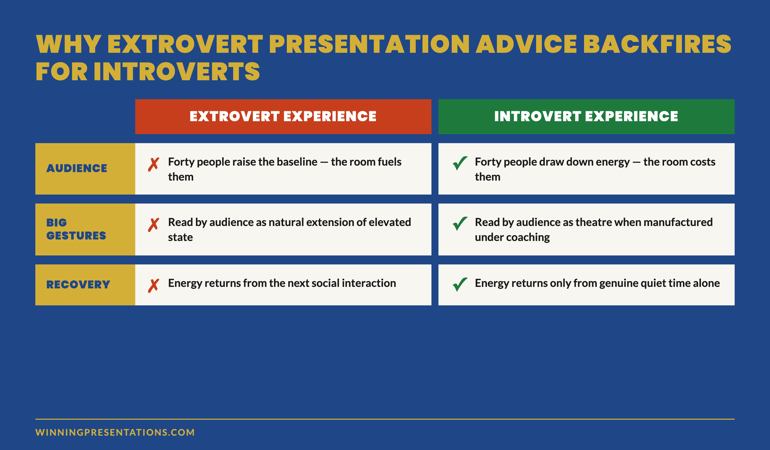
The dominant model of presentation confidence in corporate training is built on three assumptions. First, that confidence comes from energy in the room — the gestures, the projection, the willingness to take up space. Second, that nerves are reduced by exposure — the more you do it, the more the body settles. Third, that the audience reads confidence through performance signals — voice volume, eye contact intensity, the smile. Each of these is true for extroverts. Each of them is partially or wholly false for introverts.
An extrovert’s nervous system gains energy from social stimulation. A room of forty people raises the extrovert’s baseline. By the time they begin speaking, the audience itself is part of what is fuelling them. Performance signals — the bigger gesture, the stronger projection — are read by the body as natural extensions of an already-elevated state. The presenter does not feel like they are performing. They feel like they are in their element.
An introvert’s nervous system loses energy in the same room. The forty people are a load, not a fuel source. By the time the introvert begins speaking, they are already drawing down the energy reserves they need to think clearly. The performance techniques borrowed from extroverts — bigger gestures, louder voice, stronger eye contact — accelerate that drawdown. The introvert can do them. They cost more than they appear to. Three months of weekly board presentations using extrovert techniques will leave an introvert flat in a way that an extrovert in the same role does not experience.
The second assumption — that exposure alone reduces nerves — also holds differently for introverts. Exposure does help. But for introverts, exposure helps mostly when it is paired with structural preparation, not when it is treated as a desensitisation exercise. The introvert who is told to “just keep doing it” without changing their preparation will continue to feel the same nervousness, often for years, because the nervous system never settles into a meeting it has not been allowed to prepare for.
The third assumption is the costliest. The audience does read performance signals — but not in the way the training suggests. A large audience watching a senior leader does not register the presence of confident-looking gestures. It registers the absence of nervous ones. The forced smile that an introvert produces under coaching pressure is more visible than no smile at all. The bigger gesture executed without internal permission is read as theatre. The introvert who is told to project more often produces a voice that the audience hears as slightly off, even when they cannot say why. The room’s read is honest. The presenter’s read is what has been distorted by training.
The four strengths introverts already bring to the room
Before discussing what to build, it helps to be specific about what is already there. Introverted senior leaders consistently bring four strengths into a presentation that an extrovert in the same role often does not. Recognising these matters because they are the foundation that the introvert-specific approach builds on.
Strength 1 — Depth of preparation
Introverts prepare more thoroughly than extroverts on average. The same nervous system that makes large rooms costly also makes the introvert want to know exactly what they are walking into. By the time they reach the meeting, they know the numbers, the alternative scenarios, the likely objections, and the answers to questions that have not been asked yet. This is not over-preparation. It is the introvert’s natural compensatory mechanism, and it produces a presenter whose answers under challenge are noticeably more precise than an extrovert’s. The room reads this as authority.
Strength 2 — Calm under direct challenge
When a board member or hostile questioner pushes hard on a specific number or assumption, extroverts often respond with energy — they match the room. Introverts often respond with stillness. The stillness is read as composure. A calm answer to a hostile question is one of the most powerful authority signals in a senior meeting, and it is one introverts do not have to manufacture. They do it naturally because their nervous system does not match the rising energy in the room.
Strength 3 — Listening before speaking
Introverts pause before answering more often than extroverts do. In casual conversation this can read as hesitation. In a senior meeting it reads as consideration. The pause before answering a board chair’s question is not a deficit to overcome. It is a signal that the leader is treating the question seriously. Most introverts have been told their entire career to “speak up faster”. When they are presenting at a senior level, the opposite is true. The pause is the asset.
Strength 4 — Specific language under pressure
Extroverts under pressure tend toward broader language — bigger framings, more general claims, energy substituted for precision. Introverts under pressure tend toward more specific language — exact numbers, named scenarios, explicit caveats. In a high-stakes executive meeting where decisions hinge on accuracy, this is the difference between a presenter who is trusted on the second meeting and one who is not. The specificity that an introvert produces almost involuntarily is exactly what senior audiences are listening for.
The introvert-specific confidence approach
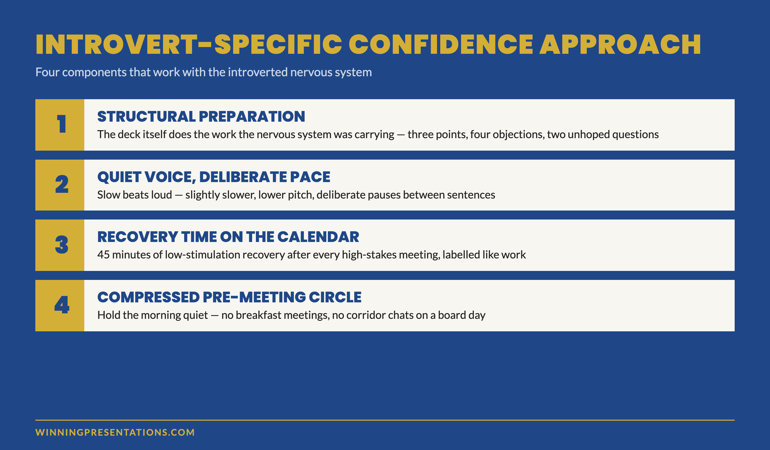
The approach has four components. None of them require performance. All of them treat the introvert’s existing nervous system as the working material rather than the problem.
Component 1 — Structural preparation as the confidence engine
Where extroverts build presentation confidence from the energy in the room, introverts build it from the structure of the deck before the meeting. The structural work is not slide-design polish. It is the deliberate process of writing out the three points the audience will leave with, the four likely objections and the precise sentence that addresses each, and the two questions you most hope are not asked along with the answer you would give if they were. This work is not over-preparation. It is the introvert’s confidence source. The senior leader who has done it walks into the room with the structural anchors that the introverted nervous system uses to settle. Extroverts can skip this and run on energy. Introverts cannot, and trying to leaves them depending on an energy reserve they do not have.
Component 2 — Quiet voice, deliberate pace
The most important vocal change an introvert can make is not to project louder. It is to slow down. A deliberate pace — slightly slower than conversation, with brief pauses between sentences — produces a voice that carries authority without effort. The audience reads slow as senior, fast as junior. This is true for both extroverts and introverts, but it especially matters for introverts because slow is sustainable. The introvert who is asked to project louder in a 90-minute meeting will tire by minute 30. The introvert who slows their pace and uses deliberate pauses can sustain authority across the full 90 minutes without depletion.
For the deliberately quieter style of presence that this approach builds, the deeper structural work in Conquer Your Fear of Public Speaking walks through the calibration of voice, pace, and pre-meeting routine specifically for senior introverts who present regularly to executive audiences.
Component 3 — Recovery time built into the calendar
The single most-skipped component of an introvert’s confidence routine is recovery. After a 90-minute board presentation, an introvert needs at least 45 minutes of low-stimulation recovery before the next high-stakes interaction. Not lunch with three colleagues. Not the next meeting. Genuine recovery — a walk, a closed-door office, a coffee alone. Without this, the body never settles back to baseline, and the next meeting starts from an already-depleted state. By the third such meeting in a day, the introvert is running on emergency reserves, and confidence drops in a way that extroverts in the same role do not experience because their nervous system did not draw down the same way.
Most introverted senior leaders do not have recovery time on their calendar because no-one ever taught them to put it there. Once it is on the calendar — even if labelled “preparation” or “writing time” — performance and sustainability both improve. This is not a productivity hack. It is what the body needs.
Build introvert confidence on solid ground — Conquer Your Fear of Public Speaking, £39
A structured programme designed for senior leaders who want to present with calm authority instead of performance pressure. Step-by-step preparation routines, voice and pace calibration, pre-meeting and recovery practices — all built around how an introverted nervous system actually works in high-stakes rooms.
- Structural preparation routines that build confidence from the deck up
- Voice and pace calibration for sustained authority across long meetings
- Pre-meeting and post-meeting recovery practices for senior introverts
- Designed for executives who present regularly to boards, exec committees, and senior stakeholders
Get Conquer Your Fear of Public Speaking →
£39, instant access. Designed for senior professionals presenting to executive audiences.
Component 4 — Smaller pre-meeting circle
Many introverted senior leaders walk into a high-stakes meeting after a morning of small interactions — corridor catch-ups, quick check-ins, a coffee with a colleague. Each of these is small in itself; collectively they draw down the same reserves the meeting will need. The deliberate practice for an introvert is to compress the pre-meeting morning. Inform the team that the morning of a board day is held quiet. Take the early commute alone. Do not schedule the breakfast meeting on the day of the executive review. The cost of these small interactions is invisible to the extroverts running the office. It is real for the introvert who has to deliver at 2pm.
What to stop doing — the techniques that drain you
An introvert who wants real presentation confidence often has to subtract before they add. The following techniques are widely taught and widely counterproductive for introverts at senior level.
Power posing in private. The research that originally supported this technique has been substantially revised. For introverts in particular, the practice often raises self-consciousness more than it raises felt confidence. The minutes spent in the bathroom in a posed stance are minutes the introvert could have spent reading the deck one more time, which is what their nervous system actually wants.
Mirror practice. Rehearsing in front of a mirror is an extrovert technique. It rewards visible expression. For introverts it tends to amplify self-monitoring without improving the substance of the presentation. The same fifteen minutes spent walking through the deck aloud — without a mirror, without an audience — produces more confidence and less depletion.
Forced eye contact intensity. The advice to “make strong eye contact with everyone in the room” is calibrated for extroverts. For introverts, sustained eye contact across forty people is one of the most exhausting components of presenting. The senior alternative is deliberate eye contact — choosing two or three people and holding their gaze for a complete sentence each, rotating across the room across the meeting. This is what experienced senior presenters actually do. It is read by the audience as engaged, not scattered.
The morning pep talk. Some leaders find this useful. Many introverts do not. The pre-meeting pep talk substitutes manufactured energy for grounded preparation. If the morning routine includes a pep talk and excludes a quiet read of the deck, swap them. The deck read produces sustainable confidence; the pep talk produces a borrowed energy that depletes within the first ten minutes of the meeting.
For introverts whose anxiety has a strong physiological component — sweating, shaking, voice tremor under pressure — the lighter-touch techniques in Calm Under Pressure (£19.99) work alongside the deeper structural rebuild and address the in-the-moment physical symptoms specifically.
A note on visibility
Senior introverts often worry that the introvert-specific approach will leave them less visible than their extroverted peers. The opposite tends to be true over time. The introvert who runs an extrovert’s playbook is visible in the way an actor is visible — present in the moment, depleted afterwards, occasionally inconsistent. The introvert who runs the approach above is visible in a different way — calmer, more precise, more sustainable. The room learns to expect a particular kind of authority from them, and the expectation strengthens with each meeting because the presenter is not running on borrowed energy that fluctuates.
This kind of visibility compounds. An extrovert’s strong performance in a single meeting wins the room that day. An introvert’s quiet authority across forty meetings wins the year. Both are valid. The mistake is the introvert trying to win in the way the extrovert wins, on a day-by-day basis, because the energy economics do not support it.
Frequently asked questions
Is presentation confidence different for introverts and extroverts?
The felt experience is different, and the techniques that build it are different. Extroverts often build confidence from the energy of the room and from frequent low-stakes presentations. Introverts build it from structural preparation, deliberate pace, and recovery routines that prevent depletion. Both can reach the same level of authority. The route is not the same.
Can an introvert ever be as confident a presenter as an extrovert?
The framing assumes confidence looks the same in both. It does not. An extrovert’s confidence is often visible as energy. An introvert’s confidence is often visible as composure. Audiences read both as authority. The error is judging an introvert’s confidence by extrovert markers — gesture size, voice projection, smile frequency — and finding it lacking when in fact it is being expressed through a different set of signals the audience reads correctly.
Why do I feel exhausted after presentations even when they go well?
This is the hallmark of an introvert presenting under extrovert techniques. The presentation went well because you executed the techniques. The exhaustion is the cost of running them through a nervous system that did not generate them naturally. Switching to the structural and recovery components above tends to reduce post-presentation exhaustion within a few weeks, even before the meetings themselves change.
Should I try to be more extroverted before presentations?
No. The pre-presentation behaviour that helps introverts most is in the opposite direction — fewer interactions, more silence, more time with the deck. The “warm-up” theory that asks introverts to socialise more before a meeting has the cost-energy direction backwards.
For the related companion piece on the timeline of building presentation confidence — what changes in week one, month three, year two — see How Long Does It Take to Build Presentation Confidence?
The Winning Edge — weekly, free
Each Thursday: one structural framework, one micro-story from senior coaching, one practical move you can use in this week’s meetings. Built for senior professionals who present at executive level.
Not ready for the full system? Start here instead: download the free Executive Presentation Checklist — a one-page pre-meeting routine the senior leaders I work with use the morning of a board presentation.
About the author
Mary Beth Hazeldine is the Owner & Managing Director of Winning Presentations Ltd, founded in 1990. With 24 years of corporate banking experience at JPMorgan Chase, PwC, Royal Bank of Scotland, and Commerzbank, she advises executives across financial services, healthcare, technology, and government on structuring presentations for high-stakes funding rounds, board approvals, and senior reviews. She works with senior introverts and extroverts on the specific approaches each requires.