Tag: presentation structure

11 Jan 2026

10-Minute Presentation: Why This Format Dominates Business Communication

Quick Answer: The 10-minute presentation isn’t an arbitrary corporate conventionβ€”it’s the format your brain is wired for. Research shows attention naturally peaks and dips in roughly 10-minute cycles. Master this format and you’ve mastered the workhorse of business communication: leadership updates, project reviews, interview presentations, and stakeholder briefings all default to 10 minutes for good reason.

When I joined Commerzbank’s investment banking division in 2002, I noticed something strange. Every meeting seemed to have the same invisible structure.

Leadership updates? Ten minutes per presenter. Project reviews? Ten-minute slots. Client pitches? “You’ll have about ten minutes before questions.” Even informal updates to managing directors somehow gravitated toward that same window.

At first, I assumed it was arbitraryβ€”just how things were done. But after 24 years across JPMorgan, PwC, RBS, and Commerzbank, I’ve realised there’s nothing arbitrary about it.

The 10-minute presentation is the dominant format of business communication because it aligns with how human attention actually works. It’s long enough to make a substantive argument. Short enough to maintain engagement. Flexible enough to work across contextsβ€”from boardrooms to team meetings to conference stages.

Every executive I’ve trained who mastered this format saw their influence grow. Not because 10 minutes is magic, but because it’s everywhere. The quarterly business review. The budget request. The interview presentation. The strategy pitch. The project update. All 10 minutes.

Master the 10-minute presentation and you’ve mastered the format you’ll use more than any other in your career. Fail to master it, and you’ll spend decades struggling with the one slot that keeps appearing on your calendar.

Here’s what 5,000 executive coaching sessions taught me about why this format worksβ€”and how to make it work for you.

🎯 50+ Openers and Closers for Every Situation

The Presentation Openers & Closers Swipe File gives you proven hooks and closing techniques for 10-minute presentations across every business scenarioβ€”updates, pitches, reviews, and more.

What’s inside:

  • Opening hooks calibrated for 10-minute formats
  • Closing techniques that drive decisions
  • Scenario-specific templates (reviews, pitches, updates)
  • The “bookend” technique that creates coherence

Get the Swipe File β†’ Β£9.99

Why 10 Minutes Dominates (The Science)

The 10-minute presentation format isn’t a corporate inventionβ€”it’s a biological reality.

Neuroscience research consistently shows that attention operates in cycles. John Medina’s work on brain rules found that audience attention begins to significantly wane around the 10-minute mark. TED talks famously cap at 18 minutes because research showed that’s the outer limit of sustained attention without re-engagement techniques.

But here’s what’s often missed: attention doesn’t just declineβ€”it cycles. Your audience’s brain naturally wants a “reset” roughly every 10 minutes. Fight that rhythm and you’re fighting biology. Work with it and you’re working with how humans actually process information.

This is why 10 minutes became the de facto standard for business presentations:

  • It respects cognitive limits. Your audience can genuinely focus for 10 minutes without heroic effort.
  • It forces prioritisation. Ten minutes prevents the “everything is important” trap that destroys longer presentations.
  • It enables decision-making. Leaders can hear multiple 10-minute presentations in an hour, compare perspectives, and decide.
  • It signals respect. Asking for 10 minutes shows you value your audience’s time.

Understanding presentation pacing becomes critical here. Ten minutes isn’t about crammingβ€”it’s about flowing with how attention naturally works.

Graph showing attention cycles and why 10-minute presentations align with natural cognitive rhythms

Where You’ll Encounter the 10-Minute Format

Once you start looking, you’ll see the 10-minute presentation everywhere. Here’s where it shows up across a typical executive career:

Leadership and Team Updates

Weekly team meetings. Monthly leadership forums. Quarterly all-hands. The format is almost always “10 minutes per update.” I’ve seen this at every major bank and consultancy I’ve worked withβ€”it’s the universal language of internal communication.

Project and Status Reviews

Steering committees. Programme boards. Portfolio reviews. Each project lead gets roughly 10 minutes to convey status, risks, and asks. Go over and you’re that person. Go under and leadership wonders what you’re hiding.

Interview Presentations

“Prepare a 10-minute presentation on…” This is the standard format for senior role interviews across industries. It tests your ability to structure thinking, communicate under pressure, and respect boundariesβ€”all things leadership roles require.

Stakeholder Briefings

Updating the board. Briefing executives. Presenting to clients. When you need to inform decision-makers without consuming their entire calendar, 10 minutes is the expected format. Our guide to presenting to senior management covers these scenarios in depth.

Conference and Event Slots

Breakout sessions. Lightning talks. Panel introductions. Event organisers know that 10 minutes maintains audience energy across a full programme. Longer slots require exceptional content; 10 minutes just requires clarity.

The reality? If you can deliver a compelling 10-minute presentation, you can handle 80% of the speaking situations your career will throw at you.

A Different Mindset Than 5 or 30 Minutes

Here’s where most professionals go wrong: they treat the 10-minute presentation as either a stretched 5-minute presentation or a compressed 30-minute one. It’s neither.

Each format requires a fundamentally different mindset:

5 Minutes: The Single Message

A 5-minute presentation is a sniper rifle. You have one message, maybe three supporting points, and no room for tangents. It’s about ruthless focusβ€”what’s the one thing you must communicate? Everything else gets cut.

10 Minutes: The Developed Argument

A 10-minute presentation is a structured conversation. You can develop three genuine points with evidence for each. You can build an argument with a beginning, middle, and end. You have room for one brief story or example. But you still can’t cover everythingβ€”you’re choosing depth over breadth.

30 Minutes: The Full Exploration

A 30-minute presentation allows comprehensive coverage. You can explore implications, address objections, and provide extensive evidence. But you’ll need to re-engage attention multiple timesβ€”the audience’s natural 10-minute cycle means you’re managing multiple phases of concentration.

The mindset shift for 10 minutes: What three things can I develop properly? Not “what can I mention?” but “what can I actually prove with evidence and make memorable?”

Comparison of mindsets for 5, 10, and 30-minute presentation formats

The Depth Paradox: More Time Doesn’t Mean More Content

The most counterintuitive lesson about the 10-minute presentation: having more time than 5 minutes doesn’t mean adding more content. It means going deeper on fewer points.

Consider the difference:

5 minutes: “We need to invest in customer analytics. Here’s why it matters.”

10 minutes: “We need to invest in customer analytics. Let me show you what our competitors are doing, what we discovered in our pilot, and what the ROI looks like based on real numbers.”

Same core message. But 10 minutes allows you to build a proper caseβ€”with evidence, examples, and implications. That’s not more topics; it’s more depth.

I worked with a VP at RBS who consistently ran over in her 10-minute updates. When I watched her present, I counted seven distinct topics in one update. “They all need to know this,” she said.

But her leadership team couldn’t follow seven topics in 10 minutes. They left confused about what actually needed their attention. When we restructured to three topics with proper evidence for each, her updates became the clearest in the leadership forum.

The paradox: Say less, communicate more. Ten minutes gives you room for depth, not breadth. Use it accordingly.

This is where strong presentation structure becomes essential. Your framework determines whether 10 minutes feels rushed or spacious.

The 10-Minute Depth Calculator

Content Type How Many in 10 Minutes Depth Possible
Major Points 3 maximum Full development with evidence
Supporting Examples 3-4 total Brief but concrete
Data Points 5-6 memorable Contextualised, not raw
Stories 1-2 maximum 60-90 seconds each
Slides 8-12 total One idea per slide

⭐ Pre-Built Frameworks for Every 10-Minute Scenario

The Executive Slide System gives you ready-to-use templates for 10-minute presentations across every business contextβ€”updates, reviews, pitches, and briefings. Stop reinventing structure for every presentation.

Includes scenario-specific frameworks so you can focus on content, not architecture.

Get the Executive Slide System β†’ Β£39

The Scenario Playbook: Adapting to Context

While the 10-minute format is consistent, how you use it varies dramatically by context. Here’s the playbook I’ve developed across thousands of coaching sessions:

The Project Update (Status Focused)

What leadership wants: Where are we? What’s changed? What do you need?

Structure that works:

  • First 2 minutes: Bottom-line status and one headline. “We’re green for March launch with one amber risk to discuss.”
  • Middle 6 minutes: Progress highlights (what’s working), the amber/red items (what needs attention), and your ask (decisions, resources, air cover).
  • Final 2 minutes: Specific next steps and timeline for your ask.

The mistake: Starting with background or methodology. Leadership assumes you did the work correctlyβ€”they want to know the outcome.

The Proposal or Pitch (Decision Focused)

What the audience wants: Should we do this? Why? What’s the risk of not acting?

Structure that works:

  • First 2 minutes: The problem or opportunity, sized in terms they care about. “We’re losing Β£2M annually to a process we could automate.”
  • Middle 6 minutes: Your proposed solution, proof it works (pilots, case studies, benchmarks), and what implementation looks like.
  • Final 2 minutes: Clear ask and immediate next step. “I need approval to proceed. Here’s what happens Monday if you say yes.”

The mistake: Leading with your solution instead of the problem. Our guide to persuasive presentations covers this in depth.

The Interview Presentation (Capability Focused)

What the panel wants: Can you do this job? How do you think? Will you fit?

Structure that works:

  • First 2 minutes: Your thesis about the role or topic they’ve assigned. Show you understand the real challenge.
  • Middle 6 minutes: Three examples or arguments that demonstrate relevant capability. Each should answer: “Here’s what I did, here’s what happened, here’s what I learned.”
  • Final 2 minutes: Why this role, why this organisation, why now. Make it personal and specific.

The mistake: Treating it as a presentation about you instead of a presentation about what you can do for them.

The Executive Briefing (Information Focused)

What executives want: What do I need to know? What should I worry about? What do you recommend?

Structure that works:

  • First 2 minutes: The essential update in plain language. “Customer satisfaction dropped 12 points. Here’s why it matters and what we’re doing.”
  • Middle 6 minutes: Analysis of causes, implications for the business, and options you’ve considered.
  • Final 2 minutes: Your recommendation and what you need from themβ€”even if it’s just acknowledgment.

The mistake: Data dumping without interpretation. Executives don’t need raw information; they need analysis. See our guide on data storytelling for more.

Four 10-minute presentation scenarios showing different structures for updates, pitches, interviews, and briefings

Case Study: The Quarterly Review That Changed Everything

Marcus was a senior director at a fintech company who dreaded quarterly business reviews. Every quarter, the same pattern: he’d prepare 45 minutes of content, race through it in 10, and leave the leadership team confused about what they’d just heard.

“The business is complex,” he explained when we first met. “Ten minutes isn’t enough to explain everything.”

But that was exactly his problem. He was trying to explain everything instead of communicating what mattered.

We restructured his approach entirely. Instead of comprehensive coverage, we focused on three questions leadership actually cared about:

  1. Are we hitting our numbers? (With one slide showing the answer clearly)
  2. What’s the one thing keeping us up at night? (With context and options)
  3. What decision do we need from you? (With a specific, actionable ask)

His next QBR used 9 slides instead of 34. He finished in 8 minutes and 40 seconds. The CEO’s response: “That’s the clearest update I’ve heard in two years.”

The questions after his presentation? Engaged and strategic, not confused and clarifying. Leadership was discussing implications instead of asking him to repeat basic information.

Marcus’s promotion to VP came six months later. “The QBR shift wasn’t the only factor,” he told me, “but it changed how leadership saw me. I went from the guy who overwhelms them with detail to the guy who cuts through complexity.”

That’s what mastering the 10-minute presentation does. It doesn’t just improve your presentationsβ€”it changes how people perceive your thinking. Strong business presentation skills signal strong business thinking.

πŸ“§ Join 2,000+ professionals getting weekly presentation insights. Subscribe to The Winning Edge β†’

Frequently Asked Questions

How many slides should a 10-minute presentation have?

Aim for 8-12 slides maximum. This allows roughly one minute per slide with time for transitions. Quality matters more than quantityβ€”fewer strong slides beat many weak ones. See our guide to making effective presentations for more on slide design.

How many words is a 10-minute presentation?

Approximately 1,200-1,500 words at a comfortable speaking pace of 120-150 words per minute. Leave room for pauses and audience engagementβ€”don’t script every second. Learn more about optimal presentation pacing.

Why is 10 minutes such a common presentation length?

Research shows attention naturally dips around the 10-minute mark. Organisations have learned this intuitivelyβ€”10 minutes is long enough to be substantive but short enough to maintain engagement. It’s biology meeting business needs.

How do I avoid running over 10 minutes?

Practice with a timer at least three times. Cut 20% more content than you think necessary. Build in buffer timeβ€”aim for 9 minutes in practice to allow for nerves and natural variation. Know exactly what you’ll cut if time runs short.

What’s the difference between 5-minute and 10-minute presentations?

A 5-minute presentation forces a single message with minimal supportβ€”it’s about ruthless focus. Ten minutes allows for three developed points with evidenceβ€”enough to build a genuine argument. They require different mindsets, not just different timing.

What’s the biggest mistake in 10-minute presentations?

Treating it as a shortened long presentation instead of its own format. Ten minutes has specific rules about depth, evidence, and pacing that differ from both shorter and longer formats. Learn more about effective presentation structure.

πŸ“₯ Free Download: 7 Presentation Frameworks

Get proven structures for every presentation scenarioβ€”from 5-minute updates to 30-minute deep dives. Includes specific templates optimised for the 10-minute format.

Download Free β†’

Related Resources

Continue building your presentation skills:

The 10-Minute Advantage

The 10-minute presentation is the most common format you’ll encounter in businessβ€”and for good reason. It aligns with how attention works. It forces prioritisation. It enables efficient decision-making.

But mastering it requires seeing it as its own format, not a compressed version of something longer. It’s the sweet spot: enough time to develop genuine arguments, not enough time to hide behind complexity.

Every executive update, project review, interview presentation, and stakeholder briefing will test your ability to communicate within this window. Get it right consistently, and you’ll be seen as someone who thinks clearly under constraint.

That’s a reputation that compounds over a career.


Mary Beth Hazeldine is a qualified clinical hypnotherapist, NLP practitioner, and Managing Director of Winning Presentations. After 5 years terrified of presenting, she built a 24-year banking career at JPMorgan Chase, PwC, RBS, and Commerzbank. She has treated hundreds of anxiety clients and trained over 5,000 executives.

10 Jan 2026
5-minute presentation structure - the 1-3-1 framework for short presentations that work

5-Minute Presentations: Why Most Fail in the First 30 Seconds

Quick Answer: Most 5-minute presentations fail because presenters try to compress 15 minutes of content into 5 minutes. The solution is the 1-3-1 structure: 1 minute for your hook and main message, 3 minutes for three supporting points, and 1 minute for your call to action. Start with your conclusion, not your background.

Three years ago, I watched a senior analyst at JPMorgan destroy his promotion chances in exactly 4 minutes and 47 seconds.

He’d been given the slot every ambitious professional dreams ofβ€”five minutes with the Managing Director to present his team’s quarterly results. Five minutes to prove he was ready for the next level.

He spent the first two minutes on background. “As you know, the market conditions this quarter have been…” The MD’s eyes glazed over before he’d finished his second sentence.

By minute three, he was rushing through slides, skipping key data because he’d run out of time. By minute four, he was apologising. “I know I’m running over, but just one more point…”

The MD cut him off at 4:47. “Thank you. Next presenter.”

I’ve seen this pattern hundreds of times in my 24 years across JPMorgan Chase, PwC, RBS, and Commerzbank. Talented professionals who can command a room for an hour somehow fall apart when given five minutes. They treat short presentations as long presentations that need trimming, when they’re actually an entirely different format requiring an entirely different approach.

The analyst who bombed? He’d prepared a 20-minute presentation and tried to speed through it. That’s not a 5-minute presentation. That’s a 20-minute presentation delivered badly.

Here’s what actually works when time is your scarcest resource.

🎯 Never Struggle With Short Presentations Again

The Presentation Openers & Closers Swipe File gives you 50+ proven opening hooks and closing techniques specifically designed for time-pressured situations. Stop wasting your first 30 seconds on “thank you for having me” and start commanding attention immediately.

What’s inside:

  • 15 opening hooks that work in 10 seconds or less
  • 12 closing techniques that drive immediate action
  • Templates for 5, 10, and 15-minute presentations
  • The “first sentence” formulas top executives use

Get the Swipe File β†’ Β£9.99

Why 5 Minutes Is Harder Than 50

Here’s a counterintuitive truth that took me years to understand: a 5-minute presentation requires more preparation than a 50-minute one, not less.

When you have an hour, you can explore tangents. You can build context gradually. You can recover from a weak opening with a strong middle. Time forgives mistakes.

Five minutes forgives nothing.

Every word counts. Every second of hesitation costs you. There’s no room for “let me just add some background” or “one more thing.” You’re either focused or you’re failing.

Mark Twain allegedly said, “I didn’t have time to write a short letter, so I wrote a long one instead.” Whether he said it or not, the principle holds. Compression is hard. Clarity under constraint is a skill most professionals never develop.

The executives I’ve trainedβ€”over 5,000 across two decadesβ€”consistently rate short-format presentations as their biggest challenge. Not board presentations. Not investor pitches. Five-minute updates where the stakes feel lower but the margin for error is actually higher.

Comparison showing 50-minute vs 5-minute presentation - more preparation time required for shorter format

The 30-Second Mistake That Loses Every Audience

Watch any unsuccessful 5-minute presentation and you’ll see the same pattern in the first 30 seconds:

“Good morning everyone. Thank you for having me. My name is [name] and I’m the [title] in [department]. Today I’m going to talk about [topic]. Before I begin, let me give you some background on…”

That opening just consumed 20-25% of your total time. And you’ve said nothing your audience didn’t already know or couldn’t read on your title slide.

This is what I call the “warm-up waste”β€”the instinct to ease into a presentation that serves the speaker’s comfort but destroys the audience’s attention.

Your audience’s attention peaks in the first 30 seconds. They’re deciding whether to listen or mentally check out. They’re forming impressions about your competence, confidence, and whether you have anything worth hearing.

And you’re wasting that peak attention on pleasantries.

What to Do Instead

Start with your conclusion. Not your introduction. Not your background. Your actual point.

Consider the difference:

Weak opening: “I’m going to walk you through our Q3 results and give you some context on the market conditions that affected our performance.”

Strong opening: “We beat target by 12% this quarter. Here’s the one decision that made the difference.”

The second version takes five seconds. It delivers your key message immediately. It creates curiosity. And it positions everything that follows as supporting evidence rather than build-up.

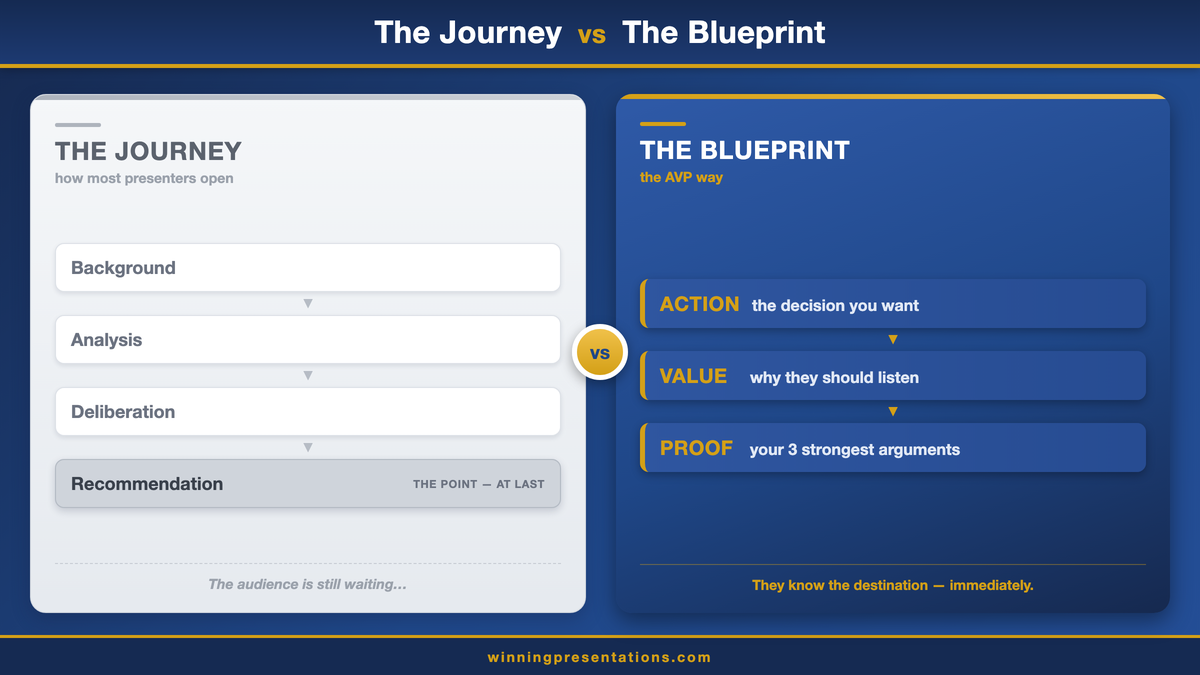
This is what great presentation openings doβ€”they start with the destination, not the journey.

Side-by-side comparison of weak vs strong 5-minute presentation openings with timing

The 1-3-1 Structure for 5-Minute Success

After coaching thousands of short presentations, I’ve found one structure that works consistently across industries, audiences, and stakes levels. I call it the 1-3-1.

Minute 1: Hook + Main Message

Your first 60 seconds must accomplish three things:

  1. Capture attention with a hookβ€”a surprising fact, a bold claim, or a provocative question
  2. State your main messageβ€”the one thing you want your audience to remember
  3. Preview your structureβ€””I’ll show you three reasons why” (takes 5 seconds, saves your audience cognitive load)

Notice what’s not in minute one: your background, the history of your project, acknowledgments, or “context setting.” All of that either gets cut or woven into your supporting points.

Minutes 2-4: Three Supporting Points

You have three minutes for your content. That means three points, roughly one minute each.

Why three? Because three is the maximum number of distinct ideas people can hold in working memory during a short presentation. Four points in five minutes means none of them land. Two points feels incomplete. Three is the sweet spot.

Each point follows a micro-structure:

  • Claim (10 seconds): State the point clearly
  • Evidence (30 seconds): One piece of proofβ€”a number, an example, a brief story
  • Implication (20 seconds): Why this matters for your audience

If you’re presenting data, this is where data storytelling becomes essential. Don’t just show numbersβ€”show what the numbers mean.

Minute 5: Call to Action + Close

Your final minute must answer the question every audience member is subconsciously asking: “What do you want me to do with this information?”

Be specific. “I’d like you to consider…” is weak. “I need approval by Friday” or “The decision we need today is…” gives your audience clarity.

Then close cleanly. The best presentation endings don’t trail off or add “one more thing.” They land with intention.

The 1-3-1 in Practice

Time Section Content
0:00-1:00 Hook + Message Attention-grabber, main point, preview
1:00-2:00 Point 1 Claim β†’ Evidence β†’ Implication
2:00-3:00 Point 2 Claim β†’ Evidence β†’ Implication
3:00-4:00 Point 3 Claim β†’ Evidence β†’ Implication
4:00-5:00 CTA + Close Specific ask, memorable close

What to Cut (And What to Keep)

The hardest part of a 5-minute presentation isn’t what to include. It’s what to cut.

I worked with a product manager at a tech firm who had 47 data points she wanted to share in her five-minute product review. “They’re all important,” she insisted. “Leadership needs to see the full picture.”

Leadership saw nothing. Her presentation was a blur of numbers that left everyone confused about what actually mattered.

Here’s the brutal truth about short presentations: your audience will remember at most one to three things. If you try to communicate ten things, they’ll remember zero.

The Ruthless Cutting Framework

For every piece of content, ask these three questions:

  1. Does this support my one main message? If not, cut itβ€”no matter how interesting.
  2. Can my audience understand this without additional context? If it needs explanation, either simplify it or cut it.
  3. Will anyone care about this in 48 hours? If it’s not memorable, it’s not essential.

What Almost Always Gets Cut

  • Background and historyβ€”unless directly relevant to your ask
  • Methodology explanationsβ€”say “we analysed” not “here’s how we analysed”
  • Caveats and disclaimersβ€”handle these in Q&A if they come up
  • Acknowledgmentsβ€”thank people afterwards, not during your precious five minutes
  • Everything after “just one more thing”β€”if you didn’t plan for it, don’t say it

Strong presentation structure isn’t about including everything. It’s about excluding everything that doesn’t directly serve your purpose.

🎯 Structure Any Presentation in Minutes

Stop staring at blank slides. The Presentation Openers & Closers Swipe File includes ready-to-use templates for 5-minute presentations that you can customise for any situation.

Copy a proven structure. Plug in your content. Present with confidence.

Download the Templates β†’ Β£9.99

Delivery Secrets for Short Presentations

Structure is only half the equation. How you deliver a 5-minute presentation matters as much as what you say.

Pace: Slower Than You Think

When time is limited, most presenters speed up. This is exactly wrong.

Fast delivery signals nervousness. It overwhelms your audience. It makes you seem like you’re trying to cram in content you couldn’t edit down.

Slow delivery signals confidence. It gives your points room to land. It shows you’ve prioritised and you trust your content.

Counterintuitively, speaking slightly slower in a short presentation often means you communicate more effectively, even if you say fewer words.

Pauses: Your Secret Weapon

A strategic pause before a key point does three things:

  1. It signals importanceβ€””what comes next matters”
  2. It gives your audience time to process what came before
  3. It gives you time to breathe and reset

In a 5-minute presentation, plan for two or three deliberate pauses. One after your opening hook. One before your call to action. One between your second and third points if you want the third to land with impact.

Eye Contact: Strategic, Not Random

You don’t have time to connect with everyone in a 5-minute presentation. Don’t try.

Instead, use strategic eye contact:

  • Decision makers firstβ€”if one person’s opinion matters most, they get the most eye contact
  • Sceptics secondβ€”connecting with a doubter can shift room dynamics
  • Supporters thirdβ€”they’ll nod along and boost your confidence

This is part of what I teach executives about presentation body languageβ€”intentional physical presence that serves your message.

Three delivery secrets for 5-minute presentations - pace, pauses, and eye contact

The Practice Protocol

A 5-minute presentation should be practiced at least five times out loud. Not in your head. Out loud.

Here’s my recommended practice sequence:

  1. Practice 1: Read through your content. Time it. You’ll probably run over.
  2. Practice 2: Cut until you hit 4:30. You need buffer for nerves and natural variation.
  3. Practice 3: Focus on your opening. Get the first 30 seconds locked.
  4. Practice 4: Focus on transitions between points. These are where most people stumble.
  5. Practice 5: Full run-through. Record yourself. Watch it once. Note one thing to improve.

Building presentation confidence doesn’t require hours of rehearsal. It requires deliberate, focused practice on the elements that matter most.

Case Study: From 12 Minutes to 5 (And a Promotion)

Remember the analyst I mentioned at the beginning? The one who bombed his five-minute slot with the MD?

Six months later, he got another chance. Same format. Same MD. Different outcome.

Here’s what changed.

His first version had been 23 slides. His revision had 4. One title slide. Three content slides. Zero bullet points.

His first version opened with “Q3 Market Overview.” His revision opened with: “Our team generated Β£2.3 million in unexpected revenue this quarter. I’m here to tell you howβ€”and how we can double it next quarter.”

The MD leaned forward. That had never happened before.

His first version crammed in seven different metrics. His revision focused on one: unexpected revenue. Everything else supported that single story.

He finished at 4:42. The MD asked questions for another three minutesβ€”not because the presentation was unclear, but because he was genuinely interested.

Two months later, that analyst was promoted. “The turning point,” he told me later, “was learning that a 5-minute presentation isn’t a compressed long presentation. It’s a different skill entirely.”

That skillβ€”persuading under constraintβ€”is what separates people who advance from people who plateau.

πŸ“§ Join 2,000+ professionals getting weekly presentation insights. Subscribe to The Winning Edge β†’

Frequently Asked Questions

How many slides should a 5-minute presentation have?

Aim for 3-5 slides maximum. The rule of thumb is one slide per minute, but for a 5-minute presentation, fewer slides with stronger visuals work better than cramming in content. I’ve seen executives deliver powerful 5-minute presentations with just a single impactful slide.

How many words should a 5-minute presentation be?

Approximately 600-750 words if you speak at a conversational pace (125-150 words per minute). However, leave room for pauses and audience processingβ€”aim for 500-600 words of actual scripted content. Your presentation structure matters more than word count.

What’s the biggest mistake in 5-minute presentations?

Trying to cover too much. Most presenters attempt to compress a 15-minute presentation into 5 minutes, resulting in rushed delivery that overwhelms audiences instead of persuading them. Edit ruthlessly. Say less, but say it better.

How do I structure a 5-minute presentation?

Use the 1-3-1 structure: 1 minute for your hook and main point, 3 minutes for your three supporting points (one minute each), and 1 minute for your call to action and close. This framework works across industries and presentation types.

Should I use notes for a 5-minute presentation?

Brief bullet points are fine, but avoid reading from a script. With only 5 minutes, every second of eye contact matters. Practice until you can deliver your key points naturally without relying heavily on notes.

How do I handle Q&A after a 5-minute presentation?

If Q&A is separate from your 5 minutes, great. If it’s included, allocate only 3.5-4 minutes for your presentation and keep answers brief. Better to say “Let’s discuss offline” than to ramble past your time. Learn more about handling difficult questions.

πŸ“₯ Free Download: 7 Presentation Frameworks

Not sure which structure fits your situation? Download 7 proven frameworksβ€”including specific templates for 5-minute presentationsβ€”and find the one that works for your next high-stakes moment.

Download Free β†’

Related Resources

Continue building your short-presentation skills:

The 5-Minute Advantage

Most professionals dread short presentation slots. They see them as constraintsβ€”impossible situations where they can’t possibly communicate everything they need to.

The best professionals see them differently. A 5-minute presentation is a test. Can you identify what truly matters? Can you communicate it with clarity and confidence? Can you respect your audience’s time while still delivering value?

Master the 5-minute presentation and you’ll stand out in every meeting, every update, every opportunity to speak. You’ll be known as someone who gets to the point. Someone whose time is worth claiming.

That’s a reputation worth building.


Mary Beth Hazeldine is a qualified clinical hypnotherapist, NLP practitioner, and Managing Director of Winning Presentations. After 5 years terrified of presenting, she built a 24-year banking career at JPMorgan Chase, PwC, RBS, and Commerzbank. She has treated hundreds of anxiety clients and trained over 5,000 executives.

02 Jan 2026
How to make a presentation outline - template showing structure before slides

How to Make a Presentation Outline: The Planning Step Most People Skip [2026]

The secret to making presentations faster isn’t better software or fancier templates. It’s making a presentation outline before you open PowerPoint.I’ve watched hundreds of professionals waste hours staring at blank slides, moving bullet points around, deleting entire sections and starting over. The problem is never the slides. It’s that they skipped the outline.

A solid presentation outline takes 10-15 minutes to create. It saves 2-3 hours of confused slide-shuffling later.

In this guide, I’ll show you exactly how to make a presentation outline β€” with templates you can use for any situation and any time limit.

This is a deep dive on the planning phase. For the complete presentation process, see: How to Make a Presentation: The Complete Guide.

🎁 Free Download: Get my 7 Presentation Outline Templates β€” ready-to-use frameworks for pitches, updates, proposals, and more.

Why a Presentation Outline Changes Everything

Here’s what happens when you skip the presentation outline and go straight to slides:

  • You create 15 slides, then realise slide 3 should come after slide 9
  • You spend 20 minutes formatting a slide you later delete
  • You finish the deck and realise you forgot your main point
  • You run out of time and rush the ending
  • Your audience leaves confused about what you wanted

A presentation outline prevents all of this. It’s your thinking made visible β€” before you commit to slides.

The rule: If you can’t explain your presentation in 60 seconds using just your outline, your audience won’t follow it in 30 minutes with slides.

How to Make a Presentation Outline in 4 Steps

Creating a presentation outline takes 10-15 minutes. Here’s the process:

Step 1: Write Your Destination (2 minutes)

Before you outline anything, answer this question in one sentence:

“What do I want my audience to think, feel, or do after this presentation?”

This isn’t your topic. It’s your destination.

Examples:

Topic Destination
“Q3 results” “Approve increased marketing spend for Q4”
“New software system” “Commit to the migration timeline”
“Project update” “Continue funding without scope changes”
“Team restructure” “Support the new reporting lines”

Write your destination at the top of your outline. Everything else serves this.

Step 2: Choose Your Framework (2 minutes)

Every presentation outline needs a framework β€” the logical structure that moves your audience from where they are to your destination.

Three frameworks work for 90% of presentations:

Framework 1: Problem β†’ Solution β†’ Action

Best for: Pitches, proposals, requesting approval

Framework 2: What β†’ So What β†’ Now What

Best for: Updates, reports, presenting data

Framework 3: Context β†’ Options β†’ Recommendation

Best for: Complex decisions, strategy presentations

Pick one. Write it under your destination. Your presentation outline now has a spine.

Step 3: Fill in the Sections (5-8 minutes)

Now expand each section of your framework with 2-4 bullet points. Each bullet point = one slide.

Example presentation outline using Problem β†’ Solution β†’ Action:

DESTINATION: Get board approval for Β£50K marketing investment

PROBLEM (3 slides)

  • Lead generation down 23% vs last quarter
  • Competitor X launched aggressive campaign in September
  • Current pipeline won’t hit Q4 targets

SOLUTION (4 slides)

  • Proposed campaign: targeted LinkedIn + retargeting
  • Why this approach vs alternatives
  • Expected results: 150 qualified leads in 8 weeks
  • Investment required: Β£50K (breakdown)

ACTION (2 slides)

  • Timeline: launch in 2 weeks if approved today
  • The ask: approve Β£50K and campaign brief

That’s 9 slides. The presentation outline took 10 minutes. The slides will practically make themselves.

Step 4: Test Your Outline (2 minutes)

Before you create a single slide, test your presentation outline:

  1. The 60-second test: Can you explain your presentation using only the outline? Time yourself.
  2. The “so what” test: After each bullet, ask “so what?” If there’s no clear answer, cut it or clarify.
  3. The destination test: Does every section move toward your destination? Remove anything that doesn’t.

If your outline passes all three tests, you’re ready to build slides.

How to make a presentation outline - template showing structure before slides

Use this template for any presentation β€” fill in your destination and framework first

How Many Points for Your Presentation Outline? The Time Guide

A common mistake: creating a presentation outline with too many points for your time slot.

Here’s the formula:

1 main point = 2-3 minutes of speaking = 1 slide

Use this guide to size your presentation outline:

Presentation outline time guide - how many slides and points for 5, 10, 15, 30 and 60 minute presentations

Match your outline to your time slot β€” fewer points, more impact
Time Slot Main Points Slides Outline Sections
5 minutes 2-3 3-5 Opening + 2 points + Close
10 minutes 3-4 5-7 Opening + 3 points + Close
15 minutes 4-6 7-10 Full 3-section framework
30 minutes 8-12 12-18 Full framework + depth
60 minutes 15-20 20-30 Full framework + examples

The mistake: Trying to fit a 30-minute presentation outline into a 10-minute slot. You’ll rush, your audience will struggle, and your message won’t land.

The fix: Cut ruthlessly. Every point you remove makes the remaining points stronger.

Presentation Outline Examples for Common Situations

Here are ready-to-use presentation outlines for situations you’ll face:

Project Update Outline (10-15 minutes)

Framework: What β†’ So What β†’ Now What

WHAT (Status)

  • Progress since last update (metrics)
  • What’s on track
  • What’s behind (if anything)

SO WHAT (Implications)

  • Impact on timeline/budget/scope
  • Risks and mitigation

NOW WHAT (Next steps)

  • Key activities next period
  • Decisions or support needed

Proposal/Pitch Outline (15-20 minutes)

Framework: Problem β†’ Solution β†’ Action

PROBLEM

  • The situation today (pain point)
  • Cost of the status quo
  • Why now (urgency)

SOLUTION

  • What I’m proposing
  • How it works
  • Why this approach (vs alternatives)
  • Expected results
  • Investment required

ACTION

  • Timeline
  • The specific ask

Strategy/Decision Outline (20-30 minutes)

Framework: Context β†’ Options β†’ Recommendation

CONTEXT

  • Background/history
  • Current situation
  • Constraints and requirements
  • Criteria for success

OPTIONS

  • Option A: Description, pros, cons
  • Option B: Description, pros, cons
  • Option C: Description, pros, cons

RECOMMENDATION

  • Recommended option and why
  • Implementation approach
  • Risk mitigation
  • Request for decision

πŸ“‹ Need More Outline Templates?

The Presentation Openers & Closers Swipe File (Β£9.99) includes outline templates for 12 common presentation types β€” plus 50+ scripts for starting strong and ending memorably.

The One-Idea-Per-Slide Rule

When converting your presentation outline to slides, follow this rule:

Each bullet point in your outline = exactly one slide.

If a bullet point contains two ideas, split it into two bullets (and two slides).

This rule prevents the most common presentation mistake: cramming multiple points onto one slide.

Bad outline bullet: “Our sales increased and customer satisfaction improved”

Good outline bullets:

  • “Sales increased 23% YoY”
  • “Customer satisfaction up from 72 to 89 NPS”

That’s two slides, not one. Your audience will understand and remember both points.

Common Presentation Outline Mistakes

Mistake 1: Starting with slides, not outline.

Fix: Force yourself to write 5 bullet points on paper before opening any software.

Mistake 2: Too many points for the time slot.

Fix: Use the time guide above. Cut until it hurts, then cut one more.

Mistake 3: No clear destination.

Fix: Write “After this presentation, my audience will…” and complete the sentence before anything else.

Mistake 4: Presenter-first structure.

Fix: Organise by what your audience needs to hear, not what you want to say.

Mistake 5: Outline is too detailed.

Fix: Keep bullets to 5-7 words max. Detail comes when you build slides.

How to Make a Presentation Outline: FAQs

Should I write my presentation outline on paper or digitally?

Paper is often better for initial outlining. It prevents you from jumping into slide design too early. Once your outline is solid, transfer it to your presentation software as slide titles.

How detailed should a presentation outline be?

Each bullet should be 5-7 words maximum β€” just enough to capture the point. If you’re writing full sentences, you’re being too detailed. Save the detail for your slides and speaker notes.

Can I change my presentation outline once I start making slides?

Yes, but be cautious. Small adjustments are normal. Major restructuring usually means your outline wasn’t solid. If you find yourself reorganising significantly, stop and return to the outline.

What if I have more content than fits my time slot?

Cut it. Ruthlessly. A focused presentation that lands 3 points is better than a rushed one that skims 8. Put extra content in backup slides or a follow-up document.

How long should it take to make a presentation outline?

10-15 minutes for most presentations. If it’s taking longer, you either don’t know your content well enough, or you’re being too detailed too early.

Your Presentation Outline Toolkit

Start with these resources:

🎁 FREE: 7 Presentation Outline Templates
Ready-to-use frameworks for pitches, updates, proposals, and more. Print and fill in.


πŸ“‹ SCRIPTS + TEMPLATES (Β£9.99): Presentation Openers & Closers
12 outline templates + 50 scripts for openings and closings that work.


🎯 BEST VALUE β€” The Presentation Confidence Bundle (Β£29.99)

Outline templates + delivery cheat sheets + anxiety guide:

  • Public Speaking Cheat Sheets (Β£14.99 value)
  • Presentation Openers & Closers (Β£9.99 value)
  • Calm Under Pressure Guide (Β£19.99 value)

Total value: Β£44.97 β†’ Bundle price: Β£29.99


πŸ† COMPLETE SYSTEM: The Executive Slide System (Β£39)
17 templates + 51 AI prompts + video training. For presentations to executives, boards, and investors.

πŸŽ“ Master Executive Presentations

A presentation outline is just the start. The Executive Buy-In Presentation System teaches you how to structure for approval, handle tough questions, and deliver with confidence.

  • The Decision Definition Canvas (advanced outlining)
  • 7 modules of video training
  • Executive-ready templates
  • Live Q&A sessions

Learn More About the Course β†’


Related Articles:

πŸ“§ Get The Winning Edge

Weekly presentation tips, templates, and frameworks from 24 years in corporate boardrooms.

Subscribe Free β†’


Mary Beth Hazeldine spent 24 years in corporate banking at JPMorgan Chase, PwC, Royal Bank of Scotland, and Commerzbank. She now trains professionals on high-stakes presentations through Winning Presentations. Her clients have raised over Β£250 million using her frameworks.

01 Jan 2026
How to give a presentation - 7-step framework showing preparation to delivery

How to Give a Presentation: The Complete Step-by-Step Guide [2026]

I once watched a senior analyst give the worst presentation of his career. The data was perfect. His slides were beautiful. And nobody cared.

Fourteen slides. Forty-five minutes. A recommendation that could have transformed the company’s European strategy.

When he finished, the Managing Director nodded politely and said: “Interesting. Let’s revisit this next quarter.”

That was 2008. I was sitting in a JPMorgan conference room in London, watching someone with brilliant ideas fail to land them β€” not because of what he said, but because of how he said it.

I’ve sat through thousands of presentations over 24 years at JPMorgan Chase, PwC, Royal Bank of Scotland, and Commerzbank. The pattern is painfully consistent: smart people, good ideas, and audiences who walk away unsure what they just heard or what they’re supposed to do about it.

If you want to learn how to give a presentation that actually lands, you need more than tips. You need a framework.

A presentation isn’t a data transfer. It’s a performance that moves people from where they are to where you need them to be. The best presenters don’t just share information β€” they shape decisions.

Here’s the complete guide to giving presentations that get results.

How to give a presentation - 7-step framework showing preparation to delivery

Why Most People Don’t Know How to Give a Presentation That Works

The typical presentation is built backwards.

Most people start with: “What do I want to say?”

The result? Slide after slide of information the presenter finds interesting β€” but the audience didn’t ask for.

The best presentations start with: “What does my audience need to understand, believe, or do by the end?”

That single shift β€” from presenter-centric to audience-centric β€” changes everything about how to give a presentation. Your structure becomes clearer. Your slides become simpler. Your delivery becomes more confident.

An effective presentation answers three questions before it begins:

  1. What does my audience already know? (So you don’t waste time on basics)
  2. What do they need to know? (So you don’t overwhelm with irrelevant detail)
  3. What do I need them to do? (So you end with clear direction)

If you can’t answer these questions, you’re not ready to build slides.

How to Give a Presentation: The 7-Step Framework

Every effective presentation follows a structure. Not rigidly β€” but as a foundation that ensures your message lands. Here’s the framework I’ve refined over 35 years of training executives:

Step 1: Start With the Destination

Before you open PowerPoint, write one sentence: “By the end of this presentation, my audience will _______________.”

Examples:

  • “…approve the Q2 budget request”
  • “…understand why we’re recommending the new vendor”
  • “…know exactly what to do in their first 30 days”

This isn’t your opening line. It’s your compass. Every slide you build should move your audience closer to that destination.

Weak destination: “I’ll present the project status.”

Strong destination: “By the end, leadership will understand why we’re two weeks behind and approve the resource request to get back on track.”

See the difference? The first is about you sharing information. The second is about what your audience will do with it.

Step 2: Know Your Audience (Specifically)

“Know your audience” is advice everyone gives and nobody explains.

Here’s what it actually means when learning how to give a presentation:

Question Why It Matters
Who are the decision-makers? Focus your content on their concerns
What do they already know? Avoid explaining the obvious
What are their objections likely to be? Address them before they raise them
What format do they prefer? Some want detail; some want headlines
How much time do they really have? Plan for half of what you’re given

A presentation to your CEO should look different from a presentation to your team. Not just in content β€” in structure, depth, and delivery.

Pro tip: If you’re presenting to someone senior, ask their assistant: “What makes a presentation land well with [name]?” You’ll get gold.

Step 3: Structure for Clarity

The best structure depends on your purpose. Here are three frameworks that cover 90% of business presentations:

Framework 1: Problem β†’ Solution β†’ Action
Use when: Proposing something new or requesting approval

  1. Here’s the problem we’re facing
  2. Here’s the solution I recommend
  3. Here’s what I need you to approve/do

Framework 2: What β†’ So What β†’ Now What
Use when: Presenting data, updates, or findings

  1. Here’s what happened / what the data shows
  2. Here’s what it means / why it matters
  3. Here’s what we should do about it

Framework 3: Context β†’ Options β†’ Recommendation
Use when: Complex decisions with multiple paths

  1. Here’s the situation and constraints
  2. Here are the options we considered
  3. Here’s what I recommend (and why)

Don’t reinvent the structure for every presentation. Pick a framework and let it do the heavy lifting.

Related: Presentation Structure: 7 Frameworks That Actually Work

πŸ“– FREE DOWNLOAD: 7 Presentation Frameworks

The same structures I teach executives β€” ready to use for your next presentation.

Download Free β†’

Step 4: Build Slides That Support (Not Compete)

Your slides should be visual evidence for what you’re saying β€” not a script you read aloud.

The biggest mistake? Putting everything on the slide.

When slides are dense with text, your audience faces a choice: read the slide or listen to you. They can’t do both. Most will read β€” and you become background noise to your own presentation.

Rules for cleaner slides:

  • One idea per slide. If you have two points, use two slides.
  • Headlines, not titles. “Revenue Increased 23% YoY” beats “Q3 Revenue Data”
  • Less text, more white space. If it doesn’t add meaning, delete it.
  • Visuals with purpose. Charts should make a point obvious, not require interpretation.

How to give a presentation - before and after slide comparison showing busy and clean design

The same information: one confuses, one converts

Your slide should take 3 seconds to understand. If it takes longer, simplify.

Step 5: Open Strong

You have 30 seconds to capture attention. Waste them on “Thank you for having me” and “Today I’ll be covering…” and you’ve already lost momentum.

Openings that work:

  • Start with a story: “Last Tuesday, a client called me in a panic…”
  • Start with a question: “What if I told you we could cut costs by 40%?”
  • Start with a bold statement: “The strategy we approved six months ago isn’t working.”
  • Start with a statistic: “73% of executive presentations fail to get a decision.”

What all these have in common: they create curiosity. They make your audience lean in rather than check their phones.

Openings to avoid:

  • “Let me introduce myself…” (they know who you are β€” or they can read it)
  • “I’ll be covering three topics today…” (a preview isn’t a hook)
  • “Sorry, I know this is a lot of slides…” (never apologise for your deck)

Related: How to Start a Presentation: 15 Opening Lines That Capture Attention

🎯 Presenting This Week?

The Presentation Openers & Closers Swipe File (Β£9.99) gives you 50+ tested scripts for starting strong and ending memorably. Skip the blank-page panic.

Get the Swipe File β†’ Β£9.99

Step 6: Deliver With Confidence

Delivery is where good presentations become great ones β€” or where great content dies.

The truth: your audience will remember how you made them feel more than what you said.

The fundamentals of how to give a presentation with confidence:

  • Eye contact: Pick three spots in the room and rotate between them. Don’t stare at your slides or notes.
  • Pace: Slow down. Nervous presenters rush. Pauses feel awkward to you but confident to your audience.
  • Voice: Vary your tone. Monotone = boring. Emphasis = engagement.
  • Posture: Stand balanced, shoulders back. Grounded posture projects confidence.
  • Hands: Use gestures naturally. If you don’t know what to do, rest them at your sides.

What to do when nerves hit:

Nervousness is physical β€” so the solution is physical too.

Before your presentation:

  • Take 5 slow breaths (4 counts in, 6 counts out)
  • Stand in a power pose for 2 minutes (sounds ridiculous, works)
  • Clench and release your fists to release tension

During your presentation:

  • Plant your feet (stops pacing)
  • Slow your first sentence (fights the urge to rush)
  • Find a friendly face and deliver your first point to them

Related: How to Calm Nerves Before a Presentation: The 5-Minute Reset

😰 Struggling With Presentation Nerves?

Calm Under Pressure (Β£19.99) combines proven NLP techniques with practical exercises to build lasting confidence β€” not just cope with symptoms. Created by a clinical hypnotherapist who spent 5 years terrified of presenting.

Build Real Confidence β†’ Β£19.99

Step 7: End With a Clear Ask

The end of your presentation is the most important moment β€” and the most often wasted.

Most presenters end with: “Any questions?” or “That’s it from me.”

Both are weak. The first invites silence. The second fades to nothing.

Strong endings:

  • Summarise and ask: “To summarise: we’re recommending Option B because of X, Y, Z. I’m asking for your approval to proceed.”
  • Call back to your opening: “Remember the story I started with? This is how we fix it.”
  • Leave them with one thought: “If you take one thing from today, let it be this: [key message].”

Your final words should make clear what happens next. Does the audience need to make a decision? Take an action? Simply remember something?

Tell them explicitly. “Any questions?” is not a call to action.

Related: How to End a Presentation: 7 Closings That Drive Action

5 Presentation Mistakes That Kill Your Credibility

Now that you know how to give a presentation properly, here are the mistakes that undo all your preparation:

How to give a presentation 5 mistakes

Mistake 1: Reading your slides word-for-word.
Nothing signals “I’m not prepared” like reading aloud what everyone can see. Your slides are signposts, not scripts. Know your content well enough to speak to it β€” not from it.

Mistake 2: Starting with an apology.
“Sorry, this is a lot of data…” or “I know you’re all busy…” undermines your message before you deliver it. If something isn’t worth presenting without apology, it isn’t worth presenting.

Mistake 3: Burying the lead.
Don’t make your audience wait 15 slides to understand why this matters. Lead with your recommendation or main point β€” then support it with evidence.

Mistake 4: No clear structure.
A presentation without structure forces your audience to do the organisation work. They won’t. They’ll zone out. Use a framework. Make the logic obvious.

Mistake 5: Weak ending.
“That’s all I have” or trailing off into “…so yeah” kills all the momentum you built. Plan your closing words. Make them count.

The One-Page Checklist: How to Give a Presentation

Before any presentation, run through this:

Element Check
Destination I can state my goal in one sentence
Audience I know who decides and what they care about
Structure My logic flow is clear (Problem β†’ Solution β†’ Action or equivalent)
Slides Each slide makes one point clearly
Opening My first 30 seconds create curiosity
Closing I end with a clear ask or action
Delivery I’ve practiced aloud at least twice

If any of these are weak, fix them before you present.

How to Give a Presentation: Frequently Asked Questions

How long should my presentation be?

Shorter than you think. Audiences have limited attention. Plan for 50% of the time you’re given β€” then you have room for questions and won’t feel rushed. A 30-minute slot means a 15-minute presentation.

Should I memorise my presentation?

Never memorise word-for-word. Memorise your structure β€” the flow from one point to the next. Know your opening and closing by heart. Let the middle be conversational.

What if I’m presenting someone else’s slides?

Request them early. Understand the story they’re trying to tell. Prepare your own notes. If you can, suggest edits β€” most slide owners welcome improvements.

How do I handle tough questions?

Don’t panic. Repeat the question (buys time). Acknowledge it (“Good question”). If you know the answer, give it concisely. If you don’t, say “I don’t have that figure, but I’ll follow up by end of day.” Never bluff.

What if I blank in the middle of my presentation?

Pause. Take a breath. Look at your slide β€” it should remind you of the point. If truly stuck, say “Let me come back to that” and move on. Your audience won’t notice as much as you think.

Your Next Step: From Knowledge to Mastery

Knowing how to give a presentation is one thing. Mastering it β€” so you can walk into any room and secure buy-in β€” takes structured practice.

If you’re serious about transforming your presentation skills in 2026, I’ve created something specifically for professionals who need to win executive decisions.

πŸŽ“ The Executive Buy-In Presentation System

A complete system for professionals who present to decision-makers. Learn how to structure for buy-in, deliver with confidence, and turn presentations into approved decisions.

  • 7 modules of video training
  • The Decision Definition Canvas
  • Executive-ready templates
  • AI prompt sequences that actually work
  • Live Q&A sessions

Learn More About the Course β†’

Get the Tools That Make It Easier

Whether you’re presenting tomorrow or building skills for the long term, these resources will help:

πŸ“– FREE: 7 Presentation Frameworks Download
The same structures I teach executives β€” ready to use.


πŸ“‹ QUICK WIN (Β£9.99): Presentation Openers & Closers Swipe File
50+ tested scripts for starting strong and ending memorably.


🎯 COMPLETE SYSTEM (£39): The Executive Slide System
17 templates + 51 AI prompts + video training. The same frameworks clients have used to secure approvals totalling over Β£250 million.


Related Articles:

πŸ“§ Get The Winning Edge

Weekly presentation tips, AI prompts that actually work, and insights from 24 years in corporate boardrooms. No fluff. No spam.

Subscribe Free β†’


Mary Beth Hazeldine spent 24 years in corporate banking at JPMorgan Chase, PwC, Royal Bank of Scotland, and Commerzbank. As a qualified clinical hypnotherapist and NLP practitioner, she now trains executives on high-stakes presentations through Winning Presentations.

29 Dec 2025
Board presentation structure - how to brief executives in 15 minutes or less

Board Presentation Structure: How to Brief Executives in 15 Minutes or Less

Last updated: December 29, 2025 Β· 9 minute read

The first time I presented to a board of directors, I made every mistake possible.

I prepared 45 slides. I started with background context. I buried my recommendation on slide 38. And when the CFO interrupted five minutes in to ask “What are you actually recommending?”, I fumbled through my deck trying to find the answer.

That was at Royal Bank of Scotland, early in my career. I learned more about board presentation structure in that painful 20 minutes than in years of regular presenting.

Here’s what I know now after 24 years of presenting to boards at JPMorgan Chase, PwC, Royal Bank of Scotland, and Commerzbank: boards don’t want information. They want decisions.

Your board presentation structure needs to deliver a clear recommendation, supported by evidence, with explicit asks β€” in 15 minutes or less. Everything else is noise.

At Winning Presentations, I’ve trained hundreds of executives on this exact framework. Here’s how it works.

⚑ Key Takeaways

  • Lead with your recommendation β€” boards want the answer first, then the evidence
  • Use the 4-part structure: Recommendation β†’ Context β†’ Evidence β†’ Ask
  • 15 minutes maximum β€” plan for 10, leave 5 for questions
  • One slide per section maximum β€” 4-6 slides total, not 40
  • End with a clear, specific ask β€” what decision do you need from them?

πŸ“₯ FREE DOWNLOAD: Executive Presentation Checklist

The pre-presentation checklist I use before every board meeting. Covers structure, timing, and common pitfalls.

Download Free β†’

Why Board Presentation Structure Is Different

Regular presentations can meander. You can build to a conclusion. You can use suspense.

Board presentations cannot.

Harvard Business Review research shows that board members have limited attention spans for individual agenda items β€” often as little as 10-15 minutes. They’re processing multiple complex topics in a single meeting. They need to make decisions, not absorb information.

This means your board presentation structure must be:

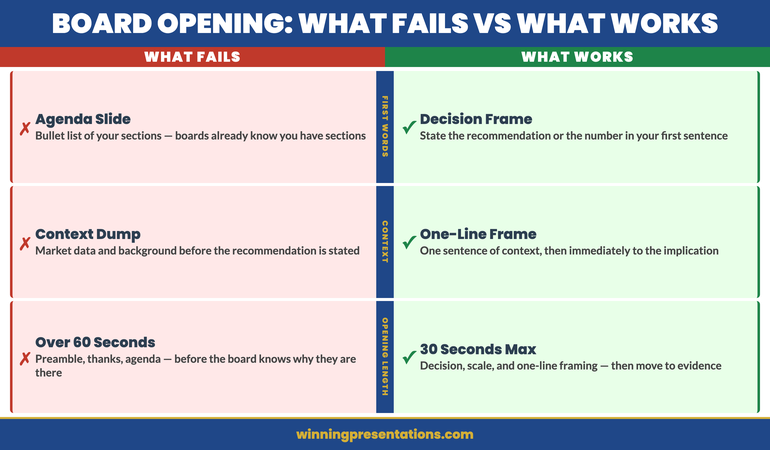
  • Conclusion-first: Lead with your recommendation, not your analysis
  • Decision-oriented: Everything supports a specific ask
  • Ruthlessly concise: If it doesn’t support the decision, cut it
  • Interrupt-proof: You should be able to state your recommendation in 30 seconds if asked

The structure I’m about to share has been tested in hundreds of board presentations. It works because it’s designed for how boards actually process information.

The 4-Part Board Presentation Structure

Board presentation structure framework - the 4-part structure for executive briefings

Part 1: Recommendation (2 minutes)

Start with your conclusion. Not background. Not context. Your recommendation.

“I’m recommending we approve a Β£2.4M investment in the CRM upgrade, to be implemented over Q2-Q3, with expected ROI of 340% over three years.”

This should take 30 seconds to say and one slide to show.

Why lead with this? Because boards are thinking “What do you want from us?” from the moment you start. If you make them wait, they’re mentally searching for your point instead of listening to your argument.

By stating your recommendation first, you frame everything that follows. The board knows what to listen for.

For techniques on delivering this opening with confidence, see my guide on how to speak confidently in public.

Part 2: Context (3 minutes)

Now β€” and only now β€” provide the minimum context needed to understand your recommendation.

The key question: What does the board need to know to evaluate my recommendation? Nothing more.

This typically includes:

  • The problem or opportunity you’re addressing
  • Why this is board-level (scale, risk, strategic importance)
  • Timeline constraints, if any

One slide maximum. Often this can be combined with your recommendation slide if you’re ruthless about brevity.

What NOT to include: history of how you got here, alternative approaches you considered, technical details, organisational politics. These belong in the appendix if anywhere.

πŸ’‘ Want Ready-Made Executive Templates?

The Executive Slide System includes board presentation templates built on this exact structure β€” plus 6 other frameworks for different executive contexts.

  • Board recommendation template
  • Executive summary one-pager
  • Investment case structure
  • Video walkthroughs of each framework

Get the Executive Slide System β€” Β£39 β†’

Part 3: Evidence (5 minutes)

Now support your recommendation with evidence. This is the “why you should agree” section.

Structure your evidence around the board’s likely concerns:

  • Financial: What’s the cost, return, and payback period?
  • Risk: What could go wrong, and how will you mitigate it?
  • Execution: Who’s accountable, and what’s the timeline?
  • Strategic fit: How does this align with company priorities?

Two to three slides maximum. Use data, not opinions. Be specific: “23% cost reduction” not “significant savings.”

Anticipate questions and address them proactively. If the CFO always asks about cash flow impact, include it before she asks.

Part 4: The Ask (2 minutes)

End with a crystal-clear ask. What specific decision do you need from the board today?

Good asks:

  • “I’m requesting approval to proceed with the Β£2.4M investment.”
  • “I’m seeking authorisation to negotiate final terms with the vendor.”
  • “I need the board’s input on whether to prioritise Option A or Option B.”

Bad asks:

  • “Thoughts?” (Too vague)
  • “I wanted to update you on our progress.” (Not a decision)
  • “Let me know if you have questions.” (Passive, not action-oriented)

If you don’t have a clear ask, question whether this needs to be a board presentation at all. Informational updates can usually be handled in pre-read documents.

For techniques on delivering powerful closings, see my guide on how to start a presentation β€” which also covers endings.

Board Presentation Structure: Timing Guide

Board presentation timing guide - how to allocate 15 minutes across four sections

If you have 15 minutes on the agenda, plan for 10 minutes of presenting and 5 minutes of questions.

Section Time Slides
Recommendation 2 min 1
Context 3 min 1
Evidence 5 min 2-3
Ask 1-2 min 1
Questions 5 min Appendix

Notice this gives you 4-6 slides maximum for your main presentation. Everything else goes in the appendix β€” ready if asked, but not in your core flow.

Board Presentation Structure: Slide Template

Here’s a template you can adapt for any board presentation:

Slide 1: Recommendation + Context

  • Headline: Your recommendation in one sentence
  • 3-4 bullets: Key context points
  • Visual: Timeline or high-level financial summary

Slide 2: Financial Case

  • Investment required
  • Expected return (ROI, NPV, payback)
  • Comparison to alternatives if relevant

Slide 3: Risk and Mitigation

  • Top 3 risks
  • Mitigation plan for each
  • Contingency if needed

Slide 4: Execution Plan

  • Timeline (phases, milestones)
  • Accountability (who owns this)
  • Dependencies

Slide 5: The Ask

  • Specific decision requested
  • What happens next if approved
  • When you’ll report back

Appendix: Technical details, alternative analysis, historical context, org charts β€” anything that supports questions but doesn’t need to be in the main presentation.

πŸŽ“ Master Executive Presentations

AI-Enhanced Presentation Mastery includes a complete module on executive and board presentations β€” plus live coaching sessions where I review your actual presentations and give direct feedback.

8 modules. 2 live sessions. Learn the techniques that got me through hundreds of board presentations.

Learn More β€” Β£249 β†’

Common Board Presentation Structure Mistakes

After reviewing hundreds of board presentations, these are the mistakes I see most often:

Mistake 1: Burying the Recommendation

Starting with history, context, or analysis before stating what you want. By slide 10, the board has mentally checked out.

Mistake 2: Too Many Slides

40 slides for a 15-minute slot is not thorough β€” it’s unfocused. Ruthlessly cut anything that doesn’t directly support your recommendation.

Mistake 3: No Clear Ask

Ending with “Any questions?” instead of a specific decision request. Boards need to know what you’re asking them to do.

Mistake 4: Reading the Slides

Your slides are for reference, not scripts. Speak to the board, not the screen. They can read faster than you can talk.

Mistake 5: Not Preparing for Interruptions

Boards interrupt. It’s how they process. If you can’t state your recommendation in 30 seconds when interrupted, you’re not prepared.

Your Next Step

Before your next board presentation, restructure using the 4-part framework: Recommendation β†’ Context β†’ Evidence β†’ Ask.

Time yourself. If you can’t deliver it in 10 minutes, you haven’t cut enough.

Resources for Executive Presentations

πŸ“– FREE: Executive Presentation Checklist
Pre-presentation checklist for board meetings and executive briefings.
Download Free β†’

πŸ’‘ QUICK WIN: Executive Slide System β€” Β£39
7 frameworks + templates for any executive presentation context.
Get Instant Access β†’

πŸŽ“ COMPLETE SYSTEM: AI-Enhanced Presentation Mastery β€” Β£249
8-module course including executive presentations module + live coaching.
Learn More β†’

FAQs About Board Presentation Structure

How long should a board presentation be?

Plan for 10 minutes of presenting, leaving 5 minutes for questions if you have a 15-minute slot. Most board presentations can β€” and should β€” be delivered in under 10 minutes. If you need more time, you probably haven’t focused your message enough.

How many slides should a board presentation have?

4-6 slides maximum for your core presentation. Everything else goes in the appendix, ready for questions but not in your main flow. More slides usually means less clarity, not more thoroughness.

Should I include an executive summary slide in my board presentation?

Your first slide essentially IS your executive summary β€” your recommendation plus key context. A separate “executive summary” slide before this often wastes time and delays your main point.

What if the board interrupts before I finish my board presentation structure?

Expect interruptions β€” they’re normal in board settings. Be prepared to state your recommendation in 30 seconds if asked. Answer the question directly, then ask: “Shall I continue with the evidence, or would you like to discuss this point further?”

How do I handle tough questions during a board presentation?

Prepare your appendix with supporting data for likely questions. If you don’t know an answer, say “I’ll get you that information by [specific date]” rather than guessing. Board members respect honesty more than waffling.

What’s the biggest mistake in board presentation structure?

Burying the recommendation. Starting with background, context, or analysis instead of stating what you want. Lead with your conclusion β€” the board can follow your logic backward, but they can’t extract your point from 40 slides of analysis.


Mary Beth Hazeldine is the Owner & Managing Director of Winning Presentations and a Microsoft Copilot PowerPoint specialist. She has delivered hundreds of board presentations during 24 years at JPMorgan Chase, PwC, Royal Bank of Scotland, and Commerzbank, and now trains executives on high-stakes presentation skills.

Get Weekly Presentation Insights

Join 2,000+ professionals getting practical presentation tips every Tuesday.

Subscribe to The Winning Edge β†’

22 Dec 2025
Business presentation skills guide - what actually matters in corporate environments from 24 years in banking

Business Presentation Skills: What Actually Matters in Corporate Environments (From 24 Years in Banking)

The presentation skills that get you noticed, promoted, and trusted β€” and the ones that don’t matter nearly as much as you think

[IMAGE: business-presentation-skills-corporate-guide.png]

Alt text: Business presentation skills guide – what actually matters in corporate environments from 24 years in banking

Most business presentation skills advice is written by people who’ve never sat through a 7am credit committee meeting where careers hang in the balance.

I have. For 24 years.

At JPMorgan, PwC, Royal Bank of Scotland, and Commerzbank, I watched hundreds of professionals present. Some got promoted. Some got ignored. Some got shown the door. The difference wasn’t charisma or confidence or “executive presence” β€” at least not in the way most training programs define it.

The difference was a specific set of business presentation skills that nobody explicitly teaches. Skills that matter when the CFO is checking her phone, when the board has 47 slides to get through before lunch, when your recommendation needs sign-off from people who’ve heard a hundred pitches this quarter.

This guide covers what I learned β€” and what I now teach to executives who need results, not applause.

🎁 Free Download: The Executive Presentation Checklist β€” the pre-presentation checklist I use with C-suite clients. 2 pages, printable.

Why Most Business Presentation Skills Training Misses the Point

Here’s what most presentation training focuses on:

  • Eye contact and body language
  • Voice projection and pacing
  • Slide design principles
  • How to “engage” your audience
  • Managing nervousness

These aren’t wrong. But they’re about 20% of what determines whether your presentation actually works in a corporate environment.

The other 80%? Nobody talks about it.

The skills that actually matter in business:

  • Knowing what to leave out
  • Reading the room before you’ve said a word
  • Structuring for decision-makers who won’t read your slides
  • Handling questions that are really objections
  • Recovering when things go sideways
  • Making the ask without apologising for it

I learned these the hard way. Five years as a terrified junior banker, presenting to credit committees and client meetings, watching what worked and what didn’t. Then 19 more years refining them. Now I train executives who don’t have five years to figure it out themselves.

Related: How to Create Executive Presentations That Get Results

The Business Presentation Skills That Actually Get You Promoted

Let me be specific. These are the skills I’ve seen separate people who advance from people who stall.

1. Structuring for Skimmers (Not Readers)

Here’s a truth nobody tells you: executives don’t read your slides. They skim. They jump to the recommendation. They flip to the financials. They look for the one number that matters.

Most presenters structure for narrative flow β€” “let me take you on a journey.” Corporate decision-makers don’t want journeys. They want answers.

What works instead:

  • Lead with your recommendation (not your process)
  • Put the “so what” in slide titles, not buried in bullets
  • Design every slide to be understood in 5 seconds if someone jumps to it
  • Include an executive summary that actually summarises

I once watched a brilliant analyst lose a promotion because his presentations required too much work to understand. His analysis was better than anyone else’s. But the partners couldn’t figure out what he was recommending without reading 40 slides. His colleague, with simpler analysis but clearer structure, got the nod.

Related: Presentation Structure: 7 Frameworks That Actually Work

2. Reading the Room Before You Start

The first 30 seconds of any business presentation should be spent reading, not speaking.

Who’s checking their phone? Who’s leaning back? Who asked to be here versus who was told to attend? Who’s the actual decision-maker versus the most senior person in the room? (Not always the same.)

I learned this at RBS during a client pitch. I’d prepared for the CFO, who was technically the decision-maker. But within 30 seconds, I could see the Head of Operations was the one everyone looked at before responding. I pivoted my entire presentation to address her concerns. We won the work.

If I’d stuck to my script, we’d have lost.

What to look for:

  • Who do people glance at before speaking?
  • Who’s taking notes versus who’s waiting for it to end?
  • What’s the energy in the room β€” rushed, sceptical, engaged, distracted?
  • Did something happen before you walked in that changed the dynamic?

This isn’t mystical. It’s pattern recognition. And it’s trainable.

3. Answering the Question Behind the Question

In business presentations, questions are rarely just questions. They’re concerns wearing a question’s clothing.

“How did you arrive at that number?” often means “I don’t trust that number.”

“What’s the timeline?” often means “This sounds like it’ll take forever.”

“Who else has done this?” often means “I’m nervous about being first.”

The skill isn’t answering the literal question. It’s identifying the concern underneath and addressing that.

Example from my banking days:

A board member asked, “What’s the competitive landscape?” The literal answer would have been a market overview. But I could tell from his tone he was really asking, “Are we too late?” So I answered that question: “We’re not first, but here’s why being second actually works in our favour…”

He nodded and moved on. If I’d given the literal answer, he’d have asked three more questions trying to get to what he actually wanted to know.

Related: How to Present Like a CEO: Executive Presentation Skills for Leadership

Business presentation skills that matter: structure for skimmers, read the room, answer the real question, know what to cut, make the ask

4. Knowing What to Cut

Every presentation is too long. Every single one.

The skill isn’t adding more content. It’s having the judgment to remove content that doesn’t serve your goal β€” even if it took you hours to create.

I’ve seen presentations fail because someone included every piece of analysis they did, rather than just the analysis that mattered. I’ve seen pitches lose momentum because the presenter couldn’t bear to cut their favourite slide.

The rule I use: If a slide doesn’t directly support your recommendation or answer a question someone will definitely ask, cut it. Move it to the appendix. Better yet, delete it entirely.

One of my clients β€” a biotech executive β€” had a 60-slide investor pitch. We cut it to 12. He was terrified. Then he raised Β£4.2 million. The investors told him it was the clearest pitch they’d seen all quarter.

Cutting isn’t about dumbing down. It’s about respecting your audience’s time and attention.

5. Making the Ask Without Apologising

This is where most business presentations fall apart.

You’ve done the analysis. You’ve built the case. You’ve handled the questions. And then, when it’s time to ask for what you want β€” the budget, the approval, the decision β€” you soften it.

“So maybe we could consider…”

“If you think it makes sense…”

“I was hoping we might…”

This kills more presentations than bad slides ever will.

The business presentation skill that separates senior people from junior people is the ability to make a clear ask without hedging, apologising, or leaving room for ambiguity.

What works:

“I’m recommending we approve the Β£2.3 million budget for Q2 implementation. I need your sign-off today to hit the timeline.”

What doesn’t:

“So that’s the proposal. Let me know what you think, and maybe we can discuss next steps when you have time?”

The first one might get a no. But at least you’ll know where you stand. The second one gets a “let’s circle back” β€” which is a no that wastes another three weeks.

Want Slides That Match These Skills?

The Executive Slide System gives you templates and frameworks for the business presentations that matter β€” board updates, budget requests, strategic recommendations.

What’s included:

  • 12 executive slide templates (PowerPoint/Google Slides)
  • The CFO-approved budget request format
  • Board presentation structure guide
  • Before/after examples from real clients

Β£39 β€” Get the Executive Slide System β†’

The Business Presentation Skills That Don’t Matter as Much as You Think

Controversial opinion: some “essential” presentation skills are overrated in corporate settings.

Perfect Delivery

I’ve seen people with mediocre delivery get promoted because their thinking was sound. I’ve seen polished presenters get ignored because their content was empty.

In business, clarity beats charisma. Every time.

That doesn’t mean delivery doesn’t matter. But if you’re spending 80% of your prep time on how you’ll say things and 20% on what you’ll say, you’ve got it backwards.

“Engaging” Your Audience

Most advice about audience engagement assumes you’re giving a keynote or a TED talk. In a corporate setting, your audience doesn’t want to be engaged. They want to make a decision and get on with their day.

Don’t ask rhetorical questions. Don’t pause for dramatic effect. Don’t try to make them laugh. Just be clear, be direct, and be done.

The most “engaging” thing you can do in a business presentation is respect their time by finishing early.

Memorising Your Script

Memorised presentations sound memorised. And in business settings, they fall apart the moment someone asks a question that takes you off script.

What works better: knowing your material so well that you could present it in any order, answer any question, and still hit your key points. That’s different from memorisation. It’s internalisation.

How to Develop Business Presentation Skills (A Realistic Framework)

Most people try to improve their business presentation skills by:

  1. Reading a book
  2. Maybe attending a workshop
  3. Going back to presenting exactly the same way

That doesn’t work. Here’s what does.

Step 1: Get Honest Feedback on One Specific Thing

Not “how was my presentation?” β€” that gets you vague reassurance.

Ask: “Did you know what I was recommending within the first two minutes?” or “Was there a point where you got lost?” or “What would you cut?”

Specific questions get useful answers.

Step 2: Watch People Who Are Good at This

Not TED talks. Not keynote speakers. Watch people in your organisation who consistently get buy-in. Notice what they do:

  • How do they structure?
  • How do they handle pushback?
  • How do they make the ask?
  • What don’t they do that you expected them to?

The patterns will emerge.

Step 3: Practice the Hard Parts, Not the Easy Parts

Most people practice their opening (easy) and ignore their Q&A (hard). They rehearse their slides (easy) and wing their recommendation (hard).

Flip it. Spend your practice time on:

  • Answering the three toughest questions you might get
  • Making your ask clearly and without hedging
  • Explaining your recommendation without slides

If you can do those three things well, the rest takes care of itself.

Related: Why Most Presentation Skills Training Fails (And What Actually Works)

The Business Presentation Skills Gap Nobody Talks About

Here’s something I’ve observed across 24 years and thousands of presentations: there’s a specific gap between “competent presenter” and “presenter who gets results.”

Competent presenters can:

  • Create reasonable slides
  • Speak clearly
  • Answer basic questions
  • Get through their material

Presenters who get results can do all that, plus:

  • Adapt in real-time based on room dynamics
  • Make complex recommendations feel simple
  • Handle hostile questions without getting defensive
  • Close with a clear ask that gets a clear answer

That gap is where careers accelerate or plateau. And most presentation training never addresses it.

Close the Gap Over 4 Months

AI-Enhanced Presentation Mastery is my course for professionals who want to level up their business presentation skills β€” with proven frameworks, AI tools to cut prep time, and live coaching.

8 self-paced modules (January–April 2026):

  • The AVP Framework: Structure that guides audiences to yes
  • The S.E.E. Formula: Messaging that resonates and drives action
  • Your AI Playbook: Customised prompts that save 10+ hours weekly
  • Data Storytelling: Turn numbers into narratives that guide decisions
  • 2 live coaching sessions in April with personalised feedback
  • Master Prompt Pack, templates, and lifetime access

Presale price: Β£249 (increases to Β£299, then Β£499)

60 seats total.

See the full curriculum β†’

Frequently Asked Questions About Business Presentation Skills

What’s the most important business presentation skill?

Clarity. The ability to make your point understandable in 30 seconds, even if your supporting material takes 30 minutes. If someone asks “what’s the bottom line?” and you can’t answer in one sentence, you’re not ready to present.

How do I improve my business presentation skills quickly?

Focus on structure first. Most presentation problems are structure problems in disguise. Use a proven framework (Situation-Complication-Resolution, Problem-Solution-Benefit, or the Pyramid Principle), lead with your recommendation, and cut anything that doesn’t directly support your ask. You’ll see improvement immediately.

How do I handle nervousness in business presentations?

Preparation beats breathing exercises. When you know your material cold β€” especially your recommendation, your key numbers, and your answers to likely questions β€” nervousness drops naturally. The remaining nervousness actually helps; it keeps you sharp. Don’t try to eliminate it entirely.

What’s the difference between presenting to executives vs. regular meetings?

Executives have less time, more context, and higher expectations for directness. Lead with the ask, not the background. Assume they’ve read nothing. Be ready to present your entire recommendation in 60 seconds if they cut you off. And don’t fill silence β€” if they’re thinking, let them think.

How long should a business presentation be?

Shorter than you think. In my experience, the right length is about 60% of the time slot you’ve been given. If you have 30 minutes, prepare for 18-20 minutes of presenting and 10-12 minutes for questions. If you finish early, everyone’s happy. If you run over, you’ve failed before you’ve even made your ask.


Your Next Step: Build Business Presentation Skills That Get Results

You’ve just read what most presentation training won’t tell you. But knowing isn’t the same as doing.

Choose your path:

🎁 START FREE: Download the Executive Presentation Checklist β€” a pre-presentation checklist for high-stakes business presentations.

πŸ“˜ GET THE TEMPLATES (Β£39): The Executive Slide System gives you the slide structures that work in corporate environments β€” board presentations, budget requests, strategic recommendations.

πŸŽ“ BUILD THE SKILLS (Β£249): Join AI-Enhanced Presentation Mastery β€” 8 modules over 4 months with frameworks, AI tools, and live coaching to close the gap between competent and compelling. January cohort, 60 seats, early bird ends December 31st.

Business presentation skills compound. Every presentation you give is practice for the next one. The question is whether you’re practising the right things.


Mary Beth Hazeldine spent 24 years in corporate banking at JPMorgan, PwC, Royal Bank of Scotland, and Commerzbank before founding Winning Presentations. She’s trained over 5,000 executives in the presentation skills that actually matter in corporate environments β€” the ones that get budgets approved, deals closed, and careers advanced.

18 Dec 2025
AI presentation workflow showing time savings from 6 hours to 90 minutes with before and after comparison

AI Presentation Workflow: How I Cut Creation Time from 6 Hours to 90 Minutes

The exact system I use with Copilot to build presentations that actually win decisions

My AI presentation workflow changed everything.

Six months ago, I spent 6 hours on a pitch deck for a biotech client. The slides looked professional. The data was solid. The client lost the funding round.

Last month, a similar client needed a similar deck. I used my AI presentation workflow. Spent 90 minutes. They raised Β£4.2 million.

Same me. Same expertise. Completely different approach to using AI.

🎁 Free Download: Get my 10 Essential Copilot Prompts β€” the exact prompts I use in this workflow. No email required.

Here’s what I’ve learned after testing AI presentation workflows on hundreds of client decks: most people use Copilot backwards.

They open PowerPoint, type “create a presentation about Q3 results,” and wonder why the output looks generic and forgettable.

That’s not an AI presentation workflow. That’s hoping AI will think for you. It won’t.

The workflow I’m sharing today is different. It’s the system I’ve refined over the past year, tested on real presentations for investment banks, biotech founders, and SaaS executives. It’s also the foundation of the course I’m launching in January.

Why Your AI Presentation Workflow Isn’t Working

Let me guess what’s happening:

You prompt Copilot. You get 15 slides of generic structure β€” title, agenda, overview, data, data, data, summary, questions. It’s technically correct. It looks like every other AI-generated deck.

You spend the next two hours trying to fix it. Moving slides around. Rewriting bullet points. Fighting with formatting. By the end, you’ve saved no time and the presentation still feels… flat.

Sound familiar?

The problem isn’t Copilot. The problem is you’re asking AI to do your strategic thinking. It can’t. Here’s what AI cannot do:

  • Decide what your audience needs to believe
  • Determine which data actually matters for this decision
  • Structure an argument that leads to action
  • Know when to break the rules for impact

That’s your job. But here’s the breakthrough: once you’ve done that thinking, AI executes ten times faster than you can manually.

The AI presentation workflow I’m about to share separates strategic thinking (you) from execution (AI). That’s why it works.

Want the Complete System?

The AI-Enhanced Presentation Mastery course teaches this entire workflow with templates, 50+ prompts, and live practice sessions.

January cohort: Β£249 (increases to Β£499 in April)

Only 60 seats. Early bird ends December 31st.

See what’s included β†’

4-step AI presentation workflow - AVP Framework, 132 Rule, SEE Formula, and AI Execution with time for each step
The AI Presentation Workflow: 4 Steps

This is the exact process I use. It works for investor pitches, board presentations, sales decks, and executive updates. The frameworks adapt to any presentation type.

Step 1: AVP Framework (5 minutes β€” before you touch PowerPoint)

Before I prompt Copilot for anything, I answer three questions on paper:

A β€” Action: What specific decision or action do I need from this audience?

V β€” Value: What’s in it for them? Why should they care?

P β€” Proof: What evidence will make them believe me?

This takes 5 minutes. Most people skip it and spend hours wandering through slides wondering why nothing feels right.

Real example from a client deck last month:

  • Action: Approve Β£500K for the pilot programme by Friday
  • Value: This solves the customer churn problem costing us Β£2M annually
  • Proof: Three case studies showing 40% churn reduction, internal data on our trajectory, ROI calculation showing 4x return

Now β€” and only now β€” am I ready to use AI. See the difference? I’m not asking Copilot to figure out my strategy. I’m asking it to execute a strategy I’ve already defined.

Related: How to Structure a Presentation: 7 Frameworks That Actually Work

AVP Framework diagram showing Action Value Proof - three questions to answer before creating presentations with AI

Step 2: The 132 Rule for Structure

The 132 Rule is how I structure every presentation, regardless of length:

  • 1 β€” One core message (the thing you want them to remember)
  • 3 β€” Three supporting arguments (the structure of your case)
  • 2 β€” Two types of evidence per argument (facts + stories)

This is where Copilot becomes genuinely powerful.

My prompt (this took me months to refine):

“I’m presenting to [specific audience] requesting [specific decision]. My core message is [from AVP]. My three supporting arguments are: 1) [argument], 2) [argument], 3) [argument]. Create a presentation outline that opens with my recommendation, develops each argument with one data point and one brief example, and closes with my specific ask and timeline.”

That’s a 30-second prompt. Copilot generates a structured outline in another 30 seconds. What used to take me 45 minutes now takes one minute.

The key: I gave Copilot the strategic decisions. It handled the structural execution.

Related: Best Copilot PowerPoint Prompts That Actually Work

The 132 Rule for presentation structure - 1 core message, 3 supporting arguments, 2 evidence types per argument with visual tree diagram

Step 3: S.E.E. Formula for Each Section

Generic AI presentations fail because every slide sounds the same β€” informative but forgettable. The audience nods politely and does nothing.

The S.E.E. formula fixes this:

  • S β€” Statement: What’s the point of this slide? (One sentence, opinionated)
  • E β€” Evidence: What proves it? (Specific data, quote, or case study)
  • E β€” Emotion: Why does it matter to THIS audience? (The “so what?”)

My prompt for transforming flat slides:

“For this slide about [topic], the key statement is [X]. The evidence is [data point]. Rewrite to emphasise what this means for [specific audience] β€” connect it to their priorities, not just the numbers. Make the title state the conclusion, not describe the content.”

Copilot becomes a translation layer between your data and your audience’s concerns. You provide the strategic insight; it finds the words.

S.E.E. Formula for persuasive slides - Statement Evidence Emotion framework for transforming flat presentations
Step 4: AI Handles the Grunt Work

Once the strategic structure is solid, there’s tedious work that AI handles brilliantly:

  • Reformatting bullet points into cleaner layouts
  • Rewriting descriptive titles into action titles (“Q3 Revenue Analysis” β†’ “Revenue Beat Target by 12% β€” Here’s Why It’s Sustainable”)
  • Creating consistency across the deck
  • Generating speaker notes
  • Building an executive summary from the full deck

None of these require strategic thinking. All of them used to eat hours. Now they take minutes.

Related: PowerPoint Copilot Tutorial: Complete Guide 2025

AI presentation workflow time comparison table showing tasks reduced from 5+ hours to 70 minutes total

The Real Time Savings

Here’s what changed when I adopted this AI presentation workflow:

Task Before With AI Workflow
Strategic planning (AVP) Skipped β€” then struggled 5 minutes
Outline creation 45 minutes 2 minutes
First draft slides 2 hours 20 minutes
Formatting and polish 1 hour 10 minutes
Review and refinement 1.5 hours 30 minutes
Total 5+ hours ~70 minutes

That’s 4+ hours saved per presentation. If you create two presentations a week, that’s 400+ hours a year β€” ten full work weeks.

Who This Works For (And Who It Doesn’t)

This AI presentation workflow works if you:

  • Already know your content but struggle to structure it persuasively
  • Spend too long on slides that don’t get the results they should
  • Want to use AI strategically, not just as a shortcut
  • Present to executives, boards, investors, or clients who make decisions

This probably isn’t right for you if:

  • You want AI to do all the thinking (it can’t β€” and the results show it)
  • You’re looking for templates without learning the strategy behind them
  • You don’t present regularly enough to justify learning a system

I’m direct about this because I’d rather you know upfront. The people who get results from this workflow β€” and from my course β€” are professionals who present regularly and want to get dramatically better, faster.

What Happens in the Course

The AI presentation workflow above is the foundation. The AI-Enhanced Presentation Mastery course goes deeper:

8 self-paced modules (January–April 2026):

  • Module 1: AI as your strategic co-creator (not a shortcut)
  • Module 2: The AVP framework with templates and examples
  • Module 3: The 132 Rule β€” structuring any presentation
  • Module 4: S.E.E. formula β€” making every slide persuasive
  • Module 5: Data storytelling with AI
  • Module 6: Building your personal prompt playbook
  • Module 7: Executive presence and delivery
  • Module 8: The complete AI presentation workflow

2 live coaching sessions (April 2026):

  • Live deck reviews and feedback
  • Q&A on your specific challenges
  • Recordings available if you can’t attend

Resources you keep forever:

  • 50+ tested prompts (my personal library)
  • AVP and S.E.E. templates
  • Before/after slide transformations
  • The complete AI presentation workflow PDF
  • Lifetime access to all materials and updates

Ready to Master the AI Presentation Workflow?

January cohort opens December 31st.

Β£249 Β£499

Early bird price β€’ 60 seats maximum β€’ Lifetime access

Enrol Now β†’

Backed by the Maven Guarantee β€” full refund until halfway point

Try the Workflow Today

You don’t need the course to start. Here’s what to do with your next presentation:

  1. Before opening PowerPoint: Write down your AVP (Action, Value, Proof). 5 minutes.
  2. Use the 132 Rule: Define your one message, three arguments, and two pieces of evidence per argument.
  3. Prompt Copilot with your strategy: Use the prompts above β€” give it your decisions, let it execute.
  4. Apply S.E.E. to each slide: Statement, Evidence, Emotion.

If this workflow saves you even one hour on your next presentation, imagine what happens when you master the complete system.


Mary Beth Hazeldine is the Managing Director of Winning Presentations. She spent 24 years in corporate banking at JPMorgan Chase, PwC, Royal Bank of Scotland, and Commerzbank before training thousands of executives to present with impact. Her clients have raised over Β£250M using her frameworks.

18 Dec 2025
How to structure a presentation step by step guide

How to Structure a Presentation: The Step-by-Step Guide for Any Situation

The exact process I use to structure presentations that have helped clients raise Β£250M+

You have a presentation next week. Maybe it’s a board update, a sales pitch, or an investor meeting. You know your content β€” the problem is figuring out what order to put it in.

Most people start with a blank slide and begin typing. That’s backwards.

After 24 years in corporate banking at JPMorgan, PwC, Royal Bank of Scotland, and Commerzbank β€” and training thousands of executives since β€” I’ve developed a step-by-step process for structuring any presentation. It works whether you have 5 slides or 50, whether you’re presenting to your team or the board.

Here’s exactly how to structure a presentation that gets results.

The 5-Step Process to Structure Any Presentation

Before you open PowerPoint, you need clarity on five things. Skip any of these and your presentation structure will fall apart.

Want ready-made structures instead of building from scratch?

The Executive Slide System includes 17 PowerPoint templates with proven structures for every business presentation β€” board meetings, budget requests, sales pitches, QBRs, and more. Plus 51 AI prompts to generate your content.

Get the templates (Β£39) β†’

Step 1: Define Your One Thing

Every presentation needs a single core message. Not three messages. Not “several key points.” One thing you want the audience to remember.

Ask yourself: If my audience forgets everything else, what’s the one thing they must remember?

Examples:

  • Budget presentation: “We need Β£500K to hit our Q3 targets”
  • Sales pitch: “Our solution cuts your processing time by 60%”
  • Board update: “We’re on track, but need a decision on the expansion”
  • Investor pitch: “We’re raising Β£2M to capture a Β£500M market”

Write this down before you do anything else. Every slide you create should support this one thing.

Presentation structure diagram showing one core message with supporting points

Step 2: Know Your Audience’s Starting Point

The biggest presentation structure mistake is assuming your audience knows what you know.

Before you structure anything, answer these questions:

  • What do they already know about this topic?
  • What do they care about most? (Hint: usually money, time, or risk)
  • What concerns or objections will they have?
  • What decision are they able to make?

A presentation to your team requires different structure than the same content presented to the board. Your team wants details. The board wants the decision and the headline numbers.

Related: How to Present to a CFO: The Finance-First Framework

Step 3: Choose Your Framework

Now you’re ready to pick a presentation structure. The right framework depends on your situation:

Situation Best Framework Why It Works
Sales pitch or proposal Problem-Solution-Benefit Creates urgency, then delivers relief
Executive briefing Pyramid Principle Answer first, details only if needed
Data presentation What-So What-Now What Turns numbers into decisions
Keynote or all-hands Hero’s Journey Inspires through narrative
Strategy recommendation SCQA Creates tension that demands resolution
Investor pitch 10-20-30 Rule Forces clarity and brevity
Client meeting (flexible) Modular Deck Adapts to conversation flow

Deep dive: Presentation Structure: 7 Frameworks That Actually Work

Don’t know which to choose? Default to Problem-Solution-Benefit for external audiences and Pyramid Principle for internal executives.

πŸ’‘ Want to combine these frameworks with AI? My AI-Enhanced Presentation Mastery course teaches you how to use Copilot as a strategic partner β€” cut creation time from 6 hours to 90 minutes while doubling impact.

Step 4: Build Your Slide Skeleton

Now β€” and only now β€” open PowerPoint.

Don’t write content yet. Just create placeholder slides with titles only. This is your skeleton.

Example: Problem-Solution-Benefit structure for a sales pitch

  1. Title slide
  2. The Problem (what pain they’re experiencing)
  3. The Cost (what this problem costs them)
  4. The Cause (why the problem exists)
  5. The Solution (your answer β€” benefits, not features)
  6. How It Works (3 steps maximum)
  7. Proof (case study with specific numbers)
  8. Next Step (one clear action)

Eight slides. That’s it. If you need more, you probably haven’t synthesised enough.

Pro tip: Read your slide titles in sequence. They should tell a complete story without any content. If someone read only your titles, would they understand your message?

Step 5: Fill In the Content (Last)

Only after your skeleton is solid do you write the actual content.

For each slide, ask:

  • What’s the ONE point this slide makes?
  • What’s the minimum evidence needed to prove it?
  • What can I cut?

Most slides need 3-5 bullet points maximum. If you have more, you’re putting two slides’ worth of content on one slide.

Related: Stop Writing Slide Titles Like This (Before and After Examples)

Skip the Skeleton β€” Get Pre-Built Structures

The 5-step process works. But it takes time.

The Executive Slide System gives you 17 ready-made presentation structures β€” just fill in your content. Includes:

  • 17 PowerPoint templates (Board, QBR, Budget, Sales, Investor, and more)
  • 51 AI prompts to generate content for each slide
  • 7 proven frameworks (Pyramid Principle, Problem-Solution-Benefit, SCQA, etc.)
  • Before/after examples showing exactly what good looks like

Get instant access (Β£39) β†’

How to Structure Different Types of Presentations

The 5-step process applies universally. But each presentation type has nuances. Here’s how to structure the most common ones:

How to Structure a Sales Presentation

Use Problem-Solution-Benefit. The structure is:

  1. Problem β€” State their pain (be specific to their situation)
  2. Cost β€” Quantify what it’s costing them
  3. Cause β€” Explain why the problem exists
  4. Solution β€” Your answer (benefits first, features later)
  5. How It Works β€” 3 steps maximum
  6. Proof β€” Case study with specific numbers
  7. Next Step β€” One clear action

Spend 70% of your prep time on slides 1-3. If they don’t feel the problem, they won’t care about your solution.

Template: Sales Presentation Template: The Structure Top Performers Use

How to Structure an Executive Presentation

Use the Pyramid Principle. Lead with your answer:

  1. The Answer β€” Your recommendation in one sentence
  2. Supporting Point 1 β€” Strongest argument + evidence
  3. Supporting Point 2 β€” Second argument + evidence
  4. Supporting Point 3 β€” Third argument + evidence
  5. Implications β€” What this means for the business
  6. Next Steps β€” What you need from them

Never more than 3 supporting points. If you have more, group related points together.

Template: Executive Presentation Template: 12 Slides That Command the Room

How to Structure a Board Presentation

Boards have specific expectations. Your structure must include:

  1. The Ask β€” What decision you need (slide 1, not slide 12)
  2. Context β€” Brief background (what they need to know)
  3. Recommendation β€” Your proposed course of action
  4. Business Case β€” ROI, costs, timeline
  5. Risks β€” What could go wrong and your mitigation
  6. Decision β€” Restate the ask with clear options

Board presentations fail when the ask is buried. Put it on slide 1.

Template: Board Presentation Template: The Complete Guide

How to Structure a Data Presentation

Use What-So What-Now What for every data point:

  • What β€” The facts (specific numbers with context)
  • So What β€” Why it matters (interpretation)
  • Now What β€” What to do about it (action)

Every chart needs a “So What.” If you can’t explain why data matters in one sentence, don’t include it.

Related: Team Dashboards That Tell a Story (Not Just Show Numbers)

Data presentation structure using What So What Now What framework

Common Presentation Structure Mistakes

I’ve reviewed thousands of presentations. These mistakes appear in 80% of them:

Mistake 1: Starting with Background

“Let me give you some context…” is how most presentations start. It’s also where most audiences check out.

Fix: Start with why they should care. Context comes after you’ve earned their attention.

Mistake 2: Building to the Conclusion

Academic training teaches us to present evidence then reach a conclusion. Business presentations are the opposite.

Fix: Lead with your recommendation. Provide evidence for those who want it.

Mistake 3: Too Many Points

If you have 7 key messages, you have 0 key messages. The audience will remember none of them.

Fix: Three points maximum. If you need more, you haven’t synthesised enough.

Mistake 4: No Clear Ask

“Let me know what you think” is not an ask. “I need your approval by Friday” is an ask.

Fix: End every presentation with one specific action and a deadline.

Related: How to End a Presentation: 7 Closing Techniques I Teach C-Suite Executives

Using AI to Structure Your Presentation

Tools like ChatGPT and PowerPoint Copilot can accelerate your presentation structure β€” if you use them correctly.

Related: The AI Presentation Workflow That Cut My Creation Time in Half

Good prompt:

“Create a presentation structure using Problem-Solution-Benefit framework for [TOPIC]. Include slide titles only β€” no content yet. The audience is [AUDIENCE] and the goal is [DECISION NEEDED].”

Bad prompt:

“Create a presentation about [TOPIC].”

AI gives you speed. Your judgment gives you substance. Use AI for the skeleton, then refine with your expertise.

Related: Best Copilot PowerPoint Prompts That Actually Work

Want to Master AI-Enhanced Presentations?

The frameworks in this article become 10x more powerful when combined with AI. My new course teaches you exactly how to use Copilot as a strategic thinking partner β€” not just a slide generator.

What you’ll learn:

  • The AVP Framework β€” Strategic planning before you prompt AI
  • The 132 Rule β€” Structure any presentation in minutes
  • The S.E.E. Formula β€” Make every slide persuasive
  • 50+ tested prompts from my personal library
  • 2 live coaching sessions with deck reviews

AI-Enhanced Presentation Mastery

Β£249 Β£499 β€” Early bird until December 31st

January cohort β€’ 60 seats maximum β€’ Lifetime access

See the Full Curriculum β†’

Frequently Asked Questions

How many slides should a presentation have?

There’s no universal answer, but here are guidelines: 1 slide per minute of speaking time is a reasonable maximum. A 20-minute presentation should have 15-20 slides. More importantly, each slide should make ONE point. If you have 40 slides for a 20-minute presentation, you’re probably putting too little on each slide β€” or talking too fast.

What’s the best presentation structure for beginners?

Start with Problem-Solution-Benefit. It’s intuitive (problem β†’ solution β†’ why it matters), works for most situations, and forces you to focus on the audience’s needs rather than your content. Once you’re comfortable, expand to Pyramid Principle for executive audiences.

How do I structure a presentation with lots of data?

Use What-So What-Now What for every data point. Don’t show data without interpretation. Every chart should answer: What does this show? Why does it matter? What should we do about it? Cut any data that doesn’t directly support your one core message.

Should I structure differently for virtual presentations?

Yes. Attention spans are shorter online. Use more frequent transitions (every 2-3 minutes), bigger text, and more visuals. Keep slides simpler β€” viewers are on smaller screens. And build in interaction every 5 minutes to maintain engagement.


Get Presentation Structures That Work

The 5-step process will help you structure any presentation from scratch. But if you want to skip the blank-slide struggle, I’ve done the work for you.

The Executive Slide System includes:

  • 17 PowerPoint templates β€” Every structure covered in this article, ready to use
  • 51 AI prompts β€” Generate content for each slide in minutes
  • 7 presentation frameworks β€” Pyramid Principle, Problem-Solution-Benefit, SCQA, and more
  • Before/after examples β€” See exactly what transforms a weak presentation into a strong one

My clients have used these templates to raise over Β£250 million in funding and get budgets approved at Fortune 500 companies.

Get the Executive Slide System (Β£39) β†’

Instant download. Lifetime access. 30-day money-back guarantee.


Mary Beth Hazeldine is the Managing Director of Winning Presentations, where she trains executives at investment banks, biotech companies, and SaaS firms to present with impact. Her clients have raised over Β£250M using her presentation frameworks.

17 Dec 2025
The Pyramid Principle for Presentations - McKinsey's secret weapon for executive communication

The Pyramid Principle for Presentations: McKinsey’s Secret Weapon (Used Wrong by Most)

πŸ“… Updated: December 2025

Quick Answer

The Pyramid Principle is a communication framework developed by Barbara Minto at McKinsey that structures presentations top-down: lead with your answer first, then support it with 3 key points, each backed by evidence. It’s the opposite of how most people present (building to a conclusion) and dramatically more effective for executive audiences who want your recommendation, not your thought process.

πŸ“¦ INCLUDES PYRAMID PRINCIPLE TEMPLATE

Executive Slide System β€” Β£39

Ready-to-use Pyramid Principle deck plus 16 other frameworks as PowerPoint templates. 51 AI prompts. Slide-by-slide scripts.

Get the Templates β€” Β£39 β†’

Instant download. Lifetime access. 30-day money-back guarantee.


What Is the Pyramid Principle?

The Pyramid Principle was developed by Barbara Minto at McKinsey in the 1960s and has since become the standard for executive communication at consulting firms, investment banks, and Fortune 500 companies worldwide.

The core idea is simple: start with the answer.

Most people present bottom-up β€” they walk through their analysis, build the case piece by piece, and finally reveal their conclusion. This feels logical to the presenter. It mirrors how they did the work.

But it’s torture for the audience.

Executives don’t want to follow your journey. They want your destination. They want to know what you recommend, then decide whether they need the supporting detail.

The Pyramid Principle flips the structure:

  1. Start with the answer β€” your main recommendation or finding
  2. Group supporting arguments β€” 3 key points that prove your answer
  3. Order logically β€” each point supported by evidence

It’s called a “pyramid” because the structure looks like one: single point at the top, broader supporting base below.

Related: Presentation Structure: 7 Frameworks That Actually Work

Why It Works for Executive Presentations

I’ve trained executives at JPMorgan, PwC, and dozens of other firms. The Pyramid Principle works because it aligns with how senior leaders actually process information.

Executives are time-poor. A CEO might have 15 minutes between meetings. If your conclusion is on slide 12, they’ll never see it. If it’s on slide 1, they can engage immediately β€” and choose whether to dig deeper.

Executives are decision-makers. They don’t need to understand every detail of your analysis. They need to know: What do you recommend? Why? What do you need from me? The Pyramid answers all three in the first 2 minutes.

Executives will interrupt. If you’re building to a conclusion, every question derails you. If you’ve already stated your answer, questions become productive exploration of supporting points.

A client of mine β€” a director at a major consulting firm β€” used to get interrupted constantly in partner meetings. His presentations were thorough but bottom-up. We restructured using the Pyramid Principle. The interruptions didn’t stop, but they changed: instead of “get to the point,” partners started asking “tell me more about point 2.” He made partner 8 months later.

The Pyramid Structure (Slide by Slide)

Here’s how to apply the Pyramid Principle to a typical executive presentation:

Slide 1: The Answer

State your recommendation or key finding in one sentence. Be direct. Be specific.

  • ❌ “We’ve been analysing the market opportunity…”
  • βœ… “We should acquire Company X for Β£15M β€” it will generate Β£4M annual savings within 18 months.”

Slide 2: Supporting Point 1

Your strongest argument. Lead with the point, then provide evidence.

  • Point: “The acquisition eliminates our largest cost centre”
  • Evidence: Current outsourcing costs, projected in-house costs, timeline to realise savings

Slide 3: Supporting Point 2

Second strongest argument, same structure.

  • Point: “Company X has technology we’d need 2 years to build”
  • Evidence: Capability comparison, build vs. buy analysis

Slide 4: Supporting Point 3

Third argument. Never more than 3 β€” if you need more, you haven’t synthesised enough.

  • Point: “The asking price is below market value”
  • Evidence: Comparable transactions, valuation methodology

Slide 5: Implications

What this means for the business. Risks, dependencies, timeline.

Slide 6: Next Steps

What you need from the audience. One clear ask.


Pyramid Principle structure diagram - answer at top, 3 supporting points below, evidence at base

The Rule of Three: Why exactly 3 supporting points? Because humans can hold 3-4 items in working memory. More than 3 points and your audience starts forgetting the first one. Fewer than 3 and your argument feels thin. Three is the magic number.

⚑
Skip the Blank Slide

The Executive Slide System includes a complete Pyramid Principle deck with placeholder text for each slide. Just fill in your content and present.

Get the Pyramid Template β€” Β£39 β†’

The MECE Rule: Mutually Exclusive, Collectively Exhaustive

The Pyramid Principle has a companion concept: MECE (pronounced “me-see”). Your supporting points should be:

Mutually Exclusive: No overlap between points. Each argument is distinct.

  • ❌ “It saves money” and “It reduces costs” (these overlap)
  • βœ… “It saves money” and “It saves time” and “It reduces risk” (distinct)

Collectively Exhaustive: Together, they cover all the important ground. No major gaps.

MECE matters because overlap confuses your audience (“wait, didn’t you already say that?”) and gaps invite objections (“but what about…?”).

Before you finalise your 3 supporting points, ask:

  1. Is there any overlap between these points?
  2. If someone accepted all 3 points, would they accept my answer?
  3. What’s the strongest objection β€” and is it addressed?

Before and After: A Real Example

Here’s how the Pyramid Principle transforms an actual presentation:

BEFORE (Bottom-Up):

  1. Slide 1: Agenda
  2. Slide 2: Background on the project
  3. Slide 3: Methodology we used
  4. Slide 4: Data we collected
  5. Slide 5: Analysis of Option A
  6. Slide 6: Analysis of Option B
  7. Slide 7: Analysis of Option C
  8. Slide 8: Comparison matrix
  9. Slide 9: Risks and considerations
  10. Slide 10: Our recommendation

Problem: The CEO checked out by slide 4. The recommendation never landed.

AFTER (Pyramid Principle):

  1. Slide 1: “We recommend Option B β€” it delivers 40% higher ROI with acceptable risk”
  2. Slide 2: Point 1 β€” ROI comparison (Option B wins on financial returns)
  3. Slide 3: Point 2 β€” Implementation timeline (Option B is fastest)
  4. Slide 4: Point 3 β€” Risk profile (Option B risks are manageable)
  5. Slide 5: What we need to proceed
  6. Appendix: Methodology, detailed analysis, data (available if asked)

Result: CEO approved in the meeting. Total presentation time: 8 minutes.

3 Common Mistakes (And How to Fix Them)

Mistake 1: Burying the answer in context

❌ “Given the market conditions and our strategic priorities and the competitive landscape… we recommend X.”

βœ… “We recommend X.” Full stop. Context comes after, if needed.

Mistake 2: More than 3 supporting points

If you have 5 points, you haven’t synthesised. Group related points together. “Financial benefits” can cover cost savings, revenue increase, and working capital improvement β€” that’s one point, not three.

Mistake 3: Supporting points that don’t actually support

Every point must directly answer “why should I accept your recommendation?” If a point is interesting but doesn’t support your answer, cut it or move it to the appendix.

Related: Executive Presentation Template: 12 Slides That Command the Room

From Framework to Finished Presentation

The Pyramid Principle tells you how to structure your thinking. But there’s a gap between knowing the structure and having slides ready for Monday’s board meeting.

That’s where most people struggle. They understand “answer first, 3 supporting points” β€” but what exactly goes on each slide? How do you phrase the opening? What evidence is compelling vs. overwhelming?

I’ve spent 35 years closing that gap.

The Executive Slide System gives you the complete Pyramid Principle deck β€” not just a framework, but ready-to-use slides with placeholders you fill in. Plus AI prompts to generate content for each section and scripts for what to say when you present.

The consulting director I mentioned earlier? He used these exact templates. The difference wasn’t that he suddenly understood the Pyramid Principle β€” he’d known it for years. The difference was having slides that forced him to execute it properly.

What’s Included: Free vs. Paid

What You Get Free Checklist Executive Slide System (Β£39)
Pyramid Principle overview βœ“ βœ“
7 frameworks reference card βœ“ βœ“
Ready-to-use PowerPoint templates β€” βœ“ 10 templates
Pyramid Principle slide deck β€” βœ“ 6-slide template
AI prompts for each slide β€” βœ“ 30 prompts
Before/after examples β€” βœ“ Real transformations
Result Understand the principle Present like McKinsey

🎯 PRESENT LIKE MCKINSEY

Executive Slide System

17 PowerPoint templates including the complete Pyramid Principle deck.
51 AI prompts. Slide-by-slide scripts. Used to close Β£250M+ in deals.

Get Instant Access β€” Β£39 β†’

βœ“ Instant downloadΒ Β Β βœ“ Lifetime accessΒ Β Β βœ“ 30-day guarantee

Frequently Asked Questions

What is the Pyramid Principle in simple terms?

The Pyramid Principle means starting with your answer or recommendation first, then supporting it with 3 key points, each backed by evidence. It’s the opposite of building to a conclusion β€” you state the conclusion immediately and let your audience decide how much supporting detail they need.

Who invented the Pyramid Principle?

Barbara Minto developed the Pyramid Principle while working at McKinsey & Company in the 1960s. She later wrote “The Pyramid Principle: Logic in Writing and Thinking,” which became the standard text for business communication at consulting firms worldwide.

When should you NOT use the Pyramid Principle?

Avoid the Pyramid Principle when your audience needs to be emotionally engaged before hearing your conclusion (use the Hero’s Journey instead), when you’re delivering bad news that requires context first, or when you genuinely don’t have a recommendation yet. It’s designed for situations where you have a clear answer and a decision-making audience.

What is MECE and how does it relate to the Pyramid Principle?

MECE stands for Mutually Exclusive, Collectively Exhaustive. It’s a test for your supporting points: they should have no overlap (mutually exclusive) and together cover all the important ground (collectively exhaustive). MECE ensures your argument is logically airtight.

How many supporting points should I have?

Exactly 3. Human working memory can hold 3-4 items comfortably. More than 3 points and your audience starts forgetting earlier ones. If you have 5 points, you haven’t synthesised enough β€” group related points together.

Not Ready to Buy? Start Here.

Get the free checklist with the Pyramid Principle template and 6 other frameworks. You can upgrade to full templates later.

Download Free Checklist β†’

πŸ“§
The Winning Edge Newsletter

Weekly insights on presentations that close deals, win budgets, and advance careers.

Subscribe Free β†’

Related Resources

About the Author

Mary Beth Hazeldine has trained executives on high-stakes presentations for 35 years. With 24 years in corporate banking at JPMorgan Chase, PwC, Royal Bank of Scotland, and Commerzbank, she’s used the Pyramid Principle in hundreds of board presentations and client pitches. Her clients have closed over Β£250 million using her presentation frameworks. She teaches at Winning Presentations.

17 Dec 2025
Presentation Structure: 7 Frameworks That Actually Work - proven structures from McKinsey, TED, and top executives

Presentation Structure: 7 Frameworks That Actually Work [2026]

πŸ“… Updated: December 2025

Quick Answer

The best presentation structure depends on your goal: use the Problem-Solution-Benefit framework for sales, the Pyramid Principle for executive briefings, or the What-So What-Now What structure for data presentations. This guide covers 7 proven frameworks with slide-by-slide breakdowns, so you can choose the right structure for any situation.

πŸ“¦ USED BY 250+ EXECUTIVES

Executive Slide System β€” Β£39

All 7 frameworks as ready-to-use PowerPoint templates. 51 AI prompts. Slide-by-slide scripts. Stop starting from blank slides.

Get the Templates β€” Β£39 β†’

Instant download. Lifetime access. 30-day money-back guarantee.


Why Structure Matters More Than Content

I’ve watched brilliant people give terrible presentations. PhDs who can’t explain their research. CFOs who lose the board in slide three. Salespeople who know the product cold but can’t close.

The problem is never knowledge. It’s structure.

A client came to me last year with a 47-slide deck for a Β£2M deal. Every slide was accurate. Every data point was relevant. And the prospect said: “This is really comprehensive. We’ll get back to you.”

They didn’t.

We restructured the same content into 12 slides using Framework 1 below. Same information, different architecture. The next prospect signed in the room.

Structure is the difference between information and persuasion.

Here are 7 frameworks that work β€” each designed for a specific situation. Use the wrong one and you’ll confuse your audience. Use the right one and you’ll guide them exactly where you want them to go.

Framework 1: Problem-Solution-Benefit (Sales Presentations)

Best for: Sales pitches, proposals, any presentation where you’re asking for a decision

Why it works: Humans are wired to solve problems. When you start with a problem your audience recognises, they lean in. When you present the solution, they’re already primed to say yes.

The structure (7 slides):

  1. The Problem β€” State the pain your audience feels. Be specific. “Most sales teams spend 40% of their time on admin instead of selling.”
  2. The Cost β€” Quantify what the problem costs them. Time, money, opportunity. “That’s Β£180K per year in lost productivity for a team of 10.”
  3. The Cause β€” Explain why the problem exists. This positions you as someone who understands.
  4. The Solution β€” Introduce your answer. High-level, not features.
  5. How It Works β€” 3 steps maximum. Keep it simple.
  6. Proof β€” One case study with specific numbers. “Acme reduced admin time by 60% in 90 days.”
  7. Next Step β€” One clear action. Not “any questions?” but “I recommend we start a pilot next week.”

Pro tip: Spend 70% of your time on slides 1-3. If your audience doesn’t feel the problem, they won’t care about your solution.

Related: Sales Presentation Template: The Structure Top Performers Use

Framework 2: The Pyramid Principle (Executive Briefings)

Best for: Board presentations, executive updates, any audience with limited time and high authority

Why it works: Executives don’t want to follow your thinking process β€” they want your conclusion. The Pyramid Principle, developed at McKinsey, puts your answer first and lets the audience drill down only if needed.

The structure:

  1. The Answer β€” Lead with your recommendation or key finding. “We should acquire Company X for Β£15M.”
  2. Supporting Point 1 β€” First reason with evidence
  3. Supporting Point 2 β€” Second reason with evidence
  4. Supporting Point 3 β€” Third reason with evidence
  5. Implications β€” What this means for the business
  6. Next Steps β€” What you need from them

The rule of three: Never more than 3 supporting points. If you need more, you haven’t synthesised enough.

Pro tip: Prepare 10 slides of backup detail you may never show. Executives will ask questions β€” have the data ready, but don’t put it in the main flow.

Related: The Pyramid Principle for Presentations: McKinsey’s Secret Weapon

⚑
Stop Reinventing the Wheel

The Executive Slide System includes the Pyramid Principle, Problem-Solution-Benefit, and all 15 other frameworks as ready-to-use templates. Just fill in your content.

Get All 7 Templates β€” Β£39 β†’

Framework 3: What-So What-Now What (Data Presentations)

Best for: Quarterly reviews, analytics presentations, any data-heavy content

Why it works: Data alone is meaningless. Your audience needs to know what it means and what to do about it. This framework forces you to interpret, not just report.

The structure:

  1. What β€” The facts. “Revenue is up 12% but margin is down 3 points.”
  2. So What β€” The interpretation. “We’re winning more deals but at lower prices β€” likely due to competitor pressure in the mid-market.”
  3. Now What β€” The action. “I recommend we raise prices 5% on enterprise while holding mid-market rates.”

Apply it to every chart: Before you show any data visualisation, prepare your “So What” statement. If you can’t explain why the data matters, don’t include it.

Pro tip: Most data presentations fail because they’re all “What” and no “So What.” Force yourself to have one insight per slide.

Related: QBR Presentation Template: Quarterly Reviews That Retain Clients

Framework 4: The Hero’s Journey (Keynotes & Vision Presentations)

Best for: Conference talks, company all-hands, any presentation meant to inspire

Why it works: Stories are how humans make sense of the world. The Hero’s Journey β€” the structure behind every great film β€” works because it’s hardwired into how we process information.

The structure:

  1. The Ordinary World β€” Where we are today. Establish the status quo.
  2. The Challenge β€” The disruption that demands change.
  3. The Journey β€” The obstacles overcome, lessons learned.
  4. The Transformation β€” What changed. The new capability or insight.
  5. The New World β€” The better future now possible.
  6. The Call to Action β€” What the audience should do to join this journey.

Pro tip: The hero isn’t you β€” it’s your audience. Position them as the protagonist who can achieve the transformation.

Framework 5: SCQA (Consulting-Style Presentations)

Best for: Strategy presentations, recommendations, complex problem-solving

Why it works: SCQA (Situation-Complication-Question-Answer) creates narrative tension. By the time you reach the Answer, your audience is desperate to hear it.

The structure:

  1. Situation β€” The context everyone agrees on. “We’re the market leader in the UK with 34% share.”
  2. Complication β€” The problem or change that disrupts the situation. “But a new competitor entered last quarter and is winning on price.”
  3. Question β€” The strategic question that must be answered. “How do we defend our position without destroying margin?”
  4. Answer β€” Your recommendation, followed by supporting analysis.

Pro tip: The Complication is where you create urgency. Make it specific and quantified β€” “They’ve taken 8 points of share in 6 months” hits harder than “competition is increasing.”

Framework 6: The 10-20-30 Rule (Pitch Decks)

Best for: Investor pitches, startup presentations, any high-stakes pitch with time pressure

Why it works: Guy Kawasaki’s rule forces discipline: 10 slides, 20 minutes, 30-point minimum font. It prevents the most common pitch mistake β€” death by PowerPoint.

The 10 slides:

  1. Title β€” Company, name, contact
  2. Problem β€” The pain you solve
  3. Solution β€” Your unique approach
  4. Business Model β€” How you make money
  5. Secret Sauce β€” Why you win (technology, team, timing)
  6. Marketing Plan β€” How you reach customers
  7. Competition β€” Landscape and your differentiation
  8. Team β€” Why you’re the right people
  9. Financials β€” Projections and key metrics
  10. Ask β€” What you want and what you’ll do with it

Pro tip: 30-point font isn’t just about readability β€” it forces you to cut words and focus on what matters.

Related: Investor Pitch Deck Template: The Sequoia Format That Raised Billions

Framework 7: The Modular Deck (Flexible Meetings)

Best for: Client meetings, consultations, any presentation where the conversation might go in different directions

Why it works: Not every presentation is linear. The Modular Deck gives you building blocks you can rearrange in real-time based on audience interest.

The structure:

  1. Opening Module β€” 3-5 slides that always come first (context, agenda, key question)
  2. Core Modules β€” 4-6 self-contained sections of 3-5 slides each, any of which can be skipped or reordered
  3. Closing Module β€” 3-5 slides that always come last (summary, next steps, call to action)

Pro tip: Number your core modules clearly (Section 1, Section 2) so you can say “Let’s skip to Section 4” without fumbling. Use PowerPoint’s Zoom feature to navigate non-linearly.

Comparison chart showing which presentation framework to use for different situations - sales, executive, data, keynote, consulting, pitch, flexible

How to Choose the Right Framework

Use this decision tree:

Are you asking for money or a decision?

  • Investor pitch β†’ 10-20-30 Rule
  • Sales presentation β†’ Problem-Solution-Benefit

Are you presenting to executives?

  • Board or C-suite β†’ Pyramid Principle
  • Strategy recommendation β†’ SCQA

Are you presenting data?

  • Quarterly review β†’ What-So What-Now What

Are you trying to inspire?

  • Keynote or all-hands β†’ Hero’s Journey

Is the conversation unpredictable?

  • Client meeting β†’ Modular Deck

Why Frameworks Alone Aren’t Enough

Here’s what I’ve learned training executives for 35 years: knowing the framework is 20% of the battle. Executing it is the other 80%.

I’ve seen people use the Pyramid Principle and still bury the lead. I’ve watched sales presentations with perfect Problem-Solution-Benefit structure fail because the proof wasn’t credible. I’ve reviewed decks that followed every rule but still felt flat.

The difference between good and great is in the details: how you phrase the opening line, which proof points you choose, how you handle the “so what,” what you put on each slide.

That’s why I built the Executive Slide System.

It’s not just frameworks β€” it’s ready-to-use templates with every slide designed for maximum impact. You get the exact structure, the placeholder text, the AI prompts to generate content, and the scripts for what to say.

My clients have used these templates to close over Β£250 million in deals. Not because the frameworks are secret β€” you just read them above. Because the execution is dialled in.

What’s Included: Free vs. Paid

What You Get Free Checklist Executive Slide System (Β£39)
7 framework summaries βœ“ βœ“
One-page reference card βœ“ βœ“
Ready-to-use PowerPoint templates β€” βœ“ 17 templates
Before/after examples β€” βœ“ Real transformations
AI prompts for each framework β€” βœ“ 51 prompts
Slide-by-slide scripts β€” βœ“ What to say per slide
Result Know the theory Present like a pro

🎯 MOST POPULAR

Executive Slide System

17 PowerPoint templates. 30 AI prompts. Slide-by-slide scripts.
Built from frameworks that have closed Β£250M+ in deals.

Get Instant Access β€” Β£39 β†’

βœ“ Instant downloadΒ Β Β βœ“ Lifetime accessΒ Β Β βœ“ 30-day guarantee

Frequently Asked Questions

What is the best structure for a presentation?

The best presentation structure depends on your goal. For sales presentations, use Problem-Solution-Benefit. For executive briefings, use the Pyramid Principle (answer first, then supporting points). For data presentations, use What-So What-Now What. The key is matching structure to audience expectations β€” executives want conclusions upfront, while sales prospects need to feel the problem first.

How do you structure a 10-minute presentation?

For a 10-minute presentation, use 5-7 slides maximum: opening hook (1 slide, 1 minute), main point with 3 supporting arguments (3-4 slides, 7 minutes), and closing call to action (1 slide, 2 minutes). The most common mistake is trying to cover too much β€” focus on one core message and make it memorable.

What is the 5-5-5 rule in PowerPoint?

The 5-5-5 rule suggests no more than 5 words per line, 5 lines per slide, and 5 text-heavy slides in a row. It’s a useful guideline for preventing death by PowerPoint, but I prefer the “one idea per slide” principle β€” each slide should make exactly one point that your audience can grasp in 3 seconds.

How do you structure a presentation for executives?

Use the Pyramid Principle: lead with your recommendation or conclusion, then provide 3 supporting points with evidence, then implications and next steps. Executives have limited time and want your answer, not your thought process. Prepare backup slides for detailed questions but keep the main flow to 6-8 slides.

What is the SCQA framework?

SCQA stands for Situation-Complication-Question-Answer. It’s a consulting-style framework that creates narrative tension: start with agreed context (Situation), introduce the problem (Complication), frame the strategic question, then deliver your recommendation (Answer). It works because by the time you reach the Answer, your audience is primed to hear it.

Not Ready to Buy? Start Here.

Get the free checklist with all 7 frameworks as a one-page reference. You can upgrade to templates later.

Download Free Checklist β†’

πŸ“§
The Winning Edge Newsletter

Weekly insights on presentations that close deals, win budgets, and advance careers.

Subscribe Free β†’

Related Resources

About the Author

Mary Beth Hazeldine has trained executives on high-stakes presentations for 35 years. With 24 years in corporate banking at JPMorgan Chase, PwC, Royal Bank of Scotland, and Commerzbank, she’s seen what separates presentations that close from those that stall. Her clients have closed over Β£250 million using her presentation frameworks. She teaches at Winning Presentations.