Category: Q&A Mastery

04 Apr 2026
Executive confidently responding to data questions during a board presentation with financial charts visible on screen, editorial photography

Data Questions in Presentations: How to Defend Your Numbers Under Pressure

Data questions in presentations are rarely about the data. They are about trust. When a board member challenges your numbers, they are testing whether you understand the assumptions behind them, the limitations within them, and the decisions they should and should not support. Here is how to defend your data under pressure without losing credibility or the room.

Ingrid was presenting the quarterly revenue forecast to the executive committee of a mid-market technology firm. Slide six showed a projected twelve percent growth in recurring revenue, driven by three new enterprise contracts expected to close in the next quarter. The CFO leaned forward. “Ingrid, the pipeline conversion rate you’ve used here is forty-two percent. Our actual conversion rate for the last four quarters has averaged thirty-one percent. Walk me through why you’ve used a different number.” She had used the higher figure because it reflected the conversion rate for enterprise deals specifically, which historically closed at a higher rate than the blended average. But she hadn’t flagged the distinction on the slide or in the supporting notes. She knew the answer—but the ten seconds it took her to locate the rationale in her memory felt, to the room, like hesitation. The CFO’s eyebrows rose. The CEO looked down at his notes. Ingrid recovered well, explaining the enterprise-specific rate and offering to share the supporting data by email. But the damage was subtle and real: for the remainder of the presentation, every number was scrutinised more carefully. She had been credible at slide five. By slide seven, she was being audited. The issue wasn’t the data. It was the gap between her preparation and her presentation of it.

Preparing for a data-heavy presentation with Q&A? The Executive Q&A Handling System includes frameworks and response structures designed for high-scrutiny presentation environments.

Why Data Challenges Are About Trust, Not Accuracy

When someone challenges a number in your presentation, the instinct is to defend the number. This is almost always the wrong response. The question behind the question is not “Is this number correct?” It is “Do you understand what this number means well enough for me to trust the decision you’re asking me to make?”

Data questions in presentations serve a governance function. The board member or senior executive who challenges your figures is not trying to embarrass you. They are building their own confidence that the data has been properly interrogated before it reaches them. Your job is not to prove the number is right. Your job is to demonstrate that you understand its provenance, its limitations, and its implications for the decision at hand.

This reframing changes your preparation entirely. Instead of preparing to defend every number, prepare to explain the three to five numbers that are most likely to be challenged—the ones with the biggest assumptions, the widest confidence intervals, or the greatest impact on the recommendation. Know the source. Know the methodology. Know the alternative interpretation. And know what your recommendation would be if the number were materially different.

The executive who responds to a data challenge with “The number is correct—it comes from our CRM” is defending accuracy. The executive who responds with “That number reflects our enterprise conversion rate over the last six quarters. If we used the blended rate instead, the forecast would be eight percent rather than twelve. My recommendation wouldn’t change, but the confidence interval would widen” is demonstrating mastery. The first response ends the question. The second response earns trust.

Handle Data Scrutiny With Authority

The Executive Q&A Handling System gives you response frameworks and preparation structures for high-scrutiny presentations—so you defend your numbers with the confidence the room expects.

  • ✓ Q&A response frameworks for executive settings
  • ✓ Preparation templates for data-heavy presentations
  • ✓ Techniques for handling hostile and unexpected questions

Get the Q&A Handling System → £39

Designed for executives who face data scrutiny in high-stakes presentations

Assumption Transparency: The Defence That Prevents the Attack

The most effective defence against data questions is to answer them before they’re asked. Assumption transparency—stating your key assumptions on the slide rather than hiding them in a footnote or an appendix—removes the adversarial dynamic entirely. When you proactively disclose that “this forecast uses enterprise-specific conversion rates (42%) rather than the blended rate (31%),” you’ve eliminated the challenge before the CFO can formulate it.

This approach works because it reverses the power dynamic. When the audience discovers an assumption themselves, it feels like catching you out. When you disclose it proactively, it feels like rigour. The data is identical. The perception is entirely different. Transparency converts a potential weakness into a credibility signal.

The practical implementation is an “Assumptions” callout box on any slide that presents modelled, projected, or estimated data. Keep it brief—three to five key assumptions, each in a single line. Position it at the bottom of the slide in a visually distinct format (grey text, smaller font, clearly labelled). This tells the audience: “I’ve thought about what underpins these numbers, and I’m confident enough to show my working.”

The assumptions you choose to disclose also signal what you consider material. Listing every assumption suggests you’re unsure which ones matter. Listing three tells the audience these are the ones you’ve stress-tested because they have the greatest impact on the recommendation. This selectivity is itself an act of expertise—it shows you can distinguish between assumptions that affect the decision and assumptions that are technically interesting but practically irrelevant.
Assumption transparency framework showing proactive disclosure versus reactive defence in data presentations

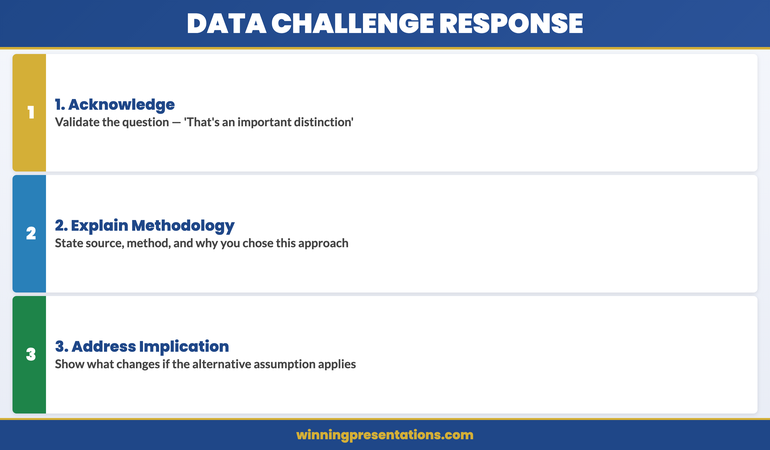
The Three-Part Response to Any Data Challenge

When a data question arrives—and it will, regardless of your preparation—use a three-part response structure that maintains credibility while addressing the challenge directly.

Part 1: Acknowledge the question’s legitimacy. “That’s an important distinction” or “You’re right to question that assumption.” This is not flattery—it is professional respect. It tells the questioner that you understand why the data point matters, which immediately reduces the adversarial temperature. A defensive response—“The data is sound”—escalates. An acknowledging response—“That’s a fair challenge”—de-escalates.

Part 2: Explain the methodology. State the source, the methodology, and the reason you chose this approach over alternatives. Be specific and brief. “We used the enterprise-specific conversion rate because the three pipeline deals are all enterprise contracts. The blended rate includes SME deals, which convert at a lower rate and aren’t represented in this quarter’s pipeline.” This takes fifteen seconds and demonstrates mastery.

Part 3: Address the implication. State what would change if the alternative assumption were used. “If we applied the blended rate, the projection would drop from twelve to eight percent growth. The recommendation to proceed with the hiring plan would still hold, though the timing would shift by one quarter.” This is the element that builds the most trust, because it shows you’ve already considered the alternative the questioner is proposing. You haven’t just defended your number—you’ve demonstrated that the decision is robust regardless. For more on the bridging technique for difficult questions, that guide covers how to redirect challenging questions without appearing evasive.

The three-part structure works because it addresses all three layers of the data challenge simultaneously: the emotional layer (acknowledgement), the technical layer (methodology), and the decision layer (implication). Most presenters only address the technical layer—and that’s why data challenges feel so uncomfortable. When you address all three, the questioner feels heard, informed, and reassured.

Anticipating Data Questions Before They Arrive

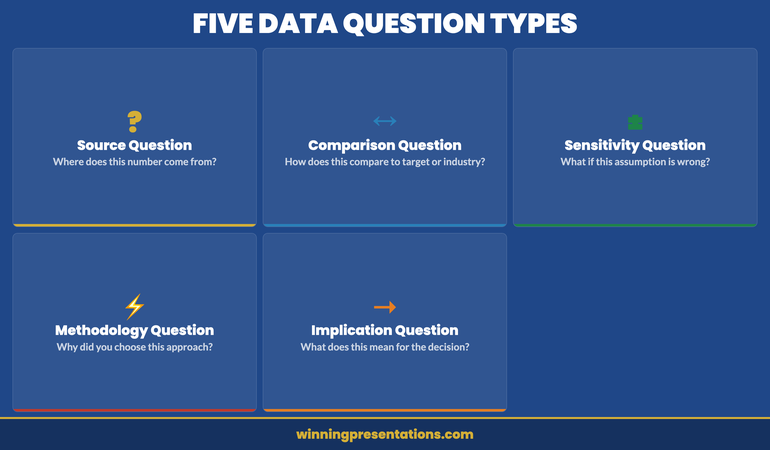
The most predictable data questions follow a pattern. For any presentation containing numerical analysis, audit each slide against five question types that appear in virtually every executive Q&A.

The Source Question: “Where does this number come from?” Prepare a one-sentence answer for every significant data point: the system, the report, the date range, and any manual adjustments. If you had to manipulate the data—filtering outliers, annualising partial data, converting currencies—disclose the methodology proactively or prepare the answer for Q&A.

The Comparison Question: “How does this compare to [last quarter / the industry / the target]?” Prepare context for every headline number. A twelve percent growth figure means nothing without comparison. Twelve percent against a target of fifteen is underperformance. Twelve percent against an industry average of four is outperformance. The questioner wants to calibrate your number against a reference point. Provide it before they ask.

The Sensitivity Question: “What happens if this assumption is wrong?” This is the data question that separates adequate presenters from authoritative ones. Prepare a sensitivity range for your three to five most impactful assumptions. Know what changes—and what doesn’t—when each assumption shifts by a material amount. For techniques on buying time during Q&A, that guide covers legitimate strategies for creating thinking space when unexpected questions arrive.

If you regularly present data-heavy material to senior audiences, the Executive Q&A Handling System provides the preparation frameworks that ensure you’ve anticipated the questions before you enter the room.
Five predictable data question types in executive presentations with preparation strategies

Recovering Credibility After a Data Stumble

If you’ve been caught off-guard by a data question—a number you can’t explain, an assumption you didn’t anticipate, a comparison you haven’t prepared—the recovery is more important than the stumble. How you handle the next sixty seconds determines whether the audience writes off the moment or writes off your presentation.

The recovery protocol has three steps. First, resist the urge to guess. An incorrect improvised answer is far more damaging than an honest acknowledgement. “I don’t have that specific breakdown in front of me” is a temporary gap. “I believe the number is roughly…” followed by an incorrect estimate is a credibility collapse.

Second, commit to a specific follow-up. Not “I’ll look into that”—which sounds vague and may never happen—but “I’ll send the detailed breakdown to the committee by end of business today.” The specificity of the commitment signals accountability. The timeline signals urgency. Together, they convert a moment of weakness into a demonstration of professional discipline.

Third, move forward with the presentation. Do not apologise repeatedly, do not circle back to the point, and do not let the stumble colour the rest of your delivery. The audience takes their cue from you. If you treat the moment as a minor administrative gap, they will too. If you treat it as a catastrophe, they will begin scrutinising every subsequent number with renewed suspicion. The stumble matters far less than the signal you send about it. For approaches to handling particularly hostile questions in board meetings, that guide covers the specific dynamics when data challenges carry political intent.

Prepare for Every Data Challenge Before You Enter the Room

Stop dreading Q&A. The Executive Q&A Handling System gives you the frameworks to anticipate, structure, and deliver authoritative responses to data scrutiny—for £39.

Get the Q&A Handling System → £39

Frequently Asked Questions

How do I handle a data question when the questioner has better data than I do?

Acknowledge their data immediately: “That’s a useful data point—thank you. My analysis used [source/timeframe]. If your figures reflect [their likely source], the difference may be [methodology/scope/date range]. I’d like to reconcile the two datasets after this meeting so we’re working from a single source going forward.” This response does three things: it validates their contribution, explains the discrepancy without being defensive, and proposes a constructive resolution. The worst response is to argue that your data is right and theirs is wrong—even if that’s true.

Should I include an appendix with detailed data for Q&A?

Always. An appendix with supporting detail is your safety net for data questions. Structure it as a set of backup slides that mirror your main presentation: for each core slide, prepare one or two appendix slides with the underlying data, the methodology note, the sensitivity analysis, or the comparison benchmarks. When a question arrives, you can say “I have the detailed breakdown—let me pull up the supporting slide.” This signals preparedness and converts Q&A from an interrogation into a collaborative data review.

What if a data challenge reveals a genuine error in my presentation?

Acknowledge it immediately, thank the person who spotted it, and assess the impact on your recommendation in real time. “You’re right—that should be thirty-one percent, not forty-two. Let me quickly assess whether that changes the recommendation.” If the recommendation holds, say so: “The conclusion is the same, but the margin is tighter. I’ll circulate corrected figures after the meeting.” If the error materially changes the recommendation, say that too: “This changes the picture. I’d like to revise the analysis and bring an updated recommendation to next week’s meeting.” Honesty in the moment of error builds more trust than a flawless presentation built on unchallenged assumptions.

The Winning Edge

Weekly insights on Q&A handling, executive presentations, and boardroom communication.

Subscribe Free

If data scrutiny also triggers anxiety about your credibility as a presenter, our guide to imposter syndrome in presentations covers the psychological patterns that make high performers feel like frauds under pressure.

About the author

Mary Beth Hazeldine, Owner & Managing Director, Winning Presentations. With 24 years of corporate banking experience at JPMorgan Chase, PwC, Royal Bank of Scotland, and Commerzbank, she advises executives across financial services, healthcare, technology, and government on structuring presentations for high-stakes funding rounds and approvals.

02 Apr 2026
Executive responding to a challenging question during a board presentation

Trick Questions in Presentations: How to Respond When They Already Know the Answer

When an executive asks you a question they clearly already know the answer to, they are not seeking information. They are testing your credibility, your composure, and your ability to think on your feet. The response framework in this article will show you exactly how to turn that test into proof of your competence.

Henrik arrived at the quarterly audit committee review with his balance sheet slides prepared to the minute. Three months into his role as finance director, he was about to present the company’s year-end position. Five minutes in, one of the senior audit committee members raised his hand: “Henrik, I notice your cash reserves have declined. What contingency measures do you have in place?” Henrik felt his chest tighten. The questioner was the chair of the audit committee. He would absolutely know about the contingency strategy—it had been discussed at their planning meeting in January. This wasn’t a genuine question. This was a test. Henrik paused. His instinct was to launch into defensive detail, to prove he’d done the work. Instead, he slowed down, met the questioner’s eyes, and gave a response that acknowledged the real question being asked. The room shifted. By the end of the presentation, that same audit committee member stopped him afterwards to say, “That’s exactly the kind of thinking we need in this chair.” Henrik had passed the test—not because he had the right answer, but because he’d recognised what was actually being asked.

Facing difficult questions in executive settings? The Executive Q&A Handling System includes preparation frameworks and response strategies built for exactly this kind of high-stakes Q&A situation.

Why Executives Ask Questions They Already Know the Answer To

Before you can respond effectively to a trick question, you need to understand what is actually happening when an executive asks you something they already know the answer to. This is a fundamentally different interaction than a genuine information-seeking question.

In corporate contexts, questions serve multiple purposes beyond information exchange. They are tools for assessment, credibility testing, relationship signalling, and power dynamics. When someone in an executive setting asks you a question they already know the answer to, they are running one of three diagnostics:

  • Are you prepared? Can you articulate your thinking clearly, or are you winging it?
  • Can you stay composed under pressure? Do you panic, become defensive, or deflect?
  • Do you understand the bigger context? Can you see beyond the surface of what’s being asked to the underlying concern?

Most professionals interpret these as genuine questions and respond with either defensive detail (“Let me explain exactly what happened…”) or vague reassurance (“Don’t worry, we’ve got it covered”). Both responses fail the test because they miss what the questioner is actually evaluating. They’re not checking your knowledge of the facts. They’re checking your judgment and your character.

The questioner wants to see whether you will pause, recognise the real question, and respond with clarity and confidence. This is why the executives you see handling difficult Q&A with grace are not necessarily the ones with the most information. They are the ones with the psychological awareness to understand what test they are being given.

The Executive Q&A Handling System

If you are regularly presenting to executive audiences, you are likely facing trick questions—whether you recognise them as such or not. The Executive Q&A Handling System is a preparation framework designed specifically for senior-level presentations where the stakes are credibility and influence.

This system includes:

  • A structured approach to pre-meeting preparation that identifies likely questions and the psychology behind them
  • Response frameworks for handling questions where the questioner already knows the answer
  • Techniques for staying composed when you’re being tested, not informed
  • Methods for reading the room to spot credibility challenges before the question is asked
  • Recovery strategies for when a response doesn’t land as intended

This is not theoretical. It’s built from the patterns we see in rooms where executives succeed, and where they stumble. You learn the psychology of the questioner’s intent, not just what words to say.


Get the Executive Q&A Handling System → £39

The Three Types of Trick Question in Executive Settings

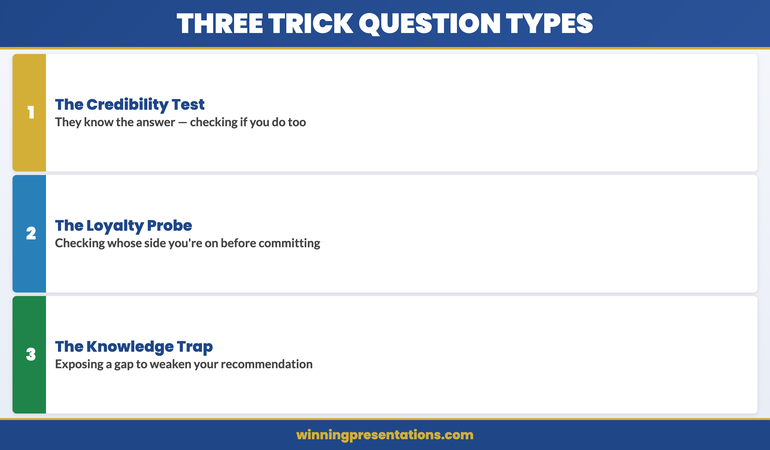
Not all trick questions are created equal. Understanding which category a question falls into will help you diagnose what the questioner is really asking—and respond appropriately. Here are the three patterns that appear repeatedly in executive presentations:

The Consistency Test
The questioner has heard you say something before, or they have read something in your written materials, and they want to hear whether you will say the same thing now, under pressure. This is often phrased as an innocent question (“So how exactly does that process work?”), but the questioner is checking whether you will contradict yourself or suddenly shift your position. The underlying concern is trust. If you tell a different story under pressure, why should they believe anything you say?

The Competence Challenge
The questioner already understands the technical answer, but they want to see whether you can articulate it clearly and confidently. This is most common in highly technical presentations to expert audiences. A board member asks your CFO a detailed question about revenue recognition. The board member is not seeking education—they are checking whether your CFO truly understands the material, or whether they are relying on someone else’s analysis.

The Values Check
The questioner knows what you are going to say, but they want to watch how you say it and what emphasis you place. They are assessing whether your stated values align with your actual priorities. For example: “How are you thinking about risk in this proposal?” The questioner may already know your risk assessment, but they are checking whether risk genuinely matters to you, or whether it is something you pay lip service to while rushing toward a deadline.

Each of these requires a slightly different response strategy. The Consistency Test requires calm clarity. The Competence Challenge requires precision and confidence. The Values Check requires authentic emphasis on what genuinely matters to you. When you misidentify the type of trick question, your response lands wrong—even if your facts are correct.

hree types of trick questions in executive presentations showing the credibility test, the loyalty probe, and the knowledge trap

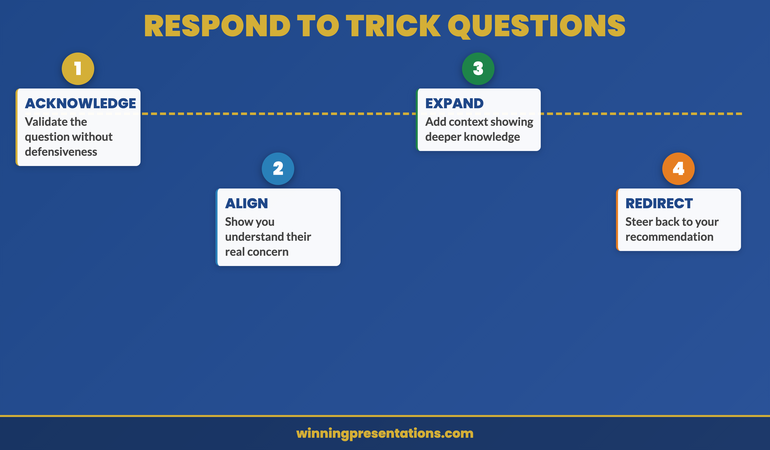
The Acknowledge-and-Expand Response Framework

Here is the framework that changes how you respond to trick questions in presentations. It’s built on one simple principle: respond to what is actually being asked, not what is literally being said.

Step 1: Pause and Acknowledge
When you hear the question, resist the urge to answer immediately. Pause. Look at the questioner. Breathe. This pause accomplishes three things: it signals that you are taking the question seriously, it gives your nervous system a moment to settle, and it gives your brain time to diagnose what is really being asked.

Your acknowledgement should be brief and genuine. “That’s a good question. Let me think about what you’re really asking here.” This tells the questioner that you are not going to give a rote answer. You are going to engage with the intent behind the question.

Step 2: Name the Real Question
If you can identify the real question—the test being administered—name it directly. Not aggressively. Not defensively. Simply: “I think you’re asking whether we have genuinely thought through the risk, or whether risk is something we’re paying lip service to.” Or: “You want to know that I can articulate this clearly, without hedging.” This signals that you understand the psychology of the moment. It also disarms the trick, because once it is named, it stops being a trick. It becomes a conversation between two adults.

Step 3: Answer Both the Literal and the Psychological Question
Now provide your answer. Clarity first. Then confidence. Then, if applicable, acknowledgement of the concern beneath the question. For a Competence Challenge, you might say: “The revenue recognition standard for performance obligations requires us to… [clear, precise answer]… and I understand why that matters to you—it’s the difference between someone who can manage the detail and someone who is just executing someone else’s strategy.” You have now answered the literal question (the technical detail) and the psychological question (yes, I understand this and I own it).

Step 4: Close with Confidence
End your response with a statement that acknowledges you have understood and addressed the real concern: “So yes, we have thought this through at that level.” Or: “I hope that demonstrates we understand the nuance here.” Then stop. Do not over-explain. Do not defend further. Let your answer sit.

The Acknowledge-and-Expand framework works because it addresses what executives actually care about in Q&A: seeing that you can think under pressure and respond to the real question, not just the surface words. This is the foundation of handling objections and difficult questions with authority.

Reading the Room: Recognising a Test Before You Walk Into It

The best time to prepare for a trick question is before you walk into the room. If you can identify which questions are likely to be traps, you can rehearse your response and manage your nervous system in advance.

Start with the agenda and the audience list. Which topics on your agenda are most likely to trigger credibility testing? What concerns does this particular group have that they might test you on? Have you presented to any of these people before? How did they question you last time?

Then, think about the psychology of the room. Is someone in this meeting competing with you for influence? Is someone new to the group trying to establish credibility by challenging the presenter? Is there a topic that is historically contentious in this organisation? Trick questions often come from people who are either protecting territory or trying to establish authority. Once you understand the dynamics, you can predict with reasonable accuracy which questions are likely to be tests and which are genuine.

The most predictive factor is this: if a question covers something that was already clearly stated in your written materials or in earlier parts of your presentation, and someone asks it again in the Q&A, it is likely a trick question. They are not seeking information they do not have. They are testing something else. Prepare your response with that in mind.

For more on this preparation work, see our guide to reading the room before you enter.

Preparation Matters More Than Instinct

Many professionals believe that handling trick questions is about quick thinking or natural charisma. It is not. It is about preparation. When you know what questions are likely to come, and you have rehearsed your response framework, you stop relying on instinct (which often leads to defensiveness under pressure) and you start relying on strategy.

The Executive Q&A Handling System includes a pre-meeting briefing template that helps you map out the psychology of the audience, predict likely trick questions, and rehearse responses before you present. This is what separates professionals who remain calm in difficult Q&A from those who freeze or become defensive.

What to Do When You Get the Trick Question Wrong

Even with excellent preparation, there will be times when you misread the situation or give a response that does not land as intended. This happens to experienced presenters. The question is not whether you will ever get it wrong. The question is what you do in the moment when you realise you have.

The instinct, when you have given a wrong answer, is to double down or to apologise excessively. Neither works. Instead, use this recovery sequence:

Pause and Acknowledge the Miss
If you have said something that clearly did not land, or you have heard a follow-up question that tells you your response missed the mark, do not pretend it did not happen. Pause and acknowledge: “I don’t think I answered the question you actually asked.” Or: “Let me come back to that—I think I answered the wrong thing.” This signals that you are paying attention and that you care about being understood.

Reframe and Try Again
Now ask a clarifying question or rephrase what you think the real question is: “Are you asking whether this approach will work in our specific context, or whether the general methodology is sound?” This gives you another chance to identify the real question. Often, the questioner will help you. They will say yes, that is what I was asking. Now you answer the right question.

Move Forward Without Belaboring It
Once you have recovered, move forward. Do not apologise multiple times. Do not spend the next five minutes trying to convince the questioner that your original answer was actually okay. You have acknowledged the miss and answered more accurately. That is enough. The room will respect you more for recovering gracefully than if you had answered perfectly the first time.

This recovery sequence also demonstrates one of the most valuable qualities in executive Q&A: the ability to think and adapt in real time. Sometimes your recovery itself becomes proof of your competence.

Building a Pre-Meeting Intelligence Briefing for Q&A

This is the preparation system that professionals who handle trick questions with confidence use before every executive presentation. It takes about 20 minutes and it is worth ten times that in improved outcomes.

Step 1: Map the Audience Psychology
For each person in the meeting, write down: their primary concern about your topic, their historical relationship to you, and any territory they are protecting. A CFO’s primary concern may be cost control. A head of operations may be concerned about implementation risk. A board member may be concerned about whether the leadership team is aligned. These concerns shape the questions they ask.

Step 2: Identify Trigger Topics
Which parts of your presentation are most likely to trigger testing questions? Usually these are the parts where someone’s interests or priorities could be affected. If you are proposing a change to process, the person who built the current process may ask a trick question to test your thinking. If you are asking for budget, the person holding the budget may test your depth of preparation.

Step 3: Predict the Likely Trick Questions
For each trigger topic, write down the most likely question and what it is really testing. For example: “Likely question: How does this change affect the current team structure? Real question being asked: Are you thinking about the human side of this, or just the process?”

Step 4: Rehearse Your Response Using the Acknowledge-and-Expand Framework
For your top three predicted trick questions, rehearse your response out loud. Use the four-step framework: pause, acknowledge the real question, answer both levels, close with confidence. Do this once. Just once, out loud. You do not need to memorise your response. You just need to know you can deliver it.

This briefing system transforms trick questions from threats into expected elements of the conversation. You walk into the room knowing what to expect, knowing why someone might ask it, and knowing how you will respond. That confidence shows. And that is when trick questions stop being a problem and start being an opportunity to demonstrate your credibility.

Four-step framework for responding to trick questions showing acknowledge, align, expand, and redirect sequence

If you are presenting to an executive audience in the next few weeks, the Executive Q&A Handling System provides a structured preparation template for exactly this kind of pre-meeting intelligence work.

Frequently Asked Questions

What if I genuinely do not know the answer to the trick question?

If you do not know the answer, the trick question framework still applies. Pause, acknowledge what you are being asked, and say honestly: “That is a fair question and I do not have that level of detail immediately available. Here is what I do know… [answer what you do know clearly] …and I will get you the specific data point you are asking for.” This response demonstrates competence and honesty. It often lands better with executives than someone who tries to bluff their way through an answer they do not have. The credibility test is not about knowing everything. It is about knowing what you know and being clear about what you do not.

How do I know if I am reading the trick question correctly?

You do not need to read it perfectly. The Acknowledge-and-Expand framework is specifically designed to handle uncertainty. By pausing, acknowledging the question, naming what you think is being asked, and inviting the questioner to confirm, you give yourself multiple chances to get it right. If you have misread the situation, the questioner will correct you. “Not quite—what I am actually asking is…” That correction gives you the information you need to answer the right question. The executives who handle this well are not mind-readers. They are good listeners who are willing to check their assumptions.

Can you teach yourself to recognise trick questions, or is this something you either have or you do not?

This is absolutely teachable. It requires three things: understanding the psychology of why executives ask questions they already know the answer to, learning the response framework, and rehearsing your application of it in realistic scenarios. The pattern recognition improves with practice. After you have handled three or four trick questions using the Acknowledge-and-Expand framework, you will start to spot them coming. You will recognise the tone, the timing, the setup. Your nervous system will settle because you will have a strategy. This is not about having a special talent. It is about systematic preparation.

Stay Ahead of Difficult Questions

Every week, The Winning Edge shares practical frameworks for handling executive Q&A, managing audience dynamics, and presenting with authority. Framework-driven. Real-world focused. No theory without application.


Join The Winning Edge

Related Reading

If trick questions trigger anxiety, you may find value in our guide to managing presentation anxiety through cognitive restructuring. This article focuses on the psychological patterns that make difficult Q&A feel threatening and how to reframe your relationship to audience testing.

The Real Power of Recognising a Trick Question

Henrik’s story at the beginning of this article was not about having the perfect answer. He had the same facts everyone else in the room had. The difference was that he recognised what was being tested and he responded to the real question. That one moment of psychological awareness—understanding that the audit committee member was not seeking information but testing credibility—changed how he was perceived in that room.

This is what separates the executives you see handling difficult Q&A with grace from those who struggle. They are not necessarily smarter or more prepared in the traditional sense. They are more psychologically aware. They understand that a question is not just words. It is a test. And they have frameworks for responding to the test, not just the words.

When you can do this consistently—when you can pause, recognise what is really being asked, and respond with clarity and confidence—you stop seeing trick questions as threats. They become what they actually are: invitations to demonstrate your competence and your character. And that is when your credibility in the room shifts fundamentally.

About Mary Beth Hazeldine

Mary Beth Hazeldine is the Owner and Managing Director of Winning Presentations. With 24 years of corporate banking experience at JPMorgan Chase, PwC, Royal Bank of Scotland, and Commerzbank, she advises executives across financial services, healthcare, technology, and government on structuring presentations for high-stakes funding rounds and approvals. She is a qualified clinical hypnotherapist and NLP practitioner whose approach integrates psychology-based communication strategy with practical executive presentation technique.
22 Mar 2026
Executive composing strategic follow-up email on laptop after boardroom Q&A session, focused expression, modern office with presentation materials visible in background

Post-Q&A Follow-Up: The Email That Converts ‘We’ll Think About It’ Into Approval

A regional operations director received pushback on a distribution network expansion in three consecutive Q&A sessions. Same outcome: “We’ll think about it.” After the third deferral, she changed her approach. Approved in one email.

Quick Answer: A post-Q&A follow-up email converts deferred decisions into approvals by doing three things: answering the questions that were actually asked (not the ones you wished they’d asked), addressing the concern behind the question that wasn’t voiced, and framing the next step so small that saying yes requires less effort than saying “let me think about it” again.

Got a “we’ll think about it” after your last Q&A?

If the Q&A ended without a decision and you’re not sure what to write in the follow-up, the Executive Q&A Handling System includes post-session follow-up frameworks designed to help move deferred decisions forward within 48 hours.

Explore the System →

The Distribution Network Expansion That Got Approval on the Fourth Attempt

Ines, a Regional Operations Director at a logistics company, presented a distribution network expansion across three board meetings. Each time, the Q&A went well—solid ROI projections, clear cost analysis, detailed implementation timeline. Each time, the result was identical: “We’ll think about it.” After the third deferral, she changed tactics entirely. Instead of requesting another board slot, she sent a follow-up email within 24 hours. Not a meeting recap. Not a gratitude note. A pivot. She zeroed in on one question the CFO had asked repeatedly—”What’s our exposure if demand forecasts don’t hit targets in Year 2?”—and provided a specific scenario analysis. Then she reframed the ask: “Would you be comfortable approving the network expansion for Year 1 only, with Year 2 contingent on Q4 demand validation?” The CFO responded within two hours. “Yes. Let’s lock in Year 1 and review in October.”

Turn Post-Q&A Silence Into Decisions That Move Forward

  • A complete Q&A handling system that covers preparation, in-session responses, AND the post-session follow-up that most Q&A training ignores entirely
  • Follow-up email frameworks designed to convert “we’ll think about it” into approval within 48 hours—with templates for each common deferral pattern
  • Question prediction methods that help you anticipate objections before the Q&A starts, so your follow-up addresses concerns before they crystallise into blockers
  • The reframing technique that turns partial objections into partial approvals—getting movement instead of stalling

Explore the Executive Q&A Handling System →

Designed for executive presentations where structured follow-up conversations help move decisions forward—because the real decision work often happens after the Q&A closes.

Why “We’ll Think About It” Is a Q&A Failure, Not a Decision Delay

“We’ll think about it” feels like a polite deferral. It’s actually diagnostic information. It tells you that the Q&A session failed to resolve the one concern that mattered most to the decision-maker.

In most cases, that concern was never voiced directly. The CFO asked about implementation timelines, but the real concern was risk. The VP asked about team capacity, but the real concern was whether this initiative competes with their own priorities. The CEO asked for “more data,” but the real concern was confidence—they didn’t trust the recommendation enough to put their name on it.

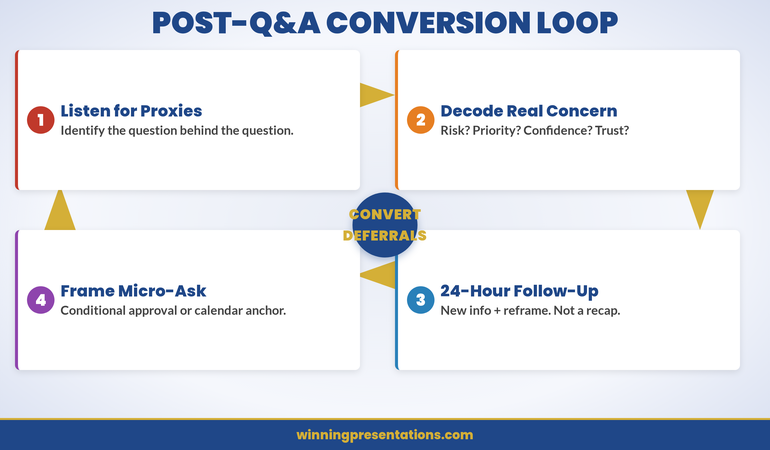
If you walk out of a Q&A with “we’ll think about it” and send a standard follow-up—”Thank you for the discussion, please find the deck attached”—you’ve wasted the most valuable conversion window in the entire decision cycle. The 24 hours after a Q&A session is when the decision-maker’s concerns are fresh, their memory of your answers is sharpest, and their willingness to engage is highest.

Your Q&A preparation needs to include a follow-up strategy, not just an in-session strategy. The follow-up email is where deferred decisions become approved ones.

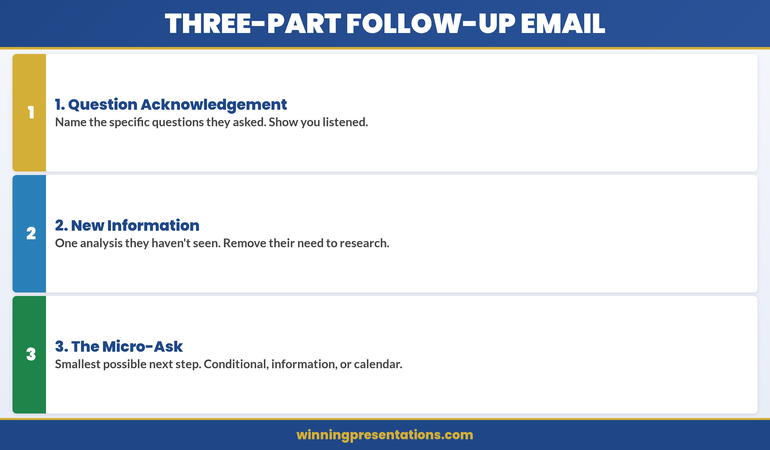
The Three-Part Follow-Up Email Structure

The post-Q&A follow-up email that converts deferrals into approvals has three parts. Not a summary. Not a recap. A conversion instrument.

Part 1: The Question Acknowledgement (2-3 sentences)
Name the specific questions that were asked. Not all of them—just the ones that revealed the decision-maker’s real concern. “You raised two important questions during our discussion: the implementation risk if the vendor timeline slips, and the impact on the Q3 reforecast if we start before Q2 results are final.” This tells the reader: I was listening to what you actually care about, not what I wanted to talk about.

Part 2: The New Information (3-5 sentences)
This is the critical section. Provide one piece of information, analysis, or framing that wasn’t in the presentation or the Q&A. Not something you forgot—something you’ve now prepared specifically in response to their concern. “Since our meeting, I’ve modelled the scenario where the vendor timeline slips by 6 weeks. The financial impact is £40k in additional parallel running costs—within our contingency budget of £75k. The attached one-page analysis shows the three trigger points where we’d escalate.” This demonstrates responsiveness and removes the decision-maker’s need to do their own analysis.

Part 3: The Micro-Ask (1-2 sentences)
Don’t ask for the full approval again. Ask for the smallest possible next step. “Would you be comfortable giving a conditional go-ahead for Phase 1, with Phase 2 contingent on the Q2 review?” Or: “Can we schedule 15 minutes next Tuesday to review the updated risk analysis? I can have it ready by Monday.” The micro-ask works because it reduces the decision from “approve everything” to “agree to this small thing.” And small agreements compound.

Three-part follow-up email structure infographic showing Question Acknowledgement, New Information, and Micro-Ask as stacked cards for converting deferred decisions

Answering the Question They Didn’t Ask Out Loud

The most important question in any Q&A session is the one that wasn’t asked. Decision-makers rarely voice their deepest concern directly. Instead, they ask proxy questions—questions that circle the real issue without naming it.

Here’s how to decode common proxy questions:

“Can you walk me through the implementation timeline again?”
They’re not confused about the timeline. They’re worried the project will overrun and they’ll be associated with a failure. Your follow-up should address implementation risk explicitly—not repeat the timeline.

“Have you considered any alternatives?”
They’re not suggesting you missed options. They’re testing whether you’re married to one solution or capable of pivoting if it doesn’t work. Your follow-up should show flexibility: “If the initial approach encounters [specific obstacle], we have two fallback options already scoped.”

“What does the team think about this?”
They’re not asking for a poll. They’re worried about execution capability—does the team have capacity and willingness to deliver? Your follow-up should name specific people and their commitments.

If you predicted these questions before the session, you’ll recognise the proxy pattern in real time. Your follow-up email becomes the place where you answer the real question directly—something that’s difficult to do in the social dynamics of a live meeting but perfectly natural in a written follow-up.

Want to Predict the Questions Before They’re Asked?

The Executive Q&A Handling System includes the question prediction framework that maps likely objections to specific decision-maker roles—so your follow-up can address concerns when they arise.

Explore the System →

The 24-Hour Window: Why Timing Matters More Than Content

You have 24 hours after a Q&A session to send the follow-up that converts the deferral. After 24 hours, two things happen that work against you.

First, the decision-maker’s memory of your answers starts to degrade. They remember their own questions clearly—but your answers blur. If you don’t reinforce your strongest answers in writing within 24 hours, the decision-maker reconstructs their own version of what you said. That reconstruction is rarely favourable.

Second, other priorities fill the gap. The urgency you created in the presentation dissipates. By Wednesday, your Monday Q&A feels like last week’s problem. The decision-maker’s calendar fills with new requests, new presentations, new decisions. Your proposal moves from “I need to decide on this” to “I should revisit this when I have time.” That time never comes.

The 24-hour follow-up breaks this pattern. It arrives while the decision-maker still remembers the conversation, still feels the momentum, and still has mental space for your proposal. It gives them a reason to act now instead of later.

If you missed the 24-hour window, a 48-hour follow-up still works—but you need to create a new urgency. “Since our discussion, I’ve learned that the vendor pricing expires end of month” or “The project team I’ve reserved will be reassigned to another initiative on Friday.” Genuine time pressure, not manufactured scarcity.

Framing the Next Step So Small They Can’t Say No

The biggest mistake in post-Q&A follow-ups is asking for the same decision that was deferred. If the decision-maker said “we’ll think about it” to a £500k investment, asking again for £500k produces the same result.

Instead, shrink the ask. There are three ways to do this:

The Conditional Approval: “Would you be comfortable approving Phase 1, with Phase 2 contingent on [milestone]?” This works because it turns one big decision into two smaller ones. The first decision feels lower risk.

The Information Request: “Would it be helpful if I prepared a one-page risk analysis addressing the scenario you raised? I could have it ready by Thursday.” This works because you’re not asking for a decision—you’re asking for permission to be helpful. Nobody says no to “can I give you more information?”

The Calendar Anchor: “Can we block 15 minutes next Tuesday to review the updated analysis together?” This works because it commits the decision-maker to a specific follow-up moment. Without a calendar anchor, “we’ll think about it” means “we’ll forget about it.”

Each of these micro-asks does the same thing: it creates forward momentum without requiring the decision-maker to overcome the inertia of the full commitment. And once they’ve said yes to the small step, the full approval becomes a natural continuation, not a new decision.

This is why understanding how to handle situations where you don’t know the answer during the Q&A itself is so valuable—because “I’ll research that and send you the analysis by tomorrow” becomes a natural bridge to the follow-up email. The gap in your knowledge becomes your conversion opportunity.

Cycle infographic showing the four stages of the post-Q&A conversion loop: Listen for Proxy Questions, Decode the Real Concern, Send 24-Hour Follow-Up, and Frame the Micro-Ask

Stop Losing Approvals to Post-Q&A Silence

  • Follow-up email frameworks that convert “we’ll think about it” into approval within 48 hours—with templates for conditional approvals, information bridges, and calendar anchors
  • Question decoding guide that helps you identify the real concern behind proxy questions—so your follow-up addresses what the decision-maker actually cares about

Get the Executive Q&A Handling System →

Designed for the critical 24 hours after Q&A sessions where you can build momentum—because follow-up strategy often determines whether a deferral becomes a decision.

People Also Ask

How long should a post-Q&A follow-up email be?

Under 200 words in the email body. Decision-makers scan, they don’t read. Your email should have three short sections: acknowledge the key questions (2-3 sentences), provide one new piece of information (3-5 sentences), and make one small ask (1-2 sentences). If you need to provide detailed analysis, attach it as a one-page document and reference it in the email—don’t embed it.

Should I copy everyone who was in the Q&A session?

Copy only the people whose concerns you’re addressing directly. If the CFO asked the key question, send the follow-up to the CFO and copy your sponsor. Don’t copy the entire meeting list—it diffuses accountability and makes the email feel like a broadcast instead of a targeted response. If other attendees need updates, send those separately with different framing.

What if the decision-maker doesn’t respond to my follow-up email?

Wait 48 hours, then send a one-line follow-up with a calendar link: “Would 15 minutes on [specific day] work to discuss? Here’s a link to my calendar.” If there’s still no response after a week, the issue isn’t your follow-up technique—it’s either a priority misalignment or an organisational blocker. Ask your internal sponsor what’s happening behind the scenes before sending another email.

Is This Approach Right for You?

This is for you if:

  • You’ve had Q&A sessions that went well but ended with “we’ll think about it” instead of a decision
  • You’re sending standard “thank you for the meeting” follow-ups and not getting traction
  • You want a structured approach to the post-presentation phase that most Q&A training ignores
  • You’re presenting proposals that require multiple stakeholder approvals and need to keep momentum between meetings

This is NOT for you if:

  • Your Q&A sessions consistently end with clear decisions—your current process is working
  • You’re in a context where follow-up emails aren’t culturally appropriate (some organisations require formal proposal resubmission instead)
  • The deferral is genuinely about budget timing, not about unresolved concerns—in that case, a follow-up email won’t change the fiscal calendar

Frequently Asked Questions

I’m worried that a follow-up email will seem pushy. How do I avoid that?

Pushiness comes from asking for the same thing again without adding value. The three-part structure avoids this by design: you acknowledge their specific concern (showing you listened), provide new information they didn’t have before (adding value), and frame a smaller ask (reducing pressure). This reads as helpful and responsive, not pushy. The key is the new information—if your follow-up contains nothing the decision-maker didn’t already have, it is pushy.

What if there were multiple decision-makers and they had different concerns?

Send separate follow-ups. The CFO gets a follow-up addressing financial risk. The CTO gets a follow-up addressing technical feasibility. Each email should feel like a personal response to their specific question, not a mass communication. If you need both to agree, include one line that bridges to the other stakeholder’s concern: “I’ve also prepared the technical risk analysis that [CTO name] requested—happy to share if helpful.”

Should my follow-up email include the presentation deck as an attachment?

Only if they asked for it. Attaching the full deck makes your email feel like a broadcast, not a targeted response. Instead, attach only the new material—the one-page analysis, the updated financial model, the risk scenario you modelled. This signals that the follow-up contains something they haven’t seen before, which is the reason to open it.

The Winning Edge — Weekly

Q&A strategies, executive communication frameworks, and the presentation techniques that get decisions approved. One email weekly. Built for executives who present to other executives.

Join The Winning Edge

About the Author

Mary Beth Hazeldine is Owner & Managing Director of Winning Presentations. With 24 years of corporate banking experience at JPMorgan Chase, PwC, Royal Bank of Scotland, and Commerzbank, she advises executives across financial services, healthcare, technology, and government on structuring presentations for high-stakes funding rounds and approvals.

Book a discovery call | View services

11 Mar 2026
Executive hand resting on a polished conference table in a moment of pause, microphone in soft focus background, navy and gold tones, calm professional atmosphere

The Pause Before You Answer: Why the Best Q&A Performers Wait Three Seconds

I once had to present 200 redundancies to a room that didn’t know they were coming. The questions afterwards were the hardest I’ve ever faced. Not because they were complex — because they were human. Angry. Frightened. Personal.

The single thing that kept me from falling apart during that Q&A was a three-second pause before every answer. Not because I needed time to think. Because without the pause, my nervous system would have matched the room’s panic — and panic answers are always wrong.

That three-second gap is the most underrated technique in executive Q&A. Most people rush to answer because silence feels dangerous. It’s not. Silence is where authority lives.

Quick answer: The pause before answering in Q&A does three things simultaneously. It gives your prefrontal cortex time to override the amygdala’s fight-or-flight impulse (which produces reactive, defensive answers). It signals to the audience that you’re considering their question seriously rather than deflecting. And it creates a micro-rhythm that makes your answer land with more weight — because the room is already listening before you speak. Three seconds is the optimal interval: long enough to reset, short enough that it doesn’t feel like hesitation.

📋 Facing an executive Q&A session soon? The Executive Q&A Handling System (£39) includes the complete pause-and-respond framework — plus question prediction templates that let you prepare answers before the Q&A starts.

I’ve watched hundreds of Q&A sessions across banking, professional services, and technology. The pattern is almost universal: the presenter finishes their slides, opens the floor to questions, and the moment someone raises a hand, something shifts. The composure evaporates. The carefully structured delivery — clear points, measured pacing, confident tone — disappears. In its place: rapid-fire answers, defensive qualifications, and a subtle but unmistakable panic in the voice.

The executives who handle Q&A brilliantly all share one habit. They pause. Not a dramatic silence. Not a power move. A genuine, three-second space between the question and the answer. It looks like consideration. It feels like control. And it produces answers that are materially better than whatever would have come out of their mouths in the first 0.5 seconds.

I learned this the hard way. Early in my banking career, I treated every question as a test of speed — as though the faster I answered, the more competent I appeared. It took me years to understand that speed signals anxiety, not expertise. The most senior executives I’ve worked with across JPMorgan, PwC, and Commerzbank all do the same thing: they wait. And the room respects them for it.


The 3-second Q&A pause technique showing what happens neurologically: amygdala override, audience attention, and answer quality improvement

Why Rushing to Answer Destroys Your Credibility

When you answer a question the instant it’s asked, you send an unintended signal: I’m afraid of silence. The audience reads this as anxiety, not preparedness. Even if your answer is technically correct, the delivery undermines its authority.

Rushed answers have three structural problems. First, they tend to be longer than necessary — because you start talking before you’ve decided where the answer ends, so you ramble until you find a conclusion. Second, they’re more likely to be defensive — because your amygdala is in control, and the amygdala’s default mode is protect, not persuade. Third, they often miss the real question — because many executive questions contain a surface question and an underlying concern, and it takes a moment to hear both.

A finance director once asked me: “What happens if the market contracts by 15% next quarter?” On the surface, that’s a forecasting question. Underneath, it’s a risk tolerance question — she was asking whether I’d planned for downside scenarios. If I’d rushed to answer the surface question with numbers, I’d have missed the real ask. The three-second pause gave me time to hear both layers and respond to the concern, not just the data point.

Understanding how to handle difficult questions in presentations starts with this recognition: the question you hear isn’t always the question being asked. The pause is what lets you hear the difference.

🎯 The Q&A Framework That Turns Difficult Questions Into Career-Building Moments

The Executive Q&A Handling System gives you the complete pause-and-respond methodology — so you walk into Q&A with composure, not dread:

  • The 3-second pause protocol with specific anchoring techniques — so the pause feels natural, not awkward
  • Question prediction templates that let you prepare answers to the questions executives actually ask in your context
  • The surface-question / underlying-concern framework — so you answer what’s really being asked
  • Hostile question deflection patterns that maintain authority without creating conflict

Get the Executive Q&A Handling System → £39

Built from hundreds of executive Q&A sessions across banking, technology, and professional services — where the wrong answer to the wrong question ends careers.

The Neuroscience Behind the Three-Second Pause

When a question hits you unexpectedly, your amygdala activates before your prefrontal cortex can engage. The amygdala’s response is fast, emotional, and defensive. The prefrontal cortex’s response is slower, analytical, and strategic. In real-time: the amygdala produces an answer in 0.3 seconds. The prefrontal cortex needs 2-3 seconds to formulate one.

This is why rushed answers sound different from considered answers. They’re literally generated by a different part of your brain. The amygdala answer protects you: it deflects, qualifies, hedges, or counter-attacks. The prefrontal cortex answer persuades: it structures, contextualises, concedes where appropriate, and redirects to strength.

The three-second pause is the bridge between these two systems. It’s not “thinking time” in the conventional sense. It’s neurological switching time — the interval your brain needs to move from reactive mode to strategic mode. Without that interval, you’re answering from the part of your brain designed to deal with sabre-toothed tigers, not board members.

This is also why Q&A anxiety feels so intense. The rapid-fire nature of questions keeps your amygdala perpetually activated. Each question is a new micro-threat. The pause breaks that cycle — it gives your nervous system a reset between each trigger.

What the Audience Actually Sees When You Pause

Most people avoid the pause because they believe the audience will interpret silence as not knowing the answer. This is almost always wrong. Research into conversational dynamics consistently shows that brief pauses before responses are interpreted as thoughtfulness, not incompetence.

When you pause for three seconds before answering, here’s what the executive audience sees: someone who takes the question seriously enough to consider their response. Someone who isn’t flustered. Someone who has enough command of the material to choose their words rather than blurt them. That’s authority.

Compare this to the fast responder. The executive who answers before the questioner has finished speaking. What the audience sees: someone reactive. Someone who may have missed the nuance of the question. Someone who values speed over accuracy. That’s anxiety disguised as competence.

There’s a reason that every senior partner I worked with at PwC paused before answering client questions. It wasn’t because they were slow. It was because they understood that the pause itself communicates a message: your question deserves a considered response.

Want to predict the questions before they’re asked? The Executive Q&A Handling System includes question prediction templates for common executive meeting types — so you’ve rehearsed your paused, structured response before the Q&A begins.

Get the Executive Q&A Handling System → £39

How to Build the Pause Into Your Q&A Performance

Knowing you should pause and actually doing it under pressure are different things. The amygdala is fast, and it fights against the pause. Here’s how to train it.

Step 1: The Physical Anchor. When a question lands, do something physical before you speak. Shift your weight slightly. Place your hand on the table. Take one deliberate breath. This physical action occupies the 0.3 seconds your amygdala needs to fire — and by the time you’ve completed the action, your prefrontal cortex is online. The key is that the physical anchor is small enough to be invisible to the audience but definite enough to feel to you.

Step 2: The Silent Repetition. In the first second of your pause, silently repeat the last three words of the question. This serves two purposes: it confirms you heard the question correctly, and it keeps your brain processing the question rather than jumping to an answer. If the question was “What happens to margins if raw material costs increase by 20%?” — you silently repeat “increase by 20%” — and by the time you’ve done that, your answer has already begun to structure itself.

Step 3: The Opening Frame. Before the content of your answer, use a framing phrase: “That’s an important consideration.” “Let me address that directly.” “There are two dimensions to that question.” These phrases buy a further half-second and signal to the audience that a structured answer is coming. They’re not filler — they’re architecture.

Practise this sequence in low-stakes conversations first. A colleague asks you a question in a meeting — pause, anchor, repeat, frame, then answer. Within a week, the sequence will feel natural. Within a month, it will be automatic.


The 3-step pause technique: Physical Anchor, Silent Repetition, and Opening Frame — with timing breakdown

⏱️ Stop Giving Rushed Answers That Undermine Your Best Presentations

The Executive Q&A Handling System gives you the complete pause-to-respond methodology — so your Q&A performance matches the quality of your prepared slides:

  • The physical anchor + silent repetition + opening frame sequence — rehearsed and ready before your next Q&A

Get the Executive Q&A Handling System → £39

Used by presenters who deliver brilliant slides — then lose credibility in the Q&A because their answers don’t match their preparation.

Using the Pause With Difficult or Hostile Questions

The pause is useful for routine questions. It’s essential for difficult ones.

When someone asks a hostile question — one designed to challenge your competence, expose a weakness, or embarrass you in front of the room — your amygdala response is strongest. The urge to answer immediately is overwhelming. And the immediate answer is almost always the wrong one. It’s defensive. It’s emotional. It gives the hostile questioner exactly what they wanted: evidence that you’re rattled.

The three-second pause neutralises hostile questions by changing the dynamic. The questioner expects a reaction. When they get silence followed by a composed, structured answer, their strategy fails. The room’s attention shifts from the attack to your response. And because your prefrontal cortex had time to engage, your response addresses the substance of the question rather than its tone.

Here’s a practical example. A board member asks: “Isn’t this the same strategy that failed last year?” That’s hostile framing. The amygdala answer: “No, this is completely different because—” (defensive, reactive, already losing). The paused answer: “That’s a fair comparison to draw. The strategy shares one element with last year’s approach — the market targeting. The execution model, the pricing, and the team structure are new. Let me walk you through the three changes.” Same information. Completely different authority.

The complete guide to presentation Q&A covers the full taxonomy of difficult questions — but the pause is the foundation that every other technique builds on.

Facing hostile questions in your next Q&A? The Executive Q&A Handling System includes deflection patterns for the most common hostile question types — with specific language you can adapt to your context.

Get the Executive Q&A Handling System → £39

PAA: Quick Answers on Q&A Pausing

Won’t pausing before answering make me look like I don’t know the answer?
No — the opposite. Research shows brief pauses (2-4 seconds) are interpreted as thoughtfulness, not ignorance. What looks like not knowing the answer is rambling, filler words, and defensive qualifications — all of which happen when you rush. A confident pause followed by a structured answer signals command of the material.

How long is too long to pause before answering a question?
Beyond 5 seconds, the pause starts to read as hesitation rather than consideration. The optimal window is 2-4 seconds. Three seconds is the sweet spot — long enough for your prefrontal cortex to engage, short enough to feel natural. If you genuinely need more time, use a bridging phrase: “Let me think about the best way to frame this for you.”

Can I practise the pause technique alone, or do I need a coach?
You can build the core habit alone. Start in low-stakes conversations — colleague questions, team check-ins, informal discussions. The physical anchor (a small movement before speaking) and the silent repetition (repeating the last few words of the question internally) can both be practised without anyone knowing. Within a week of deliberate practice, the pause will feel less forced.

Is This Right For You?

✓ This is for you if:

  • You deliver strong presentations but your Q&A answers don’t match the quality of your prepared slides
  • You rush to answer questions and then wish you’d said something different
  • You’re facing an upcoming Q&A with senior executives and want a concrete technique to improve your composure

✗ This is NOT for you if:

  • Your Q&A challenge is primarily anxiety-related (physical symptoms, avoidance) — see Conquer Speaking Fear for root cause work
  • You already pause naturally and your challenge is structuring the answers themselves

💬 The Q&A System Built From Hundreds of Executive Sessions Across Three Continents

The Executive Q&A Handling System was built from real Q&A sessions in boardrooms where the wrong answer to one question can derail a project, a budget, or a career:

  • The full pause-and-respond protocol — physical anchor, silent repetition, opening frame — with practice exercises
  • Question prediction templates for board meetings, QBRs, investor sessions, and steering committees
  • Hostile question deflection patterns — including the specific language that neutralises aggressive framing
  • The surface-question / underlying-concern framework that reveals what the questioner really wants to know

Get the Executive Q&A Handling System → £39

Built from 24 years of executive Q&A sessions at JPMorgan Chase, PwC, RBS, and Commerzbank — where composure under questioning determines outcomes.

Frequently Asked Questions

What if I pause and then my mind goes blank?

This is the most common fear — and the pause actually prevents it. Mind-blanking in Q&A happens when the amygdala overwhelms your working memory. The pause gives your prefrontal cortex time to engage, which keeps your working memory functional. If you do blank after pausing, use the bridging phrase: “Let me make sure I address the right dimension of that question.” This buys another 3-5 seconds and often the answer surfaces during the bridge.

Does the three-second pause work in fast-paced meetings where multiple people are asking questions?

Yes — and it’s more important in fast-paced settings. When questions are coming rapidly, your nervous system escalates with each one. The pause resets the escalation. Even in a rapid-fire Q&A, a 2-second pause before each answer prevents the cumulative stress buildup that leads to deteriorating answer quality. The room actually benefits from the rhythm — it creates space for them to process your answers before the next question.

How do I handle follow-up questions that are fired immediately after my answer?

Apply the same pause. Follow-up questions are where most people lose composure — because the follow-up feels like the questioner wasn’t satisfied. Your amygdala interprets the follow-up as escalation. The pause disrupts that interpretation. It gives you time to recognise whether the follow-up is a genuine clarification (answer it directly) or a challenge to your competence (address the underlying concern, not the surface question).

📬 The Winning Edge

One email per week. Q&A strategies, executive communication techniques, and the mistakes I see in boardrooms across three continents. No fluff. Just what sharpens your edge.

Subscribe to The Winning Edge

Read next: If you’re presenting a quarterly forecast and the Q&A afterwards is what concerns you, read how to simplify your forecast slide so the Q&A has fewer surprises. And if presentation anxiety goes deeper than Q&A nerves, read the humiliation recovery story I’ve never told before.

Your next Q&A session is coming. Before you walk into it, try one thing: pause for three seconds before every answer. Not because you need time. Because the pause changes what comes out of your mouth — and how the room receives it. Three seconds. That’s all it takes to shift from reactive to authoritative.

About the Author

Mary Beth Hazeldine is the Owner & Managing Director of Winning Presentations. With 24 years of corporate banking experience at JPMorgan Chase, PwC, Royal Bank of Scotland, and Commerzbank, she has delivered high-stakes presentations in boardrooms across three continents.

A qualified clinical hypnotherapist and NLP practitioner, Mary Beth combines executive communication expertise with evidence-based techniques for managing presentation anxiety. She has trained thousands of executives and supported high-stakes funding rounds and approvals.
Book a discovery call | View services

05 Mar 2026
Executive reviewing structured Q&A briefing document at desk before high-stakes presentation

The Q&A Briefing Document: What to Prepare When Stakes Are Career-Defining

Most executives prepare for Q&A by guessing which questions might come up. That’s why most executives panic when something unexpected gets asked.

The difference between recovering gracefully and freezing for 47 seconds isn’t luck. It’s a briefing document.

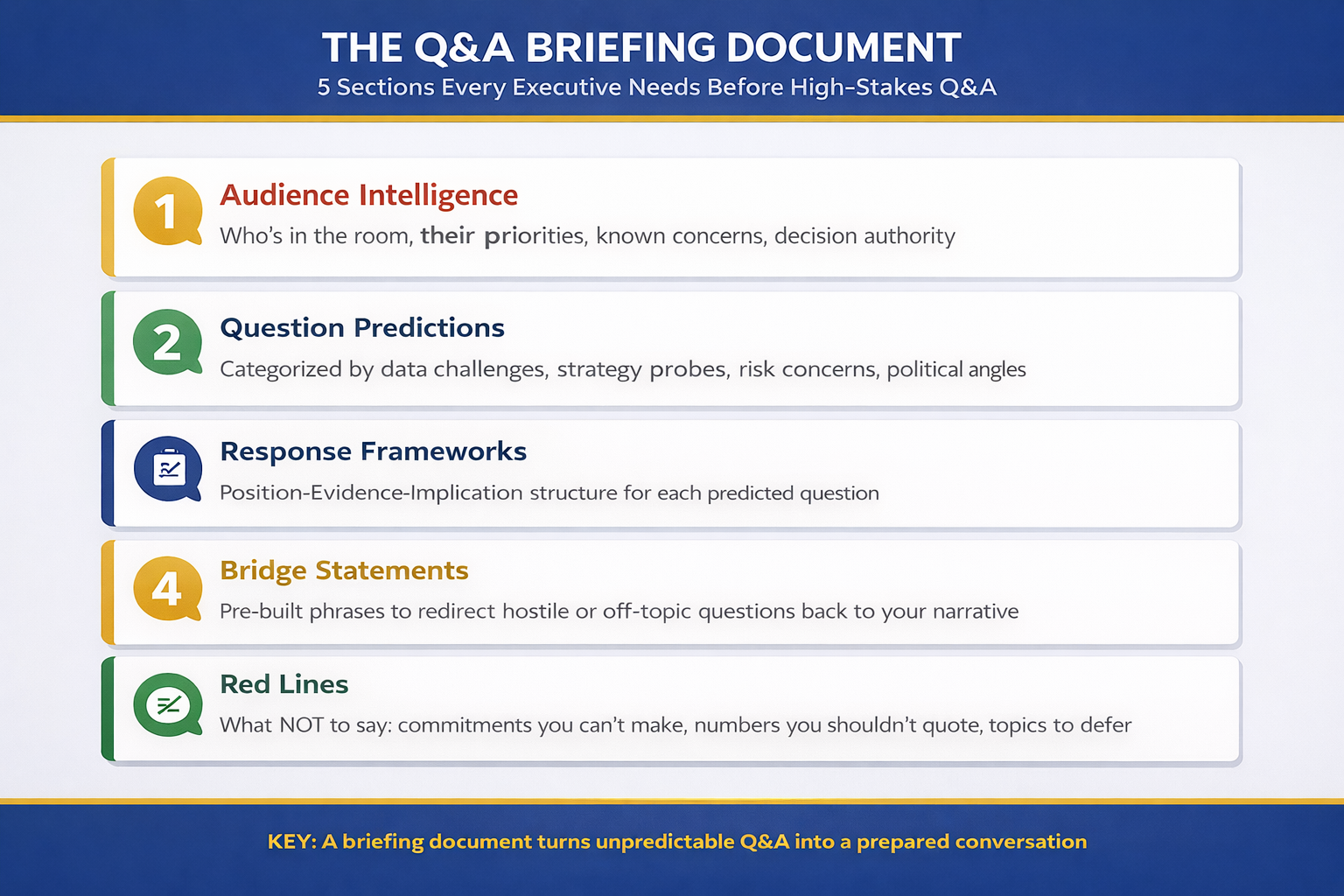
Quick answer: A Q&A briefing document is a structured, written preparation system that maps your audience’s concerns, predicts likely questions by category, and provides response frameworks rather than memorised answers. It’s the difference between defensive scrambling and confident, coherent replies. The five sections every briefing doc must contain are: Audience Intelligence, Question Predictions by Category, Response Frameworks, Bridge Statements, and Red Lines.

Feeling unprepared for upcoming Q&A? You’re not alone.

Most executives wing their Q&A preparation and hope they won’t be challenged on weak points. The Executive Q&A Handling System teaches you exactly how to build a briefing document that covers every angle—and gives you the confidence to handle anything.

Get the Executive Q&A Handling System → £39

The Executive Who Froze (And Recovered)

Sarah, a finance director presenting to the board, was mid-Q&A when a director asked something she hadn’t anticipated. Forty-seven seconds of silence. The room held its breath.

What nobody in that boardroom knew: she had prepared a briefing document for the first time.

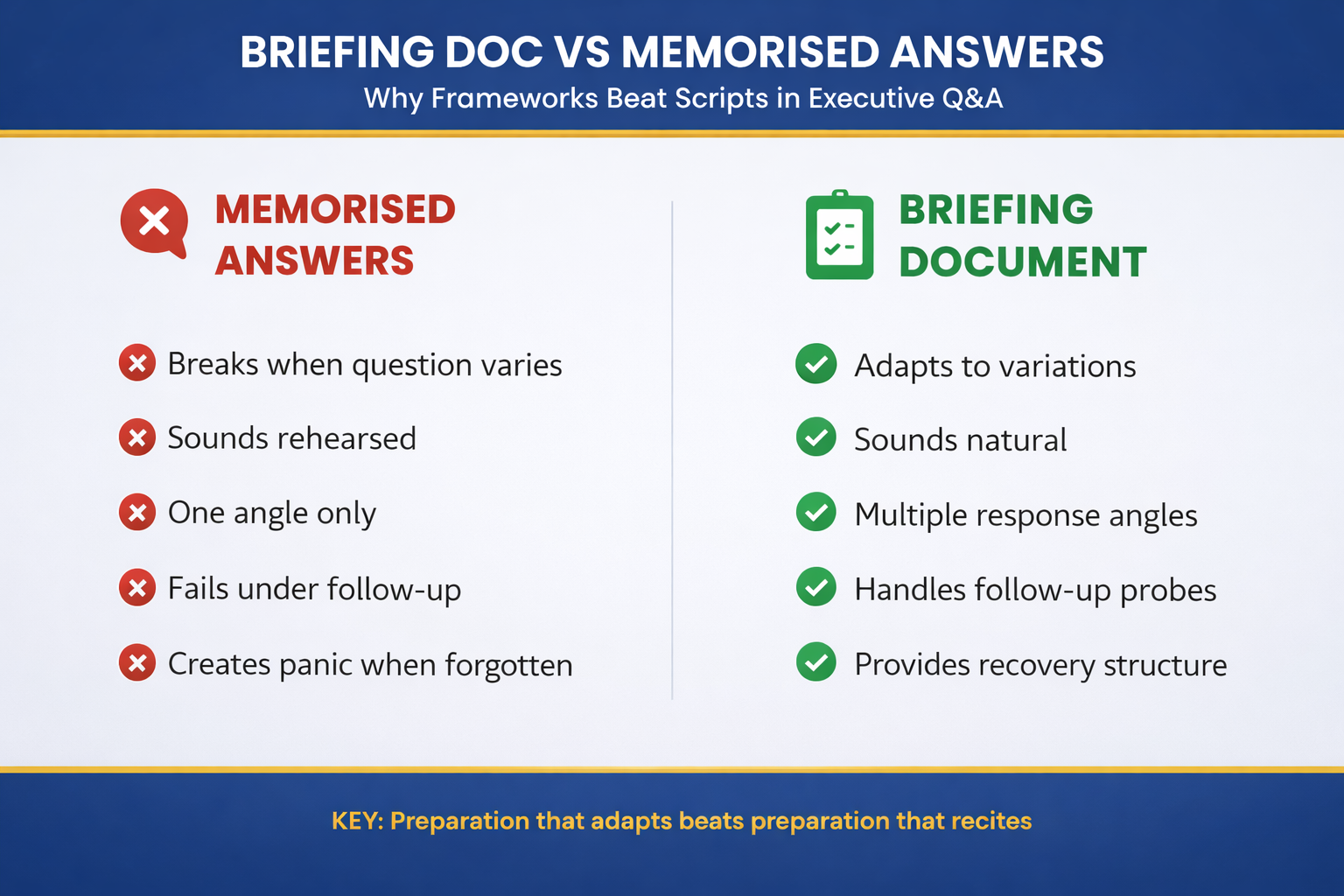
That document didn’t contain the answer to that specific question. But it contained something more valuable—a response framework. A structure for how she approached difficult questions. Response frameworks don’t predict every question. They teach your mind how to think under pressure.

During those 47 seconds, Sarah wasn’t paralysed. She was using her framework. Acknowledging the question, taking a breath, then pivoting to what she knew. The board didn’t notice the pause was panic. They noticed she recovered with composure.

When she came back to the office, she said the same thing every executive says after their first briefing document: “Why didn’t anyone teach me to do this earlier?”

What the Q&A System Teaches You

  • How to build a briefing document that covers every category of question your specific audience might ask
  • The exact structure of response frameworks that work under pressure—not rigid answers, but thinking patterns
  • How to spot your dangerous gaps before the presentation, not during it
  • How to practise with your briefing document so you’re truly prepared, not just rehearsed
  • The psychology of boardroom Q&A: what questions executives really fear, and why

Get the Executive Q&A Handling System → £39

Used by finance directors, CEOs, and board-level executives facing career-defining presentations

What a Q&A Briefing Document Actually Is

A Q&A briefing document isn’t a script. It’s not a list of prepared answers you’ve memorised. It’s a working document—a physical or digital artifact you prepare before the presentation, and that you can reference if you need to.

Think of it as an intelligence file on your own presentation. It contains everything you need to know to answer questions confidently, but it’s structured in a way that your nervous system can actually use it under pressure.

The briefing document serves three purposes at once:

  • Diagnostic: It forces you to identify gaps in your own knowledge before the presentation starts.
  • Practical: It gives you a tool to reference if you blank on a detail during live Q&A.
  • Psychological: It transforms your internal state from “I hope they don’t ask about X” to “I’m prepared for X.”

The preparation process—building the document—matters as much as the document itself. The act of thinking through what your audience cares about, what they might challenge you on, and how you’ll respond, is what rewires your confidence.

The Five Sections Every Briefing Document Needs

Every effective Q&A briefing document contains five core sections. This isn’t arbitrary structure—it’s the sequence your mind needs to move through when preparing for high-stakes Q&A.

Section 1: Audience Intelligence

Start by documenting who is in the room. Not names—psychology. What are their concerns? What do they care about? What keeps them awake at night about your topic?

If you’re presenting to a board, the finance director cares about cash flow and risk. The HR director cares about people impact and retention. The CEO cares about competitive positioning. Write down what each stakeholder in the room actually wants to know.

Section 2: Question Predictions by Category

This isn’t fortune-telling. It’s categorisation. Break down likely questions into categories: Financial Impact, Implementation Risk, Competitive Response, Timeline Feasibility, Resource Requirements, and anything else specific to your situation.

Under each category, list 3-5 specific questions you predict. Not every possible question—just the ones that would genuinely challenge your presentation if asked.

Section 3: Response Frameworks

This is the core of the document. For each category of question, write a response framework—not a rigid answer, but a thinking structure.

A framework might look like: “For financial impact questions, I acknowledge the concern, present the three-year projection, address the worst-case scenario, then connect back to the strategic benefit.” That structure applies to multiple specific questions, but it’s not memorised dialogue.

Section 4: Bridge Statements

Write 4-6 bridge statements—sentences that pivot you from a difficult question back to your core message. These aren’t evasions. They’re authentic pivots that acknowledge the question while steering toward what matters.

Examples: “That’s a fair concern, and here’s how we’re mitigating that risk…” or “I understand where that concern comes from. What we’re focused on is…”

Section 5: Red Lines

This section identifies what you will not say. What topics are out of bounds? What commitments can’t you make? What doesn’t fall under your remit? Be explicit about your boundaries so you’re not caught off guard by a question that puts you in a difficult position.

Writing down your red lines in advance means you can answer “I can’t comment on that” or “That’s outside my brief, but here’s what I can tell you…” without hesitation or defensiveness.


The Q&A Briefing Document infographic showing five sections every executive needs before high-stakes Q&A: Audience Intelligence, Question Predictions, Response Frameworks, Bridge Statements, and Red Lines

How to Map Likely Questions to Your Specific Audience

The difference between a generic briefing document and a powerful one is specificity. You’re not preparing for every possible Q&A in existence. You’re preparing for this audience, in this room, on this topic.

Step 1: Identify stakeholder concerns. For each person in the room, write down their primary concern about your topic. If they’re the CFO, their concern is likely financial sustainability. If they’re the operations director, it’s feasibility. If they’re the compliance officer, it’s regulation and risk.

Step 2: Translate concerns into questions. Take each concern and turn it into specific questions that person might ask. The CFO doesn’t just care about “finances”—they care about cash flow impact in quarter one, impact on shareholder return, and whether you’ve modelled for recession. Each of those becomes a distinct predicted question.

Step 3: Identify the hard questions. Be honest: what would genuinely undermine your presentation if asked? What are the weak points in your argument? What aren’t you completely certain about? Those become your priority questions in the briefing document.

Step 4: Map to precedent. Have similar questions come up in previous presentations? Is there a pattern in how this organisation asks questions? Add those to your document.

The briefing document isn’t complete until you feel genuinely prepared for the questions that would most hurt you.

Building Response Frameworks Within the Document

The second your briefing document becomes a script, it stops working. The moment you’re trying to remember memorised answers under pressure, your nervous system takes over and you blank.

Response frameworks are different. A framework is a thinking structure—a sequence of moves your mind makes to answer a category of questions confidently.

Here’s a practical example. If your presentation is about expanding into a new market, you might predict several questions about market viability. Your framework might be:

Framework for Market Viability Questions:

1. Acknowledge the legitimate concern (“The viability question is the right first question”)

2. Present the three-part evidence (market research data, competitor analysis, customer validation)

3. Address the worst-case scenario explicitly

4. Close by connecting back to the strategic imperative

That framework applies to “Is the market actually big enough?”, “What if we’ve miscalculated demand?”, and “How confident are you in the research?” None of those are the same question, but the framework structures your thinking for all of them.

Build 3-5 core frameworks for your presentation. Each one should feel like a natural way of thinking about that category of question, not a trick or a memorised pattern. When you practice with your frameworks, they become instinctive.

Building a briefing document requires knowing what structure actually works under pressure.

The Executive Q&A Handling System walks you through the exact process, with templates and real examples so you know exactly what goes in each section.

Get the Executive Q&A Handling System → £39

Practising With the Document

A briefing document that sits unread until presentation day is paperwork. A briefing document you practice with becomes your confidence.

Practice doesn’t mean memorising. It means familiarising yourself with the thinking patterns until they’re automatic. Here’s how:

Read through once a day. For the three days before your presentation, read the entire briefing document once. Not to memorise it—just to let your mind absorb the structure and key points.

Practice with the predicted questions out loud. Have someone ask you the 8-10 predicted questions in random order. Answer them using your frameworks, not the document. The document is your safety net, not your script.

Record yourself. Hear what you actually sound like. Are you pausing too long? Hesitating on certain topics? Sounding defensive? The briefing document is your thinking structure, but you still need to hear yourself deliver it.

Add notes as you practice. If a question stumps you during practice, add it to the document. If a framework doesn’t feel natural when you say it out loud, rewrite it. Your briefing document is a living tool that evolves as you practice.

The goal of practice is not perfection. It’s familiarity. When you’re nervous in the boardroom, your brain retreats to what’s familiar. Practice makes your frameworks and response patterns familiar.


Briefing Doc vs Memorised Answers comparison infographic showing why frameworks beat scripts in executive Q&A: memorised answers break under variation while briefing documents adapt and provide recovery structure

Eliminate the Dread of Unprepared Q&A

  • Stop winging it. Start with a documented, structured approach that removes the panic from high-stakes Q&A.
  • Walk into your next presentation knowing you’ve prepared for the questions that matter most—not just hoped they won’t come up.

Get the Executive Q&A Handling System → £39

Join 300+ executives who’ve transformed their Q&A preparation

The Difference Between a Briefing Doc and Memorised Answers

This distinction matters. It’s the difference between appearing prepared and actually being prepared.

Memorised answers are rigid. You prepare specific dialogue for specific questions. If the question comes out slightly differently than expected, you’re thrown off. Worse, you sound rehearsed. Your audience can hear the script.

Response frameworks are flexible. You’re not memorising words. You’re internalising a structure for thinking. When the question comes in a slightly different form, the framework still applies. When something unexpected gets asked, you can adapt your framework to address it.

Memorised answers fail under pressure. When your nervous system kicks in during a difficult moment, detailed memory retrieval is one of the first things that goes. You blank on word choice, phrasing, exact details. You start backtracking and clarifying, which makes you sound uncertain.

Response frameworks survive pressure. Frameworks are thinking patterns, not memory tasks. Even when you’re nervous, your brain can follow a sequence. “Acknowledge, explain, address the worst case, pivot” is a mental process, not dialogue to retrieve.

The briefing document supports frameworks, not scripts. It’s a reference tool that contains your key points, data, and bridge statements, but it trains you to think, not to recite.

That’s why executives who use briefing documents recover gracefully when challenged. They’re not searching their memory for a prepared answer. They’re following a thinking pattern they’ve internalised. It looks like presence and composure because it actually is.

The Executive Q&A Handling System teaches you the entire process: how to build a briefing document, how to develop response frameworks that work, and how to practice so it all feels natural.

Track C is specifically designed for executives facing career-defining presentations where the Q&A matters as much as the slides.

Get the Executive Q&A Handling System → £39

Is the Q&A Briefing Document Right for You?

A briefing document approach makes sense when the stakes are real. When you’re presenting to a board, to investors, to a sceptical audience, when one weak answer could undermine your entire presentation.

If you’re giving an internal update to your team, you probably don’t need this level of preparation. But if you’re a finance director presenting new strategy, a COO defending an operational change, a CEO pitching to the board, or any executive where the Q&A could be career-defining—yes. This is exactly for you.

Your nervous system doesn’t distinguish between “this is important” and “this could be career-changing.” It just knows you’re about to be questioned. A well-constructed briefing document tells your nervous system: you’re prepared. Which means your conscious mind can stay present instead of panicking.

24 Years of Boardroom Q&A, Distilled Into System

  • The exact five-section structure that executives use to prepare for the highest-stakes presentations
  • How to identify which questions will actually determine whether your audience trusts you
  • Response frameworks that work regardless of which variation of a question gets asked
  • The psychology of staying composed when challenged—and how a briefing document rewires that response
  • Real templates and examples you can adapt for your specific presentation, role, and audience

Get the Executive Q&A Handling System → £39

The same system used by board members, CFOs, and executives preparing for career-defining Q&A

Frequently Asked Questions About Q&A Briefing Documents

How long should a Q&A briefing document be?

Most effective briefing documents are 4-8 pages. Long enough to be comprehensive, short enough that you can scan it quickly. It’s not a white paper—it’s a working reference. If you need 20 pages, you’re documenting too much. Simplify to the core frameworks and key points.

Should I bring the briefing document to the presentation itself?

Depends on the format. If you’re seated at a table, it’s fine to have it in front of you (though you’ll rarely need to reference it if you’ve prepared well). If you’re standing and presenting, you’re probably not referencing it live. The real value is the preparation process. You’ve internalised the structure. The document stays with you mentally, not physically.

What if they ask something that isn’t in my predicted questions?

That’s the point of frameworks. Your response frameworks teach you how to think, not just how to answer specific questions. When something unexpected gets asked, you fall back on the framework. Acknowledge, think, respond—the structure holds you even when the specific question wasn’t predicted. That’s what Sarah did in the boardroom. The question wasn’t on her list, but her framework was strong enough to carry her.

How much time does building a briefing document take?

First time: 4-6 hours. You’re thinking through audience concerns, predicting questions, building frameworks from scratch. Once you’ve done it once, the second document takes 3-4 hours because you know the process. It’s focused work, not continuous. Most executives build it over a few days leading up to the presentation.

Get executive Q&A insights every week.

The Winning Edge newsletter delivers real strategies for the presentation moments that matter. Techniques, frameworks, psychology. Once a week, practical. No fluff.

Subscribe to The Winning Edge

Explore related articles in Q&A Mastery:

About the Author

Mary Beth Hazeldine has spent 24 years helping executives and boards navigate high-stakes presentations and Q&A. She’s worked with finance directors, CEOs, board members, and leaders facing career-defining moments. She created the Executive Q&A Handling System after realising that most executives prepare for Q&A backwards—hoping questions won’t come instead of systematically preparing for them. Now she teaches the preparation framework that separates executives who panic from those who handle anything the board throws at them.

Next step: If you have a high-stakes presentation coming up, start building your briefing document this week. Spend 30 minutes mapping your audience’s concerns. That alone will change how you approach the Q&A. Then, if you want the complete system, the Executive Q&A Handling System walks you through every section and teaches you the frameworks that work under real boardroom pressure.