Quick answer: Yes, executives take beta blockers before presentations. More than you think. But medication manages the symptoms without touching the fear underneath — and after 25 years in corporate banking and training as a clinical hypnotherapist, I can tell you there is a faster, more permanent path. Here is the honest breakdown of what works, what doesn’t, and what nobody in the boardroom will admit to.
📖 In This Article
- The pill in the boardroom bathroom
- What beta blockers actually do (and don’t do)
- The executive anxiety secret nobody discusses
- The dependency trap: when medication becomes a crutch
- What actually works long-term (from a hypnotherapist who lived it)
- Retrain your nervous system — not just your symptoms
- Common questions
- FAQ
I kept a box of propranolol in my desk drawer for three years.
Not prescribed. Borrowed from a colleague who “got them for migraines.” Every Monday morning, I would open the drawer, look at the box, and wonder if today was the day I would finally take one.
I never did. Not because I was brave, but because I was more afraid of the pill than the presentation. What if it made me drowsy? What if my boss noticed? What if I became dependent and couldn’t present without it?
Those three years taught me something that changed the direction of my career entirely. Working at JPMorgan Chase, then PwC, then Royal Bank of Scotland, I discovered that the medication question isn’t really about medication at all. It is about whether you want to manage the fear — or actually resolve it.
After training as a clinical hypnotherapist, I now understand exactly why I was right to hesitate. And why so many executives don’t.
Reaching for medication before your next presentation?
There is a structured, clinical programme that addresses the fear pattern directly — no pills, no white-knuckling. It retrains the nervous system response at the subconscious level. See Conquer Speaking Fear →

The Pill in the Boardroom Bathroom
Let me paint you a picture you will recognise.
It is 8:47am. You are presenting the quarterly update to the leadership team at 9:00. You are sitting in the bathroom stall. Your heart is hammering so loudly you can feel it in your ears. Your hands are cold and damp. Your mouth has gone completely dry.
And you are Googling “can I take a beta blocker 15 minutes before a presentation.”
I have been that person. Many of the executives I have worked with have been that person. The medication question is the most common thing I am asked in private — and the thing nobody will raise in a group setting.
Here is the reality: beta blockers for public speaking are extraordinarily common among senior professionals. Concert musicians have used propranolol for decades. Surgeons use them. Barristers use them. And yes — your colleagues on the executive floor use them too.
The question is not whether they work. They do, for certain symptoms. The question is whether they are the right solution for you.
What Beta Blockers Actually Do (And What They Don’t)
⚕️ Not medical advice. Beta blockers are prescription medication. Talk to your GP before taking them — they are not suitable for everyone, particularly those with asthma, low blood pressure, or certain heart conditions. This article discusses their use for presentation anxiety from a practical and psychological perspective, not a clinical one.
Beta blockers — typically propranolol — work by blocking adrenaline receptors. When your fight-or-flight response fires before a presentation, adrenaline floods your body. Propranolol stops that adrenaline from reaching your heart and muscles.
What beta blockers DO:
They slow your heart rate. They reduce hand tremor. They stop the visible shaking. They prevent that “thumping chest” sensation that makes you feel like everyone can see your fear. For purely physical symptoms, they can be remarkably effective within 30–60 minutes.
What beta blockers DON’T do:
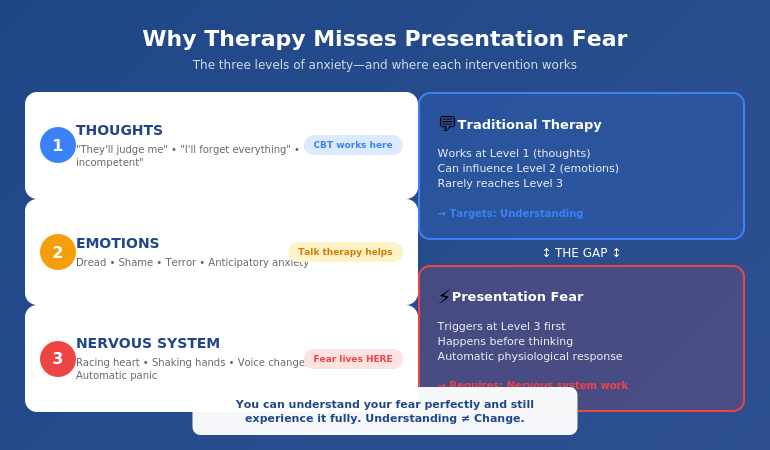
They do not touch the fear itself. They do not stop the negative thought loop (“they’re judging me,” “I’m going to forget my words,” “they can tell I’m nervous”). They do not build confidence. They do not improve your presentation skills. And critically — they do not help you the day you forget to take one.
This is the distinction most people miss. Beta blockers manage the physical expression of anxiety. They do not address the neurological pattern that creates it.
I have worked with executives who took propranolol before every presentation for five, ten, even fifteen years. When they finally forgot the pill or couldn’t get a refill in time, the panic returned at full force — sometimes worse than before, because now they had an additional fear layered on top: “I can’t present without my medication.”
Do executives take beta blockers before presentations?
Yes — far more commonly than most people realise. Beta blockers like propranolol are widely used by senior professionals to manage the physical symptoms of presentation anxiety, including racing heart and hand tremor. However, they only address symptoms and do not resolve the underlying fear. Many executives use them as a temporary bridge while developing longer-term anxiety management skills.
Your Fear Has a Pattern. You Can Break It.
Conquer Speaking Fear (£39, instant access) uses clinical hypnotherapy and NLP techniques to retrain the neurological pattern that creates presentation anxiety — not just mask the symptoms. No medication. No willpower. A different nervous system response.
Get Conquer Speaking Fear → £39
Designed by a clinical hypnotherapist with 25 years of corporate banking experience. £39, instant access.
The Executive Anxiety Secret Nobody Discusses
When I started training executives after leaving banking, the most surprising discovery was not how many professionals struggled with presentation anxiety. It was how many senior professionals struggled with it — and how completely they hid it.
Managing Directors. Partners. C-suite leaders. People who looked utterly composed at the front of the room.
Behind closed doors, here is what they told me:
“I’ve been taking propranolol before every board meeting for eight years. My wife doesn’t even know.”
“I rearranged my entire schedule last quarter to avoid presenting at the all-hands. I told my team I had a conflict.”
“I drink two glasses of wine before evening events where I might have to speak. I’ve done it for so long I don’t even think about it anymore.”
These are not weak people. These are accomplished professionals with decades of experience, running teams of hundreds, making decisions worth millions. And they are quietly medicating, drinking, or avoiding their way around a neurological pattern that nobody taught them how to change.
The shame keeps the problem invisible. And the invisibility keeps people reaching for the quick fix — because they do not know a permanent solution exists.
The Dependency Trap: When Medication Becomes a Crutch
I want to be clear: I am not anti-medication. Beta blockers are safe when prescribed appropriately, they have genuine medical applications, and for some people they serve as a valuable bridge while doing deeper work.
But here is the pattern I see repeatedly in my practice:
Stage 1: The relief. You take propranolol before a big presentation. Your heart doesn’t race. Your hands don’t shake. You think: “This is the answer.”
Stage 2: The habit. You take it before the next presentation. And the one after. You start carrying it “just in case.” The box moves from your desk drawer to your briefcase.
Stage 3: The dependency belief. You begin to believe you cannot present without it. This is not a physical dependency — beta blockers are not addictive. It is a psychological dependency. Your brain has created a new rule: “Safe presentations require medication.”
Stage 4: The expanded fear. Now you have two fears. The original presentation anxiety, plus a new one: “What happens if I can’t get my pills?” Travel, forgotten prescriptions, running out of refills — all become sources of anxiety that didn’t exist before.
This is not a theoretical risk. I have worked with three executives in the past year alone who came to me specifically because their propranolol dependency had escalated their presentation nerves rather than reduced them.

Is propranolol safe for public speaking?
Propranolol is generally considered safe for occasional use before presentations when prescribed by a doctor. It effectively reduces physical symptoms like rapid heartbeat and trembling. However, it can cause lightheadedness, fatigue, and a feeling of emotional disconnection. The larger concern is not physical safety but psychological dependency — the belief that you cannot present without it — which reinforces the anxiety pattern rather than resolving it.
Stop Managing the Symptom. Resolve the Cause.
Conquer Speaking Fear (£39, instant access) is built on the same clinical hypnotherapy and NLP techniques that resolved my own 5-year presentation phobia — without medication, without white-knuckling it, without “just pushing through.” The nervous system pattern changes permanently.
Get Conquer Speaking Fear → £39
25 years of corporate banking experience. Qualified clinical hypnotherapist and NLP practitioner. £39 — a fraction of the cost of one therapy session.
What Actually Works Long-Term (From a Hypnotherapist Who Lived It)
I was terrified of presenting for five years. Not mildly nervous — terrified. Racing heart, dry mouth, shallow breathing, the full physiological cascade that makes you want to cancel, call in sick, or find any excuse to let someone else present.
Beta blockers would have masked the symptoms. But here is what actually resolved the fear permanently:
1. Understand the pattern. Presentation anxiety is not a character flaw. It is a learned neurological response — your amygdala firing a threat signal based on a past experience (or series of experiences) where speaking in front of others felt dangerous. Once you see it as a pattern, you can change it.
2. Work at the subconscious level. This is where medication falls short. The fear response is generated below conscious awareness. Talking about it (traditional therapy) and thinking about it (willpower) operate at the wrong level. Clinical hypnotherapy and NLP techniques access the subconscious pattern directly.
3. Replace the response — don’t suppress it. Beta blockers suppress adrenaline. Hypnotherapy replaces the fear trigger with a calm, resourceful state. The difference: suppression requires ongoing medication. Replacement is permanent.
4. Build evidence. Every successful presentation without medication builds genuine neural evidence that you can do this. Medication-assisted presentations don’t build this evidence — your brain attributes the calm to the pill, not to you.
This is exactly the approach I built into Conquer Speaking Fear — the same techniques that got me from vomiting in the corridor to confidently presenting to boardrooms across three continents.
Retrain Your Nervous System — Not Just Your Symptoms
Here is the simplest way to think about the choice:
Beta blockers = turn down the volume on the alarm. The alarm still fires. You just don’t hear it as loudly. Remove the volume control, and the alarm is still there.
Nervous system retraining = change what triggers the alarm. When the presenting situation no longer registers as a threat, the alarm doesn’t fire. Nothing to suppress. Nothing to medicate. Nothing to remember to pack in your briefcase.
I have worked with executives who spent years — and thousands of pounds — on therapy, coaching, and medication. When they finally addressed the subconscious pattern, the shift happened in weeks, not years.
If you are currently using beta blockers and they are helping you function, I am not suggesting you stop immediately. But I am suggesting you start building the permanent solution alongside them. Use the medication as a bridge, not a destination. Work on calming your nerves at the source, and you will find you need the bridge less and less — until one day you leave the pill in the drawer and present anyway.
That is the day everything changes.
What are natural alternatives to beta blockers for presentations?
The most effective natural alternatives address the root neurological pattern rather than just symptoms. Clinical hypnotherapy and NLP retraining can permanently change the fear response. For immediate physical relief, diaphragmatic breathing (4-7-8 technique), peripheral vision activation, and bilateral stimulation can reduce the fight-or-flight response within 60–90 seconds. These techniques build genuine confidence because your brain learns it can manage the situation without external support.
🎓 25 Years Coaching Senior Professionals Without Beta Blockers
Conquer Your Fear of Public Speaking is built from 16 years coaching senior professionals across financial services, consulting, healthcare, and technology — alongside 25 years of corporate banking experience. Every technique — the nervous system regulation work, the breathing protocols, the cognitive reframing scripts — comes from real client work with executives who chose to build genuine confidence rather than mask symptoms.
Designed for senior professionals who want to manage acute presentation anxiety without medication — and build the regulation skills that last.
Get Conquer Your Fear of Public Speaking → £39
Instant download — lifetime access to every framework and technique.
Frequently Asked Questions
Can I take beta blockers and do nervous system retraining at the same time?
Absolutely — and this is often the smartest approach. Use beta blockers as a bridge while actively retraining your fear response through hypnotherapy or NLP techniques. As the retraining takes effect, you will naturally find you need the medication less. Many of my clients follow this exact path: medication provides immediate relief while the deeper work creates permanent change. The key is treating the medication as temporary support, not a long-term solution.
My presentation anxiety is only physical — surely medication is the right answer?
This is one of the most common misconceptions. What feels “only physical” — racing heart, trembling, sweating — is actually the physical expression of a subconscious fear pattern. Your amygdala detects a perceived threat and triggers the adrenaline cascade. Beta blockers block the adrenaline from reaching your muscles and heart, but your amygdala still fires the threat signal every single time. Address the signal itself, and the physical symptoms resolve naturally without medication.
How long does nervous system retraining take compared to medication?
Medication works in 30–60 minutes but stops working when you stop taking it. Nervous system retraining through clinical hypnotherapy and NLP typically shows significant improvement within 2–4 weeks of consistent practice, with permanent results. Most executives I work with notice a measurable reduction in their presentation anxiety after the first week. The trade-off is clear: immediate but temporary symptom relief versus slightly longer but permanent resolution.
Will my doctor judge me for asking about beta blockers for presentations?
No. GPs prescribe propranolol for performance anxiety regularly — it is one of the most common off-label uses. If you want to discuss it with your doctor, be direct: “I experience significant physical anxiety symptoms before work presentations and I would like to discuss whether propranolol might help as a short-term bridge while I work on longer-term solutions.” Most doctors will appreciate the thoughtful approach and the fact that you are not looking for a permanent prescription.
📧 The Winning Edge Newsletter
Weekly insights on presentation confidence, evidence-based anxiety techniques, and what actually works for professionals who need to present at a senior level.
Not ready for the full programme? Start here instead — download the free 7 Presentation Frameworks guide, which gives you a structured foundation so your nervous system has one less unknown to panic about.
📌 Related: Even when the anxiety is managed, most executives receive feedback that sounds positive but means nothing. Read Why “Great Presentation” Is the Worst Feedback You Can Get — and learn how to get the actionable input that actually improves your next performance.
Your next step: If you have been reaching for medication before presentations — or thinking about it — recognise that as a signal, not a solution. The fear has a pattern. The pattern can be changed. Start with understanding why the fear exists, then use Conquer Speaking Fear to retrain the response permanently.
Leave the pill in the drawer. Build the skill instead.
About the Author
Mary Beth Hazeldine is the Owner & Managing Director of Winning Presentations. With 25 years of corporate banking experience at JPMorgan Chase, PwC, Royal Bank of Scotland, and Commerzbank, she has delivered high-stakes presentations in boardrooms across three continents.
A qualified clinical hypnotherapist and NLP practitioner, Mary Beth combines executive communication expertise with evidence-based techniques for managing presentation anxiety. She advises executives across financial services, healthcare, technology, and government on managing presentation anxiety and high-stakes speaking situations.