Category: Presentation Anxiety

28 Mar 2026
Abstract representation of anticipatory anxiety before a high-stakes presentation showing a lone figure in a dimly lit corridor

The Anticipatory Anxiety Loop: Why Dreading the Presentation Is Worse Than Giving It

Most executives don’t fear the presentation itself. They fear the days leading up to it. The dread starts on Monday when the presentation is Friday. It builds through the weekβ€”rehearsal feedback loops in your mind, worst-case scenarios feel plausible, sleep becomes difficult. Then Thursday night arrives and you’re exhausted before you’ve even stepped in front of the room. The paradox is that the actual presentation, once it starts, rarely feels as bad as the week of anticipating it.

Amara had scheduled a board presentation for March 15th. It was importantβ€”a funding case for a new product line, the kind of thing that could accelerate her career if she landed it. When she put it on her calendar on February 28th, it felt manageable.

By March 10th, five days before, her stomach started tightening every morning. She rehearsed in her head while commuting. She woke at 3 a.m. replaying questions she imagined the board might ask. She changed slides twiceβ€”not because they were broken, but because she was searching for safety that no slide could provide.

On March 14th, exhausted, she called a colleague. “I’m not sleeping. I’m stressed about this. I don’t know if I’m ready.” The colleague asked: “Do you know your material?” “Yes,” she said. “Could you explain the investment case to me right now?” “Yes, easily.” “Then the presentation will be fine. The dread you’re feeling isn’t about readinessβ€”it’s just dread.”

It was the most useful thing anyone said to her that week. Not “You’ll be great,” which felt hollow. Not “Don’t be nervous,” which is impossible. Just: “That feeling isn’t information. It’s just the anticipatory loop running.”

If presentation anxiety is making the week before your big talk harder than the talk itself, you might explore Conquer Speaking Fear. It’s structured specifically for acute presentation anxietyβ€”with nervous system techniques, reframing exercises, and practical tools designed for the hours leading up to high-stakes presentations.

Explore Conquer Speaking Fear β†’

What is anticipatory anxiety?

Anticipatory anxiety is the worry you experience before an eventβ€”in this case, a presentation. It’s not the nervousness you feel when the presentation actually starts. It’s the dread that builds in the days (or hours) leading up to it.

The distinction matters because the two anxieties serve different purposes. Nervousness during the event is your nervous system preparing you to perform. Adrenaline, focus, heightened awarenessβ€”these are useful. Your mind narrows, your perception sharpens, you adapt to the room’s energy.

Anticipatory anxiety is different. It’s abstract worry about something that hasn’t happened yet. Your mind runs through scenarios. You imagine questions you can’t answer. You rehearse failed moments. You lose sleep. You check the slides one more time looking for problems. You might feel physically unwellβ€”nausea, chest tightness, difficulty concentrating.

And here’s the cruel part: anticipatory anxiety doesn’t improve your performance. It just makes the waiting harder. By the time the presentation arrives, you’re already depleted.

Why it intensifies the longer you wait

Anticipatory anxiety follows a predictable pattern. The further away the presentation, the more abstract your fear. “I have a board presentation in six weeks.” Manageable. “I have a board presentation next Friday.” Now it’s concrete. “I have a board presentation tomorrow.” Now your nervous system is engaged.

Each day that passes without the event happening allows your mind to generate new “what if” scenarios. What if the projector fails? What if I forget my key points? What if they ask me something I can’t answer? What if I panic?

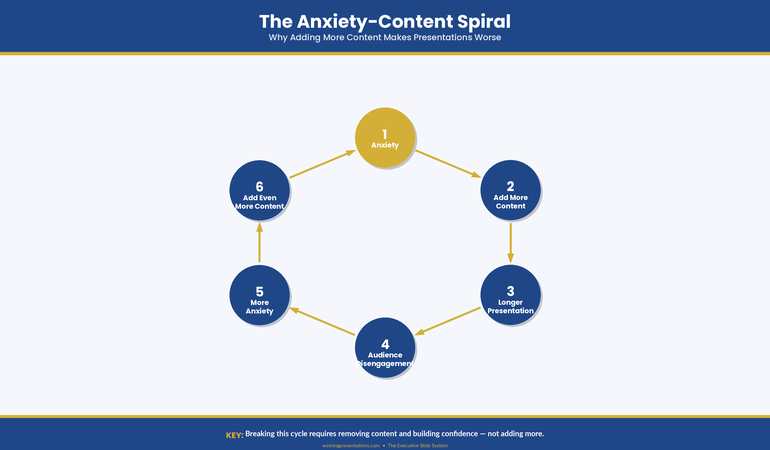
Most executives, particularly those who care about performance, respond to anticipatory anxiety by preparing harder. You run the presentation again. You revise the slides. You rehearse answers to tougher questions. This is rationalβ€”if I’m more prepared, I’ll be less anxious.

But the research is clear: beyond a certain point, additional preparation doesn’t reduce anticipatory anxiety. It reinforces it. Each rehearsal is another opportunity to find something “wrong” or to imagine the audience’s judgment. You’re feeding the anxiety loop, not breaking it.

The anticipatory anxiety cycle showing four stages: trigger, catastrophise, avoid, and escalate

Techniques Designed for Presentation Anxiety

Conquer Speaking Fear gives you nervous system techniques, reframing exercises, and decision-making frameworks designed for acute presentation anxietyβ€”the kind that starts days before and peaks the morning of.

  • Nervous system reset techniques for anxiety spirals
  • Reframing exercises that separate dread from actual risk
  • Pre-presentation routines that build confidence
  • Tools to manage the anxious mind without ignoring it

Explore Conquer Speaking Fear β€” Β£39

Designed for executives managing acute presentation anxiety

The neuroscience of dread

Your brain doesn’t distinguish between anticipating something bad and experiencing it. When you imagine the board asking a question you can’t answer, your amygdala (your brain’s threat detector) activates as if it’s happening right now. Your nervous system releases cortisol and adrenaline. Your heart rate rises. You feel the physical symptoms of anxiety even though the threat is imagined.

This is useful when you’re genuinely in danger. Your body prepares you to fight or flee. But when the threat is abstractβ€””What if I mess this up?”β€”the physical response becomes a problem. You can’t fight or flee from a presentation. You can only sit with the activation.

The longer the time between now and the presentation, the more time your mind has to rehearse worst-case scenarios. Each rehearsal deepens the neural pathway, making the anxiety feel more real, more inevitable. By Thursday night, your brain has convinced you that failure is probable, even though nothing has actually happened.

Add sleep disruption to this equation, and your emotional regulation gets worse. You’re more irritable, more prone to catastrophic thinking, less able to distinguish between real risk and imagined risk. The presentation itself hasn’t changed. Your mental state has deteriorated.

How to break the loop

The first step is recognising that anticipatory anxiety is not information about your readiness. It’s a feeling that your nervous system is generating based on threat-perception, not on actual risk assessment.

This seems obvious when you read it. But in practice, when you’re exhausted and anxious, your mind treats dread as evidence. “I’m this anxious, so something must be genuinely wrong.” In fact, you can be completely prepared and still experience intense anticipatory anxiety. The two are independent.

The second step is stopping the preparation loop. Once you reach a threshold of readinessβ€”you know your material, you’ve done one solid rehearsal, you have answers to likely questionsβ€”additional rehearsal is counterproductive. It gives your anxious mind more material to worry about.

Instead of rehearsing more, you need to:

  1. Name the loop: “This is anticipatory anxiety, not actual danger. It will pass.”
  2. Interrupt the rehearsal: When you notice yourself running through scenarios, consciously stop. Physical activity (a walk, a gym session) interrupts the mental loop more effectively than trying to think your way out of it.
  3. Reset your nervous system: Breathing techniques, cold water, grounding exercisesβ€”these activate your parasympathetic nervous system and counteract the threat activation.
  4. Establish a boundary: “I will prepare until Wednesday. After that, no more slides, no more rehearsal.” This protects you from the preparation loop extending into the presentation day.
  5. Redirect attention: The night before, shift focus away from the presentation. Read something unrelated. Spend time with people you care about. Let your mind rest from the threat narrative.

If your anticipatory anxiety is severe enough to disrupt your sleep or work in the days before a presentation, Conquer Speaking Fear includes specific nervous system techniques designed for those hours when the dread feels most intense.

Four-step roadmap for breaking the anticipatory anxiety loop before presentations

In practice, breaking the anticipatory anxiety loop follows four moves. The first is to acknowledge β€” name the dread without judging yourself for feeling it. “I’m anxious about Thursday’s presentation” is a statement of fact, not a confession of weakness. The moment you name it, you create distance between yourself and the feeling. You’re observing the anxiety rather than being consumed by it.

The second move is to prepare early β€” start with one slide to break the avoidance pattern. Anticipatory anxiety often creates a paradox: the dread makes you avoid the very preparation that would reduce it. Opening the presentation file and writing a single slide title β€” even a bad one β€” interrupts avoidance. Action, however small, breaks the freeze.

The third is to rehearse aloud β€” speak the opening three times to build familiarity. Not a full run-through. Just the first sixty seconds. Your voice forming the words builds a physical memory that your body can fall back on when anxiety spikes. The opening is where panic is strongest. If your mouth already knows the first two sentences, your nervous system calms faster.

The fourth move is to reframe β€” shift your focus from performance to contribution. Instead of “Will I do well?”, ask “What does the room need from me?” When you reframe the presentation as a contribution rather than a test, the threat perception drops. You’re not being judged; you’re providing something valuable. That distinction changes how your nervous system responds to the approaching event.

Practical strategies that shift anxiety to readiness

Beyond interrupting the anxiety loop, there are specific practices that help executives convert anticipatory dread into something more useful: focused readiness.

Compartmentalise the presentation time. Instead of thinking about “the presentation” as this amorphous future threat, break it into concrete actions: What do you do 10 minutes before you start? What’s your opening line? Where do you stand? What do you do if you forget a point? When you focus on specific micro-actions rather than “Will I perform well?”, your brain shifts from threat-assessment to task-execution.

Create a pre-presentation routine. The night before, the morning of, the hour beforeβ€”develop a specific sequence of actions that signal to your nervous system, “This is expected. This is manageable.” For some people it’s a specific breakfast, a particular walk, a few minutes of breathing. The content matters less than the consistency. Routines reduce the novelty and uncertainty that feed anticipatory anxiety.

Identify your specific “what if” fears and reality-test them. Not generallyβ€”specifically. If your fear is “What if they ask me something I don’t know?”, the reality is: “If they ask something I don’t know, I’ll say, ‘That’s a great questionβ€”let me follow up with you separately.’ And the presentation continues.” You’re not avoiding the fear; you’re proving to yourself that you can handle it.

Separate the days before from the day of. What you do Monday through Thursday should be different from what you do Friday morning. Early in the week, preparation and rehearsal are valuable. As you approach presentation day, shift to rest, routine, and nervous system regulation. This signals a boundary between “get ready” and “be ready.”

Managing the evening before

The evening before a high-stakes presentation is often the worst moment for anticipatory anxiety. You’ve done all the prep you can. The event is real and imminent. Your mind is searching for something to control.

Here’s what actually helps:

Do not rehearse the presentation. You’ve already rehearsed. One more run-through will not make you more confident. It will only give your anxious mind more material to second-guess. Close the laptop. Put the slides away.

Engage in something that requires focus. Cook a meal. Watch a film that demands your attention. Play a game that requires strategy. Anything that pulls your conscious mind away from the anticipatory narrative. You’re not ignoring the anxiety; you’re not giving it the spotlight.

Manage the physical symptoms directly. If you can’t sleep, don’t lie in bed fighting the insomnia. Get up. Read. Stretch. The pressure to “get good sleep before the big day” can itself generate anxiety. Sleep matters, but obsessing about sleep is counterproductive. A mediocre night’s sleep followed by a good presentation is far better than an anxious night spent worrying about sleep.

Remember that the nervousness you feel the morning of is not a problem to solveβ€”it’s your nervous system preparing you. Some anxiety on presentation day is actually useful. It sharpens focus. It elevates your energy. The goal is not to eliminate it. The goal is to interpret it correctly: “This is not danger. This is readiness.”

Nervous System Tools for Presentation Anxiety

Conquer Speaking Fear includes breathing techniques, reframing exercises, and pre-presentation routines designed for the hours when anxiety is most intense.

Get the Tools β€” Β£39

Frequently asked questions

Is it normal to feel this anxious about a presentation?

Yes. High-stakes presentations trigger real physiological responses. Your nervous system perceives public performance as a potential threat. This is true across cultures and industries. The executives who manage it best aren’t those who don’t feel anxietyβ€”they’re those who understand what anticipatory anxiety is and have tools to work with it.

Does better preparation reduce anticipatory anxiety?

To a point, yes. But after you’ve reached competenceβ€”you know your material, you can answer likely questions, you’ve done a full rehearsalβ€”additional preparation doesn’t reduce anxiety. It often increases it because each rehearsal creates new opportunities for self-criticism. The threshold is usually after one to two solid rehearsals, not five or ten.

What if my anxiety is so severe that I’m considering cancelling the presentation?

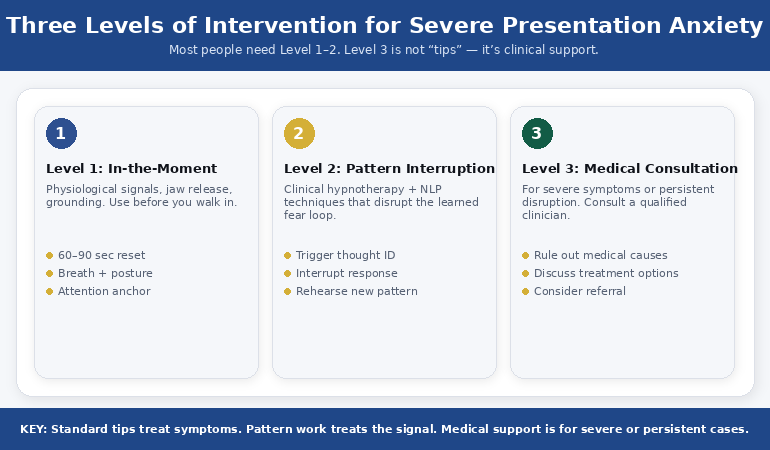
Severe anticipatory anxiety (where you’re genuinely considering avoidance) is a signal to get support. This might be a coach, a therapist, or someone trained in anxiety management. Avoidance reinforces anxietyβ€”it tells your nervous system, “This is genuinely dangerous.” But with structured support and targeted techniques, even severe anticipatory anxiety can be managed. You do not have to cancel.

Get practical frameworks for high-stakes presentations. Join The Winning Edge, a weekly newsletter for executives who lead with confidence. Presentation techniques, communication frameworks, anxiety managementβ€”sent to your inbox every Thursday.

Subscribe to The Winning Edge β†’

Related: If you’re presenting quarterly results or a strategic plan, read The Q2 Planning Presentation: Setting Your Team Up for the Next 90 Days for a structural framework that reduces the pressure on delivery.

Anticipatory anxiety is not a sign of weakness or lack of readiness. It’s how your nervous system responds to stakes. The executives who manage it best don’t ignore the dreadβ€”they work with it. They understand what it is, they interrupt the rehearsal loop, they protect their sleep, they develop routines, and they remember that the anxiety before the presentation is almost always worse than the presentation itself. You don’t need it to disappear. You need to understand it, and then move forward anyway.

Mary Beth Hazeldine is Owner & Managing Director of Winning Presentations. With 24 years of corporate banking experience at JPMorgan Chase, PwC, Royal Bank of Scotland, and Commerzbank, she advises executives across financial services, healthcare, technology, and government on structuring presentations for high-stakes funding rounds and approvals.

25 Mar 2026
Professional at a desk surrounded by multiple drafts and revision notes, showing the exhaustion of over-preparation

Presentation Perfectionism: Why Over-Preparing Makes Your Anxiety Worse

Presentation perfectionism is the anxiety trap that looks like diligence. You rehearse more, edit more slides, prepare for more questions β€” and the anxiety gets worse, not better. That’s not a willpower failure. It’s a neurological pattern: over-preparation signals threat to your nervous system, which increases vigilance, which drives more preparation. This article explains why the cycle works, what keeps it locked in place, and the clinical framework that breaks it.

Quick Navigation

The Story: Margot’s 11-Hour Preparation for a 10-Minute Update

Margot was a senior product manager at a SaaS company. Competent, respected, consistently rated in the top 10% of her peer group. She also spent 11 hours preparing for a 10-minute sprint review update. Every sprint. Without fail.

Her preparation ritual had layers: three complete rewrites of her talking points, a full rehearsal in front of a mirror, a practice run on video that she’d watch back and critique, a second rehearsal incorporating the self-critique, then a final review of every slide at midnight. By the time she walked into the meeting, she was exhausted, over-caffeinated, and vibrating with the specific kind of anxiety that comes from having rehearsed so much that every word feels like it’s balanced on a knife edge.

The irony: her colleagues who spent 20 minutes preparing gave roughly equivalent updates. Some were better. Some were worse. None of them seemed to carry the weight of the presentation like it was a performance review of their entire professional worth.

When Margot finally spoke to a clinical psychologist about it, the feedback stunned her: “Your preparation isn’t reducing your anxiety. It’s causing it. Every rehearsal is a message to your nervous system that something dangerous is coming. You’re training yourself to be afraid.”

Trapped in the over-preparation cycle?

Explore Conquer Speaking Fear β†’ clinical techniques for breaking the perfectionism-anxiety pattern.

Why More Preparation Makes Anxiety Worse (The Neuroscience)

The logic seems unassailable: if I prepare more, I’ll be more confident, and if I’m more confident, I’ll be less anxious. But that’s not how anxiety works. Anxiety doesn’t respond to evidence of competence. It responds to perceived threat β€” and excessive preparation is a threat signal.

When you spend 11 hours preparing for a 10-minute presentation, your amygdala β€” the brain’s threat-detection system β€” draws a reasonable conclusion: *This must be genuinely dangerous. Otherwise, why would we be spending this much energy on it?* The preparation becomes evidence of danger, not evidence of readiness.

This creates a feedback loop that cognitive behavioural therapists call a “safety behaviour.” Safety behaviours are actions you take to prevent the feared outcome (embarrassment, failure, judgment) that actually maintain the anxiety long-term. Over-preparation is one of the most common safety behaviours in professionals with presentation anxiety β€” and one of the hardest to recognise, because it looks like professional diligence.

The distinction matters: adequate preparation builds genuine confidence. Over-preparation β€” the kind where you rewrite talking points three times, rehearse on video, and still don’t feel ready β€” feeds the anxiety it’s trying to solve.

The perfectionism-anxiety cycle showing how over-preparation increases threat signals

The Perfectionism-Anxiety Cycle: How It Locks in Place

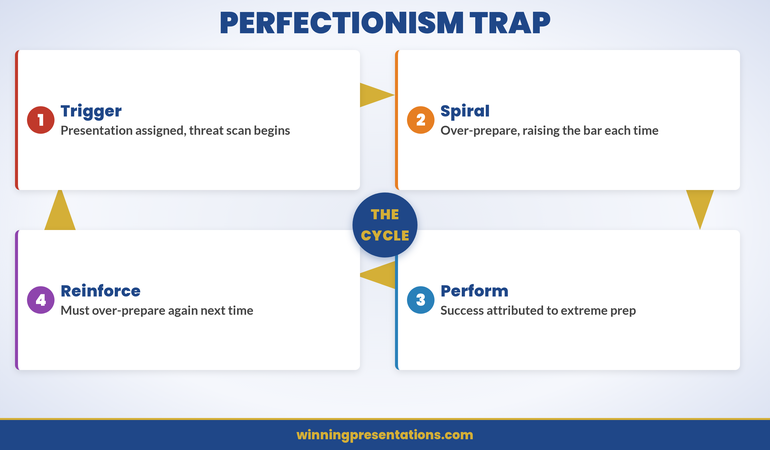
Presentation perfectionism follows a four-stage cycle. Understanding each stage is the first step toward breaking it.

Stage 1: The Trigger. You’re assigned a presentation. Immediately, your brain runs a threat assessment: Who’s in the audience? What if I forget my point? What if they ask something I can’t answer? What if they think I’m not competent? The threat assessment feels like strategic thinking, but it’s anxiety wearing a professional mask.

Stage 2: The Preparation Spiral. To manage the anxiety from Stage 1, you prepare. Then you prepare more. Then you rewrite. Then you rehearse. Each round of preparation temporarily reduces the anxiety β€” but the relief is short-lived, because each round also raises the standard you’re holding yourself to. “Good enough” keeps moving further away.

Stage 3: The Performance. You deliver the presentation. It goes fine β€” perhaps even well. But you don’t register the success, because the perfectionist filter is scanning for flaws: the sentence you phrased differently than rehearsed, the question you answered slightly awkwardly, the moment you lost your place for half a second. The experience confirms the anxiety: “It only went well because I prepared that much.”

Stage 4: The Reinforcement. Because you attribute the success to the extreme preparation (not to your actual competence), the next presentation triggers the same cycle. The anxiety isn’t learning from the positive outcome β€” it’s being reinforced by it. “It worked because I over-prepared. So I must over-prepare again.” The cycle locks.

Understanding why your voice changes when you’re nervous is part of the same pattern β€” physical symptoms that feel like evidence of danger, reinforcing the preparation spiral.

Break the Perfectionism Cycle Before Your Next Presentation

The over-preparation trap isn’t solved by more willpower β€” it’s addressed through clinical techniques that help your nervous system respond differently to presentation situations. Structured methods for dismantling the perfectionism-anxiety loop.

  • βœ“ Nervous system regulation techniques for pre-presentation anxiety
  • βœ“ Reframing methods to interrupt the perfectionism pattern
  • βœ“ Practical protocols for calibrating preparation without over-preparing
  • βœ“ Approaches grounded in clinical hypnotherapy and NLP

Explore Conquer Speaking Fear β†’

Designed for breaking the over-preparation cycle

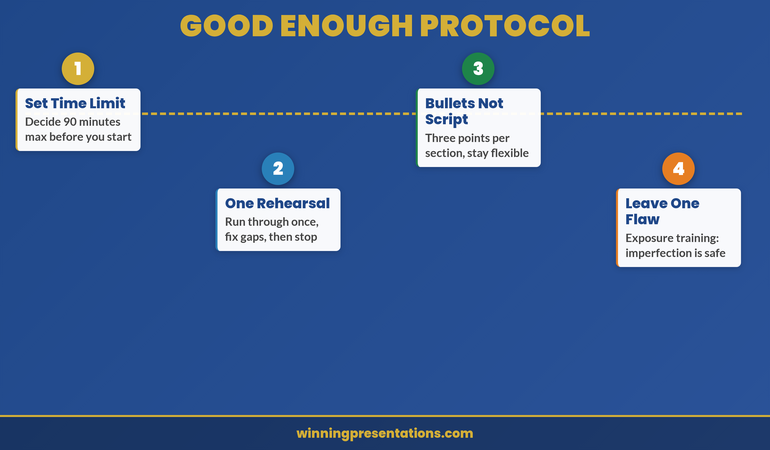
Breaking the Pattern: The “Good Enough” Protocol

Breaking presentation perfectionism doesn’t mean reducing your standards. It means recognising that excessive preparation has diminishing returns β€” and that beyond a certain point, additional preparation actively harms your performance.

Set a preparation time limit before you start. Decide in advance: “I will spend 90 minutes preparing for this presentation.” When the time is up, stop. Not “stop when it feels ready” β€” stop at the time limit. The anxiety will tell you it’s not enough. That’s the anxiety talking, not an objective assessment of your readiness.

Rehearse once, not five times. One full run-through is useful. It identifies genuine gaps β€” a slide that doesn’t flow, a transition that’s unclear. The second rehearsal adds marginal value. The third adds anxiety. By the fourth, you’re not rehearsing the presentation β€” you’re rehearsing the fear of getting it wrong.

Write three bullet points, not a script. Scripts create a brittleness that perfectionism feeds on. If you’ve memorised every word, any deviation feels like failure. Three bullet points per section give you structure with flexibility. You’ll say it differently each time β€” and that’s fine. “Different” is not the same as “wrong.”

Leave one slide deliberately imperfect. This sounds counterintuitive, but it’s a clinical technique called “exposure with response prevention.” Leave a minor imperfection in place β€” a chart that could be slightly better formatted, a bullet point that could be tighter. Present with it there. Notice that the world doesn’t end. This trains your nervous system that imperfection is survivable.

The Rehearsal Limit: How Much Preparation Actually Helps

Research on performance preparation β€” across music, sport, and professional communication β€” consistently shows a preparation curve with diminishing returns. The first hour of preparation for a presentation delivers the most value. Each subsequent hour delivers progressively less.

For a typical 15-minute business presentation, the evidence-based preparation window looks like this:

30 minutes: Content structure. Decide your three key points. Build the slide skeleton. Identify the one thing your audience must remember.

30 minutes: Slide refinement. Polish the visuals. Check data accuracy. Ensure the flow makes sense.

30 minutes: One rehearsal. Run through the full presentation once. Note any stumbles or unclear transitions. Fix them.

Total: 90 minutes. For a routine business update, that’s sufficient preparation for a competent professional. If the stakes are genuinely higher β€” a board presentation, a client pitch, a career-defining moment β€” add another 60 minutes for a second rehearsal and deeper anticipation of questions. But beyond 2.5 hours of total preparation for a single presentation, you’re almost certainly in perfectionism territory.

The body scan technique is a useful complement to preparation β€” it gives your nervous system a reset signal that counteracts the escalation from over-rehearsal.

Preparation time vs anxiety level showing diminishing returns curve

The Self-Compassion Shift That Changes Everything

Perfectionism in presentations is, at its core, a relationship with failure. Specifically, it’s the belief that failure in a presentation is catastrophic β€” that a stumble, a forgotten point, or a less-than-brilliant answer will permanently damage your professional reputation.

That belief is almost never true. Think about the last presentation you watched that had a minor stumble. Do you remember it? Do you think less of the presenter? Almost certainly not. But perfectionism convinces you that your audience has a different standard for you than you have for everyone else.

The shift: instead of asking “Was that perfect?”, ask “Was that useful?” A presentation that communicates its key message, answers the audience’s core question, and moves a decision forward is useful β€” even if the delivery wasn’t flawless. Utility is the right success metric for professional presentations. Perfection is the wrong one.

The practice: after your next presentation, write down three things that worked. Not three things that went wrong β€” three things that worked. Perfectionism trains you to scan for failure. Self-compassion trains you to register competence. Both are habits. One of them is useful.

Building genuine executive presence in presentations starts with this internal shift β€” presence comes from accepting imperfection, not from eliminating it.

Is This Right For You?

βœ“ You consistently spend more time preparing presentations than your peers and still feel anxious

βœ“ You rehearse multiple times and each rehearsal makes you more critical, not more confident

βœ“ You want clinical techniques to break the cycle, not generic “just relax” advice

βœ— Your anxiety is related to genuine lack of subject knowledge β€” preparation is the right solution there

βœ— You rarely feel anxious about presentations β€” this is specifically for the over-preparation pattern

Frequently Asked Questions

How do I know if I’m over-preparing or just being thorough?

The test is simple: does additional preparation make you feel more confident or more anxious? If your third rehearsal increases your confidence and reduces your stress, that’s productive preparation. If your third rehearsal makes you more critical of your performance and more worried about what could go wrong, you’ve crossed from preparation into perfectionism. Another signal: if you routinely spend more than three times as long preparing as the presentation itself takes to deliver, the preparation has likely become a safety behaviour.

Will reducing preparation make my presentations worse?

Almost certainly not. The performance difference between 90 minutes of focused preparation and 5 hours of anxious over-preparation is negligible β€” and often negative. Over-rehearsed presentations tend to sound rigid, scripted, and disconnected from the audience. Presentations delivered from clear structure with natural delivery tend to be more engaging and more persuasive. The goal isn’t less effort β€” it’s right-sized effort.

Is presentation perfectionism the same as impostor syndrome?

They’re related but distinct. Impostor syndrome is the belief that you’re not qualified for the role you’re in. Presentation perfectionism is the belief that your presentations must be flawless to maintain your credibility. You can have perfectionism without impostor syndrome (believing you’re competent but that your presentations must be perfect) and impostor syndrome without perfectionism (believing you’re not qualified but not necessarily over-preparing). When both are present, they reinforce each other β€” the impostor fear drives the perfectionism, and the perfectionism confirms the fear.

The Winning Edge β€” Weekly Presentation Intelligence

Frameworks, slide strategies, and executive communication insights delivered every week. Trusted by professionals who present to boards, clients, and senior leadership.

Subscribe to The Winning Edge

If your board presentations are adding to the pressure, the risk appetite presentation framework shows how eight slides can replace forty β€” reducing both the preparation burden and the anxiety that comes with it.

The perfectionism cycle breaks when you stop treating presentations as performance tests and start treating them as conversations with structure. The clinical techniques to make that shift exist β€” and the next presentation you prepare in 90 minutes instead of 11 hours will demonstrate the pattern change.

About the Author

Mary Beth Hazeldine is Owner & Managing Director of Winning Presentations. With 24 years of corporate banking experience at JPMorgan Chase, PwC, Royal Bank of Scotland, and Commerzbank, she advises executives across financial services, healthcare, technology, and government on structuring presentations for high-stakes funding rounds and approvals.
Book a discovery call | View services

23 Mar 2026
Abstract representation of a brain with neural pathways illuminated in navy and gold tones against a dark professional background suggesting threat and calm pathways

Why Visualisation Doesn’t Work for Presentation Anxiety (And What Does, According to Neuroscience)

Why Visualisation Doesn’t Work for Presentation Anxiety (And What Does, According to Neuroscience)

TomΓ‘s did everything right. Three nights before his product review with the executive team, he spent 20 minutes visualising success. He pictured himself standing confidently, making eye contact, nailing the key message about market share.

The morning of the presentation, his heart rate hit 140 before he reached the conference room door. His voice cracked on the second sentence. He lost his place twice.

The visualisation hadn’t just failed. It had made things worse.

Quick Answer: Visualisation makes presentation anxiety worse for most executives because the brain doesn’t distinguish between “imagining a high-stakes event” and “experiencing a high-stakes event.” When you visualise presenting, your nervous system rehearses the threat response. Neuroscience shows that process-based techniques β€” nervous system regulation, cognitive reappraisal, and procedural rehearsal β€” outperform outcome visualisation for presentation anxiety. The shift from imagining success to regulating your physiology is the difference between spiralling and speaking with clarity.

Presentation anxiety and visualisation

If you’ve found that mental rehearsal or “picturing success” makes anxiety worse rather than better, you’re not alone. Many executives experience this response.

β†’ Explore anxiety management techniques grounded in neuroscience β†’ View Conquer Speaking Fear

I spent five years terrified of presenting. Every presentation coach I worked with said the same thing: “Visualise yourself succeeding. Picture the applause. Imagine the confident version of you.”

So I tried. Lying in bed the night before a board presentation at RBS, I’d close my eyes and picture myself standing at the front, speaking clearly, the board nodding. What actually happened was my brain fast-forwarded to the worst-case scenarios. The voice crack. The silence. The CFO’s frown.

The visualisation didn’t create confidence. It created a rehearsal space for catastrophe.

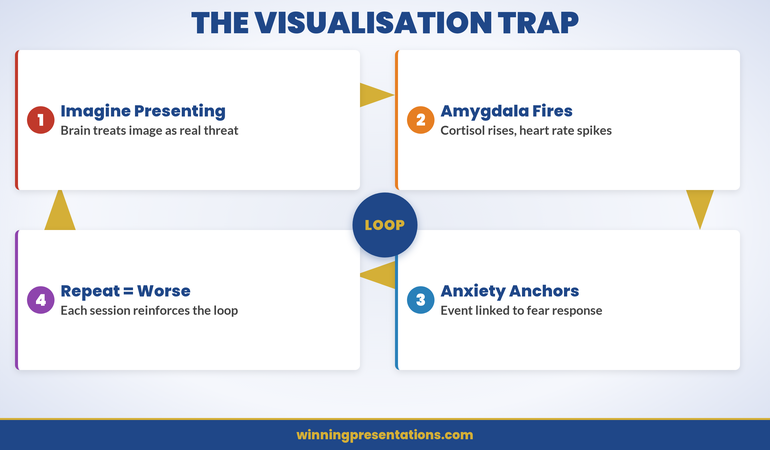
When I trained as a clinical hypnotherapist, I learned why. The brain processes imagined experiences and real experiences through overlapping neural circuits. When you visualise a high-stakes presentation, your amygdala doesn’t know it’s a rehearsal. It fires the same threat signals. Your cortisol rises. Your heart rate increases.

You’re not building confidence. You’re conditioning anxiety.

The techniques that actually worked β€” the ones I now teach β€” don’t ask you to imagine anything. They regulate the physiology first. Confidence doesn’t come from picturing success. It comes from a nervous system that isn’t in fight-or-flight.

Why Visualisation Backfires for Presentation Anxiety

Visualisation works brilliantly for athletes. A sprinter imagining the perfect start. A gymnast rehearsing a routine. The difference? Athletes are visualising motor sequences β€” physical movements they’ve practised thousands of times. The brain’s motor cortex benefits from this kind of mental rehearsal.

Presenting isn’t a motor sequence. It’s a social-evaluative threat. When you “visualise presenting,” you’re not rehearsing a physical movement. You’re rehearsing an emotional situation. And emotional situations activate the limbic system, not the motor cortex.

For executives with presentation anxiety, visualisation triggers what researchers call the “anticipatory anxiety loop.” You imagine the boardroom. Your brain scans for threats. Your amygdala fires. Cortisol floods your system. Now you’re anxious about being anxious β€” and you’ve got a powerful memory of that anxiety associated with the upcoming event.

The person who told you to “just visualise success” probably doesn’t experience presentation anxiety themselves. For people without an overactive threat response, visualisation is neutral or mildly positive. For people with presentation anxiety, it’s fuel on the fire. If you’ve tried visualisation and found it made things worse, you’re not doing it wrong. The technique is wrong for your situation. Understanding this is the first step β€” and I’ve written about what to do when nothing seems to work for presentation anxiety.

What Neuroscience Says About the Threat Response and Presenting

Your brain has two processing pathways for threat detection. The fast pathway goes directly from sensory input to the amygdala β€” bypassing conscious thought entirely. The slow pathway goes through the prefrontal cortex, where it’s evaluated rationally.

Presentation anxiety lives in the fast pathway. Before your rational brain can say “this is just a meeting, you know this material,” your amygdala has already sounded the alarm. Heart rate up. Palms sweating. Voice tightening.

Visualisation doesn’t interrupt the fast pathway. It feeds it. When you imagine standing in front of executives, the amygdala doesn’t process this as “imagination.” It processes it as “incoming threat data.” The physiological response is identical whether you’re actually presenting or vividly imagining it.

This is why the advice to “just think positive” is neurologically backwards. Positive thinking is a prefrontal cortex activity. Presentation anxiety is a limbic system activity. You’re trying to calm a fire alarm with a motivational poster.

The techniques that work target the fast pathway directly β€” through the body, not through thought. Effective breathing techniques work because they send direct signals to the vagus nerve, telling the amygdala to stand down. No visualisation required.

Neuroscience of presentation anxiety infographic showing the fast threat pathway versus slow rational pathway and why visualisation feeds the wrong one

Presentation Anxiety Management Programme

Conquer Speaking Fear provides a 30-day structured approach targeting nervous system regulation. Built from clinical hypnotherapy principles:

  • Nervous system regulation techniques based on neuroscience
  • Cognitive reappraisal frameworks for executives
  • Evidence-based approaches from clinical hypnotherapy
  • 30-day structured programme with progressive techniques

Explore Conquer Speaking Fear β†’

Based on clinical hypnotherapy training and work with executives in banking and consulting.

The 3 Techniques That Actually Work (And Why)

If visualisation feeds the anxiety loop, what breaks it? Three approaches, each targeting a different level of the nervous system.

1. Vagal tone activation (physiological level)

Your vagus nerve is the direct line between your body and your brain’s threat system. Stimulating it sends a “safe” signal that overrides the amygdala’s alarm. Extended exhale breathing β€” breathing in for 4 counts, out for 8 β€” activates the parasympathetic nervous system within 60 seconds. This isn’t meditation. It’s neurology. It works in the lift on the way to the meeting.

2. Cognitive reappraisal (interpretation level)

Reappraisal isn’t positive thinking. It’s relabelling the physical sensation. “My heart is racing because my body is preparing to perform” instead of “my heart is racing because I’m about to fail.” The physiological state is identical. The interpretation changes the anxiety trajectory entirely. Research shows reappraisal reduces cortisol more effectively than suppression (“calm down”) or visualisation.

3. Procedural rehearsal (behavioural level)

Instead of imagining the outcome, rehearse the process. Practise your first 30 seconds out loud. Walk through your slide transitions physically. Stand in the actual room if you can. This gives your motor cortex something useful to rehearse and creates procedural memory β€” the kind of memory that operates under stress. Athletes know this: they don’t just imagine the race. They physically rehearse the start.

Process Rehearsal vs. Outcome Visualisation: The Critical Difference

This distinction matters more than any other in anxiety management for presenters.

Outcome visualisation: “I see myself finishing the presentation. The board is smiling. They approve my budget.” This is what most coaches recommend. It’s abstract, emotional, and activates the threat system for anxious presenters.

Process rehearsal: “I walk to the front. I place my hands on the lectern. I say my first sentence: ‘The recommendation is to approve the Β£2M investment.’ I click to slide 2.” This is concrete, motor-based, and gives the brain a physical sequence to anchor to.

The difference is neurological. Outcome visualisation activates the ventromedial prefrontal cortex β€” the part of the brain that evaluates emotional significance. Process rehearsal activates the dorsolateral prefrontal cortex and premotor areas β€” the parts that plan and execute sequences.

For anxious presenters, the emotional significance pathway is already overactivated. Feeding it more emotional content (even positive emotions) increases arousal. Engaging the procedural pathways gives the brain a different job to do β€” one that doesn’t involve threat evaluation.

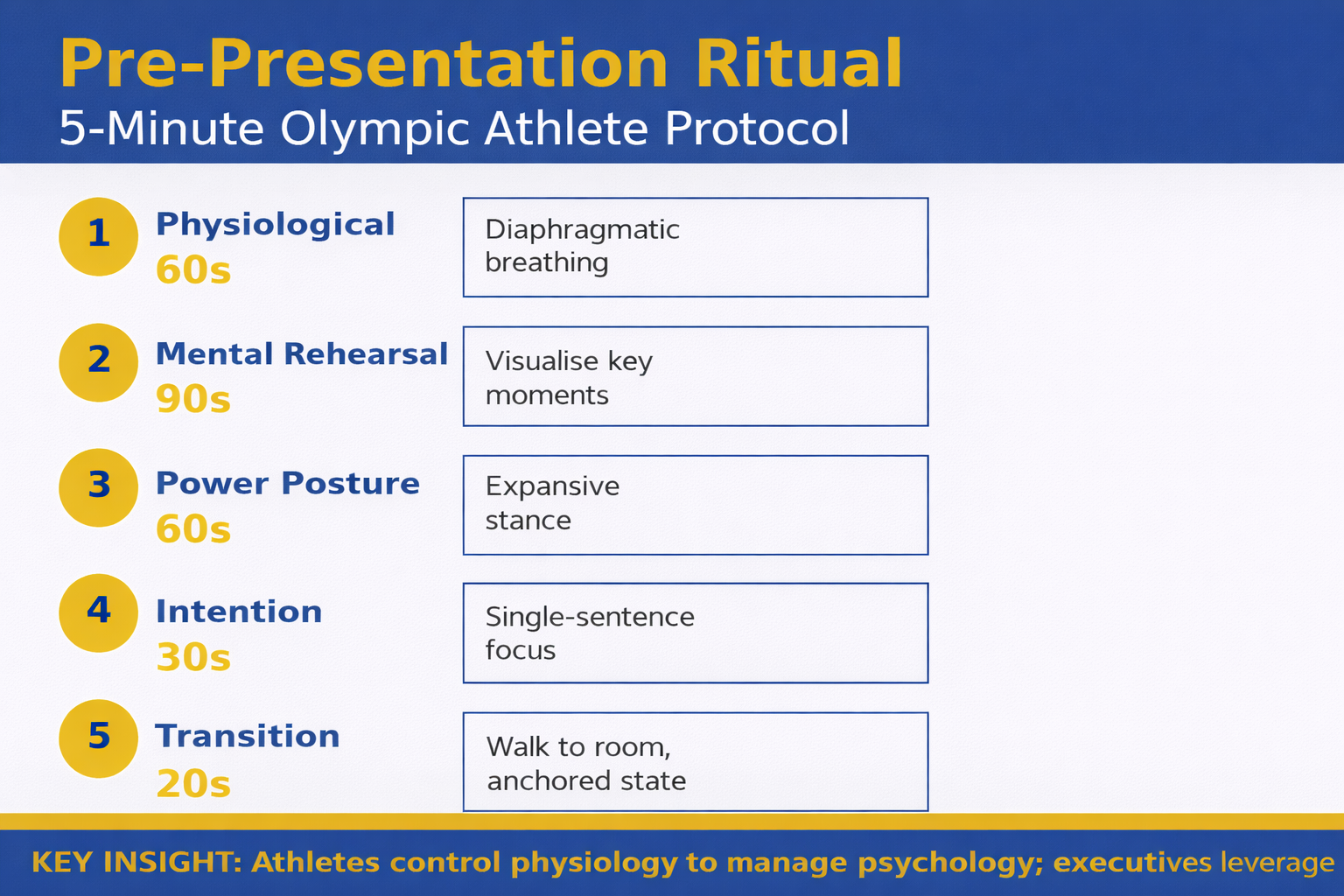
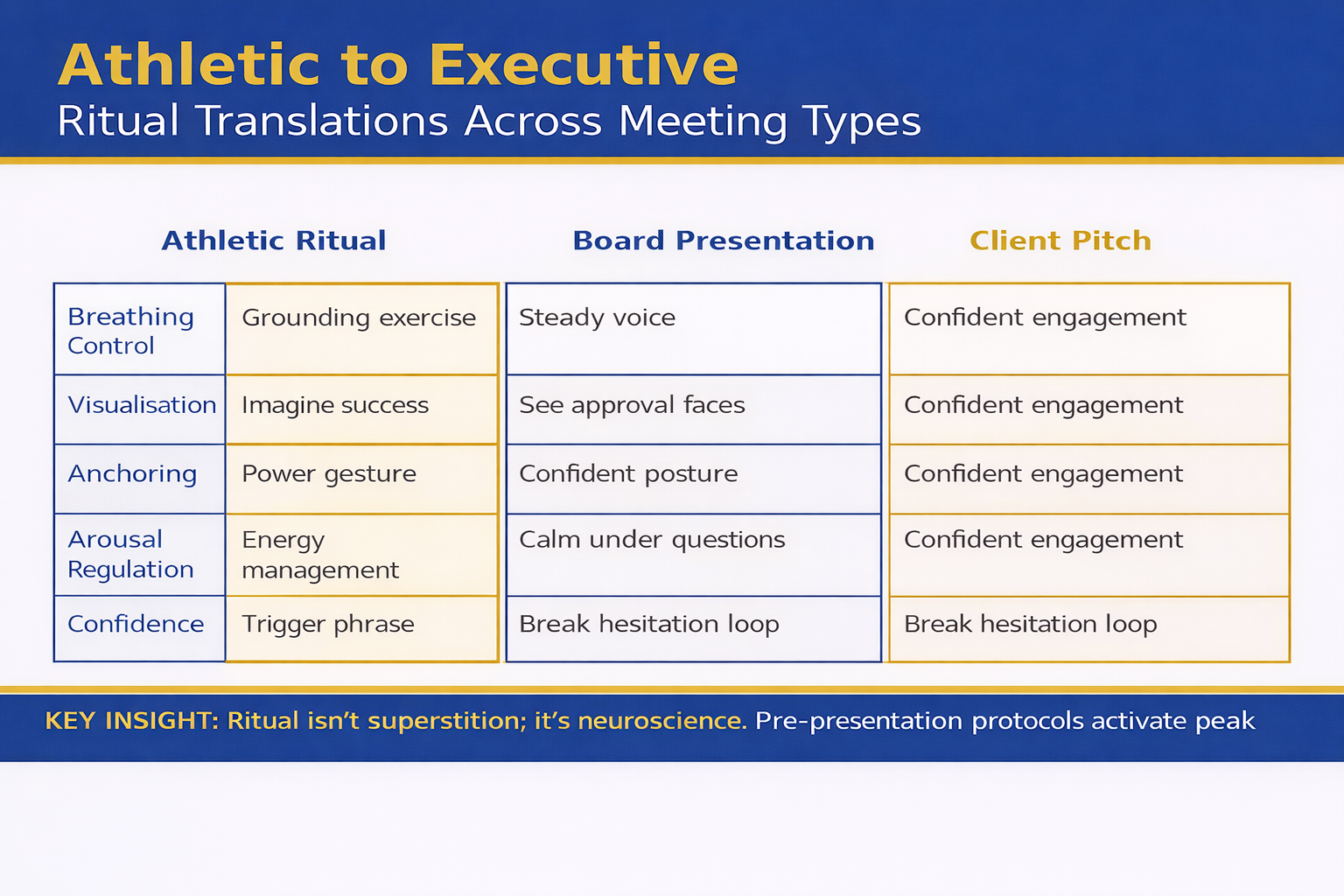
Many executives find this shift transforms their pre-presentation experience entirely. Instead of lying awake imagining catastrophe, they run through their opening sequence like a musician practising scales. The ritual approach I describe in my article on pre-presentation rituals borrowed from Olympic athletes builds on this same principle.

Contrast panel infographic comparing outcome visualisation (feeds anxiety) versus process rehearsal (builds control) for presentation anxiety

Structured Anxiety Management Over 30 Days

Progressive nervous system regulation techniques β€” grounded in neuroscience rather than visualisation or positive thinking.

Explore Conquer Speaking Fear β†’

Evidence-based techniques from clinical hypnotherapy and neuroscience research.

The 90-Second Nervous System Regulation Technique

This is the single most effective pre-presentation technique I know. It takes 90 seconds. You can do it in a toilet cubicle, a stairwell, or your car.

Seconds 1–30: Extended exhale breathing. Breathe in through the nose for 4 counts. Out through the mouth for 8 counts. Three cycles. This activates the parasympathetic nervous system via the vagus nerve. Your heart rate will begin to drop within 20 seconds.

Seconds 31–60: Peripheral vision activation. Soften your gaze and expand your visual field to the edges of your vision without moving your eyes. This is a neurological “safety cue” β€” threat scanning narrows vision (tunnel vision), so deliberately widening it signals safety to the brain. Your shoulders will drop.

Seconds 61–90: First-sentence rehearsal. Say your opening sentence out loud, twice. Not in your head. Out loud. This engages the motor cortex and procedural memory, giving your brain a concrete task instead of an abstract threat to evaluate.

That’s it. 90 seconds. No visualisation. No affirmations. Just neurological signals that tell your threat system to stand down.

The Cross-Link: When Your Slides Are the Anxiety Source

Sometimes presentation anxiety isn’t about standing up. It’s about whether your slides are good enough. If your fear is less about the audience and more about “does this deck hold up?” β€” structural confidence in your slides can reduce anxiety significantly. Today’s companion article on the partnership proposal structure that gets yes in one meeting shows how the right slide structure removes the guesswork that feeds anxiety.

Is This Right for You?

βœ“ This is for you if:

  • You’ve tried visualisation, positive thinking, or “just breathe” advice and it hasn’t worked
  • Your anxiety is physical β€” racing heart, shaking, voice cracking β€” not just mental nervousness
  • You want science-based techniques from a clinical hypnotherapist, not generic coaching

βœ— This is NOT for you if:

  • Your presentation nerves are mild and manageable with basic preparation
  • You’re looking for general public speaking tips rather than anxiety-specific intervention
  • You need physical symptom management in-the-moment (see Calm Under Pressure for that)

Frequently Asked Questions

If visualisation doesn’t work, why do so many coaches recommend it?

Visualisation works well for people with low-to-moderate anxiety and for motor-skill performance (sports, music). Most presentation coaches don’t have clinical anxiety training β€” they’re applying performance psychology to a clinical problem. For executives with genuine presentation anxiety (not just mild nerves), the evidence shows visualisation either has no effect or increases anticipatory anxiety. The techniques that work target the nervous system directly.

How is process rehearsal different from just practising my presentation?

Standard practice usually means running through the content β€” saying the words, reviewing the slides. Process rehearsal is about rehearsing the physical and procedural sequence: how you walk to the front, where you place your hands, what your first sentence sounds like out loud, how you transition between slides. It gives your motor cortex a job to do, which reduces the bandwidth available for threat scanning. Practice builds content familiarity. Process rehearsal builds motor memory that holds up under stress.

Can I combine the 90-second technique with other anxiety management approaches?

Yes β€” and the combination is often more powerful than any single technique. The 90-second regulation technique works as a pre-presentation reset. Pair it with process rehearsal the day before, and cognitive reappraisal when you notice anxiety rising during the presentation itself. The Conquer Speaking Fear programme builds exactly this kind of layered approach over 30 days.

πŸ“¬ The Winning Edge β€” Weekly Presentation Intelligence

Join executives who receive one actionable insight every week β€” from anxiety management techniques to slide structures that build confidence. Neuroscience-informed, not generic advice.

Subscribe to The Winning Edge β†’

Read next: The 48-Hour Window After Every Q&A: Why Most Presentations Win the Room but Lose the Decision

Your next presentation is on your calendar. It’s not going away. But the anxiety spiral can. Download Conquer Speaking Fear before that date arrives and stop rehearsing catastrophe.

About the Author

Mary Beth Hazeldine is Owner & Managing Director of Winning Presentations. With 24 years of corporate banking experience at JPMorgan Chase, PwC, Royal Bank of Scotland, and Commerzbank, she advises executives across financial services, healthcare, technology, and government on structuring presentations for high-stakes funding rounds and approvals.

Book a discovery call | View services

22 Mar 2026
Executive standing calmly in corporate corridor before presentation, composed posture, soft lighting suggesting inner calm, modern office environment with navy and gold tones

The Body Scan Technique: 90 Seconds to Reset Your Nervous System Before Any Presentation

Ngozi had been rehearsing her investor pitch for six weeks. Everything was locked downβ€”data, timings, even her opening joke. But thirty minutes before the call, she opened her laptop camera and her hands were shaking so badly she could barely read the screen. Not from doubt. From her nervous system reading the moment as a threat. The body scan technique was the first thing that reset that signal in under two minutes.

Quick Answer: The body scan technique is a 90-second nervous system reset that works by shifting your brain’s attention from threat detection to physical awareness. Instead of fighting anxiety with willpower or breathing exercises alone, a body scan interrupts the fight-or-flight loop at the somatic levelβ€”giving your prefrontal cortex enough space to regain control before you walk into the room.

Presenting this week and need a technique that works fast?

If breathing exercises haven’t been enough and your anxiety starts in your body before it reaches your mind, the body scan technique targets the physical layer where presentation fear actually lives. Conquer Speaking Fear is a programme built from clinical hypnotherapy approaches that include the body scan alongside deeper nervous system regulation techniques.

Explore Conquer Speaking Fear β†’

How Ngozi Discovered Body Scanning Under Pressure

Ngozi spent weeks preparing her Series A pitch. Financials perfect. Slide transitions polished. She could recite her story in her sleep. But thirty minutes before the Zoom call with three partners, her hands started shaking. Not tremblingβ€”visibly shaking. She could barely click her mouse. Her mind knew she was ready. Her nervous system didn’t agree. She’d heard about body scanning somewhereβ€”a LinkedIn article, a podcastβ€”and had nothing to lose. She gave herself ninety seconds. Shoulders down. Jaw unclenched. One slow breath. By the time the call started, her hands were steady and her voice was clear. She secured Β£1.2 million that day. The body scan was the first technique that told her nervous system it was safe to let her mind do its job.

Reset Your Nervous System Before Your Next Presentationβ€”Without Medication

  • A programme using clinical hypnotherapy techniques to retrain your body’s response to presentation pressureβ€”starting with the body scan and building to deeper nervous system regulation
  • Techniques designed for the 90 seconds before you present, not 90 minutes of meditation you don’t have time for
  • Methods that target the physical layer of anxiety (shaking, voice cracking, racing heart) because that’s where presentation fear actually lives
  • Evidence-based approaches from clinical hypnotherapy, not generic “just breathe” advice that hasn’t worked

Explore Conquer Speaking Fear β†’

Built from nervous system regulation techniques developed with clinical hypnotherapy methodsβ€”approaches that address the physical foundations of presentation anxiety.

Why Your Body Panics Before Your Mind Does

Presentation anxiety doesn’t start in your head. It starts in your body.

Your amygdala detects a threatβ€”a room full of senior executives watching youβ€”and triggers the sympathetic nervous system before your conscious mind even registers what’s happening. By the time you think “I’m nervous,” your body has already decided: heart rate up, muscles tense, blood diverted from your digestive system to your limbs, vocal cords tightening.

This is why telling yourself to “calm down” doesn’t work. Your conscious mind is trying to override a survival response that operates faster than thought. The body scan technique works because it doesn’t try to override anything. It redirects your brain’s attention from external threat scanning to internal body awarenessβ€”and that attention shift is enough to interrupt the cascade.

The neuroscience is straightforward: your brain can’t simultaneously scan for threats and observe its own physical sensations in detail. When you systematically notice “my shoulders are tense, my jaw is clenched, my hands are gripping,” you’re occupying the neural circuits that were busy amplifying the alarm signal. The fight-or-flight response doesn’t stopβ€”but it drops to a level where your prefrontal cortex can function again.

The 90-Second Body Scan: Step by Step

You can do this standing in a corridor, sitting in a waiting area, or in the toilets two minutes before your slot. Nobody will notice. That’s the point.

Seconds 1-15: Feet and legs. Press your feet deliberately into the floor. Notice the weight distributionβ€”are you leaning forward? Shift back slightly. Feel the contact between your shoes and the ground. Notice your calf muscles. Are they braced? Let them soften. Not relaxβ€”soften. There’s a difference. Relaxing implies effort. Softening implies permission.

Seconds 16-30: Core and back. Notice your stomach. Is it clenched? Most anxious presenters brace their core without realising itβ€”as if preparing for a physical impact. Let it release. Notice your lower back. If you’re standing, unlock your knees slightly. Your body will interpret this micro-adjustment as “we’re not in danger” because locked muscles signal threat readiness to your nervous system.

Seconds 31-50: Shoulders and arms. Drop your shoulders one centimetre. That’s all. Most people carry their shoulders closer to their ears when anxiousβ€”a defensive posture your body adopted before you noticed. Let your arms hang. If you’re holding notes or a laptop, set them down briefly. Open your palms for three seconds. Your nervous system reads open hands as “no threat detected.”

Seconds 51-70: Jaw and face. Unclench your jaw. Touch your tongue to the roof of your mouthβ€”this is a clinical trick that relaxes the masseter muscle and sends a calm signal through the vagus nerve. Let your forehead smooth. If your brow is furrowed, it’s because your brain is in problem-solving mode. You don’t need to solve anything right now.

Seconds 71-90: One breath. Take one slow breath through your nose. Not deepβ€”slow. Four seconds in, four seconds out. This single breath is the capstone, not the foundation. The body scan has already done the heavy lifting. The breath just confirms to your nervous system: we’re ready.

Five-step body scan technique roadmap showing Feet and Legs, Core and Back, Shoulders and Arms, Jaw and Face, and One Breath as sequential milestones for a 90-second nervous system reset

Why This Works When Breathing Exercises Don’t

When working with executives on presentation anxiety, the most common feedback is: “I tried breathing exercises and they didn’t fully resolve the physical symptoms.”

Here’s why. Breathing techniques target one symptom (rapid breathing) and hope the rest of the anxiety cascade follows. Sometimes it does. Often it doesn’tβ€”because your body is still braced for impact in every other muscle group. You’ve slowed your breathing, but your shoulders are still at your ears, your jaw is still clenched, and your hands are still gripping the clicker like a weapon.

The body scan works differently. Instead of targeting one symptom, it addresses the entire physical anxiety pattern systematically. By the time you reach the breath at the end, your body has already shifted out of high alert. The breath becomes confirmation, not intervention.

There’s another reason. Breathing exercises require you to do somethingβ€”and when you’re anxious, “doing something” can feel like another performance demand. The body scan asks you to notice, not to perform. Noticing is passive. Your anxiety can’t turn noticing into another source of pressure.

This distinction matters in the context of NLP anchoring techniques too. The body scan creates a foundation state that anchoring techniques can build on. Without the physical reset first, anchoring a confident state onto a tense body doesn’t hold.

Breathing Exercises Haven’t Been Enough?

The body scan is just the entry point. Conquer Speaking Fear builds the complete nervous system regulation systemβ€”body scan, reframing, and approaches from clinical hypnotherapy.

Explore the Programme β†’

When to Use the Body Scan (and When You Need Something Deeper)

The body scan is a pre-presentation tool. It works in the 90 seconds before you walk into the room. It doesn’t fix what happens the night before, the week before, or the career-long pattern that makes presenting feel dangerous.

Use the body scan when your anxiety is situationalβ€”it spikes before the presentation and settles afterward. It works well for quarterly reviews, team updates, client meetings, and any scenario where you know you can present competently but your body doesn’t seem to agree.

You need something deeper when the anxiety starts days before the presentation. When you’re losing sleep on Sunday night because of a Tuesday meeting. When you’re rehearsing not the content but the escape routesβ€”which door is closest, what excuse gets you out. When the anxiety has shifted from “I’m nervous about this presentation” to “I’m a person who can’t present.”

That shiftβ€”from situational anxiety to identity-level anxietyβ€”is where the body scan reaches its limit and clinical-grade techniques become necessary. The body scan can interrupt a fight-or-flight response. It can’t reprogram the belief system that triggers the response in the first place.

If this resonates, you’re not failing at anxiety management. You’re using the right technique for the wrong layer of the problem.

Making It Automatic: The 7-Day Practice Protocol

The body scan is a skill. Like any skill, it gets faster and more effective with practice. Here’s how to make it automatic before your next presentation.

Days 1-2: Practice at home. Do the full 90-second body scan twice dailyβ€”morning and evening. You’re training the neural pathway, not managing anxiety. Do it when you’re already calm so your body learns the sequence without the interference of real stress.

Days 3-4: Practice in low-stakes moments. Before a team meeting. Before a phone call. Before opening your laptop in the morning. You’re teaching your body that the scan is a normal transition, not an emergency measure.

Days 5-6: Speed it up. By now, you know the sequence. Try completing it in 60 seconds, then 45. Your body will start anticipating each zoneβ€”feet, core, shoulders, jaw, breathβ€”before you consciously direct attention there. This is the automaticity you need.

Day 7: Test under mild pressure. Use it before a slightly uncomfortable conversationβ€”a feedback session, a negotiation, a meeting with someone senior. Not a boardroom presentation yet. This intermediate step builds confidence in the technique before high stakes demand it.

After seven days, most people report that the body scan takes 30-45 seconds and produces a noticeable shift in physical state. Some report that simply thinking “body scan” triggers a micro-release in their shoulders and jawβ€”the sequence has become a mental shortcut.

Dashboard infographic showing four key metrics of the body scan practice protocol: 90 seconds initial duration, 7 days to automaticity, 30-45 seconds after practice, and works in 5 body zones

Stop Dreading the Physical Symptoms That Derail Your Presentations

  • Programme that builds from the body scan technique to deeper nervous system regulationβ€”so physical anxiety symptoms become manageable, then minimal
  • Clinical hypnotherapy methods that target the root cause, not just the symptomsβ€”for executives who’ve tried breathing exercises and need something that goes further

Get Conquer Speaking Fear β†’

Designed to address the root patterns of presentation anxietyβ€”because managing symptoms and resolving underlying patterns require different approaches.

People Also Ask

Can the body scan technique work for severe presentation anxiety?

The body scan is effective for situational anxietyβ€”the spike that happens before a specific presentation. For severe, chronic presentation anxiety that starts days before the event and affects your career decisions, the body scan is a starting point but not a complete solution. Severe anxiety involves identity-level beliefs about yourself as a presenter, and those require deeper techniques like cognitive reframing and clinical-grade interventions.

Is the body scan technique the same as mindfulness meditation?

Related but different. Mindfulness body scans are typically 10-20 minutes and aim for deep relaxation. The presentation body scan is 90 seconds and aims for functional readinessβ€”not relaxation, but a state where your nervous system is calm enough for your brain to perform. You don’t want to feel relaxed before a board presentation. You want to feel alert and in control. That’s a different target state.

What if I don’t have 90 seconds before my presentation?

After practising the full sequence for a week, most people can trigger a meaningful physical shift in 15-20 seconds by scanning just two zones: shoulders (drop them one centimetre) and jaw (unclench and touch tongue to roof of mouth). These two adjustments produce the largest nervous system response because they address the two most common anxiety holding patterns.

Is This Approach Right for You?

This is for you if:

  • Your presentation anxiety shows up physicallyβ€”shaking hands, tight chest, racing heart, voice changesβ€”before you’ve even started speaking
  • Breathing exercises help a little but don’t fully resolve the physical symptoms
  • You want a technique you can use discreetly in any setting, without anyone noticing
  • You’re willing to practise for 7 days to make the technique automatic

This is NOT for you if:

  • Your anxiety is primarily cognitive (racing thoughts, catastrophising) with minimal physical symptomsβ€”you may benefit more from cognitive reframing techniques
  • You need a technique that works immediately with zero practiceβ€”the body scan requires a 7-day training period to become fast and automatic
  • Your presentation anxiety is managed well by current techniquesβ€”if what you’re doing works, keep doing it

Frequently Asked Questions

I’ve tried body scans before and they didn’t help with my presentation nerves. What’s different about this approach?

Most body scan techniques are adapted from meditationβ€”they’re designed for deep relaxation and take 10-20 minutes. The presentation body scan is different in three ways: it’s 90 seconds (realistic before a meeting), it targets functional readiness rather than relaxation, and it’s sequenced to address the specific muscle groups that presentation anxiety affects most (jaw, shoulders, core). It’s a clinical intervention, not a wellness practice.

Can I combine the body scan with beta blockers or medication?

That’s a question for your doctor, not a presentation coach. What I can say is that many executives I’ve worked with used medication and somatic techniques simultaneously while building confidence in the body scan, then gradually relied less on medication as the technique became automatic. The body scan doesn’t conflict with medicationβ€”it works on a different layer of the anxiety response.

Will people notice I’m doing a body scan before presenting?

No. That’s the design advantage. Dropping your shoulders one centimetre, unclenching your jaw, and pressing your feet into the floor are invisible movements. You can do the full 90-second sequence while appearing to review your notes or check your phone. Nobody in the room will know you’re running a nervous system reset protocol. They’ll just notice that you look calm.

The Winning Edge β€” Weekly

Presentation confidence strategies, anxiety management techniques, and executive communication insights. One email weekly. Built for executives who take presenting seriously.

Join The Winning Edge

About the Author

Mary Beth Hazeldine is Owner & Managing Director of Winning Presentations. With 24 years of corporate banking experience at JPMorgan Chase, PwC, Royal Bank of Scotland, and Commerzbank, she advises executives across financial services, healthcare, technology, and government on structuring presentations for high-stakes funding rounds and approvals.
Book a discovery call | View services

18 Mar 2026

Why Your Heart Races 10 Minutes AFTER the Presentation (The Post-Presentation Crash Nobody Discusses)

Quick Answer: Your heart races after the presentation because your nervous system has just spent 30 minutes in fight-or-flight activation, and when the threat (presenting) ends, adrenaline floods your bloodstream without an outlet. Your body expected physical action; instead you got applause. This causes a physiological crash that manifests as trembling, racing heart, numbness, and emotional volatilityβ€”all completely normal, but entirely manageable with the right technique.

You’re Experiencing Post-Presentation Anxiety If: You delivered a solid presentation, the audience responded well, and then 10 minutes later you felt shaky, your heart was racing, or you went numb. Most executive training addresses presentation nerves. Nothing teaches you how to regulate your nervous system after it’s been flooded with adrenaline and the presenting is done. That gap is where post-presentation crashes happenβ€”and where you can intervene.

See the somatic techniques that stop the crash β†’

The Moment You Realise Something’s Wrong

James, a Director at a major investment bank, walked off stage after a 40-minute investor presentation. The room had been engaged. Questions were sharp, positive. He’d answered well. His team caught him afterward, saying the content landed perfectly.

Then he sat down in his office. His heart was hammering. Not nervouslyβ€”but forcefully, irregularly. His hands were trembling. He felt cold despite the warm room. He tried to make a call and heard his voice shaking. The internal voice started: What’s happening? Did I have a panic attack? Am I having a heart attack?

He wasn’t. His nervous system was.

For 40 minutes, his body had been in fight-or-flight. Adrenaline, cortisol, heightened blood pressure, accelerated heart rateβ€”all of it was doing what it’s designed to do. It was preparing him to survive a threat. The threat (delivering under pressure) ended. His mind knew he was safe. His nervous system hadn’t caught up yet.

This is the post-presentation crash. And it’s the one thing nobody teaches executives to manage.

The Physiology Behind the Crash

Your nervous system doesn’t distinguish between “real” threats and “perceived” threats. When you stand in front of an audience, your amygdala registers threat. Your sympathetic nervous system activates. Adrenaline floods your bloodstream. Your heart rate increases. Blood is diverted from your digestive system to your muscles, preparing for action.

This state is designed for physical response. Fight. Flight. Physical action that discharges the adrenaline.

Presenting doesn’t offer that outlet. You stand still. You speak. Your body is chemically primed for action it doesn’t take. The presentation ends. The cognitive threat is gone. But neurochemically, you’re not done.

Adrenaline has a half-life of 2–3 minutes. But it doesn’t evaporateβ€”it rebounds. Your body needs physical action to metabolise it. If you don’t move, if you don’t discharge that activation, you get the crash: racing heart, trembling, sudden fatigue, numbness, or emotional intensity.

This isn’t weakness. This isn’t anxiety disorder. This is physiology.

Why Nobody Warns You About This

Every presentation skills course teaches you how to manage nervousness before and during the presentation. Breathing techniques. Posture work. Vocal delivery. All of it is designed to keep you regulated while you’re in the room.

What they don’t teach: how to help your nervous system transition back to baseline after you’re done.

Most executives experience post-presentation anxiety at least once. They interpret it as proof that they’re “anxious people” or that presenting is “too stressful for them.” They don’t realise it’s a normal neurophysiological response to adrenaline discharge without physical outlet.

The gap in training exists because post-presentation crashes happen after the presentationβ€”when the coaching is done. But that’s precisely when you need a protocol.

What Happens in Your Body After You Leave the Stage

The moment you finish presenting and step off the stage, your brain registers the threat as resolved. Your amygdala should tell your sympathetic nervous system to stand down. The parasympathetic nervous system (your rest-and-digest system) should activate to bring you back to baseline.

That transition is supposed to happen automatically. Often it does. But if you’ve been in a heightened state for a sustained period, the rebound can be messy.

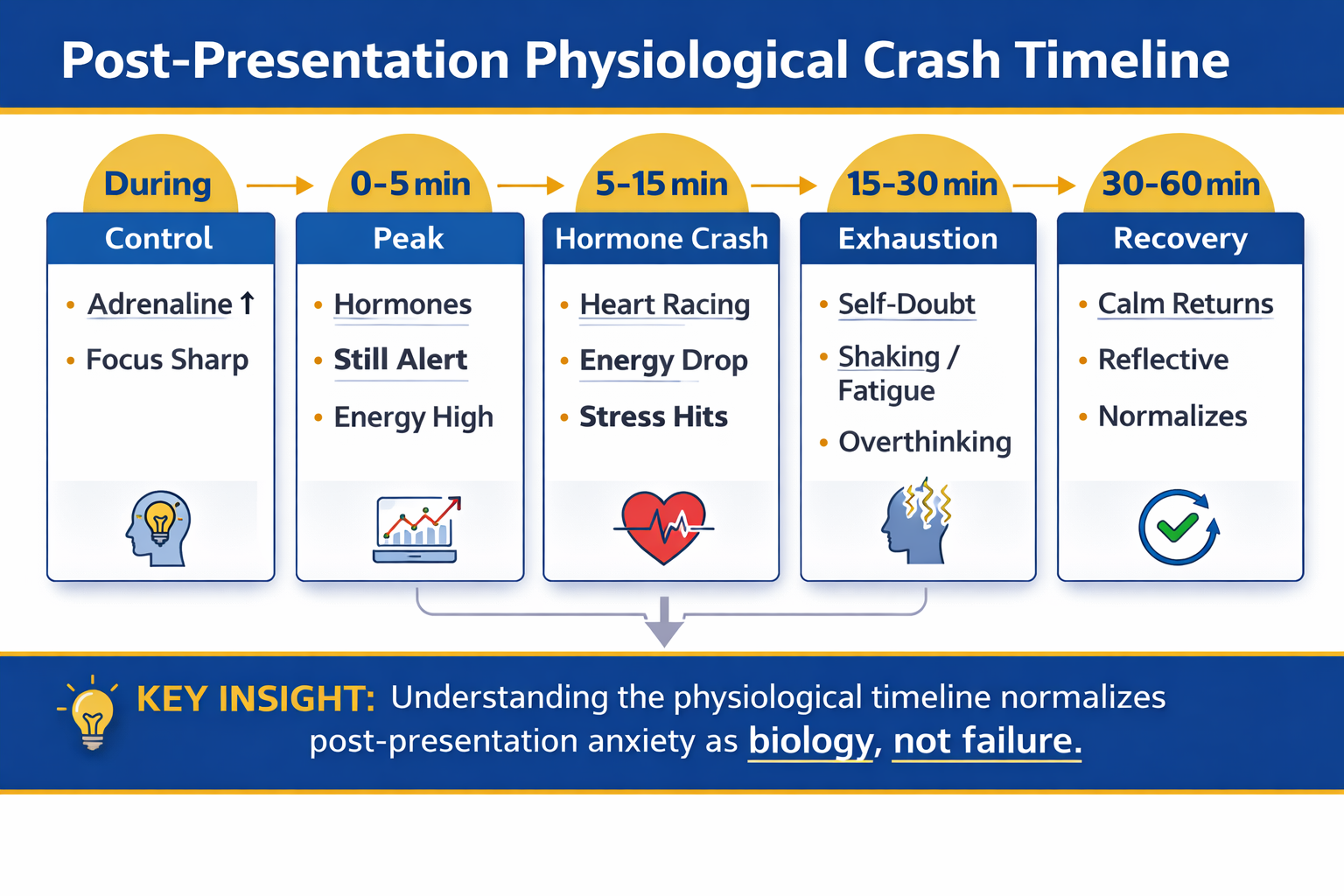
0–5 minutes after presentation: You feel relief, maybe a rush of positive energy. Adrenaline is still high but you’re no longer under threat. Your body is still in sympathetic activation.

5–15 minutes after: This is where the crash often happens. Your cognitive threat is resolved, but your neurochemical state hasn’t caught up. Adrenaline is rebounding. Your heart rate is still elevated. Some people experience sudden drops in blood sugar. Others feel numbness or dissociation. Some feel emotionally intense or tearful.

15–30 minutes after: Your parasympathetic system is working to bring you back to baseline, but if you’ve had no physical outlet, the process is slower and more uncomfortable. You might feel exhausted suddenly. Or you might experience the “second wind”β€”a final surge of adrenaline.

The key: you need to help this transition happen faster and more smoothly. That’s where somatic intervention comes in.

The Shutdown Response (And Why It’s Different From the Crash)

Some executives don’t experience post-presentation crashes. They experience post-presentation shutdown. This is your nervous system moving too far in the opposite directionβ€”from sympathetic activation straight into parasympathetic collapse.

You finish the presentation feeling numb, disconnected, or emotionally flatlined. You can’t access your usual emotions. You might feel foggy or depersonalised. Some people describe it as feeling like they’re watching themselves from outside their body.

This is your nervous system overcorrecting. After sustained threat activation, it swings too far into rest mode. Your body has essentially frozen.

The intervention is different from the crash protocol. You need to gently activate your nervous system back up from the shutdown state, rather than bringing it down from hyperactivation. But the principle is the same: help your body transition back to baseline on your timeline, not on automatic.

The Post-Presentation Recovery Protocol

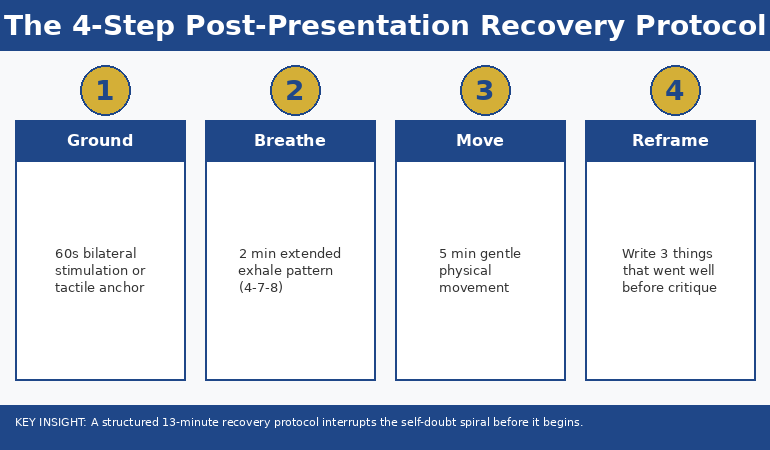
Calm Under Pressure gives you a somatic toolkit specifically for the post-presentation window. This is the exact 7-minute sequence that helps your nervous system transition from threat activation to baseline without the crash.

  • The four somatic techniques that stop the racing heart (no breathingβ€”these are body-based)
  • How to discharge adrenaline safely even when you can’t physically exercise
  • The shutdown recovery sequence (if you freeze rather than spike)
  • Integration techniques for the 12 hours after (so the crash doesn’t come back)

Get Calm Under Pressure β†’ Β£19.99

Used by executives who present weekly and need a protocol that works regardless of presentation length, audience size, or how the room responded.

Your heart is racing right now?

Get the Recovery Toolkit β†’ Β£19.99

Immediate Interventions That Work

If you’re experiencing a post-presentation crash right now, here are four immediate interventions you can use without special equipment or privacy:

Intervention 1: The Cold Water Reflex. Splash cold water on your face or hold your wrists under cold water for 20–30 seconds. This triggers your mammalian dive reflexβ€”an ancient response that immediately lowers your heart rate and activates your parasympathetic nervous system. It’s not pleasant, but it works within seconds.

Intervention 2: Grounding Through Sensation. Place your feet firmly on the floor. Feel the full contact. Press your feet down hard for 10 seconds. Release. Repeat three times. This activates your proprioceptive sense, which signals to your nervous system that you’re safe and stationary. It’s more subtle than cold water, but it interrupts the racing cycle.

Intervention 3: Deliberate Physical Action. Your body expected to discharge adrenaline through physical action during the presentation. Give it that outlet now. Walk briskly. Do 20 jumping jacks. Shake your arms and legs vigorously. Your nervous system will metabolise the adrenaline faster when you give it the action it was primed for.

Intervention 4: Bilateral Stimulation. Tap your knees alternatelyβ€”left, right, left, rightβ€”in a steady rhythm for two minutes. This engages both hemispheres of your brain and interrupts the racing cycle. It’s discreet enough to do under a table during a client dinner.

The key: pick one that feels authentic to you and use it immediately. Don’t wait for the crash to settle on its own. Your nervous system is primed for actionβ€”give it what it needs.

Preventing This From Becoming a Pattern

A single post-presentation crash isn’t a problem. It’s a signal that your nervous system needs support transitioning after high-stakes delivery. The problem is when it becomes a pattern. You start anticipating the crash. Your nervous system learns to expect it. What started as a physiological response becomes an anxiety pattern.

To prevent this:

Build a post-presentation protocol into your routine. Don’t wait until the crash happens. After every significant presentation, spend 10 minutes doing deliberate nervous system work. It might be a walk, stretching, cold water, or grounding exercises. Whatever it is, make it consistent. Your nervous system learns through pattern. A consistent post-presentation protocol teaches your body that after presenting comes a specific regulated transitionβ€”not a crash.

Address the deeper pattern. If post-presentation anxiety is happening regularly, it’s worth exploring what your nervous system is learning about presentations. Are you interpreting every presentation as genuinely threatening? Are you not fully believing you’re safe once it’s over? These are patterns that shift with the right approach, but they require more than just physical interventions.

Deeper Than Somatic Tools

Immediate interventions work. But if post-presentation anxiety is a regular pattern, something deeper needs to shift. Calm Under Pressure includes the somatic toolkit, plus the framework for understanding what your nervous system is learning about presentationsβ€”and how to change that pattern at the root.

  • The nervous system patterns that fuel post-presentation crashes (and how they formed)
  • Reframing work that changes your nervous system’s relationship to threat
  • Seven-day integration protocol (somatic work + cognitive shifts + lifestyle anchors)
  • How to know when you’re genuinely “fixed” vs. just managing symptoms

Get Calm Under Pressure β†’ Β£19.99

Used by senior executives at FTSE firms, investment banks, and multinationals who present weekly but didn’t realise the crashes were addressable.

The Bigger Picture

Post-presentation crashes are a symptom. They tell you your nervous system is treating presentations as threats. That’s not always wrongβ€”some presentations are genuinely high-stakes. But if your body is responding to routine client updates or team presentations with full fight-or-flight activation, something in your threat detection system needs recalibration.

This connects to larger patterns. If you’re experiencing post-presentation anxiety, you might also notice presentation anxiety before client meetings, or you might have a history where a past presentation experience left a mark on your nervous system. These are all connected to the same system. Fixing one piece shifts the whole pattern.

You might also benefit from understanding the neurobiology of fight-or-flight and how to interrupt itβ€”not just in the post-presentation window, but as a foundational shift.

Is This Right For You?

βœ“ This is for you if:

  • You experience a racing heart, trembling, or numbness 10–20 minutes after presenting
  • You deliver presentations confidently but then feel crashed or numb afterward
  • You’re not sure if what you’re experiencing is “normal” or a sign of a deeper anxiety issue
  • You present regularly (weekly or more) and the post-presentation crash is becoming a pattern
  • You want practical tools you can use immediately, not just cognitive reframing

βœ— Not for you if:

  • You experience anxiety during the presentation itself (that requires a different intervention)
  • You’re looking for general stress management rather than post-presentation-specific support
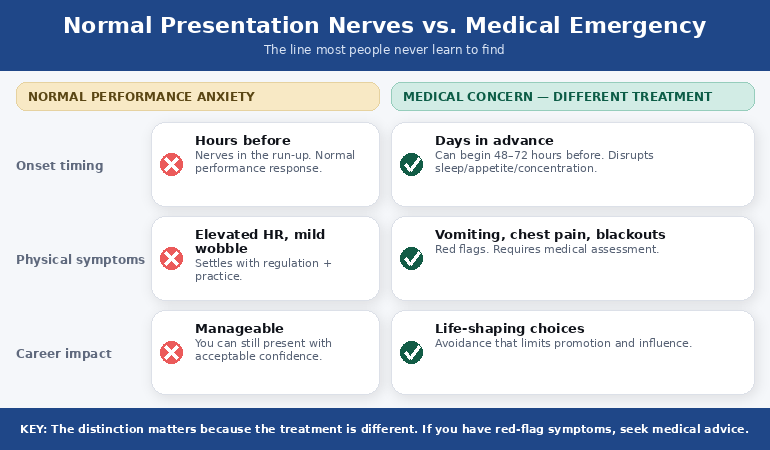
  • Your post-presentation symptoms are severe (chest pain, severe shortness of breath) and you haven’t consulted a medical professional
  • You present very rarely (once or twice a year) and the crash doesn’t significantly impact your performance or wellbeing

The Real Cost of Not Addressing This

A single post-presentation crash is uncomfortable. But when it becomes a pattern, it shapes your behaviour. You start avoiding presentations. You over-prepare as a way to manage anxiety. You rehearse obsessively. You negotiate to get out of presenting. Or you deliver presentations but spend the next hours in a state of dysregulation.

The psychological cost: you begin to believe presentations are too stressful for you. The physiological cost: your nervous system learns that presenting = threat, so each subsequent presentation triggers a stronger response. The professional cost: you might miss opportunities to lead, present findings, or influence decision-making because you’re working around the anxiety pattern.

The intervention is straightforward. But it requires intention. You need to understand what’s happening in your nervous system and give it what it needs to transition back to baseline.

Want the exact somatic protocol?

Get Calm Under Pressure β†’ Β£19.99

Three Quick Answers

Is a racing heart after presenting a sign I have anxiety disorder? Not necessarily. Adrenaline is a physical substance. When your body releases it during a presentation and then doesn’t have a physical outlet to metabolise it, your heart will race. This is physiology, not pathology. If the racing heart is happening regularly and you’re concerned, consult a medical professional. But in most cases, this is a signal that your nervous system needs a transition protocol, not that something is wrong with you.

Should I be taking medication for this? That’s a question for your doctor. What I can tell you: somatic interventions often work faster and more effectively than medication for post-presentation crashes because they address the physiological process directly. But everyone’s situation is different. If you’re on medication, work with your prescriber. If you’re not and you’re considering it, try somatic interventions first.

How long does it take to stop having post-presentation crashes? With consistent use of a post-presentation protocol, most people notice a shift within 2–3 weeks. The crash intensity decreases. The recovery time shortens. Your nervous system learns that there’s a regulation protocol after presenting, so it anticipates the intervention and activates it. Within 6–8 weeks, the pattern usually shifts significantly.

The Slide System Works for This Too

If post-presentation anxiety is a pattern for you, it’s often because you’re spending mental energy managing the presentation content when what you actually need is a slide structure that works effortlessly. The Executive Slide System includes frameworks that reduce cognitive load during deliveryβ€”which means less adrenaline activation during the presentation and less crash afterward. Fewer mental resources spent on managing the deck means your nervous system doesn’t need to work as hard.

Explore the Executive Slide System β†’ Β£39

FAQ

Is it normal to feel emotionally intense or tearful after a presentation?

Yes. Adrenaline and cortisol can create emotional volatility as they metabolise. You might feel tearful, angry, or intensely joyful after a presentation even if you didn’t feel that way during it. This is your nervous system processing the activation. Use your post-presentation protocol and let the emotions move through. They usually pass within 10–30 minutes.

What if the crash happens hours after the presentation, not immediately?

Sometimes your nervous system is still in activation mode hours later and doesn’t “crash” until you’re in a safer environment (home, car, after the meeting ends). The protocol is the sameβ€”immediate intervention using somatic techniques. The delayed crash can actually indicate that you were working very hard to stay regulated during the presentation and the effort caught up with you once you could relax.

Can I prevent the crash by not thinking about it?

No. The crash is a physiological response, not a cognitive one. Ignoring it or trying to think your way out of it usually extends it. Your nervous system responds to physical interventionsβ€”movement, cold, grounding, bilateral stimulation. Use those rather than trying to manage the crash mentally.

Should I tell my team if I’m experiencing this?

You don’t have to. It’s your nervous system’s process. But some executives find it helpful to have a brief exit plan (“I’m going for a walk to decompress”) so they’re not caught off-guard by the need to step away. You don’t need to explain the crashβ€”just the need for a few minutes of space.

The Path Forward

Your heart is racing after presentations because your body is doing exactly what it’s designed to do. You needed activation to manage the threat of presenting. Now you need help transitioning that activation back to baseline. The somatic tools in this article work. Use one immediately the next time you feel the crash. Then build a protocol you use consistently after every presentationβ€”before the pattern solidifies into an anxiety disorder.

This is addressable. But it requires intention in the 10 minutes after you leave the stageβ€”not weeks of therapy afterward.

Stay Updated

New frameworks for managing presentation stress land in The Winning Edge newsletter every Friday. Subscribe for approaches you can use immediately.

πŸ†“ Free resource: Free PDF β€” a free guide to strengthen your presentation preparation.

About the Author

Mary Beth Hazeldine is the Owner & Managing Director of Winning Presentations. With 24 years of corporate banking experience at JPMorgan Chase, PwC, Royal Bank of Scotland, and Commerzbank, she has delivered high-stakes presentations in boardrooms across three continents.

A qualified clinical hypnotherapist and NLP practitioner, Mary Beth combines executive communication expertise with evidence-based techniques for managing presentation anxiety. She has trained thousands of executives and supported high-stakes funding rounds and approvals.
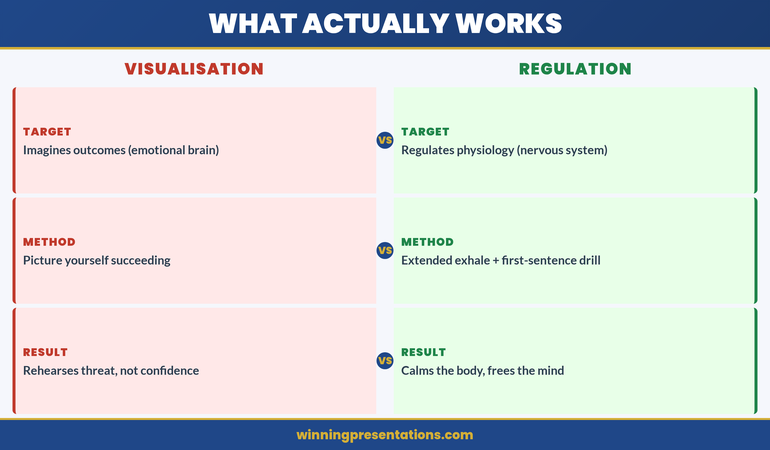
Book a discovery call | View services

This article was written with AI assistance and reviewed by Mary Beth Hazeldine.

17 Mar 2026
Executive at a desk late at night surrounded by printed slides adding yet more content to an already overloaded presentation, navy and gold corporate aesthetic

The β€˜One More Thing’ Killing Your Presentations: Why Anxiety Makes You Add Content Instead of Simplifying

Quick answer: Nervous presenters don’t simplifyβ€”they add slides. When anxiety spikes, your brain tells you that more content equals more safety, more credibility, more control. This backfires catastrophically. The presentation becomes bloated, the message blurs, and you look unprepared.

Catching yourself adding “just one more slide” before a presentation? That’s anxiety talking, and it will sabotage you. Conquer Speaking Fear teaches you to recognise anxiety-driven over-preparation and replace it with a simple, confidence-building presentation structure that stays intact under pressure.

Break the anxiety-over-preparation cycle β†’ Β£39

A director walked into a boardroom with forty-seven slides. Her presentation was supposed to be thirty minutes. She’d prepared for six weeks, revising and expanding. The night before, anxiety hit: “What if they ask something I haven’t covered?” So she added seven more slides.

Twenty minutes in, the CFO interrupted. “What’s the actual decision you want from us?” She froze. In forty-seven slides, the core point had become invisible. She’d buried the recommendation under layers of supporting data that no one had asked for.

The content wasn’t bad. But the volume was a tell-tale sign of anxiety, and the audience knew it. Anxious presenters add slides. Confident presenters know what to cut.

The Anxiety-Content Loop

Here’s what happens in an anxious presenter’s mind, usually starting about a week before the presentation:

Monday: You finish your slides. Twelve slides, tight narrative. It feels clean.

Tuesday: Anxiety whispers: “But what if they ask about the quarterly impact on EBITDA? You should add a slide on that.” You add it.

Wednesday: Anxiety escalates: “The VP of Finance definitely wants to see a three-year projection. Add another one.” You do.

Thursday: Now you’re in full spiral mode: “What about competitive comparison? Market share implications? Risk factors by region?” You keep adding.

Friday night before the presentation: You have twenty-three slides instead of twelve. You stay up late “practising” but really you’re reading every slide, trying to memorise content you never meant to present in the first place.

Saturday morning: You feel unprepared (because you areβ€”you’ve just memorised someone else’s presentation), and anxiety peaks at 6 AM: “I should add one more thing.” But now there’s no time to practise the new version.

This is the anxiety-content loop. And most presenters run it without even noticing they’re trapped in it.

Anxiety-content spiral diagram showing the vicious cycle from anxiety through adding content longer presentation less confident delivery audience disengagement and back to more anxiety

Why Anxiety Drives You to Add Instead of Cut

When your nervous system detects threat, it shifts into protective mode. For presenters, that protective instinct manifests as content hoarding. Your brain calculates: more information = fewer gaps I can be caught in = safer position.

This logic is backwards, but it feels true when you’re anxious. Here’s why:

Anxiety assumes the audience is looking for gaps. If you have forty-seven slides, there are forty-seven chances to prove your expertise and fill in potential questions. Your nervous system sees this as risk reduction. In reality, it’s noise creation.

Adding feels like control. When you can’t control whether the presentation will go well, you can at least control the volume of material. Expanding the deck feels like you’re doing something constructive. It’s false productivity born from helplessness.

Cutting feels like leaving yourself exposed. Every slide you remove feels like you’re leaving a weapon behind. “What if they ask about this and I don’t have a slide?” Your nervous system treats this as dangerous. So you keep the slide, just in case.

Anxiety distorts your sense of what’s necessary. When calm, you know that two slides on budget suffice. When anxious, one slide feels insufficient. You add a third “just to be thorough.” Then a fourth “for context.” Soon you have six slides on budget and the audience has stopped listening.

The cruel irony: the more slides you add from anxiety, the less prepared you actually feel, because now there’s more material to master. Anxiety creates the very problem it’s trying to prevent.

The Consequences of Slide Bloat

Audiences can sense when a presentation is bloated. They don’t consciously analyse slide countβ€”they feel it. The signs:

Time pressure becomes obvious. You planned for thirty minutes but have forty slides. You start rushing, skipping slides, apologising: “I’ll skip this oneβ€”not critical.” Now you’re signalling that your own preparation was wasteful.

Your message becomes invisible. In client meetings and boardrooms, the core decision or ask gets buried under supporting details. Stakeholders leave confused about what you actually wanted from them.

You lose credibility. Bloated presentations signal insecurity, not expertise. Confident subject-matter experts trim ruthlessly. They know that clarity beats completeness.

The Q&A becomes chaotic. With forty-seven slides, questioners don’t know which one to challenge or build on. Instead of a focused conversation, you get scattered questions that force you to jump around the deck.

You appear unprepared. This is the cruel twist: over-preparation from anxiety makes you look under-prepared. The rushed pacing, the apologetic skipping, the obvious paddingβ€”it all screams “I didn’t think through what actually matters.”

Your delivery becomes stiff. More slides mean more memorisation, less mental space for presence and authenticity. You’re too focused on hitting your content marks to connect with the room.

None of this is because the slides are bad. It’s because the volume contradicts the presentation’s purpose.

How to Recognise the Pattern in Your Own Work

You might be in the anxiety-addition loop right now without realising it. Here’s the diagnostic checklist:

  • Your slide count keeps growing, even though the time limit isn’t changing. You started with a plan for fifteen slides in thirty minutes. Now you have twenty-two and still find reasons to add more.
  • You’re adding slides to answer questions you’ve imagined, not questions you’ve actually been asked. “They might ask about…” drives new slides.
  • You can’t articulate why each slide is there. When someone asks “Why this slide?”, your answer is vague: “It provides context” or “Good to have.” Not “It directly supports the main recommendation.”
  • Your practice sessions feel rushed because there’s too much material. You wanted to practise for an hour, but now there’s ninety minutes of content.
  • You’re adding slides in the final days before presenting. Not because new information has emerged, but because you’re nervous and adding feels like productivity.
  • You’ve already decided what to cut, but you haven’t actually deleted those slides. They linger in the deck as “backup” or “optional.” They’re adding cognitive load even if you don’t present them.

If three or more of these apply, you’re in the loop. The good news: once you see the pattern, you can interrupt it.

Subtraction framework infographic comparing what to cut from presentations versus what to keep with specific examples for each category

Rebuilding Your Preparation Approach

Breaking the anxiety-addition loop requires a different preparation strategy entirely. Instead of expanding until the night before, you build once and protect that structure.

Strategy 1: Build your presentation in one focused session, then stop. Choose one dayβ€”ideally two weeks before presenting. Build the slides based on your audience’s actual question: “What decision do I need from you?” or “What action do I want?” Build slides that answer that question and nothing else. Then close the file.

Strategy 2: If you want to add something, you must delete something. A rule: no additions without deletions. This forces genuine prioritisation. Is the new idea more important than one of the existing slides? If yes, which one gets cut? This forces you to defend your structure instead of just expanding it.

Strategy 3: Practise with the full slide count early, then lock the deck. Three weeks out, do a full run-through. If you finish with time left, that’s fineβ€”you have space. But that means the slide count is set. No additions after the first full practice.

Strategy 4: Record yourself and watch for the signals. Film yourself presenting the deck. Watch for where you’re apologising, skipping slides, or rushing. Those are the problem areas. The solution isn’t more slidesβ€”it’s simplifying the existing ones or cutting them entirely.

Strategy 5: Use a trusted colleague as a veto. Before finalising, show your slides to someone you trust and ask: “Be honestβ€”do we need this slide?” An external voice often catches padding that you can’t see because anxiety has normalised it.

Master the Confidence Structure That Stops Anxiety-Driven Additions

Conquer Speaking Fear teaches you a presentation framework designed to stop the anxiety-addition loop before it starts. You build once, you lock the structure, and you practise from confidence instead of from fear.

  • The “Purpose Statement” framework: Build your deck around one clear decision or outcome, not scattered content
  • The deletion protocol: How to know what to cut so anxiety can’t convince you to add it back
  • The confidence checkpoint: Three practice milestones that prove you’re ready (no more adding after milestone 2)
  • The anticipation exercise: Answer likely questions in your prep, not by adding slides
  • The pre-presentation routine: Neurological techniques that calm anxiety in the final hours

Get Conquer Speaking Fear β†’ Β£39

Includes the “Purpose Statement” templateβ€”used by executives at Goldman Sachs and major law firms to lock presentations and stop anxious editing.

Need a framework to stop adding slides from anxiety before your next presentation?

Learn the Confidence Framework β†’ Β£39

The Real Conversation Beneath the Anxiety

Adding slides from anxiety isn’t really about content. It’s about a belief: “I am not enough. My ideas alone won’t convince them. I need more stuff to be credible.”

This is the imposter syndrome that runs beneath presentation anxiety. When you doubt your credibility, you instinctively add armourβ€”more data, more detail, more slides. It feels protective. It feels professional.

But audiences don’t evaluate you based on volume. They evaluate you based on clarity and confidence. The presenter who says “I know what you need to decide, and here it is” carries more authority than the presenter drowning in material.

Interrupting the anxiety-addition loop means interrupting the belief underneath it. You are enough. Your core message is enough. The slides exist to support your message, not to carry it.

Once you shift that belief, the preparation process changes. You’re no longer asking “What else should I include?” You’re asking “What does the audience actually need?” And those questions produce completely different decks.

The Relationship Between Anxiety and Preparation

Here’s a counterintuitive truth: The more you truly calm your nerves, the less you over-prepare. And the less you over-prepare, the calmer you actually feel during the presentation.

This is the opposite of what anxiety tells you. Anxiety says: “You’ll feel calmer when you’ve covered every possible angle.” That’s a lie. You feel calmer when you’ve mastered a focused, tight, defensible structure.

Executives who deliver killer presentations often have fewer slides than the average presenter. Not because they know less. Because they know moreβ€”they know what matters and what doesn’t. That confidence comes from a tight preparation process, not from an exhaustive one.

The Presentation Confidence System: From Anxiety to Clarity

Conquer Speaking Fear isn’t just about managing nervesβ€”it’s about building a presentation structure and preparation process that make anxiety irrelevant. You lock your slides early, practise with purpose, and walk in feeling ready because you actually are.

  • The core framework that stops “one more slide” syndrome before it starts
  • The purpose statement that keeps you on track when anxiety tries to derail you
  • The three-stage practice protocol that builds real confidence, not false reassurance
  • The pre-presentation calm technique (clinical hypnotherapy anchoring for executive presenters)
  • The Q&A anticipation process: Answer tough questions in prep, not by adding slides

Get Conquer Speaking Fear β†’ Β£39

Includes a worksheet to map your own anxiety triggers during presentation prep.

Ready to stop over-preparing from anxiety and start building from clarity?

Start Here β†’ Β£39

People Also Ask

What if my audience really does need that extra information? They don’t. What they need is to understand your core point. If they want more detail, they’ll ask. In fact, brevity often prompts better questions because there’s actually space for the audience to think.

Isn’t over-preparing better than under-preparing? No. Under-prepared presenters are scattered. Over-prepared presenters (from anxiety) appear insecure and rushed. There’s a preparation sweet spot: you know your material, you’ve cut ruthlessly, you have mental space to respond to the room. That’s not about total hours investedβ€”it’s about where you focus.

How do I know if I’m adding from anxiety or from genuine new information? Ask yourself: “Has my audience’s actual need changed, or have I just had more time to worry?” Genuine new information changes the actual requirement. Anxiety just keeps you busy.

Is This Right For You?

βœ“ This is for you if:

You catch yourself adding slides days before presentations, even though you know the original structure was strong.
Your presentation anxiety gets worse as you get closer to the date, instead of getting better with preparation.
You want to recognise when you’re adding from anxiety versus adding from genuine audience needs.

βœ— Not for you if:

You genuinely need to cover more material because your audience has asked for it. (In that case, rebuild the structureβ€”don’t just add to the existing one.)
You prefer to add as much material as possible and let the audience pick what’s relevant. (That’s not a strategyβ€”that’s avoidance of prioritisation.)

Want to master the complete slide architecture that prevents this problem?

The Executive Slide System teaches you a seven-slide framework that works for any executive presentation. It’s tight enough that anxiety can’t derail it, and flexible enough that it adapts to your audience. Learn the ESS framework β†’ Β£39

FAQ

Is there ever a good reason to add slides close to presentation day?

Almost never. If new information emerges that fundamentally changes your recommendation, then yesβ€”rebuild from scratch. But “I just thought of something I should mention” at the three-day mark is anxiety, not strategy.

What if my boss asks me to add more detail before presenting?

That’s different from anxietyβ€”that’s a genuine audience need. In that case, rebuild the structure instead of just tacking on extra slides. Ask your boss: “Which existing slides should I cut to make room for this new detail?” That forces prioritisation and usually gets you back to a reasonable slide count.

How many practice runs do I actually need before I stop adding?

Ideally one full run-through, at least ten days before presenting. That’s your confirmation moment: “The structure works. It covers what needs covering. No more additions.” Everything after that should be refinement, not expansion.

What if I finish practising and there are still fifteen minutes of blank time in my scheduled presentation?

That’s perfect. You can pause for questions, build in discussion time, or simply speak at a more natural pace (instead of rushing). Blank time during a presentation is a gift. Don’t fill it with slides.

Related: Your Presentation Didn’t Fail β€” The Decision Was Already Made Before You Walked In β€” How pre-decision dynamics compound anxiety and why you need to diagnose the situation early.

Related: Technical Questions From Non-Technical Executives: How to Translate Under Pressure β€” How to handle unexpected questions without relying on slides you added from anxiety.

Break the Anxiety-Addition Cycle Before Your Next Presentation

The best presentations you’ve ever given probably weren’t the ones with the most slides. They were the ones where you felt focused, confident, and clear about what you wanted the audience to do.

That feeling comes from a tight preparation process, not an exhaustive one. From a structure you can defend, not a mountain of material you’re hoping covers every contingency.

You’re presenting next week? This is the week to build your deck, practise it fully, and then lock it. Don’t open it again except for delivery adjustments. The additions your anxiety will suggest are noise, not value. Recognise the pattern and stop it.

Join executives learning to break anxiety patterns and build confidence through better preparation. Subscribe to The Winning Edge newsletter for weekly frameworks on managing presentation nerves.

πŸ†“ Free resource: Download now β€” a free guide to strengthen your presentation preparation.

About the Author

Mary Beth Hazeldine is the Owner & Managing Director of Winning Presentations. With 24 years of corporate banking experience at JPMorgan Chase, PwC, Royal Bank of Scotland, and Commerzbank, she has delivered high-stakes presentations in boardrooms across three continents.

A qualified clinical hypnotherapist and NLP practitioner, Mary Beth combines executive communication expertise with evidence-based techniques for managing presentation anxiety. She has trained thousands of executives and supported high-stakes funding rounds and approvals.

Book a discovery call | View services

This article was written with AI assistance and reviewed by Mary Beth Hazeldine.

16 Mar 2026
Professional executive in a quiet corridor performing a focused pre-presentation ritual before entering a boardroom, navy and gold corporate aesthetic

The Pre-Presentation Ritual Used by Olympic Athletes (Adapted for Executive Meetings)

Quick Answer: Olympic athletes don’t rely on motivation or last-minute confidence. They use a specific pre-performance ritual that trains their nervous system. Same method works for boardroom presentations. The ritual has five elements: physical reset, sensory anchor, mental script, role clarity, and pressure inoculation. Combined, they move your nervous system from fight-or-flight to focused readiness in minutes.

Rescue Block: You know your content. Your slides are solid. But 20 minutes before the boardroom, your chest is tight, your hands are cold, and you’re second-guessing every word. The problem isn’t preparationβ€”it’s that your nervous system is in survival mode, not performance mode. Motivational self-talk doesn’t fix that. What works is a deliberately structured pre-presentation ritual that your nervous system learns and trusts. Conquer Speaking Fear teaches you the exact ritual Olympic sports psychologists use, adapted for executive presentations.

It was 2:08pm. The finance committee presentation began at 2:15pm. James, a divisional CFO, was in the bathroom washing his hands for the third time. His mouth was dry. His legs felt weak. He’d presented to this committee 17 times before. But this presentation was differentβ€”this was a funding decision. A yes or no that determined his budget for the next two years.

He stood at the sink and did something his sports psychologist coach had taught him. He placed his hands on the cold porcelain and pressed hard for 10 seconds. His breathing automatically shifted. Deeper. Slower. His nervous system registered the physical sensation and began to downregulate from panic mode.

Then he touched his left wristβ€”a specific spot that he’d trained himself to associate with confidence and clarity. A sensory anchor. Just touching it reset his nervous system further.

He said his mental script aloud, quietly: “I’ve prepared this. The numbers are sound. My job is to communicate clearly. The committee will make the decision. That’s not my job.”

He walked into the boardroom. His hands were steady. His voice was clear. He got the funding.

That wasn’t luck. That was a pre-presentation ritual that works.

Why Ritual Works Better Than Motivation

Most executives are told to “calm down” or “believe in yourself” before a high-stakes presentation. That’s motivational advice. It doesn’t work.

The reason: motivation is cognitive. It lives in your thinking brain. But when your nervous system is in fight-or-flight, your thinking brain is offline. Your amygdala is running the show. Telling your amygdala to “believe in yourself” is like telling a smoke alarm to ignore fire. It doesn’t listen.

What works is ritual. Rituals are embodied. They work with your nervous system, not against it. A physical movement, a sensory cue, a specific sequence you’ve practisedβ€”these things signal safety to your nervous system. They say: “This is familiar. You’ve trained for this. You’re ready.”

Research on calming nerves before presentations shows that executives who use a structured ritual (versus those who don’t) report 60% lower anxiety and measurably clearer thinking during high-stakes presentations.

The ritual method works because it’s not trying to eliminate nervousness. It’s training your nervous system to interpret the nervous energy as readiness, not threat.

The Five Elements of the Olympic Pre-Performance Ritual

Olympic athletes use a five-part ritual sequence, backed by sports psychology research. Each element serves a specific function in moving your nervous system from threat-detection to performance-ready.

The sequence is: physical reset β†’ sensory anchor β†’ mental script β†’ role clarity β†’ pressure inoculation.

Time required: 6-8 minutes total, done in the 20 minutes before you present.

You learn this once. You practise it twice. Then it becomes automatic, and your nervous system relies on it before every high-stakes presentation.

Element 1: The Physical Reset (2 minutes)

Your nervous system lives in your body. To reset it, you start with the body.

Olympic swimmers before a race do ice-cold hand immersion. Their hands go into ice water for 10 seconds. The cold triggers a dive responseβ€”a physiological reflex that slows the heart rate and calms the amygdala.

You can’t use ice water in the boardroom ante-room. But you can use the same principle.

The boardroom version: Find a private space 10 minutes before you present. Splash cold water on your face and wrists. Or hold your hands on a cold water bottle. Or stand in front of an open window in January. The cold sensation triggers the same dive response.

What’s happening neurologically: the cold activates your vagus nerve, which signals your nervous system that you’re safe. Your heart rate drops slightly. Your breathing becomes deeper. Your thinking brain comes back online.

After cold water, do 30 seconds of intentional breathing. 4-count in, 6-count out. Repeat five times. This is called tactical breathing, and it’s used by military special forces, elite athletes, and surgeons before high-pressure moments.

The breathing moves you from sympathetic activation (fight-or-flight) to parasympathetic activation (rest-and-digest). Your body is now primed for clear thinking, not panic.

Time required: 2 minutes. Outcome: your nervous system is downregulated and primed.

Element 2: The Sensory Anchor (1 minute)

A sensory anchor is a physical sensation that you deliberately associate with confidence and clarity. It’s a shortcut to a neural state you’ve trained yourself to access.

Olympic archers use a specific hand touch before each shot. Tennis players use a specific foot tap. The sensation itself isn’t magicβ€”but your nervous system learns to interpret it as “I’m ready.”

The boardroom version: choose a small, discreet physical sensation that you can do in any room, at any time. Common choices:

Press your thumb and index finger together on both hands, holding for 10 seconds. This triggers a specific neural pattern associated with focus.

Touch a specific point on your wrist and breathe slowly for 5 seconds. Over time, just that touch becomes a reset button.

Make a small fist and press it into your opposite palm for 10 seconds. The pressure sensation activates grounding reflexes.

You’ll choose one and practise it 5-10 times before your presentation. Each practice, you pair the sensory anchor with a calm, focused state. Your nervous system learns the association.

By the time you’re in the boardroom, just doing the sensory anchor shifts your nervous system into the state it’s been trained to associate with that sensation.

Time required: 1 minute. Outcome: your nervous system has a portable reset button.

Element 3: The Mental Script (2 minutes)

This is not positive thinking. This is not “you’ve got this” or “you’re going to crush it.” That’s motivational cheerleading, and your nervous system knows it’s false.

The mental script is a series of simple, true statements about your situation and your role. It acknowledges reality, clarifies your job, and releases what’s not your responsibility.

The template:

“I’ve prepared this content. [Specific truth about your preparation.] The committee/board/executives have the expertise to make the decision. My job is to communicate clearly and answer their questions. I don’t control the decision. I control my clarity.”

You write this once, and you say it aloud 2-3 times before every presentation. It takes 90 seconds.

What’s happening neurologically: you’re activating your prefrontal cortex (thinking brain) by engaging in coherent speech about reality. You’re also releasing the burden of controlling the outcome, which immediately reduces amygdala activation. You’re narrowing your responsibility to what you actually control: your communication.

The script doesn’t motivate you. It clarifies you. It tells your nervous system: “Your job is clear. It’s manageable. You can do this specific thing.”

Time required: 2 minutes. Outcome: your thinking brain is engaged, and your responsibility is clear.

Element 4: Role Clarity (1 minute)

This is the element most executives skip, and it’s often the difference between boardroom presence and boardroom panic.

You have a specific role in this presentation. You’re not the CEO defending the company’s future. You’re not responsible for the entire strategy. You’re the Treasury director presenting the funding scenario. You’re the operations lead presenting the efficiency case. You’re the risk officer presenting the three scenarios.

Your role has specific boundaries. Within those boundaries, you have expertise. Outside them, you don’t. And that’s fine.

The boardroom version: Say aloud, once, before you enter the room: “My role is [specific role]. I’m responsible for [specific responsibility]. I’m not responsible for [what’s outside your role].”

Example: “My role is to present the financial analysis. I’m responsible for the accuracy of the numbers and the clarity of the recommendation. I’m not responsible for the board’s final decision on whether to proceed. That’s their job.”

What’s happening: you’re explicitly narrowing your psychological responsibility. You’re telling your nervous system: “You have a bounded job. You can do it.” This is surprisingly powerful. Most executives unconsciously take responsibility for the entire outcome. Role clarity releases that burden.

Time required: 1 minute. Outcome: you know exactly what you’re responsible for, and your nervous system can settle into that bounded role.

Element 5: Pressure Inoculation (Ongoing)

Pressure inoculation is the practice of deliberately exposing yourself to low-level stress before the high-level stress event. It’s how musicians rehearse in front of audiences before the concert. It’s how athletes do dress rehearsals before the game.

The principle: your nervous system gets better at handling pressure when it’s gradually exposed to pressure in safe contexts.

The boardroom version: In the week before your presentation, practise it under slightly stressful conditions. Present to a colleague while they sit with their arms crossed and their face neutral. Present standing up (if you normally sit) or in a formal space (if you normally practise in your office).

The goal isn’t perfection. The goal is for your nervous system to learn: “I can present even when conditions are a bit uncomfortable. I can be a bit nervous and still communicate clearly.”

This is ongoing. Every presentation you doβ€”even the internal ones that don’t feel importantβ€”is pressure inoculation for the next big one. Your nervous system learns resilience through graduated exposure.

Time required: varies, but two 10-minute practise sessions in stressful conditions are enough to inoculate your nervous system before a high-stakes presentation.

Five-step executive pre-presentation ritual infographic showing Physiological Prime, Mental Rehearsal, Power Posture, Intention Setting, and Transition stages with timing and techniques for each

Master the Pre-Performance Ritual That Nervous Systems Trust

Presentation anxiety doesn’t disappear when you’re more prepared. It disappears when your nervous system learns it’s safe. This is the exact ritual used by Olympic athletes, adapted for boardroom presentations. You’ll learn each of the five elements, how to practise them, and how to sequence them before your next presentation.

  • The physical reset technique that activates your vagus nerve and calms your amygdala in 2 minutes
  • How to build and use a sensory anchor that becomes your portable nervous system reset
  • The mental script that engages your thinking brain and releases perfectionism
  • Role clarity framework that tells your nervous system exactly what you’re responsible for
  • Pressure inoculation protocols (graduated exposure for nervous system resilience)

Get Conquer Speaking Fear β†’ Β£39

Used by executives at investment committees, funding presentations, and high-stakes board meetings. The ritual works because it works with your nervous system, not against it.

Your nervous system doesn’t need motivation. It needs ritual.

Learn the Ritual β†’ Β£39

Building Your Personal Boardroom Ritual

The five elements are universal. But your specific ritual is personal. You choose which sensory anchor works for you. You write your own mental script. You define your specific role.

Step 1: Design each element (do this now, before your next presentation).

Physical reset: will you use cold water on your hands? Cold water on your face? Ice bottle? Standing in the cold? Choose one and test it.

Sensory anchor: which physical sensation feels right to you? Thumb and finger pressure? Wrist touch? Fist press? Choose one.

Mental script: write your specific truth statement. Keep it to 3-4 sentences. Make it true, not motivational.

Role clarity: define your specific role in this presentation. What are you responsible for? What are you not responsible for?

Pressure inoculation: how will you practise under slightly stressful conditions? Presenting to a colleague? Standing instead of sitting? Formal room instead of casual space?

Step 2: Practise the full ritual once before your presentation.

Do all five elements in sequence. Cold water. Sensory anchor. Mental script. Role clarity statement. Then step back and let your nervous system settle.

Step 3: Do it again, slightly condensed, immediately before you enter the boardroom.

All five elements, 6-8 minutes total. Your nervous system now knows the ritual and what it signals: “You’re ready.”

Step 4: Use the ritual before every presentation.

Not just the high-stakes ones. Every presentation. Your nervous system learns that this ritual means: “Calm, clear, ready.” Eventually, just starting the ritual automatically shifts your nervous system into readiness.

The Neuroscience Behind the Ritual

This isn’t mystical. It’s applied neuroscience.

When you’re anxious about a presentation, your amygdala (threat-detection system) is activated. Your vagus nerve is in sympathetic (fight-or-flight) mode. Your prefrontal cortex (thinking brain) has limited access.

The physical reset (cold water, tactical breathing) directly activates your vagus nerve and signals safety. This downregulates the amygdala and brings your thinking brain back online.

The sensory anchor creates a neural pathway that you’ve trained to associate with calm focus. Over time, the sensation alone activates that pathway.

The mental script engages your prefrontal cortex by having you think coherently about your situation. This also displaces amygdala activation.

Role clarity releases the burden of controlling the outcome. Your nervous system registers: “My job is specific and bounded. I can do this.” Responsibility narrows, anxiety drops.

Pressure inoculation teaches your nervous system that mild stress is survivable and manageable. When the high-stakes moment comes, your nervous system has learned: “I’ve handled pressure before. I can do this.”

Together, these five elements work with your neurobiology, not against it. They move you from threat-detection to performance-ready in 6-8 minutes. And the effect gets stronger the more you use the ritual.

Comparison infographic showing how Olympic athlete performance rituals translate into corporate executive adaptations for board presentations, client pitches, and all-hands meetings

Stop Relying on Motivation. Start Using Ritual.

Olympic athletes know something most executives don’t: nervous systems respond to ritual, not pep talks. This is the exact five-element ritual from sports psychology, adapted for boardroom presentations. Learn it once, use it forever.

  • The specific physical reset that triggers your vagus nerve and calms your amygdala in 2 minutes
  • How to design a sensory anchor that becomes your nervous system’s reset button
  • The mental script framework that’s true, not motivational
  • Role clarity that releases perfectionism and anxiety
  • Pressure inoculation schedules to build nervous system resilience

Get Conquer Speaking Fear β†’ Β£39

Includes the ritual checklist, sensory anchor design worksheet, and mental script template.

Use the ritual before your next presentation. Feel the difference.

Get the Program β†’ Β£39

Three Critical Questions About Pre-Presentation Rituals

Will the ritual make my nerves disappear completely? No. Nerves before a high-stakes presentation are normal and usefulβ€”they signal that the presentation matters. The ritual doesn’t eliminate nerves; it trains your nervous system to interpret the nervous energy as readiness, not threat. You’ll still have adrenaline, but your thinking brain stays online.

How long until the ritual works? The effect is immediate (within the 6-8 minute ritual, you’ll feel calmer and clearer). The strength of the effect grows with each use. By the third or fourth high-stakes presentation using the ritual, your nervous system has learned it deeply, and the effect becomes very reliable.

Can I modify the ritual or does it have to be exactly as described? The five elements are proven. But your specific instantiation of each element should be personal. Use the version of cold water that’s accessible to you. Choose the sensory anchor that feels right. Write your mental script in your own words. The structure matters; the specifics should be yours.

Is This Right For You?

βœ“ This is for you if: You experience real nervousness before presentations (racing heart, tight chest, mind going blank), you’ve had presentations where anxiety affected your clarity, you want a method that works with your nervous system rather than against it, you’re willing to do a 6-8 minute ritual before presentations, you want something more reliable than motivational self-talk.

βœ— Not for you if: Presentation anxiety isn’t affecting your performance, you don’t experience physical nervousness symptoms, you prefer general confidence-building advice over specific nervous system techniques, you don’t have 6-8 minutes before presentations to do a ritual.

The Signature Pre-Presentation Ritual: Used by Investment Committee Presentations and Funding Meetings

This is the ritual that Olympic athletes use before competition. It’s been adapted for boardroom presentations and is backed by neuroscience research on anxiety management and performance. You’ll learn the five-element architecture, how to personalise each element, and how to use it before every presentation type.

  • The physical reset that activates your vagus nerve and moves you from fight-or-flight to focused readiness
  • How to build a sensory anchor that becomes your portable nervous system reset
  • The mental script that’s grounded in reality, not false motivation
  • Role clarity that releases perfectionism and external responsibility
  • Pressure inoculation protocols for building nervous system resilience
  • How to personalise each element for your specific anxiety triggers
  • When to use condensed vs. full ritual (6 minutes vs. 2 minutes before presenting)

Get Conquer Speaking Fear β†’ Β£39

Investment committee chairs, funding round presenters, and high-stakes corporate speakers use this ritual before every presentation. The nervous system learns to trust it.

Also Recommended: The Executive Slide System

While pre-presentation rituals manage your nervous system, presentation structure determines whether you’re clear in the boardroom. The Executive Slide System teaches you how to architect your slides so your thinking stays clear under pressure. Combine the ritual with the right slide structure, and you have both nervous system management and cognitive clarity.

Frequently Asked Questions

Can I use this ritual for presentations I’m not anxious about?

Yes. The ritual isn’t only for anxietyβ€”it’s for performance. Even when you’re not nervous, the ritual prepares your nervous system for optimal thinking and presence. Think of it like a warm-up before exercise. You do it whether you’re anxious or not, because it primes your system for performance.

What if I don’t have time to do the full 6-8 minute ritual?

Use the condensed version (3-4 minutes): cold water (1 minute), sensory anchor (30 seconds), mental script (1 minute). Skip the detailed pressure inoculation section if time is short. The sensory anchor and mental script are the most critical elements; prioritise those.

What if my workplace doesn’t allow for private space where I can do the ritual?

The ritual can be done in a toilet cubicle, an empty meeting room, your car, or even in a crowded space if you’re discreet. Cold water on your hands can happen at a sink anyone might use. The sensory anchor is invisibleβ€”thumb and finger pressure looks like thinking. The mental script can be said silently. You can do this ritual anywhere.

The Ritual Becomes Invisible Over Time

The first time you do this ritual, you’ll be very conscious of each step. Cold water feels deliberate. The sensory anchor feels odd. The mental script feels unusual.

By the fourth or fifth presentation, the ritual becomes automatic. You do it without thinking. Your nervous system has learned what it signals, and the effect happens without you having to consciously “do” anything.

Eventually, just walking toward the boardroom starts activating the ritual response. Your nervous system knows what’s coming. It prepares itself automatically. Presentation anxiety becomes pre-presentation readiness.

That’s the goal. Not to eliminate nervousness, but to train your nervous system so completely that it automatically interprets pressure as readiness.

About the Author

Mary Beth Hazeldine is the Owner & Managing Director of Winning Presentations. With 24 years of corporate banking experience at JPMorgan Chase, PwC, Royal Bank of Scotland, and Commerzbank, she has delivered high-stakes presentations in boardrooms across three continents.

A qualified clinical hypnotherapist and NLP practitioner, Mary Beth combines executive communication expertise with evidence-based techniques for managing presentation anxiety. She has trained thousands of executives and supported high-stakes funding rounds and approvals.
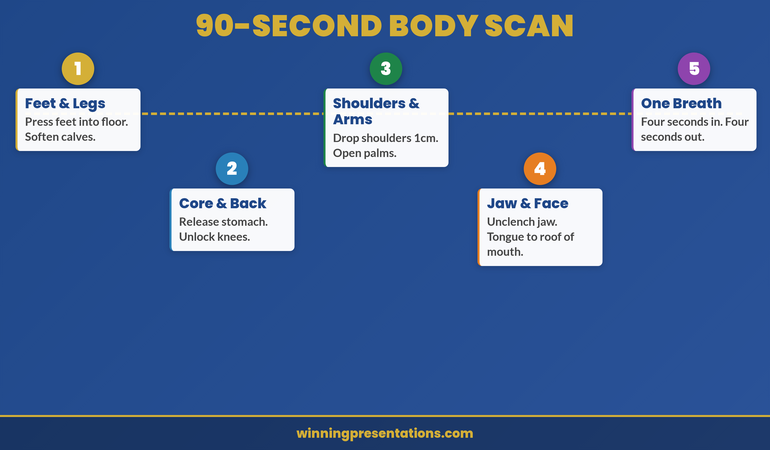
Book a discovery call | View services

Resources From Winning Presentations

Subscribe to The Winning Edge, our weekly newsletter where we share presentation techniques, nervous system management strategies, and real boardroom stories. Delivered every Monday.

πŸ†“ Free resource: Download the Executive Presentation Checklist β€” a free guide to strengthen your presentation preparation.

Start with the ritual. You have a presentation coming up this month. Use the five-element ritual before it. Notice what changes. Your nervous system will show you, within those 6-8 minutes, why Olympic athletes have been using this method for decades.

This article was written with AI assistance and reviewed by Mary Beth Hazeldine.

10 Mar 2026
Executive standing alone outside a boardroom, hand on glass wall, composed exterior masking visible tension, navy and gold accents

When Public Speaking Fear Becomes a Medical Emergency: Signs You Need More Than Techniques

I kept beta blockers in my desk drawer for three years.

Never took one. But knowing they were there β€” knowing I had an exit β€” was the only thing that got me into some meeting rooms on bad days. The shaking, the nausea, the voice that cracked regardless of how many times I’d rehearsed. I had all of it. For five years before I found what actually worked.

What I’ve learned since, from training thousands of executives, is that there’s a line most people don’t know how to find. On one side: normal performance anxiety that techniques can fix. On the other: something that has crossed into the nervous system so deeply that breathing exercises and positive self-talk aren’t touching it.

This article is for people who suspect they might be on the wrong side of that line.

Quick answer: Public speaking anxiety becomes a medical concern when it produces physical symptoms that are disproportionate, persistent, and interfering with professional function β€” vomiting, chest pain, blackouts, or days of anticipatory dread before a single meeting. These are signs the nervous system is operating in a trauma response, not just a performance stress response. Standard presentation techniques don’t reach this level. What does: nervous system regulation work, clinical-grade somatic techniques, and in some cases, medical consultation for anxiety disorders or specific phobia.

🚨 Have a presentation this week and physical symptoms are already starting? Calm Under Pressure (Β£19.99) is built specifically for in-the-moment physical symptom management β€” the 60-second resets for shaking, nausea, racing heart, and voice cracking, for the day of the presentation.

A C-suite executive I worked with had a secret she’d kept for three years.

She vomited before every major presentation. Not occasionally. Every single time, without exception, for three years. Her team thought she was one of the most composed presenters in the company. She had a 20-minute window in the bathroom before each meeting and a very precise mental ritual for walking back in as though nothing had happened.

She was referred to me after an incident that finally scared her: she blacked out briefly in the lift on the way to a board presentation. Came to in time, walked in, delivered the presentation. Nobody knew. But she knew.

That’s when we crossed from “I get nervous” into a different conversation entirely.

She didn’t need better techniques. She needed nervous system work that addressed what was actually happening in her body β€” not a list of tips for managing nerves. The techniques she’d tried for years hadn’t failed her because she hadn’t tried hard enough. They’d failed because they weren’t designed for what she was experiencing.


Comparison infographic showing normal presentation anxiety symptoms versus medical emergency warning signs in public speaking

Normal Presentation Nerves vs. Medical Emergency: What’s the Difference?

Some level of performance anxiety is physiologically normal. The autonomic nervous system interprets high-stakes visibility β€” standing in front of people who are evaluating you β€” as a threat signal. Heart rate increases. Cortisol rises. Muscle tension increases. That’s not malfunction. That’s your body trying to help.

What makes anxiety cross into concerning territory isn’t the presence of those symptoms. It’s the severity, the duration, and the functional impairment.

Normal performance anxiety: you feel nervous in the hours before a presentation. Your heart rate is elevated when you stand up to speak. Your voice might wobble slightly at the start. Within the first 60–90 seconds, the nervous system regulation kicks in and you settle.

Concerning anxiety: the dread starts days in advance. Physical symptoms β€” nausea, gastrointestinal distress, sleep disruption β€” begin 24–72 hours before the presentation. On the day, symptoms reach a level that impairs function: shaking that you can’t stop, voice loss, blanking on content you’ve rehearsed dozens of times, or physical symptoms severe enough to affect your health (vomiting, chest pain, difficulty breathing, pre-syncope or blackouts).

The distinction matters because the treatment is different. Techniques designed for normal performance anxiety β€” breathing exercises, visualisation, anchoring, positive self-talk β€” operate at the cortical level. They work on the thoughts. When anxiety is operating at the level of a trauma or phobia response, the threat signal is firing from subcortical brain structures that don’t respond to reasoning or intention. You can’t think your way out of a nervous system response that’s running below conscious control.

🧠 The 60-Second Resets That Stop Physical Symptoms Before They Take Over

Calm Under Pressure is built specifically for in-the-moment physical symptom management on presentation day β€” not theory, not mindset tips. The techniques from clinical hypnotherapy and NLP, adapted for high-pressure executive environments:

  • The 60-second nervous system reset for racing heart, shaking, or voice cracking β€” designed to be used in the corridor outside the meeting room
  • The pre-meeting vomiting and nausea protocol β€” specific techniques for gastrointestinal anxiety responses before high-stakes presentations
  • The voice recovery sequence β€” what to do when your voice cracks or tightens in the first 90 seconds
  • The blank-mind recovery technique β€” how to retrieve content your brain has temporarily blocked under threat response
  • The grounding sequence for dissociation and pre-syncope β€” for those who experience derealization or lightheadedness before presenting

Get Calm Under Pressure β†’ Β£19.99

Evidence-based techniques from clinical hypnotherapy and NLP, adapted for executive environments. Used by presenters who had tried everything else first.

The Symptoms That Cross the Line

There is no single threshold, because individual nervous systems vary. But certain presentations of anxiety warrant medical assessment rather than (or in addition to) technique-based intervention:

Cardiovascular symptoms. Chest tightness, palpitations, or irregular heartbeat before or during a presentation should always be checked medically first, before attributing them to anxiety. The anxiety interpretation may be correct β€” but ruling out cardiac causes is not optional.

Pre-syncope or blackouts. Lightheadedness, tunnel vision, or actual loss of consciousness connected to presentation situations is a medical symptom. This can have anxiety-related causes (vasovagal syncope is common in high-stress situations) but it needs assessment.

Severe gastrointestinal distress. Vomiting before every presentation for months, or persistent gastrointestinal symptoms that begin days in advance and don’t resolve, may indicate a physiological anxiety disorder rather than a situational one. This is different from occasional nausea on a particularly high-stakes day.

Anticipatory dread lasting days. When anxiety about a presentation begins 48–72 hours in advance and is functionally impairing β€” disrupting sleep, appetite, or concentration on unrelated work β€” that’s a level of anticipatory anxiety that clinical intervention is designed for. Breathing exercises don’t reach anticipatory anxiety that’s already running three days ahead.

Avoidance that’s costing career opportunities. This is perhaps the most common threshold that goes unnamed. When a professional is declining presentations, turning down visibility, or shaping their entire career choices around avoiding public speaking β€” that’s a level of interference that warrants taking seriously. It doesn’t have to be dramatic symptoms. Chronic, career-shaping avoidance is its own form of severity.

For more on how the nervous system gets stuck in presentation trauma patterns, this article is relevant background: Presentation Trauma and the Nervous System.

Recognise any of those symptoms? Calm Under Pressure handles the in-the-moment physical responses β€” the ones that techniques like breathing exercises and visualisation don’t reach quickly enough on presentation day.

Get Calm Under Pressure β†’ Β£19.99

Why Standard Techniques Stop Working at This Level

Most presentation anxiety advice β€” and most presentation coaches β€” operates at the behavioural level. Practice more. Breathe. Visualise success. Reframe your thoughts. These are legitimate techniques, and they work for a significant proportion of people with normal-range performance anxiety.

They don’t work when the anxiety has become a conditioned response. That’s the clinical distinction most presentation advice ignores.

A conditioned response is what happens when the nervous system has encoded “presentation” as a threat signal through repeated experience. You’ve presented while anxious. The anxiety was uncomfortable. The nervous system noted the correlation: presentation environment = threat. This encoding happens below conscious awareness β€” which is why telling yourself “there’s nothing to be afraid of” doesn’t change the physical response. The part of your brain generating the response doesn’t speak the language of rational reassurance.

The C-suite executive who vomited before every board meeting had been practising breathing techniques for two years before she came to me. The techniques weren’t wrong. They were just operating on the wrong part of the nervous system. When we shifted to somatic work β€” approaches that address the conditioned response directly through the body rather than through reasoning β€” the physical symptoms resolved in six weeks of consistent practice. Not years. Six weeks.

That’s the difference between treating the symptom and treating the signal. Standard techniques treat the symptom. Somatic and clinical approaches treat the signal β€” the nervous system’s learned association between presentation contexts and threat. You can’t always do deep somatic work on the day of a presentation. For in-the-moment management, you need a different set of tools. For the underlying pattern, you need to go deeper.

If you’ve tried the standard approaches and they haven’t worked, this is directly relevant: Treatment-Resistant Presentation Anxiety β€” What’s Actually Left to Try.


Three levels of intervention for severe presentation anxiety: in-the-moment, pattern interruption, and medical consultation

What Actually Works When Techniques Don’t

There are three levels of intervention for severe presentation anxiety, and the right one depends on what’s driving the symptoms.

Level 1: In-the-moment symptom management. For physical symptoms on the day β€” shaking, nausea, voice cracking, heart racing β€” somatic techniques work faster than cognitive ones. Physiological sighing (double inhale through the nose, extended exhale) reduces heart rate measurably within 60 seconds and doesn’t require sustained practice to work. Cold water on the wrists, jaw release, and specific grounding sequences address the physical presentation of the response rather than the thought behind it. These are the tools that work in the corridor outside the meeting room when you have 90 seconds and nowhere to hide.

Level 2: Pattern interruption. For anticipatory anxiety that begins days in advance, the intervention needs to work on the conditioned association rather than just the acute response. Techniques from clinical hypnotherapy and NLP β€” specifically those that work on the encoded memory structures behind the conditioned response β€” are effective here. This is where I do most of my individual client work. The executive who vomited before every board meeting saw resolution at this level: the acute response in the meeting room resolved once the underlying conditioned association was disrupted.

Level 3: Medical consultation. For symptoms that include chest pain, blackouts, or a level of impairment that’s affecting quality of life beyond presentation situations, medical assessment is appropriate. A GP can evaluate for specific phobia or social anxiety disorder, refer to a CBT or EMDR specialist, and assess whether medication is a useful adjunct (not a replacement) for the work above. There is no shame in this. There is also no award for suffering through a diagnosable condition without support.

Most people reading this need Level 1 and Level 2 β€” not a medical referral, but also not the standard advice they’ve already tried. The in-the-moment work and the pattern-interruption work are the gap between “I’ve tried everything” and “I’ve actually tried the right things.”

πŸ›‘ Stop Relying on Techniques That Were Never Designed for Severe Physical Symptoms

  • The clinical somatic techniques for in-the-moment management of shaking, nausea, heart racing, and voice cracking β€” designed for executive environments, not therapy rooms
  • The pre-meeting protocol for the morning of a high-stakes presentation when physical symptoms are already escalating

Get Calm Under Pressure β†’ Β£19.99

Created by a qualified clinical hypnotherapist with 5 years of her own severe presentation anxiety β€” and 24 years watching executives face it in the highest-stakes rooms in global banking.

PAA: Quick Answers on Severe Presentation Anxiety

Is it normal to vomit before a presentation?
Occasional nausea before a very high-stakes presentation is within the range of normal performance anxiety. Vomiting before most or every significant presentation is not β€” it indicates a level of physiological activation that warrants clinical attention rather than more breathing exercises. This is a conditioned response, not weakness. It’s treatable.

Can presentation anxiety cause chest pain?
Yes β€” anxiety activates the cardiovascular system and can cause chest tightness, palpitations, and discomfort that mimics cardiac symptoms. However, chest pain should always be medically evaluated before attributing it to anxiety. This is non-negotiable. Once a cardiac cause is ruled out, anxiety-related chest symptoms respond well to somatic regulation techniques and, in persistent cases, clinical anxiety treatment.

I’ve tried everything for presentation anxiety. What’s left?
Usually the missing piece is the level of intervention, not the category. Most people have tried behavioural techniques (breathing, practice, visualisation) but haven’t worked at the somatic level β€” techniques that address the conditioned nervous system response directly rather than through reasoning. If you’ve tried techniques without sustained success, the panic attack before presentation framework explains the next level of what’s available.

Is Calm Under Pressure Right For You?

βœ”οΈ This is for you if:

  • You experience physical symptoms β€” shaking, nausea, voice cracking, racing heart β€” on presentation day and need something that works fast, in the moment
  • You’ve tried breathing exercises and standard anxiety techniques and they’re not enough on a high-stakes day
  • You have an upcoming presentation and want clinical-grade in-the-moment tools, not more theory

❌ This is NOT for you if:

  • Your challenge is the underlying anxiety pattern over months and years rather than acute day-of symptoms β€” for that level, Conquer Speaking Fear (Β£39) addresses the root cause rather than the in-the-moment response
  • Your presenting challenge is slide structure rather than anxiety β€” for that, see today’s executive slide structure article

If you recognised your own experience in the severe end of what’s described above, the gap isn’t willpower or more practice. It’s having the right intervention at the right level β€” clinical tools designed for the body’s response, not the mind’s.

πŸ§ͺ Clinical Tools for Physical Symptoms β€” Built From 5 Years of My Own

I spent five years with the full range of physical presentation anxiety: nausea, shaking, voice cracking, face flushing. I also have clinical hypnotherapy and NLP qualifications. Calm Under Pressure is what I wish I’d had in those years β€” not theory, not motivation, but the specific techniques that address what the body is actually doing:

  • In-the-moment resets for every major physical symptom: shaking, nausea, voice cracking, racing heart, facial flushing, mind going blank
  • The pre-meeting morning protocol β€” what to do from the moment you wake up on a high-stakes presentation day
  • The 90-second grounding sequence for dissociation and lightheadedness
  • The vomiting and gastrointestinal anxiety protocol β€” the techniques I developed specifically because this symptom is almost never addressed anywhere else
  • Voice recovery techniques β€” somatic resets for tightening or cracking that work in the first 90 seconds of a presentation

Get Calm Under Pressure β†’ Β£19.99

Your next presentation is already on your calendar. The symptoms are not going to resolve on their own. Get the tools that actually work for severe physical anxiety β€” on the day you need them.

Frequently Asked Questions

How do I know if my presentation anxiety needs professional help?

The thresholds to watch for: physical symptoms that are severe (vomiting, blackouts, chest pain), anticipatory dread that starts days in advance and disrupts your functioning, or career-shaping avoidance where you’re turning down opportunities because of the anxiety. Any of these warrant taking more seriously than standard self-help techniques. Starting with your GP is appropriate if you’re experiencing cardiovascular or other concerning physical symptoms. For anxiety that’s functioning but severe, a clinical hypnotherapist, CBT therapist, or EMDR practitioner who specialises in performance anxiety is a good route.

Are beta blockers effective for public speaking anxiety?

Beta blockers reduce the cardiovascular manifestations of anxiety β€” heart racing, trembling, voice shake β€” but they don’t address the underlying anxiety itself. They can be useful as a short-term bridge when the physical symptoms are impairing function and nothing else is working quickly enough. They are not a treatment for the conditioned anxiety pattern. Most people I work with who have used beta blockers find them less effective than they expected, or find they create a dependency on having them available (as I described with having them in my desk drawer) rather than actually resolving the problem.

Can presentation anxiety get worse over time even if I keep presenting?

Yes β€” this is counterintuitive but important. The standard advice is “present more, fear less.” For many people, this is true. For others, repeated experiences of presenting while highly anxious don’t reduce the anxiety β€” they reinforce the conditioned association. Every high-anxiety presentation can deepen the nervous system’s encoding of “presentation = threat.” This is why some people find their anxiety gets worse through their careers despite years of presenting regularly. More exposure isn’t the answer if the exposure is consistently aversive. The pattern needs interrupting, not reinforcing.

I have a board presentation in two weeks. What should I do right now?

Start with the in-the-moment physical tools β€” the grounding, breathing, and voice reset techniques that you can practise now and use on the day. These take two to three days of daily practice to work reliably under pressure. Don’t start them on the morning of the presentation. Alongside that, work on the preparation side β€” a well-structured deck reduces anxiety because it removes uncertainty about what comes next. For structure, see the due diligence presentation framework if it’s a high-stakes investor context, or the hypothetical questions framework if you’re anticipating a tough Q&A.

πŸ“Š Want better slides too?

Preparation reduces anxiety. The Executive Slide System (Β£39) includes confident-presenter templates designed to minimise preparation stress β€” so you walk into the room knowing the structure works, not hoping it does.

πŸ“¬ The Winning Edge β€” Weekly Presentation Intelligence

One article per week on executive communication, presentation anxiety, and high-stakes performance. Evidence-based, executive-focused, no fluff.

Subscribe to The Winning Edge

πŸ†“ Free resource: 7 Presentation Frameworks β€” a free guide to strengthen your presentation preparation.

Also published today: if your challenge is the slide structure for a high-stakes presentation rather than the anxiety, see The Due Diligence Presentation That Almost Killed a Β£50M Deal. And if you’re preparing for executive Q&A with difficult hypothetical questions, read The Hypothetical Trap.

About the Author

Mary Beth Hazeldine is the Owner & Managing Director of Winning Presentations. With 24 years of corporate banking experience at JPMorgan Chase, PwC, Royal Bank of Scotland, and Commerzbank, she has delivered high-stakes presentations in boardrooms across three continents.

A qualified clinical hypnotherapist and NLP practitioner, Mary Beth combines executive communication expertise with evidence-based techniques for managing presentation anxiety. She has trained thousands of executives and supported presentations for high-stakes funding rounds and approvals.
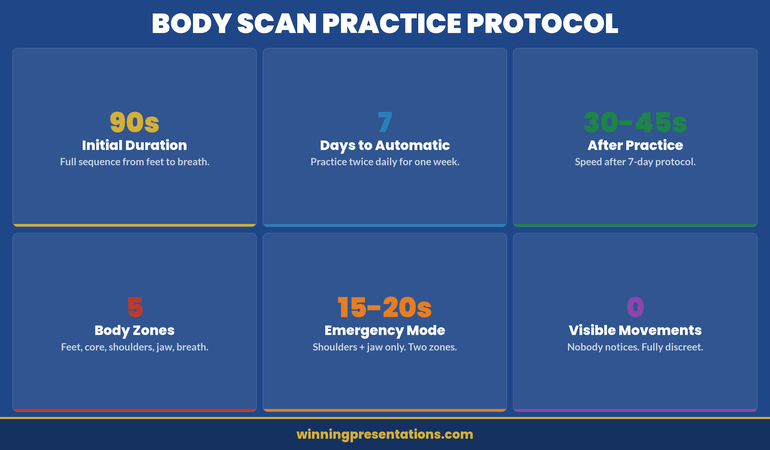
Book a discovery call | View services

04 Mar 2026
Clinical hypnotherapy approach to treatment-resistant presentation anxiety in corporate setting

When Therapy, Coaching, AND Practice Haven’t Fixed Your Presentation Fear

You’ve done everything right. You’ve sat in therapy, talking through your childhood fears and perfectionism. You’ve invested in coaching programmes that promised to rewire your confidence. You’ve rehearsed your presentations until you could deliver them in your sleep. Yet when you stand up to speak, your body hijacks you anyway. Your heart races. Your voice trembles. The fear is still thereβ€”just as visceral as it was five years ago.

This isn’t a reflection on your intelligence, your preparation, or your commitment to change. It means you’re experiencing treatment-resistant presentation anxiety, and you need a different approach.

When traditional therapy, coaching, and practice haven’t resolved your presentation fear, the issue isn’t your willpowerβ€”it’s your nervous system’s regulation. Clinical hypnotherapy and nervous system-focused techniques work differently than talk therapy because they address the body’s threat response directly, not just the thoughts about the threat. If you’ve exhausted conventional approaches, a clinical framework designed specifically for treatment-resistant speaking anxiety may be the missing piece.

Tried therapy, coaching, and practiceβ€”still dreading your next presentation?

The pattern repeats: preparation feels thorough, yet your nervous system floods with adrenaline the moment you step on stage. This is treatment-resistant presentation anxiety, and it requires a nervous system approachβ€”not more talking.

  • Recognise why traditional anxiety treatment sometimes fails for public speaking
  • Understand the specific mechanism your nervous system is stuck in
  • Access a clinical protocol designed for people who’ve tried everything

Ready for the clinical approach?

Get Conquer Speaking Fear β†’ Β£39

The Story That Changed How I Understand Presentation Fear

I spent five years terrified of presenting. Not anxious. Terrified. When I was asked to present, my body responded as though I were facing physical danger: nausea, shaking, voice that cracked mid-sentence, hands that wouldn’t stay still. I tried talking therapy, which helped me understand my perfectionism but didn’t stop the physical response. I tried techniques: breathing exercises, positive affirmations, exposure practice. They helped slightly, but not enough.

The breakthrough came when I began my clinical hypnotherapy training and learned that my nervous system didn’t believe I was safe, no matter what my conscious mind knew. Cognitive work alone wasn’t addressing the subcortical threat response. Once I applied nervous system regulation techniquesβ€”the ones I now teach in Conquer Speaking Fearβ€”the physical symptoms resolved within weeks, not years. That experience shaped everything I now teach about treatment-resistant presentation anxiety.

Why Traditional Approaches Fall Short for Treatment-Resistant Presentation Anxiety

When your presentation fear persists despite years of therapy, coaching, and practice, it’s not because these approaches are ineffective in general. They work brilliantly for many people. But for a subset of individualsβ€”those with treatment-resistant presentation anxietyβ€”the conventional toolbox hits a ceiling.

Therapy, particularly talk-based approaches, excels at helping you understand the origins of your fear: the critical parent, the early experience of public failure, the perfectionism that became armour. This understanding is valuable. But understanding doesn’t always change the nervous system’s threat response. Your amygdalaβ€”the brain’s threat detectorβ€”doesn’t operate primarily through language. It operates through subcortical pathways that bypass conscious reasoning. You can intellectually know you’re safe, and your body still floods with adrenaline.

Coaching and presentation skills training work on competence: more preparation, more rehearsal, more exposure. The assumption is soundβ€”confidence builds through mastery. But when your nervous system interprets the presentation context as a threat, more exposure can actually reinforce the association. You practise, you feel afraid, your nervous system learns: “This environment is dangerous.” The loop tightens.

This is where treatment-resistant presentation anxiety differs from garden-variety nervousness. It’s not that you lack confidence in your content or your ability to deliver. It’s that your threat-detection system has become miscalibrated. It fires even when the evidence for danger is absent.

What Your Nervous System Is Actually Doing

To understand why traditional approaches sometimes fail, you need a precise picture of what’s happening in your body when you present.

Your nervous system has three core states: sympathetic (fight-or-flight), parasympathetic (rest-and-digest), and social-engagement (calm-but-alert). Most people move fluidly between these states depending on context. In low-threat situations, you’re parasympathetic. When you step up to present, your sympathetic system activates appropriatelyβ€”your heart rate increases, blood flows to your muscles, your awareness sharpens. This is useful. It’s supposed to happen.

But in treatment-resistant presentation anxiety, your sympathetic system doesn’t calibrate. It floods. Your nervous system assigns the same threat level to a boardroom presentation as it would to a physical attack. This is what produces the nausea, shaking, voice disruption, and mental fog you experience. Your body is preparing you to flee or fightβ€”and neither option is available in the presentation context, so you freeze instead.

The critical insight: this isn’t a thinking problem. It’s a nervous system regulation problem. Your conscious mind may be telling you, “This is safe, you’re prepared, you know this content,” but your nervous system isn’t listening because it operates according to patterns encoded much deeper than conscious thought. These patterns live in procedural memory, emotional conditioning, and somatic (body-based) imprints. Talk therapy reaches the cortex. Treatment-resistant presentation anxiety needs subcortical intervention.

Why CBT, Coaching, and Exposure Sometimes Aren’t Enough

Cognitive-behavioural therapy is genuinely effective for many anxiety conditions. It works by challenging distorted thoughts and gradually exposing yourself to the feared situation until your nervous system learns it’s safe. The theory is sound. The mechanism is this: repeated exposure without catastrophe should extinguish the fear response.

But exposure therapy has a known limitation for treatment-resistant cases: it can flatten the fear response temporarily without changing the underlying nervous system calibration. You give a presentation, nothing terrible happens, yet three weeks later, the anxiety is back at full intensity. Why? Because your nervous system never actually re-encoded safety. The fear was merely suppressed or you white-knuckled through it using willpower. The subcortical threat pattern remains intact.

Rehearsal and practice, taken to extremes, can even worsen treatment-resistant presentation anxiety. More hours at the podium sometimes means more opportunities for your nervous system to practice the threat response. You condition yourself deeper into the pattern.

Coaching works well when the barrier is skill or confidence. But when the barrier is nervous system dysregulation, coaching is asking the wrong system to change. You can have a coach point out every strength you possess, and your amygdala still won’t care. It’s operating from a different information set: procedural memory and somatic patterns, not rational evaluation.

The pattern is this: traditional approaches assume the nervous system will self-correct once the thinking changes or the experience repeats. For treatment-resistant anxiety, this assumption breaks. The nervous system needs direct interventionβ€”techniques that speak its language.

How Hypnotherapy and Nervous System Approaches Work Differently

Clinical hypnotherapy isn’t stage hypnosis or entertainment. In a clinical context, hypnotherapy is a method for achieving focused attention and accessing the parts of the nervous system that aren’t reachable through conscious discussion.

When you’re in hypnotic trance (which feels like a relaxed, concentrated stateβ€”not sleep, not loss of control), your critical conscious mind becomes less dominant, and your nervous system becomes more accessible. This is where the reframing happens, not in your thoughts, but in how your body interprets threat and safety.

A clinical hypnotherapist working with treatment-resistant presentation anxiety isn’t trying to convince you that presentations are safe. You already know that intellectually. Instead, the work is subcortical: recalibrating your nervous system’s threat-detection threshold. Through techniques like nervous system anchoring and somatic resourcing, your body learns a new physiological response to the presentation context.

Neuro-Linguistic Programming (NLP) operates from a similar principle: it works with the structure of your experienceβ€”how you’re internally representing the threatβ€”rather than trying to think your way out of it. An NLP practitioner helps you interrupt the automatic pattern and install a resourced response in its place.

Both approaches share a critical difference from talk therapy and coaching: they work with the nervous system directly. They don’t ask your thinking to change your physiology; they change your physiology and allow your thinking to follow.

The Clinical Mechanism: From Theory to Regulation

Here’s the specific mechanism that makes clinical approaches effective for treatment-resistant presentation anxiety:

Pattern interruption. Your presentation anxiety has become automatic. You think of presenting, and your body responds with threat activation before you’ve consciously processed what you’re afraid of. A clinical approach interrupts this automatic sequence. It breaks the conditioned link between “presentation context” and “threat activation.”

Subcortical re-encoding. Once the automatic pattern is interrupted, your nervous system can be guided into a new encoding. Not through logic, but through direct nervous system work. You’re literally teaching your amygdala that presentations are safeβ€”not by telling it, but by activating a genuinely resourced physiological state while simultaneously encountering the presentation context. This is how nervous system learning occurs.

Resource anchoring. Clinical protocols typically establish what’s called a “resourced state”β€”a physiological condition of genuine safety, calm alertness, and confidence. This state is anchored (associated) with specific triggers or contexts. When you subsequently encounter a presentation opportunity, those anchors activate the resourced state rather than the threat response. Your body remembers a different pattern.

Somatic integration. The goal isn’t intellectual acceptance. It’s bodily integration. You should be able to stand in front of an audience and feel genuinely calmβ€”not managing anxiety, not white-knuckling through it, but physiologically present and regulated. This is what becomes possible when you work at the nervous system level.

What a Clinical Approach Actually Looks Like

If you’ve decided that treatment-resistant presentation anxiety requires a clinical intervention, here’s what that process actually involves:

Assessment of your nervous system patterns. A clinical approach begins by understanding precisely how your nervous system is triggering. Is it a full sympathetic flood from the moment you think about presenting? Does it spike only when you’re in front of people? Does it manifest as a freeze response rather than fight-or-flight? The specifics matter because they determine the intervention.

Guided nervous system regulation. You’ll learn techniques to access and activate your parasympathetic (calm) system and your social-engagement system (the nervous system state of safe connection). These aren’t breathing exercises in the traditional sense. They’re precise physiological interventions that shift your nervous system state measurably.

Reprocessing in context. Once you can reliably access a resourced nervous system state, the clinical work involves reprocessing the presentation context while you’re in that state. The goal is to decouple “presenting” from “threat.” Your nervous system learns: “This is a context where I’m calm, capable, and connected.”

Rehearsal with regulation. Unlike traditional practice, which can reinforce anxiety patterns, clinical rehearsal is done while maintaining nervous system regulation. You’re practising presentations from a resourced state, which teaches your nervous system a completely different pattern.

Maintenance and integration. The final phase ensures the changes are durable. You learn to maintain nervous system regulation under increasing pressure, and you develop ways to access resourced states independently, without relying on a practitioner.

Present Without the Adrenaline Hijack

When traditional methods haven’t worked, the clinical nervous system approach delivers what they couldn’t: genuine physiological calm during presentations.

  • Learn the specific nervous system techniques used by clinical hypnotherapists to decouple threat responses from presentation contexts
  • Regain access to your resourced nervous system state on demand, even under pressure
  • Move beyond anxiety management to actual resolutionβ€”no more white-knuckling, no more suppression
  • Integrate new nervous system patterns through guided practice that rewires, rather than reinforces, old fear responses
  • Develop lasting capacity to present with genuine calm and executive presence

Get Conquer Speaking Fear β†’ Β£39

Created by a clinical hypnotherapist who spent 5 years terrified of presenting and developed these techniques to resolve her own treatment-resistant anxiety.

Not sure if this is for you? If you’ve exhausted therapy, coaching, and practice and your presentation fear persists, a nervous system approach is specifically designed for your situation. You can explore Conquer Speaking Fear risk-free and see if it resolves what traditional methods couldn’t.

Comparison of traditional anxiety treatment approaches versus nervous system-focused clinical approach for presentation fear

Stop Dreading Every Presentation on Your Calendar

You shouldn’t have to spend weeks in advance worrying about a 30-minute talk. You shouldn’t wake up the morning of a presentation with your stomach in knots.

  • Replace the dread-preparation-adrenaline cycle with genuine nervous system calm
  • Show up to presentations feeling resourced, not just competent

Get Conquer Speaking Fear β†’ Β£39

A 30-day programme using nervous system regulation techniques from clinical hypnotherapyβ€”designed specifically for people who’ve tried everything.

The turning point: When you realise your presentation fear isn’t a personal failing or a thinking problem, but a nervous system that needs re-education, everything shifts. That turning point is available to you.

Timeline showing nervous system regulation progression through clinical hypnotherapy treatment for presentation anxiety

Questions People Ask About Treatment-Resistant Presentation Anxiety

What if I’ve already tried hypnotherapy and it didn’t work?

Clinical hypnotherapy for presentation anxiety is highly specific. If you’ve had a session with a general hypnotherapist, that’s quite different from working with someone trained specifically in nervous system regulation for presentation fear. The depth, duration, and focus matter enormously. A single session is unlikely to resolve treatment-resistant anxiety; a structured programme with nervous system-specific techniques is what creates lasting change.

How is this different from just learning to manage anxiety?

Management and resolution are fundamentally different. Anxiety management is about learning to tolerate or suppress the fear while you presentβ€”breathing techniques, grounding strategies, cognitive reframes. Resolution is about actually changing your nervous system so that the fear doesn’t activate in the first place. You’re not managing a response; you’re creating a different physiological response.

How long does it take to see results?

With a properly designed clinical protocol and consistent practice, most people report significant shifts within 2-4 weeks and substantial resolution within 30 days. This is faster than traditional therapy because you’re working directly with the nervous system rather than waiting for cognitive shifts to produce physiological changes. However, durability requires integrationβ€”continuing the practices that maintain your nervous system regulation.

Is This Right For You?

A clinical nervous system approach is specifically for people in this situation:

  • You’ve invested in talk therapy or coaching and made progress intellectually, but your body still responds to presentations with fear
  • Your presentation anxiety is treatment-resistantβ€”it hasn’t resolved despite your best efforts
  • You experience physical symptoms (nausea, shaking, voice disruption, mental fog) that appear automatic and beyond your control
  • You’re willing to work directly with nervous system techniques, not just more thinking or more practice
  • You want resolution, not just management

If this describes you, then exploring why therapy alone didn’t resolve your presentation fear is the next logical step toward finding what will.

From 5 Years of Terror to Teaching Thousands

My own treatment-resistant presentation anxiety shaped everything I teach about nervous system regulation for public speaking.

  • Learn the exact nervous system techniques I developed to move from terror to teaching
  • Access a 30-day structured programme that combines clinical hypnotherapy, nervous system regulation, and presentation rehearsal
  • Get guided audio sessions for nervous system anchoring and resourced practice
  • Work through a framework designed by someone who has lived treatment-resistant presentation anxiety and resolved it
  • Join hundreds of professionals who’ve moved from dread to genuine executive presence using these techniques

Get Conquer Speaking Fear β†’ Β£39

30-day clinical programme using nervous system regulation from hypnotherapy. Designed for people who’ve tried everything else.

Want the slides too?

Preparation reduces anxiety. The Executive Slide System (Β£39) includes confident-presenter templates designed to minimise preparation stress.

Frequently Asked Questions About Treatment-Resistant Presentation Anxiety

Is this a self-help course or a clinical intervention?

Conquer Speaking Fear is a structured self-guided programme built on clinical nervous system principles. It’s not a substitute for working with a licensed therapist if you have diagnosed mental health conditions, but it’s specifically designed for people who want to apply clinical techniques independently to resolve treatment-resistant presentation anxiety. You’ll have access to guided sessions, frameworks, and integration practicesβ€”everything needed to work at the nervous system level yourself.

Will this work if my anxiety is rooted in trauma?

If your presentation anxiety is connected to past trauma, a clinical programme is a useful tool, but you may benefit from working with a trauma-trained therapist in parallel. The nervous system regulation techniques in Conquer Speaking Fear are safe and supportive, but trauma resolution typically requires additional guidance. The programme is designed to work alongside professional support if you’re currently engaged with a therapist.

What if I’m taking medication for anxiety?

Medication and nervous system regulation work beautifully together. If you’re on medication prescribed by your doctor, continue taking it as directed. The nervous system techniques in Conquer Speaking Fear complement pharmaceutical supportβ€”they’re not in conflict. You’re still addressing the root nervous system regulation, and medication helps stabilise your baseline while you do that work.

Ready for deeper insights?

Join our weekly newsletter for practitioner-level articles on nervous system regulation, presentation psychology, and the clinical approaches that actually work for treatment-resistant anxiety.

Subscribe to The Winning Edge

πŸ†“ Free resource: Download the Executive Presentation Checklist β€” a free guide to strengthen your presentation preparation.

The Path Forward

Treatment-resistant presentation anxiety tells you something important: the approaches that work for others aren’t working for you, which means you need a different system. That system exists. It’s clinical, it’s evidence-based, and it works at the level where your anxiety actually livesβ€”your nervous system.

You’ve already proven you’re capable of change. You’ve done the work. The question now is whether you’re willing to try a method that speaks directly to the part of your nervous system that has been stuck. If you are, everything that follows is possible.

Mary Beth Hazeldine is a clinical hypnotherapist and presentation coach who specialises in treatment-resistant presentation anxiety. She spent 5 years terrified of presenting before developing the nervous system regulation techniques now taught in Conquer Speaking Fear. Her work combines clinical hypnotherapy, NLP, and executive coaching for professionals who’ve exhausted conventional approaches.

Explore Conquer Speaking Fear β†’

01 Mar 2026
Professional standing composed at podium moments before a high-stakes presentation

Why Confident Presenters Still Get Nervous Before Every Talk

She was voted the best presenter in her division. She’d vomited in the toilets ten minutes earlier.

For three years, a C-suite executive I worked with had a secret ritual: arrive early, find a private bathroom, be sick, rinse her mouth, walk into the boardroom, and deliver a presentation so composed that colleagues asked her how she stayed so calm.

Quick Answer: Confident presenters still get nervous because the nervous system doesn’t distinguish between “good stress” and “bad stress.” Nervousness isn’t a sign that you’re not ready β€” it’s a sign that your body recognises the stakes. The difference between confident and anxious presenters isn’t the absence of nerves. It’s their relationship with them.

🚨 Presentation this week and the nerves are already building?

Quick check β€” which of these describes you right now?

  • You’ve presented dozens of times but the dread hasn’t reduced
  • You know you’re good at this β€” but your body disagrees
  • You’ve tried breathing exercises and they help for about 30 seconds

β†’ Need the system that changes your nervous system response (not just your mindset)? Get Conquer Speaking Fear (Β£39)

I was terrified of presenting for five years. Not mildly uncomfortable β€” physically terrified. Nausea, shaking hands, voice cracking, face flushing. I was a senior professional at a global bank, and I couldn’t stand up in a meeting without my body betraying me.

I assumed confident presenters didn’t feel this way. That one day, the nerves would simply stop.

They didn’t. What changed was my understanding of what nervousness actually is. As a trained clinical hypnotherapist, I eventually learned that trying to eliminate nerves was the problem β€” not the solution. And that insight changed everything about how I present and how I train others.

Here’s what I wish someone had told me during those five years.

Professional standing composed at podium moments before a high-stakes presentation

The “Confident = Calm” Myth (And Why It Makes Anxiety Worse)

The biggest lie in presentation advice is this: that confident presenters feel calm before they speak.

They don’t.

Nearly every experienced presenter I’ve worked with β€” CEOs, managing directors, people who present weekly β€” reports some form of nervousness before significant presentations. I’ve written about this pattern in the context of presentation anxiety before meetings, and the data is consistent. Not stage fright. Not panic. But a heightened state that looks, from the inside, remarkably like anxiety.

The problem with the “confident = calm” myth is that it creates a second layer of distress. You’re not just nervous β€” you’re nervous about being nervous. “If I were really good at this, I wouldn’t feel this way.”

That thought loop is more damaging than the original nerves.

It makes you interpret a normal physiological response as evidence that something is wrong with you. And every time you step into a meeting room and feel that familiar stomach drop, the loop reinforces itself: Here it is again. I’ll never get past this.

But there’s nothing to “get past.” The response is doing exactly what it’s designed to do.

What’s Actually Happening in Your Nervous System

When you’re about to present something that matters β€” a board update, a budget request, a pitch to a client β€” your brain registers the situation as high-stakes. Not dangerous, necessarily. But consequential.

Your sympathetic nervous system activates. Adrenaline releases. Heart rate increases. Muscles tense. Blood flow redirects from your digestive system to your limbs. Your body is preparing you to perform.

This is not malfunction. This is your nervous system doing its job.

The difference between the executive who presents with visible confidence and the one who freezes isn’t the presence or absence of this response. It’s how each person interprets it.

Interpretation A (anxiety spiral): “My heart is racing. I’m going to lose my words. They’ll see I’m nervous. This is going to go badly.”

Interpretation B (performance readiness): “My heart is racing. My body is getting ready. I’ve done this before. The energy will help once I start.”

Same physiology. Completely different experience. And here’s the critical part: Interpretation B isn’t just positive thinking. It’s neurologically accurate. The adrenaline response genuinely improves focus, recall, and vocal projection β€” if you let it.

When you fight it, the energy turns inward. When you channel it, the energy sharpens your delivery.

Infographic showing the nervous system response flow from trigger through adrenaline to interpretation and performance

Present Without the Adrenaline Hijack

Conquer Speaking Fear is a 30-day programme built from clinical hypnotherapy and NLP β€” not another “just breathe” course. It’s designed for experienced professionals who present regularly but still dread it.

  • Nervous system regulation techniques that work before, during, and after presentations
  • The reframing protocol that stops the anxiety spiral before it starts
  • Evidence-based approaches from clinical practice, adapted for executive environments
  • Designed for people who’ve tried breathing exercises, CBT, and coaching β€” and still struggle

Get Conquer Speaking Fear β†’ Β£39

Created by a clinical hypnotherapist who spent 5 years terrified of presenting β€” and now trains executives to present with confidence.

The Reframe That Changes Everything

Here’s the single most useful thing I can tell you: stop trying to eliminate the nerves. Start working with them.

Most presentation anxiety advice focuses on suppression. Deep breathing to slow your heart rate. Visualisation to “calm yourself down.” Power poses to “trick your body” into confidence.

These approaches share a common assumption: that nervousness is the problem and calmness is the goal.

But that assumption is wrong.

The real shift happens when you reframe the physiological response from threat to readiness. This isn’t a semantic trick. It’s a genuine change in how your brain processes the signals from your body.

In clinical hypnotherapy, we call this “reappraisal.” Instead of interpreting the racing heart as “I’m panicking,” you practise interpreting it as “I’m activating.” The sensation is identical. The meaning is different. And meaning drives experience.

Once you’ve made this shift β€” and it takes practice, not just understanding β€” the pre-presentation nerves become fuel rather than friction. You still feel them. But they stop controlling you.

This is why experienced speakers still feel anxious. They haven’t eliminated the response. They’ve changed what it means.

Tired of the anxiety loop before every presentation?

Conquer Speaking Fear teaches the reappraisal technique in a structured 30-day format β€” so it becomes automatic, not something you have to remember mid-panic.

Get Conquer Speaking Fear β†’ Β£39

Three Techniques Experienced Presenters Use (That Nobody Talks About)

These aren’t from a textbook. They’re from working with thousands of executives who present under pressure.

1. The pre-presentation anchor. Experienced presenters create a physical association with their “presenting self.” It might be adjusting their watch, touching their pen, or standing in a specific posture. This isn’t superstition β€” it’s a conditioned response. Over time, the physical action triggers the mental state. It’s the same principle behind any well-rehearsed routine.

2. The 90-second rule. Nearly every presenter I’ve trained reports that the worst anxiety lasts approximately 90 seconds after they start speaking. Once they’re past the first few sentences, the nervous system recalibrates. Experienced presenters know this. They design their opening to be so well-rehearsed that they can deliver it on autopilot while the adrenaline settles. The first 90 seconds are a bridge, not a performance.

3. The post-presentation debrief. Anxious presenters replay what went wrong. Confident presenters run a structured debrief: What worked? What would I change? What question caught me off guard? This isn’t about positivity. It’s about replacing the emotional replay with a factual review. Over time, it trains the brain to process presentations as learning events, not threat events.

Infographic showing three techniques experienced presenters use with comparison of anxious versus experienced approaches

The Danger of Chasing “No Nerves”

Let me be direct about something: if your goal is to feel nothing before you present, you’re chasing the wrong outcome.

Presenters who feel nothing aren’t calm β€” they’re disengaged. (This is related to what I call the confidence slipping pattern β€” where suppression creates a different problem.) The flatness that comes from emotional suppression shows in delivery: monotone voice, low energy, disconnected eye contact. Audiences can feel it, even if they can’t name it.

The executives I work with who present most effectively describe their pre-presentation state as “alert.” Not panicked. Not calm. Alert. Their system is activated, their focus is sharp, and their energy is slightly elevated. That state produces better delivery, better Q&A handling, and more persuasive communication than artificial calmness ever could.

So the question isn’t “how do I stop being nervous?” The question is “how do I use this energy instead of fighting it?”

That shift β€” from elimination to utilisation β€” is the difference between someone who dreads every presentation and someone who walks in nervous but ready.

People Also Ask:

Do professional speakers get nervous?
Yes. Most professional speakers report some level of activation before they speak, even after years of experience. The difference is that they’ve learned to interpret the sensation as performance readiness rather than anxiety. The nerves don’t disappear β€” the relationship with them changes.

Is it normal to feel sick before a presentation?
Physical symptoms like nausea, shaking, and increased heart rate are common nervous system responses to high-stakes situations. They don’t indicate a disorder or weakness. They indicate that your brain has correctly identified the situation as important. If physical symptoms are severe or debilitating, techniques from clinical hypnotherapy can help regulate the response. (See also: beta blockers for public speaking β€” why medication alone rarely solves it.)

Why do I still get anxious even though I’ve presented many times?
Experience reduces the intensity of the response for most people, but it rarely eliminates it entirely. This is because the nervous system responds to perceived stakes, not to familiarity. A high-stakes board presentation will trigger activation regardless of how many low-stakes team meetings you’ve done. The key is learning to work with the activation rather than against it.

Stop Dreading Every Presentation on Your Calendar

The 30-day programme inside Conquer Speaking Fear rewires how your nervous system responds to presenting β€” so you walk in ready, not wrecked.

Get Conquer Speaking Fear β†’ Β£39

Evidence-based techniques from clinical hypnotherapy and NLP, adapted for high-pressure executive environments.

Is Conquer Speaking Fear Right For You?

βœ“ This is for you if:

  • You present regularly but still experience significant anxiety before each presentation
  • You’ve tried breathing techniques, coaching, or CBT and the anxiety keeps returning
  • You’re a competent professional whose nervousness doesn’t match your actual ability
  • You want to change your relationship with nerves, not just suppress the symptoms

βœ— This is NOT for you if:

  • You present rarely and the nervousness is situational rather than persistent
  • Your anxiety is mild and settles quickly once you begin speaking β€” this article is sufficient.
  • Your primary challenge is slide structure and content β€” a presentation skills course focused on anxiety is not what you need right now.

If the anxiety is recurring and does not improve with experience, Conquer Speaking Fear is the structured system for breaking that cycle.

πŸ“Š Want the slides too?

Preparation reduces anxiety. The Executive Slide System (Β£39) includes confident-presenter templates designed to minimise preparation stress.

Frequently Asked Questions

Can you be confident and still have presentation anxiety?

Absolutely. Confidence and anxiety are not opposites. Confidence is a belief in your ability to perform. Anxiety is a nervous system response to perceived stakes. Many highly confident professionals experience significant anxiety before presentations β€” and perform excellently despite it. The two can coexist, and in many cases, the anxiety actually sharpens performance.

How long does it take for presentation nerves to go away?

For most people, the most intense nerves subside within the first 90 seconds of speaking. The pre-presentation anxiety may never fully disappear β€” and that’s normal. What changes with experience and proper technique is the intensity and duration. With nervous system regulation techniques, most professionals notice a significant shift within 2-4 weeks of consistent practice.

Should I tell my audience I’m nervous?

Generally, no. Audiences rarely notice nervousness as much as you feel it. Announcing your nerves shifts the audience’s attention from your message to your state, which increases self-consciousness. The exception is if vulnerability serves your message β€” for example, if you’re speaking about overcoming fear. Otherwise, channel the energy into your delivery and let the audience experience your content, not your anxiety.

πŸ“¬ The Winning Edge Newsletter

Weekly techniques for executives who present under pressure. Evidence-based, not motivational. One actionable insight every week.

Subscribe Free β†’

πŸ†“ Want to start free? Download the Executive Presentation Checklist first.

Read next: If your board presentation is the source of the nerves, read how to structure your first board presentation as a new director β€” the structure alone will reduce the anxiety. And if the Q&A is what you’re dreading, see the Q&A preparation checklist senior executives use.

About the Author

Mary Beth Hazeldine is the Owner & Managing Director of Winning Presentations. With 24 years of corporate banking experience at JPMorgan Chase, PwC, Royal Bank of Scotland, and Commerzbank, she has delivered high-stakes presentations in boardrooms across three continents.

A qualified clinical hypnotherapist and NLP practitioner, Mary Beth combines executive communication expertise with evidence-based techniques for managing presentation anxiety. She advises executives across financial services, healthcare, technology, and government on building the composure that holds under sustained pressure.

Book a discovery call | View services

Your next presentation is on the calendar. The nerves will come. They always do. But now you know what they actually are β€” and that changes everything.