Category: Presentation Anxiety

15 Feb 2026
Professional sitting alone in quiet reflection before a high-stakes presentation — imposter syndrome moment in modern office

The Imposter Syndrome That Hits Hardest When You’re the Most Qualified Person in the Room

Quick answer: Imposter syndrome doesn’t fade as you get promoted — it often intensifies. The higher the stakes, the louder the voice that says “they’re about to find out.” This isn’t a confidence problem you can think your way out of. It’s a nervous system pattern that requires a nervous system intervention. This article explains why seniority makes imposter syndrome worse, why common advice fails, and the evidence-based reset that actually stops it before you present.

She was the most qualified person in the room and she knew it.

Twenty-two years of experience. Two promotions ahead of schedule. A track record that included the largest restructuring her division had ever completed. She’d been invited to present to the executive committee specifically because she was the acknowledged expert.

And forty-five minutes before the meeting, she was in a bathroom stall, hands shaking, rehearsing her opening sentence for the fourteenth time, absolutely certain they were about to discover she didn’t belong there.

She told me afterwards: “The bizarre thing is, I know I’m qualified. I can see it objectively. But the moment I stand up to present to senior people, something switches off the rational part of my brain and this voice starts saying: you got lucky, you’re not as good as they think, today’s the day they figure it out.

I’ve heard versions of this story repeatedly over the years — in 24 years of corporate banking at JPMorgan Chase, PwC, Royal Bank of Scotland, and Commerzbank, and then across 15 years as a clinical hypnotherapist specialising in presentation anxiety. Imposter syndrome doesn’t discriminate by competence. If anything, it targets the competent more relentlessly than anyone else.

Why Seniority Makes Imposter Syndrome Worse

Most people assume imposter syndrome fades with experience. The logic seems obvious: the more you achieve, the more evidence you accumulate that you’re competent. The voice should get quieter.

It doesn’t. For many senior professionals, it gets louder. Here’s why.

The stakes keep rising. When you were junior, a bad presentation meant embarrassment. Now it means losing a client, stalling a programme, or undermining your credibility with the board. Imposter syndrome feeds on consequence. The higher the stakes, the more ammunition it has.

The audience keeps getting more senior. You’ve mastered presenting to your peers. But every promotion puts you in front of a new audience — people who are more experienced, more powerful than the last group you got comfortable with. Imposter syndrome resets every time the room changes.

The breadth of expectation widens. As a subject matter expert, you understood your content deeply. As a senior leader, you’re expected to speak credibly about strategy, finance, operations, people — areas where you may feel less certain. The breadth of expectation at senior levels creates more surface area for doubt.

You have more to lose. Early in your career, failure is a learning experience. At VP level and above, failure feels existential. Your identity is more tightly bound to your professional role. The thought “what if they find out?” carries a weight at 45 that it didn’t carry at 28.

PAA: Why does imposter syndrome get worse with seniority?
Because the stakes, audience, and expectations all escalate with promotion. Each new level puts you in front of more senior people, across broader topics, with higher consequences. Imposter syndrome isn’t driven by incompetence — it’s driven by the gap between what you feel and what the situation demands. That gap widens as you climb.

Your Brain Is Lying to You. Here’s How to Stop It.

Conquer Speaking Fear is built for experienced professionals whose anxiety doesn’t match their ability. It combines clinical hypnotherapy techniques with NLP-based cognitive resets — a structured system for interrupting imposter syndrome before it hijacks your next presentation.

Get Conquer Speaking Fear → £39

Created by a clinical hypnotherapist who spent 5 years battling presentation terror in corporate banking — and 15 years teaching others how to overcome it.

The Three Triggers Before High-Stakes Presentations

Imposter syndrome before a presentation isn’t a single feeling. It’s a cascade — and understanding the sequence is the first step to interrupting it.

Trigger 1: The Comparison Spiral. This starts hours or days before the presentation. You think about who’s in the room. You compare yourself to them. You calculate all the ways they’re more experienced, more credible, more articulate. The comparison is always unfair — you’re measuring your internal doubt against their external composure. But the feeling is real: I don’t belong in this room.

Trigger 2: The Credibility Audit. As the meeting approaches, your brain starts questioning every piece of content. Is this data strong enough? Will they challenge this assumption? What if someone asks something I can’t answer? This isn’t constructive preparation — it’s your nervous system scanning for threats. The content hasn’t changed since you prepared it. Your perception of it has.

Trigger 3: The Physical Takeover. In the final minutes before presenting, the cognitive symptoms become physical. Racing heart. Shallow breathing. Tight throat. Shaking hands. At this point, rational self-talk is largely useless — your prefrontal cortex (the rational brain) has been overridden by your amygdala (the threat-detection system). This is why “just remember you’re qualified” doesn’t help when you’re already in fight-or-flight.

If you’ve experienced the physical takeover before high-stakes presentations, you know that the problem isn’t just in your head. It’s in your body. And the solution has to start there.


The 4-minute pre-presentation reset framework for imposter syndrome showing physiological sigh, peripheral vision, anchor state, and first-sentence rehearsal

🧠 Recognise this cascade? Conquer Speaking Fear (£39) includes specific techniques for interrupting each stage — before the physical symptoms take over.

Why “Just Remember Your Achievements” Doesn’t Work

The most common advice for imposter syndrome is some version of: make a list of your achievements, remind yourself of your qualifications, look at the evidence that you’re competent.

This advice is well-intentioned and almost completely ineffective — for a specific neurological reason.

When imposter syndrome activates before a presentation, your amygdala has already classified the situation as a threat. Once that happens, your prefrontal cortex — the part of your brain that processes rational evidence — is suppressed. Blood flow literally shifts away from the rational brain toward the survival brain.

Telling someone in an amygdala hijack to “remember their achievements” is like telling someone having a panic attack to “just calm down.” The instruction requires the exact cognitive function that the anxiety has disabled.

This is why so many intelligent, accomplished professionals feel stuck. They know they’re qualified. They can see the evidence. And it makes absolutely no difference when the nervous system takes over.

Other common advice that fails for the same reason:

“Fake it till you make it.” This adds a second layer of imposter syndrome. Now you’re not only feeling like a fraud — you’re deliberately acting like one. For people who value authenticity (which describes most senior professionals), this advice actively increases anxiety.

“Power posing.” The original research has been heavily contested in replication studies. Even if holding a pose for two minutes slightly shifts hormonal markers, it doesn’t address the underlying nervous system activation that drives imposter feelings. It’s a surface intervention for a deep-pattern problem.

“Visualise success.” Visualisation works well — when you’re already calm. When your nervous system is activated, trying to visualise a positive outcome while your body is signalling danger creates cognitive dissonance that can make anxiety worse.

The approaches that actually work target the nervous system first, the cognitive patterns second. That’s exactly how clinical hypnotherapy and NLP approach the problem — and it’s why I retrained in both disciplines after watching rational confidence-building approaches fail the presentation confidence needs of my clients for years.

Rational Self-Talk Can’t Fix a Nervous System Problem

Conquer Speaking Fear uses clinical hypnotherapy and NLP techniques to reset the nervous system pattern that drives imposter syndrome — not just manage the symptoms. Designed for senior professionals whose anxiety hasn’t responded to conventional advice.

Get Conquer Speaking Fear → £39

Created by a clinical hypnotherapist and NLP practitioner with 24 years of corporate banking experience. Evidence-based techniques designed for busy professionals — not therapy-style time commitments.

The Nervous System Approach That Actually Helps

The clinical approach to imposter syndrome works in the opposite direction from conventional advice. Instead of starting with thoughts (“remind yourself you’re qualified”), it starts with the body (“regulate your nervous system so your rational brain comes back online”).

This sequence matters. Once the nervous system is regulated, rational thinking returns naturally — and then the evidence of your competence actually lands.

Three evidence-based techniques that work at the nervous system level:

1. Physiological sigh (immediate reset). A double inhale through the nose followed by a long exhale through the mouth. Stanford neuroscientist Andrew Huberman’s research shows this is the fastest known way to downregulate the sympathetic nervous system in real time. One cycle takes about 8 seconds. Three cycles can shift your nervous system state measurably. Do this in the corridor before you walk into the room.

2. Peripheral vision activation (anxiety disruptor). Imposter syndrome narrows your visual focus — you literally get tunnel vision, focused on the threat. Deliberately softening your gaze to take in your peripheral vision activates the parasympathetic nervous system. This is an NLP technique I teach every executive I work with. Soften your eyes while looking straight ahead so you can see the edges of the room without moving your head. Hold for 30 seconds. The anxiety drops perceptibly.

3. Anchor state (conditioned confidence). This is a clinical hypnotherapy technique. Before the high-stakes presentation, you deliberately recall a specific moment when you felt genuinely competent and in control — not a vague memory, but a precise one. Where were you standing? What could you see? What did your body feel like? By associating a physical gesture (pressing thumb and forefinger together, for example) with that state, you create an anchor you can fire in the moments before presenting. With practice, the anchor activates the confident state in seconds.

These three techniques address the three triggers in reverse order: the physiological sigh stops the physical takeover, peripheral vision interrupts the credibility audit, and anchor state breaks the comparison spiral. Together, they take about 4 minutes.

PAA: How do you overcome imposter syndrome before a presentation?
Start with the body, not the mind. Use a physiological sigh (double inhale, long exhale) to downregulate the nervous system. Activate peripheral vision to disrupt the tunnel-focus of anxiety. Then fire an anchor state — a conditioned association between a physical gesture and a genuine memory of competence. This 4-minute sequence brings the rational brain back online so your actual qualifications can override the imposter voice.

PAA: Can imposter syndrome affect your presentation performance?
Yes — but not the way most people assume. Imposter syndrome rarely makes senior professionals incompetent. It makes them over-prepare, over-qualify every statement, speak faster, avoid eye contact, and hedge their recommendations. The audience sees someone who lacks conviction — not because they lack knowledge, but because their nervous system is overriding their confidence. Addressing the nervous system pattern restores the delivery that matches the expertise.

The 4-Minute Pre-Presentation Reset

Here’s the exact sequence I teach executives who experience imposter syndrome before high-stakes presentations. Do this in the 5 minutes before you enter the room.

Minutes 0-1: Three physiological sighs. Double inhale through the nose (two quick sniffs), then a long slow exhale through the mouth. Repeat three times. Your heart rate will start to slow by the second cycle.

Minutes 1-2: Peripheral vision hold. Stand still. Look straight ahead at a fixed point. Without moving your eyes, expand your awareness to include your full peripheral vision — the edges of the corridor, the ceiling, the floor. Hold this soft gaze for 60 seconds. You’ll feel the tension in your shoulders start to release.

Minutes 2-3: Anchor state activation. Press your thumb and forefinger together (or whatever physical anchor you’ve conditioned). Recall your specific competence memory — the boardroom where you nailed it, the client who said “that’s exactly what we needed,” the moment you knew your expertise made the difference. Stay in the memory for 30-45 seconds. Let the feeling settle into your body.

Minutes 3-4: First-sentence rehearsal. Say your opening sentence out loud, once, at the pace you want to deliver it. Not the whole presentation. Just the first sentence. This gives your voice a “warm start” and confirms to your nervous system that speaking is safe. The confidence from the first sentence carries into the second, and the second into the third.

Presenting this week and feeling the imposter voice already?

Try this tonight: practise the 4-minute reset sequence once, using a real presentation memory as your anchor. Tomorrow, do it again before your morning meeting — even if it’s low-stakes. By the time your high-stakes presentation arrives, the sequence will be familiar enough that your body responds automatically.

If you want the full system — including the conditioning protocol for building a permanent anchor state — Conquer Speaking Fear (£39) walks you through it step by step.

The reason this works when rational self-talk doesn’t: you’re resetting the nervous system before you ask the cognitive brain to do anything. By the time you reach the anchor state, your prefrontal cortex is back online. The evidence of your competence — the 22 years, the track record, the expertise — can finally be heard over the imposter voice.

If the fear of being judged has been running your presentation experience, this sequence changes the starting point. You walk in regulated, not reactive.

🧠 Want the full conditioning protocol? Conquer Speaking Fear (£39) includes the step-by-step anchor-building process, the pre-presentation reset sequence, and the long-term pattern interrupt that reduces imposter activation over time.

You’re Not a Fraud. Your Nervous System Is Just Louder Than Your CV.

Conquer Speaking Fear gives you the clinical techniques to reset imposter syndrome at the source — the nervous system patterns that rational self-talk can’t reach. Includes the anchor conditioning protocol, the pre-presentation reset sequence, and long-term pattern interrupts for professionals who are done letting anxiety override their expertise.

Get Conquer Speaking Fear → £39

Created by a clinical hypnotherapist and NLP practitioner. 24 years in corporate banking. 15 years helping executives present without the imposter voice running the show.

Frequently Asked Questions

Is imposter syndrome a sign that I’m not ready to present at this level?

No — it’s often a sign of the opposite. Research by psychologists Pauline Clance and Suzanne Imes, who first identified imposter syndrome, found it disproportionately affects high-achieving professionals. The pattern tends to intensify with competence, not incompetence. If you’re experiencing it before a senior presentation, it usually means you care about performing well and you’re self-aware enough to recognise the gap between how you feel and what the situation requires.

Can imposter syndrome actually be “cured,” or do I just learn to manage it?

Both are realistic outcomes. Many professionals find that nervous system techniques (like the 4-minute reset) reduce the intensity significantly — sometimes to the point where it no longer interferes with performance. Others find the voice never fully disappears but becomes quieter and easier to override. The goal isn’t to eliminate self-doubt entirely — some degree of it keeps you prepared. The goal is to stop it from controlling your delivery.

Does imposter syndrome affect men and women differently in presentations?

The original research focused on women, but subsequent studies have found imposter syndrome across all genders at similar rates in professional settings. What often differs is how it manifests: some professionals overcompensate by over-preparing (14-hour deck builds), while others withdraw by avoiding presentations entirely. Both are imposter-driven responses. The nervous system techniques work regardless of how the pattern presents itself.

What if I’ve tried therapy and it didn’t help with my presentation anxiety?

Traditional talk therapy is excellent for many things, but it primarily works at the cognitive level — exploring beliefs, reframing thoughts, building insight. If your imposter syndrome is a nervous system pattern (which presentation-specific anxiety usually is), you may need interventions that target the body first. Clinical hypnotherapy and NLP work at the subconscious and somatic level, which is why they’re often effective when talk therapy alone hasn’t resolved presentation-specific fear.

📬 The Winning Edge Newsletter

Weekly strategies for executive presentations, speaking confidence, and the psychology behind high-stakes communication. No fluff.

Subscribe free →

🎯 Free: Executive Presentation Checklist

The pre-presentation checklist I give every executive before a high-stakes meeting. Covers structure, messaging, and the confidence preparation steps that reduce anxiety before you walk in.

Download free →

Optional: Preparation reduces anxiety. If you also want executive slide templates, the Executive Slide System (£39) includes confident-presenter formats designed to minimise preparation stress.

Related: Imposter syndrome often spikes when you’re presenting results that could lead to a big decision. If you’re about to present pilot programme results to executives, the 8-slide pilot-to-rollout structure gives you a framework that reduces the “am I doing this right?” uncertainty — which is one of imposter syndrome’s favourite triggers.

Imposter syndrome isn’t a character flaw. It’s a nervous system pattern. And like any pattern, it can be interrupted, reconditioned, and eventually quietened — if you use the right techniques.

Start with the 4-minute pre-presentation reset. And if you want the full system for building a permanent anchor state and long-term pattern interrupt, Conquer Speaking Fear (£39) has everything you need.

About the Author

Mary Beth Hazeldine is the Owner & Managing Director of Winning Presentations. With 24 years of corporate banking experience at JPMorgan Chase, PwC, Royal Bank of Scotland, and Commerzbank, she spent five of those years battling severe presentation anxiety before retraining as a clinical hypnotherapist and NLP practitioner to understand — and overcome — the problem at its source.

Mary Beth now combines executive communication expertise with evidence-based anxiety techniques, helping senior professionals present with confidence in boardrooms, client meetings, and high-stakes pitches across three continents.

Book a discovery call | View services

13 Feb 2026
Professional person practising calm breathing before a high-stakes presentation with composed expression

The Breathing Technique That Stopped My Pre-Presentation Vomiting

Quick answer: Pre-presentation nausea is a vagus nerve response to perceived threat — not weakness, not “just nerves,” and not something you can think your way out of. The vagal breathing reset (extended exhale pattern: 4 counts in, 2 hold, 8 counts out) can help calm the nerve that influences your stomach. Many people notice relief within 60–90 seconds. Below: exactly how to do it, why it often works when other breathing techniques don’t, and what to do if you’re already in the bathroom.

⚕️ This article is educational, not medical advice. If nausea or vomiting is frequent, occurs outside presentation situations, or is accompanied by pain, blood, or weight loss, please consult a medical professional.

I Was on My Knees in a Bathroom Stall Fifteen Minutes Before the Biggest Presentation of My Career.

It was 2008. I was presenting to the executive committee at one of the largest banks in Europe. Twelve people. One recommendation. A decision worth millions. I’d prepared for weeks. I knew the material cold.

And I was throwing up in the third-floor bathroom while my colleagues assumed I was doing a final review of my notes.

This wasn’t new. The nausea had started about three years into my banking career. Not every presentation — just the ones that mattered. Board meetings. Client pitches. Anything where the stakes felt personal. It would begin the night before, a low churning that I’d try to ignore. By morning it was a wave I couldn’t control. By the time I arrived at the office, I was running straight for the bathroom.

I tried everything. Ginger tablets. Eating nothing beforehand. Eating something bland beforehand. Deep breathing — the standard “breathe in for four, out for four” that every article recommends. None of it worked. The deep breathing actually made it worse sometimes, because focusing on my breathing made me more aware of my stomach.

What finally stopped it was something I learned during my clinical hypnotherapy training, years after that bathroom floor moment. It wasn’t a relaxation technique. It was a nervous system reset — a specific breathing pattern that targets the exact nerve responsible for the nausea. It took 90 seconds. And the first time I used it before a presentation, I walked into the room feeling something I hadn’t felt in years: normal.

I’ve since taught this technique to many executives who experience the same thing. Some had been dealing with it for years. Some had never told anyone. Nearly all of them had the same reaction when it worked: “Why didn’t anyone teach me this sooner?”

🚨 The Nausea Protocol Above Is 1 of 13 in This Toolkit

Calm Under Pressure is the complete physical symptom toolkit — 13 timed emergency protocols for racing heart, nausea, shaking hands, voice tremor, sweating, freezing, hyperventilation, blushing, dry mouth, chest tightness, dizziness, crying, and talking too fast. Plus anticipatory anxiety protocols (night-before, 3am wake-ups, can’t eat), pre-presentation resets, NLP techniques including the Confidence Anchor and self-hypnosis script, and a 14-day rewiring protocol.

Built by a qualified clinical hypnotherapist who experienced every symptom on this list.

Get Calm Under Pressure → £19.99

Instant download — 21 pages, 13 protocols, 7 situation playbooks, printable quick reference card.

Why Your Stomach Reacts to Presentation Fear (It’s Not “Just Nerves”)

If you’ve ever been told to “just relax” when you’re nauseous before a presentation, you already know how unhelpful that is. You can’t relax your way out of nausea any more than you can relax your way out of a sunburn. It’s a physiological response, not a mindset problem.

Here’s what’s actually happening. Your vagus nerve — the longest nerve in your body, running from your brainstem to your abdomen — is your body’s communication superhighway between brain and gut. When your brain perceives a threat (and for many people, a high-stakes presentation registers as a genuine threat), it activates your sympathetic nervous system: the fight-or-flight response.

That activation disrupts your vagus nerve signalling. Your digestion slows or stops. Your stomach muscles contract. Acid production increases. Blood diverts away from your digestive system toward your muscles. The result is nausea — and in severe cases, vomiting. Your body is literally preparing to fight or run, and it’s shutting down non-essential systems (like digestion) to do it.

This is why willpower doesn’t work. You’re not choosing to feel nauseous. Your autonomic nervous system is making that decision for you, based on a threat assessment that happens below conscious awareness. Standard advice like “think positive thoughts” or “visualise success” doesn’t reach the autonomic system. It’s like trying to lower your heart rate by thinking about it — the wrong tool for the job.

What you need is something that talks directly to the vagus nerve. And the fastest way to do that is through your breath — but not just any breathing pattern.

The Vagal Breathing Reset: Step by Step

This technique works because it specifically activates your parasympathetic nervous system — the “rest and digest” mode — through extended exhalation. When your exhale is significantly longer than your inhale, it stimulates the vagus nerve and signals your body to stand down from threat mode. Your stomach calms. The nausea subsides.

Here’s the exact pattern:

Step 1: Find a position where your abdomen isn’t compressed.

Standing or sitting upright. Not hunched over (which is your instinct when nauseous, but it makes things worse by compressing your diaphragm). If you’re in a bathroom stall, stand up and lean your back against the wall.

Step 2: Place one hand on your stomach, just below your ribs.

This isn’t decorative — it gives your brain proprioceptive feedback about your breathing depth. You’ll feel your hand move if you’re breathing into your diaphragm rather than your chest.

Step 3: Inhale through your nose for 4 counts.

Slow counts, about one second each. Breathe into your stomach, not your chest. Your hand should move outward. If your shoulders rise, you’re breathing too shallow — try again.

Step 4: Hold for 2 counts.

Gentle hold. Not straining. This brief pause creates the transition between the sympathetic (inhale) and parasympathetic (exhale) phases.

Step 5: Exhale through your mouth for 8 counts.

This is the critical part. The exhale must be roughly double the inhale. Slow, controlled, through slightly pursed lips — as if you’re breathing through a straw. Your hand should move inward. This extended exhale is what activates the vagus nerve.

Step 6: Repeat for 4–6 cycles.

Many people notice the nausea begin to ease by cycle 3. By cycle 5 or 6, the acute wave has often passed. Total time: roughly 60–90 seconds.


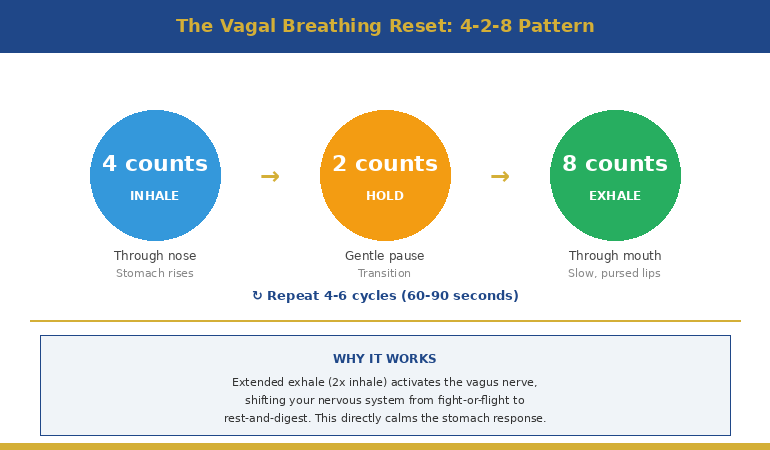
Diagram showing the vagal breathing reset technique with inhale exhale and hold timing for presentation nausea

The pattern is 4-2-8. Inhale 4. Hold 2. Exhale 8. That’s it. No apps, no special equipment, no one needs to know you’re doing it. You can do it standing in a corridor, sitting in a bathroom, or even at the table before a meeting starts.

📋 Nausea isn’t your only symptom, is it?

Calm Under Pressure covers 13 physical symptoms — shaking hands, racing heart, voice tremor, blushing, dry mouth, chest tightness, and 7 more. Each one has a timed, sequenced emergency protocol. Plus anticipatory anxiety systems for the night before, 3am wake-ups, and the morning of. Get the complete toolkit → £19.99

Why This Works When Other Breathing Techniques Don’t

If you’ve tried “deep breathing” before and it didn’t help — or made things worse — you’re not alone. There’s a specific reason standard breathing advice fails for nausea.

Most breathing exercises use equal ratios: breathe in for four, out for four. Or they emphasise the inhale — “take a deep breath.” The problem is that inhalation activates your sympathetic nervous system. When you take a big, deliberate inhale, you’re actually stimulating the fight-or-flight response slightly. For someone who’s already in sympathetic overdrive (which is what’s causing the nausea), emphasising the inhale is like throwing petrol on a fire.

The vagal reset reverses the ratio. By making the exhale twice as long as the inhale, you’re spending more time in parasympathetic activation than sympathetic. Each cycle tips the balance further toward “rest and digest.” After several cycles, you’ve shifted your autonomic state enough that the nausea signal diminishes.

This is also why the 4-7-8 technique works well for some people — it follows the same principle of extended exhalation. The 4-2-8 pattern I teach is a simplified version that’s easier to remember under stress. When you’re nauseous and panicking, you need a pattern you can recall without thinking.

The other critical difference is the hand placement. Putting your hand on your stomach does two things: it ensures you’re breathing diaphragmatically (which maximises vagal stimulation), and it gives your anxious brain something concrete to focus on. Instead of spiralling through “I’m going to be sick, everyone will notice, this is a disaster,” your attention anchors to the physical sensation of your hand moving. It’s a grounding technique disguised as a breathing exercise.

The Emergency Protocol: When You’re Already in the Bathroom

Sometimes the technique above isn’t enough to prevent an episode. Sometimes you’re already in crisis when you remember to try it. Here’s the protocol for when you’re past the prevention stage:

First: Don’t fight it.

If you’re going to be sick, let it happen. Fighting nausea increases tension in your abdomen, which makes everything worse. The physical act itself isn’t the problem — the anxiety about it is what keeps the cycle going.

Second: Cold water on your wrists.

Run cold water over the inside of your wrists for 15–20 seconds. This is a mammalian dive reflex trigger — cold on your pulse points activates your parasympathetic nervous system through a different pathway than breathing. It’s a backup route to the same destination.

Third: Start the 4-2-8 pattern immediately after.

Once the acute moment has passed, begin the vagal reset. Your body is actually more receptive to it after the release — your system is already trying to return to baseline, and the breathing pattern accelerates that process.

Fourth: Give yourself five minutes.

You don’t need to rush into the room. Five minutes of vagal breathing after an episode is enough for your system to stabilise. Your colour will return. The shaking will stop. You’ll walk in looking normal — and nobody will know what happened five minutes earlier.

I’ve used this exact protocol myself. The presentation I mentioned at the start of this article? I used an earlier version of this emergency sequence. I walked into that boardroom six minutes late, apologised for a “phone call that ran over,” and delivered the presentation. It went well. Nobody knew.

⏱️ 20-Minute Reset. 5-Minute Reset. 2-Minute Emergency Reset.

Calm Under Pressure includes three structured pre-presentation warm-up sequences — physical discharge, breathing reset, voice warm-up, mental preparation, and NLP anchor activation — timed to the minute. Plus 7 situation-specific playbooks for board presentations, virtual calls, all-hands, client pitches, job interviews, impromptu requests, and hostile Q&A. Each one adapted to the unique pressure of that context.

Get Calm Under Pressure → £19.99

Instant download. Built by a qualified clinical hypnotherapist and NLP practitioner.

Breaking the Pattern Long-Term

The vagal breathing reset is an intervention — it works in the moment. But if you’re someone who experiences nausea before every significant presentation, you’ll also want to address the pattern itself. Not just managing the symptom, but reducing the trigger.

The nausea pattern gets worse over time because of something called anticipatory conditioning. Your brain learns: presentation → nausea. Once that association is established, the nausea starts earlier and earlier. First it’s the morning of. Then it’s the night before. Eventually, some people feel it days in advance.

Breaking this cycle requires working at the nervous system level — not the cognitive level. Positive self-talk doesn’t reach the part of your brain that’s creating the association. What does work is gradually retraining your nervous system’s threat response through techniques like the fight-or-flight reset from hypnotherapy, systematic desensitisation, and building a pre-presentation routine that consistently signals safety to your nervous system.

The vagal breathing reset can actually become part of this long-term retraining. When you use it consistently before presentations — even presentations where the nausea isn’t severe — you’re building a competing association: presentation → breathing → calm. Over time, the calm pathway gets stronger and the nausea pathway gets weaker.

For a broader approach to calming nerves before presentations, combining the vagal reset with a structured pre-presentation routine produces the most reliable results.

🔍 Ready to reduce symptom intensity over time?

The 14-Day Rewiring Protocol in Calm Under Pressure combines vagal activation exercises with NLP techniques — the Confidence Anchor, Circle of Excellence, and Inner Coach reframe. Most people see a 2–4 point drop on a 10-point symptom scale by Day 14. Get the complete toolkit → £19.99

Why do I feel sick before presentations?

Pre-presentation nausea is caused by your vagus nerve responding to a perceived threat. When your brain registers a high-stakes presentation as dangerous, it activates fight-or-flight mode, which disrupts digestion, increases stomach acid, and contracts abdominal muscles. It’s an autonomic nervous system response — not weakness or poor preparation.

Can breathing exercises stop nausea?

Yes — but only specific patterns. Standard “deep breathing” with equal inhale/exhale ratios can actually make nausea worse by stimulating the sympathetic nervous system. Extended exhale patterns (like the 4-2-8 vagal reset) can help calm the vagus nerve, which influences the stomach response. Many people notice relief within 3–5 cycles.

How do I stop throwing up before a presentation?

Use the emergency protocol: don’t fight the nausea, run cold water on the inside of your wrists for 15–20 seconds (triggers the mammalian dive reflex), then immediately begin the 4-2-8 vagal breathing reset. Give yourself five minutes to stabilise before entering the room. This sequence works because it targets the nervous system through multiple pathways.

🏆 Calm Under Pressure: The Complete Physical Symptom Toolkit

The breathing technique in this article is one protocol. The toolkit has 13 — plus everything you need before, during, and after any presentation.

  • 13 Emergency Protocols: Racing heart, nausea, shaking, voice tremor, sweating, freeze, hyperventilation, blushing, dry mouth, chest tightness, dizziness, crying, talking too fast — each timed and sequenced
  • Anticipatory Anxiety: Night-before protocol, 3am wake-up protocol, morning-of protocol, can’t eat protocol, catastrophizing interrupt
  • Pre-Presentation Resets: 20-minute, 5-minute, and 2-minute emergency versions
  • NLP Toolkit: Confidence Anchor, Circle of Excellence, Inner Coach reframe, 10 cognitive reframe cards, 5-minute self-hypnosis script
  • 14-Day Rewiring Protocol: Daily exercises that reduce symptom intensity over time
  • 7 Situation Playbooks: Board, virtual, all-hands, client pitch, interview, impromptu, hostile Q&A
  • Post-Presentation Recovery: Shame spiral interrupt, 24-hour debrief protocol
  • Quick Reference Card: 13 symptoms, one-page, printable

21 pages. Built by a qualified clinical hypnotherapist who spent 5 years experiencing every symptom on this list.

Get Calm Under Pressure → £19.99

Instant download. Less than one therapy session — and you keep it forever.

📊 Want the slides too? Preparation reduces anxiety. The Executive Slide System (£39) includes confident-presenter templates designed to minimise preparation stress.

Frequently Asked Questions

Is it normal to throw up before a presentation?

It’s more common than most people realise. Severe pre-presentation nausea affects professionals at every level, including senior executives. It’s a physiological response — your vagus nerve reacting to perceived threat — not a sign of weakness or inadequacy. Many of the executives I’ve worked with experienced this for years before learning techniques that helped.

Should I eat before a presentation if I get nauseous?

Eat something small and plain about 90 minutes beforehand — a piece of toast, a banana, or crackers. An empty stomach makes nausea worse because there’s nothing to absorb the excess acid your stress response produces. Avoid caffeine, dairy, and heavy foods. Don’t eat within 30 minutes of presenting.

How long does the vagal breathing reset take to work?

Many people notice the nausea begin to ease by the third cycle (about 45 seconds). By 5–6 cycles (60–90 seconds), the acute wave has often passed. With regular practice, you may find it works faster — your nervous system can learn the “stand down” signal and respond more quickly over time.

What if the breathing technique doesn’t work for me?

If the 4-2-8 pattern doesn’t provide relief, try extending the exhale further (4-2-10) or adding the cold water wrist technique simultaneously. If nausea is persistent and severe despite these interventions, it’s worth exploring the deeper pattern with a professional who understands the nervous system — a clinical hypnotherapist or a therapist trained in somatic approaches. The symptom is treatable.

📬 The Winning Edge Newsletter

Weekly strategies for confident presentations — physical symptom management, slide structures, and executive communication techniques. No filler.

Subscribe Free →

🧠 P.S. Want to address the root cause, not just the symptom? Conquer Speaking Fear (£39) retrains the nervous system pattern that creates the anxiety in the first place.

Related reading: The presentation was perfect — the Q&A lost the deal — once the nausea is managed, preparing for the decision-making moment that follows your slides.

Your next step: The next time you feel nausea building before a presentation, stand up, place your hand on your stomach, and run through the 4-2-8 pattern. Four counts in through your nose. Two counts hold. Eight counts out through pursed lips. Five cycles. Ninety seconds. That’s all it takes to shift from “I can’t do this” to “I’ve got this.” And if nausea isn’t your only symptom — if your hands shake, your voice cracks, your heart races, or you lie awake at 3am — Calm Under Pressure (£19.99) has a timed protocol for all 13 physical symptoms, plus anticipatory anxiety systems, NLP techniques, and a 14-day rewiring protocol.

About the Author

Mary Beth Hazeldine is the Owner & Managing Director of Winning Presentations. With 24 years of corporate banking experience at JPMorgan Chase, PwC, Royal Bank of Scotland, and Commerzbank, she has delivered high-stakes presentations in boardrooms across three continents.

A qualified clinical hypnotherapist and NLP practitioner, Mary Beth combines executive communication expertise with evidence-based techniques for managing presentation anxiety. She spent five years experiencing severe presentation anxiety herself before training in the clinical approaches that resolved it — and now teaches those same techniques to senior professionals.

Book a discovery call | View services

31 Jan 2026
Professional woman in corporate hallway before presentation, contemplative expression showing pre-presentation anxiety

The Presentation Phobia Nobody Talks About: It’s Not the Audience

I vomited in a bathroom stall before presenting to twelve people.

Twelve. Not twelve hundred. Twelve colleagues I’d worked with for years. People who liked me. People who wanted me to succeed.

It didn’t matter. My hands shook so badly I couldn’t hold my notes. My voice cracked on the second sentence. I rushed through 20 minutes of material in 8 minutes, then fled to my desk pretending I had an urgent email.

That was year three of my glossophobia. I had two more years of terror ahead of me before I finally understood what was actually happening—and why everything I’d tried wasn’t working.

Here’s what I discovered: glossophobia isn’t fear of the audience. It’s fear of being exposed.

Quick answer: Glossophobia—the clinical term for fear of public speaking—affects up to 75% of people to some degree. But most advice focuses on the wrong problem: managing symptoms or “connecting with your audience.” The real fear isn’t the audience at all. It’s the terror of being seen as incompetent, unprepared, or fraudulent. Until you address that core fear, breathing exercises and power poses are just putting plasters on a broken bone. This article explains what’s actually driving your presentation anxiety and the approach that finally addresses the root cause.

The Real Fear Behind Glossophobia

After five years of presentation terror—and then training as a clinical hypnotherapist to understand why—I can tell you exactly what glossophobia is and isn’t.

It’s not fear of the audience. Your audience is usually neutral or supportive. They want you to do well. They’re not waiting for you to fail.

It’s not fear of forgetting your words. You can recover from a forgotten point. Everyone forgets things.

It’s not even fear of judgment, exactly. It’s something more primal.

Glossophobia is fear of exposure.

When you stand up to present, you’re making yourself visible in a way that feels dangerous to your nervous system. Every flaw, every hesitation, every moment of uncertainty is on display. There’s nowhere to hide.

For many professionals, this triggers a specific terror: What if they see that I don’t actually know what I’m doing? What if they realise I’m not as competent as they thought?

This is why glossophobia often hits high achievers hardest. The more successful you become, the more you feel you have to lose. The more you feel like an impostor, the more terrifying exposure becomes.

If your presentations are getting rejected for structural reasons rather than delivery issues, my article on why good presentations get rejected addresses that separate problem.

Why Glossophobia Gets Worse With Success

Here’s something that confuses many professionals: their presentation anxiety gets worse as they advance in their careers, not better.

You’d think more experience would mean more confidence. Instead, the opposite often happens. Why?

Three reasons:

1. Higher stakes, higher visibility. When you’re junior, a mediocre presentation is forgettable. When you’re senior, you’re presenting to boards, clients, and stakeholders who will remember. The exposure feels more dangerous because it is—your reputation is more visible.

2. The competence gap widens. Early in your career, no one expects you to be polished. You get credit for trying. As you advance, expectations rise. The gap between “how competent I should appear” and “how competent I feel” grows wider.

3. Accumulated negative experiences. Each awkward presentation, each moment of panic, each time you stumbled over words—your nervous system remembers all of it. These memories compound. By mid-career, you may have dozens of “evidence points” that presenting is dangerous.

This is why glossophobia rarely improves on its own. Without intervention, it typically gets worse. For more on the physical symptoms and how to manage them, see my guide on presentation anxiety before meetings.

The glossophobia cycle diagram showing fear of exposure leading to physical symptoms, confirmation, and avoidance

Why Standard Advice Doesn’t Work

If you’ve struggled with glossophobia, you’ve probably tried the standard advice:

  • “Just breathe deeply”
  • “Picture the audience in their underwear”
  • “Practice more”
  • “Focus on your message, not yourself”
  • “Fake it till you make it”

None of this works for true glossophobia. Here’s why:

Breathing exercises address symptoms, not causes. Yes, deep breathing can temporarily slow your heart rate. But it doesn’t touch the underlying fear that’s triggering the panic response. The moment you step up to present, your nervous system overrides your breathing technique.

“Picture them in underwear” is absurd. Your amygdala—the fear centre of your brain—doesn’t respond to cognitive tricks when it’s in threat mode. You can’t think your way out of a fight-or-flight response.

Practice makes permanent, not perfect. If you practice while anxious, you’re training your brain to associate presenting with anxiety. More practice can actually make glossophobia worse if the practice itself is fear-inducing.

“Fake it till you make it” is exhausting. Pretending to be confident while terrified creates cognitive dissonance that your audience can often sense. It also depletes mental resources you need for actual presenting.

The problem with all this advice is that it treats glossophobia as a thinking problem. It’s not. It’s a nervous system problem.

📌 If nervous-system-level work sounds like what you need:

Conquer Speaking Fear is a structured programme built from clinical hypnotherapy and NLP — designed for senior professionals whose anxiety hasn’t responded to breathing exercises, Toastmasters, or beta blockers.

⭐ Ready to Address the Root Cause?

Conquer Speaking Fear combines clinical hypnotherapy techniques with NLP methods specifically designed for professionals with presentation anxiety. Not breathing exercises. Not positive thinking. Real nervous system reprogramming.

What’s inside:

  • The Exposure Reframe technique (addressing the real fear)
  • Nervous system reset protocols
  • Pre-presentation anchoring methods
  • The Confidence Compound system

Get Conquer Speaking Fear → £39

Developed by a clinical hypnotherapist who overcame severe glossophobia.

The Nervous System Problem

To understand why glossophobia is so resistant to logical solutions, you need to understand what’s happening in your body.

When you perceive a threat—and your nervous system has learned that presenting IS a threat—your amygdala triggers the fight-or-flight response. This happens automatically, before your conscious mind can intervene.

Within milliseconds:

  • Adrenaline floods your system
  • Your heart rate spikes
  • Blood flows away from your brain (making thinking harder) and toward your muscles (preparing you to run)
  • Your vocal cords tighten (causing voice changes)
  • Your hands shake (excess adrenaline with nowhere to go)
  • Your digestive system shuts down (causing nausea)

This is why you can’t think your way out of glossophobia. By the time you’re trying to remember your breathing techniques, the physiological cascade has already started. Your prefrontal cortex—the thinking part of your brain—is being actively suppressed by your fear response.

The solution isn’t to fight this response in the moment. It’s to retrain your nervous system so it stops perceiving presenting as a threat in the first place.

🧠 Want to retrain your nervous system response? Conquer Speaking Fear includes the specific protocols I used to overcome five years of presentation terror.

What Actually Works

After training as a clinical hypnotherapist and working with hundreds of professionals with presentation anxiety, I’ve identified what actually moves the needle on glossophobia:

1. Addressing the Core Fear (Not the Symptoms)

The first step is identifying what you’re actually afraid of. For most professionals, it’s not “the audience” in abstract—it’s a specific fear of exposure:

  • Being seen as incompetent
  • Having your knowledge gaps exposed
  • Losing status or respect
  • Confirming your own impostor feelings

Once you identify your specific fear, you can work with it directly rather than trying to suppress symptoms.

2. Nervous System Reprogramming

Your nervous system learned that presenting is dangerous. It can learn that presenting is safe. This requires creating new associations—pairing the act of presenting with calm, competence, and safety rather than threat.

Techniques that work at the nervous system level include:

  • Anchoring (creating physical triggers for calm states)
  • Gradual exposure with positive associations
  • Hypnotic rehearsal (visualising success while in a deeply relaxed state)
  • Somatic release work (discharging stored fear from past experiences)

3. Building a New Evidence Base

Your nervous system has collected “evidence” that presenting is dangerous. Every past anxiety experience reinforced this belief. To change it, you need to create new evidence—successful presenting experiences that your nervous system registers as safe.

This doesn’t mean forcing yourself through terrifying presentations. It means creating controlled, positive experiences that gradually expand your comfort zone. For techniques on calming nerves before a presentation, see my guide on how to calm nerves before presenting.

⭐ The Nervous System Approach

Conquer Speaking Fear (£39, instant access) teaches you to work WITH your nervous system instead of fighting it — the same clinical techniques that rebuilt my relationship with presenting.

Get Conquer Speaking Fear →

Includes anchoring protocols, rehearsal techniques, and the Exposure Reframe method.

How I Finally Overcame It

For five years, I tried everything. Breathing exercises. Visualisation. Toastmasters. Beta blockers (which helped the symptoms but left me feeling disconnected and flat). Nothing addressed the core terror I felt every time I had to present.

What finally worked was training as a clinical hypnotherapist—not because I wanted to treat others, but because I was desperate to treat myself.

Through that training, I learned something that changed everything: my fear wasn’t irrational. It was a perfectly rational response to what my nervous system believed was a genuine threat.

The problem wasn’t my fear response. The problem was my nervous system’s threat assessment. Once I understood that, I could work on changing the assessment rather than suppressing the response.

Today, I present to executives, boards, and large audiences without the terror that once defined my professional life. Not because I’m braver than I was, but because my nervous system no longer perceives presenting as a threat.

That’s the difference between managing glossophobia and actually overcoming it.

What is glossophobia and what causes it?

Glossophobia is the clinical term for fear of public speaking. It affects up to 75% of people to some degree, making it one of the most common phobias. The cause isn’t the audience itself—it’s fear of exposure and judgment. When you present, you become visible in a way that feels threatening to your nervous system. Past negative experiences, perfectionism, impostor syndrome, and accumulated anxiety all contribute. The fear often worsens with career success because stakes and visibility increase.

Why does glossophobia get worse over time?

Glossophobia typically worsens because of three factors: accumulated negative experiences (your nervous system remembers every anxious presentation), increasing stakes (senior roles mean higher-visibility presenting), and the widening gap between expected competence and felt competence. Each anxious presentation reinforces your nervous system’s belief that presenting is dangerous. Without intervention that addresses the root cause, the fear compounds rather than fades.

Can glossophobia be cured?

Yes, glossophobia can be overcome—but not through willpower, breathing exercises, or “just doing it more.” Effective treatment requires retraining your nervous system’s threat response through techniques like anchoring, gradual exposure with positive associations, and addressing the core fear of exposure. Many professionals find significant improvement through clinical approaches like hypnotherapy and NLP that work at the nervous system level rather than the cognitive level.

⭐ Overcome Glossophobia—For Real

Conquer Speaking Fear is the programme I wish existed during my five years of presentation terror. Clinical techniques, nervous system protocols, and the Exposure Reframe method that finally addresses the root cause.

You’ll learn:

  • Why standard advice fails (and what works instead)
  • The Exposure Reframe technique
  • Pre-presentation anchoring protocols
  • How to build a new evidence base for your nervous system

Get Conquer Speaking Fear → £39

From someone who’s been where you are—and found the way out.

Frequently Asked Questions

Is glossophobia the same as social anxiety?

No, though they can overlap. Social anxiety is a broader condition affecting many social situations. Glossophobia is specifically fear of public speaking or presenting. Many people with glossophobia are perfectly comfortable in other social situations—meetings, conversations, even networking events. They only experience anxiety when they’re “on stage” and the focus is entirely on them. However, if you experience anxiety across many social situations, addressing underlying social anxiety may be necessary alongside glossophobia-specific techniques.

Why do I have glossophobia even though I’m confident otherwise?

This is extremely common. Glossophobia often hits high achievers hardest because they have more to lose (or feel they do). Your confidence in other areas may actually increase your glossophobia—you’ve built a reputation for competence, and presenting feels like a moment where that reputation could be destroyed. The fear isn’t about lacking confidence generally; it’s about the specific vulnerability of being visibly evaluated while performing.

Can medication help with glossophobia?

Beta blockers (like propranolol) can reduce physical symptoms—shaking hands, racing heart, trembling voice. They work by blocking adrenaline’s effects on your body. However, they don’t address the underlying fear, and some people report feeling disconnected or flat when using them. Medication can be a useful bridge while you work on root-cause solutions, but it’s rarely a complete answer on its own. Always consult a doctor before using any medication for anxiety.

How long does it take to overcome glossophobia?

This varies significantly based on severity and approach. Surface-level symptom management can show results in days. Deeper nervous system reprogramming typically takes weeks to months of consistent practice. The key factor is whether you’re addressing symptoms or root causes. Quick fixes that manage symptoms tend to fail under pressure; approaches that retrain your nervous system’s threat response create lasting change. Most professionals who commit to root-cause work see significant improvement within 4-8 weeks.

📧 The Winning Edge Newsletter

Weekly insights on presentation confidence, executive communication, and evidence-based techniques for managing anxiety.

Subscribe Free →

📋 Free: 7 Presentation Frameworks

Structure reduces anxiety. These seven frameworks give you a clear path through any presentation—so you’re not improvising under pressure.

Download Free Frameworks →

About the Author

Mary Beth Hazeldine is the Owner & Managing Director of Winning Presentations. With 25 years of corporate banking experience at JPMorgan Chase, PwC, Royal Bank of Scotland, and Commerzbank, she has delivered high-stakes presentations in boardrooms across three continents.

A qualified clinical hypnotherapist and NLP practitioner, Mary Beth combines executive communication expertise with evidence-based techniques for managing presentation anxiety. She has coached senior professionals and supported high-stakes funding rounds and executive approvals.

Book a discovery call | View services

Your Next Step

If you’ve read this far, you probably recognise the pattern I’ve described. The fear that doesn’t respond to logic. The symptoms that hijack your body before you can stop them. The sense that you should be over this by now.

You’re not broken. Your nervous system learned something that isn’t true—that presenting is dangerous. It can learn something different.

The question isn’t whether glossophobia can be overcome. It can. The question is whether you’ll address the root cause or keep fighting symptoms.

I spent five years fighting symptoms. It didn’t work. Addressing the root cause did.

Related: If your presentation anxiety stems partly from poor structure or feeling unprepared, see my article on why presentations get rejected—sometimes better slides reduce anxiety naturally.

  • Why Glossophobia Gets Worse With Success
  • Why Standard Advice Doesn’t Work
  • The Nervous System Problem
  • What Actually Works
  • How I Finally Overcame It
  • FAQ
  • The Real Fear Behind Glossophobia

    After five years of presentation terror—and then training as a clinical hypnotherapist to understand why—I can tell you exactly what glossophobia is and isn’t.

    It’s not fear of the audience. Your audience is usually neutral or supportive. They want you to do well. They’re not waiting for you to fail.

    It’s not fear of forgetting your words. You can recover from a forgotten point. Everyone forgets things.

    It’s not even fear of judgment, exactly. It’s something more primal.

    Glossophobia is fear of exposure.

    When you stand up to present, you’re making yourself visible in a way that feels dangerous to your nervous system. Every flaw, every hesitation, every moment of uncertainty is on display. There’s nowhere to hide.

    For many professionals, this triggers a specific terror: What if they see that I don’t actually know what I’m doing? What if they realise I’m not as competent as they thought?

    This is why glossophobia often hits high achievers hardest. The more successful you become, the more you feel you have to lose. The more you feel like an impostor, the more terrifying exposure becomes.

    If your presentations are getting rejected for structural reasons rather than delivery issues, my article on why good presentations get rejected addresses that separate problem.

    Why Glossophobia Gets Worse With Success

    Here’s something that confuses many professionals: their presentation anxiety gets worse as they advance in their careers, not better.

    You’d think more experience would mean more confidence. Instead, the opposite often happens. Why?

    Three reasons:

    1. Higher stakes, higher visibility. When you’re junior, a mediocre presentation is forgettable. When you’re senior, you’re presenting to boards, clients, and stakeholders who will remember. The exposure feels more dangerous because it is—your reputation is more visible.

    2. The competence gap widens. Early in your career, no one expects you to be polished. You get credit for trying. As you advance, expectations rise. The gap between “how competent I should appear” and “how competent I feel” grows wider.

    3. Accumulated negative experiences. Each awkward presentation, each moment of panic, each time you stumbled over words—your nervous system remembers all of it. These memories compound. By mid-career, you may have dozens of “evidence points” that presenting is dangerous.

    This is why glossophobia rarely improves on its own. Without intervention, it typically gets worse. For more on the physical symptoms and how to manage them, see my guide on presentation anxiety before meetings.

    The glossophobia cycle diagram showing fear of exposure leading to physical symptoms, confirmation, and avoidance

    Why Standard Advice Doesn’t Work

    If you’ve struggled with glossophobia, you’ve probably tried the standard advice:

    • “Just breathe deeply”
    • “Picture the audience in their underwear”
    • “Practice more”
    • “Focus on your message, not yourself”
    • “Fake it till you make it”

    None of this works for true glossophobia. Here’s why:

    Breathing exercises address symptoms, not causes. Yes, deep breathing can temporarily slow your heart rate. But it doesn’t touch the underlying fear that’s triggering the panic response. The moment you step up to present, your nervous system overrides your breathing technique.

    “Picture them in underwear” is absurd. Your amygdala—the fear centre of your brain—doesn’t respond to cognitive tricks when it’s in threat mode. You can’t think your way out of a fight-or-flight response.

    Practice makes permanent, not perfect. If you practice while anxious, you’re training your brain to associate presenting with anxiety. More practice can actually make glossophobia worse if the practice itself is fear-inducing.

    “Fake it till you make it” is exhausting. Pretending to be confident while terrified creates cognitive dissonance that your audience can often sense. It also depletes mental resources you need for actual presenting.

    The problem with all this advice is that it treats glossophobia as a thinking problem. It’s not. It’s a nervous system problem.

    📌 If nervous-system-level work sounds like what you need:

    Conquer Speaking Fear is a structured programme built from clinical hypnotherapy and NLP — designed for senior professionals whose anxiety hasn’t responded to breathing exercises, Toastmasters, or beta blockers.

    ⭐ Ready to Address the Root Cause?

    Conquer Speaking Fear combines clinical hypnotherapy techniques with NLP methods specifically designed for professionals with presentation anxiety. Not breathing exercises. Not positive thinking. Real nervous system reprogramming.

    What’s inside:

    • The Exposure Reframe technique (addressing the real fear)
    • Nervous system reset protocols
    • Pre-presentation anchoring methods
    • The Confidence Compound system

    Get Conquer Speaking Fear → £39

    Developed by a clinical hypnotherapist who overcame severe glossophobia.

    The Nervous System Problem

    To understand why glossophobia is so resistant to logical solutions, you need to understand what’s happening in your body.

    When you perceive a threat—and your nervous system has learned that presenting IS a threat—your amygdala triggers the fight-or-flight response. This happens automatically, before your conscious mind can intervene.

    Within milliseconds:

    • Adrenaline floods your system
    • Your heart rate spikes
    • Blood flows away from your brain (making thinking harder) and toward your muscles (preparing you to run)
    • Your vocal cords tighten (causing voice changes)
    • Your hands shake (excess adrenaline with nowhere to go)
    • Your digestive system shuts down (causing nausea)

    This is why you can’t think your way out of glossophobia. By the time you’re trying to remember your breathing techniques, the physiological cascade has already started. Your prefrontal cortex—the thinking part of your brain—is being actively suppressed by your fear response.

    The solution isn’t to fight this response in the moment. It’s to retrain your nervous system so it stops perceiving presenting as a threat in the first place.

    🧠 Want to retrain your nervous system response? Conquer Speaking Fear includes the specific protocols I used to overcome five years of presentation terror.

    What Actually Works

    After training as a clinical hypnotherapist and working with hundreds of professionals with presentation anxiety, I’ve identified what actually moves the needle on glossophobia:

    1. Addressing the Core Fear (Not the Symptoms)

    The first step is identifying what you’re actually afraid of. For most professionals, it’s not “the audience” in abstract—it’s a specific fear of exposure:

    • Being seen as incompetent
    • Having your knowledge gaps exposed
    • Losing status or respect
    • Confirming your own impostor feelings

    Once you identify your specific fear, you can work with it directly rather than trying to suppress symptoms.

    2. Nervous System Reprogramming

    Your nervous system learned that presenting is dangerous. It can learn that presenting is safe. This requires creating new associations—pairing the act of presenting with calm, competence, and safety rather than threat.

    Techniques that work at the nervous system level include:

    • Anchoring (creating physical triggers for calm states)
    • Gradual exposure with positive associations
    • Hypnotic rehearsal (visualising success while in a deeply relaxed state)
    • Somatic release work (discharging stored fear from past experiences)

    3. Building a New Evidence Base

    Your nervous system has collected “evidence” that presenting is dangerous. Every past anxiety experience reinforced this belief. To change it, you need to create new evidence—successful presenting experiences that your nervous system registers as safe.

    This doesn’t mean forcing yourself through terrifying presentations. It means creating controlled, positive experiences that gradually expand your comfort zone. For techniques on calming nerves before a presentation, see my guide on how to calm nerves before presenting.

    ⭐ The Nervous System Approach

    Conquer Speaking Fear (£39, instant access) teaches you to work WITH your nervous system instead of fighting it — the same clinical techniques that rebuilt my relationship with presenting.

    Get Conquer Speaking Fear →

    Includes anchoring protocols, rehearsal techniques, and the Exposure Reframe method.

    How I Finally Overcame It

    For five years, I tried everything. Breathing exercises. Visualisation. Toastmasters. Beta blockers (which helped the symptoms but left me feeling disconnected and flat). Nothing addressed the core terror I felt every time I had to present.

    What finally worked was training as a clinical hypnotherapist—not because I wanted to treat others, but because I was desperate to treat myself.

    Through that training, I learned something that changed everything: my fear wasn’t irrational. It was a perfectly rational response to what my nervous system believed was a genuine threat.

    The problem wasn’t my fear response. The problem was my nervous system’s threat assessment. Once I understood that, I could work on changing the assessment rather than suppressing the response.

    Today, I present to executives, boards, and large audiences without the terror that once defined my professional life. Not because I’m braver than I was, but because my nervous system no longer perceives presenting as a threat.

    That’s the difference between managing glossophobia and actually overcoming it.

    What is glossophobia and what causes it?

    Glossophobia is the clinical term for fear of public speaking. It affects up to 75% of people to some degree, making it one of the most common phobias. The cause isn’t the audience itself—it’s fear of exposure and judgment. When you present, you become visible in a way that feels threatening to your nervous system. Past negative experiences, perfectionism, impostor syndrome, and accumulated anxiety all contribute. The fear often worsens with career success because stakes and visibility increase.

    Why does glossophobia get worse over time?

    Glossophobia typically worsens because of three factors: accumulated negative experiences (your nervous system remembers every anxious presentation), increasing stakes (senior roles mean higher-visibility presenting), and the widening gap between expected competence and felt competence. Each anxious presentation reinforces your nervous system’s belief that presenting is dangerous. Without intervention that addresses the root cause, the fear compounds rather than fades.

    Can glossophobia be cured?

    Yes, glossophobia can be overcome—but not through willpower, breathing exercises, or “just doing it more.” Effective treatment requires retraining your nervous system’s threat response through techniques like anchoring, gradual exposure with positive associations, and addressing the core fear of exposure. Many professionals find significant improvement through clinical approaches like hypnotherapy and NLP that work at the nervous system level rather than the cognitive level.

    ⭐ Overcome Glossophobia—For Real

    Conquer Speaking Fear is the programme I wish existed during my five years of presentation terror. Clinical techniques, nervous system protocols, and the Exposure Reframe method that finally addresses the root cause.

    You’ll learn:

    • Why standard advice fails (and what works instead)
    • The Exposure Reframe technique
    • Pre-presentation anchoring protocols
    • How to build a new evidence base for your nervous system

    Get Conquer Speaking Fear → £39

    From someone who’s been where you are—and found the way out.

    Frequently Asked Questions

    Is glossophobia the same as social anxiety?

    No, though they can overlap. Social anxiety is a broader condition affecting many social situations. Glossophobia is specifically fear of public speaking or presenting. Many people with glossophobia are perfectly comfortable in other social situations—meetings, conversations, even networking events. They only experience anxiety when they’re “on stage” and the focus is entirely on them. However, if you experience anxiety across many social situations, addressing underlying social anxiety may be necessary alongside glossophobia-specific techniques.

    Why do I have glossophobia even though I’m confident otherwise?

    This is extremely common. Glossophobia often hits high achievers hardest because they have more to lose (or feel they do). Your confidence in other areas may actually increase your glossophobia—you’ve built a reputation for competence, and presenting feels like a moment where that reputation could be destroyed. The fear isn’t about lacking confidence generally; it’s about the specific vulnerability of being visibly evaluated while performing.

    Can medication help with glossophobia?

    Beta blockers (like propranolol) can reduce physical symptoms—shaking hands, racing heart, trembling voice. They work by blocking adrenaline’s effects on your body. However, they don’t address the underlying fear, and some people report feeling disconnected or flat when using them. Medication can be a useful bridge while you work on root-cause solutions, but it’s rarely a complete answer on its own. Always consult a doctor before using any medication for anxiety.

    How long does it take to overcome glossophobia?

    This varies significantly based on severity and approach. Surface-level symptom management can show results in days. Deeper nervous system reprogramming typically takes weeks to months of consistent practice. The key factor is whether you’re addressing symptoms or root causes. Quick fixes that manage symptoms tend to fail under pressure; approaches that retrain your nervous system’s threat response create lasting change. Most professionals who commit to root-cause work see significant improvement within 4-8 weeks.

    📧 The Winning Edge Newsletter

    Weekly insights on presentation confidence, executive communication, and evidence-based techniques for managing anxiety.

    Subscribe Free →

    📋 Free: 7 Presentation Frameworks

    Structure reduces anxiety. These seven frameworks give you a clear path through any presentation—so you’re not improvising under pressure.

    Download Free Frameworks →

    About the Author

    Mary Beth Hazeldine is the Owner & Managing Director of Winning Presentations. With 25 years of corporate banking experience at JPMorgan Chase, PwC, Royal Bank of Scotland, and Commerzbank, she has delivered high-stakes presentations in boardrooms across three continents.

    A qualified clinical hypnotherapist and NLP practitioner, Mary Beth combines executive communication expertise with evidence-based techniques for managing presentation anxiety. She has coached senior professionals and supported high-stakes funding rounds and executive approvals.

    Book a discovery call | View services

    Your Next Step

    If you’ve read this far, you probably recognise the pattern I’ve described. The fear that doesn’t respond to logic. The symptoms that hijack your body before you can stop them. The sense that you should be over this by now.

    You’re not broken. Your nervous system learned something that isn’t true—that presenting is dangerous. It can learn something different.

    The question isn’t whether glossophobia can be overcome. It can. The question is whether you’ll address the root cause or keep fighting symptoms.

    I spent five years fighting symptoms. It didn’t work. Addressing the root cause did.

    Related: If your presentation anxiety stems partly from poor structure or feeling unprepared, see my article on why presentations get rejected—sometimes better slides reduce anxiety naturally.

    15 Jan 2026
    Professional woman with hand on chest, eyes closed, showing relief and calm after using presentation breathing techniques

    My Heart Was Racing So Fast I Could Hear It. Then I Learned This.

    I was hyperventilating in the corridor outside the boardroom.

    “Just take deep breaths,” my colleague said. So I did. Big, gulping breaths. My heart raced faster. My hands tingled. I felt dizzy. The “calming” advice was making everything worse.

    That was 2003, during my second year at JPMorgan. I had three minutes until I had to present quarterly results to 40 people. And I genuinely thought I might pass out.

    What I didn’t know then—what took me five more years of presentation terror and eventually training as a clinical hypnotherapist to understand—is that “deep breathing” is dangerously incomplete advice. It’s not the depth of your breath that calms your nervous system. It’s the ratio.

    The technique I’m about to share takes 60 seconds. I’ve been teaching it to executives across financial services, healthcare, technology, and government ever since. It works every single time—because it’s based on how your nervous system actually functions, not on wishful thinking.Last updated:

    January 2026 — with the latest Navy SEALs breathing technique..

    If you want a structured approach to managing presentation nerves: Explore Conquer Your Fear of Public Speaking →

    A neuroscience-based programme for professionals who want to present with genuine confidence.

    In This Article

    ⭐ Stop the Physical Symptoms Before They Start

    Calm Under Pressure (£19.99, instant access) gives you the complete nervous system reset toolkit—so you walk into presentations with steady hands, clear voice, and controlled heart rate.

    Includes:

    • The 60-Second Reset Protocol (audio + written)
    • Pre-presentation body scan technique
    • Emergency “in the moment” recovery methods
    • Long-term nervous system training exercises

    Get Calm Under Pressure → £19.99

    Used by executives at JPMorgan, PwC, and RBS. Based on clinical hypnotherapy techniques.

    Why “Just Breathe Deeply” Makes Anxiety Worse

    Here’s what happens when you’re anxious: your breathing becomes shallow and rapid. Your body floods with adrenaline. Your heart pounds. Every instinct screams take a big breath.

    So you do. You gulp air. Big, deep breaths.

    And you feel worse.

    This isn’t a failure of willpower. It’s physiology. When you take rapid deep breaths—even if they feel “deep”—you’re hyperventilating. You’re flooding your system with oxygen and depleting carbon dioxide. This triggers more anxiety symptoms: tingling hands, dizziness, racing heart, tight chest.

    The exact opposite of what you need.

    I spent five years making this mistake before every presentation. Standing in corridors, gulping air, wondering why the “calming technique” everyone recommended was making me feel like I was dying.

    The breakthrough came when I trained as a clinical hypnotherapist and learned about the vagus nerve—the master switch for your nervous system’s calm response. The vagus nerve isn’t activated by deep breaths. It’s activated by slow exhales.

    That’s the key most breathing advice misses entirely.

    The 4-7-8 Technique: Exactly How to Do It

    This technique was developed by Dr. Andrew Weil, based on ancient pranayama breathing. Navy SEALs use a variation called “box breathing.” I’ve adapted it specifically for presentation scenarios over 15 years of teaching executives.

    Here’s the exact protocol:

    Step 1: Empty completely. Exhale through your mouth with a whoosh sound. Push every bit of air out. This is important—you need to start from empty.

    Step 2: Inhale quietly through your nose for 4 counts. Don’t rush. Count “one-one-thousand, two-one-thousand” in your head.

    Step 3: Hold your breath for 7 counts. This feels long at first. That’s normal. Your body is absorbing oxygen properly instead of cycling it too fast.

    Step 4: Exhale completely through your mouth for 8 counts. Make the whoosh sound. This extended exhale is where the magic happens—it directly activates your vagus nerve and forces your heart rate down.

    Repeat for 3-4 cycles. Total time: less than 90 seconds.

    The ratio is 1:1.75:2. The exhale is twice as long as the inhale. This isn’t arbitrary—it’s the ratio that shifts your nervous system from sympathetic (fight-or-flight) to parasympathetic (rest-and-digest).

    For more techniques on managing the mental side of pre-presentation nerves, see my guide on what senior leaders actually do for high-stakes presentation nerves.

    The 4-7-8 breathing technique diagram showing inhale for 4 counts, hold for 7 counts, exhale for 8 counts

    The Science: Why This Ratio Works

    Your autonomic nervous system has two modes:

    Sympathetic: Fight-or-flight. Heart races, breathing quickens, blood flows to muscles. Useful if you’re running from a predator. Terrible if you’re about to present quarterly results.

    Parasympathetic: Rest-and-digest. Heart slows, breathing deepens, mind clears. This is where confident presenting happens.

    The vagus nerve is the switch between these modes. And here’s the critical insight: exhaling stimulates the vagus nerve more than inhaling. That’s why the 4-7-8 ratio works—the exhale is twice as long as the inhale, giving your vagus nerve maximum activation.

    The 7-count hold serves a different purpose. When anxious, you’re cycling air too fast. The hold forces your body to actually absorb the oxygen you’ve taken in, rather than immediately expelling it and gulping more.

    This isn’t meditation. It’s not “mindfulness.” It’s a direct physiological intervention that works whether you believe in it or not.

    If you want the complete nervous system reset toolkit—including audio guides you can use in the moment—Calm Under Pressure gives you everything I’ve learned in 25 years of managing presentation anxiety.

    When to Use It: A Timing Guide

    Timing matters more than most people realise. Here’s exactly when to use the 4-7-8 technique for maximum effect:

    The night before (if you’re already anxious): Do 4 cycles before bed. This isn’t about the presentation—it’s about training your nervous system to respond to the technique. The more you practice in calm moments, the faster it works in crisis moments.

    Morning of the presentation: Do 4 cycles when you wake up, before the anticipatory anxiety has time to build. Another 4 cycles before you leave for work.

    5 minutes before: Find a quiet space. Bathroom, empty office, stairwell, your car. Do 4 complete cycles. This is your primary reset.

    2 minutes before: Do 2 cycles while walking to the room. Nobody will notice—you’re just walking and breathing.

    Seated at the table, waiting to start: Do 1 subtle cycle as others settle in. (See the subtle version below.)

    During Q&A: While someone else asks a question, you have 15-20 seconds. One complete cycle. This is especially useful if you’ve just been asked something difficult and need to compose yourself before answering.

    ⭐ Master Your Physical Response to Pressure

    Breathing is just the start. Calm Under Pressure (£19.99, instant access) covers the complete physical anxiety toolkit: voice control, hand steadiness, posture resets, and the “anchor” technique that stops panic in 10 seconds.

    What’s inside:

    • 5 breathing protocols for different scenarios
    • The “grounding” technique for shaky legs
    • Voice warm-up that prevents trembling
    • Emergency reset for mid-presentation panic

    Get the Complete Toolkit → £19.99

    The Subtle Version for During Presentations

    You can’t do full 4-7-8 breathing while you’re actively presenting. But there’s a subtle version that works without anyone noticing.

    The “Question Pause” technique:

    When someone asks you a question—or when you’re transitioning between slides—pause as if you’re considering your response thoughtfully. During this pause:

    1. Take a slow breath in (2-3 counts, not 4)
    2. Brief hold (1-2 counts)
    3. Slow exhale through your nose (4-5 counts)

    Total time: 8-10 seconds. To observers, you look thoughtful and measured. Inside, you’re resetting your nervous system.

    This is particularly powerful because most anxious presenters rush to fill silences. The pause actually makes you look more confident while giving you the physiological reset you need.

    If your voice tends to shake when presenting, I’ve written a detailed guide on how to stop voice shaking when speaking that pairs well with these breathing techniques.

    What If 4-7-8 Feels Too Long?

    Some people find the 7-count hold uncomfortable, especially when they’re already anxious. That’s fine—there’s a shorter version that still works.

    The 4-4-6 variation:

    • Inhale for 4 counts
    • Hold for 4 counts
    • Exhale for 6 counts

    The key principle remains: exhale longer than you inhale. As long as you maintain that ratio, you’ll activate the vagus nerve response.

    Start with 4-4-6 if you’re new to breathwork. Once it feels natural, progress to 4-7-8 for stronger effect.

    For Video Calls and Virtual Presentations

    Virtual presentations have one advantage: nobody can see you from the waist down. Use this.

    Before your camera turns on, do your full 4-7-8 cycles. During the call, you can do subtle breathing without anyone noticing—especially when your microphone is muted.

    One technique I teach executives: keep your hand resting on your stomach (below camera frame). This lets you feel your breath moving correctly—expanding on inhale, contracting on exhale—while looking completely natural on camera.

    For comprehensive virtual presentation strategies, see my guide on how to calm nerves before a presentation.

    FAQs

    How do you breathe to calm nerves before a presentation?

    Use the 4-7-8 technique: inhale quietly through your nose for 4 counts, hold for 7 counts, exhale completely through your mouth for 8 counts. The extended exhale activates your vagus nerve, which directly slows your heart rate and shifts your nervous system from fight-or-flight to calm. Do 3-4 cycles five minutes before presenting for maximum effect.

    Why does deep breathing sometimes make presentation anxiety worse?

    When anxious, people take rapid deep breaths, which causes hyperventilation—too much oxygen, depleted carbon dioxide. This increases symptoms like tingling, dizziness, and racing heart. The solution isn’t breathing deeply; it’s breathing slowly with an exhale longer than your inhale. That’s why the 4-7-8 ratio works when generic “deep breathing” fails.

    What is the 4-7-8 breathing technique?

    The 4-7-8 technique involves inhaling for 4 counts, holding for 7 counts, and exhaling for 8 counts. Developed by Dr. Andrew Weil based on yogic breathing, the ratio (1:1.75:2) is specifically designed to activate the parasympathetic nervous system. The extended exhale stimulates the vagus nerve, which controls your body’s calm response.

    Can I use breathing techniques during a presentation without anyone noticing?

    Yes. Use the “Question Pause” technique: when asked a question, pause as if considering your response, then take a slow breath in (2-3 counts), brief hold (1-2 counts), and slow exhale through your nose (4-5 counts). Total time: 8-10 seconds. To observers, you look thoughtful and measured. This works especially well during Q&A sections.

    📧 The Winning Edge Newsletter

    Weekly techniques for presenting with confidence. Weekly techniques for executives who present under pressure. Evidence-based, practical, no fluff.

    Subscribe Free →

    📥 Free Download: 7 Presentation Frameworks

    When your structure is solid, anxiety drops. Get the frameworks that give you confidence before you even need breathing exercises.

    Download Free Frameworks →

    Related: High-Stakes Presentation Nerves: What Senior Leaders Actually Do


    Mary Beth Hazeldine spent 25 years in corporate banking at JPMorgan Chase, PwC, Royal Bank of Scotland, and Commerzbank. She’s a qualified clinical hypnotherapist and NLP practitioner, and MD of Winning Presentations. She overcame five years of severe presentation anxiety using the techniques she now teaches.

    05 Jan 2026
    Professional woman in navy blazer standing at podium with eyes closed, taking a calming breath before presentation, golden sunset light through office windows

    I vomited before my first board presentation at JPMorgan Chase.

    Not metaphorically. Literally. In the executive bathroom, fifteen minutes before I was supposed to present quarterly results to senior leadership.

    A colleague walked past afterwards and said, “Just breathe. You’ll be fine.”

    I wanted to scream. I’d been breathing. I’d tried every relaxation technique. Every visualisation. Every piece of advice anyone had ever given me. None of it worked when the moment arrived.

    That was 2003. I spent the next five years terrified of presenting — the kind of terror that started three days before any presentation, woke me at 4am with my heart pounding, and made me consider calling in sick rather than face another room of executives.

    Twenty years later — after becoming a clinical hypnotherapist and treating hundreds of clients with presentation anxiety — I understand exactly why that advice failed. And I’ve developed what actually works.

    Quick Answer: Stage fright before presentations isn’t weakness — it’s your nervous system doing its job. The key isn’t fighting the fear but redirecting it. Standard “just breathe” advice fails because it targets symptoms, not the source. The 60-second protocol works because it interrupts your threat response at the physiological level: extended exhale (8 seconds out, 4 in), grounding anchor (feet-hands-face sequence), then purpose reframe. This activates your parasympathetic nervous system and grounds you in the present — not your racing thoughts about what might go wrong.

    ⚡ Presenting Today? 30-Second Emergency Reset

    No time for the full protocol? Do this right now:

    1. Exhale fully (8 seconds out through pursed lips)
    2. Press feet hard into the floor for 3 seconds
    3. Say silently: “The one thing I want them to understand is ___”

    That’s it. Your nervous system will begin settling within 30 seconds. For the full 60-second protocol and why it works, keep reading.

    If you want a structured approach to managing presentation nerves: Explore Conquer Your Fear of Public Speaking →

    A neuroscience-based programme for professionals who want to present with genuine confidence.

    Why “Just Breathe” Fails When You’re Actually Terrified

    Here’s what happens when someone with genuine stage fright tries to “just breathe” moments before presenting:

    Your amygdala — the brain’s threat detection centre — has already triggered a full sympathetic nervous system response. Adrenaline is flooding your body. Cortisol is spiking. Blood is redirecting from your digestive system to your major muscle groups.

    Telling someone in this state to breathe deeply is like telling someone whose house is on fire to admire the curtains.

    The breath advice isn’t wrong — it’s incomplete. When your nervous system is in genuine fight-or-flight, a few deep breaths won’t override millions of years of evolutionary programming. You need a more comprehensive intervention.

    The Three Reasons Standard Advice Fails

    Reason One: Most advice targets the symptoms, not the source. Your shaking hands aren’t the problem — they’re a downstream effect of your nervous system’s threat response. Address the threat response, and the symptoms resolve themselves.

    Reason Two: Generic techniques don’t account for timing. What works the night before is useless 60 seconds before you present. What works 60 seconds before is different from what works mid-presentation when you’ve lost your train of thought.

    Reason Three: Standard advice treats all fear as the same. But the executive who’s mildly nervous about a board presentation has fundamentally different needs than the person who’s been avoiding presentations for years because of genuine terror.

    For more on managing nerves with specific techniques, see my guide on how to calm nerves before a presentation.

    The Neuroscience Behind Stage Fright (And Why It’s Not Your Fault)

    Your brain can’t distinguish between a sabre-toothed tiger and a room full of executives waiting to judge your quarterly results. Both trigger the same ancient survival response.

    When your brain perceives threat — and being evaluated by others is perceived as threat — your prefrontal cortex (responsible for rational thought, complex reasoning, and remembering your presentation) goes partially offline. Blood flow decreases to this region while increasing to your amygdala and brain stem.

    This is why you can rehearse perfectly at home and blank completely in the moment. It’s not nerves. It’s neuroscience.

    Diagram showing how stage fright affects the brain - prefrontal cortex shutdown and amygdala activation during presentations

    The Polyvagal Perspective

    Dr. Stephen Porges’ Polyvagal Theory explains something I observed for years in my hypnotherapy practice: fight-or-flight isn’t the only fear response. Many presenters experience freeze — a state where you feel paralysed, disconnected from your body, watching yourself from the outside.

    This freeze response is actually a more primitive survival mechanism. It’s what prey animals do when escape seems impossible. And it’s what happens to many executives when they walk into a boardroom and feel overwhelmed.

    Understanding this changed everything about how I approach stage fright. Because the intervention for fight-or-flight is different from the intervention for freeze.

    ⭐ Transform Your Stage Fright Into Stage Presence

    After 5 years of presentation terror and 20+ years helping executives overcome theirs, I’ve distilled everything into a complete system. Conquer Your Fear of Public Speaking combines clear psychological theory, real case studies, and practical techniques — so you understand exactly why fear shows up and how to dismantle it.

    The Complete System Includes:

    • The Psychology of Speaking Fear (why it happens even when you’re prepared)
    • How Fear Gets Conditioned — and how to break the cycle
    • The Calm-First Method with full theory explained
    • Pre-Speaking Reset + In-the-Moment Recovery techniques

    Get the Complete System → £39

    Built from 24 years of corporate banking experience and clinical hypnotherapy practice with hundreds of anxiety clients

    The First 60 Seconds Protocol

    The moment before you present is when fear peaks. These 60 seconds determine whether you’ll start strong or start struggling.

    After treating hundreds of clients and testing countless approaches, I’ve developed a specific protocol for this critical window:

    Seconds 1-20: The Physiological Reset

    Before anything else, you need to interrupt your body’s threat response. The fastest way is through your breath — but not how you’ve been taught.

    The Extended Exhale Technique:

    Inhale normally through your nose for 4 seconds. Then exhale slowly through pursed lips for 8 seconds. The key is the extended exhale — it activates your vagus nerve and signals safety to your nervous system.

    Repeat twice. Total time: approximately 24 seconds.

    Why this works when regular breathing doesn’t: the extended exhale directly stimulates the parasympathetic nervous system. It’s not about relaxation — it’s about physiology.

    Seconds 21-40: The Grounding Anchor

    With your nervous system beginning to settle, you need to ground yourself in the present moment. Racing thoughts about what might go wrong are future-focused. You need to be here.

    The Feet-Hands-Face Sequence:

    Press your feet firmly into the ground and notice the sensation. Squeeze your hands together once, then release. Finally, relax your jaw and unclench your face.

    This sequence interrupts the mental spiral by forcing attention back to your body. It also releases physical tension that would otherwise show in your voice and posture.

    Seconds 41-60: The Mental Reframe

    Now that your body is calmer, you can engage your mind productively. But not with positive affirmations — they often backfire because your brain recognises them as false.

    Instead, use what I call the Purpose Anchor:

    Complete this sentence silently: “In the next 20 minutes, the one thing I want them to understand is…”

    This shifts your focus from self-concern to purpose-concern. You’re no longer thinking about how you’ll perform — you’re thinking about what you want to communicate. This subtle shift reduces self-consciousness dramatically.

    Want the complete 60-second protocol — with variations for different types of fear responses and the neuroscience behind why each step works? Get Conquer Your Fear of Public Speaking → £39

    The Physical Reset: What to Do With Your Body

    Stage fright lives in your body before it lives in your mind. Addressing the physical manifestations isn’t just about looking confident — it’s about changing your internal state.

    The Pre-Presentation Power Pose (But Not What You Think)

    You’ve probably heard about power posing from Amy Cuddy’s TED talk. The research has been debated, but here’s what I’ve observed clinically: the pose matters less than the duration.

    Standing in an expansive posture for two minutes changes your hormonal balance — testosterone increases, cortisol decreases. But the specific pose is less important than opening your body rather than closing it.

    If you’re in a toilet cubicle before presenting (where many of my clients do their prep), simply standing tall with shoulders back and chest open for 90-120 seconds will shift your state.

    The Voice Warm-Up Nobody Talks About

    A shaky voice is one of the most common stage fright symptoms — and one of the hardest to hide. But there’s a simple intervention:

    Hum. Literally hum at a low pitch for 30 seconds before you enter the room. Humming relaxes your vocal cords and activates your vagus nerve simultaneously. Start low and slide up, then back down.

    This is why opera singers and actors warm up before performing. It’s not about technique — it’s about physiology.

    For more techniques on building lasting confidence (not just managing symptoms), see my guide on presentation confidence.

    🧠 Understand Your Fear — Then Dismantle It

    Most resources give you techniques without explaining why they work. That’s why they fail under pressure. Conquer Your Fear of Public Speaking teaches you the psychology behind stage fright — so you can adapt when one technique isn’t enough.

    You’ll Learn:

    • Why your fear gets worse with seniority (and how to reverse it)
    • The difference between fight-or-flight and freeze responses
    • How fear gets conditioned — and the specific steps to break the pattern

    Get the Complete System → £39

    From a clinical hypnotherapist who applies evidence-based clinical techniques to managing presentation anxiety

    If stage fright is more than occasional nerves and is affecting your career, Conquer Your Fear of Public Speaking gives you a structured system to manage exactly this.

    The Mental Reframe: Changing Your Relationship With Fear

    Here’s the counterintuitive truth I’ve learned from treating hundreds of anxious presenters: the goal isn’t to eliminate fear. It’s to change your relationship with it.

    Some of the best presenters I’ve worked with still feel nervous. The difference is how they interpret that nervousness.

    The Excitement Reframe

    Research by Alison Wood Brooks at Harvard Business School found that people who said “I am excited” before a stressful task performed significantly better than those who said “I am calm” or said nothing.

    The physiological states of anxiety and excitement are nearly identical — elevated heart rate, heightened alertness, increased energy. The difference is interpretation.

    When you feel your heart racing before a presentation, try saying to yourself: “I’m excited about this opportunity to share what I know.” Your nervous system doesn’t know the difference. But your performance does.

    The Competence Anchor

    One technique I use extensively in my hypnotherapy practice is anchoring to past competence. Before presenting, briefly recall a time when you handled something difficult well. It doesn’t have to be a presentation — any moment of competence works.

    Spend 30 seconds re-experiencing that moment: what you saw, what you heard, what you felt. This isn’t about confidence — it’s about reminding your nervous system that you’ve handled challenges before.

    Case Study: From Frozen to Fluent in 6 Weeks

    James came to me after a career-threatening incident. A senior director at a pharmaceutical company, he had frozen mid-presentation to the executive committee. Not just lost his place — completely frozen. Unable to speak for what felt like minutes but was probably 30 seconds.

    He’d avoided presentations for three months after that. His career was stalling. His confidence was destroyed.

    “I don’t understand it,” he told me in our first session. “I know my material better than anyone. But when I stand up there, it’s like my brain shuts down.”

    That’s exactly what was happening. His brain was shutting down — specifically, his prefrontal cortex was going offline due to the perceived threat.

    The Six-Week Protocol

    Weeks 1-2: We focused entirely on the physiological response. James practised the extended exhale technique twice daily, regardless of whether he had presentations. He needed to build the neural pathway before he needed to use it.

    Weeks 3-4: We added the grounding sequence and began graduated exposure. He started presenting to one colleague, then two, then five. Each time, he used the First 60 Seconds Protocol before beginning.

    Weeks 5-6: We worked on mental reframing and anchoring. James identified his Purpose Anchor and practised the excitement reframe. He also learned recovery techniques for if he did lose his place mid-presentation.

    The Result

    Six weeks after we started, James presented to the same executive committee that had witnessed his freeze. He used every technique we’d developed.

    “It wasn’t perfect,” he told me afterwards. “My heart was still pounding. But I didn’t freeze. I didn’t lose my place. And by the end, I was actually enjoying myself.”

    That’s the goal. Not eliminating fear — but performing despite it. And then, eventually, transforming it.

    James’s full protocol — including the specific techniques for freeze response versus fight-or-flight — is detailed in Conquer Your Fear of Public Speaking → £39

    What to Do When Stage Fright Strikes Mid-Presentation

    The First 60 Seconds Protocol prepares you for a strong start. But what happens when fear ambushes you during your presentation? When you lose your place, or your mind goes blank, or you feel the freeze response creeping in?

    The Recovery Pause

    First, stop talking. This feels terrifying, but a deliberate pause looks confident, not panicked. Take a breath. Take a sip of water if available.

    Then, use what I call the Grounding Sentence: say something that buys you time while you recover.

    Options include: “Let me make sure I’m being clear here…” or “That’s a critical point, so let me expand on it…” or “Before I continue, let me check — any questions so far?”

    These sentences sound intentional. They give your prefrontal cortex time to come back online. And they shift attention from your internal panic to external engagement.

    The Place Recovery Technique

    If you’ve genuinely lost your place and can’t remember what comes next, don’t pretend. Briefly look at your notes or slides. Say, “Let me just check I cover everything important.” This is what competent presenters do.

    What audiences remember isn’t whether you lost your place — it’s whether you recovered gracefully.

    For more on strong presentation openings that set you up for success (even when nervous), see my guide on public speaking tips that actually work.

    Related: Once you’ve managed your nerves, your opening line determines whether executives engage or check their phones. See Executive Presentation Opening Line That Makes Executives Put Down Their Phones for the specific phrases that command attention.

    Frequently Asked Questions About Stage Fright

    Is stage fright the same as glossophobia?

    Glossophobia is the clinical term for fear of public speaking, and stage fright is a common manifestation of it. However, stage fright often refers specifically to the acute fear response before and during a presentation, while glossophobia may include anticipatory anxiety days or weeks before presenting. The techniques in this article address both the anticipatory and acute components.

    How long does it take to overcome stage fright?

    With consistent practice of the techniques described here, most people notice significant improvement within 4-6 weeks. However, the goal isn’t to eliminate all nervousness — it’s to develop strategies that allow you to present effectively despite the nervousness. Some of the most accomplished presenters I know still feel nervous; they’ve simply learned to work with it rather than against it.

    Should I take beta blockers for stage fright?

    Beta blockers address the physical symptoms of anxiety — racing heart, shaky hands, trembling voice — without affecting mental clarity. They’re commonly used by musicians and surgeons for high-stakes performances. However, they’re treating symptoms rather than causes. I recommend exploring non-pharmaceutical approaches first, and if you’re considering beta blockers, consulting with a medical professional about whether they’re appropriate for your situation.

    Why does stage fright get worse the more senior I become?

    This is extremely common and has a clear explanation: as you become more senior, the stakes feel higher. You’re presenting to peers rather than superiors, which paradoxically can feel more threatening. You’re expected to have mastered public speaking by now, so any sign of nervousness feels like evidence of incompetence. And you may have accumulated more negative presentation experiences over the years. The techniques work regardless of seniority — but you may need more consistent practice to override years of accumulated fear responses.

    What if I’ve tried everything and nothing works?

    If standard anxiety management techniques haven’t worked for you, it may be worth exploring deeper interventions. Clinical hypnotherapy (my background) can address the root causes of presentation anxiety at a subconscious level. Cognitive behavioural therapy (CBT) with a therapist who specialises in performance anxiety is another evidence-based option. Some people benefit from EMDR therapy if their stage fright stems from a specific traumatic presentation experience.

    Can stage fright actually help my presentation?

    Yes — when channelled correctly. The heightened alertness that comes with nervous energy can make you more responsive to your audience, more dynamic in your delivery, and more memorable overall. The goal isn’t to feel nothing; it’s to feel the right amount and interpret it as excitement rather than terror. Many professional performers describe needing some nervousness to give their best performance.

    📬 Get Weekly Presentation Insights

    Join professionals who want practical presentation confidence strategies each week. No fluff — just actionable techniques you can use immediately.

    Subscribe Free →

    The Path Forward: From Surviving to Thriving

    I want to be honest with you about what’s possible.

    If you’ve experienced genuine stage fright — not mild nervousness, but the kind of terror that affects your life — you won’t become a completely relaxed presenter overnight. The neural pathways that create your fear response were built over years. They won’t be dismantled in days.

    But you can develop strategies that work. You can learn to recognise the signs of escalating fear and intervene before it peaks. You can build a toolkit of techniques that are available when you need them most. And gradually, over time, you can transform your relationship with presenting from something you dread to something you might even — dare I say it — enjoy.

    That journey started for me in a JPMorgan boardroom over twenty years ago. It took me years to figure out what actually works. I’ve condensed that learning into the techniques I’ve shared here and the comprehensive system in Conquer Speaking Fear.

    Wherever you are on that journey, know this: stage fright isn’t a character flaw. It’s not evidence that you’re not cut out for presenting. It’s simply your nervous system doing what it evolved to do. And with the right tools, you can work with it rather than against it.

    Your next step: Before your next presentation, practice the 60-second protocol three times — not when you’re about to present, but in low-stakes moments. Build the neural pathway before you need it. Then, when the real moment arrives, your body will know what to do.

    🎁 Free Download: 7 Presentation Frameworks

    Not sure how to structure your presentation once you’ve managed your nerves? These 7 structured frameworks — from the Pyramid Principle to the Problem-Solution-Benefit structure — give you instant clarity on how to organise any message. No email required.

    Download Free →


    About the Author

    Mary Beth Hazeldine is a qualified clinical hypnotherapist, NLP practitioner, and Managing Director of Winning Presentations. After 5 years terrified of presenting, she built a 24-year banking career at JPMorgan Chase, PwC, RBS, and Commerzbank. She has She advises executives across financial services, healthcare, technology, and government on structuring presentations and managing presentation anxiety.